
Article

The Operational Conditions of Marine Ecological Territory Management Instruments in the Mexican Coastal Zone

by
Yessil Varinka Saenz-Aguilar
1,* and
María Teresa Sánchez-Salazar
2
1
Universidad Tecnológica del Mar de Tamaulipas Bicentenario (UTMART), Poblado La Pesca, Soto la Marina 87678, Tamaulipas, Mexico
2
Instituto de Geografía (IGG), Universidad Nacional Autónoma de México (UNAM), Mexico City 04510, Mexico
*
Author to whom correspondence should be addressed.
Coasts 2026, 6(2), 23; https://doi.org/10.3390/coasts6020023
Submission received: 12 February 2026 / Revised: 17 March 2026 / Accepted: 4 May 2026 / Published: 3 June 2026

Abstract

Marine spatial planning instruments often exhibit a gap between regulatory design and on-the-ground effectiveness. This study examines this gap in Mexico’s marine Ecological Territory Management Programs (POETs) within the Mexican Coastal Zone (MCZ) using a novel operational analysis methodology grounded in the logic of necessary determinants 32. We propose an operability conceptualization defined as the latent functionality of a policy instrument, only realized when specific contextual prerequisites are present, shifting analytical focus from policy design to preconditions for effective functioning. Derived from doctoral research reviewing over 300 sources on Mexican ecological planning and coastal management, we identify 47 necessary determinants organized by level of government (municipal, state, federal), validated through a documentary sample of 22 sources. The MCZ encompasses 264 municipalities (154 with coastline and 110 influenced), 24,945 km of coastline (1:50,000 scale), and 10,570 km2 of continental shelf. Marine POETs operate within a complex public management system comprising over 500 legal instruments and approximately 300 public operators safeguarding the environmental rights of 25.6 million coastal inhabitants. Despite this, persistent environmental degradation and unresolved land-use conflicts point to a systemic operability deficit. We provide a transferable analytical framework for diagnosing policy implementation failures in complex coastal governance systems.

1. Introduction

1.1. The Coastal Governance Challenge and the Role of Spatial Planning

Coasts are intricate socio-ecological systems whose particularly complex structures and dynamics often make it difficult for environmental management instruments to function, reducing their effectiveness in accomplishing environmental management objectives. This challenge is a central concern in the global discourse on Integrated Coastal Zone Management (ICZM), which seeks to harmonize human activities with the preservation of coastal ecosystems [1,2]. For this reason, we analyze the influence of three territorial dimensions of the Mexican Coastal Zone (MCZ) on the operation of spatial planning instruments within its marine category.
Coastal management often challenges the achievement of an adequate design and application of environmental policy and its instruments that, based on results, demonstrate their effectiveness as a binding tool between the development of an environmental policy, the decision-making process, and its implementation. Based on the Mexican legal framework, this implies demonstrating that its environmental policy instruments guarantee the right to a healthy environment and promote distributive justice, the latter understood as the delivery, through different titles, of the domain of the national assets to individuals, for the common good, the good of all and the development of the community [3].

1.2. Ecological Territory Management in Mexico: A Policy Instrument for Spatial Planning

In the Mexican public environmental management model, Ecological Territory Management (ETM) is a policy instrument designed to regulate and guide land use and productive activities, as established in the General Law on Ecological Balance and Environmental Protection (LGEEPA) [4]—a key legal pillar second only to the Mexican Constitution [5]. Conceptually compatible with UNESCO’s Marine Spatial Planning (MSP) framework [6], ETM performs regulatory and spatial zoning functions analogous to legally binding instruments such as California’s General Plan Guidelines under the Coastal Act [7] and Spain’s Maritime Spatial Planning Plans [8]. To fulfill its purpose, implementing operators must orient the spatial distribution of productive activities according to ecological criteria derived from diagnosing environmental degradation trends and resource availability. Consequently, ETM functions as a core tool for territorial regulation and planning within the Mexican public environmental management system [1,4,9,10].

1.3. The Implementation Gap: Persistent Challenges in Mexican Coastal Zones

This policy instrument materializes through decreed documents known as Ecological Territory Management Programs (POET, from the Spanish acronym), which establish binding ecological guidelines and zoning criteria intended to govern the placement of land use and to prevent environmental conflicts and risk scenarios in a specific part of the Mexican territory [10,11,12,13]. The marine category of POET is specifically designed to apply to maritime-terrestrial zones and adjacent marine regions [4,14,15], making it the primary spatial planning instrument for Mexico’s coastal and marine public domain.
By 2017, Mexico had established two marine POETs: the Gulf of California, created in 2006 [16], and the Gulf of Mexico and Caribbean Sea, established in 2012 [17]. In 2018, the North Pacific Marine POET was enacted [18]. Later that same year, Mexico issued the National Policy on Seas and Coasts [19]. However, six years after this last policy milestone, significant environmental degradation and risk scenarios persist in coastal zones under POET governance [20,21,22,23]. This enduring implementation gap reveals a disconnect between the instrument’s formal regulatory design and its on-the-ground effectiveness, often due to fragmented sectoral projects that operate contrary to established ecological planning policies [24,25,26,27,28].

1.4. Analytical Framework: A Political Ecology Approach to Operational Analysis

Therefore, analyzing POET operability requires frameworks that move beyond normative approaches to systematically examine the complex socio-ecological system in which these instruments are embedded. This study adopts a political ecology perspective [14,29], which scrutinizes how power dynamics, institutional arrangements, and conflicting interests shape environmental governance outcomes [14,30]. This lens is crucial for shifting the focus from the instrument’s design to its operational context within a public management system that functions under specific, often adverse, territorial conditions.

1.5. Research Question, Methodology, and Article Structure

Consequently, this study addresses the following research question: What are the key operational conditions derived from the territorial dimensions of the MCZ that enable or constrain the functionality of marine POETs, and what are their implications for coastal governance? To answer this, we develop and apply a novel operational analysis methodology (detailed in Section 2). This methodology allows us to dissect the MCZ’s biophysical, legal-administrative, and socioeconomic dimensions and examine how they interact within a logical framework to enable or inhibit the POET’s core functions.
We live in an interconnected world where seas and coasts are natural resources whose materials, energy, and information transcend political boundaries. As a result, decisions regarding the use of marine waters and coastal areas impact not only one nation but can also lead to humanitarian issues. Countries must collaborate to uphold environmental health and social well-being beyond their borders while respecting their sovereignty [31]. Although this work primarily focuses on a national case, its insights are designed to offer transferable insights beyond Mexico’s borders, particularly for nations facing similar challenges of implementing spatial planning instruments in extensive and complex coastal territories.

2. Materials and Methods

2.1. Research Approach and Conceptual Framework

This study employs a novel operational analysis methodology (developed in Section 2.2) grounded in qualitative documentary research. It is designed to identify the necessary but non-sufficient conditions [32] that determine the functionality (operability) of policy instruments within complex socio-ecological systems. The empirical focus is the marine category of Ecological Territory Management Programs (POETs) in the Mexican Coastal Zone (MCZ), analyzed from the enactment of the first marine POET published on 2006 to the latest national population census published on 2020.
The research is guided by a conceptual framework that integrates and operationalizes two complementary perspectives to diagnose these necessary conditions: 1. Political Ecology [33], which provides the critical lens to scrutinize the political, institutional, and socio-economic factors (e.g., power dynamics, conflicting interests) that constitute necessary conditions for an instrument’s implementation or pose barriers to it; 2. Integrated Coastal Zone Management (ICZM) [2] supplies the normative and procedural principles for assessing the technical, spatial, and planning-related prerequisites necessary for the instrument’s intended governance functions.
By applying Dul’s (2015) [32] logic of necessary conditions analysis through this synthesized lens, the study shifts the focus from a mere evaluation of the instrument’s design to a systemic diagnosis of the fundamental prerequisites that must be in place for it to become operational within a specific territorial and socio-political context.

2.2. Operational Analysis Methodology

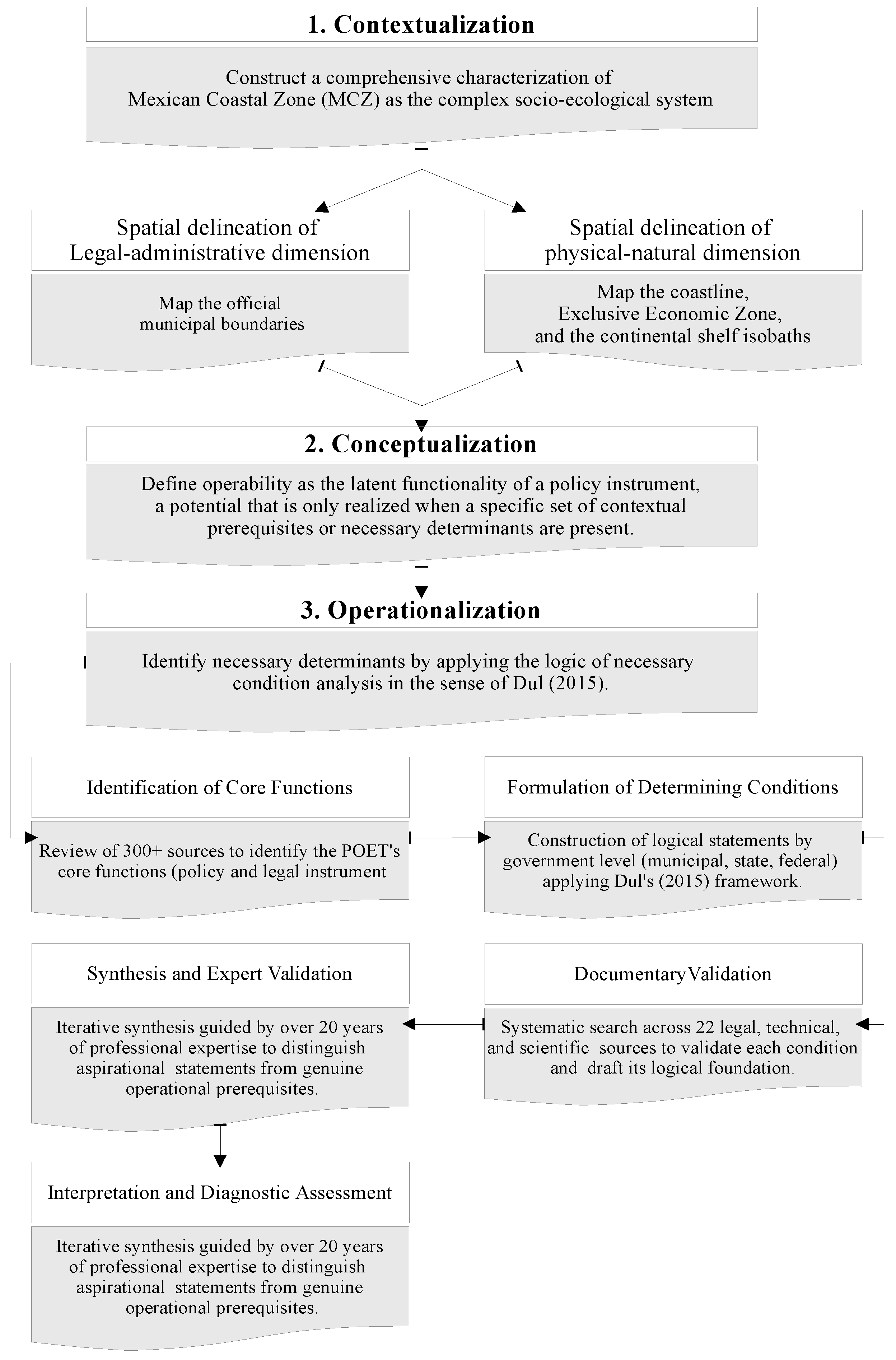
To systematically diagnose the necessary operational conditions of marine Ecological Territory Management Programs (POETs), a novel four-stage operational analysis methodology was developed and applied (Figure 1). This structured process is designed to transition from a holistic description of the system under study to the identification of the fundamental prerequisites required for the instrument’s functionality.
The first stage, contextualization, established the empirical and spatial bounds of the analysis by constructing a comprehensive characterization of the Mexican Coastal Zone (MCZ) as the complex socio-ecological system in question. This involved creating an original spatial delineation through the synthesis of two foundational dimensions. The physical-natural dimension was mapped from data on the coastline, the Exclusive Economic Zone, and the continental shelf isobaths, obtained from the National Commission for the Knowledge and Use of Biodiversity (CONABIO) [34]. Concurrently, the legal-administrative dimension was defined using official municipal boundaries from the National Institute of Statistics and Geography (INEGI) and the published list of coastal municipalities, in accordance with the delimitation established in the National Policy on Seas and Coasts of Mexico (PNMyCM) [19]. This cartographic synthesis served as the essential spatial framework for all subsequent analysis.
Building upon this spatial context, the Conceptualization stage operationalized the integrated conceptual framework—political ecology and Integrated Coastal Zone Management (ICZM). We conceptualize operability by defining it as the latent functionality of a policy instrument, a potential that is only realized when a specific set of contextual prerequisites or necessary determinants is present. This framework provided the specific analytical lenses required to observe the system, distinguish its core components such as institutions, actor networks, and biophysical units, and identify recurring system archetypes and potential operational dimensions within the coastal governance structure.
The core diagnostic work was carried out in the Operationalization phase. Here, the logic of necessary condition analysis [32] was applied through a systematic content analysis of the documented sources, starting with the construction of the 47-condition checklist for the operability of marine Ecological Territory Management Programs (POETs).
The starting point was derived from the linked doctoral research, which involved an exhaustive review of over 300 bibliographic references specialized in ecological planning and coastal management in Mexico. Through that review we were able to identify the core functions that a POET must fulfill and classified them into two main categories: policy functions and legal instrument and medium functions, synthesized in two categories: (a) inducing, monitoring, and controlling the actions of individuals and groups in relation to land use and (b) preventing, remedying, nullifying, and sanctioning violations of constitutional provisions on environmental matters.
The second step was the formulation of logical statements as determining conditions. Drawing on the analytical framework of necessary conditions proposed by Dul (2015) [32], each identified function was reinterpreted to construct logical statements. These statements describe, by level of Mexican government (municipal, state, and federal), contextual requirements for the instrument to activate that function. It is important to specify that these statements do not aim to establish necessary conditions in a deterministic sense. Rather, they function as determinants of necessity: critical factors whose absence or deficiency has the potential to render the POET inoperative by impeding or severely limiting the fulfillment of its essential functions. In this sense, these are conditions whose non-fulfillment creates a risk of systemic failure, although not necessarily in an immediate or automatic manner.
The third step was the documentary validation of the conditions. Each logical statement was subjected to a rigorous validation process. Based on the doctoral research bibliographic references, a systematic search was conducted within the Mexican legal framework (laws, regulations), technical manuals, specialized reports, and other documentary sources related to the execution of ecological planning instruments. The objective was to locate textual passages, data, or references that supported the existence and necessity of each condition. The corpus of final documentary evidence involves 22 items. Once validated, each condition was used to draft a logical foundation justifying why the absence of a given condition can compromise the operability of the POET, affecting its capacity to fulfill the functions for which it was designed. The extended analysis is provided in the Supplementary Materials.
The iterative synthesis of extracted text segments into the final set of 47 necessary conditions was guided by the authors’ collective expertise, accumulated over more than two decades of professional practice in coastal environmental management. This expertise—developed through roles as municipal technical officials, independent consultants, and academic researchers—served as an interpretative lens to distinguish between merely aspirational statements and genuine operational prerequisites. It also enabled the triangulation of documentary evidence with tacit knowledge of institutional routines, permitting procedures, and recurrent implementation failures.
Finally, the Interpretation stage involved analyzing the interaction and combined effect of the identified necessary conditions. This synthesis enabled a diagnostic assessment of the overall operability of marine POETs within the MCZ, explaining how the presence, partial presence, or absence of these specific conditions enables or constrains the instrument’s functionality, thereby offering an explanation for the observed implementation gaps. As a result of this process, each of the 47 identified conditions was defined using the following fields, ensuring the traceability and transparency of the analysis:
  • ID: Unique identifier for the condition.
  • Condition (English): Clear statement of the determining condition.
  • Source (s): Documentary source (s) supporting the condition.
  • Contextual Citation (Spanish): Textual quote or contextual reference in Spanish that provides evidence for the condition.
  • Contextual Citation (English): English translation of the contextual citation.
  • Logical Foundation: A logical explanation of why the condition is a determinant for POET operability and how its absence can affect its functions.
An example of this format for the first condition in the list (CON-1) is presented in Table 1.

2.3. Data Sources and Analysis

The operational analysis methodology was applied using a wide range of documentary sources, which were systematically compiled and examined. Primary sources included the complete Mexican legal framework governing ecological planning, specifically the Political Constitution of the United Mexican States, the General Law on Ecological Balance and Environmental Protection (LGEEPA) [4] and its subsidiary regulations, as well as the full texts of the three decreed marine POETs: Gulf of California, 2006; Gulf of Mexico and Caribbean Sea, 2012; North Pacific, 2018. Secondary sources encompassed official government databases, including the 2020 Population and Housing Census from the National Institute of Statistics and Geography (INEGI), public registries and institutional directories from the Ministry of Environment and Natural Resources (SEMARNAT) and other federal agencies with coastal competencies (PROFEPA, CONAGUA, SECTUR, SENER, ASEA, SEMAR), and the technical delimitation of the Mexican Coastal Zone as per the National Policy on Seas and Coasts (PNMyCM, 2018) [19]. Scholarly literature on Integrated Coastal Zone Management (ICZM), political ecology, and environmental governance in Latin America provided the necessary theoretical and comparative context.
To provide empirical grounding for the scale and complexity of the public management system in which marine POETs operate, three quantitative estimates were developed from the compiled documentary corpus.
First, the estimate of over 500 binding legal instruments [35] was derived from a systematic review of the federal and concurrent legal framework for environmental management and territorial regulation. This review encompassed: the LGEEPA [4] and its regulations; official Mexican standards officially called Normas Oficiales Mexicanas (NOMs) related to coastal, marine, and land-use issues; the organic statutes and internal regulations of the aforementioned federal agencies; and the general laws on human settlements, national assets, waters, and fisheries. The resulting count includes laws, regulations, decrees, agreements, and technical standards that establish concurrent responsibilities, permitting procedures, inspection faculties, or sanctioning mechanisms applicable to the coastal zone. This exercise is conservative, as it excludes state-level legislation and municipal regulatory frameworks, which would substantially increase the total number of applicable instruments.
Second, the estimation of at least 300 public operators at the municipal and state levels was constructed through a conservative, structurally grounded approximation. The analysis assumed that each of the 264 coastal municipalities that comprise the MCZ [19,36] has at least one administrative unit formally entrusted with land-use authorization, environmental oversight, or both. This assumption is supported by the municipal attributions established in Article 115 of the Constitution and the General Law on Human Settlements [5,37]. Similarly, it was assumed that each of the 32 federal entities has at least one state-level agency or decentralized representation of the federal government with concurrent faculties in coastal management and territorial regulation. This baseline of 264 municipal units and 32 state/federal representations yields a conservative estimate of approximately 300 public operators whose daily functions directly involve, or should involve, the interpretation, application, or enforcement of marine POET provisions. This estimate does not account for multiple officials within the same unit, federal inspectors, or sectoral agency personnel; therefore, the actual number of operators whose decisions intersect with the POET’s regulatory scope is likely to be considerably higher.
Third, the coastal population (25,676,661 inhabitants) was obtained from the 2020 Population and Housing Census (INEGI), aggregating the total population of the 154 coastal municipalities with coastline, which constitute the front continental portion of the Mexican Coastal Zone. This demographic baseline provides an approximate measure of the population whose constitutional right to a healthy environment is intended to be safeguarded through the effective operation of marine POETs.
All three estimates should be interpreted as indicative of the system’s scale and complexity, rather than as precise or exhaustive counts. Their primary function is to provide empirical grounding for the subsequent identification of necessary operational conditions.
Data analysis followed a two-pronged approach. For the Contextualization stage, QGIS 3.44 Solothurn software was employed for spatial data processing. A critical step involved cleaning and standardizing the municipal boundary vector files, as some entries were duplicated or contained digitization errors. Population data for each municipality were captured exclusively from the 2020 Census. Following the official administrative status at the 2020 cutoff, the municipality of San Quintín in Baja California was excluded from the analysis, as it was not yet fully formalized. This rigorous process resulted in the definitive cartographic delineation of the MCZ used in this study. For the core Operationalization phase, a qualitative content analysis was conducted on the compiled documents. This involved a systematic process of identifying, extracting, and coding text segments that evidenced potential operational conditions, followed by their synthesis into the final set of 47 necessary conditions. The complete mapping of each condition to its foundational textual evidence is archived in Supplementary Materials.

3. Results

3.1. Documented Evidence of the Implementation Gap

Empirical evidence indicates that marine POETs have not achieved their intended impact on public policy or private-sector decision-making within the MCZ. Even in areas formally governed by these instruments, new environmental conflicts and risk scenarios persist and continue to emerge. These are driven by unsustainable land-use and occupation patterns, which exacerbate environmental vulnerabilities among coastal populations and compromise their right to a healthy environment and distributive justice [9,24,35]. This persistent disconnect between formal planning and on-the-ground outcomes underscores a fundamental operability deficit. In the following sections, we analyze this deficit not as a mere technical failure, but as a consequence of unmet necessary operational conditions embedded within the biophysical, legal-administrative, and socioeconomic dimensions of the coastal context.

3.2. The Mexican Coastal Zone as an Operational Context

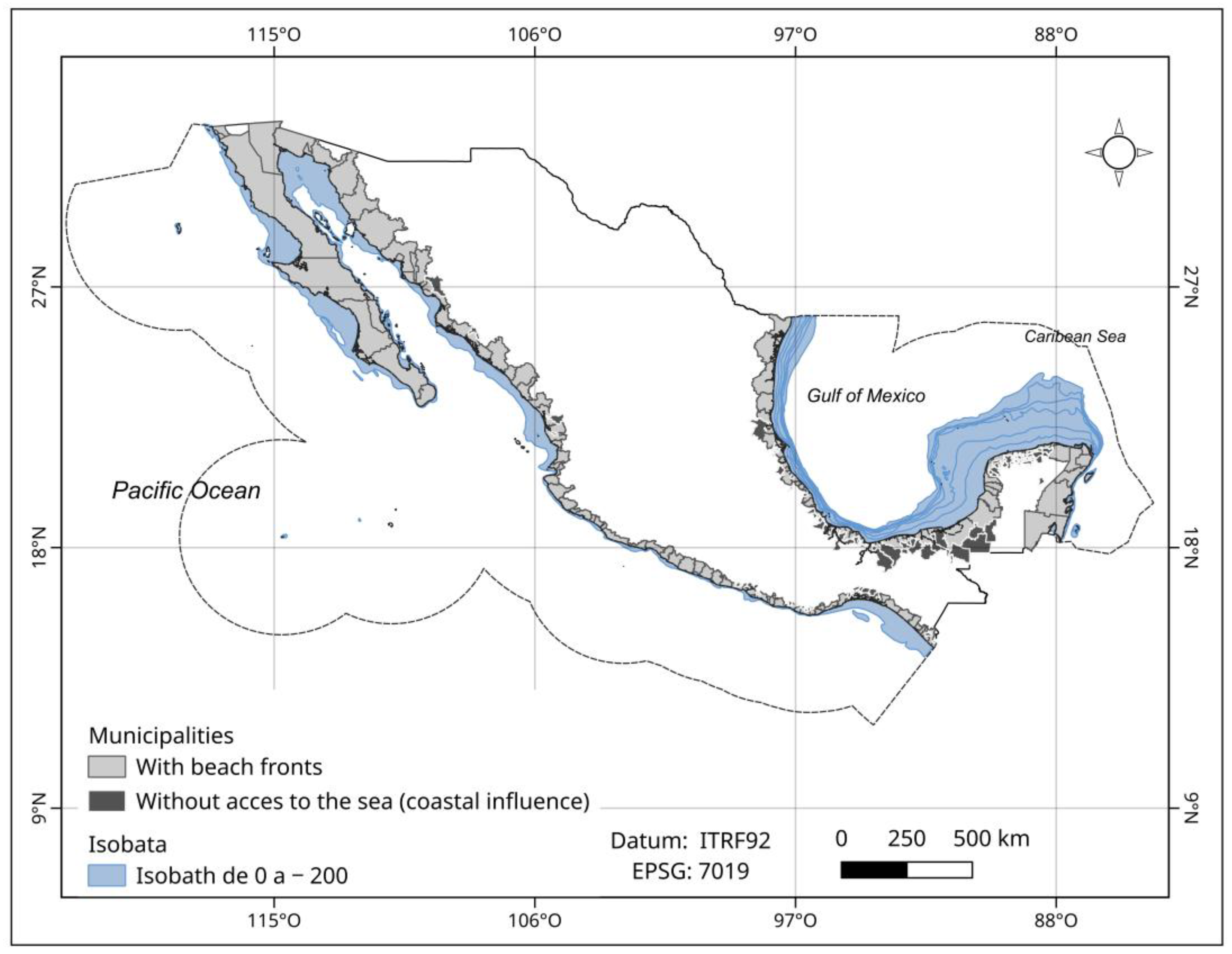
The Mexican Coastal Zone (MCZ), formally established by the 2018 National Policy on Seas and Coasts, constitutes the primary territorial context for this analysis. It is defined as a space of intense land–sea–atmosphere interaction, comprising three integrated components: (a) a continental portion made up of 264 coastal municipalities—154 with beach fronts and 110 without direct sea access but with high to medium coastal influence (e.g., coastal vegetation ecosystems); (b) a marine portion encompassing the continental shelf, bounded by the 200 m isobath; and (c) an insular portion including all national islands. The width of the MCZ is highly variable, extending from less than two kilometers in parts of Baja California Sur or Oaxaca to over 270 km off the Yucatán Peninsula (Figure 2). This spatially complex and heterogeneous region establishes the very scenario in which the necessary operational conditions for marine POETs must be evaluated.
Data from the Digital Environmental Atlas of Mexico [38] indicate that marine Ecological Territory Management Programs (POETs) regulate 62.4% of Mexico’s marine territory, encompassing seven distinct ecoregions. The Gulf of California POET (established in 2006) governs the Gulf of California ecoregion. The Gulf of Mexico and Caribbean Sea POET (2012) applies to the Northern Gulf of Mexico, Southern Gulf of Mexico, and Caribbean Sea ecoregions. The North Pacific POET (2018) covers the Southern Californian Pacific and Monterey Transitional Pacific ecoregions. Collectively, these instruments oversee a vast area of 1,969,677.28 km2 (see Table 2). A critical finding of our analysis is the significant variation in terrestrial coverage among these programs. Only the Gulf of Mexico and Caribbean Sea POET comprehensively encompasses the continental portion of the MCZ by including all coastal municipalities within its scope. In contrast, the North Pacific POET covers merely a 20 km inland strip from the coastline, while the Gulf of California POET does not include any terrestrial areas of the MCZ. This disparity creates a fragmented governance framework for integrated coastal management.
According to the 2020 Population and Housing Census [39], the 154 coastal municipalities with coastline are home to 25,676,661 inhabitants—20.4% of the national population (Table 3). This coastal population is larger than that of the Valley of Mexico Metropolitan Area (21.8 million) and is distributed extremely unevenly: municipal populations range from 938 inhabitants in San José Estancia, Oaxaca, to 1,922,523 in Tijuana, Baja California (mean = 96,529; SD = 203,843). Such heterogeneity implies that the operational demands placed on municipal POET administrators vary by orders of magnitude, yet the legal and administrative framework applies uniformly.
The maritime component of the MCZ is equally vast. Mexico’s Exclusive Economic Zone covers 3,149,920 km2, and the continental shelf within the 200 m isobath adds approximately 10,570 km2 of the continental platform’s shallow, biologically productive waters [38,40]. The aquatic portion of the national territory thus accounts for 61.6% of its total surface area [41]. Characterizing and diagnosing such an extensive, largely inaccessible territory poses profound operational challenges that are reflected in conditions related to information access.
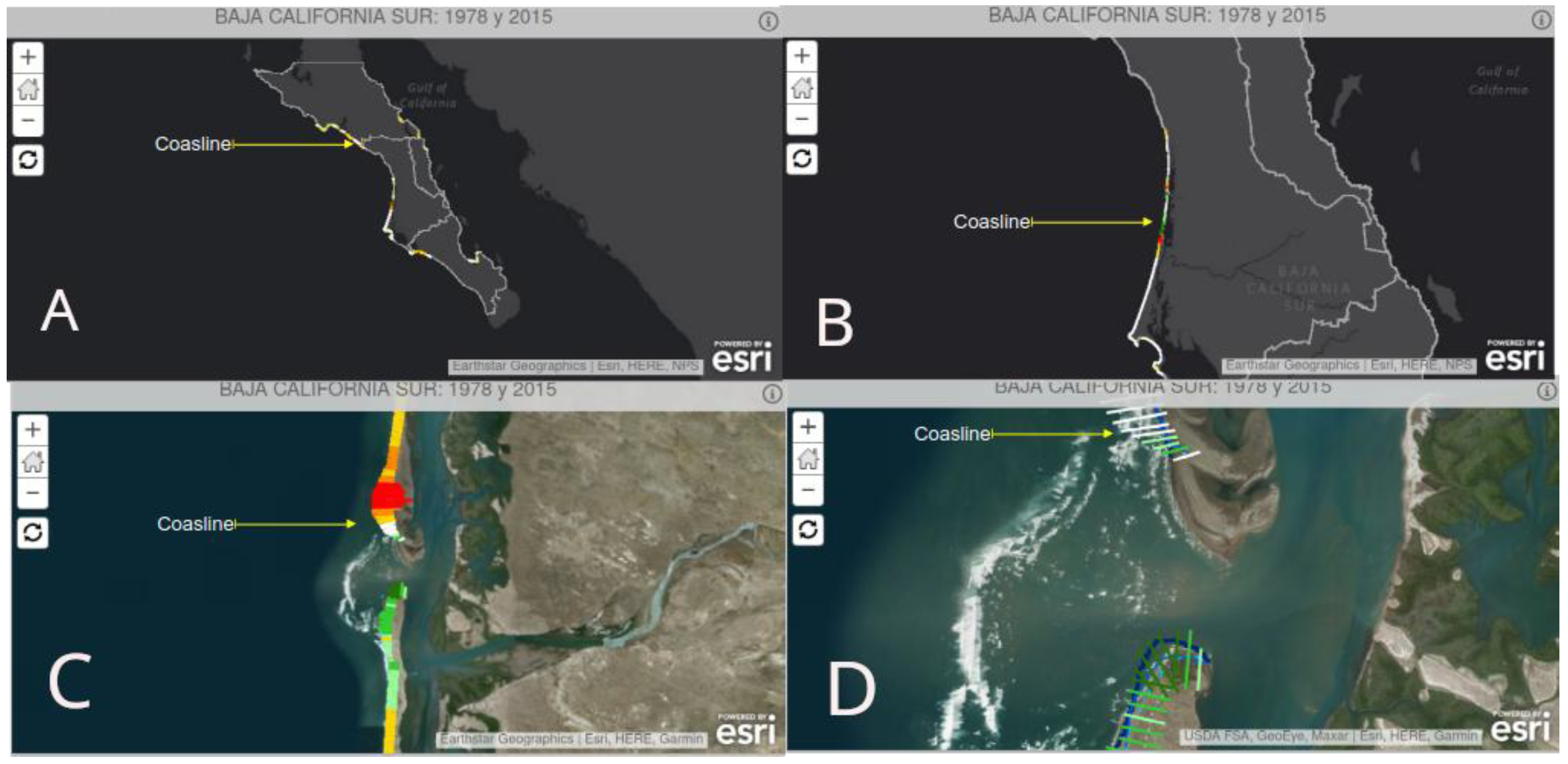
One of the most basic operational challenges is the measurement of the coastline itself. As shown in Table 4, official estimates of Mexico’s coastline length vary by a factor of 2.7, depending on the cartographic scale and methodology employed. The figure of 11,122 km, derived from INEGI’s 1:250,000 topographic charts, is the most frequently cited, but it omits features visible at larger scales—deltas, barrier islands, lagoons—that are critical for local land-use decisions. The most detailed estimate, 24,945 km, comes from 1:50,000 scale mapping by Ortiz-Pérez y De la Lanza-Espino (2006) [42] and is adopted in this study because it corresponds more closely to the scale at which municipal land-use permits and POET ecological criteria are actually applied. The sensitivity of coastline length to scale (Figure 3) illustrates a more general problem: the choice of cartographic resolution directly affects the delineation of Environmental Management Units (UGAs) and, consequently, the applicability of the ecological guidelines assigned to them. Using scales that are too small obscures ecologically relevant features; using scales that are too large fragments the territory into units that are impractical for management [18,19]. This methodological dilemma is rarely made explicit in POET decrees.

3.3. Operability as a System of Necessary Conditions

This study conceptualizes operability as the latent functionality of a policy instrument, a set of inherent characteristics that enable its activation and execution. This functionality remains potential until a specific series of contextual prerequisites within the implementation system are satisfied. The analysis is grounded in the logical framework of necessary but non-sufficient conditions [32]. This framework posits that for an instrument like a marine POET to become operational and effective, a defined set of conditions (X) must be present; however, their presence alone does not guarantee the desired outcome (Y). Consequently, evaluating operability requires a shift in focus: from a primary assessment of the instrument’s design or its long-term outcomes to a diagnostic examination of the implementation context. The core question becomes whether the necessary conditions for functionality are present within the biophysical, socio-economic, and legal-administrative environment where the instrument is applied.
This precondition-focused approach is particularly critical for evaluating abstract spatial planning instruments like marine POETs. Assessing their effectiveness based solely on final outcomes presents significant methodological and ethical challenges. First, their regulatory mechanisms are often intangible, and their intended results—such as sustainable territorial occupation, improved environmental health, or distributive justice—may take years or even decades to materialize, making a retrospective comparison with idealized models exceptionally difficult [44,45]. Second, a purely outcome-based evaluation could, in practice, necessitate observing the instrument’s failure, such as waiting for an environmental conflict or disaster to occur to judge its inadequacy. From a humanitarian and preventive governance perspective, this is unacceptable. Therefore, a prospective or “preoperative” analysis of operability is not merely methodologically convenient but an ethical and practical imperative. It aims to anticipate dysfunctions and barriers by systematically verifying if the essential working conditions are in place, thereby seeking to increase the instrument’s potential for effectiveness before negative outcomes manifest.

3.4. Necessary Operational Conditions for Marine POETs

Applying the preoperative analytical framework described in Section 2 to the MCZ context, and drawing on the authors’ collective experience of over twenty years in coastal environmental governance, we identified 47 necessary conditions for the effective operation of marine POETs. This identification process was not merely a mechanical extraction of text segments; it involved an iterative interpretative synthesis in which documentary evidence was continuously cross-referenced against practical knowledge of how municipal, state, and federal agencies actually exercise—or fail to exercise—their regulatory functions. The resulting conditions are organized by level of government—municipal, state, and federal—in Table 5, Table 6 and Table 7, respectively. Each condition represents a sine qua non prerequisite: in its absence, the POET cannot become operational, regardless of the quality of its design or the stringency of its legal mandate [32].
To illustrate the practical application of the diagnostic checklist developed in this study, we conducted a preliminary test using the three marine Ecological Territory Management Programs (POEMs) that govern the Mexican Coastal Zone. By systematically examining the 47 identified conditions, we sought to determine whether the checklist could detect and explain known implementation problems.
  • The analysis revealed a fundamental inconsistency concerning the most basic determinant of operability: CON-1, which requires that “the territorial scope of application of the POET includes the municipalities of the MCZ.” When applied to the three POEMs, the checklist immediately highlighted stark differences in how—or whether—this condition is met:
  • The POEM Gulf of Mexico explicitly defines its “Terrestrial Region” as the municipalities with a coastline, thereby satisfying CON-1 and establishing a legal basis for regulating land-based pressures on the marine environment.
  • In contrast, the POEM Northern Pacific delimits its terrestrial influence zone through what appears to be an arbitrary projection of the coastline inland across the Baja California peninsula. This design fails to systematically incorporate the relevant municipalities, meaning CON-1 is only partially and inadequately met.
  • Most critically, the POEM Gulf of California entirely excludes any terrestrial portion, functioning purely as a marine zoning instrument. Here, CON-1 is completely absent, leaving coastal municipalities—and the land-use decisions they govern—entirely outside the program’s regulatory scope.
This exercise demonstrates the diagnostic power of the checklist. By simply verifying the presence or absence of CON-1 across the three programs, we can explain a major structural cause of the implementation gap: in the Gulf of California and, to a lesser extent, the Northern Pacific, the POEMs lack legal jurisdiction over the very municipalities whose land-use decisions (e.g., urban development, deforestation, tourism infrastructure, industrial siting) generate the most significant pressures on coastal and marine ecosystems.
Consequently, persistent environmental degradation and unresolved land-use conflicts in these regions are not merely coincidental. The checklist reveals them as the predictable outcome of missing necessary determinants. This example shows how the framework moves beyond generic claims of “implementation gaps” by pinpointing the specific, documented conditions whose absence explains systemic failure. It also demonstrates that the checklist can function as a practical diagnostic tool, even at this preliminary stage, without requiring extensive fieldwork.

4. Discussion

4.1. The Operability Deficit: From Design to Implementation

The persistent implementation gap documented in Section 3.1 confirms that the effectiveness of marine spatial planning instruments depends not only on their regulatory design but critically on the operational conditions of the governance system in which they are embedded. This finding resonates with a growing body of international scholarship. Zaucha et al. (2025) [46] estimate that fewer than one-third of marine spatial plans worldwide have been fully implemented, and Cicin-Sain and Belfiore (2005) [47] attribute this to the systematic neglect of institutional feasibility, capacity-building, and stakeholder engagement during plan design. In Latin America, similar challenges have been reported in Brazil, where overlapping federal and state competencies paralyze coastal permitting [48], and in Chile, where municipal enforcement capacities are chronically under-resourced [49]. By translating these general diagnoses into a specific, verifiable checklist of necessary conditions, our study provides a practical tool for bridging the implementation gap—a direct response to the recurrent call in the ICZM literature for moving from normative principles to operational diagnostics.

4.2. Necessary Conditions as a Diagnostic Tool: Contributions to ICZM Theory and Policy Implementation

The logic of necessary but non-sufficient conditions [32] offers a distinctive analytical lens that is still underutilized in coastal governance research. Unlike traditional performance indicators, which measure degrees of success, necessary conditions identify thresholds below which success is impossible. This shift from “how well” to “whether at all” is conceptually aligned with the growing interest in Qualitative Comparative Analysis (QCA) and Necessary Condition Analysis (NCA) in public policy and management studies [50,51,52]. Our checklist operationalizes this logic for the specific context of marine spatial planning. It does not predict which POETs will succeed, but it guarantees the diagnosis of failure: any POET operating in the absence of one or more of these 47 conditions is structurally incapable of functioning. This diagnostic precision addresses the “conceptual maze” of policy failure identified by McConnell [45] and provides an evidence-based entry point for institutional reform. Furthermore, by grounding each condition in both primary legal sources and two decades of professional practice, we respond to Selepe’s call for implementation support mechanisms that are context-sensitive and problem-driven [51].

4.3. Territorial Heterogeneity and the Scale Challenge

The MCZ exhibits extreme heterogeneity—in demographic terms (municipal populations ranging from <1000 to >1.9 million) and in physical terms (coastline estimates varying by a factor of 2.7 depending on cartographic scale). This heterogeneity exemplifies a scale mismatch problem widely recognized in environmental governance. As Crowder et al. [52] argue, mismatches between the spatial scale of ecological processes and the jurisdictional scale of management institutions are a primary cause of governance failure. Our findings operationalize this insight: conditions CON-5, CON-13, CON-19, and CON-41 explicitly require scale-appropriate information, while CON-1 and Table 4 reveal that the POETs themselves suffer from jurisdictional fragmentation that mirrors the cartographic problem. The choice of scale is not a neutral technical decision; it is a political act that determines which actors, uses, and ecosystems are rendered visible or invisible to the regulatory system [53]. Degnbol et al. [54] emphasized this dilemma in coastal zone management two decades ago, yet POET decrees still rarely make their scale choices explicit. We therefore argue that CON-8 (clear and measurable ecological guidelines) cannot be fulfilled without an accompanying, justified statement of the spatial scale at which those guidelines are intended to be applied.

4.4. Coordination as a Meta-Condition: Multi-Level Governance Fragmentation

One of the most striking patterns in Table 5, Table 6 and Table 7 is the recurrence of conditions related to intergovernmental coordination (CON-22, CON-23, CON-33, CON-34, CON-44, CON-45). In Mexico’s constitutionally established system of concurrent jurisdiction, no single level of government holds complete authority over the coastal zone. This fragmentation is not a design flaw but a structural reality; the operational question is whether coordination instruments exist to bridge it. Our findings indicate that they do not—or when they do exist, they are often unknown to the very operators responsible for using them (CON-23, CON-34, CON-45). This deficit is consistent with broader scholarship on multi-level governance. Young [55] distinguishes between “hard” coordination (formal agreements, joint authorities) and “soft” coordination (information sharing, informal networks); the Mexican POET system lacks both. Imperial [56] demonstrates that successful coastal management in federal systems depends on the presence of boundary-spanning mechanisms that align incentives and pool resources across levels. We suggest that CON-33 and CON-44 represent meta-conditions: without them, even perfect performance on all other conditions may be insufficient because the system remains structurally fragmented. The Spanish experience, where the creation of decentralized federal administrative entities for coastal management has been key to the effectiveness of the Ley de Costas [57], offers a concrete institutional alternative that merits serious consideration in Mexico.

4.5. Transferability: Lessons for Coastal Governance Beyond Mexico

Although this study is empirically grounded in the Mexican case, based on the analysis of bibliographic references [4,5,11,17,58,59,60,61,62,63,64,65,66,67,68,69,70,71] – which are specific to the Mexican context—its analytical framework and diagnostic checklist are designed to be transferable. Three characteristics of the Mexican system are shared by many coastal nations: (a) federal or decentralized governance structures where multiple levels of government exercise concurrent jurisdiction; (b) extensive and heterogeneous coastlines that challenge uniform planning approaches; and (c) persistent implementation gaps despite sophisticated legal frameworks. In such contexts, the diagnosis of operability deficits cannot rely solely on post hoc evaluation; it requires prospective verification of necessary conditions. The 47-condition checklist offers a structured, replicable method for this verification. We invite researchers and practitioners in other countries—particularly in Latin America, Southeast Asia, and the Mediterranean—to adapt the checklist to their own institutional contexts. The methodology (Section 2) is explicitly designed for transfer, and the complete traceability matrix (Supplementary Materials) provides transparency for local adaptation. We also echo Rosete Vergés and Sanz Larruga’s [57] call for cross-national learning on coastal legislation; our framework complements their institutional analysis by specifying the operational prerequisites that make such legislation effective. Ultimately, the concept of operability and the method of necessary conditions analysis are not country-specific; they constitute a generalizable approach to diagnosing and remedying implementation failures in complex socio-ecological systems.

5. Conclusions

The diagnostic checklist developed in this study serves as an initial guide for identifying determinants of necessity—critical conditions whose absence or deficiency has the potential to compromise the operability of marine Ecological Territory Management Programs (POETs). By applying this tool, operators and decision-makers can gain early warning signals regarding the structural limitations of planning instruments before they translate into on-the-ground failures. The analysis of CON-1 (territorial scope of application) provides a clear illustration: where a POET fails to include coastal municipalities within its regulatory ambit, as in the Gulf of California, the instrument is effectively incapacitated ab initio from addressing land-based pressures on marine ecosystems. By systematically documenting such design inconsistencies, operators can flag these limitations and provide feedback through established mechanisms such as environmental logbooks (bitácoras ambientales). This feedback loop enables continuous learning and adaptive management, allowing for incremental improvements in the design and implementation of future planning instruments. Ultimately, the checklist functions not as a definitive verdict on POET performance, but as a diagnostic starting point—a tool to identify what must be in place for these instruments to have any realistic chance of achieving their intended objectives.
This study demonstrates that the persistent implementation gap affecting Mexico’s marine Ecological Territory Management Programs (POETs) is not primarily a failure of regulatory design, but a consequence of unmet necessary operational conditions embedded within the biophysical, legal-administrative, and socio-economic dimensions of the Mexican Coastal Zone. By conceptualizing operability as latent functionality—a potential that is activated only when a specific set of contextual prerequisites is satisfied—we shift the analytical focus from normative evaluation to systemic diagnosis.
Through a novel four-stage methodology grounded in the logic of necessary but non-sufficient conditions [32], and validated by two decades of professional practice, we identified 47 determinants of necessity organized by level of government. These conditions constitute a diagnostic checklist that makes visible the institutional, technical, informational, and coordination deficits that structurally disable POETs. Their absence has the potential to render the POET inoperative by impeding or severely limiting the fulfillment of its essential functions.
Three cross-cutting findings carry particular weight. First, the operability deficit is most acute at the municipal level, where constitutional responsibilities for land-use regulation collide with chronic shortages of technical capacity, timely information, and financial resources. Second, intergovernmental coordination emerges as a meta-condition: without formal, operationalized coordination instruments, even competent authorities at each level cannot articulate their actions into coherent coastal management. Third, the scale and heterogeneity of the MCZ are not merely background conditions but active determinants of operability; the choice of cartographic and jurisdictional scale is a political act that renders some coastal features—and some coastal actors—visible or invisible to the regulatory system.
Our framework offers transferable insights beyond Mexico. Federal or decentralized coastal states with extensive, heterogeneous coastlines and persistent implementation gaps can adapt the 47-condition checklist to their own institutional contexts. The methodology (Section 2) is explicitly designed for replication, and the complete traceability matrix (Supplementary Materials) provides the transparency required for local adaptation. The supporting references listed as [1,2,3]... further strengthen this transparency and enable other researchers to conduct independent analysis based on the Supplementary Materials, where each condition is directly linked to the references that support it. By translating general principles of ICZM and policy implementation theory into a verifiable, context-sensitive diagnostic tool, we respond to the recurrent call in the literature for moving from what ought to be done to what must be in place for an instrument to function.
We conclude that operability is not an inherent property of a policy instrument, but a property of the system in which it is embedded. Strengthening marine spatial planning in Mexico—and elsewhere—therefore requires not only better decrees, but deliberate investment in the necessary conditions that enable those decrees to become operational. This implies targeted capacity-building programs, sustained budgetary allocations, mandatory intergovernmental coordination agreements, and the production of scale-appropriate, publicly accessible coastal information. The 47 conditions identified here provide an evidence-based roadmap for such investments.
Future research should apply the checklist to specific POET case studies to empirically test its diagnostic utility and to explore the interactions—synergies and trade-offs—among the 47 conditions. Comparative studies with other Latin American or Mediterranean countries could further refine the framework and consolidate a generalizable theory of operability for coastal governance. Ultimately, bridging the implementation gap requires not only political will but also operational literacy to recognize which conditions are absent and the institutional capacity to build them.

Supplementary Materials

The following supporting information can be downloaded at: https://www.mdpi.com/article/10.3390/coasts6020023/s1, Table S1: Municipal-level necessary determinants or conditions document validation; Table S2: State-level necessary determinants or conditions document validation; Table S3: Federal-level necessary determinants or conditions for document validation; Table S4: List of Documentary Sources Used for Condition Validation.

Author Contributions

Validation, M.T.S.-S.; Writing—review and editing, Y.V.S.-A. All authors have read and agreed to the published version of the manuscript.

Funding

This work was made possible thanks to grant 59853 awarded by the National Council of Science and Technology (CONACyT—now SECIHTI, the Secretariat of Science, Humanities, Technology and Innovation of Mexico) for doctoral studies within the Postgraduate Program in Geography at the National Autonomous University of Mexico (UNAM). Both CONACyT and SECIHTI are Mexican institutions. For the purposes of this publication, the funding entity may be listed as either “CONACyT” or “CONACyT (now SECIHTI)”.

Data Availability Statement

The original contributions presented in this study are included in the article/Supplementary Materials. Further inquiries can be directed to the corresponding authors.

Acknowledgments

We are grateful for the support of Gerardo Amador Cano and Andrés Latapí Escalante, for their valuable time and suggestions for the improvement of this paper regarding the writing clarity. We are also grateful to Isidro Montelongo Alfaro for the information shared to build CON-45. The authors acknowledge the use of an AI-based language tool (DeepSeek) solely for English language editing and style improvement. All intellectual content, analysis, and conclusions are the sole responsibility of the authors. We are grateful to our colleagues who read earlier versions of this manuscript and provided valuable suggestions for improving its writing and references. The authors acknowledge the use of an AI-based language tool (DeepSeek, version used between January and February 2026) solely for English language editing and style improvement. This tool is not a commercial editing service. All intellectual content, analysis, and conclusions are the sole responsibility of the authors.

Conflicts of Interest

The authors declare no conflicts of interest.

Abbreviations

The following abbreviations are used in this manuscript:
AcronymFull Meaning/Description
CONABIOComisión Nacional para el Conocimiento y Uso de la Biodiversidad (National Commission for the Knowledge and Use of Biodiversity)
CONAGUAComisión Nacional del Agua (National Water Commission)
CONANPComisión Nacional de Áreas Naturales Protegidas (National Commission of Natural Protected Areas)
DOFDiario Oficial de la Federación (Official Gazette of the Federation)
ICZMIntegrated Coastal Zone Management
INEGIInstituto Nacional de Estadística y Geografía (National Institute of Statistics and Geography)
INEInstituto Nacional de Ecología (National Institute of Ecology)—former, now part of SEMARNAT
LANLey de Aguas Nacionales (National Waters Law)
LGBNLey General de Bienes Nacionales (General Law of National Assets)
LGEEPALey General del Equilibrio Ecológico y la Protección al Ambiente (General Law on Ecological Balance and Environmental Protection)
MCZMexican Coastal Zone
MIAManifestación de Impacto Ambiental (Environmental Impact Statement)
MSPMarine Spatial Planning
NOMNorma Oficial Mexicana (Official Mexican Standard)
OETOrdenamiento Ecológico del Territorio (Ecological Territory Management)—same as ETM
PNMyCMPolítica Nacional de Mares y Costas de México (National Policy on Seas and Coasts of Mexico)
POETPrograma de Ordenamiento Ecológico del Territorio (Ecological Territory Management Program)
PROFEPAProcuraduría Federal de Protección al Ambiente (Federal Attorney for Environmental Protection)
RAMSARConvention on Wetlands of International Importance (Ramsar Convention)
SAGARPASecretaría de Agricultura, Ganadería, Desarrollo Rural, Pesca y Alimentación (Ministry of Agriculture, Livestock, Rural Development, Fisheries and Food)—now SADER
SCTSecretaría de Comunicaciones y Transportes (Ministry of Communications and Transport)
SECTURSecretaría de Turismo (Ministry of Tourism)
SEDESOLSecretaría de Desarrollo Social (Ministry of Social Development)—now BIENESTAR
SEGOBSecretaría de Gobernación (Ministry of the Interior)
SEMARSecretaría de Marina (Ministry of the Navy)
SEMARNATSecretaría de Medio Ambiente y Recursos Naturales (Ministry of Environment and Natural Resources)
SENERSecretaría de Energía (Ministry of Energy)
UGAUnidad de Gestión Ambiental (Environmental Management Unit)
UNAMUniversidad Nacional Autónoma de México (National Autonomous University of Mexico)
ZOFEMATZona Federal Marítimo Terrestre (Federal Maritime-Terrestrial Zone)

References

  1. Escofet, A. Marco operativo de macro y mesoescala para estudios de planeación de zona costera en el Pacífico Mexicano [Macro and mesoscale operational framework for coastal zone planning studies in the Mexican Pacific]. In El Manejo Costero en México; Arriaga, E.R., Villalobos, G.J., Adeath, I.A., May, F.R., Eds.; Universidad Autónoma de Campeche: Campeche, Mexico, 2004; Available online: http://etzna.uacam.mx/epomex/pdf/mancos/cap15.pdf (accessed on 12 December 2024).
  2. Nava-Fuentes, J.C.; Arenas-Granados, P.; Cardoso-Martins, F. Integrated coastal management in Campeche, Mexico; A review after the Mexican marine and coastal national policy. Ocean Coast. Manag. 2018, 154, 34–45. [Google Scholar] [CrossRef]
  3. Franco-Espejel, M. El Derecho en la Actividad Pesquera. In Cámara de Diutados del H; Congreso de la Unión, Comisión Bicamaral del Sistema de Bibliotecas: Mexico City, Mexico, 2008; Available online: http://www.diputados.gob.mx/sedia/sia/redipal/REDIPAL-01-08.pdf (accessed on 13 December 2025).
  4. Ley General del Equilibrio Ecológico y Protección al Ambiente § Capítulo IV § Sección II Diario Oficial de la Federación (DOF) 1 April 2024 [General Law on Ecological Balance and Environmental Protection § Chapter IV § Section II (1988–2024) Official Gazette of the Federation (DOF) 1 April 2024]. Available online: https://www.diputados.gob.mx/LeyesBiblio/pdf/LGEEPA.pdf (accessed on 26 January 2025).
  5. Constitución Política de los Estados Unidos Mexicanos § Artículo 4 [Political Constitution of the United Mexican States § Article 4]. Current Text Last Reform Published Diario Oficial de la Federación 17 January 2025, Mexico City, Mexico. Available online: https://www.diputados.gob.mx/LeyesBiblio/pdf/CPEUM.pdf (accessed on 23 January 2025).
  6. UNESCO-COI/Comisión Europea. Guía Internacional de MSPglobal Sobre Planificación Espacial Marina/Marítima [MSPglobal International Guide to Marine Spatial Planning/Maritime] V; Manuales y Guías de la COI no 89; UNESCO: París, France, 2021; Available online: https://www.mspglobal2030.org/wp-content/uploads/2022/04/MSPglobal_InternationalGuideMSP_ES_HighRes.pdf (accessed on 26 January 2025).
  7. California State Governor’s Office of Planning and Research. General Plan Guides State of California. 2017. Available online: https://lci.ca.gov/docs/OPR_COMPLETE_7.31.17.pdf (accessed on 26 January 2025).
  8. López-Dóriga, P.; Gutiérrez-Martín, M.; Dopico-Casais, A. The Analysis of Maritime Spatial Planning in Spain: Towards a Sustainable Development. JSM Environ. Sci. Ecol. 2024, 12, 1096. Available online: https://www.jscimedcentral.com/jounal-article-pdf/JSM-Environmental-Science-and-Ecology/environmentalscience-12-1096.pdf (accessed on 28 November 2025).
  9. Sánchez-Salazar, M.T.; Bocco-Verdinelli, G.; Casado-Izquierdo, J.M. La Política de Ordenamiento Territorial en Mexico: De la Teoría a la Práctica. Reflexiones Sobre Sus Avances y Retos a Futuro [Land Use Policy in Mexico: From Theory to Practice. Reflections on Progress and Future Challenges]. 2013, pp. 19–43. Available online: https://publicaciones.geografia.unam.mx/index.php/ig (accessed on 28 March 2025).
  10. Instituto Nacional de Ecología (INE)—Secretaría de Medio Ambiente Recursos Naturales (SEMARNAT). Términos de Referencia Etapas de Caracterización y Diagnóstico del Estudio Técnico Para el Programa de Ordenamiento Ecológico Marino y Regional del Pacífico Norte [Characterization and Diagnostic Stages of the Technical Study for the North Pacific Marine and Regional Ecological Management Program]. Instituto Nacional de Ecología Dirección General de Investigación de Ordenamiento Ecológico y Conservación de Ecosistemas Subsecretaría de Planeación y Política Ambiental. Dirección General de Política Ambiental e Integración Regional y Sectorial. SEMARNAT. 2009. Available online: https://www.semarnat.gob.mx/archivosanteriores/temas/ordenamientoecologico/Documents/documentos%20pacifico%20norte/zip/tdr_poemrpn_anexo_oficio_bcs.pdf (accessed on 15 December 2019).
  11. Carmona Lara, M.d.C. Criterios Normativos para el Ordenamiento Ecológico [Regulatory Criteria for Ecological Planning]. Boletín Mex. Derecho Comp. 1993, 78, 819–846. Available online: https://revistas.juridicas.unam.mx/index.php/derecho-comparado/article/view/3130 (accessed on 27 December 2025).
  12. Gómez Orea, D.I. Marco Conceptual de la Ordenación Territorial [Conceptual Framework for Territorial Planning]. In Ordenación Territorial; Ediciones Mundi-Prensa/Editorial Agrícola Española: Madrid, Spain, 2001. [Google Scholar]
  13. Palacio-Prieto, J.L.; Sánchez-Salazar, M.T.; Casado-Izquierdo, J.M.; Propin-Frejomil, E.; Delgado-Campos, J.; Velázquez-Montes, A.; Chias-Becerril, L.; Ortiz-Álvarez, M.I.; González-Sánchez, J.; Negrete-Fernández, G.; et al. Indicadores para la Caracterización y el Ordenamiento Territorial [Indicators for Characterization and Territorial Planning]. Secretaría de Desarrollo Social, Secretaría de Medio Ambiente y Recursos Naturales Instituto Nacional de Ecología Universidad Nacional Autónoma de Mexico. 2004. Available online: https://publicaciones.geografia.unam.mx/index.php/ig/catalog/view/161/149/818 (accessed on 28 December 2019).
  14. Espinoza-Tenorio, A.; Moreno-Báez, M.; Pech, D.; Villalobos-Zapata, G.J.; Vidal-Hernández, L.; Ramos-Miranda, J.; Mendoza-Carranza, M.; Zepeda-Domínguez, J.A.; Alcalá-Moya, G.; Pérez-Jiménez, J.C.; et al. El ordenamiento ecológico marino en Mexico: Un reto y una invitación al quehacer científico [Marine ecological management in Mexico: A challenge and an invitation to scientific work]. Lat. Am. J. Aquat. Res. 2017, 42, 386–400. Available online: https://www.scielo.cl/scielo.php?script=sci_arttext&pid=S0718-560X2014000300001 (accessed on 28 March 2025). [CrossRef]
  15. Reglamento para el Uso y Aprovechamiento del Mar Territorial, Vías Navegables, Playas, Zona Federal Marítimo Terrestre y Terrenos Ganados al Mar]. Official Gazette of the Federation DOF. 21 August 1991. Available online: https://sidof.segob.gob.mx/notas/4739967 (accessed on 1 February 2025).
  16. Acuerdo Por el Que se Expide el Programa de Ordenamiento Ecológico Marino del Golfo de California [Agreement Issuing the Marine Ecological Management Program of the Gulf of California]. Official Gazette of the Federation DOF. 10 December 2025. Available online: https://dof.gob.mx/nota_detalle.php?codigo=4940652&fecha=15/12/2006#gsc.tab=0 (accessed on 28 March 2025).
  17. Acuerdo Por el Que se Expide la Parte Marina del Programa de Ordenamiento Ecológico Marino y Regional del Golfo de Mexico y Mar Caribe y se da a Conocer la Parte Regional del Propio Programa [Agreement Issuing the Marine Part of the Marine and Regional Ecological Management Program for the Gulf of Mexico and the Caribbean Sea and Announcing the Regional Part of the Program Itself]. Diario Oficial de la Federación DOF. 24 November 2025. Available online: https://www.diputados.gob.mx/LeyesBiblio/dof/2012/nov/DOF_24nov12.pdf (accessed on 28 March 2025).
  18. Acuerdo Por el Que se da a Conocer el Programa de Ordenamiento Ecológico Marino y Regional del Pacífico Norte [Agreement Announcing the North Pacific Marine and Regional Ecological Management Program]. Official Gazette of the Federation DOF. 9 August 2018. Available online: https://www.dof.gob.mx/nota_detalle.php?codigo=5534289&fecha=09/08/2018#gsc.tab=0 (accessed on 28 March 2025).
  19. Acuerdo Mediante el Cual se Expide la Política Nacional de Mares y Costas de Mexico [Agreement by Which the National Policy of Seas and Coasts of Mexico Is Issued.]. Official Gazette of the Federation DOF. 30 November 2018. Available online: https://www.dof.gob.mx/nota_detalle_popup.php?codigo=5545511 (accessed on 28 March 2025).
  20. H. Cámara de Diputados LX Legislatura Comité del Centro de Estudios de Las Finanzas Públicas Centro de Estudios de Las Finanzas Públicas. Plan Nacional de Desarrollo 2007–2012 Escenarios Programas e Indicadores [National Development Plan 2007–2012 Scenarios, Programs and Indicators]. Mexico. 2007. Available online: https://cefp.gob.mx/intr/edocumentos/pdf/cefp/cefp0962007.pdf (accessed on 28 March 2025).
  21. Gobierno de La República Plan Nacional de Desarrollo 2013–2018 [National Development Plan 2013–2018]. Mexico. 2013. Available online: https://www.gob.mx/cms/uploads/attachment/file/32349/plan-nacional-de-desarrollo-2013-2018.pdf (accessed on 26 March 2025).
  22. Gobierno de La República Plan Nacional de Desarrollo 2019–2024 [National Development Plan 2019–2024]. Mexico. 2019. Available online: https://framework-gb.cdn.gob.mx/landing/documentos/PND.pdf (accessed on 7 March 2025).
  23. Ortiz-Lozano, L.; Granados-Barba, A.; Solís-Weiss, V.; García-Salgado, M. Environmental evaluation and development problems of the Mexican Coastal Zone. Ocean Coast. Manag. 2005, 48, 161–176. [Google Scholar] [CrossRef]
  24. Reguero, B.G.; Secaira, F.; Toimil, A.; Escudero, M.; Díaz-Simal, P.; Beck, M.W.; Silva, R.; Storlazzi, C.; Losada, I.J. The Risk Reduction Benefits of the Mesoamerican Reef in Mexico. Front. Earth Sci. 2019, 7, 125. [Google Scholar] [CrossRef]
  25. García-Aguirre, M.C.; Pérez-Villegas, G. Una Visión Global del Deterioro de los Recursos Bióticos Terrestres en Mexico [Una Visión Global del Deterioro de los Recursos Bióticos Terrestres en Mexico]. Rev. Geográfica 2002, 131, 41–77. Available online: http://www.jstor.org/stable/40992824 (accessed on 13 December 2015).
  26. Ortiz-Pérez, M.O.; Linares, A.M. Vulnerabilidad al Ascenso del Nivel del Mar y Sus Implicaciones en las Costas Bajas del Golfo de Mexico y Mar Caribe; El Manejo Costero en Mexico, Centro EPOMEX Universidad A. De Campeche: Campeche, Mexico, 2004; pp. 307–320. Available online: http://etzna.uacam.mx/epomex/pdf/mancos/cap20.pdf (accessed on 28 March 2025).
  27. Escudero, M.; Silva, R.; Mendoza, E. Beach Erosion Driven by Natural and Human Activity at Isla del Carmen Barrier Island, Mexico. J. Coast. Res. 2014, 71, 62–74. [Google Scholar] [CrossRef]
  28. Córdova-Tapia, F.; Zambrano-González, L.; Acosta-Sinencio, S.D.; Levy-Gálvez, K.; Ornelas-García, C.P.; Figueroa-Díaz, M.F. Análisis de la Manifestación de Impacto Ambiental del Proyecto “Cabo Dorado” 03BS2014T0002” [Analysis of the Environmental Impact Statement for the “Cabo Dorado” Project 03BS2014T0002]; UCCS: Colorado Springs, CO, USA, 2014. [Google Scholar] [CrossRef]
  29. Angeles-Hernández, M.; Rovalo-Otero, M.; Tejado-Gallegos, M. Manual de Derecho Ambiental Mexicano [Mexican Environmental Law Manual] Universidad Nacional Autónoma de Mexico Instituto de Investigaciones Jurídicas. Mexico. 2021. Available online: http://ru.juridicas.unam.mx/xmlui/handle/123456789/59584 (accessed on 18 January 2026).
  30. Reglamento de la Ley General del Equilibrio Ecológico y la Protección al Ambiente en Materia de Ordenamiento Ecológico § Capítulo Quinto [Regulations of the General Law on Ecological Balance and Environmental Protection in the Area of Ecological Planning] § Chapter Five]. Official Gazette of the Federation DOF. 31 October 2014. Available online: https://www.diputados.gob.mx/LeyesBiblio/regley/Reg_LGEEPA_MOE_311014.pdf (accessed on 12 January 2026).
  31. Garver, G.; Podhora, A. Transboundary environmental impact assessment as part of the North American Agreement on Environmental Cooperation. Impact Assess. Proj. Apprais. 2008, 26, 253–263. [Google Scholar] [CrossRef]
  32. Dul, J. Necessary condition analysis (NCA) logic and methodology of necessary but not sufficient causality. Organ. Res. Methods 2016, 19, 10–52. [Google Scholar] [CrossRef]
  33. Walker, P.A. Political ecology: Where is the ecology? Prog. Hum. Geogr. 2005, 29, 73–82. [Google Scholar] [CrossRef]
  34. INEGI; Lugo-Hubp, J.; Vidal-Zepeda, R.; Fernández-Equiarte, A.; Gallegos-García, A.; Zavala, H.J.; Catañeda-Rojano, T.A.; Salmerón-García, O.; Carrillo-Brito, A. Hipsometría y Batimetría: Catálogo de Metadatos Geográficos. Comisión Nacional Para el Conocimiento y Uso de la Biodiversidad, 1990. Metadata published 05 August 1998; Metadata Record Updated 06 March 2008. Línea de Costa de la República Mexicana (2011–2014) Coastline of the Mexican Republic. Available online: http://geoportal.conabio.gob.mx/metadatos/doc/html/hipsb4mgw.html (accessed on 21 November 2022).
  35. Cortina Segovia, S.; Brachet Barro, G.; Ibáñez de la Calle, M.; Quiñones Valades, L. Océanos y Costas. Análisis del Marco Jurídico e Instrumentos de Política Ambiental en Mexico; Instituto Nacional de Ecología (INE)-Secretaría de Medio Ambiente y Recursos Naturales (SEMARNAT): Mexico City, Mexico, 2007; pp. 1–236. Available online: https://biblioteca.semarnat.gob.mx/janium/Documentos/Ciga/Libros2013/CD002182.pdf (accessed on 21 November 2022).
  36. Rivera-Arriaga, E.; Escofet, A. Gobernanza Socio-Ambiental de las Zonas Costeras y Marinas [Socio-Environmental Governance of Coastal and Marine Areas]. In Las Costas Mexicanas, Contaminación, Impacto Ambiental, Vulnerabilidad y Cambio Climático [Mexican Coasts, Pollution, Environmental Impact, Vulnerability, and Climate Change]; UNAM, UAC: Mexico City, Mexico, 2019; pp. 465–492. Available online: https://www.researchgate.net/publication/337992392_Gobernanza_socio-ambiental_de_las_zonas_costeras_y_marinas (accessed on 13 February 2025).
  37. Ley General de Asentamientos Humanos, Ordenamiento Territorial y Desarrollo Urbano, Art. 9, fracc. I. Diario Oficial de la Federación: Ciudad de Mexico, Mexico, 28 de Noviembre de 2016 (Última Reforma Publicada 1 de Abril de 2024). Available online: https://www.diputados.gob.mx/LeyesBiblio/pdf/LGAHOTDU.pdf (accessed on 13 February 2026).
  38. Gobierno de Mexico. Atlas Digital del Medio Ambiente. 2025. Available online: https://ideinfoteca.semarnat.gob.mx/AtlasD/Atlas.html (accessed on 23 October 2025).
  39. INEGI Instituto Nacional de Estadística, Geografía e Informática. Censo de Población y Vivienda (CPV) 2020. Población Total Por Entidad Federativa y Grupo Quinquenal de Edad Según Sexo. Available online: https://www.inegi.org.mx/app/tabulados/interactivos/?pxq=Poblacion_Poblacion_01_e60cd8cf-927f-4b94-823e-972457a12d4b&idrt=123&opc=t (accessed on 12 January 2021).
  40. INEGI Instituto Nacional de Estadística, Geografía e Informática. Anuario Estadístico de los Estados Unidos Mexicanos 2011 [Statistical Yearbook of the United Mexican States 2011]. Mexico. 2012. Available online: https://www.inegi.org.mx/contenidos/productos/prod_serv/contenidos/espanol/bvinegi/productos/integracion/pais/aeeum/2011/Aeeum11_1.pdf (accessed on 28 March 2025).
  41. Yáñez-Arancibia, A. Mexico 62% Mar. Boletín Inf. Red Ibermar Iberoam. 2015, 9, 7–10. Available online: https://hum117.uca.es/wp-content/uploads/2019/10/BOLETIN-09-IBERMAR.pdf (accessed on 23 December 2016).
  42. Ortiz-Pérez, M.A.; de la Lanza-Espino, G. Diferenciación del Espacio Costero de Mexico: Un Inventario Regional. Serie Textos Universitarios Núm. 3. Available online: https://publicaciones.geografia.unam.mx/index.php/ig/catalog/book/29 (accessed on 17 November 2024).
  43. Atlas de Naturaleza y Sociedad. Atlas of Nature and Society. Línea de Costa de la República Mexicana (2011–2014) [Coastline of the Mexican Republic (2011–2014)]. 2011. Available online: http://geoportal.conabio.gob.mx/metadatos/doc/html/lc2018gw.html (accessed on 21 November 2022).
  44. Gardner, H. The contribution of operativity to naming capacity in aphasic patients. Neuropsychologia 1973, 11, 213–220. [Google Scholar] [CrossRef]
  45. Howard, D.; Best, W.; Bruce, C.; Gatehouse, C. Operativity and animacy effects in aphasic naming. IJLCD 1995, 30, 286–302. [Google Scholar] [CrossRef]
  46. Zaucha, J.; Gee, K.; Ramieri, E.; Neimane, L.; Alloncle, N.; Blažauskas, N.; Calado, H.; Cervera-Núñez, C.; Kuzmanović, V.M.; Ehler, C.N.; et al. Implementing the EU MSP Directive: Current status and lessons learned in 22 EU Member States. Mar. Policy 2025, 171, 106425. [Google Scholar] [CrossRef]
  47. Cicin-Sain, B.; Belfiore, S. Linking marine protected areas to integrated coastal and ocean management: A review of theory and practice. Ocean Coast. Manag. 2005, 48, 847–868. [Google Scholar] [CrossRef]
  48. Scherer, M.E.G.; Asmus, M.L.; Gandra, T.B.R. Avaliação do Programa Nacional de Gerenciamento Costeiro no Brasil: União, Estados e Municípios. Desenvolv. Meio Ambiente 2018, 44, 431–444. [Google Scholar] [CrossRef]
  49. Aviles, J.A.C.; Flores, M.L. Diagnóstico del Manejo Costero Integrado en Chile. JAINA Costas Mares Ante Cambio Climático 2024, 1, 181–194. [Google Scholar] [CrossRef]
  50. McConnell, A. Policy Success, Policy Failure and Grey Areas In-Between. J. Public Policy 2010, 30, 345–362. [Google Scholar] [CrossRef]
  51. Selepe, M.M. The evaluation of public policy implementation failures and possible solutions. EUREKA Soc. Humanit. 2023, 1, 43–53. [Google Scholar] [CrossRef]
  52. Crowder, L.B.; Osherenko, G.; Young, O.R.; Airamé, S.; Norse, E.A.; Baron, N.; Day, J.C.; Douvere, F.; Ehler, C.N.; Wilson, J.A.; et al. Resolving mismatches in US ocean governance. Science 2006, 313, 617–618. [Google Scholar] [CrossRef]
  53. Costanzo, S.D.; Blancard, C.; Davidson, S.; Dennison, W.C.; Escurra, J.; Freeman, S.; Fries, A.; Kelsey, R.H.; Krchnak, K.; Sherman, J.; et al. Practitioner’s Guide to Developing River Basin Report Cards; IAN Press: Cambridge, MD, USA, 2017; Available online: https://ian.umces.edu/publications/practitioners-guide-to-developing-river-basin-report-cards/ (accessed on 30 March 2025).
  54. Degnbol, P.; Wilson, D.C.; Grolin, H.A.; Jensen, S.S. Spatial scale in coastal zone management: Current approaches, challenges and possibilities. In Rights and Duties in the Coastal Zone; IFM (Institute for Fisheries Management and Coastal Community Development): Stockholm, Sweden, 2003; pp. 12–14. [Google Scholar]
  55. Young, O.R. The Institutional Dimensions of Environmental Change: Fit, Interplay, and Scale; MIT Press: Cambridge, MD, USA, 2002. [Google Scholar]
  56. Imperial, M.T. Institutional analysis and ecosystem-based management: The institutional analysis and development framework. Environ. Manag. 1999, 24, 449–465. [Google Scholar] [CrossRef]
  57. Rosete Vergés, F.A.; Sanz Larruga, F.J. Experiences on Coastal Legislation and its Application in Spain: Possible Contribution to the Mexican Case. Rev. Costas 2023, 5, 135–158. [Google Scholar] [CrossRef]
  58. Arriaga Martínez, V.; Córdova y Vázquez, A. Manual del Proceso de Ordenamiento Ecológico; Secretaría de Medio Ambiente y Recursos Naturales (SEMARNAT): Mexico City, Mexico, 2006; p. 335. Available online: https://bitacora.semarnath.gob.mx/documentos/Manual%20del%20Proceso%20de%20Ordenamiento%20Ecologico_general.pdf (accessed on 3 October 2022).
  59. Secretaría de Medio Ambiente, Biodiversidad, Cambio Climático y Energía, Campeche. Nota de Prensa: Capacitación 2025 Para la Implementación del POEL. 2025. Available online: https://www.semabicce.campeche.gob.mx/prensa/capacitacion-2025-para-la-implementacion-del-poel/ (accessed on 10 December 2022).
  60. Registro Municipal De Trámites y Servicios Trámite: Constancia de Uso de Suelo. Available online: https://playadelcarmen.gob.mx/mpdc-sot-dduyf-spu-cus-022 (accessed on 10 December 2022).
  61. Controversia Constitucional 94/2009. Actor: Municipio De San Pedro Garza García, Estado De Nuevo León. Available online: https://www2.scjn.gob.mx/juridica/engroses/3/2009/9/3_112761_0_firmado.pdf (accessed on 10 December 2022).
  62. Ley Federal del Trabajo. Diario Oficial de la Federación: Ciudad de Mexico, Mexico, 1 de Abril de 1970 (Última Reforma Publicada 15 de Enero de 2026). Available online: https://www.diputados.gob.mx/LeyesBiblio/pdf/LFT.pdf (accessed on 1 February 2025).
  63. Gobierno del Estado de Baja California “Plan Estatal de Desarrollo de Baja California 2022–2027”. Available online: https://94aedd8d-a343-458e-9105-0962a4049657.usrfiles.com/ugd/94aedd_211b613631eb4b6388fb12a730760f47.pdf (accessed on 1 February 2026).
  64. Programa Sectorial de Turismo de Baja California 2022–2027. Periódico Oficial de Baja California. Mexicali, Baja California, 30 de Diciembre de 2022. Available online: https://www.bajacalifornia.gob.mx/Documentos/coplade/planeacion/programas/POE-76-CXXIX-Programa%20Sectorial%20de%20Turismo.pdf (accessed on 1 February 2026).
  65. Rabasa-Salinas, A.; Barragán-Montes, P.Y.; Medina-Amaya, R.G. Derechos Humanos. Derecho a la Ciudad; Colección Cuadernos de Jurisprudencia; Suprema Corte de Justicia de la Nación (SCJN): Ciudad de Mexico, Mexico, 2024; Available online: https://biblio.juridicas.unam.mx/bjv/detalle-libro/7538-derechos-humanos-derecho-a-la-ciudad-coleccion-cuadernos-de-jurisprudencia-scjn (accessed on 12 January 2026).
  66. Oficio: No. SRA/DGIRA/DG-01092-23 Ciudad de Mexico a 24 de Marzo de 2023. Available online: https://apps1.semarnat.gob.mx:8443/dgiraDocs/documentos/bc/resolutivos/2022/02BC2022V0029.pdf (accessed on 1 February 2026).
  67. Reglamento de la Ley General del Equilibrio Ecológico y la Protección al Ambiente en Materia de Materia de Evaluación del Impacto Ambiental. Diario Oficial de la Federación: Ciudad de Mexico, Mexico, 31 de Octubre de 2004. Última Reforma Publicada 31 de Octubre de 2014. Available online: https://www.gob.mx/cms/uploads/attachment/file/131765/30._REGLAMENTO_DE_LA_LGEEPA_EN_MATERIA_DE_EVALUACI_N_DEL_IMPACTO_AMBIENTAL.pdf (accessed on 1 February 2025).
  68. Coordinación de Universidad Abierta y Educación Digital-UNAM. Ordenamiento Ecológico. Available online: https://proyectos.cuaed.unam.mx/educacion_continua/ordenamiento_ecologico/ (accessed on 1 July 2025).
  69. WWF. Taller de Ordenamiento Ecológico Marino del Proyecto Piloto de Pacífico Sostenible en Mexico. 2024. Available online: https://www.wwfca.org/?386090/taller-PEM-Mexico--PacificoSostenible (accessed on 1 July 2025).
  70. Secretaría de Medio Ambiente y Recursos Naturales (SEMARNAT). Títulos de Concesión de Zona Federal Marítimo Terrestre, disponibles en Sitio web de la SEMARNAT. *Comunicado de Prensa Núm. 104/18*. 24 de Septiembre de 2018. Available online: https://www.gob.mx/semarnat/prensa/titulos-de-concesion-de-zona-federal-maritimo-terrestre-disponibles-en-sitio-web-de-la-semarnat (accessed on 10 October 2025).
  71. Chacón, G.I.; Velasco, A.; Martin, D. Cuidar lo Que Importa: El Presupuesto Para el Cuidado del Ambiente Y Las Áreas Naturales Protegidas en el PPEF 2025. Análisis Y Recomendaciones. Noroeste Sociedad Civil Para la Sustentabilidad Ambiental. 2024. Available online: https://nossamexico.com/wp-content/uploads/2024/12/NOSSA_CLQI2025_101224_FIN_lt.pdf (accessed on 1 February 2026).
Figure 1. Methodology’s flow diagram. The arrows indicate the sequence of steps involved in the methodology [32].
Coasts 06 00023 g001
Figure 2. Study area: Mexican Coastal Zone.
Coasts 06 00023 g002
Figure 3. Coastline perception at various scales. Data: Own elaboration based on material available on the Atlas of Nature and Society website [43]. (A,B): When observed at small scales (close to 1:1,000,000), the coastline can be perceived as a contour. (C,D): When increasing the scale to more than 1: 250,000, features such as the delta and barrier islands observed in image (C) can be perceived. When increasing to scales larger than 1: 10,000, beaches and wetlands can be perceived.
Coasts 06 00023 g003
Table 1. Example of this format for the first condition in the list (CON-1).
Logical FoundationContextual Citation
(English)
Contextual Citation
(Spanish)
Source(s)Condition (English)ID
If the POET’s formal scope excludes coastal municipalities, it lacks legal jurisdiction to regulate land-based pressures on the marine environment, rendering the instrument inoperative ab initio.The marine Ecological Territory Management Programs of the region consider municipalities with a coastline as a Terrestrial Region.El Programa de Ordenamiento Ecológico Marino de la región considera como Región Terrestre a los municipios con litoral.Acuerdo POEM-GMMC (DOF, 2012) [17]
p. 2.
Carmona-Lara, 1993, p. 9.
[11]
The territorial scope of application of the POET includes the municipalities of the MCZ.CON-1
Table 2. Mexican ecoregions subjected to a marine POET.
Year of DecreePOETMarine Ecoregions
Percentage (%)Area (km2)Name
2006Gulf of California8.31262,284Gulf of California
2012Gulf of Mexico and Caribbean Sea
Gulf of Mexico and Caribbean Sea
2.3975,298Gulf of México North
2012Gulf of Mexico and Caribbean Sea21.01663,182Gulf of México South
2012Gulf of Mexico and Caribbean Sea3.0395,534Caribbean Sea
NoneNone4.72148,923Central American Pacific
2018North Pacific25.61808,154Sud Californian Pacific
2018North Pacific
2.0765,225Transitional Pacific of Monterey
NoneNone32.871,037,587Mexican Transitional Pacific
62.41,969,677.28Total
Data Source: [38].
Table 3. Coastal States, Municipalities with Coastline and 2020 Census Population of Municipalities with coastline [39].
2020 Census PopulationMunicipalities with a CoastlineMunicipalities Within the StateCoastal Mexican States
%Number of Inhabitant
863,769,02057Baja California1
100798,44755Baja California Sur2
192,109,3041572Sonora3
502,661,190820Sinaloa4
40538,565520Nayarit5
4936,0895125Jalisco6
30334,962310Colima7
3237,7013113Michoacán8
191,358,3401285Guerrero9
7836,83320570Oaxaca10
10790,9058124Chiapas11
161,419,067643Tamaulipas12
263,404,74827212Veracruz13
762,195,916617Tabasco14
69839,212613Campeche15
481,737,09313106Yucatán16
641,703,424711Quintana Roo17
1725,670,8161541553Total
Note: Municipalities and population in Table 3 are limited to those political-administrative units with a coastline. They do not include the 110 municipalities influenced in the Mexican Coastal Zone established in the National Policy on Seas and Coasts of Mexico.
Table 4. Length of the Mexican coastline according to various estimates.
LenghtEstimation MethodSource
9330 kmNon identifiedCentral Intelligence Agency de EEUU (CIA) [41]
11,122 kmTopographical charts scale 1:250,000National Institute of Statistics and Geography (in Spanish Instituto Nacional de Estadística y Geografia (INEGI)) [42]
15,069 km *RapidEye satellite imagery, processing level 3 A, 5 m spatial resolution, scale 1:25,000. *National Commission for Biodiversity Knowledge and Use (in Spanish Comisión Nacional para el Conocimiento y Uso de la Biodiversidad de México (CONABIO) [43]
24,945 kmTopographical charts scale 1:50,000Ortiz-Pérez y De la Lanza-Espino (2006) [44]
Note: * Corresponds to the limit of the spectral difference between land and sea, at a specific time between the years 2011 and 2014, with respect to the date of the satellite image. years 2011–2014 with respect to the date of the satellite image.
Table 5. Necessary Operational Conditions for Marine POETs of municipal scope.
Municipal Scope
CON-1 The territorial scope of application of the POET includes the municipalities of the MCZ.
CON-2 The administrative organizational structure of coastal municipalities includes agencies that regulate productive activities in the coastal zone under municipal jurisdiction.
CON-3 The operators of the agencies responsible for municipal land use control are aware of the technical, administrative, and legal capacities to apply ecological criteria of the POET and its complementary instruments.
CON-4 The operators of the agencies responsible for municipal land use control have the technical competencies to interpret the ecological guidelines and criteria of the POET.
CON-5 The operators of the agencies responsible for municipal land use control have timely access to information on the state of the coastal territory subject to pressure from land use change, which allows them to apply environmental criteria.
CON-6 Stakeholders, users, owners, or interested parties of the MCZ space under municipal jurisdiction are aware of the POET and its land use regulatory role.
CON-7 Stakeholders, users, owners, or interested parties of the MCZ under municipal jurisdiction have a point of contact with the agencies responsible for land use control that guides them on applying the POET’s ecological guidelines and criteria
CON-8 The POET has clear and measurable ecological guidelines. They include goals or general statements that reflect the desired environmental status of an environmental management unit.
CON-9 The operators of the agencies responsible for municipal land use control have the technical capacity to construct guidelines based on other similar elements, such as environmental policies, ecological criteria, or other components that express in some way the goals or objectives to be achieved in the area subject to pressure from land use change.
CON-10 The actors, users, owners, or interested parties of the MCZ space under municipal jurisdiction carry out changes in land use if and only if they have authorization.
CON-11 Stakeholders, users, owners, or interested parties in the MCZ under municipal jurisdiction that do not carry out land use changes are sanctioned by the corresponding authorities.
CON-12 The land use change control mechanisms of coastal municipalities have mechanisms to compensate for unauthorized changes and the resulting environmental damage.
CON-13 There is basic reference information for the operators of the agencies responsible for land use control in coastal municipalities to consult or generate environmental indicators of pressure, status, and response.
CON-14 The operators of the agencies responsible for land use control in coastal municipalities are aware of their territorial jurisdiction in terms of land use regulation.
CON-15 The operators of the agencies responsible for land use control in coastal municipalities are limited to acting within their territorial scope of jurisdiction in land use regulation.
CON-16 When the operators of the agencies responsible for land use control in coastal municipalities detect that a stakeholder does not know to which agency he/she should apply for a land use change, they guide and direct him/her to the corresponding agency.
CON-17 The municipal governments, through their agencies, promote urban development based on sustainability criteria through an administrative framework congruent between environmental policy and urban development that induces the creation of territorial reserves and the location of productive and commercial activities with a logic of sustainability.
CON-18 The operators of the agencies responsible for the control of municipal land use have both administrative and technical faculties and competencies to carry out inspection and surveillance tasks of land use in the MCZ.
CON-19 The knowledge and information about the characteristics, dynamics, and state of the environment in the MCZ is available in such a way that the operators of the agencies responsible for municipal land use control can consult it in an agile and expeditious manner.
CON-20 The operators of the agencies responsible for municipal land use control have sufficient material, legal, administrative, and financial resources to carry out land use inspection and surveillance tasks in the MCZ.
CON-21 The operators of the agencies responsible for municipal land use control have working conditions that allow them to perform their duties adequately, effectively, and efficiently.
CON-22 The POET has implementation instruments at the municipal level that coordinate its efforts with the state and federal levels.
CON-23 The operators of the agencies responsible for land use control in coastal municipalities are aware of the POET implementation instruments that coordinate the efforts of the three levels of government.
CON-24 There are instruments for the effective promotion of social participation in the POET implementation process at the municipal level.
CON-25 There are effective and efficient instruments for the follow-up of POET implementation actions that are operated by the agencies responsible for land use control at the municipal level.
Table 6. Necessary Operational Conditions for Marine POETs of state scope.
State Scope
CON-26 The operators of state agencies that promote land use changes in areas of the MCZ are aware of the POET.
CON-27 State agency operators promote land use changes in MCZ areas if and only if they are compatible with the POET management model.
CON-28 The operators of the state agencies responsible for managing sectoral activities have technical, administrative, and legal capacities to apply the ecological criteria of the POET and its complementary instruments.
CON-29 The operators of the state agencies promote the development of the sectoral activities they manage if and only if they are compatible and contribute to the POET management model.
CON-30 The operators of the state agencies promote the development of sectoral activities if and only if these, in turn, promote socioeconomic development based on sustainability criteria through a congruent administrative framework between environmental policy and development.
CON-31 The operators of the state agencies responsible for managing sectoral activities have administrative and technical powers and competencies to conduct inspections and surveillance of land use in the MCZ
CON-32 When the operators of the agencies responsible for the management of sectoral activities detect changes in land use that contravene the POET provisions, they notify the corresponding authorities.
CON-33 The POET relies on instruments of execution at the state level to coordinate its efforts with those of the municipal and federal levels.
CON-34 The operators of the state agencies that promote the development of sectoral activities are aware of the POET execution instruments that coordinate the efforts of the three levels of government.
CON-35 Effective and efficient instruments exist for adequately promoting social participation in the POET execution process at the state level.
CON-36 There are effective and efficient instruments for the follow-up of POET implementation actions that are operated by the agencies responsible for land use control at the state level.
Table 7. Necessary Operational Conditions for Marine POETs of federal scope.
Federal Scope
CON-37 The operators of the federal agencies with powers to authorize the use of marine waters, their elements and natural resources, their adjacent federal zones and the insular territory in areas of the MCZ are aware of the POET.
CON-38 The users of marine waters, their elements and natural resources, their adjacent federal zones and the insular territory in areas of the MCZ are aware that federal agencies authorize uses if and only if they are compatible with the management model of the POET.
CON-39 The operators of the federal agencies responsible for the management of sectoral activities that affect marine waters, their adjacent federal zones and the insular territory in areas of the MCZ have technical, administrative and legal capacities to apply the ecological criteria of the POET and its complementary instruments.
CON-40 The operators of the federal agencies responsible for the management of sectoral activities that affect marine waters, their adjacent federal zones and the insular territory in areas of the MCZ have both administrative and technical faculties and competencies to carry out inspection and surveillance tasks of land use in the MCZ.
CON-41 Knowledge and information about the characteristics, dynamics and state of the environment in marine waters, their adjacent federal zones and the insular territory in areas of the MCZ is available in such a way that the operators of the federal agencies responsible for their management can consult it in an agile and expeditious manner.
CON-42 The operators of the federal agencies responsible for the management of sectoral activities that affect marine waters, their adjacent federal zones and the insular territory in areas of the MCZ have sufficient material, legal, administrative and financial resources to carry out inspection and surveillance tasks of land use in the MCZ.
CON-43 The operators of the federal agencies responsible for the management of sectoral activities that affect marine waters, their adjacent federal zones and the insular territory in areas of the MCZ have the working conditions that allow them to carry out their tasks in an adequate, effective and efficient manner.
CON-44 The POET has instruments of execution at the federal level that coordinate its efforts with the municipal and state levels.
CON-45 The operators of the federal agencies responsible for the management of sectoral activities that affect marine waters, their adjacent federal zones and the insular territory in areas of the MCZ are aware of the POET implementation instruments that coordinate the efforts of the three levels of government.
CON-46 There are effective and efficient instruments for the effective promotion of social participation in the POET execution process at the federal level.
CON-47 There are effective and efficient instruments for the follow-up of POET implementation actions that are operated by the agencies responsible for land use control at the federal level.
Disclaimer/Publisher’s Note: The statements, opinions and data contained in all publications are solely those of the individual author(s) and contributor(s) and not of MDPI and/or the editor(s). MDPI and/or the editor(s) disclaim responsibility for any injury to people or property resulting from any ideas, methods, instructions or products referred to in the content.