


Abstract
Bangladesh is an extremely climate-exposed country, with erosion, accretion, tidal surges, and cyclones continuously modifying coastal districts. Shoreline change in Bangladesh is crucial for sustainable coastal management and disaster resilience. Therefore, the objectives of this research are as follows: (i) to assess accretion- and erosion-based shoreline changes of the Bangladesh delta adjacent to the Bay of Bengal for 2021–2025 using a fixed 2021 reference shoreline and a 2025 shoreline proxy extracted from Landsat 8/9 imagery, and (ii) to explore onshore change dynamics from satellite-derived NDVI, NDBI, and NDWI for 2022–2025. The study covers 14 coastal districts and integrates the 2021 baseline shoreline, Survey of Bangladesh geospatial datasets, and 17,055 Ground Reference Points (GRPs) to support geometric consistency and spatially explicit reporting at the delta scale. Three spectral indices—Normalized Difference Vegetation Index (NDVI), Normalized Difference Water Index (NDWI), and Normalized Difference Built-up Index (NDBI)—were applied to assess vegetation health, surface water distribution, and built-up/exposed land characteristics. Results indicate spatial variability in coastal change, with 383.49 km2 of land gained through accretion and 124.12 km2 lost to erosion, resulting in a neat accretion of 259.37 km2 between 2021 and 2025; 8747.91 km2 remained geomorphologically stable. Spectral index trends show minimal inter-annual NDVI and NDWI variability, suggesting stable vegetation cover and no long-term expansion of surface water. In contrast, a slight increase in NDBI indicates localized exposure of new sediments or small-scale land-use transitions along emerging coastal zones. Spearman correlation analysis highlights consistent negative relationships between NDVI and NDWI and moderate contrasts between NDVI and NDBI, reinforcing the coexistence of vegetation recovery, water withdrawal, and sediment-driven land emergence. The novelty of this study lies in the provision of consistent, near-real-time coastal change inventory for the full ~710 km Bangladesh delta coastline by combining a common 2021 baseline shoreline with harmonized Landsat 8/9 OLI surface reflectance (2022–2025) and linked onshore spectral-index dynamics over the same period. Overall, this short-term assessment reveals a sedimentary system that is active but balanced, with accretion surpassing erosion despite cyclone-affected disturbances, underscoring the value of operational satellite monitoring for coastal management, hazard preparedness, and climate-adaptive planning.
1. Introduction
Coastal regions are characterized by a diverse array of hydrodynamic and bio-geomorphological contexts, situated at the interface between land and sea [1,2,3]. These environments are characterized by a high degree of complexity. Moreover, the term “coastal” is synonymous with “shoreline,” which denotes a tangible boundary between land and water that is subject to constant transformation through processes such as accretion and erosion [4,5]. The phenomenon of sea-level fluctuations, storm surges, land tectonics, tidal movements, and other geomorphological or hydrodynamic changes are the underlying causes of these ongoing, short-term, and long-term changes [6,7]. In addition, human activity is concentrated along shorelines due to their high population density and substantial port, industrial, and tourism operations [8]. In most of the world’s deltas, the phenomenon of rapid shifting shorelines represents a significant challenge [9]. Therefore, it is imperative to identify and quantify the areas that are susceptible to erosion and accretion [10].
A plethora of techniques have been employed in shoreline studies worldwide, including but not limited to coastal maps and charts, aerial photography, beach surveys, global positioning system (GPS), remote sensing, video imaging, and many other detection techniques [11,12,13,14]. The integration of satellite images as a fundamental data set facilitates the amalgamation of remote sensing data with geographic information systems (GIS), thereby enhancing the efficacy of data evaluation and extraction, resulting in more reliable and consistent information [9,15]. Satellite remote sensing provides digital imagery in infrared spectral bands that clearly define the land-water interface [4]. Consequently, remote sensing has been employed in conjunction with various GIS applications to analyze and detect shoreline changes in recent decades.
Multisource and multisensory remote sensing datasets were utilized on a global scale for the purpose of monitoring shoreline changes [11,16,17,18]. The following types of remote sensing data were employed: (1) medium-resolution imagery, such as that provided by Sentinel and Landsat satellites, (2) synthetic aperture radar (SAR) and optical high-resolution imagery, (3) modern remote sensing technologies, such as unmanned aerial vehicles (UAVs) and light detection and ranging (LiDAR) systems, and (4) geographic information system (GIS)-based methods, spatial analysis, and artificial intelligence [19,20,21,22]. The assessment of shoreline change rates can be facilitated by the delineation of coastline positions through the utilization of multi-date satellite imagery [23]. Furthermore, the eroded and accreted portions of the study region along the central coast of Odisha, India, were identified by researchers through the utilization of Landsat and IRS P6 remote sensing data [24].
European scientists also employ readily accessible satellite imagery to comprehend large-scale coastal developments along the coast of Mecklenburg-Western Pomerania [25,26]. Furthermore, Landsat data were utilized to calculate long-term and short-term shoreline proxy rates of advance and retreat along the shoreline [16,27,28]. The Brahmaputra delta was then anticipated and verified after a period of three years [29]. Bangladesh, a nation situated within the Ganges-Brahmaputra Delta, is among the most densely populated, agriculturally intensive, and susceptible to natural disasters in the world [30,31,32]. The coastal zone comprises 19 districts, with a total area of 47,211 km2 [33]. The coastal region is home to nearly 46 million individuals [34]. A total of 2.85 million hectares of land is utilized for agricultural purposes [35,36]. Bangladesh has one of the world’s largest deltas, making its 147,750 km2 region particularly susceptible to natural calamities [12,33,37]. Natural disasters, including but not limited to cyclones, floods, tidal surges, and seawater intrusion, are a recurring phenomenon in this region [38,39]. The shoreline is subject to significant alterations due to the presence of low-lying geology and the area’s vulnerability to natural disasters [40,41,42].
The processes of coastal accretion and erosion along Bangladesh’s shorelines have undergone an accelerated phase due to climate change and sea-level rise [13,43,44]. Consequently, shorelines are undergoing rapid changes. One of the potential hazards associated with the presence of water on the continent is the process of erosion. The accumulation of sediment on the continental shelf of the Bay of Bengal results in an elevation of the land levels. This phenomenon is associated with the processes of accretion and subsidence [45,46]. In the Bangladesh delta, substantial land gain and loss have been documented in recent decades, attributable to both accretion and erosion [47,48,49]. For instance, an area measuring 800.72 km2 was degraded between 1991 and 2021 [12]. In recent times, a variety of remote sensing techniques have been employed to provide a visual representation of the situation, thereby enabling the implementation of effective measures. Shifts in shoreline position have been shown to directly impact land use and land cover (LULC). Agricultural fields have been identified as being particularly susceptible to the effects of erosion [50,51]. In addition, three uncorrelated indices, which have gained some acceptance in remote sensing studies, were primarily used with at-satellite reflectance data. These indices are as follows: (i) NDVI (Normalized Difference Vegetation Index), (ii) NDWI (Normalized Difference Water Index), and (iii) NDBI (Normalized Difference Built-up Index) [52,53,54,55,56]. These indices provide valuable information about the shorelines. A plethora of studies have been conducted with the objective of ascertaining the rate of shoreline change in the island sections of the Meghna estuary [31,57]. The shoreline exhibits variability around the river delta in Cox’s Bazar, Bangladesh, with two notable examples being Kutubdia Island [58,59] and Sawndip Island [45,47]. Despite fluctuations in shoreline change rates along Bangladesh’s coast from 1989 to 2009, a general trend of coastal erosion has been observed, indicating a 20-year lag [60].
While many previous studies have concentrated on long-term coastal evolution over decades (e.g., 1991–2021), the present research is designed as an event-scale, near-term assessment focusing on the recent period 2021–2025. This shorter window is intended to capture recent shoreline adjustments and onshore land-surface responses following frequent cyclones, tidal surges, and rapid sediment reworking, rather than to claim robust decadal geomorphological trends. In the context of shoreline change detection, several techniques have been employed historically, each with its strengths and limitations. These include remote sensing-based methods, GIS-based analysis, and statistical models. The paper by Bharath et al. introduces a hybrid approach that leverages the precision of DSAS, a widely used tool for shoreline change analysis, with the contextual insights provided by LULC change detection [61]. This combination of shoreline change assessments allows for a more detailed understanding of the factors influencing shoreline dynamics, such as crop-soil phenological changes, land-use changes, urban development, agricultural practices, and natural processes.
The novelty of this study lies in (i) producing a consistent, near-real-time coastal change inventory for the entire 710 km Bangladesh delta coastline using harmonized Landsat 8/9 OLI surface reflectance for 2022–2025 and a common 2021 reference shoreline; (ii) jointly interpreting shoreline accretion/erosion patterns with onshore spectral-index dynamics (NDVI, NDWI, NDBI) to describe coupled geomorphic and land-surface responses over the same period; and (iii) applying a dense, systematically generated Ground Reference Point (GRP) framework to support internal geometric consistency checks and transparent reporting of shoreline-change quantities at the delta scale. Therefore, the key objectives of the study were (i) to compile a delta-wide shoreline-change inventory by comparing a fixed 2021 reference shoreline (λ21) with a consistently extracted 2025 shoreline proxy (λ25), and to quantify associated accretion, erosion, and stable land areas between 2021 and 2025, and (ii) to examine short-term onshore land-surface dynamics for 2021–2025 using satellite-derived NDVI, NDWI, and NDBI, and to relate these patterns to observed zones of shoreline accretion/erosion within the same recent period.
2. Materials and Methods
2.1. Study Area
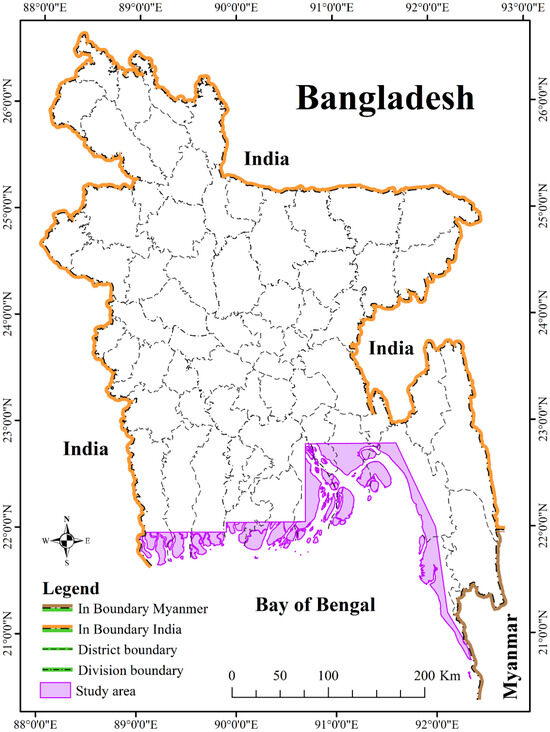
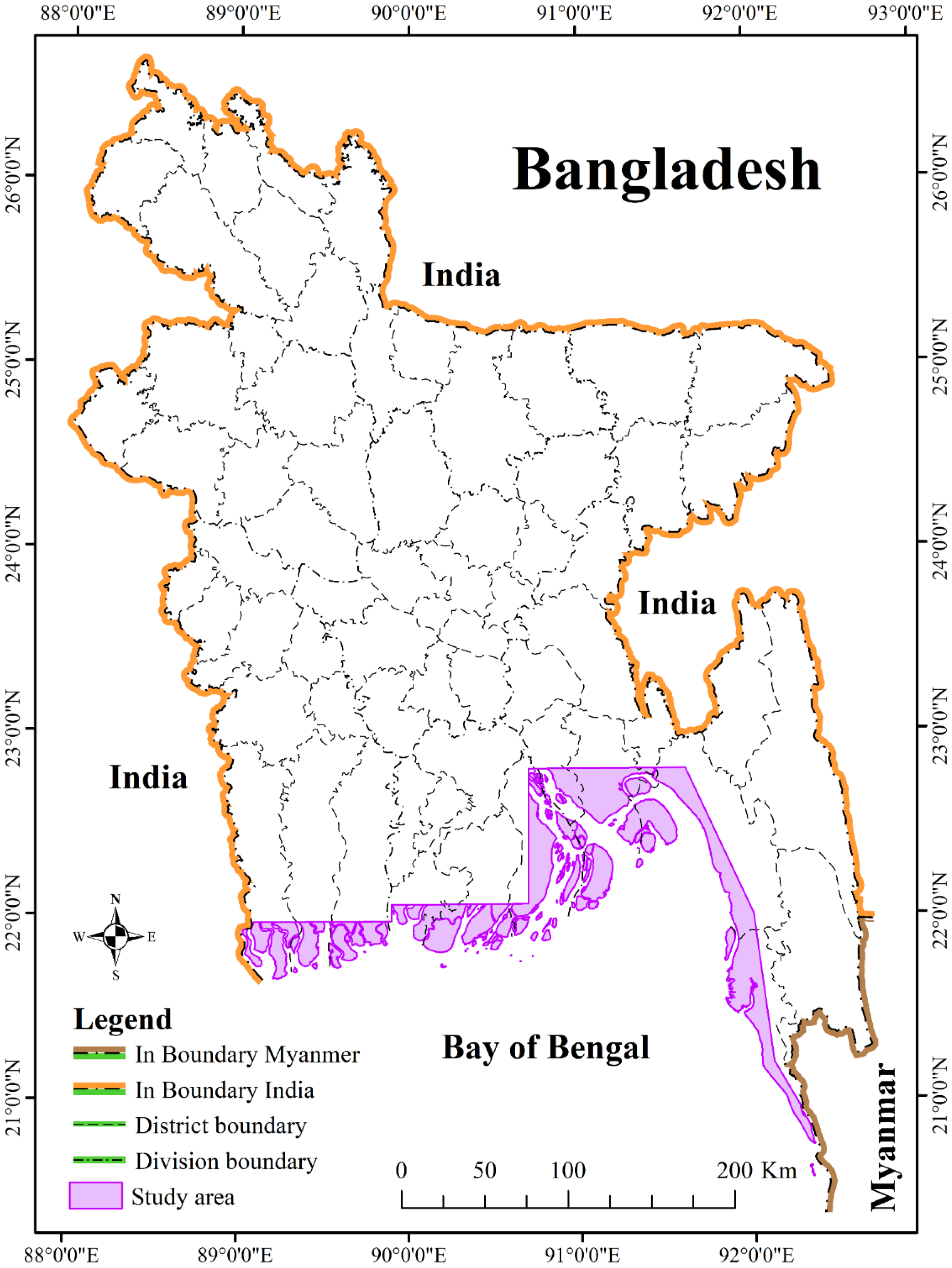
The coastal belt of Bangladesh encompasses 19 districts. The area of interest (AoI) for this study encompasses a 710-km coastline, comprising 14 coastal districts (Figure 1). This AoI extends from the Hariabhanga River in the west, along the Bangladesh–India border, to the Naf River in the east, along the Bangladesh–Myanmar border, running parallel to the Bay of Bengal [12]. From a geomorphological perspective, the coastal region of Bangladesh can be categorized into three distinct sub-zones: (i) the South–West Ganges Tidal Plain, (ii) the South–Central Meghna Deltaic Plain, and (iii) the South–East Chittagong Coastal Belt [62]. These zones indicate distinct coastal characteristics in terms of morphology, sediment dynamics, and vulnerability to shoreline change. The South–Western zone is predominantly characterized by the Sundarbans, a vast expanse of contiguous mangrove forest that spans the region. This natural habitat plays a pivotal role in safeguarding the coastline by acting as a barrier against tropical cyclones and storm surges, thereby contributing to the maintenance of relative shoreline stability [63]. In contrast, the South–Central zone is regarded as the most dynamic due to substantial sediment influx from the Ganges–Brahmaputra–Meghna (GBM) river system and robust tidal currents in the vicinity of the Meghna estuary [13,64]. The region is distinguished by the recurrent phenomenon of formation and subsequent dissolution of char lands, which are newly accreted landforms. These chars, along with islets and shoals, are a recurring feature of the area’s geomorphology [65]. The South–East zone is characterized by a combination of muddy shores in the upper Chittagong region and sandy beaches. Notably, Cox’s Bazar is recognized as the world’s longest uninterrupted natural beach, extending for a considerable distance. In the extant literature, Mahamud and Takewaka (2018), Islam et al. (2016), and Mishra et al. (2024) have made notable contributions to the subject [42,58,66]. The topographic and hydrographic datasets that delineate the study area were initially referenced to the Country’s Data Sheet (CDS), thereby establishing WGS84 as the reference datum. The validation of the data was facilitated by the geo-database (scale 1:25,000) provided by the Survey of Bangladesh, which is under the jurisdiction of the Ministry of Defense.
Figure 1.
Study area (onshore region of the Bangladesh delta).
2.2. Data Collection
Landsat 8/9 OLI imagery, with a 30-m spatial resolution, was collected for the years 2022, 2023, 2024, and 2025 from the United States Geological Survey (USGS) Earth Explorer link: https://earthexplorer.usgs.gov/ accessed on 18 November 2025 (Table 1) [67]. Images from January, February, and March of each year were selected based on spatial coverage and acceptable cloud interference over the coastal zone of Bangladesh.
Table 1.
Properties of the satellite image.
For each Landsat acquisition (Table 1), the corresponding tidal stage (time and water level) was obtained using harmonic tide prediction for the selected tide gauge/station (e.g., Chittagong Port Authority/Chattogram). In practice, this required a set of station-specific harmonic constants (constituent amplitudes and phases); the predicted water level at a given time was computed as the mean level plus the sum of sinusoidal constituents (with standard nodal corrections), and the nearest high/low water times were extracted from the predicted series.
2.3. Data Preprocessing
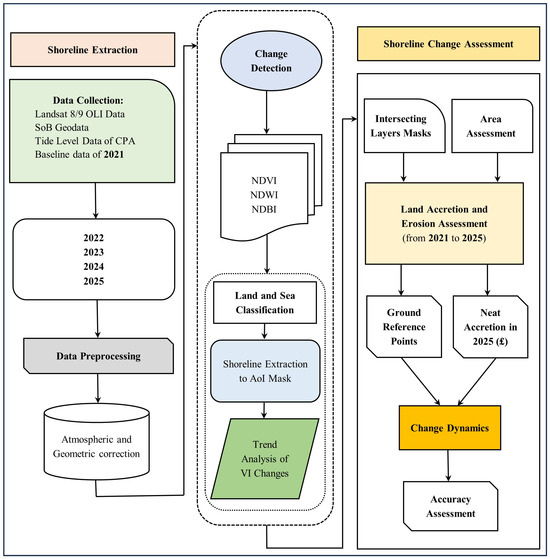
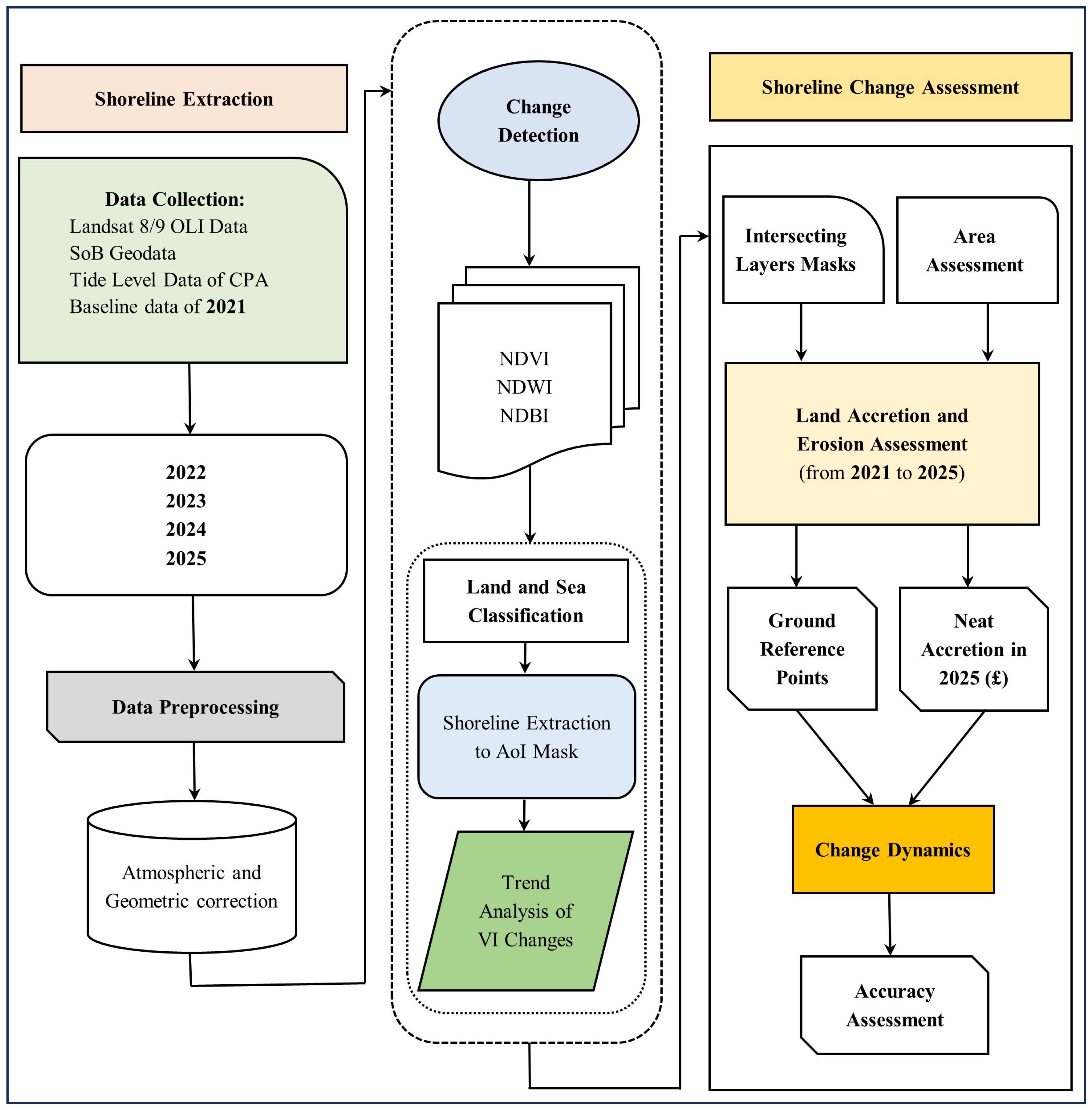
All Landsat 8/9 OLI/TIRS scenes were pre-processed prior to analysis to ensure inter-annual comparability. The workflow included: (i) conversion to surface reflectance using the standard Landsat processing level available from USGS; (ii) masking of clouds, cloud-shadow, cirrus, and snow using the QA (quality assessment) bitmask; (iii) mosaicking where necessary to ensure full spatial coverage of the Area of Interest (AoI) for each year; and (iv) co-registration checks so that all annual composites share a common coordinate reference and pixel grid. Images were then clipped to the coastal study extent. To reduce seasonal and tidal variability, scenes were selected from the dry season (January–March) for each year and processed consistently across years (Figure 2).
Figure 2.
Research framework for onshore change assessment in the Bangladesh delta.
2.4. Satellite Data Analysis
After collecting spatial data, various remote sensing techniques are used to fulfill the objectives, such as NDVI, NDWI, and NDBI data validation, change dynamics (Figure 2), and finally, Spearman correlation and statistical trend analysis are also applied using the NDVI, NDWI, and NDBI data through IBM SPSS 26 and R 4.5.2 programming [68,69].
2.4.1. Onshore Change Assessment Using Landsat 8/9 Imagery
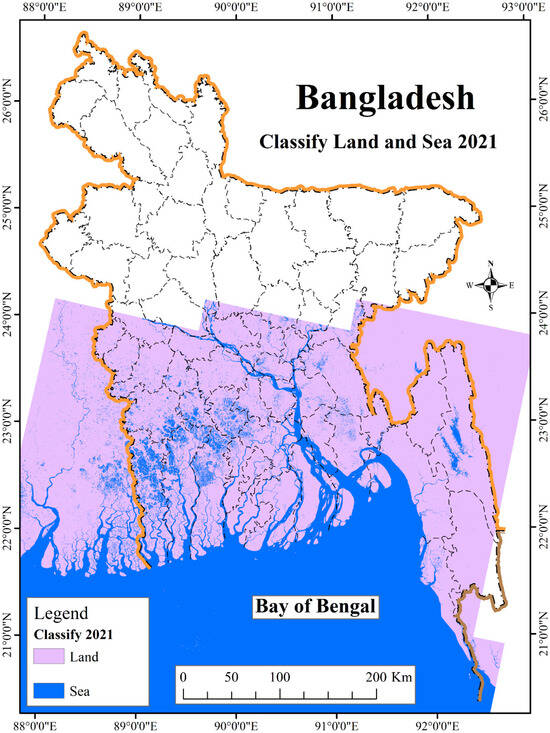
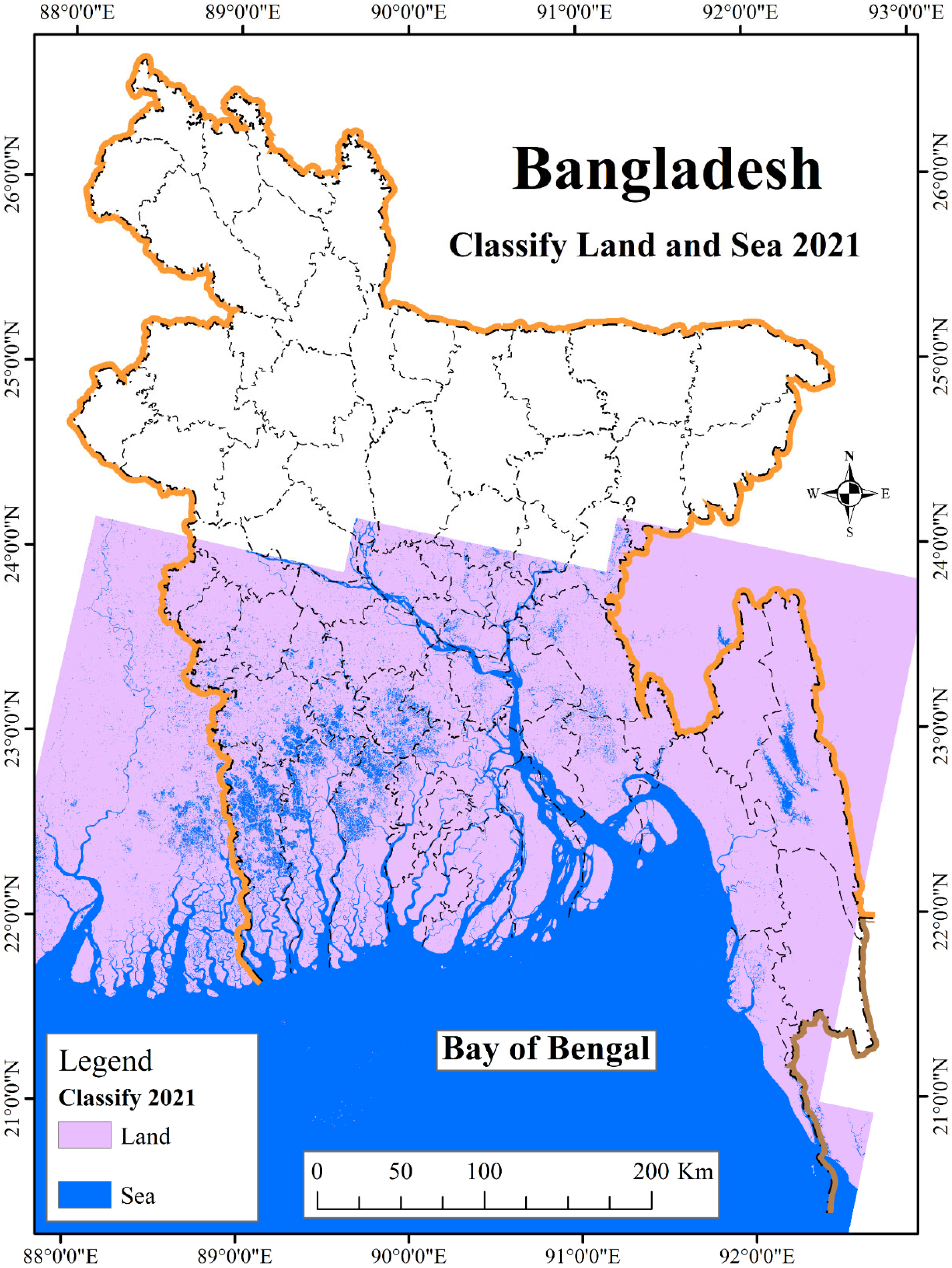
Three spectral indices were computed to delineate land and water boundaries effectively: NDVI (Normalized Difference Vegetation Index), NDWI (Normalized Difference Water Index), and NDBI (Normalized Difference Built-up Index) (Figure 3).
Figure 3.
Classification of land and sea using Landsat 8 OLI imagery over the study area.
2.4.2. Shoreline Extraction
To extract shoreline boundaries, an AoI mask was created to focus the analysis on the 14 coastal districts of Bangladesh (Figure 3). The AoI was delineated using administrative boundary data from the Survey of Bangladesh (SoB) geodata. In this study, the shoreline is treated as an operational, satellite-derived land–water boundary (a shoreline proxy) that is consistent across years. Practically, a binary land/water classification was first generated from each annual Landsat composite using water-sensitive spectral information (NDWI) together with visual checks against standard false-color composites. The land–water boundary was then vectorized and post-edited to remove obvious classification artifacts (e.g., isolated pixels and small interior ponds not connected to the sea) so that the extracted boundary consistently represented the open-coast and estuarine shoreline.
2.4.3. Shoreline Change Assessment by Area
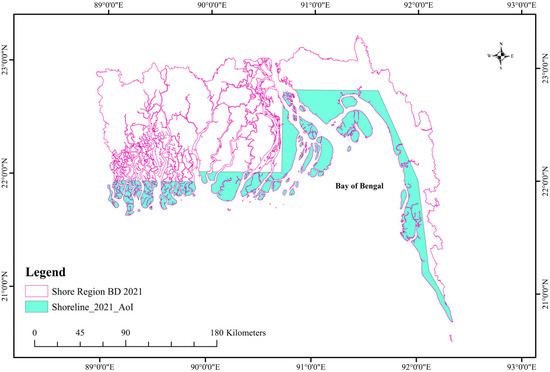
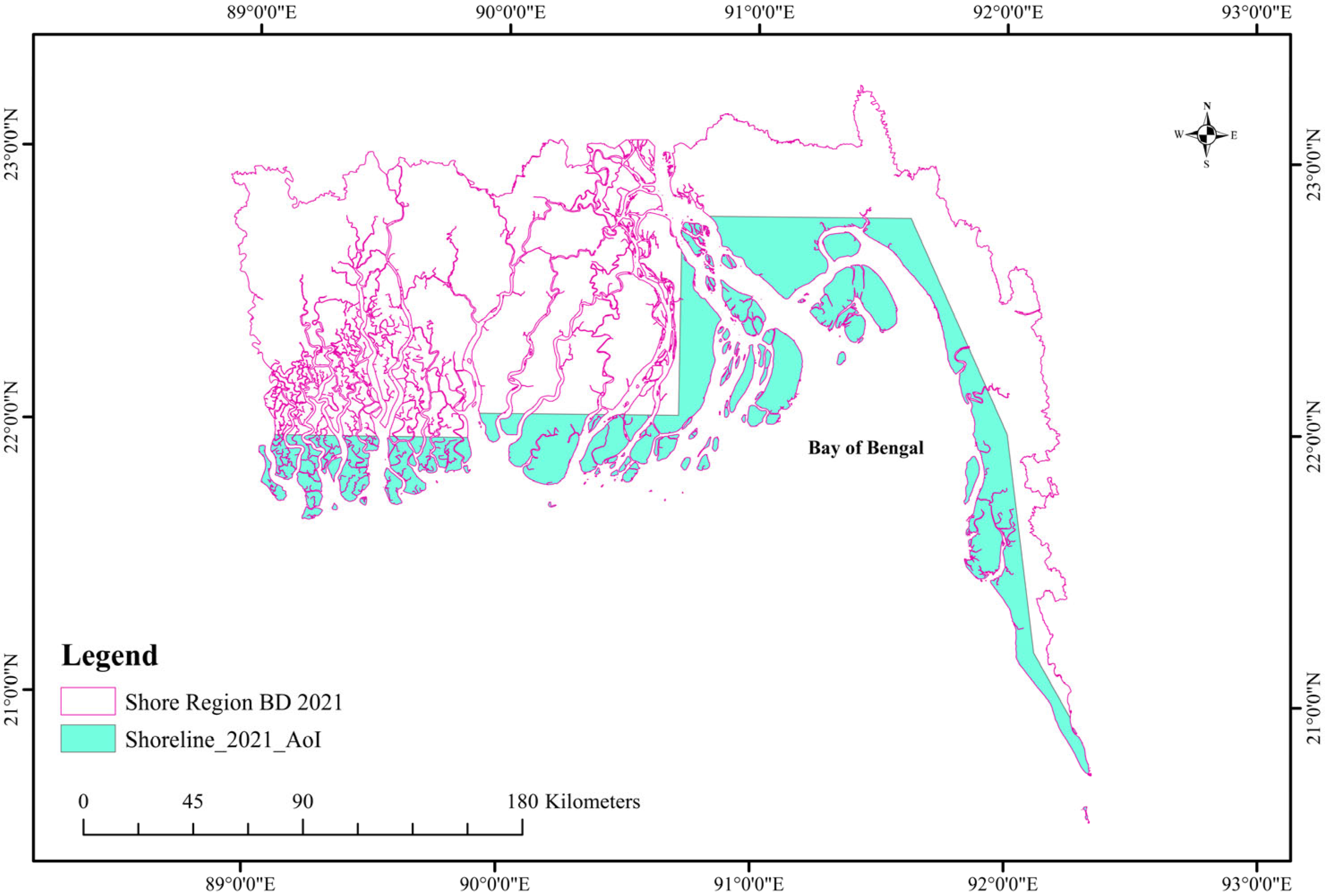
Shoreline change was quantified by comparing a reference shoreline for 2021 (λ21) with an independently extracted shoreline for 2025 (λ25). The 2021 shoreline (λ21) was adopted as the baseline to provide a fixed reference geometry for all subsequent comparisons (Figure 4). The 2025 shoreline proxy was derived from the processed 2025 Landsat 8/9 composite using the same land–water classification rules described above and then converted into a polyline representing the land–water boundary. Change polygons were generated by overlaying λ21 and λ25 and classifying the enclosed areas as accretion (land gain), erosion (land loss), or no change, following a consistent topological rule applied across the full AoI.
Figure 4.
Shorelines in 2021 (λ21) as the study baseline.
2.4.4. Land Accretion and Erosion Assessment (from 2021 to 2025)
For the area-based evaluation, λ21 and λ25 polylines were used to construct closed polygons representing land extents for 2021 and 2025 within the AoI. The two land polygons were then overlaid (polygon intersection/union) to separate three mutually exclusive classes: (i) stable land (present in both 2021 and 2025), (ii) accreted land (present in 2025 but not in 2021), and (iii) eroded land (present in 2021 but not in 2025). Areas were computed in km2 for each class and summarized for the full delta. Because satellite-derived shorelines are proxies influenced by tidal stage and water turbidity, we minimized seasonal variability by using dry-season imagery consistently across years and by applying the same processing and classification settings to each annual composite.
2.4.5. Neat Accretion Assessment (from 2021 to 2025)
The neat accretion of land along the coastal region was calculated to determine the total area of land accretion and the total area of erosion observed between 2021 and 2025 (Figure 2). Both processes were calculated in square kilometers (km2) to maintain consistency and facilitate direct comparison. Firstly, the shoreline positions of 2021 to 2025 were classified into three categories: (i) unchanged status (η), (ii) accretion (α), and (iii) erosion (ë). The total land area in 2021 was 8872.03 km2 in the Area of Interest (AoI), which was identified as λ21, along with 16,550 GRPs in the AoI in 2021. Neat accretion in 2025 was defined as £, which represented the subtraction of accretion (α) and erosion (ë) of that year. On the other hand, the total area of land in 2025 was identified by λ25, which was extracted by adding the neat accretion of 2025 (£) to the total land area in 2021 (λ21). At the same time, the total area of land in 2025 (λ25) was also identified by summing the unchanged area (η) and accretion (α) in 2025. However, neat erosion was also extracted by subtracting the total area of land in 2021 (λ21) from the total area of land in 2025 (λ25).
The delta alteration (∑Δ) was obtained by summing the unchanged, accreted, and eroded shoreline segments (η + α + ë), which was further used for spatial interpretation of coastal dynamics within the Area of Interest (AoI). Lastly, neat accretion was defined by subtracting the total area of land in 2021 (λ21) and erosion (ë) in 2025 from the delta alteration (∑Δ) (Table 2). This approach ensures a consistent and quantitative comparison of shoreline changes over the two reference periods and supports evaluating the extent of geomorphic instability in the coastal delta.
Table 2.
Calculation of land accretion, erosion, and neat accretion from 2021 to 2025.
2.4.6. Shoreline Change Assessment by Ground Reference Points
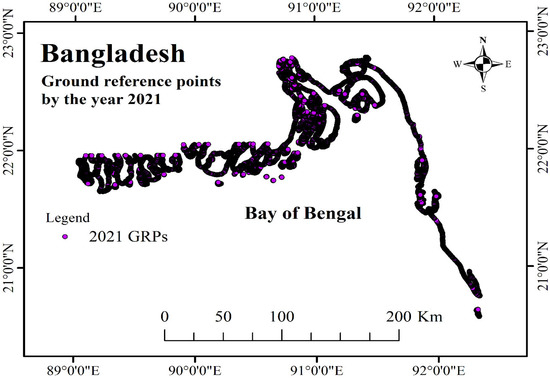
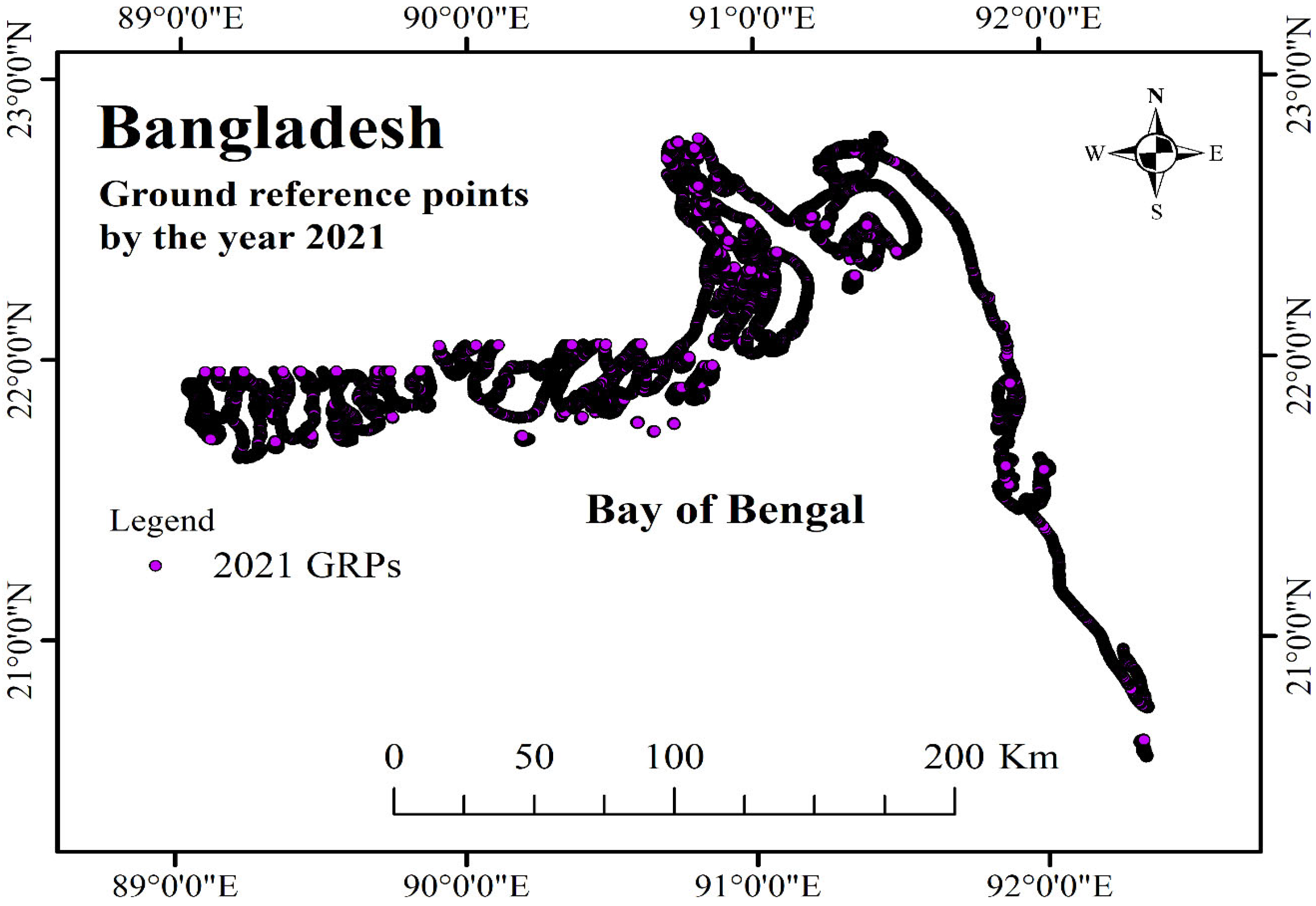
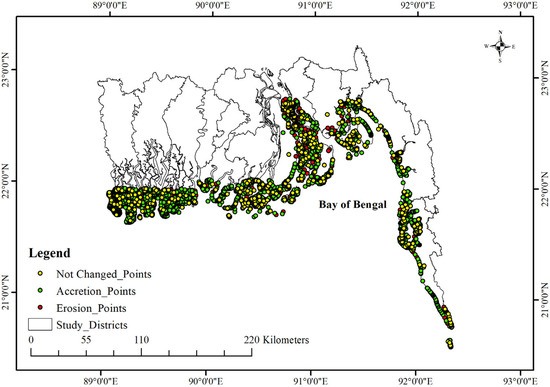
For the shoreline change analysis in this study, Ground Reference Points (GRPs) were systematically generated from the baseline 2021 (λ21) shoreline data, where there was a total of 16,550 GRPs (Figure 5) [12]. This set of GRPs was created using the “Vertex to Points” tool of ArcGIS Desktop [5]. This tool helps to convert the vertices of a polyline into point features and thus allows for accurate spatial referencing and statistical analysis. GRPs were generated from the digitized shoreline polyline that was extracted for the year 2025. To maintain the validity and consistency of these points, GRPs were generated only along the onshore baseline as established by the Survey of Bangladesh (SoB) landmass dataset. RGB composites of Landsat imagery generated through standard band combinations were checked visually to ensure that the extracted shoreline (and the corresponding GRPs) aligned strictly with the landmass and did not bear any offshore discrepancies. As a measure toward uniformity during temporal comparison and thereby facilitating equal GRP-based assessment, manual editing was performed wherever necessary. This included adding or removing vertices to standardize point density along the shoreline, ensuring balanced representation for spatial change detection. The editing process was conducted with precision using ArcGIS Desktop’s editing tools, maintaining topological accuracy and avoiding distortions in shoreline geometry. This methodology facilitated a robust and consistent GRP dataset for the year 2025, which was essential for subsequent shoreline comparisons and change assessments within the coastal belt of the Bangladesh delta.
Figure 5.
Study ground reference points in the Bangladesh delta.
2.4.7. Satellite Data Validation/Accuracy Assessment
The study used a dense set of Ground Reference Points (GRPs) to support internal consistency checks of the extracted shoreline proxy and to enable repeatable, point-based summarization of change categories along the reference shoreline [5,12]. Specifically, GRPs were sampled along the 2021 baseline shoreline (λ21) and compared against the classified 2025 change map to count how many baseline locations fell within stable, accretion, or erosion polygons. The Survey of Bangladesh (SoB) geospatial datasets were used as an authoritative reference for administrative boundaries and landmass context during visual inspection and editing. It should be noted that the GRP approach does not replace independent ground truth (e.g., RTK-GPS shoreline surveys); instead, it provides a transparent, reproducible way to summarize spatial patterns and to detect obvious geometric inconsistencies. Residual uncertainty may remain due to (i) mixed pixels at 30 m resolution, (ii) tide-stage differences among satellite overpasses, and (iii) misclassification in turbid waters; these limitations should be considered when interpreting small or localized shoreline shifts.
2.4.8. NDVI (Normalized Difference Vegetation Index)
Compton J. Tucker created the Normalized Difference Vegetation Index (NDVI) in 1979 to track vegetation dynamics using satellite data [70]. NDVI was computed using the formula (Equation (1)):
where NIR corresponds to Band 5 (0.85–0.88 µm) and Red to Band 4 (0.64–0.67 µm) in Landsat 8 imagery. NDVI ranges from −1 to +1, where bodies of water reflect values usually close to zero or negative, and values larger than 0.2 correspond to vegetated areas. To distinguish land from water, a threshold NDVI value of approximately 0.1 was used, though minor adjustments were made based on local conditions such as water turbidity and vegetation density [71]. Pixels with NDVI values below the threshold were classified as water, and those above it were classified as land.
The mean NDVI trends (2022–2025) were compared over time to identify vegetation changes near the coastal belt using the following equation (Equation (2)):
Here, n = 4, which refers to the study years (2021–2025), and xi = the value of NDVI.
2.4.9. NDWI (Normalized Difference Water Index)
In this study, the Normalized Difference Water Index (NDWI), as suggested by McFeeters (1996), was applied for the analysis of shoreline changes along the Bangladesh delta for 2022 and 2025 [72]. NDWI generally aims at maximizing the presence of open water features. Basically, water features have a very strong reflection in the green wavelength, while NIR radiation is mostly absorbed. The NDWI is calculated using the following formula (Equation (3)):
Band 3 (0.53–0.59 µm) was designated as the green band, while Band 5 (0.85–0.88 µm) was the NIR band for Landsat 8 Operational Land Imager (OLI) imagery. NDWI was computed for each annual image, and the index values were limited between −1 and +1. A threshold value of 0.3 was used to distinguish water bodies (NDWI > 0.3) from non-water features.
The mean NDWI trends (2022–2025) were calculated using raster-based statistical analysis to represent overall water body dominance within the study area (Equation (4)):
Here, n = 4, which refers to the study years (2021–2025), and yi = the value of NDWI.
2.4.10. NDBI (Normalized Difference Built-Up Index)
In this study, the land use transformation near the shoreline of the Bangladesh delta between 2022 and 2025 was examined through NDBI of Zha et al. (2003) [56]. NDBI makes use of spectral characteristics exhibited by built-up surfaces, bearing higher reflectance in the Short-Wave Infrared (SWIR) region and lower reflectance in the Near-Infrared (NIR) region, thereby setting built-up surfaces apart from natural features like vegetation and water.
The formula for NDBI is expressed as (Equation (5)):
where SWIR and NIR stand for Short-Wave Infrared and Near-Infrared, respectively. The bands specified above refer to Landsat 8 Operational Land Imager (OLI) data, where Band 6 (1.57–1.65 µm) is SWIR, and Band 5 (0.85–0.88 µm) is NIR. Generally, NDBI ranges between −1 and +1. Positive NDBI values generally indicate areas with high built-up density, while negative values suggest non-built-up areas.
The mean NDBI trends (2022–2025) were derived to assess the extent of built-up areas and urban footprint near coastal regions (Equation (6)).
Here, n = 4, which refers to the study years (2021–2025), and zi = the value of NDBI.
2.5. Evaluating Pairwise Relationships Among Spectral Indices
To evaluate the pairwise relationships among spectral indices (NDVI, NDWI, NDBI) across 4 years, Spearman’s rank correlation coefficient was calculated. The Spearman correlation between two variables X and Y is defined as:
where is the number of paired observations, di = R (Xi) − R (Yi) is the difference between the ranks of the i-th observation of the X and Y, and R (Xi) and R (Yi) represent the ranks of Xi and Yi, respectively. For variables with tied ranks, was computed using the covariance of ranks:
where and are the standard deviations of the ranked values. The resulting pairwise correlation coefficients were compiled into a correlation matrix and visualized as a heatmap. In the heat map, positive correlations are shown with warmer colors, indicating stronger positive monotonic relationships, while negative correlations are shown with cooler colors, indicating inverse relationships. The intensity of the color corresponds to the magnitude of .
3. Results
3.1. Shoreline Change Assessment
The shoreline in the Bay of Bengal represents the “last boundaries” separating “land” from “sea” in Bangladesh. Although “landmass creation” and “bank erosion,” two deltaic processes, are referred to as “accretion and erosion of lands,” respectively, the pixel data of onshore areas vary throughout time, including their changes in position.
3.2. Shoreline Change Dynamics
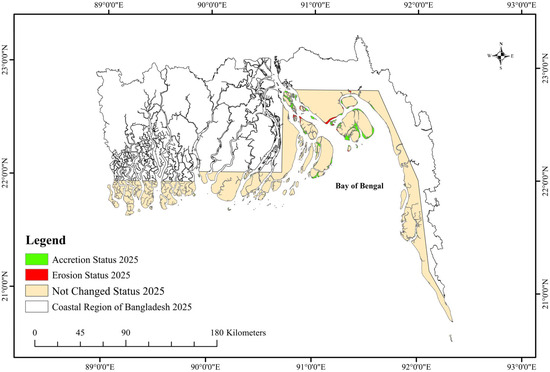
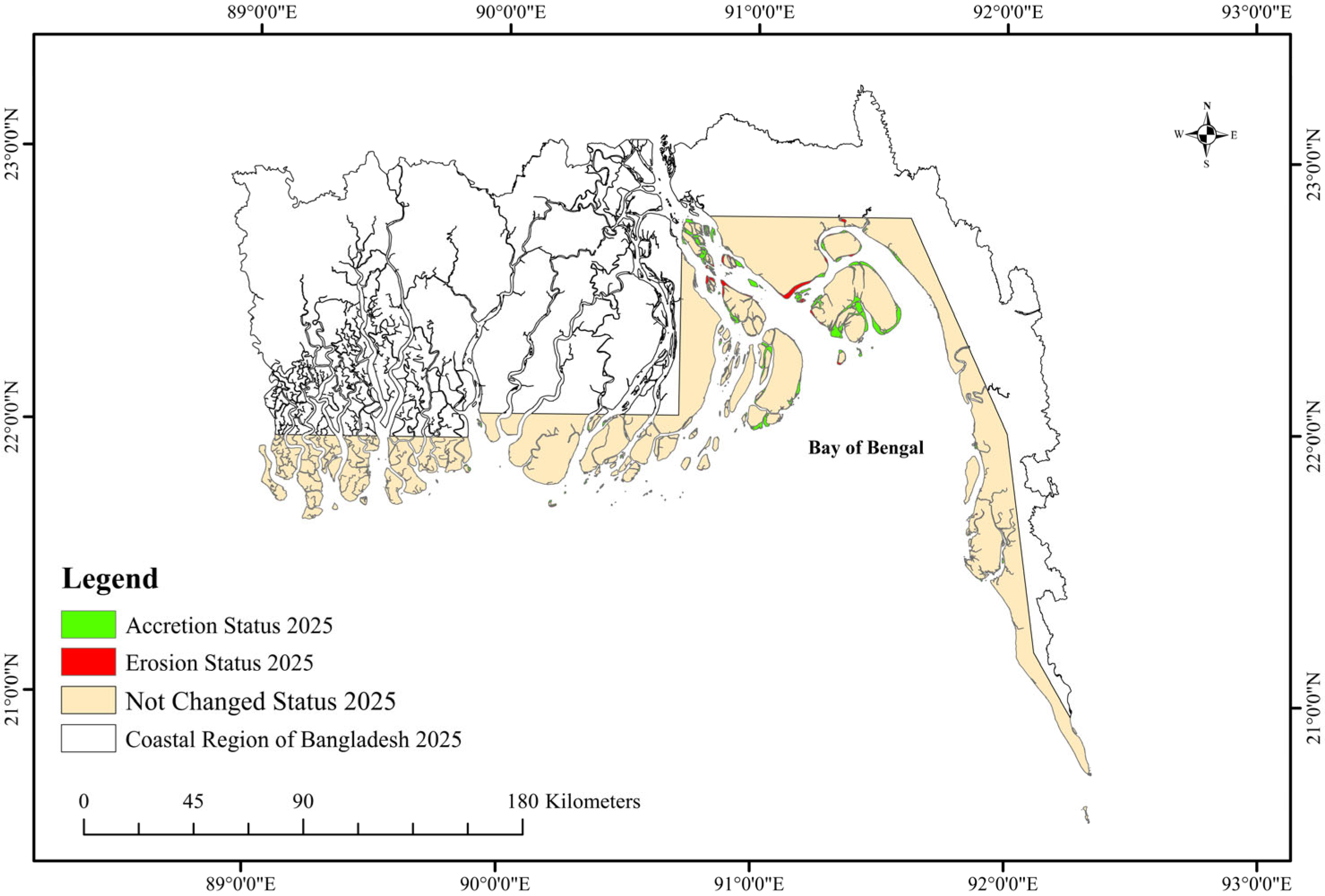
The analysis of shoreline dynamics from 2021 to 2025 reveals significant temporal and spatial changes along the coastal belt of the Bangladesh delta. Using multi-temporal satellite imagery, the current onshore condition of 2025 was extracted based on the baseline data of 2021. The shoreline moved geographically from 2021 to 2025 along with onshore accretion and erosion (Figure 6).
Figure 6.
Neat Accretion of Onshore Lands (2021–2025).
3.2.1. Spatial Stability Zones: Identifying Unchanged Status (2021–2025)
A significant portion of the coastal region exhibited no observable shoreline change between 2021 (Baseline) and 2025 (Figure 6). Based on the overlay analysis of shoreline positions across these two time points, an estimated 8747.91 km2 of land area remained stable, showing neither erosion nor accretion activity (Table 3).
Table 3.
Shoreline Area changes from 2021 to 2025 by area in km2.
3.2.2. Shoreline Accretion, Erosion, and Neat Accretion Analysis from 2021 to 2025
Based on the comparative analysis between the 2021 baseline shoreline and the 2025 observed data, a significant accretion trend was identified in the coastal region of the Bangladesh delta. The total accreted area over these four years was approximately 383.49 km2, while the analysis indicated that approximately 124.12 km2 of land was lost due to erosion. The total area of land in 2025 (λ25) was 9131.40 km2, whereas the total area of land in 2021 (λ21) was 8872.03 km2, indicating a neat land accretion of 259.37 km2 over the four years (Figure 6). The ultimate delta alteration in the AoI (ƩΔ) was 9255.52 km2 in 2025 (Table 3).
3.2.3. Accretion and Erosion Analysis (2021–2025) by GRPS
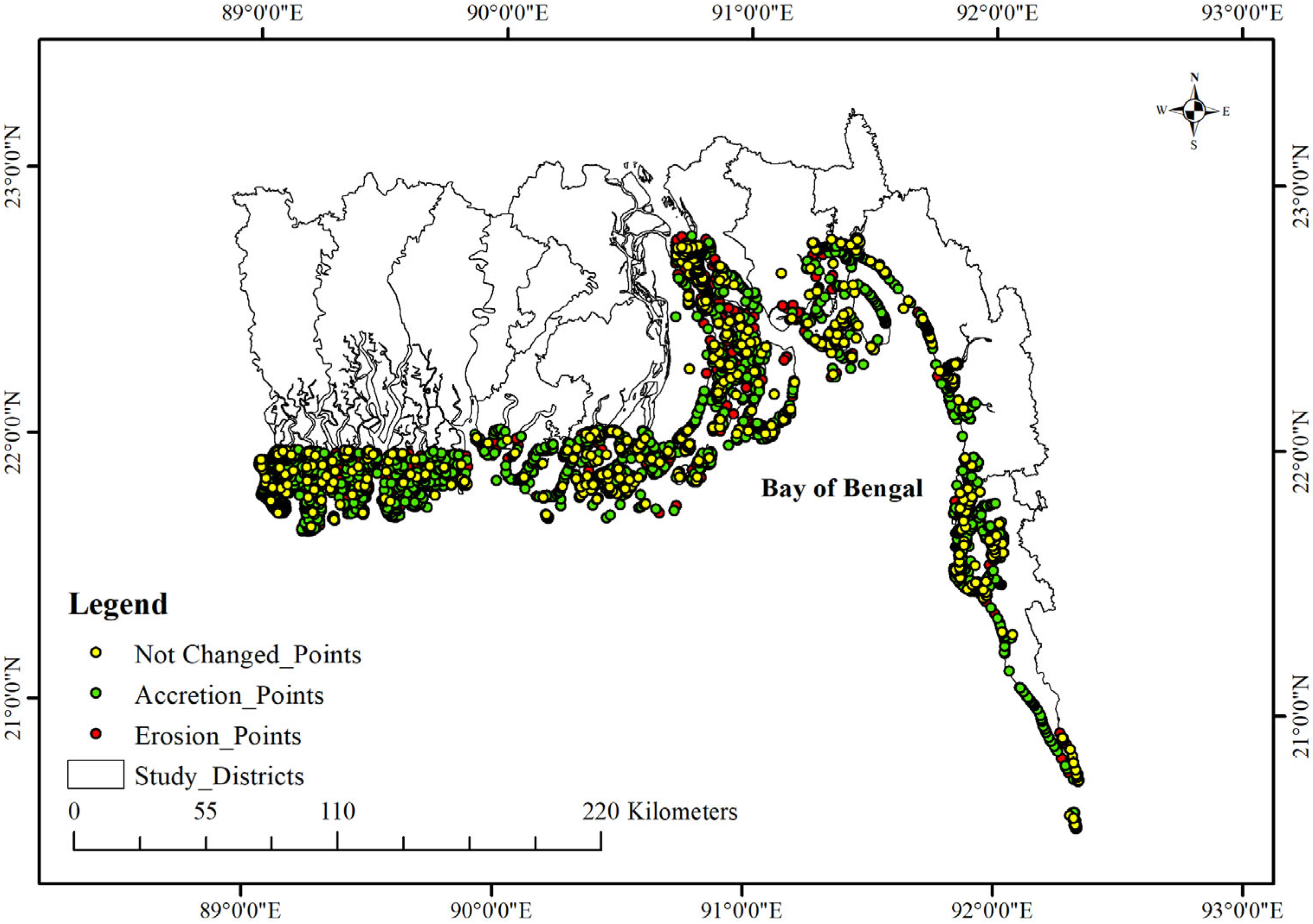
Ground Reference Points (GRPs) were generated from both the 2021 baseline shoreline (λ21) (Figure 5) and the 2025 shoreline proxy (λ25) (Figure 7) using the Vertex-to-Points tool in ArcGIS. The initial 2021 shoreline contained 16,550 vertices, which were converted to GRPs as baseline-derived points. To ensure uniform point density and geometric consistency for temporal comparison, manual vertex editing was performed, resulting in a standardized 2025 GRP dataset of 17,055 points (Table 4). The 2025 shoreline was processed using the same workflow, producing 17,055 GRPs representing the updated shoreline geometry, while 17,288 GRPs were used for classifying delta alteration (ƩΔ). Among these, 16,317 GRPs indicated an unchanged status, whereas 738 GRPs were classified as accretion zones, and 233 GRPs reflected erosion-affected regions (Figure 7). The difference between 16,550 and 17,055 was 505 as neat accretion (£), reflecting the necessary refinement of shoreline vertices to maintain consistent spatial sampling across years.
Figure 7.
Validation by GRPs.
Table 4.
Shoreline change assessment from 2021 to 2025 by GRPs in number.
3.2.4. Accuracy Assessment
The accuracy assessment of the shoreline change classification for 2025 was evaluated through comparison and change valuation between the observed areas and Ground Reference Points (GRPs) of that year. The results show that the “Unchanged” class accounts for 8747.91 km2, which represented 94.52% of the total observed area. It corresponds closely with 94.38% of the observed GRPs. Similarly, accretion covered 383.49 km2 or 4.14% of the total mapped area, while 4.27% of the GRPs were identified within accretion zones. Erosion represented the smallest proportion, 124.12 km2, occupying 1.34% of the total area and 1.35% of the GRP distribution. The delta alteration in the AoI illustrated 9255.52 km2 of observed area, which represented 100% of the total area, and 17,288 GRPs, which represented 100% in 2025. The neat accretion during the study period was estimated as 259.37 km2, supported by 2.92% of the total GRPs (Table 5), further confirming the predominance of accretion processes within the study area.
Table 5.
Accuracy assessment by comparison and change valuation across areas and GRP classification in percentage.
3.3. Valuation by Satellite-Derived NDVI (Normalized Difference Vegetation Index)
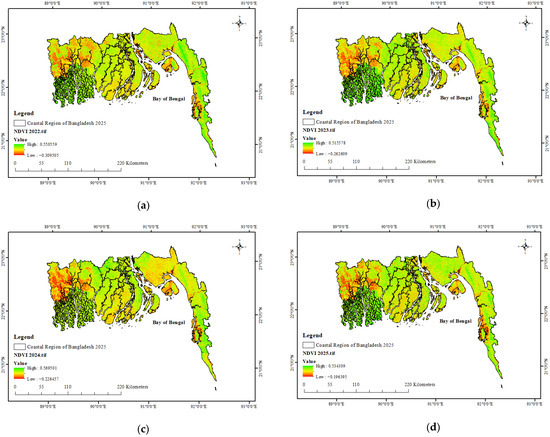
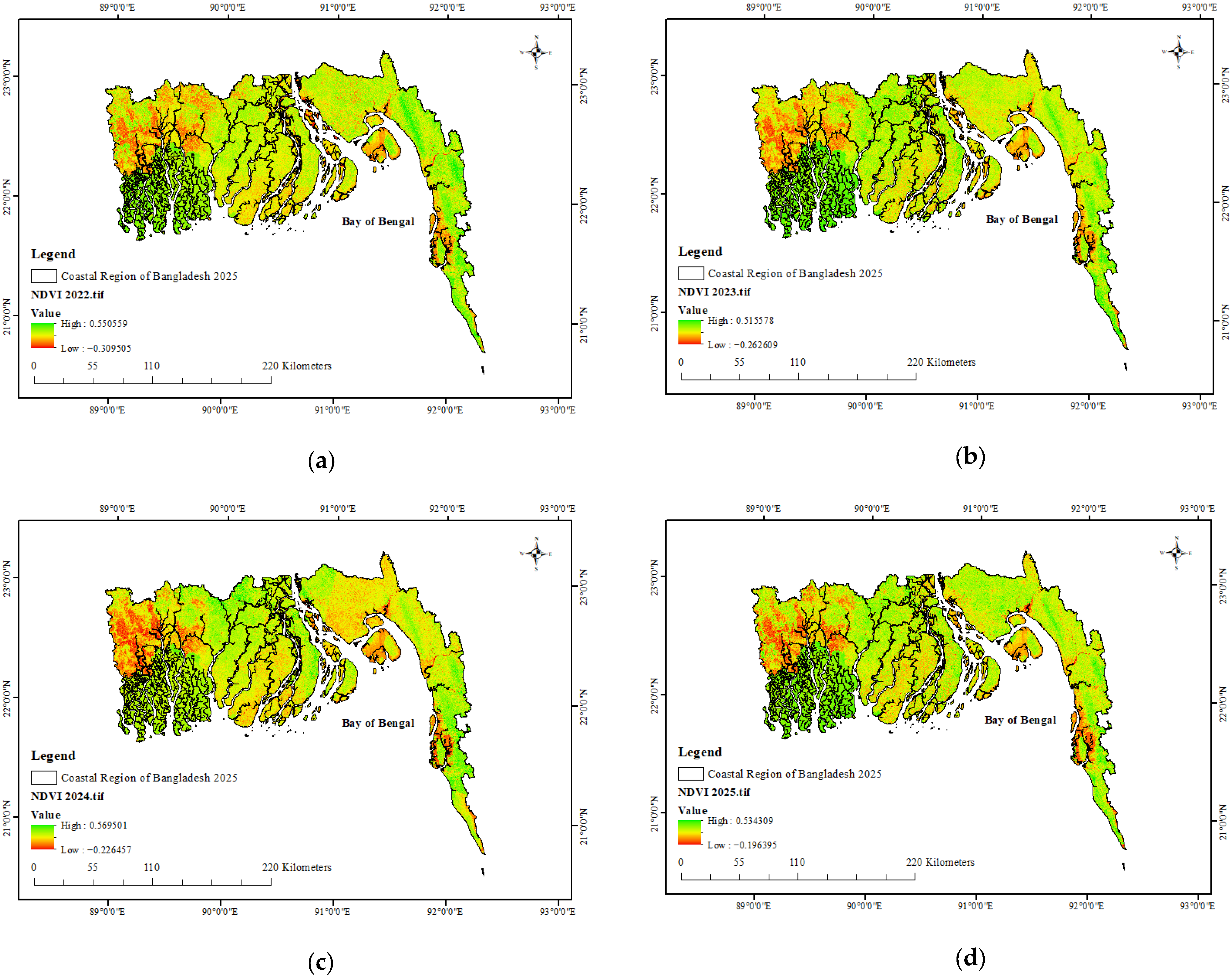
The Normalized Difference Vegetation Index (NDVI) was used to define the onshore greenness over a four-year period (2022–2025) (Figure 8). The NDVI values were 0.550 to −0.309, 0.515 to −0.263, 0.569 to −0.224, and 0.534 to −0.196 for 2022, 2023, 2024, and 2025, respectively.
Figure 8.
Normalized Difference Vegetation Index (NDVI) (a) 2022 (b) 2023 (c) 2024 (d) 2025.
3.4. Valuation by Satellite-Derived NDWI (Normalized Difference Water Index)
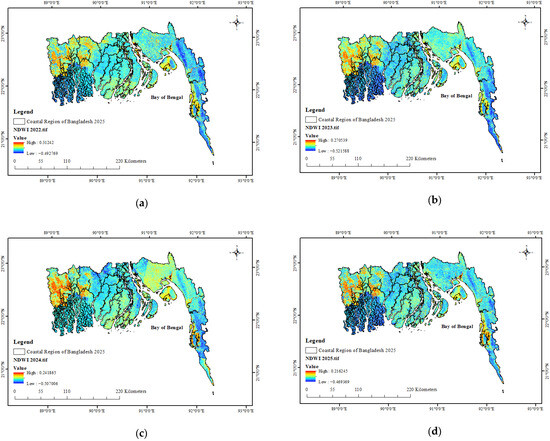
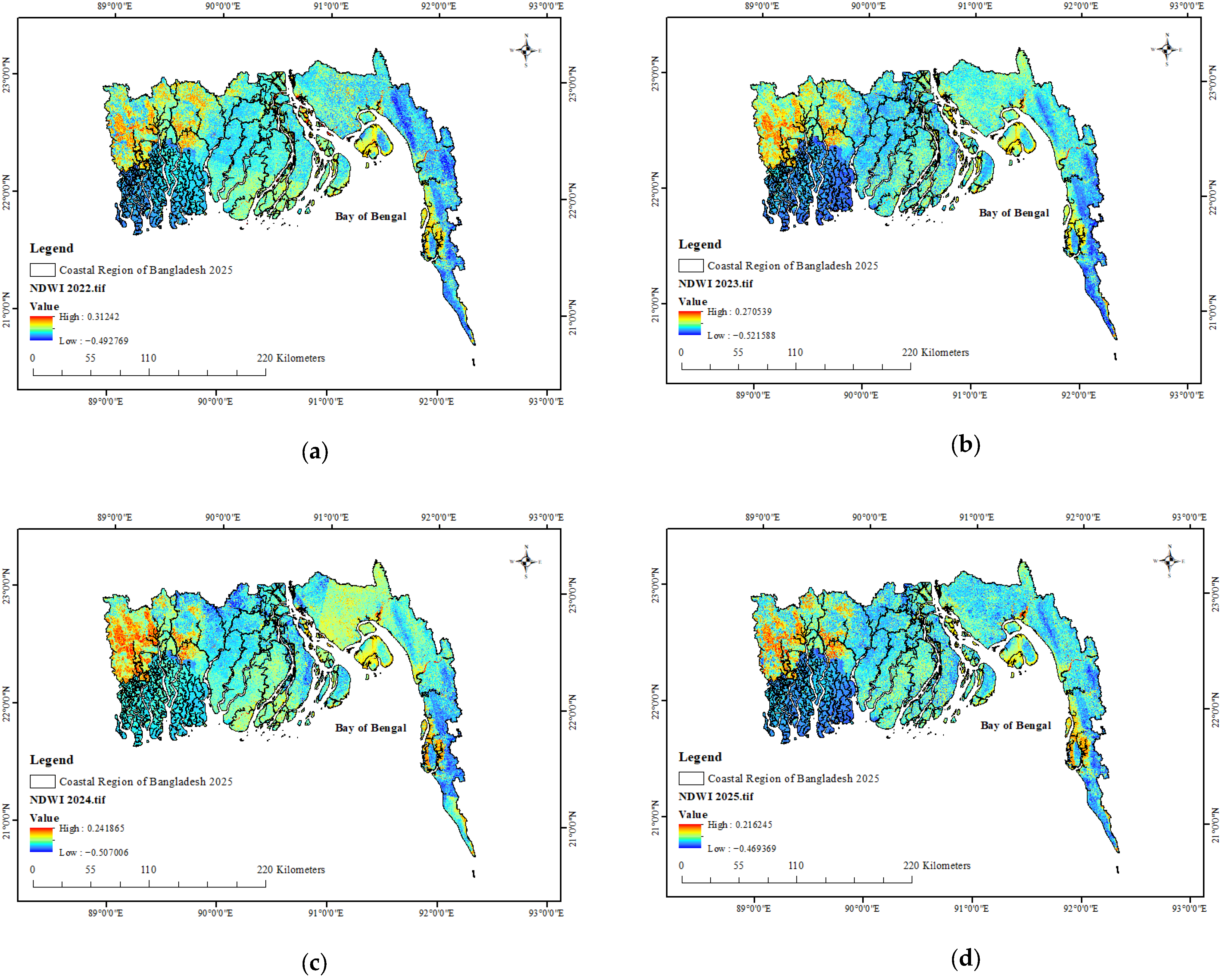
The Normalized Difference Water Index (NDWI) was used to define the onshore wetness over a four-year period (2022–2025) (Figure 9). The NDWI values were 0.312 to −0.492, 0.27 to −0.521, 0.241 to −0.507, and 0.216 to −0.469 for 2022, 2023, 2024, and 2025, respectively.
Figure 9.
Normalized Difference Water Index (NDWI) (a) 2022 (b) 2023 (c) 2024 (d) 2025.
3.5. Valuation by Satellite-Derived NDBI (Normalized Difference Built-Up Index)
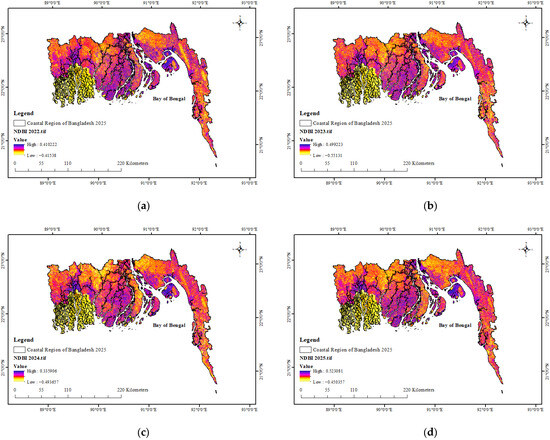
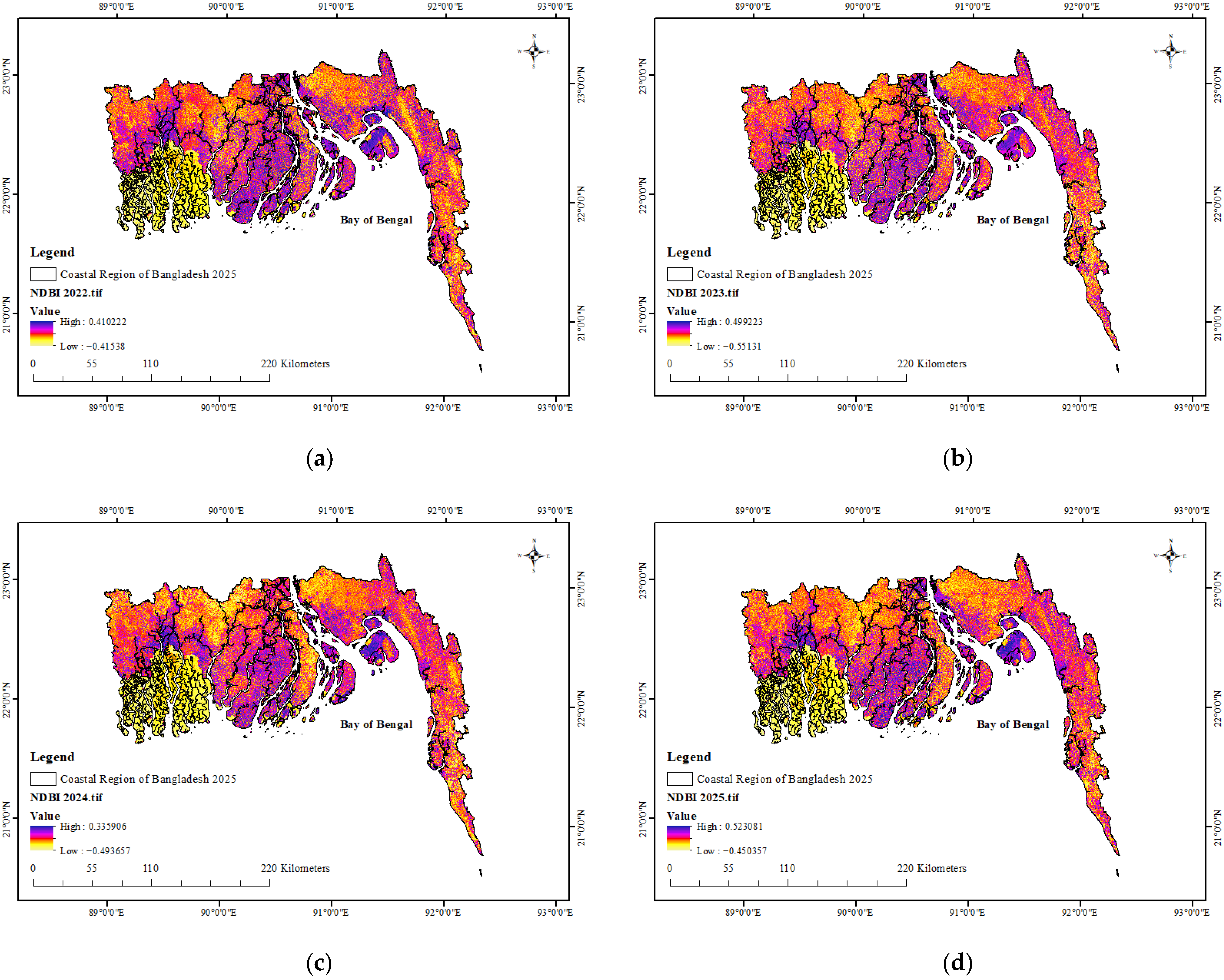
The Normalized Difference Built-up Index (NDBI) was used to define the onshore greenness over a four-year period (2022–2025) (Figure 10). The NDWI values were 0.41 to −0.42, 0.499 to −0.55, 0.33 to −0.49, and 0.52 to −0.045 for 2022, 2023, 2024, and 2025, respectively.
Figure 10.
Normalized Difference Built-up Index (a) 2022 (b) 2023 (c) 2024 (d) 2025.
3.6. Valuation by Satellite-Derived NDVI-NDWI-NDBI Average
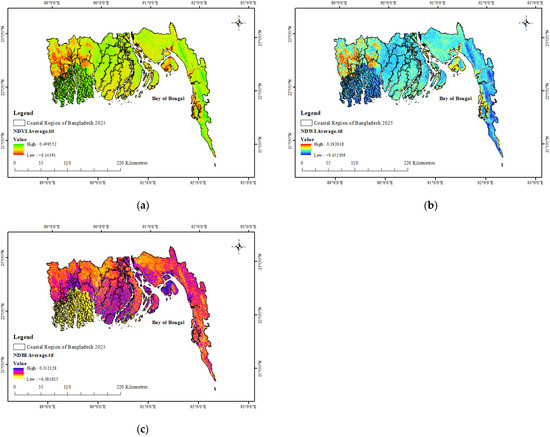
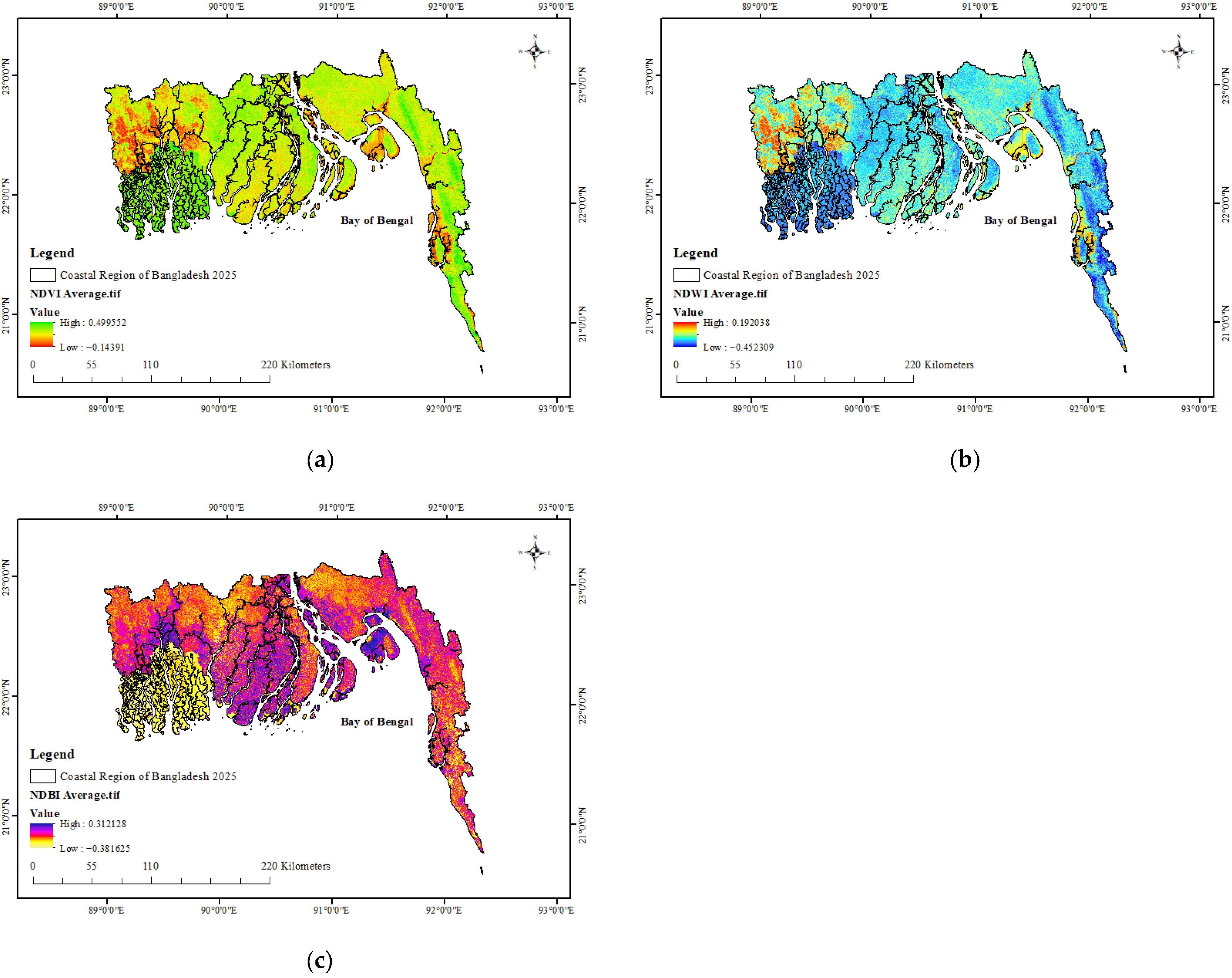
Three spectral indices, NDVI (Normalized Difference Vegetation Index), NDWI (Normalized Difference Water Index), and NDBI (Normalized Difference Built-up Index), were analyzed to assess spatiotemporal changes across the onshore study area from 2022 to 2025 (Figure 11). The average values of each index were computed annually to identify trends in vegetation health, surface water presence, and built-up expansion. The mean NDVI value ranged from 0.49 to −0.24, the mean NDWI value ranged from 0.19 to −0.42, and the mean NDBI value ranged from 0.31 to −0.38 (Figure 11).
Figure 11.
Satellite-derived NDVI–NDWI–NDBI Average (a) NDVI (b) NDWI (c) NDBI.
3.6.1. Change Assessment by NDVI Trend Analysis
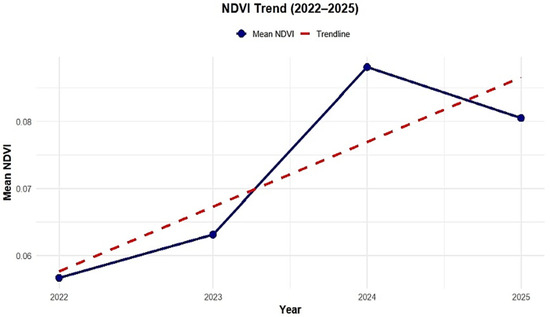
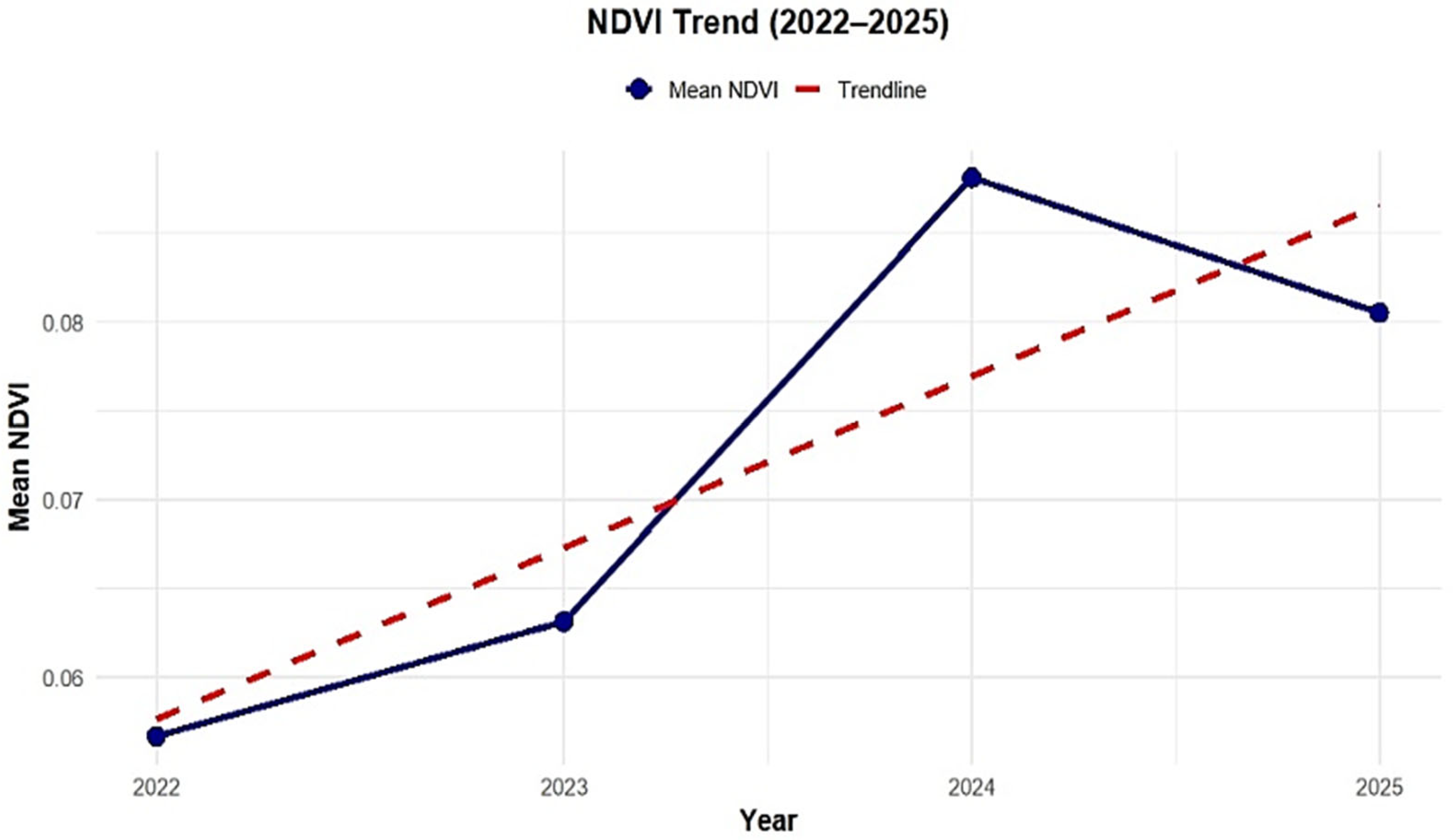
The temporal series of mean NDVI values covering the onshore coastal region of the Bangladesh delta from 2022 to 2025 is shown in Figure 12. The NDVI pattern exhibits minor inter-annual changes but remains stable overall, indicating that no long-term degradation of vegetation cover has occurred during the study period. The NDVI curve shows that the first two years of the study period were very close to each other, followed by the 2023–2024 period, where NDVI reached the highest point, hinting at the possibility of gradual vegetation recovery or stabilization, especially in the coastal areas affected by cyclones or land accretions. While a slight drop in NDVI was already observed in 2025, the overall trend of no significant change in ecological status remains very close to previous years’ trends, suggesting vegetation’s resistance to short-term climatic and geomorphological disturbances is at the core of Earth’s natural, although low, dynamics. This uniformity in NDVI conveys the idea that vegetative renewal has replaced, to a considerable extent, the temporary losses caused by theremainstides, erosion, and cyclonic activities in the deltaic saline-rich areas where sedimentation occurs.
Figure 12.
Mean NDVI Trend analysis from 2022 to 2025.
3.6.2. Change Assessment by NDWI Trend Analysis
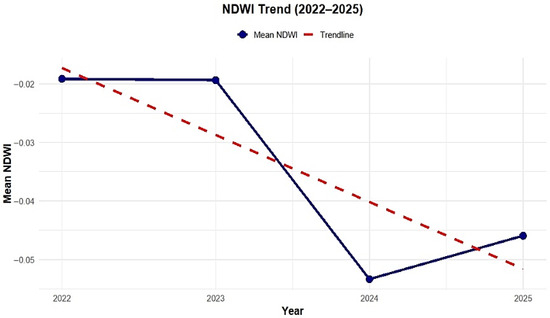
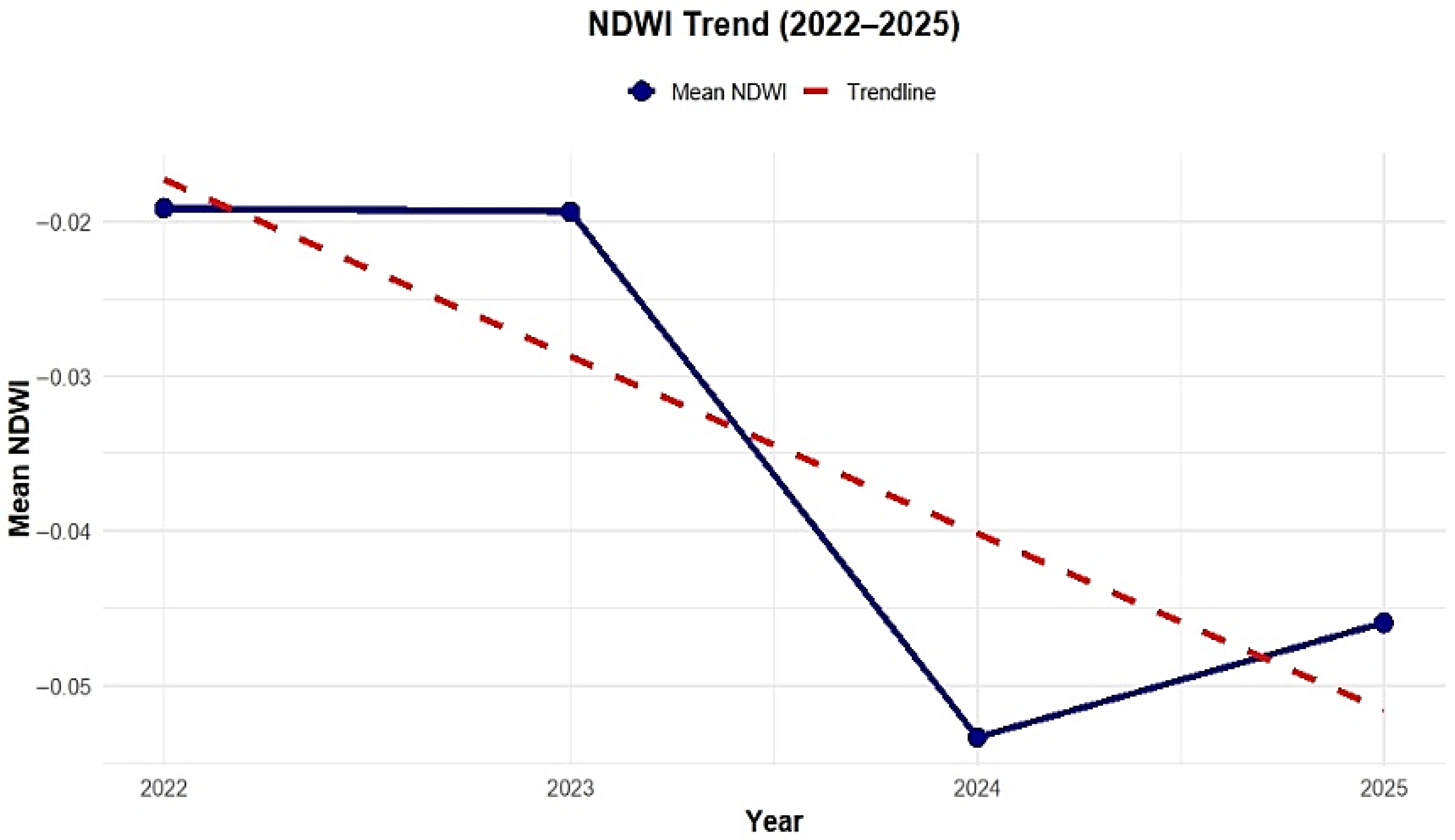
The NDWI trend from 2022 to 2025, shown in Figure 13, shows a very slight decline but remains quite stable over time. The slight decrease in average NDWI values points to a reduction in surface water presence in the coastal onshore area, which can be linked to post-monsoon water recession, sediment deposition, and land emergence. Although there were short-term hydrological changes, no sudden rise in NDWI was detected, which indicates no long-term inundation or water expansion in the study area during the period under consideration. The overall NDWI trend portrays a stable hydrological condition where the natural water presence across seasons is gradually replaced by either unexposed land or vegetated surfaces, thus aligning with the accretion-dominated coastal dynamics.
Figure 13.
Mean NDWI Trend analysis from 2022 to 2025.
3.6.3. Change Assessment by NDBI Trend Analysis
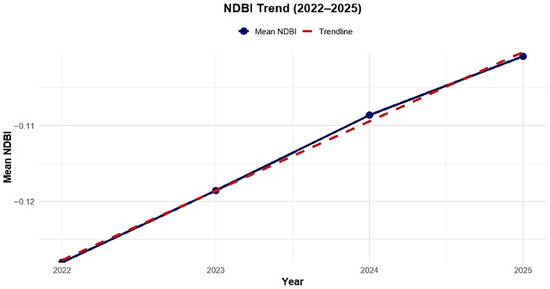
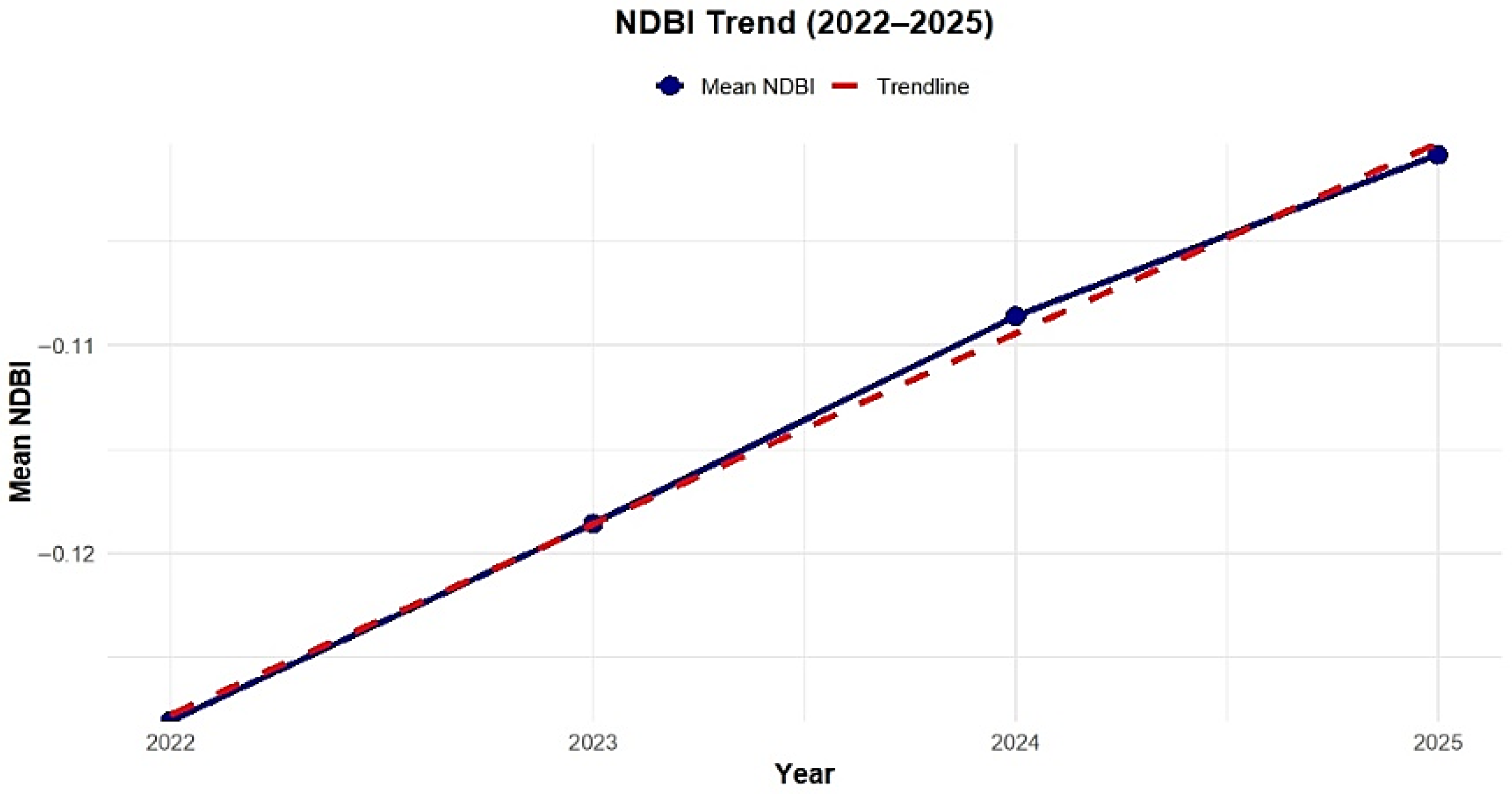
Figure 14 illustrates the temporal trend of mean NDBI values from 2022 to 2025, showing a slight yet consistent increase over the study period. This upward trend suggests a gradual rise in built-up or exposed land surfaces along the coastal zone. This increase is more likely to be linked to newly accreted sediment surfaces, bare lands, or transitional land-use zones than to extensive urban expansion.
Figure 14.
Mean NDBI Trend analysis from 2022 to 2025.
The moderate growth in NDBI values indicates ongoing land transformation processes driven by sediment deposition and shoreline movement. This trend aligns with the observed accretion patterns and supports the interpretation that coastal land emergence and surface exposure have intensified slightly between 2022 and 2025, reinforcing the dominance of depositional processes within the Bangladesh delta during the short-term assessment period.
3.7. Spearman Correlation
3.7.1. Spearman Correlation Among NDBI, NDVI, and NDWI in 2022
Spearman’s correlation results for 2022 (Table 6) show that NDBI is weakly and negatively correlated with NDVI (r = −0.289, p < 0.01), indicating lower vegetation cover in areas with higher built-up intensity. NDVI and NDWI exhibit a strong negative correlation (r = −0.921, p < 0.01), reflecting the expected inverse relationship between vegetation and surface water. NDBI shows a weak positive correlation with NDWI (r = 0.157, p < 0.01). All correlations are statistically significant at the 0.01 level (n = 17,055). These relationships collectively highlight land and water transitions and the influence of development and vegetation patterns that are typical indicators of ongoing shoreline change.
Table 6.
Spearman’s Correlation among NDBI, NDVI, and NDWI-Set 1.
3.7.2. Spearman Correlation Among NDBI, NDVI, and NDWI in 2023
There is a weak negative correlation between NDBI and NDVI in 2023 (r = −0.295, p < 0.01) (Table 6), indicating that increases in build-up intensity correspond to slight reductions in vegetation cover. In addition, NDVI and NDWI maintain a strong negative relationship (r = −0.749, p < 0.01), though notably weaker than in 2022, suggesting a reduced contrast between vegetated and water-dominated areas. NDBI exhibits a weak-to-moderate positive correlation with NDWI (r = 0.247, p < 0.01), implying greater moisture or water influence near developed zones. All correlations are statistically significant.
3.7.3. Spearman Correlation Among NDBI, NDVI, and NDWI in 2024
The 2024 correlation results (Table 6) reveal a moderate negative association between NDBI and NDVI (r = −0.480, p < 0.01), indicating a clearer contrast between built-up surfaces and vegetation compared with previous years. NDVI and NDWI continue to show a strong negative relationship (r = −0.924, p < 0.01), marking a pronounced separation between vegetated and water-dominated areas. NDBI displays a moderate positive correlation with NDWI (r = 0.352, p < 0.01), suggesting increased interaction between developed areas and moisture- or water-rich zones.
3.7.4. Spearman Correlation Among NDBI, NDVI, and NDWI of 2025
The correlation (Table 6) among NDBI, NDVI, and NDWI in 2025 shows a moderate negative relationship between NDBI and NDVI (r = −0.462, p < 0.01), indicating that vegetation tends to decrease as built-up areas increase. This inverse relationship reflects the expected land-cover dynamics in urbanizing coastal zones. A similar spectral opposition between NDVI and NDWI is also observed, consistent with their contrasting sensitivities to vegetation and surface water presence.
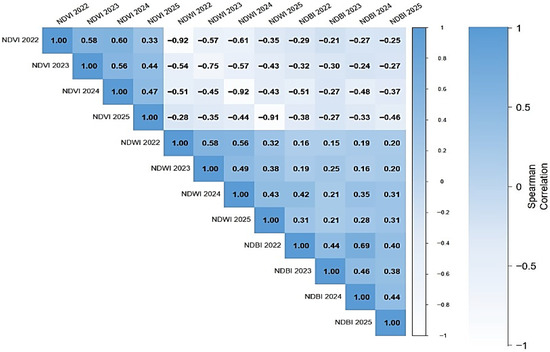
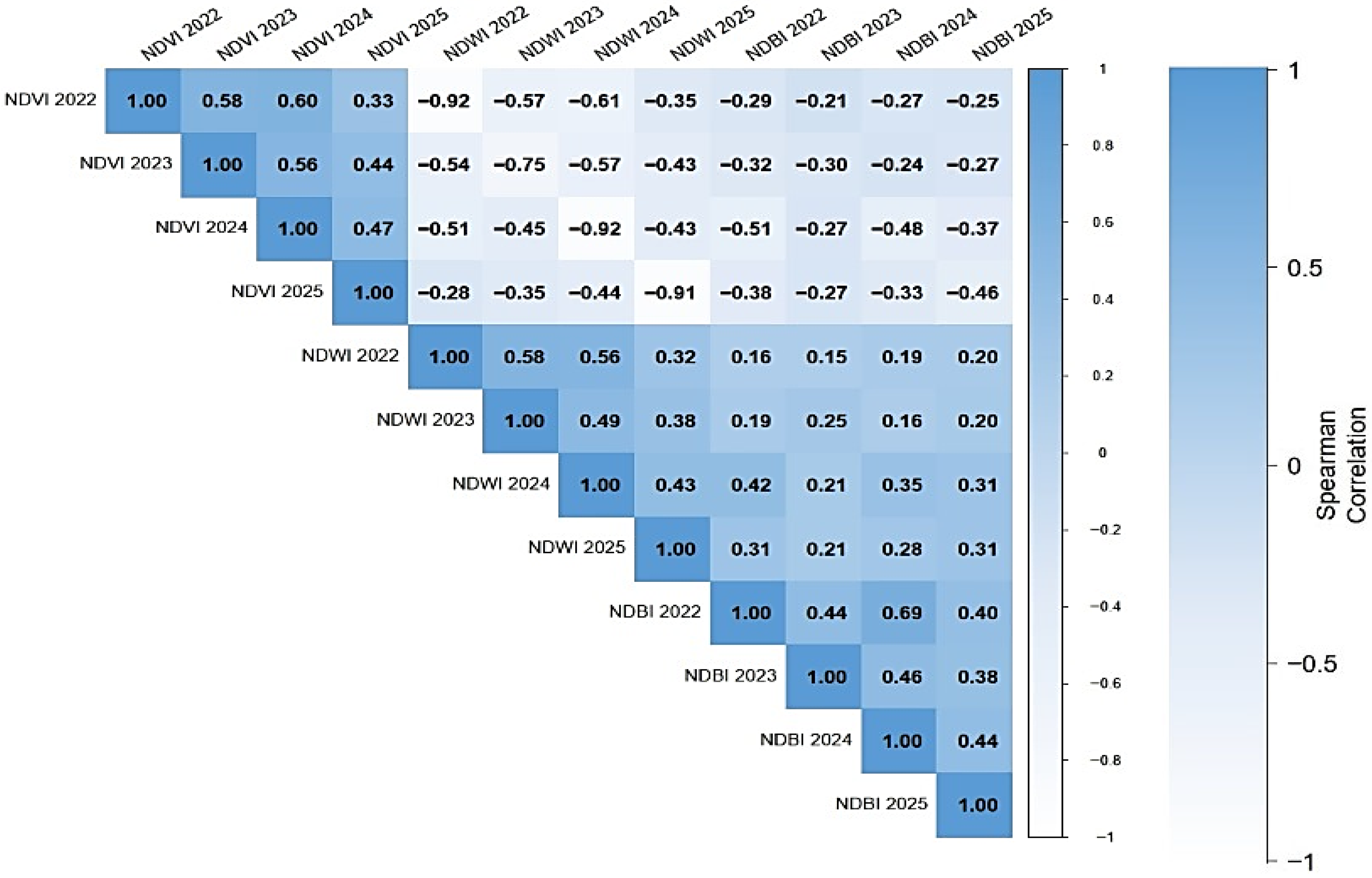
As illustrated by the heatmap, a significant positive Spearman correlation exists among NDVI, NDWI, and NDBI from 2022 to 2025 (Figure 15). Notably, a robust correlation is evident within each index across the years, particularly for NDVI and NDWI. Conversely, the NDVI demonstrates a moderate negative correlation with the NDBI, reflecting contrasting trends between vegetation and build-up areas. A thorough examination of the data reveals that the matrix underscores consistent inter-annual relationships among the three indices over the four-year period.
Figure 15.
Spearman’s Correlation among NDVI, NDWI, and NDBI from 2022 to 2025.
4. Discussion
The coastal belt of Bangladesh continues to present dynamic geomorphological transitions driven by tidal processes, sediment influx, monsoonal hydrology, and cyclone-induced disasters. The shoreline underwent several changes over the study period (2021–2025). This research reveals a clear pattern of spatial heterogeneity, consistent with previous long-term shoreline studies [12,43]. The 710 km coastline from the Hariabhanga River in the west to the Naf River in the east shows the influence of both depositional and erosional processes that shape the morphology of the delta. A total of 9255.52 km2 of coastal land were analyzed, within which 8747.91 km2 remained unchanged in 2025. These stable lands likely represent geomorphologically resilient zones or areas shielded by mangrove vegetation and sediment-compensating hydrodynamics, especially in parts of the Sundarbans [7]. These stable zones act as natural buffers that moderate hydrodynamic impacts during storm surge events [62].
A long-term analysis of shoreline changes in the coastal zone of Bangladesh reveals notable patterns of both erosion and accretion between 1991 and 2021. In 2021, compared to the 1991 baseline, approximately 1223.94 km2 of land was accreted, while 800.72 km2 was eroded from the coastline. Between 1991 and 2006, the total accreted area was 825.15 km2, whereas 475.87 km2 of land were lost due to coastal erosion. During the subsequent period from 2006 to 2021, 756.69 km2 of land were gained through accretion, and 682.75 km2 of land were eroded. The neat land gain over the entire period from 1991 to 2021 was 73.94 km2 [12].
Compared with long-term findings that reported alternating phases of accretion and erosion between 1991 and 2021, the present event-scale assessment (2021–2025) indicates a net land gain (383.49 km2 of accretion versus 124.12 km2 of erosion). This recent balance suggests an accretion-dominant phase during the study window; however, it should not be interpreted as evidence of a persistent long-term trend because shoreline behavior in the Bangladesh delta can vary substantially on decadal timescales under changing hydrodynamic, sediment-supply, and cyclone regimes. Moreover, the Bangladesh delta’s neat area loss and gain by three zonal classes were reported as follows: the west zone (neat erosion) at 40.67 km2, the center zone (neat erosion) at 61.69 km2, and the eastern zone (neat accession) at 30.20 km2 from 1989 to 2019. According to Sarwar and Woodroffe (2013), there was minimal change along the entire Bangladeshi coastline between 1989 and 2009 (20 years), with 315 km2 of accretion and about 307 km2 of erosion [60]. This accretion, compared to historical averages, reflects an active depositional phase within the coastal deltaic system, consistent with earlier findings on sediment-driven land formation in Bangladesh.
Although the comparison with long-term studies is informative, the substantially larger net accretion estimated for 2021–2025 (259.37 km2) relative to the ~73.94 km2 net gain reported over 1991–2021 requires clarification. These values are not directly comparable because they differ in methodological design, temporal scale, and shoreline proxies. The present study uses a fixed 2021 baseline shoreline and a 2025 shoreline proxy extracted from harmonized dry-season Landsat 8/9 imagery, which captures short-term sediment pulses, cyclone-driven deposition, and rapid char emergence that are typically smoothed out in multi-decadal analyses. In contrast, long-term studies integrate multiple shoreline positions across varying tidal stages, sensor types, and hydrological regimes, producing conservative net-change estimates that reflect averaged geomorphic trends rather than event-scale adjustments. Furthermore, the 2021–2025 period coincides with several years of high sediment discharge and cyclone-induced sediment redistribution, which can temporarily inflate accretion signals. Therefore, the higher short-term net accretion reported here should be interpreted as an event-scale response of a highly dynamic delta system rather than a contradiction of long-term geomorphological trends.
The spectral analysis supports this spatial interpretation. NDVI values show slight inter-annual fluctuation, indicating stable vegetation health along most of the shoreline. The stable NDVI trajectory implies that no major vegetation loss occurred despite cyclone-driven disturbances during these years, aligning with recovery patterns observed in past cyclone studies. NDWI values remained relatively stable, suggesting no long-term increase in surface-water dominance. This stability indicates that post-cyclone water recession occurred within the normal seasonal cycle, without causing persistent inundation, which supports earlier hydrological assessments of the study region. In contrast, NDBI demonstrates a slightly increasing trajectory, reflecting small expansions of built-up or exposed land surfaces. This may indicate localized land-use changes or the exposure of newly accreted sediments, a trend also noted in previous coastal LULC studies.
The Spearman correlation results support these spatial interpretations. The strong negative correlation between NDVI and NDWI across all years indicates a natural land-water contrast typical of tidal deltas. The consistent moderate negative correlation between NDVI and NDBI implies that areas experiencing vegetation decline correspond to zones of increased exposure or human modification. The positive correlation between NDWI and NDBI across multiple years indicates a statistical relationship between moisture-related areas and built-up surface conditions, reflecting changes in land surface characteristics over time. This study highlights the short-term dynamism and resilience of the Bangladesh coast. The neat accretion trend between 2021 and 2025 exceeds several long-term historical periods, demonstrating that the delta continues to expand outward despite continuous erosion. These findings highlight the importance of integrated remote sensing approaches for capturing rapid coastal transformations and for supporting future coastal management and disaster response strategies.
5. Conclusions
This research on coastal dynamics conducted in the Bangladesh delta between 2021 and 2025 reveals significant patterns of shoreline change and land-cover transformation through geospatial assessments and spectral index analyses. A total of 9255.52 km2 of land within the AoI of the shoreline-adjacent coastal districts was examined. The results indicate a neat positive coastal change, with 383.49 km2 of land accretion and 124.12 km2 of erosion, resulting in a neat gain of 259.37 km2. Moreover, 8747.91 km2 of land remained unchanged, showing no measurable shoreline displacement. The accretion largely occurred in sediment-rich estuarine and deltaic areas, while erosion was concentrated around tidal channels and exposed coastal edges prone to hydrodynamic pressure. The integrated interpretation of all indices illustrates the coupled behavior of vegetation recovery, water withdrawal, and sediment emergence.
5.1. Study Limitations
This research showed recent shoreline and onshore changes in the Bangladesh delta using Landsat 8/9 OLI data and multi-index change-detection methods; however, several limitations should be noted. First, the study relied on medium-resolution imagery (30 m), which is not ideal for detecting minor shoreline shifts, micro-erosion, or localized sediment-transport processes; higher-resolution optical imagery or LiDAR would improve positional accuracy. Second, the analysis window is short (2021–2025 for shoreline change, and 2022–2025 for onshore indices). This duration is sufficient to document recent, event-scale shoreline adjustments and associated land-surface responses, but it is too short to establish robust geomorphological trends or to represent the full range of coastal variability that typically emerges over decadal scales. Third, NDVI, NDWI, and NDBI may be influenced by seasonal vegetation cycles, water turbidity, tidal height, and atmospheric effects; despite consistent dry-season selection and internal consistency checks, residual uncertainty related to tidal synchronization and mixed pixels may remain. Finally, the study focused on physical change signals and did not quantify associated socio-economic or ecological impacts. Future work should extend the time series to at least a decade (e.g., 2015–2025), further investigate the ecological meaning of these indices in deltaic contexts (e.g., mangrove health, salinity intrusion), and apply consistent shoreline-proxy extraction across all years to enable trend analysis and to place the 2021–2025 findings in a longer-term deltaic context utilizing smart sensing techniques [73,74].
5.2. Policy Recommendations
These results support the need for continuous satellite-based monitoring to track coastal changes and erosion-prone areas, such as the Meghna estuarine zone, where the riverbanks are the most unstable. Priority management should focus on the highly dynamic zones identified in this study, especially areas showing pronounced vegetation loss and land-water conversion signals. Regulated planning of newly accreted lands (chars) is also necessary to prevent unplanned settlement expansion. Mangrove restoration, sediment-friendly embankment design, and controlled floodplain accretion should be promoted to enhance the long-term resilience of the coastal areas. Finally, integrating remote sensing-based indicators into coastal planning frameworks is essential for evidence-based coastal management in the coastal delta.
Overall, this study indicates that the Bangladesh delta remains a highly dynamic geomorphological system in which both erosion and accretion occur simultaneously; however, the short-term assessment period from 2021 to 2025 is characterized by dominant accretion. The observed neat accretion reflects the continued influence of fluvial sediment delivery and tidal redistribution processes, which collectively sustain delta-building mechanisms. This study highlights the value of sustained satellite-based shoreline monitoring for detecting near-term morphological transitions, supporting erosion-risk governance, and informing climate-responsive coastal policy and land-management frameworks in one of the world’s most sensitive deltaic environments.
Author Contributions
M.S.: Conceptualization, data curation, formal analysis, investigation, methodology, resources, software, visualization, writing—original draft preparation, writing—review and editing; S.H.S.: data curation, formal analysis, investigation, methodology, resources, software, visualization, writing—original draft preparation; I.Z.O.: data curation, formal analysis, investigation, methodology, resources, software, writing—original draft preparation; W.L.: resources, software, validation, writing—review and editing; M.A.A.: software, validation, writing—review and editing; A.A.: validation, writing—review and editing; T.A.: supervision, writing—review and editing. All authors have read and agreed to the published version of the manuscript.
Funding
The present study was funded by the Ministry of Science and Technology (MoST), the Government of the People’s Republic of Bangladesh, through the Research and Development (R&D) Cluster’s project titled “Shoreline Change Assessment (SCA) in the Coastal Region of Bangladesh Delta, from 2021 to 2025 Using Satellite Remote Sensing Dataset”. The present grant was designated for the agriculture and environment group, with the grant number R&D-2410009.
Data Availability Statement
The original contributions presented in this study are included in the article. Further inquiries can be directed to the corresponding authors.
Acknowledgments
The authors would like to express their sincere gratitude to all those who participated in this study. The authors would like to thank the Bangabandhu Science and Technology Fellowship (BSTF) (2019 to 2023), the Ministry of Science and Technology (MoST), and the Government of Bangladesh (GoB) for providing a scholarship for Doctoral Program at the University of Tsukuba, Japan, and for providing additional funding through the Research and Development (R&D) Cluster’s project to extend the research work in 2024–2025 session; the Survey of Bangladesh (SoB), the Ministry of Defense (MoD), Government of Bangladesh (GoB) for providing the country’s datasheet, Chittagong Port Authority (CPA), Chattogram for providing necessary tide level dataset and the United States Geological Survey (USGS) for the Landsat 8/9 dataset for the study and Landsat Toolbox software for analysis support. The authors are grateful to the Environmental Systems Research Institute (ESRI) for the ArcGIS® 10.8.2 software utilized in the present study.
Conflicts of Interest
The authors have declared that there are no potential conflicts of interest regarding the research, authorship, and publication of this article.
Abbreviations
| AoI | Area of Interest |
| GRPs | Ground Reference Points |
| NDBI | Normalized Difference Built-up Index |
| NDVI | Normalized Difference Vegetation Index |
| NDWI | Normalized Difference Water Index |
| OLI | Operational Land Imager |
References
- Janda, C.N.; Warrick, J.A.; Buscombe, D.; Batiste, S. Shoreline Change of Western Long Island, New York, from Satellite-Derived Shorelines. Coasts 2025, 5, 2. [Google Scholar] [CrossRef] [Scilit]
- Abdullah Al, M.; Akhtar, A.; Rahman, M.F.; Kamal, A.H.M.; Karim, N.U.; Hassan, M.L. Habitat Structure and Diversity Patterns of Seaweeds in the Coastal Waters of Saint Martin’s Island, Bay of Bengal, Bangladesh. Reg. Stud. Mar. Sci. 2020, 33, 100959. [Google Scholar] [CrossRef] [Scilit]
- Murshed, S.; Griffin, A.L.; Islam, M.A.; Wang, X.H.; Paull, D. Assessing Multi-Climate-Hazard Threat in the Coastal Region of Bangladesh by Combining Influential Environmental and Anthropogenic Factors. Prog. Disaster Sci. 2022, 16, 100261. [Google Scholar] [CrossRef] [Scilit]
- Apostolopoulos, D.; Nikolakopoulos, K. A Review and Meta-Analysis of Remote Sensing Data, GIS Methods, Materials and Indices Used for Monitoring the Coastline Evolution over the Last Twenty Years. Eur. J. Remote Sens. 2021, 54, 240–265. [Google Scholar] [CrossRef] [Scilit]
- Shamsuzzoha, M.; Ahamed, T. Assessment of Shoreline and Agricultural Land Use Changes in the Onshore Coastal Region of Bangladesh Delta Using Satellite Remote Sensing and GIS. In Remote Sensing Application II; New Frontiers in Regional Science: Asian Perspectives; Ahamed, T., Ed.; Springer: Singapore, 2024; Volume 77, pp. 85–119. [Google Scholar]
- Karunarathna, H.; Brown, J.; Chatzirodou, A.; Dissanayake, P.; Wisse, P. Multi-Timescale Morphological Modelling of a Dune-Fronted Sandy Beach. Coast. Eng. 2018, 136, 161–171. [Google Scholar] [CrossRef] [Scilit]
- Kundu, K.; Mandal, J.K. Shoreline Change Detection and Future Prediction of Sundarban Delta Using Remote Sensing Data and Digital Shoreline Analysis System. J. Indian Soc. Remote Sens. 2024, 52, 485–503. [Google Scholar] [CrossRef] [Scilit]
- Laignel, B.; Vignudelli, S.; Almar, R.; Becker, M.; Bentamy, A.; Benveniste, J.; Birol, F.; Frappart, F.; Idier, D.; Salameh, E.; et al. Observation of the Coastal Areas, Estuaries and Deltas from Space. Surv. Geophys. 2023, 44, 1309–1356. [Google Scholar] [CrossRef] [Scilit]
- Kourosh Niya, A.; Alesheikh, A.A.; Soltanpor, M.; Kheirkhahzarkesh, M.M. Shoreline Change Mapping Using Remote Sensing and GIS Case Study: Bushehr Province. Int. J. Remote Sens. Appl. 2013, 3, 102–107. [Google Scholar]
- Kankara, R.S.; Selvan, S.C.; Markose, V.J.; Rajan, B.; Arockiaraj, S. Estimation of Long and Short Term Shoreline Changes Along Andhra Pradesh Coast Using Remote Sensing and GIS Techniques. Procedia Eng. 2015, 116, 855–862. [Google Scholar] [CrossRef] [Scilit]
- Al Fugura, A.; Billa, L.; Pradhan, B. Semi-Automated Procedures for Shoreline Extraction Using Single RADARSAT-1 SAR Image. Estuar. Coast. Shelf Sci. 2011, 95, 395–400. [Google Scholar] [CrossRef] [Scilit]
- Shamsuzzoha, M.; Ahamed, T. Shoreline Change Assessment in the Coastal Region of Bangladesh Delta Using Tasseled Cap Transformation from Satellite Remote Sensing Dataset. Remote Sens. 2023, 15, 295. [Google Scholar] [CrossRef] [Scilit]
- Kabir, M.A.; Salauddin, M.; Hossain, K.T.; Tanim, I.A.; Saddam, M.M.H.; Ahmad, A.U. Assessing the Shoreline Dynamics of Hatiya Island of Meghna Estuary in Bangladesh Using Multiband Satellite Imageries and Hydro-Meteorological Data. Reg. Stud. Mar. Sci. 2020, 35, 101167. [Google Scholar] [CrossRef] [Scilit]
- Balakrishnan, P.; Abulibdeh, A.; Abul Kasem Kabir, T. Assessment of the Impact of Anthropogenic Evolution and Natural Processes on Shoreline Dynamics Using Multi-Temporal Satellite Images and Statistical Analysis. Water 2023, 15, 1440. [Google Scholar] [CrossRef] [Scilit]
- Wahiduzzaman, M.; Yeasmin, A. An Assessment of Tropical Cyclone Frequency in the Bay of Bengal and Its Impact on Coastal Bangladesh. Coasts 2024, 4, 594–608. [Google Scholar] [CrossRef] [Scilit]
- Pardo-Pascual, J.E.; Almonacid-Caballer, J.; Ruiz, L.A.; Palomar-Vázquez, J. Automatic Extraction of Shorelines from Landsat TM and ETM+ Multi-Temporal Images with Subpixel Precision. Remote Sens. Environ. 2012, 123, 1–11. [Google Scholar] [CrossRef] [Scilit]
- Dominici, D.; Zollini, S.; Alicandro, M.; Della Torre, F.; Buscema, P.; Baiocchi, V. High Resolution Satellite Images for Instantaneous Shoreline Extraction Using New Enhancement Algorithms. Geosciences 2019, 9, 123. [Google Scholar] [CrossRef] [Scilit]
- Ford, M. Shoreline Changes Interpreted from Multi-Temporal Aerial Photographs and High Resolution Satellite Images: Wotje Atoll, Marshall Islands. Remote Sens. Environ. 2013, 135, 130–140. [Google Scholar] [CrossRef] [Scilit]
- Sghaier, M.O.; Foucher, S.; Lepage, R. River Extraction from High-Resolution SAR Images Combining a Structural Feature Set and Mathematical Morphology. IEEE J. Sel. Top. Appl. Earth Obs. Remote Sens. 2017, 10, 1025–1038. [Google Scholar] [CrossRef] [Scilit]
- Zhang, G.; Perrie, W.; Zhang, B.; Yang, J.; He, Y. Monitoring of Tropical Cyclone Structures in Ten Years of RADARSAT-2 SAR Images. Remote Sens. Environ. 2020, 236, 111449. [Google Scholar] [CrossRef] [Scilit]
- Toure, S.; Diop, O.; Kpalma, K.; Maiga, A.S. Shoreline Detection Using Optical Remote Sensing: A Review. ISPRS Int. J. Geoinf. 2019, 8, 75. [Google Scholar] [CrossRef] [Scilit]
- Sardar, M.E.; Rahman, M.A.; Rasheduzzaman, M.; Shamsuzzoha, M.; Azad, A.K.; Akter, A.; Ishana, K.; Parvez, A.; Abedin, M.A.; Islam, M.K.; et al. A Systematic Review of Terrestrial Laser Scanning (TLS) Applications in Sediment Management. NDT 2026, 4, 10. [Google Scholar] [CrossRef] [Scilit]
- Maiti, S.; Bhattacharya, A.K. Shoreline Change Analysis and Its Application to Prediction: A Remote Sensing and Statistics Based Approach. Mar. Geol. 2009, 257, 11–23. [Google Scholar] [CrossRef] [Scilit]
- Murali, R.M.; Dhiman, R.; Choudhary, R.; Seelam, J.K.; Ilangovan, D.; Vethamony, P. Decadal Shoreline Assessment Using Remote Sensing Along the Central Odisha Coast, India. Environ. Earth Sci. 2015, 74, 7201–7213. [Google Scholar] [CrossRef] [Scilit]
- Tiede, J.; Jordan, C.; Moghimi, A.; Schlurmann, T. Long-Term Shoreline Changes at Large Spatial Scales at the Baltic Sea: Remote-Sensing Based Assessment and Potential Drivers. Front. Mar. Sci. 2023, 10, 1207524. [Google Scholar] [CrossRef] [Scilit]
- Warner, J.F.; van Staveren, M.F.; van Tatenhove, J. Cutting Dikes, Cutting Ties? Reintroducing Flood Dynamics in Coastal Polders in Bangladesh and the Netherlands. Int. J. Disaster Risk Reduct. 2018, 32, 106–112. [Google Scholar] [CrossRef] [Scilit]
- Alharbi, O.A.; Niang, A.J. Shoreline Development During a Four-Decade Period, Along Al Qunfudhah Coast, Saudi Arabia. Coasts 2025, 5, 45. [Google Scholar] [CrossRef] [Scilit]
- Mishra, M.; Santos, C.A.G.; da Silva, R.M.; Rana, N.K.; Kar, D.; Parida, N.R. Monitoring Vegetation Loss and Shoreline Change Due to Tropical Cyclone Fani Using Landsat Imageries in Balukhand-Konark Wildlife Sanctuary, India. J. Coast. Conserv. 2021, 25, 53. [Google Scholar] [CrossRef] [Scilit]
- Cenci, L.; Disperati, L.; Persichillo, M.G.; Oliveira, E.R.; Alves, F.L.; Phillips, M. Integrating Remote Sensing and GIS Techniques for Monitoring and Modeling Shoreline Evolution to Support Coastal Risk Management. GISci. Remote Sens. 2018, 55, 355–375. [Google Scholar] [CrossRef] [Scilit]
- Rashid, M.B. Monitoring of Drainage System and Waterlogging Area in the Human-Induced Ganges-Brahmaputra Tidal Delta Plain of Bangladesh Using MNDWI Index. Heliyon 2023, 9, e17412. [Google Scholar] [CrossRef] [Scilit]
- Elahi, M.W.E.; Wang, X.H.; Ritchie, E.A. Cyclone-Induced Storm Surge Flooding in the Ganges-Brahmaputra-Meghna Delta under Different Mean-Sea Level Rise Scenarios. Ocean Dyn. 2025, 75, 27. [Google Scholar] [CrossRef] [Scilit]
- Wang, Y.-H.; Deng, A.-J.; Feng, H.-C.; Wang, D.-W.; Guo, C.-S. Tide-Modulated River Discharge Division in the Ganges-Brahmaputra-Meghna Delta Channel Network, Bangladesh. J. Hydrol. Reg. Stud. 2023, 49, 101493. [Google Scholar] [CrossRef] [Scilit]
- Nasreen, M.; Hossain, K.M.; Khan, M.M. Coastal Disaster Risk Management in Bangladesh; Routledge: London, UK, 2023. [Google Scholar]
- BBS. Population Projection of Bangladesh: Dynamics and Trends 2011–2061; Bangladesh Bureau of Statistics (BBS): Dhaka, Bangladesh, 2015.
- BBS. Statistical Yearbook Bangladesh 2023; Bangladesh Bureau of Statistics (BBS): Dhaka, Bangladesh, 2024.
- Bala, B.K.; Hossain, M.A. Modeling of Food Security and Ecological Footprint of Coastal Zone of Bangladesh. Environ. Dev. Sustain. 2010, 12, 511–529. [Google Scholar] [CrossRef] [Scilit]
- Ministry of Environment, Forest and Climate Change. National Adaptation Plan of Bangladesh (2023–2050); Ministry of Environment, Forest and Climate Change, Government of Bangladesh (GoB): Dhaka, Bangladesh, 2022.
- Shaw, R.; Islam, A.; Mallick, F. National Perspectives of Disaster Risk Reduction in Bangladesh. In Disaster Risk Reduction Approaches in Bangladesh; Springer: Tokyo, Japan, 2013; pp. 45–62. [Google Scholar]
- Government of the Bangladesh. Standing Orders on Disaster 2019; Government of the Bangladesh (GoB): Dhaka, Bangladesh, 2020.
- Ali, A. Climate Change Impacts and Adaptation Assessment in Bangladesh. Clim. Res. 1999, 12, 109–116. [Google Scholar] [CrossRef] [Scilit]
- Rahaman, M.A.; Mursheduzzaman; Ali Reza, G.A.M.; Chowdhury, A.M.; Avi, A.R.; Chakraborty, T.R.; Shamsuzzoha, M. Nature-Based Solutions to Promote Climate Change Adaptation and Disaster Risk Reduction Along the Coastal Belt of Bangladesh. In The Palgrave Handbook of Climate Resilient Societies; Palgrave Macmillan: Cham, Switzerland, 2020. [Google Scholar]
- Mahamud, U.; Takewaka, S. Shoreline Change around a River Delta on the Cox’s Bazar Coast of Bangladesh. J. Mar. Sci. Eng. 2018, 6, 80. [Google Scholar] [CrossRef] [Scilit]
- Matin, N.; Hasan, G.M.J. A Quantitative Analysis of Shoreline Changes along the Coast of Bangladesh Using Remote Sensing and GIS Techniques. CATENA 2021, 201, 105185. [Google Scholar] [CrossRef] [Scilit]
- Mahamud, U.; Takewaka, S. Temporal and Spatial Characteristics of Shoreline Variability at Cox’s Bazar, Bangladesh. J. Jpn. Soc. Civ. Eng. Ser. B2 (Coast. Eng.) 2016, 72, I_715–I_720. [Google Scholar] [CrossRef] [Scilit] [PubMed]
- Emran, A.; Rob, M.A.; Kabir, M.H. Coastline Change and Erosion-Accretion Evolution of the Sandwip Island, Bangladesh. Int. J. Appl. Geospat. Res. 2017, 8, 33–44. [Google Scholar] [CrossRef] [Scilit]
- Hassan, M.A.; Ratna, S.J.; Hassan, M.; Tamanna, S. Remote Sensing and GIS for the Spatio-Temporal Change Analysis of the East and the West River Bank Erosion and Accretion of Jamuna River (1995–2015), Bangladesh. J. Geosci. Environ. Prot. 2017, 5, 79–92. [Google Scholar] [CrossRef]
- Langat, P.K.; Ghosh, M.K.; Roy, C.; Talukdar, P.; Koech, R.; Neupane, A. Mapping Coastal Dynamics Induced Land Use Change in Sandwip Island, Bangladesh. Remote Sens. 2024, 16, 4686. [Google Scholar] [CrossRef] [Scilit]
- Chu, Z.X.; Sun, X.G.; Zhai, S.K.; Xu, K.H. Changing Pattern of Accretion/Erosion of the Modern Yellow River (Huanghe) Subaerial Delta, China: Based on Remote Sensing Images. Mar. Geol. 2006, 227, 13–30. [Google Scholar] [CrossRef] [Scilit]
- Wang, X.-Z.; Zhang, H.-G.; Fu, B.; Shi, A. Analysis on the Coastline Change and Erosion-Accretion Evolution of the Pearl River Estuary, China, Based on Remote-Sensing Images and Nautical Charts. J. Appl. Remote Sens. 2013, 7, 073519. [Google Scholar] [CrossRef] [Scilit]
- Islam, M.S.; Crawford, T.W. Changing Pattern of Coastline and Its Impact on Land Use and Land Cover (LULC) in the Lower Meghna River Region of Bangladesh. In Proceedings of the 10th International Conference on Geomorphology, ICG2022-504, Coimbra, Portugal, 12–16 September 2022. [Google Scholar]
- Crawford, T.W.; Rahman, M.K.; Miah, M.G.; Islam, M.R.; Paul, B.K.; Curtis, S.; Islam, M.S. Coupled Adaptive Cycles of Shoreline Change and Households in Deltaic Bangladesh: Analysis of a 30-Year Shoreline Change Record and Recent Population Impacts. Ann. Am. Assoc. Geogr. 2021, 111, 1002–1024. [Google Scholar] [CrossRef] [Scilit]
- Rouse, J.W.; Hass, R.H.; Schell, J.A.; Deering, D.W. Monitoring Vegetation Systems in the Great Plains with ERTS. In Proceedings of the Third ERTS Symposium, Washington, DC, USA, 10–14 December 1973; NASA SP-351; NASA: Washington, DC, USA, 1973; pp. 309–317. [Google Scholar]
- Szabó, S.; Gácsi, Z.; Balázs, B. Specific Features of NDVI, NDWI and MNDWI as Reflected in Land Cover Categories. Landsc. Environ. 2016, 10, 194–202. [Google Scholar] [CrossRef] [Scilit]
- Gao, B. NDWI—A Normalized Difference Water Index for Remote Sensing of Vegetation Liquid Water from Space. Remote Sens. Environ. 1996, 58, 257–266. [Google Scholar] [CrossRef] [Scilit]
- He, C.; Shi, P.; Xie, D.; Zhao, Y. Improving the Normalized Difference Built-up Index to Map Urban Built-up Areas Using a Semiautomatic Segmentation Approach. Remote Sens. Lett. 2010, 1, 213–221. [Google Scholar] [CrossRef] [Scilit]
- Zha, Y.; Gao, J.; Ni, S. Use of Normalized Difference Built-up Index in Automatically Mapping Urban Areas from TM Imagery. Int. J. Remote Sens. 2003, 24, 583–594. [Google Scholar] [CrossRef] [Scilit]
- Mahmood, R.; Ahmed, N.; Zhang, L.; Li, G. Coastal Vulnerability Assessment of Meghna Estuary of Bangladesh Using Integrated Geospatial Techniques. Int. J. Disaster Risk Reduct. 2020, 42, 101374. [Google Scholar] [CrossRef] [Scilit]
- Islam, M.A.; Hossain, M.S.; Hasan, T.; Murshed, S. Shoreline Changes along the Kutubdia Island, South East Bangladesh Using Digital Shoreline Analysis System. Bangladesh J. Sci. Res. 2016, 27, 99–108. [Google Scholar] [CrossRef] [Scilit]
- Shamim, M. Impacts of Climate Change on Coastal Communities of Bangladesh: A Case Study of Kutubdia Para, Cox’s Bazar. Soc. Change 2016, 6, 27–38. [Google Scholar]
- Sarwar, M.G.M.; Woodroffe, C.D. Rates of Shoreline Change along the Coast of Bangladesh. J. Coast. Conserv. 2013, 17, 515–526. [Google Scholar] [CrossRef] [Scilit]
- Bharath, N.; Swathi, K.K.; Dwarakish, G.S.; Shivanna; Jagadeesha, P.B. Shoreline Change Detection Using DSAS and Land Use/Land Cover Change Analysis of Mangalore Coast, Southwest Coast of India. Environ. Sustain. Indic. 2025, 28, 100906. [Google Scholar] [CrossRef] [Scilit]
- Karim, M.F.; Mimura, N. Impacts of Climate Change and Sea-Level Rise on Cyclonic Storm Surge Floods in Bangladesh. Glob. Environ. Change 2008, 18, 490–500. [Google Scholar] [CrossRef] [Scilit]
- Ha-Mim, N.M.; Hossain, M.Z. Application of GIS and AHP-Based Integrated Methodology for Mapping and Characterizing Socioeconomic Vulnerability to Natural Hazards: A Case Study of Southwestern Coastal Bangladesh. In A System Engineering Approach to Disaster Resilience: Select Proceedings of VCDRR 2021; Ghosh, C., Kolathayar, S., Eds.; Springer: Singapore, 2022; Volume 205, pp. 187–203. [Google Scholar]
- Alam, R. Characteristics of Hydrodynamic Processes in the Meghna Estuary Due to Dynamic Whirl Action. IOSR J. Eng. 2014, 4, 39–50. [Google Scholar] [CrossRef] [Scilit]
- McGranahan, G.; Balk, D.; Anderson, B. The Rising Tide: Assessing the Risks of Climate Change and Human Settlements in Low Elevation Coastal Zones. Environ. Urban. 2007, 19, 17–37. [Google Scholar] [CrossRef] [Scilit]
- Mishra, M.; Guria, R.; Paul, S.; Baraj, B.; Santos, C.A.G.; dos Santos, C.A.C.; da Silva, R.M. Geo-Ecological, Shoreline Dynamic, and Flooding Impacts of Cyclonic Storm Mocha: A Geospatial Analysis. Sci. Total Environ. 2024, 917, 170230. [Google Scholar] [CrossRef] [Scilit]
- USGS. Earth Explorer. Available online: https://earthexplorer.usgs.gov/ (accessed on 28 February 2025).
- IBM. IBM SPSS Statistics 26 Brief Guide; IBM: Armonk, NY, USA, 2019. [Google Scholar]
- Rahman, A.; Muktadir, M.G. SPSS: An Imperative Quantitative Data Analysis Tool for Social Science Research. Int. J. Res. Innov. Soc. Sci. 2021, 5, 300–302. [Google Scholar] [CrossRef] [Scilit]
- Tucker, C.J. Red and Photographic Infrared Linear Combinations for Monitoring Vegetation. Remote Sens. Environ. 1979, 8, 127–150. [Google Scholar] [CrossRef] [Scilit]
- Xu, H. Modification of Normalised Difference Water Index (NDWI) to Enhance Open Water Features in Remotely Sensed Imagery. Int. J. Remote Sens. 2006, 27, 3025–3033. [Google Scholar] [CrossRef] [Scilit]
- McFeeters, S.K. The Use of the Normalized Difference Water Index (NDWI) in the Delineation of Open Water Features. Int. J. Remote Sens. 1996, 17, 1425–1432. [Google Scholar] [CrossRef] [Scilit]
- Atia, G.K. Change Detection with Compressive Measurements. IEEE Signal Process. Lett. 2015, 22, 182–186. [Google Scholar] [CrossRef] [Scilit]
- Bayındır, C.; Alan, A.R. Efficient Monitoring of Groundwater Level Changes Using Compressive Remote Sensing. Egypt. J. Remote Sens. Space Sci. 2025, 28, 659–665. [Google Scholar] [CrossRef] [Scilit]

Disclaimer/Publisher’s Note: The statements, opinions and data contained in all publications are solely those of the individual author(s) and contributor(s) and not of MDPI and/or the editor(s). MDPI and/or the editor(s) disclaim responsibility for any injury to people or property resulting from any ideas, methods, instructions or products referred to in the content. |
© 2026 by the authors. Licensee MDPI, Basel, Switzerland. This article is an open access article distributed under the terms and conditions of the Creative Commons Attribution (CC BY) license.