Article

Chemical Composition, Thermal Behavior, and Structural Characteristics of Lupinus mutabilis Sweet Flours from the Southern Peruvian Andes


by
Fredy Taipe-Pardo
1,2,*,
Jhoel Flores Alvarez
1,
Yasmine Diaz Barrera
1,2,
Dannya Arone Palomino
1,2,
Yesica Quispe Fuentes
3 and
Mirian E. Obregón-Yupanqui
1,3
1
Agroindustrial Research Laboratory, Universidad Nacional José María Arguedas, Andahuaylas 03701, Peru
2
Department of Agroindustrial Engineering and Technology, Universidad Nacional José María Arguedas, Andahuaylas 03701, Peru
3
Professional School of Agroindustrial Engineering, Universidad Nacional José María Arguedas, Andahuaylas 03701, Peru
*
Author to whom correspondence should be addressed.
AppliedChem 2026, 6(3), 44; https://doi.org/10.3390/appliedchem6030044
Submission received: 21 April 2026 / Revised: 16 June 2026 / Accepted: 23 June 2026 / Published: 2 July 2026
(This article belongs to the Special Issue Analytical Chemistry: Fundamentals, Current and Future Applications)

Abstract

Andean crops can be efficiently incorporated into food industrialization after the characterization of their components. This study evaluated tarwi (Lupinus mutabilis Sweet) flours from three ecotypes: PNTF (punto negro), WTF (white), and MTF (moro), with a particle size of 125 µm, analyzing their color, proximate composition, amino acid profile, bioactive compounds, and spectroscopic, thermal, and microstructural properties. Significant differences among ecotypes were determined at p < 0.05. The white ecotype showed greater accumulation in Dx (50), while black point exhibited the highest Dx (90), indicating a higher proportion of large particles. Regarding color, WTF presented the highest lightness and whiteness index, PNTF intermediate values, and MTF the darkest coloration, with greenish tones in black point and reddish tones in moro. The MTF ecotype showed the highest protein content (56.28%) and higher levels of essential amino acids, with methionine being the limiting amino acid. It also contained phenolic compounds ranging from 29.97 to 35.49 mg GAE/100 g, flavonoids from 9.36 to 10.8 mg quercetin/100 g, and antioxidant capacity measured by DPPH ranging from 25.79 to 55.30 mg TE/100 g, particularly notable in MTF. PNTF stood out for its dietary fiber (5.93%) and carbohydrate (17.22%) content. Infrared spectroscopy analysis revealed a similar macromolecular fingerprint among the samples. Differential Scanning Calorimetry (DSC) and Thermogravimetric Analysis (TGA) indicated greater thermal stability in MTF. Scanning Electron Microscopy (SEM) revealed greater compaction of irregular particles in MTF and greater dispersion in PNTF. These results support the differentiated valorization of tarwi ecotypes as complementary raw materials for the development of high-value-added foods in the current food industry.

1. Introduction

Growing demand for sustainable protein sources has increased interest in legumes due to their high nutritional value, bioactive compound content, and lower environmental impact compared with animal-derived protein sources [1,2]; in that scenario, tarwi (Lupinus mutabilis Sweet), an Andean species belonging to the Fabaceae family, stands out for its high protein (32–56%), lipid (up to 24%), dietary fiber, essential amino acid, particularly lysine, and antioxidant compound contents, making it a promising raw material for the development of functional ingredients and plant-based foods [3,4,5]. Nevertheless, the chemical composition and functional properties of L. mutabilis exhibit considerable variability among varieties and ecotypes, which has been attributed to both genetic factors and agronomic growing conditions [6,7,8], such variability is also reflected in seed pigmentation, which ranges from light to dark colors depending on the ecotype. In this regard, darker seeds have been associated with a greater accumulation of phenolic compounds and higher antioxidant capacity, traits closely related to the functional quality and bioactive potential of legumes [9,10]. Recent studies have further demonstrated that the functional and technological properties of L. mutabilis depend not only on its chemical composition but also on the structural organization of proteins, lipids, and polysaccharides, which directly affects thermal stability and processing performance [9,11]. Despite these advances, the relationship between nutritional composition, bioactive compounds, and molecular structure remains insufficiently understood, particularly in local Andean ecotypes.
This limitation is especially relevant in Andahuaylas (Peru), a region characterized by a wide genetic diversity of L. mutabilis, where the white flour (WTF), moro (MTF), and punto negro (PNTF) ecotypes are traditionally cultivated. Despite their agronomic and nutritional importance, information regarding their nutritional, bioactive, and structural characteristics remains scarce, and no studies have comprehensively compared these ecotypes using a unified methodological approach. Consequently, a significant knowledge gap persists regarding the influence of genetic variability on the nutritional, bioactive, and structural properties of L. mutabilis ecotypes.
Therefore, the aim of the present study was to comprehensively characterize and compare the physical, nutritional, bioactive, and structural properties of three Lupinus mutabilis ecotypes from Andahuaylas, Peru, using particle size distribution, colorimetric, compositional, amino acid, spectroscopic (FTIR), thermal (DSC and TGA), and microstructural (SEM) analyses. This approach was intended to improve the understanding of how genetic variability affects the functional quality of tarwi and to identify ecotypes with potential applications in the development of high-value food ingredients.

2. Material and Methods

2.1. Materials

The Lupinus mutabilis Sweet seeds from the white, moro, and punto negro ecotypes were cultivated under the same conventional agronomic practices and were obtained from the Sunday market in the province of Andahuaylas, located in the south-central region of the Peruvian Andes (13°10′ and 13°50′ south latitude, and 73°10′ and 73°50′ west longitude). The samples correspond to the 2023 production period. Subsequently, they were stored at room temperature (20 ± 5 °C) in airtight containers until processing.

2.2. Processing of Lupinus mutabilis Sweet Flour

The Lupinus mutabilis Sweet seeds were selected, removing impurities and mechanical damage. They were then debittered following the methodology of Cortés-Avendaño [12]. In summary, 1 kg of seeds from each ecotype was soaked in water (1:6, w/v) for 12 h at room temperature. Subsequently, they were boiled for 1 h (seeds/water, 1:3, w/v), replacing the water every 30 min. After cooking, the seeds were washed with running water for 5 days and dried at 40 °C for 24 h. Finally, they were ground using a disc mill (Maqorito MQMP2040 model, Lima, Peru) until a particle size smaller than 125 µm was obtained (according to ASTM E11-24 [13]). Larger particles from the first milling were reprocessed until the desired particle size was achieved. The samples were stored in airtight bags at 20 ± 5 °C until analysis.

2.3. Analytical Determinations

2.3.1. Particle Size and Polydispersity Analysis

The particle size of the flours was measured using a Mastersizer 3000 analyzer (Malvern Instruments, Worcestershire, UK), dispersing the samples in isopropanol. It was expressed as the volume-weighted mean diameter (D 4,3), and polydispersity was evaluated using the span index, calculated according to Equation (1).
S p a n = D ( 0.9 ) D ( 0.1 ) D ( 0.5 )
where D (0.1), D (0.5), and D (0.9) correspond to the particle diameters at 10%, 50%, and 90% of the cumulative particle size distribution, respectively.

2.3.2. Color Measurement

Color parameters were evaluated following the methodology of Chiumarelli and Barrial–Lujan [14,15], with some modifications. A CR5 colorimeter (Konica Minolta Sensing Inc., Osaka, Japan) was used to measure lightness (L*) and the a* and b* coordinates. In addition, chroma (C*), hue angle (h*), and whiteness index (WI) were calculated according to Equations (2), (3), and (4), respectively.
h * = t a n 1 ( b * a * )
C * = a * 2 + b * 2
W I = 100 ( 100 L * ) 2 + a * 2 + b * 2

2.3.3. Proximate Composition and Aminoacid Profile

The proximate analysis of Lupinus mutabilis Sweet flour from different ecotypes was performed using AOAC methods. Moisture was determined by oven drying (SLW-115STD stove, Wodzisław Sląski, Poland) [16], protein by the Kjeldahl method [17], fat content was determined by direct Soxhlet extraction [18], and dietary fiber AOAC was measured using the method cited by McCleary [19]. Ash content was determined gravimetrically [20], and carbohydrates were calculated by difference and expressed as carbohydrate content = 100 − (% Protein + % Fat + % Ash + % Fiber + % Moisture) [21].
The amino acid profile of Lupinus mutabilis Sweet flours local were identified and quantified by liquid chromatography. Briefly, approximately 0.5 g of flour sample was hydrolyzed with 6 N HCl (HCl, 37%, Sigma-Aldrich, St. Louis, MO, USA) under nitrogen atmosphere at 110 °C for 24 h. After hydrolysis, the samples were cooled, filtered, and diluted with ultrapure water prior to chromatographic analysis. Amino acids were subsequently identified and quantified using an Agilent 1200 High-Performance Liquid Chromatography (HPLC) system equipped with a diode-array detector (DAD) and a Zorbax Eclipse C18 column (4.6 mm × 75 mm, 3.5 μm) coupled to a guard column (12 mm × 4.6 mm × 5 μm) (Agilent Technologies Inc., Santa Clara, CA, USA). The mobile phase consisted of phosphate buffer (Merck KGaA, Darmstadt, Germany) (pH 7.8) (solvent A) and acetonitrile:methanol (45:45:10, v/v/v) (solvent B). Chromatographic separation was performed at 40 °C with a flow rate of 1.0 mL min−1 and a total run time of 55 min. Amino acids were derivatized using o-phthalaldehyde (OPA) for primary amino acids and 9-fluorenylmethyl chloroformate (FMOC) (Agilent Technologies Inc., CA, USA) for secondary amino acids, and detected at 262 and 336 nm. Quantification was carried out by external calibration using certified amino acid standards, and results were expressed as g amino acid per 100 g flour.

2.3.4. Bioactive Compounds

Methanolic Extraction
Extraction was carried out following the methodology of Kim [22] with slight modifications. Samples were prepared by dissolving 2 g of tarwi flour in 10 mL of 80% methanol (PanReac AppliChem, Barcelona, Spain). The mixture was vortexed (IKA, VORTEX 3 S000, Baden-Württemberg, Germany) for 1 min at 2500 rpm and allowed to stand for 24 h at 2 °C in the dark. Subsequently, the samples were sonicated (BRANSONIC, CPX5800-E, Danbury, CT, USA) for 10 min and centrifuged at 10,000 rpm for 15 min at 10 °C. The resulting extracts were used for the determination of total phenolic compounds, flavonoids, and antioxidant capacity.
Phenolic Compounds
Total phenolic content (TPC) was determined by spectrophotometry using the Folin–Ciocalteu method. The procedure described by Kim and Madrera [22,23] was followed with modifications. Folin–Ciocalteu reagent (Sigma-Aldrich, St. Louis, MO, USA) (0.2 N), 20% Na2CO3 solution (Sigma-Aldrich, St. Louis, MO, USA), and gallic acid standard (Sigma-Aldrich, St. Louis, MO, USA) (200 mg/L) were prepared. The reactions were carried out in a 96-well microplate (Immuno Plate, Winooski, VT, USA), where 50 µL of extract, 100 µL of Folin–Ciocalteu reagent, and 100 µL of Na2CO3 were added. For the blank, the extract was replaced with 50 µL of ultrapure water. The mixture was allowed to react for 15 min, after which the multimode microplate reader (Synergy H1, Winooski, VT, USA) was programmed with shaking at maximum intensity for 10 s and incubation for 30 min. Absorbance was measured at 725 nm. For calibration, a gallic acid standard solution was used at concentrations of 10, 25, 50, 100, 150, and 200 mg/L. All measurements were performed in triplicate, and total phenolic content was expressed as milligrams of gallic acid equivalents per 100 g of flour (mg GAE/100 g).
Total Flavonoid Content
The aluminum chloride colorimetric method was used to determine the total flavonoid content of the sample, following the methodology proposed by Sharma and Pekal [24,25], with modifications. In the wells of a 96-well microplate (Immuno Plate, Winooski, VT, USA), 4.5 µL of extract, 290 µL methanol (Scharlab S.L., Barcelona, Spain) to 80%, and 6 µL of AlCl3 (Merck KGaA, Darmstadt, Germany) to (5%) were added; for the blank, the extract was replaced with 4.5 µL of ultrapure water. The mixture was allowed to react for 15 min in the dark and was then programmed in a multimode microplate reader (Synergy H1, Winooski, VT, USA) with shaking at maximum intensity for 30 s and incubation for 30 min. Absorbance was recorded at 425 nm. For calibration, quercetin standard solution was used at concentrations of 5, 10, 25, 50, and 100 mg/L. Results were expressed as mg quercetin/100 g.
Antioxidant Capacity
To determine the antioxidant capacity of flour from different ecotypes of Lupinus mutabilis Sweet, the DPPH (2,2-diphenyl-1-picrylhydrazyl) free radical method was used (HIMEDIA, Mumbai, India) [26]. The calibration curve was constructed using Trolox (6-hydroxy-2,5,7,8-tetramethylchroman-2-carboxylic acid) (Sigma-Aldrich, St. Louis, MO, USA) with slight modifications. The reaction was carried out in a 96-well microplate (Immuno Plate, Winooski, VT, USA), where 14 µL of extract and 261 µL of DPPH were added. For the blank, the extract was replaced with 14 µL of methanol. The multimode microplate reader (Synergy H1, Winooski, VT, USA) was programmed with shaking at maximum intensity for 10 s and incubation for 15 min at room temperature. Absorbance was measured at 515 nm, and results were expressed as µmol Trolox equivalents per 100 g (µmol TE/100 g).

2.3.5. Determination of Functional Groups

Functional groups present in Lupinus mutabilis Sweet flours were characterized using ATR-FTIR spectroscopy, employing a Nicolet IS50 instrument (Thermo Fisher Scientific, Waltham, MA, USA), following the method of Zhao [27]. The analysis was performed in the mid-infrared range (4000–400 cm−1), with 32 scans and a resolution of 8 cm−1, applying advanced correction for the diamond crystal. The angle of incidence was 45°, and a refractive index of 1.50 was used, conditions typically applied for the identification of functional groups in organic and food matrices [28].

2.3.6. Thermal Behavior Analysis

The thermal stability of the flours was evaluated using differential scanning calorimetry (DSC 2500, TA Instruments, New Castle, DE, USA). A 7 mg sample of hydrated flour (1:2 w/v ratio) was weighed into sealed aluminum pans. The analysis was performed from 25 to 300 °C at a heating rate of 5 °C/min, under a nitrogen flow of 50 mL/min to maintain controlled conditions [28,29]. The thermal decomposition of tarwi flours was evaluated following the methodology of Taipe [28], using a thermogravimetric analyzer (TGA550, TA Instruments, New Castle, DE, USA). A 10 mg sample was subjected to temperatures ranging from 25 to 600 °C at a heating rate of 10 °C/min. Weight loss was recorded as a function of temperature, indicating the decomposition or volatilization of the different components present in the sample.

2.3.7. Structural Analysis of Flours

The surface morphology of the samples was observed using scanning electron microscopy (SEM) with a Quanta 200 system (Thermo Fisher Scientific, Hillsboro, OR, USA), operating at 25 kV and 1000× magnification. The analysis was complemented by energy-dispersive X-ray spectroscopy (EDX) using an Oxford Inca 350 detector (Oxford Instruments, Oxford, UK). Sample preparation and analytical conditions followed the procedures described by Taipe [28]. Images were acquired under low-vacuum conditions using ABS and LVD detectors, at an operating pressure of 0.07 Torr.

2.4. Statistical Analysis

All measurements were carried out in triplicate, and the results were expressed as mean values ± standard deviation. Statistical analysis was performed using analysis of variance (ANOVA) to evaluate differences among treatments and their interactions. Mean comparisons were conducted using Fisher’s least significant difference (LSD) test at a 95% confidence level (p ≤ 0.05). All analyses were performed using Statgraphics Centurion XVIII (StatPoint Technologies Inc., The Plains, VA, USA). The graphical representation of the data was generated using OriginPro 8.0 software (OriginLab Corporation, Northampton, MA, USA).

3. Results

3.1. Particle Size of Lupinus mutabilis Sweet Flour

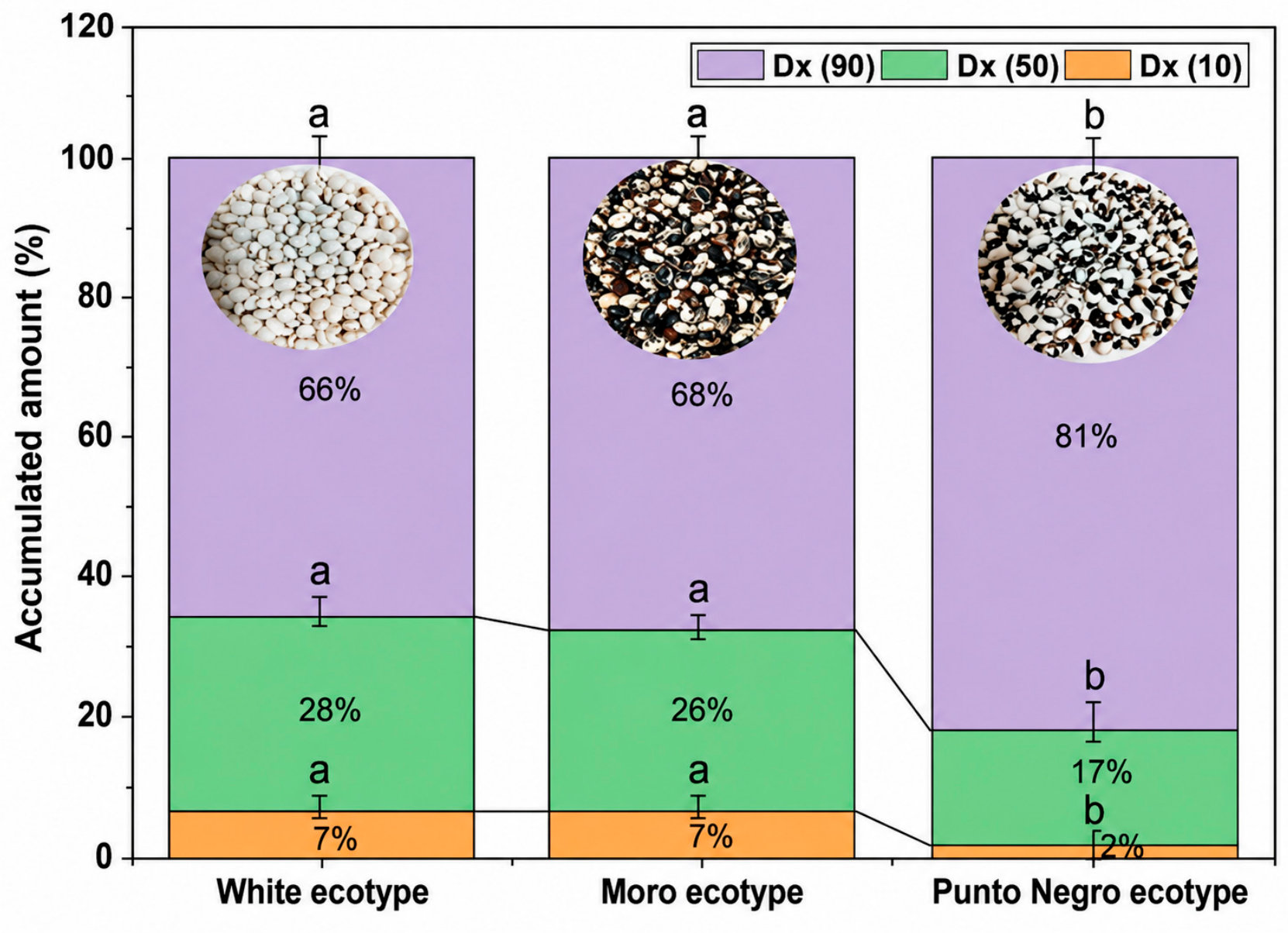
Particle size distribution influences the properties and quality of particulate materials. Figure 1 shows the granulometric analysis of tarwi flours (white, moro, and punto negro) using the Dx (10), Dx (50), and Dx (90) parameters, which describe the cumulative distribution.
The Dx (10) values ranged from 4.6 ± 0.07 to 8.08 ± 0.61 µm, showing significant differences among samples (p < 0.05); the white and moro ecotypes accounted for 7%, while the punto negro ecotype represented 2% of the total particulate material (Figure 1). For Dx (50), values fluctuated between 17.47 ± 0.73 and 69.50 ± 1.28 µm, indicating that the white ecotype showed a higher cumulative proportion (28%) compared to the punto negro ecotype (p < 0.05). Regarding Dx (90), the punto negro ecotype exhibited the largest particle size (323.67 ± 2.6 µm) with the highest relative accumulation (81%) compared to the other ecotypes (p < 0.05), indicating a particle size distribution dominated by larger particles relative to the Moro and white ecotypes. The span values indicated differences in particle size distribution among ecotypes. The white (2.13) and moro (2.38) flours showed relatively homogeneous distributions, whereas the black-point ecotype exhibited a much higher span (4.54), indicating a broader and more heterogeneous particle size distribution with the presence of both fine and coarse particles.

3.2. Color of Lupinus mutabilis Sweet Flour

Table 1 presents the color parameters of tarwi flours after debittering processing corresponding to the three ecotypes. Significant differences (p < 0.05) were observed across all analyzed parameters: lightness (L*), color coordinates (a* and b*), chroma (C*), hue angle (h*), and whiteness index (WI) indicating variations in the composition and structure of the plant material.
The flour from the white ecotype flour showed the highest lightness (78.55, close to 100), followed by the punto negro ecotype, while the moro ecotype flour presented the lowest values (p < 0.05) (Table 1). The difference between white and moro corresponds to an approximate 4.7% reduction in lightness, whereas punto negro showed an intermediate decrease of 1.7% relative to white, confirming that the former is the lightest and moro the darkest. Regarding the a* parameter, the white flour presented values close to zero (−0.05), indicating chromatic neutrality, punto negro showed significant negative values associated with greenish tones, while moro exhibited positive values linked to reddish hues. These differences indicate clear color variations among the ecotypes, potentially reflecting differences in the composition and abundance of phenolic compounds in the seeds. For the b* parameter, White and moro showed similar values, whereas punto negro presented significantly lower values, indicating an approximate 20.9% reduction in yellow hue and, therefore, a less warm color. chroma (C*) followed a similar pattern to b*, with higher values in white and moro flours and lower values in punto negro, confirming lower color saturation in the latter (20.9% less than white). The hue angle (h*) was similar in white and punto negro, close to 90° (yellow-green tones), while moro flour showed a higher value above 268°, reflecting a completely different hue. Finally, the whiteness index was highest in the white ecotype (69.51), followed by punto negro and moro. Compared to the latter, white was 8.5% higher and punto negro 3.9% higher, confirming that the white ecotype has the lightest flour, in agreement with its higher lightness value.

3.3. Proximate Composition and Aminoacid Profile of Lupinus mutabilis Sweet Flour

Table 2 presents the mean values of the proximate composition and amino acid profile of tarwi flours after debittering processing corresponding to the PNTF, WTF, and MTF ecotypes, showing statistically significant variations in their contents (p < 0.05).
The fat content was slightly higher in WTF, exceeding MTF by approximately 4.7%, while the difference between WTF and PNTF was 1.9% (Table 2). This variation could mainly be attributed to genetic differences among ecotypes, which influence the seed’s lipid accumulation capacity and may also vary according to the specific metabolism of each variety. Regarding ash content, MTF showed the highest value (3.85%), exceeding PNTF by 19.9% and WTF by 12.6%, suggesting a higher mineral content in this ecotype. In terms of dietary fiber, PNTF presented the highest content (5.93%) and contained approximately 37.6% more fiber than MTF and 4.0% more than WTF. For carbohydrates, PNTF also recorded the highest value (17.22%), followed by WTF and MTF. The difference between PNTF and MTF is 17.9%, while compared to WTF it is 3.9%. For protein content, MTF (56.28%) was the highest among WTF and PNTF. MTF exceeded WTF by 5.1% and PNTF by 5.0%, standing out as the ecotype with the greatest protein value.
The aminoacid profile of tarwi flours showed a clearly structured distribution among the three evaluated ecotypes. In all cases, glutamic acid was the predominant amino acid, with MTF showing the highest value (11.31 g/100 g), exceeding PNTF by approximately 1.8% and WTF by 0.9% (Table 1). Similarly, aspartic acid showed very close values among ecotypes, with WTF being slightly higher (2.0% more than PNTF). MTF exhibited higher concentrations in several cases: for threonine, MTF (3.21 g/100 g) exceeded WTF by 10.7% and PNTF by 3.9%. In isoleucine, MTF exceeded WTF by 9.1% and PNTF by 4.1%. Likewise, in phenylalanine, MTF exceeded WTF by 9.1% and PNTF by 4.6%. For leucine, MTF (4.31 g/100 g) was slightly higher than WTF (0.2%) and PNTF (2.6%). For lysine, MTF showed the highest value (3.11 g/100 g), exceeding PNTF by 7.2% and WTF by a similar proportion. On the other hand, some amino acids were slightly higher in WTF, such as glycine, which exceeded PNTF by 5.0%, although the difference with MTF was minimal (0.5%). Methionine was higher in PNTF (0.31 g/100 g), exceeding WTF by 63.2% and MTF by 3.3%, making this one of the few cases where PNTF clearly stands out. Overall, percentage differences among ecotypes ranged from low values (<5%) to moderate values (up to 10%), except for specific amino acids such as methionine. However, serine, histidine, proline, valine, and tryptophan showed no statistically significant differences among the evaluated ecotypes (p > 0.05), indicating that their concentrations remained relatively constant regardless of tarwi ecotype.
This distribution indicates that, although tarwi has a high protein content and a good proportion of essential amino acids, the low presence of sulfur-containing amino acids such as methionine suggests a potential nutritional limitation, which is a common characteristic in legumes.

3.4. Bioactive Compounds of Lupinus mutabilis Sweet Flour

Table 3 shows the mean values of phenolic compound content, flavonoids, and antioxidant capacity measured by DPPH, where significant differences among bioactive components are observed, indicating variability attributable to the ecotype (p < 0.05).
Regarding phenolic compounds, the MTF ecotype (35.49 mg GAE/100 g) showed the highest value, exceeding PNTF by approximately 4.2% and WTF by 18.3%. Similarly, in flavonoids, MTF (10.8 mg quercetin/100 g) was higher than PNTF by 5.5% and WTF by 15.4%. Regarding DPPH antioxidant capacity, the MTF ecotype showed the highest antioxidant capacity, exceeding that of the PNTF ecotype by 34.8% and exhibiting 2.1 times greater than that observed in the WTF ecotype (p < 0.05). In this sense, the MTF ecotype presented the highest values across the evaluated components, suggesting a greater presence of bioactive compounds and, consequently, a higher antioxidant capacity. These variations can mainly be explained by genetic differences among ecotypes, which influence the synthesis of secondary metabolites. In addition, grain pigmentation plays an important role, as darker-colored ecotypes such as MTF tend to present higher concentrations of phenolic compounds and flavonoids, which are responsible both for coloration and antioxidant capacity. In contrast, WTF ecotype with lower pigmentation, tends to accumulate lower amounts of these compounds, while PNTF shows an intermediate behavior. Overall, these results indicate that the MTF ecotype is the most outstanding due to its higher content of bioactive compounds and superior antioxidant capacity, suggesting better functional quality.

3.5. Determination of Functional Groups by Infrared Spectrophotometry

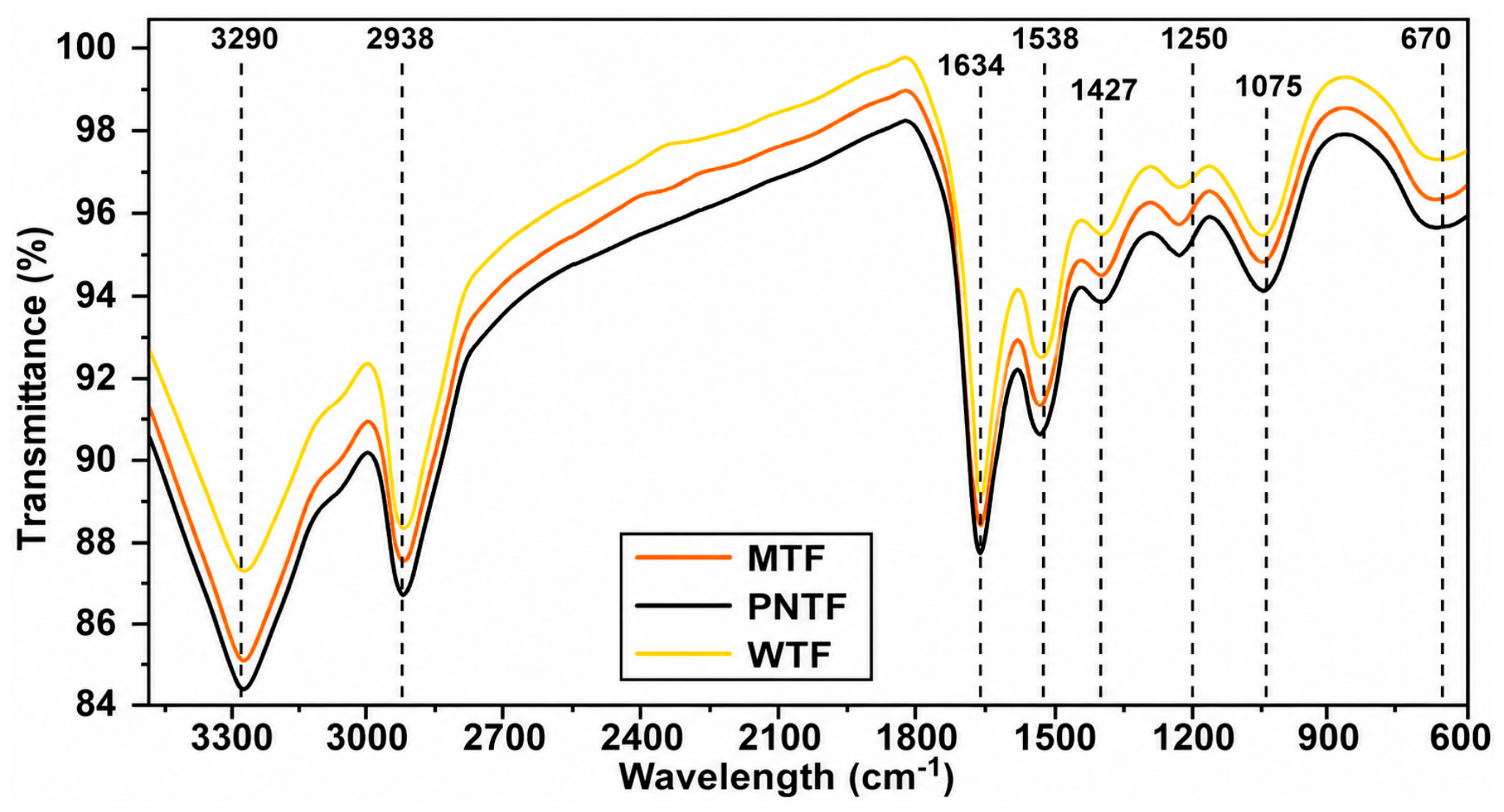
Figure 2 shows that the three tarwi flours after debittering processing present similar IR spectra. The band at 3290 cm−1 corresponds to O–H/N–H stretching, associated with water and polysaccharides, whose high intensity indicates strong molecular interaction with water. The signal at 2938 cm−1 reflects the asymmetric CH2 stretching of lipids. The bands at 1634 cm−1 (Amide I, C=O) and 1538 cm−1 (Amide II, N–H bending) confirm the presence of proteins. At 1427 cm−1, COO stretching of fatty acids is observed, while 1250 cm−1 corresponds to P–O stretching, related to Amide III. The signal at 1075 cm−1 confirms C–O stretching typical of carbohydrates and fiber. Finally, the band at 670 cm−1 is associated with C–H bending attributable to aromatic amino acids or secondary metabolites. The overlap of the spectra indicates that the three tarwi varieties share a common macromolecular fingerprint, with differences only in the relative proportion of proteins, lipids, and carbohydrates. The higher relative intensity of amide bands compared to carbohydrate bands confirms the high protein content of tarwi. Likewise, the C–H band (2938 cm−1) and slight variations in the 1200–1000 cm−1 region reflect the presence of lipids and possible amylose–lipid complexes.
Table 4. Summary of the principal FTIR absorption bands identified in tarwi (Lupinus mutabilis Sweet) flours, including wavenumber assignments, functional groups, and associated biochemical constituents. The differences observed among the ecotypes were primarily reflected in the relative intensity of the FTIR bands rather than in significant shifts in wavenumber positions (Table 4), indicating a similar chemical composition but differences in the relative proportions of proteins, lipids, and polysaccharides (Table 2). This behavior is characteristic of materials belonging to the same species, where genetic variability modifies the accumulation of storage compounds without substantially altering the functional groups present [11]. In this context, the variations observed in the intensity of the Amide I and Amide II bands, as well as in the polysaccharide region (1200–1000 cm−1), were consistent with the differences found in the proximate composition, suggesting that genetic variability influences the partitioning and accumulation of proteins and carbohydrates during seed development [6,30].

3.6. Thermal Behavior Analysis of Lupinus mutabilis Sweet Flour

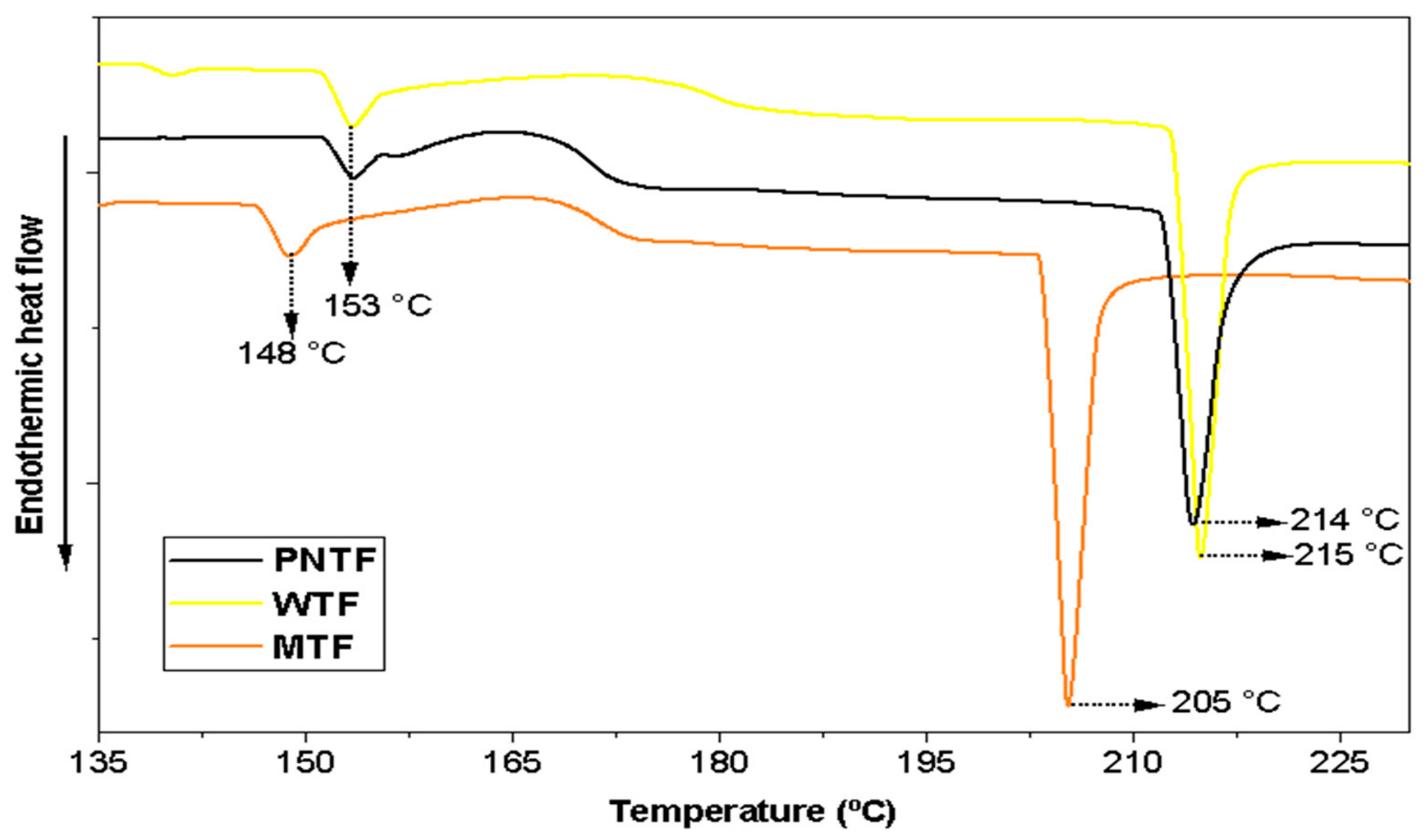
Figure 3 shows the DSC thermograms of WTF, MTF, and PNTF flours. All samples exhibit similar thermal profiles; however, differences are observed in their transition temperatures and the energy required for these transitions, indicating variations in their thermal behavior.
Figure 3 shows the DSC (Differential Scanning Calorimetry) thermograms of PNTF, WTF, and MTF. All three ecotypes exhibited two main endothermic events associated with structural changes in the macromolecular components of the matrix. The first transition, occurring between 148 and 153 °C, may be attributed to the release of strongly bound water, partial denaturation of globular proteins, and the reorganization of secondary structures. The second endothermic event, observed between 205 and 215 °C, showed greater intensity and was associated with more extensive matrix transformations, including advanced protein denaturation, disruption of protein polysaccharide and protein–lipid interactions, and the initial degradation of more thermally resistant structural compounds. Within this temperature range, the MTF ecotype exhibited a lower transition temperature (205 °C) than WTF and PNTF, suggesting that conformational changes and molecular reorganization occurred at relatively lower temperatures. However, this behavior should not be interpreted as lower overall thermal stability, since DSC evaluates energetic transitions rather than the resistance of the matrix to thermal degradation. Therefore, WTF and PNTF required higher temperatures to induce these transitions, indicating greater stability of their molecular structures against the endothermic events evaluated.
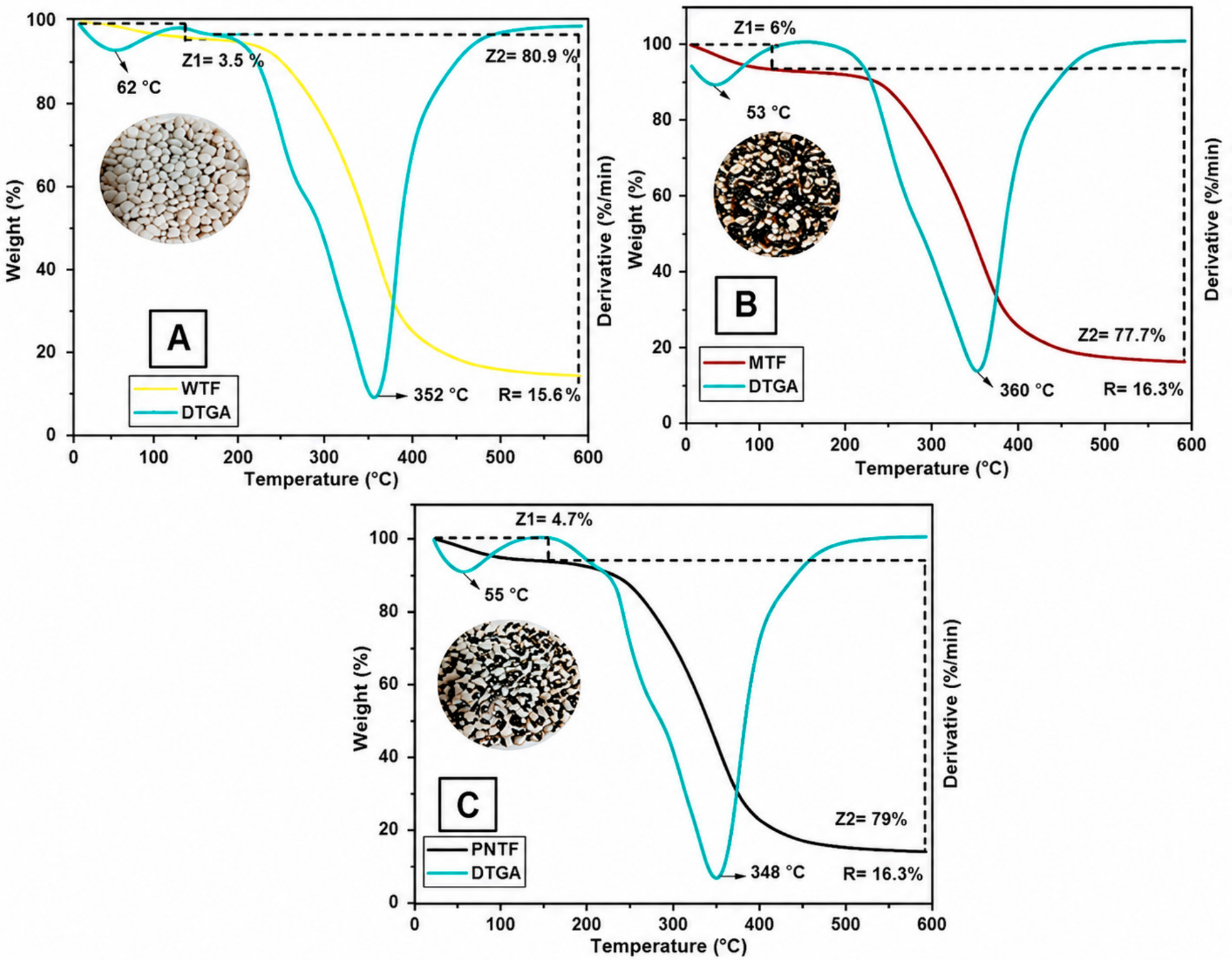
Figure 4 shows the TGA and DTGA thermograms of WTF, MTF, and PNTF flours after debittering processing, which exhibited similar thermal degradation patterns characterized by two main mass-loss stages. The first stage (Z1), occurring between 53 and 65 °C, was mainly associated with the removal of adsorbed water and resulted in mass losses of 3.5% (WTF), 6.0% (MTF), and 4.7% (PNTF). The higher mass loss observed in MTF may be associated with a greater moisture-retention capacity or stronger interactions between water molecules and matrix components. The second stage (Z2), occurring approximately between 335 and 360 °C, corresponded to the degradation of proteins, polysaccharides, and lipids, representing the main thermal decomposition event of the samples. During this stage, mass losses reached 80.9% (WTF), 77.7% (MTF), and 79.5% (PNTF). Although MTF exhibited a slightly lower mass loss, the temperatures of maximum degradation occurred within a narrow range among the three ecotypes, indicating comparable thermal degradation behavior. Therefore, the small differences observed in mass loss may be attributed to variations in the composition and structural organization of the sample matrices rather than to substantial differences in overall thermal stability. The final residue was similar among ecotypes, reaching 15.8% (WTF), 16.5% (MTF), and 16.5% (PNTF), values mainly attributable to mineral compounds and thermally resistant carbonaceous structures. Overall, the TGA results suggest that the three ecotypes exhibited comparable resistance to thermal degradation.

3.7. Structural Analysis of Lupinus mutabilis Sweet Flours

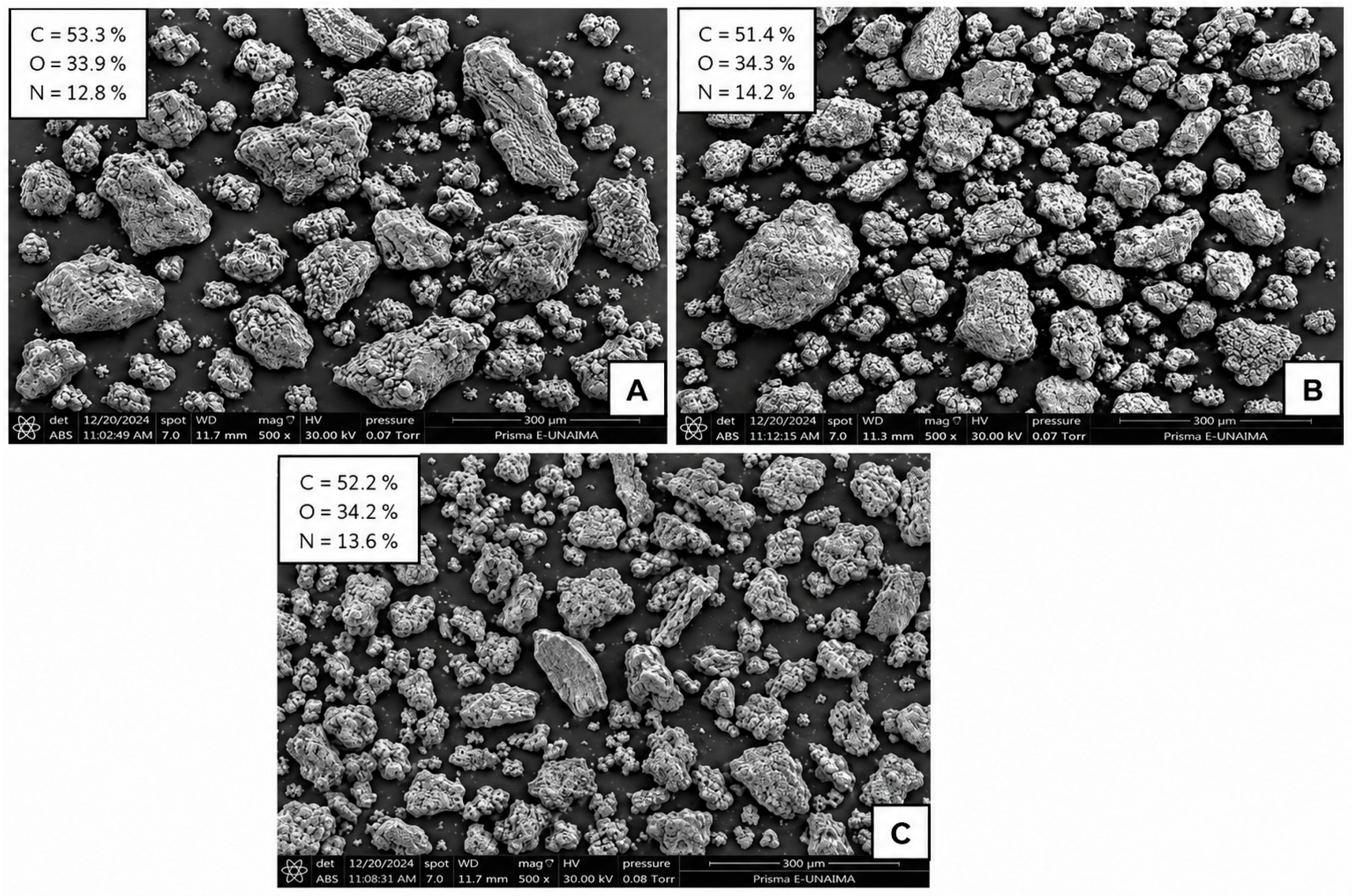
The SEM micrographs of tarwi flours after the debittering process (Figure 5) revealed differences in particle organization and aggregation among ecotypes, suggesting that genetic variability influences not only chemical composition but also the microstructural arrangement of storage compounds. These differences were consistent with the proximate composition and elemental analysis (EDS), particularly with variations in protein, carbohydrate, fiber, and nitrogen content. The WTF ecotype exhibited larger particles with an irregular morphology and heterogeneous distribution, characterized by moderate aggregation and rough surface features. These structural characteristics suggest a less compact organization of storage components, likely associated with its lower nitrogen content (12.8%), which serves as an indirect indicator of reduced protein concentration. The presence of angular particles and irregular fracture planes indicates that brittle fracture mechanisms predominated during milling, resulting in the disruption of the cellular matrix. Furthermore, the lower aggregate density may reflect weaker protein–polysaccharide interactions, thereby limiting the formation of cohesive particle networks. From a functional perspective, the rough and irregular particle surfaces may provide a greater specific surface area, potentially enhancing water adsorption capacity. In contrast, the MTF ecotype displayed a more compact and highly agglomerated microstructure, consistent with its higher protein content and elevated nitrogen concentration (14.2%). The greater accumulation of storage proteins, particularly conglutins, may promote intermolecular associations through hydrogen bonding, hydrophobic interactions, and protein–lipid complex formation, leading to the development of denser and more cohesive particle networks that enhance matrix structural integrity and physical stability. This interpretation is further supported by the higher relative intensities of the Amide I and Amide II bands observed in the FTIR spectra, indicating a greater contribution of proteinaceous components to the flour matrix. Conversely, the PNTF ecotype exhibited a more homogeneous and slightly dispersed microstructure, characterized by lower aggregation and greater particle individualization. This behavior was consistent with its higher carbohydrate (17.22%) and dietary fiber (5.93%) contents, as a greater proportion of structural polysaccharides may restrict protein–protein interactions while increasing matrix rigidity after milling. Consequently, these structural features may promote improved particle dispersibility and faster hydration kinetics. Moreover, the greater dispersion observed in PNTF may facilitate water penetration, enhance reconstitution behavior in aqueous systems, and increase the accessibility of bioactive compounds during gastrointestinal digestion, potentially improving their bioavailability. Thus, MTF appears to allocate a greater proportion of nitrogen to protein synthesis, whereas PNTF accumulates relatively more carbon in the form of structural carbohydrates and dietary fiber. Overall, the SEM, EDS, and proximate composition results indicate that genetic variability among tarwi ecotypes modulates the spatial organization of proteins, lipids, and polysaccharides, ultimately influencing their technological and functional properties.

4. Discussion

Regarding the granulometry of the flours, the Dx (10), Dx (50), and Dx (90) values show marked differences in particle size distribution among the tarwi ecotypes showing that the flour from the punto negro ecotype presents a coarser particle size, whereas white and moro exhibit finer fractions (Figure 1). The lower span values observed in the white and moro ecotypes suggest a more homogeneous particle size distribution, possibly resulting from a more uniform fracture of the cotyledon matrix during milling. In contrast, the higher span value recorded for the punto negro ecotype indicates a broader particle size distribution, characterized by the simultaneous presence of fine and coarse particles, which may reflect a more heterogeneous cellular structure or a greater proportion of fibrous components resistant to mechanical size reduction. This behavior is consistent with studies on legumes showing that differences in cellular architecture and cell wall composition significantly influence milling efficiency and the particle size distribution of the resulting flours [9,31]. This difference is relevant, as recent literature has demonstrated that particle size reduction significantly increases the specific surface area of the material, promoting the rupture of cell walls and the release of bioactive compounds and nutrients associated with the plant matrix [32]. Studies in other matrices, such as lentil flours [33] and faba bean powder [32,34], further support that smaller particle sizes improve functionality, digestibility, and technological applicability due to the increased surface area and enhanced interaction with digestive enzymes.
Regarding color parameters, the differences observed among ecotypes reflect genetically determined variations in the accumulation of pigments and phenolic compounds. The white ecotype exhibited the highest lightness (L*), whereas the moro ecotype showed the lowest values, which is consistent with its higher phenolic content and antioxidant capacity [14,35]. This behavior suggests a greater accumulation of flavonoids, tannins, and other metabolites derived from the phenylpropanoid pathway, which contribute both to seed coat pigmentation and antioxidant activity [10,36]. Likewise, the positive a* values and the high hue angle (h°) observed in the Moro ecotype indicate a greater presence of phenolic pigments, such as anthocyanins and proanthocyanidins, whose synthesis is regulated by genetic factors and agronomic growing conditions [6,15,23]. In contrast, the higher b* and WI values recorded for the white ecotype suggest a greater contribution of carotenoids and a lower accumulation of dark pigments [6]. Therefore, the color differences observed among ecotypes not only reflect phenotypic variation but also underlying differences in chemical composition and the technological potential of the flours.
The proximate composition of tarwi flours revealed differences among ecotypes that reflect variations in reserve partitioning and accumulation during seed development. Although all three ecotypes exhibited a high protein content (53.53–56.28%) (Table 2), characteristic of Lupinus mutabilis and higher than that reported for most conventionally consumed legumes such as lentils (22–26%), chickpeas (18–22%), beans (20–25%), and fava beans (24–30%) [15,37,38], the moro ecotype showed the highest protein concentration. This behavior may be associated with genetic differences in the synthesis and accumulation of storage proteins, particularly conglutin type globulins, which constitute the predominant protein fraction in the genus Lupinus [4,9]. Likewise, the higher ash content observed in MTF suggests greater mineral accumulation, which may be related to a more efficient uptake and translocation of nutrients to the seed during grain filling. In contrast, the WTF ecotype exhibited the highest lipid content compared to purple tarwi (22%) [39], while the PNTF ecotype showed the highest levels of carbohydrates and dietary fiber (Table 2). These differences suggest a differential allocation of fixed carbon during seed development, as the synthesis of proteins, lipids, and polysaccharides competes for common metabolic precursors. In legumes, genetic variation has been reported to modify the balance of proteins, oils, and carbohydrates, resulting in seeds with distinct energy storage profiles [6,39]. In this context, the higher proportion of carbohydrates and dietary fiber observed in PNTF may be associated with greater deposition of structural polysaccharides in the cell wall and seed coat, which may also contribute to the differences in color and particle size distribution observed among ecotypes.
The analysis of the amino acid profile (Table 2) showed a predominance of glutamic and aspartic acids in the three ecotypes, a pattern widely reported in lupin storage proteins, where these amino acids play key structural and metabolic roles [40,41]. Regarding essential amino acids, the MTF ecotype exhibited higher concentrations of lysine, leucine, isoleucine, phenylalanine, and threonine, suggesting a relatively better protein quality. This behavior is consistent with recent studies indicating that L. mutabilis has a balanced amino acid profile, with a high proportion of lysine compared to cereals, which improves protein complementarity in mixed diets [39,42], as in other legumes, methionine was identified as the limiting amino acid in all three ecotypes, a well-documented characteristic of plant proteins due to their low content of sulfur-containing amino acids [42,43]. The differences observed among ecotypes were relatively moderate, indicating that genetic variability mainly affects the quantitative concentration of amino acids rather than their qualitative pattern. This behavior has been reported in studies on the genetic diversity of Lupinus mutabilis, where factors such as ecotype, altitude, and environment influence protein composition without significantly altering the overall profile of essential amino acids [6,41].
Regarding bioactive compounds, the MTF ecotype exhibited significantly higher concentrations of phenolic compounds, flavonoids, and antioxidant capacity (35.49 mg GAE/100 g, 10.8 mg QE/100 g, and 55.30 mg TE/100 g, respectively) than WTF and PNTF (Table 3). This difference suggests a greater activation of the phenylpropanoid pathway, which is responsible for the biosynthesis of polyphenols and phenolic pigments associated with seed coloration [44,45]. Accordingly, the darker coloration of the moro ecotype was consistent with its greater accumulation of bioactive compounds and enhanced antioxidant capacity. Furthermore, the higher antioxidant capacity observed in MTF may not only be related to a greater total phenolic content but also to differences in the structural composition of these metabolites, since antioxidant activity depends on the number and arrangement of hydroxyl groups within phenolic molecules [23,24,32].
Compared with other legumes, the values obtained were lower than those reported for some pigmented varieties of Lens culinaris and Phaseolus vulgaris [43,45]. Nevertheless, this difference may be attributed to interspecific variations in the distribution and accumulation of phenolic compounds, as in Lupinus mutabilis a larger proportion of the seed is composed of protein- and lipid rich cotyledons, whereas in other legumes these compounds are mainly concentrated in the seed coat [23,24]. These findings provide evidence that genetic variability among ecotypes directly influences the accumulation of bioactive compounds and their antioxidant potential, highlighting the MTF ecotype as the most promising candidate for the development of functional ingredients with health-promoting properties [32,46].
The pronounced overlap of the FTIR spectra obtained for the WTF, MTF, and PNTF ecotypes indicates the presence of a common macromolecular composition, mainly characterized by storage proteins, lipids, and structural polysaccharides, which are the predominant components of Lupinus mutabilis seeds [9,11]. Nevertheless, differences in the intensity of certain bands suggest variations in the proportion and molecular organization of these components. The higher intensity of the Amide I and Amide II bands observed in MTF was consistent with its higher protein content (56.28%), which may be associated with a greater accumulation of conglutins, the main storage proteins of the genus Lupinus [30,47]. In contrast, the variations detected in the 1200–1000 cm−1 region were consistent with the higher carbohydrate and dietary fiber contents of PNTF, suggesting a greater deposition of structural polysaccharides in the cell wall, which influence matrix organization and milling behavior [31]. Likewise, the higher relative intensity of the C–H band (~2938 cm−1) in WTF was consistent with its higher lipid content (26.53%), suggesting a greater allocation of carbon toward triacylglycerol biosynthesis during seed development. This behavior agrees with studies reporting that genetic variability in Lupinus mutabilis modifies carbon partitioning among proteins, lipids, and carbohydrates [6,48,49]. Overall, the FTIR results indicate that the differences among ecotypes are mainly associated with quantitative changes in the accumulation and molecular organization of proteins, lipids, and polysaccharides rather than with modifications in the functional groups present within the matrix.
The DSC thermograms showed that the WTF and PNTF ecotypes exhibited higher main transition temperatures (214–215 °C) than MTF (205 °C), indicating that their protein structures required a greater amount of energy to undergo conformational changes. These results suggest that the protein matrices of WTF and PNTF were more structurally organized, possibly due to stronger intermolecular interactions, including hydrogen bonding, hydrophobic interactions, and protein–lipid associations [50,51]. In contrast, the lower transition temperature observed for MTF may indicate greater molecular mobility or lower stability of protein secondary and tertiary structures, promoting earlier matrix reorganization during heating [28]. However, these findings should not be interpreted as evidence of lower overall resistance to thermal degradation. While DSC evaluates denaturation and molecular reorganization processes, TGA assesses the chemical stability of the matrix through mass loss during heating. In this regard, the TGA and DTGA thermograms (Figure 4) revealed similar degradation patterns among the ecotypes. During the first stage (53–65 °C), mass losses were 3.5% (WTF), 6.0% (MTF), and 4.7% (PNTF), mainly associated with the removal of adsorbed moisture. The higher mass loss observed in MTF suggests a greater water-holding capacity, possibly related to a higher availability of polar groups derived from proteins and other hydrophilic constituents [28,52]. The second degradation stage (335–360 °C) corresponded to the decomposition of proteins, polysaccharides, and lipids, with mass losses of 80.9% (WTF), 77.7% (MTF), and 79.5% (PNTF) [53]. Although MTF reached a maximum degradation temperature close to 360 °C, slightly higher than those observed for WTF and PNTF, the differences were relatively small and occurred within a narrow thermal range. Therefore, the results do not indicate a greater overall thermal stability of MTF, but rather slight differences in degradation kinetics associated with matrix composition and organization [50,54]. This interpretation is consistent with the FTIR results, which revealed a similar macromolecular architecture among ecotypes, dominated by proteins, lipids, and polysaccharides [9,11].
The microstructural features observed in tarwi flours (Figure 5) reflect differences in the physical organization of proteins, lipids, and polysaccharides accumulated during seed development, which directly influence their functional behavior [6,55]. The WTF sample exhibited a heterogeneous and moderately agglomerated microstructure, which may be related to its higher lipid content (26.53%), promoting protein–lipid interactions and greater water retention [50,51,55]. In contrast, MTF displayed a more compact and highly agglomerated structure, consistent with its higher protein content (56.28%). A greater concentration of storage proteins favors the formation of cohesive networks through hydrogen bonding and hydrophobic interactions, generating denser and more stable aggregates [50]. This behavior is consistent with the higher intensity of the amide I and amide II bands observed in the FTIR spectra. PNTF, on the other hand, exhibited a more dispersed and less agglomerated structure, associated with its higher carbohydrate and dietary fiber contents. A greater proportion of structural polysaccharides limits matrix compaction and promotes improved dispersion and hydration in aqueous systems [31,47,51]. Overall, these findings suggest that genetic variability among ecotypes modifies the microstructural organization of the matrix through changes in the relative proportions of proteins, lipids, and polysaccharides, thereby contributing to the differences observed in the functional properties of the flours.
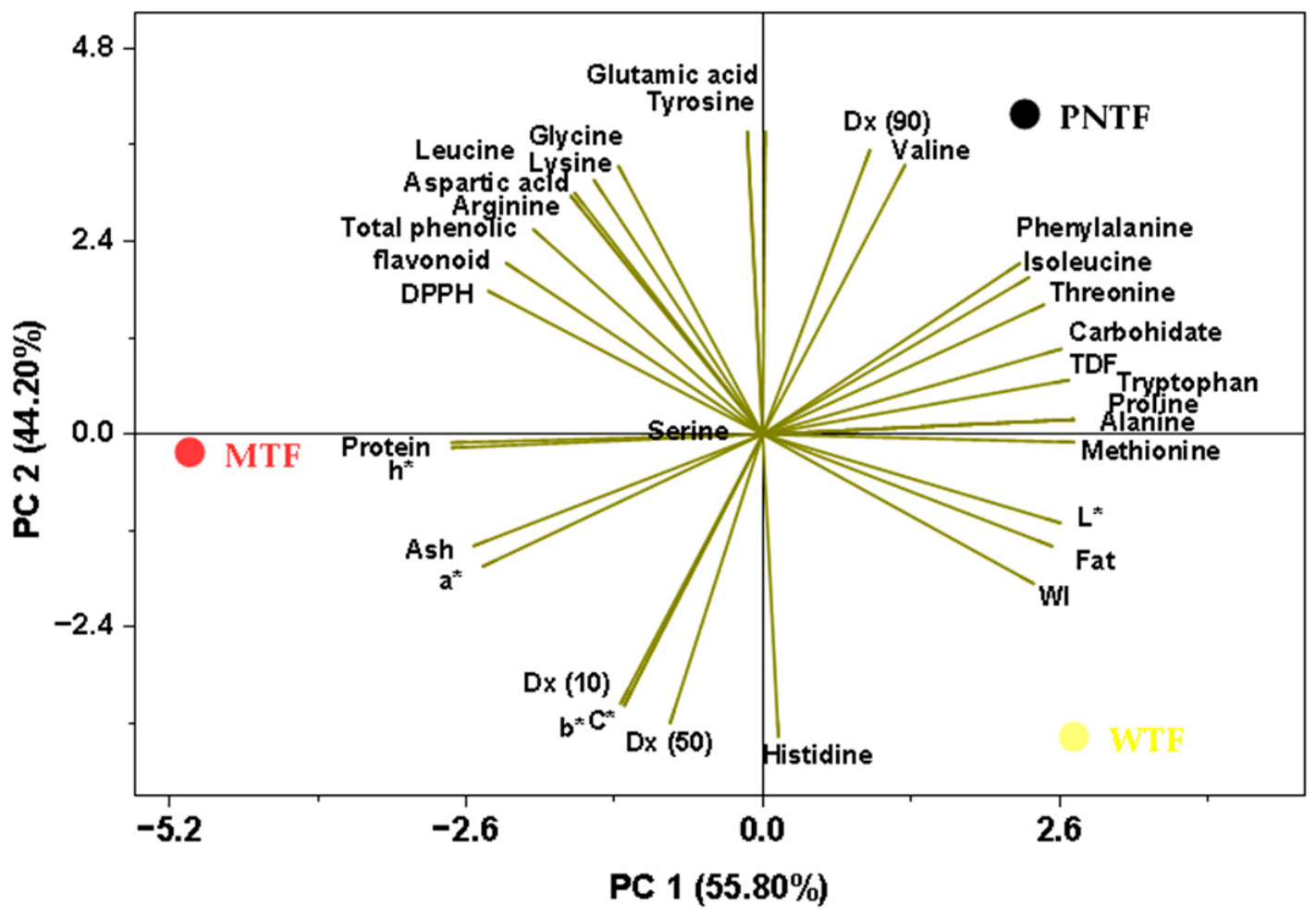
Principal component analysis (PCA), shown in Figure 6, was used to summarize the variability of the physicochemical and functional characteristics of tarwi flours into two principal components. PC1 accounted for 55.80% of the total variability, whereas PC2 explained 44.20%; this distribution reflects a strong influence of the variables associated with PC1 in the differentiation of the ecotypes [39,56].
PCA revealed that the WTF ecotype is positioned in the positive quadrant of PC1 and the negative quadrant of PC2, being associated with variables such as fat content, lightness (L*), whiteness index (WI), and two essential amino acids (histidine and methionine). This distribution suggests that its characteristics are more closely linked to physical and appearance-related properties, as well as to its lipid composition, distinguishing it from the other samples in terms of visual quality (lighter color characteristics) and higher energy content. These attributes may contribute to improving palatability and positively influencing the texture of foods [34,39]; consequently, the WTF ecotype may present greater potential for applications in baking, extrusion, and the development of formulated foods, where color, texture, and energy contribution constitute relevant technological attributes [57]. The MTF sample is located on the negative side of PC1, showing a strong association with phenolic compounds, flavonoids, and antioxidant capacity (DPPH), as well as with protein content and most amino acids (aspartic acid, glutamic acid, arginine, lysine, glycine, leucine, and tyrosine). In addition, ash content and the color parameters a*, b*, and c* also stood out in this sample, which had a fine particle size. This association suggests that this flour has greater nutraceutical potential [32,35], contributing to the oxidative stability and functional value of foods. Likewise, the association with protein may also indicate good emulsifying and foaming properties, characteristics widely reported for lupin proteins and commonly used in products such as emulsions, sauces, or egg substitutes [21,58,59]. On the other hand, the PNTF sample is located in the positive quadrant of PC1 and PC2, with particles whose cumulative distribution was represented by Dx (90). It was mainly associated with amino acids such as valine, phenylalanine, and isoleucine, which are important for muscle metabolism and tissue maintenance [41,60], and proline, alanine, threonine, and tryptophan, which are useful for energy metabolism and neurological and sleep regulation, in addition to the contribution of fiber and carbohydrates. Therefore, PNTF could be particularly useful in applications where high protein value and technological functionality are required, such as ingredients for fortified foods or protein blends [6,41,60]. This analysis shows that the samples present clearly differentiated profiles: MTF stands out for its greater nutraceutical and antioxidant potential, WTF for its physicochemical characteristics related to color and fat content, and PNTF for its amino acid content and functionality in enriched foods.
Although this study provides relevant information on the physicochemical, nutritional, structural, and functional characteristics of Lupinus mutabilis ecotypes from the Andes of Andahuaylas, some limitations should be acknowledged. In particular, the samples evaluated were collected from a single geographical region and during a single growing season, which may limit the extrapolation of the results to other agroecological environments. Environmental factors such as altitude, soil conditions, temperature, rainfall, and agronomic practices have been reported to significantly influence the accumulation of proteins, lipids, minerals, and bioactive compounds in legumes, thereby affecting their nutritional and functional characteristics [61]; Furthermore, future studies should include a comparative evaluation of tarwi microstructure before and after the debittering process to better understand the structural and compositional changes associated with the removal of soluble constituents. In addition, detailed characterization of specific bioactive compounds and a more comprehensive assessment of antioxidant potential using complementary assays, such as ABTS, FRAP, and ORAC, are recommended to provide a deeper understanding of the nutraceutical properties of tarwi ecotypes. From an applied perspective, future studies should evaluate the techno-functional performance of these flours in real food systems, including bakery products, plant-based beverages, meat analogues, and gluten-free formulations. Furthermore, it is necessary to investigate the bioaccessibility and bioavailability of proteins, amino acids, and phenolic compounds to establish their nutritional and nutraceutical value more accurately [32,46]. Such approaches will contribute to a better understanding of the functional variability of tarwi and support the identification and valorization of superior ecotypes for the development of sustainable, value-added foods and their contribution to food security.

5. Conclusions

Tarwi ecotypes from the Andes of Andahuaylas, Peru, exhibited compositional, structural, and functional differences associated with genetic variability. The MTF ecotype was characterized by its higher protein content, greater concentrations of phenolic compounds and flavonoids, and superior antioxidant capacity. In contrast, PNTF showed higher dietary fiber and carbohydrate contents, whereas WTF stood out for its higher lipid content and distinctive color characteristics. Although the three ecotypes shared a similar macromolecular composition, FTIR, DSC, TGA, and SEM analyses revealed differences in the molecular and microstructural organization of proteins, lipids, and polysaccharides. These findings indicate that genetic variability influences the distribution of storage reserves and bioactive compounds within the seed, thereby affecting its functional and technological properties. Overall, the results highlight the potential of these ecotypes as sustainable sources of plant-based proteins and functional ingredients for the development of foods with enhanced nutritional and technological value, contributing to the diversification of food resources and the promotion of food security.

Author Contributions

Conceptualization, F.T.-P. and J.F.A.; data curation, F.T.-P.; formal analysis, J.F.A. and Y.D.B.; funding acquisition, F.T.-P.; investigation, D.A.P. and Y.Q.F.; methodology, D.A.P. and M.E.O.-Y.; project administration, F.T.-P.; supervision, Y.D.B.; validation, F.T.-P.; writing—original draft, J.F.A. and Y.D.B.; writing—review and editing, F.T.-P. and M.E.O.-Y. All authors have read and agreed to the published version of the manuscript.

Funding

This research was funded by the Universidad Nacional Jose Maria Arguedas, Peru, under contract No. 230-2024-UNAJMA-CU, within the framework of the call for research projects in the teaching category.

Institutional Review Board Statement

Not applicable.

Informed Consent Statement

Not applicable.

Data Availability Statement

The data presented in this article are available within the manuscript. For any additional inquiries, clarifications, or specific requests regarding the data, interested parties may contact the corresponding author directly.

Acknowledgments

The authors wish to express their sincere gratitude to the Agroindustrial Research Laboratory of the Universidad Nacional José María Arguedas for the support provided during the development of this study. Their collaboration, facilities, and infrastructure were essential for carrying out the analyses and achieving the objectives of the research.

Conflicts of Interest

The authors declare that there are no financial, personal, or other conflicts of interest that may have influenced the development of this research.

Abbreviations

The following abbreviations are used in this manuscript:
DSCDifferential Scanning Calorimetry
FTIRFourier transform infrared spectroscopy
MTFMoro tarwi flour
PNTFPunto negro tarwi flour
SEMScanning Electron Microscopy
TGAThermogravimetric Analysis
WTFWhite tarwi flour

References

  1. Arnoldi, A.; Boschin, G.; Zanoni, C.; Lammi, C. The health benefits of sweet lupin seed flours and isolated proteins. J. Funct. Foods 2015, 18, 550–563. [Google Scholar] [CrossRef]
  2. Vilakazi, B.; Mafongoya, P.L.; Odindo, A.O.; Phophi, M.M. The Role of Neglected Grain Legumes in Food and Nutrition Security and Human Health. Sustainability 2025, 17, 350. [Google Scholar] [CrossRef]
  3. Carvajal-Larenas, F.E.; Nout, M.J.R.; van Boekel, M.A.J.S.; Koziol, M.; Linnemann, A.R. Modelling of the aqueous debittering process of Lupinus mutabilis Sweet. LWT-Food Sci. Technol. 2013, 53, 507–516. [Google Scholar] [CrossRef]
  4. Curti, C.A.; Alcócer, J.C.; Rivas, M.A.; Vinderola, G.; Ramón, A.N. White lupine (Lupinus albus) and Andean lupine (L. mutabilis) flours suitable for consumption: Physico-chemical and functional characteristics. Diaeta 2022, 40, 1339–1351.e22040011. [Google Scholar]
  5. Parra-Gallardo, G.; Salas-Sanjuán, M.d.C.; del Moral, F.; Valenzuela, J.L. Characterising the Nutritional and Alkaloid Profiles of Tarwi (Lupinus mutabilis Sweet) Pods and Seeds at Different Stages of Ripening. Agriculture 2024, 14, 1812. [Google Scholar] [CrossRef]
  6. Gulisano, A.; Alves, S.; Martins, J.N.; Trindade, L.M. Genetics and Breeding of Lupinus mutabilis: An Emerging Protein Crop. Front. Plant Sci. 2019, 10, 485490. [Google Scholar] [CrossRef] [PubMed]
  7. Atchison, G.W.; Nevado, B.; Eastwood, R.J.; Contreras-Ortiz, N.; Reynel, C.; Madriñán, S.; Filatov, D.A.; Hughes, C.E. Lost crops of the incas: Origins of domestication of the Andean pulse crop Tarwi, Lupinus mutabilis. Am. J. Bot. 2016, 103, 1592–1606. [Google Scholar] [CrossRef] [PubMed]
  8. Ruiz-López, M.A.; Barrientos-Ramírez, L.; García-López, P.M.; Valdés-Miramontes, E.H.; Zamora-Natera, J.F.; Rodríguez-Macias, R.; Salcedo-Pérez, E.; Bañuelos-Pineda, J.; Vargas-Radillo, J.J. Nutritional and Bioactive Compounds in Mexican Lupin Beans Species: A Mini-Review. Nutrients 2019, 11, 1785. [Google Scholar] [CrossRef] [PubMed]
  9. Villarino, C.B.J.; Jayasena, V.; Coorey, R.; Chakrabarti-Bell, S.; Johnson, S.K. Nutritional, Health, and Technological Functionality of Lupin Flour Addition to Bread and Other Baked Products: Benefits and Challenges. Crit. Rev. Food Sci. Nutr. 2016, 56, 835–857. [Google Scholar] [CrossRef] [PubMed]
  10. Siger, A.; Czubinski, J.; Kachlicki, P.; Dwiecki, K.; Lampart-Szczapa, E.; Nogala-Kalucka, M. Antioxidant activity and phenolic content in three lupin species. J. Food Compos. Anal. 2012, 25, 190–197. [Google Scholar] [CrossRef]
  11. Gulewicz, P.; Martinez-Villaluenga, C.; Kasprowicz-Potocka, M.; Frias, J. Non-Nutritive Compounds in Fabaceae Family Seeds and the Improvement of Their Nutritional Quality by Traditional Processing—A Review. Pol. J. Food Nutr. Sci. 2014, 64, 75–89. [Google Scholar] [CrossRef]
  12. Cortés-Avendaño, P.; Tarvainen, M.; Suomela, J.P.; Glorio-Paulet, P.; Yang, B.; Repo-Carrasco-Valencia, R. Profile and Content of Residual Alkaloids in Ten Ecotypes of Lupinus mutabilis Sweet after Aqueous Debittering Process. Plant Foods Hum. Nutr. 2020, 75, 184–191. [Google Scholar] [CrossRef] [PubMed]
  13. ASTM E 11:2024; Standard Specification for Woven Wire Test Sieve Cloth and Test Sieves. Advancing Standards Transforming Marking: West Conshohocken, PA, USA, 2024. [CrossRef]
  14. Chiumarelli, M.; Ferrari, C.C.; Sarantópoulos, C.I.G.L.; Hubinger, M.D. Fresh cut ‘Tommy Atkins’ mango pre-treated with citric acid and coated with cassava (Manihot esculenta Crantz) starch or sodium alginate. Innov. Food Sci. Emerg. Technol. 2011, 12, 381–387. [Google Scholar] [CrossRef]
  15. Barrial-Lujan, A.I.; Camacho, M.d.M.; García-Martínez, E.; Yuste, A.; Martínez-Navarrete, N. The Particle Size to Modulate the Techno-Functional Properties of Fava Bean Pod Powder. Powders 2025, 4, 14. [Google Scholar] [CrossRef]
  16. AOAC. Solids (Total) and Moisture in Flour, Method 925.10. In Official Methods of Analysis, 18th ed.; AOAC International: Gaithersburg, ML, USA, 2005; Available online: https://www.scirp.org/reference/referencespapers?referenceid=1123242 (accessed on 7 April 2026).
  17. AOAC. Determination of Kjeldahl Nitrogen in Fertilizers by AOAC Oficial Method 978.02: Effect of Copper Sulfate as a Catalyst. Available online: https://academic.oup.com/jaoac/article-abstract/97/3/764/5654772?redirectedFrom=fulltext (accessed on 7 April 2026).
  18. AOAC. Official Method 920.39 Fat (Crude) or Ether Extract in Animal Feed. Available online: https://es.scribd.com/document/480055415/AOAC-920-39 (accessed on 8 April 2026).
  19. McCleary, B.V. Measurement of Dietary Fiber: Which AOAC Official Method of AnalysisSM to Use. J. AOAC Int. 2023, 106, 917–930. [Google Scholar] [CrossRef] [PubMed]
  20. AOAC. Official Method 942.05/90 Ash of Animal Feed. Official Methods of Analysis of the Association of Official Analytical Chemists. Available online: https://es.scribd.com/doc/53398720/Aoac942-05-Ash (accessed on 7 April 2026).
  21. Owheruo, J.O.; Edo, G.I.; Makia, R.S.; Gaaz, T.S.; Okolie, M.C.; Nwaogu, M.U.; Faturoti, A.O.; Akpoghelie, P.O.; Yousif, E.; Isoje, E.F.; et al. Nutritional qualities of cookies made from wheat/cashew nut composite flour. Food Humanit. 2024, 3, 100452. [Google Scholar] [CrossRef]
  22. Kim, D.O.; Lee, K.W.; Lee, H.J.; Lee, C.Y. Vitamin C equivalent antioxidant capacity (VCEAC) of phenolic phytochemicals. J. Agric. Food Chem. 2002, 50, 3713–3717. [Google Scholar] [CrossRef] [PubMed]
  23. Madrera, R.R.; Negrillo, A.C.; Valles, B.S.; Fernández, J.J.F. Phenolic content and antioxidant activity in seeds of common bean (Phaseolus vulgaris L.). Foods 2021, 10, 864. [Google Scholar] [CrossRef] [PubMed]
  24. Sharma, K.R.; Giri, G. Quantification of Phenolic and Flavonoid Content, Antioxidant Activity, and Proximate Composition of Some Legume Seeds Grown in Nepal. Int. J. Food Sci. 2022, 2022, 4629290. [Google Scholar] [CrossRef] [PubMed]
  25. Pękal, A.; Pyrzynska, K. Evaluation of Aluminium Complexation Reaction for Flavonoid Content Assay. Food Anal. Methods 2014, 7, 1776–1782. [Google Scholar] [CrossRef]
  26. Brand-Williams, W.; Cuvelier, M.E.; Berset, C. Use of a free radical method to evaluate antioxidant activity. LWT-Food Sci. Technol. 1995, 28, 25–30. [Google Scholar] [CrossRef]
  27. Zhao, H.; Zhang, H.; Xu, Q.; Zhang, H.; Yang, Y. Thermal, Rheological, Structural and Adhesive Properties of Wheat Starch Gels with Different Potassium Alum Contents. Molecules 2023, 28, 6670. [Google Scholar] [CrossRef] [PubMed]
  28. Taipe-Pardo, F.; Obregón-Yupanqui, M.E.; Arone-Palomino, H.; Terán-Hilares, F.; Núñez-Espinoza, B.; Ramos-Quispe, I. The Technological Quality of New Wheat Varieties Grown in the Southern Region of the Central Andes in Perú. Processes 2025, 13, 3577. [Google Scholar] [CrossRef]
  29. Jhan, F.; Shah, A.; Gani, A.; Ahmad, M.; Noor, N. Nano-reduction of starch from underutilised millets: Effect on structural, thermal, morphological and nutraceutical properties. Int. J. Biol. Macromol. 2020, 159, 1113–1121. [Google Scholar] [CrossRef] [PubMed]
  30. Jain, S.; Thomas, A.; Zhuo, G.-Y.; Mazumder, N. Fourier Transform Infrared (FTIR) Spectroscopy of Biomolecules. In Recent Advances in Infrared Spectroscopy and Its Applications in Biotechnology; IntechOpen: London, UK, 2025. [Google Scholar] [CrossRef]
  31. Pelgrom, P.J.M.; Boom, R.M.; Schutyser, M.A.I. Functional analysis of mildly refined fractions from yellow pea. Food Hydrocoll. 2015, 44, 12–22. [Google Scholar] [CrossRef]
  32. Barrial-Lujan, A.I.; García-Martínez, E.; del Mar Camacho, M.; Martínez-Navarrete, N. Unveiling the functional potential of fava bean pod powder: How particle size Shapes bioactive properties. LWT 2025, 238, 118825. [Google Scholar] [CrossRef]
  33. Carboni, A.D.; Martins, G.N.; Castilho, P.C.; Puppo, M.C.; Ferrero, C. Influence of Thermal Treatment and Granulometry on Physicochemical, Techno-Functional and Nutritional Properties of Lentil Flours. Foods 2024, 13, 2744. [Google Scholar] [CrossRef] [PubMed]
  34. Olakanmi, S.J.; Jayas, D.S.; Paliwal, J.; Aluko, R.E. Impact of Particle Size on the Physicochemical, Functional, and In Vitro Digestibility Properties of Fava Bean Flour and Bread. Foods 2024, 13, 2862. [Google Scholar] [CrossRef] [PubMed]
  35. Kovačević, J.; Pham, T.; Bechtold, T. Yellowness of Selected Legume Flours as Function of Nutritional Composition, Mineral Content and Total Free Phenolic Content. Legume Sci. 2025, 7, e70028. [Google Scholar] [CrossRef]
  36. Lachman, J.; Martinek, P.; Kotíková, Z.; Orsák, M.; Šulc, M. Genetics and chemistry of pigments in wheat grain—A review. J. Cereal Sci. 2017, 74, 145–154. [Google Scholar] [CrossRef]
  37. Multescu, M.; Culetu, A.; Susman, I.E. Screening of the Nutritional Properties, Bioactive Components, and Antioxidant Properties in Legumes. Foods 2024, 13, 3528. [Google Scholar] [CrossRef] [PubMed]
  38. Walter, S.; Zehring, J.; Mink, K.; Quendt, U.; Zocher, K.; Rohn, S. Protein content of peas (Pisum sativum) and beans (Vicia faba)—Influence of cultivation conditions. J. Food Compos. Anal. 2022, 105, 104257. [Google Scholar] [CrossRef]
  39. Córdova-Ramos, J.S.; Glorio-Paulet, P.; Camarena, F.; Brandolini, A.; Hidalgo, A. Andean lupin (Lupinus mutabilis Sweet): Processing effects on chemical composition, heat damage, and in vitro protein digestibility. Cereal Chem. 2020, 97, 827–835. [Google Scholar] [CrossRef]
  40. Navarro-Vozmediano, P.; Bou, R.; García-Pérez, J.V.; Dalmau, E.; Benedito, J.J. Impact of Seed Germination on the Physicochemical Properties of Lupin Flours and the Physicochemical and Techno-functional Properties of Their Protein Isolates. Food Bioprocess Technol. 2024, 18, 1614–1630. [Google Scholar] [CrossRef]
  41. Baptist, N.G. Amino-acids in legumes. Nature 1952, 170, 76–77. [Google Scholar] [CrossRef] [PubMed]
  42. Bandyopadhyay, S.; Kashyap, S.; Calvez, J.; Devi, S.; Azzout-Marniche, D.; Tomé, D.; Kurpad, A.V.; Gaudichon, C. Evaluation of Protein Quality in Humans and Insights on Stable Isotope Approaches to Measure Digestibility—A Review. Adv. Nutr. 2022, 13, 1131–1143. [Google Scholar] [CrossRef] [PubMed]
  43. FAO. Dietary Protein Quality Evaluation in Human Nutrition; Food and Agriculture Organization: Rome, Italy, 2013; pp. 75–110. Available online: https://openknowledge.fao.org/handle/20.500.14283/i3124e (accessed on 10 April 2026).
  44. Carbas, B.; Machado, N.; Oppolzer, D.; Ferreira, L.; Queiroz, M.; Brites, C.; Rosa, E.A.; Barros, A.I. Nutrients, Antinutrients, Phenolic Composition, and Antioxidant Activity of Common Bean Cultivars and their Potential for Food Applications. Antioxidants 2020, 9, 186. [Google Scholar] [CrossRef] [PubMed]
  45. Nicolás-García, M.; Jiménez-Martínez, C.; Perucini-Avendaño, M.; Camacho-Díaz, B.H.; Jiménez-Aparicio, A.R.; Dávila-Ortiz, G. Phenolic Compounds in Legumes: Composition, Processing and Gut Health. In Legumes Research: Volume 2; BoD—Books on Demand: Hamburg, Germany, 2021. [Google Scholar] [CrossRef]
  46. García-Martínez, E.; Camacho, M.d.M.; Martínez-Navarrete, N. In Vitro Bioaccessibility of Bioactive Compounds of Freeze-Dried Orange Juice Co-Product Formulated with Gum Arabic and Modified Starch. Molecules 2023, 28, 810. [Google Scholar] [CrossRef] [PubMed]
  47. Singh, N.; Singh, J.; Kaur, L.; Sodhi, N.S.; Gill, B.S. Morphological, thermal and rheological properties of starches from different botanical sources. Food Chem. 2003, 81, 219–231. [Google Scholar] [CrossRef]
  48. Ahmed, J.; Mulla, M.Z.; Siddiq, M.; Dolan, K.D. Micromeritic, thermal, dielectric, and microstructural properties of legume ingredients: A review. Legume Sci. 2022, 4, e123. [Google Scholar] [CrossRef]
  49. Keskin, S.O.; Ali, T.M.; Ahmed, J.; Shaikh, M.; Siddiq, M.; Uebersax, M.A. Physico-chemical and functional properties of legume protein, starch, and dietary fiber—A review. Legume Sci. 2022, 4, e117. [Google Scholar] [CrossRef]
  50. Damodaran, S.; Parkin, K.L. Fennema’s Food Chemistry. In Bioscience, Food Science & Technology; CRC Press: Boca Raton, FL, USA, 2017; pp. 34–51. [Google Scholar] [CrossRef]
  51. Boye, J.; Zare, F.; Pletch, A. Pulse proteins: Processing, characterization, functional properties and applications in food and feed. Food Res. Int. 2010, 43, 414–431. [Google Scholar] [CrossRef]
  52. Sahin, A.W.; Gautheron, O.; Galle, S. Thermal Treatment and Fermentation of Legume Flours with Leuconostoc citreum TR116 for the Development of Spreadable Meat Alternatives. Fermentation 2024, 10, 412. [Google Scholar] [CrossRef]
  53. Bekele, D.W.; Admassu, S. Pasting, thermal and structural properties of haricot beans flour (Phaseolus vulgaris L.) as affected by variety and germination. Int. J. Food Prop. 2023, 26, 963–973. [Google Scholar] [CrossRef]
  54. Bento, J.A.C.; Morais, D.K.; de Berse, R.S.; Bassinello, P.Z.; Caliari, M.; Soares Júnior, M.S. Functional, thermal, and pasting properties of cooked carioca bean (Phaseolus vulgaris L.) flours. Appl. Food Res. 2022, 2, 100027. [Google Scholar] [CrossRef]
  55. Sivakumar, C.; Stobbs, J.A.; Tu, K.; Karunakaran, C.; Paliwal, J. Investigating the microstructure of chickpea and navy bean flour blends produced by roller milling: Insights from Fourier transform mid-infrared spectroscopy, scanning electron microscopy and synchrotron X-ray techniques. Adv. Powder Technol. 2024, 35, 104674. [Google Scholar] [CrossRef]
  56. Anyiam, P.N.; Phongthai, S.; Grossmann, L.; Jung, Y.H.; Sai-Ut, S.; Onsaard, E.; Rawdkuen, S. Potential plant proteins for functional food ingredients: Composition, utilization and its challenges. NFS J. 2025, 38, 100216. [Google Scholar] [CrossRef]
  57. Zúñiga, M.C.; Sánchez-Guamba, P.; Maldonado-Alvarado, P. Evaluation of a Functional Bread Made with Wheat Flour (Triticum spp.), Tarwi Flour (Lupinus mutabilis Sweet) and Hydroxypropyl Methyl Cellulose. Biol. Life Sci. Forum 2024, 37, 12. [Google Scholar] [CrossRef]
  58. Zafar, T.A.; Aldughpassi, A.; Al-Mussallam, A.; Al-Othman, A. Microstructure of Whole Wheat versus White Flour and Wheat-Chickpea Flour Blends and Dough: Impact on the Glycemic Response of Pan Bread. Int. J. Food Sci. 2020, 2020, 8834960. [Google Scholar] [CrossRef] [PubMed]
  59. Camacho, M.d.M.; Fernández-Vargas, N.; García-Martínez, E.; Martínez-Navarrete, N. Influence of the use of gum Arabic or OSA starch and the drying process on the quality of the fava bean (Vicia faba) pod flour. Food Hydrocoll. Health 2025, 7, 100201. [Google Scholar] [CrossRef]
  60. Añazco, C.; Ojeda, P.G.; Guerrero-Wyss, M. Common Beans as a Source of Amino Acids and Cofactors for Collagen Biosynthesis. Nutrients 2023, 15, 4561. [Google Scholar] [CrossRef] [PubMed]
  61. Yeremko, L.; Czopek, K.; Staniak, M.; Marenych, M.; Hanhur, V. Role of Environmental Factors in Legume-Rhizobium Symbiosis: A Review. Biomolecules 2025, 15, 118. [Google Scholar] [CrossRef] [PubMed]
Figure 1. Dx (10), Dx (50), and Dx (90) correspond to the 10th, 50th and 90th percentiles of the particle size distribution, respectively. Different letters indicate significant differences (LSD, p < 0.05).
Appliedchem 06 00044 g001
Figure 2. Fourier Transform Infrared (FTIR) Spectroscopy spectra curves of white (WTF), moro (MTF), and punto negro (PNTF) tarwi flours.
Appliedchem 06 00044 g002
Figure 3. Differential Scanning Calorimetry (DSC) thermograms of white (WTF), moro (MTF), and punto negro (PNTF) tarwi flours.
Appliedchem 06 00044 g003
Figure 4. Thermogravimetric analysis (TGA) curves and derivative thermogravimetric analysis (DTGA) curves of white (A), moro (B), and punto negro (C) tarwi flours.
Appliedchem 06 00044 g004
Figure 5. Scanning Electron Microscopy (SEM) micrographs of tarwi flours: (A) white, (B) moro, and (C) punto negro.
Appliedchem 06 00044 g005
Figure 6. Principal component analysis of the studied variables of the flours from three tarwi ecotypes. Note: white tarwi flour (WTF), moro tarwi flour (MTF) and punto negro tarwi flour (PNTF). L*, lightness; a* and b*, CIELAB color coordinates; C*, chroma; h*, hue angle; WI, whiteness index. Dx (10), Dx (50), and Dx (90) denote particle diameters at the 10th, 50th, and 90th percentiles, respectively.
Appliedchem 06 00044 g006
Table 1. Color parameters of Lupinus mutabilis Sweet flours.
ParametersWhite EcotypeMoro EcotypePunto Negro Ecotype
x̅ ± SDx̅ ± SDx̅ ± SD
L*78.55 ± 0.05 c74.72 ± 0.19 a 77.23 ± 0.36 b
a*−0.048 ± 0.00 a0.467 ± 0.03 c −0.383 ± 0.00 b
b*25.62 ± 0.63 b25.54 ± 0.23 b 20.27 ± 0.07 a
C*25.62 ± 0.63 b25.54 ± 0.23 b 20.28 ± 0.07 a
h*90.11 ± 0.01 a268.95 ± 0.07 c 91.08 ± 0.02 b
WI69.51 ± 0.31 c64.06 ± 0.30 a 66.59 ± 0.46 b
Note. Values are expressed as x̅: mean; SD: standard deviation (n = 3); L*, lightness; a* and b* represent the CIELAB color coordinates; C*, chroma; h*, hue angle; WI, whiteness index. Different letters indicate significant differences (LSD, p < 0.05).
Table 2. Proximate composition and aminoacid profile of Lupinus mutabilis Sweet flour.
Macronutrients
(g/100 g bs)
PNTFWTFMTF
x̅ ± SDx̅ ± SDx̅ ± SD
Fat26.03 ± 0.02 b26.53 ± 0.02 c25.33 ± 0.03 a
Ash3.21 ± 0.02 a3.42 ± 0.02 b3.85 ± 0.02 c
Dietary fiber5.93 ± 0.06 c5.70 ± 0.08 b4.31 ± 0.01 a
Carbohydrates17.22 ± 0.06 c16.58 ± 0.15 b14.61 ± 0.10 a
Protein53.60 ± 0.03 a53.53 ± 0.02 b56.28 ± 0.02 c
Aminoacids (gaa/100 g)
Aspartic acid5.01 ± 0.01 a5.11 ± 0.01 b5.10 ± 0.01 b
Glutamic acid11.11 ± 0.01 a11.21 ± 0.01 b11.31 ± 0.02 c
Serine2.80 ± 0.01 a2.80 ± 0.01 a2.80 ± 0.01 a
Glycine1.80 ± 0.00 a1.89 ± 0.01 b1.90 ± 0.01 b
Histidine1.02 ± 0.02 a1.01 ± 0.01 a1.00 ± 0.01 a
Threonine3.09 ± 0.01 b2.90 ± 0.01 a3.21 ± 0.01 c
Alanine1.29 ± 0.01 b1.22 ± 0.02 a1.29 ± 0.02 b
Arginine3.31 ± 0.01 a3.41 ± 0.01 b3.40 ± 0.01 b
Proline2.01 ± 0.01 a2.00 ± 0.01 a2.01 ± 0.01 a
Tyrosine1.70 ± 0.01 a1.79 ± 0.01 b1.90 ± 0.01 c
Valine2.00 ± 0.01 a2.00 ± 0.01 a2.02 ± 0.02 a
Methionine0.31 ± 0.01 b0.19 ± 0.01 a0.30 ± 0.01 b
Isoleucine2.41 ± 0.01 b2.30 ± 0.01 a2.51 ± 0.01 c
Leucine4.20 ± 0.01 a4.32 ± 0.02 b4.31 ± 0.01 b
Phenylalanine2.40 ± 0.01 b2.30 ± 0.01 a2.51 ± 0.01 c
Lysine2.90 ± 0.01 a3.11 ± 0.01 b3.11 ± 0.01 b
Tryptophan0.31 ± 0.01 a0.30 ± 0.01 a0.31 ± 0.02 a
Note: x̅: mean; SD: standard deviation (n = 3); WTF: white tarwi flour; MTF: moro tarwi flour; PNTF: Punto negro tarwi flour. Different letters indicate significant differences (LSD, p < 0.05).
Table 3. Total phenolic content, flavonoid content, and antioxidant capacity of tarwi flour.
SamplePhenolic Compounds (mg GAE/100 g)Flavonoids (mg Quercetin/100 g)DPPH Antioxidant Capacity (mg ET/100 g)
±SD±SD±SD
WTF29.97±0.014 c9.36±0.36 c25.79±0.91 c
MTF35.49±0.018 a10.80±1.18 a55.30±3.635 a
PNTF34.05±0.018 b10.24±0.44 b41.02±0.22 b
Note: x̅: mean; SD: standard deviation (n = 3); WTF: white tarwi flour; MTF: moro tarwi flour; PNTF: Punto negro tarwi flour. Different letters indicate significant differences (LSD, p < 0.05).
Table 4. Wavenumber assignments, functional groups, and biochemical interpretation of FTIR spectra of tarwi (Lupinus mutabilis Sweet) flour.
Wavenumber (cm−1)PNTFWTFMTFAssignmentAssociated BiochemicalStructural Interpretation
~3290O–H and N–H stretching vibrationsBound water, proteinsHydrogen bonding interactions associated with proteins and adsorbed water.
~2938C–H asymmetric stretchingLipids, aliphatic chainsReflects fatty acid aliphatic groups and lipid content.
~1634Amide I (C=O stretching)ProteinsAssociated with peptide bonds and protein secondary structure (α-helix and β-sheet).
~1538Amide II (N–H bending and C–N stretching)ProteinsIndicates the presence and conformation of storage proteins.
~1427CH2 bending vibrationsProteins, lipidsRelated to aliphatic structures and intermolecular interactions.
~1250Amide III/C–N stretchingProteinsAssociated with protein backbone vibrations and structural organization.
~1075C–O and C–O–C stretchingPolysaccharides, carbohydratesCharacteristics of glycosidic bonds and structural polysaccharides.
~670Out-of-plane vibrationsStructural polysaccharides, aromatic compoundsAssociated with skeletal vibrations of complex biomolecules.
Disclaimer/Publisher’s Note: The statements, opinions and data contained in all publications are solely those of the individual author(s) and contributor(s) and not of MDPI and/or the editor(s). MDPI and/or the editor(s) disclaim responsibility for any injury to people or property resulting from any ideas, methods, instructions or products referred to in the content.