
Article

Molecular Docking and ADMET Prediction of Small Molecules Targeting Proteins Involved in Alzheimer’s Disease


by
Emilio Mateev
1,*,
Stefan Kostov
1,
Valentin Karatchobanov
1,
Magdalena Kondeva-Burdina
2 and
Maya Georgieva
1
1
Department of Pharmaceutical Chemistry, Faculty of Pharmacy, Medical University-Sofia, 1000 Sofia, Bulgaria
2
Department of Pharmacology, Pharmacotherapy and Toxicology, Faculty of Pharmacy, Medical University-Sofia, 1000 Sofia, Bulgaria
*
Author to whom correspondence should be addressed.
AppliedChem 2026, 6(2), 39; https://doi.org/10.3390/appliedchem6020039
Submission received: 5 March 2026 / Revised: 28 May 2026 / Accepted: 1 June 2026 / Published: 4 June 2026
(This article belongs to the Special Issue Advances in Medicinal Chemistry for Drug Discovery and Development)

Abstract

Alzheimer’s disease (AD) is a multifactorial neurodegenerative disorder characterized by the accumulation of the toxic protein amyloid-β, formation of tau-containing neurofibrillary tangles, neuroinflammation, and synaptic dysfunction, highlighting the need for new therapeutic strategies capable of modulating multiple pathological pathways simultaneously. In this study, a structure-based in silico approach was applied to evaluate the multi-target potential of two previously reported pyrrole-based compounds (pyrrole 1 and pyrrole 2) with known monoamine oxidase-B (MAO-B) inhibitory activity and low neurotoxicity. Molecular docking studies were performed against a panel of key AD-related targets, including GSK-3β, APP, MAO-B, BACE1, AChE, BChE, COX-2, GABA-B receptor, NMDA receptor, and E3 ubiquitin ligase CHIP, using Glide XP docking. The results revealed that compound pyrrole 1 may have favorable predicted binding affinities across several targets, with relatively strong docking scores for GSK-3β and COX-2. The binding mode analysis indicated that pyrrole 1 adopts poses consistent with interaction patterns commonly observed for ATP-competitive GSK-3β inhibitors and COX-2 ligands. In silico ADMET profiling using the software SwissADME and ProTox 3.0 indicated distinct pharmacokinetic and safety profiles for the two compounds, with pyrrole 2 showing superior drug-likeness and predicted blood–brain barrier penetration, while pyrrole 1 displayed a more favorable overall toxicity profile. Collectively, these findings identify pyrrole 1 as a theoretically promising multi-target candidate for AD requiring experimental validation, while providing a strong structural basis for further optimizations and subsequent experimental confirmation.

1. Introduction

Alzheimer’s disease (AD) is a type of neurodegenerative disorder which is characterized by the accumulation of β-amyloid plaques and tau-containing neurofibrillary tangles, located throughout the cerebral cortex [1,2]. It presents as a gradual decline in cognitive function accompanied by a series of behavioral symptoms manifesting over the course of the disease [3,4]. There are several risk factors, such as age, genetic predisposition, elevated levels of reactive oxygen species (ROS) and metabolic disorders (diabetes mellitus, obesity, hypercholesterolemia, etc.), which can contribute to the development of AD [1]. Degenerative changes begin on average 10–15 years before the onset of clinical symptoms, and β-amyloid increases slowly over the course of the disease, depending on the duration and severity [5]. Statistically, the number of individuals suffering from dementia is expected to reach over 100 million by 2050 [6].
Taking into account the multifactorial nature of neurodegenerative disorders, the development of multitarget ligands has emerged as an attractive strategy to target multiple pathways implicated in the progression of neurodegeneration [7,8]. The concept of this strategy has the potential to greatly increase the chances of creating effective AD drugs and further modifying them in order to achieve adequate physicochemical and pharmacokinetic properties. It provides a more effective way for the treatment of neurological disorders instead of the classic single drug—single target strategy [9,10].
For the last three decades, extensive research towards new target therapies led to the development of potentially effective therapeutic agents such as Adacanumab, Donanemab, Suvorexant, Lembrorexant and Tideglusib. Adacanumab and Donanemab are classified as anti-Aβ antibody agents and gained attention because of their dramatic effect on lowering Aβ. In addition, Donanemab was so effective in its Aβ-lowering capability that during clinical trials, the participants’ Aβ levels fell essentially to zero, hence why it was later discontinued [1,11]. Suvorexant and Lembrorexant represent a new drug class—orexin receptor antagonists (DORAs), used for the prevention and overall treatment of AD and associated sleep disorders. Scientific evidence suggests that DORAs may directly influence the pathology of AD. Further long-term investigation is crucial in order to confirm the full pharmacodynamical properties and clinical effectiveness of the previously mentioned anti-AD agents [3,12]. Tideglusib is an irreversible inhibitor of the kinase GSK 3β. Clinical trials for Tideglusib are currently underway; therefore, detailed information regarding tolerability, safety profile and adverse drug reactions is still scarce.
Despite the available data on the effectiveness of the above-mentioned targeted drugs, it is important to note that each class acts on only one biological target. This fact supports the idea of implementing multi-targeted therapy and creating substances with activity towards more molecules involved in the mechanism of AD development [13].
Recently, the sphere of drug design has headed towards creating new leading structures acting as multi-target ligands, supporting the aforementioned therapeutic approach. According to literature data, it has been confirmed that a series of biological molecules are involved in the pathogenesis of AD and can be considered as potential targets for newly developed anti-AD agents. Examples of such molecules are Monoaminooxidase type B (MAO-B), Cyclooxigenase-2 (COX-2), Acetylcholinesterase (AChE) and Butyrylcholinesterase (BChE), as well as kinases such as Glycogen Synthase Kinase-3 beta (GSK-3β) and Cyclin-Dependent Kinase-5 (CDK-5), etc. [9,14,15,16,17,18]. This opens an opportunity for the development of new compounds acting as dual inhibitors, the synthesis of hybrid molecules with complex pharmacological activities and the overall expansion of knowledge in the field of therapy for neurodegenerative diseases [19].
In the present study, we report molecular docking and ADMET analyses of two pyrrole-based compounds previously synthesized and characterized by our research group. Several key protein targets implicated in the pathogenesis of Alzheimer’s disease (AD) were selected for computational evaluation.

2. Materials and Methods

2.1. Molecular Docking Studies

The molecular docking studies were performed using the Schrödinger Small-Molecule Drug Discovery Suite (Maestro, Schrödinger LLC, New York, NY, USA). Proteins implicated in Alzheimer’s disease and related neurodegenerative pathways were selected, namely Glycogen Synthase Kinase-3 Beta (GSK-3β; PDB ID: 1UV5), Amyloid Precursor Protein (APP; PDB ID: 2FK3), Monoamine Oxidase B (MAO-B; PDB ID: 2V5Z), Beta-Secretase 1 (BACE1; PDB ID: 3RU1), Acetylcholinesterase (AChE; PDB ID: 4EY6), Cyclooxygenase-2 (COX-2; PDB ID: 5KIR), GABA-B receptor (PDB ID: 6UO9), Butyrylcholinesterase (BChE; PDB ID: 7AIY), NMDA receptor (PDB ID: 7SAD) and E3 ubiquitin ligase CHIP (PDB ID: 8FYU), which were retrieved from the Protein Data Bank (PDB). For MAO-B, although our group investigates pyrrole-based inhibitors, no pyrrole-bound MAO-B crystal structures exist and 2V5Z provides a clinically validated reference. Similarly, PDB: 3RU1 (BACE1) offers high-resolution active site definition despite its peptidic ligand, as small molecule inhibitors target the same catalytic region. Protein structures were prepared with the Protein Preparation Wizard by adding hydrogens, assigning bond orders, generating protonation states at physiological pH, optimizing the hydrogen-bonding network and performing restrained energy minimization using the OPLS4 force field. The co-crystallized ligands (where applicable) were used to define the binding sites, and receptor grids were generated around these ligands with default van der Waals scaling parameters.
The two pyrrole derivatives (pyrrole 1 and pyrrole 2) were built in Maestro and prepared with LigPrep to generate reasonable ionization states at pH 7.0 ± 0.5 using the Epik module, reflecting physiological protonation relevant for AD target interactions. Their geometries were minimized using the same force field—OPLS4. Glide XP (Extra Precision) mode was used within Schrödinger Suite (Maestro interface), employing the OPLS4 force field for ligand minimization post-LigPrep. Key parameters include full ligand flexibility with hierarchical filtering (initial ~5000 poses per ligand, post-minimization retention of top 400–800 poses), rigid receptor, default van der Waals scaling for grid generation around co-crystallized ligands, and standard XP scoring (GlideScore incorporating van der Waals, electrostatics, hydrophobic enclosure, H-bonds, metal binding, penalties for intramolecular H-bonds and frozen torsions). Glide XP rigid receptor docking represents a simplification for these large membrane protein complexes, as it does not explicitly model the lipid bilayer environment, structured water networks, or conformational dynamics inherent to membrane-embedded binding sites. While docking of the two pyrrole compounds into these targets provides initial binding insights, these results should be interpreted cautiously. These targets would benefit from future induced-fit docking, explicit membrane molecular dynamics, or experimental validation to capture physiologically relevant binding modes.

2.2. ADMET Studies

ADMET properties were predicted using SwissADME for physicochemical parameters, drug-likeness (Lipinski, Ghose, Veber, Egan, Muegge rules), GI absorption, BBB penetration, and BOILED-Egg diagrams [20]. SwissADME computed properties via default models from SMILES input, including physicochemical (MW, Log P via WLOGP, H-bond donors/acceptors, TPSA, Log S), drug-likeness rules (Lipinski: MW ≤ 500, Log P ≤ 5, donors ≤ 5, acceptors ≤ 10; Ghose, Veber, Egan, Muegge with rule-specific thresholds), GI absorption (BOILED-Egg), and BBB penetration. Violations flagged automatically, no non-default filters applied.
Toxicity profiles, including LD50, toxicity class, organ toxicities, target toxicities, and CYP450 inhibition (CYP1A2, 2C19, 2C9, 2D6, 3A4, 2E1), were assessed with ProTox 3.0 [21]. ProTox 3.0 predictions used default settings with SMILES input, applying molecular similarity to ~59,000 compounds, fragment propensities, and machine learning models (Tox21-trained) at 0.5 probability cutoffs for positive toxicity predictions. Endpoints covered LD50, toxicity class (I–VI), organ toxicities (hepatotoxicity, etc.), target toxicities, and CYP450 inhibition (CYP1A2, 2C19, etc.)
Pyrrole 1 and 2 structures were input as SMILES strings under default conditions. SwissADME computed MW, H-bond donors/acceptors, Log P (WLOGP), Log S, and TPSA; drug-likeness violations were flagged per rule thresholds. ProTox 3.0 applied molecular similarity (>59,000 compounds) and ML models (Tox21-trained) with >0.5 probability cutoffs for positive predictions.

3. Results and Discussion

3.1. Rationale of the Study

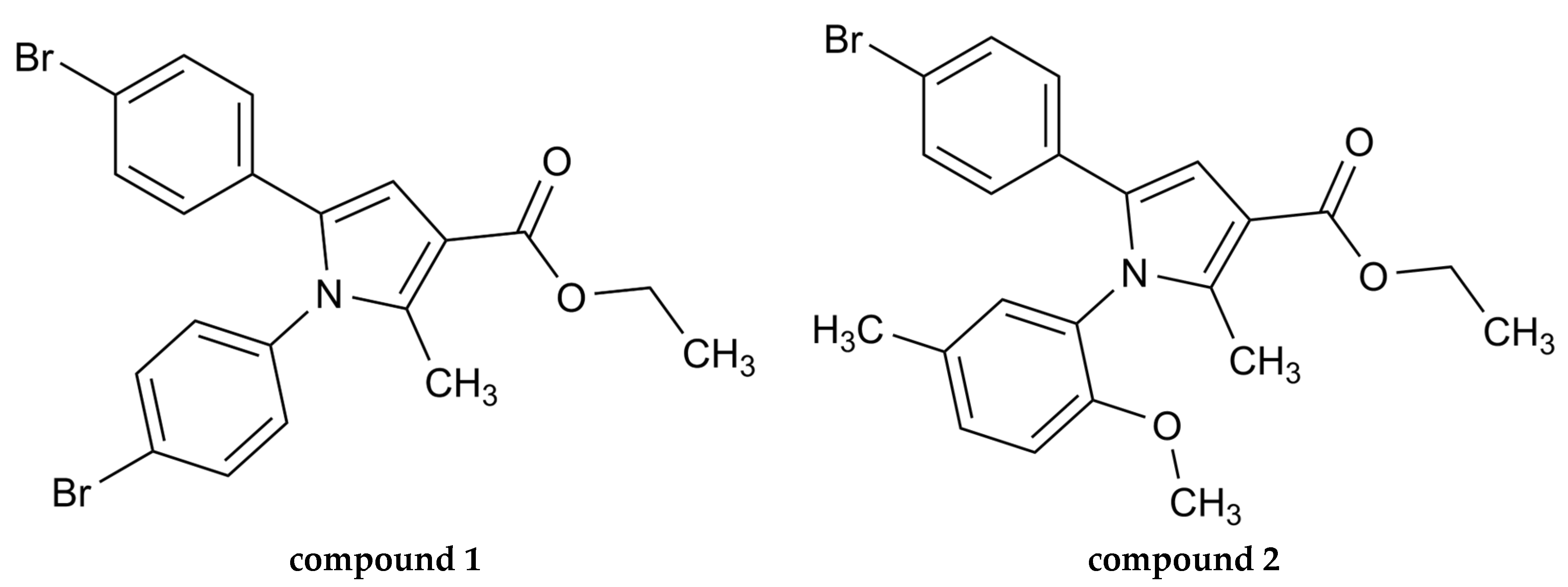
Two novel pyrrole-based compounds, previously reported as selective MAO-B inhibitors with low neurotoxicity, present promising candidates for further optimization and detailed characterization in the context of neurodegenerative disease treatment (Figure 1) [22].

3.2. Molecular Docking

Molecular docking studies were conducted on key AD targets using the crystal structures of Glycogen Synthase Kinase-3 Beta (PDB: 1UV5), Amyloid Precursor Protein (PDB: 2FK3), Monoamine Oxidase B (PDB: 2V5Z), Beta-Secretase 1 (PDB: 3RU1), Acetylcholinesterase (PDB: 4EY6), Cyclooxygenase-2 (PDB: 5KIR), GABA-B Receptor (PDB: 6UO9), Butyrylcholinesterase (PDB: 7AIY), NMDA Receptor (PDB: 7SAD), and E3 Ubiquitin Ligase CHIP (PDB: 8FYU) retrieved from the Protein Data Bank to evaluate the binding affinities and interaction profiles of the tested compounds. The docking protocols were validated by re-docking the native co-crystallized ligands (where present) into their respective binding sites and confirming that the resulting poses reproduced the experimental orientations with acceptable root-mean-square deviation (RMSD) values (<2.0 Å). All of the RMSD values were below 2.0 Å, which supports the initial validation of the docking protocols. The self-docking RMSDs were as follows: 1UV5, 1.4 Å; 2V5Z, 1.2 Å; 3RU1, 1.5 Å; 4EY6, 1.3 Å; 5KIR, 1.7 Å; 6UO9, 1.6 Å; 7AIY, 1.8 Å; and 7SAD, 1.9 Å. The docking studies of both pyrroles in the aforementioned targets are summarized in Table 1.
Among the targets, pyrrole 1 generally showed better binding affinities than pyrrole 2, suggesting differential target engagement properties between the two molecules. Notably, for GSK-3β, pyrrole 1 exhibited a docking score of −6.46 kcal/mol, which theoretically is higher than −4.63 kcal/mol, indicating good theoretical potential as a GSK-3β inhibitor. This is significant given GSK-3β’s established role in neurodegenerative pathways and validates the compound as a promising hit for further optimization [23]. Pyrrole 1 also showed good affinity towards COX-2 (−9.01 kcal/mol), close to the co-crystallized ligand (−10.4 kcal/mol), indicative of potential anti-inflammatory properties relevant to neuroprotection.
For other enzymatic targets related to Alzheimer’s, such as AChE and BChE, pyrrole 1 demonstrated moderate docking scores (−7.51 and −7.73 kcal/mol, respectively), though lower than their respective co-crystallized ligands (−11.02 and −10.72 kcal/mol). This suggests that while binding is favorable, structural optimization of these pyrrole derivatives is needed to enhance potency for cholinesterase inhibition. Pyrrole 2 consistently showed weaker affinity across all targets, reflecting less optimal interactions within the active sites.
Interestingly, the docking scores for GABA B and NMDA targets were notably lower compared to other targets. These challenging membrane protein targets are known to present difficulties in small molecule docking due to flexible binding pockets, lipid membrane interactions, and allosteric binding modes. While suggesting relatively weaker binding affinity, these results may also reflect protocol limitations specific to these receptor architectures. Future studies employing IFD, MD and experimental validation will be necessary to confirm binding potential at these therapeutically relevant sites.
For MAO-B, the docking scores for pyrroles were substantially less favorable than the strong co-crystallized ligand scores, further reinforcing the need for lead optimization to improve target specificity and binding strength.
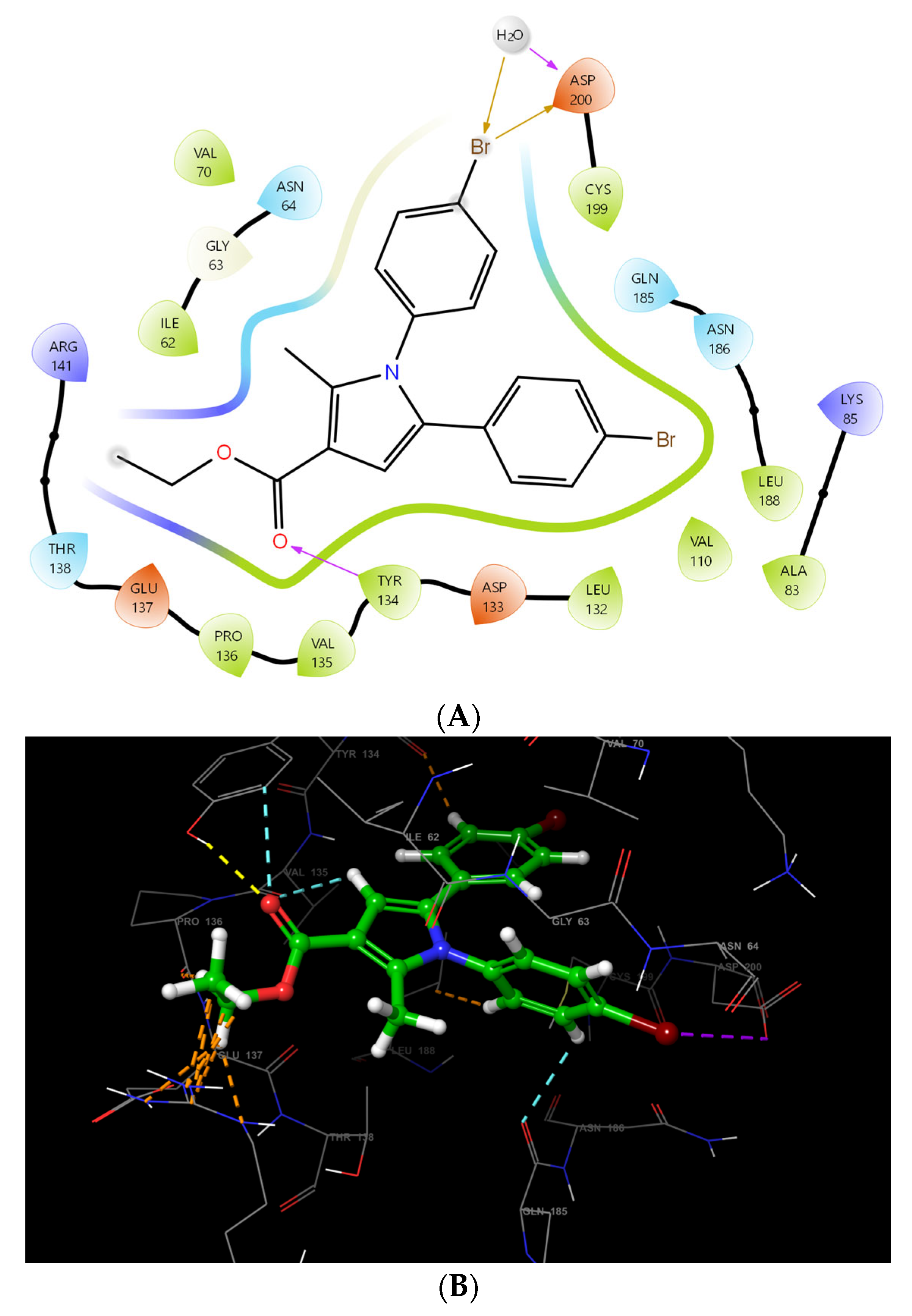
Overall, the docking results support the consideration of pyrrole 1 as a possible multi-target lead compound with a theoretical preference for GSK-3β and COX-2 pathways, highlighting its potential in multi-target drug design strategies for neurodegenerative disorders. Therefore, we further explored the possible active conformation of pyrrole 1 in the active site of GSK-3β and COX-2. Docking of pyrrole 1 into the ATP-binding site of GSK-3β (PDB: 1UV5) revealed a binding mode consistent with ATP-competitive inhibitors and supported its favorable docking score relative to the co-crystallized ligand (Figure 2). The ligand orients its central pyrrole scaffold toward the hinge region, allowing the amide linker and adjacent heteroatoms to establish key polar contacts with residues such as Asp133, Tyr134, Val135, Glu137 and Thr138, which are known to be crucial for high-affinity GSK-3β inhibition. In the obtained poses, the carbonyl oxygen is directed toward the hinge, enabling hydrogen bonding or strong dipolar interactions that anchor the molecule within the cleft, while the terminal aromatic rings extend into the hydrophobic pockets lined by Ile62, Gly63, Val70, Val110, Leu132, Pro136 and Leu188. This arrangement creates an extensive hydrophobic interface and effectively fills the ATP pocket, rationalizing the favorable docking energy.
The bromine substituents further contribute to binding by projecting toward hydrophobic regions close to Leu132 and toward the solvent-exposed area near Asp200, where they may participate in halogen bonding or polarizable contacts, possibly mediated by a structural water molecule. The interaction map also indicates additional polar contacts with Gln185, Asn186, and Asp200, in line with previous reports highlighting the importance of Gln185 and Asp200, together with Lys85 and Arg141, for optimizing affinity and selectivity among ATP-competitive GSK-3β inhibitors.
These observations align well with published docking and SAR studies of GSK-3β inhibitors, which consistently emphasize the central role of hinge binding to Asp133/Val135 and hydrophobic engagement of Val70, Ile62, Leu132, Pro136, and Leu188 in achieving low-nanomolar potency [24]. The interaction network and docking score obtained for pyrrole 1 suggest that it may possess meaningful inhibitory activities, with some scope for optimization, particularly for strengthening interactions with Lys85, Arg141 and Gln185.
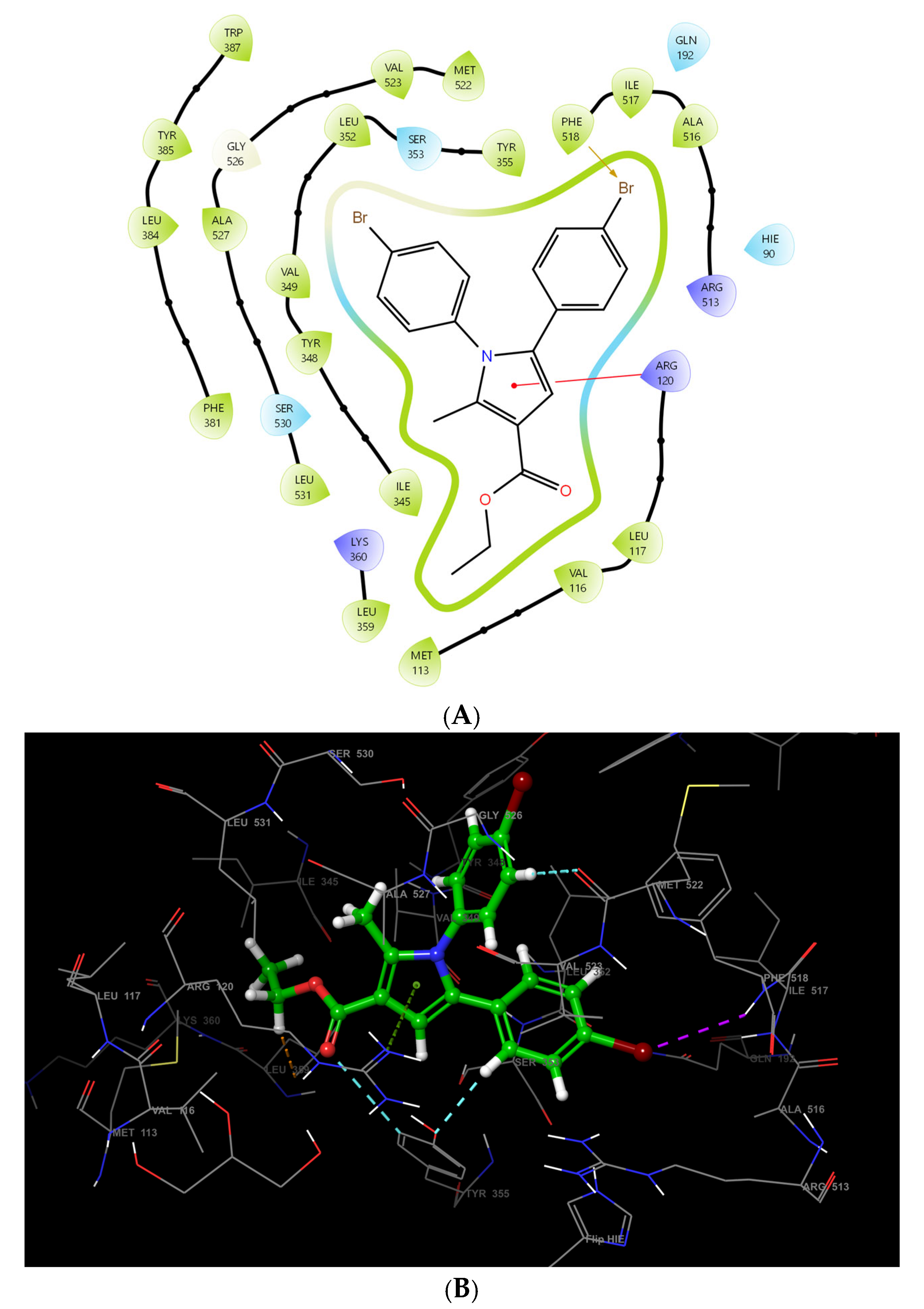
Docking of pyrrole 1 into the cyclooxygenase-2 active site (PDB: 5KIR) revealed a compact and well-defined possible binding conformation that closely matches the canonical arachidonic-acid/inhibitor pocket of COX-2 (Figure 3). The 3D pose shows that the ligand is deeply embedded within the hydrophobic channel formed by residues Met113, Val116, Leu117, Leu359, Leu352, Ile345, Val349, Val523, Met522 and Leu531, establishing extensive van der Waals contacts along the length of the molecule and rationalizing the favorable docking score obtained for this target. The two terminal aryl rings of pyrrole 1 occupy complementary lipophilic subpockets, with the bromine substituents pointing toward non-polar regions near Phe518 and Ile517, consistent with the design principles of many diaryl heterocycle COX-2 inhibitors that exploit this side pocket to enhance binding affinity and selectivity [25].
The central pyrrole core serves as a conformationally constrained linker that positions the carbonyl group toward the polar region of the active site, forming a hydrogen bond or strong dipolar interaction with backbone atoms of Leu359. Engagement of Arg120 is particularly noteworthy, as this residue has been repeatedly identified as a critical main point for many high-affinity COX inhibitors, and its interaction with pyrrole 1 supports a similar binding mechanism within the channel entrance.
This binding pattern is in good agreement with crystallographic and docking studies of reference COX-2 inhibitors, such as celecoxib and other heterocycles, which characteristically bind along the hydrophobic channel, form key interactions with Arg120 and Tyr355 at the mouth of the pocket, and occupy a side cavity near Phe518 and Val523 that is less accessible in COX-1 and underlies COX-2 selectivity [26]. In light of these comparisons, the docking results indicate that pyrrole 1 adopts a pharmacologically plausible “active” conformation in the COX-2 binding site, reproducing the essential features of known selective inhibitors and providing a strong structural basis for its proposed neuroprotective potential in the context of multi-target therapy for neurodegenerative disorders.

3.3. In Silico ADMET

The predicted values of the pharmacokinetic parameters were determined using the software SwissADME and are presented in Table 2 and Table 3.
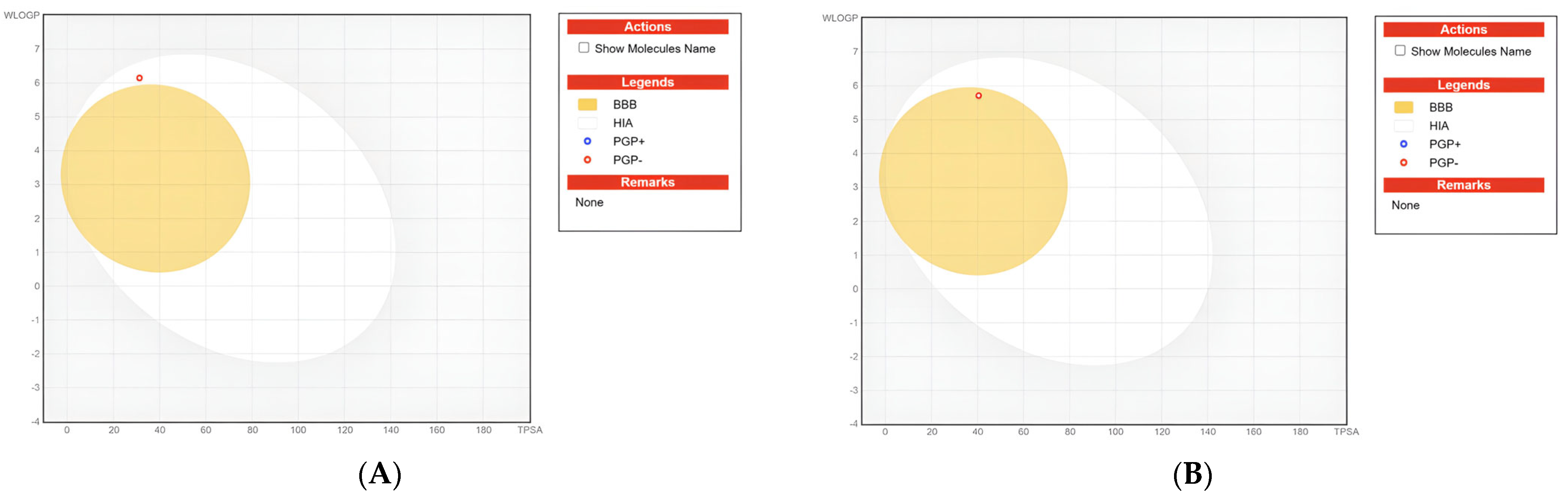
Pyrrole 2 demonstrates optimal compliance with Lipinski’s Rule of Five (0 violations: MW 428.32 Da, Log P 4.98, 0 H-bond donors, 3 acceptors), while Pyrrole 1 shows one violation due to elevated lipophilicity (Log P 5.43). This difference stems from Pyrrole 2′s lower molecular weight and increased topological polar surface area (TPSA), attributable to its structural hydroxyl group, which enhances polarity without sacrificing solubility (Log S −6.11 vs. −6.65). The BOILED-Egg visualization (Figure 4A,B) confirms high gastrointestinal absorption for both compounds, but critical differentiation emerges in blood–brain barrier (BBB) penetration: Pyrrole 1 occupies the white region (GI high/BBB low), whereas Pyrrole 2 resides in the yellow region (GI high/BBB high). This positions Pyrrole 2 as ideally suited for central nervous system delivery in neurodegenerative disease therapy.
The results show that compound Pyrrole 2 has better predicted pharmacokinetics compared to compound Pyrrole 1. Pyrrole 2 does not violate Lipinski’s rule on any criterion, whereas Pyrrole 1 violates it with respect to Log P. In addition, Pyrrole 2 has a lower molecular weight and a larger polar surface area, which is due to the presence of a hydroxyl group in its structure. In the BOILED-egg diagram, Pyrrole 2 falls into the yellow area, while Pyrrole 1 falls into the white area, which is due to the fact that both compounds have high predicted absorption through the gastrointestinal tract, but Pyrrole 2 has better penetration through the blood–brain barrier. Furthermore, Pyrrole 2 complies with Egan’s rule, classifying it as a drug-like molecule, whereas Pyrrole 1 violates Egan’s rule. To improve its BBB penetration while preserving multi-target affinity (GSK-3, COX-2), we propose replacing one terminal Br with F (to lower the MW to ~430 Da, retaining halogen bonding), introducing a meta-pyridyl bioisostere (which will lower the Log P to ~4.0, H-bond donor for GSK-3 Asp133), and rigidifying the linker with a heterocycle (to lower the number of rotatable bonds to 4/5).

3.4. Predicted Toxicity

The predicted toxicity profiles of both pyrrole derivatives were comprehensively evaluated using ProTox 3.0, revealing distinct safety characteristics that complement their pharmacokinetic and docking data.
ProTox 3.0 analysis positions both pyrrole derivatives in Toxicity Class 4 (LD50 > 300 mg/kg), indicating moderate safety margins suitable for preclinical leads, though Pyrrole 1 demonstrates superior predicted lethality (LD50 2000 mg/kg vs. 1000 mg/kg for Pyrrole 2) with higher model confidence (68.07% accuracy, 62.22% similarity) (Table 4).
Pyrrole 1 demonstrates a cleaner organ toxicity profile, avoiding hepatotoxicity and cardiotoxicity- critical liabilities for long-term CNS therapeutics, unlike Pyrrole 2′s cardiotoxic flag. Both share predictable vulnerabilities (neuro-, nephro-, respiratory toxicity) common to lipophilic heterocycles, but Pyrrole 1’s unique PGH1 (prostaglandin H synthase 1) off-target effect correlates with its strong COX-2 docking and warrants selectivity validation (Table 5).
Pyrrole 1 exhibits broader predicted CYP450 inhibition across four isoforms (CYP2C19, 2C9, 2D6, 3A4), indicating moderate-to-significant potential for drug–drug interactions (DDI)—a critical concern for Alzheimer’s patients, who are typically elderly and receive polypharmacy regimens involving CYP-metabolized medications (statins, antidepressants, antihypertensives). This broad inhibitory profile could elevate systemic exposure to co-administered drugs and increase adverse event risk, representing a key liability requiring optimization. While potentially consistent with structural features enabling MAO-B selectivity, this prediction warrants experimental validation through recombinant CYP inhibition assays and careful clinical DDI assessment during future development. Pyrrole 2 shows narrower inhibition (CYP2C9, 3A4), potentially reducing DDI concerns at the cost of hepatotoxicity (Table 6).
From the obtained results, we can conclude that the compound Pyrrole 1 has a better predicted safety profile compared to Pyrrole 2. Pyrrole 1 has a higher predicted LD50, as well as a higher potential for inhibition of enzymes from the CYP450 superfamily. In addition, Pyrrole 1 has a slightly better safety profile in terms of organ toxicity (relatively lower potential for hepatotoxicity). However, Pyrrole 1 has specific target toxicity with respect to prostaglandin G/H synthase 1, which is not characteristic of the compound Pyrrole 2.
The primary limitation of this study is its exclusive reliance on computational predictions without experimental validation of predicted binding affinities, pharmacokinetic properties, or biological activities. While molecular docking provided detailed insights into plausible binding modes and Glide XP scoring suggested favorable multi-target profiles for Pyrrole 1, these results remain theoretical and require confirmation through enzymatic assays, cellular models, and in vivo studies. Similarly, SwissADME and ProTox 3.0 predictions offer valuable guidance for lead prioritization but cannot substitute for empirical ADMET data or functional neuroprotection assays. This work represents a computational prioritization study identifying Pyrrole 1 as the most promising lead for multi-target AD therapy, setting the stage for essential experimental validation through in vitro enzyme inhibition assays against GSK-3β, COX-2, and MAO-B, PAMPA or MDCK-MDR1 assays for BBB penetration, and cytotoxicity/neuroprotection studies in neuronal models to translate these predictions into confirmed pharmacological activities.

4. Conclusions

This structure-based drug design study identifies pyrrole 1 as a promising multi-target lead compound with the potential to interact with both GSK-3β and COX-2 in pharmacologically relevant binding conformations. Its predicted binding modes are consistent with the essential interaction patterns observed for known ATP-competitive GSK-3β inhibitors and selective COX-2 ligands, supporting the plausibility of its proposed multitarget profile. At the same time, the ADMET predictions indicate a clear balance of advantages and limitations between the two compounds: pyrrole 2 demonstrates superior drug-likeness and better predicted blood–brain barrier penetration, whereas pyrrole 1 shows a more favorable toxicity profile but a substantial drug–drug interaction risk because of its broader predicted CYP inhibition. This concern is especially relevant for Alzheimer’s disease patients, who are often elderly and exposed to polypharmacy. Importantly, these conclusions are based entirely on computational predictions and therefore require experimental confirmation. Overall, the results provide a strong in silico structural rationale for the neuroprotective potential of pyrrole 1 in Alzheimer’s disease and support further optimization through molecular dynamics studies, the design and synthesis of improved analogs, and subsequent in vitro enzymatic and biological validation to translate these predictions into confirmed therapeutic candidates.

Author Contributions

Conceptualization, E.M.; methodology, E.M., S.K. and V.K.; software, E.M., S.K. and V.K.; formal analysis, E.M.; investigation, E.M., S.K. and V.K.; resources, M.G.; data curation, M.K.-B.; writing—original draft preparation, E.M., S.K., V.K., M.K.-B. and M.G.; writing—review and editing, E.M., S.K., V.K., M.K.-B. and M.G.; All authors have read and agreed to the published version of the manuscript.

Funding

This research was funded by the Bulgarian National Science Fund, funding number KП-06-M83/3; 3.12.2024.

Institutional Review Board Statement

Not applicable.

Informed Consent Statement

Not applicable.

Data Availability Statement

The original contributions presented in this study are included in the article. Further inquiries can be directed to the corresponding author.

Conflicts of Interest

The authors declare no conflicts of interest.

References

  1. Knopman, D.; Amièva, H.; Petersen, R.; Chételat, G.; Holtzman, D.; Hyman, B.; Nixon, R.; Jones, D. Alzheimer disease. Nat. Rev. Dis. Primers 2021, 7, 33. [Google Scholar] [CrossRef] [PubMed]
  2. Twarowski, B.; Herbet, M. Inflammatory Processes in Alzheimer’s Disease—Pathomechanism, Diagnosis and Treatment: A Review. Int. J. Mol. Sci. 2023, 24, 6518. [Google Scholar] [CrossRef] [PubMed]
  3. Carpi, M.; Mercuri, N.; Liguori, C. Orexin Receptor Antagonists for the Prevention and Treatment of Alzheimer’s Disease and Associated Sleep Disorders. Drugs 2024, 84, 1365–1378. [Google Scholar] [CrossRef]
  4. Sehar, U.; Rawat, P.; Reddy, A.P.; Kopel, J.; Reddy, P.H. Amyloid Beta in Aging and Alzheimer’s Disease. Int. J. Mol. Sci. 2022, 23, 12924. [Google Scholar] [CrossRef]
  5. Long, J.; Holtzman, D. Alzheimer Disease: An Update on Pathobiology and Treatment Strategies. Cell 2019, 179, 312–339. [Google Scholar] [CrossRef]
  6. Prince, M.; Wimo, A.; Guerchet, M.; Ali, G.; Wu, Y.; Prina, M. World Alzheimer Report 2015—The Global Impact of Dementia: An Analysis of Prevalence, Incidence, Cost and Trends. Available online: https://www.alzint.org/u/WorldAlzheimerReport2015.pdf (accessed on 27 May 2026).
  7. Hiremathad, A.; Piemontese, L. Heterocyclic compounds as key structures for the interaction with old and new targets in Alzheimer’s disease therapy. Neural Regen. Res. 2017, 12, 1256–1261. [Google Scholar] [CrossRef]
  8. Aleksandrova, Y.; Munkuev, A.; Mozhaitsev, E.; Suslov, E.; Tsypyshev, D.; Chaprov, K.; Begunov, R.; Volcho, K.; Salakhutdinov, N.; Neganova, M. Elaboration of the Effective Multi-Target Therapeutic Platform for the Treatment of Alzheimer’s Disease Based on Novel Monoterpene-Derived Hydroxamic Acids. Int. J. Mol. Sci. 2023, 24, 9743. [Google Scholar] [CrossRef]
  9. Ibrahim, M.; Gabr, M. Multitarget therapeutic strategies for Alzheimer’s disease. Neural Regen. Res. 2019, 14, 437–440. [Google Scholar] [CrossRef]
  10. Cheong, S.L.; Tiew, J.K.; Fong, Y.H.; Leong, H.W.; Chan, Y.M.; Chan, Z.L.; Kong, E.W.J. Current Pharmacotherapy and Multi-Target Approaches for Alzheimer’s Disease. Pharmaceuticals 2022, 15, 1560. [Google Scholar] [CrossRef]
  11. Rashad, A.; Rasool, A.; Shaheryar, M.; Sarfraz, A.; Sarfraz, Z.; Robles-Velasco, K.; Cherrez-Ojeda, I. Donanemab for Alzheimer’s Disease: A Systematic Review of Clinical Trials. Healthcare 2023, 11, 32. [Google Scholar] [CrossRef] [PubMed]
  12. Żełabowski, K.; Petrov, W.; Wojtysiak, K.; Ratka, Z.; Biedka, K.; Wesołowski, M.; Fus, K.; Ślebioda, D.; Rusinek, M.; Sterkowicz, M.; et al. Targeting the Orexin System in the Pharmacological Management of Insomnia and Other Diseases: Suvorexant, Lemborexant, Daridorexant, and Novel Experimental Agents. Int. J. Mol. Sci. 2025, 26, 8700. [Google Scholar] [CrossRef]
  13. Congdon, E.; Sigurdsson, E. Tau-targeting therapies for Alzheimer disease. Nat. Rev. Neurol. 2018, 14, 399–415. [Google Scholar] [CrossRef] [PubMed]
  14. Asghar, S.; Mushtaq, N.; Ahmed, A.; Anwar, L.; Munawar, R.; Akhtar, S. Potential of Tryptamine Derivatives as Multi-Target Directed Ligands for Alzheimer’s Disease: AChE, MAO-B, and COX-2 as Molecular Targets. Molecules 2024, 29, 490. [Google Scholar] [CrossRef] [PubMed]
  15. Peitzika, S.-C.; Pontiki, E. A Review on Recent Approaches on Molecular Docking Studies of Novel Compounds Targeting Acetylcholinesterase in Alzheimer Disease. Molecules 2023, 28, 1084. [Google Scholar] [CrossRef]
  16. de Almeida, R.B.M.; Barbosa, D.B.; do Bomfim, M.R.; Amparo, J.A.O.; Andrade, B.S.; Costa, S.L.; Campos, J.M.; Cruz, J.N.; Santos, C.B.R.; Leite, F.H.A.; et al. Identification of a Novel Dual Inhibitor of Acetylcholinesterase and Butyrylcholinesterase: In Vitro and In Silico Studies. Pharmaceuticals 2023, 16, 95. [Google Scholar] [CrossRef]
  17. Lu, Z.; Fu, J.; Wu, G.; Yang, Z.; Wu, X.; Wang, D.; You, Z.; Nie, Z.; Sheng, Q. Neuroprotection and Mechanism of Gas-miR36-5p from Gastrodia elata in an Alzheimer’s Disease Model by Regulating Glycogen Synthase Kinase-3β. Int. J. Mol. Sci. 2023, 24, 17295. [Google Scholar] [CrossRef]
  18. García-Osta, A.; Dong, J.; Moreno-Aliaga, M.J.; Ramirez, M.J. p27, The Cell Cycle and Alzheimer’s Disease. Int. J. Mol. Sci. 2022, 23, 1211. [Google Scholar] [CrossRef]
  19. Albertini, C.; Salerno, A.; De Sena Murteira Pinheiro, P.; Bolognesi, M. From combinations to multitarget-directed ligands: A continuum in Alzheimer’s disease polypharmacology. Med. Res. Rev. 2020, 41, 2606–2633. [Google Scholar] [CrossRef]
  20. Daina, A.; Michielin, O.; Zoete, V. SwissADME: A free web tool to evaluate pharmacokinetics, drug-likeness and medicinal chemistry friendliness of small molecules. Sci. Rep. 2017, 7, 42717. [Google Scholar] [CrossRef]
  21. Banerjee, P.; Kemmler, E.; Dunkel, M.; Preissner, R. ProTox 3.0: A webserver for the prediction of toxicity of chemicals. Nucleic Acids Res. 2024, 52, W513–W520. [Google Scholar] [CrossRef] [PubMed]
  22. Mateev, E.; Georgiev, B.; Pavlova, E.; Irfan, A.; Muhammed, M.T.; Momekov, G.; Kondeva-Burdina, M. Integrated experimental and computational study of novel pyrrole derivatives: Microwave-assisted synthesis, enzyme inhibition, antioxidant properties, and neurotoxicity evaluation. Lett. Drug Des. Discov. 2025, 22, 100205. [Google Scholar] [CrossRef]
  23. Lai, S.; Wang, P.; Gong, J.; Zhang, S. New insights into the role of GSK-3β in the brain: From neurodegenerative disease to tumorigenesis. PeerJ 2023, 11, 16635. [Google Scholar] [CrossRef]
  24. Arfeen, M.; Patel, R.; Khan, T.; Bharatam, P. Molecular dynamics simulation studies of GSK-3β ATP competitive inhibitors: Understanding the factors contributing to selectivity. J. Biomol. Struct. Dyn. 2015, 33, 2578–2593. [Google Scholar] [CrossRef] [PubMed]
  25. Ahmadi, M.; Bekeschus, S.; Weltmann, K.; Von Woedtke, T.; Wende, K. Non-steroidal anti-inflammatory drugs: Recent advances in the use of synthetic COX-2 inhibitors. RSC Med. Chem. 2022, 13, 471–496. [Google Scholar] [CrossRef] [PubMed]
  26. Abdellatif, K.; Abdelall, E.; Elshemy, H.; Philoppes, J.; Hassanein, E.; Kahk, N. Design, synthesis, and pharmacological evaluation of novel and selective COX-2 inhibitors based on celecoxib scaffold supported with in vivo anti-inflammatory activity, ulcerogenic liability, ADME profiling and docking study. Bioorganic Chem. 2022, 120, 105627. [Google Scholar] [CrossRef] [PubMed]
Figure 1. Pyrrole-based compounds exhibiting prominent neuroprotective effects in rat brain mitochondria, microsomes, and synaptosomes.
Appliedchem 06 00039 g001
Figure 2. Active conformation of pyrrole 1 in GSK-3β (PDB: 1UV5). Panel (A)—2D visualization; Panel (B)—3D visualization.
Appliedchem 06 00039 g002
Figure 3. Active conformation of pyrrole 1 in COX-2 (PDB: 5KIR). Panel (A)—2D visualization; Panel (B)—3D visualization.
Appliedchem 06 00039 g003
Figure 4. BOILED-Egg plots for Pyrrole 1 ((A), white region: high GI/low BBB) and Pyrrole 2 ((B), yellow region: high GI/high BBB).
Appliedchem 06 00039 g004
Table 1. XP docking scores of the investigated compounds against ten major AD targets.
TargetDocking Score Pyrrole 1 (kcal/mol)Docking Score Pyrrole 2 (kcal/mol)Docking Score Co-Crystallized Ligand (kcal/mol)
GSK-3b (1UV5)−6.46−5.30−4.63 (6-Bromoindirubin-3′-oxime)
APP (2FK3)−2.69−1.62n/a
MAO-B (2V5Z)−7.5−7.94−11.68 (Safinamide)
BACE1 (3RU1)−5.17−4.75−9.51 (3RU *)
AChE (4EY6)−7.51−5.49−11.02 ((-)-galantamine)
COX-2 (5KIR)−9.01−7.29−10.4 (Rofecoxib)
GABA-B (6UO9)−3.65−3.02−8.64 (SKF97541 **)
BChE (7AIY)−7.73−6.68−10.72 (8U2 ***)
NMDA (7SAD)−5.41−5.36−10.47 (Memantine)
CHIP (8FYU)−4.42−3.79n/a
n/a—not available. * 3RU—3-(2-Aminoquinolin-3-yl)-N-(cyclohexylmethyl)propenamide. ** SKF97541—(R)-(3-aminopropyl)methylphosphinic acid. *** 8U2—2-{1-[4-(12-Amino-3-chloro-6,7,10,11-tetrahydro-7,11-methanocycloocta[b]quinolin-9-yl)butyl]-1H-1,2,3-triazol-4-yl}-N-[4-hydroxy-3-methoxybenzyl]acetamide.
Table 2. Values of the main physicochemical parameters of the two compounds.
MWDonor HBAcceptor HBLog PLog S
Pyrrole 1463.16025.43−6.65
Pyrrole 2428.32034.98−6.11
Table 3. Indicators of drug similarity of the two pyrrole derivatives.
GI AbsorptionBBB PenetrationLipinski RuleGhose RuleVeber RuleEgan RuleMuegge Rule
Pyrrole 1HighLowYes (1 violation)NoYesNoNo
Pyrrole 2HighHighYes (0 violation)NoYesYesNo
Table 4. Main predicted toxicity parameters of the studied compounds.
Predicted LD50Predicted Toxicity ClassAverage SimilarityPrediction Accuracy
Pyrrole 12000 mg/kg462.22%68.07%
Pyrrole 21000 mg/kg456.96%67.38%
Table 5. Target and organ toxicity of the two compounds.
Toxicity TargetsHepatotoxicityNeurotoxicityNephrotoxicityRespiratory ToxicityCardiotoxicity
Pyrrole 1PGH1NoYesYesYesNo
Pyrrole 2-YesYesYesYesNo
Table 6. Inhibitory effect on enzymes from the CYP450 superfamily.
CYP1A2CYP2C19CYP2C9CYP2D6CYP3A4CYP2E1
Pyrrole 1NoYesYesYesYesNo
Pyrrole 2NoNoYesNoYesNo
Disclaimer/Publisher’s Note: The statements, opinions and data contained in all publications are solely those of the individual author(s) and contributor(s) and not of MDPI and/or the editor(s). MDPI and/or the editor(s) disclaim responsibility for any injury to people or property resulting from any ideas, methods, instructions or products referred to in the content.