
Article

Assessing Productivity and Economic Returns of Integrated Aquaculture of Red Seaweed with Shrimp and Fish During Extensive Floodings in Central Java, Indonesia

by
Reindert Wieger Nauta
1,*,
Lestari Lakhsmi Widowati
2,
Restiana Wisnu Ariyati
2,
Sri Rejeki
2 and
Adolphe Oscar Debrot
1,3
1
Wageningen Marine Research, Ankerpark 27, 1781 AG Den Helder, The Netherlands
2
Aquaculture Department, Faculty of Fisheries and Marine Sciences, Diponegoro University, Jl. Prof Soedarto SH Tembalang, Semarang 50275, Indonesia
3
Marine Animal Ecology Group, Wageningen University, P.O. Box 338, 6700 AH Wageningen, The Netherlands
*
Author to whom correspondence should be addressed.
Aquac. J. 2025, 5(4), 26; https://doi.org/10.3390/aquacj5040026
Submission received: 11 August 2025 / Revised: 14 October 2025 / Accepted: 14 November 2025 / Published: 5 December 2025

Abstract

The Indonesian coastline holds significant potential for aquaculture but is increasingly vulnerable to climate change impacts such as land subsidence, salinization, and floodings. Ensuring stable income for local communities is essential, especially during extreme events like King Tides, which cause extensive floodings. This study assessed the productivity and economic returns of an agaroid seaweed monoculture compared to co-cultivation with Giant tiger prawn, Milkfish, and Barramundi during a King Tide. The experiment was conducted in conventional ponds with seaweed monoculture or combined with one of the three other commodities. The experiment ran from May until October in 2022 and was performed in triplicate. Floodings equalized water parameters. The results demonstrated that all systems provided stable income, with co-cultivation increasing profitability. Average revenues per hectare were USD 777 (seaweed monoculture), USD 832 (with shrimp), USD 1622 (with Milkfish), and USD 2014 (with Barramundi). Agar content was significantly higher in the seaweed monoculture, and gel strength was found to be significantly higher in the seaweeds co-cultivated with shrimp and Milkfish. Total agar production did not differ between the treatments. These findings suggest that integrated aquaculture systems can enhance income resilience while supporting food security in climate-impacted coastal zones. The approach offers a promising strategy for combining livelihood stability with adaptive coastal management and reduced environmental impact but needs to be tailored to local conditions.

1. Introduction

The Indonesian archipelago possesses an extensive coastline, stretching approximately 81,000 km, offering considerable potential for aquaculture development. Despite this potential, only a small proportion of coastal areas is currently utilized: Estimates suggest 0.01–2.32% of marine coastal waters and 22.5–40% of brackish waters are in use [1,2]. However, many of these coastal zones are highly vulnerable to floodings, driven by a combination of sea-level rise, tidal inundation, land subsidence, and mangrove deforestation. Indonesia ranks third among Asian countries at highest risk of flooding [3,4,5,6], posing significant threats to coastal livelihoods [7,8].
One recurring phenomenon contributing to coastal flooding is the King Tide—defined by the U.S. Environmental Protection Agency [9] as “the highest tide of the year at a given location, typically occurring once or twice annually”. Lin et al. (2014) [10] states that the threshold for a King Tide can be considered to be 3.2 m. King Tide is a local term referring to extensive flooding caused by high tides that inundate coastal areas, often disrupting daily activities and aquaculture systems. While this is the general definition, interviews with local farmers in Central Java revealed that extreme King Tide events of the magnitude observed during our study occur only once every four to six years and persist for several days; however, no scientific literature was found to support this. Causes of these extreme King Tides, also known as ‘Banjir Rob’ in Bahasa Indonesia (Indonesia’s general language), are combinations of wind, precipitation, and moon position [11]. In addition, meteorological events like La Niña also affect these events [12]. The occurrence of the large King Tide during this research and the frequency mentioned by the farmers lines up with the frequency of La Niña (2–7 years) [13], suggesting a potential link between these events. The year in which this research was performed appeared to be the second of three consecutive years in which La Niña occurred [14]. The knowledge that this natural phenomenon (as well as El Niño) is expected to occur more frequently in the upcoming decades [15] adds urgency to understand the impact of these events on rural communities, their livelihoods, and especially their sources of income and food. An extensive King Tide can severely disrupt daily life, but some structural adaptations—such as raising housing floors or constructing small embankments—can mitigate flood impacts [5,6,10,11,14]. Even so, the economic resilience of local communities remains a critical concern [16].
Aquaculture offers a viable alternative for food production in flood-prone, saline environments where agriculture is no longer feasible. For long-term sustainability, such practices must minimize environmental degradation and ideally contribute to ecosystem enhancement while ensuring stable and attractive income for local populations. Sadly, aquaculture itself has contributed to increased flood vulnerability. Mangrove forests, which serve as natural coastal buffers, were extensively cleared in the 1980s to make way for shrimp ponds [17,18]. This trend continues today for short-term gains from both aquaculture expansion and timber extraction [19,20]. Rehabilitating mangrove forests is a promising strategy for restoring coastal protection and ecosystem services such as carbon sequestration and wave attenuation [21,22]. However, policy implementation and infrastructure development are time-intensive processes, while communities in vulnerable areas require immediate income-generating solutions. Integrated aquaculture can offer immediate resilience.
Integrated (multitrophic) aquaculture is the practice of combining different species of different trophic levels in a single (natural) pond, reducing environmental impacts while improving production, and has been studied and reviewed broadly (e.g., [23,24,25,26]). Important components of such systems are primary producers, more specifically for mariculture: seaweed [24,26]. Co-culturing fish with Gracilaria offers ecological and economic benefits in aquaculture. Red hybrid tilapia with Gracilaria changii improves water quality and algal growth [27], while integration with Milkfish in Banten is both feasible and profitable [28]. Gracilaria edulis and G. changii effectively remove nutrient-rich shrimp effluent in recirculating systems [29], and Gracilaria chouae with Sparus macrocephalus balance nitrogen and phosphorus in integrated multitrophic systems [30]. Despite the relatively low utilization of its coastal area, Indonesia is the world’s second-largest producer of seaweed [31]. Cultivated species include Eucheuma spp., Kappaphycus spp., and members of the Gracilariaceae family. The latter are primarily grown in brackish-water pond systems, making them among the most common aquaculture commodities in flood-affected regions [32,33].
This study was conducted in Brebes, Central Java, where most farmers practice monoculture of Gracilariopsis spp. (Gracilariaceae) in traditional earthen ponds. The research team assessed the productivity and economic returns of the G. longissima monoculture in relation to co-cultivation with Milkfish (Chanos chanos), Barramundi (Lates calcarifer, a.k.a. Asian sea bass), and Giant tiger prawn (Penaeus monodon). Ponds were leased from local farmers to ensure practical relevance and foster strong linkages between research and real-world aquaculture practices. This design allowed for large-scale testing under natural conditions, including (un-intended) exposure to a significant King Tide event, enhancing the validity and field applicability of the findings.

2. Materials and Methods

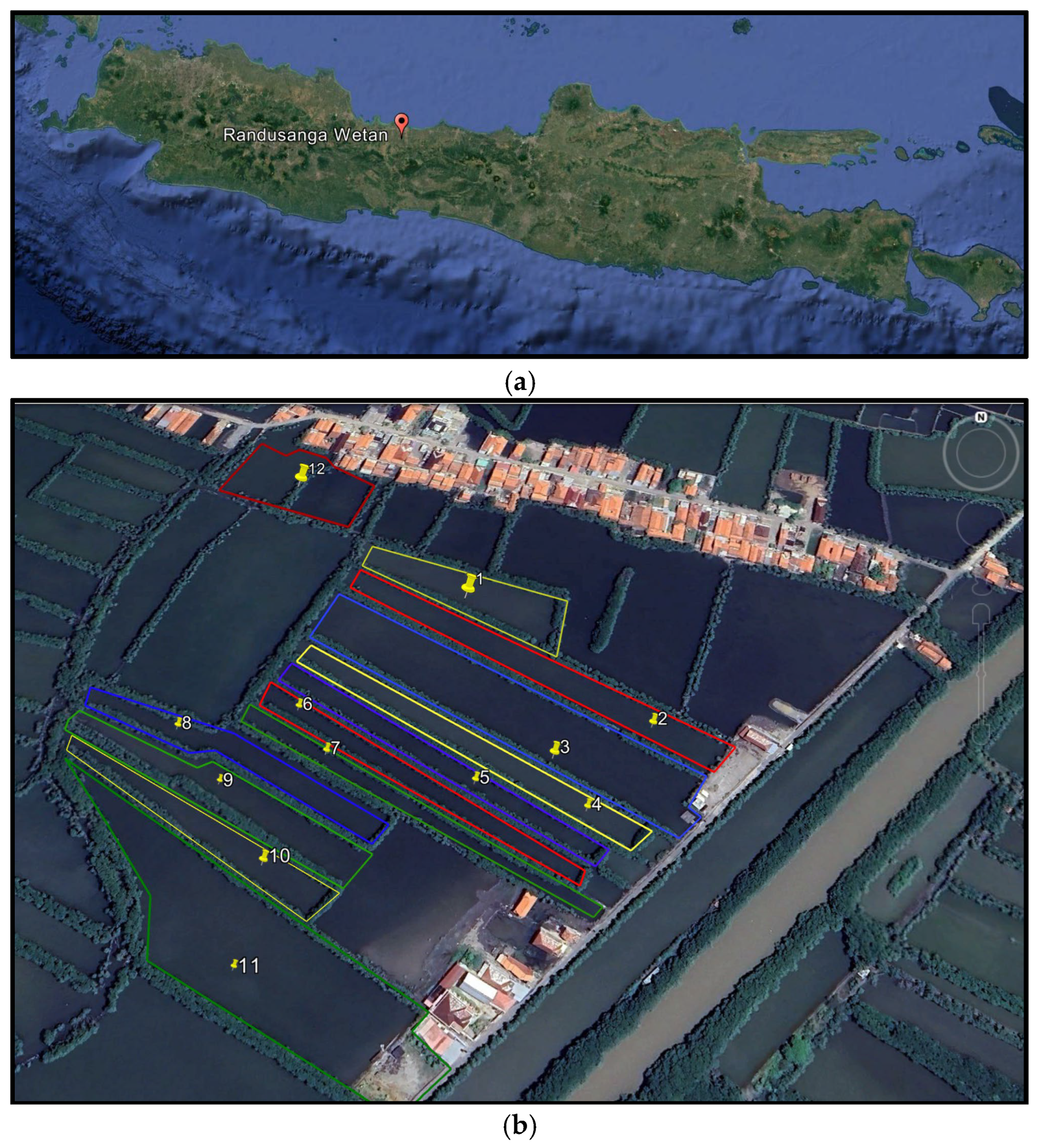
Production of the systems was measured over a 120-day cultivation period in ponds near the village of Randusanga Wetan, Brebes District (Central Java, Indonesia). Commodities were added based on availability and weather conditions, but all experiments were run in the same time span, from the end of May 2022 until the beginning of October 2022. Ponds were rented by availability and willingness of local farmers, and treatments were randomly distributed over the available ponds (Figure 1).
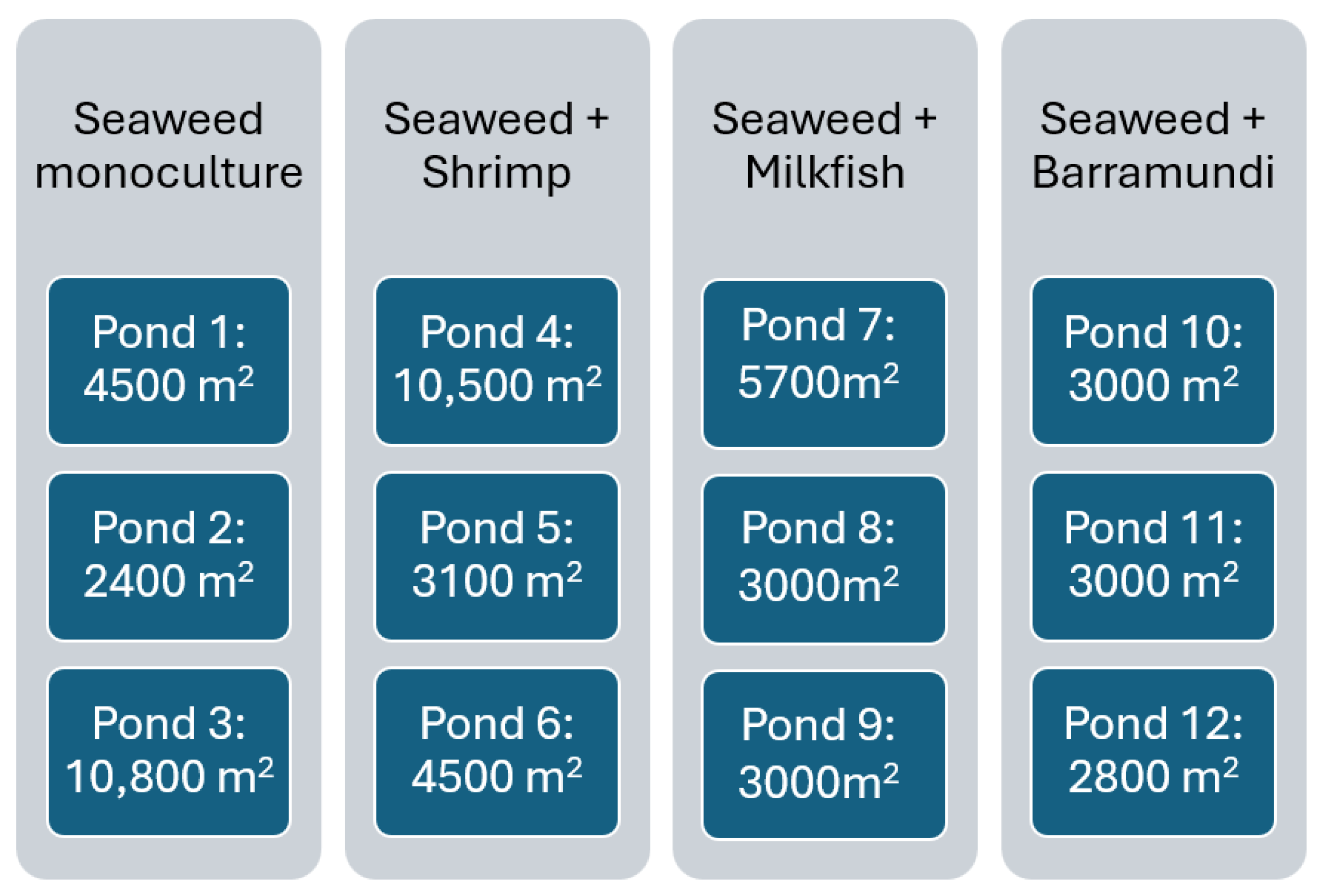
Seaweed, Gracilariopsis longissima (formerly also referred to as Gracilaria verrucosa [34]), was cultured in monoculture and in co-cultivation with either shrimp (P. monodon), Milkfish (C. chanos), or Barramundi (L. calcifer). The treatments were conducted in triplicate and no supplementary feed was added (Figure 2). Pond size was corrected for during the analysis by calculating values per hectare. Ponds were similar in basic characteristics like soil type, depth, and water source. Prior usage was assumed to be similar, as this is common practice in the area.

2.1. Water Parameters

Water temperature, salinity, and pH were measured daily using a handheld multiparameter sensor (WTW ProfiLine 3320 combined with SenTix41, CellOx325 and TetraCon 325 sensors, Xylem Analytics Germany Sales GmbH & Co. KG, WTW, Weilheim, Germany). Chlorophyll-A, nitrate, and phosphate content of the water were sampled every month. Samples were taken in triplicate at predetermined locations and times. Samples were sent to the lab and were analyzed using the following laboratory methods: Strickland and Parson (1968) (Chlorophyll) [35], APHA 4500-NO3-B 2017 (nitrate), and APHA 4500-P-D 2017 (phosphate) [36]. No specific data was available on the elevated water levels; the participating farmers indicated that water levels were up to 1.5 m higher than conventional high water levels and caused the whole area (including the lower dikes and roads) to be flooded.

2.2. Stocking Densities

In all treatments, locally sourced seaweed from a single supplier (Dr H. Mahardika, Tangerang, Indonesia) was stocked with a density of 100 g·m−2 (fresh weight). An intermediate harvest was done after 45 days, and a second cycle was initiated by leaving approximately the same stocking density in the ponds. Shrimp were stocked as post larvae 12 (PL12) at a density of 10 individuals·m−2, Milkfish were stocked at approx. 10 cm length, and Barramundi were stocked at a size of approx. 12 cm, at respectively densities of 1 ind·m−2 and 0.33 ind·m−2. Densities were set based on differences in diet and biological characteristics, as Milkfish are herbivorous and Barramundi are carnivorous per the consulted literature [37,38]. With the addition of seaweed, sufficient food would be available for Milkfish, but Barramundi are dependent on external and natural inflow of animal prey. No additional actions were taken on pond management other than ensuring the integrity of the surrounding dikes.

2.3. Production

Growth, both in terms of length and weight, as measured monthly for 20 individual shrimp, Milkfish, and Barramundi, was expressed as specific growth rate (SGR, %·day−1). Individuals were caught using a throwing net, assuring random sampling. The first 20 individuals caught were sampled, and none were excluded from the sample or (statistical) analysis. The following formula (Formula (1)) was used to calculate the SGR (Wt = weight at sampled day, W0 = starting weight, T = time (days)).
S G R % · d a y 1 = ln ( W t ) ln ( W 0 ) T · 100 %
For seaweed, the initial biomass and harvested biomass of both harvests were used to assess the growth. No intermediate measurements were done. The quality of the seaweed was measured in agar content (% dry matter) and gel strength (g·mm−2); both were measured using commonly applied methods as described elsewhere [39]. Dried seaweed was pre-treated for 3.5 h with 1 L of NaOH (6%, w/w) per 100 g (DW) seaweed at 85 °C. Ample washing was applied and samples were neutralized with acetic acid (0.5% w/w) for 60 min at room temperature. Agar was extracted with distilled water (2 h, 85 °C) using a cotton cloth while the mixture was still hot. The mixture was left to acclimate to room temperature for one day. Air drying was applied to calculate agar yield. Subsequently, the gel strength was determined by dissolving 1.5 g of dried agar in 100 mL distilled water using a magnetic stirrer (Vevor MS-H-ProA, Shanghai, China) at 90 °C, and the mixture was left to stabilize at this temperature in a water bath. Samples of 22 mL were left overnight at 28 °C and were measured with the use of a Rheometer. Agar production (kg agar·ha−1) was determined by multiplying seaweed yield (kg·ha−1) by agar content (%) (Formula (2)).
A g a r   p r o d u c t i o n k g · h a 1 = S e a w e e d   y i e l d k g · h a 1 · A g a r   c o n t e n t ( % )
At the end of the experiment, the obtained production was sold by the pond owners (farmers) to the local market at market value.

2.4. Statistical Analysis

Statistical analyses were done using GraphPad Prism (V9.3.1 for Windows, GraphPad Software, Boston, MA, USA). Normal distribution was assumed as the number of replicates was too low for testing. Equality of SDs was checked using the Brown–Forsythe test and/or Bartlett’s test. As the aim was to give a generic insight into production under extreme conditions, only simple statistical comparisons were performed using one-way ANOVAs. A Tukey test was applied post hoc to identify significant differences between groups.

3. Results

As the King Tide caused a strong connection of the waterbodies of the different ponds, we here present solely the generic values (mean, min, max, and median) of all the water parameters measured (Table 1). No specific details on the King Tide were available due to the remoteness of the area in which the experiment was executed. The King Tide affected the area for a multitude of days (>7 days) and increased water levels by approximately one meter compared to normal high tides. Phosphate levels were below the level of detection (LOD) (<0.015 mg·L−1) at T0 and occasionally below the LOD during the experiment; in those cases the lower level of detection was used as the baseline value.
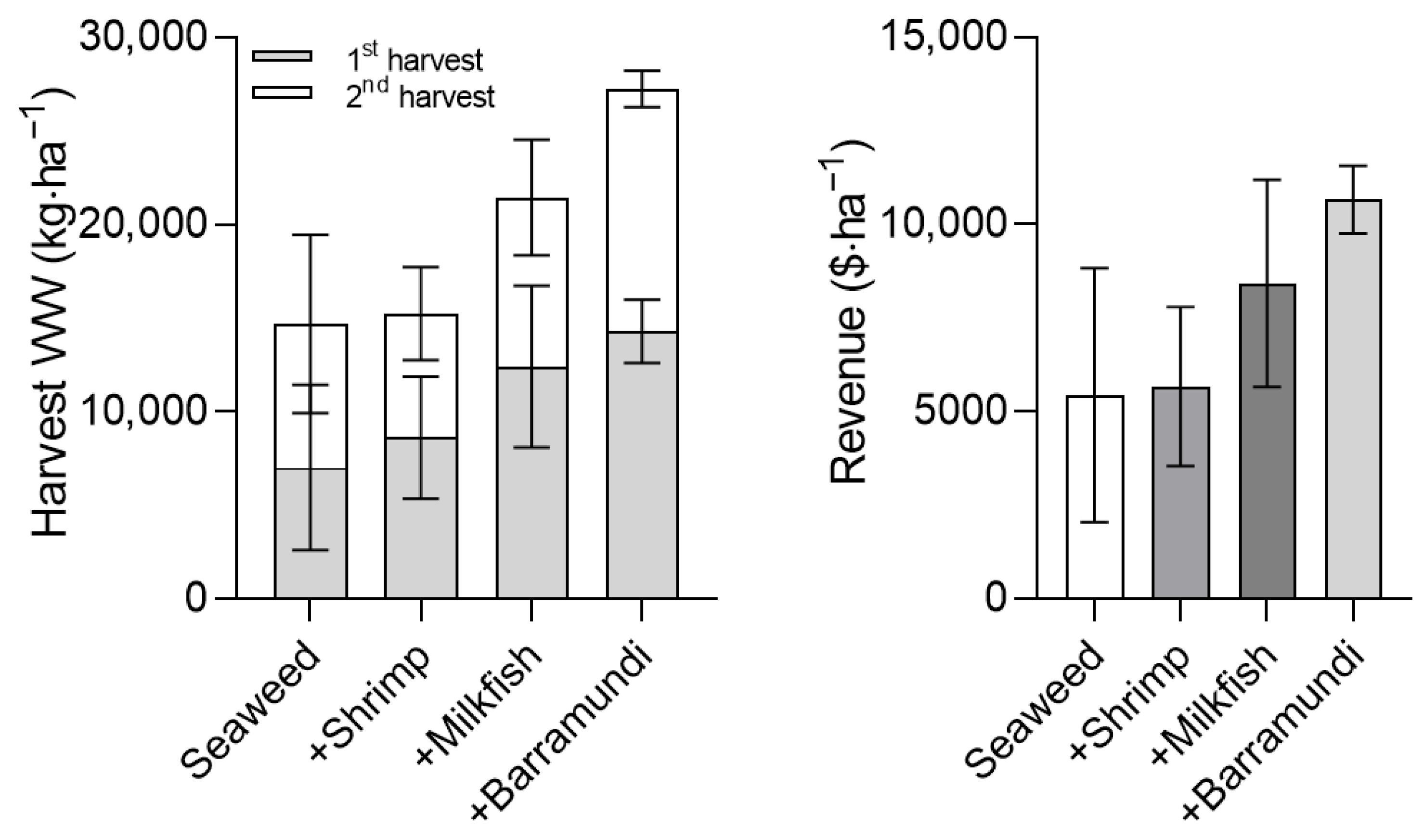
The harvest (kg·ha−1) and yield (USD·ha−1) of seaweed increased relative to monoculture of seaweed, respectively, for, addition of shrimp, Milkfish, and Barramundi (Figure 3, Table 2). However, statistical analysis of the seaweed harvest (1st, 2nd, and Total) did not show any significant differences (1-way ANOVA, p > 0.05), nor did the seaweed revenue, despite the apparent correlation (1-way ANOVA, p < 0.10).
For the SGR (Table 2), the test did not show significant differences when seaweed harvests were individually tested (1st and 2nd harvest). However, when the total seaweed harvest (the sum of the first and second harvest) was assessed, the SGR of seaweed was significantly higher in the treatment with Barramundi compared to the seaweed monoculture (Tukey post hoc, p = 0.0284) but not compared to the shrimp co-cultivation (Tukey post hoc, p = 0.0945). The total SGR of seaweed did not show significant differences between monoculture and the co-cultivation with either shrimp (Tukey post hoc, p = 0.933) or Milkfish (Tukey post hoc, p = 0.2529).
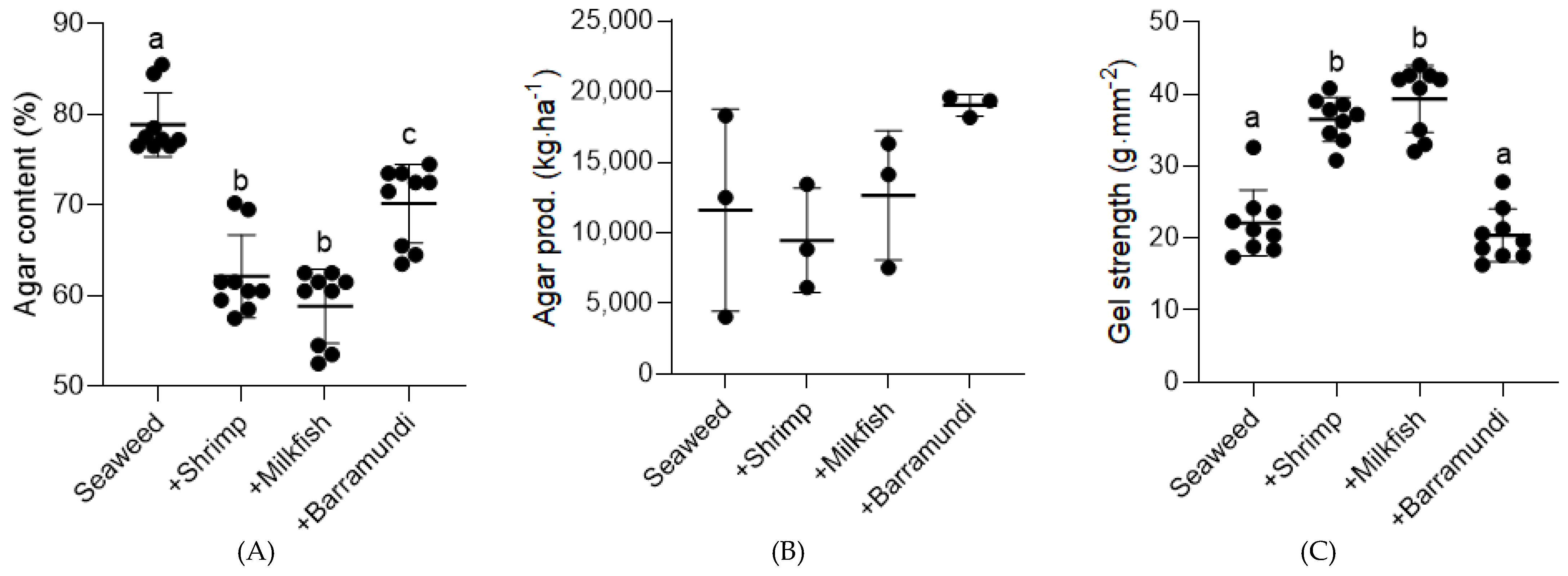
When comparing the quality of the seaweed (Figure 4), expressed as agar content, the highest content was measured in the seaweed monoculture, and a significant negative effect was observed for all polycultures (ANOVA, p < 0.001). However, agar production (i.e., agar content · seaweed yield) did not differ significantly between any of the treatments (ANOVA, p > 0.05). Compared to monoculture, gel strength was significantly higher for polyculture with shrimp (Tukey post hoc, p = 0.004) and Milkfish (Tukey post hoc, p = 0.0014), but not for polyculture with Barramundi (Tukey post hoc, p = 0.9291). A potential negative correlation was found between pond size and seaweed production·ha−1 when the added commodities were not taken into account and the production was log transformed (semi-log regression, R2 = 0.86).

4. Discussion

That integrated multitrophic aquaculture holds promise for sustainability and economic benefits has long been known, but field trials in actual outdoor culture ponds are quite rare [39]. Our work on co-cultivation of Barramundi (L. calcarifer) with seaweed (G. longissima) resulted in nearly double the average revenue compared to seaweed monoculture or co-cultivation with shrimp (P. monodon), showing the potential added value of this approach. This is fully consistent with expectations, notwithstanding the absence of statistical significance due to our low level of replication. However, even with our low level of replication, p-values were below 0.10, suggesting a significant positive correlation to be expected with higher levels of replication. The lack of statistical significance may also be attributed to external environmental variability, particularly the occurrence of a King Tide during our experiment. This event increased the exchange between pond and natural waters, introducing additional nutrients, organic matter, and wild aquatic species, which may have partially homogenized pond conditions and masked treatment effects.
No supplemental feed was used during this experiment to avoid nutrient input variability between ponds and to replicate low-cost, low-input systems. Feed can account for up to 70% of production costs [41], so eliminating this factor substantially reduced expenses. Despite farmers’ skepticism regarding shrimp performance without feed, the specific growth rate (SGR) of P. monodon reached 3.42 ± 0.01%·day−1 at a stocking density of 10 individuals·m−2. These results outperformed those found by Anh et al. [42], who reported lower SGRs (2.42–2.92%·day−1) at lower densities (2–6 ind·m−2) with a feeding ration of 50–100%. This suggests that farmers are overfeeding and subsequently not only wasting money but also increasing the nutrient content of effluent, resulting in an input of nutrients into the environment that can contribute to coastal eutrophication. Non-fed production will solely extract nutrients from the surrounding environment; therefore, this non-fed production can contribute to more sustainable aquaculture practices [43].
Co-cultivation of seaweed with Milkfish (C. chanos) yielded lower SGRs (2.71 ± 0.49%·day−1), even with reduced stocking density (1 vs. 2 ind·m−2), compared to laboratory findings by Alcantara et al. [44], who reported SGRs of 4.46 ± 0.6%·day−1 for fish and 3.96 ± 2.13%·day−1 for seaweed under controlled conditions with feeding. Notably, this study is the first to report on co-cultivation of Barramundi (L. calcarifer) with an agaroid seaweed, extending the scope of existing literature, e.g., [45,46,47], and the literature focused primarily on the use of seaweeds as feed additives for this fish species [48,49,50,51].
Although agar content varied between treatments, the total agar yield per hectare remained constant, owing to the higher biomass in polyculture systems. This is relevant as processors primarily extract agar from dry-weight seaweed and prices are based on processor demand, seasonal production cycles, quality-independent factors (e.g., moisture and sand content), and centralized collection logistics [52] but not on agar content. With prioritization of biomass over agar content by the processors, farmers incentives align with higher yield polycultures.
Another factor potentially influencing results is pond size, which varied substantially (2800–10,800 m2). To minimize this confounding variable, treatments were randomly assigned to ponds. Nonetheless, a negative correlation between pond size and seaweed productivity was observed. For shrimp, smaller pond size can indeed contribute to higher production [53,54], and in fish aquaculture pond size can affect water parameters [55]. While no definitive explanation was found in our data, this finding warrants further investigation, as pond size optimization could also enhance aquaculture yields.
This study corroborates our previous research [39] and that by several others [23,24,25,26,56] to provide supporting evidence of the profitability of polyculture systems. In addition to the economic benefits for farmers, there is also an added benefit of economic potential: the offset in nitrogen [43]. This is the case for countries where nutrient management is prioritized and could reach up to a couple of hundred USD·t−1 of produced biomass. Next to nitrogen, this is also the case for carbon, which is better known as the ‘carbon credits system’, in which the offset of carbon is valued per ton [57]. Both offsets can provide a financial incentive for producers to change toward more sustainable practices. In countries where eutrophication is an issue, but not a management priority, this asset could help foster policy change for both ecological and economic benefit.

5. Conclusions

Our results suggest that while polyculture in extensive aquaculture systems might not significantly increase seaweed agar production, it does contribute to higher biomass yields, higher economic yield, and greater system resilience. Although the agar content of seaweed in polyculture decreased, the total agar yield per hectare remained the same. Because farmers are paid based on biomass, not agar content, their economic incentives align with the cultivation of higher-yielding polycultures. Furthermore, our field experiment shows that polyculture is robust under extreme conditions, such as King Tides, potentially providing a more dependable income for farmers in rural areas. Multi-species farming, as explored in our experiments, increases resilience and reduces reliance on a single crop.
Because this research was conducted in actual aquaculture ponds and at field-scale, it provides valuable insights into the actual performance of aquaculture systems and underscores the potential of integrated multitrophic aquaculture as a climate-resilient food system. When implemented without supplemental feed, such systems can not only reduce nutrient loads but may even function as net nutrient extractors, reducing coastal eutrophication. Subsequently, they may also offer opportunities for inclusion in nutrient credit systems (C, N, and P). This makes multitrophic polyculture a promising tool for coastal management and rural development in vulnerable, flooding-prone coastal areas.

Author Contributions

Conceptualization, R.W.N., L.L.W., R.W.A., S.R. and A.O.D.; methodology, R.W.N., L.L.W., R.W.A. and S.R.; software, R.W.N.; validation, R.W.N., S.R. and A.O.D.; formal analysis, R.W.N.; investigation, R.W.N., L.L.W., R.W.A. and S.R.; resources, R.W.A., L.L.W. and S.R.; data curation, R.W.N. and A.O.D.; writing—original draft preparation, R.W.N.; writing—review and editing, A.O.D. and R.W.N.; visualization, R.W.N.; supervision, R.W.N., A.O.D. and S.R.; project administration, R.W.N. and R.W.A.; funding acquisition, R.W.N. and A.O.D. All authors have read and agreed to the published version of the manuscript.

Funding

Full funding for this work was provided by the Dutch Ministry of Agriculture, Fisheries, Food Quality and Nature via the Knowledge Base program of Wageningen University and Research within the program on Food Security and the Water-Food Nexus granted under the project numbers KB 35-004-001 and KB-35-101-001.

Institutional Review Board Statement

The experiment was conducted in active aquaculture ponds and was executed according to approved common practices. The experiment was approved by the Ethical Commission of the Universitas Diponegoro (protocol code: No. 307/EC/KEP/FK-UNDIP/2021 and approval date: 31 October 2021). In order to ensure animal welfare, the experiment was conducted with no additional potential animal welfare hazards. Consent of the farmers and pond owners for participation and publication was obtained and signed for individually.

Data Availability Statement

The raw data supporting the conclusions of this article will be made available by the authors on request.

Acknowledgments

The authors want to thank the editor and anonymous reviewers for their valuable input, as well as the farmers, students who participated in the project, and the KB35 program funding this research.

Conflicts of Interest

The authors declare no conflicts of interest.

Abbreviations

The following abbreviations are used in this manuscript (alphabetical order):
DWDry Weight
IDRIndonesian Rupiah
LODLevel of Detection
SGRSpecific Growth Rate
WWWet Weight

References

  1. KKP (Ministry of Marine Affairs and Fisheries). Indonesia Marine and Fisheries Book 2017; Ministry of Marine Affairs and Fisheries: Jakarta, Indonesia; Japan International Cooperation Agency: Tokyo, Japan, 2017.
  2. Amelia, F.; Yustiati, A.; Andriani, Y. Review of shrimp (Litopenaeus vannamei (Boone, 1931)) farming in Indonesia: Management, operating, and development. World Sci. News 2021, 158, 145–158. [Google Scholar]
  3. Dewi, A. Community-Based Analysis of Coping with Urban Flooding: A Case Study in Semarang, Indonesia. Bachelor’s Thesis, International Institute for Geo-Information and Earth Observation, ITC, Enschede, The Netherlands, 2007. [Google Scholar]
  4. Marfai, M.A.; King, L. Coastal flood management in Semarang, Indonesia. Environ. Geol. 2008, 55, 1507–1518. [Google Scholar] [CrossRef]
  5. Marfai, M.A.; King, L.; Sartohadi, J.; Sudrajat, S.; Budiani, S.R.; Yulianto, F. The impact of tidal flooding on a coastal community in Semarang, Indonesia. Environmentalist 2008, 28, 237–248. [Google Scholar] [CrossRef]
  6. Marfai, M.A.; Almohammad, H.; Dey, S.; Susanto, B.; King, L. Coastal dynamic and shoreline mapping: Multi-sources spatial data analysis in Semarang, Indonesia. Environ. Monit. Assess. 2008, 142, 297–308. [Google Scholar] [CrossRef] [PubMed]
  7. Pramita, A.W.; Syanfrudin, S.; Sugianto, D.N. Effect of seawater intrusion on groundwater in the Demak coastal area Indonesia: A review. IOP Conf. Ser. Earth Environ. Sci. 2021, 896, 012070. [Google Scholar] [CrossRef]
  8. Putiamini, S.; Mulyani, M.; Patria, M.P.; Soeliso, T.E.B.; Karsidi, A. Social vulnerability of coastal fish farming community to tidal (rob) flooding: A case study from Indramayu, Indonesia. J. Coast. Conserv. 2022, 26, 7. [Google Scholar] [CrossRef]
  9. EPA (United States Environmental Protection Agency). King Tides Factsheet (EPA-842-F-11-010). Available online: http://water.epa.gov/type/oceb/cre/upload/king_tides_factsheet.pdf (accessed on 27 August 2025).
  10. Lin, C.C.; Ho, C.R.; Cheng, Y.H. Interpreting and analyzing king tide in Tuvalu. Nat. Hazards Earth Syst. Sci. Discuss. 2014, 14, 209–220. [Google Scholar] [CrossRef]
  11. Egaputra, A.A.; Ismunarti, D.H.; Pranowo, d.W.S. Inventarisasi Kejadian Banjir Rob Kota Semarang Periode 2012–2020. Indones. J. Oceanogr. 2022, 4, 29–40. [Google Scholar] [CrossRef]
  12. Hermawan, E.; Lubis, S.W.; Harjana, T.; Purwaningsih, A.; Risyanto Ridho, A.; Andarini, D.F.; Ratri, D.N.; Widyaningsih, R. Large-scale meteorological drivers of the extreme percipitation events and devastating floods of early February 2021 in Semarang, Central Java, Indonesia. Atmosphere 2022, 13, 1092. [Google Scholar] [CrossRef]
  13. NAOO–What Are El Niño and La Niña. Available online: https://oceanservice.noaa.gov/facts/ninonina.html (accessed on 27 August 2025).
  14. FAO. La Niña: Anticipatory Action and Response Plan, September–December 2024. In Mitigating the Expected Impacts of La Niña-Induced Climate Extremes on Agricltue and Food Security; FAO: Rome, Italy, 2024. [Google Scholar]
  15. Cai, W.; Wang, G.; Santoso, A.; McPhaden, M.J.; Wu, L.; Jin, F.F.; Timmermann, A.; Collins, M.; Vecchi, G.; Lengaigne, M.; et al. Increased frequency of extreme La Niña events under greenhouse warming. Nat. Clima Change 2015, 5, 132–137. [Google Scholar] [CrossRef]
  16. Nagu, N.; Lessy, M.R.; Nur, D.K. Disaster management on small islands; lessons from flash flood. J. Ilmu Lingkung. 2025, 23, 730–741. [Google Scholar] [CrossRef]
  17. Van Wesenbeeck, B.K.; Balke, T.; Van Eijk, P.; Tonneijck, F.; Siry, H.Y.; Rudianto, M.E.; Winterwerp, J.C. Aquaculture induced erosion of tropical coastlines throws coastal communities back to poverty. Ocean. Coast. Manag. 2015, 116, 100–110. [Google Scholar] [CrossRef]
  18. Arifanti, V.B.; Novita, N.; Subarno; Tosiani, A. Mangrove deforestation and CO2 emissions in Indonesia. IOP Conf. Ser. Earth Environ. Sci. 2021, 874, 012006. [Google Scholar] [CrossRef]
  19. Primavera, J.H. Overcoming the impacts of aquaculture on the coastal zone. Ocean. Coast. Manag. 2006, 49, 531–545. [Google Scholar] [CrossRef]
  20. Pattanaik, C.; Prasad, S.N. Assessment of aquaculture impact on mangroves of Mahanadi delta (Orissa), East coast of India using remote sensing and GIS. Ocean. Coast. Manag. 2011, 54, 331–340. [Google Scholar] [CrossRef]
  21. Montgomery, J.M.; Bryan, K.R.; Horstman, E.M.; Mullarney, J.C. Attenuation of tides and surges by mangroves: Contrasting case studies from New Zealand. Water 2018, 10, 1119. [Google Scholar] [CrossRef]
  22. Cahyaningsih, A.P.; Deanova, A.K.; Pristiawati, C.M.; Ulumuddin, Y.I.; Kusumaningrum, L.; Setyawan, A.D. Review: Causes and impacts of anthropogenic activities on mangrove deforestation and degradation in Indonesia. Int. J. Bonorowo Wetl. 2022, 12, 12–22. [Google Scholar] [CrossRef]
  23. Ruiz-Vanoye, J.A.; Diaz-Parra, O.; Márquez Vera, M.A.; Fuentes-Penna, A.; Barrera-Cámara, R.A.; Ruiz-Jaimes, M.A.; Toledo-Navarro, Y.; Bernábe-Loranca, M.B.; Simancas-Acevedo, E.; Trejo-Macotela, F.R.; et al. A Comprehensive Review of Quality of Aquaculture Services in Integrated Multi-Trophic Systems. Fishes 2025, 10, 54. [Google Scholar] [CrossRef]
  24. Haque, M.M.; Mahmud, M.N. Potential role of Aquaculture in advancing sustainable development goals (SDGs) in Bangladesh. Aquac. Res. 2025, 2025, 6035730. [Google Scholar] [CrossRef]
  25. Ghosh, A.K.; Hasanuzzaman, A.F.M.; Islam, S.S.; Sarower, M.G.; Mistry, S.K.; Arafat, S.T.; Huq, K.A. Integrated multi-trophic aquaculture (IMTA): Enhancing growth, production, immunological responses, and environmental management in aquaculture. Aquac. Int. 2025, 33, 336. [Google Scholar] [CrossRef]
  26. Zhu, Y.; Wang, N.; Wu, Z.; Chen, S.; Luo, J.; Christakos, G.; Wu, J. The Role of Seaweed Cultivation in Integrated Multi-Trophic Aquaculture (IMTA): The Current Status and Challenges. Rev. Aquac. 2025, 17, e70042. [Google Scholar] [CrossRef]
  27. Muin, H.; Alias, Z.; Nor, A.; Taufek, N. Co-cultured of red hybrid tilapia and Gracilaria changii (Gracilariaceae: Rhodophyta): Effects on water quality, growth performance and algal density. Phycologia 2024, 63, 303–311. [Google Scholar] [CrossRef]
  28. Hidayatulbaroroh, R. Manajemen Produksi Rumput Laut Gracilaria (Gracilaria SP) Di Desa Domas, Pontang, Serang-Banten. J. Ilmiah Vastuwidya 2020, 2, 64–73. [Google Scholar] [CrossRef]
  29. Mawi, S.; Krishnan, S.; Din, M.; Arumugam, N.; Chelliapan, S. Bioremediation potential of macroalgae Gracilaria edulis and Gracilaria changii co-cultured with shrimp wastewater in an outdoor water recirculation system. Environ. Technol. Innov. 2020, 17, 100571. [Google Scholar] [CrossRef]
  30. Wu, H.; Huo, Y.; Han, F.; Liu, Y.; He, P. Bioremediation using Gracilaria chouae co-cultured with Sparus macrocephalus to manage the nitrogen and phosphorous balance in an IMTA system in Xiangshan Bay, China. Mar. Pollut. Bull. 2015, 91, 272–279. [Google Scholar] [CrossRef]
  31. FAO. The State of World Fisheries and Aquaculture 2020: Sustainability in Action; Food and Agriculture Organization of the United Nations: Rome, Italy, 2020. [Google Scholar] [CrossRef]
  32. Rejeki, S.; Ariyati, R.W.; Widowati, L.L.; Bosma, R.H. The effect of three cultivation methods and two seedling types on growth, agar content and gel strength of Gracilaria verrucosa. Egypt. J. Aquat. Res. 2018, 44, 65–70. [Google Scholar] [CrossRef]
  33. Hendri, M.; Rozirwan, R.; Apri, R.; Handayani, Y. Gracilaria sp. seaweed cultivation with net floating method in traditional shrimp pond in the Dungun River of Marga Sungsang village of Banyuasin District, South Sumatera. Int. J. Mar. Sci. 2018, 8, 1–11. [Google Scholar] [CrossRef]
  34. Guiry, M.D.; Guiry, G.M. AlgaeBase. World-Wide Electronic Publication, University of Galway, Ireland. 2022. Available online: https://www.algaebase.org (accessed on 11 November 2024).
  35. Strickland, J.-H.; Parsons, T.R. A Practical Handbook of Seawater Analysis; Fisheries Research Board of Canada: Ottawa, ON, Canada, 1968; pp. 1–311. [Google Scholar]
  36. APHA/AWWA/WEF. Standard Methods for the Examination of Water and Wastewater; American Public Health Association: Washington, DC, USA; American Water Works Association: Denver, CO, USA; Water Environment Federation: Alexandria, VA, USA, 2017. [Google Scholar]
  37. Widyastuti, Y.R.; Setiadi, E. Optimization of stocking density of milkfish (Chanos chanos) in polyculture system with seaweed (Gracilaria sp.) on the traditional pond. IOP Conf. Ser. Earth Environ. Sci. 2021, 744, 012099. [Google Scholar] [CrossRef]
  38. Yasmin, F.; Bosu, A.; Hasan, M.M.; Islam, M.A.; Ullah, M.R.; Khan, A.B.S.; Akhter, M.; Karim, E.; Hasan, K.R.; Mahmud, Y. Assessment of Growth Performance and Survivability of Asian Seabass (Lates calcarifer) under Different Stocking Densities in Brackish Water Ponds of South-West Coast of Bangladesh. Sustain. Aquat. Res. 2023, 2, 92–100. [Google Scholar] [CrossRef]
  39. Nauta, R.W.; Lansbergen, R.A.; Ariyati, R.W.; Widowati, L.L.; Rejeki, S.; Debrot, A.O. Co-culture of Gracilariopsis longissima seaweed and Penaeus monodon shrimp for environmental and economic resilience in poor Southeast Asian coastal aquaculture communities. Sustainability 2025, 17, 3910. [Google Scholar] [CrossRef]
  40. BOBP. Gracilaria Production and Utilization in the Bay of Bengal; Bay of Bengal Programme for Fisheries Development: Tamil Nadu, India, 1990. [Google Scholar]
  41. Rodríguez-Hernández, M.E.; Martínez-Castellanos, G.; López-Méndez, M.C.; Reyes-Gonzalez, D.; González-Moreno, H.R. Production Costs and Growth Performance of Tilapia (Oreochromis niloticus) in Intensive Production Systems: A Review. Sustainability 2025, 17, 1745. [Google Scholar] [CrossRef]
  42. Anh, N.T.N.; Vinh, N.H.; Doan, D.T.; Lan, L.M.; Kurihara, A.; Hai, T.N. Co-culture of red seaweed Gracilaria tenuistipitata and black tiger shrimp Penaeus monodon in an improved extensive pond at various stocking densities with partially reduced feed rations: A pilot-scale study. J. Appl. Phycol. 2022, 34, 1109–1121. [Google Scholar] [CrossRef]
  43. Barrett, L.T.; Theuerkauf, S.J.; Rose, J.M.; Alleway, H.K.; Bricker, S.B.; Parker, M.; Petrolia, D.R.; Jones, R.C. Sustainable growth of non-fed aquaculture can generate valuable ecosystem benefits. Ecosyst. Serv. 2022, 53, 101396. [Google Scholar] [CrossRef]
  44. Alcantara, L.B.; Calumpong, H.P.; Martinez-Goss, M.R.; Meñez, E.G.; Israel, A. Comparison of the performance of the agarophyte Gracilariopsis bailinae and the Milkfish Chanos chanos in mono- and biculture. In Developments in Hydrobiology; Kain, J.M., Brown, M.T., Lahaye, M., Eds.; Sixteenth International Seaweed Symposium; Springer: Berlin/Heidelberg, Germany, 1999; Volume 137. [Google Scholar] [CrossRef]
  45. Nhan, D.T.; Tu, N.P.C.; Tu, N.V. Comparison of growth performance, survival rate and economic efficiency of Asian seabass (Lates calcarifer) intensively cultured in earthen ponds with high densities. Aquaculture 2022, 544, 738151. [Google Scholar] [CrossRef]
  46. Islam, A.; Bosu, A.; Hasan, M.; Yasmin, F.; Bakker, A.; Khan, S.; Akhter, M.; Ullah, R.; Karim, E.; Rashid, H.; et al. Culture techniques of seabass, Lates calcarifer in Asia: A review. Int. J. Sci. Technol. Res. Arch. 2023, 4, 6–17. [Google Scholar] [CrossRef]
  47. Al Rashdi, B.; Gallardo, W.G.; Yoon, G.; Al Masroori, H. Optimal density of Asian seabass (Lates calcarifer) in combination with the Omani abalone (Haliotis mariae), brown mussel (Perna sp.), and seaweed (Ulva fasciata) in a land-based recirculating integrated multi-trophic aquaculture (IMTA) system. J. Agric. Mar. Sci. 2020, 25, 13–21. [Google Scholar] [CrossRef]
  48. Shapawi, R.; Zamry, A.A. Response of Asian seabass, Lates calcarifer juvenile fed with different seaweed-based diets. J. Appl. Anim. Res. 2016, 44, 121–125. [Google Scholar] [CrossRef]
  49. Nazarudin, M.F.; Yusoff, F.; Idrus, E.S.; Aliyu-Paiko, M. Brown seaweed Sargassum polycystum as dietary supplement exhibits prebiotic potentials in Asian sea bass Lates calcarifer fingerlings. Aquac. Rep. 2020, 18, 100488. [Google Scholar] [CrossRef]
  50. Seyedalhosseini, S.H.; Salati, A.P.; Mozanzadeh, M.T.; Parrish, C.C.; Shahriari, A. Effects of dietary seaweeds (Gracilaria spp. and Sargassum spp.) on growth, feed utilization, and resistance to acute hypoxia stress in juvenile Asian seabass (Lates calcarifer). Aquac. Rep. 2023, 31, 101663. [Google Scholar] [CrossRef]
  51. Shapawi, R.; Safiin, N.S.Z.; Senoo, S. Improving dietary red seaweed Kappaphycus alvarezii (Doty) Doty ex. P. Silva meal utilization in Asian sea bass Lates calcarifer. J. Appl. Phycol. 2015, 27, 1681–1688. [Google Scholar] [CrossRef]
  52. Langford, A.; Zhang, J.; Waldron, S.; Julianto, B.; Siradjuddin, I.; Neish, I.; Nuryartono, N. Price analysis of the Indonesian carrageenan seaweed industry. Aquaculture 2022, 550, 737828. [Google Scholar] [CrossRef]
  53. Ruiz-Velazco, J.M.J.; Hernández-Llamas, A.; Gomez-Muñoz, V.M. Management of stocking density, pond size, starting time of aeration, and duration of cultivation for intensive commercial production of shrimp Litopenaeus vannamei. Aquac. Eng. 2010, 43, 114–119. [Google Scholar] [CrossRef]
  54. Islam, M.S.; Milstein, A.; Wahab, M.A.; Dewan, S. Production and economic return of shrimp aquaculture in coastal ponds of different sizes and with different management regimes. Aquac. Int. 2005, 13, 489–500. [Google Scholar] [CrossRef]
  55. Mramba, R.P.; Kahindi, E.J. Pond water quality and its relation to fish yield and disease occurrence in small-scale aquaculture in arid areas. Heliyon 2023, 9, e16753. [Google Scholar] [CrossRef]
  56. Setyawan, P.; Imron, I.; Gunadi, B.; Van den Burg, S.; Komen, H.; Camara, M. Current status, trends, and future prospects for combining salinity tolerant tilapia and shrimp farming in Indonesia. Aquaculture 2022, 561, 738658. [Google Scholar] [CrossRef]
  57. Nathaniel, T.P.; Bhatt, S.; Gokulnath, S.R.; Vasanthakumaran, K.; Solomon, J.J.; Naveen, S.K.; Selvarani, B.; Akhila, S.; Gupta, S.S.; Varghese, T. Carbon Credits and Sustainable Aquaculture: Pathway to a Greener Future. In Food Security, Nutrition and Sustainability Through Aquaculture Technologies; Sundaray, J.K., Rather, M.A., Ahmad, I., Amin, A., Eds.; Springer: Cham, Switzerland, 2025. [Google Scholar] [CrossRef]
Figure 1. (a) The experiment was conducted at Randusanga Village, Brebes Dictrict, Central Java Province. (b) Pond’s experiment, red: seaweed and seabass (pond marker numbers 2, 6, 12); yellow: seaweed and shrimp (marker numbers 1, 4, 10); green: seaweed (marker numbers 7, 9, 11); blue: seaweed and Milkfish (marker numbers 3, 5, 8).
Aquacj 05 00026 g001
Figure 2. Schematic overview of the ponds, the applied treatments, and pond size.
Aquacj 05 00026 g002
Figure 3. (left) Mean harvest (wet weight) for the 1st and 2nd harvest of seaweed with the different co-cultivations (±SD); (right) Total revenue is the sum of the seaweed value and the value of the added commodity (±SD).
Aquacj 05 00026 g003
Figure 4. (A) Agar content (mean ± SD) of the seaweed was negatively affected by all polycultures, but was lowest in Barramundi-seaweed polyculture (mean ± SD); (B) Agar production (mean kg·ha−1 ± SD) did not differ significantly between any of the treatments; (C) Gel strength was significantly positively affected by both polyculture with shrimp and Milkfish, but not when combined with Barramundi. The letters above the clusters show if there are significant differences and if so between which treatments.
Aquacj 05 00026 g004
Table 1. Water parameters of the ponds during the experiment.
ParameterMean +/− SDMinMaxMedian
Temperature (°C)29.5 ± 1.124.233.729.5
Salinity (‰)25.0 ± 3.913.132.524.9
pH7.7 ± 0.37.08.97.7
Chl-A (µg·L−1)1.82 ± 1.270.0610.761.87
Nitrate (mg·L−1)0.468 ± 0.2680.0351.1970.495
Phosphate (mg·L−1)0.34 ± 0.390.0151.2810.051
Table 2. Production and revenue of the different treatments. Values are given as mean ± SD. Weights of the added commodities are average individual weights (g). Wet weight (WW) to dry weight (DW) conversion was 7:1 [40]. Prices are calculated in USD using the 2022 average exchange rate of IDR (1USD = 14,837IDR).
SeaweedShrimpMilkfishBarramundi
SeaweedStocking (kg·ha−1)1000100010001000
First harvest WW (kg·ha−1)7017 ± 44168631 ± 326112,403 ± 432314,297 ± 1689
Second harvest WW (kg·ha−1)7681 ± 47696615 ± 24939045 ± 309012,965 ± 977
Total harvest WW (kg·ha−1)14,699 ± 918215,246 ± 574621,447 ± 741327,263 ± 2661
Total harvest DW (kg·ha−1)2100 ± 13122178 ± 8213064 ± 10593895 ± 380
SGR2.10 ± 0.642.23 ± 0.332.51 ± 0.332.75 ± 0.08
Price per kg DW$ 0.37$ 0.37$ 0.37$ 0.37
Mean yield ($·kg−1)$ 777 ± 485$ 805 ± 304$ 1134 ± 392$ 1441 ± 141
Added
Commodity
W0 (g) 0.23 ± 0.004.51 ± 0.0728.10 ± 1.25
W120 (g) 14.10 ± 0.22131.53 ± 83.35301.26 ± 12.90
SGR (%) 3.42 ± 0.012.71 ± 0.491.98 ± 0.05
Harvest (kg·ha−1) 49.6 ± 11.6315.2 ± 75.2283.5 ± 49.0
Price per kg $ 0.54$ 1.55$ 2.02
Mean yield ($·ha−1) $ 27 ± 6$ 488 ± 117$ 573 ± 99
Total revenue ($·ha−1)$ 777 ± 485$ 832 ± 308$ 1622 ± 429$ 2014 ± 85
Disclaimer/Publisher’s Note: The statements, opinions and data contained in all publications are solely those of the individual author(s) and contributor(s) and not of MDPI and/or the editor(s). MDPI and/or the editor(s) disclaim responsibility for any injury to people or property resulting from any ideas, methods, instructions or products referred to in the content.