Article

Blood Flow Restriction Training Improves Cognition Performance and Sleep Quality in Middle-Aged Adults with Relapsing–Remitting Multiple Sclerosis


by
Javier Cano-Sánchez
1,
María del Carmen Carcelén-Fraile
2,* and
Juan Miguel Muñoz-Perete
1
1
Department of Health Sciences, Faculty of Health Sciences, University of Jaén, 23071 Jaen, Spain
2
Department of Education Sciences, Faculty of Social Sciences, University of Atlántico Medio, 35017 Las Palmas de Gran Canaria, Spain
*
Author to whom correspondence should be addressed.
Physiologia 2026, 6(1), 12; https://doi.org/10.3390/physiologia6010012
Submission received: 7 January 2026 / Revised: 30 January 2026 / Accepted: 5 February 2026 / Published: 6 February 2026
(This article belongs to the Section Exercise Physiology)

Abstract

Background/Objectives: Cognitive impairment and sleep disturbances are highly prevalent in individuals with multiple sclerosis (MS), particularly during middle age, and negatively affect functional independence and quality of life. Although physical exercise has demonstrated cognitive and sleep-related benefits in MS, tolerance to high-intensity training is often limited. Blood flow restriction (BFR) training, which combines low-load resistance exercise with partial vascular occlusion, has emerged as a feasible alternative. This study aimed to evaluate the effects of a 12-week BFR training program on performance in specific cognitive domains and sleep quality in middle-aged adults with MS. Methods: A randomized controlled trial was conducted in 65 adults with relapsing–remitting multiple sclerosis (RRMS) aged 40–65 years and an Expanded Disability Status Scale score below 7. Participants were randomly assigned to a BFR training group or a usual-care control group. The intervention consisted of supervised low-load resistance training with BFR performed twice weekly for 12 weeks. Outcomes assessed before and after the intervention included processing speed (Symbol Digit Modalities Test), executive function (Trail Making Test A and B), verbal fluency (Isaacs Set Test), and self-reported sleep quality (Pittsburgh Sleep Quality Index). Results: Compared with controls, participants in the BFR group showed significant improvements in specific cognitive domains, including processing speed, executive function, and verbal fluency. Significant reductions were also observed in self-reported global sleep disturbance and daytime dysfunction. No adverse events were reported. Conclusions: A 12-week BFR training program improved performance in key cognitive domains and self-reported sleep quality in middle-aged adults with MS, supporting its feasibility and potential clinical relevance as an exercise-based intervention.

1. Introduction

Multiple sclerosis (MS) is a chronic inflammatory disease of the central nervous system that results in demyelination, axonal injury, and neurodegeneration, with an estimated global prevalence of over 2.8 million people [1]. Although its onset usually occurs in early adulthood, many individuals live with MS into middle age (40–65 years), facing increasing physical and cognitive disability [2]. Middle age represents a clinically relevant period in MS, as cognitive decline and sleep disturbances tend to become more prevalent and impactful during this stage, significantly affecting daily functioning and quality of life [3].
Cognitive dysfunction is prevalent in MS, affecting between 40 and 70% of patients, and can appear independently of physical disability [4]. Among the most frequently affected cognitive domains are attention, processing speed, executive function, and verbal fluency [5,6]. Attention deficits impair the ability to focus and maintain concentration, interfering with learning and task execution [7]. Processing speed, often measured by tools such as the Symbol Digit Modalities Test (SDMT), is the most commonly impaired domain and is considered a core feature of MS-related cognitive decline [8]. Executive function, including planning, inhibition, and working memory, is crucial for goal-directed behavior, and its impairment is linked to poor occupational and social outcomes. Verbal fluency, reflecting the ability to access and retrieve lexical information, is also compromised in MS, affecting communication efficiency and social interaction [9].
Cognitive impairment in MS is thought to be related to demyelination in frontoparietal networks and reduced thalamocortical connectivity, with associated gray matter atrophy in regions such as the prefrontal cortex, hippocampus, and thalamus [10]. Importantly, sleep disturbances, including insomnia, restless leg syndrome, and poor sleep efficiency, are common in MS and have been strongly associated with worsened cognitive performance, increased fatigue, and reduced quality of life [11,12,13].
Physical exercise has consistently shown cognitive benefits across populations, including individuals with multiple sclerosis (MS). In people with MS, regular physical activity has been associated with increased hippocampal volume, elevated levels of brain-derived neurotrophic factor (BDNF), improved cerebral blood flow, and enhanced connectivity in functional brain networks [14,15,16]. Specifically, both aerobic and resistance training have demonstrated positive effects on cognitive processing speed, executive function, fatigue, and overall quality of life in this population [17,18]. Moreover, recent evidence suggests that exercise-based interventions may help counteract MS-related neurodegeneration and cognitive decline and should be considered a relevant non-pharmacological strategy complementing disease-modifying treatments [19]. However, despite these benefits, many individuals with MS experience barriers to engaging in high-intensity or prolonged exercise programs due to fatigue, mobility limitations, and reduced exercise tolerance.
In addition to its effects on cognition, physical exercise has been shown to positively influence sleep quality through mechanisms such as autonomic nervous system regulation, circadian rhythm stabilization, and reductions in inflammatory activity, all of which are particularly relevant in individuals with MS [20].
However, many individuals with MS cannot tolerate high-intensity or prolonged exercise due to fatigue, spasticity, and poor balance, limiting their access to the cognitive benefits of traditional training [21]. In this context, Blood Flow Restriction (BFR) training emerges as a viable alternative. BFR involves applying external pressure to the proximal portion of the limbs via pneumatic cuffs or elastic bands during low-load resistance training (typically 20–30% of one-repetition maximum), which restricts venous return while maintaining arterial inflow [22].
The physiological effects of BFR training include enhanced muscle activation, metabolite accumulation, and cellular swelling, all contributing to hypertrophy and strength gains comparable to traditional high-load resistance training [23]. Notably, BFR has also been shown to increase systemic growth hormone and BDNF levels, factors involved in neuroplasticity and cognitive resilience [24,25]. Furthermore, BFR enhances cerebral oxygenation and may modulate autonomic function, mechanisms that have been linked to improvements in sleep regulation and daytime functioning through increased parasympathetic activity [26].
Preliminary evidence supports the use of BFR in neurological populations. In stroke survivors, BFR training improved not only muscle strength but also gait and balance performance [27]. In spinal cord injury patients, BFR led to improvements in lower limb function and muscle endurance [28]. In MS populations, BFR training has demonstrated significant improvements in muscle strength, fatigue reduction, and manual dexterity without adverse effects [29,30]. However, the potential impact of BFR on cognitive domains and sleep quality in people with MS remains largely unexplored, representing a significant gap in the literature.
Given the known associations between exercise, cognitive function, and sleep, and the safety and efficacy of BFR in clinical populations, this study aims to evaluate the effects of a 12-week BFR training program on attention, processing speed, executive function, verbal fluency, and sleep quality in middle-aged individuals with MS. We hypothesize that BFR will yield improvements in both cognitive performance and sleep metrics, providing an innovative and accessible intervention for this underserved demographic.

2. Materials and Methods

2.1. Study Design

A randomized controlled trial was conducted to assess the effects of a 12-week blood flow restriction (BFR) training program in middle-aged individuals with multiple sclerosis. The study examined outcomes related to disease impact, muscle strength, fatigue, regular physical activity, and manual dexterity. Ethical approval was obtained from an Ethics Committee (CEI/05-003), and the study adhered to the ethical guidelines of the Declaration of Helsinki. It was registered under the identifier NCT06061939.

2.2. Participants

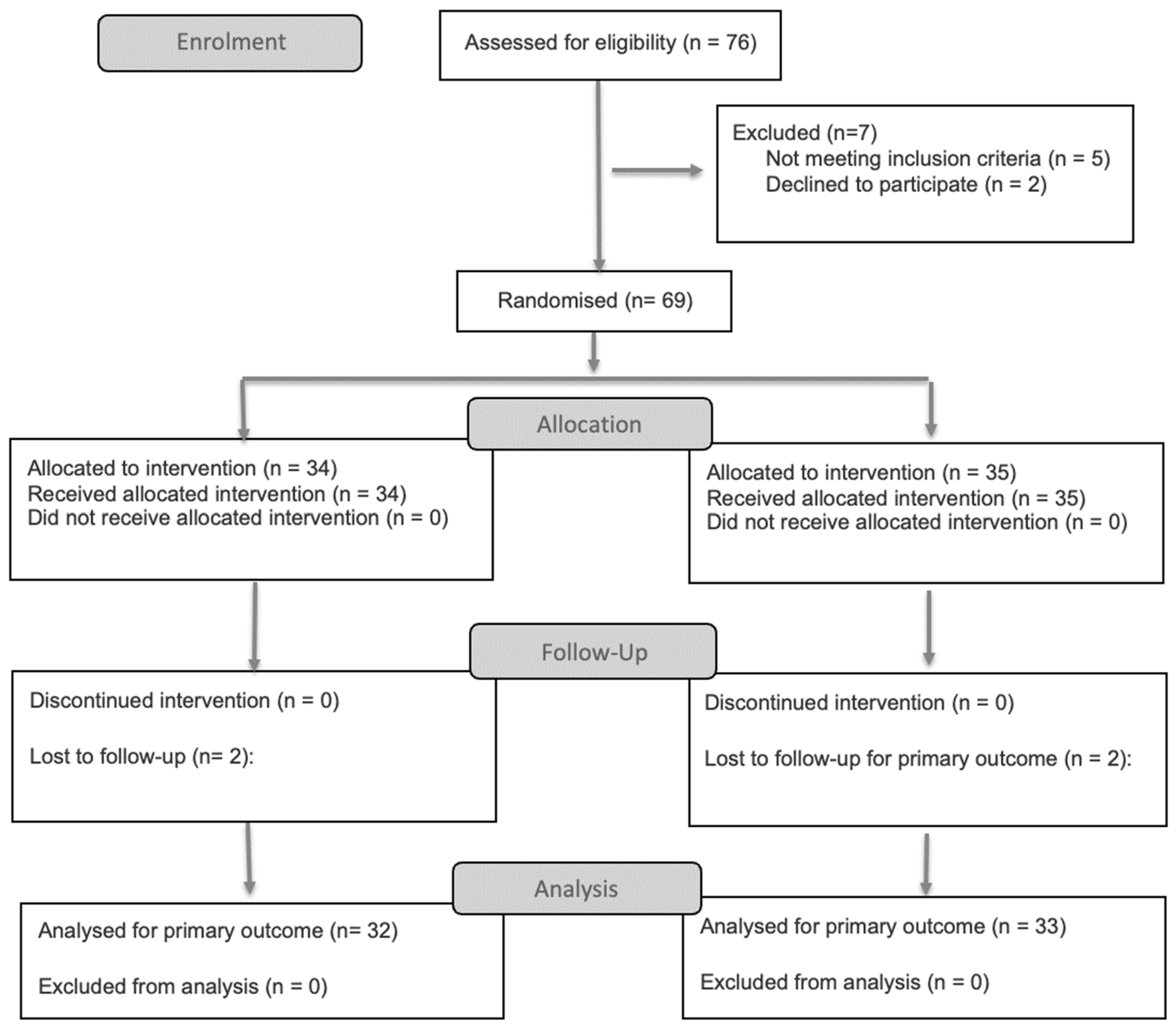
At the beginning of the study, 76 middle-aged adults were approached for participation. Out of these, 69 met the established inclusion criteria and were enrolled in the trial. All enrolled participants were diagnosed with relapsing–remitting multiple sclerosis (RRMS). Of these, four participants withdrew prior to randomization due to personal reasons or scheduling constraints and were therefore excluded from the randomization process (Figure 1). Recruitment took place between January and February 2024 through phone and email outreach. Contact information was obtained through the collaborating multiple sclerosis association, which disseminated information about the study to its members via institutional mailing lists and telephone contact, in accordance with data protection and ethical regulations. The research team did not have direct access to personal contact details prior to participants’ voluntary expression of interest. Those interested in taking part were required to sign an informed consent form, which complied with the Declaration of Helsinki, Good Clinical Practice standards, and applicable legal regulations. This document provided detailed information about the study’s aims, procedures, potential risks and benefits, and the strategies implemented to protect participant confidentiality.
To be eligible, individuals had to meet the following criteria: (i) be aged between 40 and 65 years; (ii) have an Expanded Disability Status Scale (EDSS) score below 7; (iii) not have participated in a structured exercise program in the past six months; (iv) possess sufficient physical autonomy to perform the required physical activities; and (v) be capable of understanding the study’s instructions, protocols, and training plans.
Exclusion criteria included: (i) any contraindications to physical testing or a level of disability that significantly impaired participation in the training regimen; (ii) disabilities or comorbid conditions not related to multiple sclerosis; (iii) recent MS relapses; or (iv) a current or past diagnosis of cardiovascular disease (CVD).

2.3. Randomization

Participants were randomly assigned to either the experimental group or the control group using a computerized randomization process with a 1:1 allocation ratio. Allocation concealment was ensured, as group assignments were generated and stored in opaque, sealed envelopes managed by an independent individual. At the time of randomization, neither the participants, investigators, nor the physiotherapist were aware of the upcoming group allocation. Due to the nature of the intervention, blinding of participants and the physiotherapist was not feasible after group assignment; however, outcome assessors and data analysts remained blinded throughout the study. As a result, 32 participants were allocated to the experimental group and 33 to the control group.

2.4. Intervention

The blood flow restriction (BFR) training implemented in this study was tailored to address key functional concerns in middle-aged individuals with multiple sclerosis, including disease impact, muscular strength, fatigue, physical activity levels, and manual dexterity. Over the course of 12 weeks, participants in the BFR group engaged in a supervised resistance training program held twice weekly, on Tuesdays and Thursdays, completing a total of 24 sessions, each approximately 40 min long. Each session targeted specific muscle groups, with upper body exercises performed on Tuesdays and lower body exercises on Thursdays. The intervention was conducted at the facilities of a regional multiple sclerosis association, where all training sessions were supervised by a licensed physiotherapist with experience in neurological rehabilitation and specific training in therapeutic exercise and blood flow restriction methodologies. Training sessions were conducted in a shared setting; however, all exercises were performed individually, with personalized loads and blood flow restriction pressures for each participant.
Sessions followed a standardized three-part structure: (i) a 10-min warm-up involving joint mobility exercises for both upper and lower limbs; (ii) a 20-min main workout consisting of BFR exercises targeting either the upper or lower limbs depending on the session; and (iii) a 10-min cool-down phase featuring muscle stretching and breathing techniques.
The main training component focused on major muscle groups in the arms and thighs. Upper limb exercises included biceps curls and triceps extensions, while lower limb exercises involved leg extensions and leg curls. Resistance loads were individualized at 30% of each participant’s one-repetition maximum (1RM), previously assessed for each exercise. The training protocol consisted of four sets per exercise, with a repetition scheme of 30-15-15-15. Load progression occurred if a participant successfully completed all repetitions at the current load in two consecutive sessions. Rest periods of 90 s were allowed between sets, and 2 min between different exercises.
To apply BFR, the study used the Rehab & Performance Cuff device (Rehab & Performance, Valencia, Spain), which incorporates a sphygmomanometer for pressure control and pneumatic cuffs—5 cm wide for the upper limbs and 10 cm for the lower limbs. The cuffs were placed on the proximal part of each limb to ensure effective and safe occlusion. An intermittent BFR approach was adopted, where cuff pressure was applied only during exercise execution and released during rest periods between sets and exercises, enhancing participant comfort and adherence.
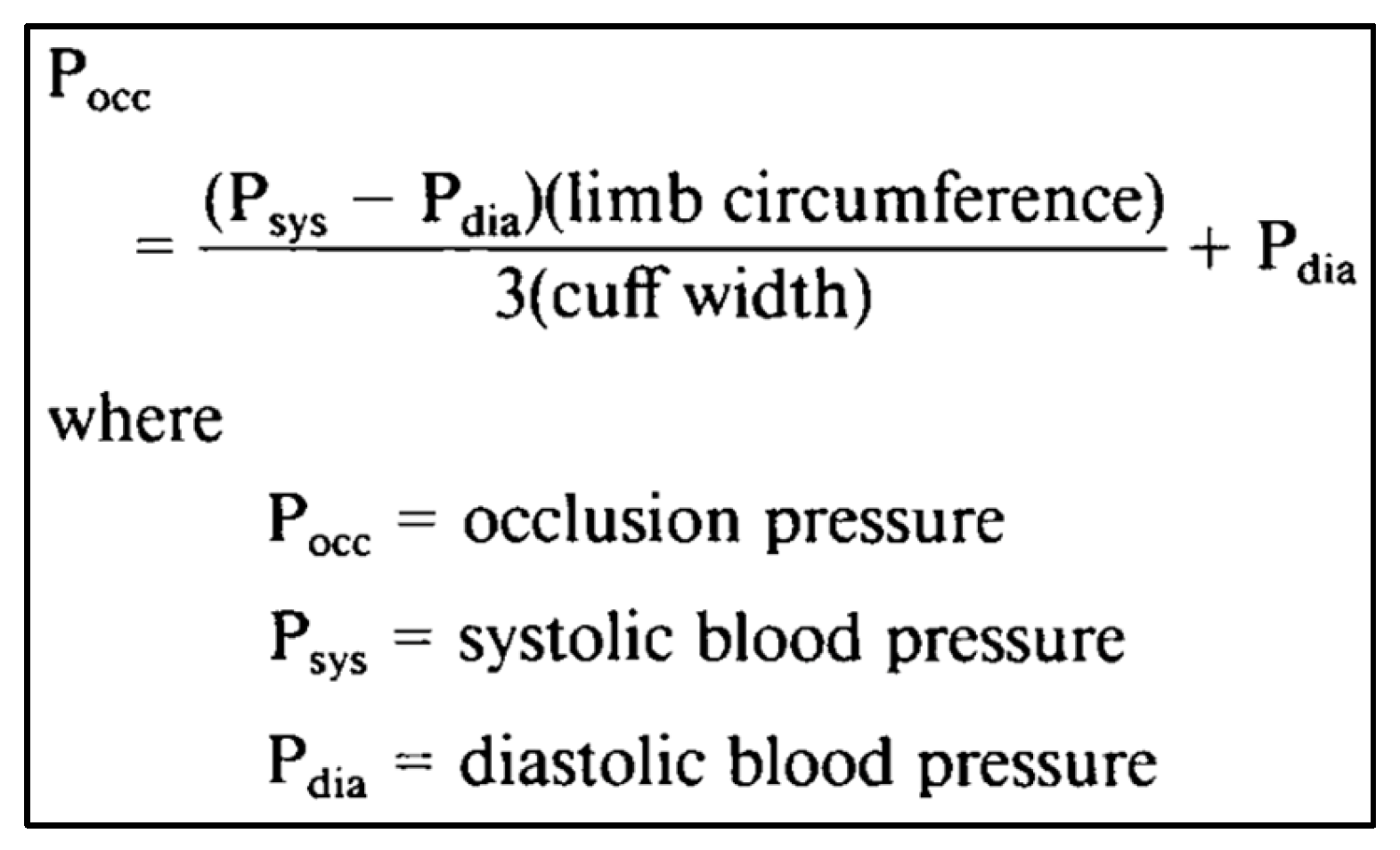
Since Doppler ultrasound was not available, arterial occlusion pressure (AOP) was estimated using a practical equation (Figure 2) derived from the relationship among cuff width, limb circumference, and systolic blood pressure, as proposed by Graham et al. [31]. AOP was defined as the minimal pressure required to eliminate the arterial pulse, allowing for precise, individualized pressure settings. During training, relative occlusion pressures were applied as follows: 40–50% of AOP for upper limbs and 60–80% for lower limbs. These pressure ranges are supported by prior research indicating their safety and efficacy in individuals with neurological conditions, promoting muscle improvements without compromising vascular or neural health [32]. Blood pressure readings were taken using an Omron HEM-907 sphygmomanometer (Omron Healthcare, Kyoto, Japan).
Participants in the control group maintained their routine care and standard medical treatment throughout the duration of the intervention. This involved continued use of prescribed medications, scheduled check-ups with healthcare professionals, and any personalized rehabilitation or support services they were already engaged in. No new exercise programs or experimental treatments were introduced, ensuring a clear comparison with the experimental group.

2.5. Outcomes

All measurements were obtained both before and immediately after the intervention period. Prior to randomization, demographic data such as age, sex, educational level, marital and occupational status, duration of MS and EDSS score were collected through self-administered questionnaires under the supervision of trained interviewers. Outcome assessments were conducted by independent researchers blinded to group allocation. Height and weight were measured using an Asimed T201-T4 stadiometer and a Tefal digital precision scale (100 g to 130 kg, Madrid, Spain), respectively. Body mass index (BMI) was calculated as weight (kg) divided by height (m2) [33].
Attention and processing speed: This was assessed using the Symbol Digit Modalities Test (SDMT), a widely used neuropsychological measure of attention and processing speed in individuals with multiple sclerosis (MS). The SDMT requires participants to match specific numbers to corresponding symbols according to a key, with performance measured by the number of correct responses within 90 s. Higher scores indicate better cognitive performance. The SDMT is sensitive to changes in cognitive function and has demonstrated excellent validity and test–retest reliability in MS populations. Its responsiveness to intervention effects makes it a valuable outcome measure for evaluating cognitive improvements following BFR training in middle-aged adults with MS [34].
Executive function: Evaluation of executive function was conducted using the Trail Making Test (TMT), a widely recognized neuropsychological assessment that measures cognitive flexibility, visual attention, and task-switching capabilities. The test is divided into two parts: TMT-A, which involves connecting sequential numbers to assess processing speed, and TMT-B, which alternates between numbers and letters to evaluate executive control. Completion time for each part is recorded, with longer durations indicating reduced performance. The TMT has shown robust validity and sensitivity in detecting executive dysfunction in individuals with multiple sclerosis and is considered a reliable measure for capturing cognitive changes following interventions such as BFR training in middle-aged adults with MS [35].
Verbal fluency: This was measured using the Isaacs Set Test (IST), a brief and sensitive instrument for assessing executive and language functions, particularly lexical access and cognitive flexibility. Participants are asked to generate as many words as possible within four semantic categories (e.g., colors, cities, fruits, animals) over a one-minute period per category. The total number of correct words produced is recorded, with lower scores reflecting reduced verbal fluency. This test has demonstrated clinical utility in populations with neurological disorders, including multiple sclerosis, and is considered a practical tool for detecting cognitive changes following interventions such as BFR training [36].
Self-reported sleep quality: This was evaluated using the Pittsburgh Sleep Quality Index (PSQI), a widely used self-report questionnaire designed to measure sleep disturbances and overall sleep quality over the previous month. The PSQI consists of 19 items grouped into seven components, including sleep latency, duration, efficiency, and disturbances. Each component is scored from 0 to 3, yielding a global score ranging from 0 to 21, with higher scores indicating poorer sleep quality. The PSQI has demonstrated strong validity and reliability in individuals with multiple sclerosis and is considered a sensitive instrument for capturing sleep-related changes resulting from interventions such as BFR training [37].

2.6. Statistical Analysis

Statistical analyses were conducted using SPSS version 20.0, with the significance threshold set at p < 0.05. Continuous data were reported as means and standard deviations, while categorical data were presented as absolute numbers and percentages. The Kolmogorov–Smirnov test assessed the normality of the data distribution. Baseline differences between groups were evaluated using Student’s t-test for continuous variables and the chi-square test for categorical ones. To examine changes within and between groups over time, a mixed-model ANOVA was applied, considering group (experimental vs. control) as the between-subjects factor and time (pre- vs. post-intervention) as the within-subjects factor. Effect sizes were determined using Cohen’s d and interpreted as negligible (<0.2), small (0.2–0.49), moderate (0.5–0.79), or large (≥0.8) [38].
The sample size for this randomized controlled trial was estimated using a 95% confidence level and 80% statistical power. A minimum meaningful difference of 3.0 points in the primary outcome was defined. Based on critical values from the normal distribution (1.96 for confidence and 0.84 for power) and assuming a population variance of 4.0, the calculation indicated a need for 52 participants. To allow for an expected 15% dropout rate, the final sample was increased to 60 individuals, evenly divided into two groups of 30.

3. Results

The participant group included 35.4% males and 64.6% females, with an average age of 51.77 ± 7.54 years. Most individuals were retired (53.8%), married (58.5%), and had completed secondary education (46.2%). All participants included in the analysis had a diagnosis of relapsing–remitting multiple sclerosis. The mean EDSS score was 3.87 ± 1.95, and the average disease duration was 17.95 ± 8.99 years (Table 1). No significant sociodemographic differences were observed between groups. Throughout the intervention period, no injuries or adverse events were reported.

3.1. Attention and Processing Speed

In the SDMT, statistically significant differences were observed between pre- and post-measurements in the training group (t(31) = −5.508, p = 0.000, Cohen’s d = 0.62), and statistically significant differences were found between both groups at the post-intervention measurement (t(63) = −2.215, p = 0.030, Cohen’s d = 0.55) (Table 2).

3.2. Executive Function

Regarding the TMTA, statistically significant differences were observed between pre- and post-measurements in the training group (t(31) = 4.261, p = 0.000, Cohen’s d = 0.56), and statistically significant differences were found between both groups at the post-intervention measurement (t(63) = 2.194, p = 0.032, Cohen’s d = 0.55). As for the TMTB, statistically significant differences were observed between pre- and post-measurements in the training group (t(31) = −2.852, p = 0.008, Cohen’s d = 0.52), and statistically significant differences were found between both groups at the post-intervention measurement (t(63) = 2.195, p = 0.032, Cohen’s d = 0.55) (Table 2).

3.3. Verbal Fluency

In the IST, statistically significant differences were observed between pre- and post-measurements in the training group (t(31) = 6.037, p = 0.000, Cohen’s d = 0.55), and statistically significant differences were found between both groups at the post-intervention measurement (t(63) = −3.045, p = 0.003, Cohen’s d = 0.56) (Table 2).

3.4. Sleep Quality

In the subjective sleep quality subdomain of the PSQI, statistically significant differences were observed between pre- and post-measurements in the training group (t(31) = 2.547, p = 0.016, Cohen’s d = 0.55), and statistically significant differences were found between both groups at the post-intervention measurement (t(63) = 2.438, p = 0.018, Cohen’s d = 0.60).
Concerning the subdomain of sleep disturbance, statistically significant differences were observed between pre- and post-measurements in the training group (t(31) = 3.738, p = 0.001, Cohen’s d = 0.80), and statistically significant differences were found between both groups at the post-intervention measurement (t(63) = 4.304, p = 0.000, Cohen’s d = 1.07).
In the subdomain of daytime dysfunction, statistically significant differences were observed between pre- and post-measurements in the training group (t(31) = 2.252, p = 0.032, Cohen’s d = 0.45), and statistically significant differences were found between both groups at the post-intervention measurement (t(63) = 2.519, p = 0.014, Cohen’s d = 0.62).
Finally, for the total score, statistically significant differences were observed between pre- and post-measurements in the training group (t(31) = 4.722, p = 0.000, Cohen’s d = 0.44), and statistically significant differences were found between both groups at the post-intervention measurement (t(63) = 3.335, p = 0.001, Cohen’s d = 0.84). However, no significant differences were found in the subdomains of sleep latency, sleep duration, sleep efficiency, and medication use (Table 3).

4. Discussion

The present study evaluated the effects of a 12-week blood flow restriction (BFR) training program on cognitive performance and self-reported sleep quality in middle-aged individuals with multiple sclerosis (MS), an area that has received limited attention in previous exercise-based intervention studies. The results demonstrated statistically significant improvements in all assessed variables in the experimental group compared to the control group, including attention and processing speed (SDMT), executive function (TMT-A and TMT-B), verbal fluency (IST), and self-reported sleep quality (PSQI).
The use of BFR represents an innovative approach to cognitive rehabilitation in MS, a population in which fatigue, spasticity, and low exercise tolerance frequently limit the feasibility of high-intensity physical training [39]. By combining low external loads (20–30% 1RM) with partial vascular occlusion, BFR induces metabolic and neuromuscular responses similar to those of high-intensity resistance training, which may promote favorable neuroplastic adaptations [40].
The significant improvement observed in the SDMT reflects increased processing speed, a cognitive domain most frequently impaired in individuals with MS and a sensitive marker for treatment effects [34]. This is particularly relevant, as reduced processing speed has been strongly associated with global functional impairment and decreased independence in this population [41]. Supporting these findings, evidence from a cognitive rehabilitation intervention indicated that a six-week program led to significant improvements in SDMT performance, accompanied by increased prefrontal cortex activation on functional Magnetic Resonance Imaging (MRI), suggesting functional neuroplasticity induced by exercise and training in individuals with MS [42]. Additionally, longitudinal analyses have demonstrated that lower SDMT scores are predictive of greater long-term disability progression, reinforcing the SDMT as a clinically meaningful and prognostically relevant outcome measure in MS [43].
Regarding executive function, the improvements seen in TMT-B scores indicate enhanced cognitive flexibility and attentional control, suggesting a beneficial effect of BFR on frontoparietal neural networks. These changes may be mediated by increased cerebral perfusion and elevated levels of BDNF stimulated by exercise [44,45]. Supporting this, recent systematic evidence shows that aerobic exercise significantly improves executive function, such as cognitive flexibility and inhibitory control, in healthy middle-aged and older adults, underscoring the role of physical activity in enhancing cognitive flexibility and attention [46]. Additionally, the observed improvements in verbal fluency measured by the IST suggest enhanced lexical access and semantic retrieval, functions primarily associated with the prefrontal and temporal cortices [47]. Likewise, a study by Castellote-Caballero et al. [48] in older adults with mild cognitive impairment found that combined physical and cognitive training enhanced verbal fluency, reinforcing the role of physical activity in modulating neural circuits related to semantic retrieval and lexical access.
Although evidence in multiple sclerosis remains limited, the present findings are consistent with emerging studies examining the effects of blood flow restriction (BFR) exercise on cognitive outcomes in other populations. For example, previous research in healthy adults has shown that acute and short-term BFR exercise can lead to improvements in executive function and attentional performance compared with non-restricted exercise, suggesting that vascular restriction may enhance the cognitive stimulus of low-intensity physical activity [49]. Similarly, studies in older adults have reported that low-load resistance exercise combined with BFR may positively influence cognitive performance when integrated into multimodal training programs [50]. While differences in population characteristics, intervention protocols, and outcome measures limit direct comparability, these findings support the plausibility of BFR as a strategy capable of modulating cognitive function beyond its well-established effects on physical performance.
Beyond blood flow restriction training, existing exercise interventions in people with multiple sclerosis have consistently demonstrated beneficial effects on cognitive function. A recent systematic review and meta-analysis of randomized controlled trials reported that exercise interventions produce a small but significant overall improvement in cognitive function in MS, with particularly evident benefits in memory and processing speed, and greater effects observed with longer or more frequent training programs [17]. In addition, randomized and quasi-experimental studies have shown that aerobic and combined exercise programs can improve processing speed, attention, executive function, and memory in people with MS [51,52]. Alternative exercise modalities have also demonstrated cognitive benefits; for example, vibration training has been associated with improvements in executive function and verbal memory, as well as improved quality of life, while structured aerobic exercise protocols in progressive MS have been linked to improvements in cognitive performance [53]. Taken together, these findings provide a solid context for the present results and suggest that blood flow restriction training may represent a viable and complementary exercise modality capable of generating cognitive benefits comparable to those observed with other exercise-based interventions in multiple sclerosis, while potentially overcoming limitations related to fatigue and reduced exercise tolerance.
Improvements in self-reported sleep quality, as measured by the PSQI, were particularly evident in the subdomains of daytime dysfunction, sleep disturbances, and overall sleep quality. These findings suggest a potential modulatory effect of BFR on autonomic function, possibly through parasympathetic activation and enhanced cerebral oxygenation [26]. Sleep quality is a key determinant of cognitive function and emotional well-being in people with MS, and its improvement may contribute to the cognitive gains observed in this study [54]. These findings align with previous studies suggesting that physical interventions can modulate autonomic function by increasing parasympathetic activity and cerebral oxygenation, which enhances sleep quality [55,56]. Specifically, Siengsukon et al. demonstrated that aerobic exercise significantly improves PSQI scores and heart rate variability in individuals with MS, indicating better autonomic regulation [57]. Additionally, Riccitelli et al. found that in MS, the relationship between sleep disorders and cognitive impairment is influenced by psychiatric symptoms, underscoring the importance of improving sleep quality to preserve cognitive function and emotional well-being in this population [57]. Therefore, the sleep improvements observed in this study may have contributed to the cognitive benefits reported, reinforcing the integrative role of blood flow restriction training in addressing both neurophysiological and neurobehavioral symptoms in people with MS.
In summary, the combined cognitive and sleep-related benefits observed may result from synergistic mechanisms triggered by BFR, including improved brain perfusion, increased neurotrophic factor release, and reduced systemic inflammation [58,59]. Unlike traditional cognitive training programs, this low-risk physical intervention offers an accessible and integrative approach to induce functional changes in individuals with MS.
The use of validated and multidimensional outcome measures such as the SDMT, TMT, IST, and PSQI allowed for the assessment of both objective improvements and subjective well-being. Moreover, the relatively large sample size (n = 65) and absence of adverse events support the internal validity and safety of the intervention. Despite the promising findings, this study has several limitations that should be acknowledged. First, the intervention period was limited to 12 weeks, which restricts the ability to assess the long-term sustainability of the cognitive and sleep-related improvements. Future research should include extended follow-up periods to determine whether these benefits persist over time or require continued training. Second, although the study included a relatively large sample size for an exercise-based intervention in MS, the generalizability of the findings may still be limited to middle-aged individuals with mild to moderate disability, as participants with an EDSS score ≥ 7 were excluded. Finally, although trained professionals supervised the intervention to ensure standardized and safe application of BFR, individual variability in cuff pressure tolerance and neuromuscular responsiveness may have influenced results and warrants further investigation. Another limitation of this study is the potential selection bias associated with recruiting participants from a single regional multiple sclerosis association. Individuals affiliated with patient associations may be more motivated, socially engaged, or health-conscious than the broader MS population, which could limit the generalizability of the findings. Nevertheless, this recruitment strategy reflects real-world clinical and community-based settings and allows for the implementation of a supervised and standardized intervention. Future multicenter studies involving participants from different regions and clinical contexts are warranted to confirm and extend these results. A further methodological limitation is that arterial occlusion pressure was estimated rather than directly measured using Doppler ultrasound. Although Doppler-based assessment is considered the gold standard, the use of predictive equations based on limb circumference, cuff width, and systolic blood pressure is a validated and commonly used approach when Doppler ultrasound is not available. Importantly, occlusion pressure was individualized for each participant and applied consistently across all training sessions, which likely minimized variability in the training stimulus. In addition, although the selected relative occlusion pressure ranges are supported by previous studies conducted in neurological populations, including individuals with multiple sclerosis, they were not originally developed as disease-specific recommendations for MS. Therefore, despite the absence of adverse events and the supervised, individualized application of pressure in the present study, some variability in individual tolerance and responsiveness cannot be entirely ruled out. Future studies should aim to establish multiple sclerosis-specific occlusion pressure guidelines to further optimize safety and efficacy. Nevertheless, future studies should incorporate direct Doppler measurements to further enhance precision and reproducibility.

5. Conclusions

In conclusion, this randomized controlled trial demonstrates that a 12-week blood flow restriction (BFR) training program produces meaningful improvements in cognitive performance and sleep quality in middle-aged individuals with multiple sclerosis, with effects that were significantly greater than those observed with usual care alone. Significant benefits were observed in key cognitive domains commonly affected in MS, including attention, processing speed, executive function, and verbal fluency, as well as in global sleep quality, sleep disturbances, and daytime functioning. From a clinical perspective, these findings suggest that BFR training may represent a feasible, safe, and time-efficient exercise-based intervention for individuals with MS who experience fatigue, mobility limitations, or intolerance to high-intensity training. By combining low external loads with individualized vascular restriction, BFR may offer a practical alternative to conventional resistance training while still promoting neurocognitive and sleep-related benefits. Although further research is needed to establish long-term effects and optimize disease-specific training parameters, the present results support the potential therapeutic role of BFR training as a complementary non-pharmacological strategy to enhance cognitive function, sleep quality, and overall well-being in people with multiple sclerosis.

Author Contributions

J.C.-S.: conceptualization, methodology, writing—original draft, writing—review & editing; M.d.C.C.-F.: formal analysis, investigation, methodology, writing—review & editing; and J.M.M.-P.: formal analysis, writing—review & editing. All authors have read and agreed to the published version of the manuscript.

Funding

This research received no external funding.

Institutional Review Board Statement

This study was approved by the Ethics Committee of the Universidad del Atlántico Medio (approval code: CEI/05-003, approval date: 28 February 2024) and conducted in accordance with the Declaration of Helsinki and Good Clinical Practice guidelines. All participants provided written informed consent prior to participation.

Informed Consent Statement

Informed consent was obtained from all subjects involved in the study.

Data Availability Statement

The data presented in this study are available upon request from the corresponding author. The data are not publicly available due to the sensitive nature of the questions asked in this study, participants were assured that the raw data would remain confidential and would not be shared.

Acknowledgments

The authors would like to express their gratitude to the Jaén Multiple Sclerosis Association for providing access to their facilities for the execution of this study, as well as to the University of Jaén for funding the open access publication costs.

Conflicts of Interest

The authors declare no conflicts of interest.

Abbreviations

The following abbreviations are used in this manuscript:
MSMultiple Sclerosis
BFRBlood Flow Restriction
EGExperimental Group
CGControl Group
EDSSExpanded Disability Status Scale
SDMTSymbol Digit Modalities Test
TMTTrail Making Test
ISTIsaacs Set Test
PSQIPittsburgh Sleep Quality Index
MRIMagnetic Resonance Imaging
BDNFBrain-Derived Neurotrophic Factor

References

  1. Reich, D.S.; Lucchinetti, C.F.; Calabresi, P.A. Multiple sclerosis. N. Engl. J. Med. 2018, 378, 169–180. [Google Scholar] [CrossRef] [Scilit] [PubMed]
  2. Lunde, H.M.B.; Assmus, J.; Myhr, K.M.; Bø, L.; Grytten, N. Survival and cause of death in multiple sclerosis: A 60-year longitudinal population study. J. Neurol. Neurosurg. Psychiatry 2017, 88, 621–625. [Google Scholar] [CrossRef] [Scilit] [PubMed]
  3. Prosperini, L.; Lucchini, M.; Ruggieri, S.; Tortorella, C.; Haggiag, S.; Mirabella, M.; Pozzilli, C.; Gasperini, C. Shift of multiple sclerosis onset towards older age. J. Neurol. Neurosurg. Psychiatry 2022, 93, 1137–1139. [Google Scholar] [CrossRef] [Scilit] [PubMed]
  4. Benedict, R.H.B.; DeLuca, J.; Enzinger, C.; Geurts, J.J.G.; Krupp, L.B.; Rao, S.M. Neuropsychology of multiple sclerosis: Looking back and moving forward. J. Int. Neuropsychol. Soc. 2017, 23, 832–842. [Google Scholar] [CrossRef] [Scilit]
  5. Portaccio, E.; Amato, M.P. Cognitive Impairment in Multiple Sclerosis: An Update on Assessment and Management. NeuroSci 2022, 3, 667–676. [Google Scholar] [CrossRef] [Scilit]
  6. Benedict, R.H.B.; Amato, M.P.; DeLuca, J.; Geurts, J.J.G. Cognitive impairment in multiple sclerosis: Clinical management, MRI, and therapeutic avenues. Lancet Neurol. 2020, 19, 860–871. [Google Scholar] [CrossRef] [Scilit]
  7. Sumowski, J.F.; Levy, S.; Katz Sand, I.; Brandstadter, R.; Dvorak, E.; Anderson, J.; Fabian, M.T.; Graney, R.A.; Lublin, F.D.; Miller, A.E.; et al. Cognition in multiple sclerosis within the modern diagnostic and treatment era. Brain 2025, 270, awaf446. [Google Scholar] [CrossRef] [Scilit]
  8. Balconi, J.; Langdon, D.; Dhakal, B.; Benedict, R.H.B. An Update on New Approaches to Cognitive Assessment in Multiple Sclerosis. NeuroSci 2025, 6, 87. [Google Scholar] [CrossRef] [Scilit]
  9. Delgado-Álvarez, A.; Matias-Guiu, J.A.; Delgado-Alonso, C.; Hernández-Lorenzo, L.; Cortés-Martínez, A.; Vidorreta, L.; Montero-Escribano, P.; Pytel, V.; Matias-Guiu, J. Cognitive Processes Underlying Verbal Fluency in Multiple Sclerosis. Front. Neurol. 2021, 11, 629183. [Google Scholar] [CrossRef] [Scilit]
  10. Mirmosayyeb, O.; Nabizadeh, F.; Moases Ghaffary, E.; Yazdan Panah, M.; Zivadinov, R.; Weinstock-Guttman, B.; Benedict, R.H.B.; Jakimovski, D. Cognitive performance and magnetic resonance imaging in people with multiple sclerosis: A systematic review and meta-analysis. Mult. Scler. Relat. Disord. 2024, 88, 105705. [Google Scholar] [CrossRef] [Scilit]
  11. Bhattarai, J.J.; Patel, K.S.; Dunn, K.M.; Brown, A.; Opelt, B.; Hughes, A.J. Sleep disturbance and fatigue in multiple sclerosis: A systematic review and meta-analysis. Mult. Scler. J. Exp. Transl. Clin. 2023, 9, 20552173231194352. [Google Scholar] [CrossRef] [Scilit] [PubMed]
  12. Wu, W.; Francis, H.; Lucien, A.; Wheeler, T.A.; Gandy, M. The Prevalence of Cognitive Impairment in Relapsing-Remitting Multiple Sclerosis: A Systematic Review and Meta-analysis. Neuropsychol. Rev. 2025, 35, 233–253. [Google Scholar] [CrossRef] [Scilit] [PubMed]
  13. Kouchaki, E.; Bayat, S.; Asgarian, F.S. Sleep disorders in patients with multiple sclerosis. BMC Neurol. 2025, 25, 237. [Google Scholar] [CrossRef] [Scilit] [PubMed]
  14. Sandroff, B.M.; Motl, R.W.; Scudder, M.R.; DeLuca, J. Systematic, Evidence-Based Review of Exercise, Physical Activity, and Physical Fitness Effects on Cognition in Persons with Multiple Sclerosis. Neuropsychol. Rev. 2016, 26, 271–294. [Google Scholar] [CrossRef] [Scilit] [PubMed]
  15. Langeskov-Christensen, M.; Hvid, L.G.; Jensen, H.B.; Nielsen, H.H.; Petersen, T.; Stenager, E.; Hämäläinen, P.; Dalgas, U. Efficacy of high-intensity aerobic exercise on cognitive performance in people with multiple sclerosis: A randomized controlled trial. Mult. Scler. 2021, 27, 1585–1596. [Google Scholar] [CrossRef] [Scilit] [PubMed]
  16. Kyriakatis, G.M.; Besios, T.; Lykou, P.M. The effect of therapeutic exercise on depressive symptoms in people with multiple sclerosis—A systematic review. Mult. Scler. Relat. Disord. 2022, 68, 104407. [Google Scholar] [CrossRef] [Scilit]
  17. Li, G.; You, Q.; Hou, X.; Zhang, S.; Du, L.; Lv, Y.; Yu, L. The effect of exercise on cognitive function in people with multiple sclerosis: A systematic review and meta-analysis of randomized controlled trials. J. Neurol. 2023, 270, 2908–2923. [Google Scholar] [CrossRef] [Scilit]
  18. Zhang, X.; Kiapour, N.; Kapoor, S.; Khan, T.; Thamilarasan, M.; Tao, Y.; Cohen, S.; Miller, R.; Sobel, R.A.; Markovic-Plese, S. IL-11 Induces Encephalitogenic Th17 Cells in Multiple Sclerosis and Experimental Autoimmune Encephalomyelitis. J. Immunol. 2019, 203, 1142–1150. [Google Scholar] [CrossRef] [Scilit]
  19. Seyedsadr, M.; Wang, Y.; Elzoheiry, M.; Gopal, S.S.; Jang, S.; Duran, G.; Chervoneva, I.; Kasimoglou, E.; Wrobel, J.A.; Hwang, D.; et al. IL-11 induces NLRP3 inflammasome activation in monocytes and inflammatory cell migration to the central nervous system. Proc. Natl. Acad. Sci. USA 2023, 120, e2221007120. [Google Scholar] [CrossRef] [Scilit]
  20. Daniela, M.; Catalina, L.; Ilie, O.; Paula, M.; Daniel-Andrei, I.; Ioana, B. Effects of Exercise Training on the Autonomic Nervous System with a Focus on Anti-Inflammatory and Antioxidants Effects. Antioxidants 2022, 11, 350. [Google Scholar] [CrossRef] [Scilit]
  21. Learmonth, Y.C.; Herring, M.P.; Russell, D.I.; Pilutti, L.A.; Day, S.; Marck, C.H.; Chan, B.; Metse, A.P.; Motl, R.W. Safety of exercise training in multiple sclerosis: An updated systematic review and meta-analysis. Mult. Scler. 2023, 29, 1604–1631. [Google Scholar] [CrossRef] [Scilit]
  22. Scott, B.R.; Loenneke, J.P.; Slattery, K.M.; Dascombe, B.J. Exercise with blood flow restriction: An updated evidence-based approach for enhanced muscular development. Sports Med. 2015, 45, 313–325. [Google Scholar] [CrossRef] [Scilit] [PubMed]
  23. Pearson, S.J.; Hussain, S.R. A review on the mechanisms of blood-flow restriction resistance training-induced muscle hypertrophy. Sports Med. 2015, 45, 187–200. [Google Scholar] [CrossRef] [Scilit] [PubMed]
  24. Slysz, J.; Stultz, J.; Burr, J.F. The efficacy of blood flow restricted exercise: A systematic review & meta-analysis. J. Sci. Med. Sport. 2016, 19, 669–675. [Google Scholar] [CrossRef] [Scilit] [PubMed]
  25. Gear, K.M.; Kim, K.; Lee, S. Effects of Training with Blood Flow Restriction on Muscular Strength: A Systematic Review and Meta-Analysis. Int. J. Exerc. Sci. 2022, 15, 1563–1577. [Google Scholar] [CrossRef] [Scilit]
  26. Cherouveim, E.D.; Miliotis, P.G.; Dipla, K.; Koskolou, M.D.; Vrabas, I.S.; Geladas, N.D. The effect of muscle blood flow restriction on hemodynamics, cerebral oxygenation and activation at rest. Appl. Physiol. Nutr. Metab. 2021, 46, 1216–1224. [Google Scholar] [CrossRef] [Scilit]
  27. Ahmed, I.; Mustafaoglu, R.; Erhan, B. The effects of low-intensity resistance training with blood flow restriction versus traditional resistance exercise on lower extremity muscle strength and motor functionin ischemic stroke survivors: A randomized controlled trial. Top. Stroke Rehabil. 2024, 31, 418–429. [Google Scholar] [CrossRef] [Scilit]
  28. Jønsson, A.B.; Krogh, S.; Lillelund, S.; Aagaard, P.; Kasch, H.; Nielsen, J.F. Efficacy of blood flow restriction exercise in chronic spinal cord injury: A randomized controlled trial. Scand. J. Med. Sci. Sports 2024, 34, e14759. [Google Scholar] [CrossRef] [Scilit]
  29. Schmidt, J.T.; Reedy, K.R.; Lubiak, S.M.; Howard, M.A.; Proppe, C.E.; Rivera, P.M.; Gonzalez-Rojas, D.H.; Lawson, J.E.; Cardona, C.; Hill, E.C. The impact of blood flow restriction and resistance training on functional outcomes and fatigue in people with Multiple Sclerosis. Med. Sci. Sports Exerc. 2025, 57, 2138–2147. [Google Scholar] [CrossRef] [Scilit]
  30. Vinolo-Gil, M.J.; Rodríguez-Huguet, M.; Martin-Vega, F.J.; Garcia-Munoz, C.; Lagares-Franco, C.; Garcia-Campanario, I. Effectiveness of blood flow restriction in neurological disorders: A systematic review. Healthcare 2022, 10, 2407. [Google Scholar] [CrossRef] [Scilit]
  31. Graham, B.; Breault, M.J.; McEwen, J.A.; McGraw, R.W. Occlusion of arterial flow at subsystolic pressures using wide tourniquet cuffs. Clin. Orthop. Relat. Res. 1993, 286, 257–261. [Google Scholar] [CrossRef] [Scilit]
  32. Patterson, S.D.; Hughes, L.; Warmington, S.; Burr, J.; Scott, B.; Owens, J.; Abe, T.; Nielsen, J.; Libardi, C.A.; Laurentino, G.; et al. Blood flow restriction exercise: Considerations of methodology, application, and safety. Front. Physiol. 2019, 10, 533. [Google Scholar] [CrossRef] [Scilit] [PubMed]
  33. World Health Organization. Obesity: Preventing and Managing the Global Epidemic; World Health Organization Technical Report Series; World Health Organization (WHO): Geneva, Switzerland, 2000; Volume 894, pp. 1–253. [Google Scholar]
  34. Benedict, R.H.; DeLuca, J.; Phillips, G.; LaRocca, N.; Hudson, L.D.; Rudick, R. Multiple Sclerosis Outcome Assessments Consortium. Validity of the Symbol Digit Modalities Test as a cognition performance outcome measure for multiple sclerosis. Mult. Scler. J. 2017, 23, 721–733. [Google Scholar] [CrossRef] [Scilit] [PubMed]
  35. Kabiri, S.; Jameie, M.; Balali, P.; Moradi, S.A.; Moghaddam, H.S.; Aghamollaii, V.; Harirchian, M.H. Trail making test could predict impairment in cognitive domains in patients with multiple sclerosis: A study of diagnostic accuracy. Arch. Clin. Neuropsychol. 2023, 38, 37–48. [Google Scholar] [CrossRef] [Scilit]
  36. Chopard, G.; Pitard, A.; Ferreira, S.; Vanholsbeeck, G.; Rumbach, L.; Galmiche, J. Combining the Memory Impairment Screen and the Isaacs Set Test: A Practical Tool for Screening Dementias. J. Am. Geriatr. Soc. 2007, 55, 1426–1430. [Google Scholar] [CrossRef] [Scilit]
  37. Jerković, A.; Mikac, U.; Matijaca, M.; Košta, V.; Katić, A.Ć.; Dolić, K.; Vujović, I.; Šoda, J.; Đogaš, Z.; Pavelin, S.; et al. Psychometric Properties of the Pittsburgh Sleep Quality Index (PSQI) in Patients with Multiple Sclerosis: Factor Structure, Reliability, Correlates, and Discrimination. J. Clin. Med. 2022, 11, 2037. [Google Scholar] [CrossRef] [Scilit]
  38. Cohen, J. A power primer. Psychol. Bull. 1992, 112, 155–159. [Google Scholar] [CrossRef]
  39. Blázquez-Fernández, A.; Marcos-Antón, S.; Cano-de-la-Cuerda, R. Effectiveness and Feasibility of Blood Flow Restriction Training for People with Multiple Sclerosis: A Systematic Review. Neurol. Int. 2024, 16, 1385–1404. [Google Scholar] [CrossRef] [Scilit]
  40. Perera, E.; Zhu, X.M.; Horner, N.S.; Bedi, A.; Ayeni, O.R.; Khan, M. Effects of Blood Flow Restriction Therapy for Muscular Strength, Hypertrophy, and Endurance in Healthy and Special Populations: A Systematic Review and Meta-Analysis. Clin. J. Sport Med. 2022, 32, 531–545. [Google Scholar] [CrossRef] [Scilit]
  41. McKay, K.A.; Bedri, S.K.; Manouchehrinia, A.; Stawiarz, L.; Olsson, T.; Hillert, J.; Fink, K. Reduction in cognitive processing speed surrounding multiple sclerosis relapse. Ann. Neurol. 2022, 91, 417–423. [Google Scholar] [CrossRef] [Scilit]
  42. Lopez-Soley, E.; Martinez-Heras, E.; Vivo, F.; Calvi, A.; Alba-Arbalat, S.; Romero-Pinel, L.; Martínez-Yélamos, S.; Ramo-Tello, C.; Presas-Rodríguez, S.; Munteis, E.; et al. Efficacy of cognitive rehabilitation in cognition and brain networks: A randomised clinical trial in patients with multiple sclerosis. Neuroimage Clin. 2025, 46, 103775. [Google Scholar] [CrossRef] [Scilit]
  43. Eijlers, A.J.C.; van Geest, Q.; Dekker, I.; Steenwijk, M.D.; Meijer, K.A.; Hulst, H.E.; Barkhof, F.; Uitdehaag, B.M.J.; Schoonheim, M.M.; Geurts, J.J.G. Predicting cognitive decline in multiple sclerosis: A 5-year follow-up study. Brain 2018, 141, 2605–2618. [Google Scholar] [CrossRef] [Scilit] [PubMed]
  44. Barha, C.K.; Starkey, S.Y.; Hsiung, G.Y.R.; Tam, R.; Liu-Ambrose, T. Aerobic exercise improves executive functions in females, but not males, without the BDNF Val66Met polymorphism. Biol. Sex Differ. 2023, 14, 16. [Google Scholar] [CrossRef] [Scilit] [PubMed]
  45. Zhang, M.; Jia, J.; Yang, Y.; Zhang, L.; Wang, X. Effects of exercise interventions on cognitive functions in healthy populations: A systematic review and meta-analysis. Ageing Res. Rev. 2023, 92, 102116. [Google Scholar] [CrossRef] [Scilit] [PubMed]
  46. Ye, M.; Song, T.; Xia, H.; Hou, Y.; Chen, A. Effects of aerobic exercise on executive function of healthy middle-aged and older adults: A systematic review and meta-analysis. Int. J. Nurs. Stud. 2024, 160, 104912. [Google Scholar] [CrossRef] [Scilit]
  47. Pelletier, A.; Bernard, C.; Dilharreguy, B.; Helmer, C.; Le Goff, M.; Chanraud, S.; Dartigues, J.-F.; Allard, M.; Amieva, H.; Catheline, G. Patterns of brain atrophy associated with episodic memory and semantic fluency decline in aging. Aging 2017, 9, 741–752. [Google Scholar] [CrossRef] [Scilit]
  48. Castellote-Caballero, Y.; Carcelén Fraile, M.D.C.; Aibar-Almazán, A.; Afanador-Restrepo, D.F.; González-Martín, A.M. Effect of combined physical–cognitive training on the functional and cognitive capacity of older people with mild cognitive impairment: A randomized controlled trial. BMC Med. 2024, 22, 281. [Google Scholar] [CrossRef] [Scilit]
  49. Chen, Y.C.; Lo, I.P.; Tsai, Y.Y.; Zhao, C.G.; Hwang, I.S. Dual-task improvement of older adults after treadmill walking combined with blood flow restriction of low occlusion pressure: The effect on the heart-brain axis. J. Neuroeng. Rehabil. 2024, 21, 116. [Google Scholar] [CrossRef] [Scilit]
  50. Manimmanakorn, A.; Manimmanakorn, P.; Srisaphonphusitti, L.; Sumethanurakkhakun, W.; Nithisup, P.; Muangritdech, N.; Thuwakum, W. The Effects of Low-Load Resistance Training Combined with Blood Flow Restriction or Hypoxia on Cardiovascular Response: A Randomized Controlled Trial. Life 2025, 15, 1162. [Google Scholar] [CrossRef] [Scilit]
  51. Yang, F.; Wen, P.-S.; Bethoux, F.; Zhao, Y. Effects of Vibration Training on Cognition and Quality of Life in Individuals with Multiple Sclerosis. Int. J. MS Care 2022, 24, 132–138. [Google Scholar] [CrossRef] [Scilit]
  52. Sangelaji, B.; Estebsari, F.; Nabavi, S.M.; Jamshidi, E.; Morsali, D.; Dastoorpoor, M. The effect of exercise therapy on cognitive functions in multiple sclerosis patients: A pilot study. Med. J. Islam. Repub. Iran 2015, 29, 205. [Google Scholar] [PubMed]
  53. Briken, S.; Gold, S.; Patra, S.; Vettorazzi, E.; Harbs, D.; Tallner, A.; Ketels, G.; Schulz, K.; Heesen, C. Effects of exercise on fitness and cognition in progressive MS: A randomized, controlled pilot trial. Mult. Scler. J. 2013, 20, 382–390. [Google Scholar] [CrossRef] [Scilit] [PubMed]
  54. Moradi, A.; Ebrahimian, A.; Sadigh-Eteghad, S.; Talebi, M.; Naseri, A. Sleep quality in multiple sclerosis: A systematic review and meta-analysis based on Pittsburgh Sleep Quality Index. Mult. Scler. Relat. Disord. 2025, 93, 106219. [Google Scholar] [CrossRef] [Scilit]
  55. Al-Sharman, A.; Khalil, H.; El-Salem, K.; Aldughmi, M.; Aburub, A. The effects of aerobic exercise on sleep quality measures and sleep-related biomarkers in individuals with Multiple Sclerosis: A pilot randomised controlled trial. NeuroRehabilitation 2019, 45, 107–115. [Google Scholar] [CrossRef] [Scilit] [PubMed]
  56. Siengsukon, C.F.; Aldughmi, M.; Kahya, M.; Bruce, J.; Lynch, S.; Ness Norouzinia, A.; Glusman, M.; Billinger, S. Randomized controlled trial of exercise interventions to improve sleep quality and daytime sleepiness in individuals with multiple sclerosis: A pilot study. Mult. Scler. J. Exp. Transl. Clin. 2016, 2, 2055217316680639. [Google Scholar] [CrossRef] [Scilit]
  57. Riccitelli, G.C.; Pacifico, D.; Manconi, M.; Sparasci, D.; Sacco, R.; Gobbi, C.; Zecca, C. Relationship between cognitive disturbances and sleep disorders in multiple sclerosis is modulated by psychiatric symptoms. Mult. Scler. Relat. Disord. 2022, 64, 103936. [Google Scholar] [CrossRef] [Scilit]
  58. Diechmann, M.D.; Campbell, E.; Coulter, E.; Paul, L.; Dalgas, U.; Hvid, L.G. Effects of exercise training on neurotrophic factors and subsequent neuroprotection in persons with multiple sclerosis—A systematic review and meta-analysis. Brain Sci. 2021, 11, 1499. [Google Scholar] [CrossRef] [Scilit]
  59. Devasahayam, A.J.; Kelly, L.P.; Williams, J.B.; Moore, C.S.; Ploughman, M. Fitness shifts the balance of BDNF and IL-6 from inflammation to repair among people with progressive multiple sclerosis. Biomolecules 2021, 11, 504. [Google Scholar] [CrossRef] [Scilit]
Figure 1. Flow diagram of participant recruitment, eligibility assessment, exclusions, randomization, and group allocation in the randomized controlled trial. A total of 76 individuals were assessed for eligibility, 69 met the inclusion criteria, and 65 participants were randomized to the experimental group (n = 32) or the control group (n = 33).
Physiologia 06 00012 g001
Figure 2. Equation used to estimate arterial occlusion pressure (AOP) based on cuff width, limb circumference, and systolic blood pressure, as proposed by Graham et al. [31]. This formula was used to individualize relative occlusion pressures applied during blood flow restriction training.
Physiologia 06 00012 g002
Table 1. Preintervention sociodemographic and clinical characteristics of the participants as a whole and by group.
Total
(n = 65)
Experimental
(n = 32)
Control
(n = 33)
p-Value
Age 51.77 ± 7.5451.70 ± 7.3951.84 ± 7.800.767
SexMale23 (35.40)12 (52.20)11 (47.80)0.495
Female42 (64.60)20 (52.40)22 (47.60)
Occupational StatusRetired35 (53.80)18 (51.40)17 (48.60)0.993
Employed26 (40.00)12 (46.20)14 (53.80)
Unemployed4 (6.20)2 (50.00)2 (50.00)
Marital StatusSingle18 (27.70)11 (61.10)7 (38.90)0.184
Married38 (58.50)17 (44.70)21 (55.30)
Divorced/Separated/Widowed9 (13.80)4 (44.40)5 (55.60)
Educational StatusPrimary Education11 (16.90)7 (63.60)4 (36.40)0.397
Secondary Education30 (46.20)13 (43.30)17 (56.70)
University Education24 (36.90)12 (50.00)12 (50.00)
MS Duration (years) 17.95 ± 8.9917.39 ± 8.0118.53 ± 9.990.294
EDSS score at baseline 3.87 ± 1.953.77 ± 2.133.97 ± 1.760.089
Financial supportYes19 (29.2)11 (57.90)8 (42.10)0.083
No46 (70.80)21 (45.70)25 (54.30)
Height 1.67 ± 0.581.67 ± 0.631.66 ± 0.540.389
Weight 67.48 ± 8.7467.72 ± 9.0167.24 ± 8.600.890
BMI 24.23 ± 2.4124.24 ± 2.7624.25 ± 2.070.380
Quantitative variables are presented as mean and standard deviation. Qualitative variables are presented as frequency and percentage. MS: Multiple Sclerosis. EDSS: Expanded Disability Status Scale. BMI: Body Mass Index.
Table 2. Effects of BFR training on Attention and Processing Speed, Executive Function, Verbal Fluency.
EG (n = 32)CG (n = 33)GroupTimeGroup × Time
PrePostPrePostF(80)p-Valueη2F(80)p-Valueη2F(80)p-Valueη2
SDMT25.19 ± 11.9933.06 ± 13.2026.36 ± 12.5425.97 ± 12.620.9450.3350.01527.6540.0000.34933.7860.0000.349
TMT-A77.19 ± 50.3453.78 ± 30.2475.94 ± 48.4775.76 ± 48.190.9110.3440.01418.9620.0000.23118.3820.0000.226
TMT-B171.78 ± 148.12113.44 ± 53.38173.97 ± 147.16174.36 ± 147.951.0430.3110.0168.2760.0050.1168.5030.0050.119
IST39.19 ± 1.4039.78 ± 0.6138.97 ± 1.4038.82 ± 1.693.6930.0590.0553.0350.0860.0468.6180.0050.120
SDMT: Symbol Digit Modalities Test; TMT-A: Trail Making Test—Part A; TMT-B: Trail Making Test—Part B; IST: Isaacs Set Test.
Table 3. Effects of BFR training on Sleep Quality.
EG (n = 32)CG (n = 33)GroupTimeGroup × Time
PrePostPrePostF(80)p-Valueη2F(80)p-Valueη2F(80)p-Valueη2
PSQI—Subjective sleep quality1.05 ± 0.760.69 ± 0.545.36 ± 4.121.12 ± 0.861.9690.1650.0302.5690.1140.0394.9320.0300.073
PSQI—Sleep latency1.22 ± 1.131.03 ± 1.121.39 ± 1.171.45 ± 1.151.1890.2800.0190.7940.3760.0123.0360.0860.046
PSQI—Sleep duration1.28 ± 0.951.16 ± 0.921.45 ± 0.971.46 ± 0.981.1240.2930.0180.5930.4450.0100.5820.4490.009
PSQI—Sleep efficiency0.97 ± 1.200.94 ± 1.221.09 ± 1.101.03 ± 0.950.1620.6890.0030.3480.5580.0050.0350.8510.001
PSQI—Sleep disturbance1.53 ± 0.621.13 ± 0.341.64 ± 0.701.73 ± 0.729.0080.0040.1252.6470.1090.0406.5800.0130.095
PSQI—Medication use0.72 ± 1.280.59 ± 1.100.79 ± 1.140.94 ± 1.060.5730.4520.0090.0300.8620.0003.2960.0740.050
PSQI—Daytime dysfunction1.06 ± 0.910.69 ± 0.741.15 ± 0.911.21 ± 0.932.3840.1280.0363.2240.0770.0496.1890.0160.089
PSQI—Total score7.84 ± 3.996.22 ± 3.388.58 ± 3.788.97 ± 3.204.0190.0490.607.1690.0090.10217.8200.0000.220
PSQI: Pittsburgh Sleep Quality Index.
Disclaimer/Publisher’s Note: The statements, opinions and data contained in all publications are solely those of the individual author(s) and contributor(s) and not of MDPI and/or the editor(s). MDPI and/or the editor(s) disclaim responsibility for any injury to people or property resulting from any ideas, methods, instructions or products referred to in the content.