
Height, Sex, and Sport as Correlates of Tendon Stiffness in Elite Athletes


 ,
,  and
and
Abstract
1. Introduction
2. Results
3. Discussion
Practical Applications
4. Materials and Methods
4.1. Experimental Approach
4.2. Participants
4.3. Anthropometric Measurements
4.4. Limb Dominance Assessment
4.5. Myoton Measurements
- (a)
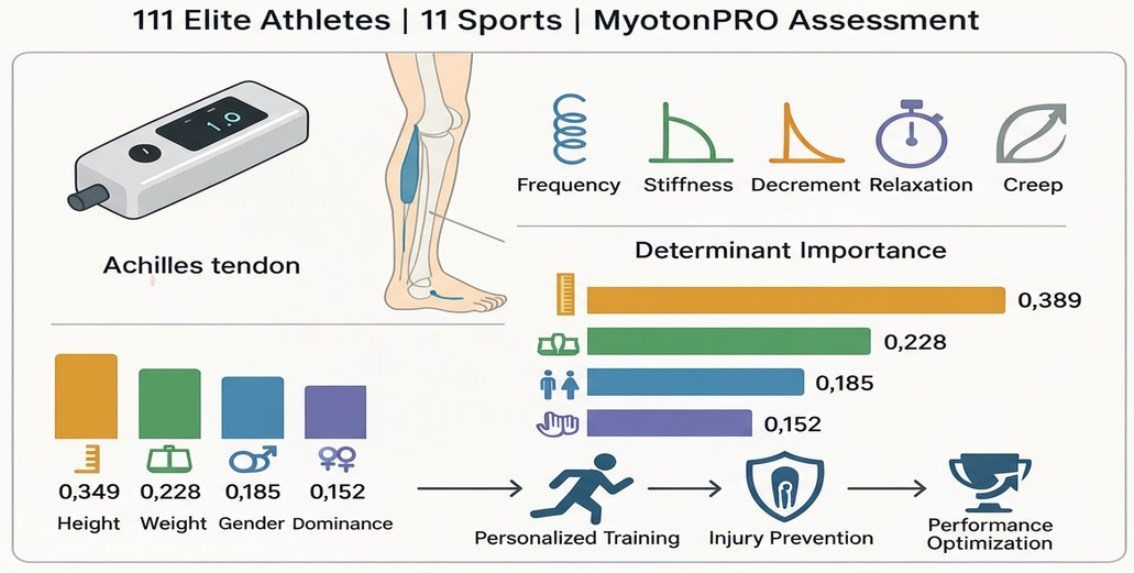
- Frequency, measured in Hertz (Hz), reflects the natural oscillation frequency of the tissue after a mechanical impulse and is an indicator of dynamic stiffness; it is calculated using the formula *f* = (1/2π) √(*k*/*m*).
- (b)
- Stiffness, expressed in Newtons per meter (N/m), represents the tissue’s resistance to deformation under an external force and is related to structural elasticity, defined by the formula S = F/Δ*x*.
- (c)
- Logarithmic decrement is a dimensionless parameter that describes the reduction rate in the vibration amplitude following perturbation, reflecting viscoelastic damping; it is calculated as D = (A1 − A2)/A1.
- (d)
- Relaxation, measured in milliseconds (ms), is the time required for the tissue to reduce internal stress under constant deformation, indicating viscoelastic relaxation; it is defined by the formula ε(*t*) = ε0 *e*(−λt).
- (e)
- Creep, quantified in millimeters (mm), refers to the progressive increase in deformation under a constant load maintained over time, as expressed by the formula ε(*t*) = ε0 + Δε (1 − *e*(−βt)).
4.6. Statistical Analysis
5. Conclusions
Supplementary Materials
Author Contributions
Funding
Institutional Review Board Statement
Informed Consent Statement
Data Availability Statement
Acknowledgments
Conflicts of Interest
Abbreviations
| BMI | Body Mass Index |
| CI | Confidence Interval |
| Hz | Hertz |
| ICC | Intraclass Correlation Coefficient |
| ISAK | International Society for the Advancement of Kinanthropometry |
| N/m | Newtons per meter |
| η2 (eta2) | Eta-squared (effect size measure) |
| R2 | Coefficient of Determination |
| SD | Standard Deviation |
References
- McMahon, G.; Cook, J. Female tendons are from venus and male tendons are from mars, but does it matter for tendon health? Sports Med. 2024, 54, 2467–2474. [Google Scholar] [CrossRef] [PubMed]
- Cassel, M.; Intziegianni, K.; Risch, L.; Müller, S.; Engel, T.; Mayer, F. Physiological Tendon Thickness Adaptation in Adolescent Elite Athletes: A Longitudinal Study. Front. Physiol. 2017, 8, 795. [Google Scholar] [CrossRef] [PubMed]
- Wiesinger, H.-P.; Rieder, F.; Kösters, A.; Müller, E.; Seynnes, O. Are Sport-Specific Profiles of Tendon Stiffness and Cross-Sectional Area Determined by Structural or Functional Integrity? PLoS ONE 2016, 11, e0158441. [Google Scholar] [CrossRef] [PubMed]
- Cristi-Sánchez, I.; Danes-Daetz, C.; Neira, A.; Ferrada, W.; Yáñez Díaz, R.; Silvestre Aguirre, R. Patellar and Achilles Tendon Stiffness in Elite Soccer Players Assessed Using Myotonometric Measurements. Sports Health 2019, 11, 157–162. [Google Scholar] [CrossRef]
- Lepley, A.S.; Joseph, M.F.; Daigle, N.R.; Digiacomo, J.E.; Galer, J.; Rock, E.; Rosier, S.B.; Sureja, P.B. Sex Differences in Mechanical Properties of the Achilles Tendon: Longitudinal Response to Repetitive Loading Exercise. J. Strength. Cond. Res. 2018, 32, 3070–3079. [Google Scholar] [CrossRef]
- Zhang, X.; Deng, L.; Xiao, S.; Li, L.; Fu, W. Sex Differences in the Morphological and Mechanical Properties of the Achilles Tendon. Int. J. Environ. Res. Public Health 2021, 18, 8974. [Google Scholar] [CrossRef]
- McGowen, J.M.; Hoppes, C.W.; Forsse, J.S.; Albin, S.R.; Abt, J.; Koppenhaver, S.L. The utility of myotonometry in musculoskeletal rehabilitation and human performance programming. J. Athl. Train. 2023, 58, 305. [Google Scholar] [CrossRef]
- Koterba, J.; Saulicz, E. Reliability of Measurement of Neck and Back Muscle Mechanical Properties Using MyotonPRO: A Systematic Review. J. Bodyw. Mov. Ther. 2025, 44, 616–624. [Google Scholar] [CrossRef]
- Kjær, M.; Petersen, J.; Dünweber, M.; Andersen, J.; Engebretsen, L.; Magnusson, S. Dilemma in the Treatment of Sports Injuries in Athletes: Tendon Overuse, Muscle Strain, and Tendon Rupture. Scand. J. Med. Sci. Sports 2025, 35, e70026. [Google Scholar] [CrossRef]
- Ra’ad, M.K.; Sukanen, M.; Finni, T. Achilles Tendon stiffness: Influence of measurement methodology. Ultrasound Med. Biol. 2024, 50, 1522–1529. [Google Scholar] [CrossRef]
- Volesky, K.; Novak, J.; Janek, M.; Katolicky, J.; Tufano, J.J.; Steffl, M.; Courel-Ibáñez, J.; Vetrovsky, T. Assessing the Test-Retest Reliability of MyotonPRO for Measuring Achilles Tendon Stiffness. J. Funct. Morphol. Kinesiol. 2025, 10, 83. [Google Scholar] [CrossRef]
- Zhang, X.; Deng, L.; Xiao, S.; Fu, W. Morphological and viscoelastic properties of the Achilles tendon in the forefoot, rearfoot strike runners, and non-runners in vivo. Front. Physiol. 2023, 14, 1256908. [Google Scholar] [CrossRef] [PubMed]
- Kurashina, W.; Iijima, Y.; Sasanuma, H.; Saito, T.; Takeshita, K. Evaluation of muscle stiffness in adhesive capsulitis with Myoton PRO. JSES Int. 2023, 7, 25–29. [Google Scholar] [CrossRef] [PubMed]
- Römer, C.; Zessin, E.; Czupajllo, J.; Fischer, T.; Wolfarth, B.; Lerchbaumer, M.H. Effect of anthropometric parameters on achilles tendon stiffness of professional athletes measured by shear wave elastography. J. Clin. Med. 2023, 12, 2963. [Google Scholar] [CrossRef] [PubMed]
- Trybulski, R.; Kużdżał, A.; Wilk, M.; Więckowski, J.; Fostiak, K.; Muracki, J. Reliability of MyotonPro in measuring the biomechanical properties of the quadriceps femoris muscle in people with different levels and types of motor preparation. Front. Sports Act. Living 2024, 6, 1453730. [Google Scholar] [CrossRef]
- LaPrade, C.M.; Chona, D.V.; Cinque, M.E.; Freehill, M.T.; McAdams, T.R.; Abrams, G.D.; Sherman, S.L.; Safran, M.R. Return-to-play and performance after operative treatment of Achilles tendon rupture in elite male athletes: A scoping review. Br. J. Sports Med. 2022, 56, 515–520. [Google Scholar] [CrossRef]
- Chan, J.J.; Chen, K.K.; Sarker, S.; Hasija, R.; Huang, H.-H.; Guzman, J.Z.; Vulcano, E. Epidemiology of Achilles tendon injuries in collegiate level athletes in the United States. Int. Orthop. 2020, 44, 585–594. [Google Scholar] [CrossRef]
- Brazier, J.; Maloney, S.; Bishop, C.; Read, P.J.; Turner, A.N. Lower extremity stiffness: Considerations for testing, performance enhancement, and injury risk. J. Strength. Cond. Res. 2019, 33, 1156–1166. [Google Scholar] [CrossRef]
- Davis, J.J., IV; Gruber, A.H. Leg stiffness, joint stiffness, and running-related injury: Evidence from a prospective cohort study. Orthop. J. Sports Med. 2021, 9, 23259671211011213. [Google Scholar] [CrossRef]
- Hackney, J.; Wilcoxon, S.; Holtmeier, M.; Eaves, H.; Harker, G.; Potthast, A. Low Stiffness Dance Flooring Increases Peak Ankle Plantar Flexor Muscle Activation During a Ballet Jump. J. Danc. Med. Sci. 2023, 27, 99–106. [Google Scholar] [CrossRef]
- Schneebeli, A.; Falla, D.; Clijsen, R.; Barbero, M. Myotonometry for the evaluation of Achilles tendon mechanical properties: A reliability and construct validity study. BMJ Open Sport. Exerc. Med. 2020, 6, e000726. [Google Scholar] [CrossRef]
- Bohm, S.; Mersmann, F.; Arampatzis, A. Human tendon adaptation in response to mechanical loading: A systematic review and meta-analysis of exercise intervention studies on healthy adults. Sports Med. Open 2015, 1, 7. [Google Scholar] [CrossRef] [PubMed]
- Sukanen, M.; Khair, R.a.M.; Ihalainen, J.K.; Laatikainen-Raussi, I.; Eon, P.; Nordez, A.; Finni, T. Achilles tendon and triceps surae muscle properties in athletes. Eur. J. Appl. Physiol. 2024, 124, 633–647. [Google Scholar] [CrossRef] [PubMed]
- Weidlich, K.; Domroes, T.; Bohm, S.; Arampatzis, A.; Mersmann, F. Addressing muscle–tendon imbalances in adult male athletes with personalized exercise prescription based on tendon strain. Eur. J. Appl. Physiol. 2024, 124, 3201–3214. [Google Scholar] [CrossRef] [PubMed]
- Maloof, A.; Hackett, L.; Bilbrough, J.; Hayek, C.; Murrell, G. Evaluating Elastographic Tendon Stiffness as a Predictor of Return to Work and Sports After Primary Rotator Cuff Repair. Orthop. J. Sports Med. 2025, 13, 23259671241306761. [Google Scholar] [CrossRef]
- Hansen, M. Female hormones: Do they influence muscle and tendon protein metabolism? Proc. Nutr. Soc. 2018, 77, 32–41. [Google Scholar] [CrossRef]
- Taş, S.; Yılmaz, S.; Onur, M.R.; Soylu, A.R.; Altuntaş, O.; Korkusuz, F. Patellar tendon mechanical properties change with gender, body mass index and quadriceps femoris muscle strength. Acta Orthop. Traumatol. Turc. 2017, 51, 54–59. [Google Scholar] [CrossRef]
- Schmidt, D.; Verderber, L.; Germano, A.M.; Nitzsche, N. Correlations Between Achilles Tendon Stiffness and Jumping Performance: A Comparative Study of Soccer and Basketball Athletes. J. Funct. Morphol. Kinesiol. 2025, 10, 112. [Google Scholar] [CrossRef]
- Seymore, K.D.; Hanlon, S.L.; Pohlig, R.T.; Elliott, D.M.; Silbernagel, K.G. Relationship Between Structure and Age in Healthy Achilles Tendons. J. Orthop. Res. 2025, 43, 1250–1258. [Google Scholar] [CrossRef]
- Bravo-Sánchez, A.; Abián, P.; Jiménez, F.; Abián-Vicén, J. Myotendinous asymmetries derived from the prolonged practice of badminton in professional players. PLoS ONE 2019, 14, e0222190. [Google Scholar] [CrossRef]
- Pissarra, Â.; Ribeiro, L.; Rodrigues, S. Ultrasonographic Evaluation of the Patellar Tendon in Cyclists, Volleyball Players, and Non-Practitioners of Sports—The Influence of Gender, Age, Height, Dominant Limb, and Level of Physical Activity. J. Funct. Morphol. Kinesiol. 2024, 9, 116. [Google Scholar] [CrossRef] [PubMed]
- Jacobs, M.W.; Feuerbacher, J.F.; Mersmann, F.; Bloch, W.; Arampatzis, A.; Schumann, M. Maximal strength training improves muscle-tendon properties and increases tendon matrix remodulation in well-trained triathletes. Sci. Rep. 2025, 15, 27333. [Google Scholar] [CrossRef] [PubMed]
- Lorimer, A.V.; Hume, P.A. Stiffness as a Risk Factor for Achilles Tendon Injury in Running Athletes. Sports Med. 2016, 46, 1921–1938. [Google Scholar] [CrossRef] [PubMed]
- Szajkowski, S.; Pasek, J.; Dwornik, M.; Cieślar, G. Mechanical properties of the patellar tendon in weightlifting athletes—The utility of myotonometry. Adaptations of patellar tendon to mechanical loading. Acta Bioeng. Biomech. 2024, 26, 153–164. [Google Scholar] [CrossRef]
- Römer, C.; Czupajllo, J.; Wolfarth, B.; Sichting, F.; Legerlotz, K. The Myometric Assessment of Achilles Tendon and Soleus Muscle Stiffness before and after a Standardized Exercise Test in Elite Female Volleyball and Handball Athletes—A Quasi-Experimental Study. J. Clin. Med. 2024, 13, 3243. [Google Scholar] [CrossRef]
- Malliaras, P.; Barton, C.J.; Reeves, N.D.; Langberg, H. Achilles and patellar tendinopathy loading programmes: A systematic review comparing clinical outcomes and identifying potential mechanisms for effectiveness. Sports Med. 2013, 43, 267–286. [Google Scholar] [CrossRef]
- Eriksen, C.S.; Svensson, R.B.; Gylling, A.T.; Couppé, C.; Magnusson, S.P.; Kjaer, M. Load magnitude affects patellar tendon mechanical properties but not collagen or collagen cross-linking after long-term strength training in older adults. BMC Geriatr. 2019, 19, 30. [Google Scholar] [CrossRef]
- Wohlgemuth, R.P.; Brashear, S.E.; Smith, L.R. Alignment, cross linking, and beyond: A collagen architect’s guide to the skeletal muscle extracellular matrix. Am. J. Physiol.-Cell Physiol. 2023, 325, C1017–C1030. [Google Scholar] [CrossRef]
- Breine, B.; Malcolm, P.; Galle, S.; Fiers, P.; Frederick, E.C.; Clercq, D.D. Running Speed-induced Changes in Foot Contact Pattern Influence Impact Loading Rate. Eur. J. Sport Sci. 2018, 19, 774–783. [Google Scholar] [CrossRef]
- Wiesinger, H.-P.; Rieder, F.; Kösters, A.; Müller, E.; Seynnes, O.R. Sport-specific capacity to use elastic energy in the patellar and Achilles tendons of elite athletes. Front. Physiol. 2017, 8, 132. [Google Scholar] [CrossRef]
- Blazevich, A.; Fletcher, J. More than energy cost: Multiple benefits of the long Achilles tendon in human walking and running. Biol. Rev. 2022, 98, 2210–2225. [Google Scholar] [CrossRef] [PubMed]
- Yu, C.; Deng, L.; Li, L.; Zhang, X.; Fu, W. Exercise Effects on the Biomechanical Properties of the Achilles Tendon—A Narrative Review. Biology 2022, 11, 172. [Google Scholar] [CrossRef] [PubMed]
- Taş, S.; Yüzbaşıoğlu, Ü.; Ekici, E.; Katmerlikaya, A. Sex-related differences in human tendon stiffness: A systematic review and meta-analysis. Indian J. Orthop. 2025, 59, 876–887. [Google Scholar] [CrossRef] [PubMed]
- Gianakos, A.L.; Hartman, H.; Kerkhoffs, G.M.; Calder, J.; Kennedy, J.G. Sex differences in biomechanical properties of the Achilles tendon may predispose men to higher risk of injury: A systematic review. J. ISAKOS 2024, 9, 184–191. [Google Scholar] [CrossRef]
- Mersmann, F.; Domroes, T.; Tsai, M.S.; Pentidis, N.; Schroll, A.; Bohm, S.; Arampatzis, A. Longitudinal Evidence for High-Level Patellar Tendon Strain as a Risk Factor for Tendinopathy in Adolescent Athletes. Sports Med. Open 2023, 9, 83. [Google Scholar] [CrossRef]
- Zhang, X.; Zhang, X.; Lu, B.; Sun, X.; Cui, J.; Tian, G.; Zhang, Z.; Li, Y.; Yu, Y.; Zhang, G.; et al. Biomechanical and neuromuscular adaptations in joint contributions during loaded countermovement jumps. Sci. Rep. 2025, 15, 19167. [Google Scholar] [CrossRef]
- Malliaras, P.; Cook, J.; Purdam, C.; Rio, E. Patellar Tendinopathy: Clinical Diagnosis, Load Management, and Advice for Challenging Case Presentations. J. Orthop. Sports Phys. Ther. 2015, 45, 887–898. [Google Scholar] [CrossRef]
- Cassel, M.; Carlsohn, A.; Fröhlich, K.; John, M.; Riegels, N.; Mayer, F. Tendon adaptation to sport-specific loading in adolescent athletes. Int. J. Sports Med. 2016, 37, 159–164. [Google Scholar] [CrossRef]
- Iwamoto, N.; Arita, Y.; Takahashi, H. Bilateral Characteristics of the Achilles Tendon and Their Relationship with Jump Performance in University Kendo Athletes. J. Musculoskelet. Neuronal Interact. 2025, 25, 232. [Google Scholar] [CrossRef]
- Couppé, C.; Svensson, R.; Skovlund, S.; Jensen, J.; Eriksen, C.; Malmgaard-Clausen, N.; Nybing, J.; Kjaer, M.; Magnusson, S. Habitual side-specific loading leads to structural, mechanical and compositional changes in the patellar tendon of young and senior life-long male athletes. J. Appl. Physiol. 2021, 131, 1187–1199. [Google Scholar] [CrossRef]
- Lazarczuk, S.; Maniar, N.; Opar, D.; Duhig, S.; Shield, A.; Barrett, R.; Bourne, M. Mechanical, Material and Morphological Adaptations of Healthy Lower Limb Tendons to Mechanical Loading: A Systematic Review and Meta-Analysis. Sports Med. 2022, 52, 2405–2429. [Google Scholar] [CrossRef] [PubMed]
- Silbernagel, K.; Hanlon, S.; Sprague, A. Current Clinical Concepts: Conservative Management of Achilles Tendinopathy. J. Athl. Train. 2020, 55, 438–447. [Google Scholar] [CrossRef] [PubMed]
- D’Hondt, L.; Groote, F.D.; Afschrift, M. A Dynamic Foot Model for Predictive Simulations of Gait Reveals Causal Relations Between Foot Structure and Whole Body Mechanics. PLoS Comput. Biol. 2023, 20, e1012219. [Google Scholar] [CrossRef] [PubMed]
- Delabastita, T.; Hollville, E.; Catteau, A.; Cortvriendt, P.; Groote, F.D.; Vanwanseele, B. Distal-to-proximal Joint Mechanics Redistribution Is a Main Contributor to Reduced Walking Economy in Older Adults. Scand. J. Med. Sci. Sports 2021, 31, 1036–1047. [Google Scholar] [CrossRef]
- Jacques, T.; Bini, R.; Arndt, A. Bilateral in vivo neuromechanical properties of the triceps surae and Achilles tendon in runners and triathletes. J. Biomech. 2021, 123, 110493. [Google Scholar] [CrossRef]
- Luis, I.; Afschrift, M.; Groote, F.D.; Gutierrez-Farewik, E.M. Insights Into Muscle Metabolic Energetics: Modelling Muscle-Tendon Mechanics and Metabolic Rates During Walking Across Speeds. PLoS Comput. Biol. 2024, 20, e1012411. [Google Scholar] [CrossRef]
- Kubo, K.; Teshima, T.; Hirose, N.; Tsunoda, N. A Longitudinal Study of the Physical Characteristics, Muscle-Tendon Structure Properties, and Skeletal Age in Preadolescent Boys. J. Musculoskelet. Neuronal Interact. 2023, 23, 407–416. [Google Scholar]
- McCarthy, M.M.; Hannafin, J.A. The Mature Athlete: Aging Tendon and Ligament. Sports Health 2013, 6, 41–48. [Google Scholar] [CrossRef]
- Stenroth, L.; Cronin, N.J.; Peltonen, J.; Korhonen, M.T.; Sipilä, S.; Finni, T. Triceps surae muscle-tendon properties in older endurance- and sprint-trained athletes. J. Appl. Physiol. 2015, 120, 63–69. [Google Scholar] [CrossRef]
- Svensson, R.B.; Heinemeier, K.M.; Couppé, C.; Kjaer, M.; Magnusson, S.P. Effect of aging and exercise on the tendon. J. Appl. Physiol. 2016, 121, 1353–1362. [Google Scholar] [CrossRef]
- Rettig, A.C.; Liotta, F.J.; Klootwyk, T.E.; Porter, D.A.; Mieling, P. Potential Risk of Rerupture in Primary Achilles Tendon Repair in Athletes Younger than 30 Years of Age. Am. J. Sports Med. 2005, 33, 119–123. [Google Scholar] [CrossRef]
- Docking, S.I.; Cook, J. How do tendons adapt? Going beyond tissue responses to understand positive adaptation and pathology development: A narrative review. J. Musculoskelet. Neuronal Interact. 2019, 19, 300. [Google Scholar]
- Karamanidis, K.; Epro, G. Monitoring Muscle-Tendon Adaptation Over Several Years of Athletic Training and Competition in Elite Track and Field Jumpers. Front. Physiol. 2020, 11, 607544. [Google Scholar] [CrossRef]
- Mencel, J.; Marusiak, J.; Jaskólska, A.; Jaskólski, A.; Kisiel-Sajewicz, K. Impact of the Location of Myometric Measurement Points on Skeletal Muscle Mechanical Properties Outcomes. Muscles Ligaments Tendons J. 2021, 11, 525–535. [Google Scholar] [CrossRef]
- Maciejewska-Skrendo, A.; Leźnicka, K.; Leońska-Duniec, A.; Wilk, M.; Filip, A.; Cięszczyk, P.; Sawczuk, M. Genetics of Muscle Stiffness, Muscle Elasticity and Explosive Strength. J. Hum. Kinet. 2020, 74, 143–159. [Google Scholar] [CrossRef]
- Coombes, B.; Tucker, K.; Vicenzino, B.; Vuvan, V.; Mellor, R.; Heales, L.; Nordez, A.; Hug, F.; Hug, F.; Hug, F. Achilles and patellar tendinopathy display opposite changes in elastic properties: A shear wave elastography study. Scand. J. Med. Sci. Sports 2018, 28, 1201–1208. [Google Scholar] [CrossRef] [PubMed]
- Morgan, G.E.; Martin, R.; Williams, L.; Pearce, O.; Morris, K. Objective assessment of stiffness in Achilles tendinopathy: A novel approach using the MyotonPRO. BMJ Open Sport. Exerc. Med. 2018, 4, e000446. [Google Scholar] [CrossRef] [PubMed]
- Nguyen, A.; Detrembleur, C.; Fisette, P.; Selves, C.; Mahaudens, P. MyotonPro Is a Valid Device for Assessing Wrist Biomechanical Stiffness in Healthy Young Adults. Front. Sports Act. Living 2022, 4, 797975. [Google Scholar] [CrossRef] [PubMed]
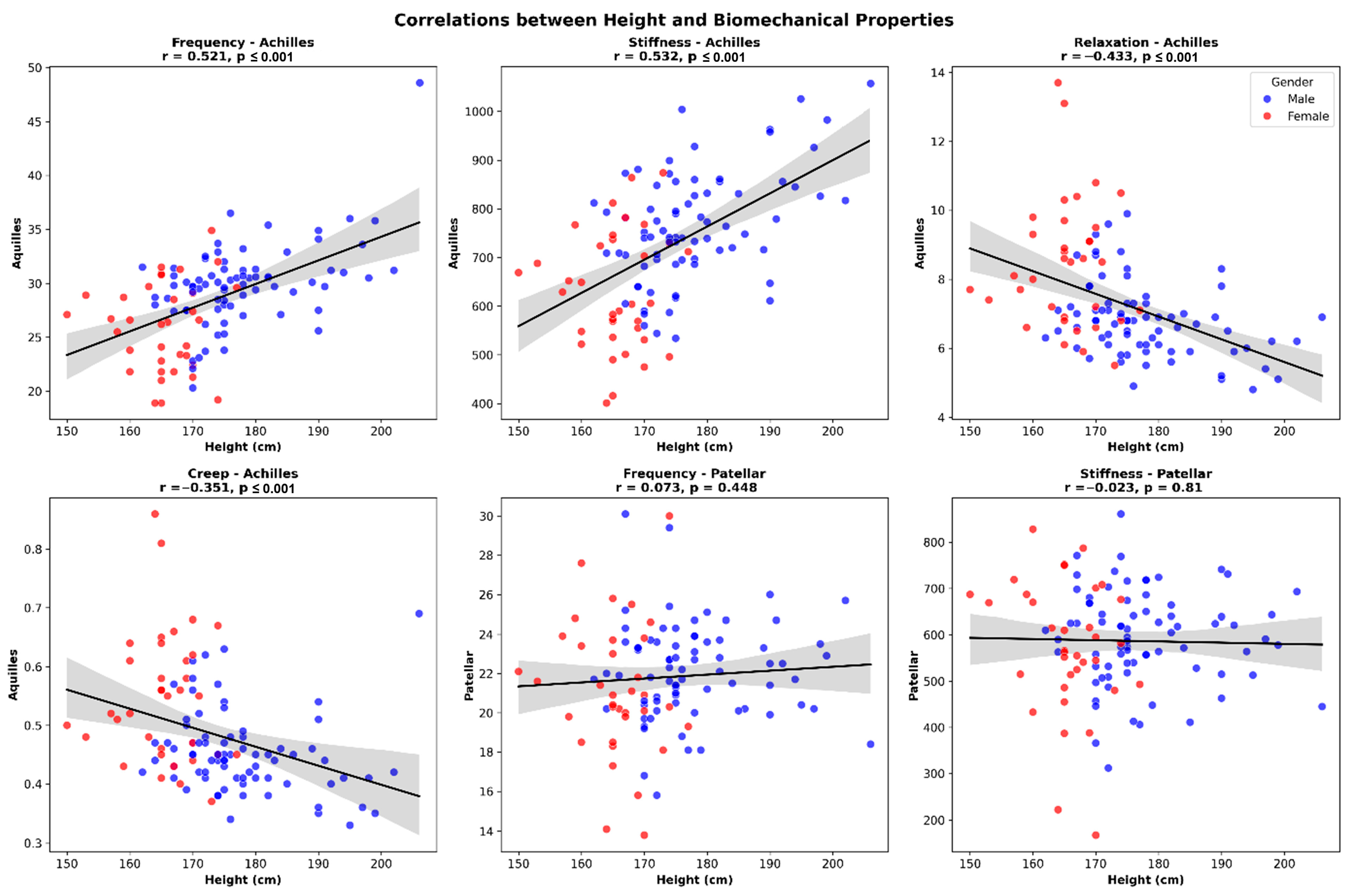
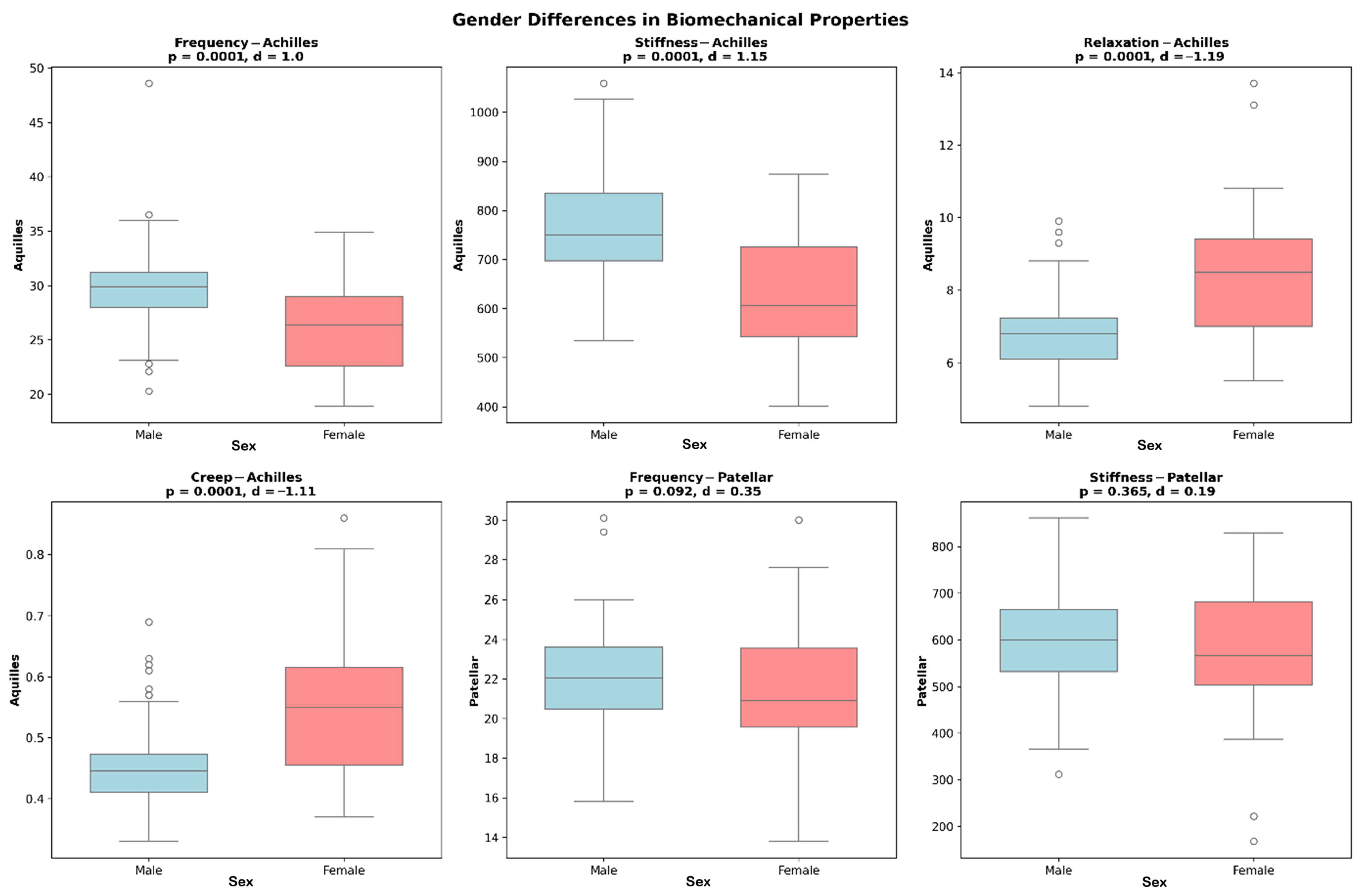
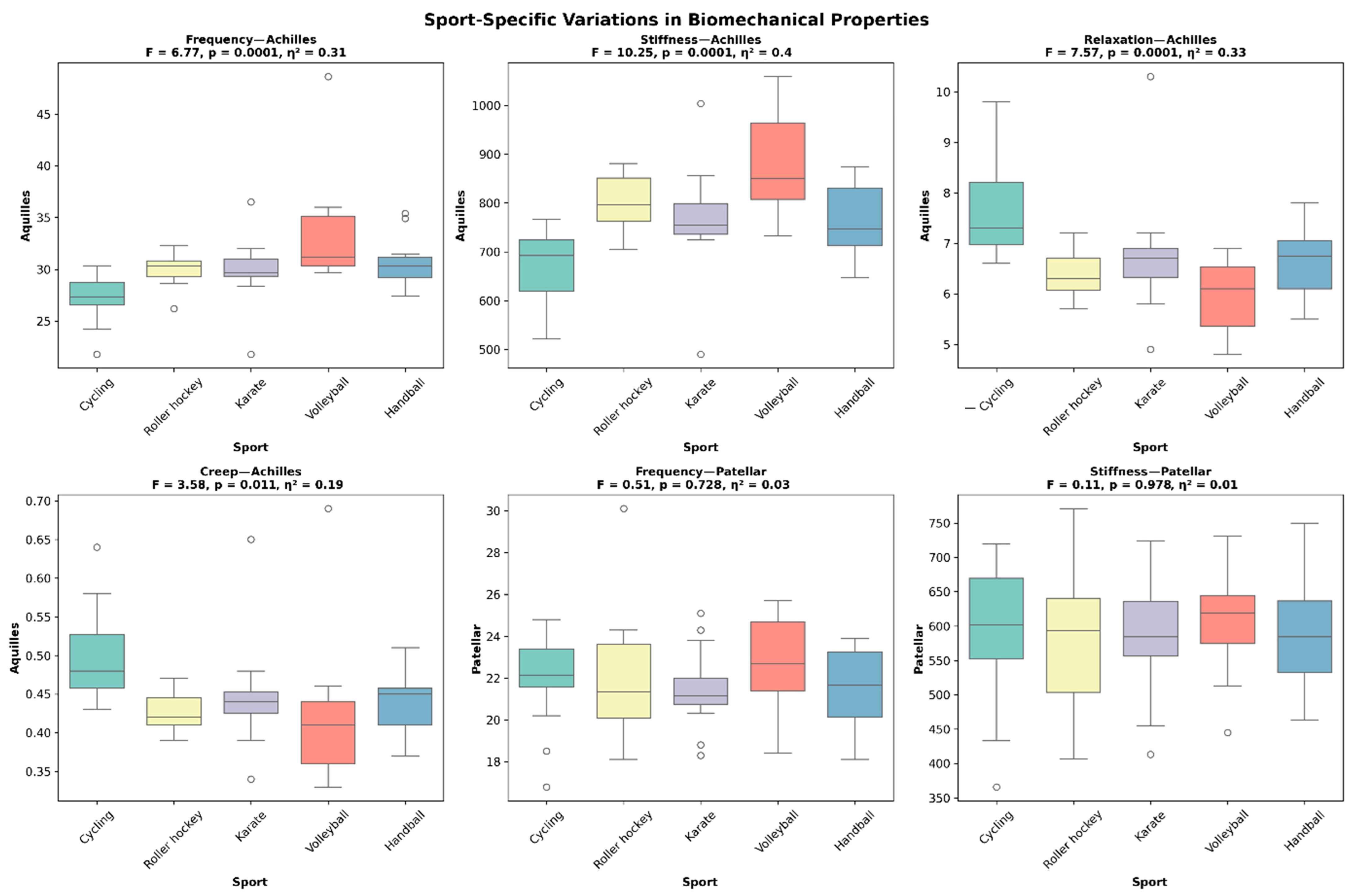
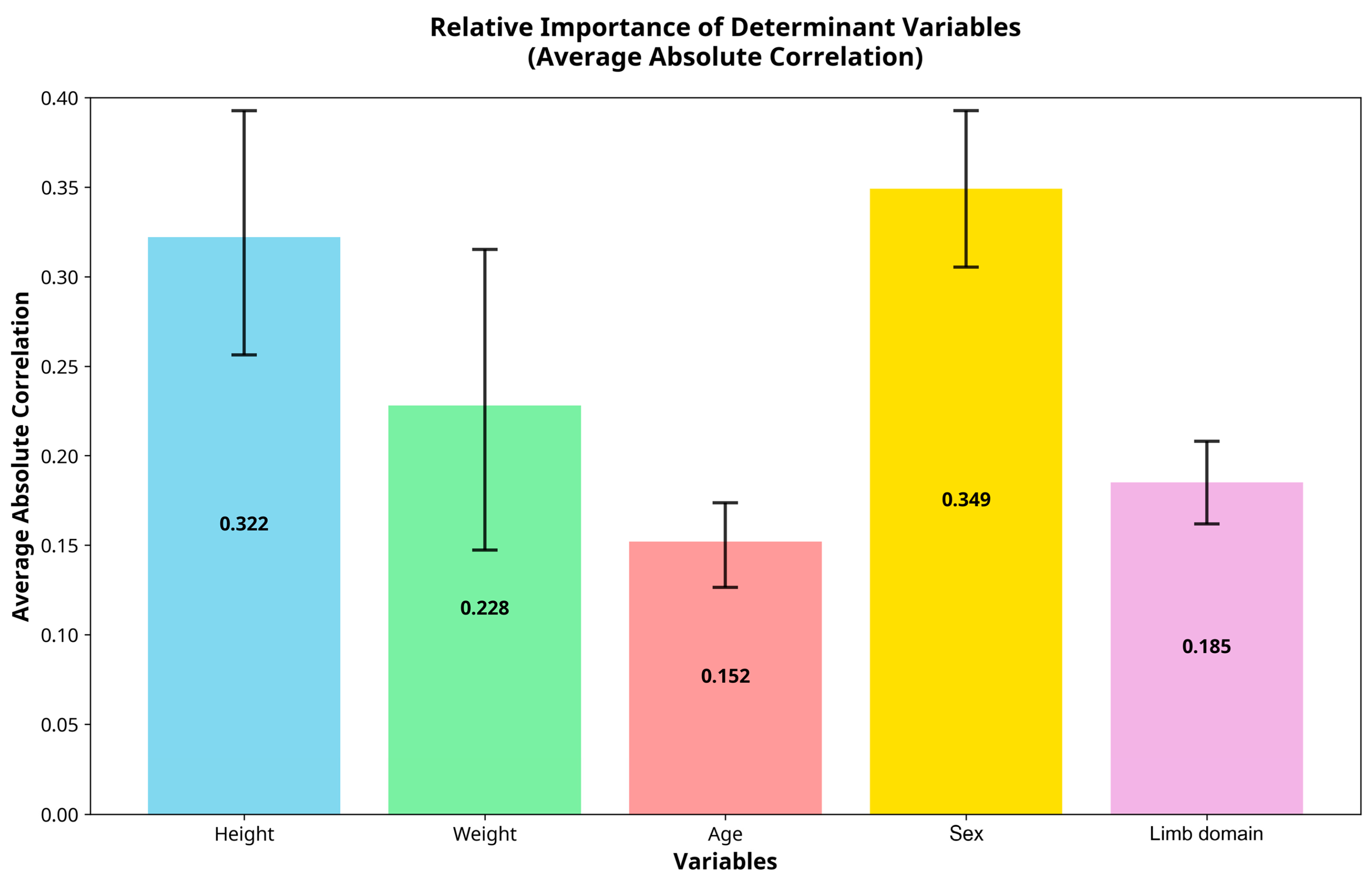



| Sport | n | Height (m) [95%CI] | BMI (kg/m2) [95%CI] | Weight (kg) [95%CI] | Age (Years) [95%CI] | TL (h/wk) | % Right |
|---|---|---|---|---|---|---|---|
| Athletics * | 7 | 1.76 ± 0.08 [1.70, 1.82] ab | 24.2 ± 1.6 [22.9, 25.5] ab | 74.1 ± 11.2 [64.8, 83.4] ab | 25.1 ± 4.2 [21.6, 28.6] | 16 ± 2.5 | 85.7 |
| Archery * | 8 | 1.69 ± 0.09 [1.62, 1.76] a | 24.8 ± 2.7 [22.7, 26.9] ab | 70.6 ± 10.2 [62.5, 78.7] a | 27.6 ± 6.3 [22.6, 32.6] | 14 ± 3.0 | 100 |
| Boxing * | 7 | 1.69 ± 0.11 [1.60, 1.78] a | 22.9 ± 1.9 [21.3, 24.5] a | 65.3 ± 11.6 [55.0, 75.6] a | 23.7 ± 3.2 [21.0, 26.4] | 15 ± 2.0 | 100 |
| Cycling | 15 | 1.68 ± 0.08 [1.64, 1.72] a | 23.4 ± 1.8 [22.4, 24.4] a | 66.1 ± 9.2 [61.1, 71.1] a | 22.5 ± 5.1 [19.8, 25.2] | 18 ± 4.0 | 93.3 |
| Handball | 15 | 1.77 ± 0.07 [1.73, 1.81] b | 25.6 ± 3.3 [23.8, 27.4] b | 80.5 ± 11.8 [74.1, 86.9] b | 25.9 ± 4.7 [23.3, 28.5] | 16 ± 3.0 | 86.7 |
| Judo | 10 | 1.72 ± 0.08 [1.67, 1.77] ab | 29.4 ± 5.0 [25.9, 32.9] c | 83.0 ± 20.4 [68.9, 97.1] b | 25.7 ± 4.3 [22.7, 28.7] | 15 ± 2.5 | 100 |
| Karate | 13 | 1.72 ± 0.06 [1.69, 1.75] ab | 24.1 ± 2.6 [22.6, 25.6] ab | 71.5 ± 9.4 [66.0, 77.0] ab | 25.5 ± 5.0 [22.5, 28.5] | 14 ± 2.0 | 92.3 |
| Volleyball | 14 | 1.90 ± 0.09 [1.85, 1.95] c | 24.7 ± 1.8 [23.7, 25.7] ab | 89.6 ± 11.6 [83.0, 96.2] c | 25.6 ± 3.3 [23.8, 27.4] | 17 ± 3.5 | 92.9 |
| Statistics | <0.001 | 0.002 | <0.001 | 0.381 | 0.381 | 0.682 |
| Variable | Group | Mean ± SD [95% CI] | p-Value (Effect Size) |
|---|---|---|---|
| Achilles tendon | |||
| Frequency (Hz) | Left | 28.5 ± 3.2 a [27.9–29.1] | 0.012 (d = 0.18) |
| Right | 29.1 ± 3.5 [28.4–29.8] | ||
| Male | 29.8 ± 3.4 a [29.1–30.5] | ≤0.001 (d = 0.83) | |
| Female | 27.2 ± 2.8 [26.5–27.9] | ||
| Stiffness (N/m) | Left | 720 ± 120 a [695–745] | 0.021 (d = 0.16) |
| Right | 740 ± 130 [715–765] | ||
| Male | 780 ± 135 a [752–808] | ≤0.001 (d = 1.04) | |
| Female | 650 ± 110 [625–675] | ||
| Logarithmic decrement | Left | 0.98 ± 0.25 [0.93–1.03] | 0.154 |
| Right | 0.95 ± 0.28 [0.89–1.01] | ||
| Male | 0.89 ± 0.22 a [0.85–0.93] | 0.008 (d = 0.60) | |
| Female | 1.05 ± 0.3 [0.98–1.12] | ||
| Relaxation (ms) | Left | 7.2 ± 1.5 [6.9–7.5] | 0.089 |
| Right | 7.0 ± 1.6 [6.7–7.3] | ||
| Male | 6.5 ± 1.4 a [6.2–6.8] | ≤0.001 (d = 0.92) | |
| Female | 8.2 ± 1.5 [7.8–8.6] | ||
| Creep (mm) | Left | 0.48 ± 0.1 [0.46–0.50] | 0.102 |
| Right | 0.46 ± 0.11 [0.44–0.48] | ||
| Male | 0.43 ± 0.09 a [0.41–0.45] | ≤0.001 (d = 1.03) | |
| Female | 0.55 ± 0.12 [0.52–0.58] | ||
| Patellar tendon | |||
| Frequency (Hz) | Left | 21.8 ± 3.1 [21.1–22.5] | 0.243 |
| Right | 21.5 ± 3.4 [20.8–22.2] | ||
| Male | 21.2 ± 3.5 a [20.5–21.9] | 0.035 (d = 0.34) | |
| Female | 22.3 ± 2.8 [21.6–23.0] | ||
| Stiffness (N/m) | Left | 580 ± 135 [552–608] | 0.187 |
| Right | 590 ± 140 [561–619] | ||
| Male | 610 ± 145 a [580–640] | 0.009 (d = 0.53) | |
| Female | 540 ± 120 [515–565] | ||
| Logarithmic decrement (dimensionless) | Left | 0.96 ± 0.11 [0.94–0.98] | 0.421 |
| Right | 0.95 ± 0.12 [0.93–0.97] | ||
| Male | 0.94 ± 0.1 [0.92–0.96] | 0.112 | |
| Female | 0.98 ± 0.13 [0.95–1.01] | ||
| Relaxation (ms) | Left | 9.3 ± 2.1 [8.9–9.7] | 0.305 |
| Right | 9.1 ± 2.3 [8.7–9.5] | ||
| Male | 8.7 ± 2.0 a [8.3–9.1] | ≤0.001 (d = 0.81) | |
| Female | 10.1 ± 2.2 [9.6–10.6] | ||
| Creep (mm) | Left | 0.59 ± 0.14 [0.56–0.62] | 0.188 |
| Right | 0.57 ± 0.15 [0.54–0.60] | ||
| Male | 0.55 ± 0.13 a [0.52–0.58] | 0.002 (d = 0.65) | |
| Female | 0.65 ± 0.15 [0.61–0.69] |
| Sport | n | Frequency (Hz) | Stiffness (N/m) | Logarithmic Decrement | Relaxation (ms) | Creep (mm) |
|---|---|---|---|---|---|---|
| Achilles | ||||||
| Cycling | 15 | 27.8 ± 2.9 a | 675 ± 85 a,b | 1.02 ± 0.18 a | 7.8 ± 1.1 a | 0.51 ± 0.08 a |
| Roller Hockey | 12 | 30.2 ± 1.8 b,c | 805 ± 75 c | 0.89 ± 0.2 b,c | 6.5 ± 0.8 b,c | 0.43 ± 0.07 b,c |
| Karate | 14 | 30.5 ± 3.2 b,c | 785 ± 95 c | 0.82 ± 0.15 c | 6.7 ± 1.0 b | 0.44 ± 0.08 b,c |
| Athletics | 8 | 31.2 ± 2.5 c | 820 ± 110 c | 0.79 ± 0.22 c | 6.3 ± 1.2 c | 0.41 ± 0.09 c |
| Volleyball | 13 | 32.1 ± 3.8 c | 865 ± 130 d | 0.75 ± 0.19 c | 5.9 ± 1.3 c | 0.39 ± 0.1 c |
| Taekwondo | 8 | 26.8 ± 3.5 a | 645 ± 120 a | 0.98 ± 0.25 a,b | 8.2 ± 1.5 a | 0.53 ± 0.11 a |
| Judo | 10 | 27.2 ± 3.8 a | 665 ± 140 a | 1.12 ± 0.3 a | 7.9 ± 1.4 a | 0.52 ± 0.12 a |
| p-value (η2) | <0.001 (0.24) | <0.001 (0.29) | <0.001 (0.22) | <0.001 (0.27) | <0.001 (0.25) | |
| Patellar | ||||||
| Cycling | 15 | 21.2 ± 2.5 | 565 ± 90 | 0.97 ± 0.1 | 9.4 ± 1.2 a | 0.6 ± 0.09 a |
| Roller Hockey | 12 | 21.5 ± 2.8 | 590 ± 110 | 0.94 ± 0.11 | 9.1 ± 1.5 a | 0.58 ± 0.1 a,b |
| Karate | 14 | 21.8 ± 3.5 | 610 ± 125 | 0.93 ± 0.12 | 8.8 ± 1.8 a,b | 0.56 ± 0.11 a,b |
| Athletics | 8 | 22.1 ± 3.1 | 625 ± 135 | 0.91 ± 0.13 | 8.5 ± 1.6 b,c | 0.54 ± 0.1 b,c |
| Volleyball | 13 | 22.5 ± 2.9 | 595 ± 115 | 0.89 ± 0.14 | 8.2 ± 1.4 c | 0.52 ± 0.09 c |
| Taekwondo | 8 | 21.3 ± 4.2 | 610 ± 145 | 0.95 ± 0.15 | 9.1 ± 1.7 a | 0.59 ± 0.12 a |
| Judo | 10 | 22.8 ± 3.7 | 630 ± 135 | 0.99 ± 0.16 | 9.8 ± 1.9 a | 0.63 ± 0.13 a |
| p-value (η2) | 0.325 (0.09) | 0.215 (0.11) | 0.418 (0.07) | 0.012 (0.18) | 0.008 (0.2) |
| Parameter | Cross-Validated R2 | RMSE | MAE | Top 3 Predictors (Importance ± 95% CI) |
|---|---|---|---|---|
| Achilles Stiffness | 0.87 ± 0.04 | 47.2 | 36.8 | Height (0.42 ± 0.08), Weight (0.28 ± 0.05), Sex (0.18 ± 0.04) |
| Achilles Frequency | 0.85 ± 0.05 | 1.31 | 1.02 | Height (0.39 ± 0.09), Sex (0.24 ± 0.06), Weight (0.21 ± 0.04) |
| Patellar Stiffness | 0.74 ± 0.08 | 67.3 | 52.1 | Weight (0.31 ± 0.12), Height (0.29 ± 0.15), Age (0.22 ± 0.08) |
| Patellar Frequency | 0.72 ± 0.09 | 1.58 | 1.24 | Age (0.35 ± 0.11), Sex (0.28 ± 0.13), Height (0.19 ± 0.09) |
Disclaimer/Publisher’s Note: The statements, opinions and data contained in all publications are solely those of the individual author(s) and contributor(s) and not of MDPI and/or the editor(s). MDPI and/or the editor(s) disclaim responsibility for any injury to people or property resulting from any ideas, methods, instructions or products referred to in the content. |
© 2025 by the authors. Licensee MDPI, Basel, Switzerland. This article is an open access article distributed under the terms and conditions of the Creative Commons Attribution (CC BY) license (https://creativecommons.org/licenses/by/4.0/).
Share and Cite
Bustamante-Garrido, A.; Sepúlveda González, S.; Inostroza-Ríos, F.; de Toledo Nóbrega, O.; Miarka, B.; Araya-Ibacache, M.; Aidar, F.J.; Aedo-Muñoz, E.; Brito, C.J. Height, Sex, and Sport as Correlates of Tendon Stiffness in Elite Athletes. Physiologia 2025, 5, 56. https://doi.org/10.3390/physiologia5040056
Bustamante-Garrido A, Sepúlveda González S, Inostroza-Ríos F, de Toledo Nóbrega O, Miarka B, Araya-Ibacache M, Aidar FJ, Aedo-Muñoz E, Brito CJ. Height, Sex, and Sport as Correlates of Tendon Stiffness in Elite Athletes. Physiologia. 2025; 5(4):56. https://doi.org/10.3390/physiologia5040056
Chicago/Turabian StyleBustamante-Garrido, Alejandro, Sebastián Sepúlveda González, Felipe Inostroza-Ríos, Otávio de Toledo Nóbrega, Bianca Miarka, Mauricio Araya-Ibacache, Felipe J. Aidar, Esteban Aedo-Muñoz, and Ciro José Brito. 2025. "Height, Sex, and Sport as Correlates of Tendon Stiffness in Elite Athletes" Physiologia 5, no. 4: 56. https://doi.org/10.3390/physiologia5040056
APA StyleBustamante-Garrido, A., Sepúlveda González, S., Inostroza-Ríos, F., de Toledo Nóbrega, O., Miarka, B., Araya-Ibacache, M., Aidar, F. J., Aedo-Muñoz, E., & Brito, C. J. (2025). Height, Sex, and Sport as Correlates of Tendon Stiffness in Elite Athletes. Physiologia, 5(4), 56. https://doi.org/10.3390/physiologia5040056