Article

Healthcare-Associated Infections, Antibiotic Use, and Invasive Devices: A Repeated Point Prevalence Survey


1
Department of Medicine, Surgery, and Dentistry, University of Salerno, 84081 Baronissi, Italy
2
University Hospital “San Giovanni di Dio e Ruggi d’Aragona”, 84131 Salerno, Italy
3
Medical Direction Department, “Pellegrini” Hospital, 80134 Naples, Italy
*
Author to whom correspondence should be addressed.
These authors contributed equally to this work.
Hygiene 2026, 6(2), 34; https://doi.org/10.3390/hygiene6020034 (registering DOI)
Submission received: 11 April 2026 / Revised: 16 May 2026 / Accepted: 2 June 2026 / Published: 6 June 2026

Abstract

Background: Healthcare-associated infections (HAIs) and antimicrobial resistance are major global public health challenges, influenced by patient clinical complexity and prescribing practices. Methods: Three-point prevalence surveys (PPSs) were conducted (P1: November 2024; P2: June 2025; P3: November 2025), involving 456 patients at the University Hospital “San Giovanni di Dio e Ruggi d’Aragona”, Salerno, Italy. Results: The prevalence of HAIs fluctuated between 3.1% (P1) and a peak of 6.1% (P2), before decreasing to 1.9% (P3), correlating with the presence of multidrug-resistant pathogens in critical care areas. The prevalence of antibiotic use remained stable (~48%), with a decrease in carbapenem use (from 12% to 9%). A decline in ‘unknown’ McCabe scores from 24.6% to 6.8% (p < 0.001) was also observed, suggesting an improvement in completeness of prognostic data, although changes in data collection practices may also have contributed to this change. Conclusions: We showed an association between clinical severity, prolonged hospitalization, invasive device use, and infection risk in a single tertiary-care hospital, within an exploratory, cross-sectional framework. Despite high healthcare pressure, improvements were observed in antimicrobial stewardship and clinical surveillance. Future strategies should focus on optimal device management and on extending surveillance activities to medical wards with increasing patient complexity.

1. Introduction

Healthcare-associated infections (HAIs) represent a critical challenge for healthcare systems worldwide, as millions of patients contract HAIs each year, resulting in severe clinical complications, increased mortality, prolonged length of stay, and rising healthcare costs [1,2,3]. The European Centre for Disease Prevention and Control (ECDC) estimates that ~4 million cases/year occur in Europe, and >37,000 deaths are directly attributable to these infections and there are an even higher number of deaths in which infection is a contributing factor [2,4].
Together with HAIs, antimicrobial resistance (AMR) is another rising challenge, amplified by the inappropriate use of antibiotics and thus favoring the selection of multidrug-resistant (MDR) microorganisms and increasing the complexity of hospital-acquired infections [5,6,7]. Hospitalized patients, particularly those with comorbidities or undergoing invasive procedures (e.g., vascular catheterization, mechanical ventilation, and major surgery), are at a significantly higher risk of HAIs [8,9]. Among the most frequent forms are surgical site infections (SSIs), ventilator-associated pneumonia (VAP), catheter-associated urinary tract infections (CAUTIs), and Central Line-Associated Bloodstream Infections (CLABSIs), often driven by MDR pathogens, such as Methicillin-Resistant Staphylococcus aureus (MRSA), carbapenemase-producing Klebsiella pneumoniae (KPC), and other MDR Gram-negative bacteria [10,11].
HAIs caused by resistant bacteria frequently necessitate of the use of last-line antibiotics or combination therapies, leading to increased hospitalization costs, a higher risk of adverse effects, and mortality rates exceeding those of infections caused by susceptible pathogens. In Italy, the prevalence of HAIs remains high, particularly in high-risk settings like Intensive Care Units (ICUs), surgical wards, and long-term care facilities, as highlighted by the most recent point prevalence studies and national and regional reports [12,13,14,15,16]. Therefore, implementation of antimicrobial stewardship (AMS) programs is essential. AMS is defined as coordinated interventions designed to promote the appropriate use of antimicrobials, with the goal of reducing resistance, improving clinical outcomes, and containing healthcare costs. AMS interventions focus on therapy optimization (drug selection, dosage, duration, and route of administration), limitation of inappropriate use (e.g., for viral infections, asymptomatic colonization, or prolonged prophylaxis), and continuous monitoring of prescribing practices through clinical audits and staff training.
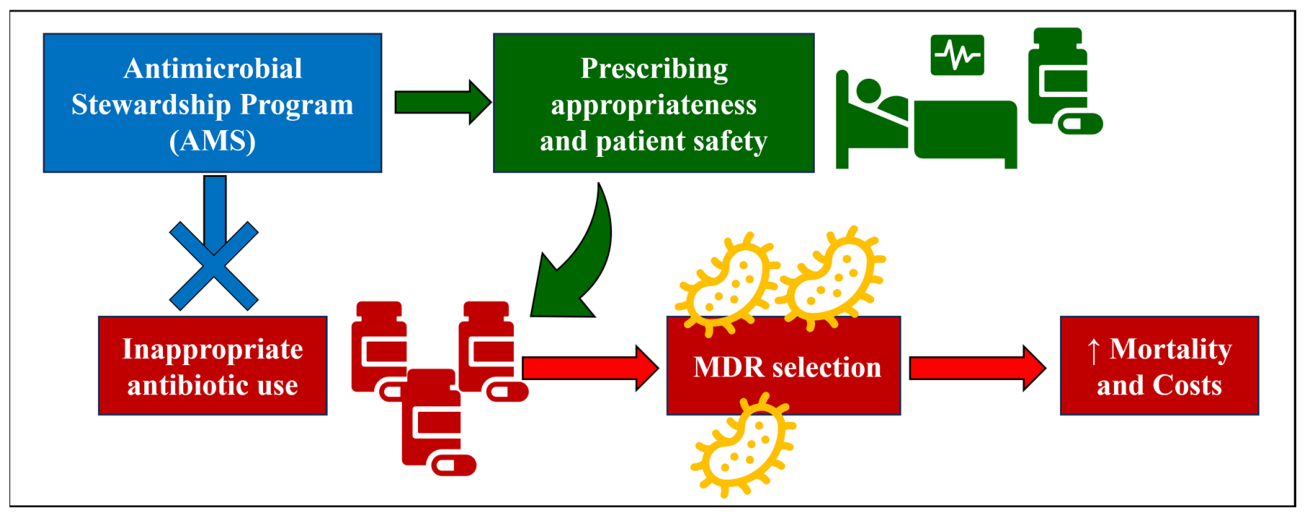
Effective AMS programs have been shown to reduce both the rates of infections caused by resistant pathogens and the overall burden of HAIs, thereby enhancing patient safety (Figure 1). Indeed, hospitals with structured AMS programs record lower rates of MDR infections and greater prescription appropriateness [17,18,19,20]. Point prevalence surveys (PPSs), promoted at the European level by the ECDC, represent one of the most well-established tools for active HAI surveillance and antimicrobial use, enabling methodological standardization and comparability across healthcare facilities and countries [5,21,22,23].
In this study, we evaluated the prevalence of HAIs and antibiotic use at the University Hospital “San Giovanni di Dio e Ruggi d’Aragona”, “Ruggi” site (further designated as Ruggi), Salerno, Italy, through three subsequent PPSs. The aim was to identify epidemiological trends and critical areas of care, and to provide evidence-based recommendations for improving infection prevention and control practices.

2. Materials and Methods

2.1. Population and Study Design

A repeated PPS was conducted across three distinct periods, 18–22 November 2024 (P1), 16–20 June 2025 (P2), and 24–28 November 2025 (P3), at the “Ruggi” Hospital, University Hospital “San Giovanni di Dio e Ruggi d’Aragona”, Salerno, Italy. A representative sample of wards was selected to encompass diverse patient populations and levels of care complexity, in accordance with the ECDC guidelines (version 6.1, 2022–2023) [5]. Monitored units in all three surveys were: Post-Operative Intensive Care Unit (UTIPO), Neurosurgery, Obstetrics, Gynecology, Orthopedics and Traumatology, Emergency Cardiac Surgery, Nephrology, General Surgery, Oncology, and General Medicine. For surveys P2 and P3, the Cardiology Unit and Pediatric Surgery were also included. However, sensitivity analysis was performed by only including wards consistently monitored across all survey periods.
This retrospective and prospective observational study was conducted in accordance with the Declaration of Helsinki [24] and protocols approved by our local Ethics Committee “Campania 2”, Naples, Italy (protocol no. 0033843-2025; approval date: 7 November 2025). Data collection was performed in full compliance with current General Data Protection Regulations.

2.2. Study Population and Eligibility Criteria

All patients present in the selected wards at 8:00 AM on the scheduled survey day were screened for eligibility. The inclusion criterion was admission to the target wards as inpatients at the time of the survey. Exclusion criteria were: admission as outpatients (Day Hospital or Day Surgery), and undergoing outpatient treatments (e.g., dialysis) without an overnight stay.

2.3. Data Collection

Data collection was conducted by trained healthcare personnel through a comprehensive review of medical records, using standardized data collection forms aligned with the ECDC protocol version 6.1 (2022) [25]. HAIs were defined according to ECDC PPS criteria (protocol v6.1) [25], and were classified as infections with onset after >3 days from hospital admission (day of admission = day 1). Infections present on admission were systematically excluded. Case definitions required suggestive clinical signs and symptoms, microbiological confirmation, and/or strong clinical/radiological evidence consistent with ECDC site-specific criteria. Device-associated infections were defined when: (a) a device was present within 7 days prior to symptom onset; (b) no alternative infection sources were identified; and (c) the same microorganism from the device tip or clinical improvement following device removal were observed.
Three datasets were compiled for each patient: (1) demographic and clinical data, including age, gender, admission date, ward specialty, comorbidities (assessed using the McCabe score for underlying disease severity), presence of invasive devices (vascular catheters, urinary catheters, mechanical ventilation), and history of recent surgery; (2) HAIs, defined as the presence of active infection in accordance with ECDC guidelines, infection site, date of onset, and causative microorganisms; and (3) antimicrobial use, such as antibiotics and antifungal agents administered at the time of the survey, with details on antimicrobial agent, dosage, route of administration, indication (medical/surgical prophylaxis, empirical or targeted therapy), and the rationale for prescription.

2.4. Microbiological Assays

All microbiological tests were performed at our Clinical Microbiology Laboratory according to standardized procedures. Clinical specimens (e.g., blood, urine, respiratory secretions, or surgical samples) were processed using conventional culture methods and automated identification systems. Antimicrobial susceptibility testing was carried out by automated broth microdilution and interpreted according to current European Committee on antimicrobial susceptibility testing (EUCAST) breakpoints [26]. MDR phenotypes and carbapenemase-producing Enterobacterales (e.g., KPC strains) were classified in line with the laboratory’s internal protocols, harmonized with national surveillance standards [27].

2.5. Outcomes and Variables

The primary endpoint was to calculate the point prevalence of HAIs (defined as the proportion of patients with at least one HAI relative to the total study population) and the prevalence of antimicrobial use. Secondary endpoints were risk stratification based on clinical severity (McCabe score) and exposure to risk factors (length of stay, device utilization), and identification of wards with the highest prevalence burden of infections.

2.6. Statistical Analysis

Data were collected in a spreadsheet and analyzed using IBM SPSS Statistics software, version 23.0. Categorical variables were expressed as frequencies and percentages, whereas continuous variables were reported as mean ± standard deviation (SD). Comparisons of categorical variables across the three study periods (P1, P2, P3) were performed by using Chi-square (χ2) or Fisher’s exact test, as appropriate. Continuous variables were compared across the three periods using one-way analysis of variance (ANOVA). Normality and homogeneity of variance assumptions were assessed before applying parametric tests. For comparisons between two groups (e.g., patients with HAIs vs. non-infected patients), the Mann–Whitney U test was employed. Univariate analysis was performed to identify potential risk factors associated with HAI occurrence, and odds ratios (ORs) with 95% confidence intervals (95% CIs) were calculated from 2 × 2 contingency tables to quantify the association between exposure to invasive devices and infection. Global tests across the three survey periods were considered the primary inferential comparisons. When an overall test was significant, pairwise comparisons between periods were explored using the same statistical test. No formal post hoc procedures or adjustments for multiple comparisons were applied; pairwise p values were reported as descriptive, in line with the exploratory nature of our study. Stratified analyses were performed by ward and survey period to assess differences in clinical characteristics, infection prevalence, and antimicrobial consumption. All statistical tests were two-tailed, and a p value < 0.05 was considered statistically significant.

3. Results

3.1. Study Population Characteristics

A total of 456 patients were evaluated across the three study periods (P1, N = 130; P2, N = 165; and P3, N = 161). Demographic and clinical characteristics are detailed in Table 1. Patient distribution was comparable across groups for age (mean ± SD, 60 ± 19.3 years vs. 61 ± 19.9 years vs. 61 ± 20.0 years, P1 vs. P2 vs. P3; p = 0.27), sex (males/females, 44%/56% vs. 57%/43% vs. 52%/48%, P1 vs. P2 vs. P3; p = 0.08), and overall length of stay (LOS) (mean ± SD, 12 ± 16.4 vs. 11 ± 15.5 vs. 9.6 ± 10.5 days, P1 vs. P2 vs. P3; p = 0.35). Stratified analysis demonstrated that patients with HAIs consistently experienced longer hospital stays compared with non-infected patients in all survey periods, especially in P1 and P2. Specifically, mean LOS was 48.3 ± 25.5 days vs. 10.8 ± 14.8 days in P1 (p = 0.004), 30.9 ± 26.3 days vs. 9.7 ± 13.8 days in P2 (p = 0.012), and 28.7 ± 27.6 vs. 9.3 ± 9.7 days in P3 (p = 0.226) for infected versus non-infected patients, respectively. Indeed, overall, infected patients had a significantly longer LOS compared to non-infected subjects (mean ± SD: 34.6 ± 26.3 days vs. 9.9 ± 12.8 days; p < 0.001), indicating that prolonged hospitalization is associated with the occurrence of HAIs in this cohort, although the cross-sectional design does not allow causal inference.
Ward composition varied significantly among periods (p < 0.001), primarily due to the inclusion of Cardiology and Pediatric Surgery units in P2 and P3. Pairwise comparisons indicated that P1 had a higher proportion of patients carrying at least one invasive device compared to P2 (p = 0.008) and P3 (p = 0.005). When individual devices were analyzed separately, no statistically significant differences were observed across periods for central venous catheter (CVC; 16% vs. 13.9% vs. 15.5%, P1 vs. P2 vs. P3; p > 0.05), urinary catheter (UC; 40% vs. 36.4% vs. 36.0%, P1 vs. P2 vs. P3; p > 0.05), and intubation/mechanical ventilation, which was a rare event in all groups (0.8% vs. 1.8% vs. 0%, P1 vs. P2 vs. P3; p > 0.05). This suggests that the observed difference was likely driven by the combined presence of devices rather than by variations in the use of specific devices.
To address potential confounding by ward composition changes in P2 and P3, HAI prevalence was recalculated for wards monitored across all periods (376/456 patients, 82.5%), showing similar trends: P1, 3.1% (4/130); P2, 6.6% (8/121); and P3, 1.6% (2/125). These findings indicate that the non-linear prevalence pattern with a peak in P2 remained even when controlled by ward composition (Cochran–Armitage trend test across periods, p = 0.55) (Table 2).

3.2. Clinical Severity

The distribution of clinical severity (McCabe score) significantly differed across the three survey periods (χ2 = 22.2, df = 6, p = 0.001; Table 3). This variance was mainly driven by a reduction in the ‘unknown’ category from 24.6% in P1 to 6.8% in P3 (p = 0.01) and by an increase in non-fatal disease from 54.6% to 69.0% (p = 0.03).
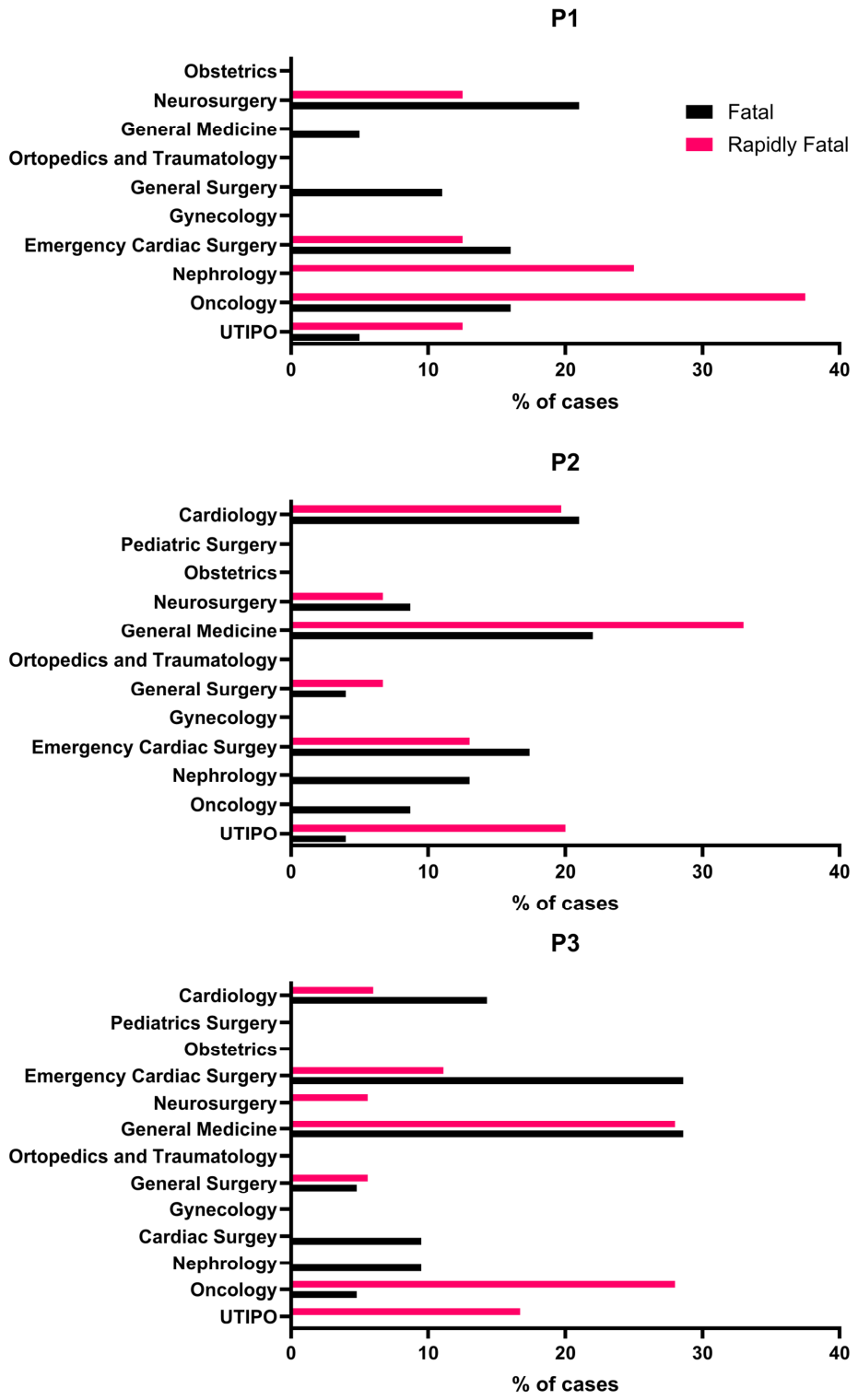
The proportion of patients with rapidly fatal disease (<1 year) almost doubled from 6.2% in P1 to 11.2% in P3, although this increase did not reach statistical significance (p = 0.33). The ultimately “fatal” disease (<5 years) category remained stable throughout the study (P1: 14.6%, P2: 14.0%, P3: 13.0%). McCabe score distributions across hospital wards and survey periods are represented in Figure 2. Categories with poor prognosis (rapidly fatal and fatal disease) tended to cluster in high-complexity care wards.
During P1, a high frequency of patients with rapidly fatal disease was observed in Oncology (37.5%) and Nephrology (25%) units, while the fatal category was particularly prominent in Neurosurgery (21%), Emergency Cardiac Surgery (16%), and Oncology (16%). In P2, General Medicine recorded the highest proportion of rapidly fatal disease (33%), followed by UTIPO (20%) and Cardiology (19.7%). Nephrology and Oncology reported no rapidly fatal cases in this period. Cardiology and Emergency Cardiac Surgery also showed substantial proportions of patients in the fatal category. In P3, General Medicine maintained high levels of rapidly fatal disease (28%), as well as Oncology (28%). Emergency Cardiac Surgery showed the highest proportion of fatal cases (38.1%), followed by General Medicine (28.6%). Nephrology stabilized at a moderate level of complexity, with 9.5% of patients classified as fatal. Other wards showed lower or absent proportions of poor-prognosis categories. Moreover, the proportion of “unknown” cases decreased progressively across most wards over time.

3.3. Prevalence and Epidemiology of HAIs

The point prevalence of HAIs exhibited seasonal and temporal variability throughout the study, following a non-linear trend across the three survey periods: 3.1% (4/130) in P1, 6.1% (10/165) in P2, and 1.9% (3/161) in P3 (Table 4). All infections met the ECDC PPS v6.1 case definitions and occurred after at least ≥3 days from the admission.
In P1, four HAIs were identified out of 130 patients (3.1% prevalence), and exclusively affected high-complexity surgical patients admitted to Emergency Cardiac Surgery or General Surgery. Cases were associated with deep SSIs (SSI-D, 50%) and catheter-related bloodstream infections (CRI3, 50%), and they were primarily caused by Gram-negative bacteria (Acinetobacter baumannii, Escherichia coli, and Klebsiella pneumoniae) or Staphylococcus aureus. In P2, we observed the peak prevalence, with 10 infected patients out of 165 inpatients (6.1%). This phase was characterized by greater clinical and microbiological heterogeneity, marked by the emergence of respiratory infections (nosocomial pneumonia/VAP) and urinary tract infections (UTIs). UTIPO was the ward with the highest care burden, accounting for 40% of cases mostly caused by multiple or polymicrobial infections (e.g., VAP/SSI co-infections). Fungal species (Candida spp.) and MRD bacteria (CPE, carbapenemase-producing Enterobacterales; KPC, Klebsiella pneumoniae carbapenemasi) were isolated. Additionally, one case of Clostridioides difficile infection (CDI) was recorded in a complex patient (already positive for Corynebacterium). In P3, HAI prevalence was lower, with 3 cases out of 161 patients (1.9%). All detected infections were bloodstream infections (BSI/CRI3) or urinary infections associated with invasive device use (CVC and urinary catheters). Despite the low number of events, the microbiological profile remained high-risk due to the persistent circulation of MDR pathogens, including a KPC isolated in Neurosurgery, and a Candida parapsilosis fungemia in the UTIPO.
Overall, Gram-negative bacilli predominated among HAI-related pathogens, with frequent detection of KPC and other multidrug-resistant Enterobacterales, Acinetobacter baumannii, Pseudomonas aeruginosa, and Serratia marcescens, falling into the critical-priority group for antibiotic resistance. Gram-positive isolates mainly included coagulase-negative staphylococci and Enterococcus faecalis, classified as “high”- or “medium”-priority pathogens, together with cases of Clostridioides difficile infection and invasive candidiasis, reflecting the high-risk microbiological profile of our setting despite the relatively low number of HAI events.

3.4. Antimicrobial Consumption: Prevalence of Use and Indications

Our PPS showed substantial stability in the prevalence of antimicrobial use, as the proportion of patients receiving antimicrobial treatment was 50.0% in P1, 48.0% in P2, and 47.8% in P3. Across all surveys, virtually all treated patients received at least one antibiotic. Regarding antifungals, although the prevalence of use among patients remained low (~2–3%), analysis of the prescribing mix reveals that this class accounts for a non-negligible share of total drug consumption (7.7% in P1 and 8.9% in P2), with a significant decrease in the final survey (5.2% in P3) (Table 5).
Analysis of prescription indications revealed a progressive shift in the ratio between prophylaxis and active therapy. Although antibiotic prophylaxis remained the predominant indication, its relative proportion decreased over time from 67% (66% medical, 34% chirurgical vs. 33.0% therapy) in P1 to 61% in P2 (45.8% medical, 52.1% chirurgical vs. 39.0% therapy) and 55.8% (23.4% medical, 32.4% chirurgical vs. 44.2% therapy) in P3. This descriptive trend suggests a potential improvement in prescribing appropriateness or a variation in the case-mix, with increased therapy for active infections (33.0% to 44.2%). In P3, surgical prophylaxis (32.4%) exceeded medical prophylaxis (23.4%), reflecting surgical activity impact (χ2 = 2.09, df = 2, p = 0.352).
Our analysis of prescribed antimicrobial classes revealed temporal variations and seasonal trends (Table 4). First-generation cephalosporins were predominant in P1 (23.0%) and P2 (26.6%) likely due to prophylactic use, while they decreased in P3 (19.5%) because of an increase in third-generation cephalosporins (from 22.0% in P1 to 28.6% in P3) and penicillin/inhibitor combinations (peaked at 24.0% in P2). We also registered a decreasing trend in carbapenem usage, which dropped from 12.0% in P1 to values consistently below 10% in subsequent phases (8.9% in P2 and 9.1% in P3). This modest but consistent reduction was in line with national AMS efforts and Italian stewardship recommendations to limit carbapenem exposure, particularly in high-risk settings, although the small sample size and the point prevalence design did not allow definitive conclusions. Macrolides exhibited a classic seasonal pattern, with higher consumption during winter months (7.7% in P1 and 9.1% in P3) and a physiological decline during the summer period (1.3% in P2), suggesting that part of the variation in antimicrobial classes may also reflect seasonal fluctuations in respiratory infections rather than stewardship interventions alone. The use of fluoroquinolones remained marginal and stable (<4% across all periods), in line with international usage restrictions. Conversely, a progressive increase was noted for glycopeptides (e.g., vancomycin), rising from 1.5% in P1 to 7.8% in P3, consistent with the need to cover resistant Gram-positive infections or CVC-related infections. Consumption of systemic antifungals was 5.2% in P3, mirroring the epidemiological trend of the observed invasive fungal infections.
Stratified analysis by wards confirmed the heterogeneity of clinical practices. In critical care and medical wards (UTIPO, General Medicine, Nephrology), complex prescribing profiles were observed, oriented toward broad-spectrum molecules (e.g., piperacillin/tazobactam, and meropenem) and combination therapies for the management of septic patients. Conversely, in surgical wards (Orthopedics–Traumatology, Cardiac Surgery), prophylaxis with cefazolin monotherapy clearly dominated. Neurosurgery was an exception, where frequent and specific use of ceftriaxone (third-generation cephalosporin) was observed, likely related to the need for optimal blood–brain barrier penetration for prophylaxis or treatment of central nervous system infections.

3.5. Risk Factor Analysis

To identify factors potentially associated with HAI acquisition, a univariate analysis was performed (Table 6). The presence of a CVC was more frequent among infected than non-infected patients (58.8% vs. 13.4%; OR, 9.20; 95%CI, 3.37–25.11; p < 0.001), although the small number of registered HAIs (n = 17 across all surveys) means our results should be interpreted as exploratory. UC use was also more common among infected patients, although not statistically significant (52.9% vs. 36.7%; OR, 1.94; 95%CI, 0.73–5.13; p = 0.20), possibly reflecting the widespread utilization of this device across the study population. Length of stay was markedly longer among patients with HAIs compared to non-infected patients (mean ± SD, 34.6 ± 26.2 days vs. 9.9 ± 13.1 days; p < 0.001), likely associated with our cross-sectional study design rather than a proven causal effect.

4. Discussion

This study, conducted through three consecutive PPSs, provides a repeated cross-sectional overview of the epidemiology of HAIs, antimicrobial consumption, and key risk factors in a University Hospital in Southern Italy. This design allowed us to observe temporal variations in HAI prevalence, clinical case-mix, prescribing practices, and data quality, without supporting causal inference. According to the most recent data from the ECDC PPS from 2022 to 2023, the average prevalence of HAIs in European acute care hospitals is ~7.1%, with marked heterogeneity across countries and settings [5,28,29]. In the Italian context, national surveillance studies report similar HAI prevalence in acute care hospitals compared to the European average (~8.8% of patients with at least one HAI) [30]. In our study, observed prevalences across all study periods were lower than the European and Italian averages, with P2 approaching the European benchmark. This discrepancy may be partly explained by structural and organizational factors, such as the bed-mix of the hospital (one Post-Operative ICU and a limited number of high-risk units compared with large national samples), the inclusion of a selected set of wards rather than all hospital wards, and the implementation of local infection prevention and control measures and antimicrobial stewardship activities during the study period. On the other hand, the point prevalence design, the relatively small sample size, and the possibility of residual under-ascertainment of HAIs cannot be ruled out, and may also have contributed to lower estimates. Therefore, these results should be interpreted cautiously as reflecting the local epidemiological situation in this single center, rather than indicating a systematically lower national risk.
The reduction observed in P3 is consistent with, but does not prove, the possible effectiveness of local infection prevention and control (IPC) strategies and stewardship interventions. This non-linear trend in HAI prevalence suggests a combination of seasonal variability, changes in ward composition, and a possible effect of infection control measures. The peak observed in P2 was characterized by greater clinical and microbiological heterogeneity, with the emergence of respiratory and urinary infections and a substantial burden in the ICU (UTIPO). This finding is consistent with higher clinical complexity and increased exposure to invasive devices in critical care settings. In P3, the reduction in prevalence was not accompanied by a decrease in microbiological complexity, highlighting that even a limited number of events may have a clinically meaningful impact in settings with high antibiotic pressure. However, it is not possible to clearly distinguish between the effect of implemented control measures and fluctuations related to the small number of observed events.
The spread of CPE, particularly Klebsiella pneumoniae KPC, is recognized as an endemic problem in Italy, with a significant impact on patient safety and the overall burden of HAIs [31]. In this epidemiological scenario, the persistent detection in our center of KPC strains and invasive fungal infections, despite a relatively low overall prevalence, suggests that the local microbiological burden remains relevant and consistent with the national high endemicity of MDR pathogens. In our hospital, local cumulative antibiograms documented high resistance rates to third-generation cephalosporins and fluoroquinolones among Enterobacterales, and a substantial burden of KPC, in line with national surveillance data [32] and supported by the microbiological findings of pathogens belonging to the critical (carbapenem-resistant Enterobacterales, A. baumannii, and P. aeruginosa) or high/medium priority groups (e.g., Enterococcus faecalis, staphylococci and C. difficile).
During our three-period PPS, a significant progressive reduction in “unknown” cases and in the distribution of the McCabe score was described, suggesting an improvement in data completeness and a greater consistency in data collection procedures over time, although differences in form completion might contribute to this trend. Patients with poor prognostic categories were consistently concentrated in high-complexity wards (Oncology, General or Internal Medicine, Emergency Cardiac Surgery, and UTIPO), in line with the association between clinical severity and HAI risk already described in the literature [5,28,33,34]. However, in our study this relationship is based on univariate analyses with a limited number of events and should therefore be interpreted as exploratory and hypothesis-generating rather than causal.
The presence of a CVC was identified as the main risk factor of HAIs, consistent with international evidence indicating that bloodstream infections are among the most frequent complications associated with the use of intravascular devices and represent one of the main device-associated HAIs in acute care hospitals [5,35,36,37,38]. Similarly, LOS was both a determinant and a consequence of HAI, generating a bidirectional relationship that increases clinical complexity, healthcare costs, and antimicrobial selective pressure. The use of UC was not directly associated with HAI, despite its higher frequency among infected patients, likely because of its wide utilization in hospitalized subjects.
The overall antimicrobial use prevalence (48–50%) observed in our hospital was higher than the European average reported by ECDC (35.5%) [7,39], likely because our tertiary-level institution manages complex patients, has several high-acuity wards, and a substantial proportion of subjects are exposed to invasive devices and severe comorbidities, which are all factors associated with a greater likelihood of antimicrobial prescribing. In addition, local prescribing habits and prophylactic practices, particularly in surgical and other high-risk settings, may have contributed to the observed prevalence. Therefore, these results should be interpreted according to hospital’s case-mix and institutional characteristics, while reinforcing the need for continued AMS efforts.
Despite this high consumption, qualitative analysis of prescribing patterns revealed a progressive reduction in carbapenems (<10% in the last two surveys), a rebalancing of prophylaxis versus therapeutic use, containment of fluoroquinolone consumption, and a selective increase in glycopeptides in clinically justified contexts, such as coverage for resistant Gram-positive organisms and CVC-related infections. The progressive increase in glycopeptide use from P1 to P3 is a relevant finding, as these agents are generally reserved for suspected or confirmed resistant Gram-positive infections and device-related infections. In our setting, this trend may reflect the higher clinical complexity of hospitalized patients, the burden of invasive device-associated infections, and cautious empirical prescribing in selected high-risk scenarios. Nevertheless, glycopeptides are reserve antibiotics, and their increasing use should be interpreted carefully considering stewardship principles to avoid unnecessary exposure and preserve their efficacy. Indeed, implementation of a dedicated AMS has been previously associated with a significant reduction in antibiotic consumption and hospital costs without negatively affecting clinical outcomes at our institution [40]. Moreover, effective AMS strategies could also help in limiting empirical antibiotic overuse during pandemic settings, such as COVID-19, and could restore more appropriate prescribing trends thereafter [41]. Accordingly, integrating periodic epidemiological surveillance with AMS may provide a useful local framework for clinical governance, although its applicability to other settings should be confirmed in multicentric studies. However, HAI prevalence was associated with significant microbiological complexity, as high-acuity wards concentrated patients with greater prognostic severity and infection risk, and invasive devices, particularly CVCs, represented the main modifiable determinant. Prescribing practices showed evolution consistent with stewardship principles, and clinical data quality was progressively improved over time. Collectively, these elements support strengthening CVC bundles, optimizing length of hospitalization, and consolidating integrated AMS strategies combined with active epidemiological surveillance.
The main limitation of this study is the cross-sectional nature of the PPS, which does not allow causal inference nor calculation of incidence rates. Furthermore, the generalizability of our findings may be limited due to the monocentric nature of this study. The analysis of associated factors was conducted exclusively through univariate analysis due to the limited number of observed events (17 total HAIs), as also confirmed by the wide confidence intervals observed. Moreover, ward composition varied over the PPS by introducing Cardiology and Pediatric Surgery in P2 and P3, thus influencing case-mix and patients’ complexity. However, the observed prevalence peak in P2 persisted in sensitivity analysis restricted to consistently monitored wards, suggesting that factors beyond ward composition may have contributed to the observed temporal variation, despite the absence of a statistically significant linear trend. Therefore, our results are exploratory, although the serial survey repetition might provide a more informative cross-sectional perspective than a single PPS, and might support the relevance of the observed trends for clinical planning and governance.

5. Conclusions

Our serial PPS provided a comprehensive overview of the local epidemiology of HAIs and antimicrobial consumption in a tertiary-care University Hospital in Southern Italy, highlighting CVCs as a potential modifiable target for prevention bundles, along with clinical complexity and length of hospitalization as exploratory associations with infection risk, derived from univariate analyses based on a limited number of HAI events. The integration of periodic epidemiological surveillance with AMS may be a useful approach for local clinical governance and patient safety. However, our results are exploratory and should be confirmed in larger prospective multicentric studies.

Author Contributions

Conceptualization, M.C.; methodology, M.C., V.G., A.M.D.C. and W.L.; formal analysis, M.C. and V.G.; investigation, M.C., L.F., V.S., G.P., A.M.D.C., M.N. and W.L.; data curation, M.C., V.G., L.F., G.P.,V.S., G.B., F.D.C., A.M. and V.G.; writing—original draft preparation, M.C., V.G. and A.M.D.C.; writing—review and editing, M.C. and V.G.; visualization, M.C., V.G., and M.N.; supervision, A.M., G.B., F.D.C., V.G., and M.C. All authors have read and agreed to the published version of the manuscript.

Funding

This research received no external funding.

Institutional Review Board Statement

Patients provided informed consent obtained in accordance with the guidelines of the Declaration of Helsinki and protocols approved by our local Ethics Committee of “Campania 2”, Naples, Italy (No. 0033843-2025; approval date: 7 November 2025).

Informed Consent Statement

Informed consent was obtained from all subjects involved in the study.

Data Availability Statement

Data are contained within this article.

Acknowledgments

Sincere thanks to A. Bonanno, M. Ciccone, V. Contaldo, A. Donato, R.F. Ferrara, C. Giugliano, L. Lorello, S. Pascarella, D. Pellegrino, M. Ragozzino, A. Rosolia, M. Sabato, V. Schettino, A. Sottolano, and R. Zanardi of University Hospital “San Giovanni di Dio e Ruggi d’Aragona”, Salerno, Italy.

Conflicts of Interest

The authors declare no conflicts of interest.

References

  1. GBD 2021 Antimicrobial Resistance Collaborators. Global burden of bacterial antimicrobial resistance 1990–2021: A systematic analysis with forecasts to 2050. Lancet 2024, 404, 1199–1226. [Google Scholar] [CrossRef] [PubMed] [PubMed Central]
  2. Incidence and Attributable Mortality of Healthcare-Associated Infections in Intensive Care Units in Europe, 2008–2012. Available online: https://www.ecdc.europa.eu/en/publications-data/incidence-and-attributable-mortality-healthcare-associated-infections-intensive (accessed on 30 April 2026).
  3. Slawomirski, L.; Auraaen, A.; Klazinga, N. The Economics of Patient Safety: Strengthening a Value-Based Approach to Reducing Patient Harm at National Level; OECD Health Working Papers, No. 96; OECD Publishing: Paris, France, 2017. [Google Scholar] [CrossRef]
  4. Cassini, A.; Högberg, L.D.; Plachouras, D.; Quattrocchi, A.; Hoxha, A.; Simonsen, G.S.; Colomb-Cotinat, M.; Kretzschmar, M.E.; Devleesschauwer, B.; Cecchini, M.; et al. Attributable deaths and disability-adjusted life-years caused by infections with antibiotic-resistant bacteria in the EU and the European Economic Area in 2015: A population-level modelling analysis. Lancet Infect. Dis. 2019, 19, 56–66. [Google Scholar] [CrossRef]
  5. European Centre for Disease Prevention and Control (ECDC). Point Prevalence Survey of Healthcare-Associated Infections and Antimicrobial Use in European Acute Care Hospitals 2022–2023; ECDC: Stockholm, Sweden, 2024.
  6. European Centre for Disease Prevention and Control (ECDC). Antimicrobial Resistance in the EU/EEA (EARS-Net)—Annual Epidemiological Report 2022; ECDC: Stockholm, Sweden, 2024; Available online: https://www.ecdc.europa.eu/en/publications-data/antimicrobial-resistance-eueea-ears-net-annual-epidemiological-report-2022 (accessed on 4 March 2026).
  7. European Centre for Disease Prevention and Control (ECDC). Healthcare-Associated Infections Acquired in Intensive Care Units. In Annual Epidemiological Report for 2020; ECDC: Stockholm, Sweden, 2024. Available online: https://www.ecdc.europa.eu/sites/default/files/documents/healthcare-associated-infections-intensive-care-units-annual-epidemiological-report-2020.pdf (accessed on 10 April 2026).
  8. Odoom, A.; Donkor, E.S. Prevalence of Healthcare-Acquired Infections Among Adults in Intensive Care Units: A Systematic Review and Meta-Analysis. Health Sci. Rep. 2025, 8, e70939. [Google Scholar] [CrossRef] [PubMed] [PubMed Central]
  9. Guarente, L.; Mosconi, C.; Cicala, M.; De Santo, C.; Ciccacci, F.; Carestia, M.; Emberti Gialloreti, L.; Palombi, L.; Quintavalle, G.; Di Giovanni, D.; et al. Device associated healthcare associated infection (DA-HAI): A detailed analysis of risk factors and outcomes in a university hospital in Rome, Italy. Infect. Prev. Pract. 2024, 6, 100391. [Google Scholar] [CrossRef] [PubMed] [PubMed Central]
  10. Szabó, S.; Feier, B.; Capatina, D.; Tertis, M.; Cristea, C.; Popa, A. An Overview of Healthcare Associated Infections and Their Detection Methods Caused by Pathogen Bacteria in Romania and Europe. J. Clin. Med. 2022, 11, 3204. [Google Scholar] [CrossRef]
  11. Anand, G.; Lahariya, R.; Priyadarshi, K.; Sarfraz, A. Emerging threat of WHO priority pathogens in ICU-associated CLABSI and CAUTI: An integrated analysis of resistance patterns, epidemiological trends, and stewardship strategies. Acta Clin. Belg. 2025, 80, 135–145. [Google Scholar] [CrossRef] [PubMed]
  12. Andreoni, F.; Pertosa, M.E.; Notaris, P.; Genicco, A.; Garota, I.; Mazzanti, M.; Barocci, S. Studio di Prevalenza su Infezioni Correlate All’assistenza e uso Degli Antibiotici Negli Ospedali Dell’area Vasta 1 (Marche). Available online: https://www.gimpios.it/archivio/4123/articoli/41173/ (accessed on 2 May 2026).
  13. Department of Sciences of Public Health and Pediatrics. Secondo Studio di Prevalenza Italiano Sulle Infezioni Correlate All’assistenza e Sull’uso di Antibiotici Negli Ospedali per Acuti—Protocollo ECDC; Università di Torino: Torino, Italy, 2018. [Google Scholar]
  14. Studio di Prevalenza su Infezioni Correlate All’assistenza e Uso di Antibiotici Negli Ospedali per Acuti- Regione Emilia Romagna. Available online: https://share.google/QeeAU5ApxXaPzmxCm (accessed on 10 May 2026).
  15. Risultati Dell’indagine di Prevalenza di Infezioni ed Uso di Antibiotici Negli Ospedali per Acuti. SER-Veneto. Available online: https://www.ser-veneto.it/public/Prevalenza.pdf (accessed on 11 May 2026).
  16. Sorveglianza Mediante Prevalenza Puntuale Delle Infezioni Correlate All’assistenza e Sull’uso di Antibiotici Negli Ospedali per Acuti (PPS3)—Report Riassuntivo; Dipartimento di Scienze della Sanità Pubblica e Pediatriche, Università degli Studi di Torino: Torino, Italy, 2023; Available online: https://www.epicentro.iss.it/sorveglianza-ica/pdf/Summary%20report%20PPS3.pdf (accessed on 11 May 2026).
  17. Davey, P.; Marwick, C.A.; Scott, C.L.; Charani, E.; McNeil, K.; Brown, E.; Gould, I.M.; Ramsay, C.R.; Michie, S. Interventions to improve antibiotic prescribing practices for hospital in patients. Cochrane Database Syst. Rev. 2017, 2017, CD003543. [Google Scholar] [CrossRef]
  18. Baur, D.; Gladstone, B.P.; Burkert, F.; Carrara, E.; Foschi, F.; Döbele, S.; Tacconelli, E. Effect of antibiotic stewardship on the incidence of infection and colonisation with antibiotic-resistant bacteria and Clostridium difficile infection: A systematic review and meta-analysis. Lancet Infect. Dis. 2017, 17, 990–1001. [Google Scholar] [CrossRef] [PubMed]
  19. Ya, K.Z.; Win, P.T.N.; Bielicki, J.; Lambiris, M.; Fink, G. Association Between Antimicrobial Stewardship Programs and Antibiotic Use Globally: A Systematic Review and Meta-analysis. JAMA Netw. Open 2023, 6, e2253806. [Google Scholar] [CrossRef]
  20. AIFA (Agenzia Italiana del Farmaco). L’uso Degli Antibiotici in Italia; Rapporto Nazionale Anno 2022; AIFA: Roma, Italy, 2024.
  21. Pitkäpaasi, M.; Lehtinen, J.M.; Kanerva, M. Point prevalence survey is useful for introducing effective surveillance of healthcare-associated infections. Infect. Prev. Pract. 2021, 3, 100182. [Google Scholar] [CrossRef] [PubMed] [PubMed Central]
  22. Antonioli, P.; Bolognesi, N.; Valpiani, G.; Morotti, C.; Bernardini, D.; Bravi, F.; Di Ruscio, E.; Stefanati, A.; Gabutti, G. A 2-year point-prevalence surveillance of healthcare-associated infections and antimicrobial use in Ferrara University Hospital, Italy. BMC Infect. Dis. 2020, 20, 75. [Google Scholar] [CrossRef] [PubMed] [PubMed Central]
  23. Barbadoro, P.; Dolcini, J.; Fortunato, C.; Rinaldini, D.M.D.; Martini, E.; Gioia, M.; Mengoni, D.; D’ERrico, M.; Schimizzi, A.; Baldassarri, A.; et al. Point prevalence survey of antibiotic use and healthcare-associated infections in acute care hospitals: A comprehensive report from the Marche Region of Italy. J. Hosp. Infect. 2023, 141, 80–87. [Google Scholar] [CrossRef] [PubMed]
  24. World Medical Association. World Medical Association Declaration of Helsinki: Ethical principles for medical research involving human subjects. JAMA 2013, 310, 2191–2194. [Google Scholar] [CrossRef] [PubMed]
  25. European Centre for Disease Prevention and Control. Point Prevalence Survey of Healthcare-Associated Infections and Antimicrobial Use in European Acute Care Hospitals—Protocol Version 6.1; ECDC: Stockholm, Sweden, 2022.
  26. Kahlmeter, G.; Brown, D.; Goldstein, F.; MacGowan, A.; Mouton, J.; Odenholt, I.; Rodloff, A.; Soussy, C.J.; Steinbakk, M.; Soriano, F.; et al. European Committee on Antimicrobial Susceptibility Testing (EUCAST) technical notes on antimicrobial susceptibility testing. Clin. Microbiol. Infect. 2006, 12, 501–503. [Google Scholar] [CrossRef]
  27. Magiorakos, A.-P.; Srinivasan, A.; Carey, R.B.; Carmeli, Y.; Falagas, M.E.; Giske, C.G.; Harbarth, S.; Hindler, J.F.; Kahlmeter, G.; Olsson-Liljequist, B.; et al. Multidrug-resistant, extensively drug-resistant and pandrug-resistant bacteria: An international expert proposal for interim standard definitions for acquired resistance. Clin. Microbiol. Infect. 2012, 18, 268–281. [Google Scholar] [CrossRef] [PubMed]
  28. World Health Organization. Global Report on Infection Prevention and Control; World Health Organization: Geneva, Switzerland, 2022; Available online: https://iris.who.int/handle/10665/354489 (accessed on 24 April 2026).
  29. OECD/European Commission. Health at a Glance: Europe 2024: State of Health in the EU Cycle; OECD Publishing: Paris, France, 2024. [Google Scholar] [CrossRef]
  30. Istituto Superiore di Sanità. Sorveglianza Delle ICA Negli Ospedali per Acuti in Italia. Epicentro—ISS. 2024. Available online: https://www.epicentro.iss.it/sorveglianza-ica/sorveglianza-ospedali-per-acuti (accessed on 22 April 2026).
  31. Iacchini, S.; Sabbatucci, M.; Gagliotti, C.; Rossolini, G.M.; Moro, M.L.; Iannazzo, S.; D’Ancona, F.; Pezzotti, P.; Pantosti, A. Bloodstream infections due to carbapenemase-producing Enterobacteriaceae in Italy: Results from nationwide surveillance, 2014 to 2017. Eurosurveillance 2019, 24, 1800159. [Google Scholar] [CrossRef] [PubMed] [PubMed Central]
  32. Rossolini, G.M.; Bochenska, M.; Fumagalli, L.; Dowzicky, M.J. Trends of major antimicrobial resistance phenotypes in Enterobacterales and gram-negative non-fermenters from ATLAS and EARS-Net surveillance systems: Italian vs. European and global data, 2008–2018. Diagn. Microbiol. Infect. Dis. 2021, 101, 115512. [Google Scholar] [CrossRef] [PubMed]
  33. Magill, S.S.; Edwards, J.R.; Bamberg, W.; Beldavs, Z.G.; Dumyati, G.; Kainer, M.A.; Lynfield, R.; Maloney, M.; McAllister-Hollod, L.; Nadle, J.; et al. Multistate point-prevalence survey of health care-associated infections. N. Engl. J. Med. 2014, 370, 1198–1208, Erratum in N. Engl. J. Med. 2022, 386, 2348. https://doi.org/10.1056/NEJMx210023. [Google Scholar] [CrossRef] [PubMed] [PubMed Central]
  34. Suetens, C.; Latour, K.; Kärki, T.; Ricchizzi, E.; Kinross, P.; Moro, M.L.; Jans, B.; Hopkins, S.; Hansen, S.; Lyytikäinen, O.; et al. Prevalence of healthcare-associated infections, estimated incidence and composite antimicrobial resistance index in acute care hospitals and long-term care facilities: Results from two European point prevalence surveys, 2016 to 2017. Eurosurveillance 2018, 23, 1800516. [Google Scholar] [CrossRef]
  35. OrthoAcademy. Prevalenza Delle Nfezioni Correlate All’assistenza: Gli Ultimi Dati Italiani Ed Europei. Available online: https://www.orthoacademy.it/prevalenza-infezioni-correlate-assistenza-dati-italiani-europei/ (accessed on 22 April 2026).
  36. Maki, D.G.; Kluger, D.M.; Crnich, C.J. The risk of bloodstream infection in adults with different intravascular devices: A systematic review of 200 published prospective studies. Mayo Clin. Proc. 2006, 81, 1159–1171. [Google Scholar] [CrossRef] [PubMed]
  37. O’Grady, N.P.; Alexander, M.; Burns, L.A.; Dellinger, E.P.; Garland, J.; Heard, S.O.; Lipsett, P.A.; Masur, H.; Mermel, L.A.; Pearson, M.L.; et al. Guidelines for the prevention of intravascular catheter-related infections. Am. J. Infect. Control. 2011, 39, S1–S34. [Google Scholar] [CrossRef] [PubMed]
  38. Huang, H.; Chang, Q.; Zhou, Y.; Liao, L. Risk factors of central catheter bloodstream infections in intensive care units: A systematic review and meta-analysis. PLoS ONE 2024, 19, e0296723. [Google Scholar] [CrossRef] [PubMed] [PubMed Central]
  39. European Centre for Disease Prevention and Control. Antimicrobial Consumption in the EU/EEA (ESAC-Net)—Annual Epidemiological Report 2023; ECDC: Stockholm, Sweden, 2024.
  40. Costantino, M.; Conti, V.; Corbi, G.; Iannelli, A.A.; Marongiu, F.; Torsiello, M.; Della Vecchia, A.; Sellitto, C.; Genovese, A.; Moccia, G.; et al. Impact and Value of Hospital Antibiotic Stewardship: Retrospective Pre-COVID-19-Pandemic Analysis. J. Clin. Med. 2022, 11, 4412. [Google Scholar] [CrossRef] [PubMed]
  41. Costantino, M.; Giudice, V.; Campana, F.; Iannelli, A.A.; Scala, P.; Longanella, W.; Marongiu, F.; Vozzella, E.A.; Elberti, M.G.; Alfieri, M.; et al. Pre- and Post-COVID-19 Antibiotic Consumption and Stewardship Program in a Southern Italian Hospital. Antibiotics 2024, 13, 1128. [Google Scholar] [CrossRef]
Figure 1. Conceptual model of antimicrobial stewardship (AMS). AMS acts on two levels: reducing (X sign) inappropriate antibiotic use by interrupting MDR selection (red boxes and arrows) and promoting prescribing appropriateness to improve patient safety and clinical outcomes (green boxes and arrows).
Hygiene 06 00034 g001
Figure 2. Distribution of clinical severity (McCabe score) by ward across the three study periods: (P1, P2, and P3).
Hygiene 06 00034 g002
Table 1. Demographic and clinical characteristics of the study population across survey periods P1 (November 2024), P2 (June 2025), and P3 (November 2025).
OutcomeP1
N = 130
P2
N = 165
P3
N = 161
p Value
Mean age, years ± SD (range)60 ± 19.3 (19–93)61 ± 19.9 (5–93)61 ± 20.0 (2–97)0.27
M/F, (%)57 (44)/73 (56)94 (57)/71 (43)84 (52)/77 (48)0.08
Mean LOS, days ± SD12 ± 16.411 ± 15.59.6 ± 10.50.35
Patients per wards, n (%) <0.01 *
UTIPO8 (6)5 (3)6 (3.7)
Neurosurgery15 (12)16 (9.7)15 (9.3)
Obstetrics25 (19)17 (10.3)20 (12.4)
Gynecology6 (5)7 (4.2)4 (2.5)
Orthopedics/Traumatology17 (13)19 (11.5)20 (12.4)
Cardiac surgery17 (13)18 (11)22 (13.7)
Nephrology8 (6)5 (3)14 (8.7)
General surgery7 (5)5 (3)4 (2.5)
Oncology8 (6)8 (5)6 (3.7)
General medicine19 (15)21 (12.7)14 (8.7)
Pediatric surgery03 (1.8)4 (2.5)
Cardiology041 (24.8)32 (19.9)
Invasive devices, n (%)
CVC21 (16.0)23 (13.9)25 (15.5)0.86
UC52 (40)60 (36.4)58 (36.0)0.75
Intubation/Mechanical ventilation1 (0.8)3 (1.8)00.23 **
Patients with ≥1 device74 (57)67 (40.6)64 (39.8)<0.01
* Ward distribution differs significantly across periods due to the absence of Cardiology and Pediatric Surgery units in the P1 survey. ** Calculated using Fisher’s exact test. Abbreviations: LOS, length of stay; CVC, central venous catheter; UC, urinary catheter; UTIPO, Post-Operative Intensive Care Unit.
Table 2. HAI prevalence in consistently monitored wards.
Survey PeriodPatients, n (%)HAIs, nPrevalence, % (95% CI)
P1130 (34.6)43.1 (0.9–7.7)
P2121 (32.2)86.6 (2.9–12.6)
P3125 (32.2)21.6 (0.2–5.7)
Total376 (82.5)143.7 (2.1–6.2)
Wards included: UTIPO, Neurosurgery, Obstetrics, Gynecology, Orthopedics/Traumatology, Emergency Cardiac Surgery, Nephrology, General Surgery, Oncology, and General Medicine.
Table 3. McCabe score distribution across survey periods P1 (November 2024), P2 (June 2025), and P3 (November 2025).
McCabe ScoreP1
N = 130
P2
N = 165
P3
N = 161
p Value *
Rapidly fatal (<1 year), n (%)8 (6.2%)15 (9.1%)18 (11.2%)0.33
Fatal (<5 years), n (%)19 (14.6%)23 (14.0%)21 (13.0%)0.54
Non-fatal (>5 years), n (%)71 (54.6%)108 (65.5%)111 (69.0%)0.03
Unknown, n (%)32 (24.6%)19 (11.5%)11 (6.8%)<0.01
Global χ2 (df = 6) 0.001
* Pearson’s Chi-square test. Pairwise comparisons were performed for descriptive purposes: non-fatal: P1 vs. P3 (p = 0.03); unknown: all pairwise comparisons p < 0.01.
Table 4. Characteristics of identified HAIs across survey periods P1 (November 2024), P2 (June 2025), and P3 (November 2025).
WardInfection Type
(ECDC Code)
Isolated PathogenMean LOS, DaysDevice
P1, N = 4 Cases
Emergency Cardiac SurgeryCRI3Acinetobacter baumannii49CVC
SSI-DKlebsiella pneumoniae84-
SSI-DStaphylococcus aureus32-
General SurgeryCRI3Escherichia coli28CVC
P2, N = 10 cases
Emergency Cardiac SurgerySSI-SStaphylococcus epidermidis85CVC
SSI-SStaphylococcus haemolyticus13-
CardiologyUTI-CPolymicrobial: E. faecalis, S. haemolyticus, C. freundii, Candida spp.70CVC or UC
PN5Negative (clinical diagnosis)34UC, CVC
General MedicineCA-UTIEnterococcus faecalis18UC
BSIStaphylococcus haemolyticus27-
UTIPOCRI3Serratia marcescens8CVC
VAP + SSIPseudomonas aeruginosa (VAP)/Enterococcus faecalis + K. pneumoniae (SSI)30ET tube, UC
VAP) + UTI + CDICorynebacterium, E. coli (VAP)/Klebsiella pneumoniae (UTI)/Clostridioides difficile14ET tube, UC, CVC
CRI3Klebsiella pneumoniae10CVC, UC
P3, N = 3 cases
CardiologyUTI-BNegative (clinical diagnosis)8Prior UC
NeurosurgeryCRI3Klebsiella pneumoniae60CVC, UC
UTIPOBSICandida parapsilosis18CVC, UC
Abbreviations. LOS, length of stay; CRI3, catheter-related bloodstream infection type 3 (microbiologically confirmed); SSI-D, deep surgical site infection; SSI-S, superficial surgical site infection; UTI-C, symptomatic urinary tract infection with microbiological confirmation; CA-UTI, catheter-associated urinary tract infection; BSI, bloodstream infection; VAP, ventilator-associated pneumonia; UTI, urinary tract infection; CDI, Clostridioides difficile infection; UTI-B, asymptomatic bacteriuria; CVC, central venous catheter; UC, urinary catheter; UTIPO, Post-Operative Intensive Care Unit; ET, endotracheal tube.
Table 5. Temporal trends in major antimicrobial classes (ATCs) prescribed (% of total prescriptions) across survey periods P1 (November 2024), P2 (June 2025), and P3 (November 2025).
ATCsP1 (%)P2 (%)P3 (%)
Third-generation cephalosporins22.021.528.6
Penicillins + β-lactamase inhibitors14.024.020.8
First-generation cephalosporins23.026.619.6
Carbapenems12.08.99.1
Macrolides7.71.39.1
Antifungals7.78.95.2
Glycopeptides1.53.87.8
Fluoroquinolones1.53.82.6
Table 6. Univariate analysis of risk factors associated with HAIs.
VariableTotal
N = 456
HAIs
N = 17
Not HAIs
N = 439
OR (95% CI)p Value
Mean LOS ± SD, days10.8 ± 14.534.6 ± 26.29.9 ± 13.1-<0.001
CVC, n (%)69 (15.1%)10 (58.8%)59 (13.4%)9.20 (3.37–25.11)<0.001
UC, n %170 (37.3%)9 (52.9%)161 (36.7%)1.94 (0.73–5.13)0.20
Abbreviations. HAIs, healthcare-associated infections; OR, odds ratio; CI, confidential interval; LOS, length of stay; CVC, central venous catheter; UC, urinary catheter.
Disclaimer/Publisher’s Note: The statements, opinions and data contained in all publications are solely those of the individual author(s) and contributor(s) and not of MDPI and/or the editor(s). MDPI and/or the editor(s) disclaim responsibility for any injury to people or property resulting from any ideas, methods, instructions or products referred to in the content.