Review

Dentistry Facing Challenges Due to the Surge in Waterborne Microbial Diseases

by
Livia Barenghi
1,* and
Alberto Barenghi
1,2
1
Department of Biomedical, Surgical and Dental Sciences, University of Milan, Via Della Commenda 10, 20122 Milan, Italy
2
Department of Medicine and Surgery, Centro di Odontoiatria, University of Parma, Via Gramsci 14, 43126 Parma, Italy
*
Author to whom correspondence should be addressed.
Hygiene 2026, 6(2), 23; https://doi.org/10.3390/hygiene6020023
Submission received: 18 December 2025 / Revised: 11 March 2026 / Accepted: 22 April 2026 / Published: 30 April 2026

Abstract

The present study proposes a narrative synthesis with an original translational approach to analyze the consequence of the global increase in waterborne microbial diseases. The focal point of this research is the relevance of these diseases for infection prevention and control (IPC) in dental settings and for public health. In order to analyze the main issues, the text focuses on studies published between January 2021 and September 2025. Over the past fifteen years, a small number of outbreaks and cases have been reported in dental settings. Nevertheless, the water utilized for dental care is frequently heavily contaminated with microbes, primarily opportunistic ones, which have the potential to cause pandemics of pseudo-infections. These include mainly Legionella, Pseudomonas, and nontuberculous Mycobacterium (NTM), antibiotic-resistant species, and other opportunistic pathogens with relative abundance exceeding 1%. This study focuses on five areas of research: (a) iatrogenic outbreaks and cases, and causes of underestimated waterborne infections; (b) the prevalence, complexity, and relevance of the dental unit water line contamination; (c) factors influencing water contamination in dental settings, (d) issues relating to products used for dental unit water line (DUWL) treatment, (e) main guidelines on water quality and European Union (EU) legislative acts and issues related to water testing. The text highlights the urgent need for greater awareness and preparedness in dental settings, as well as updated guidelines and rules to ensure the safety of patients and healthcare workers.

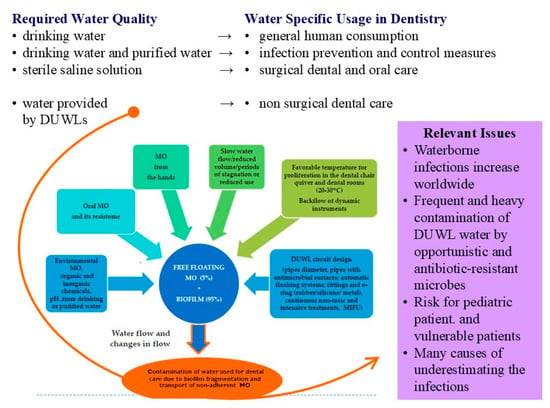
Graphical Abstract

1. Introduction

The WHO research agenda for antimicrobial resistance (AMR) in human health has identified 40 research priorities [1]. Across five themes and eleven areas related to AMR prevention, the panel reported on three themes: prevention (water, sanitation, hygiene, and IPC; overarching topics (AMR epidemiology, burden, and drivers); and policies and regulations. AMR poses a significant risk to global public health, with waterborne microbial infections often being antimicrobial resistant [2,3].
Inappropriate antibiotic prescriptions and use within the field of dentistry [4] have been identified as significant contributing factors to the prevalence of antibiotic-resistant periodontal and endodontic infections [5,6,7,8,9] and to the global AMR crisis [5]. The escalating risk of iatrogenic infections and AMR is further compounded by other concurrent factors, including a disregard for scientific evidence, reductions in scientific research funding, inconsistent and empirical recommendations, heterogeneous guidelines, and the dismantling of regulatory agencies, in addition to the propagation of misinformation through social media [10].
We previously discussed some of the topics reported in dental settings, including AMR and IPC [6,7,8]. However, waterborne infections are particularly well suited to an integrated, multidisciplinary approach to improve knowledge and management.
Our primary interest currently lies in preventing microbial contamination of water used in dental settings. The operational strategies for IPC are in accordance with the requirements set out in national legislation and guidelines, with the aim of guaranteeing patients’ rights (e.g., European Charter of Patients’ Rights n° 8, 9; Principle n° 20 of the European Pillar of Social Right) in terms of the quality of water for human consumption [11,12,13,14,15,16,17,18,19,20,21,22]. Furthermore, it is widely acknowledged among experts that the use of water of indeterminate microbiological quality is not in accordance with IPC principles and the overall effectiveness of standard precautions for IPC. This includes the effectiveness of the instrument processing (also called the decontamination cycle: a water-dependent processing to make a reusable device safe for staff and patients; this normally includes cleaning, disinfection, and sterilization) of reusable dental devices. In turn, the use of substandard water quality compromises the safety of the dental care.
Furthermore, the question arises as to whether patients adequately informed would consent to the use of water with uncertain quality, which harbors a multitude of oral and environmental pathogens. It is improbable that this will be the case. In any case, waterborne microbes may be shared with dental patients, accompanying family members, and dental healthcare workers (DHCWs). Consequently, IPC is obligatory for ethical and legal reasons pertaining to informed consent with regard to the safety of dental care and occupational risk [7,8,23,24,25,26,27,28,29,30,31,32,33,34,35,36,37,38,39,40,41,42].
Water of at least drinking quality is the primary source of water used in dental practices for operational purposes, such as hand hygiene, diluting mouthwashes, and administering drugs. It is also used for various clinical dental procedures after flowing into the dental chair unit (DCU). In this case, the water specifically flows through the dental chair control unit (DCCU) and the DUWL (i.e., the dental unit piping system). It is important to recognize that working conditions in dentistry can lead to substantial microbial contamination of water used for dental care.
This includes vital heterotrophic bacteria of environmental and/or human origin, Legionella, P. aeruginosa, NTM, fungi, and protozoa [8,23,24,25,26,27,28,29,30,31,32,33,34,35,36,37,38,39,43]. These microorganisms may be free-floating or gathered into the adhesive biofilm, in DUWL.
However, the extent to which these bacteria pose a potential public health risk and cause dental healthcare-associated infections in dental offices remains to be elucidated [44].
Our aim here is to raise awareness and improve preparedness in the dental setting, particularly with regard to opportunistic waterborne infectious agents such as Legionella, Pseudomonas, Enterococcus, and NTM [8,23,24,25,26,27,28,29]. A global surge in cases of waterborne diseases, particularly Legionnaires’ disease (LD) and NTM disease, has been reported in the last ten years [45,46,47]. During the same period, the global prevalence of carbapenem-resistant P. aeruginosa appears to have increased or spread [48]. Awareness is particularly important for microbes considered resistant WHO bacterial priority pathogens [1,2,3,6,8,38,39,49] or because their epidemiology could be affected by factors related to seasonal climate and temperature change [45,46,47,50]. It is emerging that a significant proportion of infectious diseases affecting the global population are exacerbated by climatic hazards, including extreme events and temperature changes [51]. According to McIntyre, nearly two-thirds of European human and domestic animal pathogens are climate sensitive [52]. Nevertheless, the causes of the increase remain unclear and the role of climate change is disputed by experts.
Similar research around the world found that an increase in the minimum temperature was associated with an increase in AMR for most antibiotic classes and waterborne pathogens [53,54]. However, they do not establish a definitive causal link between environmental temperature and AMR.
Nevertheless, it is known that temperature changes influences microorganism life, survival effectors, and many pathogenic processes [44,55]. A recent review synthesized the evidence regarding the impact of rising temperatures on the drinking water distribution system and its associated health risks [43]. In addition, it is expected that extreme weather events could disrupt water natural resources and damage infrastructure for drinking water production [56]. The unpredictable consequences could worsen the quality of the water supplied to consumers [44,46].
As a consequence, the quality of the drinking water supplied to dental practices and used for specific clinical purposes and IPC procedures should not be overlooked [11,12,13,14,15,16,17,18,19,57].
In addition, the DUWL is a “dead leg” in the plumbing system, with some favorable condition for microbial colonization and microbial contamination of water used for dental care. The presence of water contamination in dental settings is of significant concern, as it could facilitate the transmission of waterborne microbes through various routes [58].
The following presentation of evidence is intended to assist readers (DHCWs, infection control coordinators, general practitioners, public health officials, health policy makers, insurance experts, lawyers, manufacturers, and students of these disciplines) in comprehending the role of dental settings in the potential transmission of waterborne microbes, known outbreaks and cases, pseudo-infections and the factors to be considered for the efficacy of DUWL decontamination.
In view of the findings reported in the literature, the present study focuses on five important areas:
  • Iatrogenic outbreaks and cases (Section 3.1). In addition, this section includes cases associated to endocarditis agents (Section 3.1.1), the recent case of HAV transmission in dentistry (Section 3.1.2), and causes of underestimated waterborne infections (Section 3.1.3).
  • The prevalence, complexity, and relevance of the DUWL contamination (Section 3.2).
  • The factors influencing water contamination in dental settings (Section 3.3), including specific subsections on issues related to on inlet water in DUWL (Section 3.3.1), pros and con of using an independent reservoir (Section 3.3.2), and DUWL treatments (Section 3.3.3).
  • Issues of products used for DUWL treatment (Section 3.4), in relation to clinical warnings (Section 3.4.1), supply chain (Section 3.4.2), and ecological warnings (Section 3.4.3).
  • Main guidelines on water quality and EU legislative acts (Section 3.5) and issues related to water testing for total viable count (TVC) of heterotrophic mesophilic aerobic bacteria (Section 3.5.1) and identification and quantification of Legionella (Section 3.5.2).
The text highlights the urgent need for greater awareness of water quality and preparedness in IPC in dental settings, as well as the need for proper guidelines and rules to ensure the safety of dental patients and DHCWs [7,8,9,10,11,12,13,14,15,16,17,18,19,20,21,22,23,24,25,26,27,28,29,30,31,32,33,34,35,36,37,38,39,40,41,42]. This approach is consistent with the “wellbeing economy”, which emphasizes the importance of population health protection [59], particularly in terms of the substantial cost savings that can be realized through the implementation of updated IPC measures [7,60].

2. Materials and Methods

2.1. Focused Questions

What is the quality of water used for clinical dental care?
What are the reference values for water quality in dental settings?

2.2. Search Strategy

In consideration of the interdisciplinary and evolving nature of the topic, a narrative review approach was adopted, with particular focus on the factors that contribute to the deterioration of water quality used in dental settings. Despite the fact that narrative synthesis is less prevalent in this field, it was deemed more appropriate than conducting an additional systematic review, given the number of recent high-quality reviews that have already been published [3,4,23,24,25,31,32,34,35,36,37,39,43,44,50,60,61,62] and the highly heterogeneous nature of the data. Nevertheless, to ensure methodological rigor, the research was structured according to the PICO model (Table 1) (Population, Intervention, Comparison, and Outcome) and the literature search was based on the following three aspects: population, concept, and context.
The following keywords and MeSH terms were used in various combinations with the Boolean operators (OR, AND):“airborne”, “AMR”, “aerosol”, “bacteria”, “biofilm”, “bioareosol”, “climate change”, “contamination”, “culture”, “dental settings”, “dentistry”, “DHCW”, “directive”, “drinking water”, “DUWL”, “heterotrophic”, “EU directive”, “fungi”, “guidelines”, “hazard”, “law”, “Legionella”, “Legionella pneumophila”, “Legionellosis”, “microbes”, “Mycobacterium abscessus”, “molecular methods”, “NTM”, “oxygen”, “outbreaks”, “drinking water”, “Pontiac fever”, “pregnant women”, “protozoa”, “Pseudomonas”, “seasonal climate”, “sentinel indicators”, “SO2”, “qPCR”, “transmission”, “virus”, “water”, “waterborne”, “water treatment technologies”, “water waste”, “water loss”.

2.3. Inclusion and Exclusion Criteria

The following inclusion criteria guided our analysis: (I) English and Italian language; (II) full text available; (III) published online between January 2021 and September 2025. References were excluded for: (I) absence of a described methodology; (II) duplications; (III) irrelevant scope; (IV) content redundancy; (V) studies without freely accessible full text; (VI) abstract-only publications; (VII) outdated reviews when updated or more recent versions are available.

2.4. Research

This paper presents original translational research, the focus of which is the quality of water in dental settings, from the drinking water system to the water provided by the DUWL. The literature search was conducted via PubMed (MEDLINE), Scopus, and Google Scholar for studies published between January 2021 and September 2025. The final search was conducted on 30 September 2025, and data extraction spanned approximately six weeks. Subsequently, bibliographic material from the papers was used in order to find other or older sources that may be more appropriate in relation to specific topics and operative problems. Two independent reviewers (L.B. and A.B.) screened titles and abstracts in a blinded fashion. Discrepancies were resolved through discussion or, if required, by consultation with a third expert in ICP in dentistry. Following the application of inclusion and exclusion criteria, the final number on included references was 219. The heterogeneity of the study designs and outcome measures precluded the execution of quantitative meta-analysis. In order to facilitate comprehension for individuals lacking expertise in the field (e.g., dental and clinical professions), additional common terminology has been added in brackets following the relevant specific terminology. The Supplementary Materials provides further data and detailed explanations to facilitate a more comprehensive understanding of the subject matter. While the inclusion of some topics would have been pertinent mainly to DHCWs and dental infection control coordinators, its integration into primary text would have resulted in an interruption to the flow of the argument.

3. Results

The aim of patient safety is to prevent iatrogenic adverse outcomes caused by dental healthcare-associated infections (DHAI) in dental patients. Some people are particularly susceptible to infections caused by opportunistic pathogens. Vulnerable patients include pregnant women, elderly people, people with diabetes, and people with immunodeficiency associated with many diseases, cystic fibrosis, or HIV. Younger people are also vulnerable due to their undeveloped immune system [63]. The number of elderly patients is set to increase. These patients are prone to infections, and are often on antibiotic regimens; situations that can promote infections by antimicrobial resistant pathogens.
Two factors must be given particular consideration in order to ensure patient and DHCW safety. Firstly, the potential risk of contaminated water from DUWL has been identified as a significant concern, given its association with an increased risk of hospital infections. This has resulted in a growing interest in the effective disinfection of DUWLs in hospital dental departments, as opposed to those in the private dental sector. Secondly, in the context of the dental work environment, the transmission of infection can be mitigated through the reduction of water contamination used in dental settings and the consistent utilization of personal protective equipment (PPE). It is evident that DHCWs must don PPEs, which include surgical masks, FFP2 or N95 masks, gloves, and shields, for extended periods. However, it should be noted that dental patients are only permitted to wear respiratory PPE during their waiting time.
Blaszczyk et al. have reported a list of microorganisms isolated in water provided by DUWL in different amounts and by different culture methods, along with their role as pathogens [64]. The list includes: 14 Gram-positive bacteria, 18 Gram-negative bacteria, 18 Gram-positive granulomas, 12 Gram-positive bacilli (red, spore-forming), four Gram-negative bacilli, and nine fungi and molds. Currently, A. baumannii, P. aeruginosa, E. coli, S. aureus, K. pneumonia, and S. pneumonia are classified as priority pathogens posing the greatest threat to human health and life [49]. All of these pathogens were identified in water provided by DUWL [34,36,37,38,39,61,65] (see Section 3.2). Acinetobacter and Pseudomonas species belong to the families of bacteria found in aquatic and soil environments, whereas Legionella are found in aquatic and air environments. Pseudomonas bacteria, especially P. aeruginosa, are everywhere, and are known as survival specialists in a variety of moist and dry environments [66]. They are frequently recovered from DUWL in dental clinics [34] and surgical and periodontal wards [34,36,37,38,39,61,65]. These bacteria are known to cause healthcare-associated infections (i.e., commonly called nosocomial or hospital infections) and many are opportunistic pathogens that are often resistant to carbapenems or disinfectants. It has been demonstrated that they have the capacity to cause severe infections in individuals with compromised immune system [67]. They target moist tissues, such as mucous membranes, and can infect distant organs, such as the alveoli and urinary tract. They act on transitional epithelia and non-keratinized cell layers, such as the cornea, through virulence factors and exo-metabolites [67]. In dental settings, P. aeruginosa infections in healthy individuals that should be considered are: ocular infections, which can occur in non-contact lens wearers, infection of the bone, osteomyelitis (i.e., a serious bone infection), and endocarditis (i.e., a life-threatening inflammation of the endocardium) [68].

3.1. Iatrogenic Outbreaks and Cases

Although the transmission of waterborne infections is reported to be rare in dentistry, some outbreaks and cases have been documented [13,26,27,28,29,30,69,70]. As of 2015, Table 2 summarizes the health risks associated with sporadic infections associated with contaminated water from DUWL [70,71,72].
A recent case report shows gingival necrosis related to sepsis-induced agranulocytosis (i.e., a life-threatening, acute condition where the immune system is severely compromised) resulting from P. aeruginosa bacteremia (i.e.the presence of viable bacteria in the bloodstream) [73]. The patient most likely contracted the infections through contaminated water containing P. aeruginosa, resulting in community-acquired pneumonia and subsequent septic shock (i.e., a serious condition that occurs when a body-wide infection leads to dangerously low blood pressure). Six months later, the patient exhibited signs of alveolar (i.e., pertaining to the sockets of the teeth) bone exposure.
Recent cases and outbreaks are reported in Table 3 [26,27,28,29,30].
The infection can be fatal, as evidenced by two deaths due to Legionella infection [26,27].
The consequences of NTM infections manifested in a variety of ways, some of which included extranodal mandibular or maxillary osteomyelitis (i.e., a bone infection) and pulmonary nodules. Mycobacterium abscessus, which caused the two outbreaks, belongs to the group of rapidly growing NTM, and the immune susceptibility of children to the disease is unclear [28,29]. None of the patients were immune-compromised [29], and the incubation period was long (median 58 and 74 days, respectively). Although the two outbreaks were associated with initial pulpotomy procedures (i.e., tooth root canal procedures) and the same etiological agent, patients experienced different clinical outcomes. These included variations in the frequency of cases, the loss of permanent teeth, bone loss, lymphadenitis (i.e., inflammation and swelling of one or more lymph nodes, typically caused by a bacterial, viral, or fungal infection), facial swelling, hearing loss, and further complications [28,29]. These infections require prolonged antibiotic treatments and hospitalization [25,28,29,30]. Treatment of choice involves the drainage of pus or excision of the infected tissue. In addition, a combination of antibiotics is administered for a period of six months to one year, or longer.
A recent case report details a 6-year-old female patient who presented with symptoms consistent with Mycobacterium fortuitum infection, but which were initially misdiagnosed as odontogenic abscess (i.e., a localized, pus-filled infection arising from tooth decay, trauma, or gum disease). This phenomenon is likely attributable to oral contamination, a common occurrence resulting from hand-to-mouth behaviors frequently exhibited by children. However, water analyses were unavailable in dental practice [74].

3.1.1. Causes of Iatrogenic Endocarditis Within the Context of Dental Settings

Bacteremia has been demonstrated subsequent to a variety of dental procedures, particularly surgical cares and tooth extractions [75]. To prevent the risk of infective endocarditis, sterile water must be used [13,14,15], and antibiotic prophylaxis is only recommended for high-risk patients [76,77]. Dental care has been identified as a risk cofactor for endocarditis in 5.3% of Italian patients who do not abuse drugs, and in 22% of pediatric patients [78,79,80]. It is important to note that the medical consequences of surgical dental care (e.g., tooth extraction) may be attributable also to Staphylococcus ssp. (including MSSA and MRSA), Streptococcus, and Enterococcus species [81]. Furthermore, the frequency with which DUWL is contaminated by bacteria, known to be associated to infective endocarditis, is relevant: K. palustris (8.8%), K. kristinae (2.9%), S. maltophilia (20.5%), E. faecalis (2.9%), M. luteus (25.5%), S. haemolyticus (29.41%), S. capitis (20.5%), S. epidermidis (67.65%), S. warneri (58.82%), S. aureus (14.7%), S. sanguinis (5.9%), and L. paracasei (2.9%) [64]. The quantity of S. warneri exceeded 10,000 CFU/mL, far exceeding the TVC threshold of 100–500 CFU/mL for most of the water samples.
Furthermore, the substandard quality of the poor quality of the water utilized for manual and automated washing and rinsing of dental instruments should be taken into consideration, as it is probable that this is the cause of the 200-fold increase in the risk of endocarditis associated with oral surgical procedures caused by E. faecalis [82].

3.1.2. A Case Report Involving the Transmission of the Hepatitis A Virus in Dental Settings

Most of the waterborne infections are caused by Hepatitis A virus (HAV). Recent outbreaks of enteric viruses and HAV in Europe have failed to demonstrate an association between dental settings and its transmission [83]. However, the primary mode of transmission is via the fecal–oral route (i.e., through the ingestion of contaminated water and food), and HAV results in asymptomatic infections in infants and young children.
It is therefore intriguing to analyze a recent case of HAV transmission attributed to poor hand hygiene practices in a dental clinic [69]. However, the quality of the water used for hand hygiene and dental care with regards to the functionality of the anti-retraction valves has not been investigated.
Nevertheless, HAV infection has been demonstrated to be strongly associated with the presence of biofilm, primarily those formed by lactic acid bacteria, and this kind of biofilm affects HAV adhesion to various surfaces [84]. Further research is necessary to ascertain the role of many oral lactic bacteria, which are known to be involved in the formation of dental caries and are present in DUWLs [37].

3.1.3. Causes of Underestimating Waterborne Microbial Infections in Dental Settings

Taking into account the reported outbreaks (Table 2 and Table 3) and the number of dental patients potentially exposed to waterborne infections during the 420 million dental procedures performed by a total of 365,000 dentists in Europe in 2023, the number of iatrogenic waterborne infections seems to be low [85,86]. Nevertheless, when all the reported data is considered alongside the frequency and extent of microbial contamination of DUWL (see Section 3.2), it is possible that the number of waterborne infection and pseudo-infection (i.e., a medical scenario where lab tests identify microorganisms—often Pseudomonas or other environmental bacteria—in patient samples without the patient actually having symptoms) outbreaks, is underestimated [85]. The reasons are:
  • Dental treatments are not universally recognized as a risk factor for the iatrogenic transmission of waterborne infections, which hinders investigations. Consequently, cases may not be traced back to DCU contamination and reported to health officials promptly, as required by Italian law [85,86].
  • Under-recognition of waterborne infections as a risk, mainly in the private dental sector [85].
  • Difficulties in linking infections to a single exposure to dental care (e.g., annual or bi-annual professional dental hygiene treatment).
  • Asymptomatic cases (e.g., P. aeruginosa infection, HAV infections in children) or mild infections (e.g., Pontiac fever) are possible, as are pseudo-outbreaks [87]. Pontiac fever (PF) has a short incubation period of 48 h and is characterized by self-limiting influenza-like illness symptoms, which usually resolve within 2–5 days and without substantial mortality. As there is no specific test for PF, establishing a link with Legionella spp. is challenging.
  • Long incubation period and non-specific symptoms in the case of M. abscessus infection [28,29].
  • Insufficient up-to-date knowledge and training to identify IPC errors and lapses in an open, non-blame culture [85], and to develop functional safety water plan [88].
  • The solo practice segment (i.e., a dentist work as solo practitioner in dental practice) dominates the market (73.1% in 2024) in North America, some sections of Europe, and across the world [89]. Adopting guideline recommendations in this segment could be more difficult than for dentists affiliated with dental support organizations or hospital dental departments. In the USA, the proportion of private practice was 46% in 2021 [90].
  • The presence of resource constraints [91].
  • Despite the application of the eight-step outbreak investigation process [92], it has proven impossible to establish an epidemiological link between the disease and microbial contaminated water.
  • The difficulties of culture methods to identify and/or quantify microbes (i.e., Legionella, NTM, C. auris, fungi, protozoa) due to factors such as time-consuming process, interference, cost, and low sensitivity to detect viable but non-cultivable (VBNC) state [93,94].
  • The adoption of rapid bacterial identification methods, such as matrix assisted laser desorption ionization-time of flight mass spectrometry (MALDI-TOF MS) and nucleic acid detection/identification assays, is mainly taking place in hospital dental settings [25,35,36,37,91,93,95,96].
  • In general, the quality of drinking water supplied by drinking water services to dental practices is largely unknown, creating uncertainty. The levels of safely managed drinking water services vary widely in high-income, upper middle-income, and low-income countries [97].

3.2. The Prevalence, Complexity and Relevance of the Water Contamination from DUWL

The results of the studies on water contamination from DUWL water largely concur on the primary infectious agents involved as follows: L. pneumophila, Mycobacterium spp., Pseudomonas spp., P. aeruginosa, and Burkholderia cepacia, as well as fungi and yeasts, including Candida spp. [23,24,25,26,27,28,29,30,31,32,33,34,35,36,37,38,39,88,93,95,96,97,98,99,100,101,102,103,104,105,106,107,108,109,110,111,112,113,114,115,116].
Data on the microbial contamination of DUWLs (water and/or biofilm) can be found in Table S1 [24,31,32,33,34,38,61,62,64,65,88,98,99,100,101,102,103,104,105,106,107,109,110,111,112] and Table S2 [25,35,36,37,93,95,96]. Data on water contamination was obtained by means of classical culture methods and real-time PCR (also denoted as quantitative PCR—qPCR) and is reported in Table S1. Data obtained primarily from DUWL biofilms using open molecular biology technology is reported in Table S2.
The majority of studies (17/18) reported a high prevalence of heterotrophic microbial contamination (in the range 60–100%) that exceeded the reference values [26,33,61,62,64,88,93,98,100,101,102,103,104,105,106,107,109,110,111,113] in water from DUWLs. The contamination level has been found to be elevated to a range from 2–5-fold [103,112] to 8–80-fold [37,64,100,109,111,114] above reference levels. The dental setting organization appears to exert a certain influence on the prevalence of water contamination from DUWL. For instance, the prevalence was found to be 15% lower in hospital dental clinics compared to private practices in Italy, but increased in Pseudomonas [98]. Furthermore, the levels were found to be five times higher in water from conservative and periodontal rooms than in surgical rooms in Poland [64].
Notwithstanding the significance of the quality of inlet water, data concerning the quality of tap water from drinking water systems is scarce in dental settings [100,111]. The colonization of domestic water systems (also known as drinking water systems) poses a health risk in private dental practices, which are often located in residential buildings. Systematic reviews of data on opportunistic pathogens (including Aeromonas spp., Acinetobacter spp., Helicobacter spp., Legionella spp., Methylobacterium spp., Mycobacterium spp., Pseudomonas spp., and Stenotrophomonas spp.) in residential drinking water systems and distribution networks have been published [44,115]. However, a study of Italian dental practices revealed that only 77% of drinking water from drinking water system was found to be safe. This is in contrast to the overall 96.8% of drinking water services that were found to be safely managed [97,100]. In a context where only 68% of drinking water services were managed safely [97], a low level of drinking water quality (1.48–1.74 × 10⁴ CFU/mL) has been reported in dental practices in South Africa [111].
The microbial contamination levels were found to be higher in open-system DCUs (i.e., inlet water from drinking water system) than in closed-system DCUs (i.e., with an independent reservoir for water) [93,111]. Nevertheless, another review reported no significant difference in levels of Legionella and Pseudomonas species between purified water and tap water as water sources of DUWL [62].
However, the aforementioned study revealed that 95% of DUWL water and 23% of water from the drinking water system in dental practices was found to be of substandard quality in relation to the EU reference level [100].
Two recent reviews have evaluated the contamination of water from DUWL. The combined mean prevalence of 12–23.5% for L. pneumophila and 8–21.7% for Pseudomonas has been reported with cultural methods [24,61]. The data are consistent with those documented in Italy regarding L. pneumophila [98], yet they are lower than the observed frequencies of Pseudomonas contamination (21–85%) in Italian dental practices [98,100].
However, the data are characterized by significant heterogeneity when employing culture methods [65,100,105] or molecular methods [33,100,106] for the contamination of L. pneumophila or Legionella spp. [33,98]. L. anisa, the most common non-pneumophila Legionella, has been identified as a contaminant of DCU [88,95]. The contamination for Legionella spp. was found to be 7% positive using a culture test and 100% positive using a molecular test (PMA-qPCR method) [100]. In water samples from DUWLs, the heterogeneity of different microbial genera and species may also be attributable to the considerable variation in conditions associated with DUWL treatments. Nonetheless, the preponderance of the identified bacterial species exhibited Gram-positive characteristics, predominantly comprising the Staphylococcus and Streptococcus genera. In contrast, a mere five genera were classified as Gram-negative, predominantly including Acinetobacter indicus, Paenibacillus lactis, Roseomonas mucosa, and Roseomonas aerofrigidensis [93].
A more detailed analysis of the data using high-quality DNA sequencing revealed that Proteobacteria constituted the predominant phylum, exhibiting a relative abundance of over 85% [37]. This phylum has been documented as exhibiting a high tolerance to chlorine, a compound that is widely employed in water disinfection procedures. The other phyla observed included Actinobacteria, Acidobacteria, Chloroflexi, and Firmicutes [37]. It has been determined that seven genera, which may have human pathogenicity, have been identified, with relative abundance (RA) exceeding 1%. The most prevalent genera were identified as Pseudomonas (31.08%), Acinetobacter (mean 7.64%; 21.05% in prosthodontic specialties), while some others are less prevalent (RA in the range of <1–3%): Sphingomonas, Ochrobactrum, Rhizobium, Brevundimonas, and Methylobacterium [37].
The data indicates the presence of a distinctive microbial community in water contamination from DCU and DUWL utilized in the periodontics (i.e., management of gum infections) specialty (microbes: Hydrocarboniphaga, Zoogloea, Aquabacterium, and Hydrogenophaga), in the prosthodontics (i.e., replacement of missing or damaged teeth using crowns, bridges, dentures, and dental implants, including complex reconstructions for patients with trauma or oral cancer) specialty (microbes: Acinetobacter, Geothrix, and Desulfovibrio), and in the endodontics (i.e., root canal therapy, devitalization) specialty (microbes: Alistipes, Clostridium XIVa, and Serratia) [37].
The mean concentration of P. aeruginosa in water from handpieces (i.e., dental drills) was 25.13 CFU/100 mL [66], while the prevalence by molecular method was found to be approximately 4.7–35% [35,36,37,91]. However, bacterial colonies that grew on Pseudomonas agar were found not to belong to the Pseudomonas species, as determined by 16S rRNA gene sequencing [93].
The utilization of 16S rDNA, rpoB, and hsp65 gene analysis enabled the identification of 89.3% of isolates as NTM species in water from DUWLs. The NTM counts exhibited a range from 50 to >500 CFU/500 mL, with a median of 350 CFU/500 mL [25]. In the totality of isolates examined, 34.5% were classified as slow-growing Mycobacteria, while the remaining 65.5% were classified as rapid-growing Mycobacteria. This finding is consistent with the established fact that rapidly growing Mycobacteria were responsible for the two outbreaks in children [28,29].
The mold strains that have been identified include Aspergillus flavus, Alternaria spp., Cladosporium spp., and Fusarium oxysporum, as well as Penicillium, Cladosporium, Alternaria, Fusarium, and Stachybotrys spp. [64,101]. Furthermore, the contamination prevalence of fungi in water from DUWL has been found to be 5–98% [33,64,65,101]. The mean total fungal contamination in water from in periodontal DCUs and conservative DCU was 350 and 150 CFU/mL, respectively [64].
Gram-negative bacteria, which are predominantly non-pathogenic, have been found to be responsible for the production of foul-smelling and unpleasant-tasting substances. Such substances have been observed to occur, for example, in water left unused (i.e., stagnant water) at the weekend or holidays. This compromises the quality of dental care and engenders a negative experience for the patients. The repercussions of stagnation are exemplified by elevated TVC levels at the commencement of the working day, on Mondays, and across all dental facilities and in dental simulation head model laboratories [109,112,117].
The presence of Gram-negative microbes in water can be indicated by the levels of endotoxins present. In water samples collected three minutes after flushing, endotoxin levels were found to be higher than 5.00 endotoxin units/mL, with high TVC (2200–2500 CFU/mL) in DUWLs with no disinfection. The levels were found to range from 1.33 to 5.00 endotoxin units/mL in a stationary state for bacterial growth and DUWLs treated with a citric acid disinfectant. These values are significantly elevated in comparison to those observed in sterile physiological solution (less than 0.02 endotoxin units/mL) and dialysis water (0.25 endotoxin units/mL) [118].
As demonstrated in Table S2, the data pertaining to microbes in biofilm [35,36,93,96] and water [37,93] samples analyzed by the open molecular approach is of great interest [25]. Scanning electron microscopy revealed a gradient of biofilm coverage inside the DUWL. Subsequent molecular analysis identified Proteobacteria as the predominant phylum, followed by Bacteroidetes and Firmicutes. Furthermore, substantial variations in biofilm composition were observed between sections [96]. Proteobacteria was identified as the predominant bacterial phylum, comprising between 65.74% and 95.98% of the total sequences, while Ascomycota dominated among fungi, accounting for 93.9% to 99.3% [36]. The presence of microorganisms belonging to multiple genera associated with human diseases was identified, encompassing 25 bacterial genera and eight fungal genera. The following genera were identified: Acinetobacter (13.36%), Pseudomonas (4.69%), Enterobacter (1.48%), Aspergillus (23.52%), Candida (26.92%), and Penicillium (2.85%). A further study reported on biofilm communities and detected a high diversity of bacteria (377 genera) and fungi (83 genera). The dominant bacterial phylum was Proteobacteria (93.27%) while the dominant fungal phylum was Basidiomycota (68.15%) [35]. The predominant genera and their relative abundance (RA) were as follows: Pseudomonas (35.0% ± 2.4%), Stenotroponas, Hafnia–Obesumbacterium, Burkholeia–Caballeronia–Paraburkholderia, and Ralstonia (in the range of 5.7% to 2.5%), followed by Enterobacter and Klebsiella (in the range of 1.6 to 1.8%). In the context of six genera of fungi, the more prevalent genera demonstrate a high degree of variability in RA (e.g., Malassezia (36.7%± 40.2%) and Candida (6.9% ± 14.2%)) than other genera, such as Alternaria, Cryptococcus, and Rhodotorula (in the range of 1.4–5.6%) [35].
An intriguing multicenter study was conducted in Ukraine, examining a total of 1146 dental water samples collected from 12 dental clinics [91]. The study examined water quality from DCUs with closed systems. The data demonstrated that there was an increase in the proportion of non-standard water samples that exceeded the reference level (i.e., >100 CFU/mL) of heterotrophic TVC from 2020 onwards. The proportion was found to be 30.4% in 2020, 29.7% in 2021, and 57.4% in 2022. Furthermore, the highest prevalence of elevated bacterial concentrations was identified in the disciplines of orthodontics (54.2%), prosthodontics (47.5%), and oral surgery (44.3%). Samples with elevated bacterial concentrations were detected in the fast handpieces of DCUs (43.1%), reservoir bottles (37.8%), the internal surfaces of the distal outlets of taps (29.1%), and the internal surfaces of empty distiller bottles (17.9%). The findings are consistent with those reported in the extant literature, as evidenced by the following citations: [88,93,107,111]. The RA of potential human pathogens detected in biofilm samples is consistent with the data reported in the literature (e.g., P. aeruginosa (33.7%), E.coli (27.3%), but a high RA is evident for Enterococcus species (e.g., E. faecalis (17.4%) and E. faecium (9.5%)) [91]. E. faecalis RA was six times higher than in another study [64].
However, in addition to the documented decline in the quality of inlet water, the data can be rationalized by the following factors: prolonged stagnation periods, a decline in patients requiring long-term and out-of-pocket dental care, and reduced maintenance during the initial year of the war. The unique nature of the data collected indicates that water safety in dental settings deteriorates during periods of war.
The extant literature pertaining to AMR in waterborne microbes from DUWL is limited. A review of the data has been conducted by Farzinnia et al. [39] and recent reports have addressed Pseudomonas [38], L. anisa, and the molecular microbial characterization by whole-genome sequencing [95]. Thirty-seven virulence genes and two antibiotic resistance genes, previously described as β-lactamase genes (i.e., OXA-29 class D β-lactamase and FEZ-1 metallo-β-lactamase), were identified in the chromosome of all isolates in water from hospital DUWLs [95]. In the context of DCUs contaminated by P. aeruginosa with loads of 2–1000 CFU/L, P. aeruginosa and other Pseudomonas species were antibiotic-resistant in around 31% of the tested strains [38]. These microorganisms were also present in cold water from the controls. Farzinnia et al. attributed multidrug resistance for P. aeruginosa and M. avium and moderate resistance for L. pneumophila found in DUWL (see Figure 5 in reference [39]). In water samples from DUWL, it has been determined that approximately 50% of the isolates of the most common opportunistic bacteria (P. aeruginosa, S. aureus, S. auricularis, P. fluorescens, and A. baumannii) were resistant to two or more antibiotics [118]. An interesting study examined the dynamics of bacterial populations at the species and genotype levels in a complex water system containing 61 dental chairs over a period of 6.5 years [119]. One clone of P. aeruginosa emerged that was characterized to be high-biofilm former and resistant/tolerant to biocides. This clone caused massive and persistent contamination of all DCUs at a level of at least 5.104 CFU/100 mL. Due to the long-term inefficacy of the control measures employed, the dental department had to be completely renovated and reorganized, with each new DCU made independent of the others.
It is known that protozoa, like amoeba, frequently establish symbiotic relationships with bacteria (e.g., Legionella, NTM), thereby favoring microbe survival within DUWLs. As demonstrated in [98,99], a variable contamination (0–71.5%) with protozoa has been reported in water from DUWL.
The minimal interest observed in relation to the presence of viruses in the water or biofilm from DUWL is presumably attributable to the challenges associated with virus detection in water and the identification of the host. However, from a rational standpoint, viruses can survive in the environment (air, water), and their life cycle is dependent on a microbial host. It is increasingly recognized that viruses play a pivotal role in the regulation of environmental dynamics and biodiversity [120]. In the contest of dental settings, waterborne amoebas have been documented in DUWL [23,33,98,99]. Furthermore, the persistence of Enterovirus B (i.e., Coxsackievirus B5) in association with commonly reported waterborne amoebas (Vermamoeba vermiformis and Acanthamoeba polyphaga) has been observed, as has its localization in expelled amoebae vesicles [120]. Furthermore, an ultrafiltration system, which is commonly used to remove Legionella (with coconut-bacillary shape; dimensions ranging from 0.3 to 0.9 µm wide and 1.5 to 5 µm long), has been shown to remove only 50% of Coxsackievirus B5 (Ø 30 nm) in simulated conditions of a contaminated DUWL [121]. Finally, the transmission of many viruses (Cytomegalovirus, Measles virus, Mumps virus, Respiratory viruses (Influenza virus, Rhinovirus, Adenovirus), and Rubella virus) has been indicated by water from DUWL [122], through this has not been proven for SARS-CoV2 [123].
It has been demonstrated that water contamination also manifests in dental simulation head model laboratories, particularly following extended periods of inactivity (such as at the beginning of a semester) [117]. The composition of the microbial community (comprising nine bacterial and two fungal genera, some of which are potential human pathogens) is analogous to reports of DUWLs in clinical settings. However, even in the absence of patients and with the use of inlet drinking water, debris, microorganisms, and chemicals generated during students’ practice may enter and deposit in the waterlines, leading to deterioration in water quality.
Finally, it should be emphasized that the data heterogeneity with regard to water contamination from DUWLs is attributable to a number of factors (Tables S1 and S2):
  • Different air and water temperature during research conducted in disparate regions, including Northern Europe [33,64,95,105], Northern and Central Italy [38,88,98,100], Northern America [103,104], Northern Africa [101,109], Southern Africa [111], the Middle East [25,61,93,99,106,107], and the Far East [34,35,36,37,65,102,110,112].
  • Different legislation regarding mandatory measures to control Legionella spp. in water supplies [11,12,13,14,15,16,17,18,19,116].
  • Different type of dental facilities (e.g., hospital dental department, dental school, general dental practice) and resources for dental costs (e.g., out-of-pocket, voluntary health insurance and public resource) [25,34,35,38,61,62,64,65,88,95,98,101,106].
  • Inlet water quality in the dental practice and inside the DCU is mainly unknown and indicated only in two studies [62,93].
  • The presence of a switch that allows water for DUWLs to be taken from the drinking water system or from the dental unit’s separate tank, common in older DCUs [88]; in this type of DCUs, only drinking water can be used for the cup filler.
  • The age of general water system and the DCU, taking into accounts factors such as diameter and tubing composition, and the use of antimicrobial materials such as polyethylene, silicone, as well as antiadhesive materials such as N-halamine, polyvinylidene fluoride (PVDF), and ZnO [101,124,125].
  • The age of DCU is sometimes indicated, but the majority was approximately in the range from 7 to over 15 years [88,107,109].
  • Different use of an independent reservoir bottled water system (also known as a bottle storage tank (BST)), storage tank for drinking water, or header tanks for purified water in DCUs [93,101,107,111].
  • The backflow valve maintenance is frequently unknown, but it is suspected that this is often not carried out properly, given the frequent presence of oral microbes in DUWLs [33,34,64,107,109,111].
  • Studies have been conducted on the basis of varying numbers of water samples taken from DUWLs, with the number of samples generally ranging from a few to hundreds.
  • The position of dental practices and DUWLs within a building (ground floor and/or upper floors, or located at the beginning and the end of a dental ward) is mainly unknown, and reported in only two studies [38,95].
  • Initial disinfection of DUWLs to reduce contamination in new DCUs. This procedure should be executed immediately following the installation phase and prior to the commencement of use [113,126].
  • The potential concomitant influence of compressed air contamination is unreported.
  • Flushing water in the DUWLs (30”, 1–3 min) as a single treatment only results in a 9.1% drop in TVC and a 0.5% reduction in biofilm, which appears as a dense, homogeneous bacterial biofilm covering the surface of the tubes [118,125,126].
  • Flushing of water in the DUWLs as part of an integrated sanitization treatment results in a significant reduction in TVC and biofilm residues, with scattered rod-shaped bacteria remaining [118,127,128].
  • Different types [93,107], ages [96,107,109], and manufacturers of DCUs, which are often unknown.
  • The two different models of DCCU, referred to as traditional and continental models, are not considered with regard to microbial contamination and stagnation of the hoses [129].
  • Different type and frequency of DUWL disinfection (continuous, discontinuous, or intensive/shock) and different used products [36,101,102,109,112].
  • The absence of transparent data regarding the maintenance of anti-retraction devices [33,93,98], in-line filters (e.g., anti-Legionella cartridge) and systems for pre-treatment of water (e.g., to produce sterile, distilled or deionized water).
  • Water sampling in different dental wards [36,37,64,101,109,126].
  • Effectiveness of water treatment with iodine cartridge evaluated as a function of time (e.g., 11 months) or volume (e.g., 240 L) of filtered water [130].
  • Sampling via different water delivery points (e.g., air-water syringes, handpieces, hoses [127], cup fillers, tubing) and wash basin taps, which are used as a non-DUWL control sample [93,101].
  • Preanalytical issues: Different sample collection techniques, usually involving the use of sodium thiosulphate to neutralize residual chlorine and inhibitor cocktails for “omics” applications. Sample delivery to the laboratory within a few hours (three or more) or days.
  • Different time of collection: After overnight stagnation (known as a “Relaxed Biofilm Sample”) [33], or at the end of the working day, with or without flushing, or before and after the intensive treatment [109].
  • Different culture methods (using different media or selective media, incubation temperature conditions, and incubation times) and molecular methods for the identification, and quantification of specific pathogens (primarily Legionella spp. and/or L. pneumophila) or the TVC of heterotrophic microorganism) [35,36,37,93,101]. More information is reported in Section 3.5.1 and Section 3.5.2.

3.3. Factors That Influence the Water Contamination in Dental Settings

The DUWL can be considered a “dead leg” in the plumbing system, through which fluid moves by laminar flow into a narrow bore with an inner diameter of approximately 2–3 mm. This bore has a length of approximately 5 m long and possesses a high surface area [23,131,132] and different fittings. Fittings are placed inside the DCU or DCCU to divert water to different parts (e.g., plastic in newer DCUs and metal in very old ones) or at the end of DCCU tubing to connect dental devices (e.g., dental drills). These fittings are made of plastic or metal with rubber seals. The hoses of DCU are flexible cables that connect instruments such as high-speed handpieces (also known as turbines and contra-angles, commonly named dental drills) to the DCCU via a specific electric device (i.e., an electric motor). Hoses are responsible for supplying the air, water, and electricity which are indispensable for the operation of dental instruments (i.e., dental drills, air/water syringes, ultrasonic scalers, etc.). A traditional DCCU mounts (Figure S1) the handpieces (i.e., dental drills) under the patient chair, while a continental DCCU mounts them on top with an “extendable, pendulous arm” [129]. All parts of the DCCU, hoses, and dental drills are in the main area (air, surfaces) of microbial contamination during dental care.
It has been established that bacteria, yeast, and protozoa adhere to the surface covered in organic molecules and colonize the internal surface where water is motionless. Furthermore, the formation of biofilm is facilitated by the continuous presence of nutrient source and dissolved oxygen (DO) for microorganism metabolism, slow water flow (with minimal friction), a “comfortable” temperature, and stagnation for an average of 130 h per week. Recently, waterline tubing has been fabricated using materials containing silver ions or other antimicrobial agents, such as AlphaSan® (Milliken, Spartamburg, SC 29303, USA), which have been shown to provide protection against microbial colonization and corrosion on their surfaces [101,124,125].
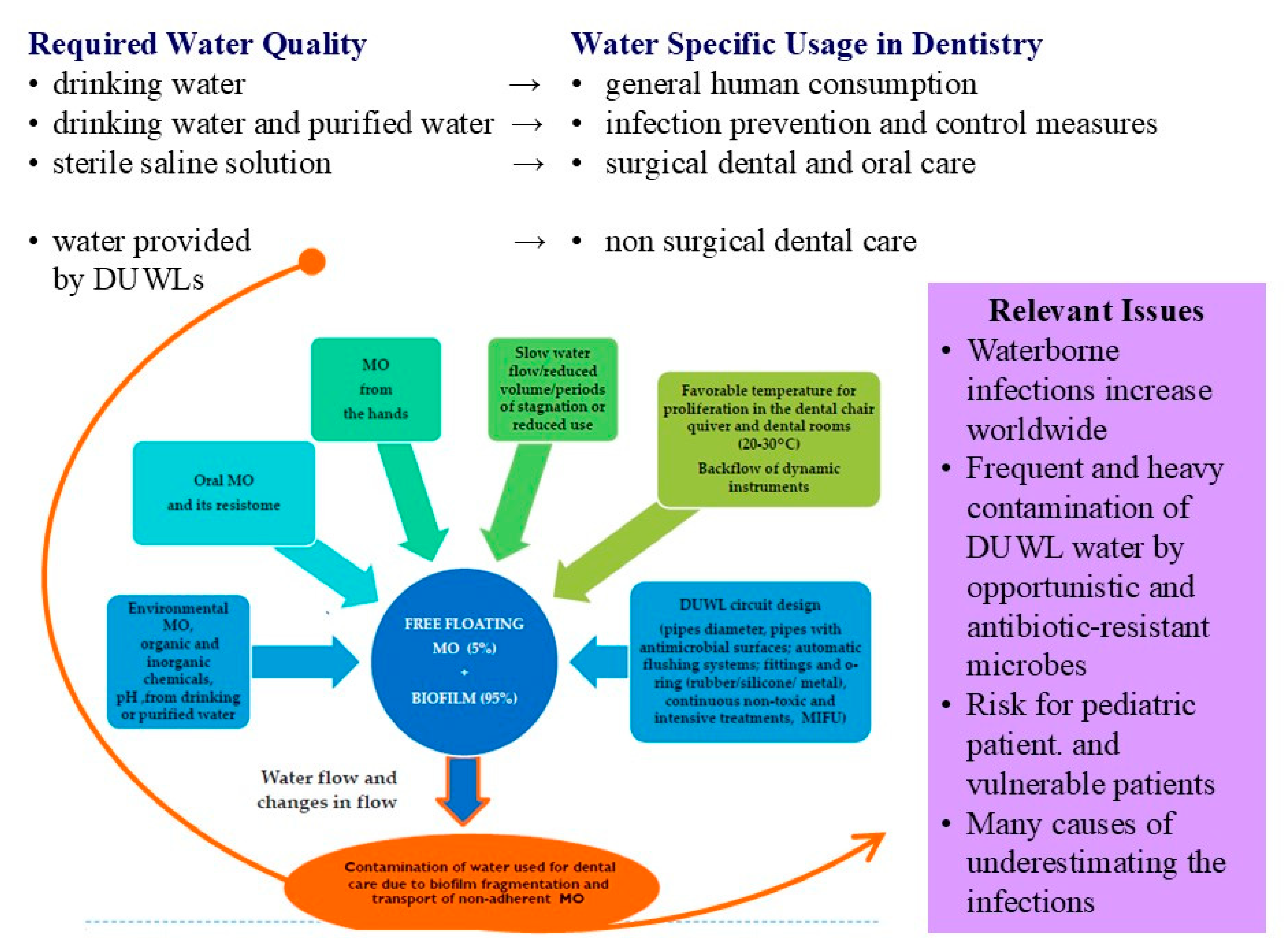
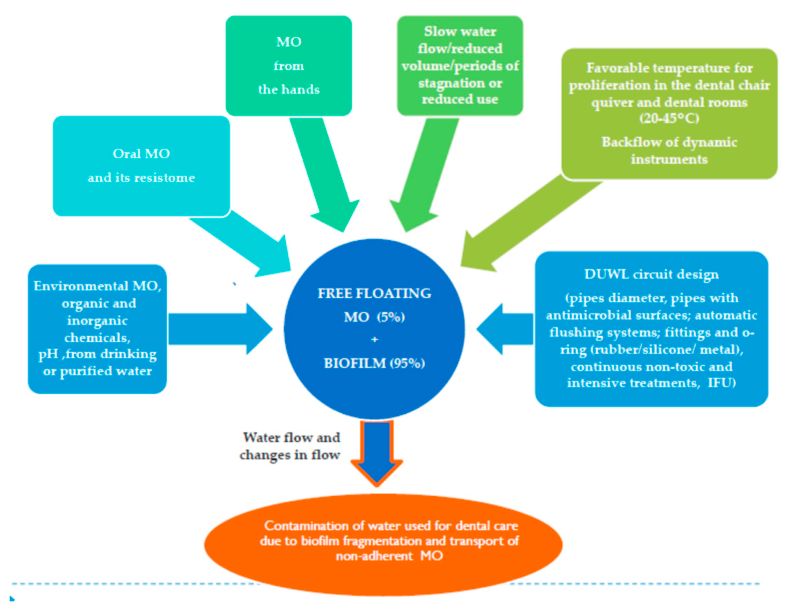
The etiology of DUWL contamination by planktonic infective agents and biofilm has been comprehensively delineated in the extant literature [23,25,26,27,28,29,30,31,32,33,34,35,36,37,38,39,58,61,62,64,69,87,93,95,96,98,99,100,101,102,103,104,105,106,107,108,109,110,111,112,113,120,121,122,123,126,131,132,133,134,135,136,137] and is represented in Figure 1 and Section 3.3. Further information on issues related to inlet water quality in DUWL, as well as the advantages and disadvantages of using an independent reservoir bottle for inlet water in DUWL, can be found in Section 3.3.1 and Section 3.3.2.
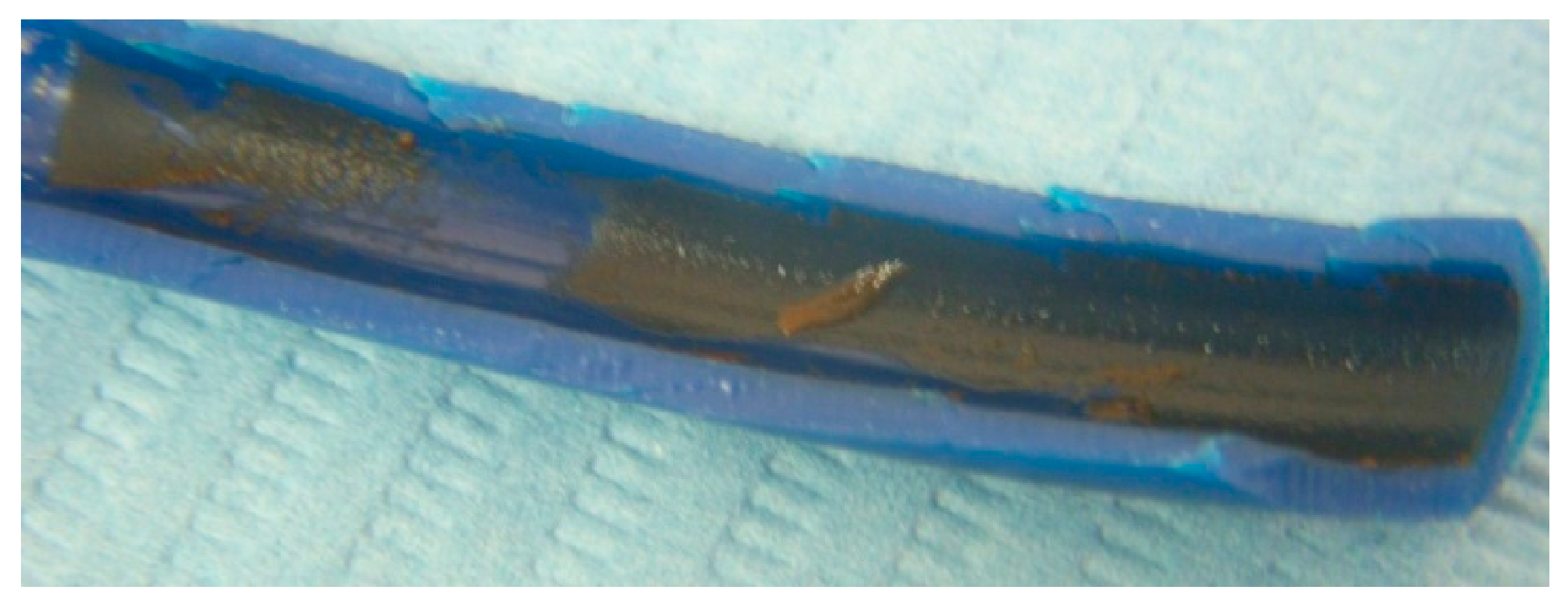
The term “biofilm” is defined as a complex and well-organized community of living or non-living microorganisms, including but not limited to bacteria, protozoa, and algae. These organisms have the capacity of produce sticky compounds, which are known as extracellular polysaccharides (Figure 2). Biofilm is a viscoelastic material that exhibits a high degree of resistance to both water flow and biocide activity. Microbes (50–100%) isolated from the DUWL water revealed a significant ability to form biofilm [101,109].
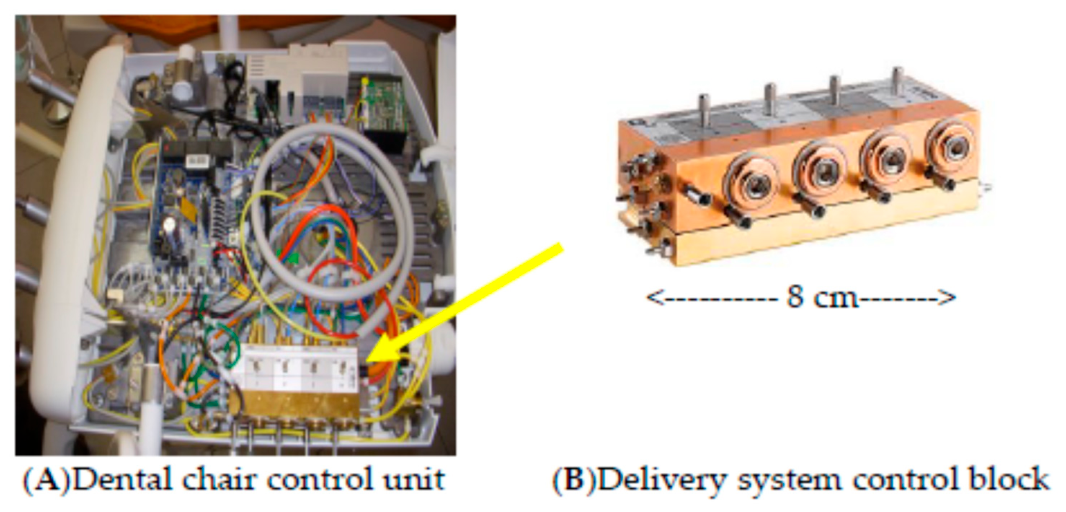
The temperature of the water in DUWL above 20–30 °C, as well as the level of DO, affect the colonization of microbes and the formation of biofilms differently [23,24,138]. It is important to acknowledge the close proximity of the delivery system’s water lines, microchips, and electrical circuits, and thus the heating of the water delivery system (Figure 3). As illustrated in Figure 3, the design of the narrow tubes, valves and connections of a contemporary DCCU is intricate [139].
It is important to note that the optimal growth temperatures for the NTM, Legionella, Pseudomonas, Enterococcus, and E. coli species are 25–33 °C, 25–45 °C, 25–30 °C, 10–45 °C, and 25–42 °C, respectively. In addition, a study of the general bacteriological status of DUWLs in Germany was conducted. This study utilized a dataset comprising 3789 water samples from 459 dental practices, collected during the years 2019 and 2020, and reported a risk factor analysis. It has been established that elevated temperatures, exceeding 20 °C, play a substantial role in the propensity of Legionella colonization within DUWLs [105].
Examining the relevant contaminants (Legionella spp., L. pneumophila 1, L. anisa, P.aeruginosa) present in the water of type B DCUs (featured with an average water temperature of 23 °C; water flushed with water from DCUs with a cup filler supplied by the municipal water network, and with handpieces supplied by an independent water bottle), provides partial confirmation of the importance of temperature. In fact, no contamination has been observed in type A and C DCUs (which are entirely supplied by the municipal water network or an independent water bottle), but above all, the water temperature is approximately 2–4 °C lower [88]. Despite some doubts on limited results, another study reported no significant difference in microbial levels of inlet and outlet water for Legionella, Pseudomonas, E.coli, S.aureus observed in a periodontics and surgery ward, with a water temperature of 23–24 °C [34].
Data concerning DO levels is of significance, given its impact on the contamination of water systems by obligate aerobic bacteria. The level of DO inside the DUWL water, a closed system that cannot exchange oxygen from the air, is unknown. DO concentration in water is known to be directly related to atmospheric pressure and inversely proportional to the water temperature (decreasing by about 20% from 20 °C to 30 °C in fresh water) and dissolved salts. While the composition of air is approximately 21% oxygen, the recommended DO value for safe drinking water is 6.5–8 mg/L and 0.001%, though other sources have reported a typical range from 8 to 10 mg/L (ppm) in drinking water. However, Legionella, an obligate aerobe, has been observed to survive in aqueous environments with DO levels ranging from 0.3 to 9.6 ppm. Nevertheless, it remains in a VBNC state and fails to multiply under conditions of low DO (less than 1.7–2.2 mg/L (ppm)) [140]. NTM are microaerobic organisms, which means that they require an environment with low oxygen levels, typically between 6–12% oxygen. In conclusion, the available data on the DO level may provide substantiation for the observed alliance between amoebae and certain aerobic microbes, and the consequence on NTM and Pseudomonas contamination in DUWL. An interesting study identified Pseudomonas as a contaminant in new DCUs [113,126]. It is likely that this contamination is associated with the manufacturing and testing of the new DCUs, which takes place 6–12 months before they are delivered to users, and involves factors such as the residual humidity for a long time.
Pseudomonas bacteria, most notably P. aeruginosa, have been observed to frequently contaminate the distal ends of DUWL (e.g., cup filler, dental handpieces). This is attributable to their adaptable nature (e.g., by the modulation of the expression of aerobic and anaerobic respiratory enzymes) and their high survival ability in wet and on dry inanimate surfaces. Recent data indicates that DUWLs function as reservoirs for P. aeruginosa strains that carry multiple virulence genes associated with biofilm formation [141].
Enterococcus spp. are formidable survival specialists. They are facultative anaerobes known for their resilience and ability to survive in a wide range of environments. This means they can grow in DUWLs with variable DO levels. This is consistent with the contamination levels of E. faecalis (17.4%) and E. faecium (9.5%) reported in a multicenter study using an open molecular approach [91].
In the absence of a continuous non-toxic disinfection process, scanning imaging microscopy reveals that the formation of biofilm becomes apparent evident after a period of one week and attains a thickness of 30 μm after five weeks. However, heterotrophic bacteria contamination (200,000.00/mL) may exceed the reference limit (100–500 CFU/mL) after one week [134,135,136].
It is acknowledged that microbes may enter the DUWL system through contamination of water line openings, located in the area with the highest air contamination during dental care, or fluid retraction through the handpiece or air/water syringe or for challenges during instrument processing for IPC (Figure S1).
The microbial contamination is high for water from high-speed handpieces, air/water syringes, and cup fillers [65,101,107,109,110,111], as expected. Only in some type of DCUs can the cup filler and fittings be taken off and sterilized. Medium level disinfectants for high clinical contact surfaces are normally used.
In conclusion, the unique nature of working in the oral cavity must be acknowledged, given the well-established link between changes in the oral microbiome and the development of dental and immunological diseases. For IPC, the premise is that all patients are potentially infectious. Nevertheless, the subsequent three cases are illustrative for this review. Firstly, salivary Enterococcus has been detected in 30% of adults and 25% of elderly individuals, at a concentration of around 200 CFU/mL [142]. Secondly, Pseudomonas is typically detected in saliva at a frequency ranging from 1–10% in healthy oral environments, but this can increase to approximately 45% in subjects with chronic periodontitis [143]. Thirdly, the most prevalent bacteria identified in the oral environment of cystic fibrosis patients are P. aeruginosa, S. aureus, and C. albicans.
Finally, it was estimated that the aspiration of 1 mL of oral fluids, containing bacteria up to 750 × 106/mL, would be aspirated into the DUWL if anti-retraction valves had not been fitted [144]. Nevertheless, exiting data show that anti-retraction valves tend to fail after a few months’ use. A study evaluating them shows altered functioning in 51.72% of DCUs [145]. The presence of oral microbes in water from DUWLs is also indicative of back siphonage and frequent failure of anti-retraction valves [33,34,93,98,107,109,111]. The recurrent occurrence of Staphylococcus species can be attributed to the presence of hand skin flora during maintenance procedures [146]. Furthermore, despite the requirement for dental handpieces (e.g., dental turbine, dental drills) to incorporate anti-retraction valves, internal clogging can occur due to factors such as biofilm deposition, product fatigue, and improper instrument processing [23,116,145]. This can then contaminate DUWLs.

3.3.1. Inlet Water in DUWL

Rationally speaking, the levels of environmental microbial contamination, in addition to the presence of organic and inorganic chemicals, impurities, and pH, vary between drinking water and the purified water recommended for utilization in DUWL. As indicated in two guidelines based on expert consensus [132,147], the recommendation for using purified water as a source for DUWL is substantiated. The purification of water can be achieved through a variety of methods, including distillation, ion exchange, or reverse osmosis. Examples of purified water include distilled water, reverse osmosis water, deionized water, demineralized water, soft water, and sterile water.
Nevertheless, a recent systematic review with meta-analysis indicated that there were no significant differences in the contamination and detection rate of P. aeruginosa when using purified water or tap water as the water sources for DUWL with no disinfection or intermittent disinfection (chlorine disinfectant administered at a concentration of 10–50 mg/mL, once a day) [108]. However, these findings could be attributable to uncontrolled retroflux, insufficient water flux between patients, or substandard inlet water quality.

3.3.2. Advantages and Disadvantages of Using an Independent Reservoir Bottle for Inlet Water in DUWL

The utilization of an independent reservoir bottled water system (also known as BST)) constitutes a pivotal contemporary recommendation for avoiding contamination from incoming mains water. This approach facilitates continuous biocide treatment (with nontoxic products) and intermittent intensive treatment [23,119,139].
However, the effectiveness of this method in containing microbial contamination is subject to variation, due to the possibility of contamination of the independent reservoir or BST and their water suction tube [62,88,107] as far as degradation of DUWL materials [148]. It is important to note that they are present in the area of the DCU with the greatest airborne and surface contamination, often near the spittoon and DCCU (Figure S1). In order to assist readers of the dental teams, the accidental and near-miss errors that can impact the effectiveness of the procedure have been outlined in Appendix A.1 [139,148].

3.3.3. DUWL Treatments

Many chemical and physical treatments (Appendix A.2) [23,104,149] have been proposed to ensure that DUWL water meets quality control standards. A variety of trial types, including randomized controlled trials, non-randomized controlled trials, mono-country trials, multi-country trials, and trials in countries of different income levels and dental practice organizations, have provided evidence of the varying effectiveness of biocides and procedures in decontaminating DUWLs [24,31,32,33,34,35,38,58,61,62,64,65,88,93,95,96,98,99,105,106,107,108,109,110,111,112,116,129,130,131,132,133,147]. However, the efficacy of different water decontamination treatments is imperfect (Table 4). The most effective results are achieved by combining continuous disinfection with regular shock treatment [131]. A recent review reported good evidence of the antimicrobial efficacy of silver and hydrogen peroxide against diverse microorganisms present in DUWLs [150].
It is imperative that the MIFU for DUWL disinfection is strictly adhered to in order to avoid adverse effects such as obstruction of waterlines, corrosion of couplings, discoloration of output water and equipment surfaces, and the overgrowth of catalase-positive bacteria following long-term utilization of hydrogen peroxide-based biocides [136] or uncontrolled overgrowth [119]. DCUs are complex medical devices that are strictly subject to the medical device regulatory framework [151]. It is therefore incumbent upon users to adhere to the established protocol of the manufacturer’s instruction for use (MIFU). The effectiveness of the treatment is primarily demonstrated by means of periodic internal monitoring and external validation, in accordance with recommendations and legal obligations (see Section 3.5). Consequently, do-it-yourself procedures, which are prevalent in the case of old DCUs and in the absence of MIFU, are risky and must be demonstrated to be effective with scientific validation [23,85,116].

3.4. Issues Relating to Products Used for DUWL Treatments

Issues of antimicrobial or antibiofilm products used for DUWL treatment are reported in relation to the clinical warnings, supply chain, and ecological warnings.

3.4.1. Warnings for Products Used for DUWL Water Disinfection

It is imperative to verify the absence of toxicity through inhalation, mucosal contact or ingestion, and to ascertain the absence of interference with other dental products (e.g., adhesives, cements, endodontic cleaning solutions, prophylaxis powders, etc.) of the product intended for DUWL continuous disinfection. Evidence has been posited that certain components of biocides for DUWL have the potential to induce toxicity in patients. For instance, phenylalanine is contraindicated for individuals with phenylketonuria, chlorhexidine gluconate can occasionally precipitate anaphylactic reactions, and iodine (released by straw/cartridge) interferes with thyroid diseases [130,152].
Many products based on silver and hydrogen peroxide are widely used due to the robust evidence supporting their antimicrobial efficacy against several microorganisms present in DUWLs. Nevertheless, there are some controversies and ongoing debates regarding the toxicity of silver and silver nanoparticles (AgNPs), associated with the activity of silver ions released [150].
Finally, there is a general call for greater transparency regarding MIFU data, particularly concerning the efficacy of the disinfectant, its composition, and the stability (e.g., absence of internal corrosion) of DUWLs under prolonged disinfectant exposure [148].

3.4.2. Demand for Disinfectants Is Putting Pressure on the Chemical Supply Chain

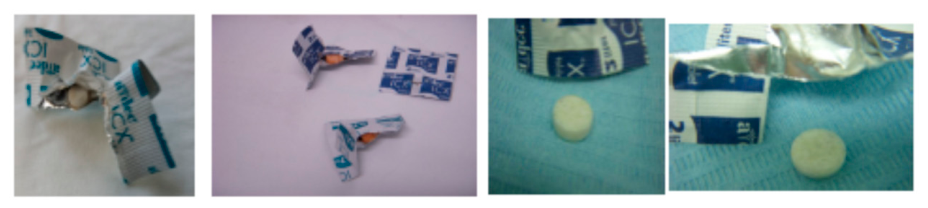
A plethora of factors are exerting pressure on the supply of products for IPC. These include natural disasters, shortages of raw materials and labor, logistical challenges, customs duties and tariffs, and the recall of antiseptics from the market due to bacterial contamination [153,154]. It is imperative to exercise meticulous caution in the management of product registration and certification (e.g., FDA, EPA, EU), along with the monitoring of expiration date and product integrity. The alteration in the conventional appearance of tablets or concentrated liquids employed for DUWL disinfection render their utilization unsafe due to uncertainty surrounding their efficacy (Figure 4).

3.4.3. Ecological Warnings

The effluent from DCU, also known as dental wastewater, is regarded as having the potential to exert a detrimental effect on the ecosystem and is deemed unsuitable for incorporation into the urban sewage system. The pollution and toxicity caused by amalgam waste, metal-free materials, particulate residues, and microorganisms (including AMR species) which are able to adapt to changing conditions pose a significant source of environmental risks [155]. Consequently, the utilization of biocides containing iodine or chlorine compounds should be avoided, as these may release mercury from amalgam into the wastewater of dental units [116,156].
It is evident that the EU material safety data sheet (MSDS) of a product, employed for the purpose of disinfection/sanitization of the DUWL, should contain ecological information in Section 12 of MSDS. It is imperative to pay close attention to hazard statements (H400, H410, H411, H412, H413, EUH059) and risk phrases (R50, R53, R58, R59) [157].
It is imperative that MIFU clearly indicates that the product does not release mercury or residues from new dental materials residues, or from amalgam waste separators [158]. However, there are significant knowledge gaps and an urgent need for regulatory and management action in this field.

3.5. Guidelines on Water Quality and EU Legislative Acts

The various usage contexts in dental settings are associated with distinct recommendations for water quality (Table 5).
The strength of the recommendation (whether it is mandatory or a good practice point, and the grade of the recommendation) is generally not indicated [116]. In contrast to the regulations or recommendations concerning the level for heterotrophic mesophilic aerobic bacteria and Legionella, there are currently no specific regulations for any dental authority on permissible levels of NTM and fungi [32].
In the context of the processing of dental devices (mainly metal-made), particular attention must be directed by dental and surgical teams towards the quality of water. They are:
  • The process of microbially influenced corrosion is initiated by bacteria, including Pseudomonas, E. coli, and Staphylococcus, as well as Archaea and fungi [159]. Pseudomonas microbial activity has been demonstrated to modify the inorganic passive layers on the surface of a metal, and is responsible for approximately 10% of corrosion [160].
  • NTM infections constitute a persistent problem that has emerged in the context of minimally invasive surgery. The contamination of surgical instruments by NTM has been associated with the use of tap water and the ineffective cleaning and sterilization of lumened instruments [161,162,163,164].
As shown in Table 6, the standard level of microbial contamination of water in non-surgical dental care and for human consumption is indicated according to the specified guidelines and directives [11,12,13,14,15,16,17,165].
Some uncertainty about water and biofilm contamination levels inside DUWL is due to the sensitivity and specificity of methods. More information on detecting heterotrophic bacteria and Legionella is included in Section 3.5.1 and Section 3.5.2.

3.5.1. Pros and Con of Using the Test to Determine Total Viable Count of Heterotrophic Mesophilic Aerobic Bacteria

Various authors have documented recent advancements in waterborne microbial detection technologies [23,166,167,168,169].
The assessment of heterotrophic aerobic bacteria in water is a reasonable procedure based on the assumption that Legionella spp. are aerobic bacteria present in the biofilm [3]. When the contamination is found to be less than 200 CFU/mL with growth at 22 °C, this seems to be a reliable indicator of the absence of Legionella [105,170]. However, other researchers argue that the true extent of high levels of contamination by heterotrophic bacteria is not reflected by annual Legionella contamination levels determined by the culture method. Indeed, Legionella growth is not supported by R2A agar, which is used to determine TVC.Furthermore, it has been demonstrated that in more than 50% of cases where DUWL exhibited a TVC of less than 100 CFU/mL, a concentration of Legionella spp. DNA level exceeding 2000 GU/L was identified [33]. Moreover, binary logistic regression findings suggest that the presence of Legionella and the total bacteria count are not correlated [105].
Notwithstanding the extant literature, the primary function of routine TVC testing is to establish an early warning system. The system has been designed to initiate action in the event of elevated TVC, thereby addressing issues related to taste or odor, as well as the probable presence of pathogens. The CDC recommends conducting TVC testing on DUWL water at four- to six-month intervals when using drinking water and purified water, respectively [13,14].
Furthermore, in the aftermath of the NTM outbreak [28], the Board of Dentistry of the Georgia Dental Association promulgated a new dental unit water quality regulation [171]. In addition to the widely adopted recommendation of the use of safe water (i.e., water with a concentration of less than 500 CFU/mL for non-surgical dental procedures, with remedial action if the TVC level is unacceptable; the maintenance of records for a minimum period of five years), it is recommended that water be tested at least quarterly and within 30 days of any plumbing modifications. The Association for Dental Safety (previously named the Organization for Safety, Asepsis and Prevention (OSAP)) concurs with the recommendation in the CDC guidelines [131,147] and the standard of no more than 500 CFU/mL of heterotrophic, mesophilic water bacteria. Nevertheless, it is recommended that levels of bacterial contamination be reduced to the lowest achievable level, as measured using standard microbiological methods or new technologies that are now available [147]. A more specific indication can be found in the South African guidelines, which state: “For routine dental treatment, use water that meets quality standards for drinking water, <500 CFU/mL of heterotrophic water bacteria or <200 CFU/mL of anaerobic heterotrophic bacteria” [57].
The observed discrepancy in the reference values for TVC (based on the growth of heterotrophic aerobic bacteria at 22 °C) is indicative of the divergent regulatory standards for drinking water across various nations. The upper limit of 200 CFU/mL is based on the standard established for standard hemodialysis fluid, which specifies TVC below 100 CFU/mL and endotoxins below 0.25 EU/mL.It is accepted that a TVC greater than 100 CFU/mL (under growth conditions for 72 h of aerobic incubation at 22 °C) or greater than 20 CFU/mL (under growth conditions for 24 h of incubation at 37 °C) is indicative of water contamination by the environment or humans, respectively.
The in-office test for bacteria TVC is increasingly utilized in dental settings. Indeed, the test is simple and cost-effective means of monitoring the quality of drinking water and DUWL water in private practices. It does not require the use of costly specialist equipment or the cost associated with microbiological hospital laboratories or accredited laboratories.
Further considerations are derived from the findings of the study on controls for the water plan at an Italian private dental practice over a number of years [172,173]. The following data is of significance for dental teams.
Notwithstanding the limitations of the in-office method, including the underestimation of TVC in comparison to the reference method, the procedure is distinguished by its simplicity and wide applicability in dental practices [100,102,172,173] for the implementation of a self-monitoring plan.
The underestimation of TVC values when the test kits are used in-office as opposed to standard laboratory procedures is primarily attributable to variations in ambient temperature and light during the incubation process, which occur in different seasons. Furthermore, the presence of residual germicides that have not been neutralized contributes to this discrepancy. It is important to note that the products employed for the decontamination of DUWL are subject to industrial secrecy regulations, which complicates the appropriate utilization of neutralizers. Disinfectants (e.g., present in the case of continuous disinfection) can be partly neutralized by common neutralizers, such as sodium thiosulfate, Letheen broth/agar, Dey–Engley broth, and Tween 80/lecithin mixtures. Microbial growth-based tests on water samples are subject to limitations (e.g., prolonged incubation times, nutritional specificity of microorganisms for nutrients in an agar plate [93], the interference of residual disinfectant, and the inability to measure the presence of damaged bacterial cells).
In order to overcome the limitations of the aforementioned method, several alternative methods have been developed.
These methods rely on microbial counts estimated from cellular nucleic acid or ATP levels [174,175,176]. The utilization of these tools has been demonstrated to reduce the duration between testing and the generation of actionable results. It appears that flow cytometry is a more suitable technique for use in hospital dental settings. Nevertheless, the consensus remains elusive between the data derived from these technologies and established standards. However, a correlation between ATP and microbial contamination lower than 200 CFU/mL could not be established, likely due to the interference of disinfectant products in the reaction mixture, non-viable bacteria, or inadequate calibration to EU limits [175,176].
A recent development has been the creation of a near real-time assay (BacteriskR) for the assessment of bacterial water quality based on endotoxin level. This assay can be conducted by non-specialist staff in situ [177,178] and has been demonstrated to possess a number of noteworthy analytical features. Firstly, it has been observed that the linearity range is in the range of 0–1000 endotoxin risk units/mL, which is approximately equivalent to 0–2 endotoxin units/mL. Secondly, a strong correlation has been demonstrated between the endotoxin level and both E. coli and Enterococci level. Thirdly, the detection limit of the method for endotoxin risk is 25 endotoxin risk units. The duration of the test is approximately 14 min, and the volume of water required is 50 μL. It is conceivable that this technology could be adapted for use in dental settings for the purpose of rapid testing.

3.5.2. Pros and Con of Utilizing the Test for the Identification and Quantification of Legionella

It is imperative to remember the absence of consensus regarding the efficacy of annual testing for Legionella or other specific infectious agents for the purpose of prevention [13,18,33,34]. With regard to Legionella spp., the potential hazard to humans is theorized to be associated with concentrations in water ranging from 104 to 105 CFU/L [23]. Furthermore, the action level that differentiates sporadic cases from outbreaks is defined as 5 × 10⁴ CFU/L of cultivable Legionella spp. [44].
The action levels that should be implemented following sampling for Legionella spp. in healthcare facilities are mandatory. As reported in Table 7, the following approaches have been proposed: a mono-factorial approach (i.e., related only to levels) and a multifactorial approach (i.e., related to levels, growth speed and extent of colonization) [12,18,116,179,180].
Italian legislation indicates a maximum limit of 103 CFU/L for Legionella spp., as a precautionary level, in consideration of the heightened greater vulnerability of certain individuals (e.g., young people, the elderly, individuals with chronic diseases, those with immunodeficiency, or those undergoing immunosuppressive therapy) [23,181]. A recent CDC document asserts the absence of a known safe level or type of Legionella [179,180]. Furthermore, it has been indicated that Legionella testing alone does not provide an indication of health risk or predict disease. Furthermore, the concentration or occurrence of Legionella species has not been demonstrated to be a reliable predictor of L. pneumophila, and the health impacts of Legionella species are minimal relative to L. pneumophila [169]. This has given rise to questions regarding the public health benefits of Legionella testing.
The inconclusive evidence regarding the risk levels of Legionella is partly attributable to analytical challenges. The reference method is cultural (UNI EN ISO 11731) [23,168,181,182,183]. Legionella testing is a mandatory requirement in Italy and other nations, with such testing being conducted at least once a year and/or whenever a case of illness occurs among staff or patients. It is imperative that the test is conducted within a laboratory that is accredited for the research and quantification of Legionella spp. Furthermore, with regard to the test’s sensitivity, the method must be capable of detecting quantities of ≤50 CFU/L. It is recommended that the water sample from DUWLs is obtained by the pool of water from all the quiver lines (200 mL each, for a total of at least of 1 L of DUWL water).
However, the standard ISO 11731 method has been shown to fail to detect Legionella [94] in the VBNC state, which has been found to be both metabolically active and infectious [184,185]. The reduced sensitivity of cultural methods in comparison to molecular methods for the detection of Legionella is attributable to a number of factors. These include the greater complexity of the method, the interference from other microbial species, the reduced sensitivity to non-pneumophilic Legionella species, and the inability to identify vital states that cannot be cultivated or are “in symbiosis” with amoebae [168,186].
A comprehensive review of the literature reveals that the merits and drawbacks of employing traditional and molecular methods for Legionella testing have been exhaustively documented [23,25,35,36,93,94,95,96,166,167,168,169,181,184,185,186,187,188,189].
These include methods employing novel technologies for the quantification of Legionella sp. (e.g., bacterial enzyme detection technology; vPCR; v-qPCR) or for the differentiation of different Legionella serotypes (e.g., real-time PCR assay) [168].
A primary challenge lies in comprehending the conditions that are likely to yield high proportions of non-viable and VBNC L. pneumophila [167]. A number of factors have been identified as contributing to the superior performance of qPCR in comparison to culture-based methods. Higher measurements obtained using quantitative PCR (qPCR) in comparison to cultivation-based methods could be attributable to the detection of uncultivable microbe, strain with lower virulence, stressed microbe, and extracellular DNA. In view of the laboriousness and incubation times (approximately 10 g in total) of cultural methods, the use of q-PCR is gaining ground for its speed and sensitivity. It is recognized as an additional or complementary tests, provided it is performed in accordance with the reference method [11,12].

3.6. Limitations of This Review

In order to ensure a comprehensive understanding of the findings of the present study, it is essential to take the following limitations into consideration. Firstly, the review was constrained to a specific time frame, namely 2021 to 2025. The primary rationale for this selection was to provide an account of the present state of knowledge on DUWL contamination, technologies, methods, and strategies. Nevertheless, we have incorporated relevant studies published outside of the specified period, with the objective of enhancing the comprehensiveness of our analysis. Moreover, the restriction of the review to English-only and Italian-only publications may have introduced a language bias by excluding research, and, above all, laws and guidelines published in other languages. Moreover, the present study does not provide a comprehensive overview of the recommendations provided by various professional associations that are in alignment with the primary recommendations.
We do not discuss the new NTM outbreaks or cases from 2022 to 2024 because data is preliminary and does not confirm the involvement of contaminated DUWL or of M. abscessus [74,190,191]. A further limitation of the study is the paucity of research that has yet to be conducted in order to establish a causal relationship between DUWL contamination and cases and outbreaks in relation to climate change and antibiotic resistance. This underscores the necessity for specific epidemiological studies grounded in robust data. A further limitation is the heterogeneity of the methodologies and types of studies and articles included. However, the reasons for this wide heterogeneity of data have been discussed in their specific sections (Section 3.1.3, Section 3.2 and Section 3.3). In some cases, there is a suspicion that data on contamination has been influenced by commercial interests.
The preponderance of extant literature on the subject pertains to studies conducted in high-income countries, with a paucity of evidence from low- and middle-income countries. However, there is also a paucity of research on the subject of drinking water quality in private dental practices. The advantages and disadvantages of employing microbiological methods as opposed to molecular methods are delineated in Section 3.5.1 and Section 3.5.2. Nevertheless, it is imperative to acknowledge that this section is exclusively concerned with the primary issues associated with the prevailing analytical methodologies. It is acknowledged that addressing the issue of waterborne infections within dental practices necessitates an interdisciplinary approach. Consequently, the employment of specific terminology may, on occasion, present challenges to individuals lacking familiarity with dental sciences. In order to facilitate comprehension for non-dental readers and students, the generic terminology has been incorporated in the majority of cases.

4. Discussion

Both professional and home oral health require an adequate supply of controlled-quality water, with microbial contamination at a level similar to that of drinking water and to a sterile solution for surgical dental care (Table 5, Table 6 and Table 7). The global DUWL market size is projected to grow from USD 600 million in 2023 to approximately USD 1.2 billion by 2032, reflecting a robust compound annual growth rate (CAGR) of 7.5% [89]. This growth is driven by regulations for IPC practices and the precautionary principle, as well as cost-effective measures to prevent infections [116]. These findings suggest a growing demand for safe dental care among those whose health is increasingly fragile and compromised, irrespective of their income [192]. This is consistent with the increasing interest in diseases caused by waterborne microbes, which has been fueled by the global increase in cases (e.g., Legionella and NTM infections) observed over the last decade [45,46,47].
In the context of a clinical dental setting, the quality of water is of significance due to the potential transmission of waterborne microbial diseases. These diseases can be transmitted by water (e.g., E. coli, Hepatitis A virus (HAV)), air (e.g., Legionella, NTM), or both, with varying efficacy (e.g., Legionella). These microorganisms can be transmitted through direct and/or indirect contact, ingestion, or aspiration of contaminated water. Moreover, respiratory infective agents can be inhaled by way of dentistry-related aerosol.
In dental settings, water is widely used for specific clinical purposes and dispensed from the DUWLs to prevent overheating and to clean and moisten oral cavity tissues (Table 5). It is also used for other dental activities and IPC, either as drinking water or more purified water. Nevertheless, the water used for dental care, which is mainly provided by DCCU and DUWLs, is often heavily contaminated with microbes, primarily opportunistic ones (Section 3.2, Tables S1 and S2), which have the potential to cause pandemics of pseudo-infections. The water from DUWLs has been found to be contaminated by a variety of pathogens or opportunistic pathogens, including Legionella, Pseudomonas, and NTM species, which are often antibiotic-resistant. The prevalence of contamination has been found to range from 60–100% for heterotrophic bacteria, 12–23.5% for L. pneumophila, 8–21.7% for Pseudomonas, and 78.3% for NTM. In addition, it is imperative to emphasize that 78% of aerosol contamination in dental settings is attributable to contaminated water from DUWLs [123].
The available evidence indicates that the utilization of contaminated water and water-derived aerosols constitutes a potential hazard to human health (Section 3.1, Section 3.1.2 and Section 3.1.3). Notably, some specific factors are to be considered in dental settings. It is important to note that water from the DUWLs can be used for extended periods (e.g., a total of 15–45 min/dental appointment) during non-surgical procedures (e.g., debond and removal of a fixed orthodontic appliance, periodontal care, conservative and prosthodontic care) [126]. In general, aerosol particles (Ø < 5 μm) remain suspended in the air for long periods, travel significant distances and disperse over a wide area. This increases the potential for exposure to respiratory infectious agents. Some IPC measures are therefore relevant. Ventilation is important in reducing the risk for the transmission of airborne infections [193]. For example, increasing ventilation from 1.2 to 10 changes per hour would reduce the risk of L. pneumophila infection by ~85% [23]. Following the COVID-19 pandemic, it has become widely accepted that airborne transmission can be limited by reducing the production of aerosols from dynamic dental instruments (e.g., dental drills used at 10,000 rpm) and oral hygiene instruments (e.g., used at 50% power).
Some people (e.g., pregnant women, young people, elderly people, people with diabetes, and people with immunodeficiency associated with many diseases, cystic fibrosis, or HIV) are particularly susceptible to infections caused by waterborne opportunistic pathogens [63,181]. The high prevalence of Pseudomonas and its AMR is alarming [38,39,76,77,95,118,119]. Moreover, dental patients face a risk for Legionella and NTM transmission because cannot wear respiratory PPE during dental care [193]. It is imperative for dental patients to use the pre-procedural mouthrinse (i.e., disinfectant mouthwash used before dental care) for reducing dental cross-infection and eye protection to prevent water-related ocular infections (e.g., by Pseudomonas, Acanthamoeba, Legionella, Burkholderia pseudomallei, Adenoviruses, Coxsackie B virus).
In addition, water used for dental care is not intended to be swallowed, although children and the elderly often do. Thus, the contamination of E. coli, Fecal Streptococci, Coliform species in water from DUWL could increase their risk of infection [34,107,109,111]. Some patients aspirate fluid (i.e., the entry of liquids or solids into the lung) and this may pose a higher risk of infection than inhaling aerosols at the same concentrations of L. pneumophila [194]. Sensitivity analyses indicate aspiration volume as a risk factor. Moreover, aspiration volume is compatible with aspiration volumes in dental patients, and dysphagia is a relevant issue as it affects 20–45% of children and 10% of people over 60. In the light of the uncertainty surrounding the infectious dose of Legionella [23], dental nurses (i.e., those primarily responsible for the use of evacuators) should avoid causing dysphagia. This involves the correct positioning of evacuator tips (i.e., various types of volume suction attachments used to remove saliva, blood, partly aerosols, and debris from a patient’s mouth during dental procedures) for dental patient in a DCU.
The primary conclusion that can be drawn from this analysis is as follows: In light of the unfeasibility of isolating patients from potential hazards (e.g., contaminated water and/or aerosol), it is imperative to implement water treatment and DUWL maintenance measures to mitigate the risk of waterborne infections (Table 4, Table 5, Table 6 and Table 7; Section 3.3, Section 3.4 and Section 3.5, Figure 4, Figure S1, Appendix A.1 and Appendix A.2).
Another important issue pertains to the dissonance between documented cases and outbreaks of iatrogenic waterborne infections, and the estimated number of dental patients who may have been exposed to waterborne pathogens during the four hundred million dental procedures that are carried out annually in Europe. The prevalence of iatrogenic waterborne infections may be underestimated [85,86], given the significant global contamination of water used for dental care (Tables S1 and S2).
The many causes of underestimating waterborne infections in dental settings have been reported in Section 3.1.3, Section 3.2, Section 3.3.1, Section 3.3.2 and Section 3.3.3, and Table 4. It is evident that waterborne infections are not always recognized as a risk, sustained by a lack of up-to-date knowledge [85]. This is the main impediment to further investigation, particularly within the private dental sector, where there are more difficulties than in the hospital sector in adopting guideline recommendations and more resource constrains. Furthermore, there are difficulties in establishing a causal relationship between dental care and infections. This is due to the fact that infections generally present with either asymptomatic or mild non-specific symptoms, or symptoms similar to those of other infections (e.g., NTM infection compared to Actinomycosis [104]. In addition, there is often a long incubation period (e.g., M. abscessus infection [28,29]), or a short one with self-limiting influenza-like illness symptoms (e.g., PF) or asymptomatic carriage (e.g., Pseudomonas). Furthermore, the probability of being diagnosed with waterborne microbial diseases (e.g., NTM) is highly dependent on socioeconomic status and access to quality healthcare [195]. The primary challenges associated with the identification of these pathogens pertain to the diagnosis of PF- and FLA-induced infections, the expeditious recognition of NTM infection, and the identification of pathogenic effectors in younger individuals. Additional challenges include the estimation of the infective dose level through culture and molecular methods, and the interpretation of the results obtained from these methods. However, the low reported frequency of FLA-caused infections and PF may be due to the lack of a diagnostic test with adequate specificity and sensitivity [196].
Furthermore, water is an important medium for the transmission of viruses and viral factors (VFs) [197], yet little is known about viruses in water and biofilm from DUWLs [198,199,200] and their transmission. Nevertheless, Mycobacteria, frequently present in DUWLs and organic matter, were identified as the key factors influencing the composition and abundance of VFs [197]. In addition, an Enterovirus model and giant viruses have been identified as hosts in amoeba species, which are commonly reported in DUWLs. Viruses are expelled by amoebae vesicles and giant viruses are suggested to be involved in the transmission of antibiotic resistance genes in the biome [114,120,201]. Furthermore, it is noteworthy that some bacterial pathogens, including Legionella, Mycobacterium, and Pseudomonas, have evolved to evade amoeba predation [114,202] and live in symbiosis with them.
Furthermore, it is essential to take into account the constraints imposed by the available analytical methodologies (e.g., cultural and molecular) and the pre-analytical challenges (Section 3.1.3, Section 3.2, Section 3.3, Section 3.5.1 and Section 3.5.2). The primary challenge pertains to the efficacy of the cultural test in discerning the VBNC state of microbes or those that are symbiotic with amoeba.
Research is required on DO level in water from DUWL, given its influence on strictly aerobic (e.g., Legionella) and microaerobic (e.g., NTM) microbes and the influence of DO level to VBNC state [140,186,203]. Further research is required to overcome the interference of residual disinfectants in DUWL water samples on tests and to develop tests with high sensitivity.
A pragmatic consideration for safety plans pertains to the source of water. Using pooled water delivered by all DCCU hoses, as recommended in contemporary guidelines, is one potential approach. Alternatively, water from individual hoses, such as air/water syringe or handpieces, can be used to identify sites requiring maintenance. From a rational standpoint, the sample volume should be proportionate to the total volumes of DUWL (approximately 200 mL) and BST (750–1800 mL). However, the laboratory typically requires a minimum of 1 L of water for the culture method. This requirement is based on the sensitivity of the method and the insidious nature of the procedure (i.e., filtration, acid treatment, filter washing, and the extended incubation step) for the Legionella test.
The reported data can be used to draw further conclusions. The underestimation of infections and pseudo-infections, in conjunction with the heterogeneity of data relating to water contamination from DUWLs, attributable to a number of factors, contributes to uncertainty about the relative infectious risk.
No data are available on the prevalence of PF in either the general or dental populations. The epidemiological trend of PF is uncertain, partly due to a lack of specific tests and different case definitions, as well as transient flu-like symptoms. Meanwhile, LD has increased dramatically [45,46,169,204,205]. However, data on an LD outbreak in a workplace is interesting. At least 23% of individuals exposed to Legionella developed PF [206].
Another matter for discussion is identifying the causes of water contamination from DUWLs. This topic was discussed in detail in Section 3.3. In general, the quality of the water supplied by drinking water services to DCU/DUWLs is largely unknown, and this creates the first uncertainty [100,207]. Unfortunately, the levels of safely managed drinking water service (SMDW) vary widely (e.g., from 95.8%, 78.2%, 69.1%, and 30.9% in high-income, upper middle-income, middle-income, and low-income countries, respectively [97]) or are unknown or very low (Australia, China, Turkey, Venezuela, and many African nations). The dental settings reported in this review are located mainly in areas (EU nations, Canada, Iran, Morocco, USA States, Jordan, Palestine, Kuwait) with SMDWs higher than 80% [25,33,34,35,64,88,98,99,100,103,104,105,106], few in areas (India, Egypt, South Africa) with SMDWs in the range of 68–78.9% [65,101,111], and many in area with SMWDs unknown (China, Turkey) [35,36,37,61,112], or very low (Iraq, Lebanon, Pakistan) [102,107,111]. Despite legal obligations [11,12], there is considerable uncertainty in Italy regarding the real quality of drinking water used to supply DCUs, as they are mainly used in private practices located in private residential or commercial buildings. Uncertainty is given by the significant water losses in the public supply system. These losses range from around 42% of the national average to extremes of up to 70% in some areas [207]. In areas with an unstable water supply (e.g., southern Italy), the hazard of colonization (e.g., caused by stagnant water) could be increased by the presence of storage tanks and/or reserve water tanks in attics or underground. Extreme weather events are expected to have unpredictable consequences for the drinking water system. In 2025, Italy was confirmed as one of the European countries most affected by extreme weather events, with over 370 incidents including floods, inundations, and landslides causing significant damage, particularly in the north of the country, peaking in intensity between late summer and autumn.
It is imperative to consider that 23% of drinking samples in Italian dental practices in the north of the country were found to be outside the reference values for TVC [100] and Legionella presence was associated to high TVC levels. It has been hypothesized that the failure of the public supply system of drinking water and the contamination of water from DUWLs may be a contributing factor to the higher incidence of Legionellosis in Italy (78 cases per million of the population) compared to Spain and Portugal. This is despite the similarity in climate in 2024 and the high quality of the safe drinking water in the countries (i.e., the EPY score was 95.7, 97.6, and 100.0 for Spain, Portugal, and Italy, respectively) [208].
The microbial variability of drinking water quality has prompted manufacturers to engineer DCUs that are disconnected from the general water supply and instead supplied with purified and/or disinfected water via dedicated bottles or reservoirs [119]. While this is an advantage for a number of reasons (e.g., use of purified water, continuous and discontinuous disinfection, etc.) (Section 3.3.1), extreme care must be taken to prevent contamination of the bottle or BST (Section 3.3.2 and Appendix A.1).
With regard to the quality of water from DUWLs, microbial contamination appears to be a widespread and general feature, sometimes associated to the type of dental instruments, clinical use, and treatments rather than significant variations by country (i.e., England, Northern Ireland, or Scotland) and clinical setting (dental hospitals or general dental practices) [116]. The available evidence on the effects of the water supply (municipal, independent reservoir, or header tank), different DCU types and DCU manufacturers, and age of DCU (old, new, or not reported) is inconclusive [62,105]. The age of the DCUs is sometimes indicated, with most falling from 7 to over 15 years.
The frequent presence of oral Streptococcus and Staphylococcus species indicates the failure of anti-retraction valves (i.e., valves designed to prevent the backward flow of patient fluids, blood, and debris into dental unit waterlines; located in handpieces, couplings, or DCCU), while Staphylococcus species indicated the transmission of hand skin flora (e.g., improper glove use and of hand hygiene) during maintenance [146]. Nevertheless, an analysis of the available data suggests that the implementation of BST, the quality of the water used for its filling, integrated continuous and discontinuous treatments of DUWL, regular maintenance, and periodic microbial checks appear to be the most effective solutions for containing water contamination from DUWL (Table 4).
Another matter for discussion is the influence of climate on the contamination of DUWLs, taking into account seasonal and territorial features, which are mainly attributed to temperature patterns. It should also be considered whether data exists relating to climate change. Nevertheless, even in the context of nosocomial and community-acquired Legionellosis cases, the data are contradictory with regard to monthly or seasonal correlations [209,210,211,212,213]. Within the EU, the majority (61%) of cases occurred during the summer months and at the onset of autumn [204]. The influence of differing seasonal and territorial climates is sometimes reported, but not systematically investigated in DUWLs [33]. The effect of seasonal change was evaluated under general conditions, whereby the TVC values at 22 °C were consistently higher (i.e., 8–60 fold) than the reference level (500 CFU/mL) in water from DUWL at the beginning and end of the working day [109]. TVC values obtained from samples grown at 22 °C were higher in autumn and winter than those obtained from samples grown at 37 °C in both autumn and winter and spring and summer.
The lower prevalence of L. pneumophila (0.03% and 22–78%, respectively) in Dutch DUWLs compared to Italian DUWLs has been attributed to higher seasonal temperatures [105]. However, it has been established that elevated temperatures, exceeding 20 °C, play a substantial role in the propensity of Legionella colonization within DUWLs [105].
Marino et al. provides partial confirmation of the importance of water temperature. In fact, no contamination has been observed in type A and type C DCUs (which are entirely supplied by the municipal water network or an independent water bottle), but above all, the water temperature was approximately 2–4 °C lower [88]. Despite some doubts on limited results, another study reported no significant difference in microbial levels (i.e., for Legionella, Pseudomonas, E.coli, or S.aureus) of inlet and outlet water in periodontics and surgery ward, with water temperatures of 23–24 °C [34].
Indicatively, the Q10 coefficient (in the range of 2–3) quantifies the temperature sensitivity of microorganisms [44]. On the other hand, temperature-regulated virulence genes code for survival effectors and all the major steps of the microbial pathogenic process, including adhesion to host cells, motility, biofilm formation, immune evasion, and resistance [55]. Nevertheless, it is also known that the DO concentration decreases by around 20% from 20 °C to 30 °C in fresh water, a phenomenon that is exacerbated in the presence of salts. This could result in the presence of Legionella in the VBNC state.
However, the presence of heterogeneous conditions and confounding factors in short-term studies means that conclusions cannot be drawn in dental settings, nor can long-term seasonal effects be captured for Legionella [214,215]. In addition, the differences in clinical outcomes for pediatric patients during the two NTM outbreaks in dental settings should suggest the presence of NTM species with specific characteristics related to geographical area or environmental differences in Georgia (USA) and California (USA), despite similar mean annual temperatures (around 16–18 °C).
A further challenge in this field pertains to the question of whether climate change or concurrent environmental factors have exerted an influence on waterborne infections and the quality of water from DUWL. Recent data shows the effect of climate change on waterborne microbial diseases, and the increase of antimicrobial resistant infections [38,48,53,54]. However, the extant data do not permit conclusions to be drawn in dental settings. Nevertheless, Yu et al. investigated Legionella cases in relation to climate and pollution changes. As indicated by the data, there was an exponential increase in LD cases when the air SO2 level was less than 4 ppb [46]. It has been established that the SO2 level is in the range of favorable conditions (1.9–11.4 ppb) in a dental setting [216]. It is imperative that the relevance of the indoor air level of SO2 on the ecology of Legionella and its pathogenic activities be investigated.
It is the opinion of certain experts and authorities that the implementation of strategies to mitigate the health impacts of climate change and factors related to waterborne infections is of crucial importance. Europe is the fastest-warming continent, as reported by the World Meteorological Organization in 2025. This is of particular pertinence to dental practices operating in regions such as the eastern Mediterranean, where the impacts of climate change are becoming increasingly evident [217].
Finally, effective management of DUWL water (Table 5) is imperative to prevent the transmission of opportunistic pathogens via waterborne and airborne routes [123,193]. This objective is pursued in accordance with the established standards and action levels (Table 6 and Table 7) and the safety of products from the clinical and ecological point of view (Section 3.4).
It is evident that maintaining DUWL contamination within the reference level poses significant challenges on a global scale. Consequently, there is an imperative for the development of practical, rapid, sensitive, and cost-effective tests that can be performed internally to verify TVC, endotoxin levels, and/or specific microorganisms (Legiolert test) [187]. In order to understand the intricate nature of waterborne infectious agents in DUWLs, extensive studies using open molecular approach are required. Preliminary data shows that microbial communities of DUWLs are characterized by their high complexity, wide variety, prevalence, and differences in relation to dental specialties (Section 3.3). The open molecular approach enables the identification of facultative anaerobic bacteria (e.g., Enterococcus), which appear to be present in biofilms under conditions of significant contamination [91].
Finally, the legal issue must be addressed. The adherence to regional and national regulations (Table 6 and Table 7) on water quality from DUWLs and for effective instrument processing is not only a legal obligation for all dental practitioners, but also a fundamental way to protect public health. Only the South African guideline specifically states a level of <200 CFU/mL of anaerobic heterotrophic bacteria for routine dental treatment [57]. In the absence of regulation concerning NTM and fungi contamination in DUWL, the precautionary principle should be applied. The precautionary principle is employed to substantiate sustainable, cost-effective measures that are intended to prevent future infections [7,40]. In the context of an NTM outbreak, the financial implications are of significance. In addition to the numerous cases that have been addressed in the initial phase (Table 3), the matter of remuneration for the remaining 198 cases arising from the NTM outbreak is currently under discussion in the Orange County Superior Court [28,131]. The recommendation to use a sterile solution should be extended to endodontics, particularly for individuals at high risk of infective endocarditis, given the lack of benefits of antibiotic prophylaxis [77] and the high levels of AMR associated with endodontic infections [218]. The ongoing challenge is that some waterborne microbes (e.g., NTM, Pseudomonas, and Enterococci etc.) can survive long-term in both dry and wet environments. They are present in DUWL water and drinking water systems and can cause infections during minimally invasive surgeries and in pediatric dentistry [28,29,78,80,219]. Therefore, greater emphasis must also be placed on the quality of water used during the processing of dental devices.

5. Conclusions

It is important to note that a DCU is a technologically advanced and costly apparatus, which can pose challenges in the control of various factors conducive to microbial contamination in DUWLs. In order to ensure optimal patient safety and prevent complications arising from DUWL contamination, it is imperative that dental professionals adopt an interdisciplinary approach and enhance their awareness of the risk of waterborne infections. It is imperative that microbial contamination is monitored at regular intervals in order to identify errors, the majority of which are often unnoticed or are near-miss (e.g., inlet drinking water quality, poor regular maintenance of BST). In consideration of the worldwide interest in DUWL water contamination, it is imperative that adequate resources are allocated for research in this field.
It is to be hoped that the extensive documentation of procedural errors and confounding factors will facilitate the development of more simple and effective water safety plans in dental settings. In the future, it is acknowledged that due to the complexity, variety, and prevalence of waterborne infectious agents in DUWLs, the use of digital twins [60] will combine real-time sensor data and ‘omics’ information from the DUWL environment with simulations in order better to prevent colonization, as well as customize treatments.
The necessity to adhere to MIFU demands the establishment of clearer and unambiguous MIFUs for the treatments of DUWLs, in addition to transparent data regarding the efficacy of the products and their ecological safety. Furthermore, it is imperative that measures for the IPC of DUWLs are firmly embedded in routine clinical practice, subject to controls by external verification bodies.
It is evident that the implementation of IPC measures to ensure the safety of water supplies constitutes a pivotal strategy in the global effort to combat AMR and the escalating prevalence of waterborne infections.

Supplementary Materials

The following supporting information can be downloaded at: https://www.mdpi.com/article/10.3390/hygiene6020023/s1. Table S1. Prevalence and level of contamination (heterotrophic bacteria, Legionella, P. aeruginosa, protozoa, other microorganisms and biofilm) in water from DUWLs and sometimes from drinking water. Data was obtained by means of classical culture methods and real-time PCR [24,31,32,33,34,38,61,64,65,88,98,99,100,101,102,103,104,105,106,107,108,109,110,111,112]. Table S2. Contamination of water from DUWLs identified by open molecular biology technology [25,35,36,37,93,95,96]. Figure S1. Details of DCCU, hoses (A) and fittings (B) (A-dec, Newberg, OR 97132, USA). Note the BST located close behind. Photo courtesy of Integrated Orthodontic Services srl, Lecco, Italy

Author Contributions

Conceptualization, L.B. and A.B.; methodology, L.B.; validation, L.B. and A.B.; formal analysis, L.B.; investigation, L.B.; resources, A.B.; data curation, L.B.; writing—original draft preparation, L.B.; writing—review and editing, L.B.; supervision, A.B.; funding acquisition, A.B. All authors have read and agreed to the published version of the manuscript.

Funding

This research received no specific grant from funding agencies in the public, commercial, or not-for-profit sectors. Only the publication costs of this work were supported by Integrated Orthodontic Services Srl in Lecco, Italy (funding reference: IOS 1/2026/DUWL).

Institutional Review Board Statement

Not applicable.

Informed Consent Statement

Not applicable.

Data Availability Statement

No new data were created or analyzed in this study. Data sharing is not applicable to this article.

Acknowledgments

We thank the experts consulted on IPC in dentistry. The text has been checked by a common word processor and DeepL Write for “spelling” and “grammar”. The authors declare that they have not used AI-tools for writing and editing the manuscript.

Conflicts of Interest

The authors declare no conflicts of interest.

Abbreviations

The following abbreviations are used in this manuscript
ADSAssociation for Dental Safety
AMRAntimicrobial Resistance
BSTBottle Storage Tank
CDCCenters for Disease Control and Prevention, USA
CFUColony Forming Unit
CAGRCompound Annual Growth Rate
DCUDental Chair Unit
DCCUDental Chair Control Unit
DODissolved Oxygen
DHAIDental Healthcare-Associated Infections
DUWLDental Units Water Line
EUEuropean Union
EDTAEthylenediaminetetraacetic Acid
FFP2Filtering Facepiece 2
FLAFree-Living Amoebae
HAIHealthcare-Associated Infections
HAVHepatitis A Virus
HWBHeterotrophic Water Bacteria
IEInfective Endocarditis
IPCInfection Prevention and Control
LDLegionella Disease
MALDI-TOF MSMatrix Assisted Laser Desorption Ionization-Time Of Flight Mass Spectrometry
MICMinimum Inhibitory Concentration
MIFUManufacturer’s Instructions for Use
MSDSMaterial Safety Data Sheet
MPNMost Probable Number
NHSNational Health Service
NTMNontuberculous Mycobacteria
OSAPOrganization for Safety, Asepsis and Prevention
PFPontiac Fever
PPE Personal Protective Equipment
RT-PCRReal-Time Polymerase Chain Reaction
SMDWSafely Managed Drinking Water
TVCTotal Viable Count
USUltrasonic
VBNCViable But Non-Cultivable
VFsViral Factors
WGSWhole-Genome Sequencing
WHOWorld Health Organization

Appendix A

All appendix sections (Appendix A.1 and Appendix A.2) have been cited in the main text.

Appendix A.1

Even almost accidental and near-miss errors can impact the effectiveness of the procedure. These errors could include:
  • Lack or inproper use of PPE (gloves, mask, protective eyewear and protective clothing) during maintenance.
  • Low quality of purified water (e.g., caused by reverse osmosis resins at the end of the usage time).
  • Plastic deterioration of the BST and DUWLs by oxidizing disinfectant (chlorine, oxygen) [148].
  • Insufficient or non-standardized disinfection measures, such as failing to clean and disinfect the inside and outside of the BST, in a timely manner. Pseudomonas, Mycobacteria, and Enterococci show very long persistance on clinical contact surfaces. It is preferable to use ready-to-use impregnated wipes disinfectants with fast contact times and wide spectra of action (e.g., a medium level disinfectant active against Mycobacteria).
  • Inadequate aseptic procedures when filling, adding proper products and screwing in the BST according to MIFU.
  • Failure to empty the BST completely after use and before the new refilling.
  • Contamination or lack of mantenence on pickup tube of the BST can also occur. In the more recently designed BST (Clean Water A-dec 300; A-dec, Newberg, OR 97132, USA), the pickup tube remains inside the bottle with a sure-fit connection. This significantly reduces exposure to ambient contaminants and the chance of cross-contamination [139].
  • Failure to pay attention to the expiration date of stored or diluted disinfectants
  • Failure to pay attention to the preparation of the product (for example, not paying attention to the volume of water per tablet/drop added of disinfectant product)
  • Stagnant time after a weekend or holiday.
  • Modification or suspension of the maintenance protocol due to lack, shortage, or unsuitability of the products.

Appendix A.2

The commercial products under scrutiny contained multiple chemical agents, including: (a) antimicrobial components, such as hydrogen peroxide with or without silver nitrate, sodium percarbonate, sodium hypochlorite, chlorhexidine gluconate, essential oils, alcohol, Povidone iodine cartrige, and electrochemical activated (oxidising) water; (b) a chelating agent, such as citric acid, EDTA; and (c) antidhesive and anti-biofilm agents. The precise concentrations and formulations of these agents are subject to industrial secrecy. Intensive treatment normally exhibit products with elevated chemicals concentration in comparison to those used for continuous atoxic application. For example, formulations based on hydrogen peroxide and silver ions contain 0.02% and 0.25% concentrations, respectively, for continuous and intensive treatments.
As an alternative to biocides, physical treatments are utilised, employing disposable microbial filters or ultraviolet light. The advantages of this approach include a reduction in pollution of the environment and a decrease in the likelihood of selecting AMR over chemicals. Nonetheless, there are still concerns regarding the effectiveness and shelf life of filters [23,104,130,149].
The following specific details are relevant for dental nurses:
  • It is imperative to exercise caution when preparing the solution for the BST. Not doing so will result in a lack of certainty with regard to final concentration of disinfectant (e.g., the quantity of a dry tablet or the number of drops of commercial product per unit volume). It is imperative to pay close attention to the volume, which is expressed in either litres or gallons.
  • The specific procedure should be adopted for the prophylaxis stations. These devices are intended for professional dental cleaning or prophylaxis and do not utilize DUWL water. It is recommended that the independent bottled water supply be replenished with purified water. Indeed, a number of prophylaxis stations are equipped with temperature control mechanisms, enabling the adjustment of the ambient temperature within the range of 25 to 40 °C. This feature is particularly beneficial for fostering the proliferation of microorganisms. It is imperative that MIFU is adhered to strictly, in conjunction with the utilisation of the product for flushing at the conclusion of the working day.

References

  1. Bertagnolio, S.; Dobreva, Z.; Centner, C.M.; Olaru, I.D.; Donà, D.; Burzo, S.; Huttner, B.D.; Chaillon, A.; Gebreselassie, N.; Wi, T.; et al. WHO global research priorities for antimicrobial resistance in human health. Lancet Microbe 2024, 5, 100902. [Google Scholar] [CrossRef]
  2. GBD 2021 Antimicrobial Resistance Collaborators. Global burden of bacterial antimicrobial resistance 1990–2021: A systematic analysis with forecasts to 2050. Lancet 2024, 404, 1199–1226. [Google Scholar] [CrossRef] [PubMed]
  3. Hayward, C.; Ross, K.E.; Brown, M.H.; Whiley, H. Water as a Source of Antimicrobial Resistance and Healthcare-Associated Infections. Pathogens 2020, 9, 667. [Google Scholar] [CrossRef] [PubMed]
  4. Soleymani, F.; Pérez-Albacete Martínez, C.; Makiabadi, M.; Maté Sánchez de Val, J.E. Mapping Worldwide Antibiotic Use in Dental Practices: A Scoping Review. Antibiotics 2024, 13, 859. [Google Scholar] [CrossRef]
  5. Zhurakivska, K.; Troiano, G.; Caponio, V.C.A. Balancing individual and community risk: Role of dentists in antimicrobial stewardship. Lancet Microbe 2025, 6, 101185. [Google Scholar] [CrossRef]
  6. Barenghi, L.; Barenghi, A.; Di Blasio, A. Infection Control in Dentistry and Drug-Resistant Infectious Agents: A Burning Issue. Part 1. In Surgical Infections—Some Facts; Baddour, M.M., Ed.; IntechOpen: Rijeka, Croatia, 2018. [Google Scholar] [CrossRef]
  7. Barenghi, L.; Barenghi, A.; Di Blasio, A. Infection control in dentistry and drug-resistant infectious agents: A burning issue. Part 2. In Surgical Infections—Some Facts; Baddour, M.M., Ed.; IntechOpen: Rijeka, Croatia, 2018. [Google Scholar] [CrossRef]
  8. Barenghi, L.; Pellegrini, M.; Barenghi, A. WHO global research priorities for antimicrobial resistance in human health. Lancet Microbe 2025, 6, 101081. [Google Scholar] [CrossRef]
  9. Dipalma, G.; Inchingolo, A.D.; Fiore, A.; Balestriere, L.; Carone, C.; Inchingolo, F.; Corsalini, M.; Severino, M.; Palermo, A.; Di Venere, D.; et al. Antimicrobial resistance in dentistry: A systematic review of prescribing practices, pathogen resistance, and clinical implications. Int. J. Dent. 2025, 2025, 8036633. [Google Scholar] [CrossRef]
  10. The Lancet Microbe. The CDC “is in trouble, and we need to fix it”. Lancet Microbe 2025, 6, 101254. [Google Scholar] [CrossRef]
  11. Directive (European Union) 2020/2184 of the European Parliament and of the Council of 16 December 2020 on the Quality of Water Intended for Human Consumption (Recast). Available online: https://eur-lex.europa.eu/eli/dir/2020/2184/oj/eng (accessed on 30 September 2025).
  12. Italian Law n. 102, June 19, 2025. Disposizioni Integrative e Correttive del Decreto Legislativo 23 Febbraio 2023, n. 18, di Attuazione Della Direttiva (UE) 2020/2184 del Parlamento Europeo e del Consiglio, del 16 Dicembre 2020, Concernente la Qualità Delle Acque Destinate al Consumo Umano. (25G00106) (GU Seie Generale n.153 del 04-07-2025-Suppl. Ordinario n. 24. Available online: https://www.gazzettaufficiale.it/eli/id/2025/07/04/25G00106/SG (accessed on 30 September 2025).
  13. Centers for Disease Control and Prevention. Summary of Infection Prevention Practices in Dental Settings: Basic Expectations for Safe Care. Centers for Disease Control and Prevention, U.S. Department of Health and Human Services. October 2016. Available online: https://www.cdc.gov/dental-infection-control/hcp/summary/index.html (accessed on 30 September 2025).
  14. Centers for Disease Control and Prevention. Best Practices for Dental Unit Water Quality. 15 May 2024. Available online: https://www.cdc.gov/dental-infection-control/hcp/dental-ipc-faqs/best-practices-dental-unit-water-quality.html (accessed on 30 September 2025).
  15. NHS England. Health Technical Memorandum 01–05: Decontamination in Primary Care Dental Practice. 26 March 2013; 98p. Available online: https://www.england.nhs.uk/publication/decontamination-in-primary-care-dental-practices-htm-01-05/ (accessed on 30 September 2025).
  16. Australian Dental Association. Guidelines for Infection Prevention and Control. Fifth Edition© 2024. Available online: https://sa.ada.org.au/closing-and-reopening-your-practice (accessed on 30 September 2025).
  17. Association for Dental Safety (Formerly Known as OSAP). Available online: https://www.myads.org/topics-dental-unit-waterlines-duwl (accessed on 30 September 2025).
  18. Italian Law: Rep. Atti n. 79/CSR del 7 Maggio 2015. Accordo Tra il Governo, le Regioni e le Province Autonome di Trento e di Bolzano, ai Sensi Degli Articoli 2, Comma 1, Lett. b) e 4, Comma 1, del Decreto Legislativo 28 Agosto 1997, n. 281, Sul Documento Recante “Linee Guida per la Prevenzione e il Controllo Della Legionellosi” (Italian Guideline for Prevention and Control of Legionellosis). Available online: https://olympus.uniurb.it/index.php?option=com_content&view=article&id=13369:csr792015&catid=7&Itemid=137 (accessed on 30 September 2025).
  19. Italian National Institute of Health. Interim Guidance for Rational Use of SARS-CoV-2 Infection Protections in Health and Socio-Health Activities in the Current SARS-CoV-2 Emerging Scenario. Version of 10 May 2020. ISS Working Group COVID-19 Infections Prevention and Control 2020, ii, 17p. Report n. 2/2020 Rev. 2. Available online: https://www.epicentro.iss.it/coronavirus/pdf/rapporto-covid-19-2-2020.pdf (accessed on 30 September 2025). (In Italian)
  20. European Union. European Charter of Patients’ Rights, November 2002. Available online: https://www.activecitizenship.net/multimedia/import/images/patientsrights/fr_english.pdf (accessed on 30 September 2025).
  21. WHO. Global Strategy on Infection Prevention and Control; World Health Organization: Geneva, Switzerland, 2023; Available online: https://www.who.int/publications/i/item/9789240080515 (accessed on 30 September 2025).
  22. European Commission. Access to Essential Services. Available online: https://employment-social-affairs.ec.europa.eu/policies-and-activities/social-protection-social-inclusion/addressing-poverty-and-supporting-social-inclusion/access-essential-services_en (accessed on 30 September 2025).
  23. Szymańska, J. Legionella spp. in a Dental Office-Current State of Knowledge. Pathogens 2025, 14, 512. [Google Scholar] [CrossRef]
  24. Bayani, M.; Raisolvaezin, K.; Almasi-Hashiani, A.; Mirhoseini, S.H. Bacterial biofilm prevalence in dental unit waterlines: A systematic review and meta-analysis. BMC Oral Health 2023, 23, 158. [Google Scholar] [CrossRef] [PubMed]
  25. Vosooghi, K.; Larypoor, M.; Sakhaee, F.; Jajin, M.G.; Moghaddam, S.; Samieefar, N.; Keramat, R.R.; Sabotki, M.A.; Fateh, A. Distribution of nontuberculous mycobacteria in dental unit waterlines: A potential health hazard in the dental office. Microb. Pathog. 2024, 196, 106963. [Google Scholar] [CrossRef] [PubMed]
  26. Ricci, M.L.; Fontana, S.; Pinci, F.; Fiumana, E.; Pedna, M.F.; Farolfi, P.; Bucci Sabattini, M.A.; Scaturro, M. Pneumonia associated with a dental unit water line. Lancet 2012, 379, 684. [Google Scholar] [CrossRef] [PubMed]
  27. Schonning, C.; Jernberg, C.; Klingenberg, D.; Andersson, S.; Paajarvi, A.; Alm, E.; Tano, E.; Lytsy, B. Legionellosis acquired through a dental unit: A case study. J. Hosp. Infect. 2017, 96, 89–92. [Google Scholar] [CrossRef]
  28. Hatzenbuehler, L.A.; Tobin-D’angelo, M.; Drenzek, C.; Peralta, G.; Cranmer, L.C.; Anderson, E.J.; Milla, S.S.; Abramowicz, S.; Yi, J.; Hilinski, J.; et al. Pediatric Dental Clinic–Associated Outbreak of Mycobacterium abscessus Infection. J. Pediatr. Infect. Dis. Soc. 2017, 6, e116–e122. [Google Scholar] [CrossRef]
  29. Singh, J.; O’Donnell, K.; Nieves, D.J.; Adler-Shohet, F.C.; Arrieta, A.C.; Ashouri, N.; Ahuja, G.; Cheung, M.; Holmes, W.N.; Huoh, K.; et al. Invasive Mycobacterium abscessus outbreak at a pediatric dental clinic. Open Forum Infect. Dis. 2021, 8, ofab165. [Google Scholar] [CrossRef] [PubMed]
  30. Realpe, O.J.C.; Gutierrez, J.C.; Sierra, D.A.; Pazmino Martinez, L.A.; Prado Palacios, Y.Y.; Echeverria, G.; de Waard, J.H. Dental Unit Waterlines in Quito and Caracas Contaminated with Nontuberculous Mycobacteria: A Potential Health Risk in Dental Practice. Int. J. Environ. Res. Public Health 2020, 17, 2348. [Google Scholar] [CrossRef]
  31. Samaranayake, L.; Fakhruddin, K.; Sobon, N.; Osathanon, T. Dental Unit Waterlines: Disinfection and Management. Int. Dent. J. 2024, 74, s437–s445. [Google Scholar] [CrossRef]
  32. Soboń, N.; Fakhruddin, K.S.; Samaranayake, L.; Remmani, N.B.; Mohammed, M.M.; Porntaveetus, T. Mycobiology of Dental Unit Water: A Systematic Scoping Review. Int. Dent. J. 2025, 75, 86–99. [Google Scholar] [CrossRef]
  33. Hoogenkamp, M.A.; Brandt, B.W.; Laheij, A.M.G.A.; de Soet, J.J.; Crielaard, W. The microbiological load and microbiome of the Dutch dental unit; ‘please, hold your breath’. Water Res. 2021, 200, 117205. [Google Scholar] [CrossRef]
  34. Moradnia, M.; Shaghayegh, M.; Darvishmotevalli, M.; Karimi, H.; Fotoohi, F.Q. Identification of infectious bacteria in dental units. Int. J. Environ. Health Eng. 2024, 13, 28. [Google Scholar] [CrossRef]
  35. Chen, P.; Zeng, J.; Hong, F.; Li, C.; Wang, H.; Yu, X. The importance of biofilm contamination control for dental unit waterlines: A multicenter assessment of the microbiota diversity of biofilm in dental unit waterlines. J. Oral Microbiol. 2024, 16, 2299496. [Google Scholar] [CrossRef]
  36. Fan, C.; Gu, H.; Liu, L.; Zhu, H.; Yan, J.; Huo, Y. Distinct microbial community of accumulated biofilm in dental unit waterlines of different specialties. Front. Cell. Infect. Microbiol. 2021, 11, 670211. [Google Scholar] [CrossRef] [PubMed]
  37. Dang, Y.; Zhang, Q.; Wang, J.; Wang, Q.; Han, M.; Niu, Y.; Li, H.; Li, X. Assessment of microbiota diversity in dental unit waterline contamination. PeerJ 2022, 10, e12723. [Google Scholar] [CrossRef]
  38. Tesauro, M.; Consonni, M.; Grappasonni, I.; Lodi, G.; Mattina, R. Dental unit water content and antibiotic resistance of Pseudomonas aeruginosa and Pseudomonas species: A case study. J. Oral Microbiol. 2022, 14, 2107316. [Google Scholar] [CrossRef]
  39. Farzinnia, G.; Anvari, Y.; Siqueira, M.F. Antimicrobial Resistance in Oral Healthcare: A Growing Concern in Dentistry. Dent. J. 2025, 13, 391. [Google Scholar] [CrossRef] [PubMed]
  40. WHO. Global Report on Infection Prevention and Control. 29 November 2024. Available online: https://www.who.int/publications/i/item/9789240103986 (accessed on 30 September 2025).
  41. Bongiovanni, A.; Colazingari, V.; Messineo, A.; Del Cimmuto, A.; De Giusti, M.; La Torre, G. Can legionellosis be considered an occupational risk in the healthcare sector? A systematic review and meta-analysis. Public Health 2023, 214, 31–37. [Google Scholar] [CrossRef] [PubMed]
  42. Hamilton, K.A.; Kuppravalli, A.; Heida, A.; Joshi, S.; Haas, C.N.; Verhougstraete, M.; Gerrity, D. Legionnaires’ disease in dental offices: Quantifying aerosol risks to dental workers and patients. J. Occup. Environ. Hyg. 2021, 18, 378–393. [Google Scholar] [CrossRef]
  43. Limaheluw, J.; van der Aa, M. Warming drinking water distribution systems in the context of climate change: A scoping review on health-related microbial and chemical water quality effects. J. Water Health 2025, 23, 952–967. [Google Scholar] [CrossRef]
  44. LeChevallier, M.W.; Prosser, T.; Stevens, M. Opportunistic Pathogens in Drinking Water Distribution Systems—A Review. Microorganisms 2024, 12, 916. [Google Scholar] [CrossRef]
  45. Pareek, A.; Singhal, R.; Pareek, A.; Chuturgoon, A.; Sah, R.; Apostolopoulos, V. Global surge of Legionnaires’ disease in 2024: Urgent call for heightened awareness and preparedness. Lancet Microbe 2025, 6, 101031. [Google Scholar] [CrossRef]
  46. Yu, F.; Nair, A.A.; Lauper, U.; Luo, G.; Herb, J.; Morse, M.; Savage, B.; Zartarian, M.; Wang, M.; Lin, S. Mysteriously rapid rise in Legionnaires’ disease incidence correlates with declining atmospheric sulfur dioxide. PNAS Nexus 2024, 3, pgae085. [Google Scholar] [CrossRef]
  47. Abbas, M.; Khan, M.T.; Iqbal, Z.; Ali, A.; Eddine, B.T.; Yousaf, N.; Wei, D. Sources, transmission and hospital-associated outbreaks of nontuberculous mycobacteria: A review. Future Microbiol. 2024, 19, 715–740. [Google Scholar] [CrossRef]
  48. Ramatla, T.; Nkhebenyane, J.; Lekota, K.E.; Thekisoe, O.; Monyama, M.; Achilonu, C.C.; Khasapane, G. Global prevalence and antibiotic resistance profiles of carbapenem-resistant Pseudomonas aeruginosa reported from 2014 to 2024: A systematic review and meta-analysis. Front. Microbiol. 2025, 21, 1599070. [Google Scholar] [CrossRef] [PubMed]
  49. WHO. WHO Bacterial Priority Pathogens List, 2024: Bacterial Pathogens of Public Health Importance to Guide Research, Development and Strategies to Prevent and Control Antimicrobial Resistance. 17 May 2024. Available online: https://www.who.int/publications/i/item/9789240093461 (accessed on 30 September 2025).
  50. Perez-Gimeno, A.; Almendro-Candel, M.B.; Lucas, I.G.; Rodriguez-Espinosa, T.; Sala-Sala, V.; Jordan, M.M.; Zorpas, A.A.; Navarro-Pedreno, J. A Review of the Impact of Climate Change on the Presence of Microorganisms in Drinking Water. Sci 2025, 7, 132. [Google Scholar] [CrossRef]
  51. Mora, C.; McKenzie, T.; Gaw, I.M.; Dean, J.M.; von Hammerstein, H.; Knudson, T.A.; Setter, R.O.; Smith, C.Z.; Webster, K.M.; Patz, J.A.; et al. Over half of known human pathogenic diseases can be aggravated by climate change. Nat. Clim. Change 2022, 12, 869–875. [Google Scholar] [CrossRef] [PubMed]
  52. McIntyre, K.M.; Setzkorn, C.; Hepworth, P.J.; Morand, S.; Morse, A.P.; Baylis, M. Systematic assessment of the climate sensitivity of important human and domestic animals pathogens in Europe. Sci. Rep. 2017, 7, 7134. [Google Scholar] [CrossRef]
  53. McGough, S.F.; MacFadden, D.R.; Hattab, M.H.; Mølbak, K.; Santillana, M. Rates of increase of antibiotic resistance and ambient temperature in Europe: A cross-national analysis of 28 countries between 2000 and 2016. Euro Surveill. 2020, 25, 1900414. [Google Scholar] [CrossRef]
  54. Fernández Salgueiro, M.; Cernuda Martínez, J.A.; Gan, R.K.; Arcos González, P. Climate change and antibiotic resistance: A scoping review. Environ. Microbiol. Rep. 2024, 16, e70008. [Google Scholar] [CrossRef]
  55. Roncarati, D.; Vannini, A.; Scarlato, V. Temperature sensing and virulence regulation in pathogenic bacteria. Trends Microbiol. 2025, 33, 66–79. [Google Scholar] [CrossRef] [PubMed]
  56. Semenza, J.C.; Paz, S. Climate change and infectious disease in Europe: Impact, projection and Adaptation. Lancet Reg. Health Eur. 2021, 9, 100230. [Google Scholar] [CrossRef]
  57. Oosthuysen, J.; Potgieter, E.; Fossey, A. Infection Control—Guidelines for Oral Health Care. South Africa. 2020. Available online: https://www.sada.co.za/sites/default/files/content-files/Infection_Control_Guidelines_Release_date_12-5-2020.pdf (accessed on 30 September 2025).
  58. Miller, C.H. Dental Unit Water Asepsis and Air Quality; Chapter 15. In Infection Control and Management of Hazardous Materials for the Dental Teams, 7th ed.; Elsevier: St Louis, MO, USA, 2024; pp. 160–169. [Google Scholar]
  59. McCartney, G.; Büchs, M.; Hensher, M.; Mazzei, M. What is a Wellbeing Economy, and what might its impact be on population health? Lancet Public Health 2025, 10, e879–e889. [Google Scholar] [CrossRef] [PubMed]
  60. Ghorbani Bam, P.; Rezaei, N.; Roubanis, A.; Austin, D.; Austin, E.; Tarroja, B.; Takacs, I.; Villez, K.; Rosso, D. Digital Twin Applications in the Water Sector: A Review. Water 2025, 17, 2957. [Google Scholar] [CrossRef]
  61. Khajezadeh, M.; Mohseni, F.; Khaledi, A.; Firoozeh, A. Contamination of dental unit water lines (DUWL) with Legionella pneumophila and Pseudomonas aeruginosa; A Middle East systematic review and meta-analysis. Eur. J. Microbiol. Immunol. 2023, 12, 93–99. [Google Scholar] [CrossRef]
  62. Shuai, T.; Shao, T.; Yi, L.; Han, S.; Jimenez-Herrera, M.F.; Wang, Z.; Li, X. The effect of different types of water sources on dental unit waterline contamination: A systematic review and meta analysis. Heliyon 2024, 10, e35745. [Google Scholar] [CrossRef]
  63. European Commission. Health at a Glance: Europe 2024. State of Health in the EU Cycle, OCDC ed. Available online: https://health.ec.europa.eu/state-health-eu/health-glance-europe/health-glance-europe-2024_en (accessed on 30 September 2025).
  64. Błaszczyk, B.; Pajaczkowska, M.; Nowicka, J.; Szymonowicz, M.; Zakrzewski, W.; Lubojanski, A.; Hercun-Jaskółka, M.; Synowiec, A.; Fedorowicz, S.; Dobrzynski, W.; et al. Microbiological Evaluation of Water Used in Dental Units. Water 2022, 14, 915. [Google Scholar] [CrossRef]
  65. Kengadaran, S.; Vikraman, R.; Indumathi, K.P.; Sundaragopal, A.K.; Adiraju, V.A.; Anusha, D. Microbial contamination of dental unit waterlines among dental clinics of India- An in vitro study. Indian J. Dent. Res. 2024, 35, 80–83. [Google Scholar] [CrossRef] [PubMed]
  66. Spagnolo, A.M.; Sartini, M.; Cristina, M.L. Pseudomonas aeruginosa in the healthcare facility setting. Rev. Med. Microbiol. 2021, 32, 169–175. [Google Scholar] [CrossRef]
  67. Męcik, M.; Stefaniak, K.; Harnisz, M.; Korzeniewska, E. Hospital and municipal wastewater as a source of carbapenem-resistant Acinetobacter baumannii and Pseudomonas aeruginosa in the environment: A review. Environ. Sci. Pollut. Res. Int. 2024, 31, 48813–48838. [Google Scholar] [CrossRef]
  68. Ambreetha, S.; Zincke, D.; Balachandar, D.; Mathee, K. Genomic and metabolic versatility of Pseudomonas aeruginosa contributes to its inter-kingdom transmission and survival. J. Med. Microbiol. 2024, 73, 001791. [Google Scholar] [CrossRef]
  69. Vinograd, A.; Ben-David, D.; Gozlan, Y.; Mor, O.; Mor, Z.; Sheffer, R.; Savion, M. Hepatitis A virus transmission in a dental clinic setting. Infect. Control. Hosp. Epidemiol. 2023, 44, 692–693. [Google Scholar] [CrossRef]
  70. Lal, S.; Singhrao, S.K.; Bricknell, M.; Pearce, M.; Morton, L.H.G.; Ahmed, W.; Crean, S.J. Monitoring Dental-Unit-Water-Line Output Water by Current In-office Test Kits. Curr. Microbiol. 2014, 69, 135–142. [Google Scholar] [CrossRef]
  71. Walters, H.L.; Maesley, R. Two cases of Pseudomonas aeruginosa epidural abscesses and cervical osteomyelitis after dental extractions. Spine 2008, 33, E293–E296. [Google Scholar] [CrossRef]
  72. Knouse, M.C.; Madeira, R.G.; Celani, V.J. Pseudomonas aeruginosa causing a right carotid artery mycotic aneurysm after a dental extraction procedure. Mayo Clin. Proc. 2002, 77, 1125–1130. [Google Scholar] [CrossRef] [PubMed]
  73. Tan, J.Y.; Teo, G.N.; Ng, E.; Tay, A.B.G.; Tay, J.R.H. Gingival necrosis related to sepsis-induced agranulocytosis due to Pseudomonas aeruginosa bacteraemia: A Case Report. J. Clin. Med. 2024, 13, 1285. [Google Scholar] [CrossRef] [PubMed]
  74. Barile, G.; Limongelli, L.; Forte, M.; Corsalini, T.; Capodiferro, S.; Corsalini, M. Mycobacterium fortuitum Infection Mimicking an Odontogenic Abscess: Report of a Pediatric Case with Relevant Literature Analysis. Pathogens 2025, 14, 513. [Google Scholar] [CrossRef]
  75. Martins, C.C.; Lockhart, P.B.; Firmino, R.T.; Kilmartin, C.; Cahill, T.J.; Dayer, M.; Occhi-Alexandre, I.G.P.; Lai, H.; Ge, L.; Thornhill, M.H. Bacteremia following different oral procedures: Systematic review and meta-analysis. Oral Dis. 2024, 30, 846–854. [Google Scholar] [CrossRef]
  76. Sperotto, F.; France, K.; Gobbo, M.; Bindakhil, M.; Pimolbutr, K.; Holmes, H.; Monteiro, L.; Graham, L.; Hong, C.H.L.; Sollecito, T.P.; et al. Antibiotic Prophylaxis and Infective Endocarditis Incidence Following Invasive Dental Procedures. A Systematic Review and Meta-Analysis. JAMA Cardiol. 2024, 9, 599–610. [Google Scholar] [CrossRef] [PubMed]
  77. Thornhill, M.H.; Gibson, T.B.; Yoon, F.; Dayer, M.J.; Prendergast, B.D.; Lockhart, P.B.; O’Gara, P.T.; Baddour, L.M. Antibiotic Prophylaxis Against Infective Endocarditis Before Invasive Dental Procedures. J. Am. Coll. Cardiol. 2022, 80, 1029–1041. [Google Scholar] [CrossRef]
  78. Cecchi, E.; Corcione, S.; Lupia, T.; De Benedetto, I.; Shbaklo, N.; Chirillo, F.; Moreo, A.; Rinaldi, M.; Faggiano, P.; Cecconi, M.; et al. Infective Endocarditis in People Who Inject Drugs: Report from the Italian Registry of Infective Endocarditis. J.Clin. Med. 2022, 11, 4082. [Google Scholar] [CrossRef]
  79. Kumar, A.; Casamassimo, P.; Kovalchin, J.; Claman, D.; Peng, J.; McDaniel, J.; Hunt, W.G.; Wong, C.A. The changing profile of infective endocarditis: A multi-year retrospective study for dentists. Int. J. Paediatr. Dent. 2024, 34, 673–679. [Google Scholar] [CrossRef]
  80. Bah, M.G.; Wilseck, Z.M.; Lin, L.Y.; Peterson, A.J.; Chaudhary, N.; Gemmete, J.J. The interplay among a dental procedure, infective endocarditis, and an acute ischemic stroke. J. Am. Dent. Assoc. 2024, 155, 244–250. [Google Scholar] [CrossRef]
  81. Saha, S.; Dudakova, A.; Danner, B.C.; Kutschka, I.; Schulze, M.H.; Niehaus, H. Bacterial Spectrum and Infective Foci in Patients Operated for Infective Endocarditis: Time to Rethink Strategies? Thorac. Cardiovasc. Surg. 2023, 71, 2–11. [Google Scholar] [CrossRef] [PubMed]
  82. Ross, K.M.; Mehr, J.S.; Greeley, R.D.; Montoya, L.A.; Kulkarni, P.A.; Frontin, S.; Weigle, T.J.; Giles, H.; Montana, B.E. Outbreaks of bacterial endocarditis associated with an oral surgery practice. New Jersey public health surveillance 2013–2014. J. Am. Dent. Assoc. 2018, 149, 191–202. [Google Scholar] [CrossRef]
  83. Samarasekera, U. Hepatitis A outbreak in Europe. Lancet Microbe 2025, 6, 101213. [Google Scholar] [CrossRef]
  84. Gagné, M.-J.; Savard, T.; Brassard, J. Interactions Between Infectious Foodborne Viruses and Bacterial Biofilms Formed on Different Food Contact Surfaces. Food Environ. Virol. 2022, 14, 267–279. [Google Scholar] [CrossRef]
  85. Vinh, R.; Azzolin, K.A.; Stream, S.E.; Carsten, D.; Eldridge, L.A.; Estrich, C.G.; Lipman, R.D. Dental unit waterline infection control practice and knowledge gaps. J. Am. Dent. Assoc. 2024, 155, 515–525.e1. [Google Scholar] [CrossRef]
  86. Eurostat. Healthcare Personnel Statistics—Dentists, Pharmacists and Physiotherapists. Available online: https://ec.europa.eu/eurostat/statistics-explained/index.php?title=Healthcare_personnel_statistics_-_dentists,_pharmacists_and_physiotherapists#:~:text=In%202023%2C%20Germany%20reported%20the,more%20than%2030%20000%20dentists (accessed on 30 September 2025).
  87. Talapko, J.; Frauenheim, E.; Juzbaši’c, M.; Tomas, M.; Mati’c, S.; Juki’c, M.; Samardži’c, M.; Škrlec, I. Legionella pneumophila—Virulence Factors and the Possibility of Infection in Dental Practice. Microorganisms 2022, 10, 255. [Google Scholar] [CrossRef]
  88. Marino, F.; Mazzotta, M.; Pascale, M.P.; Derelitto, C.; Girolamini, L.; Cristino, S. First water safety plan approach applied to a Dental Clinic complex: Identification of new risk factors associated with Legionella and P. aeruginosa contamination, using a novel sampling, maintenance and management program. J. Oral Microbiol. 2023, 15, 2223477. [Google Scholar] [CrossRef] [PubMed]
  89. S & S Insider. Dental Equipment Market Size, Share & Segmentation By Product (Dental Radiology Equipment, Dental Lasers, Systems & Parts, Laboratory Machines, Hygiene Maintenance Devices, and Other Equipment), End-User (Solo Practices, DSO/Group Practices, and Others), and Region. Global Forecast for 2025–2032. May 2025. Available online: https://www.snsinsider.com/reports/dental-equipment-market-7179 (accessed on 30 September 2025).
  90. American Dental Association. Health Policy Institute. Solo Practice Continues to Decrease. Available online: https://www.ada.org/-/media/project/ada-organization/ada/ada-org/files/resources/research/hpi/hpigraphic_solo_practice_continues_to_decrease.pdf (accessed on 30 September 2025).
  91. Salmanov, A.G.; Bondar, T.P.; Lykhota, K.M.; Dementieva, O.; Chumak, E.A.; Ostapko, O.I.; Kuvaiev, O.; Pavlenco, E.M.; Palyvoda, I.I.; Vataga, K.; et al. Microbial contamination of dental unit waterlines system in Ukraine: Results a multicenter study (2020–2022). Wiadomości Lek. 2025, 78, 974–981. [Google Scholar] [CrossRef] [PubMed]
  92. CDC. About Waterborne Disease Surveillance. 28 May 2025. Available online: https://www.cdc.gov/healthy-water-data/about/index.html#:~:text=The%20system%20collects%20data%20on,summarizing%2C%20interpreting%2C%20and%20reporting%20findings (accessed on 30 September 2025).
  93. Hussain Akbar, J.; Behbehani, J.; Karched, M. Biofilm growth and microbial contamination of dental unit waterlines at Kuwait University dental center. Front. Oral Health 2023, 3, 1071018. [Google Scholar] [CrossRef]
  94. Dietersdorfer, E.; Kirschner, A.; Schrammel, B.; Ohradanova-Repic, A.; Stockinger, H.; Sommer, R.; Walochnik, J.; Cervero-Aragó, S. Starved viable but non-culturable (VBNC) Legionella strains can infect and replicate in amoebae and human macrophages. Water Res. 2018, 141, 428–438. [Google Scholar] [CrossRef]
  95. Fleres, G. Next-Generation Sequencing to Investigate Antimicrobial Resistance: A One-Health Perspective. Ph.D. Thesis, University of Groningen, Groningen, The Netherlands, 2022. [Google Scholar] [CrossRef]
  96. Lin, S.; Ren, P.; Pan, Y. Multi dimensional analysis of dental unit waterline biofilms: Integration of morphologic observation and microbial diversity assessment. Quintessence Int. 2025, 56, 696–703. [Google Scholar] [CrossRef]
  97. Clean Water. Available online: https://ourworldindata.org/clean-water#:~:text=this%20is%20changing.-,Death%20rates%20are%20much%20higher%20in%20low%2Dincome%20countries,decline%20as%20countries%20get%20richer (accessed on 30 September 2025).
  98. Tuvo, B.; Totaro, M.; Cristina, M.L.; Spagnolo, A.M.; Di Cave, D.; Profeti, S.; Baggiani, A.; Privitera, G.; Casini, B. Prevention and control of Legionella and Pseudomonas spp. Colonization in dental units. Pathogens 2020, 9, 305. [Google Scholar] [CrossRef]
  99. Khatoonaki, H.; Solhjoo, K.; Rezanezhad, H.; Armand, B.; Abdoli, A.; Taghipour, A. Isolation and identification of potentially pathogenic free-living amoeba in dental-unit water samples. J. Water Health 2022, 20, 1126–1136. [Google Scholar] [CrossRef]
  100. Ditommaso, S.; Giacomuzzi, M.; Ricciardi, E.; Memoli, G.; Zotti, C.M. Colonization by Pseudomonas aeruginosa of dental unit waterlines and its relationship with other bacteria: Suggestions for microbiological monitoring. J. Water Health 2019, 17, 532–539. [Google Scholar] [CrossRef] [PubMed]
  101. Omran, E.A.H.; Abbass, A.A.G.; Abaza, A.F.; Elzouki, E.M. Study of some risk factors for fungal contamination of dental unit waterlines in Alexandria, Egypt. J. Infect. Dev. Ctries. 2021, 15, 1197–1204. [Google Scholar] [CrossRef] [PubMed]
  102. Umer, F.; Khan, M.; Khan, F.R.; Tejani, K. Managing dental unit waterlines: A quality improvement programme. BMJ Open Qual. 2022, 11, e001685. [Google Scholar] [CrossRef]
  103. Buitrago, J.M.; Kolbe, R.J.; Siqueira, M.F. Dental unit waterline testing practices: An 11-Year retrospective study. BMC Oral Health 2023, 23, 867. [Google Scholar] [CrossRef]
  104. Flores, R.M.; Havill, N.L.; Bouttaphom, L.; Carlin, C.; Zimkus, J. The Importance of a Dental Water Management Plan in the Prevention of Disease Transmission During Dental Procedures. Am. J. Infect. Control 2023, 51, S58. [Google Scholar] [CrossRef]
  105. Optenhövel, M.; Mellmann, A.; Kuczius, T. Occurrence and prevalence of Legionella species in dental chair units in Germany with a focus on risk factors. Eur. J. Clin. Microbiol. Infect. Dis. 2023, 42, 1235–1244. [Google Scholar] [CrossRef] [PubMed]
  106. Zayed, A.R.; Burghal, M.; Butmeh, S.; Samba-Louaka, A.; Steinert, M.; Bitar, D.M. Legionella pneumophila Presence in Dental Unit Waterlines: A Cultural and Molecular Investigation in the West Bank, Palestine. Trop. Med. Infect. Dis. 2023, 8, 490. [Google Scholar] [CrossRef]
  107. Kharma, K.; Hardan, L.; Kassis, C.; Bourgi Dr, R.; Geitani, R.; Mallah, M.; Maalouf, E.; Zogheib, C.M. Assessment and quantification of the microbial flora in the output water of two types of dental chairs: A comparative study. Int. Arab. J. Dent. 2024, 15, 101–113. [Google Scholar] [CrossRef]
  108. Mazari, W.; Boucherit-Otmani, Z.; El Haci, I.A.; Ilahi, A.; Boucherit, K. Risk assessment for the spread of Candida sp. in dental chair unit waterlines using molecular techniques. Int. Dent. J. 2018, 68, 386–392. [Google Scholar] [CrossRef] [PubMed]
  109. Alaoui, H.H.; Serhier, Z.; Abdessadek, M.; Zaim, N. Microbial quality control of dental unit water lines: A two-year study at a public university dental center in Morocco. Sci. Afr. 2025, 29, e02835. [Google Scholar] [CrossRef]
  110. Jamal, A.; Alawadhi, E. Bacterial Contamination in Dental Unit Water Lines at Primary Health Care Centers (2022–2023): A Nationwide Study. Int. J. Environ. Res. Public Health 2025, 22, 1406. [Google Scholar] [CrossRef]
  111. Kader, C.B.; de Smidt, O.; Oosthuysen, J. Water Quality and Biofilm Formation in Dental Unit Waterline Systems in Mangaung, South Africa. Int. Dent. J. 2025, 75, 2132–2149. [Google Scholar] [CrossRef] [PubMed]
  112. Zheng, Y.-Y.; Wang, Y.-Y.; Guo, Q.; Shen, C.-Y.; Huang, R.; Wang, L.; Sun, H. Long-Term Efficacy of Chlorine-Based Disinfectants Vs Multi-Enzymatic Detergent with Hypochlorous Acid for Waterline Disinfection in Inactive Dental Chair Units. Infect. Drug Resist. 2025, 18, 3055–3062. [Google Scholar] [CrossRef]
  113. Baudet, A.; Lizon, J.; Florentin, A.; Mortier, E. Initial waterline contamination by P. aeruginosa in newly installed dental chairs. Microbiol. Spectr. 2024, 12, e0396223. [Google Scholar] [CrossRef]
  114. Price, C.T.D.; Hanford, H.E.; Al-Quadan, T.; Santic, M.; Shin, C.J.; Da’as, M.S.J.; Kwaik, Y.A. Amoebae as training grounds for microbial pathogens. mBio 2024, 15, e0082724. [Google Scholar] [CrossRef]
  115. Hayward, C.; Ross, K.E.; Brown, M.H.; Bentham, R.; Whiley, H. The Presence of Opportunistic Premise Plumbing Pathogens in Residential Buildings: A Literature Review. Water 2022, 14, 1129. [Google Scholar] [CrossRef]
  116. National Services Scotland. Literature Review and Recommendations: Management of Dental Unit Waterlines. 5 August 2019. Available online: https://www.nss.nhs.scot/publications/literature-review-and-recommendations-management-of-dental-unit-waterlines-v20/ (accessed on 30 September 2025).
  117. Li, B.; Hu, Y.; Wang, Y.; Zhang, C.; Wang, Z.; Peng, X.; Feng, J. Periodic detection and disinfection maintenance of dental unit waterlines in dental simulation head model laboratories. Sci. Rep. 2025, 15, 5234. [Google Scholar] [CrossRef]
  118. Alkhulaifi, M.M.; Alotaibi, D.H.; Alajlan, H.; Binshoail, T. Assessment of nosocomial bacterial contamination in dental unit waterlines: Impact of flushing. Saudi Dent. J. 2020, 32, 68–73. [Google Scholar] [CrossRef]
  119. Abdouchakour, F.; Dupont, C.; Grau, D.; Aujoulat, F.; Mournetas, P.; Marchandin, H.; Parer, S.; Gibert, P.; Valcarcel, J.; Jumas-Bilak, E. Pseudomonas aeruginosa and Achromobacter sp. Clonal Selection Leads to Successive Waves of Contamination of Water in Dental Care Units. Appl. Environ. Microbiol. 2015, 81, 7509–7524. [Google Scholar] [CrossRef]
  120. Atanasova, N.D. Persistence of Infectious Enterovirus B in Free-Living Amoebae. Master’s Thesis, University of Alberta, Edmonton, AB, Canada, 2018. Available online: https://ualberta.scholaris.ca/items/a943ef4a-e39a-432e-bf6d-16fc129fa245 (accessed on 30 September 2025). [CrossRef]
  121. Scarano, A.; Murmura, G.; Lorusso, F.; Di Carlo, T.; Oliva, S. Efficacy of water filters for dental chair units: Assessment of the filtration action versus Coxsackievirus B5. J. Prev. Med. Hyg. 2020, 61, E296–E298. [Google Scholar] [CrossRef] [PubMed]
  122. Volgenant, C.M.C.; de Soet, J.J. Cross-transmission in the Dental Office: Does This Make You Ill? Curr. Oral Health Rep. 2018, 5, 221–228. [Google Scholar] [CrossRef]
  123. Meethil, A.P.; Saraswat, S.; Chaudhary, P.P.; Dabdoub, S.M.; Kumar, P.S. Sources of SARS-CoV-2 and Other Microorganisms in Dental Aerosols. J. Dent. Res. 2021, 100, 817–823. [Google Scholar] [CrossRef] [PubMed]
  124. Lee, S.Y.; Yoo, H.Y. Effect of dental unit waterline material on biofilm formation. Oral Biol. Res. 2023, 47, 103–106. [Google Scholar] [CrossRef]
  125. Xing, M.; Zhang, H.; Zhang, L.; Qian, W. Construction of ZnO/PCL Antibacterial Coating Potentially for Dental Unit Waterlines. J. Funct. Biomater. 2023, 14, 225. [Google Scholar] [CrossRef]
  126. Baudet, A.; Lizon, J.; Lozniewski, A.; Florentin, A.; Mortier, E. Bacterial contamination of new dental unit waterlines and efficacy of shock disinfection. BMC Microbiol. 2024, 24, 529. [Google Scholar] [CrossRef] [PubMed]
  127. Chong, J.K.H.; Adnan, S.N.A.; Ismail, N.A. The optimum duration of flushing dental unit waterlines for microbial removal. Arch. Orofac. Sci. 2021, 16, 13–23. [Google Scholar] [CrossRef]
  128. Chate, R.A.C. Incorrect and clinically compromising cross-infection control advice given to orthodontists managing patients in the coronavirus disease 2019 pandemic. Am. J. Orthod. Dentofac. Orthop. 2021, 160, 3. [Google Scholar] [CrossRef]
  129. A-dec® (Newberg, OR 97132, USA) Which Delivery System is Right for You? 18 July 2024. Available online: https://unitedkingdom.a-dec.com/blog/which-delivery-system-is-right-for-you (accessed on 30 September 2025).
  130. Petchphayaprai, C.; Chotipan, C.; Sa-ngiampak, P.; Thotsaporn, K.; Ampornaramveth, R.S. Effectiveness of iodine for continuous decontamination of dental unit waterline. BDJ Open 2023, 9, 34. [Google Scholar] [CrossRef] [PubMed]
  131. Pankhurst, C.L.; Coulter, W.A. Basic Guide to Infection Prevention and Control, 2nd ed.; Wiley Blackwell: Hoboken, NJ, USA, 2017; pp. 167–180, 105–146, 193; ISBN 9781119164982. [Google Scholar]
  132. Barbot, V.; Robert, A.; Rodier, M.-H.; Imbert, C. Update on infectious risks associated with dental unit waterlines. FEMS Immunol. Med. Microbiol. 2012, 65, 196–204. [Google Scholar] [CrossRef]
  133. Hill, A. Crashing the Biofilm Party: Understanding the Path to Safe Dental Unit Waterlines. OSAP Webinar. 13 September 2022. Available online: https://www.myads.org/index.php?option=com_jevents&task=icalrepeat.detail&evid=67&Itemid=206&year=2022&month=09&day=13&title=crashing-the-biofilm-party-understanding-the-path-to-safe-dental-unit-waterlines&uid=10ce745ac32bc0a89eac50e18983b28d (accessed on 30 September 2025).
  134. Laganà, P.; Facciolà, A.; Palermo, R.; Delia, S. Environmental Surveillance of Legionellosis within an Italian University Hospital—Results of 15 Years of Analysis. Int. J. Environ. Res. Public Health 2019, 16, 1103. [Google Scholar] [CrossRef] [PubMed]
  135. Tuttlebee, C.M.; O’Donnell, M.J.; Keane, C.T.; Russell, R.J.; Sullivan, D.J.; Falkiner, F.; Coleman, D.C. Effective control of dental chair unit waterline biofilm and marked reduction of bacterial contamination of output water using two peroxide-based disinfectants. J. Hosp. Infect. 2002, 52, 192–205. [Google Scholar] [CrossRef]
  136. O’Donnell, M.J.; Shore, A.C.; Russell, R.J.; Coleman, D.C. Optimisation of the long-term efficacy of dental chair waterline disinfection by the identification and rectification of factors associated with waterline disinfection failure. J. Dent. 2007, 35, 438–451. [Google Scholar] [CrossRef]
  137. Irfana, S.; Srikanth, P.; Kandaswamy, D.; Narayanan, L.L.; Selvarajan, R. Application of Scanning Electron Microscopy in the Detection of Biofilm in Dental Unit Waterlines. Indian J. Sci. Technol. 2015, 8, 5. [Google Scholar] [CrossRef]
  138. Ibáñez, A.; Garrido-Chamorro, S.; Barreiro, C. Microorganisms and Climate Change: A Not So Invisible Effect. Microbiol. Res. 2023, 14, 918–947. [Google Scholar] [CrossRef]
  139. A-dec. A-dec Dental Equipment: Designed with Asepsis in Mind. Available online: https://europe.a-dec.com/en/why-a-dec/optimal-infection-control (accessed on 30 September 2025).
  140. Krause, J.D. Legionella and the Role of Dissolved Oxygen in Its Growth and Inhibition: A Review. Water 2022, 14, 2644. [Google Scholar] [CrossRef]
  141. Shafipour, M.; Emrani, N.; Shahryari, A. Pseudomonas aeruginosa in dental unit waterlines: An emerging threat of virulence genes in healthcare-associated infections. BMC Oral Health 2025, 25, 1313. [Google Scholar] [CrossRef]
  142. Komiyama, E.Y.; Souto Lepesqueur, L.S.; Yassuda, C.G.; Samaranayake, L.P.; Parahitiyawa, N.B.; Balducci, I.; Yumi Koga-Ito, C. enterococcus Species in the Oral Cavity: Prevalence, Virulence Factors and Antimicrobial Susceptibility. PLoS ONE 2016, 11, e0163001. [Google Scholar] [CrossRef] [PubMed]
  143. Souto, R.; Silva-Boghossian, C.M.; Vieira Colombo, A.P. Prevalence of Pseudomonas aeruginosa and Acinetobacter spp. in subgingival biofilm and saliva of subjects with chronic periodontal infection. Braz. J. Microbiol. 2014, 45, 495–501. [Google Scholar] [CrossRef]
  144. Bagga, B.S.; Murphy, R.A.; Anderson, A.W.; Punwani, I. Contamination of dental unit cooling water with oral microorganisms and its prevention. J. Am. Dent. Assoc. 1984, 109, 712–716. [Google Scholar] [CrossRef]
  145. Ji, X.-Y.; Fei, C.-N.; Zhang, Y.; Zhang, W.; Liu, J.; Dong, J. Evaluation of bacterial contamination of dental unit water lines and use of a newly designed measurement device to assess retraction of a dental chair unit. Int. Dent. J. 2016, 66, 208–214. [Google Scholar] [CrossRef] [PubMed]
  146. Szymańska, J.; Sitkowska, J. Bacterial hazards in a dental office: An update review. Afr. J. Microbiol. Res. 2012, 6, 1642–1650. [Google Scholar] [CrossRef]
  147. Mills, S.; Porteous, N.B.; Zawada, J. Dental Unit Water Quality: Organization for Safety, Asepsis and Prevention White Paper and Recommendations—2018. J. Dent. Inf. Conr. Saf. 2018, 1, 1–27. Available online: https://www.osap.org/assets/docs/resources/toolkits-topics/dental-unit-water-quality-organization-for-safety-asepsis-and-prevention-white-paper-and-recommendations-2018.pdf (accessed on 30 September 2025).
  148. Barbosa, M.L.S.; Costa, R.D.F.S.; Silva, F.J.G.; Sousa, S.R.; Pinto, A.G.; Ferreira, B.O. Studying the Degradation of Three Polymers under Different Chlorine Concentrations and Exposure Times. Polymers 2023, 15, 3931. [Google Scholar] [CrossRef] [PubMed]
  149. De Giglio, O.; Fasano, F.; Diella, G.; Spagnuolo, V.; Triggiano, F.; Lopuzzo, M.; Apollonio, F.; Leone, C.M.; Montagna, M.T. Machine learning vs. regression models to predict the risk of Legionella contamination in a hospital water network. Ann. Ig. 2025, 37, 128–140. [Google Scholar] [CrossRef]
  150. Hong, F.; Chen, P.; Yu, X.; Chen, Q. The Application of Silver to Decontaminate Dental Unit Waterlines—A Systematic Review. Biol. Trace Elem. Res. 2022, 200, 4988–5002. [Google Scholar] [CrossRef]
  151. Regulation (EU) 2017/745 of the European Parliament and of the Council of 5 April 2017 on Medical Devices, Amending Directive 2001/83/EC, Regulation (EC) No 178/2002 and Regulation (EC) No 1223/2009 and Repealing Council Directives 90/385/EEC and 93/42/EEC (Text with EEA Relevance). Available online: https://eur-lex.europa.eu/eli/reg/2017/745/oj/eng (accessed on 30 September 2025).
  152. Alalawi, M.; Al-Saffar, H. DUWL disinfectants and Pregnancy: Is phenyalanine a cause for concern? Int. Dent. J. 2025, 75, 100829. [Google Scholar] [CrossRef]
  153. Mehrotra, P.; Desai, A. Resource sustainability and challenges in the supply chain: Implications for infection prevention. Curr. Opin. Infect. Dis. 2024, 37, 277–281. [Google Scholar] [CrossRef] [PubMed]
  154. Lompo, P.; Heroes, A.-S.; Agbobli, E.; Kühne, V.; Tinto, H.; Affolabi, D.; Jacobs, J. Bacterial Contamination of Antiseptics, Disinfectants and Hand Hygiene Products in Healthcare Facilities in High-Income Countries: A Scoping Review. Hygiene 2023, 3, 136–175. [Google Scholar] [CrossRef]
  155. Picolo Furini, G.; Belarmino, R.M.; Rigo, L. Negative Impact of Dental Wastewater on the Environment and Human Health: A Scoping Review. Water Environ. Res. 2025, 97, e70243. [Google Scholar] [CrossRef] [PubMed]
  156. Martin, N.; Sheppard, M.; Gorasia, G.-P.; Arora, P.; Cooper, M.; Mulligan, S. Awareness and barriers to sustainability in dentistry: A scoping review. J. Dent. 2021, 112, 103735. [Google Scholar] [CrossRef]
  157. European Commission. H/P Phrases. Health and Safety. Available online: https://ec.europa.eu/taxation_customs/dds2/SAMANCTA/EN/Safety/HP_EN.htm (accessed on 30 September 2025).
  158. European Commission. Mercury Decontamination of Dental Care Facilities. Available online: https://webgate.ec.europa.eu/life/publicWebsite/project/LIFE15-ENV-SE-000465/mercury-decontamination-of-dental-care-facilities (accessed on 30 September 2025).
  159. Rao, P.; Mulky, L. An Overview of Microbiologically Influenced Corrosion on Stainless Steel. ChemBioEng Rev. 2023, 10, 829–840. [Google Scholar] [CrossRef]
  160. Maji, K.; Lavanya, M. Microbiologically Influenced Corrosion in Stainless Steel by Pseudomonas aeruginosa: An Overview. J. Bio-Tribo-Corros. 2024, 10, 16. [Google Scholar] [CrossRef]
  161. Nalawade, K.; Kalikar, V.; Supe, A.; Patankar, R. Persistent Pathogens Following Minimally Invasive Surgery: Is It Time to Rethink Aldehyde-Based Disinfection? Cureus 2025, 17, e93682. [Google Scholar] [CrossRef]
  162. Ofstead, C.L.; Smart, A.G.; Holdsworth, J.E.; Gantt, B.M.; Lamb, L.A.; Bush, K.M. Unseen threats: Lumens 2.0 study reveals the hidden challenges of cleaning lumened surgical instruments. Am. J. Infect. Control. 2025, 53, 537–547. [Google Scholar] [CrossRef]
  163. Bronzatti, A.G.; de Souza, R.Q.; Niero, C.V.; Romagnoli, C.L.; da Silva, N.M.; de Moraes Bruna, C.Q.; Gioielli, L.A.; Graziano, K.U. Evaluation of cleaning and sterilization of liposuction cannulas after intentional contamination with human fat, Mycobacterium abscessus subspecies bolletii, and Geobacillus stearothermophilus. J. Hosp. Infect. 2023, 136, 8–13. [Google Scholar] [CrossRef] [PubMed]
  164. Weeks, J.W.; Segars, K.; Guha, S. The Research Gap in Non-tuberculous Mycobacterium (NTM) and Reusable Medical Devices. Front. Public Health 2020, 8, 399. [Google Scholar] [CrossRef]
  165. American Dental Association. Dental Unit Waterlines. Available online: https://www.ada.org/resources/ada-library/oral-health-topics/dental-unit-waterlines (accessed on 30 September 2025).
  166. Feleni, U.; Morare, R.; Masunga, G.S.; Magwaza, N.; Saasa, V.; Madito, M.J.; Managa, M. Recent developments in waterborne pathogen detection technologies. Environ. Monit. Assess. 2025, 197, 233. [Google Scholar] [CrossRef]
  167. Sylvestre, E.; Rhoads, W.J.; Julian, T.R.; Hammes, F. Quantification of Legionella pneumophila in building potable water systems: A meta-analysis comparing qPCR and culture-based detection methods. PLoS Water 2025, 4, e0000291. [Google Scholar] [CrossRef]
  168. Scaturro, M.; Girolamo, A.; Bella, A.; Rota, M.C.; Marella, A.M.; Amari, R.; Ingrassia, M.; Barberis, D.; Romano, C.; Borney, F.; et al. Interlaboratory comparison of culture- and PCR-based methods for Legionella pneumophila detection in drinking water samples. Appl. Environ. Microbiol. 2025, 91, e0023625. [Google Scholar] [CrossRef]
  169. LeChevallier, M.W. The Case for Monitoring for Legionella pneumophila in Drinking Water Distribution Systems. Water 2025, 17, 475. [Google Scholar] [CrossRef]
  170. Ditommaso, S.; Giacomuzzi, M.; Ricciardi, E.; Zotti, C.M. Cultural and Molecular Evidence of Legionella spp. Colonization in Dental Unit Waterlines: Which Is the Best Method for Risk Assessment? Int. J. Environ. Res. Public Health 2016, 13, 211. [Google Scholar] [CrossRef]
  171. Georgia Dental Association. Rule 150-08-05. Dental Unit Water Quality. 7 February 2025. Available online: https://www.ndds.org/advocacy/legislative-insider/2025/02/07/board-of-dentistry-adopts-new-dental-unit-water-quality-rule (accessed on 30 September 2025).
  172. Barenghi, L.; Barenghi, A. Come monitorare l’acqua del riunito: L’esperienza di uno studio dentistico (How to monitor dental unit water: A dental practice experience). Ital. Dent. J. 2025, 8, 15–16. Available online: https://www.dentaljournal.it/come-monitorare-acqua-riunito-esperienza-studio-dentistico/ (accessed on 30 October 2025).
  173. Millipore. Sampler and Swab Test Kits-User Guide. Available online: https://www.sigmaaldrich.com/deepweb/assets/sigmaaldrich/product/documents/265/383/p15325-mk.pdf (accessed on 30 September 2025).
  174. Carey, C.M.; Mills, S.E.; Vigil, R.; Aungst, M.; Favazzo, L. Application of flow cytometry to analyze microbial quality of dental unit water. JADA Found. Sci. 2024, 3, 100037. [Google Scholar] [CrossRef]
  175. Watanabe, A.; Tamaki, N.; Yokota, K.; Matsuyama, M.; Kokeguchi, S. Monitoring of bacterial contamination of dental unit water lines using adenosine triphosphate bioluminescence. J. Hosp. Infect. 2016, 94, 393–396. [Google Scholar] [CrossRef]
  176. Neogen® Clean-Trace® ATP Water Test. Available online: https://www.neogen.com/en/categories/sanitation-hygiene/clean-trace-atp-water-test/ (accessed on 30 September 2025).
  177. Good, C.R.; White, A.; Brandao, J.; Jackson, S. Endotoxin, a novel biomarker for the rapid risk assessment of faecal contamination of coastal and transitional waters. J. Water Health 2024, 22, 1044–1052. [Google Scholar] [CrossRef] [PubMed]
  178. Good, C.; White, A.; Brandão, J.; Seymour, C.; Jackson, S.K. Water Quality Assessment: Endotoxin Brings Real-Time Measurements and Non-Faecally Transmitted Bacteria to the Table. Water 2025, 17, 1674. [Google Scholar] [CrossRef]
  179. CDC. Routine Testing for Legionella. 3 January 2025. Available online: https://www.cdc.gov/control-legionella/php/toolkit/routine-testing-module.html (accessed on 30 September 2025).
  180. CDC. Legionella Control Toolkit. Routine Testing. 2025; p. F5. Available online: https://www.cdc.gov/control-legionella/media/pdfs/Control-Toolkit-Routine-Testing.pdf (accessed on 30 September 2025).
  181. Italian National Institute of Health. Guidelines for the Assessment and Management of Risk Associated to Water Safety in Internal Plumbing Systems in Priority and Non-Priority Buildings and in Certain Vessel According to Directive (EU) 2020/2184. Edited by the Ad-Hoc Working Group on Water Safety in Internal Water Distribution Systems in Buildings and Certain Ships. 2022; 177p. Rapporti ISTISAN n°22/32. Available online: https://www.acquadiqualita.it/img/sezioni/rapporti-istisan-22-32_559.pdf (accessed on 30 September 2025).
  182. Coniglio, M.A.; Yassin, M.H. Clinical and Environmental Surveillance for the Prevention of Legionellosis. Microorganisms 2024, 12, 939. [Google Scholar] [CrossRef]
  183. ISO11731:2017; Water Quality. Enumeration of Legionella. ISO: Geneva, Switzerland, 2017. Available online: https://standards.iteh.ai/catalog/standards/sist/4d5f1cc4-844f-4fe6-a26d-d3011c32633c/iso-11731-2017 (accessed on 19 March 2024).
  184. Grossi, M.R.; Dey, R.; Ashbolt, N.J. Searching for Activity Markers that Approximate (VBNC) Legionella pneumophila Infectivity in Amoeba after Ultraviolet (UV) Irradiation. Water 2018, 10, 1219. [Google Scholar] [CrossRef]
  185. Dey, R.; Mount, H.; Ensminger, A.W.; Tyrrell, G.J.; Ward, L.P.; Ashbolt, N.J. Isolation of Legionella pneumophila by Co-culture with Local Ameba, Canada. Emerg. Infect. Dis. 2019, 25, 2104–2107. [Google Scholar] [CrossRef]
  186. Redwitz, J.; Streich, P.; Zamfir, M.; Walser-Reichenbach, S.M.; Seidel, M.; Herr, C.E.W.; Heinze, S.; Quartucci, C. Verification and application of qPCR and viability-qPCR for Legionella monitoring in evaporative cooling systems complementing the conventional culture method. Sci. Total. Environ. 2024, 953, 176011. [Google Scholar] [CrossRef]
  187. Matuszewska, R.; Orych, I.; Bartosik, M. Comparison of the method of Quantitative Determination of Legionella pneumophila acc. to PN-EN ISO 11731:2017 with the Legiolert™/Quanti-Tray® (IDEXX). Ann. Agric. Environ. Med. 2024, 31, 24–28. [Google Scholar] [CrossRef]
  188. Niu, C.; Zhang, Y.; Zhang, Y. Evaluation of a Most Probable Number Method for Detection and Quantification of Legionella pneumophila. Pathogens 2022, 11, 789. [Google Scholar] [CrossRef]
  189. Screpis, G.A.; Aleo, A.; Privitera, N.; Capuano, G.E.; Farina, R.; Corso, D.; Libertino, S.; Coniglio, M.A. Biosensing Technologies for Detecting Legionella in Environmental Samples: A Systematic Review. Microorganisms 2024, 12, 1855. [Google Scholar] [CrossRef]
  190. Shirley, J. Why Do We Still Have Cases of Non-Tuberculosis Mycobacterium Infection After Dental Procedures in Children? New Cases 2022 to 2024. In Proceedings of the 2025 ADS Annual Conference, Orlando, FL, USA, 29–31 May 2025; Available online: https://myads.mclms.net/en/package/18032/course/31532/view#:~:text=This%20presentation%20addresses%20the%20persistent%20issue%20of%20Non-Tuberculosis,on%20new%20cases%20reported%20between%202022%20and%202024 (accessed on 30 September 2025).
  191. Johanis, M.; Cheema, K.S.; Young, P.A.; Bae, G.H. Bilateral Jaw Mycobacterium Abscessus Mimicking Actinomycosis: A Postoperative Complication of Wisdom Teeth Extraction. Cureus 2024, 16, e62336. [Google Scholar] [CrossRef]
  192. WHO. Global Oral Health Status Report: Towards Universal Health Coverage for Oral Health by 2030; World Health Organization: Geneva, Switzerland, 2022. [Google Scholar]
  193. Zemouri, C.; Awad, S.; Volgenant, C.; Crielaard, W.; Laheij, A.M.G.A.; de Soet, J.J. Modeling of the Transmission of Coronaviruses, Measles Virus, Influenza Virus, Mycobacterium tuberculosis, and Legionella pneumophila in Dental Clinics. J. Dent. Res. 2020, 99, 1192–1198. [Google Scholar] [CrossRef]
  194. Quon, H.; Ram, D.; Sylvestre, E.; Hamilton, K.A. The Role of Aspiration in Legionnaires’ Disease: A Quantitative Microbial Risk Assessment (QMRA)-Based Comparison with Inhalation Exposures. Environ. Sci. Technol. Lett. 2025, 12, 785–791. [Google Scholar] [CrossRef]
  195. Bents, S.J.; Powell, C.; French, J.P.; Prevots, R.; Mercaldo, R.A. Factors predicting incidence of nontuberculous mycobacteria in an era of climate change and altered ecosystems in the United States. Sci. Total. Environ. 2025, 999, 180338. [Google Scholar] [CrossRef]
  196. Carniero Santos, H.L. Free-living amoebae: A journey into historical aspects and to current discoveries. Mem. Inst. Oswaldo Cruz 2025, 120, e240246. [Google Scholar] [CrossRef]
  197. Miao, X.; Liu, C.; Liu, M.; Han, X.; Zhu, L.; Bai, X. The role of pipe biofilms on dissemination of viral pathogens and virulence factor genes in a full-scale drinking water supply system. J. Hazard. Mater. 2022, 432, 128694. [Google Scholar] [CrossRef]
  198. Kristanti, R.A.; Hadibarata, T.; Syafrudin, M.; Yılmaz, M.; Abdullah, S. Microbiological Contaminants in Drinking Water: Current Status and Challenges. Water Air Soil Pollut. 2022, 233, 299. [Google Scholar] [CrossRef]
  199. de Oliveira Neto, N.F.; Veloso Caixeta, R.A.; Zerbinati, R.M.; Zarpellon, A.C.; Caetano, M.W.; Pallos, D.; Junges, R.; Ferreira Costa, A.L.; Aitken-Saavedra, J.; Giannecchini, S.; et al. The Emergence of Saliva as a Diagnostic and Prognostic Tool for Viral Infections. Viruses 2024, 16, 1759. [Google Scholar] [CrossRef]
  200. Ghosh, S.; Kumar, M.; Santiana, M.; Mishra, A.; Zhang, M.; Labayo, H.; Chibly, A.M.; Nakamura, H.; Tanaka, T.; Henderson, W.; et al. Enteric viruses replicate in salivary glands and infect through saliva. Nature 2022, 607, 345–350. [Google Scholar] [CrossRef]
  201. Yi, X.; Liang, J.-L.; Wen, P.; Jia, P.; Feng, S.-W.; Liu, S.-y.; Zhuang, Y.-y.; Guo, Y.-q.; Lu, J.-l.; Zhong, S.-j.; et al. Giant viruses as reservoirs of antibiotic resistance genes. Nat. Commun. 2024, 15, 7536. [Google Scholar] [CrossRef]
  202. Hikal, W.M.; Kačániova, M.; Hussein, D.E.E.; Ghit, A.; Smaoui, S.; Aleem, M.T.; Čmiková, N.; Said-Al Ahl, H. Dental unit waterlines and health risks of pathogenic microbial contamination: An update review. J. Biol. Stud. 2023, 6, 282–298. [Google Scholar] [CrossRef]
  203. Mahdizade Ari, M.; Scholz, K.J.; Cieplik, F.; Al-Ahmad, A. Viable but non-cultivable state in oral microbiota: A critical review of an underexplored microbial survival strategy. Front. Cell. Infect. Microbiol. 2025, 15, 1533768. [Google Scholar] [CrossRef]
  204. ECDC. Legionnaires’ Disease Annual Epidemiological Report for 2021. Available online: https://www.ecdc.europa.eu/sites/default/files/documents/legionnaires-disease-annual-epidemiological-report-2021.pdf (accessed on 30 September 2025).
  205. Iliadi, V.; Staykova, J.; Iliadis, S.; Konstantinidou, I.; Sivykh, P.; Romanidou, G.; Vardikov, D.F.; Cassimos, D.; Konstantinidis, T.G. Legionella pneumophila: The Journey from the Environment to the Blood. J.Clin. Med. 2022, 11, 6126. [Google Scholar] [CrossRef]
  206. Nicolay, N.; Boland, M.; Ward, M.; Hickey, L.; Collins, C.; Lynch, M.; McCarthy, M.; O’Donnell, J. Investigation of Pontiac-like illness in office workers during an outbreak of Legionnaires’ disease, 2008. Epidemiol. Infect. 2010, 138, 1667–1673. [Google Scholar] [CrossRef]
  207. ISTAT Water Statistics—Years 2020–2023. Still Too High Total Water Losses in Public Supply Network. 22 March 2024. Available online: https://www.istat.it/wp-content/uploads/2024/06/WWD-2024-ENG.pdf (accessed on 30 September 2025).
  208. World Population Review. Water Quality by Country 2026. Available online: https://worldpopulationreview.com/country-rankings/water-quality-by-country (accessed on 4 February 2026).
  209. Buse, H.Y.; Morris, B.J.; Gomez-Alvarez, V.; Szabo, J.G.; Hall, J.S. Legionella Diversity and Spatiotemporal Variation in the Occurrence of Opportunistic Pathogens within a Large Building Water System. Pathogens 2020, 9, 567. [Google Scholar] [CrossRef]
  210. Riccò, M.; Peruzzi, S.; Ranzieri, S.; Giuri, P.G. Epidemiology of Legionnaires’ Disease in Italy, 2004–2019: A Summary of Available Evidence. Microorganisms 2021, 9, 2180. [Google Scholar] [CrossRef] [PubMed]
  211. Ambrose, M.; Roselle, G.A.; Kralovic, S.M.; Gamage, S.D. Healthcare-Associated Legionella Disease: A Multi-Year Assessment of Exposure Settings in a National Healthcare System in the United States. Microorganisms 2021, 9, 264. [Google Scholar] [CrossRef]
  212. Joseph, C.A.; Watson, J.M.; Harrison, T.G.; Bartlett, C.L.R. Nosocomial Legionnaires’ disease in England and Wales, 1980–1992. Epidemiol. Infect. 1994, 112, 329–346. [Google Scholar] [CrossRef]
  213. Von Baum, H.; Ewig, S.; Marre, R.; Suttorp, N.; Gonschior, S.; Welte, T.; Lück, C.; Group CNfCAPS. Community-acquired Legionella pneumonia: New insights from the German Competence Network for Community Acquired Pneumonia. Clin. Infect. Dis. 2008, 46, 1356–1364. [Google Scholar] [CrossRef]
  214. Graham, F.F.; Finn, N.; White, P.; Hales, S.; Baker, M.G. Global Perspective of Legionella Infection in Community-Acquired Pneumonia: A Systematic Review and Meta-Analysis of Observational Studies. Int. J. Environ. Res. Public Health 2022, 19, 1907. [Google Scholar] [CrossRef]
  215. Simmering, J.E.; Polgreen, L.A.; Hornick, D.B.; Sewell, D.K.; Polgreen, P.M. Weather-dependent risk for Legionnaires’ disease, United States. Emerg. Infect. Dis. 2017, 23, 1843–1851. [Google Scholar] [CrossRef]
  216. Helmis, C.G.; Tzoutzas, J.; Flocas, H.A.; Halios, C.H.; Stathopoulou, O.I.; Assimakopoulos, V.D.; Panis, V.; Apostolatou, M.; Sgouros, G.; Adam, E. Indoor air quality in a dentistry clinic. Sci. Total. Environ. 2007, 377, 349–365. [Google Scholar] [CrossRef]
  217. World Meteorological Organization. European State of the Climate: Extreme Events in Warmest Year on Record. 15 April 2025. Available online: https://wmo.int/news/media-centre/european-state-of-climate-extreme-events-warmest-year-record#:~:text=%E2%80%9CThis%20report%20highlights%20that%20Europe,between%20eastern%20and%20western%20Europe (accessed on 4 February 2026).
  218. Ardila, C.-M.; Bedoya-García, J.-A.; González-Arroyave, D. Antimicrobial resistance in patients with endodontic infections: A systematic scoping review of observational studies. Aust. Endod. J. 2023, 49, 386–395. [Google Scholar] [CrossRef]
  219. American Pediatric Dentists. Pulp Therapy for Primary and Immature Permanent Teeth the Reference Manual of Pediatric Dentistry 2025–2026. Available online: https://www.aapd.org/research/oral-health-policies--recommendations/pulp-therapy-for-primary-and-immature-permanent-teeth/ (accessed on 30 September 2025).
Figure 1. Factors influencing water contamination in DUWLs [23,25,26,27,28,29,30,31,32,33,34,35,36,37,38,39,58,61,62,64,69,70,87,93,95,96,98,99,100,101,102,103,104,105,106,107,108,109,110,111,112,113,120,121,122,123,124,131,132,133,134,135,136]; MO: microorganism.
Hygiene 06 00023 g001
Figure 2. The presence of biofilm with a sticky consistency has been observed within a DUWL. A small part of the biofilm was removed with a dental cement spatula. Photo courtesy of Integrated Orthodontic Services srl, Lecco, Italy.
Hygiene 06 00023 g002
Figure 3. The dental chair control unit (DCCU; without top cover for photographic purposes) of a modern DCU (A-dec 300) (A-dec, Newberg, OR 97132, USA)) [139] (A) features a variety of narrow tubes of different lengths and degree of complexity, which are interconnected with plastic hoses and metal control valves. It is important to note the delivery system control block (dimensions: approximately 8 cm × 3.8 cm × 2.5 cm) (B), which is installed in the DCCU ((A), bottom). It is equally important to acknowledge the close proximity of water lines, microchips, and electrical circuits of the delivery system, differently colored. The A-dec® delivery system control block ((B): details; installation: (A), bottom)) has been designed in an innovative manner that eliminates trapped, stagnant water (B). Photos courtesy of Integrated Orthodontic Services srl, Lecco, Italy.
Hygiene 06 00023 g003
Figure 4. Examples of tablet integrity loss during the COVID-19 pandemic. During the COVID-19 pandemic, supply issues arose for several disinfectant products; some batches of tablets (e.g., ICX, A-dec, Newberg, OR 97132, USA) for DUWL treatment, normally crystalline white in appearance, were opaque or brownish. The manufacturer and the Italian distributor (Dental Trey, 47016 Predappio, Italy) did not provide an explanation, but the product was replaced. Photo courtesy of Integrated Orthodontic Services srl, Lecco, Italy.
Hygiene 06 00023 g004
Table 1. Summary of the PICO framework applied.
Population/sampleWater and biofilm from DUWL and drinking water system in dental setting
Exposure/InterventionWaterborne microbial contamination and treatment technologies
Comparison/controlNo treatment
OutcomesEfficacy of treatment technologies and water quality guidelines
Table 2. Health risks associated to contaminated water from DUWL as of 2015 [70,71,72].
Infectious AgentMedical Consequence
Pseudomonas aeruginosaOral abscesses
Acute purulent maxillary sinusitis
Right carotid artery mycotic aneurysm *
Epidural abscesses and cervical osteomyelitis *
Legionella pneumoniaHumoral response
Legionella dumoffiiPneumonia/Legionellosis
Pseudomonas and
Proteus species
Rhinitis
NTMCervical lymphadenitis *
Mycobacterium gordonaeEndocarditis *
AcanthamoebaOcular keratitis
Bacterial endotoxinAsthma
Inflammation due to acute phase cytokine release
Hypersensitivity pneumonitis
* after tooth extraction.
Table 3. Recent cases and outbreak associated with contaminated water from DUWLs [26,27,28,29,30].
Setting
(Nation)
Year
(Ref.)
PathogenInfected People (n°)Comments *
Dental practice (IT, EU)2012
[26]
Legionella pneumophila serogroup 11
Female,
Lethal
Contaminated cold water (1500 CFU/L), DUWL (4000 CFU/L), and water from dental handpieces
(62,000 CFU/L).
Way of transmission: to be clarified.
Ongoing in the court.
Dental practice (SV, EU)2017
[27]
Legionella pneumophila serogroup 11
Male,
Lethal
Contaminated water from cup filler outlet: (2000 CFU/L).
Pediatric dental practice
(Orange
County, GA,
USA)
2015
[28]
Mycobacterium
abscessus
(NTM)
20
(3–11 years) having
pulpotomy;
9 presumptive + 11 confirmed M. abscessus
infection
M. abscessus was isolated from all water samples
from DUWL.
All water samples
exceeded 500 CFU/mL.
Average TVC≈ 91,000 CFU/mL
Children’s dental clinic
(Anaheim, CA, USA)
2016
[29]
Mycobacterium
abscessus
(NTM)
68
(2–11 years)
pulpotomy;
46 presumptive
+22
confirmed
M. infection
M. abscessus was isolated from all water samples
from DUWL.
Dental practice (Quito and Caracas, VE)2020
[30]
NTM3 adult
patients
Contaminated water
from DUWL
* Legionella: Common reference point for actionable concern is often set at 1000 CFU/L, with lower thresholds (<100 CFU/L, or even <1 CFU/mL) applied for drinking water or higher-risk systems, according to guidelines from different organizations.
Table 4. Failure rates of different water decontamination treatments on DUWL [131].
Water TreatmentFailure Rate of Treatments
Continuous disinfection with tablets + shock treatment12%
Continuous disinfection with tablets23%
Use of filters (straw/cartridge)28%
Only intensive/shock treatment40%
Water coming from a centralized system/daily liquid42%
Table 5. Needs of water quality and recommendation in dental settings [12,13,14,15,16,17,18,19,21,132].
Water UtilizationWater Specific UsageRegulatory Standards of Water Quality
General human consumption
Some IPC measures
Some dental procedures
  • Personal and professional hygiene, oral hygiene
  • Consumption of beverages and medications
  • Hand hygiene
  • Dilution of surface disinfectants
  • Mixing alginate for dental impressions
  • Dilution of mouthwash
As defined by the national and supranational (such as the EU) limits for drinking water
Non-surgical dental treatments requiring a DCU and dynamic instruments (dental drills)
  • The water supplied by DUWL is used to clean or cool the oral–dental tissues and dental instruments
  • Water supply for external devices (e.g., prophylaxis stations)
  • As defined by the national and supranational limits for drinking water
  • Equal to the quality of the dialysis water (0.25 endotoxin units/mL)
Invasive dental or oral surgical proceduresFlushing and cooling using sterile saline delivered by a separate sterile water delivery system, or alternatively, using a sterile disposable syringe filled with sterile solution
  • As indicated in guidelines [13,14,17]
  • Water solution with less than 0.02 endotoxin units/mL
Processing of reusable dental devices
(IPC measure)
The process applies to critical instruments and is also recommended for semi-critical instruments
In general, efficient processing depends on many factors, including water quality [132]
There are specific recommendation for water quality during the phases of dental device process and final steam sterilization
  • Cleaning (either manual or automated) and rinsing, can be performed with drinking water as long as the water hardness is low enough and other aspects of water quality are satisfactory [15] and follow MIFU for cleaning products and for automated washer devices (ultrasonic washers and washer-disinfectors)
  • During steam sterilization, use fresh, purified water with an indicative conductivity of 1–15 µS/cm, as specified in the MIFU of steam autoclaves
Table 6. Indicators for microbial contamination and their reference values for water intended for human consumption and nonsurgical dental care, in accordance with the relevant guidelines and EU legislation [11,12,13,14,15,16,165].
UE Regulatory
Standard for Water
[11,12]
UK HTM
01–05 and
Australian Dental Association
Guideline
[15,16]
USA
American Dental Association
Guideline
[165]
USA
CDC/EPA
Guideline
[13,14]
Intended for:Human ConsumptionDental CareDental CareDental Care
Indicators for Microbial Contamination
(Viable Count/Volume)
Heterotrophic mesophilic aerobic bacteria at 22 °C (TVC)No abnormal change (<100 CFU/mL *)100–200 CFU/mL
or <200 CFU/mL
<200 CFU/mL<500 CFU/mL
Legionella ssp.<1000 CFU/LWhen TVC are elevated;
doubts about IPC efficacy
Management during outbreak and cases
Coliform bacteria0/100 mLn.i. <5% of samples
Intestinal enterococci0/100 mLn.i. n.i.
Escherichia coli0/100 mLn.i. n.i.
n.i.: not indicated; * previous limit in UE (until to 1 December 2026); TVC: total viable counts.
Table 7. Action levels following sampling for Legionella spp. by means of mono-factorial or multifactorial approach on drinking water adapted to dental settings [12,18,116,179,180]. Some specific maintenance operations on the DCU and DUWLs are indicated in the right column.
Legionella spp. Level
[Reference]
Legionella
Growth Status and Colonization
Actions
Detectable to 900 CFU/L;
Concentration steady for two consecutive sampling rounds; detection in a few of many tested locations within the water system
[179,180]
Well controlled in drinking waterNo action is needed.
1000–9900 CFU/L;
10-fold increase in concentration; detection in a common source location that serves multiple areas or in more than one location within the water system
[179,180]
Poorly controlled in drinking waterReview ICP program on DUWL and/or drinking water system or purified water system and perform online remedial treatment.
≥10,000 CFU/L;
100-fold or grater increase concentration; detection in multiple locations and a common source location or across many locations within the water system
[179,180]
Uncontrolled in drinking waterReview ICP program on DUWL and/or drinking water system or purified water system and perform online remedial treatment.
≤100 CFU/L
[12,18,116]
Controlled water within the drinking water system and DUWLsNo action [12,18]. Alternatively, any detection should be investigated. If necessary, the system should be sampled again to aid interpretation of the results in line with the monitoring strategy and risk assessment [116].
>100 and up to 1000 CFU/L.
[12,18,116]
Poorly controlled water within the drinking water system
and DUWLs
If the minority of samples are positive (<30% and in the absence of clinical cases for Italian guideline), the system should be resampled.
If similar results are found again, a review of ICP measures and risk assessment should be carried out to identify any remedial actions necessary.
If the majority of samples are positive (>30% for Italian guidelines), the system may be colonized, albeit at a low level. An immediate review of the ICP measures and risk assessment should be carried out to identify any other remedial action required. Shock disinfection of the DUWL and system should be considered and is mandatory with clinical cases.
>1000 CFU/L
[12,18,116]
Uncontrolled water within the drinking water system
and DUWLs
Whether or not cases are present, the system should be resampled and an immediate review of the control measures and risk assessment carried out to identify any remedial actions, including possible disinfection of the system, and replacing worn parts (O-ring, valves, leaking parts) positive terminals and/or checking the processing of external devices (air/water syringes and their terminal). Re-testing (at least from the same DUWL or water emitters that tested positive) should take place a few days after disinfection and at frequent intervals afterwards until a satisfactory level of control is achieved.
Disclaimer/Publisher’s Note: The statements, opinions and data contained in all publications are solely those of the individual author(s) and contributor(s) and not of MDPI and/or the editor(s). MDPI and/or the editor(s) disclaim responsibility for any injury to people or property resulting from any ideas, methods, instructions or products referred to in the content.