1. Introduction
The human oral cavity contains diverse and densely populated microbial communities distributed across distinct anatomical niches. Gram-positive and Gram-negative bacteria, along with yeasts, colonize tooth surfaces as supragingival and subgingival plaque biofilms and also inhabit the tongue, gingiva, and buccal mucosa [
1,
2]. Saliva continuously bathes these surfaces and facilitates microbial dispersion throughout the mouth. While surface-associated microorganisms exist within structured biofilms, salivary microorganisms are suspended within a fluid matrix [
3].
Daily environmental exposures—including diet, beverages, and medications—significantly influence the oral ecosystem [
1,
2]. Residual dietary substrates promote microbial proliferation and metabolic activity, leading to acid production, pH changes, and the release of inflammatory components such as endotoxins and other cellular products. These cumulative effects contribute to the initiation and progression of common oral diseases, including dental caries, gingivitis, and periodontal diseases, which remain highly prevalent worldwide [
1,
2,
3]. Despite education and public health efforts, effective plaque control remains inconsistent due to behavioral and compliance-related factors.
Antimicrobial oral hygiene formulations represent an important strategy for controlling dental plaque and limiting microbial proliferation. Reliable and efficient methods for assessing microbial viability are essential for evaluating such formulations and monitoring oral health status [
3,
4]. Traditional culture-based techniques remain the reference standard; however, they are time-consuming, labor-intensive, and less suited for rapid or high-throughput screening. Consequently, alternative methods based on metabolic activity, including colorimetric redox assays, have gained attention [
5,
6,
7,
8,
9].
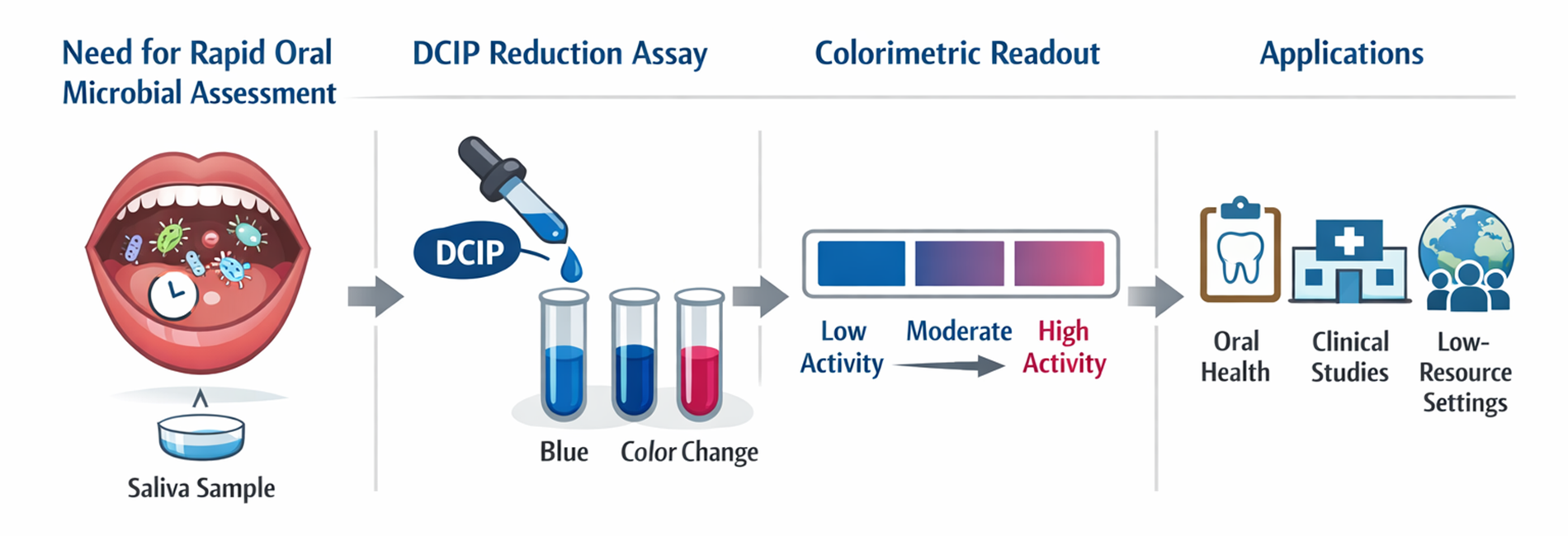
2,6-Dichlorophenolindophenol (DCIP) is a redox dye that undergoes color change upon reduction by metabolically active cells. The oxidized form is blue, while the reduced form is colorless, enabling both visual and spectrophotometric assessment of cellular viability. Prior studies have demonstrated its application in bacteria, yeast, and other biological systems [
10,
11,
12,
13,
14,
15,
16,
17,
18,
19,
20,
21]. In our previous work, DCIP reduction correlated strongly with viable counts of individual oral bacterial and yeast strains grown under controlled laboratory conditions [
9]. Reduction occurred only in the presence of viable organisms, and the method proved useful for evaluating antimicrobial oral hygiene formulations.
However, laboratory cultures do not reflect the biological complexity of the human oral cavity. Clinical oral samples contain heterogeneous microbial communities composed of hundreds of species existing in varying physiological states and structural arrangements. Whether DCIP maintains reliability and sensitivity when applied to such complex clinical specimens has not been established.
Therefore, the objective of the present study was to evaluate the utility of DCIP as a rapid, low-cost method for assessing microbial viability in heterogeneous oral samples collected directly from human volunteers. By testing this approach under clinically relevant conditions, this investigation addresses a critical gap between laboratory validation and real-world application. Establishing a practical viability platform for complex oral samples has potential implications for antimicrobial ingredient testing, clinical research, and public health-oriented oral health monitoring.
2. Materials and Methods
2.1. Chemicals, Buffers, and Microbiological Media
2,6-Dichlorophenolindophenol sodium salt hydrate (DCIP; analytical grade) was obtained from Sigma-Aldrich (St. Louis, MO, USA). All chemicals were prepared using sterile, deionized water and stored according to the manufacturer’s recommendations. Microbiological media were purchased from Becton Dickinson (Sparks, MD, USA). Hanks’ Balanced Salt Solution (HBSS) was obtained from Life Technologies–Invitrogen (Carlsbad, CA, USA).
Fresh working solutions of DCIP (80 μM) were prepared prior to each experimental session to ensure reagent stability. All reagents were equilibrated to room temperature before use.
2.2. Ethical Approval
The study protocol, informed consent documents, and sample collection procedures were reviewed and approved by the Institutional Review Board (IRB) of the University at Buffalo prior to initiation of any study-related activities. All participants provided written informed consent before enrollment.
2.3. Study Population
A total of 184 adult volunteers (18–70 years) were enrolled. Participants were recruited from the local community through prior engagement with the dental clinic and institutional outreach. All study procedures were conducted at the University at Buffalo School of Dental Medicine.
2.4. Inclusion Criteria
Participants were eligible if they
Were 18–70 years of age;
Were in good general and oral health at screening;
Presented with ≥20 natural teeth with scorable facial and lingual surfaces;
Had no more than five periodontal pockets;
Had a Löe–Silness Gingival Index ≥ 1.0 [
22];
Had a Turesky Modified Quigley–Hein Plaque Index ≥ 1.5 [
23,
24];
Were willing and able to comply with study requirements.
2.5. Exclusion Criteria
Participants were excluded if they presented with the following:
Moderate to severe periodontal disease;
Untreated caries or other oral pathology;
Salivary dysfunction;
Orthodontic appliances or removable dentures;
Dental treatment within one month prior to enrollment.
Additional exclusion criteria included the following:
Use of antibiotics, anti-inflammatory medications, or anticoagulants within three months;
Pregnancy or lactation;
Chronic systemic conditions (e.g., diabetes, cardiovascular disease, immunocompromised status);
History of substance abuse;
Participation in another clinical study within one month;
Inability to comply with study procedures;
Smoking status was not recorded and was not used as an exclusion criterion.
2.6. Washout Phase
Following enrollment, participants completed a minimum one-week washout phase. Subjects were provided a commercially available fluoride toothpaste and a soft-bristled toothbrush and were instructed to discontinue all previously used oral hygiene products. Participants were instructed to brush twice daily using only the provided materials. Compliance was verbally confirmed prior to sample collection.
2.7. Oral Sample Collection and Handling
Participants refrained from performing oral hygiene procedures and abstained from food or drink for at least two hours prior to sampling. To minimize potential diurnal variability, all samples were collected between 8:00 AM and 10:00 AM.
Each participant rinsed with 10 mL of sterile water for 15 s and expectorated into a sterile, wide-mouthed collection tube labeled with a unique subject identification code. Samples were transported immediately to the laboratory and processed within one hour of collection.
Samples were gently mixed to ensure homogeneity prior to analysis. Aliquots were prepared under sterile conditions for DCIP reduction assays and viable bacterial plate counts. DCIP reduction assays were performed in triplicate, while viable bacterial counts obtained by culture plating were performed in duplicate. Mean values from these replicate measurements were used for all subsequent statistical analyses.
2.8. DCIP Reduction Assay
The relationship between viable cell counts and DCIP reduction activity was evaluated using a dilution series prepared from each oral rinse sample. Dilutions were prepared in sterile phosphate-buffered saline to yield final concentrations representing 100%, 85%, 70%, 55%, 40%, 25%, and 10% of the original sample.
For each dilution, 100 μL aliquots were dispensed in triplicate into wells of a 96-well microplate. An equal volume (100 μL) of freshly prepared DCIP solution (80 μM) was added to each well, resulting in a total reaction volume of 200 μL.
Absorbance at 600 nm was measured immediately following DCIP addition (time 0) and again after 20 min of incubation at room temperature using a microplate reader (DTX 880, Beckman Coulter, Indianapolis, IN, USA). Plates were protected from direct light during incubation.
To correct for inter-sample turbidity differences, baseline absorbance values were recorded prior to DCIP addition and subtracted from subsequent readings obtained in the presence of DCIP.
DCIP reduction was calculated as the percentage change in absorbance according to the formula:
Mean values from triplicate wells were used for analysis. Negative controls included DCIP without biological sample and heat-inactivated samples.
2.9. Microbial Viability Assessment
Microbial viability was determined using standard culture-based techniques. Samples were serially diluted in sterile phosphate-buffered saline using 10-fold dilution steps. Each dilution was vortexed thoroughly to ensure uniform distribution.
Dilutions were plated in duplicate onto Tryptic Soy Agar supplemented with 5% sheep blood (Becton Dickinson, Sparks, MD, USA) using a spiral plater. Plates were incubated in an anaerobic chamber at 37 °C for a minimum of 48 h.
Following incubation, colony-forming units (CFU) were enumerated and expressed as CFU/mL of the original sample. Duplicate plate counts were averaged prior to calculation. CFU values were log10-transformed before statistical analysis.
Viable counts represent cultivable organisms recovered under anaerobic conditions supportive of obligate and facultative oral bacteria. These values do not represent total oral microbiota and may underestimate organisms that are non-cultivable under these conditions or present in a viable-but-non-culturable (VBNC) state. Yeasts were not specifically enumerated, as plating conditions were optimized for broad bacterial recovery rather than fungal quantification. These culture conditions recover a broad range of obligate and facultative anaerobic oral bacteria; however, the results represent cultivable microbial counts rather than the complete oral microbiome.
2.10. Statistical Analysis
Statistical analyses were performed using Microsoft Excel (Microsoft Corp., Redmond, WA, USA). Data were independently verified for consistency prior to analysis.
Descriptive statistics were calculated for DCIP reduction percentages and viable bacterial counts (CFU/mL). Viable counts were log10-transformed prior to analysis to normalize distribution and reduce heteroscedasticity commonly observed in microbiological data.
Normality of log-transformed CFU data and DCIP reduction values was assessed using graphical methods (histograms and Q–Q plots). The relationship between viable bacterial counts (independent variable) and DCIP reduction activity (dependent variable) was evaluated using Pearson’s correlation coefficient (r).
In addition, linear regression analysis was performed to assess the strength and direction of association between log10 CFU/mL and DCIP reduction percentage. The coefficient of determination (R2) was calculated to quantify the proportion of variance in DCIP reduction explained by viable counts.
Statistical significance was defined as p < 0.05 (two-tailed). Results are reported as mean ± standard deviation unless otherwise specified.
All DCIP measurements were performed in triplicate and averaged prior to statistical evaluation. Duplicate viable plate counts were averaged before log transformation. To improve statistical transparency, confidence intervals and linear regression analyses were included in addition to Pearson correlation.
3. Results
Results from 184 oral rinse samples (108 women, 76 men; mean age 46 years) were evaluated. The relationship between viable bacterial counts determined by quantitative culture on agar and DCIP reduction activity in fresh oral samples obtained from human volunteers was examined. DCIP reduction assays were performed in triplicate, and viable plate counts were performed in duplicate, with mean values used for analysis.
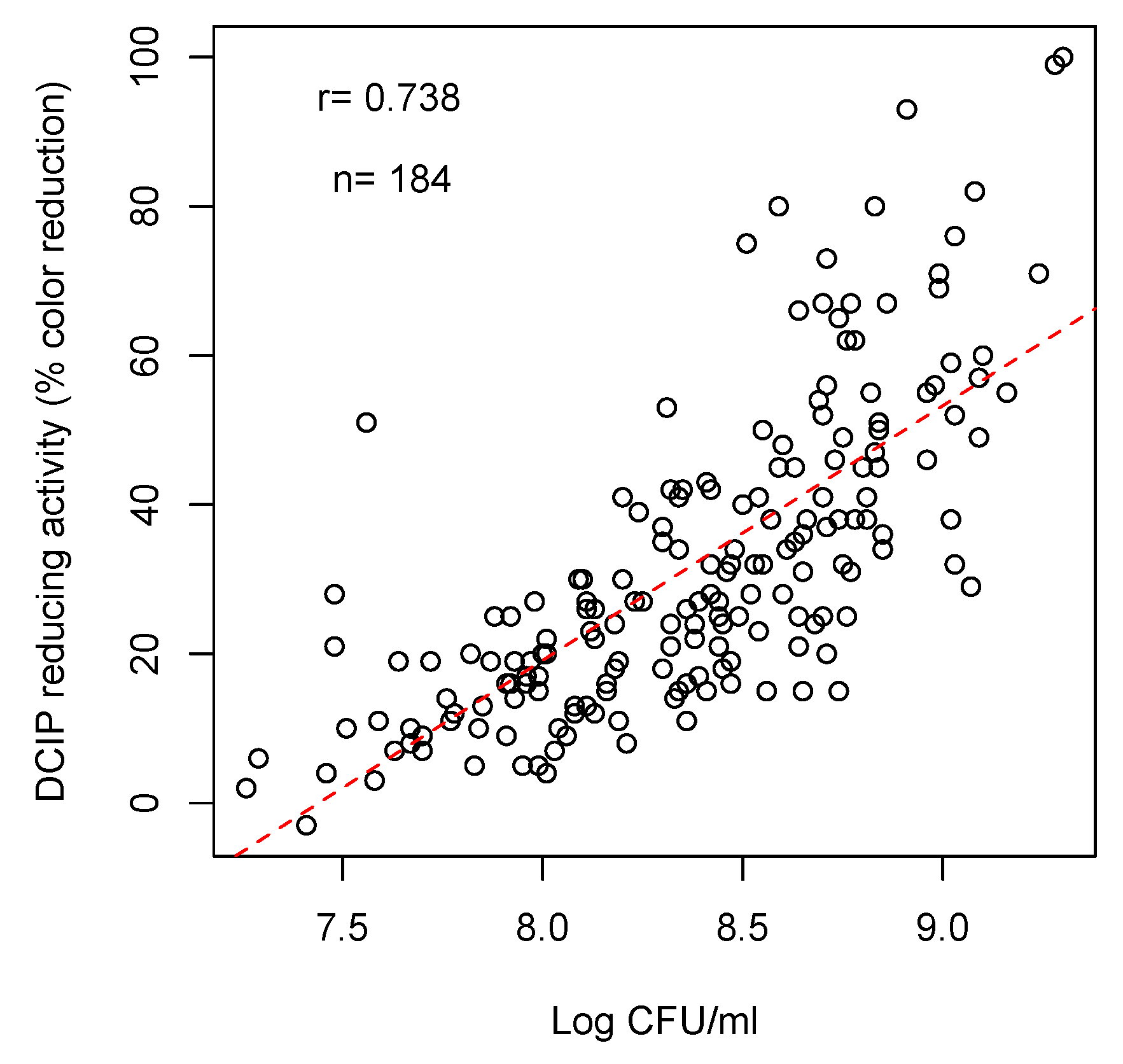
Pearson’s correlation analysis demonstrated a strong positive association between log
10-transformed viable bacterial counts and percent DCIP reduction (r = 0.74; 95% CI: 0.658–0.794;
p < 0.001). Linear regression analysis further confirmed this relationship between viable bacterial counts and DCIP reduction. (
Figure 1). These results indicate that colorimetric measurement of DCIP reduction provides estimates of microbial viability comparable to those obtained by traditional agar plating. Viable bacterial counts ranged from 7.26 to 9.30 log
10 CFU/mL, representing an approximate 2-log difference (~100-fold) between the lowest and highest microbial counts observed among study participants. This wide range in microbial load provided a broad dynamic range over which DCIP reduction demonstrated a consistent positive association with viable bacterial counts.
Control conditions included DCIP incubated in buffer alone, saliva samples without DCIP, and reaction mixtures lacking one essential component of the assay. None of these control conditions demonstrated measurable DCIP reduction, and absorbance values remained unchanged during the assay period.
Additional controls included aliquots of selected human samples that were heat-inactivated (95 °C for 10 min) prior to testing. These heat-treated samples showed no detectable DCIP reduction, confirming that the observed colorimetric changes were dependent on metabolically active microbial cells.
Together, these findings demonstrate that DCIP reduction closely reflects cultivable viable microbial load in heterogeneous oral samples collected from human subjects.
4. Discussion
The redox dye 2,6-dichlorophenolindophenol (DCIP) has been used previously to evaluate the metabolic activity and viability of a variety of microorganisms, including bacteria [
8,
12,
14], environmental organisms [
15,
16,
19,
21], and yeasts, as well as mammalian cell cultures [
10,
11,
13,
17]. Additional applications include the assessment of both resting and activated neutrophils [
18]. Together, these studies demonstrate that DCIP functions as a versatile redox indicator for assessing cellular metabolic activity. In our previous investigation, DCIP was evaluated using well-defined laboratory cultures of oral microorganisms grown under controlled conditions, including Gram-positive bacteria, Gram-negative bacteria, and yeasts. In those studies, DCIP reduction correlated with microbial viability determined using traditional plate count methods, confirming the suitability of the method for assessing microbial viability in laboratory cultures.
The present study extends those findings by evaluating DCIP reduction in oral samples collected from human volunteers representing heterogeneous microbial communities. Several measures were implemented to standardize sample collection and processing. Participants were healthy adults with adequate oral hygiene, and individuals with chronic medical conditions, ongoing medical or dental treatments, or recent healthcare procedures were excluded. Clinical plaque and gingival index scores were consistent with those commonly reported in the general population [
25]. In addition, participants completed a washout phase prior to sampling in which they used a standardized toothpaste and toothbrush. This step minimized variability associated with the use of diverse oral hygiene formulations.
Participants were instructed to refrain from oral hygiene procedures and from eating or drinking prior to sampling, and all collections were conducted between 8:00 and 10:00 AM to reduce variability associated with daily behavioral activities and circadian influences. Although these procedures improved standardization of sampling, abstinence from food or drink may also influence salivary microbial composition and metabolic activity [
26]. While studies of the oral microbiome generally indicate relative stability of resident microbial communities, temporal variation related to meals and daily activities has been reported. Future investigations could further evaluate potential diurnal influences on DCIP reduction across multiple time points.
The sampling approach used in this study was based on prior investigations evaluating oral hygiene formulations in human volunteers [
27]. Oral rinse sampling was selected because it enables collection of microorganisms from multiple oral niches, providing a representation of the overall oral microbial population. In contrast to direct saliva collection, which may be inconsistent for some individuals, the rinse method provides samples with relatively uniform viscosity and simplifies downstream laboratory processing. This approach facilitates reproducible sample handling and supports higher-throughput analytical workflows.
The results of this investigation demonstrate that DCIP reduction correlates strongly with viable bacterial counts obtained by culture-based methods. Viable bacterial counts ranged over approximately two log units across the study population, representing substantial variability in microbial load among individuals. The relatively large study population (n = 184) further strengthens the generalizability of these findings. The observed correlation between DCIP reduction and viable bacterial counts supports the potential utility of DCIP as a surrogate indicator of microbial viability in heterogeneous oral samples.
Appropriate controls were included to verify assay specificity. DCIP incubated in buffer alone, reaction mixtures lacking biological samples, and samples lacking DCIP showed no measurable reduction in the dye. In addition, heat-inactivated samples did not demonstrate DCIP reduction, confirming that the reaction depended on metabolically active cells. These observations are consistent with previous reports demonstrating that DCIP reduction is dependent on microbial metabolic activity [
7,
9,
11].
Assessment of microbial viability using rapid assays has been explored using several alternative approaches. For example, adenosine triphosphate (ATP) has been investigated as a marker of microbial viability. Previous studies evaluating salivary ATP levels demonstrated correlations with viable bacterial counts and showed sensitivity to antimicrobial agents such as chlorhexidine [
27,
28]. However, ATP-based assays typically require specialized instrumentation, reagent kits, and strict light-controlled laboratory conditions. In contrast, the DCIP assay described in the present study utilizes widely available laboratory equipment and provides a visually observable readout, which may simplify implementation in laboratory and educational settings.
Another study evaluating ATP as an indirect diagnostic method for
Streptococcus mutans,
Streptococcus sobrinus, and
Lactobacillus species found that the predictive value of ATP measurements for specific cariogenic organisms was limited [
29]. In comparison, the present study focuses on total viable microbial burden rather than detection of specific taxa, which may explain the stronger association observed between DCIP reduction and overall microbial viability.
Overall, the procedures used in this investigation required relatively simple sampling techniques, minimal sample preparation, and commonly available laboratory equipment. These characteristics allow efficient processing of a large number of clinical samples and support rapid and scalable workflows. The simplicity of the DCIP assay also suggests potential utility in educational and demonstration settings. Because the color change associated with DCIP reduction is visually observable and directly reflects microbial metabolic activity, this method may provide a useful tool for illustrating the importance of oral hygiene and microbial control. These findings support the feasibility of applying DCIP reduction to heterogeneous clinical oral samples and provide a foundation for future comparative studies with additional microbial viability methods.
Limitations
This study evaluated the ability of DCIP reduction to estimate microbial viability in oral rinse samples collected from healthy adult volunteers. Although the findings demonstrate a strong association between DCIP reduction and cultivable bacterial counts, several limitations should be considered.
First, viable bacterial counts were determined using culture-based methods under anaerobic conditions, which primarily detect cultivable organisms. These measurements may underestimate the total microbial population present in oral samples, as some organisms may be non-cultivable or exist in a viable-but-non-culturable (VBNC) state. Therefore, the reported CFU values reflect cultivable microbial load rather than the complete oral microbiome.
Second, the study population consisted of generally healthy individuals meeting defined enrollment criteria. Individuals with significant periodontal disease, systemic illness, or recent dental treatment were excluded. Consequently, the findings may not fully represent microbial viability patterns in populations with oral disease or altered systemic health conditions.
Third, the DCIP assay provides a measure of overall metabolic activity and total viable microbial burden but does not differentiate between bacterial species or microbial communities. Future studies incorporating molecular techniques, such as sequencing-based microbiome analyses or quantitative PCR, could further characterize the relationship between microbial composition and DCIP reduction.
Fourth, oral rinse samples represent a composite of microorganisms collected from multiple oral surfaces and primarily reflect loosely adherent microbial populations. While this approach facilitates standardized sampling, it may not fully represent biofilm-associated microorganisms tightly attached to dental or mucosal surfaces.
Finally, although efforts were made to standardize sampling conditions, including washout of oral hygiene products and morning sample collection, factors such as diet, hydration status, and circadian influences may still affect microbial metabolic activity. Future studies evaluating multiple sampling time points and longitudinal designs could further assess the stability and reproducibility of DCIP measurements.
Despite these limitations, the present investigation provides evidence supporting DCIP reduction as a rapid and practical approach for estimating viable microbial burden in oral samples. The results also establish a foundation for future studies evaluating the effects of oral hygiene formulations, dental treatments, or behavioral interventions on oral microbial viability.
5. Conclusions
This study demonstrates that reduction in the redox dye 2,6-dichlorophenolindophenol (DCIP) provides a simple, rapid, and cost-effective approach for estimating viable microbial burden in oral rinse samples collected from human subjects. A strong and statistically significant association was observed between DCIP reduction and viable bacterial counts determined by conventional culture methods, supporting the use of this colorimetric assay as a surrogate indicator of microbial viability in heterogeneous oral samples.
The method requires minimal sample preparation, utilizes commonly available laboratory equipment, and enables analysis of a large number of samples within a short time frame. These features make the DCIP assay suitable for applications in laboratory research, ex vivo evaluation of antimicrobial oral hygiene formulations, and potentially in clinical studies investigating changes in oral microbial viability.
An additional advantage of the DCIP assay is the visually observable color change associated with microbial metabolic activity. This characteristic may facilitate its use as an educational and demonstration tool to illustrate the relationship between microbial burden and oral hygiene practices.
Overall, the results of this investigation support DCIP reduction as a practical platform for rapid assessment of viable oral microorganisms and provide a foundation for future studies exploring its applications in oral health research, clinical evaluation of antimicrobial interventions, and public health education initiatives. While ATP-based assays have been used to estimate microbial viability, the DCIP method described here provides a simpler colorimetric approach that requires minimal instrumentation.