
Microalgae from the Extremes: Unlocking Their Potential for Emerging Pollutant Removal and Sustainable Water Remediation

 ,
,  , , ,
, , , 
Abstract
1. Introduction
1.1. Background
1.2. Knowledge Gap
1.3. Scope of Review
2. Global Freshwater Pollution Crisis
2.1. What Are Emerging Pollutants (EPs)?
2.1.1. Pharmaceuticals and Personal Care Products
2.1.2. Per and Polyfluoroalkyl Substances (PFAS)
2.1.3. Endocrine-Disrupting Compounds
2.1.4. Pesticides
2.1.5. Microplastics
2.1.6. Nanomaterials
2.1.7. Disinfection By-Products
2.2. Limitations of Conventional Treatment Technologies
2.3. Why Extremophilic Microalgae?
2.4. Bibliographic Data
3. Classification of Extremophilic Algae and Their Habitats
3.1. Thermophiles
3.2. Psychrophiles
3.3. Halophiles
3.4. Acidophiles
3.5. Barophiles
3.6. Metal-Tolerant Microalgae
3.7. Radiation-Resistant Species
4. Methodology for Isolation and Cultivation of Extremophilic Microalgal Species
- Hydrological conditions at sampling sites: Water levels in crystallization basins are frequently minimal or absent, especially during summer months. Furthermore, the entrapment of microorganisms within developing halite crystals during brine crystallization offers novel avenues for specimen collection.
- Salinity fluctuations: Given the drastic annual salinity gradients inherent to hypersaline environments, precise in situ measurement is critical to determining the osmotic threshold for laboratory cultivation. Failure to accurately replicate these native environmental conditions often results in the loss of stress-adapted metabolic phenotypes, thereby diminishing the biomass productivity and biotechnological potential of isolated strains [140].
- Soil sediments: Microbial mat samples are frequently densely embedded in complex matrices of mud and detritus. This extraneous material creates xenic confounding factors that significantly impede the establishment of stable, axenic cultures [144]. Mitigating this requires rigorous separation techniques-such as multi-stage washing or density-based fractionation to ensure the effective recovery of targeted extremophilic cells without compromising their structural integrity.
- Diversity of sample types: The isolation of photosynthetic microorganisms from aqueous versus benthic microbial mat samples necessitates distinct procedural approaches to ensure the effective recovery of specific microbial subsets. Furthermore, laboratory cultivation parameters must be adjusted in response to factors such as the seasonal timing of collection and relevant environmental variables. Establishing axenic laboratory cultures remains a primary bottleneck, as standardized protocols for hypersaline isolates are currently lacking in the broader scientific literature [145]. To address this challenge, researchers are increasingly employing advanced techniques such as single-cell isolation via fluorescence-activated cell sorting and specialized aerosol-based methodologies to enhance recovery rates from these complex, multi-phasic environments [144].
4.1. Factors Influencing Cultivation
4.1.1. Growth Medium
4.1.2. Light Intensity and Quality
4.1.3. Temperature
4.1.4. Salinity Stress
4.1.5. Nutrient Availability
5. Application and Mechanism for Emerging Pollutant Removal
5.1. Mechanisms of Emerging Pollutant Removal
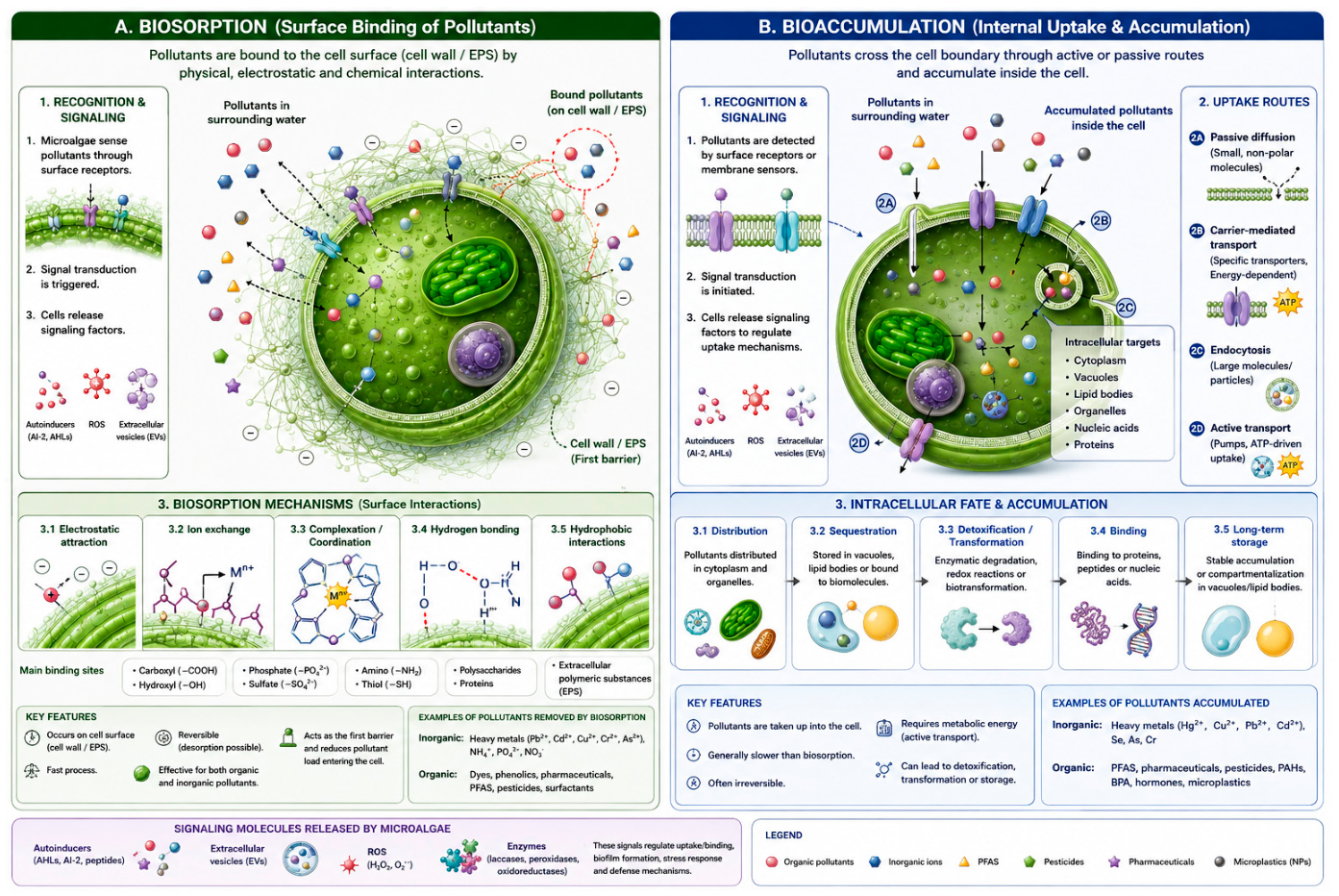
5.1.1. Biosorption
5.1.2. Bioaccumulation
5.1.3. Biodegradation
5.1.4. Photodegradation Enhancement
6. Challenges and Gaps
6.1. Growth Rate
6.2. Biomass Harvesting
6.3. Genetic Instability
6.4. Scale-Up
6.5. Trade-Off Between Stress-Induced Pollutant Removal and Productivity
7. Future Directions
7.1. Metabolic Engineering
7.2. AI-Guided Strain Selection
7.3. Multi-Omics Integration
7.4. Climate-Resilient Microalgae
7.5. Nature-Based Solutions
7.6. Efficient Strain Selection
7.7. Policy and Regulatory Frameworks
8. Conclusions
Author Contributions
Funding
Data Availability Statement
Acknowledgments
Conflicts of Interest
Abbreviations
| BCF | Bio-concentration factor |
| ECs | Emerging contaminants |
| EDCs | Endocrine-disrupting compounds |
| PFAS | Per- and Polyfluoroalkyl substances |
| PFOA | Perfluorooctanoic acid |
References
- Abdelfattah, A.; Ali, S.S.; Ramadan, H.; El-Aswar, E.I.; Eltawab, R.; Ho, S.; Elsamahy, T.; Li, S.; El-Sheekh, M.M.; Schagerl, M.; et al. Microalgae-Based Wastewater Treatment: Mechanisms, Challenges, Recent Advances, and Future Prospects. Environ. Sci. Ecotechnology 2022, 13, 100205. [Google Scholar] [CrossRef] [Scilit] [PubMed]
- Qin, Y.; Li, T.; Nie, C.; Geng, X.; Sun, X. Microalgae: Promising Solutions Paving the Way toward a Greener and More Sustainable Future. Front. Fuels 2025, 3, 1643675. [Google Scholar] [CrossRef] [Scilit]
- Anand, U.; Dey, S.; Parial, D.; Federici, S.; Ducoli, S.; Bolan, N.; Dey, A.; Bontempi, E. Algae and Bacteria Consortia for Wastewater Decontamination and Transformation into Biodiesel, Bioethanol, Biohydrogen, Biofertilizers and Animal Feed: A Review. Environ. Chem. Lett. 2023, 21, 1585–1609. [Google Scholar] [CrossRef] [Scilit]
- Fabris, M.; Abbriano, R.M.; Pernice, M.; Sutherland, D.L.; Commault, A.S.; Hall, C.; Labeeuw, L.; McCauley, J.I.; Kuzhiuparambil, U.; Ray, P.; et al. Emerging Technologies in Algal Biotechnology: Toward the Establishment of a Sustainable, Algae-Based Bioeconomy. Front. Plant Sci. 2020, 11, 279. [Google Scholar] [CrossRef] [Scilit] [PubMed]
- Wollmann, F.; Dietze, S.; Ackermann, J.; Bley, T.; Walther, T.; Steingroewer, J.; Krujatz, F. Microalgae Wastewater Treatment: Biological and Technological Approaches. Eng. Life Sci. 2019, 19, 860–871. [Google Scholar] [CrossRef] [Scilit] [PubMed]
- Sharma, P.; Gaur, V.K.; Gupta, S.; Varjani, S.; Pandey, A.; Gnansounou, E.; You, S.; Ngo, H.H.; Wong, J.W.C. Trends in Mitigation of Industrial Waste: Global Health Hazards, Environmental Implications and Waste Derived Economy for Environmental Sustainability. Sci. Total Environ. 2021, 811, 152357. [Google Scholar] [CrossRef] [Scilit] [PubMed]
- Rojas-Villalta, D.; Rojas-Rodríguez, D.; Villanueva-Ilama, M.; Guillén-Watson, R.; Murillo-Vega, F.; Gómez-Espinoza, O.; Núñez-Montero, K. Exploring Extremotolerant and Extremophilic Microalgae: New Frontiers in Sustainable Biotechnological Applications. Biology 2024, 13, 712. [Google Scholar] [CrossRef] [Scilit] [PubMed]
- Srimongkol, P.; Sangtanoo, P.; Songserm, P.; Watsuntorn, W.; Karnchanatat, A. Microalgae-Based Wastewater Treatment for Developing Economic and Environmental Sustainability: Current Status and Future Prospects. Front. Bioeng. Biotechnol. 2022, 10, 904046. [Google Scholar] [CrossRef] [Scilit] [PubMed]
- Anabtawi, H.M.; Ikhlaq, A.; Kumar, S.; Rafique, S.; Hassan, A.A. Addressing Challenges for Eco-Friendly and Sustainable Wastewater Treatment Solutions Using Extremophile Microorganisms. Sustainability 2025, 17, 2339. [Google Scholar] [CrossRef] [Scilit]
- Chia, X.K.; Hadibarata, T.; Jusoh, M.N.H.; Sutiknowati, L.I.; Tan, I.S.; Foo, H.C.Y. Role of Extremophiles in Biodegradation of Emerging Pollutants. Top. Catal. 2024, 68, 965–982. [Google Scholar] [CrossRef] [Scilit]
- Hammed, A.; Prajapati, S.K.; Şimşek, Ş.; Şimşek, H. Growth Regime and Environmental Remediation of Microalgae. ALGAE 2016, 31, 189–204. [Google Scholar] [CrossRef] [Scilit]
- Hassanien, A.E.; Saadaoui, I.; Schipper, K.; Al-Marri, S.; Dalgamouni, T.; Aouida, M.; Saeed, S.; Jabri, H.A. Genetic Engineering to Enhance Microalgal-Based Produced Water Treatment with Emphasis on CRISPR/Cas9: A Review. Front. Bioeng. Biotechnol. 2023, 10, 1104914. [Google Scholar] [CrossRef] [Scilit] [PubMed]
- Nguyen, H.T.; Yoon, Y.; Ngo, H.H.; Jang, A. The Application of Microalgae in Removing Organic Micropollutants in Wastewater. Crit. Rev. Environ. Sci. Technol. 2020, 51, 1187–1220. [Google Scholar] [CrossRef] [Scilit]
- Matamoros, V.; Uggetti, E.; García, J.; Bayona, J.M. Assessment of the Mechanisms Involved in the Removal of Emerging Contaminants by Microalgae from Wastewater: A Laboratory Scale Study. J. Hazard. Mater. 2015, 301, 197–205. [Google Scholar] [CrossRef] [Scilit] [PubMed]
- Vo, H.N.P.; Ngo, H.H.; Guo, W.; Nguyen, K.H.; Chang, S.W.; Nguyen, D.D.; Liu, Y.; Liu, Y.; Ding, A.; Bui, X. Micropollutants Cometabolism of Microalgae for Wastewater Remediation: Effect of Carbon Sources to Cometabolism and Degradation Products. Water Res. 2020, 183, 115974. [Google Scholar] [CrossRef] [Scilit] [PubMed]
- Pachouri, V.; Chandramauli, A.; Singh, R.; Gehlot, A.; Priyadarshi, N.; Twala, B. Removal of Contaminants by Chlorella Species: An Effort towards Sustainable Remediation. Discov. Sustain. 2024, 5, 19. [Google Scholar] [CrossRef] [Scilit]
- Parmar, P.; Kumar, R.; Neha, Y.; Srivatsan, V. Microalgae as next Generation Plant Growth Additives: Functions, Applications, Challenges and Circular Bioeconomy Based Solutions. Front. Plant Sci. 2023, 14, 1073546. [Google Scholar] [CrossRef] [Scilit] [PubMed]
- Maurya, R.; Zhu, X.; Valverde-Pérez, B.; Kiran, B.R.; General, T.; Sharma, S.; Sharma, A.K.; Thomsen, M.; Mohan, S.V.; Mohanty, K.; et al. Advances in Microalgal Research for Valorization of Industrial Wastewater. Bioresour. Technol. 2021, 343, 126128. [Google Scholar] [CrossRef] [Scilit] [PubMed]
- de Morais, E.G.; da Silveira, J.T.; Schüler, L.; de Freitas, B.B.; Costa, J.A.V.; de Morais, M.G.; Ferrer, I.; Barreira, L. Biomass Valorization via Pyrolysis in Microalgae-Based Wastewater Treatment: Challenges and Opportunities for a Circular Bioeconomy. J. Appl. Phycol. 2023, 35, 2689–2708. [Google Scholar] [CrossRef] [Scilit]
- Khandelwal, A.; Lens, P.N.L. Algal Systems for Resource Recovery from Waste and Wastewater. In IWA Publishing eBooks; UWA Publishing: Perth, Australia, 2023; pp. 3–8. [Google Scholar]
- Thirumalaivasan, N.; Gnanasekaran, L.; Kumar, S.; Rajesh, D.; Sundaram, T.; Rajendran, S.; Nangan, S.; Kanagaraj, K. Utilization of Fungal and Bacterial Bioremediation Techniques for the Treatment of Toxic Waste and Biowaste. Front. Mater. 2024, 11, 1416445. [Google Scholar] [CrossRef] [Scilit]
- Brar, A.S.; Kumar, M.; Vivekanand, V.; Pareek, N. Photoautotrophic Microorganisms and Bioremediation of Industrial Effluents: Current Status and Future Prospects. 3 Biotech 2017, 7, 18. [Google Scholar] [CrossRef] [Scilit] [PubMed]
- Mehariya, S.; Das, P.; Thaher, M.; Quadir, M.A.; Khan, S.; Sayadi, S.; Hawari, A.H.; Verma, P.; Bhatia, S.K.; Karthikeyan, O.P.; et al. Microalgae: A Potential Bioagent for Treatment of Emerging Contaminants from Domestic Wastewater. Chemosphere 2024, 351, 141245. [Google Scholar] [CrossRef] [Scilit] [PubMed]
- Chandran, P.; Suresh, S.; Balasubramain, B.; Gangwar, J.; Raj, A.S.; Aarathy, U.L.; Meyyazhagan, A.; Pappuswamy, M.; Joseph, K.S. Biological Treatment Solutions Using Bioreactors for Environmental Contaminants from Industrial Waste Water. J. Umm AI-Qura Univ. Appl. Sci. 2023, 11, 185–207. [Google Scholar] [CrossRef] [Scilit]
- Yin, Q.; He, K.; Collins, G.; Vrieze, J.D.; Wu, G. Microbial Strategies Driving Low Concentration Substrate Degradation for Sustainable Remediation Solutions. npj Clean Water 2024, 7, 52. [Google Scholar] [CrossRef] [Scilit]
- Vo, H.N.P.; Ngo, H.H.; Guo, W.; Liu, Y.; Chang, S.W.; Nguyen, D.D.; Nguyen, P.D.; Bui, X.; Ren, J. Identification of the Pollutants’ Removal and Mechanism by Microalgae in Saline Wastewater. Bioresour. Technol. 2018, 275, 44–52. [Google Scholar] [CrossRef] [Scilit] [PubMed]
- Matamoros, V.; Gutiérrez, R.; Ferrer, I.; García, J.; Bayona, J.M. Capability of Microalgae-Based Wastewater Treatment Systems to Remove Emerging Organic Contaminants: A Pilot-Scale Study. J. Hazard. Mater. 2015, 288, 34–42. [Google Scholar] [CrossRef] [Scilit] [PubMed]
- Rathour, R.K.; Sharma, D.; Ullah, S.; Mahmoud, E.-H.M.; Sharma, N.; Kumar, P.; Bhatt, A.K.; Ahmad, I.; Bhatia, R.K. Bacterial–Microalgal Consortia for Bioremediation of Textile Industry Wastewater and Resource Recovery for Circular Economy. Biotechnol. Environ. 2024, 1, 6. [Google Scholar] [CrossRef] [Scilit]
- Amaro, H.M.; Salgado, E.M.; Nunes, O.C.; Pires, J.C.M.; Esteves, A.F. Microalgae Systems—Environmental Agents for Wastewater Treatment and Further Potential Biomass Valorisation. J. Environ. Manag. 2023, 337, 117678. [Google Scholar] [CrossRef] [Scilit] [PubMed]
- Frascaroli, G.; Hunter, C.; Roberts, J.; Escudero, A. Antibiotic Removal by Three Promising Microalgae Strains: Biotic, Abiotic Routes, and Response Mechanisms. Water Air Soil Pollut. 2024, 235, 600. [Google Scholar] [CrossRef] [Scilit]
- Danner, M.-C.; Robertson, A.L.; Behrends, V.; Reiss, J. Antibiotic Pollution in Surface Fresh Waters: Occurrence and Effects. Sci. Total Environ. 2019, 664, 793–804. [Google Scholar] [CrossRef] [Scilit] [PubMed]
- Vo, T.P.; Danaee, S.; Chaiwong, C.; Pham, B.T.; Poddar, N.; Kim, M.; Kuzhiumparambil, U.; Songsomboon, C.; Pernice, M.; Ngo, H.H.; et al. Microalgae-Bacteria Consortia for Organic Pollutants Remediation from Wastewater: A Critical Review. J. Environ. Chem. Eng. 2024, 12, 114213. [Google Scholar] [CrossRef] [Scilit]
- Petrović, M. Analysis and Removal of Emerging Contaminants in Wastewater and Drinking Water. TrAC Trends Anal. Chem. 2003, 22, 685–696. [Google Scholar] [CrossRef] [Scilit]
- Gibi, C.; Liu, C.; Anandan, S.; Wu, J.J. Recent Advances on Electrochemical Sensors for Detection of Contaminants of Emerging Concern (CECs). Molecules 2023, 28, 7916. [Google Scholar] [CrossRef] [Scilit] [PubMed]
- Venugopal, E.; Patil, S.J. Microalgae and Bacteria Consortia for the Removal of Emerging Contaminants from Wastewater and Biomass Production. In Nature-Based Solutions for Remediation of Emerging Pollutants in Wastewater; CRC Press: Boca Raton, FL, USA, 2026; pp. 178–187. [Google Scholar]
- Abate, R.; Oon, Y.-S.; Oon, Y.-L.; Bi, Y. Microalgae-Bacteria Nexus for Environmental Remediation and Renewable Energy Resources: Advances, Mechanisms and Biotechnological Applications. Heliyon 2024, 10, e31170. [Google Scholar] [CrossRef] [Scilit] [PubMed]
- Mishra, R.K.; Mentha, S.S.; Misra, Y.; Dwivedi, N. Emerging Pollutants of Severe Environmental Concern in Water and Wastewater: A Comprehensive Review on Current Developments and Future Research. Water-Energy Nexus 2023, 6, 74–95. [Google Scholar] [CrossRef] [Scilit]
- Ahmed, M.B.; Zhou, J.L.; Ngo, H.H.; Guo, W.; Τhomaidis, Ν.S.; Jiang, X. Progress in the Biological and Chemical Treatment Technologies for Emerging Contaminant Removal from Wastewater: A Critical Review. J. Hazard. Mater. 2016, 323, 274–298. [Google Scholar] [CrossRef] [Scilit] [PubMed]
- Kumar, R.; Qureshi, M.; Vishwakarma, D.K.; Al-Ansari, N.; Kuriqi, A.; Elbeltagi, A.; Saraswat, A. A Review on Emerging Water Contaminants and the Application of Sustainable Removal Technologies. Case Stud. Chem. Environ. Eng. 2022, 6, 100219. [Google Scholar] [CrossRef] [Scilit]
- Mantovani, M.; Rossi, S.; Ficara, E.; Collina, E.; Marazzi, F.; Lasagni, M.; Mezzanotte, V. Removal of Pharmaceutical Compounds from the Liquid Phase of Anaerobic Sludge in a Pilot-Scale High-Rate Algae-Bacteria Pond. Sci. Total. Environ. 2023, 908, 167881. [Google Scholar] [CrossRef] [Scilit] [PubMed]
- Gomes, I.B.; Maillard, J.; Simões, L.C.; Simões, M. Emerging Contaminants Affect the Microbiome of Water Systems—Strategies for Their Mitigation. npj Clean Water 2020, 3, 39. [Google Scholar] [CrossRef] [Scilit]
- Tiwari, B.; Sellamuthu, B.; Ouarda, Y.; Drogui, P.; Tyagi, R.D.; Buelna, G. Review on Fate and Mechanism of Removal of Pharmaceutical Pollutants from Wastewater Using Biological Approach. Bioresour. Technol. 2016, 224, 1–12. [Google Scholar] [CrossRef] [Scilit] [PubMed]
- De Oliveira, F.R.; Lütterbeck, C.A.; Schneider, R.d.C.d.S.; Rodríguez, A.L.; Baggiotto, C.; Kersting, M.; Rieger, A.; Nunes, T.C.; Iepsen, G.L.; Frantz, J.V.; et al. Sequential Use of Microalgae and Constructed Wetlands and Its Potential to Remove Organic Load, Toxicity and Pharmaceuticals from Urban Wastewaters. Res. Sq. 2024. [Google Scholar] [CrossRef] [Scilit] [PubMed]
- Rizzo, L.; Malato, S.; Antakyalı, D.; Beretsou, V.G.; Đolić, M.; Gernjak, W.; Heath, E.; Ivančev-Tumbas, I.; Karaolia, P.; Ribeiro, A.R.; et al. Consolidated vs New Advanced Treatment Methods for the Removal of Contaminants of Emerging Concern from Urban Wastewater. Sci. Total Environ. 2018, 655, 986–1008. [Google Scholar] [CrossRef] [Scilit] [PubMed]
- Vaksmaa, A.; Guerrero-Cruz, S.; Ghosh, P.; Zeghal, E.; Hernando-Morales, V.; Niemann, H. Role of Fungi in Bioremediation of Emerging Pollutants. Front. Mar. Sci. 2023, 10, 1070905. [Google Scholar] [CrossRef] [Scilit]
- Vassalle, L.; Sunyer-Caldú, A.; Uggetti, E.; Díez-Montero, R.; Díaz-Cruz, M.S.; García, J.; García-Galán, M.J. Bioremediation of Emerging Micropollutants in Irrigation Water. The Alternative of Microalgae-Based Treatments. J. Environ. Manag. 2020, 274, 111081. [Google Scholar] [CrossRef] [Scilit] [PubMed]
- Lata, S.; Mondal, S.; Mishra, R.; Sinha, S.; Bora, J.; Talukdar, N.; Deshwal, R.K.; Thapliyal, S.; Rustagi, S.; Ramniwas, S.; et al. Technological Potential of Microalgae for Removal of Pharmaceuticals and Personal Care Product’s from Waste Water. Ind. Biotechnol. 2025, 22, 229–246. [Google Scholar] [CrossRef] [Scilit]
- Tawfik, A.; Eraky, M.; Alhajeri, N.S.; Osman, A.I.; Rooney, D.W. Cultivation of Microalgae on Liquid Anaerobic Digestate for Depollution, Biofuels and Cosmetics: A Review. Environ. Chem. Lett. 2022, 20, 3631–3656. [Google Scholar] [CrossRef] [Scilit]
- Hom-Díaz, A.; Jaén-Gil, A.; Bello-Laserna, I.; Rodríguez-Mozaz, S.; Vicent, T.; Barceló, D.; Blánquez, P. Performance of a Microalgal Photobioreactor Treating Toilet Wastewater: Pharmaceutically Active Compound Removal and Biomass Harvesting. Sci. Total Environ. 2017, 592, 1–11. [Google Scholar] [CrossRef] [Scilit] [PubMed]
- Bertolini, M.; Conti, F. Algae Culture Conditions and Process Parameters for Phycoremediation and Biomaterials Production. Environ. Clim. Technol. 2022, 26, 1092–1105. [Google Scholar] [CrossRef] [Scilit]
- Xiong, Q.; Hu, L.; Liu, Y.; Zhao, J.; He, L.-Y.; Ying, G. Microalgae-Based Technology for Antibiotics Removal: From Mechanisms to Application of Innovational Hybrid Systems. Environ. Int. 2021, 155, 106594. [Google Scholar] [CrossRef] [Scilit] [PubMed]
- García-Galán, M.J.; Arashiro, L.T.; Santos, L.H.M.L.M.; Insa, S.; Rodríguez-Mozaz, S.; Barceló, D.; Ferrer, I.; Garfí, M. Fate of Priority Pharmaceuticals and Their Main Metabolites and Transformation Products in Microalgae-Based Wastewater Treatment Systems. J. Hazard. Mater. 2019, 390, 121771. [Google Scholar] [CrossRef] [Scilit] [PubMed]
- Požar, A.K.; Atanasova, N.; Bulc, T.G.; Istenič, D. Microalgal Technologies: Treatment Strategy for Contaminants of Emerging Concern. In Proceedings of the Socratic Lectures: 12th International Symposium, Ljubljana, Slovenia, 11 January 2025. [Google Scholar]
- Das, B.; Bhattarai, A. The Versatility of Algae in Addressing the Global Sustainability Challenges. Front. Bioeng. Biotechnol. 2025, 13, 1621817. [Google Scholar] [CrossRef] [Scilit] [PubMed]
- Dawiec-Liśniewska, A.; Podstawczyk, D.; Bastrzyk, A.; Czuba, K.; Pacyna-Iwanicka, K.; Okoro, O.V.; Shavandi, A. New Trends in Biotechnological Applications of Photosynthetic Microorganisms. Biotechnol. Adv. 2022, 59, 107988. [Google Scholar] [CrossRef] [Scilit] [PubMed]
- Touliabah, H.E.; El-Sheekh, M.M.; Ismail, M.M.; El-Kassas, H.Y. A Review of Microalgae- and Cyanobacteria-Based Biodegradation of Organic Pollutants. Molecules 2022, 27, 1141. [Google Scholar] [CrossRef] [Scilit] [PubMed]
- Ende, S.; Henjes, J.; Spiller, M.; Elshobary, M.E.; Hanelt, D.; Abomohra, A.E. Recent Advances in Recirculating Aquaculture Systems and Role of Microalgae to Close System Loop. Bioresour. Technol. 2024, 407, 131107. [Google Scholar] [CrossRef] [Scilit] [PubMed]
- Shahsavari, E.; Rouch, D.A.; Khudur, L.S.; Thomas, D.C.; Aburto-Medina, A.; Ball, A.S. Challenges and Current Status of the Biological Treatment of PFAS-Contaminated Soils. Front. Bioeng. Biotechnol. 2021, 8, 602040. [Google Scholar] [CrossRef] [Scilit] [PubMed]
- Boahen, E.; Owusu, L.; Adjei-Anim, S.O. A Comprehensive Review of Emerging Environmental Contaminants of Global Concern. Discov. Environ. 2025, 3, 144. [Google Scholar] [CrossRef] [Scilit]
- Elgallal, M.M.; Fletcher, L.; Evans, B. Assessment of Potential Risks Associated with Chemicals in Wastewater Used for Irrigation in Arid and Semiarid Zones: A Review. Agric. Water Manag. 2016, 177, 419–431. [Google Scholar] [CrossRef] [Scilit]
- Ganthavee, V.; Trzcinski, A.P. Artificial Intelligence and Machine Learning for the Optimization of Pharmaceutical Wastewater Treatment Systems: A Review. Environ. Chem. Lett. 2024, 22, 2293–2318. [Google Scholar] [CrossRef] [Scilit]
- Pârvulescu, V.I.; Epron, F.; García, H.; Granger, P. Recent Progress and Prospects in Catalytic Water Treatment. Chem. Rev. 2021, 122, 2981–3121. [Google Scholar] [CrossRef] [Scilit] [PubMed]
- Narayanan, I.; Rajamanickam, R.; Singh, R.; Singh, P.; Prabhu, A.A.; Pandey, A.K.; Pradhan, N.; Nancharaiah, Y.V.; Kumar, V.; Selvasembian, R.; et al. Microalgae-Based Remediation of Pharmaceutical Contaminants: Emerging Strategies and Technological Synergies. Discov. Appl. Sci. 2025, 7, 1288. [Google Scholar] [CrossRef] [Scilit]
- Cheng, D.L.; Ngo, H.H.; Guo, W.; Chang, S.W.; Nguyen, D.D.; Kumar, S.M. Microalgae Biomass from Swine Wastewater and Its Conversion to Bioenergy. Bioresour. Technol. 2018, 275, 109–122. [Google Scholar] [CrossRef] [Scilit] [PubMed]
- Langbehn, R.K.; Müller, F.M.; Schneider, E.E.; Senna, C.P.; Sanches-Simões, E.; Gutkoski, J.P.; Kelbert, M.; Michels, C.; Soares, H.M. Treatment Approaches for Emerging Contaminants in Sludge and Wastewater. In IWA Publishing eBooks; UWA Publishing: Perth, Australia, 2024; pp. 113–134. [Google Scholar]
- Tawfik, A.; Mohsen, M.; Ismail, S.; Alhajeri, N.S.; Osman, A.I.; Rooney, D.W. Methods to Alleviate the Inhibition of Sludge Anaerobic Digestion by Emerging Contaminants: A Review. Environ. Chem. Lett. 2022, 20, 3811–3836. [Google Scholar] [CrossRef] [Scilit]
- Avila, R.; Peris, A.; Eljarrat, E.; Vicent, T.; Blánquez, P. Biodegradation of Hydrophobic Pesticides by Microalgae: Transformation Products and Impact on Algae Biochemical Methane Potential. Sci. Total Environ. 2020, 754, 142114. [Google Scholar] [CrossRef] [Scilit] [PubMed]
- Goh, P.S.; Lau, W.J.; Ismail, A.F.; Samawati, Z.; Liang, Y.Y.; Kanakaraju, D. Microalgae-Enabled Wastewater Treatment: A Sustainable Strategy for Bioremediation of Pesticides. Water 2022, 15, 70. [Google Scholar] [CrossRef] [Scilit]
- Pathak, V.M.; Verma, V.; Rawat, B.; Kaur, B.; Babu, N.; Sharma, A.; Dewali, S.; Yadav, M.; Kumari, R.; Singh, S.; et al. Current Status of Pesticide Effects on Environment, Human Health and It’s Eco-Friendly Management as Bioremediation: A Comprehensive Review. Front. Microbiol. 2022, 13, 962619. [Google Scholar] [CrossRef] [Scilit] [PubMed]
- Akmukhanova, N.R.; Seiilbek, S.N.; Zayadan, B.K.; Bolatkhan, K.; Bakytzhan, R.A.; Domash, G.S.; Bruce, B.D. Harnessing Microalgae and Cyanobacteria for Sustainable Pesticide Biodegradation: Advances, Challenges, and Ecological Benefits. Microorganisms 2025, 13, 2404. [Google Scholar] [CrossRef] [Scilit] [PubMed]
- García-Galán, M.J.; Monllor-Alcaraz, L.S.; Postigo, C.; Uggetti, E.; de Alda, M.L.; Díez-Montero, R.; García, J. Microalgae-Based Bioremediation of Water Contaminated by Pesticides in Peri-Urban Agricultural Areas. Environ. Pollut. 2020, 265, 114579. [Google Scholar] [CrossRef] [Scilit] [PubMed]
- Webster, L.J.; Villa-Gomez, D.; Brown, R.B.; Clarke, W.; Schenk, P.M. A Synthetic Biology Approach for the Treatment of Pollutants with Microalgae. Front. Bioeng. Biotechnol. 2024, 12, 1379301. [Google Scholar] [CrossRef] [Scilit] [PubMed]
- Mérida, L.G.R.; Padrón, R.A.R. Application of Microalgae in Wastewater: Opportunity for Sustainable Development. Front. Environ. Sci. 2023, 11, 1238640. [Google Scholar] [CrossRef] [Scilit]
- Yu, B.S.; Pyo, S.; Lee, J.; Han, K. Microalgae: A Multifaceted Catalyst for Sustainable Solutions in Renewable Energy, Food Security, and Environmental Management. Microb. Cell Fact. 2024, 23, 308. [Google Scholar] [CrossRef] [Scilit] [PubMed]
- Rotter, A.; Barbier, M.; Bertoni, F.; Bones, A.M.; Cancela, M.L.; Carlsson, J.; Carvalho, M.F.; Cegłowska, M.; Chirivella-Martorell, J.; Dalay, M.C.; et al. The Essentials of Marine Biotechnology. Front. Mar. Sci. 2021, 8, 629629. [Google Scholar] [CrossRef] [Scilit]
- Gao, N.; Ning, R.; Deng, X. Feasibility, Challenges, and Future Prospects of Microalgae-Based Bioremediation Technique for Removing Microplastics from Wastewater. Front. Bioeng. Biotechnol. 2023, 11, 1288439. [Google Scholar] [CrossRef] [Scilit] [PubMed]
- Hasnain, M.; Zainab, R.; Ali, F.; Abideen, Z.; Yong, J.W.H.; El-Keblawy, A.; Hashmi, S.; Radicetti, E. Utilization of Microalgal-Bacterial Energy Nexus Improves CO2 Sequestration and Remediation of Wastewater Pollutants for Beneficial Environmental Services. Ecotoxicol. Environ. Saf. 2023, 267, 115646. [Google Scholar] [CrossRef] [Scilit] [PubMed]
- Khairuddin, N.F.M.; Khan, N.A.; Sankaran, S.; Farooq, W.; Ahmad, I.; Aljundi, I.H. Produced Water Treatment by Semi-Continuous Sequential Bioreactor and Microalgae Photobioreactor. Bioresour. Bioprocess. 2024, 11, 56. [Google Scholar] [CrossRef] [Scilit]
- Singh, S.; Dwivedi, K.; Mallick, R.; Gupta, S.; Shrestha, K.; Tripathi, V.; Shukla, N. Microalgae-Based Wastewater Treatment and Production of Value Added Products. In Nature-Based Solutions for Remediation of Emerging Pollutants in Wastewater; CRC Press: Boca Raton, FL, USA, 2026; pp. 150–177. [Google Scholar]
- Bellido-Pedraza, C.M.; Torres, M.J.; Llamas, Á. The Microalgae Chlamydomonas for Bioremediation and Bioproduct Production. Cells 2024, 13, 1137. [Google Scholar] [CrossRef] [Scilit]
- López-Pacheco, I.Y.; Silva-Núñez, A.; García-Pérez, J.S.; Carrillo-Nieves, D.; Salinas-Salazar, C.; Castillo-Zacarías, C.; Afewerki, S.; Barceló, D.; Iqbal, H.M.N.; Parra-Saldívar, R. Phyco-Remediation of Swine Wastewater as a Sustainable Model Based on Circular Economy. J. Environ. Manag. 2020, 278, 111534. [Google Scholar] [CrossRef] [Scilit] [PubMed]
- Mohsenpour, S.F.; Hennige, S.; Willoughby, N.; Adeloye, A.J.; Gutiérrez, T. Integrating Micro-Algae into Wastewater Treatment: A Review. Sci. Total. Environ. 2020, 752, 142168. [Google Scholar] [CrossRef] [Scilit] [PubMed]
- Nguyen, L.T.; Aditya, L.; Vu, H.P.; Johir, A.H.; Bennar, L.; Ralph, P.J.; Hoang, N.B.; Zdarta, J.; Nghiem, L.D. Nutrient Removal by Algae-Based Wastewater Treatment. Curr. Pollut. Rep. 2022, 8, 369–383. [Google Scholar] [CrossRef] [Scilit]
- Refaay, D.A.; Hussein, M.H.; Abdel-Hamid, M.I.; Shabaan, S.A.; Mohammad, D.M. Biopolymer Treatment of Ammonium-Rich Industrial Effluents for the Mass Cultivation of Microalgae. J. Appl. Phycol. 2022, 34, 1931–1941. [Google Scholar] [CrossRef] [Scilit]
- Kholssi, R.; Ramos, P.V.; Marks, E.A.N.; Montero, O.; Rad, C. 2Biotechnological Uses of Microalgae: A Review on the State of the Art and Challenges for the Circular Economy. Biocatal. Agric. Biotechnol. 2021, 36, 102114. [Google Scholar] [CrossRef] [Scilit]
- Huang, Y.; Yu, J.; Huang, X.; Sun, J.; Tang, W.; Wei, M.; Gan, Y.; Fu, Y. Algal-Bacterial Symbiotic System for Treatment of Heavy Metal Containing Wastewater: Performance, Mechanisms and Applications. npj Clean Water 2025, 8, 86. [Google Scholar] [CrossRef] [Scilit]
- Allen, J.D.; Unlu, S.; Demirel, Y.; Black, P.N.; Riekhof, W.R. Integration of Biology, Ecology and Engineering for Sustainable Algal-Based Biofuel and Bioproduct Biorefinery. Bioresour. Bioprocess. 2018, 5, 47. [Google Scholar] [CrossRef] [Scilit]
- Chen, Y.; Xu, C.; Vaidyanathan, S. Microalgae: A Robust “Green Bio-Bridge” between Energy and Environment. Crit. Rev. Biotechnol. 2017, 38, 351–368. [Google Scholar] [CrossRef] [Scilit] [PubMed]
- Zheng, Q.; Ning, R.; Zhang, M.; Deng, X. Biofuel Production as a Promising Way to Utilize Microalgae Biomass Derived from Wastewater: Progress, Technical Barriers, and Potential Solutions. Front. Bioeng. Biotechnol. 2023, 11, 1250407. [Google Scholar] [CrossRef] [Scilit] [PubMed]
- Sarwer, A.; Hamed, S.M.; Osman, A.I.; Jamil, F.; Al-Muhtaseb, A.H.; Alhajeri, N.S.; Rooney, D.W. Algal Biomass Valorization for Biofuel Production and Carbon Sequestration: A Review. Environ. Chem. Lett. 2022, 20, 2797–2851. [Google Scholar] [CrossRef] [Scilit]
- Celente, G.d.S.; Schneider, R.d.C.d.S.; Rizzetti, T.M.; Lobo, E.A.; Sui, Y. Using Wastewater as a Cultivation Alternative for Microalga Dunaliella Salina: Potentials and Challenges. Sci. Total Environ. 2023, 911, 168812. [Google Scholar] [CrossRef] [Scilit] [PubMed]
- Vonshak, A.V.; Borowitzka, M.A.; Borowitzka, L. Microalgal Biotechnology; Cambridge University Press: Cambridge, UK, 1988. [Google Scholar]
- Vo, H.N.P.; Ngo, H.H.; Guo, W.; Chang, S.W.; Nguyen, D.D.; Chen, Z.; Wang, X.C.; Chen, R.; Zhang, X. Microalgae for Saline Wastewater Treatment: A Critical Review. Crit. Rev. Environ. Sci. Technol. 2019, 50, 1224–1265. [Google Scholar] [CrossRef] [Scilit]
- Elangovan, B.; Detchanamurthy, S.; Raja, V.K.; Vijayakumar, S. Waste to Wealth: Phycoremediation of Saline Wastewater From the Food Processing Industry Using Dunaliella Salina to Produce Beta-Carotene in High Rate Algal Ponds. Environ. Qual. Manag. 2025, 35, e70112. [Google Scholar] [CrossRef] [Scilit]
- Pang, N.; Bergeron, A.D.; Gu, X.; Fu, X.; Dong, T.; Yao, Y.; Chen, S. Recycling of Nutrients from Dairy Wastewater by Extremophilic Microalgae with High Ammonia Tolerance. Environ. Sci. Technol. 2020, 54, 15366–15375. [Google Scholar] [CrossRef] [Scilit] [PubMed]
- Nitsos, C.; Filali, R.; Taidi, B.; Lemaire, J. Current and Novel Approaches to Downstream Processing of Microalgae: A Review. Biotechnol. Adv. 2020, 45, 107650. [Google Scholar] [CrossRef] [Scilit] [PubMed]
- Beacham, T.A.; Sweet, J.; Allen, M.J. Large Scale Cultivation of Genetically Modified Microalgae: A New Era for Environmental Risk Assessment. Algal Res. 2017, 25, 90–100. [Google Scholar] [CrossRef] [Scilit]
- Geremia, E.; Ripa, M.; Catone, C.M.; Ulgiati, S. A Review about Microalgae Wastewater Treatment for Bioremediation and Biomass Production—A New Challenge for Europe. Environments 2021, 8, 136. [Google Scholar] [CrossRef] [Scilit]
- Banerjee, A.; Sarkar, S.; Govil, T.; González-Faune, P.; Cabrera-Barjas, G.; Bandopadhyay, R.; Salem, D.R.; Sani, R.K. Extremophilic Exopolysaccharides: Biotechnologies and Wastewater Remediation. Front. Microbiol. 2021, 12, 721365. [Google Scholar] [CrossRef] [Scilit] [PubMed]
- Retta, B.; Iovinella, M.; Ciniglia, C. Significance and Applications of the Thermo-Acidophilic Microalga Galdieria Sulphuraria (Cyanidiophytina, Rhodophyta). Plants 2024, 13, 1786. [Google Scholar] [CrossRef] [Scilit] [PubMed]
- Soleimani-Sardo, M.; Khanjani, M.H. Utilization of Unconventional Water Resources (UWRs) for Aquaculture Development in Arid and Semi-Arid Regions—A Review. Ann. Anim. Sci. 2022, 23, 11–23. [Google Scholar] [CrossRef] [Scilit]
- Gupta, A.; Kang, K.; Pathania, R.; Saxton, L.; Saucedo, B.; Malik, A.; Torres-Tiji, Y.; Diaz, C.J.; Molino, J.V.D.; Mayfield, S.P. Harnessing Genetic Engineering to Drive Economic Bioproduct Production in Algae. Front. Bioeng. Biotechnol. 2024, 12, 1350722. [Google Scholar] [CrossRef] [Scilit] [PubMed]
- Vítová, M.; Mezricky, D. Microbial Recovery of Rare Earth Elements from Various Waste Sources: A Mini Review with Emphasis on Microalgae. World J. Microbiol. Biotechnol. 2024, 40, 189. [Google Scholar] [CrossRef] [Scilit] [PubMed]
- Puzorjov, A.; McCormick, A.J. Phycobiliproteins from Extreme Environments and Their Potential Applications. Edinb. Res. Explor. 2020, 71, 3827–3842. [Google Scholar] [CrossRef] [Scilit] [PubMed]
- Cadoret, J.; Garnier, M.; Saint-Jean, B. Microalgae, Functional Genomics and Biotechnology. In Advances in Botanical Research; Elsevier BV: Amsterdam, The Netherlands, 2012; pp. 285–341. [Google Scholar]
- Vadiveloo, A.; Ishika, T.; Chuka-Ogwude, D.; Raeisossadati, M.; Matos, Â.P. Algae from Extremophilic Conditions and Their Potential Applications. In Algal Biorefineries and the Circular Bioeconomy; CRC Press: Boca Raton, FL, USA, 2022; pp. 303–339. [Google Scholar]
- Bagchi, S.K.; Patnaik, R.; Navneet, S.; Prasad, R. Extremophilic Microalgae. In Extremophiles; Springer Science+Business Media: Berlin/Heidelberg, Germany, 2023; pp. 151–166. [Google Scholar]
- Fu, H.; Wang, M. Ascorbate Peroxidase Plays an Important Role in Photoacclimation in the Extremophilic Red Alga Cyanidiococcus Yangmingshanensis. Front. Plant Sci. 2023, 14, 1176985. [Google Scholar] [CrossRef] [Scilit] [PubMed]
- Villegas-Valencia, M.; González-Portela, R.E.; de Freitas, B.B.; Jahdali, A.A.; Romero-Villegas, G.I.; Malibari, R.; Kapoore, R.V.; Fuentes-Grünewald, C.; Lauersen, K.J. Cultivation of the Polyextremophile Cyanidioschyzon Merolae 10D during Summer Conditions on the Coast of the Red Sea and Its Adaptation to Hypersaline Sea Water. Front. Microbiol. 2023, 14, 1157151. [Google Scholar] [CrossRef] [Scilit] [PubMed]
- Sarmiento, F.; Peralta, R.; Blamey, J.M. Cold and Hot Extremozymes: Industrial Relevance and Current Trends. Front. Bioeng. Biotechnol. 2015, 3, 148. [Google Scholar] [CrossRef] [Scilit] [PubMed]
- Yadav, A.N.; Kumar, A.; Kumar, S.; Kumar, V.; Sugitha, T.; Singh, B.; Chauahan, V.; Dhaliwal, H.S.; Saxena, A.K. Beneficial Microbiomes: Biodiversity and Potential Biotechnological Applications for Sustainable Agriculture and Human Health. J. Appl. Biol. Biotechnol. 2017, 5, 45–57. [Google Scholar] [CrossRef] [Scilit]
- Julian, G.; Gerhard, D. Life in Extreme Environments; Cambridge University Press: Cambridge, UK, 2020. [Google Scholar]
- Najjari, A. Life in Extreme Environments—Diversity, Adaptability and Valuable Resources of Bioactive Molecules; IntechOpen: London, UK, 2023. [Google Scholar]
- Sysoev, M.; Grötzinger, S.W.; Renn, D.; Eppinger, J.; Rueping, M.; Karan, R. Bioprospecting of Novel Extremozymes From Prokaryotes—The Advent of Culture-Independent Methods. Front. Microbiol. 2021, 12, 630013. [Google Scholar] [CrossRef] [Scilit] [PubMed]
- Holbrook, G.P.; Davidson, Z.; Tatara, R.A.; Ziemer, N.; Rosentrater, K.A.; Grayburn, W.S. Use of the Microalga Monoraphidium sp. Grown in Wastewater as a Feedstock for Biodiesel: Cultivation and Fuel Characteristics. Appl. Energy 2014, 131, 386–393. [Google Scholar] [CrossRef] [Scilit]
- Schulze, P.S.C.; Hulatt, C.J.; Morales-Sánchez, D.; Wijffels, R.H.; Kiron, V. Fatty Acids and Proteins from Marine Cold Adapted Microalgae for Biotechnology. Algal Res. 2019, 42, 101604. [Google Scholar] [CrossRef] [Scilit]
- Ali, N.; Nughman, M.; Shah, S.M. Extremophiles and Limits of Life in a Cosmic Perspective. In IntechOpen eBooks; IntechOpen: London, UK, 2023. [Google Scholar]
- Martínez-Espinosa, R.M. Halophilic Archaea as Tools for Bioremediation Technologies. Appl. Microbiol. Biotechnol. 2024, 108, 401. [Google Scholar] [CrossRef] [Scilit] [PubMed]
- Collins, T.; Margesin, R. Psychrophilic Lifestyles: Mechanisms of Adaptation and Biotechnological Tools. Appl. Microbiol. Biotechnol. 2019, 103, 2857–2871. [Google Scholar] [CrossRef] [Scilit] [PubMed]
- Ayilara, M.S.; Babalola, O.O. Bioremediation of Environmental Wastes: The Role of Microorganisms. Front. Agron. 2023, 5, 1183691. [Google Scholar] [CrossRef] [Scilit]
- Chen, D.; Li, Z.; Shi, J.; Suen, H.; Zheng, X.; Zhang, C.; Chen, Y.; Xue, T. Genomics and Transcriptomics Reveal β-Carotene Synthesis Mechanism in Dunaliella Salina. Front. Microbiol. 2024, 15, 1389224. [Google Scholar] [CrossRef] [Scilit] [PubMed]
- Durvasula, R.; Rao, D.V.S.; Rao, V. Microalgal Biotechnology. In Biotechnological Applications of Microalgae; CRC Press: Boca Raton, FL, USA, 2013; pp. 201–228. [Google Scholar]
- Jacob-Lopes, E.; Zepka, L.Q.; Queiroz, M.I. Microalgal Biotechnology; IntechOpen: London, UK, 2018. [Google Scholar]
- Sauvage, J.; Wikfors, G.H.; Sabbe, K.; Nevejan, N.; Goderis, S.; Claeys, P.; Li, X.; Joyce, A. Biodegradable, Metal-Chelating Compounds as Alternatives to EDTA for Cultivation of Marine Microalgae. J. Appl. Phycol. 2021, 33, 3519–3537. [Google Scholar] [CrossRef] [Scilit]
- Malekmohammadi, L. Haloculture in a Changing World: A Comprehensive Review on Sustainable Agriculture, Saline Water Resource Management, and Future Prospects under Water Scarcity and Climate Change Conditions. Appl. Water Sci. 2025, 15, 289. [Google Scholar] [CrossRef] [Scilit]
- Chen, Y.; Song, C.; Cui, X.; Han, J.; Paithoonrangsarid, K.; Gan, Q.; Lu, Y. Halophilic Microalga-Based Circular Economy Producing Functional Food by Reclaiming High-Salinity Seafood Processing Sewage. Biomass Bioenergy 2023, 178, 106952. [Google Scholar] [CrossRef] [Scilit]
- Abiusi, F.; Trompetter, E.; Pollio, A.; Wijffels, R.H.; Janssen, M. Acid Tolerant and Acidophilic Microalgae: An Underexplored World of Biotechnological Opportunities. Front. Microbiol. 2022, 13, 820907. [Google Scholar] [CrossRef] [Scilit] [PubMed]
- Venugopal, V.; Sasidharan, A.; Rustad, T. Green Chemistry to Valorize Seafood Side Streams: An Ecofriendly Roadmap toward Sustainability. J. Agric. Food Chem. 2023, 71, 17494–17509. [Google Scholar] [CrossRef] [Scilit] [PubMed]
- Ñancucheo, I.; Johnson, D.B. Acidophilic Algae Isolated from Mine-Impacted Environments and Their Roles in Sustaining Heterotrophic Acidophiles. Front. Microbiol. 2012, 3, 325. [Google Scholar] [CrossRef] [Scilit] [PubMed]
- Paladino, O.; Neviani, M. Interchangeable Modular Design and Operation of Photo-Bioreactors for Chlorella Vulgaris Cultivation towards a Zero-Waste Biorefinery. Enzym. Microb. Technol. 2023, 173, 110371. [Google Scholar] [CrossRef] [Scilit] [PubMed]
- Guihéneuf, F.; Khan, A.A.; Tran, L.P. Genetic Engineering: A Promising Tool to Engender Physiological, Biochemical, and Molecular Stress Resilience in Green Microalgae. Front. Plant Sci. 2016, 7, 400. [Google Scholar] [CrossRef] [Scilit] [PubMed]
- Ogundele, O.D.; Adewumi, A.J.; Oyegoke, D.A. Phycoremediation: Algae as an Effective Agent for Sustainable Remediation and Waste Water Treatment. Environ. Earth Sci. Res. J. 2023, 10, 7–17. [Google Scholar] [CrossRef] [Scilit]
- Janssen, P.; Lambreva, M.D.; Plumer, N.; Bartolucci, C.; Antonacci, A.; Buonasera, K.; Frese, R.N.; Scognamiglio, V.; Rea, G. Photosynthesis at the Forefront of a Sustainable Life. Front. Chem. 2014, 2, 36. [Google Scholar] [CrossRef] [Scilit] [PubMed]
- Beaulier, C.; Dannay, M.; Devime, F.; Baggio, C.; Sakkout, N.E.; Raillon, C.; Courson, O.; Bourguignon, J.; Alban, C.; Ravanel, S. Characterization of a Uranium-Tolerant Green Microalga of the Genus Coelastrella with High Potential for the Remediation of Metal-Polluted Waters. Sci. Total Environ. 2023, 908, 168195. [Google Scholar] [CrossRef] [Scilit]
- Rivasseau, C.; Farhi, E.; Atteia, A.; Couté, A.; Gromova, M.; Cyr, D.d.G.S.; Boisson, A.; Féret, A.-S.; Compagnon, E.; Bligny, R. An Extremely Radioresistant Green Eukaryote for Radionuclide Bio-Decontamination in the Nuclear Industry. Energy Environ. Sci. 2012, 6, 1230. [Google Scholar] [CrossRef] [Scilit]
- Kim, T.-Y.; Hong, J.E.; Park, H.M.; Lee, U.J.; Lee, S.-Y. Decontamination of Low-Level Contaminated Water from Radioactive Cesium and Cobalt Using Microalgae. J. Radioanal. Nucl. Chem. 2020, 323, 903–908. [Google Scholar] [CrossRef] [Scilit]
- Malavasi, V.; Soru, S.; Cao, G. Extremophile Microalgae: The Potential for Biotechnological Application. J. Phycol. 2020, 56, 559–573. [Google Scholar] [CrossRef] [Scilit] [PubMed]
- Kumar, G.; Shekh, A.; Jakhu, S.; Sharma, Y.; Kapoor, R.; Sharma, T.R. Bioengineering of Microalgae: Recent Advances, Perspectives, and Regulatory Challenges for Industrial Application. Front. Bioeng. Biotechnol. 2020, 8, 914. [Google Scholar] [CrossRef] [Scilit] [PubMed]
- Rivasseau, C.; Farhi, E.; Compagnon, E.; Cyr, D.d.G.S.; van Lis, R.; Falconet, D.; Kuntz, M.; Atteia, A.; Couté, A. Coccomyxa Actinabiotis Sp. Nov. (Trebouxiophyceae, Chlorophyta), a New Green Microalga Living in the Spent Fuel Cooling Pool of a Nuclear Reactor. J. Phycol. 2016, 52, 689–703. [Google Scholar] [CrossRef] [Scilit] [PubMed]
- Singh, M.; Trivedi, N.; Mal, N.; Mehariya, S. Extremophilic Microalgae as a Potential Source of High-Value Bioproducts. In Extremophiles; Springer Science+Business Media: Berlin/Heidelberg, Germany, 2023; pp. 167–186. [Google Scholar]
- Shah, M.M.R.; Liang, Y.; Cheng, J.J.; Daroch, M. Astaxanthin-Producing Green Microalga Haematococcus Pluvialis: From Single Cell to High Value Commercial Products. Front. Plant Sci. 2016, 7, 531. [Google Scholar] [CrossRef] [Scilit] [PubMed]
- Benedetti, M.; Vecchi, V.; Barera, S.; Dall’Osto, L. Biomass from Microalgae: The Potential of Domestication towards Sustainable Biofactories. Microb. Cell Fact. 2018, 17, 173. [Google Scholar] [CrossRef] [Scilit] [PubMed]
- Occhipinti, P.S.; Russo, N.; Foti, P.; Zingale, I.M.; Pino, A.; Romeo, F.V.; Randazzo, C.L.; Caggia, C. Current Challenges of Microalgae Applications: Exploiting the Potential of Non-conventional Microalgae Species. J. Sci. Food Agric. 2023, 104, 3823–3833. [Google Scholar] [CrossRef] [Scilit] [PubMed]
- Alzahmi, A.; Daakour, S.; Nelson, D.R.; Al-Khairy, D.; Twizere, J.; Salehi-Ashtiani, K. Enhancing Algal Production Strategies: Strain Selection, AI-Informed Cultivation, and Mutagenesis. Front. Sustain. Food Syst. 2024, 8, 1331251. [Google Scholar] [CrossRef] [Scilit]
- Verdev, P.T.; Dolinar, M. A Pipeline for the Isolation and Cultivation of Microalgae and Cyanobacteria from Hypersaline Environments. Microorganisms 2025, 13, 603. [Google Scholar] [CrossRef] [Scilit] [PubMed]
- Genuário, D.B.; Vaz, M.G.M.V.; Hentschke, G.S.; Sant’Anna, C.L.; Fiore, M.F. Halotia Gen. Nov., a Phylogenetically and Physiologically Coherent Cyanobacterial Genus Isolated from Marine Coastal Environments. Int. J. Syst. Evol. Microbiol. 2014, 65, 663–675. [Google Scholar] [CrossRef] [Scilit] [PubMed]
- Schultz, J.; Modolon, F.; Peixoto, R.S.; Rosado, A.S. Shedding Light on the Composition of Extreme Microbial Dark Matter: Alternative Approaches for Culturing Extremophiles. Front. Microbiol. 2023, 14, 1167718. [Google Scholar] [CrossRef] [Scilit] [PubMed]
- Wang, M.; Ye, X.; Bi, H.; Shen, Z. Microalgae Biofuels: Illuminating the Path to a Sustainable Future amidst Challenges and Opportunities. Biotechnol. Biofuels Bioprod. 2024, 17, 10. [Google Scholar] [CrossRef] [Scilit] [PubMed]
- Tan, F.H.P.; Nadir, N.; Sudesh, K. Microalgal Biomass as Feedstock for Bacterial Production of PHA: Advances and Future Prospects. Front. Bioeng. Biotechnol. 2022, 10, 879476. [Google Scholar] [CrossRef] [Scilit] [PubMed]
- Esteves, A.F.; Gonçalves, A.L.; Vilar, V.J.P.; Pires, J.C.M. Is It Possible to Shape the Microalgal Biomass Composition with Operational Parameters for Target Compound Accumulation? Biotechnol. Adv. 2024, 79, 108493. [Google Scholar] [CrossRef] [Scilit] [PubMed]
- Yadav, A.; Sharma, S.C.; Nitesh; Meena, R.S.; Bhardwaj, R.; Swapnil, P.; Meena, M. Tapping the Microalgal Potential: Genetic Precision and Stress-Induction for Enhanced Astaxanthin and Biofuel Production. Biotechnol. Biofuels Bioprod. 2025, 18, 92. [Google Scholar] [CrossRef] [Scilit] [PubMed]
- Zhang, S.; Zhang, L.G.; Geng, X.; Li, F.; Li, X. A Review on Biodiesel Production from Microalgae: Influencing Parameters and Recent Advanced Technologies. Front. Microbiol. 2022, 13, 970028. [Google Scholar] [CrossRef] [Scilit] [PubMed]
- El-fayoumy, E.A.; Ali, H.E.A.; Elsaid, K.; Elkhatat, A.M.; Al-Meer, S.; Rozaini, M.Z.H.; Abdullah, M.A. Co-Production of High Density Biomass and High-Value Compounds via Two-Stage Cultivation of Chlorella Vulgaris Using Light Intensity and a Combination of Salt Stressors. Biomass Convers. Biorefinery 2023, 14, 22673–22686. [Google Scholar] [CrossRef] [Scilit]
- Minhas, A.K.; Hodgson, P.; Barrow, C.J.; Adholeya, A. A Review on the Assessment of Stress Conditions for Simultaneous Production of Microalgal Lipids and Carotenoids. Front. Microbiol. 2016, 7, 546. [Google Scholar] [CrossRef] [Scilit] [PubMed]
- Sun, X.; Ren, L.; Zhao, Q.; Ji, X.; Huang, H. Microalgae for the Production of Lipid and Carotenoids: A Review with Focus on Stress Regulation and Adaptation. Biotechnol. Biofuels 2018, 11, 272. [Google Scholar] [CrossRef] [Scilit] [PubMed]
- Narendra, M.V.; Shakti, M.; Amitesh, S.; Mishra, B.N. Prospective of Biodiesel Production Utilizing Microalgae as the Cell Factories: A Comprehensive Discussion. Afr. J. Biotechnol. 2010, 9, 1402–1411. [Google Scholar] [CrossRef] [Scilit]
- Kumar, R.; Kundu, D.; Kormoker, T.; Joshi, S.; Rose, P.K.; Kumar, S.; Sahoo, P.K.; Sharma, P.; Lamba, J. Phycoremediation of Potentially Toxic Elements for Agricultural and Industrial Wastewater Treatment: Recent Advances, Challenges, and Future Prospects. Desalin. Water Treat. 2024, 319, 100505. [Google Scholar] [CrossRef] [Scilit]
- Morillas-España, A.; López-Serna, R.; Chikri, L.Y.R.; Jiménez, J.J.; Lafarga, T.; Uggetti, E.; Acién, F.G.; González–López, C.V. Microalgae Wastewater Treatment: Pharmaceutical Removal and Biomass Valorization. J. Environ. Manag. 2025, 380, 124942. [Google Scholar] [CrossRef] [Scilit] [PubMed]
- Gentili, F.G.; Fick, J. Algal Cultivation in Urban Wastewater: An Efficient Way to Reduce Pharmaceutical Pollutants. J. Appl. Phycol. 2016, 29, 255–262. [Google Scholar] [CrossRef] [Scilit] [PubMed]
- Ferro, L.; Gorzsás, A.; Gentili, F.G.; Funk, C. Subarctic Microalgal Strains Treat Wastewater and Produce Biomass at Low Temperature and Short Photoperiod. Algal Res. 2018, 35, 160–167. [Google Scholar] [CrossRef] [Scilit]
- Leng, Y.; Li, Y.; Meng, F.; Sun, W. Diatom Chaetoceros Calcitarans MZB-1 for Degrading Propylbenzenes in Seawater: Cultivation Conditions, Degradation Kinetics, and Influencing Factors. Mar. Environ. Res. 2025, 208, 107154. [Google Scholar] [CrossRef] [Scilit] [PubMed]
- García, N.E.S.; Rodríguez, R.; Vicente, G.; Espada, J.J.; Bautista, L.F. Comprehensive Study on Endocrine Disruptor Removal from Wastewater Using Different Microalgae Species. Appl. Sci. 2024, 15, 132. [Google Scholar] [CrossRef] [Scilit]
- Sheraz, N.; Shah, A.; Haleem, A.; Iftikhar, F.J. Comprehensive Assessment of Carbon-, Biomaterial- and Inorganic-Based Adsorbents for the Removal of the Most Hazardous Heavy Metal Ions from Wastewater. RSC Adv. 2024, 14, 11284–11310. [Google Scholar] [CrossRef] [Scilit] [PubMed]
- Alabssawy, A.N.; Hashem, A.H. Bioremediation of Hazardous Heavy Metals by Marine Microorganisms: A Recent Review. Arch. Microbiol. 2024, 206, 103. [Google Scholar] [CrossRef] [Scilit] [PubMed]
- Hui, C. From Bioadsorption to Biotransformation: A Hypothesis for Mercury Bioremediation Using Genetically Modified Microalgae. Front. Microbiol. 2026, 17, 1724533. [Google Scholar] [CrossRef] [Scilit] [PubMed]
- Nyika, J.; Dinka, M.O. Factors and Mechanisms Regulating Heavy Metal Phycoremediation in Polluted Water. Discov. Water 2023, 3, 14. [Google Scholar] [CrossRef] [Scilit]
- Mustafa, S.; Bhatti, H.N.; Maqbool, M.; Iqbal, M. Microalgae Biosorption, Bioaccumulation and Biodegradation Efficiency for the Remediation of Wastewater and Carbon Dioxide Mitigation: Prospects, Challenges and Opportunities. J. Water Process Eng. 2021, 41, 102009. [Google Scholar] [CrossRef] [Scilit]
- Kharel, H.L.; Tan, M.; Jha, L.J.; Selvaratnam, T. Removal of Cadmium (II), Lead (II), Nickel (II), and Zinc (II) from Synthetic Medium by Extremophile Red Alga Galdieria Sulphuraria: Investigating Single and Mixed Metal Systems. Algal Res. 2024, 83, 103699. [Google Scholar] [CrossRef] [Scilit]
- Puente-Sánchez, F.; Díaz-Cruz, M.S.; Penacho, V.; Aguilera, Á.; Olsson, S. Basis of Genetic Adaptation to Heavy Metal Stress in the Acidophilic Green Alga Chlamydomonas Acidophila. Aquat. Toxicol. 2018, 200, 62–72. [Google Scholar] [CrossRef] [Scilit] [PubMed]
- Santiago-Martínez, M.G.; Lira-Silva, E.; Encalada, R.; Pineda, E.; Gallardo-Pérez, J.C.; Zepeda-Rodríguez, A.; Moreno-Sánchez, R.; Saavedra, E.; Jasso-Chávez, R. Cadmium Removal by Euglena Gracilis Is Enhanced under Anaerobic Growth Conditions. J. Hazard. Mater. 2015, 288, 104–112. [Google Scholar] [CrossRef] [Scilit] [PubMed]
- Abinandan, S.; Subashchandrabose, S.R.; Panneerselvan, L.; Venkateswarlu, K.; Megharaj, M. Potential of Acid-Tolerant Microalgae, Desmodesmus sp. MAS1 and Heterochlorella sp. MAS3, in Heavy Metal Removal and Biodiesel Production at Acidic pH. Bioresour. Technol. 2019, 278, 9–16. [Google Scholar] [CrossRef] [Scilit] [PubMed]
- Kandasamy, S.; Narayanan, M.; He, Z.; Liu, G.; Ramakrishnan, M.; Thangavel, P.; Pugazhendhi, A.; Raja, R.; Carvalho, I.S. Current Strategies and Prospects in Algae for Remediation and Biofuels: An Overview. Biocatal. Agric. Biotechnol. 2021, 35, 102045. [Google Scholar] [CrossRef] [Scilit]
- Chalkley, R.; Child, F.; Al-Thaqafi, K.; Dean, A.P.; White, K.N.; Pittman, J.K. Macroalgae as Spatial and Temporal Bioindicators of Coastal Metal Pollution Following Remediation and Diversion of Acid Mine Drainage. Ecotoxicol. Environ. Saf. 2019, 182, 109458. [Google Scholar] [CrossRef] [Scilit] [PubMed]
- Cheng, Y.-R.; Wang, H. Highly Effective Removal of Microplastics by Microalgae Scenedesmus Abundans. Chem. Eng. J. 2022, 435, 135079. [Google Scholar] [CrossRef] [Scilit]
- Zhang, T.; Wang, J.; Liu, D.; Sun, Z.; Tang, R.; Ma, X.; Feng, Z. Loading of Microplastics by Two Related Macroalgae in a Sea Area Where Gold and Green Tides Occur Simultaneously. Sci. Total Environ. 2022, 814, 152809. [Google Scholar] [CrossRef] [Scilit] [PubMed]
- Li, Q.; Feng, Z.; Zhang, T.; Ma, C.; Shi, H. Microplastics in the Commercial Seaweed Nori. J. Hazard. Mater. 2020, 388, 122060. [Google Scholar] [CrossRef] [Scilit] [PubMed]
- Nielsen, B.V.; Maneein, S.; Anghan, J.D.; Anghan, R.M.; Farid, M.M.A.; Milledge, J.J. Biosorption Potential of Sargassum for Removal of Aqueous Dye Solutions. Appl. Sci. 2022, 12, 4173. [Google Scholar] [CrossRef] [Scilit]
- El-Agawany, N.I.; Abdel-Razik, S.A.R.; Abdel-Kareem, M.S.; Kaamoush, M. Environmental Performance of Two Marine Algae Ulva Fasciata and Pterocladia Capillacea in the Biological Treatment of Four Reactive Dyes from Aqueous Solutions Based on Fresh and Dried Biomass. Appl. Water Sci. 2023, 13, 82. [Google Scholar] [CrossRef] [Scilit]
- Pandey, A.; Kant, G.J.; Chaudhary, A.; Amesho, K.T.T.; Reddy, K.L.; Bux, F. Axenic Green Microalgae for the Treatment of Textile Effluent and the Production of Biofuel: A Promising Sustainable Approach. World J. Microbiol. Biotechnol. 2024, 40, 81. [Google Scholar] [CrossRef] [Scilit] [PubMed]
- Zou, Z.; Li, M.; He, S.; Zhou, Z.; Tian, J.; Cai, B.; Lu, Y.; Dai, Z.; Zhu, X.; Han, Z.; et al. Multifunctionalized Immobilized Microalgae Technologies for Application in Advanced Environmental Remediation Systems. Trans. Tianjin Univ. 2026, 32, 36–63. [Google Scholar] [CrossRef] [Scilit]
- Guo, W.-Q.; Zheng, H.-S.; Li, S.; Du, J.-S.; Feng, X.; Yin, R.; Wu, Q.; Ren, N.-Q.; Chang, J. Removal of Cephalosporin Antibiotics 7-ACA from Wastewater during the Cultivation of Lipid-Accumulating Microalgae. Bioresour. Technol. 2016, 221, 284–290. [Google Scholar] [CrossRef] [Scilit] [PubMed]
- Satya, A.; Harimawan, A.; Haryani, G.S.; Johir, M.A.H.; Vigneswaran, S.; Ngo, H.H.; Setiadi, T. Batch Study of Cadmium Biosorption by Carbon Dioxide Enriched Aphanothece sp. Dried Biomass. Water 2020, 12, 264. [Google Scholar] [CrossRef] [Scilit]
- Satya, A.; Harimawan, A.; Haryani, G.S.; Setiadi, T. Non-Linear Isotherm Models, Cadmium Kinetics, and Biosorption Thermodynamics of Dried Biomass of Native Aphanothece sp. in a Batch System. J. Eng. Technol. Sci. 2017, 49, 617–638. [Google Scholar] [CrossRef] [Scilit]
- Angulo, E.; Bula, L.; Mercado, I.; Montaño, A.M.; Cubillán, N. Bioremediation of Cephalexin with Non-Living Chlorella sp., Biomass after Lipid Extraction. Bioresour. Technol. 2018, 257, 17–22. [Google Scholar] [CrossRef] [Scilit] [PubMed]
- Sun, J.Z.; Cheng, J.; Yang, Z.; Li, K.; Zhou, J.; Cen, K. Microstructures and Functional Groups of Nannochloropsis sp. Cells with Arsenic Adsorption and Lipid Accumulation. Bioresour. Technol. 2015, 194, 305–311. [Google Scholar] [CrossRef] [Scilit] [PubMed]
- Ortíz-Sánchez, E.; Guillén-Garcés, R.A.; Morales-Arrieta, S.; Okoye, P.U.; Olvera-Vargas, H.; Sebastián, P.J.; Arias, D.M. Cultivation of Carbohydrate-Rich Microalgae with Great Settling Properties Using Cooling Tower Wastewater. Environ. Sci. Pollut. Res. 2023, 31, 38999–39014. [Google Scholar] [CrossRef] [Scilit] [PubMed]
- Saldarriaga-Hernández, S.; Hernández-Vargas, G.; Iqbal, H.M.N.; Barceló, D.; Parra-Saldívar, R. Bioremediation Potential of Sargassum sp. Biomass to Tackle Pollution in Coastal Ecosystems: Circular Economy Approach. Sci. Total Environ. 2020, 715, 136978. [Google Scholar] [CrossRef] [Scilit] [PubMed]
- Monteiro, C.M.; Castro, P.M.L.; Malcata, F.X. Metal Uptake by Microalgae: Underlying Mechanisms and Practical Applications. Biotechnol. Prog. 2011, 28, 299–311. [Google Scholar] [CrossRef] [Scilit] [PubMed]
- Crini, G.; Lichtfouse, É.; Wilson, L.D.; Morin-Crini, N. Conventional and Non-Conventional Adsorbents for Wastewater Treatment. Environ. Chem. Lett. 2018, 17, 195–213. [Google Scholar] [CrossRef] [Scilit]
- Zeeshan, Q.M.; Qiu, S.; Jia, G.; Abbew, A.-W.; Wu, Z.; Chen, Z.; Xu, S.; Ge, S. Unravelling Multiple Removal Pathways of Oseltamivir in Wastewater by Microalgae through Experimentation and Computation. J. Hazard. Mater. 2021, 427, 128139. [Google Scholar] [CrossRef] [Scilit] [PubMed]
- Mariano, S.; Panzarini, E.; Inverno, M.D.; Voulvoulis, N.; Dini, L. Toxicity, Bioaccumulation and Biotransformation of Glucose-Capped Silver Nanoparticles in Green Microalgae Chlorella Vulgaris. Nanomaterials 2020, 10, 1377. [Google Scholar] [CrossRef] [Scilit] [PubMed]
- Esteves, F.; Rueff, J.; Kranendonk, M. The Central Role of Cytochrome P450 in Xenobiotic Metabolism—A Brief Review on a Fascinating Enzyme Family. J. Xenobiotics 2021, 11, 94–114. [Google Scholar] [CrossRef] [Scilit] [PubMed]
- Leng, L.; Liang, W.; Xiong, Q.; Xu, S.; Li, W.; Lv, S.; Lu, Q.; Wan, L.; Wen, Z.; Zhou, W. Use of Microalgae Based Technology for the Removal of Antibiotics from Wastewater: A Review. Chemosphere 2019, 238, 124680. [Google Scholar] [CrossRef] [Scilit] [PubMed]
- Oliveira, A.; Alves, M.; Leitão, F.; Tacão, M.; Henriques, I.; Castro, P.M.L.; Amorim, C.L. Bioremediation of Coastal Aquaculture Effluents Spiked with Florfenicol Using Microalgae-Based Granular Sludge—A Promising Solution for Recirculating Aquaculture Systems. Water Res. 2023, 233, 119733. [Google Scholar] [CrossRef] [Scilit] [PubMed]
- Song, C.; Wei, Y.; Qiu, Y.; Yu, Q.; Li, Y.; Kitamura, Y. Biodegradability and Mechanism of Florfenicol via Chlorella sp. UTEX1602 and L38: Experimental Study. Bioresour. Technol. 2018, 272, 529–534. [Google Scholar] [CrossRef] [Scilit] [PubMed]
- Gonçalves, A.L.; Pires, J.C.M.; Simões, M. A Review on the Use of Microalgal Consortia for Wastewater Treatment. Algal Res. 2016, 24, 403–415. [Google Scholar] [CrossRef] [Scilit]
- Quijano, G.; Arcila, J.S.; Buitrón, G. Microalgal-Bacterial Aggregates: Applications and Perspectives for Wastewater Treatment. Biotechnol. Adv. 2017, 35, 772–781. [Google Scholar] [CrossRef] [Scilit] [PubMed]
- Li, L.; Gao, K.; Yang, M.; Zheng, Q.; Zhang, M.; Deng, X. Challenges and Potential Solutions of Microalgae-Based Systems for Wastewater Treatment and Resource Recovery. Front. Bioeng. Biotechnol. 2023, 11, 1210228. [Google Scholar] [CrossRef] [Scilit] [PubMed]
- Norvill, Z.N.; Shilton, A.; Guieysse, B. Emerging contaminant degradation and removal in algal wastewater treatment ponds: Identifying the research gaps. J. Hazard. Mater. 2016, 313, 291–309. [Google Scholar] [CrossRef] [Scilit] [PubMed]
- de Wilt, A.; Butkovskyi, A.; Tuantet, K.; Leal, L.H.; Fernandes, T.V.; Langenhoff, A.; Zeeman, G. Micropollutant removal in an algal treatment system fed with source separated wastewater streams. J. Hazard. Mater. 2016, 304, 84–92. [Google Scholar] [CrossRef] [Scilit] [PubMed]
- Reymann, T.; Kerner, M.; Kümmerer, K. Assessment of the Biotic and Abiotic Elimination Processes of Five Micropollutants during Cultivation of the Green Microalgae Acutodesmus obliquus. Bioresour. Technol. Rep. 2020, 11, 100512. [Google Scholar] [CrossRef] [Scilit]
- Headley, J.V.; Peru, K.M.; Du, J.-L.; Gurprasad, N.; McMartin, D.W. Evaluation of the Apparent Phytodegradation of Pentachlorophenol by Chlorella pyrenoidosa. J. Environ. Sci. Health A 2008, 43, 361–364. [Google Scholar] [CrossRef] [Scilit] [PubMed]
- Ben Ouada, S.; Ben Ali, R.; Leboulanger, C.; Ben Ouada, H.; Sayadi, S. Effect of Bisphenol A on the Extremophilic Microalgal Strain Picocystis sp. (Chlorophyta) and Its High BPA Removal Ability. Ecotoxicol. Environ. Saf. 2018, 158, 1–8. [Google Scholar] [CrossRef] [Scilit] [PubMed]
- Ben Ouada, S.; Ben Ali, R.; Cimetière, N.; Leboulanger, C.; Ben Ouada, H.; Sayadi, S. Biodegradation of Diclofenac by Two Green Microalgae: Picocystis sp. and Graesiella sp. Ecotoxicol. Environ. Saf. 2019, 186, 109769. [Google Scholar] [CrossRef] [Scilit] [PubMed]
- Saini, S.; Tewari, S.; Dwivedi, J.; Sharma, V. Biofilm-Mediated Wastewater Treatment: A Comprehensive Review. Mater. Adv. 2023, 4, 1415–1443. [Google Scholar] [CrossRef] [Scilit]
- Kong, W.; Kong, J.; Feng, S.; Yang, T.; Xu, L.; Shen, B.; Bi, Y.; Lyu, H. Cultivation of Microalgae–Bacteria Consortium by Waste Gas–Waste Water to Achieve CO2 Fixation, Wastewater Purification and Bioproducts Production. Biotechnol. Biofuels Bioprod. 2024, 17, 26. [Google Scholar] [CrossRef] [Scilit] [PubMed]
- Rasheed, R.N.; Pourbakhtiar, A.; Allaf, M.M.; Baharlooeian, M.; Rafiei, N.; Aratboni, H.A.; Morones-Ramírez, J.R.; Winck, F.V. Microalgal Co-Cultivation -Recent Methods, Trends in Omic-Studies, Applications, and Future Challenges. Front. Bioeng. Biotechnol. 2023, 11, 1193424. [Google Scholar] [CrossRef] [Scilit] [PubMed]
- Patel, A.; Kumar, R. Integration of Natural Biofilters for Optimal Removal of Pollutants and Recovery of Resources from Wastewater: A Comprehensive Review. Discov. Water 2025, 5, 89. [Google Scholar] [CrossRef] [Scilit]
- Remias, D.; Holzinger, A.; Lütz, C. Physiology, ultrastructure and habitat of the ice alga Mesotaenium berggrenii (Zygnemaphyceae, Chlorophyta) from glaciers in the European Alps. Phycologia 2009, 48, 302–312. [Google Scholar] [CrossRef] [Scilit]
- Pandey, B.C.; Gupta, S. Effectiveness of Algae in Wastewater Treatment Systems. Int. J. Res. Appl. Sci. Eng. Technol. 2022, 10, 520–526. [Google Scholar] [CrossRef] [Scilit]
- Velasquez-Orta, S.B.; Noguez, I.Y.; Monje–Ramírez, I.; Ledesma, M.T.O. Pilot-Scale Microalgae Cultivation and Wastewater Treatment Using High-Rate Ponds: A Meta-Analysis. Environ. Sci. Pollut. Res. 2024, 31, 46994–47021. [Google Scholar] [CrossRef] [Scilit] [PubMed]
- Vanitha, A.; Narayan, M.S.; Murthy, K.N.C.; Ravishankar, G. Comparative study of lipid composition of two halotolerant alga, Dunaliella bardawil and Dunaliella salina. Int. J. Food Sci. Nutr. 2007, 58, 373–382. [Google Scholar] [CrossRef] [Scilit] [PubMed]
- Nneoma, U.C.; Chukwudi, O.F.; Nnenna, U.J.; Ugwu, O.P.-C. Hybrid Biofactories: Integrating Microalgae and Engineered Microbiomes for Enhanced Biofuel Production in Circular Carbon Systems. Front. Energy Res. 2025, 13, 1654079. [Google Scholar] [CrossRef] [Scilit]
- Arango, J.; Muñoz, R.; Donoso-Bravo, A.; Bernard, O.; Casagli, F.; Jeison, D. A Half-Century of Research on Microalgae-Bacteria for Wastewater Treatment. Algal Res. 2022, 67, 102828. [Google Scholar] [CrossRef] [Scilit]
- Nguyen, L.T.; Kumar, J.P.; Vu, M.T.; Mohammed, J.A.H.; Pathak, N.; Commault, A.S.; Sutherland, D.L.; Zdarta, J.; Tyagi, V.K.; Nghiem, L.D. Biomethane Production from Anaerobic Co-Digestion at Wastewater Treatment Plants: A Critical Review on Development and Innovations in Biogas Upgrading Techniques. Sci. Total Environ. 2020, 765, 142753. [Google Scholar] [CrossRef] [Scilit] [PubMed]
- Rowe, P. Advances in Chemical Engineering. Chem. Eng. Sci. 1967, 22, 1527. [Google Scholar] [CrossRef] [Scilit]
- Hedden, K. Advances in Chemical Engineering. Z. Phys. Chem. 1963, 36, 252–253. [Google Scholar] [CrossRef] [Scilit]
- Almomani, F.; Ketife, A.A.; Judd, S.; Shurair, M.; Bhosale, R.R.; Znad, H.; Tawalbeh, M. Impact of CO2 Concentration and Ambient Conditions on Microalgal Growth and Nutrient Removal from Wastewater by a Photobioreactor. Sci. Total Environ. 2019, 662, 662–671. [Google Scholar] [CrossRef] [Scilit] [PubMed]
- Kharel, H.L.; Shrestha, I.; Tan, M.; Nikookar, M.; Saraei, N.; Selvaratnam, T. Cyanidiales-based bioremediation of heavy metals. BioTech 2023, 12, 29. [Google Scholar] [CrossRef] [Scilit] [PubMed]
- Grama, B.S.; Chader, S.; Khelifi, D.; Agathos, S.N.; Jeffryes, C. Induction of canthaxanthin production in a Dactylococcus microalga isolated from the Algerian Sahara. Bioresour. Technol. 2014, 151, 297–305. [Google Scholar] [CrossRef] [Scilit] [PubMed]
- Bouzidi, N.E.; Grama, S.B.; Khelef, A.E.; Yang, D.; Li, J. Inhibition of antioxidant enzyme activities enhances carotenogenesis in microalga Dactylococcus dissociatus MT1. Front. Bioeng. Biotechnol. 2022, 10, 1014604. [Google Scholar] [CrossRef] [Scilit] [PubMed]
- Praveen, K.; Abinandan, S.; Venkateswarlu, K.; Megharaj, M. Harnessing extremophilic trait and metabolic flexibility of microalgal strains for the treatment of highly alkaline winery wastewater. ACS EST Eng. 2024, 4, 455–465. [Google Scholar] [CrossRef] [Scilit]
- Liu, Y.; Yildiz, I. The effect of salinity concentration on algal biomass production and nutrient removal from municipal wastewater by Dunaliella salina. Int. J. Energy Res. 2018, 42, 2997–3006. [Google Scholar] [CrossRef] [Scilit]
- Danouche, M.; Ghachtouli, N.E.; Arroussi, H.E. Phycoremediation Mechanisms of Heavy Metals Using Living Green Microalgae: Physicochemical and Molecular Approaches for Enhancing Selectivity and Removal Capacity. Heliyon 2021, 7, e07609. [Google Scholar] [CrossRef] [Scilit] [PubMed]
- Barra, L.; Greco, S. The Potential of Microalgae in Phycoremediation. In IntechOpen eBooks; IntechOpen: London, UK, 2023. [Google Scholar]
- Ansari, F.A.; Hassan, H.; Al-Ouweini, A.S.S.; Chabukdhara, M.; Shakya, A.; Sheik, A.G.; Alghamdi, S.; Naser, I.; Waqas, S.; Ahmad, I. An Integrated Algal Biorefinery Approach for Wastewater Treatment and Biomass Valorisation. Sustainability 2026, 18, 2123. [Google Scholar] [CrossRef] [Scilit]
- Kalwani, M.; Vítová, M. Artificial Intelligence–Driven Microalgal Biorefineries: Advancing Wastewater Phycoremediation toward Sustainable Biofuel and High-Value Product Generation. Algal Res. 2026, 95, 104620. [Google Scholar] [CrossRef] [Scilit]
- Geng, Y.; Shaukat, A.; Azhar, W.; Raza, Q.-U.-A.; Tahir, A.; Abideen, M.Z.U.; Zia, M.A.B.; Bashir, M.A.; Rehim, A. Microalgal Biorefineries: A Systematic Review of Technological Trade-Offs and Innovation Pathways. Biotechnol. Biofuels Bioprod. 2025, 18, 93. [Google Scholar] [CrossRef] [Scilit] [PubMed]
- Zhu, Z.; Sun, J.; Fa, Y.; Liu, X.; Lindblad, P. Enhancing Microalgal Lipid Accumulation for Biofuel Production. Front. Microbiol. 2022, 13, 1024441. [Google Scholar] [CrossRef] [Scilit] [PubMed]
- Osman, A.I.; Chen, Z.; Elgarahy, A.M.; Farghali, M.; Mohamed, I.M.A.; Priya, A.K.; Hawash, H.B.; Yap, P. Membrane Technology for Energy Saving: Principles, Techniques, Applications, Challenges, and Prospects. Adv. Energy Sustain. Res. 2024, 5, 2400011. [Google Scholar] [CrossRef] [Scilit]
- Hu, J.; Meng, W.; Su, Y.; Qian, C.; Fu, W. Emerging Technologies for Advancing Microalgal Photosynthesis and Metabolism toward Sustainable Production. Front. Mar. Sci. 2023, 10, 1260709. [Google Scholar] [CrossRef] [Scilit]
- European Parliament and Council. Directive (EU) 2024/3019 of the European Parliament and of the Council of 27 November 2024 concerning urban wastewater treatment (recast). Off. J. Eur. Union 2024, L 2024/3019. Available online: https://eur-lex.europa.eu/eli/dir/2024/3019/oj/eng (accessed on 12 August 2026).
- European Parliament. Regulation (EU) 2020/741 of the European Parliament and of the Council of 25 May 2020 on Minimum Requirements for Water Reuse (Text with EEA Relevance). Available online: https://eur-lex.europa.eu/eli/reg/2020/741/oj/eng (accessed on 12 August 2026).
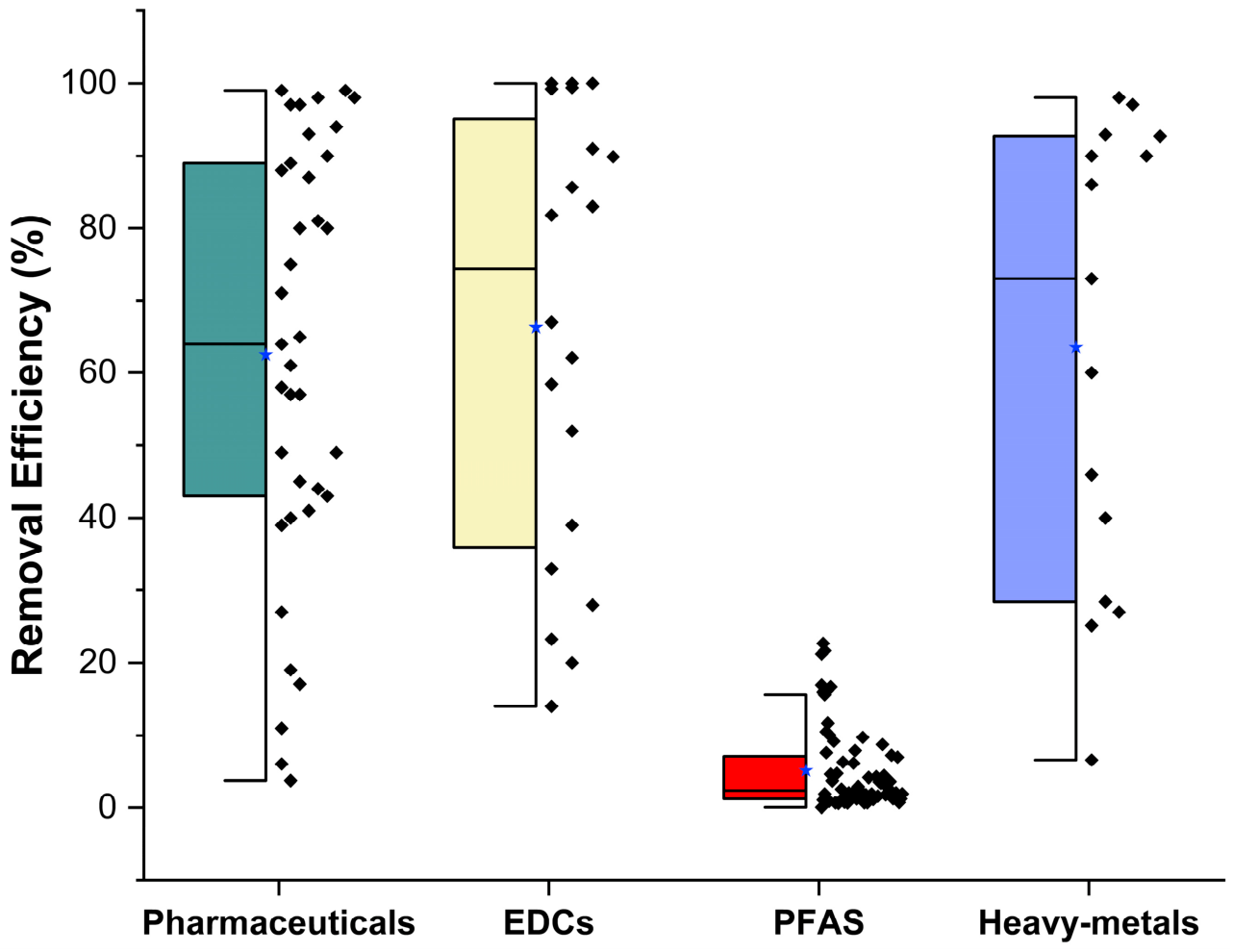
 ) shows the mean value for each box plot).
) shows the mean value for each box plot).
) shows the mean value for each box plot).



| Emerging Pollutant Type | Subtype | Microalgal Species | Temperature Range | pH Range | Removal Efficiency (%) | References |
|---|---|---|---|---|---|---|
| Pharmaceutical wastewater | Naproxen | Cymbella sp. | 15–22 | 7–8 | 97.1 | [167] |
| Nonylphenol | Lessonia nigrescens (L13) | 12–15 | 7.8–8.2 | 100 | [167] | |
| Clofibric acid | P. capillaceae | 10–22 | 6.5–8.5 | 97.7 | [167] | |
| Atenolol Diltiazem Azithromycin and Erythromycin | Chlorella-Scenedesmus consortium | 80 75 80 | [49] | |||
| Heavy metal wastewater | Cd Pb Ni Zn | G. sulphuraria | >56 | 1.5–2.5 | 45.90 25.15 6.56 28.44 | [168] |
| Cd | Chlamydomonas acidophila RT46 | 2.3–3.4 | Adaptability under high Cd stress up to 40 mg/L | [169] | ||
| Cd | Euglena gracilis | 22–28 | 3.0–4.0 | 90 | [170] | |
| Cu Fe Zn | Desmodesmus sp. MAS1 | 23–26 | 3.5–6.7 | 27 86 60 | [171] | |
| Acid mine drainage | Zn | Stigeoclonium sp. | 20–25 | 5.5–7.5 | 10 μM | [172] |
| Fe | Fucus serratus | 10–15 | 2.0–4.0 | 250 mg/g | [173] | |
| Cu Zn Ar | Fucus vesiculosus | 20–25 | 5.0–8.0 | 6 mg/g 2 mg/g 190 μg/g | [173] | |
| Microplastic | Polystyrene Polymethyl Methacrylate Polylactic Acid | Scenedesmus abundans | 25–45 | 6.5–7.5 | 84 | [174] |
| Mixed polymers | Ulva prolifera Sargassum horneri | 3–28 | 8.0–8.2 | 0.10 ± 0.05 items/g (fresh weight) 0.03 ± 0.02 items/g (fresh weight) | [175] | |
| Fiber, Film, Fragment, Microbead fiber | Pyropia yezoensis | 5–15 | 7.8–8.5 | 0.11–0.31 items/g (fresh weight) | [176] | |
| Dyes | Methylene blue | Sargassum muticum | 15–20 | 7.5–8.5 | 93 | [177] |
| Reactive red 195 | Pterocladia capillacea | 17–25 | 6.5–8.5 | 91.1 | [178] | |
| Azo dye | Chlorella sorokiniana (ASK25) | 25–42 | 5–11 | 99.71 | [179] |
Disclaimer/Publisher’s Note: The statements, opinions and data contained in all publications are solely those of the individual author(s) and contributor(s) and not of MDPI and/or the editor(s). MDPI and/or the editor(s) disclaim responsibility for any injury to people or property resulting from any ideas, methods, instructions or products referred to in the content. |
© 2026 by the authors. Licensee MDPI, Basel, Switzerland. This article is an open access article distributed under the terms and conditions of the Creative Commons Attribution (CC BY) license.
Share and Cite
Saquib, S.; Satya, A.; Lestari, F.S.; Nafisyah, E.; Satya, I.A.; Chrismadha, T.; Waluyo, A.; Singh, G.; Aikawa, S.; Bhuyan, P.P.; et al. Microalgae from the Extremes: Unlocking Their Potential for Emerging Pollutant Removal and Sustainable Water Remediation. Phycology 2026, 6, 95. https://doi.org/10.3390/phycology6030095
Saquib S, Satya A, Lestari FS, Nafisyah E, Satya IA, Chrismadha T, Waluyo A, Singh G, Aikawa S, Bhuyan PP, et al. Microalgae from the Extremes: Unlocking Their Potential for Emerging Pollutant Removal and Sustainable Water Remediation. Phycology. 2026; 6(3):95. https://doi.org/10.3390/phycology6030095
Chicago/Turabian StyleSaquib, Syed, Awalina Satya, Fajar Sumi Lestari, Eva Nafisyah, Ika Atman Satya, Tjandra Chrismadha, Agus Waluyo, Gurdarshan Singh, Shimpei Aikawa, Prajna Paramita Bhuyan, and et al. 2026. "Microalgae from the Extremes: Unlocking Their Potential for Emerging Pollutant Removal and Sustainable Water Remediation" Phycology 6, no. 3: 95. https://doi.org/10.3390/phycology6030095
APA StyleSaquib, S., Satya, A., Lestari, F. S., Nafisyah, E., Satya, I. A., Chrismadha, T., Waluyo, A., Singh, G., Aikawa, S., Bhuyan, P. P., & Pradhan, B. (2026). Microalgae from the Extremes: Unlocking Their Potential for Emerging Pollutant Removal and Sustainable Water Remediation. Phycology, 6(3), 95. https://doi.org/10.3390/phycology6030095