

Sustainable but Sensory Challenged: The Case of Spirulina in Brazilian Diets



Abstract
1. Introduction
1.1. Perceived Benefits as Drivers of Sustainable Food Consumption
1.2. Sociodemographic Profiles, Knowledge, and Barriers in Novel Sustainable Foods
1.3. Psychographic and Lifestyle Factors in Prior Awareness, Consumption, and Reported Barriers
2. Materials and Methods
2.1. Participants
2.2. Questionnaire Design
2.2.1. All Participants
2.2.2. Group 1—No Familiarity with Spirulina
2.2.3. Group 2—Familiar with Spirulina but Never Consumed It
2.2.4. Group 3—Previous Spirulina Consumers
2.3. Data Analysis
2.4. Statistical Analysis
3. Results
3.1. Sociodemographic and Psychographic Profile
3.2. Comparisons and Associations Between Groups
3.3. Knowledge About Spirulina
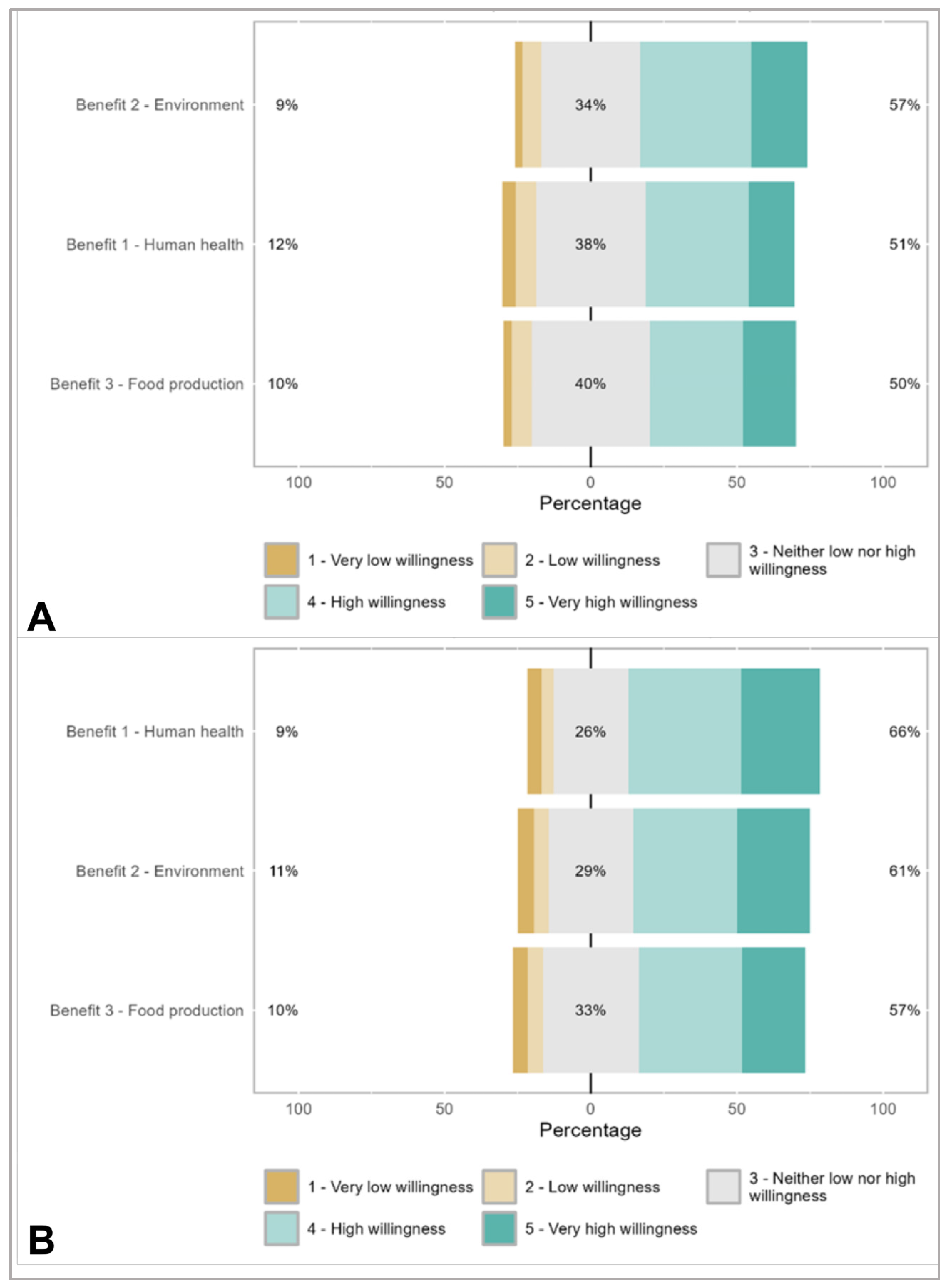
3.4. Willingness to Consume Spirulina
3.5. Barriers to Consuming Spirulina
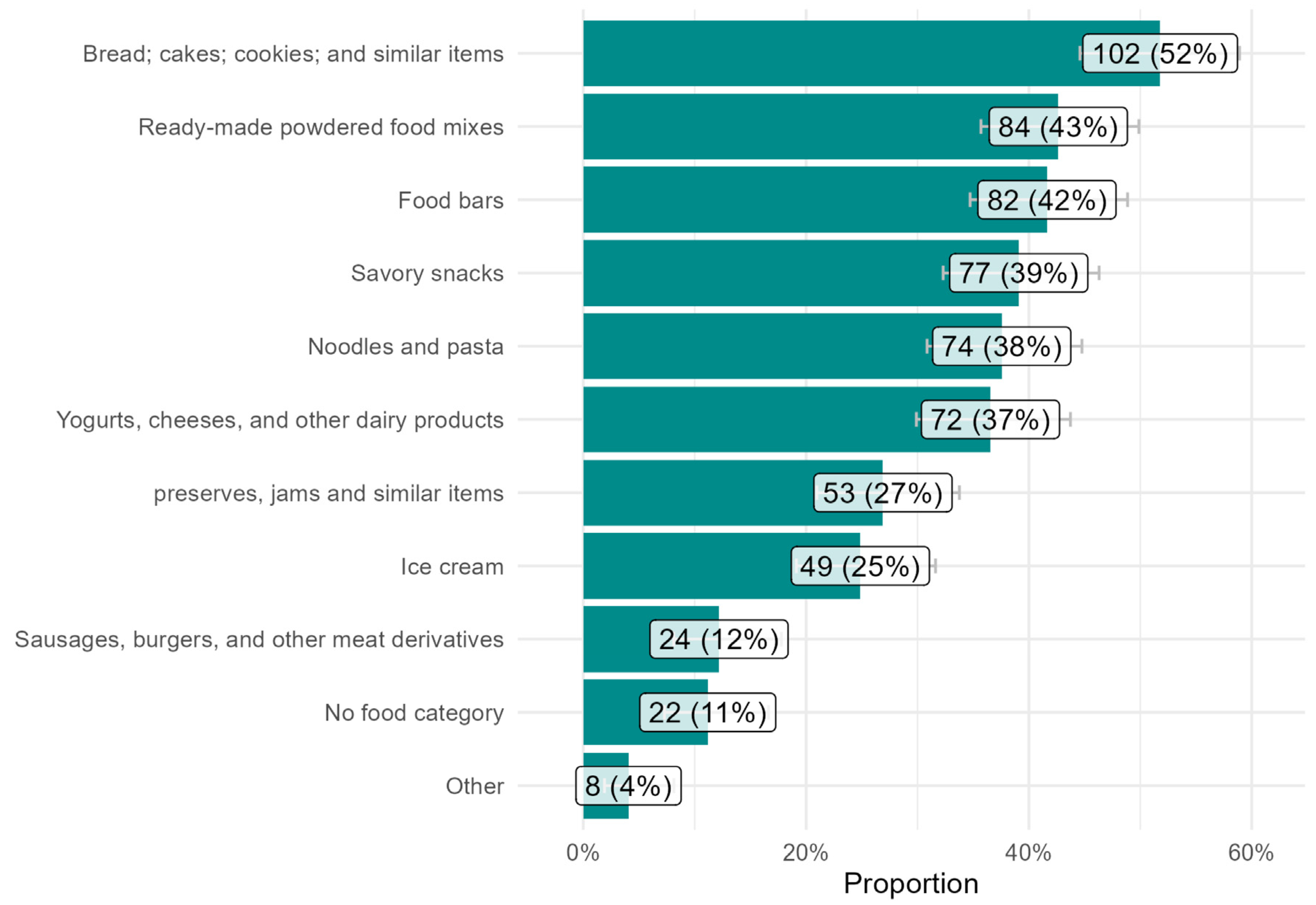
3.6. Spirulina Consumption Habits and Preferences
4. Discussion
5. Conclusions
Supplementary Materials
Author Contributions
Funding
Institutional Review Board Statement
Informed Consent Statement
Data Availability Statement
Conflicts of Interest
References
- Campoli, J.S.; Kodama, T.K.; Nagano, M.S.; Burnquist, H.L. Advancing Circular Economy: G20 Nations’ Path Towards 12th Sustainable Development Goal. Circ. Econ. Sustain. 2024, 5, 1–24. [Google Scholar] [CrossRef]
- Olabi, A.G.; Shehata, N.; Sayed, E.T.; Rodriguez, C.; Anyanwu, R.C.; Russell, C.; Abdelkareem, M.A. Role of Microalgae in Achieving Sustainable Development Goals and Circular Economy. Sci. Total Environ. 2023, 854, 158689. [Google Scholar] [CrossRef] [PubMed]
- Thevarajah, B.; Nishshanka, G.K.S.H.; Premaratne, M.; Nimarshana, P.H.V.; Nagarajan, D.; Chang, J.-S.; Ariyadasa, T.U. Large-Scale Production of Spirulina-Based Proteins and c-Phycocyanin: A Biorefinery Approach. Biochem. Eng. J. 2022, 185, 108541. [Google Scholar] [CrossRef]
- Bürck, M.; Fratelli, C.; Assis, M.; Braga, A.R.C. Naturally Colored Ice Creams Enriched with C-Phycocyanin and Spirulina Residual Biomass: Development of a Fermented, Antioxidant, Tasty and Stable Food Product. Fermentation 2024, 10, 304. [Google Scholar] [CrossRef]
- Braga, A.R.C.; Nunes, M.C.; Raymundo, A. The Experimental Development of Emulsions Enriched and Stabilized by Recovering Matter from Spirulina Biomass: Valorization of Residue into a Sustainable Protein Source. Molecules 2023, 28, 6179. [Google Scholar] [CrossRef] [PubMed]
- Benelhadj, S.; Douiri, S.; Ghouilli, A.; Hassen, R.B.; Keshk, S.M.A.S.; El-kott, A.; Attia, H.; Ghorbel, D. Extraction of Arthrospira Platensis (Spirulina) Proteins via Osborne Sequential Procedure: Structural and Functional Characterizations. J. Food Compos. Anal. 2023, 115, 104984. [Google Scholar] [CrossRef]
- Prasetiyo, H.; Purwaningsih, S.; Setyaningsih, I.; Nurilmala, M.; Uju, U.; Tarman, K. Off-Odour Identification from Volatile Organic Compounds (VOCs) of Spirulina. BIO Web Conf. 2024, 92, 02006. [Google Scholar] [CrossRef]
- Sahin, B.; Hosoglu, M.I.; Guneser, O.; Karagul-Yuceer, Y. Fermented Spirulina Products with Saccharomyces and Non- Saccharomyces Yeasts: Special Reference to Their Microbial, Physico-Chemical and Sensory Characterizations. Food Biosci. 2022, 47, 101691. [Google Scholar] [CrossRef]
- Bürck, M.; Lemes, A.C.; Egea, M.B.; Braga, A.R.C. Exploring the Potential and Challenges of Fermentation in Creating Foods: A Spotlight on Microalgae. Fermentation 2024, 10, 649. [Google Scholar] [CrossRef]
- Braga-Souto, R.N.; Bürck, M.; Nakamoto, M.M.; Braga, A.R.C. Cracking Spirulina Flavor: Compounds, Sensory Evaluations, and Solutions. Trends Food Sci. Technol. 2025, 156, 104847. [Google Scholar] [CrossRef]
- Grahl, S.; Strack, M.; Mensching, A.; Mörlein, D. Alternative Protein Sources in Western Diets: Food Product Development and Consumer Acceptance of Spirulina-Filled Pasta. Food Qual. Prefer. 2020, 84, 103933. [Google Scholar] [CrossRef]
- Kim, S.-H.; Hong, J.-H. The Effects of Contexts on Consumer Emotions and Acceptance of a Domestic Food and an Unfamiliar Ethnic Food: A Cross-Cultural Comparison between Chinese and Korean Consumers. Food Sci. Biotechnol. 2020, 29, 1705–1718. [Google Scholar] [CrossRef] [PubMed]
- Takeda, K.F.; Yazawa, A.; Yamaguchi, Y.; Koizumi, N.; Shineha, R. Comparison of Public Attitudes toward Five Alternative Proteins in Japan. Food Qual. Prefer. 2023, 105, 104787. [Google Scholar] [CrossRef]
- Weinrich, R.; Elshiewy, O. A Cross-Country Analysis of How Food-Related Lifestyles Impact Consumers’ Attitudes towards Microalgae Consumption. Algal Res. 2023, 70, 102999. [Google Scholar] [CrossRef]
- Van der Stricht, H.; Profeta, A.; Hung, Y.; Verbeke, W. Consumers’ Willingness-to-Buy Pasta with Microalgae Proteins—Which Label Can Promote Sales? Food Qual. Prefer. 2023, 110, 104948. [Google Scholar] [CrossRef]
- Wassmann, B.; Hartmann, C.; Siegrist, M. Novel Microalgae-Based Foods: What Influences Singaporean Consumers’ Acceptance? Food Qual. Prefer. 2024, 113, 105068. [Google Scholar] [CrossRef]
- Lafarga, T.; Rodríguez-Bermúdez, R.; Morillas-España, A.; Villaró, S.; García-Vaquero, M.; Morán, L.; Sánchez-Zurano, A.; González-López, C.V.; Acién-Fernández, F.G. Consumer Knowledge and Attitudes towards Microalgae as Food: The Case of Spain. Algal Res. 2021, 54, 102174. [Google Scholar] [CrossRef]
- Withana, T.N.; Ranasinghe, Y.S.; Rathnayake, A.I.; Bamunuarachchige, T.C.; de Zoysa, H.K.S. Applications of Spirulina in the Food Industry: Scientometric and Systematic Review. Food Humanit. 2025, 5, 100644. [Google Scholar] [CrossRef]
- Bertoldi, M.C.; Resende, M.E.T.; Grigório, J.K.A.; Santana, H.C. Worldwide Distribution, Current Trends and Scientific Progress in Spirulina Research (1967–2024): A Scientometric Analysis. Algal Res. 2025, 88, 104029. [Google Scholar] [CrossRef]
- Bahraseman, S.E.; Dehghani Dashtabi, M.; Karbasi, A.; Firoozzare, A.; Boccia, F.; Hosseinzadeh Nazeri, Z. Moving towards Novel and Sustainable Foods: Investigating Consumers’ Intention to Consume Algae-Based Foods in a Developing Country. Appetite 2025, 206, 107801. [Google Scholar] [CrossRef] [PubMed]
- de Jesus, C.S.; da Silva Uebel, L.; Costa, S.S.; Miranda, A.L.; de Morais, E.G.; de Morais, M.G.; Costa, J.A.V.; Nunes, I.L.; de Souza Ferreira, E.; Druzian, J.I. Outdoor Pilot-Scale Cultivation of Spirulina Sp. LEB-18 in Different Geographic Locations for Evaluating Its Growth and Chemical Composition. Bioresour. Technol. 2018, 256, 86–94. [Google Scholar] [CrossRef] [PubMed]
- Nichifor, B.; Zait, L.; Timiras, L. Drivers, Barriers, and Innovations in Sustainable Food Consumption: A Systematic Literature Review. Sustainability 2025, 17, 2233. [Google Scholar] [CrossRef]
- Huang, Z.; Zhu, Y.-D.; Deng, J.; Wang, C.-L. Marketing Healthy Diets: The Impact of Health Consciousness on Chinese Consumers’ Food Choices. Sustainability 2022, 14, 2059. [Google Scholar] [CrossRef]
- Onwezen, M.C.; Bouwman, E.P.; Reinders, M.J.; Dagevos, H. A Systematic Review on Consumer Acceptance of Alternative Proteins: Pulses, Algae, Insects, Plant-Based Meat Alternatives, and Cultured Meat. Appetite 2021, 159, 105058. [Google Scholar] [CrossRef] [PubMed]
- Ramírez Pagès, A.; Zaragoza, B.D.; López, M.P. Sipping a Sustainable Life: Exploring Drivers and Barriers in Consumer Attitudes toward Non or Low Alcoholic Spirits. Appetite 2024, 197, 107308. [Google Scholar] [CrossRef] [PubMed]
- Winkelmair, A.; Schroter, F.A.; Jansen, P. Vegetarian and Sustainable Food Consumption Behavior: Exploring the Relation to Explicit and Implicit Attitudes toward Vegetarian Foods and Dispositional Mindfulness. Appetite 2025, 206, 107847. [Google Scholar] [CrossRef] [PubMed]
- Flores, P.J.; Jansson, J. SPICe—Determinants of Consumer Green Innovation Adoption across Domains: A Systematic Review of Marketing Journals and Suggestions for a Research Agenda. Int. J. Consum. Stud. 2022, 46, 1761–1784. [Google Scholar] [CrossRef]
- Lucas, B.F.; Brunner, T.A. Attitudes and Perceptions towards Microalgae as an Alternative Food: A Consumer Segmentation in Switzerland. Algal Res. 2024, 78, 103386. [Google Scholar] [CrossRef]
- Lucas, B.F.; Costa, J.A.V.; Brunner, T.A. Attitudes of Consumers toward Spirulina and Açaí and Their Use as a Food Ingredient. LWT 2023, 178, 114600. [Google Scholar] [CrossRef]
- Ágoston, C.; Balázs, B.; Mónus, F.; Varga, A. Age Differences and Profiles in Pro-Environmental Behavior and Eco-Emotions. Int. J. Behav. Dev. 2024, 48, 132–144. [Google Scholar] [CrossRef]
- Rabitti, N.S.; Sandvik, P.; Neugart, S.; Schouteten, J.J.; Laureati, M. Green Color Drives Rejection of Crackers Added with Algae in Children but Not in Adults. Food Qual. Prefer. 2025, 127, 105461. [Google Scholar] [CrossRef]
- Mosikyan, S.; Dolan, R.; Corsi, A.M.; Bastian, S. A Systematic Literature Review and Future Research Agenda to Study Consumer Acceptance of Novel Foods and Beverages. Appetite 2024, 203, 107655. [Google Scholar] [CrossRef] [PubMed]
- Lin, H.C.; Lee, S.H. Effects of Statistical and Narrative Health Claims on Consumer Food Product Evaluation. Front. Psychol. 2021, 11, 541716. [Google Scholar] [CrossRef] [PubMed]
- Maehle, N.; Skjeret, F. Microalgae-Based Food: Purchase Intentions and Willingness to Pay. Future Foods 2022, 6, 100205. [Google Scholar] [CrossRef]
- Van der Stricht, H.; Hung, Y.; Fischer, A.R.H.; Verbeke, W. Consumer Segments Less or More Willing to Adopt Foods with Microalgae Proteins. Food Qual. Prefer. 2024, 113, 105047. [Google Scholar] [CrossRef]
- Grahl, S.; Strack, M.; Weinrich, R.; Mörlein, D. Consumer-Oriented Product Development: The Conceptualization of Novel Food Products Based on Spirulina (Arthrospira platensis) and Resulting Consumer Expectations. J. Food Qual. 2018, 2018, 1919482. [Google Scholar] [CrossRef]
- IBGE. Pesquisa de Orçamentos Familiares 2017–2018: Primeiros Resultados, 1st ed.; Instituto Brasileiro de Geografia e Estatística: Rio de Janeiro, Brazil, 2019.
- IBGE. Panorama Do Censo 2022. Instituto Brasileiro de Geografia e Estatística. Available online: https://censo2022.ibge.gov.br/panorama/ (accessed on 22 June 2025).
- Yamane, T.; Kaneko, S. Is the Younger Generation a Driving Force toward Achieving the Sustainable Development Goals? Survey Experiments. J. Clean. Prod. 2021, 292, 125932. [Google Scholar] [CrossRef]
- Severo, E.A.; De Guimarães, J.C.F.; Dellarmelin, M.L. Impact of the COVID-19 Pandemic on Environmental Awareness, Sustainable Consumption and Social Responsibility: Evidence from Generations in Brazil and Portugal. J. Clean. Prod. 2021, 286, 124947. [Google Scholar] [CrossRef] [PubMed]
- Severo, E.A.; de Guimarães, J.C.F.; Henri Dorion, E.C. Cleaner Production, Social Responsibility and Eco-Innovation: Generations’ Perception for a Sustainable Future. J. Clean. Prod. 2018, 186, 91–103. [Google Scholar] [CrossRef]
- Eger, L.; Komárková, L.; Egerová, D.; Mičík, M. The Effect of COVID-19 on Consumer Shopping Behaviour: Generational Cohort Perspective. J. Retail. Consum. Serv. 2021, 61, 102542. [Google Scholar] [CrossRef]
- Central Bank of Brazil Quotes and Bulletins. Available online: https://www.bcb.gov.br/estabilidadefinanceira/historicocotacoes (accessed on 1 April 2025).
- Vollset, S.E. Confidence Intervals for a Binomial Proportion. Stat. Med. 1993, 12, 809–824. [Google Scholar] [CrossRef] [PubMed]




| Characteristic | Overall | Group 1 | Group 2 | Group 3 | p-Value (Effect) |
|---|---|---|---|---|---|
| Age (n = 933) | |||||
| Min-Max | 18–77 | 18–77 | 19–76 | 19–77 | 0.285 f ( = 0) |
| Q1–Q3 | 28–45 | 26–46 | 28–45.25 | 29–44 | |
| Median | 36 | 34.5 | 36 | 37 | |
| Mean | 38.05 | 37.98 | 38.08 | 38.16 | |
| SD | 13.3 | 14.84 | 12.2 | 11.5 | |
| Education level (n = 933) | |||||
| Incomplete elementary school | 12 (1.29%) | 10 (2.4%) | 0 (0%) | 2 (1.02%) | <0.001 *** f ( = 0.08) |
| Completed elementary school | 9 (0.96%) | 8 (1.92%) | 1 (0.31%) | 0 (0%) | |
| Completed high school | 186 (19.94%) | 128 (30.77%) | 41 (12.81%) | 17 (8.63%) | |
| Completed undergraduate education | 337 (36.12%) | 146 (35.1%) | 122 (38.12%) | 69 (35.03%) | |
| Completed postgraduate education | 389 (41.69%) | 124 (29.81%) | 156 (48.75%) | 109 (55.33%) | |
| Family income (n = 850) | |||||
| Up to US$726.58 | 244 (28.71%) | 120 (32.17%) | 84 (28.38%) | 40 (22.1%) | <0.001 *** f ( = 0.01) |
| Between US$726.59 and US$1453.16 | 238 (28%) | 113 (30.29%) | 83 (28.04%) | 42 (23.2%) | |
| Between US$1453.17 and US$2421.95 | 193 (22.71%) | 81 (21.72%) | 63 (21.28%) | 49 (27.07%) | |
| From US$2421.96 | 175 (20.59%) | 59 (15.82%) | 66 (22.3%) | 50 (27.62%) | |
| People living in the household (n = 933) | |||||
| Min-Max | 1–14 | 1–11 | 1–14 | 1–6 | 0.016 * f ( = 0.01) |
| Q1–Q3 | 2–3 | 2–4 | 2–3 | 2–3 | |
| Median | 3 | 3 | 3 | 2 | |
| Mean | 2.71 | 2.83 | 2.66 | 2.55 | |
| SD | 1.24 | 1.25 | 1.32 | 1.05 | |
| Diet classification (n = 933) | |||||
| Flexitariana | 83 (8.9%) | 43 (10.34%) | 24 (7.5%) | 16 (8.12%) | 0.064 b |
| Omnivorous | 767 (82.21%) | 338 (81.25%) | 272 (85%) | 157 (79.7%) | |
| Other | 21 (2.25%) | 14 (3.37%) | 3 (0.94%) | 4 (2.03%) | |
| Pescetarian | 23 (2.47%) | 6 (1.44%) | 10 (3.12%) | 7 (3.55%) | |
| Vegan (or strict vegetarian) | 8 (0.86%) | 1 (0.24%) | 3 (0.94%) | 4 (2.03%) | |
| Vegetarian | 31 (3.32%) | 14 (3.37%) | 8 (2.5%) | 9 (4.57%) | |
| Racial self-declaration (n = 933) | |||||
| Yellow | 31 (3.32%) | 13 (3.12%) | 9 (2.81%) | 9 (4.57%) | 0.333 a (v = 0.06) |
| White | 582 (62.38%) | 245 (58.89%) | 209 (65.31%) | 128 (64.97%) | |
| Brown | 236 (25.29%) | 115 (27.64%) | 79 (24.69%) | 42 (21.32%) | |
| Black | 84 (9%) | 43 (10.34%) | 23 (7.19%) | 18 (9.14%) | |
| Generation (n = 933) | |||||
| Baby boomer | 88 (9.43%) | 52 (12.5%) | 22 (6.88%) | 14 (7.11%) | <0.001 *** a (v = 0.12) |
| X | 192 (20.58%) | 78 (18.75%) | 72 (22.5%) | 42 (21.32%) | |
| Y | 425 (45.55%) | 162 (38.94%) | 156 (48.75%) | 107 (54.31%) | |
| Z | 228 (24.44%) | 124 (29.81%) | 70 (21.88%) | 34 (17.26%) | |
| Gender (n = 933) | |||||
| Female | 633 (67.85%) | 243 (58.41%) | 235 (73.44%) | 155 (78.68%) | <0.001 *** a (v = 0.19) |
| Male | 300 (32.15%) | 173 (41.59%) | 85 (26.56%) | 42 (21.32%) | |
| Decision-maker for household groceries (n = 933) | |||||
| Just me | 225 (24.12%) | 80 (19.23%) | 90 (28.12%) | 55 (27.92%) | <0.001 *** a (v = 0.12) |
| Other people and me | 665 (71.28%) | 303 (72.84%) | 222 (69.38%) | 140 (71.07%) | |
| Only other people | 43 (4.61%) | 33 (7.93%) | 8 (2.5%) | 2 (1.02%) | |
| Seeking information on healthy eating (n = 933) | |||||
| 1—Never | 22 (2.36%) | 15 (3.61%) | 5 (1.56%) | 2 (1.02%) | <0.001 *** f ( = 0.08) |
| 2—Rarely | 114 (12.22%) | 69 (16.59%) | 37 (11.56%) | 8 (4.06%) | |
| 3—Occasionally | 251 (26.9%) | 143 (34.38%) | 68 (21.25%) | 40 (20.3%) | |
| 4—Frequently | 298 (31.94%) | 125 (30.05%) | 108 (33.75%) | 65 (32.99%) | |
| 5—Very frequently | 248 (26.58%) | 64 (15.38%) | 102 (31.87%) | 82 (41.62%) | |
| Seeking information on physical exercise practices (n = 933) | |||||
| 1—Never | 27 (2.89%) | 17 (4.09%) | 5 (1.56%) | 5 (2.54%) | <0.001 *** f ( = 0.02) |
| 2—Rarely | 83 (8.9%) | 47 (11.3%) | 26 (8.12%) | 10 (5.08%) | |
| 3—Occasionally | 248 (26.58%) | 122 (29.33%) | 82 (25.62%) | 44 (22.34%) | |
| 4—Frequently | 304 (32.58%) | 137 (32.93%) | 103 (32.19%) | 64 (32.49%) | |
| 5—Very frequently | 271 (29.05%) | 93 (22.36%) | 104 (32.5%) | 74 (37.56%) | |
| Seeking information on mental health (n = 933) | |||||
| 1—Never | 38 (4.07%) | 25 (6.01%) | 6 (1.88%) | 7 (3.55%) | <0.001 *** f ( = 0.03) |
| 2—Rarely | 125 (13.4%) | 76 (18.27%) | 32 (10%) | 17 (8.63%) | |
| 3—Occasionally | 230 (24.65%) | 105 (25.24%) | 86 (26.88%) | 39 (19.8%) | |
| 4—Frequently | 280 (30.01%) | 116 (27.88%) | 107 (33.44%) | 57 (28.93%) | |
| 5—Very frequently | 260 (27.87%) | 94 (22.6%) | 89 (27.81%) | 77 (39.09%) | |
| Consumption of dietary supplements (n = 933) | |||||
| 1—Never | 255 (27.33%) | 144 (34.62%) | 87 (27.19%) | 24 (12.18%) | <0.001 *** f ( = 0.07) |
| 2—Rarely | 150 (16.08%) | 84 (20.19%) | 43 (13.44%) | 23 (11.68%) | |
| 3—Occasionally | 155 (16.61%) | 63 (15.14%) | 60 (18.75%) | 32 (16.24%) | |
| 4—Frequently | 152 (16.29%) | 59 (14.18%) | 52 (16.25%) | 41 (20.81%) | |
| 5—Very frequently | 221 (23.69%) | 66 (15.87%) | 78 (24.38%) | 77 (39.09%) | |
| I have a technical degree, undergraduate or postgraduate degree in this or related areas (n = 933) | |||||
| No/I don’t remember | 576 (60.77%) | 329 (79.09%) | 148 (46.25%) | 90 (45.69%) | <0.001 *** a (v = 0.34) |
| Yes | 366 (39.23%) | 87 (20.91%) | 172 (53.75%) | 107 (54.31%) | |
| I work or have worked in this or related areas (n = 933) | |||||
| No/I don’t remember | 576 (60.77%) | 329 (79.09%) | 148 (46.25%) | 90 (45.69%) | <0.001 *** a (v = 0.34) |
| Yes | 366 (39.23%) | 87 (20.91%) | 172 (53.75%) | 107 (54.31%) | |
| I do or have done one or more short courses in this or related areas (n = 933) | |||||
| No/I don’t remember | 605 (64.84%) | 346 (83.17%) | 159 (49.69%) | 100 (50.76%) | <0.001 *** a (v = 0.34) |
| Yes | 328 (35.16%) | 70 (16.83%) | 161 (50.31%) | 97 (49.24%) | |
| Through networks and social media (n = 933) | |||||
| No/I don’t remember | 605 (64.84%) | 346 (83.17%) | 159 (49.69%) | 100 (50.76%) | <0.001 *** a (v = 0.34) |
| Yes | 328 (35.16%) | 70 (16.83%) | 161 (50.31%) | 97 (49.24%) | |
| Through networks and social media (n = 933) | |||||
| No/I don’t remember | 310 (33.23%) | 155 (37.26%) | 101 (31.56%) | 54 (27.41%) | 0.040 * a (v = 0.08) |
| Yes | 623 (66.77%) | 261 (62.74%) | 219 (68.44%) | 143 (72.59%) | |
| Variable | Statistic |
|---|---|
| How often do you usually consume Spirulina? Added or not to food and beverages (n = 197) | |
| Tried it only once | 107 (54.31%) |
| Less than once every 6 months | 31 (15.74%) |
| Once every 3 to 6 months | 9 (4.57%) |
| Once every two months | 8 (4.06%) |
| Once per month | 6 (3.05%) |
| Twice per month | 4 (2.03%) |
| At least once per week | 32 (16.24%) |
| Variable | p-Value | Statistic | Shared Variance | CI (95%) |
|---|---|---|---|---|
| Seeking information on healthy eating | 0.003 ** g | 0.21 | 0.05 | (0.08, 0.35) |
| Seeking information on physical exercise practices | 0.087 g | 0.12 | 0.01 | (−0.02, 0.26) |
| Seeking information on mental health | 0.121 g | 0.11 | 0.01 | (−0.03, 0.25) |
| Consumption of dietary supplements | <0.001 *** g | 0.29 | 0.08 | (0.16, 0.42) |
Disclaimer/Publisher’s Note: The statements, opinions and data contained in all publications are solely those of the individual author(s) and contributor(s) and not of MDPI and/or the editor(s). MDPI and/or the editor(s) disclaim responsibility for any injury to people or property resulting from any ideas, methods, instructions or products referred to in the content. |
© 2026 by the authors. Licensee MDPI, Basel, Switzerland. This article is an open access article distributed under the terms and conditions of the Creative Commons Attribution (CC BY) license.
Share and Cite
Braga-Souto, R.N.; Braga, A.R.C. Sustainable but Sensory Challenged: The Case of Spirulina in Brazilian Diets. Phycology 2026, 6, 70. https://doi.org/10.3390/phycology6030070
Braga-Souto RN, Braga ARC. Sustainable but Sensory Challenged: The Case of Spirulina in Brazilian Diets. Phycology. 2026; 6(3):70. https://doi.org/10.3390/phycology6030070
Chicago/Turabian StyleBraga-Souto, Renata Nolasco, and Anna Rafaela Cavalcante Braga. 2026. "Sustainable but Sensory Challenged: The Case of Spirulina in Brazilian Diets" Phycology 6, no. 3: 70. https://doi.org/10.3390/phycology6030070
APA StyleBraga-Souto, R. N., & Braga, A. R. C. (2026). Sustainable but Sensory Challenged: The Case of Spirulina in Brazilian Diets. Phycology, 6(3), 70. https://doi.org/10.3390/phycology6030070