Article

A Reliable Semi-Continuous Cultivation Mode for Stable High-Quality Biomass Production of Chlorella sorokiniana IPPAS C-1


by
David A. Gabrielyan
*,
Maria A. Sinetova
,
Boris V. Gabel
,
Alexander K. Gabrielian
,
Alexander Y. Starikov
,
Roman A. Voloshin
,
Alexandra Markelova
,
Grigoriy A. Savinykh
,
Natalia V. Shcherbakova
and
Dmitry A. Los
K.A. Timiryazev Institute of Plant Physiology, Russian Academy of Sciences, Botanicheskaya Street 35, 127276 Moscow, Russia
*
Author to whom correspondence should be addressed.
Phycology 2026, 6(1), 4; https://doi.org/10.3390/phycology6010004 (registering DOI)
Submission received: 3 December 2025 / Revised: 23 December 2025 / Accepted: 24 December 2025 / Published: 1 January 2026
(This article belongs to the Special Issue Development of Algal Biotechnology)

Abstract

The industrial cultivation of microalgae for high-value products faces significant challenges, particularly in maintaining long-term, cost-effective operations. Semi-continuous cultivation presents a promising solution to this problem. In this study, the green alga Chlorella sorokiniana IPPAS C-1 was cultivated in a flat-panel 5 L photobioreactor under optimized conditions, with three biological replicates. We evaluated batch mode against three semi-continuous dilution fractions (50%, 75%, and 87.5%). The 75% dilution fraction demonstrated superior performance, achieving the highest biomass productivity with an average specific productivity of 1.36 g DW L−1 day−1 over seven harvest cycles. Furthermore, this regime ensured stable biochemical composition—including proteins, lipids, carbohydrates, and pigments—as well as a consistent lipid profile and sustained photosynthetic activity throughout the cultivation. These findings are useful for the development of scalable and efficient technological protocols for the industrial production of Chlorella in flat-panel photobioreactors.

1. Introduction

Photosynthetic microorganisms, such as microalgae and cyanobacteria, are widely used in biotechnology, and they have a high biochemical potential for commercialization. Main commercial applications are: feed and food additives [1,2], supplements for cosmetics and pharmacology [3,4,5], biofuels, bioplastics and other ecological applications [6,7,8,9,10,11]. The main advantages of microalgae cultivation include rapid growth without occupying arable land [6], ability to produce a wide range of high value compounds [12,13], and integration into existing technologies for processing various wastes, for example, CO2 utilization [14,15,16] and wastewater treatment [17,18,19,20,21].
There is no doubt about the potential applications of microalgae and cyanobacteria; however, a number of publications that focused on SWOT (strengths, opportunities, weaknesses and threats) and the technical and economic analysis of large-scale biomass production, indicate that many issues and challenges remain to be addressed [6,22,23,24]. A primary objective is to reduce the capital, operational, and post-processing costs, ultimately lowering the price of the final microalgae and cyanobacteria-based products [25,26,27,28].
Optimizing the cultivation mode used in industrial production could offer a partial solution of this problem [16,24]. There are two basic cultivation modes: batch mode, where cultivation proceeds without addition of supplements; and continuous mode characterized by the constant withdrawal of certain volumes of cell suspension and addition of fresh medium portions [29]. In practice, the combination of these two modes–semi-continuous mode is often used [16,20,21,24,30,31,32,33]. The advantage of semi-continuous mode is that it combines the simplicity of batch cultivation with the ability to harvest cells periodically to obtain a specific yield of the final product. The key operational parameters governing semi-continuous cultivation are the dilution (or harvest) fraction, defined as the percentage of culture volume replaced during harvesting, and the dilution (or harvest) period, which is the fixed time interval between these replacements. Together, these parameters control nutrient supply and growth dynamics, determining the system’s productivity and stability. Furthermore, both can be optimized or adjusted based on specific production goals. The semi-continuous cultivation strategy enables long-term cultivation with controlled growth rates and a stable biochemical composition of the microalgae cells in culture [32].
Due to their high growth rate, different Chlorella strains are commonly employed for industrial cultivation, utilizing various PBR designs and cultivation modes [31,34,35].
Numerous studies demonstrate that semi-continuous cultivation is a powerful strategy for enhancing the productivity of Chlorella species, with its efficacy being highly dependent on operational parameters and nutrient concentration. For instance, nitrogen and phosphorus concentrations as well as the dilution fraction and period directly determine the maximum biomass and lipid productivity in C. vulgaris XJW [31]. Also, it was shown that the dilution period regulates nutrient uptake, growth and pigment content in C. sorokiniana AM-02 [34]. Most notably, an optimized semi-continuous strategy with surplus phosphorus can drastically increase biomass and lipid yields, as demonstrated in Chlorella sp. BRE5, though a significant productivity gap between closed and open systems remained [35]. This highlights the critical need to tailor cultivation protocols to both the algal strain and the production system.
Our previous laboratory-scale studies with various microalgae and cyanobacteria strains defined their optimal technological ranges for intensive cultivation [36,37]. These findings provided the foundational data for designing scalable vertical flat-panel PBRs for high-yield biomass production [38,39,40] and guided the optimization of cultivation strategies. The resulting PBR design ensures high efficiency in biomass production and CO2 fixation, confers resistance to contamination, and maintains stable performance under various cultivation regimes [22].
Our previous research characterized the batch-mode growth of C. sorokiniana strain IPPAS C-1 in flat-panel photobioreactors (FP PBRs) at laboratory and industrial scales [38,39,41,42]. These studies determined key biochemical and physiological parameters and established an optimal gas exchange regime (including CO2 concentration and aeration ratio) along with the estimation of the carbon dioxide utilization efficiency (CUE) [39,42]. The aim of this work was to investigate the effect of different dilution fractions on the growth, biochemical composition, and photosynthetic activity of C. sorokiniana IPPAS C-1 cultivated in a semi-continuous mode. The findings are expected to provide a foundation for developing industrial-scale bioprocesses using this strain with downstream applications in producing food additives, cosmetic bioactive compounds, or environmental solutions.

2. Materials and Methods

2.1. Microalgal Strain and Maintenance Conditions

The axenic strain of Chlorella sorokiniana strain IPPAS C-1 was obtained from the collection of microalgae and cyanobacteria IPPAS (K.A. Timiryazev Institute of Plant Physiology, RAS, Moscow, Russia). The axenic culture was maintained on slants of Tamiya agarized medium [38,43] in glass tubes at 22 °C under continuous 2700–3000 K LED illumination of 30 μmol photons m−2 s−1. For the experiments, cells of C. sorokiniana were grown for 10–14 days in 300 mL Erlenmeyer flasks with 100 mL of ½ Tamiya modified medium under continuous 5500–6500 K luminescent illumination (50 μmol photons m−2 s−1) in a growth chamber MLR-352-PE (Panasonic, Oizumi-machi, Japan). ½ Tamiya modified medium composition, g L−1: NaNO3—2.1; MgSO4·7H2O—1.25; KH2PO4—0.625; FeSO4·7H2O—0.009; EDTA—0.037; trace element solution (TES) 1 mL L−1; TES composition, g L−1: H3BO3—2.86; MnCl2·4H2O—1.81; ZnSO4·7H2O—0.222, MoO3·2H2O—0.018, NH4VO3—0.023.
All measurements of the irradiation level in the working volume of the PBRs and on the surface of the LED modules were recorded with a quantum meter LI-189 equipped with LI-190SA quantum sensor (LI-COR, Lincoln, NE, USA) in μmol photons m−2 s−1. Spectral composition of the light from LED was measured by LI-180 Spectrometer (LI-COR, Lincoln, NE, USA). Results of measurements were used to calculate the average irradiance on surfaces of PBRs.

2.2. Algal Pre-Culture for PBR Inoculation

The algae inoculum was grown aseptically in vessels of the laboratory system for intensive cultivation as described before [38]: in 250 mL of ½ Tamiya modified medium at 32 ± 0.6 °C under continuous 3000 K LED illumination of 500 μmol photons m−2 s−1 (spectral composition of the light is presented in the Supplementary Material in Figure S1). Culture mixing and aeration were achieved by bubbling with sterile GAM that contained 1.5–2% CO2. The resulting culture with a dry biomass concentration (ρ) of 2–5 g dw L−1 was used as inoculum for the next stage. The contents of vessels were mixed in a sterile graduated cylinder, from which the required volume was aseptically transferred to the reactor using a peristaltic pump. The inoculum volume was adjusted to achieve an initial culture density of 0.1–0.2 g DW L−1 for each experimental run in each PBR.

2.3. Flat-Panel PBRs

The photobioreactor with a 5 L working volume (FP-5 PBR), consists of a glass aquarium with internal dimensions of 361 × 460 × 40 mm (L × H × W), submersible module with cooling and hot water supply systems, and two LED modules, consisting of 18 rows of LED strips, similar to that used for algae pre-culture (Figure S2). Three PBRs of this type have been used in the current work as three biological replicates. Principal experimental design and detailed PBR design were described earlier [39].
The cultivation system featured an adjustable LED illumination setup with programmable irradiance control (0–100% output range). At full power (100%), the system delivered an average irradiance (Iave) of 800 ± 70 μmol photons m−2 s−1 across the PBR’s light receiving surface. The LED modules were mounted flush against the PBR sidewalls to ensure direct and uniform light exposure to the culture. The optimal conditions for intensive cultivation of C. sorokiniana IPPAS C-1 in FP-5 PBR were determined before [39]: GAM flow rate, 1 L min−1 corresponds to GAM aeration rate (RGAM) of 0.2 vvm; CO2 concentration, 1.5% ± 0.04; illumination level, 800 ± 70 μmol photons m−2 s−1; temperature, 36.0 ± 0.5 °C. This combination was applied for all experiments in the study.
In all experiments and during pre-cultivation, water was purified by a six-stage reverse osmosis system AP-800DIR-400 (AquaPro Industrial Co., Ltd., Nanking E. Rd., Taipei, Taiwan) with final treatment by UV flow filter VIQUA VT4/2 BWT (Viqua, West Guelph, ON, Canada). All containers, hoses, filters, and liquids were either sterilized by autoclaving or treated with hot steam and 70% ethanol.

2.4. Gas-Air Mixture Supply

The GAM was supplied to the suspension through an aquarium sprayer with 252 holes in total (6 holes in circumference with a step of 10 mm and Ø 1 mm; Hailea HL-AC04, Chaozhou, China), placed at the bottom of each PBR. The sprayer length was 300 mm. Pure CO2 from a cylinder was mixed with air by a compressor in a mixing unit. Then, passing through rotameters, CO2 concentration sensors and filters (Vent Filter Hydrophilic PTFE 0.45 μm Hawach Scientific, Xi’an, China), the mixture eventually was delivered to the suspension through the sprayers. The volumetric flow rate of the supplied mixture was 1 L min−1. Concentration of CO2 and the RGAM were controlled by rotameters. Previously optimized GAM supply for C. sorokiniana IPPAS C-1 [39] was used it the current study.

2.5. Temperature Control System

Thin-walled stainless-tube heat exchangers were installed perpendicular to the suspension flow in the PBRs. Temperature control of the suspension is carried out due to the periodic flow of the coolant through the heat exchanger tube. The automatic regulation of the cultivation temperature is controlled by a signal from a temperature sensor located in the internal volume of each PBR.
The temperature value of 35.5 ± 0.5 °C was identical in all experiments. The choice of this temperature was due to the maximum growth rates of C. sorokiniana IPPAS C-1 during the first three days (Table S1 in [39]) and aimed to save the energy consumption for the cooling.

2.6. Growth Characteristics

Growth characteristics were calculated from the optical density data and the biomass concentration data as described before [38,39,42]. The optical density of the suspension was measured at 750 nm by the Genesys 10S UV-Vis spectrophotometer (Thermo Scientific, Waltham, MA, USA). The samples from highly concentrated culture were diluted to avoid ‘saturation’ of OD measurements that result when insufficient light reaches the photodetector [44].
To measure the dry weight, 1–10 mL samples were precipitated by centrifugation, washed with distilled water, and dried at 80 °C overnight in pre-weighed plastic microtubes in a heat oven [45]. The dry weight of each sample was measured in triplicate.
The following parameters were used to estimate the growth rate:
  • The productivity (P) was estimated by dry weight (g DW L−1 d−1):
P = ρ 2 ρ 1 / t 2 t 1
where ρ1 and ρ2 are biomass concentrations measured at time 1 (t1) and time 2 (t2).
Using the correlation coefficient (k) between OD750 and biomass concentration [46,47,48], the following equation was applied for the points without direct DW measurement:
P = k · O D 750 2 O D 750 1 / t 2 t 1    
where OD7501 and OD7502 are the optical densities of the culture at 750 nm measured at time 1 (t1) and time 2 (t2). Correlation coefficient of dry weight (DW) content and optical density were calculated based on DW measurements at different OD750 levels (Figure S3).
  • The specific growth rate (μ) was estimated by the change in the culture OD (d−1):
μ = ln ( O D 750 2 / O D 750 1 ) / t 2 t 1
  • The biomass productivity for each drainage period was calculated as the difference between the final and initial biomass concentrations, divided by the duration of the period. The specific growth rate was determined for each period using the same approach.
To prevent inaccuracies in tracking dry biomass concentration caused by a decreasing suspension level (due to evaporation and minor liquid loss with potential foam during sampling), the reactor volumes were monitored at each measurement point using calibrated level marks. The final biomass concentration and optical density were normalized to the initial reactor volume of 5 L.

2.7. pH Measurements

The pH level of every sample was measured by a Mettler Toledo (Columbus, OH, USA) SevenEasy pH meter equipped with an Inlab 413 electrode (Thermo Fisher Scientific, Waltham, MA, USA). Measured pH levels are presented in Supplementary Materials (Figure S4).

2.8. Carbon Dioxide Utilization Efficiency

The carbon dioxide utilization efficiency (CUE) is the ratio of the total supplied CO2 converted into biomass that depends not only on the capability of an algal strain, but also on the design parameters of a PBR and cultivation conditions. CUE is calculated as described in [39] (%):
C U E = 1.88 · ( M P B R M 0 ) / M C O 2 · 100
where 1.88 is a coefficient to recalculate the amount of fixed CO2 in a microalgae cell, based on a typical microalgal molecular formula, CO0.48H1.83N0.11P0.01 [49]; (MPBRM0)—accumulated weight of dry biomass in the working volume of PBR, and MCO2 is the mass of CO2 that was supplied through the PBR. MCO2 was calculated as total CO2 volume multiplied by ρCO2 = 1.73 g L−1 (36 °C, 105 Pa).
To enhance the precision of tracking CO2 utilization dynamics, we propose a daily carbon dioxide utilization efficiency metric (CUEi), defined as the ratio of CO2 mass converted to biomass to the CO2 mass supplied to the PBR each day (%):
C U E i = 1.88 · M i / M C O 2 i · 100
ΔMi—accumulated weight of dry biomass in the working volume of PBR during the i day, calculated as the difference between the absolute biomass on the i day and the previous day, and ΔMCO2 is the mass of CO2 that was supplied to the PBR during the same i day.
This approach reveals how quickly CO2 utilization efficiency declines in parallel with the decrease in daily growth rates. In contrast, using the total volume of CO2 supplied to the reactor and the final accumulated biomass would only provide an average CUE value for the entire cultivation period, masking important short-term dynamics. The calculation of daily CUE becomes particularly crucial when the specific CO2 supply rate to the reactor is not constant over the period under review.
Total and daily CO2 volumes (VCO2) were derived from rotameters (flow rate RGAM) and gas analyzer indications (nCO2) by equation:
V C O 2 = n C O 2 · R G A M · t 2 t 1

2.9. Biochemical Composition

Algae suspension sub-samples (0.5–5 mL) were precipitated by centrifugation, stored at −20 °C, and analyzed for dry weight, protein, lipids, starch, and pigment content.
Dry weight was measured as described in Section 2.6.
The detailed procedures of protein and starch extraction and determination of their concentration are described in with some modifications [36,42]. Briefly, total proteins were extracted and quantified as follows. Frozen cells were mechanically disrupted in methanol using glass beads in a vibration mill (Retsch MM 400, Haan, Germany) at 30 kHz for 10 min. The homogenate was repeatedly washed with methanol until the supernatant became colorless to minimize spectral interference. After centrifugation and methanol removal, the pellet was dried at 65 °C. Total protein was then extracted by incubating the dried pellet in an extraction buffer (50 mM Tris-HCl, pH 8.0; 2% SDS) at 95 °C for 10 min. Cellular debris was removed by centrifugation and the protein concentration in the supernatant was determined using the bicinchoninic acid (BCA) assay with bovine serum albumin BSA standards.
Storage polysaccharides were quantified as follows. Frozen cell pellets were treated with 400 μL of 30% KOH at 95 °C for 90 min to dissolve the storage polysaccharides while hydrolyzing simple sugars. The polysaccharides were then precipitated overnight at −20 °C by adding ethanol, collected via centrifugation, and hydrolyzed to glucose using 2 M HCl (80 μL, 95 °C, 30 min). After neutralization with 2 M NaOH and dilution with deionized water to a final volume of 400 μL, the glucose concentration was determined using the phenol-sulphuric method with a glucose as a standard. The obtained results primarily reflected storage carbohydrates (starch), with potential minor contributions from cell wall polysaccharides.
Fatty acid (FA) analysis was performed according to a previously described method [50]. Briefly, heptadecanoic acid was added to each sample as an internal standard. The samples were then hydrolyzed in 1 M KOH in 80% (v/v) ethanol. Unsaponifiable compounds were removed by extraction with n-hexane, after which the pH of the aqueous phase was adjusted to a weakly acidic value. Free fatty acids were subsequently extracted with n-hexane and converted to fatty acid methyl esters (FAMEs). The FA profile of cellular lipids was determined by gas chromatography–mass spectrometry (GC–MS) of the FAMEs. The total lipid content was calculated as the amount of total esterified fatty acids per gram of dry biomass (mg FA/g dw).
To measure pigment content, the frozen microalgae cells were disrupted in methanol using glass beads in a vibration mill (Retsch MM 400, Germany) at 30 kHz for 10 min [36]. After debris removal by centrifugation, the absorption spectra (350–750 nm) of the methanol extracts were obtained using a Cary 300 double-beam spectrophotometer (Agilent Technologies, Santa Clara, CA, USA). The concentration of pigments was estimated using the equations described in [51,52]:
C h l   a =   8.0962 · A 652 A 720 + 16.52 · A 665 A 720
C h l   b = 27.44 · A 652 A 720 12.17 · A 665 A 720
C a r = 1000 · A 470 A 720 2.86 · C h l   a 129.2 · C h l   b 221
where Axxx—light absorption at a wavelength of xxx nm,
  • [Chl a]—chlorophyll a content,
  • [Chl b]—chlorophyll b content,
  • [Car]—total carotenoid content.
All measurements were performed in technical triplicate.

2.10. Photosynthetic Activity

The amount of O2 evolution and consumption by algal cells was detected by Clark-type oxygen electrode (Hansatech, King’s Lynn, Norfolk, UK). Before measurement, the cultures were diluted to about 0.7 OD750 in distilled water and was dark-adapted for 10 min. Clark-type chamber was thermostatically controlled at 36 °C. Oxygen measurement started with the recording of a dark signal for 2 min. After this, the chamber was illuminated with red light (halogen lamp with red filter, 4000 μmol photon m−2 s−1, λ > 600 nm) during 3 min. The conversion of voltage units into units of dissolved oxygen concentration was accomplished by pre-calibrating the system using sodium dithionite.

2.11. Statistics

All results in graphs and tables are represented as mean values for three biological replicates ± SD. For the biochemical composition and oxygen evolution statistical significance was assessed by one-way ANOVA followed by Tukey’s HSD post hoc test, performed using the online tool at https://astatsa.com/OneWay_Anova_with_TukeyHSD/ (2 December 2025).

3. Results

3.1. Cultivation in Batch Mode

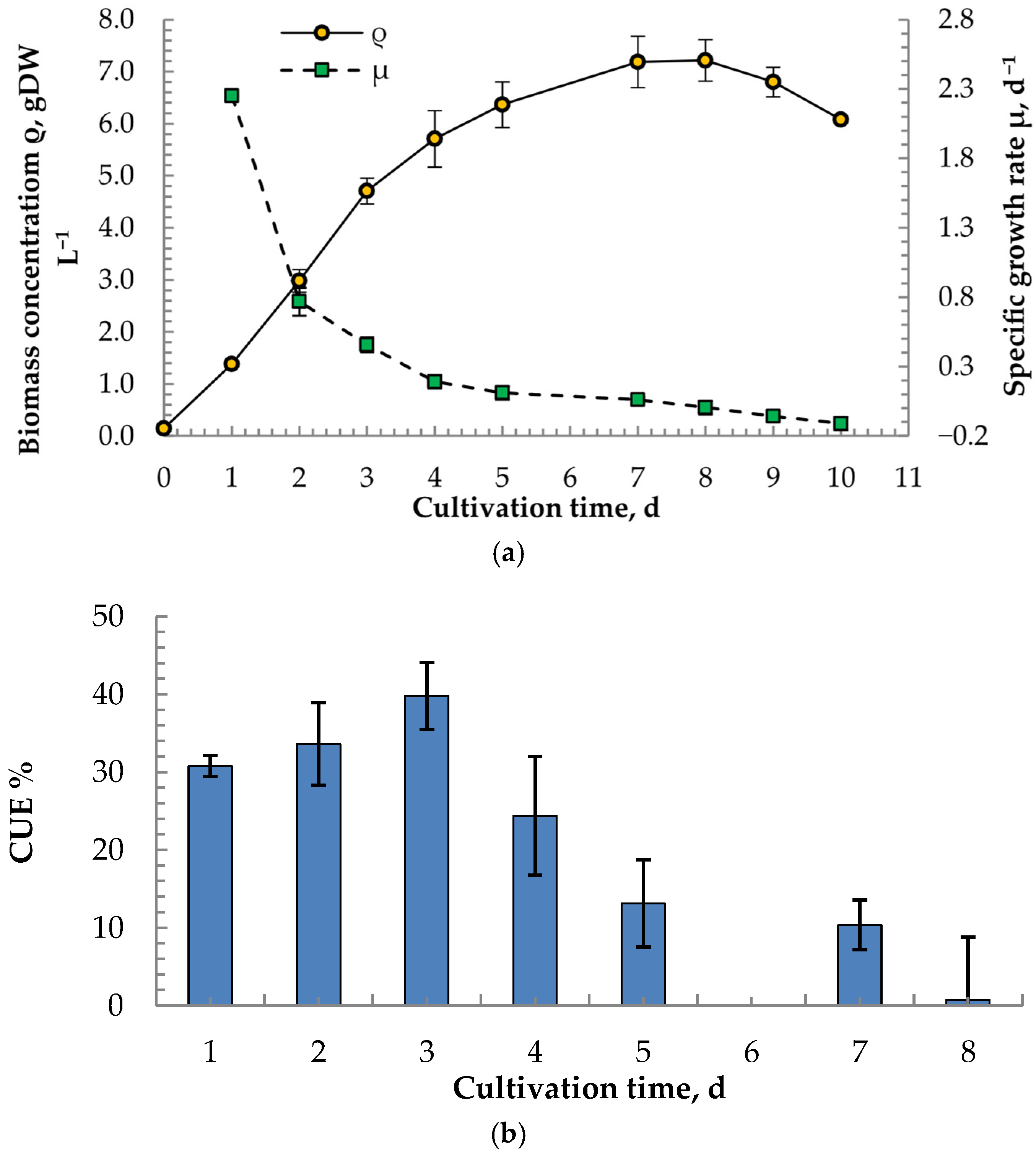
As a first step, growth curves for C. sorokiniana IPPAS C-1 (hereafter C-1) were established in FP-5 photobioreactors. The cultivation was conducted in batch mode for 10 days under previously determined optimal conditions [39], with three biological replicates. The growth characteristics and the CUE of C-1 in batch culture are presented in Figure 1.
A maximum biomass concentration of 7.21 ± 0.40 g DW L−1 was reached on day 8, while the highest specific growth rate of 2.25 ± 0.05 d−1 was observed on the first day. The peak CUE of 39.8 ± 4.3% occurred on day 3.
After day 3, the biomass growth of the culture and CUE began to decline (Figure 1), marking the culture’s transition from the linear to the stationary phase. Further batch cultivation for biomass accumulation was deemed inefficient due to diminishing returns in yield relative to required energy and time inputs. The highest specific productivity (Psp) was 1.48 ± 0.08 g DW L−1 d−1 over the initial 3-day period, compared to 0.87 ± 0.05 g DW L−1 d−1 calculated for the first 8 days (prior to the onset of the decline phase). Therefore, a 3-day batch pre-cultivation of C-1 in FP-5 PBRs was adopted for all subsequent semi-continuous experiments prior to initiating harvest and dilution cycles.
The pH increased from 6.28 ± 0.01 to 8.20 ± 0.10 by day 3 and remained near this level until the end of the cultivation on day 10. The maximum pH of 8.33 ± 0.03 was recorded on day 7. By the final day 14, the pH had slightly decreased to 8.07 ± 0.02 (Figure S4).

3.2. Cultivation in Semi-Continuous Mode

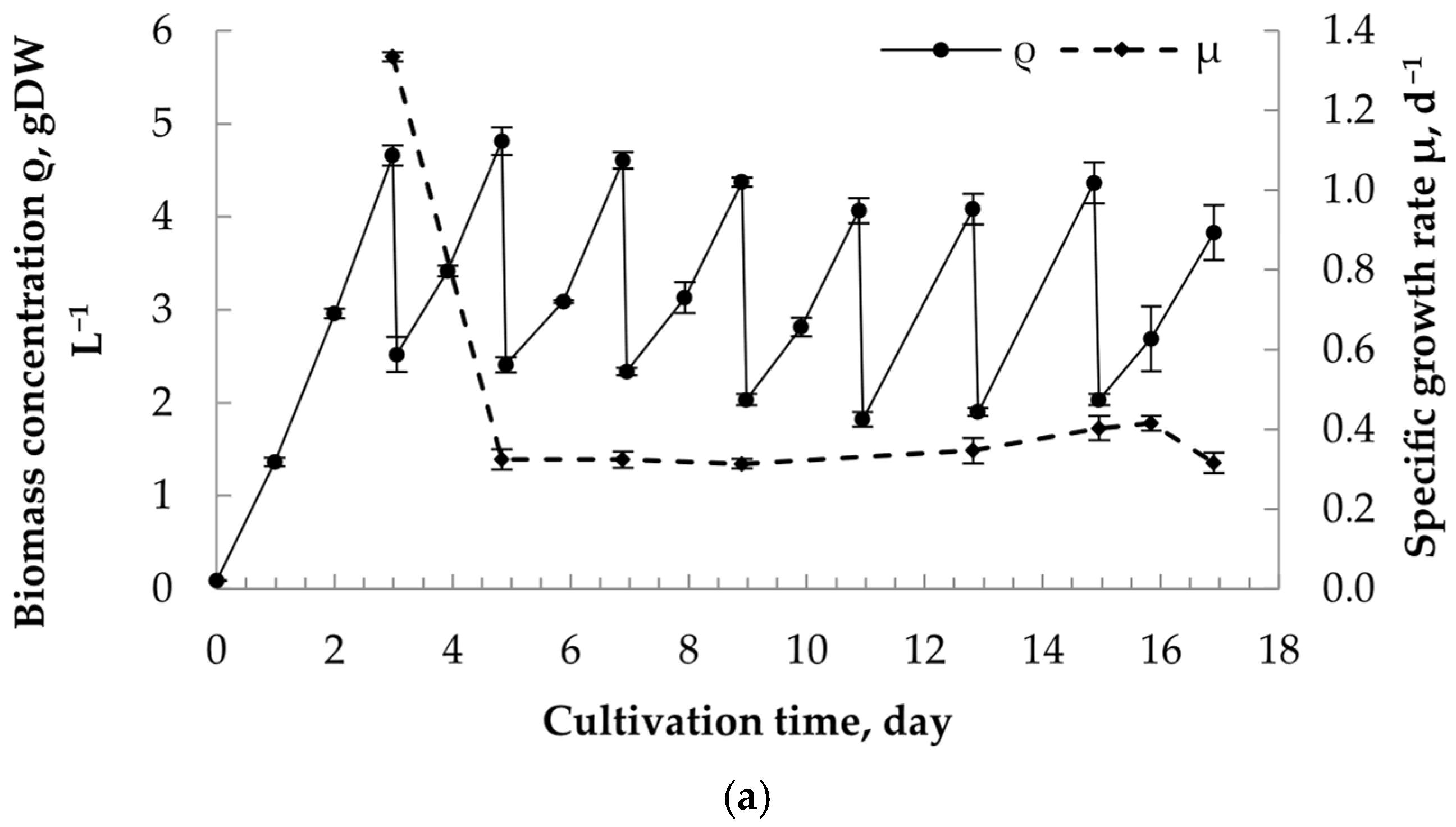
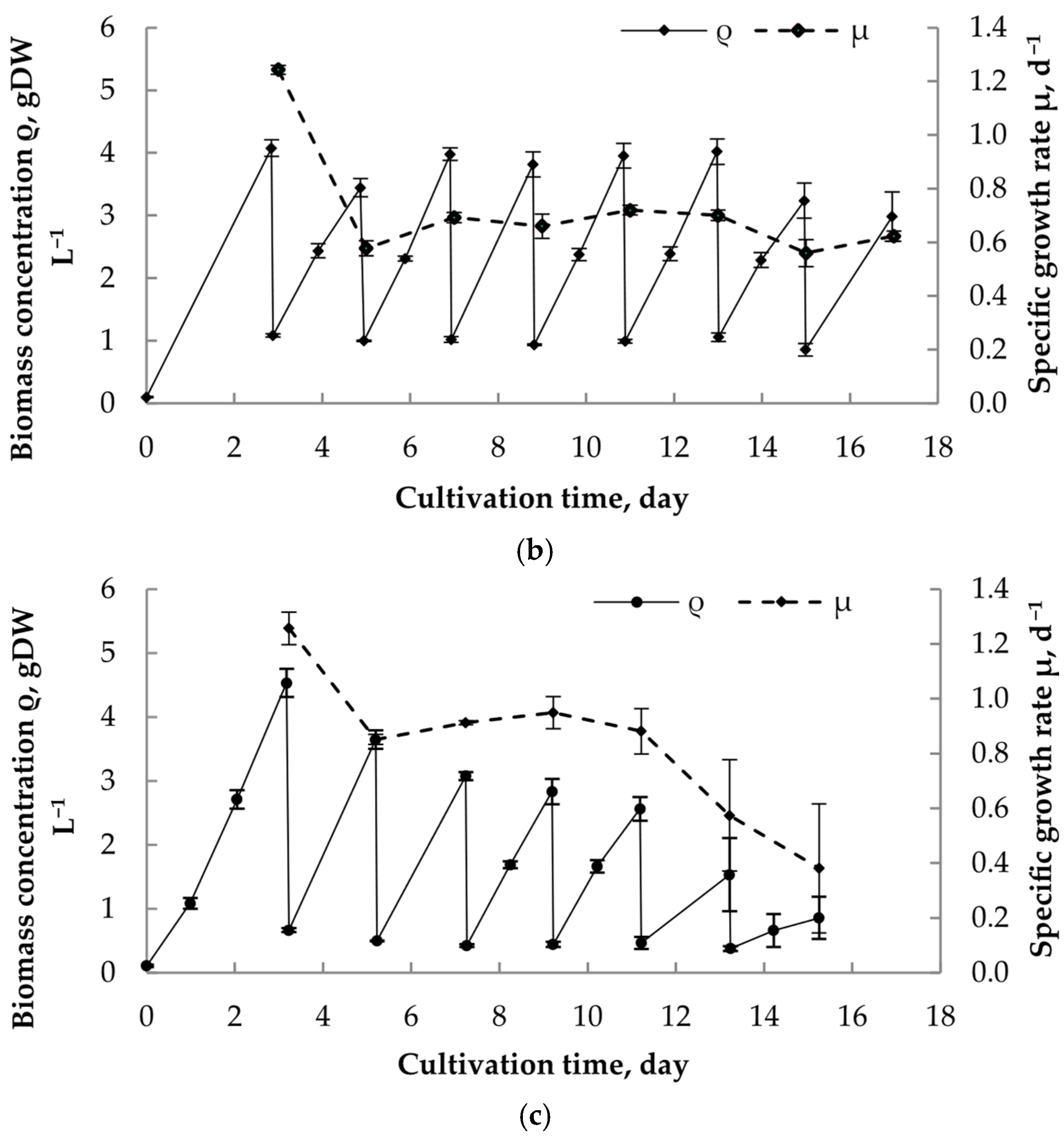
The primary goals of optimizing the dilution fraction in semi-continuous mode is to maintain stable biomass concentration and biochemical composition over successive harvests during extended cultivation (>10 days) and to maximize the total yield at the end of the production cycle. Dilution fractions of 50%, 75%, and 87.5% were tested in parallel in three individual PBRs. In all variants, harvest and dilution were performed every two days after an initial 3-day batch cultivation phase. This 2-day dilution period was selected because it corresponded to the time required for biomass to recover to its pre-harvest level after 50% and 75% dilutions. The same dilution period was also adopted for the third variant (87.5%) to enable direct comparison. The growth characteristics of C-1 in FP-5 PBRs under these semi-continuous regimes with different dilution fractions are presented in Figure 2.
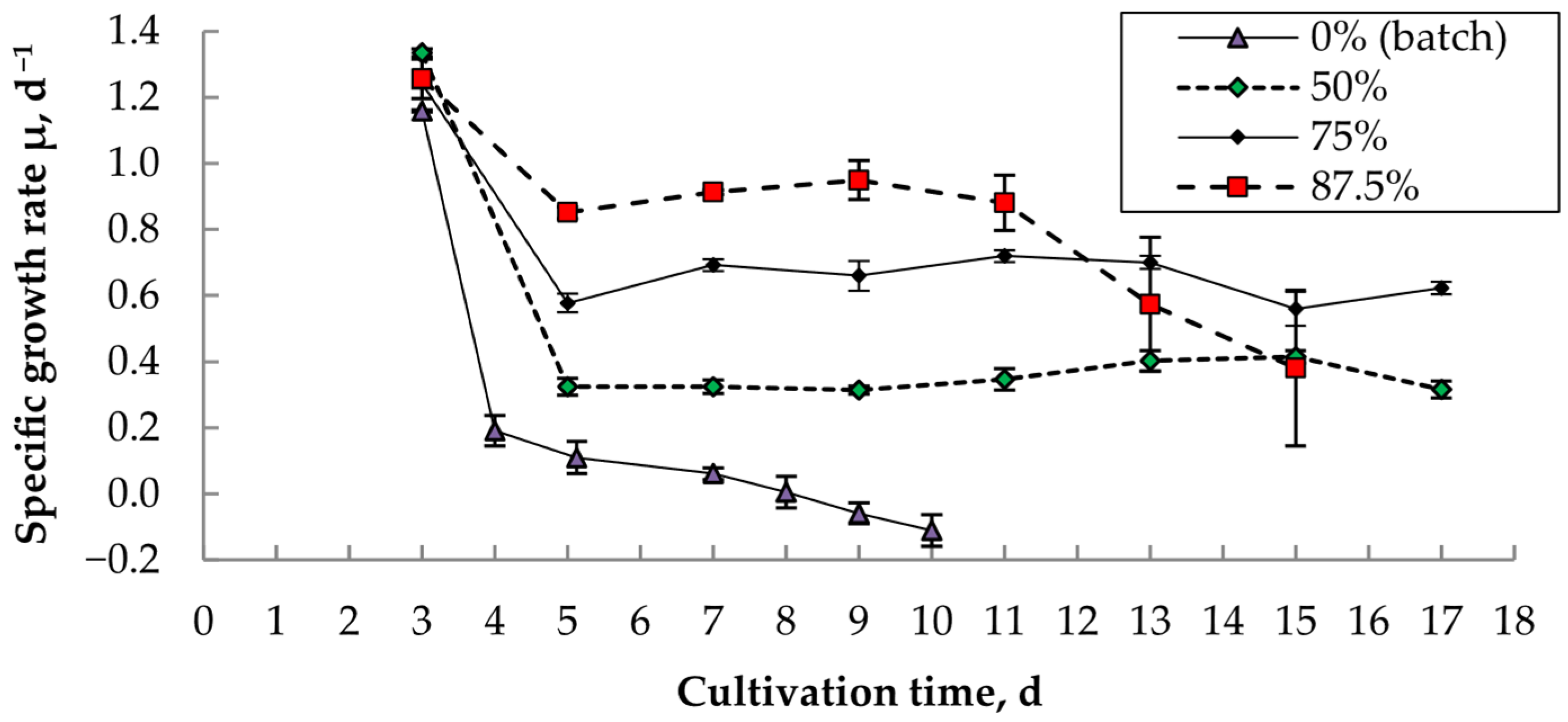
In the semi-continuous regimes with 50% and 75% dilution, the culture maintained a relatively constant specific growth rate (µ). In contrast, the 87.5% harvest regime led to a sharp decline in µ after the fifth dilution cycle (day 11), whereas the batch culture exhibited a continuous decrease in µ throughout the cultivation. Overall, higher dilution fractions were associated with higher specific growth rates. A comparison of the µ dynamics is presented in Figure 3 and the main cultivation parameters are summarized in Table 1.
The highest total biomass yield was achieved in the semi-continuous variant with a 75% dilution fraction (Table 1). It was 18.4% higher than in the 50% variant and 58.5% higher than in the batch mode. Although the 87.5% variant could potentially yield a greater harvested volume, the experiment was terminated on day 15 due to a sharp decline in the specific growth rate and a critically low biomass concentration of 0.86 ± 0.32 g DW L−1.

3.3. Biochemical Composition and Photosynthetic Activity

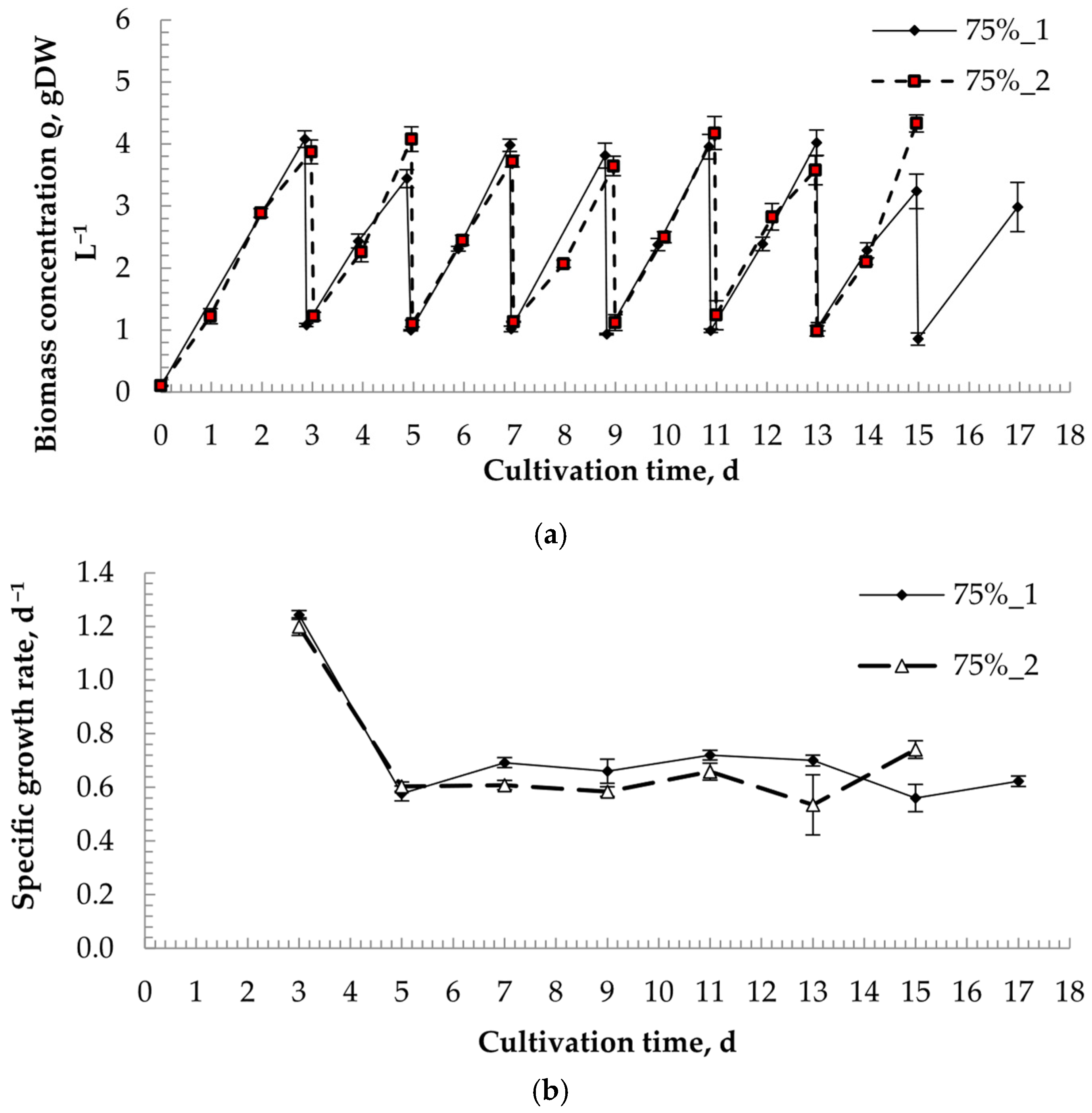
To analyze biochemical composition and photosynthetic activity, the semi-continuous cultivation with 75% harvest/dilution fraction was replicated in three FP-5 PBRs under the described conditions. The results from two independent experiments under this regime are compared in Figure 4. The dynamics of biomass concentration dynamics and specific growth rate showed a high degree of concordance between the experimental replicates. Notable discrepancies emerged only after 15 days, between the sixth and seventh harvest cycle. Hence, the semi-continuous cultivation of C-1 in FP-5 PBRs at a 75% dilution fraction proved to be highly reproducible and reliable.

3.3.1. Pigment Content and Photosynthetic Activity

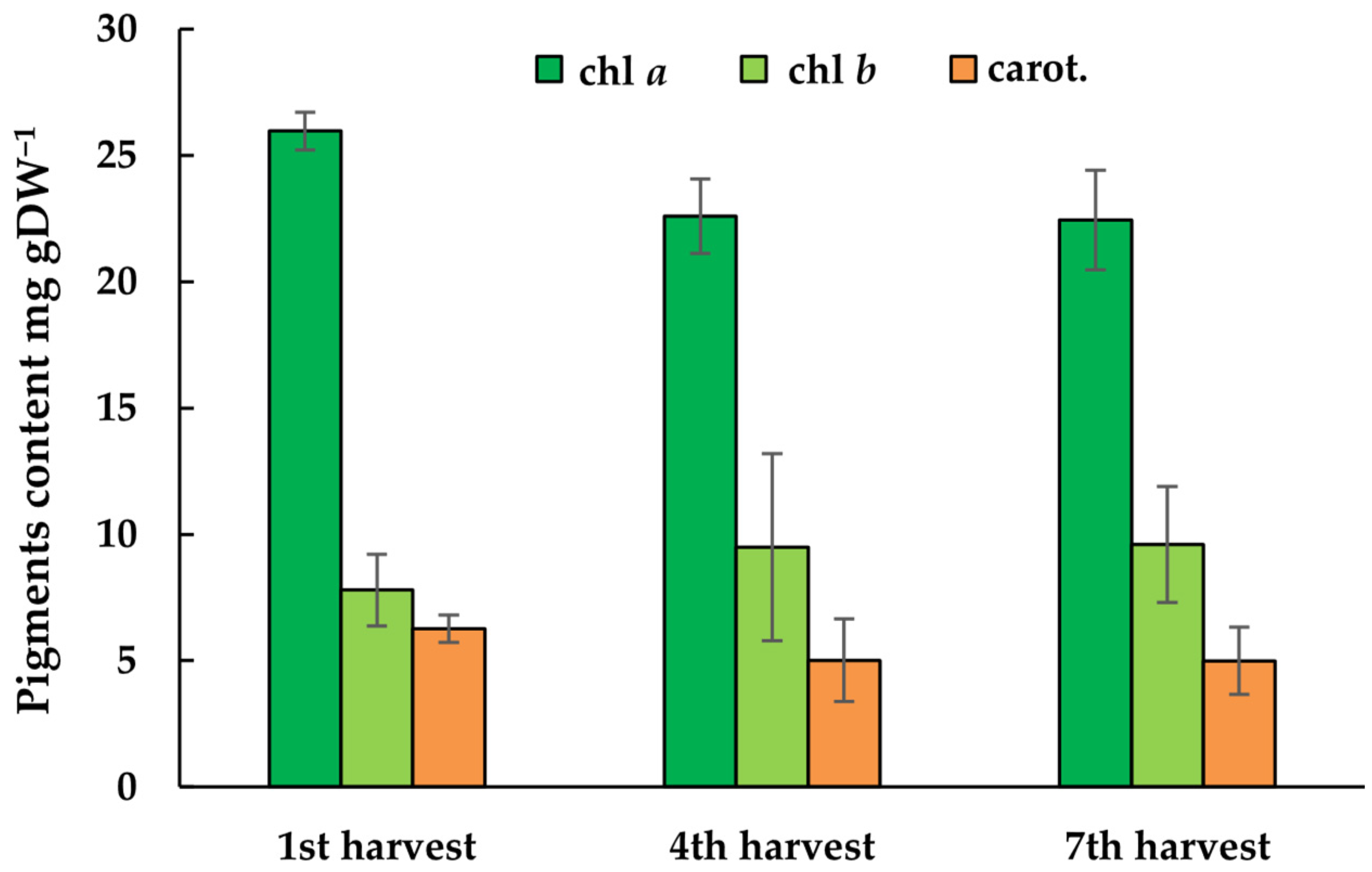
The pigment content of C-1 cells throughout the full duration of semi-continuous cultivation is presented in Figure 5. During the semi-continuous cultivation, a slight decreasing trend was observed in chlorophyll a concentration, while chlorophyll b and carotenoids did not change significantly. The highest chlorophyll a content (26.0 ± 0.75 mg g DW−1) was recorded found at the first harvest (day 3), approximately 15% higher than in subsequent harvests, where it stabilized at around 22.5 mg g DW−1 (fourth and seventh harvests). A one-way ANOVA indicated a significant overall effect of time on chlorophyll a concentration (F (2, 8) = 5.393, p = 0.046). However, post hoc Tukey HSD tests revealed no significant differences between any specific pairs of time points. This pattern may be attributed to a relatively weak effect or insufficient statistical power (n = 3 per group) to detect pairwise differences under the stringent correction for multiple comparisons. Chlorophyll b content ranged from 7.8 to 9.6 mg g DW−1, and carotenoids content from 5.0 to 6.3 mg g DW−1. In summary, the overall pigment composition was maintained relatively stable (p > 0.05) throughout the seven cultivation cycles.
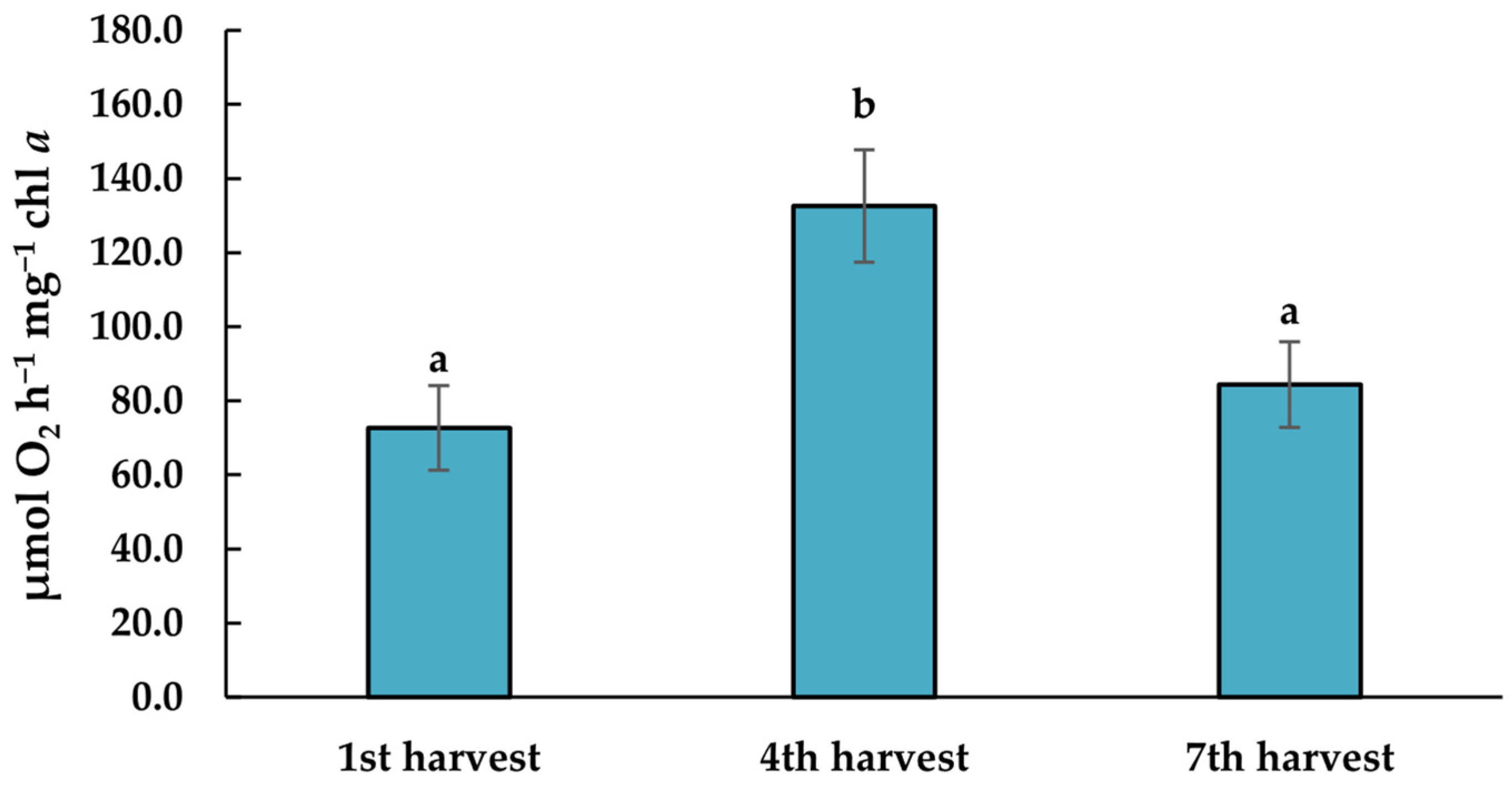
The dynamics of photosynthetic activity during the semi-continuous cultivation of strain C-1 are shown in Figure 6. The rates of oxygen evolution increased from the first to the fourth harvest (from 72.7 to 132.5 µmol O2 h−1 mg−1 chl a, respectively), followed by a decline to 84.4 µmol O2 h−1 mg−1 chl a by the seventh harvest. This final value falls within the standard deviation of the measurement from the first harvest.

3.3.2. Protein, Total Lipid and Carbohydrate Composition of the Biomass

Biochemical composition (including protein, starch, and total lipid content, FA profile, and pigment content) and photosynthetic activity were analyzed on days 3, 9, and 15 of cultivation, corresponding to the first, fourth and seventh harvests, respectively.
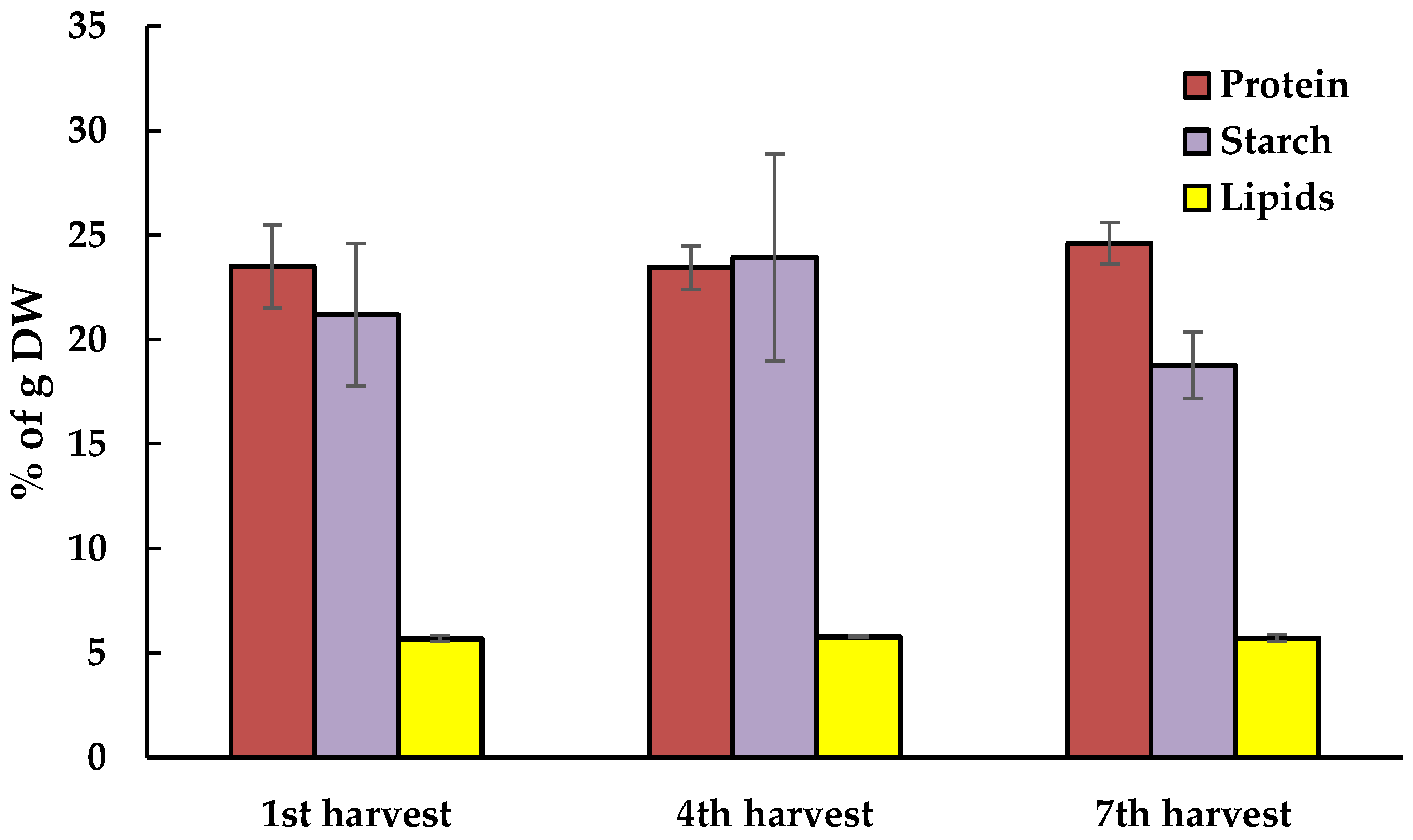
The content of the major biochemical compounds (proteins, starch and lipids) remained relatively stable (p > 0.05) throughout the full duration of semi-continuous cultivation (Figure 7). The average biochemical composition of C-1 cells was as follows: proteins, 23.84 ± 0.66% of DW; starch, 21.29 ± 2.59% of DW; and total lipids, 5.73 ± 0.075% of DW.
Table 2 presents the FA composition of C-1 total lipids during the entire semi-continuous cultivation period in FP-5 PBR with a 75% dilution fraction. The FA profile and unsaturation indices (UIs) remained stable, with no significant changes observed over time. The main FAs (>5%) were linoleic (18:2Δ9,12), palmitic (16:0), Δ7,10-hexadecadienoic (16:2Δ7,10), α-linolenic (18:3Δ9,12,15), and Δ7,10,13-hexadecatrienoic (16:3Δ7,10,13). There were also notable amounts (1–5%) of Δ7-hexadecenoic (16:1Δ7), stearic (18:0) and oleic (18:1Δ9) acids.

4. Discussion

4.1. Cultivation in Batch Mode

In our previous studies [39,42], C. sorokiniana IPPAS C-1 was cultivated in the FP-5 PBRs in batch mode. In the present study, the specific growth rates and biomass productivity over the first three days of cultivation were comparable to earlier runs, with only minor variations of 1% and 2% in their average values, respectively. The results were highly reproducible across multiple experimental repeats. During long-term batch cultivation, a maximum biomass concentration of 7.24 ± 0.4 g DW L−1 was achieved on day 8.
In the work of Bai et al. [31], the biomass concentration of C. vulgaris XJW in batch mode reached a maximum of 0.569 g·L−1 at 25 °C. This value is significantly lower than reported here. The discrepancy is well explained by the markedly different cultivation conditions employed in [31], which were less favorable for high-density growth: a column 0.7 L PBR with BG-11 medium, a temperature of 24 ± 1 °C, a light intensity of 5000 lx (about 70 µmol m−2 s−1 of warm white light) with a light/dark cycle of 16:8 h, and an aeration of 1% (v/v) CO2 at a flow rate of 0.4 m3·h−1. In contrast, our study utilized substantially more optimized conditions, including a higher temperature, greater light intensity, an elevated CO2 concentration, and a growth medium enriched in macronutrients.
Franco [53] reported a high biomass concentration of 11.34 g DW L−1 for C. sorokiniana CCAP 211/8K after just 5 days of cultivation in a commercial 1.8 L FP PBR Labfors 5 with a short 2 cm light path [52]. Notably, this concentration at day 5 already exceeded the peak concentration we achieved by day 8 (7.24 ± 0.4 g DW L−1). This advantage in volumetric productivity is a direct consequence of the shorter light path, a critical parameter for increasing light availability and thus growth rates [27]. It is reflected in the higher reported specific productivity of 3.4 g DW L−1 d−1 in [52] compared to our value of 1.52 g DW L−1 d−1. The continuous adjustment of light levels and aeration rates based on real-time cell density data, maintains optimal cultivation parameters over extended periods. However, for practical biomass production, the total yield per photobioreactor unit is a more relevant metric. The substantially reduced light path in [54] inherently limits the effective working volume. Consequently, while their system achieves a higher biomass concentration, our FP-5 PBR configuration generates a greater absolute biomass yield. This is evidenced by the total biomass obtainable on day 5: 31.82 ± 2.2 g DW from our system versus 20.4 g DW from 1.8 L Labfors 5 PBR. Thus, our reactor design prioritizes total yield over peak volumetric productivity, resulting in a higher overall harvest.
The primary challenge in increasing the productivity of our FP-5 PBRs is achieving finer control of cultivation parameters through automated feedback systems. Beyond this level of control, industrial optimization requires consistency across all cultivation parameters, including PBRs geometry and dimensions, to maximize biomass yield within compressed cultivation cycles.

4.2. Cultivation in Semi-Continuous Mode

The efficiency of semi-continuous cultivation mode is defined by dilution rate, which is dependent on the dilution fraction and the frequency of medium replacement. A high dilution fraction ensures a high specific growth rate due to improved light penetration and nutrient availability at lower optical densities. Simultaneously, it extends the time of reaching the target biomass concentration. This inverse relationship underscores the existence of an optimal dilution rate that maximizes both productivity per cycle and total biomass yield.
The optimization of semi-continuous cultivation parameters for C. vulgaris XJW was performed in a two-phase experiment [31]. The first phase tested dilution fraction of 10, 20, 30, 40, and 50% with a fixed one-day harvest interval. Subsequently the second phase evaluated harvest intervals of 1, 2, 3, and 4 days. using the optimal dilution fraction identified in the first phase. The reported average maximum biomass yield for the 10–40% dilution range (1.634–1.662 g·L−1) exceeded that achieved in batch cultivation (1.564 g·L−1). In the present study, we applied higher dilution fractions (50, 75, and 82.5%) with a two-day harvest period, selected based on a batch-mode productivity data. The high average biomass concentrations achieved in the dilution cycles (4.38 ± 0.06, 3.74 ± 0.08 and 2.73 ± 0.17 g DW L−1, respectively) can be attributed to the optimized intensive cultivation conditions established for C. sorokiniana IPPAS C-1. These conditions included superior light intensity, CO2 supply, and medium composition. For commercial biomass production, predictable and consistent output is essential. Therefore, an ideal biotechnological process should maintain stable productivity over the entire harvest cycle and enable accurate yield forecasting.
Das et al. [32] advocated for semi-continuous cultivation as a superior alternative to batch cultivation, demonstrating greater biomass and lipid yields. They tested 25, 50, and 75% dilutions, showing that the harvest period and dilution fraction require mutual optimization and that the timing of the first dilution significantly affects the cycle’s biomass yield. Their optimal configuration (initiating a 2-day dilution cycle with a 25% dilution on day 9) resulted in a final biomass concentration of 7.27 g L−1 after 30 days. However, a critical parameter for commercial production, namely the total cumulative biomass yield, was not compared between the regimes, leaving the overall productivity advantage incompletely quantified. In our study, we identified an optimal dilution fraction that maximized total biomass yield, establishing it as the key parameter for subsequent experiments.

4.3. Stability of Biomass Composition and Photosyntetic Activity

An optimized semi-continuous cultivation regime, following batch pre-cultivation, enhances overall productivity and photosynthetic activity. This synergistic effect can be attributed to the optimization of the hydraulic retention time (HRT) [20,34] and the alleviation of light limitation [54]. HRT, defined as the average time the culture remains in the reactor, is a fundamental parameter in semi-continuous systems. It directly determines the dilution frequency and volume, thereby influencing key cultivation performance metrics. Optimizing HRT involves balancing the trade-off between high volumetric productivity (favored by a short HRT) and high culture density (achieved with a long HRT) [55]. In this study, a 2-day dilution cycle with a 75% volume exchange was implemented, resulting in an intermediate HRT of 3.1–3.3 days, compared to 5.7 days for the 50% dilution and 2.5 days for the 87.5% dilution. Although the 87.5% dilution achieved the shortest HRT, it resulted in declining productivity towards the end of the experimental run yielding lower total biomass.
HRT critically influences nutrient utilization efficiency (e.g., nitrogen, phosphorus, CO2), as it defines the duration available for nutrient assimilation before harvest [13]. An optimal HRT represents a balanced state in which the culture is consistently maintained in its maximum growth phase, characterized by favorable parameters of pH and dissolved O2/CO2 ratio. This balanced state likely explains the peak photosynthetic activity observed at the fourth harvest. Supporting this interpretation, Soto-Ramírez et al. [54] demonstrated that cultivation of Chlorella under continuous light-limited conditions induces adaptations in the photosynthetic apparatus leading to ultrastructural changes that result in higher photosynthetic rates and a more pronounced response to high irradiance. While the present study confirms the physiological benefits of an optimized dilution fraction, future work incorporating nutrient depletion dynamics will be essential to fully refine the semi-continuous strategy for the C-1 strain and enhancing the productivity of valuable compounds [13,17].
Balanced cultivation conditions throughout the entire cultivation period promote a stable biochemical composition of cells. That stability is crucial for the commercial production of high-quality crude microalgae biomass or downstream extraction of valuable compounds [12,13,32,34]. The semi-continuous regime selected in the present work provided balanced growth conditions. This is confirmed by the stable content of all studied biochemical compounds, which showed no statistically significant variation across the sampling time points. Notably, this included pigments, which are typically highly sensitive to environmental changes [56]. Lai et al. [12] demonstrated stable protein production in C. vulgaris FSP-E and C. sorokiniana using a semi-continuous regime. The maximal variation in protein content throughout the experiment was 25.6% for C. vulgaris FSP-E and 7.9% for C. sorokiniana. Yuan et al. [13] used a semi-continuous cultivation regime to achieve high and stable carbohydrate yields in Chlorella sp. AE10.A key finding from Ziganshina et al. [34] was the stability of the pigment composition in all applied semi-continuous regimes.
As previously reported for the studied strain C. sorokiniana C-1, when grown under optimal conditions in batch culture, it can accumulate both protein and starch in comparable amounts of 20–25% of dry weight [42]. However, under specific conditions, the same strain demonstrated the capacity to accumulate up to 45 ± 2.3% of protein or up to 54 ± 11.7% of starch [39]. The relatively low total lipid content can be explained by the applied growth conditions, which favored intensive cell growth and production of structural lipids, mainly those from the thylakoid membranes of chloroplasts. This is confirmed by the lipid profile, characterized by a high content of dienoic and trienoic fatty acids, which typically esterify plastidic galactolipids [57].
Starch accumulation can be enhanced in semi-continuous cultivation either by increasing illumination levels or by applying nitrogen limitation [13]. In turn, protein accumulation, along with overall biomass productivity, can be increased by optimizing factors such as CO2 concentration, nitrogen source, and ferric ion supplementation. as demonstrated for C. vulgaris and C. sorokiniana by Lai et al. [12]. In that study, maximum algal protein production was achieved using a semi-continuous mode with an 80% dilution and a 7-day harvest period. The reported protein content for C. sorokiniana was 852 mg L−1, which is lower than the average value of 986 ± 28 mg L−1 obtained in our work. This discrepancy may be attributed to differences in cultivation conditions: the use of lower light intensity (100 µmol m−2 s−1) and lower nitrogen content in MBG-11 medium required a longer batch pre-cultivation period (7 days compared to our 3 days) to reach a similar initial biomass concentration of approximately 4 g DW L−1 [12].
While many Chlorella strains are applicable for lipid production, the studied strain exhibits a greater potential for protein or starch biosynthesis. Its metabolism favors high protein synthesis during rapid growth and a distinct shift toward starch accumulation under stressful conditions [39,58].
Although the applied conditions did not yield the maximum possible content of either protein or starch, both components were maintained at a significant and stable concentration of 20–25% throughout the entire cultivation cycle. In an industrial context, this operational stability can compensate for a suboptimal yield of the target product.

4.4. Prospects of Chlorella Strains Semi-Continuous Cultivation

The primary advantage of the semi-continuous cultivation regime lies in its adaptability to a wide range of input parameters and environmental conditions. This operational flexibility, coupled with the remarkable adaptive capacity of Chlorella strains, makes this approach highly suitable for a broad spectrum of biotechnological applications. Indeed, examples of its successful implementation for cultivation of microalgae strains destined for use in agriculture, energy production, and ecological remediation are well documented [13,17,18,19,20,30,32,33].
For instance, study by Rawat et al. [20] presents a compelling ecological application by integrating microalgae cultivation with mine water treatment. The microalgae Auxenochlorella pyrenoidosa (formerly Chlorella pyrenoidosa) (NCIM 2738) was cultivated in a semi-continuous mode at HRTs of 4, 6, and 9 days to assess its lipid production potential and desalination efficiency. Evaluation of nutrient removal dynamics showed that a 9-day HRT yielded the maximum chemical oxygen demand removal efficiency (96.5%) and the highest salinity reduction (93%) in a batch culture reactor. Furthermore, Energy Dispersive X-ray Spectroscopy analysis confirmed the successful desalination process, revealing significant accumulation of salt ions (Na+, Mg2+) and metal ions (Fe2+, Pb2+, Cu2+, Cr2+) within the microalgal biomass. This microalgae-assisted treatment strategy offers a sustainable practice for the coal industry, reducing its water footprint, while providing an effective long-term solution for wastewater remediation. In addition, Stirk et al. [30] identified Chlorella sorokiniana as a robust biotechnological strain based on its performance in 100 L greenhouse bioreactors under sub-optimal conditions. This strain can be used, potentially, as a plant growth biostimulant or for the utilization of pig manure wastewater. It also exhibited metabolic flexibility by adopting mixotrophic growth to counteract light limitation, further underscoring its suitability for cost-effective cultivation. Similarly, the research by Tan et al. [18] demonstrates the efficacy of utilizing various biological wastes during long-term semi-continuous cultivation of microalgae to simultaneously produce valuable compounds and treat wastewater. For instance, Chlorella vulgaris thrived under optimized conditions with 30% (v/v) medium exchange and supplementation with 0.04 L/L chicken compost at pH 3, highlighting the potential of an integrated compost-microalgae biorefinery for scalable biodiesel production with improved environmental footprints. Similarly, a consortium dominated by Chlorella vulgaris cultivated in piggery wastewater, maintained stability over six semi-continuous cycles, achieving high biomass and lipid productivities alongside efficient removal of NH4+, PO43−, and chemical oxygen demand [19]. Furthermore, a mixed microalgal consortium cultivated on low-loaded domestic wastewaters demonstrated a capacity for long-term carbohydrate accumulation [17]. Collectively, these studies confirm that biological wastes can serve as effective substrates for sustainable microalgae cultivation, supporting the bioremediation service and continuous production of biofuels and valuable biochemicals.
The high biomass yield combined with stable starch and protein content over 7 harvest cycles, establishes Chlorella sorokiniana IPPAS C-1 as a robust candidate for diverse bioproducts and applications in food, feed, pharmaceutical and cosmetic industries [2,23,59].

5. Conclusions

This study systematically evaluated different semi-continuous cultivation regimes for Chlorella sorokiniana IPPAS C-1 in flat-panel photobioreactors in three biological replicates. Among the tested regimes (50%, 75%, and 87.5% harvest volumes), periodic harvest of 75% of the suspension volume, followed by medium replenishment, proved optimal for sustained long-term cultivation. Over 15-day cultivation period in 5 L PBRs, encompassing seven harvest cycles, a total of 31.25 L of suspension was processed, yielding 114.37 ± 3.28 g DW of biomass from each PBR. This corresponds to an average biomass concentration of 3.66 ± 0.11 g DW L−1 and a productivity of 1.36 ± 0.04 g DW L−1 day−1 during the harvest period. Notably, the biochemical biomass composition (pigment, protein, starch, and lipid content, as well as FA profile) remained consistent throughout the cultivation, confirming process stability. These findings provide a robust foundation for developing scalable and efficient industrial cultivation protocols for cultivation of Chlorella sorokiniana IPPAS C-1 in flat-panel photobioreactor systems.

Supplementary Materials

The following supporting information can be downloaded at: https://www.mdpi.com/article/10.3390/phycology6010004/s1, Figure S1: LED parameters and the spectral composition of the light; Figure S2: Photograph of photobioreactors with culture (a) and principal working scheme of experimental unit (b). CO2—carbon dioxide cylinder; GA—gas analyzer; C—air compressor (pump); R1—CO2 rotameter; R2—gas–air mixture rotameter; F—filter; GS—gas analyzer sensor; FC—foam container; GM—gas–air mixer; ECU—electric control unit; TCU—temperature control unit; EV—electromagnetic valve; PBR—photobioreactor; S—gas–air mixture sprayer; RV—reserve water (medium) volume; TS—temperature sensor; LM—LED modules; OD—optical density; pH—hydrogen ion exponent. On the right PBR (a), one LED module is removed to view what is inside; Figure S3: Values of dry biomass concentration at different values of optical density for C. sorokiniana IPPAS C-1. Mean ± SD (N = 3); Figure S4: pH level during batch and semi-continuous cultivation in PBRs. (a) batch cultivation; (b) 50% of suspension volume harvest; (c) 75% of suspension volume harvest; (d) 87.5% of suspension volume. Mean ± SD (N = 3).

Author Contributions

Conceptualization, methodology, D.A.G., M.A.S. and B.V.G.; validation, formal analysis, visualization, supervision, D.A.G. and M.A.S.; investigation, D.A.G., M.A.S., B.V.G., A.K.G., A.M., A.Y.S., R.A.V., G.A.S. and N.V.S.; writing—original draft preparation, D.A.G., M.A.S. and D.A.L.; writing—review and editing, D.A.L.; project administration, funding acquisition, D.A.L. All authors have read and agreed to the published version of the manuscript.

Funding

This research was funded by the Russian Science Foundation no. 21-74-30003 to D.A.L.

Institutional Review Board Statement

Not applicable.

Informed Consent Statement

Not applicable.

Data Availability Statement

The original contributions presented in this study are included in the article. Further inquiries can be directed to the corresponding author.

Acknowledgments

We are grateful to Collection of microalgae and cyanobacteria IPPAS (K.A. Timiryazev Institute of Plant Physiology, RAS, Moscow, Russia) for providing algal strains and for the continuous support with algae cultivation. This work was partially supported by the Ministry of Science and Higher Education of the Russian Federation (theme no. 122042600086-7).

Conflicts of Interest

The authors declare no conflicts of interest.

Abbreviations

The following abbreviations are used in this manuscript:
µspecific growth rate
CUEcardon dioxide utilization efficiency
Iaveaverage irradiance or average illumination level
g DW gram of dry weight
GAMgas-air mixture
HRThydraulic retention time
IPP RAS Institute of Plants Physiology of Russian Academy of Sciences
LEDlight emitting diode
ρdry biomass concentration
ρ0starting dry biomass concentration
ρfinfinal dry biomass concentration
MCO2mass of total supplied CO2
M0starting weigh of dry biomass in PBR after inoculation
MPBRweight of dry biomass in the working volume of PBR at the moment
PBRphotobioreactor
PBR FPflat-panel photobioreactor
Pspspecific productivity
RGAMGAM aeration rate
Tdblbiomass doubling time
VPBRworking volume of PBR
vvmvolume of sparged gas per unit volume of growth medium per minute

References

  1. Diaz, C.J.; Douglas, K.J.; Kang, K.; Kolarik, A.L.; Malinovski, R.; Torres-Tiji, Y.; Molino, J.V.; Badary, A.; Mayfield, S.P. Developing algae as a sustainable food source. Front. Nutr. 2023, 9, 1029841. [Google Scholar] [CrossRef] [PubMed]
  2. Ang, W.S.; Kee, P.E.; Lan, J.C.-W.; Chen, W.-H.; Chang, J.-S.; Khoo, K.S. Unveiling the rise of microalgae-based foods in the global market: Perspective views and way forward. Food Biosci. 2025, 66, 105390. [Google Scholar] [CrossRef]
  3. Mourelle, M.L.; Díaz-Seoane, F.; Inoubli, S.; Gómez, C.P.; Legido, J.L. Microalgae and Cyanobacteria Exopolysaccharides: An Untapped Raw Material for Cosmetic Use. Cosmetics 2025, 12, 200. [Google Scholar] [CrossRef]
  4. Chwil, M.; Mihelic, R.; Matraszek-Gawron, R.; Terlecka, P.; Skoczylas, M.M.; Terlecki, K. Comprehensive Review of the Latest Investigations of the Health-Enhancing Effects of Selected Properties of Arthrospira and Spirulina Microalgae on Skin. Pharmaceuticals 2024, 17, 1321. [Google Scholar] [CrossRef]
  5. Puchkova, T.V.; Khapchaeva, S.A.; Zotov, V.S.; Lukyanov, A.A.; Solovchenko, A.E. Marine and freshwater microalgae as a sustainable source of cosmeceuticals. Mar. Biol. J. 2021, 6, 67–81. [Google Scholar] [CrossRef]
  6. Bošnjakovic, M.; Sinaga, N. The Perspective of Large-Scale Production of Algae Biodiesel. Appl. Sci. 2020, 10, 8181. [Google Scholar] [CrossRef]
  7. Six, A.; Dauvillée, D.; Lancelon-Pin, C.; Dimitriades-Lemaire, A.; Compadre, A.; Dubreuil, C.; Alvarez, P.; Sassi, J.-F.; Li-Beisson, Y.; Putaux, J.-L.; et al. From raw microalgae to bioplastics: Conversion of Chlorella vulgaris starch granules into thermoplastic starch. Carbohydr. Polym. 2024, 342, 122342. [Google Scholar] [CrossRef]
  8. Spilling, K. (Ed.) Biofuels from Algae: Methods and Protocols; Humana: New York, NY, USA, 2019; p. 249. [Google Scholar]
  9. Politaeva, N.; Smyatskaya, Y.; Al Afif, R.; Pfeifer, C.; Mukhametova, L. Development of Full-Cycle Utilization of Chlorella sorokiniana Microalgae Biomass for Environmental and Food Purposes. Energies 2020, 13, 2648. [Google Scholar] [CrossRef]
  10. Chong, J.W.R.; Tan, X.; Khoo, K.S.; Ng, H.S.; Jonglertjunya, W.; Yew, G.Y.; Show, P.L. Microalgae-based bioplastics: Future solution towards mitigation of plastic wastes. Environ. Res. 2022, 206, 112620. [Google Scholar] [CrossRef]
  11. Park, Y.K.; Lee, J. Achievements in the production of bioplastics from microalgae. Phytochem. Rev. 2023, 22, 1147–1165. [Google Scholar] [CrossRef]
  12. Lai, Y.-C.; Chang, C.-H.; Chen, C.-Y.; Chang, J.-S.; Ng, I.-S. Towards protein production and application by using Chlorella species as circular economy. Bioresour. Technol. 2019, 289, 121625. [Google Scholar] [CrossRef] [PubMed]
  13. Yuan, Y.; Liu, H.; Li, X.; Wenqiang Qi, W.; Cheng, D.; Tang, T.; Zhao, Q.; Wei, W.; Sun, Y. Enhancing Carbohydrate Productivity of Chlorella sp. AE10 in Semi-continuous Cultivation and Unraveling the Mechanism by Flow Cytometry. Appl. Biochem. Biotechnol. 2018, 185, 419–433. [Google Scholar] [CrossRef] [PubMed]
  14. Lobus, N.V.; Knyazeva, M.A.; Popova, A.F.; Kulikovskiy, M.S. Carbon Footprint Reduction and Climate Change Mitigation: A Review of the Approaches, Technologies, and Implementation Challenges. C 2023, 9, 120. [Google Scholar] [CrossRef]
  15. Tavares, J.; Silva, T.P.; Paixão, S.M.; Alves, L. Development of a bench-scale photobioreactor with a novel recirculation system for continuous cultivation of microalgae. J. Environ. Manag. 2023, 332, 117418. [Google Scholar] [CrossRef] [PubMed]
  16. Yadav, G.; Dubey, B.K.; Sen, R. A comparative life cycle assessment of microalgae production by CO2 sequestration from flue gas in outdoor raceway ponds under batch and semi-continuous regime. J. Clean. Prod. 2020, 258, 120703. [Google Scholar] [CrossRef]
  17. Solís-Salinas, C.E.; Patlán-Juárez, G.; Okoye, P.U.; Guillén-Garcés, A.; Sebastian, P.J.; Arias, D.M. Long-term semi-continuous production of carbohydrate-enriched microalgae biomass cultivated in low-loaded domestic wastewater. Sci. Total Environ. 2021, 798, 149227. [Google Scholar] [CrossRef]
  18. Tan, X.B.; Lam, M.K.; Uemura, Y.; Lim, J.W.; Wong, C.Y.; Ramli, A.; Kiew, P.L.; Lee, K.T. Semi-continuous cultivation of Chlorella vulgaris using chicken compost as nutrients source: Growth optimization study and fatty acid composition analysis. Energy Convers. Manag. 2018, 164, 363–373. [Google Scholar] [CrossRef]
  19. Fernández-Linares, L.C.; Gutiérrez-Márquez, A.; Guerrero-Barajas, C. Semi-continuous culture of a microalgal consortium in open ponds under greenhouse conditions using piggery wastewater effluent. Bioresour. Technol. Rep. 2020, 12, 100597. [Google Scholar] [CrossRef]
  20. Rawat, S.; Gangwar, A.; Kumar, S. Semi-continuous cultivation of microalgae to treat coal mine effluent in pilot scale: Nutrient removal, biodesalination and fatty acid composition analysis. J. Water Process Eng. 2024, 67, 106271. [Google Scholar] [CrossRef]
  21. Umetani, I.; Sposób, M.; Tiron, O. Semi-continuous cultivation for enhanced protein production using indigenous green microalgae and synthetic municipal wastewater. J. Appl. Phycol. 2024, 36, 1105–1116. [Google Scholar] [CrossRef]
  22. Banerjee, S.; Ramaswamy, S. Dynamic process model and economic analysis of microalgae cultivation in flat panel photobioreactors. Algal Res. 2019, 39, 101445. [Google Scholar] [CrossRef]
  23. Novoveská, L.; Nielsen, S.L.; Eroldogan, O.T.; Haznedaroglu, B.Z.; Rinkevich, B.; Fazi, S.; Robbens, J.; Vasquez, M.; Einarsson, H. Overview and Challenges of Large-Scale Cultivation of Photosynthetic Microalgae and Cyanobacteria. Mar. Drugs 2023, 21, 445. [Google Scholar] [CrossRef] [PubMed]
  24. Quiroz, D.; McGowen, J.A.; Quinn, J.C. Techno-economic analysis of microalgae cultivation strategies: Batch and semi-continuous approaches. Algal Res. 2025, 90, 104109. [Google Scholar] [CrossRef]
  25. Dębowski, M.; Zieliński, M.; Kazimierowicz, J.; Kujawska, N.; Talbierz, S. Microalgae Cultivation Technologies as an Opportunity for Bioenergetic System Development—Advantages and Limitations. Sustainability 2020, 12, 9980. [Google Scholar] [CrossRef]
  26. Al-Dailami, A.; Koji, I.; Ahmad, I.; Goto, M. Potential of Photobioreactors (PBRs) in Cultivation of Microalgae. J. Adv. Res. Appl. Sci. Eng. Technol. 2022, 27, 32–44. [Google Scholar] [CrossRef]
  27. Zhang, L.; Zhang, B.; Zhu, X.; Chang, H.; Ou, S.; Wang, H. Role of Bioreactors in Microbial Biomass and Energy Conversion. In Bioreactors for Microbial Biomass and Energy Conversion; Liao, Q., Chang, J.S., Herrmann, C., Xia, A., Eds.; Springer: Singapore, 2018; pp. 39–78. [Google Scholar]
  28. Onen Cinar, S.; Chong, Z.K.; Kucuker, M.A.; Wieczorek, N.; Cengiz, U.; Kuchta, K. Bioplastic Production from Microalgae: A Review. Int. J. Environ. Res. Public Health 2020, 17, 3842. [Google Scholar] [CrossRef]
  29. Sirohi, R.; Pandey, F.K.; Ranganathan, P.; Singh, S.; Udayan, F.; Awasthi, M.K.; Hoang, A.T.; Chilakamarry, C.R.; Kim, S.H.; Sim, S.J. Design and applications of photobioreactors—A review. Biores. Technol. 2022, 349, 126858. [Google Scholar] [CrossRef]
  30. Stirk, W.A.; Bálint, P.; Široká, J.; Novák, O.; Rétfalvi, T.; Berzsenyi, Z.; Notterpek, J.; Varga, Z.; Maróti, G.; Van Staden, J.; et al. Comparison of plant biostimulating properties of Chlorella sorokiniana biomass produced in batch and semi-continuous systems supplemented with pig manure or acetate. J. Biotechnol. 2024, 381, 27–35. [Google Scholar] [CrossRef]
  31. Bai, L.; Xu, X.; Dai, B. Optimization of semi-continuous cultivation conditions for the improvement of lipid productivity from thermo-tolerant Chlorella vulgaris XJW. Energy Sources Part A Recovery Util. Environ. Eff. 2021, 47, 6714–6728. [Google Scholar] [CrossRef]
  32. Das, N.; Padhi, D.; Mandal, S.; Kumar, V.; Nayak, M. Performance evaluation of Chlorella sp. BRE5 for augmented biomass and lipid production implementing semi-continuous cultivation strategy. Biomass Conv. Bioref. 2025, 15, 12301–12312. [Google Scholar] [CrossRef]
  33. Song, X.; Kong, F.; Liu, B.-F.; Song, Q.; Ren, N.-Q.; Ren, H.-Y. Enhancement of microalgae lipid production under multiple stressors and tetracycline and heavy metal removal in semi-continuous operation. Chem. Eng. J. 2025, 511, 162002. [Google Scholar] [CrossRef]
  34. Ziganshina, E.; Bulynina, S.; Ziganshin, A. Semi-continuous cultivation of indigenous Chlorella sorokiniana for biomass and pigment production. In XI International Scientific and Practical Conference Innovative Technologies in Environmental Science and Education (ITSE-2023), Divnomorskoe Village, Russia; Rudoy, D.V., Olshevskaya, A.V., Odabashyan, M.Y., Eds.; E3S Web of Conferences: Les Ulis, France, 2023; Volume 431, p. 01021. [Google Scholar] [CrossRef]
  35. Das, N.; Nayak, M. Enhancing biomass and lipid productivity of Chlorella sp. BRE5 with surplus phosphorus supply implementing semi-continuous cultivation in the indoor and outdoor reactor system. Environ. Sci. Pollut. Res. 2025, 32, 23414–23429. [Google Scholar] [CrossRef] [PubMed]
  36. Sinetova, M.A.; Sidorov, R.A.; Starikov, A.Y.u.; Voronkov, A.S.; Medvedeva, A.S.; Krivova, Z.V.; Pakholkova, M.S.; Bachin, D.V.; Bedbenov, V.S.; Gabrielyan, D.A.; et al. Assessment of the biotechnological potential of cyanobacterial and microalgal strains from IPPAS culture collection. Appl. Biochem. Microbiol. 2020, 56, 794–808. [Google Scholar] [CrossRef]
  37. Gabrielyan, D.A.; Sinetova, M.A.; Gabrielyan, A.K.; Bobrovnikova, L.A.; Bedbenov, V.S.; Starikov, A.Y.; Zorina, A.A.; Gabel, B.V.; Los, D.A. Laboratory System for Intensive Cultivation of Microalgae and Cyanobacteria. Russ. J. Plant Physiol. 2023, 70, 20. [Google Scholar] [CrossRef]
  38. Gabrielyan, D.A.; Sinetova, M.A.; Gabel, B.V.; Gabrielian, A.K.; Markelova, A.G.; Rodionova, M.V.; Bedbenov, V.S.; Shcherbakova, N.V.; Los, D.A. Cultivation of Chlorella sorokiniana IPPAS C-1 in Flat-Panel Photobioreactors: From a Laboratory to a Pilot Scale. Life 2022, 12, 1309. [Google Scholar] [CrossRef]
  39. Gabrielyan, D.A.; Gabel, B.V.; Sinetova, M.A.; Gabrielian, A.K.; Markelova, A.G.; Shcherbakova, N.V.; Los, D.A. Optimization of CO2 Supply for the Intensive Cultivation of Chlorella sorokiniana IPPAS C-1 in the Laboratory and Pilot-Scale Flat-Panel Photobioreactors. Life 2022, 12, 1469. [Google Scholar] [CrossRef]
  40. Krivina, E.S.; Bobrovnikova, L.A.; Temraleeva, A.D.; Markelova, A.G.; Gabrielyan, D.A.; Sinetova, M.A. Description of Neochlorella semenenkoi gen. et. sp. nov. (Chlorophyta, Trebouxiophyceae), a Novel Chlorella-like Alga with High Biotechnological Potential. Diversity 2023, 15, 513. [Google Scholar] [CrossRef]
  41. Tsoglin, L.N.; Gabel, B.V. Potential productivity of microalgae in industrial photobioreactors. Russ. J. Plant Physiol. 2000, 47, 668–673. [Google Scholar]
  42. Gabrielyan, D.A.; Sinetova, M.A.; Savinykh, G.A.; Zadneprovskaya, E.V.; Goncharova, M.A.; Markelova, A.G.; Gabrielian, A.K.; Gabel, B.V.; Lobus, N.V. Productivity and Carbon Utilization of Three Green Microalgae Strains with High Biotechnological Potential Cultivated in Flat-Panel Photobioreactors. Phycology 2025, 5, 43. [Google Scholar] [CrossRef]
  43. Hase, E.; Morimura, Y.; Tamiya, H. Some data on the growth physiology of Chlorella studied by the technique of synchronous culture. Arch. Biochem. Biophys. 1957, 69, 149–165. [Google Scholar] [CrossRef]
  44. Myers, J.A.; Curtis, B.S.; Curtis, W.R. Improving accuracy of cell and chromophore concentration measurements using optical density. BMC Biophys. 2013, 6, 4. [Google Scholar] [CrossRef]
  45. Greenhill, W.L. Determination of the dry weight of herbage by drying methods. Grass Forage Sci. 1960, 15, 48–54. [Google Scholar] [CrossRef]
  46. Lima, E.M.M.N.; Sueitt, A.P.E.; Daniel, L.A. Using correlation of variables to compare different configurations of microalgae-based wastewater treatment systems. Int. J. Environ. Sci. Technol. 2024, 21, 4957–4966. [Google Scholar] [CrossRef]
  47. Khoo, C.G.; Lam, M.K.; Lee, K.T. Pilot-scale semi-continuous cultivation of microalgae Chlorella vulgaris in bubble column photobioreactor (BC-PBR): Hydrodynamics and gas–liquid mass transfer study. Algal Res. 2016, 15, 65–76. [Google Scholar] [CrossRef]
  48. Griffiths, M.J.; Garcin, C.; van Hille, R.P.; Harrison, S.T.L. Interference by pigment in the estimation of microalgal biomass concentration by optical density. J. Microbiol. Methods 2011, 85, 119–123. [Google Scholar] [CrossRef] [PubMed]
  49. Zhao, B.; Su, Y. Process effect of microalgal-carbon dioxide fixation and biomass production: A review. Renew. Sustain. Energy Rev. 2014, 31, 121–132. [Google Scholar] [CrossRef]
  50. Krivina, E.; Sinetova, M.; Zadneprovskaya, E.; Ivanova, M.; Starikov, A.; Shibzukhova, K.; Lobakova, E.; Bukin, Y.; Portnov, A.; Temraleeva, A. The genus Coelastrella (Chlorophyceae, Chlorophyta): Molecular species delimitation, biotechnological potential, and description of a new species Coelastrella affinis sp. nov., based on an integrative taxonomic approach. Antonie Van Leeuwenhoek 2024, 117, 113. [Google Scholar] [CrossRef]
  51. Ritchie, R.J. Consistent sets of spectrophotometric chlorophyll equations for acetone, methanol and ethanol solvents. Photosynth. Res. 2006, 89, 27–41. [Google Scholar] [CrossRef]
  52. Wellburn, A.R. The spectral determination of chlorophylls a and b, as well as total carotenoids, using various solvents with spectrophotometers of different resolution. J. Plant Physiol. 1994, 144, 307–313. [Google Scholar] [CrossRef]
  53. Franco, M.C. Batch Cultivation of Microalgae in the Labfors 5 Lux Photobioreactor with LED Flat Panel Option. InforsHT Application Note. 2014; pp. 1–6. Available online: https://www.academia.edu/101601314/Batch_cultivation_of_microalgae_in_the_Labfors_5_Lux_Photobioreactor_with_LED_Flat_Panel_Option (accessed on 21 November 2025).
  54. Soto-Ramírez, R.; Tavernini, L.; Zúñiga, H.; Poirrier, P.; Chamy, R. Study of microalgal behaviour in continuous culture using photosynthetic rate curves: The case of chlorophyll and carotenoid production by Chlorella vulgaris. Aquac. Res. 2021, 52, 3639–3648. [Google Scholar] [CrossRef]
  55. Chu, H.-Q.; Tan, X.-B.; Zhang, Y.-L.; Yang, L.-B.; Zhao, F.-C.; Guo, J. Continuous cultivation of Chlorella pyrenoidosa using anaerobic digested starch processing wastewater in the outdoors. Bioresour. Technol. 2015, 185, 40–48. [Google Scholar] [CrossRef]
  56. Zavřel, T.; Schoffman, H.; Lukeš, M.; Fedorko, J.; Keren, N.; Červený, J. Monitoring fitness and productivity in cyanobacteria batch cultures. Algal Res. 2021, 56, 102328. [Google Scholar] [CrossRef]
  57. Guschina, I.A.; Harwood, J.L. Lipids and lipid metabolism in eukaryotic algae. Prog. Lipid. Res. 2006, 45, 160–186. [Google Scholar] [CrossRef]
  58. Semenenko, V.E.; Vladimirova, M.G.; Orleanskaja, O.B.; Raikov, N.I.; Kovanova, E.S. Physiological characteristics of Chlorella sp. K under conditions of high extreme temperatures. II. Changes in biosyntheses, ultrastructure and activity photosynthetical apparatus during uncoupling of cellular functions by extreme temperature. Physiol. Plants (Fiziol. Rast.) 1969, 16, 210–220. (In Russian) [Google Scholar]
  59. Chinjoo, N.; Golzary, A. Microalgae: Revolutionizing skin repair and enhancement. Biotechnol. Rep. 2025, 47, e00911. [Google Scholar] [CrossRef]
Figure 1. The growth characteristics (a) and CO2 daily utilization efficiency (b) of C. sorokiniana IPPAS C-1 in FP-5 in batch mode under the following conditions: Iave = 800 ± 70 µmol m−2 s−1; T = 35.5 ± 0.5 °C; RGAM = 0.2 vvm; nCO2 = 1.5%. No data for the 6th day of cultivation.
Phycology 06 00004 g001
Figure 2. Growth characteristics of C. sorokiniana IPPAS C-1 in FP-5 PBRs in semi-continuous mode at different dilution fractions. Constant cultivation conditions: Iave = 800 ± 70 µmol m−2 s−1; and T = 35.5 ± 0.5; RGAM = 0.2 vvm; nCO2 = 1.5%. Panels correspond to the fraction of culture volume harvested and replaced with fresh medium every two days: (a) 50%; (b) 75%; (c) 87.5%.
Phycology 06 00004 g002aPhycology 06 00004 g002b
Figure 3. The specific growth rate (µ) of C. sorokiniana IPPAS C-1 in FP-5 PBRs under batch and semi-continuous cultivation at different dilution fractions. Constant cultivation conditions: Iave = 800 ± 70 µmol m−2 s−1; T = 35.5 ± 0.5 °C; RGAM = 0.2 vvm; nCO2 = 1.5%. The data point at µ(x = 3) represents the average value for the initial 3-day batch cultivation period (all variants). Subsequent points from day 5 onward are average values calculated for each 2-day interval between harvests in the semi-continuous variants.
Phycology 06 00004 g003
Figure 4. Growth characteristics of C. sorokiniana IPPAS C-1 in FP-5 PBRs in two independent trials of semi-continuous cultivation with a 75% dilution fraction. Constant cultivation conditions: Iave = 800 ± 70 µmol m−2 s−1; and T = 35.5 ± 0.5 °C; RGAM = 0.2 vvm; nCO2 = 1.5%. (a)—biomass concertation dynamics; (b)—specific growth rate (µ) dynamics.
Phycology 06 00004 g004
Figure 5. Pigment content of C. sorokiniana IPPAS C-1 suspension harvested on day 3 (first harvest), day 9 (fourth harvest), and day 15 (seventh harvest) of semi-continuous cultivation in FP-5 PBRs with 75% dilution fraction. Legend: chl a and chl b are chlorophyll a and b, respectively; carot., carotenoids.
Phycology 06 00004 g005
Figure 6. Photosynthetic activity of C. sorokiniana IPPAS C-1 cells during semi-continuous cultivation. Oxygen evolution rates are shown for cells harvested on day 3 (first harvest), day 9 (fourth harvest), and day 15 (seventh harvest) from FP-5 PBRs operated at a 75% dilution fraction. Different lowercase letters denote significant differences between variants (p < 0.05).
Phycology 06 00004 g006
Figure 7. Protein, starch, and total lipid content of C. sorokiniana IPPAS C-1 cells harvested on day 3 (first harvest), day 9 (fourth harvest), and day 15 (seventh harvest) of semi-continuous cultivation in FP-5 PBRs with 75% dilution fraction (p > 0.05).
Phycology 06 00004 g007
Table 1. Parameters of batch mode (0%) and three variants (50, 75, and 85%) of semi-continuous mode of C. sorokiniana IPPAS C-1 cultivation in FP-5 PBRs.
Dilution Fraction, %0507587.5
Harvest volume in one reactor, L02.53.754.375
Final Batch Biomass (day 3),
g DW L−1
4.70 ± 0.254.66 ± 0.114.08 ± 0.134.53 ± 0.22
Harvest period, days8222
Biomass concentration of harvested suspension *, g DW L−17.21 ± 0.404.38 ± 0.063.74 ± 0.082.73 ± 0.17
pH level range in harvest period6.28 ± 0.01–8.33 ± 0.037.82 ± 0.1–
8.25 ± 0.08
7.28 ± 0.09–
8.32 ± 0.06
6.72 ± 0.05–
8.16 ± 0.06
Average biomass gained in harvest period, g DW36.07 ± 1.99 **10.96 ± 0.1614.03 ± 0.3211.94 ± 0.86
Productivity in harvest period *, g DW L−1 d−10.88 ± 0.051.11 ± 0.021.36 ± 0.041.11 ± 0.09
Cultivation time, days16 (8 × 2)171715
Total harvested volume, L1022.531.2531.25
Total biomass yield, g DW72.14 ± 1.9996.56 ± 2.56114.37 ± 3.2883.81 ± 6.23
*—The values represent the maximum biomass concentration and productivity for the batch culture (day 8) and the average value from the second to the sixth harvests for the semi-continuous culture (the first harvest from the accumulation phase and the final complete harvest were excluded). **—Average biomass harvested in 8-day period of batch culture.
Table 2. Total lipid fatty acid composition of the C. sorokiniana IPPAS C-1 in semi-continuous cultivation (mass, %).
FA, %1st Harvest4th Harvest7th Harvest
C14:00.1 ± 0.020.1 ± 0.010.1 ± 0.03
C16:025.9 ± 0.9426.1 ± 0.6625.8 ± 0.31
C16:1Δ72.3 ± 0.462.5 ± 0.432.0 ± 0.26
C16:1Δ90.6 ± 0.070.6 ± 0.090.6 ± 0.04
C16:2Δ7,1014.2 ± 1.6413.9 ± 1.3915.1 ± 1.03
C16:3Δ7,10,135.1 ± 0.026.5 ± 0.445.3 ± 0.41
C18:01.1 ± 0.251.5 ± 0.031.5 ± 0.09
C18:1Δ93.9 ± 1.134.3 ± 1.313.1 ± 0.79
C18:1Δ111.1 ± 0.060.9 ± 0.080.9 ± 0.08
C18:2Δ9,1232.8 ± 1.5229.3 ± 1.8133.1 ± 1.30
C18:3Δ9,12,1512.7 ± 0.4514.1 ± 1.0212.4 ± 1.21
UI1.552 ± 0.0351.564 ± 0.0271.561 ± 0.014
UI—unsaturation index.
Disclaimer/Publisher’s Note: The statements, opinions and data contained in all publications are solely those of the individual author(s) and contributor(s) and not of MDPI and/or the editor(s). MDPI and/or the editor(s) disclaim responsibility for any injury to people or property resulting from any ideas, methods, instructions or products referred to in the content.