
Getting Attached: A Heterotrophic Nanoflagellate Mingling with Centric Diatoms

Abstract
1. Introduction
2. Materials and Methods
2.1. Study Organisms and Culture Conditions
2.2. Experimental Setup
2.3. Statistical Analyses
3. Results
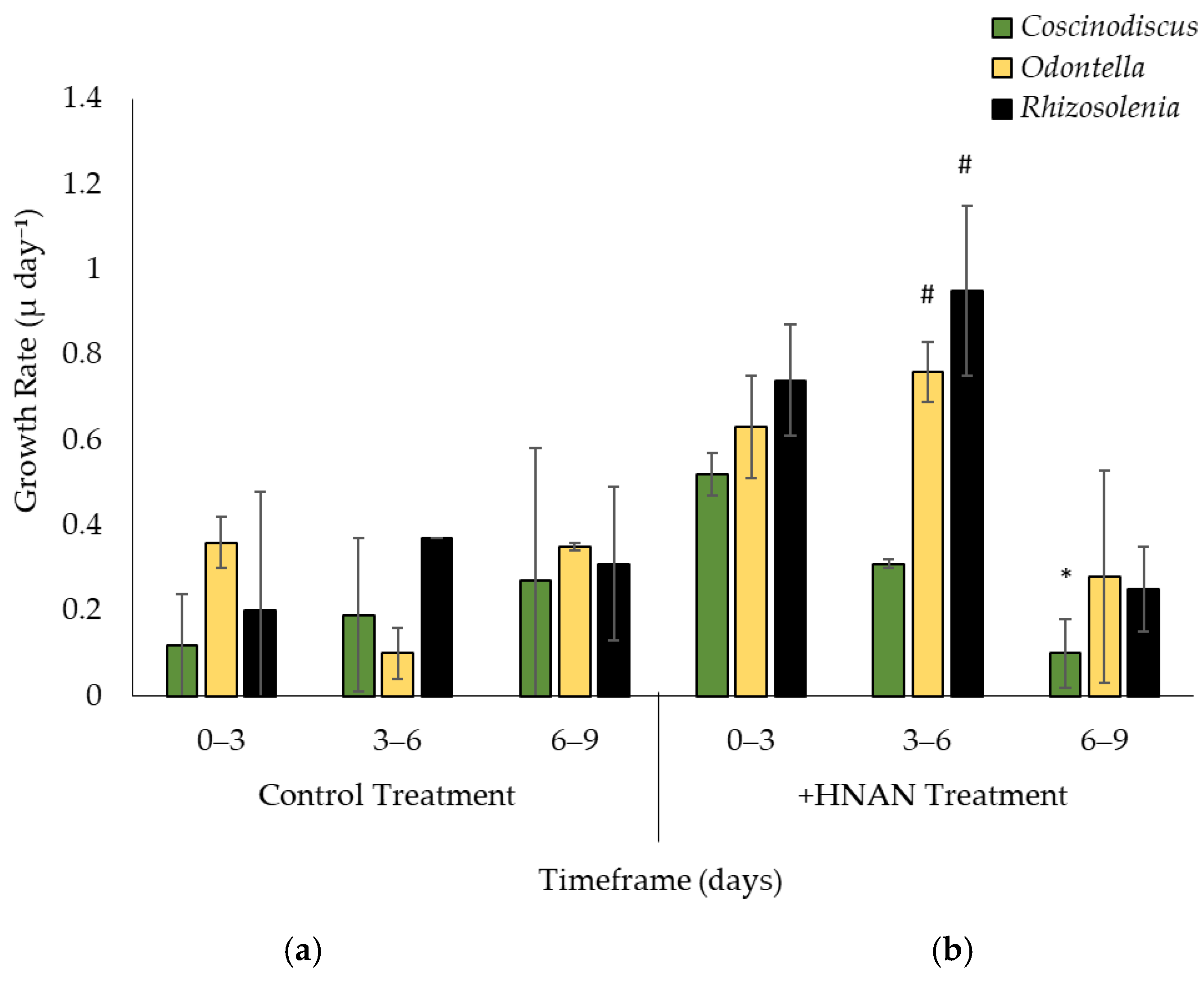
3.1. Growth Rates
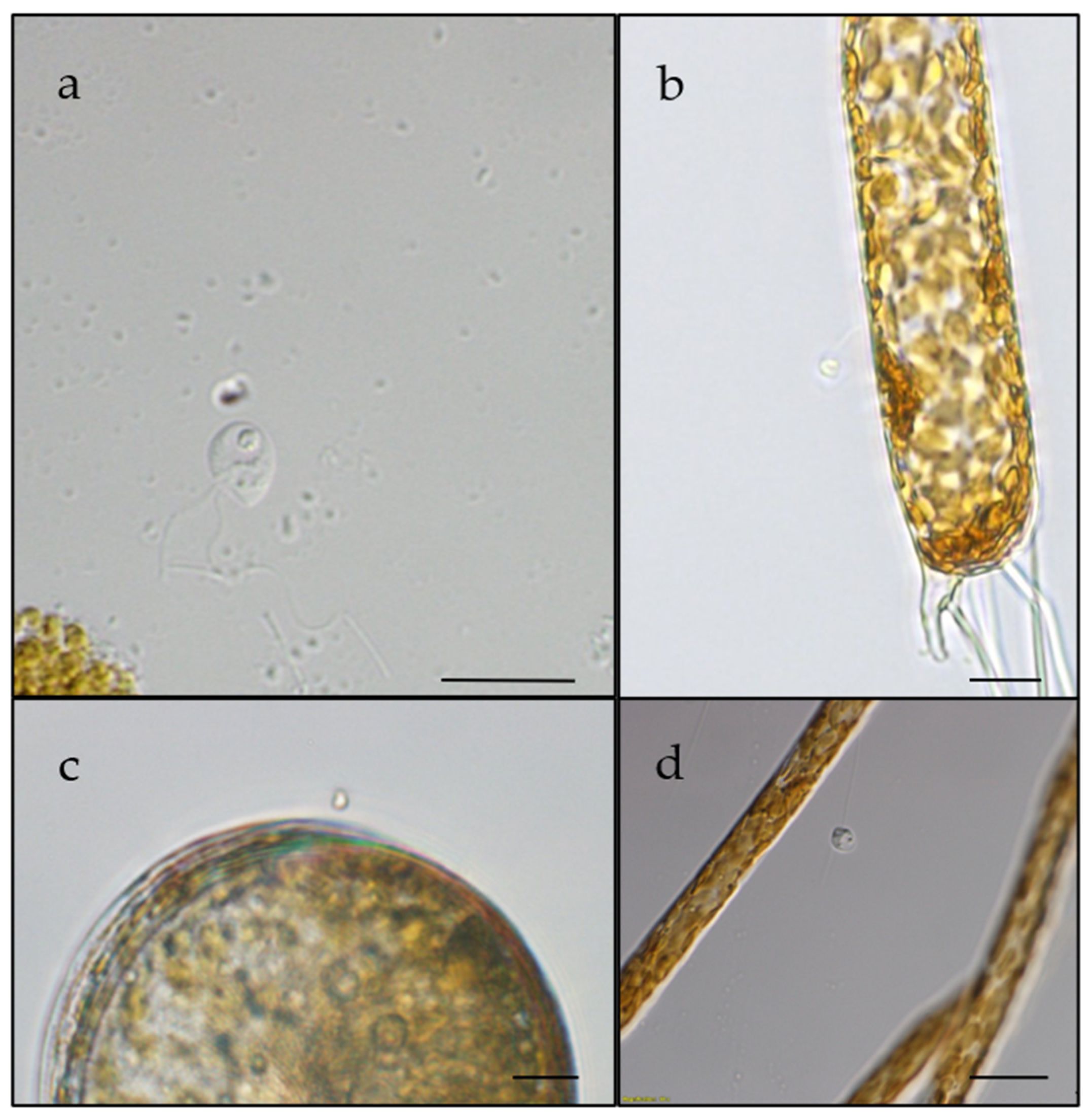
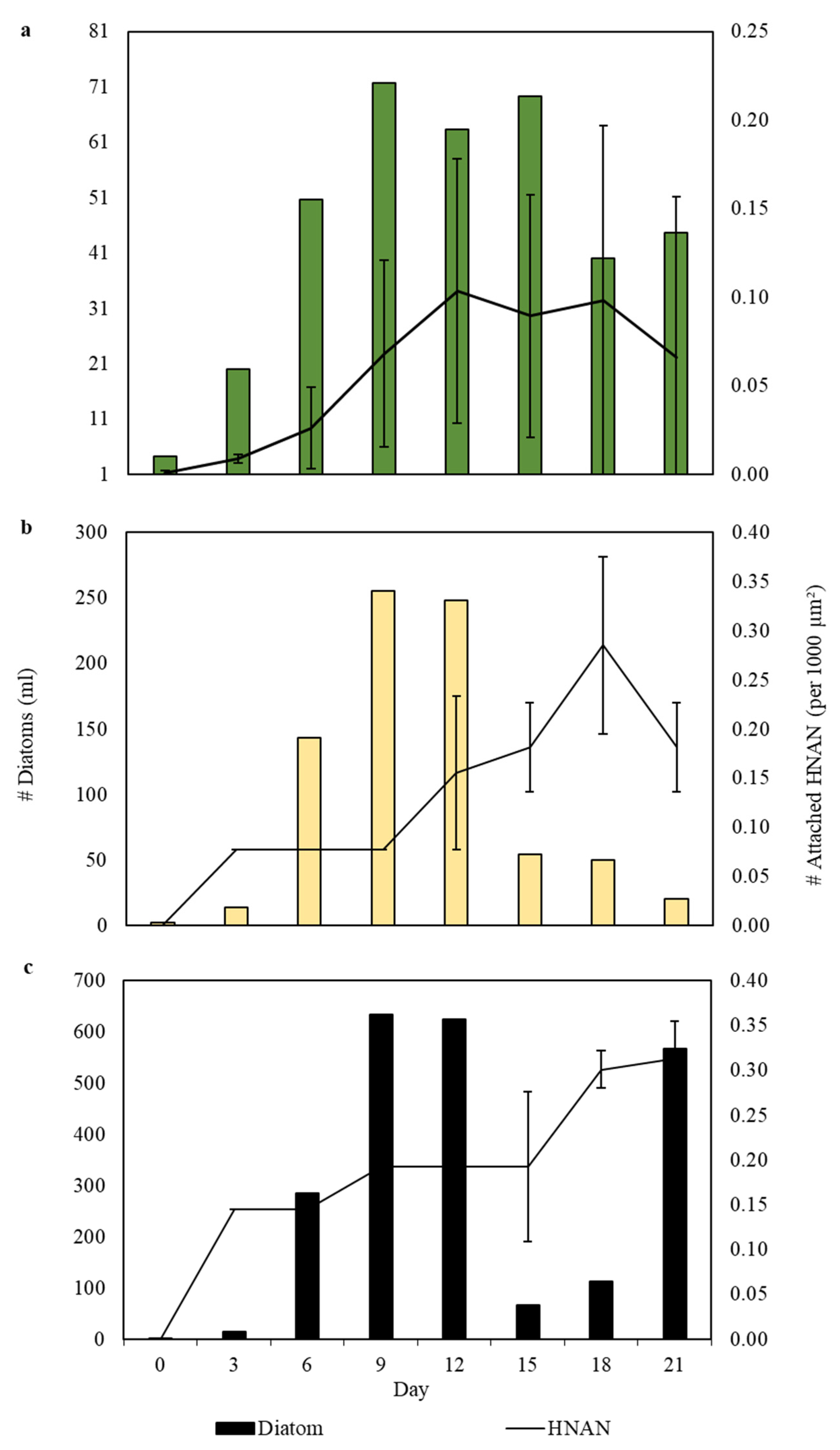
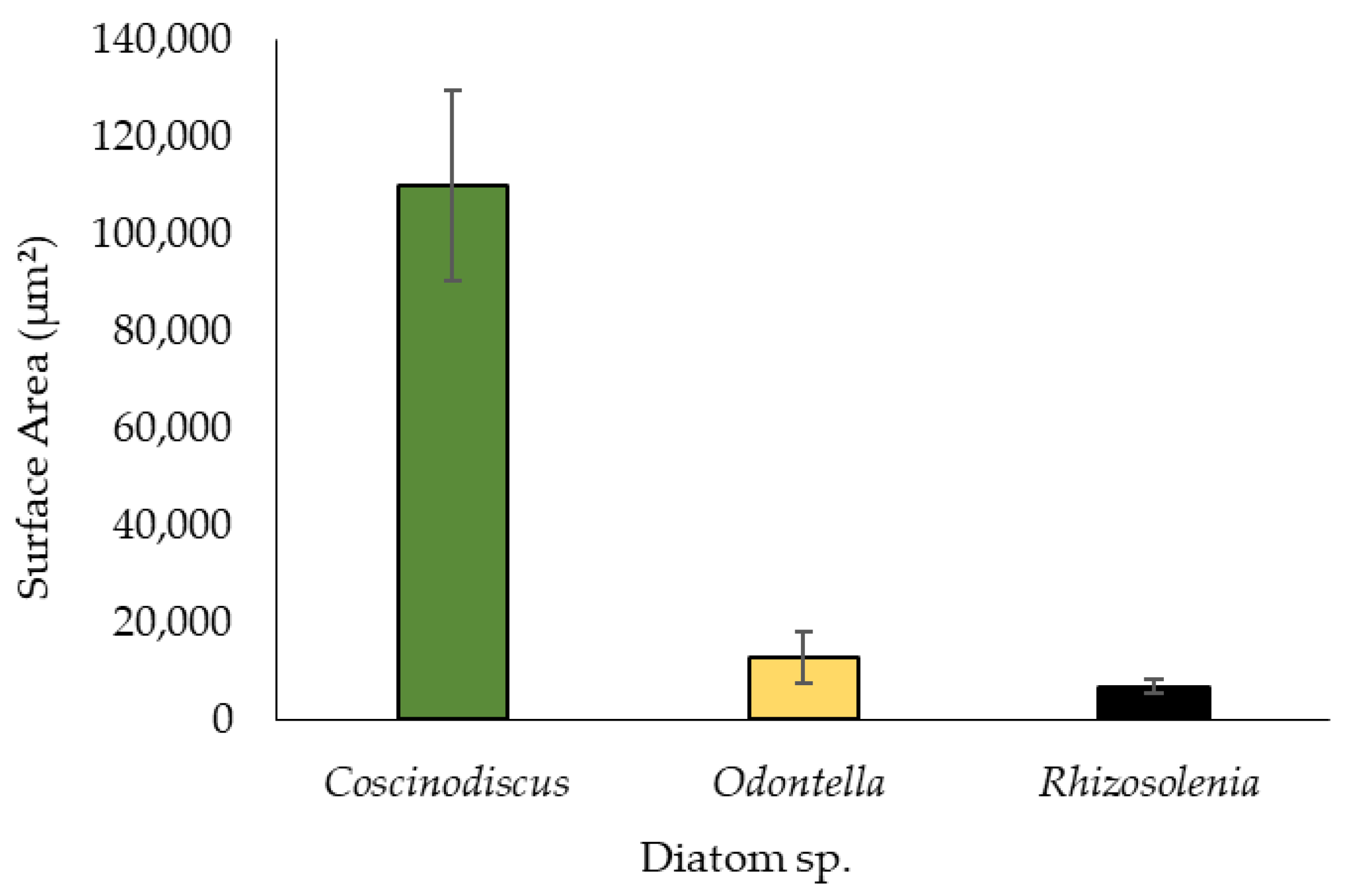
3.2. Attachment
4. Discussion
4.1. Diatom Growth and Nanoflagellate Attachment
4.2. Diatom Bloom Impacts
5. Conclusions
Supplementary Materials
Author Contributions
Funding
Data Availability Statement
Conflicts of Interest
Abbreviations
| HNAN | Heterotrophic Nanoflagellate |
References
- Azam, F.; Fenchel, T.; Field, J.G.; Gray, J.S.; Meyer-Reil, L.-A.; Thingstad, F. The Ecological Role of Water-Column Microbes in the Sea. Mar. Ecol. Prog. Ser. 1983, 10, 257–263. [Google Scholar] [CrossRef]
- Logares, R.; Audic, S.; Santini, S.; Pernice, M.C.; De Vargas, C.; Massana, R. Diversity Patterns and Activity of Uncultured Marine Heterotrophic Flagellates Unveiled with Pyrosequencing. ISME J. 2012, 6, 1823–1833. [Google Scholar] [CrossRef]
- Nakayama, T. Biology, Diversity and Ecology of Free-Living Heterotrophic Flagellates. In Marine Protists: Diversity and Dynamics; Springer: Berlin/Heidelberg, Germany, 2015; pp. 63–87. [Google Scholar]
- Fenchel, T. Ecology of Heterotrophic Microflagellates. IV. Quantitative Occurrence and Importance as Bacterial Consumers. Mar. Ecol. Prog. Ser. 1982, 9, 35–42. [Google Scholar] [CrossRef]
- Sherr, E.B.; Sherr, B.F.; Verity, P.G. Distribution and Relation of Total Bacteria, Active Bacteria, Bacterivory, and Volume of Organic Detritus in Atlantic Continental Shelf Waters off Cape Hatteras NC, USA. Deep Sea Res. Part II Top. Stud. Oceanogr. 2002, 49, 4571–4585. [Google Scholar] [CrossRef]
- Yang, J.W.; Wu, W.; Chung, C.-C.; Chiang, K.-P.; Gong, G.-C.; Hsieh, C. Predator and Prey Biodiversity Relationship and Its Consequences on Marine Ecosystem Functioning—Interplay between Nanoflagellates and Bacterioplankton. ISME J. 2018, 12, 1532–1542. [Google Scholar] [CrossRef]
- Caron, D.A. Grazing of Attached Bacteria by Heterotrophic Microflagellates. Microb. Ecol. 1987, 13, 203–218. [Google Scholar] [CrossRef] [PubMed]
- Sanders, R.; Porter, K. Phagotrophic Phytoflagellates. In Advances in Microbial Ecology; Nelson, K.E., Ed.; Springer Nature: Berlin/Heidelberg, Germany, 1988; pp. 167–192. [Google Scholar]
- Willkomm, M.; Schlüssel, A.; Reiz, E.; Arndt, H. Effects of Microcurrents in the Boundary Layer on the Attachment of Benthic Heterotrophic Nanoflagellates. Aquat. Microb. Ecol. 2007, 48, 169–174. [Google Scholar] [CrossRef]
- Artolozaga, I.; Valcárcel, M.; Ayo, B.; Latatu, A.; Iriberri, J. Grazing Rates of Bacterivorous Protists Inhabiting Diverse Marine Planktonic Microenvironments. Limnol. Oceanogr. 2002, 47, 142–150. [Google Scholar] [CrossRef]
- Smriga, S.; Fernandez, V.I.; Mitchell, J.G.; Stocker, R. Chemotaxis toward Phytoplankton Drives Organic Matter Partitioning among Marine Bacteria. Proc. Natl. Acad. Sci. USA 2016, 113, 1576–1581. [Google Scholar] [CrossRef]
- Daly, G.; Decorosi, F.; Viti, C.; Adessi, A. Shaping the Phycosphere: Analysis of the EPS in Diatom-bacterial Co-cultures. J. Phycol. 2023, 59, 791–797. [Google Scholar] [CrossRef]
- Seymour, J.R.; Amin, S.A.; Raina, J.-B.; Stocker, R. Zooming in on the Phycosphere: The Ecological Interface for Phytoplankton–Bacteria Relationships. Nat. Microbiol. 2017, 2, 17065. [Google Scholar] [CrossRef]
- Johansson, O.N.; Pinder, M.I.; Ohlsson, F.; Egardt, J.; Töpel, M.; Clarke, A.K. Friends with Benefits: Exploring the Phycosphere of the Marine Diatom Skeletonema Marinoi. Front. Microbiol. 2019, 10, 1828. [Google Scholar] [CrossRef]
- Azam, F.; Malfatti, F. Microbial Structuring of Marine Ecosystems. Nat. Rev. Microbiol. 2007, 5, 782–791. [Google Scholar] [CrossRef]
- Grossart, H. Ecological Consequences of Bacterioplankton Lifestyles: Changes in Concepts Are Needed. Environ. Microbiol. Rep. 2010, 2, 706–714. [Google Scholar] [CrossRef]
- Hu, L.; Peng, X.; Zhou, J.; Zhang, Y.; Xu, S.; Mao, X.; Gao, Y.; Liang, J. Characterizing the Interactions among a Dinoflagellate, Flagellate and Bacteria in the Phycosphere of Alexandrium tamarense (Dinophyta). Front. Mar. Sci. 2015, 2, 100. [Google Scholar] [CrossRef]
- Schnepf, E.; Drebes, G.; Elbrächter, M. Pirsonia Guinardiae, Gen. et Spec. Nov.: A Parasitic Flagellate on the Marine Diatom Guinardia flaccida with an Unusual Mode of Food Uptake. Helgoländer Meeresunters. 1990, 44, 275–293. [Google Scholar] [CrossRef]
- Kühn, S.; Drebes, G.; Schnepf, E. Five New Species of the Nanoflagellate Pirsonia in the German Bight, North Sea, Feeding on Planktic Diatoms. Helgoländer Meeresunters. 1996, 50, 205–222. [Google Scholar] [CrossRef]
- Kühn, S.; Medlin, L.; Eller, G. Phylogenetic Position of the Parasitoid Nanoflagellate Pirsonia Inferred from Nuclear-Encoded Small Subunit Ribosomal DNA and a Description of Pseudopirsonia n. Gen. and Pseudopirsonia mucosa (Drebes) Comb Nov. Protist 2004, 155, 143–156. [Google Scholar] [CrossRef] [PubMed]
- Lin, S.; Huang, L.; Zhu, Z.; Jia, X. Changes in Size and Trophic Structure of the Nanoflagellate Assemblage in Response to a Spring Phytoplankton Bloom in the Central Yellow Sea. Deep Sea Res. Part II Top. Stud. Oceanogr. 2013, 97, 93–100. [Google Scholar] [CrossRef]
- Peacock, E.E.; Olson, R.J.; Sosik, H.M. Parasitic Infection of the Diatom Guinardia delicatula, a Recurrent and Ecologically Important Phenomenon on the New England Shelf. Mar. Ecol. Prog. Ser. 2014, 503, 1–10. [Google Scholar] [CrossRef]
- Corradino, G.L.; Schnetzer, A. Grazing of a Heterotrophic Nanoflagellate on Prokaryote and Eukaryote Prey. Mar. Ecol. Prog. Ser. 2022, 682, 65–77. [Google Scholar] [CrossRef]
- Tomas, C.R. Identifying Marine Phytoplankton; Elsevier: Amsterdam, The Netherlands, 1997. [Google Scholar]
- Boenigk, J.; Arndt, H. Particle Handling during Interception Feeding by Four Species of Heterotrophic Nanoflagellates. J. Eukaryot. Microbiol. 2000, 47, 350–358. [Google Scholar] [CrossRef] [PubMed]
- Zar, J.H. Simple Linear Correlation. Biostat. Anal. 1984, 4, 377–383. [Google Scholar]
- Kühn, S.F. Infection of Coscinodiscus spp. by the Parasitoid Nanoflagellate Pirsonla diadema: I. Behavioural Studies on the Infection Process. J. Plankton Res. 1997, 19, 791–804. [Google Scholar] [CrossRef]
- Šimek, K.; Jezbera, J.; Hornák, K.; Vrba, J.; Sed¹a, J. Role of Diatom-Attached Choanoflagellates of the Genus Salpingoeca as Pelagic Bacterivores. Aquat. Microb. Ecol. 2004, 36, 257–269. [Google Scholar] [CrossRef]
- Zöllner, E.; Hoppe, H.-G.; Sommer, U.; Jürgens, K. Effect of Zooplankton-mediated Trophic Cascades on Marine Microbial Food Web Components (Bacteria, Nanoflagellates, Ciliates). Limnol. Oceanogr. 2009, 54, 262–275. [Google Scholar] [CrossRef]
- Pepper, R.E.; Roper, M.; Ryu, S.; Matsudaira, P.; Stone, H.A. Nearby Boundaries Create Eddies near Microscopic Filter Feeders. J. R. Soc. Interface 2010, 7, 851–862. [Google Scholar]
- Nguyen, H.; Koehl, M.; Oakes, C.; Bustamante, G.; Fauci, L. Effects of Cell Morphology and Attachment to a Surface on the Hydrodynamic Performance of Unicellular Choanoflagellates. J. R. Soc. Interface 2019, 16, 20180736. [Google Scholar] [CrossRef]
- Suzuki-Tellier, S.; Andersen, A.; Kiørboe, T. Mechanisms and Fluid Dynamics of Foraging in Heterotrophic Nanoflagellates. Limnol. Oceanogr. 2022, 67, 1287–1298. [Google Scholar] [CrossRef]
- Corradino, G.L.; Schnetzer, A. Impact of Temperature and Diet on Feeding and Growth of a Marine Heterotrophic Nanoflagellate. J. Plankton Res. 2025, 47, fbaf022. [Google Scholar] [CrossRef]
- Bell, W.; Mitchell, R. Chemotactic and Growth Responses of Marine Bacteria to Algal Extracellular Products. Biol. Bull. 1972, 143, 265–277. [Google Scholar] [CrossRef]
- Ohno, H.; Endo, Y.; Sato-Okoshi, W.; Nishitani, G. Feeding and Growth Characteristics of a Diatom-Feeding Flagellate Isolated from the Bottom Sediment of Onagawa Bay, Northeastern Japan. Open J. Mar. Sci. 2013, 3, 9–14. [Google Scholar] [CrossRef]
- Amin, S.A.; Hmelo, L.; Van Tol, H.; Durham, B.; Carlson, L.; Heal, K.; Morales, R.; Berthiaume, C.; Parker, M.; Djunaedi, B. Interaction and Signalling between a Cosmopolitan Phytoplankton and Associated Bacteria. Nature 2015, 522, 98–101. [Google Scholar] [CrossRef]
- Foster, R.A.; Zehr, J.P. Characterization of Diatom–Cyanobacteria Symbioses on the Basis of nifH, hetR and 16S rRNA Sequences. Environ. Microbiol. 2006, 8, 1913–1925. [Google Scholar] [CrossRef] [PubMed]
- Sison-Mangus, M.P.; Kempnich, M.W.; Appiano, M.; Mehic, S.; Yazzie, T. Specific Bacterial Microbiome Enhances the Sexual Reproduction and Auxospore Production of the Marine Diatom, Odontella. PLoS ONE 2022, 17, e0276305. [Google Scholar] [CrossRef]
- Deng, Y.; Mauri, M.; Vallet, M.; Staudinger, M.; Allen, R.J.; Pohnert, G. Dynamic Diatom-Bacteria Consortia in Synthetic Plankton Communities. Appl. Environ. Microbiol. 2022, 88, e01619-22. [Google Scholar] [CrossRef] [PubMed]
- Worden, A.Z.; Seidel, M.; Smriga, S.; Wick, A.; Malfatti, F.; Bartlett, D.; Azam, F. Trophic Regulation of Vibrio cholerae in Coastal Marine Waters. Environ. Microbiol. 2006, 8, 21–29. [Google Scholar] [CrossRef]
- Riemann, L.; Steward, G.F.; Azam, F. Dynamics of Bacterial Community Composition and Activity during a Mesocosm Diatom Bloom. Appl. Environ. Microbiol. 2000, 66, 578–587. [Google Scholar] [CrossRef]
- Cirri, E.; Pohnert, G. Algae−Bacteria Interactions That Balance the Planktonic Microbiome. New Phytol. 2019, 223, 100–106. [Google Scholar] [CrossRef] [PubMed]
- Di Costanzo, F.; Di Dato, V.; Romano, G. Diatom–Bacteria Interactions in the Marine Environment: Complexity, Heterogeneity, and Potential for Biotechnological Applications. Microorganisms 2023, 11, 2967. [Google Scholar] [CrossRef]
- Behrenfeld, M.J.; Halsey, K.H.; Boss, E.; Karp-Boss, L.; Milligan, A.J.; Peers, G. Thoughts on the Evolution and Ecological Niche of Diatoms. Ecol. Monogr. 2021, 91, e01457. [Google Scholar] [CrossRef]
- Schnepf, E.; Schweikert, M. Pirsonia, Phagotrophic Nanoflagellates Incertae Sedis, Feeding on Marine Diatoms: Attachment, Fine Structure and Taxonomy. Arch. Protistenkd. 1997, 147, 361–371. [Google Scholar] [CrossRef]
- Geesink, P.; ter Horst, J.; Ettema, T.J.G. More than the Sum of Its Parts: Uncovering Emerging Effects of Microbial Interactions in Complex Communities. FEMS Microbiol. Ecol. 2024, 100, fiae029. [Google Scholar] [CrossRef] [PubMed]
- Smayda, T.J.; Trainer, V.L. Dinoflagellate Blooms in Upwelling Systems: Seeding, Variability, and Contrasts with Diatom Bloom Behaviour. Prog. Oceanogr. 2010, 85, 92–107. [Google Scholar] [CrossRef]




| Diatom | Day | HNAN | Per Cell–1 |
|---|---|---|---|
| Average | Range | ||
| Coscinodiscus | 0 | 0.1 | 0.0–0.2 |
| 3 | 1.0 | 0.7–1.2 | |
| 6 | 2.9 | 0.0–4.8 | |
| 9 | 7.5 | 1.0–12.2 | |
| 12 | 11.4 | 2.0–17.1 | |
| 15 | 9.9 | 2.0–17.1 | |
| 18 | 10.8 | 2.0–22.9 | |
| 21 | 7.3 | 2.0–18.8 | |
| Odontella | 0 | 0.0 | 0.0 |
| 3 | 1.0 | 1.0 | |
| 6 | 1.0 | 1.0 | |
| 9 | 1.0 | 1.0 | |
| 12 | 2.0 | 1.0–3.0 | |
| 15 | 2.3 | 2.0–3.0 | |
| 18 | 3.7 | 3.0–5.0 | |
| 21 | 2.3 | 2.0–3.0 | |
| Rhizosolenia | 0 | 0.0 | 0.0 |
| 3 | 1.0 | 1.0 | |
| 6 | 1.0 | 1.0 | |
| 9 | 1.3 | 1.0–2.0 | |
| 12 | 1.3 | 1.0–2.0 | |
| 15 | 1.3 | 1.0–2.0 | |
| 18 | 2.1 | 2.0–2.3 | |
| 21 | 2.2 | 2.0–2.5 |
| Flagellate | Feeding Mode | Substrate Type | HNAN Attach. (Per Cell/Colony/Chain) | HNAN Attach. (Per Unit Surface Area) | Duration | Study |
|---|---|---|---|---|---|---|
| Bicosoecida sp. | Interception | Coscinodiscus | 6.4 ± 4.2 per cell−1 | 0.06 ± 0.04 | 21-day batch cultures | This Study |
| Odontella | 1.7 ± 0.5 per cell−1 | 0.13 ± 0.04 | ||||
| Rhizosolenia | 1.3 ± 0.3 per cell−1 | 0.19 ± 0.04 | ||||
| Pirsonia sp. | Parasitic | Coscinodiscus | 1+ per infected cell−1 | – | 3–10 min batch cultures | [27] |
| Unknow HNAN | Parasitic | Guinardia | 1–8 per infected cell–1 | – | In situ of 3 h observations collected over 1 month | [22] |
| Salpingoeca sp. | Filter | Asterionella | 0–21 cells colony–1 | – | 4-day incubations, batch cultures | [28] |
| Fragilaria | 0–35 cells colony–1 |
Disclaimer/Publisher’s Note: The statements, opinions and data contained in all publications are solely those of the individual author(s) and contributor(s) and not of MDPI and/or the editor(s). MDPI and/or the editor(s) disclaim responsibility for any injury to people or property resulting from any ideas, methods, instructions or products referred to in the content. |
© 2026 by the authors. Licensee MDPI, Basel, Switzerland. This article is an open access article distributed under the terms and conditions of the Creative Commons Attribution (CC BY) license.
Share and Cite
Corradino, G.; Schnetzer, A. Getting Attached: A Heterotrophic Nanoflagellate Mingling with Centric Diatoms. Phycology 2026, 6, 20. https://doi.org/10.3390/phycology6010020
Corradino G, Schnetzer A. Getting Attached: A Heterotrophic Nanoflagellate Mingling with Centric Diatoms. Phycology. 2026; 6(1):20. https://doi.org/10.3390/phycology6010020
Chicago/Turabian StyleCorradino, Gabrielle, and Astrid Schnetzer. 2026. "Getting Attached: A Heterotrophic Nanoflagellate Mingling with Centric Diatoms" Phycology 6, no. 1: 20. https://doi.org/10.3390/phycology6010020
APA StyleCorradino, G., & Schnetzer, A. (2026). Getting Attached: A Heterotrophic Nanoflagellate Mingling with Centric Diatoms. Phycology, 6(1), 20. https://doi.org/10.3390/phycology6010020