Article

Insecticidal Activity of Eco-Extracted Holopelagic Sargassum Against the Whitefly Bemisia tabaci Infesting Tomato Crops


by
Chirelle Jabbour
1,
Béatrice Rhino
2,3,
Chloé Corbanini
3,
Jean-Pascal Bergé
4,
Kevin Hardouin
1 and
Nathalie Bourgougnon
1,*
1
Laboratoire de Biotechnologie et Chimie Marines (LBCM), EMR CNRS 6076, IUEM, Université Bretagne Sud, F-56000 Vannes, France
2
HortSys, Université de Montpellier, CIRAD, F-34398 Montpellier, France
3
CIRAD, UPR HortSys, Le Lamentin, F-97285 Martinique, France
4
UPCYCLINK, F-56890 Saint-Avé, France
*
Author to whom correspondence should be addressed.
Phycology 2025, 5(4), 79; https://doi.org/10.3390/phycology5040079 (registering DOI)
Submission received: 17 October 2025 / Revised: 21 November 2025 / Accepted: 21 November 2025 / Published: 1 December 2025
(This article belongs to the Special Issue Development of Algal Biotechnology)

Abstract

Massive strandings of holopelagic Sargassum cause major ecological and economic problems, but its conversion into bioproducts offers a sustainable alternative. This study assessed the potential of holopelagic Sargassum (S. fluitans and S. natans) collected in the Caribbean as ecofriendly insecticides against the whitefly Bemisia tabaci, a major pest of tomato crops. Extracts were produced using green methods: ultrasound-assisted extraction (UAE) and ultrasound-assisted enzymatic hydrolysis (UAEH) with enzymes cocktails. Biochemical analyses revealed high mineral and polysaccharide contents, varying with the extraction technique. Extracts were tested at 1–6% (w/v) using clip-cage (adults) and leaf-dip (eggs) methods. All extracts reduced adult survival, with UAE and UAEH-P/C extracts achieving over 50% mortality at ≥4% concentration after 48 h (LD50: 3.9–4.5%). Egg mortality was significant only with UAE and UAEH-P extracts at 6% (LD50: 1.9–2.8%). These results suggest insecticidal activity through both ingestion and cuticle/embryo disruption. Although enzymatic extraction did not markedly enhance biochemical yields, extracts showed, for the first time, promising biocidal and ovicidal properties. This research highlights holopelagic Sargassum as a renewable source of natural insecticidal compounds, supporting sustainable management of both invasive algal biomass and agricultural pests.

1. Introduction

In the central Atlantic Ocean and Caribbean Sea, massive accumulations of holopelagic Sargassum brown seaweed, specifically Sargassum fluitans and Sargassum natans, have been observed along with frequent beaching events [1,2]. The year 2025 is emerging as the peak year for Sargassum strandings in both Guadeloupe and Martinique (France). Within a three-month period, approximately 4500 metric tons of Sargassum have already been harvested at sea [3]. The pelagic decomposition of macroalgae in coastal zones raises serious ecological, economic, and social concerns, primarily due to the emission of toxic and corrosive gases, such as hydrogen sulfide (H2S) [4]. To prevent these harmful effects, developing and implementing valorization strategies for macroalgal biomass prior to its stranding and degradation is essential, thus reducing environmental risks while promoting sustainable resource utilization.
Sargassum species are a significant source of algal biomass rich in bioactive compounds with potential uses in biotechnology, cosmetics, and agriculture [5,6,7]. In Martinique, the primary method of use is composting, where Sargassum is used at less than 30% in the mixture, as permitted for local producers.
The structure of brown seaweed cell walls, composed of anionic polysaccharides, makes their extraction particularly challenging. These polymers are intracellularly bound to proteins and are associated with insoluble phenolic compounds through hydrophilic and hydrophobic interactions [8]. Various conventional extraction techniques are often used to isolate bioactive compounds. Although these techniques provide good selectivity and efficiency, organic solvents may leave behind residues that contribute to environmental pollution. Additionally, intense extraction conditions degrade many bioactive compounds. As a result, water extraction techniques are preferred in the agricultural sector. Green extraction techniques such as ultrasound-assisted extraction (UAE) and enzyme -assisted extraction (EAE) are notably promising, as they enable the recovery of bioactive molecules without the use of hazardous organic solvents. UAE uses ultrasonic baths or probes to emit high-frequency sound waves, causing cavitation, the formation and collapse of microscopic bubbles, which helps to break down cell walls and enhance the release of bioactive compounds by improving solvent penetration and mass transfer [9]. EAE uses enzymes to break down the structure of cell walls and membranes, thereby promoting the extraction of valuable biomolecules. When these two green technologies are combined, a synergetic effect can be obtained: ultrasound under optimal conditions can enhance enzyme activity. The biomolecule extraction process is enhanced by favorable conformational and structural changes that increase diffusion rates to active enzyme sites or improve enzyme activity [10,11,12].
Recent studies have demonstrated the effectiveness of seaweed extracts against various insect pests and their developmental stages. Extracts from the brown Sargassum species including Sargassum horridum, Sargassum tenerrimum, Sargassum vulgare, and Sargassum wightii have shown insecticidal and repellent potential. These extracts were obtained by organic or hydroalcoholic extraction. Notably, they proved effective against major agricultural pests such as Diaphorina citri, Dysdercus cingulatus, Aphis craccivora, and Plutella xylostella and Spodoptera littoralis [13,14,15,16]. Further, phytochemical analyses revealed the presence of bioactive compounds, including secondary metabolites such as alkaloids, terpenes, flavonoids, saponins, phytol, hexadecenoic acid methyl ester, and n-hexadecanoic acid.
In the Caribbean, the polyphagous insect Bemisia tabaci (Gennadius) (Hemiptera: Aleyrodidae) causes global economic damage to a wide variety of crops [17]. Cucurbitaceae, Fabaceae, and Solanaceae are among the families that are seriously threatened by whiteflies, which are known as the vectors of more than a hundred plant viruses [18,19,20]. Tomato (Solanum lycopersicum, Solanaceae) plants are particularly affected by B. tabaci through feeding damage and begomovirus-induced viral diseases, such as Tomato Yellow Leaf Curl Virus and Potato Yellow Mosaic Virus. Thus, tomato yield losses can reach 100% [21,22,23].
However, insecticidal activity against B. tabaci has never been evaluated for Sargassum extracts. Therefore, this study aimed to evaluate, for the first time, the insecticidal and ovicidal potential of extracts obtained from Sargassum (Sargassum natans I/Sargassum natans VIII/Sargassum fluitans III) collected in the Caribbean Sea, using green extraction technologies, and to assess their effectiveness against the whitefly B. tabaci.

2. Materials and Methods

2.1. Algal Biomass Collection and Pretreatments

To facilitate biomass valorization, the Fresh Sargassum biomass (mixture of morphotypes: Sargassum natans I/Sargassum natans VIII/Sargassum fluitans III) was harvested directly from the open sea along the southeast coast of Grande Terre (Guadeloupe, France), without any prior sorting or separation. The seaweed was air-dried on site, sheltered from direct light. After cleaning and rinsing, the biomass was ground to a particle size of 500 µm using a laboratory hammer mill (Retsch SM 300 knife mill, 0.75 mm grid). Then the powder was stored in opaque plastic buckets at room temperature for further experiments.

2.2. Extraction

Table 1 summarizes the different extraction methods applied to Sargassum samples, along with their corresponding codes used throughout the study.

2.2.1. Ultrasound-Assisted Extraction (UAE)

The ultrasound extraction is a green extraction technique that generates a strong cavitation effect, a phenomenon involving the rapid formation and collapse of microscopic bubbles in the extraction medium. This mechanical action effectively disrupts the rigid cell walls of Sargassum, thereby improving solvent penetration and facilitating the release of intracellular compounds [24]. For this study, the UAE was performed using 300 g of dry algae in a total reaction volume of 6 L. The extraction system consisted of a thermostatically controlled tank, a pump for biomass circulation, and a 400 W, 35 kHz ultrasound tubular reactor (Sonitube®, SYNETUDE). Ultrasonic waves were generated by a transducer (or emitter), and their amplitude was mechanically adjusted using a booster. These vibrational waves were transmitted to a sonication cell known as a sonotrode. The reaction mixture was exposed to ultrasound at the sonotrode and along the entire surface of the tube. The power amplitude was set at the generator to values ranging from approximately 200 to 400 W. The energy efficiency of the SONITUBE® system was approximately 85%. The UAE was performed using an algae-to-water ratio of 5:95 (w/v), at a pH of 6.5 and a constant temperature of 40 °C (maximum operating temperature of the equipment) for a total duration of 2 h and 30 min. To prevent overheating of the extraction medium, the ultrasound was applied at maximum power in pulsed mode, consisting of 15 min of sonication followed by a 5 min pause. After extraction, the mixture was centrifuged at 2000× g for 15 min to separate the supernatant.

2.2.2. Ultrasound-Assisted Enzymatic Hydrolysis (UAEH)

The combined UAEH approach offers a synergistic effect: ultrasound treatment enhances the accessibility of enzymes to internal cellular substrates, while enzymatic action ensures selective and efficient breakdown of target macromolecules without degrading sensitive compounds [25,26]. UAEH was conducted under the same operating conditions as UAE, with the additional incorporation of enzymes. Enzymes were introduced in batch mode at a concentration of 1% (w: dw) relative to the dry matter. Following 2 h and 30 min of UAEH treatment, the enzymes were inactivated by heating the mixture to 90 °C for 15 min. The resulting water-soluble extracts (WSEs) were then centrifuged at 5000× g for 10 min to separate the supernatant from the washed solid residue. The WSEs were then freeze-dried for storage. Two enzyme cocktail batches were used:
-
Protease Batch: a mixture of Flavourzyme (Novozymes, Bagsværd, Denmark), Maxipro NPU (DSM, Delft, Netherlands), Neutrase (Novozymes), and Protamex (Novozymes), also used at optimal conditions of 50 °C and pH 6.5.
-
Carbohydrase Batch: a blend of five enzymes, including Glucanex (Novozymes), Sumizyme (Shin Nihon Chemicals Co., Anjyo Aichi, Japan), Termamyl (Novozymes), and Ultraflo L (Novozymes), applied under optimal conditions of 50 °C and pH 6.5.
All enzymes were food-grade commercial preparations derived from microbial fermentation.

2.3. Biochemical Composition Analysis

To characterize the raw matter of Sargassum biomass, 10 mg of freeze-dried matter was mixed with 5 mL HCl at 1 M concentration in a sealed vial. This acid extraction was performed at 100 °C for 2 h, after which 5 mL of NaOH at 1 M concentration was added. The final solution was used to measure the neutral sugars, uronic acids, proteins, and total phenolic content. In order to analyze sulfate groups linked to polysaccharides, the same extraction conditions were performed in ultrapure water. The composition of Sargassum biomass is defined as the proportions in percentage of each chemical compound family found in the total dried weight of the raw material. Neutral sugars were determined by the phenol sulfuric acid method described by DuBois et al. [27]. Uronic acids were determined by using the Meta-Hydroxy-Di-Phenyl (MHDP) method (Blumenkrantz & Asboe-Hansen, 1973) modified by Filisetti-Cozzi & Carpita [28]. The total amount of proteins was determined using the method developed by Smith et al. [29] and quantified by the BiCinchoninic Acid (BCA) colorimetric method with a Micro BC Assay (Interchim, Montluçon, France). The Folin–Ciocalteu method is commonly used for measuring the total phenolic content (TPC). This assay is based on the reduction–oxidation (redox) reactions, which are usually considered to be relatively stoichiometric and on the redox potential of the phenolic hydroxyl group [30]. Sulfated groups content was determined by the Azure A method that reacts specifically with sulfates linked to the polysaccharides [31]. Finally, the mineral matter content was determined according to the method of Hardouin et al. [32]. The sample was placed in a crucible and calcined by ignition. The ash content was determined thermogravimetrically after calcination of 100 mg of seaweed powder followed by a passage for 2 h in a Carbolite CSF Muffle Furnace (UK) at 585 °C. The final mass corresponds to the mineral matter in the sample and was expressed in percentage of dry weight of seaweed (d.w.) or dry weight of extract (d.e.).

2.4. Evaluation of Biological Activity

Whiteflies were collected every two months from a melon field in southern Martinique (14°26′21″ N, 60°52′44″ W). Then, they were kept in rearing cages on tomato plants, in room at 26 ± 1 °C, with a relative humidity of 45% and a photoperiod of 12:12. For the trials, we used different age and sex cohorts.
Four extracts were tested in aqueous solution at doses of 1%, 2%, 4%, and 6% (w/v), i.e., 10 mg.mL−1, 20 mg.mL−1, 40 mg.mL−1, and 60 mg.mL−1, respectively. Tween 20 (SIGMA) was added to all extracts at a rate of 0.05% (v/v) before application to improve adherence to treated plants. The negative control was treated with Tween 20 as well.
To assess the effect of Sargassum extracts on Bemisia tabaci adults, young tomato plants (four to six leaves) were treated with different solutions and air-dried for 30 min. Then, 10 to 15 whiteflies were enclosed in clip cages attached directly to tomato leaflets during 24 and 48 h after application. Clip cages were constructed from modified 60 mL crystal polystyrene vials (height: 95 mm, diameter: 35 mm) with a circle of nylon mesh (pore size ≤ 100 μm) for ventilation. The open end of the vial was gently pressed against the abaxial surface of a leaf of the tomato plant and secured using soft foam padding and clips to avoid leaf damage and ensure a sealed interface. For each plant, there were two clip cages per exposure time (24 h and 48 h). There were five replications per solution tested. Adult mortality was recorded after 24 and 48 h of exposure.
To assess the effect of Sargassum extracts on B. tabaci eggs, we used the leaf-dip method. B. tabaci laid eggs on fresh tomato plants for 24 h using clip cages, then leaflets containing eggs were dipped for 5 Section into the tested solutions, followed by air-drying for 30 min, before being placed within sealed petri dishes for each leaflet. There were five replications per solution tested. Prior to dipping, the number of eggs per leaflet was counted, with approximately 40 eggs observed per leaflet. Eight days later, newly emerged instars and unhatched eggs, which were considered dead, were recorded. For both experiments, we worked in sets. We tested different modalities at the same time in each series, as well as leaves treated with distilled water used as control indicating natural mortality and leaves treated distilled water with Tween 20 as negative control. Each series is considered a repeat and was conducted with the same cohort.
Adult and egg mortality rates were corrected using Abbott’s formula to account for natural mortality [33]: corrected mortality (%) = (Mt − Mc) × 100/(100 − Mc) where Mt is the mortality of the treated leaflets and Mc refers to the mortality of the “water control” groups. If the mortality of the “water control” was greater than 10%, the series was eliminated, and if it was between 5 and 10%, Abbott’s formula was applied to the treated groups [34]. To assess the adulticide effect, whitefly mortality rates were analyzed using a generalized linear mixed model (GLMM) with binomial distribution, series considered as random factors. We then compared the means of the treatments with that of the negative control, using Dunnett’s post hoc test. For each extract, we used the delta method to determine the Lethal Dose 50% (LD50) and its associated confidence interval from the probit regression [35]. To assess the ovicidal effect, we have performed the same workflow using series and folioles. All statistical analyses were conducted using R software version 4.4.1 and RStudio (version 2024.12.0) with the packages lme4 (version 1.1-35.5), emmeans (version 1.10.4), and car (version 3.1-2). The absence of overdispersion was assessed using the package Dharma (version 0.4.7).

3. Results

3.1. Biochemical Composition

3.1.1. Raw Seaweed Biomass

Sargassum biomass is composed essentially of water up to 90%. The dry matter is rich in minerals (45.22 ± 0.41% d.w.) and in polysaccharidic fraction (about 21.6%) if the neutral sugars (14.22 ± 0.79% d.w.), uronic acids contents (5.30 ± 0.04% d.w.), and sulfate groups (2.12 ± 0.01% d.w.) are gathered and taking into account interferences between compounds during the biochemical assays. Protein content was estimated at 11.26 ± 0.39% d.w. and soluble total phenolic content (TPC) at 3.38 ± 0.11% d.w. (Table 2).

3.1.2. Seaweed Extracts

The biochemical composition of seaweed extracts obtained by UAE and UAEH is presented in Table 2. Each extraction was performed in triplicate.
All extraction techniques improved mineral recovery when compared to the original biomass: the ash content increased from 45.22% in the untreated biomass to as much as 65.93% with UAE. Because of their higher mineral levels, which indicate little loss of inorganic matter during extraction, the control and UAE treatments also obtained the highest total recoveries (89.79% and 88.05%, respectively). The neutral sugar content (11.54%) was considerably raised by the UAEH-C treatment while sulfate and protein levels were moderately reduced. In contrast, UAEH-P showed the lowest concentrations of neutral sugars (3.35%) and uronic acids (2.46%) while maintaining a relatively high protein content (6.52%) and the highest sulfate level (3.60%) suggesting selective recovery of proteins and sulfated compounds. All of the extracted fractions had less phenolic content than the original biomass, but UAEH-C had a marginally higher phenolic yield (1.86%) than the other treatments, while UAEH-P had the lowest yield (1.19%).

3.2. Biological Activity of Seaweed Extracts

3.2.1. Biocidal Activity on Adult Whiteflies

After 24 h of exposure, adult mortality varied significantly according to extract and solution concentration (Chisq = 96.99, p < 0.001). Table 3 summarizes the number of adults and eggs assessed for each treatment. All treatments were conducted with five replicates (n = 5), which is specified in the table title. Sargassum extracts at 4% or 6% were significantly higher than those of the negative control TW (water + Tween 20) (Figure 1A). However, only UAE at 6% had an adult mortality higher than 50% and its LD50 = 5.2% (CI: 4.2–6.3%). After 48 h of exposure, adult mortality varied significantly according to extract and solution concentration (Chisq = 131.77, p < 0.001). All Sargassum extracts at 4% and 6% were significantly higher than that of the negative control TW (water + Tween 20) (Figure 1B). Adult mortality was higher than 50% with UAE and UAEH-P extracts at 4% and 6% as well as with UAEH-C extract at 6%. The LD50 of these three extracts are not significantly different because their confidence intervals overlap and the LD50 varies between 3.9% and 4.5% (Table 4). Lethal doses are given in % (w/v) to reflect concentrations relevant to agronomic practices, while equivalent values in µg. mL−1 are also provided, calculated from the extract’s dry-matter content (gram extract per 100 mL solution).

3.2.2. Ovicidal Activity on the Immature Stages of Whiteflies (Eggs)

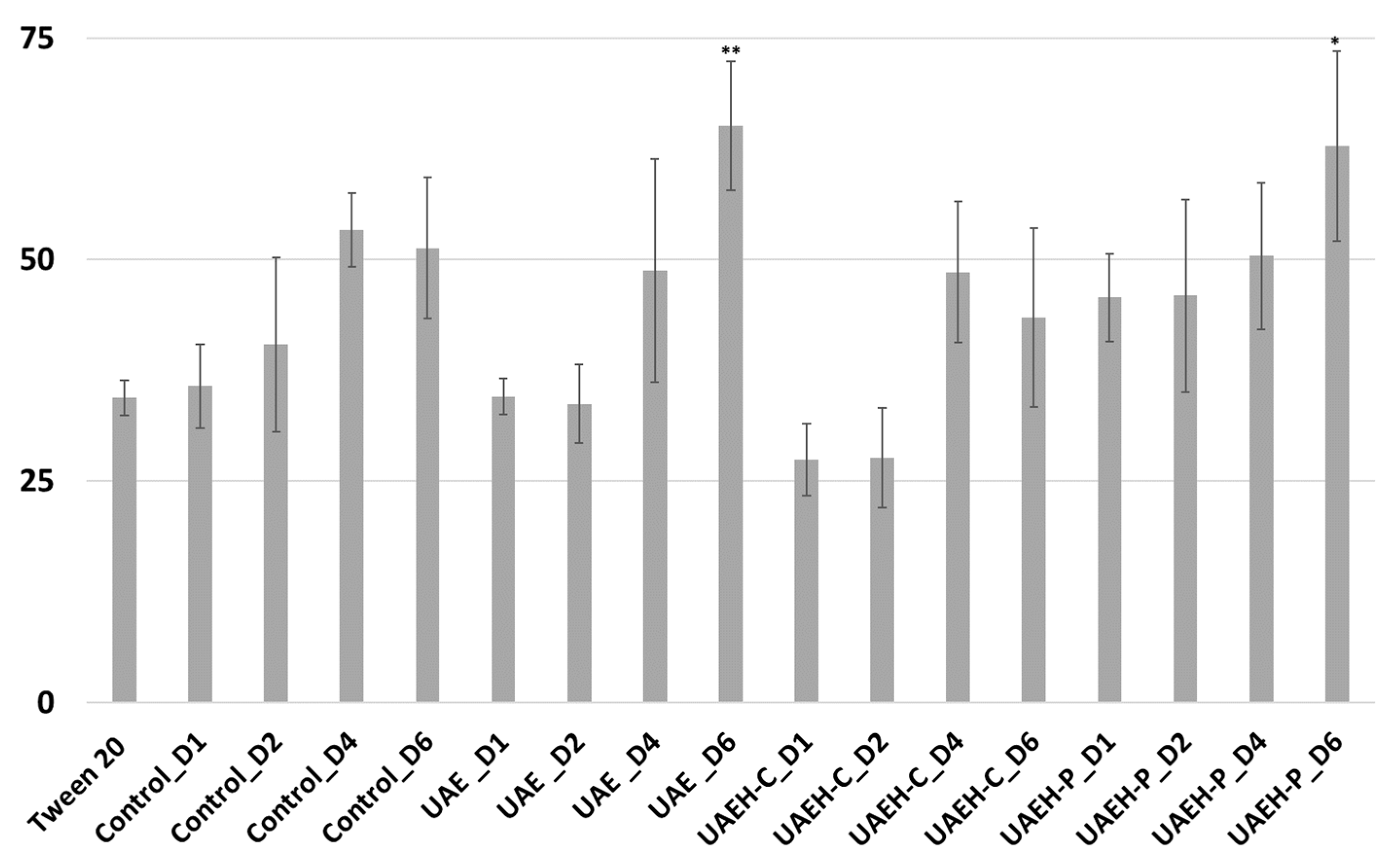
Egg mortality varied significantly according to extract and solution concentration (Chisq = 42.06, p < 0.001). However, only UAE and UAEH-P extracts at 6% had an egg mortality higher than 50% (Figure 2). The LD50 of these two extracts are not significantly different because their confidence intervals overlap and the LD50 varies between 1.9% and 2.8% (Table 4).

4. Discussion

4.1. Characterization of Sargassum Biomass and Extracts

Biochemical analysis of Sargassum biomass is essential for understanding its potential applications and environmental impacts. However, meaningful comparisons with the existing literature are often hindered by numerous variables. Variability results from multiple factors, including harvesting conditions, sample handling and storage, drying methods, geographical origin, environmental parameters (e.g., wave exposure, salinity, light availability), and analytical techniques. This heterogeneity, further compounded by the mixture of different Sargassum species in the collected biomass, complicates direct comparisons across studies [36,37,38].
According to the results, the main component of Sargassum biomass is its mineral fraction, known as ash content, which represented approximately 45% of the sample d.w. This result aligns with values reported for pelagic Sargassum collected across various locations in the Caribbean, where ash content ranged from 30.07 to 58.60% d.w. depending on the harvest site [39]. Similarly, pelagic Sargassum samples from Jamaica showed ash content of 33.7–55.7% d.w. in frozen samples and 35.3–45.7% in sun-dried samples [36]. The polysaccharidic fraction obtained in our Sargassum biomass was about 22% d.w. The literature reported that the total carbohydrate content in floating mats of Sargassum seaweed reaches up to 57% d.w [40]. Carbohydrates are well known as the primary macromolecules in brown algae, primarily due to their significant presence and role in the cell wall structure. The main carbohydrate types identified in brown algae include laminarin, mannitol, alginate, sulfated fucan polysaccharides, and cellulose [41,42]. As for proteins, the content measured in this study was approximately 11.26% in raw biomass, which aligns well with previously reported values for brown seaweeds ranging from 3 to 17% [43,44,45], with findings from other studies on pelagic Sargassum, where protein levels have been reported between 3 and 18% [40,46]. The phenolic content in Sargassum biomass was found to be 3.38% d.w. This result is higher than that reported for fresh Mexican Caribbean Sargassum, which contained approximately 0.2% d.w [38]. However, it is comparable to the total phenolic content reported for Sargassum muticum from France, which was 2.6% d.w. [47], and falls within the range reported for Sargassum vulgare from Brazil, which exhibited TPC values between 0.56 and 3.61% d.w. [48]. It is important to note that Saldarriaga-Hernandez et al. [38] It is important to note that Saldarriaga-Hernandez et al. [38] identified the season of the year as the most significant factor affecting the compositional content of Sargassum biomass, with the extraction method also playing a role. For example, Sargassum muticum can exhibit substantially different phenolic contents ranging from 0.7 to 6% dry weight, depending on the season and geographic location [46].
The biochemical analysis confirmed a higher concentration of mineral matter in all extracts compared to the raw material. In fact, high ash content in seaweed is due to its ability to absorb minerals from its environment [49]. The results showed consistent outcomes under all tested conditions, and no clear advantage to using enzymatic treatments or ultrasound to improve the extraction of Sargassum cell wall compounds was observed. Regarding neutral sugar content, an increase was detected only in the UAE process combined with carbohydrases. However, this increase occurred immediately after the enzymatic preparations were added, suggesting that it stems from the sugar-based excipients in the preparations rather than from the extraction process itself. As for polyphenols, their increase under UAEH-C might be explained by increased matrix disruption caused by carbohydrase activity, which promotes their release. From this perspective, it would be interesting to explore different parameters. A Box–Behnken design could be used to investigate the influence of three parameters on the extraction yield of water-soluble compounds: extraction time, temperature, and enzyme/seaweed ratio used with dried seaweed. In addition, given the large quantities of biomass available and the industrial accessibility of the enzyme cocktail, an industrial-scale trial could also be undertaken. Although UAE and EAE have been used separately on Sargassum, studies examining their combined effect on extraction efficiency or yield remain limited. Casas et al. [50] explored the combined use of enzyme-assisted and ultrasound-assisted extraction methods to obtain bioactive fractions from Sargassum muticum. Their study revealed a synergistic effect between the two techniques, resulting in enhanced extraction efficiency and selectivity for phenolic compounds, along with higher antioxidant activity, surpassing the performance of UAE alone. The resulting dried extracts consisted of about 70% oligomeric carbohydrates, 20% protein, and 5% phenolics and exhibited notable antioxidant and antiproliferative activities. Other studies have explored the application of this combined approach in different algal families and demonstrated that ultrasound-assisted enzymatic hydrolysis, UAEH, is a promising and sustainable strategy for increasing the extraction yields of biomolecules such as phycobiliproteins, polysaccharides, and some iodinated amino acids [25,26,51]. The two extraction techniques used in this study, UAE and UAEH, were effective for processing large amounts of biomass. However, other emerging green extraction methods offer additional benefits in yield, selectivity, and sustainability. Microwave-assisted extraction (MAE) rapidly heats intracellular water, rupturing cells and releasing bioactive compounds. MAE has been successfully applied to Sargassum plagiophyllum, achieving high polysaccharide yields in a short time [52,53] and to Sargassum muticum for efficient recovery of phenolic acids and phlorotannins [54]. Instant Controlled Pressure Drop (DIC) uses brief steam treatment followed by rapid decompression to expand cells, enhancing extraction of sugars, proteins, fucoidans, and phenolics in Sargassum muticum, making it a promising pretreatment for combined strategies [37]. Pressurized Liquid Extraction (PLE), or accelerated solvent extraction, employs high temperature and pressure to improve solubility and diffusion. PLE has been demonstrated to effectively extract phenolics and pigments from Sargassum species while reducing solvent use and processing time [55,56]. These methods can complement UAE/UAEH to improve extraction efficiency, selectivity, and sustainability.

4.2. Biological Activities of Sargassum Extracts

In this study, preliminary results showed that all Sargassum extracts exhibited insecticidal activity against B. tabaci adults, whereas only UAE and UAEH-P extracts demonstrated additional ovicidal activity. Using the clip-cage method, adults were allowed to feed on treated leaflets, suggesting that the observed adult mortality was primarily due to the ingestion of the extracts. The insecticide molecules enter the insects’ gut and pass into the hemolymph, thus disrupting their metabolism and inducing death [57]. According to Jeckel et al. [58], plant metabolites ingested by herbivorous insects can cause damage by disrupting numerous targets in their bodies, thereby producing negative effects on nutrition or inducing toxic reactions. Abubakar et al. [59] reported that some botanical extracts are effective against B. tabaci in both adult and immature stages. Using a method similar to the clip cage, Ateyyat et al. [60] demonstrated the adulticidal effect of aqueous extracts from various plants on B. tabaci. In the leaf-dip method, the extract coats the egg cuticle, and egg mortality may be explained by several factors. Baldin et al. [61] observed that the ovicidal effect of the aqueous extracts on B. tabaci caused the death of the neonates during hatching, their bodies staying partially adhered to the egg. This could be explained by the presence of toxic extracts on the egg. Sharma et al. [62] reported that some insecticides alter the cuticle, preventing larvae from emerging, while others penetrate the chorion and inhibit embryo development. The insecticidal activity of Sargassum extracts is similar to that of previous studies on other piercing–sucking hemipterans with other Sargassum extracts. González-Castro et al. [13] showed that S. horridum ethanolic extract has a lethal effect on the psyllid D. citri with an LD50 at 36 µg. mL−1 after 24 h of exposure, while the LD50 of UAE was 39 µg. mL−1 after 48 h of exposure. Ahamed et al. [63] showed that methanol and chloroform extracts of S. tenerrimum at 1.6% cause 60% mortality on A. craccivora aphid 72 h after treatment. However, to the best of our knowledge, this is the first demonstration of ovicidal activity against Bemisia tabaci eggs using Sargassum extracts, with LD50 values ranging from 1.9% to 2.8%.
No direct correlation was found between the biochemical composition analyzed in this study and the insecticidal or ovicidal effects of the tested Sargassum extracts. This finding aligns with this study’s primary aim, which was to assess biological activity rather than perform detailed biochemical profiling. Nevertheless, previous research has identified Sargassum-derived metabolites, such as flavonoids, terpenoids, and steroids, as key contributors to insecticidal and antimicrobial properties [64,65,66]. It is therefore plausible that the bioactivity observed here may originate from similar compounds, although such associations could not be verified within the present experimental scope. Future research should conduct detailed phytochemical profiling using advanced analytical techniques, such as GC–MS or LC–MS, to identify and characterize the active secondary metabolites responsible for the observed effects. Refining extraction and purification conditions, combined with targeted bioassays of isolated fractions, will further elucidate structure–activity relationships and optimize the bioactive potential of Sargassum extracts.

5. Conclusions

This study reported, for the first time, the insecticidal and ovicidal potential of eco-extracted pelagic Sargassum against the whitefly B. tabaci infesting tomato crops. Green extraction methods, including ultrasound-assisted extraction, UAE, and ultrasound-assisted enzymatic hydrolysis, UAEH, yielded extracts with significant adulticidal (LD50 ≈ 4%) and ovicidal (LD50 ≈ 2%) activities at concentrations suitable for field use. These findings highlight Sargassum biomass as a promising, sustainable, and cost-effective source of natural biopesticides, offering an eco-friendly alternative to synthetic pesticides. In addition, the approach contributes to protecting economically important crops from pest-induced losses and helps minimize the health and environmental hazards associated with the overuse of synthetic pesticides. Future research should focus on the identification and characterization of key bioactive compounds, particularly flavonoids, terpenoids, and steroids, using advanced analytical techniques and on evaluating field efficacy under Caribbean climatic conditions. To advance technology transfer, subsequent steps should include large-scale field trials, ecotoxicological assessments of non-target organisms, and the development of stable, standardized bioinsecticide formulations. These investigations will provide essential insights into the stability, performance, safety, and integration of Sargassum-based biopesticides into sustainable crop protection strategies.

Author Contributions

Conceptualization, C.J., B.R. and N.B.; methodology, C.J., B.R. and N.B.; formal analysis, C.C., K.H. and B.R.; investigation, C.C., K.H., B.R., J.-P.B. and N.B.; resources, C.J., B.R., C.C., K.H., J.-P.B. and N.B.; data curation, C.C., K.H., B.R. and J.-P.B.; writing—original draft preparation, C.J., B.R. and N.B.; writing—review and editing, C.J., B.R. and N.B.; visualization, C.J., B.R. and N.B.; supervision, N.B.; project administration, N.B.; funding acquisition, N.B. All authors have read and agreed to the published version of the manuscript.

Funding

This research was funded through the project ANR/ADEME Study of holopelagic Sargassum responsible of massive beachings: Valorization and Ecology on Caribbean coasts SAVE-C (Fundamental and applied research, Grant No. ANR-19-SARG-0008).

Data Availability Statement

The original contributions presented in this study are included in the article. Further inquiries can be directed to the corresponding author.

Acknowledgments

The authors thank Valérie Stiger, coordinator of the ANR-ADEME project, for her valuable support.

Conflicts of Interest

Author Jean-Pascal Bergé was employed by the company Upcyclink. The remaining authors declare that the research was conducted in the absence of any commercial or financial relationships that could be construed as a potential conflict of interest.

References

  1. Wang, M.; Hu, C.; Barnes, B.B.; Mitchum, G.; Lapointe, B.; Montoya, J.P. The great Atlantic Sargassum belt. Science 2019, 365, 83–87. [Google Scholar] [CrossRef]
  2. Mulatier, M.; Duchaudé, Y.; Lanoir, R.; Thesnor, V.; Sylvestre, M.; Cebrián-Torrejón, G.; Vega-Rúa, A. Invasive brown algae (Sargassum spp.) as a potential source of biocontrol against Aedes aegypti. Sci. Rep. 2024, 14, 21161. [Google Scholar] [CrossRef]
  3. Comité Indépendant d’Experts sur la problématique Sargasses et en Martinique. Echouements massifs sargasses Martinique en 2025: Enjeux prioritaires concernant le collège Robert 3 (Pontalery) et d’autres établissements sco-laires impactés. Available online: https://www.madinin-art.net/data/Rapport-Comite-Sargasses-16-05-2025_final.pdf (accessed on 1 October 2025).
  4. Resiere, D.; Mehdaoui, H.; Florentin, J.; Gueye, P.; Lebrun, T.; Blateau, A.; Viguier, J.; Valentino, R.; Brouste, Y.; Kallel, H.; et al. Sargassum seaweed health menace in the Caribbean: Clinical characteristics of a population exposed to hydrogen sulfide during the 2018 massive stranding. Clin. Toxicol. 2021, 59, 215–223. [Google Scholar] [CrossRef] [PubMed]
  5. Hardouin, K.; Bedoux, G.; Burlot, A.-S.; Donnay-Moreno, C.; Bergé, J.-P.; Nyvall-Collén, P.; Bourgougnon, N. Enzyme-assisted extraction (EAE) for the production of antiviral and antioxidant extracts from the green seaweed Ulva armoricana (Ulvales, Ulvophyceae). Algal Res. 2016, 16, 233–239. [Google Scholar] [CrossRef]
  6. Amador-Castro, F.; García-Cayuela, T.; Alper, H.S.; Rodriguez-Martinez, V.; Carrillo-Nieves, D. Valorization of pelagic Sargassum biomass into sustainable applications: Current trends and challenges. J. Environ. Manag. 2021, 283, 112013. [Google Scholar] [CrossRef]
  7. Bennett, M.; March, A.; Li, H.; Lallemand, P.; Maréchal, J.-P.; Failler, P. Qualitative and quantitative assessment of Sargassum valorisation solutions for the Caribbean. J. Environ. Manag. 2025, 381, 124954. [Google Scholar] [CrossRef] [PubMed]
  8. Deniaud-Bouët, E.; Kervarec, N.; Michel, G.; Tonon, T.; Kloareg, B.; Hervé, C. Chemical and enzymatic fractionation of cell walls from Fucales: Insights into the structure of the extracellular matrix of brown algae. Ann. Bot. 2014, 114, 1203–1216. [Google Scholar] [CrossRef]
  9. Garcia-Vaquero, M.; Ummat, V.; Tiwari, B.; Rajauria, G. Exploring Ultrasound, Microwave and Ultrasound–Microwave Assisted Extraction Technologies to Increase the Extraction of Bioactive Compounds and Antioxidants from Brown Macroalgae. Mar. Drugs 2020, 18, 172. [Google Scholar] [CrossRef] [PubMed]
  10. Nadar, S.S.; Rathod, V.K. Ultrasound assisted intensification of enzyme activity and its properties: A mini-review. World J. Microbiol. Biotechnol. 2017, 33, 170. [Google Scholar] [CrossRef]
  11. Kiss, A.A.; Geertman, R.; Wierschem, M.; Skiborowski, M.; Gielen, B.; Jordens, J.; John, J.J.; Van Gerven, T. Ultrasound-assisted emerging technologies for chemical processes. J. Chem. Technol. Biotechnol. 2018, 93, 1219–1227. [Google Scholar] [CrossRef] [PubMed]
  12. Yun, C.; Wang, S.; Gao, Y.; Zhao, Z.; Miao, N.; Shi, Y.; Ri, I.; Wang, W.; Wang, H. Optimization of ultrasound-assisted enzymatic pretreatment for enhanced extraction of baicalein and wogonin from Scutellaria baicalensis roots. J. Chromatogr. B 2022, 1188, 123077. [Google Scholar] [CrossRef] [PubMed]
  13. González-Castro, A.L.; Muñoz-Ochoa, M.; Hernández-Carmona, G.; López-Vivas, J.M. Evaluation of seaweed extracts for the control of the Asian citrus psyllid Diaphorina citri. J. Appl. Phycol. 2019, 31, 3815–3821. [Google Scholar] [CrossRef]
  14. Lisha, J.M.; Srinivasan, G.; Shanthi, M.; Mini, M.L.; Vellaikumar, S.; Sujatha, K. Phytochemical profiling and toxicity effect of various seaweed species against diamondback moth, Plutella xylostella L. (Lepidoptera: Plutellidae). Int. J. Trop. Insect Sci. 2023, 43, 1633–1648. [Google Scholar] [CrossRef]
  15. Petchidurai, G.; Sahayaraj, K.; Al-Shuraym, L.A.; Albogami, B.Z.; Sayed, S.M. Insecticidal Activity of Tannins from Selected Brown Macroalgae against the Cotton Leafhopper Amrasca devastans. Plants 2023, 12, 3188. [Google Scholar] [CrossRef]
  16. Rashwan, R.S.; Hammad, D.M. Toxic effect of Spirulina platensis and Sargassum vulgar as natural pesticides on survival and biological characteristics of cotton leaf worm Spodoptera littoralis. Sci. Afr. 2020, 8, e00323. [Google Scholar] [CrossRef]
  17. Li, Y.; Mbata, G.N.; Simmons, A.M.; Shapiro-Ilan, D.I.; Wu, S. Management of Bemisia tabaci on vegetable crops using entomopathogens. Crop Prot. 2024, 180, 106638. [Google Scholar] [CrossRef]
  18. Oliveira, M.R.V.; Henneberry, T.J.; Anderson, P. History, current status, and collaborative research projects for Bemisia tabaci. Crop Prot. 2001, 20, 709–723. [Google Scholar] [CrossRef]
  19. Kavalappara, S.R.; Milner, H.; Konakalla, N.C.; Morgan, K.; Sparks, A.N.; McCregor, C.; Culbreath, A.K.; Wintermantel, W.M.; Bag, S. High Throughput Sequencing-Aided Survey Reveals Widespread Mixed Infections of Whitefly-Transmitted Viruses in Cucurbits in Georgia, USA. Viruses 2021, 13, 988. [Google Scholar] [CrossRef] [PubMed]
  20. Radouane, N.; Ezrari, S.; Belabess, Z.; Tahiri, A.; Tahzima, R.; Massart, S.; Jijakli, H.; Benjelloun, M.; Lahlali, R. Viruses of cucurbit crops: Current status in the Mediterranean Region. Phytopathol. Mediterr. 2021, 60, 493–519. [Google Scholar] [CrossRef]
  21. Gusmão, M.R.; Picanço, M.C.; Guedes, R.N.C.; Galvan, T.L.; Pereira, E.J.G. Economic injury level and sequential sampling plan for Bemisia tabaci in outdoor tomato. J. Appl. Entomol. 2006, 130, 160–166. [Google Scholar] [CrossRef]
  22. Li, Y.; Mbata, G.N.; Punnuri, S.; Simmons, A.M.; Shapiro-Ilan, D.I. Bemisia tabaci on vegetables in the southern United States: Incidence, impact, and management. Insects 2021, 12, 198. [Google Scholar] [CrossRef]
  23. Mrosso, S.E.; Ndakidemi, P.A.; Mbega, E.R. Farmers’ knowledge on Whitefly Populousness among tomato insect pests and their management options in tomato in Tanzania. Horticulturae 2023, 9, 253. [Google Scholar] [CrossRef]
  24. Terme, N.; Hardouin, K.; Cortès, H.P.; Peñuela, A.; Freile-Pelegrín, Y.; Robledo, D.; Bedoux, G.; Bourgougnon, N. Emerging seaweed extraction techniques: Enzyme-assisted extraction a key step of seaweed biorefinery? In Sustainable Seaweed Technologies; Elsevier: Amsterdam, The Netherlands, 2020; pp. 225–256. ISBN 978-0-12-817943-7. [Google Scholar]
  25. Romarís-Hortas, V.; Bermejo-Barrera, P.; Moreda-Piñeiro, A. Ultrasound-assisted enzymatic hydrolysis for iodinated amino acid extraction from edible seaweed before reversed-phase high performance liquid chromatography–inductively coupled plasma-mass spectrometry. J. Chromatogr. A 2013, 1309, 33–40. [Google Scholar] [CrossRef]
  26. Le Guillard, C.; Bergé, J.-P.; Donnay-Moreno, C.; Cornet, J.; Ragon, J.-Y.; Fleurence, J.; Dumay, J. Optimization of R-Phycoerythrin Extraction by Ultrasound-Assisted Enzymatic Hydrolysis: A Comprehensive Study on the Wet Seaweed Grateloupia turuturu. Mar. Drugs 2023, 21, 213. [Google Scholar] [CrossRef]
  27. DuBois, M.; Gilles, K.A.; Hamilton, J.K.; Rebers, P.A.; Smith, F. Colorimetric Method for Determination of Sugars and Related Substances. Anal. Chem. 1956, 28, 350–356. [Google Scholar] [CrossRef]
  28. Filisetti-Cozzi, T.M.C.C.; Carpita, N.C. Measurement of uronic acids without interference from neutral sugars. Anal. Biochem. 1991, 197, 157–162. [Google Scholar] [CrossRef]
  29. Smith, P.K.; Krohn, R.I.; Hermanson, G.T.; Mallia, A.K.; Gartner, F.H.; Provenzano, M.D.; Fujimoto, E.K.; Goeke, N.M.; Olson, B.J.; Klenk, D.C. Measurement of protein using bicinchoninic acid. Anal. Biochem. 1985, 150, 76–85. [Google Scholar] [CrossRef]
  30. Hagerman, A.E.; Butler, L.G. Choosing appropriate methods and standards for assaying tannin. J. Chem. Ecol. 1989, 15, 1795–1810. [Google Scholar] [CrossRef] [PubMed]
  31. Jaques, L.B.; Balueux, R.E.; Dietrich, C.P.; Kavanagh, L.W. A microelectrophoresis method for heparin. Can. J. Physiol. Pharmacol. 1968, 46, 351–360. [Google Scholar] [CrossRef] [PubMed]
  32. Hardouin, K.; Burlot, A.-S.; Umami, A.; Tanniou, A.; Stiger-Pouvreau, V.; Widowati, I.; Bedoux, G.; Bourgougnon, N. Biochemical and antiviral activities of enzymatic hydrolysates from different invasive French seaweeds. J. Appl. Phycol. 2014, 26, 1029–1042. [Google Scholar] [CrossRef]
  33. Abbott, W.S. A method of computing the effectiveness of an insecticide. J. Econ. Entomol. 1925, 18, 265–267. [Google Scholar] [CrossRef]
  34. Rosenheim, J.A.; Hoy, M.A. Confidence intervals for the Abbott’s formula correction of bioassay data for control response. J. Econ. Entomol. 1989, 82, 331–335. [Google Scholar] [CrossRef]
  35. Peng, X.; Lei, C.; Sun, X. Comparison of lethal doses calculated using logit/probit–log(dose) regressions with arbitrary slopes Using R. J. Econ. Entomol. 2021, 114, 1345–1352. [Google Scholar] [CrossRef]
  36. Machado, C.B.; Maddix, G.-M.; Francis, P.; Thomas, S.-L.; Burton, J.-A.; Langer, S.; Larson, T.R.; Marsh, R.; Webber, M.; Tonon, T. Pelagic Sargassum events in Jamaica: Provenance, morphotype abundance, and influence of sample processing on biochemical composition of the biomass. Sci. Total Environ. 2022, 817, 152761. [Google Scholar] [CrossRef]
  37. Pliego-Cortés, H.; Boy, V.; Bourgougnon, N. Instant Controlled Pressure Drop (DIC) as an innovative pre-treatment for extraction of natural compounds from the brown seaweed Sargassum muticum (Yendo) Fensholt 1955 (Ochrophytina, Fucales). Algal Res. 2024, 83, 103705. [Google Scholar] [CrossRef]
  38. Saldarriaga-Hernandez, S.; Melchor-Martínez, E.M.; Carrillo-Nieves, D.; Parra-Saldívar, R.; Iqbal, H.M.N. Seasonal characterization and quantification of biomolecules from Sargassum collected from Mexican Caribbean coast—A preliminary study as a step forward to blue economy. J. Environ. Manag. 2021, 298, 113507. [Google Scholar] [CrossRef] [PubMed]
  39. Tonon, T.; Machado, C.B.; Webber, M.; Webber, D.; Smith, J.; Pilsbury, A.; Cicéron, F.; Herrera-Rodriguez, L.; Jimenez, E.M.; Suarez, J.V.; et al. Biochemical and Elemental Composition of Pelagic Sargassum Biomass Harvested across the Caribbean. Phycology 2022, 2, 204–215. [Google Scholar] [CrossRef]
  40. Milledge, J.; Harvey, P. Golden tides: Problem or golden opportunity? The valorisation of Sargassum from beach inundations. J. Mar. Sci. Eng. 2016, 4, 60. [Google Scholar] [CrossRef]
  41. Rioux, L.-E.; Turgeon, S.L. Seaweed carbohydrates. In Seaweed Sustainability; Elsevier: Amsterdam, The Netherlands, 2015; pp. 141–192. ISBN 978-0-12-418697-2. [Google Scholar]
  42. Stiger-Pouvreau, V.; Bourgougnon, N.; Deslandes, E. Carbohydrates From Seaweeds. In Seaweed in Health and Disease Prevention; Elsevier: Amsterdam, The Netherlands, 2016; pp. 223–274. ISBN 978-0-12-802772-1. [Google Scholar]
  43. Fleurence, J. Seaweed proteins. Trends Food Sci. Technol. 1999, 10, 25–28. [Google Scholar] [CrossRef]
  44. Angell, A.R.; Mata, L.; De Nys, R.; Paul, N.A. The protein content of seaweeds: A universal nitrogen-to-protein conversion factor of five. J. Appl. Phycol. 2016, 28, 511–524. [Google Scholar] [CrossRef]
  45. Choulot, M.; Jabbour, C.; Burlot, A.-S.; Jing, L.; Welna, M.; Szymczycha-Madeja, A.; Le Guillard, C.; Michalak, I.; Bourgougnon, N. Application of enzyme-assisted extraction on the brown seaweed Fucus vesiculosus Linnaeus (Ochrophyta, Fucaceae) to produce extracts for a sustainable agriculture. J. Appl. Phycol. 2025, 37, 1325–1340. [Google Scholar] [CrossRef]
  46. Nielsen, B.V.; Milledge, J.J.; Hertler, H.; Maneein, S.; Al Farid, M.M.; Bartlett, D. Chemical characterisation of Sargassum inundation from the Turks and Caicos: Seasonal and post stranding changes. Phycology 2021, 1, 143–162. [Google Scholar] [CrossRef]
  47. Puspita, M.; Déniel, M.; Widowati, I.; Radjasa, O.K.; Douzenel, P.; Marty, C.; Vandanjon, L.; Bedoux, G.; Bourgougnon, N. Total phenolic content and biological activities of enzymatic extracts from Sargassum muticum (Yendo) Fensholt. J. Appl. Phycol. 2017, 29, 2521–2537. [Google Scholar] [CrossRef]
  48. Plouguerné, E.; Cesconetto, C.; Cruz, C.P.; Pereira, R.C.; Da Gama, B.A.P. Within-thallus variation in polyphenolic content and antifouling activity in Sargassum vulgare. J. Appl. Phycol. 2012, 24, 1629–1635. [Google Scholar] [CrossRef]
  49. Peña-Rodríguez, A.; Mawhinney, T.P.; Ricque-Marie, D.; Cruz-Suárez, L.E. Chemical composition of cultivated seaweed Ulva clathrata (Roth) C. Agardh. Food Chem. 2011, 129, 491–498. [Google Scholar] [CrossRef] [PubMed]
  50. Casas, M.P.; Conde, E.; Domínguez, H.; Moure, A. Ecofriendly extraction of bioactive fractions from Sargassum muticum. Process Biochem. 2019, 79, 166–173. [Google Scholar] [CrossRef]
  51. Wang, W.; Li, J.; Lu, F.; Liu, F. Ultrasound-Assisted Multi-Enzyme Extraction for highly efficient extraction of poly-saccharides from Ulva lactuca. Foods 2024, 13, 891. [Google Scholar] [CrossRef]
  52. Rodriguez-Jasso, R.M.; Mussatto, S.I.; Pastrana, L.; Aguilar, C.N.; Teixeira, J.A. Microwave-assisted extraction of sulfated polysaccharides (fucoidan) from brown seaweed. Carbohydr. Polym. 2011, 86, 1137–1144. [Google Scholar] [CrossRef]
  53. Sugiono, S.; Taufiq Hidayat, M.; Alrosyidi, F.; Nur Abadi, A.; Anam, K.; Zannuba, S.; Taufiky, A.; Hoiriyah, E.; Nugroho, M. Microwave Assisted Extraction in a sequential biorefinery of alginate and fucoidan from Brown Alga Sargassum cristaefolium. Food Sci. Technol. J. Foodscitech 2022, 96–105. [Google Scholar] [CrossRef]
  54. Silva, A.; Cassani, L.; Carpena, M.; Lourenço-Lopes, C.; Grosso, C.; Chamorro, F.; García-Pérez, P.; Carvalho, A.; Domingues, V.F.; Barroso, M.F.; et al. Exploring the potential of invasive species Sargassum muticum: Microwave-Assisted Extraction optimization and bioactivity Profiling. Mar. Drugs 2024, 22, 352. [Google Scholar] [CrossRef]
  55. Anaëlle, T.; Serrano Leon, E.; Laurent, V.; Elena, I.; Mendiola, J.A.; Stéphane, C.; Nelly, K.; Stéphane, L.B.; Luc, M.; Valérie, S.-P. Green improved processes to extract bioactive phenolic compounds from brown macroalgae using Sargassum muticum as model. Talanta 2013, 104, 44–52. [Google Scholar] [CrossRef]
  56. Baek, S.H.; Lee, J.W.; Ho, T.C.; Park, Y.; Ata, S.M.; Yun, H.J.; Gang, G.; Getachew, A.T.; Chun, B.-S.; Lee, S.G.; et al. A comparative study of extraction methods for recovery of bioactive components from brown algae Sargassum serratifolium. Food Sci. Biotechnol. 2025, 34, 237–244. [Google Scholar] [CrossRef] [PubMed]
  57. Denecke, S.; Swevers, L.; Douris, V.; Vontas, J. How do oral insecticidal compounds cross the insect midgut epithelium? Insect Biochem. Mol. Biol. 2018, 103, 22–35. [Google Scholar] [CrossRef] [PubMed]
  58. Jeckel, A.M.; Beran, F.; Züst, T.; Younkin, G.; Petschenka, G.; Pokharel, P.; Dreisbach, D.; Ganal-Vonarburg, S.C.; Robert, C.A.M. Metabolization and sequestration of plant specialized metabolites in insect herbivores: Current and emerging approaches. Front. Physiol. 2022, 13, 1001032. [Google Scholar] [CrossRef] [PubMed]
  59. Abubakar, M.; Koul, B.; Chandrashekar, K.; Raut, A.; Yadav, D. Whitefly (Bemisia tabaci) Management (WFM) strategies for sustainable agriculture: A review. Agriculture 2022, 12, 1317. [Google Scholar] [CrossRef]
  60. Ateyyat, M.A.; Al-Mazra’awi, M.; Abu-Rjai, T.; Shatnawi, M.A. Aqueous extracts of some medicinal plants are as toxic as Imidacloprid to the sweet potato whitefly, Bemisia tabaci. J. Insect Sci. 2009, 9, 1–6. [Google Scholar] [CrossRef]
  61. Baldin, E.L.; Fanela, T.L.; Pannuti, L.E.; Kato, M.J.; Takeara, R.; Crotti, A.E. Botanical extracts: Alternative control for silverleaf whitefly management in tomato Extratos botânicos: Controle alternativo para o manejo de mosca-branca em tomateiro. Hortic. Bras. 2015, 33, 59–65. [Google Scholar] [CrossRef]
  62. Sharma, S.R.; Hwang, H.; Acharya, R.; Kim, D.; Lee, K. Stage-specific susceptibility of Bemisia tabaci MED eggs and neonates to insecticides with different modes of action. Arch. Insect Biochem. Physiol. 2025, 119, e70087. [Google Scholar] [CrossRef]
  63. Ahamed, J.T.; Srinivasan, G.; Shanthi, M.; Mini, M.L. Multifaceted effects of seaweed extracts against cowpea aphid, Aphis craccivora Koch, by evaluating four macroalgae. J. Appl. Phycol. 2023, 35, 1397–1406. [Google Scholar] [CrossRef]
  64. Matloub, A.A.; Awad, N.E.; Khamiss, O.A. Chemical composition of some Sargassum spp. and their insecticidal evaluation on nucleopolyhedrovirus replication in vitro and in vivo. Egypt. Pharm. J. 2012, 11, 53–58. [Google Scholar]
  65. Suganya, S.; Ishwarya, R.; Jayakumar, R.; Govindarajan, M.; Alharbi, N.S.; Kadaikunnan, S.; Khaled, J.M.; Al-anbr, M.N.; Vaseeharan, B. New insecticides and antimicrobials derived from Sargassum wightii and Halimeda gracillis seaweeds: Toxicity against mosquito vectors and antibiofilm activity against microbial pathogens. S. Afr. J. Bot. 2019, 125, 466–480. [Google Scholar] [CrossRef]
  66. El-Aziz, F.E.-Z.A.A.; Hifney, A.F.; Mohany, M.; Al-Rejaie, S.S.; Banach, A.; Sayed, A.M. Insecticidal activity of brown seaweed (Sargassum latifolium) extract as potential chitin synthase inhibitors: Toxicokinetic and molecular docking approaches. S.Afr. J. Bot. 2023, 160, 645–656. [Google Scholar] [CrossRef]
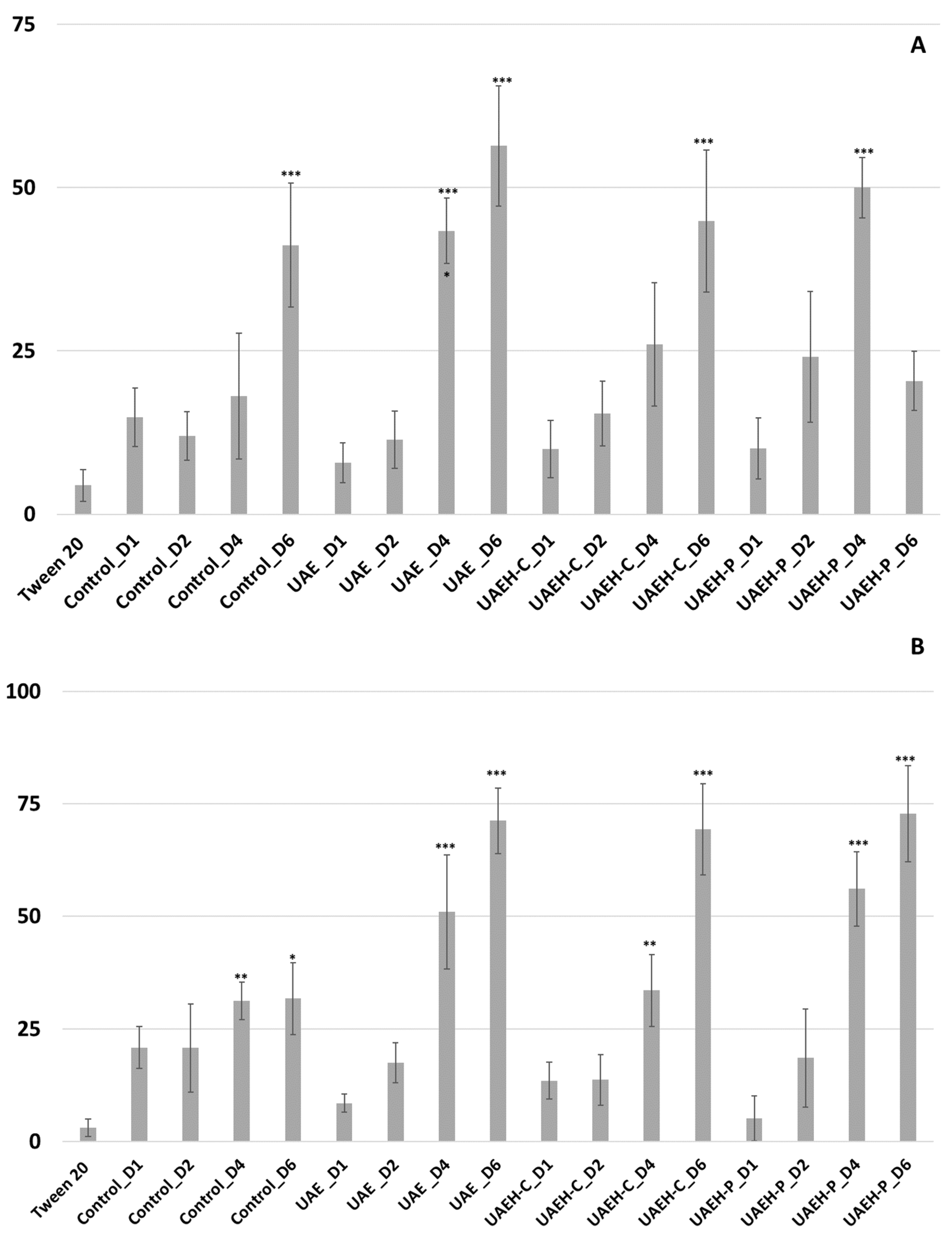
Figure 1. Mortality rate (mean ± standard deviation) of B. tabaci adults after 24 h (A) and 48 h (B) of exposure on tomato leaflet treated with different solutions of Sargassum extracts at different concentrations. Dunnett’s test was used to compare each treatment to the water + Tween 20 control (TW). *, ** and *** indicate significance at p < 0.05, p < 0.01 and p < 0.001, respectively.
Phycology 05 00079 g001
Figure 2. Mortality rate (mean ± standard deviation) of B. tabaci eggs seven days after exposure on tomato leaflet treated with different solutions of Sargassum extracts at different concentration. Dunnett’s test was used to compare each treatment to the water + Tween 20 control (TW). * and ** indicate significance at p < 0.05 and p < 0.01, respectively.
Phycology 05 00079 g002
Table 1. Summary of extraction treatments and corresponding codes.
ExtractUAEEnzyme treatmentCode
Control (Maceration)NoNoControl
UAEYesNoUAE
UAEH-ProteaseYesProtease mixtureUAEH-P
UAEH-CarbohydraseYesCarbohydrase mixtureUAEH-C
Table 2. Biochemical composition of seaweed extracts compared to controls and initial biomass (% d.e.) mean ± standard deviation sd; n = 3.
SampleAsh
% ± sd
Neutral sugars
% ± sd
Uronic acids
% ± sd
Sulfates
% ± sd
Proteins
% ± sd
Phenolics
% ± sd
Total
% ± sd
Biomass45.22 ± 0.4114.22 ± 0.795.30 ± 0.042.12 ± 0.0111.26 ± 0.393.38 ± 0.1181.50 ± 1.75
Control67.72 ± 0.005.13 ± 0.155.50 ± 0.073.33 ± 0.186.44 ± 0.221.67 ± 0.0489.79 ± 0.66
UAE65.93 ± 0.185.13 ± 0.025.00 ± 0.173.49 ± 0.016.96 ± 0.171.54 ± 0.2288.05 ± 0.77
UAEH-C61.40 ± 0.5111.54 ± 2.084.73 ± 0.341.87 ± 0.015.12 ± 0.171.86 ± 0.2186.52 ± 3.32
UAEH-P62.33 ± 0.323.35 ± 0.062.46 ± 0.053.60 ± 0.006.52 ± 0.281.19 ± 0.0580.34 ± 0.76
d.e.: dry extract.
Table 3. Total number of adult and eggs of B Bemisia tabaci tested over all trials according to the treatment (adults: five replicates; eggs: five replicates with three leaflets per replicate).
ModalityAdults 24 hAdults 48 h Eggs
Water (natural mortality)8281616
Tween 20 (negative control)7977623
Control_D17873593
Control_D27682616
Control_D48781669
Control_D68183595
UAE_D16867649
UAE_D27577616
UAE_D47779604
UAE_D68280597
UAEH-C_D18688584
UAEH-C_D28381555
UAEH-C_D48377624
UAEH-C_D68987571
UAEH-P_D17378551
UAEH-P_D27860558
UAEH-P_D47971612
UAEH-P_D67270585
Table 4. Lethal dose of ultrasound and enzymatic ultrasound extracts of Sargassum in Bemisia tabaci (only extracts with mortality of more than 50% are presented). Mean ± standard error se.
ExtractLD50 ± se %—(μg. mL−1)95% Confidence Interval %—(μg mL−1)
LowerUpper
B. tabaci adults (after 48 h exposure)
UAEH-C4.5 ± 0.4—(45)3.7%—(37)5.4%—(54)
UAEH-P4.0 ± 0.3—(40)3.3%—(33)4.6%—(46)
UAE3.9 ± 0.3—(39)3.3%—(33)4.5%—(45)
B. tabaci eggs (7 days after treatment)
UAEH-P1.9 ± 0.3—(19)0.7%—(7)3.0%—(30)
UAE2.8 ± 0.3—(28)2.3%—(23)3.3%—(33)
Disclaimer/Publisher’s Note: The statements, opinions and data contained in all publications are solely those of the individual author(s) and contributor(s) and not of MDPI and/or the editor(s). MDPI and/or the editor(s) disclaim responsibility for any injury to people or property resulting from any ideas, methods, instructions or products referred to in the content.