2.1. Experimental Animals and Study Design
Experimental studies were conducted from March to June 2026 at the facilities of DARA&CO LLP, located at 3/5 Rakhym Sabdenov Street, Nauryz microdistrict, Nauryzbay District, Almaty, Republic of Kazakhstan. The study included 36 clinically healthy male lambs aged 3 months, which were allocated into three crossbred groups of 12 animals each according to their parental breed combination and with consideration of age and initial live body weight. The animals were assigned to three crossbred groups according to their parental breed combination:
- (1)
Group I—Kazakh Finewool × Suffolk crossbred lambs;
- (2)
Group II—Kazakh Finewool × Dorper crossbred lambs;
- (3)
Group III—Kazakh Finewool × Edilbay crossbred lambs.
The lambs were obtained from 45 unrelated purebred Kazakh Finewool ewes, with 15 ewes mated to each sire breed (Suffolk, Dorper, and Edilbay). The ewes were 13 months of age and nulliparous at the time of mating. Three purebred rams were used for mating, one Suffolk, one Dorper, and one Edilbay ram, each 18 months of age. Thus, each crossbred group represented the progeny of a single sire. Before the experimental period, the animals were maintained under identical management conditions.
At 3 months of age, 12 male lambs from each crossbred group were randomly selected for the experiment. The intensive finishing period lasted 90 days, from 3 to 6 months of age. The 90-day finishing period was selected to provide a standardized intensive finishing period from the post-weaning stage to a common slaughter age of 6 months, thereby allowing growth performance, carcass characteristics, and meat quality traits to be compared under identical feeding and management conditions.
All animals were maintained under identical housing conditions. Each crossbred group was housed in one pen containing 12 lambs. Each pen measured 3 × 4 m, providing a total floor area of 12 m2, equivalent to 1.0 m2 per lamb. The same complete feed ration was provided to all groups. The animals had free access to drinking water throughout the experimental period.
At the end of the 90-day finishing period, when the lambs were approximately 6 months of age, slaughter was performed under controlled conditions. Before slaughter, feed was withheld for 12 h, while drinking water remained available ad libitum. Following transport to the slaughter facility, the lambs underwent a 2-h lairage period before slaughter. Animals were electrically stunned and immediately exsanguinated.
After dressing, the head, skin, feet, gastrointestinal tract, and internal organs were removed from the carcass. Hot carcass weight (HCW) was recorded immediately after dressing. For Edilbay-cross lambs, the fat tail was retained and included in the carcass weight. The carcasses were subsequently chilled at 2–4 °C for 24 h, after which cold carcass weight (CCW) was recorded. Calculation of carcass and meatiness indicators The dressing percentage, meat-to-bone ratio, and meatiness coefficient were calculated using the following formulas:
The dressing percentage, meat-to-bone ratio, and meatiness coefficient were calculated using the following equations:
where DP is the dressing percentage (%), W
C is the carcass weight (kg), and W
pre is the pre-slaughter live weight (kg).
where MBR is the meat-to-bone ratio, W
m is the total meat weight, including muscle and associated fat (kg), and W
b is the total bone weight (kg).
where K
m is the meatiness coefficient, W
mus is the muscle tissue weight (kg), and W
b is the bone weight (kg).
All carcass weights were recorded individually for each animal. The calculated indicators were used for comparison among the three crossbred groups. All experimental procedures involving animals, including slaughter and carcass processing, were performed in accordance with GOST 31777-2012 “Sheep and Goats for Slaughter. Mutton, Lamb, and Goat Meat in Carcasses. Specifications” [
16] and the veterinary-sanitary legislation of the Republic of Kazakhstan. Ethical approval for the study was obtained from the Local Bioethics Committee of LLP “Kazakh Research Institute of Processing and Food Industry” (Protocol No. 119, 8 April 2025). The Committee determined that all experimental procedures were conducted in accordance with accepted principles of humane animal care and welfare (see
Supplementary Material, File S1).
2.2. Feeding and Experimental Diet
The complete compound feed used in the experiment was developed and produced at the LLP “Kazakh Research Institute of Processing and Food Industry” (Almaty, Republic of Kazakhstan) in accordance with GOST 10199-2017 [
17]. The preparation of the compound feed involved grinding, mixing, and extrusion using a PD-400 pneumatic grinder, an SG-400 mixer, and a PE-170 grain extruder, respectively (Agrotechservice-12 LLP, Kostanay, Kazakhstan). The ingredient composition, nutritional value, vitamin and mineral composition, amino acid profile, microbiological characteristics, and physicochemical properties of the complete compound feed are presented in
Table 1.
The complete feed was offered to the lambs twice daily, in the morning and evening, at a predetermined daily allowance. Although the lambs were housed in groups, feed was provided individually to each animal. The amount of feed offered was weighed immediately before each feeding using a calibrated electronic scale. Feed refusals were collected and weighed before the subsequent feeding. Daily individual feed intake was calculated as the difference between the amount of feed offered and the amount of feed refused. The amount of feed offered and feed refusals were recorded throughout the 90-day finishing period. Although the 12 lambs of each genotype shared a common pen, each animal was fed from an individually assigned trough that was accessible to only one lamb during feeding, which allowed the amount offered and refused to be attributed to that specific animal despite the group housing. Feed offered and refusals were weighed on an as-fed basis and converted to a dry-matter basis using the measured dry-matter content of the complete feed (92.49%,
Table 2) to calculate the daily dry matter intake (DMI) reported for each animal.
Feed conversion ratio (FCR) was calculated as the ratio of total feed consumed to total live-weight gain during the 90-day feeding period and was expressed as kg feed/kg live-weight gain. Average daily gain (ADG) was calculated from individual live-weight measurements as total live-weight gain divided by the number of feeding days. No predefined target ADG was established before the experiment; therefore, ADG was calculated retrospectively from the observed live-weight measurements.
Quality assessment of the compound feed was carried out at the accredited Testing Center of LLP “Kazakh Research Institute of Livestock and Feed Production” (Almaty, Kazakhstan) in accordance with GOST 32040-2012 [
18].
Vitamin, mineral, toxicological, microbiological, and amino acid analyses of the compound feed, as well as physicochemical and proximate composition analyses of meat samples, were performed at the Research Laboratory for Food Quality and Safety Assessment of Almaty Technological University (Almaty, Kazakhstan). Vitamin contents were determined according to GOST R 54635-2011 [
19], GOST R 54634-2011 [
20], and GOST 31483-2012 [
21]. Mineral elements were analyzed according to GOST 32343-2013 [
22], toxic elements according to GOST 30178-96 [
23], and amino acid composition according to GOST R 55569-2013 [
24]. The amino acid composition of the complete feed is presented in
Table 3.
Microbiological analyses of feed and meat samples included detection of
Escherichia coli according to GOST R 53913-2010 [
25], total viable count (TVC) according to GOST 10444.15-94 [
26],
Coliform bacteria (BGKP) according to GOST 31747-2012 [
27],
Staphylococcus aureus according to GOST 31746-2012 [
28], and molds and yeasts according to GOST 10444.12-2013 [
29]. Vitamin, mineral, and microbiological characteristics of the complete feed are presented in
Table 4.
2.3. Comprehensive Assessment of the Physicochemical and Chemical Properties of Meat
Meat quality analyses were performed at LLP “Kazakh Research Institute of Processing and Food Industry” (Almaty, Kazakhstan). Intramuscular fat (IMF) content was determined using a Soxhlet fat extraction system (Beger, Polzela, Slovenia) according to GOST 23042–2015 [
30]. The extracted lipids were recovered using a rotary evaporator (IKA RV 3 eco, IKA-Werke, Staufen im Breisgau, Germany) equipped with a heating bath (IKA HB eco, IKA-Werke, Staufen im Breisgau, Germany). Prior to extraction, meat samples were freeze-dried using a lyophilizer (ALPHA 1–2 LDplus, Martin Christ, Osterode am Harz, Germany) and homogenized with an analytical mill (IKA A11 basic, IKA-Werke, Staufen im Breisgau, Germany).
Muscle pH was measured using a portable pH meter (Testo 205, Testo SE & Co. KGaA, Lenzkirch, Germany) in accordance with ISO 2917:1999 [
31].
Meat color characteristics (L*, a*, and b*) were determined on the cut surface of the
Longissimus dorsi muscle 24 h postmortem using a portable Minolta Chroma Meter CR-400 (Konica Minolta, Tokyo, Japan) according to ISO 11664-4:2019 [
32]. Before measurement, the samples were allowed to bloom for 30 min at 4 °C to allow oxygenation of myoglobin. The instrument was calibrated against a standard white calibration tile according to the manufacturer’s instructions. The CIELAB color parameters were recorded, including lightness (L*), redness (a*), and yellowness (b*). Chroma (C*) and hue angle (h°) were calculated from the measured a* and b* values. Three measurements were taken at different locations on the cut surface of each muscle sample, and the mean value was used for statistical analysis.
Additional physicochemical analyses of lamb meat were conducted at the Research Laboratory for Food Quality and Safety Assessment of Almaty Technological University (Almaty, Kazakhstan). Protein content was determined according to GOST 25011–2017 [
33], fat content according to GOST 23042–2015 [
30], moisture content according to GOST 33319–2015 [
34], ash content according to GOST 31727–2012 [
35], acid value according to GOST R 55480–2013 [
36].
Following slaughter, carcasses were chilled at 0–4 °C for 24 h. Samples of the m. Longissimus dorsi muscle were excised from the loin region between the 12th and 13th ribs. Visible subcutaneous fat and connective tissue were carefully removed before analysis.
The meat samples were divided into portions for determination of intramuscular fat, physicochemical composition, pH, color characteristics, histological examination, fatty acid composition, and marbling evaluation.
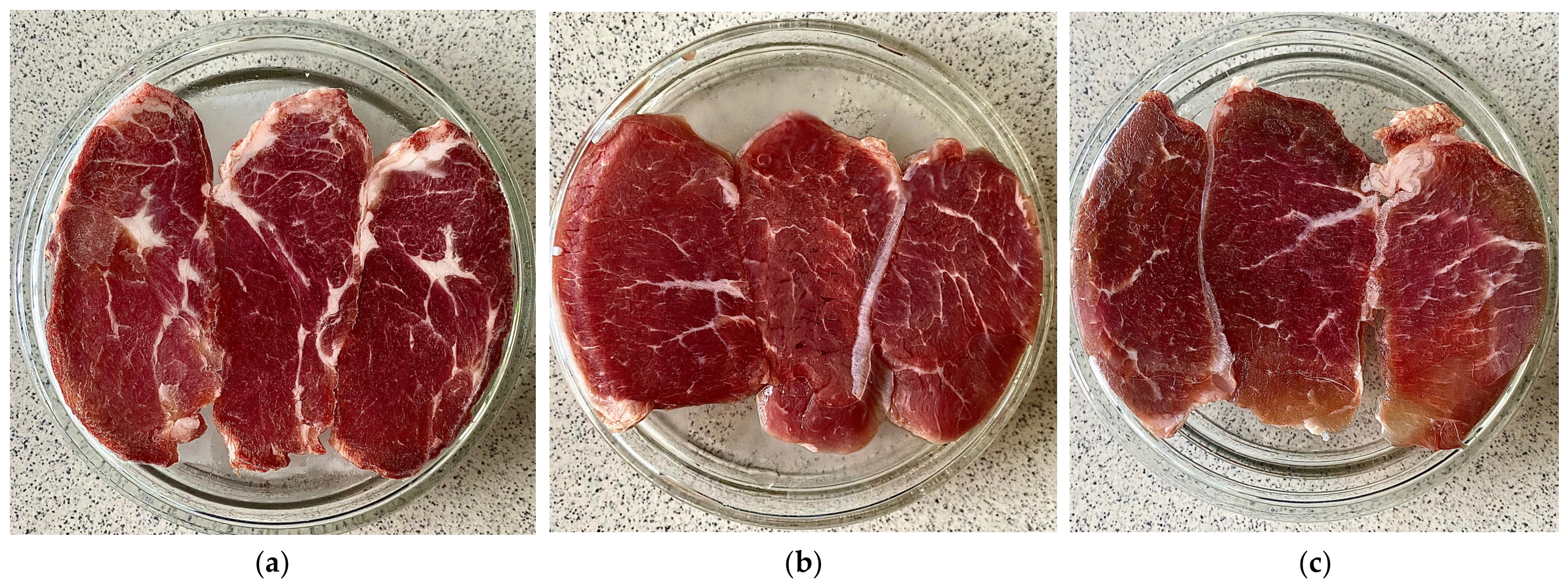
Visual marbling was assessed on the cross-section of the
m. Longissimus dorsi muscle according to the Agricultural Industry Standard of the People’s Republic of China, NY/T 630–2002 “Lamb and Mutton Evaluation and Grading” [
37]. The assessment was performed by a panel of 18 independent experts in meat science and meat technology from Kazakhstan, including specialists holding doctoral degrees and academic qualifications. The degree of visible intramuscular fat deposition was evaluated using the five-point ordinal marbling scale specified in NY/T 630–2002, with higher scores indicating a greater degree of marbling. The samples were coded before evaluation, and the assessors were blinded to the genotype and experimental group of the animals. Each assessor independently assigned a marbling score to each sample. The final marbling score for each animal was calculated as the mean score assigned by the 18 assessors.
Histological evaluation of the
m. Longissimus dorsi muscle was performed to assess the distribution and deposition of intramuscular adipose tissue among the different crossbred groups. Histological identification was carried out in accordance with GOST 34989–2023, “Meat and Meat Products. General Requirements and Procedure for Identification of Composition by Histological Method” [
38].
Muscle samples were sectioned using a semi-automatic rotary microtome (M530, Medite, Burgdorf, Germany). Histological sections were prepared at a thickness of 5 µm, with three sections obtained from each animal. For histological examination, the sections were stained with Ehrlich’s alum hematoxylin (CAS No. 517-28-2) and eosin (CAS No. 17372-87-1) according to the hematoxylin–eosin staining procedure specified in GOST 34989–2023 [
38]. To facilitate the identification of adipose tissue, sections were additionally stained with Sudan III in accordance with the corresponding procedure of GOST 34989–2023 [
38]. Briefly, sections were treated with 70% ethanol for 0.5–1 min, stained with Sudan III solution for 25 min, rinsed in 70% ethanol for 1–5 s, and subsequently counterstained with hematoxylin–eosin.
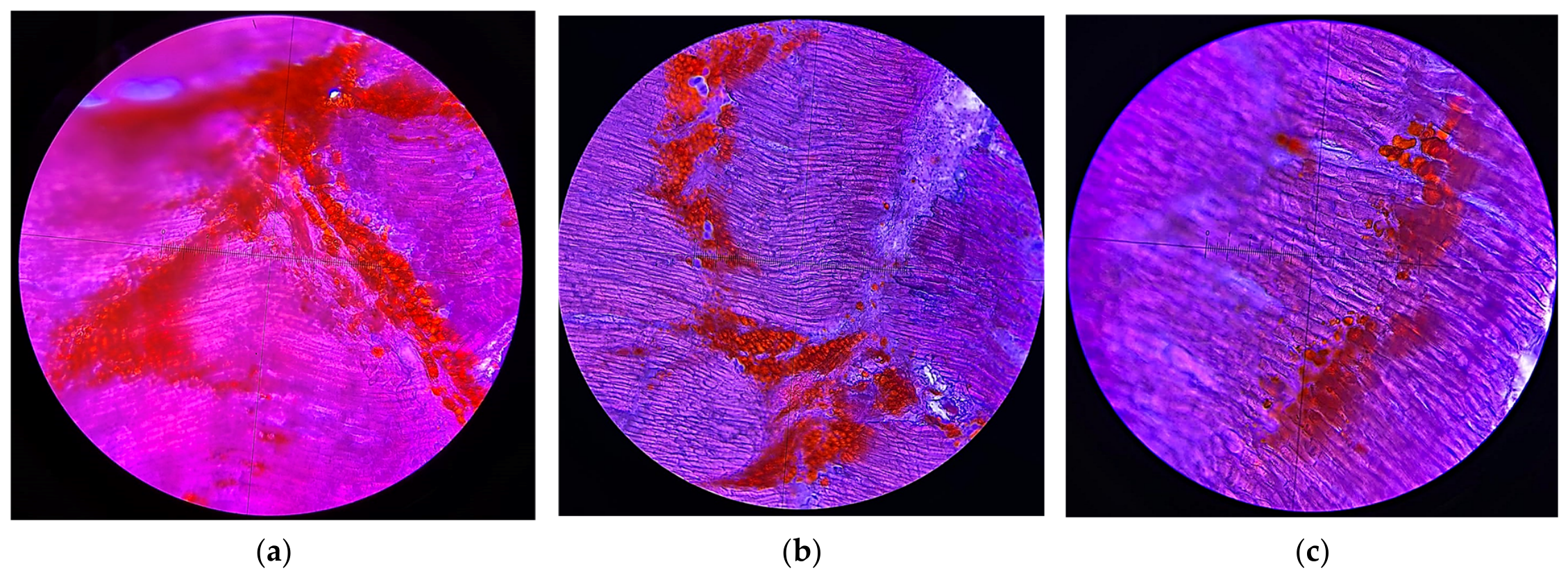
Ten randomly selected microscopic fields per section were examined at 100× magnification using a Biomed EX30-B biological microscope (Ningbo Sunny Instruments Co., Ltd., Yuyao, Zhejiang, China). According to GOST 34989–2023 [
38], adipose tissue stained with Sudan III was identified by its orange-red coloration, whereas cell nuclei stained blue and the cytoplasm exhibited varying shades of red. The localization, distribution, and relative accumulation of intramuscular adipocytes between muscle fibers were evaluated microscopically.
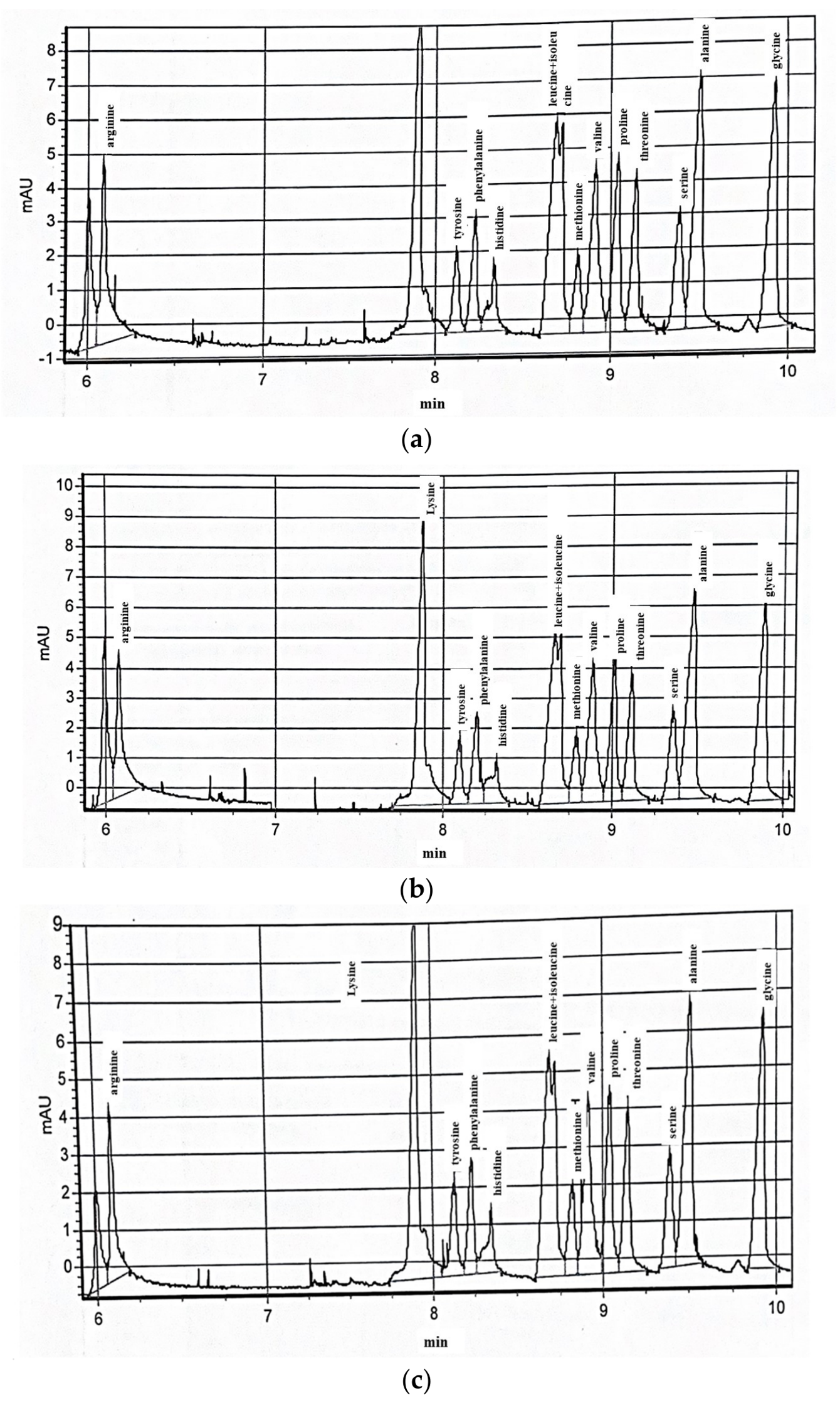
The amino acid and fatty acid compositions of lamb meat were determined at the Research Laboratory for Food Quality and Safety Assessment of Almaty Technological University (Almaty, Kazakhstan). Amino acid composition was analyzed according to GOST R 55569–2013 [
24], while fatty acid composition was determined by gas chromatography in accordance with GOST 34191–2017 [
39]. For fatty acid analysis, intramuscular lipids were extracted from approximately 10 g of muscle tissue using a chloroform–methanol mixture (2:1,
v/
v). The extracted lipids were converted to fatty acid methyl esters (FAMEs) by base-catalyzed transmethylation using KOH in methanol. FAMEs were analyzed by gas chromatography using an Agilent 6890 GC system (Agilent Technologies, Andover, Minnesota, USA) equipped with a flame-ionization detector and a DB-23 capillary column (60 m × 0.25 mm, 0.25 µm film thickness). Helium was used as the carrier gas. The GC oven temperature was programmed from 50 °C to 230 °C using a temperature gradient. Individual fatty acid methyl esters were identified by comparing their retention times with those of a certified reference standard (Supelco 37-Component FAME Mix, Merck KGaA, Darmstadt, Germany) [
40].
2.4. Statistical Analysis
Results are presented as mean ± standard error (SE) unless otherwise indicated. Feed composition and laboratory analytical values are presented as mean ± standard deviation (SD), where applicable. Each crossbred group comprised 12 animals. Individual animal measurements were used as the experimental unit for individual-level traits, including live body weight, carcass traits, meat quality characteristics, and individual feed intake. Because each crossbred group was housed in a single pen, pen effects could not be separated from crossbred-group effects and this represents a limitation of the experimental design. This limitation particularly affects growth-performance and individual feed-intake traits, for which all animals within a genotype shared common pen conditions; consequently, the corresponding p-values are subject to a risk of pseudo-replication and should be interpreted as descriptive comparisons specific to this experimental setting rather than as evidence of independently replicated genotype-level effects. For carcass and meat-quality traits measured on individually slaughtered and sampled animals, animal-level analysis is more directly justified as a descriptive comparison, although the same caution regarding confounding of sire and pen effects with crossbred group applies to all traits reported in this study. Prior to analysis, all datasets were checked for normality of distribution using the Shapiro–Wilk test and for homogeneity of variances using Levene’s test. Differences among the three crossbred groups (Kazakh Finewool × Suffolk, Kazakh Finewool × Dorper, and Kazakh Finewool × Edilbay) were evaluated by one-way analysis of variance (ANOVA), with crossbred group as the fixed factor. When the overall F-test was significant, means were compared pairwise using Duncan’s multiple range test. Differences were considered statistically significant at p < 0.05, and significant differences among genotypes are indicated in the corresponding tables by different superscript letters (a, b, c) within the same row. Although the marbling score was recorded on a five-point ordinal scale, it was analyzed as a continuous variable because it represented the mean of 18 independent assessor ratings per sample, which approximates a continuous distribution and satisfied the normality and homogeneity-of-variance criteria described above; this approach is consistent with common practice for averaged multi-rater ordinal scores in meat-quality research, although the ordinal origin of the underlying scale should be considered when interpreting the results. The same statistical procedure was applied to the fatty acid and amino acid profiles, using individual muscle samples obtained from the 12 animals in each crossbred group; because a large number of individual fatty acids and amino acids were compared, no correction for multiple comparisons was applied, and the corresponding p-values should therefore be interpreted with appropriate caution rather than as fully independent tests. All statistical analyses were performed using IBM SPSS Statistics (version 26.0, IBM Corp., Armonk, NY, USA).