
Carcass Traits, Meat Quality and Fatty Acid Profile in Meat of Suckling Goat Kids Fed with Milk Replacer: A Meta-Analysis
by
 , , , , and
Yessica Elena Vázquez-Martínez
1,
Yuridia Bautista-Martínez
1,*,
Lorenzo Danilo Granados-Rivera
2, 
Miguel Ruiz-Albarrán
1 ,
,
Jorge Loredo-Osti
1,
Einar Vargas-Bello-Pérez
3 and
and
José Felipe Orzuna-Orzuna
4,* 1
Facultad de Medicina Veterinaria y Zootecnia, Universidad Autónoma de Tamaulipas, Ciudad Victoria C.P. 87000, Tamaulipas, Mexico
2
Campo Experimental General Terán, Instituto Nacional de Investigaciones Forestales, Agrícolas y Pecuarias, General Terán C.P. 67400, Nuevo León, Mexico
3
Facultad de Zootecnia y Ecología, Universidad Autónoma de Chihuahua, Periférico R. Aldama Km 1, Chihuahua C.P. 31031, Chihuahua, Mexico
4
Unidad Regional Universitaria de Zonas Áridas, Universidad Autónoma Chapingo, Bermejillo C.P. 35230, Durango, Mexico
*
Authors to whom correspondence should be addressed.
Ruminants 2026, 6(3), 80; https://doi.org/10.3390/ruminants6030080
Submission received: 19 July 2026
/
Revised: 10 September 2026
/
Accepted: 14 September 2026
/
Published: 16 September 2026
(This article belongs to the Special Issue Nutrients and Feed Additives in Sheep and Goats)
Simple Summary
Milk replacers are widely used in goat production, but their effects on the meat quality of suckling kids are still unclear. This meta-analysis combined the results of 13 studies to assess the impact of feeding milk replacers to suckling kids. Feeding milk replacers preserves growth, carcass traits, and most meat quality traits. It also reduced kidney fat and increased linoleic acid in the meat. These findings suggest that milk replacers are a practical alternative to goat milk, with minimal effects on the meat quality of suckling kids.
Abstract
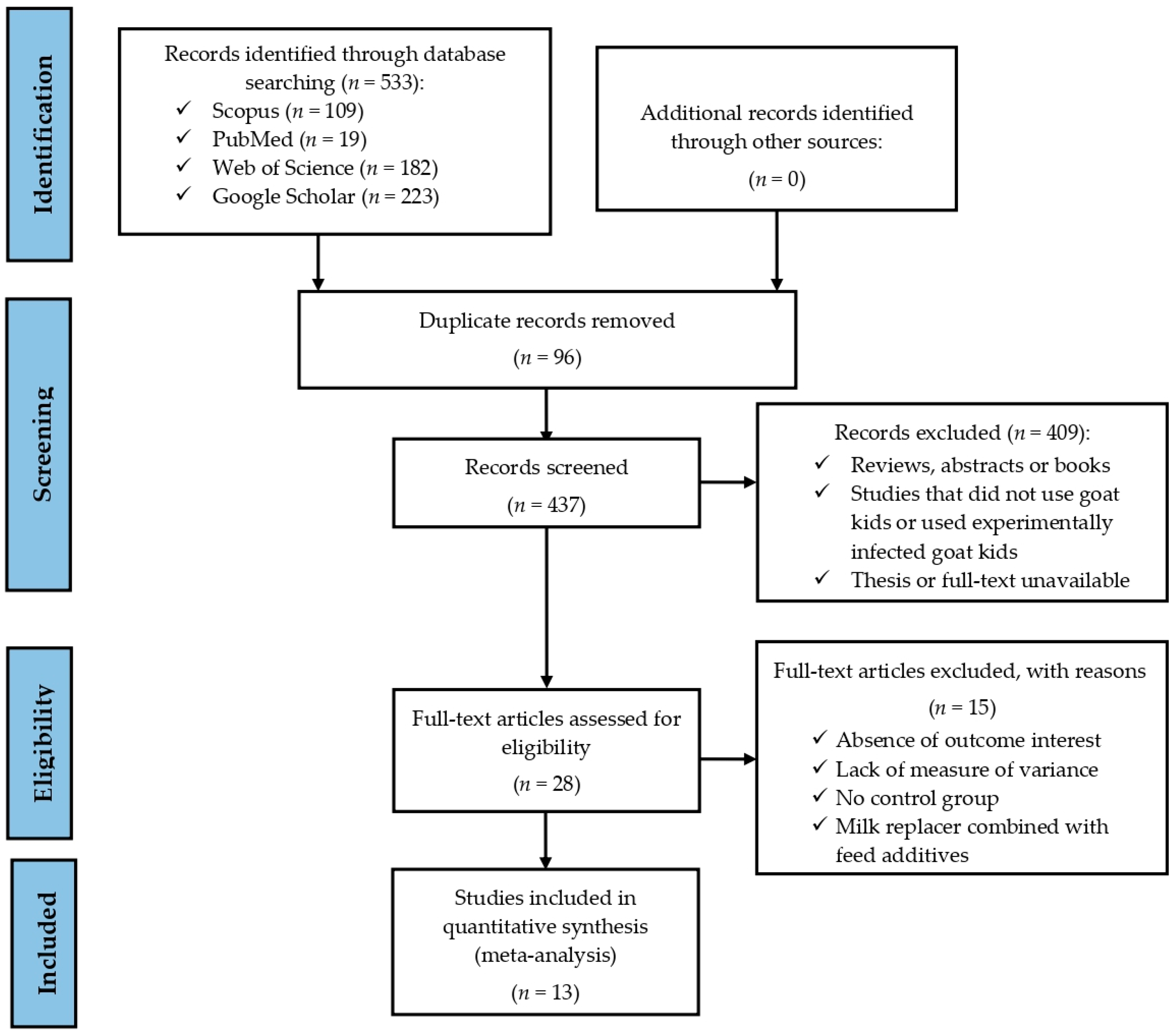
This study aimed to evaluate the effects of milk replacer (MR) feeding on carcass characteristics, meat quality, and fatty acid profile in suckling goat kids through a meta-analysis. The electronic databases Scopus, Web of Science, PubMed, and Google Scholar were used to identify the articles required for the meta-analysis using the PRISMA methodology. The data used in this meta-analysis were obtained from 13 English-language articles published in peer-reviewed journals between January 2005 and May 2026. All data were analyzed using random-effects models. Feeding with MR did not affect (p > 0.05) body weight at slaughter, hot carcass weight, or hot carcass yield of suckling kids. However, a lower renal fat weight (p < 0.05) was observed in kids fed MR. On the other hand, feeding with MR did not affect (p > 0.05) meat pH at 24 h, lightness (L*), redness (a*), yellowness (b*), Chroma (C*), Hue (H°), Warner-Bratzler shear force, or the moisture, protein, fat, collagen, and ash content in the meat of suckling kids. Nevertheless, a lower water-holding capacity (p < 0.05) was observed in the meat of kids fed MR. Feeding with MR did not affect (p > 0.05) the concentration of caproic, caprylic, lauric, myristic, myristoleic, palmitoleic, heptadecanoic, oleic, alpha-linolenic, arachidonic acid, behenic acids, total saturated fatty acids, total monounsaturated fatty acids, and total polyunsaturated fatty acids. However, lower concentrations (p < 0.05) of capric, pentadecanoic, palmitic, stearic, and arachidic acids were observed in the meat of suckling kids fed MR. In contrast, higher concentrations (p < 0.05) of linoleic acid were observed in the meat of suckling kids fed MR. In conclusion, the use of milk replacer in suckling kids preserves growth, carcass traits, and most meat quality attributes, while reducing renal fat deposition and selectively modifying the fatty acid composition toward a higher linoleic acid content.