1. Introduction
Numerous control engineering applications recently developed in engineering fields such as robotics, manufacturing, and aerospace engineering require solutions capable of ensuring accurate tracking of rapidly time-varying reference signals. If the frequency characteristics of these signals are known a priori, classical methods based on the internal model principle (see, e.g., [
1]) may provide zero steady-state tracking errors. However, these methods fail in applications with unknown time-varying reference signals. Such applications are, for example, those for automatic landing of unmanned aerial vehicles (UAVs) on mobile platforms. Autonomous landing control on dynamically moving platforms represents a critical challenge in modern aerospace engineering due to intrinsic nonlinearities, underactuated structure, and strong coupling between translational and rotational dynamics. In maritime environments, these difficulties are further intensified by continuous and irregular motions of the landing platform induced by sea waves, wind, and external disturbances.
Conventional control approaches often rely on simplified assumptions regarding platform motion, typically using constant or purely sinusoidal reference trajectories. While effective for preliminary analysis, such representations do not capture the stochastic and broadband nature of real sea states, limiting the realism of controller validation.
More realistic representations include spectral wave models, such as the Pierson–Moskowitz (PM) spectrum and its modified formulations, which provide a physically grounded description of sea-surface dynamics through the characterization of wave energy distribution across frequencies. Their use enables the generation of reference trajectories that more accurately reflect the vertical heave motion of marine platforms under different sea conditions. However, the integration of such spectral models into nonlinear UAV control frameworks remains relatively limited, particularly in the context of autonomous landing and stability-critical maneuvers. Some automatic carrier landing systems are presented, for instance, in [
2]. There are numerous challenging issues raised by the design of these automatic control systems such as the guidance of the UAV in the proximity of the landing platform, the navigation subsystem including the sensors and the communication channels, modeling of the platform movement, and the control system allowing for the UAV’s stabilization and tracking of the moving platform.
This paper aims to develop and analyze a solution for the automatic control component of the autonomous landing system. Among the validated design methodologies of control systems for tracking fast time-varying reference signals, one mentions the adaptive approaches based on the
norm minimization (see, e.g., [
3,
4]), model predictive control [
5,
6], and backstepping-type control algorithms [
7,
8]. In this paper, one adopted a backstepping control method due to the stability properties of the resulting solutions, as well as for their level of complexity. Previous studies have demonstrated the effectiveness of backstepping for quadrotor stabilization and trajectory tracking [
9,
10]. Nevertheless, its application to UAV landing on wave-excited marine platforms, combined with realistic sea-state modeling, has received comparatively limited attention.
Despite these advances, the integration of such control perspectives with realistic environmental modeling, particularly in the context of wave-induced disturbances, remains limited. This further motivates the present study, which focuses on combining nonlinear control design with physically grounded marine environment representations [
11,
12].
In contrast to conventional control approaches predominantly validated for constant or weakly time-varying reference signals, the present study explicitly targets control performance under dynamic and non-stationary references representative of realistic marine environments. The main contributions of this study can be summarized in a structured manner, following the logical flow of control system design, trajectory generation, and validation:
Control System Design: Development of a nonlinear backstepping controller with explicit Lyapunov-based stability guarantees for the coupled translational and rotational dynamics of the UAV, ensuring robust trajectory tracking under time-varying reference signals.
Trajectory generation: Integration of physically grounded PM and MPM wave spectra into the reference generation process, enabling the formulation of realistic, non-stationary trajectories representative of marine environments and moving beyond idealized deterministic inputs.
Numerical validation: Comprehensive simulation-based evaluation demonstrating improved tracking performance of the backstepping controller compared to a conventional PID approach, including reduced phase lag, lower amplitude error, enhanced damping characteristics, and robustness under broadband, wave-induced excitations.
It should be noted that the present study focuses on the trajectory tracking phase associated with autonomous landing on moving marine platforms. In particular, the study addresses the control problem of accurately following wave-induced reference trajectories representative of platform motion under realistic sea-state conditions. The final touchdown phase, including contact dynamics between the UAV and the landing surface, as well as the detailed hydrodynamic modeling of the floating platform, are beyond the scope of this study. Instead, the emphasis is placed on the control design and performance evaluation under non-stationary and stochastic disturbances, which constitute a critical prerequisite for reliable autonomous landing operations.
The paper is organized as follows:
Section 2 presents the dynamic model of the UAV and the design methodology for the backstepping controller under wave-induced reference excitations.
Section 3 presents the numerical simulation results for the verification and validation of the nonlinear controller performances in comparison with the ones obtained in the linear design framework. These results are analyzed and discussed in
Section 4. The paper ends with some concluding remarks.
2. Backstepping Controller Design for the UAV–Marine Interaction
This section describes the modeling assumption, reference generation, control design, and numerical setup required for the nonlinear control algorithms, and their implementation, verification, and validation are presented in the next sections.
2.1. Quadrotor Modeling and Reference Frames
A quadrotor UAV is modeled as a rigid body with six degrees of freedom (six-DOF) and four control inputs (see, e.g., [
13,
14,
15]). The following two reference frames are considered [
8]:
Inertial frame fixed to the ground, used to express position and Euler angles;
Body-fixed frame attached to the UAV, used to express forces, moments, and body velocities.
The translational position of the center of mass is denoted by
, while the attitude is described by Euler angles
(roll, pitch, yaw). The kinematic relations are expressed through transformation matrices
and
linking inertial derivatives to body-fixed linear and angular velocities [
16]:
,
,
where and are the body-fixed translational and angular velocity vectors, respectively.
The dynamic equations follow Newton–Euler rigid-body mechanics, including gravity and aerodynamic drag:
Translational dynamics include thrust contribution and linear drag ;
Rotational dynamics include rotor-induced moments, gyroscopic/aerodynamic damping , and inertia coupling through .
The propulsion system is modeled through individual rotor thrusts , , producing the total thrust and the body moments. The model is underactuated (six outputs, four inputs). The controlled outputs are selected as , while are stabilized indirectly through the hierarchical control structure.
2.2. Structured State Representation for Backstepping
To apply the recursive backstepping control design methodology adopted in this paper, the state variables are grouped into structured channels [
16]:
, ;
, ;
, ;
.
Following the notations in [
16], the dynamics are separated into three subsystems (translation–attitude coupling, yaw–altitude, and rotor dynamics), written in a compact nonlinear form using drift terms
, input gains
, and auxiliary mappings
, consistent with standard backstepping formulations for underactuated multirotors.
where matrices
have the following expressions:
and with the vectors
given by:
in which:
2.3. Sea-State Modeling and Reference Trajectory Generation
Marine motion is represented through stochastic wave election synthesized as a sum of harmonic components with random phases. Sea elevation is modeled as [
17]:
where
ensures stationarity,
is the number of spectral components, and
is computed from the wave spectrum
over a frequency band
[
17]:
Two spectral models are used for the applications considered in this paper:
The Pierson–Moskowitz (PM) spectrum (fully developed sea), parametrized primarily by significant wave height
:
(see, e.g., [
17,
18]);
The modified Pierson–Moskowitz (MPM) spectrum, recommended by maritime standards (12th and 15th International Towing Tank Conference—ITTC, 1969, 1978 and The 2nd International Ship and Offshore Structures Congress—ISSC, 1964 [
19,
20,
21]) for broader and more realistic frequency content, parametrized by
and dominant period
:
[
17,
22].
Spectral energy describes the distribution of wave energy over frequency.
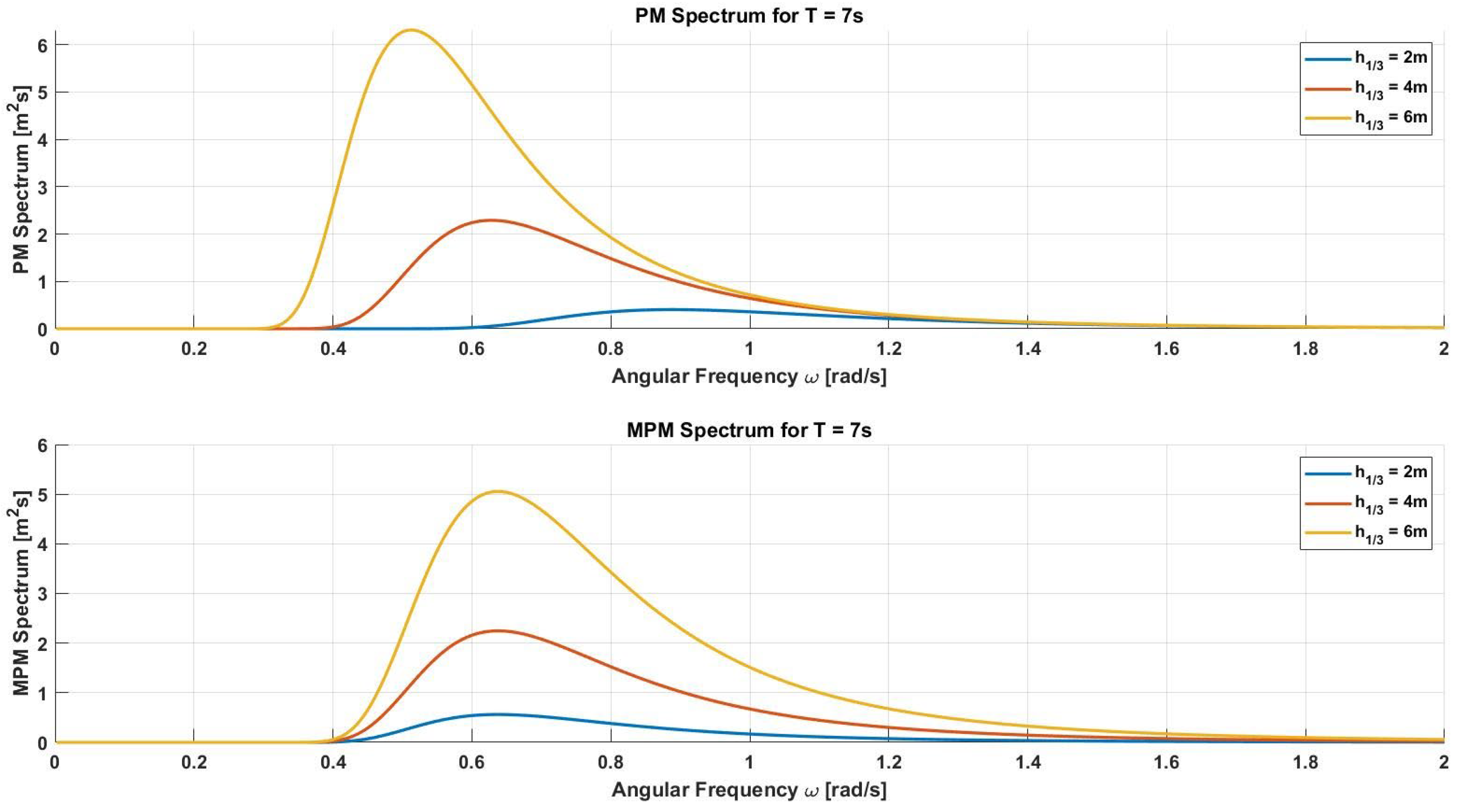
Figure 1 compares the PM and MPM spectra for the same characteristic period
and for different significant wave heights (
). As
increases, the spectral energy level rises and the peak shifts toward lower frequencies, indicating that higher waves are slower and more energetic. Accordingly, the area under the spectrum—proportional to the total sea energy—increases with
(see, e.g., [
17,
18,
22,
23,
24,
25]).
The PM spectrum concentrates energy around a well-defined dominant frequency, representing a fully developed sea. In contrast, the MPM spectrum spreads energy over a wider frequency range, with greater low-frequency content, more realistically capturing mixed long- and short-wave components. Therefore, MPM is generally preferred for rough sea simulations (as recommended by the 12th and 15th International Towing Tank Conference—ITTC, 1969,1978 and The 2nd International Ship and Offshore Structures Congress—ISSC, 1964), while PM remains a reference model for fully developed sea conditions and theoretical analyses.
In the implemented generator, vertical reference is produced by PM or MPM synthesis (optionally in a narrow band around the spectral peak to obtain a smoother heave). Horizontal and yaw references are defined as harmonic signals with configurable amplitude, frequency, and phase. The desired trajectory is defined by the vectors:
,
,
and their time derivatives , , generated analytically for the harmonic components and numerically/analytically for the spectral component depending on implementation choice.
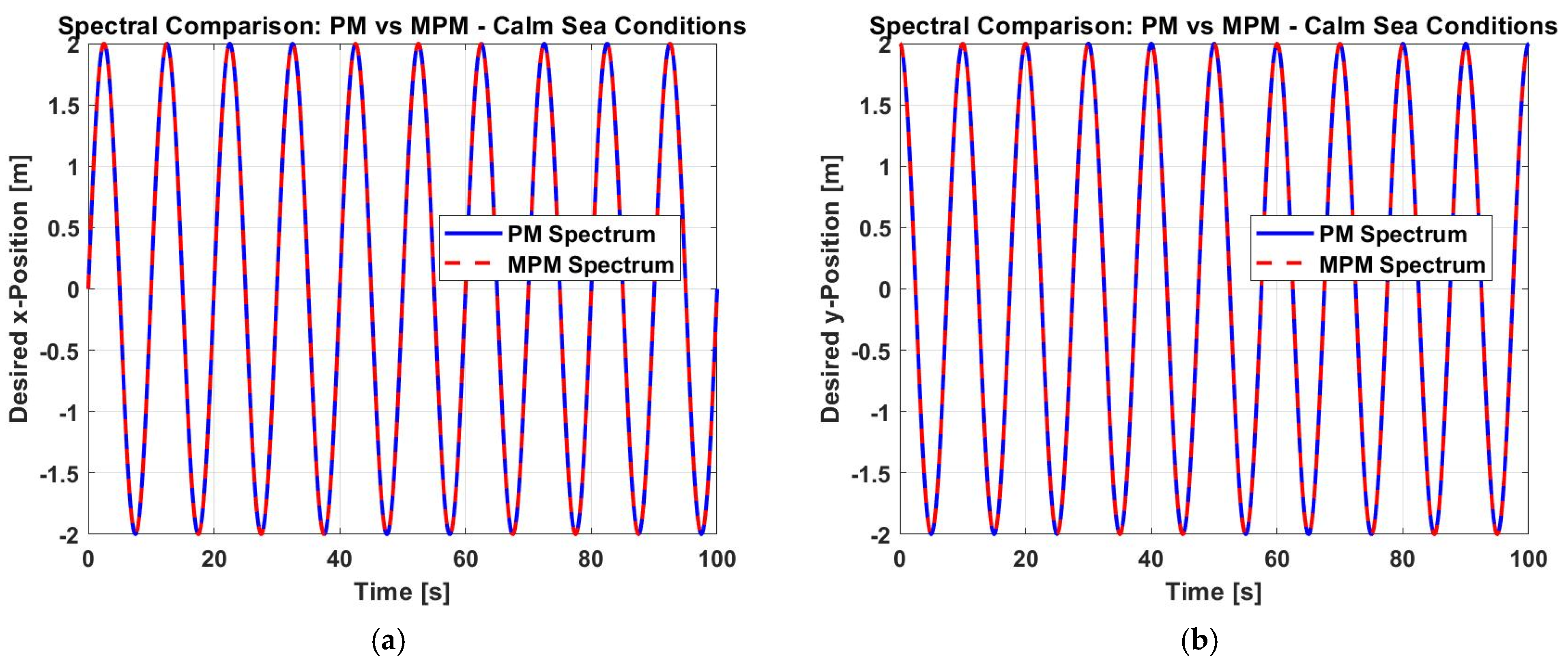
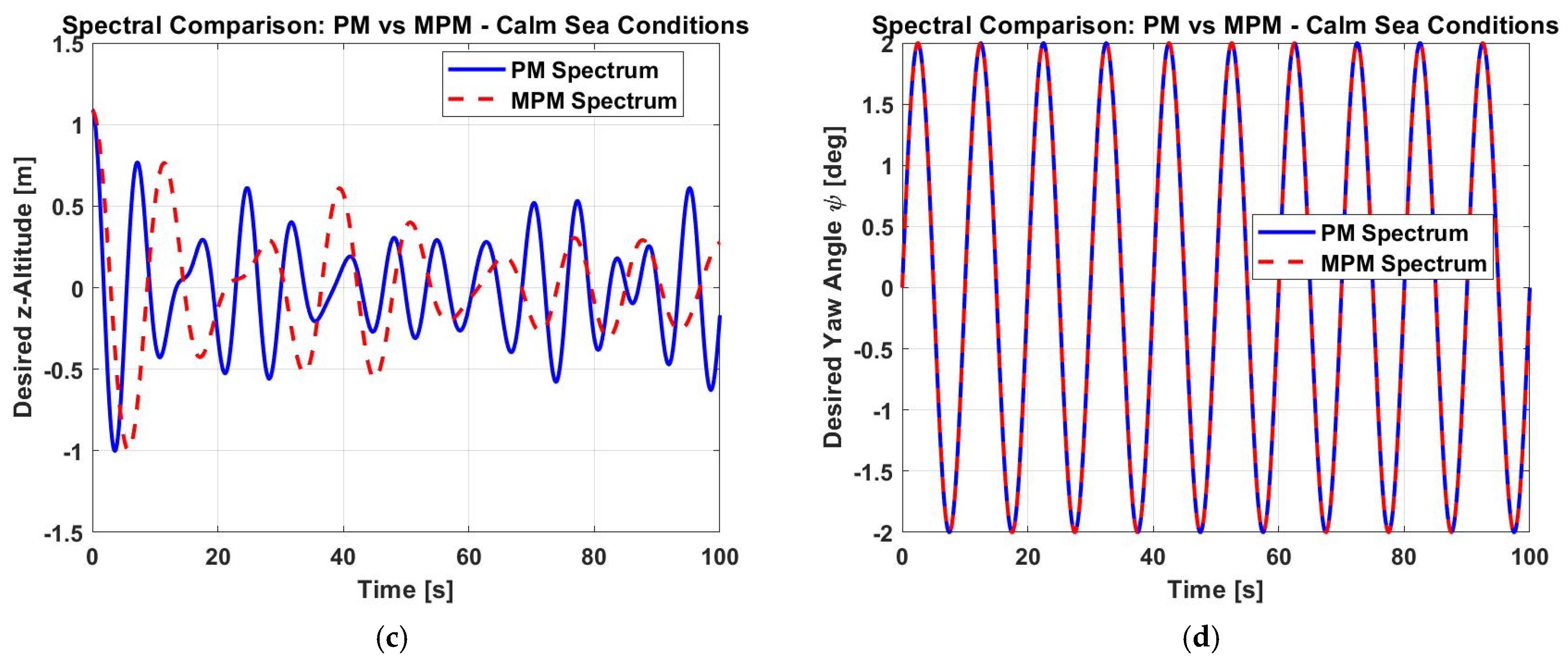
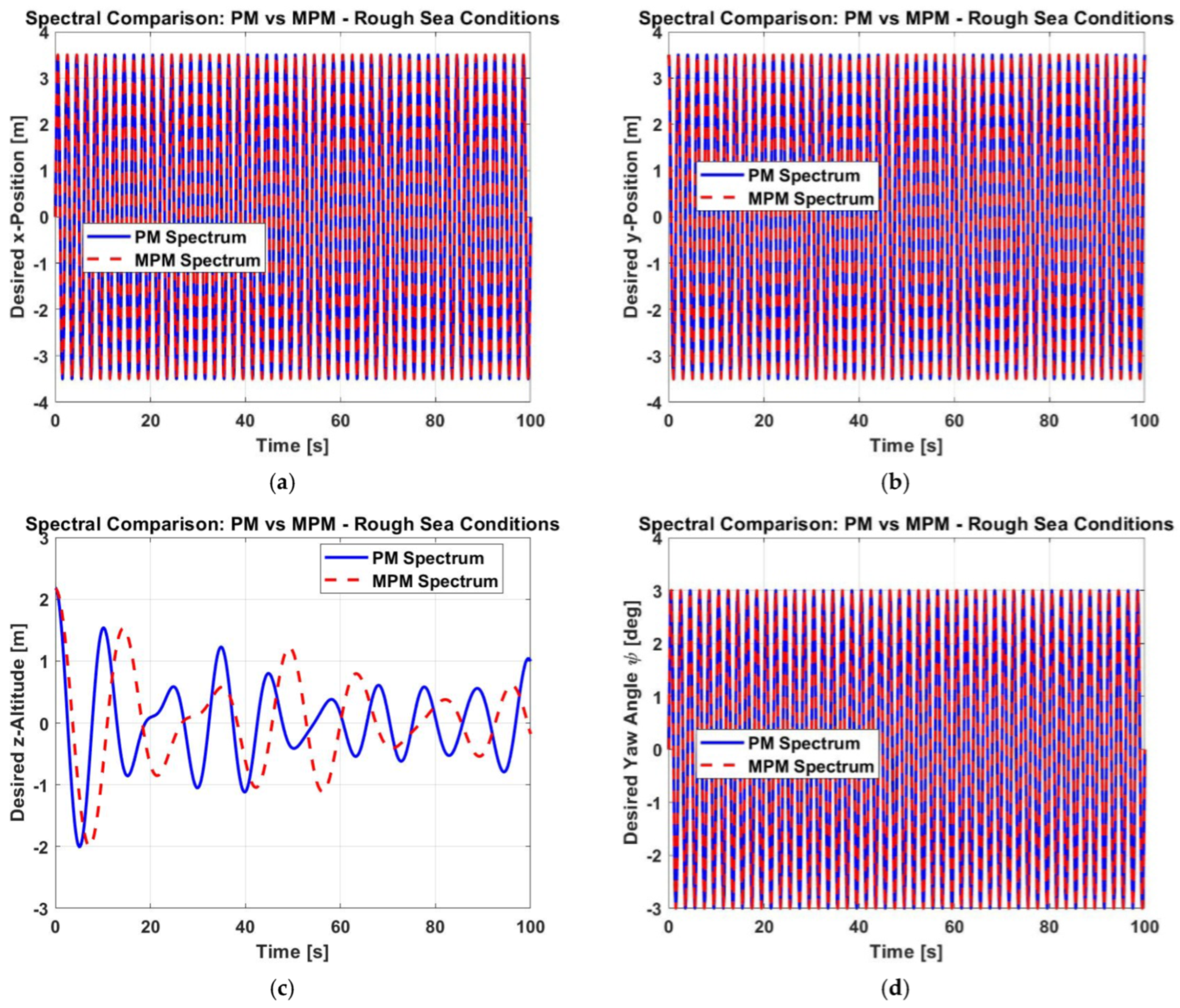
To highlight the effects of the parameters listed in
Table 1, the reference trajectories generated using the PM and MPM spectra are illustrated below.
Figure 2 presents the calm sea case, while
Figure 3 corresponds to rough sea conditions for the variables
.
Reproducibility is ensured through an optional deterministic random seed applied to the phase vector . Multi-directional effects are introduced through an optional propagation direction parameter and evaluation point in the phase argument.
2.4. Backstepping Controller Design
Based on the structured state representation for the backstepping procedure as presented in
Section 2.2, a seven-step recursive backstepping controller is implemented for the selected regulated outputs
[
16].
The backstepping procedure is developed recursively by stabilizing each subsystem through an appropriate Lyapunov function and by introducing virtual control inputs at each intermediate stage. Each step extends the previous Lyapunov function until the final physical control input is obtained.
Step 1: For the first step, the virtual system is considered as
. Let the first tracking error be
and consider the Lyapunov function positive definite
. Its time derivative is
. The stabilization of
can be obtained by introducing a first virtual control input
, with
as a positive definite matrix. The Lyapunov time derivative is then
[
16].
Step 2: For the second step, the following new virtual system is considered:
, where
is a second virtual control input. The variable change is introduced by making
(where
); hence
. For the second step, the augmented Lyapunov function is considered
. Its time derivative is
The stabilization of can be obtained by introducing the following augmented virtual control: with as a positive definite matrix.
Remark 1.
It is worth noting that the determinant of the matrix
is if . Therefore, the matrix is nonsingular in general operation condition because represents the total thrust on the body in the z-axis and is generally nonzero to overcome gravity. Therefore, [16]. Step 3: For the third step, the virtual system is considered
. Let
then
(where
); hence
. For the third step, the Lyapunov function is considered
. The derivative with respect to time is
where
is the Jacobian matrix of
such as
.
Remark 2.
It should be noted that the determinant of the Jacobian matrix
is . Therefore, is non-singular when and , which is generally satisfied. The stabilization of can be obtained by introducing a virtual control with as a positive definite matrix. Then, [16]. Step 4: The final virtual system of the underactuated subsystem
is considered as
. Putting
,
is obtained (where
); hence
. The global Lyapunov function of the subsystem
is chosen as
. Its time derivative is
The stabilization of subsystem can be obtained by introducing the following virtual control law: , with as a positive definite matrix.
Remark 3.
Since the condition
is generally satisfied, the matrix is nonsingular. While replacing the control equation in the equation, is obtained. Consequently, the subsystem is asymptotically stable with virtual control inputs , , , and .
Step 5: In this step, the virtual system is considered as . Let the tracking error be and the Lyapunov function . Its time derivative is . The stabilization of can be obtained by introducing a virtual control , with as a positive definite matrix. Therefore, .
Step 6: For this step, the following system is defined: . Let (where ), then . The augmented Lyapunov function for this step is . Its time derivative is . The stabilization of can be obtained by introducing the following virtual control: , with as a positive definite matrix.
Remark 4.
Knowing that
and , it is easy to show that the matrix is nonsingular. Replacing the virtual control equation in the equation, is obtained. This leads to the conclusion that the subsystem is asymptotically stable [16]. Step 7: For the final step, the propeller subsystem is defined as
. Let
where
and
; hence
and
, in which
and
with
as a null matrix in
. Consider the Lyapunov function candidate of the whole system
to be
. Its time derivative is given by
where
and
are the Jacobian matrices of
and
such as
, . Therefore, the stabilization of the whole system can be obtained by introducing the following control law:
with
as a positive definite matrix.
Remark 5.
It should be noted that the determinant of the matrix
is . Therefore, this matrix is nonsingular when and . While replacing the equation in the equation, one obtains . Consequently, the whole system is asymptotically stable with the following control law [8]: Therefore, the seven-step recursive construction ensures the asymptotic convergence of all tracking errors associated with the regulated outputs , and , provided that the gain matrices are positive definite.
2.5. Actuator Constraints: Saturation and Rate Limiting
To emulate physical rotor limitations and avoid non-physical thrust commands, constraints are imposed on:
Rotor thrust bounds: ;
Thrust rate limits: .
The implemented logic applies:
These constraints are essential for numerical stability and for preventing unrealistic actuator behavior during aggressive transients.
2.6. PID Baseline Controller for Comparative Evaluation
A conventional PID controller is implemented as a baseline, tuned for the same plant model and evaluated under identical initial conditions and reference trajectories [
26,
27]. The comparison focuses on tracking quality and transient behavior under slow/fast sinusoidal references and under sea-state references generated from PM/MPM spectra. PID limitations for strongly coupled nonlinear underactuated systems are assessed primarily through overshoot, persistent oscillations, and phase lag relative to the reference.
2.7. Numerical Integration and Simulation Setup
Simulations are carried out in MATLAB R2020a using numerical integration of the nonlinear state equations. The implementation supports [
28,
29,
30]:
Adaptive integration via ode45 (Runge–Kutta) for full-model simulations;
Fixed-step Runge–Kutta IV (as an alternative configuration) when strict sampling is required for discrete differentiation of virtual control derivatives.
Initial conditions are selected to represent a displaced state (non-zero position and yaw), while rotor thrusts are initialized uniformly around the hover equilibrium . Nominal parameters include mass, inertias, arm length, aerodynamic drag matrices, and gravitational acceleration.
2.8. Performance Metrics and Stability Verification
Controller performance is evaluated using:
Tracking accuracy in steady and dynamic regimes (relative error bounds);
Response time and overshoot on selected channels;
Amplitude error and phase error for sinusoidal references (computed from time-domain tracking signals via peak-to-peak comparison and phase shift estimation);
Lyapunov verification: time histories of (or stepwise components such as , ) are computed and checked for negativity over the simulation horizon, providing numerical confirmation of asymptotic convergence consistent with the control design.
2.9. Availability of Code, Data, and Protocols
The computational framework is implemented as a modular MATLAB package (22 .m files). The package contains all functions required to reproduce the figures: dynamic models, reference generation (PM/MPM), control laws, Lyapunov computations, and post-processing scripts. No external datasets or accession numbers are applicable because all reference trajectories are synthetically generated from stated parametric models. Ethical approval is not applicable because the study does not involve human or animal subjects.
3. Numerical Results
Numerical simulation campaigns were conducted to evaluate the tracking performance and stability of the proposed seven-step backstepping controller under representative reference scenarios, including constant references, slow/fast sinusoidal trajectories, and sea-state-inspired trajectories generated from Pierson–Moskowitz (PM) and modified Pierson–Moskowitz (MPM) spectra. The quadrotor model and controller parameters follow
Section 2, with nominal values
,
,
,
,
,
, and
. Rotor thrusts were initialized uniformly at hover equilibrium
. The proposed control law requires knowledge of the time derivatives of the vertical vectors
,
,
,
,
, and
. To avoid analytical difficulties, these derivatives have been estimated numerically using a finite-difference approximation
, where
represents the variation in
with respect to the previous time step and
is the simulation time step [
16].
Across all scenarios, stability was assessed through the time evolution of Lyapunov-related quantities computed during simulation. In addition, sensitivity to the control gain selection was evaluated by varying the diagonal matrices
, which directly govern convergence speed and damping in the horizontal
and
channels [
16].
3.1. Stability Verification via Lyapunov Functions
The numerical validation confirms that Lyapunov functions associated with the selected controlled outputs remain negative over the simulation horizon, consistently supporting the asymptotic convergence of tracking errors. In particular, the derivatives linked to the position and yaw–altitude channels (e.g., and ) preserve negative values throughout all analyzed scenarios, indicating dissipative closed-loop behavior and stable error dynamics.
A clear correlation is observed between gain magnitude and the transient behavior:
Small gains (e.g., ) yield conservative control action with slower decay of errors and increased phase lag for time-varying references;
Moderate gains in the range yield well-damped responses and stable convergence, matching the design specifications stated previously;
Large gains (e.g., ) tend to amplify oscillatory behavior and may lead to divergent oscillations due to overcompensation, especially under fast or highly irregular references.
3.2. Tracking Performance Under Sinusoidal References
Two sinusoidal regimes were used to evaluate controller behavior under periodic references with distinct time scales.
3.2.1. Slow Sinusoidal References
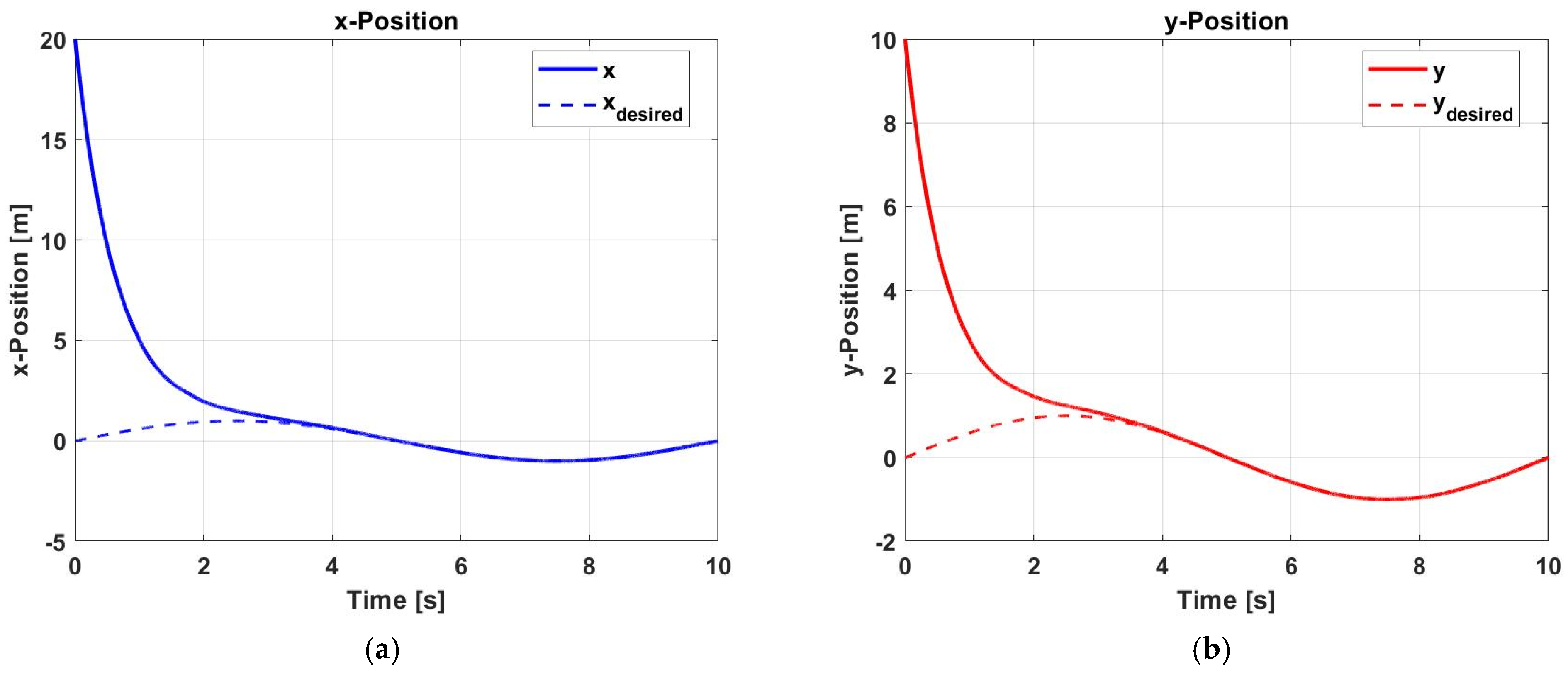
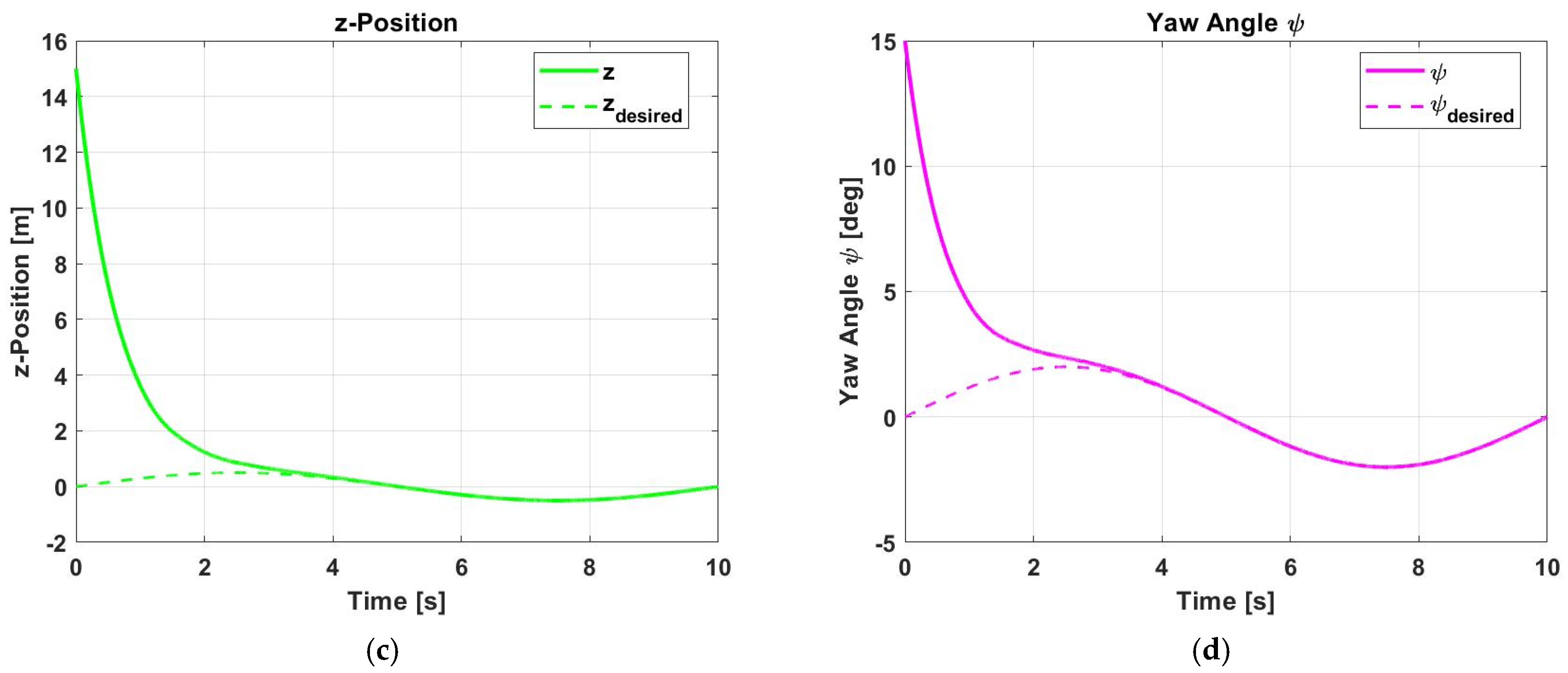
For slow sinusoidal references, the most favorable compromise between response speed and damping is obtained for
, as presented in
Figure 4. This selection yields stable tracking with reduced transient errors and limited oscillatory behavior, maintaining good synchronization with the reference trajectory.
3.2.2. Fast Sinusoidal References
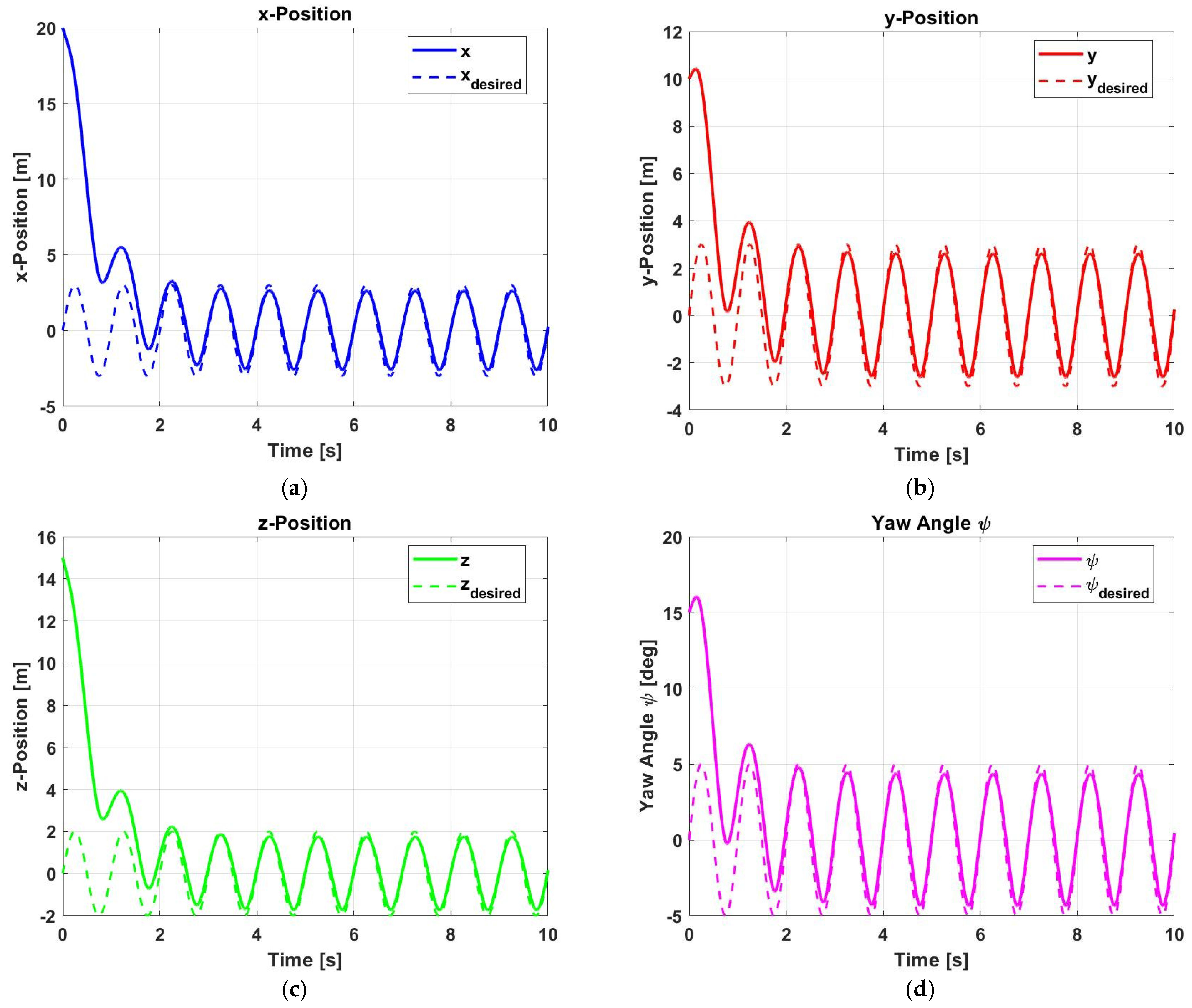
For fast sinusoidal references, improved stability and damping are achieved with slightly reduced gains
. Higher gains in this regime increase the oscillatory response and control effort, while lower gains increase phase lag and tracking degradation. The selected value maintains stability while preserving acceptable tracking accuracy, as shown in
Figure 5.
3.3. Sea-State-Inspired Tracking: PM vs. MPM
Sea-state references were generated using PM and MPM spectra with spectral components, combined with harmonic components for horizontal motion and yaw. Two sea conditions were evaluated:
Calm sea: (for MPM);
Rough sea: (for MPM).
3.3.1. Calm Sea
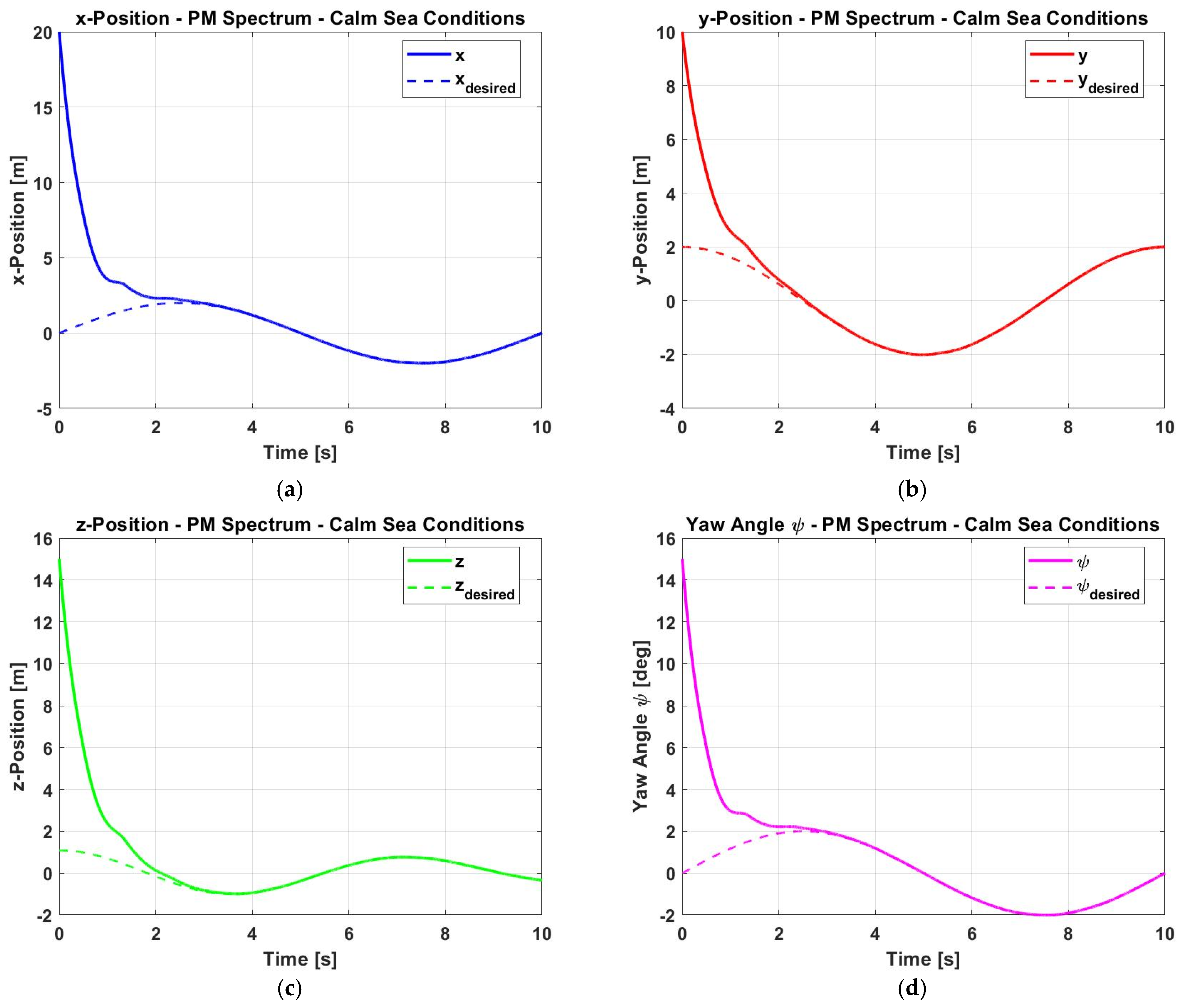
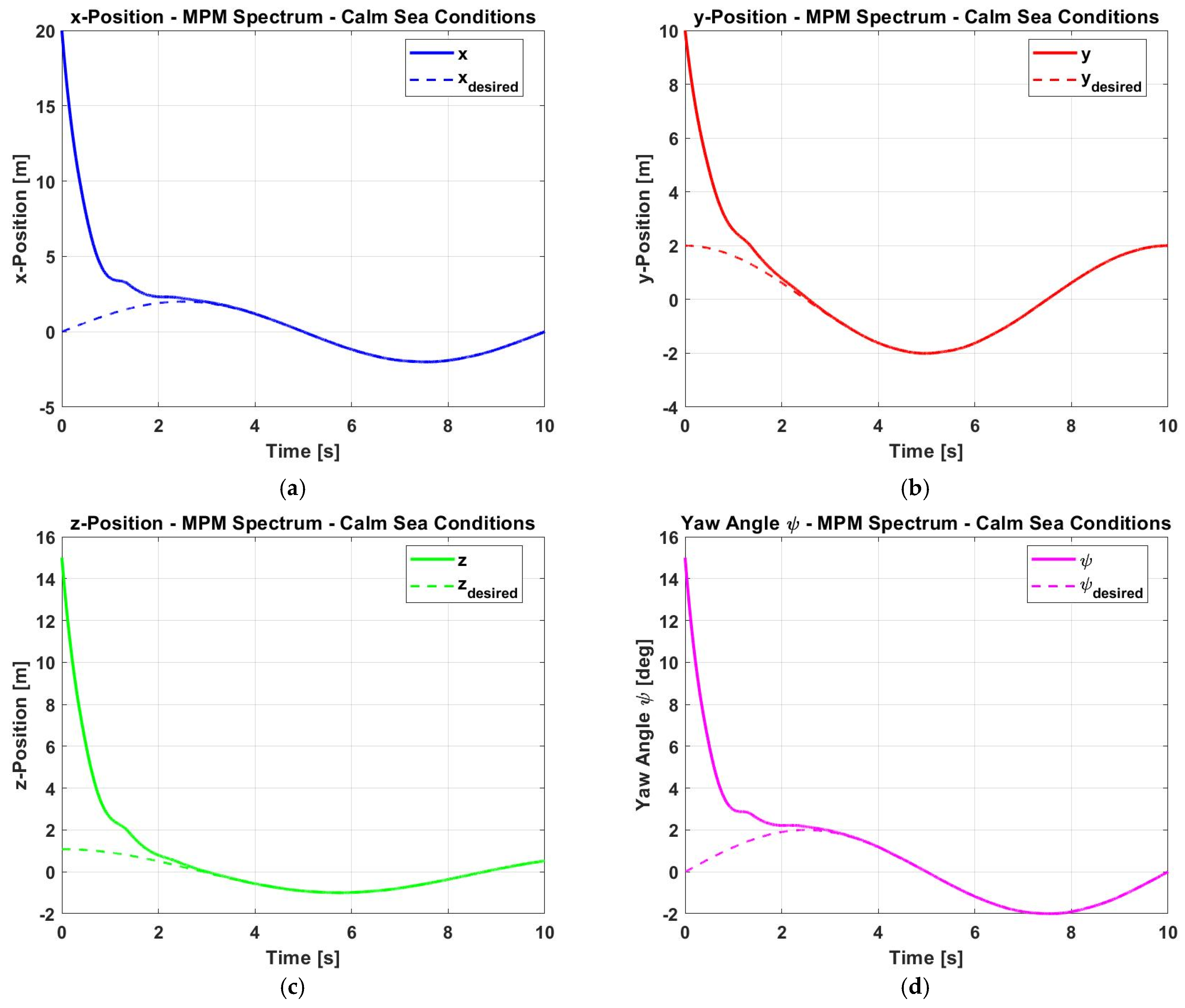
Under calm sea conditions, the recommended gain selection is
, which provides stable tracking across channels while preserving damping under irregular vertical references. These results are presented in
Figure 6 for the PM spectrum and in
Figure 7 for the MPM spectrum. The MPM-based reference consistently produces a more favorable altitude-tracking behavior compared to PM, characterized by reduced phase lag and improved amplitude consistency in
.
3.3.2. Rough Sea
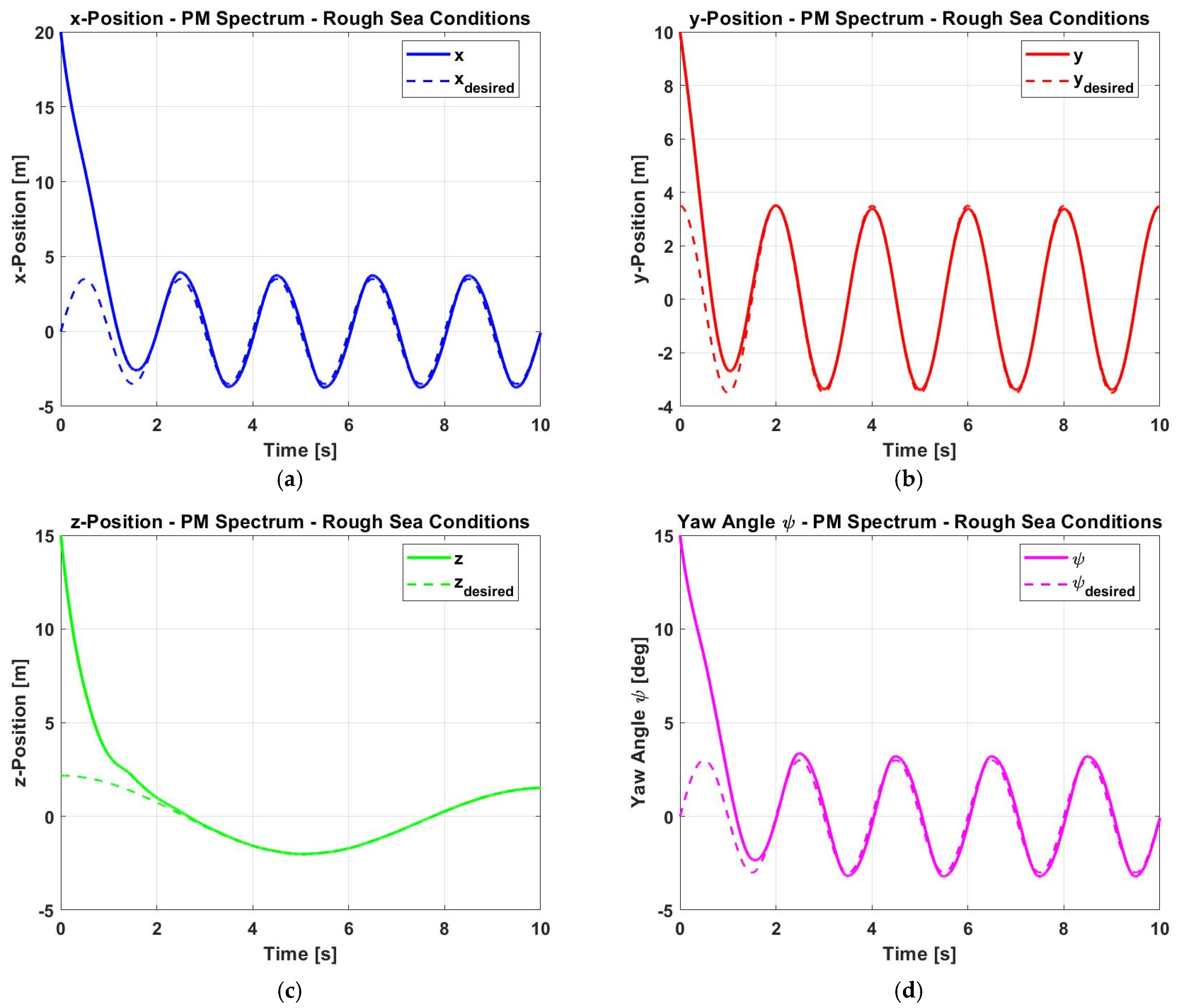
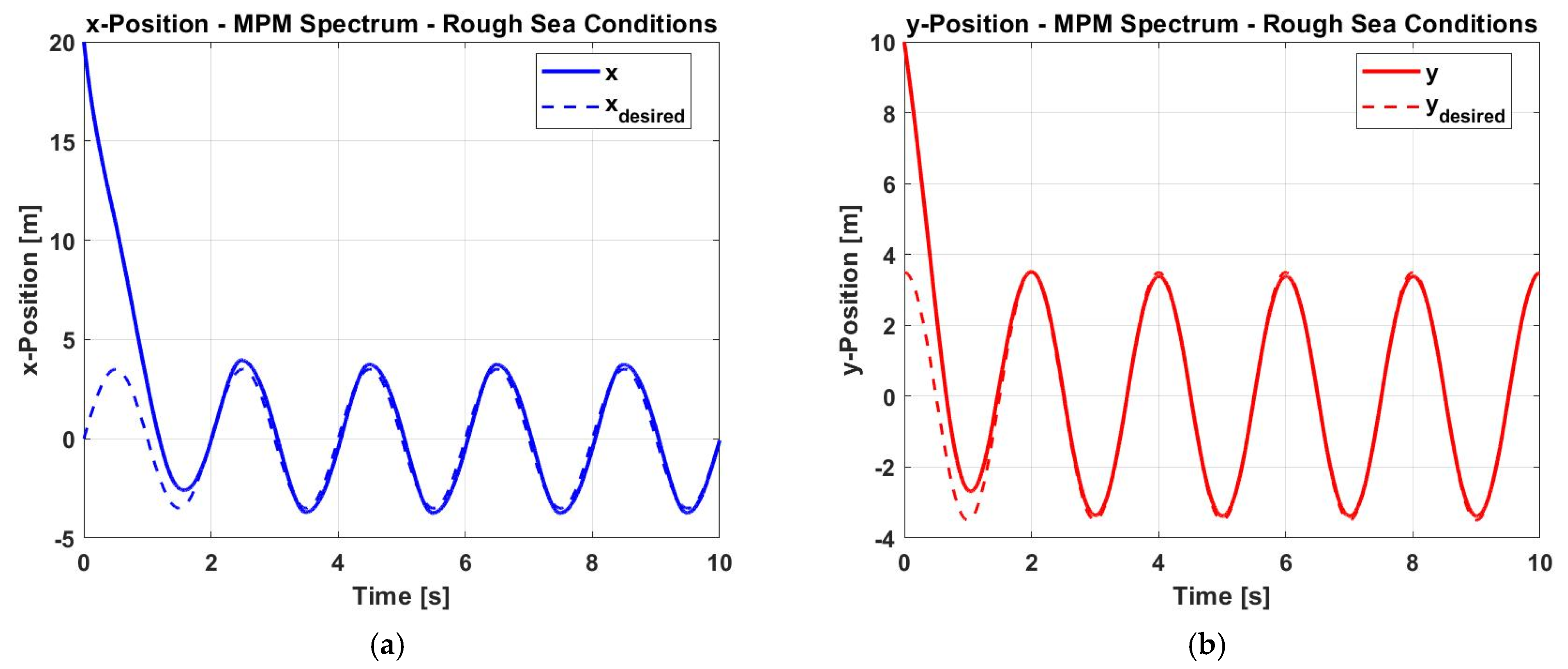
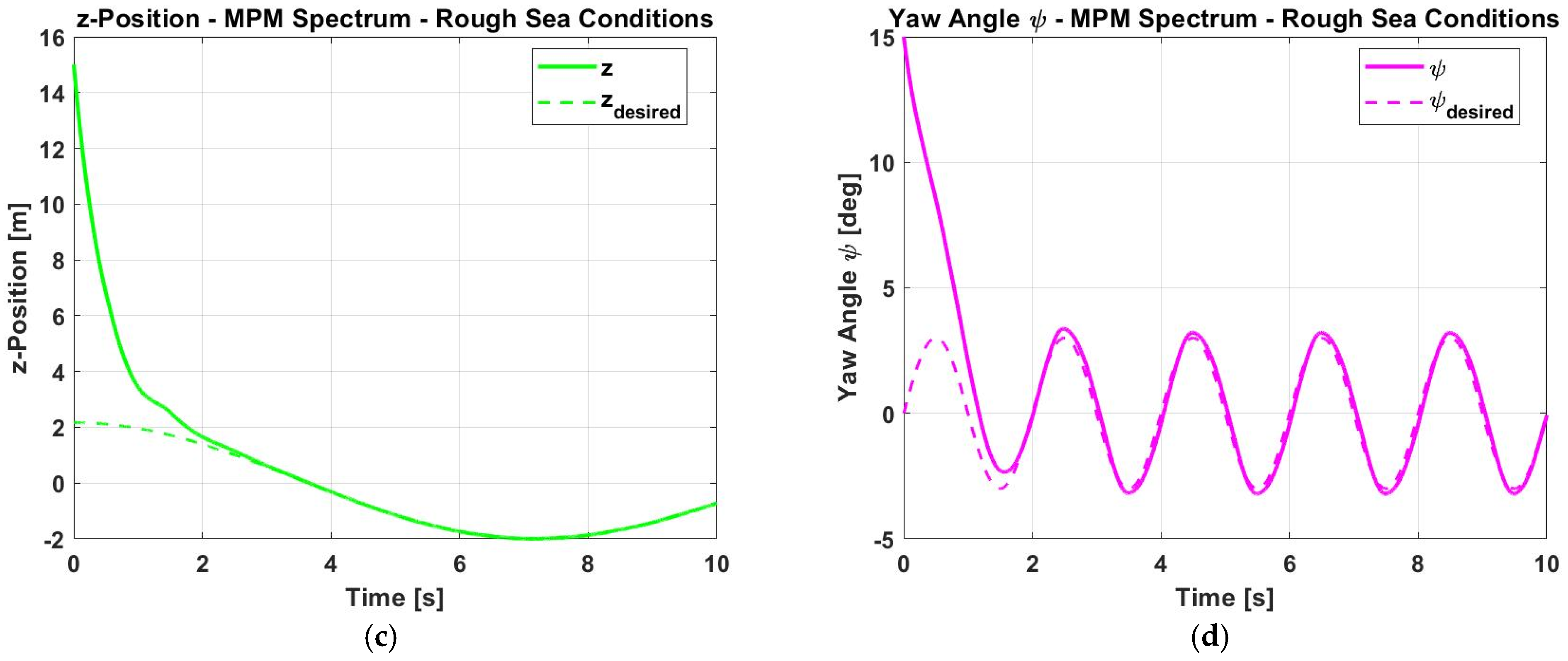
Under rough sea conditions, increased irregularity and higher energy in the heave reference produce a more demanding tracking problem. Stable performance remains attainable for moderate gains, with
providing the best overall compromise in the evaluated set. These results are shown in
Figure 8 for the PM spectrum and in
Figure 9 for the MPM spectrum. Outside the moderate gain interval, two failure modes emerge: (i) divergent oscillations for large gains and (ii) slow, inaccurate tracking for small gains. In this regime, MPM-based references again yield superior altitude tracking relative to PM, attributed to the broader spectral representation and more consistent excitation profile.
3.4. Gain Sensitivity Summary and Validated Interval
The simulations indicate that full satisfaction of the design specifications is obtained for moderate gains within . Outside this interval, tracking performance degrades markedly.
Large values (): divergent oscillations due to overcompensation;
Small values (): slow response with reduced tracking precision;
Moderate values (): best compromise between stability, accuracy, and response speed.
Table 2 summarizes the empirically recommended gain selections per scenario.
3.5. Backstepping vs. PID Comparative Results
For the comparative analysis, a cascaded PID control strategy was implemented on the complete nonlinear quadrotor dynamics. The outer loop regulates the translational motion along the
and
axes, while the inner loop stabilizes the attitude variables
and
. The selected outer-loop PID gains were:
The inner-loop attitude gains were selected as:
The PID parameters were tuned iteratively to achieve the best possible performance under the given nonlinear conditions.
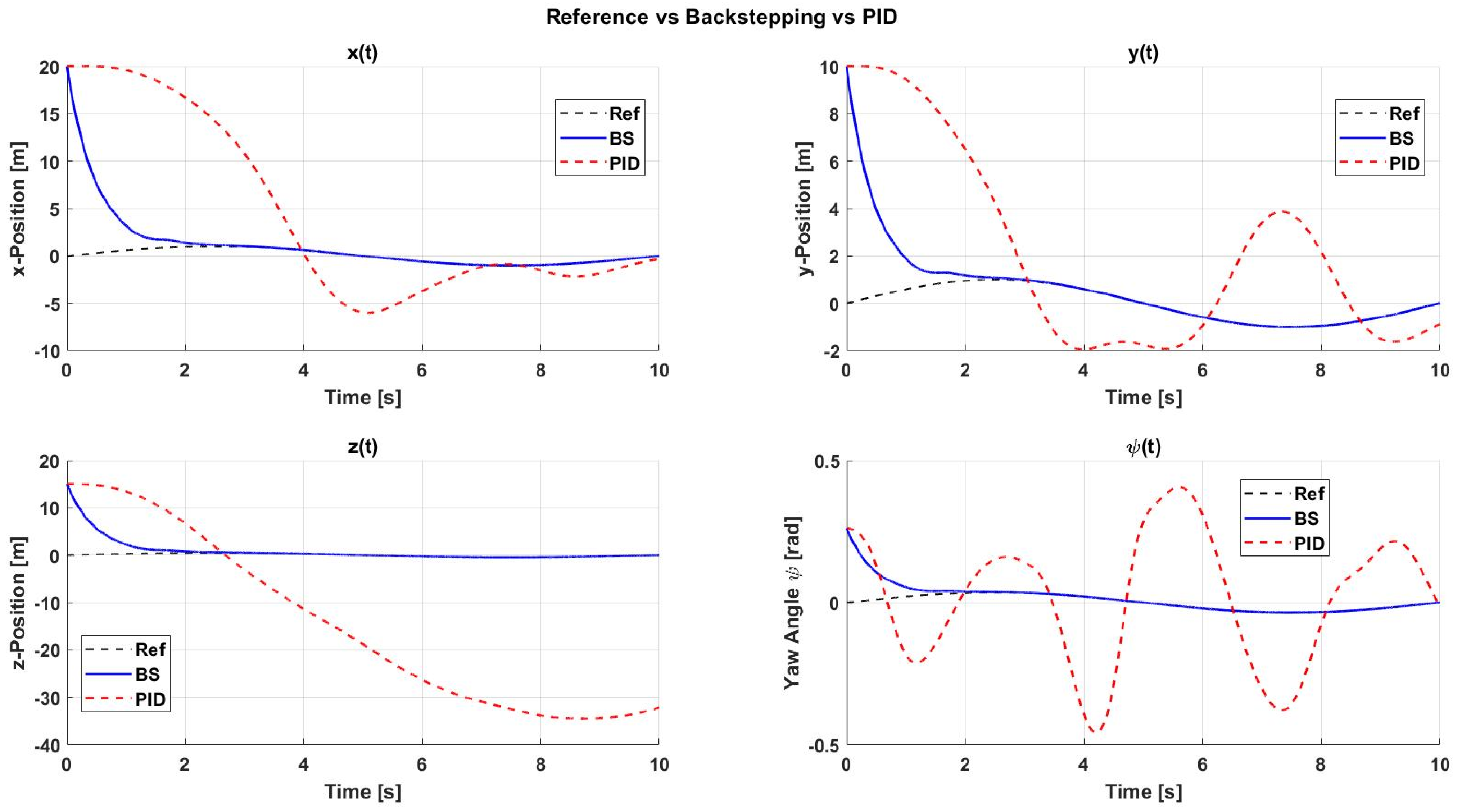
Comparative simulations against a tuned PID baseline indicate consistently improved tracking under the backstepping strategy, especially for time-varying sea-state references. PID regulation maintains approximate tracking in mild regimes but exhibits more pronounced oscillations, overshoot, and phase lag in strongly coupled and irregular scenarios (particularly for and ). In contrast, backstepping preserves better damping and trajectory synchronization due to its recursive structure and Lyapunov-based stabilization. The initial conditions were identical for both methods:
Initial position: m;
Initial yaw angle: ;
Desired state:
where the variation in
corresponds to an oscillation of ±2°. The results can be seen in
Figure 10.
These results confirm that the advantages of backstepping become increasingly pronounced as the reference trajectories depart from constant or purely harmonic forms.
To complement the qualitative analysis, quantitative performance metrics have been evaluated for both controllers under identical nonlinear conditions and sinusoidal reference trajectories.
Table 3 summarizes the root mean square error (RMSE), steady-state error (SS), and amplitude error (AmpErr).
The quantitative results confirm the superior performance of the backstepping controller, which achieves substantially lower tracking errors, reduced steady-state deviations, and improved amplitude preservation compared to the tuned PID controller. The most significant improvements are observed in altitude tracking , where the nonlinear backstepping approach exhibits considerably lower RMSE and amplitude errors.
3.6. Influence of Actuator Saturation and Rate Constraints
To evaluate the practical impact of actuator constraints introduced in
Section 2.5, thrust magnitude and rate limitations were activated during all simulation campaigns.
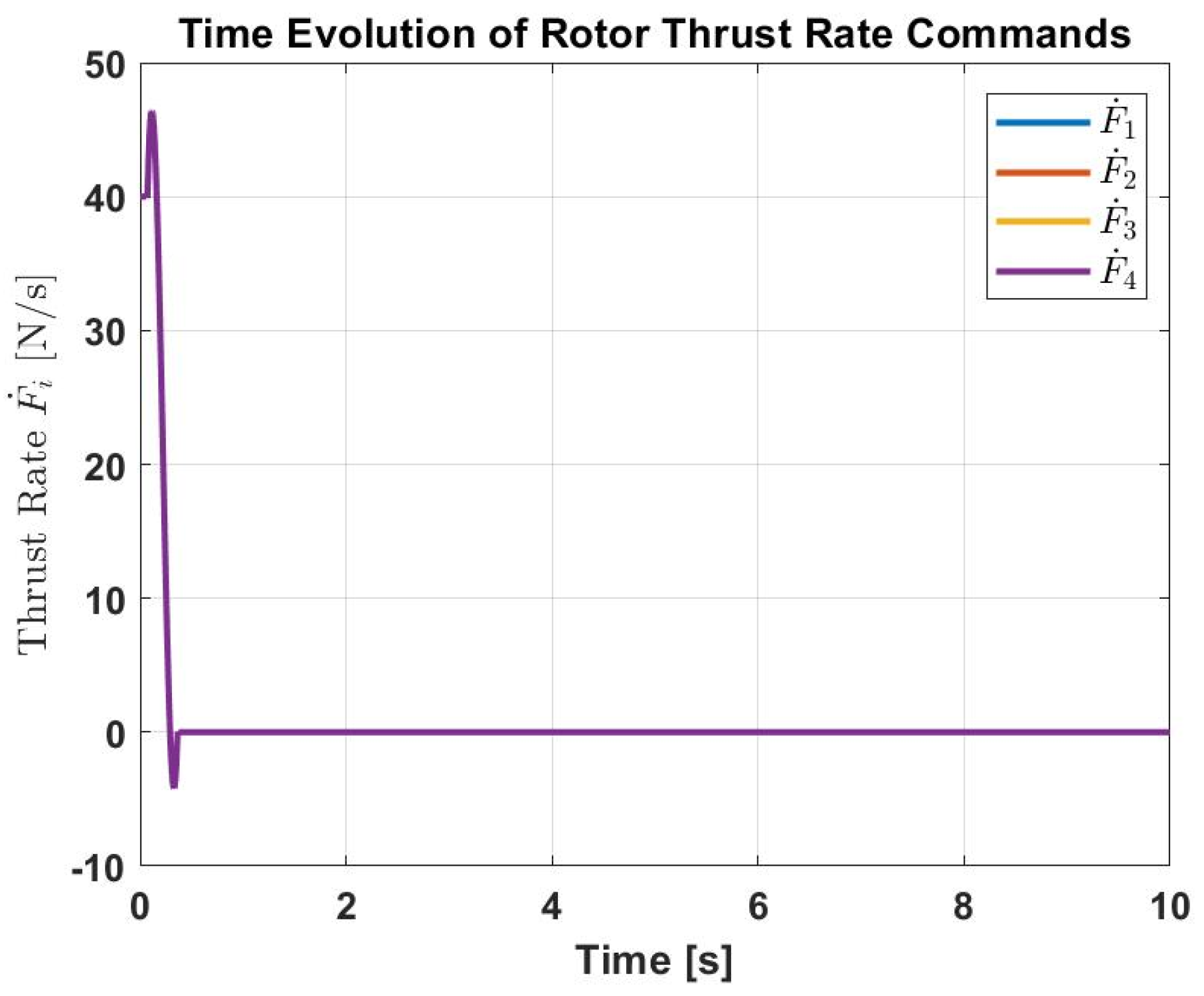
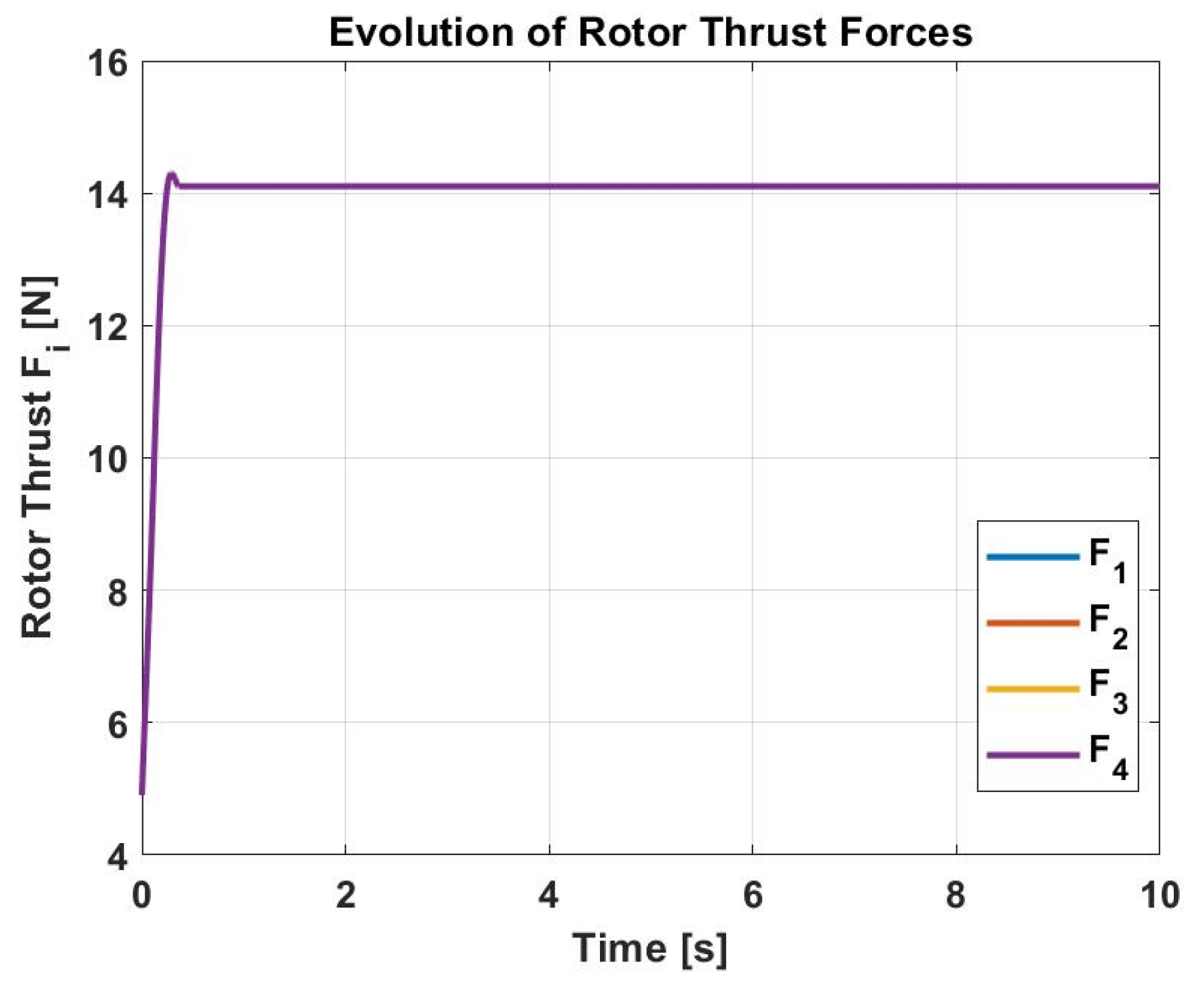
Figure 11 illustrates the time evolution of rotor thrusts
, while
Figure 12 presents the corresponding control rates
. The imposed constraints were
,
.
Quantitative analysis indicates that rate saturation was active for approximately 1.5% of the total simulation time for each rotor. These events occurred primarily during initial transients and rapid trajectory changes under rough sea conditions. For control gains within the recommended interval , the backstepping controller produced smooth thrust profiles, with limited activation of rate constraints and no sustained saturation behavior. Although transient numerical overshoots above the nominal thrust bound were observed due to numerical integration effects, the rate limitation mechanism prevented non-physical thrust variations and ensured bounded actuator dynamics.
These results confirm that the recursive structure of the backstepping method inherently generates smoother actuator commands, better respecting physical actuator limitations in the presence of non-constant and stochastic reference trajectories.
4. Discussion
The numerical results demonstrate that the proposed backstepping-based control framework provides a robust and theoretically consistent solution for quadrotor trajectory tracking in the presence of wave-induced marine disturbances. The persistence of negative Lyapunov function derivatives across all evaluated scenarios confirms asymptotic convergence of the tracking errors and supports the claim of global asymptotic stability for the selected controlled outputs. These findings are consistent with the nonlinear control theory and validate the recursive design methodology adopted for the underactuated quadrotor system.
A distinctive contribution of this study lies in the direct integration of physically established sea-state spectral models into the reference generation process. In contrast to many existing studies that rely on deterministic or simplified sinusoidal references, the use of Pierson–Moskowitz and modified Pierson–Moskowitz spectra enable the generation of stochastic, frequency-rich reference trajectories that realistically emulate maritime operating conditions. This modeling approach exposes the controller to broadband disturbances, allowing for a more meaningful assessment of robustness and tracking performance.
The comparative analysis between PM- and MPM-based references highlights that the broader spectral content of the MPM model leads to smoother altitude tracking and reduced phase lag, particularly under rough sea conditions. This observation is consistent with offshore engineering practices and confirms the importance of selecting appropriate wave models when assessing control performance. Consequently, the proposed framework contributes not only to controller design but also to improved validation methodologies for UAV operations in marine environments.
Gain sensitivity studies further underline the practical relevance of the proposed framework. The existence of a well-defined interval of moderate control gains confirms that the backstepping controller exhibits predictable behavior, with a clear trade-off between convergence speed and robustness. Low gain values lead to slow dynamics and increased phase errors, whereas excessively large gains may induce oscillatory behavior and increased control effort. This behavior reinforces the importance of systematic gain tuning then deploying nonlinear controllers in dynamic environments.
When compared to a tuned PID controller, the backstepping approach consistently achieves superior tracking performance, characterized by superior damping, reduced amplitude and phase errors, and improved resilience to stochastic disturbances. These advantages stem from the explicit treatment of system nonlinearities and coupling effects, as well as from the Lyapunov-based control synthesis, which provides stability guarantees beyond the local operating regions typically associated with linear controllers. The results therefore reinforce the suitability of backstepping methods for autonomous landing tasks on moving platforms.
Finally, the inclusion of the actuator magnitude and rate constraints provides an additional layer of realism to the control validation framework. Moreover, an analysis of the effects of control constraints is also necessary for theoretical reasons. Indeed, although the Lyapunov functions involved in the backstepping design methodology are radially unbounded, thus ensuring the global asymptotic stability of the closed-loop system, the limitations of the controls may affect stability performance. Unlike idealized control scenarios that assume unlimited actuator capabilities, the present implementation explicitly accounts for thrust bounds and rate saturation. The limited percentage of rate simulation (approximately 1.5%) demonstrates that the proposed controller remains largely compatible with realistic actuator dynamics. This aspect strengthens the practical relevance of the methodology and supports its potential extension toward hardware-in-the-loop and experimental validation.
It should be noted that the stability analysis presented in this study relies on standard assumptions commonly adopted in backstepping control design, particularly regarding the boundedness of system states and the avoidance of singular configurations. In practice, the validity of the asymptotic stability results is subject to constraints on the attitude angles, such as , ensuring the nonsingularity of the transformation matrices involved in the control design.
Therefore, the notion of global asymptotic stability should be interpreted within these operational bounds. The presence of actuator limits, angle constraints, and nonlinear coupling effects may restrict the domain of attraction in practical implementations. Despite these limitations, the simulation results indicate that the controller maintains stable and accurate tracking behavior within realistic operating conditions.
5. Concluding Remarks
This study has presented the development and numerical validation of a nonlinear backstepping control framework for quadrotor operations in maritime environments, with a particular focus on autonomous landing applications. The proposed methodology integrates rigorous mathematical modeling, Lyapunov-based control synthesis, and realistic sea-state representation within a unified simulation framework.
The results demonstrate that the proposed approach ensures robust and accurate tracking of fast time-varying reference signals, which represents a critical prerequisite for successful autonomous landing operations under realistic marine conditions.
It should be emphasized that the present study focuses specifically on the pre-landing trajectory tracking phase and does not explicitly address the final touchdown dynamics, floating platform hydrodynamics, or the complete interaction mechanisms between the UAV and a moving floating platform. Therefore, the practical applicability of the obtained results should be interpreted within the scope of trajectory tracking under wave-induced disturbances rather than as a complete autonomous landing solution.
Nevertheless, the presented framework provides a rigorous foundation for future extensions toward more comprehensive landing system modeling, including platform–vehicle interaction, floating platform dynamics, touchdown modeling, analysis of tracking performances under turbulent wind conditions, and experimental validation, including hardware-in-the-loop implementation for autonomous maritime landing applications.
Author Contributions
Conceptualization, F.C. and A.-M.S.; methodology, F.C. and A.-M.S.; mathematical modeling, F.C. and A.-M.S.; software development, F.C. and A.-M.S.; numerical simulations, F.C. and A.-M.S.; validation, F.C. and A.-M.S.; formal analysis, F.C. and A.-M.S.; investigation, F.C. and A.-M.S.; visualization, F.C. and A.-M.S.; writing—original draft preparation, F.C. and A.-M.S.; writing—review and editing, F.C. and A.-M.S.; supervision, A.-M.S. All authors have read and agreed to the published version of the manuscript.
Funding
This research received no external funding.
Data Availability Statement
The data presented in this study are available from the corresponding author upon reasonable request. The simulation data and MATLAB source code were generated specifically for this research and can be provided for academic and research purposes.
Acknowledgments
This research was carried out within the framework of a national research project developed at the National Institute for Aerospace Research “Elie Carafoli”—INCAS Bucharest, entitled “Technological demonstrator for autonomous landing control on mobile platforms”. The project aimed to develop an integrated hardware-in-the-loop (HIL) simulation architecture combining real and virtual components in a unified experimental environment. The authors would also like to acknowledge the reviewers for their constructive comments and valuable suggestions, which contributed to improving the clarity, scope definition, and overall quality of this manuscript.
Conflicts of Interest
Author Florin Costache was employed by the company GMV Innovating Solutions SRL. The remaining author declares that the research was conducted in the absence of any commercial or financial relationships that could be constructed as a potential conflict of interest.
Abbreviations
The following abbreviations are used in this manuscript:
| AmpErr | Amplitude Error |
| DOF | Degrees of Freedom |
| HIL | Hardware-in-the-Loop |
| INCAS | National Institute for Aerospace Research “Elie Carafoli” |
| ISSC | 2nd International Ship and Offshore Structures Congress |
| ITTC | 12th and 15th International Towing Tank Conference |
| MPM | Modified Pierson–Moskowitz |
| PID | Proportional Integral Derivative |
| PM | Pierson–Moskowitz |
| RMSE | Root Mean Square Error |
| SS | Steady-State Error |
| UAV | Unmanned Aerial Vehicle |
References
- Ferreira, P.M.G. The tracking problem revisited: The internal model principle. In Proceedings of IEEE Conference on Systems, Man and Cybernetics Conference-SMS, Le Touquet, France; IEEE: Piscataway, NJ, USA, 1993; Volume 1, pp. 624–629. [Google Scholar]
- Ferrier, B.; Ernst, R. Fire Scout Launch and Recovery Considerations in Unexpected Ship Roll Motion Conditions. Nav. Eng. J. 2017, 129, 87–98. [Google Scholar]
- Hovakimyan, N.; Cao, C. L1 Adaptive Control Theory Guaranteed Robustness with Fast Adaptation; Connecticut Society for Industrial and Applied Mathematics Philadelphia: Philadelphia, PA, USA, 2010. [Google Scholar]
- Hovakimyan, N.; Cao, C.; Kharisov, E.; Xargay, E.; Gregory, I.M. L1 adaptive control for safety critical systems. IEEE Control. Syst. 2011, 31, 54–104. [Google Scholar] [CrossRef]
- Maciejowski, J.M. Predictive Control with Constraints; Prentice Hall: Saddle River, NJ, USA, 2000. [Google Scholar]
- Rawlings, J.B.; Mayne, D.Q.; Diehl, M.M. Model Predictive Control: Theory, Computations and Design, 2nd ed.; Nob Hill Publishing: San Francisco, CA, USA, 2017. [Google Scholar]
- Kokotovic, P.V. The joy of feedback: Nonlinear and adaptive. IEEE Control. Syst. Mag. 1992, 12, 7–17. [Google Scholar]
- Vaidyanathan, S.; Azar, A.T. Backstepping Control of Nonlinear Dynamical Systems; Academic Press: Cambridge, UK, 2021. [Google Scholar]
- Zhang, G.; Yao, G.; Li, J.; Guo, Z. Event-triggered dynamic landing control of cooperative USV-UAV plant with the compensation mechanism for rolling kinematics. ISA Trans. 2025, 167, 183–193. [Google Scholar] [CrossRef] [Scilit]
- Zhang, G.; Xing, Y.; Zhang, W.; Li, J. Prescribed Performance Control for USV-UAV via a Robust Bounded Compensating Technique. IEEE Trans. Control. Netw. Syst. 2025, 12, 2289–2299. [Google Scholar] [CrossRef] [Scilit]
- Yu, Z.; Zhou, R.; Sun, P.; Zhang, Y.; Jiang, B.; Su, C.-Y. Hierarchical Distributed Adaptive Fault-Tolerant Control of Nonlinear Fractional-Order Multiagent Systems With Faults and Periodic Disturbances Using Event-Triggered Communication. IEEE Trans. Cybern. 2024, 54, 5231–5243. [Google Scholar] [CrossRef] [Scilit] [PubMed]
- Yu, Z.; Li, M.; Zhang, Y.; Jiang, B. A review on safety control of unmanned aerial vehicles with guaranteed performance requirements. Prog. Aerosp. Sci. 2025, 158, 101144. [Google Scholar] [CrossRef] [Scilit]
- Vukobratovic, M. Applied Dynamics of Manipulation Robots: Modelling, Analysis and Examples; Springer: Berlin/Heidelberg, Germany, 1989. [Google Scholar]
- Gomes, S.B.V.; Ramos, J.G. Airship dynamic modeling for autonomous operation. In Proceedings of the IEEE International Conference on Robotics and Automation, Leuven, Belgium, 16–21 May 1998. [Google Scholar]
- Nijmeijer, H.; Schaft, A.V.D. Nonlinear Dynamical Control Systems; Springer: New York, NY, USA, 1990. [Google Scholar]
- Madani, T.; Benallegue, A. Backstepping Control for a Quadrotor Helicopter. In Proceedings of the International Conference on Intelligent Robots and Systems, Beijing, China, 9–15 October 2006. [Google Scholar]
- Perez, T.; Blanke, M. Simulation of Ship Motion in Seaways; The University of Newcastle: Newcastle, Australia, 2001. [Google Scholar]
- Price, W.C.; Bishop, R.E. Probabilistic Theory of Ship Dynamics; Chapman and Hall: London, UK, 1974. [Google Scholar]
- ITTC. 12th International Towing Tank Conference (ITTC); ITTC: Rome, Italy, 1969. [Google Scholar]
- ITTC. 15th International Towing Tank Conference (ITTC); ITTC: The Hague, The Netherlands, 1978. [Google Scholar]
- ISSC. 2nd International Ship and Offshore Structures Congress (ISSC); ISSC: Delft, The Netherlands, 1964. [Google Scholar]
- Hervas, J.R.; Reyhanoglu, M.; Tang, H. Automatic Landing Control of Unmanned Aerial Vehicles on Moving Platforms. In Proceedings of the 2014 IEEE 23rd International Symposium on Industrial Electronics (ISIE); IEEE: Piscataway, NJ, USA, 2014. [Google Scholar]
- Fossen, T.I. Handbook of Marine Craft Hydrodynamics and Motion Control; John Wiley & Sons Ltd.: Trondheim, Norway, 2011. [Google Scholar]
- Ahmad, S.Z.A.S.; Husain, M.K.A.; Zaki, N.I.M.; Mohd, M.H.; Najafian, G. Comparison of Various Spectral Models for the Prediction of the 100-Year Design Wave Height. MATEC Web Conf. 2018, 203, 01020. [Google Scholar] [CrossRef] [Scilit]
- Haver, S.; Moan, T. On some uncertainties related to the short term stochastic modelling of ocean waves. Appl. Ocean. Res. 1983, 5, 93–108. [Google Scholar] [CrossRef] [Scilit]
- Moussid, M.; Idalene, A.; Sayouti, A.; Medromi, H. Autonomous HexaRotor Arial Dynamic Modeling and a Review of Control Algorithms. Int. Res. J. Eng. Technol. 2015, 2, 1197–1204. [Google Scholar]
- Moussid, M.; Sayouti, A.; Medromi, H. Dynamic Modeling and Control of a HexaRotor using Linear and Nonlinear Methods. Int. J. Appl. Inf. Syst. 2015, 9, 9–17. [Google Scholar] [CrossRef] [Scilit]
- The MathWorks, Inc. “Documentation-ode45,” The MathWorks, Inc. 2025. Available online: https://www.mathworks.com/help/matlab/ref/ode45.html (accessed on 6 June 2025).
- Dormand, J.R.; Prince, P.J. A family of embedded Runge-Kutta formulae. J. Comp. Appl. Math. 1980, 6, 19–26. [Google Scholar]
- Shampine, L.F.; Reichelt, M.W. The MATLAB ODE Suite. SIAM J. Sci. Comput. 1997, 18, 1–22. [Google Scholar] [CrossRef] [Scilit]
Figure 1.
PM and MPM spectra recommended by ITTC and ISSC for different significant wave heights, .
Figure 1.
PM and MPM spectra recommended by ITTC and ISSC for different significant wave heights, .
Figure 2.
Calm sea PM vs. MPM comparison: (a) desired x-position vs. time, (b) desired y-position vs. time, (c) desired z-position vs. time, (d) desired yaw angle vs. time.
Figure 2.
Calm sea PM vs. MPM comparison: (a) desired x-position vs. time, (b) desired y-position vs. time, (c) desired z-position vs. time, (d) desired yaw angle vs. time.
Figure 3.
Rough sea PM vs. MPM comparison: (a) desired x-position vs. time, (b) desired y-position vs. time, (c) desired z-position vs. time, (d) desired yaw angle vs. time.
Figure 3.
Rough sea PM vs. MPM comparison: (a) desired x-position vs. time, (b) desired y-position vs. time, (c) desired z-position vs. time, (d) desired yaw angle vs. time.
Figure 4.
Slow sinusoidal tracking response: (a) x-position vs. time, (b) y-position vs. time, (c) z-position vs. time, (d) yaw angle vs. time.
Figure 4.
Slow sinusoidal tracking response: (a) x-position vs. time, (b) y-position vs. time, (c) z-position vs. time, (d) yaw angle vs. time.
Figure 5.
Fast sinusoidal tracking response: (a) x-position vs. time, (b) y-position vs. time, (c) z-position vs. time, (d) yaw angle vs. time.
Figure 5.
Fast sinusoidal tracking response: (a) x-position vs. time, (b) y-position vs. time, (c) z-position vs. time, (d) yaw angle vs. time.
Figure 6.
Calm sea tracking PM spectrum: (a) x-position vs. time, (b) y-position vs. time, (c) z-position vs. time, (d) yaw angle vs. time.
Figure 6.
Calm sea tracking PM spectrum: (a) x-position vs. time, (b) y-position vs. time, (c) z-position vs. time, (d) yaw angle vs. time.
Figure 7.
Calm sea tracking MPM spectrum: (a) x-position vs. time, (b) y-position vs. time, (c) z-position vs. time, (d) yaw angle vs. time.
Figure 7.
Calm sea tracking MPM spectrum: (a) x-position vs. time, (b) y-position vs. time, (c) z-position vs. time, (d) yaw angle vs. time.
Figure 8.
Rough sea tracking PM spectrum: (a) x-position vs. time, (b) y-position vs. time, (c) z-position vs. time, (d) yaw angle vs. time.
Figure 8.
Rough sea tracking PM spectrum: (a) x-position vs. time, (b) y-position vs. time, (c) z-position vs. time, (d) yaw angle vs. time.
Figure 9.
Rough sea tracking MPM spectrum: (a) x-position vs. time, (b) y-position vs. time, (c) z-position vs. time, (d) yaw angle vs. time.
Figure 9.
Rough sea tracking MPM spectrum: (a) x-position vs. time, (b) y-position vs. time, (c) z-position vs. time, (d) yaw angle vs. time.
Figure 10.
Backstepping vs. PID. The reference signal is shown as a black dashed line, the backstepping response as a blue solid line, and the PID response as a red dashed line.
Figure 10.
Backstepping vs. PID. The reference signal is shown as a black dashed line, the backstepping response as a blue solid line, and the PID response as a red dashed line.
Figure 11.
Time evolution of rotor thrusts under actuator saturation constraints.
Figure 11.
Time evolution of rotor thrusts under actuator saturation constraints.
Figure 12.
Time evolution of rotor thrust rates under rate limitation.
Figure 12.
Time evolution of rotor thrust rates under rate limitation.
Table 1.
Input parameters for reference generation.
Table 1.
Input parameters for reference generation.
| Component | Parameter | Value/Expression |
|---|
| Calm Sea | Rough Sea |
|---|
| Motion on x-axis | Amplitude | 2 m | 3.5 m |
| Frequency | 0.1 Hz (period = 10 s) | 0.5 Hz (period = 2 s) |
| Motion on y-axis | Amplitude | 2 m | 3.5 m |
| Frequency | 0.1 Hz (period = 10 s) | 0.5 Hz (period = 2 s) |
| Yaw | Amplitude | ±2° (≈0.035 rad) | ±5° (≈0.052 rad) |
| Frequency | 0.1 Hz (period = 10 s) | 0.5 Hz (period = 2 s) |
| Altitude z (PM) | Model | Pierson–Moskowitz | Pierson–Moskowitz |
| Significant height | 2 m | 4 m |
| Components N | 100 | 100 |
| Altitude z (MPM) | Model | Modified Pierson–Moskowitz | Modified Pierson–Moskowitz |
| Parameters | = 2 m, T = 8 s, N = 100 | = 4 m, T = 10 s, N = 100 |
Table 2.
Recommended gain values across evaluated scenarios.
Table 2.
Recommended gain values across evaluated scenarios.
| Scenario | Recommended | Observed Behavior |
|---|
| Slow sinusoidal reference | | Stable, well-damped tracking, reduced transient errors |
| Fast sinusoidal reference | | Improved damping and stability under faster dynamics |
| Calm sea (PM/MPM) | | Stable tracking; MPM improves altitude synchronization |
| Rough sea (PM/MPM) | | Moderate gains required; MPM yields better altitude tracking |
Table 3.
Quantitative comparison between backstepping and PID control under sinusoidal reference trajectories.
Table 3.
Quantitative comparison between backstepping and PID control under sinusoidal reference trajectories.
| Method | RMSE_x [m] | RMSE_y [m] | RMSE_z [m] | RMSE_ [rad] | SS_x [m] | SS_y [m] | SS_z [m] | SS_ [rad] | AmpErr_z [m] |
|---|
| Backstepping | 3.157 | 1.579 | 2.368 | 0.041 | −0.002 | −0.002 | −0.001 | −7.38 × 10⁻⁵ | 1.147 |
| PID | 9.759 | 4.450 | 22.899 | 0.227 | 0.327 | 0.875 | 32.142 | 0.013 | 21.007 |
| Disclaimer/Publisher’s Note: The statements, opinions and data contained in all publications are solely those of the individual author(s) and contributor(s) and not of MDPI and/or the editor(s). MDPI and/or the editor(s) disclaim responsibility for any injury to people or property resulting from any ideas, methods, instructions or products referred to in the content. |