Article

Broken Symmetry, “Conservation Law”, and Scaling in Accumulated Stock Returns: A Modified Jones–Faddy Skew t-Distribution Perspective


Department of Physics, University of Cincinnati, Cincinnati, OH 45221-0011, USA
*
Author to whom correspondence should be addressed.
Foundations 2026, 6(2), 23; https://doi.org/10.3390/foundations6020023 (registering DOI)
Submission received: 21 April 2026 / Revised: 18 May 2026 / Accepted: 2 June 2026 / Published: 9 June 2026
(This article belongs to the Section Mathematical Sciences)

Abstract

We analyze historic S&P500 multi-day returns: from daily returns to those accumulated over up to ten days. Despite symmetry breaking between gains and losses in the distribution of returns, resulting in its positive mean and negative skew, realized variance (volatility squared) exhibits remarkably good linear dependence on the number of days of accumulation. Mean of the distribution also shows near perfect linear dependence as well. We analyze this phenomenon both analytically and numerically using a modified Jones–Faddy skew t-distribution.

1. Introduction

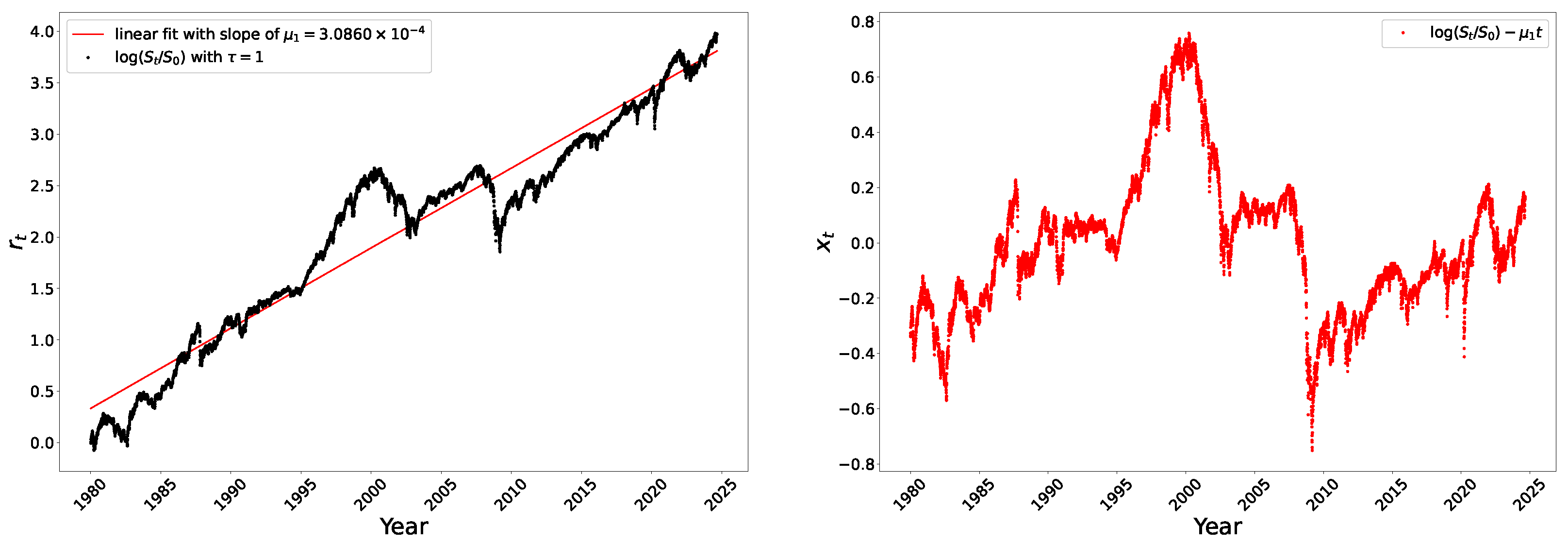
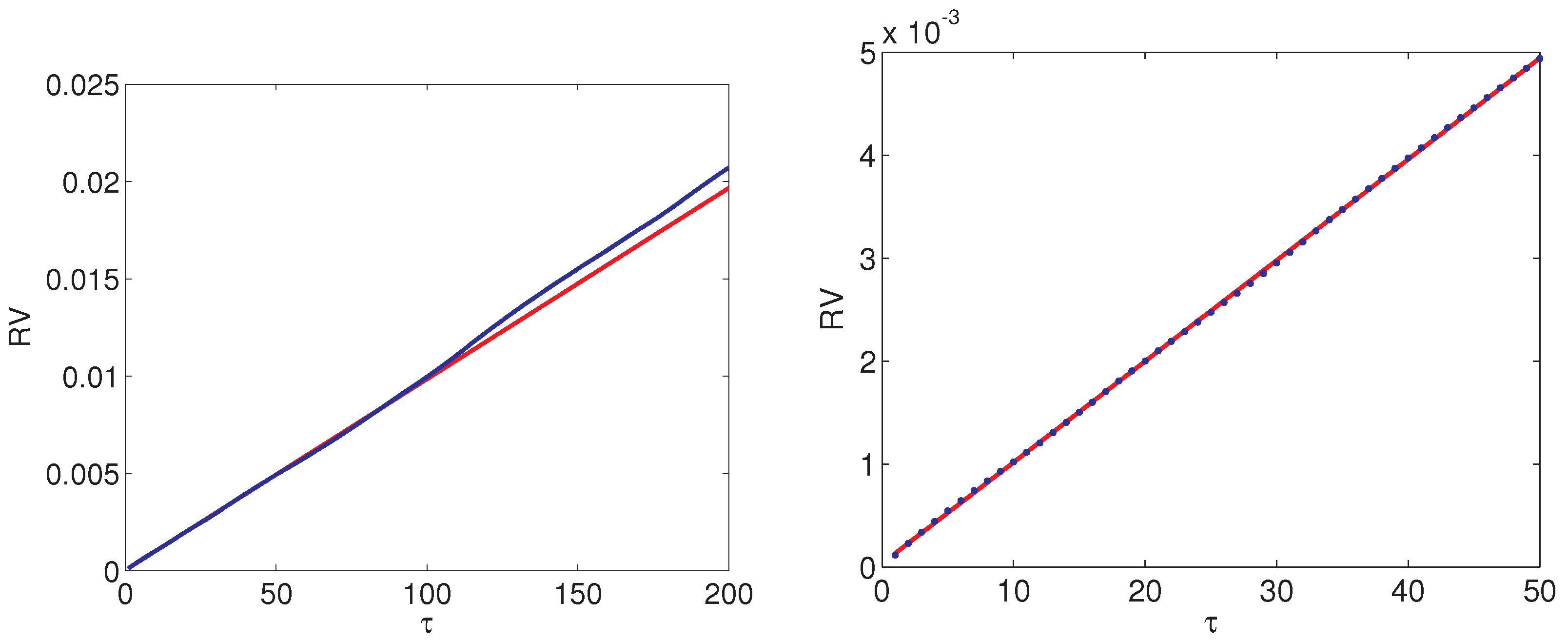
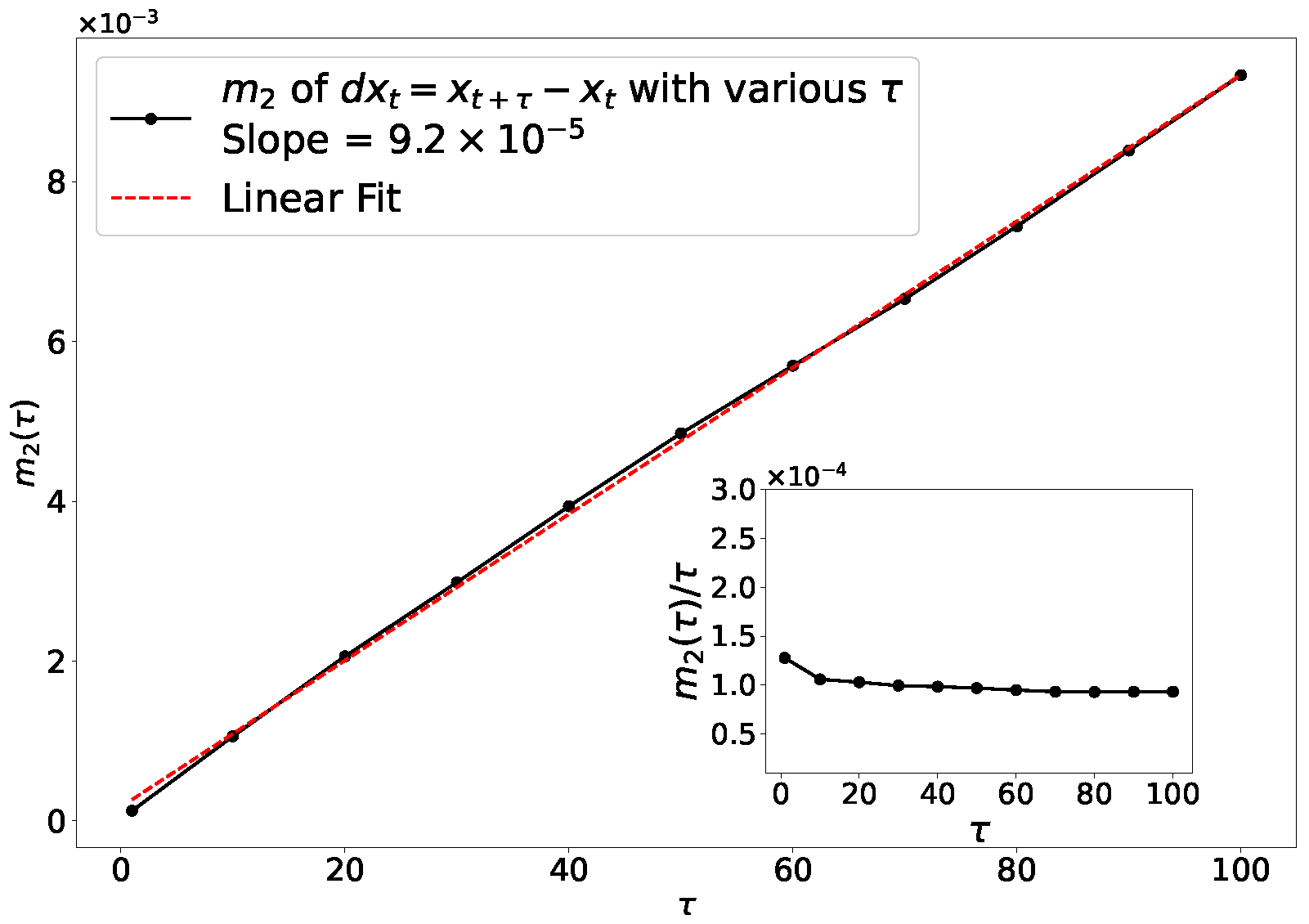
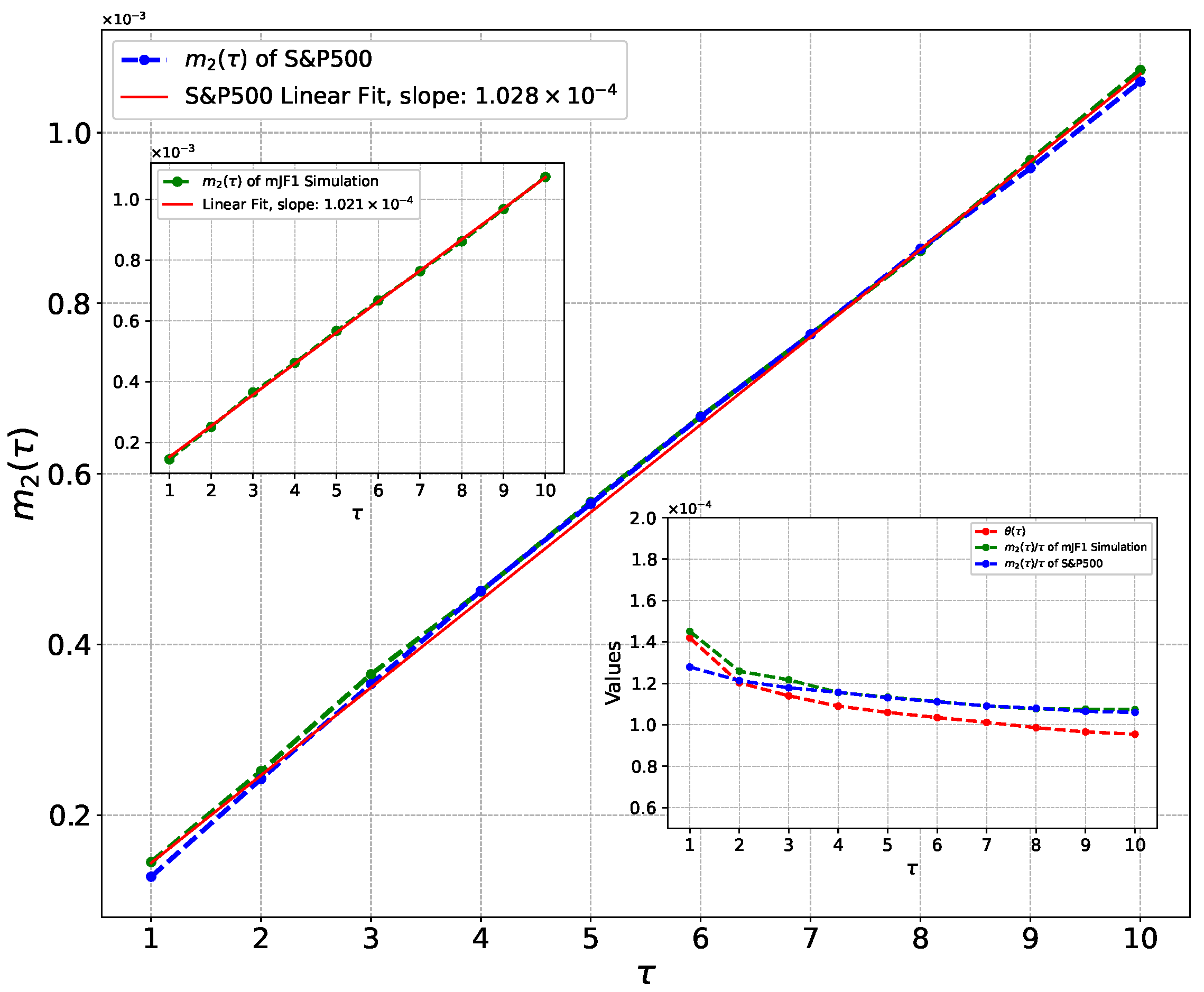
The left-hand side plot in Figure 1 shows the linear fit, μ 1 t , of r t = log ( S t / S 0 ) for the S&P500, where S t is the price on day t. We used daily S&P500 returns; hence, the index is “1“ in μ 1 . However, the magnitude of the slope depends only slightly on the number of days used as time steps [1]. This upward trend corresponds to roughly 12 % annual growth and is a beloved number cited by brokers and financial advisors (maybe 10 % when including inflation). Far less popular is the right-hand side plot in Figure 1, which shows the de-trended plot of returns, x t = r t μ 1 t , because fluctuations in x t are a result of market volatility. Despite the obviously very complicated nature of volatility, one of its features is remarkably simple: the mean realized variance d x t 2 (or, equivalently, m 2 ( τ ) , the variance in the distribution of stock returns) depends linearly on the number of days τ of returns accumulation. This can be clearly seen in Figure 2 from [2] and Figure 3 from [1], as well as in Figure 8 below. Notwithstanding a very different index composition, DJIA exhibits a very similar behavior [2].
As already mentioned, market volatility is an extremely complex phenomenon, which depends on a multitude of disparate factors at any given time. Nonetheless, there are several models that try to describe it in a concise form. One of the simplest ones is based on a pair of stochastic differential equations (SDE):
d x t = log S t + d t S t μ 1 d t = σ t d W ( 1 ) ,
d v t = γ ( v t θ ) d t + g ( v t ) d W ( 2 ) ,
where σ t is the stochastic volatility, v = σ t 2 is the stochastic variance, g ( v t ) is the diffusion coefficient, and d W = W t + d t W ( t ) is the normally distributed Wiener process, d W N ( 0 , d t ) , ( d W ) 2 = d t . In what follows, we will neglect correlations between d W ( 1 ) and d W ( 2 ) , since we are studying the distributions of returns, which, unlike, for instance, leverage [3,4], seem to be unaffected by such correlations [2,5].
The mean-reverting process for stochastic variance (2) implies that v t relaxes to θ over γ 1 timescale. In turn, it follows from (1) that, for returns accumulated over τ days, d t = τ , the mean realized variance of returns should depend linearly on τ :
d x t 2 = θ τ ,
which is in agreement with the aforementioned empirical evidence. Furthermore, (3) does not depend on any particular choice of g ( v t ) and, thus, on the resultant steady-state (stationary) distributions of v t and σ t .
To further illustrate the formalism based on (1) and (2), we point to numerous models for g ( v t ) , such as the Cox–Ingersoll–Ross (Heston) [2,5,6,7], multiplicative [2,8,9,10], and the combination of the two (multiplicative–Heston model) [11]. In multiplicative and multiplicative–Heston models, for instance, the diffusion coefficient g ( v t ) is given by, respectively,
g M ( v t ) = κ M v t and g M H ( v t ) = κ M 2 v t 2 + κ H 2 v t ,
which leads, upon replacing d x t with x, to the following steady-state probability density functions (PDF) of returns for the multiplicative [2,8,10] and multiplicative–Heston [11] models, respectively:
f M ( x ) = Γ ( α θ + 3 2 ) π Γ ( α θ + 1 ) 1 2 α τ x 2 2 α τ + 1 ( α θ + 3 2 ) with α = 2 γ θ κ M 2 ( Student t - distribution )
f M H ( x ) = Γ q + 1 2 U q + 1 2 , 3 2 p , x 2 2 β τ 2 π β τ B p , q with p = 2 γ θ κ H 2 , q = 1 + 2 γ κ M 2 , β = κ H 2 κ M 2
Here, Γ ( x ) is the gamma function, B ( p , q ) is the beta function, and U is the confluent hypergeometric function of the second kind. A direct calculation for either f M ( x ) or f M H ( x ) yields x 2 = θ τ , in agreement with (3).
Obviously both of these PDFs are even (symmetric with respect to x x ), which means that the behavior of gains and losses is treated as exactly the same in this formalism. This symmetry is unaffected by shifting the center of the distribution via rewriting the left-hand side of (1) as d ( x t μ ) . Furthermore, rescaling the variable with 2 α τ and 2 β τ , respectively, would collapse the PDFs into a single PDF [10]. Another prominent feature of these distributions is that their tails exhibit scale-free power-law behavior, respectively, ± x 2 α θ + 3 2 and ± x ( q + 1 ) . While power-law tails in returns are not universally agreed upon, there is a strong case for them at least for daily returns, while for accumulated returns, the power law may persist for a large portion of the tail (see, e.g., [1] and below).
While the symmetry of distributions (5) and (6) is explicit through the x 2 variable, the symmetry of the distribution of returns is a generic property of the formalism based on (1) and (2). Similarly to (3), it does not depend on the choice of g ( v t ) and, therefore, not on the specifics of σ t distribution. This is because the distribution of d x t is inherently an even function, since it is a product distribution [12] of positively defined σ t distribution and normal distribution, which is symmetric. The fact that the formalism based on (1) and (2) is limited to symmetrical distributions is the crux of the problem, since the symmetry of distribution of returns is clearly broken for actual empirical data. Namely, it is observed that the distribution of S&P500 returns has [1,13].
  • Positive mean;
  • Negative skew;
  • Larger number of points for gains than for losses;
  • Slower power-law exponent for losses than for gains.
The central issue, therefore, that we attempt to address is whether it is possible to reconcile the linear dependence of realized volatility with the asymmetrical distribution of returns, both of which are observed empirically.
The key element of our approach is based on breaking the symmetry of Student t-distribution (5) via the modified Jones–Faddy Skew t-Distribution (mJF1) [13,14,15]. While, at this point, we are unaware of whether or not it is possible to derive it from the first principles, such as SDE formalism, mJF1 provides a solid explanation of the above features with only relatively minor modifications to the Student t-distribution. This manuscript can be considered as a sister manuscript to [13], which extends the latter to multi-day accumulated returns. It is organized as follows. In Section 2, we provide an analytical framework for mJF1 distribution. Section 3 summarizes the results of our numerical simulations based on fitting S&P500 returns with mJF1 distribution. We summarize and discuss our results in Section 4.

2. Modified Jones–Faddy Distribution mJF1

The PDF of the modified Jones–Faddy distributions (mJF1) introduced in [13] for fitting of distribution of returns is given by
f ( x ) = C 1 x μ ( x μ ) 2 + ( α g + α l ) τ α g θ + 3 2 1 + x μ ( x μ ) 2 + ( α g + α l ) τ α l θ + 3 2
where the normalization constant C is given by
C = 1 2 α l θ + 1 + α g θ B ( α l θ + 1 , α g θ + 1 ) 1 ( α g + α l ) τ
In general, the cumulative distribution function (CDF) for gains and losses can be defined, respectively, as
F g ( x ) = x f ( y ) d y and F l ( x ) = x f ( y ) d y
where f ( x ) is the PDF of returns, and F g ( ) = F l ( ) = 1 . The complementary CDF and CCDF are 1 F g , l ( x ) . From (7) and (9), we obtain mJF1 CDF in terms of the regularized incomplete beta function [16] I ( x ; a , b ) as
F g _ m J F 1 ( x ) = I 1 + x μ ( x μ ) 2 + ( α g + α l ) τ ; α g θ + 1 , α l θ + 1
and
F l _ m J F 1 ( x ) = I 1 x μ ( x μ ) 2 + ( α g + α l ) τ ; α g θ + 1 , α l θ + 1
The comparison of (5) with (7) shows two elements that differentiate them. First, as in a standard Student distribution with location parameter [17], a location parameter μ is introduced here. Obviously, it does not affect (1), since the variable can always be shifted by a constant (see Introduction). A second—and crucial—difference is the introduction of a skew (skew t-distribution [13,14,15]), via α g and α l here. In particular, power-law tails scale as x 2 α g / θ + 3 at + and x 2 α l / θ + 3 at . This breaks a construct based on (1) and (2), which treats the volatility of gains and losses uniformly: substitution of α g = α l = α in (7) leads back to (5) with a non-zero location parameter μ . At this point, we are unaware of an SDE-based or otherwise first-principles formulation that would result in the distribution (7).
The mean, variance and mode of mJF1 are given, respectively, by [13]
m 1 = μ + ( α g + α l ) τ B α g θ + 1 2 , 1 2 B α l θ + 1 2 , 1 2 α l θ α g θ 2 π ,
m 2 = θ τ ( α g + α l ) 2 4 α g α l + ( α g + α l ) ( α g α l ) 2 τ 4 θ 2 θ 2 α g α l π B α g θ , 1 2 B α l θ , 1 2 2 ,
m ¯ = μ + ( α g + α l ) τ α l θ α g θ 2 α g θ + 3 2 α l θ + 3 2 .
We use the first and second Pearson coefficients of skewness
ζ 1 = m 1 m ¯ m 2 1 / 2 , ζ 2 = 3 m 1 m ˜ m 2 1 / 2
to characterize the skewness of the distribution, where m ˜ is the median, and m 2 1 / 2 is the standard deviation. Once the parameters α g ,   α l ,   θ and μ are obtained in Section 3 through Bayesian fitting, m 1 ,   m 2 and m ¯ are evaluated from (12)–(14). m ˜ is evaluated numerically from the fitted distribution (see also the Appendix in [13]).

3. Numerical Results

3.1. Fitting Parameters

Table 1 lists the parameters of (7) estimated from the Bayesian fitting of S&P500 returns accumulated over τ days. The parameters of the mJF1 distribution were estimated using a Bayesian Markov Chain Monte Carlo (MCMC) approach with a Metropolis–Hastings sampler. Half-normal priors were used for the positive parameters α g , α l , and θ , and a Gaussian prior was used for the location parameter μ . The posterior distribution was sampled using 10,000 MCMC iterations, with the first 2000 samples discarded as burn-in. Posterior mean values were used as parameter estimates. The stationarity and mixing behavior of the Markov chains were assessed by visual inspection of posterior trace plots. After the burn-in period, the sampled parameters fluctuated around stable posterior values without visible drift, which supports the reliability of the posterior summaries used for parameter estimation.
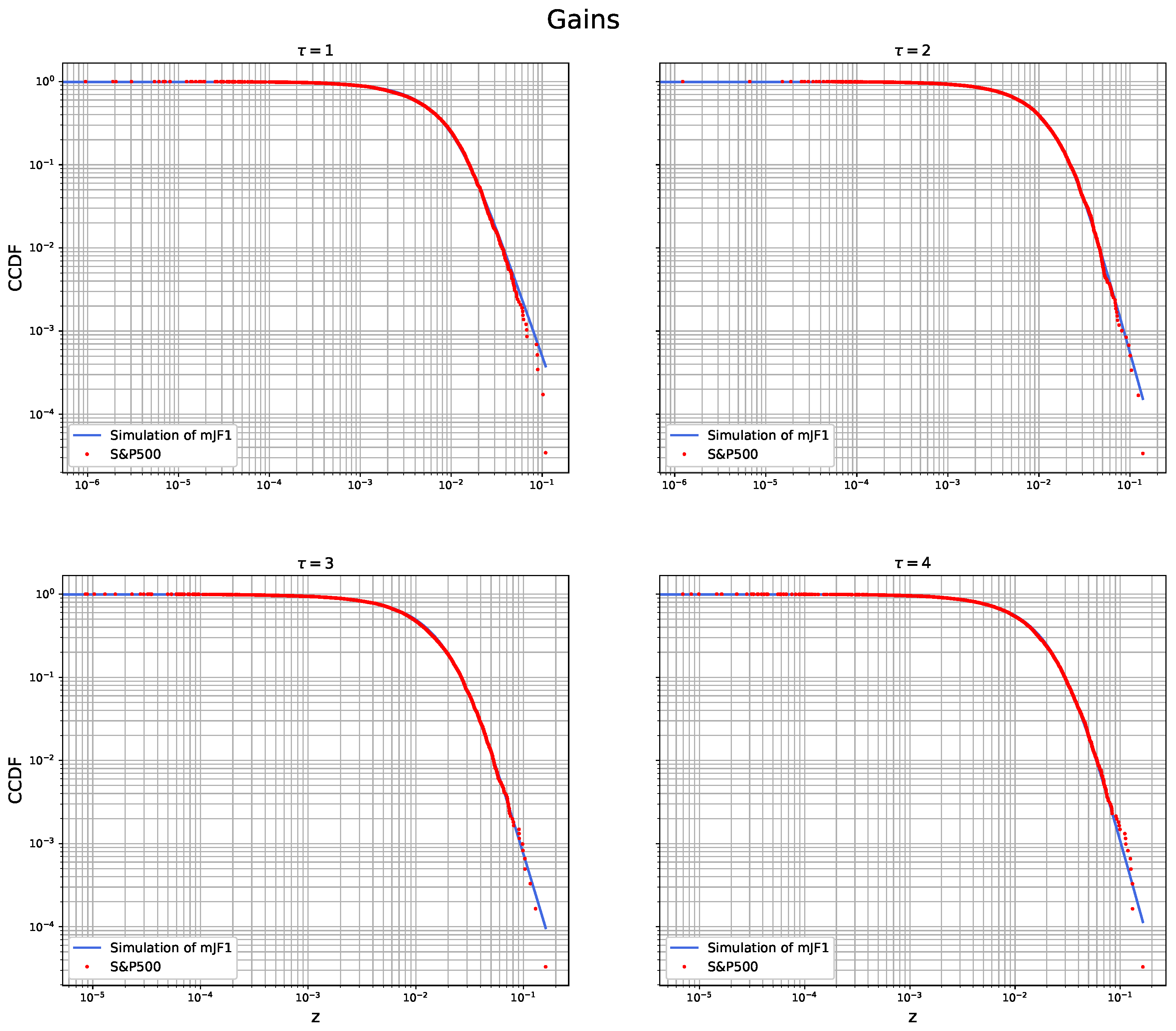
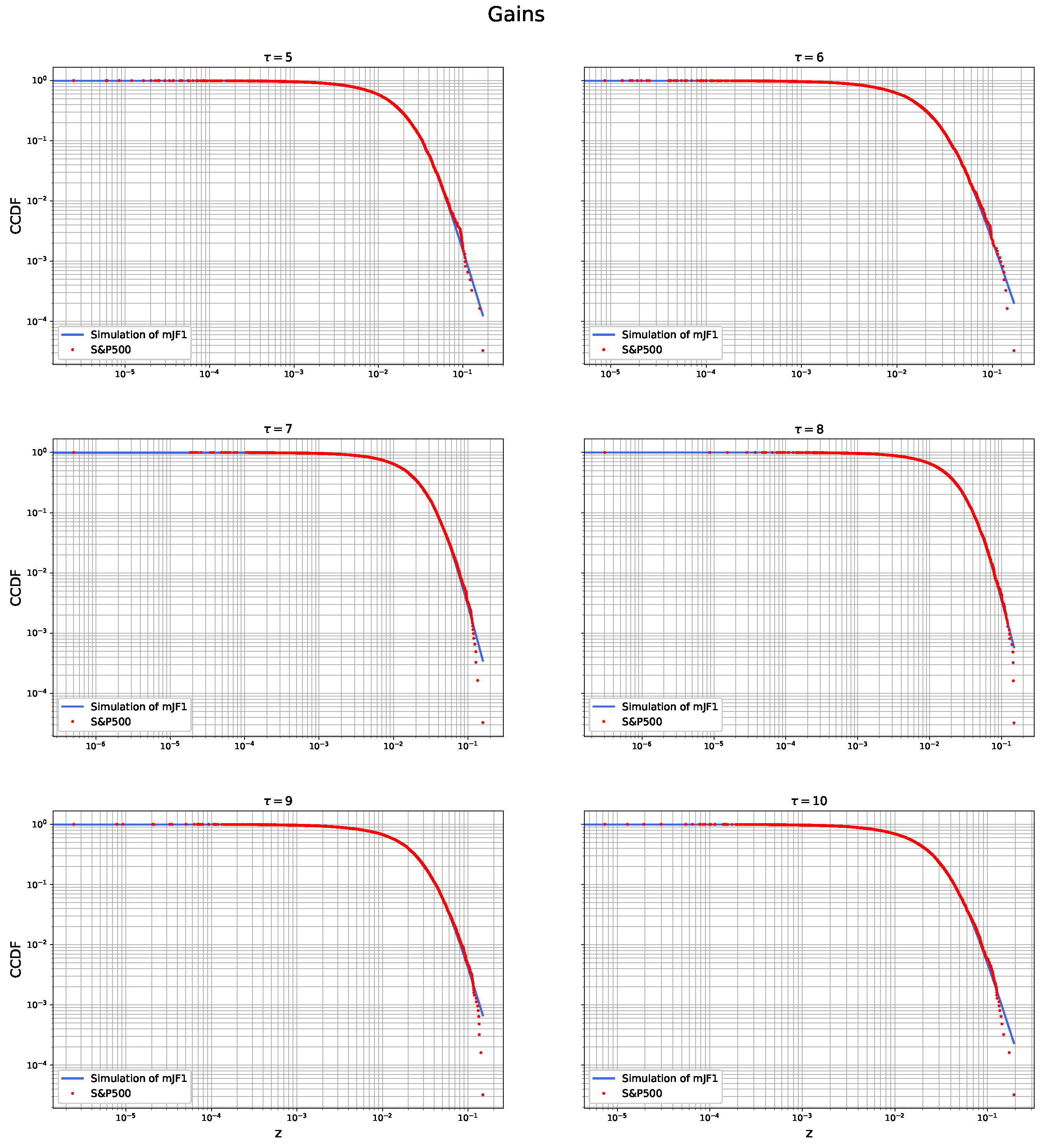
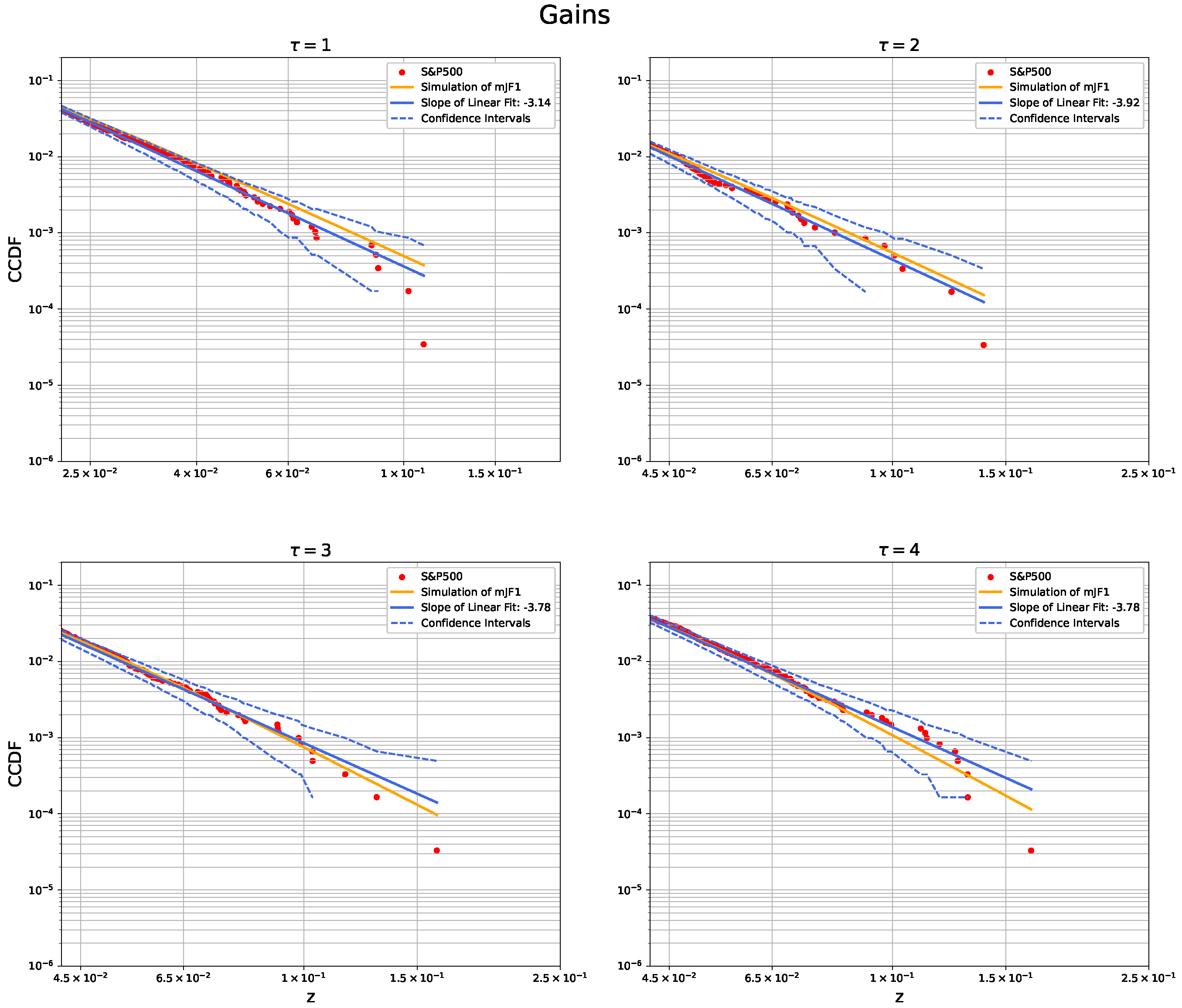
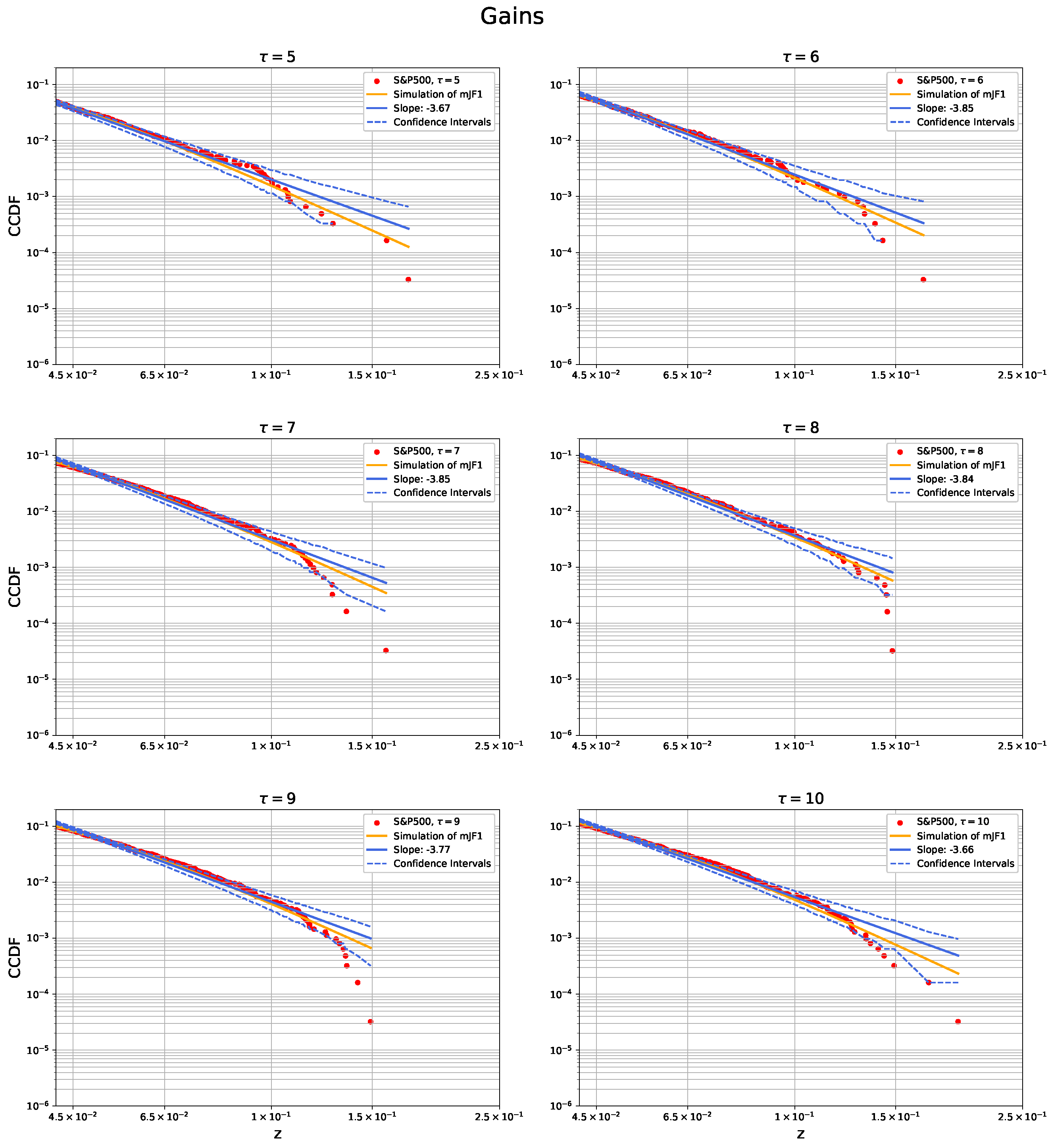
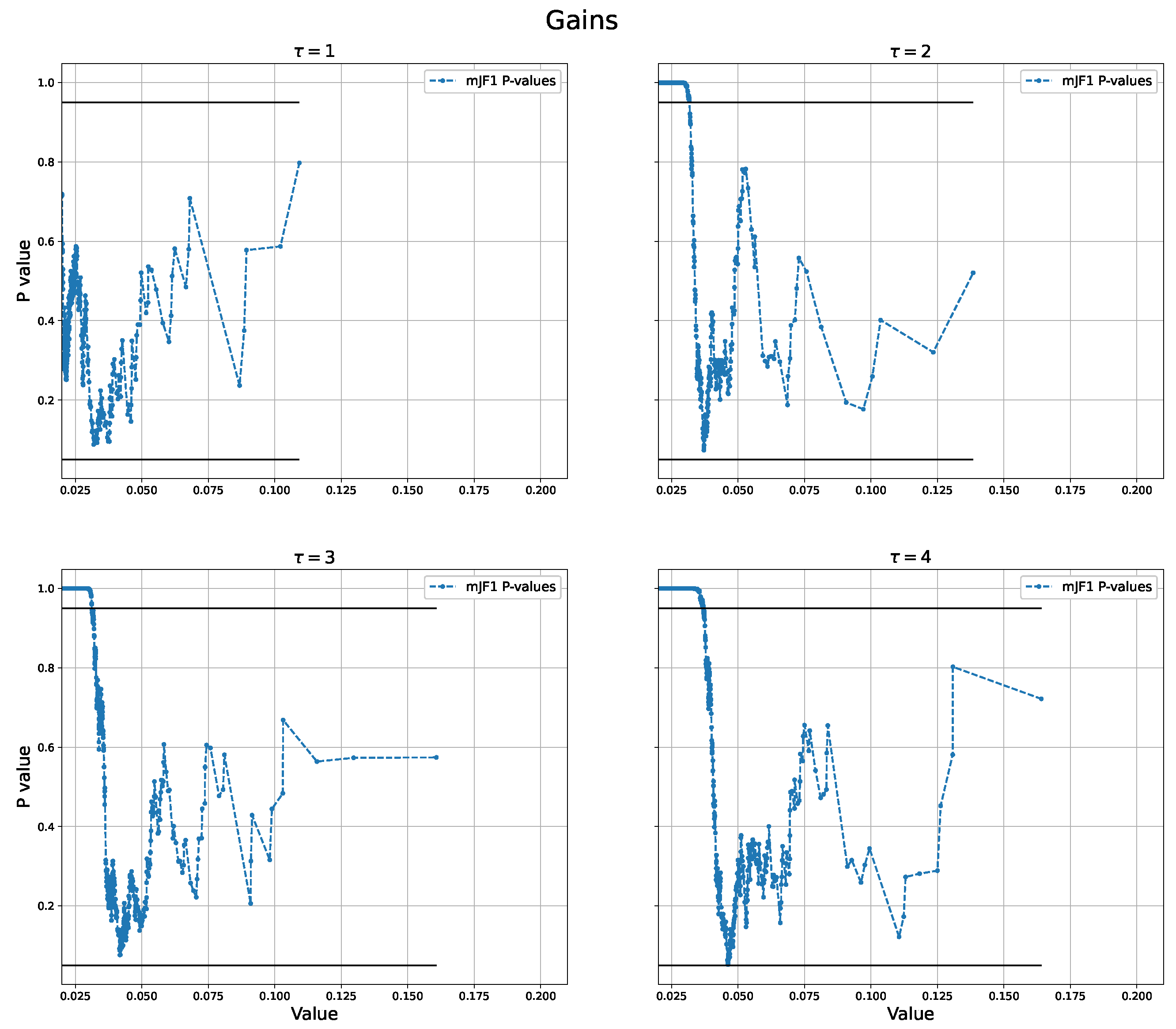
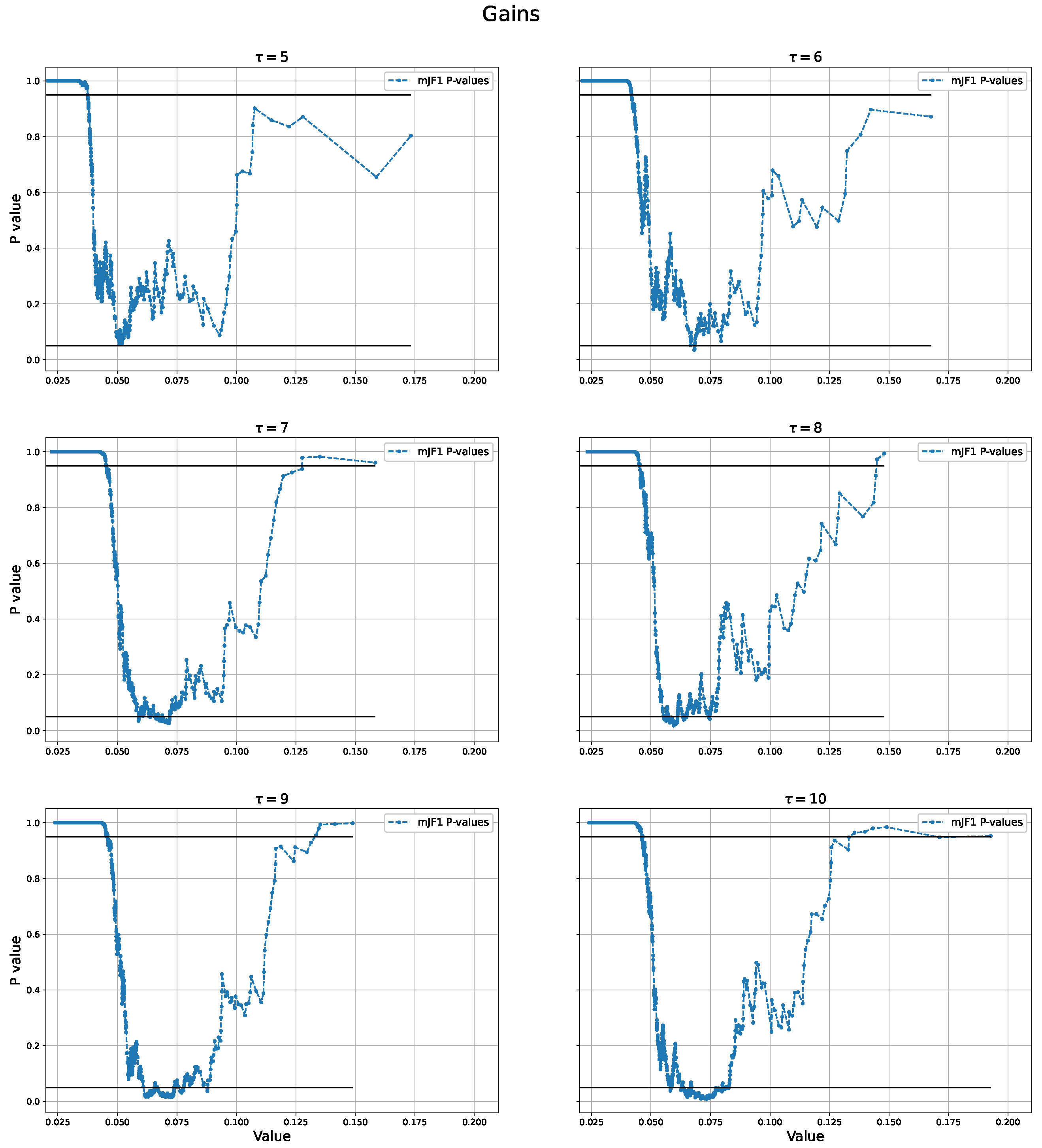
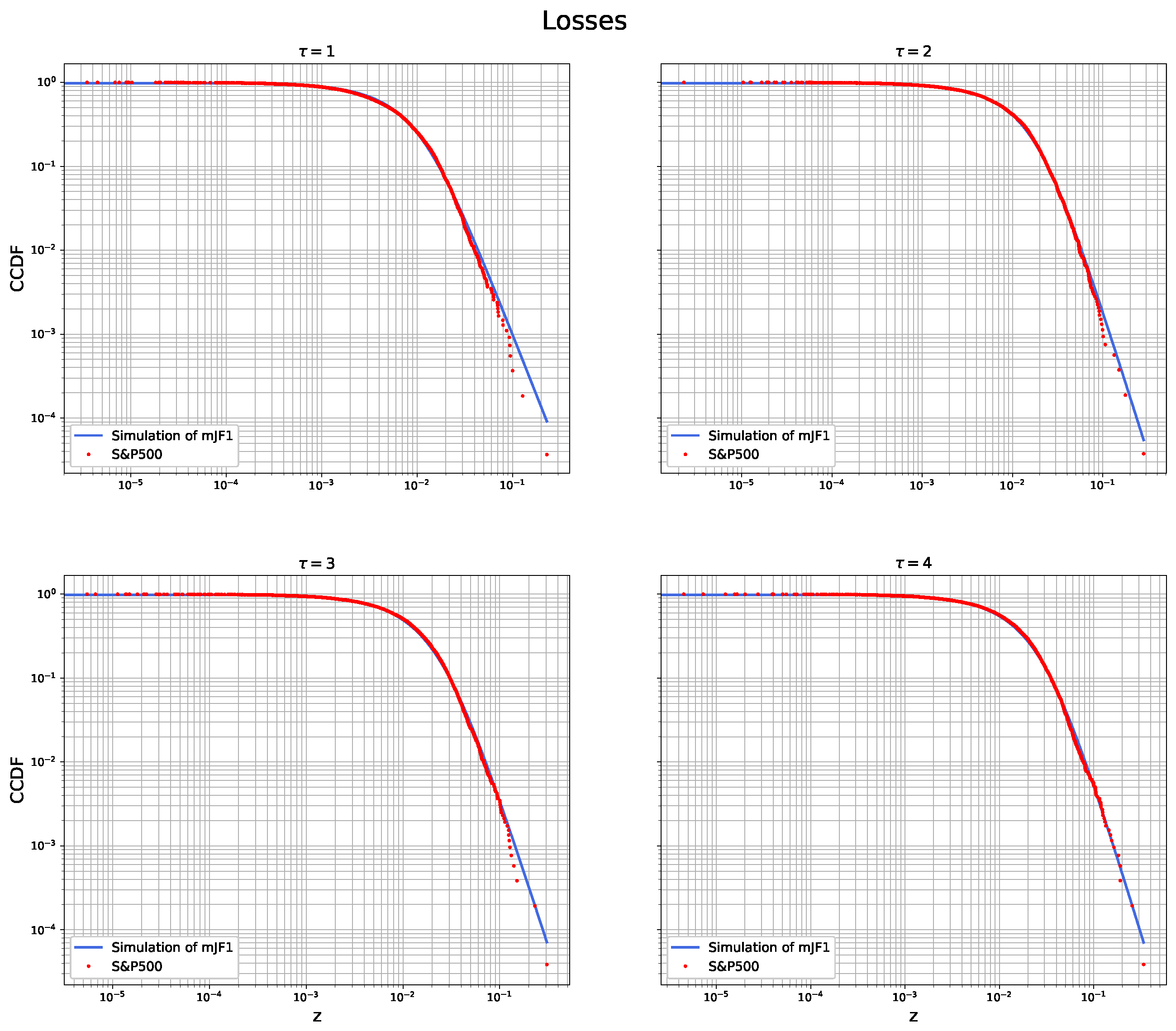
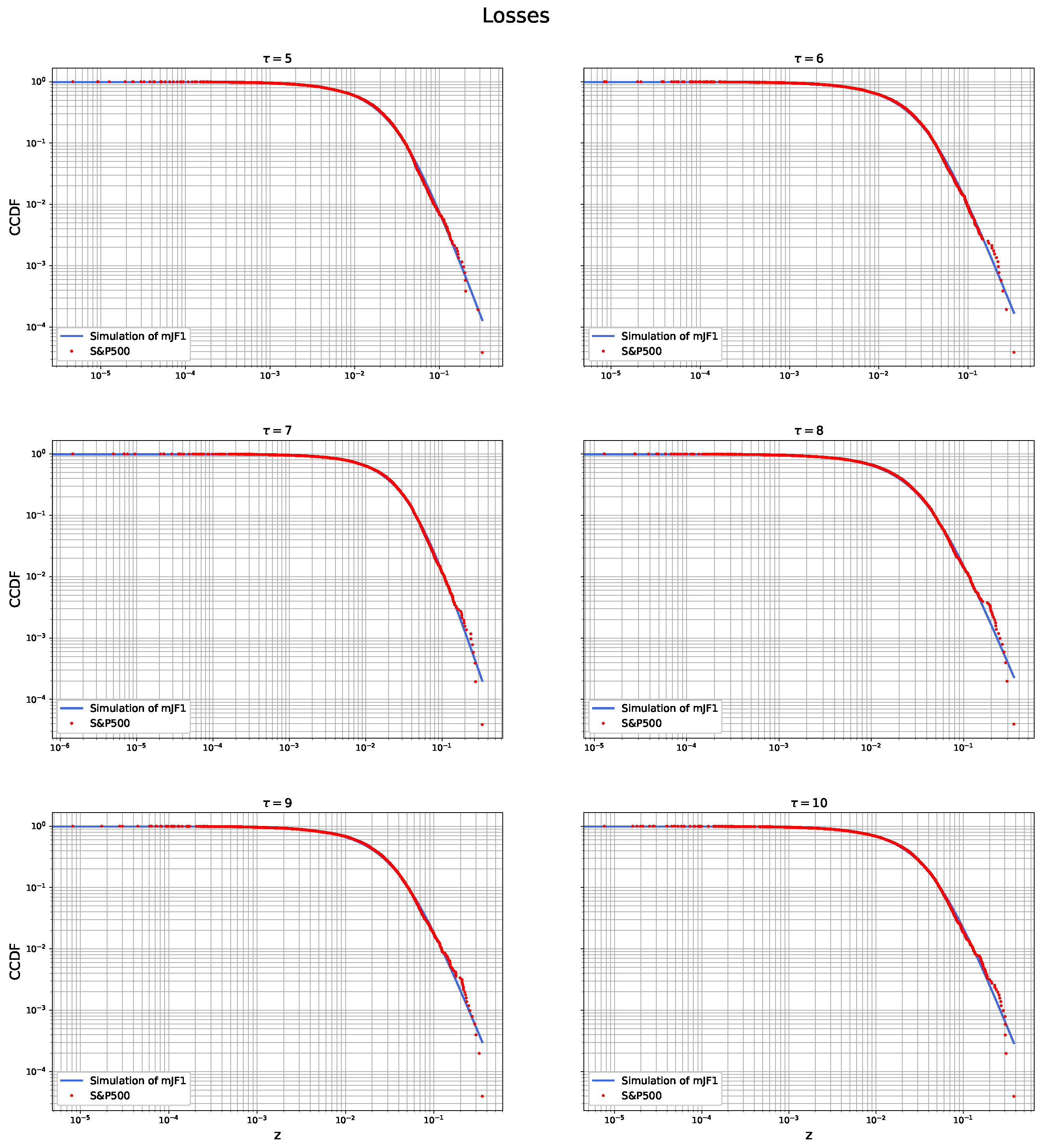
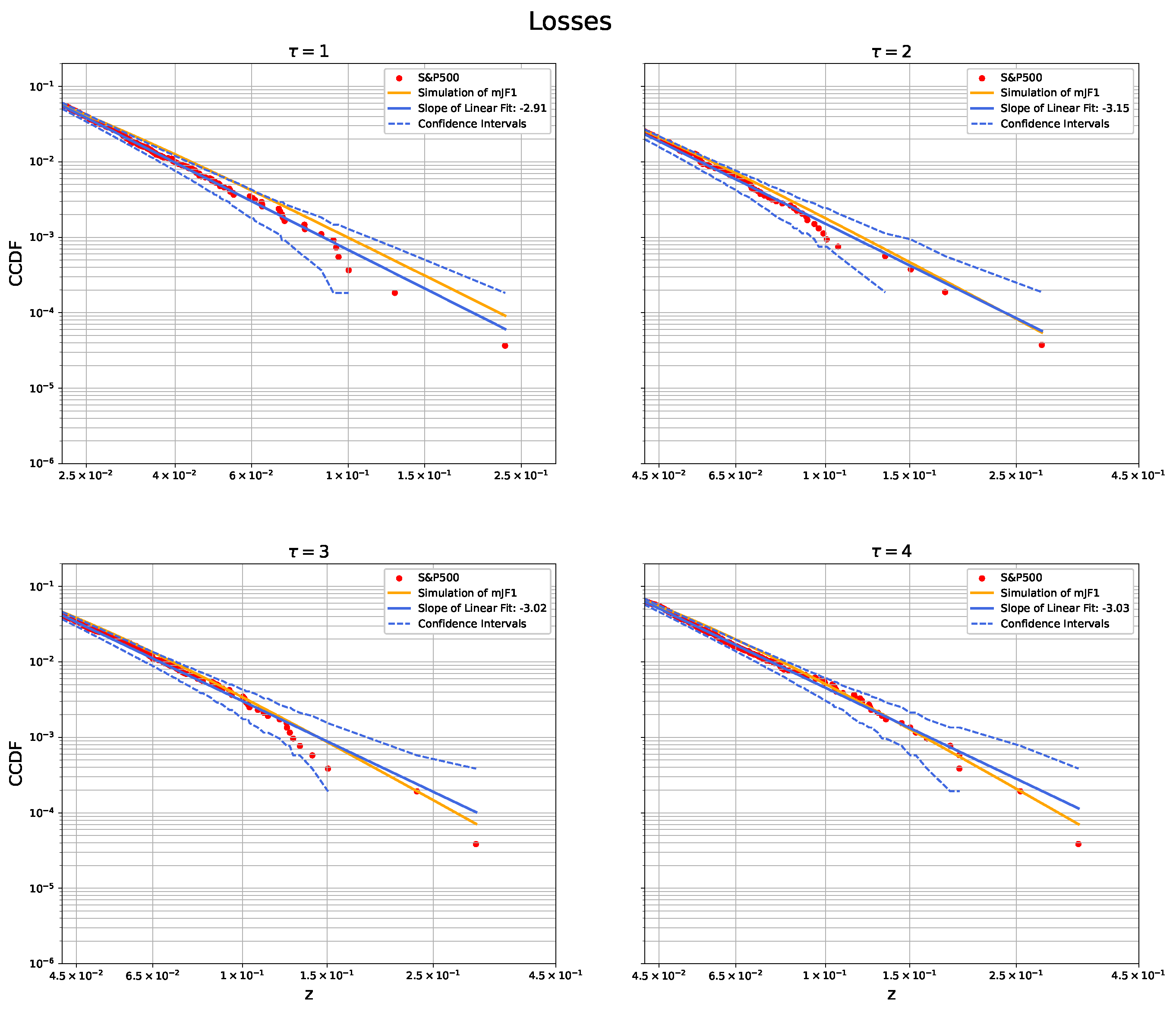
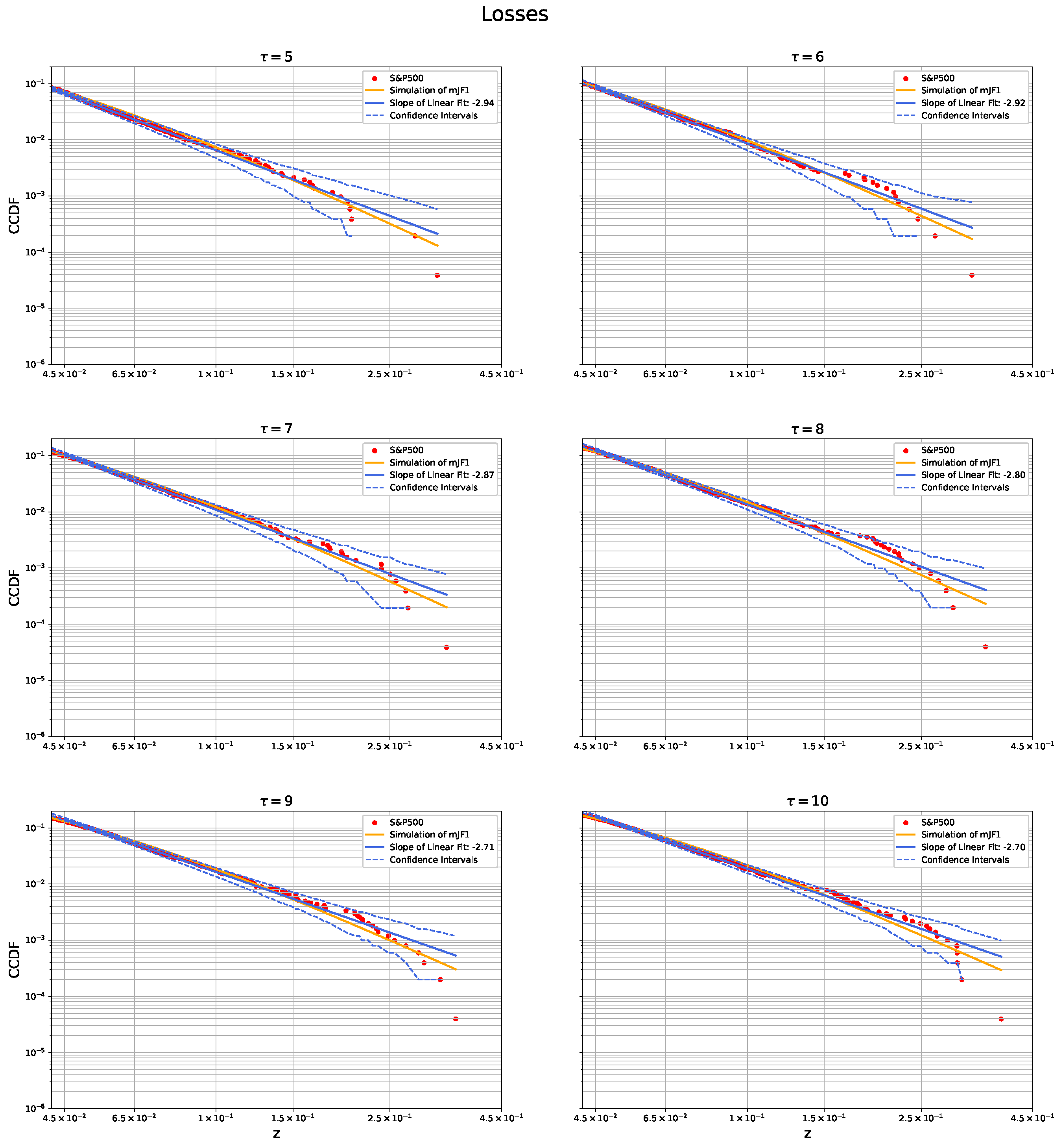
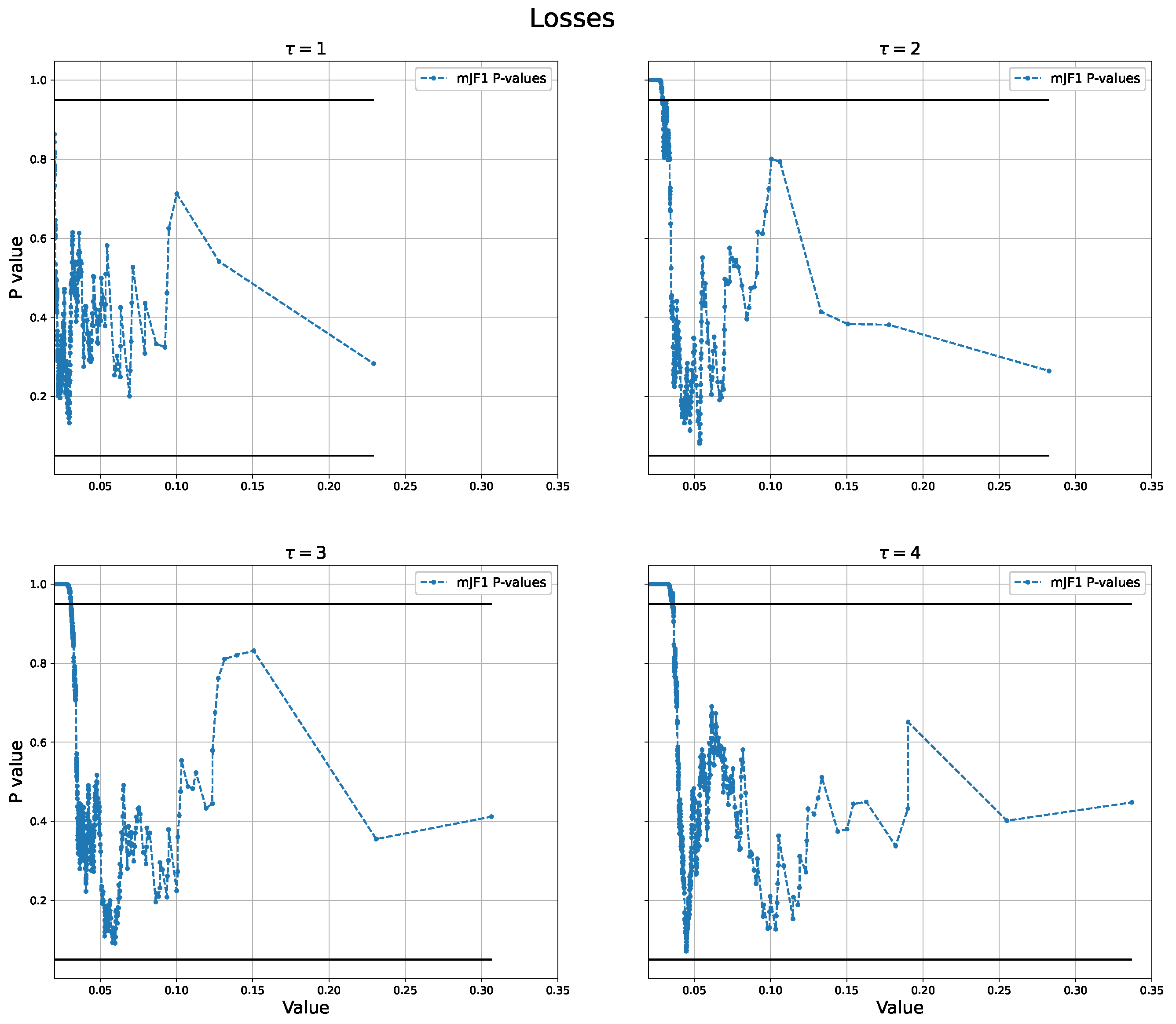
The plots in Appendices Appendix A.1 and Appendix A.2 show the following for gains and losses, respectively:
  • On a log–log scale: CCDF of S&P500 returns and CCDF, 1 F g m J F 1 and 1 F l m J F 1 per (10) and (11), with estimated parameters from Table 1.
  • Tails of the above CCDF, which now includes the linear fit (LF) of the S&P500 data and its confidence interval (CI) [18].
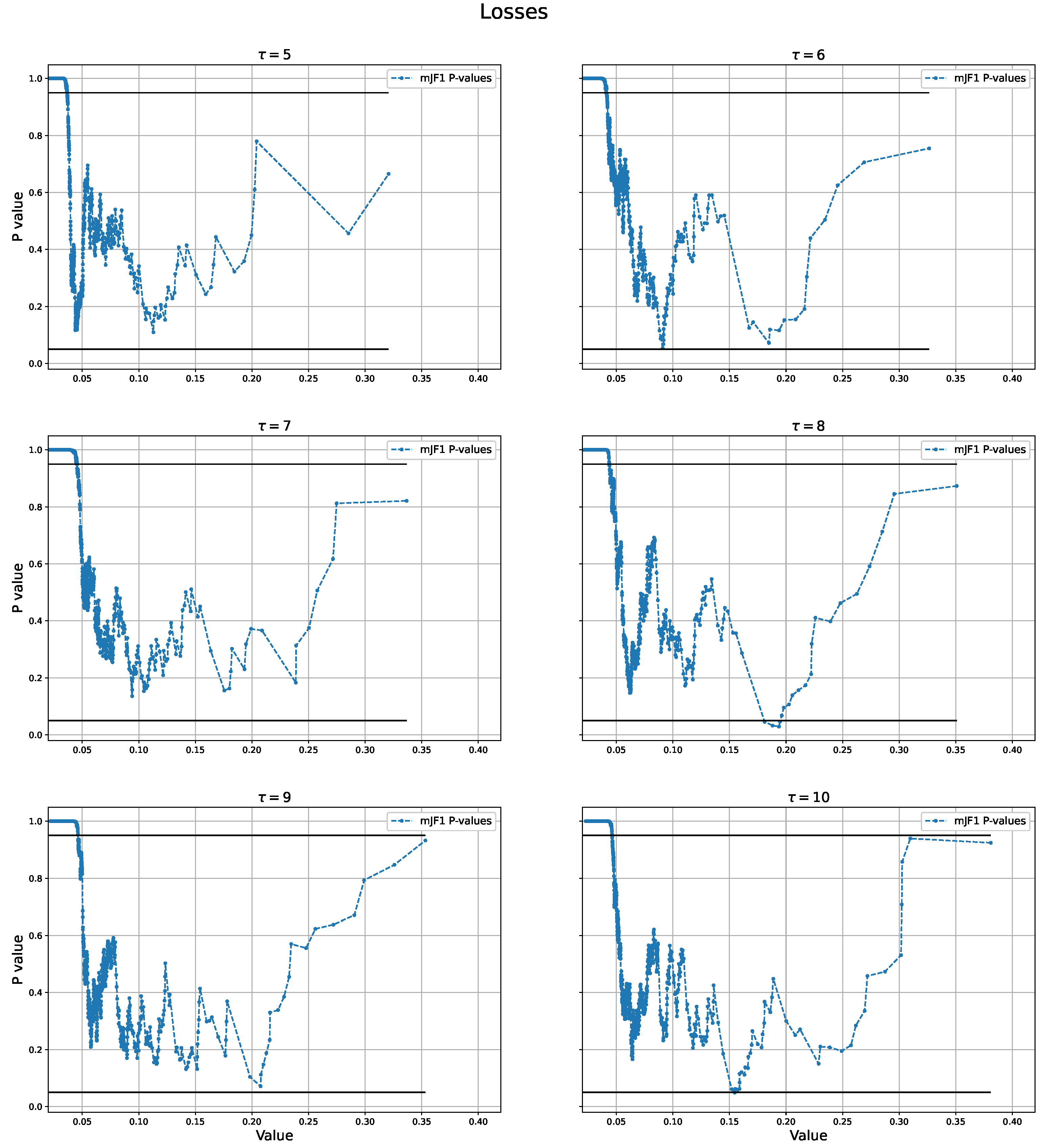
  • p-values obtained by U-test for the tail points [19].
The U-test [19] was initially developed to identify outliers such as Dragon Kings and negative Dragon kings [20] but, in general, can be viewed as a measure of goodness of fit [21] in the tail region. Namely, the p-values of points between 0.95 and 0.05 indicate that they belong to the fitted distribution with a 95 % confidence level. Clearly, both LF and mJF1, which has power-law tails, do not seem to be consistent for a larger τ with a tempered behavior of S&P500 in the end tails of its distribution, which makes the aforementioned linear dependence of the variance m 2 ( τ ) of S&P500 distribution on τ even more remarkable. This point is further discussed in Section 3.2 below.
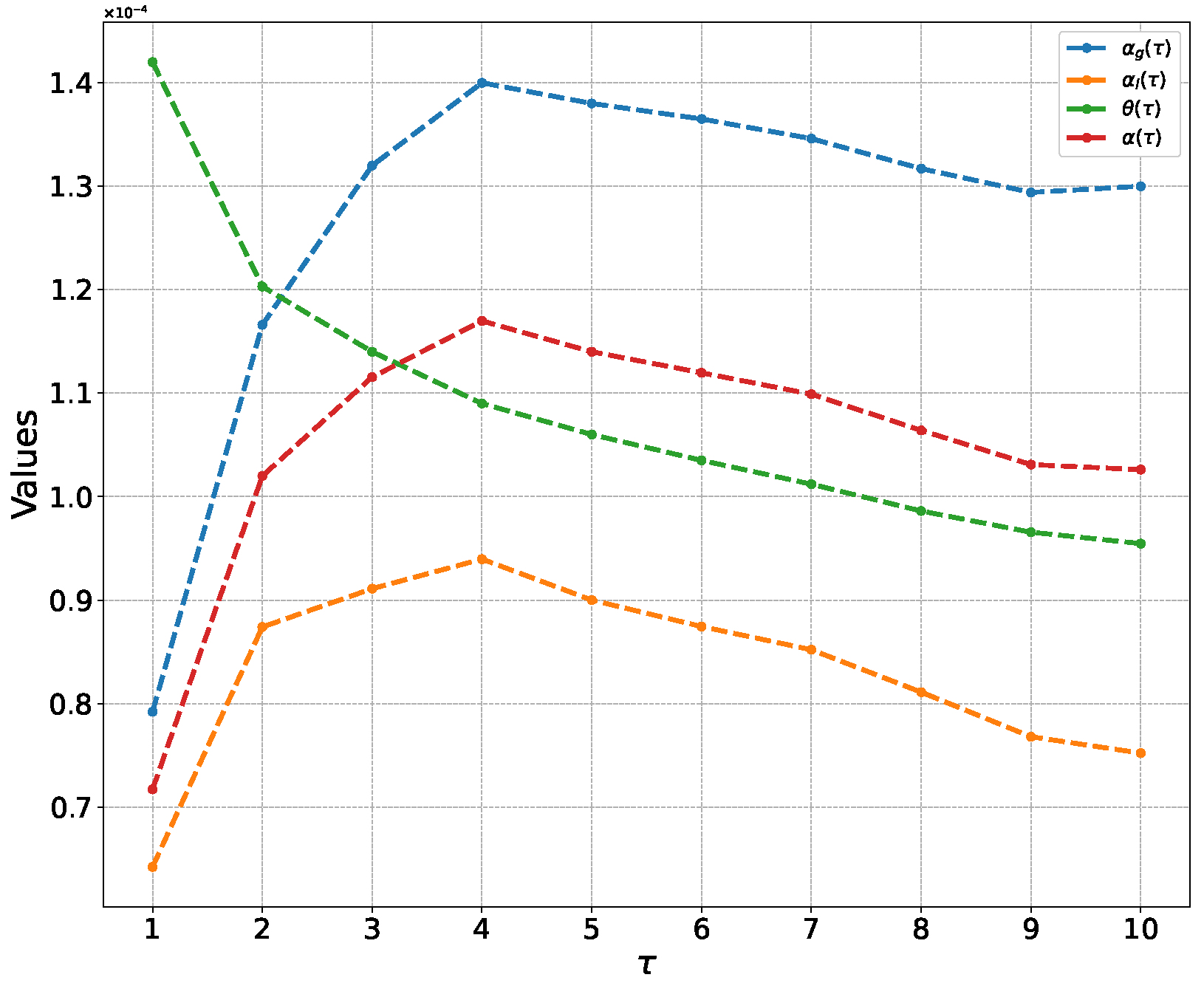
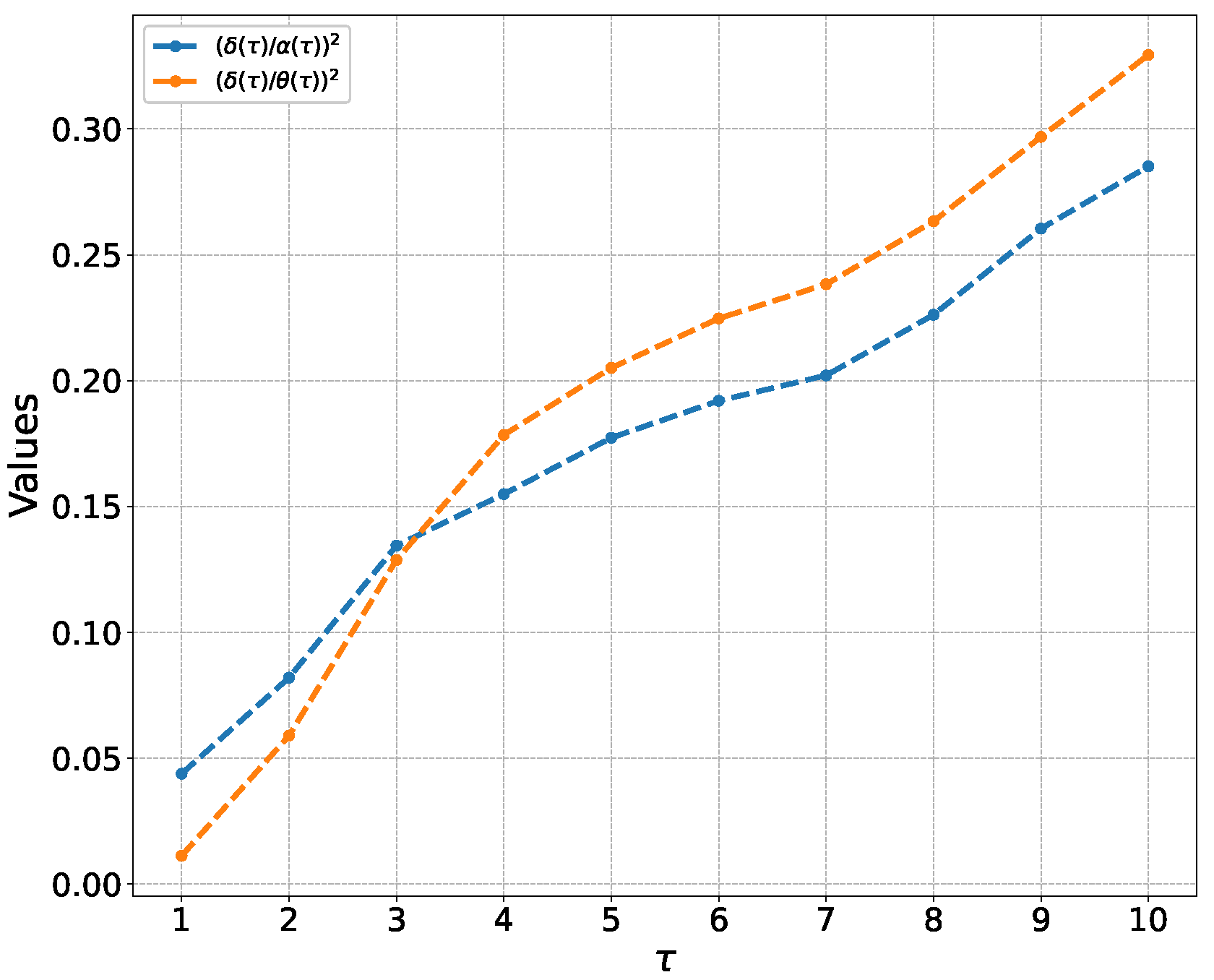
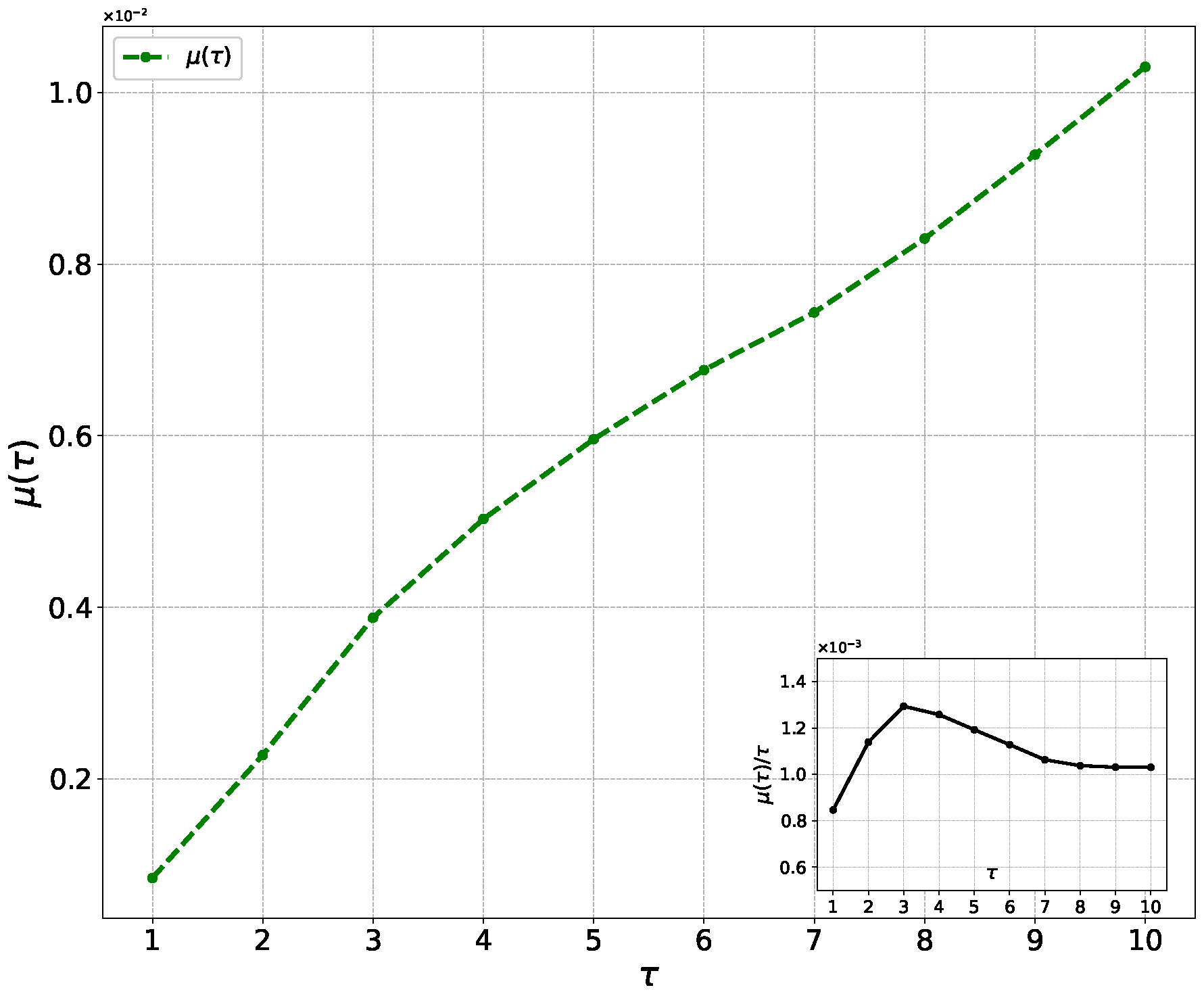
Figure 4 shows the τ dependence of α g , α l and θ from Table 1, as well as that of α = ( α g + α l ) / 2 . Clearly, α and θ track each other closely after just a few days of accumulation. Figure 5, on the other hand, shows that ratios δ 2 / θ 2 and δ 2 / α 2 , where δ = α g α l , track each other closely for all τ . These ratios characterize the degree of divergence between tail exponents of gains and losses and will also be discussed in the context of m 2 ( τ ) in Section 3.2 below. Figure 6 shows the τ dependence of the location parameter μ from Table 1. Its growth with τ seems to saturate to linear dependence and describes the shift of the bulk of the distribution to gains. This explains the positive mean of the distribution, while slower tails of losses explain the negative skewness.

3.2. Statistical Parameters

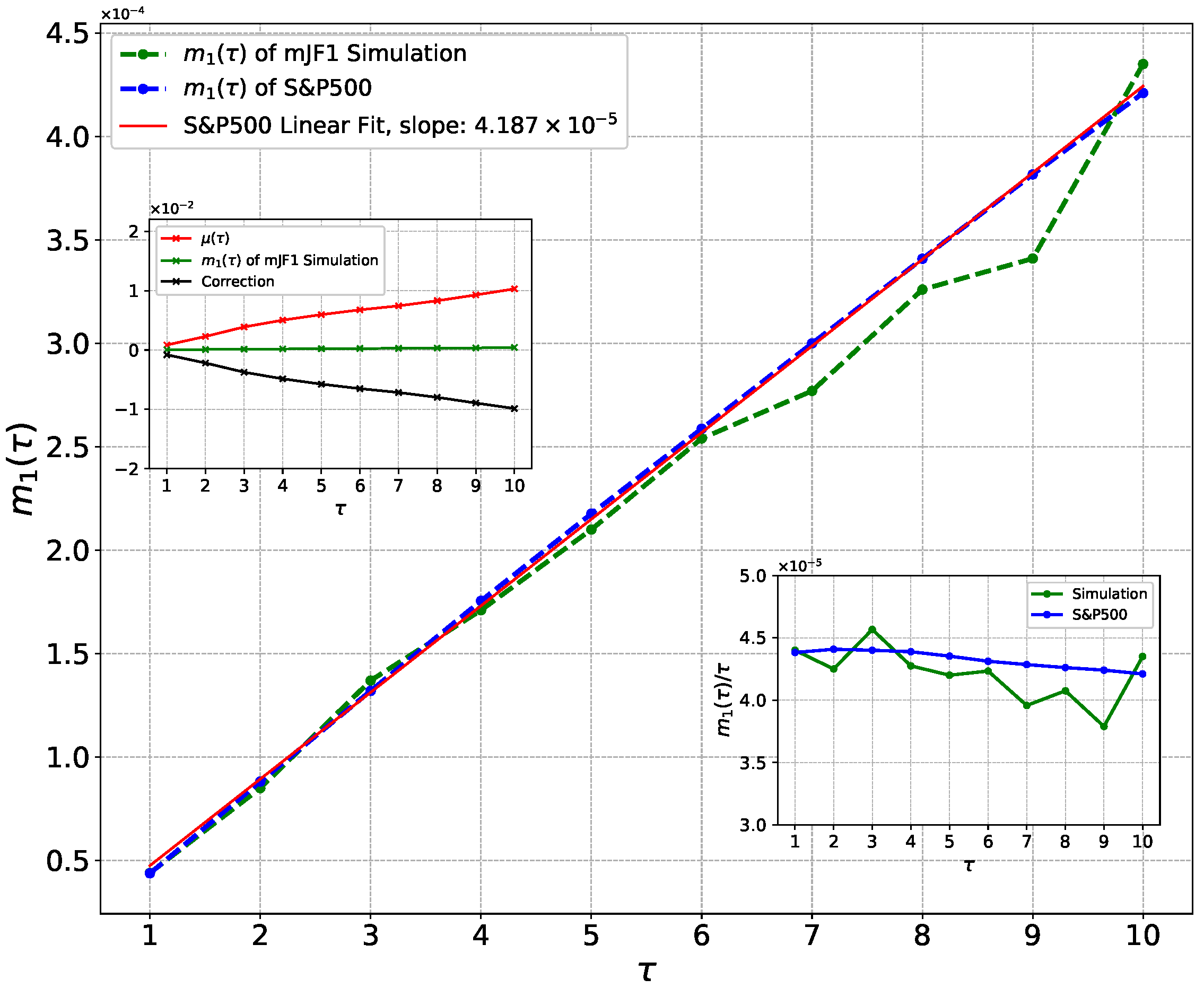
Table 2 contains the mean m 1 and variance m 2 of the S&P500 distributions of returns, as well as those of the fitted mJF1 distributions obtained using (12) and (13) with the parameters shown in Table 1. Figure 7 and Figure 8 are graphical representations of m 1 ( τ ) and m 2 ( τ ) , as per Table 2. Two very noteworthy features of Figure 7 should be pointed out. First, m 1 ( τ ) of mJF1 is a result of exquisite cancellation of two quantities in (12) which are orders of magnitude larger than m 1 ( τ ) : the positive location parameter μ ( τ ) discussed in Section 3.1 and the negative term due to slower decay of tails of losses, α l < α g . Second, the mean value of S&P500 distributions shows near perfect linear growth with τ , which is well described by fitted mJF1.
The linear dependence of m 2 ( τ ) on τ is remarkably accurate both for S&P500 and mJF1 fits, despite the former showing tempered behavior in the tail ends (see Appendix A) and the latter having power-law tails. This is expressly seen from the inserts in Figure 8: the top one shows that the slope of the mJF1 m 2 ( τ ) linear fit is nearly identical to that of S&P500, and the bottom one shows that, after four days of accumulation, the ratios m 2 ( τ ) / τ of the two are virtually indistinguishable and approach a saturation value. Additionally, the bottom insert contains a plot of θ ( τ ) , which is very close to the m 2 ( τ ) / τ of S&P500 and mJF1. The latter can be understood as follows. Assuming that δ = α g α l α = ( α g + α l ) / 2 , (13) simplifies to
m 2 ( τ ) θ τ 1 + δ 2 4 α 2 1 + 2 α θ 2 α 3 θ 3 Γ 4 1 2 + α θ Γ 4 α θ
While δ 2 / α 2 (and δ 2 / θ 2 ) are not necessarily very small, as seen from Figure 5, the combination of other factors (coefficients, ratio α / θ , etc.) in (16) yields corrections to unity of 0.022 for τ = 1 and of 0.095 for τ = 10 . The fact that θ tracks m 2 ( τ ) / τ well gives support to mean-reverting volatility even in the mJF1 framework.
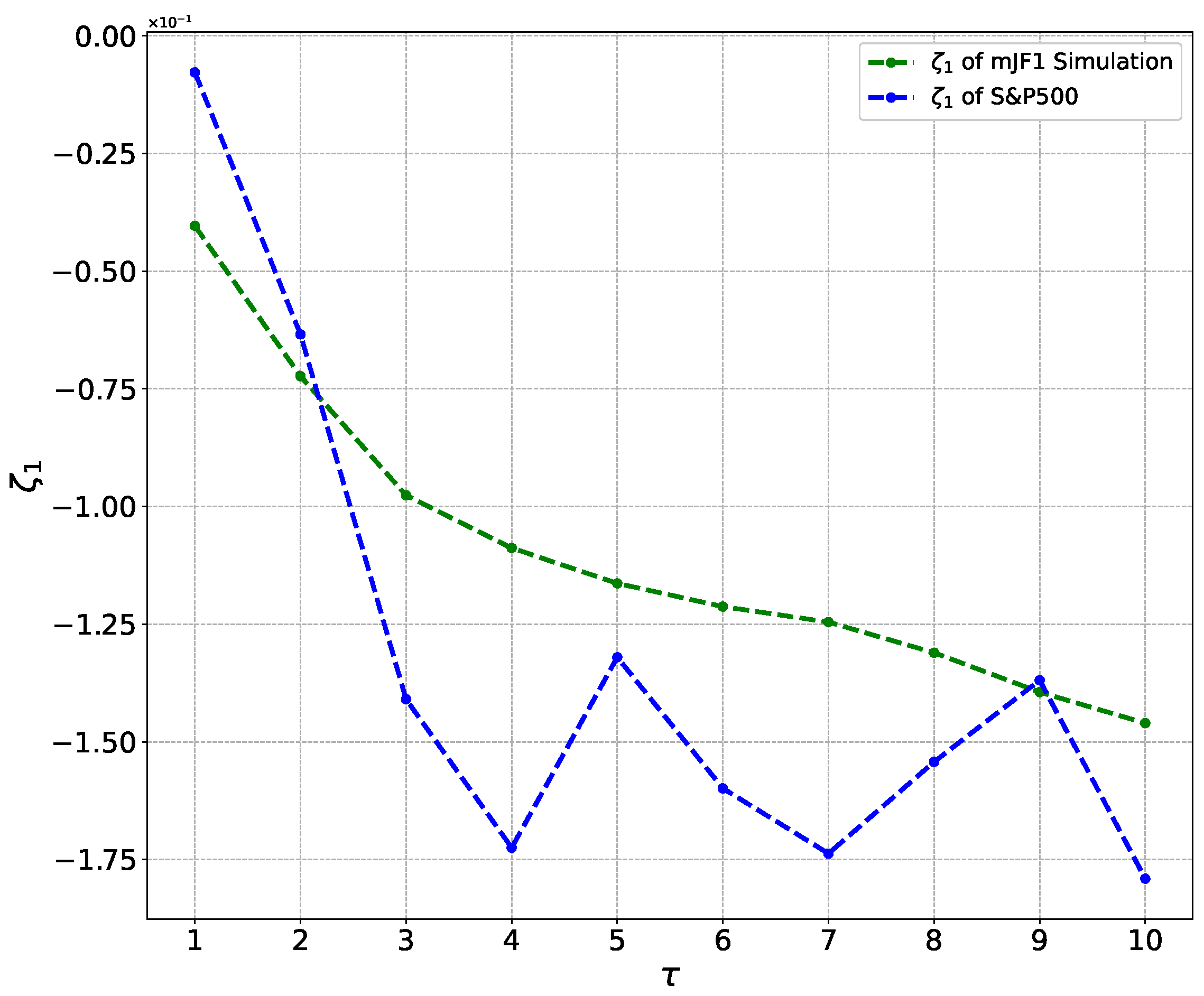
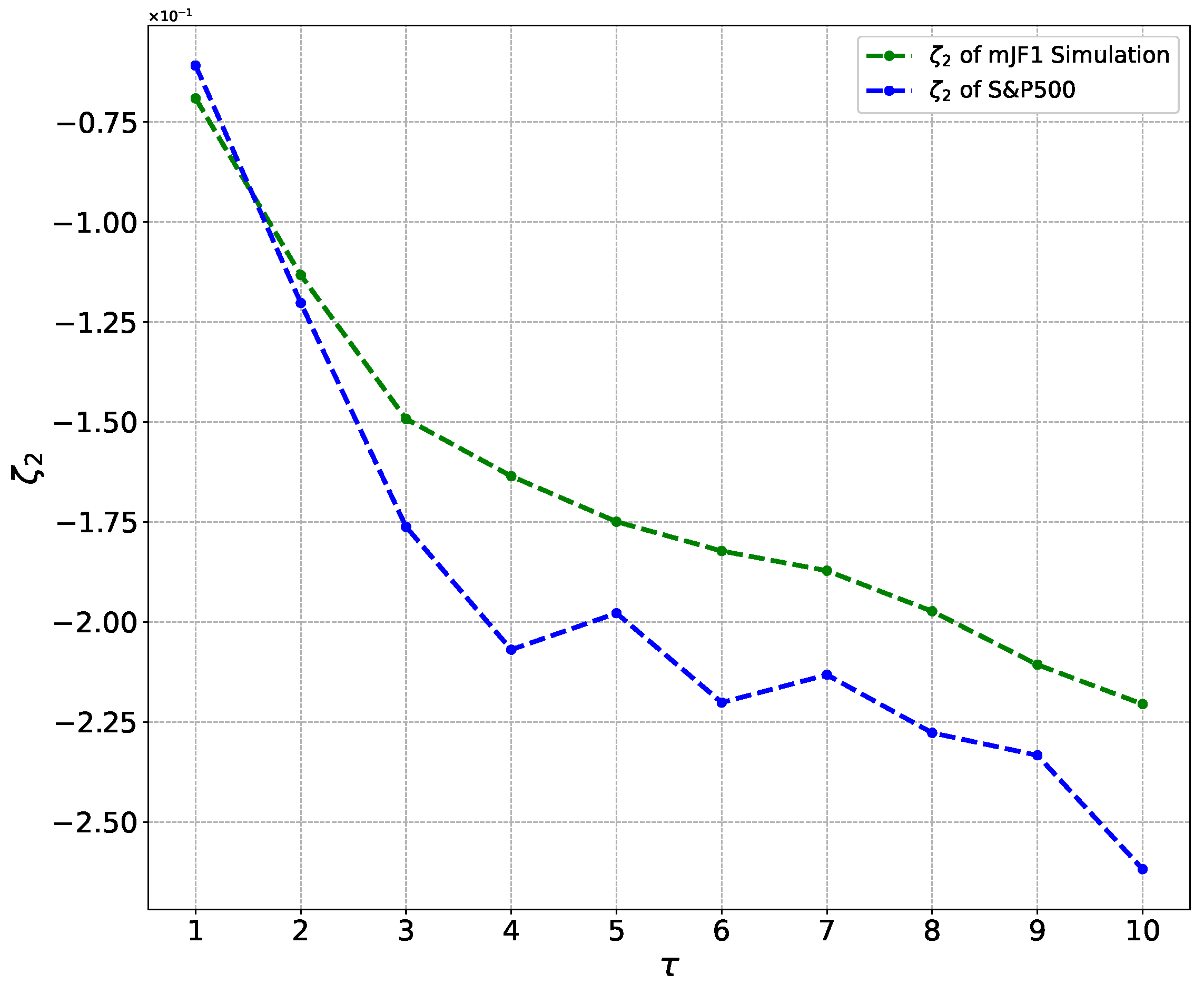
Table 3 gives the mode m ¯ and median m ˜ of S&P500 and mJF1. Finding the mode of the S&P500 requires a smoothing procedure, which may be behind a noticeable mismatch with the mode of mJF1. The mode and median are used to evaluate the first and second Pearson coefficients of skewness via (15), whose values are given in Table 4 and are illustrated in Figure 9 and Figure 10.

3.3. Scaling

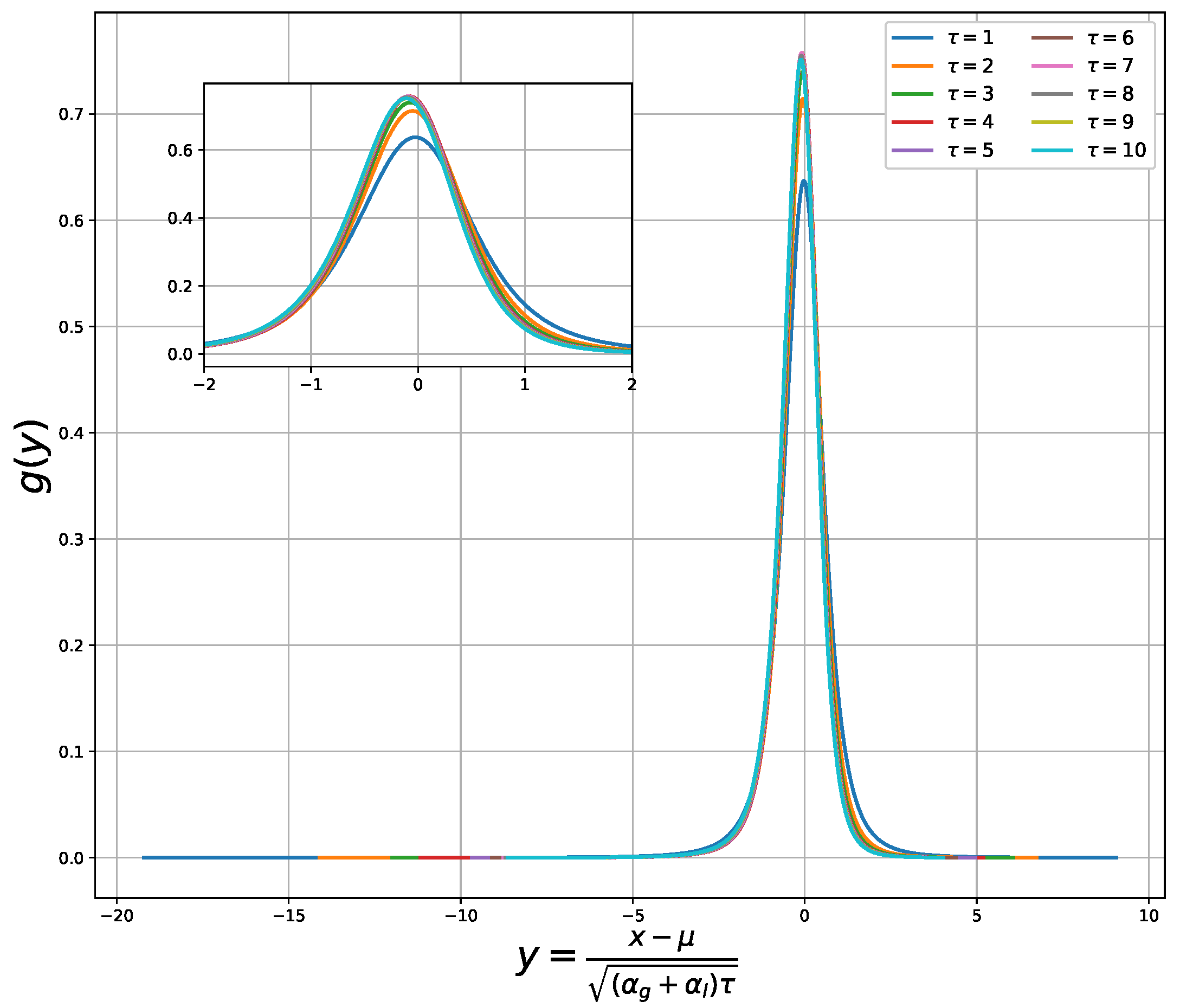
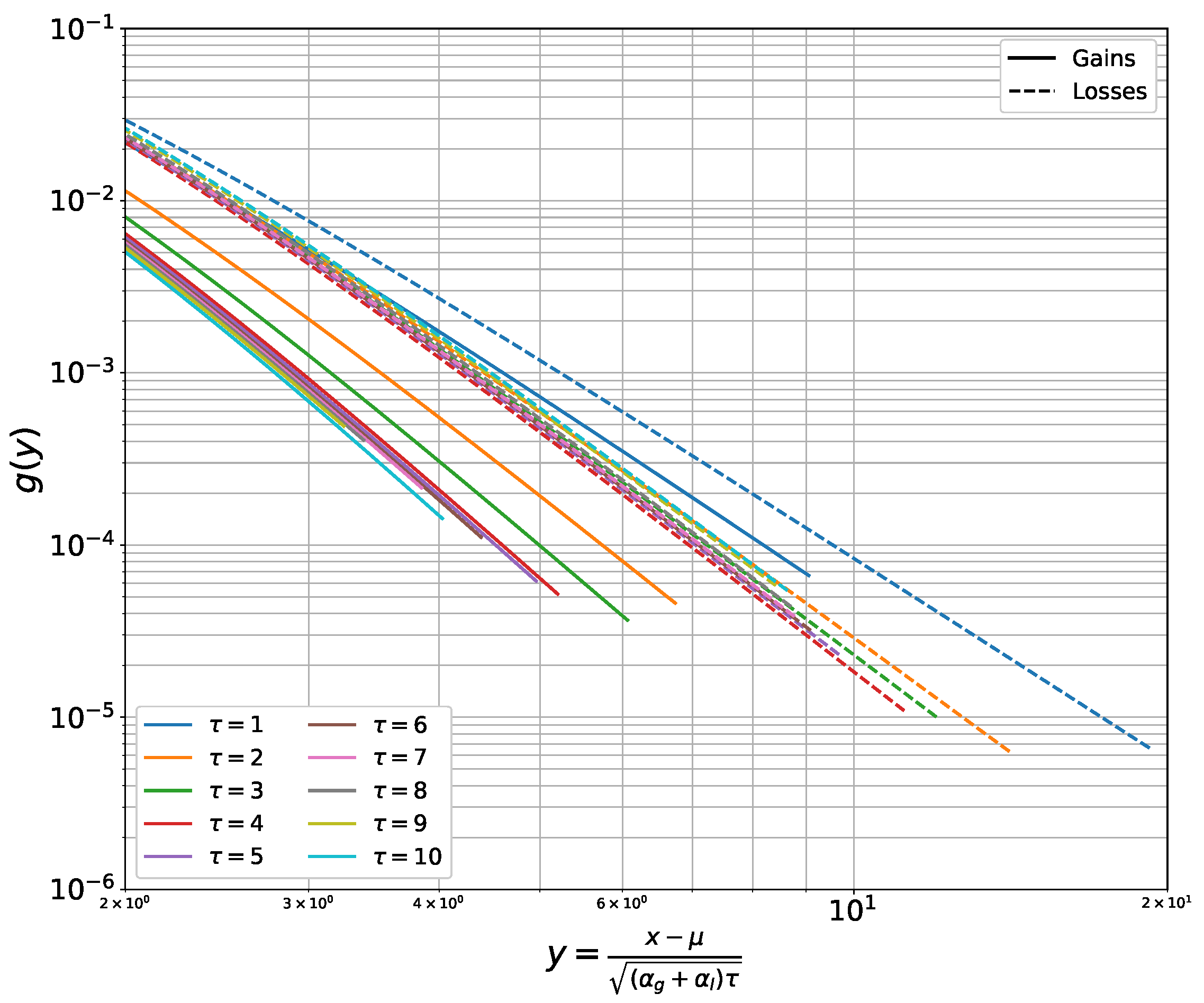
The idea of scaling goes back to symmetrical models of distribution of stock returns [8,10]. In particular, it is clear that a change in variable to y = x / 2 α τ in (5) and to y = x / 2 β τ in (6) removes dependence on τ ; so, in each case, the set of distributions for different τ should theoretically collapse to a single distribution. Of course, in practice, parameters are fitted for each τ , and, consequently, there are some variations with τ [2,11]. Similarly, the same concept applies to mJF1 (7) via a change in the variable y = ( x μ ) / ( α g + α l ) τ . This is illustrated in Figure 11 and Figure 12, which show the PDF of rescaled distributions g ( y ) with fitted mJF1 parameters from Table 1.

4. Summary and Discussion

The empirical evidence suggests that the realized variance (squared realized volatility) of major stock indices S&P500 and DJIA scales linearly with the number of days of accumulation of returns. The impetus for this work was to understand this phenomenon in terms of a stochastic model of returns. In particular, (3) implies that if the stochastic variance is on average fixed, such linearity can be satisfactorily explained. However, mean-reverting models of stochastic variance, which would assure such average behavior, yield symmetrical distributions (with respect to location parameter, if non-zero)—see for instance (5) for multiplicative and (6) for multiplicative–Heston models, respectively.
In reality, the symmetry of the distributions of returns is broken, with the bulk of returns moving to gains and the tails of losses decaying slower than gains, which results in positive mean and negative skewness of the distribution of returns. To account for this, we employed a skew version of Student t-distribution (5)—a modified Jones–Faddy skew t-distribution (7). Bayesian fitting of S&P500 returns produced good agreement with the statistical properties of empirical distributions. One point, however, deserves particular attention.
Expression (13) for the variance of the modified Jones–Faddy distribution, while proportional to τ , contains a rather complicated prefactor. When α g = α l , it reduces to m 2 = θ τ , that is to (3), which is also the explicitly calculated variance of the multiplicative and multiplicative–Heston models. Remarkably, with the parameters obtained from fitting, the full expression still gives a linear dependence on τ , which is extremely close to that of S&P500 as seen in Figure 8 and explained in the text. We dubbed this effect the ”conservation law”. Its other manifestation is the scaling phenomenon, as seen in Figure 11 and Figure 12.
Future work will address extension to much larger values of the days of accumulation τ and generalization of the modified Jones–Faddy distribution that would explain the empirically observed tempered tails. Application of our approach to other indices and to returns of specific companies is also of great interest. Finally, a more direct consideration of the distribution of realized variance and the linear dependence of its variance is also in order.
`

Author Contributions

Conceptualization, R.A.S.; formal analysis, R.A.S. and S.S.; investigation, A.G., S.S. and R.A.S.; data curation, A.G.; writing—original draft preparation, R.A.S., A.G. and S.S.; writing—review and editing, R.A.S., A.G. and S.S.; visualization, A.G. All authors have read and agreed to the published version of the manuscript.

Funding

This research received no external funding.

Data Availability Statement

We obtained S&P500 data at Yahoo! Finance. Our datasets are available upon request.

Acknowledgments

We used MathWorks Matlab R2025b for numerical work and Wolfram 14.3 for analytical calculations. Siqi Shao acknowledges support in part by The University of Cincinnati URC Graduate Support Program.

Conflicts of Interest

The authors declare no conflicts of interest.

Appendix A. Bayesian Fitting with mJF1

Appendix A.1. Gains

Figure A1. mJF1 CCDF.
Foundations 06 00023 g0a1
Figure A2. mJF1 CCDF.
Foundations 06 00023 g0a2
Figure A3. mJF1 CCDF tails.
Foundations 06 00023 g0a3
Figure A4. mJF1 CCDF tails.
Foundations 06 00023 g0a4
Figure A5. mJF1 p-values.
Foundations 06 00023 g0a5
Figure A6. mJF1 p-values.
Foundations 06 00023 g0a6

Appendix A.2. Losses

Figure A7. mJF1 CCDF.
Foundations 06 00023 g0a7
Figure A8. mJF1 CCDF.
Foundations 06 00023 g0a8
Figure A9. mJF1 CCDF tails.
Foundations 06 00023 g0a9
Figure A10. mJF1 CCDF tails.
Foundations 06 00023 g0a10
Figure A11. mJF1 p-values.
Foundations 06 00023 g0a11
Figure A12. mJF1 p-values.
Foundations 06 00023 g0a12

References

  1. Farahani, H.; Serota, R.A. Asymmetry in Distributions of Accumulated Gains and Losses in Stock Returns. Economies 2025, 13, 176. [Google Scholar] [CrossRef]
  2. Liu, Z.; Dashti Moghaddam, M.; Serota, R.A. Distributions of Historic Market Data—Stock Returns. Eur. Phys. J. B 2019, 92, 60. [Google Scholar] [CrossRef]
  3. Perello, J.; Masoliver, J. Stochastic volatility and leverage effect. Phys. Rev. E 2003, 67, 037102. [Google Scholar]
  4. Dashti Moghaddam, M.; Liu, Z.; Serota, R.A. Distributions of historic market data: Relaxation and correlations. Eur. Phys. J. B 2021, 94, 83. [Google Scholar] [CrossRef]
  5. Drǎgulescu, A.A.; Yakovenko, V.M. Probability distribution of returns in the Heston model with stochastic volatility. Quant. Financ. 2002, 2, 443–453. [Google Scholar] [CrossRef]
  6. Cox, J.; Ingersoll, J.; Ross, S. A theory of the term structure of interest rates. Econometrica 1985, 53, 385–407. [Google Scholar] [CrossRef]
  7. Heston, S.L. A closed-form solution for options with stochastic volatility with applications to bond and currency options. Rev. Financ. Stud. 1993, 6, 327–343. [Google Scholar] [CrossRef]
  8. Praetz, P.D. The distribution of share price changes. J. Bus. 1972, 45, 49–55. [Google Scholar] [CrossRef]
  9. Nelson, D. Arch models as diffusion approximations. J. Econom. 1990, 45, 7. [Google Scholar] [CrossRef]
  10. Fuentes, M.A.; Gerig, A.; Vicente, J. Universal behavior of extreme price movements in stock markets. PLoS ONE 2009, 4, e8243. [Google Scholar] [CrossRef] [PubMed][Green Version]
  11. Dashti Moghaddam, M.; Serota, R.A. Combined Multiplicative-Heston Model for Stochastic Volatility. Phys. A Stat. Mech. Its Appl. 2021, 561, 125263. [Google Scholar] [CrossRef]
  12. Ma, T.; Serota, R. A model for stock returns and volatility. Phys. A Stat. Mech. Its Appl. 2014, 398, 89–115. [Google Scholar] [CrossRef][Green Version]
  13. Shao, S.; Ghasemi, A.; Farahani, H.; Serota, R.A. Broken Symmetry of Stock Returns—A Modified Jones-Faddy Skew t-Distribution. Economies 2026, 14, 84. [Google Scholar] [CrossRef]
  14. Jones, M.C. Probability and Statistical Models with Applications; Chapman and Hall: London, UK, 2001; Chapter 17; pp. 159–174. [Google Scholar]
  15. Jones, M.C.; Faddy, M.J. A skew extension of the t-distribution, with applications. J. R. Stat. Soc. B 2003, 65, 159–174. [Google Scholar] [CrossRef]
  16. National Institute of Standards and Technology. Digital Library of Mathematical Functions. Available online: https://dlmf.nist.gov/ (accessed on 20 April 2026).
  17. Wolfram Research. StudentTDistribution. Available online: https://reference.wolfram.com/language/ref/StudentTDistribution.html (accessed on 20 April 2026).
  18. Janczura, J.; Weron, R. Black swans or dragon-kings? A simple test for deviations from the power law. Eur. Phys. J. Spec. Top. 2012, 205, 79–93. [Google Scholar] [CrossRef]
  19. Pisarenko, V.F.; Sornette, D. Robust statistical tests of Dragon-Kings beyond power law distribution. Eur. Phys. J. Spec. Top. 2012, 205, 95–115. [Google Scholar] [CrossRef]
  20. Sornette, D.; Ouillon, G. Dragon-kings: Mechanisms, statistical methods and empirical evidence. Eur. Phys. J. Spec. Top. 2012, 205, 1–26. [Google Scholar] [CrossRef]
  21. Liu, J.; Dashti Moghaddam, M.; Serota, R.A. Are there Dragon Kings in the Stock Market? Foundations 2024, 4, 91–113. [Google Scholar] [CrossRef]
Figure 1. S&P500. Left: r t = log ( S t / S 0 ) , where S t is price on day t, and t changes in daily increments ( τ = 1 in text). Right: x t = r t μ 1 t , where the index in μ 1 reflects daily increments of t ( τ = 1 in text). From [1].
Foundations 06 00023 g001
Figure 2. Realized variance (RV) of S&P500 as a function of the number of days τ over which the returns are calculated. The best straight line fit is f ( τ ) = 1.062 × 10 4 τ 3.328 × 10 5 . From [2].
Foundations 06 00023 g002
Figure 3. The variance in the distribution of returns as a function of the number of days of accumulation, m 2 ( τ ) , with its linear fit. Inset shows scaled variance m 2 ( τ ) / τ . From [1].
Foundations 06 00023 g003
Figure 4. α g , α l and θ from Table 1, and α = ( α g + α l ) / 2 vs. τ .
Foundations 06 00023 g004
Figure 5. ( δ / α ) 2 and ( δ / θ ) 2 vs. τ ; δ = α g α l .
Foundations 06 00023 g005
Figure 6. Location parameter μ from Table 1 vs. τ .
Foundations 06 00023 g006
Figure 7. Mean m 1 ( τ ) of S&P500 and mJF1 fit and linear fit of S&P500. Bottom insert: m 1 ( τ ) / τ . Top insert: Positive and negative terms in (12) and resulting m 1 ( τ ) —notice two orders of magnitude difference between central plot and insert.
Foundations 06 00023 g007
Figure 8. Variance m 2 ( τ ) of S&P500 and its linear fit. Top insert: m 2 ( τ ) of mJF1 and its linear fit. Bottom insert: m 2 ( τ ) / τ of S&P500 and mJF1 and θ ( τ ) .
Foundations 06 00023 g008
Figure 9. First Pearson coefficient of skewness ζ 1 from Table 4 vs. τ .
Foundations 06 00023 g009
Figure 10. Second Pearson coefficient of skewness ζ 2 from Table 4 vs. τ .
Foundations 06 00023 g010
Figure 11. Rescaled PDF of mJF1.
Foundations 06 00023 g011
Figure 12. Tails of rescaled PDF of mJF1.
Foundations 06 00023 g012
Table 1. Parameter estimates from Bayesian fitting with (7) of S&P500 returns accumulated over τ days.
τ α g α l θ μ
1 7.92 × 10 5 6.42 × 10 5 1.42 × 10 4 8.46 × 10 4
2 1.17 × 10 4 8.74 × 10 5 1.20 × 10 4 2.28 × 10 3
3 1.32 × 10 4 9.11 × 10 5 1.14 × 10 4 3.90 × 10 3
4 1.40 × 10 4 9.40 × 10 5 1.09 × 10 4 5.03 × 10 3
5 1.38 × 10 4 9.00 × 10 5 1.06 × 10 4 5.96 × 10 3
6 1.36 × 10 4 8.74 × 10 5 1.03 × 10 4 6.77 × 10 3
7 1.35 × 10 4 8.52 × 10 5 1.01 × 10 4 7.44 × 10 3
8 1.32 × 10 4 8.11 × 10 5 9.86 × 10 5 8.30 × 10 3
9 1.29 × 10 4 7.68 × 10 5 9.66 × 10 5 9.28 × 10 3
10 1.30 × 10 4 7.52 × 10 5 9.55 × 10 5 1.03 × 10 2
Table 2. Mean m 1 and variance m 2 of mJF1 fits and of S&P500.
τ m1 (mJF1)m1 (S&P500)m2 (mJF1)m2 (S&P500)
1 4.39 × 10 5 4.38 × 10 5 1.45 × 10 4 1.28 × 10 4
2 8.49 × 10 5 8.82 × 10 5 2.52 × 10 4 2.43 × 10 4
3 1.37 × 10 4 1.32 × 10 4 3.65 × 10 4 3.54 × 10 4
4 1.71 × 10 4 1.76 × 10 4 4.62 × 10 4 4.63 × 10 4
5 2.10 × 10 4 2.18 × 10 4 5.67 × 10 4 5.65 × 10 4
6 2.54 × 10 4 2.59 × 10 4 6.67 × 10 4 6.67 × 10 4
7 2.77 × 10 4 3.00 × 10 4 7.64 × 10 4 7.64 × 10 4
8 3.26 × 10 4 3.41 × 10 4 8.61 × 10 4 8.64 × 10 4
9 3.41 × 10 4 3.82 × 10 4 9.68 × 10 4 9.58 × 10 4
10 4.35 × 10 4 4.21 × 10 4 1.07 × 10 3 1.06 × 10 3
Table 3. Mode m ¯ and median m ˜ of mJF1 fits and of S&P500.
τ m ¯ (mJF1) m ¯ (S&P500) m ˜ (mJF1) m ˜ (S&P500)
1 5.30 × 10 4 1.32 × 10 4 3.21 × 10 4 2.73 × 10 4
2 1.23 × 10 3 1.08 × 10 3 6.84 × 10 4 7.13 × 10 4
3 2.00 × 10 3 2.78 × 10 3 1.09 × 10 3 1.24 × 10 3
4 2.51 × 10 3 3.89 × 10 3 1.34 × 10 3 1.66 × 10 3
5 2.98 × 10 3 3.36 × 10 3 1.60 × 10 3 1.78 × 10 3
6 3.39 × 10 3 4.39 × 10 3 1.82 × 10 3 2.15 × 10 3
7 3.72 × 10 3 5.10 × 10 3 2.00 × 10 3 2.26 × 10 3
8 4.17 × 10 3 4.87 × 10 3 2.26 × 10 3 2.57 × 10 3
9 4.68 × 10 3 4.62 × 10 3 2.53 × 10 3 2.79 × 10 3
10 5.22 × 10 3 6.25 × 10 3 2.84 × 10 3 3.26 × 10 3
Table 4. First and second Pearson coefficients of skewness, ζ 1 and ζ 2 , of mJF1 fits and S&P500.
τ ζ 1 (mJF1) ζ 1 (S&P500) ζ 2 (mJF1) ζ 2 (S&P500)
1 4.04 × 10 2 7.76 × 10 3 6.91 × 10 2 6.09 × 10 2
2 7.23 × 10 2 6.34 × 10 2 1.13 × 10 1 1.20 × 10 1
3 9.76 × 10 2 1.41 × 10 1 1.49 × 10 1 1.76 × 10 1
4 1.09 × 10 1 1.72 × 10 1 1.63 × 10 1 2.07 × 10 1
5 1.16 × 10 1 1.32 × 10 1 1.75 × 10 1 1.98 × 10 1
6 1.21 × 10 1 1.60 × 10 1 1.82 × 10 1 2.20 × 10 1
7 1.24 × 10 1 1.74 × 10 1 1.87 × 10 1 2.13 × 10 1
8 1.31 × 10 1 1.54 × 10 1 1.97 × 10 1 2.28 × 10 1
9 1.39 × 10 1 1.37 × 10 1 2.10 × 10 1 2.33 × 10 1
10 1.46 × 10 1 1.79 × 10 1 2.20 × 10 1 2.62 × 10 1
Disclaimer/Publisher’s Note: The statements, opinions and data contained in all publications are solely those of the individual author(s) and contributor(s) and not of MDPI and/or the editor(s). MDPI and/or the editor(s) disclaim responsibility for any injury to people or property resulting from any ideas, methods, instructions or products referred to in the content.