


Abstract
Carbon dots (C-Dots) have attracted significant interest due to their strong photoluminescence, aqueous stability, and tunable surface chemistry; however, their environmental safety remains incompletely understood. In this work, C-Dots were synthesized via a rapid microwave-assisted method using two different carbon precursors, D-glucose and ascorbic acid, with ethylenediamine as a passivating agent. The resulting nanoparticles exhibited predominantly amorphous structures with sizes below 10 nm, characteristic absorption bands at ~280–330 nm, and blue photoluminescence centered at ~450 nm. Acute toxicity was evaluated using Brine shrimp at concentrations ranging from 10 to 2000 ppm after 24 and 48 h of exposure. C-Dots synthesized from ascorbic acid showed significant toxicity at 2000 ppm, inducing higher mortality rates after 24 h, whereas D-glucose-derived C-Dots exhibited minimal toxic effects under the same conditions. These findings demonstrate that carbon precursor selection plays a critical role in determining the environmental toxicity of C-Dots and highlight the importance of precursor-dependent design strategies to minimize potential ecological risks associated with carbon-based nanomaterials.
1. Introduction
Carbon dots (C-Dots) are nanoparticles with a diameter smaller than 10 nm; they are composed of a carbon core, and their surface area is made up of various functional groups, depending on the composition of the precursors used in their synthesis [1]. C-Dots synthesis methods are classified into two groups: top-down and bottom-up. The first uses carbon-rich materials, such as graphite or nanotubes, which are fragmented into nanoparticles [2,3]. The bottom-up method, on the other hand, forms dots from simple molecules, such as sugars or organic acids, through controlled carbonization processes. Bottom-up methods have the principal advantage of short synthesis times. Among them, microwave synthesis enables precise control of reaction conditions and rapid, uniform nanoparticle production. Furthermore, its efficiency and simplicity make it ideal for obtaining reproducible C-Dots in a single step [4,5,6,7]. Since their discovery in 2004, research involving them has grown exponentially year after year. This is due to their diverse applications across fields such as biomedical applications, photocatalysis, sensing, and optoelectronics, as well as to their intrinsic properties, including high luminescence, biocompatibility, and ease of functionalization [8,9,10,11,12].
Given the exponential growth of research on C-Dots, it is crucial to verify that these materials do not pose risks to the environment or human health. C-Dots are primarily derived from organic precursors, which is why they are considered to be low-toxic and well-biocompatible, explaining their relevance in current research [13]. However, several recent reports have attributed significant toxicity to C-Dots, causing metabolic disturbances in microorganisms and growth inhibition [14,15]. Nevertheless, most of these studies evaluate the toxicity of C-Dots derived from a single source, without comparing different sources to examine how the type of starting material influences their biological behavior.
There are different methods for assessing the toxicity of nanomaterials; these can be classified into two main groups: in vivo and in vitro [16,17,18]. In vivo assays reveal how entire organisms respond when exposed to nanomaterials and provide a clearer view of their biological impact. Within this group is the method using brine shrimp, which stands out due to its simple, inexpensive, and sensitive protocol; therefore, it is widely used in preliminary ecotoxicological studies. Furthermore, because it reproduces quickly, is easy to care for and allows mortality to be measured quickly, it is helpful for assessing the initial toxicity of new nanomaterials [19,20,21,22,23,24].
In this study, C-Dots were obtained by microwave-assisted synthesis. Two different carbon sources (ascorbic acid and D-glucose), the same passivating agent (ethylenediamine), and two different synthesis temperatures (100 and 140 °C) were used. This allowed us to evaluate which of these variables had a significant impact on C-Dots toxicity. D-Glucose, selected for its stable structure and high hydroxyl group content, promotes uniform carbonization, whereas ascorbic acid, due to its reducing properties, enhances surface functionalization and improves the optical properties of the C-Dots. Ethylenediamine was employed as a passivating agent because it incorporates amine groups, improves nanoparticle dispersion, and enhances luminescence.
2. Materials and Methods
2.1. Materials
D-(+)-Glucose, anhydrous (99%, Alfa Aesar, Haverhill, MA, USA), ascorbic acid (Sigma, St. Louis, MO, USA), and ethylenediamine (99%, Sigma-Aldrich, St. Louis, MO, USA) were used as received without further purification. All aqueous solutions were prepared using deionized water.
2.2. Production of C-Dots
C-Dots were synthesized in aqueous medium by microwave irradiation using a MARS 6 reactor at 100, and 140 °C for 3 min. D-glucose and ascorbic acid were used as carbon precursors, and ethylenediamine was used as a passivating agent. In 15 mL of deionized water, 0.3 g of the carbon source (D-glucose or ascorbic acid) was first added and allowed to dissolve completely. Subsequently, 0.95 μL of ethylenediamine was added. The solution was sonicated for 15 min to obtain a homogeneous mixture and then subjected to microwave irradiation. This synthesis methodology has been described in our previous work [25]. Establishing 100 and 140 °C because these were the temperatures with the most significant differences in our previous work. Microwave-assisted synthesis was performed using a CEM MARS 6 microwave reaction system (CEM Corporation, Matthews, NC, USA). The power was set to 800 W based on the number of reaction vessels per cycle, following the manufacturer’s instructions to ensure uniform energy distribution and heating in the microwave cavity.
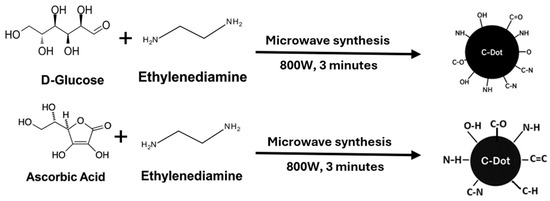
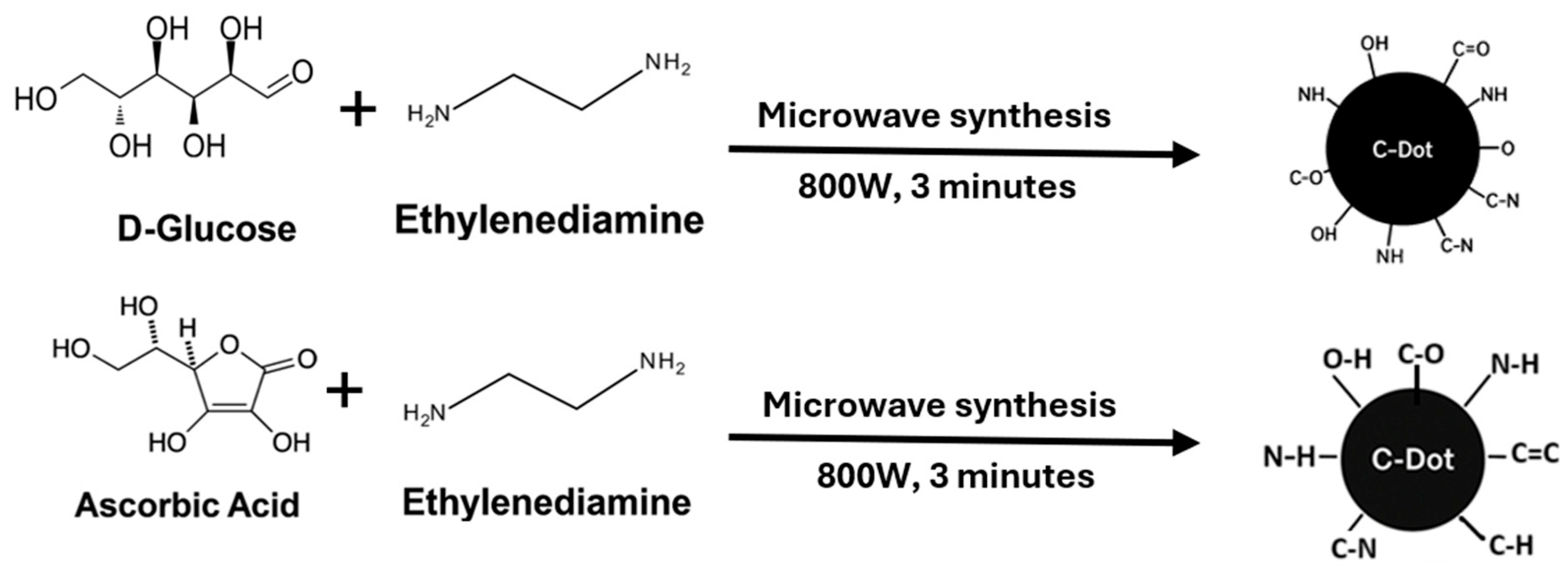
Figure 1 shows the proposed synthesis mechanisms for C-Dots based on the results of FT-IR characterization, in which D-glucose and ascorbic acid decompose to form carbon nuclei. Ethylenediamine acts as a passivating agent, binding to the surface of the C-Dots and providing amine groups.
Figure 1.
Synthesis route of C-Dots.
2.3. Characterization of C-Dots
C-Dots were characterized using different techniques. Transmission Electron Microscopy (HRTEM) was employed to examine nanostructure morphology using a JEOL-ARM200F (JEOL Ltd., Tokyo, Japan) and a JEOL-2011 (JEOL Ltd., Tokyo, Japan), both operated at 200 kV. Optical properties were measured at room temperature using a Shimadzu RF-5301PC spectrofluorometer (Shimadzu Corporation, Kyoto, Japan) and a Thermo Scientific™ GENESYS™ 50 UV–Visible spectrophotometer (Thermo Fisher Scientific, Madison, WI, USA). The nature of chemical species on the nanoparticle surface was evaluated by Fourier-transform infrared (FT–IR) spectroscopy, which was performed on a Spectrum Two FT–IR spectrometer (PerkinElmer, Waltham, MA, USA).
2.4. Toxicity Test
The Brine shrimp assay, considered an important preliminary toxicity test, produces results comparable to those of the MTT method. A 250 mL volume of pre-prepared saline solution containing 35 g/L, simulating natural seawater, was used to prepare the culture. Approximately 5 mg of brine shrimp cysts were added to the solution, which was maintained under continuous aeration. The system was incubated at 30 °C with continuous artificial lighting for 48 h to promote egg hatching. Following incubation, Brine shrimp nauplii were collected and immediately used in toxicity tests to ensure consistent organismal age across all experiments.
Following hatching, ten brine shrimp nauplii were placed in each well. Twenty-one wells of a 24-well plate were used, with 3 mL test solution per well. Each experimental condition, including the blank control, was performed in triplicate (three wells per condition). One set of wells served as the blank control, while the remaining wells contained C-Dots at concentrations of 10, 100, 300, 750, 1000, and 2000 ppm. The plates were maintained at 30 °C under continuous artificial light for 48 h, with each concentration evaluated in triplicate to ensure reproducibility. No feeding was required during the exposure period, as nauplii at this early developmental stage rely on endogenous yolk reserves, ensuring that the absence of food did not affect survival. Survival was assessed at 24 and 48 h of exposure by counting live nauplii using a stereomicroscope. Mortality and viability percentages were calculated for each concentration, and the results were expressed as mean ± standard deviation and presented as viability versus C-Dots concentration.
2.5. Statistical Analysis
Toxicity results were analyzed using Minitab Statistical Software 22. This analysis was performed with independent replicates for each experimental condition (n = 3) and used a one-way analysis of variance (ANOVA), with C-Dots concentration as the independent variable. When statistically significant differences were observed (p < 0.05), Tukey’s post hoc test was used to assess group differences, controlling for type I error in multiple comparisons.
3. Results and Discussion
3.1. Morphological, Compositional, and Optical Characterization
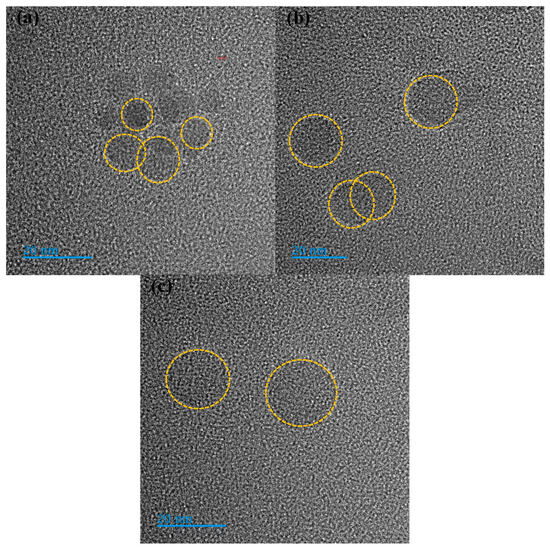
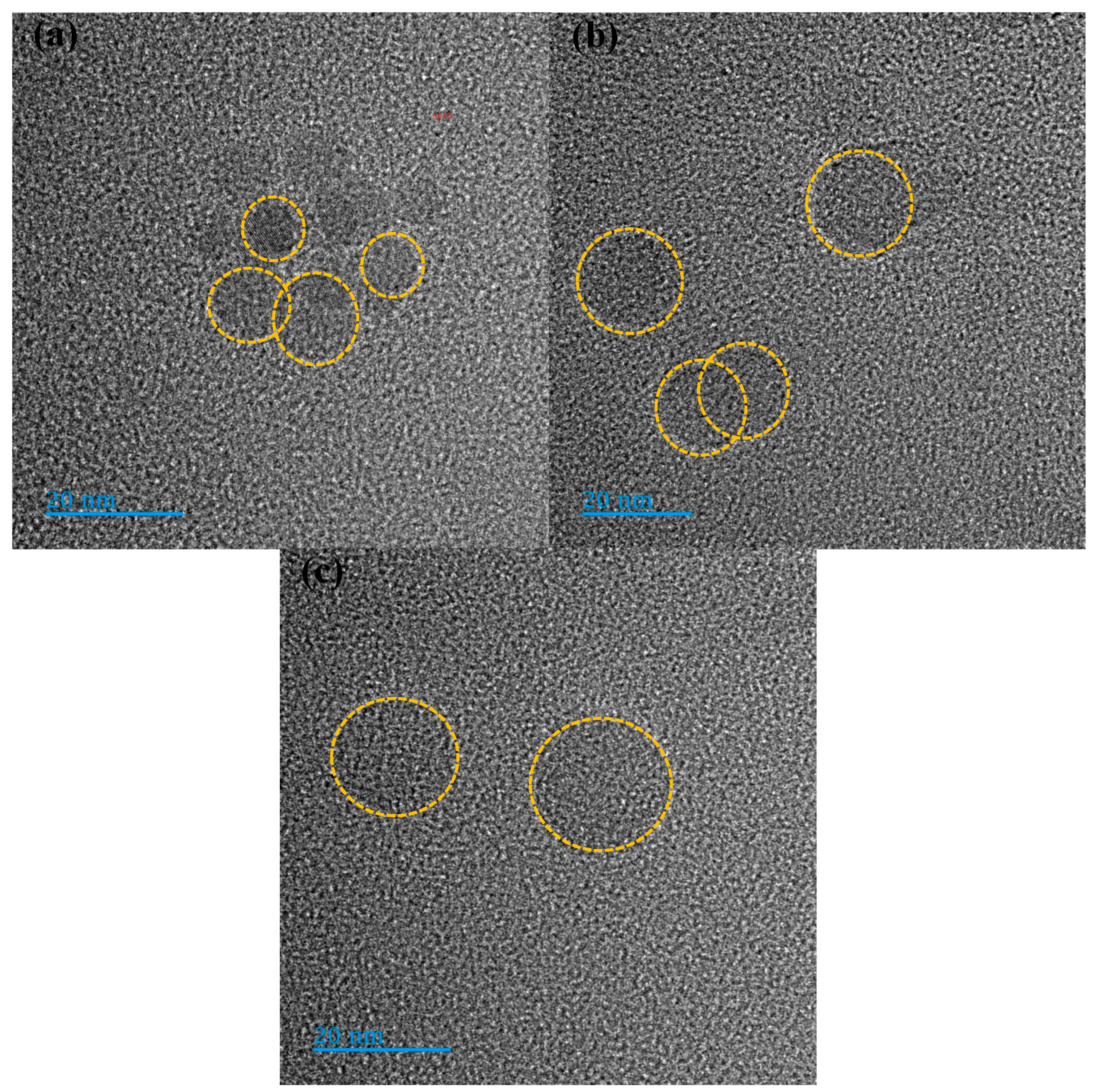
Figure 2 shows the TEM analysis at a scale of 20 nm. These results confirmed the successful synthesis of C-Dots from both carbon sources and showed that the nanoparticles were smaller than 10 nm. Due to their strong tendency to agglomerate, attributed to high surface energy and van der Waals interactions, precise statistical size distributions and accurate average particle sizes could not be reliably determined. The images mainly revealed an amorphous structure, with occasional lattice fringes indicating small crystalline domains likely related to partially aligned graphitic regions [26], as highlighted by the yellow lines.
Figure 2.
High-Resolution Transmission Electron Microscopy (HRTEM) images of C-Dots synthesized from D-glucose and ethylenediamine at (a) 100 °C and (b) 140 °C, and from ascorbic acid and ethylenediamine at (c) 100 °C.
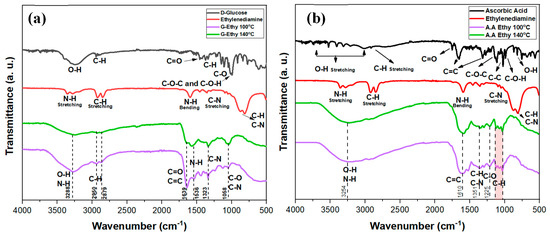
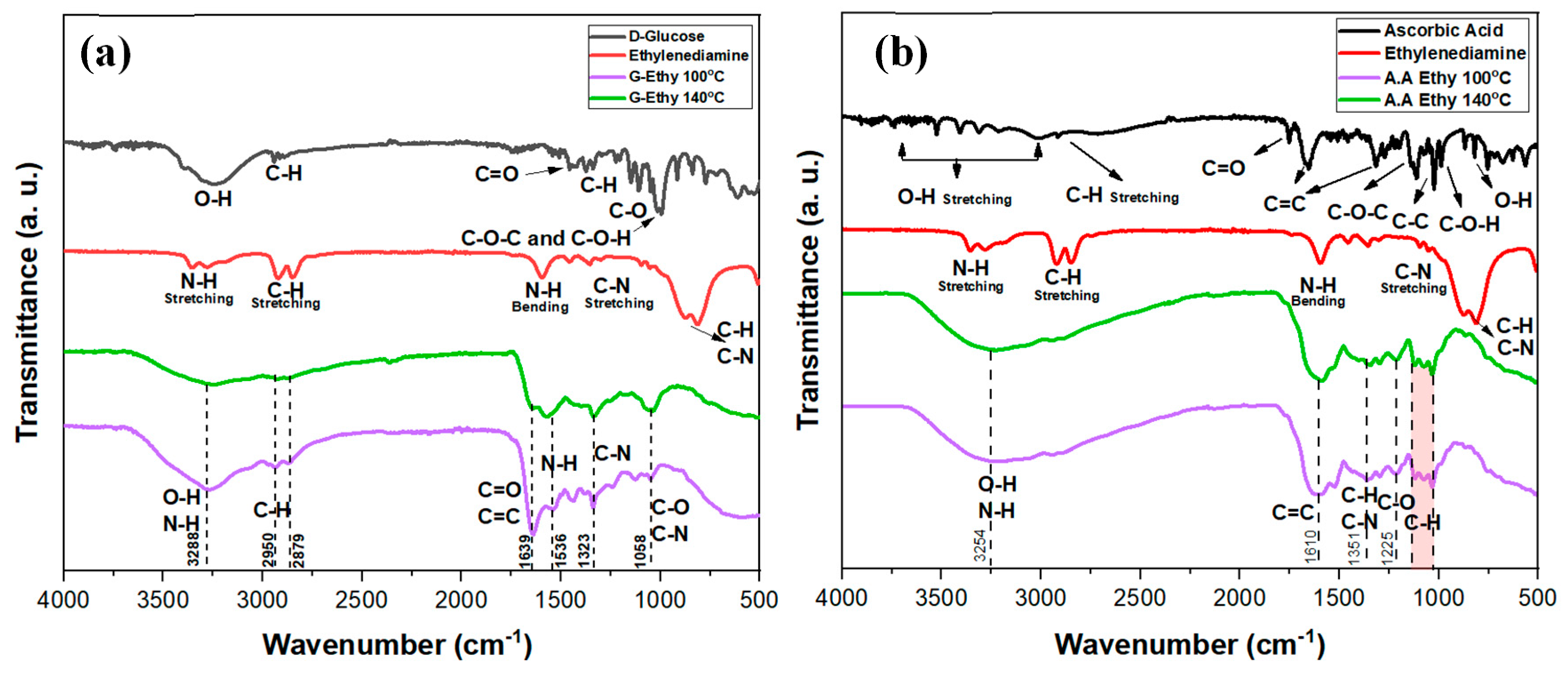
The FT-IR results in Figure 3a show an interaction between D-Glucose and ethylenediamine, resulting in C-Dots with bonds from both precursors. Additionally, the peak intensity (3288 cm−1, 1639 cm−1) decreases as the synthesis temperature increases. This may indicate that the vibrational interactions of these bonds decrease or that they have greater degrees of freedom in the medium in which they are present. It could also be due to an increase in the number of N-H bonds from ethylenimine and a decrease in the O-H bonds provided by D-glucose. For the bond at 1058 cm−1, the peak becomes more intense as the temperature increases, possibly due to increased C-O-C and C-O-H bonds. Figure 3b shows that the C-Dots contain a combination of functional groups derived from ascorbic acid (A.A.) and ethylenediamine. The peak around 3254 cm−1 corresponds to O-H bonds of A.A. and N-H bonds of ethylenediamine; the peak at 1610 cm−1 may result from N-H and C=C bonds [27,28,29]. The spectra for the different synthesis temperatures do not show a significant change, indicating that, within this temperature range, the structural characteristics of the C-Dots are stable. The C-Dots obtained from ascorbic acid exhibit a broader peak at 3300 cm−1, suggesting the presence of hydroxyl and amine groups with different hydrogen-bonding strengths, indicating a more heterogeneous functionalized surface. Between 1050 and 1250 cm−1, a peak is observed, corresponding to C–N stretching vibrations, confirming the incorporation of nitrogen-containing functional groups.
Figure 3.
FTIR spectra of C-Dots synthesized using (a) D-glucose and ethylenediamine, and (b) ascorbic acid and ethylenediamine, at 100 °C and 140 °C.
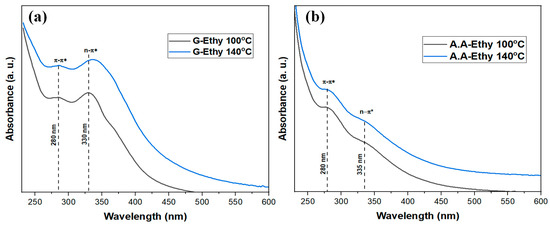
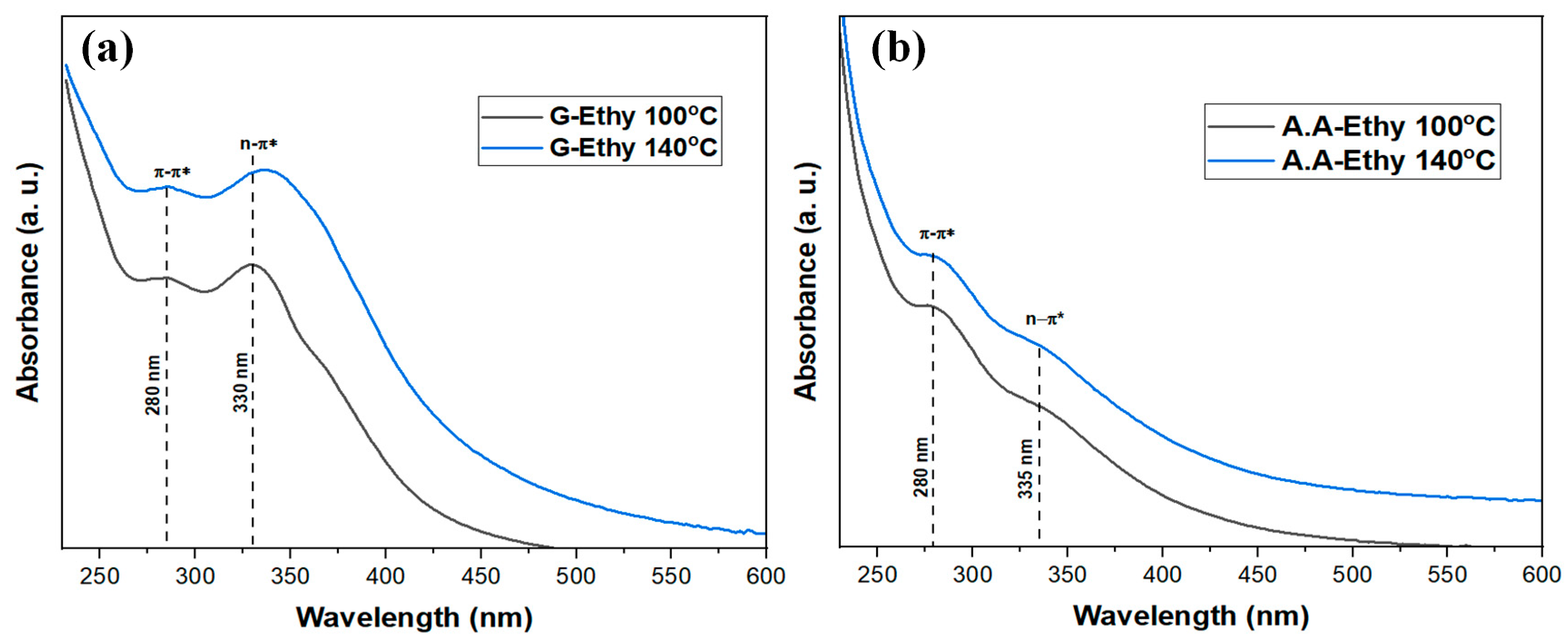
Figure 4a shows the absorbance spectrum for the C-Dots synthesized from D-glucose and ethylenediamine. Two absorbance peaks are observed, around 280 nm and 330 nm, corresponding to π-π* and n-π* electronic transitions, respectively. As the synthesis temperature increases, a slight shift in the absorbance peak around 330 nm to the right is observed; this may be due to an increase in the size of the C-Dots or to increased electronic conjugation from surface changes. Figure 4b shows the absorbance spectra of C-Dots synthesized from ascorbic acid and ethylenediamine. The spectra obtained for both temperatures remain practically identical, indicating that temperature has little influence on their optical behavior. Unlike Figure 4a, the main absorption peak is near 280 nm, associated with π–π* transitions, while a faint signal around 380 nm suggests possible n–π* interactions [30]. The broad, less-defined peaks are probably due to a heterogeneous particle-size distribution, which affects the uniformity of electronic transitions during light absorption [31].
Figure 4.
UV-Vis spectra of C-Dots synthesized using (a) D-glucose and ethylenediamine, and (b) ascorbic acid and ethylenediamine, at 100 °C and 140 °C.
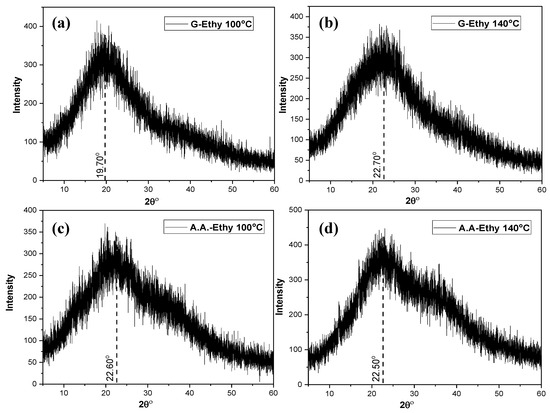
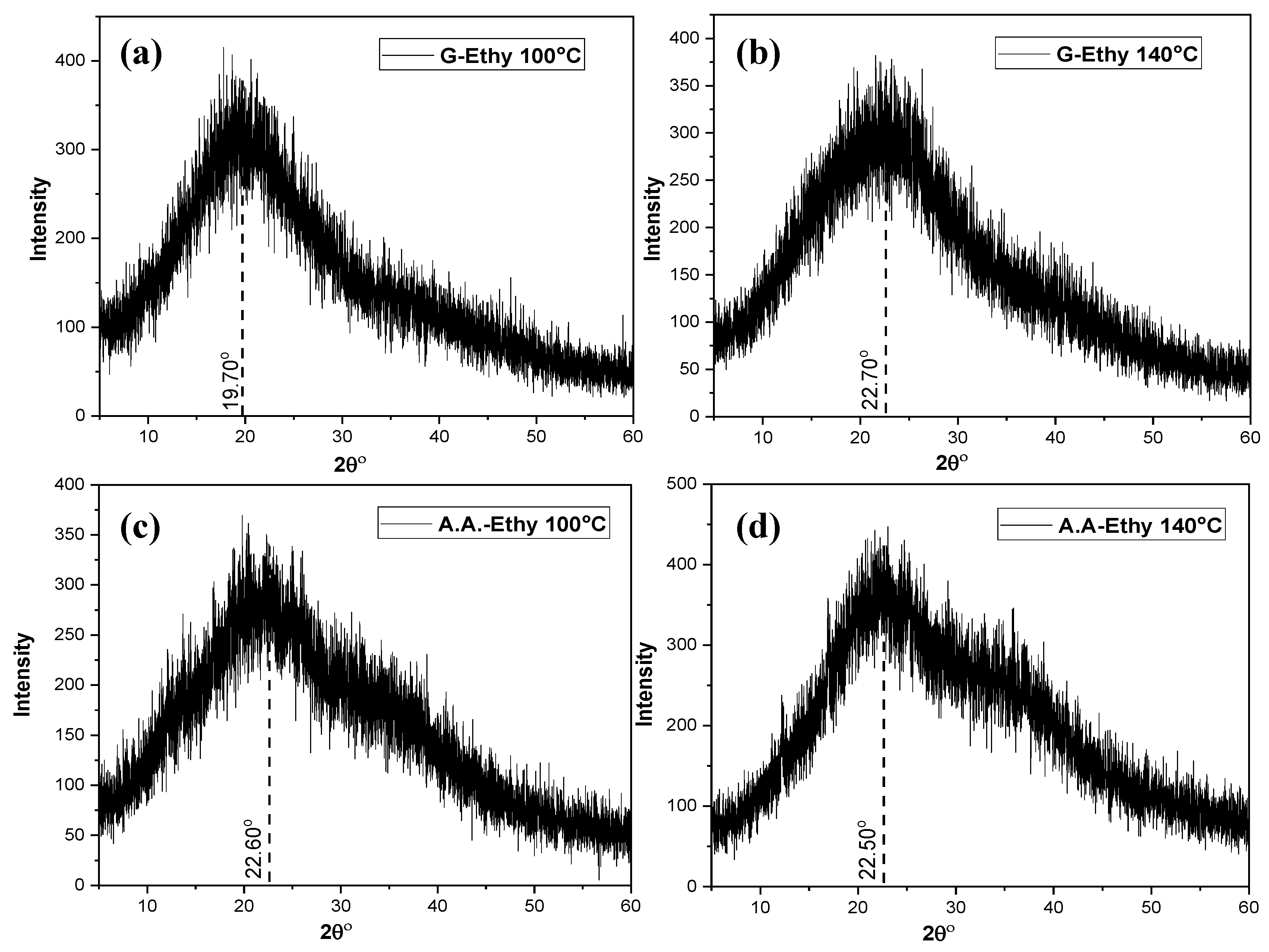
Figure 5 shows the XRD patterns of all C-Dots, which exhibit a relatively broad peak, consistent with their predominant amorphous structure and the expected nanoscale size (<10 nm). The diffraction peak around 20° corresponds to the (002) plane of graphite, and the interplanar distance greater than that corresponding to graphite d022 = 0.338 nm reflects the low degree of graphitization of the C-Dots [32,33]. C-Dots from D-glucose showed a slight change in their main diffraction angle (19.62° to 22.54°). This result indicates that the synthesis temperature may alter the structure of these C-Dots, potentially affecting their crystallinity or shape. On the other hand, the steady diffraction angle of the ascorbic acid C-Dots (22°) suggests that their structure is more stable and less affected by temperature [33].
Figure 5.
XRD patterns of C-Dots synthesized with D-glucose and ethylenediamine at (a) 100 °C and (b) 140 °C, and with ascorbic acid and ethylenediamine at (c) 100 °C and (d) 140 °C.
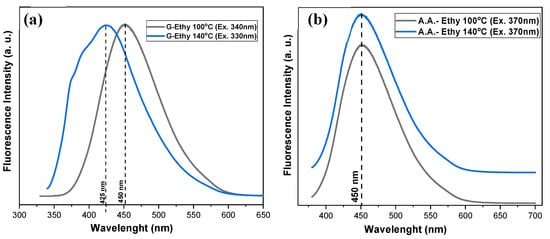
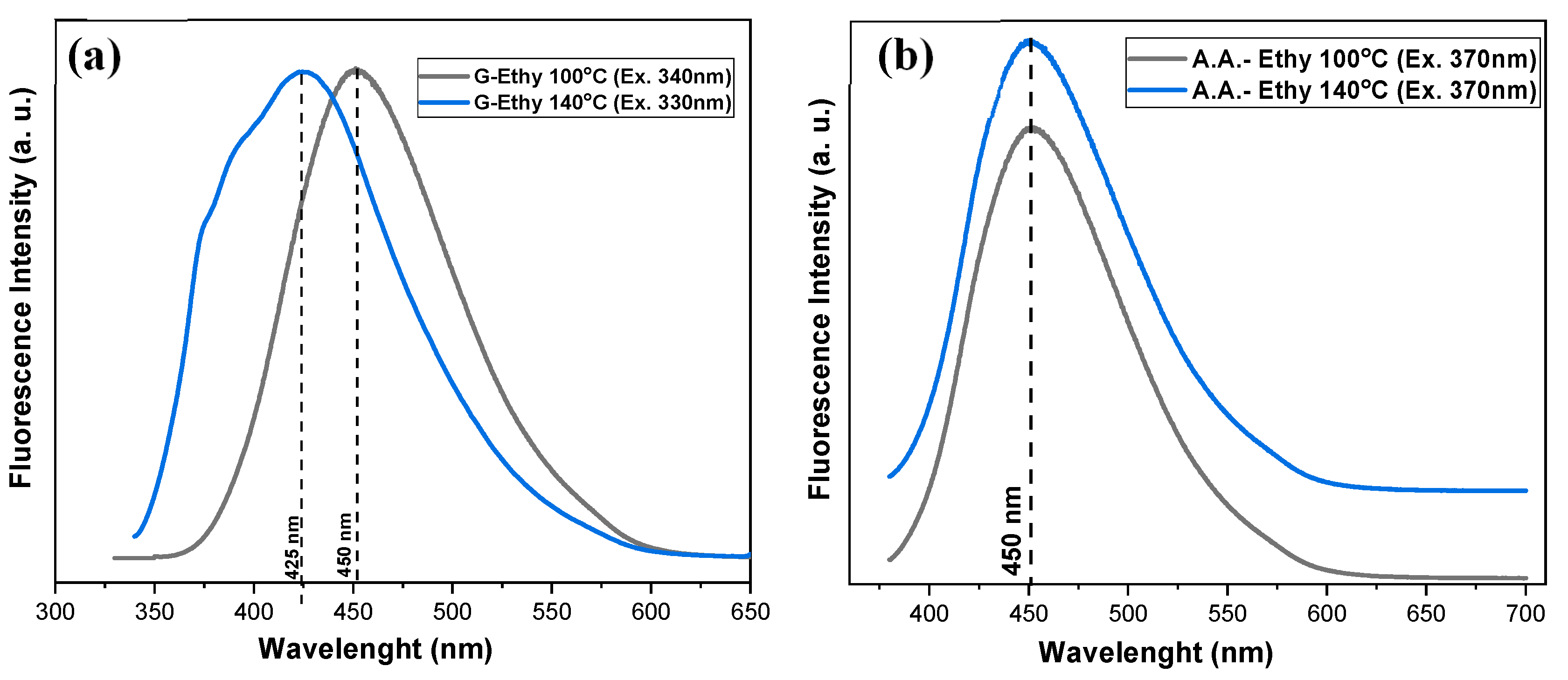
Figure 6a shows fluorescence (PL) patterns of C-Dots made from D-glucose. For the C-Dots made at 100 °C, the brightest point is at 450 nm. At 140 °C, the brightest point shifts to 425 nm, indicating a bluer color. This change is probably due to the particles being smaller or a change in their surface. At 140 °C, the brightest point is broader and less distinct, indicating that the particles are more varied in size and that the sources of light are more mixed. This may be due to the structure being less uniform, the surfaces having different chemical groups, or there are several locations where light emitted is generated [32]. Figure 6b shows that C-Dots synthesized from ascorbic acid and ethylenediamine emit most intensely at 450 nm when excited at 370 nm. The emission peaks do not vary with synthesis temperature, suggesting that the fluorescent centers are stable under these conditions [34].
Figure 6.
Fluorescence spectra of C-Dots synthesized using (a) D-Glucose and ethylenediamine, and (b) ascorbic acid and ethylenediamine, at 100 °C and 140 °C.
Like the absorbance spectra, C-Dots synthesized from ascorbic acid exhibit spectra that remain constant with temperature changes. This suggests that C-Dots derived from ascorbic acid exhibit greater thermal stability than those derived from D-glucose.
3.2. Toxicity Test in Brine shrimp
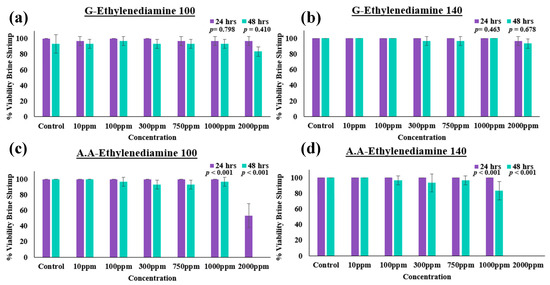
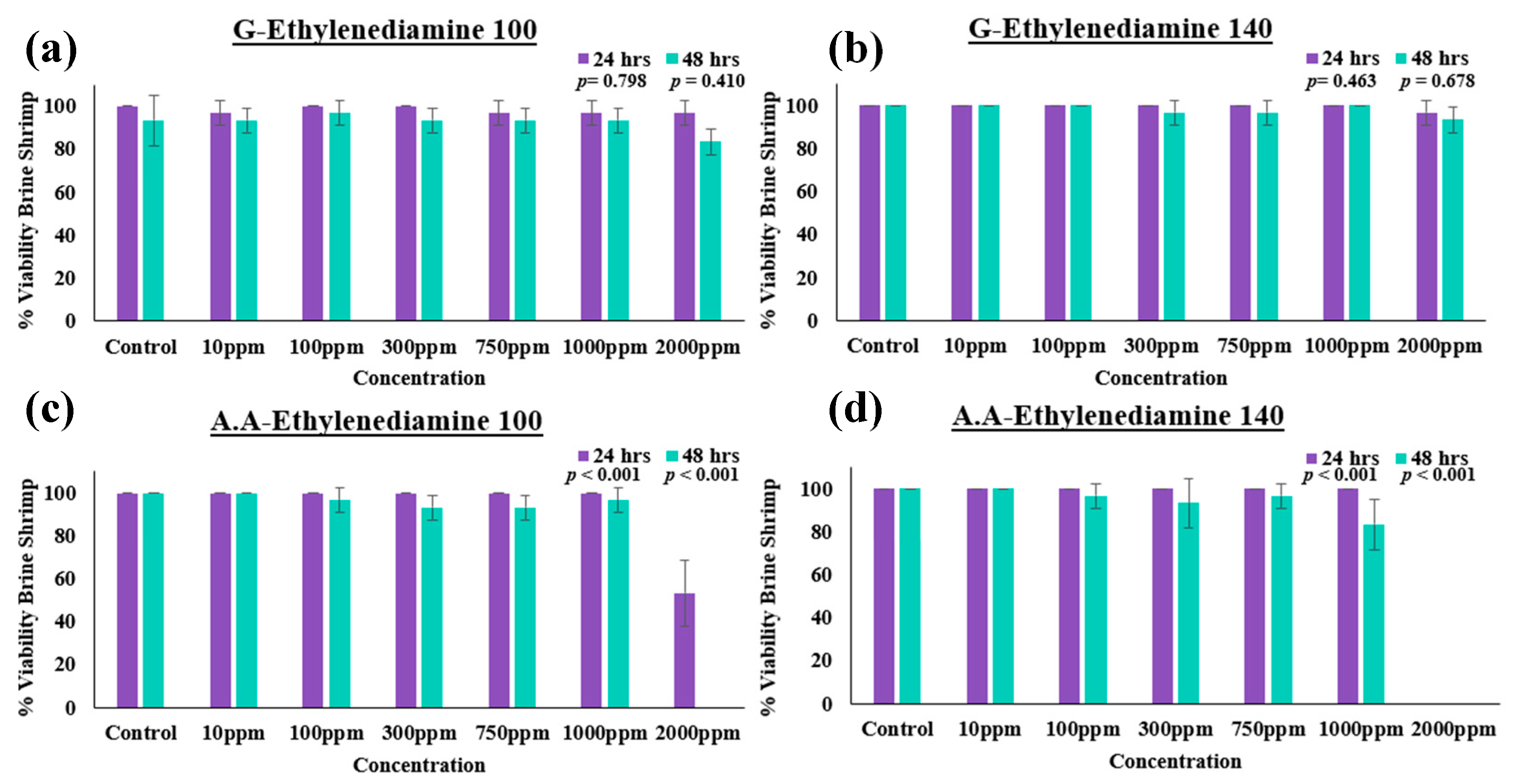
Brine shrimp were exposed to different concentrations of each C-Dots type. Their survival was checked after 24 and 48 h. Figure 7 displays the results. The experiments were repeated three times independently (n = 3). Results are shown as mean ± standard deviation (SD). A one-way analysis of variance (ANOVA) was conducted to evaluate the toxicity of C-Dots at each concentration at 24 and 48 h. The analysis was conducted using Minitab software. A p-value greater than 0.05 indicates that the null hypothesis is not rejected, indicating no significant difference in the results across the different concentrations. p-values < 0.05 indicate that there is a considerable difference.
Figure 7.
Viability of Brine shrimp exposed to different C-Dots synthesized from D-glucose and ethylenediamine at (a) 100 °C and (c) 140 °C, and from ascorbic acid and ethylenediamine at (b) 100 °C and (d) 140 °C, at concentrations ranging from 10 ppm to 2000 ppm, evaluated after 24 and 48 h of exposure. Bars represent the standard deviation of three independent replicates (n = 3). Statistical analysis was conducted using one-way ANOVA to evaluate differences in viability among concentrations at each exposure time, with p-values indicated in each panel.
C-Dots derived from D-glucose, statistical analysis showed no significant differences in mortality across the concentrations evaluated for both samples synthesized at 100 °C and 140 °C. The p-values obtained at 24 and 48 h of exposure were 0.798 and 0.410 for 100 °C, and 0.463 and 0.678 for 140 °C, respectively (p > 0.05). In contrast, C-Dots synthesized from ascorbic acid showed statistically significant differences in mortality across concentrations at both 24 and 48 h of exposure (p < 0.05). To identify which groups showed these differences, a Tukey post hoc test was applied, revealing that the 2000 ppm concentration showed significant differences at both 24 and 48 h of C-Dots exposure.
C-Dots derived synthesized from D-glucose and ethylenimine do not exhibit any reactivity with brine shrimp, even at high concentrations such as 2000 ppm. However, C-Dots derived from ascorbic acid and ethylenimine exhibit high toxicity at 2000 ppm. This highlights the importance of the carbon source in determining C-Dots toxicity.
Brine shrimp possess various defense mechanisms that enable them to survive in extreme conditions, such as high salinity, high temperatures, and low oxygen levels. Among these, the production of heat shock proteins (HSPs) stands out [16]. These proteins stabilize and repair proteins damaged by environmental stress. They also activate antioxidant systems through enzymes such as superoxide dismutase (SOD), catalase (CAT), and glutathione peroxidase (GPx), which neutralize reactive oxygen species (ROS) [35,36,37,38]. Furthermore, their metabolism can enter a state of cryptobiosis to resist desiccation and nutrient deprivation. These mechanisms, along with efficient excretion processes, allow brine shrimp to tolerate relatively high concentrations of nanoparticles without exhibiting significant toxic effects.
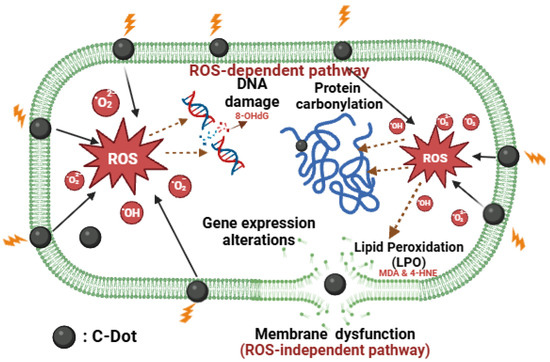
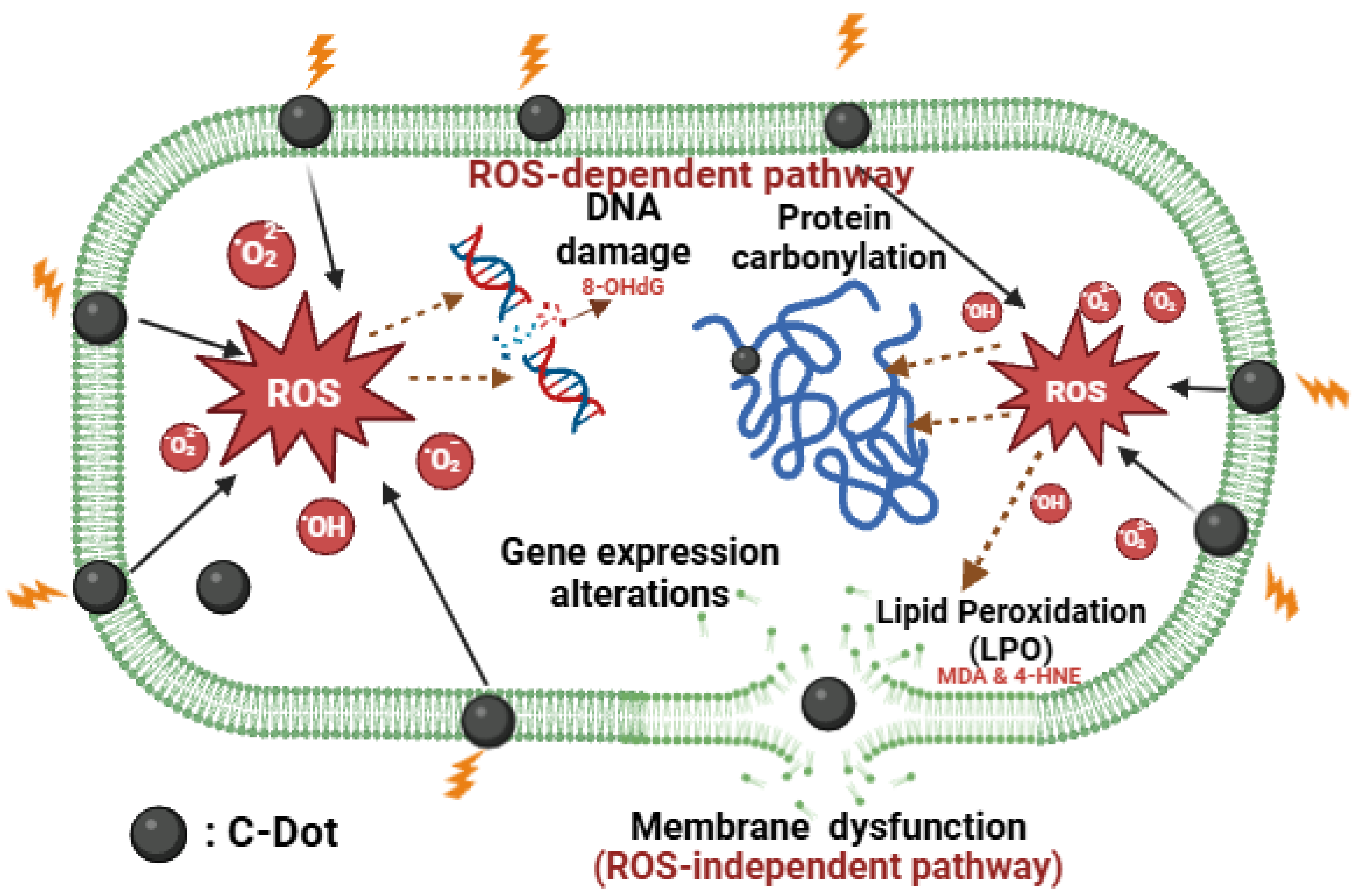
The mechanisms of C-Dot toxicity identified in the literature are presented in Figure 8. These mechanisms can be classified into two categories. The first is a ROS-dependent pathway, in which photoexcited C-Dots generate reactive oxygen species that induce oxidative stress and lipid peroxidation (LPO), resulting in the formation of MDA/4-HNE [39], nuclear genotoxicity (8-OHdG adducts and DNA strand breaks) [40], and protein carbonylation [41]. These processes ultimately disrupt cellular homeostasis. The second, a ROS-independent pathway, involves direct physicochemical interactions between C-Dots and the cell membrane, compromising membrane integrity and functionality independently of oxidative mechanisms [42,43,44].
Figure 8.
Proposed model of C-Dots induced cytotoxicity, adapted from Xiuli Dong et al. [45]. and based on literature reports, illustrating ROS-dependent and ROS-independent pathways involving oxidative stress, DNA damage, and membrane dysfunction.
Based on this framework, it was initially expected that C-Dots derived from ascorbic acid would generate higher ROS levels than those derived from D-glucose, which could explain their higher toxicity. However, the methylene blue assay [46] revealed degradation kinetic constants of 0.0021 and 0.0023 for C-Dots from D-glucose synthesized at 100 and 140 °C, respectively, compared with a lower value of 0.0007 for both C-Dots from ascorbic acid. These results indicate that D-glucose-derived C-Dots have a greater ROS-generating capacity. C-Dots synthesized from D-glucose generate higher levels of reactive oxygen species (ROS) but exhibit lower overall toxicity compared to those derived from ascorbic acid. This difference may be attributed to the capacity of brine shrimp to activate antioxidant enzymes and protective proteins that mitigate ROS-induced damage. Although these C-Dots produce increased ROS, the brine shrimp’s defense mechanisms appear sufficient to neutralize them, thereby reducing toxicity. Nevertheless, this explanation is based on inference, and further studies are necessary to directly assess antioxidant activity and elucidate the pathways involved in oxidative stress. The findings also suggest that the toxicity of C-Dots derived from ascorbic acid may result from mechanisms other than ROS, such as direct interactions with the cell membrane. Additional research is needed to clarify the relative contributions of these mechanisms to the observed toxic effects.
Although no direct membrane assays were performed, FTIR analysis revealed differences in surface functional groups between D-glucose and ascorbic acid-derived C-Dots, particularly a higher contribution of hydroxyl and amine-containing groups in ascorbic acid-derived C-Dots. These surface features may increase nanoparticle–membrane affinity and cellular uptake, thereby potentially influencing the observed toxicity.
C-Dots synthesized from ascorbic acid are candidates for antioxidant behavior because of the natural reducing ability of their precursor [47]. Nonetheless, their antioxidant performance should be verified using specific assays, such as DPPH, ABTS, or FRAP [47,48], and complemented by in vitro evaluations of cell regeneration and ROS suppression, as suggested by recent studies [48,49,50].
Although some toxicity was observed, it occurred only at high concentrations. In general, the maximum concentrations of nanoparticles used in medical applications range from approximately 10 to 1000 ppm [51,52,53]. Therefore, by preventing the accumulation of C-Dots, they could be considered safe for use in biomedical applications. This accumulation can be minimized through proper control of dose and exposure time, as well as through surface modifications that improve biocompatibility, promote renal or hepatic elimination, and reduce tissue retention [54,55]. These findings provide baseline information on the concentration ranges at which adverse effects may occur in model aquatic organisms, enabling an initial assessment of acute toxicity at each concentration. Notably, toxic effects occur only at relatively high concentrations compared to reported environmental concentrations of man-made nanomaterials, which typically range from µg·L−1 to mg·L−1 [56]. However, in the absence of environmental exposure models or fate and transport analyses, these results should be considered a preliminary analysis rather than a definitive environmental risk assessment. Future studies incorporating realistic exposure scenarios will be required to further evaluate the environmental relevance of the observed effects.
4. Conclusions
C-Dots were obtained by single-step microwave synthesis. The C-Dots are mostly amorphous. C-Dots from both carbon sources exhibited similar absorbance (280 nm and 330 nm) and fluorescence (450 nm) properties. However, the main difference was observed in the surface functional groups. C-Dots from ascorbic acid exhibit greater stability in their properties as a function of synthesis temperature.
All types of C-Dots were found to be safe at concentrations below 1000 ppm, with viability greater than 90% at 24 h and 80% at 48 h. These preliminary results from brine shrimp screening suggest that the C-Dots obtained could be promising for biomedical applications, including bioimaging, biocompatible sensors, and controlled drug delivery. However, further studies using mammalian or other in vivo models are necessary to confirm their safety and biological performance. The results also show that even structurally similar organic precursors can lead to different biological responses in C-Dots. Future studies, such as conducting bioaccumulation tests on different aquatic organisms, will help clarify how surface chemistry regulates biological interactions, absorption, and medium-term environmental impacts.
Author Contributions
Conceptualization, S.J.B.-R.; Methodology, O.V.S.-F. and S.J.B.-R.; Formal analysis, S.J.B.-R.; Investigation, O.V.S.-F.; Resources, S.J.B.-R.; Writing—original draft, O.V.S.-F.; Writing—review and editing, O.V.S.-F. and S.J.B.-R.; Supervision, S.J.B.-R.; Project administration, S.J.B.-R. All authors have read and agreed to the published version of the manuscript.
Funding
This research received no external funding.
Data Availability Statement
The data presented in this study are available in this article.
Acknowledgments
The author wants to thank the Department of Chemistry and Physics at UPRP and the Chemistry Department at UPRM.
Conflicts of Interest
The author declares no conflicts of interest.
References
- Elugoke, S.E.; Uwaya, G.E.; Quadri, T.W.; Ebenso, E.E. Carbon Quantum Dots: Basics, Properties, and Fundamentals. In ACS Symposium Series; Berdimurodov, E., Verma, D.K., Guo, L., Eds.; American Chemical Society: Washington, DC, USA, 2024; Volume 1465, pp. 3–42. ISBN 978-0-8412-9699-2. [Google Scholar]
- Abid, N.; Khan, A.M.; Shujait, S.; Chaudhary, K.; Ikram, M.; Imran, M.; Haider, J.; Khan, M.; Khan, Q.; Maqbool, M. Synthesis of Nanomaterials Using Various Top-down and Bottom-up Approaches, Influencing Factors, Advantages, and Disadvantages: A Review. Adv. Colloid Interface Sci. 2022, 300, 102597. [Google Scholar] [CrossRef] [Scilit]
- Sun, Y.-P. Carbon Dots: Exploring Carbon at Zero-Dimension; Springer International Publishing: Cham, Switzerland, 2020; ISBN 978-3-030-41183-1. [Google Scholar]
- De Medeiros, T.V.; Manioudakis, J.; Noun, F.; Macairan, J.-R.; Victoria, F.; Naccache, R. Microwave-Assisted Synthesis of Carbon Dots and Their Applications. J. Mater. Chem. C 2019, 7, 7175–7195. [Google Scholar] [CrossRef] [Scilit]
- Deng, J.; Hu, J.; Zhao, J.; An, N.; Liang, K.; Wang, Q.; Zhang, Z.; Wu, R.; Zhang, F. Eco Friendly Synthesis of Fluorescent Carbon Dots for the Sensitive Detection of Ferric Ions and Cell Imaging. Arab. J. Chem. 2021, 14, 103195. [Google Scholar] [CrossRef] [Scilit]
- Maruthupandi, M.; Varatharajan, P.; Shameem Banu, I.B.; Hafiz Mamat, M.; Vasimalai, N. White Light Emitting Diode and Anti-Counterfeiting Applications of Microwave Assisted Synthesized Green Fluorescent Carbon Dots Derived from Waste Curry Leaves. Results Opt. 2022, 8, 100249. [Google Scholar] [CrossRef] [Scilit]
- Balakrishnan, T.; Ang, W.L.; Mahmoudi, E.; Mohammad, A.W.; Sambudi, N.S. Formation Mechanism and Application Potential of Carbon Dots Synthesized from Palm Kernel Shell via Microwave Assisted Method. Carbon Resour. Convers. 2022, 5, 150–166. [Google Scholar] [CrossRef] [Scilit]
- Kumar, P.; Dua, S.; Kaur, R.; Kumar, M.; Bhatt, G. A Review on Advancements in Carbon Quantum Dots and Their Application in Photovoltaics. RSC Adv. 2022, 12, 4714–4759. [Google Scholar] [CrossRef] [Scilit]
- Manzoor, S.; Dar, A.H.; Dash, K.K.; Pandey, V.K.; Srivastava, S.; Bashir, I.; Khan, S.A. Carbon Dots Applications for Development of Sustainable Technologies for Food Safety: A Comprehensive Review. Appl. Food Res. 2023, 3, 100263. [Google Scholar] [CrossRef] [Scilit]
- Redondo-Fernandez, G.; Cigales Canga, J.; Soldado, A.; Ruiz Encinar, J.; Costa-Fernandez, J.M. Functionalized Heteroatom-Doped Carbon Dots for Biomedical Applications: A Review. Anal. Chim. Acta 2023, 1284, 341874. [Google Scholar] [CrossRef] [Scilit]
- Tukhliyivich, B.E.; Verma, D.K. (Eds.) Carbon Dots in Biology: Synthesis, Properties, Biological and Pharmaceutical Applications, 1st ed.; De Gruyter Stem; De Gruyter: Boston, MA, USA, 2023; ISBN 978-3-11-079992-7. [Google Scholar]
- Singh, R.P.; Khan, R.; Singh, J.; Singh, K.R. (Eds.) Carbon Dots: Next-Generation Materials for Biomedical Applications; IOP Publishing: Bristol, UK, 2022; ISBN 978-0-7503-4641-2. [Google Scholar]
- Sengar, P.; Chauhan, K.; Hirata, G.A. Progress on Carbon Dots and Hydroxyapatite Based Biocompatible Luminescent Nanomaterials for Cancer Theranostics. Transl. Oncol. 2022, 24, 101482. [Google Scholar] [CrossRef] [Scilit] [PubMed]
- Costa, R.S.; De Castro, M.O.; Da Silva, G.H.; Delite, F.D.S.; Strauss, M.; Ferreira, O.P.; Martinez, D.S.T.; Viana, B.C. Carbon-Dots from Babassu Coconut (Orbignya Speciosa) Biomass: Synthesis, Characterization, and Toxicity to Daphnia Magna. Carbon Trends 2021, 5, 100133. [Google Scholar] [CrossRef] [Scilit]
- Liu, Y.-Y.; Li, J.-M.; Ji, R.; Zhang, H.; Zhang, W.; Miao, A.-J. Bioaccumulation Determines the Toxicity of Carbon Dots to Two Marine Dinoflagellates. Chemosphere 2023, 321, 138155. [Google Scholar] [CrossRef] [Scilit]
- Tiple, A.D.; Badwaik, V.J.; Padwad, S.V.; Chaudhary, R.G.; Singh, N.B. A Review on Nanotoxicology: Aquatic Environment and Biological System. Mater. Today Proc. 2020, 29, 1246–1250. [Google Scholar] [CrossRef] [Scilit]
- Yan, J.; Hou, S.; Yu, Y.; Qiao, Y.; Xiao, T.; Mei, Y.; Zhang, Z.; Wang, B.; Huang, C.-C.; Lin, C.-H.; et al. The Effect of Surface Charge on the Cytotoxicity and Uptake of Carbon Quantum Dots in Human Umbilical Cord Derived Mesenchymal Stem Cells. Colloids Surf. B Biointerfaces 2018, 171, 241–249. [Google Scholar] [CrossRef] [Scilit] [PubMed]
- Namdee, K.; Khongkow, M.; Boonthod, S.; Boonrungsiman, S.; Jarussophon, S.; Pongwan, P.; Yata, T.; Saengkrit, N. Cell-Based Assay for Characterizing Cell Adhesion Properties of Active Targeted Nanoparticles under Static and Flow Condition Using an Integrated Flow Chamber. J. Drug Deliv. Sci. Technol. 2018, 45, 296–302. [Google Scholar] [CrossRef] [Scilit]
- Yamindago, A.; Lee, N.; Yum, S.; Woo, S. A Simple and Rapid Method for Toxicity Evaluation of Zinc Oxide Nanoparticle (ZnO NPs) in Benthic Animal Hydra Magnipapillata. MethodsX 2019, 6, 150–155. [Google Scholar] [CrossRef] [Scilit]
- Rajabi, S.; Ramazani, A.; Hamidi, M.; Naji, T. Artemia Salina as a Model Organism in Toxicity Assessment of Nanoparticles. DARU J. Pharm. Sci. 2015, 23, 20. [Google Scholar] [CrossRef] [Scilit] [PubMed]
- Hong, D.; Ma, Y.; Song, S.; Li, N.; Wang, J. Design, Synthesis, Brine shrimp Lethality and Cytotoxicity of Some Novel 17a-Aza-D-Homo-Androster-17-One Derivatives. Nat. Prod. Res. 2021, 35, 3985–3991. [Google Scholar] [CrossRef] [Scilit]
- Banti, C.; Hadjikakou, S. Evaluation of Toxicity with Brine shrimp Assay. Bio-Protocol 2021, 11, e3895. [Google Scholar] [CrossRef] [Scilit]
- Das Pramanik, D.; Lei, S.; Kay, P.; Goycoolea, F.M. Investigating on the Toxicity and Bio-Magnification Potential of Synthetic Glitters on Artemia Salina. Mar. Pollut. Bull. 2023, 190, 114828. [Google Scholar] [CrossRef] [Scilit] [PubMed]
- Arulvasu, C.; Jennifer, S.M.; Prabhu, D.; Chandhirasekar, D. Toxicity Effect of Silver Nanoparticles in Brine shrimp Artemia. Sci. World J. 2014, 2014, 256919. [Google Scholar] [CrossRef] [Scilit]
- Soledad-Flores, O.; Bailón-Ruiz, S.J.; Román-Velázquez, F. Rapid Synthesis of Non-Toxic, Water-Stable Carbon Dots Using Microwave Irradiation. Micro 2024, 4, 659–669. [Google Scholar] [CrossRef] [Scilit]
- Mintz, K.J.; Bartoli, M.; Rovere, M.; Zhou, Y.; Hettiarachchi, S.D.; Paudyal, S.; Chen, J.; Domena, J.B.; Liyanage, P.Y.; Sampson, R.; et al. A Deep Investigation into the Structure of Carbon Dots. Carbon 2021, 173, 433–447. [Google Scholar] [CrossRef] [Scilit]
- Zuo, K.; Liu, W.; Liu, X.; Liu, X. Phosphorescence of Carbon Dot: The Intrinsic Mechanism and Recent Progress. Carbon Trends 2023, 12, 100278. [Google Scholar] [CrossRef] [Scilit]
- Thain, S. IR Spectroscopy and FTIR Spectroscopy: How an FTIR Spectrometer Works and FTIR Analysis. Technol. Netw. Anal. Sep. 2022. Available online: https://www.technologynetworks.com/analysis/articles/ir-spectroscopy-and-ftir-spectroscopy-how-an-ftir-spectrometer-works-and-ftir-analysis-363938 (accessed on 3 March 2026).
- Boruah, J.S.; Sankaranarayanan, K.; Chowdhury, D. Insight into Carbon Quantum Dot–Vesicles Interactions: Role of Functional Groups. RSC Adv. 2022, 12, 4382–4394. [Google Scholar] [CrossRef] [Scilit] [PubMed]
- Liu, Y.; Huang, H.; Cao, W.; Mao, B.; Liu, Y.; Kang, Z. Advances in Carbon Dots: From the Perspective of Traditional Quantum Dots. Mater. Chem. Front. 2020, 4, 1586–1613. [Google Scholar] [CrossRef] [Scilit]
- Kim, S.H.; Man, M.T.; Lee, J.W.; Park, K.-D.; Lee, H.S. Influence of Size and Shape Anisotropy on Optical Properties of CdSe Quantum Dots. Nanomaterials 2020, 10, 1589. [Google Scholar] [CrossRef] [Scilit]
- Ozyurt, D.; Kobaisi, M.A.; Hocking, R.K.; Fox, B. Properties, Synthesis, and Applications of Carbon Dots: A Review. Carbon Trends 2023, 12, 100276. [Google Scholar] [CrossRef] [Scilit]
- Gao, Q.; Qu, F.; Zheng, W.; Lin, H. A Simple Method to Synthesize Graphitic Mesoporous Carbon Materials with Different Structures. J. Porous Mater. 2013, 20, 983–988. [Google Scholar] [CrossRef] [Scilit]
- He, S.; Turnbull, M.J.; Nie, Y.; Sun, X.; Ding, Z. Band Structures of Blue Luminescent Nitrogen-Doped Graphene Quantum Dots by Synchrotron-Based XPS. Surf. Sci. 2018, 676, 51–55. [Google Scholar] [CrossRef] [Scilit]
- Cong, Y.; Wang, Y.; Zhang, M.; Jin, F.; Mu, J.; Li, Z.; Wang, J. Lethal, Behavioral, Growth and Developmental Toxicities of Alkyl-PAHs and Non-Alkyl PAHs to Early-Life Stage of Brine shrimp, Artemia Parthenogenetica. Ecotoxicol. Environ. Saf. 2021, 220, 112302. [Google Scholar] [CrossRef] [Scilit]
- Browne, R.A.; Sorgeloos, P.; Trotman, C.N.A. (Eds.) Artemia Biology; CRC Press: Boca Raton, FL, USA, 1991; ISBN 978-0-8493-6729-8. [Google Scholar]
- Ross, S.; Wu, R.-S.; Wei, S.-C.; Ross, G.M.; Chang, H.-T. The Analytical and Biomedical Applications of Carbon Dots and Their Future Theranostic Potential: A Review. J. Food Drug Anal. 2020, 28, 678–696. [Google Scholar] [CrossRef] [Scilit] [PubMed]
- Tapia-Salazar, M.; Diaz-Sosa, V.R.; Cárdenas-Chávez, D.L. Toxicological Effect and Enzymatic Disorder of Non-Studied Emerging Contaminants in Artemia Salina Model. Toxicol. Rep. 2022, 9, 210–218. [Google Scholar] [CrossRef] [Scilit] [PubMed]
- Dong, X.; Liang, W.; Meziani, M.J.; Sun, Y.-P.; Yang, L. Carbon Dots as Potent Antimicrobial Agents. Theranostics 2020, 10, 671–686. [Google Scholar] [CrossRef] [Scilit]
- Mavroidi, B.; Kaminari, A.; Sakellis, E.; Sideratou, Z.; Tsiourvas, D. Carbon Dots–Biomembrane Interactions and Their Implications for Cellular Drug Delivery. Pharmaceuticals 2023, 16, 833. [Google Scholar] [CrossRef] [Scilit] [PubMed]
- Chiorcea-Paquim, A.-M. 8-Oxoguanine and 8-Oxodeoxyguanosine Biomarkers of Oxidative DNA Damage: A Review on HPLC–ECD Determination. Molecules 2022, 27, 1620. [Google Scholar] [CrossRef] [Scilit]
- Martínez-Orgado, J.; Martínez-Vega, M.; Silva, L.; Romero, A.; De Hoz-Rivera, M.; Villa, M.; Del Pozo, A. Protein Carbonylation as a Biomarker of Oxidative Stress and a Therapeutic Target in Neonatal Brain Damage. Antioxidants 2023, 12, 1839. [Google Scholar] [CrossRef] [Scilit]
- Malmborg, V.; Elam, D.A.; Di Battista, V.; Rissler, J.; Clausen, P.A.; Vogel, U.; Wohlleben, W.; Jacobsen, N.R. Toxicity of Carbon Nanomaterials: A Model to Predict ROS Production from Easily Measurable Surface Characteristics. Carbon 2025, 234, 119997. [Google Scholar] [CrossRef] [Scilit]
- Romulo, A.; Suryoprabowo, S.; Setiarto, R.H.B.; Guo, Y. Carbon Dots as Multifunctional Nanomaterials: A Review on Antimicrobial Activities and Fluorescence-Based Microbial Detection. Molecules 2025, 30, 3969. [Google Scholar] [CrossRef] [Scilit]
- Lin, X.; Chen, T. A Review of in Vivo Toxicity of Quantum Dots in Animal Models. Int. J. Nanomed. 2023, 18, 8143–8168. [Google Scholar] [CrossRef] [Scilit]
- Tvrda, E. NBT Test. In Oxidants, Antioxidants and Impact of the Oxidative Status in Male Reproduction; Elsevier: Amsterdam, The Netherlands, 2019; pp. 195–205. ISBN 978-0-12-812501-4. [Google Scholar]
- Njus, D.; Kelley, P.M.; Tu, Y.-J.; Schlegel, H.B. Ascorbic Acid: The Chemistry Underlying Its Antioxidant Properties. Free Radic. Biol. Med. 2020, 159, 37–43. [Google Scholar] [CrossRef] [Scilit] [PubMed]
- Sharma, N.; Sharma, A.; Lee, H.-J. The Antioxidant Properties of Green Carbon Dots: A Review. Environ. Chem. Lett. 2025, 23, 1061–1109. [Google Scholar] [CrossRef] [Scilit]
- Abbasi, R.; Shineh, G.; Mobaraki, M.; Doughty, S.; Tayebi, L. Structural Parameters of Nanoparticles Affecting Their Toxicity for Biomedical Applications: A Review. J. Nanopart Res. 2023, 25, 43. [Google Scholar] [CrossRef] [Scilit]
- Wang, H.; Sun, S.; Zhao, Y.; Wang, P.; Zhou, Y.; Sun, H.; Yang, J.; Cheng, K.; Li, S.; Lin, H. Carbon Dots with Integrated Photothermal Antibacterial and Heat-Enhanced Antioxidant Properties for Diabetic Wound Healing. Small 2024, 20, 2403160. [Google Scholar] [CrossRef] [Scilit]
- Wolfram, J.; Zhu, M.; Yang, Y.; Shen, J.; Gentile, E.; Paolino, D.; Fresta, M.; Nie, G.; Chen, C.; Shen, H.; et al. Safety of Nanoparticles in Medicine. Curr. Drug Targets 2015, 16, 1671–1681. [Google Scholar] [CrossRef] [Scilit]
- Yang, C.; Yang, J.; Lu, A.; Gong, J.; Yang, Y.; Lin, X.; Li, M.; Xu, H. Nanoparticles in Ocular Applications and Their Potential Toxicity. Front. Mol. Biosci. 2022, 9, 931759. [Google Scholar] [CrossRef] [Scilit] [PubMed]
- Truskewycz, A.; Yin, H.; Halberg, N.; Lai, D.T.H.; Ball, A.S.; Truong, V.K.; Rybicka, A.M.; Cole, I. Carbon Dot Therapeutic Platforms: Administration, Distribution, Metabolism, Excretion, Toxicity, and Therapeutic Potential. Small 2022, 18, 2106342. [Google Scholar] [CrossRef] [Scilit] [PubMed]
- Zhang, A.; Wang, Y.; Sui, X.; Xie, T.; Zhang, J.; Huang, Y.; Men, Y.; Zhang, P.; Chen, J. Renal-Clearable Biomass-Derived Carbon Dots with Red Fluorescence for Masked Cryptic Kidney Injury Imaging. ACS Appl. Bio Mater. 2025, 8, 1148–1156. [Google Scholar] [CrossRef] [Scilit]
- Tegafaw, T.; Mulugeta, E.; Zhao, D.; Liu, Y.; Chen, X.; Baek, A.; Kim, J.; Chang, Y.; Lee, G.H. Surface Modification, Toxicity, and Applications of Carbon Dots to Cancer Theranosis: A Review. Nanomaterials 2025, 15, 781. [Google Scholar] [CrossRef] [Scilit]
- Wang, X.; Liang, D.; Wang, Y.; Peijnenburg, W.J.G.M.; Monikh, F.A.; Zhao, X.; Dong, Z.; Fan, W. A Critical Review on the Biological Impact of Natural Organic Matter on Nanomaterials in the Aquatic Environment. Carbon Res. 2022, 1, 13. [Google Scholar] [CrossRef] [Scilit]
Disclaimer/Publisher’s Note: The statements, opinions and data contained in all publications are solely those of the individual author(s) and contributor(s) and not of MDPI and/or the editor(s). MDPI and/or the editor(s) disclaim responsibility for any injury to people or property resulting from any ideas, methods, instructions or products referred to in the content. |
© 2026 by the authors. Licensee MDPI, Basel, Switzerland. This article is an open access article distributed under the terms and conditions of the Creative Commons Attribution (CC BY) license.