Article

Fractional Dynamical System for Pollution in Multi-Pond Networks

by
Protopapas Eleftherios
School of Science and Technology, Hellenic Open University, 18, Parodos Aristotelous St, 26335 Patras, Greece
Foundations 2026, 6(1), 10; https://doi.org/10.3390/foundations6010010
Submission received: 16 December 2025 / Revised: 11 February 2026 / Accepted: 24 February 2026 / Published: 5 March 2026
(This article belongs to the Section Mathematical Sciences)

Abstract

Aquatic pollution threatens biodiversity, disrupts ecological balance, and poses risks to communities dependent on freshwater resources. Aquaculture ponds are especially susceptible, as contaminants directly influence both ecosystem stability and the safety of fish for human consumption. With the rapid growth of pond-based aquaculture, accurate modeling of pollutant dynamics is essential. This study analyzes pollution in a system of n interconnected ponds, assuming a clean water source, constant volume, and steady pollutant inflow and outflow. A previous model based on ordinary differential equations is solved using matrices, eigenvalues, eigenvectors, and generalized eigenvectors. A generalized fractional model is then developed employing the Caputo–Liouville derivative. Unlike classical models, fractional models account for memory effects and anomalous diffusion, providing a more realistic description of pollutant behavior. Analytical solutions are derived to track pollutant variation across ponds, and a comparison of the two formulations is presented. The results enhance understanding of pollution transport in aquaculture systems and offer insights for sustainable water quality management in fish farming.

1. Introduction

Clean water is one of the most essential resources for sustaining life on Earth. It plays a critical role not only in drinking and sanitation, but also in agriculture, industry, and ecosystem balance. According to the World Health Organization, improving access to safe drinking water could prevent millions of deaths annually [1]. Polluted water is directly linked to numerous diseases such as cholera and dysentery, and it remains a primary cause of mortality in low-income regions [2]. Moreover, clean water is indispensable for food production and economic development [3]. Ensuring access to safe and clean water is thus central to global public health and sustainable development strategies [4,5].
In aquaculture, particularly in systems involving connected tanks (such as recirculating aquaculture systems), water quality management is of paramount importance. Poor water quality can lead to fish stress, disease outbreaks, reduced growth, and even high mortality rates [6]. The interconnection of tanks introduces complexity, since the water quality in one tank directly affects others downstream [7]. Studies have demonstrated that parameters such as dissolved oxygen, pH, ammonia, nitrites, and temperature must be closely monitored and controlled to ensure optimal conditions for fish growth and survival [8]. Recent research also highlights the potential of real-time monitoring and IoT-based technologies for better water quality control in aquaculture systems [9,10]. Thus, modeling and controlling water dynamics in connected tanks is vital for sustainable fish farming.
To capture and analyze the evolution of water quality parameters in such systems, the theory of dynamical systems and ordinary differential equations (ODEs) provides an indispensable mathematical framework. ODEs allow researchers to model processes such as pollutant transport, nutrient cycling, or microbial growth dynamics [11]. These models have been applied in numerous domains of daily life including biology, chemistry, epidemiology, and engineering [12,13,14]. In connected aquaculture tanks, ODE-based models are used to simulate concentration changes, interactions between species, and effects of management strategies [7,8]. The strength of ODE models lies in their ability to describe temporal dynamics, stability, and response to interventions in real-world processes.
Nevertheless, many natural and engineered systems exhibit features that cannot be fully captured by integer-order derivatives. Processes such as anomalous diffusion, hereditary effects, and long-range temporal correlations require more general mathematical tools. The fractional derivative, defined in the sense of Caputo–Liouville, Riemann–Liouville, or Grünwald–Letnikov, provides a powerful extension to classical calculus [15,16,17]. Fractional calculus incorporates memory and hereditary properties into models, allowing better representation of physical and biological processes [18,19]. Its interpretation lies in the fact that fractional operators “remember” past states of the system and thus provide a more accurate description of processes with long-term dependencies [20].
By combining fractional derivatives with dynamical systems, we obtain fractional differential equations (FDEs). These models are increasingly used in physics, engineering, biology, epidemiology, and finance [21,22]. In contrast to classical ODEs, fractional-order models capture anomalous dynamics and better describe memory-driven processes [23,24]. Applications include viscoelastic materials, population dynamics with delayed responses, and diffusion in complex media [17,25]. In aquaculture and environmental systems, fractional models have the potential to represent processes such as biofilm growth, adsorption, and delayed pollutant degradation. Thus, fractional dynamical systems provide a richer and more realistic framework for understanding complex processes in both natural and engineered environments.
Recent methodological advances further highlight the growing relevance of fractional operators in modeling real-world processes. In particular, new analytical and numerical approaches have been developed to address the complexity of Caputo-type fractional differential equations with initial conditions. For example, the generalized quasilinearization method provides an efficient framework for solving nonlinear Caputo fractional systems while ensuring convergence and applicability across various scientific problems [26]. Editorial work in recent special issues has also emphasized the rapid expansion of the field, synthesizing recent progress in fractional differential equations and inclusions and outlining emerging research directions [27]. Moreover, comparative analyses of sequential versus non-sequential Caputo fractional differential equations have shed light on the structural differences between these formulations and their impact on model accuracy in applied settings [26]. Complementing these developments, surveys of boundary value problems for Hilfer fractional differential equations and inclusions provide comprehensive overviews of existence theories and solution frameworks, offering essential guidance for researchers working with hybrid fractional operators that interpolate between Caputo and Riemann–Liouville types [28]. Together, these contributions demonstrate the continuous refinement of fractional calculus as both a theoretical and applied discipline, reinforcing its role in the modeling of complex dynamical systems with memory.
In this study, we revisit the work of Ahmad et al. [29] from the standpoint of an ODE-based dynamical system, analyzing its solutions through the eigenvalues, eigenvectors, and generalized eigenvectors of the associated matrix. Our approach further extends to a corresponding system of FDEs. The setting involves a chain of n interconnected ponds of fixed volume, with the first pond receiving a continuous inflow of clean water. Water flows from one pond to the next at a constant discharge rate, while pollutants enter the system at a uniform rate. Applying the principle of mass conservation, the governing relations take the form of fractional differential equations, whose solutions describe the pollutant concentration in each pond.
Explicit solutions are derived for each pond in both models. The resulting expressions reveal both shared characteristics and distinct behaviors. The parametric analysis yields noteworthy insights: reduced discharge rates or elevated pollutant input drive higher contamination levels, whereas low pollutant input results in concentration profiles that decay exponentially. Conversely, when water discharge is maximized, pollutant accumulation effectively disappears.
The structure of the article is as follows: Section 2 presents the fundamental concepts of dynamical systems with ODEs, fractional calculus, and dynamical systems with FDEs; Section 3 revisits the classical ODE-based model and derives its solution using a matrix-based approach; Section 4 develops and solves the fractional model from the same perspective; Section 5 provides a detailed discussion of the results; and Section 6 summarizes the main conclusions and outlines future directions.

2. Mathematical Preliminaries

2.1. ODE Non-Homogenous Dynamical System with Constants Coefficients

Consider the n × n linear system
x ( t ) = A x ( t ) + b ( t ) ,
where x ( t ) = x 1 ( t ) x 2 ( t ) x 3 ( t ) x n 1 ( t ) x n ( t ) T and A is a constant matrix. In order to solve the system (1), we solve the homogenous system and then we derive a particular solution of the non-homogenous system [30].
First we calculate the eigenvalues of the matrix A . If λ is an eigenvalue of A with algebraic multiplicity j and geometric multiplicity k , ( k j n ) , then exist k eigenvectors v 1 , v 2 , v k of A .
  • If k = j the solutions that correspond to the eigenvalue λ have the form
    e λ t v i , i = 1 , 2 , , j .
  • If k < j we search for j k generalized eigevectors that correspond to the eigenvalue λ . If v 1 , v 2 , v k are the eigenvectors, then v k + 1 , v k + 2 , v j are the generalized eigenvectors and the corresponding solutions have the form
    e λ t i = 0 r 1 t i i ! v r i , r = 1 , , j .
In the case that the matrix has only one eigenvalue λ of algebraic multiplicity n and geometric multiplicity 1 , we calculate the eigenvector v 1 and we construct a chain of generalized eigenvectors v 2 , v 3 , , v n . The general solution of the homogeneous system x 0 ( t ) = A x 0 ( t ) is
x 0 ( t ) = e λ t c 1 v 1 + c 2 ( t v 1 + v 2 ) + + c n k = 0 n 1 t k k ! v n k ,
where c 1 , c 2 , , c n are constants determined by the initial conditions (ICs).
If b ( t ) 0 , a particular solution x p ( t ) can be derived using the method of variation of parameters from the relation:
x p ( t ) = Φ ( t ) Φ ( t ) 1 b ( t ) d t ,
where Φ ( t ) is the fundamental matrix formed by the n linear independent solutions of the homogeneous system.
Finally, the general solution of the system is
x ( t ) = x 0 ( t ) + x p ( t ) .

2.2. The Caputo–Liouville Fractional Derivative

2.2.1. Definitions

Fractional calculus generalizes the concept of differentiation and integration to non-integer orders. Among the most widely used definitions is the Caputo–Liouville formulation, which is useful for modeling physical systems with memory effects, as it allows for classical initial conditions.
Let f ( t ) be a sufficiently smooth function, a > 0 the order of the derivative, and n = a such that n 1 < a n , where · denotes the ceiling function. The Caputo–Liouville fractional derivative of order a is defined as [31]
D t a γ C f ( t ) = 1 Γ ( n a ) γ t f ( n ) ( τ ) ( t τ ) a n + 1 d τ , t > γ ,
where Γ ( · ) is the Euler gamma function [32].
The Riemann–Liouville fractional derivative of order p is given by
D γ a f ( t ) = 1 Γ ( n a ) d n d t n γ t f ( τ ) ( t τ ) a n + 1 d τ ,
and therefore, the essential difference lies in the placement of the integer-order derivative f ( n ) ( t ) . In the Riemann–Liouville case, the derivative acts after the integral, while in the Caputo–Liouville case, acts before the integral.

2.2.2. Properties

If a N , the Caputo–Liouville derivative reduces to the classical derivative, i.e.,
D t a γ C f ( t ) = d a f ( t ) d t a ,
while if f ( t ) is a constant, then D t a γ C f ( t ) = 0 , which makes it more suitable for initial-value problems than the Riemann–Liouville derivative. Finally, the Laplace transform of the Caputo–Liouville derivative is
L D t a 0 C f ( t ) ( s ) = s a F ( s ) k = 0 n 1 s a 1 k f ( k ) ( 0 ) ,
where F ( s ) = L { f ( t ) } ( s ) .

2.2.3. The Mittag–Leffler Function

The Mittag–Leffler function with a single parameter [33] is introduced through the power series
E a ( z ) = k = 0 z k Γ ( a k + 1 ) , ( a ) > 0 , z C .
A further generalization introduces a second parameter. The two-parameter Mittag–Leffler function [33] is defined as
E a , b ( z ) = k = 0 z k Γ ( a k + b ) , ( a ) > 0 , ( b ) > 0 , z C .
An important property of Mittag–Leffler functions lies in their behavior under Laplace transforms. For a fixed constant λ R * , the following identity holds [34]:
L 1 λ 1 E a ( λ t a ) ( s ) = 1 s ( s a + λ ) .

2.2.4. Non-Homogeneous Linear Fractional-Order Dynamical System with Constant Coefficients

Consider the n × n linear system
D t a 0 C x ( t ) = A x ( t ) + f ( t ) , t > 0
where A is a constant n × n matrix and f ( t ) is a n × 1 matrix.
Using the Picard iterative process [35], the solution of (12) is
x ( t ) = E a ( A t a ) x ( 0 ) + t a E a , a ( A t a ) f ( t ) ,
where E a ( A t a ) x ( 0 ) is the solution of the homogeneous system D t p 0 C x ( t ) = A x ( t ) ,   t a E a , a ( A t a ) f ( t ) is a partial solution of (12), the symbol ∗ denotes the convolution of the employed functions and
E a ( A t a ) = k = 0 A k t a k Γ ( a k + 1 ) ,
E a , a + 1 ( A t a ) = k = 0 A k t a k Γ ( a k + a + 1 ) .
If the derivative f ( t ) is continuous in the interval [ 0 , + ) , Equation (13) is translated to
x ( t ) = E a ( A t a ) x ( 0 ) + t a E a , a + 1 ( A t a ) f ( 0 ) + t a E a , a + 1 ( A t a ) f ( t ) .

3. The Conventional Dynamical System

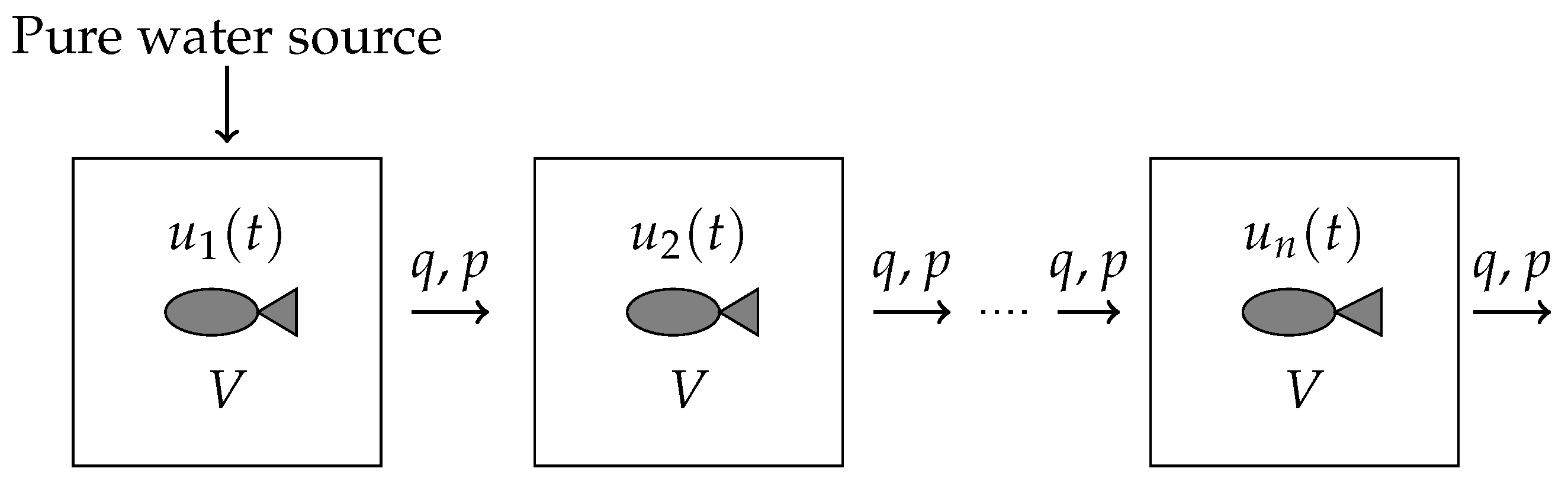
Consider a system of n ponds arranged in sequence, where the first pond receives inflow from a clean water source. Water is transferred successively from the first to the n t h pond at a constant discharge rate [29]. The fish in each pond are assumed to be fed uniformly at a fixed rate. Furthermore, the inflowing water is free of pollutants, and no additional external contaminants enter the system (Figure 1).
We assume that the system consists of n ponds, each with a fixed volume V ,   u i ( t ) , i = 1 , 2 , , n , denotes the pollutant concentration in the i-th pond at time t , pollutants enter the pond at a constant rate p and the volumetric inflow equals the outflow, both occurring at a constant discharge rate q .
Under these assumptions, the mass balance equation for the pollutant concentration in a single pond at time t is given by
u 1 ( t ) = q V u 1 ( t ) + p V .
In every other pond the incoming water is already contaminated due to pollutant accumulation in the previous pond and the equations are
u i ( t ) = p V q V u i ( t ) + q V u i 1 ( t ) , i = 2 , 3 , , n ,
creating the following system of ODEs
u 1 ( t ) = p V q V u 1 ( t ) u 2 ( t ) = p V q V u 2 ( t ) + q V u 1 ( t ) u 3 ( t ) = p V q V u 3 ( t ) + q V u 2 ( t ) u n ( t ) = p V q V u n ( t ) + q V u n 1 ( t ) , t 0 .
Lemma 1.
The steady state u is
u = p q 1 2 n T .
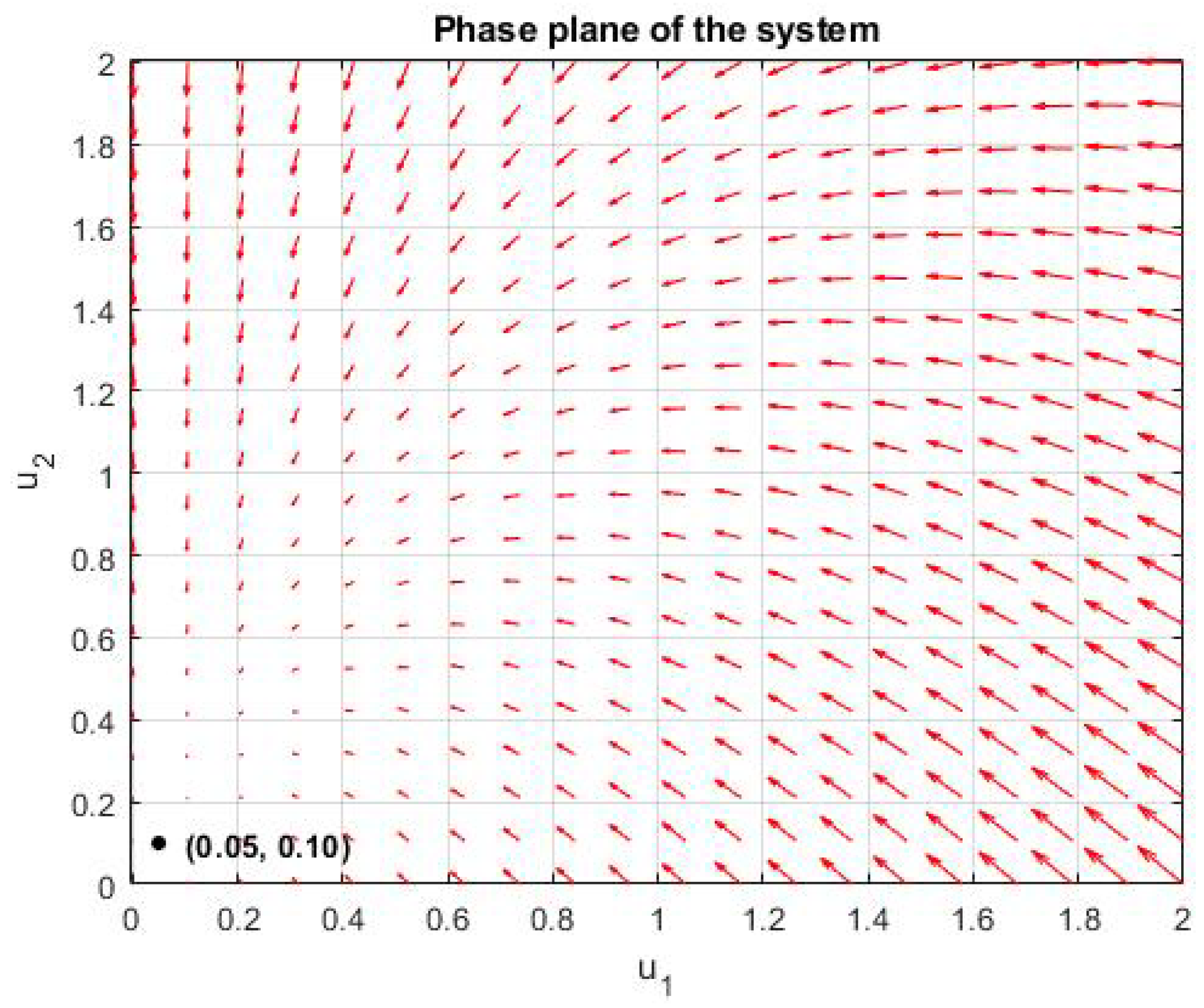
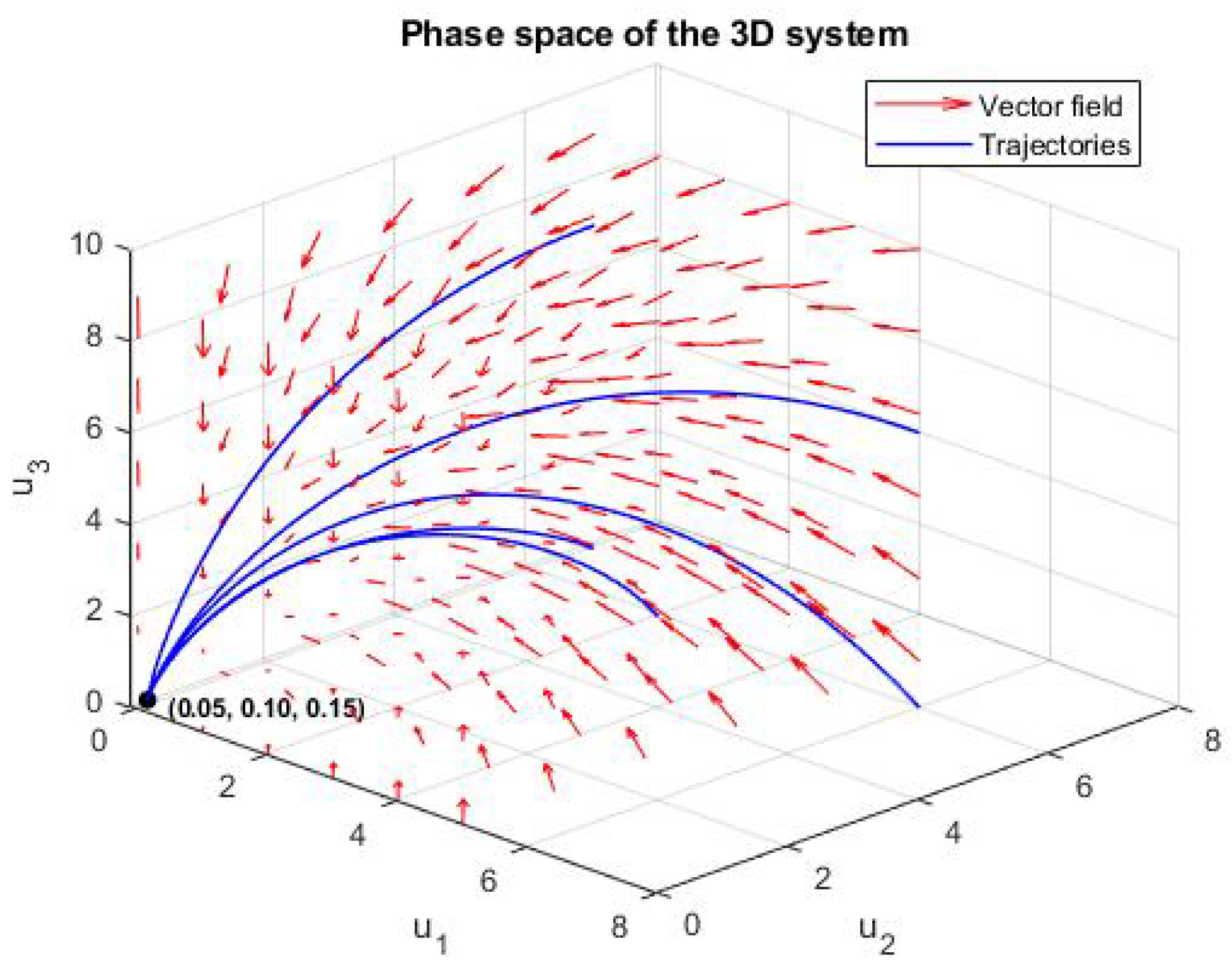
In Figure 2 we draw a phase plane in the case of exactly two ponds, while in Figure 3 a phase space in the case of exactly three ponds.
Theorem 1.
The solution of the system (19) is
u 1 ( t ) = p q + c n e q V t u 2 ( t ) = 2 p q + c n t + c n 1 e q V t u n ( t ) = n p q + i = 1 n c i t i 1 ( i 1 ) ! e q V t .
Proof. 
We rewrite the system (19) in matrix form
u ( t ) = p V 1 n × 1 + A u ( t ) , t 0 ,
where u ( t ) = u 1 ( t ) u 2 ( t ) u 3 ( t ) u n 1 ( t ) u n ( t ) T ,   1 n × 1 is the n × 1 matrix with all elements equal to one,
A = q V S I n ,
and
S = 0 0 0 0 0 0 0 1 0 0 0 0 0 0 0 1 0 0 0 0 0 0 0 0 1 0 0 0 0 0 0 0 1 0 0 0 0 0 0 0 1 0 .
The corresponding homogenous system of (22) is
u 0 ( t ) = A u 0 ( t ) = q V ( S I n ) u 0 ( t ) , t 0 ,
and its solution can be derived by calculating the eigenvalues of the matrix A . Unfortunately, matrix A has one eigenvalue λ = q V with algebraic multiplicity n and geometric multiplicity 1 . Therefore, the calculation of the generalized eigenvectors of A is a necessity. An eigenvector (matrix n × 1 ) of the eigenvalue λ is
U 1 = 0 0 0 0 0 1 T ,
and the generalized eigenvectors are
U 2 = 0 0 0 0 1 0 T , U 3 = 0 0 0 1 0 0 T , U n = 1 0 0 0 0 0 T .
Therefore, for t 0 , the solution of the (25) is
u 0 ( t ) = c 1 U 1 + c 2 U 1 t + U 2 + + c n i = 1 n t n i ( n i ) ! U i e λ t ,
or equivalently
u 0 ( t ) = i = 1 n c i t i 1 ( i 1 ) ! U 1 + i = 2 n c i t i 2 ( i 2 ) ! U 2 + + c n t 0 0 ! U n e λ t ,
where c i , i = 1 , 2 , , n are arbitrary constants.
An obvious partial solution of (22), is
u p ( t ) = p V A 1 1 n × 1 = p q 1 2 3 n 1 n T , t 0 ,
deriving that the solution of the system (22) is u ( t ) = u p ( t ) + u 0 ( t ) , i.e.
u ( t ) = p V A 1 1 n × 1 + i = 1 n c i t i 1 ( i 1 ) ! U 1 + i = 2 n c i t i 2 ( i 2 ) ! U 2 + + c n U n e λ t
or equivalently
u 1 ( t ) = p q + c n e q V t u 2 ( t ) = 2 p q + c n t + c n 1 e q V t u n ( t ) = n p q + i = 1 n c i t i 1 ( i 1 ) ! e q V t .
An alternative proof of Theorem 1 could be obtained, by setting
U * ( t ) = u ( t ) u ,
so system (22) yields
U * ( t ) = A U * ( t ) , t 0 .
Since the n × n matrix A has only one negative eigenvalue with algebraic multiplicity n , the equilibrium point u is globally asymptotically stable. Moreover, matrix A is similar to the single Jordan block
J = λ 1 0 0 0 λ 1 0 0 0 λ 1 0 0 0 λ ,
so it is not diagonalizable, but it exists a matrix P such that
J = P 1 A P ,
where
P = 0 0 0 ( λ ) ( n 1 ) 0 0 ( λ ) ( n 2 ) 0 0 ( λ ) 1 0 0 ( λ ) 0 0 0 0 ,
and
P 1 = 0 0 0 ( λ ) 0 0 0 ( λ ) 1 0 0 ( λ ) n 2 0 0 ( λ ) n 1 0 0 0 .
In the linearized dynamics it is a degenerate/defective stable node and the solutions decay like e q V t multiplied by polynomials of degree up to n 1 , i.e., the solution is:
U * = U 1 * U 2 * U n * T ,
where
U i * = e q V t k 0 + k 1 t + k 2 t 2 + + k i 1 t i 1 , i = 1 , 2 , , n ,
and k i , i = 0 , 1 , , n 1 , are constants which can be calculated from the initial conditions. This qualitative result verify the obtain analytical solution (30), since substituting (20), (35) in (31), we derive
u i ( t ) = i p q + e q V t k 0 + k 1 t + k 2 t 2 + + k i 1 t i 1 , i = 1 , 2 , , n .
Lemma 2.
For the initial condition
u ( 0 ) = u 1 ( 0 ) u 2 ( 0 ) u 3 ( 0 ) u n 1 ( 0 ) u n ( 0 ) T ,
the constants c i obtained in (30) are
c n i + 1 = u i ( 0 ) i p q , i = 1 , 2 , , n .

4. A Fractional Dynamical System

For t 0 , we consider the system
D t a 0 C g 1 ( t ) = p V q V g 1 ( t ) D t a 0 C g 2 ( t ) = p V q V g 2 ( t ) + q V g 1 ( t ) D t a 0 C g n ( t ) = p V q V g n ( t ) + q V g n 1 ( t ) ,
assuming that the fractional derivative ( D t a 0 C ) is the Caputo–Liouville derivative of order a ( 0 , 1 ] and the pollutant concentration in the i-th pond is g i ( t ) , i = 1 , 2 , , n .
Lemma 3.
The steady state g is
g = p q 1 2 n T .
Theorem 2.
The solution of the FDE system (39) is
g ( t ) = M ( t ) g ( 0 ) + p V v ( t ) , t 0 ,
where
M ( t ) = E a q V t a 0 0 q V t a E a ( 1 ) q V t a E a q V t a 0 q V 2 t 2 a 2 ! E a ( 2 ) q V t a q V t a E a ( 1 ) q V t a 0 q V n 1 t ( n 1 ) a ( n 1 ) ! E a ( n 1 ) q V t a q V t a E a ( 1 ) q V t a E a q V t a ,
v ( t ) = t a E a , a + 1 ( 1 ) q V t a q V t 2 a E a , a + 1 ( 1 ) q V t a + t a E a , a + 1 q V t a q V 2 t 3 a 2 ! E a , a + 1 ( 2 ) q V + q V t 2 a 1 ! E a , a + 1 ( 1 ) q V t a + t a E a , a + 1 q V t a t a k = 0 n 1 q V t a k k ! E a , a + 1 ( k ) q V t a .
Proof. 
If g ( t ) = g 1 ( t ) g 2 ( t ) g n ( t ) T , the system (39) becomes
D t a 0 C g ( t ) = p V 1 n × 1 + A g ( t ) ,
where A is defined in (23).
Taking into account (16), the general solution of the system (42) is
g ( t ) = E a q V S I n t a g ( 0 ) + t a E a , a + 1 q V S I n t a p V 1 n × 1 .
Moreover, using the procedure described in [35] and results from Section 3, we derive that
E α ( J t α ) = E α ( λ t α ) t α E α ( 1 ) ( λ t α ) t 2 α E α ( 2 ) ( λ t α ) 2 ! t ( n 1 ) α E α ( n 1 ) ( λ t α ) ( n 1 ) ! E α ( λ t α ) t α E α ( 1 ) ( λ t α ) t ( n 2 ) α E α ( n 2 ) ( λ t α ) ( n 2 ) ! E α ( λ t α ) t α E α ( 1 ) ( λ t α ) E α ( λ t α ) ,
E α , a + 1 ( J t α ) = E α , a + 1 ( λ t α ) t α E α , a + 1 ( 1 ) ( λ t α ) t 2 α E α , a + 1 ( 2 ) ( λ t α ) 2 ! t ( n 1 ) α E α , a + 1 ( n 1 ) ( λ t α ) ( n 1 ) ! E α , a + 1 ( λ t α ) t α E α , a + 1 ( 1 ) ( λ t α ) t ( n 2 ) α E α , a + 1 ( n 2 ) ( λ t α ) ( n 2 ) ! E α , a + 1 ( λ t α ) t α E α , a + 1 ( 1 ) ( λ t α ) E α , a + 1 ( λ t α ) ,
where E α ( k ) ( λ t α ) = d k E α ( z ) d z k z = λ t α ,   E α , a + 1 ( k ) ( λ t α ) = d k E α , a + 1 ( z ) d z k z = λ t α for k = 1 , 2 , , n 1 , and
E a ( A t a ) = E a q V S I n t a = P E a ( J t a ) P 1 ,
E a , a + 1 ( A t a ) = E a , a + 1 q V S I n t a = P E a , a + 1 ( J t a ) P 1 .
Therefore, from the solution of the system (39) given in (43), we present the specific formulas for the pollution function in the first four ponds:
g 1 ( t ) = g 1 ( 0 ) E a q V t a + p V t a E a , a + 1 q V t a ,
g 2 ( t ) = g 2 ( 0 ) E a q V t a + g 1 ( 0 ) q V t a E a ( 1 ) q V t a + p V t a E a , a + 1 q V t a + q V t 2 a E a , a + 1 ( 1 ) q V t a ,
g 3 ( t ) = g 3 ( 0 ) E a q V t a + g 2 ( 0 ) q V t a E a ( 1 ) q V t a + g 1 ( 0 ) q V 2 t 2 a 2 ! E a ( 2 ) q V t a + p V t a E a , a + 1 q V t a + q V t 2 a 1 ! E a , a + 1 ( 1 ) q V t a + q V 2 t 3 a 2 ! E a , a + 1 ( 2 ) q V t a ,
g 4 ( t ) = g 4 ( 0 ) E a q V t a + g 3 ( 0 ) q V t a E a ( 1 ) q V t a + g 2 ( 0 ) q V 2 t 2 a 2 ! E a ( 2 ) q V t a + g 1 ( 0 ) q V 3 t 3 a 3 ! E a ( 3 ) q V t a + p V [ t a E a , a + 1 q V t a + q V t 2 a 1 ! E a , a + 1 ( 1 ) q V t a + q V 2 t 3 a 2 ! E a , a + 1 ( 2 ) q V t a + q V 3 t 4 a 3 ! E a , a + 1 ( 3 ) q V t a ] .
Thus, we conclude that
g n ( t ) = k = 0 n 1 g n k ( 0 ) q V k t a k k ! E a ( k ) q V t a + p V k = 0 n 1 q V k t a ( k + 1 ) k ! E a , a + 1 ( k ) q V t a ,
which is easily proven with mathematical induction.
Therefore,
g ( t ) = M ( t ) g ( 0 ) + p V v ( t ) , t 0 .

5. Discussion

The pollution in n—connected ponds is calculated using an ODE and an FDE dynamical systems. Both solutions are derived by calculating the Jordan canonical form of the employed matrix. The solutions are expressed using exponential, in a direct way in the case of the ODE system and in an indirect way in the case of the FDE system, since the Mittag-Leffler function is practically an exponential. Specifically, when p = 0 the pollution is proportional to a decaying exponential.
Taking into account that
E 1 ( z ) = e z , z E 1 , 2 ( z ) = e z 1 , z C ,
it is easy to verify that the solution given in (52) is identical to the one provided in (29) when a = 1 .
From (52) we conclude that after a long time in the i-th pond the pollution is equal to the ratio i p / q , resulting that:
  • the last pond will be full of pollutants, so the pollution never vanishes,
  • when q 0 the pollution is infinite,
  • when p 0 the pollution is vanishes.
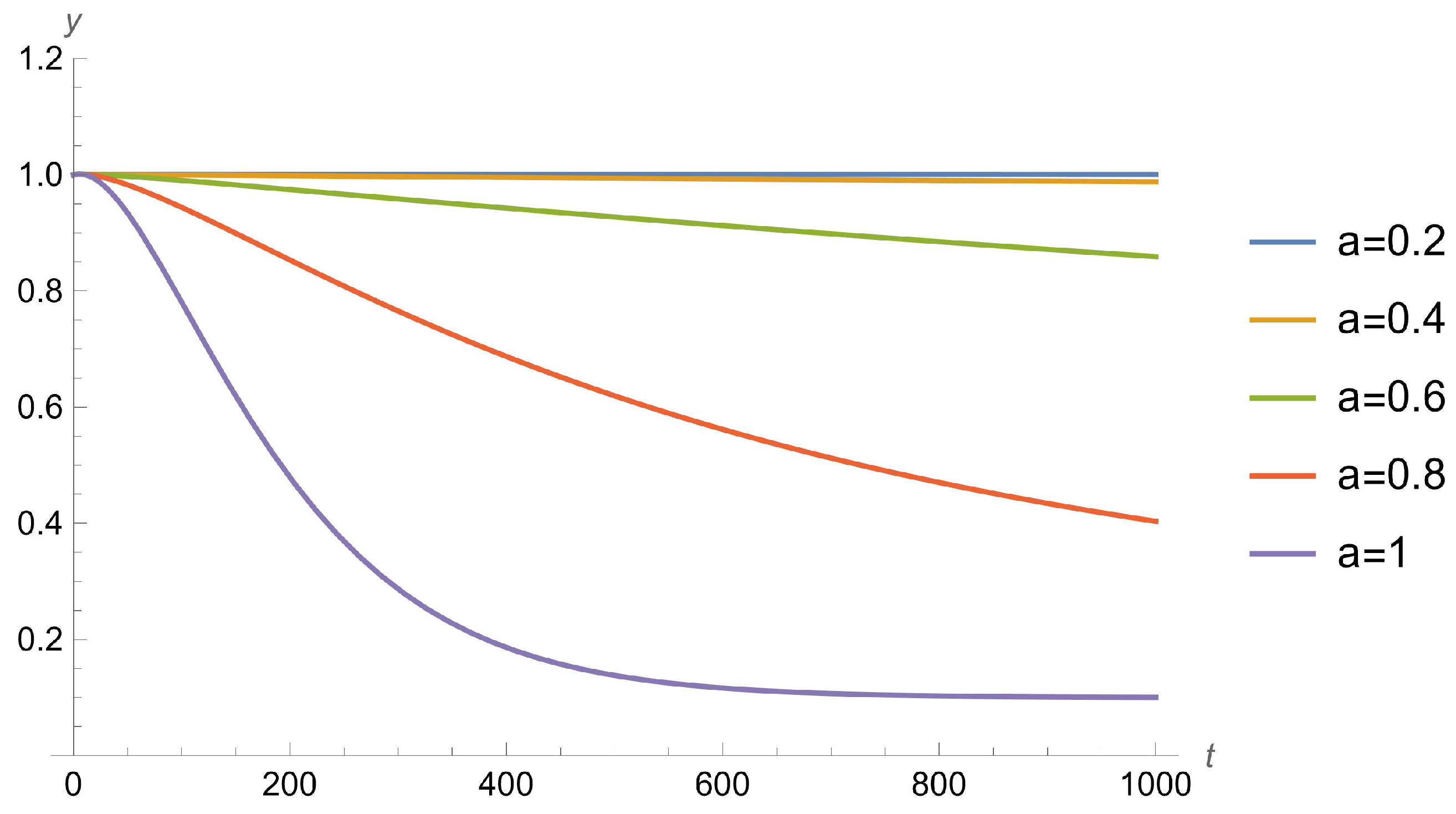
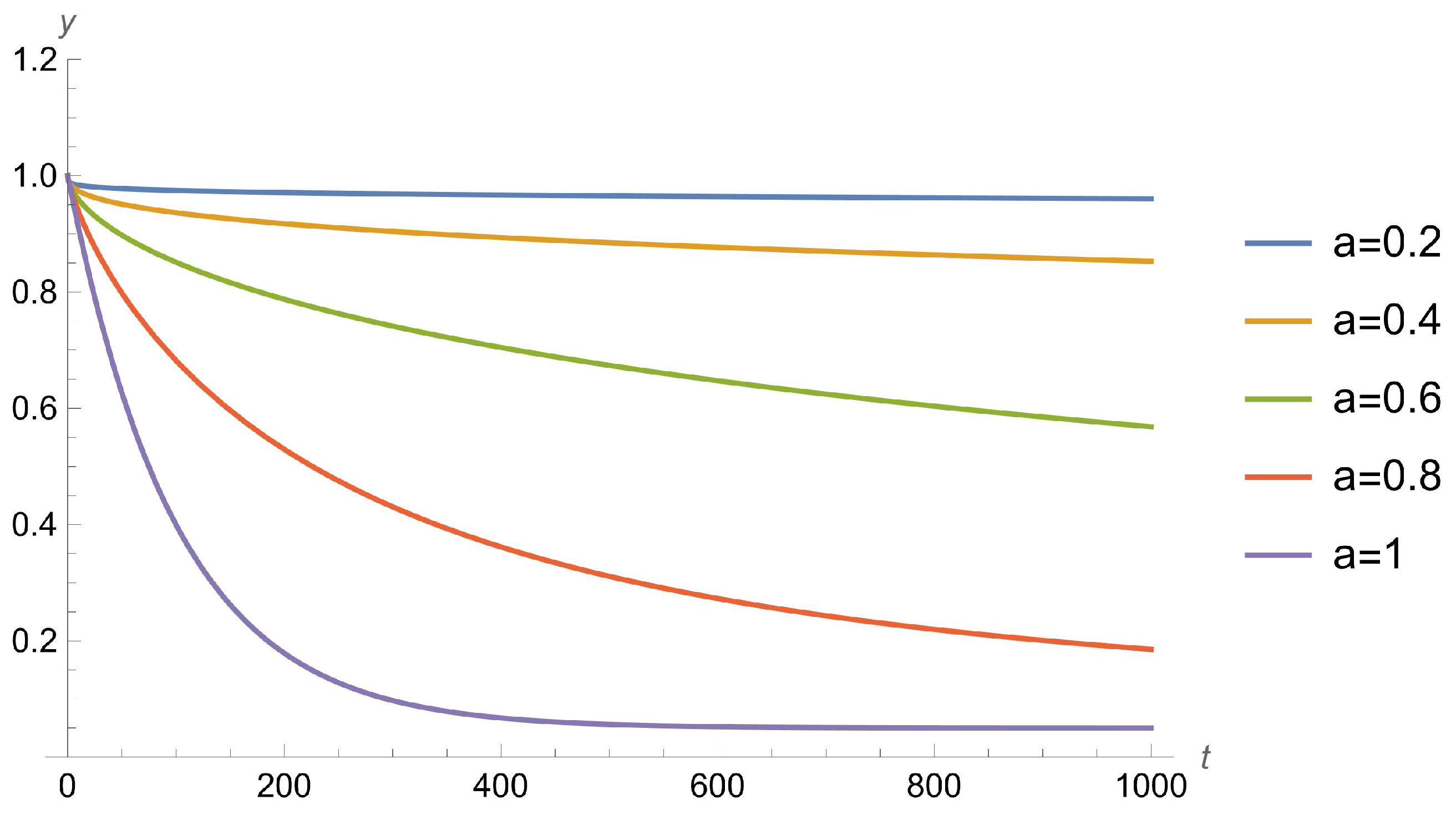
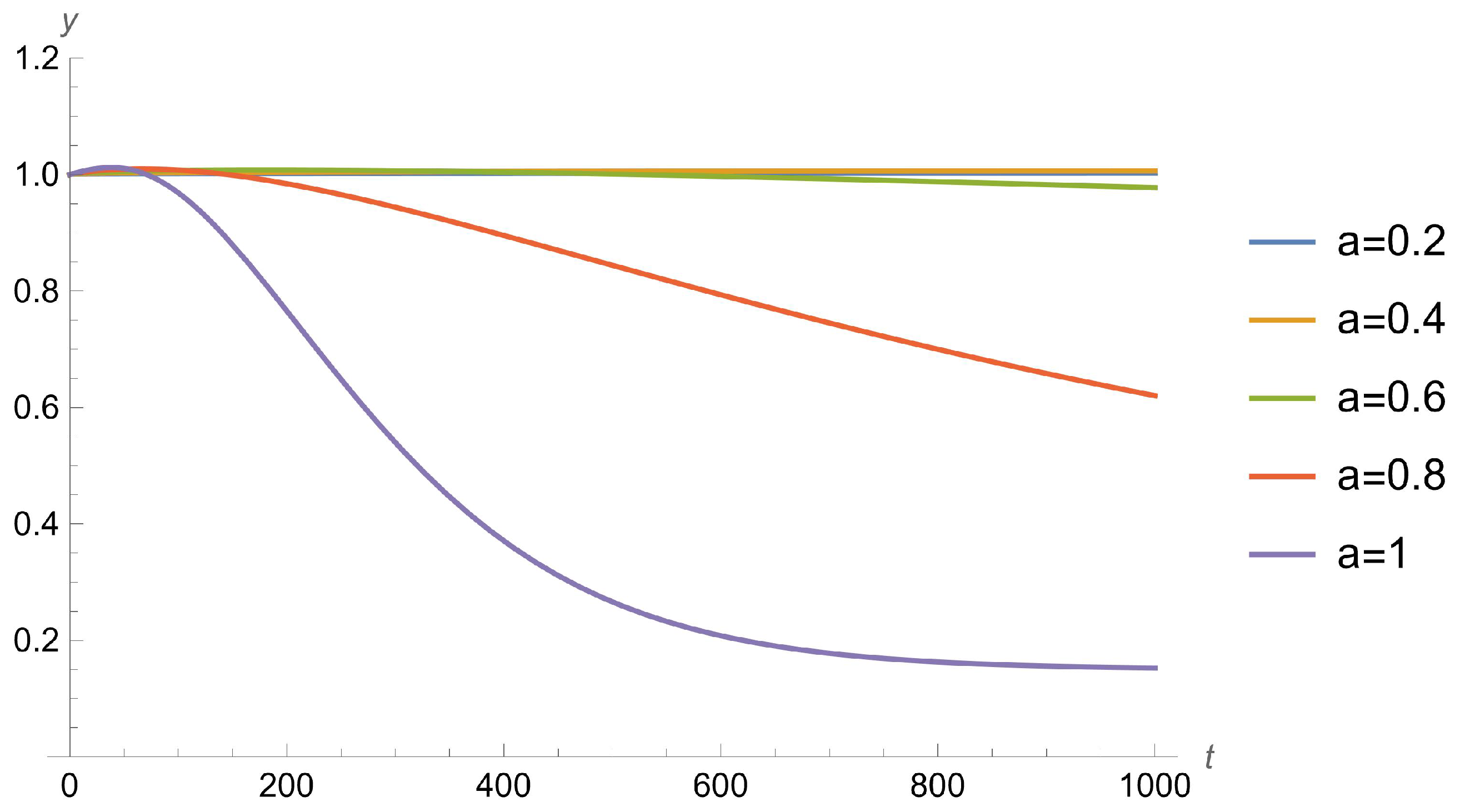
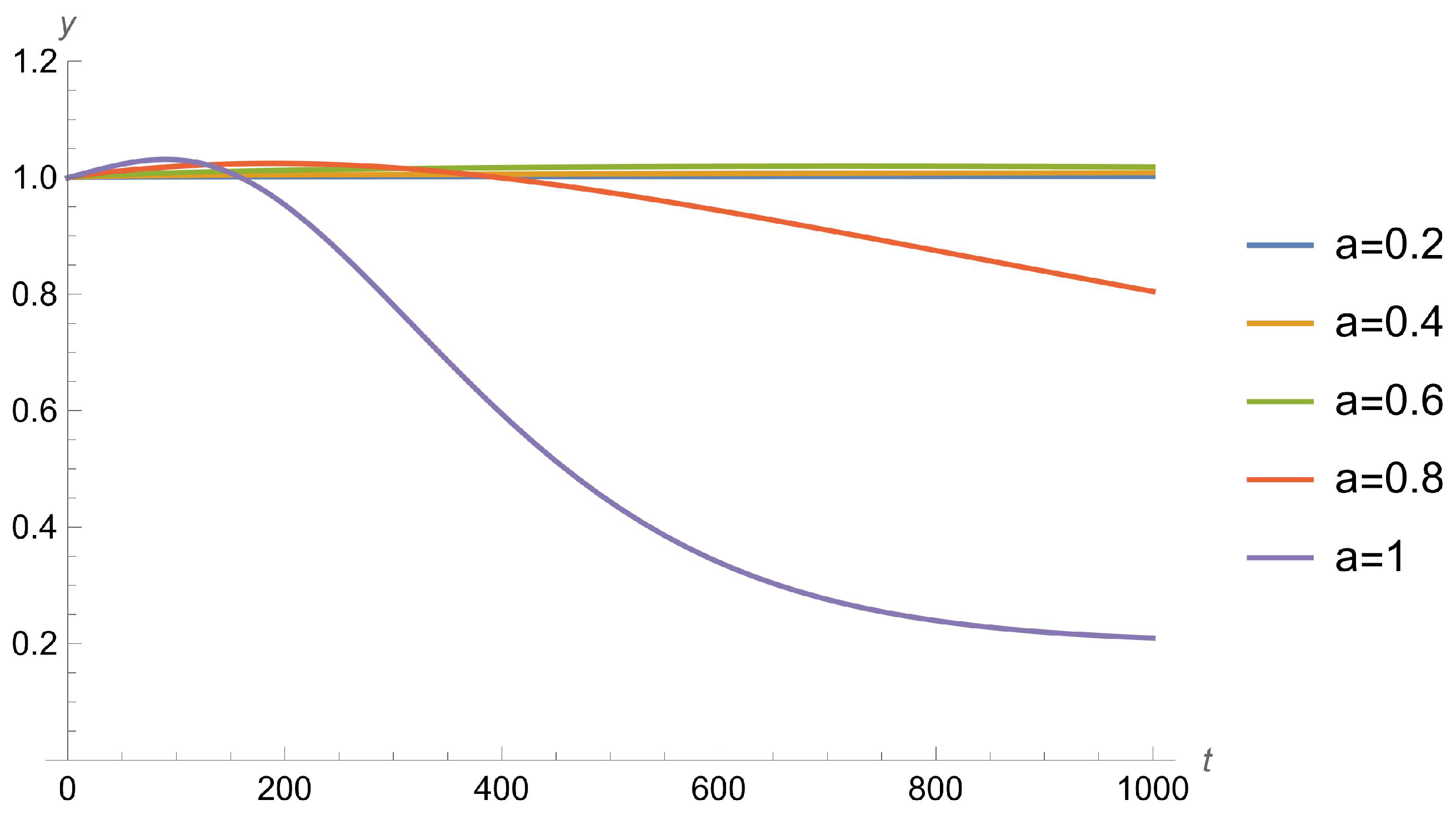
Figure 4, Figure 5, Figure 6 and Figure 7 present the pollution profiles for the i-th pond, derived from the solutions of the FDE systems with α { 0.2 , 0.4 , 0.6 , 0.8 , 1 } , p = 0.1 , q = 2 , and V = 200 for i = 1 , 2 , 3 , 4 . We observe that as the order of the fractional derivative increases, the pollution decreases at a higher rate. In the fourth pond, for the cases α = 0.2 , 0.4 , 0.6 , the pollution remains high; describing that “intermediate” pollution levels require α > 0.7 . This effect becomes more pronounced in subsequent ponds, where the fractional order must be closer to 1 .
The fractional system (39) exhibits several distinctive features that fundamentally distinguish it from its classical integer-order counterpart. These features arise from the interplay between parameter sensitivity, the intrinsic memory of the Caputo fractional derivative, and the role of the fractional order a, and they are all explicitly encoded in the closed-form solution (43) expressed through Mittag–Leffler matrix functions [15,16].
Sensitivity with respect to the input parameter p follows directly from the forcing term in the solution. Differentiation of (43) yields
g ( t ) p = t a V E a , a + 1 q V ( S I n ) t a 1 n × 1 .
This expression shows that the sensitivity grows proportionally to t a , implying sublinear growth for 0 < a < 1 . In contrast to classical compartmental systems, where sensitivity typically evolves exponentially or linearly in time, the fractional model exhibits delayed responsiveness. This attenuation is a direct consequence of fractional dynamics and reflects the stabilizing influence of long-term memory, a phenomenon widely documented in fractional systems theory [18,21].
The sensitivity with respect to the transfer parameter q is more intricate due to its dual role as both a scaling factor and a coefficient inside the matrix argument of the Mittag–Leffler functions. Differentiation with respect to q introduces derivatives of the matrix Mittag–Leffler function, producing terms involving ( S I n ) g ( 0 ) and ( S I n ) 1 n × 1 . Because the shift matrix S is nilpotent, these sensitivities propagate sequentially through the compartment chain, leading to amplified downstream effects while preserving overall stability. This behavior is consistent with known properties of triangular and nilpotent structures in linear fractional systems.
The parameter V acts as a dilution or scaling factor, appearing inversely both outside and inside the matrix argument. Its sensitivity contributions are therefore attenuated quadratically, implying that larger values of V uniformly dampen transient responses and steady-state levels. This interpretation aligns with physical and biological compartmental models, where V often represents volume, carrying capacity, or normalization, and increased capacity weakens the impact of inputs and transfers [15,21].
A defining characteristic of the fractional system is its memory. The Caputo fractional derivative, explicitly depends on the entire past history of the state variable. Consequently, the system evolution at time t is influenced by all previous states, weighted by a power-law kernel. This nonlocality eliminates the Markov property and introduces hereditary effects that cannot be reproduced by integer-order models [15,16]. In the solution (43), memory manifests through the Mittag–Leffler functions, whose series expansions decay algebraically rather than exponentially.
The fractional order, a , plays a central role as a quantitative regulator of memory strength. In the limiting case a = 1 , the Mittag–Leffler functions reduce to matrix exponentials and the system collapses to a classical linear compartmental model with exponential convergence. For 0 < a < 1 , convergence to equilibrium is algebraic, with asymptotic behavior given by
E a ( λ t a ) 1 λ Γ ( 1 a ) t a , t , ( λ ) < 0 ,
as established in the theory of fractional differential equations [15,18]. Smaller values of a therefore correspond to slower decay rates, smoother transients, and stronger persistence of initial conditions. Physically, this reflects environments where transport mechanisms are hindered, intermittent, or history-dependent, and mathematically it provides a continuous interpolation between memoryless and strongly hereditary dynamics [21].
Taken together, these results demonstrate that parameter sensitivity, long-term memory, and asymptotic behavior are inseparable consequences of the fractional structure of the system. The Mittag–Leffler representation not only yields an exact analytical solution but also provides a transparent framework for understanding how parameters and memory interact. This makes fractional systems particularly well suited for modeling non-Markovian processes in physics, biology, and engineering, where classical exponential-relaxation assumptions are no longer valid [18].

6. Conclusions

High-quality water is essential for maintaining healthy fish ponds. Water quality depends on factors such as the source and the flow rate of the water, the volume of the pond, and the pollutants introduced during feeding. This manuscript develops two mathematical models for a network of interconnected ponds with the same constant volume of liquid in each pond. We assume a continuous inflow of clean water into the initial pond, while pollutants are introduced to the system at a constant rate, with fixed discharge rates maintained between the ponds. These dynamics are characterized using both first-order (ODE) and fractional-order (FDE) dynamical systems. While the ODE system is re-evaluated using an alternative methodology, the FDE system represents a novel contribution to the field. Finally, the resulting systems are solved analytically utilizing matrix-based notation.
When pollutants from fish and feed enter the pond continuously; the model shows that the pollutant concentration in the pond accumulates at a rate proportional to the rate of pollutant input, while when no additional pollutants enter the pond, the pollutant concentration in the first pond consistently decreases, while in the subsequent ponds, it initially increases slightly before eventually declining. In the final scenario, where all ponds start in a pure state, the pollutant concentration in each pond exhibits a linear increase from the first pond to the last.
While the current study assumes constant volumes and steady flow rates to establish a fundamental analytical framework, future research will extend these models to account for time-varying parameters. Specifically, we intend to investigate non-homogeneous systems where the liquid volume V i ( t ) , the pollutant entry rate p i ( t ) , and the discharge rates q i , i + 1 ( t ) are treated as dynamic variables. Such an extension will necessitate the use of fractional differential equations with variable coefficients or nonlinear coupling to better simulate stochastic environmental events, such as heavy rainfall or industrial discharge surges. Furthermore, the transition from analytical matrix solutions to advanced numerical schemes will be explored to handle these increased complexities.


Funding

This research received no external funding.

Data Availability Statement

The original contributions presented in this study are included in the article. Further inquiries can be directed to the corresponding author.

Conflicts of Interest

The author declares no conflicts of interest.

Abbreviations

The following abbreviations are used in this manuscript:
ODEOrdinary Differential Equation
FDEFractional Differential Equation
ICInitial Condition

References

  1. World Health Organization. Progress on Household Drinking-Water, Sanitation and Hygiene 2000–2024: Special Focus on Inequalities; WHO/UNICEF Joint Monitoring Programme: Geneva, The Switzerland, 2025. [Google Scholar]
  2. Prüss, A.; Kay, D.; Fewtrell, L.; Bartram, J. Estimating the burden of disease from water, sanitation, and hygiene at a global level. Environ. Health Perspect. 2002, 110, 537–542. [Google Scholar] [CrossRef] [PubMed] [PubMed Central]
  3. UN Water. Summary Progress Update 2021: SDG 6—Water and Sanitation for All; United Nations: Geneva, The Switzerland, 2021. [Google Scholar]
  4. Montgomery, M.A.; Elimelech, M. Water and sanitation in developing countries: Including health in the equation. Environ. Sci. Technol. 2007, 41, 17–24. [Google Scholar] [CrossRef] [PubMed]
  5. Gleick, P.H. The World’s Water Volume 8: The Biennial Report on Freshwater Resources; Island Press: Washington, DC, USA, 2014. [Google Scholar] [CrossRef]
  6. Boyd, C.E.; McNevin, A.A. Aquaculture, Resource Use, and the Enviroment; John Wiley & Sons: Hoboken, NJ, USA, 2015. [Google Scholar] [CrossRef]
  7. Timmons, M.B.; Vinci, B.J. Recirculating Aquaculture; Ithaca Publishing Company: Ithaca, NY, USA, 2022. [Google Scholar]
  8. Colt, J. Water quality requirements for reuse systems. Aquac. Eng. 2006, 34, 143–156. [Google Scholar] [CrossRef]
  9. Simbeye, D.S.; Zhao, J.; Yang, S. Design and deployment of wireless sensor networks for aquaculture monitoring and control based on virtual instruments. Comput. Electron. Agric. 2014, 102, 31–42. [Google Scholar] [CrossRef]
  10. Hongpin, L.; Guanglin, L.; Weifeng, P.; Jie, S.; Qiuwei, B. Real-time remote monitoring system for aquaculture water quality. Int. J. Agric. Biol. Eng. 2015, 8, 136–143. [Google Scholar] [CrossRef]
  11. Strogatz, S.H. Nonlinear Dynamics and Chaos; CRC Press: Boca Raton, FL, USA, 2018. [Google Scholar]
  12. Murray, J.D. Mathematical Biology I: An Introduction; Springer: Berlin/Heidelberg, Germany, 2002. [Google Scholar]
  13. Hirsch, M.W.; Smale, S.; Devaney, R.L. Differential Equations, Dynamical Systems, and an Introduction to Chaos; Elsevier: Amsterdam, The Netherlands, 2013. [Google Scholar]
  14. Khalil, H.K. Nonlinear Systems, 3rd ed.; Prentice Hall: Englewood Cliffs, NJ, USA, 2002. [Google Scholar]
  15. Podlubny, I. Fractional Differential Equations; Academic Press: Warsaw, Poland, 1999. [Google Scholar]
  16. Kilbas, A.A.; Srivastava, H.M.; Trujillo, J.J. Theory and Applications of Fractional Differential Equations; Elsevier: Amsterdam, The Netherlands, 2006. [Google Scholar]
  17. Magin, R.L. Fractional Calculus in Bioengineering. Crit. Rev. Biomed. Eng. 2004, 32, 1–104. [Google Scholar] [CrossRef] [PubMed]
  18. Mainardi, F. Fractional Calculus and Waves in Linear Viscoelasticity. An Indroduction to Mathematical Models; Imperial College Press: London, UK, 2010. [Google Scholar] [CrossRef]
  19. Machado, J.A.T.; Jesus, S.I.; Barbosa, R.; Silva, F.M.; Reis, S. Application of Fractional Calculus in Engineering Sciences. In Dynamics, Games and Science I: DYNA 2008, in Honor of Maurício Peixoto and David Rand, University of Minho, Braga, Portugal, 8–12 September 2008; Springer: Berlin/Heidelberg, Germany, 2011; Volume 1. [Google Scholar] [CrossRef]
  20. Herrmann, R. Fractional Calculus: An Introduction for Physicists; World Scientific Publishing: Singapore, 2014. [Google Scholar] [CrossRef]
  21. Diethelm, K. The Analysis of Fractional Differential Equations; Springer: Berlin/Heidelberg, Germany, 2010. [Google Scholar]
  22. Baleanu, D.; Diethelm, K.; Scalas, E.; Trujillo, J.J. Fractional Calculus: Models and Numerical Methods; World Scientific: Singapore, 2012. [Google Scholar] [CrossRef]
  23. Hilfer, R. (Ed.) Applications of Fractional Calculus in Physics; World Scientific Publishing: Singapore, 2000. [Google Scholar] [CrossRef]
  24. Sabatier, J.; Agrawal, O.P.; Tenreiro Machado, J.A. (Eds.) Advances in Fractional Calculus; Springer: Berlin/Heidelberg, Germany, 2007. [Google Scholar]
  25. Tarasov, V.E. Fractional Dynamics: Applications of Fractional Calculus to Dynamics of Particles, Fields and Media; Springer Nature: Berlin/Heidelberg, Germany, 2011. [Google Scholar]
  26. Vatsala, A.S.; Pageni, G. Generalized Quasilinearization Method for Caputo Fractional Differential Equations with Initial Conditions with Applications. Foundations 2024, 4, 345–361. [Google Scholar] [CrossRef]
  27. Ntouyas, S.K. Recent Advances in Fractional Differential Equations and Inclusions. Foundations 2023, 3, 335–339. [Google Scholar] [CrossRef]
  28. Ntouyas, S.K. A Survey on Existence Results for Boundary Value Problems of Hilfer Fractional Differential Equations and Inclusions. Foundations 2021, 1, 63–98. [Google Scholar] [CrossRef]
  29. Ahmad, D.; Tasman, F.; Anzira, A. A Simple Mathematical Model of Pollutant Transfers on Ponds with Single Water Source. In Proceedings of the International Conference on Mathematics and Mathematics Education, Padang City, Indonesia, 3 August 2019; Journal of Physics: Conference Series; IOP Publishing: Bristol, UK, 2020; Volume 1554, p. 012058. [Google Scholar] [CrossRef]
  30. Boyce, W.E.; DiPrima, R.C. Elementary Differential Equations and Boundary Value Problems; Wiley: Hoboken, NJ, USA, 1992. [Google Scholar]
  31. Oldham, K.B.; Spanier, J. The Fractional Calculus: Theory and Applications of Differentiation and Integration to Arbitrary Order; Academic Press: Warsaw, Poland, 1974. [Google Scholar]
  32. Wang, Z.X.; Guo, R.D. Special Functions; World Scientific: Singapore, 1989. [Google Scholar]
  33. Haubold, H.J.; Mathai, A.M.; Saxena, R.K. Mittag-Leffler Functions and Their Applications. J. Appl. Math. 2011, 2011, 298628. [Google Scholar] [CrossRef]
  34. Garra, R.; Garrappa, R. The Prabhakar or three parameter Mittag–Leffler function: Theory and application. Commun. Nonlinear Sci. Numer. Simul. 2018, 56, 314–329. [Google Scholar] [CrossRef]
  35. Duan, J.; Chen, L. Solution of Fractional Differential Equation Systems and Computation of Matrix Mittag–Leffler Functions. Symmetry 2018, 10, 503. [Google Scholar] [CrossRef]
Figure 1. A system of n ponds is considered, each with a fixed volume V and pollutant concentration u i ( t ) for i = 1 , 2 , , n . Water is discharged from each pond at a constant rate q, while pollutants enter at a uniform rate p.
Foundations 06 00010 g001
Figure 2. The phase plane for the functions u 1 ( t ) , u 2 ( t ) , t 0 for p = 0.1 ,   q = 2 ,   V = 200 , with the equilibrium point.
Foundations 06 00010 g002
Figure 3. The phase space for the functions u 1 ( t ) , u 2 ( t ) , u 3 ( t ) , t 0 for p = 0.1 ,   q = 2 ,   V = 200 , with the equilibrium point.
Foundations 06 00010 g003
Figure 4. Function g 1 ( t ) , for p = 0.1 ,   q = 2 ,   V = 200 ,   g 1 ( 0 ) = 1 and a = 0.2 , 0.4 , 0.6 , 0.8 , 1 . .
Foundations 06 00010 g004
Figure 5. Function g 2 ( t ) , for p = 0.1 ,   q = 2 ,   V = 200 ,   g 1 ( 0 ) = 1 ,   g 2 ( 0 ) = 1 and a = 0.2 , 0.4 , 0.6 , 0.8 , 1 . .
Foundations 06 00010 g005
Figure 6. Function g 3 ( t ) , for p = 0.1 ,   q = 2 ,   V = 200 ,   g 1 ( 0 ) = 1 ,   g 2 ( 0 ) = 1 ,   g 3 ( 0 ) = 1 and a = 0.2 , 0.4 , 0.6 , 0.8 , 1 . .
Foundations 06 00010 g006
Figure 7. Function g 4 ( t ) , for p = 0.1 ,   q = 2 ,   V = 200 ,   g 1 ( 0 ) = 1 ,   g 2 ( 0 ) = 1 ,   g 3 ( 0 ) = 1 ,   g 4 ( 0 ) = 1 and a = 0.2 , 0.4 , 0.6 , 0.8 , 1 . .
Foundations 06 00010 g007
Disclaimer/Publisher’s Note: The statements, opinions and data contained in all publications are solely those of the individual author(s) and contributor(s) and not of MDPI and/or the editor(s). MDPI and/or the editor(s) disclaim responsibility for any injury to people or property resulting from any ideas, methods, instructions or products referred to in the content.