1. Introduction
Mild Cognitive Impairment (MCI) affects 15–20% of adults aged 65 and older [
1,
2]. Sleep disturbances, particularly insomnia, affect 40–60% of individuals with MCI and are linked to worsening cognitive and physical function, neuropsychiatric symptoms, and reduced quality of life [
3,
4,
5,
6]. These findings underscore the importance of addressing sleep problems in this population to promote well-being and potentially slow cognitive decline.
Cognitive Behavioral Therapy for Insomnia (CBT-I) is the first-line, evidence-based treatment for insomnia across age groups due to its safety and effectiveness, particularly when compared to pharmacological approaches that carry greater risk for older adults [
7,
8,
9]. Internet-based CBT-I has demonstrated comparable outcomes to in-person delivery while offering benefits such as reduced clinician time, lower cost, and high adherence rates [
10,
11,
12]. However, few studies have tailored CBT-I for individuals with co-morbid MCI, despite their unique cognitive challenges and need for scalable solutions.
Emerging evidence suggests that simple modifications to standard CBT-I (e.g., slower pacing, increased repetition, and use of structured prompts) can improve retention and engagement in individuals with MCI and co-morbid insomnia [
13,
14,
15]. Digital platforms incorporating cognitive assistive features, such as smart messaging (e.g., reminder and educational messages), may further enhance accessibility and adherence in this population [
16,
17].
This Phase I study developed and tested Slumber, a provider-supported mobile CBT-I app tailored for older adults with MCI. Specifically, the study aimed to: (1) develop the Slumber app; (2) evaluate its usability and refine cognitive support features; and (3) assess the feasibility of administering standardized outcome measures over a 6-week pilot trial and explore whether early change trends could inform outcome selection for a future trial.
2. Methods
2.1. The Slumber Software Platform
We developed a prototype of the
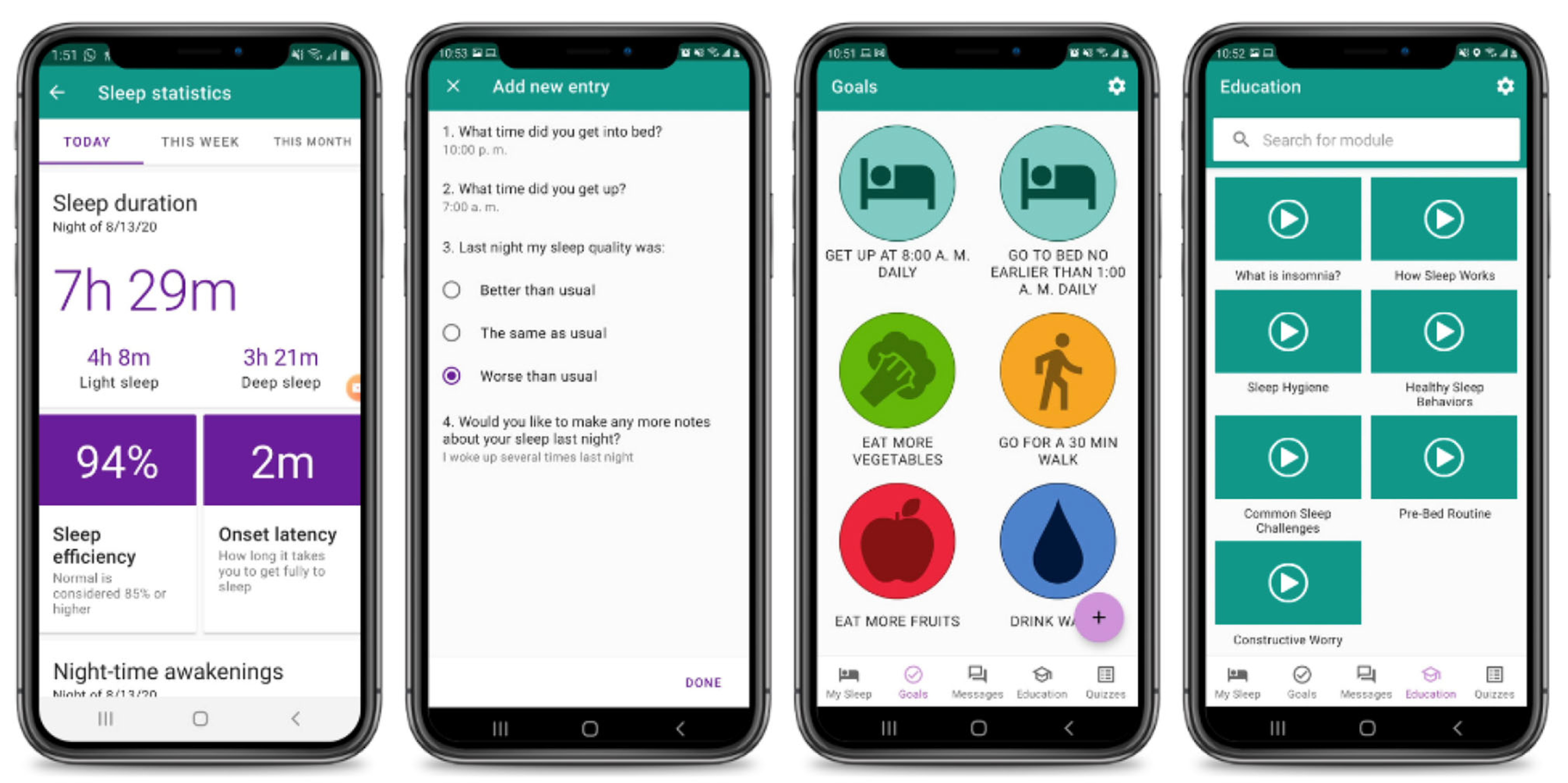
Slumber app for Android. Using Android enables both rapid iteration based on feedback and inclusive recruitment of a socio-economically diverse pilot cohort. The app was designed for end-users (patients) (see
Figure 1), paired with a web-based portal for clinicians to monitor patient engagement. The Slumber app includes six training modules adapted from evidence-based CBT-I trials aimed at improving sleep in older adults with Mild Cognitive Impairment (MCI) [
13,
14]. These CBT-I modules cover core topics including sleep education (e.g., the sleep drive and circadian rhythms), sleep hygiene (e.g., optimizing the bedroom environment and limiting daytime napping), sleep scheduling, stimulus control, managing worry and relaxation, and relapse prevention. Each of the six original CBT-I modules was approximately 30 min long, totaling about 180 min of content; these were subsequently adapted into shorter segments to accommodate the cognitive needs of individuals with MCI.
A complementary, basic web portal was also provided for clinicians to monitor patient engagement. The portal’s functionality at this pilot stage was limited to displaying patient engagement metrics (e.g., app logins) that were identical to the data visible to patients. Consequently, the role of the study clinician was limited to proactive monitoring of participant engagement, with support provided to patients via telephone in response to participant questions or a noted lack of activity. A formal usability assessment of the provider portal was not conducted as part of this pilot study, which focused on the feasibility and acceptability of the patient-facing app.
In addition to the training modules, the Slumber app includes a range of supportive features to enhance usability and engagement. These include: a real-time sleep tracking function; daily sleep analysis with visual feedback; automated reminder notifications; and a structured sleep diary for self-monitoring. Together, these features aim to support behavioral change and improve adherence to CBT-I strategies.
2.2. Modifications for Individuals with MCI
To accommodate the cognitive needs of individuals with MCI, we made several modifications to standard CBT-I. These modifications include (a) reducing the amount of information presented in each session by dividing the original ~30 min modules into shorter segments of approximately 5–8 min each, with multiple segments composing each module, (b) increasing repetition of key content to reinforce learning, (c) slowing the overall pace of video presentations to improve comprehension, and (d) incorporating automated smart messaging prompts for reminders and support. We also included an introductory module at the beginning of the program. This module guides users through app usage, phone setup, and actigraphy monitoring instructions.
The Slumber app also leverages smart messaging prompts as a cognitive assistive tool, reminding users to engage with daily tasks, resume unfinished courses, and maintain consistent participation. By integrating evidence-based CBT-I with adaptive cognitive support, the Slumber app aims to empower individuals with MCI and co-morbid insomnia to manage their sleep disturbance effectively and improve their overall well-being.
2.3. Formative Evaluation
We conducted a formative evaluation of the Slumber prototype, which included both the web platform/portal for clinicians and the patient app. The evaluation involved 12 participants—4 healthcare providers and 8 patients. All participating patients were diagnosed with Mild Cognitive Impairment (MCI) within approximately three months prior to enrollment at the Stanford Geriatric Psychiatry Outpatient Clinic and owned Android-based smartphones or tablets. The full participant inclusion criteria and recruitment process are detailed in the Feasibility Assessment section below.
The usability testing followed a structured process. First, researchers introduced the Slumber app and demonstrated its features. Next, they guided each participant through a set of predetermined activities. Finally, participants were encouraged to explore the app independently, completing tasks such as checking sleep data and viewing a video clip from the course using the app.
Patient feedback, collected through semi-structured interviews, focused on the usability (e.g., navigation and task completion), perceived quality of the content and motivational messaging, and overall user experience of features of goal-setting, customization, and clinician communication. Providers’ feedback, gathered during a focus group meeting, highlighted the need to improve the clarity of sleep analysis charts, incorporate goal-based incentives, and streamline integration with clinical workflows.
Given the early-stage nature of this Phase I study and the cognitive challenges of the target population, we prioritized qualitative feedback over standardized usability scales. This approach enabled us to gather deeper insights into participants’ comprehension, engagement, and perceived value of the app—dimensions that numeric scores alone might overlook. The feedback guided iterative refinements in both content and interface design.
In addition to refining the app based on user feedback, we also sought to assess whether participants with MCI could complete structured clinical outcome measures, and whether any measures demonstrated preliminary responsiveness to the intervention. This led to the second component of the pilot: evaluating the feasibility of outcome assessment and detecting potential signals of change.
2.4. Feasibility of Outcome Assessment
We also explored the feasibility of administering a battery of standardized outcome measures as part of a future clinical trial (Phase II). These included sleep quality, physical function, cognitive functioning, and daytime sleepiness. While the study was not powered to detect statistically significant changes, we collected and analyzed these outcomes to assess participants’ ability to complete the measures and to detect preliminary signals of change that may guide the selection of primary and secondary outcomes in future trials.
2.4.1. Participants
Participants were recruited through User Interview, an online research recruitment platform. Eligible individuals, who were older adults with self-reported sleep problems and cognitive impairment, provided written consent directly through the platform before completing a self-administered screening questionnaire to confirm their eligibility for the study.
Inclusion Criteria. To qualify, participants had to meet all of the following: (1) age 65 years or older; (2) Eight-item Informant Interview to Differentiate Aging and Dementia (AD8) score ≥ 2 [
18], consistent with screening criteria for MCI; (3) Instrumental Activities of Daily Living Scale (IADL) score ≥ 6 [
19], confirming functional independence consistent with MCI; (4) Insomnia Severity Index (ISI) score ≥ 10 [
20], with symptoms of insomnia (e.g., difficulty initiating or maintaining sleep) lasting at least one month, (DSM-V criteria; APA, 2013); and (5) ownership of, or access to, a smartphone or tablet.
Exclusion Criteria. Participants were excluded if they reported a clinical diagnosis of dementia, other sleep disorders (e.g., sleep apnea, REM Behavior Disorder, Restless Legs Syndrome), a major psychiatric disorder (e.g., bipolar disorder, psychosis, active substance use disorder, severe major depression, or suicidal ideation within the past six months), or a severe or acute medical illness (e.g., metastatic cancer) or were currently undergoing non-pharmacological treatment for insomnia.
2.4.2. Procedure
The participants were asked to use the Slumber app at their own pace during the first two weeks of the 6-week trial, while receiving smart messaging prompts (i.e., automated reminder messages designed to support engagement and memory). The app included six modules covering the following topics: Module (1) Introduction to sleep regulation, age-related changes in sleep, sleep hygiene, and an overview of the program; Module (2) Review of previous material and guidelines for behavioral sleep scheduling or sleep compression (a CBT-I strategy that gradually reduces time in bed to consolidate sleep) and stimulus control (techniques to strengthen the bed–sleep association); Module (3) Constructive worry and introduction to diaphragmatic breathing (a relaxation technique involving deep abdominal breathing); Module (4) Introduction to progressive muscle relaxation (a technique that involves sequentially tensing and relaxing muscle groups); Module (5) Introduction to visualization (mental imagery to promote relaxation and readiness for sleep); and Module (6) Review of CBT-I components and relapse prevention strategies.
In addition to the CBT-I learning modules, participants received a Withings wristwatch that automatically recorded objective sleep data, including sleep onset latency (SL) (the time it takes to fall asleep), wakefulness after sleep onset (WASO) (the total time awake after initially falling asleep), total sleep time (TST), and heart rate. Participants also wore Actigraph3x devices (produced by Actigraph Corporation, Pensacola, FL, USA), which collected continuous physical activity and sleep/wake estimates using an accelerometer and light sensor. These devices were worn on the non-dominant wrist for the full 6-week intervention period.
During the first week after the baseline assessment, the research assistant (RA) contacted each participant to ensure they could access the Slumber app and use the wristwatch. During Weeks 2–4, the RA provided technical support via phone or email. For clinical issues, the RA referred participants to the study clinician for consultation. In Week 5, participants received a reminder via phone or email to schedule an interview for the follow-up assessment.
Qualitative Data Collection and Analysis. At the end of the 6-week trial, study staff conducted semi-structured interviews to gather participant feedback on their experience with the Slumber app. The interview guide focused broadly on usability, including perceptions of usefulness, ease of use, relevance to users’ needs, and any burdens associated with app use. Participants were asked questions such as, “Which features did you find most useful?”, “Which features did you find most difficult to use?”, “What aspects addressed your specific needs?”, and “What did you find burdensome about using the app?” They were also invited to provide suggestions to improve the app’s design and functionality.
The qualitative data collected from semi-structured interviews with participants were analyzed using thematic analysis following Braun & Clarke’s six-phase approach [
21]. Initial codes were generated deductively, guided by the questions in the interview guide, while remaining open to inductive coding as patterns emerged from the data. Codes were grouped into higher-order categories to identify and refine overarching themes. Illustrative quotes were selected to support the identified themes and ensure alignment with the initial research questions outlined in the interview guide.
Quantitative Data Collection and Analysis. Although the study was not powered to evaluate treatment efficacy, we conducted a pre-post assessment to explore whether any outcome measures demonstrated promising signals of change. This exploratory analysis was intended to inform the selection of primary and secondary outcomes in a future randomized trial. Participants were assessed at baseline and again at 6-week post-intervention. All assessments were conducted by a researcher via structured online interviews. The outcome measures included: (a) subjective sleep quality, assessed using the Insomnia Severity Index (ISI) [
20]; (b) physical function, measured with the Instrumental Activities of Daily Living (IADL) scale [
19]; (c) cognitive function, assessed with the 8-item Aging and Dementia Questionnaire (AD8) [
18]; and (d) daytime sleepiness, measured by the Epworth Sleepiness Scale (ESS) [
22].
Quantitative data were analyzed using the online version of SPSS 29. Given the small sample size and the pre-post study design, paired t-tests were conducted to examine differences between baseline and post-intervention measures. Normality was assessed via visual inspection (histograms and Q-Q plots) and the Shapiro–Wilk test, with results indicating approximate normality. A few missing values were observed in two of the six variables and were addressed using mean imputation. Given the exploratory nature, no adjustment for multiple comparisons was applied. Statistical significance was defined as p < 0.05.
3. Results
3.1. Descriptive Statistics
Out of 174 interested candidates who responded to the study announcement on the Userinterviews website, 19 eligible participants consented to participate. The participants ranged in age from 69 to 76 years, and 10 out of 19 participants were female. Regarding educational background, 41% had some college education, while 59% held an undergraduate or postgraduate degree. The sample was predominantly White (75%), with 10% identifying as Hispanic or Latino, and 15% African American. Most participants used Android smartphones, and one reported using both Android and iOS devices. One participant experienced difficulty setting up the Withings wristwatch and received technical support from the research team.
All participants reported clinically significant sleep disturbances, as indicated by their scores on the insomnia index (ISI; M = 14.31, SD = 2.68). Additionally, all participants met the study’s cognitive impairment criteria, with AD8 scores of 2 or greater. As this was a pilot study, no formal statistical power calculations were conducted to determine the sample size.
3.2. Qualitative Results—User Feedback
The qualitative analysis of user feedback on the Slumber app revealed several noteworthy insights regarding its usability, benefits, and areas for improvement (see
Table 1). Overall, participants expressed strong approval of the app’s core features, particularly its
tracking function,
sleep analysis, and
reminder notifications. Users valued the
sleep tracking feature for its ability to increase their awareness and encourage better sleep habits, as well as the
sleep analysis function, which provided a visual summary of their sleep patterns and quality. Additionally, the weekly motivational reminders received positive comments for promoting regular use of the app.
Challenges: Some participants, however, reported challenges they experienced when trying to understand and interpret the sleep analysis charts and expressed doubts about the accuracy of the tracking watch, citing inconsistencies between their perceived and recorded sleep states.
Benefits: In terms of perceived benefits, users highlighted the educational aspects of the app, emphasizing its role in making them more conscious of their sleep habits through features such as the sleep diary. They also found the tracking of sleep duration and introductory video module to be beneficial for better self-monitoring.
Burdens: Regarding burdens, the primary concerns included technical issues with tracking (e.g., failure to record data on some occasions), and discomfort with wearing the watch to bed. However, several participants mentioned that the sleep diary was not time-consuming and was not perceived as a burden.
Suggestions: Participants offered several suggestions for improvement, including a more detailed user manual, more frequent contact with the research team, and enhancements to the watch’s functionality, thus allowing it to operate without needing to remain in close proximity to the phone. One user also recommended adding automatic blood pressure monitoring, noting it could further enhance the app’s usefulness.
Overall, while the Slumber app’s core functions were well-received, technical refinements and improved user support could further enhance user experience and adoption.
3.3. Measurement Feasibility and Exploratory Signals of Change
Among the 19 participants, outcome data were successfully collected across all selected domains, demonstrating the feasibility of administering a multi-domain assessment battery in this population. A significant improvement in insomnia severity (ISI) was observed over 6 weeks (
p = 0.013), suggesting potential responsiveness of this measure to the intervention. Other outcomes, including cognitive function (AD8), functional status (IADL), and daytime sleepiness (ESS), showed positive trends but were not statistically significant, likely due to the small sample size and short duration (see
Table 2). These exploratory findings provide preliminary signals of responsiveness and will inform outcome selection and power calculations for the planned Phase II trial.
Physical functioning (IADL) showed a non-significant trend toward improvement (mean difference = 0.19; p = 0.08). While this change does not meet conventional thresholds for statistical significance, the directionality of the effect suggests potential sensitivity of this measure to intervention-related change, which should be explored in future studies with greater statistical power.
Taken together, these findings demonstrate that participants with MCI were able to use the Slumber app with minimal support, provide meaningful feedback, and complete a structured assessment battery. Although statistical power was limited, the significant reduction in insomnia severity and favorable usability responses suggest that the app is both engaging and potentially impactful. These findings inform several important considerations for future development and evaluation, as discussed below.
4. Discussion
This Phase I pilot study developed and evaluated the usability and measurement feasibility of Slumber, a provider-supported, technology-enabled Cognitive Behavioral Therapy for Insomnia (CBT-I) intervention tailored for older adults with Mild Cognitive Impairment (MCI) and co-morbid insomnia. Findings suggest that Slumber is usable and acceptable, and that older adults with MCI can complete standardized assessments via online interviews. These results support the feasibility of using Slumber in future clinical trials and offer early signals to guide further development.
Although not powered to evaluate treatment efficacy, we conducted a pre-post assessment to explore whether any outcome measures demonstrated change trends. We found a statistically significant reduction in insomnia severity, along with positive—though non-significant—trends in cognitive and functional domains. These findings highlight the ISI’s preliminary responsiveness to intervention and support its use as a primary outcome in future trials. More broadly, the high completion rate and participant engagement across all outcome domains reinforce the feasibility of integrating multi-domain assessments in a larger, more definitive study.
The dissociation between improved insomnia severity and unchanged cognitive and functional outcomes highlights the importance of distinguishing proximal sleep-related benefits from more distal outcomes such as cognition and daily functioning. Future studies with larger samples and longer follow-up will be needed to determine whether improvements in sleep serve as a necessary but not sufficient condition for broader quality-of-life gains in this population.
Our results align with a growing body of evidence supporting the use of internet-based CBT-I in older adult populations, which has shown comparable benefits to in-person delivery with the added advantages of lower cost and reduced clinician time [
10,
11,
12]. Importantly, this study contributes novel findings focusing on digital CBT-I intervention specifically adapted for individuals with co-morbid MCI–an understudied group in technology-assisted insomnia treatment. Features such as slowed pacing, increased repetition, and smart messaging prompts were designed to accommodate cognitive limitations, consistent with prior research suggesting that tailored modifications can enhance retention and engagement [
13,
16,
17].
Qualitative feedback further enriched our understanding of the app’s usability. Participants expressed appreciation for the educational modules, tracking features, and motivational reminders, but also reported challenges interpreting sleep analysis charts and synchronizing the health watch with the app. These insights underscore the need for enhanced technical support, clearer visualizations, and more robust hardware integration to improve user experience.
Another notable finding was that participants successfully engaged with the intervention and outcome assessments with only minimal support—limited mainly to initial technical assistance. This highlights the potential scalability and affordability of the Slumber intervention, particularly for underserved populations who may lack access to in-person CBT-I programs. However, we also recognize that some individuals may require more intensive clinical support to fully benefit from such tools, especially if sleep problems are more severe or compounded by other health issues.
Finally, our findings extend previous research on digital CBT-I programs such as SHUTi and Sleepio [
23,
24] by demonstrating the feasibility of adapting such interventions to cognitively vulnerable older adults. The integration of smart messaging prompts and structured modules appears to offer a promising direction for enhancing adherence and tailoring care in this population.
Although this preliminary study yielded promising results, it also highlighted opportunities to substantially enhance the Slumber platform through the integration of AI-enabled tools and system architecture.
Limitations and Future Research: Several limitations should be considered when interpreting these findings. Although actigraphy was included in the study protocol, objective sleep data from the Actigraph devices were not included in the final analysis due to feasibility challenges identified during the pilot. These included inconsistent weekly battery charging by participants, resulting in incomplete data, as well as the need for customized software to define wear periods and scoring, which was beyond the scope of this Phase I study. These findings highlight important considerations for future trials, including the selection of wearable devices that minimize participant burden and allow more streamlined data integration for objective sleep assessment in cognitively vulnerable populations.
This pilot study has several limitations. The small, non-randomized design with limited statistical power means the findings are exploratory and not generalizable; the lack of a control group also precludes causal inferences. Recruitment and screening were conducted entirely online, which may have selected for more technologically literate or higher-functioning individuals, and reliance on self- or informant-reported screening tools may have introduced measurement bias. Technical challenges with the wearable device and app functionality may have affected user engagement and data completeness. Finally, the clinician portal was underdeveloped, limiting our investigation of the optimal provider role in this supported care model.
Future research should address these limitations directly. A larger, randomized controlled trial with more rigorous screening—potentially incorporating objective cognitive measures—is needed to establish efficacy and enhance generalizability. Extending the intervention duration would allow for the examination of long-term adherence and clinical impact. Furthermore, subsequent studies should prioritize co-designing and rigorously evaluating an enhanced provider platform to define the most effective level of clinician involvement. Finally, investigating the specific value of adaptive cognitive support features will help refine the intervention for this cognitively vulnerable population.




 ,
,