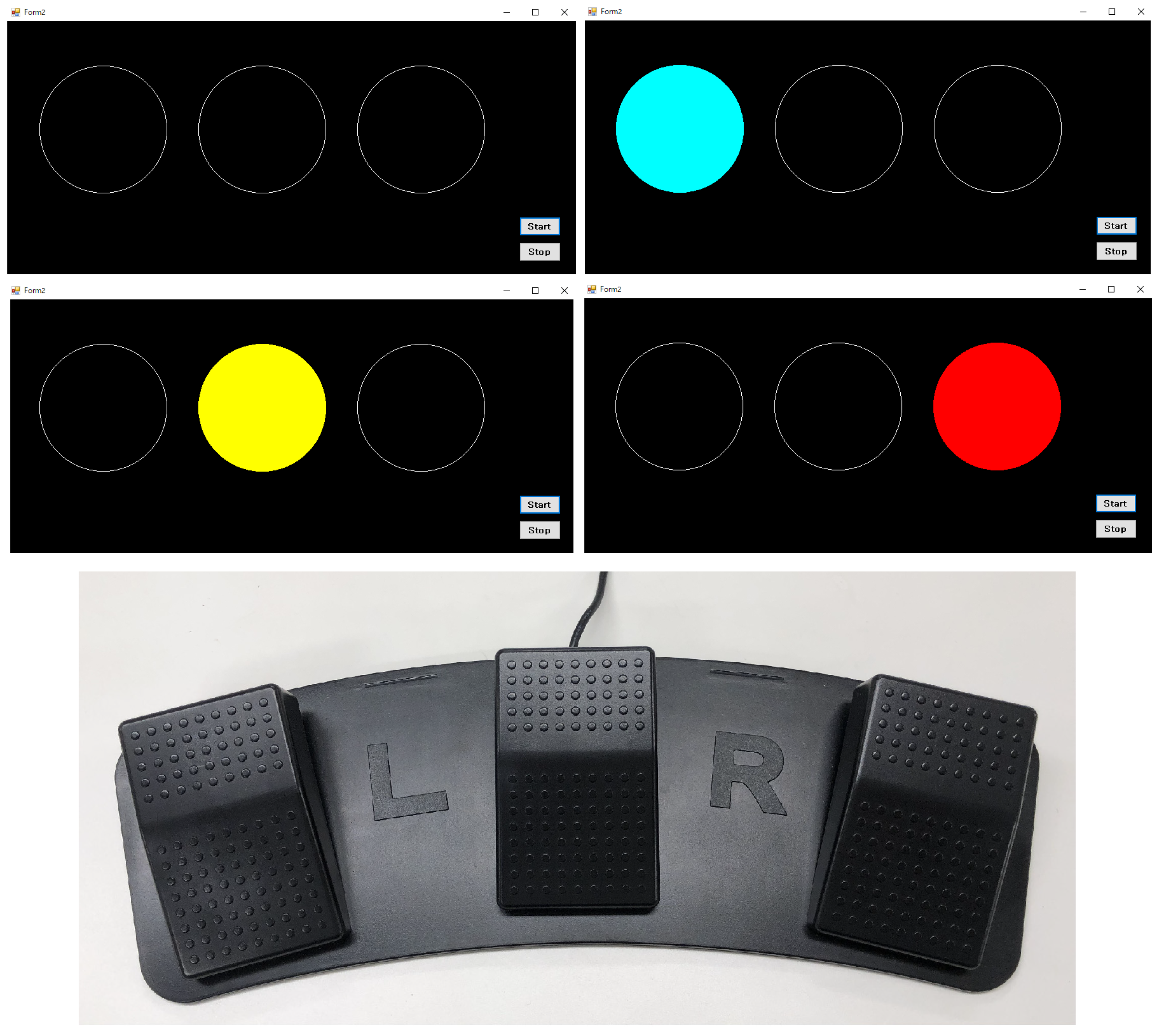

Comparison of Foot-Response Reaction Time Between Younger and Older Adults Using the Foot Psychomotor Vigilance Test



Abstract
1. Introduction
- (i)
- Do lower-limb RT and its distributional characteristics differ between younger and older adults?
- (ii)
- Are sleep-related factors, PAL, or physical characteristics such as height associated with RT performance?
2. Materials and Methods
2.1. Study Design
2.2. Participants
2.3. Foot PVT Task and Experimental Protocol
2.4. Sleep Assessment
2.5. Recorded Data
2.6. Statistical Analysis
2.6.1. Overview and Primary Analysis
2.6.2. Descriptive Statistics and Normality Assessment
2.6.3. Group Comparisons
2.6.4. Correlation Analysis
2.6.5. Multiple Regression Analysis
2.6.6. Additional Analyses
2.6.7. Software and Significance Level
3. Results
4. Discussion
5. Conclusions
Author Contributions
Funding
Institutional Review Board Statement
Informed Consent Statement
Data Availability Statement
Conflicts of Interest
Abbreviations
| Foot PVT | foot-response version of the PVT |
| METs | metabolic equivalent of task |
| PAL | physical activity level |
| PVT | psychomotor vigilance test |
| RT | reaction time |
| SD | standard deviation |
| STROBE | strengthening the reporting of observational studies in epidemiology |
References
- Dinges, D.F.; Powell, J.W. Microcomputer analysis of performance on a portable, simple visual RT task during sustained opera tions. Behav. Res. Methods Instrum. Comput. 1985, 17, 652–655. [Google Scholar] [CrossRef]
- Dinges, D.F.; Pack, F.; Williams, K.; Gillen, K.A.; Powell, J.W.; Ott, G.E.; Aptowicz, C.; Pack, A.I. Cumulative sleepiness, mood disturbance, and psychomotor vigilance performance decrements during a week of sleep restricted to 4–5 hours per night. Sleep 1997, 20, 267–277. [Google Scholar] [CrossRef]
- Basner, M.; Moore, T.M.; Nasrini, J.; Gur, R.C.; Dinges, D.F. Response speed measurements on the psychomotor vigilance test: How precise is precise enough? Sleep 2021, 44, zsaa121. [Google Scholar] [CrossRef]
- Chaisilprungraung, T.; Stekl, E.K.; Thomas, C.L.; Blanchard, M.E.; Hughes, J.D.; Balkin, T.J.; Doty, T.J. Quantifying the effects of sleep loss: Relative effect sizes of the psychomotor vigilance test, multiple sleep latency test, and maintenance of wakefulness test. Sleep Adv. 2022, 3, zpac034. [Google Scholar] [CrossRef]
- Jones, M.J.; Dunican, I.C.; Murray, K.; Peeling, P.; Dawson, B.; Halson, S.; Miller, J.; Eastwood, P.R. The psychomotor vigilance test: A comparison of different test durations in elite athletes. J. Sports Sci. 2018, 36, 2033–2037. [Google Scholar] [CrossRef]
- Mollicone, D.J.; Kan, K.; Coats, S.; Mott, C.; van Wollen, M.; Hatch, A.; Gallagher, J.; Williams, S.; Motzkin, D. Use of the psychomotor vigilance test to aid in the selection of risk controls in an air medical transport operation. Sleep Adv. 2023, 4, zpad003. [Google Scholar] [CrossRef]
- Antler, C.A.; Yamazaki, E.M.; Casale, C.E.; Brieva, T.E.; Goel, N. The 3-Minute Psychomotor Vigilance Test Demonstrates Inadequate Convergent Validity Relative to the 10-Minute Psychomotor Vigilance Test Across Sleep Loss and Recovery. Front. Neurosci. 2022, 16, 815697. [Google Scholar] [CrossRef]
- Thompson, B.J.; Shugart, C.; Dennison, K.; Louder, T.J. Test-retest reliability of the 5-minute psychomotor vigilance task in working-aged females. J. Neurosci. Methods 2022, 365, 109379. [Google Scholar] [CrossRef]
- Ferris, M.; Bowles, K.A.; Bray, M.; Bosley, E.; Rajaratnam, S.M.W.; Wolkow, A.P. The impact of shift work schedules on PVT performance in naturalistic settings: A systematic review. Int. Arch Occup. Environ. Health 2021, 94, 1475–1494. [Google Scholar] [CrossRef]
- Çolak, M.; Esin, M.N. Factors affecting the psychomotor vigilance of nurses working night shift. Int. Nurs. Rev. 2024, 71, 84–93. [Google Scholar] [CrossRef]
- Grant, D.A.; Honn, K.A.; Layton, M.E.; Riedy, S.M.; Van Dongen, H.P.A. 3-minute smartphone-based and tablet-based psychomotor vigilance tests for the assessment of reduced alertness due to sleep deprivation. Behav. Res. Methods 2017, 49, 1020–1029. [Google Scholar] [CrossRef]
- Reifman, J.; Ramakrishnan, S.; Liu, J.; Kapela, A.; Doty, T.J.; Balkin, T.J.; Kumar, K.; Khitrov, M.Y. 2B-Alert App: A Mobile Application for Real-Time Individualized Prediction of Alertness. J. Sleep Res. 2019, 28, e12725. [Google Scholar] [CrossRef]
- Droździel, P.; Tarkowski, S.; Rybicka, I.; Wrona, R. Drivers’ Reaction Time Research in the Conditions in the Real Traffic. Open Eng. 2020, 10, 35–47. [Google Scholar] [CrossRef]
- Poliak, M.; Svabova, L.; Benus, J.; Demirci, E. Driver Response Time and Age Impact on the Reaction Time of Drivers: A Driving Simulator Study among Professional-Truck Drivers. Mathematics 2022, 10, 1489. [Google Scholar] [CrossRef]
- Bauder, M.; Paula, D.; Pfeilschifter, C.; Petermeier, F.; Kubjatko, T.; Riener, A.; Schweiger, H.-G. Influences of Vehicle Communication on Human Driving Reactions: A Simulator Study on Reaction Times and Behavior for Forensic Accident Analysis. Sensors 2024, 24, 4481. [Google Scholar] [CrossRef]
- Ministry of Internal Affairs and Communications. Statistics Topics No.142. Available online: https://www.stat.go.jp/data/topics/pdf/topics142.pdf (accessed on 1 November 2025).
- Cabinet Office, Government of Japan. Available online: https://www8.cao.go.jp/koutu/taisaku/r02kou_haku/zenbun/genkyo/feature/feature_01_3.html (accessed on 1 November 2025).
- Tokyo Metropolitan Police Department. Preventing Traffic Accidents Involving Elderly Drivers. Tokyo Metropolitan Police Department 2024. Available online: https://www.keishicho.metro.tokyo.lg.jp/kotsu/jikoboshi/koreisha/koreijiko.html (accessed on 1 November 2025).
- Yoshida, Y.; Yuda, E.; Yokoyama, K. Design of the new Foot PVT for screening driving ability. Hardware 2025, 3, 3. [Google Scholar] [CrossRef]
- Mota Albuquerque, P.; Ribeiro Franco, C.M.; Sampaio Rocha-Filho, P.A. Assessing the impact of sleep restriction on the attention and executive functions of medical students: A prospective cohort study. Acta Neurol. Belg. 2023, 123, 1421–1427. [Google Scholar] [CrossRef]
- Chiaramonte, R.; Pavone, V.; Testa, G.; Pesce, I.; Scaturro, D.; Musumeci, G.; Mauro, G.L.; Vecchio, M. The Role of Physical Exercise and Rehabilitative Implications in the Process of Nerve Repair in Peripheral Neuropathies: A Systematic Review. Diagnostics 2023, 13, 364. [Google Scholar] [CrossRef]
- Alonso, A.C.; Luna, N.M.; Mochizuki, L.; Barbieri, F.; Santos, S.; Greve, J.M. The influence of anthropometric factors on postural balance: The relationship between body composition and posturographic measurements in young adults. Clinics 2012, 67, 1433–1441. [Google Scholar] [CrossRef]
- Fujita, K.; Kobayashi, Y.; Hayashi, K.; Kawabata, K.; Ogawa, T.; Hori, H.; Sato, M.; Hitosugi, M. Elderly drivers with pedal errors during emergency braking do not lift their leg. Transp. Res. Interdiscip. Perspect. 2025, 33, 101583. [Google Scholar] [CrossRef]
- Zhao, Y.; Mizuno, K.; Nitta, Y.; Kovaceva, J.; Thomson, R. Comparing the responses and visual behaviors of older and younger drivers in car-to-cyclist collisions using a driving simulator. J. Saf. Res. 2025, 94, 254–264. [Google Scholar] [CrossRef]
- Psotta, R.; Kornatovská, Z. Age-related slowing of lower-limb visuomotor reaction time in women aged 60–79 years. Acta Gymnica 2025, 55, e2025.013. [Google Scholar] [CrossRef]
- von Elm, E.; Altman, D.G.; Egger, M.; Pocock, S.J.; Gøtzsche, P.C.; Vandenbroucke, J.P. The Strengthening the Reporting of Observational Studies in Epidemiology (STROBE) Statement: Guidelines for Reporting Observational Studies. Int. J. Surg. 2014, 12, 1495–1499. [Google Scholar] [CrossRef] [PubMed]
- Okamura, H.; Mihara, K.; Tsuda, A.; Morisaki, T.; Tanaka, Y.; Shoji, Y. Subjective Happiness Is Associated with Objectively Evaluated Sleep Efficiency and Heart Rate during Sleep: An Exploratory Study Using Non-Contact Sheet Sensors. Sustainability 2020, 12, 4630. [Google Scholar] [CrossRef]
- Japan Organization of Better Sleep (JOBS). OSA Sleep Inventory MA Version. Available online: https://www.jobs.gr.jp/osa_ma.html (accessed on 1 November 2025).
- Herrmann, S.D.; Willis, E.A.; Ainsworth, B.E.; Barreira, T.V.; Hastert, M.; Kracht, C.L.; Schuna, J.M., Jr.; Cai, Z.; Quan, M.; Tudor-Locke, C.; et al. 2024 Adult Compendium of Physical Activities: A Third Update of the Energy Costs of Human Activities. J. Sport Health Sci. 2024, 13, 6–12. [Google Scholar] [CrossRef]
- Ainsworth, B.E.; Haskell, W.L.; Herrmann, S.D.; Meckes, N.; Bassett, D.R., Jr.; Tudor-Locke, C.; Greer, J.L.; Vezina, J.; Whitt-Glover, M.C.; Leon, A.S. 2011 Compendium of Physical Activities: A second update of codes and MET values. Med. Sci. Sports Exerc. 2011, 43, 1575–1581. [Google Scholar] [CrossRef]
- National Institutes of Biomedical Innovation, Health and Nutrition. Revised “List of Physical Activity METs (METs Table)”. Available online: https://www.nibn.go.jp/eiken/programs/2011mets.pdf (accessed on 1 November 2025).
- Osuka, Y.; Kojima, N.; Sugie, M.; Omura, T.; Motokawa, K.; Maruo, K.; Ono, R.; Aoyama, T.; Inoue, S.; Kim, H.; et al. Effects of a Home-Based Radio-Taiso Exercise Programme on Health-Related Quality of Life in Older Adults with Frailty: Protocol for an Assessor-Blind Randomized Controlled Trial. BMJ Open 2022, 12, e063201. [Google Scholar] [CrossRef]
- Doroudgar, S.; Chuang, H.M.; Perry, P.J.; Thomas, K.; Bohnert, K.; Canedo, J. Driving Performance Comparing Older versus Younger Drivers. Traffic Inj. Prev. 2017, 18, 41–46. [Google Scholar] [CrossRef]
- Cooper, J.M.; Wheatley, C.L.; McCarty, M.M.; Motzkus, C.J.; Lopes, C.L.; Erickson, G.G.; Baucom, B.R.W.; Horrey, W.J.; Strayer, D.L. Age-Related Differences in the Cognitive, Visual, and Temporal Demands of In-Vehicle Information Systems. Front. Psychol. 2020, 11, 1154. [Google Scholar] [CrossRef] [PubMed]
- Depestele, S.; Ross, V.; Verstraelen, S.; Brijs, K.; Brijs, T.; van Dun, K.; Meesen, R. The Impact of Cognitive Functioning on Driving Performance of Older Persons in Comparison to Younger Age Groups: A Systematic Review. Transp. Res. Part F Traffic Psychol. Behav. 2020, 73, 433–452. [Google Scholar] [CrossRef]
- Robertsen, R.; Lorås, H.W.; Polman, R.; Simsekoglu, O.; Sigmundsson, H. Aging and Driving: A Comparison of Driving Performance Between Older and Younger Drivers in an On-Road Driving Test. SAGE Open 2022, 12, 2. [Google Scholar] [CrossRef]
- Mouloua, M.; Rinalducci, E.; Smither, J.; Brill, J.C. Effect of Aging on Driving Performance. Proc. Hum. Factors Ergon. Soc. Annu. Meet. 2004, 48, 253–257. [Google Scholar] [CrossRef]
- Greene, W.R.; Smith, R. Driving in the Geriatric Population. Clin. Geriatr. Med. 2019, 35, 127–131. [Google Scholar] [CrossRef] [PubMed]
- Rivner, M.H.; Swift, T.R.; Malik, K. Influence of age and height on nerve conduction. Muscle Nerve 2001, 24, 1134–1141. [Google Scholar] [CrossRef]
- Thakker, D.V.; Kariya, V.B. A Cross-Sectional Study of Comparison between Individual Height and Median Nerve Conduction Velocity. Sch. Int. J. Anat. Physiol. 2019, 2, 325–329. [Google Scholar] [CrossRef]
- Tjolleng, A.; Yang, J.; Jung, K. Analysis of Leg Muscle Activities and Foot Angles while Pressing the Accelerator Pedal by Different Foot Postures. Appl. Sci. 2022, 12, 13025. [Google Scholar] [CrossRef]
- Lim, J.; Dinges, D.F. Sleep deprivation and vigilant attention. Ann. N. Y. Acad. Sci. 2008, 1129, 305–322. [Google Scholar] [CrossRef] [PubMed]
- Mattis, J.; Sehgal, A. Circadian Rhythms, Sleep, and Disorders of Aging. Trends Endocrinol. Metab. 2016, 27, 192–203. [Google Scholar] [CrossRef] [PubMed]
- Schmidt, C.; Peigneux, P.; Cajochen, C. Age-related changes in sleep and circadian rhythms: Impact on cognitive performance and underlying neuroanatomical networks. Front. Neurol. 2012, 3, 118. [Google Scholar] [CrossRef]
- Landry, G.J.; Best, J.R.; Liu-Ambrose, T. Measuring sleep quality in older adults: A comparison using subjective and objective methods. Front. Aging Neurosci. 2015, 7, 166. [Google Scholar] [CrossRef]
- Yuda, E.; Yoshida, Y. Individual Differences in Sustained Attention: Effects of Age, Sex, and Time of Day Based on Psychomotor Vigilance Task Performance. Appl. Sci. 2025, 15, 5487. [Google Scholar] [CrossRef]
- Voelcker-Rehage, C.; Niemann, C. Structural and functional brain changes related to different types of physical activity across the life span. Neurosci. Biobehav. Rev. 2013, 37, 2268–2295. [Google Scholar] [CrossRef]
- Colcombe, S.; Kramer, A.F. Fitness effects on the cognitive function of older adults: A meta-analytic study. Psychol. Sci. 2003, 14, 125–130. [Google Scholar] [CrossRef]
- Shi, B.; Mou, H.; Tian, S.; Meng, F.; Qiu, F. Effects of Acute Exercise on Cognitive Flexibility in Young Adults with Different Levels of Aerobic Fitness. Int. J. Environ. Res. Public Health 2022, 19, 9106. [Google Scholar] [CrossRef]
- Sun, Q.; Xu, Z.; Lyu, D.; Xu, X.; Wang, L.; Yan, T.; Yan, J. Physical activity and cognitive difficulties in adolescents: A cross-sectional study of 13,677 participants. Complement. Ther. Clin. Pract. 2025, 59, 101965. [Google Scholar] [CrossRef] [PubMed]
- Basner, M.; Dinges, D.F. Maximizing sensitivity of the psychomotor vigilance test (PVT) to sleep loss. Sleep 2011, 34, 581–591. [Google Scholar] [CrossRef] [PubMed]
- Yamashita, A.; Rothlein, D.; Kucyi, A.; Valera, E.M.; Germine, L.; Wilmer, J.; DeGutis, J.; Esterman, M. Variable Rather Than Extreme Slow Reaction Times Distinguish Brain States during Sustained Attention. Sci. Rep. 2021, 11, 14883. [Google Scholar] [CrossRef] [PubMed]



| Event No. | Color | Evaluation | Interval [ms] | RT [ms] | Elapsed Time [ms] |
|---|---|---|---|---|---|
| 1 | Yellow | T | 6445 | 1108 | 7562 |
| 2 | Blue | T | 6369 | 611 | 14,566 |
| 3 | False start | F | 9227 | −3623 | 20,170 |
| 4 | Red | F | 7427 | 1105 | 28,723 |
| 4_Retry | Red | T | 0 | 1770 | 30,493 |
| 5 | Yellow | T | 5062 | 909 | 36,472 |
| Statistic (METs·h/Week) | Younger (n = 20) | Older (n = 24) | Comment |
|---|---|---|---|
| Minimum | 0 | 0 | Both groups included participants with no regular exercise. |
| 25% tile | 0 | 5.3 | One quarter of younger adults did not exercise at all. |
| Median | 0 | 15.0 | Half of the younger adults had 0 METs·h/week, whereas older adults averaged 15. |
| 75% tile | 6.0 | 19.0 | Upper quartile of older adults exercised regularly. |
| Maximum | 20.5 | 98.0 | A few older adults were extremely active (outlier level). |
| Factor | Younger (n = 20, Mean ± SD) | Older (n = 24, Mean ± SD) | Test | p-Value |
|---|---|---|---|---|
| Sleep1 | 47.5 ± 8.6 | 49.1 ± 9.0 | S | 0.532 |
| Sleep2 | 47.1 ± 7.8 | 45.8 ± 10.4 | S | 0.664 |
| Sleep3 | 50.6 ± 10.1 | 49.7 ± 9.9 | M | 0.930 |
| Sleep4 | 46.3 ± 9.6 | 50.8 ± 8.5 | S | 0.102 |
| Sleep5 | 47.0 ± 7.6 | 51.2 ± 11.8 | M | 0.194 |
| Height (cm) | 168 ± 9 | 162 ± 9 | S | 0.039 |
| PAL (METs·h/week) | 4.9 ± 7.6 | 19.6 ± 23.2 | M | 0.002 |
| Index | Younger (n = 20, Mean ± SD) | Older (n = 24, Mean ± SD) | Test | p-Value |
|---|---|---|---|---|
| RT mean (ms) | 700 ± 73 (666–734) | 818 ± 105 (773–863) | S | <0.001 |
| RT median (ms) | 675 ± 72 (641–709) | 796 ± 96 (754–837) | S | <0.001 |
| RT SD (ms) | 122 ± 25 | 139 ± 53 | M | 0.283 |
| Skewness | 1.93 ± 0.99 | 1.41 ± 0.69 | S | 0.047 |
| Kurtosis | 7.20 ± 4.66 | 4.13 ± 3.24 | S | 0.014 |
| r (RT mean vs. Skewness) | 0.054 | 0.109 | - | 0.822 (Older: 0.611) |
| r (RT mean vs. Kurtosis) | 0.252 | −0.135 | - | 0.283 (Older: 0.528) |
| Factor | Younger (n = 20) | Older (n = 24) | All (n = 44) | |||
|---|---|---|---|---|---|---|
| r | p-Value | r | p-Value | r | p-Value | |
| Sleep1 | −0.557 | 0.011 | −0.261 | 0.216 | −0.248 | 0.104 |
| Sleep2 | −0.223 | 0.346 | −0.184 | 0.391 | −0.200 | 0.194 |
| Sleep3 | 0.303 | 0.194 | 0.093 | 0.664 | 0.115 | 0.457 |
| Sleep4 | −0.363 | 0.115 | −0.138 | 0.523 | −0.041 | 0.791 |
| Sleep5 | −0.388 | 0.091 | −0.267 | 0.206 | −0.127 | 0.411 |
| Height | −0.593 | 0.006 | −0.279 | 0.188 | −0.478 | 0.001 |
| PAL (METs·h/week) | −0.269 | 0.252 | 0.231 | 0.277 | 0.325 | 0.032 |
| Model | Predictor | B | SE | t | p | Adjusted R2 | F (p) |
|---|---|---|---|---|---|---|---|
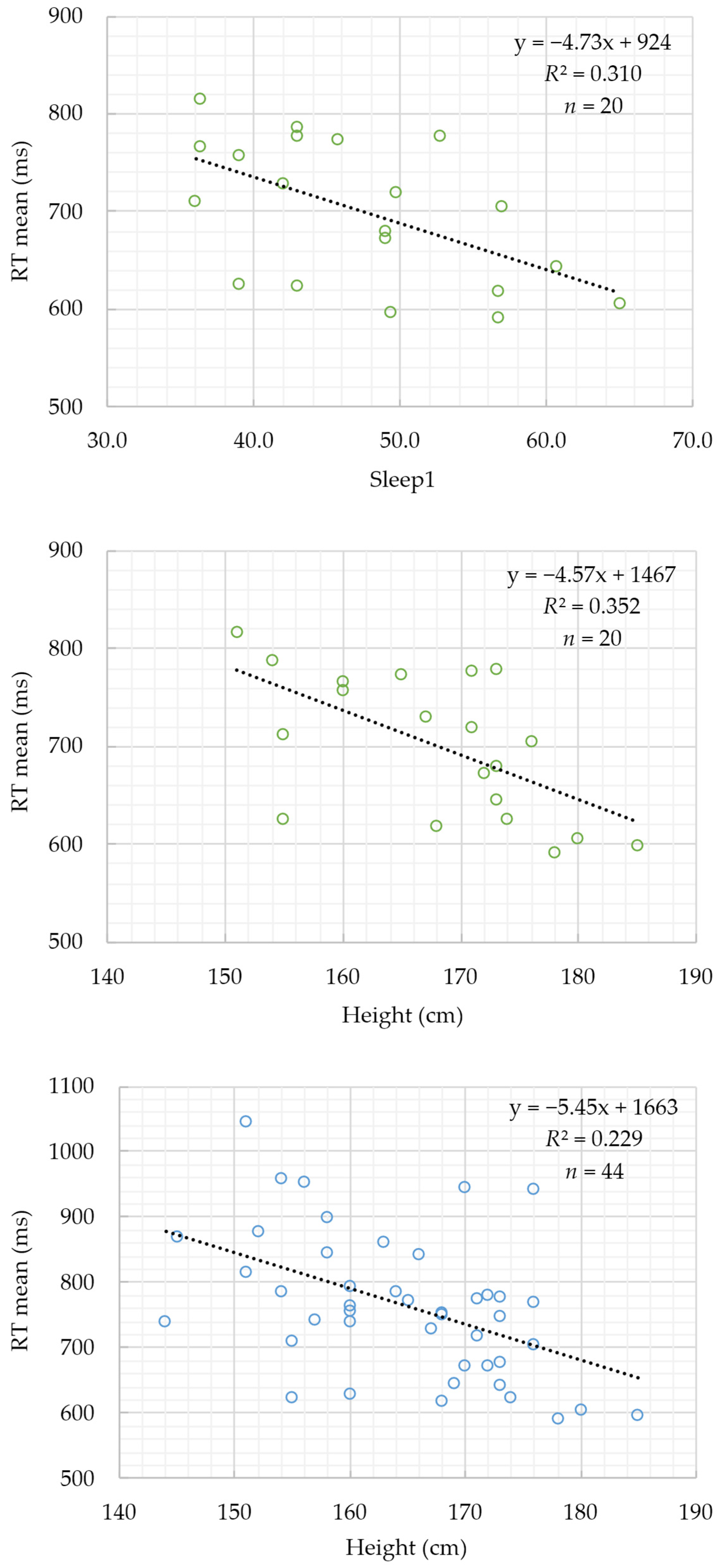
| (i) Younger | Constant | 1467.18 | 245.67 | 5.97 | 0.000 | 0.316 | 13.75 (0.006) |
| Height (cm) | −4.57 | 1.46 | −3.13 | 0.006 | |||
| (ii) Older | Constant | 818.15 | 21.81 | 37.52 | 0.000 | 0 | — |
| (iii) Combined | Constant | 1258.94 | 255.71 | 4.92 | 0.000 | 0.372 | 13.75 (0.001) |
| Height (cm) | −3.89 | 1.45 | −2.69 | 0.010 | |||
| Age group | 95.12 | 27.66 | 3.44 | 0.001 |
| Category | Young (n = 20) | Older (n = 24) | Category | Young (n = 20) | Older (n = 24) | Correction Time (ms) |
|---|---|---|---|---|---|---|
| Miss count | Count of participants | False start count | Count of participants | Mean ± SD | ||
| 0 times | 11 | 16 | 0 times | 10 | 19 | Young: 666 ± 347 Older: 714 ± 225 |
| 1 time | 4 | 6 | 1 time | 2 | 2 | |
| 2 times | 4 | 1 | 2 times | 5 | 3 | |
| 8 times | 1 | 1 | 3–9 times | 3 | 0 | |
Disclaimer/Publisher’s Note: The statements, opinions and data contained in all publications are solely those of the individual author(s) and contributor(s) and not of MDPI and/or the editor(s). MDPI and/or the editor(s) disclaim responsibility for any injury to people or property resulting from any ideas, methods, instructions or products referred to in the content. |
© 2026 by the authors. Licensee MDPI, Basel, Switzerland. This article is an open access article distributed under the terms and conditions of the Creative Commons Attribution (CC BY) license.
Share and Cite
Yoshida, Y.; Yokoyama, K. Comparison of Foot-Response Reaction Time Between Younger and Older Adults Using the Foot Psychomotor Vigilance Test. J. Ageing Longev. 2026, 6, 17. https://doi.org/10.3390/jal6010017
Yoshida Y, Yokoyama K. Comparison of Foot-Response Reaction Time Between Younger and Older Adults Using the Foot Psychomotor Vigilance Test. Journal of Ageing and Longevity. 2026; 6(1):17. https://doi.org/10.3390/jal6010017
Chicago/Turabian StyleYoshida, Yutaka, and Kiyoko Yokoyama. 2026. "Comparison of Foot-Response Reaction Time Between Younger and Older Adults Using the Foot Psychomotor Vigilance Test" Journal of Ageing and Longevity 6, no. 1: 17. https://doi.org/10.3390/jal6010017
APA StyleYoshida, Y., & Yokoyama, K. (2026). Comparison of Foot-Response Reaction Time Between Younger and Older Adults Using the Foot Psychomotor Vigilance Test. Journal of Ageing and Longevity, 6(1), 17. https://doi.org/10.3390/jal6010017