1. Introduction
The identification and selection of materials in the Architecture, Engineering, and Construction (AEC) sector can be a lengthy process, beginning in the design phase and concluding with on-site construction activities. Therefore, it is essential to understand both the cultural implications and the physical properties of materials [
1]. In particular, the growing demand for more sustainable construction practices has driven research into eco-friendly materials characterized by low environmental impact and minimal effects on human health. Consequently, material selection has gained increasing importance throughout all phases of the construction process, from the extraction and procurement of raw materials, through manufacturing and installation, to end-of-life disposal or recycling.
Materials such as wood, cork, and cellulose fibers, which have a low ecological footprint, are well suited to dry construction processes, enabling selective demolition and facilitating reuse or recycling.
This research focuses on one of the most common cellulose-based products: corrugated cardboard. This highly recyclable material is widely available and extremely versatile, making it suitable for the development of lightweight and transportable construction components. Its availability is largely due to the substantial quantity of waste generated by the industrial sector, e-commerce, and the food industry. Several studies have shown that cardboard accounts for a significant proportion of total waste production in various countries: 26% in the United States [
2], 25% in Norway [
3], and just under 8% in Australia [
4], with similar trends reported across Europe. According to data published by the EU, Italy produced over 28 million tons of manufacturing waste in 2022, more than 2 million tons of which derived from paper and cardboard production (Eurostat).
Despite these figures, cardboard holds considerable potential, as it can be recycled and transformed from waste into a valuable resource. Research on this topic follows two main directions. The first concerns structural and comfort performance [
5]; the second addresses issues related to improving production processes [
6], reducing costs and environmental impacts through preventive environmental strategies [
3,
7], and optimizing life cycle costs [
8]. In this context, reducing impurities and organic contaminants in base materials is essential to enhance overall performance [
6]. However, despite ongoing efforts within the industrial sector, the lack of reliable and standardized data on the material’s properties still raises doubts regarding its suitability for structural applications.
Since the late twentieth century, partly due to the work of Japanese architect Shigeru Ban, there has been renewed interest in paper and cardboard products in architecture. This interest is particularly evident in academic research, where numerous studies have investigated their mechanical, thermal, and acoustic properties, developing and testing construction components and full-scale prototypes through both experimental and numerical approaches.
This article aims to compile and critically review these studies by identifying cardboard-based construction components, technological systems, and previously built structures, thereby substantiating the viability of using corrugated cardboard as a structural material.
2. Methodology
This paper adopts a state-of-the-art narrative review approach to analyze the current body of knowledge on the use of corrugated cardboard in the AEC sector. The review focuses on material properties, construction components, technological systems, and built prototypes, with particular attention to mechanical, thermal, acoustic and environmental performances.
The literature was selected based on its relevance to architectural and construction applications, prioritizing peer-reviewed journal articles, doctoral theses, conference proceedings, and technical reports that investigate corrugated cardboard as a construction material or as part of composite building systems. Additional sources describing realized buildings and full-scale prototypes were included to provide a comprehensive overview of practical applications and technological development.
Rather than following a systematic review protocol, the selection process was qualitative and thematic, aimed at identifying representative and influential studies that contribute to understanding the behavior, potential, and limitations of corrugated cardboard in constructions. Due to the heterogeneity of specimens, testing methods, boundary conditions, and performance indicators adopted in the literature, a direct quantitative comparison between studies was not always possible.
The data were therefore organized into thematic categories according to
- -
Material properties;
- -
Construction components;
- -
Building systems and realized prototypes.
This structure allows for a critical interpretation of the state of research, highlighting recurring findings, divergences in results, technological trends, and existing research gaps, particularly with regard to standardization of testing methods and regulatory frameworks.
3. Corrugated Cardboard
Corrugated cardboard was invented and patented in 1856 by Edward G. Healey and Edward E. Allen. Initially, it consisted of a single corrugated paper layer used to reinforce or protect objects. Several years later, the modern configuration of corrugated cardboard—defined as multiple glued paper layers forming a composite panel—was patented in the United States and began to be widely used as a packaging material in the early twentieth century [
9].
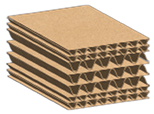
Corrugated cardboard consists of overlapping sheets of Kraft or Testliner paper, in which flat liner layers alternate with corrugated (fluted) layers bonded together using natural adhesives. This stratified arrangement creates a sandwich structure, whose overall thickness depends on the number and configuration of the layers. Different types of corrugated cardboard can be produced by varying the density of the paper, as well as the pitch and height of the corrugation.
Typically, the flat liner layers are manufactured from paper with a basis weight ranging from 125 to 350 g/m
2, while the corrugated medium has a basis weight between 80 and 180 g/m
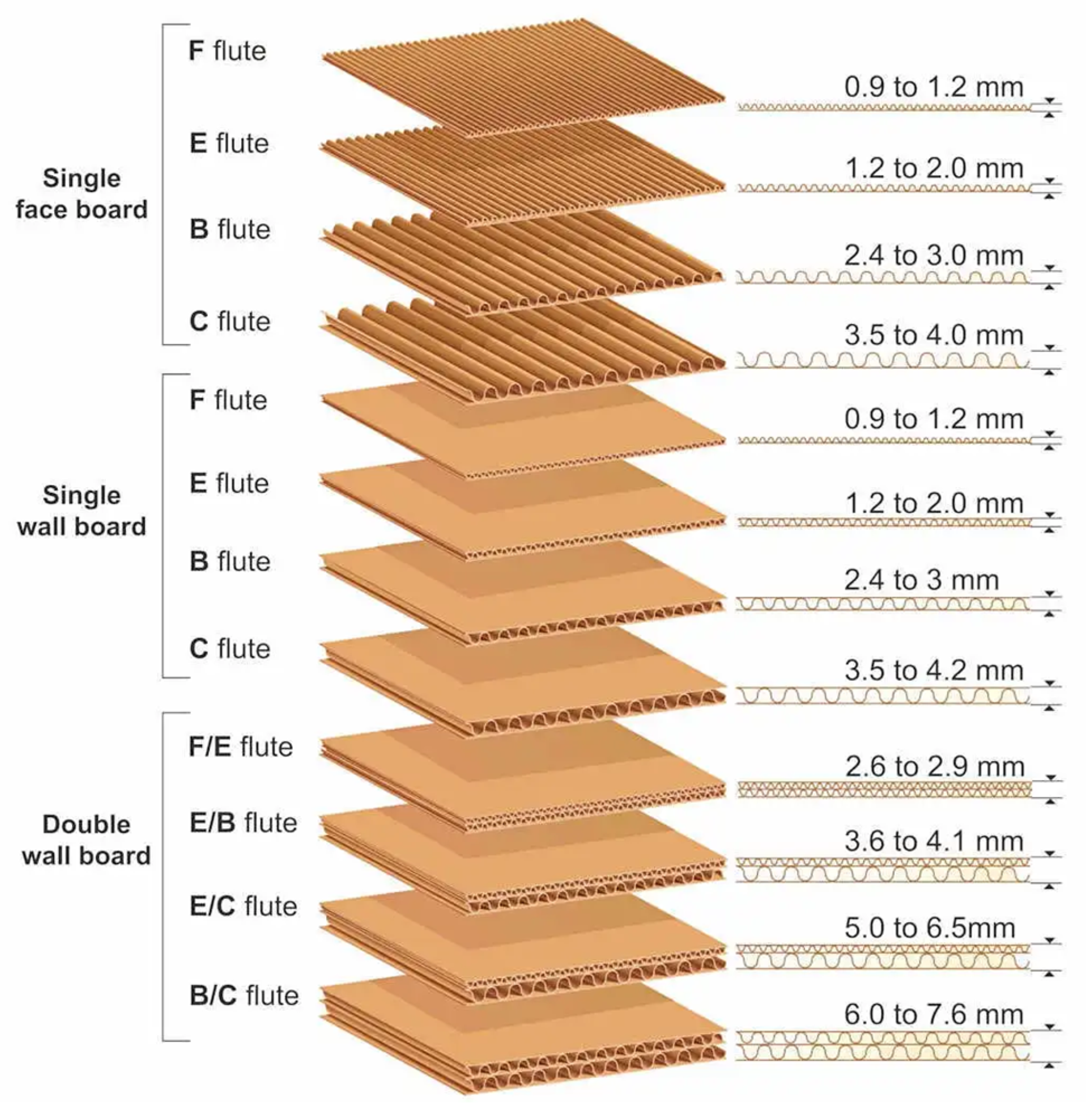
2. The height of the corrugation profiles is illustrated in
Figure 1 [
10].
Natural adhesives, such as starch-based compounds, or synthetic adhesives are used to bond the layers, particularly when enhanced performance is required, for example, increased water resistance. Another important characteristic of corrugated cardboard is the flute profile (i.e., the number and geometry of the waves), which influences its mechanical behavior and field of application. Depending on the configuration, different types of corrugated cardboard are obtained. For instance, single-wall cardboard, consisting of three layers (one corrugated medium bonded between two linerboards), is widely used in industry for packaging and transporting non-fragile goods.
The paper used in the manufacture of corrugated cardboard is produced through mechanized processes. For simplicity, the reference system adopted to describe its properties follows the production flow: the machine direction (MD), parallel to the direction of manufacture; the cross direction (CD), orthogonal to MD within the plane of the sheet; and the thickness direction (ZD), perpendicular to the plane [
11,
12,
13]. This orthotropic framework is essential for accurately characterizing the mechanical and physical behavior of the material.
To improve the thermal and acoustic insulation performance of corrugated cardboard, it can be combined with other materials. Among the most compatible is cellulose fiber, the primary constituent of paper and, consequently, cardboard. Cellulose-based insulation materials are available in various forms, such as rigid or semi-rigid panels. In addition to providing good thermal insulation, they exhibit high vapor permeability, making them suitable for moisture regulation in different environments. However, prolonged exposure to humidity may accelerate material degradation and reduce long-term durability [
1].
4. Properties of Corrugated Cardboard
The mechanical properties of corrugated cardboard are directly related to the characteristics of its constituent layers and to the geometry of the corrugation. Depending on performance requirements, the behavior of the panel can be modified by varying parameters such as the type of paper employed, the flute height and pitch, and the number of superimposed layers. The literature includes numerous scientific studies reporting the mechanical performance of individual layers, as well as of assembled panels. In particular, several experimental investigations have focused on the compressive behavior of corrugated cardboard boxes used for the transportation of perishable goods [
14,
15,
16,
17].
As corrugated cardboard is primarily composed of paper, it is generally described as an orthotropic, anisotropic, and elastic material. The term orthotropic refers to materials characterized by three mutually orthogonal axes of symmetry; anisotropic indicates that mechanical properties vary depending on the direction of the applied load; and elastic describes the material’s behavior when stresses remain significantly below the failure threshold [
18]. The elastic response of corrugated cardboard is influenced by its viscoelastic nature, which depends on stiffness parameters defined along the three principal directions (MD, CD, and ZD), namely the elastic modulus, shear modulus, and Poisson’s ratio [
12].
Several studies have shown that the in-plane elastic modulus (MD–CD) increases with material density, while it decreases—beyond a certain threshold—with increasing moisture content. Higher moisture levels weaken the inter-fiber bonds formed during the manufacturing process, thereby reducing stiffness and strength [
13,
19,
20,
21].
One of the main challenges in employing corrugated cardboard as a structural building component lies in the limited number of standardized experimental tests and the lack of consistent, comparable datasets, which hinder the development of reliable analytical models for predicting structural behavior. Nevertheless, research activity has intensified in both industrial and academic contexts. Current investigations focus on the development of corrugated cardboard components and on identifying the mechanical properties most relevant to specific structural applications. These studies include investigations into compressive, tensile, shear, and flexural strength, as well as fire resistance and thermal and acoustic performance.
4.1. Compression Strength
Numerous studies have focused on the development of mathematical models and experimental investigations aimed at evaluating the compressive strength of corrugated cardboard, particularly in relation to its use in packaging and shipping applications. Different configurations of corrugated cardboard have been examined, including single-wall and double-wall panels, combinations of various flute types, and specimens incorporating openings (e.g., ventilation holes commonly used in food packaging). The presence, size, and distribution of such openings can significantly influence compressive stiffness and overall load-bearing capacity [
14,
15,
16,
17].
Compressive strength is determined through laboratory load tests and analytical approaches based on formulas describing the geometry of the corrugation profile, as well as through numerical simulations employing the Finite Element Method (FEM) [
14,
15,
16,
17,
22,
23]. Analytical and numerical results are typically validated through experimental testing to ensure the reliability of the predicted values.
Standard laboratory methods used to determine compressive strength include the Edge Crush Test (ECT), the Box Compression Test (BCT), and the Short-Span Compression Test (SCT), generally performed using universal testing machines. Popil [
22] analyses the ECT method in detail, examining aspects such as specimen preparation, the potential occurrence of premature crushing phenomena, and test duration. The ECT can be conducted according to four different modes, which vary in specimen type and dimensions, in order to evaluate their influence on the test results.
In most cases, the compressive load is applied perpendicular to the flute direction (CD), which often coincides with the predominant alignment of paper fibers. Under these conditions, both the linerboards and the corrugated medium contribute to stress resistance. Failure generally occurs not through local fiber rupture, but as a result of instability phenomena, such as crushing or buckling of the fiber network [
20].
Experimental and analytical studies confirm that corrugated cardboard exhibits good compressive performance relative to its weight, particularly along the cross-fiber (CD) direction. The combination of linerboards and fluted cores contributes to load resistance, but failure is largely governed by instability phenomena rather than fiber rupture. While Edge Crush Tests, Box Compression Tests, and Short-Span Compression Tests provide valuable data, standardization is limited and variability across materials and flute configurations remains significant. Overall, the literature indicates that compressive strength can be tailored through panel geometry and layer composition, but additional studies are needed to predict performance reliably for structural applications beyond packaging.
4.2. Tensile Strength
Several authors have investigated the tensile behavior of the individual paper layers constituting corrugated cardboard panels [
19]. The tensile strength of the paper depends directly on the mechanical properties of the cellulose fibers and on the degree of bonding and overlap established during the manufacturing process. The integrity of the fibrous network formed during production is therefore fundamental to the material’s tensile performance.
Under low applied loads, paper typically exhibits an approximately linear stress–strain response. As the load increases, the slope of the curve progressively decreases, reflecting nonlinear behavior associated with microstructural damage, until failure occurs. Tensile failure is generally characterized by localized tearing, resulting from the progressive rupture of inter-fiber bonds followed by the breaking of individual fibers. With increasing load, this damage propagates throughout the fibrous network, ultimately leading to complete specimen failure.
Due to the manufacturing process, fibers tend to align preferentially along the machine direction (MD). Consequently, tensile strength and stiffness are significantly higher in the MD, while values measured in the cross direction (CD) are typically reduced, often by approximately 50%. These assumptions are supported by analytical models, such as those developed by Suhling et al. [
24], and have been experimentally validated by S. Allaoui et al. [
25] through tensile tests conducted on single-wall C-flute specimens.
Corrugated cardboard displays highly anisotropic tensile properties, with strength and stiffness maximized along the machine direction due to fiber alignment. The tensile behavior is largely determined by the integrity of the cellulose fiber network and the bonding between layers. Nonlinearities arise with increasing load, leading to progressive fiber and bond failure. Current studies provide clear insights into directional dependency, but long-term performance under varying environmental conditions, such as humidity or repeated loading, is not yet fully characterized. This limits the predictive capacity of tensile models for construction applications.
4.3. Bending Strength
The bending strength of corrugated cardboard strongly depends on the elastic modulus of its constituent layers as well as on the geometric configuration of the panel. Experimental determination of bending performance can be carried out using three standard methods: two-point bending, three-point bending, and four-point bending. These methods differ in terms of specimen configuration and load application scheme.
Experimental testing highlights the dependence of bending stiffness on the direction of the bending moment, a feature that cannot be fully captured by purely analytical models. This directional behavior can be attributed to material imperfections and inherent heterogeneity [
13,
26]. To ensure reliable results, multiple tests should be conducted in each principal material direction. The minimum number of specimens depends on the national standards governing bending tests in the country where the experiments are performed. Owing to the anisotropic nature of corrugated cardboard, significantly different mechanical properties are obtained depending on the loading direction [
19,
27].
When loads are applied perpendicular to the flute direction, the corrugated (fluted) core provides the dominant contribution to bending resistance. Conversely, when loads are applied parallel to the corrugation axis, the flat linerboards contribute most significantly to the overall bending stiffness.
Based on experimental evidence reported in the literature, the most effective strategies for enhancing bending strength include:
- −
The use of linerboards with a higher elastic modulus;
- −
Increasing the flute height (wave amplitude) [
12];
- −
Increasing the number of layers in the panel configuration [
19].
Bending performance of corrugated cardboard is closely linked to flute geometry, layer composition, and orientation. Experimental studies demonstrate strong anisotropy, with the fluted core dominating resistance to perpendicular loads and linerboards governing parallel loading. While multilayering, higher elastic modulus linerboards, and increased flute height improve bending resistance, standardized testing protocols remain inconsistent across studies. Overall, bending behavior can be optimized, but predictive modeling still requires further validation against experimental data, particularly for hybrid or cement-impregnated panels.
4.4. Shear Strength
Shear stresses in corrugated cardboard may induce both in-plane (MD–CD) and out-of-plane (MD–ZD and CD–ZD) effects. Experimental determination of shear properties is relatively complex; therefore, the shear modulus is often estimated indirectly from other elastic parameters, such as the Young’s modulus and Poisson’s ratio [
19].
In the specific case of corrugated cardboard, testing procedures commonly adopted for the characterization of sandwich panel cores are employed to evaluate shear modulus and shear strength. However, these methods enable the determination of out-of-plane shear properties only.
The experimental procedures typically include:
- −
a three-point bending test, in which shear properties are derived from mid-span deflection by isolating the shear contribution to total flexural deformation;
- −
a direct shear test, where the outer linerboards are adhesively bonded to rigid plates connected to the testing machine and subjected to opposing tensile forces.
From these experimental results, the shear modulus can be determined, and the corresponding shear strength can subsequently be evaluated through analytical relationships.
Shear behavior is complex due to the anisotropic structure of corrugated cardboard and is often derived indirectly from other elastic parameters. In-plane shear is largely resisted by linerboards, whereas out-of-plane shear is borne by the corrugated core. Experimental studies reveal that instabilities and delamination often govern failure, particularly under ultimate loads. Although current methodologies allow estimation of shear modulus and strength, comprehensive experimental datasets remain limited, and practical guidance for structural design is still insufficient.
4.5. Fire Resistance
The literature on the fire performance of corrugated cardboard is limited and primarily focused on packaging applications. Some studies have investigated the combustion behavior of corrugated cardboard boxes containing polystyrene cups, such as the work by Mazaherifar et al. [
28]. Another relevant contribution is provided by Liu et al. [
29], who examined the spontaneous ignition of corrugated cardboard under conditions of intense radiant heat flux.
It is widely recognized that corrugated cardboard is highly susceptible to ignition. Consequently, when this material is intended for applications beyond conventional packaging—such as in the fabrication of building components—adequate fire protection measures are required to enhance its fire resistance.
Fire performance can be improved through various treatment methods, including impregnation processes using protective coatings (e.g., paints or cement-based layers), as well as the application of intumescent coatings or commercially available fire-resistant panels [
19].
Corrugated cardboard is highly flammable, and available studies confirm its low inherent fire resistance. While treatments such as impregnation, coatings, and intumescent layers can improve performance, research is largely limited to packaging applications. For construction use, systematic evaluation of fire behavior under realistic conditions is needed, particularly for hybrid or multilayer panels. Developing effective and sustainable fire-protection strategies is critical before broader adoption in building components can be considered.
4.6. Thermal Properties
The thermal properties of cardboard have been extensively investigated since the second half of the twentieth century, primarily due to its widespread application in food packaging. More recently, interest in this topic has increased because cardboard is considered a sustainable alternative to conventional thermal insulation materials currently available on the market.
The earliest analytical models developed to predict thermal performance have been progressively refined to incorporate additional parameters, including flute geometry, geometric imperfections, number and length of internal cavities, and different heat transfer mechanisms. Notably, initial formulations did not account for radiative heat transfer within the air cavities. Despite these analytical advancements, experimental validation has consistently accompanied model development in order to standardize calculation procedures and ensure reliability.
The most common experimental method involves imposing a steady-state heat flux through the specimen using guarded hot plates, which must maintain a temperature difference of at least 10 °C to ensure measurable heat transfer. Gray-Stuard et al. [
30] investigated the thermal resistance of multilayer paper sheets and corrugated cardboard, comparing the performance of the two materials and reporting a range of thermal resistance values (see the last row of
Table 1).
Experimental results indicate that corrugated cardboard does not achieve the thermal performance levels of conventional insulation materials such as expanded polystyrene or rock wool panels. Nevertheless, it provides moderate yet acceptable thermal resistance and offers clear environmental advantages, particularly when assembled into multilayer panel configurations [
31]. A significant limitation of this system is its sensitivity to moisture: increasing water content leads to higher thermal conductivity, thereby reducing overall insulation performance [
32].
Corrugated cardboard offers moderate thermal resistance and can function as a sustainable alternative to conventional insulation materials, particularly when used in multilayer configurations. Thermal performance is highly sensitive to moisture content and air cavity geometry, which can significantly affect heat transfer. While guarded hot plate experiments and FEM-based models provide valuable data, standard reference values for design purposes are still limited. Future studies should address moisture-dependent behavior and optimize panel configurations to enhance insulation performance reliably.
4.7. Acoustic Properties
Corrugated cardboard is characterized by relatively low porosity; consequently, particularly in configurations with limited thickness—such as single-wall or double-wall sheets—it does not provide adequate performance for effective airborne sound insulation.
However, when configured as perforated panels and installed at an appropriate distance from rigid backing surfaces, corrugated cardboard can contribute to the reduction in indoor reverberation time. In such applications, the system behaves as a sound-absorbing element, improving acoustic comfort within enclosed spaces [
33,
34].
Corrugated cardboard has limited inherent sound absorption due to low porosity but can contribute to acoustic performance when used in perforated panels or as part of hybrid systems. Layer orientation, flute type, and thickness significantly influence both absorption coefficient and transmission loss. Experimental studies show that carefully designed corrugated cardboard panels can achieve acoustic performance comparable to other eco-friendly materials, although full-scale performance in real indoor environments requires further validation.
4.8. Recyclability
The recyclability of cardboard is primarily associated with its hygroscopic nature: as moisture content increases, the hydrogen bonds formed during the manufacturing process progressively weaken, enabling fiber separation and facilitating subsequent recycling cycles with limited addition of virgin raw materials. Cardboard represents one of the most abundant components of solid waste across multiple sectors, including industry, logistics, and construction, thereby constituting a significant secondary resource.
Within the AEC sector, corrugated cardboard can be integrated into dry construction systems, which facilitate selective dismantling and consequently promote material reuse and recycling at the end of the service life.
Post-consumer cardboard can be further processed into cellulose-based insulating panels [
35,
36]. For instance, Buratti et al. [
37] investigated the properties of various acoustic insulation materials produced from recycled paper and cardboard waste, either bonded alone or combined with textile or wool fibers, and compared their performance. Similarly, Martinez et al. [
38] employed cardboard-based products as benchmark materials for panels manufactured with alternative plant fibers. Haigh et al. [
39] examined the incorporation of mixed recycled cardboard fibers into cementitious mortars with the aim of reducing cement consumption. Particular attention was devoted to mitigating the effects of the alkaline environment of cement, which can degrade kraft fibers. Experimental results indicate that this approach is technically feasible for non-structural concrete applications.
Corrugated cardboard demonstrates excellent recyclability due to its hygroscopic and fibrous nature, which enables efficient recovery and reprocessing into new products. This property, combined with widespread availability as post-consumer waste, makes cardboard a highly sustainable material for construction applications, especially in insulation panels or hybrid composites [
37,
38,
39,
40,
41,
42,
43]. Nonetheless, additional research is necessary to evaluate the mechanical and functional performance of recycled materials over repeated life cycles and under diverse environmental conditions.
4.9. Remarks
The literature reviewed highlights that corrugated cardboard exhibits a wide range of mechanical, thermal, acoustic, and environmental properties that are strongly influenced by its constituent layers, flute geometry, and overall panel configuration. Experimental and analytical studies consistently demonstrate that while the material offers moderate performance in thermal and acoustic insulation, its mechanical behavior—particularly in compression, tension, bending, and shear—is highly anisotropic and dependent on the orientation of fibers and flutes. Moreover, the susceptibility of corrugated cardboard to moisture and fire represents a significant limitation that requires specific treatments for applications beyond packaging. Despite these challenges, the material’s recyclability and low environmental footprint make it an attractive option for sustainable construction solutions, especially in non-structural applications or in combination with other materials to form hybrid systems.
Overall, the review indicates that although a growing body of research is addressing the properties and applications of corrugated cardboard in the built environment, gaps remain in the standardization of testing methods, long-term performance data, and optimization strategies for structural and functional uses. Future investigations should aim to establish comprehensive datasets and predictive models that account for anisotropy, environmental effects, and multi-functional performance, thereby enabling broader and safer adoption of corrugated cardboard in sustainable construction.
5. Product for Construction in Corrugated Cardboard
Owing to the environmentally sustainable nature of paper-based products, increasing attention has been directed toward the development of innovative and higher-performance applications in the construction sector, particularly those based on corrugated cardboard. This material is widely employed in the production of panels for acoustic insulation and reverberation control in indoor environments; when combined with other materials, it may also fulfill structural functions.
Recent experimental investigations have highlighted the potential of corrugated cardboard for the construction of building systems entirely composed of this material, including load-bearing components. The literature reports several examples of composite panels and beams, sandwich panels, and modular systems designed as temporary structures capable of meeting required comfort standards.
The identified components have been classified (see
Table 2) into three principal categories:
This category includes multilayer systems made entirely of corrugated cardboard, for which experimental studies have examined variations in flute geometry, number of layers, and orientation. It also comprises resonant panels for indoor reverberation control, core elements for sandwich panels with metal or fabric facings, and multilayer panels impregnated with cementitious materials.
- 2.
Envelope Solutions
This category encompasses systems intended for use in building envelopes, performing both structural and infill functions.
- 3.
Prefabricated Panels for Internal Partitions
This category includes prefabricated elements for interior partitions, manufactured with different thicknesses and flute orientations, primarily aimed at reducing airborne sound transmission.
All products are identified by a reference number reported in
Table 2, which summarizes the properties already investigated experimentally.
Table 3 presents the main test methods identified in the literature and the corresponding material properties analyzed.
5.1. Mechanical Properties
5.1.1. Compression Strength
The compressive strength of multilayer and sandwich panels made of corrugated cardboard is examined by Pohl A. (
Table 2, ID 1.1) [
19], who investigated panels of varying thickness obtained by bonding single-wall B-flute sheets. A series of laboratory tests was conducted to assess out-of-plane mechanical behavior. In particular, compressive loads were applied in the cross direction (CD) to specimens composed of an increasing number of layers. The experimental results showed that failure occurred either through localized edge crushing or through global crushing of the entire specimen. Analytical predictions based on formulations available in the literature were also performed and compared with the experimental results obtained from the Edge Crush Test (ECT).
Table 2.
(1) Multilayer and sandwich panels, (2) Construction system and (3) acoustic panels divided by papers’ authors. The type of product and the properties analyzed in the various studies are indicated in bold: (Sc) Sub-Component, (C) Component, (M) Mechanical properties, (T) Thermal properties and (A) Acoustic properties.
Table 3.
Summary of tests performed and properties studied in the various articles divided by category: mechanical (M), thermal (T) and acoustic (A).
Table 3.
Summary of tests performed and properties studied in the various articles divided by category: mechanical (M), thermal (T) and acoustic (A).
| Type | Test | Property | Unity | ID |
|---|
| M | ECT | Compressive strength σc | MPa | 1.1; 1.9; 1.14 |
| M | ECT | Elastic modulus E | MPa | 1.1; 1.9 |
| M | ECT | Tensile strength σt | MPa | 1.9 |
| M | UECT | Compressive strength σc | MPa/mm | 1.12 |
| M | Shear plate test | Shear modulus G | MPa | 1.1; 1.9; 1.14 |
| M | Shear plate test | Shear strength τ | MPa | 1.1; 1.9; 1.14 |
| M | 3-point bending test | Share modulus G | MPa | 1.1 |
| M | 3-point bending test | Shear strength τ | MPa | 1.1 |
| M | 4-point bending test | Shear modulus G | MPa | 1.1 |
| M | 4-point bending test | Shear strength τ | MPa | 1.1 |
| M | 4-point bending test | Bending strength D | Nm | 1.8; 1.13 |
| T | Guarded hot plate method | Thermal conductivity λ | W/mK | 1.1–1.7; 1.9; 1.14 |
| T | Guarded hot plate method | Thermal resistance R | W/mK | 1.6–1.7 |
| T | Guarded hot plate method | Transmittance U | W/m2K | 2.1 |
| T | Numerical analysis | Thermal conductivity λ | W/mK | 2.3–2.7 |
| T | Numerical analysis | Transmittance U | W/m2K | 2.3–2.7 |
| A | Impedance tube | TL peak | dB | 1.2–1.3 |
| A | Impedance tube | Sound absorption coefficient α | - | 1.10–1.11 |
| A | Impedance tube | Sound reduction index Rw | dB | 1.10–1.11 |
| A | Numerical analysis | Sound absorption coefficient α | - | 3.1–3.3 |
| A | Numerical analysis | Sound reduction index Rw | dB | 3.1–3.3 |
Von der Heyden and Lange [
44] analyzed the performance of corrugated cardboard when used as a core material in sandwich panels (
Table 2, ID 1.9). Different orientations of the corrugated layers were considered, and testing procedures typically adopted for commercial sandwich panel cores were applied. The load was imposed perpendicular to the flat linerboards. The results indicated that both compressive strength and elastic modulus are influenced by the type of flute and by its mechanical interaction with the linerboards, particularly in terms of local indentation effects. The lowest mechanical properties were recorded in the thickness direction (ZD), whereas the highest values were observed in the cross direction (CD), confirming that the corrugated core primarily resists the applied load in this configuration.
Abu-Saleem M. and Gattas J. [
45] further investigated hybrid columns composed of cardboard and plywood (
Table 2, ID 1.13), performing uniaxial compression tests to evaluate their load-bearing capacity and failure mechanisms.
Specifically, three different types of specimens were produced, varying according to the type of corrugated cardboard employed (recycled or recovered from post-consumer waste), the type of plywood used for the external layers, and the slenderness ratio of the elements. Based on the experimental results, the hybrid components demonstrated satisfactory performance under axial compression. It was further observed that the external plywood layers reached compressive failure prior to the corrugated cardboard core, confirming the suitability of corrugated cardboard as a core material in sandwich-type structural members.
McCracken and Sadeghian [
46] tested rectangular specimens of two different lengths (150 mm and 300 mm) manufactured from corrugated cardboard with B-, C-, and BC-flute configurations, externally reinforced with linen fiber sheets impregnated with resin (
Table 2, ID 1.8). After complete curing and drying, several mechanical tests were conducted, including compression tests. The results indicated that the longer specimens (300 mm) exhibited superior performance under compressive loading compared to other stress conditions, whereas the shorter specimens (150 mm) showed comparable resistance across different loading types.
Cement-impregnated cardboard-based products (
Table 2, ID 1.14) were investigated by Sekulic B. [
20], building upon previous studies by Pohl A. [
19]. The combination of corrugated cardboard and cementitious material may enhance the mechanical performance of both constituents: cement contributes increased compressive strength, which is often the primary objective when improving paper-based materials. However, the impregnation process may also produce adverse effects. Due to the hygroscopic nature of corrugated cardboard, the absorption of water from the cement slurry can weaken or disrupt the hydrogen bonds between cellulose fibers, potentially leading to fiber degradation and reduced mechanical capacity. Moreover, this phenomenon may compromise the interfacial adhesion between the cement matrix and the cardboard substrate.
All mechanical values reported in the referenced studies are summarized in
Table 4.
The reviewed studies confirm that corrugated cardboard, particularly in multilayer or sandwich configurations, can provide satisfactory compressive performance, especially when applied along the cross direction (CD). Hybrid systems, such as plywood–cardboard composites, further enhance axial load capacity, indicating the suitability of cardboard as a core material in sandwich panels. Cement impregnation increases compressive strength but introduces challenges related to moisture absorption and fiber degradation. Overall, mechanical performance is highly dependent on flute type, layer orientation, and panel thickness, and careful design is necessary to avoid local or global crushing under load.
5.1.2. Tensile Strength
Due to the intrinsic anisotropy of corrugated cardboard and its manufacturing process, tensile strength is greatest along the machine direction (MD), approximately half in the cross direction (CD), and negligible in the thickness direction (ZD).
Von der Heyden and Lange [
44] performed tensile tests using dog-bone-shaped specimens for the MD and CD, in order to accommodate the relatively high in-plane stiffness and ensure controlled failure within the gauge length. For the evaluation of tensile strength in the ZD direction, cubic specimens were employed, as this configuration is more suitable for assessing through-thickness behavior.
The experimental results confirmed the expected anisotropic response: the highest tensile strength values were recorded along the MD, where the flat linerboards primarily resist the applied load. The mechanical properties derived from the studies reviewed are summarized in
Table 4.
Corrugated cardboard components retain the anisotropic behavior of the raw material, with tensile strength maximized along the machine direction (MD) and reduced in the cross (CD) and thickness (ZD) directions. Experimental results confirm that the flat linerboards primarily bear tensile loads, while the corrugated core contributes less. These findings highlight the importance of directional alignment in component design, particularly for structural applications where tensile stresses may be critical.
5.1.3. Bending Strength
Bending strength of corrugated cardboard-based elements is typically evaluated using three-point or four-point bending tests. Von der Heyden and Lange [
44] investigated linear specimens using a four-point bending setup, analogous to sandwich beams. In these tests, both the corrugated cardboard core and the external metal facings were evaluated simultaneously to capture the behavior of the complete composite system. The results indicated that the external metal sheets may or may not reach yielding depending on the orientation of the corrugated cardboard core, a behavior not observed in conventional sandwich panels with polyurethane or mineral wool cores commercially available.
In a separate study, Abu-Saleem M. and Gattas J. [
47] analyzed the bending response of hybrid plywood–corrugated cardboard beams (
Table 2, ID 1.12), manufactured from either fully recycled cardboard or post-consumer waste cardboard. The experiments revealed no significant differences in bending performance between the two types of specimens. Similarly, McCracken and Sadeghian [
46] evaluated sandwich panels through four-point bending tests, finding that specimens made from single-flute cardboard exhibited superior bending performance compared to double-wall configurations. The best results were obtained for specimens combining C-flute cardboard with polymer-impregnated linen fiber reinforcement.
For cement-impregnated corrugated cardboard, Pohl A. [
19] employed a mathematical model based on classical lamination theory to predict elastic properties, including bending stiffness.
All experimental and analytical values reported in the referenced studies are summarized in
Table 5.
Bending performance of cardboard-based components is influenced by flute geometry, layer configuration, and the presence of external reinforcements (e.g., metal sheets, plywood, or polymer-impregnated fibers). Hybrid systems demonstrate comparable or improved bending stiffness relative to fully recycled cardboard panels. C-flute single-wall panels often outperform double-wall configurations, emphasizing the importance of flute selection and layer bonding. Cement-impregnated panels offer predictable bending behavior when modeled analytically but require experimental validation to capture material heterogeneity.
5.1.4. Shear Strength
Shear strength of corrugated cardboard is often derived from the shear modulus, which can be determined experimentally through plate shear tests or from measurements obtained during three- or four-point bending tests. Pohl A. [
19] analyzed specimens loaded both parallel to the flute direction (N specimens) and perpendicular to it (S specimens), comparing the results from the two configurations. Observations of specimens with varying sizes and layouts revealed that, upon reaching ultimate load, instability phenomena occurred on the flat linerboards in the N configuration and on the corrugated layers in the S configuration, with potential delamination between layers.
Von der Heyden and Lange [
44] also employed the plate shear test to evaluate all three principal directions. Their results indicate that out-of-plane shear modulus and strength (MD–ZD and CD–ZD) are significantly lower than in-plane values (MD–CD). In out-of-plane loading, the corrugated core primarily resists the shear stress, whereas in in-plane loading, the flat linerboards carry most of the shear.
McCracken and Sadeghian [
46] calculated shear strength and modulus from deformation measurements obtained in four-point bending tests. They compared their results with data from another study [
48] using a GFRP-skinned panel with a polypropylene honeycomb core. Their findings indicate that corrugated cardboard consistently exhibits superior shear performance, likely because it resists in-plane stretching more effectively than bending, while honeycomb cores show the opposite behavior.
Regarding cement-impregnated corrugated cardboard, Pohl A. [
19] observed that failure generally occurs when the weakest component of the structure yields, indicating that instability due to shear, rather than material rupture, governs the failure mode. The shear resistance was evaluated both analytically and experimentally using plate shear tests, where loads were applied until the specimen failed. In these tests, 45° folds formed along the direction of applied stress, accompanied by localized flaking of the cement at points of deformation. Experimental results indicate that impregnation with cement can increase shear performance by approximately 50% compared to unimpregnated cardboard.
All shear strength and modulus values reported in the reviewed studies are summarized in
Table 6.
Shear performance is primarily governed by instability phenomena, including delamination and localized flaking, rather than material rupture. In-plane shear is resisted by linerboards, whereas out-of-plane shear is borne by the corrugated core. Cement impregnation improves shear strength by increasing stiffness but may reduce interfacial adhesion. Compared with honeycomb cores, corrugated cardboard exhibits superior in-plane shear performance, suggesting that it is well-suited for components subject to stretching or torsion in plane.
5.2. Thermal Properties
To enhance the sustainability of the building process—reducing both the consumption of virgin resources and associated carbon dioxide emissions—using cardboard sourced from industrial and municipal waste represents a promising alternative for the production of insulating panels. Nevertheless, employing paper- and corrugated-cardboard-based materials for building envelopes remains a complex issue, as accurately determining their thermal properties is challenging.
The key thermal parameters include the thermal conductivity coefficient λ, which determines the thermal resistance, R, depending on the material’s thickness, and the specific heat capacity c
p [
49]. Knowledge of λ allows the calculation of the U-value of the envelope, which directly influences a building’s energy consumption, while c
p and the apparent density ρ
0, determine the thermal capacity C, governing dynamic heat transfer through the envelope [
18,
49]. The internal geometry of corrugated cardboard panels contributes to a low apparent density, while the presence of air within the flutes enhances both thermal and acoustic performance [
50].
Currently, no regulations provide standardized values for λ in the case of closed air voids. Therefore, thermal insulation is often estimated from the thermal resistance of an air layer of equivalent thickness, with values provided in EN ISO 6946:2017-10 [
51] and EN ISO 10077:2017 [
52]. Alternative sources include energy simulation software databases, which typically contain values only for pressed cardboard, or datasets provided by institutions such as the Fraunhofer Institute-IBP or Integrated Environmental Solutions (IES) [
18].
Asdrubali et al. [
53,
54] investigated the thermal performance of multilayer corrugated cardboard by stacking single-layer panels, varying both the flute size in the central layers (using C- and E-type waves) and the orientation of individual layers. Thermal conductivity was determined using guarded hot plate equipment, assuming a one-dimensional heat flux and applying the simplified form of Fourier’s law:
Here, the thermal conductivity coefficient λ is calculated from the steady-state heat flux between the hot and cold surfaces of the specimen (). The obtained values were then validated using a weighted average of the thermal conductivities of air and cardboard across the panel’s cross-sectional area and by developing a finite element model. A limitation of this study is that the specimens were not pre-conditioned prior to testing, making direct comparisons with other studies difficult; nevertheless, these results have served as a basis for many subsequent investigations.
Cekon et al. [
50] analyzed different products derived from recycled paper and cardboard, including both corrugated and honeycomb structures. Two corrugated cardboard configurations were tested: M2, consisting of layers 2–4 mm thick stacked at 90° relative to each other (
Table 2, ID 1.6); and M7, composed of a 14 mm layer sandwiched between two 3 mm layers oriented perpendicularly (
Table 2, ID 1.7). Tests considered convection and radiation within closed air cavities, with one-dimensional heat flow induced by temperature differences applied via the hot and cold plates of the apparatus. The tests were performed under three temperature ranges: 10 °C (5–15 °C), 20 °C (15–25 °C), and 30 °C (25–35 °C), with higher temperatures correlating to reduced thermal resistance. Thermal resistance, R, and the equivalent thermal conductivity λ
_eq, were calculated based on material thickness. Results demonstrated that specimens with a higher number of layers exhibited improved thermal resistance, as subdividing the material into multiple small cavities reduces conduction-dominated heat transfer.
Jasiolek et al. [
55], using thermal simulations, analyzed heat propagation through six types of infill panels intended for building envelopes (
Table 2, ID 2.3–2.7), incorporated into three different paper-based load-bearing structures (using corrugated cardboard and/or honeycomb for structural components). The authors accounted for the thermal resistance of internal and external surfaces, evaluating the resulting heat fluxes within these envelope systems.
However, the formula employed does not include a corrective factor for thermal bridges, as it is applied to specific building components for which the characteristics of the thermal bridges are assumed to be known. Calculations were performed using ThermCAD software (
https://www.cascados.de/de/erweiterungen/thermcad/ (accessed on 22 January 2026)), assuming steady-state thermal flow conditions with an internal air temperature of 20 °C and an external air temperature of −20 °C. These boundary conditions allow assessment of whether the dew point is exceeded within the envelope due to the presence of thermal bridges. Additionally, a Life Cycle Assessment (LCA) was conducted, indicating that products with a frame-based structure exhibit a lower environmental impact compared to sandwich-type constructions. The thermal analysis, in turn, demonstrated that systems employing corrugated cardboard as insulation outperform those using cellulose fibers.
Distefano et al. [
56] evaluated the thermal resistance of the Archicart system (
Table 2, ID 2.1) by performing hot plate tests on 30 × 30 cm cardboard samples with a thickness of 9 cm, constrained by the testing apparatus. Panels incorporating different types of insulation were assessed, including air, cellulose fibers, expanded clay, and expanded polystyrene (EPS). Multiple measurements were conducted while maintaining a constant temperature difference of 20 °C. From these measurements, the thermal resistance, R, and the Corresponding U-values were calculated. The best thermal performance was achieved with EPS, followed by cellulose fibers, expanded clay, and air.
The results from these studies are summarized in
Table 7, respectively reporting values for sub-components (
a) and complete components (
b). Corrugated cardboard-based components demonstrate moderate thermal performance, benefiting from low apparent density and air-filled flutes. Multilayer configurations and stacking of panels with different flute sizes improve thermal resistance, though results remain sensitive to moisture and temperature. Current methodologies, including guarded hot plate tests and numerical simulations, provide valuable data but do not fully account for thermal bridges. Life Cycle Assessment indicates that frame-based or multilayer cardboard components have a lower environmental impact compared to sandwich-type alternatives. Overall, corrugated cardboard can serve as a sustainable insulation material in building envelopes, though further research is needed to standardize thermal parameters and optimize component design.
5.3. Acoustic Properties
The fundamental acoustic properties of materials are sound absorption and acoustic insulation. Sound absorption, quantified by the absorption coefficient, α, is a key parameter influencing the acoustic comfort of indoor spaces. Materials with a high absorption coefficient are commonly employed to control noise levels or to construct acoustic barriers and screens.
Acoustic insulation, on the other hand, quantifies the fraction of sound power that is not transmitted through a material; that is, the portion of sound energy that is either absorbed or reflected. The principal parameters used to characterize acoustic insulation are the Transmission Loss (TL) and the Sound Reduction Index (R). These two metrics are not directly comparable, as they are obtained using fundamentally different measurement methods.
Transmission Loss is typically determined using a Kundt tube, where sound waves propagate linearly through a sample resembling a rod. The measurement system calculates the acoustic impedance, which represents the resistance of a medium to the propagation of a sound wave. Acoustic impedance is particularly relevant when a sound wave travels across two media with different densities, temperature, or material properties—such as air and corrugated cardboard. A greater impedance mismatch results in higher reflection at the interface, thereby increasing transmission loss.
The Sound Reduction Index, R, is measured on samples with dimensions comparable to actual products under diffuse-field conditions [
18].
Asdrubali et al. [
53,
54] conducted acoustic testing alongside thermal measurements. In particular, they employed a Kundt tube to determine the absorption coefficient, α, and the transmission loss, TL, of corrugated cardboard panels (
Table 2, ID 1.2–1.5).
For each measurement, a series of preparatory steps were undertaken, including the determination of environmental parameters in the testing room, such as atmospheric pressure, air temperature, and relative humidity. Following this, the microphones were calibrated prior to conducting the tests. For the determination of the absorption coefficient, a tube with a larger diameter was used compared to that employed for measuring impedance or Transmission Loss (TL). Despite the presence of voids due to the geometry of corrugated cardboard, the material cannot be considered truly porous; high porosity is required for significant interaction between the internal structure and the interstitial air, whereby friction contributes to the attenuation of sound energy.
The experimental results reported by Asdrubali et al. [
53,
54] indicate that corrugated cardboard exhibits limited sound absorption capabilities. However, the absorption coefficient increases with sample thickness. Panels with C-type flutes demonstrated higher absorption coefficients compared to E-type flutes. Regarding TL, the values were strongly influenced by test conditions. For C-type flutes, TL increased with panel thickness, while variations in layer orientation produced significant changes at different frequencies. Parallel layer configurations exhibited better performance at low frequencies, whereas orthogonal configurations were more effective at mid-to-high frequencies. In this context, panels with E-type flutes demonstrated superior performance for mid-to-high frequency ranges.
In the study by Secchi et al. [
33], 32 products from 23 manufacturers were selected for experimental analysis aimed at improving indoor acoustic environments using paper- and cardboard-based materials. Based on a critical evaluation of these products, 10 new designs were proposed, yielding 24 variants categorized according to potential applications, including suspended ceilings, internal and external partition walls, and floating floors (
Table 2, ID 3.1–3.3). These designs were evaluated through simulations to optimize acoustic performance. The key parameters assessed included the absorption coefficient, α, the sound reduction index, R, and the corresponding reduction in sound power level, ΔL.
The results informed the identification of the best-performing designs, for which prototypes were subsequently produced. Among the prototypes utilizing corrugated cardboard, prototypes 4, 5, and 9 (and their variants) were analyzed, with the best overall performance achieved by a panel composed of honeycomb cardboard combined with cellulose fibers (panel 3B). According to the classification method proposed by Asdrubali et al., most corrugated cardboard-based prototypes were rated as favorable or moderately favorable, except for variant 9B, which was deemed unfavorable. Kang et al. [
34] further investigated the acoustic insulation capabilities of corrugated cardboard, specifically focusing on its ability to absorb reverberant sound. Previous studies had shown that corrugated cardboard combined with highly porous polyurethane foam provides excellent acoustic performance. To explore more sustainable alternatives, they tested multilayer corrugated cardboard panels, particularly triple-flute configurations, with perforations introduced to compensate for the low inherent porosity of the paper (
Table 2, ID 1.10–1.11). Three panel types were evaluated: unperforated corrugated cardboard, perforated corrugated cardboard with surface holes 2.3 mm in diameter spaced 14 mm apart, and perforated corrugated cardboard with multifrequency resonators, in which 3 mm holes penetrated the entire panel, combined with an additional non-perforated panel separated by a 4 cm air cavity to create a resonator. The panels’ performance was assessed using a household blender as a noise source, measuring acoustic absorption, TL, and the reduction in sound level produced by the single and multifrequency resonators. Absorption and TL were determined using an impedance tube under controlled environmental conditions. Results demonstrated that corrugated cardboard can provide meaningful acoustic insulation, with the best performance achieved by the perforated panels with multifrequency resonators, comparable to that of other eco-friendly insulating materials, such as wooden or natural fiber resonator panels.
Corrugated cardboard components provide limited intrinsic sound absorption due to low porosity, but thickness, flute type, and layer orientation can enhance performance. Perforated panels and multifrequency resonator designs significantly improve absorption and transmission loss, making them comparable to other eco-friendly insulating materials. Hybridization with honeycomb cores or cellulose fibers can further enhance acoustic performance. While corrugated cardboard alone may not achieve high acoustic insulation, its integration into multilayer, perforated, or resonant configurations makes it a viable material for indoor acoustic control, particularly in temporary or modular structures.
The relevant values are summarized in
Table 8.
5.4. Remarks
The literature indicates that corrugated cardboard is a versatile and environmentally sustainable material for building components, capable of fulfilling structural, thermal, and acoustic functions. Mechanical performance is strongly dependent on flute geometry, layer configuration, reinforcement strategies, and hybridization with other materials, with compressive, bending, and shear behavior largely governed by instability phenomena rather than fiber failure. Thermal and acoustic properties benefit from multilayer configurations and air cavities but are highly sensitive to moisture and material orientation. Innovative designs, such as perforated panels and hybrid sandwich systems, demonstrate that cardboard can compete with conventional insulation and modular building components while maintaining a low environmental footprint. Overall, corrugated cardboard offers significant potential for sustainable, temporary, and lightweight construction applications, though further standardization of testing methods and long-term performance evaluation are required to fully integrate it into mainstream building systems.
6. Buildings and Prototypes Made of Corrugated Cardboard
The use of corrugated cardboard in the construction sector dates back to shortly after World War II, when the first prototype building made from this material, the “1944 House,” was constructed [
57]. However, as then, the use of corrugated cardboard was significantly limited due to the lack of reliable information on water and fire resistance [
31,
32]. Since the construction of Shigeru Ban’s Paper House in 1995, various buildings have been designed using paper and cardboard components, either for load-bearing structures or building envelopes. This material can serve multiple purposes: as housing modules, shelters for victims of natural disasters, temporary refuge for homeless individuals, or even as office and exhibition spaces. Many of these are prototypes developed to evaluate their performance, potential, and expected lifespan.
In Italy, in particular, the absence of regulations allowing cardboard as a load-bearing structural material remains a significant barrier to further development. Nevertheless, internationally available modules are increasingly used to construct homes, temporary structures, or simple partition walls for indoor spaces or exhibitions, such as Archicart or ICARO panels. Some commercially available buildings constructed from corrugated cardboard, like the Wikkel House, have been produced as vacation homes in several European locations. These panels were originally conceived for lightweight, rapidly deployable shelters in emergency situations, designed to be assembled by non-specialized labor, similar to the TECH project developed at the University of Wroclaw.
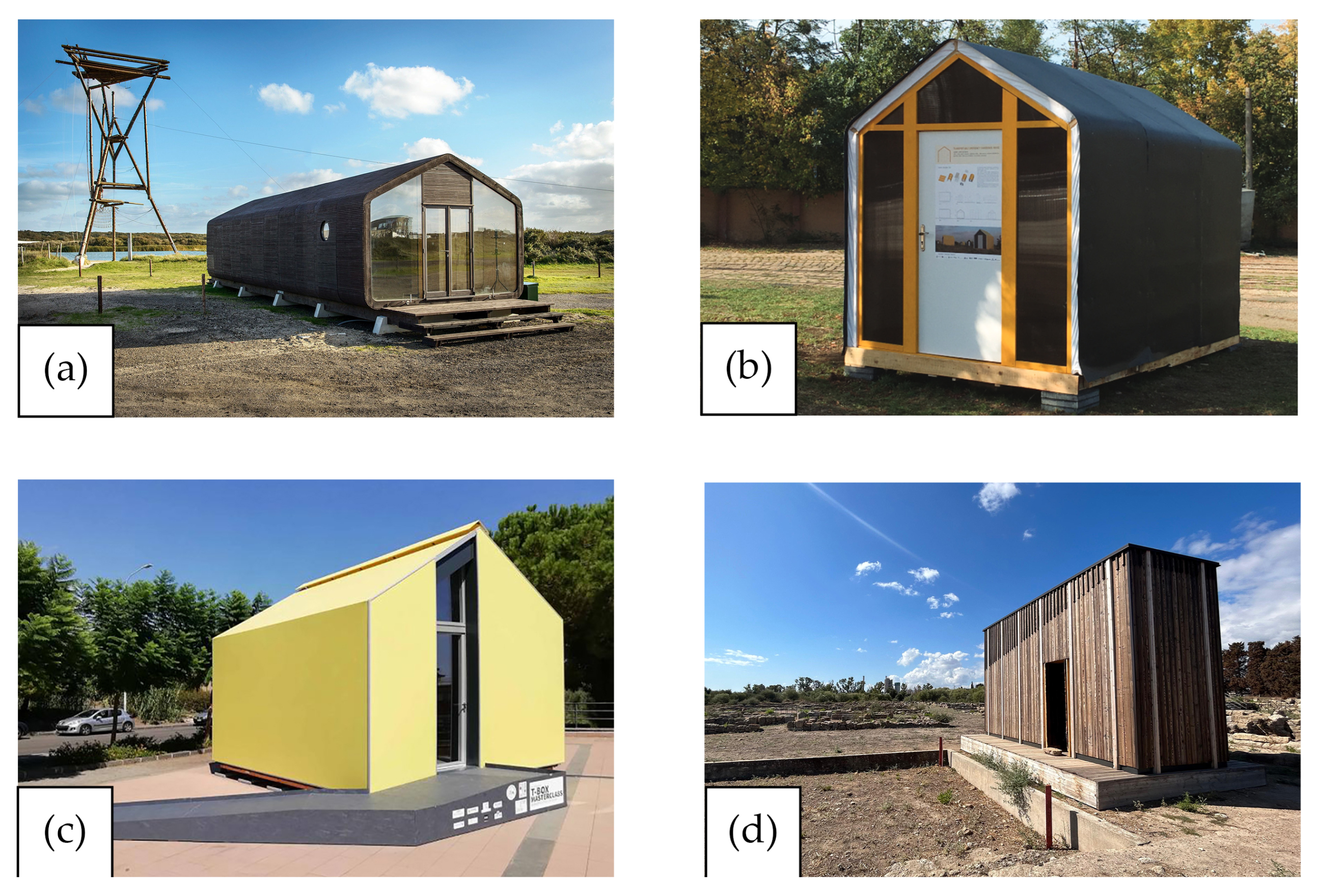
The first system studied was the Wikkel House [
57,
58] (
Figure 2a and
Table 9), initially designed as a temporary emergency structure. The production machinery was built on a trailer to enable on-site module fabrication. The original creator, Rene Snel, abandoned the project due to a lack of interest from governments and relief organizations. In 2012, Fiction Factory (FF) acquired both the machinery and the project, continuing its development. The Wikkel House consists of a series of modules made from single-wall corrugated cardboard sheets, glued and wrapped around a metal frame, reinforced with an intermediate wooden frame. The exterior is covered with waterproof, breathable tarps, over which a ventilated wooden batten wall is placed. Interiors are finished with exposed plywood.
The housing modules can be connected in series (minimum of three modules) on wooden or steel beams resting on concrete blocks as ballast. Front and rear facades are made of wood and glass, integrated directly with the module frames. The Wikkel House is marketed as an eco-sustainable, prefabricated summer home, installable within a single day, and includes a bathroom, kitchen, and air-conditioning system.
The TECH project [
9,
58] underwent two phases: digital modeling, followed by full-scale prototype construction. The Transportable Emergency Cardboard House vol. 4 (
Figure 2b and
Table 9) is the fourth-generation prototype and the second to be built. Designed as a temporary shelter for disaster victims, it consists of panels combining corrugated cardboard and honeycomb, folded on-site to form a single envelope serving as both wall and roof. Wooden elements integrated within panels provide rigidity. Each panel has a double layer of 25 mm honeycomb encased by four layers of BC-type corrugated cardboard. The system is externally covered with aluminum sheets painted for protection and internally lined with self-adhesive PVC sheets. This combination ensures modest thermal insulation while keeping weight low. The absence of joints between the roof and walls minimizes thermal bridges, and the exterior coating improves fire and water resistance, enhancing durability.
The Test Box [
59,
60,
61,
62] (
Figure 2c and
Table 9) results from experiments by Area s.r.l. in collaboration with the Department of Civil Engineering and Architecture at the University of Catania. This housing module uses Archicart technology, comprising modular panels made from triple-wall corrugated cardboard glued together and covered with an additional double-wall cardboard layer. When used structurally, the panels’ upper and lower closures feature laminated wood boards with joints, allowing easy connection to tubes and distributing loads across the panel. Floors, walls, and roof elements are assembled using custom steel anchoring brackets, with remaining spaces filled by contoured corrugated cardboard components. A full-scale prototype of approximately 25 m
2 was constructed in 2018. Thermohygrometric measurements were taken over 12 months, confirming that the dry structure is easy to disassemble, transport, and reassemble. After testing at the University of Catania (2018–2019), the prototype was reassembled at Archicart headquarters in Giarre in 2021. Another structure, with modified joints, was built in 2022 at the University of Corsica and remains under evaluation.
Finally, the Experience Pavilion (EP,
Figure 2d and
Table 9) employs ICARO [
63,
64] (Innovative Cardboard Architecture Object) technology. It is the first of a series of pavilions intended for the fragile archeological site of Megara Hyblea, a Greek colony with a brief historical existence The pavilion’s design, deliberately simple and modular, features a ventilated facade of burnt wooden slats following the Japanese Shou Sugi Ban technique, interrupted by the ICARO panel structure. Its form symbolically reflects the Greek Stoa, the site’s principal monument, with two openings enhancing the linear pathway experience and a flat, non-accessible roof.
Each ICARO panel has a framed structure in which corrugated cardboard, pre-compressed using steel bars, contributes to load-bearing. Panels consist of two wooden uprights and six beams, with slotted holes allowing screw adjustment during pre-compression. Between every two beams, two folded corrugated cardboard boxes (200 × 500 × 455 mm) are inserted. The base is a grid of C-shaped steel profiles, to which panels are fixed with plates for increased contact area, then covered with plywood. Testing and measurements of ICARO panel performance are ongoing. To achieve energy independence, three photovoltaic panels have been installed on the south façade.
7. Discussion
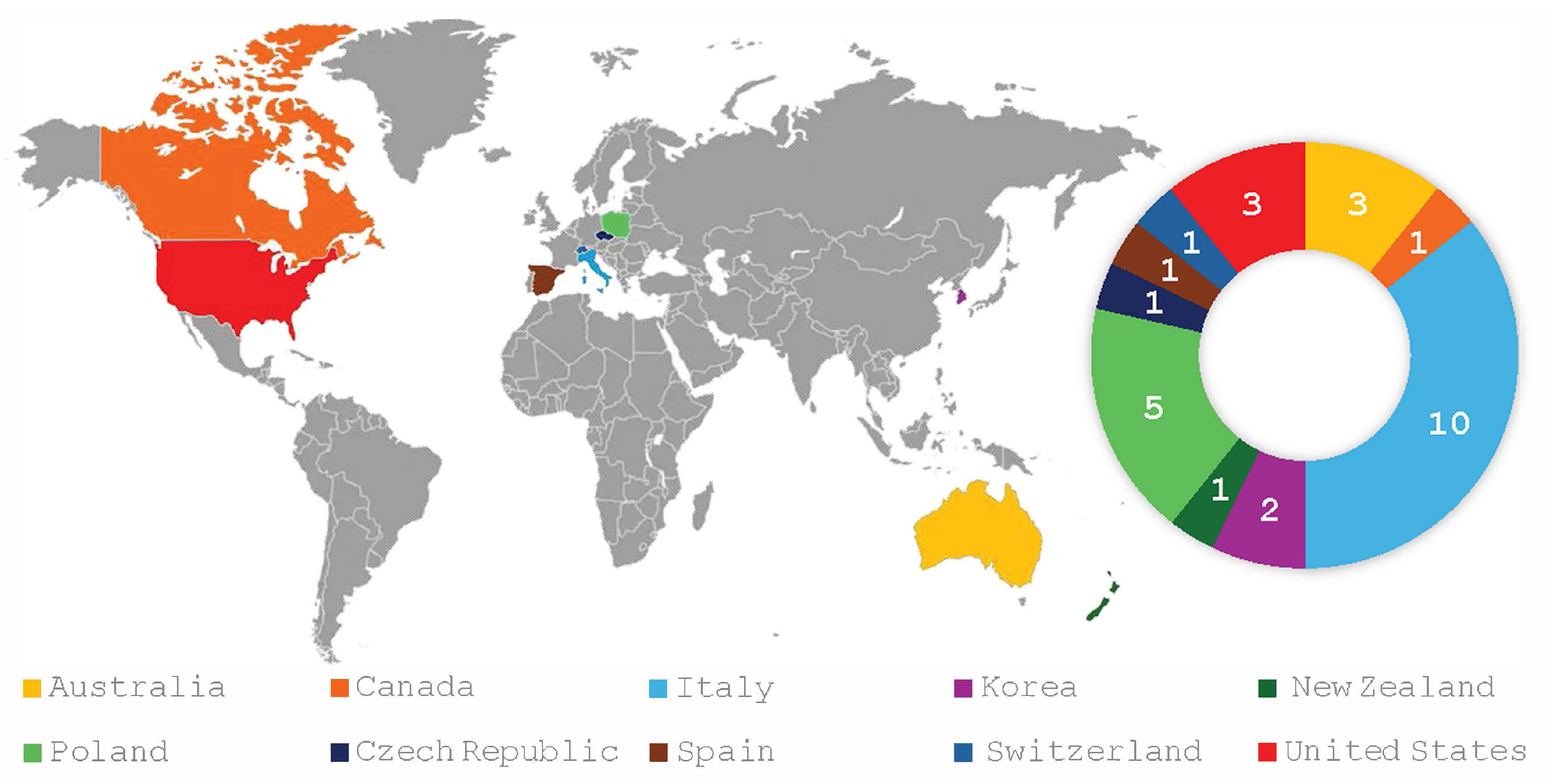
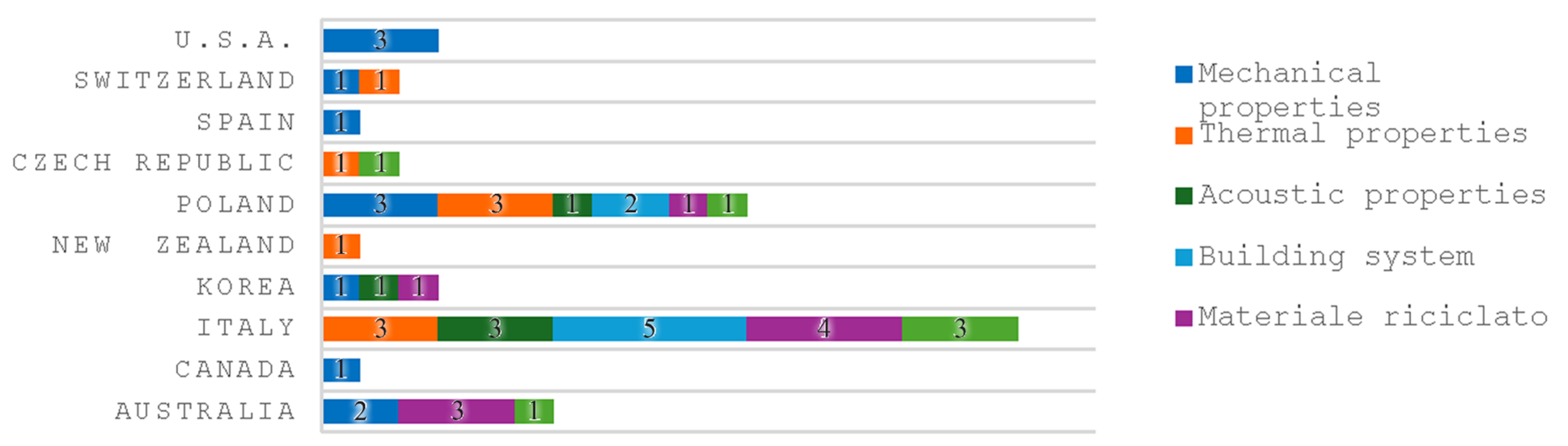
The sustainability and recyclability of corrugated cardboard make it extremely attractive in the construction sector, which is increasingly striving to meet well-defined sustainability goals. This has led to worldwide research on corrugated cardboard, as evidenced by the numerous articles consulted and referenced in this document (
Figure 3 and
Figure 4).
Initially, significant interest in the mechanical properties of corrugated cardboard developed in the USA at the end of the last century. Over the past decade, however, attention has shifted primarily to Europe and, more recently, to Eastern countries, especially regarding thermal and acoustic performance.
The main categories identified in this study are summarized below.
Most of the research available in the literature on corrugated cardboard focuses on the analysis and verification of the performance of multilayer panels. Beginning with the hypotheses formulated by Almut Phol in her doctoral thesis in 2009 [
19], numerous prototypes have been developed based on those proposed earlier. Specifically, Phol [
19] provides possible applications for sandwich panels made of corrugated cardboard for the construction of load-bearing walls and internal partitions, defining the requirements they must meet. For load-bearing walls, these must be capable of supporting various loads (self-weight, live loads, snow, wind), ensuring the transmission of these loads to the structural elements, as well as providing good resistance to heat transfer, sound waves, fire, and loads from everyday activities. From various mechanical tests conducted, the author concluded that in sandwich panels the tensile and compressive stresses, due to axial loads and bending moments, are carried solely by the outer walls, while the core resists the onset of local instabilities and counters the shear induced by the wall’s bending. In short, to achieve structural and bending requirements, it suffices to select materials with sufficient compressive strength for the facings and compressive and shear strength for the core. Moreover, the core must be impregnated to maintain the material’s properties in highly humid environments and in case of water infiltration. In this regard, cement-impregnated cardboard combined with plywood or drywall panels appears to be an ideal solution for Pohl [
19].
More recently, Heyden et al. [
44] analyzed the possibility of using corrugated cardboard as a core for structural sandwich panels, performing both mechanical and thermal tests. They found that corrugated cardboard exhibits strength and rigidity equal to, and in some cases superior to, that of the main materials commonly used as cores, to the extent that it can induce yielding in the steel of the outer sheets and prevent possible local instability.
Conversely, McCracken [
46] analyzed samples comparable to sandwich beams with a corrugated cardboard core and walls made with reinforced linen fibers. He conducted four-point bending tests and found that corrugated cardboard performs well as a substitute for the materials currently used as cores.
Abu-Saleem M. and Gattas J. [
45,
47] created large prototypes of hybrid columns and beams made of corrugated cardboard and wood; the tests conducted on these prototypes hold promise for their use in constructing framed systems of moderate dimensions.
Furthermore, considering load-bearing walls as an external envelope, there is a need for a certain resistance to heat transmission. To this end, Pohl A. [
19] identifies two possible solutions. The first is to utilize the intrinsic properties of corrugated cardboard to achieve the desired thermal resistance. This procedure has the advantage of allowing the component to be installed directly, without further processing, but it comes with the disadvantage of considerable thickness that far exceeds the structural requirements. The second solution is to use an additional layer of insulation, such as rock wool, ensuring a smaller core thickness and thus reducing the materials needed, while presenting an additional on-site processing requirement. In both cases, he refers to cement-impregnated panels. In the literature, subsequent studies can be found that are comparable to the first solution, where the focus is on unimpregnated recovered cardboard specimens.
Asdrubali et al. [
54] analyze the behavior of thermal and sound wave diffusion in panels made from recovered corrugated cardboard. Specifically, they study multilayer panels made with C-type and E-type waves, considering different configurations, both parallel and orthogonal, as well as combinations of the two types of waves. They use a protected hot plate system to determine the thermal conductivity coefficient of the various designated specimens. The collected data demonstrate better performance for the orthogonal C-type wave specimens compared to the others analyzed, but still show results significantly higher than those of the main insulating materials on the market, although comparable to those made from natural fibers.
Cekon et al. [
50], in addition to conducting thermal tests (also using a hot plate apparatus) on cardboard-based panels (different types of honeycomb and combinations of corrugated materials), compare these panels with the leading insulating materials available on the market. The authors conclude that polyurethane foam, expanded polystyrene, and mineral wool provide certainly better performance. Nonetheless, what interests us is the confirmation that panels made with honeycomb cardboard and significant thickness exhibit lower performance compared to those made from corrugated cardboard, as the presence of multiple layers eliminates the contribution due to convection.
When it comes to internal partitions, they must be able to support everyday loads, be lightweight and easy to install, and provide good resistance to sound wave transmission and fire. In this case, it is possible to use unimpregnated cardboard, and the facings can be made from low-density materials such as wood. Moreover, by selecting sufficiently thick outer walls and a core resistant to transverse compression (for this purpose, Phol considers the cardboard oriented in the CD, orthogonal to the plane of the outer facings), it is possible to create a panel that is resistant to damage from puncture/impact. She also hypothesizes several possible types of internal partitions depending on their intended use, defining different materials for the outer facings: wood applicable in all cases, steel for offices to allow the use of magnets for attaching sheets and small objects, and glass in specific situations to allow light.
Furthermore, like external partitions, internal partitions must ensure reduced sound wave transmission. This is achievable by considering the density and resonance frequency of the materials used.
When using sandwich panels with a cardboard core, one possible solution to increase the acoustic resistance of the partition is to fill the voids of the corrugated cardboard with loose insulating material. Tests conducted by Asdrubali et al. [
54] on samples of corrugated cardboard panels using an impedance tube confirm that this material does not display significant behavior for sound absorption. However, the tests show that as the number of layers increases, so does the sound absorption coefficient.
These two behaviors were expected due to the material’s relatively porous and elastic nature, where the poor damping of sound waves is attributed to the presence of air only within the waves. The study by Kang et al. [
34] highlights the significant potential of multilayer panels as acoustic dampers and addresses the previous challenge by connecting various waves through small diameter holes. Specifically, they compare three types of panels: unperforated corrugated cardboard, perforated corrugated cardboard, and corrugated cardboard perforated with a multi-frequency resonator.
The evaluations, again conducted with an impedance tube, reaffirm what was previously observed by Asdrubali [
53,
54], namely that corrugated cardboard itself is not an absorptive material. Interestingly, the perforated cardboard panel shows decent absorption at mid-to-high frequencies, while the panel perforated with a multi-frequency resonator demonstrates good absorption even at low frequencies. Regarding transmission loss, the perforated panel exhibits lower Transmission Loss (TL) levels compared to the unperforated panel, which is attributed to the perforation of the outer surface.
Another type of panel that utilizes combined corrugated cardboard and honeycomb with natural fiber panels derived from various construction waste (such as the inner panels of doors, packaging boxes, cellulose panels used for floor insulation or cavities, etc.) for reducing reverberation and sound wave transmission is the one proposed by Secchi et al. [
33]. Based on the analysis of manufacturers and products available on the market, they developed 10 types of panels, each with possible variations in thickness to enhance insulating power. In particular, these include panels for suspended ceilings, internal partitions, wall insulation, and floating floors. Only some of these products use corrugated cardboard. They start with computer simulations to achieve the best possible design with optimal performance, characteristics of lightweight, cost-effectiveness, and recyclability. From tests conducted in a reverberation chamber, they obtained results better than those of traditional gypsum panels, thus demonstrating their viability as an alternative.
- 2.
Construction Systems
The University of Catania is currently studying the possibilities of employing building systems based on corrugated cardboard. Specifically, reference is made to the Archicart [
49,
63] and ICARO [
62,
63] technologies. These are two completely different systems: the former primarily utilizes cardboard, meaning that loads are borne by triple-wall corrugated cardboard boxes enclosed by an additional layer of the same type of cardboard; while the latter uses it as bracing and infill for the wooden load-bearing structure, serving no structural purpose but merely providing support. For both types of systems, no tests have yet been published that were conducted directly on these components, although full-scale prototypes have already been developed, and a series of tests and analyses are planned to be conducted on them. From this, it can be deduced that both systems are well-suited for creating temporary structures, such as pavilions or emergency shelters; in fact, they are easy to assemble and disassemble to allow for rapid and simple relocation. The manufacturing company that has patented the Archicart system works to elevate its Technology Readiness Level (TRL) to bring this product onto the market.
On the other hand, the Icaro system was born out of the need to create lightweight, low-impact, and easily removable structures to enhance fragile sites. Another system currently being studied only analytically and through computer simulations is the thermal envelopes proposed by Jasiolek et al. [
55,
64], which aim to achieve highly sustainable and fully recyclable structures by ensuring, through a reasoned combination of materials, that both structural and thermal needs are met.
- 3.
Housing Modules
Recently, a number of building technologies based on corrugated cardboard have been developed. One of these is currently available on the market as a residential unit, namely the Wikkel House [
57,
58,
64]; the others are still in the prototype stage, developed using the previously mentioned technologies.
Given the considerable success in northwestern Europe, it was believed that the Wikkel House could serve as a starting point for this type of construction. Unfortunately, progress remains slow, particularly regarding regulatory aspects, since cardboard is not considered a structural building material. Therefore, it must always be accompanied by elements that ensure safety, such as wood and steel. The Wikkel House itself includes a wooden frame inside to provide rigidity to the corrugated cardboard component.
The TECH 04 [
58,
64] is a prototype built by Latka J. and Jasiolek A. at the University of Wroclaw. It uses a structure similar to a large sandwich panel made of corrugated cardboard and honeycomb, which can be folded on-site to create walls and a roof, minimizing points where thermal bridges may arise. It also includes wooden elements to reinforce the structure.
In the T-Box, developed using Archicart technology [
49,
60,
61], wooden boards with protrusions are present at the top and bottom of each panel, facilitating connections to the corrugated cardboard tubes that help distribute loads. Additionally, wooden uprights are included within the panels for further support.
In the EP, created with ICARO technology [
62,
63], the structural function is entirely fulfilled by the wooden components, while the cardboard serves as infill. This is a simple and linear structure designed specifically to enhance fragile contexts, rather than for residential purposes like the previous designs.
Although each building uses a different construction system in which corrugated cardboard serves as either a structural part or a component supporting the load-bearing structure, all of them incorporate wooden components to stiffen the structure, distribute loads, or perform structural tasks.
8. Conclusions
In the AEC sector, there has been a growing interest in more sustainable materials and corrugated cardboard is one of the most suitable because it is possible to find and reuse large quantities of it from different sectors (industry, construction, civil) as well as being easily recyclable.
Although in the literature there are numerous articles that investigate the performance of the corrugated cardboard, the disparity of the methods and results obtained generate a sense of mistrust in the structural use of this material, supported by the absence of regulations on the matter. To overcome this obstacle, some components and prototypes have been built from university, and not only to test the main properties. Some of these products are already on the market.
The brief confrontation between the possible use of the various components and the building systems of the prototypes, carried out in this paper, shows the high quality of the products and the high performance.
Finally, the need for a more precise regulation of the tests performed on corrugated cardboard was found, such as establishing fixed boundary conditions for each case, to allow a better comparison between the results obtained by different authors.
Furthermore, it has been explained such the possibilities given by the use of corrugated cardboard as a structural material are multiple (new construction, completion or expansion of buildings) and such they guarantee new stimulus for experimentation.