
Article

Prospect and Refuge in the Workplace: An Exploratory Pilot EEG Investigation of Desk Orientation and Hypervigilance Among Adults with ADHD

by
Jinoh Park
1,*,
Michelle Boyoung Huh
2,
Marjan Miri
3,
Melissa Hoelting
4,
Samantha Flores
4,
Yashaswini Karagaiah
4 and
Mahdi Afkhami
4
1
Department of Interior Architecture and Design, Fay Jones School of Architecture, University of Arkansas, Fayetteville, AR 72701, USA
2
Interior Design, School of Design, College of Architecture, Arts, and Design, Virginia Tech, Blacksburg, VA 24060, USA
3
Department of Architecture, Design & Urbanism, Antoinette Westphal College of Media Arts and Design, Drexel University, Philadelphia, PA 19104, USA
4
Corgan, Dallas, TX 75202, USA
*
Author to whom correspondence should be addressed.
Architecture 2026, 6(2), 51; https://doi.org/10.3390/architecture6020051
Submission received: 27 January 2026 / Revised: 7 March 2026 / Accepted: 23 March 2026 / Published: 25 March 2026

Abstract

Open-plan workplaces are often associated with increased sensory exposure, which may present challenges for adults with Attention-Deficit/Hyperactivity Disorder (ADHD), a condition characterized by atypical arousal regulation and sensory sensitivity. Although the Prospect–Refuge Theory suggests that spatial configuration may influence perceived security and attentional states, objective neurophysiological evidence in workplace contexts remains limited. This exploratory pilot study employed a mixed design to examine whether desk orientation and office enclosure were associated with differences in neural activity among adults with ADHD (n = 6). Four desk configurations were tested within each office setting, while two office types (Open Office and Enclosed Private Office) were examined between participants. Neurophysiological data were collected using portable electroencephalography (EEG), and power spectral density (PSD) across canonical frequency bands was analyzed during standardized cognitive tasks. Results indicated context-dependent spatial effects. In the Open Office setting, configurations providing both outward visibility and visual backing were associated with lower beta and gamma power relative to orientations lacking these features. In the Enclosed Private Office, orientation-related differences were not statistically significant. These preliminary findings suggest that desk orientation may influence neural indicators of cognitive demand in open-plan environments. Given the small sample size, results should be interpreted cautiously but contribute initial physiological evidence to neurodiversity-informed workplace research.

1. Introduction

1.1. The Built Environment and Neurodiversity

The built environment exerts a measurable influence on human cognition, emotional well-being, and productivity [1,2,3,4]. Research in environmental psychology and the built environment literature has established that spatial configuration can significantly affect occupants’ stress levels and concentration [5,6]. However, traditional workplace design has often operated on a “one-size-fits-all” model, implicitly assuming a neurotypical occupant. This approach is increasingly being challenged by a growing recognition of neurodiversity [7,8].
Neurodiversity recognizes variations in attention, perception, and emotional regulation as natural dimensions of human diversity [9,10,11,12]. One prominent form of neurodivergence is Attention-Deficit/Hyperactivity Disorder (ADHD), a neurodevelopmental condition associated with differences in executive functioning and sensory processing [13,14]. Despite increasing awareness of neurodiversity in design discourse, empirical research examining how interior environments support individuals with ADHD in workplace contexts remains limited [15,16].
Research in neuroarchitecture and environmental neuroscience indicates that people respond cognitively and emotionally to spatial conditions and that neural activity can be measured during exposure to built environments to examine effects on attention, stress, and emotional regulation [17,18,19,20]. While much of this work has focused on general populations, less attention has been given to how individuals with atypical sensory and attentional regulation experience everyday workplace environments [21].

1.2. ADHD and Environmental Sensitivity

Attention-Deficit/Hyperactivity Disorder (ADHD) is characterized by persistent difficulties in sustained attention, impulse control, and executive functioning [22]. In workplace contexts, these characteristics often manifest as challenges in maintaining focus and regulating effort amid competing sensory demands [23,24].
Beyond behavioral symptoms, ADHD is associated with atypical arousal regulation, characterized by unstable baseline vigilance and impaired maintenance of task engagement [25,26,27]. Autonomic nervous system studies similarly report dysregulated arousal modulation [28]. These arousal patterns are closely linked to deficits in neural inhibition, a fundamental physiological process required to filter out irrelevant environmental stimuli [29]. Such impairments in sensory gating mechanisms result in a diminished capacity to suppress background noise, leading to sensory over-responsivity and increased cognitive load [30]. Evidence also indicates heightened sensory sensitivity, reduced sensory inhibition, and atypical early sensory processing in ADHD, particularly in auditory and visual domains [31,32,33,34]. Sensory processing differences in adults with ADHD have been associated with work performance outcomes, with sensory sensitivity accounting for a meaningful proportion of variance in occupational functioning [35].
As a result, adults with ADHD may be particularly sensitive to variations in sensory load. Unstructured or unpredictable stimulation may reduce neural efficiency, whereas more structured perceptual input can sometimes support performance [36]. Together, these findings suggest that this neurophysiological vulnerability [37] may increase sensitivity to workplace environments characterized by high sensory variability and limited control over visual and auditory exposure.

1.3. Office Layout, Desk Orientation, and Prospect–Refuge Theory

Open plan and enclosed office layouts differ in the degree of visual exposure, acoustic privacy, and environmental control they provide [38]. Over the past century, these spatial models have evolved in response to shifting organizational priorities, including efficiency, supervision, collaboration, and focused work [39]. Early open plan office layouts emphasized spatial efficiency and managerial oversight, organizing workers in large shared rooms. Later, open-plan and activity-based models were promoted as flexible environments intended to support communication and collaboration. In contrast, enclosed private offices have traditionally been associated with concentrated individual work by offering spatial separation and greater control over visual and auditory input [40].
These layout differences correspond to distinct sensory conditions. Open-plan offices are often characterized by higher levels of background noise, greater exposure to intelligible speech, more visual movement, and reduced acoustic and visual privacy. Such conditions in open-plan offices have been linked to distraction, elevated cognitive load, and reduced perceived concentration, particularly during tasks requiring sustained attention [41,42,43]. Enclosed offices, by contrast, generally provide greater control over auditory and visual input [44].
Within both plan types, desk orientation may further influence the user experience. Since the desk orientation is critically related to the circulation paths, shared spaces, and co-worker movement, it affects line of sight, visual predictability, and proximity to noise sources [45]. Workstations facing high-traffic areas or open sightlines may increase visual motion and auditory variability, whereas configurations that provide visual backing or partial enclosure may reduce environmental unpredictability and perceived distraction [46,47].
To interpret the relationship between spatial arrangement and user perception, the Prospect–Refuge Theory, proposed by Appleton [48], provides a useful conceptual perspective. The framework suggests that individuals tend to prefer environments offering both outward visibility (“prospect”) and physical or visual support from behind (“refuge”), conditions associated with perceived comfort and environmental stability. In office contexts, desk orientations that limit outward view or provide little visual backing may reduce perceived environmental control, whereas configurations offering clearer sightlines and supportive backing may enhance perceived security and attentional focus [49].
Rather than implying automatic biological threat responses, the Prospect–Refuge Theory serves here as a conceptual lens for understanding how workstation configuration may shape perception and cognitive effort. However, despite its theoretical relevance, few studies have examined whether such spatial differences are associated with objective neurophysiological responses in contemporary workplace settings.
Moreover, most research on office layout relies primarily on self-report or behavioral measures [50], with limited attention to how specific workstation orientations affect physiological regulation, particularly among individuals with heightened sensory sensitivity [21]. This gap constrains understanding of how office types, along with desk orientation, may influence cognitive regulation in neurodiverse populations.

1.4. Research Aim and Hypotheses

To address these gaps, this pilot study examines how office type, open plan versus enclosed, and desk orientation are associated with neurophysiological responses among adults with ADHD. Building on evidence that ADHD is characterized by altered arousal regulation and sensory sensitivity, this study investigates whether differences in spatial configuration correspond to measurable changes in neural activity during task performance.
In this study, physiological regulation refers to changes in electroencephalography (EEG) activity associated with attentional engagement and arousal while participants complete cognitive tasks under different workstation conditions. Rather than presuming causal mechanisms, the analysis evaluates whether specific spatial arrangements are associated with variations in neural activation patterns that may reflect differences in cognitive demand.
Based on prior research linking sensory variability to attentional load, the following directional but exploratory hypotheses were formulated:
  • Open-plan office configurations will be associated with greater EEG indicators of cognitive demand, particularly higher Beta and Gamma power, than enclosed office configurations.
  • Enclosed private office configurations will be associated with lower EEG indicators of cognitive demand than open-plan office configurations, consistent with greater environmental enclosure and visual support.
  • Within office types, desk orientations that provide both outward visibility (“prospect”) and visual backing (“refuge”) will be associated with lower EEG indicators of cognitive load than orientations lacking one or both of these spatial characteristics.
Given the limited physiological research examining workstation configuration in adults with ADHD, these hypotheses are proposed as exploratory tests of whether measurable neural differences emerge across spatial conditions.

2. Materials and Methods

2.1. Study Design

This research comprised an exploratory pilot investigation employing a mixed design. Four different desk orientations were tested within subjects in each office setting, whereas two office types, the Open-Plan Office and the Enclosed Private Office, were examined between participants because of logistical constraints during the pilot phase.
The primary objective was to investigate whether spatial desk orientation and office enclosure were associated with differences in neurophysiological activity among adults with ADHD. The study was designed as an in situ experiment conducted in physically simulated workplace environments.

2.2. Participants

A total of six adults formally diagnosed with ADHD were recruited through a third-party research participant recruiting agency. Participants met the inclusion criteria of being 18–65 years of age with normal or corrected-to-normal vision. Exclusion criteria included any self-reported history of other neurological or psychiatric disorders. Given the focus on neurophysiological measurement, medication status was considered during the recruitment process. Participants currently using stimulant or other central nervous system–active medications were excluded unless they reported abstaining prior to testing. No formal washout period was imposed, and medication effects cannot be fully ruled out as a potential influence on arousal-related findings.
Due to pilot resource constraints, four participants completed the study in the Enclosed Private Office setting, and two participants completed the study in the Open-Plan Office setting. Participants were not stratified by ADHD subtype or symptom severity. As a result, comparisons between office types reflect between-subject differences and should be interpreted cautiously.
The study protocol was approved by the Institutional Review Board (IRB) at three universities, and all participants provided written informed consent prior to their participation.

2.3. Experimental Setting and Interventions

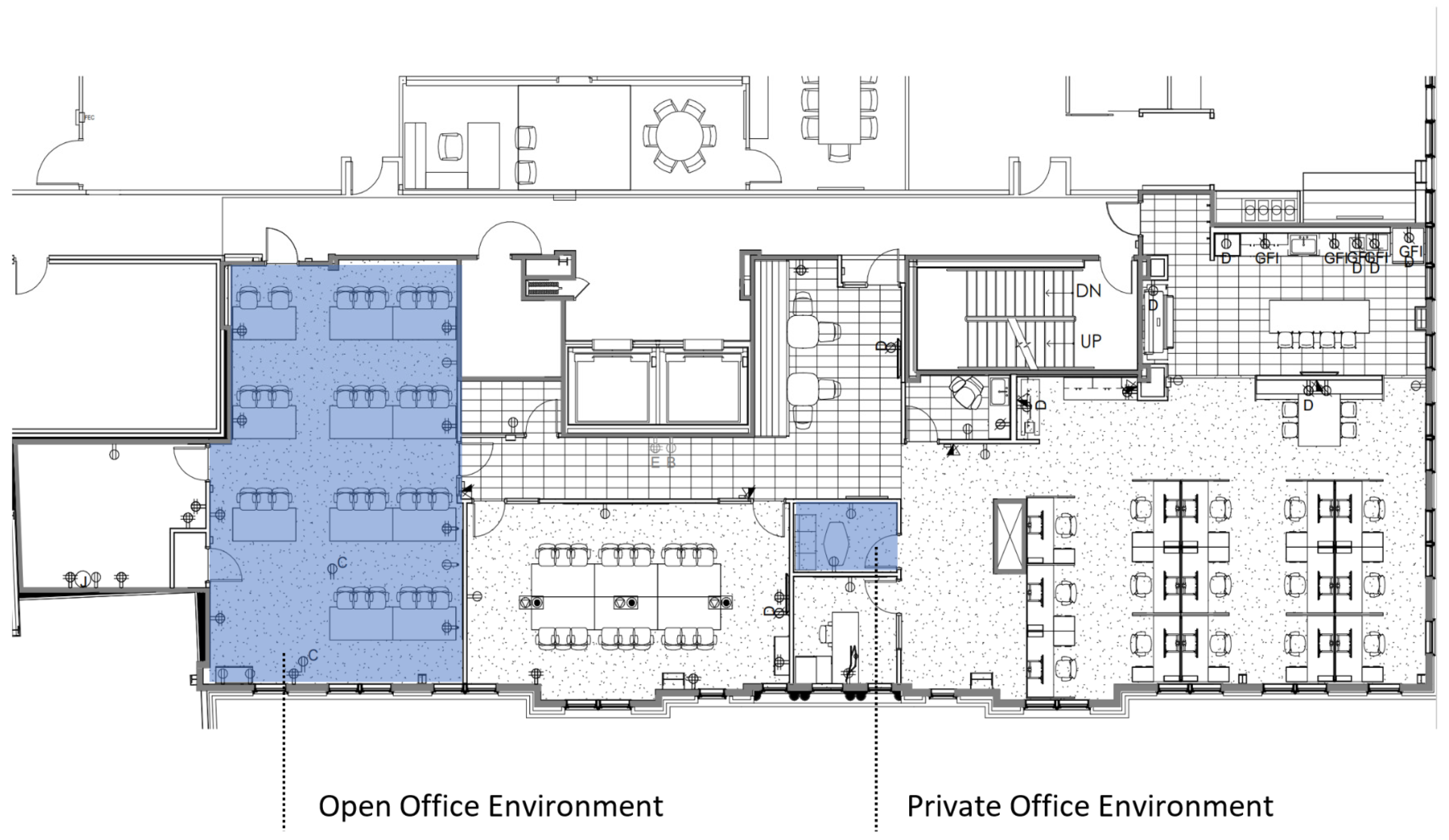
As shown in Figure 1, the experiments were conducted within two distinct fully furnished settings designed to represent typical workplace environments:
  • The Enclosed Private Office: This setting consisted of a room with a single workstation enclosed by full-height walls and a closeable glass door. It simulated a traditional private office environment that offers a high degree of visual and auditory privacy.
  • The Open-Plan Office: This setting consisted of a larger shared workspace containing multiple workstations with low or no partitions between them. During testing sessions, two to three additional occupants (research staff and/or another participant) were present in the space. These individuals engaged in typical office behaviors, including seated computer work and occasional movement within the room. No deliberate noise manipulations were introduced. Ambient sounds were limited to ordinary office activity such as typing, chair movement, and low-level conversation. Testing occurred during standard daytime hours to approximate natural workplace conditions. This design aimed to simulate ecologically valid open-plan exposure rather than an acoustically controlled laboratory condition.

2.4. Spatial Interventions

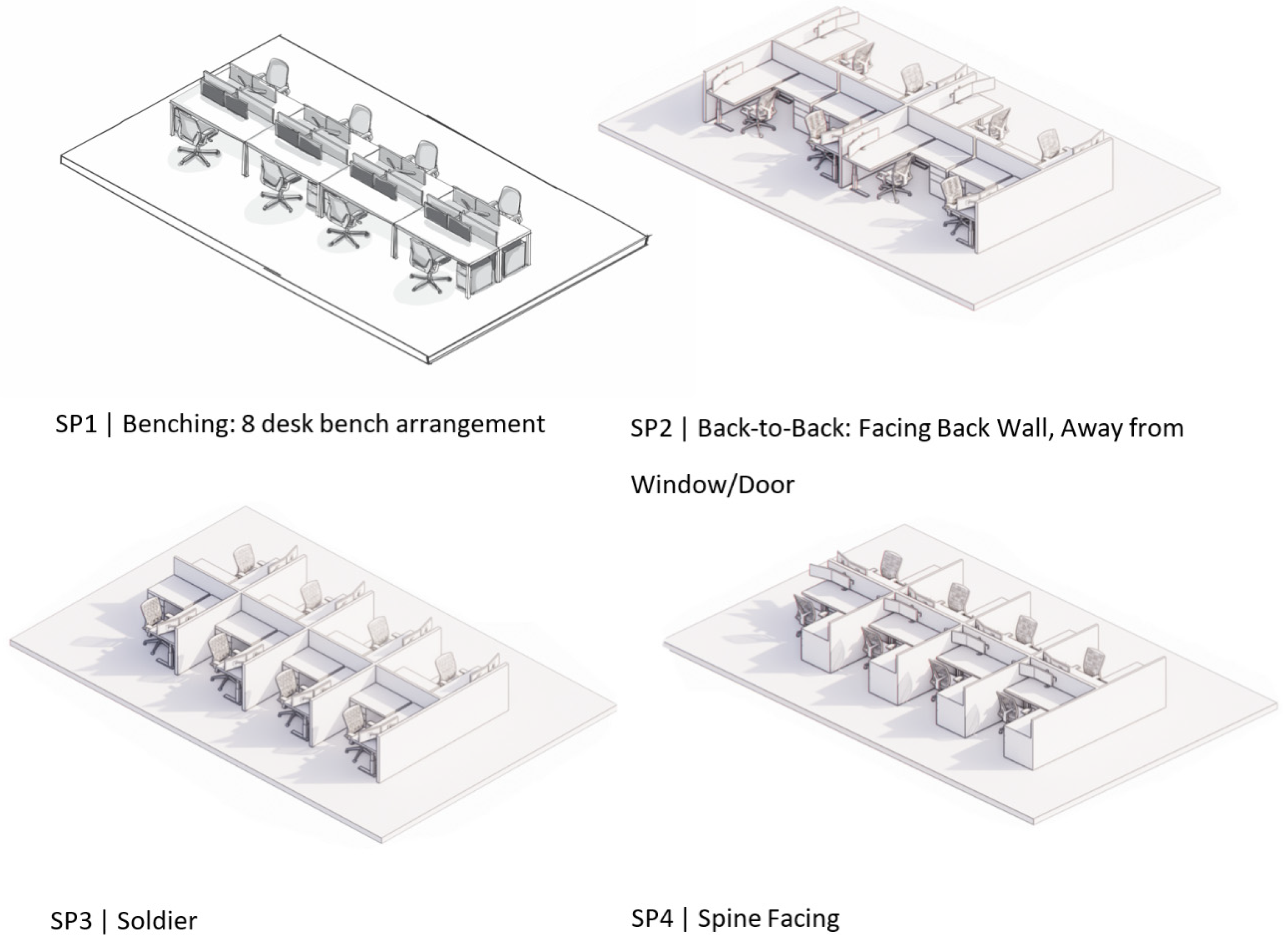
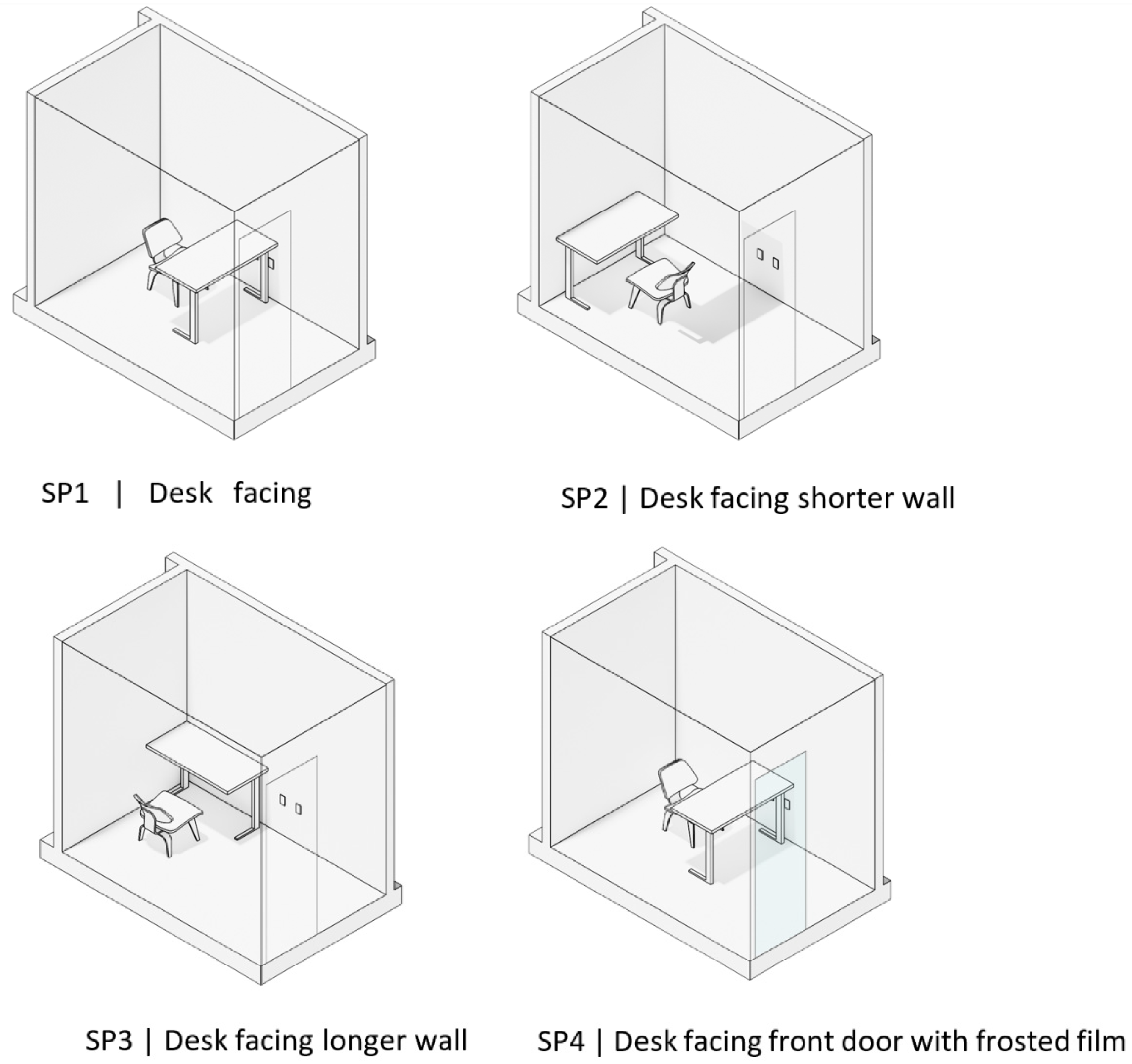
Four distinct desk configurations, referred to as Spatial Interventions (SP), were systematically tested as independent variables in both settings, as shown in Figure 2 and Figure 3. These layouts were selected to operationalize variations in visibility, backing, and environmental exposure, as conceptualized in the Prospect–Refuge Theory.
  • SP1 (Benching): The desk was positioned to allow the participant to face the primary view or room entrance. In the Open-Plan setting, this provided a clear view of the space (“Prospect”) while a solid wall behind provided protection (“Refuge”).
  • SP2 (Back-to-Back): The desk was oriented to face a solid wall with the participant’s back exposed to the room’s entrance or the open plan. This configuration represents the “No Prospect, No Refuge” condition.
  • SP3 (Soldier): The desk was placed parallel to the side walls in the private office or parallel to the primary flow of the room in the open-plan office, thereby increasing peripheral exposure.
  • SP4 (Spine Facing): The desk was positioned as in SP1 (Benching). However, a visual obstruction was introduced. In the Open-Plan Office, an eye-level privacy partition was installed on the desk. This condition provided Refuge (secure back) but blocked Prospect (view).

2.5. Data Acquisition

2.5.1. EEG Data Acquisition

Neurophysiological data were acquired using a Flowtime headband, a portable two-channel EEG system with dry electrodes positioned at the prefrontal cortex locations Fp1 and Fp2. We selected the prefrontal cortex because this region is heavily implicated in executive functions, attentional control, and emotional regulation. These cognitive domains are specifically challenged in adults with ADHD.
The device was chosen for its suitability in ambulatory and ecologically valid research settings. Unlike high-density laboratory systems, this lightweight mobile configuration allowed participants to complete cognitive tasks within realistic office environments without substantial movement restriction. The selection of this specific system followed a preliminary pilot phase in which several commercially available portable EEG devices were evaluated for ergonomic fit and skin compatibility. Systems that induced physical pressure or epidermal irritation during extended wear were excluded from the study protocol. The headband employs dry electrodes requiring minimal skin contact and no conductive gel. No participants reported discomfort, irritation, or difficulty completing tasks while wearing the device.
According to the manufacturer’s technical specifications, the Flowtime headband uses biosensing technology reported to achieve a correlation of over 92% with 64-channel research-grade systems such as the Neuroscan SynAmps RT [51]. While lower in spatial resolution than multi-channel clinical systems, portable EEG devices have been used in environmental and building research to detect sustained changes in spectral power associated with attentional and affective states [52]. Most importantly, the objective of this study was to investigate long-term modulations in cognitive states over periods of several minutes rather than to capture high-frequency time-locked event-related potentials (ERPs). For detecting such sustained changes in brainwave power (Power Spectral Density), the temporal resolution of portable EEG systems is sufficient. Therefore, the use of this mobile EEG technology represents a deliberate methodological choice to prioritize ecological validity and scalability. This enables the real-time assessment of neurophysiological processes in a naturalistic setting where traditional laboratory-based systems would have been impractical.

2.5.2. Cognitive Tasks

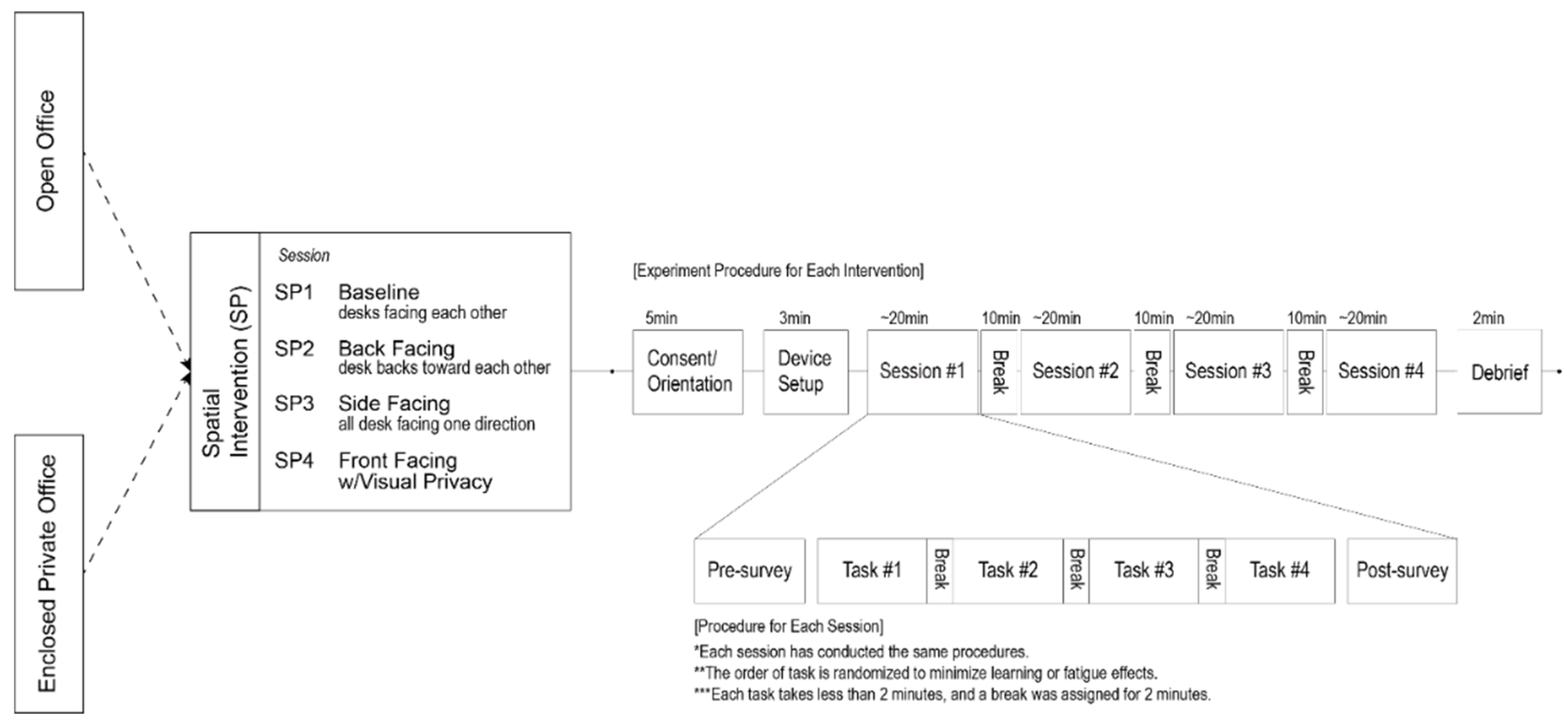
As illustrated in Figure 4, participants completed cognitive tasks during each spatial intervention. The same four tasks were administered across all spatial configurations and in both office settings: Psychomotor Vigilance Test (PVT), Stroop Task, n-back Task, Go/No-Go Task. Each task took less than two minutes, and the task order was randomized across participants to reduce order effects. No modifications were made between spatial conditions or office types.

2.5.3. Subjective Data Acquisition

To contextualize physiological findings, participants completed pre- and post-session digital surveys assessing perceived stress, comfort, and focus. Additionally, structured observational notes were taken by a researcher during each session to document participant behaviors, such as fidgeting or gaze direction, and any unsolicited comments regarding the environment.

2.6. Data Processing and Analysis

2.6.1. Signal Processing

Raw Power Spectral Density (PSD) values for the five canonical EEG frequency bands (delta, theta, alpha, beta, and gamma) were exported from the Flowtime proprietary software (version 5.0.6.) in CSV format. The primary goal of data processing was to derive a single stable representative value for each frequency band under each spatial condition for every participant.
This was achieved through a rigorous two-step averaging process. First, for each participant under a given spatial condition (e.g., SP1), the continuous EEG data were segmented according to the six experimental phases (Pre-Survey, Task A, Task B, Task C, Task D, and Post-Survey). The mean PSD value for each frequency band was calculated within each of these phases to capture the sustained cognitive state during active work. Second, these phase-averaged values were then averaged together. This procedure yielded a single comprehensive PSD value for each frequency band that represented the participant’s overall neurophysiological state during that specific spatial configuration.

2.6.2. Statistical Analysis

All statistical analyses were conducted using JASP statistical software (version 0.95.2). To determine the effect of spatial interventions on brainwave activity, a series of one-way repeated measures Analyses of Variance (ANOVAs) was performed. These analyses were conducted separately for each of the five dependent variables (mean PSD for the α, β, δ, θ, and γ bands) within each office setting (Open-Plan vs. Enclosed Private). The within-subjects factor for each ANOVA was the Spatial Intervention which consisted of four levels (SP1, SP2, SP3, SP4).
Prior to each analysis, the assumption of sphericity was assessed using Mauchly’s test. If the assumption was violated (p < 0.05), the degrees of freedom were corrected using the Greenhouse-Geisser procedure. When a statistically significant main effect was identified, post hoc pairwise comparisons were conducted using a Bonferroni correction to control Type I errors. The threshold for statistical significance was set at α = 0.05. Given the pilot nature of the study and the sample size, Partial eta-squared (ηp2) was reported for all main effects as a critical measure of effect size to evaluate the practical magnitude of the interventions’ influence.

2.6.3. Exploratory Contextual Measures

To provide a more holistic interpretation of the statistically significant EEG results, a set of exploratory contextual measures was additionally summarized for the Open-Plan Office condition only (n = 2). In addition to the device-generated proprietary indices of “Attention,” “Relaxation,” and “Pressure,” these measures included heart rate variability (HRV), mean reaction time (RT) derived from the computerized task session, post-condition NASA Task Load Index (NASA-TLX) ratings, and qualitative comments drawn from participant remarks and structured observational notes. These measures were not treated as primary dependent variables. Instead, they were used descriptively to examine whether broad patterns in physiological, behavioral, and subjective responses converged with the EEG spectral findings across spatial interventions. This approach is consistent with prior built-environment research that has combined neurophysiological and subjective indicators to interpret environmental effects, while also acknowledging the relevance of autonomic measures in ADHD and workplace stress research [3,28,50]. Because of the pilot nature of the study and the very small subgroup sample, these measures were interpreted as exploratory contextual observations rather than confirmatory inferential outcomes. The proprietary indices were considered supplementary outputs from the wearable system and were used only to support descriptive interpretation alongside the EEG results [51,52].

3. Results

This section presents the statistical outcomes of the experiments focusing on the Spatial Interventions. The findings are designated by the workplace setting: Enclosed Private Office and Open-Plan Office. All reported results are based on the repeated measures ANOVA with effect sizes reported as partial eta-squared (ηp2). A summary of the ANOVA findings is provided in Table 1. It is important to note that all participants in this study were adults formally diagnosed with ADHD. Thus, the neurophysiological responses reported here should be considered within the context of this specific neurodiverse population.

3.1. Spatial Interventions in Enclosed Private Office (n = 4)

In the Enclosed Private Office setting, the repeated measures ANOVA revealed no statistically significant main effects of the spatial desk orientation on any of the five EEG frequency bands (p > 0.05). Whether the participant faced the wall, the door, or the side, the presence of full-height walls appeared to buffer the neurophysiological impact of desk orientation. Subjective reports aligned with this null finding, as participants consistently reported feeling “secure” regardless of the desk layout.

3.2. Spatial Interventions in Open-Plan Office (n = 2)

In contrast to the enclosed office, the spatial desk configuration in the Open-Plan environment was associated with differences in EEG activity. Significant main effects of Spatial Intervention were observed across the five frequency bands (see Table 1). Effect sizes were large (ηp2 > 0.99); however, given the small sample size (n = 2), these values should be interpreted cautiously.
Post hoc comparisons with Bonferroni correction revealed that the SP1 (Benching) condition differed from all other conditions (SP2, SP3, SP4) across all five frequency bands (p < 0.05). Specifically, SP1 showed higher alpha, delta, and theta power and lower beta and gamma power compared to other configurations (SP2, SP3, SP4). Since increased alpha, delta, and theta activity is generally associated with relaxation and internal focus, whereas beta and gamma activity is associated with greater cognitive effort and arousal [53]. These findings therefore suggest that the alternative configurations (SP2, SP3, SP4) may have been associated with greater cognitive demand than SP1 in this setting. These interpretations remain preliminary, given the limited number of participants.

3.3. Correspondence with Subjective Metrics

An exploratory comparison of EEG findings with device-generated metrics and subjective surveys suggested potential divergence between physiological indicators and perceived performance in the Open-Plan setting (Table 2). In the SP2 (Back-to-Back) condition, higher beta power (Beta Power: 145.56) and lower heart rate variability (HRV: 24.50 ms) were observed relative to other configurations. However, participants gave this condition a comparatively high subjective rating (NASA-TLX: 6.50).
Qualitative comments indicated feelings of being “exposed” or a “need to look back,” which aligned more closely with physiological patterns than with perceived performance ratings. Given the exploratory nature of these analyses and the small sample size, these observations should be interpreted as descriptive rather than confirmatory.

4. Discussion

4.1. Summary of Principal Findings

This exploratory pilot study evaluated the neurophysiological associations of desk orientation in two real-world workplace settings among adults with ADHD. The findings suggest that desk orientation corresponded with differences in EEG activity within the Open-Plan Office, whereas comparable orientation-related effects were not statistically significant in the Enclosed Private Office. Although the pilot nature and limited sample size of this study preclude definitive causal effects, the results indicate that workstation configuration may correspond with measurable variation in neural activity under conditions of greater environmental exposure. In this sense, the study contributes preliminary physiological evidence to discussions of how spatial layout may interact with sensory and attentional characteristics in neurodiverse populations. Methodologically, the study confirms the feasibility of collecting in situ EEG data in fully furnished office environments. By integrating neurophysiological measures alongside subjective assessments, this approach provides an additional layer of evidence for examining how spatial variables may relate to cognitive regulation in workplace contexts.

4.2. Interpretation of Spatial Configuration and Office Context

Within the Open-Plan Office, the SP1 (Benching) configuration corresponded to differences in EEG activity characterized by relatively higher alpha, delta, and theta power and lower beta and gamma power compared to other layouts. In prior literature, beta and gamma activity have been discussed in relation to heightened cognitive effort and arousal, whereas increased alpha activity has often been associated with more relaxed attentional states [53]. This neurophysiological pattern suggests that the alternative configurations (SP2, SP3, and SP4) may have imposed greater cognitive demand than SP1 in the open-office setting. Although these associations are indirect and context-dependent, the observed differences are conceptually consistent with variation in cognitive load across spatial conditions.
The SP1 configuration uniquely combined outward visibility (“prospect”) with visual backing (“refuge”), while other orientations limited one or both of these spatial characteristics. Interpreted through the Prospect–Refuge Theory, this combination supports a greater sense of environmental stability in open settings. Importantly, the present study does not directly measure perceived safety or threat responses; therefore, the theory serves as a conceptual framework rather than as a confirmed explanatory mechanism.
The absence of statistically significant orientation effects in the Enclosed Private Office indicates that architectural enclosure itself moderates the impact of workstation placement. In more spatially contained environments, enclosure limits environmental variability, potentially diminishing orientation-based differences. Because office type was examined between participants rather than within the same individuals, this interpretation remains provisional and warrants further investigation.

4.3. Divergence Between Physiological and Subjective Experience

An additional insight emerged from the divergence between physiological indicators and perceived performance in the SP2 (Back-to-Back) condition. Participants rated their perceived performance relatively highly, whereas physiological patterns suggested greater cognitive effort, reflected in higher cognitive load (Beta/Gamma power) and lower Heart Rate Variability. This discrepancy points to two considerations in neurodiverse workplace research. Individuals with ADHD may interpret heightened arousal as productive engagement, particularly if accustomed to compensatory attentional strategies. Alternatively, subjective ratings may not capture underlying cognitive strain during short experimental tasks. Although speculative, this divergence underscores the potential limitation of relying solely on self-reports when evaluating spatial interventions. For design research, this finding demonstrates the value of integrating objective and subjective measures. The goal is not to privilege physiology over perception, but to recognize that perceived comfort and neural efficiency do not always align.

4.4. Design Implications

The present findings do not constitute prescriptive standards. Instead, they suggest that spatial variables such as desk orientation require closer consideration in open-plan environments, particularly for individuals with heightened sensory sensitivity. Configurations that provide both outward visibility and visual backing may contribute to more stable attentional engagement under conditions of increased environmental exposure. Rather than proposing fixed design solutions, this study encourages a shift toward examining how spatial configuration interacts with cognitive and sensory variability. Integrating physiological and subjective measures enables more nuanced evaluation of workplace environments, especially in contexts seeking to accommodate neurodiverse populations.

5. Conclusions

This exploratory pilot study examined whether workstation orientation and office enclosure were associated with differences in neural activity among adults with ADHD. Orientation-related differences were observed in the Open-Plan setting but not in the Enclosed Private Office, suggesting that spatial configuration effects may be context-dependent. Despite its limited scale, the study demonstrates the feasibility of combining portable EEG measurement with real-world spatial interventions. By situating the Prospect–Refuge Theory within an empirical workplace context, this research contributes an early step toward understanding how spatial design may interact with neurodiversity in built environments. These findings underscore the value of objective neurophysiological data in developing inclusive design standards that move beyond conventional self-report measures.

6. Limitations and Future Directions

Several limitations constrain the interpretation of these findings. The small sample size (n = 6), including only two participants in the Open-Plan condition, substantially limits statistical power and generalizability. Effect sizes observed in the Open-Plan analyses are likely unstable and do not represent robust population-level indicators. Office type was examined between participants rather than within the same individuals, preventing direct causal comparison across settings and introducing potential group-level variability.
Specific participant characteristics also constrain the results. Participants were not stratified by ADHD subtype or symptom severity. Although medication status was considered during recruitment, the absence of an extended washout period introduces the possibility of residual drug effects on neural activity. The use of a two-channel portable EEG system prioritizes ecological validity but offers lower spatial resolution than laboratory-grade systems.
Future research requires larger samples, fully within-subject comparisons across office types, and inclusion of neurotypical comparison groups. Longitudinal designs are necessary to determine whether short-term spectral differences correspond with sustained performance, fatigue, or well-being outcomes.

Author Contributions

Conceptualization, M.M., M.B.H., J.P., M.H., S.F., Y.K. and M.A.; methodology, M.M., M.B.H., J.P., M.H., S.F., Y.K. and M.A.; formal analysis, J.P. and M.B.H.; investigation, M.H., M.M., M.B.H., Y.K. and M.A.; resources, M.H., S.F., Y.K. and M.A.; data curation, Y.K. and M.A.; writing—original draft preparation, J.P.; writing—review and editing, M.M., M.B.H., J.P., M.H., S.F., Y.K. and M.A.; visualization, Y.K.; supervision, M.M., M.B.H., J.P., M.H., S.F., Y.K. and M.A.; project administration, M.M., M.B.H., J.P., M.H., S.F., Y.K. and M.A.; funding acquisition, M.M., M.B.H., J.P., M.H. and S.F. All authors have read and agreed to the published version of the manuscript.

Funding

This research was funded by the American Institute of Architects (AIA) Upjohn Research Initiative 2023 (https://www.aia.org/advocacy/research/grants-fellowships/upjohn-research-initiative accessed on 22 March 2026).

Institutional Review Board Statement

The study was conducted in accordance with the Declaration of Helsinki and approved by the Institutional Review Boards of the University of Arkansas (protocol # 2401516888 and 9 October 2024), Drexel University (protocol # 2409010764 and 23 October 2024), and Virginia Polytechnic Institute and State University (protocol # UA 2401516888 28 October 2024).

Informed Consent Statement

Informed consent was obtained from all subjects involved in the study.

Data Availability Statement

The data presented in this study are not available due to privacy and ethical restrictions. The participants did not consent to having their data shared publicly.

Acknowledgments

We would like to express our sincere gratitude to all the participants who volunteered for this study. We also thank the Corgan team for providing the experimental space and logistical support. During the preparation of this manuscript, the authors used Gemini (version 2.5) for the purposes of language editing and refining the clarity of the text. The authors have reviewed and edited the output and take full responsibility for the content of this publication.

Conflicts of Interest

The authors declare no conflicts of interest. The funders had no role in the design of the study; in the collection, analyses, or interpretation of data; in the writing of the manuscript; or in the decision to publish the results. Authors Melissa Hoelting, Samantha Flores, Yashaswini Karagaiah, and Mahdi Afkhami were employed by the company Corgan. In addition to the AIA grant referenced in the manuscript, support for these authors’ participation in the research was provided by Corgan through their professional roles. The funder was not involved in the study design, collection, analysis, interpretation of data, the writing of this article or the decision to submit it for publication.

Abbreviations

The following abbreviations are used in this manuscript:
ADHDAttention-Deficit/Hyperactivity Disorder
AIAAmerican Institute of Architects
ANOVAAnalysis of Variance
EEGElectroencephalography
ERPEvent-Related Potential
HRVHeart Rate Variability
IRBInstitutional Review Board
NASA-TLXNASA Task Load Index
PSDPower Spectral Density
SPSpatial Intervention

References

  1. Al Horr, Y.; Arif, M.; Katafygiotou, M.; Mazroei, A.; Kaushik, A.; Elsarrag, E. Impact of Indoor Environmental Quality on Occupant Well-Being and Comfort: A Review of the Literature. Int. J. Sustain. Built Environ. 2016, 5, 1–11. [Google Scholar] [CrossRef]
  2. Roumi, S.; Zhang, F.; Stewart, R.A.; Santamouris, M. Indoor Environment Quality Effects on Occupant Satisfaction and Energy Consumption: Empirical Evidence from Subtropical Offices. Energy Build. 2024, 303, 113784. [Google Scholar] [CrossRef]
  3. Bower, I.; Tucker, R.; Enticott, P.G. Impact of Built Environment Design on Emotion Measured via Neurophysiological Correlates and Subjective Indicators: A Systematic Review. J. Environ. Psychol. 2019, 66, 101344. [Google Scholar] [CrossRef]
  4. Abbas, S.; Okdeh, N.; Roufayel, R.; Kovacic, H.; Sabatier, J.-M.; Fajloun, Z.; Abi Khattar, Z. Neuroarchitecture: How the Perception of Our Surroundings Impacts the Brain. Biology 2024, 13, 220. [Google Scholar] [CrossRef]
  5. Kwon, J.; Linihan, S.; Iedema, A.; Schmidt, A.; Luo, C.; Marrufo, K. How Interior Design Responds to Neurodiversity: Implementing Wearable Technologies in Neurodesign Processes. Front. Built Environ. 2023, 9, 1211519. [Google Scholar] [CrossRef]
  6. Dresp-Langley, B.; Reeves, A.J. Environmental Lighting Conditions, Phenomenal Contrast, and the Conscious Perception of Near and Far. Brain Sci. 2024, 14, 966. [Google Scholar] [CrossRef]
  7. Bruyère, S.M.; Colella, A. (Eds.) Neurodiversity in the Workplace: Interests, Issues, and Opportunities; SIOP organizational frontiers series; Routledge: New York, NY, USA; London, UK, 2022; ISBN 978-1-000-60429-0. [Google Scholar]
  8. Krzeminska, A.; Austin, R.D.; Bruyère, S.M.; Hedley, D. The Advantages and Challenges of Neurodiversity Employment in Organizations. J. Manag. Organ. 2019, 25, 453–463. [Google Scholar] [CrossRef]
  9. Dwyer, P. The Neurodiversity Approach(Es): What Are They and What Do They Mean for Researchers? Hum. Dev. 2022, 66, 73–92. [Google Scholar] [CrossRef]
  10. McLennan, H.; Aberdein, R.; Saggers, B.; Gillett-Swan, J. Neurodiversity: A Scoping Review of Empirical Research. Neurodiversity 2025, 3, 1–17. [Google Scholar] [CrossRef]
  11. Stenning, A.; Rosqvist, H.B. Neurodiversity Studies: Mapping out Possibilities of a New Critical Paradigm. Disabil. Soc. 2021, 36, 1532–1537. [Google Scholar] [CrossRef]
  12. Videla, R.; Aros, M.B.; Parada, F.; Kausel, L.; Sandoval-Obando, E.; Jorquera, D.; Ibacache, D.; Maluenda, S.; Rodríguez-Herrero, P.; Cerpa, C.; et al. Neurodiversity: Post-Cognitivist Foundations of the 3E Approach for Educational Inclusion of Autistic Students with Technology. Front. Hum. Neurosci. 2025, 18, 1493863. [Google Scholar] [CrossRef]
  13. Jurek, L.; Duchier, A.; Gauld, C.; Hénault, L.; Giroudon, C.; Fourneret, P.; Cortese, S.; Nourredine, M. Sensory Processing in Individuals with Attention-Deficit/Hyperactivity Disorder Compared with Control Populations: A Systematic Review and Meta-Analysis. J. Am. Acad. Child Adolesc. Psychiatry 2025, 64, 1132–1147. [Google Scholar] [CrossRef]
  14. Thapar, A.; Cooper, M.; Rutter, M. Neurodevelopmental Disorders. Lancet Psychiatry 2017, 4, 339–346. [Google Scholar] [CrossRef] [PubMed]
  15. Yu, Y.-W.; Juan, Y.-K. Impact of Interior Design Factors on the Physical, Physiological, and Mental Health of Older Adults—A Scoping Review. Humanit. Soc. Sci. Commun. 2025, 12, 956. [Google Scholar] [CrossRef]
  16. Al Sayyed, H.; Al-Azhari, W. Investigating the Role of Biophilic Design to Enhance Comfort in Residential Spaces: Human Physiological Response in Immersive Virtual Environment. Front. Virtual Real. 2025, 6, 1411425. [Google Scholar] [CrossRef]
  17. Higuera-Trujillo, J.L.; Llinares, C.; Macagno, E. The Cognitive-Emotional Design and Study of Architectural Space: A Scoping Review of Neuroarchitecture and Its Precursor Approaches. Sensors 2021, 21, 2193. [Google Scholar] [CrossRef]
  18. Lee, S.; Shin, W.; Park, E.J. Implications of Neuroarchitecture for the Experience of the Built Environment: A Scoping Review. Archnet-IJAR Int. J. Archit. Res. 2022, 16, 225–244. [Google Scholar] [CrossRef]
  19. Wang, S.; Sanches De Oliveira, G.; Djebbara, Z.; Gramann, K. The Embodiment of Architectural Experience: A Methodological Perspective on Neuro-Architecture. Front. Hum. Neurosci. 2022, 16, 833528. [Google Scholar] [CrossRef]
  20. Attaianese, E.; Barilà, M.; Perillo, M. Exploring Neuroscientific Approaches to Architecture: Design Strategies of the Built Environment for Improving Human Performance. Buildings 2025, 15, 3524. [Google Scholar] [CrossRef]
  21. Doyle, N. Neurodiversity at Work: A Biopsychosocial Model and the Impact on Working Adults. Br. Med. Bull. 2020, 135, 108–125. [Google Scholar] [CrossRef]
  22. Faraone, S.V.; Asherson, P.; Banaschewski, T.; Biederman, J.; Buitelaar, J.K.; Ramos-Quiroga, J.A.; Rohde, L.A.; Sonuga-Barke, E.J.S.; Tannock, R.; Franke, B. Attention-Deficit/Hyperactivity Disorder. Nat. Rev. Dis. Primers 2015, 1, 15020. [Google Scholar] [CrossRef] [PubMed]
  23. Fuermaier, A.B.M.; Tucha, L.; Butzbach, M.; Weisbrod, M.; Aschenbrenner, S.; Tucha, O. ADHD at the Workplace: ADHD Symptoms, Diagnostic Status, and Work-Related Functioning. J. Neural Transm. 2021, 128, 1021–1031. [Google Scholar] [CrossRef]
  24. Oscarsson, M.; Nelson, M.; Rozental, A.; Ginsberg, Y.; Carlbring, P.; Jönsson, F. Stress and Work-Related Mental Illness among Working Adults with ADHD: A Qualitative Study. BMC Psychiatry 2022, 22, 751. [Google Scholar] [CrossRef] [PubMed]
  25. Huang-Pollock, C.L.; Karalunas, S.L.; Tam, H.; Moore, A.N. Evaluating Vigilance Deficits in ADHD: A Meta-Analysis of CPT Performance. J. Abnorm. Psychol. 2012, 121, 360–371. [Google Scholar] [CrossRef] [PubMed]
  26. Fuermaier, A.B.M.; Tucha, L.; Guo, N.; Mette, C.; Müller, B.W.; Scherbaum, N.; Tucha, O. It Takes Time: Vigilance and Sustained Attention Assessment in Adults with ADHD. Int. J. Environ. Res. Public Health 2022, 19, 5216. [Google Scholar] [CrossRef]
  27. Isaac, V.; Lopez, V.; Escobar, M.J. Arousal Dysregulation and Executive Dysfunction in Attention Deficit Hyperactivity Disorder (ADHD). Front. Psychiatry 2024, 14, 1336040. [Google Scholar] [CrossRef]
  28. Bellato, A.; Arora, I.; Hollis, C.; Groom, M.J. Is Autonomic Nervous System Function Atypical in Attention Deficit Hyperactivity Disorder (ADHD)? A Systematic Review of the Evidence. Neurosci. Biobehav. Rev. 2020, 108, 182–206. [Google Scholar] [CrossRef]
  29. Micoulaud-Franchi, J.-A.; Vaillant, F.; Lopez, R.; Peri, P.; Baillif, A.; Brandejsky, L.; Steffen, M.L.; Boyer, L.; Richieri, R.; Cermolacce, M.; et al. Sensory Gating in Adult with Attention-Deficit/Hyperactivity Disorder: Event-Evoked Potential and Perceptual Experience Reports Comparisons with Schizophrenia. Biol. Psychol. 2015, 107, 16–23. [Google Scholar] [CrossRef]
  30. Bijlenga, D.; Tjon-Ka-Jie, J.Y.M.; Schuijers, F.; Kooij, J.J.S. Atypical Sensory Profiles as Core Features of Adult ADHD, Irrespective of Autistic Symptoms. Eur. Psychiatry 2017, 43, 51–57. [Google Scholar] [CrossRef]
  31. Bagheri, S.; Good, J.; Alavi, H.S. Visual and Acoustic Discomfort: A Comparative Study of Impacts on Individuals with and without ADHD Using Electroencephalogram (EEG). Build. Environ. 2024, 264, 111881. [Google Scholar] [CrossRef]
  32. Papp, S.; Tombor, L.; Kakuszi, B.; Balogh, L.; Réthelyi, J.M.; Bitter, I.; Czobor, P. Impaired Early Information Processing in Adult ADHD: A High-Density ERP Study. BMC Psychiatry 2020, 20, 292. [Google Scholar] [CrossRef] [PubMed]
  33. Fabio, R.A.; Orsino, C.; Lecciso, F.; Levante, A.; Suriano, R. Atypical Sensory Processing in Adolescents with Attention Deficit Hyperactivity Disorder: A Comparative Study. Res. Dev. Disabil. 2024, 146, 104674. [Google Scholar] [CrossRef] [PubMed]
  34. Kamath, M.S.; Dahm, C.R.; Tucker, J.R.; Huang-Pollock, C.L.; Etter, N.M.; Neely, K.A. Sensory Profiles in Adults with and without ADHD. Res. Dev. Disabil. 2020, 104, 103696. [Google Scholar] [CrossRef] [PubMed]
  35. Grinblat, N.; Rosenblum, S. Work Participation, Sensory Processing and Sleep Quality in Adults with Attention-Deficit Hyperactive Disorder. Work 2022, 73, 1235–1244. [Google Scholar] [CrossRef]
  36. Fisher, J.T.; Hopp, F.R.; Weber, R. Cognitive and Perceptual Load Have Opposing Effects on Brain Network Efficiency and Behavioral Variability in ADHD. Netw. Neurosci. 2023, 7, 1483–1496. [Google Scholar] [CrossRef]
  37. Friedman, N.P.; Miyake, A. Unity and Diversity of Executive Functions: Individual Differences as a Window on Cognitive Structure. Cortex 2017, 86, 186–204. [Google Scholar] [CrossRef]
  38. Bodin Danielsson, C.; Bodin, D. Difference in Satisfaction with Office Environment among Employees in Different Office Types. J. Archit. Plan. Res. 2009, 26, 3–242. [Google Scholar]
  39. Kaufmann-Buhler, J. Open Plan: A Design History of the American Office, 1st ed.; Cultural histories of design; Bloomsbury Publishing: London, UK, 2020; ISBN 978-1-350-04475-3. [Google Scholar]
  40. Danielsson, C.B.; Bodin, L. Office Type in Relation to Health, Well-Being, and Job Satisfaction Among Employees. Environ. Behav. 2008, 40, 636–668. [Google Scholar] [CrossRef]
  41. Haapakangas, A.; Hongisto, V.; Varjo, J.; Lahtinen, M. Benefits of Quiet Workspaces in Open-Plan Offices—Evidence from Two Office Relocations. J. Environ. Psychol. 2018, 56, 63–75. [Google Scholar] [CrossRef]
  42. Jahncke, H.; Hallman, D.M. Objective Measures of Cognitive Performance in Activity Based Workplaces and Traditional Office Types. J. Environ. Psychol. 2020, 72, 101503. [Google Scholar] [CrossRef]
  43. James, O.; Delfabbro, P.; King, D.L. A Comparison of Psychological and Work Outcomes in Open-Plan and Cellular Office Designs: A Systematic Review. Sage Open 2021, 11, 2158244020988869. [Google Scholar] [CrossRef]
  44. Gerlitz, A.; Hülsbeck, M. The Productivity Tax of New Office Concepts: A Comparative Review of Open-Plan Offices, Activity-Based Working, and Single-Office Concepts. Manag. Rev. Q. 2024, 74, 745–775. [Google Scholar] [CrossRef]
  45. Sailer, K.; Koutsolampros, P.; Pachilova, R. Differential Perceptions of Teamwork, Focused Work and Perceived Productivity as an Effect of Desk Characteristics within a Workplace Layout. PLoS ONE 2021, 16, e0250058. [Google Scholar] [CrossRef] [PubMed]
  46. Zhuang, D.; Zhao, X.; Gan, V.J.L.; Yang, Y.; Shi, X. Comparative Investigation of Office Layout Influences on Occupant Satisfaction from Priori and Posteriori Perspectives. Buildings 2022, 12, 1327. [Google Scholar] [CrossRef]
  47. Kwon, M.; Remøy, H.; van den Bogaard, M. Influential Design Factors on Occupant Satisfaction with Indoor Environment in Workplaces. Build. Environ. 2019, 157, 356–365. [Google Scholar] [CrossRef]
  48. Appleton, J. The Experience of Landscape; Revised Edition; Wiley: Chichester, UK, 1996; ISBN 978-0-471-96235-9. [Google Scholar]
  49. Bowlby, J. A Secure Base: Parent-Child Attachment and Healthy Human Development; Basic Books: New York, NY, USA, 1988; ISBN 978-0-465-07597-3. [Google Scholar]
  50. Schuller, S.; Bergefurt, L.; De Kort, Y.; Appel-Meulenbroek, R. The Influence of Physical Office Environments on Physiological Stress: A PRISMA Systematic Scoping Review. J. Environ. Psychol. 2025, 105, 102642. [Google Scholar] [CrossRef]
  51. Flowtime. Flowtime Biosensing Headband Technical Validation Report. Available online: https://www.meetflowtime.com/pages/compare-with-muse (accessed on 3 March 2026).
  52. Miri, M.; Faubel, C.; Demarquet Alban, U.; Martinez-Molina, A. Impact of Indoor Environmental Quality on Students’ Attention and Relaxation Levels During Lecture-Based Instruction. Buildings 2025, 15, 2813. [Google Scholar] [CrossRef]
  53. Ray, W.; Cole, H. EEG Alpha Activity Reflects Attentional Demands, and Beta Activity Reflects Emotional and Cognitive Processes. Science 1985, 228, 750–752. [Google Scholar] [CrossRef]
Figure 1. In situ experiment place.
Architecture 06 00051 g001
Figure 2. Experiment Setting in Open-Plan Office.
Architecture 06 00051 g002
Figure 3. Experiment Setting in Enclosed Private Office.
Architecture 06 00051 g003
Figure 4. Experiment Procedure.
Architecture 06 00051 g004
Table 1. Summary of ANOVA Results for Spatial Interventions in Open-Plan vs. Enclosed Offices.
SettingBrainwaveF-Statistic (df)p-Valueηp2
Enclosed OfficeAll Bands-All p > 0.05-
Open-Plan OfficeAlpha (α)F(3,3) = 1316.60<0.001>0.99
Beta (β)F(3,3) = 857.26<0.001>0.99
Delta (δ)F(3,3) = 1143.45<0.001>0.99
Theta (θ)F(3,3) = 1146.33<0.001>0.99
Gamma (γ)F(3,3) = 268.82<0.001>0.99
Table 2. Descriptive contextual measures for the Open-Plan Office spatial interventions.
ConditionEEG B.EEG Alpha
(Relaxation)
HRV (ms)
(Stress
Indicator)
Mean RT (ms)
(Performance)
NASA-TLX Score
(Subj.
Performance)
Qualitative Feedback
SP1144.55138.5336.75384.005.00“Comfortable”
SP2145.56136.9024.50418.006.50“Distracting,” “Exposed”
SP3143.91135.9229.75339.003.00“Ok,” “Not distracting”
SP4142.54135.2328.00326.005.00“Ok,” “Not distracting”
Note: Table 2 presents exploratory descriptive data from the Open-Plan Office only. Quantitative values are based on the two participants assigned to the Open-Plan condition (n = 2). EEG alpha and beta values indicate mean PSD values aggregated across the task session. HRV and mean RT are presented as contextual exploratory measures. NASA-TLX scores reflect post-condition self-report ratings. Qualitative feedback summarizes participant comments and researcher observational notes. These measures were included for contextual interpretation and were not treated as confirmatory inferential outcomes.
Disclaimer/Publisher’s Note: The statements, opinions and data contained in all publications are solely those of the individual author(s) and contributor(s) and not of MDPI and/or the editor(s). MDPI and/or the editor(s) disclaim responsibility for any injury to people or property resulting from any ideas, methods, instructions or products referred to in the content.