Article

Inclusive Mediterranean Torrent Cityscapes? A Case Study of Design for Just Resilience Against Droughts and Floods in Volos, Greece


by
Efthymia Dimitrakopoulou
1,†,
Eliki Athanasia Diamantouli
1,2,†,
Monika Themou
3,
Antonios Petras
4,
Thalia Marou
1,
Yorgis Noukakis
1,
Sophia Vyzoviti
1,
Lambros Kissas
5,
Sofia Papamargariti
1,
Romanos Ioannidis
3,6,
Penelope c Papailias
4 and
Aspassia Kouzoupi
1,*
1
Department of Architecture, School of Engineering, University of Thessaly, 38334 Volos, Greece
2
Department of Civil Engineering, Construction and Environmental Engineering, University of Napoli Frederico II, 80125 Napoli, Italy
3
School of Architecture, National Technical University of Athens, 10682 Athens, Greece
4
Department of History, Archaeology, Social Anthropology, School of Humanities and Social Sciences, 38221 Volos, Greece
5
Department of Planning and Regional Development, School of Engineering, University of Thessaly, 38334 Volos, Greece
6
Department of Architecture, Built Environment, and Construction Engineering, Polytechnic University of Milan, 20133 Milano, Italy
*
Author to whom correspondence should be addressed.
These authors contributed equally to this work and shared first authorship.
Architecture 2025, 5(4), 124; https://doi.org/10.3390/architecture5040124
Submission received: 24 December 2024 / Revised: 10 July 2025 / Accepted: 15 July 2025 / Published: 4 December 2025
(This article belongs to the Special Issue The Landscape of Sustainable Cities: Emerging Futures)

Abstract

The complex relationship between urban torrents and riparian communities is investigated in this research, from a landscape point of view, in the aftermath of the catastrophic floods in Volos, Greece, in September 2023. The study starts with a multi-scalar approach, investigating through plural timescales and space-scales the way communities and torrents have co-existed in the Mediterranean; particularly in Volos, the way neoteric urban infrastructures have affected and underestimated torrentscapes, is observed critically. This investigation extends to the legislative spatial planning framework in Greece and the EU, concerning the torrent-beds and torrentscapes, in the framework of extreme climate events brought about by climate change. Highlighting the dual challenges of floods and droughts, the research uncovers the inadequacy of existing gray infrastructure and of top-down management approaches, in addressing flood risk. Co-vulnerability emerges as a binding agent, between riparian communities and torrent ecosystems. By the means of research-by/through-design in synergy with anthropological research tools, this approach aims at fostering “just” resilience, by presupposing social justice, towards the promotion of Integrated - Catchment- Management- Plans -(ICMPs) that combine the mitigation of flood risk and extreme drought challenges, the enhancement of torrentscape ecosystems, and the strengthening of the symbiotic relationship between the city inhabitants and its torrents.

Graphical Abstract

1. Introduction

In the context of climate change during the Anthropocene, we live with human-induced destabilization [1], its actuality and aftermath, in the form of crises and collapses within multiple systems of the critical zone, “the thin exterior terrestrial crust which concerns the living beings and their resources” [2]. The critical zone is understood as “a thin bio-film no thicker than a few kilometers up and down" “whose reactions (chemical alterations and geological mechanisms, as well as social processes) are still largely unknown” [3]. Torrentscapes, inscribed into the critical zone, are approached in this paper as intertwined geological, hydrological, chemical, ecological, and social systems. Earth’s crust becomes, thus, the field where we inescapably confront the realization of the existing continuum between human and natural history. Additionally, Chakrabarty’s fundamental argument, regarding the collapse of the binary antithesis between the epistemological fields of human history and natural history [4] provides a basis for an inclusive approach to the Mediterranean torrents’ landscapes, in socio-ecological terms. Human and natural history have collided, as expressed through the hybrid geo-philosophical term Anthropocene, “the period in which human history intersects with geological time” [5]. Such dynamic entanglements can be attested in Mediterranean torrentscapes which over time have been co-constituted by multiple agents, as seen in the riparian communities and the ecosystems that have developed within and around these torrents. Torrents themselves are by definition a more dynamic and volatile type of watercourse, which is characterized by extreme fluctuations in water discharge, in contrast to rivers that have more stable and predictable flows.

1.1. Can Resilience Be Just and Inclusive?

Unprecedented climate collapse events, such as the twin extreme floods of September 2023 in Thessaly, triggered by the human-induced climate change, have made clear that the timely prediction of such crisis events is not a standalone way to make Mediterranean cities and settlements less vulnerable. Historical hydrology studies make clear that a structural component of the Mediterranean climate is a combination of long periods of droughts, and torrential precipitation capable of provoking severe flooding events [6]. Based on sedimentary and documentary archives, it has been proven that, throughout the Holocene, extreme hydrological events (i.e., intense floodings and long drought periods) manifest as inherent characteristics of Mediterranean hydrology, the controlling climatic mechanisms of which are difficult to predict and model [7]. “The resilience framework (…) does not require a precise capacity to predict the future, but only a qualitative capacity to devise systems that can absorb and accommodate future events in whatever unexpected form they may take” [8]. As a result, it is no surprise that the methodological concept of resilience, introduced by Crawford Stanley Holling [9] in the context of ecosystems [8], appears adequate to approach the way Mediterranean cities are affected by extreme droughts and floods. The term resilience has come to refer to various sets of meanings; to begin with, Holling’s further (1996) distinction between “static”-“engineering” resilience, and “dynamic”-“ecological” resilience, indicated a bifurcation suggested by its initiator. Between these two, the term “ecological resilience” appears more inclusive to change, as instead of expecting a system to “bounce back” to its previous state—the usual aim of engineers when designing gray infrastructures—it places the focus on the system’s dynamic possibility to maintain its key functions when disturbed [10]. The structural properties of “resilience framework” involve the acquisition of dynamic equilibrium even in extreme change situations. “Instead of trying to control change, we should focus on the system’s ability to cope with, adapt to, and shape change.” In other words, the “adaptive capacity” and “transformability” of the system’s structure are the essence of “social–ecological resilience” [11].
Yet, even though Mediterranean cities’ torrentscapes are by definition a field characterized by constant change and high variability [12], the term resilience should be further investigated before being adopted, as it has been interpreted in a plurality of ways, some of which have led to controversies regarding social justice [11,13]. Indeed, top-down political actions that promote resilience have been widely and severely criticized from an eco-feminist and environmental justice point of view. As a counterbalance to the above denunciation of abusive modalities of resilience, the term “just resilience” is preferred. Just resilience was coined within the EU Strategy on Adaptation to Climate Change [14], “Achieving resilience in a just and fair way is essential so that the benefits of climate adaptation are widely and equitably shared.” The European Environment Agency maintains the term in the first European Climate Risk Assessment (EUCRA) [15], stressing that uneven climate risk distribution can deepen inequalities, especially through poorly designed adaptation. Thus, just resilience highlights the need for justice, fairness, and inclusion in climate policy.
Urban resilience is also an appealing term in the way it has been defined in relation to concepts such as the persistence of the desired functions, the ability to adapt to change, and the ability to quickly transform systems that limit current or future adaptive capacity [16]. However, this term is limited, since torrentscapes extend way beyond the urban fabric, reaching their mountain sources. The presented study strives to include the torrent-banks communities, safeguarding and respecting the imperative of social justice, while equally focusing on the torrent-beds as ecotones, which tend to bind the urban fabric with the waterscapes and their surrounding ecosystems. Ecosystems and society are discrete yet inseparable parts of a whole, which is captured by the term torrentscapes. This is how the complex term “just, inclusive torrentscape resilience” emerged.
Among our research hypotheses, the first is related to the question of if, and within which framework, Volos, as a Mediterranean city encompassing torrentscapes, could adapt to climate change, prioritizing just and inclusive resilience strategies. Is the existing legislative framework in function supportive towards this type of adaptation? Which are the analysis and design scales involved in the proposals that could be made towards that direction? Following the investigation of the above research questions, the hypothesis engaged suggests that what can be co-devised through transdisciplinary academic educational and participatory processes, is an inclusive approach of the torrentscapes, which aims at the consolidation of their role as precious urban eco-corridors, along which social and environmental justice should be secured.

1.2. Infrastructure and Landscape, Care and Co-Vulnerability

According to the Flood Directive [17] ‘flood’ refers to the temporary covering by water of land not normally covered by water. The flood phenomenon includes “floods from rivers, mountain torrents, Mediterranean ephemeral water courses, and floods from the sea in coastal areas”, and may exclude floods from sewerage systems [17]. Regarding torrentscapes, however, defining the perimeter that is not normally covered by water is hardly a simple and obvious task. Indeed, change is a key agent for the ever-becoming- of torrent-beds, since the main criterion for defining a torrent is the formation, transport, and deposition of sediment. Torrents are characterized by “high scouring activity, transport and deposition of sediment and frequent changes of channel dimensions”. Moreover, “the variability of the variation of the discharges, i.e., the ratio between the minimum and maximum discharges, may be as wide as 1:5000 or even wider” [12]. Delineating a torrent-bed’s limits means respecting its natural ever-changing form.
In contrast, within Mediterranean cityscapes, diverted courses and engineered forms are often given to torrent-beds, usually not respecting their changing nature enough and neither taking into account their curves nor their sediment discharge ratio. Volos’ residential complex is crossed by many streams; among them, the most prominent perennial flow torrents are Xerias—and its affluent Seskliotis—to the west, Krafsidonas in the middle, and Anavros at the east of the city. Our analysis of the case of Volos—among this article’s results—emphatically demonstrates that it is a city which in the past implemented an urban plan, with major water-related infrastructure, that was not designed to respect the free natural torrent flows and their historic limits.
Volos, of course, is not the only example where it could be argued that it is not floodplains that have invaded cities but rather cities that have invaded the areas in which floods would naturally be released [18]. The bitter impression that the city’s torrents have been the main culprits of the twin floods’ extensive damage during the two cataclysmic episodes of September 2023 in Thessaly remains widespread, haunting Volos’ citizens’ collective imaginary.
Of the four types of floods included following the improved database for flood impacts in Europe, HANZE [19], the double floods of Volos could perhaps be categorized as “flash floods: encompassing only floods of short duration along small rivers”, since all three rivers of Volos are small perennial streams characterized by torrential flow. The dual floods of 2023 in Volos could not be categorized as riverine floods, since these floods occur along larger river systems. Nevertheless, the duration of the floods in Volos was not short. Considering their aftermath, they were relatively long duration floods, at least for some parts of the city, especially if we take into consideration the period of 3-4 weeks during which a significant part of the city was almost continuously flooded. The flooding of Volos city was coupled with a severe breakdown of critical urban infrastructure networks [15], including the breakdown of water, energy, and, partly, transport infrastructure. The collapse of the urban water-supply system lasted several days; a breakdown of the electricity-providing infrastructure left several parts of the city without electric current, for multiple days. Many roads of the city network were non-functional, covered by water and mud/sludge for many weeks. Finally, the train service in and out of Volos was disrupted and is still out of order at the time of our writing. All of those parallel infrastructure breakdown events could also be described as a series of cascading effects, interlinked with each other [15]. Infrastructure is acknowledged as one of the climate-sensitive systems by the European Climate Risk Assessment Report (EUCRA) [15], strengthening the cliché that relates climate change crises to infrastructure failure. Moreover, rendering “critical infrastructure”, such as energy, transport, and water network infrastructure, resilient to climate crises, has been given priority by the EU [15]. This framework classifies gray infrastructure as critical, thus buttressing the view that infrastructures are reified “goods”, “susceptible to climate hazards”, and that therefore they should be protected “from them”. It becomes obvious that these approaches to infrastructure are limited to attributing to them a passive role in climate collapse phenomena, in juxtaposition to the understanding of infrastructure as landscape-transforming systems, which have the potential—if planned properly—to contribute to the mitigation of the effects provoked by climate collapse events.
The understanding of “landscape as infrastructure”, by contrast, positions natural systems such as rivers and torrents as foundational components of the urban fabric. The intention is to re-conceptualize infrastructure as a dynamic landscape agent; if “infrastructure is designed as landscape,” following the manifesto proposed by Antje Stockman, then the understanding of the role of infrastructure can broaden and deepen: “Designing infrastructure systems as landscape is a practice of intertwining landscape with built infrastructure. Landscape takes on an infrastructure dimension and must be designed with this in mind” [20]. In this respect, landscape is not regarded as a static aesthetic background or an image but as the perpetual mobile synthesis of the processes and life-forms that coexist in any given site or milieu. Therefore, “the beauty of landscape is based on a performative aesthetic that results from our interpretation of the interplay with other systems such as city, society, water cycles, infrastructure, or biodiversity” [20]. Landscape, in this sense, is not merely a setting for infrastructure, nor the mere sub-structure of building structures and urban life. Landscape can be understood as a materialized version of the dynamic network of relations capable of buffering environmental impacts. Such impacts existed in situ before the urban tissue started to expand: any torrent-bed is landscape infrastructure before being reformed by humans and continues being infrastructure even after successive formations and reformations. In the country relevant to the case study, Greece, there have been efforts to improve the integration of gray infrastructures into landscapes, and in particular, hydraulic infrastructure, dams, and renewable energy infrastructure [21,22], as has also been done in various other European countries [23,24]. However, an approach in which infrastructure, landscapes, and society are interwoven from the beginning, engaging theoretical transdisciplinary approaches intertwined between engineering, architecture, and the humanities, is something that has yet to be achieved. Torrentscapes are, hereby, investigated as loci which optimally bind these three facets.
The anthropological, radical black and feminist turn in the understanding of infrastructure fuels a different perspective, which is one of the foundations of our research for understanding and redesigning the urban Mediterranean torrentscapes as dynamic and inclusive urban landscapes. In everyday life, infrastructures such as bridges, the waterfront, or riverbank borders, shape our everyday movements in the city, enable our familiarity with natural-flow water elements—the coastline, the riverbanks, and torrentscapes—or create borders that frame our distancing from it. “We are all living with infrastructures, which, most of the time, are not ours, in the sense that we, ourselves, have neither developed nor constructed them, but also not decided over their making” [25]. The anthropological turn towards infrastructure, among other characteristics, approaches the Aristotelean ‘Aisthesis’ in relation to infrastructure. What can be perceived by such a point of view, is that aesthetics is not a representation, but an embodied experience governed by the ways infrastructures produce the ambient conditions of everyday life. Appropriating these embodied experiences along the Mediterranean cityscape torrent-beds supports the perception that torrentscapes “affect our sense of temperature, speed, florescence, and the ideas we have associated with these conditions” [26]. It thus becomes tangible why quotidian multisensorial experience is fueling the expressed affection of torrent riparian communities; this affection becomes a driver for the protection of torrent landscapes within the city.
Complementary argumentation emphasizing the importance of the embodied everyday experience of torrentscapes, by “Feminist Infrastructural Critique”, is “dedicated to understanding how infrastructure impacts on the condition of life and the planet.” [27], in light of their connection to top-down policies, which alter the relationship between communities and the cityscape. “Infrastructure policy and design driven by resilience not only seeks to embed disaster capitalism within physical infrastructures, but also to maintain a neoliberal paradigm within our social infrastructures: in keeping the weather out, such large-scale infrastructure limits certain kinds of social interactions that arise from a community-level climate change response” [28]. Incorporating this perspective from radical feminist methodologies allows for the concept of co-vulnerability to emerge as the opposite of ‘keeping the weather out’.
Another key concept of affinity with infrastructure, from a feminist point of view, is care. “Care always relies on infrastructure, as infrastructure requires to be cared for in order to be reliable infrastructure.” [27]. Tronto’s definition of care is “a species activity that includes everything we do to maintain, continue, and repair our ‘world’ so that we can live in it as well as possible [29]. That world includes our bodies, ourselves, and our environment, all of which we seek to interweave in a complex, life-sustaining web”. This life-sustaining web is another way of acknowledging torrentscapes as vital entities, sustaining the weaving of the web of life into cities; they are ecotones, perpetuating the interdependence, the interconnection of human and non-human. This is another path by which the concept of “co-vulnerability”, stemming from the Ethics of Care, becomes relevant to the torrentscapes approach. Additionally, since torrentscapes are part of the public space, care can also be expressed through diverse modes of participatory processes by promoting the inclusion of the public in the decision-making, planning, design, and management of projects [30,31,32,33].
The second hypothesis this article elucidates concerns means by which co-vulnerability has strengthened the social bonds along the torrent-beds, as well as the bonds between the city of Volos’ torrentscapes’ ecosystems and the social fabric. Is the awareness of co-vulnerability between riparian communities and their neighboring torrents, from a bottom-up perspective, a means for shaping a mutually beneficial future for both people and torrentscapes? Furthermore, in the light of co-vulnerability, can research-by-landscape-design methodologies develop the potential of ecotones and eco-corridors, still latent within Mediterranean torrentscapes?

2. Methodology: Inscribing the Mediterranean Torrentscapes of Volos as Crucial Landscapes

This research proposes investigating and highlighting—and, if possible, tracing a strategy by which to protect and perpetuate—the mutually beneficiary facets of the relationship of the three torrents of Volos with the riparian communities and the city inhabitants. This manifold objective has been approached through the investigation of the two research hypotheses stated in the Introduction, having just inclusive resilience and co-vulnerability awareness at their core. Evidently, to grasp the becoming of dynamic landscapes, such as the torrentscapes of Volos, from a point of view that includes cityscape, infrastructure, and society, a wide range of timescales and spatial scales needs to be addressed.
The vast timescale of millennia, which is approachable through material evidence and written testimonies around the Mediterranean basin [34], brings about, in the long-term, modes of co-existence of people and torrentscapes. Then, a medium timescale has been addressed, that of the recent centuries, which determined the position and expansion of the modern urban tissue of Volos, and its spatial relation with the three torrent-beds. To solidify a next step towards that direction, the research moves to a more detailed inquiry by focusing on one of the three torrents, the Krafsidonas, highlighting important infrastructural episodes that characterized the urban torrent-bed of Krafsidonas since the 19th century, while also tracing over time and up to the current moment the symbiotic relationship of Krafsidonas’ torrent with the city’s inhabitants. This methodology includes a “chrono-mapping” procedure [around which historical references, archive material, and historical urban plans and maps were collected and arranged. Through chrono-mapping, some bottom-up initiatives were also investigated, exposing the felt relationship of the city’s communities with the torrents, in contrast with their possible neglect by top-down initiatives. Finally, the brief yet intense timescale describing the double flooding events, of September 2023 in Thessaly and Volos, has been examined too, as it encompasses the way the existing city infrastructure responded to an extreme climatic event; in addition, it encloses the traumatic experiences of the inhabitants of Volos, but also reveals the solidarity which developed in the riparian neighborhoods.
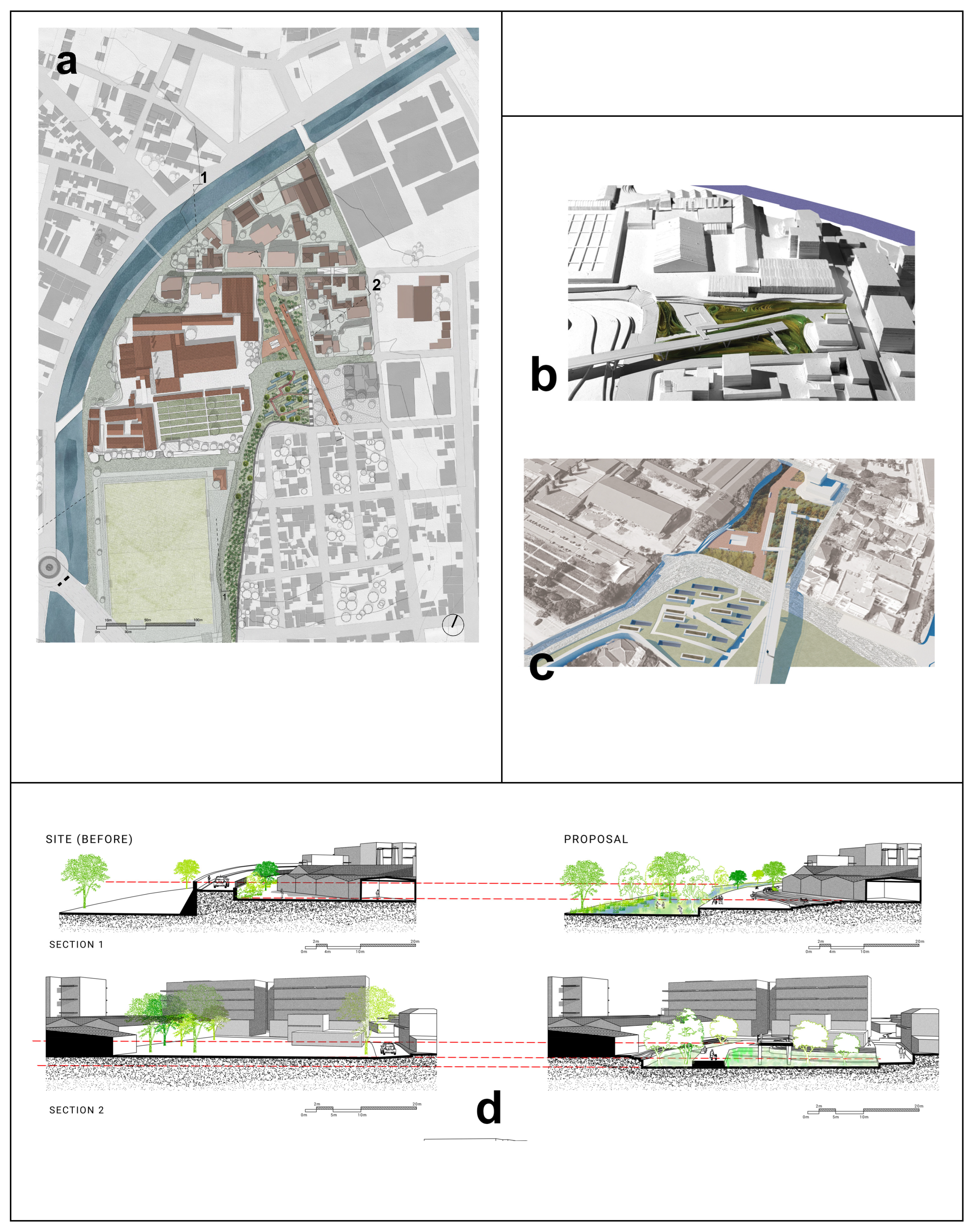
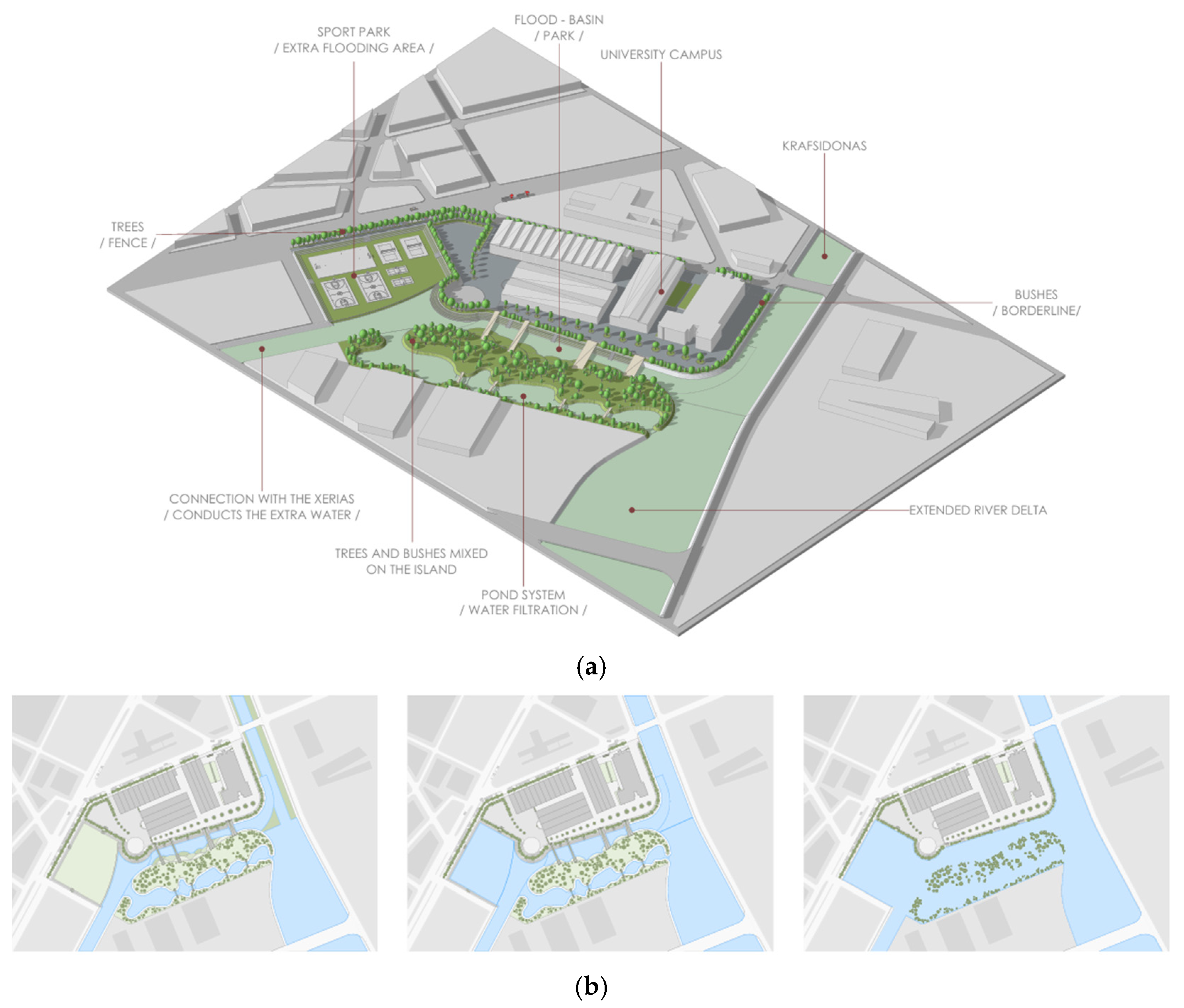
Apart from historical investigation, the current legislative framework, within which the Mediterranean torrents are inscribed in Greek and EU legislation, shapes the planning potential today. Therefore, a critical report on the existing framework in function is a part of the article’s methodology. The Integrated Catchment Management Scale encompasses the different modes of co-existence with the inhabited, rural, or forested landscape: either urban, suburban, or peri-urban, or the mountainous slopes of Mt Pelion. Zooming in to the lower catchment area, Research-by/through-Design methodology was also implemented in tandem with this broader inquiry, aiming at proposing feasible—yet inventive—plans and design solutions that coherently implement Green and Blue Infrastructure strategies (G&B-I) along the banks of the Krafsidonas torrentscape. The goal of proposing urban landscape design plans towards just and inclusive landscape resilience, along and within the torrentscapes, has been investigated together with students at the Department of Architecture of the University of Thessaly [Figure 1].
Envisioning the torrent-beds as the spine of eco-corridors, running transversally in the city of Volos, a non-anthropocentric point of view engages the concept of ecotone [35]. However, since the precious value of symbiotic Ecosystem Services (ES) [36] provided by the urban torrentscapes in Volos tends to be overshadowed by the fear and traumatic catastrophic experiences provoked by the cataclysmic floods in September 2023, an anthropological research path has been inherent as part of the methodology followed. The objective is to repair the relationship between the torrents, Xerias, Krafsidon, and Anavros, and the inhabitants of Volos, both in terms of witnessing the traumatic flood event and its aftermath and documenting critical histories of “development” (including large scale engineering projects, such as the railroad) leading to ecocidal anthropocentric actions, as well as developing genealogies of resistance and repair. Particular emphasis was given to understanding how vulnerable populations historically came to be situated in riparian zones (refugees, Roma, and working-class populations) and repeatedly have been disproportionately exposed to extreme weather events. Public anthropology initiatives enabled the opening of spaces for participatory discussions on investigated design solutions, proposed for parts of the riparian zone, with the inhabitants’ communities. An advanced stage of the anthropological research methodology has included the realization of a transdisciplinary exhibition, guided by an anthropological point of view, encompassing the presentation of perspectives engaged by architecture and urbanism, fine and expressive arts, as well as the testimonies of the inhabitants of the riparian areas, including social movements involved in caring for and protecting torrent ecosystems. Entitled “Floodmarks”, the exhibition took place between 2 April 2025 and 9 May 2025, and was hosted at the Museum of the City of Volos, curated by Penelope Papailias [37].

3. Results and Analysis

3.1. Timescale Analysis I: Mediterranean Torrents Observed During a Vast Timescale

If a longer duration of time is considered, focusing on the broader Mediterranean context, storms may not only have been a threat, but also a phenomenon people, communities, and their cultures had once developed the means to deal by inventing practices of co-existence, devising modes of living with water excess as much as with water scarcity. Written records, like the testimony of Vergil, just below, dating from the 1st century BCE, attest to the existence of ancient infrastructure channeling river and torrential water; these water-conducting infrastructural networks are described as being challenged during Mediterranean storms:
  • Often a vast column of water towers in the sky,
  • and clouds from the heights gather into a vile tempest
  • of dark rain:
  • …the ditches fill, and the channelled rivers swell and roar,
  • and the heaving ocean boils in the narrow straits.”
  • From Vergil, Georgics [38].
Reading further about the patterns of interdependence around the Mediterranean basin, it becomes clear how different scales of human activity have managed the outcome of flooding—including massive sedimentation and erosion—brought about by Mediterranean torrents [34]. The material testimony for this lies within the sediment evidence, the earthly archive of accumulated clays, argils, stones, pebbles, and other material, which forms the alluvial plains, the extended shore banks of the Mediterranean torrents. Most often, if not always, the massive sedimentation has been destructive to crops, and that is why these sediments were removed and transported, making it obvious—within the alluvial record—which areas were managed and taken care of, after any serious flood event, by the communities practicing agriculture in the particular area. Thus, we assume that the co-vulnerability of human agrarian communities and the respective agricultural riparian ecosystems constitute testimonies, exposing the long duration of the merging of human and natural history along Mediterranean torrentscapes. In other words, co-vulnerability between human-made structures and agrarian ecosystems proves their co-existence in the Mediterranean basin, coupled with practices of repair, therefore care, given that the evidence also shows, in addition to vulnerability, the results of the human-led efforts to overcome the losses the floodings caused.
The storms and floods were of course not the only ways Mediterranean agrarian communities related to water courses. The irrigation of fields is a long tradition, which was established in the landscape through sustainable practices, well before the intellectual segmentation of “human-and-natural” history arose [3].
  • <he> brings upon his crops a water course, guiding
  • its streamlets as he will, and, when the scorched land
  • swelters, and the green blades would feign die, lo, from
  • the brow of the hillside channel he decoys the water.
  • The water, as it falls, wakes murmurs amid the smooth
  • stones, and with its gushing stream gives the thirsty
  • fields just the draughts they need
  • From Vergil, Georgics-Irrigation [38].
It appears there are other ways of understanding interdependence and co-existence apart from co-vulnerability. For instance, along the torrent courses of Μt Pelion—also found in other mountain streams of Greece—traditional washing infrastructure called “dristelles” (where the water stream’s pressure was used to clean wool carpets and clothing), as well as water-mills, water-saws, and other public or private facilities devised to use the hydraulic energy, were abundant. Remnants of some of these structures are still found along the upper catchment of the Krafsidonas torrent. Sources of water in Μt Pelion are traditionally renowned for their crystal-clear waters, and even today their water is perfect for drinking. One of the villages that is renowned for its sources of potable water is Stagiates, situated on the upper catchment of the Krafsidonas torrent. Thus, the inhabitants of Μt Pelion have traditionally drunk and used the very same waters sourced from the mountain during their everyday life, sharing these waters with the torrentscapes of the three torrents: Xerias, Krafsidonas, and Anavros. In relation to the Mediterranean torrents of Volos, the archaeological findings have brought to the fore loci, where symbiotic modes of interchange between the natural flows of water, and human practices and urban structures have taken place since antiquity [39]. Ancient Neolithic settlements in the proximity of the Xerias torrent [Sesklo since 7000 BCE and Dimini c.a. 5000 BCE up to 3000 BCE] were very important, but they were not inhabited continuously. Places which have been continuously inhabited up to today appear as settlements linked to prominent positions in topographic, ecological, and possibly geopolitical terms. Such a place is the area called “Castro Palaion”; the Castle of Old Volos has been, and still is, situated close to the Krafsidonas torrent delta. It is an area which has been ceaselessly inhabited since prehistoric times and remains still inhabited today.
Archaeological excavations among the present functional buildings uncovered the site’s long history, demonstrated by an essential complex dating from Mycenaean times within the oldest substratum.
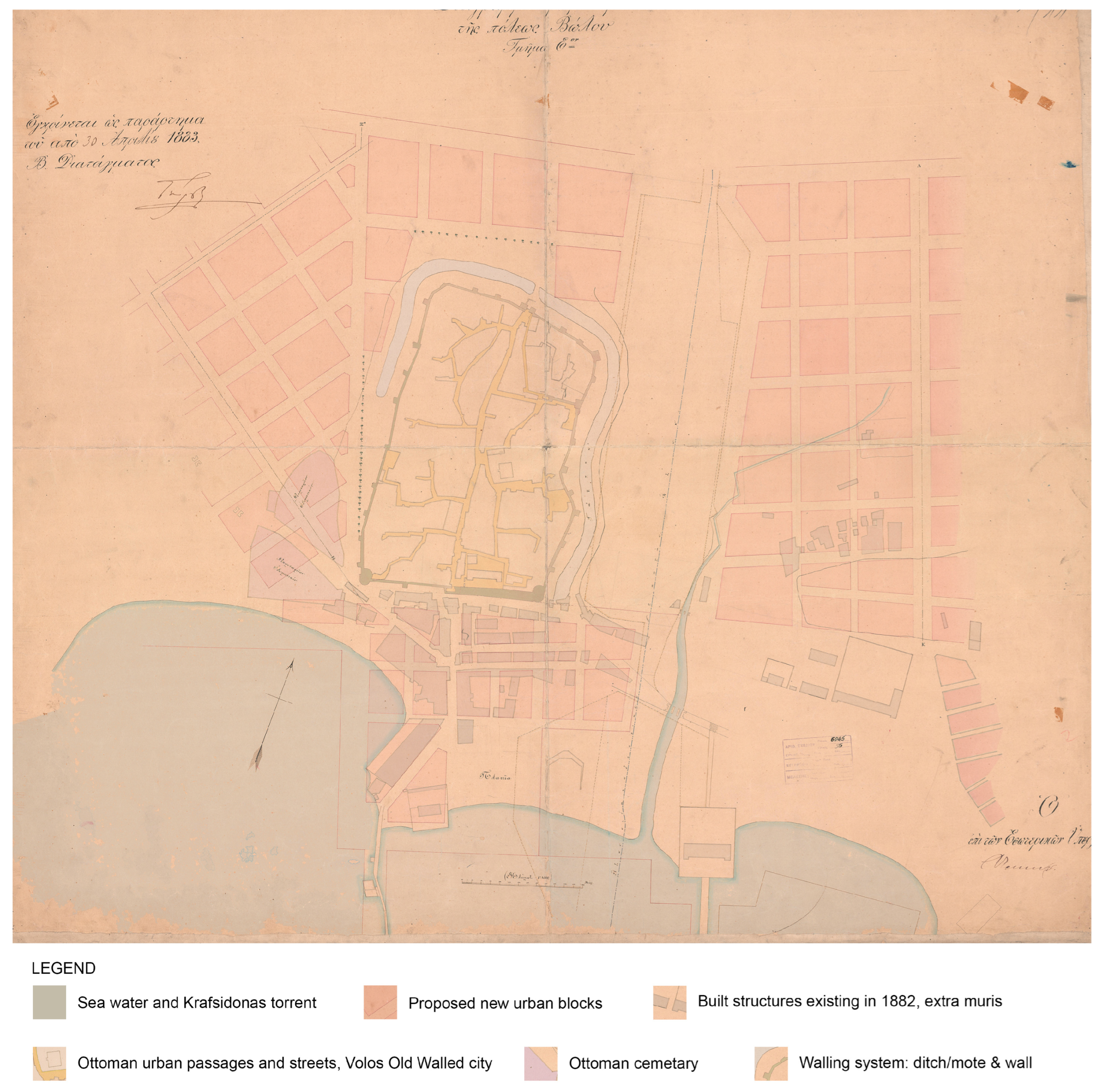
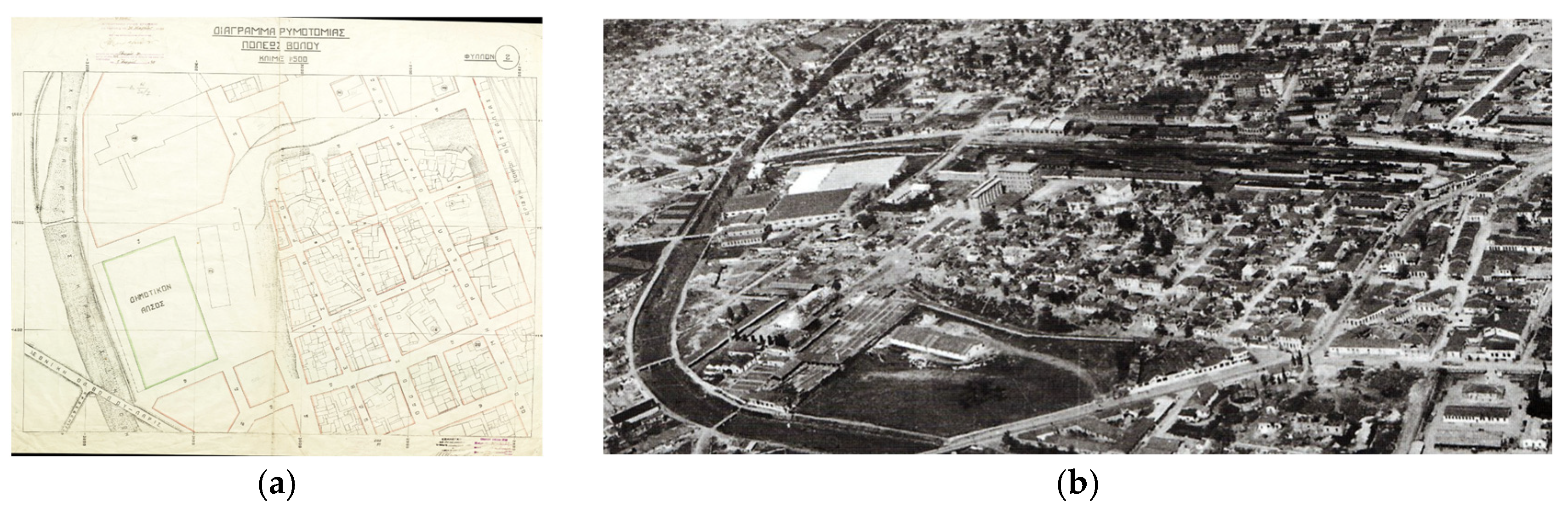
The continuity of this area’s inhabitation during the transition from the bronze to the iron age, and during all following phases, from Greek antiquity up to Roman, Byzantine, and Ottoman times, has been documented by multiple findings [40]. Today this nucleus appears as an inhabited hill formation, which maintains a part of its historical walling intact. By means of its uninterrupted inhabitation, we can assume that the historic Castle of Volos had a prominent positioning in relation to the Krafsidonas, otherwise its inhabitants would have been chased away by repeated floodings. Since the historic course of the torrent is partially documented in 19th century maps and plans [Figure 2], we know that its course today is not the same, at least if compared to its 19th century position.

3.2. Timescale Analysis II: Chronomapping Analysis and the Krafsidonas Torrent’s Turn: Landscape, Floodscape, or Infrastructure?

Recalling once more the definition of floods by the “Floods Directive” [17] as “the temporary covering by water of land not normally covered by water, “ might lead us to pose, emphatically, a fundamental question, on the abstract border, dividing the areas that are normally covered by water from the areas that normally remain safe, out of reach of flood water:is there a line that divides these two different territories? Would it provide more resilience, instead of searching for a line, to trace a buffer zonea flooding zone which is also an ecotone zone, an area occasionally flooded by water, and thus intrinsically belonging to the torrentscape? This question is fundamental, as it challenges channeling infrastructure, including riverbed and torrent-bed course deviations, the narrowing of their width, and the elimination of their previous natural-flow meanders, but also, the suffocation of deltas and estuaries and the overall creation of infrastructure that does not respect possible extreme flow rates. All of these engineered structures, by imposing standards that bear no respect for the long-lived naturally expressed limits of perennial torrential water flows, should not be entitled to re-inscribe normality. Certainly, these sorts of engineered torrent-beds are not compatible with providing the resilient standards we should base our inquiry on, since these structures have erroneously, arrogantly neglected to respect primordial fluxes, even if the latter have been diachronically proven as accurate through long-duration history records. Therefore, an analysis of the series of infrastructural works around and within the course of Krafsidonas examines the becoming of Krafsidonas from a free-flow river/torrent to a deviated urban river/torrent, as well as the expectations related to the limitations posed by its human-made borders.
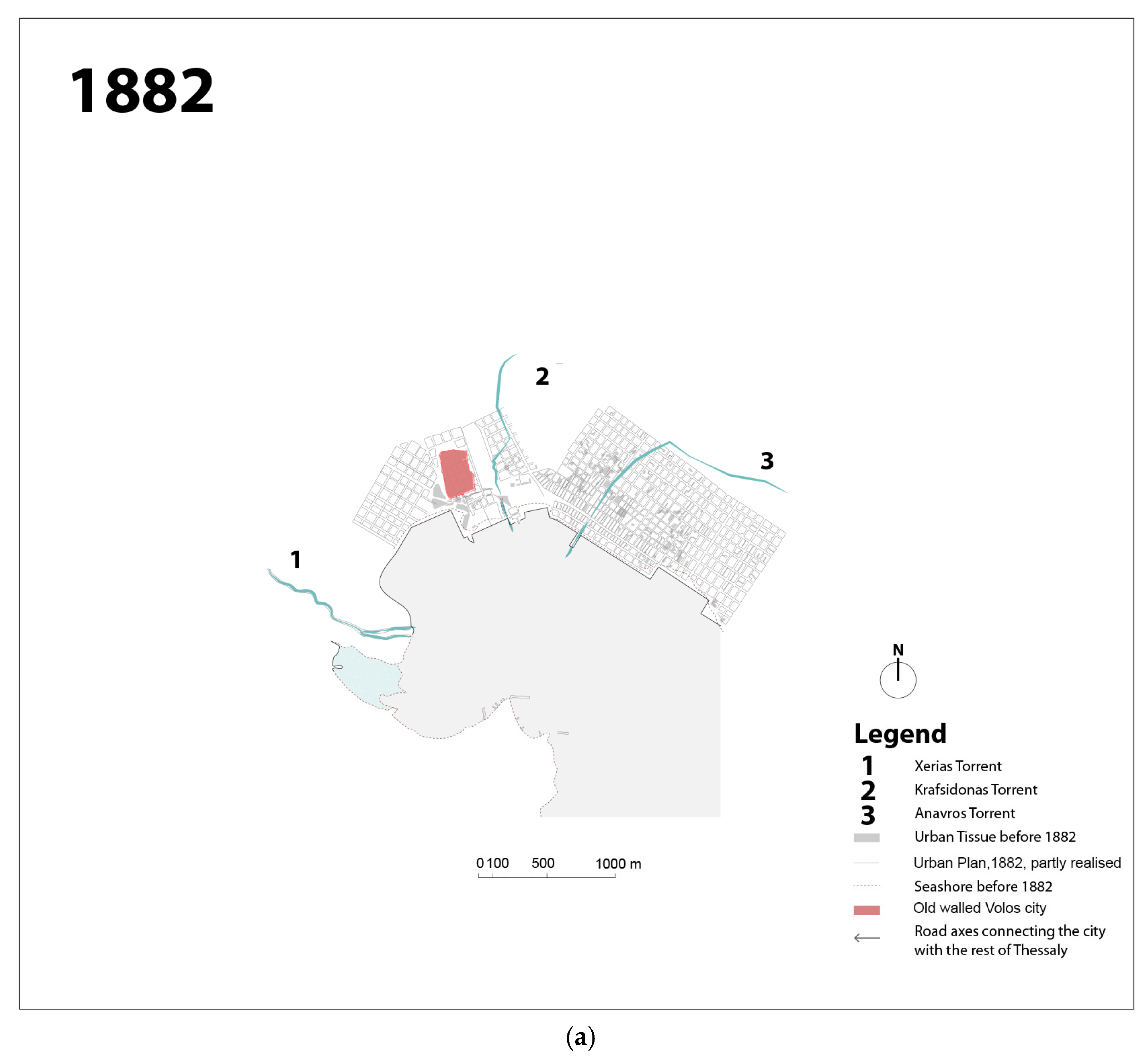
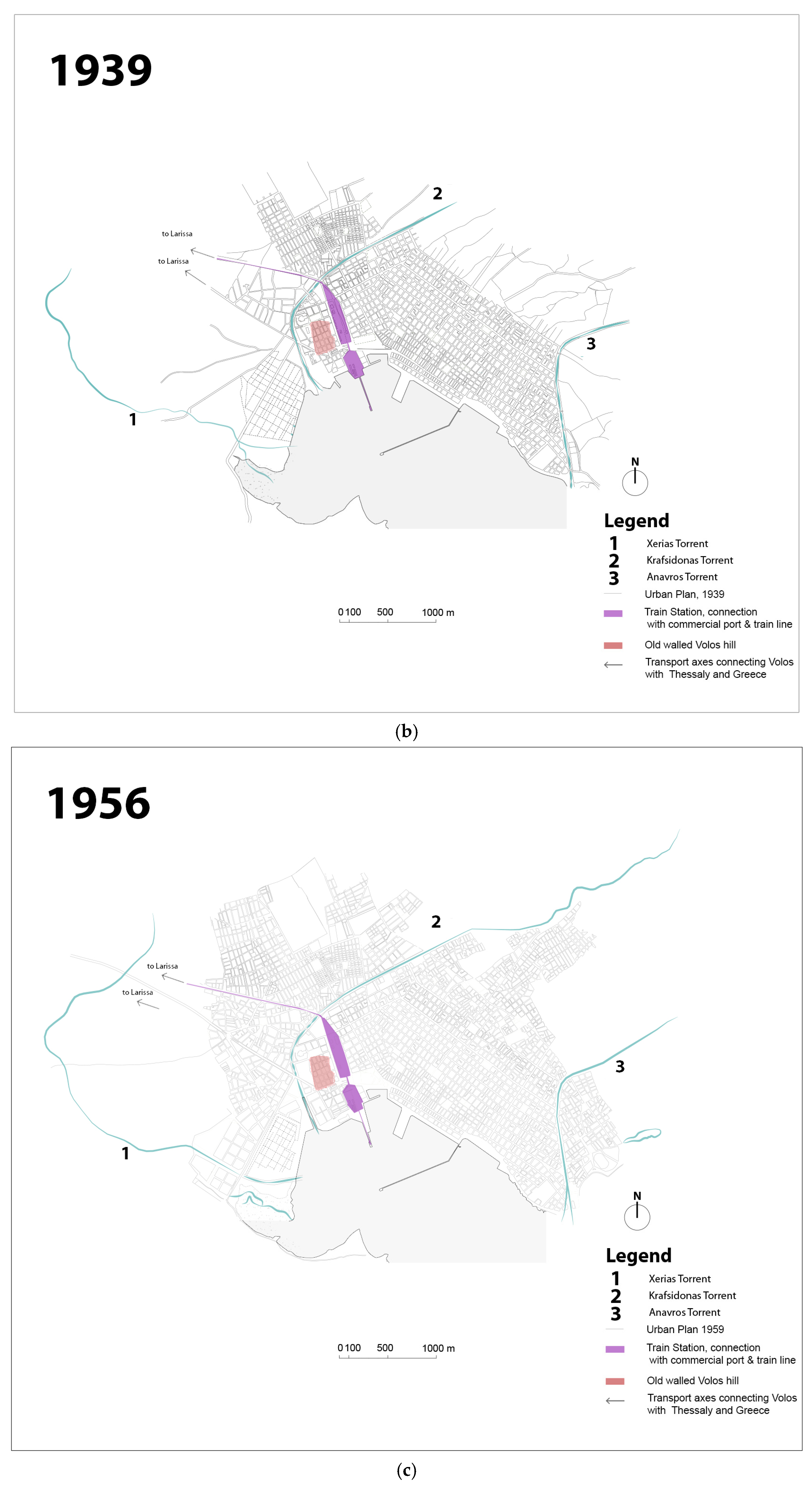
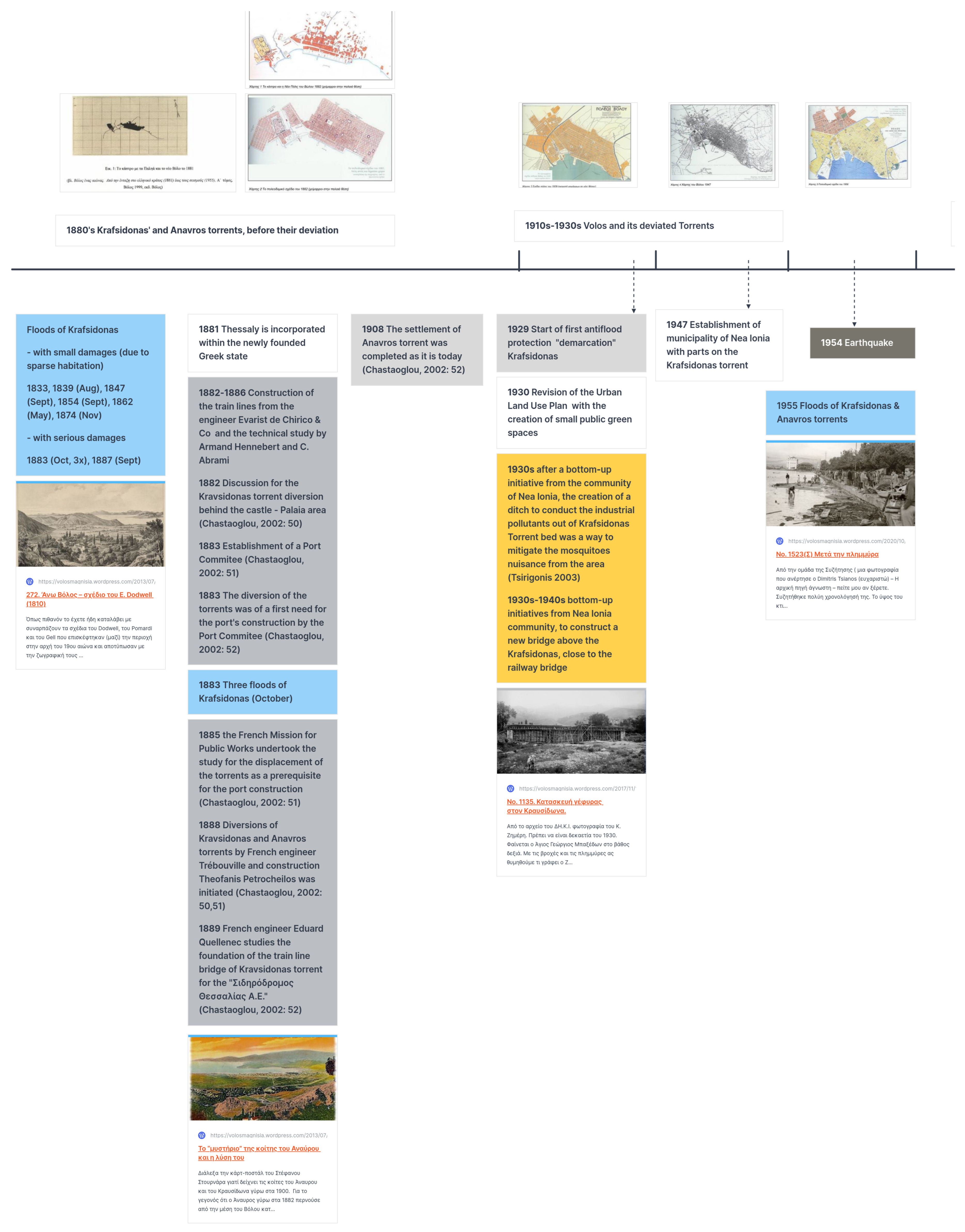
The Krafsidonas torrent has played a central role to the modern city of Volos, directly linked to infrastructural and industrial flourishing. The space once occupied by its historical, natural torrent-bed estuary was occupied by the main train line that connected the new port of Volos with inland Greece. Then, its deviated torrent-bed became the major industrial axis of Volos. The role of the administrative border between the city of Volos and the refugee settlement of Nea Ionia, was also projected on Krafsidonas’ riverbed. In addition, the deviated riverbed also took the burden of the sewerage system of Nea Ionia and the industrial zone for several decades. Nevertheless, Krafsidonas torrent was the backbone connecting a plurality of bottom-up initiatives. All of the above have been investigated following a chrono-mapping [Figure 3] methodology, which classifies policies, infrastructural interventions, and events along the passage of time, tracing the urban–natural–social history of Krafsidonas’ torrentscape.

3.2.1. The Founding of Modern Volos and the Krafsidonas Torrent [1881,1882,1883]

In 19th century maps, Krafsidonas’ riverbed is usually represented flowing at the east of the Castle of Old Volos, which was inhabited during Ottoman times. The walled Castle of Volos had a circuit moat, which possibly played a role in the water collection and drainage around the castle [Figure 2]. The incorporation of the region of Thessaly as part of the Greek state in 1881 marked a turning point for Volos. A great part of the walling infrastructure around the old walled city—where mainly Ottoman citizens used to live—was dismantled, while efforts to enlarge the city way beyond its castle began in earnest [41]. The urban fabric of modern Volos was planned to be built in interrelation with only some of the existing landscape features, such as the slightly inclined foothill topography, and the general direction of the sea coastline. As we can witness from the oldest post-Ottoman urban plans of the new modern city [1882; Figure 2], the Mediterranean torrents were not considered at all in the plans of the new city; this is obvious since the planned building blocks were projected directly in the locus where the Krafsidonas torrent-bed was mapped, and not slightly affected by its flow. Despite its unpredictable torrential nature, not enough urban space was “sacrificed” for shaping Krafsidonas’ passage within the new city. The blatant intention to create a totally new city is clearly demonstrated by the straight lines that change the naturally curved waterfront, proposing a clean-cut delineation of the new city’s port coastline. Moreover, this map shows the modern city’s rectilinear grid contrasting with the organic layout of the old walled Volos. This disregard for the Krafsidonas torrent and neglect of the ancient city core reflects the arrogance behind the push to westernize and modernize the city’s infrastructure.
During the late 19th century, the provision of infrastructures can be interpreted as tautological with a sense of shaping modern society as I realizing the future; modern infrastructures were faced as integral to the concept of progress [26]. Although this plan [Figure 2] was not completely implemented, since Krafsidonas’ course was finally diverted to the other side of the Old Volos Castle, it should be highlighted that neither this initial 1882 plan, nor the one eventually implemented, respected the Krafsidonas’ torrent course, or its dynamic characteristics; Krafsidonas’ importance as a perennially flowing Mediterranean torrent was not acknowledged. Krafsidonas’ position in relation to the ancient/old walled city was also not considered as a landscape feature that ought to be respected.

3.2.2. Infrastructure Takes Control of Torrent Krafsidonas (1881–1887), (1888–1910)

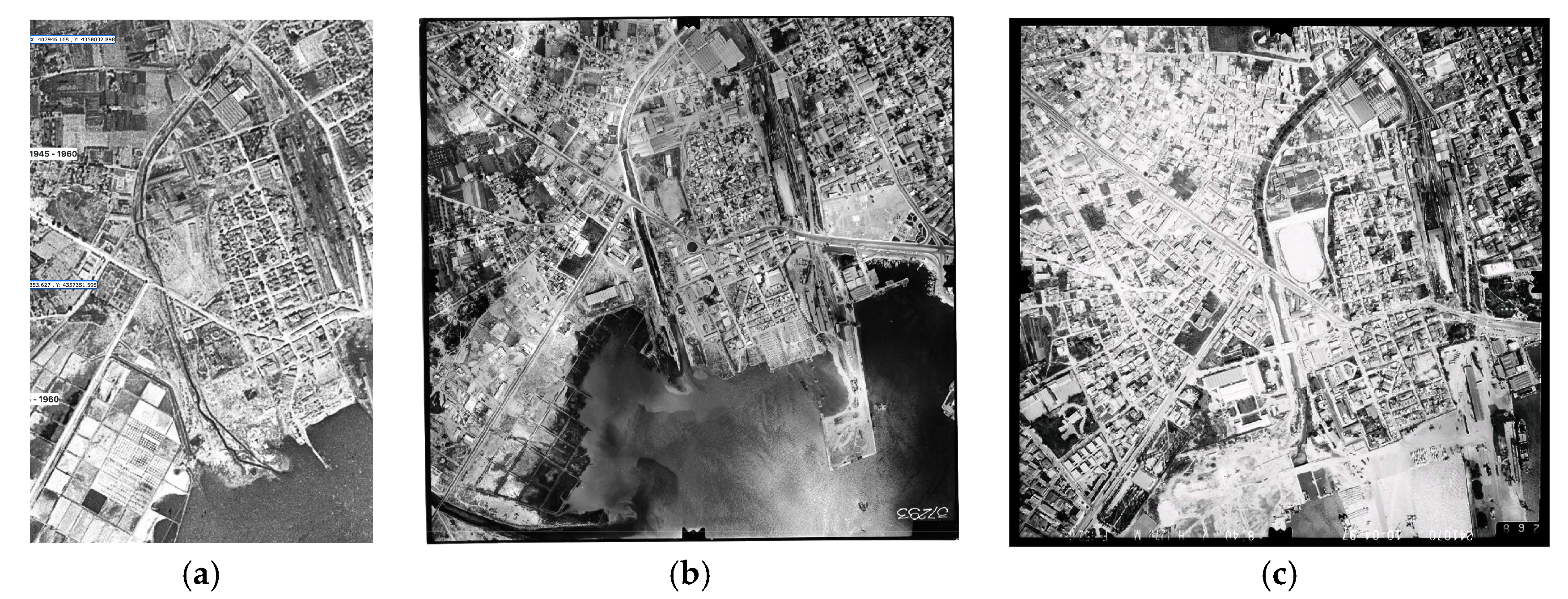
Following the incorporation of the Thessaly Region to the Greek state in 1881, in 1882, the newly established railway company “Sidirodromos Thessalias S.A.” came to strengthen the region’s transportation network. This was accompanied by the construction of train lines (1882–1886) by Evaristo de Chirico and his team, supported by technical studies from A. Hennebert and C. Abrami. However, these developments brought about a discussion on the apparent urgent need to control the Krafsidonas torrent, which frequently flooded and disrupted the growing town. In addition, Krafsidonas was reported to discharge massive quantities of sediments, which were disrupting the area the new port was projected to occupy [41]. In 1883, mayor Nikolaos Georgiadis supported the displacement of the Krafsidonas and another torrent—Anavros—emphasizing their vital importance to the city’s future [42]. This argumentation brought about the ideal of “tamingthe torrent-beds, emphasizing the “catastrophic” nature of the torrents for the city’s inhabitants; notwithstanding, it is obvious that on the level of the huge infrastructural program which combined the new port project and its connection with the railway, the Krafsidonas’ natural torrent-bed occupied a zone that had become central to these plans [Figure 4a]. It has been reported [41] that Krafsidonas threatened the lives and livelihoods of the city’s residents; the city center suffered recurrent and devastating floods, culminating in extreme flooding in 1883, when Volos experienced three major floods in a single year, and again in 1887 with another catastrophic flooding event.
Discussions began regarding the diversion of the Krafsidonas “behind” the Castle of Old Volos and the Palaia area; it was argued that this solution would protect the new city center from floods. This proposed displacement literally emptied the area that was projected for the train line leading to the port, enabling the railway connection to happen. By 1885, French engineers were invited to study the displacement of torrents as a critical step toward the construction of the Volos port. The deviation of Krafsidonas’ torrent-bed was presented as essential for the torrent’s successful management; furthermore, it was argued to be crucial not only for flood prevention but also for enabling the city of Volos to become a thriving commercial hub, and as the prominent way to protect the critical transport infrastructures, rendering them less vulnerable against floods. In 1888, the diversion of the Krafsidonas torrent, towards the west of the Castle of Old Volos, was completed. The full diversion of the Krafsidonas, however, extended well into the 20th century. By 1896, documents detailed critical advances in infrastructure, including the construction of the train bridge over the Krafsidonas’ diverted riverbed, according to the structural plan by the engineer Edouard Quellenec.
The displacement of the Anavros torrent was also planned during that period and was completed in 1908, marking a prolonged effort to control the waterways that shaped the urban development of Volos. These efforts were not only practical measures to safeguard the city, but also symbolic of the torrent’s perceived identity as an expression of ‘wild’ and ‘untamed’ nature, which needed to be controlled by modern infrastructural interventions.

3.2.3. The Krafsidonas Torrent as an Industrial Zone (1888–1910)

The combined infrastructure projects of torrent diversion, train line construction, and port development laid the foundation for Volos to grow into a prominent urban and commercial center [41]. This mobilization led to the creation of an industrial zone along the banks of Krafsidonas. Krafsidonas’ banks hosted, among others, the Papageorgiou textile mill, constructed in 1905; the textile millLeviathan” of Z. Mourtzoukou and Z. & I. Levi, founded in 1908; the silk factory of the brothers G. and A. Etmektzoglou, established in 1924; and the brickworks factory of the Tsalapata brothers, completed in 1925 [41]. They were all situated directly along the Krafsidonas’ partially diverted torrent-bed, using the water of the torrent for the industrial procedures that needed water abundance. Krafsidonas was thus fueling the city’s transformation into a flourishing modern urban center. The aforementioned industrial complexes also used the torrent-bed for the disposal of liquid industrial waste. This is how Krafsidonas’ torrent-banks hosted Volos’ historic industrial zone. All of these industrial complexes still trace the historic limit of the torrent-bed’s edges right after its deviation: the torrent-beds were wider than today. The overall transformations and violations of the Krafsidonas’ torrentscape have rendered this torrent integral to the history of modernization and neoteric growth of Volos.
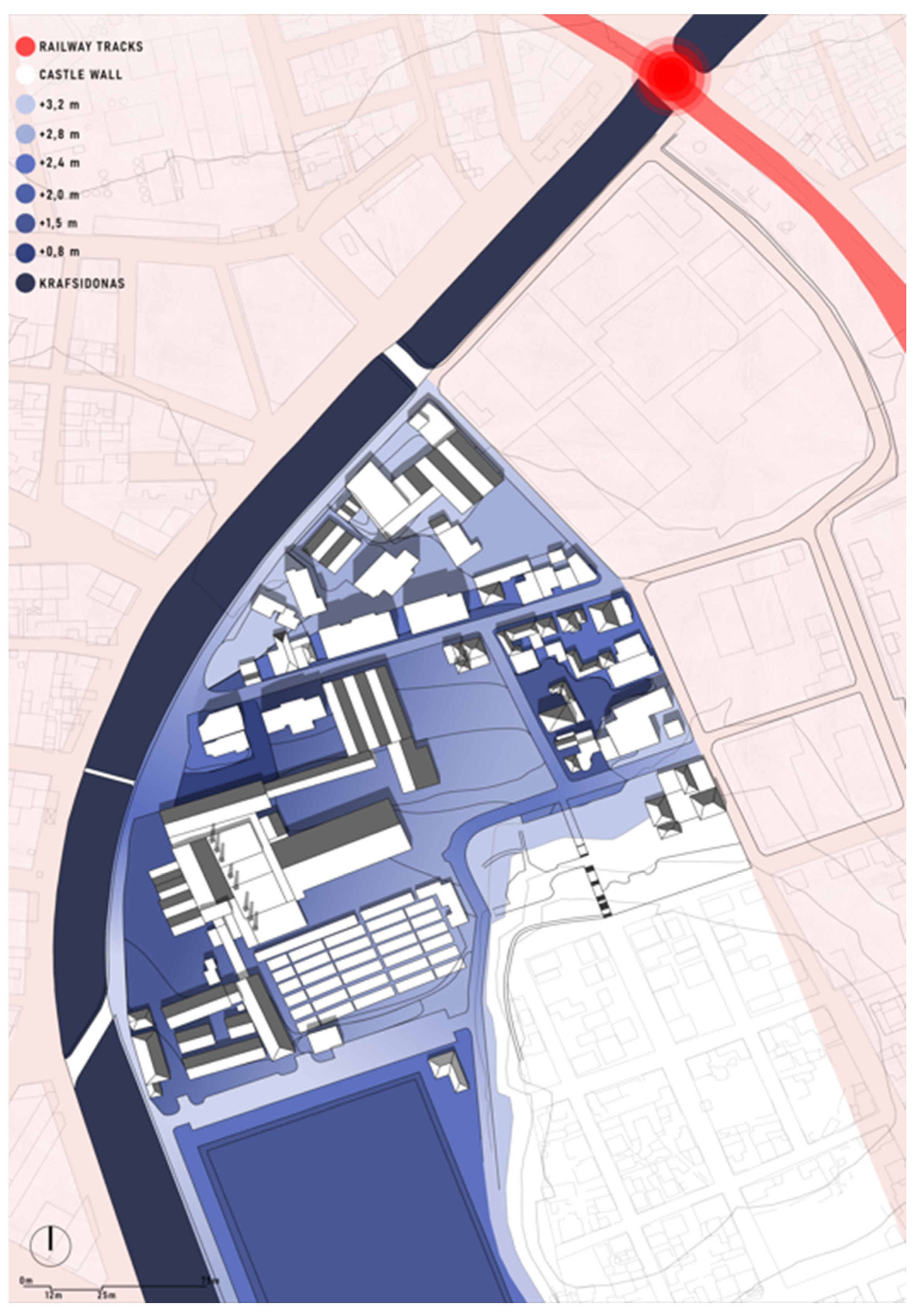
Today, most of the historic industrial complexes along Krafsidonas are part of the industrial heritage. Many of them have been re-used and are again useful to the city’s function as educational buildings: Leviathan factory is now an administrative building for secondary education, Tsalapata factory hosted for years the Committee for Research and Innovation of the University of Thessaly (until it was completely inundated by the September 2023 floods), and other industrial buildings close to the torrent’s diverted estuary host Departments of the Faculty of Engineering, partly constructed in an area where “salines”—salt flats—existed [Figure 4c]. The expansion of ‘firm land’, consuming the Krafsidonas’ delta area, in favor of the new port, and the further exploitation of the salines’ amphibious territory [Figure 5] disregarded Krafsidonas’ historic discharge rates. Later, the extreme narrowing of the estuary among the massive cement port piers following the new extension of the commercial port of Volos in the 1990s and 2000s left Krafsidonas’ torrentscape without a proper delta. The suffocation of Krafsidonas’ delta is also a cause for excessive flooding since the water flow towards the sea is regulated by a very narrow passage.

3.2.4. Catastrophic Floods During the 20th and 21st Centuries

(1955–1957): The city of Volos’ inhabitants experienced the devastating effects of seismic activity and floods between the years 1954 and 1957. Seismic damage caused the demolition of buildings, leaving their inhabitants homeless. In 1955, homeless people reached the number of circa 20.000. Homeless people living in tents experienced in the most extreme way the floods of 13 October 1955, during which 36 persons were killed. The torrents had “broken” the earth-dams which confined them: hence, the expression “the torrents broke (their limits)” has been a phrase used by Volos’ residents. During and after the 1957 floodings (9 September 1957), transport infrastructure in the city collapsed, accentuating the need to confine further the torrents; jointly, the creation of a new sewerage system was prioritized [41].
(2023): Recently, the September 2023 flooding in Volos, during storm-cyclone Daniel, was reported as being caused by torrential rain; it provided, in six hours, 617 mm of rain across the city area according to the National Observatory of Athens, about twice the expected annual rainfall [43]. The heavy rainfall overwhelmed the existing mountain torrents, especially at sites where the torrent-beds had been inadequately engineered or the width of the bed shortened. At the lower catchment of these torrents, where the city of Volos is situated, the urban surface was completely flooded by water; subsequently it was covered by mud, as various sediments were detached from their upper catchment, situated in Mt Pelion, where the cataclysms triggered mudslides. After a two-week interval, the mud and sediments were not yet removed, except from the city center. The accumulated heaps of sediments remained in the urban-engineered part of the torrent-beds when a second cataclysmic torrential rainfall, Elias, hit the same region. The second rainfall was again cataclysmic, although not as extreme as the first, bringing 316 mm of rain in six hours [43]. But, as the stacked sediments in the urban torrent-beds left no space for massive water flow, the Elias storm created a huge quantity of mud-flow in the city. Notably, that was a sludge-flow since dead animals and other contaminated material remained deposited within the torrent-beds from the first storm. As reported by citizens during a collective mapping process (described in Section 3.6.1), other large-scale infrastructures were inundated, such as the Volos peripheral ring road, situated above the city center, at Pelion’s foothill, which flooded parts of the upper neighborhoods of Volos. Additionally, parts of the city were inundated by waters that were not absorbed by the road and surface rain sewers, or by water that directly emerged from the stormwater sewers since part of the surface sewer system of Volos is directly connected with the torrent-beds, which were already full of mud and water, beyond their designed capacity. Although several severe infrastructure failures took place, exposing the absence of coherent climate change adaptation planning in the city, the three torrent-rivers of the city were often reported as the main agents of the floodings. They were depicted by the local media and press as “breaking”, and thereafter often treated as the main culprits for the city’s floodings [44].

3.2.5. From Top-Down to Community and Bottom-Up Initiatives in the 20th and 21st Centuries

Three refugee waves landed in Volos from Asia Minor, during the period 1921–1924. In August 1923, the decision to create the refugee settlement, namely Nea Ionia, on the NW side of the torrent Krafsidonas, was made [Figure 4b]. Placing the settlement of Asia Minor refugees close to Volos’ flourishing industrial zone, was coherent with a policy widely implemented in other Greek cities too, during the same period [45]. Hence, Krafsidonas’ west riverbank was populated by this new district, full of people of all ages, and its initial monotonous character as an industrial zone changed. The lack of fresh water in the settlement’s houses was a problem that called for bottom-up initiatives, led by the refugee communities’ administrative leaders. Fresh water was collected by each household from few wells, and access to these was not fairly distributed in terms of distance [46]. There was no sewerage network, and the used water from the households would float into the earth-covered streets, creating a notorious atmosphere in terms of hygienic standards [46]. The vulnerability of the area was accentuated by the existence of public washeries and toilet facilities. In particular, the latter were strongly criticized as menaces to public health [46]. Co-vulnerability between the community of Nea Ionia and the Krafsidonas torrent does not appear in the above context, as the solution proposed in the newspaper is to place sewerage tubes that would directly conduct the dirty “blackwastewaters into the Krafsidonas [46].
Nevertheless, the refugees developed affection for Krafsidonas; they named the torrent’s west bankparalia”—meaning “beach”—and the torrent was and still is referred to as “river” by this area’s inhabitants. Nea Ionia’s residents approached Krafsidonas as a natural dynamic element, a potent eco-corridor, connecting their riparian neighborhood to Μt Pelion. In contrast, the top-down decision for the placement of the settlement of Nea Ionia on the “other” side of Krafsidonas [Figure 4b] rendered the torrent important, as an administrative border. The positioning of Nea Ionia clearly instrumentalized the torrent as a separative agent, between the new refugees’ settlement and the city of Volos. It took three years to build the first car-and-pedestrian bridge directly linking the center of Nea Ionia to Volos’ city center; it was built in 1926 (based on the Zimeris Archive, Network of Municipal Libraries, Volos). Before the creation of Nea Ionia, the two torrent-banks were only connected by the train bridge (lacking any bridge for pedestrians or cars) and a bridge further to the north, leading to Volos’ cemetery. The delay in founding socially beneficial infrastructure such as an adequate bridge, or proper clear water distribution and a sewerage network, intensified social injustices between central Volos and the newsettlement”.
The Krafsidonas remained a focal point of community-driven initiatives, particularly by the residents of Nea Ionia. In the 1930s, they demanded the construction of a ditch to divert industrial pollutants—liquid waste—from the torrent’s riverbed. Their request was implemented, reducing mosquito infestations, and improving public health. This action demonstrates again the concept of co-vulnerability, and the role care can play in the remediation of environmental degradation and the solution of problems related to social justice, simultaneously. Around the same time, the community spearheaded the construction of a new bridge above the Krafsidonas, near the railway bridge, to enhance connectivity and safety [41]. The municipality of Nea Ionia was established in 1947 and was very active concerning issues connected with the Krafsidonas, bridging the gap between bottom-up initiatives and the administrative decisions, until 2010. Since then, under the new administrative division of Greece, bearing the name “Kallikratis”, the Nea Ionia municipality was merged with the Volos municipality, along with other smaller peripheral municipalities. Merging has led to the intensification of central Volos’ administration over the independent voices of the Nea Ionia municipality and its strong solidarity caring for issues pertaining to the Krafsidonas torrent.
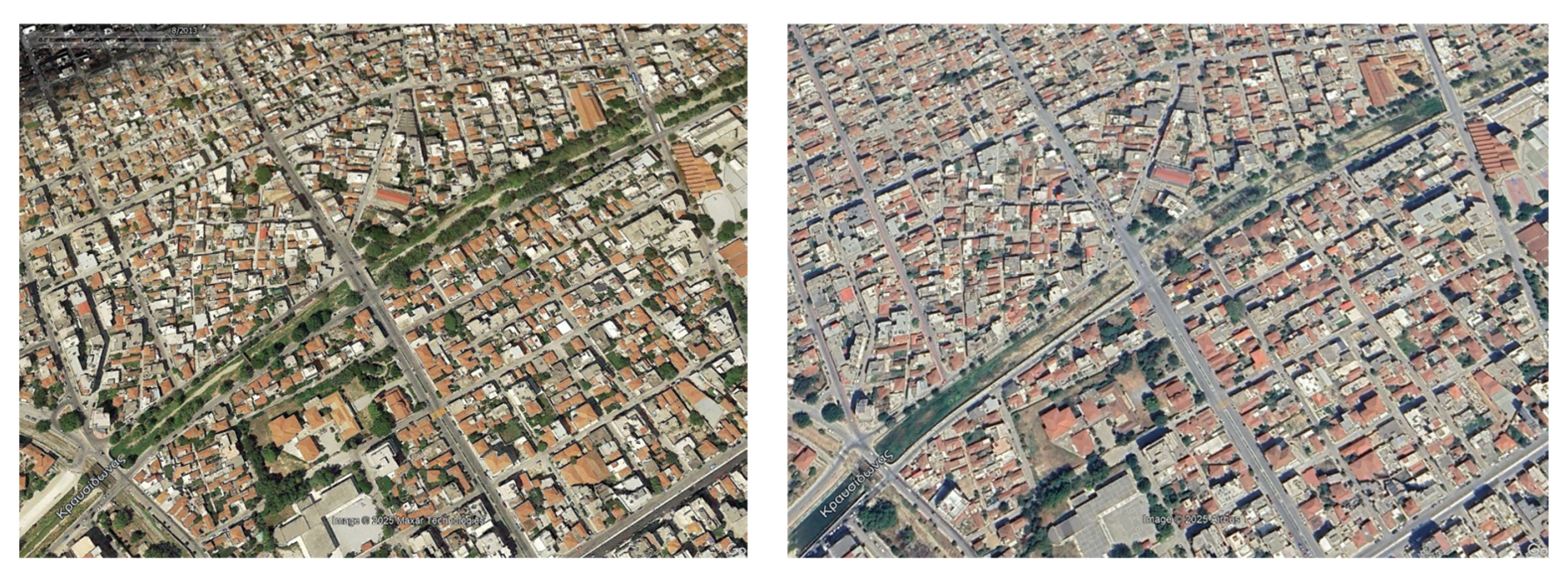
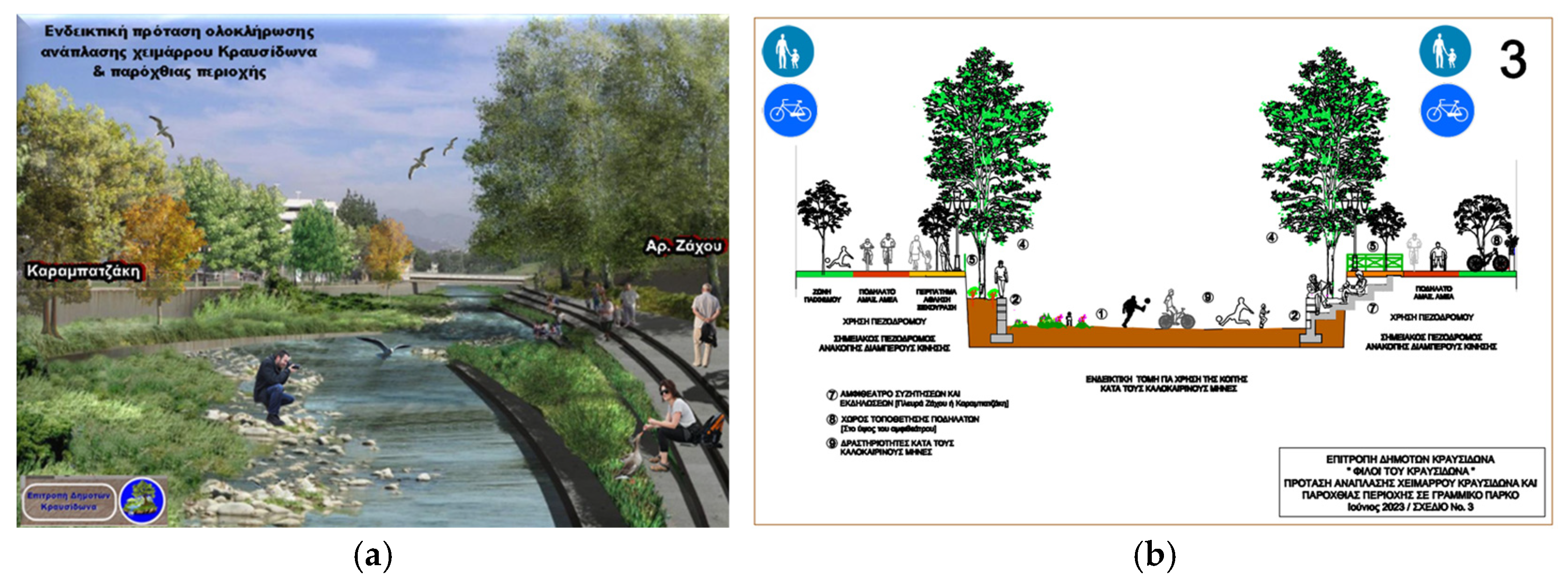
Administratively, in the late 1980s, the torrents belonged to the Ministry of Environment, leading to top-down decisions unpopular to citizens and local authorities. To ease traffic (leading to a nearby cement plant, and Mt Pelion) the Ministry planned to backfill the Krafsidonas torrent, to construct a peripheral road dividing Volos and Nea Ionia. Both inhabitants and local authorities fought against this decision and eventually won with their bottom-up demonstrations. During this struggle, the initiative “Friends of Krafsidonas” was born and proposed the creation of a linear park along and next to the torrent, asking for the missing public green in this dense urban tissue. Inhabitants describe (in interviews οf Section 3.6.2), the collective process of planting trees in the mid-1990s, at the sides of Krafsidonas’ torrent-bed, to render it a green corridor [Figure 6].
Many of these collectively planted trees were treated as culprits in 2023, as if they contributed to the torrent overflow; they were cut down or their roots were cut and damaged by the Periphery of Thessaly administration (in November 2023). Inhabitants of Volos, active citizens, and people supporting the ecological movements of Volos protested again. Although the two protests of 1990 and of 2023 were not directly linked, they have both been social movements of solidarity towards Krafsidonas, displaying the understanding of inhabitants regarding the co-vulnerability of the riparian zone communities and the torrent as an ecosystem.
Apart from the important bottom-up activist initiatives, an important effort was held by a coupling of bottom-up visionary ideas and administrative bodies: the Friends of the Krafsidonas, led by Stathis Halastaras, who also worked at the municipality of Nea Ionia, achieved the creation of a part of their “linear park” vision. They received funding by the EU Life program [47] for creating a segment of the linear park along a part of the west torrent-bank. Replacing a local road, a pedestrian and cycling path with pronounced vegetation was formed, almost a kilometer in length. The materialized results achieved by this synergy, between the bottom-up visionary initiative and the municipality of Nea Ionia, was one of “56 success stories for Europe’s environment” presented by “LIFE: Environment in Action brochure in 2001. Unfortunately, the municipality of Volos some years ago destroyed this realized part of the Friends of the Krafsidonas vision, reducing these pedestrian oases to simple vehicle roads, as they were once before.
The incidents described above expose the systematic erasure of the riparian communities’ bottom-up materialized milestones towards strengthening Krafsidonas as an eco-corridor. The actions imposed by top-down destructive decisions are not only degrading Krafsidonas’ ecological value but also erasing the traces of the affectionate relationship between the torrent/river and the riparian residents.

3.3. Vast Spatial Scales: National Legislative Framework Analysis

A critical analysis of the Greek and EU legislation and directives regarding torrents and streams with perennial flow, and their respective catchments, is necessary to form an idea of what types of interventions regarding torrent-beds are supported nowadays by the official framework in function.

3.3.1. Water Legislative Framework in Greece: Either Droughts or Floods

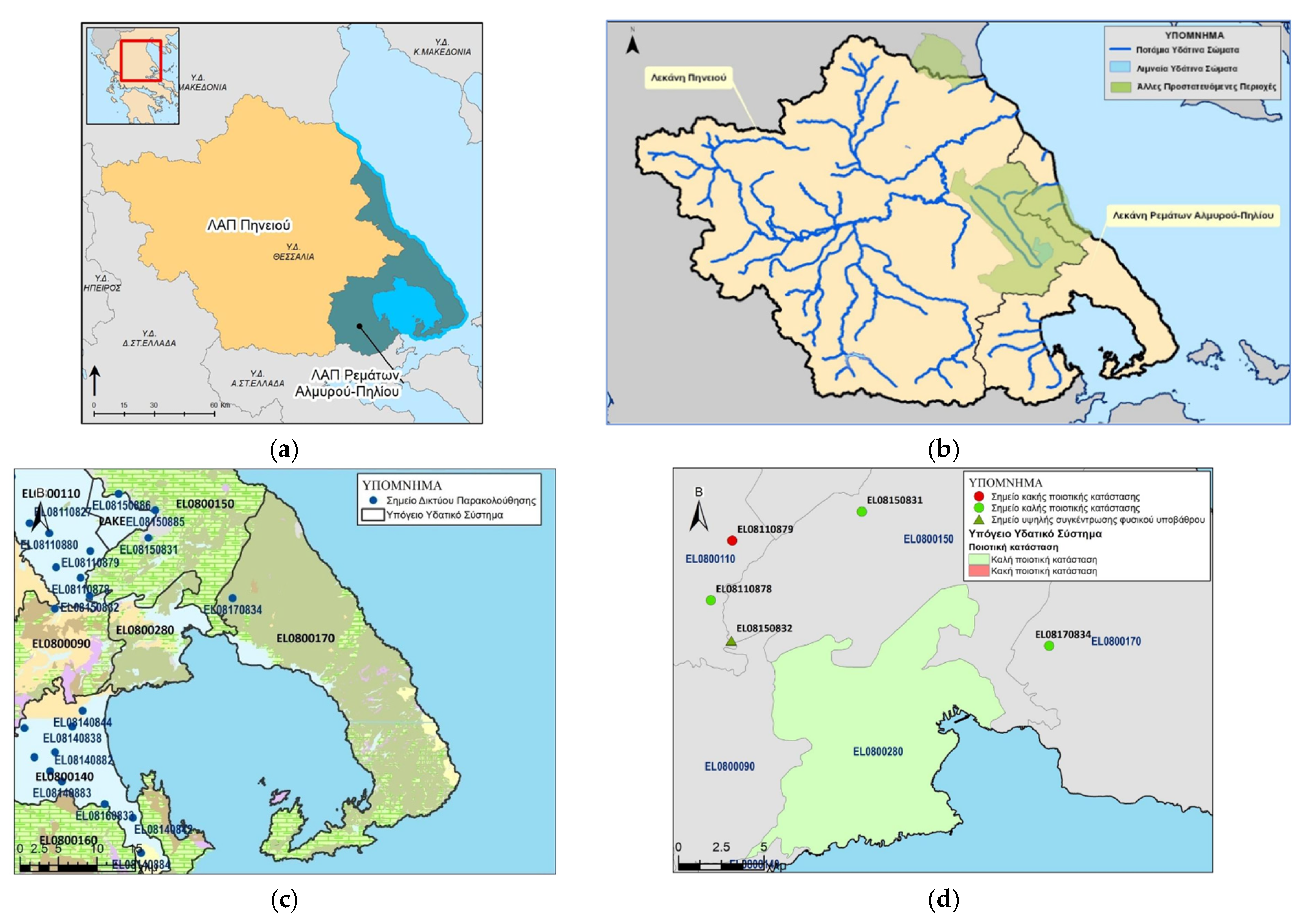
The Volos residential complex is part of the water department of Thessaly. It is situated within the Pelion-Almyros Drainage Basin EE08AP5EK.009, with a surface area of 47.7 square kilometers. The residential complex comprises the cities of Volos, including a large part of its suburbs (82,723 inhabitants), Nea Ionia (32,508 inhabitants), Aisonia (3122 inhabitants), Agria (5414 inhabitants), and smaller villages. The total population of the zone is estimated at approximately 127,180 residents [48]. Following the directives by the European Commission, Greece incorporated the “EU Water Framework Directive” into its institutional framework with Law 3199/2003 “Protection and management of waterHarmonization with Directive 2000/60/EC of the European Parliament and of the European Council of 23 October 2000” [49]. The legislative framework has taken the form of three strategic management plans. Before being implemented, they were brought for public consultation, but for a very brief period, taking the form of a quasi-participatory process, as the opinions expressed are usually considered only somewhat.
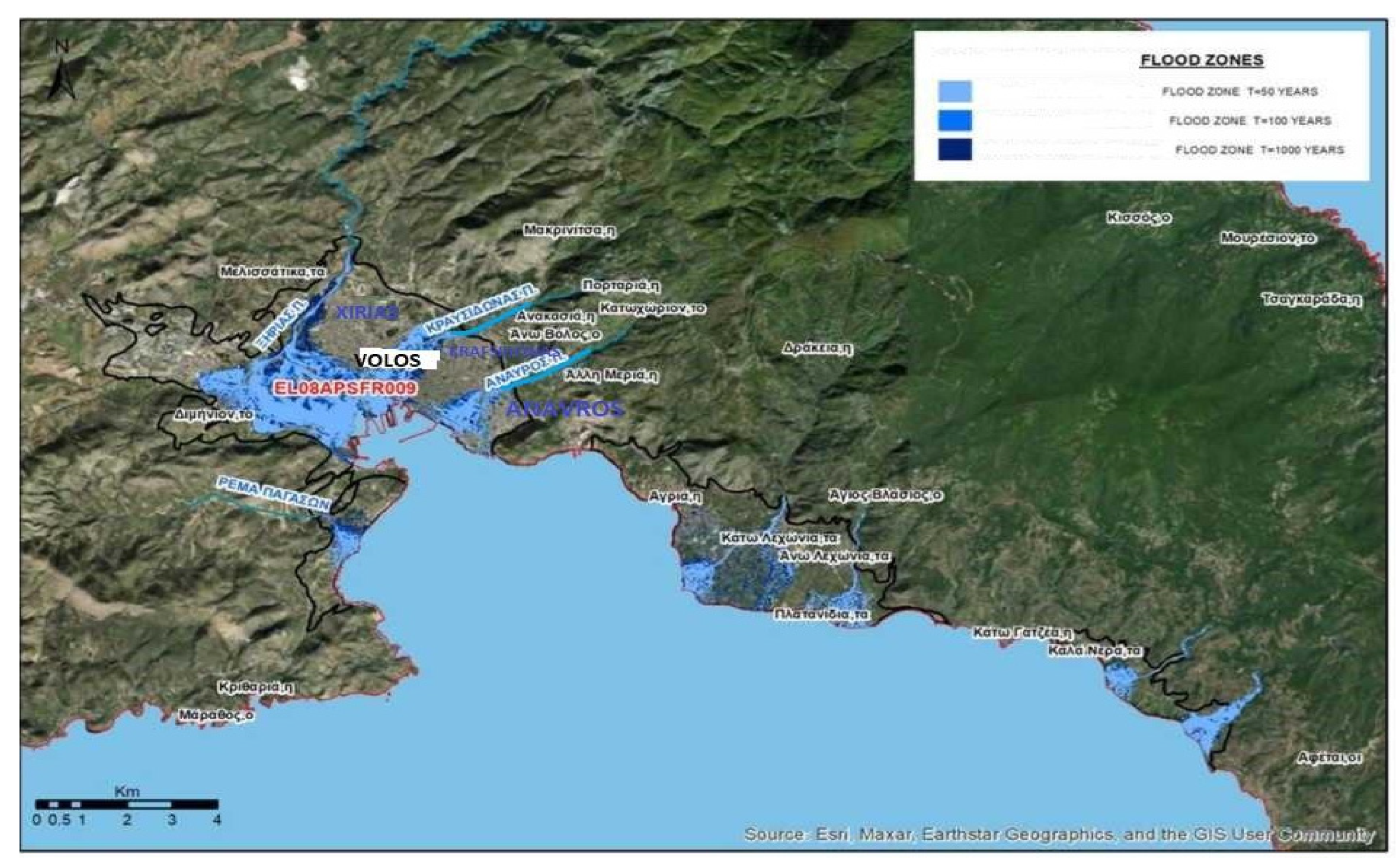
At present, the “First revision of the Flood Risk Management Plan for the River Water Basin of the water district of Thessaly (E08)” (or Flood Risk Management Plan, initials—F.R.M.P.) [48], and the “Second revision of the Management Plan of the River Basins for the water district of Thessaly (E08)” (or River Basin Management Plan initials—R.B.M.P.), which was open for public consultation in spring 2024 [50], and was subsequently approved, have been completed and are now operational. Another administrative framework recently completed is “Regional Climate Change Adaptation” (initials—R.C.C.A.P.). This framework was also drafted and approved after consultation in the summer of 2024. However, a range of severe lacunas are observed, related to the framework concerning the perennial flow Mediterranean torrents.
A key issue with the two management plans is their lack of integration and shared solutions. The Flood Risk Management Plan addresses floods, while the River Basin Management Plan focuses on drought, treating these linked issues separately. This division overlooks the Mediterranean climate’s dual challenge of prolonged water scarcity and sudden heavy rains. By separating flood and drought responses, these plans fail to address the climate holistically, discouraging integrated measures.

3.3.2. Torrent-Related National Legislation: Invisible, Yet Flooding

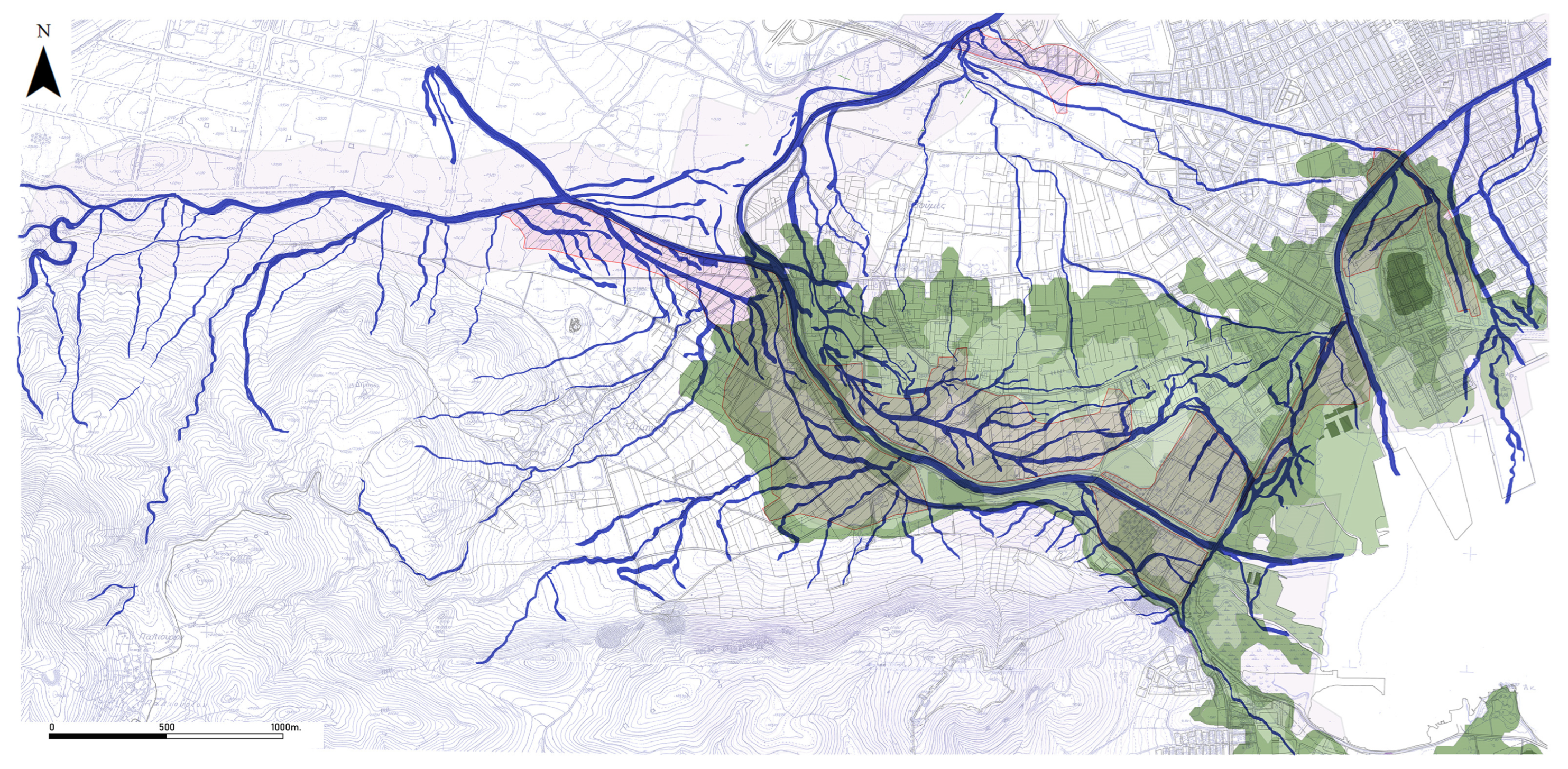
Another severe lacuna is the lack of adequately acknowledging the three perennial flow torrents of Volos, Xerias, Krafsidonas, and Anavros, among the surface water bodies mentioned in the River Basin Management Plans (RBMPs) (e.g., the RBMP of Thessaly) [51]. Although all watercourses are protected by Law 3199/2003, the three torrents of Volos do not appear among the protected water bodies of the Thessaly Region, nor are their characteristics analyzed at all, in the River Basin Management Plans (RBMPs) Environmental Impact Strategies [Figure 7]. However, these very same torrents are depicted and taken into account in the Flood Risk Management Plans [48] (FRMPs) [Figure 8], where the great quantity of water they may carry along their torrent-beds, during cataclysmic events, is depicted. This dis-symmetry proves that, according to the legislative framework, Xerias’, Krafsidonas’, and Anavros’ torrent waters are not considered useful but can only be potentially “catastrophic”. They are only taken into account when their massive quantity becomes a threat for the city of Volos. This lack of recognition of the beneficial potential of Volos’ three torrent waters, signals a dis-continuity of the diachronic cultural habitus, ignoring synergies and water-related practices, which have developed over time since antiquity, and the long-lasting relationships between perennial streams and their riparian communities.
The non-depiction of Krafsidonas, Xerias, and Anavros torrents within the RBMP of the Thessaly Region is partially remediated by Law 4258/2014 that mentions: “The River Basin Management Plans (RBMPs) and Flood Risk Management Plans (FRMPs) list the main watercourses in the country’s surface water bodies. However, it is noted that smaller watercourses that are not recorded/mapped, are a subset/part of River Basins or sub-basins (RBBs), within the meaning of para. 2c of article 2 of Law 3199/2003 and are protected”. That means that although Xerias, Krafsidonas, and Anavros are protected by law, they have not been the subject of their own river basin management plans. According to the definitions provided by the same law (4258/201): “Watercourses or streams (non-navigable rivers, streams, torrents and brooks): the natural or managed land surface formations that are the main receptors of surface runoff waters and ensure their conveyance to other water receptors at lower levels […]. Therefore, as defined above, the concept of a watercourse includes: rivers in their entire extent, as well as the tributaries of these rivers, streams, brooks, torrents, as well as the artificial branches of rivers and streams if they are part of the natural hydrographic network […])”. The same law defines the protecting framework of streams and torrents as follows: “According to the Constitution (Article 24), watercourses must be protected as elements of the natural environment in order to maintain them in their natural state and to ensure the function of water runoff performed by them. But also the Water Framework Directive 2000/60/EC explicitly sets the objective of good qualitative and quantitative status of all body surfaces by developing specific management plans for each River Basin (RB). The basic principles of the Directive extend to all watercourses even to ‘small’ ones as they contribute to larger ones, thus forming part of each RB”.
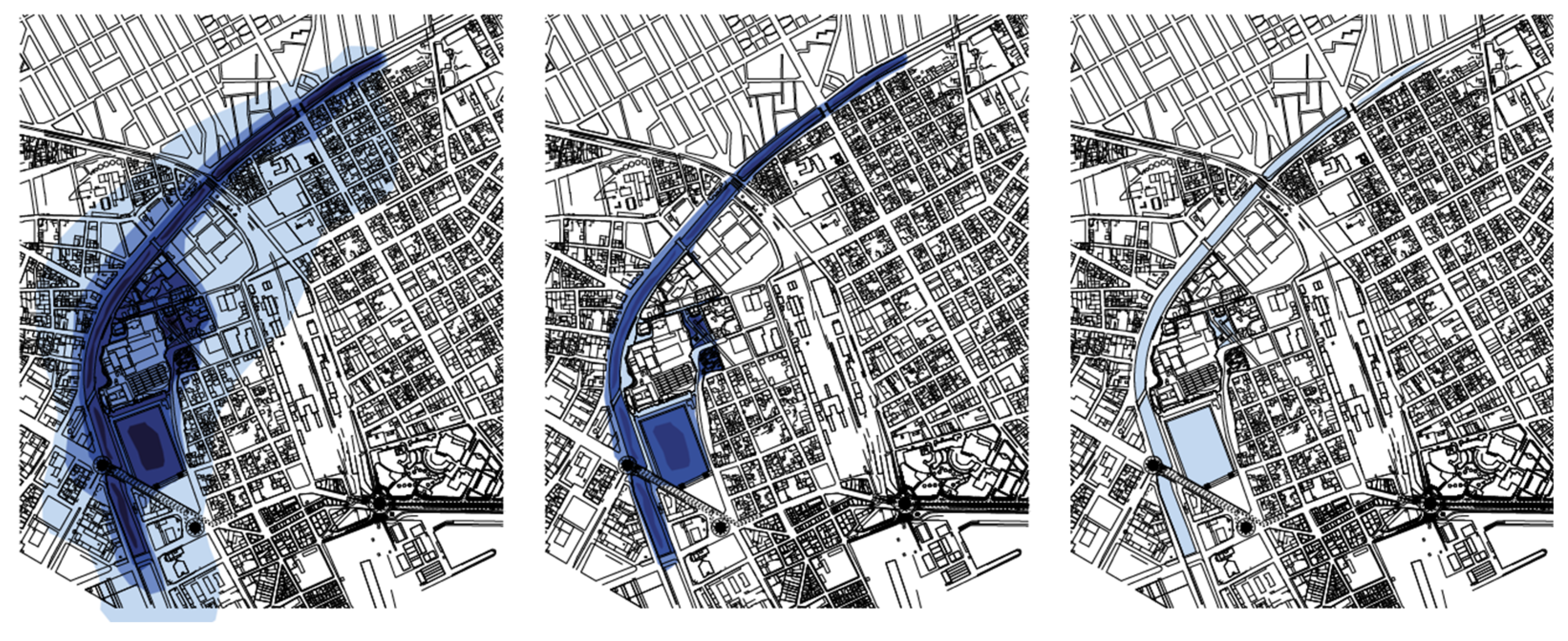
In conclusion, it has been clear that the way some among the Mediterranean torrents are “perceived”—or rather remain “imperceptible”—within the legislation in Greece, is a severe omission. Xerias, Krafsidonas, and Anavros, albeit they are perennial flow Mediterranean torrents, are deprived of a legislative framework that describes them in a holistic and specific way; they are classified in a generic category, comprising non-navigable rivers, torrents, streams, and brooks. This differentiation is too generic, clearly disregarding their specific characteristics. The three torrents are deprived of a legislative framework that would foster strategies to protect and develop them as torrentscapes, their urban, peri-urban, mountainous, and agrarian zones, by reinforcing their ecological value as open-flow urban eco-corridors connecting the cities with their hinterland. Moreover, their underground aquifer system is not monitored systematically, as no groundwater monitoring network points exist in the respective area. This omission leads to a severe shortage of data concerning the quality of the underground waters related to the three torrents of Volos. From the procedures concerning the open public consultation outcomes [50,52], it is evident that citizens are quite sensitized to the issue of the climate crisis, and, of course, there is great concern about the Flood Risk Management Plan (FRMP) [48,52] after the double major floods of September 2023. According to those analyses, the city of Volos is vulnerable to floods, even for rainfalls of relatively low return periods of 50 years.

3.3.3. The Regional Climate Change Adaption Plan

Closing this section by mentioning the Regional Climate Change Adaption Plan (RCCAP) [53] takes into account that part of the urban complex of Volos is situated within the flood zone for all scenarios considered and that important infrastructures within the urban complex are thus vulnerable. This strategic framework was completed in 2022, before the September 2023 floodings of Volos. However, even then it was recognized that “the flooding occurs due to overflowing of the streams that run within the city (Anavros, Krafisidonas and mainly Xerias) and the pressures exerted by technical works along them. It is necessary to take measures to manage these risks.” [53]. The mention of the pressures exerted by technical works along the torrents could be used as a stepping stone for defining planning initiatives. The RCCP contains further information regarding the ecological value of the streams that are sourced from Pelion: “Pelion is traversed by several streams and torrents, of transient flow. However, in the riparian areas of the streams, significant vegetation has developed, consisting mainly of Platanus orientalis (plane trees), Populus tremula (poplars), Alnus glutinosa (alders) and Salix caprea (willows). Typical endemics of Spilios are Alana Pella, Campanula incurve, Veronica urtifolia, which are rare and classified as endangered according to IUCN. Very important endemics are also Soldanella pelia and Dianthus haemnatocalyx”. This brief description provides some useful information that could be used to argue for bottom-up community-led initiatives in order to protect the flora along the torrentscapes of Volos: Xerias, Krafsidonas, and Anavros. The severe lacunas in the legislative framework analyzed previously in this Section 3.3 (concerning mainly RBMPs and, secondarily, FRMPs) renders the development of a synergy between community-led initiatives and engaged academics from the University of Thessaly—possibly in collaboration other academic institutions as well—who could act supportively and as consultants when needed.

3.4. Integrated Catchment Management Plans: An Approach of Territorial Scale in Relation to EU Guidelines and Directives

The Historical Analysis of Natural Hazards in Europe database, based on historical statistics, shows 2521 floods with significant socio-economic impacts between 1870 and 2020 [19]. In the past decades, many European cities suffered from flooding and, therefore, the city and landscape planning approach in relation to water had to change. This direction started long before the Nature Restoration Law in 2022, which focuses on guidelines for re-naturalizing urban rivers and other landscapes [54]. From the plethora of EU directions and directives that concern the concepts of just resilience, and ecosystem-inclusive landscape resilience, the following documents have been taken into account for the following analysis: the Flood Directive of the EU Parliament [17], the document Technical Guidance on the Climate Proofing of Infrastructure, for the period 2021–2027 [55], the new European Climate Risk Assessment Report [15], the Green Infrastructure Policy —Enhancing Europe’s Natural Capital (2013/2663(RSP) [56] and the Regulation of the European Parliament on Nature Restoration and Amending Regulation [54].
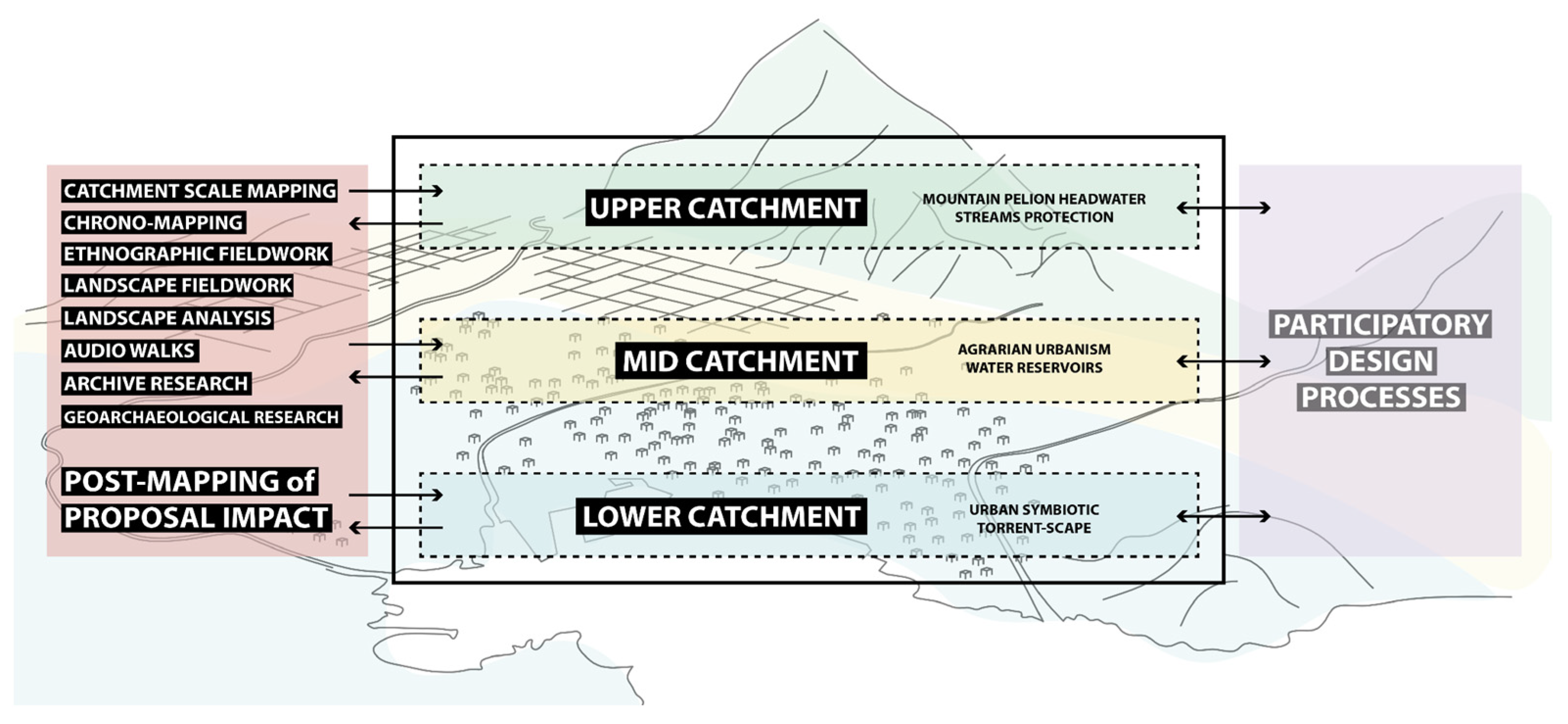
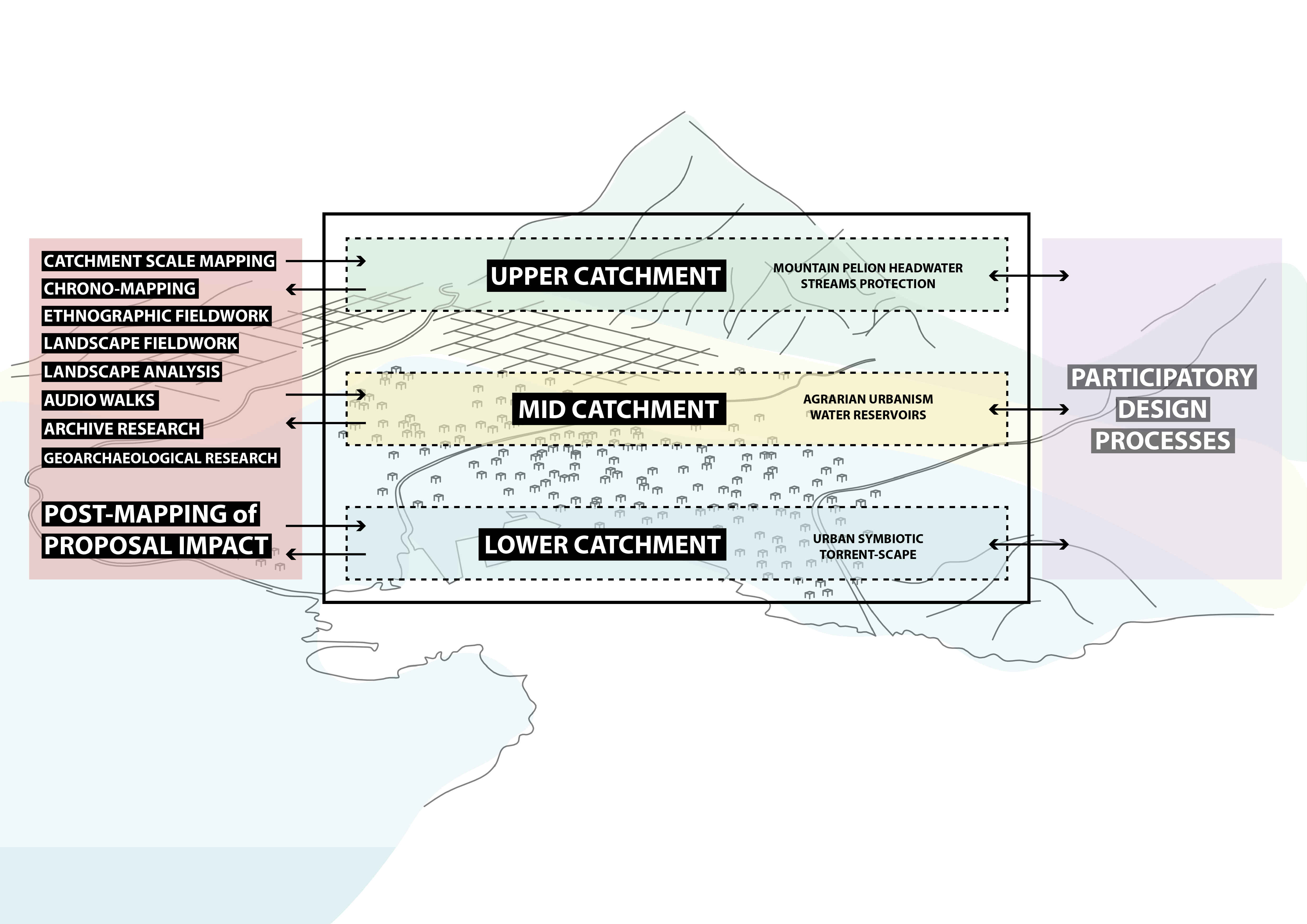
A direct reference to the September 2023 extreme precipitations and large-scale floods that took place in Thessaly Region, the “breadbasket region” of Greece, is found in the European Climate Risk Assessment report [15]. Concerning the mitigation of flood risks precisely, the EU Green Infrastructure Policy highlights the “positive effect of creating or restoring green infrastructure such as natural flood plains, woodlands, wetlands etc., which can improve disaster resilience and help adapt to climate change, and can significantly decrease related costs to society” [15]. Green infrastructure is indeed acknowledged as one of the prominent ways to address climate adaptation against floods. Green infrastructure is defined as “a strategically planned network of natural and semi-natural areas with other environmental features designed and managed to deliver a wide range of ecosystem services. It incorporates green spaces (or blue if aquatic ecosystems are concerned) and other physical features in terrestrial (including coastal) and marine areas [56]. On land, green infrastructure is present in rural and urban settings”. These strategies could be supported and supplemented by the regulations of the EU parliament (24 July 2024) on nature restoration [54]. The need for an Integrated Catchment Management Plan (ICMP) for each of the three torrent basins of Volos is a priority, since such plans do not exist for Volos’ torrentscapes at present [Figure 9] and especially since the three torrents of Volos are not even included in the River Basin Management Plans of Thessaly Region. Therefore, to approach the goal of creating such an ICMP for each one of these torrents would beneficial. “Integrated catchment management is a process that recognizes the catchment as the appropriate organizing unit for understanding and managing ecosystem processes in a context that includes social, economic and political considerations, and guides communities towards an agreed vision of sustainable natural resource management in their catchment”.
This article’s strategy highlights the three torrents’ transversal role across upper, intermediate, and lower catchments [Figure 9], stressing the need for integrated catchment planning. Their link with Volos allows the torrents to serve as urban ecological corridors rich in biodiversity and as cool air channels that reduce summer heat island effects along their riverbanks.
Based on the vegetation characteristics of each of the three torrent basin zones, and their wider ecosystem characteristics (i.e., forest in Mt Pelion, rural and arable agrarian around the city’s outskirts, torrent-bank tree lines, urban wetlands within the city, delta, and quasi-delta ecotopes, coastline, etc.), the aim of enhancing their function as eco-corridors for the reinforcement of resilient, self-regulating ecological systems is also part of the strategic design objectives.

3.4.1. Upper Catchments

The Plan on Flood Risk (FRMP) considers EU law, but its implementation depends primarily on legislative actions that must be completed for the law to be applied. This entails long delays in its implementation. For mountain hydrology projects, nature-based solutions (NBS) projects on the conservation of the riverbed and meanders of water flows, on the conservation of flood zones, and on the study of torrents as ecosystems are in line with the EU Regulation of the European Parliament on Nature Restoration and Amending Regulation [54]. In the framework of an ICMP, it would thus be imperative to draw up the corresponding guidelines. Unfortunately, in Greece, gray infrastructures are the usual way to respond to catastrophes related to infrastructures (“business as usual”).
In the upper catchment, the ecological balance of Mt Pelion forest and the forested stream-banks ecosystem protection have the highest priority. The mountain hydrology proposals can be based on the traditional dry-stone retaining walls found in the villages of Mt Pelion. Dry-stone walls and dry-stone pathways have been proven to be much more resilient than massive reinforced concrete constructions during the double cataclysmic events of September 2023. Through in situ visits it was testified that, indeed, the historic, 18th–19th century stone-paved paths, as well as many inclined stone, permeable retaining walls inside and around villages of Pelion (i.e., Makrynitsa, Argalasti, and so on) were in great shape, proving their traditional resilience; on the other hand, newer structures, such as cement paths lined with stone-covers [ca. 1980s], or massive reinforced concrete hydraulic infrastructures (ca. 1990s), were completely destroyed, broken, or displaced, by the September 2023 floods. Usually, in areas where the old, paved paths were poorly re-constructed for various reasons, their structure was proven less resilient. Furthermore, the preliminary announcement for the planning and construction of “check dams” on the mountain gullies around the Thessaly plain, as is noted in the First Report Regarding Post-Disaster Remediation of 2023 Thessaly Flooding [57], is a scenario that has also been discussed by the region’s administration experts, as the chosen method to be implemented, for the upper catchment of the torrentscapes of Volos. Again, this decision conflicts with the goals proclaimed by the EU concerning rivers and perennial torrents: the new directives are not to create additional borders, barriers, and dams, but instead “to restore at least 25,000 km of rivers into free-flowing rivers in the Union by 2030”. The description of the check dams in the aforementioned report, is not precise about the type of check dams to be implemented, some different types are presented as alternatives, ranging from wooden or stone structures, to cement and gabion structures. The choice of the types to be used for Pelion is crucial, as not all of them influence the perennial flow in the same manner; some types produce greater erosion rates downstream of check dams, with additional sediment mobilization (also enhanced by the absence of in-channel vegetation) [58]. Nevertheless, the same report states that the check dams should be complemented with nature-based solutions, NBSs, using vegetation to control the sediments. This complementary measure could be opening a possibly optimistic direction; however, the acute changes in biodiversity which are registered around check dams—both upstream and downstream—are alarming. For example, in the Mediterranean environment [35], it has been documented that the biodiversity around check dams is altered, and potentially degraded, both upstream and downstream. Upstream, the recorded results concerning the vegetation seem at first glance optimistic. However, meticulous observation will notice some threats to biodiversity, due to the intrusion of alien species: “the positive local effects induced on species diversity upstream of check dams, largely because their presence determines a more suitable environment for plant development including the appearance of opportunistic alien species”. Downstream, “clear water erosion induces changes in the riparian vegetation, which tends to assume a more terrestrial character and loses some herbaceous riparian species at the early growth stage, indicating a reduction of flood frequency in the fluvial terrace and a lowering of the water table” and “slightly lower species richness and a slight dominance of some plants belonging to terrestrial species were recorded as an ecological response to check dam installation downstream of check dams” [35]. This pending scenario, concerning check dams above the city of Volos, poses serious reasons for critical reflection, since the effects of the construction of check dams may have plural consequences. It seems that the direction the officially implemented plans seem to be taking, for the adaptation of the torrentscapes of Volos to climate change, should be thoroughly studied by an interdisciplinary research team, comprising forest engineers, botanists, ichthyologist, ornithologists, and specialists in amphibian species, but also landscape architects and social anthropologists who could study the synergy with the local upper-catchment communities and their practices. Otherwise, these plans could, unfortunately, develop in directions against the new regulations for nature restoration of the EU [54], and the national legislative framework as cited in the RCCAP of the Thessaly Region [53].

3.4.2. Intermediate (Mid)-Catchments

The areas where the upper catchment meets with the mid-catchment are areas where the biodiversity should be enhanced, particularly with the planting of tree lines around and within the torrent-beds. The poplar tree massacre that was spearheaded by the previous region of Thessaly administration, which took place within the mid-catchment zone of Krafsidonas, is in conflict with the Regional Climate Change Adaption Plan (RCCAP), the official framework that guides and confines the strategy the regional authorities should follow, since within the RCCAP, the tree lines along the riparian areas of torrents are considered significant vegetation “consisting mainly of Platanus orientalis (plane trees), Populus tremula (poplars), Alnus glutinosa (alders) and Salix caprea (willows)” [53]. Moreover, it is in complete antithesis with the directions given by the Regulation of the European Parliament on Nature Restoration and Amending Regulation of 2024 [54], in which the planting at least three billion additional trees in the Union by 2030 comprises part of the Assessment of the National Restoration Plan.
Within the areas of each catchment, the technical guidance on the climate proofing of infrastructure [55] is a way to mitigate the disasters produced by flood regimes and extreme rainfall events. Among the guidelines provided, the measures to be taken for climate change adaptation include plans for increasing resilience to floods through the use of sustainable drainage systems, the enhancement of permeable surfaces and green spaces in new public plans/programs, and the avoidance of decreasing storage volumes in flood plains. These guidelines harmonize with the characteristics of the mid-catchment agrarian landscape of Volos’ three torrents. Therefore, in the context of the case study, the agrarian landscape along the torrent-beds of Xerias, Krafsidonas, and Anavros should be preserved as cultivated permeable fields, and not turned into new urban districts (“business as usual” scenario). Drafting a strategy for the mid-catchment of Volos’ torrentscapes is meant to answer two of the crucial questions asked within the same EU technical guidance document, concerning the capacity of flood plains for managing natural floods, and the exposure of the vulnerable to flood impacts.
The mid-catchment agrarian landscapes at present are cultivated by nearby inhabitants. Such cultivated areas are found today mainly along the Xerias torrent and at a relatively small area adjacent to the Krafsidonas torrent (ca. 20 HA above Nea Ionia), as well as along Anavros, mainly above Volos’ ring road. By maintaining agricultural use, these areas will be kept permeable, thus keeping the capacity to absorb more water than urban areas; irrigation canals could enhance these rural areas’ absorbing properties and encourage the maintenance of small-scale cultivation land uses. By absorbing more water, these areas can lessen the damage that cataclysmic rain brings to the already inhabited riparian neighborhoods of Volos, situated within the torrents’ lower catchments. Therefore, the mid-catchment cultivated areas can take part in the protection strategy of the most vulnerable lower zone of each catchment. In relation to droughts, consideration is given to the further support of arable land by placing new “water containers as part of the landscape infrastructure”. Through Green and Blue Infrastructure systems, the torrent water can be collected, filtered, cleansed, and stored when it is excessive. The cleansed water can be kept for periods of drought, as a holistic way of responding to climate transformation stresses. Furthermore, connected to the water containers, the agrarian networks of channels, rows of trees, and fringes have been acknowledged as areas of preciously abundant biodiversity, as they “provide space for wild plants and animals, including pollinators, prevent soil erosion and depletion, filter air and water, support climate change mitigation and adaptation, and agricultural productivity of pollination-dependent crops” [54].
The most striking infrastructural giga-scale interference within the mid-catchment zone was carried out between 1959 and 1962 in relation to the Xerias torrent riverbed, the drainage of Lake Karla, which used to be the largest lake system in the region of Thessaly. The water was removed from the lake area via an underground channel; it conducted its precious waters into the sea at Pagasitikos Gulf, the gulf where the city of Volos is built. The mid and lower part of the Xerias torrent was—and is—part of the path the lake waters followed to reach the sea. Karla’s drainage co-created the natural and human history of Xerias. Up until the present moment, the underground channel is still functional, and thus, again, Xerias is used occasionally as the path to ‘throw’ into the sea any excessive water in the broader Karla region. After the twin floods of September 2023, the water that was unintentionally collected from a vast area of the Thessaly plain around the Lake Karla area, was indeed conducted via Seskliotis and Xerias to Pagasitikos Gulf. The Xerias torrent-bed was directing, for almost a whole year, the inundated Karla waters into the sea; the most bitter ending of this draining procedure was the discharge of hundreds of tons of dead fish—which had lived and thrived during the winter and spring of 2023–2024 in the inundated fields—into the gulf, via Xerias. It is thus arguable that a torrentscape management design, which implements NBSs to cleanse the waters from the fertilizers used at agricultural practices around Lake Karla, is indispensable. The cleaned waters could also be used for agricultural use, as explained above.

3.4.3. Lower Catchments

Considering the existing legislative framework and the local urban plan of Volos, we propose to reconsider the delimitation of the torrent-beds, for the occasional addition of width to the torrent-beds, in relation to their historic width, thus creating “flood rooms” to avoid excessive flooding in the lower catchment zones. This strategy respects the restoration measures as referred to in Annex II of the Regulation of the European Parliament on Nature Restoration of 2024 [54], where the objective is described as the re-establishment of the meandering of rivers and reconnection of artificially cut meanders or oxbow lakes. At the lower catchment, within Volos’ city, the torrents can act as the backbones for eco-corridors aiming at strengthening the urban ecosystems’ biodiversity. Eco-corridors can be irrigated by blue infrastructure networks, which provide for urban green irrigation, the rainwater runoff from streets, pavements, conventional roofs, and all impermeable city surfaces. Apart from feeding the urban green ecosystems, blue infrastructures absorb a great volume of the urban rain runoff, a vast portion of which, at present, is conducted to the torrent-beds (this is the case for all of the urban lower catchment of Krafsidonas). Blue and green infrastructure is thus meant to replace, as far as possible, the existing gray infrastructure hydraulic subterranean networks of the city. The green eco-corridors could comprise “rain gardens”, linear drainage parks, and planted swales to channel and filter rainwater, urban wetlands to purify water from pollution before it attains the torrentscapes or the aquifer, etc. The creation of flood rooms in areas that are public spaces, such as the university campus open spaces next to the torrent Krafsidonas, can be a solution for mitigating the damage created by flooding into inhabited areas, educational areas, areas with commercial uses, etc. The transformation of Volos into a city of increased permeability should be complemented by the replacement of impermeable with permeable surfaces, and the augmentation of the city’s porosity, which is possible by connecting the eco-corridors with smaller networks which are linked to the network of many small city gardens, and public squares, which already exist in parts of Volos. The aim, in addition to mitigating the consequences of floods, is also to maintain an ecological water supply for urban irrigated areas in each torrent catchment. This approach could protect the city of Volos against the phenomenon of desertification, which threatens biodiversity in the Mediterranean basin.

3.4.4. Overall Catchment Assessment Summary

As a general rule connecting each catchment transversally, it becomes clear that measures that could be chosen as effective for the lowland areas—the lower catchment zone—of a stream/torrent, largely depend on the measures taken at the mid-catchment zone (outskirts of the urban area, the agrarian landscapes), and of course also at the foothills and mountainous areas. That is the reason why an Integrated Management Plan (IMP) of each catchment as a whole is required. Several countries worldwide have started transforming their cities into so-called “sponge-cities” by renaturalizing their rivers with different practices of nature-based solutions. Some good examples are Munich, with the restoration of Isar River’s floodplains, in Düsseldorf; Copenhagen, with its Strategic Flood Masterplan; and several Asian cities, among them Shanghai and Bangkok. Landscape architect Kongjian Yu designs amphibian parks based on his concept of “sponge-cities,” observing the floodings of the past decades in China. Several cities have been replanned based on embracing the water and giving it the space it needs to move, known as “model sponge cities” [59].

3.4.5. Ecotones as Non-Anthropocentric Eco-Corridors, Transversal to Each Catchment

Aiming at dismantling anthropocentric points of view towards eco-corridors, the term ‘ecotone’ is engaged. Literally, in scientific literature pertaining to the vegetation ecology, “the ‘ecotones’ are considered as tension zones between adjacent plant communities. The riparian zones function literally as ecotones since they typically support a distinctive flora and vegetation communities that differ in structure and function from adjacent terrestrial vegetation” [35]. Apart from their literal meaning, based on Haraway’s Concept of Contact Zones, ecotones are another way of discussing co-vulnerability, a way which destabilizes the anthropocentric vision of urban space in a particularly accentuated way [60]. “I remembered that contact zones called ecotones, with their edge effects, are where assemblages of biological species form outside their comfort zones. These interdigitating edges are the richest places to look for ecological, evolutionary, and historical diversity” [61]. Haraway envisions these zones as opportunities for a new kind of globalization—an “alter-globalization” or autre-mondialisationwhere interaction and co-existence replace domination and exploitation.
The torrents of Volos, and specifically the Krafsidonas torrent, provide a compelling example of such a contact zone. Krafsidonas represents a space where the “natural” and the human-made intermingle, creating an environment where human and non-human actors coexist and interact. Various human groups utilize and influence the space around Krafsidonas, while a diverse array of vertebrates regularly inhabit its riverbed; this is how everyday practices can lead to an interweaving of anthropogenic and ecological lines. The torrent-bed of Krafsidonas functions as an ecotone between culturally defined human riparian neighborhoods and animal shelters; the latter exist into the torrent-bed, especially along the upper catchment and estuary area, where they are privileged by the company of flora communities. They are forming segments of an eco-corridor which traverses Volos’ urban fabric.This eco-corridor is more vibrant or latent depending on how “gray” the torrent-bed is within each of its sub-areas. As Noukakis [62] observes, the challenge lies in transforming the “zone of indifference”—established by the anthropological machine that separates humans from animals—into a true contact zone. Such a shift would require rethinking relationships with the non-human world, fostering interspecies interactions based on respect and mutual recognition, rather than exploitation or neglect.

3.5. Research for Torrentscape Restoration Through Landscape Design([RtD) for Krafsidonas’ Lower Catchment Scale

In the design studio “Reconstructions of the Soil” taught by Aspassia Kouzoupi from academic year 2018–2019 up to 2024–2025, students and student groups are asked to approach and design landscape as a complex assemblage of processes, not as an image. The landscape of the torrent Krafsidonas was chosen as an elongated landscape entity that connects the familiar academic locus, the School of Architecture, at the Campus of the School of Engineering of the University of Thessaly, with the mountainous and forested Pelion. All of the students, on their way from the center of Volos to the Faculty of Engineering, or vice versa, effectuate a crossing movement on a bridge above Krafsidonas. Crossing Krafsidonas is part of the route, so the torrent is usually perceived as a landscape of passage. Krafsidonas was usually barely noticed by the passers-by. Opening up the perception of the live ecosystem of Krafsidonas, and its hidden beauties that one can find when walking into the torrent-bed, was one of the objectives of this course. Furthermore, it is an intensely dynamic landscape, characterized by an extreme fluctuation regarding the presence of water: the usual state is that of drought, when water is still flowing but the small flow is not even enough to fill the entire lower surface of the torrent-bed; on rare days, maybe once every couple of years, the torrent-bed is half-full, and eventually, there is the rare but real circumstance of catastrophic floods like the ones of September 2023.
Krafsidonas is a potent eco-corridor that needs remediation, which in parts of the city functions against all odds. Krafsidonas’ torrent-bed hosts local aquatic ecosystems along the middle and lower catchment, while in the upper catchment—in Mt Pelion—it hosts a balanced forested ecosystem. The students were asked to design innovative green infrastructure solutions in each of their approaches, as a means to bind the adjacent riparian urban districts, and the torrentscape ecosystems. “The explicit integration of both nature conservation objectives and social-environmental justice objectives is essential for Green Infrastructure research to support sustainability transitions and outside the city” [63]. To become initiated to Krafsidonas’ ecological potential, and therefore design from this vantage point, is a way of conducting research towards strategies for the remediation of the torrent-bed; research on the possible limits of the torrent-bed, aiming at the recovery of areas which once were flood rooms within Krafsidonas’ lower catchment, or reclaiming an area for the ‘rewilding’ of the torrent’s estuary, has been another objective. Along the Krafsidonas torrent, different layers of interventions through time are interwoven in a complex way, reminders of any spatial ‘wicked’ problem [64]. Such layers of intervention concern changes in the torrent-bed which were imposed by the development of the city, the history of Krafsidonas as Volos’ industrial belt, the role it played as the administrative border between Volos and Nea Ionia, and the way the local authorities recently undermined its significance as a potential eco-corridor. Implementing research-by/through-design (RbD, RtD) as a design-related research approach [64], towards deploying different perspectives/perceptions of space, and layers of interventions through time, can lead to the unfolding of the interwoven information, so that ‘wicked problems’ can be better understood.
Another important aspect of the research-by/through-design value within this landscape design studio has been the observation of the way the double deluge of September 2024 affected how the student teams responded to the Krafsidonas. An observation could be articulated regarding the differences between the pre-cataclysmic and the post-cataclysmic student’s response and the modalities by which the students handled the approach of Krafsidonas. This change in attitude was partly documented in their landscape design proposals.
Two loci in contact with Krafsidonas’ torrent-bed, which until recently—as historic records testify—belonged to the torrent’s width, are at present in need of remediation. These loci were examined through the research-by/through-landscape-design procedure. One of them is an area [area-I] that heavily suffered by extensive flooding in 2023, laying at the foot of the hill of the Old Volos walled city, between the ancient wall and the actual shore of Krafsidonas [Figure 10]. In this area, next to the diverted Krafsidonas torrent-bed, formed in the turn of the 19th–20th century, at least until 1955, a great flood-room area, having the form of a vague land, existed; it was considered a municipal recreation area (before turning into a football field), in the urban plan of 1930. That locus was the first area [area-I] proposed for the students’ intervention proposals. The research addressed consisted of “Giving back Krafsidonas’ flood room”, (as an example, the study of a Flood discharge network, and a Flood Garden is showcased in [Figure 11] and [Figure 12]).
The second locus [area-II] where the research for torrentscape restoration by landscape design was focusing, is the area where the delta of Krafsidonas’ diverted torrent-bed was formed. The delta used to be formed in that locus, before its area was colonized by the massive cement-covered port of Volos; some of the delta’s traces are still present, persisting against all odds [Figure 13]. The research torrentscape restoration question addressed concerning area-II consists of “Giving back to Krafsidonas its delta”, within the Campus of the School of Engineering, (as an example, the study of in-campus Torrentscape Delta is showcased in [Figure 14]).
Nijhuis et al. [65], explain how design as a systematic search through the different types of the design-based and design-related, brings up new knowledge through the disciplines of spatial planning, urban design, and landscape architecture. According to Roggema [64], this design approach is split into three parts: pre-design, design, and post-design. The first two parts are completing any conventional approach, where context and object might be specific or variable (design research, design study, typological research, and study by design). The post-design of RtD brings the produced design(s) to the broader public for communication, exchange, and discussion. In the context of the research applying to the Krafsidonas torrentscape, the post-design production has initially included scientific and local journal writing open to the public; most importantly, the post-design phase has been expressed in the framework of the Floodmarks exhibition, where six of the students’ proposals for this course were exhibited. Additionally, the participatory design and collective mapping processes that took place among the exhibition collateral events, have been a way to continue the research-by/though-landscape design, re-starting with an emphasis given to inhabitants’ participation. This is how the synergy between the social anthropologists and the architects of the present interdisciplinary team reached a first peak: by the Floodmarks transdisciplinary exhibition, which has traced the next collective path to be followed.

3.6. Synchronic Actions for Volos’ Torrentscapes, from an Anthropological Standpoint

3.6.1. Floodmarks Exhibition’s Tracings, on the Krafsidonas Torrentscape

The exhibition Floodmarks, held at the Museum of the City of Volos, from 2 April to 9 May 2025, developed from the interdisciplinary collaboration of social anthropologists, architects, artists, and activists, centering community voices and student research and creativity. As the only event held in the city commemorating and reflecting on the devastating floods, except for the public audio walk “Water Remembers” (presented in the succeeding 3.5.2., although it took place before the exhibition), the exhibition held deep political significance (against the logic of “return to normality”) and ended up attracting many visitors. Successfully opening a discussion between the academic community of the University of Thessaly and the residents of Volos and the wider region about the September 2023 floods and the growing climate crisis, Floodmarks was covered in the local press and television and visited by many school groups, from elementary to university age, from the region, but also from many other locations in Greece.
The exhibition was organized around a conceptual glossary of key terms —“flood of/as images”, “infrastructures in crisis”, ”dis-placement”, “amphibious landscapes”, and ”torrential flows”—with the idea of ”survivance”, drawn from the work of indigenous Anishinaabe scholar Gerald Vizenor, stressing the collective and agonistic dimensions of survival in climate crisis against neoliberal, anthropocentric, individual-oriented white environmentalism, running throughout. Used as its starting point, “floodmarks”—namely, the scars of this climate collapse event on local landscapes, ecosystems and non-human beings, households and infrastructures, and bodies and souls—the exhibition set a double objective: On the one hand, through interactive and participatory processes it had the objective to create a forum to share and document the collective trauma and losses of the flood, but also powerful experiences of solidarity, which, in the rush to return to “normality”, tend to remain invisible and unspoken. On the other hand, it had the objective, using the methodological tools of social anthropology, architecture, geography, and art, to interpret these traces as omens of future climatic collapse. Through interactive and experiential workshops (participatory design and fanzine creation), multimodal exhibits (architectural models and constructions, ethnographic podcasts, and video screenings), a geolocated audio walk, an installation made especially for the exhibit by city artists, a floodtotem” co-assembled with objects brought by local residents, and special sessions (lecture and open mic), the exhibit envisioned alternative ways of living with the natural environment, with non-human beings and with each other, than those imposed by top-down “anti-flooding” engineering works.
The exhibition, curated by anthropologist Penelope Papailias, gave a platform—as much as possible—to young voices and student creation, as well as to the presentation of the work of collectives that have been struggling for decades for environmental justice in the region and were particularly active in the solidarity actions during and following flooding. A special “Reading room and mediateque of the commons” was set up in the exhibition site with a selected bibliography, podcasts, materials from collectives, and, mostly, a space to talk: this alternative library was a symbolic reminder that the library of the University of Thessaly, which was flooded, remains closed even at the time of writing. The reading room was meant to critically problematize the role of the university and the knowledge it produces in relation to the ecosystem in which the university is located and the mounting ecological crisis. More than 50 students of the University of Thessaly participated in the exhibition with their creative, research, and critical work, while the Association “Friends of the Krafsidonas” provided valuable visual and archival material [Figure 15] for the exhibition, the “Palaio Limenarcheio Inhabitans Association”, GAIA SOS, and the People’s Assembly of StagiatesFree Waters” [Figure 16].
Among special sessions, art installations, planned events, and a participatory mapping workshop took place, during which inhabitants of the city narrated their experience of the flooding, and collectively mapped areas of the city, where they had observed infrastructural failure.
The exhibition was co-organized by members of the departments of History, Archaeology and Social Sciences-Anthropology, Architectural Engineering, and Urban Planning & Regional Development of the University of Thessaly, the Volos Art Association, the Experiential and Diachronic Landscape Observatory (EDLO), and the Pelion Summer Lab for Cultural Theory and Experimental Humanities (PSL), in collaboration with the Public Humanities Initiative Stavros Niarchos Niarchos Foundation Public Humanities Initiative (SNFPHI) and coordinated by the Archives Division, Archives, Museums and Libraries of the Municipality of Volos (https://ha.uth.gr/index.php?page=events-search.display&a=687 accessed 09 May 2025).

3.6.2. “The Water Remembers”, Geolocated Media Walks

Entitled the “The Water Remembers” (To Nero Thimatai), the audio walk, which has been geolocated on the platform Echoes for future individual and collective navigation, is based on oral testimonies of residents and activists about their experience of living alongside the torrent, as well as their concerns for the future of the area. In highlighting the relationships between people, natural elements, and socio-political structures, the walk can be categorized as a public intervention in the emergent interdisciplinary field of Environmental Humanities, which seeks to demonstrate how the humanities and social sciences might contribute to the development of collective responses to the urgent planetary needs of the evolving climate crisis. While at the time of the floods, the torrent was demonized almost as the cause of the disaster, “The Water Remembers”, counterposes a biography of the river, displacing the human species as the default center of history. The audio walk, which also includes excerpts from historical documents and secondary sources, foregrounds genealogies of the capitalist development that negatively impacted the torrent (the railroad, factories, and the port) and the relocation of vulnerable populations, such as refugees from Asia Minor post-1922, to this liminal and vulnerable landscape, which in turn became inscribed with social and political hierarchies and divisions with the torrent as the border. In an attempt to imagine more sustainable and inclusive futures for the post-diluvian era, the audio walk brings into focus traces of past ecosystems and the symbiosis of human and non-human-beings, as well as histories of long-term movement resistance to the violent treatment of the environment. The geolocated media walks, under the theme “The Water Remembers” [Figure 17], centered narratives by residents and activists and everyday interaction, whether going to work in local factories or relaxing along their “beach”—the Krafsidonas’ bank (including children’s games, collecting silkworms, and block parties). These narratives centered residents and residents-turned-activists’ care and protection of the Krafsidonas’ torrent, climaxing in their successful resistance in the late 1980s to the paving over the torrent. Through excerpts from archival material as well as interviews, the media walk highlights the history of capitalist exploitation, as well as the experience of the populations of Asia Minor—vulnerable, dislocated populations, settled in a vulnerable landscape. As a parallel benefit, the aim of re-appropriating the public space along the torrent-bank by Volos’ citizens, the embodied experience of this walk, as a public event, also enabled the long history of relationships between inhabitants and Krafsidonas to literally be heard along its coasts. After the deluge, which has not been actively repressed from official public memory, the participants “occupied” the ruined landscape with their bodies, enacting an anti-tour of the city and an agonistic memorial performance.

4. Discussion: Understanding the Krafsidonas Torrentscape Under the Prisms of Co-Vulnerability and Just Resilience

4.1. Co-Vulnerability

  • “…through such mutual helpfulness men repair
  • the ravages of tempest, earthquake, time.”
  • De Officiis 2. J2 ff. Cicero [66].
Is acting in the shadow of a threat necessary to achieve a condition/state of acting collectively?Human collectivism”, which Chakrabarty envisages as “a universal that arises from a shared sense of catastrophe” or a “negative human history” [4], is the aftermath of the climate collapse episodes, acute expressions of the extreme climate transformation. For instance, in the case of Volos, many inhabitants of Volos responded to the September 2023 flooding catastrophes by supporting each other, spontaneously working collectively within their neighborhood and among friends, to chase away water, mud, and sludge, to help and host people they knew who were occasionally excluded from their homes. These actions bear a deep feeling of co-vulnerability, as part of an embodied experience difficult to explain in words. However, the present research sheds light on modalities of co-vulnerability beyond its anthropocentric facets. It focuses on the interweaving of more than human entities and humans, into a relationship that expresses an understanding of their co-vulnerability.
What is the relation between human history and natural history along the side of the torrent-beds of the torrentscapes of Volos? The answer to this question has been approached theoretically through the conceptual lens of “co-vulnerability” but is also investigated through careful observation of what happened—and is happening—to Volos, especially zooming in the area around one of Volos’s three torrents, namely Krafsidonas.
Can a political bottom-up movement for the protection of the Krafsidonas torrent prove the deep feeling and understanding of co-vulnerability between the riparian zones’ communities and the torrentscape ecosystem? In other words, are such collective movements a proof of a sense of conviviality with the torrent and the living ecosystems deployed within its landscape? These questions have been broadly answered by the narratives which take part in the “Water Remembers” geolocated public audio walk along the banks of the Krafsidonas torrent. “A view of vulnerability as part of embodied social relations and actions can help us understand how and why forms of resistance emerge as they do” [67]. The Nea Ionia settlement’s inhabitants, being a community of refugees from Asia Minor, expressed a strong expression of solidarity. Solidarity was an inextricable characteristic of Nea Ionia. Most of these community’s collective initiatives were aimed at mitigating various facets of the precarity of living at the “other side” of Krafsidonas. Having the torrent creating a material boundary which separated the “settlement of Nea Ionia” (synoikismos Neas Ionias) from the city center of Volos, resulted in the deprivation for many years or decades of the community from adequate health care, enough bridges, clean household water, and a sufficient sewerage network. The community of Nea Ionia showcased the immanence of the solidarity among its members, and towards Krafsidonas, which was alive and effective more than half a century after the refugees’ settlement was inaugurated. The issue of co-vulnerability as a deeply embodied form of knowledge leading to political resistance movements, which may take the form of a revolt, when necessary, is not new. Indeed, such resistance movements within the urban frameworks have long been associated with infrastructure. As Judith Butler proclaims, “a movement may be galvanized for the very purpose of establishing adequate infrastructure, or keeping adequate infrastructure from being destroyed” [67]. The 1980s movement of the “Friends of the Krafsidonas” is precisely founded on such a demand not to destroy Krafsidonas as anatural corridor’ linking the mythical Mt Pelion with Nea Ionia and Volos. The inhabitants of Nea Ionia and Volos, who actively participated in this movement, saved the Krafsidonas torrent and decided that their co-existence with Krafsidonas was an ideal to fight for. However, coexistence means co-vulnerability, a symbiotic mode of living, as Haraway says, “sympoiesis” [68]. She points out that “becoming is always becoming with, in a contact zone where the outcome, where who is in the world, is at stake” [59]. Nothing is excluded in this co-becoming, including technologies, creatures, landscapes, and practices. Donna Haraway’s concept of a “contact zone,” [60] a space where different species encounter each other, challenging conventional boundaries between humans and non-humans, approaches these zones as opportunities for a new kind of globalization, —an “alter-globalization” or autre-mondialisation,—where interaction and co-existence replace domination and exploitation. One of the popular arguments, during the historic ecological struggles of the period 1980s–1990s, was that “the river does not separate us, instead we are connected by the river,” and that “Krafsidonas, the river, is our beach” [69]. Both arguments stem from the history of Nea Ionia, built in the 1920s to host refugees. The Asia minor refugee settlement—which has small houses and porches, and very narrow roads—was somehow far from the seafront, being at the “far side” of the Krafsidonas’ diverted torrent-bed. Its inhabitants would meet at the “beach” of Krafsidonas; it was their public space: “Krafsidonas is the beach of Nea Ionia”. Therefore, these struggles were also struggling for safeguarding their neighborhood’s public space. Moreover, the rich biodiversity and the thermic-island-mitigating properties of the river zone are very much appreciated by the inhabitants, as they mention the singing of nightingales, and the gentle sound of leaves in the cooling summer breeze.
One of the working hypotheses which has been addressed, related to the concept of co-vulnerability, locates this concept as a prevailing characteristic and linking quality between riparian communities and the torrents. Apart from the mid-and-lower catchment, where Nea Ionia is located, co-vulnerability emerged as a collective form of resistance at the upper catchment of Krafsidonas as well. Inhabitants of Mt Pelion’s village Stagiates formed the “Stagiates Free Waters” initiative, which has been fighting for the quality of free potable water long before the 2023 floods. The initiative aims at the protection of source water as a valuable common. The initiative has been protesting against the bad quality of the water supply system of Volos and the consequences of the habit of buying and drinking bottled water. The initiative had collaborated, among others, with the Department of Architecture of UTH, during the Local Festival of the “OPEN UPCreative Europe Program, on Wednesday, 31 May, and Thursday, 1 June 2023, on the project “Hydrophores”. “Hydrophores” has been a collective performance of the public transportation of water from Stayiates to the UTH campus, a form of protest against the continuous degradation of the water cycle in Thessaly, and part of the symposium “Devisings_How will we live”, coordinated by Professor Zissis Kotionis and organized by Katerina Kritou and Efi Dimitrakopoulou. Responding to the municipal water supply system collapse during the aftermath of the 2023 twin floods, the members of the “Stagiates Free Waters” initiative offered clear potable water sourcing from the upper catchment of Krafsidonas to the people of Volos suffering from the lack of water. This offer towards the vulnerable has also been an action of remediation, curing the way Volos’ inhabitants perceive the waters of the Krafsidonas; while the city was still flooded, and Krafsidonas’ was treated as the main culprit by the prevailing narratives, its very sources saved people from thirst during water scarcity in the city.
Collaborating across fields, as suggested by Gareth Doherty, who has emphasized the synergy between landscape architects and social anthropologists, allows for a more nuanced approach to urban adaptation. Apart from acknowledging the very rich area between two established disciplines, Doherty understands it as more than an interdisciplinary space since, according to his point of view, “people and their relationships are so integral to landscape” that it would be almost absurd to consider them separately. Thus, looking at landscape architecture as an extension of anthropology, according to Doherty, is coherent, since “anthropology works with some of the raw elements of landscape, materials, people and space” [70]. The accomplishment of a structured social-anthropological approach of Krafsidonas’ riparian communities’ inhabitants is fueling the landscape urbanism vision of its torrentscape. Following a feminist approach to infrastructure, and an anthropological approach to landscape, the research on the multifaceted relationship between the torrentscapes of Volos city and its inhabitants becomes a form of resistance. Locating the co-vulnerability between human and non-human paves the way for treating systemic violence as coherent regardless of its recipient. Therefore, responses to that violence, whether infrastructural, epistemological, or political, ought to be equally coherent, treat environmental justice, and be integrally linked to social justice. A next step would be to develop design strategies that mitigate inequalities arising from climate change, while also reducing flood impacts in urban areas.

4.2. Addressing Social Justice for Just Resilience

Water has certainly always been an intense site and agent of planetary terraforming, but in an Anthropocene narrative, this shapeshifting is figured either as a result of our attempts to control water (damming, irrigation) or as an out-of-control response by water to these attempts at control (storms, sea levels). Put otherwise, adopting an aqueous orientation to the Anthropocene reminds us that the keyword of this epoch is control—where, unsurprisingly, the perverse antidote to waters out-of-control is more control and managerialism…” [71]. Introducing more control of dynamic ‘natural’ elements through the construction of more robustgrayinfrastructures is not an efficient way to deal with climate change, especially if there is a lack of coordination of all interventions on a large scale; the robustness of gray infrastructure can be proven very problematic, flooding some areas to protect others and, therefore, possibly creating serious issues of social and environmental injustice. Unfortunately, the severe lack of coordination, beginning with the statutory studies mentioned above, makes for a precarious framework, which should be revisited through the introduction of an integrated catchment scale plan (ICSP) before attempting to introduce robust interventions in the torrentscapes’ course.
Additionally, one more of the issues that arose during the floods in Volos is related to environmental justice, precisely concerning the areas that were more affected by the September 2023 floods. The areas around the torrents were more harmed than the broader center of the city. ”The quest to rethink the infrastructural component of injustice is neither a celebration of current western living standards nor a romanticization of vulnerability: rather it is a demand for infrastructural adaptation guided by the feminist politics of weathering.” [26].
The anthropological and landscape research made clear that an increased vulnerability of riparian communities to the flooding, was directly connected to gray infrastructure faults. Precisely, in a detailed investigation of the flooding attributed to the overflow of the Krafsidonas’ torrent, it became apparent how outdated—yet robust—gray infrastructure, including bridges, walls, and the road network within the urban landscape, has caused a dramatic worsening of the cataclysmic impact in specific areas. These robust gray infrastructures, no matter if they remained resilient in themselves, should be reconsidered, following the 2021 EU Commission Notice entitled “Technical guidance on the climate proofing of infrastructure in the period 2021–2027”. Specifically, in the section referring to adaptation to climate change we read that “In addition to factoring in the climate resilience of the project, there must be measures to ensure that the project does not increase the vulnerability of neighboring economic and social structures. This could happen, for instance, if a project includes an embankment that could increase flood risk in the vicinity.” [72]. In several cases, inhabited districts were the victims of such “gray infrastructures”, raising most loudly the issue of social justice.
The train bridge above the Krafsidonas torrent, built in the 1890s according to the port construction plans by Quelenec [41], was one of these gray infrastructures that caused flooding problems. It initially connected Volos’ new port, the main new port of the Thessaly Region, with the continental cities of Thessaly and all of Greece, and the above cities with transnational trade connections, such as with Egypt. Τhis extremely strong and “resilient” piece of gray infrastructure has since been the lowest massive bridge along the torrent, creating a major hydraulic bottleneck. During the 2023 floods, this low passage caused torrential overflow: unable to pass under the train bridge, the water flooded the city, following the lower-lying train lines towards central Volos and creating a ‘bottleneck’. From this incident, it becomes clear that the train bridge did not fail “per se” as gray infrastructure; nevertheless, this robust infrastructure created a problem for the areas around the train line bridge, and to the adjacent riparian areas. Elevated modern roads worsened the situation by trapping the flood waters, which could only be removed by pumps [Figure 18].
The port wall is another gray infrastructural element that was designed and constructed to be protective towards the infrastructural node: the port. Indeed, the port of Volos is still the main naval commercial infrastructure hub of the Thessaly Region today; its placement, robustness, and height created an impermeable barrier beyond which the water could not move, blocking its way to the sea. So, the flood water accumulated along the wall and completely flooded the inhabited neighborhood around it, the neighborhood of Palaio Limenarcheio. The continuation and spatial demarcation of the port’s economic activity translated into complete disregard for how its operation affected people living next to it. Notably, the inhabitants of Palaio Linenarcheio have also been refugees from Asia Minor: economically weaker families that settled there instead of Nea Ionia. In the first hours of storm Daniel, people attempted to tear down the wall with hammers but to no avail. During the next few days, the cultural association of the neighborhood repeatedly called for the municipality and the port authority to remove the wall. Regrettably, when storm Elias struck two weeks later, residents faced the exact same reality.
By assessing the above recent incidents, it becomes clearer why robust gray infrastructure structures are not comparable with a just resilience vision while redesigning Volos’ relationship with its torrents. In the context of the new climate reality, the walls of so-called “flood defense infrastructure”—such as dams, levees/dykes, and floodwalls—are not designed to prevent the devastation caused by inundation but instead, in some cases these act as directional mechanisms for transferring itelsewhere”. In their book Black Geographies and the Politics of Place, Katherine McKittrick and Clyde Woods talk about the black population of New Orleans during and after Hurricane Katrina in 2005 and what they identify as “a legacy of uneven geographies, of those locations long occupied by the wretched of the earth” [73]. Elaborating on black geographies, philosopher and environmental engineer Malcom Ferdinand formulates the concept of “Noah’s Ark Ecology”, one that is governed through specific “boarding politics,” meaning “the political and social dispositions and engineering designed to determine what and who is counted and boarded onto the ship and what and who is abandoned” [74]. Ferdinand also critiques the notion of natural disasters calling them “the result of certain ways of inhabiting the Earth” [74]. Thus, drawing upon his concept of “colonial habitation,” it is possible to identify walling infrastructures as shapers and expressions of a colonial ecology that promises the confinement of and protection against a “wild nature” that is “furious” and seeks “revenge”, while also distinguishing what is savable from what is not.

5. Conclusions

A major question addressed within the analysis of the results, is whether the current legislative frameworks, in Greece and the EU, which respond to climate change, are inclusive towards symbiotic modes of interchange between the natural flow of water and the human practices. In other words if these frameworks encourage mutual beneficiary relationships between torrentscapes and the riparian community.
The main problem that emerges through the legislation analysis that was undertaken, is that the national and EU frameworks are not directly corresponding to each other. This non-correspondence is even more acute within the case study investigated concerning the three torrentscapes of Volos. Perennial flow torrents are identified as beneficiary elements, following the EU directives and guidelines, since they have the potential to function as eco-corridors, encompassing (urban) wetlands, mitigating the thermal island in cities, and strengthening biodiversity. As such, they are meant to be protected, and their restoration prioritized. However, the “business as usual” approach, prioritizing the implementation of gray infrastructure engineering models and methods, tends to be once more selected by the regional and municipal administrations; gray infrastructures are means to handle only part of the flood-risk vulnerability of the city of Volos, and are susceptible to worsening or creating environmental injustice issues. Unfortunately, all the above constitute a rigid framework, within which the future of these torrents keeps being plotted in a non-holistic way, by top-down initiatives.
Furthermore, the existence, throughout the 20th century and until today, of a river-side community along the Krafsidonas torrent, which perceives their everyday lives as directly connected with the ecosystem services provided by this torrentscape, is a sound base for plotting future participatory planning and mapping processes. After the double floods of September 2023, the ways in which the regional and the municipal administration have ignored the invaluable contribution of the Krafsidonas’ riparian communities to bottom-up ecological initiatives, or even have obstructed them, respectively, creates an ambience of uncertainty around this historically, socially, and ecologically important torrentscape.
In a broader Mediterranean context, the discussion developed in this article made clear that flood risk mitigation cannot be simply reduced to gray infrastructure of larger and larger scale. Notorious events of the 2023 dual floods in Volos, directly relate robust gray infrastructure resilience (the train bridge and the port wall) with augmented vulnerability and environmental injustice, pinpointing the directions towards what needs to be avoided. Particularly for cataclysmic flash-floods along Mediterranean perennial flow torrents, like the three torrents of Volos, the objective of integrated catchment management plans consists of a scale of planning which can combine management strategies, and urban or peri-urban landscape design, but can also take into account the inhabitants and their comments, responding to the new guidelines and directives provided by the EU. By discussing in situ—and during planned events, like the exhibition and audio walks—the specific characteristics of each catchment’s zone, the aim has been to enrich the mapping and meticulous descriptions of each area’s crucial historic and present characteristics. Furthermore, the development of strategies that incorporate the wisdom of the riparian zone inhabitants [75] by welcoming the critique—from the local communities’ side—of the plans and solutions elaborated within the previous and next steps of the present research, is a reason for continuing with more interviews, exhibitions, and participatory sessions for the collective mapping of the torrentscapes and the floods, as well as participatory design sessions, encouraging inhabitants to have a say in the landscape design of their familiar torrentscapes. Synergy, through bottom-up participatory initiatives, connecting local riparian societies with interdisciplinary teams of academic researchers (combining engineering knowledge, ecological and landscape perspectives, and the humanities), is a key parameter, if the aim of social justice is to be respected as an invaluable cause.
Torrents are inherently not dangerous and usually become the source of extensive floodings into the urban area when their torrent-beds have been confined and/or diverted, when the space they diachronically have occupied is consumed by different urban “rigid” uses. Human-made interference with the torrent-beds, when conducted by anthropocentric motifs which disregard the ecology of torrents, can lead to hazardous and perilous, quick, and violent flooding events, even if these can take years, decades, and hundreds of years to happen. In Mediterranean regions, with their characteristic small and steep hydrological catchments, it is of great importance that the memory of the flooding and droughts is preserved by the inhabitants, and that the policies implemented by national, regional, and local authorities take both extreme climatic conditions seriously, and acknowledge their fluctuations and interrelations.
Within “torrentscapes”, flood risk mitigation should be holistic, taking into account the whole hydraulic basin, by the management of land uses and water within the whole catchment; continuous in terms of the careful management of the catchment in line with the most recent ecosystem protective and nature restoration EU laws, and particularly, in line with the torrent-beds as eco-corridors; and inclusive towards local communities, aiming at social justice. In this vein, the contribution of the present article marks progress in at least the following fields:
  • A visionary analysis and critique of the national, regional, and EU legislative framework and guidelines concerning the management of perennial Mediterranean torrents and streams, is provided. A critical approach to the actual national legislative framework concerning the hydraulic basins—catchments—and their waterbeds, the management of their waters, their flood-risk management plans, as well as the regional framework for the adaptation to climate change is effectuated, exposing serious gaps between the Greek and EU framework, and the lack of a consistent response to the dual challenges of floods and droughts.
  • A path to envision and discuss possible parameters of an integrated catchment management plan for the three Volos’ city torrents—Xerias, Krafsidonas, and Anavros—has been opened. An argument for their ecological value as ecotones and eco-corridors, and their diachronic bonds with the riparian communities has been developed. Strengthening this vision is in line with the EU guidelines and directives, but concerning the case study seems almost utopian, considering the severe lacunas observed, concerning the absence of all of these three torrents from the River Basin Management Plans of the region of Thessaly. To investigate ways of staging alternative possibilities and finding the means for the implementation of such an ambitious plan, in direct collaboration with the riparian communities, is envisioned as a stable step towards this direction.
  • Transdisciplinary research was conducted, aiming at the combination of architectural, landscape design, and planning qualities, in collaboration with civil engineering and forest engineering, and in synergy with social anthropological methodologies and perspectives, for attaining flood risk mitigation with the objective of just resilience, including visions of the Krafsidonas’ riparian community’s inhabitants.
  • The role of oral history, and direct discussions with local communities and bottom-up initiatives, as crucial for the preservation of memories and experiences which enrich our understanding of torrentscapes, emerges from this approach. The narratives concerning the sharing of traumas from flood events, but also memories of joy which exhibit the affectionate bonds between the riparian communities and their torrentscapes, and the collective mapping of the two floods, are complementary ways to increase awareness on the manifold nature of Mediterranean torrentscapes.

Author Contributions

Conceptualization, E.D., E.A.D., M.T., A.P., T.M., R.I., P.cP. and A.K.; Methodology, E.D., E.A.D., M.T., T.M., P.cP. and A.K.; Software, E.D., E.A.D., S.P. and R.I.; Validation, E.A.D., L.K., R.I., M.T., S.V. and P.cP.; Investigation, E.D., E.A.D., M.T., T.M., Y.N., S.V., L.K., S.P., P.cP. and A.K.; Resources, E.A.D., M.T., S.V., L.K. and S.P.; Data curation, E.D., E.A.D., M.T., S.P. and A.K.; Writing–original draft, E.D., E.A.D., M.T., A.P., T.M., Y.N., P.cP. and A.K.; Writing–review & editing, E.A.D., R.I., P.cP. and A.K.; Visualization, E.D., E.A.D., S.P. and A.K.; Supervision, R.I., P.cP. and A.K.; Project administration, A.K. All authors have read and agreed to the published version of the manuscript.

Funding

The “Floodmarks” exhibition was funded by the Public Humanities Initiative Stavros Niarchos Niarchos Foundation Public Humanities Initiative (SNFPHI). The Department of Architecture of the University of Thessaly covered the fees for the oral presentation by A.K. of a previous phase of this research, and the publication in the conference’s proceedings of the paper: Dimitrakopoulou, E.; Diamantouli, E.A.; Petras, A.; Papailias, P.; Vyzoviti, S.; Marou, T.; Themou, M.; Kissas, L.; Ioannidis, R.; Kouzoupi, A. After the Flooding: Living within a Mediterranean Torrentscape. In Proceedings of the IFLA 60th wold congress-Code red for earth; International Federation of Landscape Architecture (IFLA): Instanbul, Turkiye, September 2024. Apart from the funding stated above no funding has been received so far for this research project.

Institutional Review Board Statement

Not acceptable.

Informed Consent Statement

All authors have read and agreed to the published version of the manuscript.

Data Availability Statement

The images presented in this publication belong to the authors, or were kindly provided to the authors by their authors for this publication, or are data which were made available to the authors, belonging to publicly accessible archives of ministries, municipalities etc. The source of all figures is specified at their legend.

Conflicts of Interest

The authors declare there is no conflict of interest.

References

  1. Latour, B. Down to Earth: Politics in the New Climatic Regime; John Wiley & Sons: New York, NY, USA, 2018; ISBN 1-5095-3059-2. [Google Scholar]
  2. Aït-Touati, F.; Arènes, A.; Grégoire, A. Terra Forma: Manuel de Cartographies Potentielles; Éditions Les Presses du Réel: Dijon, France, 2019; ISBN 978-2-490-07795-3. [Google Scholar]
  3. Latour, B.; Weibel, P. Critical Zones: The Science and Politics of Landing on Earth; MIT Press: Cambridge, MA, USA, 2020; ISBN 0-262-04445-5. [Google Scholar]
  4. Chakrabarty, D. The Climate of History: Four Theses. Crit. Inq. 2009, 35, 197–222. [Google Scholar] [CrossRef]
  5. Morton, T. Ecology without the Present. Oxf. Lit. Rev. 2012, 34, 229–238. [Google Scholar] [CrossRef]
  6. Barriendos, M.; Gil-Guirado, S.; Pino, D.; Tuset, J.; Pérez-Morales, A.; Alberola, A.; Costa, J.; Balasch, J.C.; Castelltort, X.; Mazón, J. Climatic and Social Factors behind the Spanish Mediterranean Flood Event Chronologies from Documentary Sources (14th–20th Centuries). Glob. Planet. Change 2019, 182, 102997. [Google Scholar] [CrossRef]
  7. Benito, G.; Macklin, M.G.; Zielhofer, C.; Jones, A.F.; Machado, M.J. Holocene Flooding and Climate Change in the Mediterranean. Catena 2015, 130, 13–33. [Google Scholar] [CrossRef]
  8. Holling, C.S. Resilience and Stability of Ecological Systems. Annu. Rev. Ecol. Syst. 1973, 4, 1–23. [Google Scholar] [CrossRef]
  9. Holling, C.S. Engineering Resilience Versus Ecological Resilience; Engineering within Ecological Constraints; National Academy Press: Washington, DC, USA, 1996. [Google Scholar] [CrossRef]
  10. Meerow, S.; Newell, J.P. Urban Resilience for Whom, What, When, Where, and Why? Urban Geogr. 2019, 40, 309–329. [Google Scholar] [CrossRef]
  11. Doorn, N.; Gardoni, P.; Murphy, C. A Multidisciplinary Definition and Evaluation of Resilience: The Role of Social Justice in Defining Resilience. Sustain. Resilient Infrastruct. 2018, 4, 1–12. [Google Scholar] [CrossRef]
  12. Dvořák, J.; Novák, L. (Eds.) Chapter 6 Torrent Control. In Developments in Soil Science; Soil Conservation and Silviculture; Elsevier: Amsterdam, The Netherlands, 1994; Volume 23, pp. 148–289. [Google Scholar]
  13. Diprose, K. Resilience Is Futile. Soundings 2015, 58, 44–56. [Google Scholar] [CrossRef]
  14. European Commission. Communication from the Commission to the European Parliament, the European Council, the Council, the European Economic and Social Committee, the Committee of the Regions and the European Investment Bank: The European Green Deal; European Commission: Brussels, Belgium, 2019.
  15. European Environment Agency. European Climate Risk Assessment Executive Summary—EEA Report 01/2024; European Environment Agency: Copenhagen, Denmark, 2024. [Google Scholar]
  16. Meerow, S.; Newell, J.P.; Stults, M. Defining Urban Resilience: A Review. Landsc. Urban Plan. 2016, 147, 38–49. [Google Scholar] [CrossRef]
  17. European Union. Directive 2007/60/EC of the European Parliament and of the Council of 23 October 2007 on the Assessment and Management of Flood Risks; Official Journal of the European Union; European Union: Brussels, Belgium, 2007. [Google Scholar]
  18. Sargentis, G.-F.; Iliopoulou, T.; Ioannidis, R.; Kougia, M.; Benekos, I.; Dimitriadis, P.; Koukouvinos, A.; Dimitrakopoulou, D.; Mamassis, N.; Tsouni, A.; et al. Technological Advances in Flood Risk Assessment and Related 1 Operational Practices since the 1970s: A Case Study in the 2 Pikrodafni River of Attica. Water 2025, 17, 112. [Google Scholar] [CrossRef]
  19. Paprotny, D.; Terefenko, P.; Śledziowski, J. HANZE v2. 1: An Improved Database of Flood Impacts in Europe from 1870 to 2020. Earth Syst. Sci. Data 2024, 16, 5145–5170. [Google Scholar] [CrossRef]
  20. Stokman, A. On Designing Infrastructure Systems as Landscape. In Topology. Landscript 3; Zürich, E.T.H., Ed.; Jovis Publishers: Berlin, Germany, 2013; pp. 285–311. [Google Scholar]
  21. Ioannidis, R.; Koutsoyiannis, D.; Sargentis, G.-F. Landscape Design in Infrastructure Projects-Is It an Extravagance? A Cost-Benefit Investigation of Practices in Dams. Landsc. Res. 2022, 47, 370–387. [Google Scholar] [CrossRef]
  22. Ioannidis, R.; Mamassis, N.; Efstratiadis, A.; Koutsoyiannis, D. Reversing Visibility Analysis: Towards an Accelerated a Priori Assessment of Landscape Impacts of Renewable Energy Projects. Renew. Sustain. Energy Rev. 2022, 161, 112389. [Google Scholar] [CrossRef]
  23. Kreuzer, H. Thoughts on the Aesthetics of Dams. Int. J. Hydropower Dams 2011, 18. [Google Scholar]
  24. Tsani, T.; Pelser, T.; Ioannidis, R.; Maier, R.; Chen, R.; Risch, S.; Kullmann, F.; Mckenna, R.; Stolten, D.; Weinand, J. Quantifying the Trade-Offs between Renewable Energy Visibility and System Costs. Nat. Commun. 2025, 16, 3853. [Google Scholar] [CrossRef]
  25. Krasny, E.; Lingg, S.; Lomoschitz, C. Feminist Nightscapes. FKW//Zeitschrift Für Geschlechterforschung Und Visuelle Kultur 2024, 74, 167–177. [Google Scholar] [CrossRef]
  26. Larkin, B. The Politics and Poetics of Infrastructure. Annu. Rev. Anthropol. 2013, 42, 327–343. [Google Scholar] [CrossRef]
  27. Krasny, E.; Lingg, S. Introduction//feminist infrastructural critique. Life-affirming practices against capital. FKW//Zeitschrift Für Geschlechterforschung Und Visuelle Kultur 2024, 74, 74. [Google Scholar] [CrossRef]
  28. Hamilton, J.M.; Zettel, T.; Neimanis, A. Feminist Infrastructure for Better Weathering. Aust. Fem. Stud. 2021, 36, 237–259. [Google Scholar] [CrossRef]
  29. Tronto, J. Moral Boundaries: A Political Argument for an Ethic of Care; Routledge: London, UK, 1993; ISBN 1-003-07067-1. [Google Scholar]
  30. Corbett, J.; Keller, P. An Analytical Framework to Examine Empowerment Associated with Participatory Geographic Information Systems (PGIS). Cartogr. Int. J. Geogr. Inf. Geovisualization 2005, 40, 91–102. [Google Scholar] [CrossRef]
  31. Lamond, J.; Everett, G. Sustainable Blue-Green Infrastructure: A Social Practice Approach to Understanding Community Preferences and Stewardship. Landsc. Urban Plan. 2019, 191, 103639. [Google Scholar] [CrossRef]
  32. Dimitrakopoulou, D.; Dimitriadis, P.; Ioannidis, R.; Sargentis, G.-F.; Chardavellas, E.; Sigourou, S.; Pagana, V.; Tsouni, A.; Mamassis, N.; Koutsoyiannis, D.; et al. The Importance of Citizens’ Engagement in the Implementation of Civil Works for the Mitigation of Natural Disasters with Focus on Flood Risk. In Proceedings of the EGU General Assembly Conference Abstracts; European Geosciences Union: Vienna, Austria, 2024. [Google Scholar]
  33. Ioannidis, R.; Zakynthinou-Xanthi, M.; Mamassis, N.; Moraitis, K. An Initial Investigation of the Potential of Participatory Landscape Assessment through Crowdsourcing within University Education. J. Sustain. Dev. Cult. Tradit. SDCT 2024, 3, 38–50. [Google Scholar]
  34. Horden, P.; Purcell, N. The Corrupting Sea: A Study of Mediterranean History; Blackwell Publishing: Oxford, UK, 2000; ISBN 0-631-21890-4. [Google Scholar]
  35. Bombino, G.; Boix-Fayos, C.; Gurnell, A.M.; Tamburino, V.; Zema, D.A.; Zimbone, S.M. Check Dam Influence on Vegetation Species Diversity in Mountain Torrents of the Mediterranean Environment. Ecohydrology 2014, 7, 678–691. [Google Scholar] [CrossRef]
  36. Haines-Young, R. Common International Classification of Ecosystem Services (CICES) V5.2 Guidance on the Application of the Revised Structure; UK Centre for Ecology & Hydrology (UKCEH): Nottingham, UK, 2023. [Google Scholar]
  37. Papailias, P. Floodmarks. Exhibition of the University of Thessaly and Pelion Summer Lab for Cultural Theory and Experi-mental Humanities. 2025. Available online: https://snfphi.columbia.edu/events/floodmarks/ (accessed on 30 May 2025).
  38. Volk, K. Vergil’s Georgics; OUP Oxford: Oxford, UK, 2008; ISBN 0-19-156229-7. [Google Scholar]
  39. Papamargariti, S.; Phokaides, P. Hydrocultures of Thessaly in a Diachronic Perspective” [Special Research Topic]; Department of Architecture, University of Thessaly: Volos, Greece, 2024. [Google Scholar]
  40. Lis, B.; Batziou, A.; Adrymi-Sismani, V.; Mommsen, H.; Maran, J.; Prillwitz, S. Pottery Production, Exchange and Consumption in Late Bronze Age Magnesia (Thessaly): Results of Neutron Activation Analysis of Pottery from Dimini, Volos (Nea Ionia, Kastro/Palaia), Pefkakia and Velestino. Annu. Br. Sch. Athens 2023, 118, 197–220. [Google Scholar] [CrossRef]
  41. Chastaoglou, V. Volos: Portrait of the City in the 19th and 20th Century; Publishing House of the University of Thessaly: Volos, Greece, 2002; ISBN 978-960-86742-8-8. (In Greek) [Google Scholar]
  42. Magnisia sto Perasma tou Xronou. Magnisia in the Passing of Time. Volos Magnisia. 12 July 2013. Available online: https://volosmagnisia.wordpress.com (accessed on 30 March 2025). (In Greek).
  43. Karagiannidis, A.; Ntafis, S.; Lagouvardos, K. First Comparison of Rainfall from Storms Daniel and Elias. Meteo Articles. 2023. Available online: https://www.meteo.gr/article_view.cfm?entryID=2951 (accessed on 10 May 2025).
  44. Dimitrakopoulou, E.; Diamantouli, E.; Petras, A.; Papailias, P.; Vyzoviti, S.; Marou, T.; Themou, M.; Kissas, L.; Ioannidis, R.; Kouzoupi, A. After the Flooding: Living Within a Mediterranean Torrentscape. In Book of Full Text Proceedings, VOL2/IFLA 60th Wold Congress—Code Red for Earth; Şahin, Ş., Çabuk, A., Uslu, A., Kaymaz, I., Bakkaloğlu, A.C., Ok, G., Eds.; International Federation of Landscape Architecture (IFLA): Instanbul, Turkiye, 2025; Available online: https://api.peyzajmimoda.org.tr/uploads/PublicationFiles/2025-03-18-14-26-52-007629.pdf (accessed on 19 May 2025).
  45. Myofa, N. Neighbourhood of Social Housing Estates in Tavros. Athens Soc. Atlas 2020, 6. [Google Scholar]
  46. Trigonis. Nea Ionia of 1933. The Journalist Research of Athos Trigonis, for the Newspaper ‘People’s Voice”, “Life and Needs of the Settlement of Nea Ionia”; Iones [Cultural House of Asia Minor people from Nea Ionia]: New Ionia, Magnesia, 2003. [Google Scholar]
  47. LIFE Programme for the Environment, European Commission. LIFE--Environment in Action: 56 New Success Stories for Europe’s Environment; Office for Official Publications of the European Communities: Luxembourg, 2001; ISBN 92-894-0272-5. [Google Scholar]
  48. Ministry of Environment and Energy. First Revision of the Flood Risk Management Plan for the River Water Basin of the Water District of Thessaly (EL08)—FRMP; Ministry of Environment and Energy: Athens, Greece, 2024. Available online: https://floods.ypeka.gr/wp-content/uploads/2024/06/EL08_2round_consultation_P11-T1.pdf (accessed on 19 May 2025).
  49. Greek Government. Government Gazette Issue A’ 280/9.12.2003; Water Protection and Management—Harmonization with Directive 2000/60/EC of the European Parliament and of the Council of 23 October 2000, Pub. L. No. Law 3199/2003 (FEK A’ 280/9.12.2003, 280 280 4821); Greek Government: Athens, Greece, 2003. Available online: https://www.elinyae.gr/sites/default/files/2019-07/280a_03.1126767280457.pdf (accessed on 19 May 2025).
  50. Ministry of Environment and Energy. Second Revision of the Management Plan of the River Basin for the Water District of Thessaly (EL08)—RBMP; Ministry of Environment and Energy: Athens, Greece, 2024. Available online: https://wfdver.ypeka.gr/wp-content/uploads/2023/12/EL08_2REV_P4.5_Mitrwo-Prost.-Per.pdf (accessed on 15 May 2025).
  51. Ministry of Environment and Energy. First Revision of the Management Plan of the River Basin for the Water District of Thessaly (EL08)—RBMP; Ministry of Environment and Energy: Athens, Greece, 2024. Available online: https://wfdver.ypeka.gr/el/management-plans-gr/ (accessed on 19 May 2025).
  52. Ministry of Environment and Energy. First Revision of the Flood Risk Management Plan for the River Water Basin of the Water District of Thessaly (EL08)—FRMP; Ministry of Environment and Energy: Athens, Greece, 2024. Available online: https://floods.ypeka.gr/sdkp-lap/maps-1round/sdkp-el08-1round/ (accessed on 19 May 2025).
  53. Region of Thessaly Plan for the Adaptation to Climate Change, approved by the Ministry of Environment and Energy and the Regional Council of Thessaly 2025. Available online: https://www.thessalia.gov.gr/ (accessed on 19 May 2025).
  54. European Parliament. Regulation 2024/1991 of the European Parliament and of the Council of 24 June 2024 on Nature Restoration and Amending Regulation (EU) 2022/869; European Parliament: Brussels, Belgium, 2024.
  55. European Commission Critical Infrastructure Protection & Resilience—EC Technical Guidance on Climate Proofing of Infrastructure. Available online: https://ec.europa.eu/newsroom/cipr/items/722278/en (accessed on 17 May 2025).
  56. Green Infrastructure Policy Official Journal of the European Union. European Parliament Resolution of 12 December 2013 on Green Infrastructure—Enhancing Europe’s Natural Capital (2013/2663(RSP)); European Parliament: Brussels, Belgium, 2016. [Google Scholar]
  57. HVA. HVA First Report Regarding Post-Disaster Remediation. 2023. Available online: https://www.government.gov.gr/wp-content/uploads/2023/11/HVA-Fact-Finding-Mission-Report-on-Thessaly-Post-Disaster-Remediation.pdf (accessed on 25 May 2025).
  58. Zema, D.A.; Carrà, B.G.; Lucas-Borja, M.E.; Filianoti, P.G.F.; Pérez-Cutillas, P.; Conesa-García, C. Modelling Water Flow and Soil Erosion in Mediterranean Headwaters (with or without Check Dams) under Land-Use and Climate Change Scenarios Using SWAT. Water 2022, 14, 2338. [Google Scholar] [CrossRef]
  59. Yu, K. ‘Sponge City’: Theory and Practice; [Office Website]; Turenscape: Beijing, China, 2015; Available online: https://www.turenscape.com/topic/en/spongecity/index.html (accessed on 12 May 2025).
  60. Haraway, D. When Species Meet; University of Minnesota Press: Minneapolis, MN, USA, 2008; Volume 20. [Google Scholar]
  61. Haraway, D. Staying with the Trouble for Multispecies Environmental Justice. Dialogues Hum. Geogr. 2018, 8, 102–105. [Google Scholar] [CrossRef]
  62. Noukakis, Y. Krafsidonas: Contact Zone (Supervised by Giannisi Phoebe and Tzirtzilakis Yorgos); Department of Architecture of the University of Thessaly: Volos, Greece, 2013. [Google Scholar]
  63. Chatzimentor, A.; Apostolopoulou, E.; Mazaris, A.D. A Review of Green Infrastructure Research in Europe: Challenges and Opportunities. Landsc. Urban Plan. 2020, 198, 103775. [Google Scholar] [CrossRef]
  64. Roggema, R. Research by Design: Proposition for a Methodological Approach. Urban Sci. 2016, 1, 2. [Google Scholar] [CrossRef]
  65. Nijhuis, S.; Bobbink, I. Design-Related Research in Landscape Architecture. J. Des. Res. 2012, 10, 239–257. [Google Scholar] [CrossRef]
  66. Cicero, M.T. Cicero de Officiis; William Heinemann: London, UK, 1921; Volume 30. [Google Scholar]
  67. Butler, J. The Force of Nonviolence; Verso: Brooklyn, NY, USA, 2020. [Google Scholar]
  68. Haraway, D.J. Training in the Contact Zone: Power, Play, and Invention in the Sport of Agility; The MIT Press: Cambridge, MA, USA, 2008. [Google Scholar]
  69. Pelion Summer Lab. “The Water Remembers”. Geolocated Media Walks; Pelion Summer Lab: Volos, Greece, 2024; Available online: https://www.pelionsummerlab.net/tonerothimatai.html (accessed on 30 May 2025).
  70. Doherty, G. Landscape Fieldwork: How Engaging the World Can Change Design; University of Virginia Press: Charlottesville, VA, USA, 2025. [Google Scholar]
  71. Neimanis, A. Bodies of Water: Posthuman Feminist Phenomenology; Bloomsbury Academic: New York, NY, USA, 2019; ISBN 1-4742-7540-0. [Google Scholar]
  72. European Commission. Commission Notice Technical Guidance on the Climate Proofing of Infrastructure in the Period 2021–2027; European Commission: Brussels, Belgium, 2021.
  73. McKittrick, K.; Woods, C.A. Black Geographies and the Politics of Place; South End Press: Cambridge, MA, USA, 2007; p. 256. [Google Scholar]
  74. Ferdinand, M. Decolonial Ecology: Thinking from the Caribbean World; John Wiley & Sons: New York, NY, USA, 2021; ISBN 1-5095-4624-3. [Google Scholar]
  75. The UN General Assembly. Report of the United Nations Conference on Environment and Development, Rio de Janeiro, Brazil, 3–14 June 1992; A/CONF; UN: New York, NY, USA, 1992; Volume 151, p. 26. [Google Scholar]
Figure 1. The lower catchment of the torrent-beds of Xerias torrent and Krafsidonas torrent appear in the map. Image symbols translation: the torrents’ watercourses, their water-flow networks, are traced by blue lines-; the striped gray-pinkish motif patches, signalize the areas which suffered the most by being flooded by water land sludge during the September 2023 floods. Darker green color marks higher surface elevation while lightest green signalizes lowlands. Map by Sophia Papamargariti, printed version, 2025, presented in “Floodmarks” exhibition.
Architecture 05 00124 g001
Figure 2. Urban plan “Street Layout Diagram of Volos” displaying the Old Walled city of Volos with its organic urban layout (middle part of the map), in juxtaposition to an official Greek state plan of modern Volos (scanned page of the original drafted plan, signed by the prime minister Charilaos Trikoupis, 1883). This post-Ottoman plan presents the neoteric mobility infrastructure layout [roads and railroad axis, and new port amenities] and the rectangular or rectilinear areas intended for new building development, for the city of Volos, in 1882. The natural course of the existing torrent, Krafsidonas (the non-straight quasi-vertical line in light blue diagonally tracing the middle of the displayedplan), had not influenced the proposed urban layout in any way. Source: Archive of the Ministry of Energy (former Ministry of Environment, Urban Management and Public Works), retrieved by Monika Themou. (hue enhancing of map features by Aspassia Kouzoupi).
Architecture 05 00124 g002
Figure 3. First part of the Chrono-mapping diagram (19th c. to 1955), tracing a timeline with important incidents and initiatives related to the Krafsidonas torrent. The upper side of the timeline consists of a series of official urban plans and maps of the city, showing its planned growth, and Volos’ real extents, in parallel. The lower part presents important initiatives connected to Krafsidonas torrent along the city’s history. Highlighted in blue: the major flood events. Highlighted in gray: the top-down decisions taken and applied regarding Krafsidonas’ relation to the urban fabric and the riparian communities. Highlighted in ochre: the bottom-up initiatives, led by the inhabitants of Krafsidonas’ torrent-banks. Some of the text is in Greek as the above chrono-mapping diagram contains the initial texts referring to the above events, decisions, and initiatives.
Architecture 05 00124 g003
Figure 4. Diagrams- maps, based on the historic, officially drafted, urban plans of Volos, as documented by Vilma Chastaoglou in “Volos, Portrait of the city from the 19th century to today”. To complete the whole image of the tree torrents crossing the city of Volos, the course of the Xerias torrent has been added, within the framework of the present research. The addition was done according to data provided by maps of the Geographical Service of the Army. (a): (above) plan for the new city, of 1882, which includes the initial historic courses of Krafsidonas and Anavros torrents; this plan was not followed, since the two torrent beds of Krafsidonas and Anavros were diverted; (b): (below left) 1939 official plan depicting the new city of Volos expanding between the deviated torrent courses of Krafsidonas and Anavros; the Nea Ionia refugee settlement figures at the ‘other side’ of the Krafsidonas. Krafsidonas’ delta is formed despite its deviation some decades earlier, and next to it the salines grid is visible. (c): (below right) 1956 official plan showing the extension of Volos, figuring more new districts along the ‘other’ side of the two derived torrents; the salines grid is still visible at the west of Krafsidonas’ estuary (processed map credits: S. Papamargariti; graphics: E. Diamantouli).
Architecture 05 00124 g004aArchitecture 05 00124 g004b
Figure 5. Aerial photos of the Krafsidonas’ diverted torrent-bed, three time periods are represented (a): 1945–1960 in left column, (b): 1969 in mid-column and 1997 in right column (c). (a): Salt marshes rectilinear module can be discerned, west of the quasi-delta of the diverted Krafsidonas. (b): the estruary of Krafsidonas is formed and confined by concrete limits, (c): the estuary suffocates among the new extension of the port piers, while the former saline areas become developed as the campus of the School of Engineering if the University of Thessaly.
Architecture 05 00124 g005
Figure 6. August 2013 (left) and August 2024 (right): The dramatic diminishing of the trees around Krafsidonas’ torrent-banks is obvious. Many of those trees were cut with the destruction of the pedestrian street–linear park segment by the municipality of Volos. Then, a second large-scale eradication and cutting of trees inside the torrent-bed was held by the region of Thessaly shortly after the floods of 2023 [source: Google Earth Pro, accessed on 17 May 2025].
Architecture 05 00124 g006
Figure 7. (a,b): (top), two maps from the second revision of the River Basin Management Plans of Thessaly Region [50] [7a, top left]: the Pelion stream-and-torrent hydrological catchment area, which the three torrents of Volos are part of, is presented in a dark green color (RBMP, p. 129); [7b,top right]: among the three torrents of Volos belonging to the Pelion-Almyros hydrological catchment, and more specifically to the “Nea Aghialos-Nea Ionia Aquifer System, EL0800280”, however unlike other rivers and torrents, the three torrents of Volos are not depicted on the plan map. Furthermore, none of the 3 is depicted in the map of Environmental Protected Entities, nor in any other map of protected or acknowledged surface hydrological systems [51]. (c,d): (bottom), two maps from the first revision of the River Basin Management Plans of Thessaly Region [51]. [7c bottom left] The map presents the delineation of the area’s underground aquifers, showing by blue dots the network of monitoring stations. [7d, bottom right] A closer look at the underground water system in the area of the three torrents, the “Nea Aghialos-Nea Ionia Aquifer System, EL0800280”, depicted in green, shows its underground water condition is estimated as ‘good’; the lack of any station (red and green dots) among the groundwater monitoring network points within the system’s boundaries is noticeable. Such monitoring points are marked by colorful circles at the adjacent systems, clearly marking the other aquifers’ chemical condition.
Architecture 05 00124 g007
Figure 8. The three torrents of Volos are depicted, Xerias to the left, Krafsidonas at the middle, and Anavros to the right. The most severe floodings have been predicted for the combined lower catchments of Xerias and Krafsidonas. Flood zones for a period of T = 50 years, T = 100 years, and T = 1000 years from Flood Risk Management Plans, p. 199 [48].
Architecture 05 00124 g008
Figure 9. Strategy diagram for integrated catchment management planning (ICMP from a trans-disciplinary point of view, combining humanities with engineering. The three different procedures which are mutually interactively feeding each other are: the meticulous and manifold mapping and post-mapping tasks (left); the planning of the entire catchment (middle frame) having stated each zone’s (upper-mid-lower) discrete goals yet in synergy between them; the participatory design processes which are meant to include and integrate the visions of the riparian communities.
Architecture 05 00124 g009
Figure 10. (a) Part of the original 1930 new street layout urban plan of old walled Volos. The plan shows the imposed-proposed modern rectilinear road-layout.; as a result of its application, the previous Medieval-Ottoman organically shaped urban layout was largely destroyed; the plan showcases also the diverted riverbed of Krafsidonas, and an area designated as the “municipal recreation area”; the latter was positioned between the Castle of the Old Volos and Krafsidonas diverted riverbed. (b) The same “recreation area” can be identified next to Krafsidonas in this aerial view, dating from 1955. It looks like a vague land, between the torrent-bed and the city, which was lower from the rest of the city around it, and thus functioned as a flood room. These two documents show that a flood room existed in that area, at least between 1930 and 1955. Today this area was converted into a football club but does not function as a food room anymore. (source: Archive of the Municipal Centre of History, Volos).
Architecture 05 00124 g010
Figure 11. Designing to mitigate the flood vulnerability and damage, caused in proximity to the problematic train line bridge, in Volos. Dismantling problematic gray infrastructure, which enclosed the flood water into an area below the wall of Old Volos, which used to be a flood room up to 1955. Diagram showcasing/speculating three successive phases of flood water natural discharge into the torrent-bed—if their project is implemented: darker blue color represents bigger quantities of flood water in contrast with light blue which represent shallow water. Credits: Aspa Drikou and Anastasis Oikonomou, third year students of the Department of Architecture of the University of Thessaly (proposal project in the framework of the course “Design Studio II-Va: Soil Re-Constructions” taught by A. Kouzoupi, winter semester, academic year 2023–2024).
Architecture 05 00124 g011
Figure 12. Designing to mitigate the flood vulnerability and damage. (a): [top left] Proposal plan and (b): [top right] the model of the main Flood-Garden area, and the pedestrian bridge (c) [middle left] 3d-collage of Flood Garden and pedestrian bridge (d): Sections of the area as it is today [lower left] and after the proposed intervention [lower right]. This student project creates a network of lower height public spaces, which could channel the flood water, and drain the whole area in a few days. Credits: Aspa Drikou and Anastasis Oikonomou, 3rd year students of the Department of Architecture of the University of Thessaly (in the framework of the course “Design Studio II-Va: Soil Re-Constructions” taught by A. Kouzoupi, winter semester, academic year 2023–2024).
Architecture 05 00124 g012
Figure 13. Re-creating and de-colonizing the Krafsidon delta. Selected photos from the site adjacent to the former Krafsidonas delta with comments. Credits: Kata Forgács and Levente Perjési, Erasmus students of Architecture, at the Department of Architecture of the University of Thessaly (proposal project in the framework of the course “Design Studio II-Va: Soil Re-Constructions” taught by A. Kouzoupi, winter semester, academic year 2024–2025).
Architecture 05 00124 g013
Figure 14. (a) Axonometric view of the students’ proposal, concerning the creation of a flood room and a G&B-I system for cleansing the waters of Krafsidonas using selected plants and water filtering. This flood room is situated into the Faculty of Engineering campus, UTH, in Volos, in an area which used to be part of the torrent’s delta. (b) Successive diagrams showing the way the flood water would inundate the flood room (flood water is depicted in light blue), progressively occupying the flood room, while leaving the faculty buildings (depicted in gray) intact. Credits: Kata Forgács and Levente Perjési, Erasmus students at the Department of Architecture of the University of Thessaly (proposal-project in the framework of the course “Design Studio II-Va: Soil Re-Constructions” taught by A. Kouzoupi, winter semester, academic year 2024–2025).
Architecture 05 00124 g014
Figure 15. Stathis Halastaras and “Friends of the Krafsidonas” envisioned as a linear park/mid-lower catchment proposal, which was presented in the exhibition’s conceptual cluster: “Torrential Flows”. (a): Presented here is the “Proposal for the Reconvention of the torrent and the riparian area”, between two pedestrian streets, version dating from June 2023. (b): “Indicative section with the function of the torrentbed during summer months”. The proposal envisions spontaneous festivities, sports, and cultural events during the summertime, along and inside the Krafsidonas torrentbed. Such activities were organized by Volos’s activist initiatives in the 1990s, binding the riparian communities with an affection for the torrentscape. Narrated by Stathis Halastaras for the “Water Remembers” audio geolocated walk.
Architecture 05 00124 g015
Figure 16. This photo featured in the exhibition’s conceptual cluster: “Infrastructures in crisis. The ”Stagiates free waters” initiative, among the most renowned residents’ initiatives at the upper catchment of Krafsidonas, provided potable water when the crucial infrastructure of Volos’ water supply had collapsed. Photo of the action of the Assembly of the Stagiates “Elefthera Nera”-“Free Waters”, who brought clear potable water to Volos during the floodings, when the water supply network collapsed (photo: archive of Panos Galanopoulos).
Architecture 05 00124 g016
Figure 17. (a) Poster from “The Water Remembers/audio-walk along the torrentbank”, the public audio walk along the banks of the Krafsidonas torrent, which took place on 15 December 2024, at 10:30 Eastern European Time. The audio-walk was repeated on 6 April 2025. The collage in the poster is made by historical photos along Krafsidonas. (b) The map showcases by yellow-colored numbers, the succession of the loci which are directly connected to the narrations comprised in the audio-walk. In the map Krafsidonas urban torrentbed is depicted in light blue, and the walk track traced in red dashed line. The audio-narrations are structured in three parts: “I, Ecologies of symbioses and reclamation”, “Interlude”, “III, Black geographies”. Poster graphics by Chrysa Lioti. A way of collecting oral histories of care for Krafsidonas’ torrentscape, and attributing them to the public, have been these ‘geolocated media walks’, which play an informative and educative role, as Decolonial Ecology Anti-tours (this can be experienced individually online at https://www.pelionsummerlab.net/ecologies.html, accessed on 15 May 2025).
Architecture 05 00124 g017
Figure 18. Diagram showing the position of the train bridge above Krafsidonas, which led the torrential waters into the depicted inhabited neighborhood. The diagram also exposes the relative depths in relation to Krafsidonas’ torrent-bed. The road network infrastructure of the area appears to be on a higher level than the level of some of the yards, thus the flood water was enclosed in that area for several weeks. Credits: Aspa Drikou and Raphael Oikonomou, 3rd year students of the Department of Architecture of the University of Thessaly (in situ mapping project in the framework of the course “Design Studio II-Va: Soil Re-Constructions” taught by A. Kouzoupi, winter semester, academic year 2023–2024, version of the diagram 2025, re-visited for the Floodmarks exhibition).
Architecture 05 00124 g018
Disclaimer/Publisher’s Note: The statements, opinions and data contained in all publications are solely those of the individual author(s) and contributor(s) and not of MDPI and/or the editor(s). MDPI and/or the editor(s) disclaim responsibility for any injury to people or property resulting from any ideas, methods, instructions or products referred to in the content.