Review

GATA-3 and Its Association with Allergic Diseases and Immune Regulation: A Systematic Review

by
Jamal Nasser Saleh Al-Maamari
1,
Junaidi Khotib
2,*,
Mahardian Rahmadi
2,
Yusuf Alif Pratama
1 and
Nadia Ahmed Nasser Hosrom
1
1
Doctoral Programme of Pharmaceutical Sciences, Faculty of Pharmacy, Universitas Airlangga, Surabaya 60286, Indonesia
2
Department of Pharmacy Practice, Faculty of Pharmacy, Universitas Airlangga, Surabaya 60286, Indonesia
*
Author to whom correspondence should be addressed.
Int. J. Transl. Med. 2026, 6(1), 3; https://doi.org/10.3390/ijtm6010003
Submission received: 15 October 2025 / Revised: 23 December 2025 / Accepted: 28 December 2025 / Published: 6 January 2026

Abstract

Background/Objectives: GATA-binding protein 3 (GATA-3) is a crucial transcription factor that drives type 2 immune responses, and it is actively involved in allergic conditions such as asthma, allergic rhinitis (AR), and atopic dermatitis (AD). However, the molecular mechanisms GATA-3 uses to modulate immune responses and its potential therapeutic targeting are not fully understood. This systematic review aimed to summarize studies on the role of GATA-3 in immune responses, particularly in allergic diseases, and evaluate GATA-3’s potential as a therapeutic target. Methods: We searched PubMed, Scopus, Web of Science, Cochrane, and Science Direct for studies published before April 2025. Articles were sifted through using predefined criteria, and risk of bias was measured with RoB 2 for clinical trials and SYRCLE for animal models and in vitro studies; evidence was graded using the GRADE system. Results: Twenty-nine eligible studies reported that GATA-3 is a key regulator of Th2 and ILC2 differentiation, promoting the production of IL-4, IL-5, and IL-13. Animal models and in vitro studies demonstrated its role in exacerbating allergic inflammation and highlighted the promise of targeting strategies such as DNAzymes and nanocapsules. Clinical trials showed that targeting GATA-3, particularly with DNAzymes, can reduce allergic responses in asthma. Conclusions: GATA-3’s role in driving allergic inflammation through Th2 and ILC2 pathways suggests it as a promising therapeutic target. Understanding its broader regulatory mechanisms is imperative for designing effective GATA-3 targeting-based therapies.

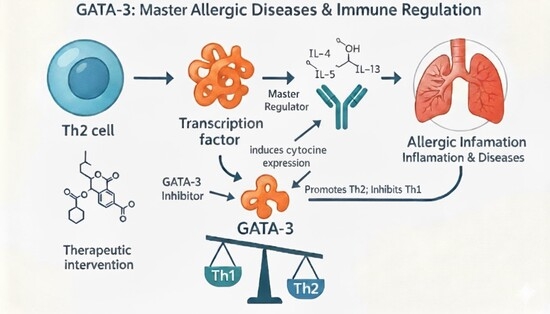
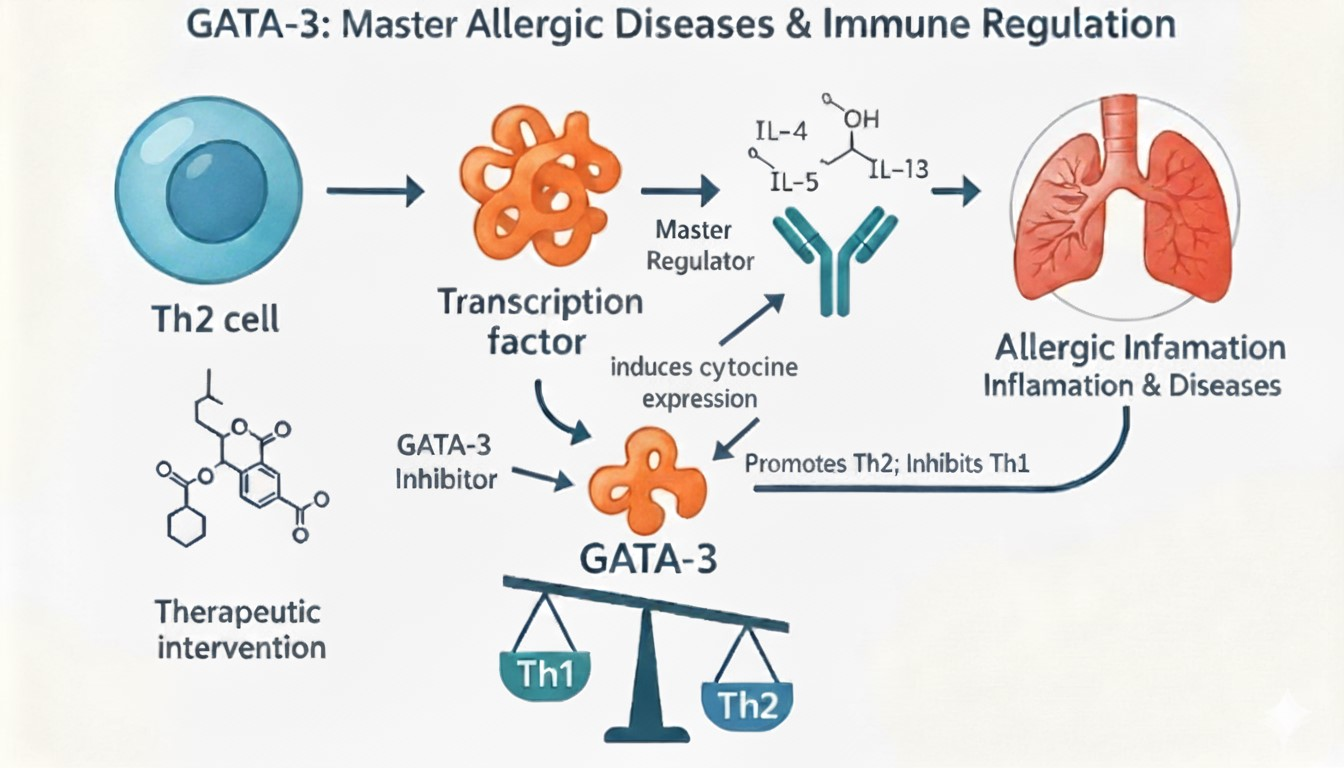
Graphical Abstract

1. Introduction

Allergic diseases such as asthma, atopic dermatitis, allergic rhinitis, and food allergies affect more than 30% of the population and lead to substantial economic burdens due to chronic inflammation, tissue remodeling, and low quality of life [1,2]. The pathogenesis of such disorders is characterized by imbalanced type 2 immune system responses, typically driven by T helper 2 (Th2) cells along with type 2 innate lymphoid cells (ILC2s), which produce the response markers interleukin IL-4, IL-5, and IL-13. Central to this process is GATA binding protein 3 (GATA-3), a zinc finger transcription factor that acts as a master regulator of Th2 differentiation and type 2 inflammation [3,4].
GATA-3 is a member of the GATA family of transcription factors, each of which contains two conserved zinc finger domains that allow them to bind to the consensus DNA sequence WGATAR [5]. It was first described in the context of T-cell receptor (TCR) α enhancer regulation [6]. Beyond this, GATA-3 orchestrates Th2 differentiation through multiple pathways. The study by Zheng and Flavell [7] showed that the transcription factor GATA-3 is necessary and sufficient for Th2 cytokine production. When GATA-3 was introduced into Th1 cells, it triggered the production of Th2 cytokines (IL-4 and IL-5) while simultaneously suppressing the Th1 cytokine IFN-c. This highlights GATA-3’s critical role in directing Th2 immune responses. At a molecular level, GATA-3 promotes remodelling of chromatin and hyperacetylation of histones as well as demethylation of DNA at the IL4/IL5/IL13 locus, thereby enabling cytokine gene access and increased production [8,9]. Concurrently, it inhibits Th1 differentiation by acting on STAT4 and T-bet, thus reinforcing the Th2 phenotype through a positive feedback loop [10].
Aside from adaptive immunity, GATA-3 regulates the development and function of innate lymphoid cells (ILCs), particularly ILC2s, which further enhance eosinophilic inflammation by secreting IL-5 and IL-13 in response to epithelial alarmins such as IL-33 [11,12]. This dual regulation of both adaptive and innate immune components positions GATA-3 as a critical convergence point in allergic pathophysiology. Recent research has revealed complex and context-dependent roles for GATA-3 in regulatory T cells (Tregs). On one hand, GATA-3 overexpression has been shown to stabilize Foxp3 expression and thus, maintain immune tolerance [13]. On the other hand, increased GATA-3 action in Tregs, paradoxically, intensifies allergic inflammation through Th2-like polarization. This dual function underscores the intricate balance of GATA-3’s regulatory activities in immune homeostasis [14,15].
Clinical investigations have correlated the overexpression of GATA-3 with the allergic disease phenotype severity. In asthma, T cells positive for GATA-3 are increased in bronchial biopsies, which correlates with reduced FEV1 reversibility and increased airway hyperresponsiveness [16,17,18]. In allergic rhinitis, GATA-3 mRNA is increased in the nasal mucosa following allergen exposure long before inflammatory cell infiltration, suggesting its role as an early Type 2 mediator [16]. In atopic dermatitis, lesional skin demonstrates increased GATA-3 expression in keratinocytes linked to downregulated filaggrin and barrier dysfunction [19,20]. These clinical correlations are reinforced by genetic studies showing that individuals with GATA-3 haploinsufficiency display reduced Th2 frequencies and IgE levels, highlighting its implications in genetic susceptibility [21].
GATA-3 function is further modulated by environmental influences and epigenetic factors, demonstrating a sophisticated interplay between genetics and the surrounding environment. Hypomethylation at the IL4 locus facilitates GATA-3 binding and cytokine production, thereby exacerbating asthma severity [22]. Certain environmental factors, like particulate matter and allergens, exacerbate this process by inducing oxidative stress-dependent GATA-3 phosphorylation and nuclear translocation [8,23]. More recently, microbiome-derived metabolites, particularly short-chain fatty acids, have been shown to downregulate GATA-3 expression, offering new avenues for potential dietary interventions [24,25].
GATA-3 targeting therapeutic approaches have evolved from animal models and in vitro studies to clinical trials with promising results. In phase II trials, the DNAzyme SB010, which cleaves GATA-3 mRNA, caused a 34% reduction in late asthmatic responses accompanied by eosinophilic sputum decline [26,27]. Intranasal GATA-3 antisense oligonucleotides have been shown to block IL-5 and IL-13 production, reducing symptoms in murine models of allergic rhinitis [28]. More recently, GATA-3 inhibitor nanoparticles have advanced targeted delivery in murine asthma models by enhanced tissue targeting [29]. Traditional approaches, such as corticosteroids, indirectly affect GATA-3 by inhibiting p38 MAPK-mediated phosphorylation and subsequent nuclear import [30]. Lastly, CRISPR techniques focused on enhancer elements of GATA-3, while precise, require critical safety assessment [31,32].
Notwithstanding these developments, vital gaps in knowledge still exist regarding the clinical applicability of GATA-3-targeted therapies. Firstly, the function of GATA-3 in non-Th2 cells, such as ILC3s and mast cells, warrants further exploration. Second, the temporal dynamics of GATA-3 inhibition require clarification, specifically whether intervening during early life staves off allergic sensitization is unknown. In addition, some GATA-3/FOXP3 ratios in peripheral blood could serve as potential biomarkers to guide the development of personalized therapeutic approaches [33,34].
Although GATA-3’s function in immune modulation seems well-defined, the mechanisms of how it engages with other immune cells and the full impact of genetic and environmental factors on its activity remain unclear. Furthermore, a comprehensive understanding of GATA-3’s synergistic molecular involvement in allergic diseases, its precise cellular mechanisms of action, epigenetic regulation, and optimal therapeutic intervention is still lacking.
Therefore, this systematic review aims to synthesize the relevant literature to bridge these knowledge gaps, clarify GATA-3’s significance as a biomarker in allergic disease activity, and illuminate its intricate role in allergic inflammation, particularly emphasizing the therapeutic implications of targeting GATA-3. This work aims to synthesize current mechanistic and clinical evidence on GATA-3 to inform future research and translational efforts, with potential relevance to the development of targeted therapeutic strategies for asthma, allergic rhinitis, atopic dermatitis, and other Th2-driven diseases, including food allergy.

2. Materials and Methods

This systematic review was registered in the PROSPERO database (CRD4201069940), and it was conducted in accordance with the 2020 PRISMA Guidelines on systematic reviews and meta-analyses. The protocol can be accessed at the PROSPERO website under the registration number above. No amendments were made to the registered protocol.

2.1. Search Strategy and Information Sources

A systematic search was conducted investigating the role of GATA-3 in allergy and immune regulation. The search strategy focused on publication in reputable databases such as PubMed, Science Direct, Web of Science, Scopus, and Cochrane up to 30 April 2025, targeting experimental studies, including clinical and animal models and in vitro studies. To ensure a comprehensive literature search, a strategy based on key concepts related to GATA-3, allergic diseases, immune regulation, and transcription factors guided the literature search. Free-text keywords including “GATA Binding Protein 3,” “GATA-3,” “GATA3,” “Allergic Diseases,” “Immune Regulation,” and “Transcription Factors” alongside their relevant synonyms and identified broader terms. Database-specific controlled vocabulary terms, like MeSH for PubMed, were also used. This core strategy was carried out in all searched databases (PubMed, Scopus, Web of Science, Cochrane, and Science Direct) while considering the peculiarities of their indexing and search syntax by applying Boolean operators (AND, OR) for result refinement. All databases are included in the appendix for the search strategy.

2.2. Inclusion and Exclusion Criteria

Inclusion criteria comprised original research articles on human and animal studies of allergic conditions (asthma, atopic dermatitis, allergic rhinitis) and immune system regulation investigating GATA-3 expression, function, genetic variations, or therapeutic targeting (e.g., DNAzymes, antisense oligonucleotides, small molecules), or GATA-3 activity modulated by environmental or epigenetic influences. The outcomes of interest include molecular mechanisms, such as cytokine regulation and chromatin remodeling, clinical correlations like disease severity and biomarker levels, and therapeutic endpoints like reduction in type 2 inflammation and symptom improvement. Inclusion criteria were restricted to peer-reviewed original research to ensure data quality and reliability. Accordingly, conference abstracts, editorials, and review articles were excluded. Non-English publications were also excluded due to translation limitations (Table 1).

2.3. Study Selection Process

Reviewers independently screened the titles and abstracts to identify potentially eligible studies. Full-text articles were retrieved and assessed against the eligibility criteria. Disagreements at the screening and full-text review stages were settled by discussion, with a third reviewer arbitrating unresolved disagreements. The entire study selection was conducted and documented on the Rayyan platform.

2.4. Data Extraction

Information extracted included study characteristics, methods and mechanisms of GATA-3 assessment, cell-specific functions, cytokine, transcriptional, and epigenetic interactions., clinical correlates, therapeutic approaches, methods, and key findings. The original authors were approached directly for missing data or clarification of ambiguous points.

2.5. Risk of Bias and Quality Assessment

Two reviewers independently evaluated the risk of bias for the 29 included studies using the standardized tools: The Revised Risk of Bias Assessment Tool (RoB 2) for clinical trials and SYRCLE’s risk of bias tool for animal models and in vitro studies. Subsequently, the quality of evidence for key outcomes was graded using the GRADE (Grading of Recommendations Assessment, Development, and Evaluation) framework.

2.6. Data Synthesis

Due to considerable methodological and clinical heterogeneity across the studies, findings were synthesized narratively. Planned subgroup analyses included disease type, study design, specific GATA-3 mechanism (transcriptional, epigenetic, post-translational), and therapeutic approach. This systematic review did not require ethical approval because it used publicly available information from previously published studies.

3. Results

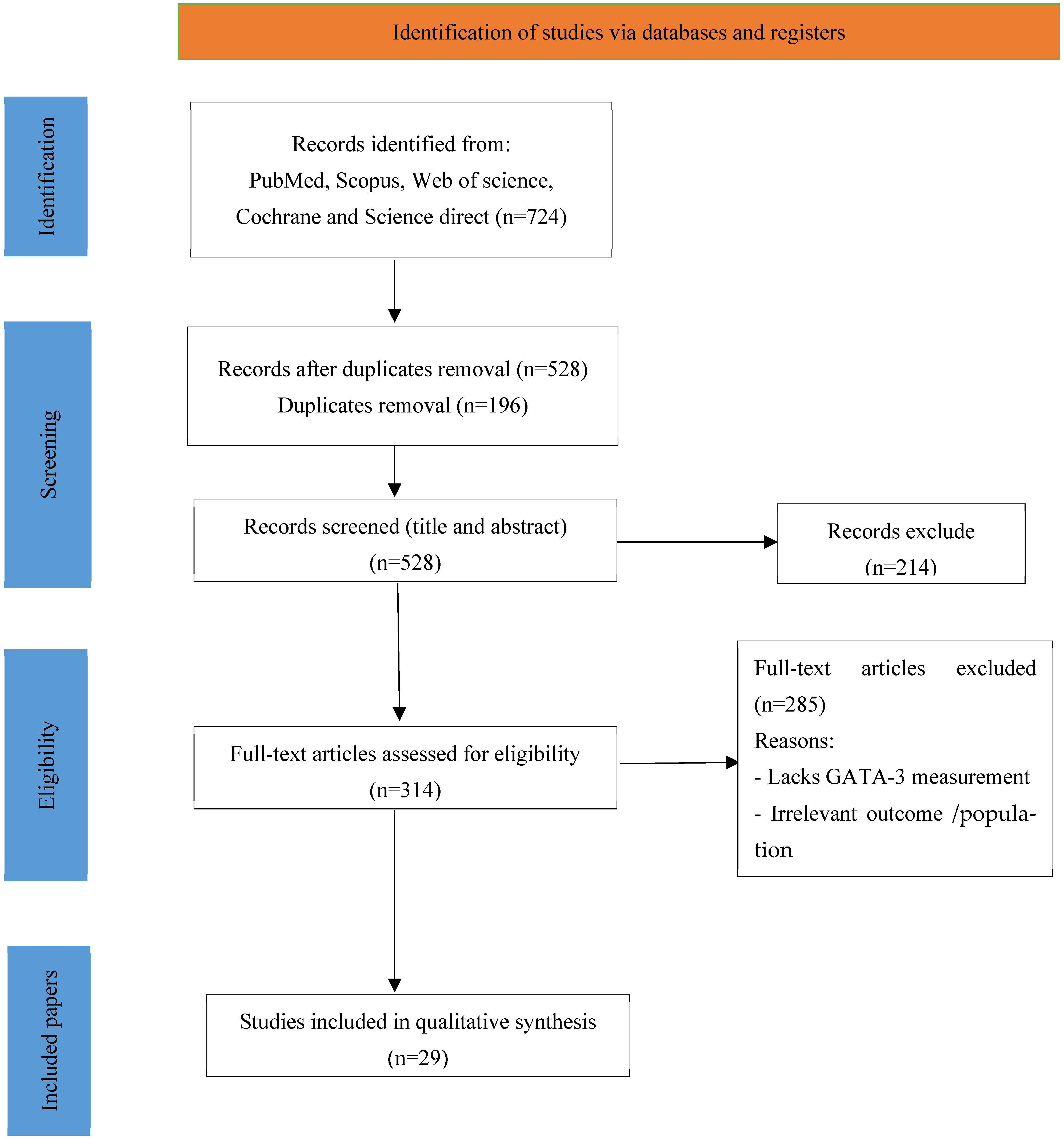
A detailed search in several electronic databases identified 724 relevant articles. After removing duplicate records, 528 unique articles remained for screening. Further title and abstract review resulted in 314 studies meeting the preliminary inclusion criteria. A complete text evaluation established 29 studies for final analysis, which were detailed in the PRISMA flow diagram (Figure 1).
This systematic review includes 29 studies covering experimental approaches ranging from animal models and in vitro studies to clinical trials investigating GATA-3 and its involvement in allergic diseases, including asthma, allergic rhinitis (AR), and atopic dermatitis (AD). The studies investigated various mechanisms through which GATA-3 modulates immune responses, such as cytokine production and chromatin remodelling, as well as gene-environment interplay (Table 2, Table 3 and Table 4).
Table 2, Table 3 and Table 4: Summary of included studies (see Supplementary Tables S1–S3 for full details).

3.1. Risk of Bias Assessment

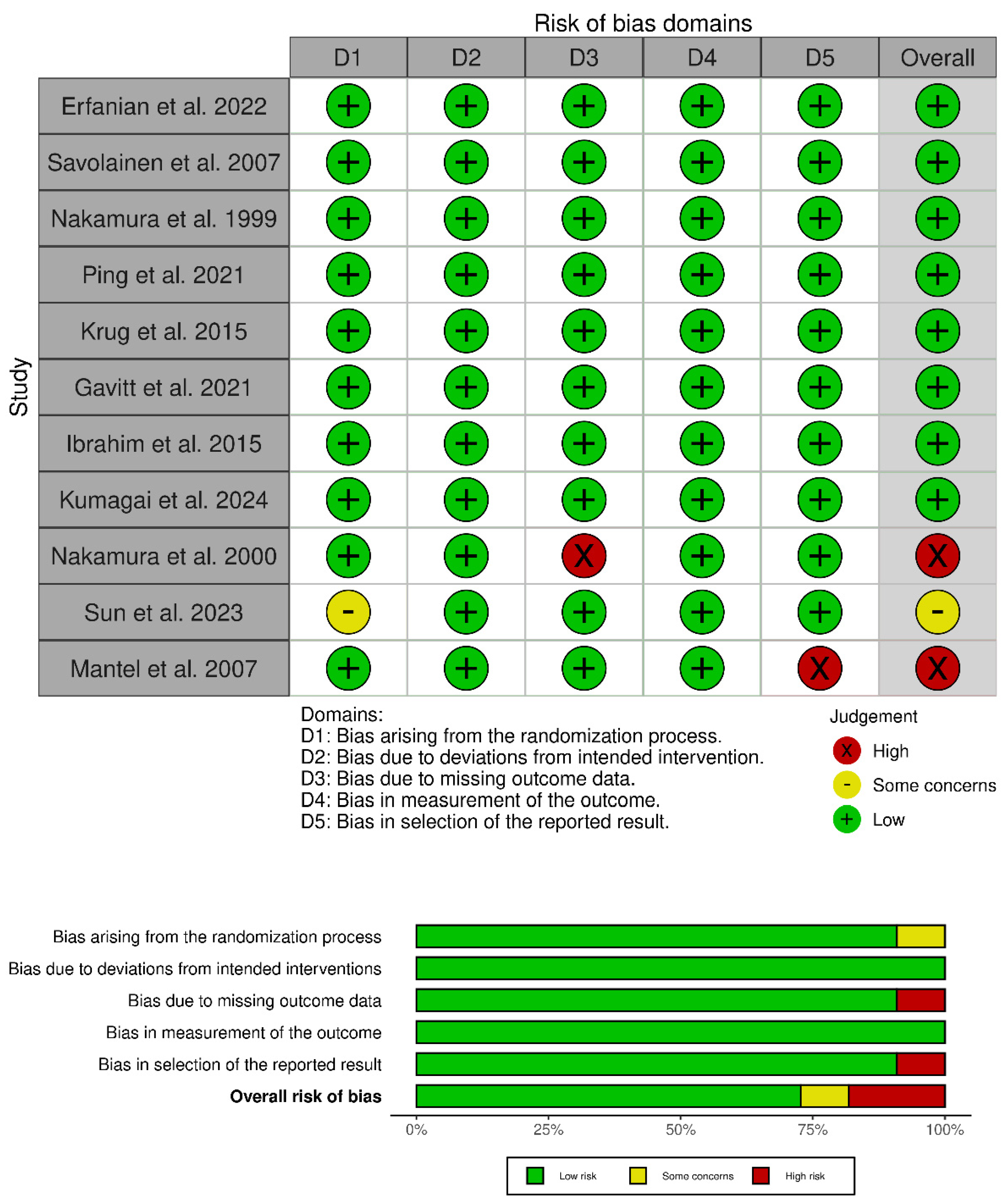
Nearly 73% of the included studies showed a low overall risk of bias, particularly regarding blinding of outcome assessors. However, approximately 27% of the studies exhibited some concerns or a high risk of bias due to confounding factors, missing data on the outcomes, or selective outcome reporting (Figure 2). These biases highlight a need for further improvement in methodology for future research.

3.2. Key Findings

This systematic review synthesizes findings from 29 studies exploring the relationships between GATA-3 and allergic disorders and its role in immune modulation. These studies encompassed animal models and in vitro studies, clinical (human), and mixed (animal and human) studies, collectively offering a comprehensive overview of the various aspects of GATA-3.

3.2.1. Animal Models and In Vitro Studies

Eighteen animal models and in vitro studies investigated GATA-3’s role in allergic diseases and immune regulation. These studies primarily focused on GATA-3’s influence on Th2 cell differentiation and function, and its impact on allergic inflammation. Experimental asthma models in mice have consistently shown that GATA-3 overexpression significantly enhanced susceptibility to allergic airway inflammation (AAI). For example, GATA-3 overexpressing mice displayed steroid-sensitive eosinophilic inflammation with goblet cell hyperplasia and mucus overproduction, in contrast to RORγt overexpressing mice which developed steroid-insensitive neutrophilic inflammation [35]. In these studies, GATA-3, T-bet, RORγt, and Foxp3 expression levels were assessed by quantitative real-time PCR (qPCR), revealing that GATA-3 overexpression was 379-fold higher in lung T cells compared to wild-type mice [35]. Similarly, transgenic mice with enforced GATA-3 expression showed an increased AAI alongside elevated IL-5 and IL-13 in BAL fluid and greater ILC2s, which are now thought to contribute to Th2 cytokine production [36]. Leukocyte populations were measured by flow cytometry, and cytokines IL-5 and IL-13 were quantified by ELISA [36].
Conversely, reduced GATA-3 expression demonstrated beneficial effects. Lentiviral-mediated GATA-3 RNAi in a murine asthma model significantly suppressed GATA-3 gene expression (by approximately 60-70% via real-time PCR and Western blot), reduced Th2 cytokines (e.g., IL-4 by approximately 48-60%, IL-5 by approximately 16-45% via ELISA), decreased eosinophilic airway inflammation (by 67.5% compared with the mock group and by 67% compared with the positive control group, based on BALF cell counts), and alleviated airway hyperresponsiveness (AHR) [37]. Furthermore, local blockade of GATA-3 expression by antisense oligonucleotides (confirmed by Western blot and EMSA) also abrogated signs of lung inflammation (histology) and AHR (assessed by body plethysmography, leading to significant reduction in PenH and pulmonary resistance) in OVA-sensitised mice [28]. These experiments support the hypothesis that GATA-3 acts as a major regulator in the effector phase of asthma.
Beyond asthma, GATA-3’s influence extends to allergic skin inflammation. In a mouse model of allergic dermatitis, GATA-3 overexpression enhanced allergic skin inflammation, leading to increased ear thickness (measured with a Digimatic Indicator), aLN weight, IgE and IgG1 levels (by ELISA), and elevated Th2 cytokines (IL-4, IL-5, IL-13 quantified by cytokine array assay) [38]. This pro-inflammatory effect was reversed by D-pinitol treatment, which suppressed GATA-3 expression (confirmed by Western blot) [38]. Contact hypersensitivity (CHS) in GATA-3 transgenic mice also showed significantly greater ear-swelling responses (up to 3-fold higher ear swelling peaking at 18h post stimulus) (dial thickness gauge measurement), elevation of IL-5 and IL-13 (2- to 3-fold higher levels from skin tissue extracts quantified by ELISA), and increase in IgE (also by ELISA), indicating a critical role for Th2-dominant responses in allergic dermatitis [39].
At a mechanistic level, GATA-3’s necessity for Th2 development and maintenance was directly demonstrated; GATA-3-deficient CD4 and CD8 T cells failed to produce optimal Th2 cytokines (e.g., 30% reduction in IL-4, 50% reduction in IL-5 quantified by ELISA) and showed increased IFN-γ production [40]. Sustained expression of GATA-3 was crucial to maintain the Th2 phenotype [7]. Studies also demonstrated that GATA-3 facilitates the transactivation of the IL-4 promoter (e.g., 8- to 12-fold increases in luciferase assays) and acts on IL-4/IL-13 genes as an enhancer-binding factor [41]. Furthermore, Gata3/Chd4 complexes were shown to be responsible for defining Th2 cell identity by creating specialized activating complexes for Th2 cytokine genes (with p300, as confirmed by ChIP) while simultaneously silencing other Th lineage genes (with NuRD at the Tbx21 locus) [42]. This dual regulatory function highlights a sophisticated mechanism by which GATA-3 orchestrates Th2 differentiation.
GATA-3 has also been shown to dictate the inflammation-associated fate of Foxp3+ T regulatory (Treg) cells in mice [15]. This core function entails enforcing Treg retention in high numbers at sites of inflammation while sustaining elevated expression of Foxp3. In addition, GATA-3 constrains the ability of Treg to be polarized towards effector forms [15]. The determination of Treg populations was conducted using flow cytometry [15]. These findings suggest that GATA-3 is a key player in the immune system’s balance under inflammatory conditions.
The investigation of GATA-3 siRNA as a novel therapeutic approach has demonstrated inhibition of IL-13 promoter binding by NFAT1 in human T cells, reducing IL-13 transcription. Real-time PCR and Western blotting assessed GATA-3 mRNA and protein levels, respectively, while NFAT1 binding was evaluated using the ChIP assay [43]. This implicates the GATA-3-NFAT1 interaction as a plausible candidate for IL-13 regulation control in the context of allergic diseases.
GATA-3’s function is crucial for T-cell lineage development. Investigation of GATA-3 knockout embryonic stem (ES) cells, confirmed by Southern and Northern blots, revealed an absence of thymocyte and mature peripheral T cell differentiation (assessed by flow cytometry). This demonstrates that GATA-3 is an essential and specific regulator in early thymocyte development [44]. Aside from adaptive immunity, GATA-3 is associated with developing chronic obstructive pulmonary disease (COPD), a condition primarily characterized by neutrophilic inflammation, though specific phenotypes exhibit Th2-high features similar to asthma. Particulate matter (PM) from air pollution enhanced lncRNA MHC-R and GATA-3 expression in the lungs and dendritic cells (DCs) of rats [45]. GATA-3 positively regulates MHC-R expression, which, in turn, regulates DC and CD8+ T cell activity and contributes to the development of COPD [45]. GATA-3 expression was quantified by Western blot and qPCR, while lncRNA MHC-R was analysed using microarrays, quantitative RT-PCR, ISH, and FISH [45].
Collectively, the animal and in vitro studies consistently demonstrate that GATA-3 suppression, whether via DNAzymes, shRNA, or chemical inhibitors, leads to a significant reduction in Th2 cytokines (IL-4, IL-5, IL-13) and eosinophilic infiltration. However, it is important to note the heterogeneity in these models; while most showed robust efficacy, the magnitude of inflammation reduction varied depending on the specific allergen challenge and the timing of the intervention relative to exposure.

3.2.2. Clinical Studies (Human)

Five clinical studies specifically explored the role of GATA-3 in human allergic diseases and immune system regulation. These studies confirm the pro-allergic association of GATA-3 while exploring potential therapeutic options.
In allergic asthma, regarding GATA-3 gene expression in peripheral blood mononuclear cells (PBMCs), it was reported that asthmatic individuals exhibited lower expression levels than healthy controls (e.g., 0.89 ± 0.27 fold change versus 2.32 ± 0.18 fold change) [49]. GATA-3 gene expression was quantified through qPCR, and RNA quality was assessed with a biophotometer [49]. However, the modulation of GATA-3 expression by vitamin D was complex and depended on the dose, with varying effects between healthy subjects and those with asthma [49]. These findings may indicate an immunomodulatory function of vitamin D on GATA-3 pathways.
Research conducted on children with allergic rhinitis (AR) undergoing sublingual immunotherapy (SLIT) showed that although SLAM and IL-18 mRNA expression was upregulated (for example, IL-18 mRNA increased in the high-dose group after one year, p = 0.028), GATA-3 mRNA did not change significantly [50]. mRNA expression was measured using kinetic real-time RT-PCR TaqMan® [50]. This study indicates that SLIT might modulate the immune response by downregulating Th2-type inflammation and enhancing Th1-type responses instead of directly reducing GATA-3.
Direct evidence for GATA-3 involvement in asthma was found in the study of Nakamura et al. [51] on chronic airway inflammation in asthmatics and nonasthmatics subjects with increased expression of the GATA-3 gene. The GATA-3 mRNA expression, measured by in situ hybridization, was elevated in asthmatic airways (p < 0.001 in BAL cells). Most of the GATA-3 mRNA-positive cells were classified as CD3+ T cells, comprising 73.7% ± 10.5% of the total. Moreover, the GATA-3 mRNA+ T cell density correlated significantly with diminished airway calibre (FEV1) (r = −0.81, p < 0.01) and IL-5 mRNA levels (r = 0.879 in BAL, p < 0.001). These findings suggest a probable mechanistic relationship involving increased GATA-3 and dysregulated IL-5 in atopic asthma.
A clinical trial assessing the GATA-3-specific DNAzyme SB010 in patients with allergic asthma showed that SB010 mitigated both early (EAR) and late (LAR) asthmatic responses (e.g., LAR AUC reduced by 34% (p = 0.02), EAR AUC reduction of 11% (p = 0.04)) [26]. SB010’s therapeutic effects were measured using spirometry for lung function, NIOX MINO® for FeNO, and plasma IL-5 using a multiplex assay [26]. This therapeutic effect was linked to reduced allergen-induced sputum eosinophilia and lower IL-5 levels, confirming GATA-3’s involvement in Th2-regulated inflammatory responses [26].
Moreover, a comparative investigation of traditional Chinese medicine (Gan-Cao) with Montelukast in children suffering from allergic asthma noted no substantial difference in T-bet and GATA-3 gene expression in the treatment groups (p = 0.102 for GATA-3, p = 0.888 for T-bet). Gene expression was measured using real-time PCR on PBMCs separated through Ficoll gradient centrifugation [52]. This suggests that Gan-Cao could have similar effects as Montelukast on these genes, indicating that it may be used as a potential alternative or adjunctive treatment.
Human observational studies strongly support the correlation between elevated GATA-3 mRNA/protein levels and disease severity in asthma and atopic dermatitis. However, evidence from therapeutic interventions remains limited. While the SB010 DNAzyme showed promise in reducing late asthmatic responses in specific phenotypes, results across different patient cohorts have been variable, indicating that GATA-3 targeting may not be universally effective for all allergic endotypes.

3.2.3. Mixed Studies (Animal and Human)

Sex studies integrated findings from animal models with human in vitro or clinical data, providing a more translational perspective on GATA-3’s roles.
The association of GATA-3 with allergic inflammatory responses has been consistently observed in mixed studies. In allergic rhinitis (AR) mouse models, there was increased eosinophil infiltration and goblet cell hyperplasia (confirmed by HE and PAS staining), along with decreased Treg and GATA3+ Treg cells (both p < 0.01 in human PBMC and mouse spleen via flow cytometry) [53]. These AR mice also had elevated expression of Th2 cytokines (IL-4, IL-6, and IL-10 measured by cytometric bead array) [53].
Numerous studies have investigated GATA-3 as a therapeutic target for allergic diseases. A peptide cross-linked nucleic acid nanocapsule (NAN), designed to deliver GATA-3-specific DNAzyme, successfully delivered the DNAzyme to human immune cells. In vitro uptake was assessed by FACS and confocal microscopy, which demonstrated up to 60% knockdown of GATA-3 mRNA via qPCR [29]. More importantly, these DNAzyme-NANs diminished the allergic pulmonary inflammation (evaluated by pulmonary eosinophilia) in a mouse model of HDM-induced asthma [29]. This model shows promise for in vivo gene regulation. In a comparable study, hgd40, a GATA-3-targeting DNAzyme, was topically applied and markedly reduced skin inflammation gauged by skinfold thickness as well as decreasing GATA-3 mRNA in an atopic dermatitis mouse model [54]. These findings suggest that GATA-3 inhibitors offer candidates for treating allergic skin diseases.
Mechanistic insights have also been provided on how GATA-3 regulates the immune system. In both animal models and human in vitro systems, GATA-3 was found to be upregulated in the upper airway mucosa post allergen exposure (GATA-3 mRNA via RT-PCR, protein by Western blot) [16], indicating its potential role in Th2 and macrophage cell response upregulation.
Furthermore, Mantel et al. [55] provided crucial insights into the interaction between GATA-3 and FOXP3. Their in vitro studies using human CD4+CD45RA T cells, Th2 cells, and Jurkat cells, complemented by in vivo studies in GATA-3-overexpressing transgenic mice, showed that IL-4 inhibits FOXP3 expression. They demonstrated that GATA-3 directly binds to the FOXP3 promoter, thereby repressing its transactivation, and that GATA-3 overexpression in transgenic mice significantly reduced FOXP3 induction. These findings, using qPCR, FACS, and Western blotting, highlight a direct mechanism by which GATA-3 can negatively regulate the formation of regulatory T cells.
In summary, these translational studies bridge the gap between preclinical models and human pathology, confirming GATA-3 as a central driver of allergic inflammation across species. The findings elucidate a dual pathogenic mechanism wherein GATA-3 not only amplifies Th2 cytokine production but also actively suppresses immune tolerance by inhibiting FOXP3 expression. Furthermore, the demonstrated efficacy of gene-silencing interventions, such as DNAzymes and nanocarriers, validates GATA-3 as a prime therapeutic target capable of restoring the delicate balance between effector and regulatory immune responses.
Detailed study protocols, dosages, and numerical results are available in Supplementary Table S1.

4. Discussion

This discussion synthesizes the findings of our systematic review to illuminate GATA-3’s multifaceted role in allergic diseases and its potential as a target for immunotherapeutic interventions. GATA-binding protein 3 (GATA-3) has become a key integrator of type 2 immune responses, relating adaptive and innate immune components in allergic disorders like asthma, allergic rhinitis (AR), and atopic dermatitis (AD). Drawing from thirty years of research, this systematic review comprehensively describes GATA-3’s multifaceted roles, including its influence on chromatin remodeling in T helper 2 (Th2) cells and its complex, sometimes contradictory, roles in regulatory T cells (Tregs). This discussion aims to highlight GATA-3 as a promising therapeutic target, address key questions regarding its regulatory mechanisms, and elucidate its translational potential in allergic disease management and employ the extensive methodologies recounted in the methods section.
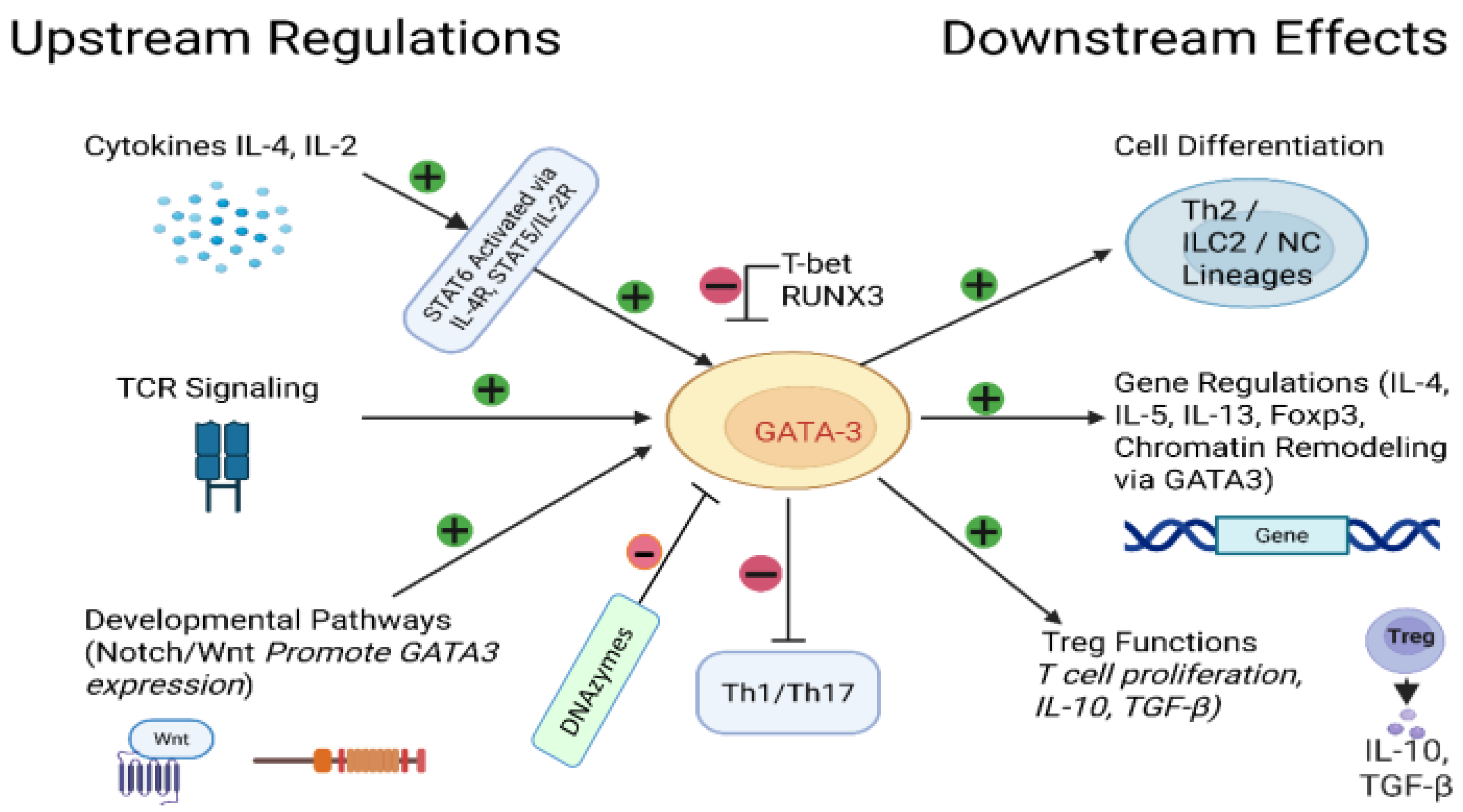
GATA-3’s crucial role in Th2 differentiation is highlighted by its ability to remodel chromatin at the IL4/IL5/IL13 locus, allowing cytokine gene expression while inhibiting Th1-associated pathways. Initial animal models and in vitro studies showed that ectopic GATA-3 expression in Th1 cells programmed them to secrete IL-4 and IL-5 while suppressing IFN-γ, the hallmark of Th2 commitment. These studies used cDNA subtraction and RT-PCR techniques [7]. Mechanically, GATA-3 recruits the histone acetyltransferases (HATs) p300 and CBP to conserved non-coding sequences (CNS2) of the IL4 locus where chromatin is made accessible thereby facilitating sustained cytokine production, as demonstrated by ChIP-Seq and luciferase assays [41,42]. This epigenetic “priming” explains the preseason elevation of nasal mucosal GATA-3+ cells (quantified by immunohistochemistry) in AR patients, which escalates during pollen exposure [16]. Of significance, GATA-3’s suppression of Th1 differentiation through the blockade of STAT4 and T-bet illustrates further its role as a stabilizing force in type 2 immunity [13]. The upstream regulatory signals and downstream immunological effects of GATA-3 described above are summarized in Figure 3.
Murine models displaying GATA-3 deficiency demonstrate a marked reduction in eosinophilic responses to allergens, while transgenic overexpression models increase airway hyperresponsiveness (AHR). A case in point is the murine asthma model, where steroid-sensitive eosinophilic inflammation was noted following GATA-3 overexpression, quantified as a 379-fold increase in lung T cells using real-time PCR [35]. Conversely, GATA-3 RNA interference (RNAi) delivered through lentivirus significantly attenuated GATA-3 expression by approximately 60-70% as measured by real-time PCR and Western blot analysis, diminished Th2 cytokines (released IL-4 by approximately 48-60%, IL-5 by 16-45% as detected by ELISA), and mitigated AHR [37]. Clinically, a study by Nakamura et al. [51] demonstrated that GATA-3+ T cells, quantified via in situ hybridization, showed an inverse correlation with FEV1 reversibility (r = -0.81, p < 0.01). This suggests these T cells directly contribute to airflow obstruction. Likewise, in AD, the keratinocyte-specific overexpression of GATA-3 exacerbated allergic skin inflammation (assessed by ear thickness with a Digimatic Indicator), consequently increased ear thickness, IgE and IgG1 levels (measured by ELISA), and elevated Th2 cytokines [38]. These findings collectively position GATA-3 not merely as a biomarker of Th2 activity but as a driver of pathology across allergic diseases.
Group 2 innate lymphoid cells (ILC2s) have been identified as crucial amplifiers of eosinophilic inflammation in steroid-resistant asthma and atopic dermatitis (AD). GATA-3 is central to the development and function of ILC2s, which is demonstrated in knockout models where there is abolished IL-5/IL-13 synthesis and inflammation. This centrality is documented in studies where enforced Gata3 expression in transgenic mice resulted in increased allergic airway inflammation (AAI) due to IL-5 and IL-13 overproduction in BAL fluid and a concomitant increase in ILC2s, which contribute to Th2 cytokine production, as measured via flow cytometry and ELISA [36]. ILC2s respond to cytokines derived from epithelial cells and alarmins such as IL-33 and TSLP by upregulating GATA-3. This promotes the secretion of eosinophil-recruiting cytokines, which is associated with resistance to glucocorticoids. Therapeutic strategies targeting this axis, for instance, using DNAzyme for GATA-3 knockdown, have been shown to diminish ILC2-derived IL-5/IL-13 and subsequently reduce skin inflammation in AD models of mice [54]. Nevertheless, the therapeutic targeting of ILC2 inflammation is complicated due to its plasticity. IL-33 stimulation, for example, temporally dampens GATA-3, producing IL-17A, which is associated with neutrophilic inflammation in severe asthma [56,57]. This duality reinforces the need for context-specific interventions tailored to particular microenvironmental cues, emphasizing the intricate balance of GATA-3 and ILC2 responses in allergic inflammation.
Regulatory T cells (Tregs) that express GATA-3 occupy a paradoxical niche in allergic inflammation. GATA-3 stabilizes Foxp3 expression to ensure Treg functionality. However, while GATA-3 overexpression ensures Treg suppressive function, its overexpression induces Th2-like plasticity, characterized by IL-4 and IL-5 secretion. Mechanistically, Mantel et al. [55] showed that GATA-3 can directly bind to and repress the FOXP3 promoter, inhibiting the formation of regulatory T cells. Conversely, in murine models of Treg-specific GATA-3 deletion (validated by qRT-PCR and immunoblotting), Tregs exhibited defective peripheral homeostasis, compromised suppressive function, acquired Th17 cell phenotypes, and reduced Foxp3 expression, highlighting GATA-3’s fundamental role in Treg stability. Clinically, patients with low peripheral blood GATA-3/FOXP3 ratios (assessed by flow cytometry and real-time PCR) exhibit poor corticosteroid responses, suggesting that Th2-skewed Tregs contribute to steroid resistance. Strategies to rebalance Treg function, including low-dose IL-2 aimed at expanding stable Treg populations, might counteract GATA-3-driven plasticity. Moreover, mixed studies on allergic rhinitis (AR) in mice and humans indicate that a decrease in both Treg cells and GATA-3+ Treg cells populations (p < 0.01 by flow cytometry) is associated with increased eosinophil infiltration and goblet cell proliferation, along with increased Th2 cytokine expression (IL-4, IL-6, IL-10 quantified by cytometric bead array) [53]. This reinforces the critical yet complex role of GATA-3-expressing Tregs in maintaining immune homeostasis.
Genetic and environmental factors modulate GATA-3 functions, highlighting their complex interplay in determining allergic predisposition. SNPs in the GATA-3 locus, such as rs1269486 and rs2229360, are associated with an increased risk of developing asthma and AD. Studies of haploinsufficiency also underscore GATA-3’s essential functions. Patients with GATA-3 mutations have low serum IgE levels and Th2 cells, mirroring murine knockout phenotypes. Severe asthma’s characteristic DNA hypomethylation at the IL4 locus enhances GATA-3 binding and cytokine production. Particulate matter, like PM2.5, worsens this imbalance by inducing oxidative stress-dependent GATA-3 phosphorylation, which enhances nuclear translocation and transcriptional activity. A COPD rat model demonstrated this, where PM exposure boosted MHC-R lncRNA and GATA-3 in lung tissue and dendritic cells, with GATA-3 levels measured and confirmed via Western blot, qPCR, and IHC [45]. This revealed a GATA-3 and lncRNA MHC-R positive feedback loop that regulates DC and CD8+ T cell responses [45]. Short-chain fatty acids (SCFAs) derived from gut microbiota downregulate GATA-3 expression in Th2 cells, suggesting a potential pathway by which dysbiosis could increase susceptibility to allergies. Probiotic therapies, including Lactobacillus rhamnosus, might complement GATA-3-specific therapies by modulating GATA-3 expression via the gut-immune system axis.
GATA-3-targeting therapeutic approaches have transitioned from animal models and in vitro studies to clinical trials with promising results, aligning with the objective of assessing its therapeutic potential. DNAzymes like SB010, which cleave GATA-3 mRNA (confirmed by in vitro cleavage assays), reduced late asthmatic responses (LAR) by 34% (p = 0.02) and early asthmatic responses (EAR) by 11% (p = 0.04) in a multi-center clinical trial [26]. Lung function was assessed by spirometry, FeNO by NIOX MINO®, and plasma IL-5 by multiplex assay [26]. However, their efficacy is context-dependent: SB010 demonstrated limited impact in eosinophilic COPD, likely due to disease-specific differences in GATA-3 regulation. Glucocorticoids indirectly modulate GATA-3 by inhibiting p38 MAPK-mediated phosphorylation, reducing nuclear import. Long-term use of these traditional approaches is often hampered by systemic side effects and tachyphylaxis, particularly in patients with low GATA-3/FOXP3 ratios. More precisely, disruption of GATA-3 enhancers has been shown to reduce IL-4 production in Th2 cells, providing a more targeted approach to immune modulation without the extensive immunosuppression often associated with general immune suppression. This precision therapy offers a potential strategy for treating allergic diseases while minimizing off-target effects. Nevertheless, challenges remain, as GATA-3’s pivotal role in early T-cell development complicates the systemic inhibition of this protein. Thus, achieving effective therapeutic outcomes while navigating these complexities is a major hurdle that demands further investigation.
Recent investigations published in early 2025 have provided further insights into GATA-3’s regulation. Leslie et al. identified that PGAP3 overexpression in asthmatic airway smooth muscle leads to increased GATA-3 and ALOX5 expression, thereby contributing to muscle proliferation and contractility. Additionally, Wang et al. reported that recombinant human PLD2 alleviates allergic inflammation by restoring Th1/Th2 homeostasis through the modulation of the T-bet/GATA-3 expression ratio [58,59].
Besides being associated with Th2 cells, GATA-3 is also involved in the immune-regulatory activities of other immune cells. GATA-3’s role in ILC3s and mast cells is still incompletely understood, but some evidence points to its role in regulating IL-22 synthesis, an essential contributor to mucosal immunity. This regulation may help explain the development of atopic dermatitis (AD) in terms of the immune system’s interactions with epithelial barriers. In addition, environmental and microbiome factors impact GATA-3 activity. SCFAs and PSA produced by commensal bacteria have been shown to influence GATA-3, pointing to the possibility that diet or probiotic treatments could be beneficial in managing allergic diseases. Neonatal GATA-3 inhibition attributable to maternal probiotic supplementation may impede allergic sensitization. This phenomenon supports the “hygiene hypothesis,” which postulates that early exposure to specific microbes can foster immune tolerance and lower the likelihood of developing allergies. Regarding patient stratification, observing the ratios of GATA-3 to FOXP3 along with specific single nucleotide polymorphisms (SNPs), such as rs1269486, may enhance therapeutic tailoring within precision medicine. For instance, in patients with particular SNPs, treatment results might be improved by using DNAzyme-mediated therapies, thereby personalizing the management of allergic disorders. Finally, GATA-3 regulation is strongly influenced by the surrounding environment, including exposure to particulate matter (PM2.5). Decreasing exposure to PM2.5 has been proven to reduce the incidence of asthma, especially in urban populations, which serves as an additional preventative measure against allergic conditions.
In summary, this systematic review underscores GATA-3’s indispensable role as a central orchestrator of allergic inflammation, operating through complex molecular and cellular mechanisms across Th2 cells, ILC2s, and Tregs. While its fundamental actions in cytokine transcription and chromatin remodeling are well-defined, this review reveals persistent complexities, particularly regarding its nuanced regulatory function in Tregs and its intricate interplay with genetic and environmental factors [12,15,45,53]. Despite promising animal models and in vitro studies advancements with GATA-3-targeted therapies, clinical translation faces hurdles related to achieving optimal selectivity, managing off-target effects, and ensuring consistent efficacy across heterogeneous patient populations [26,29]. Future research is thus imperative to fully elucidate GATA-3’s comprehensive molecular repertoire, chart its diverse roles beyond classical Th2/ILC2 pathways (e.g., ILC3s, mast cells), and dissect how genetic backgrounds and environmental exposures modulate its activity. Such insights will be crucial for developing precise, personalized, and ultimately more effective therapeutic interventions in allergic diseases.

Limitations

This systematic review has several limitations that should be acknowledged. First, restricting the analysis to English-language publications may have introduced language bias by excluding relevant findings published in other languages. Second, the exclusion of conference abstracts and grey literature, while intended to maintain high methodological rigor by relying on fully peer-reviewed data, may have resulted in the omission of early-phase evidence on emerging therapeutic interventions. Finally, heterogeneity among the included animal models, study designs, and clinical protocols precluded a quantitative meta-analysis, thereby necessitating a narrative approach to synthesis.
While GATA-3 represents a promising target for precision medicine, current enthusiasm must be tempered by the limited long-term human data. Most successes are drawn from animal models or short-term, early-phase studies; importantly, direct targeting of GATA-3 has not yet been explored in large-scale clinical trials involving diverse asthma populations. Future research must rigorously validate these findings in larger, diverse human cohorts to determine if the efficacy seen in pre-clinical models translates to sustainable clinical benefits.

5. Conclusions

This systematic review emphasizes the crucial role of GATA-3 as a transcription factor in allergic diseases, regulating Th2 and ILC2s immune responses, enhancing the production of cytokines IL-4, IL-5, and IL-13, and extending to chromatin remodeling and modulation of T regulatory cell functions. While animal models and in vitro studies show the therapeutic potential of GATA-3 via tools such as DNAzymes and nanocapsules, significantly alleviating allergic inflammation and AHR, clinical trials have provided proof-of-concept regarding the attenuation of asthmatic responses, specifically in eosinophilic phenotypes, yet consistent efficacy across the broader asthma population remains to be established. However, persistent challenges in therapeutic selectivity, off-target effects, and consistent clinical efficacy require future research to fully elucidate its diverse mechanisms and roles and its complex interaction with genetic and environmental factors to develop precise and targeted therapeutic interventions in allergic diseases. Clinically, this review provides a framework for utilizing GATA-3 signaling pathways as potential biomarkers for patient stratification, thereby guiding the development of personalized treatment regimens for severe, non-responsive allergic phenotypes.

Supplementary Materials

The following supporting information can be downloaded at: https://www.mdpi.com/article/10.3390/ijtm6010003/s1, Table S1. Non-clinical studies. Table S2. Clinical Studies. Table S3. Mixed Studies - Animal and Human.

Author Contributions

For Conceptualization: J.K., J.N.S.A.-M., and M.R.; Methodology: J.K., J.N.S.A.-M., and M.R.; Data Analysis: J.N.S.A.-M., Y.A.P.; Resources: J.N.S.A.-M., N.A.N.H.; Writing—Original Draft Preparation: J.N.S.A.-M.; Writing—Review and Editing: J.K., J.N.S.A.-M., Y.A.P., N.A.N.H. and M.R.; Visualization: J.K., J.N.S.A.-M., and M.R.; Supervision: J.K. and M.R.; Administration: J.K., J.N.S.A.-M., and M.R. All authors have read and agreed to the published version of the manuscript.

Funding

This research received no external funding.

Data Availability Statement

No new data were created or analyzed in this study.

Acknowledgments

We would like to express our sincere gratitude to the Faculty of Pharmacy at Universitas Airlangga for their valuable support and for providing access to essential research facilities. Additionally, we appreciate all individuals and institutions who contributed to this review, particularly those who provided constructive feedback and access to resources. We also acknowledge the researchers whose works contributed to the findings of this study. During the preparation of this manuscript, the authors utilized ChatGPT (GPT-5, OpenAI, San Francisco, CA, USA) exclusively for linguistic refinement and enhancement of textual clarity. All content was thoroughly reviewed, verified, and approved by the authors to ensure the accuracy, integrity, and originality of the final manuscript.

Conflicts of Interest

The authors declare no conflicts of interest.

Abbreviations

The following abbreviations are used in this manuscript:
AbbreviationFull Term/Meaning
AAIAllergic Airway Inflammation
ADAtopic Dermatitis
AHRAirway Hyperresponsiveness
ARAllergic Rhinitis
BALBronchoalveolar Lavage
BALB/cCommon laboratory mouse strain
BALFBronchoalveolar Lavage Fluid
CBPCREB-binding protein
ChIP-SeqChromatin Immunoprecipitation Sequencing
CNS2Conserved Noncoding Sequence 2
COPDChronic Obstructive Pulmonary Disease
CRDCochrane Register of Database (used in PROSPERO)
CRISPRClustered Regularly Interspaced Short Palindromic Repeats
DCDendritic Cell
DNDouble-Negative (thymocyte stage)
DNAzymeCatalytic DNA enzyme
EAREarly Asthmatic Response
ELISAEnzyme-Linked Immunosorbent Assay
EPOEosinophil Peroxidase
FACSFluorescence-Activated Cell Sorting
FeNOFractional Exhaled Nitric Oxide
FEV1Forced Expiratory Volume in one second
FF creCre recombinase-based gene knockout strain
Foxp3Forkhead box P3
GATA-3GATA-binding protein 3
GRADEGrading of Recommendations, Assessment, Development, and Evaluation
H&EHematoxylin and Eosin
H&E/toluidine blueTissue staining methods
HATHistone acetyltransferase
HDMHouse Dust Mite
IFN-γInterferon gamma
IgAImmunoglobulin A
IgEImmunoglobulin E
IgG1Immunoglobulin G1
ILInterleukin
IL-22Interleukin 22
IL-4, IL-5, IL-13Interleukins 4, 5, and 13
ILC2Type 2 innate lymphoid cell
ILC3Type 3 innate lymphoid cell
JAK-STATJanus Kinase–Signal Transducer and Activator of Transcription pathway
LARLate Asthmatic Response
MAPKMitogen-Activated Protein Kinase
MeSHMedical Subject Headings
NANNucleic Acid Nanocapsule
NCNatural Cytotoxic Cell
OVAOvalbumin
PASPeriodic Acid–Schiff
PBMCPeripheral Blood Mononuclear Cell
PM2.5Particulate Matter ≤ 2.5 μm
PSAPolysaccharide A
qPCRQuantitative Polymerase Chain Reaction
RCTRandomized Controlled Trial
RNAiRNA interference
RoB 2Revised Risk of Bias Tool (for clinical trials)
RT-PCRReverse Transcription Polymerase Chain Reaction
RUNX3Runt-related transcription factor 3
SB010GATA-3-specific DNAzyme (therapeutic agent)
SCFAShort-Chain Fatty Acid
SNPSingle Nucleotide Polymorphism
STAT6Signal Transducer and Activator of Transcription 6
SYRCLESystematic Review Centre for Laboratory animal Experimentation (bias tool)
TCRT Cell Receptor
TGF-βTransforming Growth Factor beta
Th2T helper type 2 cell
TNCB2,4,6-Trinitrochlorobenzene (used in dermatitis models)
TregRegulatory T cell

References

  1. Wang, J.; Zhou, Y.; Zhang, H.; Hu, L.; Liu, J.; Wang, L.; Wang, T.; Zhang, H.; Cong, L.; Wang, Q. Pathogenesis of allergic diseases and implications for therapeutic interventions. Signal Transduct. Target. Ther. 2023, 8, 138. [Google Scholar] [CrossRef]
  2. Zemelka-Wiacek, M.; Agache, I.; Akdis, C.A.; Akdis, M.; Casale, T.B.; Dramburg, S.; Jahnz-Różyk, K.; Kosowska, A.; Matricardi, P.M.; Pfaar, O.; et al. Hot topics in allergen immunotherapy, 2023: Current status and future perspective. Allergy 2023, 79, 823–842. [Google Scholar] [CrossRef]
  3. Yagi, R.; Zhu, J.; Paul, W.E. An updated view on transcription factor GATA3-mediated regulation of Th1 and Th2 cell differentiation. Int. Immunol. 2011, 23, 415–420. [Google Scholar] [CrossRef] [PubMed]
  4. Bacha, R.; Alwisi, N.; Ismail, R.; Pedersen, S.; Al-Mansoori, L. Unveiling GATA3 Signaling Pathways in Health and Disease: Mechanisms, Implications, and Therapeutic Potential. Cells 2024, 13, 2127. [Google Scholar] [CrossRef]
  5. Ko, L.J.; Engel, J.D. DNA-binding specificities of the GATA transcription factor family. Mol. Cell. Biol. 1993, 13, 4011–4022. [Google Scholar] [CrossRef] [PubMed]
  6. Ho, I.C.; Vorhees, P.; Marin, N.; Oakley, B.K.; Tsai, S.F.; Orkin, S.H.; Leiden, J.M. Human GATA-3: A lineage-restricted transcription factor that regulates the expression of the T cell receptor alpha gene. EMBO J. 1991, 10, 1187–1192. [Google Scholar] [CrossRef] [PubMed]
  7. Zheng, W.; Flavell, R.A. The transcription factor GATA-3 is necessary and sufficient for Th2 cytokine gene expression in CD4 T cells. Cell 1997, 89, 587–596. [Google Scholar] [CrossRef]
  8. Zhu, J.; Yamane, H.; Cote-Sierra, J.; Guo, L.; Paul, W.E. GATA-3 promotes Th2 responses through three different mechanisms: Induction of Th2 cytokine production, selective growth of Th2 cells and inhibition of Th1 cell-specific factors. Cell Res. 2006, 16, 3–10. [Google Scholar] [CrossRef]
  9. Scheinman, E.J.; Avni, O. Transcriptional regulation of GATA3 in T helper cells by the integrated activities of transcription factors downstream of the interleukin-4 receptor and T cell receptor. J. Biol. Chem. 2009, 284, 3037–3048. [Google Scholar] [CrossRef]
  10. Liberman, A.C.; Antunica-Noguerol, M.; Ferraz-De-Paula, V.; Palermo-Neto, J.; Castro, C.N.; Druker, J.; Holsboer, F.; Perone, M.J.; Gerlo, S.; De Bosscher, K.; et al. Compound A, a dissociated glucocorticoid receptor modulator, inhibits T-bet (Th1) and induces GATA-3 (Th2) activity in immune cells. PLoS ONE 2012, 7, e35155, Correction in PLoS ONE 2012, 7. [Google Scholar] [CrossRef]
  11. Hoyler, T.; Klose, C.S.N.; Souabni, A.; Turqueti-Neves, A.; Pfeifer, D.; Rawlins, E.L.; Voehringer, D.; Busslinger, M.; Diefenbach, A. The transcription factor GATA-3 controls cell fate and maintenance of type 2 innate lymphoid cells. Immunity 2012, 37, 634–648. [Google Scholar] [CrossRef]
  12. Tong, Y.; Wang, L.; Wang, L.; Song, J.; Fan, J.; Lai, C.; Bao, J.; Weng, C.; Wang, Y.; Shuai, J.; et al. Allergen immunotherapy combined with Notch pathway inhibitors improves HDM-induced allergic airway inflammation and inhibits ILC2 activation. Front. Immunol. 2024, 14, 1264071. [Google Scholar] [CrossRef]
  13. Wang, Y.; Su, M.A.; Wan, Y.Y. An essential role of the transcription factor GATA-3 for the function of regulatory T cells. Immunity 2011, 35, 337–348. [Google Scholar] [CrossRef] [PubMed]
  14. Lipińska-Opałka, A.; Leszczyńska-Pilich, M.; Będzichowska, A.; Tomaszewska, A.; Rustecka, A.; Kalicki, B. The Role of Regulatory B Lymphocytes in Allergic Diseases. Biomedicines 2024, 12, 2721. [Google Scholar] [CrossRef] [PubMed]
  15. Wohlfert, E.A.; Grainger, J.R.; Bouladoux, N.; Konkel, J.E.; Oldenhove, G.; Ribeiro, C.H.; Hall, J.A.; Yagi, R.; Naik, S.; Bhairavabhotla, R.; et al. GATA3 controls Foxp3+ regulatory T cell fate during inflammation in mice. J. Clin. Investig. 2011, 121, 4503–4515. [Google Scholar] [CrossRef] [PubMed]
  16. Nakamura, Y.; Christodoulopoulos, P.; Cameron, L.; Wright, E.; Lavigne, F.; Toda, M.; Muro, S.; Ray, A.; Eidelman, D.H.; Minshall, E.; et al. Upregulation of the transcription factor GATA-3 in upper airway mucosa after in vivo and in vitro allergen challenge. J. Allergy Clin. Immunol. 2000, 105, 1146–1152. [Google Scholar] [CrossRef]
  17. Pascual, R.M.; Peters, S.P. The irreversible component of persistent asthma. J. Allergy Clin. Immunol. 2009, 124, 883–890. [Google Scholar] [CrossRef]
  18. Malmhäll, C.; Bossios, A.; Rådinger, M.; Sjöstrand, M.; Lu, Y.; Lundbäck, B.; Lötvall, J. Immunophenotyping of circulating T helper cells argues for multiple functions and plasticity of T cells in vivo in humans-possible role in asthma. PLoS ONE 2012, 7, e40012. [Google Scholar] [CrossRef]
  19. Zeitvogel, J.; Jokmin, N.; Rieker, S.; Klug, I.; Brandenberger, C.; Werfel, T. GATA3 regulates FLG and FLG2 expression in human primary keratinocytes. Sci. Rep. 2017, 7, 11847. [Google Scholar] [CrossRef]
  20. Moosbrugger-Martinz, V.; Leprince, C.; Méchin, M.-C.; Simon, M.; Blunder, S.; Gruber, R.; Dubrac, S. Revisiting the roles of filaggrin in atopic dermatitis. Int. J. Mol. Sci. 2022, 23, 5318. [Google Scholar] [CrossRef]
  21. Skapenko, A.; Leipe, J.; Niesner, U.; Devriendt, K.; Beetz, R.; Radbruch, A.; Kalden, J.R.; Lipsky, P.E.; Schulze-Koops, H. GATA-3 in human T cell helper type 2 development. J. Exp. Med. 2004, 199, 423–428. [Google Scholar] [CrossRef] [PubMed]
  22. Yang, I.V.; Schwartz, D.A. Epigenetic mechanisms and the development of asthma. J. Allergy Clin. Immunol. 2012, 130, 1243–1255. [Google Scholar] [CrossRef] [PubMed]
  23. Liu, Y.; Xu, K.; Yao, Y.; Liu, Z. Current research into A20 mediation of allergic respiratory diseases and its potential usefulness as a therapeutic target. Front. Immunol. 2023, 14, 1166928. [Google Scholar] [CrossRef] [PubMed]
  24. Toh, Z.Q.; Anzela, A.; Tang, M.L.K.; Licciardi, P.V. Probiotic therapy as a novel approach for allergic disease. Front. Pharmacol. 2012, 3, 30130. [Google Scholar] [CrossRef]
  25. Wang, J.; Zhu, N.; Su, X.; Gao, Y.; Yang, R. Gut-microbiota-derived metabolites maintain gut and systemic immune homeostasis. Cells 2023, 12, 793. [Google Scholar] [CrossRef]
  26. Krug, N.; Hohlfeld, J.M.; Kirsten, A.-M.; Kornmann, O.; Beeh, K.M.; Kappeler, D.; Korn, S.; Ignatenko, S.; Timmer, W.; Rogon, C.; et al. Allergen-induced asthmatic responses modified by a GATA3-specific DNAzyme. N. Engl. J. Med. 2015, 372, 1987–1995. [Google Scholar] [CrossRef]
  27. Greulich, T.; Hohlfeld, J.M.; Neuser, P.; Lueer, K.; Klemmer, A.; Schade-Brittinger, C.; Harnisch, S.; Garn, H.; Renz, H.; Homburg, U.; et al. A GATA3-specific DNAzyme attenuates sputum eosinophilia in eosinophilic COPD patients: A feasibility randomized clinical trial. Respir. Res. 2018, 19, 55. [Google Scholar] [CrossRef]
  28. Finotto, S.; De Sanctis, G.T.; Lehr, H.A.; Herz, U.; Buerke, M.; Schipp, M.; Bartsch, B.; Atreya, R.; Schmitt, E.; Galle, P.R.; et al. Treatment of allergic airway inflammation and hyperresponsiveness by antisense-induced local blockade of GATA-3 expression. J. Exp. Med. 2001, 193, 1247–1260. [Google Scholar] [CrossRef]
  29. Gavitt, T.D.; Hartmann, A.K.; Sawant, S.S.; Mara, A.B.; Szczepanek, S.M.; Rouge, J.L. A GATA3 targeting nucleic acid nanocapsule for in vivo gene regulation in asthma. ACS Nano 2021, 15, 11192–11201. [Google Scholar] [CrossRef]
  30. Maneechotesuwan, K.; Yao, X.; Ito, K.; Jazrawi, E.; Usmani, O.S.; Adcock, I.M.; Barnes, P.J. Suppression of GATA-3 nuclear import and phosphorylation: A novel mechanism of corticosteroid action in allergic disease. PLoS Med. 2009, 6, e1000076, Correction in PLoS Med. 2018, 15, e1002657. [Google Scholar] [CrossRef]
  31. Kotowski, M.; Sharma, S. CRISPR-based editing techniques for genetic manipulation of primary T cells. Methods Protoc. 2020, 3, 79. [Google Scholar] [CrossRef] [PubMed]
  32. Kumagai, T.; Iwata, A.; Furuya, H.; Kato, K.; Okabe, A.; Toda, Y.; Kanai, M.; Fujimura, L.; Sakamoto, A.; Kageyama, T.; et al. A distal enhancer of GATA3 regulates Th2 differentiation and allergic inflammation. Proc. Natl. Acad. Sci. USA 2024, 121, e2320727121. [Google Scholar] [CrossRef] [PubMed]
  33. Hoseini-Shahrestanak, S.; Bazargan, N.; Rahimian, L.; Nemati, M.; Solaymani, S.; Jafarzadeh, A. Imbalanced expression of Th2 and Treg cell-related parameters in peripheral blood mononuclear cells in patients with allergic asthma. Tanaffos 2018, 17, 1. [Google Scholar] [PubMed] [PubMed Central]
  34. Cheru, N.; Hafler, D.A.; Sumida, T.S. Regulatory T cells in peripheral tissue tolerance and diseases. Front. Immunol. 2023, 14, 1154575. [Google Scholar] [CrossRef]
  35. Ano, S.; Morishima, Y.; Ishii, Y.; Yoh, K.; Yageta, Y.; Ohtsuka, S.; Matsuyama, M.; Kawaguchi, M.; Takahashi, S.; Hizawa, N. Transcription factors GATA-3 and RORγt are important for determining the phenotype of allergic airway inflammation in a murine model of asthma. J. Immunol. 2013, 190, 1056–1065. [Google Scholar] [CrossRef]
  36. KleinJan, A.; Wolterink, R.G.J.K.; Levani, Y.; de Bruijn, M.J.W.; Hoogsteden, H.C.; van Nimwegen, M.; Hendriks, R.W. Enforced expression of Gata3 in T cells and group 2 innate lymphoid cells increases susceptibility to allergic airway inflammation in mice. J. Immunol. 2014, 192, 1385–1394. [Google Scholar] [CrossRef]
  37. Lee, C.-C.; Huang, H.-Y.; Chiang, B.-L. Lentiviral-mediated GATA-3 RNAi decreases allergic airway inflammation and hyperresponsiveness. Mol. Ther. 2008, 16, 60–65. [Google Scholar] [CrossRef]
  38. Hwang, D.Y.; Bae, C.J.; Lee, J.W.; Shim, S.B.; Jee, S.W.; Lee, S.H.; Woo, J.M.; Lee, C.K. GATA binding protein 3 overexpression and suppression significantly contribute to the regulation of allergic skin inflammation. Int. J. Mol. Med. 2011, 28, 171–179. [Google Scholar] [CrossRef]
  39. Tamauchi, H.; Amoh, Y.; Itoh, M.; Terashima, M.; Masuzawa, M.; Habu, S.; Katsuoka, K.; Iwabuchi, K. GATA-3 regulates contact hyperresponsiveness in a murine model of allergic dermatitis. Immunobiology 2012, 217, 446–454. [Google Scholar] [CrossRef]
  40. Pai, S.-Y.; Truitt, M.L.; Ho, I.-C. GATA-3 deficiency abrogates the development and maintenance of T helper type 2 cells. Proc. Natl. Acad. Sci. USA 2004, 101, 1993–1998. [Google Scholar] [CrossRef]
  41. Ranganath, S.; Ouyang, W.; Bhattarcharya, D.; Sha, W.C.; Grupe, A.; Peltz, G.; Murphy, K.M. Cutting edge: GATA-3-dependent enhancer activity in IL-4 gene regulation. J. Immunol. 1998, 161, 3822–3826. [Google Scholar] [CrossRef] [PubMed]
  42. Hosokawa, H.; Tanaka, T.; Suzuki, Y.; Iwamura, C.; Ohkubo, S.; Endoh, K.; Kato, M.; Endo, Y.; Onodera, A.; Tumes, D.J.; et al. Functionally distinct Gata3/Chd4 complexes coordinately establish T helper 2 (Th2) cell identity. Proc. Natl. Acad. Sci. USA 2013, 110, 4691–4696. [Google Scholar] [CrossRef] [PubMed]
  43. Xin, Y.; Yan, Y.; He, H.Y.; Min, W.; Yin, K.S.; Huang, M. GATA3 siRNA inhibits the binding of NFAT1 to interleukin-13 promoter in human T cells. Chin. Med. J. (Engl.) 2010, 123, 739–744. [Google Scholar] [PubMed]
  44. Ting, C.-N.; Olson, M.C.; Barton, K.P.; Leiden, J.M. Transcription factor GATA-3 is required for development of the T-cell lineage. Nature 1996, 384, 474–478. [Google Scholar] [CrossRef]
  45. He, F.; Wang, N.; Yu, X.; Zheng, Y.; Liu, Q.; Chen, Q.; Pu, J.; Li, N.; Zou, W.; Li, B.; et al. GATA3/long noncoding RNA MHC-R regulates the immune activity of dendritic cells in chronic obstructive pulmonary disease induced by air pollution particulate matter. J. Hazard. Mater. 2022, 438, 129459. [Google Scholar] [CrossRef]
  46. Liu, Z.; Liu, X.; Sang, L.; Liu, H.; Xu, Q.; Liu, Z. Boswellic acid attenuates asthma phenotypes by downregulation of GATA3 via pSTAT6 inhibition in a murine model of asthma. Int. J. Clin. Exp. Pathol. 2015, 8, 236. [Google Scholar] [PubMed] [PubMed Central]
  47. Lu, Y.; Malmhäll, C.; Sjöstrand, M.; Rådinger, M.; O’NEil, S.E.; Lötvall, J.; Bossios, A. Expansion of CD4+ CD25+ and CD25-T-bet, GATA-3, Foxp3 and RORγt cells in allergic inflammation, local lung distribution and chemokine gene expression. PLoS ONE 2011, 6, e19889. [Google Scholar] [CrossRef][Green Version]
  48. Tamauchi, H.; Terashima, M.; Ito, M.; Maruyama, H.; Ikewaki, N.; Inoue, M.; Gao, X.; Hozumi, K.; Habu, S. Evidence of GATA-3-dependent Th2 commitment during the in vivo immune response. Int. Immunol. 2004, 16, 179–187. [Google Scholar] [CrossRef]
  49. Erfanian, S.; Jafaripour, S.; Jokar, M.H.; Sedighi, S.; Jahromi, A.S.; Razavi, F.; Zargar, M.F.; Moradzadeh, M. The effect of vitamin D on GATA3 gene expression in peripheral blood mononuclear cells in allergic asthma. Adv. Respir. Med. 2022, 90, 118–124. [Google Scholar] [CrossRef]
  50. Savolainen, J.; Nieminen, K.; Laaksonen, K.; Laiho, T.; Jacobsen, L.; Lahesmaa, R.; Terho, E.O.; Valovirta, E. Allergen-induced in vitro expression of IL-18, SLAM and GATA-3 mRNA in PBMC during sublingual immunotherapy. Allergy 2007, 62, 949–953. [Google Scholar] [CrossRef]
  51. Nakamura, Y.; Ghaffar, O.; Olivenstein, R.; Taha, R.A.; Soussi-Gounni, A.; Zhang, D.-H.; Ray, A.; Hamid, Q. Gene expression of the GATA-3 transcription factor is increased in atopic asthma. J. Allergy Clin. Immunol. 1999, 103, 215–222. [Google Scholar] [CrossRef] [PubMed]
  52. Ping, Z.; Jun, X.; Yan, W.; Jun, Z. The comparison between the effect of Glycyrrhizae uralensis (Gan-Cao) and Montelukast on the expression of T-bet and GATA-3 genes in children with allergic asthma. Cell. Mol. Biol. 2021, 67, 306–312. [Google Scholar] [CrossRef] [PubMed]
  53. Sun, L.; Jiao, W.; Kong, Y.; Yang, C.; Xu, S.; Qiao, Y.; Chen, S. Changes in percentage of GATA3+ regulatory T cells and their pathogenic roles in allergic rhinitis. Nan Fang Yi Ke Da Xue Xue Bao = J. South Med. Univ. 2023, 43, 280–286. [Google Scholar] [CrossRef]
  54. Ibrahim, R.; Purath, U.; Turowska, A.; Homburg, U.; Runkel, F.; Schmidts, T.; Dobler, D.; Renz, H.; Garn, H.; Mueller, A. Effects of interference with GATA-3 expression by target-specific DNAzyme treatment on disease progression in a subacute oxazolone-induced mouse model of atopic dermatitis. Clin. Transl. Allergy 2015, 5, 1. [Google Scholar] [CrossRef]
  55. Mantel, P.-Y.; Kuipers, H.; Boyman, O.; Rhyner, C.; Ouaked, N.; Rückert, B.; Karagiannidis, C.; Lambrecht, B.N.; Hendriks, R.W.; Crameri, R.; et al. GATA3-driven TH2 responses inhibit TGF-β1–induced FOXP3 expression and the formation of regulatory T cells. PLoS Biol. 2007, 5, e329. [Google Scholar] [CrossRef]
  56. Cai, T.; Qiu, J.; Ji, Y.; Li, W.; Ding, Z.; Suo, C.; Chang, J.; Wang, J.; He, R.; Qian, Y.; et al. IL-17–producing ST2+ group 2 innate lymphoid cells play a pathogenic role in lung inflammation. J. Allergy Clin. Immunol. 2019, 143, 229–244.e9. [Google Scholar] [CrossRef]
  57. Golebski, K.; Ros, X.R.; Nagasawa, M.; van Tol, S.; Heesters, B.A.; Aglmous, H.; Kradolfer, C.M.A.; Shikhagaie, M.M.; Seys, S.; Hellings, P.W.; et al. IL-1β, IL-23, and TGF-β drive plasticity of human ILC2s towards IL-17-producing ILCs in nasal inflammation. Nat. Commun. 2019, 10, 2162. [Google Scholar] [CrossRef]
  58. Wang, H.-L.; Yu, C.-X.; Yu, X.-M.; Lin, J.-J.; Chen, Y.-Z.; Zhu, L. Differential Control of T-Cell Subsets by Recombinant Human PLD2 in a Mouse Model of Allergic Asthma. Immunol. Investig. 2025, 54, 334–351. [Google Scholar] [CrossRef]
  59. Leslie, E.; Miller, M.; Lafuze, A.; Svyatskaya, S.; Choi, G.-S.; Kennedy, J.L.; Huang, Y.-A.; Doherty, T.A.; Broide, D.H. PGAP3 is expressed at increased levels in asthmatic ASM and is associated with increased ASM proliferation, contractility and expression of GATA3 and ALOX5. PLoS ONE 2025, 20, e0320427. [Google Scholar] [CrossRef]
Figure 1. PRISMA (2020) Flow Diagram of Study Selection Process.
Ijtm 06 00003 g001
Figure 2. Risk of bias summary: Review authors’ judgements about each risk of bias item for included clinical and mixed studies. The figure was generated by the review authors using the RoB 2 tool [16,26,29,32,49,50,51,52,53,54,55].
Ijtm 06 00003 g002
Figure 3. Regulatory Network of GATA-3 in T Cell Immunity. The diagram illustrates the upstream regulators and downstream effects of the transcription factor GATA-3 in immune function. Upstream signals include cytokines (IL-4, IL-2), which activate STAT6, TCR signaling, and developmental pathways (Notch, Wnt). These collectively induce GATA-3 expression. Negative regulation of GATA-3 is mediated by T-bet and RUNX3, which are associated with Th1/Th17 lineage suppression. Additionally, DNAzymes are depicted as a negative regulator inhibiting GATA-3. Downstream, GATA-3 promotes cell differentiation into Th2, ILC2, and NC lineages, regulates gene expression (e.g., IL-4, IL-5, IL-13, Foxp3), and modulates immune functions such as Treg activity and T cell proliferation, including cytokine production (IL-10, TGF-β). Symbols and colors: arrows (→) indicate regulatory interactions; plus symbols (+) represent positive regulation or activation; bar-headed symbols (⊣) and minus signs (−) indicate inhibitory or negative regulation; red boxes highlight key transcription factors involved in lineage commitment. Colors are used for visual clarity only. Abbreviations: ILC2, type 2 innate lymphoid cells; NC, natural cytotoxic cells; TCR, T cell receptor; Foxp3, forkhead box P3; Treg, regulatory T cell; IL, interleukin; TGF-β, transforming growth factor beta. The figure was created by the authors using BioRender.com.
Ijtm 06 00003 g003
Table 1. Eligibility Criteria for This Review.
Criteria InclusionExclusion
Study Design Experimental studies (Animal models and in vitro studies and clinical trials), and observational human studies (e.g., cohort, case–control)Review articles, systematic reviews, meta-analyses, and in silico studies.
LanguagePublished in English LanguagePublished in another languages with no available translation
PopulationHuman and animal (in vivo or in vitro) studies including allergic diseases and immune regulation.In silico studies or theoretical research no involving human or animal models, and not addressing allergic diseases or immune regulation.
Outcome ReportingStudies that directly assess GATA-3 levels about allergic diseases or immune regulation with sufficient dataStudies lacking GATA-3 measurements or missing relevant data.
Table 2. Animal models and in vitro studies.
No.Study Title (Author and Year) Study Design
(Model & Measures)
Results (Key Findings)
1“The transcription factor GATA-3 is necessary and sufficient for Th2 cytokine gene expression in CD4 T cells” [7]. CD4-GATA-3 transgenic mice; Th1/Th2 differentiation models.GATA-3 is necessary and sufficient for Th2 cytokine expression; overexpression redirects Th1 precursors to Th2 phenotype.
2“ An essential role of the transcription factor GATA-3 for the function of regulatory T cells” [13]. Treg-specific GATA-3 knockout mice; IBD model.GATA-3 ensures Treg stability/function; deficiency causes Foxp3 loss, Th17 accumulation, and severe inflammation
3“GATA3 controls Foxp3+ regulatory T cell fate during inflammation in mice” [15].Gata3 conditional knockout mice; T cell transfer colitis model.GATA-3 stabilizes Treg immunosuppressive fate, maintains Foxp3 expression, and prevents conversion to inflammatory effector cells.
4“Treatment of allergic airway inflammation and hyperresponsiveness by antisense-induced local blockade of GATA-3 expression” [28].OVA-induced asthma mice; intranasal GATA-3 antisense oligonucleotides.Reduced lung GATA-3 mRNA, eosinophilic inflammation, Th2 cytokines, and AHR.
5“Transcription Factors GATA-3 and RORyt Are Important for Determining the Phenotype of Allergic Airway Inflammation in a Murine Model of Asthma” [35].Wild-type and transgenic (GATA-3-tg & RORγt-tg) mice; OVA-induced asthma. GATA-3 overexpression drove steroid-sensitive eosinophilic inflammation, distinct from RORγt-driven neutrophilic inflammation
6“Enforced expression of Gata3 in T cells and group 2 innate lymphoid cells increases susceptibility to allergic airway inflammation in mice” [36]. CD2-Gata3 transgenic mice; OVA/HDM-induced airway inflammation.GATA-3 overexpression increased susceptibility to inflammation via ILC2 expansion/priming and elevated IL-5/IL-13.
7“Lentiviral-mediated GATA-3 RNAi Decreases Allergic Airway Inflammation and Hyperresponsiveness” [37].BALB/c mice; OVA-induced asthma; Lentiviral GATA-3 RNAi.Reduced GATA-3 expression, Th2 cytokines, eosinophilic inflammation, and airway hyperresponsiveness (AHR).
8“GATA binding protein 3 overexpression and suppression significantly contribute to the regulation of allergic skin inflammation” [38]. hGATA-3 transgenic mice; phthalic anhydride-induced dermatitis; D-pinitol treatment.GATA-3 overexpression exacerbated allergic skin inflammation (IgE, Th2 cytokines); D-pinitol treatment reversed these effects.
9“GATA-3 regulates contact hyperresponsiveness in a murine model of allergic dermatitis” [39].GATA-3 transgenic mice; TNCB-induced allergic dermatitis (CHS model).Augmented ear swelling, cutaneous Th2 cytokines (IL-5, IL-13), and serum IgE.
10“GATA-3 deficiency abrogates the development and maintenance of T helper type 2 cells” [40]. Conditional knockout BALB/c mice; CD4/CD8 differentiation.GATA-3 is essential for both Th2 development and maintenance; deficiency impairs Th2 cytokines and elevates IFN-γ.
11“Cutting Edge: GATA-3-Dependent Enhancer Activity in IL-4 Gene Regulation” [41]. Mouse (M12) and human (Jurkat) cell lines; primary T cells.GATA-3 enhances IL-4 promoter activity via specific enhancer elements but requires cooperative interactions for full expression.
12“Functionally distinct Gata3/Chd4 complexes coordinately establish T helper 2 (Th2) cell identity” [42]. CD4+ T cells and asthma mice with Chd4 knockdown.GATA3/CHD4 complex stabilizes Th2 identity by upregulating Th2 cytokines (via p300) and repressing T-bet (via NuRD complex).
13“GATA3 siRNA inhibits the binding of NFAT1 to interleukin-13 promoter in human T cells” [43]. Human T cell line (Hut-78); GATA-3 siRNA transfection.GATA-3 siRNA inhibits NFAT1 binding to the IL-13 promoter, significantly reducing IL-13 transcription.
14“Transcription factor GATA-3 is required for development of the T-cell lineage” [44]. GATA-3 deficient ES cell chimeric mice; in vitro differentiation.GATA-3 is essential for T-cell lineage initiation; deficiency arrests thymocyte development at the double-negative stage.
15“GATA3/long noncoding RNA MHC-R regulates the immune activity of dendritic cells in chronic obstructive pulmonary disease induced by air pollution particulate matter” [45].COPD rat model; particulate matter (PM) exposure.PM increased GATA-3 and lncRNA MHC-R; GATA-3/MHC-R axis exacerbated COPD via dendritic cell and CD8+ T cell modulation.
16“Boswellic acid attenuates asthma phenotypes by downregulation of GATA3 via pSTAT6 inhibition in a murine model of asthma” [46]. OVA-induced asthma mice; Boswellic acid aerosol treatment.Attenuated AHR, IgE, and Th2 cytokines by downregulating GATA-3 via pSTAT6 inhibition
17“Expansion of CD4(+) CD25(+) and CD25(-) T-Bet, GATA-3, Foxp3 and RORγt cells in allergic inflammation, local lung distribution and chemokine gene expression” [47]. C57BL/6 mice; OVA-induced allergic inflammation.Significant pulmonary expansion and accumulation of GATA-3+ T-cell subsets compared to other transcription factors.
18“Evidence of GATA-3-dependent Th2 commitment during the in vivo immune response” [48]. Double-transgenic mice (GATA-3/OVA-TCR); OVA immunization.Increased GATA-3 activity drove Th2 polarization (IL-5, IL-13) and elevated specific antibodies (IgG1, IgE, IgA).
Table 3. Clinical Studies.
No.Study Title (Author and Year)Study Design,
Model & Measures
Results (Key Findings)
1“Allergen-Induced Asthmatic Responses Modified
by a GATA3-Specific DNAzyme” [26].
Multicenter RCT (eosin-ophilic asthma); SB010 DNAzyme treatment.Attenuated Early and Late Asthmatic Responses (EAR/LAR) and Th2 inflammation, especially in eosinophilic patients.
2“The effect of vitamin D on GATA3 gene expression in peripheral blood mononuclear cells in allergic asthma” [49].PBMCs from asthmatics vs. healthy controls; Vitamin D treatment.Baseline GATA-3 lower in asthmatics; Vitamin D caused heterogeneous GATA-3 upregulation compared to robust response in controls.
3“Allergen-induced in vitro expression of IL-18, SLAM and GATA-3 mRNA in PBMC during sublingual immunotherapy” [50].Phase II trial; children with Allergic Rhinitis; Sublingual Immunotherapy (SLIT).No significant change in GATA-3 mRNA after 1 year of SLIT; elevated IL-18 and SLAM levels.
4“Gene expression of the GATA-3 transcription factor is increased in atopic asthma” [51]. Atopic asthmatics (n = 10) vs. healthy controls; airway tissue analysis.Elevated airway GATA-3 mRNA (in T cells) correlates with IL-5 and eosinophilic inflammation.
5“The comparison between the effect of Glycyrrhizae uralensis (Gan-Cao) and Montelukast on the expression of T-bet and GATA-3 genes in children with allergic asthma” [52]. Children with allergic asthma; Glycyrrhizae uralensis (Gan-Cao) vs. Montelukast.No significant difference in GATA-3 or T-bet expression between treatments (comparable efficacy).
Table 4. Mixed Studies—Animal and Human.
No.Study Title (Author and Year) Study Design, Model & MeasuresResults (Key Findings)
1“Upregulation of the transcription factor GATA-3 in upper airway mucosa after in vivo and in vitro allergen challenge” [16]. Murine asthma (OVA) & human airway mucosa/CD4+ T cells.Allergen challenge upregulates GATA-3 in airway epithelium and BALF, amplifying local Th2 response.
2“A GATA3 Targeting Nucleic Acid Nanocapsule for In Vivo Gene Regulation in Asthma” [29]. Human immune cells & HDM-asthma mice; GATA-3 DNAzyme via Nanocapsules (NAN)Efficient delivery/knockdown in human cells; reduced allergic lung inflammation in mice.
3“A distal enhancer of GATA3 regulates Th2 differentiation and allergic inflammation” [32]. mG900KO mice & human PBMCs; CRISPR-Cas9 analysis.Identified G900 enhancer as a key regulator of GATA-3 and Th2 differentiation via chromatin modulation.
4“Changes in percentage of GATA3+ regulatory T cells and their pathogenic roles in allergic rhinitis” [53].C57BL/6 AR mice; human PBMC & nasal mucosa.Allergic Rhinitis associated with reduced GATA-3+ Treg frequency and increased Th2 cytokines/eosinophilia.
5“Effects of interference with GATA-3 expression by target-specific DNAzyme treatment on disease progression in a subacute oxazolone-induced mouse model of atopic dermatitis” [54]. Oxazolone-induced dermatitis mice; Topical GATA-3 DNAzyme (hgd40).Reduced skin thickness, CD4+ T cell infiltration, and GATA-3 mRNA levels.
6“GATA3-driven TH2 responses inhibit TGF-β1–induced FOXP3 expression and the formation of regulatory T cells” [55]. Transgenic mice (GATA-3 overexpression); T-cell analysis.GATA-3 inhibits Treg formation by directly antagonizing the FOXP3 gene promoter.
Disclaimer/Publisher’s Note: The statements, opinions and data contained in all publications are solely those of the individual author(s) and contributor(s) and not of MDPI and/or the editor(s). MDPI and/or the editor(s) disclaim responsibility for any injury to people or property resulting from any ideas, methods, instructions or products referred to in the content.