Current and Emerging Biomarkers in Dermatomyositis: Clinical Utility and Future Directions


Abstract
1. Introduction
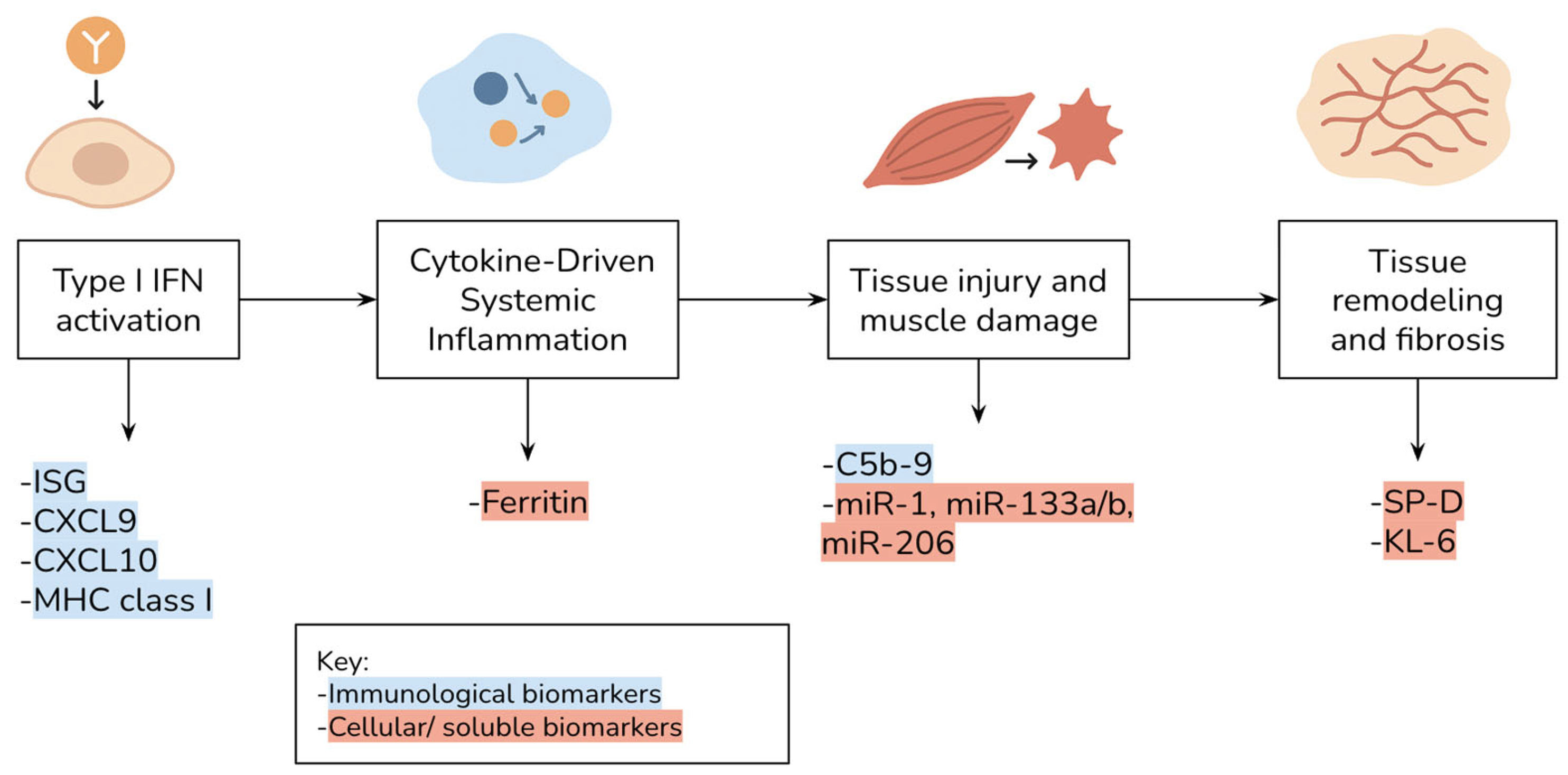
- Immunological (main mediators of inflammation or innate/adaptive immunity): IL-6, TNF-α, IFN-α/β, CXCL9/CXCL10, CCL2 (MCP-1), ISGs, neopterin, TGF-β1, MHC class I, C5b-9 (MAC).
- Cellular or soluble (related to tissue damage, local inflammation, or cellular response): CRP/ESR, ferritin, S100A8/A9 (calprotectin), LDH, CK-MB, myoglobin, miR-1, miR-133a/b, miR-206, MMP-1/MMP-3, KL-6, SP-D.
- Prognostic/therapeutic response (useful to monitor disease course, treatment response, or prognosis): ISGs, CXCL9/CXCL10, ferritin, KL-6, SP-D, miR-1, miR-133a/b, miR-206, MMP-1/MMP-3 [4].
2. Methodology
3. Immunological Biomarkers
3.1. Pro-Inflammatory Cytokines (IL-6, TNF-α, IFN-α/β)
3.2. Chemokines (CXCL9, CXCL10, CCL2)
3.3. Interferon-Stimulated Genes (ISGs)
3.4. Neopterin
3.5. TGF-β1
3.6. Complement and Antigen Presentation (MHC-I, C5b-9)
3.7. Overall Synthesis of Immunological Biomarkers
4. Cellular/Soluble Biomarkers
4.1. CRP/ESR
4.2. Ferritin and S100A8/A9 (Calprotectin)
4.3. LDH and CK-MB
4.4. Myoglobin
4.5. miR-1, miR-133a/b, miR-206
4.6. MMP-1/MMP-3
4.7. KL-6
4.8. SP-D
4.9. Overall Synthesis of Cellular and Soluble Biomarkers
5. Prognostic or Therapeutic Response Biomarkers
5.1. ISGs
5.2. CXCL9/CXCL10
5.3. Ferritin
5.4. KL-6
5.5. MHC Class I
5.6. miR-1, miR-133a/b, miR-206
5.7. C5b-9 (Membrane Attack Complex)
6. Discussion
6.1. Validated Biomarkers for Clinical Use
6.2. Experimental and Emerging Biomarkers
6.3. Future Directions and Implementation Barriers
6.4. Proposed Composite Model
6.5. Projections and Limitations
7. Conclusions
Author Contributions
Funding
Institutional Review Board Statement
Informed Consent Statement
Data Availability Statement
Conflicts of Interest
References
- Aguayo-Ortiz, R.; Abal Díaz, L.; Casanova Seuma, J.M. Dermatomiositis. Piel 2011, 26, 330–340. [Google Scholar] [CrossRef]
- Rodríguez López, J.; Ariosa Ortiz, K.; George Carrión, W.; Bell Castillo, J. Dermatomiositis en un adulto. Medisan 2014, 18, 575–582. Available online: http://scielo.sld.cu/scielo.php?script=sci_arttext&pid=S1029-30192014000400017 (accessed on 1 October 2025).
- Lundberg, I.E.; Tjärnlund, A.; Bottai, M.; Werth, V.P.; Pilkington, C.; de Visser, M.; Alfredsson, L.; Amato, A.A.; Barohn, R.J.; Liang, M.H.; et al. 2017 European League Against Rheumatism/American College of Rheumatology classification criteria for adult and juvenile idiopathic inflammatory myopathies and their major subgroups. Ann. Rheum. Dis. 2017, 76, 1955–1964. [Google Scholar] [CrossRef] [PubMed]
- Cassius, C.; Le Buanec, H.; Bouaziz, J.D.; Amode, R. Biomarkers in adult dermatomyositis: Tools to help the diagnosis and predict the clinical outcome. J. Immunol. Res. 2019, 2019, 9141420. [Google Scholar] [CrossRef]
- Wienke, J.; Deakin, C.T.; Wedderburn, L.R.; van Wijk, F.; van Royen-Kerkhof, A. Systemic and tissue inflammation in juvenile dermatomyositis: From pathogenesis to the quest for monitoring tools. Front. Immunol. 2018, 9, 2951. [Google Scholar] [CrossRef]
- Zheng, Q.; Wang, Z.; Tan, Y.; Zhu, K.; Lu, M. Overactivation of IL-6/STAT3 signaling pathway in juvenile dermatomyositis. Rheumatol. Ther. 2024, 11, 1255–1269. [Google Scholar] [CrossRef]
- Gono, T.; Kaneko, H.; Kawaguchi, Y.; Hanaoka, M.; Kataoka, S.; Kuwana, M.; Takagi, K.; Ichida, H.; Katsumata, Y.; Ota, Y.; et al. Cytokine profiles in polymyositis and dermatomyositis complicated by rapidly progressive or chronic interstitial lung disease. Rheumatology 2014, 53, 2196–2203. [Google Scholar] [CrossRef]
- Yang, M.; Cen, X.; Xie, Q.; Zuo, C.; Shi, G.; Yin, G. Serum interleukin-6 expression level and its clinical significance in patients with dermatomyositis. Clin. Dev. Immunol. 2013, 2013, 717808. [Google Scholar] [CrossRef]
- Niu, Y.; Liu, S.; Qiu, Q.; Fu, D.; Xiao, Y.; Liang, L.; Cui, Y.; Ye, S.; Xu, H. Increased serum IL-6 predicts poor prognosis in anti-MDA5–positive dermatomyositis with rapidly progressive interstitial lung disease. Arthritis Res. Ther. 2024, 26, 184. [Google Scholar] [CrossRef]
- Aggarwal, B.B. Signalling pathways of the TNF superfamily: A double-edged sword. Nat. Rev. Immunol. 2003, 3, 745–756. [Google Scholar] [CrossRef]
- Hallermalm, K.; Seki, K.; Wei, C.; Castelli, C.; Rivoltini, L.; Kiessling, R.; Levitskaya, J. Tumor necrosis factor-alpha induces coordinated changes in major histocompatibility class I presentation pathway, resulting in increased stability of class I complexes at the cell surface. Blood 2001, 98, 1108–1115. [Google Scholar] [CrossRef] [PubMed]
- Efthimiou, P.; Schwartzman, S.; Kagen, L.J. Possible role for tumor necrosis factor inhibitors in resistant dermatomyositis and polymyositis: Retrospective of eight patients. Ann. Rheum. Dis. 2006, 65, 1233–1236. [Google Scholar] [CrossRef] [PubMed]
- Efthimiou, P. Tumor necrosis factor-α in inflammatory myopathies: Pathophysiology and therapeutic implications. Semin. Arthritis Rheum. 2006, 36, 168–172. [Google Scholar] [CrossRef] [PubMed]
- Campanilho-Marques, R.; Deakin, C.T.; Simou, S.; Papadopoulou, C.; Wedderburn, L.R.; Pilkington, C.A. Juvenile Dermatomyositis Research Group (JDRG). Retrospective analysis of infliximab and adalimumab in juvenile dermatomyositis patients. Arthritis Res. Ther. 2020, 22, 79. [Google Scholar] [CrossRef]
- Drougkas, K.; Skarlis, C.; Mavragani, C. Type I Interferons in Systemic Autoimmune Rheumatic Diseases: Pathogenesis, Clinical Features and Treatment Options. Mediterr. J. Rheumatol. 2024, 35, 365–380. [Google Scholar] [CrossRef]
- Ishihara, R.; Watanabe, R.; Shiomi, M.; Fujita, Y.; Katsushima, M.; Fukumoto, K.; Yamada, S.; Hashimoto, M. The Type I Interferon Axis in Systemic Autoimmune Diseases: From Molecular Pathways to Targeted Therapy. Biomolecules 2025, 15, 1586. [Google Scholar] [CrossRef]
- Lee, J.; Croen, L.A.; Lindan, C.; Nash, K.B.; Yoshida, C.K.; Ferriero, D.M.; Barkovich, A.J.; Wu, Y.W. Predictors of outcome in perinatal arterial stroke: A population-based study. Ann. Neurol. 2005, 58, 303–308. [Google Scholar] [CrossRef]
- Solignac, M. JAK inhibitors in refractory juvenile rheumatic diseases. Curr. Opin. Rheumatol. 2024, 36, 237–243. [Google Scholar] [CrossRef]
- De Paepe, B.; Creus, K.K.; De Bleecker, J.L. Role of cytokines and chemokines in idiopathic inflammatory myopathies. Curr. Opin. Rheumatol. 2009, 21, 610–616. [Google Scholar] [CrossRef]
- Nicolai, R.; Moneta, G.M.; Caiello, I.; Pires Marafon, D.; Rosina, S.; Bracci Laudiero, L.; Ravelli, A.; De Benedetti, F. Correlation of type I interferon score and CXCL10 (C-X-C motif chemokine ligand 10) with cutaneous and muscular disease activity in juvenile dermatomyositis patients. Arthritis Rheumatol. 2019, 71, 2340. [Google Scholar]
- Li, X.; Liu, Y.; Cheng, L.; Huang, Y.; Yan, S.; Li, H.; Zhan, H.; Li, Y. Roles of biomarkers in anti-MDA5-positive dermatomyositis, associated interstitial lung disease, and rapidly progressive interstitial lung disease. J. Clin. Lab. Anal. 2022, 36, e24726. [Google Scholar] [CrossRef] [PubMed]
- Oda, K.; Kotani, T.; Takeuchi, T.; Ishida, T.; Shoda, T.; Isoda, K.; Yoshida, S.; Nishimura, Y.; Makino, S. Chemokine profiles of interstitial pneumonia in patients with dermatomyositis: A case-control study. Sci. Rep. 2017, 7, 1635. [Google Scholar] [CrossRef] [PubMed]
- Deshmane, S.L.; Kremlev, S.; Amini, S.; Sawaya, B.E. Monocyte chemoattractant protein-1 (MCP-1): An overview. J. Interf. Cytokine Res. 2009, 29, 313–326. [Google Scholar] [CrossRef]
- Liprandi, A.; Bartoli, C.; Figarella-Branger, D.; Pellissier, J.F.; Lepidi, H. Local expression of monocyte chemoattractant protein-1 (MCP-1) in idiopathic inflammatory myopathies. Acta Neuropathol. 1999, 97, 642–648. [Google Scholar] [CrossRef] [PubMed]
- Sanner, H.; Schwartz, T.; Flatø, B.; Vistnes, M.; Christensen, G.; Sjaastad, I. Increased levels of eotaxin and MCP-1 in juvenile dermatomyositis median 16.8 years after disease onset; associations with disease activity, duration and organ damage. PLoS ONE 2014, 9, e92171. [Google Scholar] [CrossRef]
- Gong, J.H.; Ratkay, L.G.; Waterfield, J.D.; Clark-Lewis, I. An antagonist of monocyte chemoattractant protein-1 (MCP-1) inhibits arthritis in the MRL-lpr mouse model. J. Exp. Med. 1997, 186, 131–137. [Google Scholar] [CrossRef]
- Schoggins, J.W. Interferon-stimulated genes: What do they all do? Annu. Rev. Virol. 2019, 6, 567–584. [Google Scholar] [CrossRef]
- Wang, X.; Hu, H.; Yan, G.; Zheng, B.; Luo, J.; Fan, J. Identification and validation of interferon-stimulated gene 15 as a biomarker for dermatomyositis by integrated bioinformatics analysis and machine learning. Front. Immunol. 2024, 15, 1429817. [Google Scholar] [CrossRef]
- Ramaswamy, M.; Tummala, R.; Streicher, K.; Nogueira da Costa, A.; Brohawn, P.Z. The pathogenesis, molecular mechanisms, and therapeutic potential of the interferon pathway in systemic lupus erythematosus and other autoimmune diseases. Int. J. Mol. Sci. 2021, 22, 11286. [Google Scholar] [CrossRef]
- Avanzas, P.; Arroyo, R.; Kaski, J.C. Papel de la neopterina en la medicina cardiovascular. Rev. Esp. Cardiol. 2009, 62, 1342–1343. [Google Scholar] [CrossRef]
- Panero López, A.; Espert, A.N. Neopterina como marcador de la activación inmune en infecciones víricas y bacterianas. An. Esp. Pediatr. 1996, 45, 597–602. [Google Scholar]
- Gil-Gómez, R.; Blasco-Alonso, J.; Sánchez-Yáñez, P.; Rosa-Camacho, V.; Milano Manso, G. Neopterin levels and systemic inflammatory response syndrome in pediatric critically ill patients. An. Pediatr. (Engl. Ed.) 2017, 87, 343–349. [Google Scholar] [CrossRef] [PubMed]
- Heneberk, O.; Wurfelova, E.; Radochova, V. Neopterin, el biomarcador de la respuesta inmune mediada por células, en enfermedades periodontales inflamatorias: Una revisión narrativa de un biomarcador con más de cincuenta años de antigüedad. Biomedicines 2023, 11, 1294. [Google Scholar] [CrossRef]
- Confalonieri, P.; Bernasconi, P.; Cornelio, F.; Mantegazza, R. Transforming growth factor-β1 in polymyositis and dermatomyositis correlates with fibrosis but not with mononuclear cell infiltrate. J. Neuropathol. Exp. Neurol. 1997, 56, 479–484. [Google Scholar] [CrossRef]
- Honda, N.; Jinnin, M.; Kajihara, I.; Makino, T.; Makino, K.; Masuguchi, S.; Fukushima, S.; Okamoto, Y.; Hasegawa, M.; Fujimoto, M.; et al. TGF-β–mediated downregulation of microRNA-196a contributes to the constitutive upregulated type I collagen expression in scleroderma dermal fibroblasts. J. Immunol. 2012, 188, 3323–3335. [Google Scholar] [CrossRef]
- Kang, H. Role of microRNAs in TGF-β signaling pathway-mediated pulmonary fibrosis. Int. J. Mol. Sci. 2017, 18, 2527. [Google Scholar] [CrossRef] [PubMed]
- Neefjes, J.; Jongsma, M.L.M.; Paul, P.; Bakke, O. Towards a systems understanding of MHC class I and MHC class II antigen presentation. Nat. Rev. Immunol. 2011, 11, 823–836. [Google Scholar] [CrossRef]
- Nagaraju, K.; Raben, N.; Loeffler, L.; Parker, T.; Rochon, P.J.; Lee, E.; Danning, C.; Wada, R.; Thompson, C.; Bahtiyar, G.; et al. Conditional up-regulation of MHC class I in skeletal muscle leads to self-sustaining autoimmune myositis and myositis-specific autoantibodies. Proc. Natl. Acad. Sci. USA 2000, 97, 9209–9214. [Google Scholar] [CrossRef]
- Nagaraju, K.; Casciola-Rosen, L.; Lundberg, I.; Rawat, R.; Cutting, S.; Thapliyal, R.; Chang, J.; Dwivedi, S.; Mitsak, M.; Chen, Y.W.; et al. Activation of the endoplasmic reticulum stress response in autoimmune myositis: Potential role in muscle fiber damage and dysfunction. Arthritis Rheum. 2005, 52, 1824–1835. [Google Scholar] [CrossRef]
- Greenberg, S.A. Inflammatory myopathies: Evaluation and management. Semin. Neurol. 2008, 28, 241–249. [Google Scholar] [CrossRef]
- Kissel, J.T.; Mendell, J.R.; Rammohan, K.W. Microvascular deposition of complement membrane attack complex in dermatomyositis. N. Engl. J. Med. 1986, 314, 329–334. [Google Scholar] [CrossRef] [PubMed]
- Dalakas, M.C. Complement in autoimmune inflammatory myopathies, the role of myositis-associated antibodies, COVID-19 associations, and muscle amyloid deposits. Expert Rev. Clin. Immunol. 2022, 18, 413–423. [Google Scholar] [CrossRef]
- Braczynski, A.K.; Harter, P.N.; Zeiner, P.S.; Drott, U.; Tews, D.S.; Preusse, C.; Penski, C.; Dunst, M.; Weis, J.; Stenzel, W.; et al. C5b-9 deposits on endomysial capillaries in non-dermatomyositis cases. Neuromuscul. Disord. 2016, 26, 283–291. [Google Scholar] [CrossRef] [PubMed]
- Lahoria, R.; Selcen, D.; Engel, A.G. Microvascular alterations and the role of complement in dermatomyositis. Brain 2016, 139, 1891–1903. [Google Scholar] [CrossRef] [PubMed]
- Mouliou, D.S. C-reactive protein: Pathophysiology, diagnosis, false test results and a novel diagnostic algorithm for clinicians. Diseases 2023, 11, 132. [Google Scholar] [CrossRef]
- De la Taille, A.; Buttyan, R.; Katz, A.E.; McKiernan, J.; Burchardt, M.; Burchardt, T.; Chopin, D.K.; Sawczuk, I.S. Biomarkers of renal cell carcinoma: Past and future considerations. Urol. Oncol. 2000, 5, 139–148. [Google Scholar] [CrossRef]
- Qudsiya, Z.; Waseem, M. Dermatomyositis. In StatPearls [Internet]; StatPearls Publishing: Treasure Island, FL, USA, 2023. [Google Scholar] [PubMed]
- Zhou, P.; Shen, Q.; Zhou, S.; Ouyang, X.; Guo, T.; Song, M.; Guo, W.; Zhang, Y.; Peng, H. The prognostic role of C-reactive protein to albumin ratio and anti-MDA5 antibody-positive in idiopathic inflammatory myopathy: A retrospective study. Sci. Rep. 2023, 13, 3863. [Google Scholar] [CrossRef]
- Miossi, R. Could C-reactive protein and erythrocyte sedimentation rate be useful biomarkers in dermatomyositis? Med. J. Univ. São Paulo 2017, 134, e20170002. [Google Scholar] [CrossRef]
- Bertoncin, A.; Dicugno, M. Requerimientos analíticos y preanalíticos para el análisis de ferritina. Rev. Hematol. 2022, 26, 1–7. [Google Scholar]
- Barrientos, N.; Sicilia, J.J.; Moreno de Vega, M.J.; Domínguez, J.D. Anti-MDA5–positive dermatomyositis: A description of the cutaneous and systemic manifestations in 2 cases. Actas Dermosifiliogr. (Engl. Ed.) 2018, 109, 188–190. [Google Scholar] [CrossRef]
- Navío Anaya, M.; Monrabal Bernabéu, A.; Pons Morales, S.; Castillo Corullón, S. Clinically amyopathic dermatomyositis with pulmonary involvement, exceptional pathology. An. Pediatr. (Engl. Ed.) 2021, 95, 282–283. [Google Scholar] [CrossRef] [PubMed]
- Wang, S.; Song, R.; Wang, Z.; Jing, Z.; Wang, S.; Ma, J. S100A8/A9 in inflammation. Front. Immunol. 2018, 9, 1298. [Google Scholar] [CrossRef]
- Palacios Soto, C.D. Importancia del Estudio de la Calprotectina Fecal y su Utilidad Diagnóstica en Enfermedades Inflamatorias Gastrointestinales. Bachelor’s Thesis, Universidad Nacional Autónoma de México, Mexico City, Mexico, 2023. [Google Scholar]
- Sršen, S.; Held, M.; Sestan, M.; Kifer, N.; Kozmar, A.; Supe Domić, D.; Benzon, B.; Gagro, A.; Frkovic, M.; Jelusic, M. Serum levels of S100A8/A9 as a biomarker of disease activity in patients with IgA vasculitis. Biomedicines 2024, 12, 750. [Google Scholar] [CrossRef] [PubMed]
- Lou, Y.; Zheng, Y.; Fan, B.; Zhang, L.; Zhu, F.; Wang, X.; Chen, Z.; Tan, X.; Wei, Q. Serum levels of interleukins and S100A8/A9 correlate with clinical severity in patients with dermatomyositis-associated interstitial lung disease. BMC Pulm. Med. 2020, 20, 229. [Google Scholar] [CrossRef]
- Li, M.; Zhao, X.; Liu, B.; Zhao, Y.; Li, X.; Ma, Z.; Yang, Q. Predictors of rapidly progressive interstitial lung disease and prognosis in Chinese patients with anti-MDA5-positive dermatomyositis. Front. Immunol. 2023, 14, 1209282. [Google Scholar] [CrossRef]
- Kishaba, T.; Yano, H.; Itagane, M.; Sudo, K.; Nagano, H.; Kinjo, M. Predictors of relapse of polymyositis/dermatomyositis associated interstitial lung disease. J. Thorac. Dis. 2024, 16, 4229–4237. [Google Scholar] [CrossRef]
- So, J.; So, H.; Wong, V.T.L.; Ho, R.; Wu, T.Y.; Wong, P.C.H.; Tam, L.H.-P.; Ho, C.; Lam, T.T.-O.; Chung, Y.K.; et al. Predictors of rapidly progressive interstitial lung disease and mortality in patients with autoantibodies against melanoma differentiation-associated protein 5 dermatomyositis. Rheumatology 2022, 61, 4437–4444. [Google Scholar] [CrossRef]
- Metko, D.; Bednar, D.; Legault, K.; Abu-Hilal, M. Prevalence and risk factors of interstitial lung disease in dermatomyositis: A retrospective study. J. Am. Acad. Dermatol. 2024, 91, 1219–1221. [Google Scholar] [CrossRef]
- Larca, L.J.; Coppola, J.T.; Honig, S. Creatine kinase MB isoenzyme in dermatomyositis: A noncardiac source. Ann. Intern. Med. 1981, 94, 341–343. [Google Scholar] [CrossRef]
- Tsung, S.H.; Huang, T.Y.; Lin, J.I. CK-MB isoenzyme in patients with polymyositis. Am. J. Med. Sci. 1982, 283, 174–177. [Google Scholar] [CrossRef]
- Tymms, K.E.; Beller, E.M.; Webb, J.; Schreiber, L.; Buchanan, W.W. Correlation between tests of muscle involvement and clinical muscle weakness in polymyositis and dermatomyositis. Clin. Rheumatol. 1990, 9, 523–529. [Google Scholar] [CrossRef] [PubMed]
- Benveniste, O.; Goebel, H.H.; Stenzel, W. Biomarkers in inflammatory myopathies—An expanded definition. Front. Neurol. 2019, 10, 554. [Google Scholar] [CrossRef] [PubMed]
- Saghazadeh, A.; Rezaei, N. Pulmonary manifestations of predominantly antibody deficiencies. In Pulmonary Manifestations of Primary Immunodeficiency Diseases; Springer International Publishing: Cham, Switzerland, 2018; pp. 77–120. [Google Scholar]
- Rusu, M.C.; Sava, C.J.; Ilie, A.C.; Săndulescu, M.; Dincă, D. Agger Nasi cells versus lacrimal cells and uncinate bullae in cone-beam computed tomography. Ear Nose Throat J. 2019, 98, 334–339. [Google Scholar] [CrossRef]
- Hanisch, F.; Müller, T.; Zierz, S. Serum muscle enzymes and standard inflammatory markers at time of diagnosis in idiopathic inflammatory myopathies—A retrospective analysis. Klin. Neurophysiol. 2010, 41, ID172. [Google Scholar] [CrossRef]
- Mikołajczyk-Korona, A.; Dziedzic, R.; Wójcik, K.; Olchawa, M.; Sarna, T.; Pięta, J.; Jakiela, B.; Zaręba, L.; Bazan, J.G.; Potaczek, D.P.; et al. Enhanced systemic oxidative stress response in patients with idiopathic inflammatory myopathies. Arthritis Res. Ther. 2025, 27, 50. [Google Scholar] [CrossRef]
- Georgantas, R.W.; Streicher, K.; Greenberg, S.A.; Greenlees, L.M.; Zhu, W.; Brohawn, P.Z.; Higgs, B.W.; Czapiga, M.; Morehouse, C.A.; Amato, A.; et al. Inhibition of myogenic microRNAs 1, 133, and 206 by inflammatory cytokines links inflammation and muscle degeneration in adult inflammatory myopathies. Arthritis Rheumatol. 2014, 66, 1022–1033. [Google Scholar] [CrossRef]
- Yang, Y.; Hu, G.; Wan, G.; Li, M.; Chang, B.; Yi, X. Idiopathic inflammatory myopathy and non-coding RNA. Front. Immunol. 2023, 14, 1227945. [Google Scholar] [CrossRef]
- Mitchelson, K.R. Roles of the canonical myomiRs miR-1, miR-133 and miR-206 in cell development and disease. World J. Biol. Chem. 2015, 6, 162–174. [Google Scholar] [CrossRef]
- Hirai, T.; Ikeda, K.; Tsushima, H.; Fujishiro, M.; Hayakawa, K.; Yoshida, Y.; Morimoto, S.; Yamaji, K.; Takasaki, Y.; Takamori, K.; et al. Circulating plasma microRNA profiling in patients with polymyositis/dermatomyositis before and after treatment: miRNA may be associated with polymyositis/dermatomyositis. Inflamm. Regen. 2018, 38, 1. [Google Scholar] [CrossRef]
- Choi, Y.C.; Dalakas, M.C. Expression of matrix metalloproteinases in the muscle of patients with inflammatory myopathies. Neurology 2000, 54, 65–71. [Google Scholar] [CrossRef]
- Schoser, B.G.H.; Blottner, D.; Stürenburg, H.J. Matrix metalloproteinases in inflammatory myopathies: Enhanced immunoreactivity near atrophic myofibers. Acta Neurol. Scand. 2002, 105, 309–313. [Google Scholar] [CrossRef] [PubMed]
- Zhang, M.; Xue, Y.; Chen, H.; Meng, L.; Chen, B.; Gong, H.; Zhao, Y.; Qi, R. Resveratrol inhibits MMP3 and MMP9 expression and secretion by suppressing TLR4/NF-κB/STAT3 activation in ox-LDL-treated HUVECs. Oxid. Med. Cell. Longev. 2019, 2019, 9013169. [Google Scholar] [CrossRef]
- Chen, Z.; Li, B.; Zhan, R.Z.; Rao, L.; Bursac, N. Exercise mimetics and JAK inhibition attenuate IFN-γ-induced wasting in engineered human skeletal muscle. Sci. Adv. 2021, 7, eabf8420. [Google Scholar] [CrossRef] [PubMed]
- Hanaoka, M.; Katsumata, Y.; Kawasumi, H.; Kawaguchi, Y.; Yamanaka, H. KL-6 is a long-term disease-activity biomarker for interstitial lung disease associated with polymyositis/dermatomyositis, but is not a short-term disease-activity biomarker. Mod. Rheumatol. 2019, 29, 625–632. [Google Scholar] [CrossRef] [PubMed]
- Hu, C.; Wu, C.; Yang, E.; Huang, H.; Xu, D.; Hou, Y.; Zhao, J.; Li, M.; Xu, Z.; Zeng, X.; et al. Serum KL-6 is associated with the severity of interstitial lung disease in Chinese patients with polymyositis and dermatomyositis. Clin. Rheumatol. 2019, 38, 2181–2187. [Google Scholar] [CrossRef]
- Fathi, M.; Barbasso Helmers, S.; Lundberg, I.E. KL-6: A serological biomarker for interstitial lung disease in patients with polymyositis and dermatomyositis. J. Intern. Med. 2012, 271, 589–597. [Google Scholar] [CrossRef]
- Khalil, M.; Fouda, A.I.; Amin, N.A.; Ali, A.S.M.; Shams, G.M.; Sheiha, S.H. KL-6 in adult polymyositis and dermatomyositis patients and its correlation with interstitial lung disease. Egypt. Rheumatol. Rehabil. 2023, 50, 64. [Google Scholar] [CrossRef]
- Kishore, U.; Greenhough, T.J.; Waters, P.; Shrive, A.K.; Ghai, R.; Kamran, M.F.; Bernal, A.L.; Reid, K.B.; Madan, T.; Chakraborty, T. Surfactant proteins SP-A and SP-D: Structure, function, and receptors. Mol. Immunol. 2006, 43, 1293–1315. [Google Scholar] [CrossRef]
- Ihn, H.; Asano, Y.; Kubo, M.; Yamane, K.; Jinnin, M.; Yazawa, N.; Fujimoto, M.; Tamaki, K. Clinical significance of serum surfactant protein D in patients with polymyositis/dermatomyositis: Correlation with interstitial lung disease. Rheumatology 2002, 41, 1268–1272. [Google Scholar] [CrossRef]
- Cao, H.; Huang, J.; Chang, J.; Zhu, Y.; Liang, J.; Sun, C.; Lin, J. Predictors of progression in idiopathic inflammatory myopathies with interstitial lung disease. J. Transl. Intern. Med. 2023, 11, 46–56. [Google Scholar] [CrossRef]
- Takahashi, H.; Fujishima, T.; Koba, H.; Murakami, S.; Kurokawa, K.; Shibuya, Y.; Shiratori, M.; Kuroki, Y.; Abe, S. Serum surfactant proteins A and D as prognostic factors in idiopathic pulmonary fibrosis and their relationship to disease extent. Am. J. Respir. Crit. Care Med. 2000, 162, 1109–1114. [Google Scholar] [CrossRef] [PubMed]
- Salajegheh, M.; Kong, S.W.; Pinkus, J.L.; Walsh, R.J.; Liao, A.; Nazareno, R.; Amato, A.A.; Krastins, B.; Morehouse, C.; Higgs, B.W.; et al. Interferon-stimulated gene 15 (ISG15) conjugates proteins in dermatomyositis muscle with perifascicular atrophy. Ann. Neurol. 2010, 67, 53–63. [Google Scholar] [CrossRef] [PubMed]
- Qian, J.; Li, R.; Chen, Z.; Cao, Z.; Lu, L.; Fu, Q. Type I interferon score is associated with the severity and poor prognosis in anti-MDA5 antibody-positive dermatomyositis patients. Front. Immunol. 2023, 14, 1151695. [Google Scholar] [CrossRef] [PubMed]
- Kim, J.; Choi, J.Y.; Park, S.H.; Yang, S.H.; Park, J.A.; Shin, K.; Lee, E.Y.; Kawachi, H.; Kohsaka, H.; Song, Y.W. Therapeutic effect of anti-C-X-C motif chemokine 10 (CXCL10) antibody on C protein-induced myositis mouse. Arthritis Res. Ther. 2014, 16, R126. [Google Scholar] [CrossRef]
- Paik, J.J.; Casciola-Rosen, L.; Shin, J.Y.; Albayda, J.; Tiniakou, E.; Leung, D.G.; Gutierrez-Alamillo, L.; Perin, J.; Florea, L.; Antonescu, C.; et al. Study of Tofacitinib in Refractory Dermatomyositis: An Open-Label Pilot Study of Ten Patients. Arthritis Rheumatol. 2021, 73, 858–865. [Google Scholar] [CrossRef]
- Izuka, S.; Komai, T.; Tsuchida, Y.; Tsuchiya, H.; Okamura, T.; Fujio, K. The role of monocytes and macrophages in idiopathic inflammatory myopathies: Insights into pathogenesis and potential targets. Front. Immunol. 2025, 16, 1567833. [Google Scholar] [CrossRef]
- He, X.; Ji, J.; Chen, X.; Luo, Z.; Fang, S.; Yan, H.; Guo, L. Serum ferritin as a significant biomarker for patients with idiopathic inflammatory myopathy-associated interstitial lung disease: A systematic review and meta-analysis. Semin. Arthritis Rheum. 2024, 64, 152350. [Google Scholar] [CrossRef]
- Osawa, T.; Morimoto, K.; Sasaki, Y.; Matsuda, S.; Yamana, K.; Yano, R.; Uchiyama, T.; Goto, H. The serum ferritin level is associated with the treatment responsivity for rapidly progressive interstitial lung disease with amyopathic dermatomyositis, irrespective of the anti-MDA5 antibody level. Intern. Med. 2018, 57, 387–391. [Google Scholar] [CrossRef]
- Zohar, D.N.; Seluk, L.; Yonath, H.; Shoenfeld, Y.; Kivity, S. Anti-MDA5 positive dermatomyositis associated with rapidly progressive interstitial lung disease and correlation between serum ferritin level and treatment response. Mediterr. J. Rheumatol. 2020, 31, 75–77. [Google Scholar] [CrossRef]
- Ye, Y.; Fu, Q.; Wang, R.; Guo, Q.; Bao, C. Serum KL-6 level is a prognostic marker in patients with anti-MDA5 antibody-positive dermatomyositis associated with interstitial lung disease. J. Clin. Lab. Anal. 2019, 33, e22942. [Google Scholar] [CrossRef]
- Zhang, T.; Shen, P.; Duan, C.; Gao, L. KL-6 as an immunological biomarker predicts the severity, progression, acute exacerbation, and poor outcomes of interstitial lung disease: A systematic review and meta-analysis. Front. Immunol. 2021, 12, 745233. [Google Scholar] [CrossRef]
- Pugashetti, J.V.; Khanna, D.; Kazerooni, E.A.; Oldham, J. Clinically relevant biomarkers in connective tissue disease-associated interstitial lung disease. Immunol. Allergy Clin. N. Am. 2023, 43, 411–433. [Google Scholar] [CrossRef] [PubMed]
- Arahata, K.; Engel, A.G. Monoclonal antibody analysis of mononuclear cells in myopathies. I: Quantitation of subsets according to diagnosis and sites of accumulation and demonstration and counts of muscle fibers invaded by T cells. Ann. Neurol. 1984, 16, 193–208. [Google Scholar] [CrossRef] [PubMed]
- Nyberg, P.; Wikman, A.L.; Nennesmo, I.; Lundberg, I. Increased expression of interleukin-1α and MHC class I in muscle tissue of patients with chronic, inactive polymyositis and dermatomyositis. J. Rheumatol. 2000, 27, 940–948. [Google Scholar] [PubMed]
- Lundberg, I.E.; Fujimoto, M.; Vencovsky, J.; Aggarwal, R.; Holmqvist, M.; Christopher-Stine, L.; Mammen, A.L.; Miller, F.W. Idiopathic inflammatory myopathies. Nat. Rev. Dis. Primers 2021, 7, 86. [Google Scholar] [CrossRef]
- Horak, M.; Novak, J.; Bienertova-Vasku, J. Muscle-specific microRNAs in skeletal muscle development. Dev. Biol. 2016, 410, 1–13. [Google Scholar] [CrossRef]
- Eisenberg, I.; Eran, A.; Nishino, I.; Moggio, M.; Lamperti, C.; Amato, A.A.; Lidov, H.G.; Kang, P.B.; North, K.N.; Mitrani-Rosenbaum, S.; et al. Distinctive patterns of microRNA expression in primary muscular disorders. Proc. Natl. Acad. Sci. USA 2007, 104, 17016–17021, Erratum in Proc. Natl. Acad. Sci. USA 2008, 105, 399. [Google Scholar] [CrossRef]
- Liu, N.; Williams, A.H.; Maxeiner, J.M.; Bezprozvannaya, S.; Shelton, J.M.; Richardson, J.A.; Bassel-Duby, R.; Olson, E.N. MicroRNA-206 promotes skeletal muscle regeneration and delays progression of Duchenne muscular dystrophy in mice. J. Clin. Investig. 2012, 122, 2054–2065. [Google Scholar] [CrossRef]
- Güller, I.; Russell, A.P. MicroRNAs in skeletal muscle: Their role and regulation in development, disease and function. J. Physiol. 2010, 588, 4075–4087. [Google Scholar] [CrossRef]
- Emslie-Smith, A.M.; Engel, A.G. Microvascular changes in early and advanced dermatomyositis: A quantitative study. Ann. Neurol. 1990, 27, 343–356. [Google Scholar] [CrossRef]
- Dalakas, M.C. Immunopathogenesis of inflammatory myopathies. Ann. Neurol. 1995, 37, 74–86. [Google Scholar] [CrossRef]
- Tirado-Sánchez, A.; Bonifaz, A.; Ponce-Olivera, R.M. Utilidad del complejo soluble de ataque a membrana para determinar actividad clínica de la dermatomiositis y respuesta al tratamiento. Gac. Med. Mex. 2018, 154, 582–587. [Google Scholar] [CrossRef]


| Biomarker | Type | Biological Function | Clinical Application | Level of Evidence | Specificity for DM | Clinical Implementation |
|---|---|---|---|---|---|---|
| IL-6 | Cytokine | Proinflammatory mediator | Marker of systemic inflammation and disease activity | Moderate | Low | No |
| TNF-α | Cytokine | Regulates inflammation, apoptosis, and lymphocyte differentiation | Involved in pathophysiology; potential therapeutic target | Moderate | Low | No |
| IFN-α/β | Cytokine | Antiviral response and immunomodulation | Diagnostic and prognostic marker; associated with lung involvement | High | Moderate | No |
| CXCL9/CXCL10 | Chemokine | T cell recruitment | Associated with disease activity and treatment response | High | High | Yes |
| CCL2 (MCP-1) | Chemokine | Monocyte recruitment | Inflammation marker and mononuclear infiltrate | Moderate | Low | No |
| ISGs | Gene signature | IFN-induced gene activation | Associated with DM and ILD; useful for disease monitoring | High | High | Yes |
| Neopterin | Metabolite | Indicator of immune activation | Marker of immune activity and therapeutic response | Low | Low | No |
| TGF-β1 | Cytokine | Regulation of fibrosis and tissue repair | Involved in muscle fibrosis and interstitial lung disease (ILD) | Moderate | Low | No |
| MHC class I | HLA protein | Antigen presentation | Overexpressed in muscle biopsies; early diagnostic marker | High | High | Yes |
| C5b-9 (MAC) | Complement complex | Formation of membrane attack complex | Diagnostic marker in active DM | Moderate | High | Yes |
| CRP/ESR | Inflammatory protein | Acute inflammation response | Non-specific markers of systemic inflammation | High | Low | No |
| Ferritin | Protein | Iron storage, inflammation marker | Associated with severe anti-MDA5+ DM and progressive ILD | High | Moderate | Yes |
| S100A8/A9 (calprotectin) | Protein | Inflammatory and chemotactic mediator | Indicates active muscle inflammation | Moderate | Moderate | No |
| LDH | Enzyme | Cellular energy metabolism | Non-specific indicator of muscle damage | High | Low | No |
| CK-MB | Enzyme | Cardiac creatine kinase isoenzyme | Differentiates cardiac vs. skeletal muscle damage | Moderate | Low | No |
| Myoglobin | Protein | Oxygen storage and transport in muscle | Marker of acute muscle injury | Moderate | Low | No |
| miR-1, miR-133a/b, miR-206 | Muscle micro RNAs | Post-transcriptional regulation in muscle | Useful for diagnosis, prognosis, and monitoring | High | Moderate | Yes |
| MMP-1/ MMP-3 | Metalloproteinase | Extracellular matrix degradation | Markers of tissue remodeling and disease activity | Moderate | Low | No |
| KL-6 | Glycoprotein | Marker of pulmonary epithelial damage | Diagnosis and monitoring of ILD | High | High | Yes |
| SP-D | Surfactant protein | Pulmonary immune function | Associated with ILD and lung damage | High | Moderate | Yes |
Disclaimer/Publisher’s Note: The statements, opinions and data contained in all publications are solely those of the individual author(s) and contributor(s) and not of MDPI and/or the editor(s). MDPI and/or the editor(s) disclaim responsibility for any injury to people or property resulting from any ideas, methods, instructions or products referred to in the content. |
© 2026 by the authors. Licensee MDPI, Basel, Switzerland. This article is an open access article distributed under the terms and conditions of the Creative Commons Attribution (CC BY) license.
Share and Cite
Jaederlund, F.; Joo Hu, K.W.K.; Karsulovic, C.; Hojman, L. Current and Emerging Biomarkers in Dermatomyositis: Clinical Utility and Future Directions. Int. J. Transl. Med. 2026, 6, 4. https://doi.org/10.3390/ijtm6010004
Jaederlund F, Joo Hu KWK, Karsulovic C, Hojman L. Current and Emerging Biomarkers in Dermatomyositis: Clinical Utility and Future Directions. International Journal of Translational Medicine. 2026; 6(1):4. https://doi.org/10.3390/ijtm6010004
Chicago/Turabian StyleJaederlund, Fiona, Ka Wei Katty Joo Hu, Claudio Karsulovic, and Lia Hojman. 2026. "Current and Emerging Biomarkers in Dermatomyositis: Clinical Utility and Future Directions" International Journal of Translational Medicine 6, no. 1: 4. https://doi.org/10.3390/ijtm6010004
APA StyleJaederlund, F., Joo Hu, K. W. K., Karsulovic, C., & Hojman, L. (2026). Current and Emerging Biomarkers in Dermatomyositis: Clinical Utility and Future Directions. International Journal of Translational Medicine, 6(1), 4. https://doi.org/10.3390/ijtm6010004