
Ecotoxic Effects of Microplastics from Compostable and Conventional Plastic Bags on the Growth and Reproduction of Eisenia andrei in a Sewage Sludge-Based Substrate



Abstract
1. Introduction
2. Materials and Methods
2.1. Origin and Preparation of Compostable, Non-Compostable, and Reference Polymer Materials
2.2. Exposure Substrate
2.3. Experiment Set-Up of Survival and Reproduction Test
2.4. Survival and Reproduction Test
2.5. Statistical Analysis
3. Results
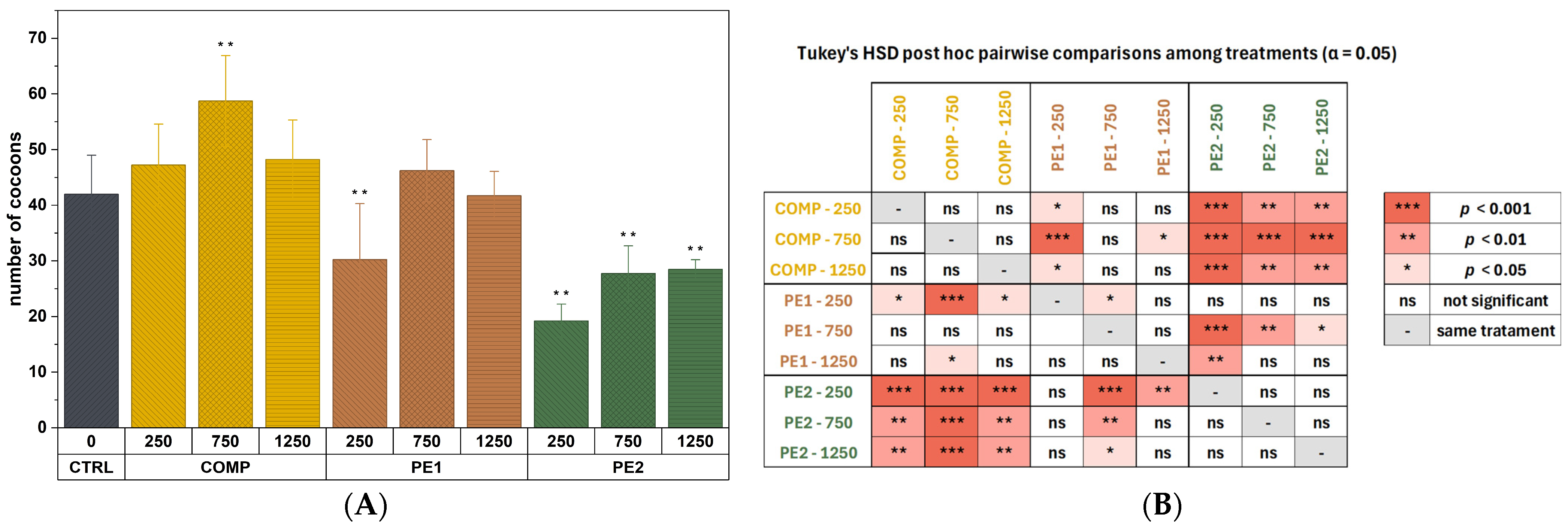
3.1. Response of Eisenia Andrei to Microplastics Derived from Compostable and Conventional Plastic Bags
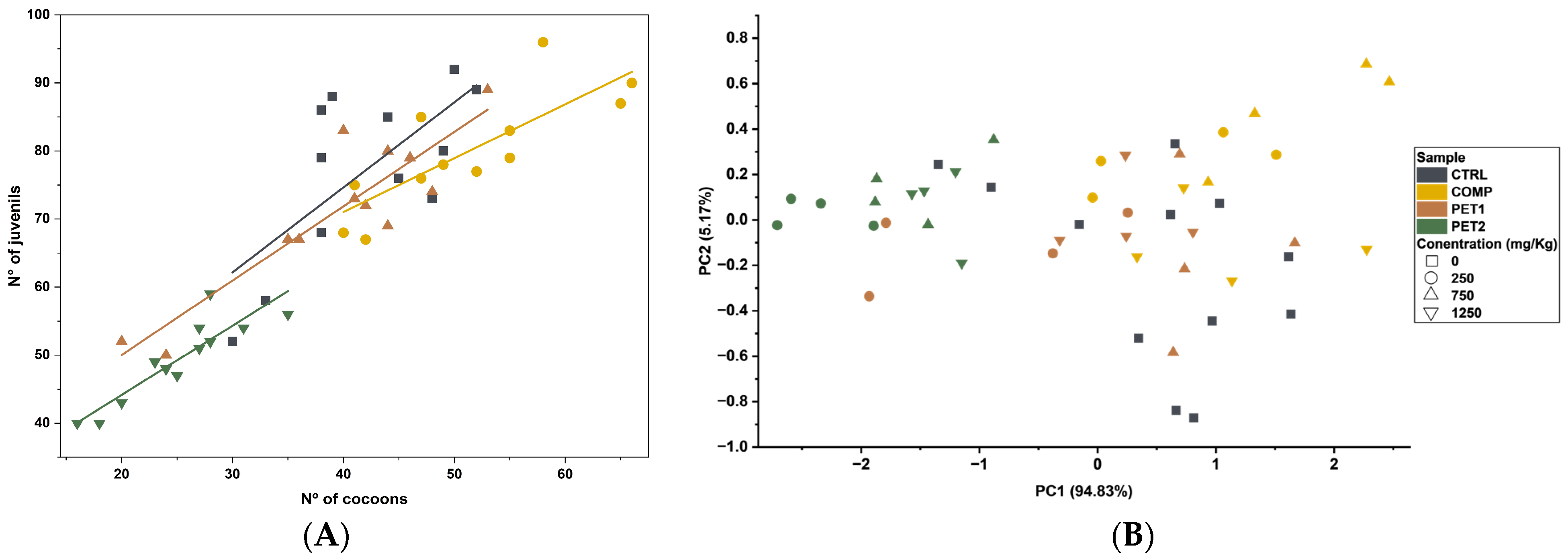
3.2. Multivariate Analysis and Relationships
4. Discussion
5. Conclusions
Supplementary Materials
Author Contributions
Funding
Institutional Review Board Statement
Informed Consent Statement
Data Availability Statement
Acknowledgments
Conflicts of Interest
Abbreviations
| COMP | Microplastics from a compostable plastic bag |
| CTRL | Control treatment |
| MPs | Microplastics |
| OECD | Organization for Economic Co-operation and Development |
| PCA | Principal Component Analysis |
| PE | Polyethylene |
| PE1 | Microplastics from a commercial polyethylene plastic bag |
| PE2 | Virgin polyethylene resin |
| WWTP | Wastewater Treatment Plant |
References
- Koelmans, A.A.; Redondo-Hasselerharm, P.E.; Nor, N.H.M.; de Ruijter, V.N.; Mintenig, S.M.; Kooi, M. Risk assessment of microplastic particles. Nat. Rev. Mater. 2022, 7, 138–152. [Google Scholar] [CrossRef] [Scilit]
- Ghosh, S.; Sinha, J.K.; Ghosh, S.; Vashisth, K.; Han, S.; Bhaskar, R. Microplastics as an emerging threat to the global environment and human health. Sustainability 2023, 15, 10821. [Google Scholar] [CrossRef] [Scilit]
- Esterhuizen, M.; Vikfors, S.; Penttinen, O.P.; Kim, Y.J.; Pflugmacher, S. Lolium multiflorum germination and growth affected by virgin, naturally, and artificially aged high-density polyethylene microplastic and leachates. Front. Environ. Sci. 2022, 10, 964230. [Google Scholar] [CrossRef] [Scilit]
- Sun, J.; Zheng, H.; Xiang, H.; Fan, J.; Jiang, H. The surface degradation and release of microplastics from plastic films studied by UV radiation and mechanical abrasion. Sci. Total Environ. 2022, 838, 156369. [Google Scholar] [CrossRef] [Scilit] [PubMed]
- Özen, E.Y.; Canbulat Özdemir, M.; Hatinoğlu, M.D.; Apul, O.G.; İmamoğlu, İ. Mechanistic inferences from empirical and LSER modeling approaches concerning sorption of organic compounds by pristine and aged PE microplastics. Chemosphere 2024, 368, 143695. [Google Scholar] [CrossRef] [Scilit] [PubMed]
- Li, Y.; Liu, C.; Yang, H.; He, W.; Li, B.; Zhu, X.; Liu, S.; Jia, S.; Li, R.; Tang, K.H.D. Leaching of chemicals from microplastics: A review of chemical types, leaching mechanisms and influencing factors. Sci. Total Environ. 2024, 906, 167666. [Google Scholar] [CrossRef] [Scilit] [PubMed]
- Salehi, M.; Pincus, L.N.; Deng, B.; Peters, C.A. Microplastics: From intrinsic properties to environmental fate. Environ. Eng. Sci. 2024, 41, 425–435. [Google Scholar] [CrossRef] [Scilit]
- Hoang, H.G.; Nguyen, N.S.H.; Zhang, T.; Tran, H.T.; Mukherjee, S.; Naidu, R. A review of microplastic pollution and human health risk assessment: Current knowledge and future outlook. Front. Environ. Sci. 2025, 13, 1606332. [Google Scholar] [CrossRef] [Scilit]
- Masseroni, A.; Federico, L.; Becchi, A.; Quinto, M.; Saliu, F.; Villa, S. Effects of pristine and aged LDPE and PP microplastic leachates on behavioural responses of the soil arthropods Folsomia candida and Porcellionides pruinosus. Toxics 2026, 14, 502. [Google Scholar] [CrossRef] [Scilit] [PubMed]
- Boháčková, J.; Cajthaml, T. Contribution of chemical toxicity to the overall toxicity of microplastic particles: A review. Sci. Total Environ. 2024, 957, 177611. [Google Scholar] [CrossRef] [Scilit] [PubMed]
- de Souza Machado, A.A.; Kloas, W.; Zarfl, C.; Hempel, S.; Rillig, M.C. Microplastics as an emerging threat to terrestrial ecosystems. Glob. Change Biol. 2018, 24, 1405–1416. [Google Scholar] [CrossRef] [Scilit] [PubMed]
- Mendes, L.A.; Beiras, R.; Domínguez, J. Earthworm (Eisenia andrei)-mediated degradation of commercial compostable bags and potential toxic effects. Microplastics 2024, 3, 322–338. [Google Scholar] [CrossRef] [Scilit]
- Muñiz González, A.B.; Mendes, L.A.; Brandón, M.G.; Quintela-Sabarís, C.; Rupani, P.F.; Domínguez, J. Earthworms and microplastics: Transport from sewage sludge to soil, antibiotic-resistant genes, and soil remediation. In Earthworm Technology in Organic Waste Management: Recent Trends and Advances; Elsevier: Amsterdam, The Netherlands, 2024; pp. 207–229. [Google Scholar] [CrossRef] [Scilit]
- Fuller, S.; Gautam, A. A procedure for measuring microplastics using pressurized fluid extraction. Environ. Sci. Technol. 2016, 50, 5774–5780. [Google Scholar] [CrossRef] [Scilit] [PubMed]
- Zhang, L.; Jiang, C.; Wang, W.; Xie, B. Revisiting the environmental impacts of microplastics in soils: Insights from a meta-analysis. Environ. Pollut. 2026, 404, 128465. [Google Scholar] [CrossRef] [Scilit] [PubMed]
- Wang, Y.; Jing, S.; Hou, P.; Ni, R.; Niu, L.; Wanger, T.C.; Liu, W.; Liu, K. Soil erosion is a major driver for nano & micro-plastics to enter riverine systems from cultivated land. Water Res. 2024, 256, 121597. [Google Scholar] [CrossRef] [Scilit] [PubMed]
- Zhang, L.; Wang, F.; Wang, W.; Su, Y.; Zhan, M.; Lu, J.; Xie, B. Using machine learning to reveal drivers of soil microplastics and assess their stock: A national-scale study. J. Hazard. Mater. 2024, 478, 135466. [Google Scholar] [CrossRef] [Scilit] [PubMed]
- Klimasz, M.; Grobelak, A. Effects of microplastics on selected earthworm species. Toxics 2025, 13, 201. [Google Scholar] [CrossRef] [Scilit] [PubMed]
- Castillo, A.; Lores, M.; Aira, M.; Domínguez, J. Microplastics in sewage sludge: Changes in abundance, size distribution and composition during short and long-term vermicomposting. Microplastics 2026, 5, 118. [Google Scholar] [CrossRef] [Scilit]
- Li, B.; Song, W.; Cheng, Y.; Zhang, K.; Tian, H.; Du, Z.; Wang, J.; Wang, J.; Zhang, W.; Zhu, L. Ecotoxicological effects of different size ranges of industrial-grade polyethylene and polypropylene microplastics on earthworms Eisenia fetida. Sci. Total Environ. 2021, 783, 147007. [Google Scholar] [CrossRef] [Scilit] [PubMed]
- OECD. Test No. 222: Earthworm Reproduction Test (Eisenia fetida/Eisenia andrei). In OECD Guidelines for the Testing of Chemicals, Section 2; OECD Publishing: Paris, France, 2016. [Google Scholar] [CrossRef] [Scilit]
- He, S.; Wei, Y.; Yang, C.; He, Z. Interactions of microplastics and soil pollutants in soil-plant systems. Environ. Pollut. 2022, 315, 120357. [Google Scholar] [CrossRef] [Scilit] [PubMed]
- Brami, C.; Glover, A.R.; Butt, K.R.; Lowe, C.N. Avoidance, biomass and survival response of soil dwelling (endogeic) earthworms to OECD artificial soil: Potential implications for earthworm ecotoxicology. Ecotoxicology 2017, 26, 576–583. [Google Scholar] [CrossRef] [Scilit] [PubMed]
- Römbke, J.; Jänsch, S.; Junker, T.; Pohl, B.; Scheffczyk, A.; Schallnaß, H.J. Improvement of the applicability of ecotoxicological tests with earthworms, springtails, and plants for the assessment of metals in natural soils. Environ. Toxicol. Chem. 2006, 25, 776–787. [Google Scholar] [CrossRef] [Scilit] [PubMed]
- Aderjan, E.; Wagenhoff, E.; Kandeler, E.; Moser, T. Natural soils in OECD 222 testing—Influence of soil water and soil properties on earthworm reproduction toxicity of carbendazim. Ecotoxicology 2023, 32, 403–415, Correction in Ecotoxicology 2023, 32, 416–417. [Google Scholar] [CrossRef] [Scilit] [PubMed]
- Beiras, R.; Vilas, A.; Sieiro, J.G.; Schönemann, A.M.; Laranjeiro, F.M.G. Alternative plastic materials pose higher chemical hazard and aquatic ecotoxicity than conventional plastics. Aquat. Toxicol. 2025, 284, 107360. [Google Scholar] [CrossRef] [Scilit] [PubMed]
- Büks, F.; Kaupenjohann, M. Global concentrations of microplastics in soils—A review. SOIL 2020, 6, 649–662. [Google Scholar] [CrossRef] [Scilit]
- Zhou, Y.; Wang, J.; Zou, M.; Jia, Z.; Zhou, S.; Li, Y. Microplastics in soils: A review of methods, occurrence, fate, transport, ecological and environmental risks. Sci. Total Environ. 2020, 748, 141368. [Google Scholar] [CrossRef] [Scilit] [PubMed]
- Hackenberger, B.K.; Velki, M.; Stepić, S.; Hackenberger, D.K. The effect of formalin on acetylcholinesterase and catalase activities, and on the concentration of oximes, in the earthworm species Eisenia andrei. Eur. J. Soil Biol. 2012, 50, 137–143. [Google Scholar] [CrossRef] [Scilit]
- Mendes, L.A.; Domínguez, J. Spent coffee grounds as a suitable alternative to standard soil in ecotoxicological tests. Environ. Sci. Pollut. Res. 2024, 31, 16725–16734. [Google Scholar] [CrossRef] [Scilit] [PubMed]
- Van Gestel, C.A.M.; Dirven-Van Breemen, E.M.; Baerselman, R.; Emans, H.J.B.; Janssen, J.A.M.; Postuma, R.; Van Vliet, P.J.M. Comparison of sublethal and lethal criteria for nine different chemicals in standardized toxicity tests using the earthworm Eisenia andrei. Ecotoxicol. Environ. Saf. 1992, 23, 206–220. [Google Scholar] [CrossRef] [Scilit] [PubMed]
- Ding, W.; Li, Z.; Qi, R.; Jones, D.L.; Liu, Q.; Liu, Q.; Yan, C. Effect thresholds for the earthworm Eisenia fetida: Toxicity comparison between conventional and biodegradable microplastics. Sci. Total Environ. 2021, 781, 146884. [Google Scholar] [CrossRef] [Scilit]
- Yang, X.; Zhang, X.; Shu, X.; Gong, J.; Yang, J.; Li, B.; Lin, J.; Chai, Y.; Liu, J. The effects of polyethylene microplastics on the growth, reproduction, metabolic enzymes, and metabolomics of earthworms Eisenia fetida. Ecotoxicol. Environ. Saf. 2023, 263, 115390. [Google Scholar] [CrossRef] [Scilit] [PubMed]
- Gautam, K.; Dwivedi, S.; Verma, R.; Vamadevan, B.; Patnaik, S.; Anbumani, S. Combined effects of polyethylene microplastics and carbendazim on Eisenia fetida: A comprehensive ecotoxicological study. Environ. Pollut. 2024, 348, 123854. [Google Scholar] [CrossRef] [Scilit] [PubMed]
- Quigley, E.; Silva, A.L.P.; Chelinho, S.; Cunha, L.; Briones, M.J.; Sousa, J.P. Pristine and UV-aged polyethylene microplastics’ impact on gut microbiome and reproduction of earthworm Eisenia andrei. Eur. J. Soil Biol. 2024, 122, 103640. [Google Scholar] [CrossRef] [Scilit]
- Gutiérrez-Rial, D.; Lagoa, A.; Villar, I.; Feijoo, P.; Mariño, F.; Garrido, J.; Soto, B.; Mato, S. Short- and medium-term effects of biodegradable microplastics (PLA and PHB) on earthworm development and reproduction. Ecotoxicology 2025, 34, 701–711. [Google Scholar] [CrossRef] [Scilit] [PubMed]
- Liu, X.; Dong, W.; Gao, H.; Wang, K.; Liu, X.; Yan, C. Ecotoxicological effects of soil microplastic types and concentrations on earthworms. Environ. Pollut. 2026, 393, 127720. [Google Scholar] [CrossRef] [Scilit] [PubMed]
- Reinecke, A.J.; Maboeta, M.S.; Reinecke, S.A. Stimulating effects of low lead concentrations on growth and cocoon production of Eisenia fetida (Oligochaeta). S. Afr. J. Zool. 1997, 32, 72–75. [Google Scholar] [CrossRef] [Scilit]
- Agathokleous, E.; Iavicoli, I.; Barceló, D.; Calabrese, E.J. Micro/nanoplastics effects on organisms: A review focusing on ‘dose’. J. Hazard. Mater. 2021, 417, 126084. [Google Scholar] [CrossRef] [Scilit] [PubMed]



| Parameter | Value * ( ± σ) | Units |
|---|---|---|
| pH | 6.52 ± 0.02 | - |
| Electric conductivity | 114.28 ± 1.56 | µs cm−1 |
| Moisture content | 81.03 ± 0.07 | % |
| Organic matter content | 58.32 ± 0.25 | % |
| Dissolved organic carbon | 1.84 ± 3.08 | µg C·g−1 |
| N-NH4 | 375.4 ± 27.9 | µg N·g−1 |
| N-NO3 | 459.74 ± 59.75 | µg N·g−1 |
| Dissolved organic N | 1.19 ± 0.08 | µg N·g−1 |
| Microbial biomass C | 21.32 ± 1.09 | mg C·g−1 |
| Microbial activity | 185.83 ± 6.48 | µg CO2·g−1 h−1 |
| Study | Species | Polymer | Polymer State | MP Size (µm) | Concentrations (mg·kg−1) | Matrix | Days |
|---|---|---|---|---|---|---|---|
| [32] Ding et al. (2021) | E. fetida | PE, PLA, PPC | Non-aged | 120 | 0.125, 1.25, 12.5, 125, 250, 500 | OECD | 56 |
| [33] Yang et al. (2023) | E. fetida | PE | Pristine | 30–50 | 0.05, 0.5, 1, 2.5, 10, 20 | Agricultural soil | 60 |
| [34] Gautam et al. (2024) | E. fetida | HDPE | Pristine | 40–48 | 0.001, 0.1, 1 | OECD | 56 |
| [35] Quigley et al. (2024) | E: andrei | PE | Pristine and UV-aged | 63–250 µm | 2·10−4, 0.002, 0.02, 0.2, 2 | Agricultural soil | 56 |
| [36] Gutiérrez-Rial et al. (2025) | E. andrei | PLA, PHB, PE | Non-aged | 418–500 µm | 0.625, 1.25, 2.5 | OECD and VC * | 49 and 112 |
| [37] Liu et al. (2026) | E. fetida | PE, PP, PBAT | Pristine | <1 mm | 0.5, 5, 20 | OECD | 42 |
Disclaimer/Publisher’s Note: The statements, opinions and data contained in all publications are solely those of the individual author(s) and contributor(s) and not of MDPI and/or the editor(s). MDPI and/or the editor(s) disclaim responsibility for any injury to people or property resulting from any ideas, methods, instructions or products referred to in the content. |
© 2026 by the authors. Licensee MDPI, Basel, Switzerland. This article is an open access article distributed under the terms and conditions of the Creative Commons Attribution (CC BY) license.
Share and Cite
Castillo, A.; Aira, M.; Beiras, R.; Domínguez, J. Ecotoxic Effects of Microplastics from Compostable and Conventional Plastic Bags on the Growth and Reproduction of Eisenia andrei in a Sewage Sludge-Based Substrate. Microplastics 2026, 5, 182. https://doi.org/10.3390/microplastics5030182
Castillo A, Aira M, Beiras R, Domínguez J. Ecotoxic Effects of Microplastics from Compostable and Conventional Plastic Bags on the Growth and Reproduction of Eisenia andrei in a Sewage Sludge-Based Substrate. Microplastics. 2026; 5(3):182. https://doi.org/10.3390/microplastics5030182
Chicago/Turabian StyleCastillo, Aly, Manuel Aira, Ricardo Beiras, and Jorge Domínguez. 2026. "Ecotoxic Effects of Microplastics from Compostable and Conventional Plastic Bags on the Growth and Reproduction of Eisenia andrei in a Sewage Sludge-Based Substrate" Microplastics 5, no. 3: 182. https://doi.org/10.3390/microplastics5030182
APA StyleCastillo, A., Aira, M., Beiras, R., & Domínguez, J. (2026). Ecotoxic Effects of Microplastics from Compostable and Conventional Plastic Bags on the Growth and Reproduction of Eisenia andrei in a Sewage Sludge-Based Substrate. Microplastics, 5(3), 182. https://doi.org/10.3390/microplastics5030182