
Review

Microplastics as Source or Sink of Potentially Toxic Elements: Dynamics in the Soil–Plant System


by
Ignazio Allegretta
1,
Concetta Eliana Gattullo
2,*,
Mohammad Yaghoubi Khanghahi
2,3,
Carlo Porfido
2,
Fani Sakellariadou
4,
Carmine Crecchio
2,
Matteo Spagnuolo
2 and
Roberto Terzano
2
1
Department of Biological and Environmental Sciences and Technologies, University of Salento, Via Monteroni 165, 73100 Lecce, Italy
2
Department of Soil, Plant and Food Sciences, University of Bari “Aldo Moro”, Via Giovanni Amendola 165/A, 70126 Bari, Italy
3
Department of Agricultural, Forestry, Food and Environmental Sciences (DAFE), Università degli Studi della Basilicata, Viale dell’Ateneo Lucano 10, 85100 Potenza, Italy
4
Department of Maritime Studies, Piraeus University, Grigoriou Lampraki 21 Distomou, 18533 Piraeus, Greece
*
Author to whom correspondence should be addressed.
Microplastics 2026, 5(2), 96; https://doi.org/10.3390/microplastics5020096 (registering DOI)
Submission received: 13 February 2026 / Revised: 30 April 2026 / Accepted: 8 May 2026 / Published: 19 May 2026

Abstract

Soils are increasingly affected by microplastic (MP) contamination, mainly coming from industrial activities, agricultural practices, atmospheric or waterborne transport, and improper waste disposal. Despite the increasing attention to the fate of MPs in soil over the last few years, research in this area is still limited compared to aquatic ecosystems. The introduction of MPs into the soil environment can modify not only the soil properties but also the interactions among soil components, plants, and microorganisms, thus affecting the mobility and availability of other contaminants, such as potentially toxic elements (PTEs). This review critically examines the complex dynamics between MPs and PTEs in the soil ecosystem, with a focus on the conditions under which MPs can act as a source or a sink of PTEs. Indeed, on the one hand, MPs can adsorb or complex PTEs on their surfaces (similarly to natural soil colloids), thus reducing their mobility and availability; on the other hand, they can release/mobilize PTEs after MP degradation or act as micro-/nano-vectors of PTEs. Understanding such mechanisms is relevant when evaluating the environmental risks associated with the co-presence of MPs and PTEs in soil, a situation likely to occur in most contaminated sites and in many agricultural soils.

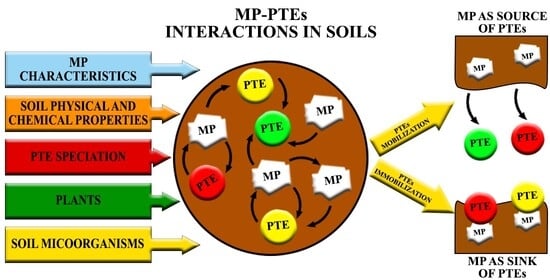
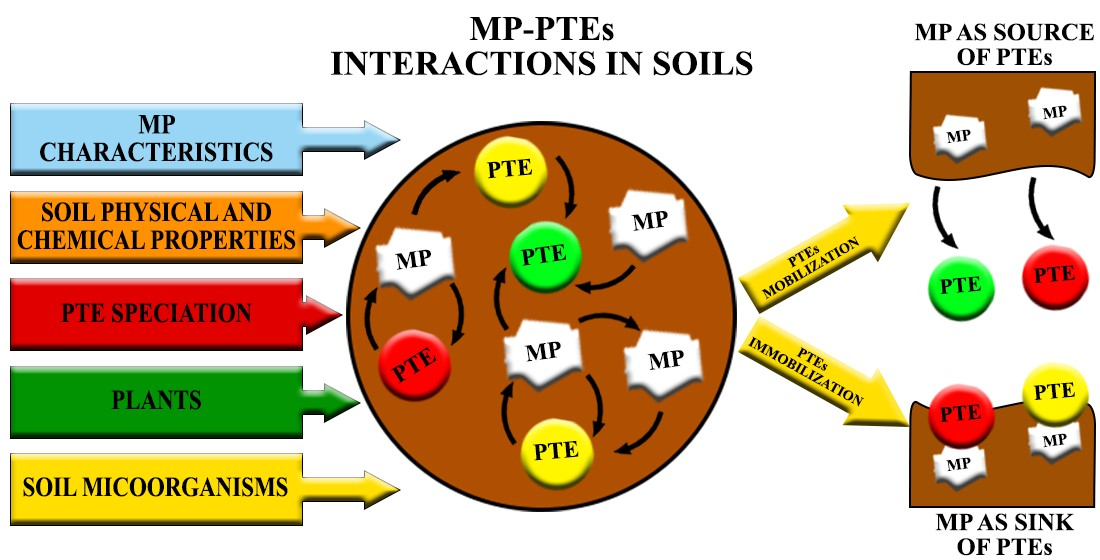
Graphical Abstract

1. Introduction

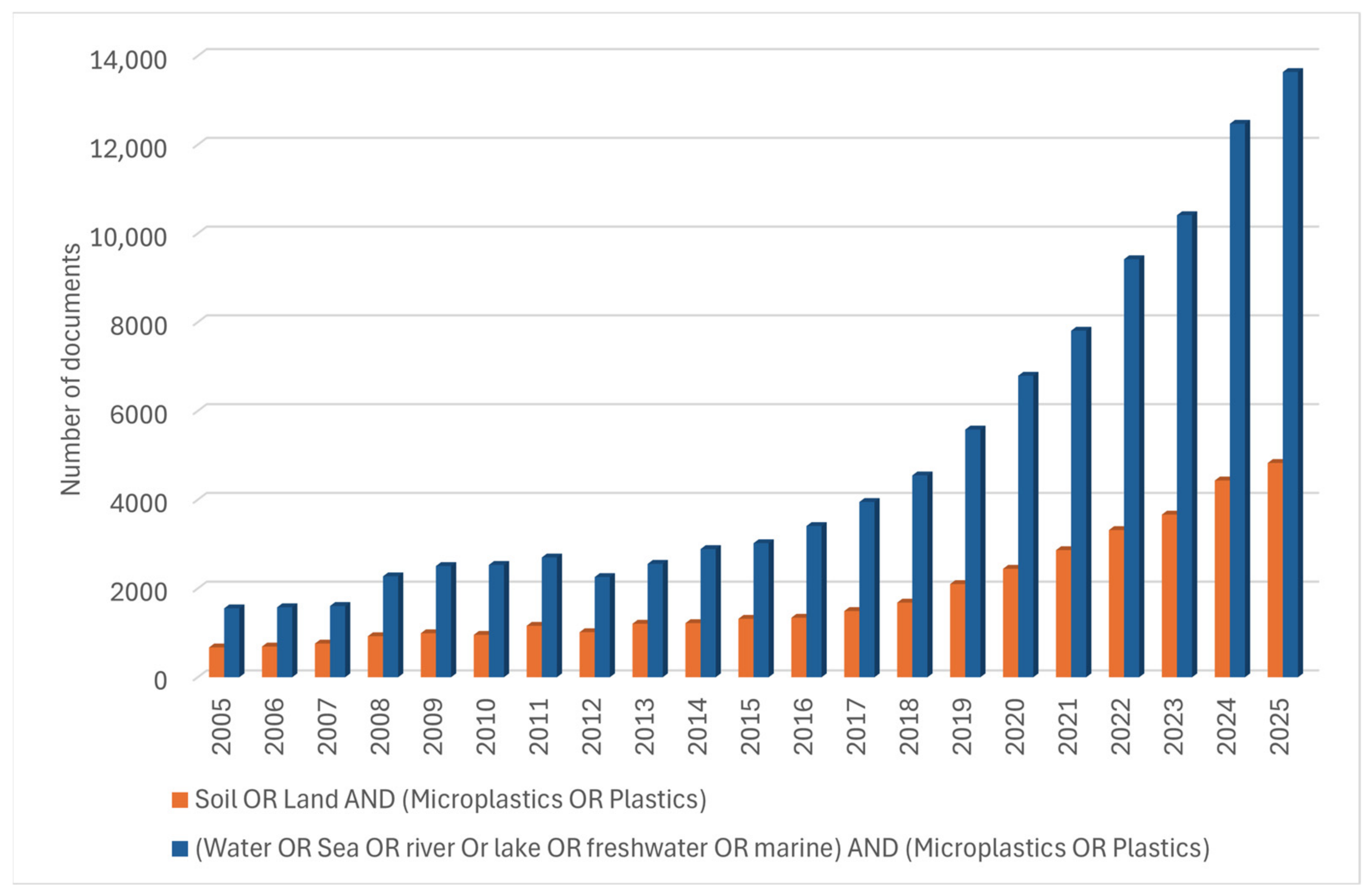
The amount of plastic waste in the environment has gradually increased in recent decades with the increase in global plastic production [1] and is estimated to continue growing in the future [2]. Plastic pollution nowadays affects different ecosystems and environmental compartments, from the hydrosphere to the lithosphere, atmosphere, and biosphere [3]. The short life cycle of plastic products, together with the long-term persistence of plastic materials, contributes to their accumulation in the environment. In 2024, about 460 million tons of plastic were produced, of which 20 million tons of plastic litter ended in the environment [4]. Once reaching an environmental compartment, plastics may undergo physical crushing, photodegradation, chemical aging, and (bio)degradation, causing fragmentation into progressively smaller particles. Fragments of different shapes and sizes may interact with the environment in a very different way compared to the original material. Microplastics (MPs, particles in the size range between 1 μm and 5 mm) and nanoplastics (NPs, 0.001 ÷ 1 μm) can be defined as heterogeneous mixtures of plastic fragments, fibers, spheroids, granules, pellets, flakes, or beads that are either intentionally manufactured in that size for specific uses (primary MPs-NPs) or generated by the degradation of pristine plastics (secondary MPs-NPs) [5,6]. They have a high mobility and can easily diffuse in all the environmental compartments, entering living organisms, where they may interfere with biochemical processes or be magnified along the food chain [7,8]. These properties are more pronounced in NPs than in MPs due to the smaller size of NPs. Additionally, NPs possess colloidal properties and a high surface reactivity [9]. Although approximately two-thirds of plastic waste is distributed over land [10], the majority of the scientific production over the past two decades has mainly focused on MP behavior in aquatic environments, and this discrepancy has widened in recent years (Figure 1), reaching a ratio of about 3:1 in 2025 in favor of publications dealing with MPs in aquatic environments.
Physical, chemical, and biological properties of soil are strongly impacted by MPs [11,12]. Nevertheless, the comprehensive understanding of MP interactions with soil abiotic and biotic components remains elusive. This depends on both the great complexity and heterogeneity of soil ecosystems and the huge variety of plastics and their alteration products. Several works pointed out that MPs can influence the mobility and availability of plant nutrients [13] and potentially toxic elements (PTEs) [14,15,16,17]. Some PTEs (e.g., Cu and Zn) are essential in trace amounts for biological functions, but they become toxic when accumulated beyond safe thresholds. Other PTEs (e.g., Cr, As, Cd, Hg, Pb) are harmful to living organisms, even at very low concentrations. Potentially toxic elements cause concern in the soil–plant system since they are non-degradable, potentially mobile and available to living organisms (depending on their speciation), and ubiquitous. They can already be present in the soil (as trace elements and/or as pollutants) or can reach the soil through different routes, including plastics that end up in the soil (as described in Section 5). Once in the soil, MPs may either promote the retention or the leaching of PTEs in soil. This dual behavior depends on the nature, degree of alteration, shape, size, and concentration of MPs, as well as on the properties of the soil itself [12]. Plastic additives (filming agents, catalysts, coloring agents, etc.) also play an important role in PTE mobilization and/or fixation. Indeed, such additives often contain or are PTEs themselves. Indeed, the interplay of these processes and their impact on soil properties and soil (micro)biota needs to be reviewed using a holistic approach.
This review aims at critically examining the possible impacts of MPs in the soil environment, with a particular focus on their influence on the mobility and availability of PTEs. After reviewing the main types of MPs spread in soils and their possible source, the effects of MPs on the chemical and physical properties of soil are addressed, particularly those modifications that impact the mobility of PTEs. Then, the potential of MPs to act as a sink or a source of PTEs is discussed, considering the interactions of both pristine and aged MPs with the different abiotic (i.e., minerals, soil organic matter, soil liquid phase, etc.) and biotic (plants and microorganisms) soil components. Exploring these processes as a whole is crucial for understanding the dynamics of PTEs in relation to the increasing diffusion of MP pollution in terrestrial environments, both considering MPs as a source of PTE pollution itself or as a new “artificial exogenous soil component” regulating PTE sorption and desorption processes in soil.

2. Review Methodology

The review was prepared following the guidelines set by the Preferred Reporting Items for Systematic Reviews and Meta-Analyses protocols (PRISMA-P) [18]. The PRISMA 2020 checklist was provided as Supplementary Material (File S1). The Scopus database was consulted, and three interrogations were done:
  • “Soil” AND (“Microplastics” OR “Nanoplastics”) AND (“heavy metals” OR “metalloids” OR “potentially toxic elements” OR “potentially toxic metals”): identification of papers dealing with the interaction of microplastics, potentially toxic elements, and soil;
  • “Plant” AND (“Microplastics” OR “Nanoplastics”) AND (“heavy metals” OR “metalloids” OR “potentially toxic elements” OR “potentially toxic metals”): identification of papers dealing with the interaction of microplastics, potentially toxic elements, and plants;
  • (“Microorganism” OR “Bacteria” OR “Fungi”) AND (“Microplastics” OR “Nanoplastics”) AND (“heavy metals” OR “metalloids” OR “potentially toxic elements” OR “potentially toxic metals”): identification of papers dealing with the interaction of microplastics, potentially toxic elements, and microorganisms.
No year limitation was set to consult the whole Scopus database. The number of works obtained for each interrogation was 725, 485, and 397, respectively, for a total of 1607 records. Some works were found in more than one interrogation, and a total of 549 duplicates were identified and excluded. Then, the titles and abstracts of the remaining 1058 works were checked to verify their pertinence (i.e., marine or aquatic plants were excluded, works on sediments and industrial muds were not considered, etc.). At the end of this process, 190 papers were identified as potentially relevant to this review. Seven papers were not found, and the final 183 papers were checked to further verify the pertinence of the works with the topic of the review. Among them, 64 works were considered off-topic, 25 records did not present an adequate methodology, and 24 papers recalled data of other papers already considered. Two further papers were added after manuscript revision. In conclusion, a total of 72 works that deal with the interaction among microplastics, potentially toxic elements, and soils, plants, and microorganisms were included in the present review. The different steps of the literature identification and selection process are summarized in the PRISMA 2020 flow chart, provided as Supplementary Material (File S2).

3. Origin and Type of (Micro)Plastics in Soil

Soil is considered a major sink for MPs. In a comprehensive study on 62 sites in 17 countries, MP concentrations up to 3573 × 103 particles kg−1 have been found in soil [19]. Büks and Kaupenjohan [20] have reviewed 23 studies on soil MP contamination, for a total of 223 sampling sites, and reported common global MP concentrations up to 13,000 items kg−1 and 4.5 mg kg−1 of dry soil.
Microplastics in soil originate from several sources. The origin of MPs is often site-specific and varies according to the land use (agricultural, industrial, mining soils, or other uses), climatic conditions, agricultural management, and waste management strategies [21]. For instance, in industrial soils, MPs deriving from atmospheric deposition and plastic waste disposal may prevail over other inputs. Differently, in agricultural soils, the primary source of MPs is plastic mulch films, followed by organic amendments with compost, biosolids, or sewage sludge, and irrigation with MP-contaminated waters [21,22]. Sources and types of MPs in agricultural soils are listed below in order of importance, from major sources to minor sources.
Mulch films, used worldwide to improve crop yields and water use efficiency, as well as to control weeds and pests [23], are mainly made of polyethylene (PE) and, to a lesser extent, polyvinyl chloride (PVC) [24,25,26]. PVC mulching films have been banned in several countries [27], whereas the use of PVC is still allowed for greenhouse covering [28]. Removal of mulch films after their use is often labor-intensive and inefficient, leading to the accumulation of large amounts of plastic residues in the soil. Such residues become fragile by photodegradation under ultraviolet radiation, so they break down and shatter, releasing MPs [29,30].
Soil organic amendments produced from biowaste, municipal waste, or sewage sludge are additional potential sources of MPs [27,31]. During the composting process, for example, the elevated temperature and the increased microbial activity may speed up the fragmentation process, increasing the MP content in compost and, consequently, in compost-amended soils [32].
Irrigation with untreated or partially treated municipal wastewater also contributes to soil MP contamination. This practice is unfortunately increasing in several countries due to water deficit caused by climate change and population growth [33]. Microplastics in wastewater may originate from the decomposition of synthetic textiles during washing, as well as from discharged cosmetics and personal care products. Their reduced size allows MPs to partially pass through treatment plants [34]. Agricultural field irrigation with groundwater, river, or lake water potentially contaminated with MPs and NPs can also contribute, albeit to a lesser extent, to the plastic pollution of soils [27].
Plastic waste is often deliberately disposed of on agricultural soils, including packaging materials (e.g., containers for pesticides and fertilizers), plant pot trays, crop-covering plastics, irrigation pipes, valves, and fittings. Many plastic wastes are accumulated near the roads, and surface runoff or wind can transport (micro)plastics into the neighboring soils. Illegal landfills may also contain large amounts of plastic debris and MPs that end up in the soil. Microplastics may also enter the soil through the abrasion of agricultural machinery tires, construction materials, and atmospheric depositions [35]. Indeed, light MPs can be easily transported by the wind from landfills and roads [25,36].
The shape of the MPs recorded in soil ranges from fragments and fibers (the most common) to pellets, spherules, sheets, lines, and films [30,37]. The most common types of polymers detected in soils are PE and polypropylene (PP), followed by polyamide (PA), polystyrene (PS), PVC, polyester (PES), and polyethylene terephthalate (PET) [21,30]. Bioplastics, i.e., bio-based or biodegradable or both bio-based and biodegradable plastics, can also be found in soil due to their increasing production and use in agriculture [38]. Polylactic acid (PLA) and polyhydroxyalkanoates (PHAs) are the main bioplastics used in agriculture [38]. Because of their easier degradability compared to conventional plastics, bioplastics may fragment more rapidly under environmental conditions, leading to the release of larger amounts of MPs and NPs into terrestrial ecosystems [39,40].
Table 1 provides a detailed list of the main sources of (micro)plastic contamination in soil. For each source, the type of polymers released and their potential PTE load are also reported.

4. Impact of MPs on Soil Properties Affecting PTE Dynamics

Microplastics in soil can alter its physical, chemical, and microbiological properties. However, the impacts may differ depending on the polymer type and shape, as well as soil characteristics [12]. Such modifications can, in turn, affect the behavior of other chemicals already present in soil, including soil contaminants. Among contaminants, PTEs are present almost ubiquitously in soils all around the world, constituting one of the major threats to soil health. In addition, certain types of plastics may contain these elements in their structure, becoming a potential source of PTEs themselves (Table 1). A detailed discussion on MPs as PTE sources as well as on their role in mobilizing/immobilizing PTEs will be provided in the following sections. This section only covers the impact of MPs on soil properties potentially affecting PTE behavior.
As for soil physical properties, MPs can influence the soil structure by destroying stable soil aggregates. In fact, from a mechanical point of view, MPs act as discontinuity points, allowing the fissuring and, consequently, the breaking of the aggregates [61]. This effect is particularly evident in the case of PA, PS, and microfibers of PES and polyacrylic acid (PAA), while PE does not affect soil aggregation. The stability of the aggregates is also influenced by MP shape. In fact, MPs in the form of films, fragments, or fibers may trigger the destruction of soil aggregates, while foams can stabilize the aggregates [62]. The destruction of the aggregates causes an increase in the percentage of macropores [61] with a consequent higher soil aeration [62]. Increased oxygenation can influence the redox conditions of the soil, changing the oxidation state of PTEs and speeding up the mineralization of organic matter, thus affecting PTE mobility. The presence of MPs also modifies the soil water content. Since many MPs are characterized by hydrophobic surfaces, soil water availability, transport, and holding capacity are altered as a result [63]. Indeed, MP fibers have an impact on water fluxes in soil and also affect soil microorganism health and biodiversity [62,64].
As far as soil chemical properties are concerned, MPs can modify soil pH according to the type of polymer, dose, size and shape, incubation time, and soil type [12]. In particular, PE, PS, and polytetrafluoroethylene (PTFE) can decrease soil pH, whereas PES and PLA have been reported to increase it [62,65]. A dose of 0.2–1% MP particles does not produce a significant change in soil pH [15,65], whereas significant effects have been observed with 2% of MPs [65]. Soil electrical conductivity (EC) may also be influenced by MPs [66]. For instance, Qi et al. [67] observed a significant EC reduction with increasing MP concentrations. In general, MPs reduce soil cation exchange capacity (CEC) due to their hydrophobicity and lower content of active functional groups and negative surfaces compared to soil colloids [15,68,69]. However, Wen et al. [70] observed a CEC increase from 46 to 58 cmol(+) kg−1 after the addition of 0.5–4% of MPs, with higher CEC values reached with PA, polyurethane (PU), and low-density polyethylene (LDPE). This different behavior could be attributed to a pretreatment of the MPs with microwaves, which may have altered their surface properties.
Microplastics indirectly affect both the quality and quantity of soil organic matter (SOM) and dissolved organic matter (DOM) by enhancing the activity of peroxidase and fluorescein diacetate hydrolase enzymes, which decompose high-molecular-weight compounds into more easily dissolved low-molecular-weight molecules. This also leads to an increase in dispersed organic nitrogen and phosphorus [71]. Microplastics affect soil respiration, interfering with the carbon biogeochemical cycle, increasing CO2 emissions, and, therefore, contributing to global climate change [12]. This is mainly due to the increase in soil aeration caused by the destruction of soil aggregates, which promotes the metabolism of aerobic bacteria, and to the presence of biodegradable polymers, which can be promptly decomposed by soil microorganisms.
Microplastics may also alter the biogeochemical cycle of sulfur, interfering with different enzymes such as sulfur dioxygenase, sulfur reductase, and adenosine-5′-phosphosulfate reductase [72]. All these changes in soil properties, in addition to endangering soil health and soil ecosystem services, can strongly affect PTE availability, as discussed in the next sections.

5. PTE-Containing Plastics

Some MPs can also modify soil properties in terms of PTE content because of their own PTE native load, up to concentrations of several thousand mg kg−1 (Table 1). Indeed, PTEs can enter the composition of plastics through three main pathways: (i) intentionally added within chemical compounds used as additives, (ii) as catalyst residues or side reaction products, and (iii) arising from metal-containing recycled materials used to produce new plastics [73]. Among these three routes of entry, the use of functional metal-based inorganic and organometallic additives has been historically the most relevant source of PTEs in plastic products [74]. Despite that regulatory directives have been adopted in many countries in the last decades to forbid or restrict metal-based additives, as in the case of the Toy Safety European Directive 2009/48/EC [75] and the Packaging and Packaging Waste Directive 94/62/EC [76], plastics produced in the past and spread everywhere over the planet continue to exert their potential toxicity [77,78].
Metal-based additives are (or were) used in the plastic industry for multiple functions (e.g., fillers, stabilizers, flame retardants, colorants, etc.); therefore, different metal species can be found in plastic products, depending on both the type of plastic and/or the function of the additive. Certain additives were used in almost all types of plastics, making metals (PTEs included) practically ubiquitous in plastics produced in the past. This is the case of metal pigments, which have been widely and extensively used as colorants for their excellent properties of thermal stability and chemical resistance. Along with non-hazardous metal-containing pigments, such as the white ZnS, ZnO, and TiO2 (the latter being the most used white pigment in the plastic industry), many other compounds (mainly oxides and sulfides) may contain PTEs, such as Cr(VI), Se, Cd, Hg, and Pb. Such pigments are mostly insoluble and can reach a concentration in plastic of 2.5% on a weight basis [73]. Cadmium sulfide (CdS) and selenide (CdSe) are solid inorganic pigments used as yellow and red colorants, respectively. Among Cr(VI) compounds, lead chromate (PbCrO4) is another well-known yellow pigment, while lead sulfate (PbSO4), lead molybdate (PbMoO4), and mercury sulfide (HgS) were used for red. Other metal-based additives can have more specific applications, sometimes being used for tailoring specific types of plastics for particular uses. For instance, the soluble organic compound Co(II) diacetate was employed mainly as a catalyst but also as a blue pigment, specifically for PET products. Cadmium, Pb, and Sn inorganic and organometallic compounds have been extensively used as heat and light stabilizers in the PVC industry, while the liquid As compound 10,10′-oxybisphenoxarsine (C24H16As2O3) and the tributyltin ((C4H9)3Sn) were used in PVC and foamed PU with a biocide function [73].
Potentially toxic elements may also occur in plastics as residues of catalysts employed in the productive process. For instance, Cr can derive from chromium(VI) trioxide (CrO3) used for PE production, while organometallic forms of Hg (e.g., phenylmercury compounds) and Sn (e.g., dibutyltin dilaurate) are used as catalysts to produce PU.
Based on the data collected in previous review works [73,79], it can be summarized that the utmost and widespread contribution to PTE content in plastics is attributable to inorganic pigments, in a concentration range of 100–50,000 mg kg−1, with Pb-Cr(VI) > Cd > Co > Hg. Additionally, the PTE contribution arising from the use of stabilizers may range from 10 to 25,000 mg kg−1, with minimal values for Sn compounds and maximum values for Pb-containing ones. As expected, the lowest contribution to PTE content in plastics is that of catalyst residues, with a range of 5–3000 mg kg−1, with Hg > Sn >> Cr(VI).

6. Microplastics as PTE Sinks

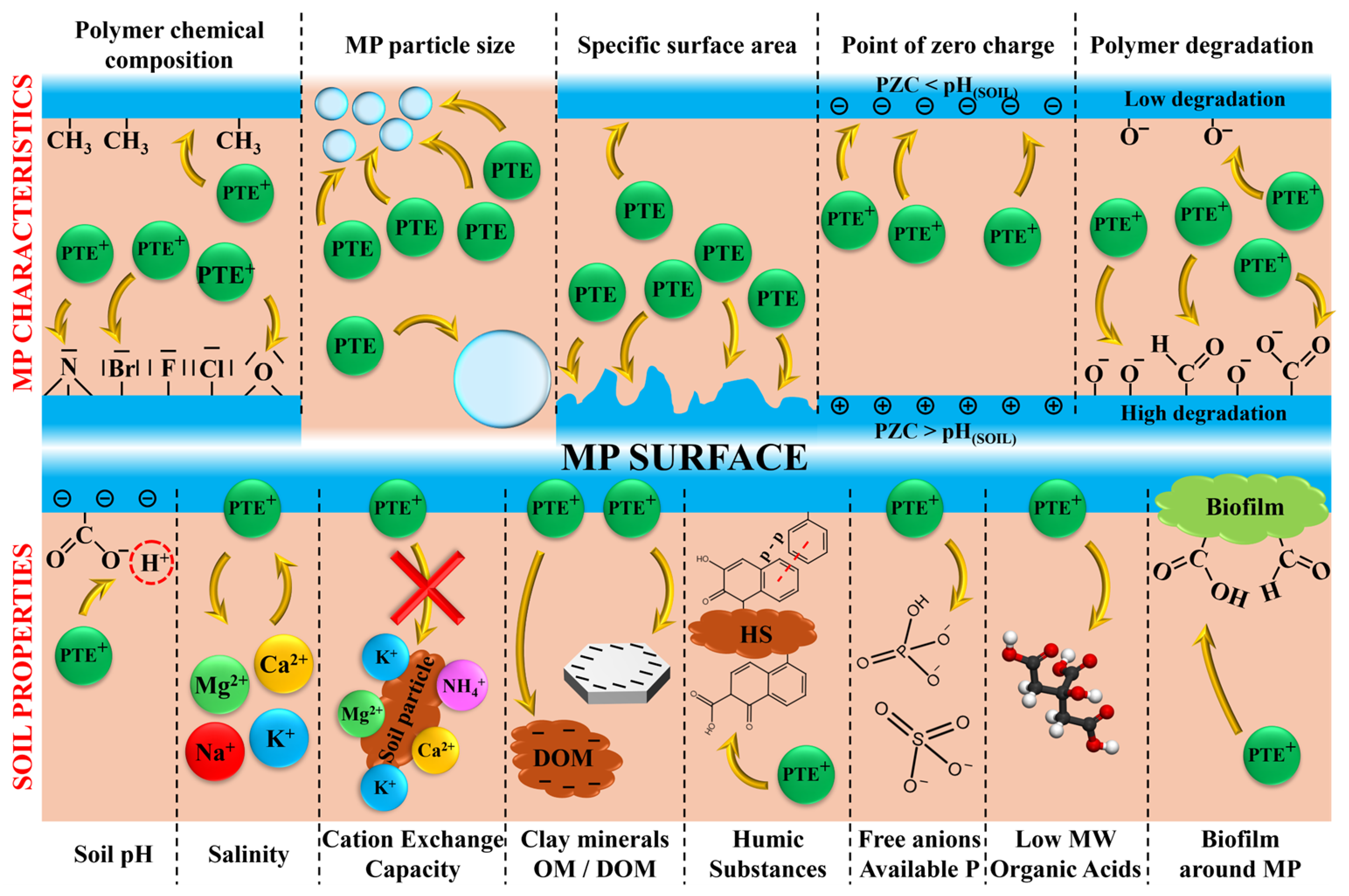
Once in the soil, plastic fragments and particles can interact with soil components, including free, adsorbed, complexed, and fixed PTEs. According to their characteristics, plastics, and in particular MPs and NPs, can act as sorbents for both metal nutrients and PTEs. The type of interaction depends mainly on MP characteristics (polymer type, specific surface area, and aging), as well as on PTEs and soil properties (soil physical and chemical conditions, metal species, biological activity, etc.), as graphically described in Figure 2.
Generally, pristine plastic polymers are considered hydrophobic materials, thus hindering the adsorption of metallic ions. However, the presence in the polymer structure of elements with high electronegativity (i.e., F, O, Cl, N, and Br) and polar functional groups (mainly amino, amide, carboxyl, carbonyl, alcoholic, phenolic groups) allows the formation of localized dipoles and charges (both positive and negative) along the polymer, making the plastic capable of interacting with metal ions [80]. Polyamide can efficiently adsorb PTEs in both cationic and anionic forms [81,82,83]. In fact, Cr(VI) adsorption is higher on PA than on PS and PE [81]. Similarly, Cd(II) was efficiently adsorbed onto PA, followed by PVC, PS, acrylonitrile butadiene styrene, and PET [83]. Yang et al. [84] have observed that, together with PA, polymethylmetacrilate (PMMA) also has a good adsorption capacity for Cu(II) in soils compared to PE, PS, PET, and polyvinyl siloxane (PVS). PTEs in cationic form can be complexed by the amide group of PA, while anions are usually adsorbed by means of electrostatic interactions with the positive part of the formed dipole or, in an acidic environment, by the protonated carbonyl group [81,82].
Even if MPs preferentially sorb cations, PTE anions can also be adsorbed using different mechanisms: (i) electrostatic interaction with other metal cations already bound to the polymer, (ii) formation of innersphere complexes, and (iii) formation of hydrogen bonds. Specifically, (i) Li et al. [81] observed that chromate adsorption onto PA increases with increasing the Cu(II)/Cr(VI) ratio, demonstrating a positive correlation between the amount of the cation complexed by the polymer and the anion adsorption; (ii) As(V), in the form of arsenate, can be chemically sorbed via the formation of an O-As bond on the surface of PE, and this process also causes a partial reduction in As(V) to As(III) [85], which, differently, can be sorbed on PS only via electrostatic interactions [86]; and (iii) Dong et al. [87] observed that arsenite is adsorbed onto PTFE by means of hydrogen bond formation.
Arsenic adsorption on MPs can also lead to co-precipitation of As-sorbed MPs with soil Fe-Mn oxides, thus reducing their mobility [16,17]. The presence of Cl in the polymer structure improves the sorption properties of plastics towards PTEs. In fact, Lin et al. [88] demonstrated that PVC can adsorb more Pb(II) than PE and PS. Zou et al. [89] also found that chlorinated polyethylene (CPE) adsorbs more Pb(II), Cu(II), and Zn(II) than PVC, LDPE, and HDPE. Compared to PA, in these polymers, the PTE sorption is mainly due to electrostatic interactions (van der Waals forces for PE, CPE, LDPE, HDPE, PVC, and cation–π interactions for PS) and not to complexation [88,90].
Polymers are characterized by different points of zero charge (PZC) or isoelectric points (IEP), and, therefore, the extent of the adsorption strongly depends on the soil pH. For instance, PVC and PE show an IEP of 6.59 and 6.44, respectively, while PA requires a pH of 3.6 to reach its IEP [91]. This can explain why PA can also complex cations in acid soils, whereas PVC and PE only adsorb PTEs via electrostatic interactions at higher pHs.
Microplastics can indirectly adsorb PTEs via interaction with soil humic substances (HSs). The latter can form complexes with metal ions using different oxygenated and sulfur-containing functional groups. Then, on their turn, HSs can be sorbed onto MPs, in particular onto the less crystalline portion of the polymer [92]. The formation of MP–HS–metal complexes sensibly reduces the PTE mobility in soil [90]. The formation of a microbial layer around MPs (plastisphere) also facilitates PTE adsorption due to several interactions of the functional groups of the biofilm molecules with PTEs [93].
Degradation processes occurring in soil may change MP chemical composition, leading, for example, to an increase in oxygenated functional groups in the polymer structure [94,95]. The formation of these oxygenated groups shifts the PZC to lower pH values, allowing the adsorption and complexation of PTE cations not only in mildly acidic, neutral, and alkaline environments but also under more acidic conditions [92]. In fact, Li et al. [81] demonstrated that aged PS and PE behave like pristine PA in the complexation of Cu(II) and subsequent adsorption of Cr(VI). Lang et al. [96] observed that aged PS can adsorb more Cd(II) not only via physical but also via chemical adsorption due to the presence of C-OH, C=O, C-O-C, and O-C=O groups. Yang et al. [84] found that aged PMMA can adsorb more Cu(II) than pristine PMMA due to an increase in oxygenated groups. The opposite occurred in the case of PA, due to a reduction in the carbonyl and carboxylic groups after aging. Together with the increase in oxygenated functional groups, aged MPs show a higher specific surface area than pristine plastics, with a consequent higher availability of sorption sites [92,93,97]. The particle sorption area also increases because of a reduction in MP size due to aging. An et al. [14], after sequential extractions from soil, found that Pb in the less mobile oxidizable fraction was inversely correlated with MP size. They also pointed out the direct correlation between MP concentration and exposure time in soil, as well as the concentration of Pb and Cd in the oxidizable fraction, while the same parameters were inversely correlated to Cu, Pb, and Cd concentrations in the more mobile fractions (i.e., acid soluble and reducible fractions). A change in PTE partitioning in the different soil fractions was also observed by Yu et al. [16]. They found that MPs can reduce PTE bioavailability by changing Cu, Cr, and Ni speciation from the exchangeable, carbonate-bound, and Fe-Mn oxide-bound fractions to the oxidizable organic matter-bound fraction. The same conclusions were achieved by Yu et al. [17] studying the MP effect on a soil subjected to multiple contaminations (Cu, Cr, Ni, Cd, As, and Zn). This reduction in bioavailability was observed in different soil aggregates (0.25–2.00 mm and 0.05–0.25 mm) and in non-aggregate silt and clay fractions. Despite the relevant effect that the degradation level of MPs has on the MP-PTE dynamics, this parameter is poorly studied, and the characterization of the polymer degradation is often not provided. In fact, only 16% of the papers reviewed in this work clearly define the degradation level of MPs studied, while another 11% consider it only for data discussion. Being the MP weathering grade one of the main parameters governing the MP–PTE–soil interaction, it should be more clearly defined in future studies. Spectroscopic methods, which allow the definition of the MP weathering grade (for instance, through the identification and quantification of specific functional groups, such as carbonyl or hydroxyl moieties), might be used for this purpose.
However, the potential positive effects of MPs in reducing PTE availability in soil by adsorption or complexation should be interpreted with caution. Indeed, if on the one hand, MPs can immobilize PTEs, on the other hand, they can facilitate the diffusion of PTEs, both in the environment and in the biosphere, acting as nano- or micrometric-sized vectors [98].
In terms of adsorption capacity, MPs can adsorb Cd to the same extent as soil colloidal particles: 0.2–0.7 mg g−1 onto MPs [99,100,101] compared to 0.1–0.6 mg g−1 in the case of humic acids and clay minerals [102,103,104]. In the case of Cu, Zn, and Pb, MPs show an adsorption capacity from half to one-tenth that of other soil colloids. In particular, the adsorption capacity of MPs for these metals is in the range 0.4–1.4 mg g−1 for Cu, 0.4–1.3 mg g−1 for Zn, and 1.5–1.8 mg g−1 for Pb [99,101]. The complexity of the soil system, the interactions between soil components, and the interconnected influences of the different physical and chemical parameters on PTE sorption processes make the interpretation of the role of MPs as PTE sorbents challenging. This was pointed out by several authors who tried to model the effect of MPs on soil properties and PTE mobility [14,16,17]. The increase in soil pH and CEC promotes the adsorption of PTEs on MPs. On the contrary, PTE adsorption is negatively correlated to DOM content, available phosphorus, and some biochemical and microbiological parameters (easily oxidable carbon and microbial biomass carbon). However, as already discussed in Section 4, MPs can influence soil properties, and their presence can cause a decrease in soil pH and negatively affect carbon- and nitrogen-degrading enzymes. This, in turn, may affect amorphous Fe-(hydro)oxides, DOM, and microbial biomass carbon, causing an increase in the mobility of PTEs [14,16,17]. On the contrary, other studies have observed an increase in soil pH after MP addition and at increasing exposure times, favoring the sorption of PTEs [15,67,105]. These different results demonstrate that even if MPs can behave as potential metal sinks, their sorption capacity and their effect on PTE mobility strongly depend on the type of soil in which they are dispersed. In addition, the presence of plants and the action of microorganisms, as well as the degree of alteration of the MPs, can further complicate the picture, as discussed in the next sections.

7. Microplastics as PTE Sources

As already described in Section 5, in certain types of plastics, metals and metal complexes are not chemically bound to the plastic polymer, but they are “encapsulated” in their structure [79,106]. In this case, the release of PTEs in the environment from MPs (in particular, from pristine plastics) is mainly due to the degradation process of the polymer with respect to the alteration of the metal compound. These processes may lead to an increase in the availability of such MP-trapped PTEs in soils. For example, Meng et al. [107] found that the bioavailability of Cr, Cu, Mn, Ni, Pb, and Zn increased after 60 days from the addition of metal-containing pristine PVC in soil. Also, Lang et al. [96] observed that the release of PTEs (with the exception of Cd) was favored by the natural aging of MPs in the soil. Environmental conditions and polymer properties are the main factors influencing the release of PTEs in soil [106], as schematized in Figure 2. Although solar irradiation and temperature are usually considered the most important factors of polymer degradation, they do not play a key role in the soil environment. In fact, UV light can only reach the soil surface, and only in the absence of vegetation or litter. Therefore, photodegradation can influence the degradation of plastic coverings or mulching films solely, resulting in the subsequent release of their contained PTEs [95]. In these cases, Pb is mainly released compared to other metals [108]. An important effect of temperature can be observed in the case of arson or controlled fire events, which causes the release of metals from the plastics [109,110]. In such cases, almost all the metals remain in the bottom ashes (hence, in the soil), except for Sb, which can volatilize in the atmosphere by 27–67% of its initial amount [111,112].
Soil pH has a strong effect on the weathering of plastics and the mobilization of PTEs. Acid environments trigger the leaching of metals from the surface of MPs. The release of Ca, Ba, Pb, Cd, and Zn from PVC increases moving from pH 9 to pH 5. In particular, the highest release of Sn, Cd, and Ba has been observed moving from pH 6 to pH 5 [108]. Metal mobilization is rapid in the first 24 h as a consequence of the release from the surface of the MP, and then it slows down with exposure time [73]. Such a process is also influenced by the shape and weathering status of MPs. In fact, weathered MPs show more microcracks and surface irregularities than pristine MPs, resulting in an increased surface area, enhancing PTE release [73]. Biodegradation is another important path for the weathering of MPs and the release of PTEs in soils. Some organisms, such as earthworms, are able to degrade MPs after ingestion due to both the acidic environment of their digestive apparatus and the presence of microbial consortia in their gut [97].
Soil microorganisms also play an important role in degrading plastics in soil, thus favoring the release of PTEs, as will be discussed in Section 8.2.
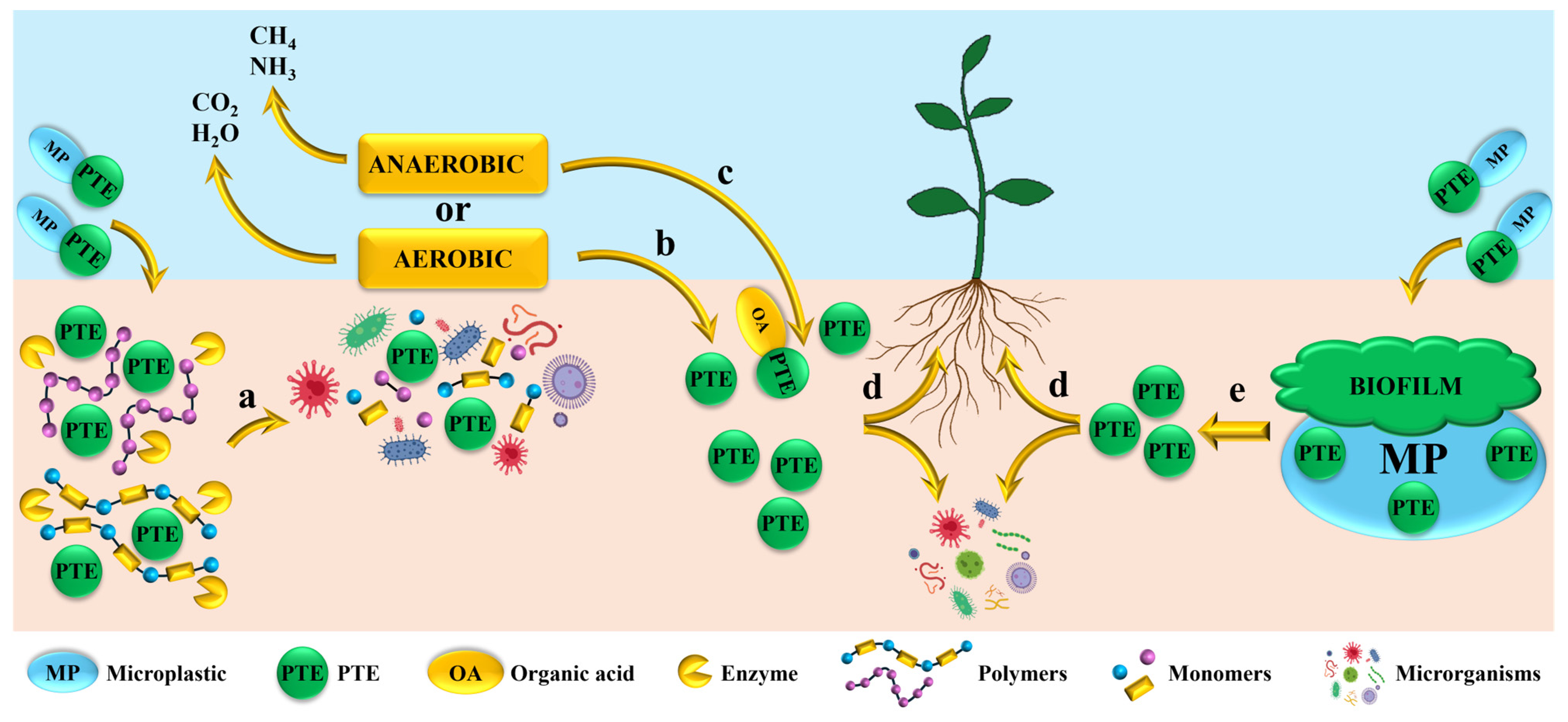
One of the main parameters influencing PTE mobilization from MPs is the grade of weathering of the MPs. The higher the weathering, the lower the metal desorption [106]. PTE release from MPs is, therefore, initially faster, and then it becomes slower the longer MPs age in soil. Soil pH still plays a key role in the release of PTEs from weathered MPs because, under acidic conditions, protons can displace the cations adsorbed on the sorbent surface. Soil salinity is another crucial factor affecting the release of metals from weathered MPs, again depending on the type of polymer. An increase in soil salinity, and, therefore, in EC, results in the release of higher amounts of PTEs in the soil. In fact, a high concentration of cations in soil competes with PTEs for the adsorption sites on the MP surfaces [92]. Yang et al. [84] observed that the effect of salinity on the desorption of Cu2+ from PA is less important than that from PMMA. The presence of free anions in the soil liquid phase, in particular Cl, HPO42−, NO3, and SO42−, enhances PTE desorption from MP surfaces [108], posing problems in the case of fertigation with phosphates and nitrates in MP-containing soils. The occurrence of low-molecular-weight organic acids (LMWOAs) enhances the release of metals from the MP surfaces. Citric, malic, and ascorbic acids can easily complex Sb(III) [109]; citric and oxalic acids trigger the release of Cu(II) from PA particles, while, in the case of PMMA, only oxalic acid has an evident effect on Cu(II) desorption [84]. Therefore, particular attention should be paid to plant root exudation since exuded organic acids can promote PTE release from MPs, which happens for metal mobilization from soil particles [113]. This peculiar aspect will be further discussed in Section 8.1. Soil organic matter and humic acids usually create co-polymers with MPs by forming π-π conjugations, thus increasing the sorption surface of the MPs and hindering the release of metals [83,106]. On the contrary, charged minerals, like phyllosilicates, may compete with PTEs for the adsorption sites on MPs [106]. In particular, this can occur for the octahedral layer of phyllosilicates, which can be positively charged and occupy the negatively charged adsorption sites of MPs, reducing the adsorption of PTEs in cationic form and causing an increase in their mobility. Finally, microorganisms can have a double effect on the adsorption–desorption capability of MPs. The extrusion of organic acids can improve the desorption of PTEs, while the formation of biofilms around the MP isolates the particles and limits the release of PTEs in the surrounding environment [106]. The role of microorganisms in influencing MP-PTE interactions will be discussed in Section 8.2.

8. Rhizosphere Processes Affecting the Fate of PTEs Associated with Microplastics

When dealing with soils, and especially cultivated soils, special attention must be paid to the so-called “rhizosphere”. This is the narrow region of soil that surrounds and is directly influenced by plant roots. It is a dynamic microenvironment where the chemical, physical, and biological processes are expedited due to the action of plant roots and microorganisms. For the sake of clarity, these two effects will be presented separately in the following sections. Nevertheless, they cannot be examined independently, as they belong to the same interconnected soil–plant system.

8.1. Plants

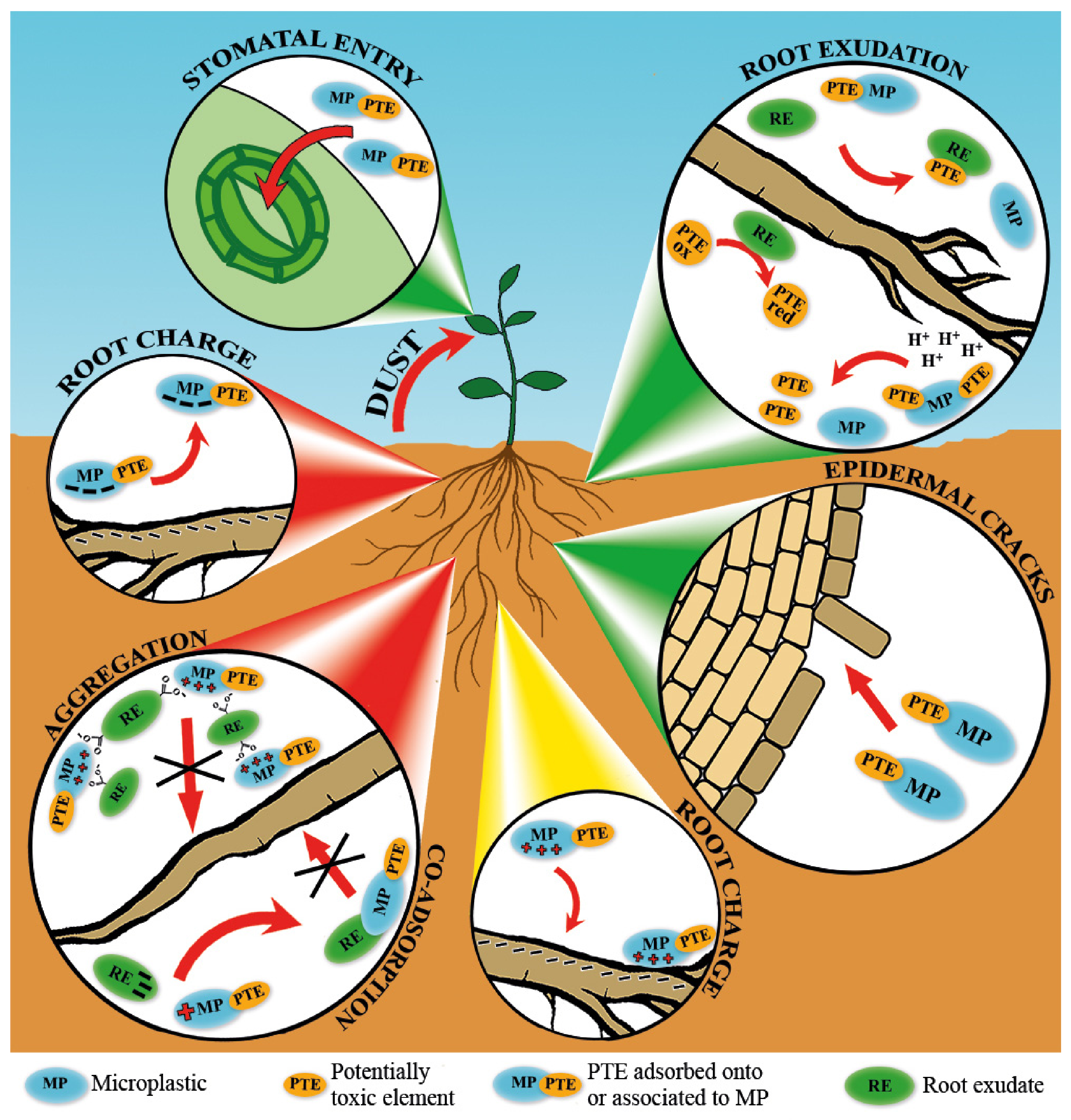
Plants can modify the environmental fate of MPs and associated PTEs (encapsulated, adsorbed, or simply coexisting), mainly through their root activity. They can (i) modulate the rhizodeposition [101], (ii) adsorb MPs and associated PTEs on the root surfaces [114], and (iii) take up MPs and associated metals and possibly translocate them to shoots [115,116] (Figure 3).
Some studies have revealed that the root exudation pattern shifts toward the release of LMWOAs when relevant concentrations of MPs are present in the rhizosphere. In a pot experiment on lettuce (Lactuca sativa L.) grown in a soil polluted with As (86.9 mg kg−1) and Cd (1.9 mg kg−1), Liu et al. [101] observed that the co-presence in soil of PE MPs at 0.1% (w/w) had no effect or even decreased the root exudation of LMWOAs compared to control plants (not treated with MPs). Conversely, the presence of higher concentrations of PE MPs (0.5% or 1%) in soil enhanced the release of LMWOAs, increasing the mobilization of Cd and As and their uptake by plants. After 60 days of growth, plants treated with 1.0% PE MPs accumulated in roots and shoots, respectively, 58% and 83% more As and 78% and 82% more Cd than control plants. The exudation of oxalic, tartaric, citric, malic, and acetic acids appeared positively correlated with As accumulation, while that of malonic, succinic, and fumaric acids was positively correlated with Cd accumulation [101]. In addition to promoting the uptake of mineral nutrients by plants, root exudates can facilitate the desorption of PTEs retained on MP surfaces and on other adsorption sites. Recently, Abbasi et al. [98] demonstrated that a mixture of LMWOAs (oxalic, citric, and malic acids) and sugars (maltose, sucrose, glucose, and fructose), simulating the composition of wheat root exudates, can desorb up to 34% Pb, 23% Cd, and 15% Zn from PET MPs previously loaded with 0.003, 8.42, and 11.37 µg g−1 of Pb, Cd, and Zn, respectively. It is well established that the cocktail of organic acids exuded by roots mobilizes metals in the rhizosphere by a combination of metal complexation, reduction, and soil acidification [117,118].
A potential role of root exudates in increasing PTE immobilization by adsorption on MP surfaces should also be considered. Indeed, similarly to what was observed for the natural organic matter, root exudates may be sorbed on MP surfaces and then promote the co-adsorption of metals [119]. In some cases, root exudates may promote the aggregation of MPs in the rhizosphere and, consequently, hinder the uptake by roots of MPs and their associated metals. In a hydroponic experiment, Sun et al. [120] observed a significant alteration of rhizodeposition of Arabidopsis thaliana in the presence of positively charged PS NPs. They measured a 2.6-fold increase in oxalate exudation when plants were exposed to 50 µg ml−1 PS NPs. This was explained as a plant defense response, since oxalate promotes the aggregation of positively charged MPs and hinders their entry into plant cells [120,121].
The surface charge of MPs also influences their adsorption on root surfaces, with consequences for metal uptake by plants. Both root exudates and cell walls possess an overall negative charge. As a result, positively charged MPs can be electrostatically attracted by root exudates and form a hydrophobic film adhering to the rhizodermis, which hampers the root absorption of water, nutrients, and PTEs [120,121,122]. On the other hand, negatively charged MPs escape the attraction exerted by root exudates and the rhizodermis cell wall and, if smaller than 2 µm, they might move through the apoplast to the stele; otherwise, they are simply repelled by roots [120,121].
Microplastics can enhance the absorption of PTEs by plants and, in some cases, their translocation to leaves, depending on their concentration and particle size. In a pot experiment on lettuce, two different concentrations (100 and 1000 mg kg−1) of PS NPs (100 nm in size) or PS MPs (100 μm in size) were tested in a soil contaminated with PTEs [116]. After 60 days of plant growth, the treatment with PS NPs at 1000 mg kg−1 caused the highest accumulation of Pb, Cd, Cu, and Zn in roots, whereas PS MPs at 100 mg kg−1 did not affect the accumulation of PTEs in roots compared to control plants (not treated with MPs or NPs). All treatments increased Cd translocation to the leaves, while PS NPs at 100 mg kg−1 and PS MPs at 1000 mg kg−1 also increased Pb translocation [116]. In another study, Wang et al. [69] found that by increasing the concentration of PE MPs from 0.1% to 1% and 10% (w/w) in a Cd-polluted soil (0.5 ÷ 4.4 mg kg−1 Cd), the accumulation of Cd in lettuce roots and leaves increased progressively to a maximum of 60%.
Several mechanisms may explain the enhanced accumulation of PTEs in plants exposed to MPs. Plastic particles smaller than 2 µm can enter the roots through the so-called “crack-entry mode”, which is commonly used by several pathogens as a route of infection [115]. Nanoplastics (between 1 nm and 1 µm in size) and smaller MPs (between 1 and 2 µm) can pass through the epidermal cracks located at the emergence sites of the lateral roots, which correspond to discontinuity points of the Casparian band, and reach the xylem vessels via the apoplastic pathway until they are translocated to shoots [115]. Endocytosis and stomatal entry are additional mechanisms of MP uptake by plants [114,123]. Only NPs smaller than 100 nm can enter the cells through endocytosis, due to the size of endocytosis vesicles [114]. In contrast, both NPs and MPs can enter through the stomata, since the size of stomatal openings is on the order of a few tens of microns. If MPs act as carriers of PTEs (i.e., by entrapment or adsorption of metals), their uptake will also facilitate the absorption and translocation of PTEs by plants. The size of plastic particles plays a key role in determining the risk of exposure to PTEs for plants and other living organisms. In fact, NPs, due to their smaller size and higher surface reactivity, can more easily penetrate the biological membranes and release PTEs (or other pollutants), posing a greater risk of toxicity to living organisms than MPs [9]. Additionally, MPs and NPs may damage the cell structures and facilitate the passive transport of metals through the cell membranes or facilitate the active uptake of metals by promoting the biosynthesis of PTE transporters, modulating the plant hormonal pool and the signal transduction system [116].
The accumulation of MPs in edible plant organs can lead to their transfer (and, potentially, of the PTEs they contain) to humans through the direct ingestion of fruit and vegetables or through the food chain (by the consumption of meat from farm animals that feed on contaminated plants). Although bioconcentration and biomagnification of MPs along the food chain are highly plausible, there are still no robust studies demonstrating the extent of these phenomena, as other authors have also recently pointed out [9,124].
Sometimes, MPs do not affect or may even reduce the uptake of PTEs by plants. For instance, the accumulation of Pb in roots of mung bean (Vigna radiata L.) grown in soil containing Pb (20 or 40 µM) and PS MPs (4 mg kg−1) was 14–20% lower than that of plants grown in soil polluted only with Pb [122]. Naturally aged PE MPs added at 0.1% (w/w) to soil polluted with As (68 and 117 mg kg−1) reduced the accumulation of As both in the roots and shoots of lettuce (by 55% and 45%, respectively) [125]. The variety of responses observed depends on the interaction between several factors, such as the type, concentration, and size of MPs, the type of metal and its concentration, the soil properties, and the plant species.

8.2. Microorganisms

The rhizosphere, in addition to intense root activity, is also enriched with distinct microbial communities that actively interact with both the roots and soil particles [126], including MPs. These microbes include bacteria, fungi, archaea, and various protists that thrive in the nutrient-rich environment generated by plant root exudates. Indeed, roots exudate many different classes of organic compounds such as sugars, amino acids, and phenolic compounds that serve as substrates for microbial growth and activity [127]. In this complex “cocktail” of organic molecules, certain substrates can be selected by specific microbial populations capable of degrading MPs, which can then proliferate in this microenvironment [128]. The interactions occurring in soil are complex and multifaceted, influencing both MP degradation and the release and bioavailability of PTEs [65], as discussed in detail in the following sections.

8.2.1. Synergistic Interactions in Soil: The Role of Microbes in MP Biodegradation

Various microorganisms have established specialized mechanisms to transform complex synthetic polymeric materials into less harmful substances [129,130] (Figure 4). The biodegradation process is mainly divided into two pathways: aerobic and anaerobic biodegradation. Under aerobic conditions, enzymatic depolymerization followed by microbial assimilation may lead to partial or complete mineralization to CO2 and H2O, whereas anaerobic degradation in oxygen-limited microsites results in the production of methane (CH4), ammonia (NH3), organic acids, and reduced organic intermediates [131,132]. These processes are initiated by biodeterioration, in which extracellular enzymes (e.g., ureases and lipases) weaken polymer integrity, followed by biofragmentation through hydrolytic and oxidative reactions that introduce functional groups and free radicals into polymer chains [133,134]. Other key enzymes involved in these processes include proteases, hydrolases, esterases, laccases, peroxidases, and other types of oxidoreductases, which collectively depolymerize MPs into oligomers and monomers that can be assimilated as carbon and energy sources [128,134,135]. Progressive fragmentation increases MP surface area and reactivity, enhancing microbial colonization and accelerating degradation while simultaneously increasing the density of sorption sites for PTE ions [79,136]. Additionally, microorganisms can assimilate MP monomers as carbon sources for energy production through mineralization processes [137].
Biofilm formation on MP surfaces represents a critical amplification mechanism for these synergistic interactions. Biofilms create structured microhabitats that aggregate diverse microbial taxa, protect cells from environmental stress, and retain nutrients and PTEs within the extracellular polymeric substance (EPS) matrix [138,139,140]. Within these biofilm-associated microenvironments, microbial metabolism generates organic acids (e.g., citric, oxalic, and malic acids) that locally reduce pH and chelate metal ions, thereby increasing metal solubility and bioavailability [110,141,142]. Such localized geochemical shifts can promote desorption of PTEs from both soil minerals and MP surfaces, enhancing their mobility and ecological exposure [14,136].
Importantly, these synergistic microbe–MP–PTE interactions are particularly relevant in soil and rhizosphere environments, where heterogeneous redox conditions and high microbial diversity prevail. Biofilm-mediated MP degradation can thus act as a dynamic interface linking polymer transformation with PTE redistribution, potentially increasing plant and microbial uptake of metals, even when total soil metal concentrations remain unchanged [143,144]. This highlights the need to consider microbial cooperation, enzymatic diversity, and biofilm-driven microenvironments when assessing the environmental risks of MP biodegradation and its implications for PTE contamination in soils.

8.2.2. Bacteria and Fungi in MP Decomposition

The mobilization of PTEs associated with MPs in soil is strongly related to MP biodegradation and, therefore, to the action of soil microorganisms, especially bacteria and fungi, capable of breaking the MP polymers.
Among the microbial agents involved in MP degradation, bacteria play a pivotal role due to their resilience and ability to metabolize various substrates. Within the Firmicutes phylum, species such as Bacillus cereus, Alcaligenes faecalis, Bacillus sonorensis, Staphylococcus epidermidis, Burkholderia vietnamensis, Rhodococcus ruber, and Bacillus flexus have been shown to effectively degrade PET and PS. In a field-based mangrove study, Auta et al. [145] reported microbial degradation of PET and PS microplastics over 90 days, with weight losses of 16.4–18% for PET and 15–19% for PS, depending on treatment conditions. Degradation rates reached ~0.0022 day−1 and were strongly correlated with microbial population dynamics (R2 ≈ 0.83–0.87), highlighting the role of both indigenous and augmented microbial communities. Additionally, SOM dynamics during microplastic degradation reflect active microbial carbon utilization, as evidenced by functional group transformations, including the progressive increase in hydroxyl (–OH) groups, indicated by the enhanced FTIR absorption band at 3434 cm−1 in PBAT-derived microplastics, along with concurrent ester bond cleavage over 6 weeks. These changes, together with the development of surface cracks and oxidation, indicate ongoing biodegradation and enhanced surface reactivity, which may, in turn, influence PTE adsorption and release [146].
Moreover, the decrease in pH during biodegradation is primarily attributed to the accumulation of organic acids resulting from microbial metabolism [147]. This further promotes the oxidative or hydrolytic breakdown of ester or amide bonds in plastics [145], indirectly enhancing PTE mobility through pH-dependent desorption mechanisms [148]. Furthermore, members of the Proteobacteria phylum, particularly Klebsiella sp., have shown remarkable efficacy in degrading PVC under controlled conditions, achieving 19.6% weight loss and a 12–15% reduction in molecular weight over 90 days. This process involves biofilm formation, surface oxidation (e.g., hydroxyl and C=C functional group formation), and enzymatic depolymerization mediated by oxidative enzymes, such as catalase–peroxidase, highlighting an effective pathway for bacterial transformation of recalcitrant polymers [149].
Fungi also play a key role in MP biodegradation. Within the Ascomycota phylum, fungi, such as Aspergillus niger and Aspergillus fumigatus, have demonstrated high degradation efficiency, with reported weight losses of 71% and 53%, respectively, for PP, and an overall range of 29–71% across fungal taxa, highlighting substantial variability but consistently higher performance compared to bacterial systems [150]. It is established that fungal hyphae secrete extracellular enzymes that hydrolyze polymers, facilitating the degradation and assimilation of plastic materials [151]. Furthermore, these fungi synthesize lignocellulosic enzymes, such as laccases, peroxidases, and esterases, making them promising candidates for bioremediation [152]. Earlier research by Osman et al. [153] showed that Aspergillus sp., belonging to the Ascomycota phylum, improved PU degradation efficiency, achieving 15–20% weight loss over 28 days, accompanied by a progressive increase in esterase enzyme activity (up to 2.7 μM min−1 mg−1). Spectroscopic evidence (e.g., reduction in ester-related FTIR peaks) and morphological changes, such as surface pits and cracks, confirm that PU degradation proceeds via enzymatic hydrolysis of ester linkages, further supported by the formation of a calcium complex indicative of esterase-mediated activity.
Several other Ascomycota species, including Fusarium oxysporum, Fusarium falciforme, and Purpureocillium lilacinum, have demonstrated the ability to utilize PE as a carbon source. Biodegradation processes were associated with progressive acidification (pH decreasing to 3.6 within 30 days) and the formation of oxidized functional groups (e.g., carbonyl and hydroxyl), indicating oxidative pathways targeting polymer chains. These chemical changes, together with pronounced surface alterations, such as pits, furrows, swellings, and partial exfoliation, confirm that fungal degradation of PE involves initial oxidation followed by structural disintegration and partial mineralization [154].
In soil systems, mycorrhizal fungi play a critical role in the rhizosphere by restructuring soil architecture, enhancing water retention, and increasing microbial diversity [155,156]. Their extensive hyphal networks expand reactive surfaces for MP–soil interactions and can influence the redistribution and uptake of PTEs released during MP biodegradation, potentially increasing plant and microbial exposure to PTEs [144,157]. This association benefits plants by improving the uptake of essential nutrients; however, it may also facilitate the release and uptake of PTEs from degraded MPs, which is detrimental to both plants and fungi [156].
Despite the demonstrated ability of specific microbial taxa to degrade MPs, their utilization as carbon sources remains constrained by the intrinsic recalcitrance of polymer structures. As highlighted by Yaghoubi et al. [158], although MPs are carbon-rich materials, their physicochemical properties prevent them from functioning analogously to natural SOM. Consequently, microbial communities often exhibit a preference for more labile carbon substrates when available, which may limit the direct assimilation of MP-derived carbon. Furthermore, biodegradation is frequently mediated through co-metabolic processes, whereby microorganisms utilize easily degradable organic carbon while simultaneously transforming MP polymers via non-specific enzymatic activity [159]. This mechanism helps explain why polymer degradation can occur, even when MPs are not the primary carbon source. Additionally, intermediate degradation products may be further metabolized by other microbial groups, indicating that MP biodegradation is not a single-organism process but rather a community-driven, multi-step transformation within the soil food web [158].
From a trophic transfer perspective, microorganisms do more than just degrade MPs; they can also influence how these particles move through the soil–plant system. MPs may accumulate in lower trophic levels after environmental exposure, but current evidence suggests that their transfer to higher trophic levels is limited and does not consistently lead to biomagnification, especially when particle size prevents movement beyond the digestive tract [160,161]. This is mainly due to biological barriers, such as epithelial and cellular boundaries, which restrict the uptake and internal distribution of MPs, particularly larger particles [160,162]. In this framework, microbial activity acts as an important modifying factor. By changing particle size, surface properties, and aggregation state, microorganisms can affect how easily MPs are ingested and retained by soil organisms, thereby influencing early-stage bioaccumulation [160,163]. However, these changes do not necessarily provide a greater transfer along the food chain, as physical and physiological constraints still play a dominant role, making MPs behave differently from typical bioaccumulative contaminants [160,163]. Overall, microbial processes mainly regulate the initial availability and accumulation of MPs, highlighting the need to consider both microbial transformations and biological barriers when assessing their environmental risks.

8.2.3. The Dark Side of Biodegradation: Assessing Risks of PTE Contamination in Soil

Much of the experimental evidence reported in the previous sections suggests that incomplete biodegradation of MPs, including materials labeled as biodegradable, has important implications for the accumulation, mobility, and bioavailability of PTEs in soil systems. In fact, during partial degradation, MPs often undergo fragmentation, surface oxidation, and structural reorganization, leading to increased surface area, altered surface charge, and the formation of new functional groups [164]. These changes can enhance the capacity of MPs to adsorb PTEs, effectively concentrating them at the plastic–soil interface [136,164,165]. As a result, MPs may function not only as passive contaminants but also as dynamic vectors that redistribute metals between solid phases and the soil solution, potentially increasing the fraction of metals that are environmentally mobile or biologically accessible.
Biodegradable MPs appear to pose distinct risks in this context. Several studies indicate that polymers such as PBAT and PLA exhibit stronger and more variable metal sorption–desorption behavior during degradation compared with conventional, non-degradable plastics [146,164]. Incompletely degraded bioplastics can temporarily sequester PTEs on newly generated heterogeneous surfaces, followed by their gradual release as degradation proceeds or environmental conditions change. This pulsed retention–release behavior may increase PTE bioavailability without changing total soil metal concentrations, thereby elevating ecological and toxicological risks, particularly for plants and soil biota [14,166]. Evidence further suggests that aged or weathered biodegradable MPs can enhance the migration and transformation of elements, such as As, by modifying PTE speciation and partitioning within soil matrices [167].
In parallel, incomplete MP biodegradation can indirectly influence metal behavior through its effects on soil microbial communities and microenvironments. MPs provide novel colonization surfaces for microorganisms, promoting biofilm formation and localized changes in pH, redox conditions, and ligand production, all of which can affect PTE cycling and stabilization pathways [129,168,169]. Such microbially mediated processes may further increase the mobility or bioavailability of PTEs, reinforcing the coupling between MP degradation dynamics and PTE contamination. Collectively, current evidence indicates that incomplete MP biodegradation, particularly of biodegradable plastics, can exacerbate PTE contamination by enhancing metal accumulation on plastic surfaces and facilitating subsequent remobilization. This underscores the need for risk assessments that move beyond total PTE concentrations and explicitly consider PTE speciation, bioavailable fractions, and time-dependent interactions between MPs, soil chemistry, and microbial processes [136,164,170].

9. Conclusions and Future Perspectives

The presence of MPs in soil can affect the mobility and availability of PTEs. Indeed, MPs can influence soil physicochemical properties, plant physiological processes, and microbial activity, thus affecting PTE dynamics in soil. Moreover, once reaching the soil, MP characteristics can be altered due to physical, chemical, and biological degradation, modifying their interaction with PTEs.
The complexity and heterogeneity of the soil environment make the identification and definition of all the variables influencing MP-PTE interactions very challenging. The answer to the question if MPs are a source or a sink for PTEs in the soil system is, therefore, not straightforward. Microplastics can act either as sinks or sources of PTEs, depending on the type, size, and characteristics of the MP (whether containing or adsorbing PTEs) and soil conditions (including plants and microorganisms), with a behavior similar to that of SOM and DOM.
Primary unaltered MPs cannot strictly interact with PTEs due to their hydrophobicity but can indirectly influence the mobility of PTEs by modifying soil physical and chemical properties. The alteration of pristine plastics is the process that mostly addresses MPs as a direct source of PTEs in soil by causing the release of included inorganic pigments and additives. On the other side, the biotic and abiotic degradation of MPs promotes the functionalization of plastic polymers with oxygenated moieties, which provide a higher number of sorption sites, comparable to those of soil colloids (both organic and inorganic). The formation of supramolecular complexes together with SOM, root exudates, and biofilms contributes to PTE immobilization in soil. In this view, MPs act as a sink, allowing the reduction in PTE mobility. Nevertheless, when we talk about MPs, we must consider that in most cases, they reach the environment (in this case, the soil) already altered (i.e., as secondary MPs). This may lead to the conclusion that they act mainly as a sink for PTEs in soil.
However, before considering MPs as a beneficial input for PTE stabilization in soil, other aspects should be taken into consideration. First of all, the MP alteration process in soil continues transforming MPs into NPs. The latter adsorb PTEs but may also act like PTE shuttles, increasing their mobility and bioavailability. In this view, MPs finally behave as a PTE source and, considering that once arrived in the soil, they continue to be altered by biotic and abiotic factors, their initial sink action will leave the place to the source one. This whole issue poses an important methodological question in the research dealing with MP-PTE interaction in soil. In fact, according to the reviewed literature, only 16% of the consulted works define the alteration level of the MPs. Future studies should, therefore, consider the influence of the alteration status of MPs on their behavior towards PTEs. Another open question is the role of plants in plastic degradation in the rhizosphere and the metabolic pathways of MPs and associated PTEs once taken up by plants. In fact, MPs could either favor or hinder PTE uptake by stimulating or inhibiting the physiological mechanisms underlying PTE transport and homeostasis.
As for microorganisms, understanding the interactions between MP biodegradation, microbial ecology, and PTE bioavailability will be the key to developing effective strategies and policies for mitigating plastic and PTE pollution in terrestrial ecosystems. Moreover, future studies should consider real-world conditions to investigate the long-term ecological impacts of MP degradation and the resulting byproducts, including released PTEs. The univariate approach should be abandoned in favor of a multivariate one, which allows for investigating the phenomenon considering correlations among different variables instead of single-factor effects. Special attention should be paid to the environmental implications of MPs originating from bioplastics, which often show more chemically altered surfaces compared to fossil fuel-based MPs and, therefore, may interact more easily with PTEs. Additionally, once adsorbed and accumulated, PTEs can be more easily and rapidly released due to the faster (bio)degradation of biopolymers in soil. Finally, despite the large amount of experimental data available in the literature, there is a lack of models on MP diffusion, degradation, and interaction with PTEs in soil. All the experimental data acquired can be the basis for the development of predictive models in order to define the environmental potential risks connected to MP presence in PTE-contaminated soils and for assessing the role of MPs as a PTE sink or source in specific soil conditions.

Supplementary Materials

The following supporting information can be downloaded at: https://www.mdpi.com/article/10.3390/microplastics5020096/s1, File S1: PRISMA_2020_checklist; File S2: PRISMA Flow chart.

Author Contributions

Conceptualization, I.A., C.E.G. and R.T.; formal analysis, I.A.; investigation, I.A., C.E.G., M.Y.K., C.P. and F.S.; resources, M.S. and R.T.; writing—original draft preparation, I.A., C.E.G., M.Y.K., C.P., F.S. and R.T.; writing—review and editing, I.A., C.E.G., C.C., M.S. and R.T.; visualization, I.A. and C.E.G.; supervision, R.T.; project administration, I.A., C.E.G. and R.T.; funding acquisition, M.S. All authors have read and agreed to the published version of the manuscript.

Funding

This study was carried out within the Agritech National Research Center and received funding from the European Union Next-GenerationEU (PIANO NAZIONALE DI RIPRESA E RESILIENZA (PNRR)—MISSIONE 4 COMPONENTE 2, INVESTIMENTO 1.4—D.D. 1032 17/06/2022, CN00000022). This manuscript reflects only the authors’ views and opinions; neither the European Union nor the European Commission can be considered responsible for them.

Institutional Review Board Statement

Not applicable.

Data Availability Statement

No new data were created or analyzed in this study. Data sharing is not applicable to this article.

Conflicts of Interest

The authors declare no conflict of interest.

References

  1. Brandon, J.A.; Jones, W.; Ohman, M.D. Multidecadal increase in plastic particles in coastal ocean sediments. Sci. Adv. 2019, 5, eaax0587. [Google Scholar] [CrossRef]
  2. Geyer, R.; Jambeck, J.R.; Law, K.L. Production, use and fate of all plastics ever made. Sci. Adv. 2017, 3, e1700782. [Google Scholar] [CrossRef] [PubMed]
  3. Pilapitiya, P.G.C.N.T.; Ratnayake, A.S. The world of plastic waste: A review. Clean. Mater. 2024, 11, 100220. [Google Scholar] [CrossRef]
  4. IUCN. Plastic Pollution, Issues Brief May 2024; International Union for Conservation of Nature: Gland, Switzerland, 2024; Available online: https://iucn.org/resources/iucn-issues-briefs (accessed on 24 April 2026).
  5. EFSA. Microplastics and Nanoplastics in Food. 2026. Available online: https://www.efsa.europa.eu/en/topics/microplastics-and-nanoplastics-food (accessed on 24 April 2026).
  6. Hartmann, N.B.; Hüffer, T.; Thompson, R.C.; Hassellöv, M.; Verschoor, A.; Daugaard, A.E.; Rist, S.; Karlsson, T.; Brennholt, N.; Cole, M.; et al. Are we speaking the same language? Recommendations for a definition and categorization framework for plastic debris. Environ. Sci. Technol. 2019, 53, 1039–1047. [Google Scholar] [CrossRef]
  7. Amereh, F.; Babaei, M.; Eslami, A.; Fazelipour, S.; Rafiee, M. The emerging risk of exposure to nano(micro)plastics on endocrine disturbance and reproductive toxicity: From a hypothetical scenario to a global public health challenge. Environ. Pollut. 2020, 261, 114158. [Google Scholar] [CrossRef] [PubMed]
  8. Habumugisha, T.; Zhang, Z.; Uwizewe, C.; Yan, C.; Ndayishimiye, J.C.; Rehman, A.; Zhang, X. Toxicological review of micro- and nano-plastics in aquatic environments: Risks to ecosystems, food web dynamics and human health. Ecotoxicol. Environ. Saf. 2024, 278, 116426. [Google Scholar] [CrossRef] [PubMed]
  9. Jani, V.; Wu, S. Nanoplastics (NPs): Environmental Presence, Ecological Implications, and Mitigation Approaches. Microplastics 2025, 4, 48. [Google Scholar] [CrossRef]
  10. Elsner, M.; Atkinson, G.; Zahidi, S. Global Risks Report 2025, 20th ed.; World Economic Forum: Geneva, Switzerland, 2025. [Google Scholar]
  11. Bouaicha, O.; Mimmo, T.; Tiziani, R.; Praeg, N.; Polidori, C.; Lucini, L.; Vigani, G.; Terzano, R.; Sanchez-Hernandez, J.C.; Illmer, P.; et al. Microplastics make their way into the soil and rhizosphere: A review of the ecological consequences. Rhizosphere 2022, 22, 100542. [Google Scholar] [CrossRef]
  12. Wang, F.; Qang, Q.; Adams, C.A.; Sun, Y.; Zhang, S. Effects of microplastics on soil properties: Current knowledge and future perspectives. J. Hazard. Mater. 2022, 424, 127531. [Google Scholar] [CrossRef]
  13. Wang, S.; Wang, W.; Rong, S.; Liu, G.; Li, Y.; Wang, X.; Liu, W. Key factors and mechanisms of microplastics’ effects on soil nitrogen transformation: A review. Soil Environ. Health 2024, 2, 100101. [Google Scholar] [CrossRef]
  14. An, Q.; Zhou, T.; Wen, C.; Yan, C. The effects of microplastics on heavy metals bioavailability in soils: A meta-analysis. J. Hazard. Mater. 2023, 460, 132369. [Google Scholar] [CrossRef]
  15. Wang, F.; Zhang, X.; Zhang, S.; Zhang, S.; Sun, Y. Interactions of microplastics and cadmium on plant growth and arbuscular mycorrhizal fungal communities in an agricultural soil. Chemosphere 2020, 254, 126791. [Google Scholar] [CrossRef]
  16. Yu, H.; Hou, J.; Dang, Q.; Cui, D.; Xi, B.; Tan, W. Decrease in bioavailability of soil heavy metals caused by the presence of microplastics varies across aggregate levels. J. Hazard. Mater. 2020, 395, 122690. [Google Scholar] [CrossRef]
  17. Yu, H.; Zhang, Z.; Zhang, Y.; Fan, P.; Xi, B.; Tan, W. Metal type and aggregate microenvironment govern the response sequence of speciation transformation of different heavy metals to microplastics in soil. Sci. Total Environ. 2021, 752, 141956. [Google Scholar] [CrossRef]
  18. Page, M.J.; McKenzie, J.E.; Bossuyt, P.M.; Boutron, I.; Hoffmann, T.C.; Mulrow, C.D.; Shamseer, L.; Tetzlaff, J.M.; Akl, E.A.; Brennan, S.E.; et al. The PRISMA 2020 statement: An updated guideline for reporting systematic reviews. BMJ 2021, 372, n71. [Google Scholar] [CrossRef] [PubMed]
  19. En-Nejmy, K.; EL Hayany, B.; Al-Alawi, M.; Jemo, M.; Hafidi, M.; El Fels, L. Microplastics in soil: A comprehensive review of occurrence, sources, fate, analytical techniques and potential impacts. Ecotoxicol. Environ. Saf. 2024, 288, 117332. [Google Scholar] [CrossRef]
  20. Büks, F.; Kaupenjohann, M. Global concentrations of microplastics in soils—A review. Soil 2020, 6, 649–662. [Google Scholar] [CrossRef]
  21. Sahai, H.; Anguilera del Real, A.M.; Alcayde, A.; Martínez Bueno, M.J.; Wang, C.; Hernando, M.D.; Fernández-Alba, A.R. Key insights into microplastic pollution in agricultural soils: A comprehensive review of worldwide trends, sources, distribution, characteristics and analytical approaches. TrAC Trends Anal. Chem. 2025, 185, 118176. [Google Scholar] [CrossRef]
  22. Fan, W.; Qiu, C.; Qu, Q.; Hu, X.; Mu, L.; Gao, Z.; Tang, X. Sources and identification of microplastics in soils. Soil Environ. Health 2023, 2, 100019. [Google Scholar] [CrossRef]
  23. Sun, D.; Li, H.; Wang, E.; He, W.; Hao, W.; Yan, C.; Li, Y.; Mei, X.; Zhang, Y.; Sun, Z.; et al. An overview of the use of plastic-film mulching in China to increase crop yield and water-use efficiency. Natl. Sci. Rev. 2020, 10, 1523–1526. [Google Scholar] [CrossRef]
  24. Liu, E.; Zhang, L.; Dong, W.; Yan, C. Biodegradable plastic mulch films in agriculture: Feasibility and challenges. Environ. Res. Lett. 2021, 16, 011004. [Google Scholar] [CrossRef]
  25. Tian, L.; Jinjin, C.; Ji, R.; Ma, Y.; Yu, X. Microplastics in agricultural soils: Sources, effects, and their fate. Curr. Opin. Environ. Sci. Health 2022, 25, 100311. [Google Scholar] [CrossRef]
  26. Yang, Y.; Li, Z.; Yan, C.; Chadwick, D.; Jones, D.L.; Liu, E.; Liu, Q.; Bai, R.; He, W. Kinetics of microplastic generation from different types of mulch films in agricultural soil. Sci. Total Environ. 2022, 814, 152572. [Google Scholar] [CrossRef]
  27. Bläsing, M.; Amelung, W. Plastics in soil: Analytical methods and possible sources. Sci. Total Environ. 2018, 612, 422–435. [Google Scholar] [CrossRef]
  28. Steinmetz, Z.; Wollmann, C.; Schaefer, M.; Buchmann, C.; David, J.; Tröger, J.; Muñoz, K.; Frör, O.; Schaumann, G.E. Plastic mulching in agriculture. Trading short-term agronomic benefits for long-term soil degradation? Sci. Total Environ. 2016, 550, 690–705. [Google Scholar] [CrossRef]
  29. Huang, Y.; Liu, Q.; Jia, W.; Yan, C.; Wang, J. Agricultural plastic mulching as a source of microplastics in the terrestrial environment. Environ. Pollut. 2020, 260, 114096. [Google Scholar] [CrossRef]
  30. Yang, L.; Zhang, Y.; Kang, S.; Wang, Z.; Wu, C. Microplastics in soil: A review on methods, occurrence, sources, and potential risk. Sci. Total Environ. 2021, 780, 146546. [Google Scholar] [CrossRef]
  31. Zubris, K.A.V.; Richards, B.K. Synthetic fibers as an indicator of land application of sludge. Environ. Pollut. 2005, 2, 201–211. [Google Scholar] [CrossRef]
  32. Braun, M.; Mail, M.; Heyse, R.; Amelung, W. Plastic in compost: Prevalence and potential input into agricultural and horticultural soils. Sci. Total Environ. 2021, 760, 143335. [Google Scholar] [CrossRef]
  33. UNESCO; UN-Water. United Nations World Water Development Report 2020: Water and Climate Change; UNESCO: Paris, France, 2020. [Google Scholar]
  34. De Falco, F.; Di Pace, E.; Cocca, M.; Avella, M. The contribution of washing processes of synthetic clothes to microplastic pollution. Sci. Rep. 2019, 9, 6633. [Google Scholar] [CrossRef]
  35. Weber, C.J. Plastics in soil description and surveys—Practical considerations and field guide. Front. Soil Sci. 2022, 2, 917490. [Google Scholar] [CrossRef]
  36. Sajjad, M.; Huang, Q.; Khan, S.; Khan, M.A.; Liu, Y.; Wang, J.; Lian, F.; Wang, Q.; Guo, G. Microplastics in the soil environment: A critical review. Environ. Technol. Innov. 2022, 27, 102408. [Google Scholar] [CrossRef]
  37. Xu, C.; Zhang, B.; Gu, C.; Shen, C.; Yin, S.; Aamir, M.; Li, F. Are we underestimating the sources of microplastic pollution in terrestrial environment? J. Hazard. Mater. 2020, 400, 123228. [Google Scholar] [CrossRef]
  38. European Bioplastics. Bioplastics Market Development Update 2024; European Bioplastics: Berlin, Germany, 2024; Available online: https://www.european-bioplastics.org/bioplastics-market-development-update-2024/ (accessed on 24 April 2026).
  39. Fei, J.; Bai, X.; Jiang, C.; Yin, X.; Ni, B.J. A state-of-the-art review of environmental behavior and potential risks of biodegradable microplastics in soil ecosystems: Comparison with conventional microplastics. Sci. Total Environ. 2024, 954, 176342. [Google Scholar] [CrossRef]
  40. Piyathilake, U.; Lin, C.; Bolan, N.; Bundschuh, J.; Rinklebe, J.; Herath, I. Exploring the hidden environmental pollution of microplastics derived from bioplastics: A review. Chemosphere 2024, 355, 141773. [Google Scholar] [CrossRef]
  41. Wang, Y.; Cui, W.; Duan, Z.; Qin, L.; Zhang, H.; Cheng, H.; Wang, L. Investigation of microplastic pollution on paddy fields in Xiangtan City, Southern China. Environ. Sci. Pollut. Res. 2022, 29, 81300–81307. [Google Scholar] [CrossRef]
  42. Reay, M.K.; Graf, M.; Murphy, M.; Li, G.; Yan, C.; Battacharya, M.; Osbahr, H.; Ma, J.; Chengtao, W.; Shi, X.; et al. Higher potential leaching of inorganic and organic additives from biodegradable compared to conventional agricultural plastic mulch film. J. Hazard. Mater. 2025, 488, 137147. [Google Scholar] [CrossRef]
  43. FAO. Assessment of Agricultural Plastics and Their Sustainability. A Call for Action; FAO: Rome, Italy, 2021. [Google Scholar] [CrossRef]
  44. Adhikari, K.; Pearce, C.I.; Sanguinet, K.A.; Bary, A.I.; Chowdhury, I.; Eggleston, I.; Xing, B.; Flury, M. Accumulation of microplastics in soil after long-term application of biosolids and atmospheric deposition. Sci. Total Environ. 2024, 912, 168883. [Google Scholar] [CrossRef]
  45. Crossman, J.; Hurley, R.R.; Futter, M.; Nizzetto, L. Transfer and transport of microplastics from biosolids to agricultural soils and the wider environment. Sci. Total Environ. 2020, 724, 138334. [Google Scholar] [CrossRef]
  46. Surendran, D.; Varghese, G.K.; Zafiu, C. Characterization and source apportionment of microplastics in Indian composts. Environ. Monit. Assess. 2024, 196, 5. [Google Scholar] [CrossRef]
  47. Weber, C.J.; Santowski, A.; Chifflard, P. Investigating the dispersal of macro- and microplastics on agricultural fields 30 years after sewage sludge application. Sci. Rep. 2022, 12, 6401. [Google Scholar] [CrossRef]
  48. Ziajahromi, S.; Neale, P.A.; Silveira, I.T.; Chua, A.; Leusch, F.D.L. An audit of microplastic abundance throughout three Australian wastewater treatment plants. Chemosphere 2021, 263, 128294. [Google Scholar] [CrossRef]
  49. Cydzik-Kwiatkowska, A.; Milojevic, N.; Jachimowicz, P. The fate of microplastic in sludge management systems. Sci. Total Environ. 2022, 848, 157466. [Google Scholar] [CrossRef]
  50. Li, X.; Mei, Q.; Chen, L.; Zhang, H.; Dong, B.; Dai, X.; He, C.; Zhou, J. Enhancement in adsorption potential of microplastics in sewage sludge for metal pollutants after the wastewater treatment process. Water Res. 2019, 157, 228–237. [Google Scholar] [CrossRef]
  51. Magni, S.; Binelli, A.; Pittura, L.; Avio, C.G.; Della Torre, C.; Parenti, C.C.; Gorbi, S.; Regoli, F. The fate of microplastics in an Italian wastewater treatment plant. Sci. Total Environ. 2019, 652, 602–610. [Google Scholar] [CrossRef]
  52. Wolff, S.; Kerpen, J.; Prediger, J.; Barkmann, L.; Müller, L. Determination of the microplastics emission in the effluent of a municipal waste water treatment plant using Raman microspectroscopy. Water Res. X 2019, 2, 100014. [Google Scholar] [CrossRef]
  53. Sarkar, D.J.; Sarkar, S.D.; Das, B.K.; Sahoo, B.K.; Das, A.; Nag, S.K.; Manna, R.K.; Behera, B.K.; Samanta, S. Occurrence, fate and removal of microplastics as heavy metal vector in natural wastewater treatment wetland system. Water Res. 2021, 192, 116853. [Google Scholar] [CrossRef]
  54. Johansson, G.; Fedje, K.K.; Modin, O.; Haeger-Eugensson, M.; Uhl, W.; Andersson-Sköld, Y.; Strömvall, A.-M. Removal and release of microplastics and other environmental pollutants during the start-up of bioretention filters treating stormwater. J. Hazard. Mater. 2024, 468, 133532. [Google Scholar] [CrossRef] [PubMed]
  55. Güney, B. Investigation of physical and chemical properties of particulate matter caused by vehicle tire wear. Int. J. Environ. Sci. Technol. 2024, 21, 1805–1816. [Google Scholar] [CrossRef]
  56. Yu, H.; Zhang, W.; Li, J.; Yang, J.; Yang, X.; Hai, C.; Wang, Y.; Yang, Y. Vertical distribution and multi-source pathways of microplastics in agricultural soils: A study of typical irrigation areas in the upper Yellow River basin. Environ. Pollut. 2025, 381, 126479. [Google Scholar] [CrossRef]
  57. Kaydi, N.; Jorfi, S.; Takdastan, A.; Haghighifard, N.J.; Khafaie, M.A. Morphological and chemical analysis of indoor airborne microplastics: Implications for human health in Ahvaz, Iran. Environ. Geochem. Health 2025, 47, 95. [Google Scholar] [CrossRef]
  58. Scarascia-Mugnozza, G.; Sica, C.; Russo, G. Plastic materials in European agriculture: Actual use and perspectives. J. Agric. Eng. 2011, 42, 15–28. [Google Scholar] [CrossRef]
  59. Katsumi, N.; Kusube, T.; Nagao, S.; Okochi, H. Accumulation of microcapsules derived from coated fertilizer in paddy fields. Chemosphere 2021, 267, 129185. [Google Scholar] [CrossRef]
  60. Isakov, V.; Vlasova, E.; Forer, V.; Kenny, J.; Lyulin, S. Analysis of slow-released fertilisers as a source of microplastics. Land 2025, 14, 38. [Google Scholar] [CrossRef]
  61. Zhang, S.; Han, B.; Sun, Y.; Wang, F. Microplastics influence the adsorption and desorption characteristics of Cd in an agricultural soil. J. Hazard. Mater. 2020, 388, 121775. [Google Scholar] [CrossRef]
  62. Lozano, Y.M.; Lehnert, T.; Linck, L.T.; Lehmann, A.; Rillig, M.C. Microplastics shape, polymer type, and concentration affect soil properties and plant biomass. Front. Plant Sci. 2021, 12, 616645. [Google Scholar] [CrossRef]
  63. de Souza Machado, A.; Lau, C.W.; Kloas, W.; Bergmann, J.; Bachelier, J.B.; Faltin, E.; Becker, R.; Gorlich, A.S.; Rillig, M.C. Microplastics can change soil properties and affect plant performance. Environ. Sci. Technol. 2019, 53, 6044–6052. [Google Scholar] [CrossRef]
  64. Zhang, G.S.; Liu, Y.F. The distribution of microplastics in soil aggregate fractions in southwestern China. Sci. Total Environ. 2018, 642, 12–20. [Google Scholar] [CrossRef]
  65. Feng, X.; Wang, Q.; Sun, Y.; Zhang, S.; Wang, F. Microplastics change soil properties, heavy metal availability and bacterial community in a Pb-Zn-contaminated soil. J. Hazard. Mater. 2022, 424, 127364. [Google Scholar] [CrossRef] [PubMed]
  66. Hanif, M.N.; Aijaz, N.; Azam, K.; Akhtar, M.; Laftah, W.A.; Babur, M.; Abbood, N.K.; Benitez, I.B. Impact of microplastics on soil (physical and chemical) properties, soil biological properties/soil biota, and response of plants to it: A review. Int. J. Environ. Sci. Technol. 2024, 21, 10277–10318. [Google Scholar] [CrossRef]
  67. Qi, Y.; Ossowicki, A.; Yang, X.; Lwanga, E.H.; Dini-Andreote, F.; Geissen, V.; Garbeva, P. Effects of plastic mulch film residues on wheat rhizosphere and soil properties. J. Hazard. Mater. 2020, 387, 121711. [Google Scholar] [CrossRef]
  68. Li, M.; Liu, Y.; Xu, G.; Wang, Y.; Yu, Y. Impacts of polyethylene microplastics on bioavailability and toxicity of metals in soil. Sci. Total Environ. 2021, 760, 144037. [Google Scholar] [CrossRef]
  69. Wang, F.; Wang, X.; Song, N. Polyethylene microplastics increase cadmium uptake in lettuce (Lactuca sativa L.) by altering the soil microenvironment. Sci. Total Environ. 2021, 784, 147133. [Google Scholar] [CrossRef]
  70. Wen, X.; Yin, L.; Zhou, Z.; Kang, Z.; Sun, Q.; Zhang, Y.; Long, Y.; Nie, X.; Wu, Z.; Jiang, C. Microplastics can affect soil properties and chemical speciation of metals in yellow-brown soil. Ecotoxicol. Environ. Saf. 2022, 243, 113958. [Google Scholar] [CrossRef]
  71. Liu, H.; Yang, X.; Liu, G.; Liang, C.; Xue, S.; Chen, H.; Ritsema, C.J.; Geissen, V. Response of soil dissolved organic matter to microplastic addition in Chinese loess soil. Chemosphere 2017, 185, 907–917. [Google Scholar] [CrossRef]
  72. Dong, Y.; Gao, M.; Cai, Q.; Qiu, W.; Xiao, L.; Chen, Z.; Peng, H.; Liu, Q.; Song, Z. The impact of microplastics on sulfur REDOX processes in different soil types: A mechanism study. J. Hazard. Mater. 2024, 465, 133432. [Google Scholar] [CrossRef]
  73. Turner, A.; Filella, M. Hazardous metal additives in plastics and their environmental impacts. Environ. Int. 2021, 156, 106622. [Google Scholar] [CrossRef]
  74. Murphy, J. Additives for Plastics Handbook, 2nd ed.; Elsevier: Amsterdam, The Netherlands, 2001; ISBN 9781856173704. [Google Scholar]
  75. European Parliament and Council of the EU. Directive 2009/48/EC of the European Parliament and of the Council of 18 June 2009 on the safety of toys. Off. J. Eur. Union 2009, L170/1, 1–37. [Google Scholar]
  76. European Parliament and Council of the EU. Directive 94/62/EC of 20 December 1994 on packaging and packaging waste. Off. J. Eur. Union 1994, L365, 10–23. [Google Scholar]
  77. Turner, A. Heavy metals, metalloids and other hazardous elements in marine plastic litter. Mar. Pollut. Bull. 2016, 111, 136–142. [Google Scholar] [CrossRef]
  78. Zhou, Y.; Liu, X.; Wang, J. Characterization of microplastics and the association of heavy metals with microplastics in suburban soil of central China. Sci. Total Environ. 2019, 694, 133798. [Google Scholar] [CrossRef]
  79. Hahladakis, J.N.; Velis, C.A.; Weber, R.; Iacovidou, E.; Purnell, P. An overview of chemical additives present in plastics: Migration, release, fate and environmental impact during their use, disposal and recycling. J. Hazard. Mater. 2018, 344, 179–199. [Google Scholar] [CrossRef]
  80. McKeen, L.W. Introduction to plastics and polymers. In Film Properties of Plastics and Elastomers; McKeen, L.W., Ed.; Elsevier: Oxford, UK, 2017; pp. 1–24. [Google Scholar] [CrossRef]
  81. Li, Y.; Zhang, Y.; Su, F.; Wang, Y.; Peng, L.; Liu, D. Adsorption behaviour of microplastics on the heavy metal Cr(VI) before and after ageing. Chemosphere 2022, 302, 134865. [Google Scholar] [CrossRef]
  82. Tang, S.; Yang, X.; Zhang, T.; Qin, Y.; Cao, C.; Shi, H.; Zhao, Y. Adsorption mechanisms of metal ions (Pb, Cd, Cu) onto polyamide 6 microplastics: New insight into environmental risks in comparison with natural media in different water matrices. Gondwana Res. 2022, 110, 214–225. [Google Scholar] [CrossRef]
  83. Zhou, Y.; Yang, G.; Liu, G.; He, G.; Liu, W. Adsorption mechanism of cadmium on microplastics and their desorption behavior in sediment and gut environments: The roles of water pH, lead ions, natural organic matter and phenanthrene. Water Res. 2020, 184, 116209. [Google Scholar] [CrossRef]
  84. Yang, J.; Cang, L.; Sun, Q.; Dong, G.; Ata-Ul-Karim, S.T.; Zhou, D. Effects of soil environmental factors and UV aging on Cu2+ adsorption on microplastics. Environ. Sci. Pollut. Res. 2019, 26, 23027–23046. [Google Scholar] [CrossRef]
  85. Chen, H.; Zhang, X.; Ji, C.; Deng, W.; Yang, G.; Hao, Z.; Chen, B. Physicochemical properties of environmental media can affect the adsorption of arsenic (As) by microplastics. Environ. Pollut. 2023, 338, 122592. [Google Scholar] [CrossRef]
  86. Dong, Y.; Gao, M.; Song, Z.; Qiu, W. As(III) adsorption onto different-sized polystyrene microplastic particles and its mechanism. Chemosphere 2020, 239, 124792. [Google Scholar] [CrossRef]
  87. Dong, Y.; Gao, M.; Song, Z.; Qiu, W. Adsorption mechanism of As(III) on polytetrafluoroethylene particles of different size. Environ. Pollut. 2019, 254, 112950. [Google Scholar] [CrossRef]
  88. Lin, Z.; Hu, Y.; Yuan, Y.; Hu, B.; Wang, B. Comparative analysis of kinetics and mechanisms for Pb(II) sorption onto three kinds of microplastics. Ecotoxicol. Environ. Saf. 2021, 208, 111451. [Google Scholar] [CrossRef]
  89. Zou, J.; Liu, X.; Zhang, D.; Yuan, X. Adsorption of three bivalent metals by four chemical distinct microplastics. Chemosphere 2020, 248, 126064. [Google Scholar] [CrossRef] [PubMed]
  90. Guo, Q.Q.; Xiao, M.R.; Zhang, G.S. The persistent impacts of polyester microfibers on soil bio-physical properties following thermal treatment. J. Hazard. Mater. 2021, 420, 126671. [Google Scholar] [CrossRef]
  91. Jang, M.H.; Kim, M.S.; Han, M.; Kwak, D.H. Experimental application of a zero-point charged based on pH as a simple indicator of microplastic particle aggregation. Chemosphere 2022, 299, 134388. [Google Scholar] [CrossRef] [PubMed]
  92. Gao, X.; Hassan, I.; Peng, Y.; Huo, S.; Ling, L. Behaviors and influencing factors of the heavy metals adsorption onto microplastics: A review. J. Clean. Prod. 2021, 319, 128777. [Google Scholar] [CrossRef]
  93. Li, K.; Wang, F. Global hotspots and trends in interactions of microplastics and heavy metals: A bibliometric analysis and literature review. Environ. Sci. Pollut. Res. 2023, 30, 93309–93322. [Google Scholar] [CrossRef]
  94. Singh, B.; Sharma, N. Mechanistic implications of plastic degradation. Polym. Degrad. Stab. 2008, 93, 561–584. [Google Scholar] [CrossRef]
  95. Yang, J.; Song, K.; Tu, C.; Li, L.; Feng, Y.; Li, R.; Xu, H.; Luo, Y. Distribution and weathering characteristics of microplastics in paddy soils following long-term mulching: A field study in Southwest China. Sci. Total Environ. 2023, 858, 159774. [Google Scholar] [CrossRef]
  96. Lang, M.; Yu, X.; Liu, J.; Xia, T.; Wang, T.; Jia, H.; Guo, X. Fenton aging significantly affects the heavy metal adsorption capacity of polystyrene microplastics. Sci. Total Environ. 2020, 722, 137762. [Google Scholar] [CrossRef]
  97. Duan, J.; Bolan, N.; Li, Y.; Ding, S.; Atugoda, T.; Vithanage, M.; Sarkar, B.; Tsang, D.C.W.; Kirkham, M.B. Weathering of microplastics and interaction with other coexisting constituents in terrestrial and aquatic environments. Water Res. 2021, 196, 117011. [Google Scholar] [CrossRef]
  98. Abbasi, S.; Moore, F.; Keshavarzi, B.; Hopke, P.K.; Naidu, R.; Rahman, M.M.; Oleszczuk, P.; Karimi, J. PET-microplastics as a vector for heavy metals in a simulated plant rhizosphere zone. Sci. Total Environ. 2020, 744, 140984. [Google Scholar] [CrossRef]
  99. Chen, P.W.; Hsiao, M.N.; Ziao, L.W.; Liu, Z.S. Adsorption behaviour of heavy metals onto microplastics derived from conventional and biodegradable commercial plastic products. Sci. Total Environ. 2024, 951, 175537. [Google Scholar] [CrossRef] [PubMed]
  100. Liao, Y.; Gan, C.; Zhao, X.; Du, X.; Yang, J. Insight into the interactions between microplastics and heavy metals in agricultural soil solution: Adsorption performance influenced by microplastic types. Environ. Sci. Process. Impacts 2025, 27, 2049–2062. [Google Scholar] [CrossRef] [PubMed]
  101. Liu, Y.; Li, B.; Zhou, J.; Li, D.; Liu, Y.; Wang, Y.; Huang, W.; Ruan, Z.; Yao, J.; Qiu, R.; et al. Effects of naturally aged microplastics on arsenic and cadmium accumulation in lettuce: Insights into rhizosphere microecology. J. Hazard. Mater. 2025, 486, 136988. [Google Scholar] [CrossRef]
  102. Liu, A.; Gonzalez, R.D. Adsorption/desorption in a system consisting of humic acid, heavy metals and clay minerals. J. Colloid Interface Sci. 1999, 218, 225–232. [Google Scholar] [CrossRef]
  103. Shaker, M.A.; Albishri, H.M. Dynamics and thermodynamics of toxic metals adsorption onto soil-extracted humic acid. Chemosphere 2014, 111, 587–595. [Google Scholar] [CrossRef]
  104. Vermeer, A.W.P.; McCulloch, J.K.; Van Riemsdijk, W.H.; Koopal, L.K. Metal ion adsorption to complexes of humic acid and metal oxides: Deviations from the additivity rule. Environ. Sci. Technol. 1999, 33, 3892–3897. [Google Scholar] [CrossRef]
  105. Zhao, T.; Lozano, Y.M.; Rillig, M.C. Microplastics Increase Soil pH and Decrease Microbial Activities as a Function of Microplastic Shape, Polymer Type, and Exposure Time. Front. Environ. Sci. 2021, 9, 675803. [Google Scholar] [CrossRef]
  106. Liu, P.; Zhan, X.; Wu, X.; Li, J.; Wang, H.; Gao, S. Effect of weathering on environmental behavior of microplastics: Properties, sorption and potential risks. Chemosphere 2020, 242, 125193. [Google Scholar] [CrossRef]
  107. Meng, J.; Xu, B.; Liu, F.; Li, W.; Sy, N.; Zhou, X.; Yan, B. Effects of chemical and natural ageing on the release of potentially toxic metal additives in commercial PVC microplastics. Chemosphere 2021, 283, 131274. [Google Scholar] [CrossRef]
  108. Al-Malack, M.H. Migration of lead from unplasticized polyvinyl chloride pipes. J. Hazard. Mater. 2001, 82, 263–274. [Google Scholar] [CrossRef]
  109. Filella, M.; Hennebert, P.; Okkenhaug, G.; Turner, A. Occurrence and fate of antimony in plastics. J. Hazard. Mater. 2020, 390, 121764. [Google Scholar] [CrossRef]
  110. Terzano, R.; Rascio, I.; Allegretta, I.; Porfido, C.; Spagnuolo, M.; Yaghoubi Khanghahi, M.; Crecchio, C.; Sakellariadou, F.; Gattullo, C.E. Fire effects on the distribution and bioavailability of potentially toxic elements (PTE) in agricultural soils. Chemosphere 2021, 281, 130752. [Google Scholar] [CrossRef]
  111. Nakamura, K.; Kinoshita, S.; Takatsuki, H. The origin and behavior of lead, cadmium and antimony in MSW incinerator. Waste Manag. 1996, 16, 509–517. [Google Scholar] [CrossRef]
  112. Paoletti, F.; Sirini, P.; Seifert, H.; Vehlow, J. Fate of antimony in municipal solid waste incineration. Chemosphere 2001, 42, 533–543. [Google Scholar] [CrossRef]
  113. Terzano, R.; Cesco, S.; Mimmo, T. Dynamics, thermodynamics and kinetics of exudates: Crucial issues in understanding rhizosphere processes. Plant Soil 2015, 386, 399–406. [Google Scholar] [CrossRef]
  114. Yu, Z.; Xu, X.; Guo, L.; Jin, R.; Lu, Y. Uptake and transport of micro/nanoplastics in terrestrial plants: Detection, mechanisms, and influencing factors. Sci. Total Environ. 2024, 907, 168155. [Google Scholar] [CrossRef]
  115. Li, L.; Luo, Y.; Li, R.; Zhou, Q.; Peijnenburg, W.J.G.M.; Yin, N.; Yang, J.; Tu, C.; Zhang, Y. Effective uptake of submicrometre plastics by crop plants via a crack-entry mode. Nat. Sustain. 2020, 3, 929–937. [Google Scholar] [CrossRef]
  116. Xu, G.; Lin, X.; Yu, Y. Different effects and mechanisms of polystyrene micro- and nano-plastics on the uptake of heavy metals (Cu, Zn, Pb and Cd) by lettuce (Lactuca sativa L.). Environ. Pollut. 2023, 316, 120656. [Google Scholar] [CrossRef]
  117. Schwab, A.P.; Zhu, D.S.; Banks, M.K. Influence of organic acids on the transport of heavy metals in soil. Chemosphere 2008, 72, 986–994. [Google Scholar] [CrossRef]
  118. Terzano, R.; Cuccovillo, G.; Gattullo, C.E.; Medici, L.; Tomasi, N.; Pinton, R.; Mimmo, T.; Cesco, S. Combined effect of organic acids and flavonoids on the mobilization of major and trace elements from soil. Biol. Fertil. Soils 2015, 51, 685–695. [Google Scholar] [CrossRef]
  119. Cao, Y.; Zhao, M.; Ma, X.; Song, Y.; Zuo, S.; Li, H.; Deng, W. A critical review on the interactions of microplastics with heavy metals: Mechanism and their combined effect on organisms and humans. Sci. Total Environ. 2021, 788, 147620. [Google Scholar] [CrossRef] [PubMed]
  120. Sun, X.D.; Yuan, X.Z.; Jia, Y.; Feng, L.J.; Zhu, F.P.; Dong, S.S.; Liu, J.; Kong, X.; Tian, H.; Duan, J.L.; et al. Differentially charged nanoplastics demonstrate distinct accumulation in Arabidopsis thaliana. Nat. Nanotechnol. 2020, 15, 755–760. [Google Scholar] [CrossRef]
  121. Schwab, F.; Rothen-Rutishauser, B.; Petri-Fink, A. When plants and plastic interact. Nat. Nanotechnol. 2020, 15, 729–730. [Google Scholar] [CrossRef]
  122. Chen, F.; Aqeel, M.; Khalid, N.; Nazir, A.; Irshad, M.K.; Akbar, M.U.; Alzuaibr, F.M.; Ma, J.; Noman, A. Interactive effects of polystyrene microplastics and Pb on growth and phytochemicals in mung bean (Vigna radiata L.). J. Hazard. Mater. 2023, 449, 130966. [Google Scholar] [CrossRef]
  123. Sun, H.; Lei, C.; Xu, J.; Li, R. Foliar uptake and leaf-to-root translocation of nanoplastics with different coating charge in maize plants. J. Hazard. Mater. 2021, 416, 125854. [Google Scholar] [CrossRef]
  124. Ren, L.; Wang, X.; Zheng, J.; Zhai, Y.; Liu, L.; Xu, Z.; Shi, Q. From soil to table: Pathways, influencing factors, and human health risks of micro- and nanoplastic uptake by plants in terrestrial ecosystems. Microplastics 2026, 5, 22. [Google Scholar] [CrossRef]
  125. Liu, Y.; Huang, W.; Wang, Y.; Wen, Q.; Zhou, J.; Wu, S.; Liu, H.; Chen, G.; Qiu, R. Effects of naturally aged microplastics on the distribution and bioavailability of arsenic in soil aggregates and its accumulation in lettuce. Sci. Total Environ. 2024, 914, 169964. [Google Scholar] [CrossRef]
  126. Shi, X.; Zhao, Y.; Xu, M.; Ma, L.; Adams, J.M.; Shi, Y. Insights into plant–microbe interactions in the rhizosphere to promote sustainable agriculture in the new crops era. New Crops 2024, 1, 100004. [Google Scholar] [CrossRef]
  127. Yaghoubi Khanghahi, M.; Spagnuolo, M.; Filannino, P.; Minervini, F.; Crecchio, C. Genetic and ecological inheritance of plant growth-promoting rhizobacteria. Plant Soil 2025, 509, 15–33. [Google Scholar] [CrossRef]
  128. Thapliyal, C.; Priya, A.; Singh, S.B.; Bahuguna, V.; Daverey, A. Potential strategies for bioremediation of microplastic contaminated soil. Environ. Chem. Ecotoxicol. 2024, 6, 117–131. [Google Scholar] [CrossRef]
  129. Li, S.; Yang, Y.; Yang, S.; Zheng, H.; Zheng, Y.; Jun, M.; Nagarajan, D.; Varjani, S.; Chang, J.S. Recent advances in biodegradation of emerging contaminants—Microplastics (MPs): Feasibility, mechanism, and future prospects. Chemosphere 2023, 331, 138776. [Google Scholar] [CrossRef]
  130. Zhang, K.; Hamidian, A.H.; Tubić, A.; Zhang, Y.; Fang, J.K.H.; Wu, C.; Lam, P.K.S. Understanding plastic degradation and microplastic formation in the environment: A review. Environ. Pollut. 2021, 274, 116554. [Google Scholar] [CrossRef]
  131. Gewert, B.; Plassmann, M.M.; MacLeod, M. Pathways for degradation of plastic polymers floating in the marine environment. Environ. Sci. Process. Impacts 2015, 17, 1513–1521. [Google Scholar] [CrossRef]
  132. Gu, J.D. Microbiological deterioration and degradation of synthetic polymeric materials: Recent research advances. Int. Biodeterior. Biodegrad. 2003, 52, 69–91. [Google Scholar] [CrossRef]
  133. Ali, S.S.; Elsamahy, T.; Koutra, E.; Kornaros, M.; El-Sheekh, M.; Abdelkarim, E.A.; Zhu, D.; Sun, J. Degradation of conventional plastic wastes in the environment: A review on current status of knowledge and future perspectives of disposal. Sci. Total Environ. 2021, 771, 144719. [Google Scholar] [CrossRef] [PubMed]
  134. Thakur, B.; Singh, J.; Singh, J.; Angmo, D.; Vig, A.P. Biodegradation of different types of microplastics: Molecular mechanism and degradation efficiency. Sci. Total Environ. 2023, 877, 162912. [Google Scholar] [CrossRef] [PubMed]
  135. Yuan, J.; Ma, Y.; Sun, T.; Zhou, Y.; Zhao, F. Microbial degradation and other environmental aspects of microplastics/plastics. Sci. Total Environ. 2020, 715, 136968. [Google Scholar] [CrossRef]
  136. Liu, B.; Zhao, S.; Qiu, T.; Yang, Y.; Li, L.; Chen, J.; Huang, M.; Zhan, A.; Fang, L. Interaction of microplastics with heavy metals in soil: Mechanisms, influencing factors and biological effects. Sci. Total Environ. 2024, 918, 170281. [Google Scholar] [CrossRef]
  137. Kjeldsen, A.; Price, M.; Lilley, C.; Guzniczak, E.; Archer, I. A review of standards for biodegradable plastics. Ind. Biotechnol. Innov. Cent. 2018, 33, 1. [Google Scholar]
  138. Briassoulis, D. Agricultural plastics as a potential threat to food security, health, and environment through soil pollution by microplastics: Problem definition. Sci. Total Environ. 2023, 892, 164533. [Google Scholar] [CrossRef]
  139. Flemming, H.C.; Wingender, J.; Szewzyk, U.; Steinberg, P.; Rice, S.A.; Kjelleberg, S. Biofilms: An emergent form of bacterial life. Nat. Rev. Microbiol. 2016, 14, 563–575. [Google Scholar] [CrossRef]
  140. Han, Y.N.; Wei, M.; Han, F.; Fang, C.; Wang, D.; Zhong, Y.J.; Guo, C.L.; Shi, X.Y.; Xie, Z.K.; Li, F.M. Greater Biofilm Formation and Increased Biodegradation of Polyethylene Film by a Microbial Consortium of Arthrobacter sp. and Streptomyces sp. Microorganisms 2020, 8, 1979. [Google Scholar] [CrossRef]
  141. Chen, L.; Wang, D.; Long, C.; Cui, Z. Effect of biodegradable chelators on induced phytoextraction of uranium- and cadmium-contaminated soil by Zebrina pendula Schnizl. Sci. Rep. 2019, 9, 19817. [Google Scholar] [CrossRef]
  142. Mahto, K.U.; Priyadarshanee, V.M.; Samantaray, D.P.; Das, S. Bacterial biofilm and extracellular polymeric substances in the treatment of environmental pollutants: Beyond the protective role in survivability. J. Clean. Prod. 2022, 379, 134759. [Google Scholar] [CrossRef]
  143. Rillig, M.C.; Lehmann, A.; de Souza Machado, A.A.; Yang, G. Microplastic effects on plants. New Phytol. 2019, 223, 1066–1070. [Google Scholar] [CrossRef] [PubMed]
  144. Wu, X.; Lin, L.; Lin, Z.; Deng, X.; Li, W.; He, T.; Zhang, J.; Wang, Y.; Chen, L.; Lei, Z.; et al. Influencing mechanisms of microplastics existence on soil heavy metals accumulated by plants. Sci. Total Environ. 2024, 926, 171878. [Google Scholar] [CrossRef] [PubMed]
  145. Auta, H.S.; Abioye, O.P.; Aransiola, S.A.; Bala, J.D.; Chukwuemeka, V.I.; Hassan, A.; Hassan, A.; Aziz, A.; Fauziah, S.H. Enhanced microbial degradation of PET and PS microplastics under natural conditions in mangrove environment. J. Environ. Manag. 2022, 304, 114273. [Google Scholar] [CrossRef]
  146. Li, R.; Liu, Y.; Sheng, Y.; Xiang, Q.; Zhou, Y.; Cizdziel, J.V. Effect of prothioconazole on the degradation of microplastics derived from mulching plastic film: Apparent change and interaction with heavy metals in soil. Environ. Pollut. 2020, 260, 113988. [Google Scholar] [CrossRef]
  147. Esmaeili, A.; Pourbabaee, A.A.; Alikhani, H.A.; Shabani, F.; Esmaeili, E. Biodegradation of low-density polyethylene (LDPE) by mixed culture of Lysinibacillus xylanilyticus and Aspergillus niger in soil. PLoS ONE 2013, 8, e71720. [Google Scholar] [CrossRef]
  148. Alloway, B.J. Heavy Metals in Soils: Trace Metals and Metalloids in Soils and Their Bioavailability, 3rd ed.; Springer: Dordrecht, The Netherlands, 2013. [Google Scholar] [CrossRef]
  149. Zhang, Z.; Peng, H.; Yang, D.; Zhang, G.; Zhang, J.; Ju, F. Polyvinyl chloride degradation by a bacterium isolated from the gut of insect larvae. Nat. Commun. 2022, 13, 5360. [Google Scholar] [CrossRef]
  150. Williams, J.O.; Osahon, N.T. Assessment of microplastic degrading potential of fungal isolates from an estuary in Rivers State, Nigeria. South Asian J. Res. Microbiol. 2021, 9, 11–19. [Google Scholar] [CrossRef]
  151. Okal, E.J.; Heng, G.; Magige, E.A.; Khan, S.; Wu, S.; Ge, Z.; Zhang, T.; Mortimer, P.E.; Xu, J. Insights into the mechanisms involved in the fungal degradation of plastics. Ecotoxicol. Environ. Saf. 2023, 262, 115202. [Google Scholar] [CrossRef] [PubMed]
  152. Sánchez, C. Lignocellulosic residues: Biodegradation and bioconversion by fungi. Biotechnol. Adv. 2009, 27, 185–194. [Google Scholar] [CrossRef]
  153. Osman, M.; Satti, S.M.; Luqman, A.; Hasan, F.; Shah, Z.; Shah, A.A. Degradation of polyester polyurethane by Aspergillus sp. strain S45 isolated from soil. J. Polym. Environ. 2018, 26, 301–310. [Google Scholar] [CrossRef]
  154. Spina, F.; Tummino, M.L.; Poli, A.; Prigione, V.; Ilieva, V.; Cocconcelli, P.; Puglisi, E.; Bracco, P.; Zanetti, M.; Varese, G.C. Low density polyethylene degradation by filamentous fungi. Environ. Pollut. 2021, 274, 116548. [Google Scholar] [CrossRef]
  155. Chang, N.; Chen, L.; Wang, N.; Cui, Q.; Qiu, T.; Zhao, S.; He, H.; Zeng, Y.; Dai, W.; Duan, C.; et al. Unveiling the impacts of microplastic pollution on soil health: A comprehensive review. Sci. Total Environ. 2024, 951, 175643. [Google Scholar] [CrossRef]
  156. Leifheit, E.F.; Lehman, A.; Rillig, M.C. Potential Effects of Microplastic on Arbuscular Mycorrhizal Fungi. Front. Plant Sci. 2021, 12, 626709. [Google Scholar] [CrossRef]
  157. AbdElgawad, H.; Crecchio, C.; Nhs, M.; Abdel-Maksoud, M.A.; Malik, A.; Sheteiwy, M.S.; Hamoud, Y.A.; Suleimen, S.; Shaghaleh, H.; Alyafei, M.; et al. Mitigating gadolinium toxicity in guar (Cyamopsis tetragonoloba L.) through the symbiotic associations with arbuscular mycorrhizal fungi: Physiological and biochemical insights. BMC Plant Biol. 2024, 24, 877. [Google Scholar] [CrossRef]
  158. Yaghoubi Khanghahi, M.; Crecchio, C.; Sofo, A.; Addesso, R. The Role of Soil Microorganisms in Microplastic Biodegradation: Mechanisms, Carbon Preferences, and Ecological Impacts. Environ. Microbiol. Rep. 2026, 18, e70270. [Google Scholar] [CrossRef] [PubMed]
  159. Zhao, K.; Si, T.; Liu, S.; Liu, G.; Li, D.; Li, F. Co-Metabolism of Microorganisms: A Study Revealing the Mechanism of Antibiotic Removal, Progress of Biodegradation Transformation Pathways. Sci. Total Environ. 2024, 954, 176561. [Google Scholar] [CrossRef] [PubMed]
  160. Ma, M.; Wu, Z.; An, L.; Xu, Q.; Wang, H.; Zhang, Y.; Kang, Y. Microplastics transferring from abiotic to biotic in aquatic ecosystem: A mini review. Sci. Total Environ. 2023, 893, 164686. [Google Scholar] [CrossRef]
  161. Miller, M.E.; Hamann, M.; Kroon, F.J. Bioaccumulation and biomagnification of microplastics in marine organisms: A review and meta-analysis of current data. PLoS ONE 2020, 15, e0240792. [Google Scholar] [CrossRef]
  162. DeLoid, G.M.; Cao, X.; Bitounis, D.; Singh, D.; Llopis, P.M.; Buckley, B.; Demokritou, B.P. Toxicity, uptake, and nuclear translocation of ingested micro-nanoplastics in an in vitro model of the small intestinal epithelium. Food Chem. Toxicol. 2021, 158, 112609. [Google Scholar] [CrossRef]
  163. Koelmans, A.A.; Redondo-Hasselerharm, P.E.; Nor, N.H.M.; de Ruijter, V.N.; Mintenig, S.M.; Kooi, M. Risk assessment of microplastic particles. Nat. Rev. Mater. 2022, 7, 138–152. [Google Scholar] [CrossRef]
  164. Qin, M.; Chen, C.; Song, B.; Shen, M.; Cao, W.; Yang, H.; Zeng, G.; Gong, J. A review of biodegradable plastics to biodegradable microplastics: Another ecological threat to soil environments? J. Clean. Prod. 2021, 312, 127816. [Google Scholar] [CrossRef]
  165. Chah, C.N.; Banerjee, A.; Gadi, V.K.; Sekharan, S.; Katiyar, V. A systematic review on bioplastic-soil interaction: Exploring the effects of residual bioplastics on the soil geoenvironment. Sci. Total Environ. 2022, 851, 158311. [Google Scholar] [CrossRef] [PubMed]
  166. An, Q.; Zhen, Z.; Zhong, N.; Qiu, D.; Xie, Y.; Yan, C. Effects of biodegradable microplastics on arsenic migration and transformation in paddy soils: A comparative analysis with conventional microplastics. J. Hazard. Mater. 2024, 469, 134053. [Google Scholar] [CrossRef]
  167. Wu, H.; Peng, T.; Li, X.; Zhao, Y.; Huang, F.; Guo, P.; Lyu, M.; Yin, J.; Liu, Q.; Gouda, S.; et al. Effects of aging biodegradable agricultural films on soil physicochemical properties and heavy metal speciation. Toxics 2025, 13, 245. [Google Scholar] [CrossRef] [PubMed]
  168. Sun, Y.; Ren, X.; Rene, E.R.; Wang, Z.; Zhou, L.; Zhang, Z.; Wang, Q. The degradation performance of different microplastics and their effect on microbial community during composting process. Bioresour. Technol. 2021, 332, 125133. [Google Scholar] [CrossRef]
  169. Jia, J.; Liu, Q.; Zhao, E.; Li, X.; Xiong, X.; Wu, C. Biofilm formation on microplastics and interactions with antibiotics, antibiotic resistance genes and pathogens in aquatic environment. Eco Environ. Health 2024, 3, 516–528. [Google Scholar] [CrossRef]
  170. Kyrikou, I.; Briassoulis, D. Biodegradation of agricultural plastic films: A critical review. J. Polym. Environ. 2007, 15, 125–150. [Google Scholar] [CrossRef]
Figure 1. Number of documents (scientific articles, book chapters, and proceedings) dealing with microplastics or plastics in water and land environments published from 2005 to 2025. The data collection was performed on Scopus (scopus.com) using Boolean operators. For soil/land environments, we used the following syntax: “Soil OR Land AND (Microplastics OR Plastics)”; for water environments, we used the following syntax: “Water OR Sea OR River OR Lake OR Freshwater OR Marine AND (Microplastics OR Plastics)”.
Microplastics 05 00096 g001
Figure 2. Representation of the dynamics of PTE adsorption or desorption from MPs according to MP characteristics and soil physical–chemical properties.
Microplastics 05 00096 g002
Figure 3. Representation of the main interactions between plant, soil, MPs, and PTEs. The processes that trigger the entrance of MPs and PTEs in plants (marked with green cones) are the intake by stomatal entry, the action of root exudation (acidification, complexation, and reduction in the metals), and the entrance via epidermal cracks. The process favoring the adsorption of MPs and their associated PTEs on roots (marked with a yellow cone) is the electrostatic interaction between the negatively charged root surface and the positively charged MPs. The processes that hinder the uptake of MPs associated with PTEs (marked with red cones) are the co-adsorption of PTEs by both root exudates and MPs, the aggregation of MPs, and the electrostatic interaction between negatively charged MP-bearing PTEs and the negatively charged surface of the plant root.
Microplastics 05 00096 g003
Figure 4. Schematic illustration of the biodegradation process of MPs via microbial action. After the dispersion of PTEs containing MPs (on the left), soil extracellular enzymes can drive the biofragmentation of the polymer, which can cause the release of some PTEs (a). The resulting oligomers, dimers, and monomers formed after biofragmentation can still contain some PTEs. These products can be biodegraded by microorganisms that use them for their metabolism. The mineralization of these residues (b) can cause the release of PTEs. In anaerobic conditions (c), PTEs can also be released in association with organic acids. In all these cases, PTEs become more mobile and bioavailable, and they can be taken up by plants or assimilated by microorganisms (d). A further process is the formation of a microbial biofilm on a plastic surface, which enhances the plastic biodegradation and the release of PTEs (e), which can then be taken up by both plants and microorganisms (d).
Microplastics 05 00096 g004
Table 1. Main sources of (micro)plastic contamination of soils, related types of polymers released, and potentially toxic element (PTE) content.
SourcePolymersPTE Concentrations in (Micro)Plastics
Mulching films
  • Main polymers: polyethylene (PE), including high-density (HDPE), low-density (LDPE), and linear low-density PE, eventually co-polymerized with ethylene vinyl acetate (EVA) or ethylene butyl acrylate (EBA) [28]
  • Other polymers: polyvinyl chloride (PVC) [41], polybutyrate adipate terephthalate (PBAT), and poly lactic acid (PLA) in biodegradable films [26,42]
Concentrations (µg m−2) in mulching films: 490  ±  90 Zn (LDPE); 230  ±  140 Zn (PBA-PLA); <50 Cd (PBA-PLA > LDPE); <10 Cr (PBA-PLA > LDPE); <10 Cu (PBA-PLA < LDPE); < 10 Pb (PBA-PLA = LDPE); <1 As (PBA-PLA < LDPE) [42]
Greenhouse filmsPVC [28,41]; LDPE, EVA [43]N/A *
Biosolids
  • Main polymers: polyurethane (PU), alkyd resins, PA; other polymers: PE, PET, rubber, polyvinyl alcohol (PVA) [44]
  • Main polymers: PE, PP, PES; other polymers: acrylic, PS, PU, silicone, and others [45]
Concentrations (µg g−1) in compost MPs (PE, PP, PS): 3017–5973 Zn; 504–1234 Cu; 765–916 Pb; 697–840 Cd [46]
Sewage sludge
  • PS, PE, PP, PET [47]
  • PET, PE, PP, nylon [48]
  • PES, PA, PE, PET, PP [49]
Concentrations (µg g−1) in sludge MPs: 200–2500 Cd [50]
(Waste)waters used for irrigation
  • Main polymers: polyethylene terephthalate (PET), PE, polypropylene (PP) [48]
  • Other polymers: polyester (PES), polyamide (PA), polystyrene (PS) [51,52]
Concentrations (µg g−1) in MPs from treated wastewaters: 439 Zn; 147 Cr; 51 Cu; 37 Ni; 35 Pb; 3.0 As; 2.5 Cd [53]
Tire wear
  • Polybutadiene (PB) [44]
  • Polyisoprene (PI), PB [54]
Concentrations (µg g−1) in tire wear MPs: 4000–5000 Cu; 2000–4000 Zn; 3000 Co [55]
Atmospheric deposition
  • PA, PU, PE [44]
  • Chlorinated polyethylene (CPE), polyimide (PI), PU, PVC, acrylate co-polymer (ACR) [56]
4.9% Hg and trace concentrations of Pb in PE, PP, PS, and PET airborne MPs [57]
Pipes and other equipment for irrigationLDPE, HDPE, PVC, glass fiber-reinforced plastic (GRP) [58]N/A
Pesticide containers and fertilizer bags
  • LDPE, HDPE [58]
  • PP, HDPE, PET [43]
N/A
Seedling plug trays, plant pots, twines, clips, tree guards, and other productsPP, PE, expanded polystyrene (EPS), PVC [43]N/A
Polymer-coated fertilizers
  • PE, EVA, LDPE [43]
  • PE, PU [59]
  • PE—polyacrylic acid (PAA) co-polymer, polyacrylamide (PAM), PAA [60]
Maximum adsorption on coating MPs (mg g−1): 22 Cd (PAM + PA + acrylates), 48 Cd (PE + PAA), 11 Pb (PAM + PA + acrylates), 25 Pb (PE + PAA) [60]
* N/A: Data not available.
Disclaimer/Publisher’s Note: The statements, opinions and data contained in all publications are solely those of the individual author(s) and contributor(s) and not of MDPI and/or the editor(s). MDPI and/or the editor(s) disclaim responsibility for any injury to people or property resulting from any ideas, methods, instructions or products referred to in the content.