Review

In Situ Micro/Nanoplastic Sensing Technologies: Optical, Electrochemical and Biosensor Approaches


by
Kuok Ho Daniel Tang
Department of Environmental Science, The University of Arizona, Tucson, AZ 85721, USA
Microplastics 2026, 5(2), 93; https://doi.org/10.3390/microplastics5020093 (registering DOI)
Submission received: 24 February 2026 / Revised: 23 April 2026 / Accepted: 10 May 2026 / Published: 14 May 2026

Abstract

Micro- and nanoplastic (MNP) pollution has emerged as a global environmental and health concern, driving the rapid development of sensor technologies for faster, more sensitive, and field-deployable detection. This review synthesizes recent advances in optical, electrochemical, and biosensor platforms for MNP analysis and compares their analytical performance and practical feasibility. Optical sensors, including plasmonic, spectroscopic, and colorimetric systems, enable label-free and often rapid detection with material discrimination capability, and are well-suited for screening applications, though they commonly exhibit higher detection limits and matrix interference. Electrochemical sensors demonstrate the highest analytical sensitivity overall, frequently reaching low µg L−1 to ng mL−1 levels, with strong potential for miniaturization and on-site deployment; performance is further enhanced by nanostructured electrodes, photoelectrochemical designs, and signal amplification strategies. Biosensors incorporating peptides, aptamers, enzymes, or engineered proteins provide improved polymer selectivity and enable targeted detection, but face challenges related to stability, cross-reactivity, and reproducibility in complex samples. Practically, portable electrochemical and simple optical colorimetric platforms are currently the most feasible for field use, while hybrid bio-electrochemical systems show the highest performance potential. Future research should prioritize robust selective recognition elements, antifouling interfaces, standardized validation protocols, mixed-polymer quantification models, and integration with machine learning to enable reliable, real-world MNP monitoring.

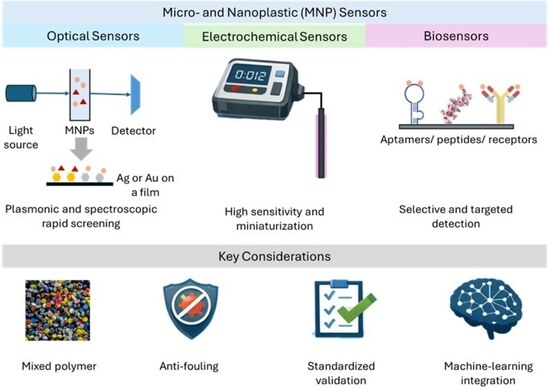
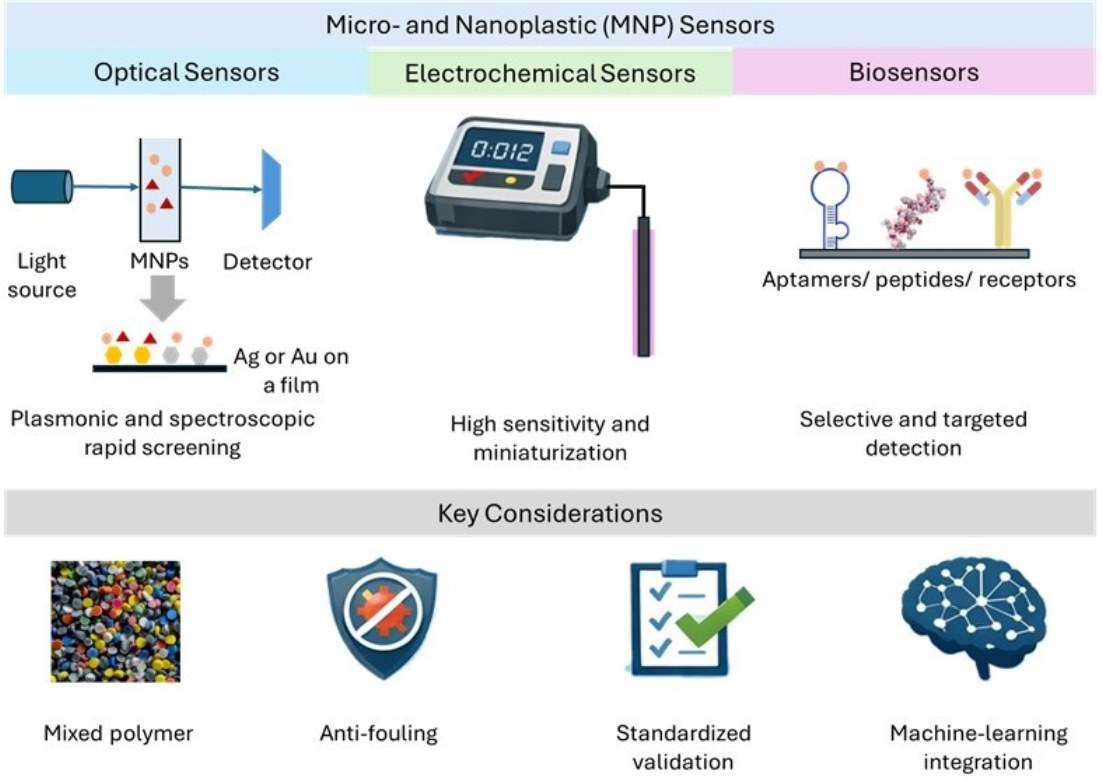
Graphical Abstract

1. Introduction

Microplastics are typically defined as plastic particles smaller than 5 mm that originate either from the fragmentation of larger plastic debris (secondary microplastics) or from intentionally manufactured small particles, such as microbeads and industrial abrasives (primary microplastics) [1]. Nanoplastics are extremely small plastic particles with at least one dimension below 1 micrometer (1000 nanometers), commonly defined as 1–1000 nm [2]. However, it should be noted that these size-based classifications largely reflect widely adopted conventions rather than universally standardized definitions. Emerging efforts toward harmonization, including those led by international standardization bodies such as the ISO, have begun to propose more consistent frameworks for plastic particle classification, yet no consensus definition, particularly for nanoplastics, has been fully established [3]. Therefore, the definitions adopted in this work follow common usage in the literature while acknowledging the ongoing need for standardization in this rapidly evolving field.
Due to their diverse polymer compositions, irregular morphologies, and broad size distributions, ranging from millimeters to the submicron scale, micro- and nanoplastics (MNPs) exhibit high environmental persistence and complex environmental behavior [4,5]. They are now ubiquitously detected across aquatic, terrestrial, and atmospheric environments, including oceans, freshwater systems, soils, sediments, and even remote and polar regions [6,7,8,9].
The severity of MNP pollution has become increasingly evident over the past decade. MNPs are readily ingested by a wide range of organisms and can bioaccumulate along food webs, raising concerns regarding ecological integrity and potential human exposure [10,11,12]. Beyond their physical impacts, MNPs act as vectors for chemical additives, persistent organic pollutants, heavy metals, and pathogenic microorganisms, thereby amplifying their toxicological significance [13,14,15]. Growing evidence links microplastic exposure to oxidative stress, inflammation, and disruptions in physiological and metabolic processes across multiple taxa, underscoring the urgent need for reliable monitoring and risk assessment frameworks [16,17]. Nanoplastics are generally considered more toxic than microplastics because their much smaller size gives them a higher surface area-to-volume ratio, greater chemical reactivity, and increased ability to cross biological barriers [18]. Compared with microplastics, nanoplastics can more readily penetrate cells and tissues, enter the bloodstream, and accumulate in organs, increasing the likelihood of cellular stress, inflammation, oxidative damage, and interference with normal biological functions [19].
Accurate detection and quantification of MNPs are therefore central to understanding their environmental distribution, fate, and impacts. Conventional MNP detection and characterization methods are largely based on multi-step laboratory workflows involving sampling, density separation, chemical digestion, filtration, and visual inspection, followed by polymer identification using spectroscopic techniques such as Fourier transform infrared (FTIR) spectroscopy, Raman spectroscopy, and pyrolysis-gas chromatography-mass spectrometry (Py-GC-MS) [20,21]. While these approaches provide detailed compositional information, they are often labor-intensive, time-consuming, expensive, and require specialized instrumentation and trained personnel [22]. Moreover, conventional methods generally lack real-time capability, are prone to sample contamination and operator bias, and show limited sensitivity toward small microplastics and nanoplastics. These limitations significantly constrain high-frequency monitoring, large-scale spatial coverage, and in situ measurements [23].
The growing scale and complexity of MNP pollution have therefore prompted increasing interest in microplastic sensing technologies that can complement, or in some contexts, replace traditional laboratory-based analyses. Microplastic sensors aim to enable rapid, sensitive, and potentially real-time detection by transducing microplastic–sensor interactions into measurable optical, electrical, or biochemical signals [24]. Optical sensing strategies exploit light–matter interactions such as scattering, fluorescence, and spectroscopy; electrochemical sensors leverage changes in current, impedance, or potential induced by the presence of MNPs, while biosensor approaches integrate biological recognition elements, including enzymes, antibodies, or whole cells, to achieve enhanced selectivity [25,26,27]. Collectively, these sensor platforms offer promising pathways toward miniaturized, automated, and field-deployable monitoring systems.
Despite rapid technological advances, the MNP sensing field remains fragmented across disciplines, with developments reported in analytical chemistry, materials science, environmental engineering, and biotechnology. Existing reviews predominantly focus on conventional detection techniques or briefly discuss sensor technologies as emerging tools, often without a systematic comparison of sensing principles, performance metrics, environmental applicability, and key limitations [21,28]. For instance, Baruah et al. [22] reviewed microplastic detection methods, with little focus on sensor technologies. While Shabib et al. [29] reviewed MNP sensors more extensively, their review was limited to electrochemical detection and placed greater emphasis on the underlying principles than on advances. Similarly, Kamel et al. [30] reviewed the application of electrochemical sensing technology exclusively for MNP detection, with a large portion of the review dedicated to conventional microplastic detection methods. A recent review by Lin et al. [31] covered a wide range of MNP detection technologies, from conventional spectroscopy to smart sensors, with more attention on electrochemical sensors. Blevins et al. [32] reviewed a wide range of field measurement techniques for microplastic characterization in aqueous environments, focusing on the underlying principles, and provided limited information on the latest sensor developments, particularly biosensors. Tirkey & Upadhyay [33] conducted a review along similar lines, focusing on sensor principles rather than developments. Given the lack of reviews that present the most recent developments in major MNP sensing technologies, a dedicated review covering not only the principles, but also the analytical performance, advantages, and limitations of these technologies, particularly from the perspective of environmental monitoring and real-world deployment, is crucial.
Against this backdrop, this review aims to provide a comprehensive overview of in situ MNP sensing technologies, with a specific focus on optical, electrochemical, and biosensor approaches. It offers the novelty of integrated synthesis of in situ MNP sensing technologies by systematically comparing optical, electrochemical, and biosensor approaches within a unified framework. Unlike prior studies that focus on conventional methods or single sensing modalities, it emphasizes real-time, field-deployable detection and evaluates analytical performance, environmental applicability, and practical limitations. By bridging fragmented advances across multiple disciplines and highlighting key challenges, including selectivity, standardization, and scalability, the review provides a forward-looking perspective on the development of next-generation MNP monitoring systems.
Herein, the sensing principles, representative platforms, analytical performance, advantages, and limitations of each approach are systematically discussed and compared. Key challenges related to selectivity, sensitivity, standardization, and field implementation are highlighted, and future research directions toward real-time, in situ, and scalable MNP monitoring are proposed.

2. Review Methodology

This review adopts a narrative review approach to synthesize and critically evaluate recent advances in MNP sensing technologies, with a particular focus on optical, electrochemical, and biosensor-based approaches. A narrative framework was selected to enable conceptual integration across multiple disciplines, including analytical chemistry, materials science, environmental monitoring, and biotechnology, where methodological heterogeneity and rapid technological evolution limit the applicability of strict systematic review protocols. The review emphasizes sensing principles, sensor architectures, analytical performance, and environmental applicability rather than quantitative meta-analysis.
A comprehensive literature search was conducted using major scientific databases, including Web of Science, Scopus, and ScienceDirect, to capture peer-reviewed research articles and reviews relevant to MNP sensing. Search terms were applied in various combinations using Boolean operators and included: (1) microplastic OR nanoplastic; AND (2) sensor OR sensing OR detection; AND (3) optical sensor OR spectroscopic sensing; OR (4) electrochemical sensor OR impedance OR voltammetric detection; OR (5) biosensor OR biorecognition OR enzyme-based sensor OR cell-based sensor. Additional relevant studies were identified through backward and forward citation tracking of key articles to ensure the coverage of influential and emerging works.
Studies were included in this review if they met the following criteria: (1) Focus on in situ sensing technologies specifically designed for the detection, identification, or quantification of microplastics or nanoplastics; (2) Employ optical, electrochemical, or biosensor-based approaches, including proof-of-concept platforms, laboratory-scale sensors, or field-deployable devices; (3) Provide mechanistic or methodological insights into sensing principles, signal transduction mechanisms, or MNP–sensor interactions; (4) Report analytical performance parameters, such as sensitivity, detection limits, selectivity, response time, or operational stability; and (5) Peer-reviewed research articles or authoritative review papers published within the last decade, with earlier seminal studies included where necessary to establish foundational concepts.
The following categories of studies were excluded from this review: (1) Studies focused exclusively on conventional microplastic detection and characterization methods, such as FTIR imaging, Raman mapping, or Py-GC-MS, without an in situ sensing or sensor-based component; (2) Articles addressing plastic pollution broadly without specific relevance to MNP sensing technologies; (3) Studies reporting sample preparation, extraction, or separation techniques that do not incorporate a sensing or signal transduction mechanism; (4) Papers lacking sufficient methodological detail or quantitative evaluation of sensing performance; (5) Conference abstracts, editorials, commentaries, patents, and non-peer-reviewed literature; (6) Non-English publications where reliable translation was not available.
Information extracted from selected studies included sensing principles, sensor materials and architectures, target microplastic characteristics (e.g., size range, polymer type), detection environment, analytical performance metrics, and reported advantages and limitations. Rather than aggregating quantitative data, findings were qualitatively synthesized to identify overarching trends, technological strengths, knowledge gaps, and challenges associated with real-world implementation.

3. Optical Sensors

Optical MNP sensors have emerged as a powerful class of analytical tools for the rapid, sensitive, and often non-destructive detection of plastic particles in environmental, biological, and industrial samples. Driven by growing concern over the widespread distribution and ecological risks of MNPs, optical sensing approaches leverage light–matter interactions, such as absorption, scattering, fluorescence, and vibrational signatures, to enable particle identification and quantification with high spatial and chemical resolution [25].

3.1. Sensing Principles and Platforms of Optical Sensors

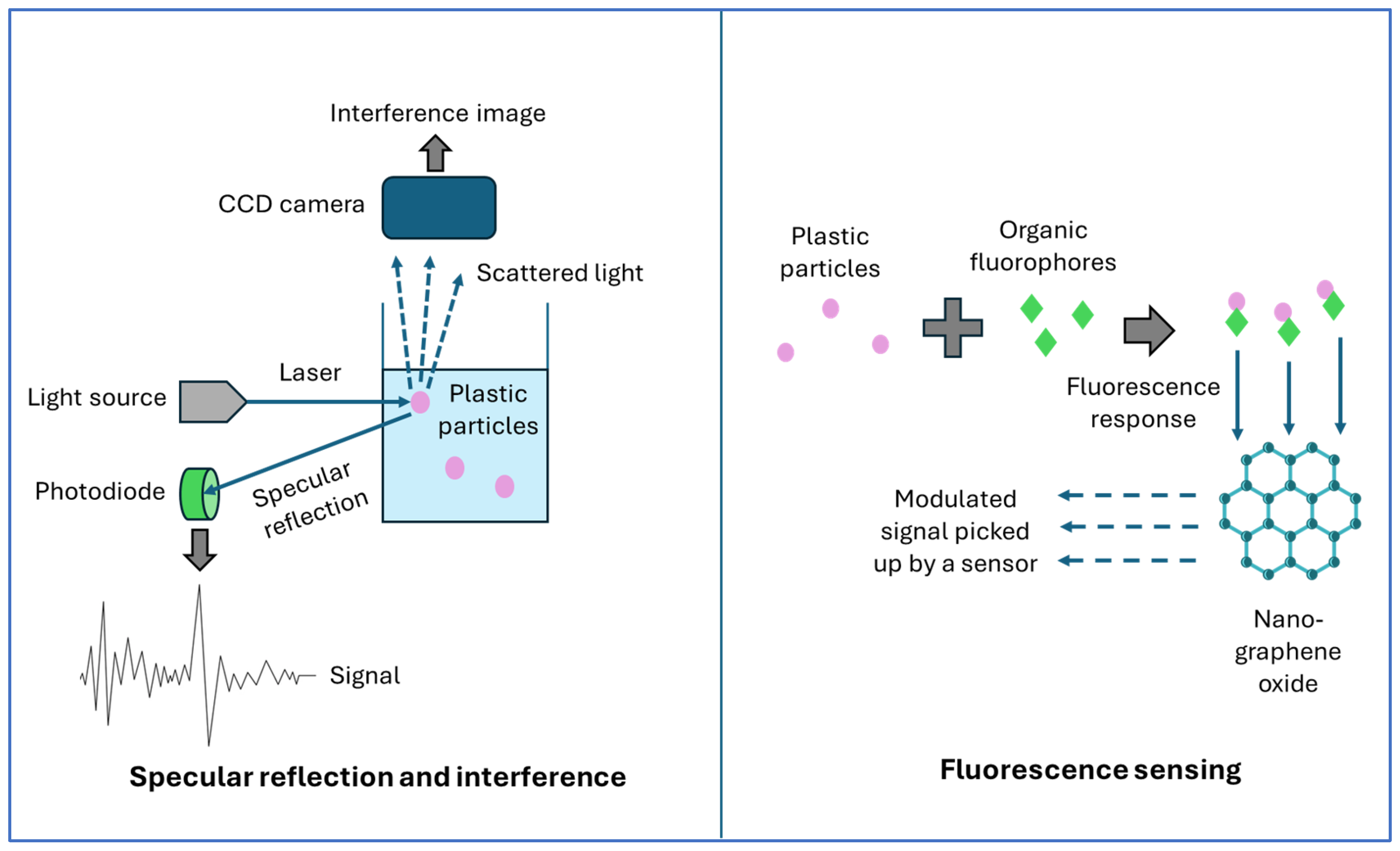
Optical sensing of MNPs relies on a variety of physical phenomena, including light scattering, reflection, absorption, evanescent-field interactions, and plasmonic signal enhancement. A portable handheld optical device demonstrates the feasibility of combining specular reflection and transmitted interference patterns to analyze microplastics in water [34]. In this setup, the device measures both the reflected laser signal and interference patterns captured by a photodiode and charge-coupled device (CCD) camera, respectively (Figure 1). By exploiting differences in refractive index, thickness, and transparency between microplastics such as transparent polyethylene terephthalate (PET) and translucent low-density polyethylene (LDPE), the device can differentiate plastic type and approximate particle size. These measurements highlight the potential for in situ, portable microplastic screening in freshwater systems, including both floating and sedimenting particles [34].
Fluorescence-based optical sensors use functionalized nanomaterials to enhance selectivity and sensitivity toward microplastics [35]. Tayeng et al. [36] employed nano-graphene oxide (nGO) as a receptor in a two-step fluorescence modulation strategy. Microplastics were first treated with different organic fluorophores, producing varied fluorescence signals, which were further modulated by nGO (Figure 1). This sensor array could classify multiple polymer types with 100% accuracy, even at low concentrations in leachates from plastic containers and in environmental water samples. This demonstrates that fluorescence-based optical platforms can achieve high specificity by exploiting material-dependent photophysical interactions.
Multiwavelength optical platforms analyze polymer-specific light attenuation across a spectrum of wavelengths, enabling material differentiation and spectral fingerprinting. Campos-Lopez et al. [37] developed a prototype using an array of ultraviolet–visible–near-infrared (UV–NIR) LEDs combined with photodiode detection and mechanical scanning. Microplastics exhibited distinct absorbance patterns relative to organic matter, and their spectral signals decreased at longer wavelengths, allowing for discrimination across polymer types. Integration with microscopy and image processing improved particle identification and morphology analysis, illustrating the utility of multispectral optical sensing for both qualitative and quantitative monitoring in complex water matrices [37].
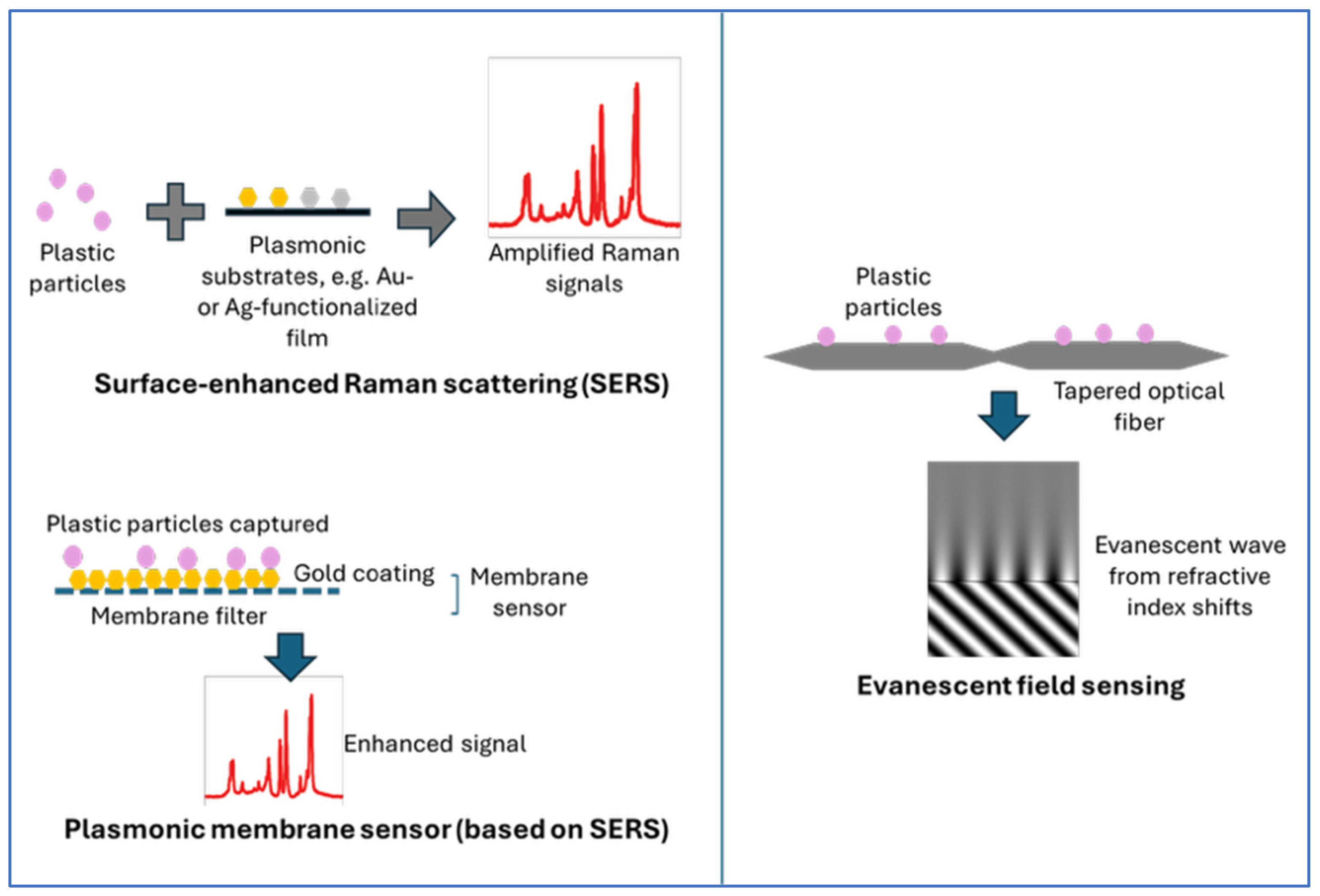
Surface-enhanced Raman scattering (SERS) has emerged as a powerful method for detecting MNPs at low concentrations. Plasmonic substrates, such as Au- or Ag-functionalized films, amplify the Raman signals of adsorbed particles, providing chemical “fingerprints” for identification (Figure 2) [38,39,40,41,42]. Variations in substrate architecture, including metal nanoparticles on TiO2 arrays, anodized aluminum oxide nanopores, or cellulose-supported nanowires, affect sensitivity and particle-size response [38,39]. SERS-based platforms enable the detection of polystyrene (PS) and other polymers across nanometer and micrometer scales, with limits of detection reaching the sub-microgram per milliliter range, and are applicable to complex environmental samples, including tap, river, and seawater [40,41,43].
Evanescent-field and fiber-optic sensing platforms offer another route to highly sensitive nanoplastic detection. Tapered optical fibers, including Mach–Zehnder interferometers (MZI) and zeolitic imidazole framework (ZIF)-8-functionalized single-mode tapered fibers (STF), convert particle binding or refractive index changes near the fiber surface into detectable spectral shifts [44,45,46]. These sensors exploit enhanced light–particle interactions within the evanescent field to achieve ultra-low detection limits for sub-300 nm PS nanoplastics, with applicability in natural water samples (Figure 2). Similarly, rare-earth-doped planar waveguides can be optimized for sensitivity by tuning the cladding thickness and core diameter, providing additional optical sensing modalities for refractive index-based detection [47].
Finally, hybrid optical-membrane approaches integrate microplastic collection and detection within a single platform. Plasmonic membrane sensors employ thin metal layers sputtered onto porous polymer membranes to simultaneously capture and detect particles using SERS (Figure 2). Optimizing the pore size and metal coating enhances localized surface plasmon resonance (SPR), creating high-density “hot spots” for Raman signal amplification [48]. These systems enable ultrafast scanning, quantitative detection at microgram-per-liter levels, and high imaging contrast for irregularly shaped microplastics, highlighting the potential of integrated optical platforms for real-time environmental monitoring.

3.2. Analytical Performance of Optical Sensors

The analytical performance of optical MNP sensors varies widely depending on the detection principle, particle size range, and environmental matrix. The portable handheld optical sensor developed by Asamoah et al. [34] successfully distinguished transparent PET and translucent LDPE in freshwater, exploiting differences in refractive index and thickness. While the sensor demonstrates high confidence for the volume screening of microplastics and potential applicability to both floating and sedimenting particles, its detection limit and sensitivity are inherently constrained by the optical configuration and CCD-based detection. The system is primarily effective for millimeter- to submillimeter-sized particles, making it suitable for preliminary in situ screening rather than ultrafine detection [34].
Fluorescence-based sensor arrays, such as the nano-graphene oxide (nGO) platform reported by Tayeng et al. [36], achieve remarkable sensitivity and selectivity for multiple microplastic types. By modulating the fluorescence output of organic dyes bound to microplastics, the system reached 100% classification accuracy across six polymer types at concentrations as low as 90.3 ng/mL for nylon microplastics. This sensor also effectively detected microplastics leached into water from plastic containers over extended periods and in environmental waters such as rivers, lakes, and tap water [36]. The nGO-based sensor exhibits superior analytical reproducibility and robustness, highlighting its potential for trace-level detection in complex matrices.
Multispectral optical platforms achieve the reliable detection of microplastics in the 0.5–5 mm range and demonstrate reproducibility across repeated measurements [37]. While the sensitivity is comparable to conventional UV–Vis spectroscopy, the system lacks the molecular-level specificity of FTIR or Raman spectroscopy and is influenced by ambient light, requiring shielding [37]. Nevertheless, the combination of multispectral analysis with image-processing algorithms enables rapid, low-cost classification and particle morphology analysis.
Low-cost Raman spectroscopy-based devices, such as that described by Iri et al. [49], maintain linear detection within 0.015–0.035% w/v microplastic concentrations. Although the sensitivity is lower than that of conventional laboratory Raman instruments, these portable systems successfully capture characteristic Raman features, providing an accessible route for field-based microplastic detection.
Surface-enhanced Raman scattering (SERS)-based sensors consistently demonstrate superior sensitivity and molecular specificity. Various configurations, including Ag nanoparticles (AgNPs)@TiO2 arrays [38], AuNP-functionalized substrates [42], Ag nanowires (AgNWs)/reinforced cellulose [39], and silver-coated gold nanostar incorporated into aluminum oxide nanopores (AuNSs@Ag@AAO) [40], achieved limits of detection ranging from 0.05 mg/L to 100 μg/mL for microplastics and nanoplastics. SERS methods are particularly effective for submicron particles, providing fingerprint-based chemical identification with high reproducibility (relative standard deviation (RSD) < 10%). The trade-off, however, is the complexity of substrate fabrication and the need to carefully optimize plasmonic structures to ensure signal enhancement.
Evanescent-field optical sensors, including ZIF-8-functionalized STF [44] and MZI based on optical microfibers [45], demonstrate ultralow detection limits for nanoplastics. Xiong et al. [44] reported sensitivity down to 0.0018 g/L for 300 nm PS nanoplastics, while Li et al. [45] achieved limits of 1–3 × 10⁻⁶ mg/mL for 100–150 nm PS nanoplastics in both pure and environmental waters. These platforms benefit from enhanced light–particle interaction in the evanescent field and selective surface functionalization, enabling real-time detection with minimal sample preparation.
Other integrated optical platforms, such as the plasmonic membrane sensor developed by Wu et al. [48], combine filtration and SERS detection, achieving detection limits of 1 μg/L for individual microplastics in eutrophic lake water with ultrafast scanning times of 0.01 s per particle. Such systems demonstrate the potential for the high-throughput, in situ monitoring of microplastics with enhanced sensitivity, imaging contrast, and environmental applicability.
In summary, the analytical performance of these optical sensors shows a clear trade-off among particle size range, sensitivity, portability, and specificity. Fluorescence-based nGO arrays and evanescent-field sensors excel in the ultralow detection of nanoplastics, while multispectral and handheld devices are more suited for the rapid screening of larger microplastics. SERS-based sensors provide high molecular specificity and reproducibility across a wide particle size range, making them ideal for detailed chemical identification in complex environmental matrices. Each platform’s choice ultimately depends on the target particle size, concentration range, environmental matrix, and the balance between portability and analytical precision.

3.3. Limitations and Future Directions of Optical Sensors

Despite significant progress in optical sensing technologies for MNPs, several limitations remain that constrain their broader application in environmental monitoring. Many current prototypes, such as the handheld reflection–transmission device by Asamoah et al. [34], demonstrate promising detection capabilities for specific types of microplastics, such as PET and LDPE, in controlled freshwater samples, but require further optimization for real-world conditions. Challenges include the accurate discrimination of the complex mixtures of plastics, the influence of environmental interferents, and the need for robust calibration methods. Similarly, nGO-based fluorescence sensors have achieved high discrimination accuracy for multiple microplastic types under laboratory conditions, but their performance may be affected by sample heterogeneity, the presence of natural organic matter, and variations in leachate composition across different water sources [36]. For wavelength-dependent optical systems, such as the multi-LED platform described by Campos-Lopez et al. [37], ambient light interference and limited spectral resolution may reduce sensitivity and reproducibility when deployed in situ. Moreover, many devices, including portable Raman-based sensors [38,48,49], offer impressive detection limits but often rely on sophisticated sample preparation, high-quality optical components, or controlled laboratory settings, limiting their field applicability.
Another key limitation lies in particle size and concentration detection ranges. While SERS- and STF-based sensors can detect nanoplastics down to sub-100 nm scales [39,41,45,48], most conventional optical sensors are limited to microplastics above 50–100 µm [34,37,50]. This restricts their utility for detecting the increasing prevalence of smaller nanoplastics in aquatic environments. In addition, sensitivity and selectivity are influenced by polymer type, surface properties, and particle morphology, meaning that similarly sized particles from different plastic types may produce overlapping optical signals. Cost and complexity also pose barriers; for instance, multi-component SERS substrates [40,42] require precise nanofabrication and handling, which may be impractical for routine environmental screening.
Looking forward, future directions should focus on improving portability, robustness, and multiplexed detection for real-world applications. Integration of machine learning and chemometric methods could enhance discrimination among MNP types, sizes, and environmental interferents, particularly in complex matrices such as rivers, lakes, and wastewater. Miniaturization of high-sensitivity systems, such as SERS, STF, and plasmonic membrane sensors [45,48], will be critical for field deployment. Additionally, hybrid approaches that combine optical modalities, for example, simultaneous fluorescence, absorbance, and evanescent-wave sensing, could improve both sensitivity and specificity. Advances in low-cost nanomaterials (e.g., nGO, Au/Ag nanoparticles, metal-organic frameworks (MOFs)) and robust optical substrates may also facilitate long-term monitoring with minimal maintenance. Standardization of calibration protocols, sample handling, and validation against conventional methods like FTIR or Raman spectroscopy will be essential to ensure accuracy and comparability across devices. Finally, expanding detection capabilities to the nanoscale and achieving high-throughput analysis remain key challenges to fully address the pervasive and diverse presence of MNPs in natural and engineered water systems. Table 1 summarizes the principles, performance, and limitations of the optical sensors.

4. Electrochemical Sensors

Unlike optical sensors that rely on light–matter interactions, electrochemical platforms detect MNPs through changes in electrical signals, such as current, potential, or impedance, induced by the adsorption, surface modification, or redox activity of plastic particles on electrode surfaces. Functionalization of electrodes with nanomaterials, including carbon-based nanostructures, metal nanoparticles, or conductive polymers, can enhance the specific recognition of polymer types and particle sizes while also amplifying signal transduction [29].

4.1. Sensing Principles and Platforms of Electrochemical Sensors

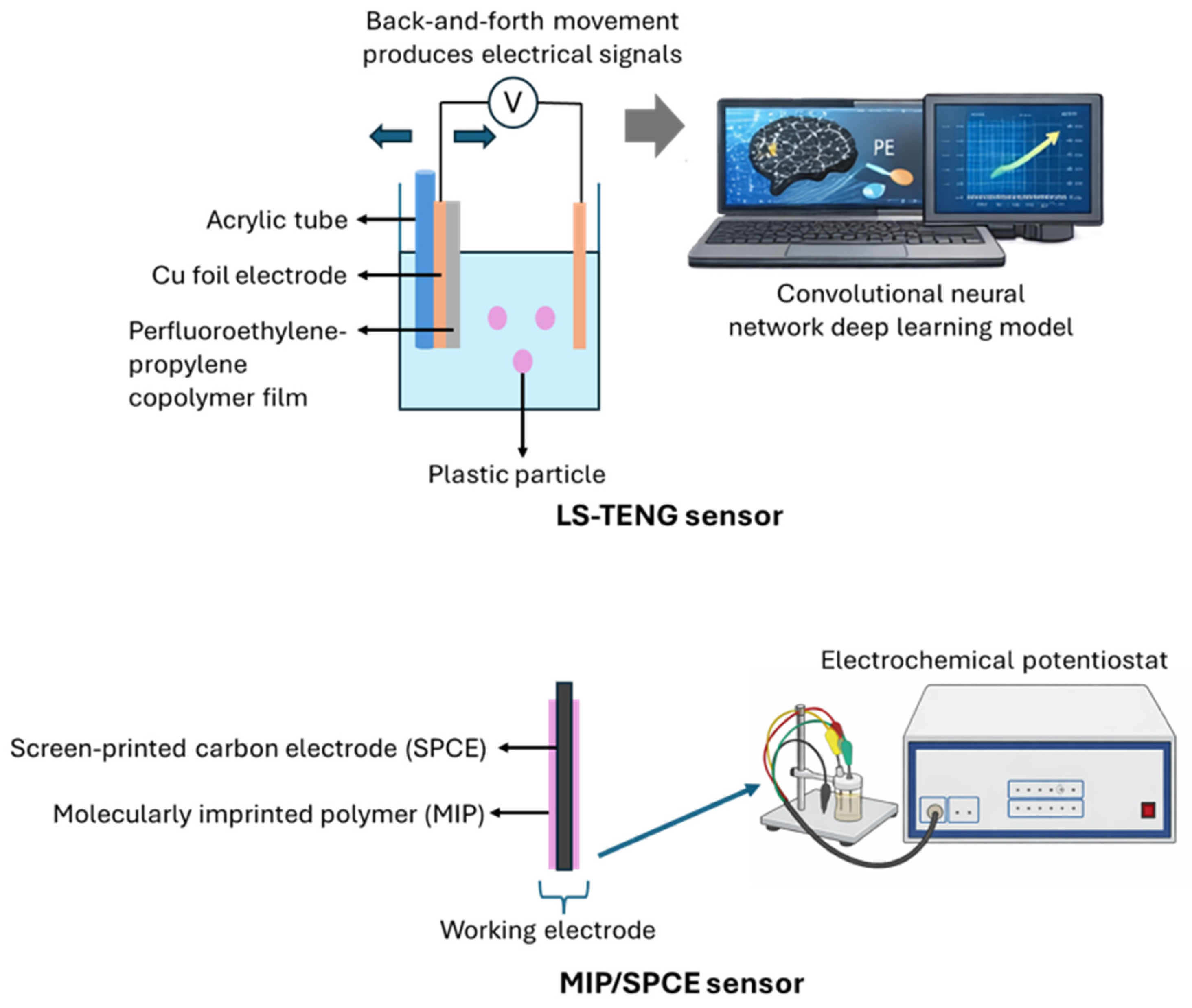
Electrochemical MNP sensors operate via diverse mechanisms that convert particle interactions into measurable electrical signals, offering high sensitivity, rapid response, and adaptability for real-world environmental monitoring. One class of sensors utilizes triboelectric interactions at liquid–solid interfaces. Huang et al. [52] fabricated a liquid–solid triboelectric nanogenerator (LS-TENG) sensor, where a hydrophobic fluorinated ethylene propylene surface generates charge upon contact with liquid. Movement of the LS-TENG induces charge redistribution and electron transfer through a copper electrode, producing output voltage signals correlated with microplastic type and concentration (Figure 3). Integration with a convolutional neural network (CNN) enabled high-accuracy classification of microplastics, including polyethylene (PE), polypropylene (PP), polyvinyl chloride (PVC), PET, and PS (Figure 3). This approach highlights the combination of electrochemical signal generation with data-driven analysis for robust sensing [52].
Other platforms employ microelectromechanical systems (MEMS) and resonant structures. Lee et al. [53] designed a complementary multisplit ring resonator (CMSRR) coupled with a MEMS microfilter, where the accumulation of microplastics in the MMF induces a notch frequency shift in the CMSRR sensor. This approach enables the rapid, size-selective, and on-site measurement of microplastics without high-cost spectroscopy, providing both portability and practical deployment potential.
Molecularly imprinted polymers (MIPs) represent another strategy. Sanchez-Almirola et al. [54] fabricated poly-o-phenylenediamine (PoPD) MIPs on screen-printed carbon electrodes (SPCEs), forming selective recognition sites for nanoscale PS (Figure 3). Electrochemical interrogation via chronoamperometry allowed for the detection of PS nanoparticles at sub-ppb levels, demonstrating how molecular imprinting can confer high selectivity in complex aqueous matrices. Similarly, biochar-based electrodes derived from starfish or aloe vera demonstrated enhanced electrochemical detection of 100 nm PS microplastics due to high surface area and conductive frameworks [55].
Magnetically assisted electrochemical platforms combine enrichment and detection. Qiu et al. [56] employed Fe3O4 nanoparticles to capture PS microplastics, with electroactive Ag nanoparticles generating distinct voltammetric peaks upon adsorption, enabling rapid “capture–enrichment–identification” in a single integrated platform. Impact-based detection leverages single-entity electrochemistry, where collisional contact between microplastics and ultramicroelectrodes (e.g., Pt UME) perturbs steady-state currents, allowing for the precise detection of individual microparticles [57,58].
Advanced nanostructured electrode modifications enhance sensitivity and selectivity. Reduced graphene oxide frameworks [59], Cu-MOF films with multi-walled carbon nanotubes (MWCNTs) [60], MoS2 quantum dots within TiO2 matrices [61], CeO2 nanoparticles [62], and MXene-coated microwires in microfluidics [63] provide increased surface area, electrostatic interactions, and rapid electron transfer. These modifications enable ultra-low detection limits (sub-μg/mL) and reproducibility in complex matrices such as tap water, seawater, and saline solutions. Photoelectrochemical–electrochemical dual-mode sensors [64] further improve portability and speed, offering the rapid detection of PS nanoplastics (detection limit ~0.38 ng/mL).
Collectively, these platforms illustrate a range of electrochemical principles, including contact electrification, redox perturbation, voltammetric signaling, impedance variation, and photoelectrochemical coupling, paired with functionalized electrodes or nanostructured materials to achieve the sensitive, selective, and often in situ detection of micro- and nanoplastics in diverse aqueous environments.

4.2. Analytical Performance of Electrochemical Sensors

The LS-TENG sensor exhibited linear voltage responses over microplastic mass fractions ranging from 0.025 to 0.25 wt%, with minimum detection limits of 0.0068 wt% for PE and 0.0223 wt% for PET [52]. Integration with a CNN-enabled type-specific identification, achieving an average recognition accuracy of 86.7%, with PS detection reaching 100%. The LS-TENG sensor’s advantages include simple construction and label-free detection, though its sensitivity is constrained by the relatively high mass fractions required for measurable signals.
CMSRR sensors integrated with MEMS microfilters, as proposed by Lee et al. [53], employ notch-frequency shifts to quantify microplastics accumulated within the microfilter. This sensor design allows for rapid on-site measurement and size-specific separation, demonstrating high sensitivity with a 14.3 MHz shift observed for a 1% polyethylene dispersion. While the CMSRR sensor offers portability, low cost, and ease of fabrication, its detection range is limited by the physical dimensions of the filter and the resonance-based sensing mechanism.
MIP-based sensors provide a highly selective strategy for nanoscale plastic detection. Sanchez-Almirola et al. [54] fabricated PoPD MIPs on screen-printed carbon electrodes, templated against 100–500 nm PS nanoparticles. The sensors demonstrated sub-ppb detection limits (4.2 × 10⁻⁹ g/L), rapid detection (~11 min), and strong point-of-care applicability. Similarly, biochar-based electrodes derived from starfish and aloe vera achieved low detection limits (0.44–0.52 nM) for 100 nm PS, with the aloe vera biochar exhibiting higher sensitivity (3.263 μA/μM·cm2) due to surface metal-carbon frameworks [55]. Both MIP and biochar-based sensors combine high sensitivity with good repeatability and stability, though biochar electrodes generally offer broader applicability at the cost of reduced type-specific selectivity.
Magnetic enrichment coupled with electrochemical detection has been employed to enhance the sensitivity for PS microplastics. Qiu et al. [56] utilized Fe3O4 nanoparticles for microplastic capture and Ag nanoparticles for signal transduction in a differential pulse voltammetry setup, achieving a detection limit of 1.4 ppm and a linear range from 0.01 to 0.5 mg/mL. This integrated “capture–enrichment–identification” approach accelerates detection and minimizes interference, although the achievable sensitivity remains lower (µg/L to low mg/L versus sub-µg/L or even ng/L equivalent response) than that of nanoscale MIP or biochar electrodes. Electrochemical impact-based sensors, including oxygen reduction spike detection [58] and ultramicroelectrode systems [57], offer high temporal resolution for single-entity detection. Linear detection ranges are narrower (0.02–0.04% w/v), and signal accuracy is highly dependent on electrode design and electrolyte optimization.
Nanomaterial-enhanced electrodes, including graphene [65], Cu-MOF/MWCNT [60], and C-ZIF-8/rGO composites [59], demonstrate exceptional sensitivity, selectivity, and wide linear ranges. For instance, graphene electrodes achieved excellent correlation coefficients (R2 > 0.99) across a concentration range of 0.01–25 mg/L, while Cu-MOF/MWCNT composites reached detection limits as low as 6 μg/mL for 100 nm PS nanoparticles. C-ZIF-8/rGO electrodes further extended the detection range (25–500 μg/mL) with an ultra-low detection limit (1.19 μg/mL) and high stability (91.6% signal retention over 28 days), emphasizing the advantages of engineered surface interactions in enhancing electrochemical performance.
Photoelectrochemical–electrochemical dual-mode sensors, such as the CdS/CeO2 heterojunction platform [64], combine photoelectrochemical and electrochemical detection to achieve ultra-low detection limits (0.38 ng/mL) and wide linear ranges (0.5–800 μg/mL) with high reproducibility (inter-day RSD: 0.4–2.97%; intra-day RSD: 0.94–4.65%). Similarly, hydrophobic CeO2 nanoparticle electrodes [62] and MXene-coated microfluidic sensors [63] offer robustness in complex matrices, including saline environments, with detection limits of 0.226 mg/mL and 0.825 ppm, respectively. Quantum dot–mesoporous TiO2 electrodes [61] achieve wide dynamic ranges (104–1010 particles/mL) and a detection limit of 5 × 10³ particles/mL, highlighting the benefits of nanoconfinement and mesoporosity for environmental monitoring.
Overall, the comparative performance of these electrochemical sensors reveals a trade-off between sensitivity, selectivity, and operational practicality. MIP, photoelectrochemical–electrochemical, and nanomaterial-enhanced electrodes exhibit superior detection limits and wide dynamic ranges suitable for trace environmental monitoring, whereas LS-TENG, MEMS-CMSRR, and magneto-enrichment approaches excel in portability and field deployment. Biochar and MXene-based sensors offer cost-effective, robust alternatives, particularly in complex matrices, while single-entity and impact-based methods provide mechanistic insights with high temporal resolution. The choice of sensor depends critically on the target MNP size, concentration range, and application scenario.

4.3. Limitations and Future Directions of Electrochemical Sensors

Recent progress in electrochemical MNP sensors has demonstrated impressive analytical performance across diverse platforms; however, several technical and practical limitations remain that must be addressed for real-world environmental deployment. A recurring challenge is matrix interference, particularly in high-ionic-strength environments such as seawater. For example, fluorescence-peptide/electrochemical impedance spectroscopy sensors showed a marked increase in detection limits from 50 ppb in pure and tap water to 400 ppb in saline media, attributed to ionic masking effects on impedance signals [66]. Similarly, recoveries exceeding 100% in seawater using C-ZIF-8/rGO electrodes suggest that coexisting ions and background microplastics may distort quantification [59]. Although MXene-coated microfluidic systems combined with Wheatstone bridge balancing improved signal stability at salinity levels up to 1000 ppm [63], maintaining high sensitivity across diverse and highly conductive environmental matrices remains a fundamental challenge.
Another limitation concerns sensitivity versus operational practicality. While advanced nanostructured systems, such as MoS2 quantum dots–TiO2 hybrids (detection limit: 5.0 × 10³ particles mL−1) [61], photoelectrochemical–electrochemical dual-mode CdS/CeO2 heterojunction sensors (detection limit: 0.38 ng mL−1) [64], and MIP-based PoPD/SPCE electrodes (sub-ppb detection limit) [54], demonstrate ultra-low detection limits, their fabrication processes often involve multi-step synthesis, template removal, nanoconfinement control, or heterojunction engineering. Such complexity may limit scalability and reproducibility in large-scale production. In contrast, simpler systems such as LS-TENG sensors [52] and CMSRR-MEMS devices [53] offer portability and low-cost fabrication but operate at relatively higher detection limits (wt% or % dispersion levels) and moderate classification accuracy (average 86.7% for LS-TENG). Bridging the gap between ultra-sensitive laboratory systems and scalable, field-ready platforms remains a critical objective.
Selectivity and particle heterogeneity also present significant constraints. Many studies focus predominantly on PS as a model microplastic [59,60,65], while environmental samples typically contain heterogeneous mixtures of polymers with variable sizes, shapes, surface chemistries, and weathering states [67,68]. Particle size strongly influences electrochemical response due to differences in surface area, charge density, and adsorption behavior, as highlighted by Liu et al. [59]. Detection limits often worsen with increasing particle size, as observed in Cu-MOF/MWCNT sensors [60] as well as the sandwich-type electrochemical platform of Li et al. [69], where sensitivity declines markedly as particles transition from the nano- to microscale. Therefore, sensor calibration with monodisperse laboratory standards may not fully capture the complexity of real environmental conditions. Future efforts must incorporate aged, irregular, and mixed-polymer microplastics to improve environmental relevance.
Impact-based and single-entity electrochemical methods [57,58] provide mechanistic insight into particle–electrode interactions and enable high-resolution detection; however, they typically exhibit narrow linear ranges and require controlled redox conditions, Faradaic shielding, or microelectrode fabrication. These requirements may complicate translation into portable or high-throughput systems. Similarly, magneto-enrichment platforms [56] offer rapid capture and interference reduction but currently operate in the ppm to mg mL−1 range, limiting trace-level monitoring capability.
Future research directions should therefore prioritize (i) matrix-resilient sensing, including antifouling coatings, adaptive signal processing, and salinity-compensated electrochemical designs; (ii) multiplexed and polymer-specific detection, potentially integrating molecular imprinting, peptide recognition, or machine learning-assisted signal classification to distinguish mixed polymer types in complex samples; (iii) miniaturized and integrated systems, combining enrichment, sensing, and wireless data transmission into robust field-deployable devices; and (iv) standardized calibration protocols, including environmentally aged and polydisperse plastic standards, to improve comparability across studies. Additionally, coupling electrochemical sensors with complementary spectroscopic validation could enhance analytical reliability. Table 2 summarizes the principles, performance, and limitations of the electrochemical sensors.

5. Biosensors

MNP biosensors represent an emerging class of analytical platforms that integrate biological recognition elements with advanced transduction systems to enable the rapid, selective, and highly sensitive detection of plastic contaminants at trace levels in complex environmental matrices.

5.1. Sensing Principles and Platforms of Biosensors

MNP biosensors are built on the integration of selective biological recognition elements, such as receptors, enzymes, peptides, aptamers, and engineered binding proteins, with optical, electrochemical, and photoelectrochemical transduction platforms [71]. The central sensing principle is that specific or semi-specific interactions between these recognition layers and plastic particles alter an interfacial physicochemical property, such as refractive index, plasmonic coupling, electron transfer, impedance, or photocurrent, which is then converted into a measurable analytical signal [71]. Compared with purely physicochemical sensors, biosensors emphasize molecular recognition and surface functionalization strategies that promote the selective capture of target polymers or particle classes [27].
SPR platforms are widely used optical biosensing systems for MNP detection. In SPR configurations, a gold-coated surface is functionalized with a biological recognition layer, and particle binding changes the local refractive index, shifting the resonance condition. Receptor-based and enzyme-based SPR biosensors, including those reported by Huang et al. [72] and Seggio et al. [73], use immobilized proteins, such as estrogen receptors or laccase, to promote preferential adsorption of different plastic types. Variants such as SPR–plastic optical fiber architectures miniaturize the optical path and support field-deployable formats. Closely related localized SPR (LSPR) platforms employ nanostructured gold surfaces or nanoparticles, where peptide or protein probes are attached to plasmonic nanostructures and binding events modify extinction spectra through near-field coupling effects, as demonstrated in peptide-functionalized AuNP chips by Oh et al. [74].
Gold nanoparticle-based colorimetric biosensors represent another optical platform that relies on biorecognition-controlled nanoparticle aggregation or dispersion. In these systems, plastic-binding peptides or anchor proteins are conjugated onto AuNPs. Interaction with target plastics alters interparticle spacing and aggregation state, producing visible color and absorbance changes. This principle underlies peptide–AuNP assays developed by Zhao et al. [75] and Gagné et al. [76], where different short peptides are tailored to different polymer chemistries. The sensing mechanism is governed by competitive interactions among peptide–plastic binding, nanoparticle surface stabilization, and solution-induced aggregation.
Electrochemical biosensor platforms translate plastic binding events into changes in current, potential, or impedance at modified electrodes. Recognition layers can include peptides, proteins, extracellular polymeric substances (EPSs), or aptamers immobilized on gold or carbon electrodes [77,78,79]. The binding of MNPs may block electron transfer, alter the double-layer structure, or affect the accessibility of redox probes. Representative approaches include peptide/protein-modified electrodes and sandwich-type capture schemes. More advanced electrochemical biosensors incorporate nucleic-acid machinery and synthetic biology elements, including CRISPR/Cas systems [79] and engineered binding modules, as shown in computationally guided protein-electrode platforms reported by Pereira et al. [80], where molecular simulation informs the selection of surface recognition proteins.
Photoelectrochemical biosensors extend electrochemical concepts by coupling photoactive semiconductor heterojunctions with aptamer recognition. In these platforms, illumination generates a baseline photocurrent, while aptamer or probe attachment modulates charge transfer. Target plastic binding induces probe detachment or conformational change, switching the photocurrent between suppressed and restored states. This “off–on” photoelectrochemical switching concept is illustrated in the Z-scheme heterojunction aptasensors reported by Bai et al. [78], where modified aptamers act simultaneously as recognition and signal-modulating elements.
Across these biosensor platforms, the unifying principles are surface biofunctionalization, selective interfacial binding, and signal transduction through optical or electrochemical property changes. Platform diversity, spanning SPR/LSPR, colorimetric AuNP systems, electrochemical and photoelectrochemical devices, reflects different strategies for coupling biorecognition with measurable physical signals, increasingly supported by computational probe design and data-driven signal interpretation.

5.2. Analytical Performance of Biosensors

Analytical performance across MNP biosensors varies widely depending on transduction mode, recognition element, and signal amplification strategy, with clear trade-offs among sensitivity, dynamic range, selectivity, and field applicability. Optical SPR-based biosensors generally provide robust label-free quantification and material discrimination, while electrochemical and photoelectrochemical platforms tend to achieve lower detection limits through signal amplification and interfacial signal modulation [81,82]. Colorimetric and plasmonic nanoparticle systems offer operational simplicity and portability but typically operate at higher detection limits and narrower linear ranges [74,76,83].
SPR biosensors demonstrate strong quantitative capability and reproducibility, with performance influenced by surface functionalization. The SPR–plastic optical fiber biosensor reported by Seggio et al. [73] showed concentration-dependent wavelength shifts across 1–10 mg/mL for both micro- and nanoplastics, with distinct response profiles for particle size and composition and rapid binding kinetics (~8 min). Integration with AI-based classification improved analytical interpretation, achieving >90% classification accuracy for particle type and size, though mixed-particle systems reduced predictive performance. Conventional SPR systems, such as those described by Huang et al. [72], further demonstrate linear, label-free quantification and polymer discrimination via binding affinity analysis. Enzyme-functionalized SPR platforms, including the laccase-based sensor by Rivera-Rivera et al. [84], extend selectivity and can reach sub-µg/mL detection limits for certain polymers, although matrix metal ions may inhibit response and introduce sample-dependent variability.
Electrochemical biosensors generally achieve lower detection limits and broader dynamic ranges than most optical biosensors, especially when enhanced by biological or nucleic-acid amplification. A computationally guided protein-modified electrode platform developed by Pereira et al. [80] demonstrated a wide working range (0.01–100 mg/L) and major reductions in quantification error and variance through protein recognition layers and machine-learning calibration, highlighting gains in robustness and cross-device comparability. CRISPR-enabled electrochemical biosensing reported by Shi et al. [79] further improved sensitivity, achieving ng/mL detection limits for PVC and PS with good recoveries (≈98–104%) and low RSD in real water samples, illustrating the analytical advantage of enzymatic cascade amplification. Similarly, a CRISPR/Cas12a-assisted electrochemiluminescence (ECL) biosensor integrates graphitic carbon nitride (g-C3N4)-based nanomaterial emitters, aptamer recognition, and rolling circle (RCA) plus catalytic hairpin assembly (CHA) amplification to achieve ultra-sensitive PVC detection (0.07 ng/mL detection limit; 0.20 ng/mL–0.20 μg/mL range), with high stability, reproducibility (RSD ≈ 1.7–2.2%), and validated seawater recoveries (93.8–97.2%), illustrating the strong potential of hybrid ECL–CRISPR systems for trace microplastic analysis [85]. Electrochemical impedance platforms, such as the EPS-coated electrode described by Gongi et al. [77], achieved extremely low molar detection limits (down to ~10−11 M) across multiple polymers, though response behavior depended strongly on particle size, with rapid saturation effects observed for larger microplastics.
Photoelectrochemical aptasensors provide another high-sensitivity route by coupling optical excitation with electrochemical readout. The switch-type photoelectrochemical aptasensor introduced by Bai et al. [78] achieved sub-µg/mL detection limits (~0.1 µg/mL) for PVC and PS over a broad linear range (1–200 µg/mL), with strong linearity, low signal variation (~1.5–2% RSD), and good operational stability (>90% signal retention after repeated cycles). Compared with standard SPR and colorimetric systems, photoelectrochemical designs show improved sensitivity and dynamic range while retaining selectivity through aptamer recognition, though they require photoactive materials and controlled illumination.
Plasmonic and colorimetric nanoparticle biosensors emphasize simplicity and visual or spectroscopic readout but typically operate at higher detection limits. LSPR peptide-based sensors reported by Oh et al. [74] reached ~1 µg/mL detection limits for sub-micrometer PS and showed sensitivity gains through sandwich plasmonic structures and microfluidic enrichment. Colorimetric AuNP–peptide assays from Zhao et al. [75] and Gagné et al. [76] demonstrated useful selectivity and acceptable recoveries in environmental waters but generally higher detection thresholds (µg/mL to tens of µg/mL) and notable cross-reactivity among polymers, making them better suited for screening and semi-quantitative analysis. Electrochemiluminescence systems such as that by Guo et al. [86] occupy an intermediate position, achieving sub-mg/L detection with strong affinity-driven signal enhancement.
Overall, electrochemical, CRISPR-assisted, and photoelectrochemical biosensors currently define the upper tier of analytical sensitivity and quantitative robustness for MNP detection, while SPR-based platforms provide strong label-free quantification and material discrimination with good reproducibility. Plasmonic and colorimetric nanoparticle biosensors offer operationally simple and potentially field-deployable options but with comparatively higher detection limits and greater susceptibility to cross-reactivity. The most advanced performance profiles increasingly arise from hybrid strategies that combine selective bio-recognition layers with signal amplification and machine-learning-assisted calibration.

5.3. Limitations and Future Directions of Biosensors

Electrochemical MNP biosensors have demonstrated remarkable analytical sensitivity and architectural diversity, yet several limitations constrain their translation into standardized environmental monitoring tools. A primary challenge lies in the dependence on surface physicochemical properties rather than intrinsic polymer signatures. For instance, the EPS-coated impedance sensor reported by Gongi et al. [77] achieves extremely low theoretical detection limits (~10−11 M), but larger particles rapidly saturate the membrane, limiting dynamic range and practical quantification. This indicates that interfacial blocking mechanisms, while highly sensitive, may lack scalability across heterogeneous environmental samples containing broad particle-size distributions.
Selectivity remains another critical bottleneck. Although protein- and aptamer-based recognition elements improve discrimination, cross-reactivity among chemically similar polymers persists. The CRISPR/Cas12a-mediated electrochemical system [79] enhances specificity through nucleic-acid cascade amplification, yet its recognition ultimately depends on aptamer–polymer interactions whose binding mechanisms are not fully elucidated at the molecular level. Likewise, computationally guided protein engineering in the carbohydrate-binding module of Bacillus anthracis (BaCBM2)-modified electrode platform [80] significantly reduces quantification error and device variability, but calibration transferability and long-term stability under environmental fouling conditions remain to be comprehensively validated. Enzyme-based SPR systems [84] further demonstrate that matrix components such as Mn2+, Cr2+, and Zn2+ can inhibit performance, underscoring the susceptibility to metal-ion interference in real waters.
Another limitation concerns standardization and comparability across platforms. Detection limits are reported in diverse units (µg mL−1, µg L−1, molarity), often under controlled laboratory suspensions rather than environmentally aged plastics. Furthermore, electrochemical signals are often indirect, arising from current suppression, impedance increase, or photocurrent recovery rather than polymer-specific electrochemical signatures. While machine-learning-assisted calibration (e.g., SISSO symbolic regression in Pereira et al. [80]) reduces device-to-device variability, robust interlaboratory validation and reference materials are still lacking. Integration with optical methods, such as SPR [72,73], has demonstrated promising hybrid strategies, yet multimodal standard frameworks have not been established.
Future directions should therefore prioritize molecular-level recognition engineering, antifouling interface design, and standardized validation protocols. Computational screening combined with synthetic biology offers a rational route to designing polymer-selective binding domains with tunable affinity and environmental resilience. Incorporation of antifouling self-assembled monolayers, zwitterionic coatings, or bioinspired membranes may enhance operational stability in complex matrices. Additionally, coupling electrochemical detection with orthogonal spectroscopic confirmation, such as SERS or plasmonic methods [43,87], could improve material specificity. Emerging photoelectrochemical systems [78] and electrochemiluminescence platforms [86] illustrate how signal amplification mechanisms can be leveraged while maintaining label-free operation. Ultimately, progress toward field-deployable, calibration-transferable, and polymer-specific MNP biosensors will require harmonized reporting metrics, environmentally realistic validation, and interdisciplinary integration of materials science, molecular engineering, and data-driven analytics. Table 3 summarizes the principles, performance, and limitations of the biosensors.

6. Comparative Analysis

MNP sensing technologies exhibit marked differences in analytical performance, operational complexity, and field applicability across optical, electrochemical, and biosensor-based platforms, largely driven by their distinct transduction principles and signal amplification strategies.
Optical approaches represent the most diverse and mature class of MNP detection platforms, encompassing fluorescence, Raman, SERS, refractive index sensing, and imaging-based systems (Table 1). These methods generally excel in chemical specificity and material discrimination, particularly through vibrational fingerprinting and plasmonic enhancement effects. For example, SERS-based substrates such as AgNPs@TiO2 nanocages and Au nanostar arrays enable polymer identification at sub-milligram levels with good reproducibility and matrix tolerance [38,40], while AuNP- and AgNW-based flexible SERS films extend applicability to portable formats [39].
Refractive index and interferometric fiber-optic sensors further achieve ultra-low detection limits, with microfiber Mach–Zehnder interferometers reaching sensitivities on the order of 10−6 mg/mL for PS nanoplastics [45]. Similarly, fluorescence-based nanosensor arrays coupled with machine learning can achieve near-perfect classification accuracy for multiple polymer types in water matrices [36]. More recently, AI-integrated optical flow systems have enabled the real-time detection and classification of larger microplastics in continuous-flow environments, although performance remains limited for sub-250 μm particles and is strongly dependent on training datasets [51].
Despite these advantages, optical systems are often constrained by instrumental complexity, susceptibility to environmental interference (e.g., ambient light, scattering background), and the need for surface functionalization or labeling. SERS and fiber-optic platforms also frequently require sophisticated substrate fabrication or optical alignment, limiting scalability for field deployment.
Electrochemical platforms demonstrate the highest sensitivity and broadest dynamic range overall, particularly when coupled with nanomaterial engineering and molecular amplification strategies (Table 2). Simple impedance or current-based systems, such as graphene- or MOF-modified electrodes, achieve detection ranges spanning μg/L to mg/L levels with good recoveries in environmental waters [59,65], while impedance and redox-based approaches can further extend sensitivity under optimized conditions [61].
Advanced signal amplification significantly enhances performance. For instance, CRISPR-enabled electrochemical biosensors achieve ng/mL-level detection of PVC and PS with high recoveries (~98–104%) and low variability [79]. Similarly, magnetic enrichment, coupled with nanoparticle tagging, enables rapid preconcentration and electrochemical readout, thereby improving selectivity and reducing matrix interference [56,70].
At the upper end of performance, dual-mode photoelectrochemical systems and nanoscale redox modulation platforms achieve sub-ng/mL sensitivity and wide linear ranges (0.5–800 μg/mL) while maintaining strong reproducibility [64]. However, many electrochemical sensors remain polymer-specific (often PS- or PVC-targeted), require multi-step sample preparation (e.g., magnetic enrichment, labeling, or electrode modification), and may suffer from electrode fouling or matrix-dependent variability. Impact-based and triboelectric sensors, although highly portable, typically operate at relatively high concentration ranges and are less chemically selective [52,58].
Biosensor platforms, encompassing SPR, electrochemical biosensors, photoelectrochemical aptasensors, CRISPR-based systems, and ECL, represent an intermediate but rapidly advancing class that integrates biorecognition specificity with signal amplification (Table 3).
SPR-based systems provide strong label-free quantification and polymer discrimination, as demonstrated by receptor-functionalized platforms showing distinct affinity hierarchies (PS > PVC > PE) and linear binding responses [72]. Enzyme-modified SPR systems further extend the sensitivity to sub-μg/mL levels in real environmental matrices, although performance is affected by ion inhibition and polymer dependence [84]. However, most SPR systems remain limited to mg/mL-level sensitivity in practical configurations and are sensitive to matrix complexity, particularly in mixed-polymer samples [73].
Electrochemical biosensors incorporating biomolecular recognition significantly enhance selectivity. For example, BaCBM2-based systems combined with machine learning reduce quantification error and achieve wide working ranges (0.01–100 mg/L) [80]. CRISPR/Cas12a-assisted electrochemical biosensors further improve the sensitivity to tens of ng/mL with high reproducibility and recovery rates [79].
Among the most advanced biosensor systems, CRISPR/Cas12a-assisted electrochemiluminescence platforms integrating g-C3N4 nanomaterial emitters, aptamer recognition, and dual nucleic-acid amplification (RCA and CHA) demonstrate ultra-trace detection capability (detection limit: 0.07 ng/mL; 0.20 ng/mL–0.20 μg/mL range), excellent reproducibility (RSD ≈ 1.7–2.2%), and strong environmental recovery (93.8–97.2%), highlighting their suitability for trace-level PVC monitoring in complex matrices [85]. Similarly, photoelectrochemical aptasensors achieve sub-μg/mL detection limits with high stability and low variability (~1.5–2% RSD), although they require controlled illumination and photoactive heterojunction materials [78]. Nevertheless, biosensor systems are often constrained by complex fabrication, reliance on enzymatic or nucleic acid amplification, limited polymer coverage, and reduced field deployability, particularly for CRISPR- and SPR-based configurations.
Overall, the convergence of bio-recognition elements, nanomaterial-enhanced signal transduction, and machine-learning-assisted calibration is increasingly narrowing the performance gap among these platforms. Hybrid systems, particularly CRISPR-integrated electrochemical and electrochemiluminescence biosensors, currently represent the most promising direction for achieving ultra-sensitive, selective, and environmentally robust MNP detection. Table 4 summarizes the comparison of the three MNP sensor types.
A major limitation in comparing these sensors is the heterogeneity in reported performance metrics across studies. Detection limits and sensitivities are expressed in a wide range of units, including mass concentration (e.g., µg/mL, mg/L), particle number (e.g., particles/mL), and relative measures (e.g., wt%, ppm), reflecting differences in detection principles, target characteristics, and experimental design. This lack of uniformity complicates direct quantitative comparison between sensing platforms and may lead to inconsistencies in interpreting analytical performance. Where possible, unit conversions can provide approximate alignment; however, such conversions are not always meaningful, particularly when comparing particle-based and mass-based metrics. Qualitative comparisons were resorted to in cases where meaningful unit conversions could not be performed.

7. Conclusions

In conclusion, this review provides a comprehensive and integrative evaluation of in situ MNP sensing technologies, highlighting the complementary strengths of optical, electrochemical, and biological platforms alongside their shared limitations. Optical sensors offer high spatial and chemical resolution, with SERS and evanescent-field systems enabling ultra-sensitive detection and fluorescence-based arrays achieving excellent selectivity, while portable devices support rapid field screening. Electrochemical sensors provide high sensitivity, rapid response, and strong potential for miniaturization, particularly through nanomaterial-enhanced electrodes, MIPs, and dual-mode systems, though they face challenges related to matrix interference and scalability. Biosensors deliver the highest selectivity through biological recognition elements such as aptamers and CRISPR-based systems, achieving ultra-low detection limits and robust quantification, but remain constrained by cross-reactivity, stability, and standardization issues.
The scientific value of this review lies in its systematic cross-platform comparison of sensing principles, analytical performance, and limitations, bridging traditionally fragmented research areas. By evaluating trade-offs among sensitivity, selectivity, portability, and environmental applicability, this work provides a unified guide for selecting and designing MNP sensing technologies.
The novelty of this study lies in its integrative perspective, which not only compares optical, electrochemical, and biosensing approaches but also emphasizes emerging hybrid and multimodal strategies. It identifies key unifying design principles, including signal amplification, interfacial engineering, and machine-learning-assisted analysis, and explicitly links them to real-world environmental constraints, such as matrix complexity and particle heterogeneity.
Despite significant progress, a critical gap remains between laboratory validation and real-world applicability. Many reported sensing platforms are evaluated using pristine, monodisperse MNPs under controlled conditions, which do not adequately represent environmental samples characterized by mixed polymer compositions, irregular morphologies, aging/weathering effects, and complex matrices (e.g., organic matter, salts, and co-contaminants). These factors can substantially alter sensor response, selectivity, and detection limits. In addition, inconsistencies in reporting performance metrics, such as the use of mass concentration, particle number, or relative units, further complicate cross-study comparisons and obscure true analytical capabilities. As a result, caution is required when extrapolating laboratory-scale performance to field conditions, and greater emphasis should be placed on validating sensors under environmentally realistic scenarios.
Future research should focus on developing robust, field-deployable systems capable of multiplexed detection across the full micro- to nanoscale spectrum. In particular, future efforts should prioritize (i) validation using environmentally relevant samples containing mixed, aged, and irregularly shaped particles; (ii) the development of standardized testing protocols and reporting frameworks to improve comparability across studies; and (iii) a systematic evaluation of matrix effects, including salinity, natural organic matter, and co-existing contaminants. Additional priorities include improving nanoscale sensitivity, engineering highly selective recognition elements via computational and synthetic biology approaches, integrating multimodal sensing platforms for cross-validation, and applying machine learning for real-time data interpretation under variable field conditions. Advancing these directions will enable more accurate, reliable, and scalable in situ monitoring of MNPs, ultimately supporting more effective environmental management and pollution mitigation strategies.

Funding

This study received no external funding.

Institutional Review Board Statement

Not applicable.

Informed Consent Statement

Not applicable.

Data Availability Statement

No new data were created or analyzed in this study. Data sharing is not applicable to this article, as it is based solely on previously published literature. All sources used are cited within the article.

Acknowledgments

During the preparation of this manuscript/study, the author used Grammarly (v1.2.259.1886) for the purposes of language editing and polishing.

Conflicts of Interest

The author declares no conflicts of interest.

References

  1. Thompson, R.C.; Courtene-Jones, W.; Boucher, J.; Pahl, S.; Raubenheimer, K.; Koelmans, A.A. Twenty years of microplastic pollution research—What have we learned? Science 2024, 386, eadl2746. [Google Scholar] [CrossRef] [PubMed]
  2. Mitrano, D.M.; Wick, P.; Nowack, B. Placing nanoplastics in the context of global plastic pollution. Nat. Nanotechnol. 2021, 16, 491–500. [Google Scholar] [CrossRef] [PubMed]
  3. Allan, J.; Belz, S.; Hoeveler, A.; Hugas, M.; Okuda, H.; Patri, A.; Rauscher, H.; Silva, P.; Slikker, W.; Sokull-Kluettgen, B.; et al. Regulatory landscape of nanotechnology and nanoplastics from a global perspective. Regul. Toxicol. Pharmacol. 2021, 122, 104885. [Google Scholar] [CrossRef]
  4. Wang, S.; Al-Hasni, N.S.; Liu, Z.; Liu, A. Multifaceted Aquatic Environmental Differences between Nanoplastics and Microplastics: Behavior and Fate. Environ. Health 2024, 2, 688–701. [Google Scholar] [CrossRef]
  5. Tang, K.H.D. Effects of Microplastics on Bioavailability, Persistence and Toxicity of Plant Pesticides: An Agricultural Perspective. Agriculture 2025, 15, 356. [Google Scholar] [CrossRef]
  6. Tang, K.H.D. Microplastics in and Near Landlocked Countries of Central and East Asia: A Review of Occurrence and Characteristics. Trop. Aquat. Soil Pollut. 2023, 3, 120–130. [Google Scholar] [CrossRef]
  7. Rillig, M.C.; Lehmann, A. Microplastic in terrestrial ecosystems. Science 2020, 368, 1430–1431. [Google Scholar] [CrossRef]
  8. Gola, D.; Kumar Tyagi, P.; Arya, A.; Chauhan, N.; Agarwal, M.; Singh, S.K.; Gola, S. The impact of microplastics on marine environment: A review. Environ. Nanotechnol. Monit. Manag. 2021, 16, 100552. [Google Scholar] [CrossRef]
  9. Bergmann, M.; Mützel, S.; Primpke, S.; Tekman, M.B.; Trachsel, J.; Gerdts, G. White and wonderful? Microplastics prevail in snow from the Alps to the Arctic. Sci. Adv. 2023, 5, eaax1157. [Google Scholar] [CrossRef]
  10. Du, J.; Xu, S.; Zhou, Q.; Li, H.; Fu, L.; Tang, J.; Wang, Y.; Peng, X.; Xu, Y.; Du, X. A review of microplastics in the aquatic environmental: Distribution, transport, ecotoxicology, and toxicological mechanisms. Environ. Sci. Pollut. Res. 2020, 27, 11494–11505. [Google Scholar] [CrossRef]
  11. Tang, K.H.D. Counteracting the Harms of Microplastics on Humans: An Overview from the Perspective of Exposure. Microplastics 2025, 4, 47. [Google Scholar] [CrossRef]
  12. Tang, K.H.D. Tracing Microplastic Pollution Through Animals: A Narrative Review of Bioindicator Approaches. Appl. Sci. 2026, 16, 1413. [Google Scholar] [CrossRef]
  13. Abdollahi, S.; Raissi, H.; Farzad, F. The role of microplastics as vectors of antibiotic contaminants via a molecular simulation approach. Sci. Rep. 2025, 15, 27007. [Google Scholar] [CrossRef]
  14. Godoy, V.; Blázquez, G.; Calero, M.; Quesada, L.; Martín-Lara, M.A. The potential of microplastics as carriers of metals. Environ. Pollut. 2019, 255, 113363. [Google Scholar] [CrossRef]
  15. Tang, K.H.D.; Li, R. Aged Microplastics and Antibiotic Resistance Genes: A Review of Aging Effects on Their Interactions. Antibiotics 2024, 13, 941. [Google Scholar] [CrossRef]
  16. Tang, K.H.D. A review of the toxic effects of microplastics based on studies on mammals and mammalian cell lines. Environ. Sci. Adv. 2024, 3, 1669–1678. [Google Scholar] [CrossRef]
  17. Bhagat, J.; Nishimura, N.; Shimada, Y. Toxicological interactions of microplastics/nanoplastics and environmental contaminants: Current knowledge and future perspectives. J. Hazard. Mater. 2021, 405, 123913. [Google Scholar] [CrossRef]
  18. Gong, H.; Li, R.; Li, F.; Guo, X.; Xu, L.; Gan, L.; Yan, M.; Wang, J. Toxicity of nanoplastics to aquatic organisms: Genotoxicity, cytotoxicity, individual level and beyond individual level. J. Hazard. Mater. 2023, 443, 130266. [Google Scholar] [CrossRef] [PubMed]
  19. Tang, K.H.D. Toxic Effects of Nanoplastics on Animals: Comparative Insights into Microplastic Toxicity. Environments 2025, 12, 429. [Google Scholar] [CrossRef]
  20. Bouzid, N.; Tassin, B.; Gasperi, J.; Dris, R. Sequential combination of micro-FTIR imaging spectroscopy and pyrolysis-GC/MS for microplastic quantification. Application to river sediments. Anal. Methods 2025, 17, 3781–3792. [Google Scholar] [CrossRef]
  21. Joshi, A.; Akhtar, N.; Kumar, A. Microplastics Detection Techniques. In Microplastics Pollution and Its Remediation; Kumar, A., Singh, V., Eds.; Springer Nature: Singapore, 2024; pp. 25–53. [Google Scholar]
  22. Baruah, A.; Sharma, A.; Sharma, S.; Nagraik, R. An insight into different microplastic detection methods. Int. J. Environ. Sci. Technol. 2022, 19, 5721–5730. [Google Scholar] [CrossRef]
  23. Mariano, S.; Tacconi, S.; Fidaleo, M.; Rossi, M.; Dini, L. Micro and Nanoplastics Identification: Classic Methods and Innovative Detection Techniques. Front. Toxicol. 2021, 3, 636640. [Google Scholar] [CrossRef]
  24. Rathour, A.; Pathania, S. Sensing of Microplastics Using Advanced Materials: A Comprehensive Review. Sens. Imaging 2025, 26, 80. [Google Scholar] [CrossRef]
  25. Praveena, U.; Raja, V.; Ragavan, K.V.; Anandharamakrishnan, C. Optical detection probes and sensors for micro-/nano-plastics. Rev. Environ. Sci. Bio/Technol. 2024, 23, 569–599. [Google Scholar] [CrossRef]
  26. Martic, S.; Tabobondung, M.; Gao, S.; Lewis, T. Emerging electrochemical tools for microplastics remediation and sensing. Front. Sens. 2022, 3, 958633. [Google Scholar] [CrossRef]
  27. Tang, Y.; Hardy, T.J.; Yoon, J.-Y. Receptor-based detection of microplastics and nanoplastics: Current and future. Biosens. Bioelectron. 2023, 234, 115361. [Google Scholar] [CrossRef]
  28. Kumari, S.; Samuel, J.; Mishra, A.K.; Nagpal, S. Exploring Innovations in Microplastics Detection: A Comprehensive Methodological Review. Chem. Afr. 2025, 8, 3167–3182. [Google Scholar] [CrossRef]
  29. Shabib, A.; Maraqa, M.A.; Mohammad, A.F.; Awwad, F. Design, fabrication, and application of electrochemical sensors for microplastic detection: A state-of-the-art review and future perspectives. Environ. Sci. Eur. 2025, 37, 94. [Google Scholar] [CrossRef]
  30. Kamel, A.H.; Hefnawy, A.; Hazeem, L.J.; Rashdan, S.A.; Abd-Rabboh, H.S.M. Current perspectives, challenges, and future directions in the electrochemical detection of microplastics. RSC Adv. 2024, 14, 2134–2158. [Google Scholar] [CrossRef] [PubMed]
  31. Lin, J.-T.; Chung, Y.-P.; Lee, Y.-Y.; Wu, T.-L.; Huynh, T.T.T.; Nguyen, P.T.; Lu, M.-J.; Huang, B.-W.; Sriram, B.; Wang, S.-F.; et al. Emerging analytical frontiers in microplastic detection: From spectroscopy to smart sensor technologies. Talanta Open 2025, 12, 100514. [Google Scholar] [CrossRef]
  32. Blevins, M.G.; Allen, H.L.; Colson, B.C.; Cook, A.-M.; Greenbaum, A.Z.; Hemami, S.S.; Hollmann, J.; Kim, E.; LaRocca, A.A.; Markoski, K.A.; et al. Field-Portable Microplastic Sensing in Aqueous Environments: A Perspective on Emerging Techniques. Sensors 2021, 21, 3532. [Google Scholar] [CrossRef]
  33. Tirkey, A.; Upadhyay, L.S.B. Discrete sensors to detect microplastics in environment. Int. J. Environ. Sci. Technol. 2024, 21, 2357–2366. [Google Scholar] [CrossRef]
  34. Asamoah, B.O.; Kanyathare, B.; Roussey, M.; Peiponen, K.-E. A prototype of a portable optical sensor for the detection of transparent and translucent microplastics in freshwater. Chemosphere 2019, 231, 161–167. [Google Scholar] [CrossRef]
  35. Dave, R.; Pandey, K.; Jain, S.; Kshtriya, V.; Sengupta, P.; Kumar Verma, S.; Gour, N.; Bhatia, D. Functionalized Nanomaterials for Detecting Environmental Pollutants. ChemistrySelect 2024, 9, e202402477. [Google Scholar] [CrossRef]
  36. Tayeng, O.; Behera, P.; De, M. Detection of microplastics through an optical sensor array using nano-graphene oxide and fluorophore conjugates. Nanoscale 2026, 18, 1944–1956. [Google Scholar] [CrossRef] [PubMed]
  37. Campos-López, M.; Aguilar-Garay, R.; González-Rodriguez, D.E.; Mejía-Lopez, V.I.; Gamboa-Lugo, M.M.; Garibay-Febles, V.; Reyes-Guzmán, M.A.; Gordillo-Sol, Á.; Mendoza-Pérez, J.A. A Portable Optical Sensor for Microplastic Detection: Development and Calibration. Appl. Sci. 2025, 15, 4757. [Google Scholar] [CrossRef]
  38. Li, Z.; Han, K.; Zhang, A.; Wang, T.; Yan, Z.; Ding, Z.; Shen, Y.; Zhang, M.; Zhang, W. Honeycomb-like AgNPs@TiO2 array SERS sensor for the quantification of micro/nanoplastics in the environmental water samples. Talanta 2024, 266, 125070. [Google Scholar] [CrossRef]
  39. Jeon, Y.; Kim, D.; Kwon, G.; Lee, K.; Oh, C.-S.; Kim, U.-J.; You, J. Detection of nanoplastics based on surface-enhanced Raman scattering with silver nanowire arrays on regenerated cellulose films. Carbohydr. Polym. 2021, 272, 118470. [Google Scholar] [CrossRef]
  40. Lê, Q.T.; Ly, N.H.; Kim, M.-K.; Lim, S.H.; Son, S.J.; Zoh, K.-D.; Joo, S.-W. Nanostructured Raman substrates for the sensitive detection of submicrometer-sized plastic pollutants in water. J. Hazard. Mater. 2021, 402, 123499. [Google Scholar] [CrossRef]
  41. Lv, L.; He, L.; Jiang, S.; Chen, J.; Zhou, C.; Qu, J.; Lu, Y.; Hong, P.; Sun, S.; Li, C. In situ surface-enhanced Raman spectroscopy for detecting microplastics and nanoplastics in aquatic environments. Sci. Total Environ. 2020, 728, 138449. [Google Scholar] [CrossRef]
  42. Caldwell, J.; Taladriz-Blanco, P.; Rothen-Rutishauser, B.; Petri-Fink, A. Detection of Sub-Micro- and Nanoplastic Particles on Gold Nanoparticle-Based Substrates through Surface-Enhanced Raman Scattering (SERS) Spectroscopy. Nanomaterials 2021, 11, 1149. [Google Scholar] [CrossRef]
  43. Lan, T.; Yu, X.; Du, Y.; Liu, T.; Huang, M. Hetero-charge-based surface enhanced Raman spectroscopy: An in situ rapid detection strategy for real marine nanoplastics. J. Hazard. Mater. 2025, 493, 138390. [Google Scholar] [CrossRef] [PubMed]
  44. Xiong, L.; Duan, S.; Wang, W.; Yao, Y.; Zhang, H.; Liu, B.; Lin, W.; Liu, H.; Wu, J.; Lu, L.; et al. ZIF-8 functionalized S-tapered fiber-optic sensor for polystyrene nanoplastics detection by electrostatic adsorption. Talanta 2024, 275, 126168. [Google Scholar] [CrossRef] [PubMed]
  45. Li, H.; Zheng, A.; Wu, H.; Wang, W.; Wang, X.; Yu, Y.; Liang, L.; Sun, H.; Lin, J.; Lu, L.; et al. Operando on-line monitoring of nanoplastics in real environmental water samples enabling an optical microfiber Mach-Zehnder interferometer. J. Environ. Chem. Eng. 2024, 12, 114651. [Google Scholar] [CrossRef]
  46. Zulkeflee, N.N.; Mohd Saing, S.H.; Kamil, Y.M.; Mansor, M.; Halim, N.A.; Zainol Abidin, N.H.; Mahdi, M.A. Multimode tapered fiber Sensor-based optical response for the detection of Nile Red-stained microplastics. Opt. Fiber Technol. 2025, 95, 104441. [Google Scholar] [CrossRef]
  47. Mohd Hanafi, A.I.; Saris, N.N.H.; Idrus, S.M.; Hamzah, A.; Mohd Razali, N. Design optimisation of rare earth metal doped polymer optical planar waveguide sensor for microplastics detection in water. Opt. Quantum Electron. 2024, 56, 1917. [Google Scholar] [CrossRef]
  48. Wu, Z.; Janssen, S.E.; Tate, M.T.; Wei, H.; Qin, M. Adaptable Plasmonic Membrane Sensors for Fast and Reliable Detection of Trace Low-Micrometer Microplastics in Lake Water. Environ. Sci. Technol. 2024, 58, 20172–20180. [Google Scholar] [CrossRef]
  49. Iri, A.H.; Shahrah, M.H.A.; Ali, A.M.; Qadri, S.A.; Erdem, T.; Ozdur, I.T.; Icoz, K. Optical detection of microplastics in water. Environ. Sci. Pollut. Res. 2021, 28, 63860–63866. [Google Scholar] [CrossRef]
  50. Issaka, E.; Yakubu, S.; Sulemana, H.; Kerkula, A.; Nyame-do Aniagyei, O. Current status of the direct detection of microplastics in environments and implications for toxicological effects. Chem. Eng. J. Adv. 2023, 14, 100449. [Google Scholar] [CrossRef]
  51. García-Valle, G.; Torralba-Calleja, E.; Ciurana, F.M.; Campoy, F.J.; Ricart, J.; Pirriera, M.D.; Martínez-Navas, S. Detecting Microplastics in Seawater with a Novel Optical Sensor Based on Artificial Intelligence Models. In Proceedings of the OCEANS, Brest, France, 16–19 June 2025; pp. 1–8. [Google Scholar]
  52. Huang, T.; Sun, W.; Liao, L.; Zhang, K.; Lu, M.; Jiang, L.; Chen, S.; Qin, A. Detection of Microplastics Based on a Liquid–Solid Triboelectric Nanogenerator and a Deep Learning Method. ACS Appl. Mater. Interfaces 2023, 15, 35014–35023. [Google Scholar] [CrossRef]
  53. Lee, K.-H.; Kim, J.-H.; Shin, K.-S.; Cha, C.-U.; Lee, H.-M. Complementary Multisplit Ring Resonant MEMS Sensor With Microfilter for Microplastics Concentration Measurement. IEEE Sens. J. 2023, 23, 19105–19116. [Google Scholar] [CrossRef]
  54. Sanchez-Almirola, J.; Orr, R.; Mujawar, M.A.; Casals-Terré, J.; Voronine, D.V.; Kaushik, A. MIP-assisted electrochemical sensing of micro/nano-microplastic (polystyrene) for environmental surveillance. Sens. Actuators A Phys. 2026, 398, 117305. [Google Scholar] [CrossRef]
  55. Kim, S.-A.; Kim, E.-B.; Imran, M.; Shahzad, K.; Moon, D.H.; Akhtar, M.S.; Ameen, S.; Park, S.H. Naturally manufactured biochar materials based sensor electrode for the electrochemical detection of polystyrene microplastics. Chemosphere 2024, 351, 141151. [Google Scholar] [CrossRef] [PubMed]
  56. Qiu, Y.; Qu, Z.; Li, P.; Zhu, J.; Zeb, M.; Yeom, B.; Zhang, W.; Guo, F.; Zhao, Y.; Ma, W. Enrichment coupled electrochemical sensing for one-pot microplastic quantification. Microchem. J. 2026, 221, 116831. [Google Scholar] [CrossRef]
  57. Lee, C.; Han, S.; Park, J.H. Electrochemical Detection of Microplastics in Water Using Ultramicroelectrodes. Chemosensors 2024, 12, 278. [Google Scholar] [CrossRef]
  58. Choyon, M.S.; Søpstad, S.; Peacock, M.; Salmani, H.; Johannessen, E. Electrochemical Detection of Microplastics in Aqueous Media. Sensors 2025, 25, 4278. [Google Scholar] [CrossRef]
  59. Liu, J.; Ning, Y.; Wu, W.; Niu, J.; Guo, P.; Du, M.; Zhou, D.; Cao, H.; Zheng, Q. Electrochemical sensor based on cubic ZIF-8/rGO with enhanced electrostatic interaction for detection of polystyrene microplastics. J. Water Process Eng. 2025, 79, 108882. [Google Scholar] [CrossRef]
  60. Wang, X.; Zhao, Z.; An, L.; Wang, T.; Yang, X.; Shan, J. Novel unlabeled electrochemical sensing platform based on highly electroactive Cu-MOF film for nanoplastic detection in water. Microchim. Acta 2024, 191, 772. [Google Scholar] [CrossRef]
  61. Al Omari, R.H.; Saraswat, S.K.; Kumar, A.; Ganesan, S.; Mohammed, S.; Sinha, A.; Noorizadeh, H.; Kazemi, M. Nanoconfined MoS2 quantum dots in mesoporous TiO2: A high-performance platform for electrochemical microplastic sensing. Environ. Sci. Water Res. Technol. 2025, 11, 2192–2210. [Google Scholar] [CrossRef]
  62. Nguyen, H.-H.T.; Kim, E.; Imran, M.; Choi, Y.-H.; Kwak, D.-H.; Ameen, S. Microplastic contaminants detection in aquatic environment by hydrophobic cerium oxide nanoparticles. Chemosphere 2024, 357, 141961. [Google Scholar] [CrossRef]
  63. Warraich, H.; Zabihihesari, A.; Karimpour, S.; Rezai, P. Microplastic detection in saline water utilizing a microfluidic sensor with MXene-coated electrodes and a Wheatstone bridge. Microchim. Acta 2025, 192, 476. [Google Scholar] [CrossRef]
  64. Xiao, Z.; Hong, S.; Chen, Y.; Zhang, Z.; Zhang, Y. Smart and accurate detection of nanoplastics in aquatic environments by photoelectrochemical-electrochemical dual-mode portable sensor. Sens. Actuators B Chem. 2024, 420, 136483. [Google Scholar] [CrossRef]
  65. Du, H.; Chen, G.; Wang, J. Highly selective electrochemical impedance spectroscopy-based graphene electrode for rapid detection of microplastics. Sci. Total Environ. 2023, 862, 160873. [Google Scholar] [CrossRef] [PubMed]
  66. Motalebizadeh, A.; Fardindoost, S.; Hoorfar, M. Selective on-site detection and quantification of polystyrene microplastics in water using fluorescence-tagged peptides and electrochemical impedance spectroscopy. J. Hazard. Mater. 2024, 480, 136004. [Google Scholar] [CrossRef] [PubMed]
  67. Ling, Y.; Yulan, Z.; Shichang, K.; Zhaoqing, W.; Chenxi, W. Microplastics in soil: A review on methods, occurrence, sources, and potential risk. Sci. Total Environ. 2021, 780, 146546. [Google Scholar] [CrossRef]
  68. Elizalde-Velázquez, G.A.; Gómez-Oliván, L.M. Microplastics in aquatic environments: A review on occurrence, distribution, toxic effects, and implications for human health. Sci. Total Environ. 2021, 780, 146551. [Google Scholar] [CrossRef]
  69. Li, J.; Wang, G.; Gou, X.; Xiang, J.; Huang, Q.-t.; Liu, G. Revealing Trace Nanoplastics in Food Packages—An Electrochemical Approach Facilitated by Synergistic Attraction of Electrostatics and Hydrophobicity. Anal. Chem. 2022, 94, 12657–12663. [Google Scholar] [CrossRef] [PubMed]
  70. Surucu, O. Electrochemical analysis of PET microplastics and detection of elements in PET bottles. Microchem. J. 2025, 208, 112422. [Google Scholar] [CrossRef]
  71. Daoutakou, M.; Kintzios, S. Biosensors for Micro- and Nanoplastics Detection: A Review. Chemosensors 2025, 13, 143. [Google Scholar] [CrossRef]
  72. Huang, C.-J.; Narasimha, G.V.; Chen, Y.-C.; Chen, J.-K.; Dong, G.-C. Measurement of Low Concentration of Micro-Plastics by Detection of Bioaffinity-Induced Particle Retention Using Surface Plasmon Resonance Biosensors. Biosensors 2021, 11, 219. [Google Scholar] [CrossRef]
  73. Seggio, M.; Arcadio, F.; Radicchi, E.; Cennamo, N.; Zeni, L.; Bossi, A.M. Toward Nano- and Microplastic Sensors: Identification of Nano- and Microplastic Particles via Artificial Intelligence Combined with a Plasmonic Probe Functionalized with an Estrogen Receptor. ACS Omega 2024, 9, 18984–18994. [Google Scholar] [CrossRef]
  74. Oh, S.; Hur, H.; Kim, Y.; Shin, S.; Woo, H.; Choi, J.; Lee, H.H. Peptide Specific Nanoplastic Detection Based on Sandwich Typed Localized Surface Plasmon Resonance. Nanomaterials 2021, 11, 2887. [Google Scholar] [CrossRef] [PubMed]
  75. Zhao, J.; Ruan, Y.; Zheng, Z.; Li, Y.; Sohail, M.; Hu, F.; Ling, J.; Zhang, L. Gold nanoparticles-anchored peptides enable precise colorimetric estimation of microplastics. iScience 2023, 26, 106823. [Google Scholar] [CrossRef] [PubMed]
  76. Gagné, F.; Gauthier, M.; André, C. Plastic Analysis with a Plasmonic Nano-Gold Sensor Coated with Plastic-Binding Peptides. J. Xenobiot. 2024, 14, 690–700. [Google Scholar] [CrossRef]
  77. Gongi, W.; Touzi, H.; Sadly, I.; Ben Ouada, H.; Tamarin, O.; Ben Ouada, H. A Novel Impedimetric Sensor Based on Cyanobacterial Extracellular Polymeric Substances for Microplastics Detection. J. Polym. Environ. 2022, 30, 4738–4748. [Google Scholar] [CrossRef]
  78. Bai, X.; Zhang, G.; Tang, C.; Kang, R.; Liu, G.; Shao, S.; Liang, Q.; Dong, S. Switch-type photoelectrochemical aptasensor for microplastics and nanoplastics detection based on two-dimensional organic−inorganic heterojunction. Talanta 2026, 303, 129467. [Google Scholar] [CrossRef] [PubMed]
  79. Shi, K.; Chen, J.; Cheng, Y.; Song, J.; Li, Y.; Cheng, X.; Bai, X.; Chang, J.; Jiang, T. A novel label-free electrochemical aptasensor for sensitive and selective detection of microplastics based on split gRNA with CRISPR/Cas12a-mediated cascade strand displacement. Sens. Actuators B Chem. 2025, 444, 138491. [Google Scholar] [CrossRef]
  80. Pereira, G.X.; Leite, M.d.C.; Zanineli, P.H.M.; Costa, J.N.Y.; Cunha, D.M.; Serra, S.P.; Sophia, P.H.; Shimizu, F.M.; Moura, Y.W.; Oliveira, C.C.; et al. Accelerating Biosensor Discovery: A Computationally-Driven Pipeline for Microplastics Monitoring. Adv. Intell. Discov. 2026, e202500156. [Google Scholar] [CrossRef]
  81. Lv, J.; Wang, J.; Yang, L.; Liu, W.; Fu, H.; Chu, P.K.; Liu, C. Recent advances of optical fiber biosensors based on surface plasmon resonance: Sensing principles, structures, and prospects. Sens. Diagn. 2024, 3, 1369–1391. [Google Scholar] [CrossRef]
  82. Fdez-Sanromán, A.; Bernárdez-Rodas, N.; Rosales, E.; Pazos, M.; González-Romero, E.; Sanromán, M.Á. Biosensor Technologies for Water Quality: Detection of Emerging Contaminants and Pathogens. Biosensors 2025, 15, 189. [Google Scholar] [CrossRef]
  83. Behera, A.; Mahapatra, S.R.; Majhi, S.; Misra, N.; Sharma, R.; Singh, J.; Singh, R.P.; Pandey, S.S.; Singh, K.R.B.; Kerry, R.G. Gold nanoparticle assisted colorimetric biosensors for rapid polyethylene terephthalate (PET) sensing for sustainable environment to monitor microplastics. Environ. Res. 2023, 234, 116556. [Google Scholar] [CrossRef]
  84. Rivera-Rivera, D.M.; Quintanilla-Villanueva, G.E.; Luna-Moreno, D.; Muthuswamy Ponniah, J.; Rodríguez-Delgado, J.M.; Cedillo-González, E.I.; Kaushik, G.; Villarreal-Chiu, J.F.; Rodríguez-Delgado, M.M. Enzymatic SPR Approach for the Detection of Nano and Microplastic Particles Using Rainwater as Matrices. Microplastics 2025, 4, 57. [Google Scholar] [CrossRef]
  85. Hou, Y.; Li, Y.; Liu, X.; Wei, Q.; Li, Y.; Jia, Y. Narrow-Window Cathodic Electrochemiluminescence from Laser-Engineered Graphitic Carbon Nitride: A Next-Generation Emitter for Microplastics Biosensing. Anal. Chem. 2026, 98, 7532–7540. [Google Scholar] [CrossRef]
  86. Guo, W.; Ma, Y.; Bai, D.; Yang, R.; Yu, Z.; Wang, B. An Electrochemiluminescence-Activated Amphiphilic Perylene Diimide Probe: Enabling Highly Sensitive and Selective Detection of Polypropylene Nanoplastics in the Environment. Anal. Chem. 2025, 97, 10218–10226. [Google Scholar] [CrossRef]
  87. Mikac, L.; Rigó, I.; Himics, L.; Tolić, A.; Ivanda, M.; Veres, M. Surface-enhanced Raman spectroscopy for the detection of microplastics. Appl. Surf. Sci. 2023, 608, 155239. [Google Scholar] [CrossRef]
Figure 1. Schematic illustration of representative optical sensing strategies for MNPs, including a portable specular reflection–transmission interferometric device that simultaneously captures reflected laser signals and transmitted interference patterns using a photodiode and CCD camera to differentiate polymer type, size, and optical properties (left), and a fluorescence-based nanosensor array employing fluorophore labeling and nanographene oxide-mediated signal modulation for highly selective, pattern-recognition-based classification of multiple microplastic types in environmental waters (right).
Microplastics 05 00093 g001
Figure 2. Schematic representation of advanced optical sensing strategies for MNP detection, including surface-enhanced Raman scattering (SERS) platforms based on Au- or Ag-functionalized nanostructured substrates that generate plasmonic “hot spots” for amplified Raman fingerprinting of polymers across nano- to microscale sizes (left top); plasmonic membrane sensors integrating porous polymer membranes with metal coatings to enable simultaneous microplastic capture, enrichment, and ultrafast SERS-based detection at low concentrations (left bottom); and evanescent-field and fiber-optic sensing systems, such as tapered fibers, which transduce refractive index changes induced by particle binding into spectral shifts, enabling the ultra-sensitive detection of nanoplastics (right).
Microplastics 05 00093 g002
Figure 3. Schematic illustration of representative electrochemical sensing strategies for MNP detection, including an LS-TENG sensor, in which contact electrification between a hydrophobic fluorinated ethylene propylene surface and flowing liquid induces charge redistribution and electron transfer at a copper electrode, generating voltage signals correlated with microplastic type and concentration (top), and an MIP/SPCE sensor, where polymer-specific cavities enable selective recognition of nanoplastics and transduce binding events into measurable electrochemical signals (bottom). Integration of LS-TENG outputs with convolutional neural network analysis further enables the accurate classification of multiple polymer types.
Microplastics 05 00093 g003
Table 1. Principles, analytical performance, and practical feasibility of optical MNP sensors.
Study/Sensor TypeOptical PrincipleKey Materials/ComponentsTarget MNP Type & SizeDetection Limit/SensitivityKey CapabilitiesMain Limitations
Portable specular reflection + transmission prototype [34]Laser specular reflection + transmission interference imagingHandheld laser device + photodiode + CCD cameraPET, LDPE microplastics (sub-mm thickness)Not explicitly statedSimultaneous reflection & transmission; distinguishes type, size, nonplanarity; portablePrototype stage; requires further algorithm and hardware development
nGO fluorescence sensor array [36]Fluorescence modulation + sensor array pattern recognitionNano-graphene oxide + fluorophore dyes + microplate readerMultiple microplastic types (0.1–1.4 µm)Nylon microplastics: 90.3 ng/mL100% classification accuracy for six microplastic types; applicable to bottled, river, lake, tap waterRequires dye treatment and calibration dataset
Multispectral LED attenuation platform [37]Multi-wavelength optical attenuationUV–NIR LED array + photodiode + motorized scan platform + embedded processorMicroplastics ~0.5–5 mmComparable to UV–Vis (detect microplastics > 100 µm)Portable, low-cost, spectral fingerprints, automated mappingSensitive to ambient light; lower chemical specificity than FTIR/Raman
Low-cost Raman prototype [49]Raman scattering spectroscopy405 nm laser + notch filter + diffraction grating + CCDMicroplastics in waterLinear response ~0.015–0.035% w/vLow cost (<$370), portable Raman detectionLower sensitivity than conventional Raman systems
MOF-functionalized tapered fiber sensor [44]Evanescent wave refractive index sensingZIF-8 MOF coated S-tapered optical fiberPS nanoplastics (~300 nm)~0.0018 g/L equivalentSelective adsorption; reduced interference from silica particlesPolymer-specific (PS); coating dependent
AgNPs@TiO2 SERS array [38]Surface-enhanced Raman scattering (SERS)AgNPs anchored on TiO2 nanocage arraysMNPs; PS microplastics (~0.2 mm)~50–100 μg/mL (matrix dependent)Handheld Raman compatible; mixture discrimination; good reproducibilityNanostructure fabrication required
AuNP SERS glass substrate [42]SERSAuNP-functionalized glass slidesPS & PET nanoplastics (33–161 nm)10–32 μg/mL (size dependent)Chemical fingerprinting; size-dependent enhancementSubstrate preparation required
AgNW/Au nanorod (AuNR) cellulose SERS films [39]SERSAgNWs or AuNRs on regenerated cellulose filmsPS nanoplastics (84–630 nm)Down to 0.1 mg/mL (AgNW films)Flexible substrate; good uniformity (~10% RSD); bendableModerate detection limit compared with advanced SERS chips
AuNS@Ag@AAO nanopore SERS substrate [40]SERS in nanoporous substrateAg-coated Au nanostars in AAO nanoporesPS microplastics down to 0.4 μm~0.05 mg/g (~50 ppm)Fast detection; works in tap, river, seawater; minimal pretreatmentMuch stronger response for smaller vs. larger microplastics
Silver colloid liquid SERS [41]Colloidal SERS (liquid phase)Silver colloid + NaCl aggregation agentPS nanoplastics (100–500 nm), PE, PP~40 μg/mL (100 nm PS)Direct liquid analysis; applicable in seawaterSignal decreases with excessive aggregation
Rare-earth doped planar waveguide (simulation) [47]Waveguide refractive index sensingRare-earth doped polymer planar waveguideMicroplastics via refractive index range 1.48–1.50Sensitivity up to 2.75 × 10⁻⁴ (simulated)Design optimization insightSimulation only; not experimentally validated
Multimode tapered fiber dual-mode sensor [46]Evanescent field + absorbance + fluorescenceTapered multimode fiber + broadband source + spectrometer + Nile Red stainingPS microplastics (stained) (1 µm)Strong linear absorbance response; detection limit not reportedSimultaneous absorbance & fluorescence; real-time detectionRequires dye staining
Gold-coated plasmonic membrane SERS sensor [48]Membrane-based SERS + filtrationGold-sputtered polymer membranes (PCTE, CA, PES, PVDF)Individual microplastics in lake water~1 μg/LFilter + sensor in one; ultrafast scan (0.01 s); single-particle detectionPerformance depends on membrane type & coating
Optical microfiber MZI sensor [45]Interferometric (Mach–Zehnder) RI sensingFlame-tapered optical microfiberPS nanoplastics (100–150 nm)~1.2–3.0 × 10⁻⁶ mg/mLUltra-low detection limit; validated in lake, ocean, wastewaterRequires precise fiber taper fabrication
AI-integrated continuous-flow optical microplastic sensor [51]Optical microscopy + UV/Vis fluorescence imaging + AI (CNN classification)Microscope objective, tunable lens, UV/Vis LEDs, high-speed camera, CNN processingMicroplastics ≥ 250 µm (distinguishes microplastics vs. bubbles/particles)Detection efficiency: ~70–80% (field); >90% achievable after training optimizationContinuous-flow real-time detection; AI-based classification; portable/field-deployable; automated “detection–identification–data transmission” systemReduced field efficiency (<50% initially); requires extensive AI training; limited to larger microplastics; robustness and waterproofing challenges
Note: PCTE—polycarbonate track etch; CA—cellulose acetate; PES—polyethersulfone; PVDF—polyvinylidene fluoride; CNN—convolutional neural network; AI—Artificial intelligence.
Table 2. Principles, analytical performance, and practical feasibility of electrochemical MNP sensors.
Study/Sensor TypeOptical PrincipleKey Materials/ComponentsTarget MNP Type & SizeDetection Limit/SensitivityKey CapabilitiesMain Limitations
LS-TENG triboelectric sensor + deep learning [52]Liquid–solid triboelectric nanogenerator (contact electrification + electrical double layer formation)Copper electrode + fluorinated ethylene propylene dielectric film; CNN classificationPE, PP, PVC, PET, PS (~75 µm)Linear: 0.025–0.25 wt%; detection limit: 0.0068–0.0223 wt% (polymer dependent)Multi-polymer classification; PS recognition 100%; portable & AI-assistedModerate detection limit; requires mechanical motion; mass-fraction based
CMSRR + MEMS microfilter sensor [53]Resonant frequency shift (microwave/electromagnetic)Complementary multisplit ring resonator + MEMS microfilterPE microplastics (50 µm)14.3 MHz shift at 1% PE; intrinsic 2.84 GHzSize-selective filtration; on-site detection; low-cost fabricationTested mainly for PE; concentration relatively high (1%)
MIP-PoPD/SPCE sensor [54]Molecular imprinting + chronoamperometryPoPD MIP on SPCE (template: 100 & 500 nm PS)PS nanoplastics (100–500 nm)Detection range 4.2 × 10⁻⁹–2.1 × 10⁻⁴ g/L; sub-ppb detection limitHighly selective; portable potentiostat; lake validationPolymer-specific (PS); template-based fabrication
Biochar-modified glassy carbon electrode [55]Electrochemical current responseStarfish (SF-1) & aloe vera (AL-1) biochar electrodesPS (~100 nm)Detection limit: 0.44 nM (SF-1), 0.52 nM (AL-1)High sensitivity; AL-1 showed 3.263 μA/μM·cm2; good repeatabilityTested only for PS; biochar variability
Magnetic enrichment + AgNP tagging [56]Differential pulse voltammetry oxidation of Ag tagsFe3O4 magnetic capture + AgNP labels + glassy carbon electrodePS microplasticsDetection range 0.01–0.5 mg/mL; detection limit 1.4 ppm30 s enrichment; capture–identify integration; interference-free signalLabel-dependent; multi-step preparation
Oxygen reduction reaction impact-based sensor [58]Oxygen reduction reaction spikes upon particle collisionCarbon-coated microwire working electrodes (~40 µm)Microplastics (w/v %)Detection range 0.02–0.04% (w/v)Simple, cost-effective; spike-count correlationRelatively high concentration range
Pt UME impact sensor [57]Steady-state redox current perturbation upon collisionPt UME (10 µm) in ferrocyanide electrolytePS, PP microplasticsSize-dependent (simulation-supported)Single-entity electrochemistry; migration-enhanced sensitivityNo explicit detection limit; redox probe required
Graphene electrode + EIS/principal component analysis [65]Electrochemical impedance spectroscopy (EIS)Petroleum-derived graphene electrodePS (0.08–20 µm)Detection range 0.01–25 mg/L; R2 = 0.9914Quantifies both size & concentration; good recovery (98–113%)PS-specific study
C-ZIF-8/rGO modified GCE [59]Electrostatic adsorption + EISCubic ZIF-8/rGO composite on glassy carbon electrode (GCE)PS (20 nm–20 µm)Detection range 25–500 μg/mL; detection limit 1.19 μg/mLWide size range; density functional theory-supported mechanism; stable (28 days)PS-focused; seawater recovery > 100%
Iron oxide nanoparticles-modified Pt electrode [70]Redox peak analysis (cyclic voltammetry)Iron oxide NP-modified Pt electrodePET microplasticsDetection range 0.03–0.30 mg/mL; detection limit 3.74 × 10⁻⁴ mg/mLWide range; real sample validationPET-specific
Cu-MOF/MWCNT composite sensor [60]Current inhibition upon adsorptionCu-MOF electro-deposited on MWCNTsPS nanoplastics (100 nm–1 µm)Detection limit: 6–10 μg/mL (size-dependent)Excellent selectivity; low RSD (~3.3%); anti-interferencePolymer-specific (PS)
MoS2 QDs@mesoporous TiO2 [61]Enhanced redox kineticsMoS2 quantum dots confined in TiO2 matrixPS, PP microplasticsDetection range 104–1010 particles/mL; detection limit 5 × 10³ particles/mLBroad dynamic range; seawater compatibleParticle-count based
CdS/CeO2 photoelectrochemical–electrochemical dual-mode sensor [64]Photoelectrochemical-electrochemical dual detectionCdS/CeO2 heterojunction; smartphone interfacePS nanoplasticsDetection range 0.5–800 μg/mL; detection limit 0.38 ng/mLUltra-low detection limit; portable; high precision (RSD < 5%)Focused on PS
Hydrophobic CeO2 NP modified glassy carbon electrode [62]Cyclic voltammetry/linear sweep voltammetry current responseCeO2 NP-coated glassy carbon electrodePE, PP (27–32 µm)Detection limit ~0.226 mg/mLStable; reproducible; hydrophobic interaction enhancedModerate sensitivity
MXene-coated microwire microfluidic sensor [63]Resistance change (Wheatstone bridge)Ti3C2Tx MXene-coated Cu microwires in microchannelPS (1–10 µm)Detection range 1–25 ppm; detection limit 0.825 ppmHigh salinity tolerance (1000 ppm NaCl); bridge improves signal-to-noise ratioTested primarily for PS
Sandwich electrochemical AuNP–ferrocene sensor [69]Differential pulse voltammetry sandwich electrochemical detectionPositively charged AuNP capture + ferrocene signalPS, PP, PE, polyamide (PA) nanoplasticsDetection range 1–100 μg/L; detection limit 0.8 μg/LStrong nanoplastic selectivity; minimal ion interference; R2 = 0.998Reduced sensitivity for microplastics ≥ 500 nm
Table 3. Principles, analytical performance, and practical feasibility of MNP biosensors.
Study/Sensor TypeOptical PrincipleKey Materials/ComponentsTarget MNP Type & SizeDetection Limit/SensitivityKey CapabilitiesMain Limitations
SPR–plastic optical fiber estrogen receptor-functionalized biosensor [73]Surface plasmon resonance (plastic optical fiber platform)Estrogen receptorPS & polymethyl methacrylate (PMMA) microplastics (20 μm) and nanoplastics (100 nm)1–10 mg/mLDifferentiates nano vs. micro; Hill-model binding; AI classification (94% accuracy; 90.3% unknowns); validated in simulated seawaterReduced accuracy for mixed samples; mg/mL sensitivity
AuNP lateral flow peptide sensor [83]Hypothesized AuNP-based lateral flow biosensor (in silico validated)Synthetic PET-binding peptide (SP1)PET (BHET, MHET oligomers)Computational validation only1.5× higher binding affinity vs. PET anchor peptide (Dermaseptin SI); stable molecular dynamics simulationsNot experimentally validated
BaCBM2 electrochemical biosensor [80]Label-free electrochemical (square wave voltammetry) + machine learning quantificationBaCBM2 protein (carbohydrate-binding module)PS microplastics0.01–100 mg/L92% RMSE reduction; calibration-free machine learning (SISSO); strong linear log-responseDevice calibration needed (model-free mode); PS-focused
SPR estrogen receptor platform [72]Label-free SPR (angular interrogation)Estrogen receptor α (optional functionalization)PE, PS, PVC microplasticsParticle-number dependent; linear response intensity–concentration relationQuantitative (label-free) + selective binding; Langmuir affinity discrimination (PS > PVC > PE)Primarily microplastics; controlled lab conditions
Laccase-based SPR biosensor [84]SPR (Kretschmann configuration)Immobilized laccase enzymePS (0.1 μm), PMMA (1–100 μm), PE (34–50 μm)7.5 × 10⁻⁴–253.2 μg/mL (polymer-dependent)Real rainwater validation; enzyme-selective detectionInhibition by Mn2+, Cr2+, Zn2+; polymer-dependent sensitivity
CRISPR-microplastic electrochemical aptasensor [79]CRISPR/Cas12a-mediated differential pulse voltammetry signal suppressionAptamer + split gRNA Cas12a systemPVC & PS microplasticsDetection limit: 37 ng/mL (PVC), 45 ng/mL (PS)High sensitivity; 97–103% recovery in real water; low RSD (2.5–4.4%)Limited to PVC/PS; DNA amplification complexity
EPS membrane EIS biosensor [77]Electrochemical impedance spectroscopyEPS membranePS, PMA, PA, PE (0.1 μm–1 mm)Down to 10−11 MMulti-polymer detection; wide dynamic rangeMembrane saturation for large microplastics
Photoelectrochemical “off–on” aptasensor [78]Photoelectrochemical Z-scheme heterojunctionAcetylferrocene-modified aptamerPVC & PS MNPsDetection range 1–200 μg/mL; Detection limit 0.10 μg/mL (PVC), 0.09 μg/mL (PS)Very low detection limit; strong selectivity; >90% photocurrent retentionMinor cross-response to PP/PE
Electrochemiluminescence perylene diimide probe biosensor [86]ElectrochemiluminescenceAmphiphilic perylene diimide probePP nanoplasticsDetection limit 0.948 mg/LStrong affinity confirmed by density functional theory & isothermal titration calorimetry; effective in real samplesPP-specific; mg/L-level sensitivity
LSPR peptide-AuNP sandwich sensor [74]Localized surface plasmon resonancePS-binding peptide (HWGMWSY)PS nanoplasticsSensitivity ↑60% (sandwich format); detection limit 1.0 μg mL−1Real styrofoam sample; microfluidic enrichmentPS-specific
Colorimetric AuNP–anchor peptide sensor [75]AuNP aggregation colorimetryPolymer-specific anchor peptidesPP & PS MNPs2.5–15 μg/mLHigh recovery (92–110%); visible detectionModerate cross-reactivity; μg/mL range
nAu–peptide aggregation assay [76]Acid-induced AuNP aggregation (UV–Vis)Short polymer-binding peptidesPE, PET, PP, PS nanoplasticsDetection limit 50 μg mL−1Multi-polymer coverage; adaptable peptide combinationsCross-reactivity (30–60%); semi-quantitative
Peptide-functionalized EIS sensor [66]Peptide binding + impedance changePeptide-modified SPCEPS (0.1–250 µm)Detection limit: 50 ppb (pure/tap water), 400 ppb (saline)Selective; multi-matrix testing; principal component analysis-assistedReduced performance in high salinity
CRISPR/Cas12a-assisted ECL biosensor with g-C3N4 emitter [85]Electrochemiluminescence (surface-state-mediated band gap emission)Nitrogen vacancy-enriched g-C3N4, glassy carbon electrode, magnetic beads, PVC-specific aptamer–cDNA, RCA + CHA amplification system, CRISPR/Cas12a, ferrocene probePVC microplastics (environmentally relevant sizes)Detection limit: 0.07 ng/mL; linear range: 0.20 ng/mL–0.20 μg/mL (R2 = 0.995)Narrow potential window emission via sulfate radical-driven electron transition; ultra-high sensitivity; multi-stage amplification (RCA + CHA + CRISPR); excellent stability repeatability, and precisionComplex multi-step fabrication; reliance on enzymatic amplification; limited immediate field deployability
Table 4. Principles, analytical performance, and practical feasibility of MNP sensors.
CategoryOptical SensorsElectrochemical SensorsBiosensors
Typical transduction principleSERS, fluorescence, Raman, refractive index, interferometry, imagingImpedance, voltammetry, redox current, triboelectric, impact electrochemistry, MOF/graphene interfacesSPR, CRISPR/Cas, aptamer, enzymatic SPR, photoelectrochemical, ECL, LSPR, colorimetric
Target MNPsPS, PE, PET, PVC, PMMA, mixed microplastics/nanoplasticsPS, PVC, PE, PET, PP, PA, mixed microplastics/nanoplasticsPVC, PS, PE, PET, PP, PMMA, mixed microplastics/nanoplastics
Detection limit/sensitivity (typical range)~0.1 μg/mL (best SERS/MZI) to ~100 μg/mL; down to 10−3 μg/mL (fiber interferometry) [45]; fluorescence ~0.09 μg/mL [36]From 10−11 M (EIS extreme case; hybrid) [77] to 0.38 ng/mL [64]; typical range μg/mL to mg/L; triboelectric: 0.0068–0.0223 wt% [52]0.07 ng/mL (CRISPR-ECL [85]); 0.09–0.10 μg/mL (photoelectrochemical [78]); ~0.037–0.045 μg/mL (CRISPR electrochemical [79]); mg/mL (SPR bulk systems [73])
Linear/working rangeμg/mL–mg/mL (most systems); some mg/mL-level SPR systems [67]0.5–800 μg/mL [64]; 0.001–0.1 μg/mL [69]; 10–500 μg/mL [56]0.20 –200 ng/mL(CRISPR-ECL [85]); 1–200 μg/mL (photoelectrochemical [78]); 0.01–100 μg/mL (BaCBM2 [80])
Key strengthsExcellent chemical fingerprinting; label-free SPR quantification; portable SERS and fiber systems; strong polymer discriminationHighest sensitivity overall; wide dynamic range; strong compatibility with nanomaterials; real-sample validation; amenable to miniaturizationVery high sensitivity (ng–pg level) for CRISPR-associated ones; strong selectivity via aptamers/enzymes/CRISPR; programmable signal amplification; good real-sample recovery (93–104%)
Main limitationsSubstrate fabrication complexity; environmental interference; limited robustness in field; moderate-to-high detection limits for portable systemsMulti-step preparation (magnetic enrichment, labeling); electrode fouling; polymer-specific designs; matrix sensitivity in complex watersComplex multi-step biochemical amplification; limited field deployability; polymer-specific designs; reagent stability issues
Disclaimer/Publisher’s Note: The statements, opinions and data contained in all publications are solely those of the individual author(s) and contributor(s) and not of MDPI and/or the editor(s). MDPI and/or the editor(s) disclaim responsibility for any injury to people or property resulting from any ideas, methods, instructions or products referred to in the content.