Article

Seasonal Distribution of Microplastics in Farmed Mytilus galloprovincialis and Human Dietary Exposure


by
Raffaelina Mercogliano
1,*,
Alessandro Avolio
1,
Stefano Capone
2,
Margherita Ferrante
3,
Gea Oliveri Conti
3,
Rossella Di Palo
1 and
Maria Carmela Ferrante
1
1
Department of Veterinary Medicine and Animal Production, University of Naples Federico II, Via F. Delpino 1, 80137 Napoli, Italy
2
ARPAC—Campania Regional Agency for Environmental Protection, Via Vicinale S. Maria del Pianto—Centro Polifunzionale, Torre 1, 80143 Napoli, Italy
3
Environmental and Food Hygiene Laboratory (LIAA), Department of Medical, Surgical Sciences and Advanced Technologies “G. F. Ingrassia”, Catania University, Via Santa Sofia 87, 95123 Catania, Italy
*
Author to whom correspondence should be addressed.
Microplastics 2026, 5(2), 129; https://doi.org/10.3390/microplastics5020129

Submission received: 19 February 2026 / Revised: 5 May 2026 / Accepted: 3 June 2026 / Published: 19 June 2026

Abstract

The seasonal distribution of microplastics, as a representative case, was examined in Mytilus galloprovincialis from a pilot farm in the Gulf of Naples (Italy). The influence of marine parameters on microplastic uptake rate was assessed. A destructive patented method was used, and two microplastic size classes (<10 µm; >10 µm) were defined. Estimated Daily Intakes were calculated for different age groups. Results showed a significant abundance of small microplastics (9683.92 ± 6911 vs. 41.85 ± 13.98). In mussels, the highest levels (19,738.13 ± 3406.04) were detected in summer, and the lowest in autumn (4145.56 ± 2364.93). Summer variations in seawater temperature, oxygen, and pH were significantly different from those in winter and spring. High exposure levels, mainly of microplastics < 10 µm, were observed in the elderly (318.08 ± 227.00), followed by adults (225.29 ± 160.78) and children (212.29 ± 151.50), with the lowest in teenagers (127.51 ± 91.00). Despite the high variability of factors influencing mussel filtration and microplastic uptake, the study provided data on the seasonal microplastic distribution pattern and a size-based screening exposure level. Results highlight the importance of geographic and seasonal conditions, and particle size in assessing microplastic exposure through farmed mussel consumption.

1. Introduction

Marine plastic pollution primarily originates from improper waste management and accidental discharges associated with human activities such as construction, farming, and aquaculture. Microplastics (MPs) include various plastic materials (fragments, fibres, spheroids, granules, pellets, flakes, and beads) ranging in size from 0.1 to 5000 μm [1]. Plastic fragments smaller than 1 μm are defined as nanoplastics. Generally, plastics intentionally produced at microscopic sizes are termed primary MPs, whereas secondary MPs refer to small plastic fragments that originate from the disintegration of larger plastic debris, occurring in both marine and terrestrial environments.
MPs are emerging contaminants of concern because of their ability to adversely affect ecosystems, organisms, and animal tissues at all biological levels, from cells to entire ecosystems [2,3]. According to current knowledge, MPs accumulate in the environment, and human exposure occurs through multiple routes [4]. They may enter the body through dermal contact (primarily through damaged skin), inhalation, and ingestion. Other routes are breastfeeding and placental transmission [1,5]. MP absorption mainly depends on particle size.
In animal studies, MPs smaller than 1 μm can penetrate deep into the lungs, may be absorbed by the alveoli, and then pass into the bloodstream or lymphatic system [5,6]. In humans, individuals with high occupational exposure to MP-containing dust might face increased risks of various lung diseases, even if no causal links have been established [5]. Ingested MPs reach the intestinal barrier and can be transported through the bloodstream. Based on in vitro studies, approximately 0.3% of all particles measuring 1–10 μm are absorbed in the human intestine, while most MPs are excreted without being absorbed by the digestive system [7]. Only a minor fraction, smaller than 150 μm, may cross the intestinal mucosal barrier, whereas only particles with a diameter smaller than 1.5 μm may be transported to tissues, becoming systemically bioavailable [1,8]. These particles in both the intestine and lungs may be taken up by immune cells and be transported throughout the body [9].
Recent studies have shown the presence of MPs in endocrine, digestive, skin, lymphatic, urinary, and reproductive systems [10], as well as many organs and tissues, such as blood [11], deep lung [12], heart tissue [13], semen [14], and, recently, in atherosclerotic plaques [4,15]. This exposure may extend to infants and young children through early-life exposure and vertical transfer, since MPs have been detected in the human placenta and maternal breast milk [16,17,18]. Potential effects of MPs on cellular signalling pathways, enzyme activity, and membrane properties are reported, even if none of these mechanisms of action have been confirmed for MPs yet [4]. Evidence exists for MP effects on inflammatory processes and the immune response in certain models [4].
As pollutants in marine habitats, MPs impact over 600 marine organisms, including commercial species [19]. Seafood consumption is a potential exposure route for humans with significant health implications [20,21].
Mussels are sessile filter-feeders that feed on phytoplankton (mainly) by pumping and filtering large volumes of water over their large ciliated gills. This seawater filtration capacity enables them to efficiently accumulate pollutants from seawater, thereby providing an integrated measure of concentrations and bioavailability of pollutants in situ. They can also transfer anthropogenic pollutants along the marine food chain to higher trophic levels. When food is plentiful, mussels continue to filter seawater and expel excess food as pseudofaeces.
Filter-feeding organisms, such as Mediterranean mussels (Mytilus galloprovincialis, Lamarck, 1819), have been widely used as a target organism for monitoring MP spatiotemporal distribution in the environment and pollution because of their wide distribution, vital ecological niches, susceptibility to MP uptake, and close connection with marine predators [22,23]. M. galloprovincialis can filter and incorporate from marine water and sediments MPs that accumulate and persist in soft tissues and organs, including the foot and mantle. As a commercial species, M. galloprovincialis may also help to estimate human exposure and risks to human health [24,25].
Although current literature on contamination levels in farmed and wild mussels is contradictory, an important source of pollution in farmed mussels is MPs released into seawater by plastic equipment in aquaculture plants, such as fishing nets, buoys, and pipelines. According to Chen et al. (2021) [26], the constant interaction of these materials with environmental factors (such as water, UV radiation, and sunlight) contributes to their erosion, leading to increased microplastic production.
The Mediterranean Sea is a semi-enclosed basin and one of the most polluted areas, with a range of 873–2576 tons of plastic particles floating on the sea surface [27,28]. In Mediterranean areas, MP contamination is of particular concern [22]. The Gulf of Naples is a wide embayment with specific hydrogeological characteristics. The basin is SW-oriented and located over the continental shelf of southern Italy. The northern part is limited by the islands of Procida and Ischia. The southern part is delimited by the Campi Flegrei, the island of Capri, and the peninsula of Sorrento. The interior waters communicate with the Tyrrhenian Sea through two main openings called Bocca Grande and Bocca Piccola. Due to these characteristics, it is particularly susceptible to MP pollution [29]. In the Gulf, primary sources of litter contamination are anthropogenic activities such as fisheries, shipping, urban settlements, tourism, industrial areas, and aquaculture plants along the coasts, which may transfer MPs into the aquatic environment. Its eastern part receives the land runoff of Sarno, a polluted river that impacts the physical, chemical, and biological qualities of the coastal water [29,30,31].
Data on floating MP concentrations in the Gulf of Naples reported the occurrence of 3.56–0.26 items per m3 in water samples collected at coastal (Portici) and offshore (Punta Campanella) stations. These levels are within the range (0.15–7.68 items/m3) reported from other Mediterranean Sea areas [32]. Moreover, distribution of MPs is spatially and seasonally variable, and strongly influenced by water circulation and hydrodynamic features (currents, vertical movements, gyres, and fronts) [31,33].
MP contamination may also be influenced by seasonal variations in marine abiotic parameters, which can modulate bivalve capacity to accumulate MPs and other environmental contaminants. For instance, increased salinity has been associated with a significant reduction in MP uptake in M. galloprovincialis larvae [34]. In addition, temperature and pH have been shown to indirectly influence accumulation processes by affecting physiological parameters such as mussel filtration and clearance rates. Specifically, filtration tends to increase with rising temperature, reaching an optimum around 25 °C [35], whereas seawater acidification significantly reduces these rates [36]. Consequently, seasonal fluctuations in these environmental parameters may influence mussel filtration rates and levels of the ingested MPs.
Nearshore mussel farming (M. galloprovincialis) is a common practice in the Gulf area. Generally, MP contamination in bivalves is studied by sampling various sites within the marine regions under investigation. Mussel farms in the Gulf of Naples have common characteristics (marine depth, length, plant width, and a similar intense impact of human activities). Focusing the study on a single mussel farm might provide data on the MP potential occurrence and consumer exposure in edible mussels. Considering the potential health risks, this data could help to achieve a better understanding of factors affecting the distribution of MPs in commercial mussels from farms in the Gulf of Naples. Despite the presence of MPs in wild and farmed mussels from different marine areas being reported, currently, available data on MP dietary exposure is inadequate for a comprehensive risk assessment [37,38]. Moreover, based on existing data on food consumption patterns within the population, the calculation of the Estimated Daily Intake (EDI) may reliably estimate human exposure. The study aimed to (i) investigate the occurrence of MPs in M. galloprovincialis from a pilot plant in the Gulf of Naples (Italy), as a representative case, monitoring the seasonal variations in marine abiotic parameters and their effects on MP uptake rate in mussels; (ii) to quantify the number of MPs using a destructive patented method; and (iii) assess the human dietary exposure to MPs through mussel consumption calculating the EDI of MPs for different age groups.

2. Materials and Methods

2.1. Mussel Sample Collection, Preparation, and Processing

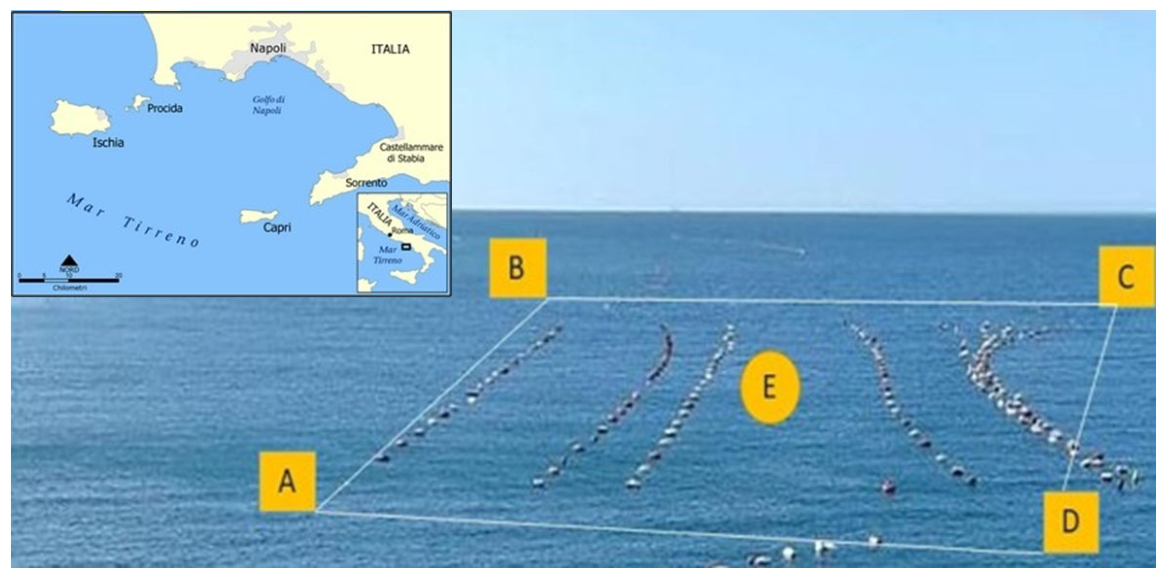
In the Gulf of Naples, the typical offshore mussel farm consists of submerged long lines arranged in parallel at a depth of 3–5 m. Each row is anchored to the seabed using concrete blocks. As a pilot plant, a mussel farm located in the Gulf of Naples, approximately 7 km long (East–West direction) with a minimum width of about 3.4 km was sampled based on the following criteria: (a) characteristics such as length, plant width, and marine depth similar to the main mussel farms in the Gulf; (b) similar impact related to intense human activities near populated areas. Using these criteria, Mediterranean mussels (M. galloprovincialis Lamarck, 1819) were collected from the pilot plant between August 2024 and June 2025, with four seasonal samplings conducted (summer, autumn, winter, and spring). The mussel plant area—surrounded by a delimited perimetral marine area—was ideally divided into four perimetral and one central points (ropes). Mussel samples were collected in each of these 5 points at the water surface (1.5 m depth) (Figure 1). About 1 kg of fresh mussels (in shell) per point was pooled for each sample. Over the year, a total of 20 mussel samples were analysed.

2.2. Pre-Treatment

Live specimens were collected in aluminium film, placed in tightly closed net bags in rigid polypropylene thermal boxes, and transported to the laboratory for processing < 2 h. To remove dirt and eventual plastic tracers from the bags, mussels were washed with running tap water, placed in foil bags, and stored at −20 °C until further processing.
Mussel selection was based on the following biometric parameters: length (maximum measure along the anterior–posterior axis), height (maximum dorso-ventral axis), and weight (Table 1). After shucking the mussels, a pool of 100 g of soft tissues (pulp and intervalvular liquid) per sampling point was collected. The pooled material was divided into quarters, homogenised, and 1 g from each pooled sample was analysed.

2.3. Extraction

In all sample treatments (extraction and analysis), the use of plastic materials was avoided. All devices used for analysis were washed with Ultra-Performance Liquid Chromatography-Mass Spectrometry (UPLC-MS) Grade water (Dutscher, Bernolsheim, France) (glass bottle).
The destructive extraction method applied was covered by a nationally and internationally protected European patent code EP3788344 (20 July 2022) [39,40,41]. The destructive method does not provide a filtration. The MP quantification method does not destroy any MP fraction. Briefly, according to the method, an aliquot of 0.1 g from each sample was transferred into a 15 mL transparent glass tube with a conical bottom, an emery neck, and a glass stopper. The sample was digested by 65% nitric acid (Merck, Darmstadt, Germany) at 80 °C for 90 min, using a graphite digestion block system (digiPREP LS, QuantAnalitica, Lecco, Italy). At the same time, reagent blanks (B) were examined to check for cross-contamination by the analytical process. After digestion, dichloromethane was added to each sample, and the mixture was vortexed for 30 s using a vortex (FisherbrandTM; Milan, Italy) using glass vials. The sample was centrifuged at 4000 rpm for 5 min using an Eppendorf 5427R bench centrifuge (Eppendorf; Hamburg, Germany) with an angular rotor. Subsequently, the lower organic phase was transferred to a new test tube. The extraction was performed twice. The extracts were dispersed on aluminium stubs for observation in the scanning electron microscope (SEM Specimen Stubs) with a 25 mm diameter previously washed with 100% dichloromethane. The sample dispersion on the surface of the stub was carried out using diaphanizing. When the stub was dry, it was metallised with gold (Cressington Sputter Coater metallizer 108 Auto, Cressington, UK) for Scanning Electron Microscopy (Cambridge Instruments Mod. Stereoscan 360, Cambridge, UK) coupled to an X Energy Dispersion Detector (Diffractometer Rigaku Miniflex, Tokyo, Japan) (SEM-EDX) with Inca software V.7. The patent protects the use of the methodology applied. Recovery was 81%.
Based on the calculated LOD of the method (0.1 μm), for the particle count, two subgroups of small-size (<10 μm) and large-size (>10 μm) MPs were fixed. The blanks, with zero particles revealed, were determined in each batch.

2.4. Microplastic Quantification

A Scanning Electron Microscopy coupled with Energy-Dispersive X-ray Spectroscopy (SEM-EDX) analysis was performed, and the calculation criterion was applied to an overall reading area within 1 mm2 of the stub, examining 228 fields at 1500 K magnification.
An automated calculation of the total number of MPs was carried out through the Software MICROPLAST version 1.0. The results were adjusted in real-time by varying the number and size of the particles counted, based on the values of other parameters (quantity of sample analysed, MP diameter, etc.) inserted in appropriate boxes. From the registered diameters, the electronic sheet calculates the average radius of each particle. Results of this study were expressed as the number of particles per gram (items/g) wet weight (w.w.) of mussel tissue.

2.5. Marine Water Sampling

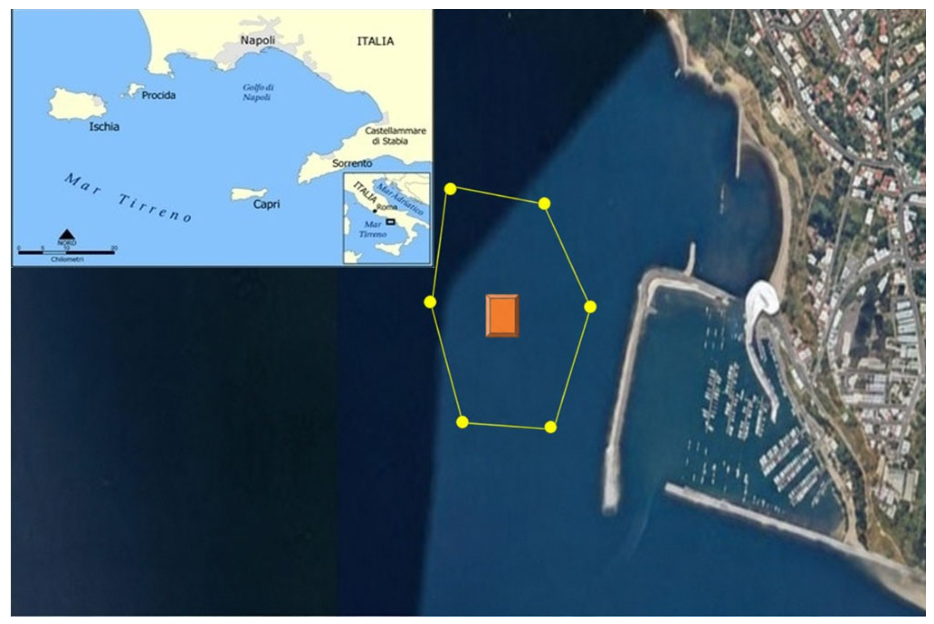
To register marine parameters, n.4 seasonal seawater samplings were carried out on the same dates as the mussel sampling. A horizontal sampling using a manta net was conducted to collect n.6 water samples from the sea surface along the perimeter of the mussel plant (distance 1.5 km) (Figure 2). The samples were stored in bottles (3 replicates taken from 1.5 m below the surface). The following parameters were studied: temperature (°C), salinity (Practical Salinity Unit_ PSU), oxygen (mg/L), and pH.

2.6. Data Analysis

Differences in particle numbers (≤10 µm and >10 µm) among seasons were analysed using a two-way ANOVA within a General Linear Model (GLM):
yijk = μ + αi+ βj + εijk
where y is the particle number, μ the overall mean, αi the effect of particle size (i = ≤10 µm, >10 µm), βj the seasonal effect (j = 1–4), and εijk the residual error.
Homogeneity of variances was tested using Levene’s test, and Duncan’s multiple range test was used for post hoc comparisons.
Abiotic parameters (temperature, salinity, oxygen concentration, and pH) did not meet the assumption of homogeneity of variances (Levene’s test) and were therefore analysed using the Kruskal–Wallis test. Pairwise comparisons were performed with Bonferroni correction. All analyses were performed using SPSS v.29.0.1.0.

2.7. Estimated Daily Intake

In the dietary exposure assessment, the following elements were considered: (i) the contaminant concentration in mussels; (ii) the average per capita purchase of mussels in Italy and the percentage of edibility; (iii) survey evidence on the fresh bivalve molluscs and total fish and seafood consumption by age group, and measures of body weight of the Italian population. The EDI of MPs for M. galloprovincialis by Italian consumers was assessed as follows:
EDI = (C × dIR)/BW
where C is the mean concentration of MPs, expressed as number of particles per gram (items/g) of mussel soft tissues; dIR is the daily ingestion rate (g) of mussels by consumers; and BW is the body weight of consumers. Estimates of the daily ingestion rate of M. galloprovincialis were obtained for each of the following classes of Italian consumers: children (3–9.9 years old); adolescents (10–17.9 years old); adults (18–64.9 years old); elderly (≥65 years old) [42]. In particular, we started from the daily per capita purchase of mussels in Italy (approximately 4.7 g day−1) [43], and we applied an edibility factor of 0.35 [44] to estimate a daily per capita consumption of 1.65 g. We then used the consumption index provided by ISMEA (2008) [45] for fresh bivalve molluscs to rescale this national value and derive mean daily intake values for three age groups: <35 years, 35–65 years, and ≥65 years. Finally, data from the INRAN-SCAI [42] for the category ‘Fish, seafood and their products’ were used to further refine the estimate for individuals < 35 years, allowing the derivation of more specific values for children (3–9.9 years) and adolescents (10–17.9 years). Overall, Estimated Daily Intake (EDI) values were obtained for the four age groups mentioned.

3. Results

3.1. Determination of Microplastic Concentrations in M. galloprovincialis

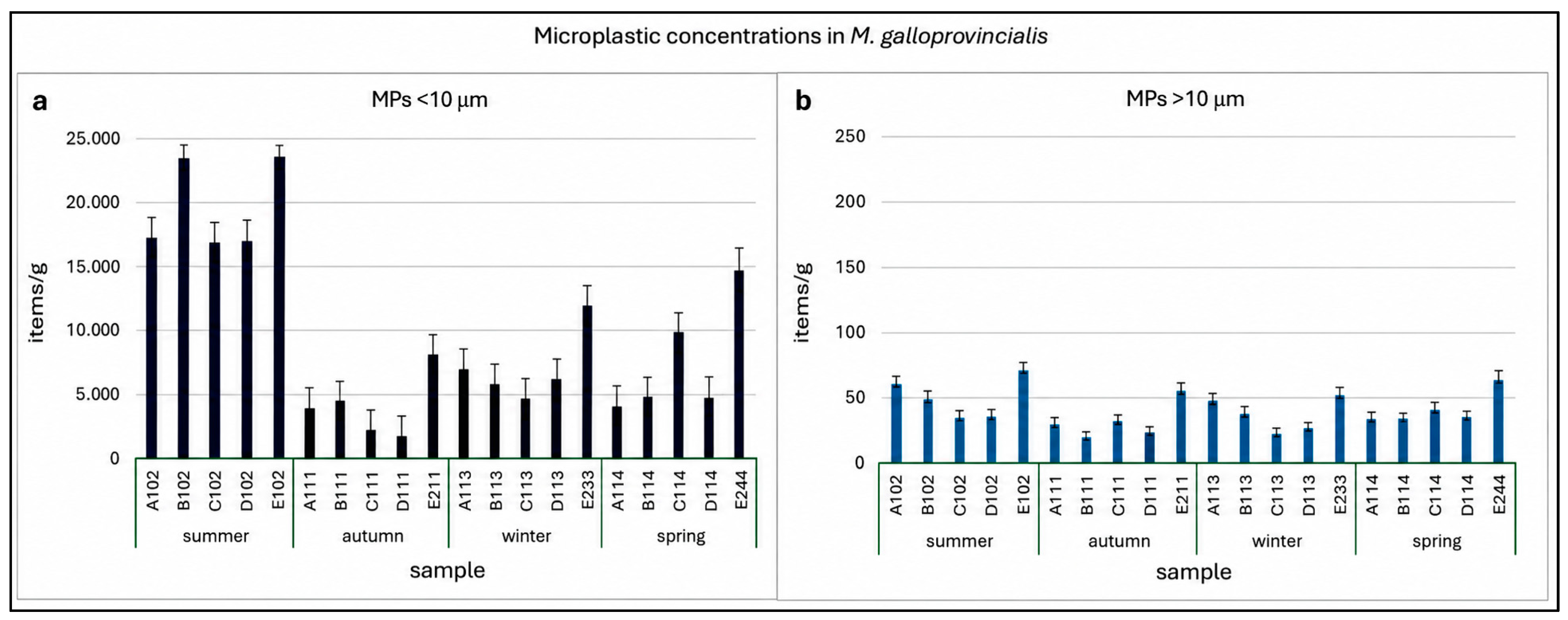
Results for MP concentrations detected in M. galloprovincialis from the pilot plant were expressed as items per gram of wet weight (g w.w.) of whole soft-body mussel tissues. The total concentration of MPs < 10 µm ranged from 1811.82 to 23,732.30 items/g. Total MPs > 10 µm were detected at concentrations of 21.84–65.57 items/g (Figure 3).
In mussel tissues, a significantly higher number of MPs < 10 µm was detected in summer vs. the other three seasons (p < 0.01). No significant difference between seasons for MPs > 10 µm was observed (Table 2).

3.2. Determination of Parameters of the Marine Area near the Mussel Farm

In the marine area near the mussel farm, the values of temperature (°C), salinity (Practical Salinity Unit_PSU), oxygen (%), and pH were registered. The temperature ranged between 15.49 °C (winter) and 28.56 °C (summer). Salinity varied from 37.29 PSU (spring) to 38.18 PSU (autumn). Oxygen concentration values were 6.61 mg/L (autumn) and 8.42 mg/L (spring), and pH ranged from 8.17 (winter, autumn, and spring) to 8.24 (summer) (Table 3). In summer, temperature, oxygen, and pH were significantly different (p ≤ 0.01) from winter and spring, while salinity values were significantly different (p ≤ 0.01) from winter and autumn (Table 3).

3.3. EDI Assessment

To calculate EDI (MP items/kg b.w./day), the daily mussel consumption for consumers of different age groups and the (mean) concentration of MPs smaller and larger than 10 μm was considered.
For MPs < 10 µm, the means (±standard deviations) of daily intakes through M. galloprovincialis consumption ranged from 127.51 (±91.00) MP items/kg b.w./day (age group 10–17.9 years old) to 318.08 (±227.00) MP items/kg b.w./day (age group of 65 years). The corresponding values for MPs > 10 µm were in the range of 0.55 (±0.18) MP items/kg b.w./day (age group 10–17.9 years old) and 1.37 (±0.46) MP items/kg b.w./day (age group of 65 years) (see Table 4 and Table 5). Due to the high variability in MP concentrations in the mussel sample units, standard deviations for daily intakes of MPs < 10 µm appear to be relatively high.
Mean consumption estimates are obtained considering (i) the annual average per capita purchase of mussels in Italy, that is 1.73 kg, corresponding to the daily purchase of roughly 4.7 g, (ii) the percentage of edibility, that is 0.35, as reported by Prato and coauthors [44], (iii) the consumption index provided by ISMEA (2008) [45] relative to differences in fresh bivalves molluscs consumption by age group as well as evidence provided by the Italian National Food Consumption Survey relative to fish, seafood and their products; standard deviations of consumption by age group are obtained by rescaling the standard deviations of fish and seafood consumption provided by the Italian National Food Consumption Survey [42], according to the proportion of estimated mussel consumption relative to total fish and seafood consumption. Fish, seafood and their products category is related to all types of fish, mollusks, crustaceans, raw (fresh or frozen) and fish fingers; all preserved fish, mollusks, crustaceans and fish eggs (caviar, anchovies) brined or in oil, tuna brined or in oil, smoked salmon, canned crab meat, dried and salted, smoked herring, etc.) including fish-based homogenised infant products. However, these products do not include mussels. Therefore, the EDI evaluation for infants (0–2 years) was excluded, as mussels are not typically consumed in this age group.

4. Discussion

Over a one-year sampling, in M. galloprovincialis from the pilot plant in the Gulf, total mean concentrations of MPs < 10 µm (9683 items/g) were significantly higher than those of MPs > 10 µm (41.85 items/g). If the variety of MP sources identified in the Gulf area and data of monitoring studies [31] are considered, this suggests that mussel contamination might be influenced by MP pollution of the perimeter marine area around the pilot farm. Results showed the presence of both MPs < 10 µm and >10 µm. The levels of MP < 10 μm in Mediterranean mussels are in accordance with those observed in the recent literature [46] and higher than those generally reported in other studies that employed non-destructive extraction and filtering steps (Table 6). In our study, a validated and accepted destructive method for the MP extraction was applied. Current non-destructive methodologies for MP determination in biological samples are based on filtration steps during sample preparation. This approach might not allow the recovery and collection of all-sized MPs smaller than the filter pore size. If the diet risk assessment is evaluated, the large use of filtration may also cause an underestimation of MPs with sizes < 10 μm, which are the most abundant and difficult particles to detect [47]. So, even if the use of destructive methods does not provide data on polymer characterisation, it may ensure a more accurate count of particles, also of those < 10 μm. Nevertheless, a direct comparison between studies is difficult due to a lack of standardisation in protocols and methodology. The results are consistent with those of other studies using destructive methods in fishery products [39,47].
The surrounding environment (aquaculture systems, hydrogeological characteristics, environmental contamination of mariculture areas, anthropogenic activities, seasonal variations) [62] might have influenced the filtration rate of MPs in farmed mussels of the Gulf.
In mussel farming, potential sources of marine litter may include accidental loss of residual items such as non-biodegradable plastic ropes made of polypropylene, polyvinyl chloride pipes, or other plastic materials used in the facilities. These plastics can persist in the environment by settling on the seabed or washing ashore far from the farms. Due to their high capacity for adaptation to large environmental fluctuations, mussels filter huge volumes of seawater. Thus, they are considered a species susceptible to MP uptake [63,64]. The concentrations of MPs are higher nearshore [62] in semi-enclosed bays than in open seashores [65,66,67] and in an estuary adjacent to land than in the open sea [68,69,70]. Furthermore, a positive correlation between the abundance of MPs in seawater and in bivalves has been reported [71,72].
In the Tyrrhenian Sea, the Gulf of Naples is one of the most densely populated areas located off the coast of the Campania region (Southern Italy). Due to its semi-enclosed nature and proximity to human settlements, it is highly susceptible to MP contamination [31]. The MP average concentration (30 kg/km2) increases in nearshore waters [73]. Considering 270 g of MP produced per inhabitant per year, a total of 6891 tons per year is entering the Tyrrhenian Sea, 4764 tons due to the river input and 2127 tons due to the coastal city input [29,31,73]. A concentration of 0.15–7.68 items/m3 of floating MP in the Gulf of Naples has been estimated [33]. According to the literature [74], environmental pressure or concomitance of different factors might have increased the mussel filtration and ingestion/retention rates of MPs in mussels from the pilot plant.
Hydrogeological characteristics (i.e., water currents, temperature, wind, and hydrodynamic factors) also influence the transport, dynamics, distribution, and accumulation of MPs in the marine area [74]. Plastic pollution in the marine areas is considered one of the main factors influencing the filter-feeding and MP ingestion rate in mussels [29,31].
Results of this study showed a seasonal variability in the occurrence of MP, with the highest number in summer (19,738.13 ± 3406.04) compared to other seasons, while the lowest was in autumn (4145.56 ± 2364.93). Hydrodynamic features (currents, vertical movements, gyres, and fronts) and seasonal variability impact the residency times and spatial distribution of MPs in farmed mussels. If the spatial-temporal distribution of floating MPs is considered, in summer, the currents in the Gulf of Naples move through the open sea. The large MP load is introduced into stable vortices; consequently, in this season, MPs are carried away from the sources and accumulate offshore. According to the literature, due to heavy maritime traffic and tourist activities in the Gulf in summer, the high dispersion of MP concentrations might be one of the factors influencing the mussel uptake rate and the abundance of MPs detected in M. galloprovincialis from the pilot plant sampled in the season [29]. In contrast, MPs remain confined to the coastal areas during autumn and winter, seasons in which currents are faster and directed towards the coast [33]. Also, this hydrogeological pattern in the Gulf of Naples might reduce MP dispersion in the marine area, influencing decreased filtration and MP concentrations in mussels during these seasons.
In our study, seasonal variations in the MP uptake rate of farmed mussels were evaluated by measuring seasonal changes in marine abiotic parameters.
Results showed summer variations in temperature (28.56 °C), salinity (36.97 PSU), and oxygen (6.68 mg/L). In seawater samples of the perimeter area of the plant, temperatures and oxygen were significantly higher in summer than in winter and spring (p ≤ 0.01). The significantly highest value of pH in summer, and salinity significantly higher than in autumn and winter, suggest that the seasonal variations in marine parameters registered in the perimeter area of the pilot plant might have influenced MP filtration rate and consequently concentration of MPs in M. galloprovincialis in this season, as reported in the literature [53,75,76].
In mariculture areas, seasonal changes in abiotic parameters and their influence on the ingestion rate of MPs are reported [67]. In M. galloprovincialis collected in the Mar Grande of Taranto (Italy), a seasonal trend with the highest concentrations of MPs in autumn was observed, followed by summer and winter, and the lowest in spring. Due to storm effects mixing in the water column, the trend was positively correlated with autumnal water temperature (18–22 °C) and MP resuspension. These factors influenced an optimal filtration rate of mussels and MP concentrations [75,77]. Summer temperatures and increased solar radiation in summer may enhance MP fragmentation in the sea, contributing to mussel contamination [67].
A seasonal trend in M. galloprovincialis from Aveiro lagoon (Portugal), with the highest MP levels in summer and the lowest concentrations in winter [53], was positively correlated with increased temperatures and mussel filtration rates.
Results suggest that, except for pH values, the parameters showed significant differences in line with typical seasonal variations in the Gulf [29]. Due to occasional surface nuclei of freshwater from the coast in spring in the Gulf marine area [29], the surface temperature decreased (21.26 °C). Thus, temperature variations might have influenced MP clearance rate and retention, decreasing MP levels detected in mussels from the pilot plant sampled in this season (7714.62 MPs/g).
Despite favourable salinity conditions (38.18 PSU) for mussel filtration and the lowest oxygen concentration (6.61 mg/L) in autumn, low MP content (4145.56 MPs/g) was observed in mussels. Moreover, in a one-year sampling, the difference in MP concentrations in mussels detected in all seasons might also be related to occasional weather and climatic events in the Gulf [78].
Due to seasonal differences, the influence of environmental variables on mussel feeding is important [78]. MP contamination, mussel rate ingestion, and seasonal variations in MPs have been studied in commercial bivalves inhabiting several compartments of coastal and estuarine environments [74,79,80]. Filter-feeding and the growth of mussels are highly dependent on factors such as temperature, salinity, and oxygen [78,81]. Increasing temperatures (12–17 °C) and salinity gradient (23–31 PSU) show a positive correlation with filter feeding in M. edulis. Generally, a negative correlation is observed between marine oxygen concentrations and mussel growth [78,82]. According to the literature, a higher concentration of food in the medium and favourable abiotic parameters increase the ingestion rate by mussels, decreasing food retention in the gut [83].
Due to the lack of area-specific reference data on exposure, the EDI calculation was a useful tool to evaluate the magnitude of exposure associated with MP dietary intake through mussel consumption [1]. In our study, EDI related to mussel consumption for MPs smaller than 10 μm showed similar values (212.29 and 225.29 MP items /kg b.w./day, respectively) for children and adults; the lowest value was for teenager group (127.51 MP items/kg b.w./day), while the highest in elderly group (318.08 MP items /kg b.w./day).
These results are mainly attributable to differences in mussel consumption across age groups. Even if mussel consumption is not considered as prevalent as in adults, the low body weight of children, compared to that of teenagers and adults, explains the difference in EDI among these groups.
The same distribution of EDI values was observed for MPs larger than 10 μm, contributing to the total EDI variability among age groups. Despite this, children may be more exposed to potential risks to MPs because of their physiological susceptibility to the toxicity of environmental pollutants [84].
Variable M. galloprovincialis consumption EDIs are reported in different countries [85]. In our study, EDI values through mussel consumption for MPs smaller than 10 μm are lower than EDIs reported by Ferrante et al. (2022) [47], and higher than those reported by Barboza and coauthors for Portugal and other European countries [86]. Italian consumers are exposed to a higher risk than European and non-European consumers [87]. In our study, if compared to values reported by studies related to Italian mussel consumption, the exposure intakes were within the range (150–600 MP items/kg b.w./day) for fresh commercial M. galloprovincialis [49], but lower than those (1395–1620 items/kg b.w./day) reported for mussel stocks collected from the Italian market [63,88]. According to the literature, the exposure intakes for the adults (18–64.9 and >65 years old) are higher than values estimated for American adult males (EDI 142 MP items/kg b.w./day) and females (EDI 113 MP items/kg b.w./day) [89]. The EDI is higher to those reported for American male (126 MP items/kg b.w./day) and female (106 MP items/kg b.w./day) children [89]. In addition, EDIs for the consumption of M. galloprovincialis from the pilot plant were lower than EDIs resulting from the consumption of other food and drinks, such as fruit [39] and mineral water in PET plastic bottles [90].
In our study, the approach to EDI calculation was subject to several limitations: (a) the use of purchase data as a proxy for consumption; (b) data does not take into account food waste or differences in mussel preparation; (c) the fixed edibility factor (0.35) does not capture season, mussel size and filtration variability; (d) the age-specific intakes were based on consumption indices, assuming similar consumption patterns within each age group; (e) the use of aggregated data for the ‘Fish, seafood and their products’ category introduces additional uncertainty assuming that mussel consumption has the same distribution of total seafood consumption.
Thus, the results showed a relatively large standard deviation of EDI values across age groups, reflecting both the corresponding variability in MP concentrations in mussels and a large within-group age variability. Also, the limited availability of data on MP concentrations by particle size, especially for small particles (<10 µm), as well as the environmental and seasonal variability in contamination levels, should be considered in mussels. Finally, both environmental (i.e., variability in MP concentrations) and demographic factors (i.e., body weight and consumption rates) contributed to the variability in dietary exposure estimates.
In light of these limitations, standardised analytical methods and more comprehensive datasets are needed for an accurate MP exposure assessment.
Some evidence suggests that MPs < 10 µm may represent a potential risk due to their ability to interact with the organism cells [3,91,92,93]. Despite the limitations, this study provides data on a size-based assessment of dietary exposure, which might be useful for a screening-level estimation of MP dietary exposure through mussel consumption.

5. Conclusions

MPs are considered ubiquitous environmental contaminants. The consumption of commercial bivalves may be a source of consumer exposure. The quality of the aquatic environment is crucial for mussel growth, reproduction, and food safety in mariculture plants. Results showed that in M. galloprovincialis collected from the pilot plant, MP occurrence was characterised by an abundance of MP < 10 µm and a seasonal trend of their distribution in mussel tissues during summer. Despite the high variability of factors influencing mussel filtration and microplastic uptake, the study provided data on the seasonal MP distribution pattern and a size-based screening exposure level through mussel consumption.
Results highlight the importance of geographic and seasonal conditions, and size in assessing MP exposure through farmed mussel consumption. A higher risk for the elderly and a similar risk for adults and children was observed. The EDIs appear to increase depending on consumption patterns of mussels (eaten whole), MP small size, seasonal trend of marine pollution (summer), age of consumers (elderly), and frequency of consumption across age groups. Currently, available data are insufficient to perform a comprehensive human health risk characterisation for MPs, and no health-based guidance value (i.e., TDI) has yet been established. Data highlights the importance of considering different geographic conditions, seasonal influences, sampling sites, and potential variables such as the relevance of different particle sizes, when MP dietary exposure and potential impact on human health are evaluated.

Author Contributions

Conceptualization, R.M.; methodology, M.F. and G.O.C.; formal analysis, R.D.P.; validation, M.C.F.; investigation, A.A.; data curation, A.A., S.C., R.D.P. and M.C.F.; writing—original draft preparation, R.M.; writing—review and editing, R.M.; visualisation, R.M.; supervision, R.M. and M.C.F. All authors have read and agreed to the published version of the manuscript.

Funding

This research received no external funding.

Institutional Review Board Statement

Not applicable.

Informed Consent Statement

Not applicable.

Data Availability Statement

The raw data supporting the conclusions of this article will be made available by the corresponding author on reasonable request.

Conflicts of Interest

The authors declare no conflicts of interest.

Abbreviations

The following abbreviations are used in this manuscript:
EDIEstimated Daily Intake
LODLimit of Detection
MPMicroplastic
NENortheast
NNENorth–Northeast
PSUPractical Salinity Unit
SEMScanning Electron Microscopy
SEM-EDXScanning Electron Microscopy coupled with Energy-Dispersive X-ray Spectroscopy
SWSouthwest
TDITolerable Daily Intake
UPLC-MSUltra-Performance Liquid Chromatography–Mass Spectrometry

References

  1. EFSA Panel on Contaminants in the Food Chain (Contam). Presence of Microplastics and Nanoplastics in Food, with Particular Focus on Seafood. EFSA J. 2016, 14, e04501. [Google Scholar] [CrossRef]
  2. Yong, C.Q.Y.; Valiyaveettil, S.; Tang, B.L. Toxicity of Microplastics and Nanoplastics in Mammalian Systems. Int. J. Environ. Res. Public Health 2020, 17, 1509. [Google Scholar] [CrossRef]
  3. Fraissinet, S.; De Benedetto, G.E.; Malitesta, C.; Holzinger, R.; Materić, D. Microplastics and Nanoplastics Size Distribution in Farmed Mussel Tissues. Commun. Earth Environ. 2024, 5, 128. [Google Scholar] [CrossRef]
  4. Janzik, R.; Sieg, H.; Braeuning, A.; Böl, G.F. Microplastics: State of the Evidence on Health Effects and Public Perception. Dtsch. Arztebl. Int. 2025, 122, 546–551. [Google Scholar] [CrossRef] [PubMed]
  5. Borgatta, M.; Breider, F. Inhalation of Microplastics—A Toxicological Complexity. Toxics 2024, 12, 358. [Google Scholar] [CrossRef] [PubMed]
  6. Facciolà, A.; Visalli, G.; Ciarello, M.P.; Di Pietro, A. Newly Emerging Airborne Pollutants: Current Knowledge of Health Impact of Micro and Nanoplastics. Int. J. Environ. Res. Public Health 2021, 18, 2997. [Google Scholar] [CrossRef] [PubMed]
  7. Wardani, I.; Hazimah Mohamed Nor, N.; Wright, S.L.; Kooter, I.M.; Koelmans, A.A. Nano- and Microplastic PBK Modeling in the Context of Human Exposure and Risk Assessment. Environ. Int. 2024, 186, 108504. [Google Scholar] [CrossRef] [PubMed]
  8. Stock, V.; Böhmert, L.; Lisicki, E.; Block, R.; Cara-Carmona, J.; Pack, L.K.; Selb, R.; Lichtenstein, D.; Voss, L.; Henderson, C.J.; et al. Uptake and Effects of Orally Ingested Polystyrene Microplastic Particles in Vitro and in Vivo. Arch. Toxicol. 2019, 93, 1817–1833. [Google Scholar] [CrossRef]
  9. Persiani, E.; Cecchettini, A.; Ceccherini, E.; Gisone, I.; Morales, M.A.; Vozzi, F. Microplastics: A Matter of the Heart (and Vascular System). Biomedicines 2023, 11, 264. [Google Scholar] [CrossRef]
  10. Roslan, N.S.; Lee, Y.Y.; Ibrahim, Y.S.; Anuar, S.T.; Yusof, K.M.K.K.; Lai, L.A.; Brentnall, T. Detection of Microplastics in Human Tissues and Organs: A Scoping Review. J. Glob. Health 2024, 14, 04179. [Google Scholar] [CrossRef]
  11. Leslie, H.A.; van Velzen, M.J.M.; Brandsma, S.H.; Vethaak, A.D.; Garcia-Vallejo, J.J.; Lamoree, M.H. Discovery and Quantification of Plastic Particle Pollution in Human Blood. Environ. Int. 2022, 163, 107199. [Google Scholar] [CrossRef]
  12. Jenner, L.C.; Rotchell, J.M.; Bennett, R.T.; Cowen, M.; Tentzeris, V.; Sadofsky, L.R. Detection of Microplastics in Human Lung Tissue Using ΜFTIR Spectroscopy. Sci. Total Environ. 2022, 831, 154907. [Google Scholar] [CrossRef]
  13. Yang, Y.; Xie, E.; Du, Z.; Peng, Z.; Han, Z.; Li, L.; Zhao, R.; Qin, Y.; Xue, M.; Li, F.; et al. Detection of Various Microplastics in Patients Undergoing Cardiac Surgery. Environ. Sci. Technol. 2023, 57, 10911–10918. [Google Scholar] [CrossRef]
  14. Montano, L.; Giorgini, E.; Notarstefano, V.; Notari, T.; Ricciardi, M.; Piscopo, M.; Motta, O. Raman Microspectroscopy Evidence of Microplastics in Human Semen. Sci. Total Environ. 2023, 901, 165922. [Google Scholar] [CrossRef]
  15. Marfella, R.; Prattichizzo, F.; Sardu, C.; Fulgenzi, G.; Graciotti, L.; Spadoni, T.; D’Onofrio, N.; Scisciola, L.; La Grotta, R.; Frigé, C.; et al. Microplastics and Nanoplastics in Atheromas and Cardiovascular Events. N. Engl. J. Med. 2024, 390, 900–910. [Google Scholar] [CrossRef]
  16. Ragusa, A.; Svelato, A.; Santacroce, C.; Catalano, P.; Notarstefano, V.; Carnevali, O.; Papa, F.; Rongioletti, M.C.A.; Baiocco, F.; Draghi, S.; et al. Plasticenta: First Evidence of Microplastics in Human Placenta. Environ. Int. 2021, 146, 106274. [Google Scholar] [CrossRef]
  17. Halfar, J.; Čabanová, K.; Vávra, K.; Delongová, P.; Motyka, O.; Špaček, R.; Kukutschová, J.; Šimetka, O.; Heviánková, S. Microplastics and Additives in Patients with Preterm Birth: The First Evidence of Their Presence in Both Human Amniotic Fluid and Placenta. Chemosphere 2023, 343, 140301. [Google Scholar] [CrossRef] [PubMed]
  18. Ragusa, A.; Notarstefano, V.; Svelato, A.; Belloni, A.; Gioacchini, G.; Blondeel, C.; Zucchelli, E.; De Luca, C.; D’avino, S.; Gulotta, A.; et al. Raman Microspectroscopy Detection and Characterisation of Microplastics in Human Breastmilk. Polymers 2022, 14, 2700. [Google Scholar] [CrossRef] [PubMed]
  19. Thiele, C.J.; Hudson, M.D.; Russell, A.E.; Saluveer, M.; Sidaoui-Haddad, G. Microplastics in Fish and Fishmeal: An Emerging Environmental Challenge? Sci. Rep. 2021, 11, 2045. [Google Scholar] [CrossRef] [PubMed]
  20. Sangkham, S.; Faikhaw, O.; Munkong, N.; Sakunkoo, P.; Arunlertaree, C.; Chavali, M.; Mousazadeh, M.; Tiwari, A. A Review on Microplastics and Nanoplastics in the Environment: Their Occurrence, Exposure Routes, Toxic Studies, and Potential Effects on Human Health. Mar. Pollut. Bull. 2022, 181, 113832. [Google Scholar] [CrossRef]
  21. Yuan, Z.; Nag, R.; Cummins, E. Human Health Concerns Regarding Microplastics in the Aquatic Environment—From Marine to Food Systems. Sci. Total Environ. 2022, 823, 153730. [Google Scholar] [CrossRef]
  22. Li, J.; Lusher, A.L.; Rotchell, J.M.; Deudero, S.; Turra, A.; Bråte, I.L.N.; Sun, C.; Shahadat Hossain, M.; Li, Q.; Kolandhasamy, P.; et al. Using Mussel as a Global Bioindicator of Coastal Microplastic Pollution. Environ. Pollut. 2019, 244, 522–533. [Google Scholar] [CrossRef]
  23. Mercogliano, R.; Avio, C.G.; Regoli, F.; Anastasio, A.; Colavita, G.; Santonicola, S. Occurrence of Microplastics in Commercial Seafood under the Perspective of the Human Food Chain. A Review. J. Agric. Food Chem. 2020, 68, 5296–5301. [Google Scholar] [CrossRef]
  24. Ding, J.; Li, J.; Sun, C.; Jiang, F.; He, C.; Zhang, M.; Ju, P.; Ding, N.X. An Examination of the Occurrence and Potential Risks of Microplastics across Various Shellfish. Sci. Total Environ. 2020, 739, 139887. [Google Scholar] [CrossRef]
  25. Barboza, L.G.A.; Lopes, C.; Oliveira, P.; Bessa, F.; Otero, V.; Henriques, B.; Raimundo, J.; Caetano, M.; Vale, C.; Guilhermino, L. Microplastics in Wild Fish from North East Atlantic Ocean and Its Potential for Causing Neurotoxic Effects, Lipid Oxidative Damage, and Human Health Risks Associated with Ingestion Exposure. Sci. Total Environ. 2020, 717, 134625. [Google Scholar] [CrossRef] [PubMed]
  26. Chen, G.; Li, Y.; Wang, J. Occurrence and Ecological Impact of Microplastics in Aquaculture Ecosystems. Chemosphere 2021, 274, 129989. [Google Scholar] [CrossRef] [PubMed]
  27. Suaria, G.; Avio, C.G.; Mineo, A.; Lattin, G.L.; Magaldi, M.G.; Belmonte, G.; Moore, C.J.; Regoli, F.; Aliani, S. The Mediterranean Plastic Soup: Synthetic Polymers in Mediterranean Surface Waters. Sci. Rep. 2016, 6, 37551. [Google Scholar] [CrossRef]
  28. Hartmann, N.B.; Hüffer, T.; Thompson, R.C.; Hassellöv, M.; Verschoor, A.; Daugaard, A.E.; Rist, S.; Karlsson, T.; Brennholt, N.; Cole, M.; et al. Are We Speaking the Same Language? Recommendations for a Definition and Categorization Framework for Plastic Debris. Environ. Sci. Technol. 2019, 53, 1039–1047. [Google Scholar] [CrossRef] [PubMed]
  29. Gifuni, L.; de Ruggiero, P.; Cianelli, D.; Zambianchi, E.; Pierini, S. Hydrology and Dynamics in the Gulf of Naples during Spring of 2016: In Situ and Model Data. J. Mar. Sci. Eng. 2022, 10, 1776. [Google Scholar] [CrossRef]
  30. Williams, G.S. Mediterranean Ecosystems: Dynamics, Management and Conservation; Nova Science Publisher’s, Incorporated: Hauppauge, NY, USA, 2012. [Google Scholar]
  31. Murano, C.; Agnisola, C.; Caramiello, D.; Castellano, I.; Casotti, R.; Corsi, I.; Palumbo, A. How Sea Urchins Face Microplastics: Uptake, Tissue Distribution and Immune System Response. Environ. Pollut. 2020, 264, 114685. [Google Scholar] [CrossRef]
  32. Santa, F.; Viale, T.; Gessi, R.; Garaventa, F.; Gorbi, S.; Morgana, S.; Costa, E.; Faimali, M.; Mezzelani, M.; Avio, C.G.; et al. “Less Plastic More Mediterranean” 2017 Campaign on Board the Rainbow Warrior Greenpeace Ship “MICROPLASTIC INVESTIGATION IN WATER AND TROPHIC CHAIN ALONG THE ITALIAN COAST 06/24/2017-07/15/2017”; Activity Report; CNR-ISMAR: Genova, Italy; UNIVPM: Ancona, Italy, 2017. [Google Scholar]
  33. Cincinelli, A.; Martellini, T.; Guerranti, C.; Scopetani, C.; Chelazzi, D.; Giarrizzo, T. A Potpourri of Microplastics in the Sea Surface and Water Column of the Mediterranean Sea. TrAC-Trends Anal. Chem. 2019, 110, 321–326. [Google Scholar] [CrossRef]
  34. Boukadida, K.; Mlouka, R.; Abelouah, M.R.; Chelly, S.; Romdhani, I.; Conti, G.O.; Ferrante, M.; Cammarata, M.; Parisi, M.G.; AitAlla, A.; et al. Unraveling the Interplay between Environmental Microplastics and Salinity Stress on Mytilus galloprovincialis Larval Development: A Holistic Exploration. Sci. Total Environ. 2024, 927, 172177. [Google Scholar] [CrossRef]
  35. Daviot, J.R.; Lymbery, A.J.; Beatty, S.J. Biofiltration by an Imperilled Freshwater Mussel: Implications for Water Quality in a Drying Climate. Hydrobiologia 2025, 852, 3349–3363. [Google Scholar] [CrossRef]
  36. Munari, M.; Matozzo, V.; Riedl, V.; Pastore, P.; Badocco, D.; Marin, M.G. EAT BREATHE EXCRETE REPEAT: Physiological Responses of the Mussel Mytilus galloprovincialis to Diclofenac and Ocean Acidification. J. Mar. Sci. Eng. 2020, 8, 907. [Google Scholar] [CrossRef]
  37. Parolini, M.; Stucchi, M.; Ambrosini, R.; Romano, A. A Global Perspective on Microplastic Bioaccumulation in Marine Organisms. Ecol. Indic. 2023, 149, 110179. [Google Scholar] [CrossRef]
  38. Garrido Gamarro, E.; Costanzo, V. Microplastics in Food Commodities—A Food Safety Review on Human Exposure Through Dietary Sources; Food Safety and Quality Series No. 18; FAO: Rome, Italy, 2022. [Google Scholar] [CrossRef]
  39. Oliveri Conti, G.; Ferrante, M.; Banni, M.; Favara, C.; Nicolosi, I.; Cristaldi, A.; Fiore, M.; Zuccarello, P. Micro- and Nano-Plastics in Edible Fruit and Vegetables. The First Diet Risks Assessment for the General Population. Environ. Res. 2020, 187, 109677. [Google Scholar] [CrossRef]
  40. Epo.Org. Available online: https://www.epo.org/en/searching-for-patents/technical/ep-full-text (accessed on 30 April 2026).
  41. Estrazione Di Micro-Plastiche in Campioni a Matrice Organica e Inorganica. Available online: https://www.knowledge-share.eu/it/brevetti/estrazione-di-micro-plastiche-in-campioni-a-matrice-organica-e-inorganica (accessed on 30 April 2026).
  42. Leclercq, C.; Arcella, D.; Piccinelli, R.; Sette, S.; Le Donne, C. The Italian National Food Consumption Survey INRAN-SCAI 2005–06: Main Results in Terms of Food Consumption. Public Health Nutr. 2009, 12, 2504–2532. [Google Scholar] [CrossRef]
  43. EUMOFA. Available online: https://eumofa.eu/ (accessed on 27 April 2026).
  44. Prato, E.; Biandolino, F.; Parlapiano, I.; Giandomenico, S.; Denti, G.; Calò, M.; Spada, L.; Di Leo, A. Proximate, Fatty Acids and Metals in Edible Marine Bivalves from Italian Market: Beneficial and Risk for Consumers Health. Sci. Total Environ. 2019, 648, 153–163. [Google Scholar] [CrossRef] [PubMed]
  45. ISMEA. I Consumi Ittici Nei Principali Paesi Europei; ISMEA: Rome, Italy, 2008. [Google Scholar]
  46. Xiong, X.; Xie, S.; Feng, K.; Wang, Q. Occurrence of Microplastics in a Pond-River-Lake Connection Water System: How Does the Aquaculture Process Affect Microplastics in Natural Water Bodies. J. Clean. Prod. 2022, 352, 131632. [Google Scholar] [CrossRef]
  47. Ferrante, M.; Pietro, Z.; Allegui, C.; Maria, F.; Antonio, C.; Pulvirenti, E.; Favara, C.; Chiara, C.; Grasso, A.; Omayma, M.; et al. Microplastics in Fillets of Mediterranean Seafood. A Risk Assessment Study. Environ. Res. 2022, 204, 112247. [Google Scholar] [CrossRef]
  48. Manolaki, S.M.; Chatzivasileiou, D.; Lampa, M.; Dimitriou, P.D.; Philippidis, A.; Karakassis, I.; Papageorgiou, N. Microplastic Contamination in Cultured Mussels and Pearl Oysters in Greece. Microplastics 2023, 2, 168–181. [Google Scholar] [CrossRef]
  49. Nalbone, L.; Cincotta, F.; Giarratana, F.; Ziino, G.; Panebianco, A. Microplastics in Fresh and Processed Mussels Sampled from Fish Shops and Large Retail Chains in Italy. Food Control 2021, 125, 108003. [Google Scholar] [CrossRef]
  50. Pizzurro, F.; Recchi, S.; Nerone, E.; Salini, R.; Barile, N.B. Accumulation Evaluation of Potential Microplastic Particles in Mytilus galloprovincialis from the Goro Sacca (Adriatic Sea, Italy). Microplastics 2022, 1, 303–318. [Google Scholar] [CrossRef]
  51. Quaglia, N.C.; Capuozzo, F.; Ceci, E.; Cometa, S.; Di Pinto, A.; Mottola, A.; Piredda, R.; Dambrosio, A. Preliminary Survey on the Occurrence of Microplastics in Bivalve Mollusks Marketed in Apulian Fish Markets. Ital. J. Food Saf. 2023, 12, 10906. [Google Scholar] [CrossRef]
  52. Bråte, I.L.N.; Hurley, R.; Iversen, K.; Beyer, J.; Thomas, K.V.; Steindal, C.C.; Green, N.W.; Olsen, M.; Lusher, A. Mytilus spp. as Sentinels for Monitoring Microplastic Pollution in Norwegian Coastal Waters: A Qualitative and Quantitative Study. Environ. Pollut. 2018, 243, 383–393. [Google Scholar] [CrossRef]
  53. Botelho, M.J.; Vale, C.; Marques, F.; Moreirinha, C.; Costa, S.T.; Guilhermino, L.; Joaquim, S.; Matias, D.; Candeias, M.; Rudnitskaya, A. One-Year Variation in Quantity and Properties of Microplastics in Mussels (Mytilus galloprovincialis) and Cockles (Cerastoderma edule) from Aveiro Lagoon. Environ. Pollut. 2023, 333, 121949. [Google Scholar] [CrossRef] [PubMed]
  54. Masiá, P.; Ardura, A.; Garcia-Vazquez, E. Microplastics in Seafood: Relative Input of Mytilus galloprovincialis and Table Salt in Mussel Dishes. Food Res. Int. 2022, 153, 110973. [Google Scholar] [CrossRef]
  55. Sparks, C. Microplastics in Mussels Along the Coast of Cape Town, South Africa. Bull. Environ. Contam. Toxicol. 2020, 104, 423–431. [Google Scholar] [CrossRef] [PubMed]
  56. Sparks, C.; Viljoen, N.; Hill, D.; Lassen, J.; Awe, A. Characteristics and Risk Assessment of Microplastics in Water and Mussels Sampled from Cape Town Harbour and Two Oceans Aquarium, South Africa. Bull. Environ. Contam. Toxicol. 2023, 110, 104. [Google Scholar] [CrossRef]
  57. Jeong, J.; Shim, W.J.; Cho, Y.; Han, G.M.; Jang, M.; Hong, S.H. Intra-Annual Variation in Microplastics in Mussels (Mytilus galloprovincialis) Inhabiting an Urbanized Bay of South Korea. Mar. Pollut. Bull. 2023, 196, 115673. [Google Scholar] [CrossRef] [PubMed]
  58. Abidli, S.; Lahbib, Y.; Trigui El Menif, N. Microplastics in Commercial Molluscs from the Lagoon of Bizerte (Northern Tunisia). Mar. Pollut. Bull. 2019, 142, 243–252. [Google Scholar] [CrossRef] [PubMed]
  59. Abelouah, M.R.; Romdhani, I.; Ben-Haddad, M.; Hajji, S.; De-la-Torre, G.E.; Gaaied, S.; Barra, I.; Banni, M.; Ait Alla, A. Binational Survey Using Mytilus galloprovincialis as a Bioindicator of Microplastic Pollution: Insights into Chemical Analysis and Potential Risk on Humans. Sci. Total Environ. 2023, 870, 161894. [Google Scholar] [CrossRef]
  60. Yozukmaz, A. Investigation of Microplastics in Edible Wild Mussels from İzmir Bay (Aegean Sea, Western Turkey): A Risk Assessment for the Consumers. Mar. Pollut. Bull. 2021, 171, 112733. [Google Scholar] [CrossRef]
  61. Can Tunçelli, İ.; Erkan, N. Microplastic Pollution in Wild and Aquacultured Mediterranean Mussels from the Sea of Marmara: Abundance, Characteristics, and Health Risk Estimations. Environ. Res. 2024, 242, 117787. [Google Scholar] [CrossRef] [PubMed]
  62. Dambrosio, A.; Cometa, S.; Capuozzo, F.; Ceci, E.; Derosa, M.; Quaglia, N.C. Occurrence and Characterization of Microplastics in Commercial Mussels (Mytilus galloprovincialis) from Apulia Region (Italy). Foods 2023, 12, 1495. [Google Scholar] [CrossRef] [PubMed]
  63. Renzi, M.; Guerranti, C.; Blašković, A. Microplastic Contents from Maricultured and Natural Mussels. Mar. Pollut. Bull. 2018, 131, 248–251. [Google Scholar] [CrossRef]
  64. Digka, N.; Patsiou, D.; Hatzonikolakis, Y.; Raitsos, D.E.; Skia, G.; Koutsoubas, D.; Dimitriadis, C.; Tsangaris, C. Microplastic Ingestion in Mussels from the East Mediterranean Sea: Exploring Its Impacts in Nature and Controlled Conditions. Sci. Total Environ. 2024, 946, 174268. [Google Scholar] [CrossRef] [PubMed]
  65. Aliabad, M.K.; Nassiri, M.; Kor, K. Microplastics in the Surface Seawaters of Chabahar Bay, Gulf of Oman (Makran Coasts). Mar. Pollut. Bull. 2019, 143, 125–133. [Google Scholar] [CrossRef]
  66. Zhu, J.; Zhang, Q.; Li, Y.; Tan, S.; Kang, Z.; Yu, X.; Lan, W.; Cai, L.; Wang, J.; Shi, H. Microplastic Pollution in the Maowei Sea, a Typical Mariculture Bay of China. Sci. Total Environ. 2019, 658, 62–68. [Google Scholar] [CrossRef]
  67. Faruk Çullu, A.; Sönmez, V.Z.; Sivri, N. Microplastic Contamination in Surface Waters of the Küçükçekmece Lagoon, Marmara Sea (Turkey): Sources and Areal Distribution. Environ. Pollut. 2021, 268, 115801. [Google Scholar] [CrossRef]
  68. Kye, H.; Kim, J.; Ju, S.; Lee, J.; Lim, C.; Yoon, Y. Microplastics in Water Systems: A Review of Their Impacts on the Environment and Their Potential Hazards. Heliyon 2023, 9, e14359. [Google Scholar] [CrossRef]
  69. Zhang, W.; Zhang, S.; Zhao, Q.; Qu, L.; Ma, D.; Wang, J. Spatio-Temporal Distribution of Plastic and Microplastic Debris in the Surface Water of the Bohai Sea, China. Mar. Pollut. Bull. 2020, 158, 111343. [Google Scholar] [CrossRef]
  70. Zhang, D.; Cui, Y.; Zhou, H.; Jin, C.; Yu, X.; Xu, Y.; Li, Y.; Zhang, C. Microplastic Pollution in Water, Sediment, and Fish from Artificial Reefs around the Ma’an Archipelago, Shengsi, China. Sci. Total Environ. 2020, 703, 134768. [Google Scholar] [CrossRef] [PubMed]
  71. Wang, D.; Su, L.; Ruan, H.D.; Chen, J.; Lu, J.; Lee, C.H.; Jiang, S.Y. Quantitative and Qualitative Determination of Microplastics in Oyster, Seawater and Sediment from the Coastal Areas in Zhuhai, China. Mar. Pollut. Bull. 2021, 164, 112000. [Google Scholar] [CrossRef]
  72. Halbach, M.; Vogel, M.; Tammen, J.K.; Rüdel, H.; Koschorreck, J.; Scholz-Böttcher, B.M. 30 Years Trends of Microplastic Pollution: Mass-Quantitative Analysis of Archived Mussel Samples from the North and Baltic Seas. Sci. Total Environ. 2022, 826, 154179. [Google Scholar] [CrossRef]
  73. Pini, A.; Tomassetti, P.; Matiddi, M.; Andrea De Lucia, G.; Bello, P.; Zazzini, S.; Leuzzi, G.; Monti, P. Microplastic Detection and Lagrangian Modelling in the Tyrrhenian Sea. In Proceedings of the 2019 IMEKO TC19 International Workshop on Metrology for the Sea (MetroSea 2019), Genova, Italy, 3–5 October 2019. [Google Scholar]
  74. Ding, J.; Sun, C.; He, C.; Li, J.; Ju, P.; Li, F. Microplastics in Four Bivalve Species and Basis for Using Bivalves as Bioindicators of Microplastic Pollution. Sci. Total Environ. 2021, 782, 146830. [Google Scholar] [CrossRef] [PubMed]
  75. Fraissinet, S.; Arduini, D.; Martines, A.; De Benedetto, G.E.; Malitesta, C.; Giangrande, A.; Rossi, S. Seasonal Occurrence and Distribution of Microplastics in Four Different Benthic Suspension Feeders from an Integrated Multi-Trophic Aquaculture (IMTA) Facility: A Bioremediation Perspective. Mar. Pollut. Bull. 2024, 207, 116811. [Google Scholar] [CrossRef]
  76. Kamermans, P.; Saurel, C.; Boudry, P.; Kamermans, P. Interacting Climate Change Effects on Mussels (Mytilus edulis and M. galloprovincialis) and Oysters (Crassostrea gigas and Ostrea edulis): Experiments for Bivalve Individual Growth Models. Aquat. Living Resour. 2022, 35, 1. [Google Scholar] [CrossRef]
  77. Riisgård, H.U.; Larsen, P.S. Filter-Feeding Zoobenthos and Hydrodynamics. In Marine Animal Forests: The Ecology of Benthic Biodiversity Hotspots; Springer International Publishing: Berlin/Heidelberg, Germany, 2017; pp. 787–811. [Google Scholar]
  78. Bergström, P.; Lindegarth, S.; Lindegarth, M. Temporal Consistency of Spatial Pattern in Growth of the Mussel, Mytilus edulis: Implications for Predictive Modelling. Estuar. Coast. Shelf Sci. 2013, 131, 93–102. [Google Scholar] [CrossRef]
  79. Cho, Y.; Shim, W.J.; Jang, M.; Han, G.M.; Hong, S.H. Nationwide Monitoring of Microplastics in Bivalves from the Coastal Environment of Korea. Environ. Pollut. 2021, 270, 116175. [Google Scholar] [CrossRef]
  80. Liu, J.; Zhu, X.; Teng, J.; Zhao, J.; Li, C.; Shan, E.; Zhang, C.; Wang, Q. Pollution Characteristics of Microplastics in Mollusks from the Coastal Area of Yantai, China. Bull. Environ. Contam. Toxicol. 2021, 107, 693–699. [Google Scholar] [CrossRef]
  81. Sakamaki, T.; Hayashi, K.; Zheng, Y.; Fujibayashi, M.; Nishimura, O. Effects of Oyster Age on Selective Suspension-Feeding and the Chemical Composition of Biodeposits: Insights from Fatty Acid Analysis. Mar. Ecol. Prog. Ser. 2020, 644, 75–89. [Google Scholar] [CrossRef]
  82. Riisgård, H.U.; Lüskow, F.; Pleissner, D.; Lundgreen, K.; López, M.Á.P. Effect of Salinity on Filtration Rates of Mussels Mytilus edulis with Special Emphasis on Dwarfed Mussels from the Low-Saline Central Baltic Sea. Helgol. Mar. Res. 2013, 67, 591–598. [Google Scholar] [CrossRef]
  83. Fernández, B.; Albentosa, M. Insights into the Uptake, Elimination and Accumulation of Microplastics in Mussel. Environ. Pollut. 2019, 249, 321–329. [Google Scholar] [CrossRef]
  84. Sly, P.D.; Flack, F. Susceptibility of Children to Environmental Pollutants. Ann. N. Y. Acad. Sci. 2008, 1140, 163–183. [Google Scholar] [CrossRef] [PubMed]
  85. Heo, S.J.; Moon, N.; Kim, J.H. A Systematic Review and Quality Assessment of Estimated Daily Intake of Microplastics through Food. Rev. Environ. Health 2024, 40, 371–392. [Google Scholar] [CrossRef] [PubMed]
  86. Barboza, L.G.A.; Otero, X.L.; Guilhermino, L. Microplastic Contamination in Marine Mussels from the Atlantic Coast of North Portugal and Human Risk of Microplastic Intake through Mussel Consumption. Environ. Pollut. 2024, 352, 124133. [Google Scholar] [CrossRef]
  87. Cho, Y.; Shim, W.J.; Jang, M.; Han, G.M.; Hong, S.H. Abundance and Characteristics of Microplastics in Market Bivalves from South Korea. Environ. Pollut. 2019, 245, 1107–1116. [Google Scholar] [CrossRef] [PubMed]
  88. Nawab, A.; Ahmad, M.; Khan, M.T.; Nafees, M.; Khan, I.; Ihsanullah, I. Human Exposure to Microplastics: A Review on Exposure Routes and Public Health Impacts. J. Hazard. Mater. Adv. 2024, 16, 100487. [Google Scholar] [CrossRef]
  89. Cox, K.D.; Covernton, G.A.; Davies, H.L.; Dower, J.F.; Juanes, F.; Dudas, S.E. Human Consumption of Microplastics. Environ. Sci. Technol. 2019, 53, 7068–7074. [Google Scholar] [CrossRef]
  90. Zuccarello, P.; Ferrante, M.; Cristaldi, A.; Copat, C.; Grasso, A.; Sangregorio, D.; Fiore, M.; Oliveri Conti, G. Exposure to Microplastics (<10 µm) Associated to Plastic Bottles Mineral Water Consumption: The First Quantitative Study. Water Res. 2019, 157, 365–371. [Google Scholar] [CrossRef]
  91. Marcelino, R.C.; Cardoso, R.M.; Domingues, E.L.B.C.; Gonçalves, R.V.; Lima, G.D.A.; Novaes, R.D. The Emerging Risk of Microplastics and Nanoplastics on the Microstructure and Function of Reproductive Organs in Mammals: A Systematic Review of Preclinical Evidence. Life Sci. 2022, 295, 120404. [Google Scholar] [CrossRef]
  92. Zhou, G.; Li, J.; Chen, Y.; Cui, Y.; Wang, Y.; Zheng, L.; Zhang, D.; Luo, T. Size-Dependent Toxicological Effects of Microplastics: A Review. Ecotoxicol. Environ. Saf. 2026, 311, 119831. [Google Scholar] [CrossRef]
  93. Ribeiro, F.; O’Brien, J.W.; Galloway, T.; Thomas, K.V. Accumulation and Fate of Nano- and Micro-Plastics and Associated Contaminants in Organisms. TrAC-Trends Anal. Chem. 2019, 111, 139–147. [Google Scholar] [CrossRef]
Figure 1. Sampling diagram of M. galloprovincialis in the pilot plant of the Gulf of Naples (Italy). Legend: A-B-C-D = perimeter points (ropes) of M. galloprovincialis sampling. E = central point (rope) of mussel sampling.
Microplastics 05 00129 g001
Figure 2. Marine water sampling diagram of the pilot plant in the Gulf of Naples (Italy). The red square represents the mussel pilot plant. Yellow lines represent the perimeter area, and yellow points represent the marine water sampling sites.
Microplastics 05 00129 g002
Figure 3. Concentrations (items/g w.w) of microplastics smaller (a) and larger (b) than 10 µm in farmed M. galloprovincialis samples from the pilot plant in the Gulf of Naples. Sample points are indicated with capital letters (A-B-C-D-E), while numbers represent the same point in different seasons.
Microplastics 05 00129 g003
Table 1. Biometric parameters of selected M. galloprovincialis for analysis.
SeasonLength (Mean)
(cm)
Height (Mean)
(cm)
Weight (Mean)
(g)
Summer7.02.56.22
Autumn6.22.24.68
Winter5.51.84.17
Spring6.42.14.63
Table 2. Seasonal distribution and total concentration (mean) of microplastics, smaller and larger than 10 μm, in M. galloprovincialis from the mussel farming pilot plant in the Gulf of Naples (Italy).
Sampling
Season
Mean ± SD (Items/g)Median
<10 μm>10 μm<10 μm>10 μm
summer19,738.13 ± 3406.04 A51.86 ± 13.8517,331.7450.32
autumn4145.56 ± 2364.93 B33.66 ± 12.572279.5731.21
winter7117.39 ± 2666.89 B38.58 ± 11.516172.1038.67
spring7714.62 ± 24,353.01 B42.32 ± 11.964874.1836.78
Total concentration
(all seasons)
9683.92 ± 6911 A41.85 ± 13.98 B6573.6338.04
Different capital letters (AB) within the columns indicate statistically significant differences (p ≤ 0.01). Different capital letters (AB) of the last line indicate statistically significant differences (p ≤ 0.01).
Table 3. Abiotic parameter values—expressed as mean ( x ¯ ) and standard deviation (±SD)—registered in the perimeter marine area of the pilot plant in the Gulf of Naples (Italy).
ParameterTotalSummerAutumnWinterSpring
Temperature (°C)22.43 ± 4.8628.56 ± 0.13 A24.42 ± 0.01AC15.49 ± 0.04 B21.26 ± 1.37 BC
Salinity (PSU)37.58 ± 0.5336.97 ± 0.36 A38.18 ± 0.01B37.87 ± 0.07 Ba37.29 ± 0.26 Ab
Oxygen (mg/L)7.37 ± 0.776.68 ± 0.10 Aa6.61 ± 0.04 A7.80 ± 0.08 Bb8.42 ± 0.13 B
pH (units)8.18 ± 0.048.24 ± 0.04 A8.17 ± 0.01 B8.17 ± 0.01 B8.17 ± 0.01 B
Different capital letters (AC) within lines indicate statistically significant differences (p ≤ 0.01). Lowercase letters (ab) within lines indicate statistically significant differences (p ≤ 0.05).
Table 4. Estimated Daily Intakes of microplastics through M. galloprovincialis consumption.
Age Group (Years)Estimated Daily Intake
(MP Items/kg Body Weight/Day)
MPs < 10 μmMPs > 10 μmSum
3–9.9212.29 ± 151.500.92 ± 0.31213.21 ± 151.74
10–17.9127.51 ± 91.000.55 ± 0.18128.06 ± 91.15
18–64.9225.29 ± 160.780.97 ± 0.33226.06 ± 161.03
≥65318.08 ± 227.001.37 ± 0.46319.46 ± 227.36
Note: the table reports the Estimated Daily Intakes (MPs/kg body weight/day) and the related standard deviations of microplastics for consumers, based on the mean concentrations in mussel soft tissues.
Table 5. Mean body weight and mussel consumption across age groups.
Age Group (Years)Weight (kg)Shares of Fish and Seafood Consumption with Respect to National ValueM. galloprovincialis Consumption Estimates: Mean ± SD
3–9.926.100.890.57 ± 0.42
10–17.952.601.080.69 ± 0.52
18–64.969.701.031.62 ± 1.22
≥6570.100.932.30 ± 1.62
Note: Means of weight (kg) of consumers grouped for age groups and average daily consumption (g/day) of mussels for children (3–9.9 years), adolescents (10–17.9 years), adults (18–64.9 years), and elderly (≥65 years) consumers as reported by Leclercq et al. (2009) [42].
Table 6. Microplastic concentrations in M. galloprovincialis from different countries.
CountryExtraction and Identification MethodMPs (Items/g) (Mean ± SD)References
Greece,
different sites
10% KOH and 30% H2O2 mixed solution
Raman Spectroscopy (LOD 0.8 µm)
5.00 (±0.96)[48]
Italy,
Sicily
30% H2O2
FT-IR (minimum size 150 µm)
0.20 (±0.24)[49]
Italy,
Goro Sacca
15% H2O2
Optical analysis (minimum size < 15 µm)
0.55 ± 0.56–1.11 ± 0.92, December
0.17 ± 0.21–0.12 ± 0.13, May
[50]
Italy,
Apulia
30% H2O2
FTIR-ATR (minimum size 5 µm)
1.25 (±0.65)[51]
Tunisia,
Mediterranean Coast
* 65% nitric acid graphite digestion
block system
SEM-EDX (LOD) 0.1 µm
8.83 × 10 4 4.13 × 10 4 )[47]
Norway,
different sites
10% KOH
FT-IR (minimum size 2.36 µm)
0.97 (±2.61)[52]
Portugal,
Aveiro Lagoon
10% KOH
FT-MIR (minimum size 159 µm)
0.77–4.3[53]
Spain,
Asturias
30% H2O2
FTIR-ATR (no specified size)
1.62 (±1.0)[54]
South Africa,
Cape Town Coast
10% KOH
Optical analysis (minimum size 100 µm)
2.33 (±0.2)[55]
South Africa,
Cape Town
Harbour
10% KOH
FTIR-ATR (minimum size < 500 µm)
3.05 (±1.09)[56]
South Korea,
Masan Bay
10% KOH
FTIR-ATR (minimum size 41 µm)
0.36 ± 0.14[57]
Tunisia,
Bizerte Lagoon
10% KOH
FTIR-ATR (minimum size 0.05 mm)
1.03 (±0.36)[58]
Tunisia
(Mediterranean Sea)
Morocco
(Atlantic Ocean)
10% KOH and FTIR-ATR (minimum
size < 500 µm)
0.90 (±0.51)
1.27 (±0.42)
[59]
Turkey,
İzmir Bay
30% H2O2
Optical analysis (minimum size 0.05 mm)
3.90 (±1.53)[60]
Turkey,
Sea of Marmara
10% KOH
FTIR-ATR (minimum size < 0.1 mm)
1.33 (±0.86), aquaculture
8.45 (±3.32), wild
[61]
* Destructive extraction method. In parentheses, LOD or the MP smallest size detected in the extraction methods is reported.
Disclaimer/Publisher’s Note: The statements, opinions and data contained in all publications are solely those of the individual author(s) and contributor(s) and not of MDPI and/or the editor(s). MDPI and/or the editor(s) disclaim responsibility for any injury to people or property resulting from any ideas, methods, instructions or products referred to in the content.