Article

Sticking Efficiency of Microplastic Particles in Terrestrial Environments Determined with Atomic Force Microscopy


by
Robert M. Wheeler
1,* and
Steven K. Lower
2,3
1
Virginia Department of Environmental Quality, Richmond, VA 23219, USA
2
School of Environment and Natural Resources, Ohio State University, Columbus, OH 43210, USA
3
School of Earth Sciences, Ohio State University, Columbus, OH 43210, USA
*
Author to whom correspondence should be addressed.
Microplastics 2026, 5(1), 6; https://doi.org/10.3390/microplastics5010006
Submission received: 19 October 2025 / Revised: 28 November 2025 / Accepted: 5 December 2025 / Published: 9 January 2026
(This article belongs to the Special Issue Microplastics in Freshwater Ecosystems)

Abstract

Subsurface deposition determines whether soils, aquifers, or ocean sediment represent a sink or temporary reservoir for microplastics. Deposition is generally studied by applying the Smoluchowski–Levich equation to determine a particle’s sticking efficiency, which relates the number of particles filtered by sediment to the probability of attachment occurring from an interaction between particles and sediment. Sticking efficiency is typically measured using column experiments or estimated from theory using the Interaction Force Boundary Layer (IFBL) model. However, there is generally a large discrepancy (orders of magnitude) between the values predicted from IFBL theory and the experimental column measurements. One way to bridge this gap is to directly measure a microparticle’s interaction forces using Atomic Force Microscopy (AFM). Herein, an AFM method is presented to measure sticking efficiency for a model polystyrene microparticle (2 μm) on a model geomaterial surface (glass or quartz) in environmentally relevant, synthetic freshwaters of varying ionic strength (de-ionized water, soft water, hard water). These data, collected over nanometer length scales, are compared to sticking efficiencies determined through traditional approaches. Force measurement results show that AFM can detect extremely low sticking efficiencies, surpassing the sensitivity of column studies. These data also demonstrate that the 75th to 95th percentile, rather than the mean or median force values, provides a better approximation to values measured in model column experiments or field settings. This variability of the methods provides insight into the fundamental mechanics of microplastic deposition and suggests AFM is isolating the physicochemical interactions, while column experiments also include physical interactions like straining. Advantages of AFM over traditional column/field experiments include high throughput, small volumes, and speed of data collection. For example, at a ramp rate of 1 Hz, 60 sticking efficiency measurements could be made in only a minute. Compared to column or field experiments, the AFM requires much less liquid (μL volume) making it effortless to examine the impact of solution chemistry (temperature, pH, ionic strength, valency of dissolved ions, presence of organics, etc.). Potential limitations of this AFM approach are presented alongside possible solutions (e.g., baseline correction, numerical integration). If these challenges are successfully addressed, then AFM would provide a completely new approach to help elucidate which subsurface minerals represent a sink or temporary storage site for microparticles on their journey from terrestrial to oceanic environments.

1. Introduction

The effect that plastics have on human and environmental health has been a focus of research for decades. More recently, this concern has been targeted at microplastics [1,2,3], distinguished by their size of 0.1 μm to 5 mm [4]. Microplastics have been found across the world in oceans, lakes, and streams, on land and in the air, and even in remote places like the sediment of the Southern Ocean and snow in the Arctic [3,5,6,7,8]. Current estimates show that humans consume, on average, 0.1–5 g of microplastics weekly, mostly through drinking water [9]. Research has long focused on the effect of microplastics in the oceans, but there is now growing concern about what effects microplastics will have on terrestrial environments (e.g., lakes, rivers, soils, and aquifers) and ocean sediment [3,10].
Microplastics are thought to primarily enter the terrestrial environment through application of wastewater treatment biosolids, which are estimated to contain 99% of the microplastics that pass through the wastewater plant [11,12]. Other possible sources include direct release from abrasion or cleaning of plastics and leaching from landfills [3,13,14]. The fate and transport of microplastics in the terrestrial subsurface is a new area of intense interest, focusing on the following questions: What is the mobility of microplastics in subsurface aquifers or soils? Does the subsurface represent a sink for microplastic particles or a temporary storage site on the particles’ journey to the ocean?
Mobility is generally examined with packed column experiments, whereby a well-characterized material (e.g., pristine quartz spheres) is packed into a column, and microplastics are passed through the column in a water suspension. By monitoring the concentration of the microplastics eluting from the other end of the column, the probability that a particle will attach to the column can be calculated using the Smoluchowski–Levich equation:
ln c c 0 =   3 2 1 f η 0 α L d
f is the porosity of the column (unitless); η0 is the single collector contact efficiency (unitless); α is the sticking efficiency also called the attachment efficiency (unitless); L is the length of the column (m) or in real-world situations, the distance of transport; and d is the diameter of the collector media (m) [15,16].
In column studies, α is usually the term of interest because all of the other terms are set by the physical properties of the system while the value of α is largely determined by the chemical environment. In this situation, the Interaction Force Boundary Layer (IFBL) model is the typical approach used to calculate α from theory [17]. The IFBL model is attributed to Spielman and Friedlander, who found that the value of α can be determined from theory using the following equation [18]:
α = β 1 + β S β  
where S is a dimensionless function which describes the collection of Brownian particles on a spherical collector, this function with tabulated values in Spielman and Friedlander, and β is defined by the following equation [18]:
β = 1 3 2 1 / 3 Γ 1 3 A s 1 / 3   D U   r p 1 / 3 k r D
where Γ is the gamma function, As is a unitless constant describing porosity-dependent flow; D is the diffusion constant calculated with the Stokes–Einstein approach (m2 s−1); U is undisturbed flow velocity in units of (m s−1); rp is the radius of the particle (m); and k is a reaction rate coefficient found using the following equation [15]:
k = D 0 e ϕ x / k b T 1 d x
where x is defined as the separation between the particle and surface (m); kb is the Boltzmann constant (1.38 × 10²³ J K−1); T is temperature (K); and ϕ is the intersurface potential energy (J) usually calculated from DLVO or extended DLVO theory [15]. However, despite a robust theory to estimate α, estimates from the IFBL model generally underpredict α by several orders of magnitude, which is often attributed to some force or experimental variable not being properly accounted for in the estimation of ϕ [15,19,20,21].
One way to bridge the gap between the IFBL model and the column experiments that estimate α is the use of Atomic Force Microscopy (AFM) to directly measure the inter-surface potential energy, as AFM allows for the precise measurement of forces between two surfaces as a particle approaches a given surface [15,22]. The measured force (F) can then be integrated to obtain the intersurface potential energy according to the equation:
ϕ = 0 F ( x ) d x
AFM also offers the advantage of elucidating the effects of environmentally relevant variables on the deposition of microplastics. A common criticism of column studies is that they typically use pure substrates as the collectors (e.g., spherical glass beads), whereas higher retention tends to be observed when using more environmentally relevant, ‘dirty’ collectors [3]. As an example, researchers found higher retention in a column of sediment from a creek bed than of pure sand, which they attributed to the higher aluminum oxide content and greater roughness of the creek sediment [23]. Other reasons for the higher retention in more environmentally relevant surfaces are the presence of biofilms or natural organic matter and grain size variation [3].
AFM can contribute to understanding the magnitude of many of these effects by directly measuring the forces, and thereby the energy, of these systems in isolation from one another, which could allow researchers to better understand how the sediment characteristics impact microplastic retention. Herein, we assess the effectiveness of AFM for measuring sticking efficiencies using environmentally relevant synthetic fresh waters, identify challenges the technique presents, and discuss the impact of method selections on the final measurement of sticking efficiency.

2. Materials and Methods

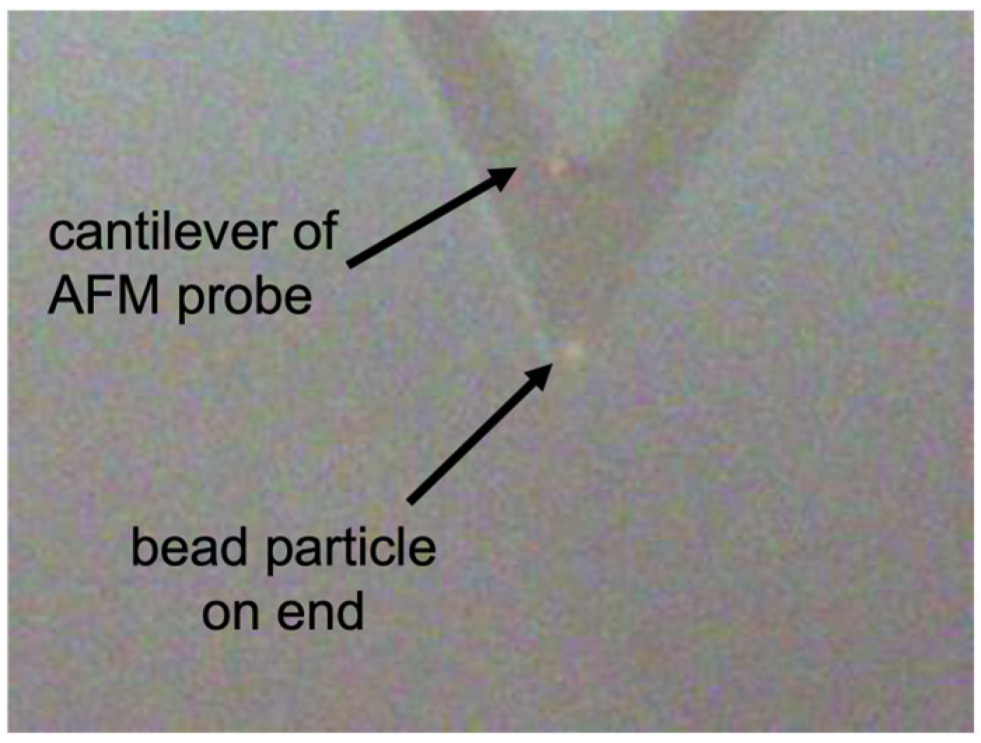
Bruker ScanAsyst cantilevers with a nominal spring constant of 0.4 N/m were used to characterize the surface roughness of substrates. To determine sticking efficacy, we used prepared colloidal AFM probes that were purchased from NovaScan Technologies (Boone, IA, USA). The colloidal probes can also be homemade, allowing for flexibility with respect to the composition and size of microplastics used in the AFM (e.g., see [24]). For these experiments, each probe consisted of a silicon nitride cantilever with a nominal spring constant of 0.24 N/m, with an attached microplastic particle. The 2 μm polystyrene particle used for force spectroscopy experiments is shown in Figure 1.
Artificial soft (104 ppm total dissolved solids, 40–48 mg/L Hardness as CaCO3) and hard (415 ppm total dissolved solids, 160–180 mg/L Hardness as CaCO3) freshwater solutions were purchased from Fisher Scientific as produced by Ricca Chemical, lot numbers 1103751 and 1103865, respectively. Both solutions consist of a mixture of calcium sulfate dihydrate, magnesium sulfate, potassium chloride, and sodium bicarbonate prepared according to EPA method EPA/600/4-90/027F [25].
Two types of glass surfaces were used in this study: glass from a microscope slide (Fisher Scientific, Pittsburgh, PA, USA) and glass from a coverslip (Corning Glass, Corning, NY, USA). These surfaces were prepared by cleaning the glass in piranha solution (1:3 mixture of H2O2 and H2SO4), before thoroughly rinsing the surface with DI water (Milli-Q 18.2 mΩ cm). Glass surfaces were then dried in a 70 °C oven for at least 30 min prior to experiments.
Surface roughness measurements were performed for the glass surfaces in air using Bruker ScanAsyst cantilevers (Bruker, Billerica, MA, USA). The clean surfaces were each imaged using Bruker’s Peak Force Tapping mode over a 2 μm by 2 μm area. The roughness of the images was calculated in NanoScope Analysis 1.7 after second-order flattening to remove tilt and bow from the image.
Each NovaScan probe (NovaScan Technologies, Ames, IA, USA) was installed into the cantilever holder of a Bioscope Resolve AFM (Bruker, Billerica, MA, USA). The probes were submerged in deionized (DI) water and allowed to equilibrate for 15 min, with DI water exchanges every 5 min. The tip was then brought into contact with the coverslip in DI water, and the deflection sensitivity and the spring constant were measured using the thermal tuning method.
Force measurements were taken in water from lowest to highest ionic strength (DI water, soft water, then hard water), testing both glass surface types prior to moving to the next ionic strength. When moving to the next ionic strength, the AFM tip was rinsed three times and allowed to equilibrate in solution for 5 min prior to the experiment. The data were collected using 500 nm ramp size with a ramp rate of 1 Hz (i.e., 1 s per force curve) and force set point of 3 nN. A minimum of 150 curves were collected for each spot on a sample.
Over the course of the force spectroscopy experiments, over 7500 force curves were generated. Each of these force curves was manually filtered to remove curves where no jump-to-contact feature was observed, or the data were otherwise corrupted. Raw AFM data were then imported to the software SPIP version 6.6.2 (Image Metrology) to calculate the force–distance curve and the average curve. Each of the curves had a first-order baseline correction and a hysteresis correction applied, and was subsequently aligned based on its minimum height prior to averaging. The average curves were then exported for further analysis in MATLAB 2018B.
Sticking efficiencies were calculated using Equations (2)–(5). The temperature and undisturbed flow velocity, U, were found by averaging the instrument’s reported tip temperature and tip velocity for each curve that made up the average. The porosity-dependent flow constant, As, was assumed to be 60 after Cail and Hochella, which corresponds to a porosity of roughly 0.3 [15].
The energy of each force–distance curve was numerically integrated using cumulative trapezoidal integration of the force curve from the point of contact to a given distance. There were two methods used to determine the distance of integration. First, we used a one-size-fits-all approach typical of these types of AFM experiments, where one integration distance is used for all the curves. In this case, 50 nm was chosen based on its usage in past experiments [15].
The second method used to determine the integration distance was an individualized approach, where the integration distance varied from curve to curve. The integration distance was chosen using an iterative approach where the distance from the point of contact to the start of the repulsive energy barrier, which was taken to be the inflection point in the energy separation curve in the one-size-fits-all approach, found using MATLAB’s ‘findpeaks’ function. In addition to changing the integration distance, the end point of integration was set to a force of 0 nN. One consequence of using the cumulative trapezoidal method is that the integration needs to be performed using 50 nm as the lower limit of integration because the first value integrated is assumed to be zero; otherwise, the correct integrated function would not be found. Therefore, as applied in this study, Equation (5) becomes
Φ = 50   n m 0   n m F ( x ) d x  
It is important to note that ~10−15 is the lower physical bound on the sticking efficiency. Therefore, any AFM-determined α less than this limit is reported herein as <10−20.

3. Results and Discussion

3.1. Characterize Surfaces of the Solid Substrates Used in AFM Experiments

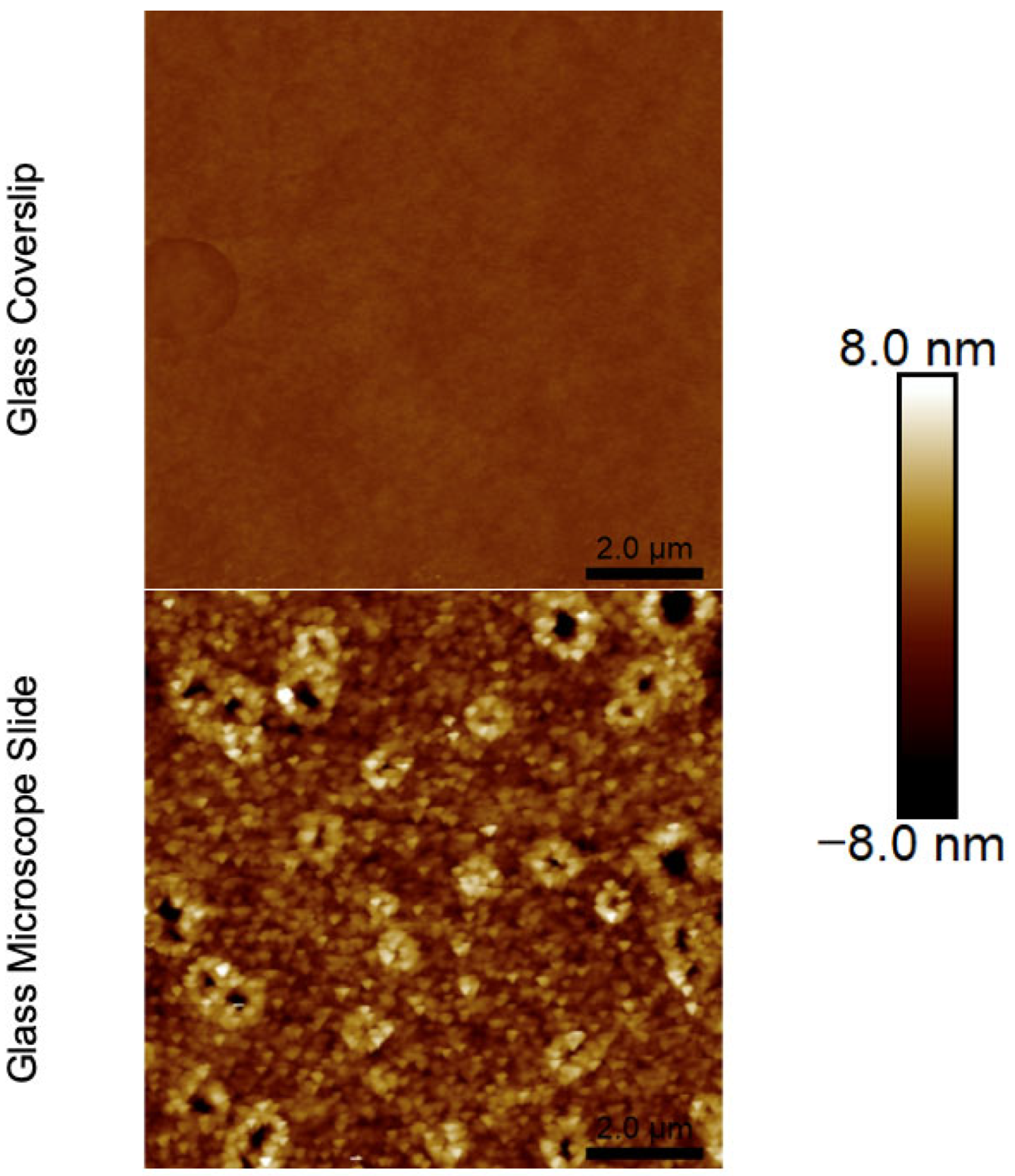
Representative images of the clean surfaces prior to the experiments are shown in Figure 2. The images reveal that while the two glass surfaces, a coverslip and a microscope slide, share the same chemistry, the microtopography of each sample is very different. The coverslip is shown to be a mostly flat surface with some small surface features, while the microscope slide is marked by pits (on the order of 10 nm in depth), and the triangular nature of silica is seen in the features. These differences are also borne out in the measurements of roughness, which show that the microscope slide is an order of magnitude rougher than the coverslip (Table 1).

3.2. AFM Experiments Using Microparticles, Minerals, and Freshwater Solutions

AFM can be used to collect topographic images of surfaces (e.g., see Figure 2), and it is also a technique that can be used to directly measure pico- to nano-Newton forces between a probe on the end of a flexible cantilever and a solid surface. The AFM repeatedly extends and retracts the probe relative to a surface, in effect tapping the probe against the surface. The forces (e.g., intermolecular) between the probe and sample are determined by reflecting a laser off the top of the cantilever and measuring the deflection of the laser in response to bending or flexure of the cantilever. These values can be converted to force (F) by way of measuring the cantilever’s deflection sensitivity (dsens, units of nm V−1) and spring constant (ksp, units of N m−1):
F = k s p × d s e n s x
where x is the deflection of the free end of the cantilever (where the probe/tip is located; see Figure 1) measured in volts [26].
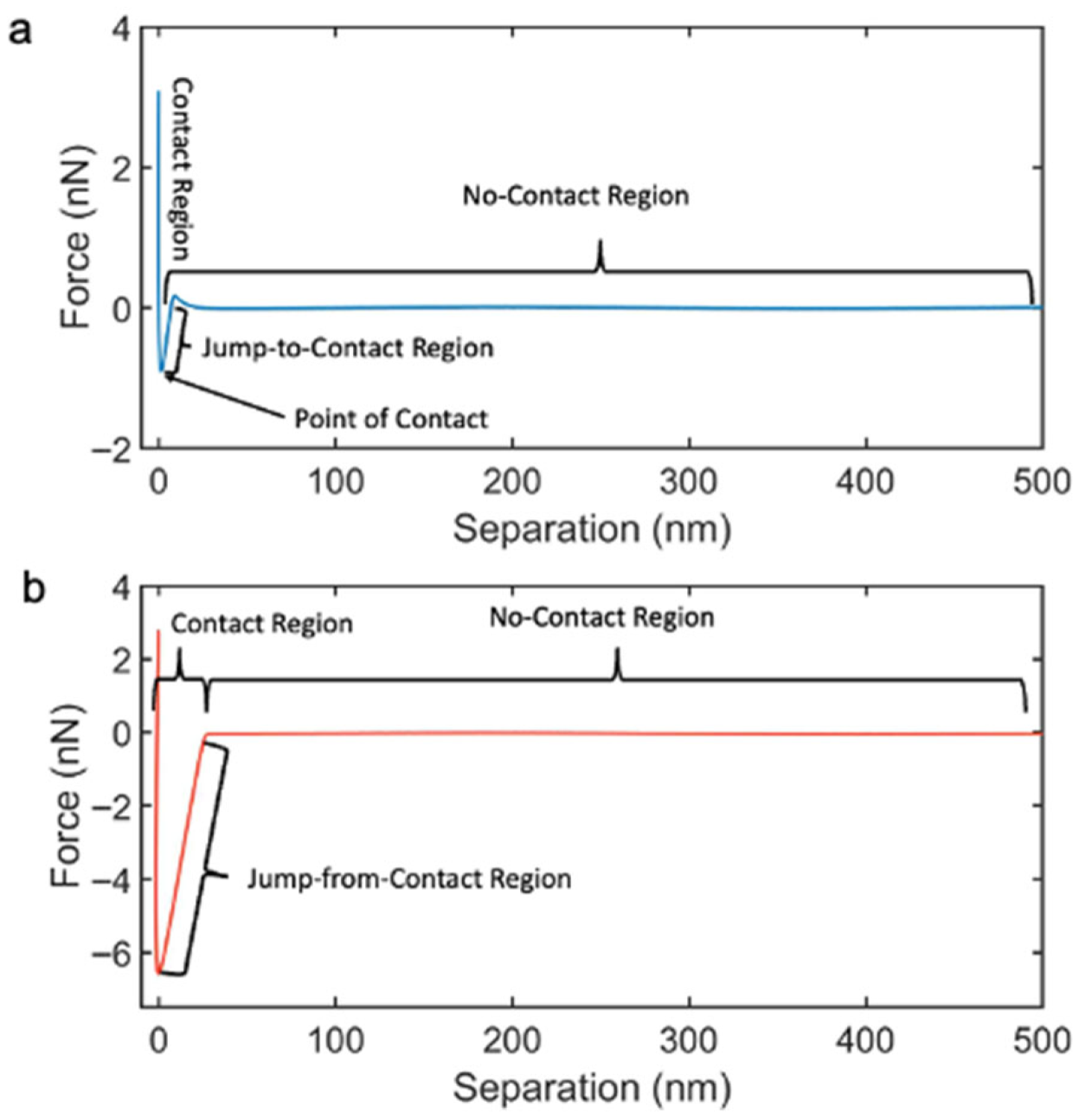
Force curves such as the one shown in Figure 3 are typically plotted as force versus separation between the probe and the surface. It is worth noting that the entire system (microparticle and solid sample) is immersed in an aqueous solution. Force curves can be broken up into several regions of interest: the region of no interaction and the region of interaction, which itself consists of a repulsive region, a jump-to-contact region, a point of contact, a contact region, and a jump-from-contact region. Starting with the extension of the probe to the surface, termed the approach curve, there is a region of no interaction, where the probe is at a distance sufficiently far from the glass surface, where there is no interaction between the microplastic probe and the glass surface. Ideally, in this region, the measured force is zero, as the probe should not be experiencing any net force. In reality, there is usually some noise due to thermal fluctuations, vibrations, or just instrumental noise. This region is of interest to researchers not for the data it produces but because it can be used for baseline fitting, which removes any systematic noise in the data by fitting this region to a polynomial and subtracting that polynomial over the entire dataset [27].
The region of no contact ‘ends’ when the force measured by the AFM begins to deviate from this baseline. In Figure 3a, the deviation is shown as a positive force, representing repulsion of the probe from the surface (e.g., due to electrostatic forces) followed by a sharp decrease, called the jump-to-contact region, where the attractive forces between the probe and surface (e.g., due to van der Waals) overcome the repulsive forces and the probe rapidly comes into contact with the surface at a sharp inflection point, representing the point of contact. Beyond the contact point, there is a strong repulsive force which represents the two surfaces in contact with one another and the probe being pushed into the surface. This occurs until a set threshold force is met, which triggers the instrument to retract [28]. The region of the approach curve where there is deviation from baseline to the point of contact is the region of interest in this current work. It is important to note that this region is highly variable, and a number of other shapes can be seen in which there is no attractive region or repulsive region, depending on the aqueous environment of the probe (e.g., temperature, ionic strength, pH, etc.).
During the retraction phase, a similar pattern of features is seen, but in reverse. Figure 3b shows a sharp decrease in force, which should, in theory, match the region beyond the contact point, but there is sometimes hysteresis in this slope which can be corrected for in software [28]. Next, there is a deep well, which represents the adhesive force holding the surface and probe together, and which lasts until the force of the probe pulling away from the surface overcomes the adhesive force, creating a jump-from-contact feature. Lastly, a second region of no interaction is found, where forces should be approximately zero [26].
Over the course of a typical AFM experiment, the approach–retract cycle repeats a hundred or more times in a given spot, which creates a large data set of many curves. Usually, only a small region of data from each curve is of interest, and this region must be defined manually, one curve at a time. Past attempts to use AFM to measure sticking efficiency have averaged the force curves together, which turns 100 or more force curves into one, allowing for much faster manual processing of force curve data [15,22].

3.3. Going from Fundamental Force Curves to Sticking Efficiencies

The process of going from the force curve to sticking efficiency requires applying Equations (2)–(5) in reverse order, but there are several choices and subtleties to doing so. The first choice deals with the integration of force with respect to distance to yield the energy of interaction (Equation (5)). In this step, the force curve is integrated from the point of contact (whose separation is set to a value of zero) to 50 nm. The distance 50 nm is chosen since it is sufficiently far from the contact point and ensures that the entire contact region, along with some of the no-contact region, will be included.
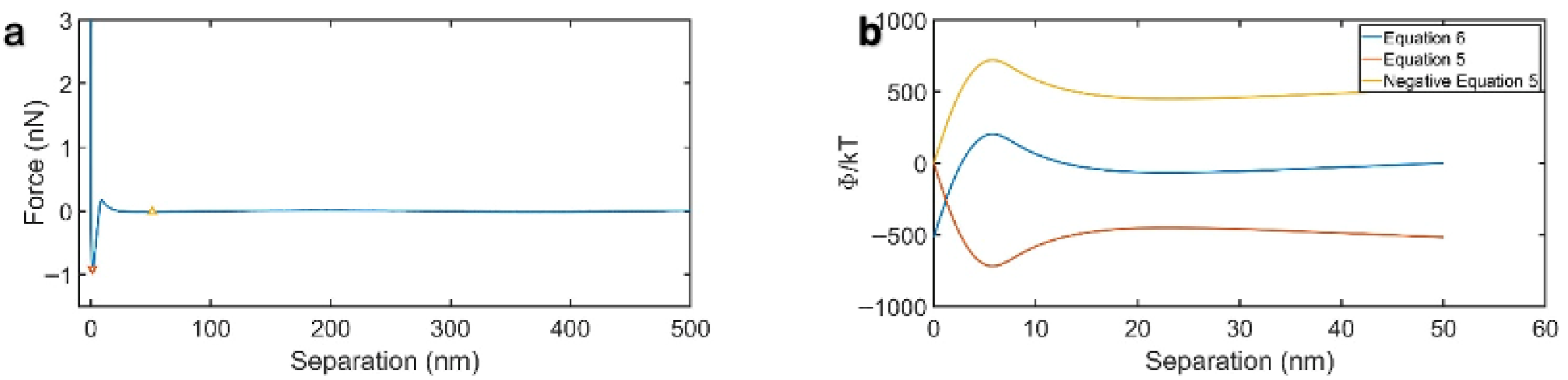
The no-contact region should have an interaction force of zero and therefore should not impact the integrated value. However, oddities arise when this integral is applied in code, as shown in Figure 4. When the integral according to Equation (5) is performed from the point of contact, represented by the first triangle in Figure 4a, to the end point of integration, represented by the second triangle, a strongly negative energy separation profile is seen in Figure 4b. This arises from an artifact of cumulative trapezoidal numeric integration, which preserves the x-axis by setting the first value to zero, leading to a computational artifact, which is then compounded by the strong attractive energy well of the contact zone. But if integrated according to Equation (6), the second plot is found, which creates energy profiles that more closely match those expected from DLVO theory [29]. Indeed, force measurements can be used in combination with DLVO predictions to determine a particle’s surface charge density by fitting the non-contact region of an AFM curve (see Figure 3a). The theoretical derivation of such an approach can be found in [28] along with specific examples in the literature (e.g., see [30,31]).
For the method used herein, the force profiles are almost mirror images (see Figure 4b). However, flipping the sign on the Equation (4) method creates an offset energy separation profile because the cumulative trapezoidal numeric integration forces the first point to zero, as shown in Figure 4b. This method of integration is termed the one-size-fits-all method in this paper because the same limits of integration are applied regardless of the specifics of the curve. Applying the remaining Equations (2)–(4) then becomes a set of simple mathematical calculations since the x-axis data does not need to be preserved.
The sticking efficiency values calculated using the one-size-fits-all approach yield the results shown in Table 2. The results in this table are mixed from the perspective of agreeing with the theory. One would expect the sticking efficiency to increase towards 1 as (i) ionic strength increases from DI, to soft, to hard water, and (ii) roughness increases from coverslip to microscope slide, as noted by others [3,15,19,32]. The trend of increasing ionic strength was seen in isolation for both probes against microscope slides, but not coverslips. In soft water, both probes had a sticking efficiency of 1. This value held consistent for Probe 1 but decreased below the physical limit of α for Probe 2 when the ionic strength increased. The expected roughness trend was only seen for Probe 2 in hard water.
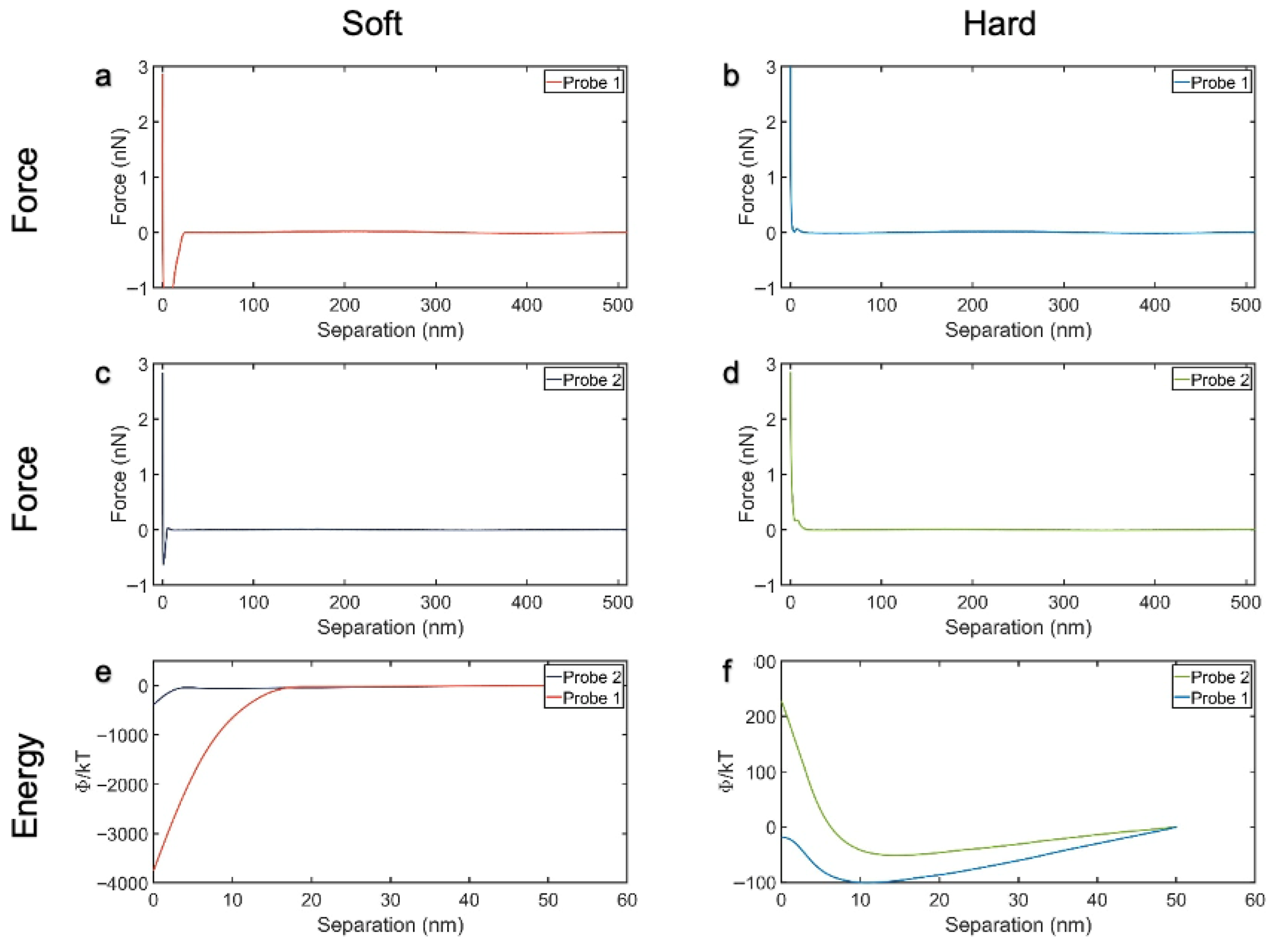
The failure of experimental data to meet theoretical expectations led to a closer examination of the average force curves that were used to determine sticking efficiency. Two average force curves are shown in Figure 5 along with the calculated energy-separation curves. At first look, all of the force curves appear normal, with some variation in the jump-to-contact feature. Except for Probe 1 in soft water, the curves exhibit a clear energy barrier represented by the positive, and therefore repulsive, force just before the jump-to-contact region. However, the barrier is not reflected in the reported sticking efficiencies of Probe 1 in hard water or Probe 2 in soft water, both of which are reported as 1 in Table 2.
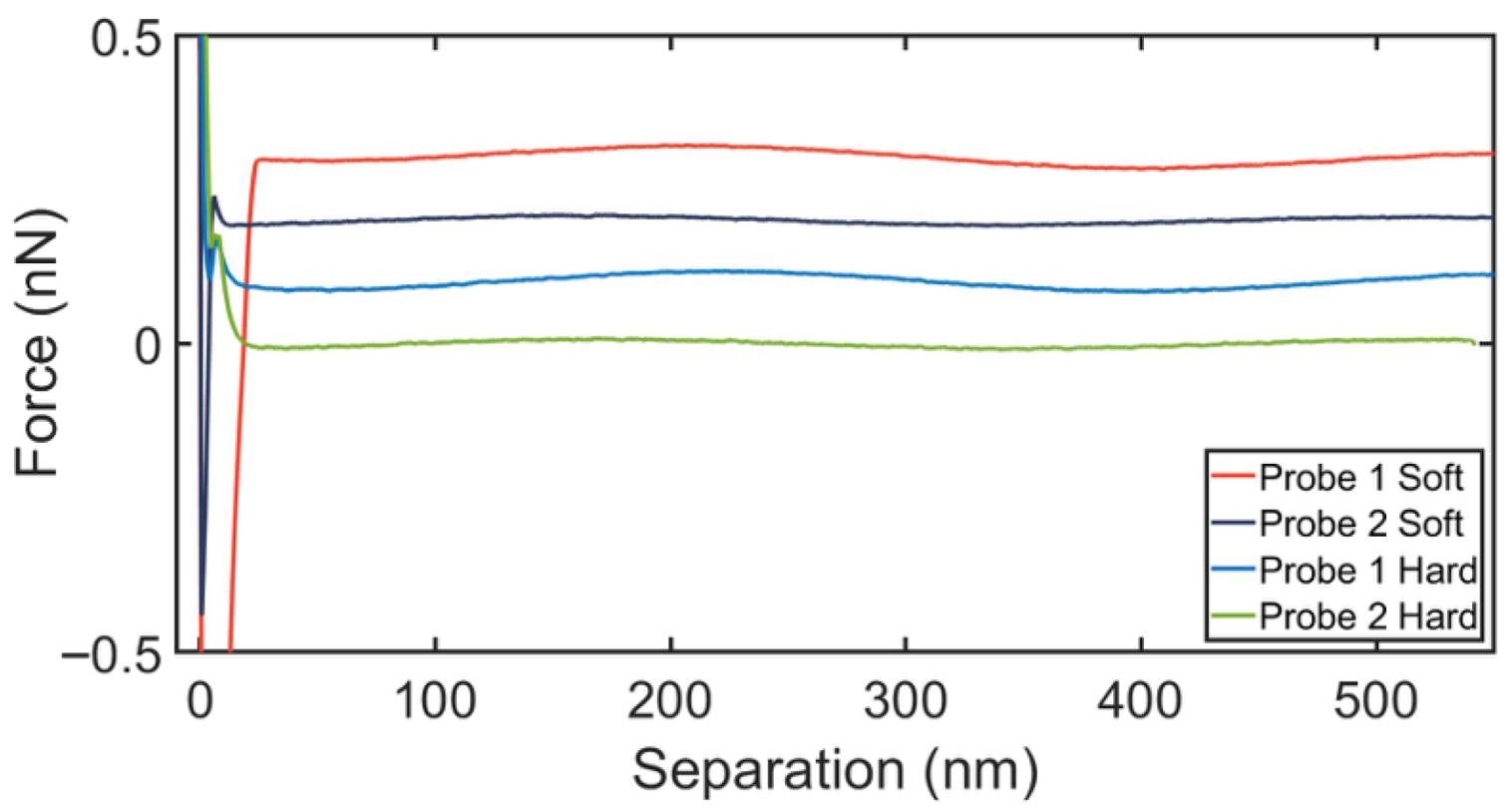
What becomes evident when looking at the energy-separation curves (Figure 5e,f) is that there is a slight but consistent negative trend in the force values, leading to negative energies that the small repulsive force barrier does not overcome energetically. Moreover, with a more careful eye, it is evident that there is a slight wave in the force curve data. This wave is more obvious when the x-axis is compressed, as shown in Figure 6. This wave leads to a negative energy well that the repulsive force barrier is unable to overcome, leading to a sticking efficiency of 1 when it should be a fraction of this value.
In an effort to obtain a better estimate of the sticking efficiency values for each of the force curves shown in Figure 5 and Figure 6, an individualized approach was developed, which modifies the average force curves. The two modifications that were made were to (1) change the distance of integration to consider only the region of contact to the onset of repulsive force and (2) shift the region of integration by the amount needed to set the onset of repulsive force to zero. Both of these changes are justifiable from theory, only requiring the assumption that the wave in the force curves is an experimental artifact due to the insufficient isolation of environmental vibrations; for example, due to a leak in the air table upon which the AFM floats or vibrations in the cantilever resulting from the pull-off force.
In theoretical applications of the IFBL model where the interaction energy, φ, is calculated based on DLVO theory, the value of φ is found to be practically constant for all separations greater than 3 nm, and any limit of integration larger than that should provide the same answer [29]. However, with AFM data, more long-range forces are present and measured, meaning that a large value must be chosen as the limit of integration. A limit of 100 nm has been recommended, but values of 50 nm and 32 nm have been used instead, since there was no particle interaction beyond those points [15,22,29]. Similarly, since there should not be any particle interaction in the baseline, the net force should be zero, which is eliminated by shifting the force curves.
In order to limit the arbitrary selection of limits, the onset of the repulsive force was taken to be the minima in the energy separation diagrams as found using MATLAB’s ‘findpeaks’ function. The choice of using software to find the onset of repulsive forces removes possible human bias or error from the final sticking efficiency values.
The sticking efficiencies resulting from this individualized approach are shown in Table 3. The values are more in line with the expectations set by the force curves in Figure 5, which, except for Probe 1 in soft water (Figure 5a), all have an energy barrier present. Additionally, the energy deficit that the one-size-fits-all method creates is overcome and leads to an increase in the sticking efficiencies by orders of magnitude. Not only do these sticking efficiencies better mirror the force curves, but they also show an expected trend of increasing sticking efficiencies with ionic strength or roughness.

3.4. Assessing the Assumptions Used to Make the Average Force Curves

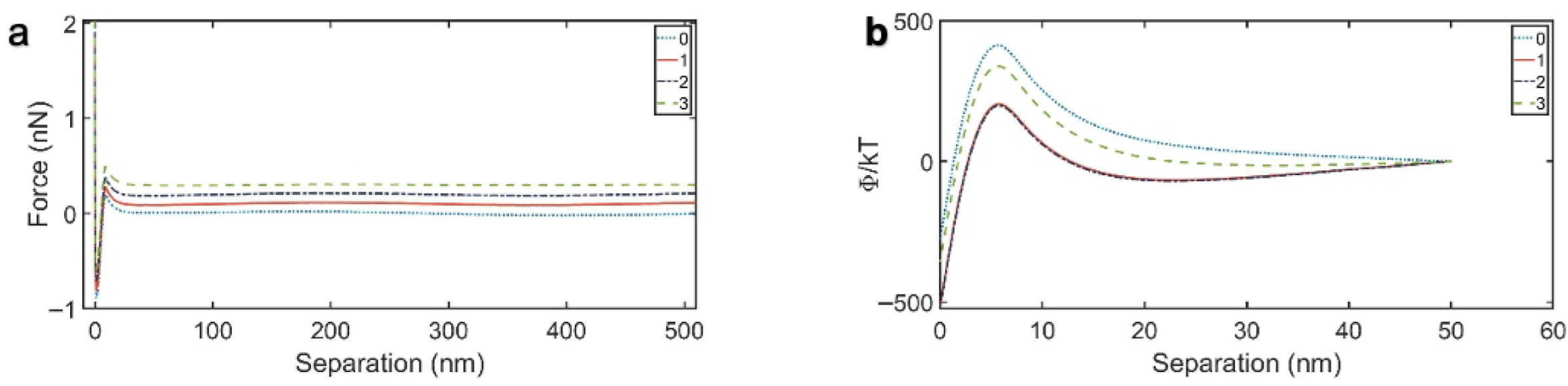
One of the first steps in any analysis of force spectroscopy curves is to apply hysteresis or baseline corrections to remove instrumental artifacts arising from drift, hydrodynamic drag, laser interference between the probe and substrate, or other sources of error [27,28]. In light of the variation in the baselines shown in Figure 5 and Figure 6 and to fully explore the method of using AFM to calculate sticking efficiencies, the choices made in SPIP in regard to hysteresis and baseline were assessed. The force curves of Probe 1, when it was tapped against a microscope slide in soft water, were chosen for this assessment. There were three options in SPIP that warranted a closer inspection: the effect of the order of polynomial (zeroth- to third-order), the baseline fitting of the individual force curves, whether the curves were corrected for hysteresis, and lastly, if the average force curve was baseline corrected.
Table 4 shows the variation in the sticking efficiency values derived from the same underlying data with different correction methods applied. The most obvious feature of this table is that the sticking efficiency values vary over 170 orders of magnitude depending on which choices were made during the averaging steps. This spread in values is something that anyone using AFM must contend with. Closer inspection reveals some subtleties in the data, which help guide choices for other researchers trying this AFM method.
First, in the case of this dataset, Table 4 reveals that the hysteresis correction appears to have a greater effect as a greater order of baseline fitting is applied. The percent difference rises from 0.5% to 11% for the cases of the uncorrected average baseline and from 5% to 44% when the average baseline is corrected. However, these variations are negligible in comparison to the variation caused by the baseline fit, which creates orders of magnitude differences where the smallest percent difference is 21,700%. This indicates that applying the hysteresis correction can create some variation, but not enough to make a clear recommendation of whether this correction should be applied. In the case of the data presented outside of Table 4, the hysteresis correction was applied.
The reason for the large percent difference due to the order of baseline fit is not clear from the plotted force curves in Figure 7a, as there is little apparent difference between the force curves. Numerically, there is some variation in the maximum force, which ranges from 0.2003 nN to 0.1792 nN. This variation seems almost negligible but is apparently enough to create large differences in zeroth- and third-order baseline’s energy separation plots compared to the second- and first-order fits, which are remarkably close and bear more careful examination (Figure 7b). The first and second order energy separation plots appear to almost completely overlap (Figure 7b), and even numerically are quite similar, as the maximum force and energy of the first-order baseline is 0.1799 nN and 204 kT, respectively, compared to 0.1793 nN and 198 kT for the second-order fit. However, these small differences result in a two orders of magnitude difference in the sticking efficiencies.
This large variability in sticking efficiencies despite similar energy profiles highlights one of the biggest drawbacks of applying the IFBL model, which is that the exponential in Equation (4) magnifies small differences in the repulsive force; thus, minor human or instrumental errors may provide inaccurate or misleading results. However, the similarity of the first- and second-order fit results compared to the zeroth-order and third-order fitting does suggest that those two options lead to under- and over-fitting of the data, respectively. Therefore, first- or second-order fitting is the best data practice, with preference given to first-order fitting, since it minimizes the change to the data.
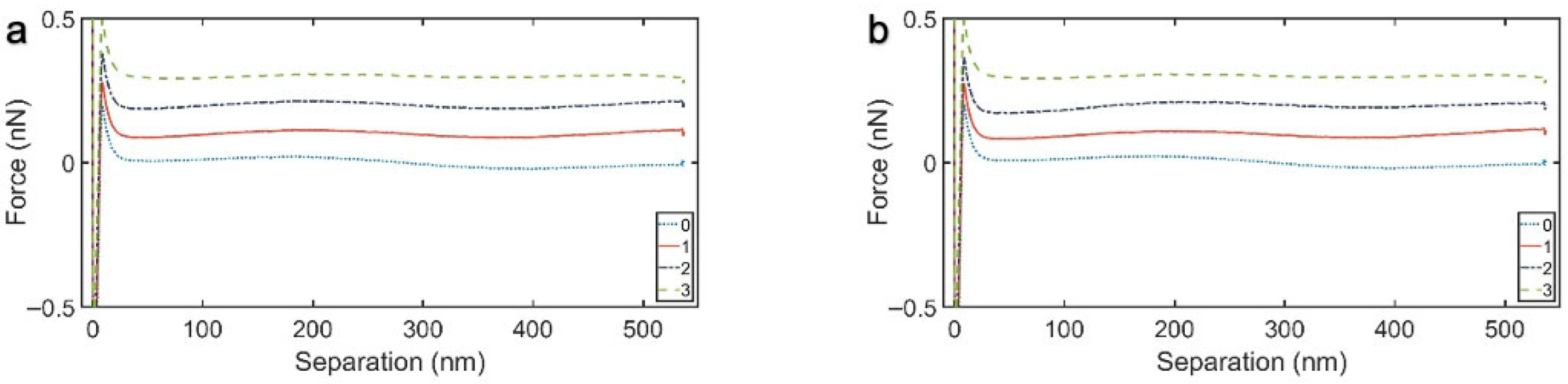
Like in Figure 5, there appears to be a slight ‘wobble’ in the force curves of Figure 7a, which is further highlighted in Figure 8a. Of note, the wobble persists regardless of the order of fitting applied, so going to a higher level of fitting does not correct this problem. As Figure 8b shows, providing baseline fitting to the average of the data does not remove the wobble either. It is unclear what the baseline fitting is doing to the average curve, as the average baseline height is −0.23 × 10⁻⁴ nN for the first-order fitted curve with hysteresis correction without average baseline fit versus −0.21 × 10⁻³ nN for the same case with the average baseline fit. This suggests that fitting the average curve’s baseline manipulates the data but does not necessarily improve it, and this modification should therefore be avoided.

3.5. From Averages to Individual Curves

Studies that use AFM to determine sticking efficiency use an underlying assumption that each time the probe approaches the surface of a sample, the same interaction is occurring with some variability, but that variability is never fully explored. Indeed, this is what we have conducted in the above analysis.
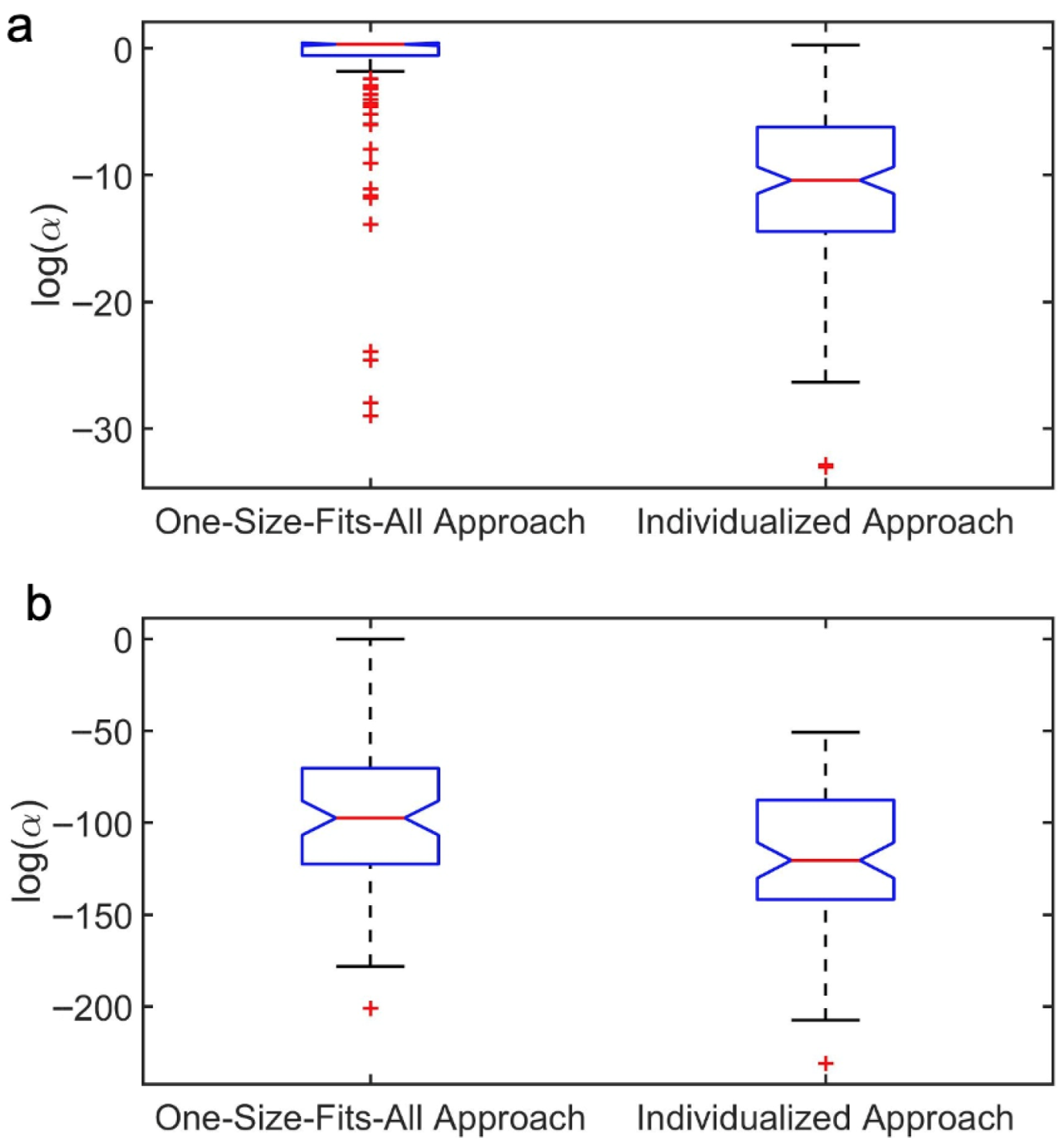
In order to explore the variability in the surface interaction, the individual force curves, rather than the average force curve, were used as input to the IFBL model using both the one-size-fits-all approach and the individualized approach. The results for Probe 2 in soft water tapped against the coverslip and microscope slide show that each average force curve represents a spectrum of data, which can range over a hundred orders of magnitude, with greater variability in the microscope slide versus the coverslip data (Figure 9). This result makes sense in the context of the increased roughness of the microscope slide, providing different possible binding environments which could lead to more variability in the interaction forces. Figure 9 continues to support that the individualized approach leads to smaller and more likely correct sticking efficiencies when instrumental error occurs.
Even though roughness does not increase sticking efficiency as theory would expect, roughness does appear to have a large impact on the spread of data. Ignoring outliers, Figure 9b shows sticking efficacies for the rougher microscope slide vary over 60 orders of magnitude for the one-size-fits-all approach and 100 orders of magnitude in the individualized approach, while Figure 9a shows variation for the coverslip of over 2 and 25 orders of magnitude, respectively. This wide variability may provide insight into the mechanics of deposition, because in a model column or the environmental subsurface, there is not just one interaction, but a multitude, and it takes only one favorable interaction to result in deposition. The sticking efficiencies represented by Figure 9 demonstrate this and suggest, importantly, that the 75th or 95th percentile of interactions would be a better match to the sticking efficiencies found in model column experiments or even the actual subsurface.

3.6. Implications for the Fate of Microplastics in Terrestrial Environments

With interest growing in the fate of microplastics in the subsurface and soils, there are several clear research directions that would benefit the research community. First, based on the collection of microplastic deposition studies compiled by Alimi et al., there is a striking lack of data on microplastics other than polystyrene, despite polyethylene, polypropylene, and other plastic microspheres being commercially available [3]. Testing these materials even in simple glass bead columns would offer new scientific knowledge and predictive power. Second, there is a need to study the particles under more environmentally relevant conditions; the studies cataloged by Alimi et al. reveal that most column studies are conducted with simple monovalent electrolytes for easier comparison with theory, but for a better understanding of particles in the subsurface, waters that more accurately model nature such as artificial soft and hard water need to be used like was conducted in this work. Lastly, most studies are performed with quartz as either purified sand or specially prepared beads, and moving to more diverse materials and minerals is necessary to understand what is occurring in the environment [3].
AFM is a tool that can help provide answers to many of the remaining questions, because it is a fast technique compared to column experiments. At a ramp rate of 1 Hz interaction, 180 force curves can be measured in three minutes, compared to a column experiment taking one to 40 h, depending on the test conditions [33,34,35]. Additionally, changing surfaces only requires the time to change microscope slides and give the solution of interest time to equilibrate with the surface and tip. A drawback of AFM compared to column studies is that the 180 force curves represent 180 individual interactions compared to the countless interactions that occur within a column to determine the sticking efficiency.
AFM has the ability to measure sticking efficiencies that are much smaller than those that can be measured in column experiments, as Table 5 reveals. Typical column experiments measure sticking efficiencies on the order of 10−2 or 10−3, while we show that AFM is able to measure sticking efficiencies <10−20. One possible reason why sticking efficiencies measured by AFM are very different from the column experiment is that AFM is isolating the physicochemical interactions, while the column experiments are also measuring physical interactions like straining.
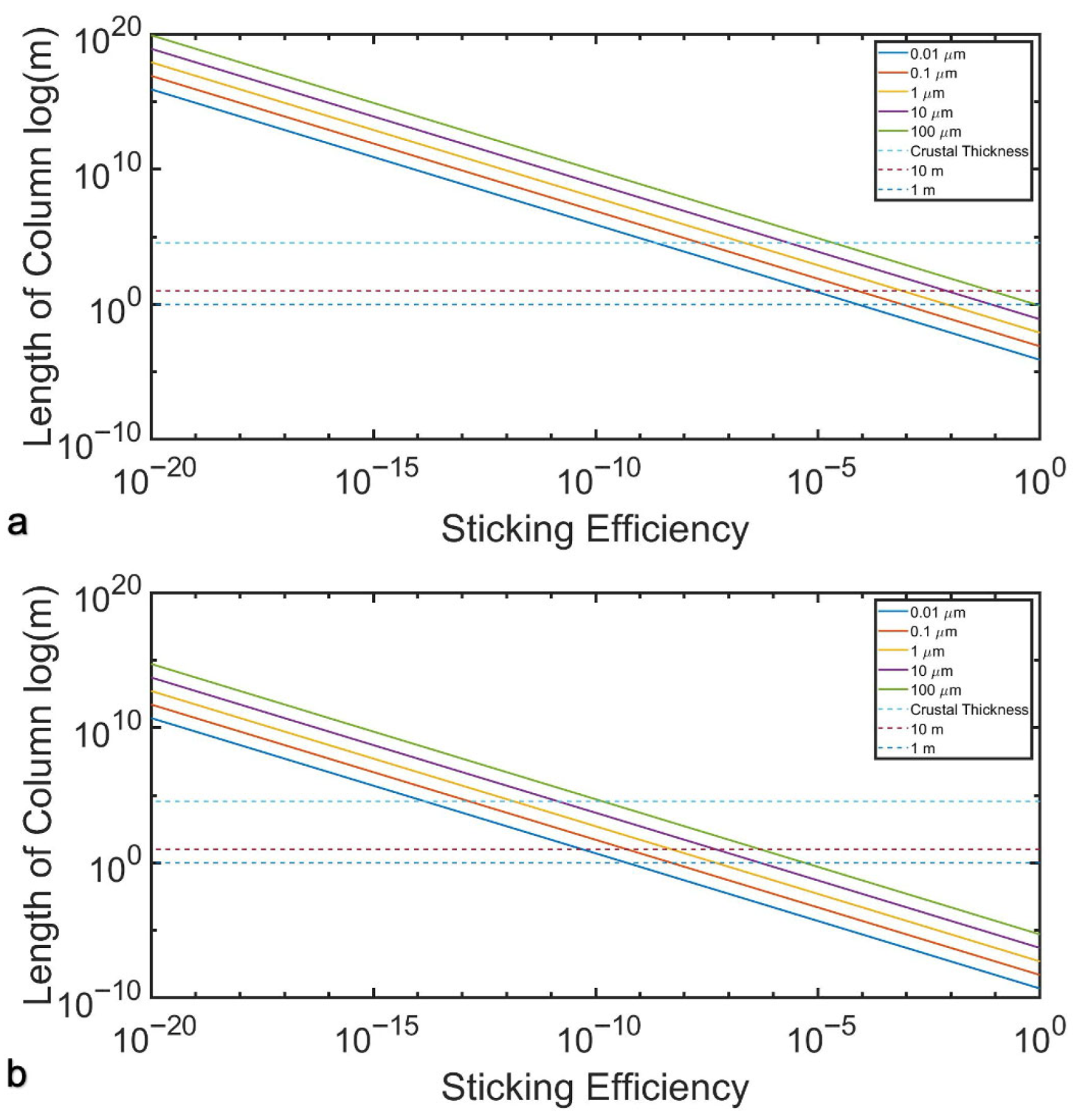
Another reason for the discrepancy is due in part to the nature of the columns being used, which are generally smaller than 1 m in length and therefore unable to measure sticking efficiencies smaller than 10−5 in a sand column or 10−10 in a model clay column. This assertion is based on the theoretical application of the Smoluchowski–Levich equation (Equation (1)) in Figure 10, which shows the length of a column necessary to remove 50% of a given particle at each sticking efficiency. Figure 10 also highlights another advantage of the AFM method to measure sticking efficiencies, finding values beyond these limits, which would not be possible in a column study. Though AFM does reach a point of purely academic interest once sticking efficiencies are less than 10−10 in sand or 10−14 in clay since the length of a column required to remove 50% of the particles would need to be the thickness of the Earth’s crust (35 km).
The small sticking efficiencies found in this study, based on Figure 10, are effectively zero since there are several orders of magnitude below any physically meaningful threshold for particle-surface attachment. This implies that a subsurface composed of mostly pure quartz, such as a beach, dune, or sandstone aquifer, is not expected to be a sink for 2-μm polystyrene, and there would be little to no long-term retention. This assertion is borne out by Goeppert and Goldscheider, who performed a particle tracer study on a sand and gravel aquifer, using 1, 2, and 5 μm polystyrene [36]. The microplastics were detected at each sampling well, including one 200 m away, and even reached several of the further wells faster than the conserved dissolved tracer, leading them to conclude that the aquifer did not “efficiently attenuate microplastics” [36].
It is important to note that the assertion that there will be minimal retention of polystyrene microplastics in quartz-dominated environments does not account for the fact that real soils and sands often have coatings of iron oxides, clays, biofilms, or organics. Several studies have reported that microbial biofilms increase the retention of microplastics, while larger organisms such as earthworms and various insect larvae, can ingest and thereby transport particles [3,10]. The role natural organic matter plays in the transport of microplastics is less clear, with column studies showing that it has either no effect, or an increase in stability and retention, depending on whether or not the natural organic matter is changing the microplastics’ charge and/or varying steric hindrance of the particle [3].
One further effect that needs to be studied to determine the environmental relevance of AFM to measure sticking efficiency is the effect of the approach velocity. Cail and Hochella note in their methods section that “cantilever velocity did not noticeably affect measured force curves” [15]. However, the approach speed estimated to be used in their work was 0.6 μm s−1, and while the work described herein utilized a faster speed of 2 μm s−1, both are below flow rates used in the column studies; for example, Xu et al. varied their flow rate between 22 and 63.33 μm s−1, while Cheng et al. varied their flow rate between 4.4 μm s−1, a value they claimed was typical of groundwater flow, and 131.9 μm s−1 [15,33,37]. The challenge for AFM is that there is a trade-off with the ‘capture rate’ because the faster the probe moves, the less accurate the measurement. Furthermore, based on Equation (3), increasing the velocity would only serve to decrease the sticking efficiency.

4. Conclusions

This paper presents a method for using AFM to measure the attachment efficiency of microplastics depositing on mineral surfaces. We showed that AFM measurements are system-specific, just like traditional column experiments, and the final value is dependent upon careful consideration of a number of factors. These include, for example, the type of microplastic (only polystyrene was used herein), the amount of weathering of the microplastic, the force value selected (mean, median, 75th-, 95th-percentile), sensitivity to baseline correction, and numerical integration parameters. Approach speed is another variable that could be addressed since hydrodynamic drag could have an impact on cantilever deflection [38]. Once these challenges are fully addressed (e.g., as described in Section 3.3, Section 3.4 and Section 3.5), this new AFM approach could offer significant advantages to testing hypotheses related to the fate and transport of microparticles because AFM has a much higher throughput than column studies and, with AFM, the researcher can easily vary the mineral surface, water chemistry, and type of plastic being tested.
An obvious next step for this line of experimentation is the use of other geomaterials such as clays, calcite, pyrite, graphite, and goethite. These minerals all have published methods for cleaning or cleaving to generate pristine surfaces [39,40,41,42] that could even have limited roughness in the case of a cleavage plane. Testing different artificial or natural water chemistries is an area in which AFM has particular power because it uses microliter volumes compared to orders of magnitude more water for column studies. Therefore, AFM is not limited to just simple salt solutions that poorly represent real-world conditions or natural water sources that are specific to only one field site. Lastly, different plastics need to be tested both with AFM and with column studies, as every study on microplastic deposition documented by Alimi et al. was conducted using polystyrene, despite the fact that multiple types of microplastic spheres are commercially available, such as polyethylene and polypropylene [3]. While polystyrene is the most widely available microplastic-tipped AFM probe, there are multiple well-documented methods for attaching microplastic beads to AFM tips [28,43,44], and these methods can readily be adapted for different microplastics.

Author Contributions

Conceptualization, R.M.W. and S.K.L.; methodology, R.M.W.; software, R.M.W.; formal analysis, R.M.W.; investigation, R.M.W. and S.K.L.; resources, R.M.W. and S.K.L.; data curation, R.M.W.; writing—original draft preparation, R.M.W.; writing—review and editing, R.M.W. and S.K.L.; visualization, R.M.W.; supervision, S.K.L.; project administration, S.K.L.; funding acquisition, R.M.W. and S.K.L. All authors have read and agreed to the published version of the manuscript.

Funding

This research was funded by U.S. National Science Foundation, grant number EAR-2038207, U.S. National Institutes of Health grant number R01HL119648, and the Friends of Orton Hall Fund at the Ohio State University.

Institutional Review Board Statement

Not applicable.

Data Availability Statement

The raw data supporting the conclusions of this article will be made available by the authors on request.

Acknowledgments

This manuscript benefited from the constructive criticism of Nicholas Basta, Motomu Ibaraki, and John Lenhart. We also thank two anonymous reviewers for providing valuable feedback.

Conflicts of Interest

The authors declare no conflicts of interest. The funders had no role in the design of the study; in the collection, analyses, or interpretation of data; in the writing of the manuscript; or in the decision to publish the results.

Abbreviations

The following abbreviations are used in this manuscript:
AFMAtomic Force Microscopy
DIDeionized water
DLVODerjaguin–Landau–Verwey–Overbeek theory
IFBLInteraction Force Boundary Layer
SPIPScanning Probe Image Processor software

References

  1. Cole, M.; Lindeque, P.; Halsband, C.; Galloway, T.S. Microplastics as Contaminants in the Marine Environment: A Review. Mar. Pollut. Bull. 2011, 62, 2588–2597. [Google Scholar] [CrossRef]
  2. Andrady, A.L. Microplastics in the Marine Environment. Mar. Pollut. Bull. 2011, 62, 1596–1605. [Google Scholar] [CrossRef] [PubMed]
  3. Alimi, O.S.; Farner Budarz, J.; Hernandez, L.M.; Tufenkji, N. Microplastics and Nanoplastics in Aquatic Environments: Aggregation, Deposition, and Enhanced Contaminant Transport. Environ. Sci. Technol. 2018, 52, 1704–1724. [Google Scholar] [CrossRef] [PubMed]
  4. EFSA CONTAM Panel (EFSA Panel on Contaminants in the Food Chain). Presence of microplastics and nanoplastics in food, with particular focus on seafood. EFSA J. 2016, 14, 4501. [Google Scholar] [CrossRef]
  5. Cunningham, E.M.; Ehlers, S.M.; Dick, J.T.A.; Sigwart, J.D.; Linse, K.; Dick, J.J.; Kiriakoulakis, K. High Abundances of Microplastic Pollution in Deep-Sea Sediments: Evidence from Antarctica and the Southern Ocean. Environ. Sci. Technol. 2020, 54, 13661–13671. [Google Scholar] [CrossRef]
  6. Panko, J.M.; Chu, J.; Kreider, M.L.; Unice, K.M. Measurement of Airborne Concentrations of Tire and Road Wear Particles in Urban and Rural Areas of France, Japan, and the United States. Atmos. Environ. 2013, 72, 192–199. [Google Scholar] [CrossRef]
  7. Auta, H.S.; Emenike, C.U.; Fauziah, S.H. Distribution and Importance of Microplastics in the Marine Environment—A Review of the Sources, Fate, Effects, and Potential Solutions. Environ. Int. 2017, 102, 165–176. [Google Scholar] [CrossRef] [PubMed]
  8. Bergmann, M.; Mützel, S.; Primpke, S.; Tekman, M.B.; Trachsel, J.; Gerdts, G. White and Wonderful? Microplastics Prevail in Snow from the Alps to the Arctic. Sci. Adv. 2019, 5, eaax1157. [Google Scholar] [CrossRef]
  9. Senathirajah, K.; Attwood, S.; Bhagwat, G.; Carbery, M.; Wilson, S.; Palanisami, T. Estimation of the Mass of Microplastics Ingested: A Pivotal First Step towards Human Health Risk Assessment. J. Hazard. Mater. 2021, 404 Pt B, 124004. [Google Scholar] [CrossRef]
  10. Kim, Y.-N.; Yoon, J.-H.; Kim, K.-H. Microplastic Contamination in Soil Environment—A Review. Soil Sci. Annu. 2021, 71, 300–308. [Google Scholar] [CrossRef]
  11. Talvitie, J.; Mikola, A.; Setälä, O.; Heinonen, M.; Koistinen, A. How Well Is Microlitter Purified from Wastewater?—A Detailed Study on the Stepwise Removal of Microlitter in a Tertiary Level Wastewater Treatment Plant. Water Res. 2017, 109, 164–172. [Google Scholar] [CrossRef]
  12. Murphy, F.; Ewins, C.; Carbonnier, F.; Quinn, B. Wastewater Treatment Works (WwTW) as a Source of Microplastics in the Aquatic Environment. Environ. Sci. Technol. 2016, 50, 5800–5808. [Google Scholar] [CrossRef]
  13. Su, Y.; Zhang, Z.; Wu, D.; Zhan, L.; Shi, H.; Xie, B. Occurrence of Microplastics in Landfill Systems and Their Fate with Landfill Age. Water Res. 2019, 164, 114968. [Google Scholar] [CrossRef]
  14. He, P.; Chen, L.; Shao, L.; Zhang, H.; Lü, F. Municipal Solid Waste (MSW) Landfill: A Source of Microplastics? -Evidence of Microplastics in Landfill Leachate. Water Res. 2019, 159, 38–45. [Google Scholar] [CrossRef] [PubMed]
  15. Cail, T.L.; Hochella, M.F. Experimentally Derived Sticking Efficiencies of Microparticles Using Atomic Force Microscopy. Environ. Sci. Technol. 2005, 39, 1011–1017. [Google Scholar] [CrossRef] [PubMed]
  16. Levich, V.G. Physicochemical Hydrodynamics; Prentice-Hall: Englewood Cliffs, NJ, USA, 1962. [Google Scholar]
  17. Petosa, A.R.; Jaisi, D.P.; Quevedo, I.R.; Elimelech, M.; Tufenkji, N. Aggregation and Deposition of Engineered Nanomaterials in Aquatic Environments: Role of Physicochemical Interactions. Environ. Sci. Technol. 2010, 44, 6532–6549. [Google Scholar] [CrossRef]
  18. Spielman, L.A.; Friedlander, S.K. Role of the Electrical Double Layer in Particle Deposition by Convective Diffusion. J. Colloid Interface Sci. 1974, 46, 22–31. [Google Scholar] [CrossRef]
  19. Elimelech, M.; O’Melia, C.R. Effect of Particle Size on Collision Efficiency in the Deposition of Brownian Particles with Electrostatic Energy Barriers. Langmuir 1990, 6, 1153–1163. [Google Scholar] [CrossRef]
  20. Pelley, A.J.; Tufenkji, N. Effect of Particle Size and Natural Organic Matter on the Migration of Nano- and Microscale Latex Particles in Saturated Porous Media. J. Colloid Interface Sci. 2008, 321, 74–83. [Google Scholar] [CrossRef] [PubMed]
  21. Li, Y.; Wang, Y.; Pennell, K.D.; Briola, L.M.A. Investigation of the Transport and Deposition of Fullerene (C60) Nanoparticles in Quartz Sands under Varying Flow Conditions. Environ. Sci. Technol. 2008, 42, 7174–7180. [Google Scholar] [CrossRef]
  22. Cail, T.L.; Hochella, M.F. The Effects of Solution Chemistry on the Sticking Efficiencies of Viable Enterococcus Faecalis: An Atomic Force Microscopy and Modeling Study. Geochim. Cosmochim. Acta 2005, 69, 2959–2969. [Google Scholar] [CrossRef]
  23. Bouchard, D.; Zhang, W.; Chang, X. A Rapid Screening Technique for Estimating Nanoparticle Transport in Porous Media. Water Res. 2013, 47, 4086–4094. [Google Scholar] [CrossRef]
  24. Yongsunthon, R.; Lower, S.K. Force measurements between a bacterium and another surface in situ. Adv. Appl. Microbiol. 2005, 58, 97–124. [Google Scholar] [CrossRef]
  25. Weber, C.I. (Ed.) Dilution water. In Methods for Measuring the Acute Toxicity of Effluent and Receiving Waters to Freshwater and Marine Organisms, 4th ed.; U.S. Environmental Protection Agency: Cincinnati, OH, USA, 1993; pp. 28–33. [Google Scholar]
  26. Lower, S. Atomic Force Microscopy to Study Intermolecular Forces and Bonds Associated with Bacteria. In Bacterial Adhesion; Advances in Experimental Medicine and Biology; Linke, D., Goldman, A., Eds.; Springer: Dordrecht, The Netherlands, 2011; Volume 715, pp. 285–299. [Google Scholar] [CrossRef]
  27. Benítez, R.; Bolós, V.J.; Toca-Herrera, J.-L. AfmToolkit: An R Package for Automated AFM Force-Distance Curves Analysis. R J. 2017, 9, 291–308. [Google Scholar] [CrossRef]
  28. Butt, H.-J.; Cappella, B.; Kappl, M. Force Measurements with the Atomic Force Microscope: Technique, Interpretation and Applications. Surf. Sci. Rep. 2005, 59, 1–152. [Google Scholar] [CrossRef]
  29. Elimelech, M. Particle Deposition and Aggregation: Measurement, Modelling, and Simulation; Butterworth-Heinemann: Oxford, UK; Boston, MA, USA, 1998. [Google Scholar]
  30. Lower, S.K. Directed natural forces of affinity between a bacterium and mineral. Am. J. Sci. 2005, 305, 752–765. [Google Scholar] [CrossRef]
  31. Yongsunthon, R.; Lower, S.K. Force spectroscopy of bonds that form between a Staphylococcus bacterium and silica or polystyrene substrates. J. Electron. Spectrosc. Relat. Phenom. 2006, 150, 228–234. [Google Scholar] [CrossRef]
  32. Elimelech, M.; O’Melia, C.R. Kinetics of Deposition of Colloidal Particles in Porous Media. Environ. Sci. Technol. 1990, 24, 1528–1536. [Google Scholar] [CrossRef]
  33. Xu, S.; Qi, J.; Chen, X.; Lazouskaya, V.; Zhuang, J.; Jin, Y. Coupled Effect of Extended DLVO and Capillary Interactions on the Retention and Transport of Colloids through Unsaturated Porous Media. Sci. Total Environ. 2016, 573, 564–572. [Google Scholar] [CrossRef] [PubMed]
  34. Quevedo, I.R.; Tufenkji, N. Mobility of Functionalized Quantum Dots and a Model Polystyrene Nanoparticle in Saturated Quartz Sand and Loamy Sand. Environ. Sci. Technol. 2012, 46, 4449–4457. [Google Scholar] [CrossRef]
  35. Tufenkji, N.; Elimelech, M. Breakdown of Colloid Filtration Theory: Role of the Secondary Energy Minimum and Surface Charge Heterogeneities. Langmuir 2005, 21, 841–852. [Google Scholar] [CrossRef]
  36. Goeppert, N.; Goldscheider, N. Experimental Field Evidence for Transport of Microplastic Tracers over Large Distances in an Alluvial Aquifer. J. Hazard. Mater. 2021, 408, 124844. [Google Scholar] [CrossRef]
  37. Cheng, X.; Kan, A.T.; Tomson, M.B. Study of C 60 Transport in Porous Media and the Effect of Sorbed C 60 on Naphthalene Transport. J. Mater. Res. 2005, 20, 3244–3254. [Google Scholar] [CrossRef]
  38. Casillas-Ituarte, N.N.; Cruz, C.H.B.; Lins, D.L.; DiBartola, A.C.; Howard, J.; Liang, X.; Hook, M.; Viana, I.F.V.; Sierra-Hernandez, M.R.; Lower, S.K. F Amino acid polymorphisms in the fibronectin-binding repeats of fibronectin-binding protein A affect bond strength and fibronectin conformation. J. Biol. Chem. 2017, 292, 8797–8810. [Google Scholar] [CrossRef] [PubMed]
  39. Eichmann, S.L.; Burnham, N.A. Calcium-Mediated Adhesion of Nanomaterials in Reservoir Fluids. Sci. Rep. 2017, 7, 11613. [Google Scholar] [CrossRef] [PubMed]
  40. Jupille, J. Analysis of Mineral Surfaces by Atomic Force Microscopy. Rev. Mineral. Geochem. 2014, 78, 331–369. [Google Scholar] [CrossRef]
  41. Afrin, R.; Yano, T.; Jia, T.Z.; Cleaves, H.J.; Hara, M. Unbinding Events of Amino Acids and Peptides from Water–Pyrite Interfaces: A Case Study of Life’s Origin on Mineral Surfaces. Biophys. Chem. 2020, 260, 106338. [Google Scholar] [CrossRef]
  42. Lower, S.K.; Tadanier, C.J.; Hochella, M.F. Measuring Interfacial and Adhesion Forces between Bacteria and Mineral Surfaces with Biological Force Microscopy. Geochim. Cosmochim. Acta 2000, 64, 3133–3139. [Google Scholar] [CrossRef]
  43. D’Sa, D.J.; Chan, H.K.; Chrzanowski, W. Attachment of Micro- and Nano-Particles on Tipless Cantilevers for Colloidal Probe Microscopy. J. Colloid Interface Sci. 2014, 426, 190–198. [Google Scholar] [CrossRef]
  44. Mark, A.; Helfricht, N.; Rauh, A.; Karg, M.; Papastavrou, G. The Next Generation of Colloidal Probes: A Universal Approach for Soft and Ultra-Small Particles. Small 2019, 15, 1902976. [Google Scholar] [CrossRef]
Figure 1. Optical microscopy image of a 2-μm polystyrene particle on the end of the V-shaped cantilever of an AFM probe. The polystyrene bead is moved towards/away from a sample surface while monitoring attractive (or repulsive) intermolecular forces. The entire setup is immersed in solution. Higher resolution images of a particle on the AFM probe can be collected with electron microscopy, but this requires a conductive coating to be applied to the particle. For this study, a lower resolution optical microscope (mounted on the AFM) was used to nondestructively confirm that a single particle was fixed on the end of the AFM probe before, during, and after the experiments.
Microplastics 05 00006 g001
Figure 2. Representative AFM images of model geomaterial surfaces after second-order plane correction. All images are 10 μm × 10 μm and share the same z-axis coloring.
Microplastics 05 00006 g002
Figure 3. Examples of typical force curves with regions of interest labeled. (a) The approach portion of the curve when the microparticle is brought into contact with the sample (from 500 nm to 0 nm). (b) The retraction portion of the curve when the particle is removed from contact with a sample (from 0 nm to 500 nm). The entire approach–retraction cycle takes about a second. The work presented in this paper focuses on the deviation from baseline in the approach curve.
Microplastics 05 00006 g003
Figure 4. (a) The part of a force curve to be integrated between the orange triangle (at zero) and the yellow triangle (near 50 nm). (b) The impact of the equation on the energy separation profile. This panel highlights the artifact that the cumulative trapezoidal method creates when integrating from 0 to 50 nm because the first value of the definite integral is zero.
Microplastics 05 00006 g004
Figure 5. Average force-separation curves for probe #1 (a,b) and probe #2 (c,d) of a 2 μm polystyrene particle interacting with a glass coverslip in hard water (b,d) vs. soft water (a,c). Calculated energy-separation curves for the force data are shown in (e) for soft water and (f) for hard water.
Microplastics 05 00006 g005
Figure 6. Compressed average force curves of the 2 μm polystyrene in hard water or soft water interacting with a microscope’s glass coverslip, highlighting the slight wave or sinusoidal pattern in the baseline. This is typical of laser interference. Each force curve is offset by 0.1 nN for clarity.
Microplastics 05 00006 g006
Figure 7. The effect that zeroth- to third-order baseline fitting has on the 2 μm polystyrene particle against a microscope slide in soft water, where hysteresis is corrected. (a) The average force curve for each case. Each force curve is offset by 0.1 nN for clarity. (b) The energy profiles, where the same curve is integrated from the contact point to 50 nm. There is no offset between the baseline profiles, highlighting the overlap of first- and second-order energy profiles.
Microplastics 05 00006 g007
Figure 8. Compressed average force curves varying the baseline fit of 2 μm polystyrene in soft water interacting with a glass microscope slide, highlighting the slight wave in each force curve’s baseline. (a) The case where the average force curve’s baseline is not fitted after calculation. (b) The case where the average force curve’s baseline is fitted after calculation. Each force curve is offset by 0.1 nN for clarity.
Microplastics 05 00006 g008
Figure 9. Boxplots illustrating the spectrum of sticking efficiencies (α) from the probe #2 dataset for soft water against coverslip (a) and microscope slide (b), while comparing the one-size-fits-all approach versus the individualized approach.
Microplastics 05 00006 g009
Figure 10. This illustration was generated with Equation (1). It shows the effect of varying the sticking efficiency and particle size on the length of column necessary to filter half of the initial particles added to the column at a fluid velocity of 2 μm/s and a temperature of 298 K. The lower physical bound on α is on the order of 10−15. (a) The results for a column of sand with average grain size of 500 μm and a porosity of 0.4. (b) The results for a column of sand with average grain size of 1 μm and a porosity of 0.58. The term η was calculated using the equation: η = 4 A s × D 2 × a c × U where ac is collector size. As a reference, dotted lines are plotted corresponding to 1 m, 10 m, and the thickness of Earth’s crust (35,000 m).
Microplastics 05 00006 g010
Table 1. Mean roughness and standard deviation of cleaned surfaces after second-order plane correction. Rq and Ra are two measures of roughness. Rq is the root mean squared deviation while Ra is the arithmetic mean deviation.
Geomaterial SurfaceRq Roughness (nm)Ra Roughness (nm)
glass coverslip (n = 10)0.23 ± 0.090.17 ± 0.05
glass microscope slide (n = 6)2.36 ± 0.330.67 ± 0.16
Table 2. Sticking efficiency values calculated for each of two 2 μm polystyrene probes, assuming first-order baseline fitting of the raw data with hysteresis correction and integrating from point of contact to 50 nm. The variation in such measurements is addressed in Section 3.5.
Probe #Deionized Water (DI)Soft WaterHard Water
CoverslipSlideCoverslipSlideCoverslipSlide
1001<10−201<10−20
2<10−2001<10−20<10−204.58 × 10⁻²⁰
Table 3. Comparison of the sticking efficiencies calculated for the original one-size-fits-all approach and the individualized approach. The variation in such measurements is addressed in Section 3.5.
Particle
Diameter (mm)
Soft WaterHard Water
CoverslipSlideCoverslipSlide
2 (trial 1)1<10−20<10−20<10−20
2 (trial 2)2.29 × 10⁻⁶<10−20<10−20<10−20
Table 4. The effects of different data analysis choices in SPIP on the sticking efficiency value at 50 nm from the point of contact for Probe 1 in soft water interacting with a coverslip.
Baseline OrderForce Curves with
Hysteresis Correction
Force Curves Without
Hysteresis Correction
Uncorrected Avg. BaselineCorrected
Avg. Baseline
Uncorrected Avg. BaselineCorrected
Avg. Baseline
1<10−20<10−20<10−20<10−20
2<10−20<10−20<10−20<10−20
3<10−206.81 × 10⁻¹⁵<10−205.19 × 10⁻¹⁵
4<10−20<10−20<10−20<10−20
Table 5. Comparison of sticking efficiencies (α) of particles from this and previous studies.
TypeSizeRange of αMethodReference
polystyrene2 μm<10−20 to 1AFMthis work
carboxylated polysty.2 μm10−48 to 1AFM[15]
polystyrene753 nm0.019 to 0.65column[19]
carboxylated polysty.364 nm0.001 to 0.023column[33]
polystyrene24 nm0.001 to 1column[34]
carboxylated polysty.63 nm–3 μm0.0058 to 0.83column[35]
Disclaimer/Publisher’s Note: The statements, opinions and data contained in all publications are solely those of the individual author(s) and contributor(s) and not of MDPI and/or the editor(s). MDPI and/or the editor(s) disclaim responsibility for any injury to people or property resulting from any ideas, methods, instructions or products referred to in the content.