Review

Beyond Microplastics: Analytical Boundaries, Real-World Barriers, and the Possibilities for Scalable Removal


by
Danka Kiperović
1,*,
Dimitrije Mara
1,
Saša Đurović
1,2,
Gordana Racić
3,
Igor Vukelić
4,
Ana R. M. Mendes
5 and
Jovana Vunduk
1,*
1
Institute of the General and Physical Chemistry, Studentski trg 12/V, P.O. Box 45, 11158 Belgrade, Serbia
2
Institute of Biomedical Systems and Biotechnology, Peter the Great Saint-Petersburg Polytechnic University, Polytechnicheskaya Street 29, 195251 Saint-Petersburg, Russia
3
Tamiš Research and Development Institute, Novoseljanski Put 33, 26000 Pančevo, Serbia
4
Faculty of Ecological Agriculture, Educons University, Vojvode Putnika 87, 21208 Sremska Kamenica, Serbia
5
Earth and Ocean Sciences, School of Natural Sciences and Ryan Institute, University of Galway, H91 TK33 Galway, Ireland
*
Authors to whom correspondence should be addressed.
Microplastics 2026, 5(1), 20; https://doi.org/10.3390/microplastics5010020
Submission received: 7 November 2025 / Revised: 9 December 2025 / Accepted: 24 December 2025 / Published: 1 February 2026

Abstract

Plastic has transitioned rapidly from a revolutionary material to a global environmental concern, primarily due to mismanagement. Synthetic polymers have quickly gained widespread use due to their versatility, durability, and affordability. However, the properties making plastic indispensable contribute to its permanence in the environment, where it breaks down into microplastics—tiny particles that are typically classified in the size range from 0.1 μm to 5 mm. These particles can now be found in all ecosystems, including the oceans, soil, atmosphere, and within living organisms, raising global concerns about their long-term environmental and health impacts. This review critically examines the current status and potential for identifying, analyzing, and mitigating microplastic pollution. In this paper, we particularly focus on the destructive and non-destructive analytical methods used for microplastic identification and characterization, examining their technical capabilities and limitations, the challenges in maintaining sample integrity, and the reliability of their quantification methods. In addition, the review addresses microplastic removal strategies, from laboratory procedures to real-world applications, examining barriers to implementation and the limited availability of existing solutions. Finally, the review highlights the urgent need for standardized protocols, regulatory frameworks, and interdisciplinary collaboration to address the multifaceted nature of microplastic pollution.

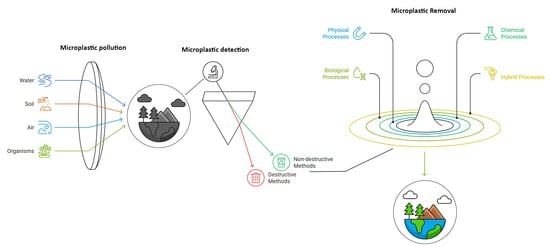
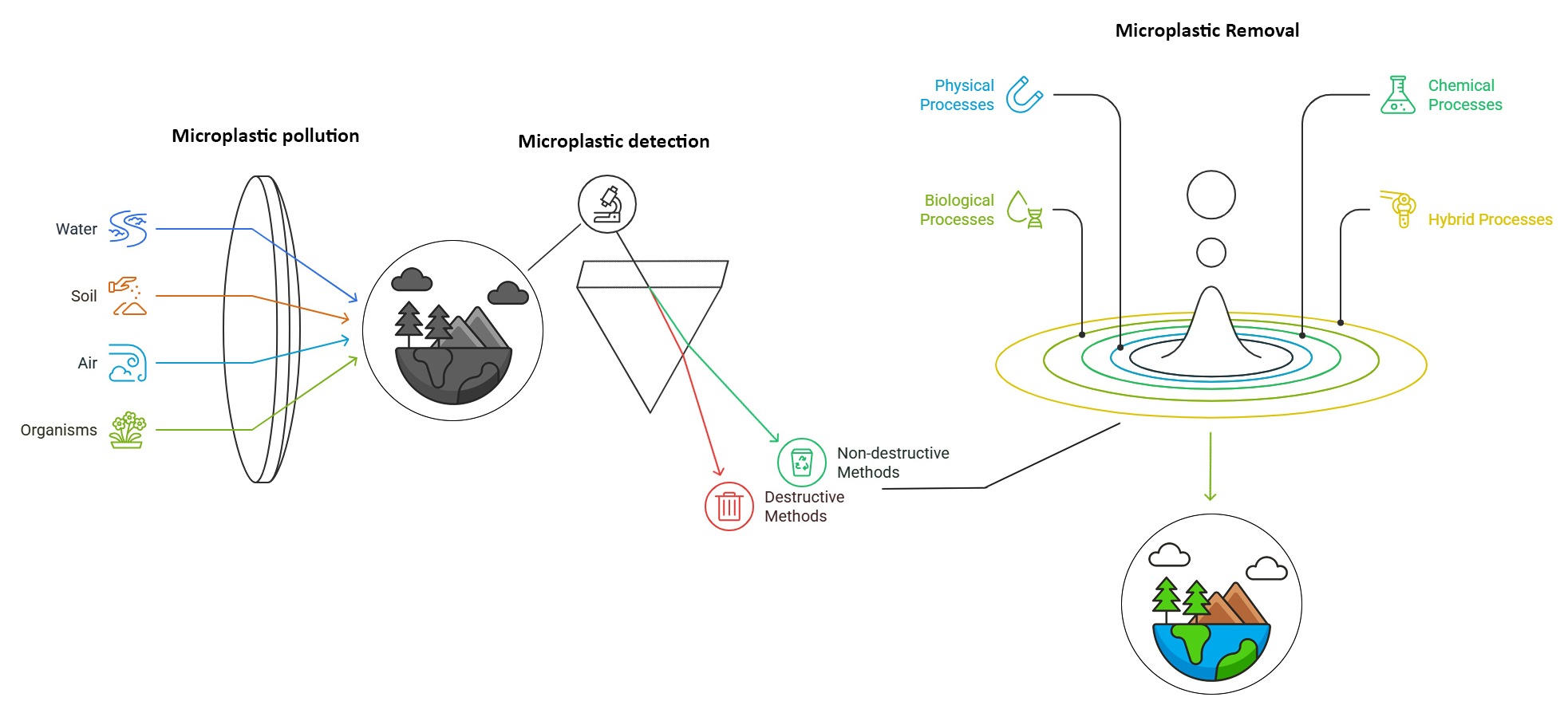
Graphical Abstract

1. Introduction

Plastics, now integral to modern infrastructure and consumer goods, have undergone a transformative journey since their inception. Although plastic has recently become a major environmental problem, its history illustrates both benefits and challenges. Originally developed as a substitute for scarce natural materials such as ivory, early synthetic polymers like Parkesine (1860) and Bakelite (1907) marked the beginning of a materials revolution driven by industrial demands [1]. Polymer science has advanced rapidly, synthesizing increasingly complex and non-biodegradable macromolecules designed to fulfil a broad range of functional requirements in daily life [2,3]. Within a relatively short span of just over a century, synthetic polymers have become ubiquitous, integrating into nearly every sector of modern society and achieving a status of near indispensability due to their versatility, durability, and cost effectiveness [3]. Defined as synthetic or semi-synthetic organic polymers formed through the polymerization of petrochemical-derived monomers, plastics today are primarily based on poly(methylene) (PE), poly(proene) (PP), poly(ethylene terephthalate) (PET), and polystyrene (PS), with ethylene and propylene being the most common sources [4,5,6]. Modern plastics incorporate various additives—plasticizers, stabilizers, flame retardants, antistatic agents, and pigments—to tailor material properties such as durability, processability, and resistance to environmental stressors [7]. Their widespread use is attributed to these adaptable properties, combined with low cost, corrosion resistance, and barrier functionality against gases and moisture, making them indispensable in food packaging, pharmaceuticals, electronics, construction, and medical applications [1,8]. Global plastic production reflects this demand, rising from 2 million tons in 1950 to 400 million tons by 2022, with the market valued at USD 624.84 billion in 2023 and projected to reach USD 943.76 billion by 2033 [9]. Despite their benefits, plastics’ alignment with a linear “produce–use–dispose” model has contributed to their status as a significant environmental concern [10].
The negative consequences of plastic use stem from a failure to conduct long-term impact assessments of these man-made materials and technologies. Irresponsible and growing application of plastic materials has “plasticized” our environment, with micro- and nanoplastic entering every ecosystem of our planet [11]. The broader context of plastic’s environmental impact is underscored by its global carbon footprint, which has doubled since 1995, reaching two billion tons of CO2 equivalents in 2015 [12]. During the same period, the health footprint of global plastics grew by 70% due to air pollution with fine particles [13]. Southeast Asian countries like Indonesia, Malaysia, and the Philippines top the list for dietary microplastics consumption per capita, while China, Mongolia, and the United Kingdom lead in microplastics inhalation [13]. The European Union (EU) continues to lead in product and chemical compliance. The European Chemicals Agency recently announced a ban on all synthetic polymer particles under five millimeters in size that are organic, insoluble, and resist degradation [14,15].
Aside from the negative aspects of plastic use, our economy and daily life still heavily depend on it. However, the growing consciousness and the need to remediate has been reflected primarily in scientific research. Current reviews provide extensive information on types of plastics, their production, and their health impact on the environment, animals, plants, microorganisms, and humans [16,17]. In other words, the problem has been identified through an increasingly comprehensive understanding of our planet.
While several reviews have examined the occurrence, toxicity, and general detection of microplastics, very few provide a fully integrated assessment that connects the severity of analytical constraints with remediation possibilities and the existing legislatives. The novelty of this review is that it (i) synthesizes destructive and non-destructive analytical methods alongside their methodological limitations, (ii) contrasts laboratory removal strategies with the scarce and fragmented real-world implementation data, and (iii) integrates these scientific insights with current global and EU policy developments, including microplastics restrictions, emerging SSbD principles, and forthcoming regulatory frameworks. By connecting analytical, technological, environmental, and policy dimensions, this review highlights gaps that remain largely unaddressed in the existing literature and identifies practical barriers hindering scalable microplastics mitigation.

2. Literature Review Methodology

To provide an overview of the risks posed by microplastics pollution to the environment, the Scopus (Elsevier) and PubMed (US National Library of Medicine) databases have been assessed. The following keywords were selected: “microplastics in the environment”, “detection of microplastics”, “methods for removing microplastics”, “negative impact of microplastics”, “sources and transport pathways of microplastics”, “policies and mitigation strategies”, and “remediation and bioremediation of microplastics”. The search was limited to the last five years, covering the period from 2020 to 2025, with the final search conducted on 16 May 2025. Scopus and PubMed were selected as the primary data sources based on their extensive coverage of the peer-reviewed scientific literature.
PRISMA Statement
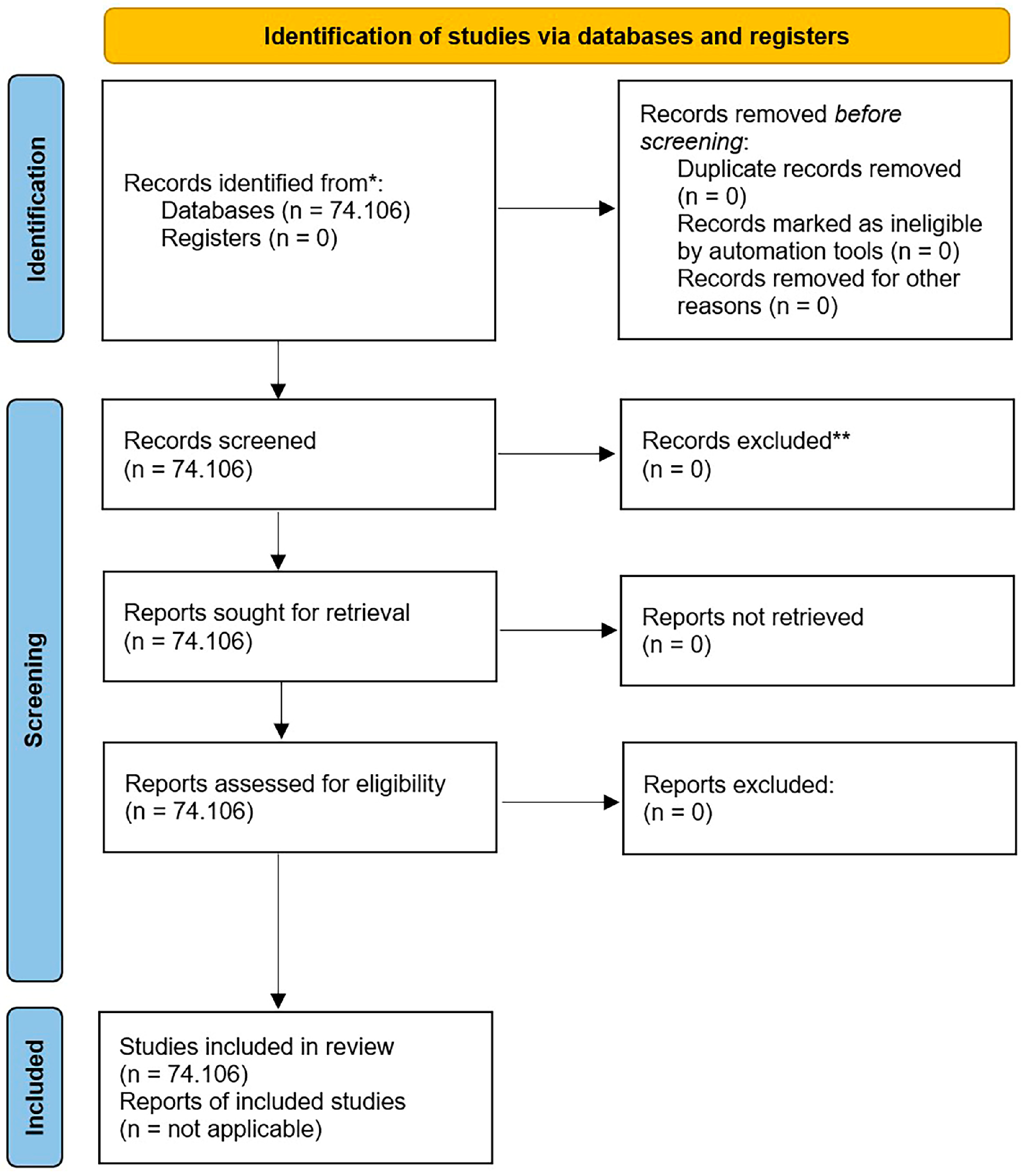
This scoping review was conducted in accordance with the Preferred Reporting Items for Systematic Reviews and Meta-Analyses (PRISMA 2020) guidelines. The review protocol was not registered in a public database, however, the PRISMA 2020 checklist was provided as Supplementary Material (S1). Following the Preferred Reporting Items for Systematic Reviews and Meta-Analyses (PRISMA) guidelines, the review involved four main steps, as shown in Figure 1.
The search was organized into six categories:
  • Microplastics in the environment—keywords: microplastics, environment, ecosystem, soil, and water;
  • Detection and removal methods—keywords: detection, analytical methods, removal, degradation, and elimination techniques;
  • Negative impacts of microplastics—keywords: toxicity, adverse effects, health risks, and ecological impact;
  • Microplastics definition, sources, and transport pathways—keywords: definition, sources, and transport pathways;
  • Strategies and policies for mitigation—keywords: policy, strategy, mitigation, and management;
  • Remediation approaches—keywords: remediation, bioremediation, cleanup, and elimination.
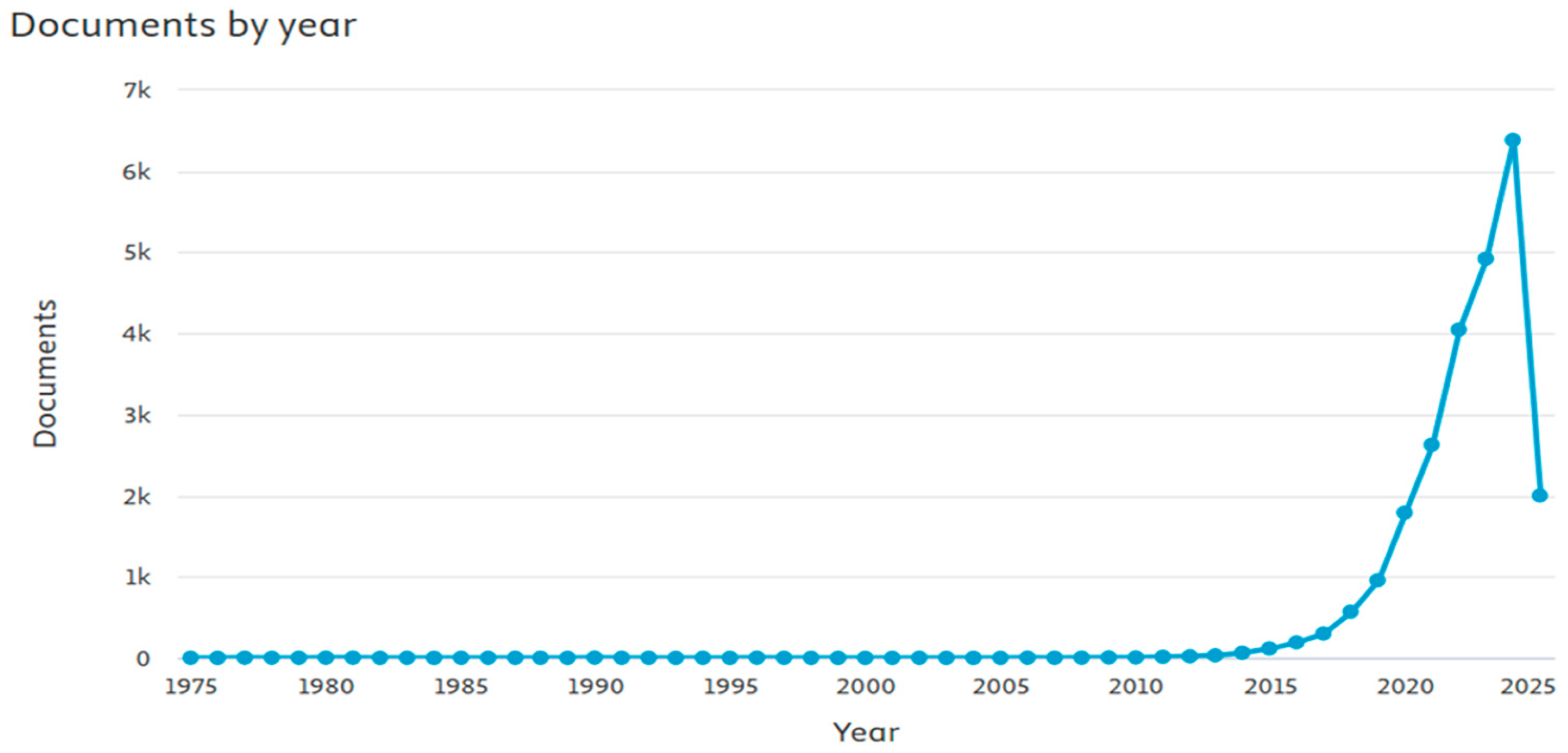
Based on the above-mentioned categories, search formulas were created for scientific papers in the selected databases (Table 1). In total, 20,815 and 9131 articles were identified from the Scopus and PubMed databases, respectively. A substantial number of publications were retrieved from both Scopus and PubMed across all key topics, including detection and removal methods, negative impacts, definitions and sources, mitigation strategies, and remediation approaches. Scopus consistently yielded more results than PubMed, with the highest numbers relating to detection/removal and negative impacts and fewer articles on remediation. The research results indicate a continuous and significant yearly increase in the number of published papers on microplastics. Between 1975 and 2009, no more than two papers were published annually, whereas since 2020, there has been a sharp rise, with thousands of papers published each year (Figure 2).

3. Current Microscopic and Analytical Techniques

3.1. Detection and Quantification Techniques

Approaches to the collection and analysis of plastic debris in environmental matrices are rapidly evolving, reflecting the growing concern over plastic pollution, the complex nature of the materials involved, and the recognition of plastics as a pervasive and widespread pollutant. Environmental plastics vary widely in scale, from visible macroplastics to microscale particles—commonly categorized as microplastics, typically ranging between 1 micrometer (µm) and 5 millimeters (mm), and even extending into the nanoscale domain [18]. These particles are not static in size; larger debris can degrade into smaller fragments, while fine particles may clump together under natural conditions [19]. Characterization is further complicated by the diversity in particle forms, such as fibers, fragments, and spheres, or colors [20,21], as well as the broad spectrum of polymer types they represent [22,23]. Among these, synthetic fibers are particularly challenging to analyze due to their thin, thread-like structures, which often fall outside the detection capabilities of standard analytical tools [19]. A comprehensive approach to microplastic analysis must therefore account for the morphological and chemical complexity inherent in these materials.
Although the analysis of microplastics in environmental and experimental contexts has expanded rapidly, the field continues to suffer from a lack of methodological standardization. While early efforts laid the groundwork for extraction and identification [24], many of these procedures remain largely unchanged more than a decade later. Despite ongoing innovation, no universally accepted protocol has emerged for isolating and characterizing microplastics across sample types and size ranges [25]. The resulting variation in resolution, sensitivity, and selectivity among studies leads to datasets of uneven quality and limited comparability [26,27].
Standard workflows generally include the removal of organic and inorganic matter, followed by physical and chemical identification techniques—most commonly microscopy coupled with Fourier-transform infrared (FTIR) or Raman spectroscopy [28]. However, these approaches have important limitations. Microscopy-based identification, for instance, can lead to both false positives and negatives, particularly for particles near or below the lower microplastic size threshold [29]. Analytical resolution often remains insufficient for detecting sub-micron plastics, and distinguishing synthetic polymers from morphologically similar natural particles continues to be a challenge [30]. These constraints together with the selective targeting of certain polymer types, shapes, or sizes and poor-quality controls can contribute to a likely underestimation or overestimation of total microplastic contamination [31,32]. As a result, despite increased research activity, current methodologies remain inadequate for producing fully representative and comparable data on environmental microplastics.
Nevertheless, ongoing research continues to refine and diversify analytical techniques for the identification and quantification of microplastics in environmental samples. A broad range of tools is currently in use, each offering unique advantages and limitations. Non-destructive methods preserve sample integrity and support visual inspection of particle size, shape, and color, often down to a few micrometers. These include three main categories: visualization techniques (e.g., optical, fluorescence, FLIM, and SEM), physicochemical methods (e.g., light scattering and hyperspectral imaging (HIS)), and vibrational spectroscopy (e.g., FTIR and Raman). Optical microscopy, using visible light and occasionally polarization filters, is widely employed for particles in the 1–1000 µm range. It forms the foundation for many microplastics studies; although limited by diffraction, it remains a cost-effective screening tool, often enhanced through dark-field illumination or combined with higher-resolution imaging [33,34]. Fluorescence microscopy builds on this by staining particles with dyes such as Nile Red or FITC, which bind preferentially to synthetic polymers [35,36,37]. This enables the detection of particles below 1 µm and improves contrast in complex matrices like wastewater. Recently, low-cost smartphone-based systems have emerged, using CCD sensors and UV light sources for portable, in situ analysis [38]. Fluorescence lifetime imaging microscopy (FLIM) captures intrinsic differences in the time-domain fluorescence decay of plastics, allowing label-free differentiation of polymers like ABS, PPE, and PET [39,40].
Electron microscopy (SEM and TEM) offers nanometer-scale resolution, making it ideal for visualizing fine MPs and their surface characteristics. When paired with energy-dispersive spectroscopy (EDS), it also provides elemental composition. However, these methods are not suitable for color analysis and require elaborate sample preparation [41,42]; and hyperspectral imaging (HSI) for rapid, automated polymer differentiation merges imaging and spectroscopy to produce three-dimensional datasets across visible to infrared wavelengths [42,43]. These datasets can then be used to distinguish polymer types, particularly when combined with machine learning [44,45]. Physicochemical techniques include a suite of light-based methods used to probe MPs based on their physical interaction with light. Light scattering techniques, such as dynamic (DLS) and static light scattering (SLS), measure particle size distributions from 0.001 µm to 1000 µm by analyzing how particles scatter laser light at various angles [46].
Multi-angle DLS systems collect data simultaneously from multiple directions, providing more accurate particle profiling, especially when analyzed using numerical methods like machine learning [47,48]. Innovations in static scattering include goniophotometer-based detectors and polarized light systems that enhance resolution and extend applicability to untreated water samples [49,50]. Flow cytometry combines light scattering with fluorescence detection in a flow-through format, allowing rapid multiparameter analysis of size and shape and fluorescent labeling of MPs in liquid suspensions [51,52]. Finally, vibrational spectroscopy, namely Fourier Transform Infrared (FTIR) and Raman spectroscopy, remains the most widely used approach for characterizing polymer types in microplastics, with detection capabilities ranging from 1 µm to several millimeters [53]. Fourier Transform Infrared, particularly in the attenuated total reflectance (ATR) mode, enables rapid assessment of solid and liquid samples with minimal preparation. µ-FTIR can detect particles as small as 11 × 11 µm, making it suitable for spatial mapping of MPs on filters or substrates [54,55]. Raman spectroscopy complements FTIR by using inelastic scattering to probe molecular vibrations and can identify particles as small as 0.2 µm. Its high spectral resolution and reduced water interference make it ideal for aqueous samples, though fluorescence interference may occur when using visible lasers. Near-infrared lasers help mitigate this issue. The two techniques are often used together to enhance polymer differentiation and reliability [56,57].
In contrast, destructive methods such as pyrolysis–gas chromatography–mass spectrometry (Py-GC-MS) and thermo-extraction desorption GC-MS (TED-GC-MS) are employed for precise chemical composition and polymer identification, even at the cost of morphological data [58,59]. Pyrolysis–gas chromatography–mass spectrometry (Py-GC-MS) is a thermal degradation-based technique that breaks down polymers into smaller volatile components, which are then separated by gas chromatography and identified via mass spectrometry [60]. This technique provides highly accurate identification of polymer types and organic additives, such as plasticizers and flame retardants, using minimal sample amounts (5–200 µg) [61]. It is particularly useful for complex matrices like sediments or sludge. However, as it destroys the sample, it cannot provide information on particle size, shape, or count; thus, it is often used alongside imaging or spectroscopic methods. Thermo-Extraction and Desorption GC-MS (TED-GC-MS) combines thermogravimetric analysis with thermal desorption and GC-MS. It offers faster throughput and semi-quantitative data on polymer composition in environmental samples [58]. Like Py-GC-MS, it misses morphological context, but its speed and sensitivity make it a valuable screening and confirmation tool for bulk MP analysis.
These diverse analytical tools, when strategically combined, offer a more comprehensive understanding of microplastic contamination. While no single method captures all dimensions, such as morphology, size, type, and quantity, a tiered approach using both non-destructive and destructive techniques can overcome most limitations. Continued innovation and standardization are critical to enhancing reproducibility and comparability across studies.

3.2. Limitations and Challenges of Current Detection Techniques and the Imperative for Standardization Protocols

Despite substantial advancements in microplastic detection, no single analytical technique currently provides a complete dataset encompassing polymer identification, particle quantification (both in terms of count and mass), and size distribution. The fact that there is no universality presents a significant limitation, particularly for studies aiming to generate comprehensive and comparable data. The sensitivity and accuracy of detection techniques are often constrained by particle size. For instance, vibrational methods such as FTIR and Raman spectroscopy rely on interactions with light and are challenged when analyzing particles smaller than the wavelength of the laser source—typically below 50 µm [53]. As a result, these methods may underperform in quantifying nanoplastics or finely fragmented microplastics, leading to underestimation of contamination levels.
To address these limitations, researchers increasingly adopt multi-technique strategies.
Microscopy and vibrational methods often benefit from simpler final preparation steps (e.g., for placement on filters) compared to the thermal methods, which reduces the risk of analyte loss and instrument contamination during the final analysis step.
The choice of techniques depends on the trade-off between speed and analytical depth. Rapid screening methods (e.g., DLS, SLS, and basic microscopy) offer insight into particle size ranges and serve as a foundation for selecting more targeted, high-resolution techniques.
For comprehensive analysis, a tiered approach is recommended: microscopy to estimate particle abundance, vibrational spectroscopy for polymer typing and particle-level quantification, and pyrolysis-based techniques for detailed mass and additive composition. Microscopy and vibrational methods generally require minimal sample preparation, reducing risk of analyte loss and instrument contamination [34]. In contrast, destructive methods involve more complex preparation steps [58,59,61]. Sample purification, often necessary to avoid interference during thermal decomposition, may result in the loss of smaller or more fragile particles. Additionally, residual non-volatile compounds in the sample can impair chromatographic columns or mass spectrometer ion sources, impacting analytical precision and instrument longevity.
Ultimately, the effectiveness of microplastic analysis depends heavily on robust sample isolation and extraction. These preparatory steps are critical for maximizing recovery efficiency, maintaining particle integrity, and ensuring reproducible results. However, the optimal isolation method is highly matrix-dependent, requiring tailored protocols for water, sediment, biota, or air samples. The development and adoption of standardized procedures across laboratories and sample types remain an urgent priority to ensure consistency, data comparability, and global coordination in microplastic pollution research. However, there is also a need to implement all above-mentioned techniques and technologies into the real-world conditions.

4. Scalable Removal Strategies: From Lab to Real World

The rapid production, use, and disposal of plastic waste have become a significant environmental threat, driven largely by industrial development and a continuously growing global population. Most waste—whether biodegradable or non-biodegradable—originates from human activities, with key contributors including industrial expansion, socio-economic development, increased consumption, and even climate change [62,63]. Addressing this issue requires coordinated efforts across all levels of society. Government legislation, starting at the state level and extending to local authorities and community organizations, plays a crucial role in promoting environmental safety. These laws establish frameworks for the proper disposal and management of plastic waste, aiming to guide public behavior and ensure sustainable waste practices [64].
One possible direction is the exploration of sustainable alternatives. These include the development and adoption of biodegradable materials, bioplastics, and other eco-friendly substitutes that can fulfil the same functions as traditional plastics without the long-term environmental consequences. However, the transition to such alternatives must be supported by comprehensive policies, economic incentives, and research investment to ensure scalability and affordability. At the same time, shifting consumer habits through education and behavioral change is crucial. Encouraging a reduction in single-use plastics, promoting circular economy principles, and fostering a culture of environmental responsibility can significantly amplify the impact of technological innovations. Ultimately, managing plastic waste effectively requires a holistic strategy—one that integrates science, policy, industry, and public participation to drive meaningful and lasting change [65].

4.1. Overview of Current Experimental Methods (e.g., Filters, Adsorption, and Biodegradation)

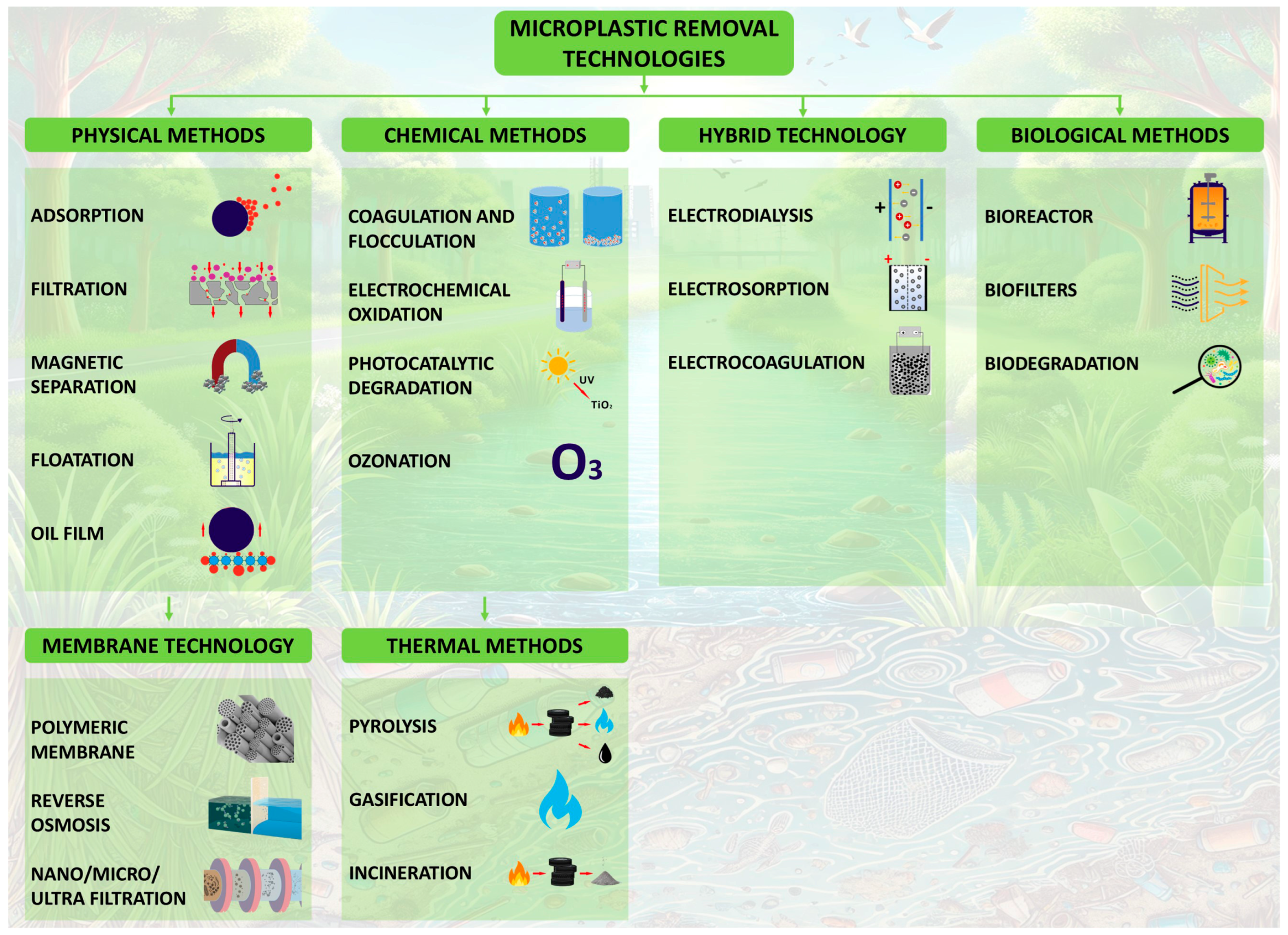
Numerous technologies have been developed in recent years to eliminate microplastics from the environment. These approaches can be broadly categorized into physical, chemical, biological, and hybrid technologies (Figure 3). Physical methods enable the mechanical removal of microplastics from water, while membrane-based technologies, a category of physical methods, offer high efficiency in eliminating particles of different sizes. Chemical methods employ various reactions to break down microplastics into smaller, less harmful components, while thermal techniques, a subcategory of chemical methods, ensure the complete degradation of microplastics by converting them into gaseous or inert products. Hybrid technologies integrate physical and chemical processes to improve removal efficiency. Finally, biological methods utilize microorganisms to degrade microplastics into environmentally benign substances.

4.1.1. Physical Methods

Due to their chemical inertness and resistance to degradation, microplastics are persistent environmental pollutants that require active removal to mitigate their ecological impact. In aquatic environments, the primary objective of microplastics remediation is to reduce pollutant load and prevent bioaccumulation in organisms. However, most current removal technologies remain at the laboratory or pilot scale, with limited real-world application [66]. Among existing strategies, physical methods are commonly applied as the initial step prior to chemical or biological treatment. These approaches aim to separate microplastics particles from water without altering their chemical structure or that of the surrounding medium [67]. One widely studied physical technique is adsorption, wherein microplastics particles adhere to the surface of an adsorbent material via a range of physicochemical interactions. Important mechanisms during the adsorption process include π–π interactions, surface complexation, electrostatic attraction, and hydrogen bonding [68]. Recent advancements have focused on developing high-performance adsorbents, such as magnetic nanocomposites, graphene-based materials, and biochar, with enhanced surface area, selectivity, and removal efficiency. A summary of selected adsorbents and their performance metrics is provided in Table 2.
Removing microplastics is a real challenge considering their size and prevalence. During the filtration phase, it is possible to remove microplastics by passing water through different types of filters (sieves, mesh screens, and membranes). The advantage of this method is that particles with a size of 0.1–1 mm (microfiltration), 2–100 mm (ultrafiltration), and ~2 nm (nanofiltration) can be removed [75]. Most wastewater treatment plants use the disc filter method, which can remove 75.6% of microplastics particles whose size is less than or equal to 10 µm [76]. The combination of electrocoagulation–electroflotation (EC/EF) with membrane filtration showed 100% efficiency in removing microplastics from wastewater [77]. Plants for the purification of drinking water as well as plants for the treatment of wastewater use rapid sand filters (RSF), the effectiveness of which was shown by [78]. The efficiency of using RSF was 97.7% for plastic sheets with an effective size (ES) of 0.39 mm filter medium, while the removal efficiency of ES 0.39 mm was 0.68%. Also, a 91.04% success of removing microplastics is possible when using a filter plate coated with activated carbon in combination with a disk filter [79].
Also, in-line filtration has proven to be an effective method, as it has greater potential for removing microplastics compared to in-lab filtration [80]. However, although there are many advantages, the filtration method also has its disadvantages, as it is slow and can lead to clogging of pores. It is quite an expensive method due to working at high pressure, while membrane regeneration is an extremely demanding job. Also, the method is effective when it comes to larger particles but not in removing nanoplastics or dissolved microplastics. It is also important to note that the proper disposal of the removed microplastics through the method of filtration is a big challenge and requires proper management to prevent the risk of possible return to the environment.

4.1.2. Chemical Methods

One of the ways to remove microplastics is the application of chemical methods, including coagulation and sedimentation, electrocoagulation, and sol–gel reactions. The addition of various chemicals has proven successful in eliminating microplastics. AlCl3 and FeCl3 are often used as coagulants. In the work of [81], the speed of PS removal was investigated, with the efficiency for particles of 20, 45, and 90 microns ranging from 77.4 to 95.3%. AlCl3 proved to be a better coagulant due to the more potent binding force between Al3+ and PS [81]. As a coagulation agent in their research, ref. [82] used FeCl3 × 6H2O. At a neutral pH value and an increase in the coagulant concentration, an increased removal of microplastics, the size of which was smaller than 0.5 mm, was determined [82]. The effectiveness of removing different types of microplastics from rainwater was shown in the research of [83]. In this paper, different types and doses of coagulants, weathering conditions, and pH were used. The best results were obtained with a combination of alum and polyacrylamide (PAM), and charge neutralization and hydrophobic interaction between MP and coagulant were cited as the removal mechanism. Also, at pH 3–5, the efficiency of removing different sizes of microplastics particles was higher [83].
In water treatments, the most representative chemical method for microplastics removal is coagulation/sedimentation, the success of which depends on the properties, dose, and residence time of the coagulant. For the success of microplastics removal to be as good as possible, many studies deal with the optimization of the conditions and the type of coagulants [68].

4.1.3. Biological Methods

Biological methods have the potential to completely break down microplastics, turning them into harmless substances, attracting significant attention at the global level. These methods have high efficiency, sustainability, and significant capacities for the degradation of specific types of plastic. Biological methods are environmentally friendly, using microorganisms and natural processes to break down or remove microplastics without the use of chemical compounds.
By 2020, more than 400 microorganisms were found that naturally degrade plastic [84]. Thanks to their adaptability and ability to produce enzymes, microorganisms such as bacteria, fungi, and some algae can survive even in the most difficult conditions and decompose plastic pollution using it as the only carbon source (Table 3).
Bacterial species from Bacillus, Escherichia, and Pseudomonas genera show high potential for efficiently degrading plastics (Table 4), especially for widely distributed polymers, such as PS, PE, and PET.
Moreover, studies have shown that bacterial strains such as Bacillus megaterium, Pseudomonas aeruginosa, Rhodococcus ruber, and others are capable of degrading thermoplastics like PE and PET [105]. In addition, fungi exhibit efficient degradation of plastic, in part due to their powerful enzymatic system (Table 4). Filamentous fungi play a significant role in the degradation and mineralization of plastic pollutants, demonstrating the capability to break down PE and PET [106]. The efficiency of microplastics degradation can be improved by the application of microbial communities. A lot of research has shown that microorganisms typically collaborate in communities. Microbial communities possess the ability to adapt to new environments and attach to them, primarily releasing specific enzymes that enable the utilization of persistent plastic as their sole carbon source [107]. These communities comprise a diverse array of microorganisms and their enzymes, which enhances degradation efficiency compared to individual microorganisms. Due to the presence of multiple microorganisms coexisting in an environment and functioning synergistically, microbial communities or consortia can break down complex compounds into simpler monomers. Microbial diversity is one of the key conditions for the biodegradation of microplastics [108].

4.1.4. Microplastics Removal in Real-World Conditions, Challenges, and Possible Solutions

In recent years, legislative initiatives around the world have focused on reducing microplastics, particularly in cosmetics, cleaning, and textile products. Although the global framework is still not harmonized, there are significant steps taken by individual countries and regions [109]. Also, great attention has been paid to methods for removing microplastics from different environments under real conditions. In contrast to laboratory conditions, the removal of MP in real conditions is less efficient. One of the reasons is that MP is often combined with other pollutants (organic matter, heavy metals, and microorganisms). Additionally, due to their chemical composition and physical characteristics, microplastics particles are very complex and therefore require precise methods for detection and quantification [110]. Another problem is that it is difficult to compare the results of different research and removal methods due to the lack of standardized protocols for sampling, identification, and analysis of MPs.
Based on the literature review and available data, the removal of microplastics is mostly at the level of studies or pilot projects. The effectiveness of various methods for removing microplastics, depending on their size and the countries where they are applied, is presented in Table 5 [111,112,113,114,115,116,117]. There is still no single, standardized method for detecting all types of microplastics, especially those of nanosize. As long as the quantification methods are not standardized, it is difficult to monitor the effectiveness of the applied methods. Many technologies for removing microplastics can harm the environment. For example, membrane technologies can generate secondary pollutants, while advanced oxidation processes can produce toxic byproducts. The implementation of these technologies requires significant investment in infrastructure and personnel training, which can be a barrier to their widespread use, especially in developing countries.
Also, for the transition and successful application of methods from the laboratory to real conditions, an interdisciplinary approach, technological innovations, economic incentives, and legal regulations are necessary.

5. Microplastics Mitigation and Policies

Despite widespread scientific and public concern over the pervasive presence of MPs in various environmental systems, comprehensive research and effective policy development remain hindered by the absence of a universally accepted definition for MPs. This shortage of clarity leads to inconsistencies in data collection, analysis, and interpretation, thereby delaying accurate assessments of the extent and impact of MP pollution [118]. The ongoing debate surrounding MP definitions underscores the urgent need for standardization, which is essential for advancing our understanding of MP pollution and mitigating its adverse effects.
Although numerous proposals have been made, reaching a consensus is challenging due to the dynamic nature and diverse characteristics of MPs. The variation in definitions and classification systems across studies has led to significant data incomparability, limiting the ability to draw meaningful, generalizable conclusions. Establishing standardized definitions is crucial for (1) enabling reliable monitoring and consistent data collection, (2) facilitating comparative research and meta-analyses, and (3) supporting the creation of effective policies and regulations. Moreover, a unified definition is essential for accurate risk assessment, allowing for a more precise evaluation of the ecological and human health impacts of MPs [72,119].
A recently established guideline defines microplastics as water-insoluble, solid plastic fragments with at least one dimension between 1 µm and 1 mm [120]. It also introduces a separate category, “large microplastics”, referring to similar particles with dimensions ranging from 1 to 5 mm [121]. However, this classification diverges from existing regulatory practices, as authorities in regions such as the EU and the US typically define all plastic particles smaller than 5 mm as microplastics (ISO 24187:2023) [121]. Once in the environment, microplastics obstruct the food chain and cause devastation to natural ecosystems. This pressing concern is underscored by the estimated 145,000 tons of microplastics used annually in the EU/European Economic Area (EEA) [122]. The comprehensive mitigation of plastic pollution necessitates a multidimensional policy approach, which is categorized by the OECD report into four interconnected pillars. Firstly, strategies must focus on curbing production and demand through measures such as bans on problematic plastics, promoting product longevity, mandating reuse systems, and implementing taxes on virgin polymers, alongside the removal of fossil fuel subsidies. Secondly, there is a focus on design for circularity, which involves restrictions on hazardous chemicals, extended producer responsibility with fee modulation, recycled content standards, and eco-design criteria aimed at enhancing reusability, repairability, and preventing microplastics leakage. Thirdly, efforts must concentrate on enhancing recycling by improving separate collection, sorting, and processing through instruments like landfill taxes, deposit-refund schemes, and pay-as-you-throw initiatives. Finally, closing leakage pathways is critical, requiring robust collection and treatment infrastructure, improved municipal litter management, addressing sea-based sources like abandoned fishing gear, and advancing end-of-pipe capture technologies [123]. Considering the multifaceted nature of microplastics contamination, these strategies, when employed independently, exhibit limited effectiveness; therefore, a multidisciplinary and integrated approach is essential to comprehensively restrict plastic input into the environment and reduce existing accumulated plastic waste [123].
In October 2023, the European Union enacted Regulation 2023/2055 (Annex XVII to Regulation (EC) No 1907/2006 of the European Parliament and of the Council concerning the Registration, Evaluation, Authorisation and Restriction of Chemicals), which bans synthetic polymers containing microparticles in products such as cosmetics, cleaning agents, and various disposable items. Building on this effort, the European Commission (EC) released its official position in 2024 concerning synthetic polymer microparticles (SPMs)—a category that includes plastic glitter—both as standalone particles and when incorporated into products, as outlined in SafeGuardS 37/24 and supporting references. Further guidance came in March 2025, when the EC issued a three-part Guide for the REACH Microplastics Restriction (Annex XVII, Entry 78), intended to support EU Member States and stakeholders in effectively implementing the new microplastics restrictions. While the Member States approved the guide by consensus, disagreement remained regarding the classification of products with glitter affixed to surfaces. According to SGS SA (2025), such products are considered outside the scope of the restriction by countries including Austria, Belgium, Germany, and the Netherlands.
Despite such regulatory advances, plastic consumption—especially of single-use plastics—remains widespread globally. Items such as food packaging, over-packaged consumer products, bottled water, and disposable utensils continue to dominate daily use. In response, numerous educational campaigns aim to raise public awareness about the environmental and health impacts of plastic use while encouraging small but meaningful lifestyle changes. Key recommendations for individuals include reducing the use of single-use plastics like plastic bottles, bags, straws, cutlery, and containers. Conscious food choices are also encouraged—for instance, avoiding canned products with plastic linings and limiting seafood intake (particularly shellfish, which accumulate higher levels of microplastics). Additional practices include selecting microbead-free cosmetics, choosing natural-fiber clothing, installing water filters, regularly dusting household surfaces, and avoiding synthetic products like chewing gum. Supporting small businesses that adopt environmentally sustainable practices is another effective way to drive positive change. Furthermore, robust recycling systems are essential for managing plastic waste. Governments should incentivize public participation in waste collection and recycling efforts, for example, by implementing deposit-refund schemes for recyclable containers. Stricter environmental legislation must be developed and enforced both nationally and internationally to ensure the proper disposal of plastic waste [124]. When combined, these regulatory efforts and individual actions can significantly reduce the global plastic footprint and limit human exposure to microplastics.

Mitigation Policies of Plastic in Marine and Terrestrial Environments

As MPs become increasingly prevalent, there is a growing need to adopt more sustainable practices to reduce plastic pollution. By minimizing the use of single-use plastics, improving waste management systems, and promoting recycling and composting, research can lead towards a more sustainable future [125].
To facilitate data consistency and collaboration among international researchers for managing marine microplastics data, the NOAA NCEI has established a global, open-access system consisting of a user-friendly GIS map and data portal (https://www.ncei.noaa.gov/products/microplastics, accessed on 15 April 2024). This system is designed to create a central repository for collecting, archiving, and delivering microplastics information in a standardized and reliable manner. This initiative advances NCEI’s goal of improving and sharing knowledge, as profound microplastics contamination has large ecological implications on marine and freshwater ecosystems alike. Accordingly, to date, research on MPs has been more concentrated on marine environments, leaving a deficiency of knowledge focused on soil and terrestrial ecosystems, which are also important sources of MPs transport by wind, water, and anthropogenic activities, emphasizing the largely unintended but massive emissions of plastic in the environment. It underscores the critical need for immediate and detailed control measures that focus on reducing plastic waste generation, improving waste management infrastructure that involves the use of microbes (for instance, bioremediation, bioaugmentation, and biodegradation), and innovating materials that do not readily break down into harmful micro- and nanoplastics. This is essential for designing targeted and impactful prevention and mitigation policies.
Recent investigation in biodegradable materials proved their potential to reduce reliance on fossil fuels and mitigate environmental pollution [126]. Biodegradable alternatives, such as cellulose microbeads, offer a promising solution to persistent plastic microbead pollution, with potential for future legislative support [127]. These materials are considered safer and more susceptible to microbial degradation than synthetic plastics [128]. For instance, cosmetic chito-beads demonstrate superior cleansing efficacy compared to polyethylene microbeads and fully degrade in soil into benign products without negative impact on plants [129]. Consequently, the development of biodegradable plastics, coupled with the engineering of microorganisms to break down both conventional and biodegradable plastic particles, represents an eco-friendly strategy for mitigating micro/nanoplastic (MP/NP) pollution. Furthermore, integrating bioremediation utilizing non-edible plants in terrestrial systems and algae in aquatic environments while simultaneously producing biodegradable plastics from this biomass provides a viable pathway to eliminate MPs/NPs and support a bio-based circular economy.
Plastic waste management strategies are based on the 4Rs principle (Reduce, Reuse, Recycle, Recover) and innovative upcycling initiatives and policies that govern the entire plastic lifecycle, fostering a circular economy for plastics. This initiative is supported by the European policy “Strategy for Plastics in Circular Economy”, which seeks to establish a continent-wide circular economy for plastics, promoting the reuse, repair, and recycling of plastic product;, minimizing microplastic (MP) incorporation; and fostering the development of sustainable alternatives and novel MP treatment technologies [130]. Furthermore, advancements in treatment technologies, comprehensive clean-up operations, heightened public awareness campaigns, and the development of sustainable material alternatives are of the same importance. Nevertheless, the widespread nature of microplastics contamination cannot be adequately addressed by these strategies in isolation, which limits their overall effectiveness. Therefore, a synergistic, multidisciplinary approach that integrates all these efforts is essential to follow the flow of plastic into the environment and reduce existing accumulated plastic waste [130].
Public awareness and education are also very important in mitigating microplastics pollution, as evidenced by historical knowledge gaps and the need to translate awareness into tangible behavioral changes like reduced littering and improved recycling [131]. Global initiatives, such as the UNEP’s awareness campaigns involving numerous countries, alongside regional environmental bodies [132] and NGOs like the 5 Gyres Institute [133], are actively working to address this.
Complementing awareness efforts, the implementation of Safe and Sustainable by Design (SSbD) principles for plastics is essential for addressing MP pollution at its source [134]. This strategy integrates innovation in material science and product design with circular economy principles, aiming for chemicals, materials, and products that are safe, durable, and recyclable throughout their lifecycle [135]. SSbD fosters the development of environmentally friendly alternatives, including biodegradable polymers [136], bio-based textile coatings [137], and natural fiber composites for industries like automotive [138], thereby enhancing functionality while minimizing environmental impact. In conclusion, collaborative stakeholder efforts are crucial for transitioning the plastic industry towards sustainable and health-focused solutions.

6. Conclusions

The alarming increase in microplastics pollution has drawn widespread attention from scientists, policymakers, and the public, highlighting the urgent need for effective mitigation strategies. The adoption of a standardized definition requires collaborative effort involving researchers, policymakers, and industry stakeholders. Despite growing awareness of the microplastics crisis, effective regulatory responses remain a challenge. Efforts to combat microplastics pollution include preventive measures, such as banning certain single-use plastics and promoting recycling initiatives, alongside removal and mitigation strategies aimed at managing existing contamination. However, the implementation of these policies is often hampered by inconsistencies in enforcement and a lag in public awareness.
Increasing importance is also being attached to the development and application of methods for the detection and removal of microplastics from different ecosystems. Techniques such as spectroscopy (e.g., FTIR and Raman spectroscopy), thermogravimetric analysis (TGA), and microscopic methods enable precise identification and quantification of microplastic particles in water, air, and soil. But even so, innovative methods are being developed, which include the application of nanotechnology, biosensors, and automated sampling systems, thus raising the level of detection to a higher level of precision and efficiency. However, it should be pointed out that although the mentioned methods are precise, they are often expensive, time-consuming, and impractical for use outside laboratory conditions or in real time. The lack of standardized protocols further complicates the comparison of results among different studies and geographic regions. When it comes to removing microplastics from the environment, various approaches are being researched and implemented, including filtration technologies, advanced wastewater treatment methods, as well as biological methods based on the use of microorganisms capable of degrading certain types of plastic.
Only an integrated approach that combines scientific innovation, political will, and social responsibility can help preserve ecological balance and safeguard human health amid increasing microplastic contamination. Ultimately, regardless of technological progress, no solution will be effective without international cooperation, regulatory alignment, and a long-term strategy that integrates prevention, detection, and remediation.

Supplementary Materials

The following supporting information can be downloaded at: https://www.mdpi.com/article/10.3390/microplastics5010020/s1, Table S1: PRISMA_checklist [139].

Author Contributions

Conceptualization, D.K. and J.V.; methodology, I.V.; investigation, D.K., D.M., S.Đ., G.R., I.V., A.R.M.M. and J.V.; resources, I.V. and D.K.; writing—original draft preparation, D.K., D.M., G.R. and A.R.M.M.; writing—review and editing, D.K., D.M., G.R., A.R.M.M. and J.V.; visualization, I.V.; supervision, D.K. and J.V. All authors have read and agreed to the published version of the manuscript.

Funding

This research was funded by the European Union’s Horizon Europe Project GREENLand—Twinning Microplastic-Free Environment under grant agreement number 101079267.

Institutional Review Board Statement

Not applicable.

Informed Consent Statement

Not applicable.

Data Availability Statement

As a review article, this manuscript primarily synthesizes existing knowledge and published data from the scientific literature. No original datasets were generated or analyzed for this study. All sources of information and data are fully cited within the article.

Acknowledgments

The authors have reviewed and edited the output and take full responsibility for the content of this publication.

Conflicts of Interest

The authors declare no conflict of interest.

Abbreviations

PEPoly(methylene)
PPPoly(propene)
PETPoly(ethylene terephthalate)
PSPoly(styrene)
PVCPoly(vinyl chloride
PEAPoly(ethylene adipate)
PCLPoly(ε-caprolactone)
PBS Poly(butylene succinate
PURPolyurethane
LDPElow-density polyethylene
HDPEhigh-density polyethylene
EUEuropean Union
EEAEuropean Economic Area
FTIRFourier-transform infrared spectroscopy
FLIMFluorescence lifetime imaging microscopy
SEMScanning electron microscopy
TEMTransmission electron microscopy
EDSenergy-dispersive spectroscopy
HSIhyperspectral imaging
DLSdynamic light scattering
SLSstatic light scattering
ATRattenuated total reflectance
MPsmicroplastics
Py-GC-MSpyrolysis–gas chromatography-mass spectrometry
TED-GC-MSthermo-extraction desorption gas chromatography–mass spectrometry
EC/EFelectrocoagulation–electroflotation
RSFrapid sand filters
ESeffective size
AOPsAdvanced Oxidation Processes
SSbDSafe and Sustainable by Design

References

  1. Andrady, A.L.; Neal, M.A. Applications and Societal Benefits of Plastics. Philos. Trans. R. Soc. B 2009, 364, 1977–1984. [Google Scholar] [CrossRef] [PubMed]
  2. Hernandez, L.M.; Xu, E.G.; Larsson, H.C.E.; Tahara, R.; Maisuria, V.B.; Tufenkji, N. Plastic Teabags Release Billions of Microparticles and Nanoparticles into Tea. Environ. Sci. Technol. 2019, 53, 12300–12310. [Google Scholar] [CrossRef] [PubMed]
  3. Geyer, R. Production, Use, and Fate of Synthetic Polymers. In Plastic Waste and Recycling; Letcher, T.M., Ed.; Academic Press: London, UK, 2020; pp. 13–32. [Google Scholar] [CrossRef]
  4. Gazal, A.A.; Gheewala, S.H. Plastics, Microplastics and Other Polymer Materials-A Threat to the Environment. J. Sustain. Energy Environ. 2020, 11, 113–122. [Google Scholar]
  5. Torres-Agullo, A.; Karanasiou, A.; Moreno, T.; Lacorte, S. Overview on the Occurrence of Microplastics in Air and Implications from the Use of Face Masks during the COVID-19 Pandemic. Sci. Total Environ. 2021, 800, 149555. [Google Scholar] [CrossRef]
  6. Hassan, T.; Srivastwa, A.K.; Sarkar, S.; Majumdar, G. Characterization of Plastics and Polymers: A Comprehensive Study. IOP Conf. Ser. Mater. Sci. Eng. 2022, 1225, 012033. [Google Scholar] [CrossRef]
  7. Walsh, A.N.; Reddy, C.M.; Niles, S.F.; McKenna, A.M.; Hansel, C.M.; Ward, C.P. Plastic Formulation is an Emerging Control of Its Photochemical Fate in the Ocean. Environ. Sci. Technol. 2021, 55, 12383–12392. [Google Scholar] [CrossRef]
  8. Pan, D.; Su, F.; Liu, C.; Guo, Z. Research Progress for Plastic Waste Management and Manufacture of Value-Added Products. Adv. Compos. Hybrid Mater. 2020, 3, 443–461. [Google Scholar] [CrossRef]
  9. Precedence Research. Plastics Market. Available online: https://www.precedenceresearch.com/plastics-market (accessed on 6 November 2025).
  10. Rumetshofer, T.; Fischer, J. Information-Based Plastic Material Tracking for Circular Economy—A Review. Polymers 2023, 15, 1623. [Google Scholar] [CrossRef]
  11. Rodrigues, M.O.; Abrantes, N.; Gonçalves, F.J.M.; Nogueira, H.; Marques, J.C.; Gonçalves, A.M.M. Impacts of Plastic Products Used in Daily Life on the Environment and Human Health: What Is Known? Environ. Toxicol. Pharmacol. 2019, 72, 103239. [Google Scholar] [CrossRef]
  12. Cabernard, L.; Pfister, S.; Oberschelp, C.; Hellweg, S. Growing Environmental Footprint of Plastics Driven by Coal Combustion. Nat. Sustain. 2022, 5, 139–148. [Google Scholar] [CrossRef]
  13. Zhao, X.; You, F. Microplastic Human Dietary Uptake from 1990 to 2018 Grew across 109 Major Developing and Industrialized Countries but Can Be Halved by Plastic Debris Removal. Environ. Sci. Technol. 2024, 58, 8709–8723. [Google Scholar] [CrossRef]
  14. European Commission. Restriction of Microplastics—EU (17 October 2023). Available online: https://trade.ec.europa.eu/access-to-markets/en/news/restriction-microplastics-eu-17-october-2023 (accessed on 6 November 2025).
  15. Munhoz, D.R.; Harkes, P.; Beriot, N.; Larreta, J.; Basurko, O.C. Microplastics: A Review of Policies and Responses. Microplastics 2022, 2, 1–26. [Google Scholar] [CrossRef]
  16. Chang, X.; Fang, Y.; Wang, Y.; Wang, F.; Shang, L.; Zhong, R. Microplastic Pollution in Soils, Plants, and Animals: A Review of Distributions, Effects and Potential Mechanisms. Sci. Total Environ. 2022, 850, 157857. [Google Scholar] [CrossRef] [PubMed]
  17. Tang, K.H.D.; Li, R.; Li, Z.; Wang, D. Health Risk of Human Exposure to Microplastics: A Review. Environ. Chem. Lett. 2024, 22, 1155–1183. [Google Scholar] [CrossRef]
  18. Song, J.; Wang, C.; Li, G. Defining Primary and Secondary Microplastics: A Connotation Analysis. ACS EST Water 2024, 4, 2330–2332. [Google Scholar] [CrossRef]
  19. Hale, R.C.; Seeley, M.E.; La Guardia, M.J.; Mai, L.; Zeng, E.Y. A Global Perspective on Microplastics. J. Geophys. Res. Ocean 2020, 125, e2018JC014719. [Google Scholar] [CrossRef]
  20. Lusher, A.L.; Bråte, I.L.N.; Munno, K.; Hurley, R.R.; Welden, N.A. Is It or Isn’t It: The Importance of Visual Classification in Microplastic Characterization. Appl. Spectrosc. 2020, 74, 1139–1153. [Google Scholar] [CrossRef]
  21. Kotar, S.; McNeish, R.; Murphy-Hagan, C.; Renick, V.; Lee, C.F.T.; Steele, C.; Lusher, A.; Moore, C.; Minor, E.; Schroeder, J.; et al. Quantitative Assessment of Visual Microscopy as a Tool for Microplastic Research: Recommendations for Improving Methods and Reporting. Chemosphere 2022, 308, 136449. [Google Scholar] [CrossRef]
  22. Rodríguez-Seijo, A.; Pereira, R. Morphological and Physical Characterization of Microplastics. In Comprehensive Analytical Chemistry; Elsevier: Amsterdam, The Netherlands, 2017; Volume 75, pp. 49–66. [Google Scholar] [CrossRef]
  23. Chen, H.; Zou, X.; Ding, Y.; Wang, Y.; Fu, G.; Yuan, F. Are Microplastics the ‘Technofossils’ of the Anthropocene? Anthr. Coasts 2022, 5, 8. [Google Scholar] [CrossRef]
  24. Van Cauwenberghe, L.; Devriese, L.; Galgani, F.; Robbens, J.; Janssen, C.R. Microplastics in Sediments: A Review of Techniques, Occurrence and Effects. Mar. Environ. Res. 2015, 111, 5–17. [Google Scholar] [CrossRef]
  25. Prabhakar, S.; Prateek, S.; Kumar, A. Sampling, Separation, and Characterization Methodology for Quantification of Microplastic from the Environment. J. Hazard. Mater. Adv. 2024, 14, 100416. [Google Scholar] [CrossRef]
  26. Müller, Y.K.; Wernicke, T.; Pittroff, M.; Witzig, C.S.; Storck, F.R.; Klinger, J.; Zumbülte, N. Microplastic analysis—Are we measuring the same? Results on the first global comparative study for microplastic analysis in a water sample. Anal. Bioanal. Chem. 2020, 412, 555–560. [Google Scholar] [CrossRef] [PubMed]
  27. Lv, L.; Yan, X.; Feng, L.; Jiang, S.; Lu, Z.; Xie, H.; Li, C. Challenge for the detection of microplastics in the environment. Water Environ. Res. 2021, 93, 5–15. [Google Scholar] [CrossRef]
  28. Zhao, S.; Kvale, K.F.; Zhu, L.; Zettler, E.R.; Egger, M.; Mincer, T.J.; Amaral-Zettler, L.A.; Lebreton, L.; Niemann, H.; Nakajima, R.; et al. The distribution of subsurface microplastics in the ocean. Nature 2025, 641, 51–61. [Google Scholar] [CrossRef] [PubMed]
  29. Blair, R.M.; Waldron, S.; Phoenix, V.R.; Gauchotte-Lindsay, C. Microscopy and elemental analysis characterisation of microplastics in sediment of a freshwater urban river in Scotland, UK. Environ. Sci. Pollut. Res. 2019, 26, 12491–12504. [Google Scholar] [CrossRef]
  30. Zarfl, C. Promising techniques and open challenges for microplastic identification and quantification in environmental matrices. Anal. Bioanal. Chem. 2019, 411, 3743–3756. [Google Scholar] [CrossRef]
  31. Kefer, S.; Miesbauer, O.; Langowski, H.C. Environmental Microplastic Particles vs. Engineered Plastic Microparticles—A Comparative Review. Polymers 2021, 13, 2881. [Google Scholar] [CrossRef]
  32. Prata, J.C. The environmental impact of e-waste microplastics: A systematic review and analysis based on the Driver–Pressure–State–Impact–Response (DPSIR) Framework. Environments 2024, 11, 30. [Google Scholar] [CrossRef]
  33. Richter, S.; Horstmann, J.; Altmann, K.; Braun, U.; Hagendof, C. A reference methodology for microplastic particle size distribution analysis: Sampling, filtration and detection by optical microscopy and image processing. Appl. Res. 2023, 2, e202200055. [Google Scholar] [CrossRef]
  34. Hammond, B.C.; Qadikolae, F.A.; Aghaaminiha, M.; Sharma, S.; Wu, L. New Insights into the Formation of Aggregates of Bidisperse Nano- and Microplastics in Water Based on the Analysis of In situ Microscopy and Molecular Simulation. Lagumir 2024, 40, 14455–14466. [Google Scholar] [CrossRef]
  35. Aoki, H. Material-Specific Determination Based on Microscopic Observation of Single Microplastic Particles Stained with Fluorescent Dyes. Sensors 2022, 22, 3390. [Google Scholar] [CrossRef] [PubMed]
  36. Awada, A.; Potter, M.; Aherne, J.; Lavoie-Bernstein, S.; Diamond, L.M.; Helm, A.P.; Jantunen, L.; Welsh, B.; Mutus, B.; Rondeau-Gangé, S. Facile detection of microplastics from a variety of environmental samples with conjugated polymer nanoparticles. Environ. Sci. Adv. 2025, 4, 270–278. [Google Scholar] [CrossRef]
  37. Karakolis, G.E.; Nguyen, B.; Bem You, J.; Rochman, M.C.; Sinton, D. Fluorescent Dyes for Visualizing Microplastic Particles and Fibers in Laboratory-Based Studies. Environ. Sci. Technol. Lett. 2019, 6, 334–340. [Google Scholar] [CrossRef]
  38. Lee, J.J.; Kang, J.; Kim, C. A low-cost TICT-based staining agent for identification of microplastics: Theoretical studies and simple, cost-effective smartphone-based fluorescence microscope application. J. Hazard. Mater. 2024, 465, 133168. [Google Scholar] [CrossRef]
  39. Wohlschläger, M.; Versen, M.; Löder, J.G.M.; Laforsch, C. A promising method for fast identification of microplastic particles in environmental samples: A pilot study using fluorescence lifetime imaging microscopy. Heliyon 2024, 10, 25133. [Google Scholar] [CrossRef]
  40. Monteleone, A.; Wenzel, F.; Langhals, H.; Dietrich, D. New application for the identification and differentiation of microplastics based on fluorescence lifetime imaging microscopy (FLIM). J. Environ. Chem. Eng. 2021, 9, 104769. [Google Scholar] [CrossRef]
  41. Gniadek, M.; Dąbrowska, A. The marine nano- and microplastics characterisation by SEM-EDX: The potential of the method in comparison with various physical and chemical approaches. Mar. Pollut. Bull. 2019, 148, 210–216. [Google Scholar] [CrossRef]
  42. Li, L.; Luo, Y.; Peijnenburg, W.J.G.M.; Li, R.; Yang, J.; Zhou, Q. Confocal measurement of microplastics uptake by plants. MethodsX 2019, 7, 100750. [Google Scholar] [CrossRef]
  43. Faltynkova, A.; Johnsen, G.; Wagner, M. Hyperspectral imaging as an emerging tool to analyze microplastics: A systematic review and recommendations for future development. Microplast. Nanoplast. 2021, 1, 13. [Google Scholar] [CrossRef]
  44. Huang, H.; Qureshi, J.U.; Liu, S.; Sun, Z.; Zhang, C.; Wang, H. Hyperspectral imaging as a potential online detection method of microplastics. Bull. Environ. Contam. Toxicol. 2021, 107, 754–763. [Google Scholar] [CrossRef]
  45. Hu, B.; Dai, Y.; Zhou, H.; Sun, Y.; Yu, H.; Dai, Y.; Wang, M.; Ergu, D.; Zhou, P. Using artificial intelligence to rapidly identify microplastics pollution and predict microplastics environmental behaviors. J. Hazard. Mater. 2024, 474, 134865. [Google Scholar] [CrossRef]
  46. Balakrishnan, G.; Lagarde, F.; Chassenieux, C.; Nicolai, T. Quantification of Very Low Concentration of Colloids with Light Scattering Applied to Micro (Nano)Plastics in Seawater. Microplastics 2023, 2, 202–214. [Google Scholar] [CrossRef]
  47. He, X.; Wang, C.; Wang, Y.; Yu, J.; Zhao, Y.; Li, J.; Hussain, M.; Liu, B. Rapid classification of micro-particles using multi-angle dynamic light scattering and machine learning approach. Front. Bioeng. Biotechnol. 2022, 10, 1097363. [Google Scholar] [CrossRef] [PubMed]
  48. Villacorta, A.; Rubio, L.; Alaraby, M.; López-Mesas, M.; Fuentes-Cebrian, V.; Morinones, H.O.; Marcos, R.; Hernández, A. A new source of representative secondary PET nanoplastics. Obtention, characterization, and hazard evaluation. J. Hazard. Mater. 2022, 49, 129593. [Google Scholar] [CrossRef] [PubMed]
  49. Wang, Y.; Liao, R.; Dai, J.; Liu, Z.; Xiong, Z.; Zhang, T.; Chen, H.; Ma, H. Differentiation of suspended particles by polarized light scattering at 120. Opt. Express 2018, 26, 22419. [Google Scholar] [CrossRef]
  50. Liu, M.; Liu, M.H.; Yang, K.; Li, J.; Huang, C.; Yang, J.; Chen, W.; Ying, K.; Leung, Y.M.K.; Zhang, K.; et al. Advancing the understanding of microplastic weathering: Insights from a novel polarized light scattering approach. Environ. Sci. Technol. 2024, 58, 19004–19015. [Google Scholar] [CrossRef]
  51. Picot, J.; Guérin, L.C.; Le Van Kim, C.; Boulanger, M.C. Flow cytometry: Retrospective, fundamentals and recent instrumentation. Cytotechnology 2012, 64, 109–130. [Google Scholar] [CrossRef]
  52. Kaile, N.; Lindivat, M.; Elio, J.; Thuenstad, G.; Crowley, G.Q.; Hoell, A.I. Preliminary results from detection of microplastics in liquid samples using flow cytometry. Front. Mar. Sci. 2020, 7, 552688. [Google Scholar] [CrossRef]
  53. Phan, S.; Torrejon, D.; Furseth, J.; Mee, E.; Luscombe, C. Exploiting weak supervision to facilitate segmentation, classification, and analysis of microplastics (<100 μm) using Raman microspectroscopy images. Sci. Total Environ. 2023, 886, 163786. [Google Scholar] [CrossRef]
  54. Vinay Kumar, N.B.; Löschel, A.L.; Imhof, K.H.; Löder, J.G.M.; Laforsche, C. Analysis of microplastics of a broad size range in commercially important mussels by combining FTIR and Raman spectroscopy approaches. Environ. Pollut. 2021, 269, 116147. [Google Scholar] [CrossRef]
  55. Skvorčinskienė, R.; Kiminaitė, I.; Vorotinskienė, L.; Jančauskas, A.; Paulauskas, R. Complex study of bioplastics: Degradation in soil and characterization by FTIR-ATR and FTIR-TGA methods. Energy 2023, 274, 127320. [Google Scholar] [CrossRef]
  56. Wang, Z.; Wang, X.; Hu, C.; Ge, T.; Wang, L.; Xing, J.; He, X.; Zhao, Y. Comparative evaluation of analytical techniques for quantifying and characterizing polyethylene microplastics in farmland soil samples. Agriculture 2024, 14, 554. [Google Scholar] [CrossRef]
  57. Zhi, Z.; Li, Y.; Liu, G.; Ou, Q. Identification and detection of label-free polystyrene microplastics in maize seedlings by Raman spectroscopy. Sci. Total Environ. 2025, 958, 178093. [Google Scholar] [CrossRef]
  58. Dümichen, E.; Eisentraut, P.; Bannick, C.G.; Barthel, A.K.; Senz, R.; Braun, U. Fast identification of microplastics in complex environmental samples by a thermal degradation method. Chemosphere 2017, 174, 572–584. [Google Scholar] [CrossRef] [PubMed]
  59. Hanvey, J.S.; Lewis, P.J.; Lavers, J.L.; Crosbie, N.D.; Pozo, K.; Clarke, B.O. A review of analytical techniques for quantifying microplastics in sediments. Anal. Methods 2017, 9, 1369–1383. [Google Scholar] [CrossRef]
  60. Qiu, Q.; Tan, Z.; Wang, J.; Peng, J.; Li, M.; Zhan, Z. Extraction, enumeration and identification methods for monitoring microplastics in the environment. Estuar. Coast Shelf Sci. 2016, 176, 102–109. [Google Scholar] [CrossRef]
  61. Kusch, P. Challenges in the analysis of micro- and nanoplastics: The role of laboratory studies. In Handbook of Microplastics in the Environment; Springer International Publishing: Cham, Switzerland, 2022; pp. 477–501. [Google Scholar] [CrossRef]
  62. Kittner, M.; Eisentraut, P.; Dittmann, D.; Braun, U. Decomposability versus detectability: First validation of TED-GC/MS for microplastic detection in different environmental matrices. Appl. Res. 2024, 3, e202200089. [Google Scholar] [CrossRef]
  63. Evode, N.; Qamar, S.A.; Bilal, M.; Barceló, D.; Iqbal, H.M.N. Plastic waste and its management strategies for environmental sustainability. Case Stud. Chem. Environ. Eng. 2021. [Google Scholar] [CrossRef]
  64. Benson, N.U.; Fred-Ahmadu, O.H.; Bassey, D.E.; Atayero, A.A. COVID-19 pandemic and emerging plastic-based personal protective equipment waste pollution and management in Africa. J. Environ. Chem. Eng. 2021, 9, 105222. [Google Scholar] [CrossRef]
  65. Di Bartolo, A.; Infurna, G.; Dintcheva, N.T. A review of bioplastics and their adoption in the circular economy. Polymers 2021, 13, 1229. [Google Scholar] [CrossRef]
  66. Sundbæk, K.B.; Koch, I.D.W.; Villaro, C.G.; Rasmussen, N.S.; Holdt, S.L.; Hartmann, N.B. Sorption of fluorescent polystyrene microplastic particles to edible seaweed Fucus vesiculosus. J. Appl. Phycol. 2018, 30, 2923–2927. [Google Scholar] [CrossRef]
  67. Ahmed, M.B.; Rahman, M.S.; Alom, J.; Hasan, M.S.; Johir, M.A.H.; Mondal, M.I.H.; Lee, D.Y.; Park, J.; Zhou, J.L.; Yoon, M.H. Microplastic particles in the aquatic environment: A systematic review. Sci. Total Environ. 2021, 775, 145793. [Google Scholar] [CrossRef] [PubMed]
  68. Meng, X.; Chen, S.; Sun, L.; Liu, B.; Ma, B.; Qu, Y.; Song, Y.; Li, D. Identification of marine microplastics by combined method of principal component analysis and random forest for fluorescence spectrum processing. Mar. Pollut. Bull. 2025, 214, 117740. [Google Scholar] [CrossRef]
  69. Tang, Y.; Zhang, S.; Su, Y.; Wu, D.; Zhao, Y.; Xie, B. Removal of microplastics from aqueous solutions by magnetic carbon nanotubes. Chem. Eng. J. 2021, 406, 126804. [Google Scholar] [CrossRef]
  70. Yuan, F.; Yue, L.; Zhao, H.; Wu, H. Study on the Adsorption of Polystyrene Microplastics by Three-Dimensional Reduced Graphene Oxide. Water Sci. Technol. 2020, 81, 2163–2175. [Google Scholar] [CrossRef] [PubMed]
  71. Ganie, Z.A.; Khandelwal, N.; Tiwari, E.; Singh, N.; Darbha, G.K. Biochar-Facilitated Remediation of Nanoplastic Contaminated Water: Effect of Pyrolysis Temperature Induced Surface Modifications. J. Hazard. Mater. 2021, 417, 126096. [Google Scholar] [CrossRef]
  72. Shi, C.; Wu, H.; Wang, W.; Zhao, J.; Niu, F.; Geng, J. Microplastic Removal from Water Using Modified Maifanite with Rotating Magnetic Field Affected. J. Clean. Prod. 2024, 434, 140111. [Google Scholar] [CrossRef]
  73. Hanif, M.A.; Ibrahim, N.; Dahalan, F.A.; Ali, U.F.M.; Hasan, M.; Azhari, A.W.; Jalil, A.A. Microplastics in Facial Cleanser: Extraction, Identification, Potential Toxicity, and Continuous-Flow Removal Using Agricultural Waste–Based Biochar. Environ. Sci. Pollut. Res. 2023, 30, 60106–60120. [Google Scholar] [CrossRef]
  74. Peng, G.; Xiang, M.; Wang, W.; Su, Z.; Liu, H.; Mao, Y.; Zhang, P. Engineering 3D Graphene-Like Carbon-Assembled Layered Double Oxide for Efficient Microplastic Removal in a Wide pH Range. J. Hazard. Mater. 2022, 433, 128672. [Google Scholar] [CrossRef]
  75. Poerio, T.; Piacentini, E.; Mazzei, R. Membrane Processes for Microplastic Removal. Molecules 2019, 24, 4148. [Google Scholar] [CrossRef]
  76. Simon, M.; Vianello, A.; Vollertsen, J. Removal of >10 μm Microplastic Particles from Treated Wastewater by a Disc Filter. Water 2019, 11, 1935. [Google Scholar] [CrossRef]
  77. Sacco, N.A.; Zoppas, F.M.; Devard, A.; González Muñoz, M.d.P.; García, G.; Marchesini, F.A. Recent Advances in Microplastics Removal from Water with Special Attention Given to Photocatalytic Degradation: Review of Scientific Research. Microplastics 2023, 2, 278–303. [Google Scholar] [CrossRef]
  78. Sembiring, E.M.F.; Marisa, H. Performance of Rapid Sand Filter–Single Media to Remove Microplastics. Water Supply 2021, 21, 2273–2284. [Google Scholar] [CrossRef]
  79. Kwon, H.J.; Hidayaturrahman, H.; Peera, S.G.; Lee, T.G. Elimination of Microplastics at Different Stages in Wastewater Treatment Plants. Water 2022, 14, 2404. [Google Scholar] [CrossRef]
  80. Akarsu, C.; Kumbur, H.; Kideys, A.E. Removal of Microplastics from Wastewater through Electrocoagulation–Electroflotation and Membrane Filtration Processes. Water Sci. Technol. 2021, 84, 1648–1662. [Google Scholar] [CrossRef]
  81. Na, S.H.; Kim, M.J.; Kim, J.T.; Jeong, S.; Lee, S.; Chung, J.; Kim, E.J. Microplastic Removal in Conventional Drinking Water Treatment Processes: Performance, Mechanism, and Potential Risk. Water Res. 2021, 202, 117417. [Google Scholar] [CrossRef]
  82. Ma, B.; Xue, W.; Hu, C.; Liu, H.; Qu, J.; Li, L. Characteristics of Microplastic Removal via Coagulation and Ultrafiltration during Drinking Water Treatment. J. Chem. Eng. 2018, 359, 159–167. [Google Scholar] [CrossRef]
  83. Monira, S.; Bhuiyan, M.A.; Haque, N.; Pramanik, B.K. Assess the Performance of Chemical Coagulation Process for Microplastics Removal from Stormwater. Process Saf. Environ. Prot. 2021, 155, 11–16. [Google Scholar] [CrossRef]
  84. Gambarini, V.; Pantos, O.; Kingsbury, J.M.; Weaver, L.; Handley, K.M.; Lear, G. PlasticDB: A Database of Microorganisms and Proteins Linked to Plastic Biodegradation. Database 2022, 2022, baac008. [Google Scholar] [CrossRef]
  85. Maity, W.; Maity, S.; Bera, S.; Roy, A. Emerging Roles of PETase and MHETase in the Biodegradation of Plastic Wastes. Appl. Biochem. Biotechnol. 2021, 193, 2699–2716. [Google Scholar] [CrossRef]
  86. Sulaiman, S.; Yamato, S.; Kanaya, E.; Kim, J.J.; Koga, Y.; Takano, K.; Kanaya, S. Isolation of a Novel Cutinase Homolog with Polyethylene Terephthalate-Degrading Activity from Leaf-Branch Compost by Using a Metagenomic Approach. Appl. Environ. Microbiol. 2012, 78, 1556–1562. [Google Scholar] [CrossRef] [PubMed]
  87. Carmen, S. Microbial Capability for the Degradation of Chemical Additives Present in Petroleum-Based Plastic Products: A Review on Current Status and Perspectives. J. Hazard. Mater. 2021, 402, 123534. [Google Scholar] [CrossRef] [PubMed]
  88. Das, R.; Liang, Z.; Li, G.; Mai, B.; An, T. Genome Sequence of a Spore-Laccase Forming, BPA-Degrading Bacillus sp. GZB Isolated from an Electronic-Waste Recycling Site Reveals Insights into BPA Degradation Pathways. Arch. Microbiol. 2019, 201, 623–638. [Google Scholar] [CrossRef] [PubMed]
  89. Torena, P.; Alvarez-Cuenca, M.; Reza, M. Biodegradation of Polyethylene Terephthalate Microplastics by Bacterial Communities from Activated Sludge. Can. J. Chem. Eng. 2021, 99, S69–S82. [Google Scholar] [CrossRef]
  90. Jeyavani, J.; Al-Ghanim, K.A.; Govindarajan, M.; Nicoletti, M.; Malafaia, G.; Vaseeharan, B. Bacterial Screening in Indian Coastal Regions for Efficient Polypropylene Microplastics Biodegradation. Sci. Total Environ. 2024, 918, 170499. [Google Scholar] [CrossRef]
  91. Tokiwa, Y.; Calabia, B.P.; Ugwu, C.U.; Aiba, S. Biodegradability of Plastics. Int. J. Mol. Sci. 2009, 10, 3722–3742. [Google Scholar] [CrossRef]
  92. Shimao, M. Biodegradation of Plastics. Curr. Opin. Biotechnol. 2001, 12, 242–247. [Google Scholar] [CrossRef]
  93. Boubendir, A. Purification and Biochemical Evaluation of Polyurethane Degrading Enzymes of Fungal Origin. Ph.D. Thesis, University of Salford, Salford, UK, 1992. [Google Scholar]
  94. Álvarez-Barragán, J.; Domínguez-Malfavón, L.; Vargas-Suárez, M.; González-Hernández, R.; Aguilar-Osorio, G.; Loza-Tavera, H. Biodegradative Activities of Selected Environmental Fungi on a Polyester Polyurethane Varnish and Polyether Polyurethane Foams. Appl. Environ. Microbiol. 2016, 82, 5225–5235. [Google Scholar] [CrossRef]
  95. Sowmya, H.V.; Ramalingappa; Krishnappa, M.; Thippeswamy, B. Degradation of Polyethylene by Trichoderma harzianum—SEM, FTIR, and NMR Analyses. Environ. Monit. Assess. 2014, 186, 6577–6586. [Google Scholar] [CrossRef]
  96. Liebminger, S.; Eberl, A.; Sousa, F.; Heumann, S.; Fischer-Colbrie, G.; Cavaco-Paulo, A.; Guebitz, G.M. Hydrolysis of PET and Bis-(Benzoyloxyethyl) Terephthalate with a New Polyesterase from Penicillium citrinum. J. Biocatal. Biotransform. 2007, 25, 171–177. [Google Scholar] [CrossRef]
  97. Muhonja, C.N.; Makonde, H.; Magoma, G.; Imbuga, M. Biodegradability of Polyethylene by Bacteria and Fungi from Dandora Dumpsite Nairobi-Kenya. PLoS ONE 2018, 13, e0198446. [Google Scholar] [CrossRef] [PubMed]
  98. Maroof, L.; Khan, I.; Yoo, H.S.; Kim, S.; Park, H.T.; Ahmad, B.; Azam, S. Identification and Characterisation of Low-Density Polyethylene-Degrading Bacteria Isolated from Soils of Waste Disposal Sites. Environ. Eng. Res. 2021, 26, 200167. [Google Scholar] [CrossRef]
  99. Park, S.Y.; Kim, C.G. Biodegradation of Micro-Polyethylene Particles by Bacterial Colonization of a Mixed Microbial Consortium Isolated from a Landfill Site. Chemosphere 2019, 222, 527–533. [Google Scholar] [CrossRef] [PubMed]
  100. Skariyachan, S.; Setlur, A.S.; Naik, S.Y.; Naik, A.A.; Usharani, M.; Vasist, K.S. Enhanced Biodegradation of Low and High-Density Polyethylene by Novel Bacterial Consortia Formulated from Plastic-Contaminated Cow Dung under Thermophilic Conditions. Environ. Pollut. Res. Int. 2017, 24, 8443–8457. [Google Scholar] [CrossRef]
  101. Awasthi, S.; Srivastava, P.; Singh, P.; Tiwary, D.; Mishra, P.K. Biodegradation of Thermally Treated High-Density Polyethylene (HDPE) by Klebsiella pneumoniae CH001. 3 Biotech 2017, 7, 332. [Google Scholar] [CrossRef]
  102. Thomas, B.T.; Olanrewaju-Kehinde, D.S.K.; Popoola, O.D.; James, E.S. Degradation of Plastic and Polythene Materials by Some Selected Microorganisms Isolated from Soil. World Appl. Sci. J. 2015, 33, 1888–1891. [Google Scholar]
  103. Taghavi, N.; Singhal, N.; Zhuang, W.Q.; Baroutian, S. Degradation of Plastic Waste Using Stimulated and Naturally Occurring Microbial Strains. Chemosphere 2021, 263, 127975. [Google Scholar] [CrossRef]
  104. Munir, E.; Harefa, R.S.M.; Priyani, N.; Suryanto, D. Plastic Degrading Fungi Trichoderma viride and Aspergillus nomius Isolated from Local Landfill Soil in Medan. IOP Conf. Ser. Earth Environ. Sci. 2018, 126, 012145. [Google Scholar] [CrossRef]
  105. Amobonye, A.; Bhagwat, P.; Singh, S.; Pillai, S. Plastic Biodegradation: Frontline Microbes and Their Enzymes. Sci. Total Environ. 2021, 759, 143536. [Google Scholar] [CrossRef]
  106. Sánchez, C. Fungal Potential for the Degradation of Petroleum-Based Polymers: An Overview of Macro- and Microplastics Biodegradation. Biotechnol. Adv. 2020, 40, 107501. [Google Scholar] [CrossRef]
  107. Wang, G.X.; Huang, D.; Ji, J.H.; Völker, C.; Wurm, F.R. Seawater-Degradable Polymers—Fighting the Marine Plastic Pollution. Adv. Sci. 2021, 8, 2001121. [Google Scholar] [CrossRef]
  108. Cai, Z.; Li, M.; Zhu, Z.; Wang, X.; Huang, Y.; Li, T.; Gong, H.; Yan, M. Biological Degradation of Plastics and Microplastics: A Recent Perspective on Associated Mechanisms and Influencing Factors. Microorganisms 2023, 11, 1661. [Google Scholar] [CrossRef] [PubMed]
  109. Cai, M.; Liu, M.; Hossain, K.B.; Wang, J.; Zhou, Y.; Yan, M.; Leung, K.M. Current Status and Emerging Techniques for Sampling, Separating, and Identifying Microplastics in Freshwater Environments. TrAC Trends Anal. Chem. 2025, 184, 118151. [Google Scholar] [CrossRef]
  110. Adhikari, S.; Kelkar, V.; Kumar, R.; Halden, R.U. Methods and Challenges in the Detection of Microplastics and Nanoplastics: A Mini-Review. Polym. Int. 2022, 71, 543–551. [Google Scholar] [CrossRef]
  111. Chand, R.; Iordachescu, L.; Bäckbom, F.; Andreasson, A.; Bertholds, C.; Pollack, E.; Molazadeh, M.; Lorenz, C.; Nielsen, A.H.; Vollertsen, J. Treating Wastewater for Microplastics to a Level on Par with Nearby Marine Waters. Water Res. 2024, 256, 121647. [Google Scholar] [CrossRef]
  112. Zhang, Y.; Kang, S.; Allen, S.; Allen, D.; Gao, T.; Sillanpää, M. Atmospheric Microplastics: A Review on Current Status and Perspectives. Earth Sci. Rev. 2020, 203, 103118. [Google Scholar] [CrossRef]
  113. Elkhatib, D.; Oyanedel-Craver, V.; Carissimi, E. Electrocoagulation Applied for the Removal of Microplastics from Wastewater Treatment Facilities. Sep. Purif. Technol. 2021, 276, 118877. [Google Scholar] [CrossRef]
  114. Wang, X.; Dai, Y.; Li, Y.; Yin, L. Application of Advanced Oxidation Processes for the Removal of Micro/Nanoplastics from Water: A Review. Chemosphere 2024, 346, 140636. [Google Scholar] [CrossRef]
  115. Gaß, H.; Kloos, T.M.; Höfling, A.; Müller, L.; Rockmann, L.; Schubert, D.W.; Halik, M. Magnetic Removal of Micro- and Nanoplastics from Water—From 100 nm to 100 µm Debris Size. Small 2024, 20, e2305467. [Google Scholar] [CrossRef]
  116. Mohanan, N.; Montazer, Z.; Sharma, P.K.; Levin, D.B. Microbial and Enzymatic Degradation of Synthetic Plastics. Front. Microbiol. 2020, 11, 580709. [Google Scholar] [CrossRef]
  117. Conesa, J.A.; Ortuño, N. Reuse of Water Contaminated by Microplastics, the Effectiveness of Filtration Processes: A Review. Energies 2022, 15, 2432. [Google Scholar] [CrossRef]
  118. Kum, G.; Berglund, O.; Hollander, J. Lost in Definition: Unravelling Microplastics from Marine Coatings through Bibliometrics Science Mapping in Thematic Analysis and Systematic Narrative Literature Review. Environ. Sci. Eur. 2025, 37, 38. [Google Scholar] [CrossRef]
  119. Bermúdez, J.R.; Swarzenski, P.W. A Microplastics Size Classification Scheme Aligned with Universal Plankton Survey Methods. MethodsX 2021, 8, 101516. [Google Scholar] [CrossRef] [PubMed]
  120. Prata, J.C.; Padrão, J.; Khan, M.T.; Walker, T.R. Do’s and Don’ts of Microplastic Research: A Comprehensive Guide. Water Emerg. Contam. Nanoplastics 2024, 3, 8. [Google Scholar] [CrossRef]
  121. ISO 24187:2023; Principles for the Analysis of Microplastics Present in the Environment. International Organization for Standardization: Geneva, Switzerland, 2023.
  122. European Environment Agency. Microplastics from Textiles: Towards a Circular Economy Approach; EEA: Copenhagen, Denmark, 2023. Available online: https://www.eea.europa.eu/publications/microplastics-from-textiles-towards-a (accessed on 15 April 2024).
  123. OECD. Policy Scenarios for Eliminating Plastic Pollution by 2040; OECD Publishing: Paris, France, 2024. [CrossRef]
  124. Shruti, V.C.; Kutralam-Muniasamy, G. Blanks and Bias in Microplastic Research: Implication for Future Quality Assurance. Trends Environ. Anal. Chem. 2023, 38, e00203. [Google Scholar] [CrossRef]
  125. Rana, A.; Potphode, N.; Deshpande, S. Mitigation Strategies: Policy Recommendations, Community Initiatives and Innovative Solutions. In Microplastics: Impacts and Implications; Olympick Publisher India: Maharashtra, India, 2023; Volume 1, p. 69. [Google Scholar] [CrossRef]
  126. Nisar, B.; Pahalvi, H.N.; Gulzar, A.; Rashid, S.; Majeed, L.R.; Kamili, A.N. Bioplastics: Solution to a Green Environment and Sustainability. In Role of Green Chemistry in Ecosystem Restoration and Achieving Environmental Sustainability; Elsevier: Amsterdam, The Netherlands, 2023. [Google Scholar] [CrossRef]
  127. O’Brien, S.; Rauert, C.; Ribeiro, F.; Okoffo, E.D.; Burrows, S.D.; O’Brien, J.W.; Wang, X.; Wright, S.L.; Thomas, K.V. There’s Something in the Air: A Review of Sources, Prevalence and Behaviour of Microplastics in the Atmosphere. Sci. Total Environ. 2023, 874, 162193. [Google Scholar] [CrossRef]
  128. Liao, J.; Chen, Q. Biodegradable Plastics in the Air and Soil Environment: Low Degradation Rate and High Microplastics Formation. J. Hazard. Mater. 2021, 418, 126329. [Google Scholar] [CrossRef]
  129. Ju, S.; Shin, G.; Lee, M.; Koo, J.M.; Jeon, H.; Ok, Y.S.; Hwang, D.S.; Hwang, S.Y.; Oh, D.X.; Park, J. Biodegradable Chito-Beads Replacing Non-Biodegradable Microplastics for Cosmetics. Green Chem. 2021, 23, 6953–6965. [Google Scholar] [CrossRef]
  130. Nafea, T.H.; Chan, F.K.S.; Xu, H.; Wang, C.; Xiao, H.; He, J. Status of Management and Mitigation of Microplastics Pollution. Crit. Rev. Environ. Sci. Technol. 2024, 54, 1734–1756. [Google Scholar] [CrossRef]
  131. Santos, I.R.; Friedrich, A.C.; Wallner-Kersanach, M.; Fillmann, G. Influence of Socio-Economic Characteristics of Beach Users on Litter Generation. Ocean Coast. Manag. 2005, 48, 742–752. [Google Scholar] [CrossRef]
  132. Burgess, R.L.; Clark, R.N.; Hendee, J.C. An Experimental Analysis of Anti-Litter Procedures 1. J. Appl. Behav. Anal. 1971, 4, 71–75. [Google Scholar] [CrossRef]
  133. Xanthos, D.; Walker, T.R. International Policies to Reduce Plastic Marine Pollution from Single-Use Plastics (Plastic Bags and Microbeads): A Review. Mar. Pollut. Bull. 2017, 118, 17–26. [Google Scholar] [CrossRef]
  134. Apel, C.; Kümmerer, K.; Sudheshwar, A.; Nowack, B.; Som, C.; Colin, C.; Walter, L.; Breukelaar, J.; Meeus, M.; Ildefonso, B.; et al. Safe-and-Sustainable-by-Design: State of the Art Approaches and Lessons Learned from Value Chain Perspectives. Curr. Opin. Green Sustain. Chem. 2024, 100876. [Google Scholar] [CrossRef]
  135. Caldeira, C.; Farcal, R.; Garmendia Aguirre, I.; Mancini, L.; Tosches, D.; Amelio, A.; Rasmussen, K.; Rauscher, H.; Riego Sintes, J.; Sala, S. Safe and Sustainable by Design Chemicals and Materials—Framework for the Definition of Criteria and Evaluation Procedure for Chemicals and Materials; EUR 31100 EN; Publications Office of the European Union: Luxembourg, 2022; ISBN 978-92-76-53264-4. [Google Scholar] [CrossRef]
  136. Kim, K.W.; Lee, B.H.; Kim, S.; Kim, H.J.; Yun, J.H.; Yoo, S.E.; Sohn, J.R. Reduction of VOC Emission from Natural Flours Filled Biodegradable Bio-Composites for Automobile Interior. J. Hazard. Mater. 2011, 187, 37–43. [Google Scholar] [CrossRef]
  137. Kang, M.M.; He, X.; Cui, J.; Wang, J.; Hu, W.; Zhu, L.; Shao, Z.B. Aldehyde-Free and Bio-Based Durable Coatings for Cellulose Fabrics with High Flame Retardancy, Antibacteria and Well Wearing Performance. Int. J. Biol. Macromol. 2024, 258, 128744. [Google Scholar] [CrossRef]
  138. Naik, V.; Kumar, M.; Kaup, V. A Review on Natural Fiber Composite Materials in Automotive Applications. Eng. Sci. 2022, 18, 1–10. [Google Scholar] [CrossRef]
  139. Page, M.J.; McKenzie, J.E.; Bossuyt, P.M.; Boutron, I.; Hoffmann, T.C.; Mulrow, C.D.; Shamseer, L.; Tetzlaff, J.M.; Akl, E.A.; Brennan, S.E.; et al. The PRISMA 2020 statement: An updated guideline for reporting systematic reviews. BMJ 2021, 372, n71. [Google Scholar] [CrossRef]
Figure 1. Literature Review Framework.
Microplastics 05 00020 g001
Figure 2. Scopus keyword database (Microplastics in the environment, 6 April 2025).
Microplastics 05 00020 g002
Figure 3. Methods for microplastics removal from the environment beyond the laboratory.
Microplastics 05 00020 g003
Table 1. Overview of Scientific Literature Search Related to Microplastics (2021–2025; last accessed: 16 May 2025).
DatabaseSearch FormulaKeywords/Focus AreaNumber of Results
ScopusTITLE-ABS-KEY (microplastics* AND (environment OR ecosystem* OR soil OR water)) AND PUBYEAR > 2020Microplastics in the environment20.815
PubMed(microplastics*[Title/Abstract]) AND (environment [Title/Abstract] OR ecosystem*[Title/Abstract] OR soil [Title/Abstract] OR water [Title/Abstract]) AND (“2021” [Date-Publication]: “2026” [Date-Publication])9.131
ScopusTITLE-ABS-KEY (microplastics* AND (detection OR “analytical methods” OR removal OR degradation OR “elimination techniques”)) AND PUBYEAR > 2020Detection and removal methods7.730
PubMed(microplastics*[Title/Abstract]) AND (detection [Title/Abstract] OR “analytical methods” [Title/Abstract] OR removal [Title/Abstract] OR degradation [Title/Abstract] OR “elimination techniques” [Title/Abstract]) AND (“2021” [Date-Publication]: “2026” [Date-Publication])3.276
ScopusTITLE-ABS-KEY (microplastics* AND (toxicity OR “adverse effects” OR “negative impact” OR “health risk*” OR “ecological impact”)) AND PUBYEAR > 2020Negative impacts of microplastics7.787
PubMed(microplastics*[Title/Abstract]) AND (toxicity [Title/Abstract] OR “adverse effects”[Title/Abstract] OR “negative impact” [Title/Abstract] OR “health risk*” [Title/Abstract] OR “ecological impact” [Title/Abstract]) AND (“2021” [Date-Publication]: “2026” [Date-Publication])3.291
ScopusTITLE-ABS-KEY (microplastics* AND (definition OR source* OR “transport pathway*”)) AND PUBYEAR > 2020Microplastics definition, sources, and transport pathways5.898
PubMed(microplastics*[Title/Abstract]) AND (definition OR source* OR “transport pathway*”) AND (“2021” [Date-Publication]: “2026” [Date-Publication])2.875
ScopusTITLE-ABS-KEY (microplastics* AND (policy OR strategy OR mitigation OR management)) AND PUBYEAR > 2020Strategies and policies for microplastics mitigation5.907
PubMed(microplastics*[Title/Abstract]) AND (policy OR strategy OR mitigation OR management) AND (“2021” [Date-Publication]: “2026” [Date-Publication])3.679
ScopusTITLE-ABS-KEY (microplastics* AND (remediation OR bioremediation OR cleanup OR elimination)) AND PUBYEAR > 2020Remediation of microplastics2.112
PubMed(microplastics*[Title/Abstract]) AND (remediation OR bioremediation OR cleanup OR elimination) AND (“2021” [Date-Publication]: “2026” [Date-Publication])1.605
Records were identified from Scopus and PubMed. No automation tools were used during screening.
Table 2. Adsorbents for removing microplastics in laboratory conditions.
AdsorbentsMicroplastics Removal
Efficacy (%)
Reference
Magnetic carbon nanotubes (M-CNTs)5 g/L PE, PET, and PA for 300 min[69]
Three-dimensional reduced graphene oxide (3D RGO)617.28 mg/g PS[70]
Biochars99% PS[71]
95.2% PS[72]
97% PS[73]
G@LDO209.39 mg/g (80%) PS[74]
Poly(methylene) (PE); poly(ethylene terephthalate) (PET); polyamide (PA), poly(styrene) (PS); graphene-like carbon-assembled layered double-oxide material (G@LDO).
Table 3. Microorganisms and enzymes involved in plastic degradation.
MicrobesEnzymePlastic TypeReference
Bacteria
Ideonella sakaiensisMHETase PET [85]
Thermomonospora LC-cutinase PET [86]
Pseudomonas PME hydrolases PVC, PP, PE, PS (PAEs)[87]
Arthrobacter PME hydrolases PVC, PP, PE, PS (PAEs)[87]
Bacillus sp. A spore-laccase PC (BPA) [88]
Agromyces mediolanus PETasePET[89]
Stenotrophomonas acidaminiphila Protease, lipase, esterase PP[90]
Fungi
Aspergillus flavus Glucozidases PCL [91]
Aspergillus niger Catalase, protease PCL [91]
FusariumCutinasePCL[92]
Pestalotiopsis microsporaManganase peroxidasePolyurethane[92]
Rhizopus sp.LipasePCL, PEA, PBS[91]
Chaetomium globosumEsterasesPUR[93]
Cladosporium pseudocladosporioidesEsterasesPUR[94]
Trichoderma harzianum Laccases, perohidases PE [95]
Penicillium citrinum Polyesterases PET[96]
Poly(methylene) (PE); poly(proene) (PP); poly(ethylene terephthalate) (PET); poly(styrene) (PS); and poly(vinyl chloride) (PVC); poly(ethylene adipate) (PEA); poly(ε-caprolactone) (PCL); poly(butylene succinate) (PBS); polyurethane (PUR); polycarbonate (PC, bisphenol A–based).
Table 4. Microorganisms’ efficiency in microplastics degradation.
MicrobesPlastic TypeDegradation Time (Days)Biodegradation Efficiency (%)Reference
Bacteria
Bacillus cereus strain LDPE11236[97]
Bacillus siamensisLDPE908[98]
Bacillus sp. PE6015[98]
Bacillus vallismortisLDPE12075[99,100]
Klebsiella pneumoniaeHDPE6018[101]
Paenibacillus sp.PE6015[98]
Pseudomonas fluorescensPE27018[102]
Fungi
Aspergillus flavusHDPE1006[103]
Aspergillus nomiusLDPE457[104]
Aspergillus oryzaeLDPE11236[97]
Trichoderma virideLDPE455[104]
Poly(methylene) (PE); low-density polyethylene (LDPE); high-density polyethylene (HDPE).
Table 5. The effectiveness of different methods of removing microplastics.
TechnologyRemoval EfficiencyParticle Size RangeCostReal-World ApplicationCountries/Cities
Membrane Filtration80–99%>0.1 µmHighYes (limited by cost/maintenance)Singapore, Sweden, Japan, Germany
Coagulation/Flocculation50–80%>100 µmLow to mediumYesGermany, Netherlands, France, China
ElectrocoagulationUp to 99% (lab/pilot)>100 nmMediumPilot stage onlyIndia, Turkey, Iran, Brazil
Advanced Oxidation Processes (AOPs)60–95%Micro and nanoHighLimitedItaly, South Korea, Australia
Magnetic Separation>90% (lab)100 nm–1 mmMediumNot yetChina, Germany (research groups)
Biodegradation<50% (slow process)PET, PE polymersLowNo (experimental stage)Japan, China, France, USA
Natural Materials (e.g., sponge)>99% (lab)All sizes (porosity-dependent)LowExperimental/research onlyChina, Australia
Disclaimer/Publisher’s Note: The statements, opinions and data contained in all publications are solely those of the individual author(s) and contributor(s) and not of MDPI and/or the editor(s). MDPI and/or the editor(s) disclaim responsibility for any injury to people or property resulting from any ideas, methods, instructions or products referred to in the content.