
Review

The Improvements and Applications of Prime Editing
Centre de Recherche du CHU de Québec—Université Laval, Québec City, QC G1V4G2, Canada
*
Author to whom correspondence should be addressed.
Submission received: 27 October 2025 / Revised: 31 January 2026 / Accepted: 12 February 2026 / Published: 20 March 2026

Abstract

Clustered Regularly Interspaced Short Palindromic Repeats (CRISPR)/Cas9, a genome-editing technology pioneered in 2012, enables the precise correction of deleterious mutations or disruption of disease-causing genes through targeted double-strand breaks (DSBs), offering potential for treating genetic diseases. However, CRISPR/Cas9 can cause off-target cleavage at non-specific DNA sites, leading to unintended insertions or deletions (indels), which limit its safety and applicability despite ongoing improvements in specificity. Recently, prime editing (PE), an advanced CRISPR-derived technology, has been employed with a Cas9 nickase (Cas9n) fused with a reverse transcriptase and a prime editing guide RNA (pegRNA) to enable precise insertions, deletions, and transversions without inducing DSBs, thus reducing risks of indels and chromosomal aberrations. Furthermore, ongoing optimizations, such as improved pegRNA design and enhanced editing efficiency, have expanded the applications of PE in medical therapeutics, agriculture, and fundamental research. This review summarizes recent advancements in the PE system, including optimized pegRNA designs and enzyme engineering for enhanced efficiency and specificity, alongside novel delivery methods. It also evaluates cutting-edge delivery strategies, such as adeno-associated virus (AAV) vectors, lipid nanoparticles (LNPs) and novel extracellular vesicle (EV)-based systems, and explores PE applications in vitro and in vivo, including disease modeling and therapeutic gene correction.

1. Introduction

Gene editing has revolutionized biomedical research and therapeutic development by facilitating precise modifications of genomic DNA. Among the most prominent technologies are programmable nucleases, notably Clustered Regularly Interspaced Short Palindromic Repeats (CRISPR)/Cas9. This system utilizes sequence-specific single guide RNAs (sgRNAs) in conjunction with Cas9 endonucleases to induce double-strand breaks (DSBs) at specific targeted genomic loci, thereby facilitating various applications in gene therapy [1]. However, the repair of DSBs through the error-prone non-homologous end joining (NHEJ) pathway often results in unintended insertions or deletions (indels), which can increase mutagenic risks and pose significant challenges for clinical safety [1]. In response to these limitations, prime editing (PE) has emerged as an advanced gene editing technology, first introduced in 2019 [2]. PE enables precise base substitutions, insertions, and deletions without the need for DSBs. It employs a fusion protein that combines a catalytically impaired Cas9 nickase (Cas9n) with an engineered Moloney murine leukemia virus (M-MLV) reverse transcriptase, guided by a prime editing guide RNA (pegRNA). This pegRNA is composed of a 20-nucleotide spacer that binds to a complementary specific genomic DNA sequence, a primer binding site (PBS) to initiate DNA synthesis, and a reverse transcriptase template (RTT) that encodes the desired genetic alterations. This sophisticated mechanism allows PE to achieve all 12 possible base-to-base conversions or small indels, with high specificity, theoretically capable of addressing up to 89% of known human pathogenic variants [2]. Furthermore, recent optimizations, including advanced pegRNA designs and engineering of Cas9n and reverse transcriptase proteins, have significantly enhanced the editing precision and versatility of PE. Notably, advancements in delivery methodologies—such as adeno-associated virus (AAV) vectors, lipid nanoparticles (LNPs), and novel extracellular vesicle (EV)-based systems—have improved the efficiency and applicability of PE in both in vitro and in vivo settings. This review aims to summarize the latest iterations, recent optimizations, and diverse applications of prime editing in gene therapy for genetic disorders, emphasizing innovative delivery strategies to overcome translational challenges.

2. Iterative Optimization of Prime Editors

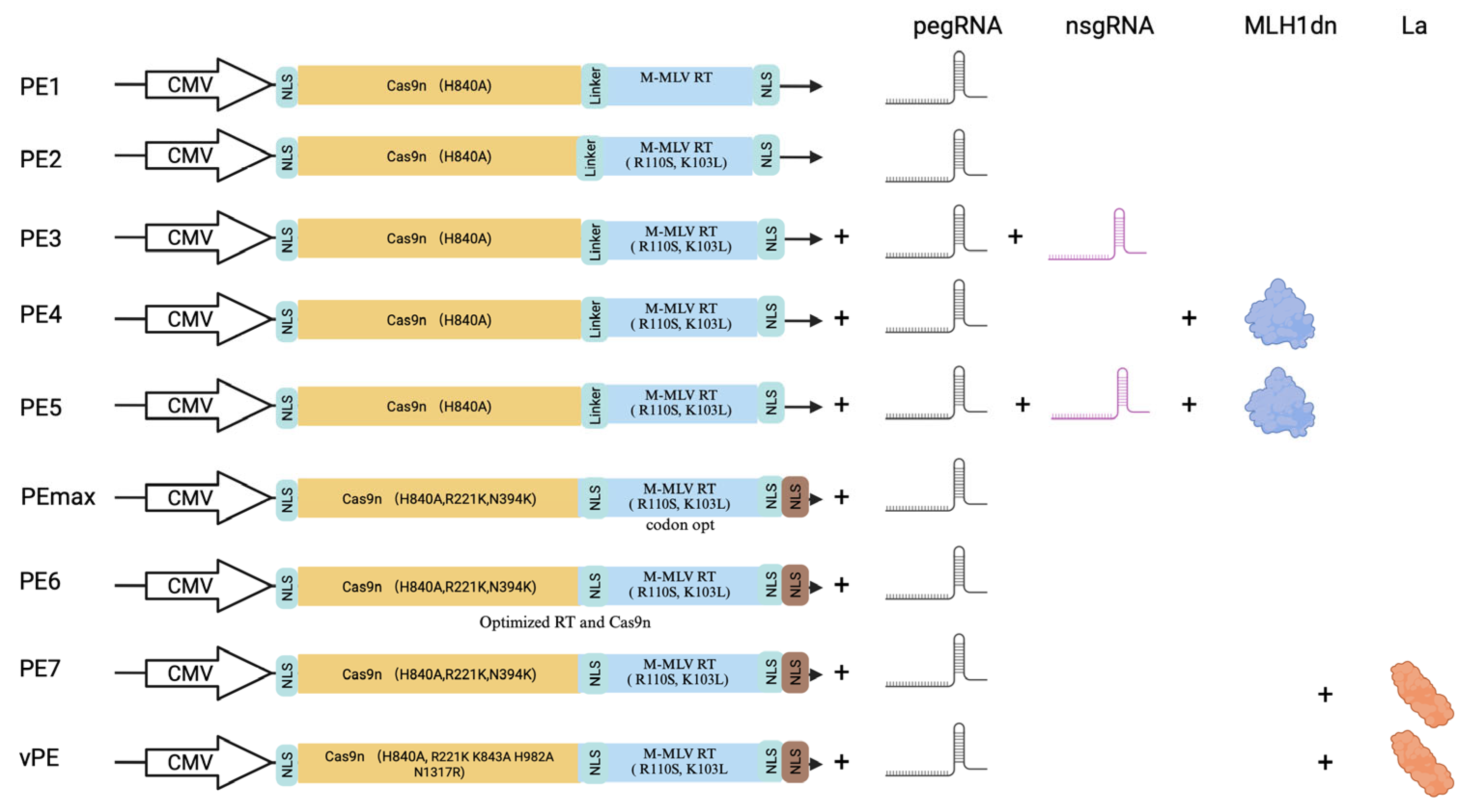
Since its introduction in 2019, PE has undergone iterative refinements to improve its precision and applicability in genome editing [2]. The initial PE1 system employed a Cas9n to introduce a single-strand nick, an engineered M-MLV reverse transcriptase (RT), to synthesize the edited DNA, and a prime editing guide RNA (pegRNA) to guide and encode the desired modifications. However, PE1 exhibited low editing efficiency (<10%) and insufficient RT activity. The subsequent PE2 system built on PE1 by incorporating five RT mutations (D200N, L603W, T330P, T306K, W313F), which enhanced catalytic activity, substrate binding, and thermostability [2]. This resulted in increased editing efficiencies up to 10–30% (depending on cell type and target site), although it remained inefficient for long fragment editing (>30 bp). Based on PE2, the PE3 system further optimizes efficiency by adding a secondary single-guide RNA (sgRNA) to nick the non-edited strand, thereby directing mismatch repair toward the edited sequence. This achieved a higher gene editing efficiency but increased the risk of generating insertions and deletions (indels) due to double-strand breaks [2]. To improve editing outcomes, Chen et al. [3] integrated a dominant-negative MLH1 protein (MLH1dn) to suppress mismatch repair (MMR), creating the PE4 system based on PE2. The PE5 combines PE3 with MLH1dn for synergistic effects. Although both preserved edited sequences, their efficacy for larger edits decreased [3]. In mammalian cells, PE4 improved editing efficiency over PE2 by an average of 7.7-fold, while PE5 enhanced efficiency over PE3 by an average of 2.0-fold, as demonstrated across multiple loci in MMR-proficient cell types, which effectively detect and repair replication errors, thereby maintaining low baseline mutation rates. In the same study, the PEmax system was developed by incorporating Cas9 mutations, enhanced nuclear localization signals (NLS), improved linker design, and codon optimization to significantly boost editing efficiency in mammalian cells based on the PE2 system, which typically exhibits 2–3-fold higher editing efficiency than PE2 [3]. To address the challenge of low in vivo efficiency caused by the large size of PE complexes, the PE6 system utilizes phage-assisted continuous evolution to optimize Cas9 and RT domains, yielding variants PE6a–b (with reduced size) and PE6c–d (with enhanced RT activity), as well as PE6e–g, which incorporate additional Cas9 mutations to improve mammalian cell editing [4]. These PE6a–g variants achieve an average 3–6-fold higher editing efficiency than PE2 across multiple loci, with different improvements depending on the variant and the target site. To mitigate pegRNA degradation, the PE7 system was developed by optimizing Cas9 mutations and fusing it to a truncated La protein (residues 1–194, containing La motif and RNA recognition motif 1) at the C-terminus to protect pegRNA from exonuclease degradation [5]. This resulted in a cumulative 3.2–7.4-fold improvement over PE2 in cell lines such as HEK293T and HeLa. More recently, Chauhan et al. [6] developed the very precise prime editor (vPE) by modifying Cas9n with four additional mutations based on PEmax and incorporating the La protein. The vPE system not only increased gene editing efficiency compared to PE max but also reduced undesired insertions and deletions (indels). Different PE versions vary significantly in editing efficiency, scope of application, accuracy, and ease of operation (as shown in Figure 1). These advancements enhanced the precision and versatility of PE for correcting pathogenic mutations, engineering agricultural traits, and advancing functional genomics, although delivery challenges persist. The gene editing efficiency of presented PE systems is summarized in Table 1.

3. Optimization of the Editing Range of Prime Editing

3.1. Insertion and Integration

PE was developed to precisely rewrite short sequences of the genome. However, it faced challenges with longer edits. To investigate the factors contributing to this limitation, Koeppel et al. [7] created a library of 3604 sequences of varied lengths and analyzed their insertion frequency into four genomic loci across three different human cell lines. This analysis was conducted using different prime editor systems under various DNA repair contexts. The results demonstrated that insertion rates were influenced by the length of the insertion sequence, nucleotide composition and secondary structure. Moreover, the study revealed that the 3′ flap nucleases TREX1 and TREX2 suppressed the insertion of longer sequences by degrading the 3′ flap intermediates (containing the insertion) before they could be integrated into the genome. Based on these findings, the authors concluded that pegRNA sequences between 15 and 21 nt were inserted more efficiently than shorter ones in MMR-proficient cells, and for the longer sequence over 30 nt, the 3′ flap nucleases TREX1 and TREX2 played a critical role.
Since many hereditary diseases are due to mutations spanning more than one nucleotide, the ability to insert large DNA fragments is essential for gene-based therapies and genome engineering. GRAND editing, which is based on the PE3 system, used two pegRNAs to insert DNA fragments larger than 400 bp, although its efficiency remained low [8]. Similarly, TwinPE, developed by David Liu’s group, successfully inserted a 5.6 kb attP-containing DNA donor plasmid into the genomes of human cells at AAVS1, CCR5 and ALB gene with 6.8%, 6.1% and 2.6% efficiency, respectively [9]. Subsequently, Zheng et al. [10] developed a retrotransposon-like template jumping-prime editing (TJ) PE, which enabled the insertion of the GFP gene (~800 bp) into recipient cells. This technology draws inspiration from the effective genomic insertion mechanism of retrotransposons, which replicate their genetic material into chromosomal DNA via target-primed reverse transcription (TPRT). In this approach, the authors designed TJ-pegRNA harboring the insertion sequence and two primer binding sites (PBSs), with one PBS matching a nicking sgRNA site. After the initial insertion of the template into the DNA, the second PBS on the DNA flap binds to the nick site created by nicking sgRNA, allowing the first inserted sequence to serve as a template for a subsequent prime editing reaction, thereby facilitating large insertions and exon rewriting. To date, the methods described above have not been applied in in vivo experiments. More recently, David Liu’s lab introduced Prime-editing-assisted site-specific integrase gene editing (PASSIGE) [11], along with its optimized version, PASSIGE with eeBxb1 named eePASSIGE, for the site-specific integration of large DNA sequences (exceeding 10 kb). This method shares conceptual similarities with Programmable Addition via Site-Specific Targeting Elements (PASTE) [12]. Both PASSIGE and PASTE leverage the programmability of the PE system combined with large serine integrases (LSRs), also known as recombinases, to efficiently integrate foreign DNA into eukaryotic genomes. Specifically, they used prime editing to first insert a short DNA sequence (<50 bp) at a targeted location, creating a recognition site (attB or attP) for the integrase. The integrase then facilitated integration by delivering a template DNA containing the complementary recognition site (attP or attB) along with the desired sequence.
Beyond experiments in human cells, Sun et al. [13] developed third-generation PrimeRoot editors, which enabled precise DNA insertion of up to 11.1 kb into plant genomes. This system relied on site-specific recombinases (SSRs) to achieve large insertions. During recombination, SSRs identified certain sequences called recombinase sites (RSs). By linking the DNA fragment to the RSs, the system allowed insertion into the plant genome through the SSRs-mediated recombination.

3.2. Deletion

To generate deletions using PE systems, two pegRNAs are employed to target different strands. Choi et al. [14] reported that PRIME Del can remove big fragments up to 10 kb with an editing efficiency of 1–30%. In essence, they utilized PE2 with two pegRNAs targeting distinct sites, rather than delivering the PE3 system. Once the PE2 created a nick in the two desired sites, the two RTTs eliminated the sequence between the two sites. This approach showed that PRIME Del was more accurate and flexible than CRISPR-Cas9 with double sgRNAs for targeted genomic sequence deletion, marker labeling, and genomic rearrangement. Similarly, TwinPE, a method that uses a prime editor protein (PE2) and two prime editing guide RNAs (pegRNAs) for the programmable replacement or excision of DNA sequences at endogenous human genomic sites [9], can also be used for deletion. For instance, Single-anchor TwinPE was applied to remove exon 51 (780 bp) of Duchenne muscular dystrophy (DMD) gene in HEK293T cells, achieving an average editing efficiency of 28% [9]. Furthermore, Jiang et al. [15] also developed a PE-Cas9-based deletion and repair (PEDAR) method for large fragment deletion (up to 10 kb). In this strategy, they replaced the Cas9 nickase with an active Cas9 fused with RT to create PE-Cas9. Under the guidance of two pegRNAs that recognize both complementary DNA strands, PE-Cas9 generated two DSBs and removed the DNA fragment between the cut sites.

3.3. Transversion

Base editing and prime editing are feasible for generating precise transversion in the genomic DNA. However, base editing requires different enzymes fused with SpCas9 for different transversion, making it less flexible than PE. On the other hand, PE enables all 12 types of transversion and any other types of substitution by providing the desired template sequence. Nonetheless, PE efficiency depends heavily on the lengths of the PBS and RTT, as well as the position of the nicking sgRNA [2]. For each target site, several pegRNAs with various combinations of RTT and PBS sequence lengths must be tested. Typically, the lengths of PBS and RTT often range from 6 to 16 nt and 8–23 nt, respectively. To date, there is no universal rule for designing the pegRNA to achieve the highest efficiency for each targeted gene. Thus, various combinations must be tested for each transversion modification. TwinPE has proven effective in cases where inverting large sequences was required to correct human pathogenic alleles with multiple mutation points or large structure variants. For example, TwinPE was used to invert a ~40 kb target sequence associated with Hunter disease by combining it with recombinase Bxb1 attB and attP [9].

4. Optimization of Prime Editor

4.1. Optimization of Cas Nickase

The optimization of Cas nickase has been achieved through four main paths: (1) altering the PAM requirements of Cas9 orthologs from different bacterial sources, such as Staphylococcus aureus Cas9 (saCas9), to modify both PAM requirements and packaging size; (2) utilizing different classes of Cas proteins (e.g., Cas12) for similar goals; (3) introducing mutations in Cas9 to enhance editing activity; and (4) reducing indels. Regarding the first aspect, as summarized by Lu et al. [16], the required PAM sequence varies depending on the Cas9 variants. For instance, Kweon et al. [17] created PE2 variations utilizing several SpCas9 variants, including PE2-VQR, PE2-VRQR, PE2-NG, PE2-SpG, and PE2-SpRY. Notably, PE2-SpRY can target 94.4% of pathogenic variants and thus is termed a PAM-less prime editor.
The Cas9 nickase most frequently used for PE is SpCas9, derived from Streptococcus pyogenes. However, Cas9 can also be isolated from different bacteria species, yielding orthologs such as Staphylococcus aureus (SaCas9), Streptococcus thermophilus (StCas9), Neisseria meningitidis (NmCas9), Francisella novicida (FnCas9), Campylobacter jejuni (CjCas9), and Streptococcus canis (ScCas9). More recently, a Cas9 variant was identified in Staphylococcus auricularis (SauriCas9) (3.3 kb). This variant recognizes a 5′-NNGG-3′ PAM sequence (similar to CjCas9), has high editing activity and is small enough for delivery by a single AAV [18]. For prime editing, Lan et al. [19] reported the construction of Mini-PE, which combines truncated MMLV RT with Campylobacter jejuni Cas9 (CjCas9; H559A). The truncated MMLV RT has 21 N-terminal amino acids (AA) and 200 C-terminal AA deleted, leaving 467 AA (two-thirds of the original RT). The total size of the Mini-PE was lowered to 4.5 kb, which is suitable for recombinant AAV packaging [19]. However, its editing efficiency was low, which remains an important limitation. David Liu’s lab [20] compared PE systems based on SaCas9 and SpCas9 nickase and found that the SpCas9-based system exhibited higher efficiency than the SaCas9-based one. Moreover, there are different types of nucleases-based CRISPR/Cas systems, such as Cas12 and Cas13, and each contains its own subtypes [21,22]. In combination with the prime editor, Liang et al. [23] developed circular RNA-mediated prime editor (CPE) systems using Cas12 instead of Cas9. This system preferentially targets T-rich genomic regions and offers potential for multiplexing.
Furthermore, some studies [24,25] showed that the nCas9 (H840 and D10A mutations) occasionally generated DSB. Lee et al. [24] tested 14 mutation combinations in nCas9 at 15 loci in HEK293T cells to avoid the formation of DSB, increase the activity of nCas9, and minimize unwanted editing. By combining H840A and N863A mutations, they abolished the function of the HNH domain, leading to single strand breaks exclusively in the non-target strand. This decreased the frequency of indels while maintaining the same prime editing efficiency as the PE3 system.

4.2. Optimization of RT

The M-MLV RT employed in PE1 to PE5 is one of the most well-studied RTs. It consists of five domains. The palm (1–40, 125–159, 193–275 AA), the finger (41–124, 160–192 AA) and the thumb (276–361 AA) domains form the DNA polymerase domain (1–361 AA). These domains play different roles in substrate binding, stability, and polymerase activity. The DNA polymerase domain is linked by a connection domain (362–496) to the RNase H domain (497–671) that degrades the RNA in the RNA/DNA heteroduplex during DNA synthesis [26].
Several mutations have been found to improve the processivity, thermostability and substrate affinity of the M-MLV RT [27]. However, their combination in the PE needs to be tested and optimized for the targeted cells [4,26]. Anzalone et al. [2] screened multiple mutation combinations to create the pentamutant RT that was tested in the PE2 to PE5 systems. Chen et al. [3] codon-optimized this pentamutant for human cells in the process of developing the PEmax architecture. Similarly, Gao et al. [28] increased the expression level and editing efficiency by human codon-optimizing the RT using different algorithms.
Furthermore, since the loading capacity of the vector limits the delivery of the PE systems in vivo, many attempts have been made to minimize the size of the RT by trying different truncations of the M-MLV RT or using smaller orthologs that would yield equivalent editing efficiency. Although prior research showed that mutations in the RNase H domain can negatively affect the RT processivity and accuracy [27,29], its removal in the PE can lead to equivalent editing. Moreover, this domain interacts with peptidyl release factor 1 (eRF1), which recognizes a stop codon and recruits other termination factors [26,30], which prevents the binding of peptidyl release factor 3 (eRF3), promoting the stop codon readthrough and blocking the mRNA degradation by the nonsense-mediated decay. Thus, Zheng et al. [31] suggested that prime editing could be safer if the RNase H domain is removed. After experimenting with several truncations, they discovered that the Δ497 truncation, which eliminates the RNase H domain, preserves an editing efficiency comparable to PE3 for substitutions and small insertions or deletions. Similarly, Böck et al. [32] observed similar editing efficiency between PE2 and PE2 Δ486 RNase H in HEK293T for different substitutions in HEK293T cells. Damon et al. [4] also obtained similar editing with PE2 and PE2 ΔRNaseH. However, when tested on complex editing types, such as long insertions or deletions that require TwinPE, the editing efficiency was, on average, 1.4-fold lower compared to the full-length PE2. Likewise, Lan et al. [19] found different truncations that produce editing comparable to PE2 while trying to make a mini-PE small enough to fit in a single AAV. The smallest one, which removes the first 21 and last 200 amino acids of the RT, combined with a compact CjCas9, can be delivered in vivo with a single AAV but with low editing efficiency. It has been previously described that the 23 first AA of the M-MLV RT are dispensable for its enzymatic function. Additionally, different truncations were tried using the plant prime editor (PPE) by Zong et al. [33]. The removal of the RNase H domain increased the editing by 2-fold for nucleotide substitutions at various sites in rice and wheat protoplast [33]. Overall, these truncations significantly reduce the PE size and offer additional splitting options for delivery in small vectors like AAV [4,28,31].
The connection domain links the RNase H to the polymerase, and some residues on its surface interact with the RNA template. Zheng et al. [31] removed part of the connection domain with Δ474 truncation, and this reduced the editing efficiency at some sites. The Δ418 truncation or the total removal of this domain resulted in low editing. Similarly, Zong et al. [33] eliminated the connection domain in the PPE and observed no editing. Gao et al. [28] obtained comparable editing with the Δ471 truncation and PE2 human codon-optimized in HEK293T cells for A to T substitution or CTT insertions. Examining further truncation, they discovered that they could eliminate an extra 60 bp at the N-terminal and 90 bp at the C-terminal without compromising the editing efficiency at those sites.
While working on different configurations for the PE, Grunewald et al. [34] discovered that an untethered RT and nSpCas9 had comparable editing efficiency to PE2. They hypothesized that instead of acting in cis on the fusion protein, the RT might act in trans from a molecule in solution. Their group used the split PE to screen smaller RT orthologues rapidly. They optimized the Marathon-RT from Eubacterium rectale but had 3-fold less editing for various edits in HEK293T cells compared to the full-length pentamutant M-MLV RT. Comparable editing between PE2 and a split PE2 was also reported by Liu et al. [35]. They co-transfected cells with PE2 mutants that were either defective for the M-MLV RT or nCas9 activity and had no editing. These results suggest that the RT in the PE, in opposition to a split PE, does not function in trans, probably due to local molecular clashes. They also tried two human codon-optimized bacterial RTs but had lower editing and higher indels compared to PE3.
To compare different RT orthologues, Doman et al. [4] tested 20 different RT orthologues. The results showed that the wild-type forms and the structure-based engineering ones had lower editing efficiencies compared to PE2, especially the smallest ones. After that, they used the phage-assisted continuous evolution (PACE) to optimize the Escherichia coli Ec48 retrotransposon (1.2 kb) and Schizosaccharomyces pombe Tf1 retrotransposon (1.5 kb) RT, named PE6a and PE6b, generated the editing efficiency averaging 80% of PEmax and giving comparable or better editing compared to PEmax depending on the edit tested, respectively. However, both PE6a and PE6b are less efficient for long, complex edits and with structured RTT or PBS. To solve this problem, Doman et al. [4] added rational mutations to the evolved Tf1 to make PE6c. Also, they optimized the M-MLV RT with PACE to generate an RT of the same size as PEmax ΔRNaseH called PE6d. Both optimizations are more efficient with structured RTT or PBS and long edits that require TwinPE. However, PE6d is not well suited for small prime edits.

4.3. Optimization of pegRNA

The design, stability, editing position of the pegRNA from the Cas9 nicking site, and auto-inhibitory interaction between PBS and the spacer sequence of pegRNA limited the use of PE systems. Thus, the most straightforward method to enhance PE efficiency is pegRNA modification.
Many methods have been developed to redesign pegRNAs, taking into account the assessment of off-target effects, compatibility with Cas variants, and sequence optimizations. Most of these tools are summarized in a reference review article [36].
The pegRNA consists of a sgRNA and an unstructured RNA extension at the 3′ end, rendering it unstable. To avoid degradation, David Liu’s lab developed engineered pegRNAs (epegRNAs) by appending a structured RNA motif to the 3′ terminus of the PBS. These motifs—specifically the prequeosine1-1 riboswitch aptamer (evopreQ1) or the Moloney murine leukemia virus frameshifting pseudoknot (hereafter ‘mpknot’)—stabilize the pegRNA against degradation and inhibit the formation of editing-incompetent PE complexes that would otherwise compete for genomic access. This method increased prime editing efficiency by 3–4-fold in many cell lines compared to unmodified pegRNA. Removing the linker between pseudoknots and pegRNA reduced its efficiency, confirming its necessity. To further reduce the misfolding of the pegRNA, they trimmed the unnecessary sequence by about 5 nt from the evopreQ1 (TevopreQ1), boosting efficiency for different modifications (3 nt insertions, nucleotide transversions) across genes by 3.8 to 6.8-fold [37]. Similarly, to reduce the degradation of the 3′-extended portion of pegRNAs, Zhang et al. [38] added a viral exoribonuclease-resistant RNA (xrRNA) motif, a group of conserved structures found in flaviviruses, to the 3′ end of the pegRNA to protect the stability and activity. In this study, five different xrRNAs (Murray Valley encephalitis (MVE), West Nile virus (WNV), Zika, Dengue, and Yellow Fever (YF)) were tested to alter the pegRNA stability for base conversion in 293T cells. Among them, the 3′ Zika xrRNA motif yielded the optimal improvement. Instead of using those xrRNAs, another study incorporated RNA aptamers such as the stem-loops M2, PP7, Csy4, and BoxB into the 3′ end of pegRNA to prevent degradation. Compared to ePE-mpknot and ePE-evopreQ1 at the RUNX1 gene site (+5 G·C to T·A) in HEK293FT cells, none outperformed them. These aptamer-modified pegRNAs were split into sgRNA and the Prime RNA (pRNA: PBS, RTT, aptamer), to increase the flexibility of the PE system, named split pegRNA prime editors (SnPEs). A Tornado circRNA system expression system was used to construct the circular prime to stabilize the pRNA, but the editing efficiency was generally lower than the classical PE system [39].
Furthermore, the editing efficiency was affected by the type of editing and the editing distance from the Cas9 nicking site. Previous findings indicated that modifications to the invariant GG nucleotides of the PAM sequence for Cas9 (positions +5–6 relative to the dsDNA break) typically produced stronger phenotypes than other positions, with positions +1–4 remaining somewhat effective and positions +7–20 generally less effective, especially after the +16 position [40]. Meanwhile, the author also proposed that the location of the target sequence in a gene alters the editing efficiency. For example, the editing efficiency is higher if the editing site is located at the beginning of a gene due to it being more disruptive than other positions.
To mitigate self-inhibition from pegRNA circularization, Ponnienselvan et al. [41] demonstrated that auto-inhibitory interaction occurs between the spacer sequence and PBS and impairs binding and target recognition. Reducing the complementarity between the PBS and spacer sequences could increase gene editing efficiency. Similarly, to solve the same problem, Zhang et al. [42] applied three-point mutations to the 3′ PBS region of the pegRNAs to prevent the misfolding of pegRNA and used a heat denaturation followed by slow cooling to refold the pegRNA structure. By conducting those strategies in zebrafish for generating the base substitution, the gene editing efficiency was increased up to 24.7-fold compared to unmodified pegRNA. Additionally, Li et al. [43] introduced same-sense mutations at the appropriate locations in the RTT to increase the PE-editing efficiency by an average of 353-fold. They also modified the secondary structure of the pegRNA to increase the stability of the small hairpin, which was affected by the swing PBS and RTT by inserting the G/C base pair. This modification was validated by using the PE3 system to generate a small indel, and the efficiency was increased up to 10.6-fold.

5. PE Delivery Strategies

Ensuring the safe and effective delivery of gene editing components into the cell nucleus remains a challenge, primarily due to the presence of negatively charged proteins and nucleic acids, particularly the macroprotein prime editor. In general, delivery techniques are broadly divided into viral and non-viral delivery. Although viral vectors have been extensively employed in labs and clinical trials to administer genome editing treatments, the translation of these therapies have been severely impeded by the possible immunogenicity associated with viral vectors and their potential random integration. Non-viral delivery systems offer a promising alternative with improved safety profiles, whether derived from natural sources or synthetically engineered, although they have a somewhat lower delivery efficiency than viral delivery systems. A further complication arises from the physicochemical characteristics of prime editing machinery: the PE protein itself has a coding sequence of ~6.3 kb, and the associated pegRNA is highly anionic. These properties collectively exacerbate the difficulty of achieving efficient in vivo gene modification.

5.1. Viral Vectors

5.1.1. Adeno-Associated Viruses (AAV)

AAV is a non-enveloped, replication-defective virus that is non-pathogenic in humans. Its packaging capacity of approximately 4.7 kb is substantially smaller than the size of the prime editor (PE) system. To address this limitation, the most well-known delivery method for PE is the dual-AAV system, in which the PE components are split into two separate expression cassettes and reconstituted via intein-mediated protein splicing. Inteins are self-excising protein segments that catalyze the ligation of flanking extein sequences through a peptide bond, thereby restoring the functional PE protein and enabling gene editing. Research efforts on dual-AAV delivery of PE have therefore focused on three parts: (1) evaluating the splicing activity of different inteins, (2) identifying optimal split sites within the PE coding sequence, and (3) using a smaller size RT to reduce cargo size. To choose an intein to generate a higher efficiency, Pinto et al. [44] compared the splicing activity of 34 inteins to induce the fusion of two parts of the mCherry protein. Ten inteins out of all those orthologs were successfully used in vivo and in vitro. The results suggested that the reaction condition, the junction sequence, and protein expression level affect the intein efficiency. In a related study, She et al. [45] compared the inteins Rhodothermus marinus (Rma) and Nostoc punctiforme (Npu) to split the PE system at 11 different split sites. The Rma generated higher gene editing efficiency in most split sites.
Beyond intein selection, the split sites within SpCas9 are an important factor that alters the gene editing efficiency. She et al. [45] reported that the best on-target editing efficiency was obtained with a PE split located before amino acid 1105 (Ser) of SpCas9 and the use of the Rma intein. Zhi et al. [46] further constrained the optimal splitting region to residues 990 (Asn) to 1050 (Ile) of SpCas9, with splits at positions 1005 and 1024 demonstrating superior efficiency when paired with the Rma intein. Notably, Split-PE-1024 showed a higher editing efficiency with plasmid transfection in HEK293T cells. Davis et al. [20] proposed a similar split at the 1024 site of SpCas9, which allowed for therapeutically relevant editing in the liver (up to 46%), heart (up to 11%), and brain (up to 42% efficiency in the cortex) of mice. However, dual-vector designs are less efficient because the intein recombination system is only partially controlled. To prevent split issues that could impact Cas9 activity, Grünewald et al. [34] transfected the entire SpCas9 nickase (Cas9n) and RT independently. Gao et al. [28] reported a truncated reverse transcriptase that removed the RNase H domain to insert 3 nt into the PCSK9 gene in mice, which were packaged into AAV8 with a total of 2 × 10¹² vector genome (vg) injected via the tail vein. The insertion efficiency reached 13.5% after 4 weeks. Meanwhile, Doman et al. [4] developed a PE6 system with a smaller RT, the size being 270 bp smaller than the RNase H version with several mutations to increase RT activity. This system was used to mediate large single-flap insertions in vivo, which generated an average of 40% and 62% loxP insertion in bulk and transduced cells. Wei et al. [47] optimized a dual adeno-associated virus (AAV) system by screening Cas9n split sites, identifying Asn1115 as an efficient cleavage point for delivering PE components, and fused a truncated reverse transcriptase (RT) to the C-terminus of nCas9-N, enabling the use of larger promoters to drive PE expression [47]. This approach achieved 17.5% precise editing of the Pcsk9 mutation in mice, demonstrating robust in vivo efficacy [47]. More recently, Lindley et al. [48] developed StitchR, a ribozyme-mediated system that facilitates scarless trans-splicing and translation of two separate mRNAs into a full-length nCas9-RT fusion protein in eukaryotic cells by incorporating a ribozyme and split intein [48]. In vitro, StitchR achieved approximately 82% of the editing efficiency of a single ORF-encoded PEmax and doubled the efficiency of a previously reported protein trans-splicing split-intein vector pair for PEmax. However, no in vivo experimental data were reported [48]. These advancements improve the precision and efficiency of PE delivery for correcting pathogenic mutations by using dual AAV to deliver the PE system.

5.1.2. Adenovector (Ad)

Adenoviral vectors are replication-deficient viral particles derived from adenoviruses with a cargo capacity ranging from 4.5 to 8 kb for first-generation vectors to 36–37 kb for third generation (gutless) vectors. They enable efficient delivery of large transgenes to diverse cell types, though their in vivo utility is constrained by immunogenicity and transient expression. Wang et al. [49] successfully employed adenovector particles (AdVPs) to deliver full-length prime editors (PE2 and PE3) to correct the Duchenne muscular dystrophy (DMD) gene in vitro. Treatment of myoblasts and mesenchymal stem cells with AdVPs carrying the PE system achieved editing efficiencies of 80% and 64%, respectively. They also compared the delivery of PE2 and PE3 by AdVPs. The results demonstrated that the PE3 generated higher gene editing efficiency with fewer indels than PE2 delivery. Moreover, this strategy was further used to delete a DMD exon in myotubes produced by the fusion of human myoblasts by delivering PE2 and two pegRNAs. Dystrophin expression was detected in the AdVP-treated group. Collectively, this study provides a new method to deliver the full-length PE system, although the immunogenicity and potential toxicity of AdVPs must be carefully evaluated for in vivo applications.

5.1.3. Helper-Dependent Adenovirus (HDAd)

Li [50] reported that the use of the helper-dependent adenoviral (HDAd) vectors, which are vectors devoid of all viral coding sequences and have a payload capacity of 35 kb, to effectively transduce a broad range of cell types from different species irrespective of the cell cycle led to long-term transgene expression. This strategy was used to deliver the prime editor into a sickle mouse model with corrections of over 40% for hemoglobin S alleles in vivo [51].

5.2. Non-Viral Vectors

5.2.1. Lipid Nanoparticles

Lipid nanoparticles (LNPs) are spherical, nanoscale vesicles (typically 50–200 nm in diameter) composed of a lipid bilayer or matrix. Chen et al. [52] successfully reached 13% editing of the Pcsk9 gene, which encodes proprotein convertase subtilisin/kexin type 9, an enzyme that destroys low-density lipoprotein receptors (LDLRs). The immunodeficient mice were treated with LNPs containing PE components by retro-orbital intravenous injection. The authors sought to insert a 4 bp (TTAC) sequence into the Pcsk9 gene to introduce a premature termination codon and shift the reading frame, thereby inactivating the gene. Inactivating the PCSK9 gene is a preferred method for treating hypercholesterolemia since it lowers LDL-cholesterol (LDL-C) levels without causing negative side effects.

5.2.2. Virus-like Particles (VLPs)

David Liu’s lab [53] has applied a new method, virus-like particles (VLPs), to deliver the full-length PE. Instead of using PE fused with the Gag protein (which permitted the insertion of 26 PE molecules per VLP), they optimized the system by adding a P3–P4 coiled-coil peptide pair to the Gag protein and PE protein. Separating the GAG and PE allowed them to avoid the large size of the fusion protein (309 kDa), which was thought to hinder the VLP production. This strategy increased the gene editing efficiency for different mutations and reached 47% average editing among GFP+ nuclei in mouse brains by neonatal intracerebroventricular injection. This strategy was applied in vivo to treat the rd12 mouse model, which displays more severe retinal degeneration that allows evaluation of disease phenotype rescue. Using the PE3b-based construction resulted in an average 7.2% correction of the mutation in bulk RPE tissue. More recently, Thibaut et al. used VLPs named Nanoscribes to deliver PE by constructing plasmids coding for GAG-Cas9n-RT (GAG-PE V1), GAG-POL (Helper) and pegRNA together with a set of 3 fusogens (VSV-G, BAEV and Syncitin-1). However, the first generation could only edit SWYS cells at about 1%. With the optimization of RT, pegRNA and additional proteolytic cleavages sites (P) were inserted either next to the 3 × HIV nuclear export signals (NESs) or flanking the 3 × NES signal, the most effective in editing YFP, achieving an efficiency of 63%; however, no in vivo experimental data provided [54].

6. Prime Editing in Therapeutic Applications

6.1. Creation of Pathogenic Cell Lines and Organoids

To study diseases in vitro, it is helpful to have a cell line or an organoid with a pathogenic mutation. Prime editing can install this mutation, enabling investigation of disease mechanisms and therapeutic responses. For example, Schene et al. created a liver organoid containing the D482G, A > G mutation in the ABCB11 gene in 20% of cells to study bile salt export pump deficiency [55]. The Cerebrofrontofacial Baraitser–Winter syndrome and coloboma (a congenital malformation of one or more ocular structures) are caused by mutations in the ACTB gene, encoding β-actin. Using the prime editing technique, Binder et al. succeeded in creating pluripotent stem cells with the c.640G > T PTC (premature termination codons) mutation in exon 4 of the ACTB gene, making it possible to examine the molecular and functional consequences of the deficiency [56]. Geurts et al. used PE to generate intestinal organoids presenting either the F508del mutation or the R785* mutation in the CFTR (cystic fibrosis transmembrane conductance regulator) gene, two mutations responsible for cystic fibrosis [57]. Pancreatic adenocarcinoma was also studied by installing the G12V mutation in the KRAS gene of the zebrafish genome. However, off-target mutations were observed due to sequence homology [58]. In some patients with liver cancer, the CTNNB1 gene, which encodes β-catenin, has a deletion of six nucleotides. The introduction of this pathogenic mutation into a liver organoid was carried out by prime editing with success in 30% of the cells [59]. Hou et al. [60] worked on X-linked severe combined immunodeficiency (X-SCID). This disease is caused by mutations in the interleukin-2 receptor gamma (IL2RG) gene. Prime editing was used to generate an in vitro disease model by introducing the c.458T > C mutation of the IL2RG gene, responsible for the disease, into T lymphocytes from healthy donors. Using this model, the authors were then able to correct 26% of the mutated cells [60].

6.2. Creation of Pathogenic Animal Models

After studying the editing or disease mechanisms in vitro, animal models recreate in vivo conditions to evaluate the effect of a mutation or the impact of a treatment on the phenotype. Lin et al. generated a mouse model suffering from cataracts by deleting a nucleotide (G) in exon 3 of the CRYGC (crystallin gamma C) gene. This was accomplished through the microinjection of plasmids encoding the prime editing components into mouse embryos and achieved a nucleotide deletion efficiency of 38.2% as well as a nuclear cataract phenotype [61]. The P302L mutation in the TYR gene encoding tyrosinase, which controls melanin synthesis, is responsible for oculocutaneous albinism. This mutation was inserted by prime editing into zebrafish with a frequency of 3.33%, and the mutation was transmitted to 8.3% of the next generation [58]. Salem et al. [62] installed, in mice, the S50A mutation in the CAPN2 gene, which encodes calpain 2, a ubiquitous protein with functions in the central nervous system and in the heart. In patients with pulmonary hypertension, serine at position 50 of the protein is hyperphosphorylated. The authors therefore developed this model to study the impact of the mutation on the disease [62]. Qian et al. [63,64] generated a rabbit model of Tay-Sachs disease, characterized by an accumulation of GM2 gangliosides in the nervous system. In 80% of cases, it is due to an insertion of four bases (TATC) in exon 11 of the HEXA gene encoding hexosaminidase A, causing a deficiency of the enzyme [63,64].

6.3. Correcting Mutations In Vitro

Prime editing is also used to engineer a treatment that would allow the exact correction of pathogenic mutations. This was first tested in vitro or ex vivo in cell lines. Alpha thalassemia is often caused by the CD142 mutation (UAA > CAA) in the HBA2 gene encoding the alpha 2 subunit of hemoglobin. Shao et al. [65] used prime editing to correct 39% of the HUDEP2 (human umbilical cord-derived erythroid progenitor) in Hb CS (hemoglobin constant spring) cells [65]. Chronic septic granulomatosis is caused by mutations in the NCF1 (neutrophil cytosol factor 1) gene, encoding the protein p47phox, a subunit of NADPH oxidase. The majority of patients have a homozygous deletion of 2 nucleotides (delGT) in exon 2 of the gene. Heath et al. corrected at least one allele in 75% of CD34+ myeloid cells carrying the delGT deletion [66]. Duchenne muscular dystrophy is caused by mutations in the DMD gene encoding dystrophin. Mbakam et al. [67] corrected the c.428 G > A mutation (with a rate of 28%) and the c.8713C > T mutation (22%) in myoblasts from patients in culture. Zhao et al. corrected the c.7893delC mutation of the DMD gene in patient fibroblasts with an editing rate of 31% [68]. The S210del mutation in the DGAT1 gene, encoding diacylglycerol O-acyltransferase 1, an enzyme required to metabolize lipids, causes an enteropathy characterized by diarrhea and malnutrition in infants; 21% correction was obtained in intestinal cells isolated from patients [69]. Peterkova et al. corrected the c.1 A > G mutation in the FANCA gene, responsible for Fanconi anemia and reached 15% correction in patient fibroblasts [70]. Hypogonadism caused by the W495X mutation in the LHCGR (luteinizing hormone/choriogonadotropin receptor) gene results in insufficient testosterone and sperm production. Xia et al. [71] corrected 23.42% of Leydig stem cells from LhcgrW495X mutated mice, by delivering the N- and C-terminal parts of the PE using lentiviruses. Mutations in the CRB1 (crumbs homolog-1) gene can cause different phenotypes, including Leber congenital amaurosis and retinitis pigmentosa, which lead to vision loss. p.(C948Y) and p.(G1103R) are common mutations in this gene, and they were corrected in induced pluripotent stem cells (IPSCs) from patients with a success rate of 72% [72]. Mutations in the HPRT1 (hypoxanthine phosphoribosyltransferase 1) gene cause Lesch-Nyhan syndrome, a disease characterized by hypotonia and developmental delay. Jang et al. [73] corrected up to 14% of the c.333_334ins(A) mutation in patient fibroblasts using PE. RYR1-related diseases are caused by mutations in the gene coding for the ryanodine receptor protein. Godbout et al. [74] generated a myoblast cell line presenting the T4709M mutation in the RYR1 gene in the homozygous state and then corrected the mutation with a rate of 59% by delivering the prime editing components under the RNA form [69].

6.4. Correcting Mutations In Vivo

Other studies reached the in vivo point, where they tested the editing in animal models. Mutations in the SERPINA1 gene (serpin peptidase inhibitor family A member 1) cause alpha-1-antitrypsin deficiency. The E342K G > A mutation of the SERPINA1 gene (PiZ allele) was corrected in 6.7% of the genes in mice by intravenous hydrodynamic injection of plasmid DNA encoding the different components of prime editing [75]. In a mouse model carrying the R207W (c.619 > T) mutation of the Kcnq2 (potassium voltage-gated channel subfamily Q member 2) gene, responsible for epilepsy, Cao et al. [76] used prime editing and corrected 14% of mutated alleles [71]. To treat hypercholesterolemia, Chen et al. [52] inserted 4 bp (TTAC) in 13% of the PCSK9 genes to introduce a premature termination codon and to inactivate the gene which encodes PCSK9, an enzyme that degrades low-density lipoprotein receptors (LDLR). Böck et al. [32] corrected the F263S (T > C) mutation in the Pahenu 2 gene, which causes phenylketonuria, a disease which impairs the assimilation of phenylalanine. By delivering the PE by an adenovirus into newborn mice, these authors achieved a gene modification of 11.1%. In addition, the most common variant in phenylketonuria patients is c.1222C > T (p.R408W). Thus, Brooks et al. [77] using dual-AAV delivery to treat the liver cells of R408W mice, which generated an editing rate of 41%. The rd6 mice represent a model of recessive retinal degeneration caused by a 4 bp deletion in the mfrp (membrane frizzled-related protein) gene in a splice donor site. David R. Liu’s group successfully corrected this mutation at 15% in the eyes of rd6 mice through the subretinal injection of VLPs. This group also used PE delivered by subretinal injection of pseudoviral particles to correct the R44X (c.130 C > T) mutation of the rpe5 (retinal pigment epithelium) gene in the rd12 mouse, a model of retinal degeneration affected by Leber congenital amaurosis. An average correction of 7.2% of the retinal pigment epithelium was obtained along with a significant improvement in their visual function assessed by electroretinography [53]. Hong et al. [78] corrected the mutations c.3631C > T at 10.5% and c.2005C > T at 5.2% of the COL7A1 gene (collagen type VII alpha 1 chain), responsible for recessive dystrophic epidermolysis bullosa (RDEB). Prime editing treatment was carried out ex vivo on patient-derived fibroblasts then transplanted into immunodeficient athymic nude mice. Sickle cell disease is caused by an A > T mutation in the HBB gene encoding hemoglobin β. Prime editing was used ex vivo on patients’ hematopoietic stem cells and corrected between 15% and 41% of the cells. These cells were grafted into mice which, 17 weeks after the transplant, presented between 28% and 43% healthy hemoglobin [79]. Tyrosinemia type I (HT-1) is caused by mutations, such as c.706G > A, in the FAH gene, coding for fumarylacetoacetate hydrolase (FAAH), an enzyme responsible for tyrosine catabolism. Jang et al. corrected the in vivo deficit by 11.5% [80]. After treatment, 61% of hepatocytes expressed the FAH gene. This percentage is higher than the editing rate of genomic DNA because most hepatocytes are polyploid [81]. DNA contamination from other cells also explains this difference [15,80,82].

7. Prime Editing in Plants and Agriculture

Plant prime editing (PPE), specifically codon optimized for plant cells, is becoming a groundbreaking tool for plant genome engineering, allowing precise genetic modifications across diverse crop species [83,84]. PPE holds significant promise for addressing global challenges such as climate resilience, yield enhancement, and nutritional fortification. Numerous experimental studies have demonstrated improved editing efficiencies and agronomic trait enhancement in major crops. In hexaploid wheat, a complex polyploid species, Gupta et al. [85] developed a modularly assembled multiplex PE system capable of concurrently targeting up to four agronomically significant loci, specifically OsEPSPS1 and OsALS1 for herbicide tolerance, and TFIIAγ5 and OsSWEET11a for resistance to Xanthomonas oryzae pathovar oryzae (Xoo). This system achieved editing efficiencies ranging from 10% to 25%, successfully generating rice lines, adaptable to wheat, with enhanced bacterial blight resistance and herbicide tolerance through precise, targeted insertions of resistance-associated genes. Butt et al. [86] utilized prime editing in rice to introduce single-nucleotide polymorphisms in the OsALS1 gene, achieving herbicide resistance with 30% editing efficiency and near-zero off-target effects, a significant improvement over the gene editing efficiency of base editing (BE; 7–15%) in this gene [87]. In maize, Qiao et al. [88] employed the ePE5max system to efficiently generate heritable mutations conferring resistance to herbicides that inhibit 5-enolpyruvylshikimate-3-phosphate synthase (EPSPS), acetolactate synthase (ALS), or acetyl-CoA carboxylase (ACCase) activity, with gene editing efficiencies ranging from 1.4% to 21.5%. In addition, delivery methods have advanced, Liu et al. [89] have summarized the precision modifications of crop nutritional quality and stress tolerance. More recently, Ni et al. [90] introduced a V223A substation in RT named ePPEmax, which showed an average gene editing increase of 6.4-fold and 33.0-fold compared to the classical PPE. Primeroot is another technique that has been used to insert up to 11.1 kb DNA segments into the rice genome [13]. Despite these advances, challenges persist, including optimizing pegRNA design for complex insertions (>100 bp) and addressing regulatory variations across countries, which impact the adoption of non-transgenic edited crops. Lou et al. [91] reported that to address the low knock-in efficiency in dicots (e.g., tomato), researchers constructed a Csy4-based prime editing system (Csy4-PE), which inhibits pegRNA circularization via the Csy4 endonuclease and protects its 3′ end stability, achieving 65–85% precise knock-in efficiency for the 10 bp heat shock element (HSE; sequence ATTCTAGAAT) in tomato. Furthermore, the researchers optimized the RT component via plant-derived extraction, yielding gene-editing efficiencies comparable to those of the classical RT [83]. Nevertheless, substantial cost barriers impede the scaling of prime editing technologies for smallholder farmers, thereby underscoring the imperative for developing affordable delivery systems. Moreover, despite their exceptional versatility, contemporary prime editors continue to exhibit suboptimal and inconsistent editing efficiencies across diverse target loci and cellular contexts. Collectively, these investigations illuminate the profound transformative potential of PE for sustainable agriculture, with emergent innovations poised to enhance precision, efficiency, and global accessibility.

8. Conclusions and Perspective

Since its discovery, the prime editing system has rapidly evolved, progressing from initial characterization to promising applications in both biological and agricultural sciences. This remarkable method has a high specificity and versatility for all kinds of gene manipulations compared with other nucleases and nickase-based methods. The optimization of each component of the PE system increases the application range and editing efficiency for correcting different mutations. Notably, prime editing is currently undergoing clinical trials for the treatment of chronic granulomatous disease (CGD), a rare genetic disorder that impairs white blood cell function, resulting in defective innate immunity against a range of pathogens and is often linked with autoimmune and inflammatory manifestations. This marks a milestone in the development of PE-based gene therapies. Despite these advances, several challenges remain to be addressed. Foremost among these is the variable editing efficiency observed across different cell types and primary cells. Enhancing efficiency will require a deeper mechanistic understanding of prime editor structure and function. To solve this problem, a better understanding of the structure and the molecular mechanism of the PE system needs to be elucidated, and the factors that affect the pegRNA synthesis in cells need to be considered if the plasmid coding for pegRNA is used. Furthermore, determining the guidelines for developing the appropriate length of pegRNA is crucial to minimizing the wasteful effort involved in experimenting with various lengths of pegRNA PBS and RTT for each target site. Another key consideration relates to the enzymatic environment within primary cells. For instance, efficient reverse transcription by the Moloney murine leukemia virus reverse transcriptase (MMLV-RT) domain is dependent on adequate intracellular dNTP pools, which may be limiting in certain cell types. The enzymatic properties in primary cells can be enhanced by adding mutations in MMLV-RT to increase gene editing efficiency. Most critically, the translational potential of prime editing for human therapeutics hinges on the development of safe, efficient, and tissue-specific delivery vectors capable of supporting stable in vivo expression without eliciting significant immune responses or off-target effects. In summary, while prime editing represents a transformative technology with broad utility in gene therapy and crop improvement, it remains in a relatively early stage of development. Addressing these persistent limitations—through interdisciplinary efforts in structural biology, nucleic acid chemistry, delivery engineering, and translational validation—will be essential to fully realizing its therapeutic and agricultural potential.

Author Contributions

Conceptualization: Y.Y.L. and C.B.; Writing—original draft: Y.Y.L., C.B., N.S., A.S.; Writing—review and editing: Y.Y.L., C.B., N.S., A.S., G.L., K.G. and J.P.T.; Supervision: J.P.T. All authors have read and agreed to the published version of the manuscript.

Funding

This work was funded by Defeat Duchenne Grant, the funding number is #53320215. Y.Y.L. is supported by the China Scholarship Council (CSC) Grant.

Institutional Review Board Statement

Not applicable.

Informed Consent Statement

Not applicable.

Data Availability Statement

All data generated or analyzed during this study are included in this article.

Conflicts of Interest

The authors declare no conflicts of interest.

References

  1. Ran, F.A.; Hsu, P.D.; Wright, J.; Agarwala, V.; Scott, D.A.; Zhang, F. Genome Engineering Using the CRISPR-Cas9 System. Nat. Protoc. 2013, 8, 2281–2308. [Google Scholar] [CrossRef] [PubMed]
  2. Anzalone, A.V.; Randolph, P.B.; Davis, J.R.; Sousa, A.A.; Koblan, L.W.; Levy, J.M.; Chen, P.J.; Wilson, C.; Newby, G.A.; Raguram, A.; et al. Search-and-Replace Genome Editing without Double-Strand Breaks or Donor DNA. Nature 2019, 576, 149–157. [Google Scholar] [CrossRef] [PubMed]
  3. Chen, P.J.; Hussmann, J.A.; Yan, J.; Knipping, F.; Ravisankar, P.; Chen, P.-F.; Chen, C.; Nelson, J.W.; Newby, G.A.; Sahin, M.; et al. Enhanced Prime Editing Systems by Manipulating Cellular Determinants of Editing Outcomes. Cell 2021, 184, 5635–5652.e29. [Google Scholar] [CrossRef] [PubMed]
  4. Doman, J.L.; Pandey, S.; Neugebauer, M.E.; An, M.; Davis, J.R.; Randolph, P.B.; McElroy, A.; Gao, X.D.; Raguram, A.; Richter, M.F.; et al. Phage-Assisted Evolution and Protein Engineering Yield Compact, Efficient Prime Editors. Cell 2023, 186, 3983–4002.e26. [Google Scholar] [CrossRef]
  5. Yan, J.; Oyler-Castrillo, P.; Ravisankar, P.; Ward, C.C.; Levesque, S.; Jing, Y.; Simpson, D.; Zhao, A.; Li, H.; Yan, W.; et al. Improving Prime Editing with an Endogenous Small RNA-Binding Protein. Nature 2024, 628, 639–647. [Google Scholar] [CrossRef]
  6. Chauhan, V.P.; Sharp, P.A.; Langer, R. Engineered Prime Editors with Minimal Genomic Errors. bioRxiv 2024. [Google Scholar] [CrossRef]
  7. Koeppel, J.; Weller, J.; Peets, E.M.; Pallaseni, A.; Kuzmin, I.; Raudvere, U.; Peterson, H.; Liberante, F.G.; Parts, L. Prediction of Prime Editing Insertion Efficiencies Using Sequence Features and DNA Repair Determinants. Nat. Biotechnol. 2023, 41, 1446–1456. [Google Scholar] [CrossRef]
  8. Wang, J.; He, Z.; Wang, G.; Zhang, R.; Duan, J.; Gao, P.; Lei, X.; Qiu, H.; Zhang, C.; Zhang, Y.; et al. Efficient Targeted Insertion of Large DNA Fragments without DNA Donors. Nat. Methods 2022, 19, 331–340. [Google Scholar] [CrossRef]
  9. Anzalone, A.V.; Gao, X.D.; Podracky, C.J.; Nelson, A.T.; Koblan, L.W.; Raguram, A.; Levy, J.M.; Mercer, J.A.M.; Liu, D.R. Programmable Deletion, Replacement, Integration and Inversion of Large DNA Sequences with Twin Prime Editing. Nat. Biotechnol. 2022, 40, 731–740. [Google Scholar] [CrossRef]
  10. Zheng, C.; Liu, B.; Dong, X.; Gaston, N.; Sontheimer, E.J.; Xue, W. Template-Jumping Prime Editing Enables Large Insertion and Exon Rewriting in Vivo. Nat. Commun. 2023, 14, 3369. [Google Scholar] [CrossRef]
  11. Pandey, S.; Gao, X.D.; Krasnow, N.A.; McElroy, A.; Tao, Y.A.; Duby, J.E.; Steinbeck, B.J.; McCreary, J.; Pierce, S.E.; Tolar, J.; et al. Efficient Site-Specific Integration of Large Genes in Mammalian Cells via Continuously Evolved Recombinases and Prime Editing. Nat. Biomed. Eng. 2024. [Google Scholar] [CrossRef]
  12. Yarnall, M.T.N.; Ioannidi, E.I.; Schmitt-Ulms, C.; Krajeski, R.N.; Lim, J.; Villiger, L.; Zhou, W.; Jiang, K.; Garushyants, S.K.; Roberts, N.; et al. Drag-and-Drop Genome Insertion of Large Sequences without Double-Strand DNA Cleavage Using CRISPR-Directed Integrases. Nat. Biotechnol. 2023, 41, 500–512. [Google Scholar] [CrossRef]
  13. Sun, C.; Lei, Y.; Li, B.; Gao, Q.; Li, Y.; Cao, W.; Yang, C.; Li, H.; Wang, Z.; Li, Y.; et al. Precise Integration of Large DNA Sequences in Plant Genomes Using PrimeRoot Editors. Nat. Biotechnol. 2024, 42, 316–327. [Google Scholar] [CrossRef]
  14. Choi, J.; Chen, W.; Suiter, C.C.; Lee, C.; Chardon, F.M.; Yang, W.; Leith, A.; Daza, R.M.; Martin, B.; Shendure, J. Precise Genomic Deletions Using Paired Prime Editing. Nat. Biotechnol. 2022, 40, 218–226. [Google Scholar] [CrossRef] [PubMed]
  15. Jiang, T.; Zhang, X.-O.; Weng, Z.; Xue, W. Deletion and Replacement of Long Genomic Sequences Using Prime Editing. Nat. Biotechnol. 2022, 40, 227–234. [Google Scholar] [CrossRef] [PubMed]
  16. Lu, Y.; Happi Mbakam, C.; Song, B.; Bendavid, E.; Tremblay, J.-P. Improvements of Nuclease and Nickase Gene Modification Techniques for the Treatment of Genetic Diseases. Front. Genome Ed. 2022, 4, 892769. [Google Scholar] [CrossRef] [PubMed]
  17. Kweon, J.; Yoon, J.K.; Jang, A.H.; Shin, H.R.; See, J.E.; Jang, G.; Kim, J.I.; Kim, Y. Engineered Prime Editors with PAM Flexibility. Mol. Ther. 2021, 29, 2001–2007. [Google Scholar] [CrossRef]
  18. Hu, Z.; Wang, S.; Zhang, C.; Gao, N.; Li, M.; Wang, D.; Wang, D.; Liu, D.; Liu, H.; Ong, S.-G.; et al. A Compact Cas9 Ortholog from Staphylococcus Auricularis (SauriCas9) Expands the DNA Targeting Scope. PLoS Biol. 2020, 18, e3000686. [Google Scholar] [CrossRef]
  19. Lan, T.; Chen, H.; Tang, C.; Wei, Y.; Liu, Y.; Zhou, J.; Zhuang, Z.; Zhang, Q.; Chen, M.; Zhou, X.; et al. Mini-PE, a Prime Editor with Compact Cas9 and Truncated Reverse Transcriptase. Mol. Ther. Nucleic Acids 2023, 33, 890–897. [Google Scholar] [CrossRef]
  20. Davis, J.R.; Banskota, S.; Levy, J.M.; Newby, G.A.; Wang, X.; Anzalone, A.V.; Nelson, A.T.; Chen, P.J.; Hennes, A.D.; An, M.; et al. Efficient Prime Editing in Mouse Brain, Liver and Heart with Dual AAVs. Nat. Biotechnol. 2024, 42, 253–264. [Google Scholar] [CrossRef]
  21. Makarova, K.S.; Koonin, E.V. Annotation and Classification of CRISPR-Cas Systems; Springer: Berlin/Heidelberg, Germany, 2015; pp. 47–75. [Google Scholar]
  22. Chen, P.J.; Liu, D.R. Prime Editing for Precise and Highly Versatile Genome Manipulation. Nat. Rev. Genet. 2023, 24, 161–177. [Google Scholar] [CrossRef]
  23. Liang, R.; He, Z.; Zhao, K.T.; Zhu, H.; Hu, J.; Liu, G.; Gao, Q.; Liu, M.; Zhang, R.; Qiu, J.-L.; et al. Prime Editing Using CRISPR-Cas12a and Circular RNAs in Human Cells. Nat. Biotechnol. 2024, 42, 1867–1875. [Google Scholar] [CrossRef] [PubMed]
  24. Lee, J.; Lim, K.; Kim, A.; Mok, Y.G.; Chung, E.; Cho, S.-I.; Lee, J.M.; Kim, J.-S. Prime Editing with Genuine Cas9 Nickases Minimizes Unwanted Indels. Nat. Commun. 2023, 14, 1786. [Google Scholar] [CrossRef] [PubMed]
  25. Gopalappa, R.; Suresh, B.; Ramakrishna, S.; Kim, H. (Henry) Paired D10A Cas9 Nickases Are Sometimes More Efficient than Individual Nucleases for Gene Disruption. Nucleic Acids Res. 2018, 46, e71. [Google Scholar] [CrossRef] [PubMed]
  26. Oscorbin, I.P.; Filipenko, M.L. M-MuLV Reverse Transcriptase: Selected Properties and Improved Mutants. Comput. Struct. Biotechnol. J. 2021, 19, 6315–6327. [Google Scholar] [CrossRef]
  27. Telesnitsky, A.; Goff, S.P. RNase H Domain Mutations Affect the Interaction between Moloney Murine Leukemia Virus Reverse Transcriptase and Its Primer-Template. Proc. Natl. Acad. Sci. USA 1993, 90, 1276–1280. [Google Scholar] [CrossRef]
  28. Gao, Z.; Ravendran, S.; Mikkelsen, N.S.; Haldrup, J.; Cai, H.; Ding, X.; Paludan, S.R.; Thomsen, M.K.; Mikkelsen, J.G.; Bak, R.O. A Truncated Reverse Transcriptase Enhances Prime Editing by Split AAV Vectors. Mol. Ther. 2022, 30, 2942–2951. [Google Scholar] [CrossRef]
  29. Mbisa, J.L.; Nikolenko, G.N.; Pathak, V.K. Mutations in the RNase H Primer Grip Domain of Murine Leukemia Virus Reverse Transcriptase Decrease Efficiency and Accuracy of Plus-Strand DNA Transfer. J. Virol. 2005, 79, 419–427. [Google Scholar] [CrossRef]
  30. Tang, X.; Zhu, Y.; Baker, S.L.; Bowler, M.W.; Chen, B.J.; Chen, C.; Hogg, J.R.; Goff, S.P.; Song, H. Structural Basis of Suppression of Host Translation Termination by Moloney Murine Leukemia Virus. Nat. Commun. 2016, 7, 12070. [Google Scholar] [CrossRef]
  31. Zheng, C.; Liang, S.-Q.; Liu, B.; Liu, P.; Kwan, S.-Y.; Wolfe, S.A.; Xue, W. A Flexible Split Prime Editor Using Truncated Reverse Transcriptase Improves Dual-AAV Delivery in Mouse Liver. Mol. Ther. 2022, 30, 1343–1351. [Google Scholar] [CrossRef]
  32. Böck, D.; Rothgangl, T.; Villiger, L.; Schmidheini, L.; Matsushita, M.; Mathis, N.; Ioannidi, E.; Rimann, N.; Grisch-Chan, H.M.; Kreutzer, S.; et al. In Vivo Prime Editing of a Metabolic Liver Disease in Mice. Sci. Transl. Med. 2022, 14, eabl9238. [Google Scholar] [CrossRef]
  33. Zong, Y.; Liu, Y.; Xue, C.; Li, B.; Li, X.; Wang, Y.; Li, J.; Liu, G.; Huang, X.; Cao, X.; et al. An Engineered Prime Editor with Enhanced Editing Efficiency in Plants. Nat. Biotechnol. 2022, 40, 1394–1402. [Google Scholar] [CrossRef]
  34. Grünewald, J.; Miller, B.R.; Szalay, R.N.; Cabeceiras, P.K.; Woodilla, C.J.; Holtz, E.J.B.; Petri, K.; Joung, J.K. Engineered CRISPR Prime Editors with Compact, Untethered Reverse Transcriptases. Nat. Biotechnol. 2023, 41, 337–343. [Google Scholar] [CrossRef] [PubMed]
  35. Liu, B.; Dong, X.; Cheng, H.; Zheng, C.; Chen, Z.; Rodríguez, T.C.; Liang, S.-Q.; Xue, W.; Sontheimer, E.J. A Split Prime Editor with Untethered Reverse Transcriptase and Circular RNA Template. Nat. Biotechnol. 2022, 40, 1388–1393. [Google Scholar] [CrossRef] [PubMed]
  36. Petrova, I.O.; Smirnikhina, S.A. The Development, Optimization and Future of Prime Editing. Int. J. Mol. Sci. 2023, 24, 17045. [Google Scholar] [CrossRef] [PubMed]
  37. Nelson, J.W.; Randolph, P.B.; Shen, S.P.; Everette, K.A.; Chen, P.J.; Anzalone, A.V.; An, M.; Newby, G.A.; Chen, J.C.; Hsu, A.; et al. Engineered PegRNAs Improve Prime Editing Efficiency. Nat. Biotechnol. 2022, 40, 402–410. [Google Scholar] [CrossRef]
  38. Zhang, G.; Liu, Y.; Huang, S.; Qu, S.; Cheng, D.; Yao, Y.; Ji, Q.; Wang, X.; Huang, X.; Liu, J. Enhancement of Prime Editing via XrRNA Motif-Joined PegRNA. Nat. Commun. 2022, 13, 1856. [Google Scholar] [CrossRef]
  39. Feng, Y.; Liu, S.; Mo, Q.; Xiao, X.; Liu, P.; Ma, H. Enhancing Prime Editing Efficiency and Flexibility with Tethered and Split PegRNAs. Protein Cell 2022, 14, 304–308. [Google Scholar] [CrossRef]
  40. Cirincione, A.; Simpson, D.; Yan, W.; McNulty, R.; Ravisankar, P.; Solley, S.C.; Yan, J.; Lim, F.; Farley, E.K.; Singh, M.; et al. A Benchmarked, High-Efficiency Prime Editing Platform for Multiplexed Dropout Screening. Nat. Methods 2025, 22, 92–101. [Google Scholar] [CrossRef]
  41. Ponnienselvan, K.; Liu, P.; Nyalile, T.; Oikemus, S.; Maitland, S.A.; Lawson, N.D.; Luban, J.; Wolfe, S.A. Reducing the Inherent Auto-Inhibitory Interaction within the PegRNA Enhances Prime Editing Efficiency. Nucleic Acids Res. 2023, 51, 6966–6980. [Google Scholar] [CrossRef]
  42. Zhang, W.; Petri, K.; Ma, J.; Lee, H.; Tsai, C.-L.; Joung, J.K.; Yeh, J.-R.J. Enhancing CRISPR Prime Editing by Reducing Misfolded PegRNA Interactions. Elife 2024, 12, RP90948. [Google Scholar] [CrossRef]
  43. Li, X.; Zhou, L.; Gao, B.-Q.; Li, G.; Wang, X.; Wang, Y.; Wei, J.; Han, W.; Wang, Z.; Li, J.; et al. Highly Efficient Prime Editing by Introducing Same-Sense Mutations in PegRNA or Stabilizing Its Structure. Nat. Commun. 2022, 13, 1669. [Google Scholar] [CrossRef] [PubMed]
  44. Pinto, F.; Thornton, E.L.; Wang, B. An Expanded Library of Orthogonal Split Inteins Enables Modular Multi-Peptide Assemblies. Nat. Commun. 2020, 11, 1529. [Google Scholar] [CrossRef] [PubMed]
  45. She, K.; Liu, Y.; Zhao, Q.; Jin, X.; Yang, Y.; Su, J.; Li, R.; Song, L.; Xiao, J.; Yao, S.; et al. Dual-AAV Split Prime Editor Corrects the Mutation and Phenotype in Mice with Inherited Retinal Degeneration. Signal Transduct. Target. Ther. 2023, 8, 57. [Google Scholar] [CrossRef] [PubMed]
  46. Zhi, S.; Chen, Y.; Wu, G.; Wen, J.; Wu, J.; Liu, Q.; Li, Y.; Kang, R.; Hu, S.; Wang, J.; et al. Dual-AAV Delivering Split Prime Editor System for in Vivo Genome Editing. Mol. Ther. 2022, 30, 283–294. [Google Scholar] [CrossRef]
  47. Wei, R.; Yu, Z.; Ding, L.; Lu, Z.; Yao, K.; Zhang, H.; Huang, B.; He, M.; Ma, L. Improved Split Prime Editors Enable Efficient in Vivo Genome Editing. Cell Rep. 2025, 44, 115144. [Google Scholar] [CrossRef]
  48. Lindley, S.R.; Subbaiah, K.C.V.; Priyanka, F.; Poosala, P.; Ma, Y.; Jalinous, L.; West, J.A.; Richardson, W.A.; Thomas, T.N.; Anderson, D.M. Ribozyme-Activated MRNA Trans-Ligation Enables Large Gene Delivery to Treat Muscular Dystrophies. Science 2024, 386, 762–767. [Google Scholar] [CrossRef]
  49. Wang, Q.; Capelletti, S.; Liu, J.; Janssen, J.M.; Gonçalves, M.A.F. V Selection-Free Precise Gene Repair Using High-Capacity Adenovector Delivery of Advanced Prime Editing Systems Rescues Dystrophin Synthesis in DMD Muscle Cells. Nucleic Acids Res. 2024, 52, 2740–2757. [Google Scholar] [CrossRef]
  50. Li, C.; Georgakopoulou, A.; Newby, G.A.; Chen, P.J.; Everette, K.A.; Paschoudi, K.; Vlachaki, E.; Gil, S.; Anderson, A.K.; Koob, T.; et al. In Vivo HSC Prime Editing Rescues Sickle Cell Disease in a Mouse Model. Blood 2023. [Google Scholar] [CrossRef]
  51. Rosewell, A.; Vetrini, F. Helper-Dependent Adenoviral Vectors. J. Genet Syndr. Gene Ther. 2011, 2. [Google Scholar] [CrossRef]
  52. Chen, Z.; Kelly, K.; Cheng, H.; Dong, X.; Hedger, A.K.; Li, L.; Sontheimer, E.J.; Watts, J.K. In Vivo Prime Editing by Lipid Nanoparticle Co-Delivery of Chemically Modified PegRNA and Prime Editor MRNA. GEN Biotechnol. 2023, 2, 490–502. [Google Scholar] [CrossRef]
  53. An, M.; Raguram, A.; Du, S.W.; Banskota, S.; Davis, J.R.; Newby, G.A.; Chen, P.Z.; Palczewski, K.; Liu, D.R. Engineered Virus-like Particles for Transient Delivery of Prime Editor Ribonucleoprotein Complexes in Vivo. Nat. Biotechnol. 2024, 42, 1526–1537. [Google Scholar] [CrossRef] [PubMed]
  54. Halegua, T.; Risson, V.; Carras, J.; Rouyer, M.; Coudert, L.; Jacquier, A.; Schaeffer, L.; Ohlmann, T.; Mangeot, P.E. Delivery of Prime Editing in Human Stem Cells Using Pseudoviral NanoScribes Particles. Nat. Commun. 2025, 16, 397. [Google Scholar] [CrossRef] [PubMed]
  55. Schene, I.F.; Joore, I.P.; Oka, R.; Mokry, M.; van Vugt, A.H.M.; van Boxtel, R.; van der Doef, H.P.J.; van der Laan, L.J.W.; Verstegen, M.M.A.; van Hasselt, P.M.; et al. Prime Editing for Functional Repair in Patient-Derived Disease Models. Nat. Commun. 2020, 11, 5352. [Google Scholar] [CrossRef] [PubMed]
  56. Binder, S.; Ramachandran, H.; Hildebrandt, B.; Dobner, J.; Rossi, A. Prime-Editing of Human ACTB in Induced Pluripotent Stem Cells to Model Human ACTB Loss-of-Function Diseases and Compensatory Mechanisms. Stem Cell Res. 2024, 75, 103304. [Google Scholar] [CrossRef]
  57. Geurts, M.H.; de Poel, E.; Pleguezuelos-Manzano, C.; Oka, R.; Carrillo, L.; Andersson-Rolf, A.; Boretto, M.; Brunsveld, J.E.; van Boxtel, R.; Beekman, J.M.; et al. Evaluating CRISPR-Based Prime Editing for Cancer Modeling and CFTR Repair in Organoids. Life Sci. Alliance 2021, 4, e202000940. [Google Scholar] [CrossRef]
  58. Petri, K.; Zhang, W.; Ma, J.; Schmidts, A.; Lee, H.; Horng, J.E.; Kim, D.Y.; Kurt, I.C.; Clement, K.; Hsu, J.Y.; et al. CRISPR Prime Editing with Ribonucleoprotein Complexes in Zebrafish and Primary Human Cells. Nat. Biotechnol. 2022, 40, 189–193. [Google Scholar] [CrossRef]
  59. Abuhamad, A.Y.; Mohamad Zamberi, N.N.; Sheen, L.; Naes, S.M.; Mohd Yusuf, S.N.H.; Ahmad Tajudin, A.; Mohtar, M.A.; Amir Hamzah, A.S.; Syafruddin, S.E. Reverting TP53 Mutation in Breast Cancer Cells: Prime Editing Workflow and Technical Considerations. Cells 2022, 11, 1612. [Google Scholar] [CrossRef]
  60. Hou, Y.; Ureña-Bailén, G.; Mohammadian Gol, T.; Gratz, P.G.; Gratz, H.P.; Roig-Merino, A.; Antony, J.S.; Lamsfus-Calle, A.; Daniel-Moreno, A.; Handgretinger, R.; et al. Challenges in Gene Therapy for Somatic Reverted Mosaicism in X-Linked Combined Immunodeficiency by CRISPR/Cas9 and Prime Editing. Genes 2022, 13, 2348. [Google Scholar] [CrossRef]
  61. Lin, J.; Liu, X.; Lu, Z.; Huang, S.; Wu, S.; Yu, W.; Liu, Y.; Zheng, X.; Huang, X.; Sun, Q.; et al. Modeling a Cataract Disorder in Mice with Prime Editing. Mol. Ther. Nucleic Acids 2021, 25, 494–501. [Google Scholar] [CrossRef]
  62. Salem, A.R.; Bryant, W.B.; Doja, J.; Griffin, S.H.; Shi, X.; Han, W.; Su, Y.; Verin, A.D.; Miano, J.M. Prime Editing in Mice with an Engineered PegRNA. Vascul. Pharmacol. 2024, 154, 107269. [Google Scholar] [CrossRef]
  63. Qian, Y.; Zhao, D.; Sui, T.; Chen, M.; Liu, Z.; Liu, H.; Zhang, T.; Chen, S.; Lai, L.; Li, Z. Efficient and Precise Generation of Tay–Sachs Disease Model in Rabbit by Prime Editing System. Cell Discov. 2021, 7, 50. [Google Scholar] [CrossRef] [PubMed]
  64. Frisch, A.; Colombo, R.; Michaelovsky, E.; Karpati, M.; Goldman, B.; Peleg, L. Origin and Spread of the 1278insTATC Mutation Causing Tay-Sachs Disease in Ashkenazi Jews: Genetic Drift as a Robust and Parsimonious Hypothesis. Hum. Genet. 2004, 114, 366–376. [Google Scholar] [CrossRef] [PubMed]
  65. Shao, C.; Liu, Q.; Xu, J.; Xin, Y.; Zhang, J.; Ye, Y.; Luo, H.; Zhang, X.; Xu, X.; Xu, P. Prime Editing of the α-Thalassemia Hb Constant Spring Mutation. Blood 2023, 142, 5001. [Google Scholar] [CrossRef]
  66. Heath, J.M.; Stuart Orenstein, J.; Tedeschi, J.G.; Ng, A.; Collier, M.D.; Kushakji, J.; Wilhelm, A.J.; Taylor, A.; Waterman, D.P.; De Ravin, S.S.; et al. Prime Editing Efficiently and Precisely Corrects Causative Mutation in Chronic Granulomatous Disease, Restoring Myeloid Function: Toward Development of a Prime Edited Autologous Hematopoietic Stem Cell Therapy. Blood 2023, 142, 7129. [Google Scholar] [CrossRef]
  67. Happi Mbakam, C.; Rousseau, J.; Lu, Y.; Bigot, A.; Mamchaoui, K.; Mouly, V.; Tremblay, J.P. Prime Editing Optimized RTT Permits the Correction of the c.8713C>T Mutation in DMD Gene. Mol. Ther. Nucleic Acids 2022, 30, 272–285. [Google Scholar] [CrossRef]
  68. Zhao, X.; Qu, K.; Curci, B.; Yang, H.; Bolund, L.; Lin, L.; Luo, Y. Comparison of In-Frame Deletion, Homology-Directed Repair, and Prime Editing-Based Correction of Duchenne Muscular Dystrophy Mutations. Biomolecules 2023, 13, 870. [Google Scholar] [CrossRef]
  69. Bijker, L.E.; Uyttebroeck, S.; Hauser, B.; Vandenplas, Y.; Huysentruyt, K. Variants in DGAT1 Causing Enteropathy: A Case Report and Review of the Literature. Belg. J. Paediatr. 2023, 23, 275–279. [Google Scholar]
  70. Peterkova, L.; Racková, M.; Svaton, M.; Riha, P.; Novotna, D.; Sedlacek, P.; Sramkova, L.; Skvarova, K. P754: Prime editing as a novel tool for precise correction of causal mutations in fanconi anaemia group a patient-derived cells. Hemasphere 2023, 7, e27248b5. [Google Scholar] [CrossRef]
  71. Xia, K.; Wang, F.; Tan, Z.; Zhang, S.; Lai, X.; Ou, W.; Yang, C.; Chen, H.; Peng, H.; Luo, P.; et al. Precise Correction of Lhcgr Mutation in Stem Leydig Cells by Prime Editing Rescues Hereditary Primary Hypogonadism in Mice. Adv. Sci. 2023, 10, e2300993. [Google Scholar] [CrossRef]
  72. da Costa, B.L.; Jenny, L.A.; Maumenee, I.H.; Tsang, S.H.; Quinn, P.M.J. Analysis of CRB1 Pathogenic Variants Correctable with CRISPR Base and Prime Editing. In Retinal Degenerative Diseases XIX: Mechanisms and Experimental Therapy; Springer: Berlin/Heidelberg, Germany, 2023; pp. 103–107. [Google Scholar]
  73. Jang, G.; Shin, H.R.; Do, H.-S.; Kweon, J.; Hwang, S.; Kim, S.; Heo, S.H.; Kim, Y.; Lee, B.H. Therapeutic Gene Correction for Lesch-Nyhan Syndrome Using CRISPR-Mediated Base and Prime Editing. Mol. Ther. Nucleic Acids 2023, 31, 586–595. [Google Scholar] [CrossRef]
  74. Godbout, K.; Rousseau, J.; Tremblay, J.P. Successful Correction by Prime Editing of a Mutation in the RYR1 Gene Responsible for a Myopathy. Cells 2023, 13, 31. [Google Scholar] [CrossRef]
  75. de Serres, F.J.; Blanco, I.; Fernández-Bustillo, E. Health Implications of A1-Antitrypsin Deficiency in Sub-Sahara African Countries and Their Emigrants in Europe and the New World. Genet. Med. 2005, 7, 175–184. [Google Scholar] [CrossRef]
  76. Cao, B.; Huang, Y.; Tian, F.; Li, J.; Xu, C.; Wei, Y.; Liu, J.; Guo, Q.; Xu, H.; Zhan, L.; et al. Prime Editing-Based Gene Correction Alleviates the Hyperexcitable Phenotype and Seizures of a Genetic Epilepsy Mouse Model. Acta Pharmacol. Sin. 2023, 44, 2342–2345. [Google Scholar] [CrossRef]
  77. Brooks, D.L.; Whittaker, M.N.; Qu, P.; Musunuru, K.; Ahrens-Nicklas, R.C.; Wang, X. Efficient in Vivo Prime Editing Corrects the Most Frequent Phenylketonuria Variant, Associated with High Unmet Medical Need. Am. J. Human. Genet. 2023, 110, 2003–2014. [Google Scholar] [CrossRef] [PubMed]
  78. Hong, S.-A.; Kim, S.-E.; Lee, A.-Y.; Hwang, G.-H.; Kim, J.H.; Iwata, H.; Kim, S.-C.; Bae, S.; Lee, S.E. Therapeutic Base Editing and Prime Editing of COL7A1 Mutations in Recessive Dystrophic Epidermolysis Bullosa. Mol. Ther. 2022, 30, 2664–2679. [Google Scholar] [CrossRef] [PubMed]
  79. Everette, K.A.; Newby, G.A.; Levine, R.M.; Mayberry, K.; Jang, Y.; Mayuranathan, T.; Nimmagadda, N.; Dempsey, E.; Li, Y.; Bhoopalan, S.V.; et al. Ex Vivo Prime Editing of Patient Haematopoietic Stem Cells Rescues Sickle-Cell Disease Phenotypes after Engraftment in Mice. Nat. Biomed. Eng. 2023, 7, 616–628. [Google Scholar] [CrossRef] [PubMed]
  80. Jang, H.; Jo, D.H.; Cho, C.S.; Shin, J.H.; Seo, J.H.; Yu, G.; Gopalappa, R.; Kim, D.; Cho, S.-R.; Kim, J.H.; et al. Application of Prime Editing to the Correction of Mutations and Phenotypes in Adult Mice with Liver and Eye Diseases. Nat. Biomed. Eng. 2021, 6, 181–194. [Google Scholar] [CrossRef]
  81. Wilkinson, P.D.; Delgado, E.R.; Alencastro, F.; Leek, M.P.; Roy, N.; Weirich, M.P.; Stahl, E.C.; Otero, P.A.; Chen, M.I.; Brown, W.K.; et al. The Polyploid State Restricts Hepatocyte Proliferation and Liver Regeneration in Mice. Hepatology 2019, 69, 1242–1258. [Google Scholar] [CrossRef]
  82. Kim, Y.; Hong, S.-A.; Yu, J.; Eom, J.; Jang, K.; Yoon, S.; Hong, D.H.; Seo, D.; Lee, S.-N.; Woo, J.-S.; et al. Adenine Base Editing and Prime Editing of Chemically Derived Hepatic Progenitors Rescue Genetic Liver Disease. Cell Stem Cell 2021, 28, 1614–1624.e5. [Google Scholar] [CrossRef]
  83. Vats, S.; Kumar, J.; Sonah, H.; Zhang, F.; Deshmukh, R. Prime Editing in Plants: Prospects and Challenges. J. Exp. Bot. 2024, 75, 5344–5356. [Google Scholar] [CrossRef]
  84. Sretenovic, S.; Qi, Y. Plant Prime Editing Goes Prime. Nat. Plants 2021, 8, 20–22. [Google Scholar] [CrossRef] [PubMed]
  85. Gupta, A.; Liu, B.; Raza, S.; Chen, Q.-J.; Yang, B. Modularly Assembled Multiplex Prime Editors for Simultaneous Editing of Agronomically Important Genes in Rice. Plant Commun. 2024, 5, 100741. [Google Scholar] [CrossRef] [PubMed]
  86. Butt, H.; Rao, G.S.; Sedeek, K.; Aman, R.; Kamel, R.; Mahfouz, M. Engineering Herbicide Resistance via Prime Editing in Rice. Plant Biotechnol. J. 2020, 18, 2370–2372. [Google Scholar] [CrossRef] [PubMed]
  87. Kuang, Y.; Li, S.; Ren, B.; Yan, F.; Spetz, C.; Li, X.; Zhou, X.; Zhou, H. Base-Editing-Mediated Artificial Evolution of OsALS1 In Planta to Develop Novel Herbicide-Tolerant Rice Germplasms. Mol. Plant 2020, 13, 565–572. [Google Scholar] [CrossRef]
  88. Qiao, D.; Wang, J.; Lu, M.; Xin, C.; Chai, Y.; Jiang, Y.; Sun, W.; Cao, Z.; Guo, S.; Wang, X.; et al. Optimized Prime Editing Efficiently Generates Heritable Mutations in Maize. J. Integr. Plant Biol. 2023, 65, 900–906. [Google Scholar] [CrossRef]
  89. Liu, P.; Yang, J.; Xu, Z.; Han, Y.; Wang, S.; Nikoloski, Z.; Yang, J. Precision Modification and de Novo Design of Metabolic Pathways to Enhance Crop Nutritional Quality and Stress Tolerance. Crop J. 2025. [Google Scholar] [CrossRef]
  90. Ni, P.; Zhao, Y.; Zhou, X.; Liu, Z.; Huang, Z.; Ni, Z.; Sun, Q.; Zong, Y. Efficient and Versatile Multiplex Prime Editing in Hexaploid Wheat. Genome Biol. 2023, 24, 156. [Google Scholar] [CrossRef]
  91. Lou, H.; Li, S.; Shi, Z.; Zou, Y.; Zhang, Y.; Huang, X.; Yang, D.; Yang, Y.; Li, Z.; Xu, C. Engineering Source-Sink Relations by Prime Editing Confers Heat-Stress Resilience in Tomato and Rice. Cell 2025, 188, 530–549.e20. [Google Scholar] [CrossRef]
Figure 1. Differences between iterative prime editing (PE) systems. PE: prime editing, CMV: cytomegalovirus, Cas9n: Cas9 nickase, M-MLV: Moloney murine leukemia virus, RT: reverse transcriptase, NLS: nuclear localization signal, pegRNA: Prime editing guide RNA, nsgRNA: nicking single guide RNA, MLH1dn: MutL Homolog 1 Dominant-Negative, La: lupus antigen.
Dna 06 00016 g001
Table 1. The iteration of prime editing system.
Prime
Editors
DescriptionEfficiencyKey Features
PE1 [2]The original prime editor, utilizing a Cas9 nickase (H840A) fuse with reverse transcriptas (RT) and a pegRNA0.7–5.5%Lower efficiency; foundational design for subsequent improvements.
PE2 [2]An improved version of PE1, incorporating 5-point mutations into RT1.6 to 5.1-fold compared to PE1Efficiency improved significantly and reduced off-target effects.
PE3 [2]Further enhances PE2 by using additional sgRNA to achieve more precise editing3-fold compared to PE2Increased targeting range, higher efficiency but with higher indels.
PE4 [3]A more advanced version of PE2 by adding a mismatch repair (MMR)-inhibiting protein 7.7-fold compared to PE2Enhanced editing outcomes through co-expression of dominant negative MLH1 based on P2.
PE5 [3]Advanced version of PE3 by adding a mismatch repair (MMR)-inhibiting protein 2.0-fold compared to PE3Enhanced editing outcomes through co-expression of dominant negative MLH1 based on P3.
PEmax [3]Advanced version of PE2, varying RT codon usage, SpCas9 mutations, NLS sequences and the length
and composition of peptide linkers between nCas9 and RT
Higher than PE3 and PE5 Further improvements in editing capabilities and versatility.
PE6 [4]Optimization of Cas9 and RT based on PEmax23-fold compared to PEmax△RNaseH PE6a to PE6d, which offered improvements in editor size (PE6a and b) and RT activity (PE6c and d); PE6e–g were based on using various evolved and engineered Cas9 variants.
PE7 [5]PE7 is the PEmax system fused to a truncated La protein.5.2-fold improvement compared to PEmaxStabilizing exogenous small RNAs therein, which avoid the pegRNA degradation.
vPE [6]Optimized Cas9n with 4 additional mutations to increase the gene editing efficiency.2–5-fold higher compared to PEmax in diving cellIncreased the gene editing efficiency and decreased the indels.
Disclaimer/Publisher’s Note: The statements, opinions and data contained in all publications are solely those of the individual author(s) and contributor(s) and not of MDPI and/or the editor(s). MDPI and/or the editor(s) disclaim responsibility for any injury to people or property resulting from any ideas, methods, instructions or products referred to in the content.