


Abstract
Resistance exercise (RE) is a well-known modality to increase skeletal muscle strength and hypertrophy. While both high-load (HL) and low-load (LL) RE stimulate skeletal muscle growth, the effects of RE load on androgen-regulated genes remain unclear. Further, the relationship between circulating and intramuscular androgen-associated targets and muscular strength and mass has not been well defined. Purpose: This investigation therein aimed to examine acute gene and hormone responses to volume- and intensity-equated RE at different loads, examining their relationships with lean body mass (LBM), strength, and circulating and intramuscular androgen-related biomarkers. Methods: Ten resistance-trained males completed one-repetition maximum (1RM) testing, as well as body composition testing, before two volume- and intensity-equated RE sessions, separated by a 7–10 day crossover period. Serum and skeletal muscle samples were collected at baseline, 3 h, and 24 h post-exercise to assess testosterone (TST), dihydrotestosterone (DHT), AR protein, AR mRNA, and AR–DNA binding. Pearson correlations evaluated any potential associations between LBM, strength, and androgen/AR biomarkers. Results: Training load did not significantly impact gene expression, but time effects were observed, whereby MyoD peaked 3 h post-exercise (2.03 ± 1.64 fold; p = 0.005), while AR mRNA decreased at 24 h (0.54 ± 0.42 fold; p = 0.021) versus baseline. LBM also correlated with bench press (r = 0.607, p = 0.048) and leg press (r = 0.705, p = 0.015) 1RM. Serum total TST correlated with leg press 1RM (r = 0.909, p = 0.012), while serum-free TST correlated with AR mRNA fold-change (r = 0.392, p = 0.001) and AR–DNA binding (r = 0.287, p = 0.021). Intramuscular DHT correlated with intramuscular TST (r = 0.415, p < 0.001) and AR protein (r = 0.421, p < 0.001). Lastly, fold changes in AR mRNA were correlated with MyoD mRNA fold changes (r = 0.785, p = 0.007) along with IGF1-Ea mRNA fold changes being significantly correlated with both myogenin mRNA fold changes (r = 0.865, p = 0.001) and AR-DNA binding (r = −0.727, p = 0.017). Conclusions: Despite no observable load-specific effects, RE elicited time-dependent increases in MyoD and AR mRNA expression. This reinforces prior LBM and maximal muscular strength relationship evidence whilst also lending new insights into circulating and intramuscular androgen interactions with AR.
1. Introduction
Resistance exercise (RE) reliably enhances physical performance, increases skeletal muscle mass, and improves metabolism [1]. Beyond its general health benefits, RE serves as a foundation for many athletic disciplines, including bodybuilding, powerlifting, and Olympic weightlifting. Each emphasizes different physical attributes—hypertrophy, maximal strength, and/or explosive power, respectively—along a performance spectrum. Nonetheless, recreational and competitive athletes alike strategically manipulate training variables, whereby RE load (% of 1 repetition maximum [1RM]) is of particular importance to elicit muscular adaptations and express physical performance [2]. Although the American College of Sports Medicine (ACSM) specifically recommends performing resistance exercises at approximately 70–85% of 1RM to facilitate hypertrophy [3,4], these guidelines fail to discern practical outcome differences between high-load (HL; >60% 1RM) and low-load (LL; <60% 1RM) [5]. Further, RE-induced increases in skeletal muscle strength and hypertrophy are in part initiated by both acute molecular and hormonal responses; however, limited data exist examining the effects of RE load on the acute molecular responses.
Typically, HL RE involves fewer repetitions performed under a greater mechanical tension relative to time, whereas LL RE leads to increased repetitions performed at lower relative intensities [6]. Consequently, total exercise volume can differ immensely between HL and LL protocols, complicating interpretations of which intensity produces the most beneficial adaptations. When volume is matched, however, there remains a significant gap in the literature elucidating whether HL and LL RE elicit distinct molecular and hormonal responses. The previous literature demonstrates that circulating (free and sex hormone binding globulin [SHBG]-bound) testosterone (TST) has been shown to substantially increase following moderate-to-high intensity physical activity [7]. Androgens such as TST are lipophilic and thus may passively diffuse across the sarcolemma phospholipid bi-layer, binding to their associated, indwelling androgen receptor (AR). Therein, the activated androgen/AR complex translocates into the nucleus as an active DNA-binding protein, associating with androgen response elements in the promoter region of androgen-responsive genes, and ultimately initiates AR-DNA binding to regulate various androgen-regulated genes [8,9,10]. These androgen-regulated genes include androgen receptor (AR), myoblast determination protein 1 (MyoD), Myogenin, insulin-like growth factor Ea (IGF1-Ea), and cyclin-dependent kinase inhibitor 1A (1p21-Cip1), which all demonstrate expression changes in response to RE. Intramuscular TST can also undergo enzymatic conversion via 5-α-reductase to dihydrotestosterone (DHT), which has a higher affinity for the AR and thus increased relative AR-DNA binding capacity [11]. Cumulatively, their expression and subsequent protein translation modulate imperative mechanisms such as cell cycle regulation, myogenesis, and substrate utilization [12,13,14]. Given that AR-regulated genes regulate diverse biochemical processes, their transcriptional changes provide insight into how RE load may drive distinct adaptations in muscle structure and function. Since long-term hypertrophic and strength adaptations are ultimately the product of repeated acute bouts of gene expression and hormonal signaling, investigation is warranted to determine the degree to which exercise intensity differentially impacts these molecular responses.
Data from our group has previously demonstrated greater AR-DNA binding following HL versus LL RE but focused more on the potential individual and/or synergistic impacts of ß-catenin on AR activation rather than consequential gene expression alterations [15]. All the aforementioned androgen-regulated genes are fundamentally associated with skeletal muscle regenerative processes and metabolism, but acute—let alone longitudinal—transcriptional changes are nonetheless sparsely described in the present literature, nor are their relationships with muscle mass and strength. Therefore, the purpose of this study is to examine how a single bout of HL and LL RE differentially impacts androgen-regulated gene expression in addition to determining how these responses relate to individual differences in LBM, muscular strength, and androgenic hormone and receptor concentrations. Because we have previously shown greater AR-DNA binding following HL RE, we hypothesized that HL RE would produce greater upregulations in androgen-regulated gene expression. These differences and various common strength-associated outcomes would moreover be correlated with increased circulating and intramuscular androgen/AR concentrations.
2. Materials and Methods
2.1. Experimental Approach
This investigation represents a secondary analysis of a prior study from our group—Cardaci et al. [15]—and, thus, all reproductions from this investigation are explicitly mentioned in each subsequent instance where relevant. Participants completed three laboratory visits in a fixed and sequential order: (1) screening, familiarization, and maximal strength testing; (2) a resistance training (RT) session at 50% of one-repetition maximum (1RM; light load, LL); and (3) a matched session at 80% 1RM (heavy load, HL). Visits were separated by a minimum of 7 and a maximum of 10 days, whereby participants were instructed to maintain their normal training regimen but abstain from exercise for 48 h prior to each testing visit. The present design employed a crossover, volume- and intensity-equated design that required participants to perform identical upper- and lower-body RE protocols. All exercise testing methods, as well as blood serum and muscle sample concentrations, were reproduced from Cardaci et al. [15] and not re-assayed for this secondary analysis; their concentrations were assessed for potential associations with newly measured mRNA and functional outcomes.
2.2. Participants
Ten resistance-trained male participants (age 23.2 ± 4.7 years; height 176.8 ± 9.6 cm; all participant data was reproduced from Cardaci et al. [15] for this secondary data analysis and can be reviewed for additional participant demographics) provided their voluntary consent via signature on a university ethics board-approved document prior to participating in the present study. Resistance-trained was defined by RE at least 3x/week for at least a year prior to this study and confirmed by being able to leg press >2.82x their body weight [16]. All participants were classified as low cardiovascular disease risk with no contraindications to exercise as per the ACSM screening criteria and were not allowed to use any nutritional supplements (i.e., creatine, protein powder, etc.) besides the use of a multivitamin. Upon approval, all eligible participants signed a university-approved informed consent, as well as receiving both a verbal and written explanation of the experimental methods. All study procedures were authorized by the Institutional Review Board at Baylor University (approval #1521229-3) and conformed to the ethical considerations of the Declaration of Helsinki.
2.3. One-Repetition Maximum (1RM) Bench Press and Leg Press Assessments
Barbell bench press and angled leg press 1RM, as well as 10RM unilateral leg extension and lat pulldown methods, were reproduced from Cardaci et al. [15] for this secondary data analysis, whereby all exercises were performed in accordance with the National Strength and Conditioning Association (NSCA) guidelines. Distance between handgrip on the bench press/lat pulldown and leg press foot placement was standardized within participants by recording across each experimental visit. Additionally, a goniometer was used during the leg press assessment to ensure participants performed repetition along the full range of motion until they reached 90° of knee flexion. During the barbell bench press, the investigative staff instructed each participant to physically contact the barbell to their chest before fully extending their elbows back to the starting position to constitute a completed repetition. As previously mentioned, each exercise was tested in visit 1 to assess a 1RM, determining load in the subsequent visits. The warm-up pattern was standardized where each participant completed 5–10 reps at 50%1RM, whereby another set of 3–5 reps was performed at 70%1RM after a 1 min rest period. After the warmup repetitions, each participant attempted a single repetition to determine their maximal load lifted, subsequently resting 5 min before increasing load by 2.5–5% and 5–10% for bench and leg press exercises, respectively, upon successful completion. Each assessment was supervised by the same research team member at all visits.
2.4. Resistance Exercise Protocol
At visits 2 and 3, participants completed volume- and intensity-equated HL and LL RE, respectively. Each visit’s exercise protocol consisted of four multi-joint and single-joint exercises (barbell bench press, leg press machine, cable lat pulldown machine, alongside a unilateral leg extension). RE volume was equated by calculating total volume load as: sets × repetitions × load (kg) of visit 2 and matched for visit 3. Additionally, intensity was equated by having all sets performed to volitional failure across both HL and LL RE conditions. Following a standardized warm-up, participants in visit 2 (LL) performed three sets of each RE at 50% of their 1RM until volitional failure. Total exercise volume from LL session was subsequently calculated (sets × repetitions × load) and then replicated in the HL session. Consequently, participants performed the same protocol in visit 3 but performed sets at 80%1RM until the LL volume load had been reached, ensuring volume and intensity were equated across conditions (i.e., more than four sets could be completed to reach the previously accumulated LL volume load). Rest periods of 2–4 min were provided between sets for both conditions. All participants consumed a standardized nutrition bar (25 g carbohydrate, 20 g protein, 6 g fat, 4 g fiber) 30 min prior to each exercise session (Power Bar®, Premier Nutrition Corporation, Kings Mountain, NC, USA) and arrived following a 10–12 h overnight fast and completed each visit in the morning between 08:53 ± 0:55 (LL) and 08:37 ± 1:00 (HL) to control for potential diurnal and dietary influences on relevant biomarkers. Lastly, all visits were completed 7–10 days apart and within a 2 h window of the prior visit to control for protocol-specific adaptation and time-of-day variations. The data used in this secondary analysis was reproduced from Cardaci et al. [15], which can be visited for additional protocol procedures.
2.5. Body Composition, Dietary, and Hydration Analysis
Height (cm) and weight (kg) were measured on a standard dual-beam balance scale (Detecto Bridgeview, IL, USA). Dual-energy X-ray absorptiometry (DEXA) (Hologic Discovery Series W, Waltham, MA, USA) was utilized to determine bone mineral content, fat mass, and LBM. Additionally, participants were required to log their diet 48 h prior leading up to each session and were instructed to avoid making significant changes in their diet. Dietary recalls were recorded through the MyFitnessPal mobile or desktop application (Under Armor Inc., Baltimore, MD, USA) to determine average daily fat, carbohydrate, protein, and fiber intakes, which were then both used to calculate total caloric intake and made relative to body weight for further analysis. Previous research has established that dehydration can reduce acute post-exercise TST concentrations [17]; therefore, hydration concentrations were measured to control for abnormal values. Hematocrit was also assessed to measure packed cell volume (PCV) as a surrogate hydration status indicator, alongside multi-frequency bioelectrical impedance analysis (Tanita, Tokyo, Japan) to assess total body water (TBW) [15]. We have previously reported no significant differences between conditions or time for all body composition, diet, and hydration-related variables [15].
2.6. Skeletal Muscle Biopsies
Percutaneous muscle biopsies (~30 mg) were obtained from the midpoint of the vastus lateralis muscle on each participant’s dominant leg using the 14-gauge TRU-CORE 1 automatic biopsy instrument (Angiotech, Medical Device Technologies, Inc., Gainsville, FL, USA) to perform a fine needle aspiration technique as described in our previous investigations [15,18,19]. In brief, the biopsy needle was inserted into the participant’s vastus lateralis via a pilot hole at ~5–10 mm depth and between 2 and 3 total passes: this method samples ~30 mg skeletal muscle tissue for subsequent processing. After the initial biopsy, the following biopsy attempts were made to extract tissue from approximately the same location as the initial biopsy by using the pre-biopsy scar, depth markings on the needle, and a successive incision that was made approximately 0.5 cm to the former from medial to lateral. Participants were given localized anesthetic (1 mL of 1% lidocaine/xylocaine) to minimize discomfort. Biopsies at subsequent visits were acquired by first locating the previous visit’s biopsy scar to ensure samples were taken from a similar location, additionally using the device’s needle depth markings to provide reliable and consistent sampling. Adipose tissue was then trimmed off each sample and stored at −80 °C for subsequent analysis. Three biopsies were taken in both visits 2 and 3, all prior to exercise (baseline), as well as 3 h and 24 h post-exercise. For the 24 h post-exercise timepoint, participants again reported to the laboratory for sample collection following a 10–12 h overnight fast.
2.7. Venipuncture
A 21-gauge needle was used to acquire venous blood samples into a 10 mL vacutainer tube (Becton Dickinson VacutainerTM, Franklin Lakes, NJ, USA). Samples were taken from the antecubital vein, after which they were left to stay at room temperature for 10 min before centrifugation at 2500 rpm for an additional 15 min [4]. Serum samples were subsequently stored frozen at −80 °C for later analysis and similarly taken within visits 2 and 3, before exercise (baseline), 3 h, and 24 h post-exercise. For the 24 h post-exercise timepoint, participants again reported to the laboratory for sample collection following a 10–12 h overnight fast.
2.8. Serum and Intramuscular Hormone Analysis
As previously described [15], Serum androgenic hormone concentrations (both free and total TST), as well as intramuscular AR-DNA binding, AR, TST, and DHR concentrations were all reproduced from Cardaci et al. [15]. In brief, a portion of each muscle sample was weighed and homogenized using a commercial tissue extraction reagent (Invitrogen Corporation, Camarillo, CA, USA) and a tissue homogenizer. Following total protein extraction, all extracts were supplemented with phenylmethanesulfonyl fluoride and a protease inhibitor cocktail (Sigma Chemical Company, St. Louis, MO, USA) with broad specificity for the inhibition of serine, cysteine, and metalloproteases. All circulating serum and intramuscular androgenic markers were assessed using enzyme-linked immunosorbent assay (ELISA) kits (cat# MBS455266, MyBiosource, San Diego, CA, USA; cat# TST31-K01, cat# TSF31-K01, cat# DHT31-K01, Eagle Biosciences, Nashua, NH, USA; see Cardaci et al. [15] for further details) and analyzed with a microplate reader (X-Mark, Bio-Rad, Hercules, CA, USA). Absorbance was measured at 450 nm, after which unknown concentrations were calculated using linear regression against standard curves generated with commercial software (Microplate Manager 6, version 6.3, Bio-Rad, Hercules, CA, USA). Further, AR-DNA binding was also assessed and reproduced from Cardaci et al. [15]. In brief, AR-DNA binding was quantified in nucleoplasmic extracts by a commercially available ELISA kit (cat# OKAG00294, Aviva Systems Biology Corporation, San Diego, CA, USA; see Cardaci et al. [15] for further details). All values from Cardaci et al. [15] were not re-assayed for this secondary analysis. As detailed in our previously published investigation, the overall intra-assay coefficients of variation were 2.37 ± 2.54% and 2.10 ± 1.98% for total and free TST, respectively. Furthermore, intramuscular TST and DHT coefficients of variation were 1.31 ± 1.15% and 3.35 ± 2.71%, respectively.
2.9. mRNA Gene Expression Analysis
Real-Time Quantitative Polymerase Chain Reaction (RT-qPCR) analyses were used to quantify expression for relevant target genes mRNA gene expressions (see Table 1). Total RNA was extracted from muscle biopsy samples using a monophasic solution of phenol and guanidine isothiocyanate contained in the TRI-reagent (Sigma Chemical Co., St. Louis, MO). Subsequently, 2 μg of skeletal muscle RNA was then reverse transcribed to synthesize cDNA using the iScript cDNA Synthesis Kit (Bio-Rad, Hercules, CA, USA) per manufacturer’s guidelines. Starting cDNA template concentration was standardized by adjusting all samples to 200 ng prior to PCR amplification.
Table 1.
List of all relevant primer sequences for target genes of interest.
The mRNA gene sequences for each target were obtained from the NCBI Entrez Nucleotide Database (www.ncbi.nlm.nih.gov, accessed on 20 September 2019) and used to design PCR primers with Beacon Designer software version 8.20 (Bio-Rad, Hercules, CA, USA). Once designed, primers were subsequently commercially synthesized (Integrated DNA Technologies, Coralville, IA, USA). To account for variations in sample input and amplification efficiency, all target genes were normalized to β-Actin (a constitutively expressed housekeeping gene) and analyzed using the geNorm method for relative mRNA expression.
2.10. Statistical Analysis
All variables were tested for normality and homogeneity of variance using the Shapiro–Wilk test and Levene’s test of homogeneity of variance, as well as Mauchly’s test of Sphericity where applicable prior to subsequent analysis. Separate 2 × 3 [Condition (LL, HL) × Time (Pre, 3 h post-exercise, and 24 h post-exercise)] factorial analysis of variance (ANOVA) with repeated measures were used for analysis of androgenic serum and intramuscular analyte (serum free and total TST, intramuscular AR protein, TST, DHT) concentrations, as well as AR-DNA binding. Separate one-way ANOVA with repeated measures was employed to analyze dietary intake, hydration status, and packed cell volume. Upon a significant main or interaction effect, pairwise comparisons with a Bonferroni adjustment were employed to further describe mean differences while adjusting for alpha inflation, and all aforementioned statistical analyses were reproduced from Cardaci et al. [15] for the present secondary data analysis. Pearson correlation coefficients were additionally used to elucidate any potential relationships between LBM, leg press and barbell bench press 1RM, lat pulldown and unilateral leg press 10RM, serum androgenic hormone markers (free TST, TST and DHT), muscle androgen-associated markers (AR protein, muscle TST, muscle DHT) and all mRNA gene expression (AR, MyoD, Myogenin, IGF-1Ea, and p21-cip1) changes. For correlative analyses between all serum and intramuscular data, timepoints were pooled for analysis. For correlative analyses investigating the relationships between LBM, leg press 1RM, barbell bench press 1RM, along with serum and intramuscular data, baseline LBM, leg press 1RM, barbell bench press 1RM along with serum and intramuscular markers were used. All statistical analyses were performed using SPSS V.27 (IBM Corporation, Armonk, NY, USA) at a p < 0.05 significance level and values reported as means ± standard deviations.
3. Results
3.1. Gene Expression
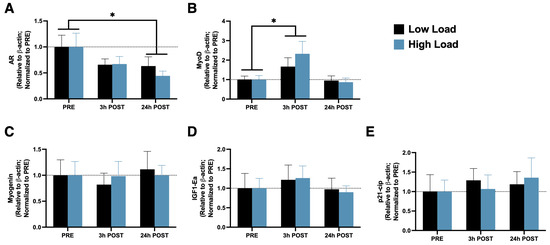
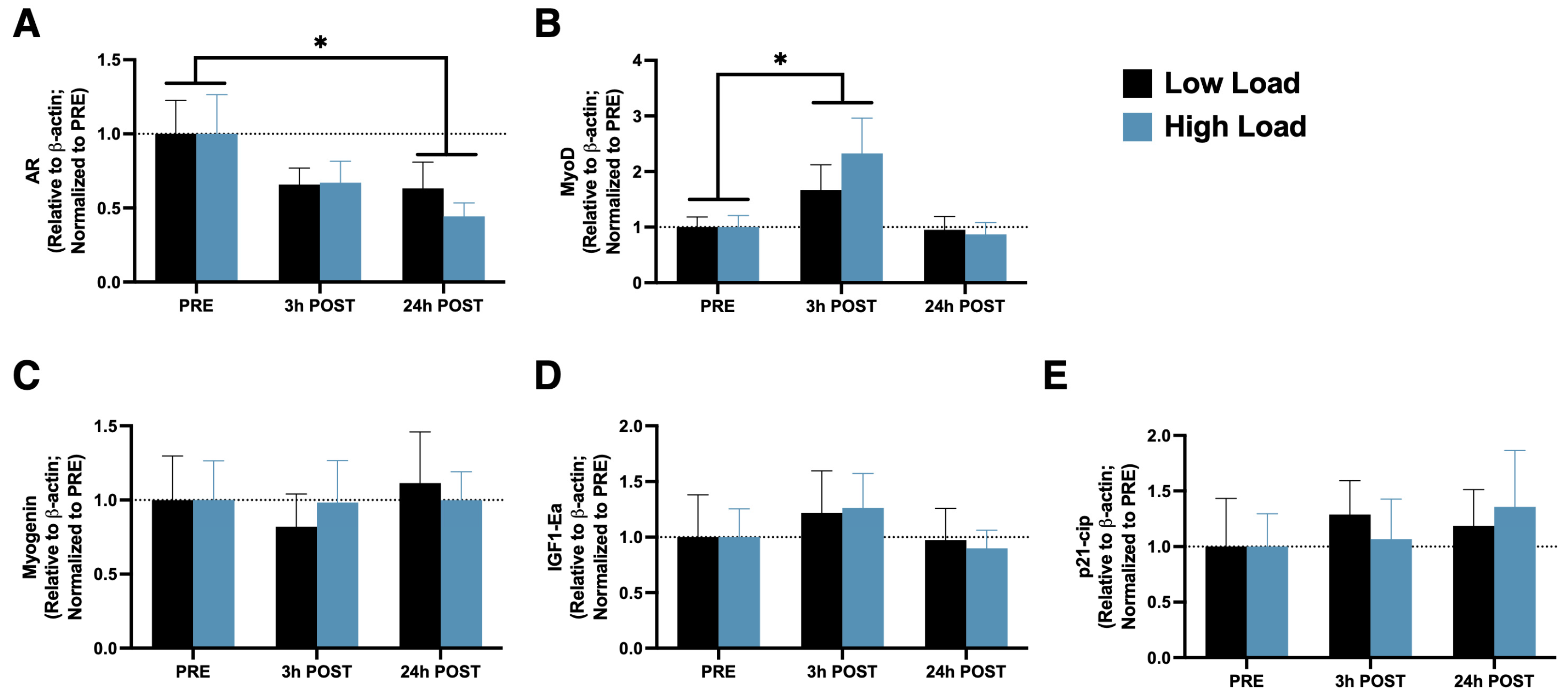
We have previously reported elevations in skeletal muscle AR-DNA binding following HL with significant decreases in circulating free testosterone and no significant changes in skeletal muscle AR, TST, or DHT (see Cardaci et al. [15]. Consequently, in order to determine whether this increase in AR-DNA binding is sufficient to induce upregulations in AR-regulated gene expression, we assessed AR-regulated gene responses. Interestingly, analyses largely failed to reveal any significant main or interaction effects for relative gene expression changes (all p > 0.05). However, significant main time effects were found for two genes, whereby AR mRNA expression was significantly lower at 24 h post vs. pre-exercise (0.54 ± 0.42 fold change; p = 0.031) and MyoD mRNA expression was significantly elevated from pre-exercise at 3 h post (2.03 ± 1.64 fold change; p = 0.004). Otherwise, no main load nor load x time interaction effects were observed for relative AR or MyoD gene expression changes. All gene expression changes can be visualized in Figure 1.
Figure 1.
Fold changes in mRNA expression from baseline are shown for (A) AR, (B) MyoD, (C) Myogenin, (D) IGF1-Ea, and (E) p21-cip. An asterisk (*) indicates a significant difference from PRE (p < 0.05). AR mRNA expression decreased at 24 h post-exercise, whereas MyoD mRNA expression increased at 3 h post-exercise. The horizontal dotted line represents baseline expression.
3.2. Correlational Analyses
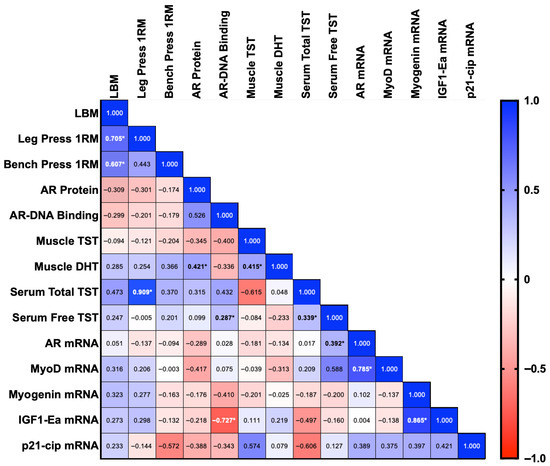
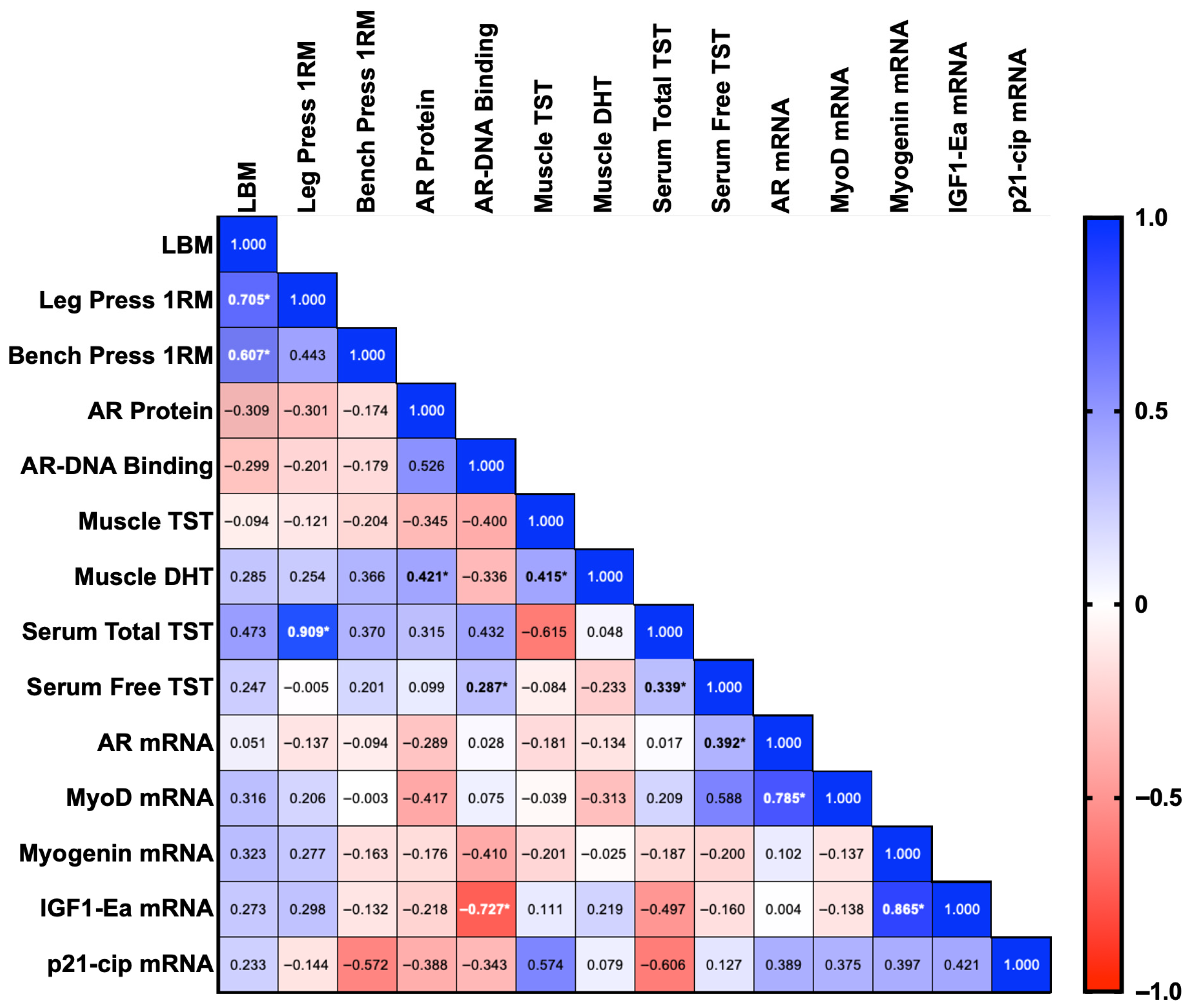
Pearson correlation analyses revealed several significant relationships (see Figure 2 for a comprehensive comparison matrix). LBM was positively correlated with both leg press 1RM (r = 0.705, p = 0.015) and bench press 1RM (r = 0.607, p = 0.048). Serum total TST was strongly correlated with leg press 1RM (r = 0.909, p = 0.012). Additionally, significant correlations were observed between serum-free TST and AR mRNA fold changes (r = 0.392, p = 0.001), as well as AR-DNA binding activity (r = 0.287, p = 0.021) and serum total TST (r = 0.339, p = 0.030). Intramuscular concentrations of DHT were also positively correlated with intramuscular TST (r = 0.415, p < 0.001) and AR protein content (r = 0.421, p < 0.001). Finally, fold changes in AR mRNA were correlated with MyoD mRNA fold changes (r = 0.785, p = 0.007) along with IGF1-Ea mRNA fold changes being significantly correlated with both myogenin mRNA fold changes (r = 0.865, p = 0.001) and AR-DNA binding (r = −0.727, p = 0.017).
Figure 2.
Correlative analyses between androgen-associated markers, upper- and lower-body strength, and lean body mass (LBM). Correlation matrix shows Pearson’s r values between variables and heat map to demonstrate the strength and direction of linear relationships. Asterisks (*) denote statistically significant findings from PRE at p < 0.05, whereby LBM is positively correlated with leg and bench press. Serum free TST is positively correlated with leg press 1RM, serum total TST, AR gene expression changes, as well as AR-DNA binding. Further, intramuscular DHT is positively correlated with both intramuscular TST and AR protein content. Lastly, gene expression changes in AR are correlated with MyoD gene expression changes along with gene expression changes in IGF1-Ea being significantly correlated with both myogenin gene expression changes and AR-DNA binding.
4. Discussion
The present study is the first to investigate the temporal effects of RE load, in a volume-and intensity-equated manner, on myogenic gene expression in resistance-trained males. Contrary to our initial hypothesis, RE load did not influence the expression of genes related to muscle hypertrophy or regeneration; instead, our findings indicate that the post-exercise timeframe is a more critical determinant of transcriptional changes. This suggests that early molecular events driving muscle adaptation may occur independently of load when exercise volume is matched [20,21].
The previous literature has reported significantly increased AR mRNA expression 48 h after isolated eccentric or concentric exercise, which contrasts with the decreases that we observed at 24 h post-exercise within the present investigation [22]. One potential mechanism is that AR expression follows a transient, tightly regulated temporal pattern, similar to the diurnal fluctuations observed in circulating testosterone [23]. Willoughby and Taylor [10] demonstrated temporal upregulation of AR protein and mRNA following sequential bouts of RE. Interestingly, we observed a decreased AR mRNA expression at 24 h, which we suggest may reflect a negative feedback response to elevated ligand binding rather than a blunted adaptive signal. Given that our protocol involved only a single acute bout, it is plausible that we captured this transient downregulation of AR transcription, whereas a more prolonged time course or repeated sessions might have revealed the delayed upregulation reported in other studies [22]. Additionally, this regulation appears to be load-independent when total exercise volume and intensity are equated. Thus, while HL and LL did not significantly alter AR mRNA expression, this further underscores the importance of cumulative volume in shaping muscle hypertrophy.
MyoD expression, in contrast, increased at 3 h post-exercise, independent of HL or LL conditions. This early activation of satellite cell–mediated myogenesis [24] aligns with its established regulatory role in myogenic lineage commitment and corroborates prior findings with low-load blood-flow-restricted RT [25]. The similar MyoD response across RE loads supports the concept that activation of satellite cell regulatory genes is sensitive to the presence of an exercise stimulus itself rather than the magnitude of load, provided that sufficient volume is achieved. This interpretation is consistent with evidence that both HL and LL exercise, when volume is matched, promote comparable increases in satellite cell content and myonuclear accretion during chronic training interventions [21,26]. Thus, MyoD may function as an “early responder” gene that is primarily volume-driven, whereby load plays a more secondary role in dictating the downstream efficiency of differentiation and fusion [27,28]. Taken together with AR findings, this reinforces the idea that transcriptional events critical for the initiation of muscle adaptation can be elicited by both HL and LL protocols, provided total exercise volume and intensity are comparable. This volume-mediated regulation suggests that LL RE may still be sufficient to activate early myogenic pathways if the total stimulus is equated, carrying practical implications for demographics (e.g., elderly, clinical) with HL RE contraindications [29].
Conversely, the lack of significant changes in IGF-1Ea and myogenin expression may reflect their classification as intermediate-to-delayed response genes, which typically peak later (24–72 h) [30]. While the current investigation also failed to reveal any load-specific effects, this absence potentially suggests that downstream anabolic and differentiation signals may also be more dependent on training volume and temporal dynamics than on load per se. This aligns with prior reports showing that IGF-1 isoforms and myogenin gene expression exhibit more gradual, sustained increases that correspond to later stages of regeneration, ultimately proliferating satellite cell transitions toward fusion and myotube formation [31,32]. The lack of a robust response at our chosen timepoints may therefore reflect a misalignment between sampling and peak gene expression windows rather than a true absence of regulation. It is also worth considering that differences in HL-versus-LL training may emerge more strongly in these later-phase genes only after repeated bouts of exercise, when cumulative adaptations to mechanical tension, metabolic stress, and endocrine signaling have accrued. For instance, HL training may preferentially enhance IGF-1 expression through greater mechanical loading of the muscle-tendon complex [22], whereas LL training may rely more heavily on metabolite-driven pathways [20]. However, when volume and intensity are equated in a single acute bout, these distinctions may be less apparent, producing a “convergent” response where neither HL nor LL independently modulates IGF-1Ea or myogenin beyond volume-driven effects. Prior research noting muted myogenin changes relative to MyoD from baseline following acute RE [33] lends further support to our findings, implying that the initial satellite cell activation (MyoD) is readily triggered by both HL and LL, while the later differentiation (myogenin) requires more sustained or repeated mechanical input to facilitate subsequent adaptations.
Lastly, the associations assessed between traditional strength outcomes and LBM, alongside (circulating and intramuscular) androgen-associated targets, cumulatively provide further context. Namely, the significantly positive relationships observed between LBM and both bench press and leg press 1RM ultimately reinforce foundational strength and conditioning concepts [34,35]. Notwithstanding our prior reference to the significant TST associations with both AR mRNA fold-changes and AR-DNA binding, intramuscular androgens were also positively correlated with AR protein. These collective findings reinforce the role of androgen signaling in strength and adaptation, lending credence to hormone-regulated muscular adaptation, despite modest or delayed gene expression responses [36]. Interestingly, we also observed significant correlations in AR mRNA and MyoD mRNA fold-changes, as well as significant correlations between IGF1-Ea mRNA fold changes with both myogenin mRNA fold-changes and AR-DNA binding. While these data further support a positive relationship between different skeletal muscle AR-regulated gene expression targets and are associated with the acute resistance exercise responses, more work is certainly needed to further understand the mechanisms. Nevertheless, the data we present otherwise contend that the resistance exercise stimulus is a more important factor relative to load intensity when considering hypertrophy-associated gene expression. The consequential notion that skeletal muscle hypertrophy is independent of load intensity is well-supported under the caveat that all HL and LL sets being compared are performed to volitional failure [29,37]. The principle behind this characteristic is, in large part, to ensure an adequate volume-associated stimulus, which ultimately continues to support volume load over the relative load intensity [38].
5. Conclusions
Although the present investigation sought to limit all potential confounding variables, this investigation had several limitations. Alongside a modest sample size and an acute design, the present participants were homogeneously young, resistance-trained males. Thus, our findings would be strengthened by a larger sample size of more diverse demographics and employing a longitudinal design. As previously mentioned, differences between our findings and the existing literature may be attributed to differences in RT stimulus and inconsistent sampling timeframes with the previous literature [22,39,40]. Lastly, our practical inferences are inherently limited by our assessed outcomes; not only can transcriptional changes fail to parallel translational protein synthesis, but we cannot make claims to hypertrophic potential without long-term adaptation [41]. More precise techniques such as muscle fiber cross-sectional area analysis or ultrasound-derived muscle thickness measurement would therefore ideally contextualize molecular data in more practically extended training contexts [42].
Despite failing to determine any load-specific differences in androgen-responsive gene expression, we contend that these data emphasize that the sampling timeframe should be heavily considered when assessing genetic responses to an incurred stimulus [22,39,40]. Furthermore, this work has implications not only for athletic populations—where load manipulation is central to programming—but also for mitigating factors like muscle wasting in clinical populations [15,43]. Although the limitations we present in our methodology prevent aggressive extrapolations regarding HL vs. LL RT adaptations, our data may suggest that load intensity holds lower priority over maintaining a consistent RT routine.
Author Contributions
Conceptualization, T.D.C. and D.S.W.; methodology T.D.C. and D.S.W.; formal analysis T.D.C. and D.S.W.; investigation, T.D.C., D.R.H., S.B.M. and D.S.W.; resources, T.D.C. and D.S.W.; data curation T.D.C. and D.S.W.; writing—original draft preparation, B.G.C., T.D.C., D.R.H., S.B.M. and D.S.W.; writing—review and editing, B.G.C., T.D.C., D.R.H., S.B.M. and D.S.W. visualization T.D.C. and D.S.W.; supervision, T.D.C. and D.S.W.; project administration, T.D.C. and D.S.W.; funding acquisition, T.D.C. and D.S.W. All authors have read and agreed to the published version of this manuscript.
Funding
This research was funded by the American College of Sports Medicine—Texas Chapter, Student Research Development Grant, and the Baylor University Health, Human Performance, and Recreation Graduate Student Research Grant.
Institutional Review Board Statement
All study procedures were authorized by the Institutional Review Board at Baylor University (approval code: #1521229-3, approved on 17 November 2019) and conformed to the ethical considerations of the Declaration of Helsinki.
Informed Consent Statement
Informed consent was obtained from all subjects involved in this study.
Data Availability Statement
All the data and materials associated with the findings stated in the results of this manuscript are within the manuscript.
Acknowledgments
The authors would like to acknowledge Emma Fletcher, Dylan Wilburn, and Jeffery Heileson for their contributions.
Conflicts of Interest
The authors declare no conflicts of interest.
References
- Westcott, W.L. Resistance training is medicine: Effects of strength training on health. Curr. Sports Med. Rep. 2012, 11, 209–216. [Google Scholar] [CrossRef] [Scilit] [PubMed]
- Storey, A.; Smith, H.K. Unique aspects of competitive weightlifting: Performance, training and physiology. Sports Med. 2012, 42, 769–790. [Google Scholar] [CrossRef] [PubMed]
- Ratamess, N.; Alvar, B.; Evetoch, T.; Housh, T.; Kibler, W.; Kraemer, W. Progression models in resistance training for healthy adults [ACSM position stand]. Med. Sci. Sports Exerc. 2009, 41, 687–708. [Google Scholar]
- Campos, G.E.; Luecke, T.J.; Wendeln, H.K.; Toma, K.; Hagerman, F.C.; Murray, T.F.; Ragg, K.E.; Ratamess, N.A.; Kraemer, W.J.; Staron, R.S. Muscular adaptations in response to three different resistance-training regimens: Specificity of repetition maximum training zones. Eur. J. Appl. Physiol. 2002, 88, 50–60. [Google Scholar] [CrossRef] [Scilit]
- Piercy, K.L.; Troiano, R.P.; Ballard, R.M.; Carlson, S.A.; Fulton, J.E.; Galuska, D.A.; George, S.M.; Olson, R.D. The physical activity guidelines for Americans. JAMA 2018, 320, 2020–2028. [Google Scholar] [CrossRef] [Scilit]
- Schoenfeld, B.J.; Grgic, J.; Van Every, D.W.; Plotkin, D.L. Loading recommendations for muscle strength, hypertrophy, and local endurance: A re-examination of the repetition continuum. Sports 2021, 9, 32. [Google Scholar] [CrossRef] [Scilit]
- D’Andrea, S.; Spaggiari, G.; Barbonetti, A.; Santi, D. Endogenous transient doping: Physical exercise acutely increases testosterone levels-results from a meta-analysis. J. Endocrinol. Investig. 2020, 43, 1349–1371. [Google Scholar] [CrossRef] [Scilit] [PubMed]
- Gelmann, E.P. Molecular biology of the androgen receptor. J. Clin. Oncol. 2002, 20, 3001–3015. [Google Scholar] [CrossRef] [Scilit] [PubMed]
- Roberts, M.D.; Dalbo, V.J.; Hassell, S.E.; Kerksick, C.M. The expression of androgen-regulated genes before and after a resistance exercise bout in younger and older men. J. Strength Cond. Res. 2009, 23, 1060–1067. [Google Scholar] [CrossRef] [Scilit]
- Willoughby, D.S.; Taylor, L. Effects of sequential bouts of resistance exercise on androgen receptor expression. Med. Sci. Sports Exerc. 2004, 36, 1499–1506. [Google Scholar] [CrossRef] [Scilit]
- Denayer, S.; Helsen, C.; Thorrez, L.; Haelens, A.; Claessens, F. The rules of DNA recognition by the androgen receptor. Mol. Endocrinol. 2010, 24, 898–913. [Google Scholar] [CrossRef] [Scilit]
- Al Bitar, S.; Gali-Muhtasib, H. The role of the cyclin dependent kinase inhibitor p21(cip1/waf1) in targeting cancer: Molecular mechanisms and novel therapeutics. Cancers 2019, 11, 1475. [Google Scholar] [CrossRef] [Scilit]
- Ascenzi, F.; Barberi, L.; Dobrowolny, G.; Villa Nova Bacurau, A.; Nicoletti, C.; Rizzuto, E.; Rosenthal, N.; Scicchitano, B.M.; Musarò, A. Effects of IGF-1 isoforms on muscle growth and sarcopenia. Aging Cell 2019, 18, e12954. [Google Scholar] [CrossRef] [Scilit]
- Ganassi, M.; Badodi, S.; Wanders, K.; Zammit, P.S.; Hughes, S.M. Myogenin is an essential regulator of adult myofibre growth and muscle stem cell homeostasis. eLife 2020, 9, e60445. [Google Scholar] [CrossRef] [Scilit]
- Cardaci, T.D.; Machek, S.B.; Wilburn, D.T.; Heileson, J.L.; Willoughby, D.S. High-load resistance exercise augments androgen receptor-DNA binding and Wnt/β-Catenin signaling without increases in serum/muscle androgens or androgen receptor content. Nutrients 2020, 12, 3829. [Google Scholar] [CrossRef] [Scilit]
- Heyward, V.H. The Physical Fitness Specialist Certification Manual; The Cooper Institute for Aerobics Research: Dallas, TX, USA, 1998; Volume 48. [Google Scholar]
- Judelson, D.A.; Maresh, C.M.; Yamamoto, L.M.; Farrell, M.J.; Armstrong, L.E.; Kraemer, W.J.; Volek, J.S.; Spiering, B.A.; Casa, D.J.; Anderson, J.M. Effect of hydration state on resistance exercise-induced endocrine markers of anabolism, catabolism, and metabolism. J. Appl. Physiol. 2008, 105, 816–824. [Google Scholar] [CrossRef] [Scilit] [PubMed]
- Newmire, D.E.; Willoughby, D.S. The skeletal muscle microbiopsy method in exercise and sports science research: A narrative and methodological review. Scand. J. Med. Sci. Sports 2022, 32, 1550–1568. [Google Scholar] [CrossRef] [Scilit] [PubMed]
- Machek, S.B.; Harris, D.R.; Zawieja, E.E.; Heileson, J.L.; Wilburn, D.T.; Radziejewska, A.; Chmurzynska, A.; Cholewa, J.M.; Willoughby, D.S. The impacts of combined blood flow restriction training and betaine supplementation on one-leg press muscular endurance, exercise-associated lactate concentrations, serum metabolic biomarkers, and hypoxia-inducible factor-1α gene expression. Nutrients 2022, 14, 5040. [Google Scholar] [CrossRef] [Scilit] [PubMed]
- Mitchell, C.J.; Churchward-Venne, T.A.; West, D.W.; Burd, N.A.; Breen, L.; Baker, S.K.; Phillips, S.M. Resistance exercise load does not determine training-mediated hypertrophic gains in young men. J. Appl. Physiol. 2012, 113, 71–77. [Google Scholar] [CrossRef] [Scilit]
- Morton, R.W.; Oikawa, S.Y.; Wavell, C.G.; Mazara, N.; McGlory, C.; Quadrilatero, J.; Baechler, B.L.; Baker, S.K.; Phillips, S.M. Neither load nor systemic hormones determine resistance training-mediated hypertrophy or strength gains in resistance-trained young men. J. Appl. Physiol. 2016, 121, 129–138. [Google Scholar] [CrossRef] [Scilit]
- Bamman, M.M.; Shipp, J.R.; Jiang, J.; Gower, B.A.; Hunter, G.R.; Goodman, A.; McLafferty, C.L., Jr.; Urban, R.J. Mechanical load increases muscle IGF-I and androgen receptor mRNA concentrations in humans. Am. J. Physiol. Endocrinol. Metab. 2001, 280, E383–E390. [Google Scholar] [CrossRef] [Scilit] [PubMed]
- Diver, M.J.; Imtiaz, K.E.; Ahmad, A.M.; Vora, J.P.; Fraser, W.D. Diurnal rhythms of serum total, free and bioavailable testosterone and of SHBG in middle-aged men compared with those in young men. Clin. Endocrinol. 2003, 58, 710–717. [Google Scholar] [CrossRef] [Scilit] [PubMed]
- Shintaku, J.; Peterson, J.M.; Talbert, E.E.; Gu, J.M.; Ladner, K.J.; Williams, D.R.; Mousavi, K.; Wang, R.; Sartorelli, V.; Guttridge, D.C. MyoD Regulates Skeletal Muscle Oxidative Metabolism Cooperatively with Alternative NF-κB. Cell Rep. 2016, 17, 514–526. [Google Scholar] [CrossRef] [Scilit]
- Drummond, M.J.; Fujita, S.; Abe, T.; Dreyer, H.C.; Volpi, E.; Rasmussen, B.B. Human muscle gene expression following resistance exercise and blood flow restriction. Med. Sci. Sports Exerc. 2008, 40, 691–698. [Google Scholar] [CrossRef] [Scilit]
- Fry, C.S.; Lee, J.D.; Jackson, J.R.; Kirby, T.J.; Stasko, S.A.; Liu, H.; Dupont-Versteegden, E.E.; McCarthy, J.J.; Peterson, C.A. Regulation of the muscle fiber microenvironment by activated satellite cells during hypertrophy. FASEB J. 2014, 28, 1654–1665. [Google Scholar] [CrossRef] [Scilit]
- Drummond, M.J.; Conlee, R.K.; Mack, G.W.; Sudweeks, S.; Schaalje, G.B.; Parcell, A.C. Myogenic regulatory factor response to resistance exercise volume in skeletal muscle. Eur. J. Appl. Physiol. 2010, 108, 771–778. [Google Scholar] [CrossRef] [Scilit]
- Hopwood, N.; Pluck, A.; Gurdon, J. MyoD expression in the forming somites is an early response to mesoderm induction in Xenopus embryos. EMBO J. 1989, 8, 3409–3417. [Google Scholar] [CrossRef] [Scilit]
- Schoenfeld, B.J.; Peterson, M.D.; Ogborn, D.; Contreras, B.; Sonmez, G.T. Effects of low- vs. high-load resistance training on muscle strength and hypertrophy in well-trained men. J. Strength Cond. Res. 2015, 29, 2954–2963. [Google Scholar] [CrossRef] [Scilit]
- Philippou, A.; Papageorgiou, E.; Bogdanis, G.; Halapas, A.; Sourla, A.; Maridaki, M.; Pissimissis, N.; Koutsilieris, M. Expression of IGF-1 isoforms after exercise-induced muscle damage in humans: Characterization of the MGF E peptide actions in vitro. In Vivo 2009, 23, 567–575. [Google Scholar]
- Grubb, A.; Joanisse, S.; Moore, D.R.; Bellamy, L.M.; Mitchell, C.J.; Phillips, S.M.; Parise, G. IGF-1 colocalizes with muscle satellite cells following acute exercise in humans. Appl. Physiol. Nutr. Metab. 2014, 39, 514–518. [Google Scholar] [CrossRef] [Scilit]
- Liu, Z.; Liu, H.; Yang, X.; Xu, X.; Zhang, W.; Li, Z. Effects of insulin-like growth factor-1 on expression of sensory neuropeptides in cultured dorsal root ganglion neurons in the absence or presence of glutamate. Int. J. Neurosci. 2010, 120, 698–702. [Google Scholar] [CrossRef] [Scilit]
- Raue, U.; Slivka, D.; Jemiolo, B.; Hollon, C.; Trappe, S. Myogenic gene expression at rest and after a bout of resistance exercise in young (18–30 yr) and old (80–89 yr) women. J. Appl. Physiol. 2006, 101, 53–59. [Google Scholar] [CrossRef] [Scilit]
- Tromaras, K.; Zaras, N.; Stasinaki, A.N.; Mpampoulis, T.; Terzis, G. Lean Body Mass, Muscle Architecture and Powerlifting Performance during Preseason and in Competition. J. Funct. Morphol. Kinesiol. 2024, 9, 89. [Google Scholar] [CrossRef] [Scilit]
- Harris, D.; Cardaci, T.; Cintineo, H.; Pham, R.; Dunsmore, K.; Funderburk, L.; Machek, S. A cross-sectional examination of wrist wrap use prevalence and characterization for ergogenic purposes in actively competing powerlifters. Int. J. Strength Cond. 2023, 3. [Google Scholar] [CrossRef] [Scilit]
- Howard, E.E.; Margolis, L.M.; Berryman, C.E.; Lieberman, H.R.; Karl, J.P.; Young, A.J.; Montano, M.A.; Evans, W.J.; Rodriguez, N.R.; Johannsen, N.M.; et al. Testosterone supplementation upregulates androgen receptor expression and translational capacity during severe energy deficit. Am. J. Physiol. Endocrinol. Metab. 2020, 319, E678–E688. [Google Scholar] [CrossRef] [Scilit] [PubMed]
- Lopez, P.; Radaelli, R.; Taaffe, D.R.; Newton, R.U.; Galvão, D.A.; Trajano, G.S.; Teodoro, J.L.; Kraemer, W.J.; Häkkinen, K.; Pinto, R.S. Resistance training load effects on muscle hypertrophy and strength gain: Systematic review and network meta-analysis. Med. Sci. Sports Exerc. 2021, 53, 1206–1216. [Google Scholar] [CrossRef] [Scilit]
- Santanielo, N.; Nóbrega, S.R.; Scarpelli, M.C.; Alvarez, I.F.; Otoboni, G.B.; Pintanel, L.; Libardi, C.A. Effect of resistance training to muscle failure vs non-failure on strength, hypertrophy and muscle architecture in trained individuals. Biol. Sport 2020, 37, 333–341. [Google Scholar] [CrossRef] [Scilit]
- Ratamess, N.A.; Kraemer, W.J.; Volek, J.S.; Maresh, C.M.; VanHeest, J.L.; Sharman, M.J.; Rubin, M.R.; French, D.N.; Vescovi, J.D.; Silvestre, R.; et al. Androgen receptor content following heavy resistance exercise in men. J. Steroid Biochem. Mol. Biol. 2005, 93, 35–42. [Google Scholar] [CrossRef] [Scilit] [PubMed]
- Caldow, M.K.; Thomas, E.E.; Dale, M.J.; Tomkinson, G.R.; Buckley, J.D.; Cameron-Smith, D. Early myogenic responses to acute exercise before and after resistance training in young men. Physiol. Rep. 2015, 3, e12511. [Google Scholar] [CrossRef] [Scilit] [PubMed]
- Liu, Y.; Beyer, A.; Aebersold, R. On the dependency of cellular protein levels on mRNA abundance. Cell 2016, 165, 535–550. [Google Scholar] [CrossRef] [Scilit]
- Franchi, M.V.; Longo, S.; Mallinson, J.; Quinlan, J.I.; Taylor, T.; Greenhaff, P.L.; Narici, M.V. Muscle thickness correlates to muscle cross-sectional area in the assessment of strength training-induced hypertrophy. Scand. J. Med. Sci. Sports 2018, 28, 846–853. [Google Scholar] [CrossRef] [Scilit] [PubMed]
- Wilburn, D.; Ismaeel, A.; Machek, S.; Fletcher, E.; Koutakis, P. Shared and distinct mechanisms of skeletal muscle atrophy: A narrative review. Ageing Res. Rev. 2021, 71, 101463. [Google Scholar] [CrossRef] [Scilit] [PubMed]

Disclaimer/Publisher’s Note: The statements, opinions and data contained in all publications are solely those of the individual author(s) and contributor(s) and not of MDPI and/or the editor(s). MDPI and/or the editor(s) disclaim responsibility for any injury to people or property resulting from any ideas, methods, instructions or products referred to in the content. |
© 2025 by the authors. Licensee MDPI, Basel, Switzerland. This article is an open access article distributed under the terms and conditions of the Creative Commons Attribution (CC BY) license (https://creativecommons.org/licenses/by/4.0/).