Article

Olive Pomace-Based Nanobiochar as an Adsorbent Biomass for the Removal of Simple Phenols from Oil Mill Effluents: Experimental Modeling and Computational Approaches

1
Superior School of Technology of Khenifra, University of Sultan Moulay Slimane, BP 170, Khenifra 54000, Morocco
2
Biocenter, Tambov State Technical University, Sovetskaya St. 106, 392000 Tambov, Russia
3
Olive Research Institute, İzmir, Kazımdirik, 35100 Bornova, İzmir, Türkiye
*
Authors to whom correspondence should be addressed.
Biomass 2026, 6(2), 30; https://doi.org/10.3390/biomass6020030
Submission received: 19 February 2026 / Revised: 20 March 2026 / Accepted: 23 March 2026 / Published: 14 April 2026

Abstract

This study evaluated the sustainability of removing phenolic compounds from olive mill effluents using a nanobiochar synthesized from olive pomace. Catechol, tyrosol, hydroxytyrosol, and homovanillic alcohol were chosen as model pollutants due to their presence in agro-industrial wastewater. The surface morphology, elemental composition, crystallographic structure, functional groups, porosity, and thermal stability of the nanobiochar were investigated by SEM, EDX, XRD, FTIR, BET analysis, and TGA/DTA. The developed nanobiochar exhibited a predominantly amorphous carbon structure, enriched in carbon (85.6%), with localized graphitic domains. Its mesoporous architecture (SBET = 15.478 m2 g−1; Dp = 2.14 nm) promotes accessibility to active sites, while its thermal stability confirmed its suitability for adsorption applications. In this batch adsorption study, the technological aspect considered is the influence of operating parameters on adsorption efficiency, using kinetic and equilibrium models. Pseudo-first-order and pseudo-second-order kinetic models, as well as Freundlich and Langmuir isotherms, were used to analyze the experimental data. The pseudo-second-order model proved to be the most suitable for describing adsorption, suggesting that the process is primarily dominated by chemisorption. Similarly, the Langmuir model gave the least satisfactory results regarding equilibrium data, indicating monolayer adsorption on homogeneous active sites. The adsorption capacity of phenolic compounds was variable. The highest adsorption capacities were observed for catechol (250 mg g−1), tyrosol (19.23 mg g−1), homovanillic alcohol (15.38 mg g−1), and hydroxytyrosol (13.16 mg g−1). The results of this research indicate that adsorption affinity depends on molecular structure and electronic properties. Furthermore, computer modeling based on molecular simulations and electronic descriptors was performed to explain the adsorption mechanism. Linear regression, principal component analysis, and elastic regression revealed strong correlations between adsorption parameters and molecular descriptors. These results demonstrate that olive pomace-based nanobiochar is an environmentally friendly adsorbent for the treatment of phenolic effluents, with adsorption primarily controlled by surface interactions.

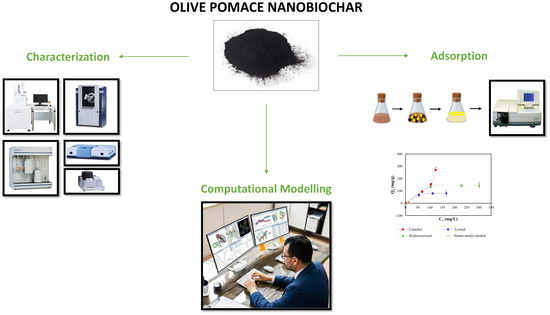
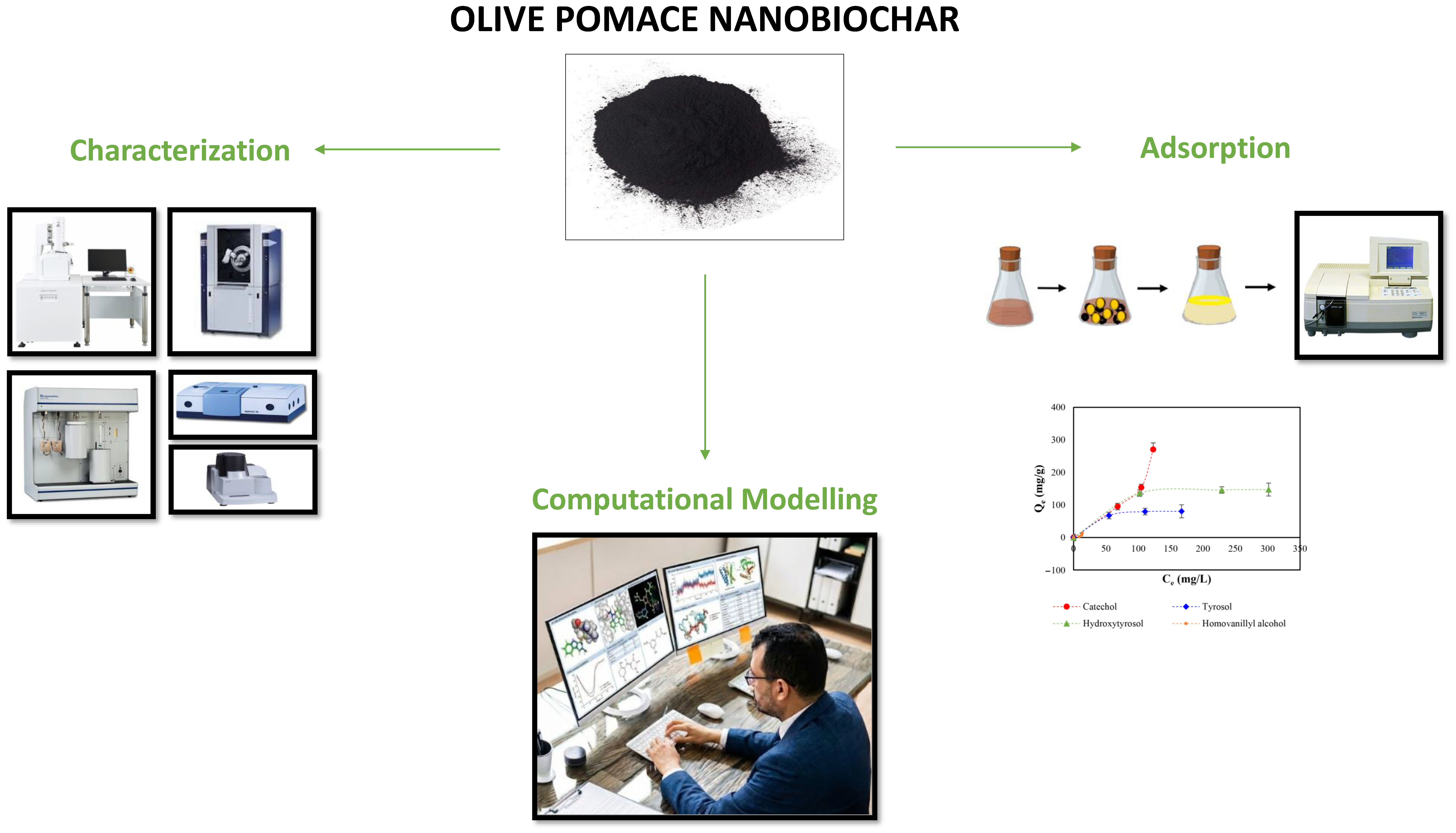
Graphical Abstract

1. Introduction

Olive cultivation is an important agro-industrial activity in Mediterranean countries, particularly in Morocco, where oil production generates significant volumes of oil mill effluents (OMEs) [1]. The fractions of these effluents, especially oil mill wastewater (OMW), have high concentrations of phenolic compounds, including simple phenols and polyphenols, which gives them a high chemical oxygen demand and phytotoxicity [2]. Because these phenolic compounds are highly reactive and toxic to aquatic and terrestrial life, their uncontrolled release into the environment can lead to ecological imbalances and a reduction in microbial activity in soils and aquatic environments [3]. However, some phenols present in OMW possess recognized antioxidant, antimicrobial, and anti-inflammatory properties and are therefore used in nutraceutical and cosmetic products [4,5,6]. Thus, the economic opportunity offered to olive oil producers could have an environmental impact, due to the possibility of valorizing phenolic oxides that would otherwise be harmful to the environment [7].
The treatment of phenols in organic waste relies on various physicochemical and biological technologies aimed at reducing their toxicity and enabling the recovery of available resources [8]. Anaerobic digestion, particularly with pretreatments such as aeration, advanced oxidation, or thermal conditioning, has also been shown to have the potential to reduce phenol toxicity and methane production, especially when the digestate is co-digested with other organic matter [9]. Similarly, coagulation–flocculation methods using lime or ferrous sulfate combined with cationic polyelectrolytes have achieved phenol removal efficiencies of 30 to 80% [10]. The Fenton reaction, which combines iron-based catalysts and hydrogen peroxide, has been shown to maximize the reduction in chemical oxygen demand and increase overall treatment efficiency [11]. Furthermore, biological biodegradation methods for phenols using ligninolytic fungi and laccase-producing microorganisms have led to the development of viable biodegradation pathways for these compounds [12]. The use of microalgae, particularly after enzymatic pretreatment, has also improved the removal of phenolic compounds from oil mill effluents [13].
In addition to degradation methods, more efficient extraction and valorization methods have been developed to recover phenolic compounds as renewable resources. Organic solvent extraction is considered one of the most promising methods for preserving the structure of phenols during their high-value applications [14]. Furthermore, novel extraction methods, such as microwave-assisted extraction, ultrasound-assisted extraction, and high-pressure hydrostatic extraction, have demonstrated improved recovery efficiency, particularly with the use of natural deep eutectic solvents [15]. Nanofiltration and reverse osmosis, membrane-based methods, have also facilitated the selective separation and purification of phenols [16]. In addition, the adsorption of natural polyphenols, implemented by integrated biotechnological systems using an adsorption resin and ethanol such as Amberlite XAD16, has achieved recovery yields exceeding 60% [17]. Treatment of dephenolized effluents by an anaerobic biofilm reactor has subsequently been used to facilitate the production of volatile fatty acids (VFAs), thus providing them with secondary valorization potential [18]. These technologies reduce the environmental impact of olive mill effluents and increase phenol recovery, but remain expensive. In contrast, the use of synthetic materials, particularly biochar, has demonstrated removal efficiencies of up to 94–110%, which is cost-effective [19].
Nanobiochar is an adsorbent material that has received little attention for the removal of simple phenols from olive oil effluents. Its relatively unique physicochemical properties, such as a large specific surface area, mesoporosity, and surfaces enriched in oxygenated functional groups, promote adsorption through electrostatic interactions, hydrogen bonding, and π-π stacking. However, its use in OME treatment remains unexplored.
This research article therefore aims to develop and test a nanobiochar produced from olive pomace as a sustainable bioadsorbent for the removal of certain simple phenols present in OME. The choice of compounds studied (catechol, tyrosol, hydroxytyrosol, and homovanillic alcohol) is based on their presence and bioactivity. Although catechol is a compound commonly used in industry, it is known for its ecotoxicity and its release must be controlled. Tyrosol and hydroxytyrosol, on the other hand, are recognized for their significant antioxidant properties in the nutraceutical market. Although present at low concentrations, homovanillic alcohol possesses certain exploitable chemical properties in olive-based formulations. The study was structured in four main phases. The first step consisted of the synthesis of nanobiochar by controlled pyrolysis of olive pomace. This nanobiochar was characterized using advanced analytical techniques to identify its morphology, elemental composition, surface functionalities, porosity, and thermal stability. The second step consisted of adsorption experiments to determine removal efficiency. Kinetic and isothermal models were used to determine the adsorption mechanisms and surface interactions. The third step consisted of computer modeling using molecular descriptors to predict adsorption behavior and optimize process parameters. Finally, adsorption mechanisms were studied, and correlations were established between adsorption performance and molecular structure.

2. Material and Methods

2.1. Chemical Reagents

All reagents used in this study were of analytical grade (>99.99%) and were purchased from Merck (Darmstadt, Germany) and ACROS (Geel, Belgium). Aqueous solutions were prepared using distilled water to minimise contamination and preserve solution integrity. For chromatographic analyses, ultrapure water produced by a Milli-Q purification system (Millipore, Burlington, MA, USA) was used throughout High-Performance Liquid Chromatography (HPLC) quantification to ensure stable baseline conditions and reproducible detection.

2.2. Feedstocks

Olive pomace was obtained from the Picholine cultivar (December 2023 harvest) and was supplied by a local olive oil mill operating a traditional three-phase extraction process with rotating millstones (Khenifra, Morocco). To remove water-soluble impurities, the pomace was washed repeatedly with distilled water. The washed biomass was then oven-dried at 50 °C for 72 h and sieved to <1 mm using a RETSCH AS 200 control screener (RETSCH GmbH, Haan, Germany), thereby standardising the precursor particle size prior to thermochemical conversion.
In parallel, oil mill effluent (OME) samples were collected during the production season from the same facility. The effluent was transferred into plastic containers, transported immediately to the laboratory, and stored at 2 °C to limit chemical and biological degradation. The total phenolic content of the raw effluent was measured at 21.5 g L−1, while the pH was recorded as 5.1 ± 0.2.

2.3. Preparation and Characterisation of Olive Pomace Nanobiochar

Olive pomace nanobiochar (OPNB) was produced via sequential pyrolysis, size reduction, and surface modification, which were implemented to generate a mesoporous, functionalised adsorbent suitable for phenol removal. First, dried pomace was ground, packed in perforated stainless-steel containers, and pyrolysed in a muffle furnace under an inert atmosphere at 450 °C. The heating rate was maintained at 6 °C min−1 and the residence time was fixed at 120 min to promote uniform carbonisation. After cooling, the resulting biochar was sieved to <1 mm and stored under controlled conditions [20].
Subsequently, the sieved biochar (100 g) was mechanically milled to the nanoscale using a ball-milling process using VMA-Getzmann DISPERMAT® SL-NANO high-energy disperser (VMA-Getzmann GmbH, Heidelberg, Germany), which enabled controlled reduction in particle size and increased surface exposure. To stabilise the fine particles and enhance dispersion, surface modification was performed using an alkaline sodium hexametaphosphate ((NaPO3)6) treatment. The biochar suspension was stirred at 200 rpm and 50 °C, conditions selected to promote particle deagglomeration and surface activation. The treated suspension was then centrifuged, washed repeatedly with water until neutral pH was achieved, and oven-dried at 50 °C for 72 h to obtain an ultrafine nanobiochar powder.
The physicochemical properties of OPNB were characterised using complementary techniques to establish morphology, composition, structural order, porosity, surface chemistry, and thermal stability. Surface morphology and elemental composition were analysed by scanning electron microscopy coupled with energy-dispersive spectrometry (SEM–EDS; JSM-5800, JEOL Ltd., Tokyo, Japan). Crystalline phases were identified using X-ray diffraction (XRD; Bruker D8 Advance, Cu Kα radiation, λ = 1.54 Å, Bruker Corporation, Billerica, MA, USA). Specific surface area and pore structure were quantified by N2 adsorption–desorption at 77 K using a BET analyser (Micromeritics ASAP 2020, Micromeritics Instrument Corp., Norcross, GA, USA). Functional groups were identified by Fourier-transform infrared spectroscopy (FTIR; Bruker Vertex 70, Bruker Corporation, Billerica, MA, USA) over 4000–400 cm−1. Thermal behaviour was evaluated by simultaneous DTA/TGA (DTG-60H, Shimadzu, Kyoto, Japan), which enabled the assessment of mass-loss events and associated thermal transitions.

2.4. Quantification of Total Phenolics and Targeted Simple Phenols

Total phenolic compounds (TPCs) were quantified using the Folin–Ciocalteu method [21]. For each diluted sample or calibration standard, 10 mL of solution was mixed with 0.5 mL of Folin–Ciocalteu reagent and 1.5 mL of sodium carbonate solution (200 g L−1). The mixture was incubated in the dark for 1 h at 20 °C to allow colour development. Absorbance was then measured at 750 nm using a Shimadzu UV-1601 spectrophotometer (Shimadzu Corporation, Kyoto, Japan) and 1 cm quartz cuvettes, with distilled water used as the blank. A calibration curve was established using gallic acid standards in the range 0–1 ppm.
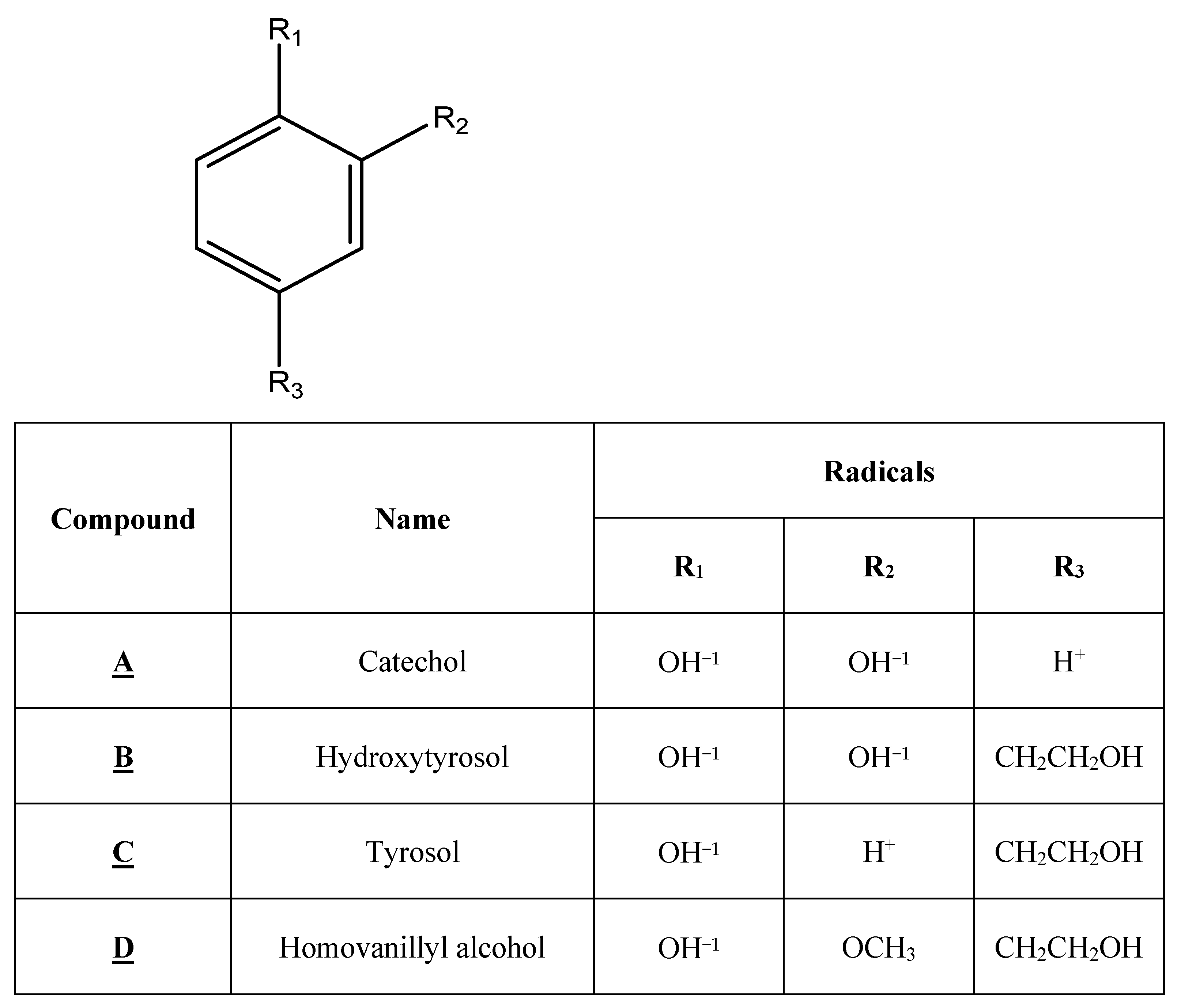
Targeted quantification of catechol, tyrosol, hydroxytyrosol, and homovanillyl alcohol (Figure 1) was performed by HPLC. Stock standards (5000 mg L−1) were prepared in a methanol/water mixture and diluted to working concentrations of 5–250 mg L−1. Sample preparation was performed by liquid extraction with 3 mL of N,N-dimethylformamide (DMF), followed by hexane washing to remove non-polar interferences. Residual hexane was evaporated under nitrogen, and the clarified extract was filtered through a 0.22 μm membrane prior to injection.
Chromatographic separation was carried out using an Agilent 1260 Infinity II system (Agilent Technologies, Santa Clara, CA, USA) equipped with an autosampler, a quaternary pump, and an Agilent ZORBAX Eclipse Plus C18 column (5 µm, 25 cm × 4.6 mm), which is suitable for reversed-phase separation of semi-polar phenolics. The gradient programme began with 90% water adjusted to pH 3.0 using phosphoric acid and 10% methanol, followed by a progressive increase to 20% methanol over 10 min. The flow rate was maintained at 1 mL min−1 and the column temperature was fixed at 35 °C. Detection was performed using a diode array detector (Agilent Technologies, Santa Clara, CA, USA) coupled to a fluorescence detector (Agilent Technologies, Santa Clara, CA, USA) to enhance analytical sensitivity and improve selectivity towards phenolic compounds [22].

2.5. Batch Adsorption Experiments and Model Fitting

Batch adsorption experiments were conducted to quantify the removal of phenolic compounds from OMEs using OPNBs under controlled operating conditions. The initial TPC value of the effluent was 21.5 g L−1, and the initial concentrations of targeted phenols were 258.6 mg L−1 (catechol), 190.2 mg L−1 (tyrosol), 375.2 mg L−1 (hydroxytyrosol), and 20.1 mg L−1 (homovanillyl alcohol). Experimental conditions were selected based on established optimisation procedures reported previously [20,23], including solution pH 10, OPNB dosage between 0.5 and 2 g L−1, and a temperature of 298 K.
For each run, 50 mL of OME was transferred to a 100 mL beaker and placed on an orbital shaker. A defined mass of OPNB was then added, and agitation was maintained at 400 rpm to enhance external mass transfer and maintain homogeneous suspension. At the end of the adsorption period, the treated suspension was filtered through Whatman grade 42 filter paper to remove nanobiochar particles. The filtrate was subsequently analysed by HPLC to determine residual concentrations of the targeted phenols.
The amount adsorbed per unit mass of adsorbent was calculated using equation below [24]:
Q = ( C 0 C f ) W
where C0 and Cf represent the initial and final phenol concentrations (mg L−1), respectively, and W denotes the adsorbent dosage (g L−1). Each experiment was performed in triplicate, and results were reported as the mean of three measurements to enhance statistical reliability.
Adsorption kinetics were interpreted using pseudo-first-order and pseudo-second-order models, which were selected to differentiate between adsorption dominated by diffusion-controlled uptake and adsorption governed by surface reaction mechanisms [24]. Equilibrium data were fitted using the Freundlich and Langmuir isotherms to establish adsorption capacity and assess whether adsorption proceeded on heterogeneous surfaces or through monolayer coverage of homogeneous sites [24]. The corresponding equations are provided in Table 1.

2.6. Computational Approaches

Computational analysis was integrated to support mechanistic interpretation by linking molecular properties to experimental adsorption behaviour. Catechol, tyrosol, hydroxytyrosol, and homovanillyl alcohol were first geometrically optimised using the Merck Molecular Force Field 94 (MMFF94), which was applied to generate stable conformations suitable for energy descriptor calculations [25,26].
Electronic descriptors were computed to characterise molecular reactivity and adsorption propensity, including the energies of the highest occupied molecular orbital (EHOMO) and the lowest unoccupied molecular orbital (ELUMO). From these values, the energy gap (EGAP) was derived, which serves as an indicator of chemical stability and reactivity. Additional global descriptors were calculated, including chemical hardness (η), electronegativity (χ), electrophilicity index (ω), and molecular flexibility (S), which collectively describe the energetic response of molecules to electron transfer and polar interactions. The descriptor equations used in this study are summarised in Table 2, thereby facilitating subsequent interpretation of structure–adsorption relationships.

2.7. Statistical Studies

All experimental datasets were subjected to statistical evaluation using XLSTAT 2016 integrated into Microsoft Excel. Results were expressed as mean ± uncertainty, and statistical significance was assessed at a 5% threshold using Student’s t-test based on three independent repetitions [27].
To explore correlations among calculated molecular descriptors and adsorption outcomes, principal component analysis (PCA) was performed, which enabled dimensionality reduction and visualisation of descriptor-driven clustering relative to adsorption performance [28].
In addition, Elastic Net Regression (ENR) was applied to develop predictive relationships under conditions of multicollinearity and limited sample size. ENR combines L1 (Lasso) and L2 (Ridge) regularisation, which enables variable selection while stabilising coefficient estimation when predictors are correlated [29]. The penalised optimisation objective is expressed in Equation (11), where λ1 controls the Lasso component and λ2 controls the Ridge component.
M i n i m i z e   E r r o r + λ 1 β j + λ 2 β j 2
The corresponding Elastic Net formulation is provided in Equation (12), in which α determines overall regularisation strength and λ governs the balance between L1 and L2 penalties Lasso and Ridge respectively.
Y = m i n y X β 2 + α [ ( 1 λ ) β 1 + λ β 2 ]

3. Results

3.1. Characterization of OPNB

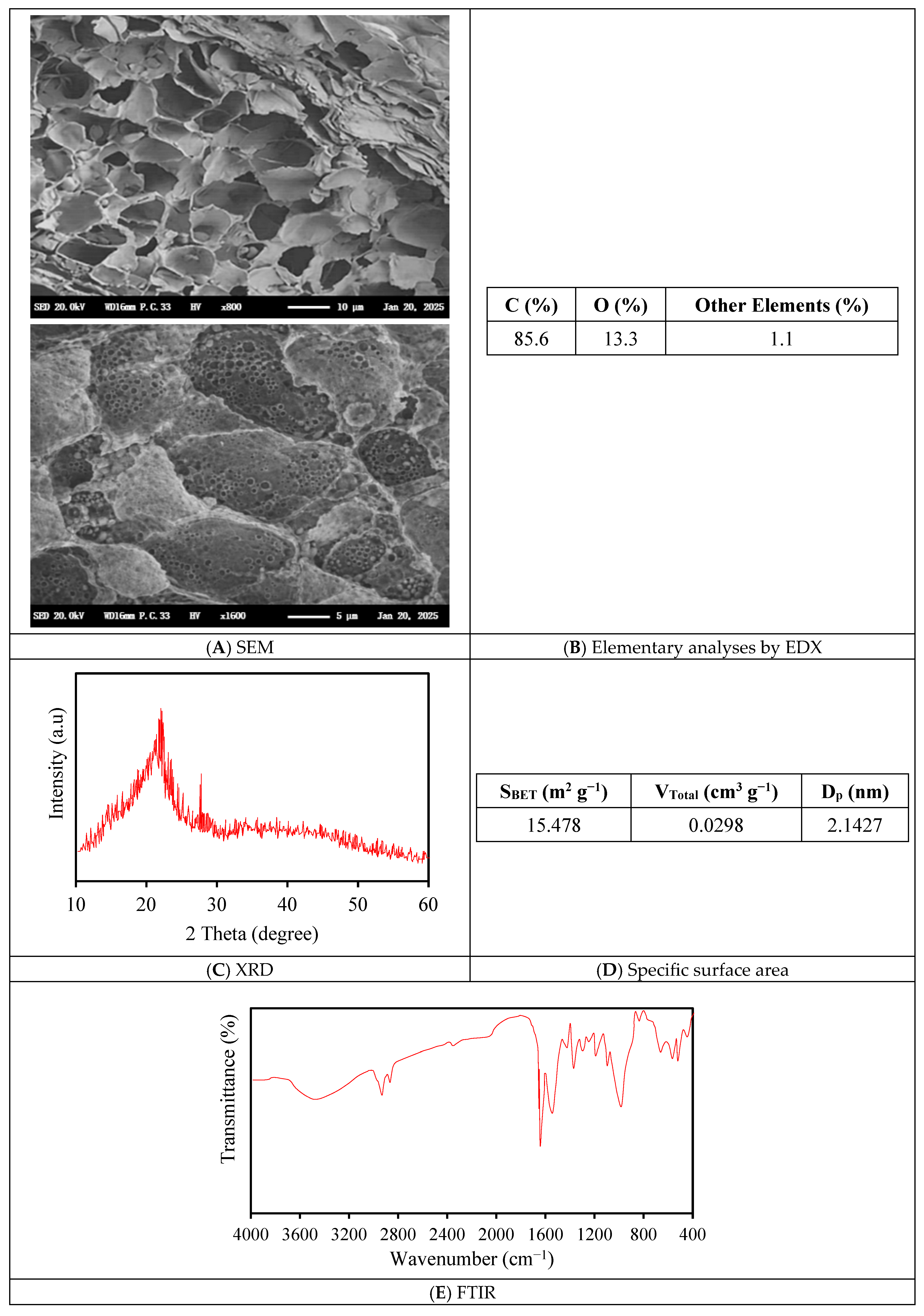
The surface characteristics and microstructure of a material are important parameters for its adsorption performance, directly influencing the efficiency of adsorbents. The characterization of the developed OPNB involved several analytical techniques: (1) scanning electron microscopy (SEM) combined with energy dispersive X-ray spectrometry (EDX) to examine the morphology and elemental composition of the material surface; (2) X-ray diffraction (XRD) to study the crystal structure; (3) gas adsorption by BET method to determine the specific surface area and porosity parameters; (4) Fourier-transform infrared spectroscopy (FTIR) to identify functional groups; and (5) TG/DTA thermal analyses to evaluate the thermal stability of the material. First, scanning electron microscopy (SEM) combined with energy dispersive X-ray spectrometry (EDX) was used to examine the morphology and elemental composition of the material surface (Figure 2A). SEM observation revealed a well-developed porous structure, suggesting a large surface area favorable for various applications [30]. Furthermore, EDX analysis of the surface revealed a high carbon content (85.6%), showing that the nanobiochar is mainly composed of carbon, as is the case for pyrolyzed materials. The presence of oxygen (13.3%) indicates the presence of oxides, while the other elements (1.1%) correspond to mineral traces (Figure 2B).
To characterize the structure of OPNB, X-ray diffraction (XRD) analysis was performed. The obtained diffraction pattern shows an amorphous character, with a notable absence of marked crystalline peaks, revealing a weak long-range order in the structure. This amorphy is characteristic of pyrolyzed carbonaceous materials, which tend to form disorganized structures during the thermal decomposition process. However, a peak at 2θ = 24° indicates the presence of C12 to C60 type carbonaceous structures, while a peak at 2θ = 28° reveals the presence of graphite, confirming localized regions of structured order [31,32] (Figure 2C).
The specific surface area and porosity of the nanobiochar were measured by the BET method. The results show a specific surface area (SBET) of 15.478 m2/g, typical of porous materials. The total pore volume (VTotal) measured at 0.0298 cm3/g confirms this porosity, while the average pore diameter (Dp) of 2.1427 nm indicates a mesoporous distribution (Figure 2).
Fourier-transform infrared spectroscopy (FTIR) analysis was performed to determine the functional groups on the surface of the nanobiochar, where the FTIR spectrum shows a broad band around 3450 cm−1, associated with hydroxyl groups (O–H), indicating the presence of sites conducive to hydrogen interaction [33]. Another band, around 1650 cm−1, corresponds to carbonyl groups (C=O), resulting from the thermal decomposition of the initial biomass [34]. The bands located between 1400 and 1500 cm−1 reflect aromatic structures, which are created during the pyrolysis process and confer increased chemical stability to the biochar [35]. Finally, bands around 800 cm−1, related to out-of-plane deformations of C–H bonds in condensed aromatic structures, illustrate the formation of stable carbon networks [36] (Figure 2E).
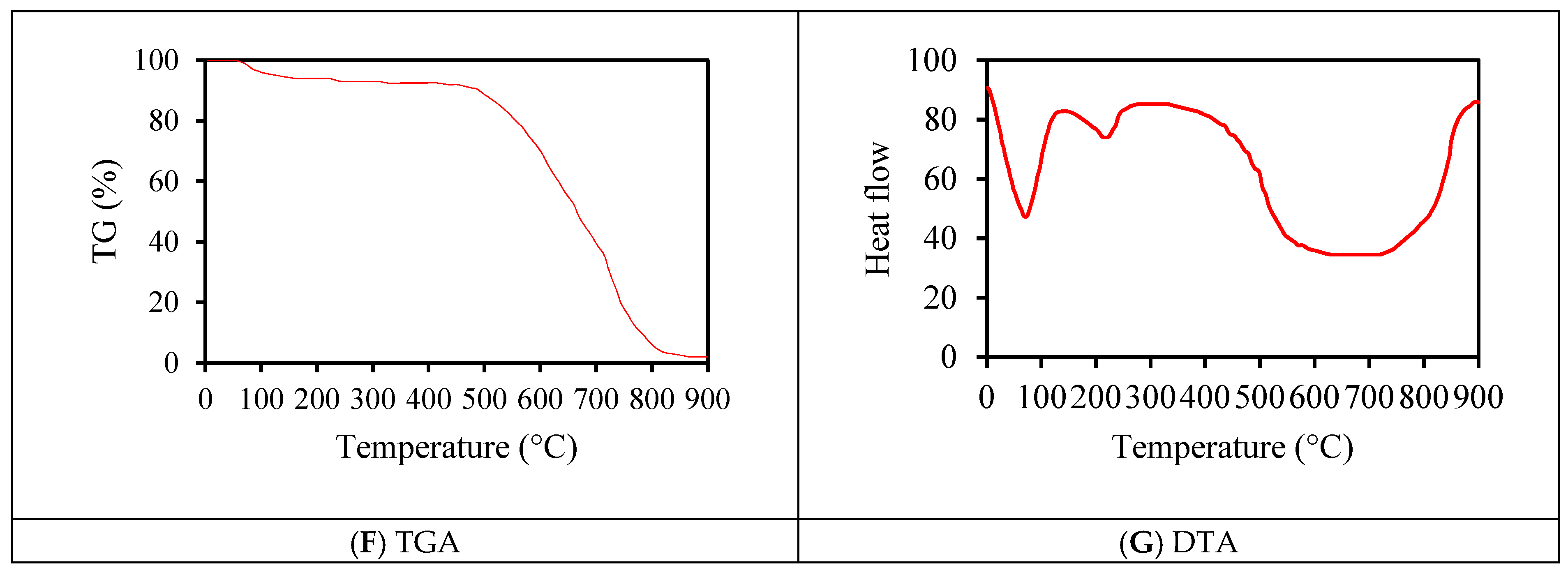
Thermal analysis by thermogravimetry (TG) and differential thermal analysis (DTA) confirmed the high thermal stability of OPNB. The first weight loss observed between 50 °C and 450 °C is associated with the evaporation of water and the volatilization of light organic residues, indicating a low content of residual organic components (Figure 2F). A second weight loss, notable above 450 °C and coupled with a decrease in the DTA curve, signals the progressive degradation of complex carbon structures, characterized by the rupture of stable chemical bonds typical of highly carbonized materials [23,37] (Figure 2G).
The overall results of this physicochemical characterization of OPNB indicate a high potential for adsorption applications, attributable to its structural, chemical and thermal properties. A well-developed porous architecture, with mesopores, ensures optimized accessibility to active sites, which is essential for efficient retention of different adsorbates. Its high carbon composition offers a natural affinity for organic compounds with specific properties, while the oxygenated functional groups present promote interactions with polar adsorbates, thus enhancing the versatility of application. Moreover, the high thermal stability provides a strategic advantage for industrial environments where temperature variations are frequent, ensuring sustainable adsorption efficiency under demanding conditions. Furthermore, the active surface, rich in hydroxyl and carbonyl groups, allows specific interactions with adsorbed molecules, increasing the adsorption efficiency for a wide variety of compounds.

3.2. Adsorption of Simple Phenols by Nanobiochar

As part of the adsorption study, batch experiments were carried out on samples of effluents from olive oil mills (OMEs), with an initial concentration of total phenols set at 21.5 g/L. These effluents contain specific phenolic compounds: A: Catechol, B: Tyrosol, C: Hydroxytyrosol and D: Homovanillyl alcohol, at respective initial concentrations of 258.6 mg/L, 190.2 mg/L, 375.2 mg/L and 20.1 mg/L, respectively. The experimental conditions were set according to previous studies, including pH 10, nanobiochar (OPNB) loading ranging from 0.5 to 2 g/L, and temperature stabilized at 298 K.
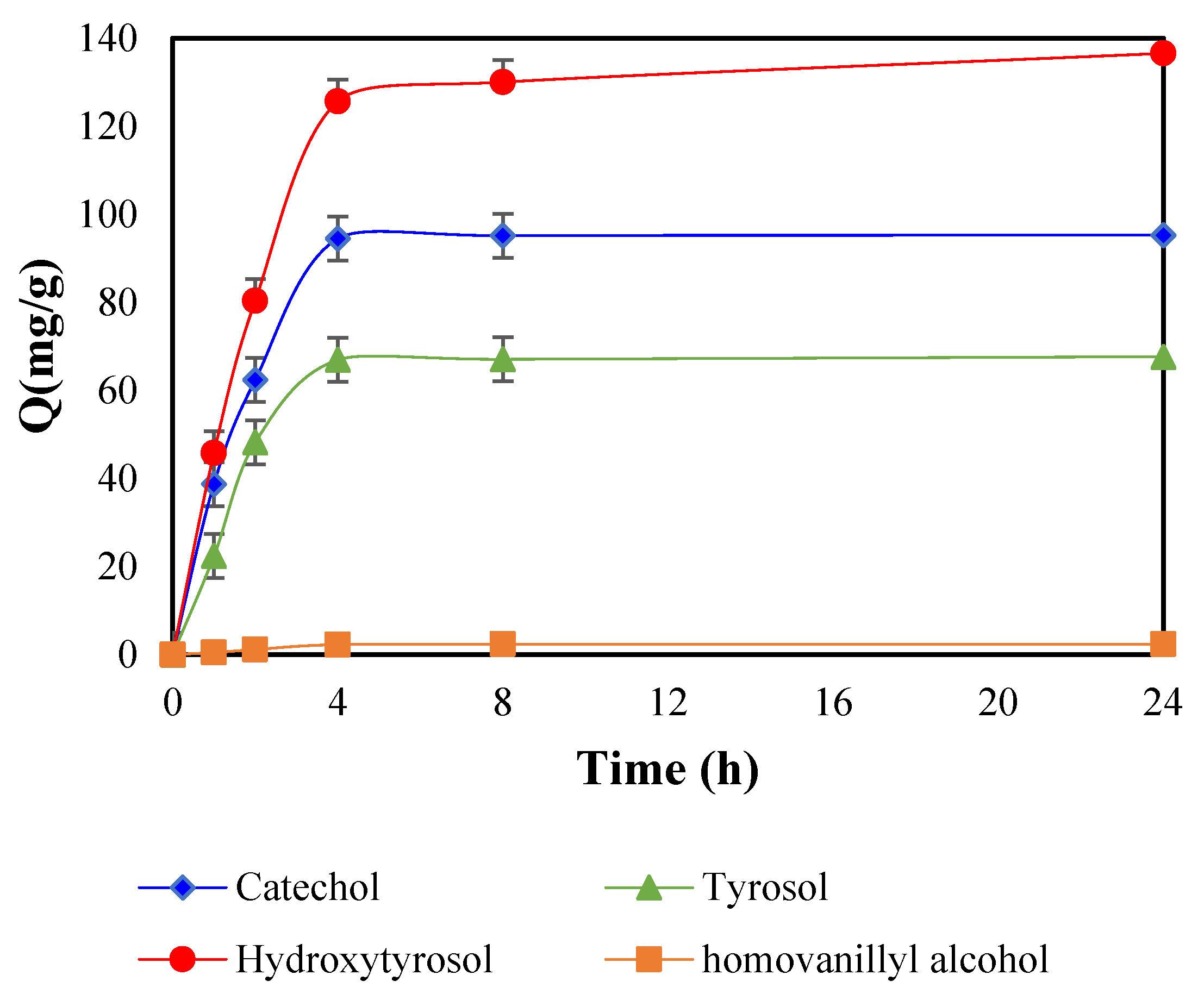
The adsorption kinetic profiles for each phenolic compound, shown in Figure 3, revealed that catechol reached a maximum adsorption of 95.3 mg/L with equilibrium reached in 4 h. Tyrosol showed an adsorption of 67.7 mg/L with rapid saturation, while hydroxytyrosol reached a higher value of 136.6 mg/L, reflecting a higher affinity for the adsorbent. In contrast, homovanillyl alcohol showed less adsorption, reaching only 2.4 mg/L, with early equilibrium.
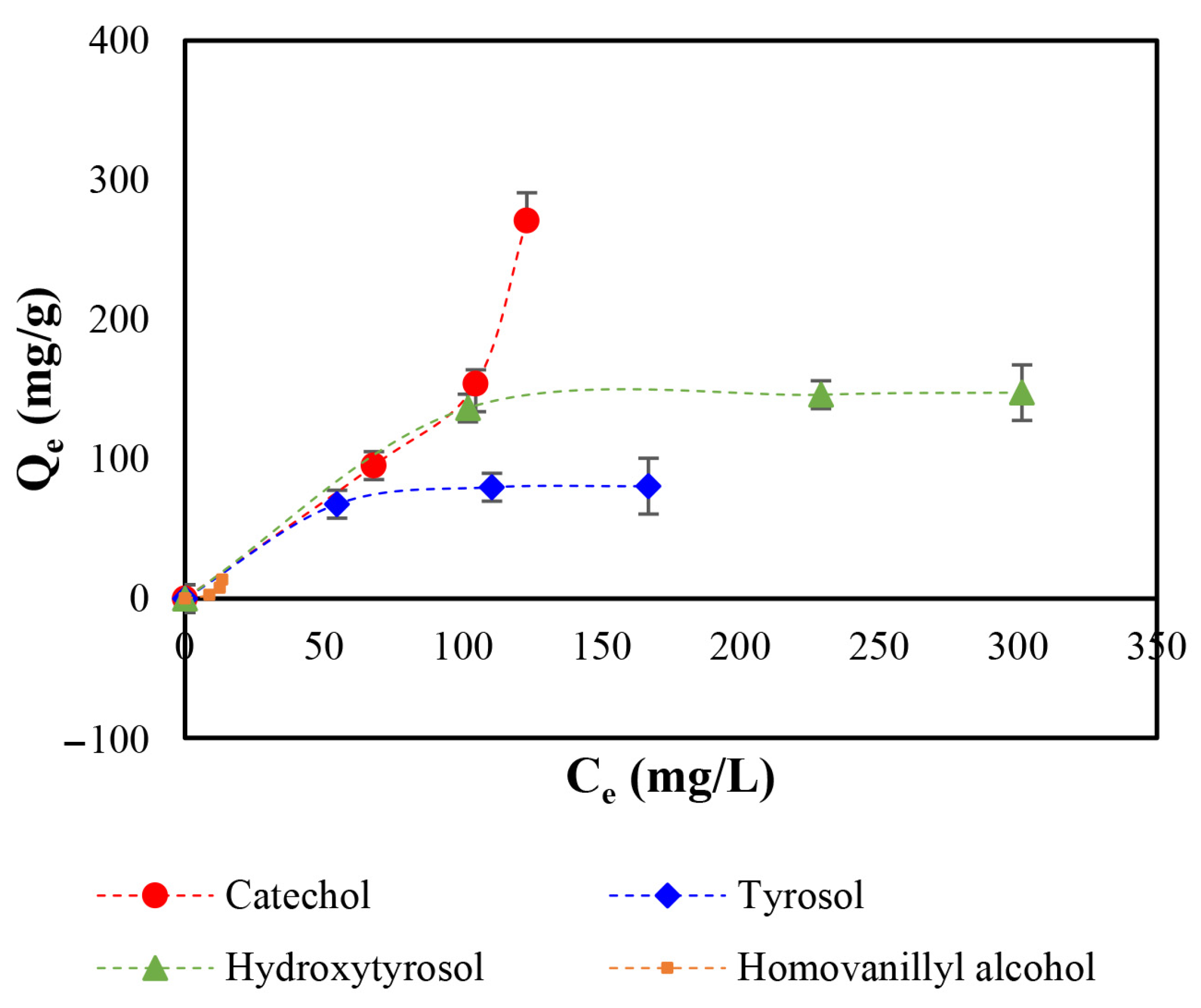
Examination of the adsorption isotherms, illustrated in Figure 4, has shown that nanobiochar OPNB has the highest catechol adsorption capacity, approaching 300 mg/g at high equilibrium concentrations, indicating a high affinity for the adsorbent. Hydroxytyrosol showed an intermediate adsorption of 150 mg/g with a saturation plateau. Tyrosol, with an adsorption capacity of 100 mg/g, indicates a more limited interaction with the support. Finally, homovanillyl alcohol, with a maximum adsorption below 20 mg/g, revealed a marginal affinity.
These results allow us to conclude that each phenolic compound has distinct adsorption kinetics, influenced by its molecular structure. The affinity of the adsorbent also varies according to the characteristics of the molecules, with catechol and hydroxytyrosol showing higher adsorption capacities compared to tyrosol and homovanillyl alcohol.
Table 3 presents the kinetic and isothermal modeling parameters for the adsorption of simple phenols (A: catechol, B: tyrosol, C: hydroxytyrosol, D: homovanillyl alcohol) by nanobiochar (OPNB), using the pseudo-first- and pseudo-second-order models for kinetics, as well as the Freundlich and Langmuir models for adsorption isotherms.
For adsorption kinetics, the experimental data were fitted to the pseudo-first- and pseudo-second-order models. In the pseudo-first-order model, correlation coefficients R2 ranging from 0.81 to 0.94 were obtained, revealing a variable fit depending on the type of phenol. The highest kinetic constant k1P was observed for catechol (0.924 min−1), while the equilibrium adsorption capacity qe,1P reached 108.31 mg/g for catechol and 115.24 mg/g for hydroxytyrosol, indicating significant adsorption. With the pseudo-second-order model, higher R2 values (between 0.91 and 0.99) were obtained, indicating a better fit. Hydroxytyrosol showed the highest equilibrium capacity (qe,2P = 200 mg/g), suggesting an increased affinity for the adsorbent.
For adsorption isotherms, the Freundlich and Langmuir models were applied. The Freundlich model, with R2 values of 0.90–0.98, showed good fit, particularly for hydroxytyrosol (R2 = 0.98), whose high nF parameter (13.231) indicated a high affinity, suggesting adsorption on a heterogeneous surface. The Langmuir model also provided a satisfactory fit, with R2 values between 0.95 and 0.99, and allowed to determine a maximum adsorption capacity qm,L of 250 mg/g for catechol, which represents a high theoretical adsorption.
The KL values for the Langmuir model of compounds catechol, tyrosol, and hydroxytyrosol are low, while for homovanillyl alcohol a significantly higher affinity is observed. This difference can be attributed to the presence of a methoxy group in the structure of homovanillyl alcohol, which alters its interactions with the active sites of the nanobiochar, compared to the other molecules.
Completing these results, it was found that the adsorption kinetics mainly follow the pseudo-second-order model, while the adsorption isotherms are better described by the Langmuir model, indicating monolayer adsorption on a homogeneous surface for simple phenolic compounds.

3.3. Computational Analysis

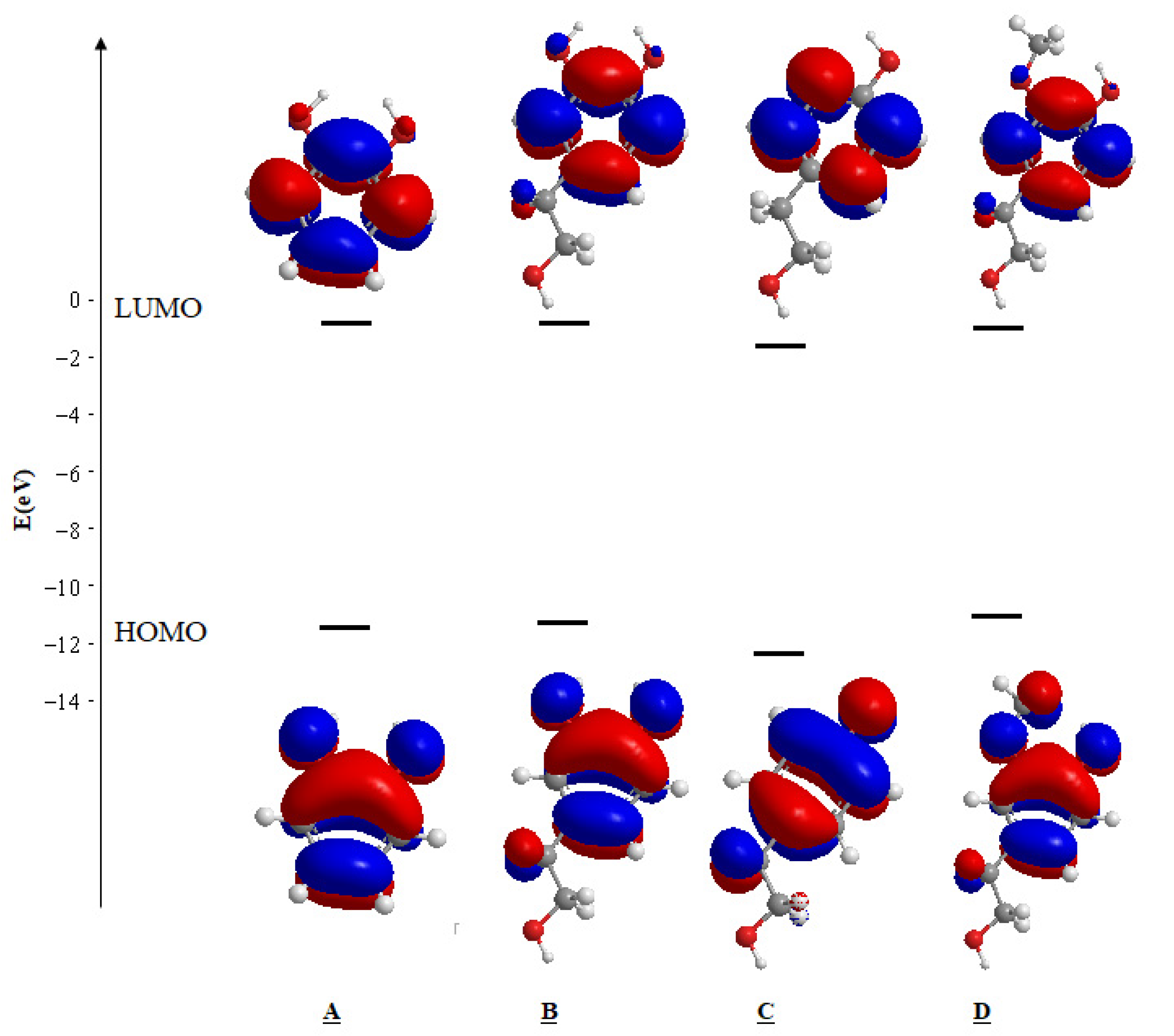
A computational analysis, exploiting advanced chemoinformatics tools, was integrated to examine the interactions between adsorbed simple phenols and nanobiochar as adsorbate. This approach is based on both molecular descriptors of the phenolic compounds and parameters derived from kinetic models and adsorption isotherms. All calculated parameters were optimized using the Merck Molecular Force Field 94 (MMFF94) program, as shown in Table 4, while Figure 5 presents the energy level diagrams of the phenolic molecular orbitals.
A first correlation analysis was performed between the key computational chemistry variables and the adsorption parameters, taking each pair of variables individually. Table 5 summarizes the calculated correlation coefficients. It is found that EGAP and η (molecular hardness) exhibit a perfect correlation (1.000), confirming their interdependence and joint influence. Adsorption parameters also show moderate to high correlations with some energy descriptors, suggesting a direct influence of chemical reactivity on adsorption efficiency.
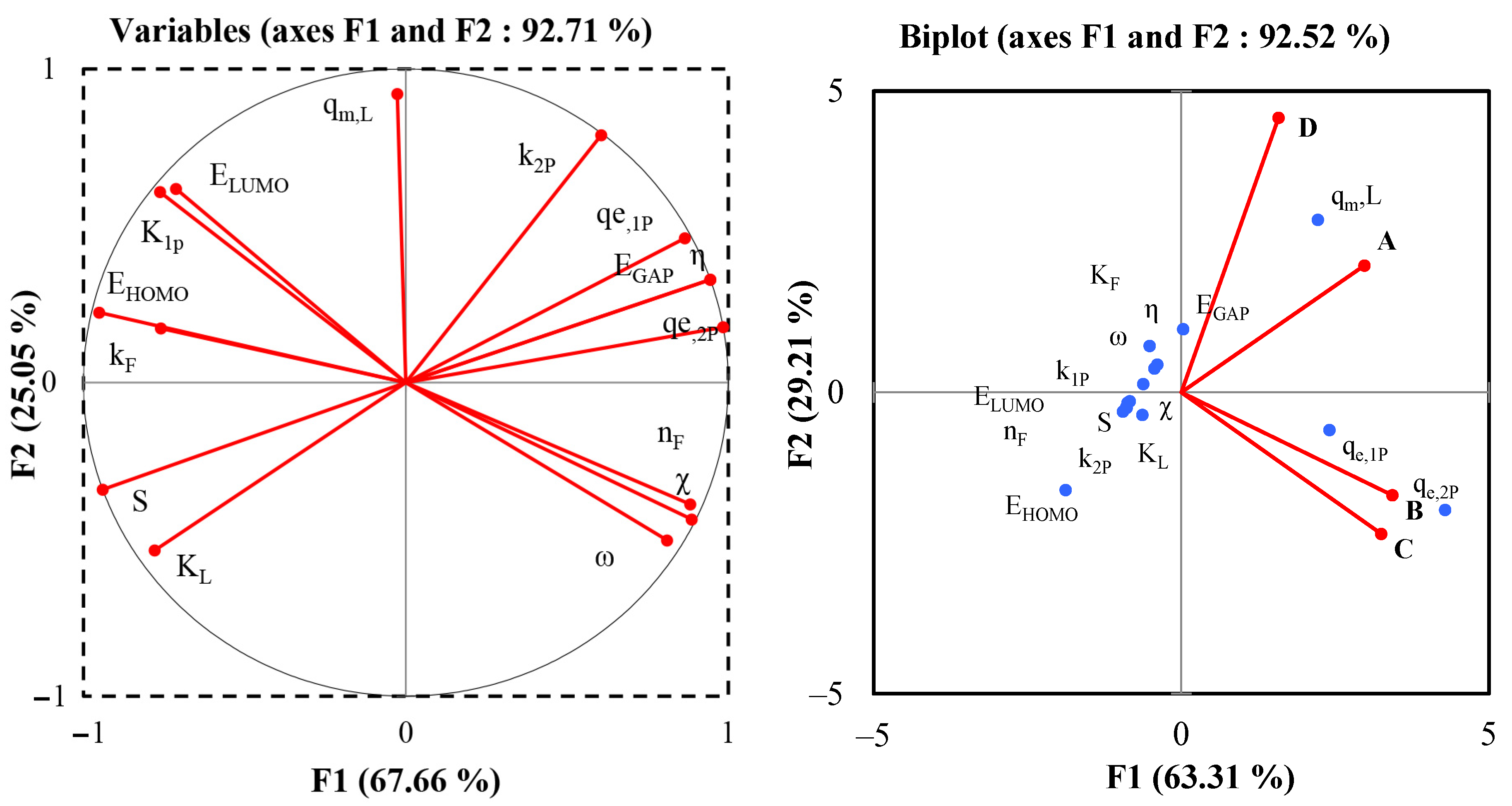
In a second correlation step, a principal component analysis (PCA) was conducted on all parameters, as illustrated by the correlation circle and the biplot (axes F1 and F2 representing 92.71% and 92.52% of the variance, respectively), in Figure 6. The major results of this approach, using the Langmuir isotherm model, indicate that the first Langmuir parameter, KL, is positively correlated with S and EHOMO and inversely correlated with η. In contrast, the second Langmuir parameter, qm,L, does not show any significant correlation with the molecular descriptors, suggesting that qm,L is potentially influenced by other factors not represented in this model.
Following the previous correlations, a multiple regression was implemented using the Elastic Net Regression (ENR) model to further explore the influence of molecular descriptors on Langmuir adsorption. The adsorption parameter Y: KL was thus modeled as a function of three main variables: X1: EHOMO; X2: η; and X3: S. Table 6 summarizes the set of input data used for this multiple regression. The results show that the Elastic Net regression provides an accurate modeling of KL, depending mainly on EHOMO and η. The obtained equation indicates a slight decrease in KL as a function of the increase in EHOMO, while an increase in η leads to a more significant decrease in KL. This reveals that molecular reactivity and hardness play a major role in the adsorption capacity. The descriptor S (molecular softness) was excluded from the final equation, indicating that it has no significant impact on KL in this context. The Elastic Net model optimizes the selection of variables by keeping only those having a major contribution to explain KL. The regularization parameter, λ (0.00034), is small, thus favoring a minimization of errors while integrating the determining variables. With a mixture parameter α = 0.5, which strikes a balance between Ridge and Lasso regularization techniques, the model manages to enhance the prediction accuracy while reducing the complexity. The regression performance indicators show high accuracy (Table 7): a Mean Square Error (MSE) of 0.003 and a Root Mean Square Error (RMSE) of 0.053 reveal that the predictions are closely aligned with the observed values. The coefficient of determination R2 confirms that 95% of the variability of KL is explained by EHOMO and η. These results suggest that the Elastic Net model is not only accurate but also robust in predicting the adsorption capacity based on EHOMO and η descriptors.

3.4. Adsorption Mechanism

The adsorption of simple phenols onto nanobiochar is regulated by coupled kinetic and thermodynamic interactions, the sum of which determines the removal efficiency. This process involves surface reactions (self-regulated or surface controlled), monolayer adsorption behavior, and electronic considerations that affect the affinity of the adsorbate for the adsorbent. Molecular descriptors, combined with kinetic modeling and equilibrium analysis, allow for a comprehensive interpretation of the adsorption process.
Kinetic behavior: The kinetics of phenol adsorption are also described by a pseudo-second-order model, indicating that chemisorption dominates physical adsorption [38]. This model postulates that the adsorption rate is determined by the presence of active sites on the surface and by the concentration of phenolic molecules in solution. Therefore, the adsorption process follows a multi-step mechanism, characterized by the progressive development of specific interactions between the nitrogen functional groups and those of the nanobiochar, on the one hand, and the phenolic structures, on the other. These phenomena are most likely due to hydrogen bonding and the π-3 stacking of the aromatic rings of the phenols with the graphitic domains of the nanobiochar [39]. During adsorption, the surface sites are saturated until a dynamic equilibrium is reached, indicating the balance between adsorption and desorption.
After the establishment of surface contact, the equilibrium data agree with the Langmuir isotherm model, which postulates monolayer adsorption on sites of uniform energy [40]. This model is considered correct when each adsorption site can only accommodate a single phenol molecule and no adsorbent-adsorbent interaction occurs. Under these conditions, the phenol concentration contributes to the adsorption rate until surface saturation. The maximum adsorption capacity corresponds to the plateau of the Langmuir curve and thus allows for the identification of the nanobiochar’s retention potential and an approximate estimation of the amount of phenol remaining in the treated effluents [41]. This behavior indicates that adsorption is spatially confined and governed by a finite number of active sites.
Furthermore, the Langmuir constant (KL) provides a more complete understanding of the adsorption affinity and surface energetics. A relatively low KL value means that phenolic molecules exhibit a moderate affinity for the nanobiochar, indicating that adsorption is less favorable at low solute concentrations [42]. However, beyond initial adsorption, stabilizing forces, including van der Waals forces and other non-covalent interactions, contribute to maintaining the adsorbed state. The KL value determines the mode of equilibrium attainment as phenol concentration increases, as well as the level of surface saturation [43]. Therefore, KL is used as a measure of adsorption strength and equilibrium dynamics.
In addition to surface thermodynamics, molecular electronic properties have a significant impact on adsorption behavior. The energy of the highest occupied molecular orbital (EHOMO) reflects the ability of phenolic molecules to donate electrons. The higher the EHOMO value, the greater the potential for electrotransfer reactions with the electrophilic sites of the nanobiochar [44]. These electron transfers promote chemisorption reactions and strengthen the bond between adsorbates and surfaces. Furthermore, low chemical hardness (η) suggests greater electronic flexibility, which increases the molecule’s ability to adapt to a heterogeneous surface environment [45]. This flexibility facilitates better orbital overlap and stabilization of the adsorption complex. The combination of the EHOMO and η markers establishes a mechanistic link between molecular reactivity and adsorption efficiency, thus explaining the selectivity and efficiency of the nanobiochar in phenol removal.


4. Discussion

Nanobiochar derived from olive pomace shows significant potential as an effective adsorbent for removing simple phenolic compounds from industrial effluents, particularly those from olive oil production. This effect is due to its physicochemical structure, which provides a high specific surface area and a mesoporous structure that enhances adsorbent-adsorbate interactions. The increased accessibility of the surfaces promotes the exposure of active binding sites, while the network of interconnected pores facilitates the mass transfer of phenolic molecules within the nanobiochar [46]. Consequently, the optimal structure is a key factor in adsorption efficiency.
The high specificity of nanobiochar for phenolic contaminants has been demonstrated by experimental adsorption analyses using kinetic and isothermal modeling. The substance exhibits a high level of adsorption for the high concentrations of phenols typically found in olive oil mill effluents. Furthermore, it exhibits selective adsorption behavior towards catechol, tyrosol, hydroxytyrosol, and homovanillic alcohol, meaning that adsorption performance depends on molecular structure [47]. This selectivity implies that nanobiochar can be used not only for wastewater treatment but also for the selective recovery of phenol in the context of industrial process valorization.
The pseudo-second-order model accurately describes the adsorption kinetics and indicates the predominance of chemisorption mechanisms. This model explains that the rate of the adsorption process is determined by the concentration of phenols in the liquid phase as well as by the concentration of active sites on the surface of the nanobiochar. Initially, adsorption is rapid because it occurs through interaction with readily accessible sites on the external surface. These sites are then occupied, and the phenolic molecules diffuse into the internal pores, where further adsorption occurs within the porous network [48]. The overall effect of the surface reaction and diffusion within the particles is described in this chain mechanism.
Equilibrium modeling also explains the adsorption process. Both the Freundlich and Langmuir isotherms have been used, but the Langmuir isotherm offers better linearity, describing monolayer adsorption on energetically homogeneous sites. This behavior suggests that the adsorption energy at the surface of the nanobiochar is uniform, which is consistent with its activated carbon configuration. Phenol retention is ensured by non-covalent forces (van der Waals forces) and electron transfer, and is primarily characterized by interactions between the aromatic rings and the carbon domains. Furthermore, polar and nonpolar functional groups increase molecular affinity and establish a direct correlation between surface chemistry and adsorption capacity [49]. The results show that functional group density and pore distribution play an important role in adsorption.
The experimental results were complemented by molecular modeling, which elucidated the adsorption mechanism. Molecular reactivity and interaction propensity were estimated by calculating electronic descriptors, including the energy of the highest occupied molecular orbital (EHOMO) and chemical hardness (η). High EHOMO values indicate a strong electron-donating capacity, thus facilitating charge-transfer interactions to electrophilic surface sites. Conversely, low e values reflect increased electronic flexibility, promoting the stabilization of adsorption complexes. Quantum chemistry calculations thus establish a mechanistic link between experimentally measured adsorption constants, such as the Langmuir constant KL, and molecular electronic properties. These correlations make it possible to predict optimal adsorption conditions and improve our understanding of adsorption selectivity.
A comparative study reveals that the use of olive pomace for the preparation of nanobiochar can compete with traditional adsorbents such as activated carbon [50], modified clays [51], and composite materials [52,53,54]. Although activated carbon exhibits high adsorption performance, its regeneration can require an energy-intensive thermal or chemical process, thus increasing operating costs and reducing its long-term durability. Furthermore, its surface characteristics are not well-suited to the selective adsorption of phenol. In contrast, nanobiochar produced from biomass offers structural flexibility, functional surface heterogeneity, and reduced production costs. It can regenerate under milder conditions, thus consuming less energy and being economically viable.
These results demonstrate that nanobiochar derived from olive pomace combines structure, efficiency, selectivity, and cost-effectiveness. This material represents a promising alternative for industrial wastewater treatment, combining high adsorption performance with sustainable resource use. Its ability to remove and potentially reuse phenolic compounds supports circular economy strategies in the olive oil industry and addresses the growing need for cost-effective and sustainable pollution control technologies.

5. Conclusions

Olive pomace-derived nanobiochar demonstrates high performance as a bioadsorbent for the removal of simple phenols from olive mill effluents, including catechol, tyrosol, hydroxytyrosol, and homovanillyl alcohol. Its mesoporous architecture and surface enriched with oxygen-containing functional groups enhance molecular interactions and promote efficient adsorption of these bioactive compounds. These structural attributes establish strong affinity between phenolic molecules and the nanobiochar matrix. Comprehensive physicochemical characterisation was conducted using SEM–EDX, XRD, BET surface analysis, and FTIR. These techniques revealed a structurally stable, predominantly amorphous carbon material with developed porosity and active surface functionalities that favour selective adsorption. Kinetic and equilibrium investigations were performed using pseudo-first-order and pseudo-second-order models, as well as Langmuir and Freundlich isotherms. The adsorption behaviour was best described by the pseudo-second-order and Langmuir models, indicating monolayer adsorption on homogeneous sites governed by specific surface interactions, including van der Waals forces and electron transfer mechanisms. Furthermore, molecular simulations and electronic descriptor analyses, particularly EHOMO_{HOMO}HOMO and chemical hardness (η), established that electron-donating capacity and molecular flexibility significantly influence adsorption efficiency. These findings confirm that adsorption performance is controlled by both surface characteristics and molecular electronic properties. Collectively, olive pomace-based nanobiochar represents a cost-effective and environmentally sustainable solution for industrial wastewater treatment. Its application aligns with circular economy principles by converting agro-industrial waste into a functional remediation material. However, optimisation of regeneration and reuse strategies remains necessary to support large-scale implementation. Future research should therefore prioritise the development of efficient recycling protocols to enhance durability and economic viability in continuous treatment systems.

Author Contributions

Conceptualization: R.A., R.I. and T.A.; Data curation: A.A., M.A. and K.O.; Formal analysis: A.A., A.D., A.M. (Ayla Mumcu) and T.A.; Funding acquisition: A.M. (Alexander Mikhalev), R.I. and T.A.; Investigation: A.A. and T.A.; Methodology: R.A., M.A., A.D. and A.M. (Ayla Mumcu); Project administration: R.I.; Resources: R.I. and A.M. (Alexander Mikhalev); Software: R.A., M.A. and A.A.; Supervision: T.A.; Validation: R.I. and T.A.; Visualization: A.A., A.M. (Alexander Mikhalev) and T.A.; Writing—original draft: R.A. and M.A.; Writing—review & editing: A.D., A.M. (Alexander Mikhalev), R.I. and T.A. All authors have read and agreed to the published version of the manuscript.

Funding

This research received no external funding.

Institutional Review Board Statement

Not applicable.

Informed Consent Statement

Not applicable.

Data Availability Statement

Data is contained within the article.

Acknowledgments

Our thanks go to the entire team at the Laboratory of Biotechnology, Bioresources and Bioinformatics of EST-Khenifra. A special thank you to my colleagues for their constant support, their invaluable advice, and the friendly atmosphere they demonstrate daily at University of Sultan Moulay Slimane Morocco.

Conflicts of Interest

The authors declare no conflicts of interest.

References

  1. Safaa, K.R.; Anouzla, A.; Abrouki, Y.; Loukili, H.; Kastali, M.; Souabi, S. Management of Olive Oil Mill Wastewater in Morocco. In Wastewater from Olive Oil Production: Environmental Impacts, Treatment and Valorisation; Springer International Publishing: Cham, Switzerland, 2023; pp. 183–212. [Google Scholar]
  2. Mollo, L.; Drigo, F.; Moglie, M.; Norici, A. Screening for tolerance to natural phenols of different algal species: Toward the phycoremediation of olive mill wastewater. Algal Res. 2023, 75, 103256. [Google Scholar] [CrossRef]
  3. Schmidt, L.; Prestes, O.D.; Augusti, P.R.; Moreira, J.C.F. Phenolic compounds and contaminants in olive oil and pomace—A narrative review of their biological and toxic effects. Food Biosci. 2023, 53, 102626. [Google Scholar] [CrossRef]
  4. Mattioli, L.B.; Corazza, I.; Budriesi, R.; Hrelia, S.; Malaguti, M.; Caliceti, C.; Amoroso, R.; Maccallini, C.; Crupi, P.; Clodoveo, M.L.; et al. From Waste to Health: Olive Mill Wastewater for Cardiovascular Disease Prevention. Nutrients 2024, 16, 2986. [Google Scholar] [CrossRef]
  5. Sar, T.; Akbas, M.Y. Antimicrobial activities of olive oil mill wastewater extracts against selected microorganisms. Sustainability 2023, 15, 8179. [Google Scholar] [CrossRef]
  6. Athanasiadis, V.; Voulgaris, A.; Katsoulis, K.; Lalas, S.I.; Roussis, I.G.; Gortzi, O. Development of enriched oil with polyphenols extracted from olive mill wastewater. Foods 2023, 12, 497. [Google Scholar] [CrossRef]
  7. Muezzinoglu, A. Future trends in olive industry waste management: A literature review. In Wastewater from Olive Oil Production: Environmental Impacts, Treatment and Valorisation; Springler: Cham, Switzerland, 2023; pp. 221–297. [Google Scholar]
  8. Shabir, S.; Ilyas, N.; Saeed, M.; Bibi, F.; Sayyed, R.Z.; Almalki, W.H. Treatment technologies for olive mill wastewater with impacts on plants. Environ. Res. 2023, 216, 114399. [Google Scholar] [CrossRef]
  9. Mazzanti, G.; Demichelis, F.; Fino, D.; Tommasi, T. A closed-loop valorization of the waste biomass through two-stage anaerobic digestion and digestate exploitation. Renew. Sustain. Energy Rev. 2025, 207, 114938. [Google Scholar] [CrossRef]
  10. Abu-Dalo, M.; Abdelnabi, J.; Al-Rawashdeh, N.A.; Albiss, B.; Al Bawab, A. Coupling coagulation-flocculation to volcanic tuff-magnetite nanoparticles adsorption for olive mill wastewater treatment. Environ. Nanotechnol. Monit. Manag. 2022, 17, 100626. [Google Scholar] [CrossRef]
  11. Agabo-García, C.; Repetto, G.; Albqmi, M.; Hodaifa, G. Evaluation of the olive mill wastewater treatment based on advanced oxidation processes (AOPs), flocculation, and filtration. J. Environ. Chem. Eng. 2023, 11, 109789. [Google Scholar] [CrossRef]
  12. Boutafda, A.; Hafidi, M.; Ouhdouch, Y.; Pinelli, E.; Jemo, M.; El Fels, L. Fungal strain as biological tool to remove genotoxicity effect of phenolic compounds from olive mill wastewater. Sustainability 2023, 15, 6510. [Google Scholar] [CrossRef]
  13. Hachicha, R.; Elleuch, J.; Dubessay, P.; Hachicha, R.; Abdelkafi, S.; Michaud, P.; Fendri, I. Integrated processes for olive mill wastewater treatment and its revalorization for microalgae culture. Int. Microbiol. 2024, 28, 1071–1085. [Google Scholar] [CrossRef]
  14. Hernández-Fernández, A.; Garrido, Y.; Iniesta-López, E.; Pérez de los Ríos, A.; Quesada-Medina, J.; Hernández-Fernández, F.J. Recovering Polyphenols in Aqueous Solutions from Olive Mill Wastewater and Olive Leaf for Biological Applications. Processes 2023, 11, 2668. [Google Scholar] [CrossRef]
  15. Tapia-Quirós, P.; Granados, M.; Sentellas, S.; Saurina, J. Microwave-assisted extraction with natural deep eutectic solvents for polyphenol recovery from agrifood waste: Mature for scaling-up? Sci. Total Environ. 2023, 912, 168716. [Google Scholar] [CrossRef]
  16. Sánchez-Arévalo, C.M.; Croes, T.; Van der Bruggen, B.; Vincent-Vela, M.C.; Álvarez-Blanco, S. Feasibility of several commercial membranes to recover valuable phenolic compounds from extracts of wet olive pomace through organic-solvent nanofiltration. Sep. Purif. Technol. 2023, 305, 122396. [Google Scholar]
  17. Nicodemou, A.; Kallis, M.; Koutinas, M. Biorefinery development for the production of polyphenols, algal biomass and lipids using olive processing industry waste. Sustain. Chem. Pharm. 2023, 32, 100998. [Google Scholar] [CrossRef]
  18. Ochando-Pulido, J.M.; Vuppala, S.; García-López, A.I.; Martínez-Férez, A. A focus on anaerobic digestion and co-digestion strategies for energy recovery and digestate valorization from olive-oil mill solid and liquid by-products. Sep. Purif. Technol. 2023, 333, 125827. [Google Scholar] [CrossRef]
  19. Sylla, A.S.; Ihammi, A.; Kirm, I.; Boussetta, A.; Benali, K.; Ainane, T.; Chigr, M. Utilization of olive mill solid waste-based activated carbon for the effective elimination of phenolic compounds in olive-mill wastewater: A study on optimization, kinetics, and isotherms. Chem. Pap. 2026, 1–19. [Google Scholar]
  20. Ainane, T.; Abdoul-Latif, F.M.-L.; Ainane, A.; Kornaros, M.; Rania, A.B.B.I.; Achira, M.; Brule, M. Optimization by design of experiments of the preparation of biochar from olive pomace and its physicochemical characterizations. J. Anal. Sci. Appl. Biotechnol. 2023, 5, 1–10. [Google Scholar]
  21. Boussaoudi, I.; El Mtili, N.; Lamarti, A.; Cherroud, S.; Ainane, A.; Ainane, T. Antimicrobial and antioxidant activities of bay laurel (Laurus nobilis L.) essential oil from the region of Khenifra (Morocco). J. Anal. Sci. Appl. Biotechnol. 2023, 5, 116–124. [Google Scholar]
  22. Carrara, M.; Kelly, M.T.; Munier, S.; Paradis, C.; Belmiloudi, S.; Margout-Jantac, D. Validation of Simple UPLC-MS-UV and HPLC-Fluorescence Methods for the Determination of Oleacein in Olive Mill Wastewater. Application in the Analysis of Oleacein in French Cultivars. ACS Food Sci. Technol. 2024, 4, 578–585. [Google Scholar]
  23. Mohamed Abdoul-Latif, F.; Ainane, A.; Hachi, T.; Abbi, R.; Achira, M.; Abourriche, A.; Brulé, M.; Ainane, T. Materials derived from olive pomace as effective bioadsorbents for the process of removing total phenols from oil mill effluents. Molecules 2023, 28, 4310. [Google Scholar] [CrossRef]
  24. Khammour, F.; Abdoul-Latif, F.M.; Ainane, A.; Mohamed, J.; Ainane, T. Eco-Friendly Adsorbent from Waste of Mint: Application for the Removal of Hexavalent Chromium. J. Chem. 2021, 1, 8848964. [Google Scholar] [CrossRef]
  25. Stylianakis, I.; Zervos, N.; Lii, J.H.; Pantazis, D.A.; Kolocouris, A. Conformational energies of reference organic molecules: Benchmarking of common efficient computational methods against coupled cluster theory. J. Comput. Aided Mol. Des. 2023, 37, 607–656. [Google Scholar] [CrossRef]
  26. Mohamed Abdoul-Latif, F.; Ainane, A.; Merito, A.; Houmed Aboubaker, I.; Mohamed, H.; Cherroud, S.; Ainane, T. The Effects of khat chewing among djiboutians: Dental chemical studies, Gingival histopathological analyses and bioinformatics approaches. Bioengineering 2024, 11, 716. [Google Scholar] [CrossRef] [PubMed]
  27. Mohamed Abdoul-Latif, F.; Ainane, A.; Achenani, L.; Merito Ali, A.; Mohamed, H.; Ali, A.; Jutur, P.P.; Ainane, T. Production of fucoxanthin from microalgae ısochrysis galbana of djibouti: Optimization, correlation with antioxidant potential, and bioinformatics approaches. Mar. Drugs 2024, 22, 358. [Google Scholar] [CrossRef]
  28. Ainane, A.; Abdoul-Latif, F.M.; Achenani, L.; Ali, A.M.; Mohamed, H.; Arra, A.A.; Cacciatore, S.; Ainane, T. Antioxidant potential of Tisochrysis lutea through urea-based nanonutrient enrichment: Experimental modeling and computational approach. Nanotechnol. Percept. 2024, 20, 309–322. [Google Scholar]
  29. Zournatzidou, G.; Mallidis, I.; Farazakis, D.; Floros, C. Enhancing bitcoin price volatility estimator predictions: A four- step methodological approach utilizing elastic net regression. Mathematics 2024, 12, 1392. [Google Scholar] [CrossRef]
  30. Mahmoud, M.E.; El-Ghanam, A.M.; Saad, S.R. Sequential removal of chromium (VI) and prednisolone by nanobiochar-enriched-diamine derivative. Biomass Convers. Biorefin. 2024, 14, 7011–7030. [Google Scholar] [CrossRef]
  31. Antanasković, A.; Lopičić, Z.; Šoštarić, T.; Adamović, V.; Cvetković, S.; Perendija, J.; Milivojević, M. Toxic dye removal by thermally modified lignocellulosic waste in a three-phase air-lift reactor: Kinetic insights: Original scientific paper. Hem. Ind. Chem. Ind. 2024, 78, 241–252. [Google Scholar] [CrossRef]
  32. Chen, X.; Li, H.; Liu, W.; Meng, Z.; Wu, Z.; Wang, G.; Liang, Y.; Bi, S. Low-temperature constructing N-doped graphite-like mesoporous structure biochar from furfural residue with urea for removal of chlortetracycline from wastewater and hydrothermal catalytic degradation mechanism. Colloids Surf. A Physicochem. Eng. Asp. 2020, 600, 124873. [Google Scholar] [CrossRef]
  33. Zhang, C.; Zhang, Z.; Zhang, L.; Li, Q.; Li, C.; Chen, G.; Zhang, S.; Liu, Q.; Hu, X. Evolution of the functionalities and structures of biochar in pyrolysis of poplar in a wide temperature range. Bioresour. Technol. 2020, 304, 123002. [Google Scholar] [CrossRef]
  34. Nair, R.R.; Mondal, M.M.; Weichgrebe, D. Biochar from co-pyrolysis of urban organic wastes—Investigation of carbon sink potential using ATR-FTIR and TGA. Biomass Convers. Biorefin. 2020, 12, 4729–4743. [Google Scholar]
  35. Janu, R.; Mrlik, V.; Ribitsch, D.; Hofman, J.; Sedláček, P.; Bielská, L.; Soja, G. Biochar surface functional groups as affected by biomass feedstock, biochar composition and pyrolysis temperature. Carbon Resour. Convers. 2021, 4, 36–46. [Google Scholar] [CrossRef]
  36. Li, B.; Liu, D.; Lin, D.; Xie, X.; Wang, S.; Xu, H.; Wang, J.; Huang, Y.; Zhang, S.; Hu, X. Changes in biochar functional groups and its reactivity after volatile–char interactions during biomass pyrolysis. Energy Fuels 2020, 34, 14291–14299. [Google Scholar] [CrossRef]
  37. Balmuk, G.; Cay, H.; Duman, G.; Kantarli, I.C.; Yanik, J. Hydrothermal carbonization of olive oil industry waste into solid fuel: Fuel characteristics and combustion performance. Energy 2023, 278, 127803. [Google Scholar] [CrossRef]
  38. Li, N.; Liu, Y.; Du, C.; Wang, Y.; Wang, L.; Li, X. A novel role of various hydrogen bonds in adsorption, desorption and co-adsorption of PPCPs on corn straw-derived biochars. Sci. Total Environ. 2023, 861, 160623. [Google Scholar] [PubMed]
  39. Cao, S.; Zhu, R.; Wu, D.; Su, H.; Liu, Z.; Chen, Z. How hydrogen bonding and π–π interactions synergistically facilitate mephedrone adsorption by bio-sorbent: An in-depth microscopic scale interpretation. Environ. Pollut. 2024, 342, 123044. [Google Scholar] [CrossRef]
  40. Shao, C.; Fan, F.; Dai, Y. Lead ions removal from water by tartaric acid modified biochar materials: Equilibrium, kinetic studies and mechanism. Desalin. Water Treat. 2024, 320, 100601. [Google Scholar] [CrossRef]
  41. Devrajani, S.K.; Ahmed, Z.; Qambrani, N.A.; Kanwal, S.; Sundaram, U.M.; Mubarak, N.M. Mechanism of arsenic removal using brown seaweed derived impregnated with iron oxide biochar for batch and column studies. Sci. Rep. 2024, 14, 18102. [Google Scholar] [CrossRef] [PubMed]
  42. Solomakou, N.; Drosaki, A.; Zamvrakidis, G.; Goula, A.M. Adsorption of phenolic compounds from olive mill wastewaters on spent coffee grounds: Isotherms, kinetics, and pure phenol adsorption. Biomass Convers. Biorefin. 2023, 13, 16557–16567. [Google Scholar]
  43. Jain, M.; Sahoo, A.; Mishra, D.; Khan, S.A.; Pant, K.K.; Ziora, Z.M.; Blaskovich, M.A. Modelling and statistical interpretation of phenol adsorption behaviour of 3-Dimensional hybrid aerogel of waste-derived carbon nanotubes and graphene oxide. Chem. Eng. J. 2024, 490, 151351. [Google Scholar] [CrossRef]
  44. Prabhu, C.; Rajesh, P.; Lawrence, M.; Sahaya Jude Dhas, S.; Almansour, A.I. Computational aspects of DFT, HOMO-LUMO, PED, molecular docking and basic characterisations of Octadec-9-Enoic Acid (C18H34O2). Mol. Phys. 2025, 123, e2385572. [Google Scholar] [CrossRef]
  45. Mou, C.; Ali, F.; Malaviya, A.; Bettinger, C.J. Electrochemical-mediated gelation of catechol-bearing hydrogels based on multimodal crosslinking. J. Mater. Chem. B 2019, 7, 1690–1696. [Google Scholar] [CrossRef]
  46. Xia, C.; Liang, Y.; Li, X.; Al Garalleh, H.; Garaleh, M.; Hill, J.M.; Pugazhendhi, A. Remediation competence of nanoparticles amalgamated biochar (nanobiochar/nanocomposite) on pollutants: A review. Environ. Res. 2023, 218, 114947. [Google Scholar] [CrossRef] [PubMed]
  47. Simos, Y.V.; Zerikiotis, S.; Lekkas, P.; Zachariou, C.; Halabalaki, M.; Ververidis, F.; Trantas, E.A.; Tsamis, K.; Peschos, D.; Angelidis, C.; et al. Hydroxytyrosol produced by engineered Escherichia coli strains activates Nrf2/HO-1 pathway: An in vitro and in vivo study. Exp. Biol. Med. 2023, 248, 1598–1612. [Google Scholar] [CrossRef] [PubMed]
  48. Rehman, S.U.; Hassan, M.H.; Batool, S.Y.; Aqib, H.M.; Babar, Z.B. Potential Role of Nano-Biochar, Nano-Cellulose, and Other Nanomaterials in Microbial Fuel Cell. In Nanomaterials in Biomass Conversion; Woodhead Publishing: Cambridge, UK, 2024; pp. 215–233. [Google Scholar]
  49. Kannan, P.; Firnass, M.M.R.A.; Ponmani, S.; Veni, D.K.; Swaminathan, C. Nano-Biochar: A soil Conditioner for Sustainable Soil Health. In Nanomaterials and Nano-Biochar in Reducing Soil Stress; Apple Academic Press: Cambridge, MA, USA, 2025; pp. 43–69. [Google Scholar]
  50. García-Pérez, P.; Losada-Barreiro, S.; Gallego, P.P.; Bravo-Díaz, C. Adsorption of gallic acid, propyl gallate and polyphenols from Bryophyllum extracts on activated carbon. Sci. Rep. 2019, 9, 14830. [Google Scholar] [CrossRef] [PubMed]
  51. El Abbadi, S.; El Moustansiri, H.; Douma, M.; Bouazizi, A.; Arfoy, B.; Calvo, J.I.; Tijani, N. Enhancing the performance of alumina-pillared clay for phenol removal from water solutions and polyphenol removal from olive mill wastewater: Characterization, kinetics, adsorption performance, and mechanism. J. Water Process Eng. 2024, 63, 105432. [Google Scholar] [CrossRef]
  52. Siemińska-Kuczer, A.; Szymańska-Chargot, M.; Zdunek, A. Recent advances in interactions between polyphenols and plant cell wall polysaccharides as studied using an adsorption technique. Food Chem. 2022, 373, 131487. [Google Scholar] [CrossRef]
  53. Wang, C.; Wei, M.; Zhu, H.; Wang, L.; Ni, S.; Li, X.; Gao, D. Development of porous materials via protein/polysaccharides/polyphenols nanoparticles stabilized Pickering high internal phase emulsions for adsorption of Pb2+ and Cu2+ ions. Food Chem. 2024, 445, 138796. [Google Scholar] [CrossRef]
  54. Benković, M.; Laljak, I.; Valinger, D.; Jurina, T.; Sokač Cvetnić, T.; Gajdoš Kljusurić, J.; Jurinjak Tušek, A. Comparison of the adsorption and desorption dynamics of biological molecules on alginate hydrogel microcapsules—The case of sugars, polyphenols, and proteins. Gels 2024, 10, 201. [Google Scholar] [CrossRef]
Figure 1. Main simple phenols present in OME.
Biomass 06 00030 g001
Figure 2. Physicochemical characterization of nanobiochar OPNB. (A) SEM: Scanning electron microscopy. (B) Elementary analysis by EDX. (C) X-ray diffraction. (D) BET analysis. (E) Fourier-transform infrared. (F) Thermogravimetric analysis. (G) Differential thermal analysis.
Biomass 06 00030 g002aBiomass 06 00030 g002b
Figure 3. Adsorption kinetics of simple phenols by OPNB (pH: 10; W: 2 g/L; T: 298 K).
Biomass 06 00030 g003
Figure 4. Adsorption isotherms of simple phenols by OPNB (pH: 10; W: 0.5–2 g/L; T: 298 K).
Biomass 06 00030 g004
Figure 5. Energy level diagrams of phenolic molecular orbitals (HOMO and LUMO).
Biomass 06 00030 g005
Figure 6. Correlations between adsorption parameters and molecular descriptors according to PCA.
Biomass 06 00030 g006
Table 1. Kinetic and isotherm adsorption models.
SorptionModelEquation
KineticPseudo-first order q t = q e , 1 P ( 1 e k 1 p . t ) (2)
Pseudo-second order q t = k 2 p . q e , 2 P 2 . t 1 + k 2 p . q e , 2 P . t (3)
IsothermFreundlich q e = K F . C e n (4)
Langmuir q e = q m , L . K L . C e 1 + K L . C e (5)
Table 2. Energetic descriptors.
DescriptorsSymbolEquation
Energy gapEGAP E L U M O E H O M O (6)
Chemical hardnessη ( E L U M O E H O M O ) / 2 (7)
Electronegativityχ ( E L U M O + E H O M O ) / 2 (8)
Electrophilicity indexω χ 2 / 2 η (9)
Molecular flexibilityS 1 / 2 η (10)
Table 3. Kinetic and isotherm parameters for simple phenols adsorption by OPNB.
SorptionModelParametersABCD
KineticPseudo-first-orderLinear expressiony = −0.924x + 4.685y = −0.654x + 3.988y = −0.401x + 4.747y = −0.817x + 1.279
R20.940.810.900.91
k1P (min−1)0.9240.6540.4010.817
qe,1P (mg·g−1)108.3153.95115.243.59
Pseudo-second-orderLinear expressiony = 0.017x + 0.008y = 0.032x + 0.010y = 0.016x + 0.005y = 102.240x − 0.680
R20.960.910.970.99
k2P (min−1)0.4710.3130.3130.007
qe,2P (mg·g−1)125.00100.00200.001.47
IsothermFreundlichLinear expressiony = 0.560x + 1.727y = 5.502x − 19.20y = 13.231x − 60.445y = 0.251x + 1.978
R20.910.900.980.96
KF (L/g)5.624~0~07.228
nF0.5605.50213.2310.251
LangmuirLinear expressiony = 0.990x + 0.004y = 4.751x − 0.052y = 11.690x − 0.076y = 0.114x + 0.065
R20.950.960.990.99
KL0.0040.0110.0070.570
qm,L (mg·g−1)250.0019.2313.1615.38
Table 4. Molecular descriptors of phenolic compounds.
CompoundsABCD
ELUMO−0.346−0.359−1.140−0.529
EHOMO−11.372−11.239−12.335−11.008
EGAP11.02610.88011.19510.479
η5.5135.4405.5975.239
χ5.8595.7996.7375.768
ω3.1133.0904.0543.175
S0.0910.0920.0890.095
Table 5. Correlation Matrix of adsorption parameters with molecular descriptors.
VariablesELUMOEHOMOEGAPηχωSk1pqe,1Pk2Pqe,2PKFnFKLqm,L
ELUMO1
EHOMO0.8871
EGAP−0.472−0.8261
η−0.472−0.8261.0001
χ−0.957−0.9830.7070.7071
ω−0.988−0.9470.6020.6020.9901
S0.4570.816−1.000−1.000−0.694−0.5881
k1p0.8450.812−0.519−0.519−0.848−0.8570.5111
qe,1P−0.398−0.7620.9700.9700.6370.529−0.969−0.3361
k2P0.089−0.3780.8310.8310.2010.064−0.840−0.0040.8681
qe,2P−0.596−0.8990.9880.9880.8030.712−0.985−0.6400.9360.7351
KF0.4400.625−0.657−0.657−0.568−0.5140.6600.824−0.454−0.386−0.7091
nF−0.851−0.9080.6940.6940.9110.893−0.686−0.9750.5370.2080.794−0.8441
KL0.1160.550−0.909−0.909−0.391−0.2630.9170.341−0.856−0.927−0.8570.705−0.5071
qm,L0.4590.1470.2790.279−0.276−0.368−0.2860.6670.4780.6720.1420.424−0.484−0.3441
Table 6. Input data for multiple regression.
CompoundsABCD
Y: KL 0.0040.0110.0070.570
X1: EHOMO−11.372−11.239−12.335−11.008
X2: η5.5135.445.59755.2395
X3: S0.0910.0920.0890.095
Table 7. Correlations between adsorption parameters and molecular descriptors according to Elastic Net regression.
Equation Y ^ = 10.670 − (0.278 × X1) − (2.518 × X2)
λ0.00034
α0.5
MSE0.003
RMSE0.053
R20.95
Disclaimer/Publisher’s Note: The statements, opinions and data contained in all publications are solely those of the individual author(s) and contributor(s) and not of MDPI and/or the editor(s). MDPI and/or the editor(s) disclaim responsibility for any injury to people or property resulting from any ideas, methods, instructions or products referred to in the content.