


Abstract
Cellulases catalyze the hydrolysis of cellulose and can be produced through fermentation processes, such as sequential fermentation (SeqF), which combines submerged and solid-state fermentation. The objective of this study was to evaluate the production of cellulases (endoglucanase and β-glycosidase) by fungi of the genus Aspergillus using coffee husks as substrate. Three Aspergillus strains were evaluated, with A. japonicus URM5620 showing the highest endoglucanase (0.368 U mL−1) and β-glucosidase (0.652 U mL−1) activities by SeqF. Based on the complete factorial design 22, a 9-fold and 3-fold increase in the production of endoglucanase (3.44 U mL−1) and β-glucosidase (2.12 U mL−1), respectively, was observed. Both enzymes showed maximum activity at 60 °C and pH 5.0. The kinetic/thermodynamic parameters indicated a high affinity of the enzymes for their respective substrates and a high catalytic potential. In addition, the half-life and decimal reduction values demonstrate the good thermal stability of endoglucanase (t1/2 = 8.82 ± 0.34 and D = 29.32 ± 1.13 h) and β-glucosidase (t1/2 = 26.61 ± 0.74 and D = 88.38 ± 2.47 h) at 60 °C. The thermostability results indicate potential for use in the pretreatment of raw materials.
1. Introduction
Cellulases hold significant relevance in the global enzyme market. Along with other lignocellulolytic enzymes, they contributed approximately 20% of the USD 7.9 billion generated in 2024 [1]. The high relevance of cellulases stems from their multiple potential applications across processes in the food and feed industries, agriculture, paper production, textiles, laundry, and other sectors [2]. These enzymes hydrolyze cellulose and are classified based on their catalytic activity and substrate specificity. Thus, endoglucanase (E. C. 3.2.1.4) acts randomly to break down cellulose, while exoglucanase (E. C. 3.2.1.91) breaks the bonds at the reducing and non-reducing ends of the chain, while β-glucosidase (E. C. 3.2.1.21) hydrolyzes the products resulting from the action of the other two enzymes [3].
Cellulolytic enzymes can be obtained from various microorganisms, including bacteria and mesophilic and thermophilic microbes, but fungi are the primary producers [3]. Filamentous fungi of the genus Aspergillus are widely studied and used in industry due to their high capacity to secrete cellulases [4]. Cellulases are commonly produced by solid-state fermentation (SSF) and submerged fermentation (SmF). SSF is a process that requires low water content and is less susceptible to microbial contamination, whereas SmF requires a larger volume of medium and better process control. However, these processes have disadvantages, including increased scale and operating costs. As a result, more efficient and economical methods have been sought [5].
In this context, Cunha et al. [6] proposed a method for producing cellulases, called sequential fermentation (SeqF). This technique combines the initial cultivation of the fungus in a solid-state medium, followed by a submerged stage. This fermentation process has been shown to be a promising method for producing cellulolytic enzymes, as it combines the advantages of SSF and SmF and achieves higher yields [6].
Initially, SeqF was developed to use sugarcane bagasse as substrate; this method can be adapted to use different lignocellulosic substrates such as poplar wood, corncobs, cottonseed hulls [7], soybean bran, wheat bran [8], and coffee husks. In this context, coffee husk is the primary residue produced during the dry processing of coffee cherries [9]. It is composed of phenolic and antioxidant compounds, lipids, protein, minerals, cellulose, hemicellulose and lignin [10]. This composition allows the husk to be used to obtain different value-added products, such as in mushroom cultivation [11], extraction of biomolecules [12], production of bioethanol [13], preparation of biosorbents [14], and production of enzymes [15].
After cellulase production, it is essential to conduct biochemical characterization of the optimal pH and temperature for operation, as well as to study the kinetic and thermodynamic parameters of both the reaction and thermal inactivation. This evaluation provides relevant information on catalytic performance, applicability, and enzyme thermostability under specific operational conditions [16]. Thermodynamic data on cellulolytic enzymes are still scarce and typically focus on individual enzymes rather than the entire enzymatic complex.
Based on this background, the aim of this study was to produce the cellulolytic enzymes endoglucanase and β-glucosidase from different Aspergillus species by SSF and SeqF, using coffee husks as the substrate, as well as biochemically characterizing and determining the kinetic and thermodynamic parameters of the hydrolysis of carboxymethyl cellulose (CMC) and cellobiose, and the thermal denaturation of both enzymes.
2. Materials and Methods
2.1. Microorganisms and Fermentation Substrate
Three fungal strains belonging to the Aspergillus genus were used, kindly provided by the “Micoteca URM” belonging to the Biosciences Centre of the Federal University of Pernambuco (UFPE). Microorganisms A. japonicus URM5620, A. tamarii URM4634, and A. terreus URM4658 were preserved in Czapek Dox Agar medium and mineral oil, subsequently reactivated in glucose broth, and then transferred to Czapek Dox Agar medium for a 7-day cultivation at 30 °C in a bacteriological oven.
The coffee husks used as a substrate for the fermentation processes were supplied by the producer of Sítio Florentina (Latitude: 7°94′63.4″ S and Longitude: 36°05′05.9″ W), located in Taquaritinga do Norte—PE, from Arabica typica coffee obtained through organic management and processed by dry processing. The husks were dried in an oven with air circulation at 65 °C for 24 h, ground in a conventional grinder, and standardized to particle sizes of 0.5 and 2.0 mm.
2.2. Substrate Characterization
The composition of dried coffee husks was determined in terms of protein, lipid, moisture and ash content according to the methods described by the Adolfo Lutz Institute [17], with adaptations, and the carbohydrate content by the difference between the total mass and that of the other components as reported by de Castro, Nishide and Sato [18]. The water absorption index (WAI) and the critical humidity point (CHP) were determined according to Flores-Maltos et al. [19], with modifications. To determine the WAI, 1.25 g of coffee husk was added to 15.0 mL of distilled water in Falcon tubes (50 mL); the suspension was homogenized in a vortex for 1 min at room temperature (25 °C) and centrifuged at 8000× g for 15 min, discarding the supernatant and weighing the centrifuged sediment. CHP was determined by soaking 1.0 g of coffee husks in distilled water until saturation, placing them in an oven at 120 °C for 60 min, and then assessing the residual moisture content. All analyses were performed in triplicate.
2.3. Cellulase Production by Solid-State Fermentation
The SSF process was carried out in 125 mL Erlenmeyer flasks containing 5 g of coffee husks. Fermentation was carried out for 96 h at 30 °C with an initial moisture of 50%, achieved by adding a nutrient solution (1.0% glucose and 0.5% yeast extract) and the spore suspension (107 spores g−1 coffee husk). The volumes of each solution were calculated according to Equation (1) for the fermentations with each fungal strain, with the total liquid volume defined from the predefined initial moisture. The crude cellulase extract was obtained by adding 7.5 mL of 0.1 M citrate buffer (pH 5.0) per gram of fermented material and homogenizing the mixture on an orbital shaker at 120 rpm for 90 min. The solids were removed by centrifugation at 5000 rpm for 10 min at 4 °C, and the enzymatic extract was stored at −22 °C for later analysis.
where VT represents the total liquid volume, calculated based on the substrate water absorption capacity and the predefined initial moisture content; VNS corresponds to the volume of nutrient solution; and VSS is the volume of spore suspension, calculated according to the spore concentration determined by counting in a Neubauer chamber.
2.4. Cellulase Production by Sequential Fermentation
The SeqF process was carried out in two stages, the first corresponding to cultivation in solid medium for 24 h under the same conditions as the SSF procedure, then nutrient medium adapted according to Cunha et al. [6] was added (20 mL g−1 of coffee husks), and submerged cultivation was carried out for 72 h under agitation (150 rpm). The fermentation was carried out in 250 mL Erlenmeyer flasks containing 5 g of coffee husks, a nutrient solution (1.0% glucose and 0.5% yeast extract), and the spore suspension (107 spores g−1 of substrate), so that the initial moisture was 50%. Finally, at the end of fermentation, the medium was filtered under vacuum, and the crude extract was stored at −22 °C for subsequent analysis.
2.5. Evaluation of the Correlation Between Coffee Husk Composition and Cellulase Production by SSF and SeqF
The results obtained for endoglucanase and β-glucosidase production by SSF and SeqF were subjected to Pearson’s correlation analysis to measure the strength of the linear dependence between the chemical components of coffee husks (protein, carbohydrates, lipid, and ash) and cellulolytic enzyme production. The correlation coefficient ranges from −1 to 1, where a value of −1 indicates a perfect negative correlation, a value of 0 implies no correlation, and a value of 1 indicates a perfect positive correlation. Correlations were considered statistically significant when p ≤ 0.05. The mentioned statistical analysis was performed using software R version 4.1.1 [20] and RStudio version 2024.04.2+764 [21].
2.6. Evaluation of the Influence of SeqF Conditions on Cellulase Production
After the definition of SeqF as the most suitable fermentative process for cellulase production, a 22-full factorial design with three central points was used to evaluate the influence of the independent variables, volume of liquid medium per gram of substrate (15, 20, and 25 mL g−1) and glucose concentration (30, 40 and 50 g L−1) on the cellulolytic activities (endoglucanase and β-glucosidase), determined according to Section 2.7. Statistical analysis of the experimental design was performed using Statistica 7.0 (StatSoft Inc., Tulsa, OK, USA).
2.7. Analytical Determinations
The hydrolytic activity of endoglucanase was determined according to the method proposed by Ghose [22], with adaptations as described: 0.5 mL of the enzyme extract was incubated with 0.5 mL of carboxymethylcellulose (CMC) (2.0%) diluted in citrate buffer pH 4.8 (0.05 M) for 30 min at 50 °C. The reaction was stopped in an ice bath, and the reducing sugars (RS) released were determined by the Miller method [23] with 3.5 dinitrosalicylic acid (DNS) and glucose as the standard. One unit of endoglucanase is defined as the amount of enzyme needed to release 1 µmol of reducing sugars per minute.
The activity of β-glucosidase was determined according to the method proposed by Ghose [22], with adaptations. A 0.5 mL volume of the enzyme extract was incubated with 0.5 mL of cellobiose (15 mM) in citrate buffer (0.05 M, pH 4.8) for 30 min at 50 °C. The reaction was stopped in an ice bath, and the glucose released in the reaction was determined using a glucose oxidase kit (In Vitro Diagnóstica, Itabira, MG, Brazil). One unit of β-glucosidase is defined as the amount of enzyme needed to release 1 µmol of glucose per minute under the proposed reaction conditions.
2.8. Biochemical Characterization of Cellulases
The effect of pH on cellulolytic activities (endoglucanase and β-glucosidase) was evaluated by adding the enzyme extract with the corresponding substrates, prepared in 0.05 M buffer solutions with different pH values: citrate (pH 3.0–5.0), citrate-phosphate (pH 5.0–7.0) and Tris-HCl (8.0–9.0). The reaction temperature was kept constant at 50 °C for 30 min, for determination of the enzyme activity, while the effect of temperature on endoglucanase and β-glucosidase activities was determined by adding the enzyme extract with the respective substrates, prepared as described in Section 2.7, for 30 min at different temperatures: 30, 40, 50, 60, 70, 80 °C. Thermal stability was assessed by pre-incubating the enzyme at 60 and 75 °C for up to 180 min, with samples collected every 60 min to measure enzyme activity.
The effect of metal ions on cellulolytic activities was evaluated by incubating the enzyme extract in different ionic solutions at 10 mM: CuSO4·5H2O, FeSO4·7H2O, MgSO4·7H2O, ZnSO4·7H2O, CaCl2, HgCl2·4H2O, KCl, NaCl, BaCl2·2H2O for 30 min at room temperature (25 °C). Aliquots of the mixture were added to the specific substrates. All analyses of cellulase characterization were performed in triplicate.
The data were submitted to analysis of variance (ANOVA), considering the difference statistically significant when p < 0.05; the means were compared by Tukey’s test at the 5% probability level. The mentioned statistical analysis was performed using software R version 4.1.1 [20] and RStudio version 2024.04.2+764 [21].
2.9. Determining the Kinetic and Thermodynamic Parameters of Hydrolysis Reactions
The apparent kinetic parameters, Michaelis–Menten constant (Km) and maximum rate (Vmax) of the CMC and cellobiose hydrolysis reactions were evaluated by determining the corresponding enzymatic activity using different concentrations of substrate (CMC: 4.0; 6.0; 8.0; 10.0; 15.0; 20.0; 25.0 and 30.0 mg mL−1; cellobiose: 2.0; 4.0; 8.0; 10.0; 15.0; 20.0 and 30.0 mM) and calculated using the Lineweaver–Burk model.
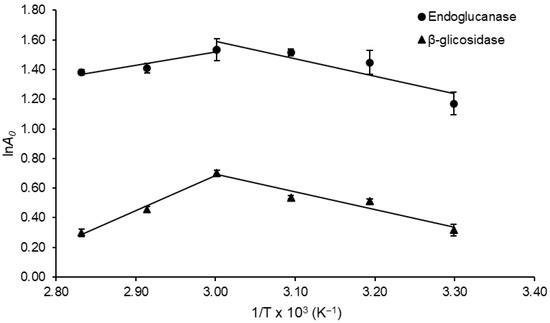
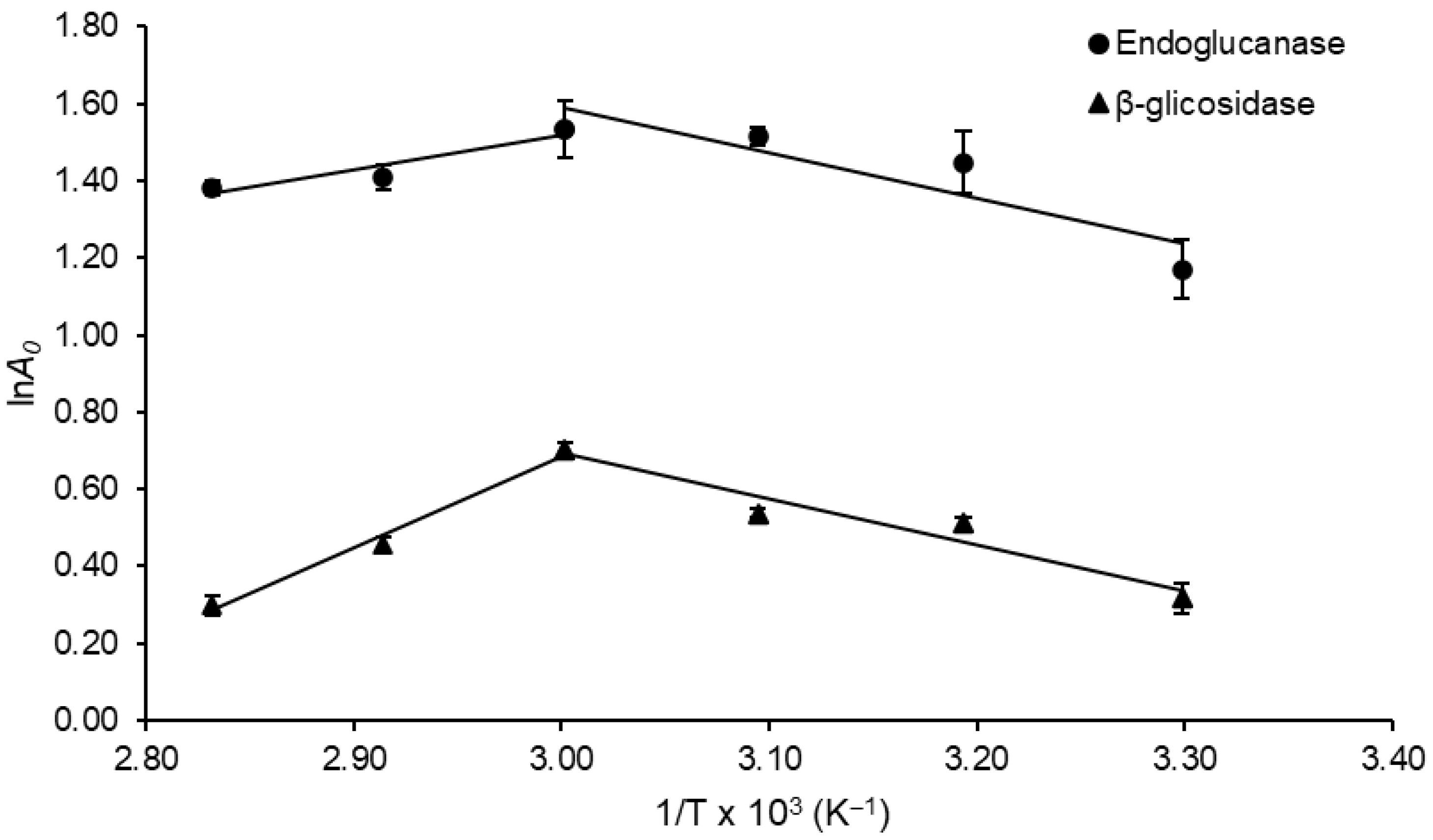
The activation energy (E*a) of the reactions was estimated from the slopes of the right straight line, obtained by plotting an Arrhenius plot of ln A0 versus 1/T at 30 to 60 °C, where A0 is the initial activity, and T is the absolute temperature. The activation enthalpy (ΔH*) was calculated by Equation (2) as follows:
where R is the gas constant (8.314 J K−1 mol−1)
The effect of temperature on the hydrolysis rates of carboxymethyl cellulose (CMC) and cellobiose was determined using the temperature quotient (Q10). This parameter indicates the increase in enzyme activity due to an increase in temperature of 10 °C, and was calculated according to Equation (3) proposed by Dixon and Webb [24]:
All analyses to determine the kinetic and thermodynamic parameters of the hydrolysis reactions of CMC and cellobiose were performed in triplicate.
2.10. Determination of the Kinetic and Thermodynamic Parameters of Thermal Denaturation
Enzyme thermal inactivation is usually defined as the reversible unfolding of the native form, yielding a less stable intermediate, which then undergoes irreversible denaturation to an inactivated form. Thus, the process of irreversible thermal inactivation is characterized as a first-order reaction (Equation (4)):
where, vd is the rate of enzyme inactivation, kd is the first-order thermal denaturation constant, and E is the concentration of the active form of the enzyme.
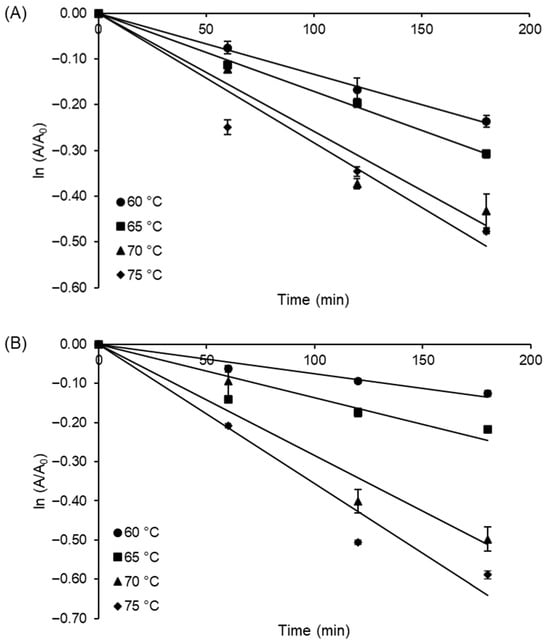
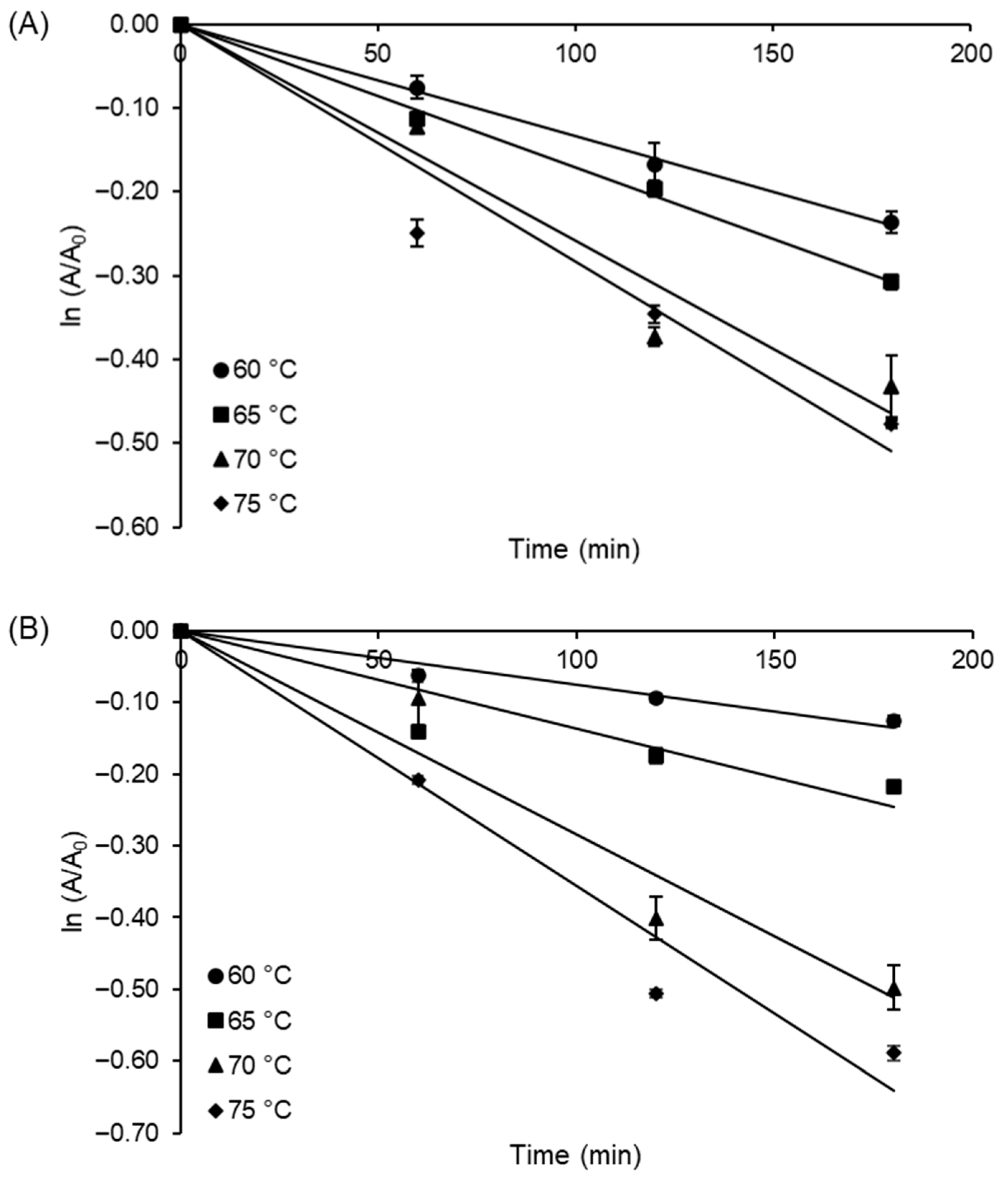
The activity coefficient is defined as the ratio of E to the enzyme concentration at the start of the heat treatment (A/A0), and kd can be estimated at different temperatures from the slopes of lines obtained by plotting ln(A/A0) versus time. The first-order thermal denaturation constant depends on temperature according to the Arrhenius adapted equation:
where a is the pre-exponential factor, E*d is the activation energy of the irreversible inactivation of the enzyme, R is the universal gas constant (8.314 J mol−1 K−1), and T is the absolute temperature.
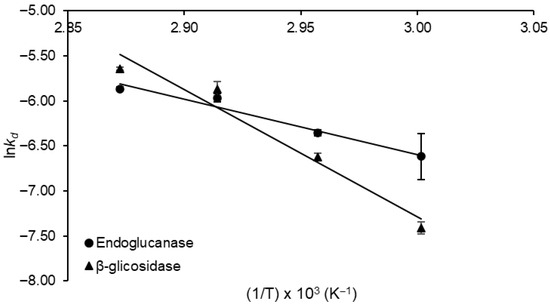
The energy of the irreversible inactivation of the cellulases was determined by the slope of the line obtained by plotting lnkd versus 1/T according to the linearized form of Equation (6). The other thermodynamic denaturation parameters, enthalpy (ΔH*d), Gibbs free energy (ΔG*d), and entropy (ΔS*d), were calculated in the temperature range of 60 to 75 °C, from Equations (6)–(8), as follows:
where h (6.626 × 10⁻⁴ J s−1) is the Planck constant and kb (1.381 × 10⁻²³ J K−1) is the Boltzmann constant.
The half-life of the enzyme (t1/2) is defined by the time after which the activity of the enzyme is reduced to half of the initial activity and is calculated using Equation (9):
The decimal reduction time (D-value) is the exposure time required for the enzyme at a given temperature to maintain 10% residual activity and can be determined using Equation (10). The D-value is often accompanied by the thermal resistance constant (Z), which corresponds to the temperature rise required to reduce the D-value by one logarithmic cycle, and was calculated from the slope of the straight line obtained by plotting log D versus T, according to the linearized form of the Bigelow model.
All analyses to determine the kinetic and thermodynamic parameters of endoglucanase and β-glucosidase denaturation were performed in triplicate.
3. Results and Discussion
3.1. Cellulase Production by SSF and SeqF
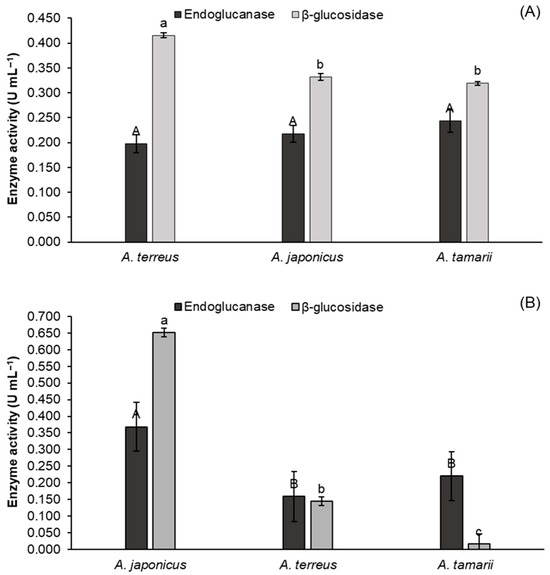
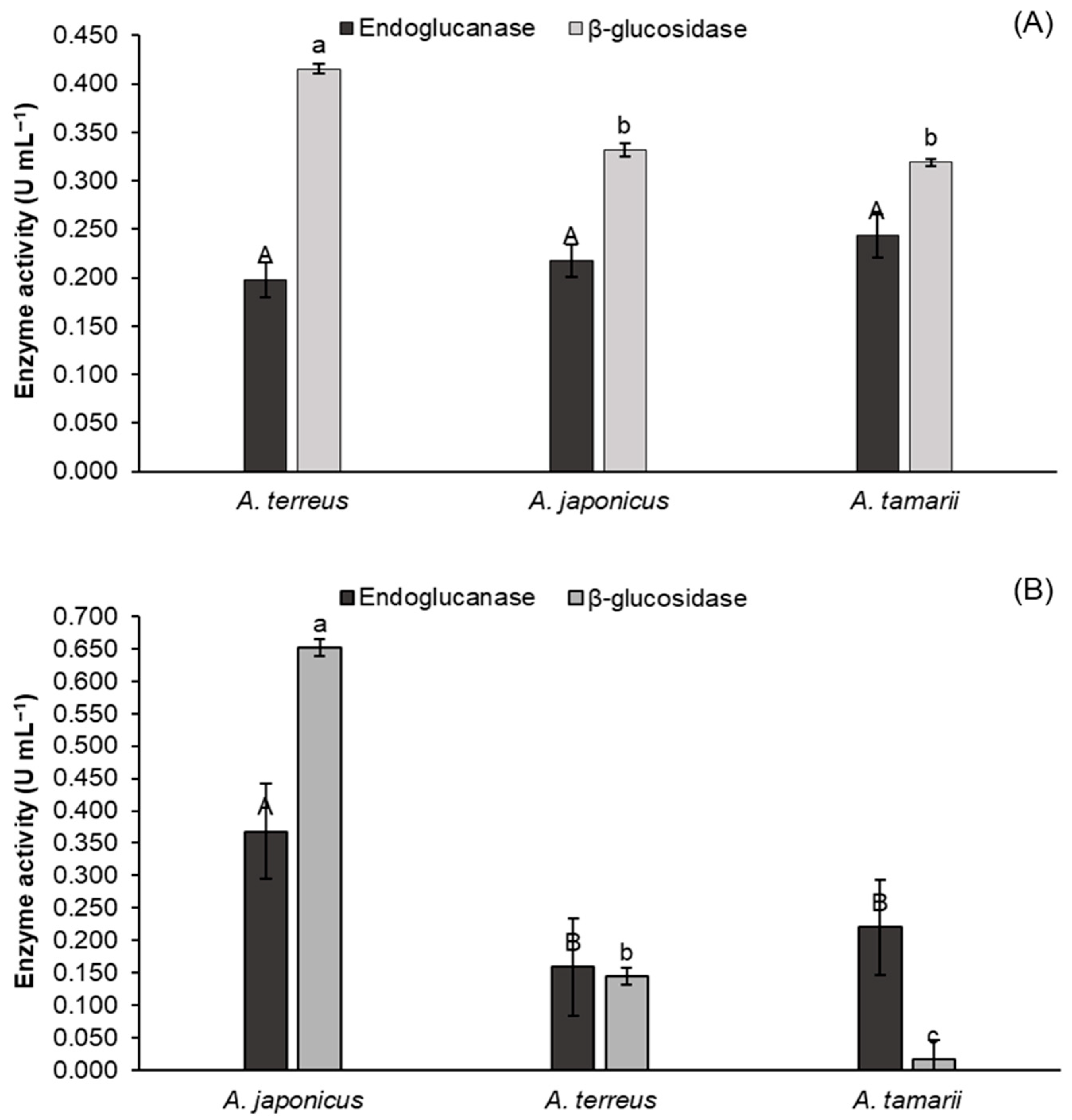
The cellulase production using coffee husks (Arabica typica) as substrate was evaluated by SSF and sequential fermentation (SeqF) as shown in Figure 1A,B, respectively. Three fungal strains from the genus Aspergillus were used in both fermentations. In the SSF process, the A. terreus URM4658, A. japonicus URM5620, and A. tamarii URM4634 presented a production between 0.198 and 0.243 U mL−1 and 0.332 and 0.415 U mL−1 for endoglucanase and β-glucosidase, respectively. Comparing with the results obtained for SeqF, it was verified that A. terreus URM4658 and A. tamarii URM4634 showed a decrease in the production of endoglucanase (0.159 and 0.220 U mL−1) and β-glucosidase (0.145 and 0.017 U mL−1), while for A. japonicus URM5620, there was an improvement in production (0.368 and 0.652 U mL−1) when compared to SSF, indicating better absorption of the coffee husk.
Figure 1.
Endoglucanase and β-glucosidase production by different fungal strains of the genus Aspergillus under solid-state (A,B) sequential fermentation conducted at 30 °C for 96 h using coffee husks as the substrate. Different letters indicate statistically significant differences among treatments for endoglucanase (A, B) and β-glucosidase (a–c), according to Tukey’s test (p < 0.05).
The higher results observed in SeqF compared with a conventional fermentative process (SSF) for cellulolytic enzymes in A. japonicus URM5620 corroborate the positive trend observed for cellulolytic enzyme production [25] and to produce other enzymes, such as proteases [26] and β-fructofuranosidases [27]. A possible explanation for the increase in enzyme production is associated with the development of a more dispersed filamentous morphology in SeqF, facilitating the interaction between fungal cells and the substrate [6].
3.2. Physicochemical Characterization of Coffee Husks
The results obtained for moisture content (9.24%) and water activity (0.54) (Table 1) indicate a lower susceptibility to microbial deterioration. In terms of ash content (5.51%), lipids (13.72%), protein (5.48%), and carbohydrates (67.48%) (Table 1), the presence of minerals helps in cell maintenance and drives biosynthesis reactions [28], while proteins and carbohydrates can be assimilable sources of nitrogen and carbon [18].
Table 1.
Proximal composition and physicochemical characteristics of Coffea arabica (Typica) husks used as the substrate for cellulase production.
The coffee husk showed higher values for WAI and lower values for CHP (Table 1) compared to what was reported for other agro-industrial waste that can be used as a substrate for enzyme production, such as walnut shells (1.77 g g−1 of dry walnut shell; 46.09%), chestnut shells (3.10 g g−1 dry chestnut shell; 45.08%) and almond shells (1.51 g g−1 dry almond shell; 49.40%) [29]. It is known that low CHP values are preferable for fermentation processes that rely on the cultivation of the microorganism in a solid state, since high values of this parameter interfere with the development of the microorganism [30], so coffee husks (Arabica typica) are a viable substrate to be used in solid-state and sequential fermentation.
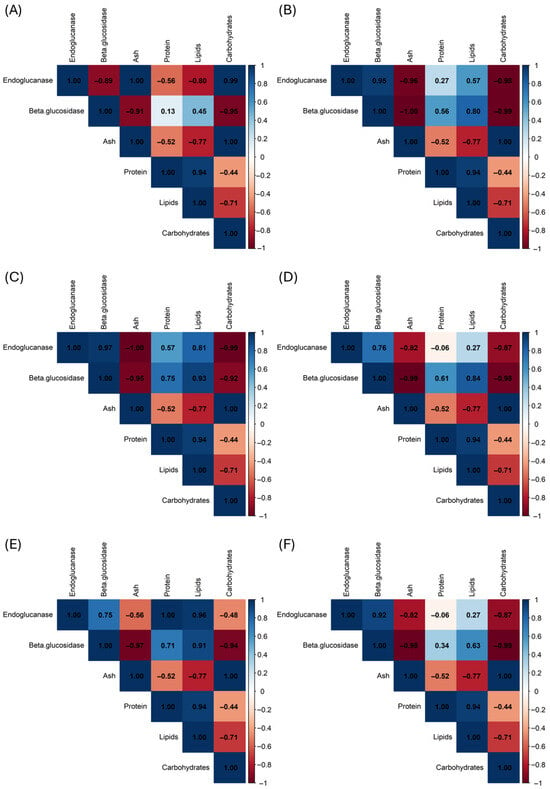
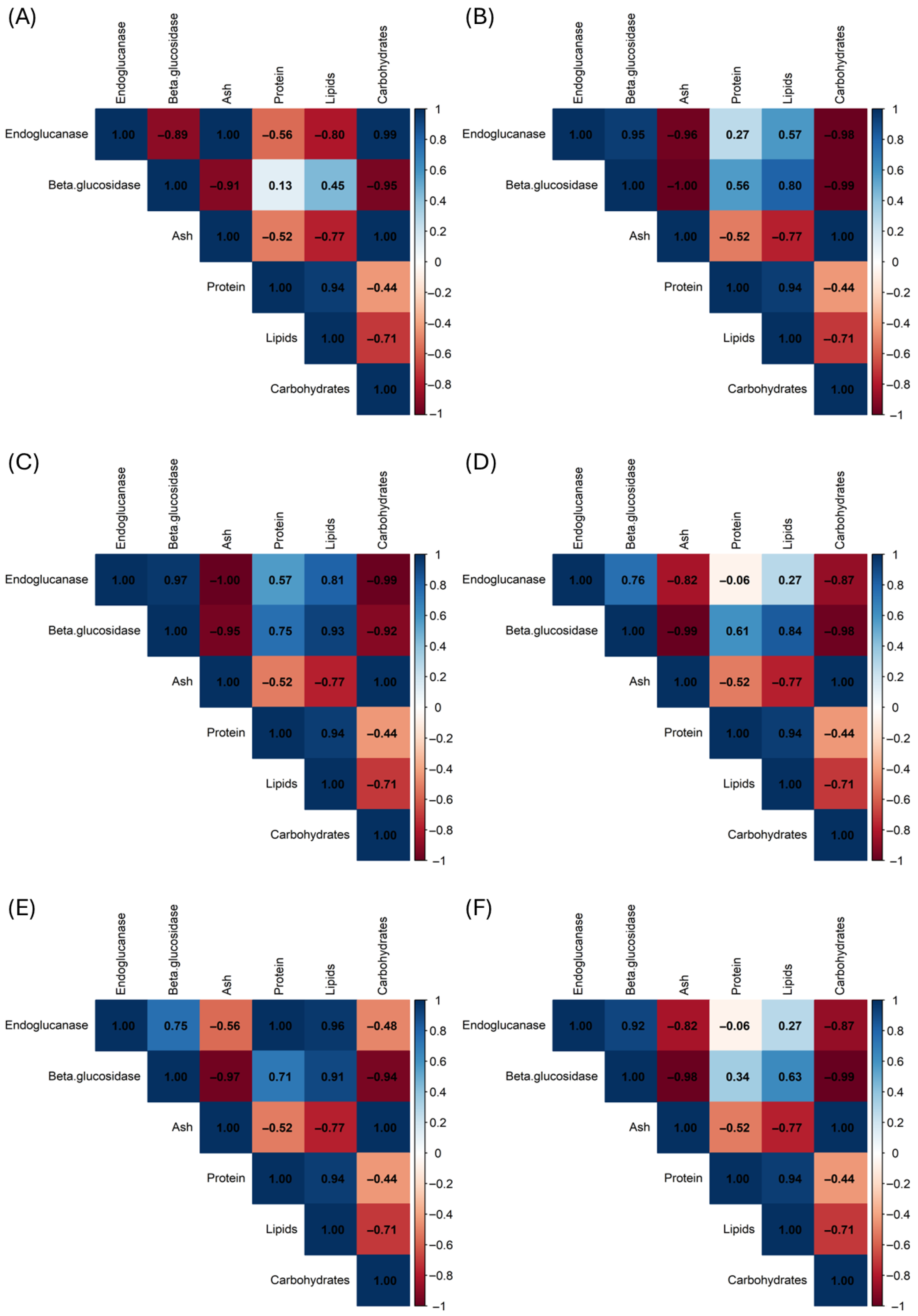
The Pearson coefficient was applied to assess the correlation between the ash, protein, lipid, and carbohydrate contents and the production of endoglucanase and β-glucosidase by A. terreus URM4658, A. japonicus URM5620, and A. tamarii URM4634 by SSF and SeqF. The analysis indicated a strong, positive, and statistically significant correlation between ash content and endoglucanase activity from A. terreus in SSF, whereas a strong, negative, and statistically significant correlation was observed for β-glucosidase activity from A. terreus (Figure 2A). As for the endoglucanase and β-glucosidase of A. japonicus (Figure 2B) and A. tamarii (Figure 2C) produced by SSF, a strong, negative and statistically significant correlation was found. In addition, SeqF showed strong, negative and statistically significant correlations between ash content and the production of endoglucanase and β-glucosidase by A. terreus (Figure 2D) and A. tamarii (Figure 2F), while for the cellulases of A. japonicus (Figure 2E), only β-glucosidase showed a statistically significant correlation.
Figure 2.
Correlation analysis between the ash, protein, lipid and carbohydrate content of coffee husks (Coffea arabica var. Typica) and the production of endoglucanase and β-glucosidase by different Aspergillus species under solid-state (A–C) and sequential fermentation (D–F) conducted at 30 °C for 96 h using coffee husks as the substrate.
The analysis did not indicate any statistically significant correlation between the protein content and the production of cellulases from A. terreus, A. japonicus, and A. tamarii by SSF; however, in SeqF, a strong, positive, and statistically significant correlation was observed for the endoglucanase from A. japonicus. As for the correlation between lipid content and cellulases, a strong, negative, and statistically significant correlation was observed for endoglucanase and β-glucosidase from A. terreus and A. japonicus, respectively, and a positive correlation for endoglucanase and β-glucosidase from A. tamarii in SSF. In SeqF, only strong, positive, and statistically significant correlations were found for endoglucanase from A. japonicus and β-glucosidase from A. terreus and A. tamarii.
The analysis revealed no statistically significant correlation between protein content and cellulase production by A. terreus, A. japonicus, and A. tamarii under SSF conditions. In contrast, under SeqF conditions, a strong, positive, and statistically significant correlation was observed for endoglucanase activity produced by A. japonicus. With respect to lipid content, strong, negative, and statistically significant correlations were identified for endoglucanase and β-glucosidase activities in A. terreus and A. japonicus, respectively. Conversely, A. tamarii exhibited positive correlations for both enzymes under SSF, suggesting an enhanced capacity to assimilate lipids and utilize them as a readily available energy source. In SeqF, strong, positive, and statistically significant correlations were observed only for endoglucanase activity in A. japonicus and for β-glucosidase activity in A. terreus and A. tamarii. These findings indicate that the fermentative process influences lipid availability as an energy source, potentially associated with the more dispersed filamentous morphology adopted by fungi under submerged fermentation conditions.
The correlation between carbohydrate content and endoglucanase activity in A. terreus was strong, positive, and statistically significant, whereas for β-glucosidase, it was strong, negative, and significant across both fermentative processes. For the cellulolytic enzymes produced by A. japonicus, a statistically significant correlation was observed only under SSF conditions, while for A. tamarii, strong, negative, and statistically significant correlations were detected for cellulase activities in both fermentative processes. These findings may be associated with the heterogeneous carbohydrate composition of coffee husk, particularly cellulose and hemicellulose, whose availability and modes of assimilation can influence fungal growth and enzyme production [31].
Overall, these correlations highlight the strain- and process-dependent nature of fungal metabolic responses to substrate composition. Divergent correlations observed for the same substrate component among different fungi, such as the contrasting effects of ash content, suggest differential sensitivity to inorganic constituents and regulatory pathways involved in enzyme secretion. Rather than establishing direct causal relationships or defining universal substrate pre-treatment strategies, the correlation analysis was used as an exploratory approach to identify substrate characteristics with potential influence on enzyme production.
3.3. Evaluation of Fermentative Conditions of Cellulases Production by SeqF
After evaluating the most suitable fermentation process for cellulase production, the influence of the process conditions on SeqF was investigated according to a 22-full factorial design. The results are presented in Table 2. Maximum endoglucanase (3.44 U mL−1) and β-glucosidase (2.12 U mL−1) activities were observed in run 4, performed with 25 mL g−1 for the nutrient medium volume and 50 g L−1 of glucose for supplementation, these being the recommended conditions for the SeqF cellulase production protocol using coffee husks of A. japonicus URM5620 as a substrate. Compared with the results presented in Section 3.1, an increase of 9 and 3 times was observed in the production of endoglucanase and β-glucosidase, respectively.
Table 2.
Experimental conditions and results obtained from the 22-full factorial design for endoglucanase and β-glucosidase production by Aspergillus japonicus URM5620 under sequential fermentation conducted at 30 °C for 96 h using coffee husks as the substrate.
Regarding the effects of the independent variables on the activities of endoglucanase and β-glucosidase (Table 3), the volume of nutrient medium and glucose concentration were statistically significant and showed a positive effect on endoglucanase activity; increasing both variables promotes a better result in enzymatic activity. For β-glucosidase, the concentration of glucose was statistically significant and had a positive effect, indicating that increasing this variable results in better activity. Glucose, used in nutrient supplementation as a carbon source, plays a key role in cell formation, polysaccharide synthesis, and energy supply [26].
Table 3.
Estimated main effects of the independent variables and their interaction on endoglucanase and β-glucosidase activities produced by Aspergillus japonicus URM5620 under sequential fermentation, conducted at 30 °C for 96 h using coffee husks as the substrate.
The interaction between the independent variables was statistically significant and synergistic for both enzymes. Although the model showed statistically significant effects for the studied variables, the analysis of variance (ANOVA) (Table S1, Supplementary Material) revealed a statistically significant lack of fit for endoglucanase (p = 0.0062) and β-glucosidase (p = 0.0184), indicating that the linear model does not satisfactorily describe the relationship between the independent variables and the response and presents limited predictive capacity, thus requiring further studies with new experimental designs based on the conditions described in Run 4. However, additional experiments were not conducted due to operational constraints associated with handling larger volumes of nutrient medium in 250 mL Erlenmeyer flasks. Nevertheless, the trend observed in this study provides valuable insights and serves as a useful basis for future investigations, particularly those focused on scaling up SeqF in stirred-tank bioreactors.
3.4. Biochemical Characterization of Cellulases Produced by SeqF
External conditions, such as pH and temperature, induce conformational changes in protein structure, thereby affecting catalytic efficiency and reducing enzymatic activity. Thus, changes in pH induce ionization of the enzyme’s active sites, thereby affecting the rate at which the substrate binds to the active site. While changes in temperature increase the reaction rate, progressive inactivation can also occur due to denaturation of the protein [32,33].
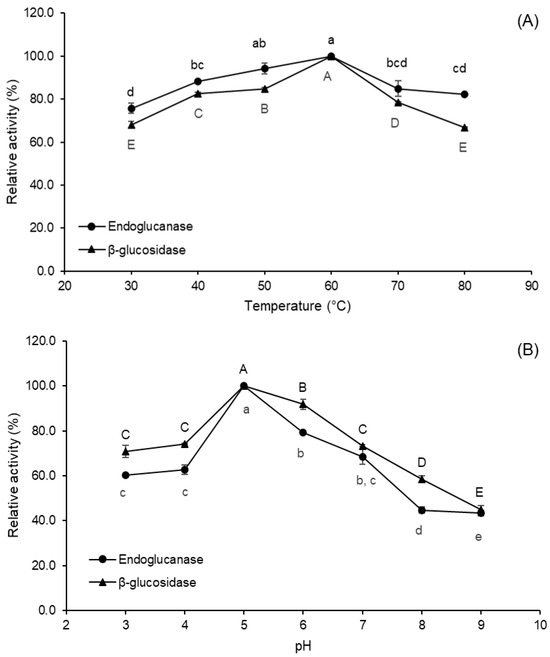
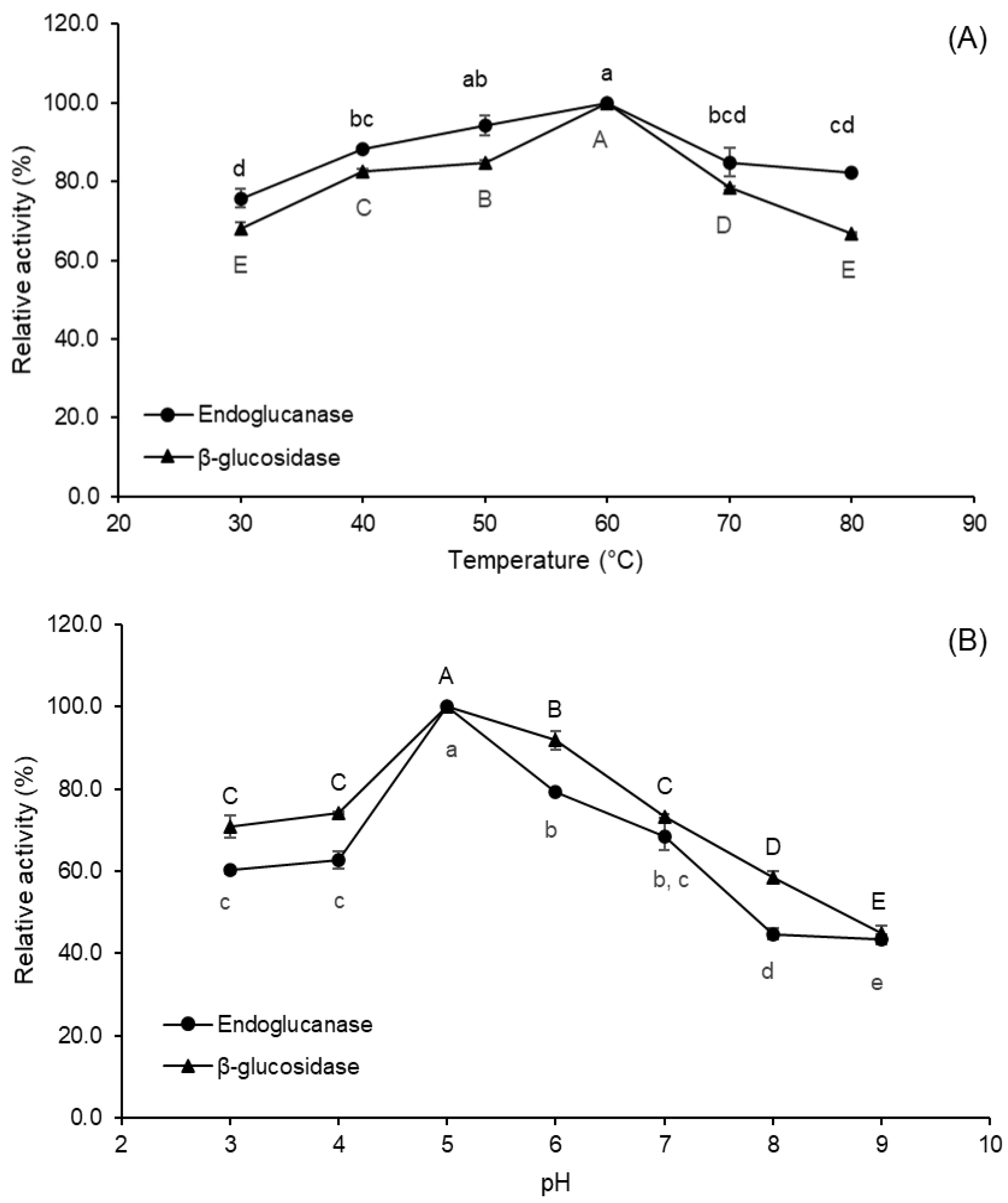
For the effect of temperature on enzyme activity (Figure 3A), an optimum temperature of 60 °C was determined for endoglucanase and β-glucosidase. Furthermore, enzyme activity decreased at temperatures in the 70–80 °C range, with β-glucosidase showing a steeper decline (78.35 and 66.83%). Saroj, P and Narasimhulu [34] reported similar optimal temperatures for endoglucanase (50 °C) and β-glucosidase (60 °C) purified from A. fumigatus JCM10253, with the purified endoglucanase showing a lower optimal temperature than that reported in the present study. Meanwhile, for the effect of pH on the activities of the cellulolytic enzymes (Figure 3B), endoglucanase showed an optimum pH of 5.0 and a marked decrease in activity in the pH range 6.0 to 9.0 (79.15 to 43.44%). A similar effect was observed for β-glucosidase, which exhibited a pH optimum at 5.0 and a decline in the 6.0–9.0 range (91.88–44.88%). Silva et al. [35] in their study evaluated the cellulase of P. chrysogenum CCDCA10756 grown on corn straw and observed an optimum pH of 7.0 for endoglucanase, while for β-glucosidase, it was observed in the range of 5.0 to 6.0.
Figure 3.
Effect of temperature (A) and pH (B) on the hydrolytic activity of cellulases produced by Aspergillus japonicus URM5620 under sequential fermentation, conducted at 30 °C for 96 h using coffee husks as the substrate. Different letters indicate statistically significant differences among treatments for endoglucanase (A–E) and β-glucosidase (a–e), according to Tukey’s test (p < 0.05).
Regarding the influence of the metal ions on cellulase activities (Table 4), it was noted that only the Cu2+ ions provided a slightly positive modulation in the activity of endoglucanase (109.81%) and β-glucosidase (101.09%). A different behavior was reported by Manavalan et al. [36], with Cu2+ (91.0%) causing a negative modulation in the cellulase activity of Ganoderma lucidum. For the other metal ions, inhibition was observed for both enzymes, with greater reductions in the activities of endoglucanase and β-glucosidase in the presence of K+ (44.55%) and Fe2+ (18.31%), respectively. In addition, Zn2+, Hg2+ and Mg2+ ions are reported to be negative modulators of cellulase activity, since when they associate with the enzymes, they promote changes in the conformation or substitution of native metal cofactors, making it difficult for the enzyme to access them [37].
Table 4.
Influence of metal ions (10 mM) on the hydrolytic activity of endoglucanase and β-glucosidase produced by Aspergillus japonicus URM5620 under sequential fermentation, conducted at 30 °C for 96 h using coffee husks as the substrate. Different letters indicate statistically significant differences among treatments for endoglucanase (A–H) and β-glucosidase (a–d), according to Tukey’s test (p < 0.05).
3.5. Kinetic and Thermodynamic Parameters of the Reactions Catalyzed by Endoglucanase and β-Glicosidase
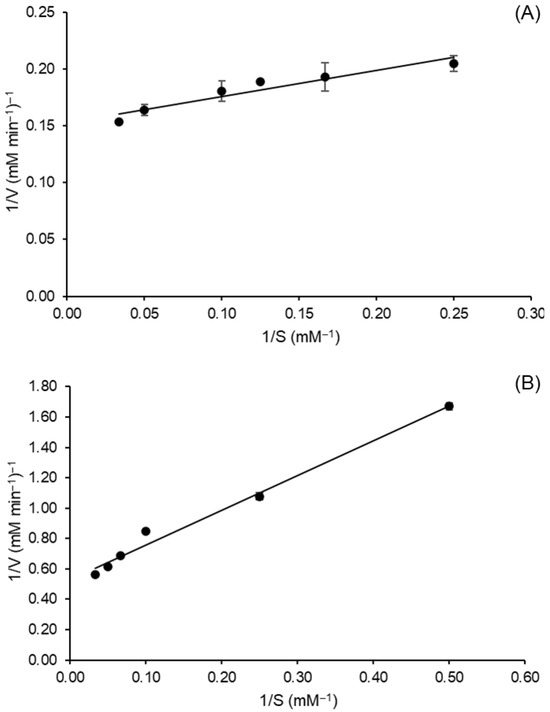
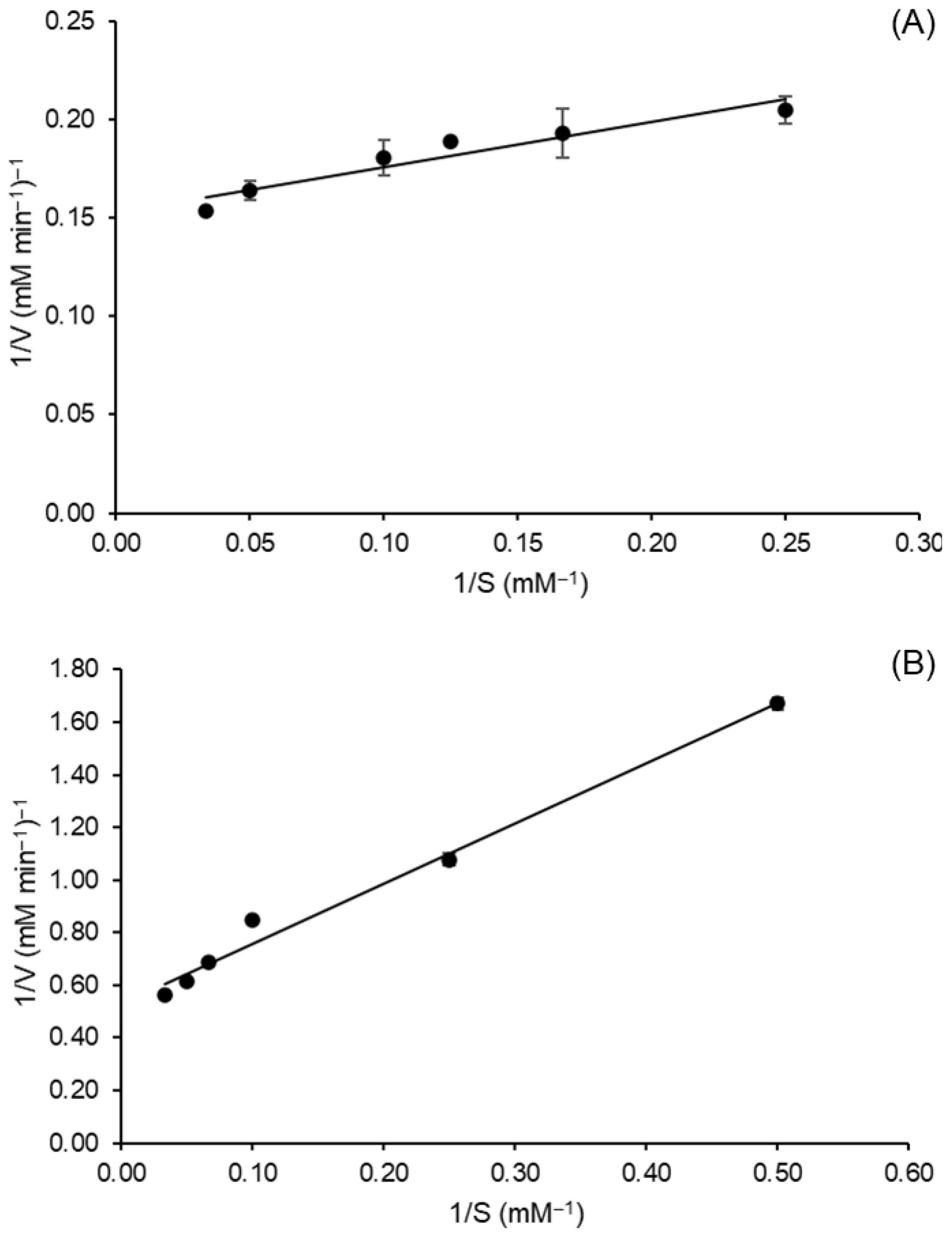
For the apparent kinetic parameters, maximum reaction rate (Vmax) and Michaelis–Menten constant (Km) (Figure 4A,B), it was observed that for Vmax, endoglucanase (6.53 mg mL−1 min−1) showed higher values when compared to β-glucosidase (1.89 mg mL−1 min−1). In contrast, endoglucanase (1.50 mg mL−1) had a lower Km value than β-glucosidase (4.31 mg mL−1). These results indicate that the endoglucanase evaluated has a greater affinity for carboxymethylcellulose than β-glucosidase for cellobiose. Notably, the substrate affinity observed in the present study is higher than that reported for purified cellulases, as described by Saroj, P and Narasimhulu [35], who reported Km values of 10.79 mg mL−1 for endoglucanase and 32.59 mg mL−1 for β-glucosidase purified from A. fumigatus JCM10253.
Figure 4.
Lineweaver–Burk plots for CMC (A) and cellobiose (B) hydrolysis reactions at 60 °C and pH 4.8, catalyzed by endoglucanase and β-glucosidase from A. japonicus URM5620 obtained from sequential fermentation using coffee husks as the substrate.
The activation energy (E*a) was calculated from the Arrhenius graph (Figure 5), showing a satisfactory correlation (0.90 ≤ R2 ≤ 0.98). The low activation energy values for the hydrolysis of CMC and cellobiose catalyzed by endoglucanase (9.83 kJ mol−1) and β-glucosidase (9.92 kJ mol−1), respectively, indicate that a low amount of energy is required for the formation of the enzyme–substrate complex (ES) due to the availability of the correct conformation in the active site, demonstrating the high catalytic potential of the enzymes [38]. The enthalpy of activation (ΔH*) values (Table 5) observed for endoglucanase and β-glucosidase were 7.10 and 7.19 kJ mol−1. Such low values suggest the occurrence of effective formation of the activated enzyme–substrate complex [39].
Figure 5.
Arrhenius type-plots used to determine the activation energy (E*a) of CMC (endoglucanase) and cellobiose (β-glucosidase) hydrolysis reactions, performed at pH 4. and temperatures ranging from 30 to 80 °C. Reactions were catalyzed by endoglucanase and β-glucosidase from Aspergillus japonicus URM5620 obtained by sequential fermentation using coffee husks as the substrate.
Table 5.
Kinetic and thermodynamic parameters of hydrolysis reactions catalyzed by endoglucanase and β-glucosidase produced by Aspergillus japonicus URM5620 under sequential fermentation using coffee husks as the substrate.
The temperature quotient (Q10) quantifies the effect of a 10 °C increase in temperature on the enzyme-catalyzed reaction rate, where values outside the 1–2 range indicate that the reaction is influenced and controlled by factors other than temperature [40]. The values ranged from 1.040 to 1.036 for both activities across the temperature range 30–60 °C. This indicates that the hydrolysis reactions of CMC and cellobiose were kinetically influenced only by temperature.
3.6. Kinetic and Thermodynamic Parameters of Thermal Denaturation of Endoglucanase and β-Glicosidase
The values of the first-order thermal inactivation rate constants (kd) (Figure 6A,B) were estimated to be satisfactory (0.98 ≤ R2 ≤ 0.99 and 0.95 ≤ R2 ≤ 0.98) for the enzymes endoglucanase (0.0014–0.0028 min−1) and β-glucosidase (0.0008–0.0035 min−1) and are presented in Table 6, together with the other kinetic and thermodynamic parameters of thermal denaturation. From these results, a gradual increase in temperature was observed, indicating a more pronounced inactivation, likely due to the breaking of strong electrostatic bonds [41].
Figure 6.
Semi-logarithmic plots of the residual activity coefficient (A/A0) of endoglucanase (A) and β-glucosidase (B) from Aspergillus japonicus URM5620 versus time, used to determine first-order thermal inactivation rate constants.
Table 6.
Kinetic and thermodynamic parameters of thermal denaturation of endoglucanase and β-glucosidase produced by Aspergillus japonicus URM5620 under sequential fermentation.
The half-life (t1/2) and decimal reduction time (D-value) obtained for endoglucanase (t1/2 = 8.82 h; D = 29.32 h) and β-glucosidase (t1/2 = 26.61 h; D = 88.38 h) (Table 6) were markedly higher than those reported for cellulase from Aureobasidium pullulans NAC8 [t1/2 = 1.67 h (70.0 min); D = 3.88 h (233.0 min)] [42]. These results indicate that the crude enzymatic extracts evaluated in this study exhibit considerable thermal robustness, requiring longer exposure times to reduce activity by 50% (t1/2) and 90% (D-value), respectively, compared with their initial activity [40]. It should be noted that in crude extracts, factors such as residual substrates, co-secreted proteins, or other extracellular components may contribute to the observed stability, and the results do not necessarily reflect the intrinsic thermal properties of individual enzymes. Purification treatments have been reported to diminish enzyme activity relative to crude extracts due to loss of matrix components, suggesting that crude extract composition influences apparent stability and activity measurements [43].
Regarding the thermal resistance constant (Z), endoglucanase presented a relatively high Z value (42.55 °C), indicating that its thermal inactivation rate was less dependent on temperature changes and more strongly influenced by the duration of heat exposure. In contrast, β-glucosidase exhibited a lower Z value (16.37 °C), reflecting a greater sensitivity of its thermal stability to increase in temperature [44].
Regarding the activation energy of thermal denaturation (E*d), determined from the Arrhenius type-plot (Figure 7), values of 51.01 kJ mol−1 and 117.04 kJ mol−1 were obtained for endoglucanase and β-glucosidase, respectively. In addition, both enzymes showed higher results than cellulase from Aureobasidium pullulans NAC8 (33.7 kJ mol−1) [42], which reflects a better thermostability of the enzymes evaluated in this work, since a greater amount of energy is required to overcome the energy barrier and denature endoglucanase and β-glucosidase.
Figure 7.
Arrhenius plots used to estimate the activation energy for thermal denaturation of endoglucanase (R2 = 0.961) and β-glucosidase (R2 = 0.957) from Aspergillus japonicus URM5620.
E*d is also related to the denaturation enthalpy (ΔH*d), which corresponds to the total amount of energy required to denature an enzyme by breaking the non-covalent bonds [45]. For this parameter, a variation of 48.24 to 48.12 kJ mol−1 was observed for endoglucanase and 114.28 to 114.15 kJ mol−1 for β-glucosidase, indicating a slight reduction with increasing temperature (60–75 °C). Positive enthalpy values, such as those observed in this study, are an indication that the process of thermal denaturation of the enzyme is endothermic and requires energy to start [46]. Moreover, with the ΔH*d values, it is possible to estimate the amount of non-covalent bonds broken, since the energy required to break a -CH2 fraction of a hydrophobic bond is approximately 5.4 kJ mol−1 [47]. For this study, it was observed that around 8.92 and 21.15 non-covalent bonds were broken during the denaturation process of endoglucanase and β-glucosidase, respectively.
For the denaturation entropy (ΔS*d), different behaviors were observed for endoglucanase (−189.41 ≤ ΔS*d ≤ −190.84 J mol−1 K−1) and β-glucosidase (0.66 ≤ ΔS*d ≤ 3.83 J mol−1 K−1). Positive values, such as those observed for β-glucosidase, indicate an increase in disorder and randomness during the enzyme’s denaturation. The behavior observed for endoglucanase indicates that the enzyme exhibited greater order in the transition state than β-glucosidase, which was also evaluated in this study [44]. Additionally, negative ΔS*d values associated with positive ΔH*d results suggest a reverse process, but not a spontaneous one at any temperature [26]. Thus, the denaturation of endoglucanase was non-spontaneous, but reversible across all temperatures evaluated.
The Gibbs free energy of denaturation (ΔG*d) was obtained for endoglucanase (111.58 ≤ ΔG*d ≤ 114.56 kJ mol−1) and β-glucosidase (112.89 ≤ ΔG*d ≤ 113.92 kJ mol−1), values higher than those reported by Ademakinwa and Agboola [42] for cellulase from Aureobasidium pullulans NAC8 (94.6 kJ mol−1). Small, negative values are associated with a more spontaneous process, in which the enzyme is subject to thermal denaturation. In contrast, large and positive values, as observed in this study, indicate that the cellulases from A. japonicus URM5620 were more resistant to denaturation [44].
Overall, the results demonstrate improvements in the kinetic and thermodynamic parameters associated with thermal denaturation of the enzymes evaluated in this study. The superior performance of endoglucanase and β-glucosidase may be related to the fermentation strategy employed, as previously reported by Oliveira et al. [26], who observed similar behavior for proteases from Aspergillus tamarii URM4634 produced by SSF and SeqF. Therefore, further studies comparing additional fermentation methods are necessary to confirm this trend and to expand the understanding of how cultivation strategies influence the properties of these enzymes.
4. Conclusions
Coffee husks were a substrate with high potential for producing cellulases via sequential fermentation, which was more effective than solid-state fermentation, as evidenced by higher enzyme activities. The cellulases produced had recommended operating conditions at 60 °C and pH 5.0 for both endoglucanase and β-glucosidase. The results obtained from kinetic and thermodynamic study will contribute to a better understanding of the reaction mechanisms of the cellulolytic complex, which remain scarcely explored in the literature. The kinetic and thermodynamic parameters of thermal denaturation demonstrated that both enzymes exhibit high thermostability, particularly at 60 °C. This characteristic indicates their strong potential for application in industrial processes involving the treatment of lignocellulosic raw materials. Nevertheless, further studies are required to evaluate their hydrolytic efficiency and to determine the most appropriate industrial applications for the cellulases obtained.
Supplementary Materials
The following supporting information can be downloaded at: https://www.mdpi.com/article/10.3390/biomass6020020/s1, Table S1. Analysis of variance (ANOVA) applied to the results of the 22-full factorial design used to produce endoglucanase (R2= 0.84) and β-glucosidase (R2= 0.92) from A. japonicus URM5620 by sequential fermentation using coffee husks as substrate.
Author Contributions
Conceptualization, R.L.d.O. and S.P.d.S.; methodology, R.L.d.O., T.S.P. and S.P.d.S.; software, R.L.d.O. and W.W.V.S.; validation, E.R.d.S., W.W.V.S. and R.L.d.O.; formal analysis, E.R.d.S. and R.L.d.O.; investigation, E.R.d.S. and W.W.V.S.; resources, R.L.d.O. and S.P.d.S.; data curation, R.L.d.O. and W.W.V.S.; writing—original draft preparation, E.R.d.S.; writing—review and editing, R.L.d.O., T.S.P. and S.P.d.S.; visualization, W.W.V.S. and T.S.P.; supervision, R.L.d.O.; project administration, R.L.d.O.; funding acquisition, R.L.d.O. All authors have read and agreed to the published version of the manuscript.
Funding
This research received no external funding.
Institutional Review Board Statement
Not applicable.
Data Availability Statement
The data supporting the findings of this study, including raw enzymatic activity data, experimental design results, and datasets used for the calculation of kinetic, thermodynamic, and thermal denaturation parameters, are available from the corresponding author upon reasonable request.
Acknowledgments
The authors would like to thank the Science and Technology Support Foundation of the State of Pernambuco (FACEPE, Brazil—Funding code APQ-0151-5.07/21) for the financial support of the research group studies, the Federal University of Agreste de Pernambuco (UFAPE, Brazil) for supporting the research, and the producer Jaqueline Alves from Sítio Florentina for donating the coffee husks.
Conflicts of Interest
The authors declare that they have no conflicts of interest.
Abbreviations
The following abbreviations are used in this manuscript:
| CMC | Carboxymethylcellulose |
| D | Decimal reducing time |
| E*a | Activation energy |
| E*d | Activation energy of thermal denaturation |
| H | Planck constant |
| kb | Boltzmann constant |
| kcat | Turnover number |
| kd | First-order inactivation rate constant |
| Km | Michaelis constant |
| Q10 | Temperature quotient |
| R | Universal gas constant |
| t1/2 | Half-life time |
| Vmax | Maximum reaction rate |
| Z | Thermal resistance constant |
| ΔG* | Gibbs free energy |
| ΔG*d | Gibbs free energy of thermal denaturation |
| ΔH* | Activation enthalpy |
| ΔH*d | Enthalpy of thermal denaturation |
| ΔS* | Activation entropy |
| ΔS*d | Entropy of thermal denaturation. |
References
- Business Communication Company (BCC) Research. Global Markets for Enzymes in Industrial Applications. 2025. Publishing PhysicsWeb. Available online: https://www.bccresearch.com/market-research/biotechnology/global-markets-for-enzymes-in-industrial-applications.html (accessed on 25 May 2025).
- Sutaoney, P.; Rai, S.N.; Sinha, S.; Choudhary, R.; Gupta, A.K.; Singh, S.K.; Banerjee, P. Current perspective in research and industrial applications of microbial cellulases. Int. J. Biol. Macromol. 2024, 264, 130639. [Google Scholar] [CrossRef] [Scilit] [PubMed]
- Zhou, Z.; Ju, X.; Chen, J.; Wang, R.; Zhong, Y.; Li, L. Charge-oriented strategies of tunable substrate affinity based on cellulase and biomass for improving in situ saccharification: A review. Bioresour. Technol. 2021, 319, 124159. [Google Scholar] [CrossRef] [Scilit]
- Santos, G.B.; Sousa Filho, A.S.F.; Rodrigues, J.R.S.; Souza, R.R. Cellulase production by Aspergillus niger using urban lignocellulosic waste as substrate: Evaluation of different cultivation strategies. J. Environ. Manag. 2022, 305, 114431. [Google Scholar] [CrossRef] [Scilit] [PubMed]
- Hakraborty, S.; Yadav, G.; Saini, J.K.; Kuhad, R.C. Comparative study of cellulase production using submerged and solid-state fermentation. In New and Future Developments in Microbial Biotechnology and Bioengineering; Srivastava, N., Srivastava, M., Mishra, P.K., Ramteke, P.W., Singh, R.L., Eds.; Elsevier: Amsterdam, The Netherlands, 2019; pp. 99–113. [Google Scholar] [CrossRef] [Scilit]
- Cunha, F.M.; Esperança, M.N.; Zangirolami, T.C.; Badino, A.C.; Farinas, C.S. Sequential solid-state and submerged cultivation of Aspergillus niger on sugarcane bagasse for the production of cellulase. Bioresour. Technol. 2012, 112, 270–274. [Google Scholar] [CrossRef] [Scilit] [PubMed]
- An, Q.; Wu, X.J.; Han, M.L.; CuI, B.K.; He, S.H.; Dai, Y.C.; Si, J. Sequential solid-state and submerged cultivation of the white rot fungus Pleurotus ostreatus on biomass and the activity of lignocellulolytic enzymes. BioResources 2016, 11, 8791–8805. [Google Scholar] [CrossRef] [Scilit]
- Cunha, F.M.; Vasconcellos, V.M.; Florencio, C.; Badino, A.C.; Farinas, C.S. On-site production of enzymatic cocktails using a non-conventional fermentation method with agro-industrial residues as renewable feedstocks. Waste Biomass Valorization 2017, 8, 517–526. [Google Scholar] [CrossRef] [Scilit]
- Klingel, T.; Kremer, J.I.; Gottstein, V.; Rezende, T.R.; Schwarz, S.; Lachenmeier, D.W. A review of coffee by-products including leaf, flower, cherry, husk, silver skin, and spent grounds as novel foods within the European Union. Foods 2020, 9, 665. [Google Scholar] [CrossRef] [Scilit]
- Oliveira, F.C.; Srinivas, K.; Helms, G.L.; Isern, N.G.; Cort, J.R.; Gonçalves, A.R.; Ahring, B.K. Characterization of coffee (Coffea arabica) husk lignin and degradation products obtained after oxygen and alkali addition. Bioresour. Technol. 2018, 257, 172–180. [Google Scholar] [CrossRef] [Scilit]
- Silva, M.C.; Naozuka, J.; Luz, J.M.R.; Assunção, L.S.; Oliveira, P.V.; Vanetti, M.C.; Kasuya, M.C. Enrichment of Pleurotus ostreatus mushrooms with selenium in coffee husks. Food Chem. 2012, 131, 558–563. [Google Scholar] [CrossRef] [Scilit]
- Sarrouh, B.; Souza, R.O.A.; Florindo, R.H.S.; Lofrano, R.C.Z.; Oliveira, A.M. Extraction and identification of biomolecules from lignin alkaline hydrolysate from coffee husk. Waste Biomass Valorization 2021, 12, 787–794. [Google Scholar] [CrossRef] [Scilit]
- Morales-Martínez, J.L.; Aguilar-Uscanga, M.G.; Bolaños-Reynoso, E.; López-Zamora, L. Optimization of chemical pretreatments using response surface methodology for second-generation ethanol production from coffee husk waste. BioEnergy Res. 2021, 14, 815–827. [Google Scholar] [CrossRef] [Scilit]
- Alhogbi, B.G. Potential of coffee husk biomass waste for the adsorption of Pb (II) ion from aqueous solutions. Sust. Chem. Pharm. 2017, 6, 21–25. [Google Scholar] [CrossRef] [Scilit]
- Navya, P.N.; Bhoite, R.N.; Murthy, P.S. Improved β-glucosidase production from Rhizopus stolonifer utilizing coffee husk. Int. J. Curr. Res. 2012, 4, 123–129. [Google Scholar]
- de Oliveira, R.L.; dos Santos, A.F.A.; Cardoso, B.A.; da Silva Santos, T.S.; de Campos-Takaki, G.M.; Porto, T.S.; Porto, C.S. Production, Kinetic/Thermodynamic Study, and Evaluation of the Influence of Static Magnetic Field on Kinetic Parameters of β-Fructofuranosidase from Aspergillus tamarii Kita UCP 1279 Produced by Solid-State Fermentation. BioTech 2023, 12, 21. [Google Scholar] [CrossRef] [Scilit]
- Instituto Adolfo Lutz. Métodos Físico-Químicos Para Alimentos, 4th ed; Ministério da Saúde: São Paulo, Brazil, 2008; p. 1030.
- De Castro, R.J.S.; Nishide, T.G.; Sato, H.H. Production and biochemical properties of proteases secreted by Aspergillus niger under solid state fermentation in response to different agroindustrial substrates. Biocatal. Agric. Biotechnol. 2014, 3, 236–245. [Google Scholar] [CrossRef] [Scilit]
- Flores-Maltos, D.A.; Mussato, S.I.; Esquivel, J.C.C.; Buenrostro, J.J.; Rodríguez, R.; Teixeira, J.A.; Aguilar, C.N. Typical mexican agroindustrial residues as supports for Solid-State Fermentation. Am. J. Agric. Biol. Sci. 2014, 9, 289–293. [Google Scholar] [CrossRef] [Scilit]
- R Core Team. R: A Language and Environment for Statistical Computing; R Foundation for Statistical Computing: Vienna, Austria, 2024; Available online: https://www.R-project.org (accessed on 18 June 2025).
- RStudio Team. RStudio: Integrated Development for R. (RStudio, Boston, 2024). Available online: https://www.rstudio.com/ (accessed on 18 June 2025).
- Ghose, T.K. Measurement of cellulase activities. Pure Appl. Chem. 1987, 59, 257–268. [Google Scholar] [CrossRef] [Scilit]
- Miller, G.L. Use of dinitrosalicylic acid reagent for determination reducing sugar. Anal. Chem. 1959, 31, 426–428. [Google Scholar] [CrossRef] [Scilit]
- Dixon, M.; Webb, E.C. Enzyme Inhibition and Inactivation, 3rd ed; Longman: London, UK, 1979; pp. 332–467. [Google Scholar]
- Farinas, C.S.; Florencio, C.; Badino, A.C. On-site production of cellulolytic enzymes by the sequential cultivation method. Cell. Methods Protoc. 2018, 1796, 273–282. [Google Scholar] [CrossRef] [Scilit]
- Oliveira, R.L.; Souza, E.C.; Converti, A.; Porto, T.S. Use of a sequential fermentation method for the production of Aspergillus tamarii URM4634 protease and a kinetic/thermodynamic study of the enzyme. Catalysts 2021, 11, 963. [Google Scholar] [CrossRef] [Scilit]
- Oliveira, R.L.; Silva, W.B.; Couto, K.S.; Porto, T.S. Sequential cultivation method for β-fructofuranosidase production from Aspergillus tamarii URM4634, evaluation of their biochemical and kinetic/thermodynamic characteristics, and application on sucrose hydrolysis. 3 Biotech 2024, 14, 186. [Google Scholar] [CrossRef] [Scilit]
- Silva, O.S.; Oliveira, R.L.; Souza-Motta, C.M.; Porto, A.L.F.; Porto, T.S. Novel protease from Aspergillus tamarii URM4634: Production and characterization using inexpensive agroindustrial substrates by solid-state fermentation. Adv. Enzym. Res. 2016, 4, 125–143. [Google Scholar] [CrossRef]
- Castro, C.; Nobre, C.; Duprez, M.-E.; De Weireld, G.; Hantson, A.-L. Screening and selection of potential carriers to immobilize Aureobasidium pullulans cells for fructo-oligosaccharides production. Biochem. Eng. J. 2017, 118, 82–90. [Google Scholar] [CrossRef] [Scilit]
- Oliveira, R.L.; Silva, M.F.; Converti, A.; Porto, T.S. β-fructofuranosidase with transfructosylating activity by Aspergillus tamarii URM4634 Solid-State Fermentation on agroindustrial by-products. Int. J. Biol. Macromol. 2020, 144, 343–350. [Google Scholar] [CrossRef] [Scilit] [PubMed]
- Ohara, A.; de Castro, R.J.S.; Nishide, T.G.; Dias, F.F.G.; Bagagli, M.P.; Sato, H.H. Invertase production by Aspergillus niger under solid state fermentation: Focus on physical–chemical parameters, synergistic and antagonistic effects using agro-industrial wastes. Biocatal. Agric. Biotechnol. 2015, 4, 645–652. [Google Scholar] [CrossRef] [Scilit]
- Abdel-Naby, M.A.; Ahmed, S.A.; Wehaidy, H.R.; El-Mahdy, S.A. Catalytic, kinetic and thermodynamic properties of stabilized Bacillus stearothermophilus alkaline protease. Int. J. Biol. Macromol. 2017, 96, 265–271. [Google Scholar] [CrossRef] [Scilit] [PubMed]
- Robinson, P.K. Enzymes: Principles and biotechnological applications. Essays Biochem. 2015, 50, 1–41. [Google Scholar] [CrossRef] [Scilit]
- Saroj, P.; P, M.; Narasimhulu, K. Biochemical characterization of thermostable carboxymethyl cellulase and β-glucosidase from Aspergillus fumigatus JCM10253. Appl. Biochem. Biotechnol. 2022, 194, 2503–2527. [Google Scholar] [CrossRef] [Scilit]
- Silva, L.M.B.; Gomes, T.C.; Ullah, S.; Ticona, A.R.P.; Hamann, P.R.V.; Noronha, E.F. Biochemical Properties of carbohydrate-active enzymes synthesized by Penicillium chrysogenum using corn straw as carbon source. Waste Biomass Valorization 2020, 11, 2455–2466. [Google Scholar] [CrossRef] [Scilit]
- Manavalan, T.; Manavalan, A.; Thangavelu, K.P.; Heese, K. Characterization of a novel endoglucanase form Ganoderma lucidum. J. Basic Microbiol. 2015, 54, 761–771. [Google Scholar] [CrossRef] [Scilit]
- Gama, A.R.; Brito-Cunha, C.C.Q.; Campos, I.T.N.; Souza, G.R.L.; Carneiro, L.C.; Bataus, L.A.M. Streptomyces thermocerradoensis I3 secretes a novel bifunctional xylanase/endoglucanase under solid-state fermentation. Biotechnol. Progress 2019, 36, e2934. [Google Scholar] [CrossRef] [Scilit] [PubMed]
- Regmi, S.; Choi, Y.S.; Kim, Y.K.; Khan, M.M.; Lee, S.H.; Cho, S.S.; Suh, J.W. Endoglucanase produced by Bacillus subtilis strain CBS31: Biochemical characterization, thermodynamic study, enzymatic hydrolysis, and bio-industrial applications. Biotechnol. Bioprocess Eng. 2020, 25, 104–116. [Google Scholar] [CrossRef] [Scilit]
- Mostafa, F.A.; Abdel, W.A.; Salah, H.A.; Nawwar, G.A.M.; Esawy, M.A. Kinetic and thermodynamic characteristic of Aspergillus awamori EM66 levansucrase. Int. J. Biol. Macromol. 2018, 119, 232–239. [Google Scholar] [CrossRef] [Scilit] [PubMed]
- Wehaidy, H.R.; Abdel-Naby, M.A.; Shousha, W.G.; Elmallah, M.I.Y.; Shawky, M.M. Improving the catalytic, kinetic and thermodynamic properties of Bacillus subtilis KU710517 milk clotting enzyme conjugation with polyethylene glycol. Int. J. Biol. Macromol. 2018, 111, 296–301. [Google Scholar] [CrossRef] [Scilit]
- Oliveira, R.L.; Silva, M.F.; Converti, A.; Porto, T.S. Biochemical characterization and kinetic/thermodynamic study of Aspergillus tamarii URM4634 β-fructofuranosidase with transfructosylating activity. Biotechnol. Progress 2019, 35, e2879. [Google Scholar] [CrossRef] [Scilit]
- Ademakinwa, A.N.; Agboola, F.K. Kinetic and thermodynamic investigations of cell-wall degrading enzymes produced by Aureobasidium pullulans via induction with orange peels: Application in lycopene extraction. Prep. Biochem. Biotechnol. 2019, 49, 949–960. [Google Scholar] [CrossRef] [Scilit]
- Liu, Z.; Smith, S.R. Enzyme recovery from biological wastewater treatment. Waste Biomass Valorization 2021, 12, 4185–4211. [Google Scholar] [CrossRef] [Scilit]
- Converti, A.; Pessoa, A.; Silva, J.D.C.; Oliveira, R.L.; Porto, T.S. Thermodynamics applied to biomolecules. In Pharmaceutical Biotechnology, 1st ed.; Pessoa, A., Vitolo, M., Long, P.F., Eds.; CRC Press: Boca Raton, FL, USA, 2021; pp. 29–42. [Google Scholar]
- Oliveira, R.; Silva, S.P.; Converti, A.; Porto, T.S. Production, biochemical characterization, and kinetic/thermodynamic study of inulinase from Aspergillus terreus URM4658. Molecules 2022, 27, 6418. [Google Scholar] [CrossRef] [Scilit]
- Agrawal, D.C.; Dwevedi, A.; Kayastha, A.M. Biochemical and thermodynamic characterization of de novo synthesized β-amylase from fenugreek. Int. J. Biol. Macromol. 2019, 130, 786–797. [Google Scholar] [CrossRef] [Scilit]
- Pace, C.N. Contribution of the hydrophobic effect to globular protein stability. J. Mol. Biol. 1992, 226, 29–35. [Google Scholar] [CrossRef] [Scilit]

Disclaimer/Publisher’s Note: The statements, opinions and data contained in all publications are solely those of the individual author(s) and contributor(s) and not of MDPI and/or the editor(s). MDPI and/or the editor(s) disclaim responsibility for any injury to people or property resulting from any ideas, methods, instructions or products referred to in the content. |
© 2026 by the authors. Licensee MDPI, Basel, Switzerland. This article is an open access article distributed under the terms and conditions of the Creative Commons Attribution (CC BY) license.