
Article

Extraction and Composite Film Formation of Arabinoxylans from Brewer’s Byproducts: Mechanical and Physicochemical Properties

by
Othmar J. Aguilar-Bautista
1,
Karina Aguilar-Arteaga
1,*,
Araceli Castañeda Ovando
2,*,
Yari Jaguey Hernández
1,2,
Gonzalo Velázquez de la Cruz
3,
Eduardo Morales Sánchez
3 and
Prisciliano Hernández Martínez
1
1
Master’s Program in Food Science and Technology, Universidad Politécnica de Francisco I. Madero, Domicilio Conocido, Tepatepec, Francisco I. Madero CP 42660, Hidalgo, Mexico
2
Food Chemistry Academic Area, Universidad Autónoma del Estado de Hidalgo, Carr. Pachuca-Tulancingo km. 4.5, Mineral de la Reforma CP 42184, Hidalgo, Mexico
3
Centro de Investigación en Ciencia Aplicada y Tecnología Avanzada, Unidad Querétaro, Instituto Politécnico Nacional, Cerro Blanco No. 141, Querétaro CP 76090, Mexico
*
Authors to whom correspondence should be addressed.
Biomass 2026, 6(1), 15; https://doi.org/10.3390/biomass6010015
Submission received: 20 November 2025 / Revised: 13 January 2026 / Accepted: 27 January 2026 / Published: 5 February 2026
(This article belongs to the Topic Recovery and Use of Bioactive Materials and Biomass)

Abstract

In this study, barley biomass from the brewing industry was used to obtain fraction-rich arabinoxylans, polysaccharides that, due to their chemical and structural properties, can form films. The effect of adding three plasticizers at a concentration of 20% w/w on the mechanical, optical, and barrier properties of the thermoplasticized films was evaluated. Tensile strength (TS) and percent elongation (%E) tests were performed to determine the mechanical properties, water vapor transmission rate (WVTR) and water vapor permeability (WVP) were evaluated by gravimetric methods, the ΔE and color index (CI) were calculated with the chromatic coordinates of the CIE-L*a*b system, and structural morphology was determined by scanning electron microscopy (SEM) and Fourier transform infrared spectroscopy (FT-IR-ATR). The results show that plasticizers decrease the TS values and increase the %E, obtaining more flexible films compared to films made without plasticizers. The structural characteristics of plasticizers directly influence the CI of films. The values corresponding to %E and PVA were higher in the arabinoxylan films thermoplasticized with glycerol. Films’ stability was evaluated using electrochemical impedance spectroscopy. The results show that there are significant differences when the films are coated with polylactic acid.

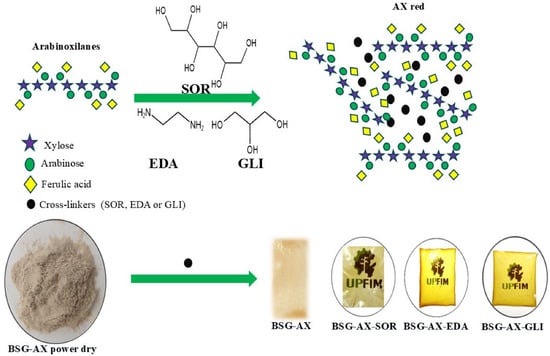
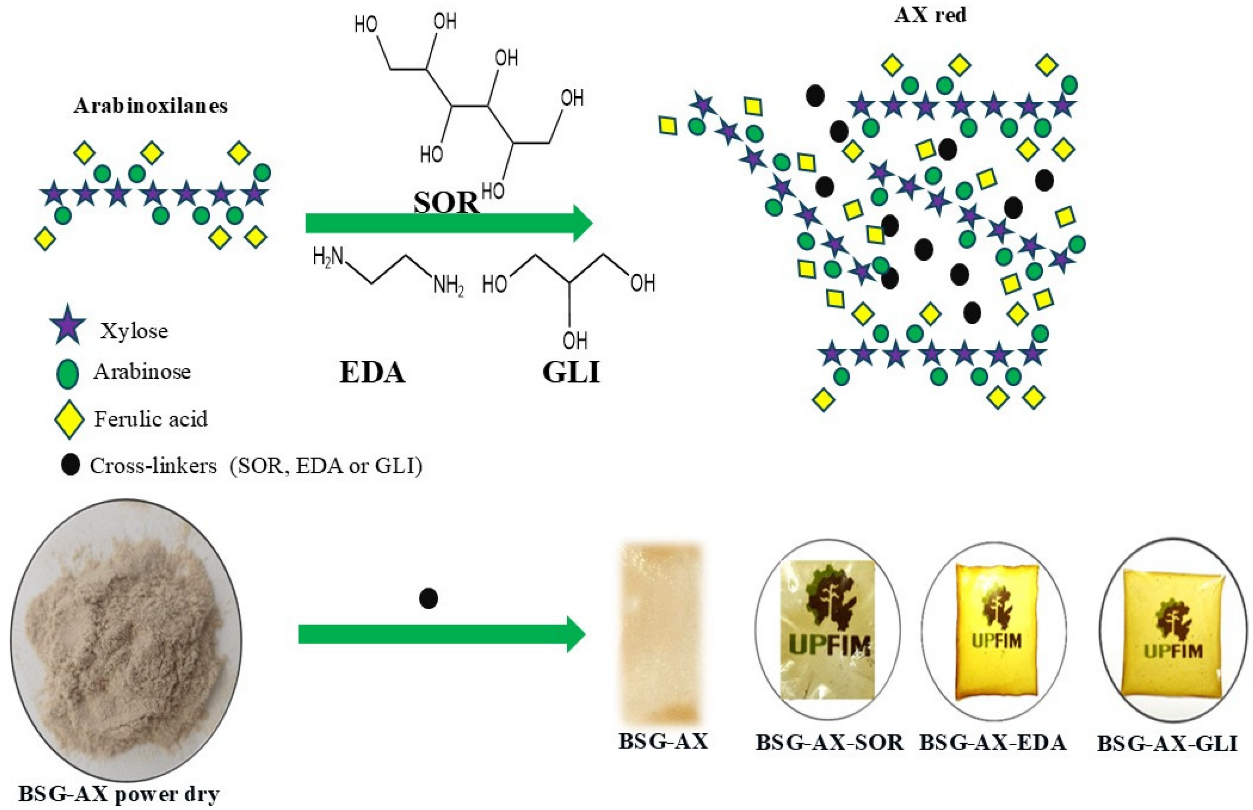
Graphical Abstract

1. Introduction

Residual by-products from the agri-food industry are valuable sources of high-value compounds, such as polysaccharides and proteins, either in their original form or after being transformed into new materials, and represent a feasible strategy for petroleum polymers, since they are a renewable product of the primordial energy source on Earth, the sun [1].
Several investigations have explored the application of biopolymers for the manufacture of homopolymeric or heteropolymeric films (composite). Cellulose, for example, is the most abundant biopolymer on earth; it is part of plant and fungal structures, and it is one of the main products of primary metabolism because it has important structural functions. Biomasses such as sugarcane bagasse, stubble from cereal crops, fruit peels, and vegetable residues are the main source of this biopolymer. Various research projects have reported applications to produce nanostructured materials, hydrogels, and biocompatible materials, among others [2].
On the other hand, starch has been widely used to form films for food packaging, and although some research has been reported on the extraction of starch from agri-food waste, the main sources of starch are foods such as rice, corn, and potatoes, an ethical aspect to consider [3].
Heteropolysaccharides such as pectin have been widely studied for their nutritional and functional properties in foods; however, numerous studies have been reported that address the effect of various factors on their extraction from biomasses, mainly of fruit peels. It is important to note that its application has become popular in the manufacture of composite films and coatings for food [4,5].
Lignin, one of the most abundant polymers in nature, is an aromatic polymer extracted from many wastes from the food industry that has been used for the manufacture of composite films; however, it has been studied more for encapsulation of compounds such as vitamins and naturally occurring pigments such as anthocyanins [6].
Other polymers and their derivatives such as chitin and chitosan have been extracted from various food waste and used for the manufacture of food films and coatings and evaluate their effect on food preservation [7].
On the other hand, proteins extracted from food waste have also begun to have relevance to produce bioplastics evaluated for food packaging and coating [8].
One of the current trends is to take advantage of residual biomass as a source of polymeric materials for food packaging and coating, since this means for scientists a strategy to promote sustainability based on the circular economy [9].
Brewer’s spent grain (BSG) is the primary by-product of the brewing industry and consists mainly of hemicellulose (40–50%), cellulose (12–25%), and protein (30%) [10]. This biomass should be regarded as a raw material source for other industrial sectors due to its composition. It is made up of non-starch polysaccharides (NSPs) such as arabinoxylans (AX), which feature a linear structure of β-(1–4)-D-xylanopyranose units, with branching from α-L-arabinofuranose substituents through glycosidic bonds at O- and/or O-2. Additionally, the AX chains are cross-linked by ferulic acid bridges, forming polymeric networks [11].
AXs are components of NSPs found in the cell walls of cereals. These polysaccharides have garnered attention due to their various biological activities, which include prebiotic effects, immunomodulation, antioxidant properties, and protection against diabetes and cardiovascular issues [12]. Additionally, AX possesses technological functions such as gelling properties and thermal stability, and they behave like pseudoplastic fluids [12].
However, the properties of AX can vary based on their chemical structure, which is influenced by their source [13]. Furthermore, the functional properties of AXs are affected by their molecular weights. Their distribution is broad, and variations can also depend on the extraction method used [14]. One critical parameter is the arabinose-to-xylose ratio (Ara:Xyl), which significantly impacts the structure and properties of AX. A low Ara:Xyl ratio, combined with the cross-linking effect of bound ferulic acid, has been shown to negatively affect solubility [15].
The functional properties of AX and the extraction yield are significantly influenced by the extraction method used. Previous studies have examined the effects of factors such as flour particle size, temperature, ethanol concentration, pH, and ionic strength.
The extraction methods for AX primarily involve alkaline extraction, employing NaOH or Ba(OH)2 solutions at various concentrations. These substances break the covalent and hydrogen bonds within the polysaccharide network, which facilitates the release of polysaccharides from cellular matrices [12]. Some studies also utilize assisted methods, such as ultrasound, followed by precipitation with a hydroalcoholic solution.
Enzymatic extraction is another effective method that increases yield while minimizing structural degradation. This technique not only preserves the content of ferulic acid but also typically results in higher purity isolates. Furthermore, enzymatic extraction is considered non-toxic, safe, and environmentally friendly, making it a sustainable alternative to traditional alkaline methods [16]. However, it is worth noting that the latter method used to be more cost-effective.
The physicochemical properties of AXs enable them to exhibit traits such as water solubility, viscosity, and gelation, making them suitable for developing biodegradable films, using plasticizer to increase these properties [17], because the brittleness and hydrophilicity of polysaccharide films can negatively affect their mechanical and barrier properties, limiting their applications, because one of the problems is the water absorption and their consequent microbial contamination [18]. Therefore, it is essential to incorporate other non-toxic, biodegradable compounds that interact with the hydroxyl (-OH) groups of AX to enhance its hydrophobicity.
One such component is polylactic acid (PLA), a biodegradable, bio-based aliphatic polyester derived from 100% renewable resources, including corn, potatoes, and sugarcane. PLA possesses favorable properties for the synthesis of composite materials [19]. This paper aims to evaluate the mechanical and physicochemical properties of composite films made from AX extracted from BSG, combined with PLA and three plasticizing agents: glycerol (GLI), sorbitol (SOR), and ethylenediamine (EDA). This study proposes future applications for these materials, including hydrophobic, biodegradable options in the food and pharmaceutical industries.

2. Materials and Methods

2.1. Fraction Rich in AX (BSG-AX)

2.1.1. Raw Material

A batch of 10 kg of BSG was collected from an artisanal brewery in Hidalgo, Mexico. The sample was dehydrated by freeze-drying, then reduced in particle size by grinding in a blade mill and subsequently sieved through a 295-micron mesh.
The sample selection criteria were based on the growing craft beer industry in Mexico, particularly in the state of Hidalgo. Therefore, the sample was collected from a craft brewery that produces beer under a controlled and standardized production process, to reduce the variance due to changes in the process to improve the reproducibility of the yield and composition of the AX-rich fraction. Immediately after the filtration of the wort, the biomass was kept in refrigeration to prevent microbial growth and/or changes in its composition. The proposed BSG biomass pretreatment method was based on previous reports [20,21].

2.1.2. Alkaline Extraction

The extraction of the fraction rich in arabinoxylan (BSG-AX) was conducted according to the methodology proposed by Jaguey-Hernandez and colleagues [22]. A 200 g sample of powdered BSG was mixed with 1000 mL of distilled water and subjected to heat treatment for 30 min at 100 °C while stirring continuously. The resulting mixture was then centrifuged at 6000 rpm for 10 min, after which the supernatant was discarded.
The solid residue was mixed with NaOH solution (1000 mL, 0.5 M) and placed in a mini shaker at 25 °C with constant agitation and darkness at 100 rpm for 8 h. Following this, the mixture was acidified with HCl solution (3 M) until a pH of 4 was achieved. The mixture was centrifuged again at 6000 rpm for 10 min to remove the solids and recover the supernatant.
The BSG-AX was precipitated with ethanol at a 1:2 (v/v) ratio, and the mixture was maintained at 4 °C for 12 h. The solid was then recovered by centrifugation for 10 min at 6000 rpm, washed with distilled water to reach pH 7, and subsequently frozen at −45 °C before spray-drying for 72 h. The resulting dry extract was ground in an agate mortar and stored in polyethylene jars until analysis.

2.1.3. Functional Properties

The water solubility index (WSI), water adsorption capacity (WAC), and swelling power (SP) were evaluated following the methodology of Kesselly et al. [23] with some modifications.

2.2. Composite Films

2.2.1. Preparation

Different thermoplastic films were prepared using glycerol (GLI), sorbitol (SOR), and ethylenediamine (EDA) as plasticizers. The preparation method followed the approach of Jaguey-Hernandez et al. [22] with some modifications. First, 300 mg of BSG-AX was dispersed in 10 mL of distilled water and stirred continuously at 60 °C for 1 h. Next, 20% w/w of the chosen plasticizer was added, and stirring continued for 1 h to facilitate polymerization. The resulting solution was then spread onto a glass plate coated with polyvinyl chloride adhesive to prevent the films from sticking. All films were left to dry at room temperature for 12 h. Four types of films were created: BSG-AX-S/P, the control film without a plasticizer, and the other films were named according to the plasticizer used.

2.2.2. Color

Color determination of the homogenized films was conducted using the CIE L*a*b* system. In this system, L represents lightness (where 0 indicates black and 100 indicates white), while a* and b* are chromatic coordinates (+a* indicates red, −a* indicates green, +b* indicates yellow, and −b* indicates blue). To obtain color measurements, the films were placed on a transparent surface inside a camera illuminated with white light. Digital analysis was then carried out to derive the parameters L, a*, and b* from photographic images. Using these measurements, the color index (CI) and ΔE were calculated according to Equations (1)–(3).
T o n e h ° = 180 ° + a r c t a n b a
C r o m a C = ( a   2 + b   2 )
E 00 = L K L S L 2 + C K C S C 2 + H K H S H 2 + R T C K C S C H K H S H

2.2.3. Morphology

The morphology of BSG-AX was examined using a scanning electron microscope (Phenom-World., Eindhoven, North Brabant, The Netherlands). The BSG-AX film sample was mounted onto an aluminum sample holder with double-sided carbon conductive tape. The scanning electron microscope was used to analyze the sample at an accelerating voltage of 5 kV.

2.2.4. Fourier Transform Infrared Spectroscopy (FT-IR)

FT-IR spectroscopy analysis was conducted using an FT-IR spectrophotometer (Spectrum GX, PerkinElmer Inc., Waltham, MA, USA) equipped with an ATR accessory at room temperature. Spectra were collected in the range of 4000 to 600 cm−1 with a resolution of 4 cm−1.

2.2.5. Mechanical Properties

Fracture tests were conducted using a texturometer (LLOYD Instruments, AMETEK, Fareham, Hampshire, UK) to evaluate the films’ mechanical properties. Mechanical grips were used to clamp the samples, which were cut to dimensions of 5 cm2 and stored in a desiccator until testing. The distance between the grips was set at 30 mm, and the testing speed was 1 mm/s. The stress at break and strain at fracture were determined from the force vs. distance curve. Young’s modulus was calculated from the viscoelastic region of the stress–strain curve. Each type of film was measured in triplicate to ensure accuracy.

2.2.6. Water Vapor Permeability

The permeability of the films was determined using the ASTM E96-00 gravimetric method. Circular thermoplastic films with a diameter of 39 mm and a thickness ranging from 30 to 40 µm were produced and placed inside a glass cell filled with distilled water. Silicone gaskets were used to ensure a controlled transfer area of 9.0792 × 10⁻⁴ m2. This glass cell was then positioned on an equilibration plate within a temperature-controlled chamber set at 30 °C, which contained silica gel to maintain humidity. The weight of the films was automatically recorded every minute for 8 h using an analytical balance with an accuracy of 1 × 10⁻⁴ g. The water vapor transmission rate (WVTR), permeance, and water vapor permeability (WVP) were calculated using specified Equations (4)–(6).
W V T R = S l o p e a r e a
P e r m a n e n c e = W V T R Δ P
P e r m e a b i l i t y = P e r m e a n c e T h i c k e s s
where ΔP is the water vapor pressure gradient (4245 Pa) created by distilled water and silica at 30 °C.

2.2.7. Electric and Electrokinetic Properties

A conventional three-electrode cell was utilized for the experiment, consisting of an Ag/AgCl reference electrode, a graphite auxiliary electrode, and a vitrified carbon working electrode. Impedance spectroscopy (IS) analyses were conducted using a potentiostat/galvanostat (Princeton Applied Research, VersaStat 3, Ametek, Inc., Oak Ridge, TN, USA). For the film analysis, the working electrode was coated, and a 1.0 mmol L−1 K3[Fe(CN)6]/K4[Fe(CN)6] solution was employed as the electrolyte, supported in an agar agar medium to simulate the matrix environment.

3. Results and Discussion

3.1. BSG-AX Extraction Yield and Functional Properties

The alkaline extraction of BSG-AX using 0.5 M NaOH yielded 4.2 ± 0.13% (w/w), calculated based on the weight of the original BSG sample. This yield is consistent with previous reports by Jaguey-Hernandez et al. (3.62%) [22] and Perez-Flores et al. (3.46%) [24] demonstrating the reproducibility of the extraction methodology. Minor differences in yield may be attributed to slight modifications in the extraction protocol and the drying method employed (freeze-drying versus convection oven drying), as well as variations in lignin content, which also impart a light brown coloration to the extract.
AX content is influenced by both the extraction technique and the matrix. For example, Hu et al. [25] reported AX contents ranging from 3.20% to 3.70% in various barley varieties, as determined by a colorimetric assay. The use of BSG as source material offers the advantage of low starch content, since most starch is metabolized during fermentation. This characteristic allows for the omission of enzymatic starch removal, which is commonly required in other AX extraction methodologies.
The water absorption capacity (WAC) of BSG-AX was 554%, comparable to values reported for flours from different barley varieties [26]. The solubility and pH values indicate that BSG-AX is highly water-soluble (78%) and capable of forming gels. High WAC and swelling power (SP) values, as reported by Dussan-Sarria et al. [27], reflect the strong interactions between polysaccharide chains. The gelatinization properties of AX in BSG-AX are responsible for its WAC, water solubility index (WSI), and SP. However, these interactions are modulated by the xylose/arabinose ratio, as well as the molecular weight, degree of branching, and conformation of the polysaccharides (Table 1).
The extraction yield of BSG-AX obtained in this study is consistent with previously reported values, which confirms the reproducibility and reliability of the extraction protocol. The slight variations observed can be attributed to differences in drying methods and lignin content, which may affect both yield and color. Using BSG as a starting material is beneficial due to its low starch content, which eliminates the need for enzymatic pretreatment and simplifies the extraction process. The high values of water absorption capacity (WAC), water solubility index (WSI), and swelling power (SP) indicate strong water interactions and good gel-forming capabilities, both of which are essential for film formation. These functional properties are influenced by the structural characteristics of the arabinoxylan (AX), including the xylose/arabinose ratio and degree of branching [22,24].

3.2. Characterization of Thermoplastic Composite Films

3.2.1. Chemical Composition and Morphology

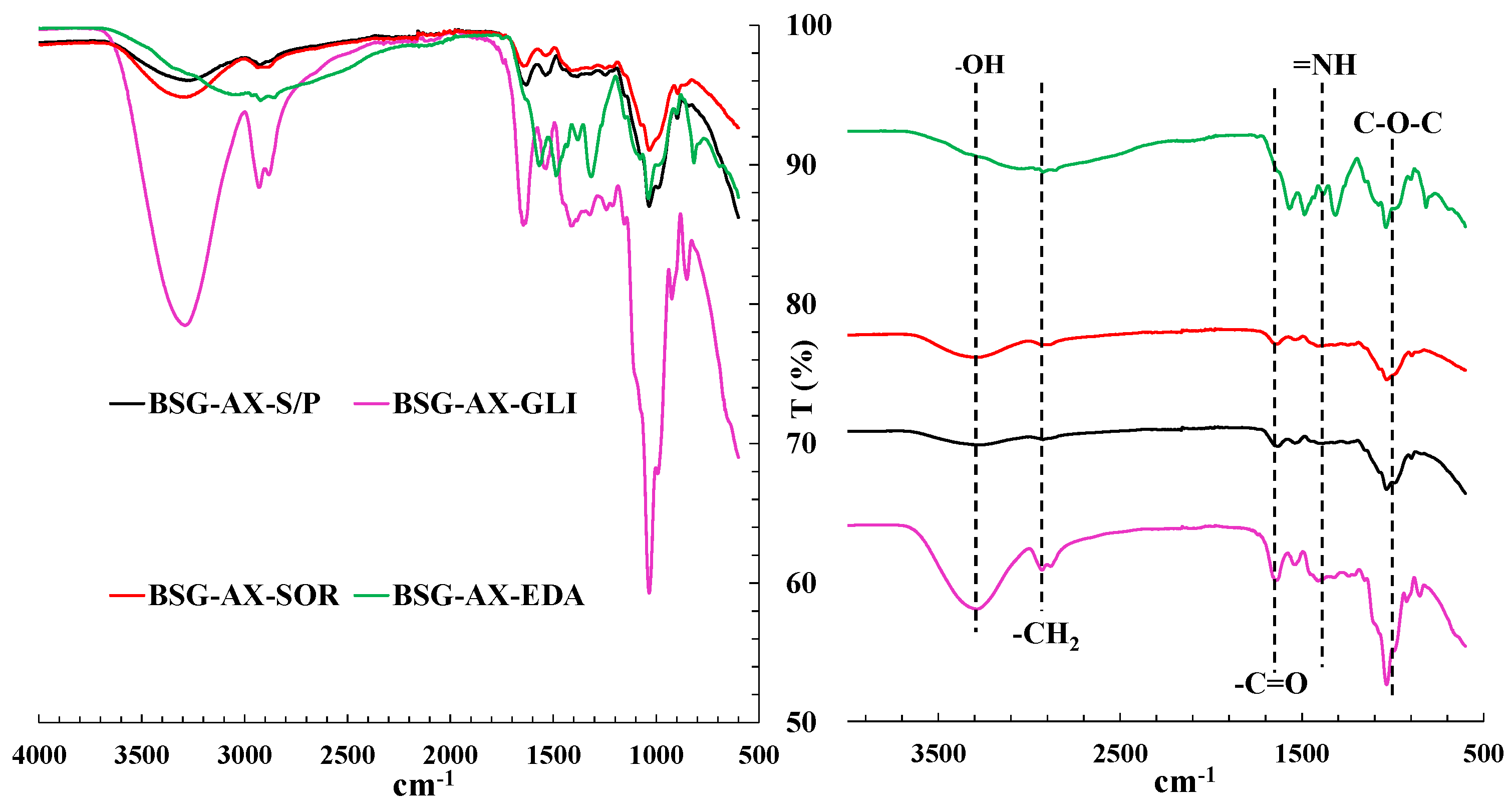
FT-IR spectra (Figure 1) confirmed the presence of characteristic functional groups associated with arabinoxylans and indicated interactions with the plasticizers. The region from 3500 to 1800 cm−1 corresponds to the arabinoxylan fingerprint, featuring bands at 3413 cm−1 (–OH stretching) and 2854 cm−1 (–CH stretching). The primary band at 1035 cm−1 is attributed to C–OH bending, with additional shoulders at 1158 and 897 cm−1 representing the antisymmetric C–O–C stretching of glycosidic bonds and β-(1–4) linkages. An absorbance band at 1700 cm−1 suggests a low degree of esterification with aromatic esters such as ferulic acid. Additionally, peaks at 1580 and 1412 cm−1 indicate the presence of amino functional groups, confirming the conjugation of EDA to BSG-AX.
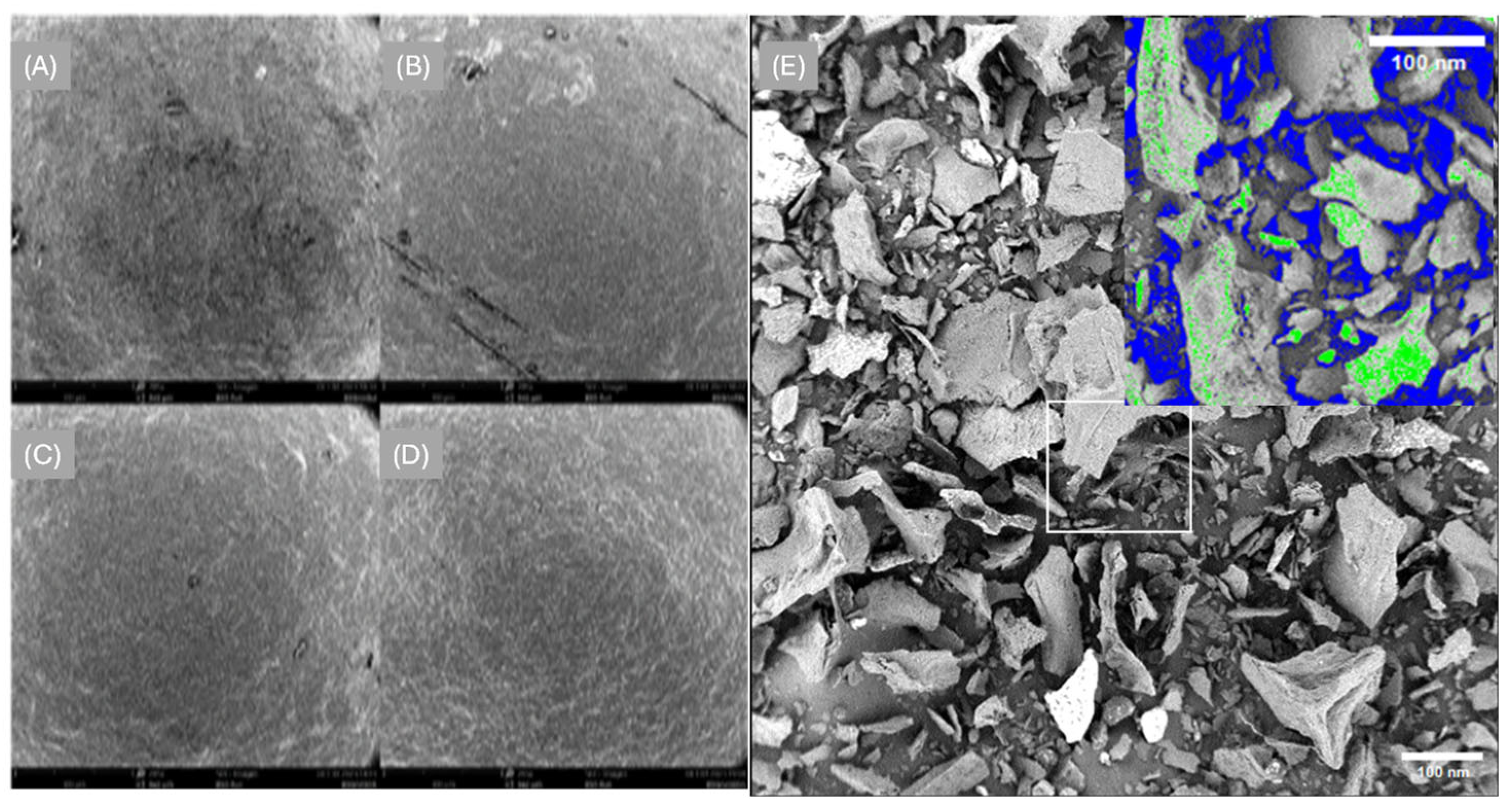
The SEM analysis of BSG-AX powder (Figure 2E) revealed that the particles have irregular shapes and rough, porous surfaces. The particle sizes varied significantly, with average lengths of 184 ± 33 nm for large particles, 62 ± 9 nm for medium particles, and 22 ± 3 nm for small particles. These characteristics align with those of arabinoxylan isolated by alkaline hydrolysis from dried distillery residues [28]. The observed porosity is likely due to low entanglement between arabinoxylan chains, which results from limited branching of arabinofuranose units on the xylose backbone [29].
SEM micrographs of the thermoplastic films (Figure 2) showed generally homogeneous surfaces with some micropores and roughness, and no cracks except in the control film without plasticizer (Figure 2A), where cracks were evident. The addition of plasticizers improved surface morphology and conferred permeability properties.
The FT-IR and SEM analyses confirm the successful incorporation of plasticizers and modifications to film morphology. The presence of characteristic functional groups and the observed changes in surface structure demonstrate the impact of plasticizer addition on film properties. Notably, improved homogeneity and reduced cracking in plasticized films suggest enhanced flexibility and processability, which are critical for practical applications. The results indicate that the films developed possess adjustable mechanical and barrier properties, making them suitable for use as edible coatings for food, as well as biodegradable casings and packaging materials in the food and pharmaceutical industries. Their biodegradable nature and the use of agro-industrial by-products contribute to sustainability and help reduce plastic waste, aligning with current circular economy trends [30].
FT-IR spectroscopic analysis supports the possible formation of covalent bonds between ethylenediamine (EDA) and arabinoxylans. Bands observed at 1580 cm−1 and 1412 cm−1 are attributable to amino groups, confirming the conjugation of EDA with the polysaccharide matrix. Additionally, the presence of a band at 1700 cm−1 suggests the formation of covalent bonds with aromatic esters found in arabinoxylans, such as ferulic acid. These chemical interactions (both covalent and hydrogen) alter the molecular structure of the films, affecting light absorption and, consequently, their color. The observed changes in the optical and mechanical properties of the films with EDA support the hypothesis of significant structural modification due to the formation of these bonds, which shift the absorption of visible light by modifying the chromophore groups and increasing conjugation [31,32,33].

3.2.2. Color Properties

The films exhibited color index (I.C.) values ranging from −1 to +1 (Table 2), placing them in the greenish-yellow region of the CIE Lab* color space. No significant differences were observed between the films plasticized with sorbitol (SOR) and glycerol (GLI). However, films plasticized with ethylenediamine (EDA) displayed distinct color properties. The variation in color can be attributed to the number and type of substituents in the plasticizers, which influence the films’ light absorption capacity. This is due to covalent and hydrogen-bonding interactions between the amine or hydroxyl groups of the plasticizers and the polysaccharide chains.
The color properties of the films are primarily determined by the type and quantity of plasticizer used. The formation of covalent and hydrogen bonds between plasticizer functional groups and the polysaccharide matrix influences light absorption and, consequently, film color. The observed differences, particularly with EDA, highlight the importance of plasticizer selection in tailoring film appearance for specific applications.

3.2.3. Permeability and Mechanical Properties

As shown in Table 3, significant differences in water vapor transfer velocity (WTVR) were observed among the films. However, when the data were normalized to account for the cross-sectional area in the calculations of water vapor permeability (WVP), only the BSG-AX-GLI film exhibited a statistically significant increase. Ballesteros-Martínez et al. [34] indicated that increasing the plasticizer content in biopolymers alters the three-dimensional molecular organization. This change reduces intermolecular forces and increases free volume, thereby enhancing water permeability. Both glycerol (GLI) and ethylene diamine (EDA) plasticizers significantly improved the mechanical properties of the films, leading to a decrease in breaking strength but an increase in elongation at break. This trend is consistent with previous observations in starch and cellulose films.
The mechanical and barrier properties of films are significantly influenced by the incorporation of plasticizers. The observed decrease in tensile strength, along with the increase in elongation at break, aligns with the expected plasticizing effect, which disrupts interactions among polymer chains and enhances flexibility. The relationship between plasticizer concentration and water vapor permeability underscores the need to balance mechanical performance with barrier properties when designing films for specific applications [34,35,36].
Glycerol, a polyalcohol, is widely used as a plasticizer in the food and pharmaceutical industries. It is known for its ability to interact with the hydroxyl groups of polysaccharides, thereby increasing flexibility and reducing film fragility. Glycerol was selected due to its high compatibility with polysaccharide matrices and its designation as a safe compound (Generally Recognized As Safe, GRAS). Additionally, glycerol enhances elongation and flexibility, essential for applications such as edible coatings and biodegradable packaging [37,38].
Sorbitol is another polyalcohol used as a plasticizer. It is less hygroscopic than glycerol, providing greater dimensional stability to films and reducing moisture absorption. Sorbitol was chosen to compare its effects with glycerol, as both compounds impart flexibility but may influence the films’ optical and barrier properties differently. Like glycerol, sorbitol is also considered safe for food and pharmaceutical applications [39,40].
Ethylenediamine (EDA), which contains amino groups, can form bonds with the hydroxyl groups of polysaccharides, thereby modifying the films’ flexibility, optical properties, and barrier characteristics. EDA was selected to evaluate the impact of a plasticizer with different functional groups (amino instead of hydroxyl) on the structure, color, and mechanical properties of the films. The conjugation of EDA with the arabinoxylan matrix was confirmed through FT-IR spectroscopy [41,42].
The selection of these three plasticizers aims to compare the effects of different functional groups (hydroxyl and amino) on the films’ final properties. All three are low-toxicity compounds widely used in food and pharmaceutical applications, ensuring the safety and viability of the films developed for uses such as edible coatings and biodegradable packaging [43,44].
When comparing the results of this study with those reported for films made from other polysaccharides, such as starch and cellulose, it is evident that incorporating glycerol and ethylenediamine as plasticizers in arabinoxylan films results in similar reductions in tensile strength and increases in elongation. This is consistent with findings reported by Ballesteros-Martínez et al. [34] and Paudel et al. [36] for starch and cellulose films, respectively. However, arabinoxylan films exhibit higher water absorption and vapor permeability, which can be attributed to their branched structure and specific functional groups. These differences highlight the importance of selecting the appropriate type of polysaccharide and plasticizer based on the desired application, as these choices significantly affect the mechanical and barrier properties of the developed materials [45].
The mechanical and barrier properties of the films are significantly affected by plasticizer incorporation. The observed decrease in tensile strength and increase in elongation at break are consistent with the expected plasticizing effect, which disrupts polymer chain interactions and increases flexibility. The relationship between plasticizer concentration and water vapor permeability underscores the need to balance mechanical performance and barrier properties when designing films for targeted uses.
Glycerol is a polyalcohol widely used as a plasticizer in the food and pharmaceutical industry. It is known for its ability to interact with the hydroxyl groups of polysaccharides, which increases flexibility and reduces the fragility of films. It was chosen for its high compatibility with polysaccharide matrices and for being a safe compound (GRAS). In addition, glycerol improves the elongation and flexibility of films, which is critical for applications such as edible coatings and biodegradable packaging [46].
On the other hand, sorbitol is another polyalcohol used as a plasticizer. It is less hygroscopic than glycerol, which can provide greater dimensional stability to films and reduce moisture absorption. It was selected to compare its effect against glycerol, as both compounds provide flexibility, but may influence the optical and barrier properties of the films differently. Sorbitol is also safe for food and pharmaceutical applications [45,46,47].
Ethylenediamine, with amino groups, can form bonds with the hydroxyl groups of the polysaccharides, modifying both the flexibility and the optical and barrier properties of the films. It was chosen to evaluate the effect of a plasticizer with different functional groups (amino instead of hydroxyl) to analyze how these chemical interactions affect the structure, color and mechanical properties of the films. The conjugation of EDA with the arabinoxylan matrix was confirmed by FT-IR spectroscopy [48,49,50].
The choice of these three plasticizers responds to the need to compare the effect of different functional groups (hydroxyl and amino) on the final properties of the films. All of them are low-toxicity compounds and widely used in food and pharmaceutical applications, ensuring the safety and viability of films developed for uses such as edible coatings and biodegradable packaging [51,52,53].
When comparing the results obtained in this study with those reported for films made from other polysaccharides, such as starch and cellulose, it is observed that the incorporation of glycerol and ethylenediamine as plasticizers in arabinoxylan films produces similar effects in terms of decreasing tensile strength and increasing elongation. which coincides with what was reported by Ballesteros-Martínez et al. [34] and Paudel et al. [36] for starch and cellulose films, respectively. However, arabinoxylan films exhibit a higher water absorption capacity and vapor permeability, attributable to their branched structure and the presence of specific functional groups. These differences highlight the importance of selecting the type of polysaccharide and plasticizer according to the desired application, as they directly influence the mechanical and barrier properties of the materials developed [54].

3.2.4. Electric and Electrokinetic Stability

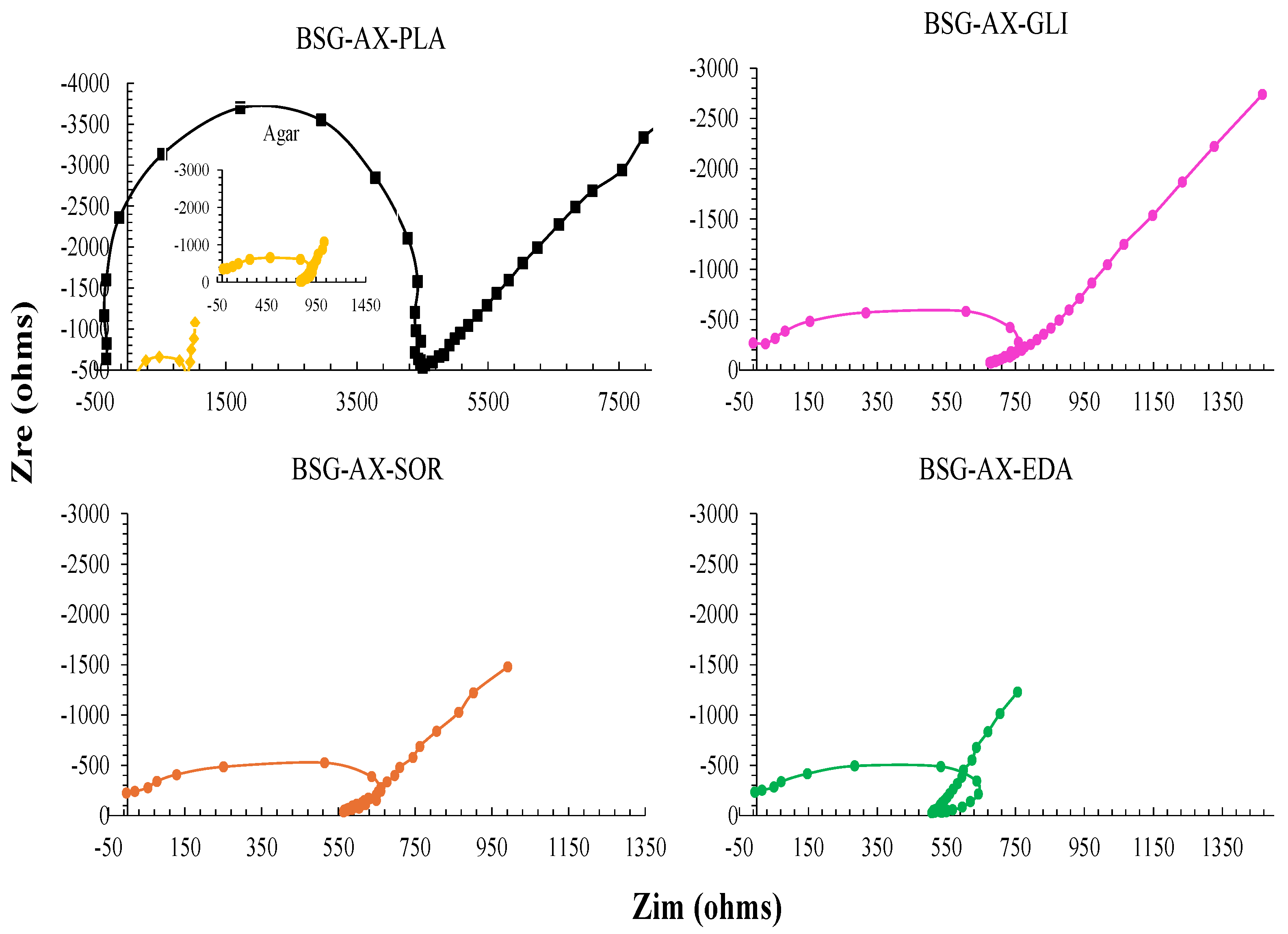
The disintegration time of the films in aqueous media was correlated with their electrical resistance (Z, measured in ohms), as detailed in Table 4. The addition of deionized water to collagen films reduced electrical impedance, indicating that interactions between water molecules and the functional groups in the matrix increased conductance. In this study, no statistically significant differences were observed among the various plasticizers in film stability under high-moisture conditions [35]. However, coating the films with polylactic acid (PLA) increased the impedance by 5.5 orders of magnitude (Figure 3). According to Alabbasi et al. [55], PLA slowly absorbs electrolytes, thereby enhancing the BSG-AX film bilayer’s resistance to degradation in aqueous media.
The results on electric and electrokinetic stability indicate that the type of plasticizer used does not significantly affect the films’ stability in moist environments. However, applying a PLA coating greatly improves their resistance to degradation. This finding is especially important for applications that involve extended exposure to water, such as edible films or biodegradable packaging [56,57,58,59,60].

4. Conclusions

The BSG-AX fraction possesses physical characteristics that render it highly suitable to produce films, both with and without the incorporation of plasticizers. The introduction of plasticizing agents markedly influences various properties, including color, permeability, tensile strength, and elongation at break. These attributes suggest that such films could serve effectively in applications as edible films or as packaging materials within the food and pharmaceutical sectors.
Furthermore, the application of a coating of polylactic acid significantly enhances the stability of BSG-AX films in aqueous environments.

5. Patents

No patents have been generated or filed as a result of the research presented in this manuscript.

Author Contributions

O.J.A.-B., conceptualization, formal analysis, investigation, and writing—original draft. K.A.-A., conceptualization, resources, data curation, software, formal analysis, supervision, funding acquisition, validation, investigation, visualization, methodology, writing—original draft, project administration, and writing—review and editing. A.C.O., conceptualization, resources, data curation, software, formal analysis, supervision, funding acquisition, validation, investigation, visualization, methodology, writing—original draft, project administration, and writing—review and editing. Y.J.H., conceptualization and supervision. G.V.d.l.C., conceptualization, data curation, formal analysis, validation, investigation, and supervision. E.M.S., investigation, methodology, supervision, and validation. P.H.M., investigation, and methodology. All authors have read and agreed to the published version of the manuscript.

Funding

All authors gratefully acknowledge Secretaría de Ciencia, Humanidades, Tecnología e Innovación (SECIHTI, Mexico) by the project financing [Project number 321905].

Institutional Review Board Statement

Not applicable. This study did not involve human participants or animals.

Informed Consent Statement

Not applicable. This study did not involve human participants.

Data Availability Statement

No new data were created or analyzed in this study. Data sharing is not applicable to this article.

Acknowledgments

B.O.A. also thank Consejo Nacional de Ciencia y Tecnología (Mexico) for the scholarship received. C.O.A., J.HY., V.de la C.G., E.M.S., H.M.P., and A.A.K. also thank Sistema Nacional de Investigadoras e Investigadores for the stipend received. Special thanks to Georgina Young-Ellis for her support with English-language editing.

Conflicts of Interest

The authors declare no conflicts of interest.

Abbreviations

The following abbreviations are used in this manuscript:
BSGBrewer’s Spent Grain
AXArabinoxylans
GLIGlycerol
SORSorbitol
EDAEthylenediamine
PLAPolylactic Acid
SEMScanning Electron Microscopy
FT-IRFourier Transform Infrared Spectroscopy
ATRAttenuated Total Reflectance
TSTensile Strength
%EPercent Elongation
WVTRWater Vapor Transmission Rate
WVPWater Vapor Permeability
WSIWater Solubility Index
WACWater Adsorption Capacity
SPSwelling Power
C.I.Color Index
ISImpedance Spectroscopy
Ag/AgClSilver/Silver Chloride
K3[Fe(CN)6]/K4[Fe(CN)6]Potassium Ferricyanide/Ferrocyanide
NaOHSodium Hydroxide
HClHydrochloric Acid
PVAPolyvinyl Alcohol
ASTMAmerican Society for Testing and Materials
KClPotassium Chloride

References

  1. Melis, A. Solar energy conversion efficiencies in photosynthesis: Minimizing the chlorophyll antennae to maximize efficiency. Plant Sci. 2009, 177, 272–280. [Google Scholar] [CrossRef]
  2. Ali, S.Z.; Nahian, M.K.; Hoque, M.E. Extraction of cellulose from agro-industrial wastes. In Extraction of Natural Products from Agro-Industrial Wastes; Bhawani, S.A., Khan, A., Ahmad, F.B., Eds.; Elsevier: Amsterdam, The Netherlands; Oxford, UK; Cambridge, MA, USA, 2023; Volume 1, pp. 319–348. [Google Scholar]
  3. Mhaske, S.T.; Mohanty, J.D.; Borse, P.Y. Starch from agro-waste for food packaging applications. In Agro-Waste Derived Biopolymers and Biocomposites: Innovations and Sustainability in Food Packaging; Kumar, S., Mukherjee, A., Katiyar, V., Eds.; John Wiley & Sons: Hoboken, NJ, USA, 2024; Volume 1, pp. 241–265. [Google Scholar]
  4. Kumar, S.; Konwar, J.; Purkayastha, M.D.; Kalita, S.; Mukherjee, A.; Dutta, J. Current progress in valorization of food processing waste and by-products for pectin extraction. Int. J. Biol. Macromol. 2023, 239, 124332. [Google Scholar] [CrossRef]
  5. Kumar, S.; Reddy, A.R.L.; Basumatary, I.B.; Nayak, A.; Dutta, D.; Konwar, J.; Mukherjee, A. Recent progress in pectin extraction and their applications in developing films and coatings for sustainable food packaging: A review. Int. J. Biol. Macromol. 2023, 239, 124281. [Google Scholar] [CrossRef]
  6. Mateo, S.; Fabbrizi, G.; Moya, A.J. Lignin from plant-based agro-industrial biowastes: From extraction to sustainable applications. Polymers 2025, 17, 952. [Google Scholar]
  7. Pavani, M.; Singh, S.K.; Singha, P. Chitosan from agro-waste for food packaging applications. In Agro-Waste Derived Biopolymers and Biocomposites: Innovations and Sustainability in Food Packaging; Kumar, S., Mukherjee, A., Katiyar, V., Eds.; John Wiley & Sons: Hoboken, NJ, USA, 2024; Volume 1, pp. 267–294. [Google Scholar]
  8. Álvarez-Castillo, E.; Felix, M.; Bengoechea, C.; Guerrero, A. Proteins from Agri-Food Industrial Biowastes or Co-Products and Their Applications as Green Materials. Foods 2021, 10, 981. [Google Scholar] [PubMed]
  9. Gaspar, M.C.; Braga, M.E. Edible films and coatings based on agrifood residues: A new trend in the food packaging research. Curr. Opin. Food Sci. 2023, 50, 101006. [Google Scholar] [CrossRef]
  10. Reis, S.F.; Coelho, E.; Coimbra, M.A.; Abu-Ghannam, N. Improved efficiency of brewer’s spent grain arabinoxylans by ultrasound-assisted extraction. Ultrason. Sonochem 2015, 24, 155–164. [Google Scholar] [CrossRef]
  11. Li, X.; Mu, X.; Zhang, H.; Wang, C.; Yang, R.; Liang, J.; Liu, Z. Purification and characterisation of arabinoxylan arabinofuranohydrolase I responsible for the filterability of barley malt. Food Chem. 2015, 174, 286–290. [Google Scholar] [CrossRef]
  12. Zhang, Z.; Koris, A.; Csighy, A.; Yao, X.; Gu, K.; Zhang, P.; Xue, B.; Ren, F.; Liu, H. Extraction, structural characteristics, and health benefits of starch, arabinoxylan and β-glucan from Triticeae cereals: A critical review. Int. J. Biol. Macromol. 2025, 330, 148167. [Google Scholar] [CrossRef]
  13. Geng, M.; Li, J.; Luo, D.; Li, X.; Zhang, Y.; Lan, H.; Huang, J.; Bai, Z.; Han, S. Recycling of wheat gluten wastewater: Separation, characterisation, and solution rheology of arabinoxylans. Int. J. Food Sci. Technol. 2024, 59, 1852–1863. [Google Scholar] [CrossRef]
  14. Boukid, F. Comprehensive review of barley dietary fibers with Emphasis on arabinoxylans. Bioact. Carbohydr. Diet. Fibre 2024, 31, 100410. [Google Scholar] [CrossRef]
  15. Guo, R.; Xu, Z.; Wu, S.; Li, X.; Li, J.; Hu, H.; Wu, Y.; Ai, L. Molecular properties and structural characterization of an alkaline extractable arabinoxylan from hull-less barley bran. Carbohydr. Polym. 2019, 218, 250–260. [Google Scholar] [CrossRef]
  16. Jia, H.; Jia, Y.; Ren, F.; Liu, H. Enhancing bioactive compounds in plant-based foods: Influencing factors and technological advances. Food Chem. 2024, 460, 140744. [Google Scholar] [CrossRef]
  17. Wahlström, N.; Hedenqvist, M.S.; Vilaplana, F. Citric acid tailors the mechanical and barrier properties of arabinoxylan-gluten crosslinked glycoprotein films. Food Hydrocoll. 2024, 153, 110012. [Google Scholar] [CrossRef]
  18. Alahmed, A.; Simsek, S. Recycling of wheat gluten wastewater. Foods 2024, 13, 1914. [Google Scholar] [PubMed]
  19. Wu, Y.; Gao, X.; Wu, J.; Zhou, T.; Nguyen, T.T.; Wang, Y. Biodegradable Polylactic Acid and Its Composites: Characteristics, Processing, and Sustainable Applications in Sports. Polymers 2023, 15, 3096. [Google Scholar] [CrossRef] [PubMed]
  20. Börjesson, M.; Westman, G.; Larsson, A.; Ström, A. Thermoplastic and flexible films from arabinoxylan. ACS Appl. Polym. Mater. 2019, 1, 1443–1450. [Google Scholar] [CrossRef]
  21. Deralia, P.K.; Sonker, A.K.; Lund, A.; Larsson, A.; Ström, A.; Westman, G. Side chains affect the melt processing and stretchability of arabinoxylan biomass-based thermoplastic films. Chemosphere 2022, 294, 133618. [Google Scholar] [CrossRef]
  22. Jaguey-Hernández, Y.; Tapia-Ignacio, C.; Aguilar-Arteaga, K.; González-Olivares, L.G.; Castañeda-Ovando, E.P.; Cruz-Cansino, N.; Ojeda-Ramírez, D.; Castañeda-Ovando, A. Thermoplastic biofilms obtained from an arabinoxylan-rich fraction from brewers’ spent grain: Physicochemical characterization and thermal analysis. Biomass Convers. Biorefin. 2023, 13, 14035–14047. [Google Scholar]
  23. Kesselly, S.R.; Mugabi, R.; Byaruhanga, Y.B. Effect of soaking and extrusion on functional and pasting properties of cowpeas flour. Sci. Afr. 2023, 19, e01532. [Google Scholar]
  24. Pérez-Flores, J.G.; Contreras-López, E.; Castañeda-Ovando, A.; Pérez-Moreno, F.; Aguilar-Arteaga, K.; Álvarez-Romero, G.A.; Téllez-Jurado, A. Physicochemical characterization of an arabinoxylan-rich fraction from brewers’ spent grain and its application as a release matrix for caffeine. Food Res. Int. 2019, 116, 1020–1030. [Google Scholar] [CrossRef]
  25. Hu, G.; Ellberg, S.; Burton, C.; Evans, C.; Satterfield, K.; Bockelman, H. Application of an orcinol-ferric chloride colorimetric assay in barley and wheat accessions for water-extractable and total arabinoxylan. J. Cereal Sci. 2020, 93, 102962. [Google Scholar] [CrossRef]
  26. Holtekjølen, A.K.; Olsen, H.H.R.; Færgestad, E.M.; Uhlen, A.K.; Knutsen, S.H. Variations in water absorption capacity and baking performance of barley varieties with different polysaccharide content and composition. LWT-Food Sci. Technol. 2008, 41, 2085–2091. [Google Scholar] [CrossRef]
  27. Dussán-Sarria, S.; Hurtado-Hurtado, D.L.; Camacho-Tamayo, J.H. Granulometría, propiedades funcionales y propiedades de color de las harinas de quinua y chontaduro. Inf. Tecnol. 2019, 30, 3–10. [Google Scholar]
  28. De Anda-Flores, Y.; Carvajal-Millan, E.; Lizardi-Mendoza, J.; Rascon-Chu, A.; Martínez-López, A.L.; Marquez-Escalante, J.; Brown-Bojorquez, F.; Tanori-Cordova, J. Covalently Cross-Linked Nanoparticles Based on Ferulated Arabinoxylans Recovered from a Distiller’s Dried Grains Byproduct. Processes 2020, 8, 691. [Google Scholar]
  29. Martínez-López, A.L.; Carvajal-Millan, E.; Rascón-Chu, A.; Márquez-Escalante, J.; Martínez-Robinson, K. Gels of ferulated arabinoxylans extracted from nixtamalized and non-nixtamalized maize bran: Rheological and structural characteristics. CyTA—J. Food 2013, 11, 22–28. [Google Scholar]
  30. Punia Bangar, S.; Gumber, S.; Whiteside, W.S.; Phimolsiripol, Y. Arabinoxylan-Based Films and Coatings for Fresh Produce: A Review of Emerging Trends in Food Packaging. Int. J. Biol. Macromol. 2025, 310, 143097. [Google Scholar] [CrossRef] [PubMed]
  31. Salvada, J.; Alke, B.; Brazinha, C.; Alves, V.D.; Coelhoso, I.M. Development and characterisation of arabinoxylan-based composite films. Coatings 2022, 12, 813. [Google Scholar] [CrossRef]
  32. Rojas-Lema, S.; Mellinas, C.; Jiménez, A.; Garrigós, M.C.; Garcia-Garcia, D.; Balart, R. Enhanced properties of methyl hydroxyethyl cellulose films with arabinoxylans-rich extract from brewer’s spent grain. Carbohydr. Polym. Technol. Appl. 2024, 8, 100624. [Google Scholar]
  33. Bilal, M.; Li, D.; Xie, C.; Yang, R.; Gu, Z.; Jiang, D.; Xu, X.; Wang, P. Valorization of wheat bran arabinoxylan: A review on nutritional and materials perspectives. Grain Oil Sci. Technol. 2024, 7, 196–208. [Google Scholar] [CrossRef]
  34. Ballesteros-Mártinez, L.; Pérez-Cervera, C.; Andrade-Pizarro, R. Effect of glycerol and sorbitol concentrations on mechanical, optical, and barrier properties of sweet potato starch film. NFS J. 2020, 20, 1–9. [Google Scholar] [CrossRef]
  35. Hazrati, K.Z.; Sapuan, S.M.; Zuhri, M.Y.M.; Jumaidin, R. Effect of plasticizers on physical, thermal, and tensile properties of thermoplastic films based on Dioscorea hispida starch. Int. J. Biol. Macromol. 2021, 185, 219–228. [Google Scholar] [CrossRef]
  36. Paudel, S.; Regmi, S.; Janaswamy, S. Effect of glycerol and sorbitol on cellulose-based biodegradable films. Food Packag. Shelf Life 2023, 37, 101090. [Google Scholar] [CrossRef]
  37. Mikkonen, K.S.; Heikkinen, S.; Soovre, A.; Peura, M.; Serimaa, R.; Talja, R.A.; Helén, H.; Hyvönen, L.; Tenkanen, M. Films from Oat Spelt Arabinoxylan Plasticized with Glycerol and Sorbitol. J. Appl. Polym. Sci. 2009, 114, 457–466. [Google Scholar] [CrossRef]
  38. Stoklosa, R.J.; Latona, R.J.; Bonnaillie, L.M.; Yadav, M.P. Evaluation of Arabinoxylan Isolated from Sorghum Bran, Biomass, and Bagasse for Film Formation. Carbohydr. Polym. 2019, 213, 382–392. [Google Scholar] [CrossRef] [PubMed]
  39. Yilmaz-Turan, S.; Jiménez-Quero, A.; Menzel, C.; Morais de Carvalho, D.; Lindström, M.E. Bio-Based Films from Wheat Bran Feruloylated Arabinoxylan: Effect of Extraction Technique, Acetylation and Feruloylation. Carbohydr. Polym. 2020, 250, 116916. [Google Scholar] [CrossRef]
  40. Cheng, J.; Wang, H.; Kang, S.; Xia, L.; Jiang, S.; Chen, M.; Jiang, S. An active packaging film based on yam starch with eugenol and its application for pork preservation. Food Hydrocoll. 2019, 96, 546–554. [Google Scholar] [CrossRef]
  41. Jana, P.; Mitra, T.; Kumara Raja, S.T.; Gnanamani, A.; Kundu, P. Preparation of Guar Gum Scaffold Film Grafted with Ethylenediamine and Fish Scale Collagen, Cross-Linked with Ceftazidime for Wound Healing Application. Carbohydr. Polym. 2016, 153, 573–581. [Google Scholar] [CrossRef] [PubMed]
  42. Alavarse, A.C.; Frachini, E.C.; Da Silva, R.; Hashimoto Lima, V.; Shavandi, A.; Petri, D.F.S. Crosslinkers for Polysaccharides and Proteins: Synthesis Conditions, Mechanisms, and Crosslinking Efficiency—A Review. Int. J. Biol. Macromol. 2022, 202, 558–596. [Google Scholar]
  43. Jahangiri, F.; Mohanty, A.K.; Misra, M. Sustainable Biodegradable Coatings for Food Packaging: Challenges and Opportunities. Green Chem. 2024, 26, 4934–4974. [Google Scholar] [CrossRef]
  44. Oliveira, I.; Pinto, T.; Afonso, S.; Karaś, M.; Szymanowska, U.; Gonçalves, B.; Vilela, A. Sustainability in Bio-Based Edible Films, Coatings, and Packaging for Small Fruits. Appl. Sci. 2025, 15, 1462. [Google Scholar] [CrossRef]
  45. Jahangiri, F.; Mohanty, A.K.; Pal, A.K.; Shankar, S.; Rodriguez-Uribe, A.; Clemmer, R.; Gregori, S.; Misra, M. PHBV coating on biodegradable plastic sheet: Effect of coating on morphological, mechanical and barrier properties. Prog. Org. Coat. 2024, 189, 108270. [Google Scholar] [CrossRef]
  46. García-Ochoa, F.; Santos, V.E.; Casas, J.A.; Gómez, E. Xanthan Gum: Production, Recovery, and Properties. Carbohydr. Polym. 2000, 43, 187–204. [Google Scholar]
  47. Antoniou, J.; Liu, F.; Majeed, H.; Qazi, H.J.; Zhong, F. Physicochemical and Thermomechanical Characterization of Tara Gum Edible Films: Effect of Polyols as Plasticizers. Carbohydr. Polym. 2014, 111, 359–365. [Google Scholar] [CrossRef] [PubMed]
  48. O’Connor, N.A.; Abugharbieh, A.; Yasmeen, F.; Buabeng, E.; Mathew, S.; Samaroo, D.; Cheng, H.-P. The Crosslinking of Polysaccharides with Polyamines and Dextran–Polyallylamine Antibacterial Hydrogels. Int. J. Biol. Macromol. 2015, 72, 88–93. [Google Scholar] [CrossRef] [PubMed]
  49. Yammine, P.; El Safadi, A.; Kassab, R.; El-Nakat, H.; Obeid, P.J.; Nasr, Z.; Tannous, T.; Sari-Chmayssem, N.; Mansour, A.; Chmayssem, A. Types of Crosslinkers and Their Applications in Biomaterials and Biomembranes. Chemistry 2025, 7, 61. [Google Scholar] [CrossRef]
  50. Zhou, Y.; Zeng, G.; Zhang, F.; Li, K.; Li, X.; Luo, J.; Li, J.; Li, J. Design of tough, strong and recyclable plant protein-based adhesive via dynamic covalent crosslinking chemistry. Chem. Eng. J. 2023, 460, 141774. [Google Scholar] [CrossRef]
  51. Chen, Y.; Wang, J.; Xu, L.; Nie, Y.; Ye, Y.; Qian, J.; Liu, F.; Zhang, L. Effects of Different Plasticizers on the Structure, Physical Properties and Film Forming Performance of Curdlan Edible Films. Foods 2024, 13, 3930. [Google Scholar] [CrossRef]
  52. Ma, C.; Tao, H.; Tan, C.; Gao, S.; Wu, Z.; Guo, L.; Cui, B.; Yuan, F.; Zou, F.; Liu, P.; et al. Effects of Polyols with Different Hydroxyl Numbers on the Structure and Properties of Starch Straws. Carbohydr. Polym. 2023, 321, 121297. [Google Scholar] [CrossRef]
  53. Özeren, H.D.; Guivier, M.; Olsson, R.T.; Nilsson, F.; Hedenqvist, M.S. Ranking Plasticizers for Polymers with Atomistic Simulations: PVT, Mechanical Properties, and the Role of Hydrogen Bonding in Thermoplastic Starch. ACS Appl. Polym. Mater. 2020, 2, 2016–2026. [Google Scholar] [CrossRef]
  54. Ashoorirad, M.; Fallah, A.; Saviz, M. Measuring and assessment of impedance spectrum of collagen thin films in the presence of deionized water. J. Mol. Liq. 2020, 320, 114488. [Google Scholar] [CrossRef]
  55. Alabbasi, A.; Liyanaarachchi, S.; Kannan, M.B. Polylactic acid coating on a biodegradable magnesium alloy: An in vitro degradation study by electrochemical impedance spectroscopy. Thin Solid Film. 2012, 520, 6841–6844. [Google Scholar] [CrossRef]
  56. Kaur, N.; Pandey, S.; Bhushan, K. Recent Developments in Extraction, Molecular Characterization, Bioactivity, and Application of Brewers Spent Grain Arabinoxylans. J. Food Sci. 2025, 90, e70239. [Google Scholar] [CrossRef] [PubMed]
  57. Belardi, I.; Sarasini, F.; Tirillò, J.; Russo, P.; De Francesco, G.; Marconi, O.; Marrocchi, A. Brewers’ Spent Grain-Derived Arabinoxylan as a Sustainable Filler for Enhanced PHBV Biocomposites. Polymers 2025, 17, 114. [Google Scholar] [CrossRef] [PubMed]
  58. Badsha, M.A.R.; Kjelland, M.; Ulven, C.; Hossain, K. Arabinoxylan-Based Bioplastic from Wheat Bran: A Promising Replacement for Synthetic Plastics. Polymers 2025, 17, 2488. [Google Scholar] [CrossRef]
  59. Salvay, A.G. Polysaccharide-Based Materials: Developments and Properties. Polymers 2025, 17, 3028. [Google Scholar] [CrossRef]
  60. Deol, P.; Madhumita, M.; Verma, P.; Kumar, A.; Kaushik, R.; Lai, C.W. Recent Advances in Polysaccharide-Based Edible Films Using Natural Extracts and Their Potential Food Applications. J. Food Sci. 2025, 90, e70737. [Google Scholar] [CrossRef]
Figure 1. FT-IR spectra of thermoplastic films. BSG-AX-S/P is a control (without plasticizer). BSG-AX-GLI (with glycerol), BSG-AX-SOR (with sorbitol), and BSG-AX-EDA (with ethylenediamine).
Biomass 06 00015 g001
Figure 2. Micrographs of (A) BSG-AX-S/P, (B) BSG-AX-GLI, (C) BSG-AX-SOR, (D) BSG-AX-EDA films, and (E) BSG-AX dry powder composed of irregular sizes and morphologies.
Biomass 06 00015 g002
Figure 3. Nyquist diagrams obtained from the impedance measurement of the evaluated films.
Biomass 06 00015 g003
Table 1. Physical properties of BSG-AX, mean ± standard deviation (number of replicates n = 3).
PropertiesValue
pH6.91 ± 0.03
WAC (%)555 ± 22
WSI (%)78.2 ± 2.9
SP (gwater/gwater)4 ± 1.0
Table 2. Color parameters of the three-dimensional CIE L*a*b* space of the formulations.
Composite FilmsL*a*b*IC
BSG-AX-SOR76.33 ± 0.23 a−0.10 ± 0.10 d32.87 ± 0.45 g−0.039
BSG-AX-GLI72.60 ± 0.52 b0.33 ± 0.58 e62.83 ± 0.31 h0.073
BSG-AX-ETD68.83 ± 0.32 c3.70 ± 0.56 f68.97 ± 0.45 i0.780
Tukey test means comparison with p ≤ 0.05, means that do not share a letter are significantly different, mean ± standard deviation (number of replicates n = 3).
Table 3. Permeability and mechanical properties of composite films.
ParameterComposite Films
BSG-AX-S/PBSG-AX-GLIBSG-AX-SORBSG-AX-EDA
Thickness (mm)0.030 ± 0.001 A0.039 ± 0.002 B0.036 ± 0.0008 B0.030 ± 0.0008 A
WVTR (g/day·m2)1570.10 ± 1.16 A2431.50 ± 13.55 B1566.71 ± 4.54 A1807.46 ± 2.22 D
WVP (g/day·m·Pa) × 10−51.11 ± 0.043 A2.28 ± 0.014 B1.36 ± 0.035 A1.28 ± 0.028 A
Thickness (mm)0.035 ± 0.001 A0.036 ± 0.002 A0.037 ± 0.001 A0.038 ± 0.001 A
TS (MPa)27.4 ± 2.7 A8.6 ± 3.9 B27.5 ±4.7 A15.4 ± 3.8 B
%E1.27 ± 0.20 A39.7 ± 12.2 B4.42 ±1.26 A34.3 ± 8.2 B
Extension (mm)0.381 ± 0.06 A11.90 ±3.66 B1.33 ± 0.38 A10.29 ± 2.46 B
Tukey test means comparison with p ≤ 0.05, means that do not share a letter are significantly different, mean ± standard deviation (number of replicates n = 3). WVTR: Water vapor transmission rate; WVP: Water vapor permeability; TS: Tensile strength; %E: Percent elongation.
Table 4. Electric impedance for the composite films.
Composite FilmZ (ohms)Time of Disintegration (min)
Agar−644.87 ± 10.38 A-
BSG-AX-GLI−562.15 ± 30.34 A1.52 ± 0.18 A
BSG-AX-SOR−485.62 ± 43.31 A1.41 ± 0.14 A
BSG-AX-EDA−423.00 ± 68.57 A1.56 ± 0.13 A
BSG-AX-PLA−3332.12 ± 347.48 B5.52 ± 2.33 B
Tukey’s test mean comparison with a p ≤ 0.05, means that do not share a letter are significantly different, mean ± standard deviation (n = 3). Z is the electric resistance.
Disclaimer/Publisher’s Note: The statements, opinions and data contained in all publications are solely those of the individual author(s) and contributor(s) and not of MDPI and/or the editor(s). MDPI and/or the editor(s) disclaim responsibility for any injury to people or property resulting from any ideas, methods, instructions or products referred to in the content.