Review

Enzymatic Hydrolysis of Lignocellulosic Biomass: Structural Features, Process Aspects, Kinetics, and Computational Tools


by
Darlisson Santos
1,2,*,
Joyce Gueiros Wanderley Siqueira
3,
Marcos Gabriel Lopes da Silva
3,
Maria Donato
3,
Girleide da Silva
2,
Bruna Pratto
4,
Allan Almeida Albuquerque
3,
Emmanuel Damilano Dutra
3 and
Jorge Luíz Silveira Sonego
5
1
Department of Fundamental Chemistry, Federal University of Pernambuco, Recife 50740-560, PE, Brazil
2
Chemistry Graduate Program, Federal University of Pernambuco, Recife 50740-560, PE, Brazil
3
Laboratory of Bioenergy and Environment, Department of Nuclear Energy, Federal University of Pernambuco, Recife 50740-545, PE, Brazil
4
Laboratory of Bioprocess, Department of Chemical Engineering, FEI University Center, São Bernardo do Campo 09850-901, SP, Brazil
5
Biotechnology Graduate Program, Department of Antibiotics, Federal University of Pernambuco, CEP, Recife 50670-901, PE, Brazil
*
Author to whom correspondence should be addressed.
Biomass 2026, 6(1), 13; https://doi.org/10.3390/biomass6010013
Submission received: 2 December 2025 / Revised: 19 January 2026 / Accepted: 26 January 2026 / Published: 3 February 2026

Abstract

This manuscript provides a comprehensive review of the enzymatic hydrolysis of lignocellulosic biomass, emphasizing how chemical composition, structural features, inhibitory compounds, and process configurations collectively influence the conversion of structural polysaccharides into fermentable sugars. Variability among herbaceous, woody, and residual biomasses results in differences in cellulose, hemicellulose, lignin content, and crystallinity, which strongly affect enzyme accessibility. The review discusses key inhibitory mechanisms, including nonproductive cellulase adsorption onto lignin, interference from phenolic derivatives and pretreatment by-products, and inhibition caused by accumulating mono- and oligosaccharides. Process configurations such as SHF, SSF, PSSF, and consolidated bioprocessing are compared, with SSF often achieving superior performance by mitigating end-product inhibition. The manuscript also highlights the growing relevance of computational modeling and simulation tools, which support kinetic prediction, the evaluation of transport limitations, and the optimization of operating conditions in high-solids systems. Additionally, recent advances in artificial intelligence are presented as powerful approaches for modeling nonlinear hydrolysis behavior, estimating kinetic parameters, identifying rate-limiting steps, and improving predictive accuracy in complex bioprocesses. Overall, the integration of experimental insights with advanced modeling, simulation, and AI-based strategies is essential for overcoming current limitations and enhancing the technical feasibility and industrial competitiveness of lignocellulosic bioconversion.

1. Introduction

There has been an increasing interest in renewable fuels in the last decades, since sustainability has become a hot topic in environmental discussions. In this regard, lignocellulosic biomasses gained attention because of their chemical composition, that is, their sugar-rich polymers (cellulose and hemicellulose) [1,2]. There are many cellulose-rich biomasses, whose composition (hemicellulose, cellulose, lignin, and ash) and structure vary according to their sources (forestry, agricultural, industrial, algal, etc.) [3,4,5].
Due to these chemical composition and structural variations, the sugars released through enzymatic hydrolysis have some important factors that must be considered when a biomass is chosen as substrate for cellulase hydrolysis. One of the most studied factors is lignin removal prior to hydrolysis in a step named pretreatment [6]. There are many pretreatment methods that can be applied, resulting in different lignocellulosic structural changes, such as carbohydrate percentage and cellulose crystallinity and polymerization degrees [7,8].
Being responsible for so many structural changes in lignocellulosic matrixes, the pretreatment step is always reported as the most important aspect of enzymatic cellulose hydrolysis, but there are other variables that can be considered in the whole process [9,10].
During cellulose hydrolysis using cellulase as catalysts, the enzyme complex composition and source are also crucial for suitable glucose yields. A critical aspect of enzymatic hydrolysis is the high cost of enzymes, which remains a major barrier to economically viable large-scale production of biofuels and biomaterials [11]. In addition, the hydrolysis of cellulose or hemicellulose often yields relatively low conversion efficiency. Thus, a deeper understanding of enzyme kinetics and hydrolysis mechanisms is essential to improve efficiency and reduce the costs associated with lignocellulosic biomass biorefineries.
So, the use of different cellulase complexes, cocktails, and engineering are of great importance to improve cellulose hydrolysis [12,13]. However, when the sugars released from lignocellulosic biomasses are desired on an industrial scale, other factors (process configuration, kinetic models, and computational modeling) must be considered.
Therefore, this review brings light to crucial factors affecting the enzymatic hydrolysis of cellulose, beginning with biomass composition variation, inhibitors of cellulase activity, and process configuration (solid loading, sugar removal, separate hydrolysis and fermentation, simultaneous saccharification and fermentation—SSF, pre-saccharification followed by SSF, and consolidated bioprocessing) and finally discussing the modeling choice. These insights over cellulose hydrolysis can highlight the state of the art in enzymatic hydrolysis. Next, this review summarizes the main aspects involved in enzymatic hydrolysis of cellulose apart from the most studied ones: pretreatment and cellulase source. Furthermore, the major highlight is the Kinetic modeling step, being the first review in recent years that discusses the recent advances in this subject.

2. Chemical and Structural Variability of Available Biomasses

2.1. Biomass Concept and Worldwide Availability

Biomass is solar energy accumulated and stored within chemical bonds. Remarkable scientific advances and technological developments have been achieved in the last years regarding the bioconversion of lignocellulosic biomasses into several bioproducts. Interest in the topic grew as its applicability in bioenergy production became a vital part of energy transition. Up to 500 EJ of energy per year can be harnessed from the biomass available on Earth [14].
Lignocellulosic biomass is a matrix of polymeric carbohydrates, cellulose and hemicelluloses, and lignin, a complex polyphenolic polymer. It also has, in lesser amounts, extractives, proteins, and ashes. The main matrix creates a sturdy and recalcitrant structure [15]. Cellulose is a linear polysaccharide of cellobiose units organized in a crystalline structure with some amorphous regions. The higher the degree of cellulose crystallinity, the harder it is to break down the structure, which makes cellulose a great cell wall component for plant cells, protecting them from microbial attack and enzymatic hydrolysis.
In contrast, hemicelluloses are heteropolysaccharides, comprising different oligosaccharides such as xylan, glucuronoxylan, arabinoxylan, arabinogalactan, galactoglucomannan, etc. [16]. Hemicelluloses’ structures are highly contrasting with those of cellulose, being branched and easily hydrolyzed by enzymes and acids.
Finally, lignin is an amorphous polymer of p-coumaryl alcohol, coniferyl alcohol, and sinapyl alcohol, which are all distributed randomly across the structure and vary significantly from one plant species to another. Lignin is also recalcitrant and adds resistance to microbial and enzymatic attacks. Strong covalent bonds link lignin to the carbohydrates, and it protects cellulose, reducing enzyme accessibility [15]. Distinct biomass feedstocks have different structures because their unit connections of p-hydroxyphenyl (H), guaiacyl (G), and syringyl (S) are diverse [17].

2.2. Classification of Biomass Feedstock

The global transition towards low-carbon energy systems has intensely accelerated the search for sustainable and renewable energy alternatives [18]. In this context, biomass emerges as a promising feedstock due to its abundant nature, versatility in application, and its characteristic of carbon neutrality in bioenergy production [19].
The variety of biomasses is wide, and some classifications can be used to group types of biomasses and allow for the definition of processes that may be extrapolated from one biomass on the group to the others. For example, most biomass structural characterization methods are developed for certain plant species and are not always used with other species, since they are very different in their nature. The classification helps researchers and industry specialists to find out which methods may be more suitable for the biomass they are working with.
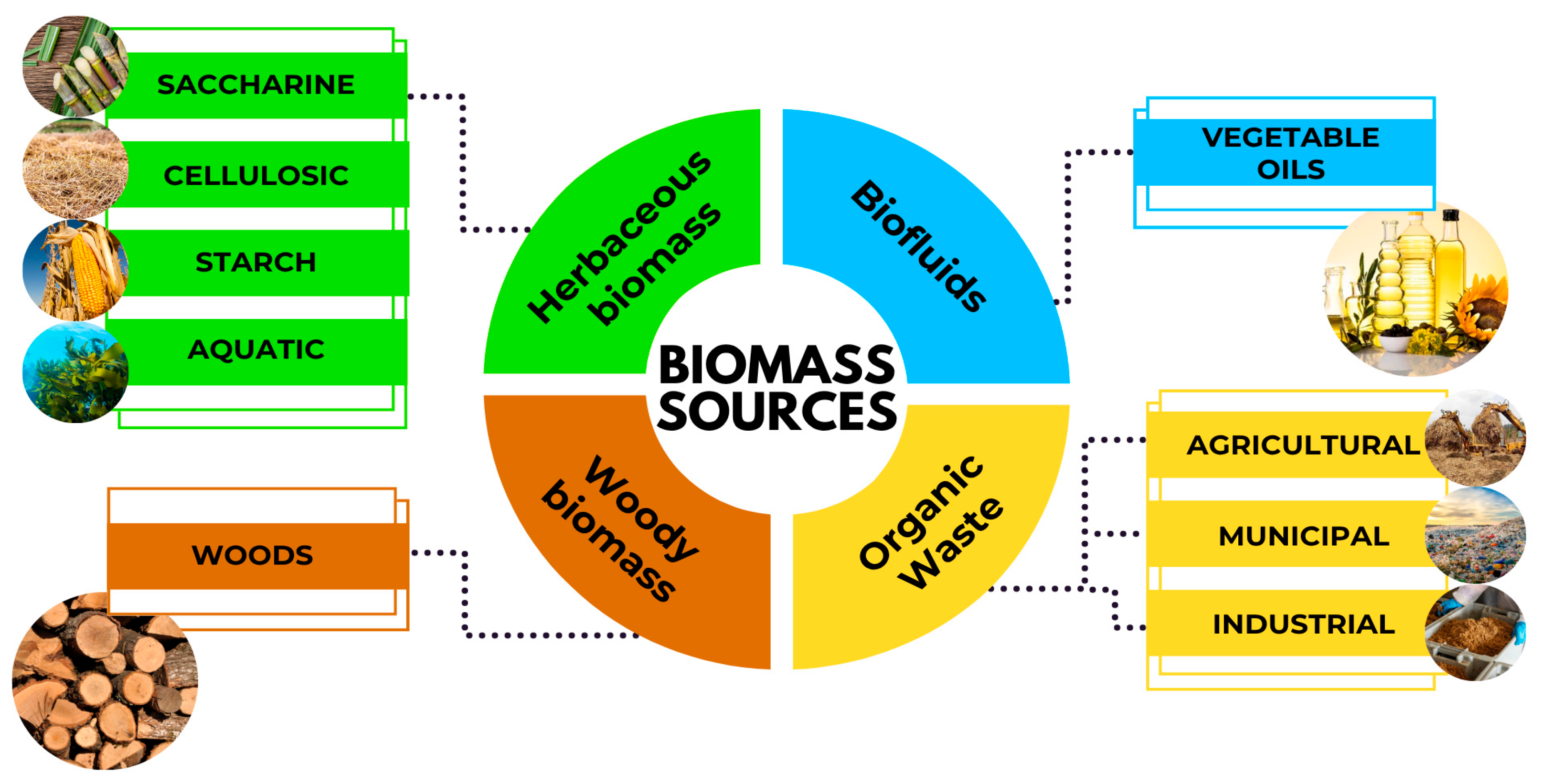
The categorization of biomass into diverse source classifications relies fundamentally on its chemical composition, which, in turn, serves as the determining factor for establishment of optimal energy conversion routes [20]. The key feedstock groups are herbaceous biomass, organic waste, woody biomass, and biofluids, and they are typically grouped according to this structural paradigm, as illustrated in Figure 1.
Some of the classes of biomasses are still divided into subgroups, such as woody biomass, which can be further classified as hardwood and softwood. Herbaceous biomasses have more porous and less dense lignin, which makes it easier to degrade than woody biomass. It also has more p-coumaryl alcohol in its structure [17]. These differences highly impact the processing of the biomasses in biorefineries, mainly the enzymatic hydrolysis that converts cellulose and hemicelluloses into fermentable sugars. Usually, different types of biomasses have characteristics that qualify them for different bioenergy processes, with herbaceous biomass being the most suitable for hydrolysis and fermentation and woody biomass for pyrolysis and gasification [14].
Organic waste, such as agricultural residues, municipal solid waste (MSW), and industrial residues, are common sources of biomass. These residues can be converted into solid, liquid, and gaseous fuels through thermochemical and biochemical processes [21]. Likewise, biofluids (such as vegetable oils) can be converted into biodiesel via the transesterification reaction, presenting a renewable and significantly less toxic alternative to conventional petroleum diesel [22].
The valorization of diverse biomass streams has gained significant prominence in research, representing a vast and strategic potential for the expansion of the bioeconomy and sustainable bioenergy production [23]. Crucially, the energetic utilization of the materials directly contributes to mitigating environmental challenges, specifically by reducing water and soil pollution, often caused by inadequate waste disposal [24].

2.3. Chemical Variability of Different Biomass Feedstocks for Glucose Obtention Through Enzymatic Hydrolysis

Several biomasses can be used as feedstock for enzymatic hydrolysis and glucose obtention. Reports in the literature include raw biomasses and agroindustry residues. The use of the latter is highly supported because it adds value to biomasses that are usually disposed of in fields and landfills or burnt to produce energy. The use of lignocellulosic biomass is still very niche, and it is predicted to remain current for the next few years [25]. This is due to variations in the type of feedstock, environmental conditions, and logistics. Biomass composition varies significantly with weather changes, soil quality, and water availability [14].
Sibono et al. studied the enzymatic conversion of untreated brewers’ spent grain with CellicCtec2 and produced 44% of the theoretical glucose concentration 11.71 ± 0.09 g glucose per gram of substrate (dry matter) at 48.6 °C, 6.7% w/w biomass loading, and 0.22 mL of enzyme per gram of substrate (dry matter) [26]. The chemical composition of their biomass is shown in Table 1, along with other biomasses, all divided into their main classes.
In Table 1, it is possible to see that even biomasses under the same classification can have a wide variety of compositions, which is a significant challenge in solidifying biomass feedstocks as a reliable and permanent source of energy. The synthesized data also show that not all measurements are made during the feedstocks’ characterization, which hampers data comparison and analysis of the biomass potential. This is mainly due to variations in characterization procedures and perhaps also to the lack of addressing composition and characteristic variations through seasons and weather conditions. Improving and standardizing these procedures might enhance reliability and applicability [14].
Besides the lignocellulosic chemical composition, cellulosic matrix crystallinity has a high impact on biomass enzymatic hydrolysis, and it also varies from one biomass to another. Xu et al. studied the characteristics and kinetics of the enzymatic bioconversion of microcrystalline cellulose (Sigma Aldrich’s Avicel) and dilute-acid-pretreated corncob, which had a crystallinity of 78.18 ± 1.13% and 51.20 ± 0.72%, respectively [38]. The authors reported a higher cellulose conversion in corncob than in microcrystalline cellulose using the same enzyme (CellicCtec2) load and operational conditions, which is probably due to lower crystallinity. Chemical and physical treatments can be used to decrease crystallinity degree and allow enzymes to degrade the biomass more efficiently. Lee et al. used ball milling and hydrothermal treatment on oak, miscanthus, and sweet sorghum bagasse and achieved lower cellulose crystallinity, hemicellulose removal, and lower particle sizes, which led to improved cellulose conversion to glucose [15]. This behavior is not always seen in pretreatments, as the crystallinity index can decrease or increase depending on the pretreatment and the biomass [17].
Another hindrance to enzymatic hydrolysis imposed by biomass composition is the adsorption of the enzyme to the lignocellulosic structure, which allows for contact with the substrate. Depending on the composition, this adsorption can be difficult and decrease hydrolysis efficiency, or the enzyme can be adsorbed to the lignin structure by hydrogen bonds or hydrophobic and electrostatic interactions, reducing the efficiency [15,41]. Wu et al. increased enzyme adsorption by using hydrothermal, alkaline, and mechanical pretreatments [33]. The authors also verified that the enzyme isothermal adsorption followed the Langmuir model, meaning that it was a monolayer adsorption. This was also observed by Alvarez-Gonzalez et al., who saw their hydrolysis efficiency increase from 23 to more than 90% after alkaline pretreatments with NaOH, along with an increase in cellulose fraction on the structure from 38.94 to 80.85% and a lignin decrease from 27 to 9.42% [40].
Wu et al. hydrolyzed poplar branches (woody biomass) after several pretreatments and reported that the increase in lignin hydrophilicity improved the enzyme adsorption and, consequently, the enzyme efficiency [33]. The authors also reported that after pretreatments, lignin can reaggregate and form a type of pseudolignin that will also compete with cellulose for cellulase adsorption, creating a non-productive adsorption and inhibiting enzymatic catalysis. Higher lignin content can also hinder cellulase activity via steric repulsion [37].
While evaluating the hydrolysis of corncob and sugarcane bagasse, Yu et al. observed that corncob, which had a lower lignin content, was a better contender for cellulolytic hydrolysis, as it releases more sugars in the process, even with the higher cellulose content of sugarcane bagasse (Table 1) [34].

3. Main Inhibitors in the Enzymatic Hydrolysis of Lignocellulose

Since the enzymatic hydrolysis processes are dependent on the substrate composition, accessibility, concentration, and also the existence of different components in the reaction vessel, there are significant inhibitors in this process because all the steps carry with themselves chemical compounds, generated during hydrolysis or in pretreatment, that can inhibit cellulase activity [42,43]. Furthermore, the enzyme source can be an important factor in the inhibitory effect because its structure may vary from one microorganism to another, changing the cellulose binding domain and its capability in catalyzing the hydrolysis reaction [44,45]. Therefore, in the following topics we will discuss the main inhibitory effects on the enzymatic hydrolysis of multiple lignocellulosic biomasses.

3.1. Enzyme Deactivation by Lignin

Lignin is the most studied inhibitor in enzymatic cellulose hydrolysis, and its inhibitory effect occurs due two main factors: (1) physical and chemical barriers hindering the contact between cellulase and cellulose strand and (2) enzyme inactivation by the adsorption of enzymes on lignin, with a strong permanent interaction between cellulose-binding domain (CBD) and lignin [46]. Both factors act together and are addressed in many reports in the literature.
Ko et al. describe that, among all cellulases in the cellulolytic complex, β-glucosidase from Trichoderma reesei as the most inhibited enzyme by lignin presence, as it has high molecular weights and isoeletric points [47]. They also observed that guaiacyl-rich lignins adsorb more β-glucosidase, reducing the cellobiose hydrolysis and, consequently, the glucose yield.
Although Du et al. reported that, when separately added in the enzymatic hydrolysis of pure cellulose, lignin does not have inhibitory effect, indicating that its recalcitrant effect is only when directly associated to the cellulose fiber, acting more as a physical barrier than as a chemical barrier, many other studies have shown that lignin acts as inhibitor by strongly adsorbing the cellulases in a non-productive way [48,49,50,51,52].
This adsorption is not limited to CBD but also interferes in the catalytic domain; that is, the adsorption not only decreases the movement of enzymes on cellulose fiber but also restricts the catalytic ability of enzymes [50]. Yao et al. also studied the interaction between lignin and cellulases, identifying the π–π interactions and H-bond as responsible for the high adsorption, since there is a phenolic moiety in tyrosine that has an affinity for the phenolic moieties of lignin [53].
One way to reduce the lignin effect in enzymatic hydrolysis is choosing pretreatment methods that do not have high lignin degradation, since high-molecular-weight lignin has higher negative surface charges, decreasing the hydrophobic interactions and increasing electrostatic repulsion with the cellulases [54,55,56]. Furthermore, Li et al. reported that adding high-molecular-weight lignin to the hydrolytic medium increased the saccharification yield, because the low lignin affinity of cellulases liberates more enzymes to adsorb on cellulose fibers [57].

3.2. Inhibition by Cellulose Structural Factors

The naturally occurring cellulose is classified as cellulose I, which is an aggregate of crystalline nanofibers held together by intra/intermolecular hydrogen bonds and van der Waals interactions. Once thermochemically treated, the cellulose structure is changed to cellulose II, cellulose III, and amorphous cellulose [58,59].
The changes in cellulose structure are not limited to their crystallinity degree, but also its surface area, microfibrils and fiber shapes, and polymerization degree, which directly interfere in the performance of enzymatic hydrolysis of cellulose [60]. Also, according to Zhai et al., the presence of acid moieties in the cellulosic substrates is an important factor to determine whether the hemicellulosic sugars will inhibit cellulose hydrolysis or not [61].
The preference for celluloses II and III is constantly reported in the literature. Cellulase from T. reesei, for example, had the lowest affinity with cellulose II nanocrystals but highest hydrolytic activity when compared to cellulose I nanocrystals [62]. Chen et al. observed that cellulases have low adsorption affinity for C III, whose hydrolysis also has suitable glucose yields, and that low affinity is determined by the degree of crystallinity [63]. The low affinity is the reason for the high hydrolysis yield because the cellulase dissociation from cellulose fiber is directly related to this affinity; that is, low affinity allows the cellulase to move faster on cellulose fiber. The exocellulase Cel7A from T. reesei, for example, showed reduced binding affinity when the substrate was cellulose III [64]. It was observed that initial binding commitment decreased by 48% when cellulose changed from cellulose I to cellulose III. The reduced binding affinity was responsible for a 20-fold increase in cellulose III hydrolysis when directly compared to cellulose I, showing that changing cellulose structure through pretreatment can be relevant to improve its enzymatic hydrolysis. However, not all cellulases have improved their activity with the decrease of cellulose binding affinity; once, it was documented that high binding affinity is also associated with higher hydrolysis yield [65]. Moreover, the best yields come from the balance between an efficient cellulose binding affinity that is low enough to release the products in every hydrolysis cycle [66]. This balance is directly related to the substrate structure and the cellulose chain binding free energy [67].
Another factor influencing enzymatic hydrolysis is the drying effect on cellulose structure, once hemicellulose and lignin, when still present in the cellulose, mitigate the drying effect on cellulose by preserving cellulase access to cellulose fibers. However, it is important to point out that at low enzyme loadings, hemicellulose and lignin have significant inhibitory effects [68].

3.3. Inhibition by Water-Soluble Chemicals

There are a group of chemical compounds that act as potent cellulase inhibitors, and they are mainly produced during biomass pretreatment. The main group is composed of phenolic compounds, which are majorly generated/liberated during the depolymerization and repolymerization of lignin during its pretreatment [69].
Their inhibitory effect on enzymatic hydrolysis is as relevant as the lignin inhibitory effect, since they also can permanently attach to CBD and deactivate cellulases via hydrophobic interactions and/or hydrogen bonding [70,71,72,73].
The phenolic compounds are reported to be responsible for at least 50% of inhibition of cellulose hydrolysis, and the level of the inhibitory effect is directly related to the side-chain groups, which can have aldehydes, alcohols, and acid moieties [74,75,76,77]. Their influence in enzymatic hydrolysis is also substrate dependent; that is, if the substrate loading is increased, the phenolics concentration also increases, resulting in stronger inhibition of cellulase activities [74].
Chen et al. observed that phenolics from corn stover, using different pretreatment methods, also have different inhibitory effects on enzymatic hydrolysis [78]. The corn stover was pretreated via four methods—dilute acid, liquid hot-water pretreatment, ammonia fiber expansion, and alkaline pretreatment—with the highest inhibition being observed for ammonia fiber expansion and the lowest for alkaline pretreatment. This observation indicates that, like lignin inhibitory effects, the phenolic compounds’ inhibitory effects can be avoided or decreased by choosing the method that generates less soluble inhibitors [79].
However, the pretreatment method also interferes with other factors, and in the literature, the most prominent way to reduce the phenolic inhibition of enzymatic hydrolysis is the use of additives that can prevent their interaction with cellulases. These additives might have different structural characteristics, but all of them have a high affinity for the phenolic compounds. We can cite the following as additive: L-cysteine, dithiothreitol, Tween 40, bovine serum albumin, and whey protein [72,80,81].
Besides phenolic compounds, other water-soluble inhibitors, such as formic acid and levulinic acid, are also dependent on biomass type, previous pretreatment, and concentration of lignocellulosic solids [82]. Acetic acid, furfural, and hydroxymethyl furfural are described as inhibitors in some works but also described as non-inhibitors in other works, showing the inhibition is also dependent on cellulase source [81,82,83].
Therefore, using an enzyme cocktail can be an efficient method to reduce enzymatic hydrolysis inhibition performed by water-soluble inhibitors because each cellulase is affected differently by the inhibitors [84,85,86].
Furfural and hydroxymethylfurfural, constantly associated with fermentation inhibitors, can also act as cellulose hydrolysis inhibitors [48]. Both are originated from lignocellulose pretreatment and are easily found in many hydrolysates that were submitted to high temperature and pressure; furfural is originated from sugar pentoses and hydroxymethylfurfural from sugar hexoses [69].

3.4. Inhibition by Mono/Oligosaccharides

As already known, there are many cellulases involved in cellulose hydrolysis that act synergistically to yield glucose as product. However, glucose itself has an inhibitory effect over cellulase activity, and its inhibitory effect is concentration dependent along the cellulose hydrolysis, since glucose is being produced and cumulated till the end of hydrolysis [74].
Some works have reported that glucose is the main inhibitor of β-glucosidase and cellulase activities, but there are alternative ways to decrease its inhibition: (1) higher substrate concentrations and the addition of hemicellulose sugars [61,87] and (2) designing new reactors in which glucose is continuously removed [88]. These strategies are of great interest for keeping the cellulase activity at its highest performance.
However, the strategy of hemicellulose monomers is not always welcome, since the inhibition promoted by xylose and mannose, monomers of hemicellulose, in CBHI cellulase during cellobiose release was observed when using Avicel (high crystallinity index), 27% and 20%, respectively, and amorphous cellulose (low crystallinity index), 18% and 7%, respectively. This is an important indicative of the cellulose crystallinity index being relevant (as described above), but the inhibition promoted by monomers of hemicellulose is still significant. The main reason for this inhibition is that xylose and mannose interfere in CBD, diminishing the productive binding by CBHI on cellulose fiber [58].
The degree of inhibition can be different if other cellulases are being studied, as reported by Haldar et al., whose work studied sugar (glucose, mannose, galactose, xylose, and cellobiose) inhibition in the activity from the cellulase complex from T. reesei [89]. The sugar additions reduced glucose production, and the lowest inhibition was observed for xylose (10.5%), while the highest was cellobiose (79,3%). The glucose, mannose, and galactose inhibitions were 49.7%, 39.0%, and 32.0%, respectively. Therefore, xylose was not the most important inhibitor of cellulase complex from T. reesei, when compared with other sugars.
Cellobiose, a dimer of glucose, had its inhibition mechanism studied by Nong et al., whose work showed that cellobiose acts in the catalytic domain (front door) and also binds to the product release site (back door), blocking the cellulase active site for another reaction cycle [90]. The same pattern of inhibition is performed by xylo-oligosaccharides that act by staying in the tunnel of the cellobiohydrolase (CBH) binding site, blocking the way for cellulose hydrolysis. But not all xylo-oligosaccharides promotes CBH inhibition; once, xylotetraose was degraded during cellulose hydrolysis in the first reaction hour, but the whole inhibition process was observed with xylotriose, which has affinity for CBH, showing that inhibition is also related to the size of oligosaccharides [91].
Not only do xylo-oligosaccharides have an inhibitory effect in enzymatic hydrolysis, but hemicellulose itself is bound to cellulose, inhibiting cellulase (Cel7A) adsorption on cellulose by 45% and reducing cellulase activities by 40%, especially when glucuronoxylan was used as hemicellulose model [92].
These findings are a reminder that it is not possible to remove all inhibitors from the reaction medium before the enzymatic hydrolysis of cellulose, because even the expected product, glucose, inhibits the cellulase activity. Then, it is possible to understand why the search for new cellulases less susceptible to these inhibitors is still a hotspot research field.

3.5. Effect of Cellulose Binding Domain in Hydrolysis Performance

In the search for more efficient cellulases, it is important to study how cellulase binding to cellulose is directly affected by the interactions between the CBD and cellulose [93]. Thus, cellulases with a low affinity for the inhibitors are the most desired, and almost all these affinities rely on the different amino acids in CBD, though CBD from all cellulases has the same role. Comparing different cellulases and their affinity for the inhibitors, Lu et al. discovered that β-glucosidase from Aspergillus fumigatus has a high affinity for lignin adsorption, while β-glucosidase from Penicillium oxalicum has greater affinity for cellulose [94]. Then, when their CBD structure was determined, it was possible to engineer and express new β-glucosidases with low binding affinity for lignin and also less inhibitory effects from phenolic compounds in the reaction medium. The removal of N-glycosylated sites of Cel7A cellulase was another report that reinforced CBD enzyme engineering as a suitable approach to improve cellulose hydrolysis, reducing the inhibitors’ effect in cellulase activity [95]. Similar results were observed when, for a CBH, single valine substitution increased the catalytic rate by 53.1% and product yield by 49.8% [96]. Therefore, changes in CBD structure can help to improve enzymatic hydrolysis by avoiding the inhibitor effect.
Next, it is possible to observe that there are many potential inhibitors in enzymatic cellulose hydrolysis, but there also are many possibilities to overcome the difficulties caused by them, improving the hydrolysis yield and turning the cellulose economically suitable as substrate for biofuel production.

4. Process Configurations for Lignocellulosic Bioconversion

The configuration employed in enzymatic hydrolysis and fermentation is a central factor governing the technical and economic feasibilities of lignocellulosic biorefineries. Operating at high biomass loadings—typically above 15% w/w solids—is essential for achieving industrially relevant sugar concentrations required to achieve ethanol concentrations above 40–50 g/L [97,98]. However, processing high biomass loads also introduces significant challenges. As hydrolysis proceeds, glucose and xylose accumulate rapidly in the reaction medium, resulting in pronounced end-product inhibition of cellulolytic enzymes and a progressive decrease in the hydrolysis rate [99].
A second major barrier is the rheology of high-solids slurries. As solids loading increases, the reduction in free water results in sharp increases in slurry viscosity, resulting in poor mixing, restricted mass and heat transfer, and non-uniform enzyme distribution throughout the medium [100,101,102,103]. These combined effects reduce hydrolysis efficiency and significantly hinder scale-up.
These challenges highlight the importance of carefully evaluating how different process configurations affect overall performance.

4.1. A Comparison of SHF, SSF, and PSSF

The separate hydrolysis and fermentation (SHF) configuration is the most traditional approach in lignocellulosic bioconversion, where enzymatic hydrolysis and fermentation are conducted sequentially in separate reactors. Its main advantage is that each step can be carried out under its optimal conditions, around 50 °C for enzymatic hydrolysis and 30–37 °C for most fermenting microorganisms [104,105]. However, SHF is strongly affected by end-product inhibition: cellulases and hemicellulases are highly sensitive to the accumulation of glucose, cellobiose, and xylose, which progressively decrease hydrolysis rates. This limitation becomes particularly severe with high solids loading, where the accumulation of fermentable sugars is precisely the objective of the process [106]. Additionally, SHF requires intermediate solid–liquid separation steps, which can lead to sugar losses and increase operational complexity. On the other hand, SHF may perform better for inhibitor-rich feedstocks, where decoupling hydrolysis and fermentation allows for a detoxification step prior to fermentation.
Simultaneous saccharification and fermentation (SSF) was introduced to reduce enzyme inhibition by maintaining low sugar concentrations. In SSF, enzymes hydrolyze polysaccharides, while fermenting microorganisms consume the released sugars concurrently, thereby reducing end-product inhibition and enhancing hydrolysis rates [107,108]. SSF generally results in shorter processing times and reduced capital costs because the process requires only one reactor [107,109]. Nevertheless, the main limitation of the SSF process is the temperature, which is suboptimal for both the enzymatic system and the microorganism. A recent study by Santiago-Gómez et al. illustrated this trade-off inherent in SSF [105]. Enzymatic saccharification at 50 °C of Agave salmiana released 103.1 g/L of sugars, whereas at 40 °C (typical SSF conditions), 78.4 g/L was released (a 24% decrease). Despite this reduction, SSF produced 51.5 g/L ethanol, which was 13% higher than the optimized SHF process (44.4 g/L). This result highlights that even at suboptimal enzymatic temperatures, the lower sugar concentrations maintained during SSF can lead to superior fermentation performance.
A hybrid configuration called pre-saccharification followed by SSF (PSSF, also referred to as semi-SSF or SSSF) was developed to mitigate the temperature limitations in SSF and to combine the advantages of both SHF and SSF, but its success depends critically on selecting an appropriate pre-hydrolysis time [104].
In PSSF, an initial pre-hydrolysis step (typically 6 to 24 h) is carried out under optimal conditions for the enzymatic reaction, promoting early polysaccharide depolymerization and reducing slurry viscosity [104]. After the liquefaction stage, the temperature is adjusted to the optimal fermentation condition (35–40 °C), and the fermenting microorganism is inoculated to continue the process as SSF [104,105,110]. By allowing hydrolysis to be initiated under ideal catalytic conditions, while simultaneously benefiting from the simultaneous consumption of sugars, PSSF improves the performance of high-solids systems and mitigates the negative effects of enzyme inhibition.
Table 2 summarizes several studies comparing the efficiencies of SHF, SSF, and/or PSSF processes.
The comparative data presented in Table 2 reveal that the relative performance of SHF, SSF, and PSSF is dependent on the type of biomass, the microorganism employed, and the operational conditions, particularly solids loading and temperature. Despite these variations, for most studies presented, SSF outperforms SHF in terms of final titer, yield, and productivity. These results are consistent with the expected benefit of SSF in systems where end-product inhibition is significant, particularly with high solids loading. The rapid consumption of sugars by fermenting yeast prevents their accumulation, thereby sustaining higher hydrolysis rates and resulting in increased productivity. Zhu et al. reported a significantly higher ethanol production from cassava pulp (20% w/v) in SSF (34.7 g/L) compared to SHF (23.5 g/L) [113]. Similarly, Kadhum et al. (2019) and Rana et al. (2014) observed the superiority of SSF compared to the SHF strategy in ethanol production [115,117].
In ABE fermentation, Qi et al., Sasaki et al., Valles et al., and Zhang et al. also observed better results for the SSF process [108,114,115,118]. In addition, Pratto et al. found better performance of ABE fermentation using the PSSF strategy compared to the SHF process [119].
In contrast, other studies indicated that SHF can remain competitive, or even superior, under certain conditions. López-Linares et al. reported the highest ethanol titer and theoretical yield in SHF (39.9 g/L and 57.9%), with PSSF and SSF yielding lower values, using 20% w/v dilute-acid-pretreated rapeseed straw [110]. Shen & Agblevor applied the SHF, SSF, and PSSF strategies of cotton gin waste and recycled paper sludge for ethanol production [111]. They found that the theoretical yield and productivity were higher for the PSSF strategy with 24 h of pre-hydrolysis.
In general, the studies summarized in Table 2 indicate that SSF tends to be more advantageous than SHF. Efforts to address the temperature compromise in SSF have driven significant advances using this strategy.
Thermotolerant yeasts, especially Kluyveromyces marxianus, have gained prominence due to their ability to grow and ferment efficiently at 40–45 °C. Operation at these elevated temperatures promotes higher enzymatic activity, reduces cooling requirements, and minimizes the risk of contamination. For instance, in the conversion of A. salmiana leaves at 11% (w/w) solids, Santiago-Gómez et al. reported that SSF carried out at 40 °C with the thermotolerant yeast K. marxianus produced the highest ethanol concentration (51.5 g/L) among all configurations (SHF, SSF, and PSSF) [105]. Although enzymatic hydrolysis at 40 °C released less sugar than at 50 °C, the continuous removal of inhibitory sugars during SSF compensated for this thermal loss, resulting in titers superior to those in the SSF configuration. This result demonstrates that the use of a thermotolerant fermenting organism can effectively reduce the temperature gap between hydrolysis and fermentation, thereby enhancing SSF performance.
In summary, process configuration strongly influences high-solids lignocellulosic bioconversion, where end-product inhibition and slurry rheology impose major constraints. Among the evaluated strategies, SSF generally provides higher productivity by coupling hydrolysis and fermentation and minimizing sugar accumulation, while PSSF represents a practical compromise by enhancing liquefaction through an initial pre-hydrolysis step. Although SHF can be advantageous under specific conditions, such as inhibitor-rich feedstocks, its requirement for additional unit operations increases process complexity and operational costs. Advances in thermotolerant fermenting microorganisms further strengthen SSF-based configurations by reducing the temperature mismatch between hydrolysis and fermentation.

4.2. Consolidated Bioprocessing (CBP)

Consolidated bioprocessing (CBP) represents the most integrated approach for lignocellulosic biomass conversion, combining enzyme production, substrate hydrolysis, and fermentation within a single bioreactor [120]. Unlike SHF, SSF, or PSSF, CBP relies on a single microorganism or a defined microbial consortium capable of producing the necessary hydrolytic enzymes, deconstructing the biomass, and converting the resulting sugars into the desired bioproduct in one step [121]. This high level of process integration provides operational simplicity and eliminates the substantial costs associated with commercial enzyme acquisition, which remains one of the major costs in the conventional bioconversion processes. Despite these advantages, identifying or engineering a microbial strain capable of simultaneously producing an effective set of cellulolytic enzymes and accumulating high concentrations of bioalcohols remains one of the major biological and engineering challenges of CBP [120].
Efforts to obtain suitable CBP strains have followed two main strategies. The first focuses on adapting naturally ethanologenic or butanologenic microorganisms to give them cellulolytic and hemicellulolytic capabilities. The second approach adopts the opposite route of genetically modifying cellulolytic microorganisms to increase their ability to produce bioalcohols. Among these, Clostridium thermocellum is one of the most extensively investigated due to its high hydrolytic capacity and its ability to utilize both hexoses and pentoses [122]. For example, Singh et al. demonstrated that C. thermocellum can convert crystalline cellulose into ethanol, reaching 95.32% cellulose conversion and 0.30 gethanol/gcellulose consumed. However, despite its strong hydrolytic performance, C. thermocellum suffers from low ethanol tolerance (typically <2.5 g/L) and carbon diversion toward organic acids, resulting in reduced final yields [123].
These persistent biological limitations demonstrate why CBP is not yet industrially viable. Challenges such as inadequate enzyme secretion, limited tolerance, and unfavorable carbon flux toward by-products continue to restrict ethanol and butanol yields. These constraints have stimulated growing interest in filamentous fungi such as Aspergillus and Rhizopus, which naturally secrete large quantities of extracellular enzymes and exhibit substantial metabolic versatility [121,124]. Varriale et al. developed a CBP platform using A. niger for citric acid production from the press cake of perennial ryegrass (Lolium perenne), achieving yields of 84.7 g/kg dry matter when supplemented with glucose, thereby illustrating the broader applicability of CBP frameworks for high-value biochemicals [121].

5. Kinetic Modeling on Enzymatic Hydrolysis

Kinetic modeling is a valuable approach for describing how dynamic phenomena evolve over time through mathematical formulations. In the context of enzymatic hydrolysis, mathematical models constitute an important tool for understanding the progression of the reaction. A robust kinetic model can support the development of rate expressions that are incorporated into the equations used for designing, operating, and controlling large-scale biofuel production processes [31,125].
The literature contains reviews on kinetic models employed in the study of enzymatic hydrolysis [126,127]. These studies indicate that kinetic models should consider greater properties of the substrate and enzymes involved to allow for a more detailed and phenomenological understanding of the enzymatic hydrolysis of biomass. According to Bansal et al., more robust models allow for a better understanding of the hydrolysis process [31]. However, they will require more experimental data for validation due to the increased number of variables and parameters.
In this context, the development of cellulose hydrolysis process modeling helps form a deeper understanding of the properties of the enzyme and the substrate. Among the substrate properties, the following stand out: substrate concentration, degree of polymerization, accessibility, adsorption capacity, chain size distribution, crystallinity, enzyme concentration, cellulase composition, and concentration of adsorbed cellulase. It also allows for the identification of rate-limiting factors [31].

Conventional Modeling

Enzymatic hydrolysis is a critical step in biomass transformation and generally determines the overall efficiency of the process for obtaining bio-based bioproducts. Therefore, the development of mathematical models for the enzymatic hydrolysis of lignocellulosic materials is a challenging topic in the field of process engineering [31,48,128]. Kinetic models of hydrolysis are important to understand, as they help in designing and optimizing the processes [129]. With the development of kinetic models, it is possible to predict hydrolysis profiles under different circumstances. They can be used as an important tool to determine the ideal hydrolysis conditions, resulting in a low-cost and highly efficient process [130].
There are several kinetic models for enzymatic hydrolysis, applied to different enzymes and lignocellulosic materials. The models can be classified as non-mechanistic, semi-mechanistic, functional, and structural models [126,127,131,132].
Non-mechanistic models are models that help quantify the effects of enzyme and substrate properties during the hydrolysis process. They are useful for correlating experimental data. However, they are not applicable outside the conditions for which they were developed and do not provide any insight into the phenomenological details of the process [127]. Non-mechanistic models can be used as statistical models to optimize reaction conditions, employing response surface methodology [133]. According to Sousa Jr et al., the non-mechanistic model can be represented by Equation (1) [126].
Y = b 0 + b 1 · X 1 + b 2 · X 2 + b 3 · X 3 + b 4 · X 4 + b 5 · X 5 + b 6 · X 6
The most common approach to represent the semi-mechanistic kinetic model is described using Michaelis–Menten enzyme kinetics, where the substrate, despite being a solid, is treated as a soluble reagent. This approach can be implemented with or without incorporating enzyme adsorption effects, temperature, accessible surface area, crystallinity, and inhibitory effects of the product. This model may have limitations related to the effect of substrate characteristics. However, it is widely used in industrial projects [131,134].
Equations (2)–(4) represent the models of Michaelis–Menten, Michaelis–Menten modified (considers competitive inhibition by cellobiose), and Michaelis–Menten modified that considers solid substrate and soluble enzyme, respectively,
V = V m a x · S K m + S
V = V m a x · S K m · 1 + P K i c + S
v 0 = V e m a x · E 0 K e + E 0
where V m a x is the maximal velocity, S is cellulose concentration, P is product, K m is the Michaelis–Menten constant, K i c is the (competitive) product inhibition constant, v 0 initial rate of hydrolysis, and E 0 initial enzyme concentration
These equations illustrate distinct kinetic formalisms used to describe enzymatic cellulose hydrolysis, based on different assumptions and domains. The classical Michaelis–Menten model, given by Equation (2), treats cellulose as a pseudo-soluble substrate and considers the reaction rate limited by enzyme saturation. This approach is used to determine apparent Km and Vmax values for pretreated lignocellulosic substrates under low solid loadings and short reaction times [127,135]. Equation (3) expands the classical description, including competitive inhibition by soluble products (glucose or cellobiose). In batch hydrolysis systems, for instance, this approach improves fitting accuracy. Moreover, it has shown promising results in studies where end-product accumulation constitutes a dominant inhibitory mechanism [125,136].
Equation (4), on the other hand, is based on the inverse Michaelis–Menten formalism so that the enzyme becomes the saturating component instead of the substrate. Because cellulose’s limited surface area restricts enzyme adsorption and turnover, it is especially pertinent for insoluble substrates and high-solids systems. Cellulase–cellulose systems at high enzyme-to-substrate ratios and adsorption-limited hydrolysis phenomena have been studied using inverse Michaelis–Menten kinetics. These applications have provided mechanistic insights into binding, saturation, and product formation under conditions of industrial interest [127,137].
In contrast, according to Zhang and Lynd, function-based models are useful in understanding the substrate characteristics and mechanisms of action of multiple enzymes [127]. These models can be applied in bioreactor design; however, they often involve many parameters, requiring significant amounts of experimental data, which may hinder their practical implementation [126].
Models classified as structure-based models, which are based on the structural characteristics of the lignocellulosic matrix and cellulases, as well as the interactions between the enzyme–substrate complex, allow for a better phenomenological understanding at the molecular level. However, the experimental validation of these models is a major challenge [126,127].
Subsequently, Jeoh et al. also observed that, in general, these models can be classified into two main categories: enzyme-centered models and substrate-centered models [137]. Through their extensive review, they concluded that the rate of cellulose hydrolysis by cellulases, such as T. reesei Cel7A, is primarily limited by the rate at which the enzyme productively binds to the substrate and the time required for dissociation. In contrast, properties such as surface area and degree of polymerization only affect initial rates. The authors further highlight that most models fail to predict hydrolysis over extended reaction times, suggesting additional factors, such as enzyme inactivation and product inhibition, which improve empirical fitting.
In the following years, several studies sought to refine the kinetic and structural descriptions of the process by incorporating previously neglected phenomena. Ahamed et al. proposed a multilayer population balance model (ML-PBM) capable of representing the distribution of cellulose particle sizes and degrees of polymerization, demonstrating that structural heterogeneity is one of the main factors responsible for the slowdown observed during prolonged reaction times [138]. These results reinforced the transition from global empirical models to structural approaches that incorporate the evolving dynamics of the substrate throughout hydrolysis.
Another important advancement concerns the consideration of non-productive adsorption of cellulases onto lignin, a phenomenon that drastically reduces the fraction of active enzymes available for conversion. Yuan et al. reviewed in detail the effects of lignin and product inhibition, whereas Zheng et al. experimentally demonstrated that additives such as lignosulfonate reduce this non-productive adsorption, increasing overall cellulose conversion [41,139]. More recent studies, such as those of Mou et al. and Xie et al., deepened the kinetic understanding of Cel7A binding to lignin surfaces, providing updated adsorption and desorption parameters (kon and koff) that aid in the refinement of mechanistic models [140,141]. These studies show that non-productive adsorption constitutes a critical thermodynamic and kinetic bottleneck, especially in incompletely pretreated substrates.
At the process scale, new approaches have aimed to integrate kinetic modeling and hydrodynamics to represent industrial conditions of high solids loading and non-Newtonian rheological behavior. Gaona et al. coupled kinetic models with computational fluid dynamics (CFD) simulations, capturing local concentration gradients and mass transfer in highly viscous systems [142]. Complementarily, Barba et al. reviewed the practical challenges of high-solids enzymatic hydrolysis, highlighting the influence of mixing, limited diffusion, and the formation of low-accessibility zones on overall conversion [143]. These effects, previously neglected, explain discrepancies between laboratory predictions and industrial yields.
Additionally, the coupling between dynamic adsorption and product inhibition has been incorporated into more recent hybrid models. Chan et al. developed a mechanistic model capable of simultaneously integrating enzymatic adsorption, diffusion, and competitive inhibition, representing more realistic conditions found in continuous and batch reactors [136]. The application of these models has also been expanded to membrane bioreactor configurations, as shown by Dąbkowska-Susfał et al., who incorporated enzyme recirculation and flux limitations into the mathematical modeling of the process [144].
Finally, studies focused on the influence of pretreatment and calibration of kinetic parameters have expanded the practical applicability of these models. Moreira-Neto et al. compared different pretreatment strategies (hydrothermal and organosolv) for sugarcane bagasse hydrolysis, finding that partial lignin removal and increased surface area significantly modify Km and Vmax values [131]. Similarly, Efrinalia et al. determined apparent kinetic parameters for cellulose extracted from rice husk, confirming variability in these values depending on substrate nature and enzymatic consortium [135].
Westh et al. deepened the understanding of the kinetic and thermodynamic mechanisms involved in cellulose hydrolysis, highlighting the influence of activation barriers, diffusional limitations, and equilibrium conditions on catalytic efficiency [145]. The authors proposed a simplified yet thermodynamically consistent conceptual framework to describe the balance among adsorption, reaction, and desorption, showing that cellulases are highly efficient catalysts for the cleavage of β-1,4-glycosidic bonds, although they exhibit low turnover numbers under steady-state conditions due to slow dissociation from the insoluble substrate. This modern view reinforces that overall process efficiency depends not only on the structural properties of the substrate but also on intrinsic transport limitations and conformational relaxation of enzymes.

6. Software and Challenges for Simulating Enzymatic Hydrolysis of Lignocellulosic Biomass

The main software tools used to simulate the enzymatic hydrolysis stage of lignocellulosic biomass include Aspen Plus v15, SuperPro Designer v15, computational fluid dynamics (CFD) simulators like ANSYS Fluent 25.2, and multiphysics environments such as COMSOL Multiphysics 6.4 and MATLAB R2025b. Each is used according to the level of detail and modeling objective, ranging from process integration at the plant scale to mechanistic description of local phenomena.
In Aspen Plus, hydrolysis is commonly represented using RStoic or RYield blocks (“converters”), with apparent conversions and stoichiometries calibrated from experimental data. When necessary, the enzymatic stage is divided into multiple reactors, such as simultaneous saccharification and co-fermentation (SSCF) or SHF, to represent different stages and recycles. In general, studies conducted in Aspen integrate utilities and scenario analysis, such as high solids loading, pre-liquefaction, and thermal integration, in addition to economic evaluations using Aspen Economic Analyzer. These approaches show that configurations with high solids loading and heat integration increase energy efficiency and reduce specific cost, provided that target conversions are maintained.
Furthermore, studies involving corn residues and Jerusalem artichoke indicated that enzymatic hydrolysis is the main bottleneck for sugar concentrations and the Minimum Ethanol Selling Price (MESP), emphasizing the importance of reliable kinetic parameters. Recent studies have also reported significant improvements when applying pre-liquefaction strategies and modulation of temperature and time. However, it is important to recognize a central limitation: Aspen Plus does not resolve fundamental mechanisms such as adsorption, inhibition, or intraparticle diffusion, serving better for process integration than for detailed mechanistic predictions [146,147,148,149].
Studies using SuperPro Designer typically employ software for complete construction of the plant flowsheet, covering pretreatment, enzymatic hydrolysis (batch or fed batch), fermentation, and product recovery. In these models, hydrolysis is represented as a simplified unit operation, in which conversion rates and enzyme consumption are parametrized from experimental data and the literature. Simulations include mass and energy balances, equipment sizing, and techno-economic analysis (TEA), considering capital (CAPEX) and operating (OPEX) costs. Results demonstrated that fed-batch operation reduces viscosity peaks and water consumption, increases sugar concentrations, and decreases the MESP, showing better economic performance compared to batch mode. Additionally, the optimization of additive use and partial enzyme recycling provide significant reductions in OPEX and increases in productivity. Applications involving various feedstocks, such as corn cellulose, palm residues, and Jerusalem artichoke bagasse, showed that hydrolysis efficiency and enzyme price are critical factors for TEA outcomes. However, SuperPro does not capture mechanistic phenomena such as non-productive adsorption, enzyme inactivation, or rheological effects with high solids loading, therefore being more adequate for integrated and economic analyses of processes than for detailed phenomenological modeling [150,151,152,153].
At a more detailed level, several studies integrated CFD to investigate hydrodynamic behavior under high-solids conditions, incorporating non-Newtonian flow effects, dead zones, and heterogeneous mixing. Numerical approaches involve temporal sub-cycling to decouple transport and reaction scales, three-dimensional meshes, and experimentally calibrated rheological models. Results show that hydrodynamic optimization, considering reactor geometry, impeller type, baffle configuration, and feeding mode, can significantly increase sugar release rates without requiring higher enzyme loading. Additionally, mixing gradients explain the characteristic slowdown observed in high-solids systems, which is absent in perfectly mixed tank models. Thus, CFD emerges as a complementary tool to flowsheet simulations, allowing for the elucidation of diffusional limitations and the proposal of new reactor designs, such as biomimetic geometries based on bionic intestinal segmentation [142,154,155,156].
Studies conducted in COMSOL and MATLAB aim to explicitly represent the fundamental mechanisms of enzymatic hydrolysis, including adsorption and desorption, product inhibition, intraparticle diffusion, and, in some cases, hydrodynamic coupling with membranes. These environments commonly use formulations based on partial differential equations (PDEs), differential–algebraic equations (DAEs), or population balance equations (PBEs), often validated against bench-scale experimental data. Applications in membrane bioreactors incorporate flux balance, permeate behavior, and fouling constraints into reaction progress. Results indicate that mechanistic models accurately reproduce local kinetics, highlighting the role of non-productive adsorption and diffusion in limiting effective reaction rates. In configurations with continuous product removal and enzyme recycling (membrane bioreactors, MBRs), increases in conversion and productivity are observed, provided that fouling is minimized. Thus, COMSOL and MATLAB have proven essential for generating reliable mechanistic parameters that can later be incorporated into process-scale simulations, promoting more complete integration between phenomenological modeling and process engineering [144,157,158,159].

7. Artificial Intelligence and Digital Twins in Lignocellulosic Biomass Hydrolysis

The application of machine learning (ML) algorithms to predict and optimize enzymatic hydrolysis of lignocellulosic biomass has proven highly effective, especially due to the multivariate, complex, and nonlinear nature of the processes involved. Various models, including regression methods, artificial neural networks (ANNs), and tree-based algorithms, have been employed to capture interactions between biomass composition, pretreatment conditions, and sugar release efficiency. From an operational perspective, ML has enabled the identification of optimal process conditions, reduced experimental demand, and supported the development of tools applicable to biorefineries. Models such as ANNs and support vector regression (SVR) have identified ideal enzyme loadings and operational conditions, while feature-importance methods reinforce the central role of pH, solids yield, and hemicellulose content in determining glucose and xylose yields. Methodological comparisons show that although complex models offer higher accuracy on training data, simpler models often provide more suitable generalization to unseen data, highlighting the need to balance complexity and predictive robustness. Together, these approaches demonstrate the potential of ML to enhance understanding and efficiency of biomass conversion processes, contributing to technological advances in biorefineries [29,160,161,162].
Tovar et al., for instance, employed an ANN to forecast the release of glucose from steam-exploded and chemically processed sugarcane bagasse substrates. The inputs included enzyme loading (5–20 FPU·g−1), solids content (5–15% w/w), and reaction time (0–72 h) [163]. Their ANN performed better than traditional response surface models, enabling virtual screening of operational periods and lowering prediction error for glucose yield to less than 8%. To assess SHF/SSF combinations utilizing bagasse at 10–15% (w/w) solids, Fischer et al. combined ANNs, decision trees, and random forest (RF) models. RF achieved R2 > 0.90 for ethanol concentration, reflecting the enzymatic hydrolysis contribution under inhibitory conditions [164]. For predicting ethanol output from ionic liquid pretreatment and enzymatic hydrolysis of mixed lignocellulosic biomass, Smuga-Kogut et al. used ANN and RF models. These accurately rated pretreatment conditions and decreased experimental runs by around 40% [164]. Consequently, multivariate nonlinear effects related to solid concentration, enzyme dosage, and pretreatment severity—challenge variables within traditional kinetic frameworks—were suitably measured by these ML models [164].
In hydrolysis-focused research, ML has also been employed as a tool to support experimental design. From rice straw and sugarcane leaves processed with diluted acid, Namboonlue et al. trained decision tree models using reducing sugars as response variables [29]. In contrast, pretreatment severity, reaction time, and enzyme loading were defined as predictors. Their models reduced the need for experimental screening by achieving R2 ≈ 0.89, since pretreatment severity and enzyme dosage were identified as dominant variables [29]. From inputs such as solid loading, time, and temperature, Kim et al. applied ANN models to pine biomass subjected to combined steam explosion and alkaline pretreatment in wood-derived substrates [161]. ML-derived sensitivity analysis revealed that pretreatment temperature affected accessibility and final glucose yield, directing pretreatment optimization [161]. Coşgun et al., for example, identified that ML helps to optimize hydrolysis, especially in the presence of heterogeneous substrates and high-solids regimes, where structural variability makes mechanistic modeling more difficult [165].
Digital twins (DTs) have gained prominence in lignocellulosic biorefineries for enabling virtual and dynamic representation of processes, integrating mechanistic models, sensor data, and near-real-time simulation. In complex environments such as pretreatment, hydrolysis, and fermentation, DTs allow for testing of operational conditions, process optimization, and reduction of losses, aligning with the concept of intelligent biorefineries. Recent studies demonstrate the feasibility of this approach: Moser et al. developed modular structures combining kinetic, physicochemical, and reactor submodels, facilitating application to hydrolysis processes; and Appl et al. showed that integrating mechanistic hydrolysis models into DTs connected to real bioreactors accelerates the development of control strategies [166,167]. Although specific applications to enzymatic hydrolysis of lignocellulosic biomass are still limited, advances have been demonstrated in subsequent stages, such as lignocellulosic fermentation through digital shadows capable of predicting sugar and ethanol profiles in real time [168]. Recent reviews indicate that DTs combined with ML techniques will be central to self-adaptive and energy-efficient biorefineries, reinforcing the potential of this technology and the need to expand its application to the hydrolysis stage [169].

8. Conclusions

The enzymatic hydrolysis of cellulose for glucose production is dependent on many factors: (1) its source, with a great variety of lignocellulosic biomasses that also varies in its chemical composition, cellulose accessibility, crystallinity degree, etc.; (2) the pretreatment method, if it removes lignin and other interferents without releasing inhibitors for cellulase activity; (3) the CBD affinity, depending on its amino acid residues; (4) the process configuration, that is, the choice for the adequate saccharification approach; and (5) the Kinetic understanding of the whole saccharification process, since the models can predict if the process configuration is suitable for good glucose yields. Then, it is important to consider all these factors to apply different lignocellulosic biomasses in biorefinery concepts, since an efficient biorefinery should start with an efficient cellulose hydrolysis process that can be scaled up. The study of reactor design and the development of new Kinetic models that are capable of considering the influence of almost all variables in enzymatic cellulose hydrolysis might be the key to solve the problem of enzymatic hydrolysis high costs, but we cannot forget the relevance of obtaining a good hydrolysate for the next step for biofuel production, the fermentation

Author Contributions

D.S. prepared the final version of this manuscript; E.D.D., J.L.S.S. and D.S. were responsible for conceptualization; G.d.S., M.G.L.d.S., M.D., J.G.W.S., B.P., A.A.A., E.D.D., J.L.S.S. and D.S. wrote, reviewed, edited, and provided valuable suggestions. All authors have read and agreed to the published version of the manuscript.

Funding

This research was funded by Brazilian Federal Agency for Support and Evaluation of Graduate Education—Capes (N°88887.978526/2024-00) and the Human Resources Training Program of the Brazilian National Agency for Petroleum, Natural Gas and Biofuels–PRH-ANP, via PRH-48/UFPE (FAPESP N° 2025/03556-7).

Data Availability Statement

No new data were created or analyzed in this study. Data sharing is notapplicable to this article.

Acknowledgments

The authors acknowledge the financial support provided by the Capes and PRH-ANP.

Conflicts of Interest

The authors declare no conflicts of interest.

Abbreviations

The following abbreviations are used in this manuscript:
MSWMunicipal Solid Waste
CBDCellulose-Binding Domain
CBHCellobiohydrolase
SHFSeparate Hydrolysis and Fermentation
SSFSimultaneous Saccharification and Fermentation
PSSFPre-Saccharification Followed by SSF
CBConsolidated Bioprocessing
ML-PBMMultilayer Population Balance Model
CFDComputational Fluid Dynamics
MESPMinimum Ethanol Selling Price
TEATechno-Economic Analysis
CAPEXCapital Cost
OPEX Operating Cost
MLMachine Learning
ANNArtificial Neural Network
SVRSupport Vector Regression
DTsDigital Twins

References

  1. Vinuthana, V.H.; Govindaraj, O.; Subramaniam, S.; Gnanachitra, M.; Uthandi, S. Harnessing lignocellulosic biomass: Insights into pre-treatment strategies and hydrolytic enzyme production. Ind. Crop. Prod. 2025, 229, 120986. [Google Scholar] [CrossRef]
  2. Tamo, A.K.; Doench, I.; Deffo, G.; Jiokeng, S.L.Z.; Doungmo, G.; Fotsop, C.G.; Temgoua, R.C.T.; Montembault, A.; Serghei, A.; Njanja, E.; et al. Lignocellulosic biomass and its main structural polymers as sustainable materials for (bio)sensing applications. Mater. Chem. A 2025, 13, 24185–24253. [Google Scholar] [CrossRef]
  3. Riseh, R.S.; Vazvani, M.G.; Hassanisaadi, M.; Thakur, V.K. Agricultural wastes: A practical and potential source for the isolation and preparation of cellulose and application in agriculture and different industries. Ind. Crop. Prod. 2024, 208, 117904. [Google Scholar] [CrossRef]
  4. Gautam, D.; Rana, V.; Sharma, S.; Walia, Y.K.; Kumar, K.; Umar, A.; Ibrahim, A.A.; Baskouta, S. Hemicelluloses: A Review on Extraction and Modification for Various Applications. Chem. Select 2025, 10, e06050. [Google Scholar] [CrossRef]
  5. Segers, B.; Nimmegeers, P.; Spiller, M.; Tofani, G.; Jasiukaitytė-Grojzdek, E.; Dace, E.; Kikas, T.; Marchetti, J.M.; Rajić, M.; Yildiz, G.; et al. Lignocellulosic biomass valorisation: A review of feedstocks, processes and potential value chains and their implications for the decision-making process. RSC Sustain. 2024, 2, 3730–3749. [Google Scholar] [CrossRef]
  6. Yoo, C.G.; Meng, X.; Pu, Y.; Ragauskas, A.J. The critical role of lignin in lignocellulosic biomass conversion and recent pretreatment strategies: A comprehensive review. Bioresour. Technol. 2020, 301, 122784. [Google Scholar] [CrossRef]
  7. Riaz, S.; John, A.J.; Samuel, M.S.; Ethiraj, S. Recent developments and emerging methodologies in the pre-treatment of lignocellulosic biomass. Sustain. Chem. Environ. 2025, 11, 100285. [Google Scholar] [CrossRef]
  8. Martín, C.; Dixit, P.; Momayez, F.; Jönsson, L.J. Hydrothermal Pretreatment of Lignocellulosic Feedstocks to Facilitate Biochemical Conversion. Front. Bioeng. Biotechnol. 2022, 10, 846592. [Google Scholar] [CrossRef]
  9. Sun, W.; Li, X.; Zhao, J.; Qin, Y. Pretreatment Strategies to Enhance Enzymatic Hydrolysis and Cellulosic Ethanol Production for Biorefinery of Corn Stover. Int. J. Mol. Sci. 2022, 23, 13163. [Google Scholar] [CrossRef]
  10. Liao, Y.; de Beeck, B.O.; Thielemans, K.; Ennaert, T.; Snelders, J.; Dusselier, M.; Courtin, C.M.; Sels, B.F. The role of pretreatment in the catalytic valorization of cellulose. Mol. Catal. 2020, 487, 110883. [Google Scholar] [CrossRef]
  11. Bilal, M.; Nawaz, M.Z.; Iqbal, H.M.N.; Hou, J.; Mahboob, S.; Al-Ghanim, K.A.; Cheng, H. Engineering Ligninolytic Consortium for Bioconversion of Lignocelluloses to Ethanol and Chemicals. Protein Pept. Lett. 2018, 25, 108–119. [Google Scholar] [CrossRef] [PubMed]
  12. Victoria, J.; Odaneth, A.; Lali, A. Importance of cellulase cocktails favoring hydrolysis of cellulose. Prep. Biochem. Biotechnol. 2017, 47, 547–553. [Google Scholar] [CrossRef]
  13. Moya, E.B.; Syhler, B.; Dragone, G.; Mussatto, S.I. Tailoring a cellulolytic enzyme cocktail for efficient hydrolysis of mildly pretreated lignocellulosic biomass. Enzyme Microb. Technol. 2024, 175, 110403. [Google Scholar] [CrossRef]
  14. Varthan, M.K.H.; Keerthana, V.; Saravanan, A.; Deivayanai, V.C.; Kumar, R.S.R.; Raveendran, S.K.; Ahmed, Z.H.T.; Indumathi, S.M.; Prakash, P. Harnessing global biomass for bioenergy: Assessment techniques, technological advances, and environmental perspectives. Fuel 2026, 405, 136599. [Google Scholar] [CrossRef]
  15. Lee, E.-J.; Shin, Y.-J.; Kim, H.; Lee, J.-W. Sequential Pretreatment of Lignocellulosic Biomass Employing Hydrothermal Treatment and Ball Milling to Improve the Efficiency of Enzymatic Hydrolysis. Ind. Crop. Prod. 2024, 222, 120119. [Google Scholar] [CrossRef]
  16. Murzin, D.Y.; Kusema, B.; Murzina, E.V.; Aho, A.; Tokarev, A.; Boymirzaev, A.S.; Wärnå, J.; Dapsens, P.Y.; Mondelli, C.; Pérez-Ramírez, J.; et al. Hemicellulose Arabinogalactan Hydrolytic Hydrogenation over Ru-Modified H-USY Zeolites. J. Catal. 2015, 330, 93–105. [Google Scholar] [CrossRef]
  17. Zhang, M.; Tian, R.; Tang, S.; Wu, K.; Wang, B.; Liu, Y.; Zhu, Y.; Lu, H.; Liang, B. The Structure and Properties of Lignin Isolated from Various Lignocellulosic Biomass by Different Treatment Processes. Int. J. Biol. Macromol. 2023, 243, 125219. [Google Scholar] [CrossRef]
  18. Saeed, S.; Siraj, T. Global Renewable Energy Infrastructure: Pathways to Carbon Neutrality and Sustainability. Sol. Energy Sustain. Dev. 2024, 13, 183–203. [Google Scholar] [CrossRef]
  19. Kabeyi, M.J.B.; Olanrewaju, O.A. Sustainable Energy Transition for Renewable and Low Carbon Grid Electricity Generation and Supply. Front. Energy Res. 2022, 9, 743114. [Google Scholar] [CrossRef]
  20. Gundekari, S.; Mitra, J.; Varkolu, M. Chapter 4—Classification, characterization, and properties of edible and non-edible biomass feedstocks. In Advanced Functional Solid Catalysts for Biomass Valorization; Hussain, C.M., Sudarsanam, P., Eds.; Elsevier Inc.: Amsterdam, The Netherlands, 2020; pp. 89–120. [Google Scholar] [CrossRef]
  21. Shahbaz, M.; AlNouss, A.; Ghiat, I.; Mckay, G.; Mackey, H.; Elkhalifa, S.; Al-Ansari, T. A comprehensive review of biomass based thermochemical conversion technologies integrated with CO2 capture and utilisation within BECCS networks. Resour. Conserv. Recycl. 2021, 173, 105734. [Google Scholar] [CrossRef]
  22. Salaheldeen, M.; Mariod, A.A.; Aroua, M.K.; Rahman, S.M.A.; Soudagar, M.E.M.; Fattah, I.M.R. Current State and Perspectives on Transesterification of Triglycerides for Biodiesel Production. Catalysts 2021, 11, 1121. [Google Scholar] [CrossRef]
  23. Stančin, H.; Mikulčić, H.; Wang, X.; Duić, N. A review on alternative fuels in future energy system. Renew. Sustain. Energy Rev. 2020, 128, 109927. [Google Scholar] [CrossRef]
  24. Mignogna, D.; Szabó, M.; Ceci, P.; Avino, P. Biomass Energy and Biofuels: Perspective, Potentials, and Challenges in the Energy Transition. Sustainability 2024, 16, 7036. [Google Scholar] [CrossRef]
  25. IEA—International Energy Agency. Renewables 2025. 2025. Available online: https://iea.blob.core.windows.net/assets/76ad6eac-2aa6-4c55-9a55-b8dc0dba9f9e/Renewables2025.pdf (accessed on 17 November 2025).
  26. Sibono, L.; Tronci, S.; Hajrizaj, R.; Christensen, K.V.; Errico, M.; Grosso, M. Optimization and Kinetic Analysis of Untreated Brewers’ Spent Grain Saccharification Process via Enzymatic Hydrolysis. Biochem. Eng. J. 2023, 198, 109044. [Google Scholar] [CrossRef]
  27. Pérez-Barragán, J.; García-Depraect, O.; Maya-Yescas, R.; Vallejo-Rodríguez, R.; Palacios-Hinestroza, H.; Coca, M.; Castro-Muñoz, R.; León-Becerril, E. Solid and Liquid Fractionation of Sugarcane and Agave Bagasse during Ozonolysis and Enzymatic Hydrolysis: Impact on Biohydrogen and Biogas Production. Ind. Crop. Prod. 2024, 210, 118175. [Google Scholar] [CrossRef]
  28. Pino, M.S.; Rodríguez-Jasso, R.M.; Michelin, M.; Ruiz, H.A. Enhancement and Modeling of Enzymatic Hydrolysis on Cellulose from Agave Bagasse Hydrothermally Pretreated in a Horizontal Bioreactor. Carbohydr. Polym. 2019, 211, 349–359. [Google Scholar] [CrossRef]
  29. Namboonlue, S.; Ngowsakul, K.; Nakarat, K.; Kongsinkaew, C.; Subjalearndee, N.; Uttayopas, P.; Charoenrat, T.; Laemthong, T. Predictive Reducing Sugar Release from Lignocellulosic Biomass Using Sequential Acid Pretreatment and Enzymatic Hydrolysis by Harnessing a Machine Learning Approach. Comput. Struct. Biotechnol. J. 2025, 27, 4246–4256. [Google Scholar] [CrossRef]
  30. Qin, Z.; Wang, D.; Li, T.; Luo, R.; Zhou, D.; Xiong, X. Construction of an Enzymatic Shuttling Compartment Based on Reverse Micellar for Bamboo Biomass Hydrolysis in Ionic Liquids. Bioresour. Technol. 2022, 355, 127257. [Google Scholar] [CrossRef]
  31. Wojtusik, M.; Vergara, P.; Villar, J.C.; Ladero, M.; García-Ochoa, F. Enzymatic Hydrolysis of Several Pretreated Lignocellulosic Biomasses: Fractal Kinetic Modelling. Bioresour. Technol. 2020, 318, 124050. [Google Scholar] [CrossRef]
  32. Azizi, A.; Koupaie, E.H. Integrated Acid-Thermal and Enzymatic Hydrolysis of Hardwood Residues with Anaerobic Digestion: Effects on Carbohydrate and Biomethane Recovery. Biocatal. Agric. Biotechnol. 2025, 69, 103775. [Google Scholar] [CrossRef]
  33. Wu, R.; Liu, W.; Li, L.; Ren, Q.; Jiang, C.; Hou, Q. Combination of Hydrothermal and Chemi-Mechanical Pretreatments to Enhance Enzymatic Hydrolysis of Poplar Branches and Insights on Cellulase Adsorption. Bioresour. Technol. 2021, 342, 126024. [Google Scholar] [CrossRef] [PubMed]
  34. Yu, Q.; Baroutian, S.; Xie, J. Hydrothermal Co-Hydrolysis of Corncob/Sugarcane Bagasse/Broussonetia Papyrifera Blends: Kinetics, Thermodynamics and Fermentation. Bioresour. Technol. 2021, 342, 125923. [Google Scholar] [CrossRef] [PubMed]
  35. Di Fidio, N.; Carmassi, L.; Kasmiarti, G.; Fulignati, S.; Licursi, D.; Raspolli Galletti, A.M.; Antonetti, C. Chemical and Enzymatic Hydrolysis of Waste Wheat Bran to Sugars and Their Simultaneous Biocatalytic Conversion to Valuable Carotenoids and Lipids. Catal. Today 2024, 442, 114941. [Google Scholar] [CrossRef]
  36. Jia, X.; Liu, D.; Lin, H.; Zhang, H.; Liang, X.; Ding, K.; Ji, G.; Han, L.; Xiao, W. Enhancing Efficiency in Ethanol Production from High Solid Corn Stover: Insights into Enzymatic Hydrolysis Parameters and Cellulase Recovery. J. Taiwan Inst. Chem. Eng. 2025, 177, 105644. [Google Scholar] [CrossRef]
  37. Li, X.; Zheng, Y. Investigation of Dynamic Changes of Substrate Features on Enzymatic Hydrolysis of Lignocellulosic Biomass. Ind. Crop. Prod. 2018, 111, 414–421. [Google Scholar] [CrossRef]
  38. Xu, C.; Zhu, Y.; Wang, K.; Ouyang, J.; Gu, X. Substrate-Specific Responses to Mixing Conditions in High-Solids Enzymatic Hydrolysis: Insights from Microcrystalline Cellulose and Dilute-Acid Pretreated Corncob. Int. J. Biol. Macromol. 2025, 294, 139431. [Google Scholar] [CrossRef]
  39. Song, G.; Azad, S.A.; Hu, W.; Madadi, M.; Rahman, A.; Sun, C.; Sun, F. Comparison Study and Mechanisms Insight of AlCl3-Catalyzed Different Organosolv Pretreatment of Lignocellulose: Enhancing Enzymatic Hydrolysis, Lignin Fractionation, and Furfural Production. Bioresour. Technol. 2026, 439, 133308. [Google Scholar] [CrossRef]
  40. Alvarez-Gonzalez, C.; Delgado, J.A.; Gonzalez, J.M.; Zurita-Gotor, M.; Ladero, M.; Bolivar, J.M. Enhanced Upstream Processing of Rice Straw by an Integrated Alkaline Pretreatment and Enzymatic Saccharification. Results Eng. 2025, 27, 106573. [Google Scholar] [CrossRef]
  41. Yuan, Y.; Jiang, B.; Chen, H.; Wu, W.; Wu, S.; Jin, Y.; Xiao, H. Recent Advances in Understanding the Effects of Lignin Structural Characteristics on Enzymatic Hydrolysis. Biotechnol. Biofuels 2021, 14, 205. [Google Scholar] [CrossRef]
  42. Wang, Y.; Zhang, Y.; Cui, Q.; Feng, Y.; Xuan, J. Composition of lignocellulose hydrolysate in different biorefinery strategies: Nutrients and inhibitors. Molecules 2024, 29, 2275. [Google Scholar] [CrossRef]
  43. Wahlström, R.M.; Suurnäkki, A. Enzymatic hydrolysis of lignocellulosic polysaccharides in the presence of ionic liquids. Green Chem. 2015, 17, 694. [Google Scholar] [CrossRef]
  44. Paul, M.; Mohapatra, S.; Mohapatra, P.K.D.; Thatoi, H. Microbial cellulases—An update towards its surface chemistry, genetic engineering and recovery for its biotechnological potential. Bioresour. Technol. 2021, 340, 125710. [Google Scholar] [CrossRef] [PubMed]
  45. Bhardwaj, N.; Kumar, B.; Agrawal, K.; Verma, P. Current perspective on the production and applications of microbial cellulases: A review. Bioresour. Bioprocess. 2021, 8, 95. [Google Scholar] [CrossRef]
  46. Guo, J.; Li, J.; Liu, D.; Xu, Y. Insights into key obstacles and technological strategies for enzymatic digestion of whole cellulose fraction from poplar sawdust. Bioresour. Technol. 2024, 391, 129994. [Google Scholar] [CrossRef]
  47. Ko, J.K.; Ximenes, E.; Kim, Y.; Ladisch, M.R. Adsorption of enzymes onto liquid hot-water pretreated hardwood. Biotechnol. Bioeng. 2015, 112, 447. [Google Scholar] [CrossRef]
  48. Du, J.; Li, Y.; Zhang, H.; Zheng, H.; Huang, H. Factors that decrease cellulose conversion during enzymatic hydrolysis of lignocellulose at high-solids loadings. Cellulose 2014, 21, 2409. [Google Scholar] [CrossRef]
  49. Ju, X.; Engelhard, M.; Zhang, X. An advanced understanding of the specific effects of xylan and surface lignin content on the enzymatic hydrolysis of lignocellulosic biomass. Bioresour. Technol. 2013, 132, 137. [Google Scholar] [CrossRef]
  50. Lu, X.; Feng, X.; Li, X.; Zhao, J. Adsorption properties of endoglucanase to lignin and their impact on hydrolysis. Bioresour. Technol. 2018, 267, 110. [Google Scholar] [CrossRef]
  51. Akimkulova, A.; Zhou, Y.; Zhao, X.; Liu, D. Enhancement of enzymatic hydrolysis of dilute-acid pretreated wheat straw by blocking metal-ion–mediated non-productive cellulase adsorption onto lignin. Bioresour. Technol. 2016, 208, 110. [Google Scholar] [CrossRef] [PubMed]
  52. Vermaas, J.V.; Petridis, L.; Qi, X.; Schulz, R.; Lindner, B.; Smith, J.C. Mechanism of lignin inhibition of enzymatic biomass deconstruction. Biotechnol. Biofuel. 2015, 8, 217. [Google Scholar] [CrossRef]
  53. Yao, F.; Xu, S.; Jiang, Z.; Zhao, J.; Hu, C. The inhibition of the p-hydroxyphenyl hydroxyl group in residual lignin on enzymatic cellulose hydrolysis and its underlying mechanism. Bioresour. Technol. 2022, 346, 126585. [Google Scholar] [CrossRef] [PubMed]
  54. Lai, C.; Yang, C.; Jia, Y.; Xu, X.; Wang, K.; Yong, Q. Lignin fractionation to realize the comprehensive elucidation of structure–inhibition relationship of lignins in enzymatic hydrolysis. Bioresour. Technol. 2022, 355, 127255. [Google Scholar] [CrossRef]
  55. Luan, Z.; Zhang, D.; Wang, X.; Li, M.; Zhang, W.; Yong, Q. Reversing lignin inhibition on enzymatic hydrolysis through regulating supramolecular assembly. Bioresour. Technol. 2025, 428, 132451. [Google Scholar] [CrossRef]
  56. Yang, H.; Liu, Y.; Wu, X.; Yuan, J.; Yao, L. Synergistic enhancement of enzymatic hydrolysis by DES–CTAB pretreatment through mitigating lignin-induced non-productive cellulase adsorption. Bioresour. Technol. 2026, 440, 133510. [Google Scholar] [CrossRef]
  57. Li, Y.; Qi, B.; Luo, J.; Wan, Y. Effect of alkali lignins with different molecular weights from alkali-pretreated rice straw hydrolysate on enzymatic hydrolysis. Bioresour. Technol. 2016, 200, 272. [Google Scholar] [CrossRef]
  58. Jiang, X.; Heng, T.L.; Mu, Y.; Zhai, R.; Jin, M. Understanding the inhibitory effect of hemicellulosic sugars on enzymatic cellulose hydrolysis: A combined experimental and computational study. Bioresour. Technol. 2025, 437, 133060. [Google Scholar] [CrossRef] [PubMed]
  59. Wada, M.; Ike, M.; Tokuyasu, K. Enzymatic hydrolysis of cellulose I is greatly accelerated via its conversion to the cellulose II hydrate form. Polym. Degrad. Stabil. 2010, 95, 543. [Google Scholar] [CrossRef]
  60. Payne, C.M.; Knott, B.C.; Mayes, H.B.; Hansson, H.; Himmel, M.E.; Sandgren, M.; Ståhlberg, J.; Beckham, G.T. Fungal cellulases. Chem. Rev. 2015, 115, 1308. [Google Scholar] [CrossRef]
  61. Zhai, R.; Hu, J.; Saddler, J.N. Extent of Enzyme Inhibition by Phenolics Derived from Pretreated Biomass Is Significantly Influenced by the Size and Carbonyl Group Content of the Phenolics. ACS Sustain. Chem. Eng. 2018, 6, 3823–3829. [Google Scholar] [CrossRef]
  62. Jin, E.; Zhang, Y.; Hu, F.; Yang, F.; Wu, S.; Jin, Y.; Junlong, C. Understanding superior hydrolytic activity after polymorphic conversion of cellulose I to II from enzyme adsorption behaviors. Cellulose 2017, 24, 1371. [Google Scholar] [CrossRef]
  63. Chen, X.; Li, H.; Yao, S.; Wang, C.; Chen, X.; Guo, H.; Xiong, L.; Zhang, H.; Chen, X. The alleviation of lignin inhibition on enzymatic hydrolysis of cellulose by changing its ultrastructure. Ind. Crop. Prod. 2022, 185, 115108. [Google Scholar] [CrossRef]
  64. Chundawat, S.P.S.; Nemmaru, B.; Hackl, M.; Brady, S.K.; Hilton, M.A.; Johnson, M.M.; Chang, S.; Lang, M.J.; Huh, H.; Lee, S.-H.; et al. Molecular origins of reduced activity and binding commitment of processive cellulases and carbohydrate-binding proteins to cellulose III. J. Biol. Chem. 2021, 296, 100431. [Google Scholar] [CrossRef] [PubMed]
  65. Lv, K.; Shao, W.; Pedroso, M.M.; Peng, J.; Wu, B.; Li, J.; He, B.; Schenk, G. Enhancing the catalytic activity of a GH5 processive endoglucanase from Bacillus subtilis BS-5 by site-directed mutagenesis. Int. J. Biol. Macromol. 2021, 168, 442–452. [Google Scholar] [CrossRef]
  66. Chaudhari, Y.B.; Várnai, A.; Sørlie, M.; Horn, S.J.; Eijsink, V.G.H. Engineering cellulases for conversion of lignocellulosic biomass. Protein Eng. Des. Sel. 2023, 36, gzad002. [Google Scholar] [CrossRef]
  67. Wang, Y.; Zhang, S.; Song, X.; Yao, L. Cellulose chain binding free energy drives the processive move of cellulases on the cellulose surface. Biotechnol. Bioeng. 2016, 113, 1873–1880. [Google Scholar] [CrossRef] [PubMed]
  68. Ao, T.-J.; Wu, J.; Chandra, R.; Zhang, H.-Y.; Yuan, Y.-F.; Luo, Y.-P.; Li, D.; Liu, C.-G.; Renneckar, S.; Saddler, J. Influence of hemicellulose and lignin on the effect of cellulose drying and subsequent enzymatic hydrolysis. Green Chem. 2025, 27, 8901. [Google Scholar] [CrossRef]
  69. Balasundaram, G.; Banu, R.; Varjani, S.; Kazmi, A.A.; Tyagi, V.K. Recalcitrant compounds formation, their toxicity, and mitigation: Key issues in biomass pretreatment and anaerobic digestion. Chemosphere 2022, 291, 132930. [Google Scholar] [CrossRef] [PubMed]
  70. Liu, T.; Yang, L.; Liu, B.; Tan, L. Hydroxycinnamic acids release during bioconversion of corn stover and their effects on lignocellulolytic enzymes. Bioresour. Technol. 2019, 294, 122116. [Google Scholar] [CrossRef]
  71. Michelin, M.; Ximenes, E.; Polizeli, M.L.T.M.; Ladisch, M.R. Effect of phenolic compounds from pretreated sugarcane bagasse on cellulolytic and hemicellulolytic activities. Bioresour. Technol. 2016, 199, 275. [Google Scholar] [CrossRef]
  72. Jiang, X.; Zhai, R.; Li, H.; Li, C.; Deng, Q.; Wu, X.; Jin, M. Binary additives for in situ mitigation of the inhibitory effect of lignin-derived phenolics on enzymatic hydrolysis of lignocellulose: Enhanced performance and synergistic mechanism. Energy 2023, 282, 128062. [Google Scholar] [CrossRef]
  73. Jiang, X.; Zhai, R.; Li, H.; Li, C.; Yuan, Y.; Deng, Q.; Xu, Z.; Sha, Y.; Jin, M. Unveiling cellulose enzymatic hydrolysis inhibition by lignin-derived phenolics: Interfacial kinetics and molecular simulations. ACS Sustain. Chem. Eng. 2024, 12, 9957. [Google Scholar] [CrossRef]
  74. Zhai, R.; Hu, J.; Saddler, J.N. What are the main components in steam-pretreated lignocellulosic biomass that inhibit the effectiveness of cellulase enzyme mixtures? ACS Sustain. Chem. Eng. 2016, 4, 3429. [Google Scholar] [CrossRef]
  75. Rasmussen, H.; Tanner, D.; Sørensen, H.R.; Meyer, A.S. Novel degradation compounds from lignocellulosic biomass pretreatment: Routes to formation of potent oligophenolic enzyme inhibitors. Green Chem. 2017, 19, 464. [Google Scholar] [CrossRef]
  76. Zhai, R.; Hu, J.; Jin, M. Towards efficient enzymatic saccharification of pretreated lignocellulose: Enzyme inhibition by lignin-derived phenolics and recent trends in mitigation strategies. Adv. Biotechnol. 2022, 61, 108044. [Google Scholar] [CrossRef] [PubMed]
  77. Zhai, R.; Hu, J.; Saddler, J.N. The inhibition of hemicellulosic sugars on cellulose hydrolysis are highly dependant on the cellulase productive binding, processivity, and substrate surface charges. Bioresour. Technol. 2018, 258, 79. [Google Scholar] [CrossRef]
  78. Chen, X.; Zhai, R.; Li, Y.; Yuan, X.; Liu, Z.-H.; Jin, M. Understanding structural features of water-soluble phenolic compounds from four corn stover pretreatments and their inhibitory effects on enzymatic hydrolysis and fermentation. Biotechnol. Biofuel 2020, 13, 44. [Google Scholar] [CrossRef] [PubMed]
  79. Wang, L.; Yin, M.; Li, M.; Chen, H. Salt-frost pretreatment disrupts the dense structure of poplar coupled with hydrothermal processing to enhance enzymatic hydrolysis. Ind. Crop. Prod. 2025, 231, 121146. [Google Scholar] [CrossRef]
  80. Lindsay, S.E.; Fry, S.C. Control of diferulate formation in dicot and grass cell suspension cultures. Planta 2008, 227, 439. [Google Scholar] [CrossRef]
  81. Kim, Y.; Ximenes, E.; Mosier, N.S.; Ladisch, M.R. Soluble inhibitors/deactivators of cellulase enzymes from lignocellulosic biomass. Enzyme Microb. Technol. 2011, 48, 408. [Google Scholar] [CrossRef]
  82. Cantarella, M.; Cantarella, L.; Gallifuoco, A.; Spera, A.; Alfani, F. Effect of inhibitors released during steam explosion of poplar wood on subsequent enzymatic hydrolysis and SSF. Biotechnol. Prog. 2004, 20, 200. [Google Scholar] [CrossRef]
  83. Jing, X.; Zhang, X.; Bao, J. Inhibitory performance of lignocellulose degradation products on industrial cellulase enzymes during cellulose hydrolysis. App. Biochem. Biotechnol. 2009, 159, 696. [Google Scholar] [CrossRef]
  84. Agrawal, R.; Nath, V.; Kumar, H.; Kumar, V. Deciphering PPARγ activation in cardiometabolic syndrome: Studies by in silico and in vivo experimental evaluation. J. Recept. Signal Transduct. 2018, 38, 122. [Google Scholar] [CrossRef]
  85. Wang, M.; Song, Y.; Hu, M.; Wei, J.; Li, X. Computer-assisted enzyme cocktails enhance fermentation by overcoming toxic inhibitors from pretreatment processes. Bioresour. Technol. 2025, 419, 132076. [Google Scholar] [CrossRef]
  86. Du, J.; Liang, J.; Gao, X.; Liu, G.; Qu, Y. Optimization of an artificial cellulase cocktail for high-solids enzymatic hydrolysis of cellulosic materials with different pretreatment methods. Bioresour. Technol. 2020, 295, 122272. [Google Scholar] [CrossRef] [PubMed]
  87. Xiao, Z.; Zhang, X.; Gregg, D.J.; Saddler, J.N. Effects of sugar inhibition on cellulases and β-glucosidase during enzymatic hydrolysis of softwood substrates. Appl. Biochem. Biotechnol. 2004, 115, 1115. [Google Scholar] [CrossRef]
  88. Andrić, P.; Meyer, A.S.; Jensen, P.A.; Dam-Johansen, K. Reactor design for minimizing product inhibition during enzymatic lignocellulose hydrolysis: I. Significance and mechanism of cellobiose and glucose inhibition on cellulolytic enzymes. Biotechnol. Adv. 2010, 28, 308–324. [Google Scholar] [CrossRef]
  89. Haldar, D.; Gayen, K.; Sen, D. Enumeration of monosugars’ inhibition characteristics on the kinetics of enzymatic hydrolysis of cellulose. Process Biochem. 2018, 72, 130. [Google Scholar] [CrossRef]
  90. Nong, D.; Haviland, Z.K.; Zexer, N.; Pfaff, S.A.; Cosgrove, D.J.; Tien, M.; Anderson, C.T.; Hancock, W.O. Single-Molecule Tracking Reveals Dual Front/Back Gating Inhibition of Cellulase Cel7A by Its Product Cellobiose. Proc. Natl. Acad. Sci. USA 2024, 121, e2322567121. [Google Scholar] [CrossRef]
  91. Wang, C.; Lu, X.; Gao, J.; Li, X.; Zhao, J. Xylo-Oligosaccharides Inhibit Enzymatic Hydrolysis by Influencing the Enzymatic Activity of Penicillium oxalicum Cellulase. Energy Fuels 2018, 32, 9427. [Google Scholar] [CrossRef]
  92. Malgas, S.; Minghe, K.V.M.; Pletschke, B.I. The Effect of Hemicellulose on the Binding and Activity of Cellobiohydrolase I, Cel7A, from Trichoderma reesei to Cellulose. Cellulose 2020, 27, 781. [Google Scholar] [CrossRef]
  93. Mudinoor, A.R.; Goodwin, P.M.; Rao, R.U.; Karuna, N.; Hitomi, A.; Nill, J.; Jeoh, T. Interfacial molecular interactions of cellobiohydrolase Cel7A and its variants on cellulose. Biotechnol. Biofuels 2020, 13, 10. [Google Scholar] [CrossRef] [PubMed]
  94. Lu, X.; Li, X.; Zhao, J. Improving enzymatic efficiency of β-glucosidases in cellulase system by altering its binding behavior to the insoluble substrate during bioconversion of lignocellulose. Bioresour. Technol. 2024, 391, 129974. [Google Scholar] [CrossRef]
  95. Kołaczkowski, B.M.; Schaller, K.S.; Sørensen, T.H.; Peters, G.H.J.; Jensen, K.; Krogh, K.B.R.M.; Westh, P. Removal of N-linked Glycans in Cellobiohydrolase Cel7A from Trichoderma reesei Reveals higher Activity and Binding Affinity on Crystalline Cellulose. Biotechnol. Biofuels 2020, 13, 136. [Google Scholar] [CrossRef]
  96. Liu, H.; Ding, Y.; Mazurkewich, S.; Pei, W.; Wei, X.; Larsbrink, J.; Chipot, C.; Hong, Z.; Cai, W.; Zong, Z. Boosting Enzyme Activity in Biomass Conversion by Modulating the Hydrolysis Process of Cellobiohydrolases. ACS Catal. 2024, 14, 16044. [Google Scholar] [CrossRef]
  97. Arshad, N.; Panakkal, E.J.; Kalivarathan, P.B.; Tawai, A.; Chuetor, S.; Wanmolee, W.; Kirdponpattara, S.; Chantarasiri, A.; Rakesh, S.; Septevani, A.A.; et al. Emerging Technologies in Pretreatment and Hydrolysis for High-Solid-Loading Bioethanol Production from Lignocellulosic Biomass. Fermentation 2025, 11, 613. [Google Scholar] [CrossRef]
  98. Xu, Y.; Zhang, M.; Roozeboom, K.; Wang, D. Integrated Bioethanol Production to Boost Low-Concentrated Cellulosic Ethanol without Sacrificing Ethanol Yield. Bioresour. Technol. 2018, 250, 299–305. [Google Scholar] [CrossRef]
  99. Baksi, S.; Sarkar, U.; Villa, R.; Basu, D.; Sengupta, D. Conversion of Biomass to Biofuels through Sugar Platform: A Review of Enzymatic Hydrolysis Highlighting the Trade-off between Product and Substrate Inhibitions. Sustain. Energy Technol. Assess. 2023, 55, 102963. [Google Scholar] [CrossRef]
  100. Da Silva, A.S.A.; Espinheira, R.P.; Teixeira, R.S.S.; De Souza, M.F.; Ferreira-Leitão, V.; Bon, E.P.S. Constraints and Advances in High-Solids Enzymatic Hydrolysis of Lignocellulosic Biomass: A Critical Review. Biotechnol. Biofuels 2020, 13, 58. [Google Scholar] [CrossRef]
  101. dos Santos-Rocha, M.S.R.; Pratto, B.; Corrêa, L.J.; Badino, A.C.; Almeida, R.M.R.G.; Cruz, A.J.G. Assessment of Different Biomass Feeding Strategies for Improving the Enzymatic Hydrolysis of Sugarcane Straw. Ind. Crops Prod. 2018, 125, 293–302. [Google Scholar] [CrossRef]
  102. Du, J.; Cao, Y.; Liu, G.; Zhao, J.; Li, X.; Qu, Y. Identifying and Overcoming the Effect of Mass Transfer Limitation on Decreased Yield in Enzymatic Hydrolysis of Lignocellulose at High Solid Concentrations. Bioresour. Technol. 2017, 229, 88–95. [Google Scholar] [CrossRef]
  103. Fockink, D.H.; Urio, M.B.; Sánchez, J.H.; Ramos, L.P. Enzymatic Hydrolysis of Steam-Treated Sugarcane Bagasse: Effect of Enzyme Loading and Substrate Total Solids on Its Fractal Kinetic Modeling and Rheological Properties. Energy Fuels 2017, 31, 6211–6220. [Google Scholar] [CrossRef]
  104. Pratto, B.; dos Santos-Rocha, M.S.R.; Longati, A.A.; de Sousa Júnior, R.; Cruz, A.J.G. Experimental Optimization and Techno-Economic Analysis of Bioethanol Production by Simultaneous Saccharification and Fermentation Process Using Sugarcane Straw. Bioresour. Technol. 2020, 297, 122494. [Google Scholar] [CrossRef]
  105. Santiago-Gómez, M.; Hernández-Mendoza, A.G.; Martínez-Hernández, S. Ethanol Production from Agave Salmiana Leaves by Semi and Simultaneous Saccharification and Fermentation at High Temperature Using Kluyveromyces Marxianus. Biocatal. Agric. Biotechnol. 2023, 50, 102703. [Google Scholar] [CrossRef]
  106. Nguyen, T.Y.; Cai, C.M.; Kumar, R.; Wyman, C.E. Overcoming Factors Limiting High-Solids Fermentation of Lignocellulosic Biomass to Ethanol. Proc. Natl. Acad. Sci. USA 2017, 114, 11673–11678. [Google Scholar] [CrossRef] [PubMed]
  107. Paulova, L.; Patakova, P.; Branska, B.; Rychtera, M.; Melzoch, K. Lignocellulosic Ethanol: Technology Design and Its Impact on Process Efficiency. Biotechnol. Adv. 2015, 33, 1091–1107. [Google Scholar] [CrossRef] [PubMed]
  108. Valles, A.; Álvarez-Hornos, F.J.; Martínez-Soria, V.; Marzal, P.; Gabaldón, C. Comparison of Simultaneous Saccharification and Fermentation and Separate Hydrolysis and Fermentation Processes for Butanol Production from Rice Straw. Fuel 2020, 282, 118831. [Google Scholar] [CrossRef]
  109. Olofsson, K.; Bertilsson, M.; Lidén, G. A Short Review on SSF—An Interesting Process Option for Ethanol Production from Lignocellulosic Feedstocks. Biotechnol. Biofuels 2008, 1, 7. [Google Scholar] [CrossRef]
  110. López-Linares, J.C.; Romero, I.; Cara, C.; Ruiz, E.; Moya, M.; Castro, E. Bioethanol Production from Rapeseed Straw at High Solids Loading with Different Process Configurations. Fuel 2014, 122, 112–118. [Google Scholar] [CrossRef]
  111. Shen, J.; Agblevor, F.A. Ethanol Production of Semi-Simultaneous Saccharification and Fermentation from Mixture of Cotton Gin Waste and Recycled Paper Sludge. Bioprocess Biosyst. Eng. 2011, 34, 33–43. [Google Scholar] [CrossRef]
  112. Ask, M.; Olofsson, K.; Di Felice, T.; Ruohonen, L.; Penttilä, M.; Lidén, G.; Olsson, L. Challenges in Enzymatic Hydrolysis and Fermentation of Pretreated Arundo donax Revealed by a Comparison between SHF and SSF. Process. Biochem. 2012, 47, 1452–1459. [Google Scholar] [CrossRef]
  113. Zhu, M.; Li, P.; Gong, X.; Wang, J. A Comparison of the Production of Ethanol between Simultaneous Saccharification and Fermentation and Separate Hydrolysis and Fermentation Using Unpretreated Cassava Pulp and Enzyme Cocktail. Biosci. Biotechnol. Biochem. 2012, 76, 671–678. [Google Scholar] [CrossRef]
  114. Zhang, J.; Wang, M.; Gao, M.; Fang, X.; Yano, S.; Qin, S.; Xia, R. Efficient Acetone-Butanol-Ethanol Production from Corncob with a New Pretreatment Technology-Wet Disk Milling. Bioenergy Res. 2013, 6, 35–43. [Google Scholar] [CrossRef]
  115. Rana, V.; Eckard, A.D.; Ahring, B.K. Comparison of SHF and SSF of Wet Exploded Corn Stover and Loblolly Pine Using In-House Enzymes Produced from T. Reesei RUT C30 and A. saccharolyticus. SpringerPlus 2014, 3, 516. [Google Scholar] [CrossRef]
  116. Sasaki, C.; Kushiki, Y.; Asada, C.; Nakamura, Y. Acetone-Butanol-Ethanol Production by Separate Hydrolysis and Fermentation (SHF) and Simultaneous Saccharification and Fermentation (SSF) Methods Using Acorns and Wood Chips of Quercus acutissima as a Carbon Source. Ind. Crops Prod. 2014, 62, 286–292. [Google Scholar] [CrossRef]
  117. Kadhum, H.J.; Mahapatra, D.M.; Murthy, G.S. A Comparative Account of Glucose Yields and Bioethanol Production from Separate and Simultaneous Saccharification and Fermentation Processes at High Solids Loading with Variable PEG Concentration. Bioresour. Technol. 2019, 283, 67–75. [Google Scholar] [CrossRef]
  118. Qi, G.; Huang, D.; Wang, J.; Shen, Y.; Gao, X. Enhanced Butanol Production from Ammonium Sulfite Pretreated Wheat Straw by Separate Hydrolysis and Fermentation and Simultaneous Saccharification and Fermentation. Sustain. Energy Technol. Assess. 2019, 36, 100549. [Google Scholar] [CrossRef]
  119. Pratto, B.; Chandgude, V.; de Sousa, R.; Cruz, A.J.G.; Bankar, S. Biobutanol Production from Sugarcane Straw: Defining Optimal Biomass Loading for Improved ABE Fermentation. Ind. Crops Prod. 2020, 148, 112265. [Google Scholar] [CrossRef]
  120. Olguin-Maciel, E.; Singh, A.; Chable-Villacis, R.; Tapia-Tussell, R.; Ruiz, H.A. Consolidated Bioprocessing, an Innovative Strategy towards Sustainability for Biofuels Production from Crop Residues: An Overview. Agronomy 2020, 10, 1834. [Google Scholar] [CrossRef]
  121. Varriale, L.; Kuka, K.; Tippkötter, N.; Olsson, L.; Ulber, R. Development of a Consolidated Bioprocess for the Production of Citric Acid Using Aspergillus Niger as Biocatalyst. Biofuels Bioprod. Biorefin 2025, 19, 1622–1630. [Google Scholar] [CrossRef]
  122. Olson, D.G.; Lynd, L.R. Transformation of Clostridium Thermocellum by Electroporation. Methods Enzymol. 2012, 510, 317–330. [Google Scholar]
  123. Singh, N.; Mathur, A.S.; Gupta, R.P.; Barrow, C.J.; Tuli, D.; Puri, M. Enhanced Cellulosic Ethanol Production via Consolidated Bioprocessing by Clostridium Thermocellum ATCC 31924☆. Bioresour. Technol. 2018, 250, 860–867. [Google Scholar] [CrossRef]
  124. Troiano, D.; Orsat, V.; Dumont, M.J. Status of Filamentous Fungi in Integrated Biorefineries. Renew. Sustain. Energy Rev. 2020, 117, 109472. [Google Scholar] [CrossRef]
  125. Bansal, P.; Hall, M.; Realff, M.J.; Lee, J.H.; Bommarius, A.S. Modeling Cellulase Kinetics on Lignocellulosic Substrates. Biotechnol. Adv. 2009, 27, 833–848. [Google Scholar] [CrossRef]
  126. Sousa, R., Jr.; Carvalho, M.L.; Giordano, R.L.C.; Giordano, R.C. Recent Trends in the Modeling of Cellulose Hydrolysis. Braz. J. Chem. Eng. 2011, 28, 545–564. [Google Scholar] [CrossRef]
  127. Zhang, Y.H.P.; Lynd, L.R. Toward an Aggregated Understanding of Enzymatic Hydrolysis of Cellulose: Noncomplexed Cellulase Systems. Biotechnol. Bioeng. 2004, 88, 797–824. [Google Scholar] [CrossRef] [PubMed]
  128. Pratto, B.; de Souza, R.B.A.; Sousa, R., Jr.; Cruz, A.J.G. Enzymatic Hydrolysis of Pretreated Sugarcane Straw: Kinetic Study and Semi-Mechanistic Modeling. Appl. Biochem. Biotechnol. 2016, 178, 1430–1444. [Google Scholar] [CrossRef]
  129. Pendse, D.S.; Deshmukh, M.; Pande, A. Different Pre-Treatments and Kinetic Models for Bioethanol Production from Lignocellulosic Biomass: A Review. Heliyon 2023, 9, 16604. [Google Scholar] [CrossRef]
  130. Zhang, H.; Han, L.; Dong, H. An Insight to Pretreatment, Enzyme Adsorption and Enzymatic Hydrolysis of Lignocellulosic Biomass: Experimental and Modeling Studies. Renew. Sustain. Energy Rev. 2021, 140, 110758. [Google Scholar] [CrossRef]
  131. Moreira Neto, J.; Costa, J.M.; Bonomi, A.; Costa, A.C. A Novel Kinetic Modeling of Enzymatic Hydrolysis of Sugarcane Bagasse Pretreated by Hydrothermal and Organosolv Processes. Molecules 2023, 28, 5617. [Google Scholar] [CrossRef]
  132. Mohana, S.; Acharya, B.K.; Madamwar, D. Distillery Spent Wash: Treatment Technologies and Potential Applications. J. Hazard. Mater. 2009, 163, 12–25. [Google Scholar] [CrossRef] [PubMed]
  133. Kim, J.K.; Oh, B.R.; Shin, H.J.; Eom, C.Y.; Kim, S.W. Statistical Optimization of Enzymatic Saccharification and Ethanol Fermentation Using Food Waste. Process Biochem. 2008, 43, 1308–1312. [Google Scholar] [CrossRef]
  134. Jimenez-Villota, D.S.; Acosta-Pavas, J.C.; Betancur-Ramírez, K.J.; Ruiz-Colorado, A.A. Modeling and Kinetic Parameter Estimation of the Enzymatic Hydrolysis Process of Lignocellulosic Materials for Glucose Production. Ind. Eng. Chem. Res. 2020, 59, 16851–16867. [Google Scholar] [CrossRef]
  135. Efrinalia, W.; Novia, N.; Melwita, E. Kinetic Model for Enzymatic Hydrolysis of Cellulose from Pre-Treated Rice Husks. Fermentation 2022, 8, 417. [Google Scholar] [CrossRef]
  136. Chan, K.; Ko, C.; Chang, K.; Leu, S. Construction of a structural enzyme adsorption/kinetics model to elucidate additives associated lignin–cellulase interactions in complex bioconversion system. Biotechnol. Bioeng. 2021, 118, 4065–4075. [Google Scholar] [CrossRef]
  137. Jeoh, T.; Cardona, M.J.; Karuna, N.; Mudinoor, A.R.; Nill, J. Mechanistic kinetic models of enzymatic cellulose hydrolysis—A review. Biotechnol. Bioeng. 2017, 114, 1369–1385. [Google Scholar] [CrossRef]
  138. Ahamed, F.; Song, H.-S.; Ooi, C.W.; Ho, Y.K. Modelling heterogeneity in cellulose properties predicts the slowdown phenomenon during enzymatic hydrolysis. Chem. Eng. Sci. 2019, 206, 118–133. [Google Scholar] [CrossRef]
  139. Zheng, W.; Lan, T.; Li, H.; Yue, G.; Zhou, H. Exploring why sodium lignosulfonate influenced enzymatic hydrolysis efficiency of cellulose from the perspective of substrate–enzyme adsorption. Biotechnol. Biofuels 2020, 13, 19. [Google Scholar] [CrossRef] [PubMed]
  140. Mou, H.Y.; Tang, L.; Wu, T.; Feng, L.; Liu, Y. Study on the mechanism of lignin non-productive adsorption on cellobiohydrolase. Int. J. Biol. Macromol. 2024, 273, 133003. [Google Scholar] [CrossRef] [PubMed]
  141. Xie, J.; Liu, S. Kinetic understanding of fiber surface lignin effects on cellulase adsorption and hydrolysis. Results Surf. Interfaces 2024, 14, 100185. [Google Scholar]
  142. Gaona, A.; Lawryshyn, Y.; Saville, B.A. High-solids enzymatic hydrolysis of biomass: Hydrodynamics and reaction kinetics integration via numerical modeling. Phys. Fluids 2021, 33, 037107. [Google Scholar] [CrossRef]
  143. Barba, D.; da Silva, E.A.B.; Chandel, A.K.; Santos, J.C. High-solids loading processing for an integrated lignocellulosic biorefinery: Effects of transport phenomena and rheology—A reiew. Bioresour. Technol. 2022, 351, 127044. [Google Scholar] [CrossRef]
  144. Dąbkowska-Susfał, K.; Greluk, M.; Kowalik-Klimczak, A.; Gierycz, P. Mathematical modeling of the enzymatic hydrolysis of lignocellulosic waste in membrane bioreactor considering transport phenomena. Chem. Eng. Res. Des. 2024, 208, 656–665. [Google Scholar] [CrossRef]
  145. Westh, P.; Kari, J.; Badino, S.; Sørensen, T.; Christensen, S.; Røjel, N.; Schiano-di-Cola, C.; Borch, K. Are cellulases slow? Kinetic and thermodynamic limitations for enzymatic breakdown of cellulose. BBA Adv. 2024, 7, 100128. [Google Scholar] [CrossRef] [PubMed]
  146. Correia, B.; Matos, H.A.; Lopes, T.F.; Marques, S.; Gírio, F. Sustainability Assessment of 2G Bioethanol Production from Residual Lignocellulosic Biomass. Processes 2024, 12, 987. [Google Scholar]
  147. Hu, C.-H.; Wu, J.-Y.; Lu, X.-H.; Zhang, K.-Q.; Xiong, X.; Hei, D.; Li, M.; Peng, F.; Ye, Y. Cellulosic Ethanol Production from High-Solids Corncob Residues by Simultaneous Saccharification and Fermentation on a Pilot Scale. ACS Sustain. Resour. Manag. 2024, 1, 1845–1854. [Google Scholar] [CrossRef]
  148. Abeysuriya, D.I.; Sethunga, G.S.M.D.P.; Rathnayake, M. Process simulation–based scenario analysis of scaled-up bioethanol production from water hyacinth. Biomass Convers. Biorefin. 2024, 14, 17677–17692. [Google Scholar] [CrossRef]
  149. Laosiriwut, O.; Srinophakun, P.; Srinophakun, T.; Liu, C.-G.; Bai, F. Process simulation of ethanol production from Jerusalem artichoke stalk. Iran. J. Chem. Chem. Eng. 2021, 40, 1665–1674. [Google Scholar]
  150. Uddin, M.R.; Akter, S.; Hossain, N.; Alam, M.M. Bioethanol Production from Palm Biomass Residues and Techno-Economic Analysis Using Superpro Designer Software. Int. J. Res. Sci. Innov. 2025, 12, 130–139. [Google Scholar] [CrossRef]
  151. Chen, Y.; Zicari, S.M.; Zhang, R. Economic analysis of enzyme recycling during enzymatic hydrolysis of sugar beets for soluble sugars production. Food Bioeng. 2023, 2, 200–211. [Google Scholar] [CrossRef]
  152. Argo, E.; Keshwani, D.R. Techno-Economic Implications of Fed-Batch Enzymatic Hydrolysis. Processes 2019, 7, 847. [Google Scholar]
  153. Kadhum, H.J.; Rajendran, K.; Murthy, G.S. Optimization of Surfactant Addition in Cellulosic Ethanol Process Using Integrated Techno-economic and Life Cycle Assessment for Bioprocess Design. ACS Sustain. Chem. Eng. 2018, 6, 13687–13695. [Google Scholar] [CrossRef]
  154. Wongsirichot, P. Development and future potential of Computation Fluid Dynamics for improved biomass hydrolysis. Chem. Eng. J. 2024, 482, 149032. [Google Scholar] [CrossRef]
  155. Liao, Q.; Zhu, T.; Zhang, C.; Huang, Y.; Zhu, X.; Zhu, X.; Xia, A. Numerical simulation of enzymatic hydrolysis in a bionic intestinal segmentation reactor. Phys. Fluids 2024, 36, 033601. [Google Scholar] [CrossRef]
  156. Sitaraman, H.; Danes, N.; Lischeske, J.J.; Stickel, J.J.; Sprague, M.A. Coupled CFD and chemical-kinetics simulations of cellulosic-biomass enzymatic hydrolysis: Mathematical-model development and validation. Chem. Eng. Sci. 2019, 206, 348–360. [Google Scholar] [CrossRef]
  157. Hokrkar, H.; Keighobadi, A. Effect of fluid hydrodynamic situations on enzymatic hydrolysis of mixed microalgae: Experimental study and simulation. Energy 2022, 241, 122804. [Google Scholar] [CrossRef]
  158. Al-Mardeai, S.; Elnajjar, E.; Hashaikeh, R.; Kruczek, B.; Van der Bruggen, B.; Al-Zuhair, S. Simultaneous Enzymatic Cellulose Hydrolysis and Product Separation in a Radial-Flow Membrane Bioreactor. Molecules 2022, 27, 288. [Google Scholar] [CrossRef]
  159. Amil, N.M.; Wang, Q. CFD-PBE Modelling and Simulation of Enzymatic Hydrolysis of Cellulose in a Stirred Tank. J. Math. Stat. 2016, 12, 225–237. [Google Scholar] [CrossRef]
  160. Xie, T.; Fan, M. Machine learning models for predicting enzymatic hydrolysis yields of lignocellulosic biomass after various pretreatments. Ind. Crop. Prod. 2025, 235, 121644. [Google Scholar] [CrossRef]
  161. Kim, H.C.; Ha, S.Y.; Yang, J.-K. Artificial neural network approach for predicting enzymatic hydrolysis of steam exploded pine wood chip in mild alkaline pretreatment. BioResources 2025, 20, 8400–8419. [Google Scholar] [CrossRef]
  162. Gama, R.; Sá, L.; Delgado, M.; Leite, P. Using an artificial neural network to predict the optimal conditions for enzymatic hydrolysis of apple pomace. 3Biotech 2017, 7, 138. [Google Scholar] [CrossRef]
  163. Tovar, L.P.; Rivera, E.C.; Mariano, A.P.; Maciel, M.R.W.; Maciel-Filho, R. Prediction of overall glucose yield in hydrolysis of pretreated sugarcane bagasse using a single artificial neural network: Good insight for process development. J. Chem. Technol. Biotechnol. 2018, 93, 1031–1043. [Google Scholar] [CrossRef]
  164. Smuga-Kogut, M.; Kogut, T.; Markiewicz, R.; Słowik, A. Use of Machine Learning Methods for Predicting Amount of Bioethanol Obtained from Lignocellulosic Biomass with the Use of Ionic Liquids for Pretreatment. Energies 2021, 14, 243. [Google Scholar] [CrossRef]
  165. Coşgun, A.; Günay, M.E.; Yıldırım, R. A critical review of machine learning for lignocellulosic ethanol production via fermentation route. Biofuel Res. J. 2023, 10, 1859–1875. [Google Scholar] [CrossRef]
  166. Moser, A.; Appl, C.; Portner, R.; Baganz, F.; Hass, V.C. A New Concept for the Rapid Development of Digital Twin Core Models for Bioprocesses in Various Reactor Designs. Fermentation 2024, 10, 463. [Google Scholar] [CrossRef]
  167. Appl, C.; Baganz, F.; Hass, V.C. Development of a Digital Twin for Enzymatic Hydrolysis Processes. Processes 2021, 9, 1734. [Google Scholar] [CrossRef]
  168. Lopez, P.C.; Udugama, I.A.; Thomsen, S.T.; Roslander, C.; Junicke, H.; Mauricio-Iglesias, M.; Gernaey, K.V. Towards a digital twin: A hybrid data-driven and mechanistic digital shadow to forecast the evolution of lignocellulosic fermentation. Biofuel. Bioprod. Biorefin. 2021, 14, 1046–1060. [Google Scholar] [CrossRef]
  169. Marzban, N.; Rahnama, F.; Baroutian, S.; Gapes, D.; Tavakoli, O.; Sarmah, A.K. Smart integrated biorefineries in bioeconomy: A concept toward zero-waste, emission reduction, and self-sufficient energy production. Biofuel Res. J. 2025, 12, 2319–2349. [Google Scholar] [CrossRef]
Figure 1. Classification of biomass sources.
Biomass 06 00013 g001
Table 1. Raw lignocellulosic biomass chemical composition and crystallinity index (when available) for several feedstocks divided by their classification.
Herbaceous BiomassWoody BiomassResidual Biomass
ComponentAgave bagasseAgave bagasseSugarcane leavesBamboo powderCynara cardunculus (cardoon)Poplar wood residuesMaple wood residuesPoplar wood chipsBroussonetia papyriferaDefatted wheat branDried corn stover
[27][28][29][30][31][32][32][33][34][35][36]
Cellulose (glucan) (%)30.820.929.240.131.554.150.338.211.837.232.6
Hemicellulose (xylan)12.912.221.120.315.418.023.014.96.427.520.0
Hemicellulose (arabinan)-2.6--12.2
Acid-soluble lignin6.2-24.222.32.6--24.8-2.020.5
Acid-insoluble lignin19.417.311.523.225.811.70.1
Extractives-9.9-----5.3-4.4-
Ash4.77.7-------3.53.7
Acetyl---------3.0-
Crystallinity index-50.3---------
Enzymatic efficiency (%)18.9 56.2>90.020.073.063.041.527.142.044.3
Residual Biomass
ComponentRice strawRice strawSugarcane bagasseWheat strawCorn stoverCorncobCorncobSugarcane bagasseSugarcane bagasseUntreated brewers’ grainRice straw
[37][29][27][31][31][38][34][34][39][26][40]
Cellulose (glucan) (%)33.539.629.532.832.336.135.644.140.926.838.9
Hemicellulose (xylan)17.727.47.226.316.228.531.924.922,124.023.6
Hemicellulose (arabinan) 3.60.5--11.8
Acid-soluble lignin17.414.10.40.63.326.5--23.59.927.0
Acid-insoluble lignin30.313.114.414.424.05.5
Extractives---17.021.55.8-----
Ash--4.54.17.53.8---3.610.5
Acetyl---2.43.2------
Crystallinity index--------- -
Enzymatic efficiency (%) a25.472.022.770.045.0>90.019.123.918.143.023.0
a Percentage of cellulose hydrolysis using cellulase as biocatalyst.
Table 2. Comparison between SHF, SSF, and PSSF configurations in biofuel production from different lignocellulosic biomasses.
BiomassMicroorganismOperational Conditions (°T/Time)Main ResultsReference
SHFSSFPS + SSF
2 to 3% m/v of mixed and exploded pretreated cotton gin waste and recycled paper sludge S. cerevisiae50 °C (48 h)
+
36 °C (24 h)
36 °C (72 h)50 °C (12 or 24 h)
+
36 °C (48 or 60 h)
Ethanol theoretical yield and productivity
72.1% and 0.086 g/(L·h) (SHF)
69.8% and 0.084 g/(L·h) (SSF)
71.7% and 0.086 g/(L·h) (PSSF12)
78.5% and 0.094 g/(L·h) (PSSF24)
[111]
10% w/v Arundo donax pretreated with steam explosionS. cerevisiae VTT C-1088045 °C (72 h)
+
32 °C (24 h)
32 °C (96 h)-Ethanol production and overall yield
20.6 g/L and 0.27 g/gsugars (SHF)
19 g/L and 0.24 g/gsugars (SSF)
[112]
20% w/v fresh cassava pulpS. cerevisiae SHY08-350 °C (120 h)
+
37 °C (48 h)
37 °C
(120 h)
-Ethanol production
23.5 g/L(SHF)
34.7 g/L (SSF)
[113]
10% w/v pretreated corn cobC. acetobutylicum SE-150 °C (48 h)
+
37 °C (72 h)
37 °C
(120 h)
-Acetone–butanol–ethanol production and productivity
14.2 g/L and 0.12 g/(L·h) (SHF)
18.2 g/L and 0.15 g/(L·h) (SSF)
[114]
20% w/v dilute-acid-pretreated rapeseed strawS. cerevisiae50 °C (72 h)
+
35 °C (24 h)
40 °C
(72 h)
50 °C (24 h)
+
40 °C (48 h)
Ethanol production and theoretical yield
39.9 g/L and 57.9% (SHF)
34.1 g/L and 49.5% (SSF)
32.4 g/L and 47.1% (PSSF)
[110]
10% w/v steam-exploded pretreated corn stoverS. cerevisiae50 °C (72 h)
+
33 °C (96 h)
33 °C
(96 h)
-Ethanol production, theoretical yield, and productivity
26.8 g/L; 65.33%; and 0.28 g/(L·h) (SHF)
28.4 g/L; 69.21%; and 0.30 g/(L·h) (SSF)
[115]
5% w/v exploded chips of Quercus acutissima oakC. acetobutylicum NBRC1394850 °C (48 h)
+
37 °C (96 h)
37 °C
(120 h)
-Acetone–butanol–ethanol production
15.45 g/L (SHF)
16.70 g/L (SSF)
[116]
30% w/v of dilute acid-pretreated whet strawS. cereviciae50 °C (72 h)
+
30 °C (24 h)
30 °C (72 h)-Ethanol production and productivity
82.9 g/L and 0.86 g/(L·h) (SHF)
95.3 g/L and 1.33 g/(L·h) (SSF)
[117]
10.5% w/v of wheat strawC. acetobutylicum
ATCC 824
50 °C (48 h)
+
37 °C (108 h)
37 °C (132 h)-Acetone–butanol–ethanol production; yield; productivity
17.8 g/L, 0.13 g/gbiomass, and 0.11 g/(L·h) (SHF)
19.2 g/L, 0.14 g/gbiomass, and 0.14 g/(L·h) (SSF)
[118]
10% w/v hydrothermally pretreated sugarcane strawC. acetobutylicum NRRL B-52750 °C (24 h)
+
37 °C (72 h)
-50 °C (24 h)
+
37 °C (72 h)
Acetone–butanol–ethanol production, yield, productivity
10.5 g/L, 0.18 g/gsugars consumed, and 0.11 g/(L·h) (SHF)
13 g/L, 0.37 g/gsugars consumed, and 0.14 g/(L·h) (PSSF)
[119]
10% w/v of microwave-assisted hydrothermally pretreated rice strawC. beijerinckii DSM 642250 °C (72 h)
+
37 °C (72 h)
37 °C (120 h)-Butanol production, yield, and productivity
4.85 g/L; 0.245 g/g; and 0.04 g/(L·h) (SHF)
5.24 g/L; 0.217 g/g; and 0.11 g/(L/h) (SSF)
[108]
11% w/v dilute-acid-pretreated A. salmiana leavesK. marxianus OFF150 °C (72 h)
+
40 °C (28 h)
40 °C
(48 h)
50 °C (24 h)
+
40 °C (36 h)
Ethanol production
44.45 g/L (SHF)
51.5 g/L (SSF)
31.3 g/L (PSSF)
[105]
Disclaimer/Publisher’s Note: The statements, opinions and data contained in all publications are solely those of the individual author(s) and contributor(s) and not of MDPI and/or the editor(s). MDPI and/or the editor(s) disclaim responsibility for any injury to people or property resulting from any ideas, methods, instructions or products referred to in the content.