Article

A Semi-Mechanistic Approach to Modeling Lipase-Catalyzed Processes with Multiple Competing Reactions: Demonstration for the Esterification of Trimethylolpropane


by
Ana Paula Yumi Nishimura
1,
Fernando Augusto Pedersen Voll
2,
Nadia Krieger
3,* and
David Alexander Mitchell
1
1
Department of Biochemistry and Molecular Biology, Federal University of Paraná, Polytechnic Center, P.O. Box 19046, Curitiba 81531-980, PR, Brazil
2
Department of Chemical Engineering, Federal University of Paraná, Polytechnic Center, P.O. Box 19011, Curitiba 81531-980, PR, Brazil
3
Department of Chemistry, Federal University of Paraná, Polytechnic Center, P.O. Box 19032, Curitiba 81531-980, PR, Brazil
*
Author to whom correspondence should be addressed.
Biomass 2026, 6(1), 12; https://doi.org/10.3390/biomass6010012
Submission received: 28 November 2025 / Revised: 18 December 2025 / Accepted: 19 January 2026 / Published: 3 February 2026
(This article belongs to the Topic Biomass for Energy, Chemicals and Materials)

Abstract

Kinetic models are important tools for guiding the design and optimization of lipase-catalyzed processes. These processes follow the Ping Pong bi bi mechanism, for which mechanistic kinetic equations can be derived. However, when there are several competing reactions, fully mechanistic models contain a large number of parameters, making it difficult to obtain reliable estimates, so simplified models are necessary. We present a two-step approach to developing semi-mechanistic models of such processes. The first step involves the estimation of the selectivities of the enzyme, using profiles for the reaction species plotted against the degree of reaction, while the second step involves empirical fitting to the same data, but plotted as a function of time. We demonstrate this two-step approach through four case studies based on the literature data for the lipase-catalyzed esterification of fatty acids with trimethylolpropane to produce biolubricants. The semi-mechanistic models were able to describe the data well. Our approach has the advantage of allowing selectivities to be estimated without confounding effects from phenomena such as enzyme denaturation and inhibition. It therefore provides a promising framework for developing models of enzyme-catalyzed processes that obey Ping Pong bi bi kinetics.

1. Introduction

Lipases are important tools in biocatalytic processes of biotechnological importance, catalyzing hydrolysis, esterification, and transesterification reactions with a wide range of substrates [1,2,3]. Some of these processes involve a single reaction, but many involve several competing reactions. These competing reactions arise if several different substrates are originally present in the reaction medium or if the product of one reaction is the substrate of a subsequent reaction. We will refer to processes with multiple competing reactions as “complex processes”.
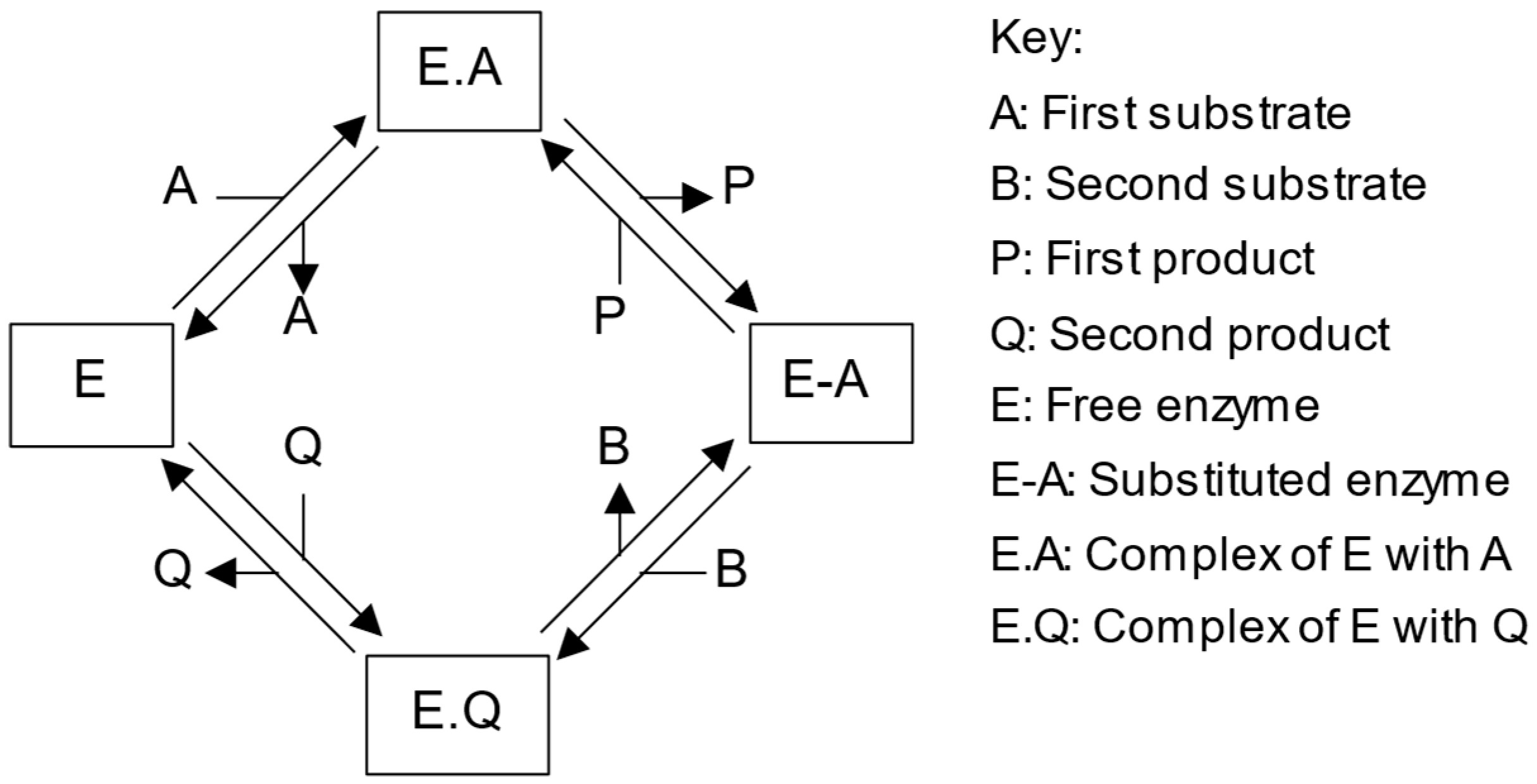
The design and optimization of complex lipase-catalyzed processes would be facilitated by appropriate kinetic models of lipase action [4,5,6,7]. Such models could be used to explore different design and operating strategies, reducing the number of experiments by identifying those strategies that are most promising [8]. Kinetic models of complex lipase-catalyzed processes should take into account that lipases obey the Ping Pong bi bi mechanism. Figure 1 shows the Ping Pong bi bi mechanism for a single reversible reaction A + B ⇌ P + Q, in which A is the first substrate to enter the active site, and Q is the second product that is released.
The basic kinetic equation for a single reaction that obeys the Ping Pong bi bi mechanism is well established, although it can be parameterized in several different ways. The following equation shows the parameterization originally proposed by Cleland [9]:
v = V m a x f V m a x b A [ B ] P [ Q ] K E Q V m a x b K m B A + V m a x b K m A B + V m a x f K m Q K E Q P + V m a x f K m P K E Q Q + V m a x b [ A ] [ B ] + V m a x f K m Q K E Q K i A [ A ] [ P ] + V m a x b K m A K i Q B [ Q ] + V m a x f 1 K E Q [ P ] [ Q ] .
In this equation, Vmaxf and Vmaxb are the maximum velocities in the forward and reverse directions. These maximum velocities are given by Vmaxf = kcatf[E]T and Vmaxb = kcatb[E]T, where kcatf and kcatb are the catalytic constants in the forward and reverse directions, respectively, and [E]T is the total concentration of enzyme. KEQ is the equilibrium constant of the reaction, KmA, KmB, KmP, and KmQ are Michaelis-type saturation constants for A, B, P, and Q, respectively. KiQ is related to the inhibition of the forward reaction by Q. KiA is related to the inhibition of the reverse reaction by A.
The parameterization suggested by Cornish-Bowden [10] is also often used:
v = V m a x f A [ B ] K i A K m B V m a x b P [ Q ] K i P K m Q [ A ] K i A + K m A [ B ] K i A K m B + [ P ] K i P + K m P [ Q ] K i P K m Q + [ A ] [ B ] K i A K m B + [ A ] [ P ] K i A K i P + K m A B [ Q ] K i A K m B K i Q + [ P ] [ Q ] K i P K m Q .
In this equation, KiP is related to the inhibition of the forward reaction by P. The other parameters have the same meanings as they have in the parameterization of Cleland [9].
More recently, Mitchell and Krieger [11] proposed a parameterization in which the numerator is expressed in terms of specificity constants:
v =   k A A h B B h P P k Q Q E T k A A 1 + P K i P + B K m B + h B B + h P [ P ] + k Q Q 1 + [ P ] K m P + [ B ] K i B .
In this parameterization, kA and kQ are the specificity constants of the enzyme for A and Q (as first substrates of reactions), while hB and hP are the specificity constants of the enzyme for B and P (as second substrates of reactions). KmB, KmP, and KiP have the same meanings as they have for the parameterizations of Cleland [9] and Cornish-Bowden [10]. KiB is related to the inhibition of the reverse reaction by B.
These three parameterizations are consistent with one another because they are based on the same elementary coefficients; the difference is that these elementary coefficients are grouped differently in the different parameterizations. However, the parameterization of Mitchell and Krieger [11] is more appropriate than the other two parameterizations for the modeling of complex processes. Since the numerator is expressed in terms of specificity constants, one can derive a so-called “fingerprinting model”, which consists of a set of equations written with the degree of reaction as the independent variable and in which the only parameters are the selectivities of the enzyme for the various reactions that it can catalyze. This enables the estimation of selectivities without interference from phenomena such as inhibition and denaturation, even if they occur in the system [12].
The equation of Mitchell and Krieger [11] can easily be expanded to develop a set of kinetic equations describing complex lipase-catalyzed processes; however, a fully mechanistic set of kinetic equations for such processes involves a large number of parameters [8,13]. It is quite tedious to obtain independent estimates of each of these parameters in initial rate experiments [5]. In any case, the systems are often solvent-free systems: although modified reaction media can be used that only contain intermediate species, allowing initial rate studies with these species, this affects the physicochemical environment of the lipase and may yield parameter estimates that do not apply in the full system [8]. Due to these challenges, initial rate studies are rarely carried out with the intermediates of complex processes; rather, researchers commonly estimate the parameters of their models by fitting the kinetic equations to concentration profiles, plotted against time, for the various species involved in the reaction [8]. However, if a fully mechanistic equation is fitted, many of the parameters will be correlated with one another, making it impossible to obtain reliable estimates [5,8]. It can also be difficult to detect whether extra parameters are required to account for denaturation and inhibition of the enzyme. Faced with this situation, researchers typically propose simplified kinetic equations that contain as few parameters as possible [8]. These simplified kinetic equations may or may not be derived from the fully mechanistic equation.
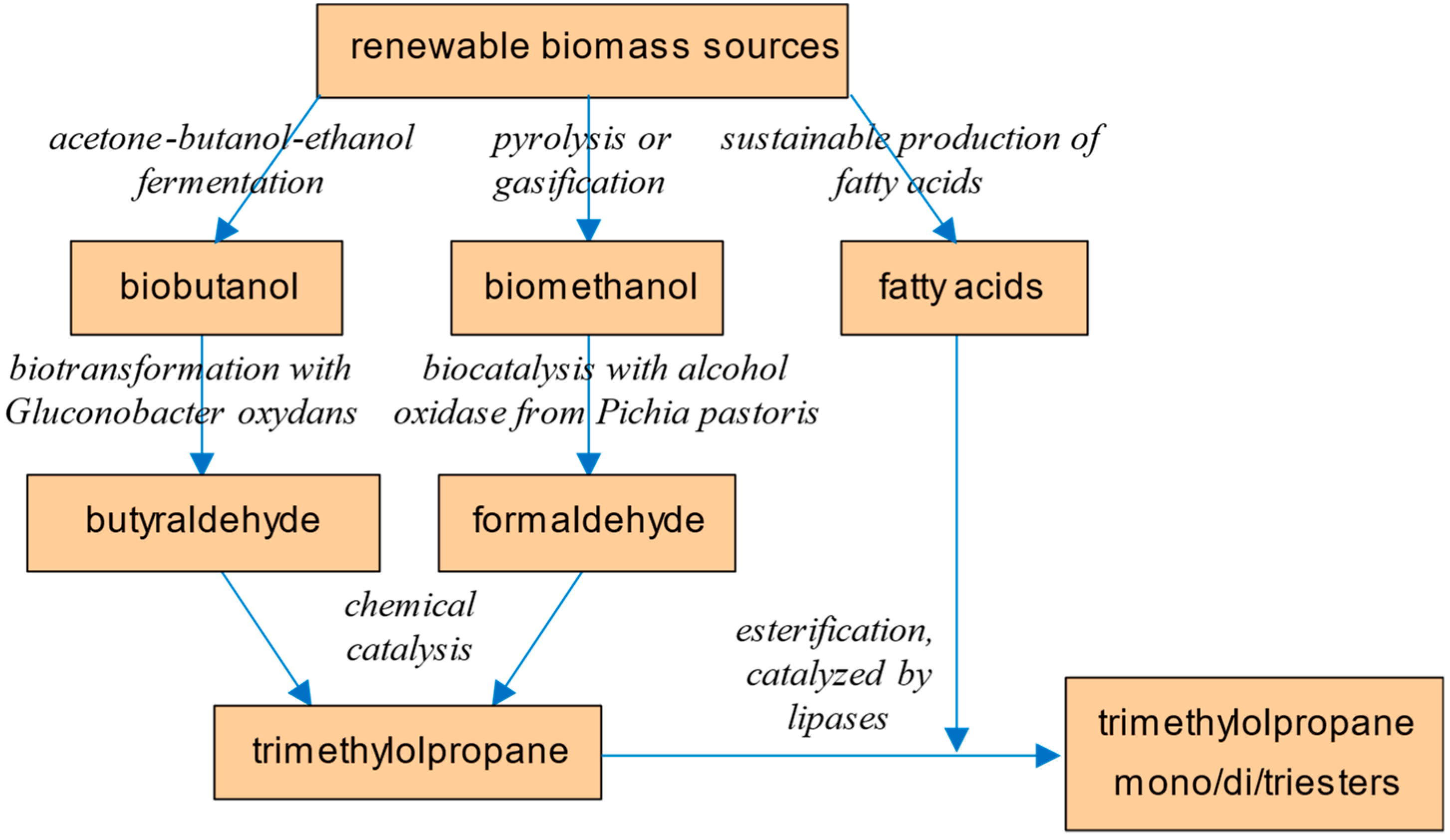
The development of simplified equations for complex lipase-catalyzed reactions was addressed by Bornadel et al. [8] in the context of the esterification of fatty acids with trimethylolpropane (TMP). This is an interesting model reaction for complex lipase-catalyzed processes because it could be a key step in the sustainable production of biolubricants from biomass. Figure 2 integrates this esterification step with routes for the sustainable production of the two substrates, trimethylolpropane [14] and fatty acids [15,16,17].
Although Bornadel et al. [8] were able to fit a simplified model to their experimental reaction profiles, they assumed that the maximum velocities for the three esterifications were equal and that the saturation constants for oleic acid in each of the esterifications were equal. There is no a priori reason to assume that this should be the case. A better approach to developing a simplified model has been made possible by the parameterization of the Ping Pong bi bi kinetic equation proposed by Mitchell and Krieger [11]. This approach involves a two-step fitting procedure in which the selectivities of the enzyme between the three reactions are estimated in a first step, and empirical parameters are then estimated in a second step [18]. Mitchell and Krieger [18] applied this two-step procedure to the production of galactooligosaccharides by a β-galactosidase, but it has not previously been applied to the lipase-catalyzed esterification of trimethylolpropane.
The aim of the current work is, therefore, to adapt the two-step fitting procedure of Mitchell and Krieger [18] to obtain simplified kinetic equations for complex lipase-catalyzed processes, using the esterification of trimethylolpropane as a model system. Four case studies were carried out using the literature data, in which profiles for trimethylolpropane and its fatty acid mono-, di-, and triesters were provided as functions of time [8,19,20,21]. Our two-step strategy gives good fits to this data, showing its usefulness for developing practical kinetic equations of complex lipase-catalyzed processes.

2. Materials and Methods

In this section, we develop an “irreversible fingerprinting model” (i.e., with degree of reaction as the independent variable) and a dynamic model (i.e., with time as the independent variable) for the lipase-catalyzed esterification of fatty acids with trimethylolpropane (TMP).

2.1. Identification of the Reactions That Occur and Definition of Molar Percentages

The lipase-catalyzed esterification of fatty acids with TMP involves three reactions that can be treated as irreversible if measures are taken to remove the water that is formed:
Reaction 1 : A + Z W + M ,
Reaction 2 : A + M W + D ,
Reaction 3 : A + D W + T .
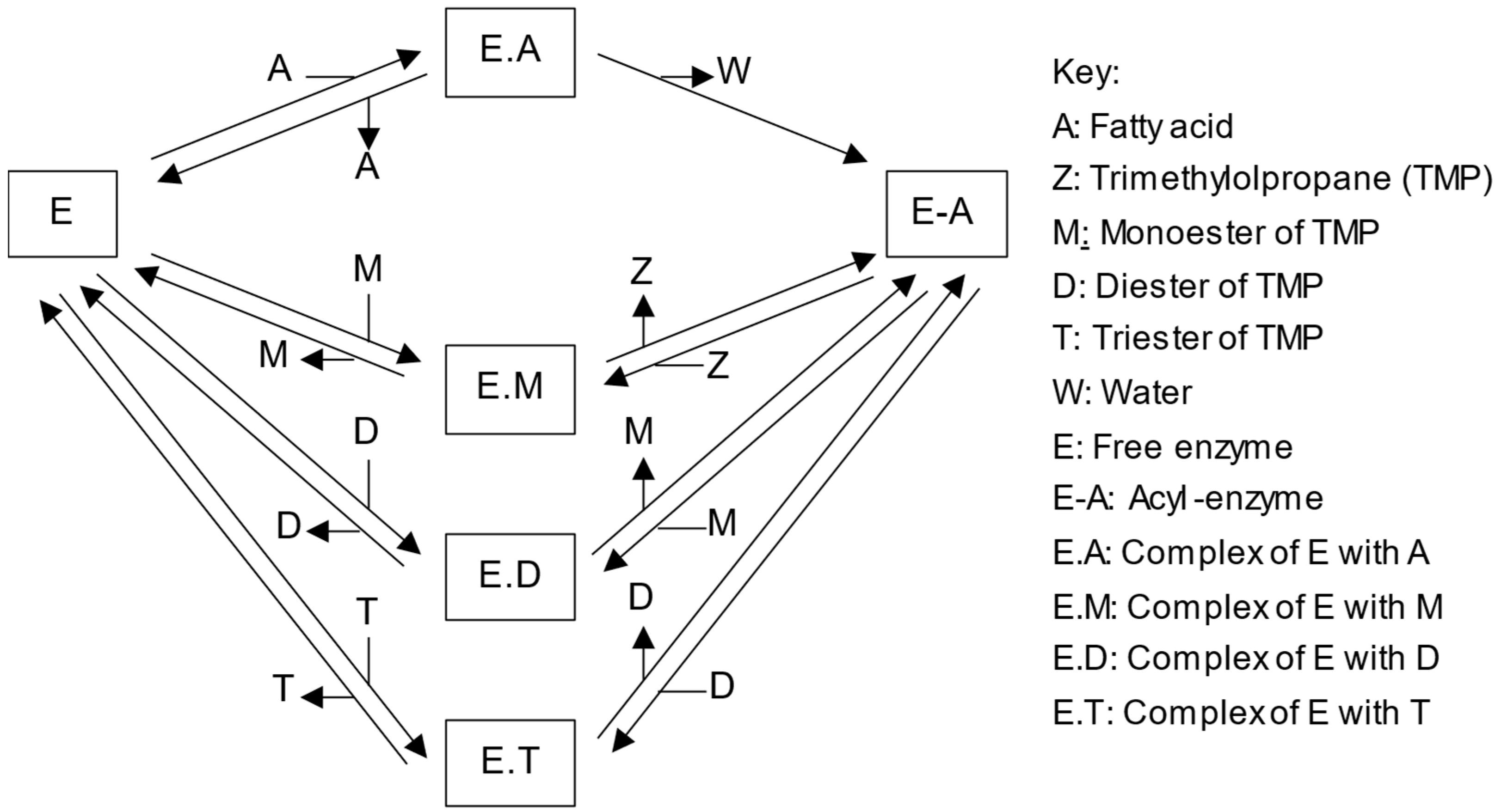
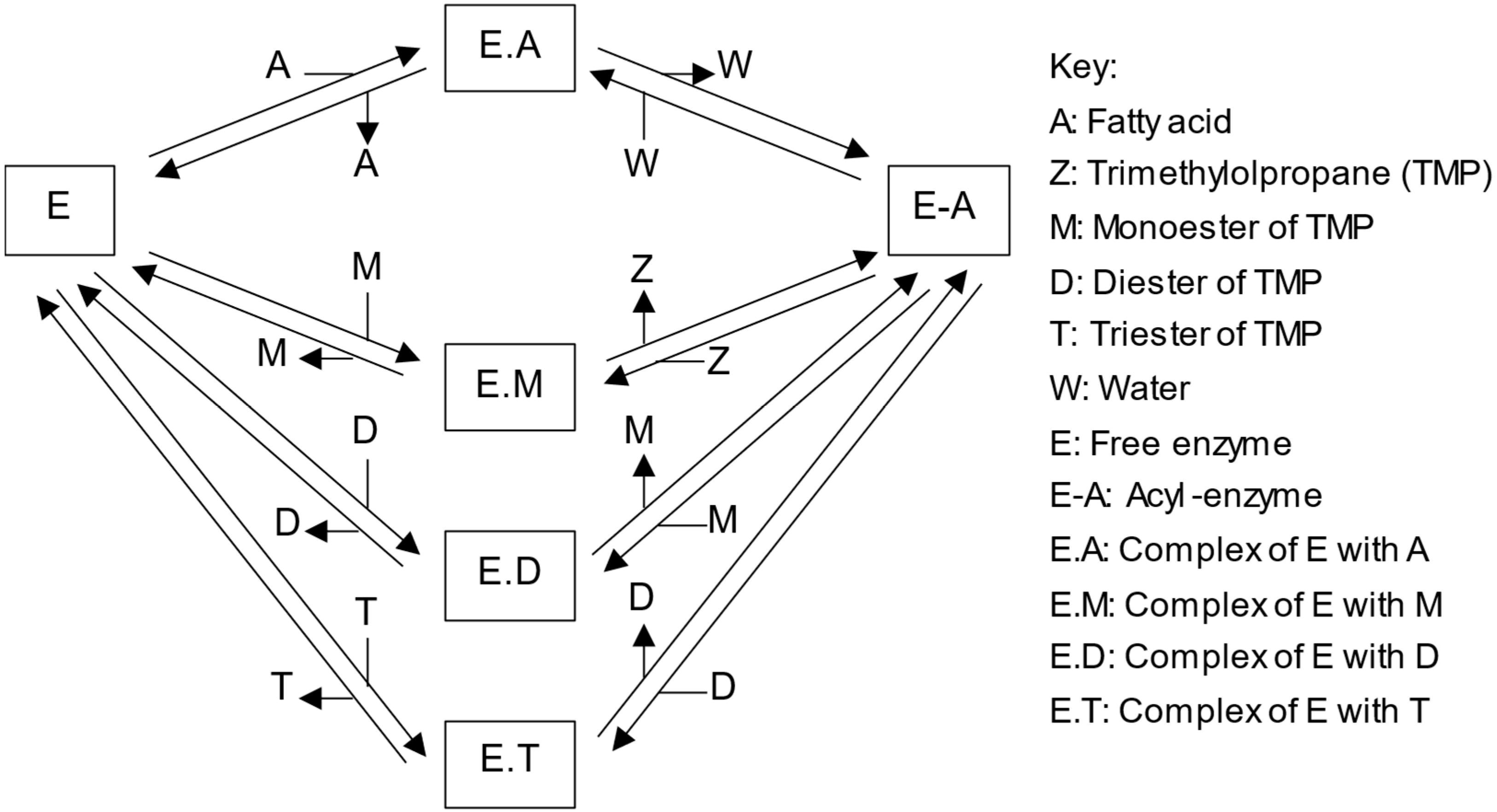
In these equations, A represents the fatty acid, Z represents TMP, and M, D, and T represent the TMP monoester, TMP diester, and TMP triester, respectively. W represents water. Each of these reactions obeys the Ping Pong bi bi mechanism (Figure 3).
Since the systems used to produce esters of TMP are solvent-free systems, the models are written in terms of the molar percentages of the reaction species, based on the initial number of moles of TMP (nZo). The molar percentages are indicated by the letters of the species written in italic font and are defined as:
For   trimethylolpropane : Z = n Z n Z o × 100
For   trimethylolpropane   monoester : M = n M n Z o × 100
For   trimethylolpropane   diester : D = n D n Z o × 100
For   trimethylolpropane   triester : T = n T n Zo × 100
For   the   fatty   acid : A = n A n Z o × 100
For   water : W = n W n Z o × 100
where nZ, nM, nD, nT, nA, and nW are the number of moles of TMP, the TMP monoester, the TMP diester, the TMP triester, the fatty acid, and water, respectively.

2.2. Case Study for the Esterification of TMP—Step 1—Irreversible Fingerprinting Model

If the first reaction above (i.e., Equation (4)) is taken as the reference reaction, the selectivities of the enzyme for catalyzing the second reaction (i.e., Equation (5)) in relation to the first reaction (SM) and for catalyzing the third reaction (i.e., Equation (6)) in relation to the first reaction (SD) are
S M = k A h M k A h Z = h M h Z ,
S D = k A h D k A h Z = h D h Z ,
where kA is the specificity constant of the enzyme for the fatty acid (as a first substrate), hZ is the specificity constant of the enzyme for TMP (as a second substrate), hM is the specificity constant of the enzyme for the TMP monoester (as a second substrate), and hD is the specificity constant of the enzyme for the TMP diester (as a second substrate).
The percentage degree of reaction is defined as c = M + 2D + 3T, such that
d c d t = d M d t + 2 d D d t + 3 d T d t .
The percentage degree of reaction varies from zero, corresponding to the original unesterified TMP, to 300%, corresponding to each of the three hydroxyl groups of TMP being 100% esterified (i.e., all TMP has been converted to TMP triester).
The following irreversible fingerprinting model can be written in terms of the selectivities [22]:
d Z d c = Z Z + S M M + S D D ,
d M d c = Z S M M Z + S M M + S D D ,
d D d c = S M M S D D Z + S M M + S D D ,
d T d c = S D D Z + S M M + S D D .

2.3. Case Study for the Esterification of TMP—Step 2—Dynamic Model

The dynamic model developed in this section is for a system involving the three reactions given in Equations (4)–(6), for the case in which (i) the three reactions are irreversible, (ii) reaction species M, D, and T cause neither substrate inhibition nor product inhibition, (iii) water is removed from the system such that its concentration is kept low and terms containing water are therefore negligible, and (iv) the enzyme does not denature during the reaction. If these conditions hold, then the following balance equations can be written:
d A d t = k A . A . h Z . Z k A . A . h M . M k A . A . h D . D [ E ] T k A . A 1 + Z K M Z 1 + M K MM 1 + D K MD 1 + h Z . Z + h M . M + h D . D ,
d Z d t = k A . A . h Z . Z . [ E ] T k A . A 1 + Z K M Z 1 + M K M M 1 + D K M D 1 + h Z . Z + h M . M + h D . D ,
d M d t = k A . A . h Z . Z k A . A . h M . M [ E ] T k A . A 1 + Z K M Z 1 + M K M M 1 + D K M D 1 + h Z . Z + h M . M + h D . D ,
d D d t = k A . A . h M . M k A . A . h D . D [ E ] T k A . A 1 + Z K M Z 1 + M K M M 1 + D K M D 1 + h Z . Z + h M . M + h D . D ,
d T d t = k A . A . h D . D . [ E ] T k A . A 1 + Z K M Z 1 + M K M M 1 + D K M D 1 + h Z . Z + h M . M + h D . D .
In these equations, KMZ1, KMM1, and KMD1 are saturation constants for Z, M, and D as second substrates when the fatty acid itself is the acyl donor.
If the numerators and denominators of Equations (20)–(24) are divided by hZ, and the factor kA.A is distributed over the sum inside the parentheses in the denominator, then these equations can be rewritten as
d A d t = k A . A . Z k A . A . S M . M k A . A . S D . D [ E ] T k A h Z . A + k A h Z . A Z K M Z + k A h Z . A M K M M + k A h Z . A D K M D + Z + S M . M + S D . D ,
d Z d t = k A . A . Z . E T . k A h Z . A + k A h Z . A Z K M Z + k A h Z . A M K M M + k A h Z . A D K M D + Z + S M . M + S D . D ,
d M d t = k A . A . Z k A . A . S M . M E T k A h Z . A + k A h Z . A Z K M Z + k A h Z . A M K M M + k A h Z . A D K M D + Z + S M . M + S D . D ,
d D d t = k A . A . S M . M k A . A . S D . D E T k A h Z . A + k A h Z . A Z K M Z + k A h Z . A M K M M + k A h Z . A D K M D + Z + S M . M + S D . D ,
d T d t = k A . A . S D . D . E T   k A h Z . A + k A h Z . A Z K M Z + k A h Z . A M K M M + k A h Z . A D K M D + Z + S M . M + S D . D .
The individual parameters within the parentheses in the common denominator of Equations (25)–(29) are not estimated. Rather, the equation set is rewritten as:
d A d t = k A . A . Z k A . A . S M . M k A . A . S D . D [ E ] T F A . A + F A Z . A . Z + F A M . A . M + F A D . A . D + Z + S M . M + S D . D ,
d Z d t = k A . A . Z . E T . F A . A + F A Z . A . Z + F A M . A . M + F A D . A . D + Z + S M . M + S D . D ,
d M d t = k A . A . Z k A . A . S M . M E T F A . A + F A Z . A . Z + F A M . A . M + F A D . A . D + Z + S M . M + S D . D ,
d D d t = k A . A . S M . M k A . A . S D . D E T F A . A + F A Z . A . Z + F A M . A . M + F A D . A . D + Z + S M . M + S D . D ,
d T d t = k A . A . S D . D . E T   F A . A + F A Z . A . Z + F A M . A . M + F A D . A . D + Z + S M . M + S D . D ,
where FA, FAZ, FAM, and FAD are lumped parameters. FA represents the combination kA/hZ, FAZ represents the combination kA/(hZKMZ), FAM represents the combination kA/(hZKMM), and FAD represents the combination kA/(hZKMD).

2.4. Data, Fitting Procedure, and Estimation of Confidence Intervals

The data extracted from the source publications are given in the Supplementary Material (Section S1 for Åkerman et al. [19], Bornadel et al. [8], and Tao et al. [20], and Section S2 for Mao et al. [21]).
For the first step, the parameters SD and SM were estimated by fitting the irreversible fingerprinting model (i.e., Equations (16)–(19)) to reaction profiles plotted as a function of the percentage degree of reaction.
For the second step, namely the fitting of the dynamic model, the values of SD and SM were set at the values obtained from the fitting of the irreversible fingerprinting model and the parameters kA, FA, FAZ, FAM, and FAD were estimated by fitting Equations (30)–(34) to the same reaction profiles, but plotted as a function of time.
For both models, the following objective function was minimized:
F o b j = j = 1 m i = 1 n Z i , j , p Z i , j , e 2 + M i , j , p M i , j , e 2 + D i , j , p D i , j , e 2 + T i , j , p T i , j , e 2 ,
where m represents the number of datasets. i represents the ith sampling time for which data is available in the jth dataset. n is the number of sampling times in each dataset (n varies from dataset to dataset). The subscript “e” indicates an experimental value, while the subscript “p” represents the value predicted by the model for the same sampling time. The data of Mao et al. [21] did not allow calculation of Z, so, in this case, the first term of the objective function was removed.
The confidence intervals of the parameters were estimated according to Schwaab et al. [23], while the confidence intervals for model predictions were estimated according to Gomes et al. [24]. In this work, the Hessian matrix (which contains the second-order partial derivatives of the objective function with respect to the parameters and is used to estimate the parametric covariance matrix) as well as the gradient vector (which contains the partial derivatives of the model prediction with respect to each parameter) were obtained numerically using central finite differences. The elements of the parametric correlation matrices were obtained directly from the parametric covariance matrices:
r i , j = σ i , j 2 σ i σ j ,
where σ i , j 2 is the covariance between parameters i and j, while σ i and σ j are the square roots of the variances of parameters i and j, respectively.
The fittings and the estimation of the confidence intervals and the parametric correlation matrices were carried out using programs written in the Scilab programming language.
The Bayesian Information Criterion (BIC) was calculated as
B I C = n T . ln F o b j n T + k . l n n T ,
where Fobj is calculated according to Equation (35) above, k is the number of fitting parameters in the model, and nT is the total number of data points (equal to the number of sampling times multiplied by the number of different species quantified at each sampling time).

3. Results

Four case studies are presented below, with data for the esterification of TMP extracted from Åkerman et al. [19], Bornadel et al. [8], Tao et al. [20], and Mao et al. [21]. The data of Åkerman et al. [19], Bornadel et al. [8], and Tao et al. [20] were previously analyzed by the “fingerprinting method” by Mitchell et al. [22] using a Bayesian technique to estimate the selectivities. In the current work, these selectivities were re-estimated by a least squares method (Section 2.4). In these cases, only the re-estimated selectivities and their 95% confidence intervals are given below; more details, including the fitted curves, are given in Sections S3–S6 (Supplementary Material). The data of Mao et al. [21] have not been previously analyzed; therefore, the details of the fitting of the irreversible fingerprinting model are given below. In all cases, detailed results are given below for the fitting of the dynamic models.

3.1. Fitting the Dynamic Model to the Data of Åkerman et al. [19]

The irreversible fingerprinting model (Equations (16)–(19)) was fitted to the data that Åkerman et al. [19] obtained for the esterification of oleic acid (C18:19) with TMP, at an initial molar ratio of 3:1, catalyzed by CALB (Novozym 435), at two different temperatures in a solvent-free system. Since the profiles obtained at the two temperatures coincided when plotted against the percentage degree of reaction, both datasets were fitted simultaneously. The fitting gave values (±95% confidence intervals) of SM = 0.389 ± 0.026 and SD = 0.0311 ± 0.0035, with a sum of squares of 74.2. The fits are shown in Figure S1 (Section S3, Supplementary Material).
The estimated values for SM and SD were then set in the dynamic model (Equations (30)–(34)), and the parameters kA, FA, FAZ, FAM, and FAD were estimated by fitting the model, separately, to the data that Åkerman et al. [19] obtained at 70 °C and at 100 °C. The results obtained are shown in Table 1. In the case of the fitting to the data obtained at 70 °C, the values of the parameters FA and FAZ are smaller than their 95% confidence intervals. In the case of the fitting to the data obtained at 100 °C, the values of all parameters are greater than their corresponding 95% confidence intervals. However, the estimated values for FA and FAZ are small.
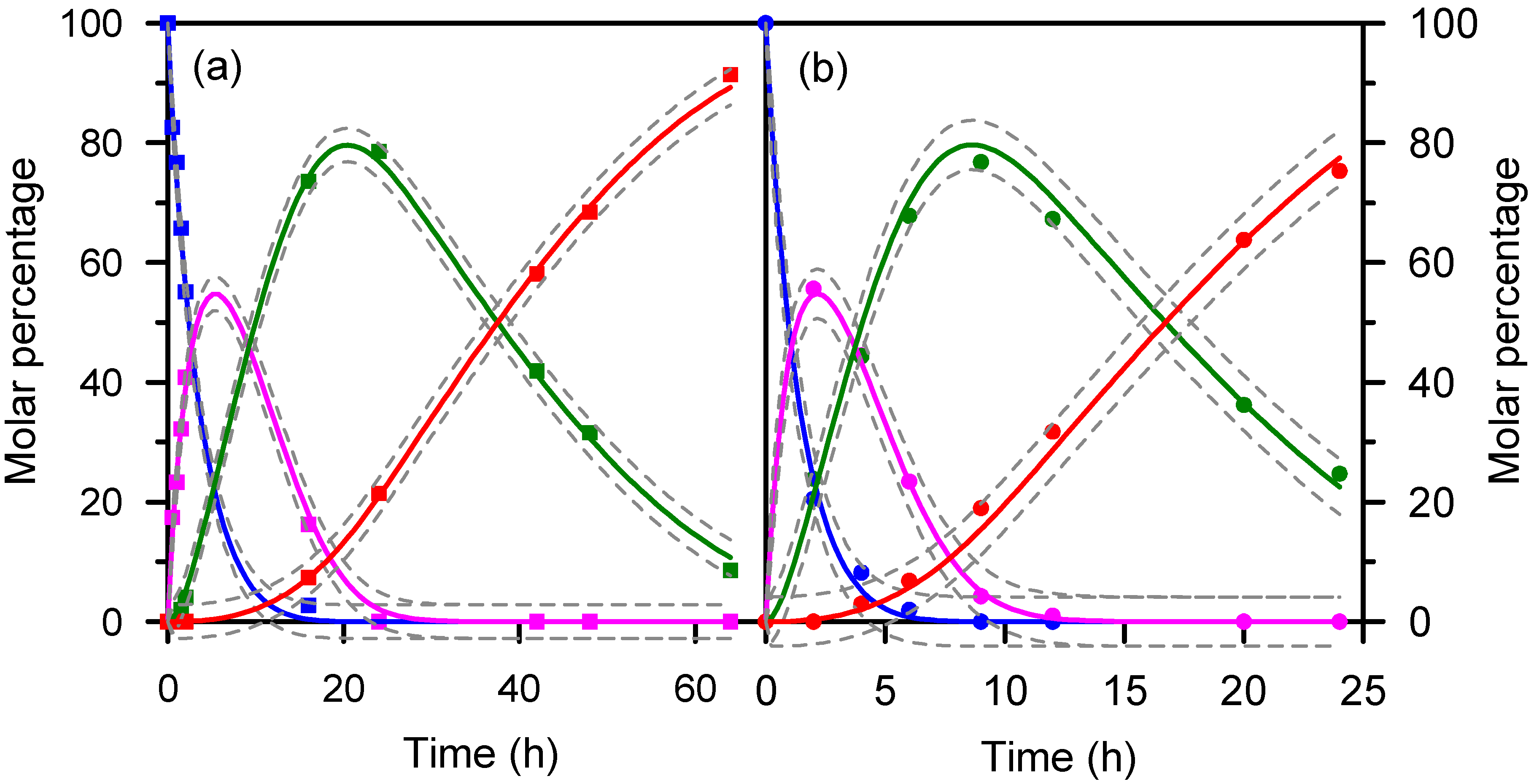
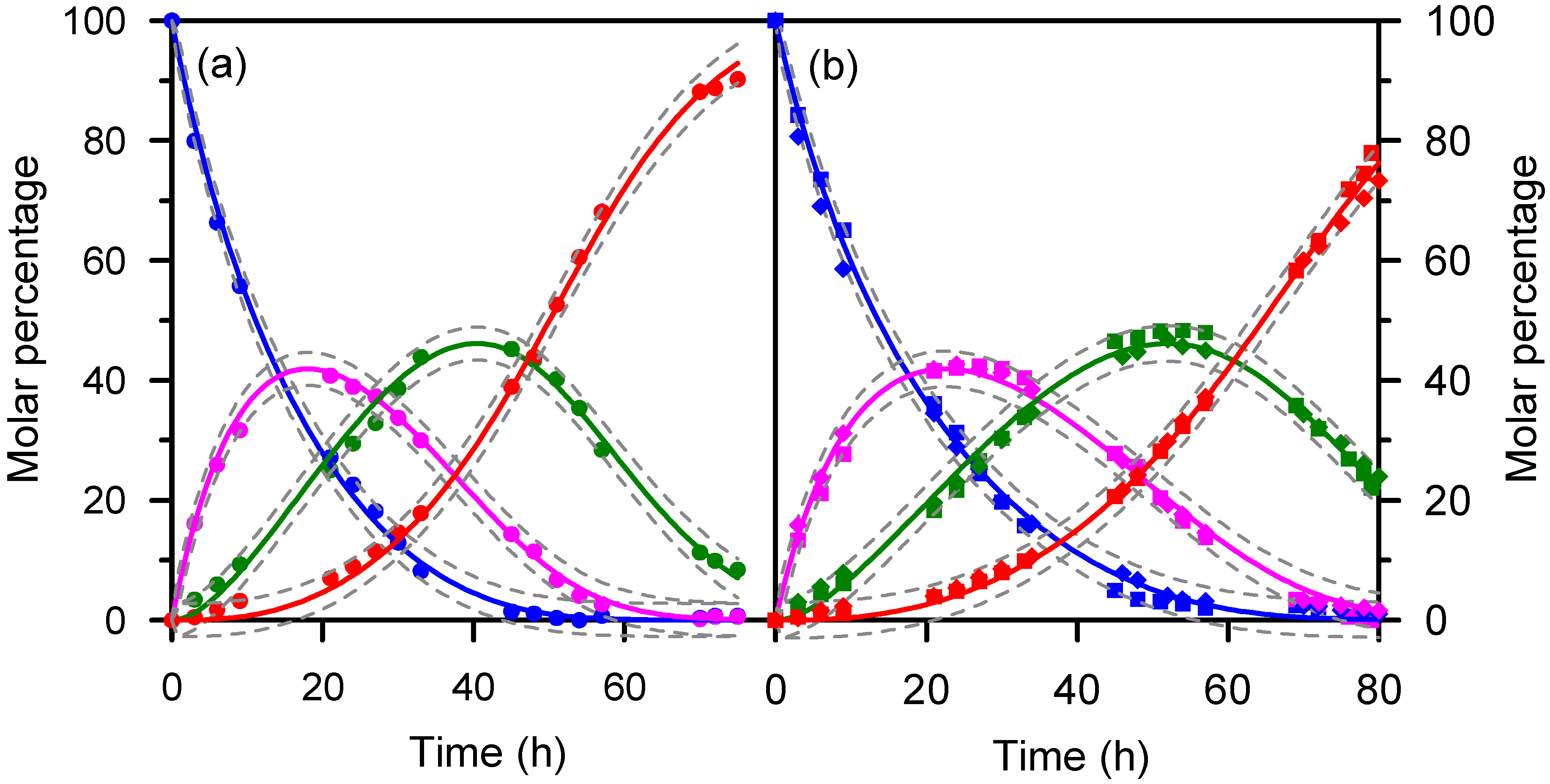
Given that FA and FAZ appeared to be unimportant, a simplified version of the model (Equations (30)–(34)) was fitted to the data of Åkerman et al. [19], with the values of FA and FAZ in the denominator set to zero. Table 2 shows the parameter estimates, while Figure 4 shows the fits to the data. At both temperatures, the simplified model describes the data well. It is preferable to the full model, since it gives a lower BIC value for both datasets. The fits indicate that the greatest effect of temperature is on the value of kA, with the value for 100 °C being 2.5-fold higher than the value at 70 °C. The estimated values for the empirical constants FAM and FAD are quite similar at the two temperatures.

3.2. Fitting the Dynamic Model to the Data of Bornadel et al. [8]

The irreversible fingerprinting model (Equations (16)–(19)) was fitted to the data that Bornadel et al. [8] obtained for the esterification of oleic acid (C18:19) with TMP at an initial molar ratio of 3:1, catalyzed by CALB (Novozym 435) in a solvent-free system. The fitting gave values (±95% confidence intervals) of SM = 0.909 ± 0.096 and SD = 0.066 ± 0.011, with a sum of squares of 840.6. The fits are shown in Figure S2 (Section S4, Supplementary Material).
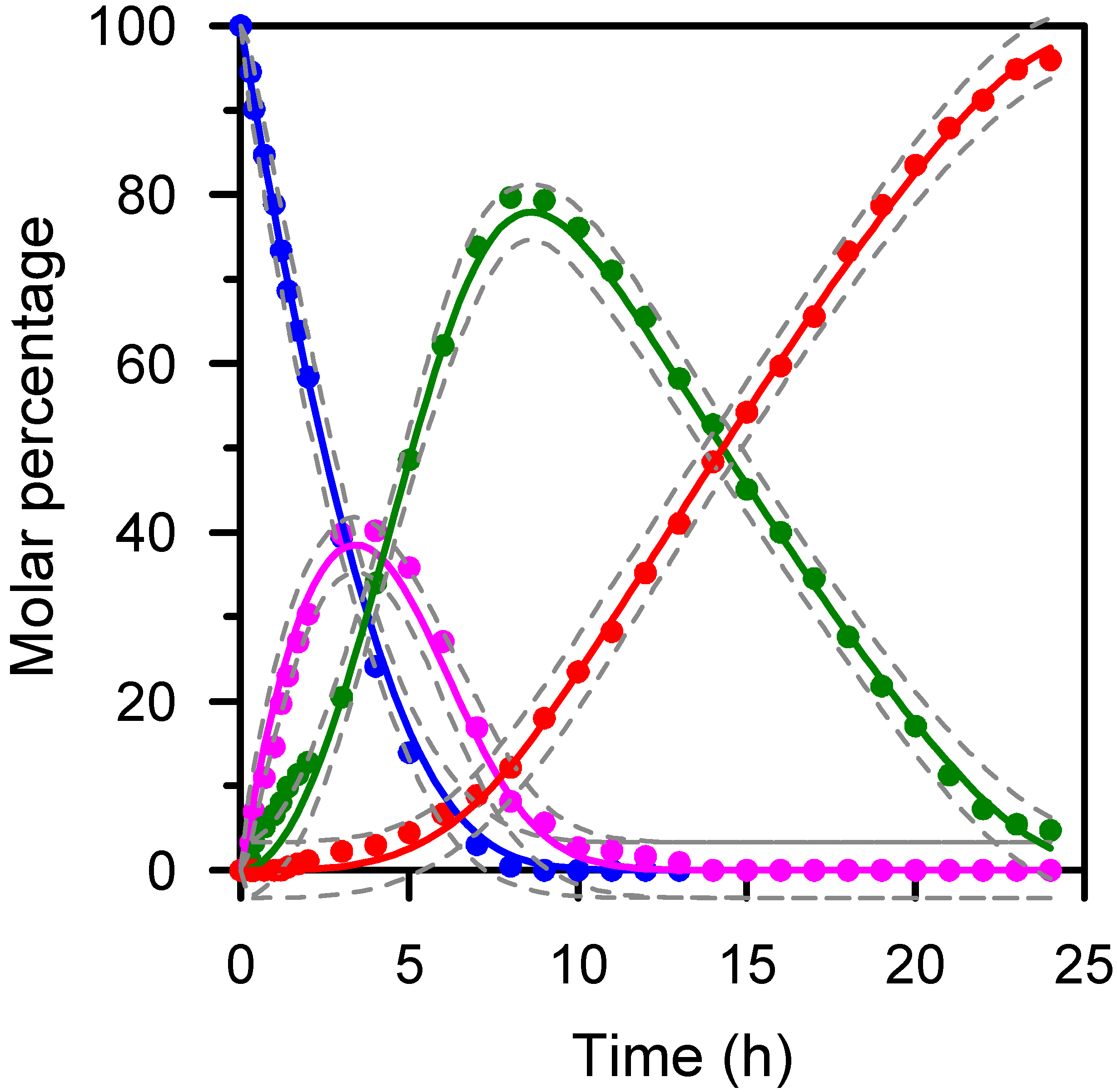
The estimated values for SM and SD were then set in the dynamic model (Equations (30)–(34)), and the parameters kA, FA, FAZ, FAM, and FAD were estimated by fitting the model to the data of Bornadel et al. [8]. The estimated value for FA is smaller than its 95% confidence interval (Table 3); therefore, a simplified model was fitted to the data with FA set to zero in the denominator. This simplified model fits the data as well as the full model (Table 3) and is preferable, since it gives a lower BIC value than does the full model. Figure 5 shows the fit of this simplified model to the data of Bornadel et al. [8]. It should be noted that although the estimated value of FAM is smaller than its 95% confidence interval for both the full dynamic model and the simplified dynamic model, when it is set to zero in the simplified model, the value of the objective function increases 1.4-fold.
Interestingly, the fit of the dynamic model, with a minimized Fobj value of 329.9, is much better than the fit of the irreversible fingerprinting model, which has a minimized Fobj value of 840.6. The irreversible fingerprinting model fits relatively poorly because the data of Bornadel et al. [8] show evidence of mass transfer limitations [22]. Bornadel et al. [8] did not detect the presence of mass transfer limitations because they only plotted their data against time; these limitations only became evident when Mitchell et al. [22] plotted their data as a function of the percentage degree of reaction and applied a “fingerprinting analysis”. We explicitly acknowledge that the effects of the mass transfer limitations are subsumed into the values of the fitting constants of the fingerprinting and dynamic models of this case study. We discuss the implications of this later (see Section 4.3).

3.3. Fitting the Dynamic Model to the Data of Tao et al. [20]

The irreversible fingerprinting model (Equations (16)–(19)) was fitted to the data that Tao et al. [20] obtained for the esterification of caprylic acid (C8:0) with TMP, at an initial molar ratio of 3.2:1, catalyzed by the lipase of Candida sp. 99–125 in a solvent-free system. Tao et al. [20] obtained their data at three different values of water activity (aw). Since the profiles obtained at all three water activities coincided when plotted against the percentage degree of reaction, the three datasets were fitted simultaneously. The fitting gave values (±95% confidence intervals) of SM = 0.761 ± 0.025 and SD = 0.333 ± 0.012, with a sum of squares of 535.3. The fits are shown in Figure S3 (Section S5, Supplementary Material).
The estimated values for SM and SD were then set in the dynamic model (Equations (30)–(34)), and the parameters kA, FA, FAZ, FAM, and FAD were estimated by fitting the model, first, to the data that Tao et al. [20] obtained at a water activity of 0.25 and, second, to the data that Tao et al. [20] obtained at water activities of 0.35 and 0.45. This simultaneous fitting of the latter two datasets was carried out because the reaction profiles at the two water activities coincided when plotted as a function of time. The results obtained are shown in Table 4. In the case of the fitting to the data obtained at aw = 0.25, all parameters are larger than their 95% confidence intervals. However, in the case of the fitting to the data obtained at aw = 0.35 and 0.45, the values of the parameters FA and FAD are smaller than their 95% confidence intervals.
Given that FA and FAD did not seem important in the fitting of the full model, a simplified version of the model was fitted to the data of Tao et al. [20], with the values of FA and FAD in the denominator set to zero. This fitting gave the parameter estimates shown in Table 5. The fits to the data are shown in Figure 6. At all three water activities, the simplified model describes the data well. The simplified model is preferable to the full model, since it gives a lower BIC value for both datasets. The fits indicate that the greatest effect of water activity is on the value of kA, with the value for the water activity of 0.25 being 1.3-fold higher than the value for the water activities of 0.35 and 0.45. In a similar manner, the value of FA for the water activity of 0.25 is 1.2-fold higher than the value for the water activities of 0.35 and 0.45. The values estimated for the empirical constant FAM are quite similar at the different water activities.

3.4. Fitting the Fingerprinting Model and the Dynamic Model to the Data of Mao et al. [21]

Mao et al. [21] used the lipase of Candida sp. 99–125 to catalyze the esterification of pelargonic acid (C9:0) with TMP in five successive batches in a solvent-free system. In each batch, the initial molar ratio of pelargonic acid to TMP was 3:1. After each batch, the lipase was recovered and washed with acetone before being added to the next batch. When the data from all five batches are plotted against the degree of reaction, the data from the fourth and fifth batches are not consistent with the data from the first three batches, indicating the presence of systematic experimental error in the data from the last two batches (see Figure S4, Section S6, Supplementary Material). The data from these two batches are therefore not included in the analysis.
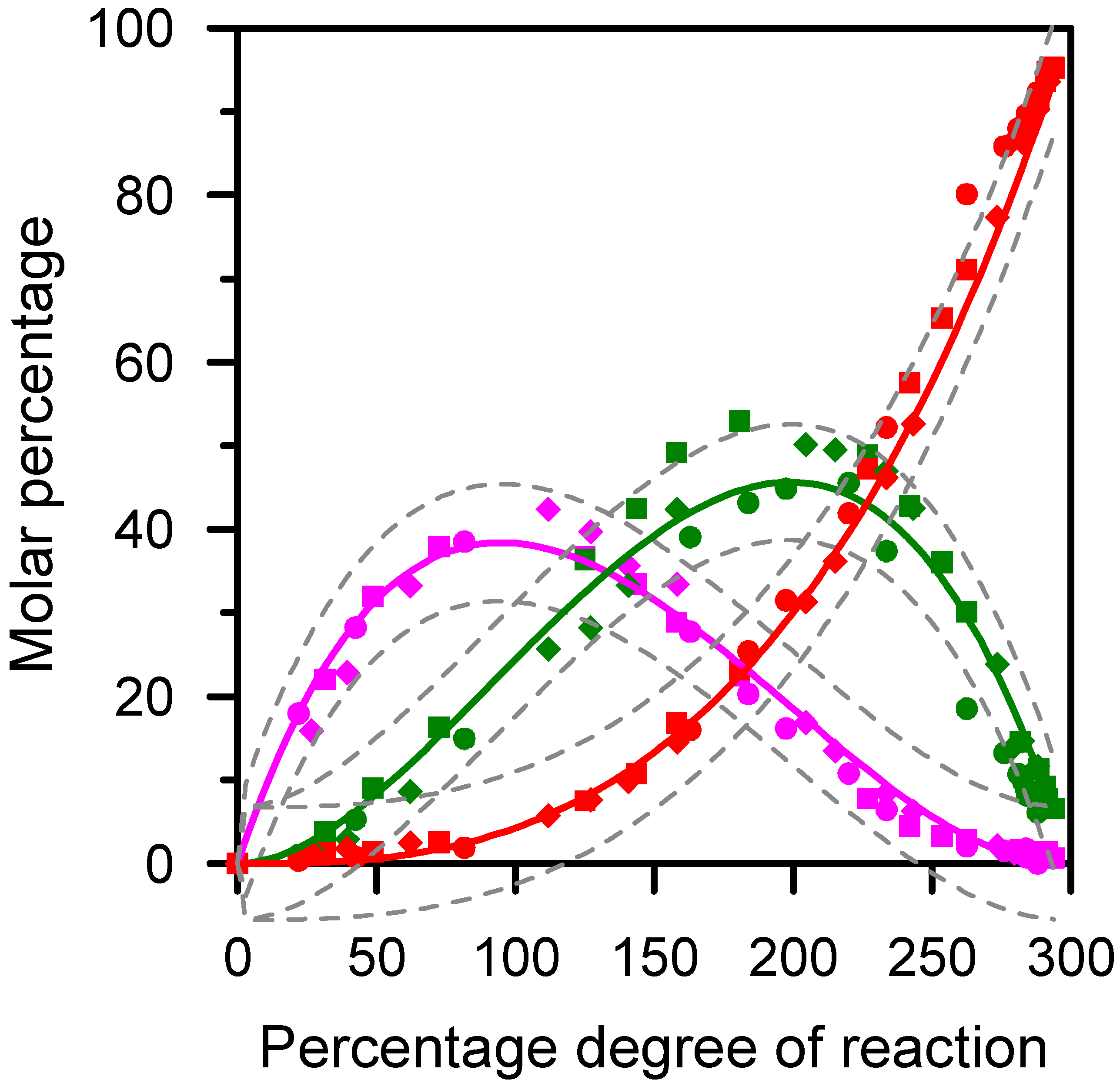
The irreversible fingerprinting model (Equations (16)–(19)) was fitted to the data that Mao et al. [21] obtained in their first three batches. This fitting gave values (±95% confidence intervals) of SM = 0.916 ± 0.094 and SD = 0.378 ± 0.037, with a sum of squares of 1616.0. The fit is shown in Figure 7.
The estimated values for SM and SD were then set in the dynamic model (Equations (30)–(34)), and the parameters kA, FA, FAZ, FAM, and FAD were estimated by fitting the model to the data that Mao et al. [21] obtained in their first three batches. Since a preliminary analysis indicated that the initial velocities were different in each batch, possibly due to denaturation by acetone in the washing between batches, three separate values of kA were estimated, one for each batch (Table 6). For the other parameters, a single value was estimated over the three batches.
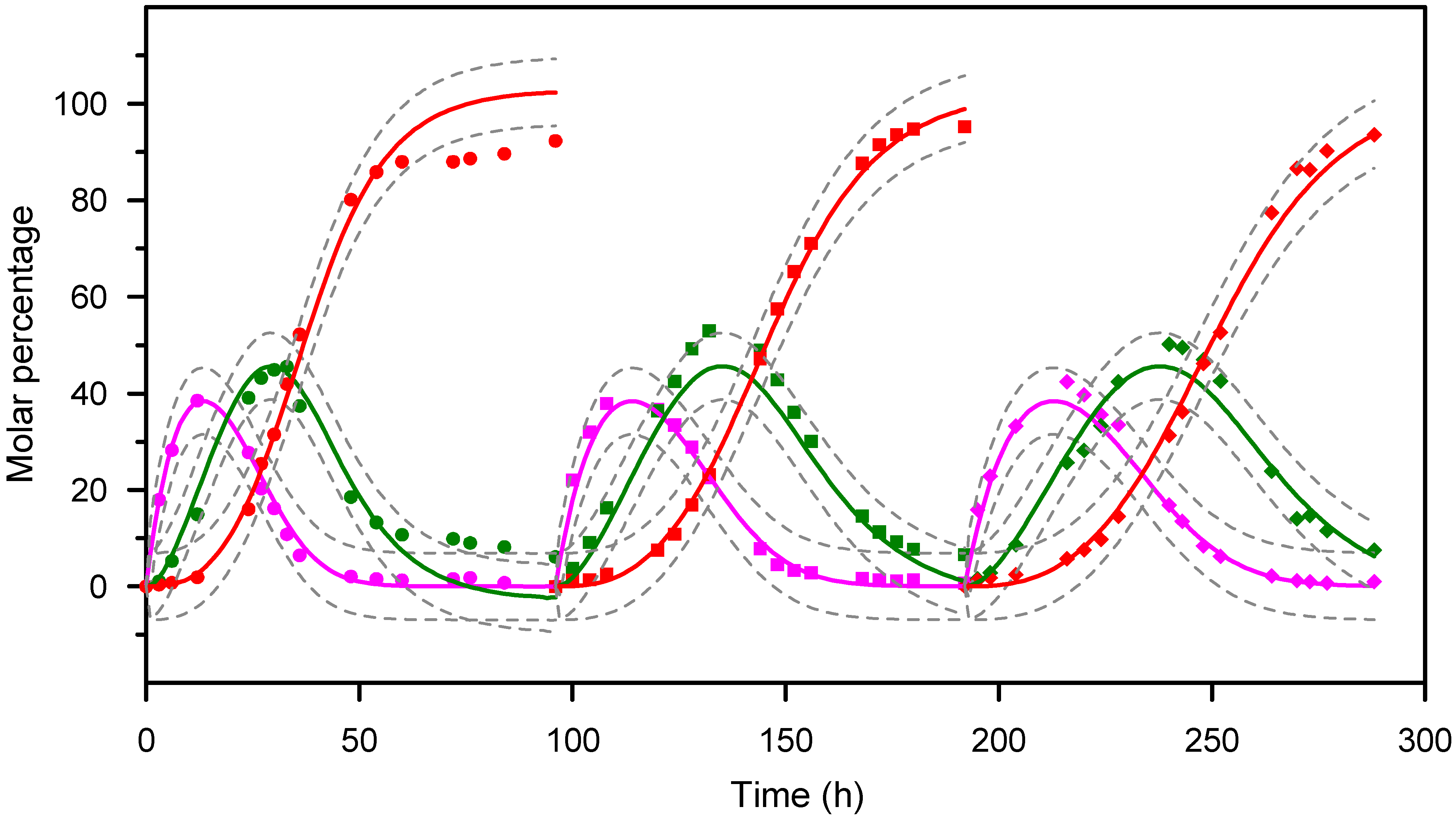
The estimated value of FAD is smaller than its 95% confidence interval (Table 6). Additionally, although the estimated value of FA is larger than its 95% confidence interval, the confidence interval is relatively large. A simplified version of the model was therefore fitted to the data of Mao et al. [21], with the values of FA and FAD in the denominator set to zero. This fitting gave the parameter estimates shown in Table 6, which have very small 95% confidence intervals. The fits obtained are quite reasonable (Figure 8), even though the simplified model has a higher BIC value than the full model.

4. Discussion

The main contribution of the current work is that it improves the framework, developed originally by Bornadel et al. [8], for modeling complex reactions catalyzed by enzymes that obey the Ping Pong bi bi mechanism. As we discuss below, although our approach is developed for lipase-catalyzed reactions, it is applicable to other reactions that obey the Ping Pong bi bi mechanism.
The main difference in our framework from that of Bornadel et al. [8] is that our two-step approach involves a mechanistic aspect, namely the determination of selectivities in the first step, using reaction profiles plotted as a function of the percentage degree of reaction, in a so-called “fingerprinting analysis”. Below, we discuss the implications of the empirical nature of the second step and point out that various models that purport to be mechanistic are, in fact, empirical.

4.1. Advantages of Carrying out a “Fingerprinting Analysis” as a Separate First Step

The advantages of plotting the reaction profiles in terms of percentage degree of reaction and then performing a so-called “fingerprinting analysis” have been previously discussed [12,22]. Briefly,
  • The fingerprinting analysis is a mechanistic analysis, because it is based on the numerators of mechanistic rate equations. In this fingerprinting analysis, it is straightforward to identify whether the reaction can be treated as being irreversible (as was done in the current work, due to the removal of water from the reaction medium) or whether it is necessary to introduce specificity constants related to the reverse direction of one or more reactions. It is also possible to identify whether it is necessary to describe the phenomenon of processivity, either because it truly occurs or because there is pseudoprocessivity due to mass transfer limitations. Such an analysis was previously demonstrated by Mitchell et al. [22] in the context of the lipase-catalyzed esterification of TMP.
  • The number of parameters to be estimated in this step is minimized and the only parameters of the fingerprinting models are selectivities and, in the case in which (pseudo)processivity occurs, probabilities of processive action. This helps to reduce problems caused by correlation between parameters, which are exacerbated when selectivities are estimated simultaneously with other parameters [5,8].
  • The estimation of the selectivities is not affected by saturation, inhibition, or denaturation of the enzyme, even when such phenomena occur in the system. This occurs because the fingerprinting analysis is based on ratios of rate equations, and the parameters related to these phenomena cancel out from the equation set [12,22].

4.2. The Empirical Nature of the Derived Set of Kinetic Equations and Its Implications

In our two-step approach, the selectivities are estimated in a mechanistic manner in the first step, but the remaining parameters are estimated empirically in the second step. Even though the dynamic model that is used in the second step is a simplified version of a fully mechanistic model of the process, the estimation of parameters in this step is highly empirical, and we explicitly recognize this. Consequently, we make no attempt to extract estimates of individual saturation and inhibition constants from the lumped parameters FA, FAZ, FAM, and FAD. Further, we make no attempt to interpret the values of these empirical constants in terms of the reaction mechanism.
Other researchers who have developed kinetic models of complex processes often do not explicitly acknowledge the empirical nature of their models. In fact, by using classical symbols, such as Vmax (or kcat), KM, and Ki, they often give the impression that their estimated values are reliable estimates of these parameters, even when they are not. As one example in the context of lipase-catalyzed esterification of TMP, Bornadel et al. [8] did not explicitly acknowledge that the parameters of their model (Vmax and various KM values) were, in fact, empirical fitting parameters. There are several reasons why the parameters of their model must be regarded as being empirical. First, as pointed out in the case study that we did with their data (Section 3.2), Bornadel et al. [8] did not realize that their estimated values were contaminated by the effects of mass transfer limitations (the implications of this for our fitting are discussed in the next subsection). Second, although they correctly pointed out that the specificity constant for oleic acid (which is represented by “kA” in the current work) must be the same for all three esterification reactions (i.e., the esterifications of Z, of M and of D), there is no mechanistic basis for their further assumption that the maximum velocities of the three esterification reactions are equal and that the saturation constants for oleic acid in the three reactions are equal. Since all the parameters of their model were estimated simultaneously by fitting to reaction profiles plotted as a function of time, all their parameter estimates were affected by the empirical nature of their model.
Another example of empirical model fitting in the context of the lipase-catalyzed esterification of TMP is the work of Tao et al. [20]. Although their model fits their data, their model is derived based on a reaction scheme that represents the binding of both substrates to form a ternary complex, whereas the correct Ping Pong bi bi mechanism involves the formation of a covalent acyl-enzyme intermediate before nucleophilic attack by the second substrate. Since their model is an incorrect description of the mechanism, the parameters estimated by Tao et al. [20] do not represent what they purport to represent.
In our case, the empirical nature of the dynamic model means that it is system-specific. In other words, the values of the lumped parameters will be valid for a given process carried out under a given set of conditions. They will vary for different fatty acid chain lengths and for different alcohols (e.g., if trimethylolpropane is replaced with ethylene glycol or glycerol). Likewise, if operating variables such as the temperature or water activity are changed, then the estimates of the lumped parameters will change. Other factors affecting the enzyme may also affect the estimates of these parameters, such as the presence of inert solvents (e.g., hexane or heptane) or even the formulation of the enzyme (i.e., immobilized or not). As a first approximation, different molar ratios of the fatty acid to the alcohol should not affect these parameters, but this needs to be confirmed experimentally by performing reactions at different molar ratios, since, in solvent-free systems, the molar ratio between the components may affect the properties of the medium, thereby affecting the enzyme. In conclusion, once one accepts that simplified dynamic models of complex processes are empirical in nature, it becomes clear that, for the model to be useful as a tool for guiding process development and optimization, the parameters should be estimated from large datasets, involving profiles of reactions carried out over a wide range of conditions. However, for each reaction carried out under a particular set of conditions, the two-step approach that we have demonstrated in the current work is the best method for estimating selectivities and the lumped parameters because the selectivities are estimated without confounding effects from enzyme denaturation and inhibition.

4.3. The Implications When Mass Transfer Limitations Cause Pseudoprocessivity

The case study based on the data of Bornadel et al. [8], presented in Section 3.2, represents an exception to the mechanistic estimation of selectivities. In this case, the selectivities estimated in the first step are apparent rather than true selectivities. This conclusion arises from the fingerprinting analysis of Mitchell et al. [22], in which a model that incorporated processivity into the esterification reactions fitted the data of Bornadel et al. [8] better than an irreversible fingerprinting model. Although the lipase used, CALB, is not a processive enzyme, such a situation can occur due to mass transfer limitations: when the product of one reaction diffuses very slowly away from the enzyme, the likelihood of it being recaptured as the substrate for a subsequent reaction increases [22]. This phenomenon is known as pseudoprocessivity [22].
In the current work, an irreversible model without pseudoprocessivity was preferred in the interests of simplicity. Since the irreversible fingerprinting model did not allow for pseudoprocessivity, the mass transfer limitations in the system of Bornadel et al. [8] affect the estimated selectivities. Likewise, since the dynamic model did not allow for pseudoprocessivity, the mass transfer limitations in their system affect the values obtained for the lumped parameters estimated in this step. Consequently, in systems like theirs in which mass transfer limitations are important, these parameter estimates would be valid for a specific reactor configuration and agitation condition.

4.4. The Implications of Our Work for Other Complex Processes Involving Biomass-Derived Products

The two-step approach described in the current work can be directly applied to complex processes catalyzed by enzymes that obey the Ping Pong bi bi mechanism and in which there is a single form of the substituted enzyme. Such processes include other lipase-catalyzed reactions, such as the esterification of flavonoid glycosides [25], the transesterification of oils [26,27,28,29], the synthesis of diesters of carbohydrates [30,31,32], the desymmetrization of meso-alcohols [33], and the kinetic resolution of racemic alcohols [34].
Another class of biotechnologically important processes catalyzed by enzymes that obey the Ping Pong bi bi mechanism are transglycosylation reactions that proceed through a covalent glycosyl-enzyme intermediate. They include processes for the production of prebiotics such as galactooligosaccharides [35,36,37,38], fructooligosaccharides [39,40,41,42], and lactulose [43], in which there are competing synthesis and hydrolysis reactions. In fact, the first step of the two-step approach, namely the fingerprinting analysis, has been undertaken for several transglycosylation systems [18,44,45].
When there is a single form of the substituted enzyme, it is straightforward to extend the two-step approach to describe any number of competing reactions and to allow for reversibility of the reactions. To demonstrate this, we will consider a Ping Pong bi bi scheme analogous to that shown in Figure 3, but assuming that sufficient water is present for all reactions to be fully reversible, as shown in Figure 9. With respect to the numerators of the kinetic equations, for any reversible loop X + Y ⇌ P + Q (where X is the first substrate to enter the active site and Q is the last product to leave), there will be a combination of terms for the forward and reverse directions, “kX.X.hY.YhP.P.kQ.Q”. On the other hand, the denominator of the kinetic equations becomes ever more complex as the number of competing reactions increases. Based on the deductions presented in the supplementary materials of Mitchell and Krieger [11,46], it can be deduced that, for the various competing reactions shown in Figure 9, the fully mechanistic denominator (d), which is common to all kinetic equations, is given by (see Section S7, Supplementary Material):
d =   k A A 1 + W K i W + Z K M Z 1 + M K M M 1 + D K M D 1              + k M M 1 + Z K i Z + W K M W 2 + M K M M 2 + D K M D 2              + k D D 1 + M K i M + W K M W 3 + Z K M Z 3 + D K M D 3              + k T T 1 + D K i D + W K M W 4 + Z K M Z 4 + M K M M 4                 + h Z Z + h M M + h D D + h W W
In this denominator, a kX value is the specificity constant of the enzyme for species X as a first substrate, while a hY value is the specificity constant of the enzyme for species Y as a second substrate. A Ki value is related to inhibition by the indicated species when it is the first product of a reaction. A KM value is a saturation constant for the indicated species when it is the second substrate of a reaction. It should be noted that the same species can be the second substrate in several different reaction loops that start with different first substrates, and that the value of the saturation constant for this second substrate is affected by the identity of the first substrate. For this reason, Z has three saturation constants (KMZ1, KMZ3, and KMZ4), W has three saturation constants (KMW2, KMW3, and KMW4), M has three saturation constants (KMM1, KMM2, and KMM4), and D has three saturation constants (KMD1, KMD2, and KMD3).
From the structure of the denominator in Equation (38), it can then be seen that
  • For each arrow leaving the free enzyme in Figure 9, with the entry of species X, there is a factor “kX.X” that multiplies a set of parentheses containing various terms;
  • Within each set of parentheses, the terms are
    1;
    A term in which the concentration of the species that leaves in the step that forms the substituted enzyme is divided by an inhibition constant (since this species causes product inhibition of this route);
    One term for each of the other routes that return from the substituted enzyme to the free enzyme, with the concentration of the species that enters as a second substrate in this other route being divided by a KM value;
  • For each arrow leaving the substituted enzyme and returning to the free enzyme, with the entry of species Y, there is a term of the type “hY.Y”.
Of course, this fully mechanistic denominator is so complex that it is impractical to use it in the dynamic model. However, any simplified denominator should only contain terms from this mechanistic denominator.
When appropriate, an extra equation can be incorporated into the dynamic model to describe enzyme denaturation. In the case of first-order denaturation kinetics, the equation would be
d [ E ] T d t = k d E T ,
where kd is the first-order denaturation constant. In fact, the necessity for this equation was investigated in the current work; however, in all four case studies, it did not improve the fit significantly, and estimated kd values were very close to zero.
Once appropriate simplified kinetic models have been developed and their parameters have been estimated, they can be used to guide the design and optimization of enzymatic processes. For example, the simplified kinetic models can be incorporated into models of different types of bioreactors, such as batch reactors, continuous well-stirred tank reactors, and continuous plug flow reactors, and simulations can be carried out to identify the most promising bioreactor type. The simplified kinetic models can also be used to guide strategies for optimizing the production of products in kinetically controlled processes.

5. Conclusions

We have demonstrated a two-step strategy for developing a semi-mechanistic dynamic model for complex systems involving enzymes that obey the Ping Pong bi bi mechanism. This two-step strategy requires a set of data containing experimental profiles for the various species involved in the reaction: for the original substrates, for intermediates that are produced and consumed, and for the final products. In the first step, one identifies the network of reactions in the system and writes a fingerprinting model for this network in terms of the percentage degree of reaction (not time) as the independent variable. One then fits this model to data plotted in terms of the percentage degree of reaction, yielding estimates of the selectivities of the enzyme amongst the different reactions. In the second step, one fixes the specificities at the values obtained in the first step and then simplifies the denominator of the mechanistic rate equation. The resulting dynamic model is then fitted to the same data that was used in the first step, but plotted against time as the independent variable. This yields empirical estimates of lumped parameters that appear in the dynamic model. One can then test the dynamic model with new datasets. Our two-step approach has an advantage over previous approaches since it allows selectivities to be estimated without confounding effects from phenomena such as enzyme denaturation and inhibition.

Supplementary Materials

The following supporting information can be downloaded at: https://www.mdpi.com/article/10.3390/biomass6010012/s1, Table S1: Percentage degrees of reaction (c) and molar percentages (Z, M, D and T) calculated from the results that Åkerman et al. [19] obtained at 70 °C; Table S2: Percentage degrees of reaction (c) and molar percentages (Z, M, D and T) calculated from the results that Åkerman et al. [19] obtained at 100 °C; Table S3: Percentage degrees of reaction (c) and molar percentages (Z, M, D and T) calculated from the results of the first experiment of Bornadel et al. [8]; Table S4: Percentage degrees of reaction (c) and molar percentages (Z, M, D and T) calculated from the results that Tao et al. [20] obtained at aw = 0.25; Table S5: Percentage degrees of reaction (c) and molar percentages (Z, M, D and T) calculated from the results that Tao et al. [20] obtained at aw = 0.35; Table S6: Percentage degrees of reaction (c) and molar percentages (Z, M, D and T) calculated from the results that Tao et al. [20] obtained at aw = 0.45; Table S7: Mass percent data extracted from the results that Mao et al. [21] obtained in the first batch; Table S8: Mass percent data extracted from the results that Mao et al. [21] obtained in the second batch; Table S9: Mass percent data extracted from the results that Mao et al. [21] obtained in the third batch; Table S10: Mass percent data extracted from the results that Mao et al. [21] obtained in the fourth batch; Table S11: Mass percent data extracted from the results that Mao et al. [21] obtained in the fifth batch; Table S12: Number of moles in the reaction medium calculated for the first batch of Mao et al. [21]; Table S13: Number of moles in the reaction medium calculated for the second batch of Mao et al. [21]; Table S14: Number of moles in the reaction medium calculated for the third batch of Mao et al. [21]; Table S15: Number of moles in the reaction medium calculated for the fourth batch of Mao et al. [21]; Table S16: Number of moles in the reaction medium calculated for the fifth batch of Mao et al. [21]; Table S17: Molar percentages calculated for the first batch of Mao et al. [21]; Table S18: Molar percentages calculated for the second batch of Mao et al. [21]; Table S19: Molar percentages calculated for the third batch of Mao et al. [21]; Table S20: Molar percentages calculated for the fourth batch of Mao et al. [21]; Table S21: Molar percentages calculated for the fifth batch of Mao et al. [21]; Figure S1: Fit of the irreversible fingerprinting model (Equations (16)–(19) of the main paper) to the data that Åkerman et al. [19] obtained at 70 °C (∎), 100 °C (●); Table S22: Parameter estimates and correlation matrix for the fitting of the irreversible fingerprinting model (Equations (16)–(19) of the main paper) to the data that Åkerman et al. [19] obtained at 70 °C and 100 °C; Table S23: Correlation matrix for fitting the full dynamic model to the data that Åkerman et al. [19] obtained at 70 °C; Table S24: Correlation matrix for fitting the full dynamic model to the data that Åkerman et al. [19] obtained at 100 °C; Table S25: Correlation matrix for fitting the simplified dynamic model to the data that Åkerman et al. [19] obtained at 70 °C; Table S26: Correlation matrix for fitting the simplified dynamic model to the data that Åkerman et al. [19] obtained at 100 °C; Figure S2: Fit of the fingerprinting model (Equations (16)–(19) of the main paper) to the data of the first experiment of Bornadel et al. [8]; Table S27: Parameter estimates and correlation matrix for the fitting of the irreversible fingerprinting model (Equations (16)–(19) of the main paper) to the data of the first experiment of Bornadel et al. [8]; Table S28: Correlation matrix for fitting the full dynamic model to the data of the first experiment of Bornadel et al. [8]; Table S29: Correlation matrix for fitting the simplified dynamic model to the data of the first experiment of Bornadel et al. [8]; Figure S3: Fit of the fingerprinting model (Equations (16)–(19) of the main paper) to the data that Tao et al. [20] obtained at aw = 0.25 (●), aw = 0.35 (∎) and aw = 0.45 (◆); Table S30: Parameter estimates and correlation matrix for the fitting of the irreversible fingerprinting model (Equations (16)–(19) of the main paper) to the data that Tao et al. [20] obtained at aw = 0.25, 0.35 and 0.45; Table S31: Correlation matrix for the fitting of the full dynamic model to the data that Tao et al. [20] obtained at aw = 0.25; Table S32: Correlation matrix for the fitting of the full dynamic model to the data that Tao et al. [20] obtained at aw = 0.35 and 0.45; Table S33: Correlation matrix for the fitting of the simplified dynamic model to the data that Tao et al. [20] obtained at aw = 0.25; Table S34: Correlation matrix for the fitting of the simplified dynamic model to the data that Tao et al. [20] obtained at aw = 0.35 and 0.45; Figure S4: Demonstration that the data that Mao et al. [21] obtained in their fourth and fifth batches are not consistent with the data that they obtained in their first three batches; Table S35: Correlation matrix for the fitting of the full dynamic model to the data that Mao et al. [21] obtained in the fist three batches; Table S36: Correlation matrix for the fitting of the simplified dynamic model to the data that Mao et al. [21] obtained in the fist three batches; Figure S5: The Ping Pong bi bi reaction mechanism drawn for a single reversible reaction A + B ⇌ P + Q; Figure S6: Scheme for the lipase-catalyzed B-Q kinetic resolution involving the reactions shown in Equations (S9)–(S11), drawn such that each enzyme form appears only once; Figure S7: A scheme for the fully reversible esterification of trimethylolpropane (TMP); Figure S8: Scheme showing the logic of the first line on the right-hand side of Equation (S13); Figure S9: Scheme showing the logic of the second line on the right-hand side of Equation (S13); Figure S10: Scheme showing the logic of the third line on the right-hand side of Equation (S13); Figure S11: Scheme showing the logic of the fourth line on the right-hand side of Equation (S13); Figure S12: Scheme showing the logic of the fifth line on the right-hand side of Equation (S13).

Author Contributions

Conceptualization, N.K. and D.A.M.; methodology, A.P.Y.N. and D.A.M.; software, F.A.P.V. and D.A.M.; formal analysis, A.P.Y.N., F.A.P.V. and D.A.M.; investigation, A.P.Y.N. and D.A.M.; writing—original draft preparation, A.P.Y.N. and D.A.M.; writing—review and editing, F.A.P.V. and N.K.; supervision, D.A.M.; project administration, N.K.; funding acquisition, N.K. All authors have read and agreed to the published version of the manuscript.

Funding

This work was funded by a “Universal” grant (n◦ 402085/2023–0) from CNPq (Conselho Nacional de Desenvolvimento Científico e Tecnológico), a Brazilian government agency for the advancement of science and technology. CNPq (Conselho Nacional de Desenvolvimento Científico e Tecnológico) also granted research scholarships to Ana Paula Yumi Nishimura (136386/2025-3), Fernando Voll (n◦ 306739/2022–4), Nadia Krieger (n◦ 304583/2022–7) and David Mitchell (n◦ 304949/2022–1).

Institutional Review Board Statement

Not applicable.

Informed Consent Statement

Not applicable.

Data Availability Statement

The data used in this study is contained within the Supplementary Material. Further inquiries can be directed to the corresponding author. The Scilab programs used during the current study are available from the corresponding author upon reasonable request.

Conflicts of Interest

The authors declare no conflicts of interest. The funding agency, CNPq, had no role in the design of the study; in the collection, analyses, or interpretation of data; in the writing of the manuscript; or in the decision to publish the results.

Abbreviations

The following abbreviations are used in this manuscript:
awWater activity
AFatty acid
AMolar percentage of trimethylolpropane monoester, as defined in Equation (11)
BICBayesian Information Criterion
EFree enzyme
E.ANon-covalent complex between the enzyme and the acyl donor
E-ACovalent acyl-enzyme complex
E.DNon-covalent complex between the enzyme and trimethylolpropane diester
E.M Non-covalent complex between the enzyme and trimethylolpropane monoester
E.TNon-covalent complex between the enzyme and trimethylolpropane triester
TMPTrimethylolpropane
DTrimethylolpropane diester
DMolar percentage of trimethylolpropane diester, as defined in Equation (9)
MTrimethylolpropane monoester
MMolar percentage of trimethylolpropane monoester, as defined in Equation (8)
TTrimethylolpropane triester
TMolar percentage of trimethylolpropane triester, as defined in Equation (10)
WWater
WMolar percentage of water, as defined in Equation (12)
ZUnesterified trimethylolpropane
ZMolar percentage of unesterified trimethylolpropane, as defined in Equation (7)

References

  1. Gamayurova, V.S.; Zinov’eva, M.E.; Shnaider, K.L.; Davletshina, G.A. Lipases in esterification reactions: A review. Catal. Ind. 2021, 13, 58–72. [Google Scholar] [CrossRef]
  2. Sousa, R.R.; Silva, A.S.; Fernandez-Lafuente, R.; Ferreira-Leitão, V.S. Solvent-free esterifications mediated by immobilized lipases: A review from thermodynamic and kinetic perspectives. Catal. Sci. Technol. 2021, 11, 5696–5711. [Google Scholar] [CrossRef]
  3. Abdelaziz, A.A.; Abo-Kamar, A.M.; Elkotb, E.S.; Al-Madboly, L.A. Microbial lipases: Advances in production, purification, biochemical characterization, and multifaceted applications in industry and medicine. Microb. Cell Fact. 2025, 24, 40. [Google Scholar] [CrossRef]
  4. Krishna, S.H.; Karanth, N.G. Lipases and lipase-catalyzed esterification reactions in nonaqueous media. Catal. Rev. 2002, 44, 499–591. [Google Scholar] [CrossRef]
  5. Al-Haque, N.; Santacoloma, P.A.; Neto, W.; Tufvesson, P.; Gani, R.; Woodley, J.M. A robust methodology for kinetic model parameter estimation for biocatalytic reactions. Biotechnol. Prog. 2012, 28, 1186–1196. [Google Scholar] [CrossRef]
  6. Papamichael, E.M.; Stergiou, P.Y. Reformulated kinetics of immobilized enzymes in non-conventional media: A case of lipase-catalyzed esterification. Catalysts 2024, 14, 830. [Google Scholar] [CrossRef]
  7. Assis, G.P.; Rangel, A.B.S.; Sampaio, V.S.; Anjos, G.F.C.; Silva, M.V.C.; Aguiar, L.G.; Freitas, L. Study of the biochemical and kinetic properties of Candida antarctica lipase immobilized on magnetized poly(styrene-co-ethylene glycol dimethacrylate) and the development of a mathematical model for emollient ester synthesis. Bioprocess Biosyst. Eng. 2025, 48, 1267–1280. [Google Scholar] [CrossRef]
  8. Bornadel, A.; Åkerman, C.O.; Adlercreutz, P.; Hatti-Kaul, R.; Borg, N. Kinetic modeling of lipase-catalyzed esterification reaction between oleic acid and trimethylolpropane: A simplified model for multi-substrate multi-product Ping–Pong mechanisms. Biotechnol. Prog. 2013, 29, 1422–1429. [Google Scholar] [CrossRef]
  9. Cleland, W.W. The kinetics of enzyme-catalyzed reactions with two or more substrates or products: I. Nomenclature and rate equations. Biochim. Biophys. Acta Spec. Sect. Enzymol. Subj. 1963, 67, 104–137. [Google Scholar] [CrossRef]
  10. Cornish-Bowden, A. Fundamentals of Enzyme Kinetics, 4th ed.; Wiley-Blackwell: Weinheim, Germany, 2012. [Google Scholar]
  11. Mitchell, D.A.; Krieger, N. Looking through a new lens: Expressing the Ping Pong bi bi equation in terms of specificity constants. Biochem. Eng. J. 2022, 178, 108276. [Google Scholar] [CrossRef]
  12. Fagundes, J.P.; Voll, F.A.P.; Krieger, N.; Mitchell, D.A. Enzymatic transglycosylation by the Ping Pong bi bi mechanism: Selectivity for transglycosylation versus primary and secondary hydrolysis. Biochem. Eng. J. 2022, 182, 108440. [Google Scholar] [CrossRef]
  13. Paiva, A.L.; Balcão, V.M.; Malcata, F.X. Kinetics and mechanisms of reactions catalyzed by immobilized lipases. Enzym. Microb. Technol. 2000, 27, 187–204. [Google Scholar] [CrossRef]
  14. Sayed, M.; Elsabaa, H.; Han, J.; Choi, J.; Sayed, W.F.; Salem, W.M.; Temerk, H.A.; Xu, Y.; Pyo, S.H. Sustainable synthesis of trimethylolpropane, a biobased polyol from renewable resources by an integrated process of biotechnology and chemical reactions. ACS Omega 2025, 10, 32413–32423. [Google Scholar] [CrossRef] [PubMed]
  15. Lennen, R.M.; Pfleger, B.F. Microbial production of fatty acid-derived fuels and chemicals. Curr. Opin. Biotechnol. 2013, 24, 1044–1053. [Google Scholar] [CrossRef]
  16. Saha, T.R.; Kang, N.K.; Lee, E.Y. Advanced metabolic engineering strategies for the sustainable production of free fatty acids and their derivatives using yeast. J. Biol. Eng. 2024, 18, 73. [Google Scholar] [CrossRef]
  17. Kim, J.; Ko, J.; Lee, Y.; Lee, H.; Jeong, S.; Yoo, J.; Lee, S.A.; Gong, G.; Suh, Y.W.; Lee, S.M.; et al. High-yield oleic acid production through glucose-xylose co-fermentation process from lignocellulosic biomass: Techno-economic analysis and environmental evaluation on a large-scale case study. Chem. Eng. J. 2025, 510, 161171. [Google Scholar] [CrossRef]
  18. Mitchell, D.A.; Krieger, N. Estimation of selectivities in transglycosylation systems with multiple transglycosylation products. Biochem. Eng. J. 2022, 189, 108737. [Google Scholar] [CrossRef]
  19. Åkerman, C.O.; Hagström, A.E.V.; Mollaahmad, M.A.; Karlsson, S.; Hatti-Kaul, R. Biolubricant synthesis using immobilised lipase: Process optimisation of trimethylolpropane oleate production. Process Biochem. 2011, 46, 2225–2231. [Google Scholar] [CrossRef]
  20. Tao, Y.; Chen, G.; Pavlidis, I.V.; Jiang, Y.; Qie, L.; Cui, C.; Liu, L.; Chen, B.; Tan, T. A water-dependent kinetics guide for complex lipase-mediated synthesis of biolubricants in a water activity control reactor. Catal. Sci. Technol. 2015, 5, 5120–5128. [Google Scholar] [CrossRef]
  21. Mao, Q.; He, C.; Chen, B.; Zhang, X. Enzymatic synthesis of TMP esters based on pelargonic acid from the cleavage of oleic acid: Evaluation of synthetic process, physicochemical properties and lubrication performance. Biochem. Eng. J. 2024, 204, 109238. [Google Scholar] [CrossRef]
  22. Mitchell, D.A.; Krieger, N.; Estumano, D.C. Estimation of selectivities in the lipase-catalyzed esterification of trimethylolpropane with fatty acids. Biochem. Eng. J. 2023, 198, 109024. [Google Scholar] [CrossRef]
  23. Schwaab, M.; Biscaia, E.C., Jr.; Monteiro, J.L.; Pinto, J.C. Nonlinear parameter estimation through particle swarm optimization. Chem. Eng. Sci. 2008, 63, 1542–1552. [Google Scholar] [CrossRef]
  24. Gomes, E.M.; Araújo, R.R.L.; Lenzi, M.K.; Silva, F.R.G.B.; Lenzi, E.K. Parametric analysis of a heavy metal sorption isotherm based on fractional calculus. Math. Probl. Eng. 2013, 2013, 642101. [Google Scholar] [CrossRef]
  25. Milivojević, A.; Ćorović, M.; Carević, M.; Banjanac, K.; Vujisić, L.; Veličković, D.; Bezbradica, D. Highly efficient enzymatic acetylation of flavonoids: Development of solvent-free process and kinetic evaluation. Biochem. Eng. J. 2017, 128, 106–115. [Google Scholar] [CrossRef]
  26. Fjerbaek, L.; Christensen, K.V.; Norddahl, B. A review of the current state of biodiesel production using enzymatic transesterification. Biotechnol. Bioeng. 2009, 102, 1298–1315. [Google Scholar] [CrossRef] [PubMed]
  27. Toldrá-Reig, F.; Mora, L.; Toldrá, F. Developments in the use of lipase transesterification for biodiesel production from animal fat waste. Appl. Sci. 2020, 10, 5085. [Google Scholar] [CrossRef]
  28. Sendzikiene, E.; Santaraite, M.; Makareviciene, V. Lipase-catalysed in situ transesterification of waste rapeseed oil to produce diesel-biodiesel blends. Processes 2020, 8, 1118. [Google Scholar] [CrossRef]
  29. Moschona, A.; Spanou, A.; Pavlidis, I.V.; Karabelas, A.J.; Patsios, S.I. Optimization of enzymatic transesterification of acid oil for biodiesel production using a low-cost lipase: The effect of transesterification conditions and the synergy of lipases with different regioselectivity. Appl. Biochem. Biotechnol. 2024, 196, 8168–8189. [Google Scholar] [CrossRef]
  30. Buzatu, A.R.; Soler, M.A.; Fortuna, S.; Ozkilinc, O.; Dreavă, D.M.; Bîtcan, I.; Badea, V.; Giannozzi, P.; Fogolari, F.; Gardossi, L.; et al. Reactive natural deep eutectic solvents increase selectivity and efficiency of lipase catalyzed esterification of carbohydrate polyols. Catal. Today 2024, 426, 114373. [Google Scholar] [CrossRef]
  31. Spalletta, A.; Joly, N.; Martin, P. Latest trends in lipase-catalyzed synthesis of ester carbohydrate surfactants: From key parameters to opportunities and future development. Int. J. Mol. Sci. 2024, 25, 3727. [Google Scholar] [CrossRef]
  32. Ren, K.; Chen, G.; Zhang, Z.; Long, Z.; Zhou, B.; Han, W.; Lin, Q. Enzymatic synthesis of some sugar-lauric acid esters by lipase from Candida antarctica and their functionalities as emulsifiers and antibacterial agents. Food Chem. X 2025, 27, 102383. [Google Scholar] [CrossRef] [PubMed]
  33. Patti, A.; Sanfilippo, C. Breaking molecular symmetry through biocatalytic reactions to gain access to valuable chiral synthons. Symmetry 2020, 12, 1454. [Google Scholar] [CrossRef]
  34. Ferraccioli, R. Progress on the stereoselective synthesis of chiral molecules based on metal-catalyzed dynamic kinetic resolution of alcohols with lipases. Symmetry 2021, 13, 1744. [Google Scholar] [CrossRef]
  35. Vera, C.; Córdova, A.; Aburto, C.; Guerrero, C.; Suárez, S.; Illanes, A. Synthesis and purification of galacto-oligosaccharides: State of the art. World J. Microbiol. Biotechnol. 2016, 32, 197. [Google Scholar] [CrossRef]
  36. Panesar, P.S.; Kaur, R.; Singh, R.S.; Kennedy, J.F. Biocatalytic strategies in the production of galacto-oligosaccharides and its global status. Int. J. Biol. Macromol. 2018, 111, 667–679. [Google Scholar] [CrossRef] [PubMed]
  37. Liburdi, K.; Esti, M. Galacto-oligosaccharide (GOS) synthesis during enzymatic lactose-free milk production: State of the art and emerging opportunities. Beverages 2022, 8, 21. [Google Scholar] [CrossRef]
  38. Ignatova, I.; Arsov, A.; Petrova, P.; Petrov, K. Prebiotic effects of α- and β-galactooligosaccharides: The structure-function relation. Molecules 2025, 30, 803. [Google Scholar] [CrossRef]
  39. Flores-Maltos, D.A.; Mussatto, S.I.; Contreras-Esquivel, J.C.; Rodríguez-Herrera, R.; Teixeira, J.A.; Aguilar, C.N. Biotechnological production and application of fructooligosaccharides. Crit. Rev. Biotechnol. 2016, 36, 259–267. [Google Scholar] [CrossRef]
  40. Sánchez-Martínez, M.J.; Soto-Jover, S.; Antolinos, V.; Martínez-Hernández, G.B.; López-Gómez, A. Manufacturing of short-chain fructooligosaccharides: From laboratory to industrial scale. Food Eng. Rev. 2020, 12, 149–172. [Google Scholar] [CrossRef]
  41. Rawat, H.K.; Nath, S.; Sharma, I.; Kango, N. Recent developments in the production of prebiotic fructooligosaccharides using fungal fructosyltransferases. Mycology 2024, 15, 564–584. [Google Scholar] [CrossRef]
  42. Dias, G.S.; Vieira, A.C.; Baioni e Silva, G.; Simões, N.F.; Milessi, T.S.; Saraiva, L.S.; Xavier, M.d.C.A.; Longati, A.A.; Rodrigues, M.F.A.; Fernandes, S.; et al. Fructooligosaccharides: A comprehensive review on their microbial source, functional benefits, production technology, and market prospects. Processes 2025, 13, 1252. [Google Scholar] [CrossRef]
  43. Wang, M.; Wang, L.; Lyu, X.; Hua, X.; Goddard, J.M.; Yang, R. Lactulose production from lactose isomerization by chemo-catalysts and enzymes: Current status and future perspectives. Biotechnol. Adv. 2022, 60, 108021. [Google Scholar] [CrossRef]
  44. Moreira, C.L.O.; Weber, L.Z.; Krieger, N.; Mitchell, D.A. Selectivities of the β-galactosidase of Bacillus circulans in the production of galactooligosaccharides, lactulose and lactosucrose. Process Biochem. 2024, 145, 175–186. [Google Scholar] [CrossRef]
  45. Weber, L.Z.; Moreira, C.L.O.; Krieger, N.; Mitchell, D.A. Model-based estimation of selectivities of the β-galactosidase of Aspergillus oryzae in the production of lactulose and fructosyl-galactooligosaccharides. Biochem. Eng. J. 2024, 209, 109408. [Google Scholar] [CrossRef]
  46. Mitchell, D.A.; Krieger, N. Kinetics of lipase-catalyzed kinetic resolutions of racemic compounds: Reparameterization in terms of specificity constants. Biochem. Eng. J. 2022, 181, 108397. [Google Scholar] [CrossRef]
Figure 1. The Ping Pong bi bi reaction mechanism drawn for a single reversible reaction A + B ⇌ P + Q. In this representation, each form of the enzyme appears only once. Starting with the free enzyme (E) on the left, the forward direction represents a clockwise loop, whereas the reverse direction represents an anticlockwise loop.
Biomass 06 00012 g001
Figure 2. A scheme for the sustainable production of trimethylolpropane-based biolubricants from biomass. This scheme integrates the sustainable route for production of trimethylolpropane proposed by Sayed et al. [14] with the sustainable production of fatty acids, either from oils extracted from plants or from microbes growing on plant-based feedstocks [15,16,17]. The final step is the lipase-catalyzed esterification of the trimethylolpropane with fatty acids, the focus of the current work.
Biomass 06 00012 g002
Figure 3. Scheme for the irreversible esterification of fatty acids with trimethylolpropane (TMP), drawn such that each enzyme form appears only once. Each of the reactions in Equations (4)–(6) represents a loop that starts with the free enzyme (E) at the left of the scheme and passes along the upper route, through the formation of the complex E.A, to the formation of the acyl-enzyme (E-A) at the right of the scheme and then follows one of the lower routes back to the free enzyme.
Biomass 06 00012 g003
Figure 4. Fit of a simplified dynamic model (represented by Equations (30)–(34), with FA and FAZ set to zero) to the data that Åkerman et al. [19] obtained at two different temperatures for the esterification of oleic acid with TMP, at an initial molar ratio of 3:1, catalyzed by CALB (Novozym 435) in a solvent-free system. (a) Fitting to the results obtained at 70 °C. (b) Fitting to the results obtained at 100 °C. Key: Experimental data for Z (∎●), M (∎●), D (∎●), and T (∎●). The solid lines represent the fits of the model, while the dashed lines represent the 95% confidence intervals.
Biomass 06 00012 g004
Figure 5. Fit of a simplified dynamic model (represented by Equations (30)–(34), with FA set to zero) to the data that Bornadel et al. [8] obtained for the esterification of oleic acid with TMP, at an initial molar ratio of 3:1, catalyzed by CALB (Novozym 435) in a solvent-free system. Key: Experimental data for Z (), M (), D (), and T (). The solid lines represent the fit of the model, while the dashed lines represent the 95% confidence intervals.
Biomass 06 00012 g005
Figure 6. Fit of a simplified dynamic model (represented by Equations (30)–(34), with FA and FAD set to zero) to the data that Tao et al. [20] obtained at different water activities for the esterification of caprylic acid with TMP, at an initial molar ratio of 3.2:1, catalyzed by the lipase of Candida sp. 99–125 in a solvent-free system. (a) Fitting to the results obtained at an aw value of 0.25 (●). (b) Fitting to the results obtained at aw values of 0.35 (∎) and 0.45 (◆). Key: Experimental data for Z (●∎◆), M (●∎◆), D (∎◆), and T (●∎◆). The solid lines represent the fit of the model, while the dashed lines represent the 95% confidence intervals.
Biomass 06 00012 g006
Figure 7. Fit of the irreversible fingerprinting model (represented by Equations (16)–(19)) to the data that Mao et al. [21] obtained in three successive batches for the esterification of pelargonic acid with TMP, with each batch starting with an initial molar ratio of 3:1, catalyzed by the lipase of Candida sp. 99–125. Key: Data for batch 1 (●), batch 2 (∎), and batch 3 (◆); experimental data for M (●∎◆), D (●∎◆); and T (●∎◆). The solid lines represent the fit of the model, while the dashed lines represent the 95% confidence intervals.
Biomass 06 00012 g007
Figure 8. Fit of a simplified dynamic model (represented by Equations (30)–(34), with FA and FAD set to zero) to the data that Mao et al. [21] obtained in three successive batches for the esterification of pelargonic acid with TMP, with each batch starting with an initial molar ratio of 3:1. The reaction is catalyzed by the lipase of Candida sp. 99–125. Key: Data for batch 1 (●), batch 2 (∎), and batch 3 (◆); experimental data for M (●∎◆), D (●∎◆), and T (●∎◆). The solid lines represent the fit of the model, while the dashed lines represent the 95% confidence intervals.
Biomass 06 00012 g008
Figure 9. A scheme for the fully reversible esterification of trimethylolpropane (TMP). The scheme is drawn to illustrate the logic of the numerators and the denominators of the kinetic equations in complex processes that obey a fully reversible Ping Pong bi bi mechanism and in which there is only one form of the substituted enzyme (in this case, E-A). Each of the reactions that is possible in this system represents a loop that starts with the free enzyme (E) at the left of the scheme, passes through the formation of the substituted enzyme (E-A) at the right of the scheme, and then follows one of the other three routes back to the free enzyme.
Biomass 06 00012 g009
Table 1. Estimated values of the parameters obtained in fitting the full dynamic model 1 to the data of Åkerman et al. [19].
Estimated Values ± 95% Confidence Intervals
ParameterFitting to the Data that Åkerman et al. [19] Obtained at 70 °CFitting of the Data that Åkerman et al. [19] Obtained at 100 °C
kA (%w/w)−1 h−10.0866 ± 0.03670.1336 ± 0.0109
FA (-)0.000077 ± 0.0001240.0000252 ± 0.0000187
FAZ (molar%−1)0.00223 ± 0.002421.988 × 10−9 ± 0.807 × 10⁻⁹
FAM (molar%−1)0.00495 ± 0.003040.0022687 ± 0.0005162
FAD (molar%−1)0.00205 ± 0.001160.0013023 ± 0.0001847
Fobj 259.0117.9
BIC 335.756.9
1 The full dynamic model is given by Equations (30)–(34). 2 Minimized value of the objective function given by Equation (35). 3 Calculated using Equation (37).
Table 2. Estimated values of the parameters obtained in fitting the simplified dynamic model 1 to the data of Åkerman et al. [19].
Estimated Values ± 95% Confidence Intervals
ParameterFitting to the Data that Åkerman et al. [19] Obtained at 70 °CFitting of the Data that Åkerman et al. [19] Obtained at 100 °C
kA (%w/w)−1 h−10.0530 ± 0.00360.133 ± 0.037
FAM (molar%−1)0.00223 ± 0.000600.00225 ± 0.00193
FAD (molar%−1)0.00100 ± 0.000110.00130 ± 0.00051
Fobj 270.9118.0
BIC 335.150.3
1 The simplified dynamic model is given by Equations (30)–(34) with FA and FAZ set to zero. 2 Minimized value of the objective function given by Equation (35). 3 Calculated using Equation (37).
Table 3. Estimated values of the parameters obtained in fitting the full dynamic model and the simplified dynamic model to the data of Bornadel et al. [8].
Estimated Values ± 95% Confidence Intervals
ParameterFitting of the Full
Dynamic Model 1
Fitting of the Simplified
Dynamic Model 2
kA (%w/w)−1 h−10.199 ± 0.1490.199 ± 0.034
FA (-)7.164 × 10⁻⁹ ± 0.0000005set to 0
FAZ (molar%−1)0.0395 ± 0.02790.0395 ± 0.0024
FAM (molar%−1)0.0125 ± 0.02140.0125 ± 0.0180
FAD (molar%−1)0.00933 ± 0.007530.00933 ± 0.00108
Fobj 3329.9329.9
BIC 4145.3140.5
1 The full dynamic model is given by Equations (30)–(34). 2 The simplified dynamic model is given by Equations (30)–(34) with FA set to zero. 3 Minimized value of the objective function given by Equation (35). 4 Calculated using Equation (37).
Table 4. Estimated values of the parameters obtained in fitting the full dynamic model 1 to the data of Tao et al. [20].
Estimated Values ± 95% Confidence Intervals
ParameterFitting to the Data that Tao et al. [20], Obtained at aw = 0.25Fitting of the Data that Tao et al. [20] Obtained at aw = 0.35 and 0.45
kA (w/w)−1 h−10.848 ± 0.0540.639 ± 0.084
FA (-)0.0259 ± 0.01300.0288 ± 0.0856
FAZ (molar%−1)0.00888 ± 0.000890.00737 ± 0.00149
FAM (molar%−1)0.0130 ± 0.00210.0135 ± 0.0005
FAD (molar%−1)7.52 × 10⁻¹⁰ ± 1.705 × 10−106.86 × 10⁻⁹ ± 0.0000003
Fobj 2121.2325.8
BIC 361.7142.4
1 The full dynamic model is given by Equations (30)–(34). 2 Minimized value of the objective function given by Equation (35). 3 Calculated using Equation (37).
Table 5. Estimated values of the parameters obtained in fitting a simplified dynamic model 1 to the data of Tao et al. [20].
Estimated Values ± 95% Confidence Intervals
ParameterFitting to the Data that Tao et al. [20], Obtained at aw = 0.25Fitting of the Data that Tao et al. [20] Obtained at aw = 0.35 and 0.45
kA (w/w)−1 h−10.776 ± 0.0820.582 ± 0.026
FAZ (molar%−1)0.00813 ± 0.001460.00669 ± 0.00057
FAM (molar%−1)0.0117 ± 0.00240.0122 ± 0.0013
Fobj 2123.5 326.7
BIC 354.5132.9
1 The simplified dynamic model is given by Equations (30)–(34) with FA and FAD set to zero. 2 Minimized value of the objective function given by Equation (35). 3 Calculated using Equation (37).
Table 6. Estimated values of the parameters obtained in fitting the full dynamic model and the simplified dynamic model to the data that Mao et al. [21] obtained in their first three batches.
Estimated Values ± 95% Confidence Intervals
ParameterFitting of the Full
Dynamic Model 1
Fitting of the Simplified
Dynamic Model 2
batch 1: kA (%w/w)−1 h−10.0109 ± 0.00150.00545 ± 0.00000
batch 2: kA (%w/w)−1 h−10.00810 ± 0.001100.00407 ± 0.00008
batch 3: kA (%w/w)−1 h−10.00693 ± 0.000930.00349 ± 0.00007
FA (-)0.345 ± 0.136set to 0
FAZ (molar%−1)0.0156 ± 0.00480.00797 ± 0.00000
FAM (molar%−1)0.0154 ± 0.00230.00702 ± 0.00000
FAD (molar%−1)2.62 × 10⁻¹⁰ ± 37.7 × 10⁻¹⁰set to 0
Fobj 31475.91771.5
BIC 4365.7381.6
1 The full dynamic model is given by Equations (30)–(34). 2 The simplified dynamic is given by Equations (30–34) with FA and FAD set to zero. 3 Minimized value of the objective function given by Equation (35), but without the terms involving Z, as Mao et al. [21] did not report data for Z in a usable form. 4 Calculated using Equation (37).
Disclaimer/Publisher’s Note: The statements, opinions and data contained in all publications are solely those of the individual author(s) and contributor(s) and not of MDPI and/or the editor(s). MDPI and/or the editor(s) disclaim responsibility for any injury to people or property resulting from any ideas, methods, instructions or products referred to in the content.