1. Introduction
It seems hard to believe that, after more than a hundred years from the time of its discovery, there is still not much in the way of reliable published information on the Voigt effect in assorted magnetic materials, in the optical region, including doped semiconductors as well as transition metals, alloys and compounds. The Voigt effect is, of course, one of three major magnetooptical effects that are observable over a wide variety of materials, the other two being the better-known Faraday and Kerr effects. All three effects are interrelated, as can be demonstrated most effectively by examination of the elements of a gyroelectric optical conductivity matrix of the type given in
Appendix A [
1,
2].
The Faraday and Kerr effects are both first-order effects in terms of magnetization/magnetic field dependence, of which the eigenfunctions are pairs of elliptically or circularly polarized wave functions of opposite helicity, depending on the disposition of the magnetic field in relation to the angle of incidence. The Voigt is a smaller effect, observable in transmission or reflection, at normal incidence on surfaces with in-plane magnetic fields, a configuration in which the above-mentioned first-order effects vanish. A second-order effect, in terms of magnetization or external field dependence, is characterized by orthogonal linear eigenfunctions, parallel to and orthogonal to the magnetic field.
In the following, a Voigt component of the optical conductivity, derived from the above-mentioned hydrodynamic model, is used in conjunction with Heisenberg’s Uncertainty Principle, as a vehicle to investigate the nature of quantum fluctuations. This will lead, ultimately, to an expression for the Voigt conductivity in the quantum region (defined in
Section 3).
Current work on hydrodynamics and quantum field theory has its origin in the pilot wave hypothesis of de Broglie [
3]. Two-dimensional (2D) electrons in nanostructures display a hydrodynamic transport regime [
4].
Using the classical form for the magneto-optical component of the optical conductivity seems an unlikely starting point for an undertaking of this sort. The methodology is, however, straightforward and when initially applied first, in
Section 2, to the conductivity tensor and leads, respectively, to expressions for the quantum Hall effect (HE) and for the quantum linear magnetoresistance (LMR) in agreement with published work. The outcome of this procedure, when applied to the Voigt conductivity in the optical regime in
Section 3, strongly suggests the existence of a quantum linear Voigt effect at low temperatures. This would appear to suggest that quantum LMR is a special zero-frequency example of a more general phenomenon. Given the fairly limited amount of published material on this effect (especially at very low temperatures), it is not surprising that experimental evidence supporting the ideas set down in this paper is exceedingly limited. One thing to be mindful of, here, is that the proposed model’s linear dependence, like its quantum LMR counterpart, is a modular one, meaning that it has, like the classical Voigt form, even field-dependent symmetry, making it, consequently, more difficult to differentiate from its classical quadratic counterpart. Some apparently supportive published experimental work is briefly evaluated in
Section 4. A critical test for any magneto-optical theory is how well it describes the dispersion of key variables, particularly the optical permittivity or conductivity. An equation consistent with Equation (A4) of the classical theory of
Appendix A was, for example, shown to provide a reasonable description of the dispersion of the Kerr component of the optical permittivity in bulk samples of Fe and Co in the visible and near infra-red [
2]. Corresponding dispersion measurements for the second-order Voigt effect, representing a much more stringent test of that theory, have not been as forthcoming but, based upon their own previously published experimental work, the present authors have recently shown [
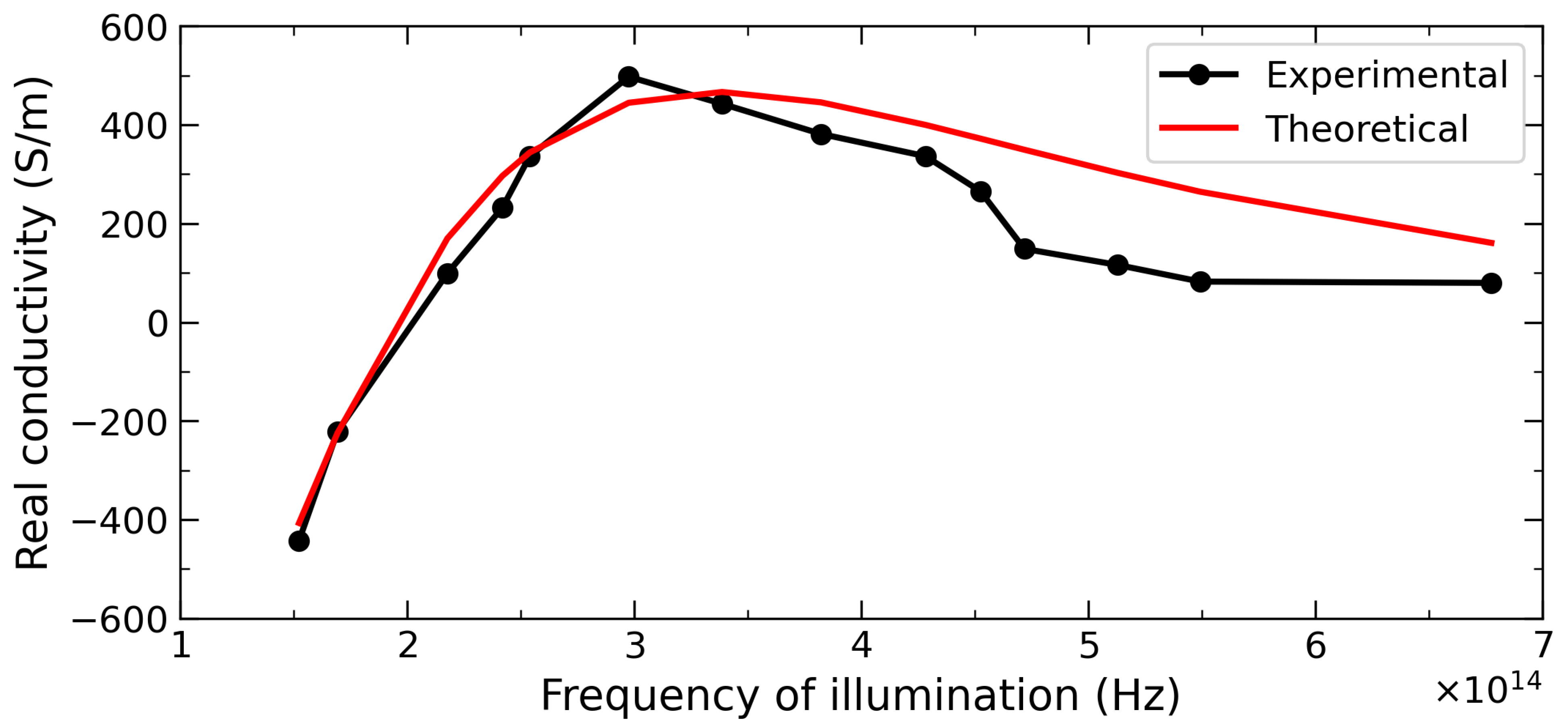
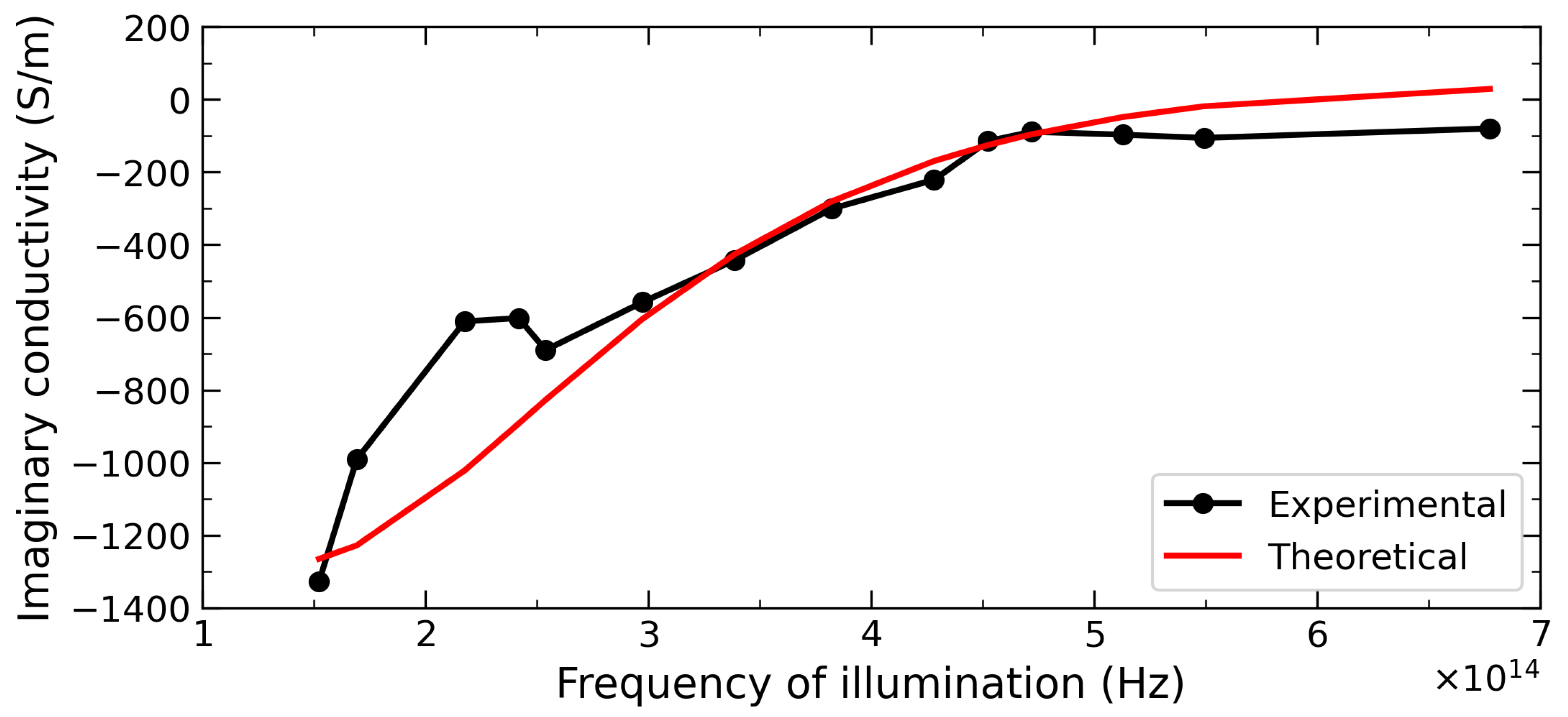
5] that Equations (A4) and (A5) describe, reasonably well, (see
Figure 1 and
Figure 2, respectively) the dispersion of the Voigt component of optical conductivity in thin films of Fe and Co in the optical regime. Key parameters of this model (
Appendix A) are the plasma (
), cyclotron (
) and relaxation (
) angular frequencies.
The success of the model, particularly in its ability to depict the above second-order dispersion curves, is quite remarkable given the very high scattering rates in transition metals at room temperature and the notion of cyclotron frequency being used to describe what is, in effect, skew-symmetric scattering caused by spin–orbit coupling. The model is, clearly, better-suited to doped semiconductors in the cryogenic temperature range where scattering is less disruptive, cyclotron motion is less of an artificial construct, where much of the current experimental interest in magneto-optics is concentrated, and at which the analyses of
Section 3, below, are directed.
The validity of this theory is further underlined, in the following two sections, by taking, respectively, the zero-frequency extrapolations of the Voigt () and Kerr () conductivities and, using the Heisenberg Uncertainty Principle and some simple reasoning, showing that, at temperatures well below the quantum limit, they lead to established forms for the quantum Hall Effect and quantum linear magnetoresistance.
Additionally, in
Section 3, a similar argument is presented (along the lines of that used for the zero-frequency case), that, at optical frequencies, in the quantum region, there is reason to suppose that the Voigt component of the optical conductivity may not, necessarily, be a quadratic function of field, but, instead, of a functional form, reflecting a (modular) linear field dependence.
2. Fashioning an Expression for LMR Using the Zero-Frequency Limit
The linear field magnetoresistance of conducting media has been a topic of scientific interest [
6,
7,
8,
9,
10,
11,
12,
13]. As Falicov and Smith [
13] have articulated, published explanations of the origins of this linear behavior, all highly sophisticated, reveal the following dichotomy. On the one hand, there are analyses based largely on morphology [
8,
9]. Here, the disorder of the metal is the dominant theme, the models being framed in terms of discontinuities, microstructure, and so on. On the other hand, a number of papers favor exploring intrinsic aspects of the materials [
10,
11]. Others focus on localized anomalies such as ‘hot spots’ [
12,
13]. A comprehensive review of classical, semi-classical, and quantum theories of LMR is given in a recent article [
14]. In place of these complex models, we focus on the transition from a ‘normal’ quadratic MR effect above the quantum limit to a linear form below it.
This section of the paper attempts, by a rather unorthodox approach, to construct a simple model for LMR, in conducting media, below the quantum limit. The method employed is that of taking phenomenological expressions for the leading diagonal elements of the gyroelectric tensor of
Appendix A and calculating the uncertainty in those elements in terms of quantum fluctuations in both the cyclotron and carrier relaxation frequencies, paralleling the hydrodynamic approach adopted in related recent work [
15,
16].
This leads to fundamental fluctuations in a part of the resistivity, quadratic in magnetic field, normally associated with conventional magnetoresistance. At an appropriate point, Heisenberg’s uncertainty principle is invoked, similar to ballistic conductance in nanowires [
17], resulting in a simple expression for LMR that is fully in agreement with published experimental work [
18,
19,
20].
The method, detailed in
Appendix B, starts with the zero-frequency forms of the leading diagonal elements of the conductivity tensor of
Appendix A. An inversion of those leads to a component of the zero-frequency resistivity explicitly dependent on the cyclotron frequency and, thereby, indirectly on the applied field. This resistivity component is described in terms of plasma, cyclotron and relaxation frequencies. At this stage, the cyclotron frequency, and therefore, the cyclotron energy, is given a quantum perturbation, with a concomitant perturbation in the relaxation frequency, resulting in a corresponding quantum perturbation in the magnetic component of the resistivity. At this point, Heisenberg’s Uncertainty Principle is invoked, leading to the form shown in Equation (A17). The symmetrical distribution of spin-up, spin-down carriers results in the overall uncertainty in the resistivity being reduced by a factor of two, resulting in Equation (A19), which is identical to a long-established empirical relationship fashioned by Johnson et al [
20] from LMR data on MnAs-GaAs composites and one which appears to provide an explicit form for Kohler’s Rule [
21] in doped semiconducting systems.
The simplicity of the present approach and the accompanying absence of microscopic detail (evident in the celebrated models referred to above) is an obvious weakness of the present approach. The present authors, however, regard ℏΔω
c (=E) as an uncertainty in the energy gap caused by charge-density fluctuations in ground state energy [
9,
10] and is not necessarily at odds with established consensus. The degeneracy of this Landau level means that, as the external field ramps up in a linear fashion, so, too, does the change in resistivity.
Both the traditional quadratic forms and the quantum linear form of magnetoresistance can exist in the same material. Based on the above arguments, it is evident that the linear form is highly restricted to situations in which the external field is sufficiently high to generate transitions to the zeroth Landau level and at temperatures low enough to withstand destabilizing thermal effects. A simple analysis, quantifying these arguments, is given in
Appendix C.
Clearly, under certain conditions, the classical quadratic form of MR transitions into the quantum linear form, at which point it follows from Equations (A13) and (A18) that
i.e., the transition takes place when
, or
.
Xin et al. [
22] have shown that
, where C (~1) is an activation constant.
It follows that LMR can occur when
which seems to be in rough agreement with earlier definitions of the quantum regime for LMR. It is shown in
Appendix C that a consequence of the Heisenberg Uncertainty Principle (HUP) is that the product of the uncertainties in B and in
Taking the traditional form of
in Equation (A13) and assigning an uncertainty in it (in the manner described for Equation (A16)), as well as the corresponding uncertainties in B and
gives
resulting in
which is consistent with the LMR form of Equation (A18). The factor of 2 disappears when spin-up/spin-down is considered.
The polarization of the lattice was addressed in the first term on the right of Equation (A2). When applied to, for example, transition metals, alloys and compounds, lattice effects are essentially negligible, all the gyroelectric effects arising out of spin–orbit coupled 3d electrons. By contrast, for compensated doped semiconductors of the type referred to in
Section 4, the gyroelectric behavior of holes must also be considered, resulting in an additional term, identical to that on the right side of Equation (A19), but expressed, instead, in terms of hole mobility. This approach has already been used in the Drude approach to conventional quadratic MR in such systems [
20]. In extreme cases, such as a charge-neutral 2-dimensional Dirac material like graphene, hole and electron mobilities are essentially the same [
22,
23], resulting in, for example, a quantum LMR equal to twice that expressed by Equation (A19). A further argument, justifying the present approach, can be made in regard to the zero-frequency versions of the off-diagonal conductivity elements of
Appendix A. Applying the Heisenberg Uncertainty principle, once again, results in a very simple derivation of the quantum Hall effect, as outlined in
Appendix D.
3. Quantum Aspects of the Voigt Conductivity in the Optical Regime
Given the ability of this model to provide correct forms for the quantum HE and the quantum LMR, the question then arises: what is the form of the magneto-optical Voigt conductivity, in semiconductors, in the quantum region at temperature
? To obtain the answer to this, the same procedure used to determine uncertainties, already used in
Section 2, is now applied to Equation (A4), as follows.
An examination of the Voigt component of Equation (A4) upon applying the same uncertainty procedures as used for the zero-frequency expressions of
Appendix B is dealt with in the following manner. When the E vector of the light is aligned along the z-axis, the material is magneto-optically inactive and the relative permittivity is given by Equations (A2) and (A3):
where
is effectively unity. By contrast, when the electric field vector is oriented in either the x- or y- directions, the relative permittivity, under normal circumstances, is given by Equations (A2) and (A3):
The Voigt effect is driven by the permittivity difference
In the cryogenic region, uncertainty in the free electron component of
is therefore given by
Since
ωc << ω, ω
r, Equation (4) can be expressed as
When spin-up–spin-down considerations are taken, as before, the expectation of the Voigt permittivity becomes
Note that a factor of 2 applies to the first term of Equation (5) as well, meaning that (along with
), it cancels the relative permittivity of the z-direction. Equating this uncertainty to quantum transitions to the lowest Landau level [
11], the quantum Voigt permittivity, using Equation (6), becomes
i.e.,
leading to
and the Voigt conductivity becomes proportional to the modulus of the applied field
It is easily shown that the Voigt rotation is proportional to
both in reflection and in transmission, if the Voigt conductivity is similarly dependent.
It should be noted that, in this equation,
reduces to a form identical to Equation (A19), as the frequency tends to zero. It is likely to exist only at the lowest temperatures of the quantum region and, like its zero-frequency counterpart, most likely brought about by transitions from the ground state to low-lying Landau levels [
11]. Like the classical quadratic Voigt effect, this putative quantum version has even symmetry, meaning that it may well have gone unrecognized and attributed to lack of field saturation or other experimental considerations.
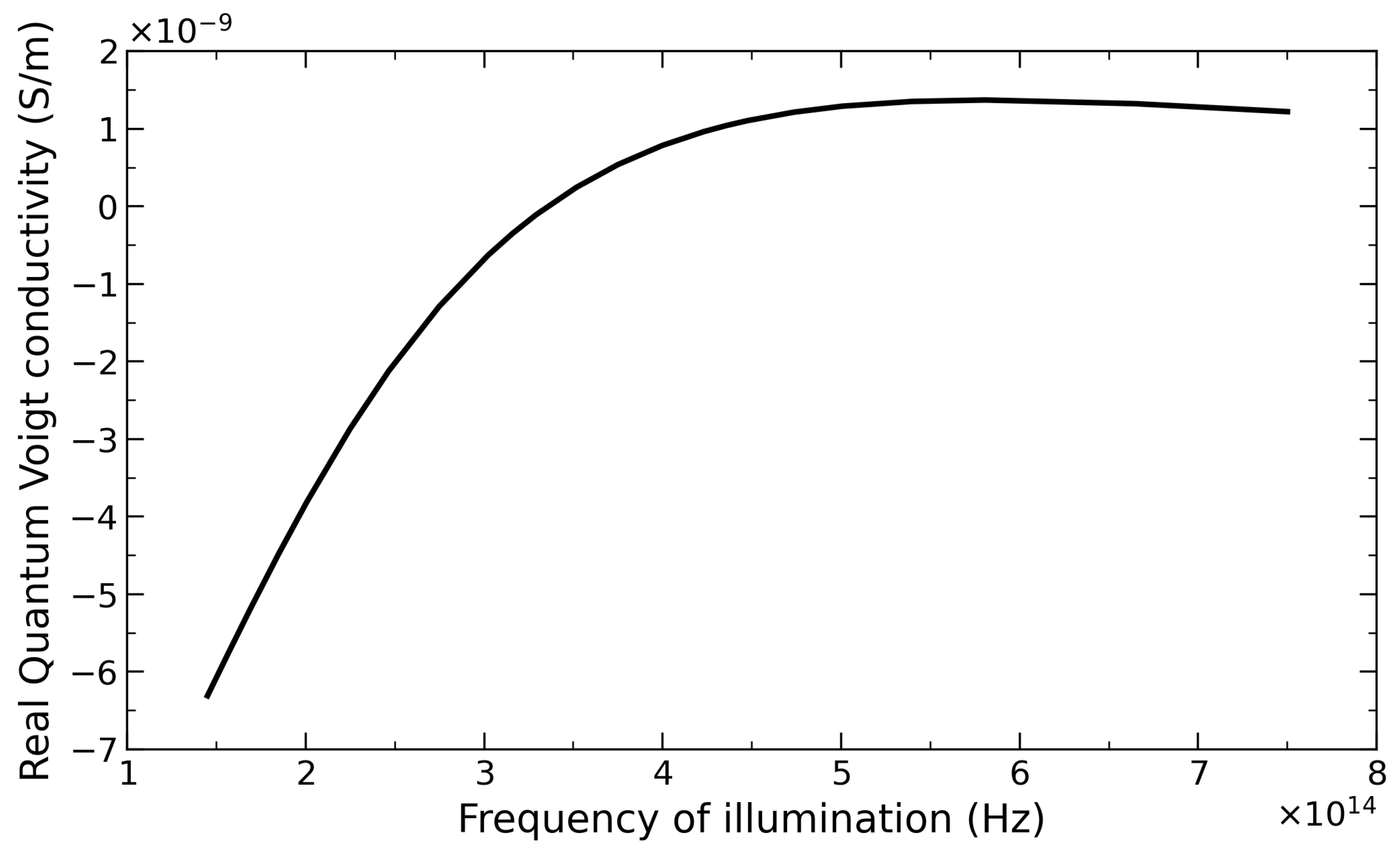
Figure 3 shows the real and
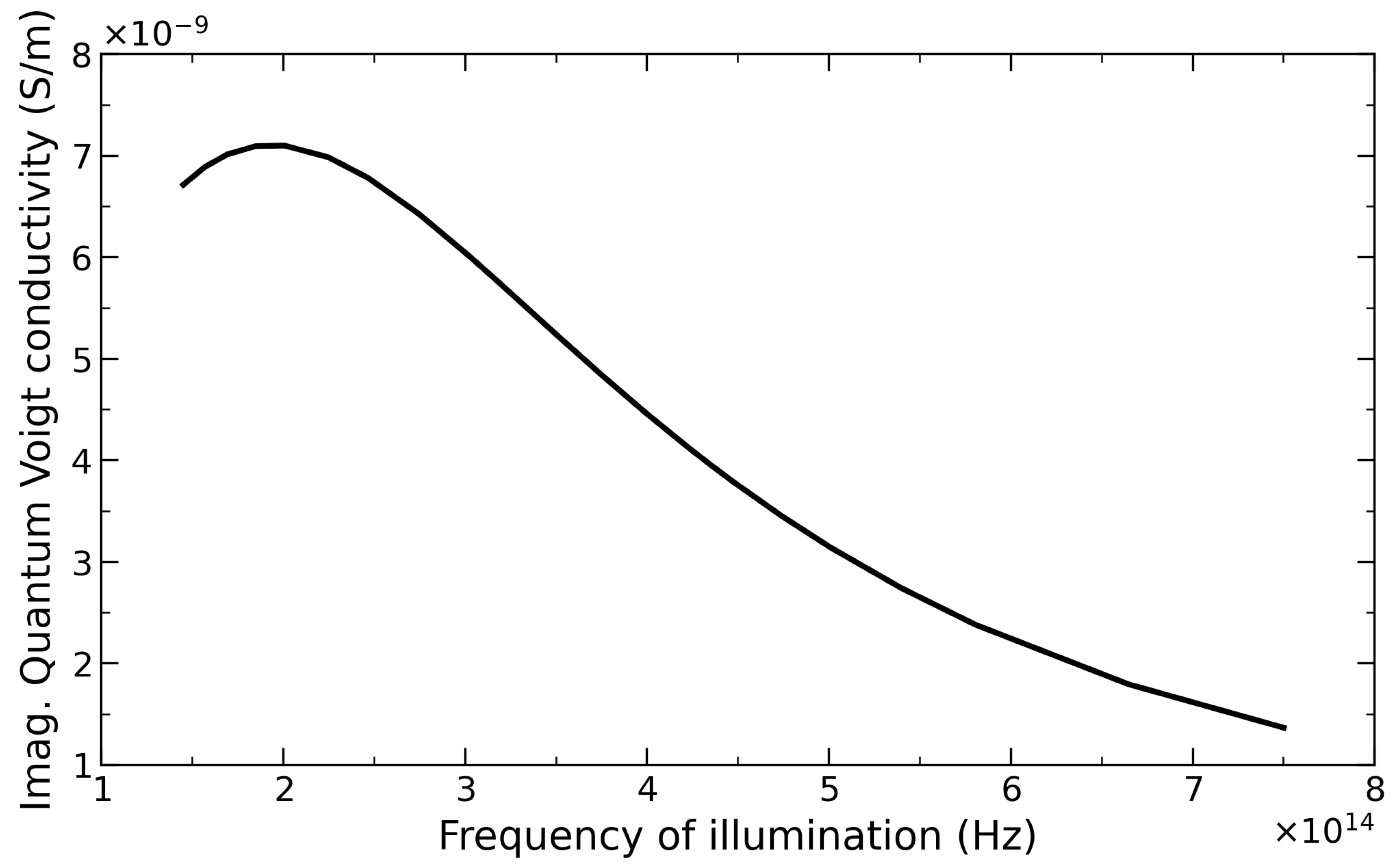
Figure 4 the imaginary part of the quantum Voigt conductivity, plotted in terms of the frequency of illumination, following Equation (8). The curves show dispersion in the vicinity of
. Given the typical relaxation frequencies of semiconductors at low temperature, it would seem to suggest that this putative quantum effect could be large in the far infra-red and terahertz regions. The analysis of
Appendix A would seem to suggest one possible reason for the comparatively large Voigt effect at low temperatures. In the conventional quadratic case, the optical Voigt permittivity is given, approximately, by
By contrast, Equation (7) gives the corresponding quantum Voigt permittivity. Given that, typically, , these two equations may well explain some of the anomalously large, low-temperature Voigt rotations.
4. Experimental Evidence
Recent experimental evidence supporting the above-mentioned arguments is lacking. It may be instructive, however, to revisit a 1991 experimental paper dealing with giant Voigt effects in diluted magnetic semiconductors, namely alloys of CdMnTe [
24]. That paper shows two plots of Voigt rotation versus the square of the applied field, one for a sample at a temperature of 20 K, one at a temperature of 5 K, and both subjected to magnetic fields in excess of 5 T.
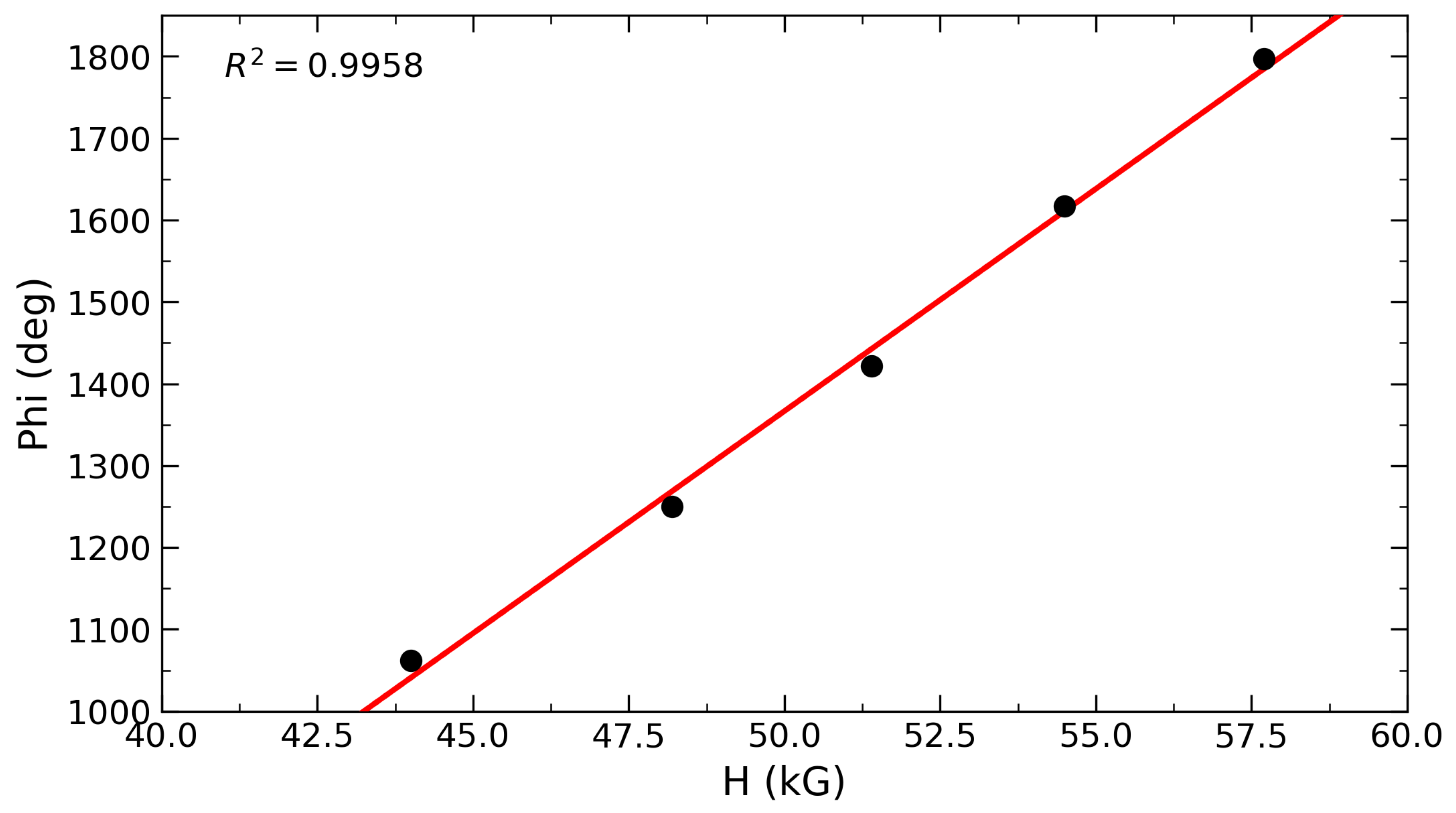
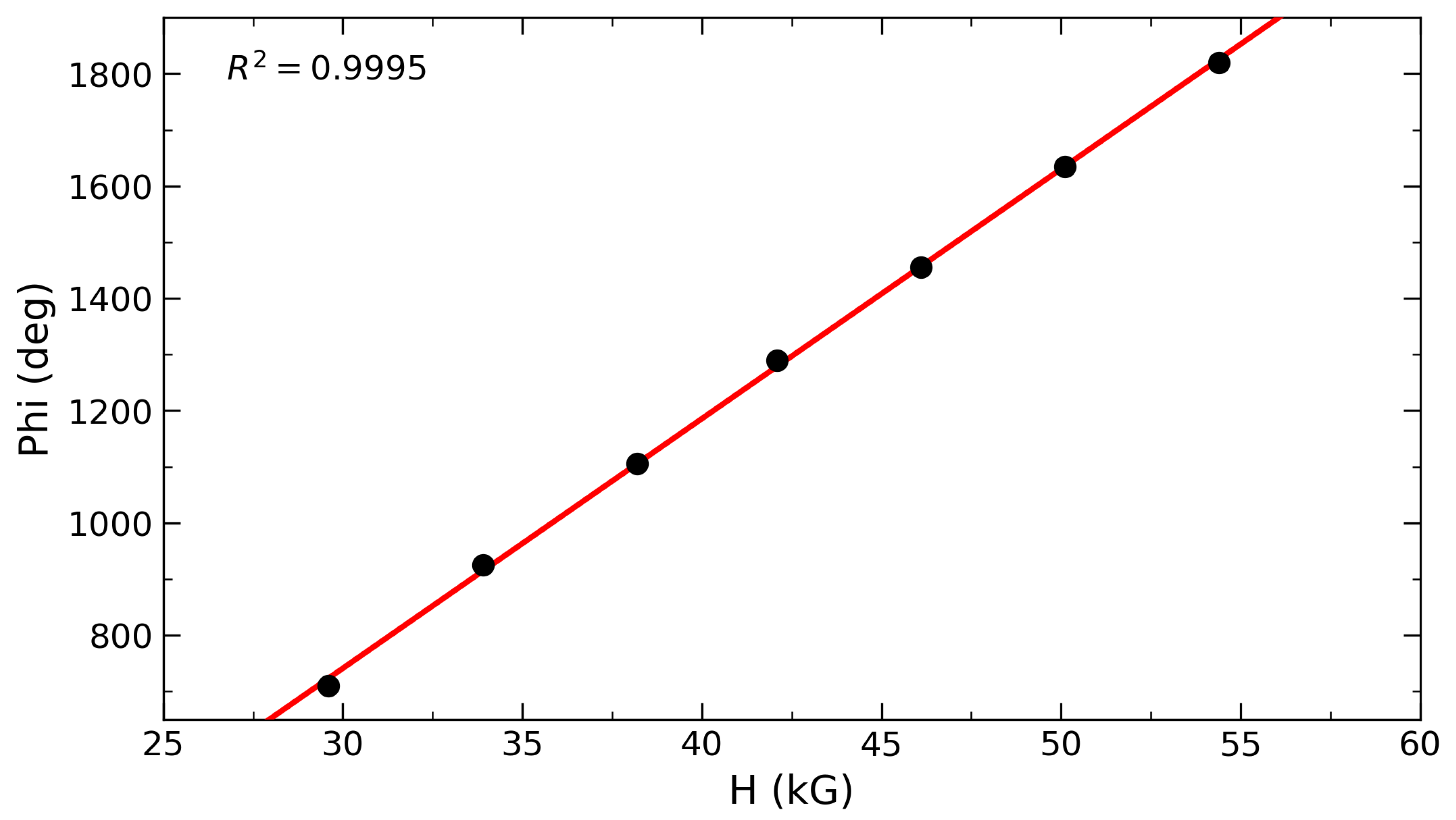
Both plots show good adherence to the classical quadratic Voigt field dependence at lower applied fields (0 ≤ 2 T), but no such agreement at higher fields. The authors ascribe the reason for this to magnetization saturation at a relatively low value of applied field [
24]. The data points for the higher fields are reproduced, below, in
Figure 5 and
Figure 6, respectively, only this time the rotations are shown as functions of magnetic field, H, using the units in the original plots. In both plots, the Voigt rotations show a clear linear dependence on magnetic field with no evidence whatsoever of saturation.
It would seem, therefore, that, at modest values of applied field, the conventional quadratic Voigt effect is observed. At higher values of applied field, saturation of magnetization is not a factor, and the results can be explained by the quantum linear Voigt effect. The latter is brought about by transitions to the lowest-lying (degenerate) Landau level, generated by high applied fields, displacing the classical form, but only when the applied field is high enough to achieve the quantum transition and only when the temperature is low enough to suppress thermal disruption. At fields of nearly 6 T, in a manner reminiscent of quantum LMR, there is no evidence of saturation of rotation. In their paper, Eunsoon et al. [
24] also pronounce the requirement for obtaining giant Voigt effects as being one of subjecting magnetic semiconductors to cryogenic temperatures and very high fields. This condition is consistent with arguments made by the present authors for the realization of a quantum linear Voigt effect. The comparatively large quantum Voigt permittivity of Equation (7), compared to that of the traditional Voigt effect (Equation (9)), reinforces this argument.
It is interesting to note that the traditional quadratic form of the Voigt effect, as depicted in
Figure 1 and
Figure 2, is predicated on magnetization, the effect itself reaching a maximum at the saturation field. The linear form of the effect would seem to be only achievable under the limited conditions outlined in
Appendix C and would appear, by contrast, to be explicitly dependent on the applied field as indicated in the plots of
Figure 5 and
Figure 6, which represent field values well in excess of saturation.