
Article

KKR-CPA Study of the Electronic and Magnetic Properties of Transition Metal-Doped AgZnF3 Perovskites

1
Engineering and Applied Physics Laboratory (EAPL), Superior School of Technology, Sultan Moulay Slimane University, Beni Mellal 23000, Morocco
2
The Moroccan Association of Sciences and Techniques for Sustainable Development, Beni Mellal 23000, Morocco
*
Author to whom correspondence should be addressed.
Magnetism 2026, 6(1), 14; https://doi.org/10.3390/magnetism6010014

Submission received: 22 November 2025 / Revised: 15 March 2026 / Accepted: 16 March 2026 / Published: 23 March 2026

Abstract

In this work, the electronic, structural, and magnetic properties of Ti-, V-, Cr-, Mn-, and Ni-doped AgZnF3 perovskites are systematically investigated using the Korringa–Kohn–Rostoker method combined with the coherent potential approximation (KKR-CPA) within the generalized gradient approximation (GGA). Transition metal dopants (Ti and V) at a concentration of 5% substituting the Zn site introduce 3d states that cross the Fermi level in the majority-spin channel, resulting in half-metallic behavior. Ferromagnetic stability is predicted for Ti-, V-, Cr-, and Mn-doped AgZnF3 at a doping concentration of 5%. The TM-doped AgZnF3 alloys exhibit noticeable variations in exchange splitting between the t2g and e_g states of the TM-3d orbitals. In Ti-doped AgZnF3, the calculated spin magnetic moments follow the expected trend based on crystal-field splitting theory. Furthermore, a clear correlation is observed between the nature of the transition metal dopant (Ti, V, Cr, Mn, and Ni) and the total magnetic moment of the system.

1. Introduction

Perovskite materials have attracted considerable attention in recent years due to their versatile crystal structure and remarkable physical properties. The perovskite family includes a wide range of compounds that share a crystal structure similar to that of the mineral perovskite. Owing to their structural flexibility, these materials exhibit a variety of interesting electrical, optical, and magnetic properties, making them promising candidates for numerous applications in materials science, energy technologies, and electronic devices [1,2,3,4,5]. Perovskites have a kind of structure that is crystal-like. This structure is made up of metal atoms in the middle. These metal atoms are arranged in a cubic shape. The metal atoms are surrounded by atoms that are not metals called non-metal atoms. Perovskites are really interesting because of this structure [6,7], such as the chemical structure of the ABC3-type [8,9]. Atoms A and B behave like they have a charge because of the way they attract electrons. This is different from atom C, which behaves like it has a charge. Perovskites have an arrangement of atoms that makes them very interesting. The way the atoms are arranged in perovskites gives us a lot of options for what elements we can use in the A and B spots. This means perovskites can have a lot of properties. Perovskites have some interesting properties that can be changed in big ways by doping. This means that doping can affect how perovskites work with light and how well they conduct electricity and the energy levels of their electrons. So, it is very important to understand what happens to perovskites when they are doped. This is because perovskites could be used in a lot of technologies. When perovskites are doped, they become useful materials. They have some properties that have made a lot of people want to study them. People are working hard to find ways to use doped perovskites, in electronic devices [10,11]. Considerable research has focused on the electronic and magnetic characteristics of metal perovskites containing inorganic metal cations [12,13]. Well known for their intriguing optical, electronic, and magnetic properties [14,15], perovskites find extensive use in several fields [16,17,18,19].
Doping materials, particularly perovskites, can induce substantial changes in their properties, including alterations in their electronic, magnetic, and optical properties, as well as in their crystal arrangement [20,21,22,23]. To really get a handle on how semiconductor materials behave, we need to make it clear that density functional theory, or DFT for short, is ideal. DFT approaches are key to figuring out the density of states in semiconductor materials [24,25,26,27]. They also help us understand the properties of semiconductor materials and the magnetic properties of semiconductor materials. Semiconductor materials are pretty interesting. We can learn a lot about them by using DFT approaches to study semiconductor materials [28,29,30,31].
Perovskite materials have recently attracted increasing attention due to their remarkable electrical, dielectric, and magnetic properties, which make them promising candidates for a wide range of technological applications, including spintronics and multifunctional devices. Significant progress has been achieved in understanding and tailoring these properties through compositional engineering and transition metal doping. In this context, recent comprehensive reviews have highlighted the crucial role of structural flexibility and electronic correlations in governing the magnetic behavior of perovskite systems. In particular, Tayari et al. [32] provided an extensive overview of recent advances in perovskite materials, emphasizing the interplay between electrical, dielectric, and magnetic properties and the importance of first-principles approaches in predicting and optimizing these characteristics. Motivated by these developments, the present work focuses on the magnetic and electronic properties of transition metal-doped AgZnF3 perovskites using a KKR-CPA first-principles framework.
Many transition elements can be incorporated into AgZnF3 compounds, which belong to the halide perovskite family [33,34]. Owing to their remarkable optical, electronic, and structural characteristics, these materials have attracted considerable research interest [35,36]. Their stability is supported by experimental evidence showing that they crystallize in a cubic structure that remains unaffected by variations in temperature and pressure [37,38,39]. This robustness opens new avenues for investigating fundamental physical phenomena and uncovering unexpected behaviors. Furthermore, doping strategies can be employed to tailor key properties of perovskite materials, including electrical conductivity and band gap.
The interesting thing about perovskites is that doping perovskites is currently being investigated by researchers. They are interested in knowing the effects that can be achieved by doping perovskites. They are also interested in knowing the methods by which these effects can be managed within perovskites. This is quite helpful for discovering applications for perovskites as well as improving perovskites.
Despite the growing interest in fluoroperovskites, the magnetic properties of transition metal-doped AgZnF3 remain largely unexplored from a first-principles perspective. In this work, we present a systematic KKR-CPA investigation of the electronic and magnetic properties of AgZn1-xTMxF3 (TM = Ti, V, Cr, Mn, and Ni). The main objective is to clarify the role of transition metal substitution in generating magnetic moments and to analyze the correlation between crystal-field splitting, exchange interaction, and spin polarization. This study provides new insight into the design of fluoroperovskite-based magnetic materials for potential spintronic applications.
This particular project aims at synthesizing a perovskite of a certain type named perovskite AgZn1−xTMxF3 alloy. The perovskite AgZn1−xTMxF3 alloy makes use of transition metals, including Ti, V, Cr, Mn, and Ni. The individuals working on this particular project are attempting to synthesize perovskites with transition metals, which are perovskites as well, and are analyzing what happens as a result of this attempt. They use a technique named DFT, which allows them to analyze how a certain amount of transition metals affects the formation of a certain structure of electrons and the magnetic properties of AgZnF3 perovskites. The addition of transition metals into perovskites makes them possess some fascinating magnetic properties. The perovskites with transition metals possess certain moments that belong to different electronic bands in perovskites. The particular class of alloys provides a very useful platform that allows them to explore ferromagnetic properties as well as different magnetic properties, including itinerant and localized magnetic properties. The parallel alignment of magnetic moments in ferromagnetic structures gives rise to complex exchange interactions, resulting in a wide range of magnetic properties in this class of compounds.

2. Model and Method

The ferromagnetic properties of AgZnF3 doped with Ti, V, Cr, Mn, and Ni were investigated using the Korringa–Kohn–Rostoker (KKR) method combined with the coherent potential approximation (CPA) within the framework of density functional theory (DFT) [40]. Exchange–correlation effects were treated using the generalized gradient approximation (GGA) [41,42,43,44], which accounts for both the local electron density and contributions from neighboring regions. All calculations were performed within the DFT–CPA formalism. Within the CPA framework, the disordered alloy system is described by a set of effective sites characterized by a common coherent potential, with an appropriate ε(CPA) energy assigned to each site. The CPA approach is particularly suitable for describing substitutional disorder in diluted magnetic systems. Instead of modeling a specific atomic configuration as in supercell calculations, CPA provides configurationally averaged electronic and magnetic properties that represent a random distribution of dopant atoms in the lattice [45,46]. This approach has been widely used to study transition metal-doped semiconductors and perovskites, where the magnetic behavior arises from the averaged interaction between localized TM-3d states and the host electronic bands.
The Green’s functions and density of states (DOS) were evaluated using a mean-field approximation for the effective sites [47,48], enabling an efficient solution of the Kohn–Sham equations within DFT. Computational modeling was carried out using Akai’s MACHIKANEYAMA-2002 (V09) package [49] to investigate the AgZn0.95TM0.05F3 (TM = Ti, V, Cr, Mn, and Ni) alloy system. In the electronic structure calculations performed with the Akai-KKR code, Green’s functions were evaluated within the GGA framework. This approach provides a flexible and reliable means of analyzing the effects of chemical disorder, including cation and anion vacancies, on the electronic and magnetic properties of the material. Furthermore, it enables precise control over the dopant concentration in the host lattice, which is essential for tailoring the resulting material properties [47].
The substitutional doping in AgZn1−xTMxF3 (TM = Ti, V, Cr, Mn, and Ni) was implemented using the CPA within the KKR formalism. A doping concentration of x = 0.05 was introduced by treating the Zn sublattice as a random alloy consisting of 95% Zn atoms and 5% TM atoms. In this approach, each Zn site is represented by an effective coherent medium that statistically accounts for the presence of both Zn and TM atoms, allowing an accurate description of substitutional disorder without imposing artificial periodicity. Given the dilute doping level and the focus on configurationally averaged electronic and magnetic properties, no explicit supercell calculations were performed to validate the CPA assumptions.
The KKR-CPA was employed to study the system. Within this framework, the atomic sphere approximation (ASA) was adopted, which is justified by a volume-filling ratio exceeding 95%, ensuring the validity of the approximation for the present system.
The atomic sphere radii were systematically tested to evaluate their influence on the results. It was found that small variations in the atomic sphere radii do not significantly affect the magnetic or electronic properties obtained within the KKR-CPA framework.
All KKR-CPA calculations were carried out until self-consistency in total energy was achieved, with a convergence criterion better than 10−5 Ry, ensuring high numerical accuracy. The Brillouin zone was sampled using a dense Monkhorst–Pack scheme with 1000 k-points to guarantee reliable results. Scalar relativistic effects were included in the calculations, and the potential was expanded in real spherical harmonics up to an angular momentum cutoff of ℓmax = 2 at each atomic site, allowing for an accurate treatment of both the Brillouin zone and the atomic environments.
Exchange–correlation effects were described within the generalized gradient approximation (GGA), using the Perdew–Wang parameterization (GGA91), as implemented in the Akai-KKR code. This methodological approach enables precise control of the doping concentration and provides the flexibility to investigate structural modifications, including the effects of anion and cation vacancies, on the electronic and magnetic properties of the system [47].
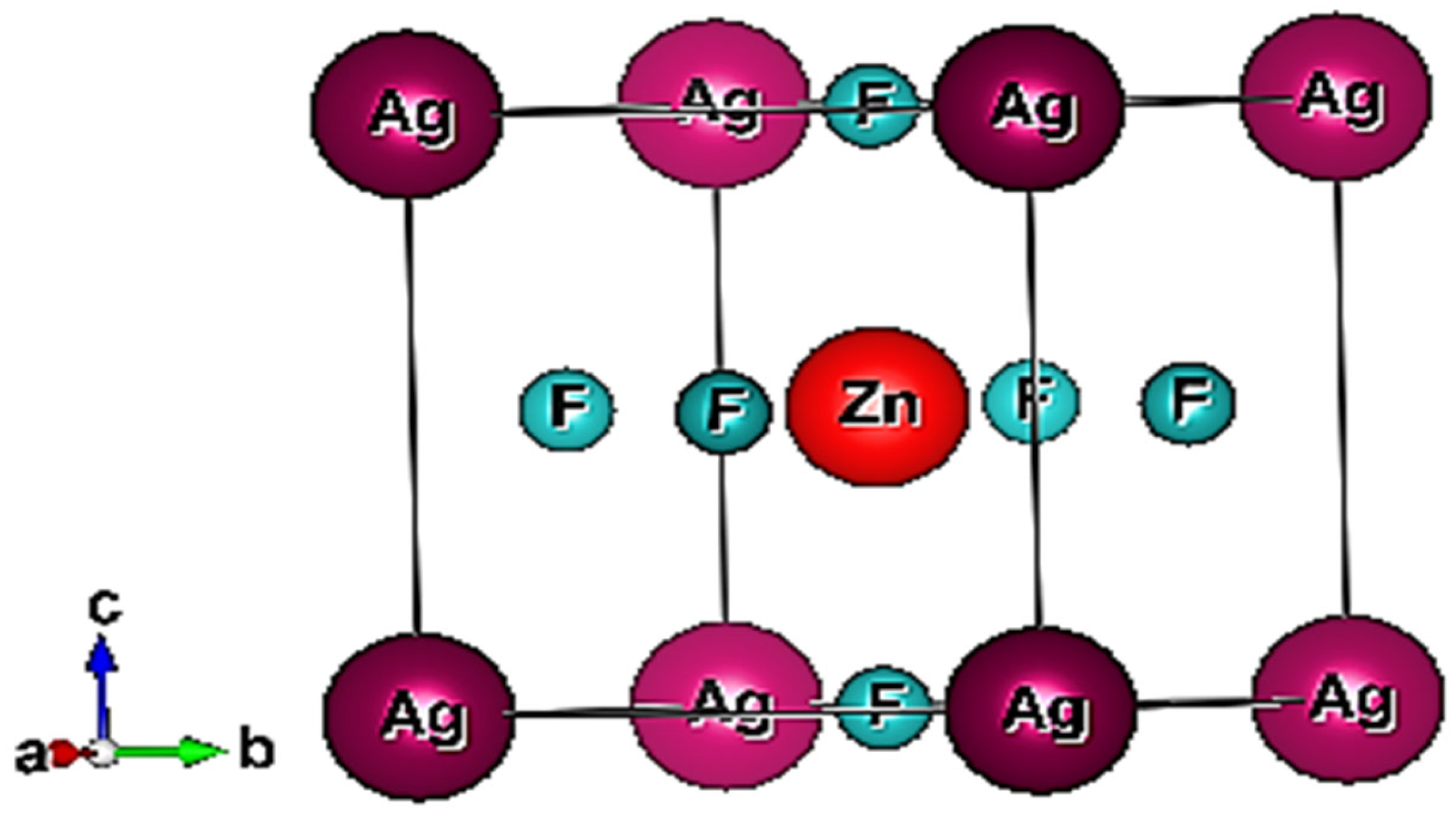
The perovskite compound (ABX3) has a cubic crystal structure in the space group of Pm 3 ¯ m, as in zinc blende (no. 221). This work is based on the pure and doped AgZnF3 compounds by (TM = Ti, V, Cr, Mn, and Ni), collectively denoted as (ABX3 = AgZnF3), with lattice parameters of a0 = b0 = c0 = 3.972 Å [50], with α = β = γ = 90° [50]. The AgZnF3 compound has an ordered filled octahedral configuration of the A (Ag), B (Zn), and X (F) atoms in an fcc lattice with three atoms (Figure 1). Their corresponding Wyckoff positions in AgZnF3 are (0, 0, 0), (0.5, 0.5, 0.5), and (0, 0.5, 0.5). We studied the pure compound and the doped samples with Ti, V, Cr, Mn, and Ni atoms at a concentration of 5% in the Zn position for the calculations [37].
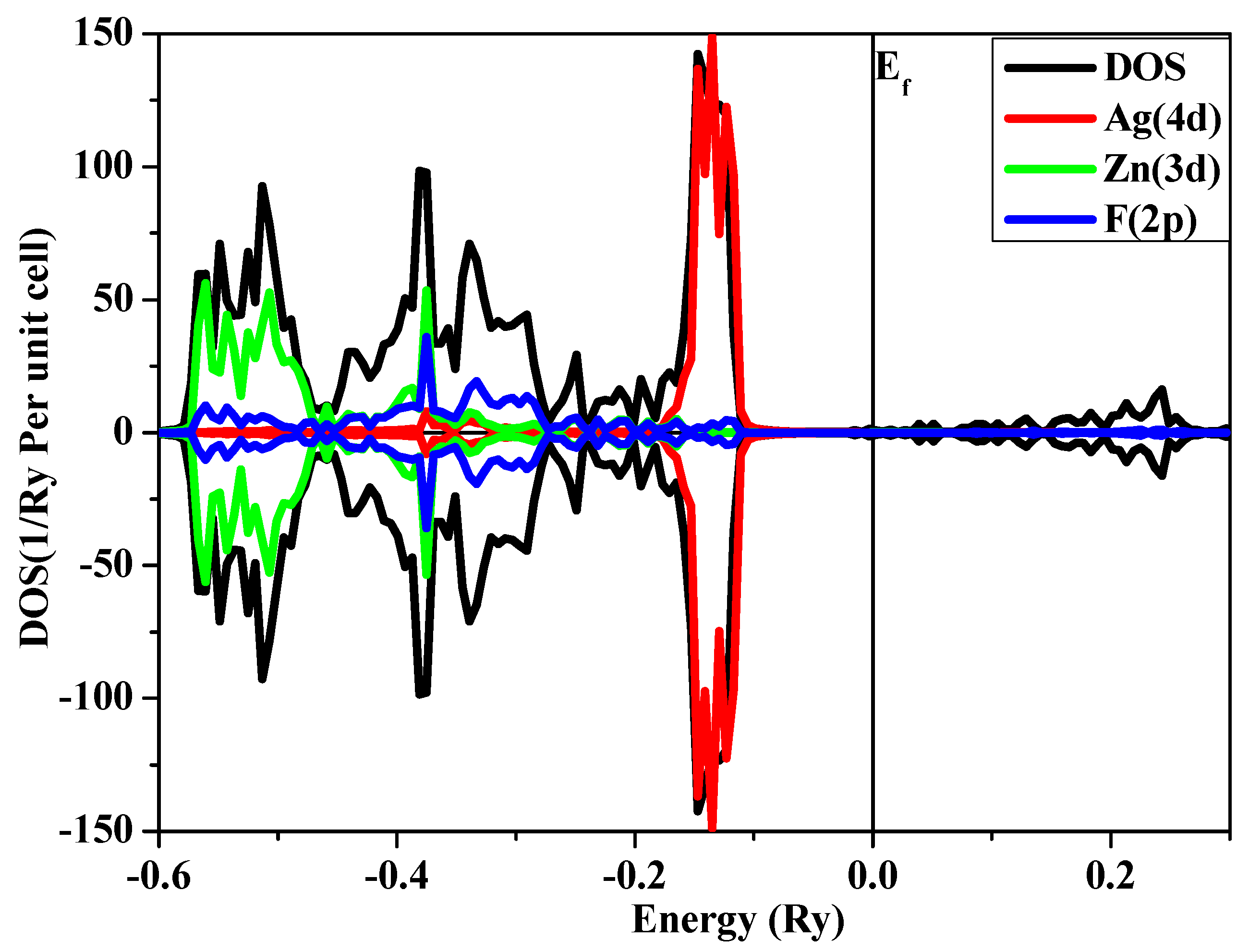
The DOS of TM alloys with larger dimensions is calculated using the Green’s function formalism within the KKR-CPA framework. Compared with the LDA, the GGA offers a significantly more reliable description of the ground state properties of atoms, molecules, and light elements. In this work, the GGA scheme corresponds to the Perdew–Wang functional (GGA91), which is well known for its improved accuracy in predicting structural and electronic properties [31,51]. According to the DOS shown in Figure 2, AgZnF3 exhibits a total spin magnetic moment of zero, as evidenced by the symmetry between the majority and minority spin bands, indicating a non-magnetic ground state.

3. Results and Discussion

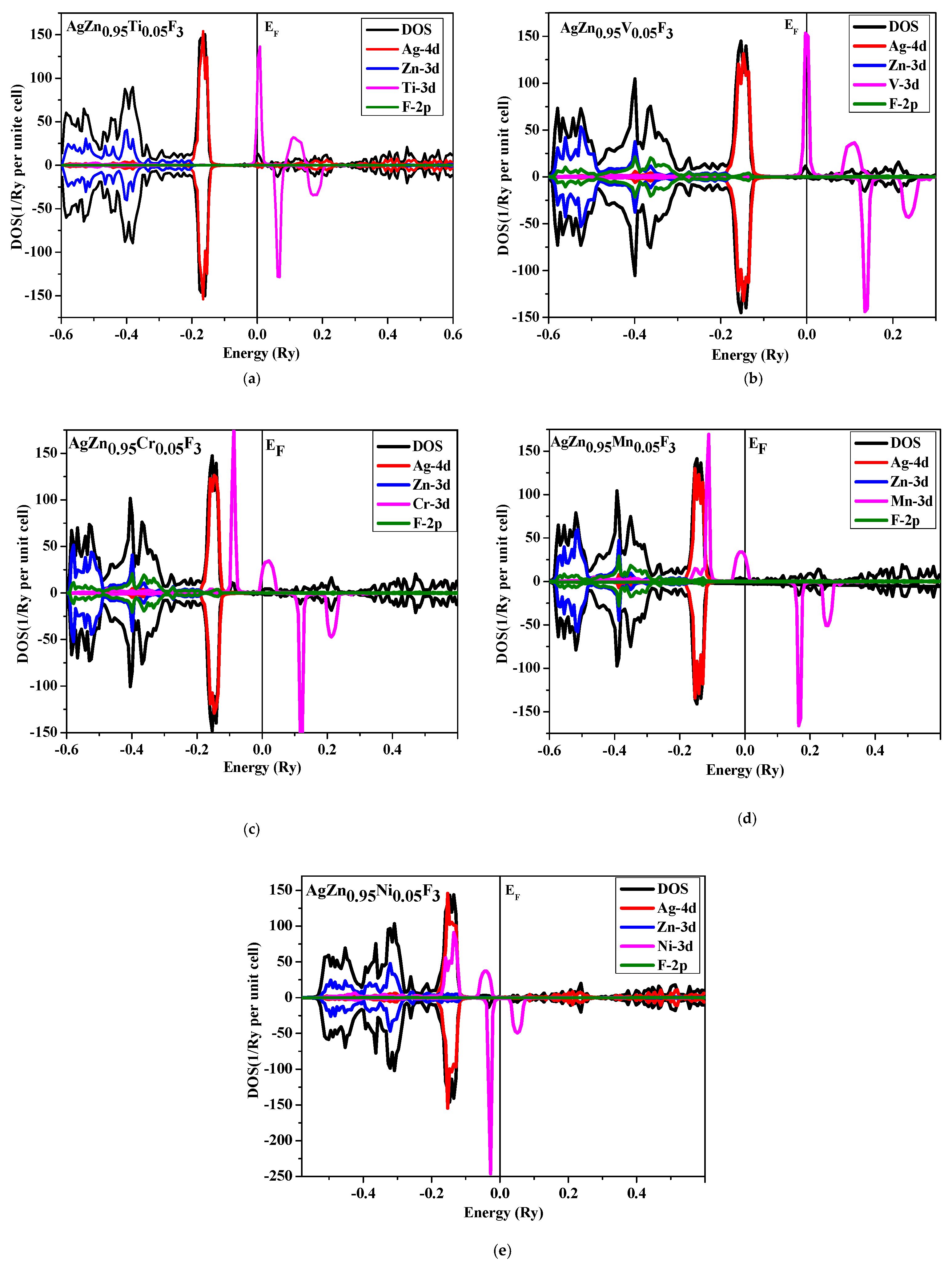
As shown in Figure 3, the magnetic moments mainly originate from the 3d orbitals of the transition metals, namely titanium, vanadium, chromium, manganese, and nickel. These transition metals play a crucial role in determining the magnetic behavior of the system through their contribution to the local magnetic moments.
In the pristine AgZnF3 compound, the electronic structure is spin symmetric, leading to a non-magnetic ground state. However, when Zn atoms are substituted by transition metals, partially filled 3d orbitals are introduced into the system. These 3d states interact with the surrounding fluorine 2p orbitals and create spin-polarized electronic states near the Fermi level. As a result, local magnetic moments develop on the transition metal atoms and induce ferromagnetic ordering in the doped systems.
In Figure 3a, the electronic configuration closely resembles that expected for a Ti2+ ion. In this case, two electrons occupy the spin-up t2g states above the Fermi level, which is characteristic of half-metallic behavior in transition metal-based systems. This indicates that titanium significantly contributes to the observed magnetic moment. As illustrated in Figure 3b, the electronic configuration is consistent with a V2+ charge state, where three electrons occupy the spin-up t2g+ states above the Fermi level. For the AgZn0.95Cr0.05F3 alloy, ferromagnetic behavior is predicted, as the spin-up eg+ states lie close to the Fermi energy. In this configuration, three electrons occupy the t2g+ states, while the remaining electron occupies the eg+ state, as shown in Figure 3c.
As illustrated in Figure 3d, the supposed charge state of the AgZn0.95Mn0.05F3 alloy is Mn2+, in which three electrons will be found in t2g+, where two electrons are occupied eg+ above the Fermi level, which is adequate for ferromagnetic stability. In the AgZn0.95Ni0.05F3 system, the ferromagnetic behavior is further supported by the difference between the disordered local moment energy (EDLM) and ferromagnetic energy (Eferro), as expressed by the equation: ΔE = EDLM − Eferro where ΔE represents the total energy difference. The total energy differential (ΔE), or the difference between the EFerro and the EDLM, can be computed to assess the magnetic stabilization of the AgZn0.95Ni0.05F3 alloy and confirm the ferromagnetic stability. Since ΔE > 0, the alloy AgZn0.95Ni0.05F3 is in a ferromagnetic (FM) state, according to the value that was found. It is predicted that this behavior, as shown in Figure 3e, is the result of the hybridization of the Ni-3d and F-3p orbitals, suggesting an indirect coupling [52].
The substitution of Zn by transition metal atoms (Ti, V, Cr, Mn, and Ni) modifies the local electronic structure of the AgZnF3 lattice. In the cubic perovskite environment, the 3d orbitals of the transition metal split into t2g and eg states due to the crystal field created by the surrounding fluorine octahedron. The calculated density of states indicates that these TM-3d states strongly hybridize with the F-2p orbitals near the Fermi level. This hybridization induces exchange splitting between the spin-up and spin-down channels, which leads to the formation of local magnetic moments on the transition metal sites [53]. As the number of 3d electrons increases from Ti to Mn, the magnetic moment increases accordingly, following the crystal-field splitting mechanism typical of transition metal-doped perovskites.
The origin of ferromagnetism induced by transition metal substitution at the Zn site in AgZnF3 can be understood within the framework of diluted magnetic semiconductors, as extensively discussed in the literature for Zn-based compounds. When a transition metal (TM) replaces Zn, localized TM-3d states are introduced inside or close to the host electronic bands, giving rise to strong exchange interactions with the anion p states. Sato and Katayama-Yoshida [53] demonstrated through ab initio calculations that ferromagnetism in ZnO-, ZnS-, ZnSe-, and ZnTe-based systems originates from the exchange coupling between localized TM-3d electrons and the surrounding anion p orbitals, leading to carrier-mediated or double-exchange-like magnetic interactions depending on the dopant electronic configuration and concentration. A similar mechanism is observed in the present AgZn0.95TM0.05F3 alloys, where a pronounced hybridization between TM-3d and F-3p states near the Fermi level is evidenced by the calculated density of states, resulting in spin polarization and ferromagnetic stabilization.
In addition, Pham et al. [54] reported that ferromagnetism in ZnO:Co systems can be reinforced by indirect exchange mechanisms mediated by anion bridges, such as Co–O–Co complexes, particularly in the presence of defects. Although explicit defect states are not considered in the present work, the KKR-CPA approach inherently accounts for chemical disorder at finite dopant concentrations. The observed exchange splitting and positive magnetic stabilization energy in TM-doped AgZnF3 suggest that an indirect p–d exchange mechanism mediated by F-3p orbitals plays a dominant role in establishing long-range ferromagnetic ordering, in close analogy with previously reported Zn-based diluted magnetic semiconductors.
To further clarify the nature of the magnetic interactions in AgZn0.95Ni0.05F3, we analyze the projected density of states (PDOS) of the Ni-3d and F-2p orbitals. As shown in the PDOS results, a pronounced overlap between Ni-3d and F-2p states is observed in the energy range extending from approximately −0.3 Ry up to the Fermi level. This energy overlap provides clear evidence of strong hybridization between these orbitals. The hybridization leads to a redistribution of electronic states near the Fermi level, which plays a crucial role in mediating the indirect exchange interaction between localized Ni magnetic moments through the fluorine anions. Consequently, this Ni-3d–F-2p hybridization contributes significantly to the stabilization of the ferromagnetic ground state in the Ni-doped AgZnF3 system. These results confirm that the magnetic behavior of AgZn0.95Ni0.05F3 is governed by orbital hybridization effects rather than purely localized Ni-3d states.
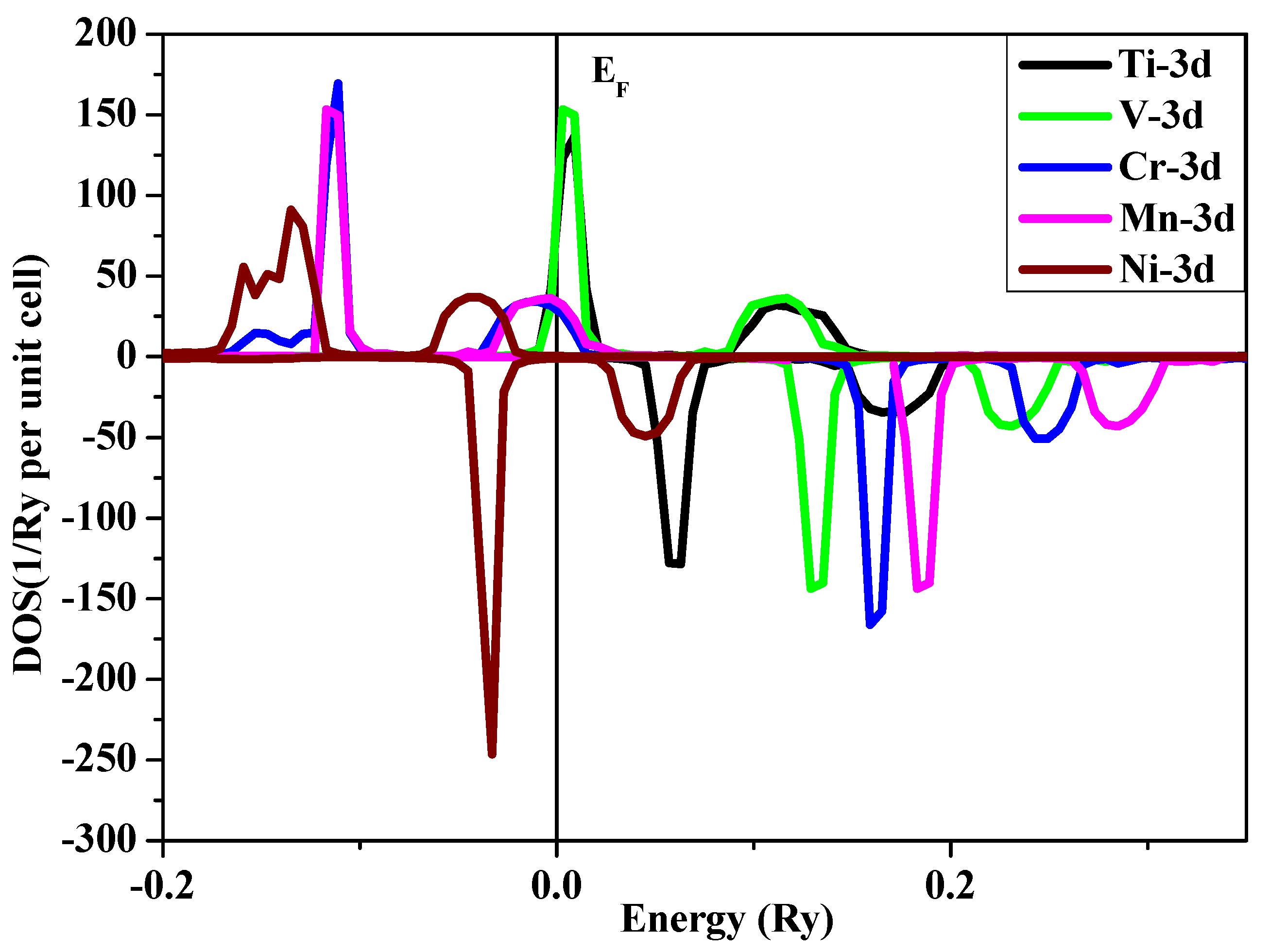
Notably, interestingly, Figure 4 shows a notable variance in the exchange splitting E x N i of Ni-3d with relation to (t2g+, eg+) in comparison to Ti, V, Cr, up and spin-down electrons, exceeding E x T i , E x V , E x C r , and E x N i thereby permitting nearly full spin polarization of the current. These findings collectively demonstrate that the magnetic and electronic properties of AgZnF3-based compounds can be effectively tuned through targeted transition metal doping. Each dopant introduces distinct magnetic configurations and spin splitting patterns, which opens promising avenues for the design of spintronic and magneto-optoelectronic materials.
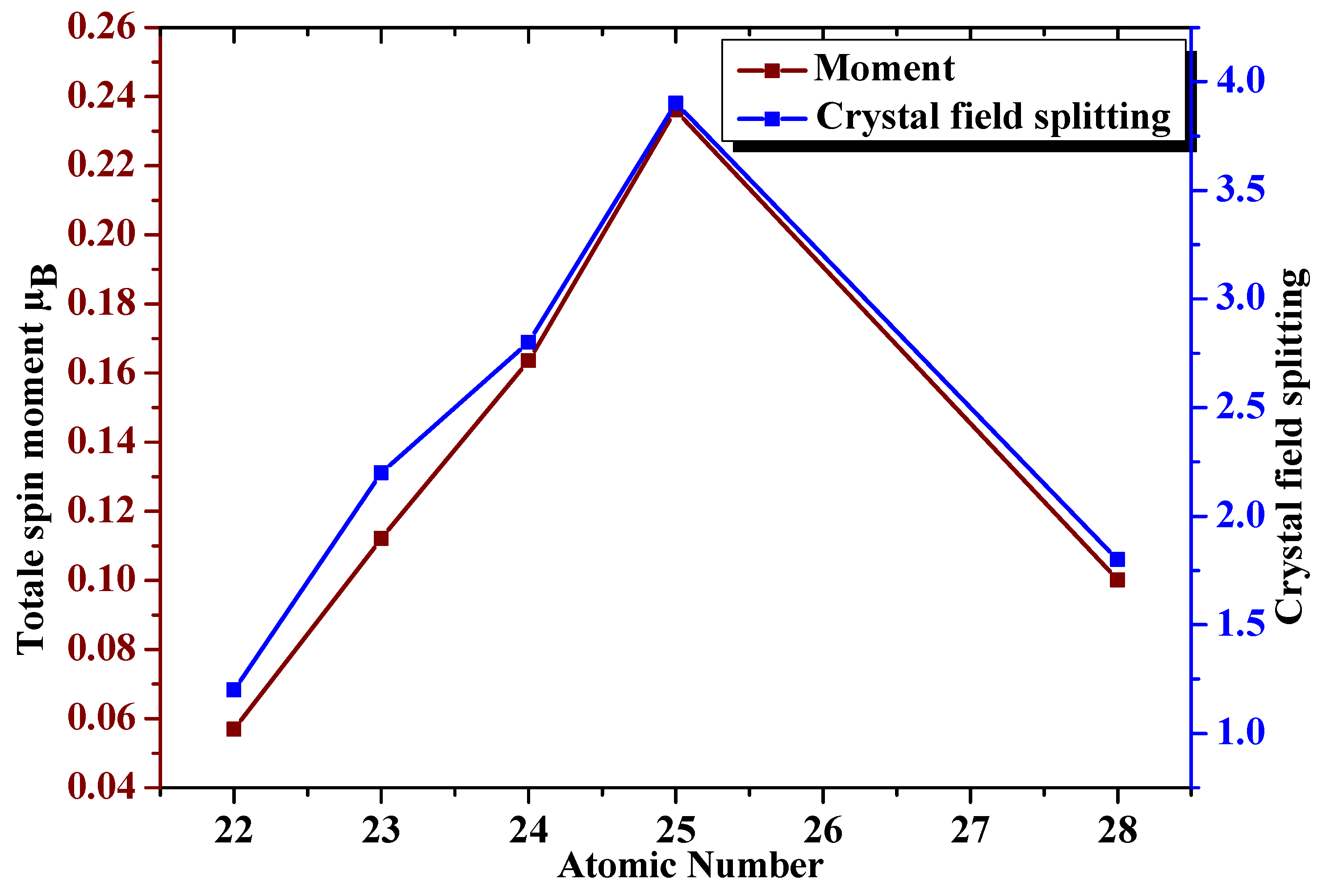
To sum up, the elements Ti, V, Cr, Mn, and Ni are considered as potential possibilities in the field of magnetism and play important roles in it. Some observations about the doped elements included here are worth mentioning. In particular, the transition metals’ spin moment trend is in line with the crystal-field splitting prediction (see Figure 5). That is to say, the magnetic moment follows the sequence M T i < M N i < M V < M C r < M M n .
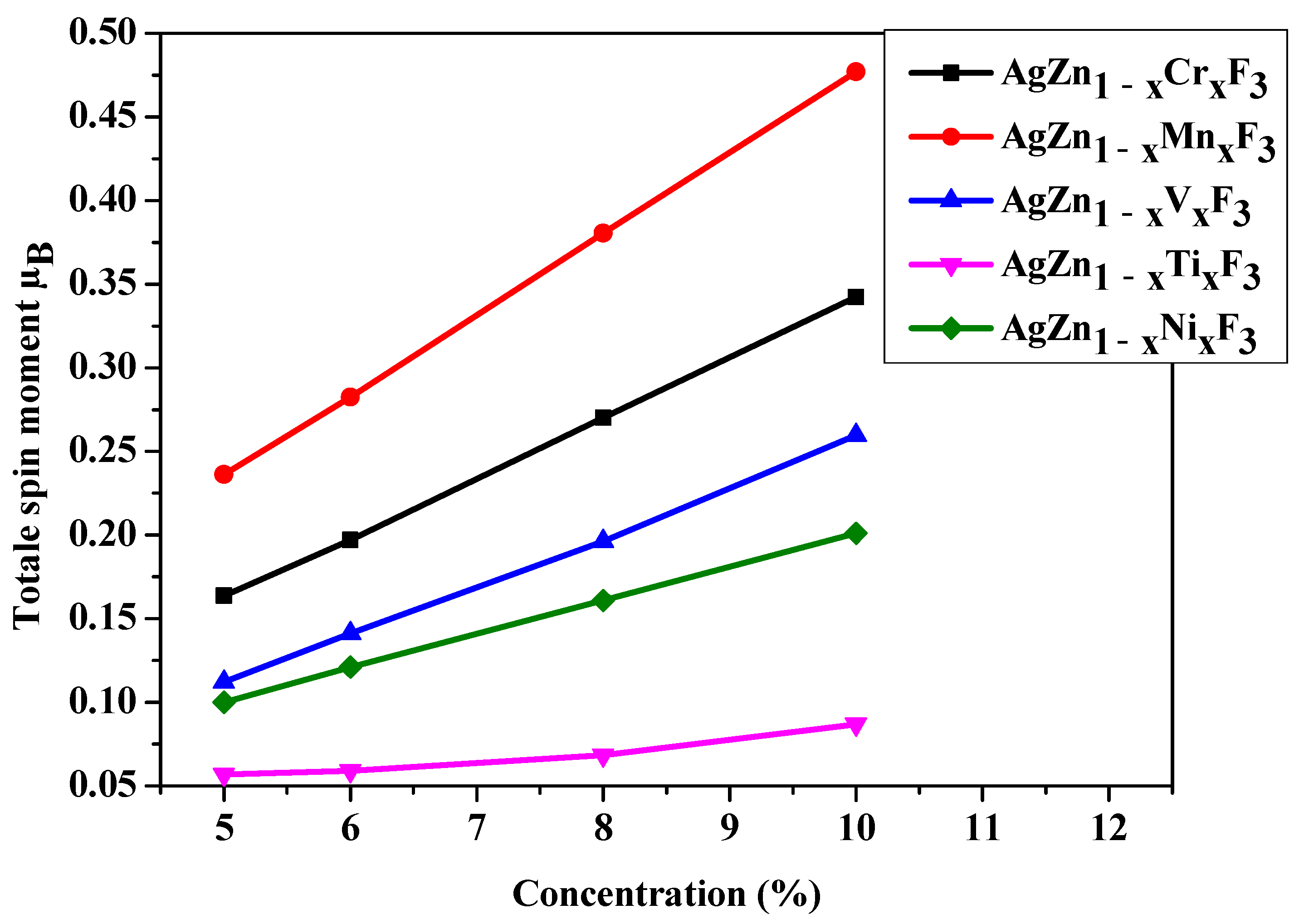
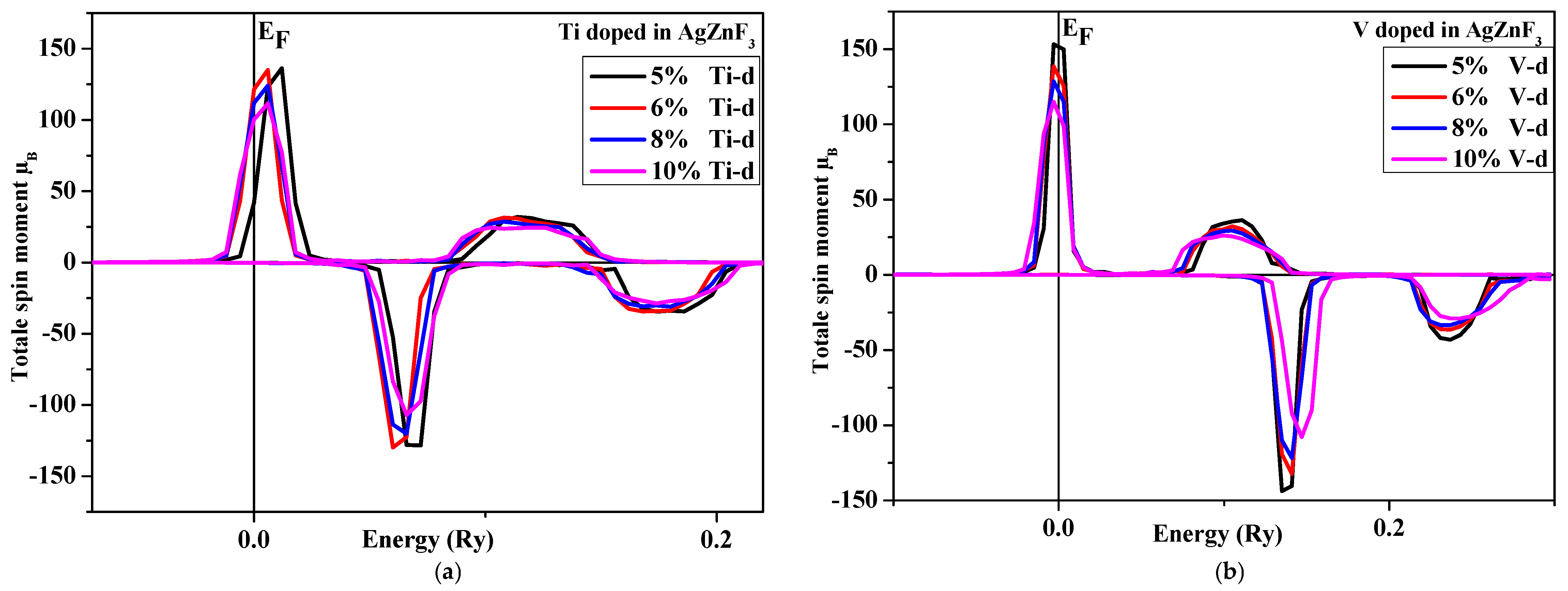
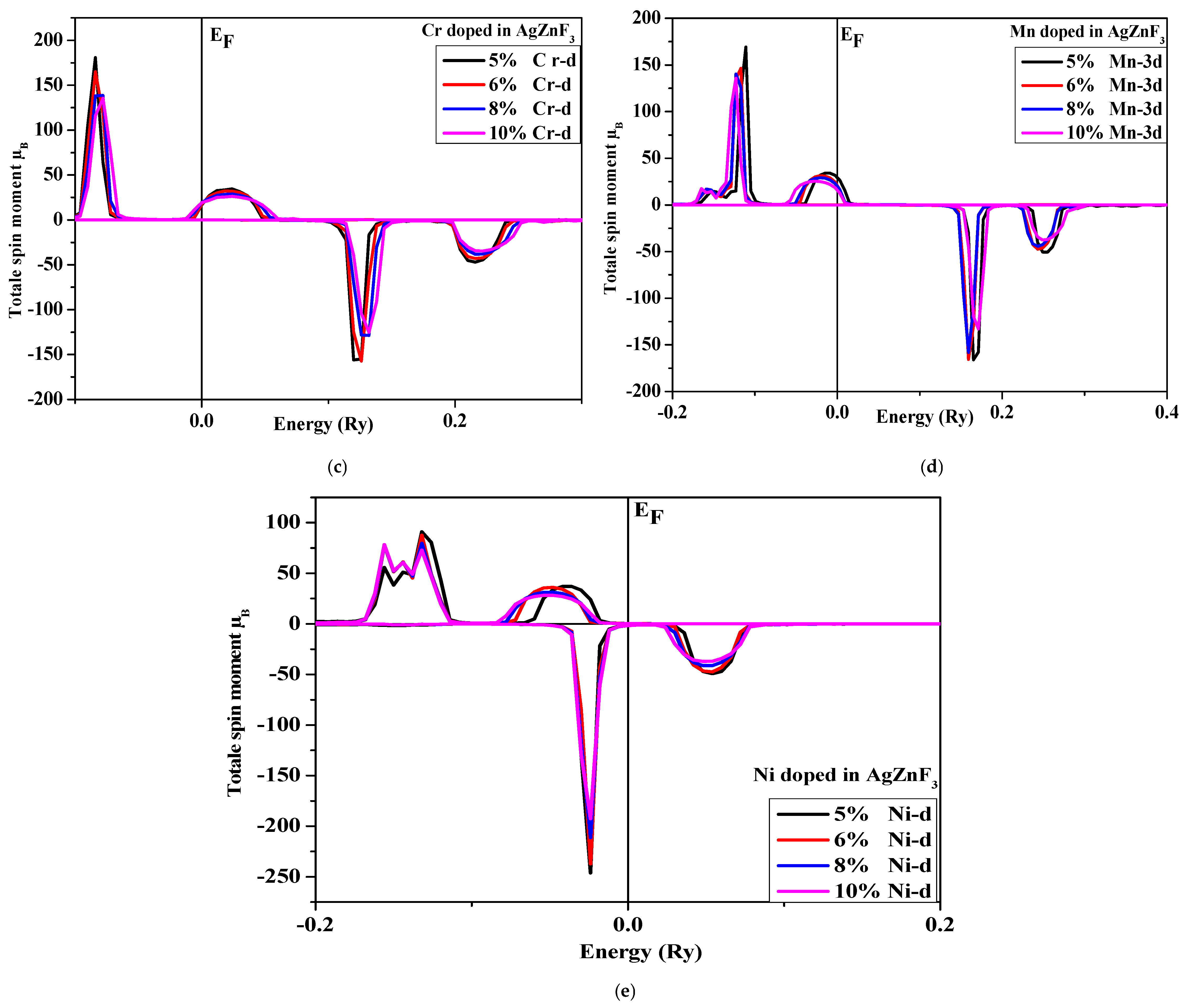
Furthermore, a correlation between Ti, V, Cr, Mn, and Ni may be seen in their total magnetic moments M T o t   with the trend being M A g Z n 0.95 T i 0.05 F 3 T o t < M A g Z n 0.95 N i 0.05 F 3 T o t < M A g Z n 0.95 V 0.05 F 3 T o t < M A g Z n 0.95 C r 0.05 F 3 T o t < M A g Z n 0.95 M n 0.05 F 3 T o t as showed in Table 1. Comparably, in AgZn0.95TM0.05F3 alloys, the crystal-field splitting (t2g, eg) shows the following trend among the doped elements: Δ ( t 2 g , e g ) T i < Δ ( t 2 g , e g ) N i < Δ ( t 2 g , e g ) V < Δ ( t 2 g , e g ) C r < Δ ( t 2 g , e g ) M n . As Figure 6 illustrates, increasing the concentration also raises the magnetic moment. A double-exchange magnetic coupling can be expected based on the doping of AgZnF3 with those elements at concentrations of 5%, 6%, 8%, and 10%, respectively (Figure 7). This behavior shows the transition metal TM-3d band at different doping concentrations and exhibits a significant drop in the DOS of the (3d) band. Notably, the band widens and its amplitude decreases with increasing doping concentration. This characteristic could be explained by double-exchange magnetic coupling (see Figure 7).

4. Conclusions

The electronic and magnetic properties of the AgZn0.95TM0.05F3 alloys (TM = Ti, V, Cr, Mn, and Ni) were systematically investigated using the Korringa–Kohn–Rostoker method combined with the coherent potential approximation (KKR-CPA). The calculated magnetic moments indicate that the transition metal dopants (Ti, V, Cr, Mn, and Ni) contribute dominantly to the total magnetization, exhibiting significantly larger magnetic moments than those of the host Ag, Zn, and F atoms. Among the investigated systems, the AgZn0.95Ti0.05F3 and AgZn0.95V0.05F3 alloys exhibit clear ferromagnetic behavior. In particular, the Ti-doped compound displays half-metallic character, characterized by a fully spin-polarized Ti-3d state in the vicinity of the Fermi level. The electronic configuration of AgZn0.95Ti0.05F3 is consistent with a Ti2+ charge state, where two electrons occupy the majority-spin t2g+ orbitals above the Fermi level. Similarly, the AgZn0.95V0.05F3 alloy is well described by a V2+ charge state, with three electrons occupying the majority-spin t2g+ orbitals above the Fermi level. Overall, the evolution of the magnetic moments across the transition metal series follows the crystal-field splitting scenario, yielding the sequence M T i < M N i < M V < M C r < M M n , which correlates directly with the increasing exchange splitting between the majority- and minority-spin t2g states, Δ ( t 2 g + , t 2 g ) T i < Δ ( t 2 g + , t 2 g ) N i < Δ ( t 2 g + , t 2 g ) V < Δ ( t 2 g + , t 2 g ) C r < Δ ( t 2 g + , t 2 g ) M n sequence.

Author Contributions

A.K.: Conceptualization, Methodology, Investigation, Formal analysis, Data curation, Software. Y.Z.: Supervision, Visualization, Validation. H.B.: Visualization, Validation, Writing—Review and Editing. All authors have read and agreed to the published version of the manuscript.

Funding

This research received no external funding.

Data Availability Statement

Data will be made available on request.

Acknowledgments

The authors are warmly grateful to the support of “The Moroccan Association of Sciences and Techniques for Sustainable Development (MASTSD), Beni Mellal, Morocco”. No specific grant number is associated with this support.

Conflicts of Interest

The authors declare that they have no known competing financial interests or personal relationships that could have appeared to influence the work reported in this paper.

References

  1. Ortega-San-Martin, L. Introduction to perovskites: A historical perspective. In Revolution of Perovskite: Synthesis, Properties and Applications; Springer: Berlin/Heidelberg, Germany, 2020; pp. 1–41. [Google Scholar] [CrossRef]
  2. Elmeskini, N.; Ziat, Y.; Belkhanchi, H.; Koufi, A. DFT Approach for Improving the Electronic and Optical Properties of Kznf3 Perovskite: Impact of Copper Doping. Sol. Energy Sustain. Dev. J. 2025, 14, 51–66. [Google Scholar] [CrossRef]
  3. Koufi, A.; Ziat, Y.; Belkhanchi, H. Study of the Gravimetric, Electronic and Thermoelectric Properties of XAlH3 (X = Be, Na, K) as hydrogen storage perovskite using DFT and the BoltzTrap Software Package. Sol. Energy Sustain. Dev. 2024, 14, 53–66. [Google Scholar] [CrossRef]
  4. Motahhir, H.; Bouzaid, A.; Ziat, Y.; Belkhanchi, H.; Lakouari, N.; Laghlimi, C.; Baghli, F.Z.; Forsal, I. Exploring the Impact of Halogen (F, Cl, Br, I) Doping on CaTiO3: A First Principles Study. E3S Web Conf. 2025, 649, 01006. [Google Scholar] [CrossRef]
  5. Koufi, A.; Ziat, Y.; Belkhanchi, H.; Bouzaid, A. Investigation of Thermoelectric and Structural Properties of BeAlH3, BeGaH3, and BeInH3 perovskite Hydrides for Energy Applications. Sol. Energy Sustain. Dev. 2025, 14, 1–14. [Google Scholar] [CrossRef]
  6. Gupta, T.K.; Lodhi, K.; Jeyaseelan, C.; Gupta, D.; Alam, M. Nonmetal oxide perovskite-based materials (carbon-based perovskites and halide-based perovskites). In Perovskite Metal Oxide; Elsevier: Amsterdam, The Netherlands, 2023; pp. 119–140. [Google Scholar] [CrossRef]
  7. Koufi, A.; Ziat, Y.; Belkhanchi, H.; Zarhri, Z. Effect of (V, Cr, Mn, Ni, and Cu) doping on the electronic structure and magnetic properties of perovskite RbZnF3 alloy: A DFT study. Europ. Phys. J. App Physics. 2025, 100, 9. [Google Scholar] [CrossRef]
  8. Koufi, A.; Ziat, Y.; Belkhanchi, H.; Miri, M.; Lakouari, N.; Bougayr, E.H.; Baghli, F.Z. A computational study of the structural and thermal conduct of MgCrH3 and MgFeH3 perovskite-type hydrides: FP-LAPW and BoltzTraP insight. E3S Web Conf. 2024, 582, 02003. [Google Scholar] [CrossRef]
  9. Koufi, A.; Ziat, Y.; Belkhanchi, H.; Bouzaid, A. DFT and BoltzTrap investigations on the thermal and structural characteristics of the perovskite MgCuH3 and MgCoH3. Comput. Condens. Matter 2025, 42, e01010. [Google Scholar] [CrossRef]
  10. Tian, W.; Zhou, H.; Li, L. Hybrid organic–inorganic perovskite photodetectors. Small 2017, 13, 1702107. [Google Scholar] [CrossRef]
  11. Boix, P.P.; Nonomura, K.; Mathews, N.; Mhaisalkar, S.G. Current progress and future perspectives for organic/inorganic perovskite solar cells. Mater. Today 2014, 17, 16–23. [Google Scholar] [CrossRef]
  12. Sleight, A.W.; Weiher, J.F. Magnetic and electrical properties of Ba2MReO6 ordered perovskites. J. Phys. Chem. Solids 1972, 33, 679–687. [Google Scholar] [CrossRef]
  13. Mandal, T.K.; Felser, C.; Greenblatt, M.; Kübler, J. Magnetic and electronic properties of double perovskites and estimation of their Curie temperatures by ab initio calculations. Phys. Rev. B 2008, 78, 134431. [Google Scholar] [CrossRef]
  14. Jiang, X.; Kuklin, A.V.; Baev, A.; Ge, Y.; Ågren, H.; Zhang, H.; Prasad, P.N. Two-dimensional MXenes: From morphological to optical, electric, and magnetic properties and applications. Phys. Rep. 2020, 848, 1–58. [Google Scholar] [CrossRef]
  15. Adinolfi, V.; Peng, W.; Walters, G.; Bakr, O.M.; Sargent, E.H. The electrical and optical properties of organometal halide perovskites relevant to optoelectronic performance. Adv. Mater. 2018, 30, 1700764. [Google Scholar] [CrossRef] [PubMed]
  16. Pacchioni, G. Highly efficient perovskite LEDs. Nat. Rev. Mater. 2021, 6, 108. [Google Scholar] [CrossRef]
  17. Zhang, K.; Zhu, N.; Zhang, M.; Wang, L.; Xing, J. Opportunities and challenges in perovskite LED commercialization. J. Mater. Chem. C 2021, 9, 3795–3799. [Google Scholar] [CrossRef]
  18. Wang, R.; Mujahid, M.; Duan, Y.; Wang, Z.K.; Xue, J.; Yang, Y. A review of perovskites solar cell stability. Adv. Funct. Mater. 2019, 29, 1808843. [Google Scholar] [CrossRef]
  19. Koufi, A.; Ziat, Y.; Belkhanchi, H. First-principles DFT and BoltzTraP investigation of multifunctional properties of XNiH3 (X = Li, Na, K) perovskite hydrides: Thermoelectric and hydrogen storage potential. Next Energy 2025, 9, 100402. [Google Scholar] [CrossRef]
  20. Hossain, A.; Roy, S.; Sakthipandi, K. The external and internal influences on the tuning of the properties of perovskites: An overview. Ceram. Int. 2019, 45, 4152–4166. [Google Scholar] [CrossRef]
  21. Anantharaman, A.; Ajeesha, T.L.; Baby, J.; George, M. Effect of structural, electrical and magneto-optical properties of CeMnxFe1-xO3-δ perovskite materials. Solid State Sci. 2020, 99, 105846. [Google Scholar] [CrossRef]
  22. Chchiyai, Z.; El Bachraoui, F.; Tamraoui, Y.; Bih, L.; Lahmar, A.; El Marssi, M.; Alami, J.; Manoun, B. Effect of cobalt doping on the crystal structure, magnetic, dielectric, electrical and optical properties of PbTi1−xCoxO3−δ perovskite materials. J. Alloys Compd. 2022, 927, 166979. [Google Scholar] [CrossRef]
  23. Najar, F.A.; Abass, S.; Sultan, K.; Kharadi, M.A.; Malik, G.F.A.; Samad, R. Comparative study of optical properties of substitutionally doped La2NiMnO6 double perovskite ceramic: A potential candidate for solar cells and dielectrics. Phys. B Condens. Matter 2021, 621, 413311. [Google Scholar] [CrossRef]
  24. Riaz, S.; Yaseen, M.; Butt, M.K.; Mubashir, S.; Iqbal, J.; Altowyan, A.S.; Dahshan, A.; Murtaza, A.; Iqbal, M.; Laref, A. Physical characteristics of NaTaO3Under pressure for electronic devices. Mater. Sci. Semicond. Process. 2021, 133, 105976. [Google Scholar] [CrossRef]
  25. Zarhri, Z.; Cano, A.D.; Oubram, O.; Ziat, Y.; Bassam, A. Optical measurements and Burstein Moss effect in optical properties of Nb-doped BaSnO3 perovskite. Micro Nanostructures 2022, 166, 207223. [Google Scholar] [CrossRef]
  26. Boudad, L.; Taibi, M.; Belayachi, A.; Abd-Lefdil, M. Structural, morphological, dielectric and optical properties of double perovskites RBaFeTiO6 (R = La, Eu). RSC Adv. 2021, 11, 40205–40215. [Google Scholar] [CrossRef] [PubMed]
  27. Roknuzzaman, M.; Zhang, C.; Ostrikov, K.; Du, A.; Wang, H.; Wang, L.; Tesfamichael, T. Electronic and optical properties of lead-free hybrid double perovskites for photovoltaic and optoelectronic applications. Sci. Rep. 2019, 9, 718. [Google Scholar] [CrossRef]
  28. Khan, M.S.; Shi, L.; Zou, B.; Ali, S. Theoretical investigation of optoelectronic and magnetic properties of Co-doped ZnS and (Al, Co) co-doped ZnS. Comput. Mater. Sci. 2020, 174, 109491. [Google Scholar] [CrossRef]
  29. Asghar, M.; Ullah, H.; Iqbal, M.W.; Shin, Y.H. Doping-dependent optoelectronic, and magnetic properties of monolayer SnS. Mater. Sci. Semicond. Process. 2022, 152, 107049. [Google Scholar] [CrossRef]
  30. Ziat, Y.; Boujnah, M.; Benyoussef, A.; El Kenz, A. Magnetic properties of Co-(Os, Mn) Co-doped ZrO2 within GGA and mBJ approaches. J. Supercond. Nov. Magn. 2015, 28, 3397–3403. [Google Scholar] [CrossRef]
  31. Ziat, Y.; Zarhri, Z.; Belkhanchi, H. Crystal field, electronegativity and magnetic behavior of Mn-, Fe-, Co- and Ni-doped LiMgN half-Heusler: KKR-CPA approximation. Int. J. Mod. Phys. B 2023, 38, 2450388. [Google Scholar] [CrossRef]
  32. Tayari, F.; Teixeira, S.S.; Graca, M.P.F.; Nassar, K.I. A comprehensive review of recent advances in perovskite materials: Electrical, dielectric, and magnetic properties. Inorganics 2025, 13, 67. [Google Scholar] [CrossRef]
  33. Takeuchi, H.; Ebisu, H.; Arakawa, M. An electron paramagnetic resonance study of vanadium centres in RbZnF3 single crystals. J. Phys. Condens. Matter 2008, 20, 055221. [Google Scholar] [CrossRef]
  34. Ebisu, H.; Takeuchi, H.; Arakawa, M. EPR study of chromium centres formed in hexagonal RbMgF3 and RbZnF3 single crystals. Phys. Status Solidi (b) 2010, 247, 983–988. [Google Scholar] [CrossRef]
  35. Han, X.; Song, E.; Zhang, S.; Ye, S.; Yang, X.B.; Zhang, Q. Heavy Mn2+-doped near-infrared photon upconversion luminescence in fluoride RbZnF3: Yb3+, Mn2+ guided by dopant distribution simulation. J. Mater. Chem. C 2020, 8, 12. [Google Scholar] [CrossRef]
  36. Zheng, W.-C.; Yang, W.-Q.; Liu, H.-G. Theoretical studies of the spin-Hamiltonian parameters and defect structure for the tetragonal Gd3+ center in cubic c-RbZnF3 crystal. Philos. Mag. 2011, 91, 4045–4052. [Google Scholar] [CrossRef]
  37. Reshak, A.H.; Khan, S.; Laref, A.; Murtaza, G.; Bila, J. Pressure induced physical variations in the lead free fluoropervoskites XYF3 (X = K, Rb, Ag; Y = Zn, Sr, Mg): Optical materials. Opt. Mater. 2020, 109, 110325. [Google Scholar] [CrossRef]
  38. Vaitheeswaran, G.; Kanchana, V.; Zhang, X.; Ma, Y.; Svane, A.; Christensen, N.E. Calculated high-pressure structural properties, lattice dynamics and quasi particle band structures of perovskite fluorides KZnF3, CsCaF3 and BaLiF3. J. Phys. Condens. Matter 2016, 28, 315403. [Google Scholar] [CrossRef]
  39. Akaogi, M.; Shirako, Y.; Kojitani, H.; Nagakari, T.; Yusa, H.; Yamaura, K. High-pressure transitions in NaZnF3 and NaMnF3 perovskites, and crystal-chemical characteristics of perovskite–postperovskite transitions in ABX3 fluorides and oxides. Phys. Earth Planet. Inter. 2014, 228, 160–169. [Google Scholar] [CrossRef]
  40. Parke, W.C. Electric and magnetic fields in life. In Biophysics: A Student’s Guide to the Physics of the Life Sciences and Medicine; Springer: Berlin/Heidelberg, Germany, 2020; pp. 183–204. [Google Scholar]
  41. Kohn, W. Nobel Lecture: Electronic structure of matter—Wave functions and density functionals. Rev. Mod. Phys. 1999, 71, 1253. [Google Scholar] [CrossRef]
  42. Fischer, M.; Evers, F.O.; Formalik, F.; Olejniczak, A. Benchmarking DFT-GGA calculations for the structure optimisation of neutral-framework zeotypes. Theor. Chem. Acc. 2016, 135, 257. [Google Scholar] [CrossRef]
  43. Vega, L.; Vines, F. Generalized gradient approximation adjusted to transition metals properties: Key roles of exchange and local spin density. J. Comput. Chem. 2020, 41, 2598–2603. [Google Scholar] [CrossRef]
  44. Pochareddy, S.A.; Nicholson, A.P.; Thiyagarajan, A.; Shah, A.; Sampath, W.S. Structural and electronic calculations of CdTe using DFT: Exchange–correlation functionals and DFT-1/2 corrections. J. Electron. Mater. 2021, 50, 2216–2222. [Google Scholar] [CrossRef]
  45. Turek, I.; Drchal, V.; Kudrnovský, J.; Sob, M.; Weinberger, P. Electronic Structure of Disordered Alloys, Surfaces and Interfaces; Springer: New York, NY, USA, 2013. [Google Scholar]
  46. Abrikosov, I.A.; Ruban, A.V.; Johansson, B.; Skriver, H.L. Total energy calculations of random alloys: Supercell, Connolly-Williams, and CPA methods. Comput. Mater. Sci. 1998, 10, 302–305. [Google Scholar] [CrossRef]
  47. Saint-Cricq, M. Modélisation des Coefficients de Transport Thermoélectriques des Alliages Métalliques Multicomposants. Ph.D. Dissertation, Université Grenoble Alpes, Grenoble, France, 2020. [Google Scholar]
  48. Sabry, A.; Essajai, R.; Salmani, E.; Fahoom, M.; Hassanain, N.; Mzerd, A.; Ez-Zahraouy, H. DFT study, Mean-Field Approximation and Monte-Carlo simulation of physical properties of Fe and Cr doped and co-doped GaN. Solid State Commun. 2021, 340, 114509. [Google Scholar] [CrossRef]
  49. Akai, H.; Dederichs, P.H. Local moment disorder in ferromagnetic alloys. Phys. Rev. B 1993, 47, 8739. [Google Scholar] [CrossRef]
  50. Hiadsi, S.; Bouafia, H.; Sahli, B.; Abidri, B.; Bouaza, A.; Akriche, A. Structural, mechanical, electronic and thermal properties of KZnF3 and AgZnF3 Perovskites: FP-(L) APW+ lo calculations. Solid State Sci. 2016, 58, 1–13. [Google Scholar] [CrossRef]
  51. Perdew, J.P.; Chevary, J.A.; Vosko, S.H.; Jackson, K.A.; Pederson, M.R.; Singh, D.J.; Fiolhais, C. Atoms, molecules, solids, and surfaces: Applications of the generalized gradient approximation for exchange and correlation. Phys. Rev. B 1992, 46, 6671. [Google Scholar] [CrossRef]
  52. Ziat, Y.; Zarhri, Z.; Lakhal, Y.; Baghli, F.Z. Electronegativity and magnetic correlation in Cr-, Mn-, Co- and Ni-doped LiMgP half-Heusler as promised ferromagnetism material: A DFT study. Int. J. Mod. Phys. B 2023, 37, 2350226. [Google Scholar] [CrossRef]
  53. Sato, K.; Katayama-Yoshida, H. Ab initio study on the magnetism in ZnO-, ZnS-, ZnSe-and ZnTe-based diluted magnetic semiconductors. Phys. Status Solidi (b) 2002, 229, 673–680. [Google Scholar] [CrossRef]
  54. Pham, A.; Zhang, Y.B.; Assadi, M.H.N.; Yu, A.B.; Li, S. Ferromagnetism in ZnO: Co originating from a hydrogenated Co–O–Co complex. J. Phys. Condens. Matter 2013, 25, 116002. [Google Scholar] [CrossRef]
Figure 1. Structure of AgZnF3.
Magnetism 06 00014 g001
Figure 2. DOS of pure AgZnF3 compound.
Magnetism 06 00014 g002
Figure 3. DOS of AgZn0.95TM0.05F3 (TM = Ti, V, Cr, Mn, and Ni) related to EF. (a) AgZn0.95Ti0.05F3; (b) AgZn0.95V0.05F3; (c) AgZn0.95Cr0.05F3; (d) AgZn0.95Mn0.05F3; (e) AgZn0.95Ni0.05F3.
Magnetism 06 00014 g003
Figure 4. Exchange splitting of AgZn0.95TM0.05F3 (TM = Ti, V, Cr, Mn, and Ni).
Magnetism 06 00014 g004
Figure 5. Pauling scale of crystal-field splitting and total moment versus of atomic number of Ti-, V-, Cr-, Mn-, and Ni-doped AgZn0.95TM0.05F3.
Magnetism 06 00014 g005
Figure 6. Total magnetic moment of AgZn1−xTMxF3 (TM = Ti, V, Cr, Mn, and Ni) at (5%, 6%, 8% and 10%).
Magnetism 06 00014 g006
Figure 7. DOS of AgZn1−xTMxF3 (TM = Ti, V, Cr, Mn, and Ni) with different percentages of concentration of the dopant elements (5%, 6%, 8% and 10%). (a) AgZn1−xTixF3; (b) AgZn1−xVxF3; (c) AgZn1−xCrxF3; (d) AgZn1−xMnxF3; (e) AgZn1−xNixF3.
Magnetism 06 00014 g007aMagnetism 06 00014 g007b
Table 1. Moments of AgZn0.95TM0.05F3 in µB.
M T o t M A g M Z n M T M M F
AgZnF30.00000.000000.00000-0.00000
AgZn0.95Ti0.05F30.05690.001850.000390.768640.00014
AgZn0.95V0.05F30.11210.000970.000161.893190.00042
AgZn0.95Cr0.05F30.16360.001280.000322.874080.00060
AgZn0.95Mn0.05F30.23610.003350.000813.947940.00410
AgZn0.95Ni0.05F30.10010.000080.002231.547260.00660
Disclaimer/Publisher’s Note: The statements, opinions and data contained in all publications are solely those of the individual author(s) and contributor(s) and not of MDPI and/or the editor(s). MDPI and/or the editor(s) disclaim responsibility for any injury to people or property resulting from any ideas, methods, instructions or products referred to in the content.