Article

Research on Finite Permeability Semi-Analytical Harmonic Modeling Method for Maglev Planar Motors


1
Ultra-Precision Mechatronics Engineering Research Center, College of Transportation, Ludong University, Yantai 264025, China
2
Institute of Ultra Precision Optoelectronic Instrument Engineering, College of Instrument Science and Engineering, Harbin Institute of Technology, Harbin 150080, China
*
Author to whom correspondence should be addressed.
Magnetism 2025, 5(4), 27; https://doi.org/10.3390/magnetism5040027

Submission received: 28 August 2025 / Revised: 14 October 2025 / Accepted: 16 October 2025 / Published: 21 October 2025

Abstract

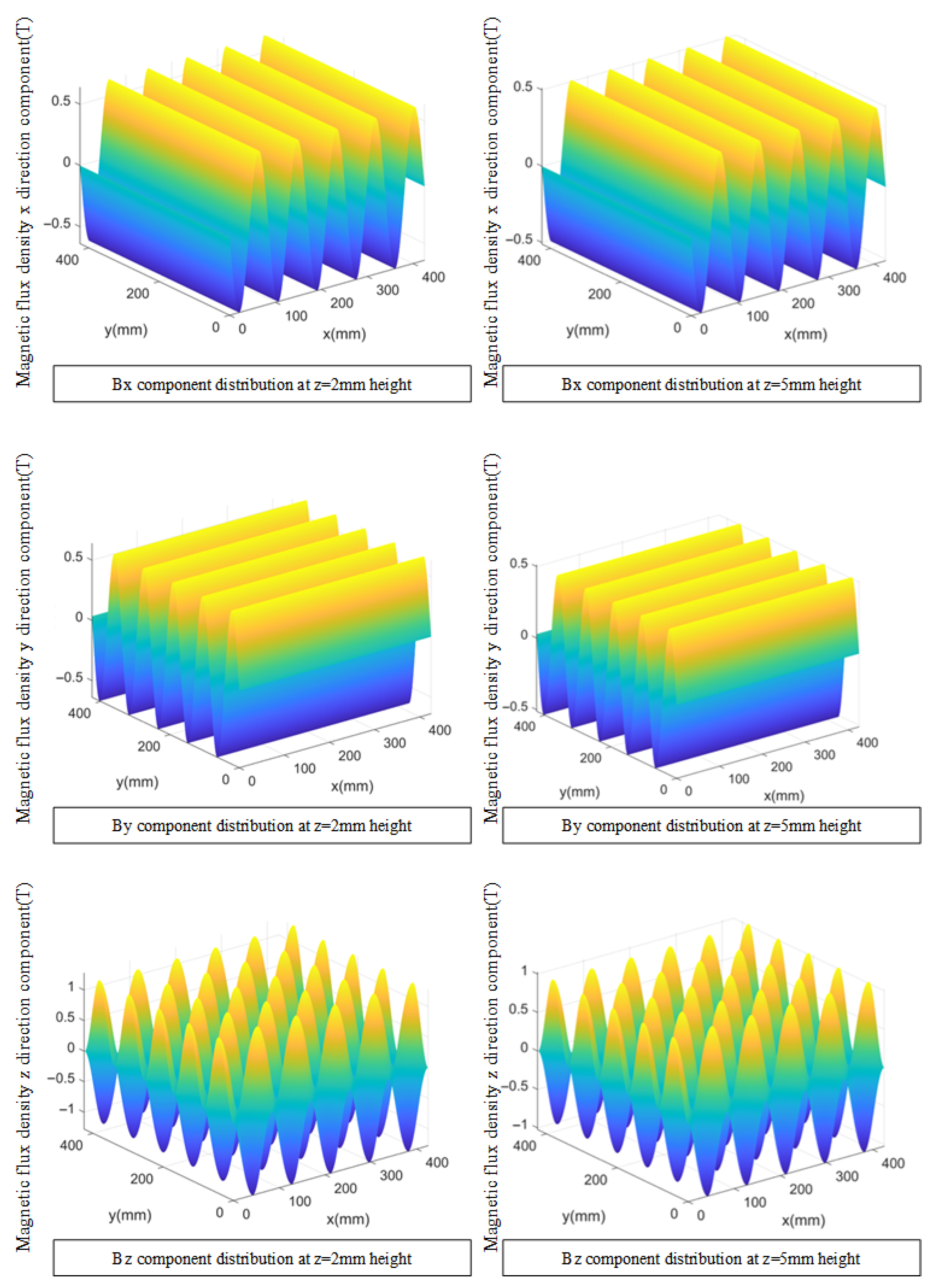
This study proposes a semi-analytic harmonic modeling method that significantly improves the accuracy and efficiency of complex magnetic field modeling by integrating numerical and analytical approaches. Compared to traditional methods such as the equivalent charge method and finite element method, this approach optimizes the distribution of surface and body charges in the magnetic dipole model and introduces a finite and variable permeability model to accommodate material non-uniformity. Through harmonic expansion and analytical optimization, the method more accurately reflects the characteristics of real magnets, providing an efficient and precise solution for complex magnetic field problems, particularly in the design of high-performance magnets such as Halbach arrays. In this study, the effectiveness of the new modeling method is verified through the combination of simulation and experiment: the magnetic field distribution of the new Halbach array is accurately simulated, and the applicability of the model in the description of complex magnetic fields is analyzed. The dynamic response ability of the optimized model is verified by modeling and simulating the variation of the permeability under actual conditions. The distribution of scalar potential energy with permeability was simulated to evaluate the adaptability of the model to the real physical field. Through the comparative analysis of simulation and experimental results, the advantages of the new method in modeling accuracy and efficiency are clearly pointed out, and the effectiveness of the semi-analytic harmonic modeling method and its wide application potential in the design of new magnetic fields are proved. In this study, a semi-analytic harmonic modeling method is proposed by combining numerical and analytical methods, which breaks through the efficiency bottleneck of traditional modeling methods, and achieves the unity of high precision and high efficiency in the magnetic field modeling of the new Halbach array, providing a new solution for the study of complex magnetic field problems.
Keywords: planar motor; permanent magnets; analytical models; electromagnetic forces planar motor; permanent magnets; analytical models; electromagnetic forces