
Article

Recovery of Neodymium from Spent Hard Disk Drivers by Microwave Treatment and Magnesium Liquid Extraction

National Research and Development Institute for Non-Ferrous and Rare Metals—IMNR, 102 Biruinței Boulevard, 077145 Pantelimon, Romania
*
Author to whom correspondence should be addressed.
Magnetism 2025, 5(1), 3; https://doi.org/10.3390/magnetism5010003

Submission received: 8 October 2024 / Revised: 4 January 2025 / Accepted: 28 January 2025 / Published: 30 January 2025

Abstract

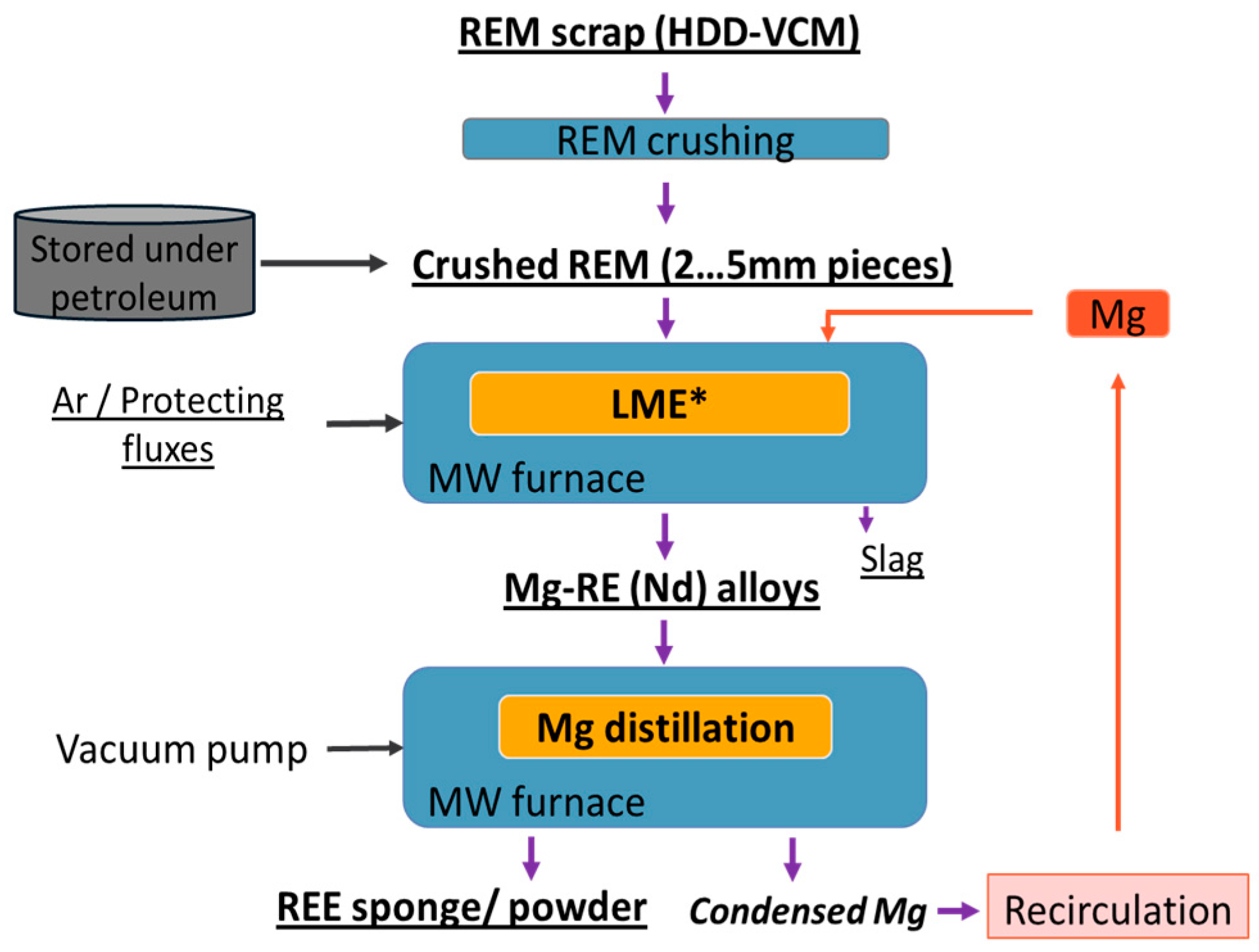
Rare earth elements (REEs) possess unique physical and chemical properties that render them indispensable in various industries, including electronics, energy production and storage, hybrid and electric vehicles, metallurgy, and petro-chemical processing. The criticality of REE underscores the need to enhance the efficiency of primary resource extraction and promote circularity through increased recycling from secondary sources. This paper provides a brief overview of REE recovery from secondary sources, particularly waste from electronic and electric equipment (WEEE). The discussion encompasses direct reuse of magnets, short-loop recycling (direct recycling), hydro- and pyrometallurgical processes, highlighting microwave (MW) technology. Original results are presented, focusing on the recovery of neodymium (Nd) from permanent magnet scraps from hard disk drives (HDD-PC) using microwave-assisted liquid metal extraction (LME) with magnesium (Mg) as the extractant. The subsequent separation of Nd from the Mg-Nd alloy via vacuum Mg distillation that is reused in the process is described. The experimental study demonstrates that the LME process, conducted in a microwave furnace, is a viable method for recovering Nd from permanent magnet scraps, which are essential for reducing the environmental impact of REE extraction and promoting a circular economy. By separating Nd from the alloy through vacuum distillation (450–550 mmHg), at temperatures of 850–900 °C for 8 h, a Nd sponge with a content of 95–98 wt.% Nd was obtained. The extracted content of Nd in the Mg alloy increases with increasing temperature and holding time. It was found that ≈ 97% of the Nd in the scrap was extracted from 2 to 5 mm crushed scrap at 800 °C for 8 h, using a LiF-LiCl-MgF2 protecting flux in a furnace Ar atmosphere.
Keywords: circular economy; rare earth elements; permanent magnets; recycling; microwave melting; liquid metal extraction; magnesium circular economy; rare earth elements; permanent magnets; recycling; microwave melting; liquid metal extraction; magnesium