Article

Nonlinear Combined Resonance of Thermo-Magneto-Electro-Elastic Cylindrical Shells

College of Mechanical and Vehicle Engineering, Chongqing University, Chongqing 400044, China
*
Author to whom correspondence should be addressed.
Dynamics 2025, 5(4), 48; https://doi.org/10.3390/dynamics5040048
Submission received: 6 October 2025 / Revised: 11 November 2025 / Accepted: 13 November 2025 / Published: 14 November 2025
(This article belongs to the Special Issue Recent Advances in Dynamic Phenomena—3rd Edition)

Abstract

This study investigates the combined resonance phenomenon in magneto-electro-elastic (MEE) cylindrical shells under longitudinal and lateral excitations with thermal factors, addressing the complex interaction between mechanical, electrical, and magnetic fields in smart structures. The research aims to establish a theoretical framework for predicting resonance behaviors in energy harvesting and sensing applications. Using Maxwell’s equations and Hamilton’s principle, the governing equations for combined resonance are derived. The method of varying amplitude (MVA) is employed to acquire the combined resonance response across varying parameters. Furthermore, the Runge–Kutta method is applied to investigate the bifurcation and chaotic motion characteristics under different longitudinal and lateral excitation conditions. Key findings reveal the coupling effects of multi-physical fields on resonance frequencies, demonstrating quantitative agreement with prior studies. The results provide fundamental insights into the dynamic characteristics of MEE materials, offering theoretical support for optimizing their performance in adaptive engineering systems.

1. Introduction

The dynamic study of magnetoelectric elastic shells holds significant scientific value and engineering importance. Its core significance is manifested in three aspects: Firstly, as a typical pressure-bearing structure, cylindrical shells are widely used in aerospace and energy equipment, where the magnetoelectric coupling effect can significantly regulate stiffness and damping characteristics, offering new approaches for vibration suppression and energy recovery. Secondly, the multi-field coupling mechanism of MEE materials (mechanical-electrical-magnetic-thermal) enables environmental adaptability, making research on dynamic response patterns crucial for developing intelligent sensing and vibration damping systems [1]. Finally, such studies can deepen the understanding of nonlinear dynamic behaviors under complex loads, providing theoretical support for structural design in extreme environments (e.g., high-speed airflow, electromagnetic interference). While current research has made progress, challenges remain in transient response and parameter optimization under multi-field coupling effects. Recent studies have made significant contributions to the analysis of magneto-electro-elastic (MEE) shell structures under various loading conditions. Ni et al. [2] developed a precise buckling model for MEE composite cylindrical shells accounting for non-uniform pre-buckling effects under MEE conditions through Galerkin’s approach. Zhao et al. [3] formulated a new finite element model to assess static and dynamic responses of MEE cylindrical shells to four thermal loading patterns. Dat et al. [4] examined how geometric parameters, material properties, and boundary conditions influence vibration characteristics of smart MEE sandwich shells using combined Galerkin-Runge–Kutta techniques. Ellouz et al. [5] analyzed large deflection behaviors in smart MEE composite shells involving multi-physics coupling. Meuyou et al. [6] presented a 3D solution for static responses of simply supported doubly curved MEE shells using state-space methods. Ellouz et al. [7] enhanced first-order shear deformation theory to evaluate MEE coupling in thin-walled smart structures with piezoelectric patches. Dong et al. [8] studied nonlinear harmonic resonances in composite cylindrical shells with MEE factor. Gan and She [9] demonstrated transient responses of imperfect MEE cylindrical shells through time-history analysis. Tu et al. [10] applied isogeometric analysis to model free and forced vibrations of doubly curved MEE shallow shells on visco-Pasternak foundations. Tornabene et al. [11] developed higher-order formulations for static analysis of laminated anisotropic MEE doubly curved shells using Mori-Tanaka and GDQ methods. Brischetto et al. [12] proposed a 3D spherical shell model for free vibration analysis of multilayered smart MEE shells with simple supports. However, the combination resonance problem of MEE shells has not been reported in the literature to date.
The study of combined resonance in plate-shell structures holds irreplaceable value for modern engineering safety. These structures are widely used in aerospace field, where their vibration characteristics directly affect operational reliability and lifespan. When multi-degree-of-freedom systems experience combined resonance, they often generate destructive forces far exceeding those of single-mode vibrations, potentially leading to fatigue failure or catastrophic structural collapse. Systematic research into the coupling mechanisms of combined resonance not only reveals energy transfer patterns in complex vibration environments but also provides effective vibration suppression solutions for engineering practice. Hu and Ma [13] investigated the nonlinear combined resonance phenomenon in ferromagnetic circular plates subjected to transverse alternating magnetic fields by employing multiscale analysis techniques. Gan and She [14] explored combined resonance in magnetoelectric plates through Maxwell’s equations and varying amplitude methods. Jahangiri et al. [15] reduced the governing equations to nonlinear ODEs via trigonometric Airy stress functions and Galerkin’s method, analyzing vibrations in functionally graded sandwich shells. She et al. discovered parameter-dependent stable/unstable loops in axially moving cylindrical shells [16].
Existing research predominantly focuses on vibration characteristics of cylindrical shells, while combined resonance phenomena in MEE cylindrical shells under multi-source excitations remain unexplored. This study pioneers a comprehensive investigation into the dynamic responses of magneto-electro-elastic (MEE) cylindrical shells subjected to simultaneous longitudinal and lateral excitations, formulating it as a forced-parametric combined resonance problem. The governing partial differential equations of the coupled electro-elastic system are discretized and solved using the assumed mode method, leading to a set of nonlinear ordinary differential equations. Subsequently, the MVA is employed to systematically analyze the influences of key parameters (such as material properties and excitation amplitudes on the resonance characteristics, aiming to identify the dominant factors governing dynamic behavior regulation. Furthermore, the study delves into the nonlinear dynamics of the system, examining how external excitations can induce complex phenomena such as bifurcation and chaos, which are critical for understanding the stability and safety of such structures in practical applications. Through this research, we aim to provide new theoretical insights into the design and control of advanced cylindrical shell systems operating in multi-physical field environments.

2. Theoretical Models

The present study aims to establish a theoretical framework for predicting the combined resonance characteristics of MEE cylindrical shells subjected to longitudinal and lateral excitations. As illustrated in Figure 1, a cylindrical shell operating in a magneto-electro-thermal environment is modeled with a midplane coordinate system (x, θ, z), where (u, v, w) denote the displacement components along the (x, θ, z) directions, respectively. The shell geometry is defined by three parameters: length (L), thickness (h), and radius (R). The excitation system consists of two components: one is a uniformly distributed lateral load (P) inducing parametric resonance, the other is a longitudinal load expressed as F = Fxcos(Ωt/2 + β), triggering primary resonance. When the cylindrical shell is simultaneously exposed to these excitations with a 1:2 frequency ratio between longitudinal and lateral loads, the combined resonance phenomenon emerges. This theoretical model investigates the coupled dynamics arising from such multi-physical field interactions.
Based on Love’s thin shell theory, the three-dimensional coordinates of any point in the cylindrical shell can be represented as follows
u x = u z w x ,   u θ = v z R w θ ,   u z = w .
The cylindrical shell’s three-dimensional coordinate system is defined by the directions x, θ, and z, corresponding to axial, circumferential, and radial directions, respectively. The displacement components in these directions are denoted by u, v, and w. Based on Love’s thin shell theory, the strain components can be derived from these displacement fields [16].
ε x ε θ γ x θ = ε x 0 ε θ 0 γ x θ 0 + z δ x δ θ δ x θ
Herein,
ε x 0 ε θ 0 γ x θ 0 = u x + 1 2 w x 2 1 R v θ + 1 2 R 2 w θ 2 + w R v x + 1 R u θ + 1 R w x w θ ,   δ x δ θ δ x θ = 2 w x 2 1 R 2 2 w θ 2 1 R 2 v θ 2 R 2 w x θ 2 R v x .
Furthermore, by applying Maxwell’s equations, the expressions for magnetic potential (Φ) and electric potential (Ψ) can be formulated through the governing equations [9,14]:
Ψ ˜ x , θ , z , t = cos β z Ψ x , θ , t + 2 z ψ 0 h Φ ˜ x , θ , z , t = cos β z Φ x , θ , t + 2 z ϕ 0 h
where ψ0 and ϕ0 represent the initial values of electric and magnetic potentials, and β = π/h. In the present case, the electric and magnetic components read,
H x = Ψ ˜ x ,   H θ = 1 R + z Ψ ˜ θ ,   H z = Ψ ˜ z ,   E x = Φ ˜ x ,   E θ = 1 R + z Φ ˜ θ ,   E z = Φ ˜ z .
Incorporating control factors such as magnetic field, electric field, and thermal effects, the constitutive equations for the cylindrical shell are formulated by
σ x σ θ σ x θ B x B θ B z D x D θ D z = c ˜ 11 ε x + c ˜ 12 ε θ e ˜ 31 E z q ˜ 31 H z β ˜ 1 Δ T c ˜ 12 ε x + c ˜ 11 ε θ e ˜ 31 E z q ˜ 31 H z β ˜ 1 Δ T c ˜ 66 γ x θ d ˜ 11 E x + μ ˜ 11 H x d ˜ 11 E θ + μ ˜ 11 H θ q ˜ 31 ε x + q ˜ 32 ε θ + d ˜ 33 E z + μ ˜ 33 H z + λ ˜ 3 Δ T s ˜ 11 E x + d ˜ 11 H x s ˜ 11 E θ + d ˜ 11 H θ e ˜ 31 ε x + e ˜ 32 ε θ + s ˜ 33 E z + d ˜ 33 H z + p ˜ 1 Δ T
where (σxθ) represent the strains, (Bx,Bθ,Bz) define the magnetic inductions, and electric displacements are denoted by (Dx,Dθ,Dz), ΔT represents the uniform temperature change, and [14]
c ˜ 11 = c 11 c 13 2 c 33 ,   c ˜ 12 = c ˜ 11 ,   c ˜ 66 = c 66 ,   e ˜ 31 = e 31 c 13 e 33 c 33 ,   e ˜ 32 = e ˜ 31 ,   e ˜ 15 = e 15 ,   q ˜ 31 = q 31 c 13 q 33 c 33 ,   q ˜ 31 = q ˜ 32 ,   q ˜ 15 = q 15 ,   d ˜ 33 = d 33 + q 33 e 33 c 33 ,   d ˜ 11 = d 11 ,   s ˜ 11 = s 11 ,   s ˜ 33 = s 33 e 33 2 c 33 ,   μ ˜ 33 = μ 33 + q 33 2 c 33 ,   μ ˜ 11 = μ 11 ,   β ˜ 1 = β 1 c 13 β 3 c 33 ,   p ˜ 3 = p 3 + β 3 e 33 c 33 ,   λ ˜ 3 = λ 3 + β 3 q 33 c 33 .
Integration of Equation (6) from −h/2 to h/2 with respect to the thickness z, one can yield
N x N θ N x θ = h / 2 h / 2 σ x σ θ σ x θ d z ,   M x M θ M x θ = h / 2 h / 2 z σ x σ θ σ x θ d z ,   B ¯ x B ¯ θ B ¯ z = h / 2 h / 2 B x cos β z B θ cos β z R + z B z β sin β z d z ,   D ¯ x D ¯ θ D ¯ z = h / 2 h / 2 D x cos β z D θ cos β z R + z D z β sin β z d z .
Herein, (Nx,Nθ,N) are defined the internal forces, the force related to magnetism and electricity are denoted by ( B ¯ x , B ¯ θ , B ¯ z ) and ( D ¯ x , D ¯ θ , D ¯ z ), and (Mx,Mθ,M) indicate the moments. For the shell system, the work W done by external excitations, the kinetic energy K and the strain energy U are represented as follows
δ K = δ 1 2 0 L 0 2 π h / 2 h / 2 ρ z u ˙ x 2 + u ˙ θ 2 + u ˙ z 2 R d z d θ d x
δ U = δ 1 2 0 L 0 2 π h / 2 h / 2 σ x ε x + σ θ ε θ + σ x θ γ x θ R d z d θ d x
δ W = δ 1 2 0 L 0 2 π k w w 2 + k g w x 2 + k g w R θ 2 R d θ d x + 0 L 0 2 π F δ w P δ u x x C t d w d t δ w R d θ d x
where kw and kg are the correlation coefficients of elastic foundation, Ct expresses the damping coefficient, F and P are defined as longitudinal and lateral excitations, and F = Fxcos(Ωt/2 + β), P = Pxcos(Ωt), where (Fx,Px) and β indicate the amplitude and phase difference of F and P, respectively; Ω stand for the excitation frequency, To meet the requirements of Hamiltonian variational principle, one has
t δ K δ U + δ W d t = 0
The partial differential equations for MEE cylindrical shells under longitudinal and lateral excitations can be derived by using Hamiltonian principle. Substituting Equations (9)–(11) into Equation (12) and organizing them into the following form
N x x + 1 R N x θ θ = I 0 2 u t 2 ,  
N x θ x + 1 R N θ θ + 1 R 2 M x θ x + 1 R M θ θ = I 0 2 v t 2 ,
2 M x x 2 + 2 R 2 M x θ x θ + 1 R 2 2 M θ θ 2 N θ R + N x 2 w x 2 + 2 N x θ R 2 w x θ + N θ R 2 2 w θ 2 k w w + k g 2 w x 2 + k g 1 R 2 2 w θ 2 + F x cos Ω t 2 + β + P x w cos Ω t = I 0 2 w t 2 + C t d w d t ,
D ¯ x x + D ¯ θ θ + D ¯ z = 0 ,
B ¯ x x + B ¯ θ θ + B ¯ z = 0 .
The simply supported boundary conditions at both ends are written as
u = v = w = 2 w x 2 = Ψ = Φ = 0 ,
Herein, I 0 = h / 2 h / 2 ρ ( z ) d z . Introducing the following dimensionless coefficients
x ¯ = x L ,   u ¯ = u L ,   v ¯ = v R ,   w ¯ = w h ,   Θ ¯ x = Θ x ,   Θ ¯ y = Θ y ,   Φ ¯ = Φ ,   Ψ ¯ = Ψ ,   τ = t D m ρ h a 4 ,   D m = c 11 h 3 12 ,   I ¯ 0 = I 0 ρ h ,   C ¯ t = a 4 D m ρ h C t ,   P ¯ x = a 4 D m P x ,   F ¯ x = a 4 D m h F x ,   Ω ¯ = Ω ρ h a 4 D m .
Substituting Equation (15) into Equation (13) and organizing, one has
L ¯ 11 ( u ¯ ) + L ¯ 12 ( v ¯ ) + L ¯ 13 ( w ¯ ) + L ¯ 14 Φ ¯ + L ¯ 15 Ψ ¯ = I ¯ 0 2 u ¯ τ 2
L ¯ 21 ( u ¯ ) + L ¯ 22 ( v ¯ ) + L ¯ 23 ( w ¯ ) + L ¯ 24 Φ ¯ + L ¯ 25 Ψ ¯ = I ¯ 0 2 v ¯ τ 2
L ¯ 31 ( u ¯ ) + L ¯ 32 ( v ¯ ) + L ¯ 33 ( w ) + L ¯ 34 ( Φ ¯ ) + L ¯ 35 ( Ψ ¯ ) + L ¯ 36 u ¯ , w ¯ + L ¯ 37 v ¯ , w ¯ + L ¯ 38 Φ ¯ , w ¯ + L ¯ 39 Ψ ¯ , w ¯ + P ¯ x w ¯ cos Ω ¯ τ + F ¯ x cos Ω ¯ τ / 2 + β = I ¯ 0 2 w ¯ τ 2 + C ¯ t d w ¯ d τ
L ¯ 41 ( u ¯ ) + L ¯ 42 ( v ¯ ) + L ¯ 43 ( w ¯ ) + L ¯ 44 Φ ¯ + L ¯ 45 Ψ ¯ = 0
L ¯ 51 ( u ¯ ) + L ¯ 52 ( v ¯ ) + L ¯ 53 ( w ¯ ) + L ¯ 54 Φ ¯ + L ¯ 55 Ψ ¯ = 0
Expressions for the operator ( L ¯ i j ) in Equations (16)–(20) are presented in Appendix A.

3. Solution Method

In current section, the Galerkin method is used to derive the dynamic equations of MEE cylindrical shells under longitudinal and lateral excitations. In order to discretize Equations (16)–(20), the displacement type function that satisfies the boundary conditions has the following form [16]
u ¯ = U ¯ m n ( τ ) cos m π x ¯ L sin n θ ,   v ¯ = V ¯ m n ( τ ) sin m π x ¯ L cos n θ , w ¯ = W ¯ m n ( τ ) sin m π x ¯ L sin n θ ,   Φ ¯ = ϕ ¯ m n ( τ ) sin m π x ¯ L sin n θ , Ψ ¯ = ψ ¯ m n ( τ ) sin m π x ¯ L sin n θ .
where U ¯ m n ( τ ) , V ¯ m n ( τ ) , W ¯ m n ( τ ) , ϕ ¯ m n ( τ ) , ψ ¯ m n ( τ ) are amplitude coefficients. Inserting Equation (21) into Equations (16)–(20) yields
l 11 U ¯ m n ( τ ) + l 12 V ¯ m n ( τ ) + l 13 W ¯ m n ( τ ) + l 14 W ¯ m n 2 ( τ ) + l 15 ϕ ¯ m n ( τ ) + l 16 ψ ¯ m n ( τ ) = 0
l 21 U ¯ m n ( τ ) + l 22 V ¯ m n ( τ ) + l 23 W ¯ m n ( τ ) + l 24 W ¯ m n 2 ( τ ) + l 25 ϕ ¯ m n ( τ ) + l 26 ψ ¯ m n ( τ ) = 0
l 31 U ¯ m n ( τ ) + l 32 V ¯ m n ( τ ) + l 33 W ¯ m n ( τ ) + l 34 W ¯ m n 2 ( τ ) + l 35 W ¯ m n 3 ( τ ) + l 36 ϕ ¯ m n ( τ ) + l 37 ψ ¯ m n ( τ ) + l 38 U ¯ m n ( τ ) W ¯ m n ( τ ) + l 39 V ¯ m n ( τ ) W ¯ m n ( τ ) + l 310 ϕ ¯ m n ( τ ) W ¯ m n ( τ ) + l 311 ψ ¯ m n ( τ ) W ¯ m n ( τ ) + λ P W ¯ m n cos ( Ω ¯ τ ) + λ F cos ( Ω ¯ τ / 2 + β ) = I d 2 W m n ( τ ) d τ 2 + c t d W m n ( τ ) d τ
l 41 U ¯ m n ( τ ) + l 42 V ¯ m n ( τ ) + l 43 W ¯ m n ( τ ) + l 44 W ¯ m n 2 ( τ ) + l 45 ϕ ¯ m n ( τ ) + l 46 ψ ¯ m n ( τ ) = 0
l 51 U ¯ m n ( τ ) + l 52 V ¯ m n ( τ ) + l 53 W ¯ m n ( τ ) + l 54 W ¯ m n 2 ( τ ) + l 55 ϕ ¯ m n ( τ ) + l 56 ψ ¯ m n ( τ ) = 0
The integral coefficients appearing in Equations (22)–(26) are defined in Appendix B. By eliminating U, V, ϕ and ψ, one has
I d 2 W ¯ m n ( τ ) d τ 2 + F 0 d W ¯ m n ( τ ) d τ + F 1 + λ P cos Ω ¯ τ W ¯ m n ( τ ) + F 3 W ¯ m n 3 ( τ ) = λ F cos Ω τ / 2 + β
in which, I = 2 π I ¯ 0 , c t = 2 π C ¯ t , λ F = 2 π F ¯ x , λ P = 2 π P ¯ x , and the expressions of F0, F1 and F3 are defined in Appendix C. For subsequent calculations, the following coefficients is given as
χ = W ¯ m n τ ,   ϑ ¯ 1 = F 0 / I ,   ϑ ¯ 3 = F 3 / I , ω L 2 = F 1 / I ,   λ ¯ p = λ p / ω L 2 ,   λ ¯ F = λ F / I .
Inserting Equation (28) into Equation (27), leads to
χ ¨ + ϑ ¯ 1 χ ˙ + ω L 2 1 + λ ¯ p cos Ω ¯ τ χ + ϑ ¯ 3 χ 3 = λ ¯ F cos Ω ¯ τ / 2 + β
The MVA [17] is employed to solve Equation (28), using the single-term MVA approximation, the χ(τ) is given as
χ τ = C cos Ω ¯ τ / 2 + D sin Ω ¯ τ / 2
For the subsequent numerical analysis, the χ(τ) is further rewritten as [16,17,18,19,20]
χ τ = W m τ cos Ω ¯ τ / 2 + ζ τ
in which, Wm and ζ(τ) correspond to the amplitude and phase angle, and they have
W m τ = C 2 τ + D 2 τ , ζ τ = tan 1 D τ C τ
Inserting Equations (31) and (32) into Equation (29), and separating coefficients cos Ω ¯ τ / 2 and D sin Ω ¯ τ / 2 , we can obtain
W m + ϑ ¯ 1 W m + ω L 2 1 + 1 2 λ ¯ p cos 2 ζ 1 4 Ω ¯ W m + 3 4 ϑ ¯ 3 W m 3 = λ ¯ F cos β ζ
Ω ¯ W m 1 2 ϑ ¯ 1 Ω ¯ W m + 1 2 ω L 2 λ ¯ p W m sin 2 ζ + 3 4 ϑ ¯ 3 W m 3 = λ ¯ F sin β ζ
By solving Equations (33) and (34), the relationship between amplitude and frequency is derived, seen in Equation (35), it will be used for numerical analysis.
9 ϑ ¯ 3 W m 6 6 ϑ ¯ 3 Ω ¯ 2 4 ω L 2 W m 4 24 λ ¯ p ϑ ¯ 3 cos β ζ W m 3 + Ω ¯ 4 + 4 Ω ¯ 2 ϑ ¯ 1 2 2 ω L 2 + 4 ω L 2 4 λ ¯ p 2 W m 2 + 8 λ ¯ F Ω ¯ 2 4 ω L 2 cos β ζ 2 ϑ ¯ 1 Ω ¯ sin β ζ W m + 16 λ ¯ F 2 = 0
Equation (35) provides six solutions for W m , but only the real, positive solutions are physically meaningful (with a maximum of five such solutions possible, as noted in [17]). As Ω ¯ 2 approaches infinity, the response becomes bounded, and Equation (35) admits only one real solution. This can be understood by retaining only the leading-order terms in Ω ¯ 2 and W m , causing Equation (35) to simplify to
9 ϑ ¯ 3 W m 4 6 ϑ ¯ 3 Ω ¯ 2 4 ω L 2 W m 2 + Ω ¯ 4 + 4 Ω ¯ 2 ϑ ¯ 1 2 2 ω L 2 0
In the context of the discussion on steady-state dynamic response analysis, the amplitude-frequency relationship can be directly derived from Equation (35) to plot the corresponding response curves. For investigations into bifurcation and chaotic dynamics, the Runge–Kutta method is employed to perform numerical simulations of Equation (27), as the analytical solutions for such complex nonlinear behaviors are often intractable.

4. Results

4.1. Comparative Analysis

In this section, the accuracy of the present study is verified by comparing its results with those obtained from the Runge–Kutta method. To systematically investigate the effects of magnetism, electricity, heat, initial phase angle, elastic foundation, damping, and material distribution type on the combined resonance, a series of parametric analyses are conducted. The geometric parameters of the shell are defined as L = 1 m, R = 1 m, h = 0.05 m. The material properties are specified in Table 1, where CoFe2O4 represents the matrix material, BaTiO3 denotes the embedded material, and MEE refers to the composite system comprising BaTiO3 and CoFe2O4.
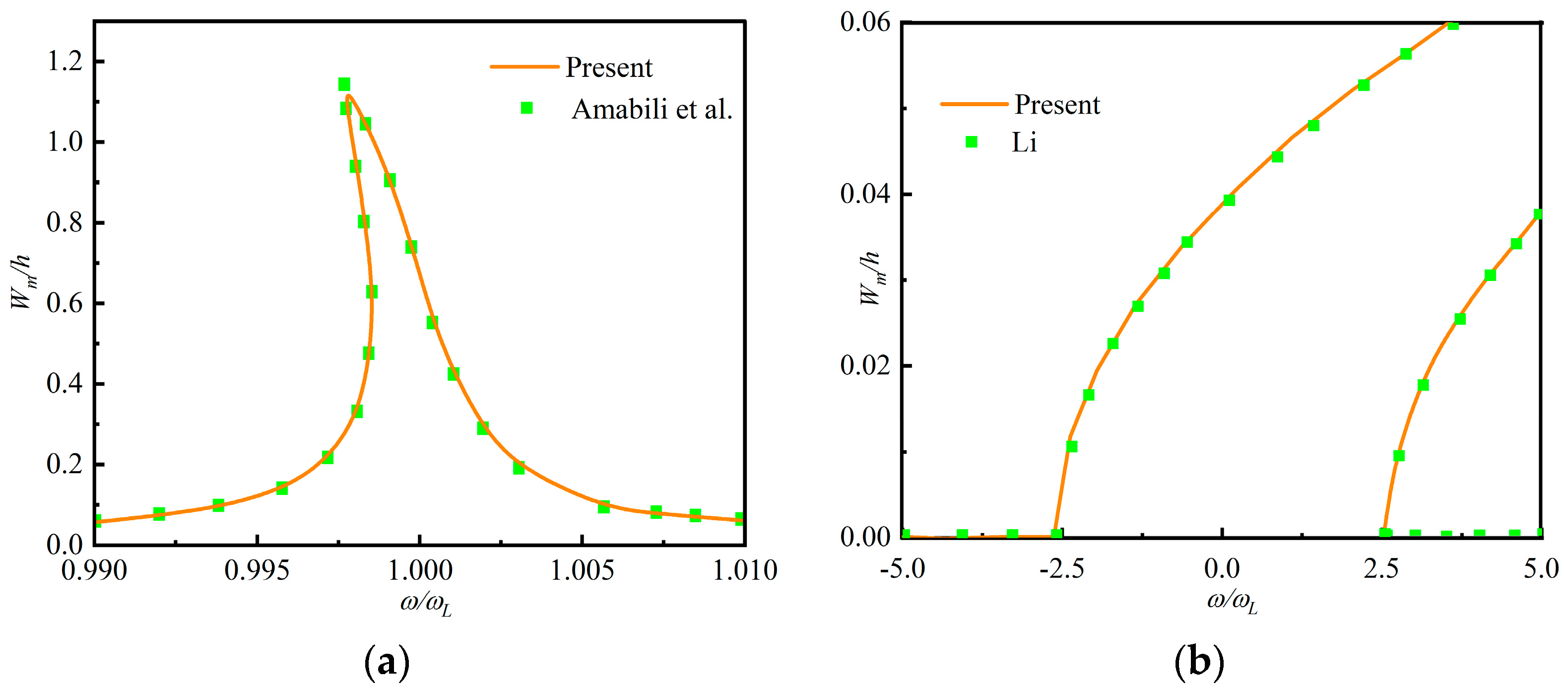
Comparative analysis is conducted before developing parametric analysis to ensure research reliability through two validation aspects: model validation and method validation. For model validation, comparative studies are performed with the work of Ye et al. [19]. The comparison results, presented in Table 2, demonstrate that the current findings align well with those reported in Ye et al. [19], regardless of whether the cylindrical shell is homogeneous or MEE-based. Additionally, Figure 2 shows excellent agreement between the forced/parametric resonance curves obtained in this study and those from existing studies [20,21]. Based on these comparisons, the theoretical model is sufficiently validated.
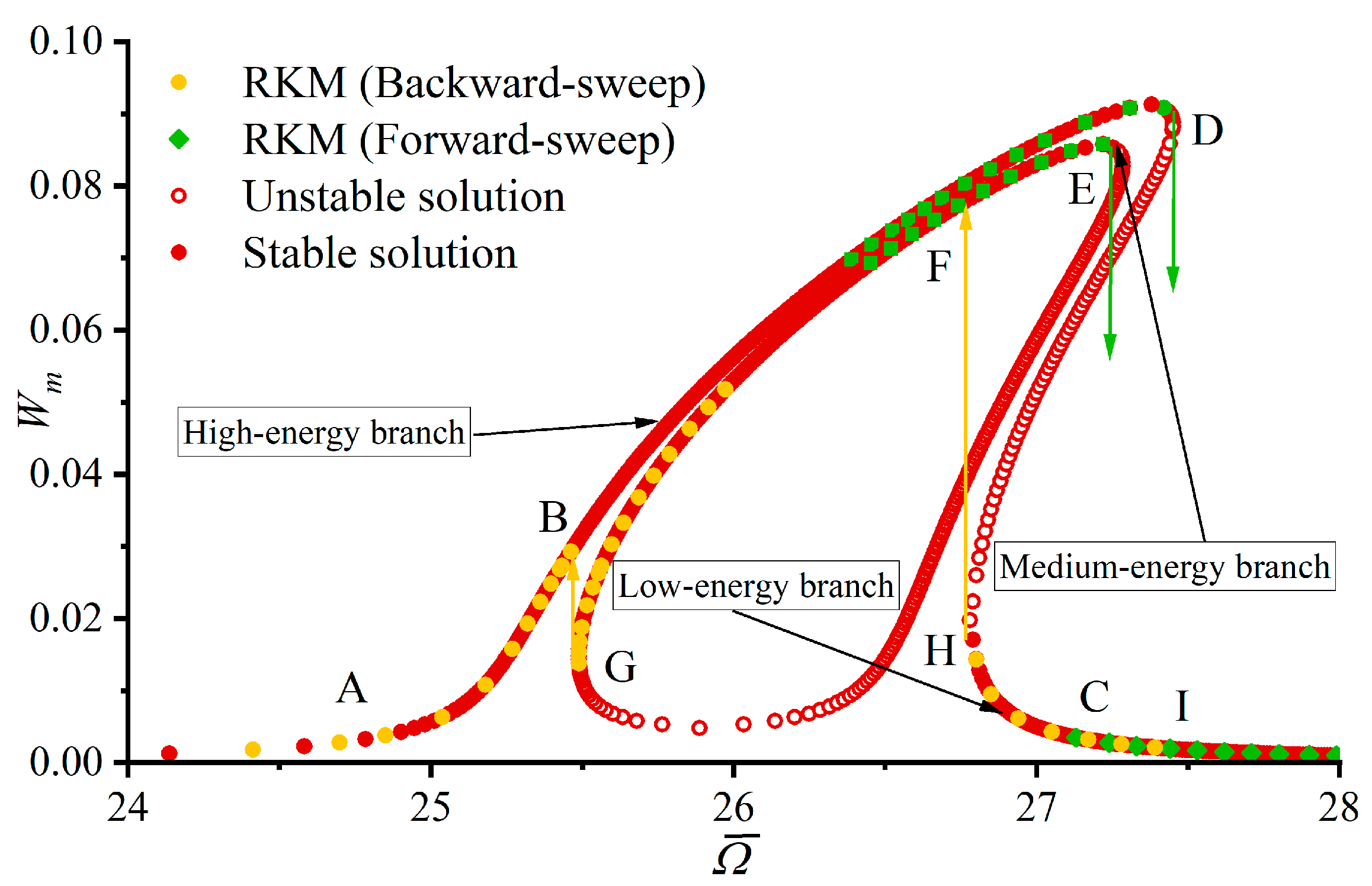
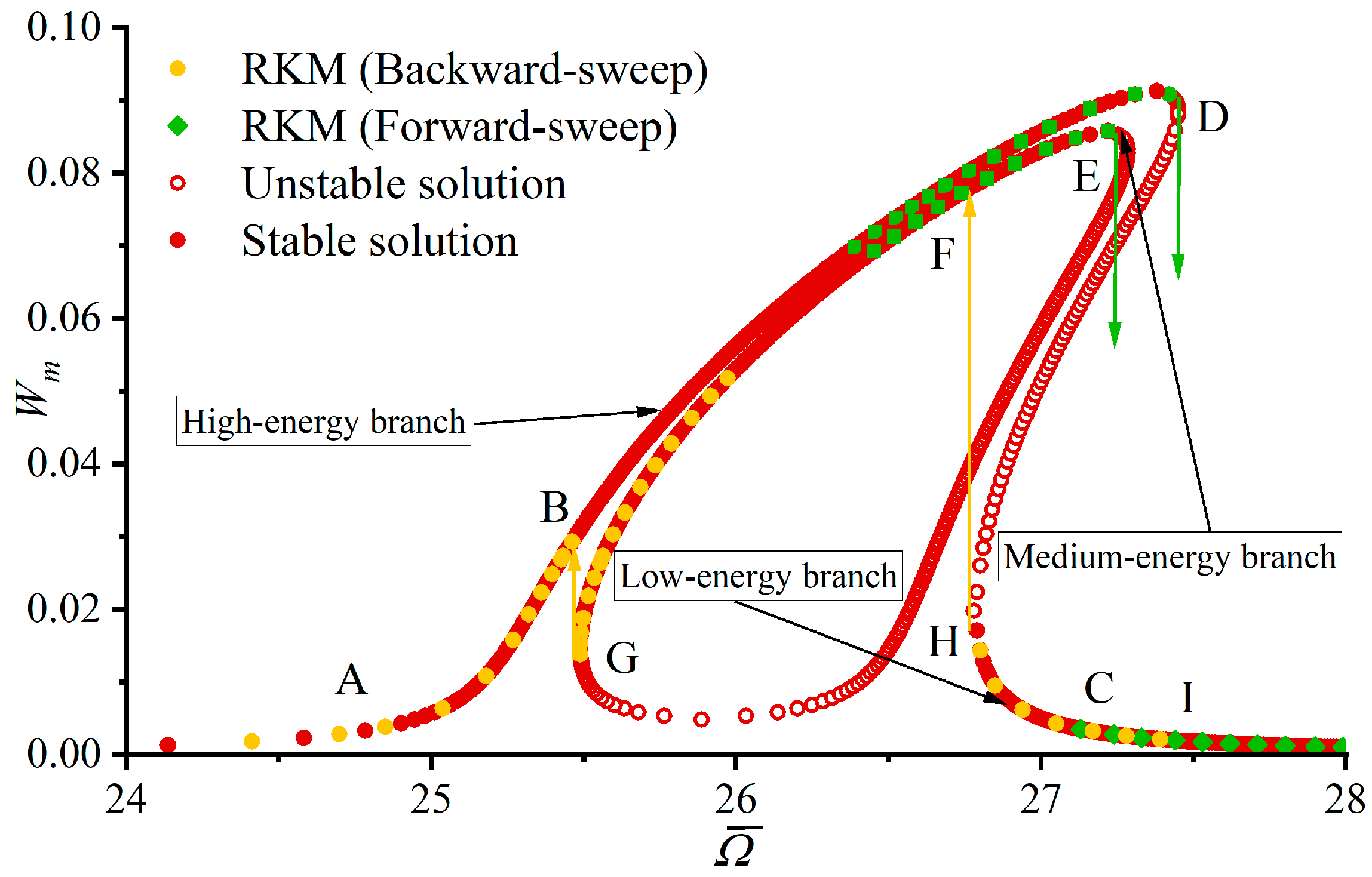
Moreover, before investigating the combined resonance of cylindrical shells, both methodological validation and resonance mechanism clarification are essential. According to Ref. [17], the MVA demonstrates sufficient accuracy, and its applicability for combined resonance problems is confirmed by comparison with RKM (Runge–Kutta Method) results. As illustrated in Figure 3 and Figure 4, the Ω ¯ W m curves calculated by RKM and MVA exhibit strong consistency, validating the MVA’s capability to not only obtain steady-state and non-stationary solutions but also accurately track sweep paths. The Ω ¯ W m curves in Figure 3 and Figure 4 exhibit hardening characteristics, with intersections between solid and hollow markers defined as saddle points (e.g., points D, E, H, and G in Figure 3). These saddle points trigger two distinct dynamic behaviors: bifurcation and jumping. Furthermore, the closed loop formed within the curve by alternating solid and hollow segments leads to multiple stable/unstable solutions and sweep path non-uniqueness. For instance, with θ ¯ 1 = 2 and λ ¯ p = 0.32 during forward sweep (high-frequency direction), two distinct sweep paths emerge, each experiencing bifurcation and jumping events. Starting from point A, the response increases to point D (bifurcation point), then decreases to point I (jumping phenomenon). Conversely, when initiating at point G, the path G→E→C also encounters bifurcation/jumping at point E. During reverse sweep (low-frequency direction), only a single unique path exists: I→H→F→G→B. With θ ¯ 1 = 2.02 and λ ¯ p = 0.315 (Figure 4), similar phenomena occur, but the increased θ ¯ 1 and reduced λ ¯ p reduce curve amplitude, weaken hardening characteristics, and compress the internal loop.

4.2. Parametric Analysis

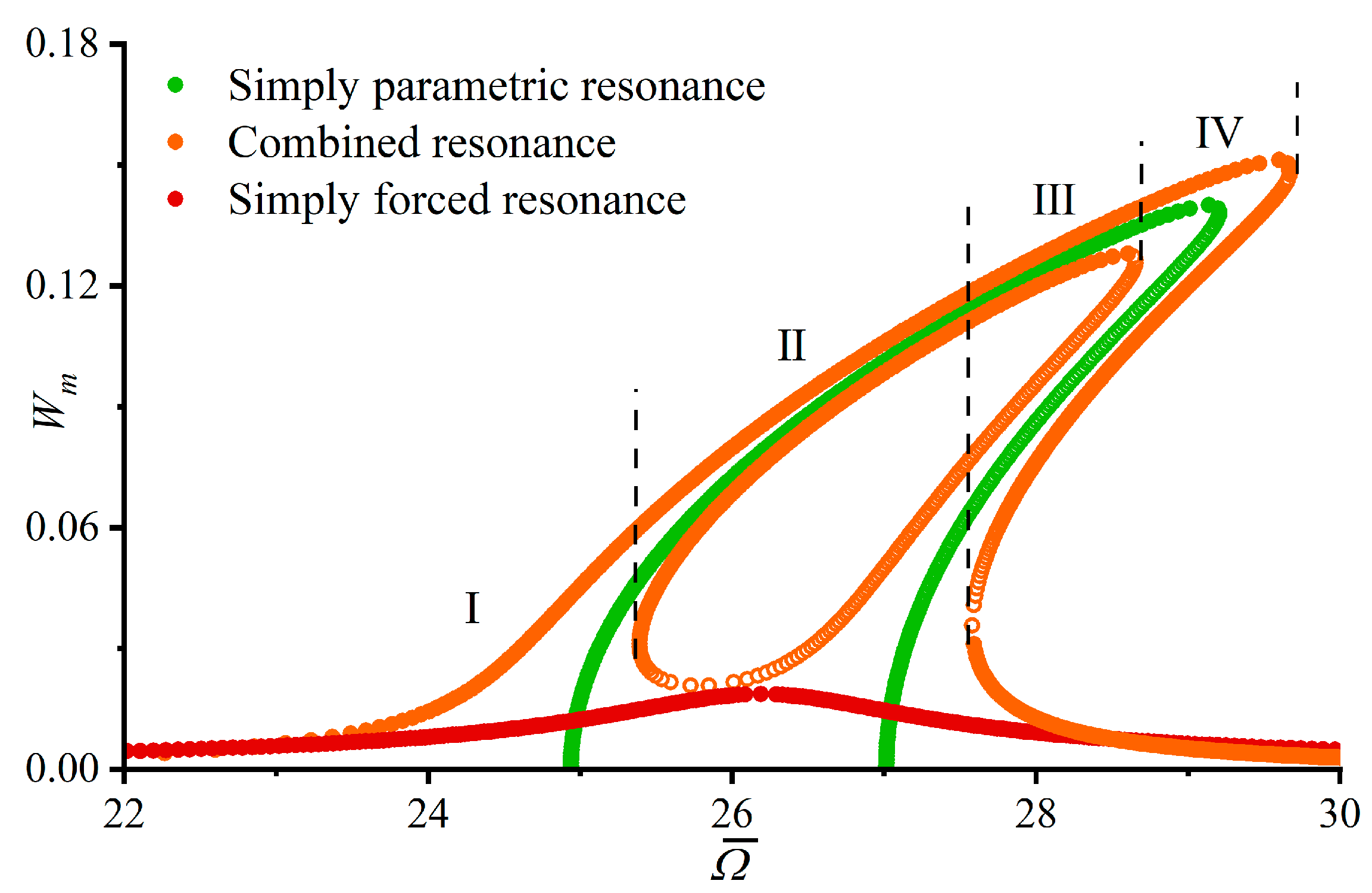
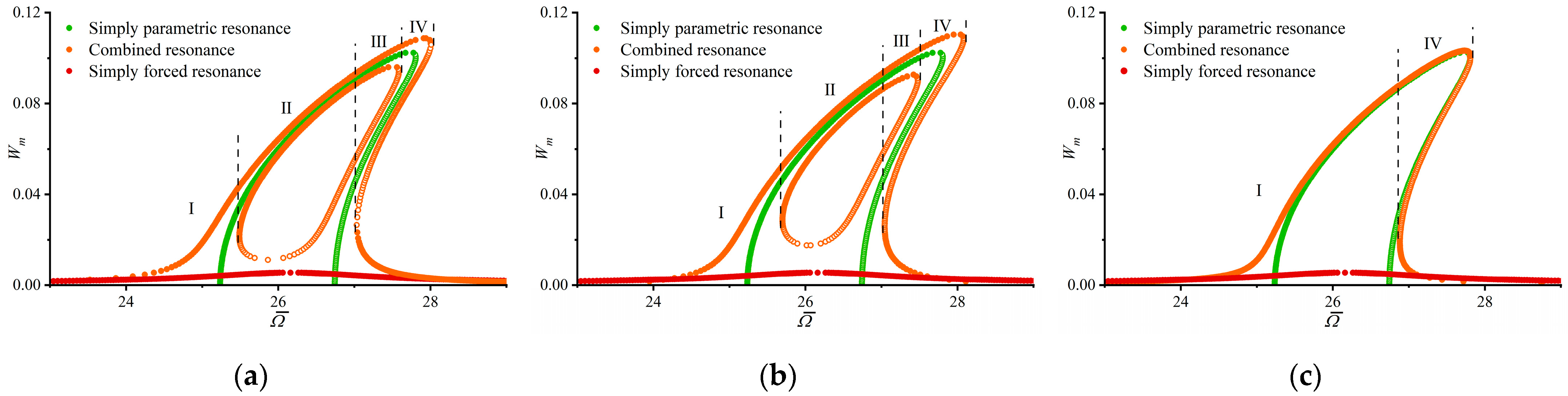
In this section, the results presented in Figure 5, Figure 6, Figure 7, Figure 8, Figure 9, Figure 10 and Figure 11 are obtained using Equation (35) based on the MVA. Given that structures often suffer from vibration damage caused by multi-source excitation during service, this study investigates the nonlinear dynamic behavior of cylindrical shells under combined lateral and longitudinal excitations within a multi-physical field (magnetic-electric-elastic-thermal), as illustrated in Figure 5. The green and red lines in the figure represent parametric resonance excited by lateral excitation and forced resonance triggered by longitudinal excitation, respectively; the orange line denotes combined resonance, which typically occurs when both lateral and longitudinal excitations (or accelerations) act simultaneously, with their excitation frequencies satisfying the 1:2 ratio condition. It is important to emphasize that combined resonance is not a simple superposition of the other two resonances, but rather a complex dynamic behavior arising from the interaction of lateral and longitudinal excitations. This conclusion will be substantiated in subsequent research. As shown in Figure 5, compared to single vibration forms, the combined resonance curve exhibits larger amplitude and more complex dynamic behavior. During forward sweep, stable/unstable solutions, inner loops, bifurcation, and jumping behaviors emerge sequentially. Due to the complexity of the system, the combined resonance response curve is divided into four regions based on the distribution of stable and unstable solutions.
The mechanical behavior of structures is closely related to material parameters. In this study, MEE materials composed of CoFe2O4 and BaTiO3 are investigated, where BaTiO3 serves as the embedded material. To examine the influence of the embedded material on the combined resonance behavior of cylindrical shells, three cases are analyzed in Figure 6. As shown in the figure, a cylindrical shell made of pure CoFe2O4 exhibits the maximum deflection and resonance frequency under lateral and longitudinal excitation. With the incorporation of BaTiO3 material, the amplitude decreases, the resonance position shifts to lower frequencies, and the internal loop becomes smaller. When the BaTiO3 content reaches 100%, the system achieves the minimum amplitude and resonance frequency. Consequently, the introduction of BaTiO3 material is detrimental to structural strength enhancement. However, by comparing Figure 6b,c, it is observed that the rate of decrease in resonance frequency exceeds that of amplitude reduction. Therefore, from a vibration control perspective, the MEE composite material proves to be the optimal choice for the current study.
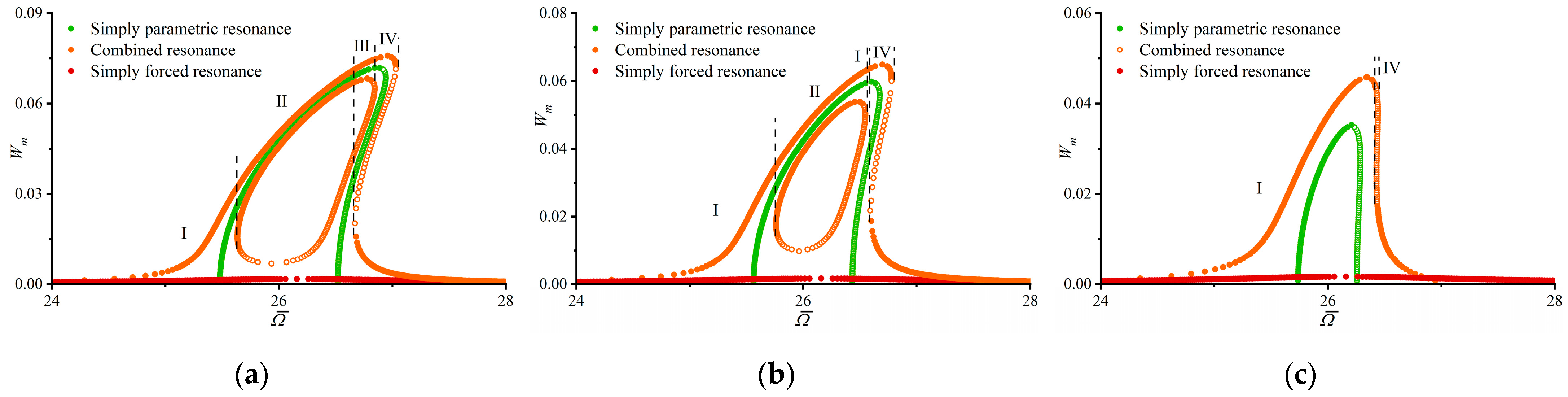
The influence of the damping coefficient ( θ ¯ 1 ) on the combined resonance of MEE cylindrical shells is analyzed in Figure 7. Damping systems fundamentally operate through energy dissipation mechanisms, where the damping coefficient governs the rate of energy exchange between the system and its surroundings. As shown in the figure, with increasing θ ¯ 1 , the amplitude decreases significantly, the hardening effect weakens, and the internal loop gradually compresses. This behavior can be attributed to the damping’s role in modulating the system’s effective stiffness and energy balance. Specifically, higher damping coefficients enhance energy dissipation, leading to reduced vibration amplitudes and a diminished hardening effect. The compression of the internal loop is a direct consequence of this energy exchange, as damping disrupts the formation of multiple stable/unstable solutions by suppressing the energy accumulation necessary for such states. As previously discussed, the presence of an internal loop creates regions with multiple stable/unstable solutions, with the entire curve divided into four regions using four saddle points as critical points. Figure 7a illustrates the distinct distributions of stable/unstable solutions in each region. As the inner loop compresses and eventually disappears, Regions III and II vanish sequentially, leaving only Regions I and II. At this stage, the Ω ¯ W m curve loses its multiple stable solution characteristic, retaining only a single bifurcation and jump phenomenon, as demonstrated in Figure 7c. This transition can be explained by the damping’s impact on the system’s energy landscape, where increased damping reduces the energy available for maintaining multiple stable states, thereby simplifying the system’s response to a single bifurcation. Furthermore, when subjected to smaller longitudinal excitation, the combined resonance curve does not simply replicate the parametric resonance curve, though their outer contours show strong similarity. This observation not only confirms that combined resonance is not a mere superposition of forced and parametric resonance but also reinforces the conclusion that parametric resonance forms the backbone of combined resonance behavior. The damping coefficient’s influence on this behavior is further highlighted by its role in shaping the energy exchange dynamics, which ultimately determine the system’s response to combined excitation.
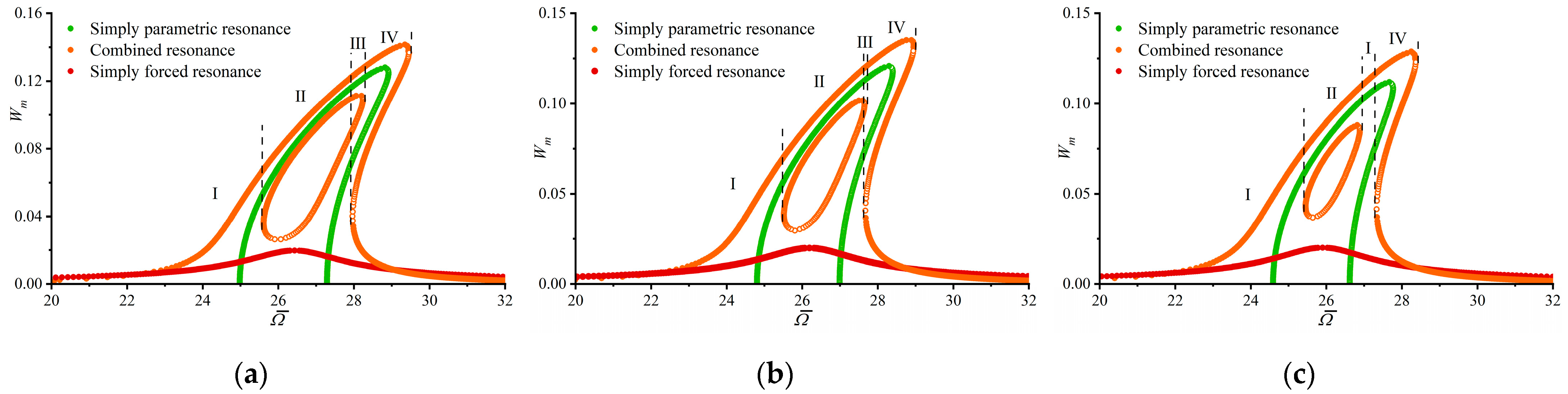
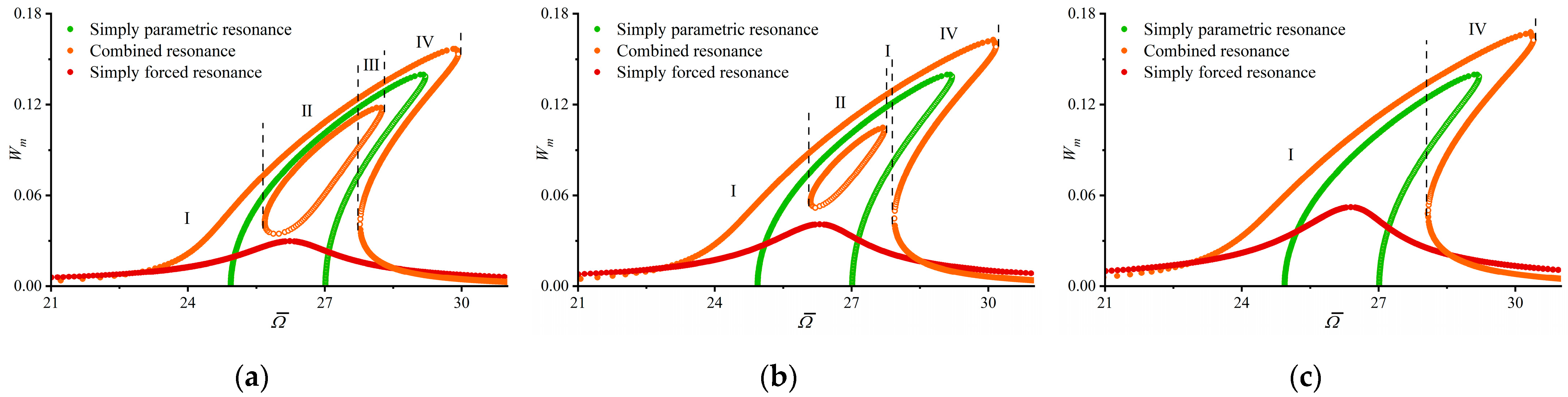
Figure 8 investigates the influence of λ ¯ F , with three cases of λ ¯ F = 0.16, 0.22, and 0.28 analyzed. As expected, increasing λ ¯ F results in an amplitude growth of forced resonance while leaving parametric resonance unaffected. For combined resonance, λ ¯ F ’s influence is determined by the difference (Δδ) between its peak value and that of parametric resonance. As shown in Figure 8a,b, larger λ ¯ F enhances hysteresis phenomena and significantly alters the multi-stable solution characteristics of combined resonance curves. At low λ ¯ F values, forward frequency sweeps exhibit two bifurcations and jumps, with Regions-I to IV coexisting—where Regions-II and III represent multi-stable solutions (Figure 8a). As λ ¯ F increases, Region-III dissolves, and the multi-stable region shrinks. When λ ¯ F reaches 0.28, the internal loop vanishes entirely, eliminating multi-stable solutions. A parallel study on lateral excitation amplitude ( λ ¯ p = 0.32, 0.35, 0.37) is presented in Figure 9. Unlike longitudinal excitation, λ ¯ p variation does not affect forced resonance but strongly modulates parametric and combined resonance dynamics. Comparative analysis reveals that both increasing λ ¯ F and λ ¯ p amplify combined resonance amplitudes and hysteresis effects. However, while λ ¯ F narrows multi-stable regions, λ ¯ p expands them—demonstrating opposing effects on system stability.
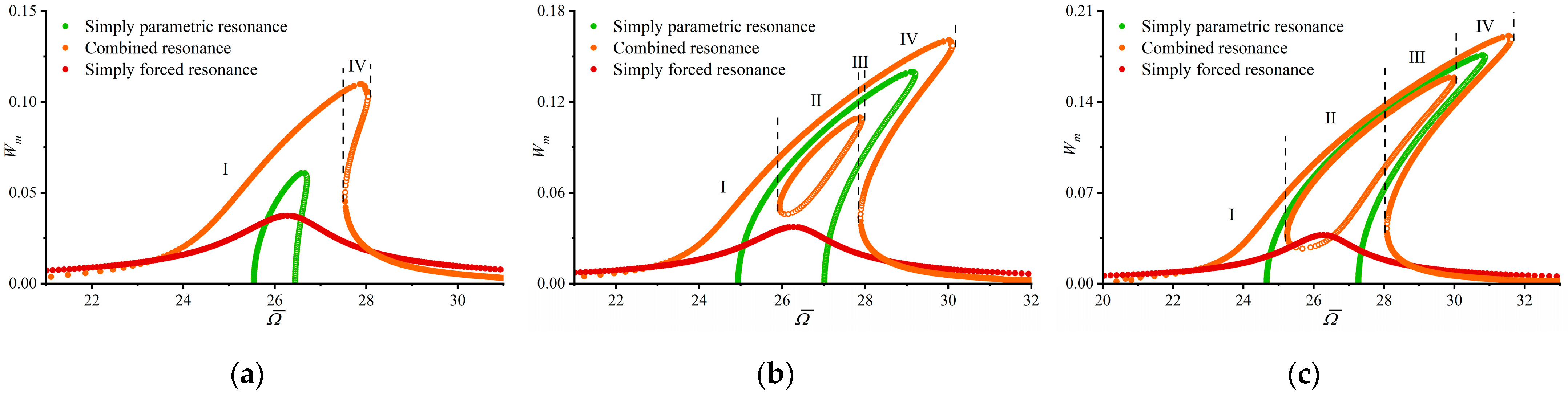
Figure 10 demonstrates the influence of initial phase angle (ζ) on system dynamics. As ζ increases, the internal loop contracts progressively, indicating a gradual reduction in the multi-stable solution region in the Ω ¯ W m   curve. Specifically, Figure 10a,b reveal that while Regions-II and III shrink, Regions-I and II expand. At ζ = −π, the internal loop vanishes entirely, eliminating the multi-stable solution region (Figure 10c). This observation suggests that larger ζ values weaken the coupling effect of external excitation. Notably, the combined resonance amplitude exhibits minor variations with ζ changes, whereas forced and parametric resonance responses remain entirely unaffected. These findings contradict the misconception that combined resonance is merely a linear superposition of forced and parametric resonance. The influence of phase angle on system dynamics can be attributed to the underlying energy exchange and stiffness modulation mechanism. Specifically, the phase angle affects the synchronization between the external excitation and the system’s natural vibration modes, thereby altering the energy transfer efficiency between the system and its environment. Additionally, the phase angle modulates the effective stiffness of the system through the parametric excitation mechanism, which in turn influences the system’s response to external forces. Therefore, the changes observed in the system’s behavior, such as the contraction of the internal loop and the reduction in the multi-stable solution region, are not merely descriptive but can be explained by the fundamental physics of energy exchange and stiffness modulation.
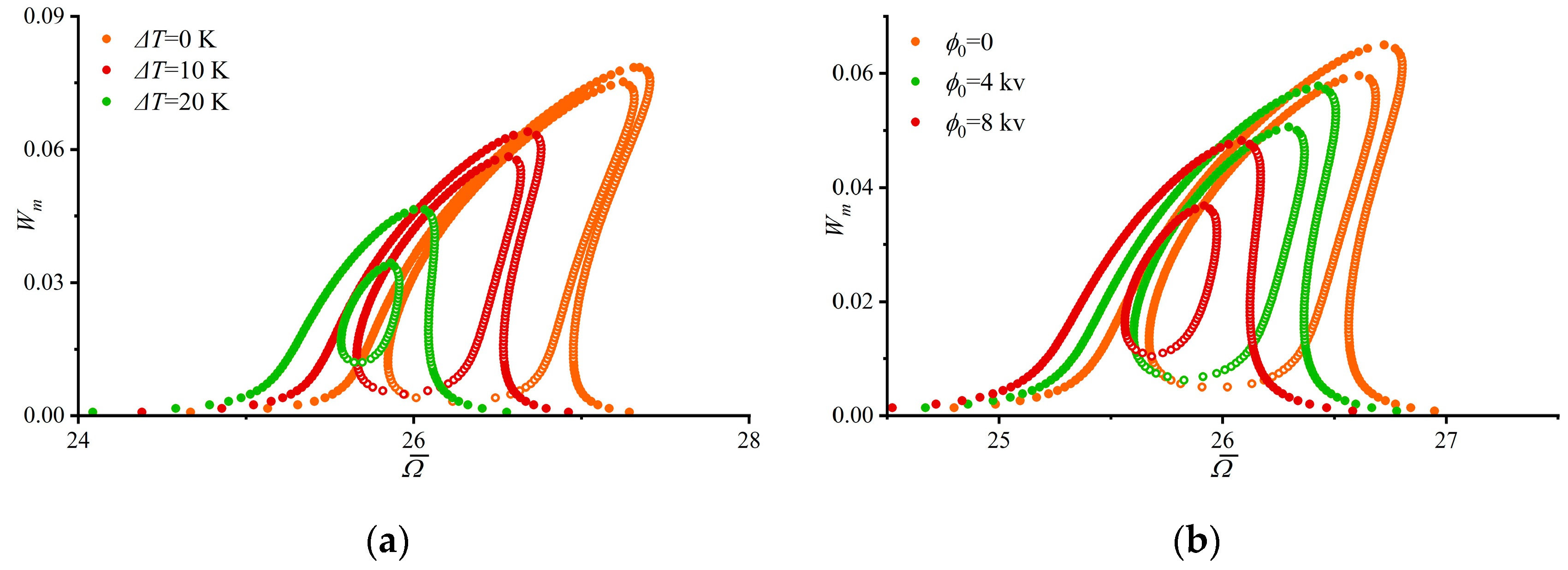
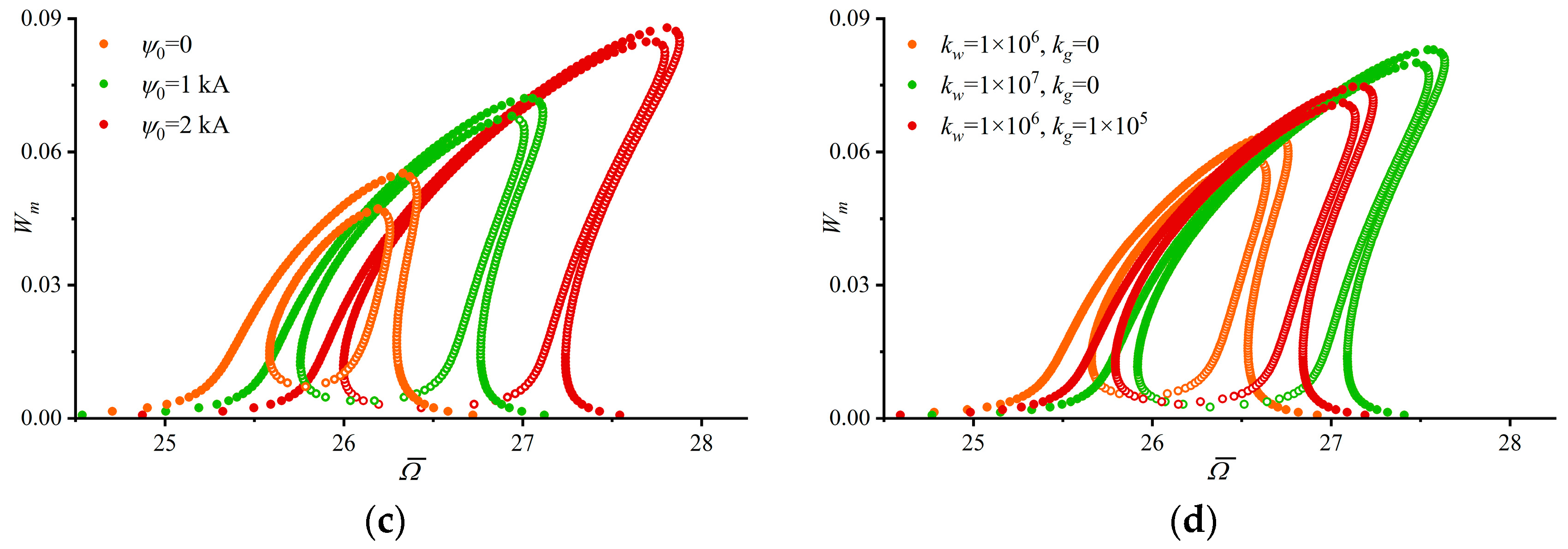
Figure 11 illustrates the effects of temperature ΔT, elastic coefficient (kw, kg), magnetic potential (ψ0), and electric potential (ϕ0) on the combined resonance of MEE cylindrical shells. The system exhibits extreme sensitivity to variations in these parameters. As shown in Figure 11a,b, the Ω ¯ W m curves display similar trends across different temperatures and electric potentials. Increasing these parameters significantly reduces both amplitude and resonance bandwidth, while minimally affecting complex dynamic characteristics such as multi-stable solutions, double jumps, and bifurcations. In contrast, Figure 11c reveals an opposing effect for magnetic potential (ψ0). As ψ0 increases from 0 to 2 kA, the system exhibits distinct behavior: amplitude grows, resonance position shifts to higher frequencies, and the multi-stable solution region expands. This phenomenon stems from the opposing forces introduced by magnetic (ψ0) and electric (ϕ0) fields, where ψ0 dominates the interaction. Specifically, increasing ψ0 expands the multi-stable region and shifts the resonance to higher frequency due to magnetic stiffening. Finally, Figure 11d examines the influence of elastic coefficients (kw, kg). The results demonstrate that increasing either kw or kg enhances the response, shifts the resonance band to higher frequencies, and expands the multi-stable region. These changes can be attributed to the underlying energy exchange and stiffness modulation mechanisms: higher elastic coefficients increase the effective stiffness of the system, thereby altering the energy distribution between the elastic foundation and the structural components. This stiffness modulation not only shifts the resonance to higher frequencies but also expands the multi-stable region by providing additional constraints on the system’s dynamic behavior. Consequently, these findings suggest that lower temperatures and electric potentials, combined with higher magnetic potentials and elastic coefficients, are advantageous for achieving high-frequency resonance, as they collectively enhance the system’s energy efficiency and stability.

4.3. Bifurcation and Chaotic

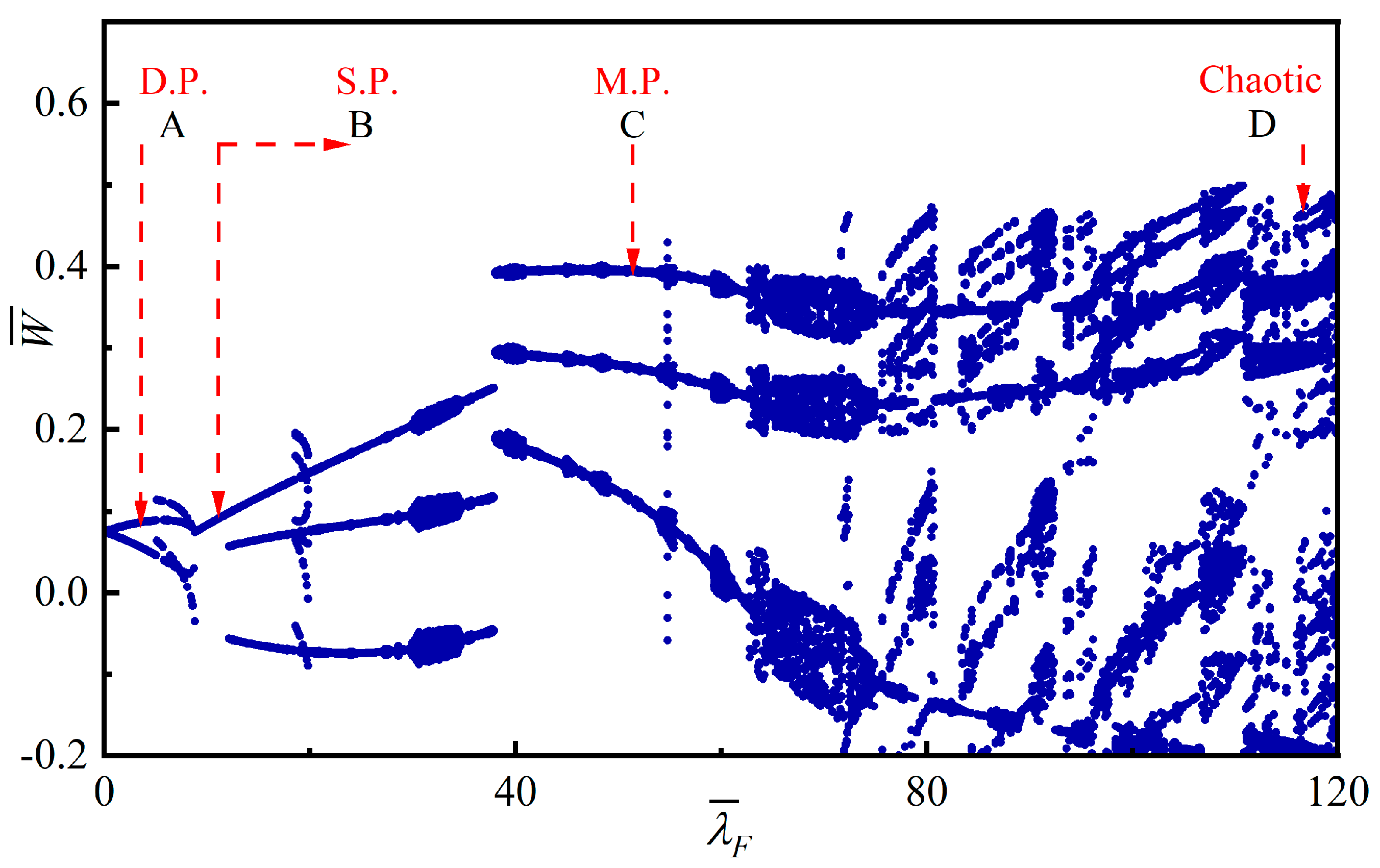
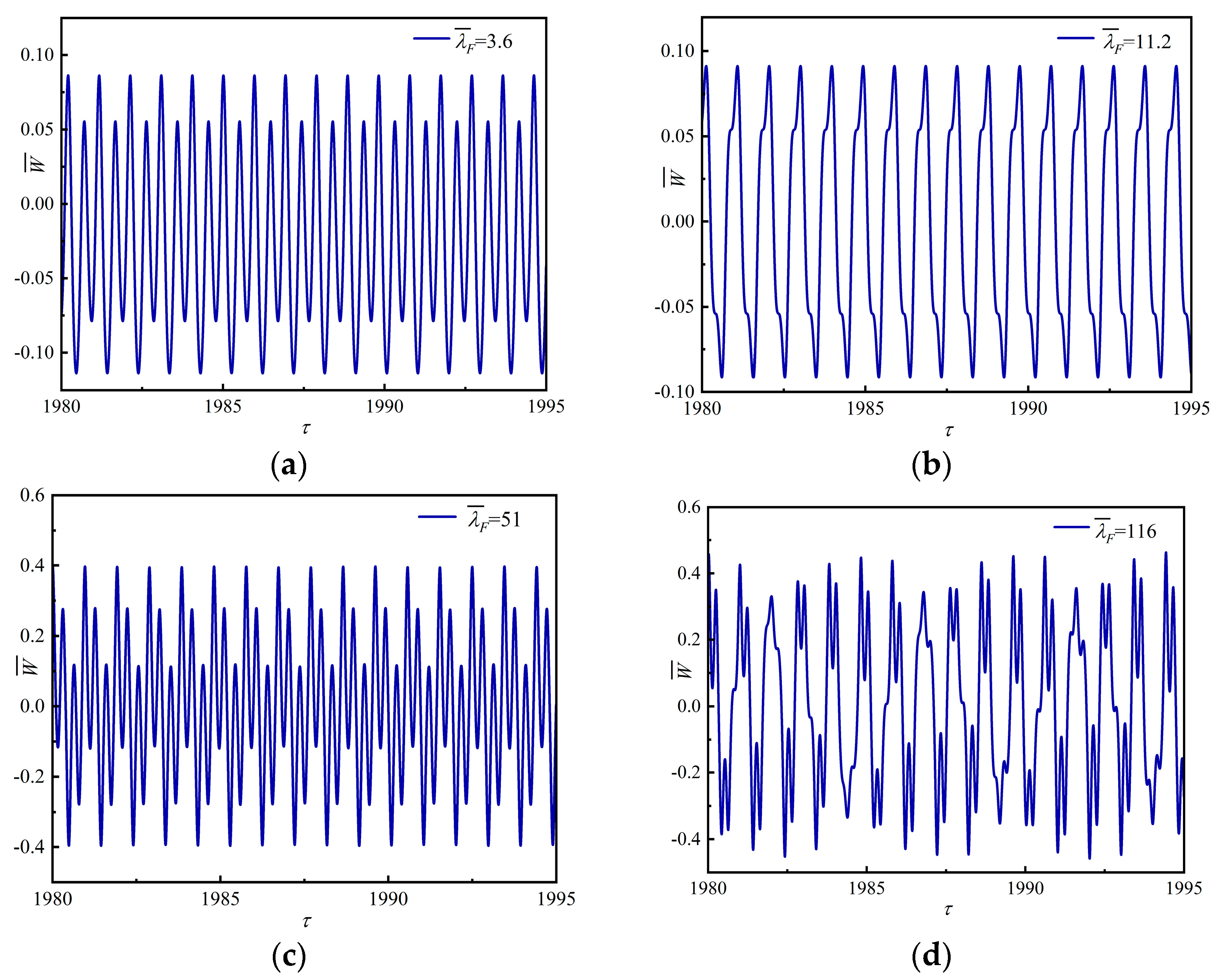
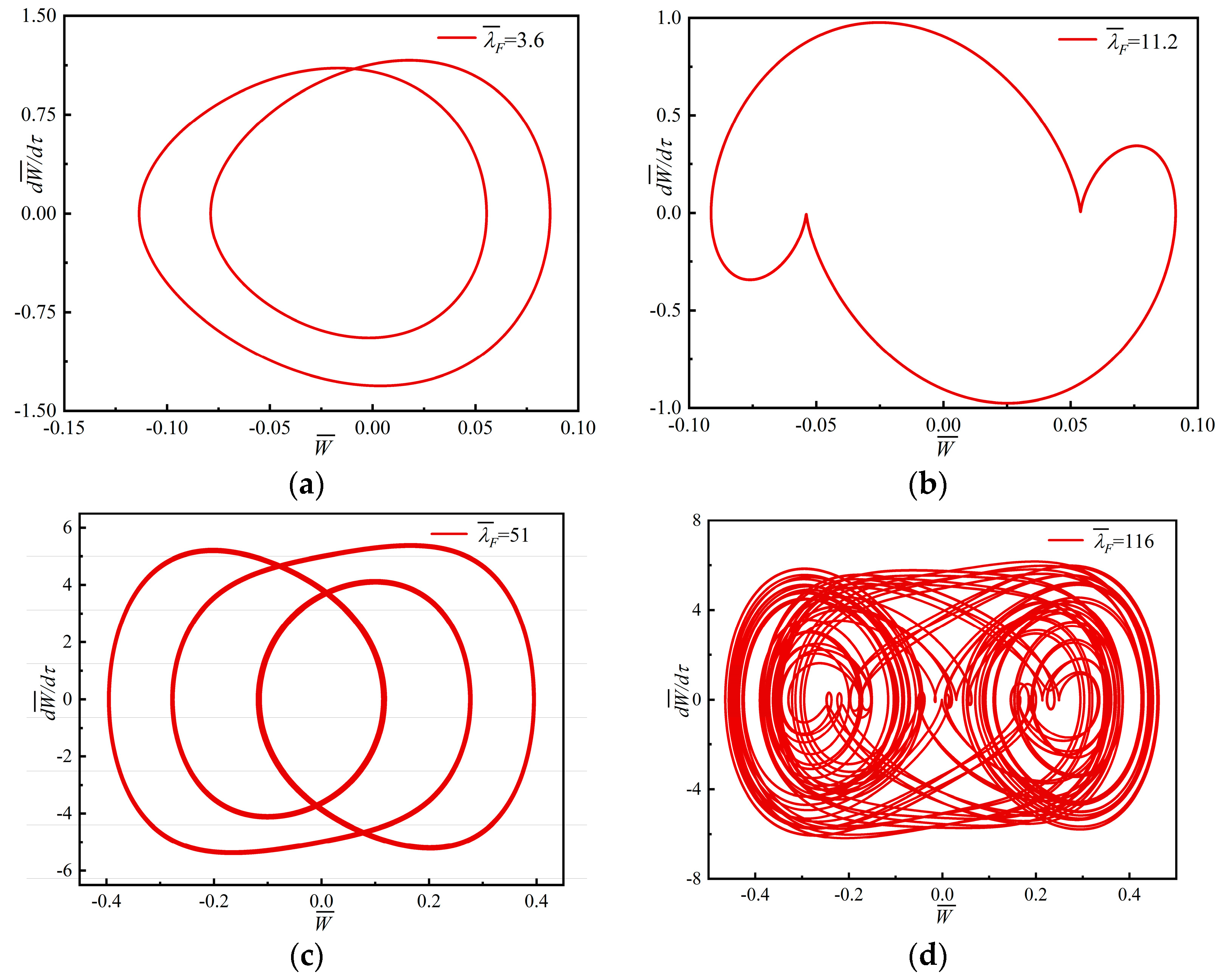
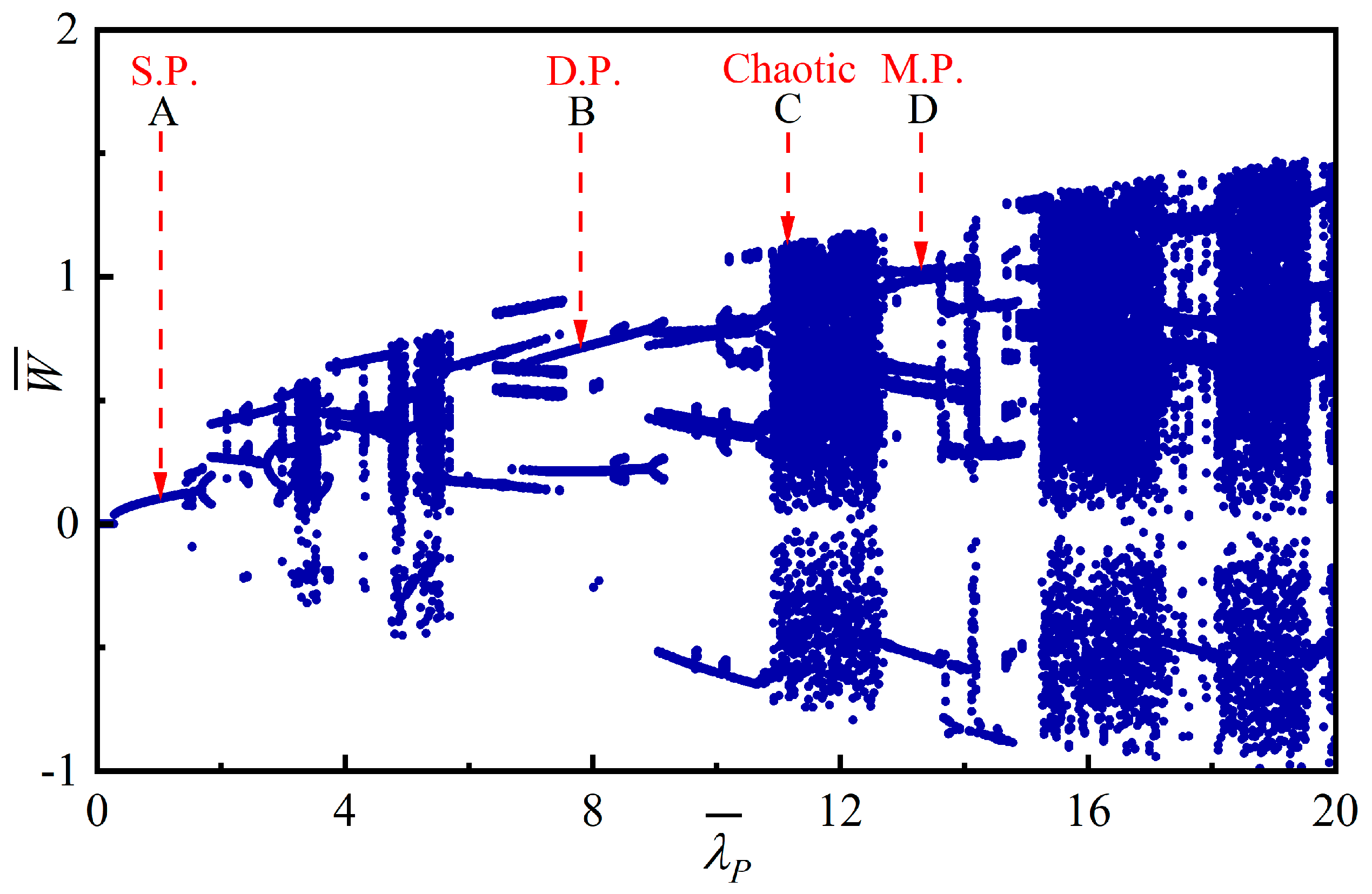
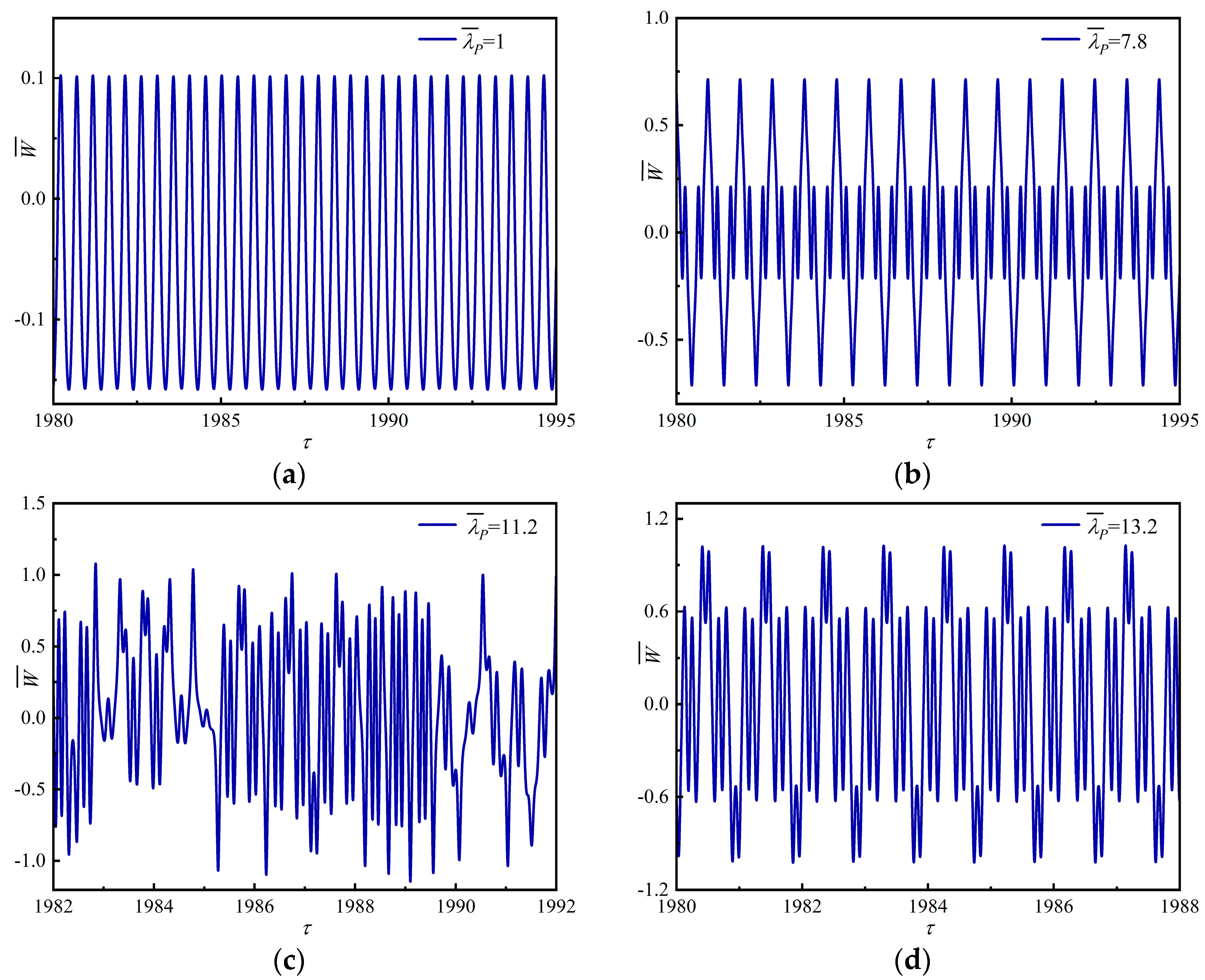
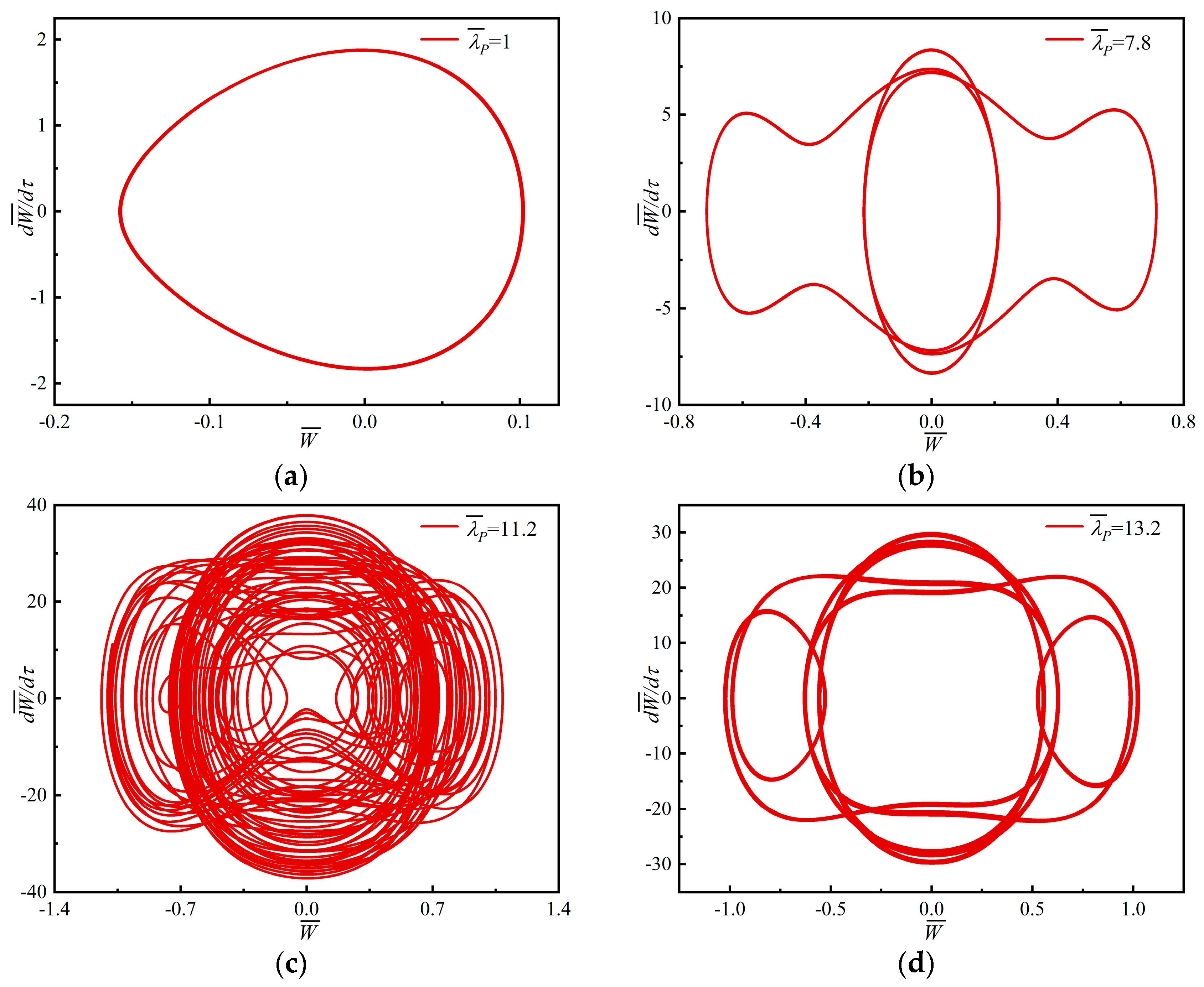
In this section, the results presented in Figure 12, Figure 13, Figure 14, Figure 15, Figure 16 and Figure 17 are obtained using Equation (27) based on the Runge–Kutta method. As illustrated in Figure 12 and Figure 15, the complex dynamics of MEE cylindrical shells are investigated to reveal the vibration characteristics under different longitudinal excitation amplitudes ( λ ¯ F ) and lateral excitation amplitudes ( λ ¯ p ). Figure 12 presents the bifurcation trajectory of the nonlinear system under varying λ ¯ F . As λ ¯ F increases, the system exhibits successive transitions from double-period to single-period motions. Corresponding time-history curves and phase trajectories are shown in Figure 13 and Figure 14a,b, respectively. Further increasing λ ¯ F leads to multi-period and chaotic oscillations, as demonstrated by points C and D in Figure 12. The dynamic responses at these points are displayed in Figure 13 and Figure 14c,d. Additionally, Figure 15, Figure 16 and Figure 17 analyze the effects of λ ¯ p on the bifurcation diagram, time-history curve, and phase trajectory. Unlike the behavior observed with λ ¯ F   , increasing λ ¯ p initially induces single-period oscillations (point A in Figure 15), followed by transitions to double-period and chaotic motions at points B and C, respectively. These transitions are visually confirmed in Figure 16 and Figure 17a–c. Moreover, Figure 16 and Figure 17d capture the multi-period oscillations at point C.

5. Conclusions

The study investigates the combined resonance response of MEE cylindrical shells under a 1:2 ratio of longitudinal to lateral excitation frequencies. To elucidate the influence mechanism of multiple factors on combined resonance, a comprehensive dynamic model incorporating magnetic, electric, thermal, initial phase angle, elastic foundation, damping, and material distribution type is developed to establish strong nonlinear coupling equations. The Hamiltonian principle and Galerkin method are then employed to discretize the derived nonlinear equations, while the MVA is applied to obtain the combined resonance response under varying parameters. Additionally, the Runge–Kutta method is utilized to analyze bifurcation and chaotic motion characteristics under different longitudinal and lateral excitations. The key findings are as follows:
(1) The bifurcation topology of combined resonance exhibits extreme sensitivity to BaTiO3 content, electric potential, and magnetic potential. Increasing BaTiO3 content not only reduces resonance frequency but also compresses the internal loop and multiple steady-state solution regions, a phenomenon analogous to the effect of varying electric potential but opposite to that of increasing magnetic potential.
(2) The damping coefficient significantly influences the stable region of the amplitude-frequency curve. As the damping coefficient increases, the region containing multiple steady-state solutions progressively contracts and eventually vanishes, resulting in only one bifurcation and jump phenomenon during forward frequency sweep. Similarly, a larger initial phase angle narrows the range of multiple stable solutions.
(3) Simultaneous increases in longitudinal and lateral excitation amplify the response amplitude and induce pronounced hysteresis. However, unlike lateral excitation, increasing longitudinal excitation reduces the internal loop of combined resonance, decreases the number of stable solutions, and ultimately leaves only one bifurcation and jump during frequency sweep.
(4) Elevated temperature lowers resonance frequency, weakens hysteresis, and diminishes the internal loop of the amplitude-frequency curve, producing effects inverse to those of increasing elastic coefficients.
(5) Enhanced longitudinal and lateral excitations trigger bifurcation and chaotic phenomena.
While the present study focuses on the combined resonance response of MEE cylindrical shells under uniform temperature fields, several promising avenues for future research can be explored to further enhance the understanding of such complex systems: (a) The current model assumes a uniform temperature distribution, which may not hold in practical scenarios involving thermal gradients. Future studies could investigate the influence of non-uniform temperature fields, such as axial or circumferential thermal gradients, on the dynamic response, stability, and bifurcation characteristics of MEE shells. This would provide deeper insights into the thermal-mechanical-electromagnetic coupling effects under realistic operating conditions. (b) Experimental studies are essential to validate the theoretical predictions and identify potential discrepancies. Future work could involve prototype testing of MEE shells under combined resonance conditions. Additionally, developing active or passive control strategies (e.g., piezoelectric shunting, magnetic tuning) to mitigate undesirable vibrations or enhance energy harvesting efficiency would be highly valuable.

Author Contributions

Conceptualization, formal analysis, investigation, data curation, writing—original draft preparation, writing—review and editing, supervision, project administration, funding acquisition, G.-L.S.; Conceptualization, methodology, validation, formal analysis, investigation, resources, data curation, writing—original draft preparation, visualization, L.-L.G. All authors have read and agreed to the published version of the manuscript.

Funding

This research was funded by the talent introduction project of Chongqing University, grant number 02090011044159.

Data Availability Statement

Date will be made available on reasonable request.

Conflicts of Interest

The authors declare no conflicts of interest.

Appendix A

L ¯ 11 = A 11 2 u ¯ x ¯ 2 + A 66 L R 2 2 u ¯ θ 2 L 3 D m ,   L ¯ 12 = 2 B 66 + A 66 R L R + A 12 + B 12 R 2 v ¯ x ¯ θ L 3 D m , L ¯ 13 = A 66 h 2 L R 2 2 w ¯ θ 2 w ¯ x ¯ + A 66 L + A 12 h 2 R 2 2 w ¯ x ¯ θ w ¯ θ + A 12 h R w ¯ x ¯ 2 B 66 L B 12 h R 2 3 w ¯ x ¯ θ 2 B 11 h L 2 3 w ¯ x ¯ 3 + A 11 h 2 L 2 2 w ¯ x ¯ 2 w ¯ x ¯ L 3 D m , L ¯ 14 = L ¯ 15 = 0 .
L ¯ 21 = A 12 + A 66 L + 1 R 2 B 66 L + B 12 2 u ¯ x ¯ θ L 3 R D m , L ¯ 22 = A 11 + 2 B 11 R + D 11 R 2 2 v ¯ R θ 2 + 4 D 66 R + 4 B 66 + A 66 R 2 v ¯ L x ¯ 2 L 3 D m , L ¯ 23 = 4 D 66 R B 12 L D 12 L R 2 B 66 h L R 3 w ¯ x ¯ 2 θ + A 11 h R 2 w ¯ θ 2 2 w ¯ θ 2 + B 12 R + A 12 h 2 L 2 R 2 w ¯ x ¯ θ w ¯ x ¯ + D 11 R B 11 h R 3 3 w ¯ θ 3 + B 11 h R 3 w ¯ θ + A 11 + B 11 R h 2 R 3 2 w ¯ θ 2 w ¯ θ + 2 B 66 R + A 66 2 w ¯ x ¯ θ w ¯ x ¯ + 2 w ¯ x ¯ 2 w ¯ θ h 2 L R L 3 D m , L ¯ 24 = L ¯ 25 = 0 .
L ¯ 31 = B 11 3 u ¯ x ¯ 3 A 12 R u ¯ x ¯ + B 12 + 2 B 66 L 1 R 2 3 u ¯ x ¯ θ 2 L 3 D m , L ¯ 32 = B 11 R A 11 v ¯ R θ + B 11 + D 11 R 3 v ¯ R 2 θ 3 + B 12 + 4 D 66 R L + 2 B 66 L + D 12 R 3 v ¯ x ¯ 2 θ L 3 D m , L ¯ 33 = h 2 R 2 B 12 + 2 B 66 L 2 w ¯ x ¯ θ 2 + 3 w ¯ x ¯ 2 θ w ¯ θ D 11 h R 4 4 w ¯ θ 4 + N e + N m N t 2 w ¯ x ¯ 2 + 2 w ¯ R 2 θ 2 + 2 B 66 R h 2 L R 3 w ¯ x ¯ θ 2 w ¯ x ¯ + A 12 h w ¯ R + h 2 2 R 2 w ¯ θ 2 + A 11 h 2 2 L 2 w ¯ x ¯ 2 B 11 h L 2 2 w ¯ x ¯ 2 2 w ¯ x ¯ 2 + 2 B 66 h L B 12 h R 2 2 w ¯ θ 2 2 w ¯ x ¯ 2 4 D 66 h L R 2 4 w ¯ x ¯ 2 θ 2 D 11 h L 2 4 w ¯ x ¯ 4 + 2 B 11 h R + k g 2 w ¯ R 2 θ 2 + B 12 h 2 R 2 L 2 2 w ¯ x ¯ θ 2 + 3 w ¯ x ¯ θ 2 w ¯ x ¯ k w w ¯ + B 11 h 2 L 2 2 w ¯ x ¯ 2 2 + 3 w ¯ x ¯ 3 w ¯ x ¯ + B 12 + B 12 L 2 h R 2 w ¯ x ¯ 2 A 12 h 2 2 L 2 R w ¯ x ¯ 2 + k g R w ¯ x ¯ + B 11 h 2 R 4 2 w ¯ θ 2 2 + 3 w ¯ θ 3 w ¯ θ h L R 2 4 B 66 2 w ¯ x ¯ θ 2 A 66 h w ¯ x ¯ w ¯ θ 2 w ¯ x ¯ θ + A 12 h 2 2 L 2 R 2 w ¯ x ¯ 2 + A 11 h R 3 w ¯ + h 2 R w ¯ θ 2 2 w ¯ θ 2 + D 12 h R 2 1 1 L 2 4 w ¯ x ¯ 2 θ 2 + h R 2 B 11 R 2 2 w ¯ θ 2 B 12 L 2 2 w ¯ x 2 2 w ¯ θ 2 A 11 h R 2 w ¯ + h 2 w ¯ θ 2 L 3 D m , L ¯ 34 = E 11 Φ ¯ R L 3 D m , L ¯ 35 = E 12 Ψ ¯ R L 3 D m , L ¯ 36 = A 12 u ¯ x ¯ 2 w ¯ θ 2 + A 11 R 2 u ¯ x ¯ 2 w ¯ x ¯ 2 + 2 A 66 L u ¯ θ 2 w ¯ x ¯ θ L 3 R 2 D m , L ¯ 37 = L 3 D m A 12 + B 12 R 2 w ¯ x ¯ 2 v ¯ θ + 4 B 66 L 2 D m R 2 w ¯ x ¯ θ v ¯ x ¯ + L 3 D m R 2 A 11 + B 11 R 2 w ¯ θ 2 v ¯ θ + 2 A 66 L 2 D m 2 w ¯ x ¯ θ v ¯ x ¯ , L ¯ 38 = E 11 Φ ¯ 2 w ¯ θ 2 + R 2 2 w ¯ x ¯ 2 L 3 R 2 D m , L ¯ 39 = E 12 Ψ ¯ 2 w ¯ θ 2 + R 2 2 w ¯ x ¯ 2 L 3 R 2 D m .
L ¯ 41 = E 11 u ¯ x ¯ L 3 D m , L ¯ 42 = E 11 + F 11 R v ¯ θ L 3 D m , L ¯ 43 = E 11 w ¯ R + h 2 R 2 w ¯ θ 2 + E 11 h 2 L 2 w ¯ x ¯ 2 F 11 R 2 2 w ¯ θ 2 F 11 L 2 2 w ¯ x ¯ 2 h L 3 D m , L ¯ 44 = K 11 Φ ¯ L 3 D m , L ¯ 45 = K 12 Ψ ¯ L 3 D m .
L ¯ 51 = E 12 u ¯ x ¯ L 3 D m , L ¯ 52 = E 12 + F 12 R v ¯ θ L 3 D m , L ¯ 53 = E 12 w ¯ R + h 2 R 2 w ¯ θ 2 + E 12 h 2 L 2 w ¯ x ¯ 2 F 12 R 2 2 w ¯ θ 2 F 12 L 2 2 w ¯ x ¯ 2 h L 3 D m , L ¯ 54 = K 12 Φ ¯ L 3 D m , L ¯ 55 = K 22 Ψ ¯ L 3 D m .
in which,
A i j B i j D i j = h / 2 h / 2 c ˜ i j z c ˜ i j z 2 c ˜ i j d z i , j = 1 , 2 , 6 , E 11 E 12 F 11 F 12 = h / 2 h / 2 e ˜ 31 β sin β z q ˜ 31 β sin β z z e ˜ 31 β sin β z z q ˜ 31 β sin β z d z , K 11 K 12 K 22 = h / 2 h / 2 s ˜ 33 β sin β z 2 d ˜ 33 β sin β z 2 μ ˜ 33 β sin β z 2 d z , G 11 G 12 G 22 = h / 2 h / 2 s ˜ 11 cos 2 β z d ˜ 11 cos 2 β z μ ˜ 11 cos 2 β z d z , H 11 H 12 H 22 = h / 2 h / 2 s ˜ 11 cos β z R + z 2 d ˜ 11 cos β z R + z 2 μ ˜ 11 cos β z R + z 2 d z , N e N q N t = h / 2 h / 2 e ˜ 31 2 ϕ 0 h q ˜ 31 2 ψ 0 h β ˜ 1 Δ T d z .

Appendix B

l 11 = A 11 m 2 π 3 2 L π A 66 L n 2 2 R 2 , l 12 = m n π 2 A 12 + A 66 2 R m n π 2 R 2 1 2 B 12 + B 66 , l 13 = m π 2 B 12 L 2 n 2 + 2 B 66 L 2 n 2 + A 12 L 2 R + B 11 R 2 m 2 π 2 2 L 2 R 2 .
l 21 = m n π 2 A 12 + A 66 2 R m n π 2 R 2 1 2 B 12 + B 66 , l 22 = A 66 R 4 m 2 π 3 + 4 B 66 R 3 m 2 π 3 + 4 D 66 R 2 m 2 π 3 + A 11 L 2 R 2 n 2 π + 2 B 11 L 2 R n 2 π + D 11 L 2 n 2 π 2 L R 4 , l 23 = π n D 11 L 2 n 2 + B 11 L 2 R + A 11 L 2 R 2 + B 11 L 2 R n 2 + B 12 R 3 m 2 π 2 + 2 B 66 R 3 m 2 π 2 + D 12 R 2 m 2 π 2 + 4 D 66 R 2 m 2 π 2 2 L R 4 .
l 31 = A 12 L 2 R m π 2 + B 11 R 2 m 3 π 4 + B 12 L 2 m n 2 π 2 + 2 B 66 L 2 m n 2 π 2 2 L 2 R 2 , l 32 = π L n 2 R 2 A 11 + B 11 R + π L n 3 2 R 3 B 11 + D 11 R + m 2 n π 3 2 L R B 12 + D 12 R + 2 B 66 + 4 D 66 R , l 33 = 32 π A 11 L 4 R 2 + 32 π D 11 L 4 n 4 + 32 π L 4 R 4 k w + 64 π B 11 L 4 R n 2 + 32 π L 4 R 2 n 2 N e + N q N t + 32 L 2 R 4 m 2 π 3 N e + N q N t + 32 π L 4 R 2 k g n 2 + 64 B 12 L 2 R 3 m 2 π 3 + 64 D 12 L 2 R 2 m 2 n 2 π 3 + 128 D 66 L 2 R 2 m 2 n 2 π 3 + 32 D 11 R 4 m 4 π 5 64 L 3 R 4 m 2 π 3 p h 2 L , l 34 = 6 A 11 R 4 W 1 m 4 π 5 + 6 π A 11 L 4 W 1 n 4 + 12 A 12 L 2 R 2 W 1 m 2 n 2 π 3 4 A 66 L 2 R 2 W 1 m 2 n 2 π 3 4 A 66 L 2 R 3 W 1 m 2 n 2 π 3 64 L 3 R 4 , l 35 = π 3 A 11 L 4 n 4 + 3 A 11 R 4 m 4 π 4 + 6 A 12 L 2 R 2 m 2 n 2 π 2 4 A 66 L 2 R 2 m 2 n 2 π 2 64 L 3 R 4 , l 36 = π L E 11 2 R , l 37 = π L E 12 2 R .
l 41 = m π 2 E 11 2 , l 42 = n π L E 11 2 R n π L F 11 2 R 2 , l 43 = π L 2 R E 11 + n 2 L 2 F 11 + m 2 π 2 R 2 F 11 2 L R 2 , l 45 = π L K 11 2 , l 46 = π L K 12 2 .
l 51 = m π 2 E 12 2 , l 52 = n π L E 12 2 R n π L F 12 2 R 2 , l 53 = π L 2 R E 12 + L 2 n 2 F 12 + m 2 π 2 R 2 F 12 2 L R 2 , l 55 = l 46 , l 56 = π L K 22 2 .
l 14 = l 15 = l 16 = l 24 = l 25 = l 26 = l 38 = l 39 = l 310 = l 311 = l 44 = l 54 = 0
in which,
A i j B i j D i j = h / 2 h / 2 c ˜ i j z c ˜ i j z 2 c ˜ i j d z i , j = 1 , 2 , 6 , E 11 E 12 F 11 F 12 = h / 2 h / 2 e ˜ 31 β sin β z q ˜ 31 β sin β z z e ˜ 31 β sin β z z q ˜ 31 β sin β z d z , K 11 K 12 K 22 = h / 2 h / 2 s ˜ 33 β sin β z 2 d ˜ 33 β sin β z 2 μ ˜ 33 β sin β z 2 d z , G 11 G 12 G 22 = h / 2 h / 2 s ˜ 11 cos 2 β z d ˜ 11 cos 2 β z μ ˜ 11 cos 2 β z d z , H 11 H 12 H 22 = h / 2 h / 2 s ˜ 11 cos β z R + z 2 d ˜ 11 cos β z R + z 2 μ ˜ 11 cos β z R + z 2 d z , N e N q N t = h / 2 h / 2 e ˜ 31 2 ϕ 0 h q ˜ 31 2 ϕ 0 h β ˜ 1 Δ T d z .

Appendix C

F 0 = 2 π C ¯ t
F 1 = l 33 l 31 l 12   l 23   l 45   l 56 l 12   l 23 l 55 2 l 13   l 22   l 45   l 56 + l 13   l 22 l 55 2 l 11   l 22 l 45   l 56 l 11   l 22 l 55 2 + l 12   l 21 l 55 2 l 12   l 21 l 45   l 56 l 32 l 11 l 23 l 55 2 l 11 l 23 l 45 l 56 + l 13 l 21 l 45 l 56 l 13 l 21 l 55 2 l 11 l 22 l 45 l 56 l 11 l 22 l 55 2 l 12 l 21 l 45 l 56 + l 12 l 21 l 55 2 l 36 l 11 l 22 l 55 l 53 l 11 l 22 l 43 l 56 + l 11 l 23 l 42 l 56 l 11 l 23 l 55 l 52 + l 12 l 21 l 43 l 56 l 12 l 21 l 55 l 53 l 12 l 23 l 41 l 56 + l 12 l 23 l 55 l 51 l 13 l 21 l 42 l 56 + l 13 l 21 l 55 l 52 + l 13 l 22 l 41 l 56 l 13 l 22 l 55 l 51 l 11 l 22 l 45 l 56 l 11 l 22 l 55 2 l 12 l 21 l 45 l 56 + l 12 l 21 l 55 2 l 37 l 11 l 22 l 43 l 55 l 11 l 22 l 45 l 53 l 11 l 23 l 42 l 55 + l 11 l 23 l 45 l 52 l 12 l 21 l 43 l 55 + l 12 l 21 l 45 l 53 + l 12 l 23 l 41 l 55 l 12 l 23 l 45 l 51 + l 13 l 21 l 42 l 55 l 13 l 21 l 45 l 52 l 13 l 22 l 41 l 55 + l 13 l 22 l 45 l 51 l 11 l 22 l 45 l 56 l 11 l 22 l 55 2 l 12 l 21 l 45 l 56 + l 12 l 21 l 55 2
F 3 = l 35

References

  1. Gui, Y.F.; Wu, R.J. Buckling analysis of embedded thermo-magneto-electro-elastic nano cylindrical shell subjected to axial load with nonlocal strain gradient theory. Mech. Res. Commun. 2023, 128, 104043. [Google Scholar] [CrossRef]
  2. Ni, Y.W.; Sun, J.B.; Zhang, J.L.; Tong, Z.Z.; Zhou, Z.H.; Xu, X.S. Accurate buckling analysis of magneto-electro-elastic cylindrical shells subject to hygro-thermal environments. Appl. Math. Model. 2023, 128, 798–817. [Google Scholar] [CrossRef]
  3. Zhao, Y.F.; Gao, Y.S.; Wang, X.; Markert, B.; Zhang, S.Q. Finite element analysis of functionally graded magneto-electro-elastic porous cylindrical shells subjected to thermal loads. Mech. Adv. Mater. Struct. 2024, 31, 4003–4018. [Google Scholar] [CrossRef]
  4. Dat, N.D.; Anh, V.T.T.; Duc, N.D. Vibration characteristics and shape optimization of FG-GPLRC cylindrical shell with magneto-electro-elastic face sheets. Acta. Mech. 2023, 234, 4749–4773. [Google Scholar] [CrossRef]
  5. Ellouz, H.; Jrad, H.; Wali, M.; Dammak, F. Large deflection analysis of FGM/magneto-electro-elastic smart shells with porosities under multi-physics loading. Mech. Adv. Mater. Struct. 2024, 31, 7299–7323. [Google Scholar] [CrossRef]
  6. Meuyou, H.H.; Ngak, F.P.E.; Ntamack, G.E.; Azrar, L. Semi-analytical three-dimensional solutions for static behavior of arbitrary functionally graded multilayered magneto-electro-elastic shells. Mech. Adv. Mater. Struct. 2024, 31, 7218–7243. [Google Scholar] [CrossRef]
  7. Ellouz, H.; Jrad, H.; Wali, M.; Dammak, F. Numerical modeling of geometrically nonlinear responses of smart magneto-electro-elastic functionally graded double curved shallow shells based on improved FSDT. Comput. Math. Appl. 2023, 151, 271–287. [Google Scholar] [CrossRef]
  8. Dong, B.C.; Zhao, R.; Yu, K.P. Nonlinear combined harmonic resonances of composite cylindrical shells operating in hygro-thermo-electro-magneto-mechanical fields. Compos. Struct. 2024, 331, 117877. [Google Scholar] [CrossRef]
  9. Gan, L.L.; She, G.L. Nonlinear transient response of magneto-electro-elastic cylindrical shells with initial geometric imperfection. Appl. Math. Model. 2024, 132, 166–186. [Google Scholar] [CrossRef]
  10. Tu, P.H.; Ke, T.V.; Trai, V.K.; Hoai, L. An isogeometric analysis approach for dynamic response of doubly-curved magneto elec-tro elastic composite shallow shell subjected to blast loading. Def. Technol. 2024, 41, 159–180. [Google Scholar] [CrossRef]
  11. Tornabene, F.; Viscoti, M.; Dimitri, R. Magneto-Electro-Elastic Analysis of Doubly-Curved Shells: Higher-Order Equivalent Layer-Wise Formulation. CMES-Comp. Model. Eng. 2025, 142, 1767–1838. [Google Scholar]
  12. Brischetto, S.; Cesare, D.; Mondino, T. An Exact 3D Shell Model for Free Vibration Analysis of Magneto-Electro-Elastic Composite Structures. J. Compos. Sci. 2025, 9, 399. [Google Scholar] [CrossRef]
  13. Hu, Y.D.; Ma, B.B. Magnetoelastic combined resonance and stability analysis of a ferromagnetic circular plate in alternating magnetic field. Appl. Math. Mech. 2019, 40, 925–942. [Google Scholar] [CrossRef]
  14. Gan, L.L.; She, G.L. Nonlinear combined resonance of magneto-electro-elastic plates. Eur. J. A Solids 2025, 109, 105492. [Google Scholar] [CrossRef]
  15. Jahangiri, R.; Rezaee, M.; Manafi, H. Nonlinear and chaotic vibrations of FG double curved sandwich shallow shells resting on visco-elastic nonlinear Hetenyi foundation under combined resonances. Compos. Struct. 2022, 295, 115721. [Google Scholar] [CrossRef]
  16. Ding, H.X.; She, G.L. Nonlinear combined resonances of axially moving graphene platelets reinforced metal foams cylindrical shells under forced vibrations. Nonlinear Dyn. 2024, 112, 419–441. [Google Scholar] [CrossRef]
  17. Aghamohammadi, M.; Sorokin, V.; Mace, B. Dynamic analysis of the response of Duffing-type oscillators subject to interacting parametric and external excitations. Nonlinear Dyn. 2021, 107, 99–120. [Google Scholar] [CrossRef]
  18. Xu, J.; Yuan, X.; Jiao, J.; Zhang, H. Computation of axisymmetric nonlinear low-frequency resonances of hyperelastic thin-walled cylindrical shells. Appl. Math. Model. 2021, 94, 332–349. [Google Scholar] [CrossRef]
  19. Ye, W.B.; Liu, J.; Zang, Q.S.; Lin, G. Magneto-electro-elastic semi-analytical models for free vibration and transient dynamic responses of composite cylindrical shell structures. Mech. Mater. 2020, 148, 103495. [Google Scholar] [CrossRef]
  20. Amabili, M.; Pellicano, F.; Païdoussis, M.P. Nonlinear vibrations of simply supported, circular cylindrical shells, coupled to quiescent fluid. J. Fluid. Struct. 1998, 12, 883–918. [Google Scholar] [CrossRef]
  21. Li, X. Parametric resonances of rotating composite laminated nonlinear cylindrical shells under periodic axial loads and hygrothermal environment. Compos. Struct. 2020, 255, 112887. [Google Scholar] [CrossRef]
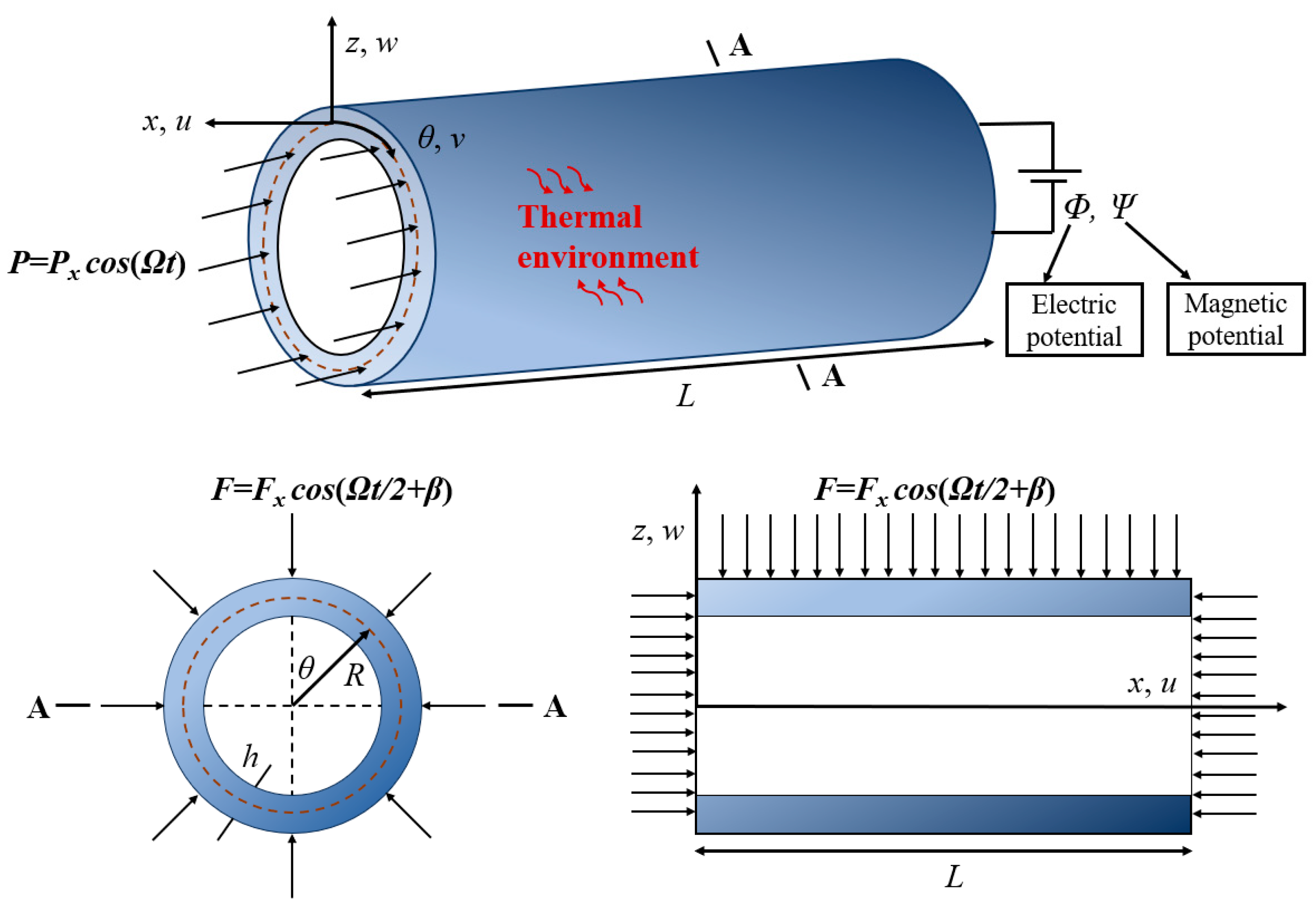
Figure 1. The sketch of a MEE cylindrical shell.
Dynamics 05 00048 g001
Figure 2. Comparative analysis of (a) forced resonance with the results of Amabili et al. [20] and (b) parametric resonance with results of Li et al. [21] for a cylindrical shell.
Dynamics 05 00048 g002
Figure 3. Combined resonance response of MEE plates at L = 1 m, R = 1 m, h = 0.05 m, T = 310 K, ϕ0 = 500 V, ψ0 = 500 A, kw = 1 × 10⁶, kg = 0, λ ¯ p = 0.32, λ ¯ F = 0.01, θ ¯ 1 = 2 ,   ζ = −π/4, (m, n) = (1, 7).
Dynamics 05 00048 g003
Figure 4. Combined resonance response of MEE plates at L = 1 m, R = 1 m, h = 0.05 m, T = 310 K, ϕ0 = 500 V, ψ0 = 500 A, kw = 1 × 10⁶, kg = 0, λ ¯ p = 0.315, λ ¯ F = 0.01, θ ¯ 1 = 2.02 ,   ζ = −π/4, (m, n) = (1, 7).
Dynamics 05 00048 g004
Figure 5. Combined resonance response of MEE plates at L = 1 m, R = 1 m, h = 0.05 m, T = 310 K, ϕ0 = 500 V, ψ0 = 500 A, kw = 1 × 10⁶, kg = 0, λ ¯ p = 0.35, λ ¯ F = 0.1, θ ¯ 1 = 2.05 ,   ζ = −π/4, (m, n) = (1, 7).
Dynamics 05 00048 g005
Figure 6. Combined resonance response of MEE plates at L = 1 m, R = 1 m, h = 0.05 m, T = 310 K, ϕ0 = 500 V, ψ0 = 500 A, kw = 1 × 10⁶, kg = 0, λ ¯ p = 0.415, λ ¯ F = 0.13, θ ¯ 1 = 0.25 ,   ζ = −π/4, (m, n) = (1, 7), (a) Pure CoFe2O4; (b) MEE; (c) Pure BaTiO3.
Dynamics 05 00048 g006
Figure 7. Combined resonance response of MEE plates at L = 1 m, R = 1 m, h = 0.05 m, T = 310 K, ϕ0 = 500 V, ψ0 = 500 A, kw = 1 × 10⁶, kg = 0, λ ¯ p = 0.315, λ ¯ F = 0.009, ζ = −π/4, (m, n) = (1, 7). (a) θ ¯ 1 = 2, (b) θ ¯ 1 = 2.02, (c) θ ¯ 1 = 2.05.
Dynamics 05 00048 g007
Figure 8. Combined resonance response of MEE plates at L = 1 m, R = 1 m, h = 0.05 m, T = 310 K, ϕ0 = 500 V, ψ0 = 500 A, kw = 1 × 10⁶, kg = 0, λ ¯ p = 0.35, θ ¯ 1 = 2.05, ζ = −π/4, (m, n) = (1, 7). (a) λ ¯ F = 0.16 (b) λ ¯ F = 0.22, (c) λ ¯ F = 0.28.
Dynamics 05 00048 g008
Figure 9. Combined resonance response of MEE plates at L = 1 m, R = 1 m, h = 0.05 m, T = 310 K, ϕ0 = 500 V, ψ0 = 500 A, kw = 1 × 10⁶, kg = 0, λ ¯ F = 0.2, θ ¯ 1 = 2.05, ζ = −π/4, (m, n) = (1, 7). (a) λ ¯ P = 0.2 = 0.32, (b) λ ¯ P = 0.35, (c) λ ¯ P = 0.37.
Dynamics 05 00048 g009
Figure 10. Combined resonance response of MEE plates at L = 1 m, R = 1 m, h = 0.05 m, T = 310 K, ϕ0 = 500 V, ψ0 = 500 A, kw = 1 × 10⁶, kg = 0, λ ¯ p = 0.33, λ ¯ F = 0.03, θ ¯ 1 = 2.03, (m, n) = (1, 7). (a) ζ = −π/4, (b) ζ = −π/2, (c) ζ = −π.
Dynamics 05 00048 g010
Figure 11. Comparative analysis of forced resonance and parametric resonance for a cylindrical shell: Effects of (a) temperature ΔT, (b) electric potential (ϕ0), (c) magnetic potential (ψ0), and (d) elastic coefficient (kw, kg).
Dynamics 05 00048 g011aDynamics 05 00048 g011b
Figure 12. Bifurcation trajectory at L = 1 m, R = 1 m, h = 0.05 m, T = 310 K, ϕ0 = 500 V, ψ0 = 500 A, kw = 1 × 10⁶, kg = 0, λ ¯ p = 0.58, θ ¯ 1 = 0.02, ζ = −π/4, (m, n) = (1, 7).
Dynamics 05 00048 g012
Figure 13. Time history plot at L = 1 m, R = 1 m, h = 0.05 m, T = 310 K, ϕ0 = 500 V, ψ0 = 500 A, kw = 1 × 10⁶, kg = 0, λ ¯ p = 0.58, θ ¯ 1 = 0.02, ζ = −π/4, (m, n) = (1, 7): (a) λ ¯ F = 3.6 ,   (b) λ ¯ F = 11.2 , (c)   λ ¯ F   = 51 , (d)   λ ¯ F   = 116 .
Dynamics 05 00048 g013
Figure 14. Phase trajectories at L = 1 m, R = 1 m, h = 0.05 m, T = 310 K, ϕ0 = 500 V, ψ0 = 500 A, kw = 1 × 10⁶, kg = 0, λ ¯ p = 0.58, θ ¯ 1 = 0.02, ζ = −π/4, (m, n) = (1, 7): (a) λ ¯ F = 3.6 ,   (b) λ ¯ F = 11.2 , (c) λ ¯ F = 51 , (d) λ ¯ F = 116 .
Dynamics 05 00048 g014
Figure 15. Bifurcation trajectory at L = 1 m, R = 1 m, h = 0.05 m, T = 310 K, ϕ0 = 500 V, ψ0 = 500 A, kw = 1 × 10⁶, kg = 0, λ ¯ F = 0.1, θ ¯ 1 = 0.2, ζ = −π/4, (m, n) = (1, 7).
Dynamics 05 00048 g015
Figure 16. Time history plot at L = 1 m, R = 1 m, h = 0.05 m, T = 310 K, ϕ0 = 500 V, ψ0 = 500 A, kw = 1 × 10⁶, kg = 0, λ ¯ F = 0.1, θ ¯ 1 = 0.2, ζ = −π/4, (m, n) = (1, 7): (a) λ ¯ p = 1 ,   (b) λ ¯ p = 7.8 , (c) λ ¯ p = 11.2 , (d) λ ¯ p = 13.2 .
Dynamics 05 00048 g016
Figure 17. Phase trajectories at L = 1 m, R = 1 m, h = 0.05 m, T = 310 K, ϕ0 = 500 V, ψ0 = 500 A, kw = 1 × 10⁶, kg = 0, λ ¯ F = 0.1, θ ¯ 1 = 0.2, ζ = −π/4, (m, n) = (1, 7): (a) λ ¯ p = 1 ,   (b) λ ¯ p = 7.8 , (c) λ ¯ p = 11.2 , (d) λ ¯ p = 13.2 .
Dynamics 05 00048 g017
Table 1. Material properties [18].
PropertiesMaterial ConstantsCoFe2O4MEEBaTiO3
Elastic constantc11 = c22 (GPa)286213166
c12173113.577
c13 = c23170112.878
c33269.5206.5162
c44= c5545.349.743
C6656.549.844.5
Piezoelectric constante31 = e32 (C/m2)0−2.71−4.4
e3308.8618.6
e15 =e2400.1511.6
Dielectric constants11 = s22 (10−9 C2/Nm2)0.080.7111.2
s330.0936.3212.6
Magnetic constantμ11 = μ22 (10−4 Ns2/C2)−5.9−1.920.05
μ331.570.830.1
Piezomagnetic constantq31 = q32 (N/Am)580222.60
q33699.72920
q15 = q24550185.130
Magnetoelectric coupling constantd11 = d22 (10−12 Ns/VC)05.350
d3302751.40
Thermal modulusβ1 (106 N/Km2)000
β2 = β31.11.11.1
Densityρ (kg/m3)530055005800
Table 2. Natural frequency (Hz) of an MEE cylindrical shell (K = 1, m = 1, n = 2).
Lay-UpR/h = 4R/h = 10
Ye et al. [19]PresentError (%)Ye et al. [19]PresentError (%)
MEE959.941963.1780.337641.113640.9920.019
B883.637867.5031.826586.639580.4861.049
F1041.5341062.52.003687.013703.9572.466
Disclaimer/Publisher’s Note: The statements, opinions and data contained in all publications are solely those of the individual author(s) and contributor(s) and not of MDPI and/or the editor(s). MDPI and/or the editor(s) disclaim responsibility for any injury to people or property resulting from any ideas, methods, instructions or products referred to in the content.