
Targeting the Cellular Prion Protein as a Biomarker for Stem Cells, Cancer, and Regeneration
 , and
, and 
Abstract
1. Introduction
2. Structure, Localization, and Signaling of the Cellular Prion Protein
2.1. Cleavage and Shedding of Prion Protein
2.2. GPI Anchor and Lipid Raft Localization
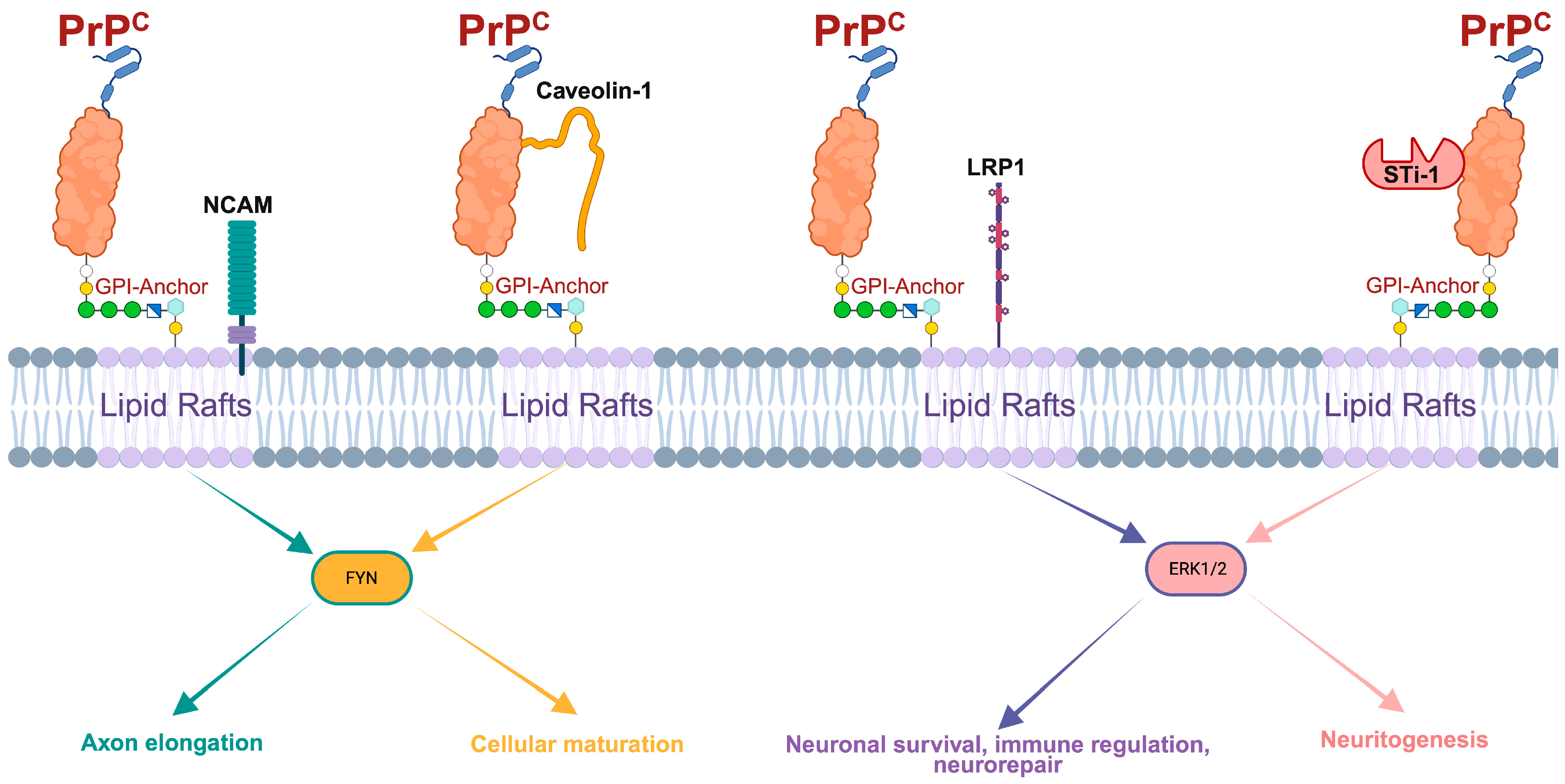
2.3. PrP Signaling Interactions in Physiological Processes
3. Prion Potency in Stem Cell Biology
3.1. Embryonic Stem Cells and Early Development
3.2. Adult Stem Cell Types and Lineages
3.3. From Pluripotency to Differentiation: PrPC as a Biomarker in Stem Cells
4. Prion Protein: From Stem Cells to Cancer
4.1. Implications in Cancer Cell Survival, Proliferation, Invasion, and Metastasis
4.1.1. Gastric Cancer (GC)
4.1.2. Glioblastoma (GBM)
4.1.3. Colorectal Cancer (CRC)
4.1.4. Other Cancers

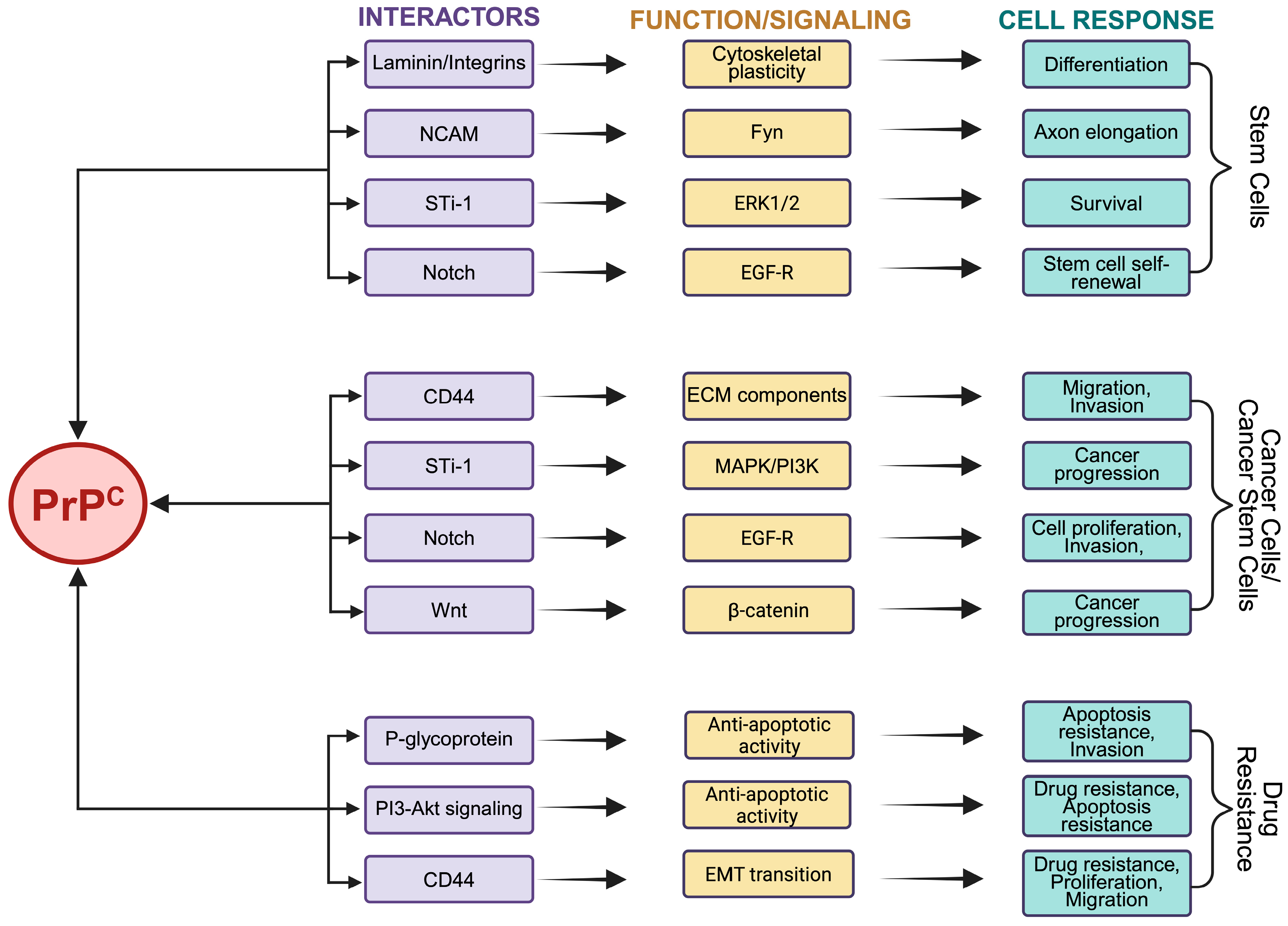
| Functional Context | Cell/Tissue | PrP Interacting Partner | Functional Outcome | Ref. |
|---|---|---|---|---|
| Physiological regeneration | Embryonic Stem Cells | PKC, Src | Promotion of neuritogenesis, Synapse formation, Axon elongation | [66] |
| Nestin, MAP-2 | Promotion of early neurogenesis | [88] | ||
| Adult Stem Cells | Notch/EGF-R | Modulation of neural stem cell self-renewal and proliferation | [98,99] | |
| EGF-R | Promotion of neuronal differentiation | [100] | ||
| Cancer | Gastric Cancer | Bcl-2 | Anti-apoptotic activity | [114,115] |
| PI3K/Akt, Cyclin D1 | Increased proliferation | [116] | ||
| MEK/ERK-MMP11 | Promotion of adhesion, invasion, and metastasis | [117] | ||
| Glioblastoma | HSP70/90 | Induction of proliferation | [122] | |
| Colorectal Cancer | HOP | Enancing migration and invasion | [124] | |
| Fyn-SP1-SATB1 | Acceleration of cancer metastasis | [125] | ||
| Pancreatic Cancer | FLNa | Increased tumor cell aggression | [128] |
4.2. PrPC in Therapy Resistance and Poor Prognosis
4.2.1. Breast Cancer
4.2.2. Lung Adenocarcinoma
4.2.3. Gastric Cancer
4.2.4. Colorectal Cancer
4.2.5. Other Contexts
5. PrPC as a Therapeutic Target in Cancer Treatment and Regenerative Medicine
5.1. Cancer Treatment
5.2. Excitability, Tissue Repair, and Regeneration
6. Concluding Remarks
Author Contributions
Funding
Data Availability Statement
Acknowledgments
Conflicts of Interest
Abbreviations
| Akt | Protein Kinase B |
| ASCs | Adult Stem Cells |
| Bcl-2 | B-cell lymphoma 2 |
| CRC | Colorectal Cancer |
| CSCs | Cancer Stem Cells |
| CJD | Creutzfeldt–Jakob Disease |
| CNS | Central Nervous System |
| DG | Hippocampal Dentate Gyrus |
| EGF-R | Epidermal Growth Factor Receptor |
| ER | Estrogen Receptor |
| ERK | Extracellular signal-regulated kinase |
| ESCs | Embryonic Stem Cells |
| Fyn | Tyrosine-protein kinase Fyn |
| FLNa | Filamin A |
| GBM | Glioblastoma |
| GC | Gastric Cancer |
| GSCs | Glioblastoma Stem Cells |
| HOP | Heat shock Organizing Protein |
| HSP | Heat Shock Protein |
| HSCs | Hematopoietic Stem Cells |
| LRP1 | Low-density lipoprotein Receptor-related Protein-1 |
| MEK | Mitogen-activated protein kinase |
| MMP11 | Matrix metalloproteinase-11 |
| NMDA-R | N-methyl-d-aspartate receptor |
| MAP2 | Microtubule-Associated Protein 2 |
| MβCD | Methyl-β-cyclodextrin |
| MSCs | Mesenchymal Stem Cells |
| PI3K | Phosphoinositide 3-kinase |
| PC | Pancreatic Cancer |
| PKC | Protein Kinase C |
| PrPC | Cellular prion protein |
| recPrP | Recombinant prion protein |
| PrPRes | Protease-resistant prion protein |
| PrPSc | Scrapie prion protein |
| S-PrP | Soluble prion protein |
| SATB1 | Special AT-rich sequence-binding protein 1 |
| SP1 | Specificity Protein 1 |
| STi-1 | Stress-inducible protein 1 |
| t-PA | Tissue-type plasminogen activator |
References
- Prusiner, S.B. Novel proteinaceous infectious particles cause scrapie. Science 1982, 216, 136–144. [Google Scholar] [CrossRef]
- Prusiner, S.B. Research on scrapie. Lancet 1982, 2, 494–495. [Google Scholar] [CrossRef]
- Schmitz, M.; Lüllmann, K.; Zafar, S.; Ebert, E.; Wohlhage, M.; Oikonomou, P.; Schlomm, M.; Mitrova, E.; Beekes, M.; Zerr, I. Association of prion protein genotype and scrapie prion protein type with cellular prion protein charge isoform profiles in cerebrospinal fluid of humans with sporadic or familial prion diseases. Neurobiol. Aging 2014, 35, 1177–1188. [Google Scholar] [CrossRef]
- Atkinson, C.J.; Zhang, K.; Munn, A.L.; Wiegmans, A.; Wei, M.Q. Prion protein scrapie and the normal cellular prion protein. Prion 2016, 10, 63–82. [Google Scholar] [CrossRef]
- Chandrasekaran, P.; Santosh Kumar, C.; Rangachari, K.; Sekar, K. Disassociation of β1-α1-β2 from the α2-α3 domain of prion protein (PrP) is a prerequisite for the conformational conversion of PrPC into PrPSc: Driven by the free energy landscape. Int. J. Biol. Macromol. 2019, 136, 368–376. [Google Scholar] [CrossRef] [PubMed]
- Mead, S.; Gandhi, S.; Beck, J.; Caine, D.; Gallujipali, D.; Carswell, C.; Hyare, H.; Joiner, S.; Ayling, H.; Lashley, T.; et al. A novel prion disease associated with diarrhea and autonomic neuropathy. N. Engl. J. Med. 2013, 369, 1904–1914. [Google Scholar] [CrossRef] [PubMed]
- Honda, H.; Mori, S.; Watanabe, A.; Sasagasako, N.; Sadashima, S.; Đồng, T.; Satoh, K.; Nishida, N.; Iwaki, T. Abnormal prion protein deposits with high seeding activities in the skeletal muscle, femoral nerve, and scalp of an autopsied case of sporadic Creutzfeldt-Jakob disease. Neuropathology 2021, 41, 152–158. [Google Scholar] [CrossRef]
- Honda, H.; Matsumoto, M.; Shijo, M.; Hamasak, I.H.; Sadashima, S.; Suzuki, S.O.; Aishima, S.; Kai, K.; Nakayama, K.I.; Sasagasako, N.; et al. Frequent Detection of Pituitary-Derived PrPRes in Human Prion Diseases. J. Neuropathol. Exp. Neurol. 2019, 78, 922–929. [Google Scholar] [CrossRef] [PubMed]
- Koyama, S.; Noguchi, H.; Yagita, K.; Hamasaki, H.; Shijo, M.; Yoshimura, M.; Inoshita, K.; Sasagasako, N.; Honda, H. Characteristic distribution and molecular properties of normal cellular prion protein in human endocrine and exocrine tissues. Sci. Rep. 2022, 12, 15289. [Google Scholar] [CrossRef]
- Crestini, A.; Santilli, F.; Martellucci, S.; Carbone, E.; Sorice, M.; Piscopo, P.; Mattei, V. Prions and Neurodegenerative Diseases: A Focus on Alzheimer’s Disease. J. Alzheimers Dis. 2022, 85, 503–518. [Google Scholar] [CrossRef]
- Walker, L.C.; Jucker, M. The prion principle and Alzheimer’s disease. Science 2024, 385, 1278–1279. [Google Scholar] [CrossRef]
- Holm-Mercer, L.; Mok, T.H.; Sequeira, D.; Coysh, T.; Rudge, P.; Ramadan, H.; Darwent, L.; Campbell, T.; Murphy, T.; Smith, C.; et al. Inherited prion disease caused by a novel frameshift mutation of PRNP resulting in protein truncation at codon 157. J. Alzheimers Dis. 2025, 106, 1087–1096. [Google Scholar] [CrossRef] [PubMed]
- Oesch, B.; Westaway, D.; Wälchli, M.; McKinley, M.P.; Kent, S.B.; Aebersold, R.; Barry, R.A.; Tempst, P.; Teplow, D.B.; Hood, L.E.; et al. A cellular gene encodes scrapie PrP 27-30 protein. Cell 1985, 40, 735–746. [Google Scholar] [CrossRef]
- Chesebro, B.; Race, R.; Wehrly, K.; Nishio, J.; Bloom, M.; Lechner, D.; Bergstrom, S.; Robbins, K.; Mayer, L.; Keith, J.M.; et al. Identification of scrapie prion protein-specific mRNA in scrapie-infected and uninfected brain. Nature 1985, 315, 331–333. [Google Scholar] [CrossRef]
- Watts, J.C.; Westaway, D. The prion protein family: Diversity, rivalry, and dysfunction. Biochim. Biophys. Acta 2007, 1772, 654–672. [Google Scholar] [CrossRef]
- Büeler, H.; Fischer, M.; Lang, Y.; Bluethmann, H.; Lipp, H.P.; DeArmond, S.J.; Prusiner, S.B.; Aguet, M.; Weissmann, C. Normal development and behaviour of mice lacking the neuronal cell-surface PrP protein. Nature 1992, 356, 577–582. [Google Scholar] [CrossRef] [PubMed]
- Manson, J.C.; Clarke, A.R.; Hooper, M.L.; Aitchison, L.; McConnell, I.; Hope, J. 129/Ola mice carrying a null mutation in PrP that abolishes mRNA production are developmentally normal. Mol. Neurobiol. 1994, 8, 121–127. [Google Scholar] [CrossRef] [PubMed]
- Martins, V.R.; Graner, E.; Garcia-Abreu, J.; de Souza, S.J.; Mercadante, A.F.; Veiga, S.S.; Zanata, S.M.; Neto, V.M.; Brentani, R.R. Complementary hydropathy identifies a cellular prion protein receptor. Nat. Med. 1997, 3, 1376–1382. [Google Scholar] [CrossRef]
- Mouillet-Richard, S.; Ermonval, M.; Chebassier, C.; Laplanche, J.L.; Lehmann, S.; Launay, J.M.; Kellermann, O. Signal transduction through prion protein. Science 2000, 289, 1925–1928. [Google Scholar] [CrossRef]
- Brown, D.R. Prion and prejudice: Normal protein and the synapse. Trends Neurosci. 2001, 24, 85–90. [Google Scholar] [CrossRef]
- Settanni, G.; Hoang, T.X.; Micheletti, C.; Maritan, A. Folding pathways of prion and doppel. Biophys. J. 2002, 83, 3533–3541. [Google Scholar] [CrossRef]
- Matamoros-Angles, A.; Hervera, A.; Soriano, J.; Martí, E.; Carulla, P.; Llorens, F.; Nuvolone, M.; Aguzzi, A.; Ferrer, I.; Gruart, A.; et al. Analysis of co-isogenic prion protein deficient mice reveals behavioral deficits, learning impairment, and enhanced hippocampal excitability. BMC Biol. 2022, 20, 17. [Google Scholar] [CrossRef]
- Schmitz, M.; Zafar, S.; Silva, C.J.; Zerr, I. Behavioral abnormalities in prion protein knockout mice and the potential relevance of PrPC for the cytoskeleton. Prion 2014, 8, 381–386. [Google Scholar] [CrossRef] [PubMed]
- Solforosi, L.; Criado, J.R.; McGavern, D.B.; Wirz, S.; Sánchez-Alavez, M.; Sugama, S.; DeGiorgio, L.A.; Volpe, B.T.; Wiseman, E.; Abalos, G.; et al. Cross-linking cellular prion protein triggers neuronal apoptosis in vivo. Science 2004, 303, 1514–1516. [Google Scholar] [CrossRef] [PubMed]
- Collinge, J.; Clarke, A.R. A general model of prion strains and their pathogenicity. Science 2007, 318, 930–936. [Google Scholar] [CrossRef]
- Aguzzi, A.; Baumann, F.; Bremer, J. The prion’s elusive reason for being. Annu. Rev. Neurosci. 2008, 31, 439–477. [Google Scholar] [CrossRef]
- Watts, J.C.; Bourkas, M.E.C.; Arshad, H. The function of the cellular prion protein in health and disease. Acta Neuropathol. 2018, 135, 159–178. [Google Scholar] [CrossRef] [PubMed]
- Steele, A.D.; Emsley, J.G.; Ozdinler, P.H.; Lindquist, S.; Macklis, J.D. Prion protein (PrPC) positively regulates neural precursor proliferation during developmental and adult mammalian neurogenesis. Proc. Natl. Acad. Sci. USA 2006, 103, 3416–3421. [Google Scholar] [CrossRef]
- Martins, V.R.; Beraldo, F.H.; Hajj, G.N.; Lopes, M.H.; Lee, K.S.; Prado, M.A.; Linden, R. Prion protein: Orchestrating neurotrophic activities. Curr. Issues Mol. Biol. 2010, 12, 63–86. [Google Scholar]
- Caetano, F.A.; Lopes, M.H.; Hajj, G.N.; Machado, C.F.; Pinto Arantes, C.; Magalhães, A.C.; Vieira Mde, P.; Américo, T.A.; Massensini, A.R.; Priola, S.A.; et al. Endocytosis of prion protein is required for ERK1/2 signaling induced by stress-inducible protein 1. J. Neurosci. 2008, 28, 6691–6702. [Google Scholar] [CrossRef]
- Linden, R.; Martins, V.R.; Prado, M.A.; Cammarota, M.; Izquierdo, I.; Brentani, R.R. Physiology of the prion protein. Physiol. Rev. 2008, 88, 673–728. [Google Scholar] [CrossRef]
- Cheon, Y.P.; Ryou, C.; Svedružić, Ž.M. Roles of prion proteins in mammalian development. Anim. Cells. Syst. 2024, 28, 551–566. [Google Scholar] [CrossRef]
- James, T.L.; Liu, H.; Ulyanov, N.B.; Farr-Jones, S.; Zhang, H.; Donne, D.G.; Kaneko, K.; Groth, D.; Mehlhorn, I.; Prusiner, S.; et al. Solution structure of a 142-residue recombinant prion protein corresponding to the infectious fragment of the scrapie isoform. Proc. Natl. Acad. Sci. USA 1997, 94, 10086–10091. [Google Scholar] [CrossRef]
- Biasini, E.; Turnbaugh, J.A.; Unterberger, U.; Harris, D.A. Prion protein at the crossroads of physiology and disease. Trends Neurosci. 2012, 35, 92–103. [Google Scholar] [CrossRef] [PubMed]
- Altmeppen, H.C.; Prox, J.; Krasemann, S.; Puig, B.; Kruszewski, K.; Dohler, F.; Bernreuther, C.; Hoxha, A.; Linsenmeier, L.; Sikorska, B.; et al. The sheddase ADAM10 is a potent modulator of prion disease. eLife 2015, 4, e04260. [Google Scholar] [CrossRef]
- Shen, P.; Dang, J.; Wang, Z.; Zhang, W.; Yuan, J.; Lang, Y.; Ding, M.; Mitchell, M.; Kong, Q.; Feng, J.; et al. Characterization of Anchorless Human PrP with Q227X Stop Mutation Linked to Gerstmann-Sträussler-Scheinker Syndrome In Vivo and In Vitro. Mol. Neurobiol. 2021, 58, 21–33. [Google Scholar] [CrossRef] [PubMed]
- Riek, R.; Hornemann, S.; Wider, G.; Billeter, M.; Glockshuber, R.; Wüthrich, K. NMR structure of the mouse prion protein domain PrP(121–231). Nature 1996, 382, 180–182. [Google Scholar] [CrossRef] [PubMed]
- Cobb, N.J.; Sönnichsen, F.D.; McHaourab, H.; Surewicz, W.K. Molecular architecture of human prion protein amyloid: A parallel, in-register beta-structure. Proc. Natl. Acad. Sci. USA 2007, 104, 18946–18951. [Google Scholar] [CrossRef]
- Pushie, M.J.; Vogel, H.J. Modeling by assembly and molecular dynamics simulations of the low Cu2+ occupancy form of the mammalian prion protein octarepeat region: Gaining insight into Cu2+-mediated beta-cleavage. Biophys. J. 2008, 95, 5084–5091. [Google Scholar] [CrossRef]
- Zahn, R.; Liu, A.; Lührs, T.; Riek, R.; von Schroetter, C.; López García, F.; Billeter, M.; Calzolai, L.; Wider, G.; Wüthrich, K. NMR solution structure of the human prion protein. Proc. Natl. Acad. Sci. USA 2000, 97, 145–150. [Google Scholar] [CrossRef]
- Calzolai, L.; Zahn, R. Influence of pH on NMR structure and stability of the human prion protein globular domain. J. Biol. Chem. 2003, 278, 35592–35596. [Google Scholar] [CrossRef]
- Chen, S.G.; Teplow, D.B.; Parchi, P.; Teller, J.K.; Gambetti, P.; Autilio-Gambetti, L. Truncated forms of the human prion protein in normal brain and in prion diseases. J. Biol. Chem. 1995, 270, 19173–19180. [Google Scholar] [CrossRef] [PubMed]
- Yadavalli, R.; Guttmann, R.P.; Seward, T.; Centers, A.P.; Williamson, R.A.; Telling, G.C. Calpain-dependent endoproteolytic cleavage of PrPSc modulates scrapie prion propagation. J. Biol. Chem. 2004, 279, 21948–21956. [Google Scholar] [CrossRef] [PubMed]
- Watt, N.T.; Taylor, D.R.; Gillott, A.; Thomas, D.A.; Perera, W.S.; Hooper, N.M. Reactive oxygen species-mediated beta-cleavage of the prion protein in the cellular response to oxidative stress. J. Biol. Chem. 2005, 280, 35914–35921. [Google Scholar] [CrossRef] [PubMed]
- Borchelt, D.R.; Rogers, M.; Stahl, N.; Telling, G.; Prusiner, S.B. Release of the cellular prion protein from cultured cells after loss of its glycoinositol phospholipid anchor. Glycobiology 1993, 3, 319–329. [Google Scholar] [CrossRef]
- Parkin, E.T.; Watt, N.T.; Turner, A.J.; Hooper, N.M. Dual mechanisms for shedding of the cellular prion protein. J. Biol. Chem. 2004, 279, 11170–11178. [Google Scholar] [CrossRef]
- Lewis, V.; Johanssen, V.A.; Crouch, P.J.; Klug, G.M.; Hooper, N.M.; Collins, S.J. Prion protein “gamma-cleavage”: Characterizing a novel endoproteolytic processing event. Cell Mol. Life Sci. 2016, 73, 667–683. [Google Scholar] [CrossRef]
- Wu, E.L.; Qi, Y.; Park, S.; Mallajosyula, S.S.; MacKerell, A.D., Jr.; Klauda, J.B.; Im, W. Insight into Early-Stage Unfolding of GPI-Anchored Human Prion Protein. Biophys. J. 2015, 109, 2090–2100. [Google Scholar] [CrossRef][Green Version]
- Liu, T.; Li, R.; Pan, T.; Liu, D.; Petersen, R.B.; Wong, B.S.; Gambetti, P.; Sy, M.S. Intercellular transfer of the cellular prion protein. J. Biol. Chem. 2002, 277, 47671-8. [Google Scholar] [CrossRef]
- Sorice, M.; Mattei, V.; Tasciotti, V.; Manganelli, V.; Garofalo, T.; Misasi, R. Trafficking of PrPC to mitochondrial raft-like microdomains during cell apoptosis. Prion 2012, 6, 354–358. [Google Scholar] [CrossRef]
- Kraft, M.L. Sphingolipid Organization in the Plasma Membrane and the Mechanisms That Influence It. Front. Cell Dev. Biol. 2017, 4, 154. [Google Scholar] [CrossRef]
- Prusiner, S.B. Prions. Proc. Natl. Acad. Sci. USA 1998, 95, 13363–13383. [Google Scholar] [CrossRef] [PubMed]
- Prusiner, S.B.; Scott, M.R.; DeArmond, S.J.; Cohen, F.E. Prion protein biology. Cell 1998, 93, 337–348. [Google Scholar] [CrossRef] [PubMed]
- Gad, A.Z.; Morris, J.S.; Godret-Miertschin, L.; Montalvo, M.J.; Kerr, S.S.; Berger, H.; Lee, J.C.H.; Saadeldin, A.M.; Abu-Arja, M.H.; Xu, S.; et al. Molecular dynamics at immune synapse lipid rafts influence the cytolytic behavior of CAR T cells. Sci. Adv. 2025, 11, eadq8114. [Google Scholar] [CrossRef]
- Santilli, F.; Fabrizi, J.; Martellucci, S.; Santacroce, C.; Iorio, E.; Pisanu, M.E.; Chirico, M.; Lancia, L.; Pulcini, F.; Manganelli, V.; et al. Lipid rafts mediate multilineage differentiation of human dental pulp-derived stem cells (DPSCs). Front. Cell Dev. Biol. 2023, 11, 1274462. [Google Scholar] [CrossRef]
- Alomari, M.; Almohazey, D.; Almofty, S.A.; Khan, F.A.; Al Hamad, M.; Ababneh, D. Role of Lipid Rafts in Hematopoietic Stem Cells Homing, Mobilization, Hibernation, and Differentiation. Cells 2019, 8, 630. [Google Scholar] [CrossRef]
- Gupta, N.; Wollscheid, B.; Watts, J.D.; Scheer, B.; Aebersold, R.; DeFranco, A.L. Quantitative proteomic analysis of B cell lipid rafts reveals that ezrin regulates antigen receptor-mediated lipid raft dynamics. Nat. Immunol. 2006, 7, 625–633. [Google Scholar] [CrossRef]
- Pawson, T. Protein modules and signalling networks. Nature 1995, 373, 573–580. [Google Scholar] [CrossRef]
- Simons, K.; Toomre, D. Lipid rafts and signal transduction. Nat. Rev. Mol. Cell Biol. 2000, 1, 31–39. [Google Scholar] [CrossRef] [PubMed]
- Didonna, A. Prion protein and its role in signal transduction. Cell Mol. Biol. Lett. 2013, 18, 209–230. [Google Scholar] [CrossRef] [PubMed]
- Graner, E.; Mercadante, A.F.; Zanata, S.M.; Forlenza, O.V.; Cabral, A.L.; Veiga, S.S.; Juliano, M.A.; Roesler, R.; Walz, R.; Minetti, A.; et al. Cellular prion protein binds laminin and mediates neuritogenesis. Brain Res. Mol. Brain Res. 2000, 76, 85–92. [Google Scholar] [CrossRef]
- Gauczynski, S.; Peyrin, J.M.; Haïk, S.; Leucht, C.; Hundt, C.; Rieger, R.; Krasemann, S.; Deslys, J.P.; Dormont, D.; Lasmézas, C.I.; et al. The 37-kDa/67-kDa laminin receptor acts as the cell-surface receptor for the cellular prion protein. EMBO J. 2001, 20, 5863–5875. [Google Scholar] [CrossRef]
- Zanata, S.M.; Lopes, M.H.; Mercadante, A.F.; Hajj, G.N.; Chiarini, L.B.; Nomizo, R.; Freitas, A.R.; Cabral, A.L.; Lee, K.S.; Juliano, M.A.; et al. Stress-inducible protein 1 is a cell surface ligand for cellular prion that triggers neuroprotection. EMBO J. 2002, 21, 3307–3316. [Google Scholar] [CrossRef]
- Lopes, M.H.; Hajj, G.N.; Muras, A.G.; Mancini, G.L.; Castro, R.M.; Ribeiro, K.C.; Brentani, R.R.; Linden, R.; Martins, V.R. Interaction of cellular prion and stress-inducible protein 1 promotes neuritogenesis and neuroprotection by distinct signaling pathways. J. Neurosci. 2005, 25, 11330–11339. [Google Scholar] [CrossRef]
- Santuccione, A.; Sytnyk, V.; Leshchyns’ka, I.; Schachner, M. Prion protein recruits its neuronal receptor NCAM to lipid rafts to activate p59fyn and to enhance neurite outgrowth. J. Cell Biol. 2005, 169, 341–354. [Google Scholar] [CrossRef] [PubMed]
- Kanaani, J.; Prusiner, S.B.; Diacovo, J.; Baekkeskov, S.; Legname, G. Recombinant prion protein induces rapid polarization and development of synapses in embryonic rat hippocampal neurons in vitro. J. Neurochem. 2005, 95, 1373–1386. [Google Scholar] [CrossRef] [PubMed]
- Martellucci, S.; Flütsch, A.; Carter, M.; Norimoto, M.; Pizzo, D.; Mantuano, E.; Sadri, M.; Wang, Z.; Chillin-Fuentes, D.; Rosenthal, S.B.; et al. Axon-derived PACSIN1 binds to the Schwann cell survival receptor, LRP1, and transactivates TrkC to promote gliatrophic activities. Glia 2024, 72, 916–937. [Google Scholar] [CrossRef]
- Zhang, Y.; Ma, K.L.; Ruan, X.Z.; Liu, B.C. Dysregulation of the Low-Density Lipoprotein Receptor Pathway Is Involved in Lipid Disorder-Mediated Organ Injury. Int. J. Biol. Sci. 2016, 12, 569–579. [Google Scholar] [CrossRef] [PubMed]
- Riitano, G.; Manganelli, V.; Capozzi, A.; Mattei, V.; Recalchi, S.; Martellucci, S.; Longo, A.; Misasi, R.; Garofalo, T.; Sorice, M. LRP6 mediated signal transduction pathway triggered by tissue plasminogen activator acts through lipid rafts in neuroblastoma cells. J. Cell Commun. Signal 2020, 14, 315–323. [Google Scholar] [CrossRef]
- Martellucci, S.; Heredia, M.; Wang, Z.; Whisenant, T.; Strickland, D.K.; Sanchez, R.; Arai, T.; Zhang, M.; Wang, H.; Gong, Z.; et al. The low-density lipoprotein receptor-related protein-1 (LRP1) in Schwann cells controls mitochondria homeostasis in peripheral nerves. Prog. Neurobiol. 2025, 251, 102796. [Google Scholar] [CrossRef]
- Gong, Z.; Zhang, M.; Asam, K.; Martellucci, S.; Aouizerat, B.; Campana, W.M.; Ye, Y. Schwann Cell Lrp1 Deletion Drives Trigeminal Neuron Sensitization and Orofacial Pain by Modulating Mitochondrial Function and TRPV1/TRPA1 Activity. J. Headache Pain 2025. [Google Scholar] [CrossRef] [PubMed]
- Wang, Z.; Martellucci, S.; Van Enoo, A.; Austin, D.; Gelber, C.; Campana, W.M. α1-Antitrypsin derived SP16 peptide demonstrates efficacy in rodent models of acute and neuropathic pain. FASEB J. 2022, 36, e22093. [Google Scholar] [CrossRef]
- Mantuano, E.; Azmoon, P.; Banki, M.A.; Lam, M.S.; Sigurdson, C.J.; Gonias, S.L. A soluble derivative of PrPC activates cell-signaling and regulates cell physiology through LRP1 and the NMDA receptor. J. Biol. Chem. 2020, 295, 14178–14188. [Google Scholar] [CrossRef]
- Mantuano, E.; Azmoon, P.; Banki, M.A.; Sigurdson, C.J.; Campana, W.M.; Gonias, S.L. A Soluble PrPC Derivative and Mem-brane-Anchored PrPC in Extracellular Vesicles Attenuate Innate Immunity by Engaging the NMDA-R/LRP1 Receptor Com-plex. J. Immunol. 2022, 208, 85–96. [Google Scholar] [CrossRef]
- Mantuano, E.; Azmoon, P.; Banki, M.A.; Gunner, C.B.; Gonias, S.L. The LRP1/CD91 ligands, tissue-type plasminogen activator, α2-macroglobulin, and soluble cellular prion protein have distinct co-receptor requirements for activation of cell-signaling. Sci. Rep. 2022, 12, 17594. [Google Scholar] [CrossRef]
- Mantuano, E.; Zampieri, C.; Azmoon, P.; Gunner, C.B.; Heye, K.R.; Gonias, S.L. An LRP1-binding motif in cellular prion protein replicates cell-signaling activities of the full-length protein. JCI Insight 2023, 8, e170121. [Google Scholar] [CrossRef]
- Mattei, V.; Manganelli, V.; Martellucci, S.; Capozzi, A.; Mantuano, E.; Longo, A.; Ferri, A.; Garofalo, T.; Sorice, M.; Misasi, R. A multimolecular signaling complex including PrPC and LRP1 is strictly dependent on lipid rafts and is essential for the function of tissue plasminogen activator. J. Neurochem. 2020, 152, 468–481. [Google Scholar] [CrossRef] [PubMed]
- Laurén, J.; Gimbel, D.A.; Nygaard, H.B.; Gilbert, J.W.; Strittmatter, S.M. Cellular prion protein mediates impairment of synaptic plasticity by amyloid-beta oligomers. Nature 2009, 457, 1128–1132. [Google Scholar] [CrossRef] [PubMed]
- Thom, T.; Schmitz, M.; Fischer, A.L.; Correia, A.; Correia, S.; Llorens, F.; Pique, A.V.; Möbius, W.; Domingues, R.; Zafar, S.; et al. Cellular Prion Protein Mediates α-Synuclein Uptake, Localization, and Toxicity In Vitro and In Vivo. Mov. Disord. 2022, 37, 39–51. [Google Scholar] [CrossRef]
- Mattei, V.; Martellucci, S.; Santilli, F.; Manganelli, V.; Garofalo, T.; Candelise, N.; Caruso, A.; Sorice, M.; Scaccianoce, S.; Misasi, R. Morphine Withdrawal Modifies Prion Protein Expression in Rat Hippocampus. PLoS ONE 2017, 12, e0169571. [Google Scholar] [CrossRef]
- Lopes, M.H.; Santos, T.G. Prion potency in stem cells biology. Prion 2012, 6, 142–146. [Google Scholar] [CrossRef]
- Miranda, A.; Ramos-Ibeas, P.; Pericuesta, E.; Ramirez, M.Á.; Gutierrez-Adan, A. The role of prion protein in stem cell regulation. Reproduction 2013, 146, R91-9. [Google Scholar] [CrossRef] [PubMed]
- Mediano, D.R.; Sanz-Rubio, D.; Ranera, B.; Bolea, R.; Martín-Burriel, I. The potential of mesenchymal stem cell in prion research. Zoonoses Public Health 2015, 62, 165–178. [Google Scholar] [CrossRef] [PubMed]
- Martellucci, S.; Santacroce, C.; Santilli, F.; Manganelli, V.; Sorice, M.; Mattei, V. Prion Protein in Stem Cells: A Lipid Raft Component Involved in the Cellular Differentiation Process. Int. J. Mol. Sci. 2020, 21, 4168. [Google Scholar] [CrossRef]
- Tanji, K.; Saeki, K.; Matsumoto, Y.; Takeda, M.; Hirasawa, K.; Doi, K.; Matsumoto, Y.; Onodera, T. Analysis of PrPC mRNA by in situ hybridization in brain, placenta, uterus and testis of rats. Intervirology 1995, 38, 309–315. [Google Scholar] [CrossRef]
- Miranda, A.; Pericuesta, E.; Ramírez, M.Á.; Gutiérrez-Adán, A. Prion protein in ESC regulation. Prion 2011, 5, 169–171. [Google Scholar] [CrossRef] [PubMed]
- Miranda, A.; Pericuesta, E.; Ramírez, M.Á.; Gutierrez-Adan, A. Prion protein expression regulates embryonic stem cell pluripotency and differentiation. PLoS ONE 2011, 6, e18422. [Google Scholar] [CrossRef]
- Peralta, O.A.; Huckle, W.R.; Eyestone, W.H. Expression and knockdown of cellular prion protein (PrPC) in differentiating mouse embryonic stem cells. Differentiation 2011, 81, 68–77. [Google Scholar] [CrossRef]
- Lee, Y.J.; Baskakov, I.V. The cellular form of the prion protein is involved in controlling cell cycle dynamics, self-renewal, and the fate of human embryonic stem cell differentiation. J. Neurochem. 2013, 124, 310–322. [Google Scholar] [CrossRef]
- Manson, J.; West, J.D.; Thomson, V.; McBride, P.; Kaufman, M.H.; Hope, J. Prion Protein Gene: A Role Mouse Embryogenesis? Development 1992, 115, 117–122. [Google Scholar] [CrossRef]
- Hajj, G.N.; Santos, T.G.; Cook, Z.S.; Martins, V.R. Developmental expression of prion protein and its ligands stress-inducible protein 1 and vitronectin. J. Comp. Neurol. 2009, 517, 371–384. [Google Scholar] [CrossRef]
- Passet, B.; Young, R.; Makhzami, S.; Vilotte, M.; Jaffrezic, F.; Halliez, S.; Bouet, S.; Marthey, S.; Khalifé, M.; Kanellopoulos-Langevin, C.; et al. Prion protein and Shadoo are involved in overlapping embryonic pathways and trophoblastic development. PLoS ONE 2012, 7, e41959. [Google Scholar] [CrossRef]
- Peralta, O.A.; Huckle, W.R.; Eyestone, W.H. Developmental expression of the cellular prion protein (PrPC) in bovine embryos. Mol. Reprod. Dev. 2012, 79, 488–498. [Google Scholar] [CrossRef] [PubMed]
- Salès, N.; Hässig, R.; Rodolfo, K.; Di Giamberardino, L.; Traiffort, E.; Ruat, M.; Frétier, P.; Moya, K.L. Developmental expression of the cellular prion protein in elongating axons. Eur. J. Neurosci. 2002, 15, 1163–1177. [Google Scholar] [CrossRef] [PubMed]
- Cotto, E.; André, M.; Forgue, J.; Fleury, H.J.; Babin, P.J. Molecular characterization, phylogenetic relationships, and developmental expression patterns of prion genes in zebrafish (Danio rerio). FEBS J. 2005, 272, 500–513. [Google Scholar] [CrossRef] [PubMed]
- Nourizadeh-Lillabadi, R.; Seilø Torgersen, J.; Vestrheim, O.; König, M.; Aleström, P.; Syed, M. Early embryonic gene expression profiling of zebrafish prion protein (Prp2) morphants. PLoS ONE 2010, 5, e13573. [Google Scholar] [CrossRef]
- Málaga-Trillo, E.; Sempou, E. PrPs: Proteins with a purpose: Lessons from the zebrafish. Prion 2009, 3, 129–133. [Google Scholar] [CrossRef]
- Aguirre, A.; Rubio, M.E.; Gallo, V. Notch and EGFR pathway interaction regulates neural stem cell number and self-renewal. Nature 2010, 467, 323–327. [Google Scholar] [CrossRef]
- Martin-Lannerée, S.; Halliez, S.; Hirsch, T.Z.; Hernandez-Rapp, J.; Passet, B.; Tomkiewicz, C.; Villa-Diaz, A.; Torres, J.M.; Launay, J.M.; Béringue, V.; et al. The Cellular Prion Protein Controls Notch Signaling in Neural Stem/Progenitor Cells. Stem Cells 2017, 35, 754–765. [Google Scholar] [CrossRef]
- Martellucci, S.; Manganelli, V.; Santacroce, C.; Santilli, F.; Piccoli, L.; Sorice, M.; Mattei, V. Role of Prion protein-EGFR multimolecular complex during neuronal differentiation of human dental pulp-derived stem cells. Prion 2018, 12, 117–126. [Google Scholar] [CrossRef]
- Mattei, V.; Santacroce, C.; Tasciotti, V.; Martellucci, S.; Santilli, F.; Manganelli, V.; Piccoli, L.; Misasi, R.; Sorice, M.; Garofalo, T. Role of lipid rafts in neuronal differentiation of dental pulp-derived stem cells. Exp. Cell Res. 2015, 339, 231–240. [Google Scholar] [CrossRef]
- Martellucci, S.; Santacroce, C.; Santilli, F.; Piccoli, L.; Delle Monache, S.; Angelucci, A.; Misasi, R.; Sorice, M.; Mattei, V. Cellular and Molecular Mechanisms Mediated by recPrP Involved in the Neuronal Differentiation Process of Mesenchymal Stem Cells. Int. J. Mol. Sci. 2019, 20, 345. [Google Scholar] [CrossRef] [PubMed]
- Castle, A.R.; Gill, A.C. Physiological Functions of the Cellular Prion Protein. Front. Mol. Biosci. 2017, 4, 19. [Google Scholar] [CrossRef]
- Holada, K.; Vostal, J.G. Different levels of prion protein (PrPC) expression on hamster, mouse and human blood cells. Br. J. Haematol. 2000, 110, 472–480. [Google Scholar] [CrossRef]
- Sim, H.J.; Kim, Y.C.; Bhattarai, G.; Won, S.Y.; Lee, J.C.; Jeong, B.H.; Kook, S.H. Prion infection modulates hematopoietic stem/progenitor cell fate through cell-autonomous and non-autonomous mechanisms. Leukemia 2023, 37, 877–887. [Google Scholar] [CrossRef]
- Liu, T.; Li, R.; Wong, B.S.; Liu, D.; Pan, T.; Petersen, R.B.; Gambetti, P.; Sy, M.S. Normal cellular prion protein is preferentially expressed on subpopulations of murine hemopoietic cells. J. Immunol. 2001, 166, 3733–3742. [Google Scholar] [CrossRef]
- Risitano, A.M.; Holada, K.; Chen, G.; Simak, J.; Vostal, J.G.; Young, N.S.; Maciejewski, J.P. CD34+ cells from paroxysmal nocturnal hemoglobinuria (PNH) patients are deficient in surface expression of cellular prion protein (PrPC). Exp. Hematol. 2003, 31, 65–72. [Google Scholar] [CrossRef] [PubMed]
- Martellucci, S.; Santacroce, C.; Manganelli, V.; Santilli, F.; Piccoli, L.; Cassetta, M.; Misasi, R.; Sorice, M.; Mattei, V. Isolation, Propagation, and Prion Protein Expression During Neuronal Differentiation of Human Dental Pulp Stem Cells. J. Vis. Exp. 2019, 145, 1–7. [Google Scholar]
- Hidaka, K.; Shirai, M.; Lee, J.K.; Wakayama, T.; Kodama, I.; Schneider, M.D.; Morisaki, T. The cellular prion protein identifies bipotential cardiomyogenic progenitors. Circ. Res. 2010, 106, 111–119. [Google Scholar] [CrossRef]
- Ikeda, N.; Nakayama, Y.; Nakazawa, N.; Yoshida, A.; Ninomiya, H.; Shirayoshi, Y. Prion Protein and Stage Specific Embryo Antigen 1 as Selection Markers to Enrich the Fraction of Murine Embryonic Stem Cell-Derived Cardiomyocytes. Yonago Acta Med. 2016, 59, 126–134. [Google Scholar]
- Massimino, M.L.; Ferrari, J.; Sorgato, M.C.; Bertoli, A. Heterogeneous PrPC metabolism in skeletal muscle cells. FEBS Lett. 2006, 580, 878–884. [Google Scholar] [CrossRef]
- Go, G.; Lee, S.H. The Cellular Prion Protein: A Promising Therapeutic Target for Cancer. Int. J. Mol. Sci. 2020, 21, 9208. [Google Scholar] [CrossRef]
- Martin-Lannerée, S.; Hirsch, T.Z.; Hernandez-Rapp, J.; Halliez, S.; Vilotte, J.L.; Launay, J.M.; Mouillet-Richard, S. PrPC from stem cells to cancer. Front. Cell Dev. Biol. 2014, 2, 55. [Google Scholar]
- Ryskalin, L.; Biagioni, F.; Busceti, C.L.; Giambelluca, M.A.; Morelli, L.; Frati, A.; Fornai, F. The Role of Cellular Prion Protein in Promoting Stemness and Differentiation in Cancer. Cancers 2021, 13, 170. [Google Scholar] [CrossRef]
- Liang, J.; Pan, Y.L.; Ning, X.X.; Sun, L.J.; Lan, M.; Hong, L.; Du, J.P.; Liu, N.; Liu, C.J.; Qiao, T.D.; et al. Overexpression of PrPC and its antiapoptosis function in gastric cancer. Tumour Biol. 2006, 27, 84–91. [Google Scholar] [CrossRef] [PubMed]
- Liang, J.; Pan, Y.; Zhang, D.; Guo, C.; Shi, Y.; Wang, J.; Chen, Y.; Wang, X.; Liu, J.; Guo, X.; et al. Cellular prion protein promotes proliferation and G1/S transition of human gastric cancer cells SGC7901 and AGS. FASEB J. 2007, 21, 2247–2256. [Google Scholar] [CrossRef]
- Pan, Y.; Zhao, L.; Liang, J.; Liu, J.; Shi, Y.; Liu, N.; Zhang, G.; Jin, H.; Gao, J.; Xie, H.; et al. Cellular prion protein promotes invasion and metastasis of gastric cancer. FASEB J. 2006, 20, 1886–1888. [Google Scholar] [CrossRef] [PubMed]
- Thellung, S.; Corsaro, A.; Bosio, A.G.; Zambito, M.; Barbieri, F.; Mazzanti, M.; Florio, T. Emerging Role of Cellular Prion Protein in the Maintenance and Expansion of Glioma Stem Cells. Cells 2019, 8, 1458. [Google Scholar] [CrossRef] [PubMed]
- Corsaro, A.; Dellacasagrande, I.; Tomanelli, M.; Pagano, A.; Barbieri, F.; Thellung, S.; Florio, T. The expression of pro-prion, a transmembrane isoform of the prion protein, leads to the constitutive activation of the canonical Wnt/β-catenin pathway to sustain the stem-like phenotype of human glioblastoma cells. Cancer Cell Int. 2024, 24, 426. [Google Scholar] [CrossRef]
- Corsaro, A.; Bajetto, A.; Thellung, S.; Begani, G.; Villa, V.; Nizzari, M.; Pattarozzi, A.; Solari, A.; Gatti, M.; Pagano, A.; et al. Cellular prion protein controls stem cell-like properties of human glioblastoma tumor-initiating cells. Oncotarget 2016, 7, 38638–38657. [Google Scholar] [CrossRef]
- Prado, M.B.; Coelho, B.P.; Iglesia, R.P.; Alves, R.N.; Boccacino, J.M.; Fernandes, C.F.L.; Melo-Escobar, M.I.; Ayyadhury, S.; Cruz, M.C.; Santos, T.G.; et al. Prion protein regulates invasiveness in glioblastoma stem cells. BMC Cancer 2024, 24, 1539. [Google Scholar] [CrossRef]
- Iglesia, R.P.; Prado, M.B.; Cruz, L.; Martins, V.R.; Santos, T.G.; Lopes, M.H. Engagement of cellular prion protein with the co-chaperone Hsp70/90 organizing protein regulates the proliferation of glioblastoma stem-like cells. Stem Cell Res. Ther. 2017, 8, 76. [Google Scholar] [CrossRef] [PubMed]
- Li, Q.Q.; Sun, Y.P.; Ruan, C.P.; Xu, X.Y.; Ge, J.H.; He, J.; Xu, Z.D.; Wang, Q.; Gao, W.C. Cellular prion protein promotes glucose uptake through the Fyn-HIF-2α-Glut1 pathway to support colorectal cancer cell survival. Cancer Sci. 2011, 102, 400–406. [Google Scholar] [CrossRef]
- de Lacerda, T.C.; Costa-Silva, B.; Giudice, F.S.; Dias, M.V.; de Oliveira, G.P.; Teixeira, B.L.; Dos Santos, T.G.; Martins, V.R. Prion protein binding to HOP modulates the migration and invasion of colorectal cancer cells. Clin. Exp. Metastasis 2016, 33, 441–451. [Google Scholar] [CrossRef]
- Wang, Q.; Qian, J.; Wang, F.; Ma, Z. Cellular prion protein accelerates colorectal cancer metastasis via the Fyn-SP1-SATB1 axis. Oncol. Rep. 2012, 28, 2029–2034. [Google Scholar] [CrossRef]
- Besnier, L.S.; Cardot, P.; Da Rocha, B.; Simon, A.; Loew, D.; Klein, C.; Riveau, B.; Lacasa, M.; Clair, C.; Rousset, M.; et al. The cellular prion protein PrPC is a partner of the Wnt pathway in intestinal epithelial cells. Mol. Biol. Cell 2015, 26, 3313–3328. [Google Scholar] [CrossRef]
- Provenzano, L.; Ryan, Y.; Hilton, D.A.; Lyons-Rimmer, J.; Dave, F.; Maze, E.A.; Adams, C.L.; Rigby-Jones, R.; Ammoun, S.; Hanemann, C.O. Cellular prion protein (PrPC) in the development of Merlin-deficient tumours. Oncogene 2017, 36, 6132–6142. [Google Scholar] [CrossRef]
- Sy, M.S.; Li, C.; Yu, S.; Xin, W. The fatal attraction between pro-prion and filamin A: Prion as a marker in human cancers. Biomark. Med. 2010, 4, 453–464. [Google Scholar] [CrossRef] [PubMed]
- Bernardino-Sgherri, J.; Siberchicot, C.; Auvré, F.; Busso, D.; Brocas, C.; El Masri, G.; Lioutsko, A.; Ferri, F.; Radicella, J.P.; Romeo, P.H.; et al. Tumor resistance to radiotherapy is triggered by an ATM/TAK1-dependent-increased expression of the cellular prion protein. Oncogene 2021, 40, 3460–3469. [Google Scholar] [CrossRef] [PubMed]
- Diarra-Mehrpour, M.; Arrabal, S.; Jalil, A.; Pinson, X.; Gaudin, C.; Piétu, G.; Pitaval, A.; Ripoche, H.; Eloit, M.; Dormont, D.; et al. Prion protein prevents human breast carcinoma cell line from tumor necrosis factor alpha-induced cell death. Cancer Res. 2004, 64, 719–727. [Google Scholar] [CrossRef]
- Roucou, X.; Giannopoulos, P.N.; Zhang, Y.; Jodoin, J.; Goodyer, C.G.; LeBlanc, A. Cellular prion protein inhibits proapoptotic Bax conformational change in human neurons and in breast carcinoma MCF-7 cells. Cell Death Differ. 2005, 12, 783–795. [Google Scholar] [CrossRef]
- Meslin, F.; Conforti, R.; Mazouni, C.; Morel, N.; Tomasic, G.; Drusch, F.; Yacoub, M.; Sabourin, J.C.; Grassi, J.; Delaloge, S.; et al. Efficacy of adjuvant chemotherapy according to Prion protein expression in patients with estrogen receptor-negative breast cancer. Ann. Oncol. 2007, 18, 1793–1798. [Google Scholar] [CrossRef] [PubMed]
- Cheng, Y.; Tao, L.; Xu, J.; Li, Q.; Yu, J.; Jin, Y.; Chen, Q.; Xu, Z.; Zou, Q.; Liu, X. CD44/cellular prion protein interact in multidrug resistant breast cancer cells and correlate with responses to neoadjuvant chemotherapy in breast cancer patients. Mol. Carcinog. 2014, 53, 686–697. [Google Scholar] [CrossRef] [PubMed]
- Li, Q.Q.; Cao, X.X.; Xu, J.D.; Chen, Q.; Wang, W.J.; Tang, F.; Chen, Z.Q.; Liu, X.P.; Xu, Z.D. The role of P-glycoprotein/cellular prion protein interaction in multidrug-resistant breast cancer cells treated with paclitaxel. Cell Mol. Life Sci. 2009, 66, 504–515. [Google Scholar] [CrossRef]
- Lin, S.C.; Lin, C.H.; Shih, N.C.; Liu, H.L.; Wang, W.C.; Lin, K.Y.; Liu, Z.Y.; Tseng, Y.J.; Chang, H.K.; Lin, Y.C.; et al. Cellular prion protein transcriptionally regulated by NFIL3 enhances lung cancer cell lamellipodium formation and migration through JNK signaling. Oncogene 2020, 39, 385–398. [Google Scholar] [CrossRef]
- Du, J.; Pan, Y.; Shi, Y.; Guo, C.; Jin, X.; Sun, L.; Liu, N.; Qiao, T.; Fan, D. Overexpression and significance of prion protein in gastric cancer and multidrug-resistant gastric carcinoma cell line SGC7901/ADR. Int. J. Cancer 2005, 113, 213–220. [Google Scholar] [CrossRef]
- Zhou, L.; Shang, Y.; Liu, C.; Li, J.; Hu, H.; Liang, C.; Han, Y.; Zhang, W.; Liang, J.; Wu, K. Overexpression of PrPC, combined with MGr1-Ag/37LRP, is predictive of poor prognosis in gastric cancer. Int. J. Cancer 2014, 135, 2329–2337. [Google Scholar] [CrossRef]
- Du, L.; Rao, G.; Wang, H.; Li, B.; Tian, W.; Cui, J.; He, L.; Laffin, B.; Tian, X.; Hao, C.; et al. CD44-positive cancer stem cells expressing cellular prion protein contribute to metastatic capacity in colorectal cancer. Cancer Res. 2013, 73, 2682–2694. [Google Scholar] [CrossRef] [PubMed]
- Le Corre, D.; Ghazi, A.; Balogoun, R.; Pilati, C.; Aparicio, T.; Martin-Lannerée, S.; Marisa, L.; Djouadi, F.; Poindessous, V.; Crozet, C.; et al. The cellular prion protein controls the mesenchymal-like molecular subtype and predicts disease outcome in colorectal cancer. EBioMedicine 2019, 46, 94–104. [Google Scholar] [CrossRef]
- Ghazi, A.; Le Corre, D.; Pilati, C.; Taieb, J.; Aparicio, T.; Didelot, A.; Dedhar, S.; Mulot, C.; Le Malicot, K.; Djouadi, F.; et al. Prognostic value of the PrPC-ILK-IDO1 axis in the mesenchymal colorectal cancer subtype. Oncoimmunology 2021, 10, 1940674. [Google Scholar] [CrossRef]
- Mouillet-Richard, S.; Martin-Lannerée, S.; Le Corre, D.; Hirsch, T.Z.; Ghazi, A.; Sroussi, M.; Pilati, C.; de Reyniès, A.; Djouadi, F.; Vodovar, N.; et al. A proof of concept for targeting the PrPC–Amyloid β peptide interaction in basal prostate cancer and mesenchymal colon cancer. Oncogene 2022, 41, 4397–4404. [Google Scholar] [CrossRef]
- Mouillet-Richard, S.; Gougelet, A.; Passet, B.; Brochard, C.; Le Corre, D.; Pitasi, C.L.; Joubel, C.; Sroussi, M.; Gallois, C.; Lavergne, J.; et al. Wnt, glucocorticoid and cellular prion protein cooperate to drive a mesenchymal phenotype with poor prognosis in colon cancer. J. Transl. Med. 2024, 22, 337. [Google Scholar] [CrossRef]
- Lee, J.H.; Yun, C.W.; Lee, S.H. Cellular Prion Protein Enhances Drug Resistance of Colorectal Cancer Cells via Regulation of a Survival Signal Pathway. Biomol. Ther. 2018, 26, 313–321. [Google Scholar] [CrossRef]
- Lee, J.H.; Yoon, Y.M.; Han, Y.S.; Yun, C.W.; Lee, S.H. Melatonin Promotes Apoptosis of Oxaliplatin-resistant Colorectal Cancer Cells Through Inhibition of Cellular Prion Protein. Anticancer Res. 2018, 38, 1993–2000. [Google Scholar]
- Chieng, C.K.; Say, Y.H. Cellular prion protein contributes to LS 174T colon cancer cell carcinogenesis by increasing invasiveness and resistance against doxorubicin-induced apoptosis. Tumour Biol. 2015, 36, 8107–8120. [Google Scholar] [CrossRef] [PubMed]
- Li, C.; Yu, S.; Nakamura, F.; Yin, S.; Xu, J.; Petrolla, A.A.; Singh, N.; Tartakoff, A.; Abbott, D.W.; Xin, W.; et al. Binding of pro-prion to filamin A disrupts cytoskeleton and correlates with poor prognosis in pancreatic cancer. J. Clin. Investig. 2009, 119, 2725–2736. [Google Scholar] [CrossRef] [PubMed]
- Muras, A.G.; Hajj, G.N.; Ribeiro, K.B.; Nomizo, R.; Nonogaki, S.; Chammas, R.; Martins, V.R. Prion protein ablation increases cellular aggregation and embolization contributing to mechanisms of metastasis. Int. J. Cancer 2009, 125, 1523–1531. [Google Scholar] [CrossRef] [PubMed]
- Mehrpour, M.; Codogno, P. Prion protein: From physiology to cancer biology. Cancer Lett. 2010, 290, 1–23. [Google Scholar] [CrossRef]
- Lopes, M.H.; Santos, T.G.; Rodrigues, B.R.; Queiroz-Hazarbassanov, N.; Cunha, I.W.; Wasilewska-Sampaio, A.P.; Costa-Silva, B.; Marchi, F.A.; Bleggi-Torres, L.F.; Sanematsu, P.I.; et al. Disruption of prion protein-HOP engagement impairs glioblastoma growth and cognitive decline and improves overall survival. Oncogene 2015, 34, 3305–3314. [Google Scholar] [CrossRef]
- Sonati, T.; Reimann, R.R.; Falsig, J.; Baral, P.K.; O’Connor, T.; Hornemann, S.; Yaganoglu, S.; Li, B.; Herrmann, U.S.; Wieland, B.; et al. The toxicity of antiprion antibodies is mediated by the flexible tail of the prion protein. Nature 2013, 501, 102–106. [Google Scholar] [CrossRef]
- McEwan, J.F.; Windsor, M.L.; Cullis-Hill, S.D. Antibodies to prion protein inhibit human colon cancer cell growth. Tumour Biol. 2009, 30, 141–147. [Google Scholar] [CrossRef]
- Lee, J.H.; Han, Y.S.; Yoon, Y.M.; Yun, C.W.; Yun, S.P.; Kim, S.M.; Kwon, H.Y.; Jeong, D.; Baek, M.J.; Lee, H.J.; et al. Role of HSPA1L as a cellular prion protein stabilizer in tumor progression via HIF-1α/GP78 axis. Oncogene 2017, 36, 6555–6567. [Google Scholar] [CrossRef]
- Abballe, L.; Spinello, Z.; Antonacci, C.; Coppola, L.; Miele, E.; Catanzaro, G.; Miele, E. Nanoparticles for Drug and Gene Delivery in Pediatric Brain Tumors’ Cancer Stem Cells: Current Knowledge and Future Perspectives. Pharmaceutics 2023, 15, 505. [Google Scholar] [CrossRef]
- Wang, R.; Hu, B.; Pan, Z.; Mo, C.; Zhao, X.; Liu, G.; Hou, P.; Cui, Q.; Xu, Z.; Wang, W.; et al. Antibody-Drug Conjugates (ADCs): Current and future biopharmaceuticals. J. Hematol. Oncol. 2025, 18, 51. [Google Scholar] [CrossRef]
- Curcio, M.; Pediconi, N.; Brunetti, M.; Spinello, Z.; Raia, T.; Citarella, A.; Scorzafave, L.; Nicoletta, F.P.; Avena, P.; Casaburi, I.; et al. Delivery of miR-139-5p from responsive human serum albumin nanoparticles boosts doxorubicin biological effects on triple negative breast cancer cells. Colloids Surf. B Biointerfaces 2026, 258, 115283. [Google Scholar] [CrossRef]
- Pantera, B.; Bini, C.; Cirri, P.; Paoli, P.; Camici, G.; Manao, G.; Caselli, A. PrPc activation induces neurite outgrowth and differentiation in PC12 cells: Role for caveolin-1 in the signal transduction pathway. J. Neurochem. 2009, 110, 194–207. [Google Scholar] [CrossRef]
- Fan, J.; Stemkowski, P.L.; Gandini, M.A.; Black, S.A.; Zhang, Z.; Souza, I.A.; Chen, L.; Zamponi, G.W. Reduced Hyperpolarization-Activated Current Contributes to Enhanced Intrinsic Excitability in Cultured Hippocampal Neurons from PrP(−/−) Mice. Front. Cell Neurosci. 2016, 10, 74. [Google Scholar] [CrossRef] [PubMed]
- Lin, J.; Callender, J.A.; Mayfield, J.E.; McClatchy, D.B.; Ojeda-Juárez, D.; Pourhamzeh, M.; Soldau, K.; Kurt, T.D.; Danque, G.A.; Khuu, H.; et al. Mutant prion protein enhances NMDA receptor activity, activates PKC, and triggers rapid excitotoxicity in mice. J. Clin. Investig. 2025, 135, e186432. [Google Scholar] [CrossRef] [PubMed]
- Bremer, J.; Baumann, F.; Tiberi, C.; Wessig, C.; Fischer, H.; Schwarz, P.; Steele, A.D.; Toyka, K.V.; Nave, K.A.; Weis, J.; et al. Axonal prion protein is required for peripheral myelin maintenance. Nat. Neurosci. 2010, 13, 310–318. [Google Scholar] [CrossRef]
- Wulf, M.A.; Senatore, A.; Aguzzi, A. The biological function of the cellular prion protein: An update. BMC Biol. 2017, 15, 34. [Google Scholar] [CrossRef] [PubMed]
- Stella, R.; Massimino, M.L.; Sandri, M.; Sorgato, M.C.; Bertoli, A. Cellular prion protein promotes regeneration of adult muscle tissue. Mol. Cell Biol. 2010, 30, 4864–4876. [Google Scholar] [CrossRef]
- Lin, K.C.; Yeh, J.N.; Sung, P.H.; Yin, T.C.; Chiang, J.Y.; Huang, C.R.; Chen, Y.L.; Wang, Y.T.; Chen, K.H.; Yip, H.K. Exogenous mitochondria added on benefits for cellular prion protein overexpression in adipose-derived mesenchymal stem cells treatment on intracranial hemorrhage rat. J. Mol. Histol. 2025, 56, 106. [Google Scholar] [CrossRef] [PubMed]
- Matsuzono, K.; Honda, H.; Mashiko, T.; Koide, R.; Sakashita, E.; Endo, H.; Kitamoto, T.; Fujimoto, S. GPI-anchorless prion disease is sensitive to oxidative stress and shows potential for treatment with edaravone, based on iPS-derived neuron study. Cell Mol. Life Sci. 2025, 82, 202. [Google Scholar] [CrossRef]
- Han, Y.S.; Lee, J.H.; Yoon, Y.M.; Yun, C.W.; Noh, H.; Lee, S.H. Hypoxia-induced expression of cellular prion protein improves the therapeutic potential of mesenchymal stem cells. Cell Death Dis. 2016, 7, e2395. [Google Scholar] [CrossRef]
- Zhang, C.C.; Steele, A.D.; Lindquist, S.; Lodish, H.F. Prion protein is expressed on long-term repopulating hematopoietic stem cells and is important for their self-renewal. Proc. Natl. Acad. Sci. USA 2006, 103, 2184–2189. [Google Scholar] [CrossRef] [PubMed]
- Siberchicot, C.; Gault, N.; Déchamps, N.; Barroca, V.; Aguzzi, A.; Roméo, P.H.; Radicella, J.P.; Bravard, A.; Bernardino-Sgherri, J. Prion protein deficiency impairs hematopoietic stem cell determination and sensitizes myeloid progenitors to irradiation. Haematologica 2020, 105, 1216–1222. [Google Scholar] [CrossRef] [PubMed]


Disclaimer/Publisher’s Note: The statements, opinions and data contained in all publications are solely those of the individual author(s) and contributor(s) and not of MDPI and/or the editor(s). MDPI and/or the editor(s) disclaim responsibility for any injury to people or property resulting from any ideas, methods, instructions or products referred to in the content. |
© 2025 by the authors. Licensee MDPI, Basel, Switzerland. This article is an open access article distributed under the terms and conditions of the Creative Commons Attribution (CC BY) license.
Share and Cite
Candelise, N.; Orefice, N.S.; Mantuano, E.; Martellucci, S. Targeting the Cellular Prion Protein as a Biomarker for Stem Cells, Cancer, and Regeneration. Biologics 2026, 6, 1. https://doi.org/10.3390/biologics6010001
Candelise N, Orefice NS, Mantuano E, Martellucci S. Targeting the Cellular Prion Protein as a Biomarker for Stem Cells, Cancer, and Regeneration. Biologics. 2026; 6(1):1. https://doi.org/10.3390/biologics6010001
Chicago/Turabian StyleCandelise, Niccolò, Nicola Salvatore Orefice, Elisabetta Mantuano, and Stefano Martellucci. 2026. "Targeting the Cellular Prion Protein as a Biomarker for Stem Cells, Cancer, and Regeneration" Biologics 6, no. 1: 1. https://doi.org/10.3390/biologics6010001
APA StyleCandelise, N., Orefice, N. S., Mantuano, E., & Martellucci, S. (2026). Targeting the Cellular Prion Protein as a Biomarker for Stem Cells, Cancer, and Regeneration. Biologics, 6(1), 1. https://doi.org/10.3390/biologics6010001