


Abstract
Bone tissue engineering offers a promising alternative to autografts and allografts for treating critical bone defects. Hydrogels, three-dimensional hydrophilic polymer networks, have emerged as leading scaffold materials due to their ability to mimic native extracellular matrix properties while providing tunable biocompatibility, biodegradability, mechanical characteristics, and high water content, enabling nutrient transport and cell viability. These scaffolds can be loaded with bioactive cues, including growth factors, peptides, and nanoparticles, and can deliver stem cells, supporting localised and sustained bone regeneration. Recent advances in hydrogel design have improved osteoinductivity and osteoconductivity through controlled physical, chemical, and mechanical properties, and sophisticated fabrication strategies such as 3D bioprinting and nanostructuring. This review provides a comprehensive overview of hydrogel-based scaffolds for bone tissue engineering, discussing material types, bioactive factor delivery, host tissue interactions, including immune modulation and osteogenic differentiation, and the latest preclinical and clinical applications. Finally, we highlight the remaining challenges and critical design requirements for developing next-generation hydrogels that integrate structural integrity with biological functionality.
1. Introduction
Bone defects caused by extensive tumour resections, nonunion fractures after trauma, metabolic or biochemical disorders, infections, or congenital skeletal abnormalities are a major global cause of disability and reduced quality of life. Recent global burden assessments indicate that bone fractures constitute a major public health challenge, with an estimated 178 million new fracture cases worldwide in 2019, corresponding to an increase of more than 30% since 1990, largely driven by population growth and ageing trends [1,2,3]. Complications of fracture healing, particularly nonunion, occur in a clinically relevant subset of fractures. Large clinical series report that approximately 5–10% of fractures progress to nonunion, depending on anatomical site and severity of injury [4,5]. Retrospective population-based analyses found an overall nonunion rate of about 4.9% across multiple fracture locations, with a higher risk associated with open injuries, multiple fractures, and comorbid conditions [6]. Restoring normal bone morphology and function in these situations remains a significant and largely unmet clinical challenge, especially when the physiological healing process is hindered. Impaired bone repair can result from multiple factors, including major bone loss, inadequate vascularisation, dysregulated immune responses, and infection or osteomyelitis [7]. Several surgical techniques have been developed, including the use of synthetic bone substitutes and bone grafts, to promote bone regeneration. Bone grafting is employed to replace the missing bone during surgery and is a widely requested procedure [8]. Autologous bone grafting remains the gold standard for bone repair due to its osteogenic, osteoinductive, and osteoconductive properties, but it is severely limited by donor-site morbidity and limited availability [9]. Allografts, widely used as an alternative, avoid donor-site complications but are constrained by reduced osteoinductivity after processing, slower revascularisation, increased resorption, and the risk of immune response or disease transmission [10]. To address these limitations, extensive research has focused on synthetic and biomimetic bone substitutes that aim to combine safety, availability, and improved regenerative potential [11]. However, despite these advantages, conventional non-hydrogel synthetic bone substitutes still often fail to support complete regeneration, as they lack biological signalling, exhibit limited vascularisation and immune integration, and degrade at rates that are not synchronised with new bone formation, particularly in critical-sized or load-bearing defects [12,13,14,15]. Furthermore, the inclusion of therapeutic ions such as strontium and magnesium, along with antibacterial ions such as copper, zinc, and silver, has expanded their use in regenerative medicine [16,17,18]. Notably, hydrogel-based systems have emerged as a distinct and highly versatile class of biomaterials. Unlike traditional alternatives, hydrogels not only provide structural support but also offer a tunable, biologically active microenvironment that can be engineered to enhance osteogenesis, angiogenesis, and immunomodulation [19,20,21,22]. Furthermore, hydrogels have gained considerable attention in bone tissue engineering due to their ability to mimic key characteristics of the bone extracellular matrix (ECM) and their physical and chemical properties [23]. They not only reproduce the biological environment but can also adapt to irregular defect shapes, providing a hydrated space where cells can thrive and new tissue can grow. In addition, hydrogels can often be delivered in a minimally invasive way, for instance, as injectable systems that solidify directly at the defect site [24]. To provide a clear understanding of the mechanisms underlying hydrogels, it is essential to first outline the fundamental principles of bone regeneration. Bone regeneration proceeds through three overlapping phases: inflammation, repair, and remodelling. The inflammatory phase is characterised by haematoma formation, infiltration of immune cells, and release of growth factors and cytokines, which recruit mesenchymal stem cells (MSCs) and promote angiogenesis [25]. During the repair phase, MSCs differentiate into chondrocytes and osteoblasts, leading to the formation of a cartilaginous and mineralised callus [26]. Finally, in the remodelling phase, osteoclasts and osteoblasts replace the callus with lamellar bone, restoring cortical architecture and mechanical strength [27]. Effective bone regeneration through hydrogels requires three elements: biomaterial-based scaffolds, such as hydrogels, to provide structural support; growth factors to stimulate and guide cellular responses; and local or transplanted cells to drive tissue formation. This triad aims to mimic natural bone healing and repair critical-sized defects, ultimately restoring function. In this context, hydrogels have emerged as versatile scaffolds that can act as extracellular matrices and vehicles for the controlled delivery of bioactive molecules, thereby enhancing osteogenesis [28,29]. Hydrogels are uniquely suited to address all three of these requirements, as they can serve as a scaffold and be loaded with bioactive molecules and encapsulate cells, thereby recreating a supportive microenvironment for bone repair (Figure 1).
Figure 1.
Schematic representation of the tissue engineering triad, highlighting the interplay between cells, bioactive signalling molecules, and the scaffold. The scaffold provides a three-dimensional template that supports cell migration, adhesion, proliferation, and extracellular matrix deposition, while bioactive cues regulate cellular behaviour to guide tissue formation. Created with BioRender.com.
However, for optimal performance, hydrogel scaffolds must meet several design criteria. They should be biocompatible and free from long-term inflammatory responses, degrade at a rate aligned with new bone formation, and offer sufficient mechanical strength or be combined with reinforcements when used in load-bearing sites [30,31]. Moreover, they must enable vascularisation and nutrient transport through an interconnected porous structure, which is essential for sustaining cell penetration, bone remodelling, and long-term tissue integration [32,33]. Although hydrogels have been widely studied for bone regeneration, recent advances in immune-responsive design, dynamic crosslinking mechanisms, and spatiotemporally controlled bioactive delivery are still not fully integrated into the current literature. A recent bibliometric and review analysis confirmed a rapid increase in publications but highlighted a lack of unified, mechanistic, and translational reviews [24,34]. Therefore, this review aims to provide an up-to-date synthesis of these converging strategies, highlighting how hydrogels can recreate a biologically favourable microenvironment, modulate immune responses, and support osteogenesis and angiogenesis. We also discuss recent preclinical and clinical progress, current challenges, and the translational potential of hydrogel-based bone graft substitutes, emphasising the key considerations for applying these materials in routine clinical use.
2. Hydrogel’s Properties
2.1. Classification and Design
Hydrogels are usually classified based on the type of source materials they originate from. They can be categorised into two main groups: those derived from natural polymers such as collagen, gelatin, hyaluronic acid, alginate, and chitosan; and those produced synthetically from artificial polymers, including polyethylene glycol (PEG), polyesters like polylactic acid (PLA) and polycaprolactone (PCL), and polyvinyl alcohol (PVA) [35,36] (Table 1). Natural polymer-based hydrogels are intrinsically biocompatible and bioactive. They provide cell adhesion sites and include enzymatically degradable structures that actively support tissue remodelling [37,38]. For instance, hydrogels composed of collagen or fibrin contain natural binding motifs that promote cell adhesion and enhance osteogenic activity [39]. Similarly, chitosan and hyaluronic acid are highly valued not only for their compatibility and degradability in vivo but also for their additional biological functions: chitosan exhibits antibacterial and hemostatic properties [40,41], whereas hyaluronic acid plays a natural role in wound healing [42,43]. Due to these characteristics, natural hydrogels can directly assist in bone regeneration by serving as osteoconductive matrices. Decellularised bone extracellular matrix (ECM) hydrogels exemplify this, as they provide native growth factors and mineral components from bone tissue and have shown promising results in preclinical studies and clinical use [44,45,46]. In contrast, synthetic hydrogels are produced from synthetic polymers such as PEG, PVA, polyacrylates, and biodegradable polyesters like polypropylene fumarate (PPF) and PCL, and are often prepared as macromers for crosslinking [47,48]. Unlike natural hydrogels, these materials are usually bioinert, lacking cell-adhesive ligands or osteogenic signals [49]. However, their greatest advantage lies in their highly tunable chemistry and structural properties. By adjusting molecular weight, branching, and functional groups, it is possible to exert precise control over gelation behaviour and mechanical strength [50]. Furthermore, synthetic polymers can be reliably produced on a large scale, which is essential for clinical translation [51]. Synthetic hydrogels also tend to exhibit higher mechanical stiffness and stability compared to natural counterparts, which is particularly useful for applications involving load-bearing conditions [52]. To overcome their intrinsic lack of bioactivity, they are often functionalized with bioactive cues. For example, PEG hydrogels modified with cell-adhesive peptides such as RGD or with matrix metalloproteinase-sensitive crosslinks show significantly improved cellular infiltration and integration [53,54]. Another widely used strategy is blending synthetic polymers with small quantities of natural polymers or biomolecules, thereby endowing the synthetic system with osteoconductive properties [55,56].
Table 1.
Classification of hydrogels by source materials.
To meet the demanding requirements of bone regeneration, hydrogel design is increasingly shifting toward composite strategies. One common approach is to combine polymers with bioactive inorganic fillers or nanoparticles to produce hybrid scaffolds. Among the most prominent examples, there is the integration of calcium phosphate-based ceramics, such as hydroxyapatite (HA) or β-tricalcium phosphate (β-TCP), into hydrogel matrices [57]. These composites mimic the mineral phase of bone: the ceramic particles provide nucleation sites for mineralisation and directly promote osteoblast activity [58]. Experimental evidence confirms that the addition of nano-hydroxyapatite to hydrogels markedly enhances stem cell differentiation into osteogenic lineages and accelerates bone formation in vivo [59,60]. In one notable case, a three-dimensional hydrogel scaffold reinforced with hydroxyapatite/MgO nanocrystals significantly improved defect healing in diabetic rat models, underscoring the therapeutic potential of mineralised nanocomposites [61]. Similar efforts have involved embedding silicate nanoceramics or bioactive glass particles within hydrogels to release osteostimulatory ions such as silicon, calcium, or magnesium, that not only enhance osteogenesis but also support angiogenesis [62,63,64]. Metallic nanoparticles have also attracted interest; for example, magnesium-, strontium-, or copper-doped bioactive glasses have been incorporated into hydrogels both to stimulate bone regeneration and to mitigate infection risks [65,66]. In particular, magnesium ions have been shown to enhance osteogenic differentiation and to promote vascularisation, which is vital for bone repair [67,68]. Another direction in hydrogel design involves functionalization with short bioactive peptides or protein fragments, either by covalently grafting them onto polymer chains or by physically incorporating them into the network [69,70,71,72]. These peptide sequences, often derived from extracellular matrix proteins or growth factors, engage specific cell receptors to elicit targeted biological responses [73,74]. The RGD peptide, for instance, is frequently attached to bioinert hydrogels to promote cell adhesion and spreading, key prerequisites for osteoblast differentiation, and matrix deposition [75,76]. Similarly, osteogenic growth peptide (OGP) has been used to functionalize hydrogels [77]. One particular study demonstrated that GelMA (gelatin methacrylate) hydrogels covalently linked with OGP improved cell attachment, upregulated osteogenesis-related genes, and led to significant bone formation in a rat femoral defect model [78,79]. These findings highlight how incorporating biochemical signals can transform hydrogels from passive scaffolds into active, bio-instructive materials. Beyond their material origin or biochemical modification, hydrogels can also be categorised by their regenerative role. They may act as osteoconductive scaffolds, providing a structural framework that supports host bone cell migration and growth, as is often the case with natural hydrogels that inherently interact with cells. They can also be engineered to be osteoinductive by incorporating external signalling molecules that drive progenitor cells toward osteogenic differentiation [80,81]. In the most advanced designs, hydrogels can be rendered osteogenic by encapsulating living bone-forming cells, such as mesenchymal stem cells or pre-osteoblasts, thereby directly contributing to new bone formation at the defect site [82,83]. Importantly, these categories are not mutually exclusive: with proper design, a single hydrogel can combine all three properties. For example, a collagen-based hydrogel (naturally osteoconductive) can be supplemented with bone morphogenetic protein-2 (BMP-2) to become osteoinductive, and further loaded with stem cells to be osteogenic, thus providing the structural matrix, the inductive signal, and the cellular machinery required for bone regeneration [84,85]. The overarching paradigm in advanced hydrogel design is therefore to integrate structural, chemical, and cellular components into a unified system that replicates the natural microenvironment of bone healing. Thus, hydrogels move beyond their role as passive scaffolds, actively orchestrating cellular behaviour, growth factor signalling, and tissue remodelling to drive effective bone regeneration.
2.2. Properties of Hydrogel
2.2.1. Physical Properties
Physical properties of hydrogels largely depend on the organisation of their polymer chains into a crosslinked network. Crosslinking in hydrogels occurs through two primary mechanisms: physical crosslinking, mediated by non-covalent interactions; and chemical crosslinking, which establishes covalent bonds between polymer chains [86]. Physically crosslinked hydrogels form through weaker intermolecular forces, including hydrogen bonding, ionic interactions, hydrophobic interactions, and van der Waals forces. Since these interactions are reversible, physically crosslinked gels are often soft, moldable, and capable of undergoing reversible changes [87]. A key advantage of this type of network is that it can form under mild conditions without the need for added chemicals, making it highly suitable for in situ gelation and encapsulating living cells [88]. Alginate hydrogels provide a classical example: divalent cations such as calcium crosslink guluronate blocks of alginate through an “egg-box” structure, allowing rapid gelation at physiological conditions with minimal toxicity [89]. Physically crosslinked gels are typically more viscoelastic and softer, which can be advantageous for injectability or for mimicking the mechanical properties of certain soft tissues [90]. However, their transient and relatively weak bonds also imply that such gels may lose strength or deform under long-term mechanical stress [91]. Another crucial physical property is porosity, which plays a central role in nutrient diffusion, vascularisation, and tissue integration. Hydrogels are naturally porous at the nanoscale, facilitating the diffusion of oxygen, nutrients, and waste [92,93]. However, for robust tissue infiltration and bone regeneration, scaffolds require a highly interconnected macroporous network with pores in the 10–100 µm range. Numerous studies have shown that pores of approximately 100 µm or larger are especially favourable for vascularisation and new bone tissue formation [94]. Hydrogels produced by polymerisation often have homogeneous, dense structures, which can hinder cell migration into the scaffold unless cells are encapsulated during gelation. To address this, techniques such as cryogelation, porogen leaching, and microgel assembly have been employed to generate microporosity [95,96]. Other fabrication strategies include creating fibre–mesh hydrogels, which inherently form interconnected pore networks, or using salt, sugar, or gelatin microspheres as temporary porogens that are later dissolved to leave behind macropores [97,98]. Hydrogels also possess a high water content and swelling capacity, which contribute significantly to their biocompatibility. A hydrated gel can contain more than 90% water by weight [80], providing a soft, cell-friendly environment and facilitating the diffusion of large molecules, such as growth factors [99]. The extent of swelling depends on the balance between polymer hydrophilicity and crosslink density. While increased swelling enhances permeability and factor release, it can also mechanically weaken the scaffold or induce stress on surrounding tissues, making optimisation essential [94]. Recent experimental evidence demonstrates that modulation of the physical structure directly improves hydrogel performance in bone repair. Macroporous cryogel scaffolds with controlled and highly interconnected porosity have been shown to markedly support cell infiltration and vascular ingrowth in bone and cartilage regeneration settings [100]. Furthermore, an in vitro analysis of a 3D-printed pore-gradient hydrogel (gelatin/oxidised alginate) demonstrated superior mechanical stability, improved cell seeding efficiency, and enhanced osteogenic differentiation compared to uniform-pore constructs [101]. Similarly, a preclinical injectable cryogel system that combines bioactive glass nanoparticles with methacrylated gelatin demonstrated notable toughness, rapid shape recovery, and the preservation of microporosity, features especially beneficial for minimally invasive delivery and effective filling of defect sites [102].
2.2.2. Chemical Properties
Chemical properties relate to the covalent structure, crosslinking chemistry, and degradation behaviour of hydrogels. Chemically crosslinked hydrogels rely on covalent bonds to form a more durable, mechanically stronger network [103]. Various methods can be used to achieve this, including free-radical polymerisation of multifunctional monomers, click chemistry reactions (such as thiol-ene or azide-alkyne cycloaddition), Schiff-base reactions, enzyme-mediated coupling, or photo-crosslinking using light-sensitive groups [104,105]. Chemically crosslinked networks generally exhibit greater stiffness and structural stability, qualities that are essential for maintaining integrity in the dynamic, often mechanically demanding, in vivo environment. At the same time, chemical crosslinking presents potential challenges: many reactions need initiators or crosslinking agents, and any residual reactants must be thoroughly removed to prevent cytotoxic effects [106]. To address this, strategies based on enzymatic crosslinking have been developed, enabling covalent gel formation under mild, biocompatible conditions [107,108]. A notable example is photo-polymerised PEG-diacrylate hydrogels, which allow precise stiffness tuning by modulating macromer concentration and light exposure. However, the process must be carefully optimised to ensure that the photoinitiator and reactive intermediates do not affect cell viability [109,110]. Another chemical aspect is the degradation profile. Ideally, a scaffold should degrade in synchrony with new bone formation, gradually transferring mechanical function to the regenerating tissue without leaving defects or gaps [111]. Degradation can occur through hydrolytic processes (such as ester bond cleavage in PLGA-based hydrogels) or enzymatic activity (e.g., cleavage of peptide crosslinks by matrix metalloproteinases secreted by cells) [112,113]. Regulation of degradation kinetics is crucial: excessively slow degradation may hinder complete tissue remodelling, while excessively rapid degradation may result in premature loss of mechanical support [114,115]. Physically crosslinked hydrogels tend to degrade more readily under physiological conditions, whereas chemically crosslinked hydrogels require carefully designed labile bonds to ensure proper resorption [116,117]. Growing preclinical evidence confirms that chemical crosslinking strategies and controlled degradability are crucial in defining hydrogel biofunctionality in bone healing contexts. Matrix metalloproteinase (MMP)-responsive hydrogels functionalised through peptide chirality adjustment have demonstrated tunable degradation profiles that effectively support cellular migration and enhance bone formation in vivo [118]. In addition, a nanocomposite system based on covalently crosslinked silk methacryloyl incorporating mesoporous silica nanoparticles loaded with BMP-2 enabled sustained osteoinductive release, intrinsic antibacterial activity, and significantly improved cranial defect repair in small-animal models [119]. A complementary approach using xonotlite nanofibers integrated into a 3D-printed silk/gelatin hydrogel matrix demonstrated enhanced structural stability and encouraged osteogenesis, angiogenesis, and immunomodulatory balance when evaluated in vivo [120].
2.2.3. Mechanical Properties
Mechanical properties determine how well hydrogels withstand forces in the defect environment and influence cellular behaviour. Although hydrogels are far softer than cortical bone, scaffold stiffness strongly influences cellular behaviour. Mesenchymal stem cells, for example, have been shown to preferentially differentiate into osteoblasts on stiffer matrices that approximate the rigidity of mineralised bone [121]. The stiffness and strength of hydrogels can be finely tuned by adjusting crosslink density, polymer concentration, and crosslinking chemistry [122,123]. Highly crosslinked networks yield greater stiffness and mechanical resistance but may be brittle, whereas lower crosslink densities result in more ductile, softer materials [124,125]. Mechanical performance involves not only stiffness but also viscoelasticity and fatigue resistance, particularly in contexts where scaffolds are exposed to cyclic mechanical loading, such as long bone defects [126]. While rigid fixation devices (plates, rods, external fixators) often bear most of the mechanical load, hydrogels must still provide sufficient stability to support bone healing until regeneration is complete [76]. Incremental progress has been made in strengthening synthetic hydrogels; for example, PPF hydrogels can be formulated to approximate the mechanical properties of trabecular bone, making them suitable as temporary supports in non-load-bearing or partially load-bearing settings [127]. Preclinical findings increasingly underline the decisive role of mechanical tuning, particularly viscoelastic behaviour, stress-relaxation kinetics, and composite reinforcement, in dictating regenerative outcomes. A recent study on stress-relaxing viscoelastic hydrogels demonstrated that faster relaxation kinetics enhance recruitment of reparative macrophage subsets and promote a pro-healing metabolic switch, ultimately supporting improved defect repair in preclinical cranial models [128]. Similarly, interpenetrating-network hydrogel studies have shown that materials with identical stiffness but different relaxation profiles elicit markedly distinct osteoblast and osteocyte organisation, matrix deposition, and maturation patterns, underscoring the central role of time-dependent mechanics rather than modulus alone [129]. Complementary to these findings, nanofiber-reinforced hydrogel systems have achieved increased mechanical endurance and fatigue resistance while maintaining biological responsiveness; when evaluated in vivo, these mechanically stabilised constructs supported robust bone formation, angiogenic progression, and favourable immune modulation [130]. The physical, chemical, and mechanical properties of hydrogels are pivotal in determining their suitability for bone regeneration. Indeed, by carefully balancing these interdependent parameters, it is possible to engineer hydrogels that not only provide structural support but also create a biologically favourable environment for osteogenesis and vascularization (Figure 2).
Figure 2.
Overview of the main physical, chemical and mechanical properties of hydrogels relevant to bone regeneration. The figure summarises key parameters that collectively influence cell-material interactions and scaffold performance. Created with BioRender.com.
2.3. Bioactive Delivery
Hydrogels have gained considerable attention in bone tissue engineering for their ability to act as versatile depots for therapeutic agents, including growth factors, cytokines, nucleic acids, and living cells (Table 2) [131]. Their hydrated and protective networks preserve the bioactivity of fragile molecules, while enabling localised and sustained release at the defect site [132]. This feature is particularly relevant for bone healing, which in physiological conditions relies on a tightly coordinated cascade of signalling molecules such as bone morphogenetic proteins (BMPs), vascular endothelial growth factor (VEGF), platelet-derived growth factor (PDGF), and transforming growth factor beta (TGF-β) [133]. Hydrogels can be engineered to reproduce or amplify these natural regenerative signals, thereby achieving temporal and spatial precision that direct injections of soluble proteins typically fail to achieve [134]. A major advantage of hydrogel-based delivery is the ability to modulate release kinetics and mitigate adverse effects. Free growth factors typically exhibit rapid clearance and poor localisation, whereas hydrogel encapsulation enables their gradual release over days to weeks [135,136]. Retention mechanisms include electrostatic interactions with the polymer backbone, covalent tethering, or encapsulation in secondary vehicles such as microspheres [137]. Each approach generates distinct release patterns: for instance, covalent attachment largely prevents an initial burst and couples release to matrix degradation, whereas physical encapsulation is easier to implement but often results in biphasic kinetics with an early burst phase [138]. Refinements, such as heparin-based affinity systems or reduced-dosing strategies, have been developed to prolong factor availability and improve safety profiles [139,140]. Controlled BMP-2 delivery remains the most extensively studied example. Encapsulation within hydrogels not only sustains osteoinductive activity but also reduces the risk of ectopic bone formation, whereas preclinical models have consistently demonstrated enhanced bone regeneration compared with bolus administration [141]. Co-delivery strategies, such as combining BMP-2 with VEGF, further highlight the ability of hydrogels to reproduce the sequence of natural healing: VEGF release in the early phase promotes vascular ingrowth, followed by BMP-driven osteogenesis, resulting in more robust and organised repair [142,143]. Beyond recombinant proteins, hydrogels have also been used to incorporate platelet-rich plasma (PRP) or platelet-derived growth factors, harnessing endogenous regenerative cues [144,145]. Other designs focus on capturing and presenting growth factors naturally released during healing, as in heparin-functionalized hyaluronic acid hydrogels, which act as local reservoirs that amplify host signalling [146]. Gene delivery represents another promising avenue. Gene-activated hydrogels carrying plasmid DNA, RNA, or viral vectors provide a platform for sustained local production of therapeutic proteins, overcoming the short half-life of recombinant molecules [147,148,149,150,151]. For example, hydrogels releasing plasmids encoding BMP-2 have enabled continuous in situ secretion by transfected cells, leading to bone formation with significantly lower doses than protein delivery [152]. Likewise, DNA-based hydrogel scaffolds have been designed to support both osteogenesis and angiogenesis, while RNA-based systems, including siRNA or microRNA release, have been shown to modulate macrophage activity and fine-tune the regenerative microenvironment [153,154,155,156]. Hydrogels are also particularly suited for cell-based therapies. Their three-dimensional structure protects transplanted progenitor cells, such as mesenchymal stem cells or pre-osteoblasts, ensuring their retention and survival at the defect site. These cells contribute to repair both directly, by differentiating into osteoblasts, and indirectly, through the secretion of paracrine signals that recruit host cells [157,158].
Table 2.
Bioactive agents delivered via hydrogel scaffolds and their primary regenerative roles in bone repair.
3. Preclinical and Clinical Applications
Recent literature shows significant translational progress in the application of hydrogels for bone regeneration, moving from laboratory investigations to preclinical animal studies and early-stage clinical trials in humans (Table 3).
Table 3.
Functionalized hydrogel systems for bone regeneration. Schematic overview of hydrogel-based scaffolds engineered to enable bone regeneration in preclinical and clinical models.
Preclinical studies across various species, from rodents to large animals, have shown strong evidence for the effectiveness of hydrogel scaffolds in enhancing bone repair. In a rat critical-sized calvarial defect model, a PEG-based hydrogel functionalised with RGD peptides and loaded with bone morphogenetic protein-2 (BMP-2) achieved complete defect closure within four weeks, with full scaffold resorption and replacement by mature bone, causing no adverse inflammatory reactions [167]. Similarly, in a rabbit femoral condyle defect model, an injectable oxidised alginate (OSA) hydrogel containing hydroxyapatite nanocrystals and polydopamine-based adhesive chemistry promoted the formation of highly mineralised, well-integrated bone tissue, confirming the osteoconductive and osteointegrative properties of the system [168]. Chitosan-based hydrogels have also demonstrated promise in both ectopic and orthotopic models. Injectable formulations incorporating BMP-2 and β-tricalcium phosphate have induced ectopic ossification in murine muscle and partially repaired rabbit femoral critical-size defects, emphasising that defect size, duration, and BMP-2 dosage are crucial factors influencing regenerative outcomes [169]. Similarly, dextran-tyramine (Dex-TA) hydrogels loaded with basic fibroblast growth factor (bFGF) have been shown to significantly promote bone formation in murine femoral defects, demonstrating the angiogenic role of growth factor–releasing systems [159]. Another representative system, a photocrosslinked hyaluronic acid-polyvinyl alcohol hydrogel enriched with BMP-2, demonstrated strong ectopic bone formation in rat muscle within 4–10 weeks post-injection, confirming both osteoinductive potential and cytocompatibility with fibroblasts [160]. A recent study introduced an injectable GelMA–polydopamine microsphere hydrogel loaded with calcitriol that delivers osteoinductive signals and reduces oxidative stress during bone healing. This hydrogel improved bone regeneration, increased bone volume, enhanced vascular infiltration, and promoted M2 macrophage polarisation in a rat model, with favourable degradation, biocompatibility, and no chronic inflammation [161]. A 3D-printed microsphere–hydrogel scaffold combining GelMA/methacrylated poly(γ-glutamic acid) (mPGA) with poly(lactic-co-glycolic acid) (PLGA) microspheres was engineered to enable the sequential release of two bioactive peptides: a nerve growth factor (NGF)-mimetic for early neural regeneration and a BMP-2–mimetic for sustained osteogenic maturation. The temporally regulated delivery strategy replicates the physiological sequence of bone repair, where early reinnervation supports subsequent bone formation. In vitro, the construct enhanced neurite outgrowth, Schwann cell migration, and MSC osteogenic differentiation. In a critical-sized calvarial defect model, the dual-peptide scaffold achieved significantly improved bone regeneration compared with single-factor and unloaded controls, with increased bone volume, better trabecular organisation, and simultaneous ingrowth of regenerating nerve fibres. These findings suggest that controlled neural-bone signalling significantly accelerates and improves the quality of bone regeneration [162]. In a sheep iliac crest segmental defect model, a composite alginate/hyaluronate hydrogel loaded with mineralised microspheres and autologous mesenchymal stem cells (MSCs) enhanced both osteogenesis and angiogenesis after 12 weeks, outperforming acellular controls [163]. These robust preclinical findings have laid the groundwork for clinical translation. However, although preclinical animal studies consistently show the ability of hydrogel-based systems to encourage bone regeneration, their actual therapeutic effectiveness can only be confirmed through human clinical trials, where biological variability, comorbidities, and the complex biomechanical and microbiological environment of craniofacial and orthopaedic defects are fully considered. For this reason, early-phase clinical trials remain essential for determining safety profiles, procedural feasibility, and regenerative effectiveness of injectable hydrogel scaffolds within realistic surgical conditions. In oral and craniofacial applications, Machado et al. conducted a randomised controlled clinical trial involving 12 patients with post-extraction alveolar defects, comparing a dextrin-based injectable hydrogel (DEXGEL) loaded with synthetic bone granules with granules alone. After six months, both groups achieved satisfactory osseointegration; however, the hydrogel composite showed significantly greater graft resorption (p = 0.029), a trend toward greater new bone formation, and improved primary implant stability (p = 0.017) [164]. In periodontology, a randomised split-mouth trial involving 20 patients with chronic periodontitis showed that adding a chitosan nanohydrogel to particulate bone grafts significantly enhanced results compared to grafts alone. After six months, the sites treated with the hydrogel displayed greater probing depth reduction and clinical attachment gain (from 8.7 ± 0.6 mm to 1.6 ± 0.8 mm), along with radiographic evidence of bone fill [165]. In clinical settings, repairing nasopalatal cleft defects with a BMP-2-enriched hydrogel has demonstrated bone formation comparable to or superior to that obtained with iliac crest autograft, using a BMP-2 dose of 250 µg/mL, as confirmed by CT imaging after six months (Figure 3) [166].
Figure 3.
Schematic overview of hydrogel-based scaffolds engineered to promote bone repair through the incorporation of bioactive molecules, cells, or structural cues, as investigated in preclinical and clinical models. Created with BioRender.com.
This indicates that hydrogel-based delivery systems might serve as a less invasive, ready-to-use alternative to autograft surgery. Other potential applications include spinal fusion and intervertebral disc regeneration, where hydrogel–ceramic composites are being explored as bone graft extenders or biologically active matrices for vertebral fusion [170]. These results demonstrate that hydrogel systems are biocompatible and safe, and can support osteogenesis and integration without local or systemic complications. They also enhance graft handling, stabilise the clot, and speed up biomaterial resorption during bone healing. However, the extent of bone volume increase remains variable, and limitations such as small cohort sizes, short follow-up periods, and heterogeneity in study design hinder definitive clinical conclusions. Recent reviews highlight the importance of large-scale, long-term clinical trials to confirm therapeutic effectiveness across various defect types and patient groups [171].
4. Challenges and Future Perspectives
Recent advances in hydrogel-based bone regeneration have yielded significant progress, accompanied by a clearer understanding of the limitations and challenges that must be addressed to enable broad clinical translation. Hydrogel research has expanded rapidly, with an increasing focus not only on structural support and controlled delivery but also on immunomodulation, vascularized regeneration, bone homeostasis coupling, and integration with cell engineering and advanced tissue architecture strategies, reflecting the converging directions of materials science, cell biology, and regenerative surgery in the recent literature. In this context, hydrogels are no longer considered solely as passive carriers but as dynamic, interactive biomaterials capable of directing immune responses, facilitating angiogenesis, and interfacing with engineered cells to drive complex tissue regeneration [172]. Developments in fabrication technologies, including three-dimensional (3D) and four-dimensional (4D) bioprinting as well as micro- and nanostructuring, have substantially expanded the functional scope of hydrogels [173,174,175,176]. These innovations now permit the creation of patient-specific, multifunctional scaffolds with precisely controlled geometry, pore architecture, and spatial distribution of cells and biomolecules [177,178]. Such advances enable the fabrication of pre-vascularized constructs, the incorporation of multiple cell types, and the development of dynamic scaffolds capable of responding to mechanical or biochemical cues over time, representing a major step toward truly personalised bone tissue engineering [179,180]. The landscape of bone regeneration is increasingly influenced by three interconnected axes: engineered materials (such as hydrogel scaffolds and composites), engineered cells (including iPSCs, reprogrammed progenitors, and genetically modified cells), and architectural strategies (like electrospinning, cryogelation, microsphere assembly, and structural reinforcement). These axes collectively determine how hydrogel constructs perform in vivo. Viewing these axes helps shape both material development and translational design, ensuring scaffold properties are aligned with cell behaviour and surgical approaches (Figure 4).
Figure 4.
Key elements shaping hydrogel-based strategies for bone regeneration. The figure illustrates how engineered materials (hydrogels and scaffolds), engineered cells (including iPSCs and genetically modified progenitors), and tissue architecture strategies (such as electrospinning and implantation) together influence scaffold functionality and regenerative outcomes in vivo. Created with BioRender.com.
However, the clinical integration of these sophisticated technologies brings several critical considerations. A prominent challenge is the use of bone morphogenetic protein-2 (BMP-2) within hydrogel systems. Although BMP-2 is a highly potent osteoinductive factor, uncontrolled or burst release can lead to ectopic bone formation and localised inflammation, particularly in adjacent soft tissues [181]. Similar complications have been reported in collagen sponge carriers, underscoring the importance of finely tuned release kinetics [182]. To mitigate these risks, new hydrogel formulations are being engineered to achieve spatially confined and temporally controlled BMP-2 delivery, often by incorporating mineral carriers, thereby reducing systemic exposure [141]. Such strategies reduce systemic exposure while improving local signalling fidelity, and can be tailored to release sequences that mimic physiological repair cascades. Moreover, hydrogels that can achieve therapeutic efficacy with lower doses of osteoinductive agents while integrating intrinsic anti-inflammatory properties are under active investigation, offering potential to ameliorate swelling and inflammatory side effects associated with high-dose BMP-2 [183,184]. Studies employing anti-inflammatory peptide functionalization and ionic modulation (e.g., Mg2+ release to promote M2 macrophage polarisation and pro-healing cues) have shown promising results in preclinical models, improving both osteogenesis and immune regulation [128]. Mechanical performance remains another major concern. In particular, for load-bearing long-bone defects, current hydrogel formulations alone cannot provide adequate structural support, necessitating continued use of rigid fixation devices such as plates, rods, or external fixators. In such cases, hydrogels primarily function as osteoconductive or osteoinductive fillers, facilitating bone bridging until the newly formed tissue can assume mechanical function. While this limitation is clinically manageable, research is ongoing to develop mechanically reinforced hydrogel composites capable of sustaining early postoperative loads [185,186,187]. Recent examples include electrospun fibre–hydrogel hybrids that approach trabecular bone stiffness and composites with nanoscale bioactive ceramics that integrate mechanical and biological cues [24,188]. Moreover, gradients in stiffness and architecture, enabled by 4D printing and responsive network design, are yielding constructs that adapt their mechanical behaviour over time in response to biochemical or mechanical stimuli, thereby better mimicking the progression of native bone healing. Several hydrogel-based products are currently under clinical evaluation, reflecting both the promise and translational challenges of these materials. For instance, platelet lysate–incorporated hyaluronic acid hydrogels are being investigated as injectable therapies for bone defects, designed to enable sustained release of endogenous growth factors [189,190]. Similarly, injectable granular hyaluronic acid hydrogels combined with calcium phosphate granules are under evaluation for orthopaedic trauma, pairing immediate mechanical stability with the biological activity of the hydrogel matrix [191]. Early clinical studies have also explored dextrin-based injectable hydrogels as carriers for synthetic bone granules, showing increased graft resorption and improved implant stability in alveolar defects, and chitosan nanohydrogel adjuncts, which demonstrate significant reduction in probing depth and attachment gain in periodontal defects [164,192]. These clinical observations, though limited in scale, support continued exploration of multifunctional, clinically adaptable hydrogel systems and highlight the need for larger, long-term trials to confirm safety and efficacy. Despite these encouraging developments, several overarching challenges persist. Aligning hydrogel degradation rates with the intrinsic timelines of bone healing in patient-specific and defect-specific scenarios remains unresolved. Composite designs integrating fibres, meshes, or 3D-printed polymer frameworks have improved mechanical performance, while emerging strategies such as self-healing hydrogels and biomimetic mineralisation aim to enable adaptive reinforcement progressively increasing scaffold stiffness in concert with new bone formation [193,194]. Another persistent challenge lies in aligning hydrogel degradation rates with patient- and defect-specific healing timelines. Advanced designs are now incorporating feedback-responsive crosslinks or osteoclast-targeted degradation mechanisms to synchronise material resorption with osteogenesis [195]. From a manufacturing standpoint, scalability, reproducibility, sterilisation, and storage stability remain significant barriers, particularly for hydrogels incorporating cells or growth factors. Investigational solutions include synthetic polymer analogues, lyophilised formulations, and two-component systems capable of in situ gelation, which together may improve shelf life and handling consistency [99,196]. Achieving sufficient vascularisation within large constructs remains a limiting factor, motivating strategies such as pre-vascularized scaffold assembly, encapsulation of angiogenic factors within microspheres, and modular construction of vascularized hydrogel units to enhance nutrient diffusion and perfusion. Strategies such as pre-vascularized scaffold assembly, encapsulation of angiogenic factors within microspheres, and modular assembly of vascularized hydrogel units have shown promise in enhancing nutrient diffusion and perfusion; however, robust clinical evidence remains lacking. In parallel, the development of osteoimmunomodulatory hydrogels that can dynamically respond to inflammatory or immunocompromised microenvironments is emerging as a key avenue for optimising bone regeneration, particularly in aged or diabetic populations [197,198,199,200]. The high risk of infection associated with bone defects has also driven the design of hydrogels capable of localised antimicrobial delivery while preserving cytocompatibility. Antibacterial hydrogels combining network polymers (PEG, HA, chitosan, and GelMA) with antimicrobial agents (e.g., metal ions, nanoparticles, cationic polymers, and antimicrobial peptides) have demonstrated significant in vitro and in vivo efficacy against biofilms and infection models, offering concurrent promotion of tissue repair and infection control, critical for contaminated bone defects [201,202,203]. Looking ahead, hydrogel-based bone regeneration is expected to evolve along complementary paths. On one front, next-generation hydrogels incorporating self-healing mechanisms (via dynamic covalent bonds, host–guest interactions, or reversible physical associations) are being designed to improve structural resilience and longevity in vivo, addressing mechanical fragility while enabling repeated stress adaptation [204]. These systems enhance resilience under cyclic loading and may be particularly valuable for defects exposed to micromotion or early functional forces. On another front, bone-powder-laden hydrogels and biomimetic mineral nanocomposites are advancing bone regeneration by providing native inorganic cues that stimulate osteogenesis, promote angiogenesis, and improve integration. Injectable hydrogels enriched with demineralised bone matrix, bone powder, or bioactive ceramic nanoparticles have shown substantial gains in mineral deposition, osteogenic gene expression, and vascular infiltration in recent studies [205,206]. Injectable nanocomposites also represent a rapidly expanding domain. Nanoclay–hydrogel composites, graphene-reinforced hydrogels, and nanosilicate-loaded injectable systems have demonstrated improved mechanical strength, sustained drug release, and immunomodulatory functions in rat and rabbit models of critical-sized defects [207,208]. These materials allow for simultaneous structural and biochemical enhancements, bridging the gap between soft hydrogel matrices and the mechanical demands of osseous tissue. Functionalized biomaterials continue to diversify, with peptide-tethered hydrogels (RGD, BMP-mimetics, VEGF-mimetics), ion-modulated scaffolds (Mg2+, Sr2+, Zn2+), and hydrogels incorporating exosomes or extracellular vesicles demonstrating potent effects on osteogenesis, angiogenesis, and osteoimmunomodulation (Table 4). Recent research has shown that exosome-loaded hydrogels can activate endogenous stem cell recruitment and modulate local immunity, thereby enhancing bone regeneration [209]. Together, these emerging strategies define the core functional attributes of next-generation hydrogel systems for bone regeneration (Figure 5).
Table 4.
Summary of functional features in hydrogels, their intended applications, and representative material examples.
Figure 5.
Conceptual illustration of the core functional features defining next-generation hydrogel systems for bone regeneration. The figure highlights the multifunctional design of advanced hydrogels, integrating complementary properties to enhance injectability, structural adaptability, biological functionality, and protection against adverse microenvironmental conditions, supporting improved bone repair. Created with BioRender.com.
Regulatory and ethical considerations will continue to shape translation, particularly for combination products incorporating scaffolds, biologics, and living or gene-edited cells, which must demonstrate not only safety and efficacy but also cost-effectiveness relative to autografts. Emerging research is increasingly focused on “smart” hydrogels that are responsive to environmental stimuli, such as pH, temperature, or mechanical loading [210,211,212]. These systems enable on-demand release of bioactive factors and real-time modulation of scaffold stiffness to enhance the quality and maturity of newly formed bone [213,214]. The integration of genetically engineered cells within hydrogels may further transform these materials into living bioreactors, capable of sensing and responding to local physiological conditions by secreting therapeutic molecules as needed. Hydrogel coatings on orthopaedic implants also represent a promising approach, allowing localised delivery of bioactive agents to improve osseointegration [215].
5. Conclusions
Hydrogels constitute a versatile and robust platform for bone regeneration by integrating scaffold architecture, bioactive signalling, and cellular therapy within a single construct. Their therapeutic efficacy depends on optimising mechanical properties, degradation rates, vascularisation, immune modulation, infection prevention, and the delivery of bioactive factors. Preclinical and early clinical studies indicate substantial promise, particularly for non-load-bearing and moderately loaded bone defects. Ongoing research aims to expand their application to complex, load-bearing, or compromised clinical scenarios. The combination of advanced biomaterials, innovative fabrication technologies, and enhanced mechanistic insights into osteogenesis, angiogenesis, immunomodulation, and infection control establishes hydrogels as prominent candidates for next-generation regenerative medicine. Achieving their full clinical potential will require addressing challenges related to mechanical reinforcement, precise control of bioactivity, manufacturing standardisation, and regulatory approval. Ultimately, hydrogel-based strategies may supplement or replace traditional bone grafts, improving outcomes for bone repair.
Author Contributions
Conceptualization, F.M.P. and A.S.; methodology, F.M.P. and A.S.; software, F.M.P. and A.S.; validation, F.M.P., S.G. and A.S.; formal analysis, F.M.P., S.G. and A.S.; investigation, F.M.P. and A.S.; resources, A.S.; data curation, F.M.P. and A.S.; writing—original draft preparation, F.M.P. and A.S.; writing—review and editing, A.S.; visualisation, F.M.P., S.G. and A.S.; supervision, A.S. All authors have read and agreed to the published version of the manuscript.
Funding
This research received no external funding.
Data Availability Statement
No new data were created or analysed in this study. Data sharing is not applicable.
Conflicts of Interest
The authors declare no conflicts of interest.
Abbreviations
The following abbreviations are used in this manuscript:
| ECM | Bone extracellular matrix |
| MSCs | Mesenchymal stem cells |
| PEG | Polyethylene glycol |
| PLA | Polylactic acid |
| PCL | Polycaprolactone |
| PVA | Polyvinyl alcohol |
| PPF | Polypropylene fumarate |
| OGP | Osteogenic growth peptide |
| GelMA | Gelatin methacrylate |
| MMP | Matrix metalloproteinase |
| BMP-2 | Bone morphogenetic protein-2 |
| VEGF | Vascular endothelial growth factor |
| PDGF | Platelet-derived growth factor |
| TGF-β | Transforming growth factor beta |
| PRP | Platelet-rich plasma |
| OSA | Oxidised alginate |
| Dex-TA | Dextran-tyramine |
| bFGF | Basic fibroblast growth factor |
| mPGA | Methacrylated poly(γ-glutamic acid) |
| PLGA | Poly(lactic-co-glycolic acid) |
| NGF | Nerve growth factor |
| DEXGEL | Dextrin-based injectable hydrogel |
References
- Vanderkarr, M.F.; Ruppenkamp, J.W.; Vanderkarr, M.; Holy, C.E.; Blauth, M. Risk factors and healthcare costs associated with long bone fracture non-union: A retrospective US claims database analysis. J. Orthop. Surg. Res. 2023, 18, 745. [Google Scholar] [CrossRef] [Scilit]
- Maisenbacher, T.C.; Rollmann, M.F.; Menger, M.M.; Braun, N.R.; Braun, B.J.; Herath, S.C.; Stuby, F.; Nuessler, A.K.; Histing, T.; Reumann, M.K. Direct and indirect costs of long bone fracture nonunions of the lower limb: The economic burden on the German healthcare system. Bone Jt. Res. 2025, 14, 338–347. [Google Scholar] [CrossRef] [Scilit]
- Wu, A.-M.; Bisignano, C.; James, S.L.; Abady, G.G.; Abedi, A.; Abu-Gharbieh, E.; Alhassan, R.K.; Alipour, V.; Arabloo, J.; Asaad, M. Global, regional, and national burden of bone fractures in 204 countries and territories, 1990–2019: A systematic analysis from the Global Burden of Disease Study 2019. Lancet Healthy Longev. 2021, 2, e580–e592. [Google Scholar] [CrossRef] [Scilit]
- Thomas, J.D.; Kehoe, J.L. Bone nonunion. In StatPearls; StatPearls Publishing: Treasure Island, FL, USA, 2023. [Google Scholar]
- Bowers, K.M.; Anderson, D.E. Delayed union and nonunion: Current concepts, prevention, and correction: A review. Bioengineering 2024, 11, 525. [Google Scholar] [CrossRef] [Scilit] [PubMed]
- Zura, R.; Xiong, Z.; Einhorn, T.; Watson, J.T.; Ostrum, R.F.; Prayson, M.J.; Della Rocca, G.J.; Mehta, S.; McKinley, T.; Wang, Z. Epidemiology of fracture nonunion in 18 human bones. JAMA Surg. 2016, 151, e162775. [Google Scholar] [CrossRef] [Scilit]
- Zhang, L.-Y.; Bi, Q.; Zhao, C.; Chen, J.-Y.; Cai, M.-H.; Chen, X.-Y. Recent advances in biomaterials for the treatment of bone defects. Organogenesis 2020, 16, 113–125. [Google Scholar] [CrossRef] [Scilit]
- De Pace, R.; Molinari, S.; Mazzoni, E.; Perale, G. Bone regeneration: A review of current treatment strategies. J. Clin. Med. 2025, 14, 1838. [Google Scholar] [CrossRef] [Scilit]
- Santoro, A.; Voto, A.; Fortino, L.; Guida, R.; Laudisio, C.; Cillo, M.; D’Ursi, A.M. Bone defect treatment in regenerative medicine: Exploring natural and synthetic bone substitutes. Int. J. Mol. Sci. 2025, 26, 3085. [Google Scholar] [CrossRef] [Scilit] [PubMed]
- Fernandez de Grado, G.; Keller, L.; Idoux-Gillet, Y.; Wagner, Q.; Musset, A.-M.; Benkirane-Jessel, N.; Bornert, F.; Offner, D. Bone substitutes: A review of their characteristics, clinical use, and perspectives for large bone defects management. J. Tissue Eng. 2018, 9, 2041731418776819. [Google Scholar] [CrossRef] [Scilit]
- Sun, H.; Xu, J.; Wang, Y.; Shen, S.; Xu, X.; Zhang, L.; Jiang, Q. Bone microenvironment regulative hydrogels with ROS scavenging and prolonged oxygen-generating for enhancing bone repair. Bioact. Mater. 2023, 24, 477–496. [Google Scholar] [CrossRef] [Scilit] [PubMed]
- Valtanen, R.S.; Yang, Y.P.; Gurtner, G.C.; Maloney, W.J.; Lowenberg, D.W. Synthetic and Bone tissue engineering graft substitutes: What is the future? Injury 2021, 52, S72–S77. [Google Scholar] [CrossRef] [Scilit]
- Dos Santos, R.L.; Ahmed, A.; Hunn, B.E.; Addison, A.E.; Marques, D.W.; Bruce, K.A.; Martin, J.R. Oxidation-responsive, settable bone substitute composites for regenerating critically-sized bone defects. Biomater. Sci. 2025, 13, 1975–1992. [Google Scholar] [CrossRef] [Scilit]
- Liu, H.; Chen, H.; Han, Q.; Sun, B.; Liu, Y.; Zhang, A.; Fan, D.; Xia, P.; Wang, J. Recent advancement in vascularized tissue-engineered bone based on materials design and modification. Mater. Today Bio 2023, 23, 100858. [Google Scholar] [CrossRef] [Scilit] [PubMed]
- Madhavarapu, S.; Lakshmikanthan, A.; Cipriano, J.; Mai, L.; Frazier, B.; Cook-Chennault, K.; Kanna, A.J.; Franco, F.; Freeman, J.W. 3D-printed polymer scaffolds for vascularized bone regeneration using mineral and extracellular matrix deposition. Regen. Eng. Transl. Med. 2025, 11, 512–523. [Google Scholar] [CrossRef] [Scilit]
- Ghasabpour, T.; Sharifianjazi, F.; Bazli, L.; Tebidze, N.; Sorkhabi, M. Bioactive glasses, ceramics, glass-ceramics and composites: State-of-the-art review and future challenges. J. Compos. Compd. 2025, 7, 1–16. [Google Scholar] [CrossRef] [Scilit]
- Niazvand, F.; Hosseinzadeh, J.; Zahed, P.; Azizabadi, N. Effect of SrO incorporation on the morphology of sol-gel derived 58S bioactive glass. J. Compos. Compd. 2025, 7, 1–5. [Google Scholar]
- Kubiak-Mihkelsoo, Z.; Kostrzębska, A.; Błaszczyszyn, A.; Pitułaj, A.; Dominiak, M.; Gedrange, T.; Nawrot-Hadzik, I.; Matys, J.; Hadzik, J. Ionic doping of hydroxyapatite for bone regeneration: Advances in structure and properties over two decades—A narrative review. Appl. Sci. 2025, 15, 1108. [Google Scholar] [CrossRef] [Scilit]
- Zheng, Y.; Ke, Z.; Hu, G.; Tong, S. Hydrogel promotes bone regeneration through various mechanisms: A review. Biomed. Eng./Biomed. Tech. 2025, 70, 103–114. [Google Scholar] [CrossRef] [Scilit]
- Zhou, B.; Jiang, X.; Zhou, X.; Tan, W.; Luo, H.; Lei, S.; Yang, Y. GelMA-based bioactive hydrogel scaffolds with multiple bone defect repair functions: Therapeutic strategies and recent advances. Biomater. Res. 2023, 27, 86. [Google Scholar] [CrossRef] [Scilit]
- Xia, Y.; Chen, Z.; Zheng, Z.; Chen, H.; Chen, Y. Nanomaterial-integrated injectable hydrogels for craniofacial bone reconstruction. J. Nanobiotechnol. 2024, 22, 525. [Google Scholar] [CrossRef] [Scilit] [PubMed]
- Han, Y.; Liu, J.; Hu, C.; Wang, Y.; He, C. Advances in hydrogel systems for bone regeneration: Trends, innovations, and prospects. J. Mater. Chem. B 2025, 13, 14869–14908. [Google Scholar] [CrossRef] [Scilit] [PubMed]
- Gough, J.E.; Saiani, A.; Miller, A.F. Peptide hydrogels: Mimicking the extracellular matrix. Bioinspired Biomim. Nanobiomater. 2012, 1, 4–12. [Google Scholar] [CrossRef] [Scilit]
- Cota Quintero, J.L.; Ramos-Payán, R.; Romero-Quintana, J.G.; Ayala-Ham, A.; Bermúdez, M.; Aguilar-Medina, E.M. Hydrogel-Based Scaffolds: Advancing Bone Regeneration Through Tissue Engineering. Gels 2025, 11, 175. [Google Scholar] [CrossRef] [Scilit] [PubMed]
- Claes, L.; Recknagel, S.; Ignatius, A. Fracture healing under healthy and inflammatory conditions. Nat. Rev. Rheumatol. 2012, 8, 133–143. [Google Scholar] [CrossRef] [Scilit]
- Marsell, R.; Einhorn, T.A. The biology of fracture healing. Injury 2011, 42, 551–555. [Google Scholar] [CrossRef] [Scilit]
- Einhorn, T.A.; Gerstenfeld, L.C. Fracture healing: Mechanisms and interventions. Nat. Rev. Rheumatol. 2015, 11, 45–54. [Google Scholar] [CrossRef] [Scilit]
- Fedorovich, N.E.; Alblas, J.; de Wijn, J.R.; Hennink, W.E.; Verbout, A.J.; Dhert, W.J.A. Hydrogels as extracellular matrices for skeletal tissue engineering: State-of-the-art and novel application in organ printing. Tissue Eng. 2007, 13, 1905–1925. [Google Scholar] [CrossRef] [Scilit]
- Lee, S.-H.; Shin, H. Matrices and scaffolds for delivery of bioactive molecules in bone and cartilage tissue engineering. Adv. Drug Deliv. Rev. 2007, 59, 339–359. [Google Scholar] [CrossRef] [Scilit]
- Jurczak, P.; Lach, S. Hydrogels as Scaffolds in Bone-Related Tissue Engineering and Regeneration. Macromol. Biosci. 2023, 23, 2300152. [Google Scholar] [CrossRef] [Scilit]
- Xue, X.; Hu, Y.; Deng, Y.; Su, J. Recent advances in design of functional biocompatible hydrogels for bone tissue engineering. Adv. Funct. Mater. 2021, 31, 2009432. [Google Scholar] [CrossRef] [Scilit]
- Maisani, M.; Pezzoli, D.; Chassande, O.; Mantovani, D. Cellularizing hydrogel-based scaffolds to repair bone tissue: How to create a physiologically relevant micro-environment? J. Tissue Eng. 2017, 8, 2041731417712073. [Google Scholar] [CrossRef] [Scilit]
- Liu, J.; Yang, L.; Liu, K.; Gao, F. Hydrogel scaffolds in bone regeneration: Their promising roles in angiogenesis. Front. Pharmacol. 2023, 14, 1050954. [Google Scholar] [CrossRef] [Scilit]
- Zhang, H.; Li, X.; Jia, Z.; Jiao, K.; Liu, C.; Deng, Z.; Bai, Y.; Wei, X.; Zhou, X. Bioprinted hydrogels in bone regeneration: A bibliometric analysis. Front. Pharmacol. 2025, 16, 1532629. [Google Scholar] [CrossRef] [Scilit]
- Gyles, D.A.; Castro, L.D.; Silva, J.O.C., Jr.; Ribeiro-Costa, R.M. A review of the designs and prominent biomedical advances of natural and synthetic hydrogel formulations. Eur. Polym. J. 2017, 88, 373–392. [Google Scholar] [CrossRef] [Scilit]
- Bhatia, S. Natural polymers vs synthetic polymer. In Natural Polymer Drug Delivery Systems: Nanoparticles, Plants, and Algae; Springer: Berlin/Heidelberg, Germany, 2016; pp. 95–118. [Google Scholar]
- Yang, J.; Sun, X.; Zhang, Y.; Chen, Y. The application of natural polymer–based hydrogels in tissue engineering. In Hydrogels Based on Natural Polymers; Elsevier: Amsterdam, The Netherlands, 2020; pp. 273–307. [Google Scholar]
- Hu, T.; Fang, J.; Shen, Y.; Li, M.; Wang, B.; Xu, Z.; Hu, W. Advances of naturally derived biomedical polymers in tissue engineering. Front. Chem. 2024, 12, 1469183. [Google Scholar] [CrossRef] [Scilit]
- Morwood, A.J.; El-Karim, I.A.; Clarke, S.A.; Lundy, F.T. The role of extracellular matrix (ECM) adhesion motifs in functionalised hydrogels. Molecules 2023, 28, 4616. [Google Scholar] [CrossRef] [Scilit] [PubMed]
- Radwan-Pragłowska, J.; Piątkowski, M.; Deineka, V.; Janus, Ł.; Korniienko, V.; Husak, E.; Holubnycha, V.; Liubchak, I.; Zhurba, V.; Sierakowska, A. Chitosan-based bioactive hemostatic agents with antibacterial properties—Synthesis and characterization. Molecules 2019, 24, 2629. [Google Scholar] [CrossRef] [Scilit]
- Ren, Z.; Li, M.; Wang, F.; Qiao, J.; Kaya, M.G.A.; Tang, K. Antibacterial chitosan-based composite sponge with synergistic hemostatic effect for massive haemorrhage. Int. J. Biol. Macromol. 2023, 252, 126344. [Google Scholar] [CrossRef] [Scilit]
- Neuman, M.G.; Nanau, R.M.; Oruña-Sanchez, L.; Coto, G. Hyaluronic acid and wound healing. J. Pharm. Pharm. Sci. 2015, 18, 53–60. [Google Scholar] [CrossRef] [Scilit] [PubMed]
- Price, R.D.; Myers, S.; Leigh, I.M.; Navsaria, H.A. The role of hyaluronic acid in wound healing: Assessment of clinical evidence. Am. J. Clin. Dermatol. 2005, 6, 393–402. [Google Scholar] [CrossRef] [Scilit] [PubMed]
- Zhang, W.; Du, A.; Liu, S.; Lv, M.; Chen, S. Research progress in decellularized extracellular matrix-derived hydrogels. Regen. Ther. 2021, 18, 88–96. [Google Scholar] [CrossRef] [Scilit]
- Yao, Q.; Zheng, Y.-W.; Lan, Q.-H.; Kou, L.; Xu, H.-L.; Zhao, Y.-Z. Recent development and biomedical applications of decellularized extracellular matrix biomaterials. Mater. Sci. Eng. C 2019, 104, 109942. [Google Scholar] [CrossRef] [Scilit]
- Kim, Y.S.; Majid, M.; Melchiorri, A.J.; Mikos, A.G. Applications of decellularized extracellular matrix in bone and cartilage tissue engineering. Bioeng. Transl. Med. 2019, 4, 83–95. [Google Scholar] [CrossRef] [Scilit]
- Gaihre, B.; Liu, X.; Lee Miller, A.; Yaszemski, M.; Lu, L. Poly (caprolactone fumarate) and oligo [poly (ethylene glycol) fumarate]: Two decades of exploration in biomedical applications. Polym. Rev. 2021, 61, 319–356. [Google Scholar] [CrossRef] [Scilit]
- Krishna, L.; Jayabalan, M. Synthesis and characterization of biodegradable poly (ethylene glycol) and poly (caprolactone diol) end capped poly (propylene fumarate) cross linked amphiphilic hydrogel as tissue engineering scaffold material. J. Mater. Sci. Mater. Med. 2009, 20, 115–122. [Google Scholar] [CrossRef] [Scilit]
- Neves, S.C.; Pereira, R.F.; Araújo, M.; Barrias, C.C. Bioengineered peptide-functionalized hydrogels for tissue regeneration and repair. In Peptides and Proteins as Biomaterials for Tissue Regeneration and Repair; Elsevier: Amsterdam, The Netherlands, 2018; pp. 101–125. [Google Scholar]
- Bao, Z.; Xian, C.; Yuan, Q.; Liu, G.; Wu, J. Natural polymer-based hydrogels with enhanced mechanical performances: Preparation, structure, and property. Adv. Healthc. Mater. 2019, 8, 1900670. [Google Scholar] [CrossRef] [Scilit] [PubMed]
- Kamaly, N.; Xiao, Z.; Valencia, P.M.; Radovic-Moreno, A.F.; Farokhzad, O.C. Targeted polymeric therapeutic nanoparticles: Design, development and clinical translation. Chem. Soc. Rev. 2012, 41, 2971–3010. [Google Scholar] [CrossRef] [Scilit] [PubMed]
- Vasile, C.; Pamfil, D.; Stoleru, E.; Baican, M. New developments in medical applications of hybrid hydrogels containing natural polymers. Molecules 2020, 25, 1539. [Google Scholar] [CrossRef] [Scilit]
- Zhu, J. Bioactive modification of poly (ethylene glycol) hydrogels for tissue engineering. Biomaterials 2010, 31, 4639–4656. [Google Scholar] [CrossRef] [Scilit] [PubMed]
- Ali, S.; Saik, J.E.; Gould, D.J.; Dickinson, M.E.; West, J.L. Immobilization of cell-adhesive laminin peptides in degradable PEGDA hydrogels influences endothelial cell tubulogenesis. BioRes. Open Access 2013, 2, 241–249. [Google Scholar] [CrossRef] [Scilit]
- Donnaloja, F.; Jacchetti, E.; Soncini, M.; Raimondi, M.T. Natural and synthetic polymers for bone scaffolds optimization. Polymers 2020, 12, 905. [Google Scholar] [CrossRef] [Scilit]
- Sionkowska, A. Current research on the blends of natural and synthetic polymers as new biomaterials. Prog. Polym. Sci. 2011, 36, 1254–1276. [Google Scholar] [CrossRef] [Scilit]
- Furko, M.; Balázsi, K.; Balázsi, C. Calcium phosphate loaded biopolymer composites—A comprehensive review on the most recent progress and promising trends. Coatings 2023, 13, 360. [Google Scholar] [CrossRef] [Scilit]
- Kucko, S.K.; Raeman, S.M.; Keenan, T.J. Current advances in hydroxyapatite-and β-tricalcium phosphate-based composites for biomedical applications: A review. Biomed. Mater. Devices 2023, 1, 49–65. [Google Scholar] [CrossRef] [Scilit]
- Pan, Y.; Zhao, Y.; Kuang, R.; Liu, H.; Sun, D.; Mao, T.; Jiang, K.; Yang, X.; Watanabe, N.; Mayo, K.H. Injectable hydrogel-loaded nano-hydroxyapatite that improves bone regeneration and alveolar ridge promotion. Mater. Sci. Eng. C 2020, 116, 111158. [Google Scholar] [CrossRef] [Scilit]
- Fu, M.; Li, J.; Liu, M.; Yang, C.; Wang, Q.; Wang, H.; Chen, B.; Fu, Q.; Sun, G. Sericin/nano-hydroxyapatite hydrogels based on graphene oxide for effective bone regeneration via immunomodulation and osteoinduction. Int. J. Nanomed. 2023, 18, 1875–1895. [Google Scholar] [CrossRef] [Scilit]
- Chen, R.; Chen, H.-B.; Xue, P.-P.; Yang, W.-G.; Luo, L.-Z.; Tong, M.-Q.; Zhong, B.; Xu, H.-L.; Zhao, Y.-Z.; Yuan, J.-D. HA/MgO nanocrystal-based hybrid hydrogel with high mechanical strength and osteoinductive potential for bone reconstruction in diabetic rats. J. Mater. Chem. B 2021, 9, 1107–1122. [Google Scholar] [CrossRef] [Scilit] [PubMed]
- Mehrabi, T.; Mesgar, A.S.; Mohammadi, Z. Bioactive glasses: A promising therapeutic ion release strategy for enhancing wound healing. ACS Biomater. Sci. Eng. 2020, 6, 5399–5430. [Google Scholar] [CrossRef] [Scilit]
- Van Rijt, S.; De Groot, K.; Leeuwenburgh, S.C.G. Calcium phosphate and silicate-based nanoparticles: History and emerging trends. Tissue Eng. Part A 2022, 28, 461–477. [Google Scholar] [CrossRef] [Scilit]
- Fernandes, H.R.; Gaddam, A.; Rebelo, A.; Brazete, D.; Stan, G.E.; Ferreira, J.M.F. Bioactive glasses and glass-ceramics for healthcare applications in bone regeneration and tissue engineering. Materials 2018, 11, 2530. [Google Scholar] [CrossRef] [Scilit]
- Taye, M.B. Biomedical applications of ion-doped bioactive glass: A review. Appl. Nanosci. 2022, 12, 3797–3812. [Google Scholar] [CrossRef] [Scilit]
- Qin, S.; Niu, Y.; Zhang, Y.; Wang, W.; Zhou, J.; Bai, Y.; Ma, G. Metal ion-containing hydrogels: Synthesis, properties, and applications in bone tissue engineering. Biomacromolecules 2024, 25, 3217–3248. [Google Scholar] [CrossRef] [Scilit] [PubMed]
- Qi, T.; Weng, J.; Yu, F.; Zhang, W.; Li, G.; Qin, H.; Tan, Z.; Zeng, H. Insights into the role of magnesium ions in affecting osteogenic differentiation of mesenchymal stem cells. Biol. Trace Elem. Res. 2021, 199, 559–567. [Google Scholar] [CrossRef] [Scilit]
- Gu, Y.; Zhang, J.; Zhang, X.; Liang, G.; Xu, T.; Niu, W. Three-dimensional printed Mg-doped β-TCP bone tissue engineering scaffolds: Effects of magnesium ion concentration on osteogenesis and angiogenesis in vitro. Tissue Eng. Regen. Med. 2019, 16, 415–429. [Google Scholar] [CrossRef] [Scilit]
- Fisher, S.A.; Baker, A.E.G.; Shoichet, M.S. Designing peptide and protein modified hydrogels: Selecting the optimal conjugation strategy. J. Am. Chem. Soc. 2017, 139, 7416–7427. [Google Scholar] [CrossRef] [Scilit]
- Mondal, S.; Das, S.; Nandi, A.K. A review on recent advances in polymer and peptide hydrogels. Soft Matter 2020, 16, 1404–1454. [Google Scholar] [CrossRef] [Scilit]
- Giordano, S.; Gallo, E.; Diaferia, C.; Rosa, E.; Carrese, B.; Borbone, N.; Scognamiglio, P.L.; Franzese, M.; Oliviero, G.; Accardo, A. Multicomponent peptide-based hydrogels containing chemical functional groups as innovative platforms for biotechnological applications. Gels 2023, 9, 903. [Google Scholar] [CrossRef] [Scilit]
- Gallo, E.; Diaferia, C.; Giordano, S.; Rosa, E.; Carrese, B.; Piccialli, G.; Borbone, N.; Morelli, G.; Oliviero, G.; Accardo, A. Ultrashort cationic peptide Fmoc-FFK as hydrogel building block for potential biomedical applications. Gels 2023, 10, 12. [Google Scholar] [CrossRef] [Scilit] [PubMed]
- Ligorio, C.; Mata, A. Synthetic extracellular matrices with function-encoding peptides. Nat. Rev. Bioeng. 2023, 1, 518–536. [Google Scholar] [CrossRef] [Scilit]
- Unal, A.Z.; West, J.L. Synthetic ECM: Bioactive synthetic hydrogels for 3D tissue engineering. Bioconjug. Chem. 2020, 31, 2253–2271. [Google Scholar] [CrossRef] [Scilit] [PubMed]
- Bellis, S.L. Advantages of RGD peptides for directing cell association with biomaterials. Biomaterials 2011, 32, 4205–4210. [Google Scholar] [CrossRef] [Scilit]
- Burdick, J.A.; Anseth, K.S. Photoencapsulation of osteoblasts in injectable RGD-modified PEG hydrogels for bone tissue engineering. Biomaterials 2002, 23, 4315–4323. [Google Scholar] [CrossRef] [Scilit]
- Zhao, Y.; Xing, Y.; Wang, M.; Huang, Y.; Xu, H.; Su, Y.; Zhao, Y.; Shang, Y. Supramolecular hydrogel based on an osteogenic growth peptide promotes bone defect repair. ACS Omega 2022, 7, 11395–11404. [Google Scholar] [CrossRef] [Scilit]
- Luo, P.; Fang, J.; Yang, D.; Yu, L.; Chen, H.; Jiang, C.; Guo, R.; Zhu, T.; Tang, S. OP3-4 peptide sustained-release hydrogel inhibits osteoclast formation and promotes vascularization to promote bone regeneration in a rat femoral defect model. Bioeng. Transl. Med. 2023, 8, e10414. [Google Scholar]
- Qiao, Y.; Liu, X.; Zhou, X.; Zhang, H.; Zhang, W.; Xiao, W.; Pan, G.; Cui, W.; Santos, H.A.; Shi, Q. Gelatin templated polypeptide co-cross-linked hydrogel for bone regeneration. Adv. Healthc. Mater. 2020, 9, 1901239. [Google Scholar] [CrossRef] [Scilit]
- Benoit, D.S.W.; Collins, S.D.; Anseth, K.S. Multifunctional hydrogels that promote osteogenic human mesenchymal stem cell differentiation through stimulation and sequestering of bone morphogenic protein 2. Adv. Funct. Mater. 2007, 17, 2085–2093. [Google Scholar] [CrossRef] [Scilit]
- Reddi, A.H. Morphogenesis and tissue engineering of bone and cartilage: Inductive signals, stem cells, and biomimetic biomaterials. Tissue Eng. 2000, 6, 351–359. [Google Scholar] [CrossRef] [Scilit] [PubMed]
- Tharakan, S.; Raja, I.; Pietraru, A.; Sarecha, E.; Gresita, A.; Petcu, E.; Ilyas, A.; Hadjiargyrou, M. The use of hydrogels for the treatment of bone osteosarcoma via localized drug-delivery and tissue regeneration: A narrative review. Gels 2023, 9, 274. [Google Scholar] [CrossRef] [Scilit] [PubMed]
- Wang, L.; Zhang, C.; Li, C.; Weir, M.D.; Wang, P.; Reynolds, M.A.; Zhao, L.; Xu, H.H.K. Injectable calcium phosphate with hydrogel fibers encapsulating induced pluripotent, dental pulp and bone marrow stem cells for bone repair. Mater. Sci. Eng. C 2016, 69, 1125–1136. [Google Scholar] [CrossRef] [Scilit] [PubMed]
- Qin, D.; Wang, N.; You, X.-G.; Zhang, A.-D.; Chen, X.-G.; Liu, Y. Collagen-based biocomposites inspired by bone hierarchical structures for advanced bone regeneration: Ongoing research and perspectives. Biomater. Sci. 2022, 10, 318–353. [Google Scholar] [CrossRef] [Scilit]
- Agrawal, V.; Sinha, M. A review on carrier systems for bone morphogenetic protein-2. J. Biomed. Mater. Res. Part B Appl. Biomater. 2017, 105, 904–925. [Google Scholar] [CrossRef] [Scilit]
- Yang, J.; Chen, Y.; Zhao, L.; Zhang, J.; Luo, H. Constructions and properties of physically cross-linked hydrogels based on natural polymers. Polym. Rev. 2023, 63, 574–612. [Google Scholar] [CrossRef] [Scilit]
- Maitra, J.; Shukla, V.K. Cross-linking in hydrogels—A review. Am. J. Polym. Sci. 2014, 4, 25–31. [Google Scholar]
- Nicodemus, G.D.; Bryant, S.J. Cell encapsulation in biodegradable hydrogels for tissue engineering applications. Tissue Eng. Part B: Rev. 2008, 14, 149–165. [Google Scholar] [CrossRef] [Scilit]
- Tordi, P.; Ridi, F.; Samorì, P.; Bonini, M. Cation-alginate complexes and their hydrogels: A powerful toolkit for the development of next-generation sustainable functional materials. Adv. Funct. Mater. 2025, 35, 2416390. [Google Scholar]
- Van Damme, L.; Blondeel, P.; Van Vlierberghe, S. Injectable biomaterials as minimal invasive strategy towards soft tissue regeneration—An overview. J. Phys. Mater. 2021, 4, 022001. [Google Scholar] [CrossRef] [Scilit]
- Young, S.A.; Riahinezhad, H.; Amsden, B.G. In situ-forming, mechanically resilient hydrogels for cell delivery. J. Mater. Chem. B 2019, 7, 5742–5761. [Google Scholar] [CrossRef] [Scilit] [PubMed]
- Hernandez, J.L.; Woodrow, K.A. Medical applications of porous biomaterials: Features of porosity and tissue-specific implications for biocompatibility. Adv. Healthc. Mater. 2022, 11, 2102087. [Google Scholar] [CrossRef] [Scilit]
- Loh, Q.L.; Choong, C. Three-dimensional scaffolds for tissue engineering applications: Role of porosity and pore size. Tissue Eng. Part B Rev. 2013, 19, 485–502. [Google Scholar] [CrossRef] [Scilit] [PubMed]
- Cheng, A.; Schwartz, Z.; Kahn, A.; Li, X.; Shao, Z.; Sun, M.; Ao, Y.; Boyan, B.D.; Chen, H. Advances in porous scaffold design for bone and cartilage tissue engineering and regeneration. Tissue Eng. Part B Rev. 2019, 25, 14–29. [Google Scholar] [CrossRef] [Scilit] [PubMed]
- Chen, D.; Yang, B.; Yang, C.; Wu, J.; Zhao, Q. Macroporous hydrogels prepared by ice templating: Developments and challenges. Chin. J. Chem. 2023, 41, 3082–3096. [Google Scholar] [CrossRef] [Scilit]
- De France, K.J.; Xu, F.; Hoare, T. Structured macroporous hydrogels: Progress, challenges, and opportunities. Adv. Healthc. Mater. 2018, 7, 1700927. [Google Scholar] [CrossRef] [Scilit]
- Bencherif, S.A.; Braschler, T.M.; Renaud, P. Advances in the design of macroporous polymer scaffolds for potential applications in dentistry. J. Periodontal Implant Sci. 2013, 43, 251. [Google Scholar] [CrossRef] [Scilit] [PubMed]
- Garg, T.; Singh, O.; Arora, S.; Murthy, R.S.R. Scaffold: A novel carrier for cell and drug delivery. Crit. Rev. Ther. Drug Carr. Syst. 2012, 29, 1–63. [Google Scholar] [CrossRef] [Scilit]
- Segneanu, A.-E.; Bejenaru, L.E.; Bejenaru, C.; Blendea, A.; Mogoşanu, G.D.; Biţă, A.; Boia, E.R. Advancements in Hydrogels: A Comprehensive Review of Natural and Synthetic Innovations for Biomedical Applications. Polymers 2025, 17, 2026. [Google Scholar] [CrossRef] [Scilit] [PubMed]
- Carriero, V.C.; Di Muzio, L.; Petralito, S.; Casadei, M.A.; Paolicelli, P. Cryogel scaffolds for tissue-engineering: Advances and challenges for effective bone and cartilage regeneration. Gels 2023, 9, 979. [Google Scholar] [CrossRef] [Scilit]
- Mukasheva, F.; Moazzam, M.; Yernaimanova, B.; Shehzad, A.; Zhanbassynova, A.; Berillo, D.; Akilbekova, D. Design and characterization of 3D printed pore gradient hydrogel scaffold for bone tissue engineering. Bioprinting 2024, 39, e00341. [Google Scholar] [CrossRef] [Scilit]
- Castanheira, E.J.; Maia, J.R.; Monteiro, L.P.G.; Sobreiro-Almeida, R.; Wittig, N.K.; Birkedal, H.; Rodrigues, J.M.M.; Mano, J.F. 3D-printed injectable nanocomposite cryogel scaffolds for bone tissue regeneration. Mater. Today Nano 2024, 28, 100519. [Google Scholar] [CrossRef] [Scilit]
- Yang, D. Recent advances in hydrogels. Chem. Mater. 2022, 34, 1987–1989. [Google Scholar] [CrossRef] [Scilit]
- Arkenberg, M.R.; Nguyen, H.D.; Lin, C.-C. Recent advances in bio-orthogonal and dynamic crosslinking of biomimetic hydrogels. J. Mater. Chem. B 2020, 8, 7835–7855. [Google Scholar] [CrossRef] [Scilit]
- Bednarek, C.; Schepers, U.; Thomas, F.; Bräse, S. Bioconjugation in materials science. Adv. Funct. Mater. 2024, 34, 2303613. [Google Scholar] [CrossRef] [Scilit]
- Gao, Y.; Peng, K.; Mitragotri, S. Covalently Crosslinked hydrogels via step-growth reactions: Crosslinking chemistries, polymers, and clinical impact. Adv. Mater. 2021, 33, 2006362. [Google Scholar] [CrossRef] [Scilit] [PubMed]
- Li, Z.; Lu, F.; Liu, Y. A review of the mechanism, properties, and applications of hydrogels prepared by enzymatic cross-linking. J. Agric. Food Chem. 2023, 71, 10238–10249. [Google Scholar] [CrossRef] [Scilit]
- Teixeira, L.S.M.; Feijen, J.; van Blitterswijk, C.A.; Dijkstra, P.J.; Karperien, M. Enzyme-catalyzed crosslinkable hydrogels: Emerging strategies for tissue engineering. Biomaterials 2012, 33, 1281–1290. [Google Scholar] [CrossRef] [Scilit]
- Yao, H.; Wang, J.; Mi, S. Photo processing for biomedical hydrogels design and functionality: A review. Polymers 2017, 10, 11. [Google Scholar] [CrossRef] [Scilit]
- Dikovsky, D.; Bianco-Peled, H.; Seliktar, D. Proteolytically Degradable Photo-Polymerized Hydrogels Made From PEG–Fibrinogen Adducts. Adv. Eng. Mater. 2010, 12, B200–B209. [Google Scholar] [CrossRef] [Scilit]
- Sun, J.; Chen, C.; Zhang, B.; Yao, C.; Zhang, Y. Advances in 3D-printed scaffold technologies for bone defect repair: Materials, biomechanics, and clinical prospects. BioMed. Eng. OnLine 2025, 24, 51. [Google Scholar] [CrossRef] [Scilit] [PubMed]
- Houchin, M.L.; Topp, E.M. Chemical degradation of peptides and proteins in PLGA: A review of reactions and mechanisms. J. Pharm. Sci. 2008, 97, 2395–2404. [Google Scholar] [CrossRef] [Scilit]
- Martins, C.; Sousa, F.; Araújo, F.; Sarmento, B. Functionalizing PLGA and PLGA derivatives for drug delivery and tissue regeneration applications. Adv. Healthc. Mater. 2018, 7, 1701035. [Google Scholar] [CrossRef] [Scilit]
- Yildirimer, L.; Seifalian, A.M. Three-dimensional biomaterial degradation—Material choice, design and extrinsic factor considerations. Biotechnol. Adv. 2014, 32, 984–999. [Google Scholar] [CrossRef] [Scilit]
- Zhang, H.; Zhou, L.; Zhang, W. Control of scaffold degradation in tissue engineering: A review. Tissue Eng. Part B Rev. 2014, 20, 492–502. [Google Scholar] [CrossRef] [Scilit]
- Lee, K.Y.; Bouhadir, K.H.; Mooney, D.J. Controlled degradation of hydrogels using multi-functional cross-linking molecules. Biomaterials 2004, 25, 2461–2466. [Google Scholar] [CrossRef] [Scilit]
- Konieczynska, M.D.; Grinstaff, M.W. On-demand dissolution of chemically cross-linked hydrogels. Acc. Chem. Res. 2017, 50, 151–160. [Google Scholar] [CrossRef] [Scilit] [PubMed]
- Chen, W.; Sheng, S.; Tan, K.; Wang, S.; Wu, X.; Yang, J.; Hu, Y.; Cao, L.; Xu, K.; Zhou, F. Injectable hydrogels for bone regeneration with tunable degradability via peptide chirality modification. Mater. Horiz. 2024, 11, 4367–4377. [Google Scholar] [CrossRef] [Scilit]
- Mao, Y.; Zhang, Y.; Wang, Y.; Zhou, T.; Ma, B.; Zhou, P. A multifunctional nanocomposite hydrogel with controllable release behavior enhances bone regeneration. Regen. Biomater. 2023, 10, rbad046. [Google Scholar] [CrossRef] [Scilit] [PubMed]
- Xu, H.; Luo, H.; Chen, J.; Chen, G.; Yu, X.; Ye, Z. BMP-2 releasing mineral-coated microparticle-integrated hydrogel system for enhanced bone regeneration. Front. Bioeng. Biotechnol. 2023, 11, 1217335. [Google Scholar] [CrossRef] [Scilit] [PubMed]
- El-Rashidy, A.A.; El Moshy, S.; Radwan, I.A.; Rady, D.; Abbass, M.M.S.; Dörfer, C.E.; Fawzy El-Sayed, K.M. Effect of polymeric matrix stiffness on osteogenic differentiation of mesenchymal stem/progenitor cells: Concise review. Polymers 2021, 13, 2950. [Google Scholar] [CrossRef] [Scilit]
- Yu, X.; Qin, Z.; Wu, H.; Lv, H.; Yang, X. Tuning hydrogel mechanics by kinetically dependent cross-linking. Macromolecules 2019, 52, 1249–1256. [Google Scholar] [CrossRef] [Scilit]
- Kong, H.J.; Wong, E.; Mooney, D.J. Independent control of rigidity and toughness of polymeric hydrogels. Macromolecules 2003, 36, 4582–4588. [Google Scholar] [CrossRef] [Scilit]
- Lin, P.; Ma, S.; Wang, X.; Zhou, F. Molecularly engineered dual-crosslinked hydrogel with ultrahigh mechanical strength, toughness, and good self-recovery. Adv. Mater. 2015, 27, 2054–2059. [Google Scholar] [CrossRef] [Scilit]
- Panteli, P.A.; Patrickios, C.S. Multiply interpenetrating polymer networks: Preparation, mechanical properties, and applications. Gels 2019, 5, 36. [Google Scholar] [CrossRef] [Scilit]
- Abd El-Aziz, A.M.; Abd El-Fattah, A.; El-Maghraby, A.; Ghareeb, D.A.; Kandil, S. Viscoelasticity, mechanical properties, and in vitro bioactivity of gelatin/borosilicate bioactive glass nanocomposite hydrogels as potential scaffolds for bone regeneration. Polymers 2021, 13, 2014. [Google Scholar] [CrossRef] [Scilit]
- Fisher, J.P.; Dean, D.; Mikos, A.G. Photocrosslinking characteristics and mechanical properties of diethyl fumarate/poly (propylene fumarate) biomaterials. Biomaterials 2002, 23, 4333–4343. [Google Scholar] [CrossRef] [Scilit]
- Tao, D.; Wang, H.; Chang, S.; Cheng, J.; Da, N.; Zhang, L.; Yang, J.; Wang, W.; Xu, F.; Li, B. Matrix Viscoelasticity Orchestrates Osteogenesis via Mechanotransduction Mediated Metabolic Switch in Macrophages. Adv. Healthc. Mater. 2025, 14, 2405097. [Google Scholar] [CrossRef] [Scilit] [PubMed]
- Bernero, M.; Zauchner, D.; Müller, R.; Qin, X.-H. Interpenetrating network hydrogels for studying the role of matrix viscoelasticity in 3D osteocyte morphogenesis. Biomater. Sci. 2024, 12, 919–932. [Google Scholar] [CrossRef] [Scilit] [PubMed]
- Yang, S.-Y.; Zhou, Y.-N.; Yu, X.-G.; Fu, Z.-Y.; Zhao, C.-C.; Hu, Y.; Lin, K.-L.; Xu, Y.-J. A xonotlite nanofiber bioactive 3D-printed hydrogel scaffold based on osteo-/angiogenesis and osteoimmune microenvironment remodeling accelerates vascularized bone regeneration. J. Nanobiotechnol. 2024, 22, 59. [Google Scholar] [CrossRef] [Scilit]
- Zhang, Y.; Yu, T.; Peng, L.; Sun, Q.; Wei, Y.; Han, B. Advancements in hydrogel-based drug sustained release systems for bone tissue engineering. Front. Pharmacol. 2020, 11, 622. [Google Scholar] [CrossRef] [Scilit]
- Du, Z.; Cao, G.; Li, K.; Zhang, R.; Li, X. Nanocomposites for the delivery of bioactive molecules in tissue repair: Vital structural features, application mechanisms, updated progress and future perspectives. J. Mater. Chem. B 2020, 8, 10271–10289. [Google Scholar] [CrossRef] [Scilit]
- Dimitriou, R.; Tsiridis, E.; Giannoudis, P.V. Current concepts of molecular aspects of bone healing. Injury 2005, 36, 1392–1404. [Google Scholar] [CrossRef] [Scilit] [PubMed]
- Vermonden, T.; Censi, R.; Hennink, W.E. Hydrogels for protein delivery. Chem. Rev. 2012, 112, 2853–2888. [Google Scholar] [CrossRef] [Scilit]
- Shan, B.H.; Wu, F.G. Hydrogel-based growth factor delivery platforms: Strategies and recent advances. Adv. Mater. 2024, 36, 2210707. [Google Scholar] [CrossRef] [Scilit]
- Tayalia, P.; Mooney, D.J. Controlled growth factor delivery for tissue engineering. Adv. Mater. 2009, 21, 3269–3285. [Google Scholar] [CrossRef] [Scilit]
- Nguyen, M.K.; Alsberg, E. Bioactive factor delivery strategies from engineered polymer hydrogels for therapeutic medicine. Prog. Polym. Sci. 2014, 39, 1235–1265. [Google Scholar] [CrossRef] [Scilit]
- Huang, X.; Brazel, C.S. On the importance and mechanisms of burst release in matrix-controlled drug delivery systems. J. Control. Release 2001, 73, 121–136. [Google Scholar] [CrossRef] [Scilit] [PubMed]
- He, C.; Ji, H.; Qian, Y.; Wang, Q.; Liu, X.; Zhao, W.; Zhao, C. Heparin-based and heparin-inspired hydrogels: Size-effect, gelation and biomedical applications. J. Mater. Chem. B 2019, 7, 1186–1208. [Google Scholar] [CrossRef] [Scilit] [PubMed]
- Safi, S.Z.; Fazil, S.; Saeed, L.; Shah, H.; Arshad, M.; Alobaid, H.M.; Rehman, F.; Sharif, F.; Selvaraj, C.; Orakzai, A.H. Chitosan-and heparin-based advanced hydrogels: Their chemistry, structure and biomedical applications. Chem. Pap. 2024, 78, 9287–9309. [Google Scholar] [CrossRef] [Scilit]
- Qi, J.; Wu, H.; Liu, G. Novel strategies for spatiotemporal and controlled BMP-2 delivery in bone tissue engineering. Cell Transplant. 2024, 33, 09636897241276733. [Google Scholar] [CrossRef] [Scilit]
- Park, J.; Kim, S.; Kim, K. Bone morphogenetic protein-2 associated multiple growth factor delivery for bone tissue regeneration. J. Pharm. Investig. 2018, 48, 187–197. [Google Scholar] [CrossRef] [Scilit]
- Wang, Q.; Zhang, Y.; Li, B.; Chen, L. Controlled dual delivery of low doses of BMP-2 and VEGF in a silk fibroin–nanohydroxyapatite scaffold for vascularized bone regeneration. J. Mater. Chem. B 2017, 5, 6963–6972. [Google Scholar] [CrossRef] [Scilit]
- Zhang, Y.; Wang, Z.-L.; Deng, Z.-P.; Wang, Z.-L.; Song, F.; Zhu, L.-L. Emerging Delivery Strategies of Platelet-Rich Plasma with Hydrogels for Wound Healing. Adv. Polym. Technol. 2022, 2022, 5446291. [Google Scholar] [CrossRef] [Scilit]
- Bhatnagar, P.; Law, J.X.; Ng, S.-F. Delivery systems for platelet derived growth factors in wound healing: A review of recent developments and global patent landscape. J. Drug Deliv. Sci. Technol. 2022, 71, 103270. [Google Scholar] [CrossRef] [Scilit]
- Wang, J.-F.; Jan, J.-S.; Hu, J.-J. Heparin-Based Growth Factor Delivery Platforms: A Review. Pharmaceutics 2025, 17, 1145. [Google Scholar] [CrossRef] [Scilit] [PubMed]
- Carballo-Pedrares, N.; Fuentes-Boquete, I.; Díaz-Prado, S.; Rey-Rico, A. Hydrogel-based localized nonviral gene delivery in regenerative medicine approaches—An overview. Pharmaceutics 2020, 12, 752. [Google Scholar] [CrossRef] [Scilit]
- Jahangiri, S.; Rahimnejad, M.; Nasrollahi Boroujeni, N.; Ahmadi, Z.; Motamed Fath, P.; Ahmadi, S.; Safarkhani, M.; Rabiee, N. Viral and non-viral gene therapy using 3D (bio) printing. J. Gene Med. 2022, 24, e3458. [Google Scholar] [CrossRef] [Scilit]
- Hosseinkhani, H.; Domb, A.J.; Sharifzadeh, G.; Nahum, V. Gene therapy for regenerative medicine. Pharmaceutics 2023, 15, 856. [Google Scholar] [CrossRef] [Scilit]
- Santoro, A.; Ferrara, Y.V.; De Angelis, A. Therapeutic strategies in cystinosis: A focus on cysteamine and beyond. Exp. Mol. Pathol. 2025, 144, 104995. [Google Scholar] [CrossRef] [Scilit]
- Giordano, S.; Terracciano, M.; Gallo, E.; Diaferia, C.; Falanga, A.P.; Accardo, A.; Franzese, M.; Salvatore, M.; Piccialli, G.; Borbone, N. Investigating the Interactions of Peptide Nucleic Acids with Multicomponent Peptide Hydrogels for the Advancement of Healthcare Technologies. Gels 2025, 11, 367. [Google Scholar] [CrossRef] [Scilit]
- Park, S.-Y.; Kim, K.-H.; Kim, S.; Lee, Y.-M.; Seol, Y.-J. BMP-2 gene delivery-based bone regeneration in dentistry. Pharmaceutics 2019, 11, 393. [Google Scholar] [CrossRef] [Scilit]
- Miao, Y.; Chen, Y.; Luo, J.; Liu, X.; Yang, Q.; Shi, X.; Wang, Y. Black phosphorus nanosheets-enabled DNA hydrogel integrating 3D-printed scaffold for promoting vascularized bone regeneration. Bioact. Mater. 2023, 21, 97–109. [Google Scholar] [CrossRef] [Scilit]
- Shi, R.; Zhan, H.; Jiang, S.; Lin, K.; Yuan, C. DNA-Based Hydrogels for Musculoskeletal Reconstruction: Harnessing Dynamic Programmability and Multimodal Therapeutic Integration. Adv. Sci. 2025, 12, e11099. [Google Scholar] [CrossRef] [Scilit] [PubMed]
- Bian, X.; Zhou, L.; Luo, Z.; Liu, G.; Hang, Z.; Li, H.; Li, F.; Wen, Y. Emerging delivery systems for enabling precision nucleic acid therapeutics. ACS Nano 2025, 19, 4039–4083. [Google Scholar] [CrossRef] [Scilit]
- Gaharwar, A.K.; Singh, I.; Khademhosseini, A. Engineered biomaterials for in situ tissue regeneration. Nat. Rev. Mater. 2020, 5, 686–705. [Google Scholar] [CrossRef] [Scilit]
- Upadhyay, R.K. Role of biological scaffolds, hydro gels and stem cells in tissue regeneration therapy. Adv. Tissue Eng. Regen. Med. Open Access 2017, 2, 121. [Google Scholar] [CrossRef] [Scilit]
- Kostadinova, M.; Raykovska, M.; Simeonov, R.; Lolov, S.; Mourdjeva, M. Recent Advances in Bone Tissue Engineering: Enhancing the Potential of Mesenchymal Stem Cells for Regenerative Therapies. Curr. Issues Mol. Biol. 2025, 47, 287. [Google Scholar] [CrossRef] [Scilit]
- Shoji, S.; Uchida, K.; Saito, W.; Sekiguchi, H.; Inoue, G.; Miyagi, M.; Kuroda, A.; Takaso, M. Acceleration of Bone Healing by In Situ-Forming Dextran-Tyramine Conjugates Containing Basic Fibroblast Growth Factor in Mice. Cureus 2020, 12, e10085. [Google Scholar] [CrossRef] [Scilit]
- Hulsart-Billström, G.; Piskounova, S.; Gedda, L.; Andersson, B.-M.; Bergman, K.; Hilborn, J.; Larsson, S.; Bowden, T. Morphological differences in BMP-2-induced ectopic bone between solid and crushed hyaluronan hydrogel templates. J. Mater. Sci. Mater. Med. 2013, 24, 1201–1209. [Google Scholar] [CrossRef] [Scilit]
- Chen, J.; Yan, X.; Nie, L.; Zhou, S.; Ji, P.; Zhang, H. Injectable hydrogel microsphere orchestrates immune regulation and bone regeneration via sustained release of calcitriol. Mater. Today Bio 2025, 32, 101687. [Google Scholar] [CrossRef] [Scilit]
- Zhang, X.; Wang, S.; Yang, Q.; Chen, A.; Dong, S.; Liao, L.; Zhang, C. 3D Printed Microsphere-Hydrogel Scaffold Facilitates Restoration of Reinnervation in Bone Regeneration through Programmable Release of NGF/BMP-2 Mimetic Peptides. Adv. Healthc. Mater. 2025, 14, 2501594. [Google Scholar] [CrossRef] [Scilit] [PubMed]
- Ingavle, G.C.; Gionet-Gonzales, M.; Vorwald, C.E.; Bohannon, L.K.; Clark, K.; Galuppo, L.D.; Leach, J.K. Injectable mineralized microsphere-loaded composite hydrogels for bone repair in a sheep bone defect model. Biomaterials 2019, 197, 119–128. [Google Scholar] [CrossRef] [Scilit]
- Machado, A.; Pereira, I.; Costa, F.; Brandão, A.; Pereira, J.E.; Maurício, A.C.; Santos, J.D.; Amaro, I.; Falacho, R.; Coelho, R. Randomized clinical study of injectable dextrin-based hydrogel as a carrier of a synthetic bone substitute. Clin. Oral Investig. 2023, 27, 979–994. [Google Scholar] [CrossRef] [Scilit]
- Meenakshi, S.S.; Sankari, M. Effectiveness of chitosan nanohydrogel as a bone regenerative material in intrabony defects in patients with chronic periodontitis: A randomized clinical trial. J. Adv. Oral Res. 2021, 12, 222–228. [Google Scholar] [CrossRef] [Scilit]
- Neovius, E.; Lemberger, M.; Skogh, A.C.D.; Hilborn, J.; Engstrand, T. Alveolar bone healing accompanied by severe swelling in cleft children treated with bone morphogenetic protein-2 delivered by hydrogel. J. Plast. Reconstr. Aesthetic Surg. 2013, 66, 37–42. [Google Scholar] [CrossRef] [Scilit]
- Vallmajo-Martin, Q.; Millan, C.; Müller, R.; Weber, F.E.; Ehrbar, M.; Ghayor, C. Enhanced bone regeneration in rat calvarial defects through BMP2 release from engineered poly (ethylene glycol) hydrogels. Sci. Rep. 2024, 14, 4916. [Google Scholar] [CrossRef] [Scilit]
- Liu, C.; Wu, J.; Gan, D.; Li, Z.; Shen, J.; Tang, P.; Luo, S.; Li, P.; Lu, X.; Zheng, W. The characteristics of mussel-inspired nHA/OSA injectable hydrogel and repaired bone defect in rabbit. J. Biomed. Mater. Res. Part B Appl. Biomater. 2020, 108, 1814–1825. [Google Scholar] [CrossRef] [Scilit] [PubMed]
- Vasilyev, A.V.; Kuznetsova, V.S.; Bukharova, T.B.; Grigoriev, T.E.; Zagoskin, Y.D.; Nedorubova, I.A.; Babichenko, I.I.; Chvalun, S.N.; Goldstein, D.V.; Kulakov, A.A. Influence of the degree of deacetylation of chitosan and BMP-2 concentration on biocompatibility and osteogenic properties of BMP-2/PLA granule-loaded chitosan/β-glycerophosphate hydrogels. Molecules 2021, 26, 261. [Google Scholar] [CrossRef] [Scilit] [PubMed]
- Desai, S.U.; Srinivasan, S.S.; Kumbar, S.G.; Moss, I.L. Hydrogel-based strategies for intervertebral disc regeneration: Advances, challenges and clinical prospects. Gels 2024, 10, 62. [Google Scholar] [CrossRef] [Scilit] [PubMed]
- Xu, Z.; Wang, J.; Gao, L.; Zhang, W. Hydrogels in Alveolar Bone Regeneration. ACS Biomater. Sci. Eng. 2024, 10, 7337–7351. [Google Scholar] [CrossRef] [Scilit]
- Shen, X.; Zhu, D.; Hu, H.; Su, L.; Wu, G.; Forouzanfar, T.; Yang, G.; Jiang, Z. Bone powder-laden hydrogel scaffolds in bone tissue engineering. Biomater. Sci. 2026, 14, 31–55. [Google Scholar] [CrossRef] [Scilit]
- Bonetti, L.; Scalet, G. 4D fabrication of shape-changing systems for tissue engineering: State of the art and perspectives. Prog. Addit. Manuf. 2025, 10, 1913–1943. [Google Scholar] [CrossRef] [Scilit]
- Omidian, H.; Mfoafo, K. Three-dimensional printing strategies for enhanced hydrogel applications. Gels 2024, 10, 220. [Google Scholar] [CrossRef] [Scilit]
- Lima, C.S.A.d.; Balogh, T.S.; Varca, J.P.R.O.; Varca, G.H.C.; Lugão, A.B.; A. Camacho-Cruz, L.; Bucio, E.; Kadlubowski, S.S. An updated review of macro, micro, and nanostructured hydrogels for biomedical and pharmaceutical applications. Pharmaceutics 2020, 12, 970. [Google Scholar] [CrossRef] [Scilit] [PubMed]
- Zhao, F.; Bae, J.; Zhou, X.; Guo, Y.; Yu, G. Nanostructured functional hydrogels as an emerging platform for advanced energy technologies. Adv. Mater. 2018, 30, 1801796. [Google Scholar] [CrossRef] [Scilit]
- Günay, M.; Meral, T. Biomedical Applications with Multiscale Structures Produced by Additive Manufacturing. J. Mol. Eng. Mater. 2025, 13, 2430004. [Google Scholar] [CrossRef] [Scilit]
- Parvin, N.; Joo, S.W.; Jung, J.H.; Mandal, T.K. Innovative Micro-and Nano-Architectures in Biomedical Engineering for Therapeutic and Diagnostic Applications. Micromachines 2025, 16, 419. [Google Scholar] [CrossRef] [Scilit] [PubMed]
- Han, X.; Saiding, Q.; Cai, X.; Xiao, Y.; Wang, P.; Cai, Z.; Gong, X.; Gong, W.; Zhang, X.; Cui, W. Intelligent vascularized 3D/4D/5D/6D-printed tissue scaffolds. Nano-Micro Lett. 2023, 15, 239. [Google Scholar] [CrossRef] [Scilit]
- Lu, C.; Jin, A.; Liu, H.; Gao, C.; Sun, W.; Zhang, Y.; Dai, Q.; Liu, Y. Advancing tissue engineering through vascularized cell spheroids: Building blocks of the future. Biomater. Sci. 2025, 13, 1901–1922. [Google Scholar] [CrossRef] [Scilit]
- Roseti, L.; Parisi, V.; Petretta, M.; Cavallo, C.; Desando, G.; Bartolotti, I.; Grigolo, B. Scaffolds for bone tissue engineering: State of the art and new perspectives. Mater. Sci. Eng. C 2017, 78, 1246–1262. [Google Scholar] [CrossRef] [Scilit]
- Lu, D.C.; Tumialán, L.M.; Chou, D. Multilevel anterior cervical discectomy and fusion with and without rhBMP-2: A comparison of dysphagia rates and outcomes in 150 patients. J. Neurosurg. Spine 2013, 18, 43–49. [Google Scholar] [CrossRef] [Scilit]
- Halloran, D.; Durbano, H.W.; Nohe, A. Bone morphogenetic protein-2 in development and bone homeostasis. J. Dev. Biol. 2020, 8, 19. [Google Scholar] [CrossRef] [Scilit]
- Bordukalo-Nikšić, T.; Kufner, V.; Vukičević, S. The role of BMPs in the regulation of osteoclasts resorption and bone remodeling: From experimental models to clinical applications. Front. Immunol. 2022, 13, 869422. [Google Scholar] [CrossRef] [Scilit]
- Omidian, H.; Akhzarmehr, A.; Dey Chowdhury, S. Hydrogel composites for multifunctional biomedical applications. J. Compos. Sci. 2024, 8, 154. [Google Scholar] [CrossRef] [Scilit]
- Virdi, C.; Lu, Z.; Zreiqat, H.; No, Y.J. Theta-Gel-Reinforced Hydrogel Composites for Potential Tensile Load-Bearing Soft Tissue Repair Applications. J. Funct. Biomater. 2023, 14, 291. [Google Scholar] [CrossRef] [Scilit] [PubMed]
- Liu, M.; Cui, Z.; Xu, D.; Liu, C.; Zhou, C. Chitin nanocrystal-reinforced chitin/collagen composite hydrogels for annulus fibrosus repair after discectomy. Mater. Today Bio 2025, 31, 101537. [Google Scholar] [CrossRef] [Scilit] [PubMed]
- Emon, N.U.; Zhang, L.; Osborne, S.D.; Lanoue, M.A.; Huang, Y.; Tian, Z.R. Novel nanomaterials for developing bone scaffolds and tissue regeneration. Nanomaterials 2025, 15, 1198. [Google Scholar] [CrossRef] [Scilit]
- Babo, P.S.; Pires, R.L.; Santos, L.; Franco, A.; Rodrigues, F.; Leonor, I.; Reis, R.L.; Gomes, M.E. Platelet lysate-loaded photocrosslinkable hyaluronic acid hydrogels for periodontal endogenous regenerative technology. ACS Biomater. Sci. Eng. 2017, 3, 1359–1369. [Google Scholar] [CrossRef] [Scilit]
- Jooybar, E.; Abdekhodaie, M.J.; Alvi, M.; Mousavi, A.; Karperien, M.; Dijkstra, P.J. An injectable platelet lysate-hyaluronic acid hydrogel supports cellular activities and induces chondrogenesis of encapsulated mesenchymal stem cells. Acta Biomater. 2019, 83, 233–244. [Google Scholar] [CrossRef] [Scilit]
- Flegeau, K.; Gauthier, O.; Rethore, G.; Autrusseau, F.; Schaefer, A.; Lesoeur, J.; Veziers, J.; Brésin, A.; Gautier, H.; Weiss, P. Injectable silanized hyaluronic acid hydrogel/biphasic calcium phosphate granule composites with improved handling and biodegradability promote bone regeneration in rabbits. Biomater. Sci. 2021, 9, 5640–5651. [Google Scholar] [CrossRef] [Scilit]
- Machado, A.; Pereira, I.; Pereira, J.E.; Maltez, L.; Brandão, A.; Alvites, R.; Sousa, A.C.; Branquinho, M.; Caseiro, A.R.; Pedrosa, S.S. Dextrin hydrogel loaded with a macroporous Bonelike® scaffold and dental pulp stem cells for critical-sized defect repair. Materialia 2023, 30, 101859. [Google Scholar] [CrossRef] [Scilit]
- Bertsch, P.; Diba, M.; Mooney, D.J.; Leeuwenburgh, S.C.G. Self-healing injectable hydrogels for tissue regeneration. Chem. Rev. 2022, 123, 834–873. [Google Scholar] [CrossRef] [Scilit]
- Erezuma, I.; Lukin, I.; Desimone, M.; Zhang, Y.S.; Dolatshahi-Pirouz, A.; Orive, G. Progress in self-healing hydrogels and their applications in bone tissue engineering. Biomater. Adv. 2023, 146, 213274. [Google Scholar] [CrossRef] [Scilit]
- Bai, Y.; Wu, N.; Li, X.; Liu, Z.; Li, K.; Jiao, T.; Liu, F. Recent progress of 3D printed responsive scaffolds for bone repair: A review. Mater. Today Bio 2025, 35, 102351. [Google Scholar] [CrossRef] [Scilit]
- Shreya, L.; Suma, U.S. Recent Advances in Oral In-situ Gel Drug Delivery System: A Polymeric Approach. Drug Dev. Ind. Pharm. 2025, 51, 1639–1649. [Google Scholar]
- Su, N.; Villicana, C.; Yang, F. Immunomodulatory strategies for bone regeneration: A review from the perspective of disease types. Biomaterials 2022, 286, 121604. [Google Scholar] [CrossRef] [Scilit] [PubMed]
- Rezaei, Z.; Yilmaz-Aykut, D.; Tourk, F.M.; Bassous, N.; Barroso-Zuppa, M.; Shawl, A.I.; Ashraf, S.S.; Avci, H.; Hassan, S. Immunomodulating hydrogels as stealth platform for drug delivery applications. Pharmaceutics 2022, 14, 2244. [Google Scholar] [CrossRef] [Scilit] [PubMed]
- Mi, B.; Xiong, Y.; Zha, K.; Cao, F.; Zhou, W.; Abbaszadeh, S.; Ouyang, L.; Liao, Y.; Hu, W.; Dai, G. Immune homeostasis modulation by hydrogel-guided delivery systems: A tool for accelerated bone regeneration. Biomater. Sci. 2023, 11, 6035–6059. [Google Scholar] [CrossRef] [Scilit]
- Zhang, B.; Su, Y.; Zhou, J.; Zheng, Y.; Zhu, D. Toward a better regeneration through implant-mediated immunomodulation: Harnessing the immune responses. Adv. Sci. 2021, 8, 2100446. [Google Scholar] [CrossRef] [Scilit] [PubMed]
- Chen, Q.; He, Y.; Li, Q.; Yang, K.; Sun, L.; Xu, H.; Wang, R. Intelligent design and medical applications of antimicrobial hydrogels. Colloid Interface Sci. Commun. 2023, 53, 100696. [Google Scholar] [CrossRef] [Scilit]
- Yao, H.; Wu, M.; Lin, L.; Wu, Z.; Bae, M.; Park, S.; Wang, S.; Zhang, W.; Gao, J.; Wang, D. Design strategies for adhesive hydrogels with natural antibacterial agents as wound dressings: Status and trends. Mater. Today Bio 2022, 16, 100429. [Google Scholar] [CrossRef] [Scilit]
- Li, Z.; Ren, K.; Chen, J.; Zhuang, Y.; Dong, S.; Wang, J.; Liu, H.; Ding, J. Bioactive hydrogel formulations for regeneration of pathological bone defects. J. Control. Release 2025, 380, 686–714. [Google Scholar] [CrossRef] [Scilit]
- Li, W.; Wu, Y.; Zhang, X.; Wu, T.; Huang, K.; Wang, B.; Liao, J. Self-healing hydrogels for bone defect repair. RSC Adv. 2023, 13, 16773–16788. [Google Scholar] [CrossRef] [Scilit]
- Szwed-Georgiou, A.; Płociński, P.; Kupikowska-Stobba, B.; Urbaniak, M.M.; Rusek-Wala, P.; Szustakiewicz, K.; Piszko, P.; Krupa, A.; Biernat, M.; Gazińska, M. Bioactive materials for bone regeneration: Biomolecules and delivery systems. ACS Biomater. Sci. Eng. 2023, 9, 5222–5254. [Google Scholar] [CrossRef] [Scilit]
- Kang, H.-J.; Park, S.-S.; Tripathi, G.; Lee, B.-T. Injectable demineralized bone matrix particles and their hydrogel bone grafts loaded with β-tricalcium phosphate powder and granules: A comparative study. Mater. Today Bio 2022, 16, 100422. [Google Scholar] [CrossRef] [Scilit] [PubMed]
- Hwang, H.S.; Lee, C.-S. Nanoclay-composite hydrogels for bone tissue engineering. Gels 2024, 10, 513. [Google Scholar] [CrossRef] [Scilit] [PubMed]
- Keshavarz, M.; Alizadeh, P.; Kadumudi, F.B.; Orive, G.; Gaharwar, A.K.; Castilho, M.; Golafshan, N.; Dolatshahi-Pirouz, A. Multi-leveled nanosilicate implants can facilitate near-perfect bone healing. ACS Appl. Mater. Interfaces 2023, 15, 21476–21495. [Google Scholar] [CrossRef] [Scilit]
- Wen, Z.; Shi, X.; Li, X.; Liu, W.; Liu, Y.; Zhang, R.; Yu, Y.; Su, J. Mesoporous TiO2 coatings regulate ZnO nanoparticle loading and Zn2+ release on titanium dental implants for sustained osteogenic and antibacterial activity. ACS Appl. Mater. Interfaces 2023, 15, 15235–15249. [Google Scholar] [CrossRef] [Scilit] [PubMed]
- El-Husseiny, H.M.; Mady, E.A.; Hamabe, L.; Abugomaa, A.; Shimada, K.; Yoshida, T.; Tanaka, T.; Yokoi, A.; Elbadawy, M.; Tanaka, R. Smart/stimuli-responsive hydrogels: Cutting-edge platforms for tissue engineering and other biomedical applications. Mater. Today Bio 2022, 13, 100186. [Google Scholar] [CrossRef] [Scilit]
- Protsak, I.S.; Morozov, Y.M. Fundamentals and advances in stimuli-responsive hydrogels and their applications: A review. Gels 2025, 11, 30. [Google Scholar] [CrossRef] [Scilit]
- Kasiński, A.; Zielińska-Pisklak, M.; Oledzka, E.; Sobczak, M. Smart hydrogels–synthetic stimuli-responsive antitumor drug release systems. Int. J. Nanomed. 2020, 15, 4541–4572. [Google Scholar] [CrossRef] [Scilit]
- Chen, W.; Zhang, H.; Zhou, Q.; Zhou, F.; Zhang, Q.; Su, J. Smart hydrogels for bone reconstruction via modulating the microenvironment. Research 2023, 6, 0089. [Google Scholar] [CrossRef] [Scilit]
- Mofrad, Y.M.; Asiaei, S.; Shaygani, H.; Cheraghi, F.; Amirsadat, S.; Soltani, M.; Derarandash, F.D.N.; Shams, M.; Zare, S.; Shamloo, A. Advances in Smart Hydrogels for Nerve Repair: A Review Focusing on Criteria and Applications. J. Sci. Adv. Mater. Devices 2025, 10, 100996. [Google Scholar] [CrossRef] [Scilit]
- Li, M.; Fan, Y.; Ran, M.; Chen, H.; Han, J.; Zhai, J.; Wang, Z.; Ning, C.; Shi, Z.; Yu, P. Hydrogel coatings of implants for pathological bone repair. Adv. Healthc. Mater. 2024, 13, 2401296. [Google Scholar] [CrossRef] [Scilit] [PubMed]
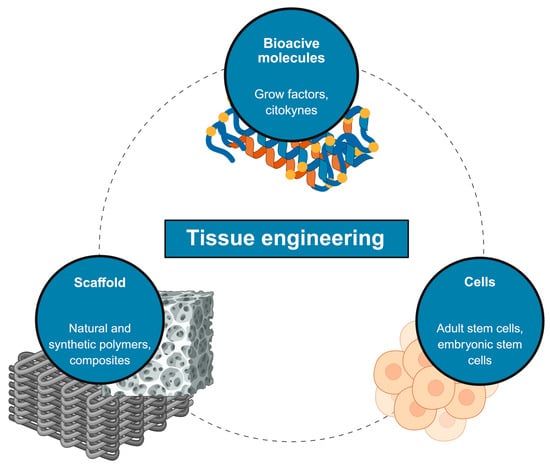
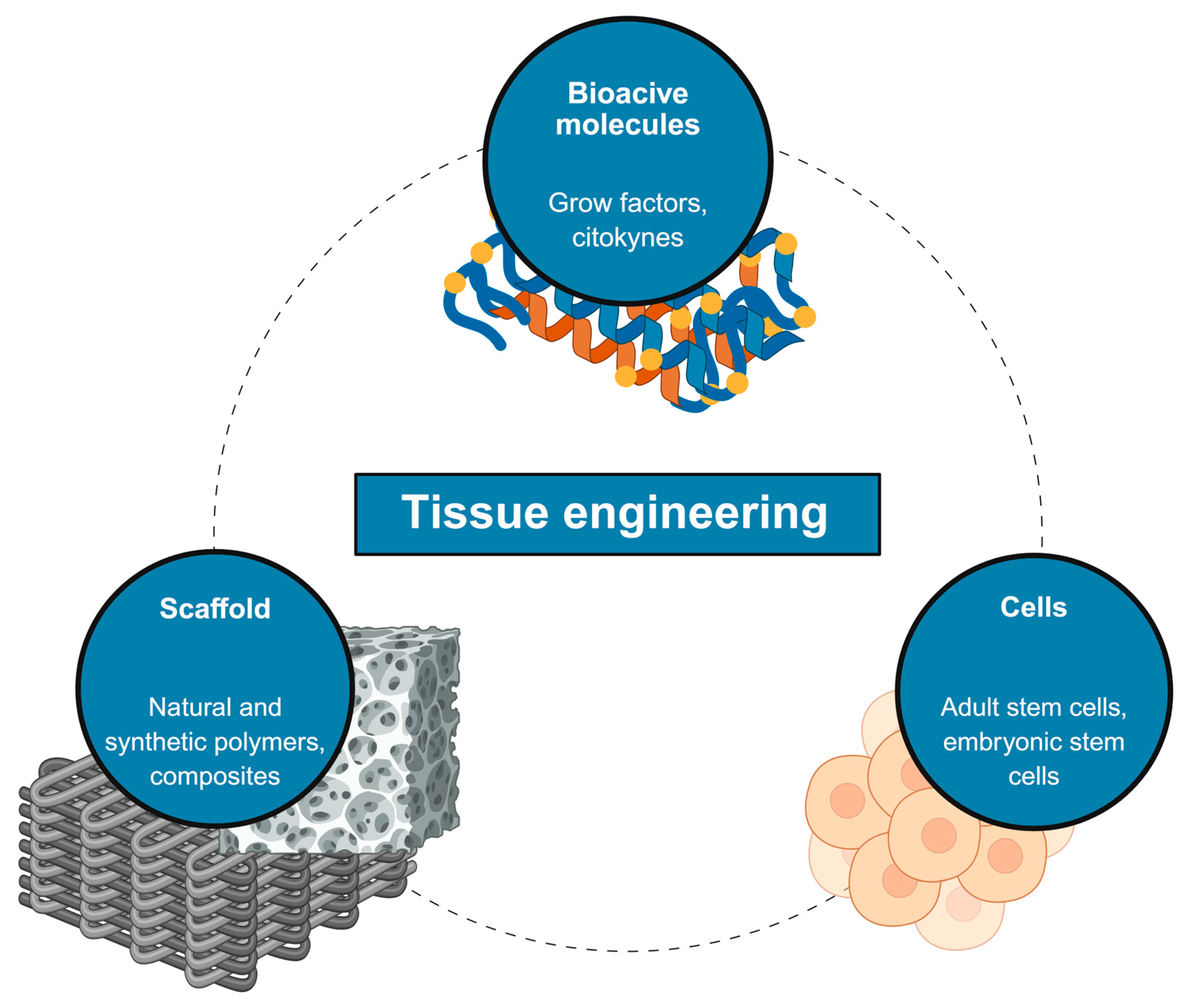
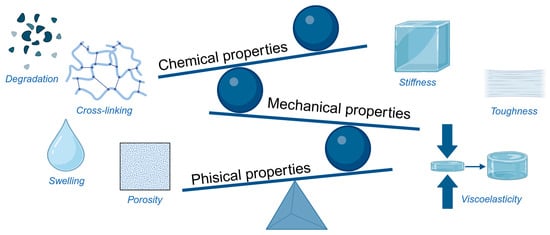
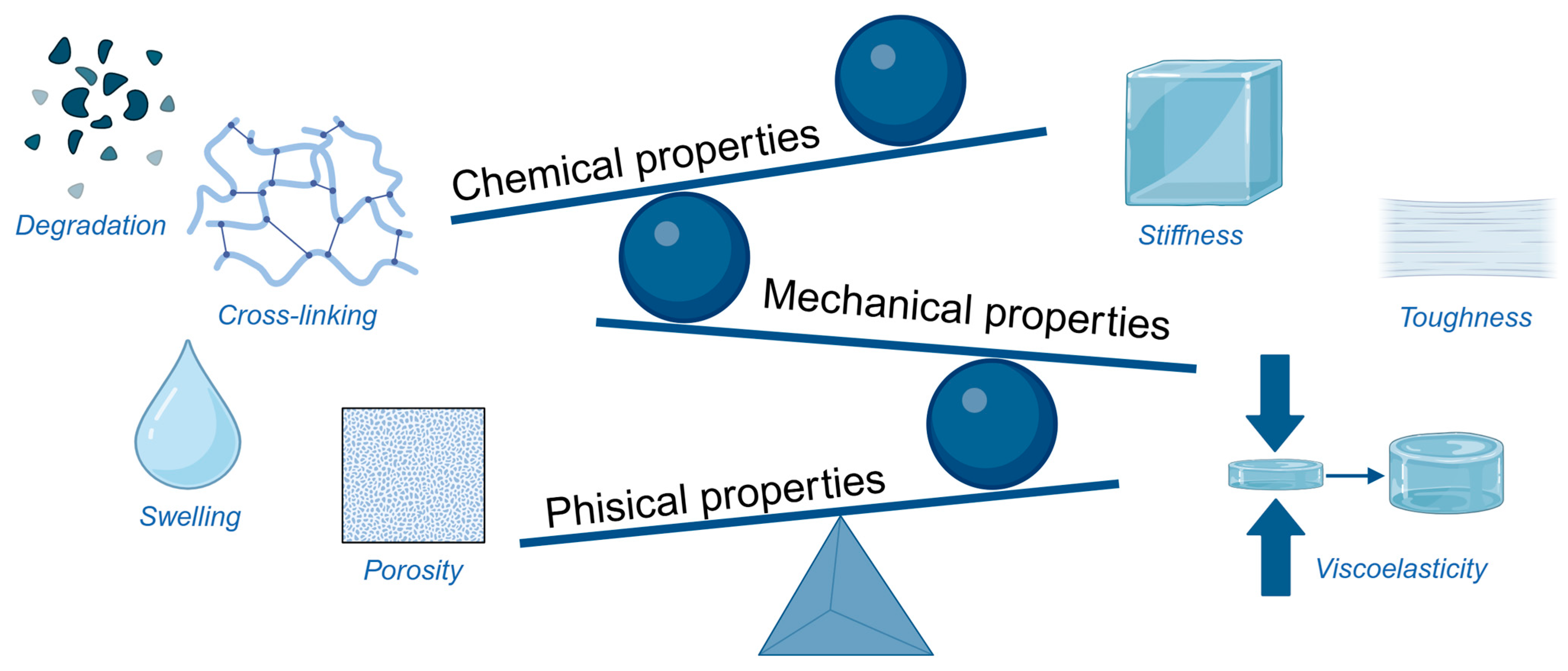
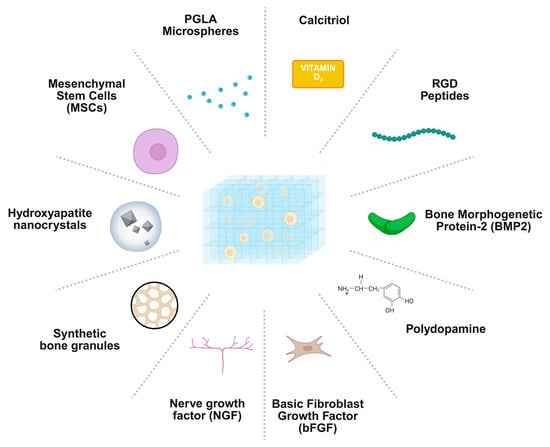
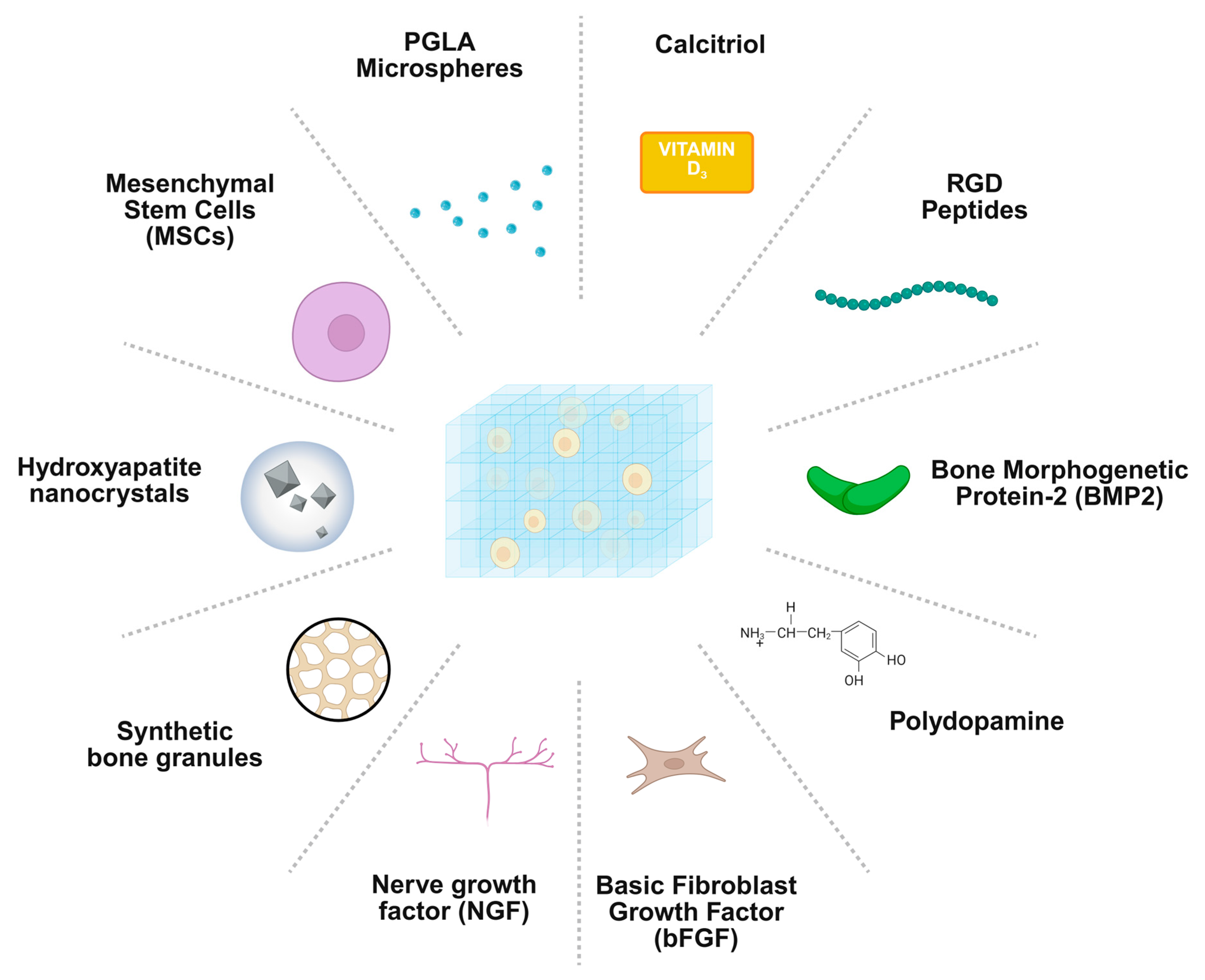
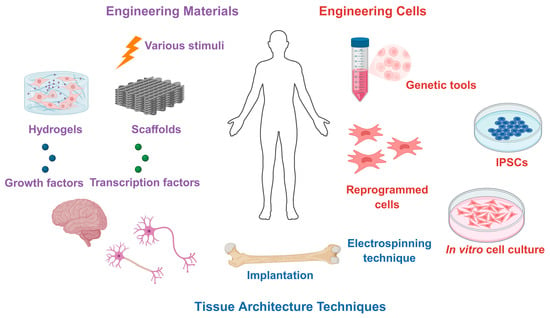
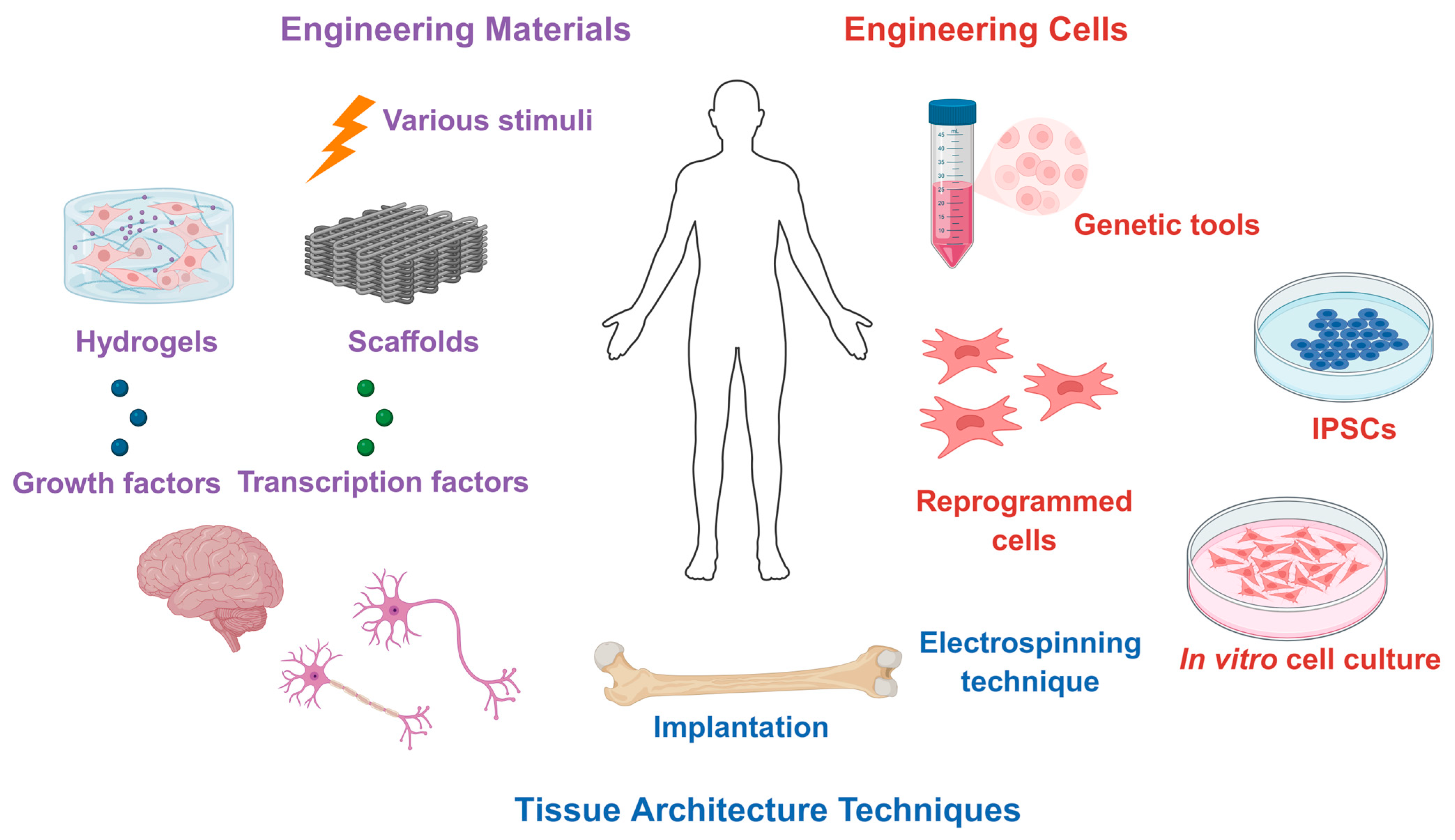
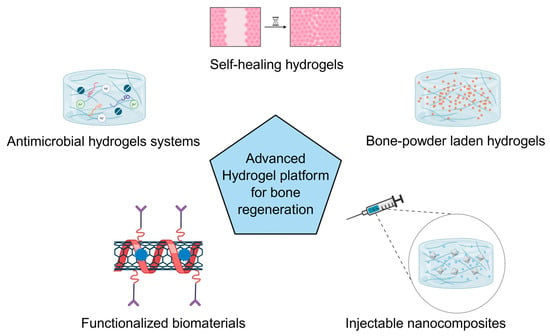
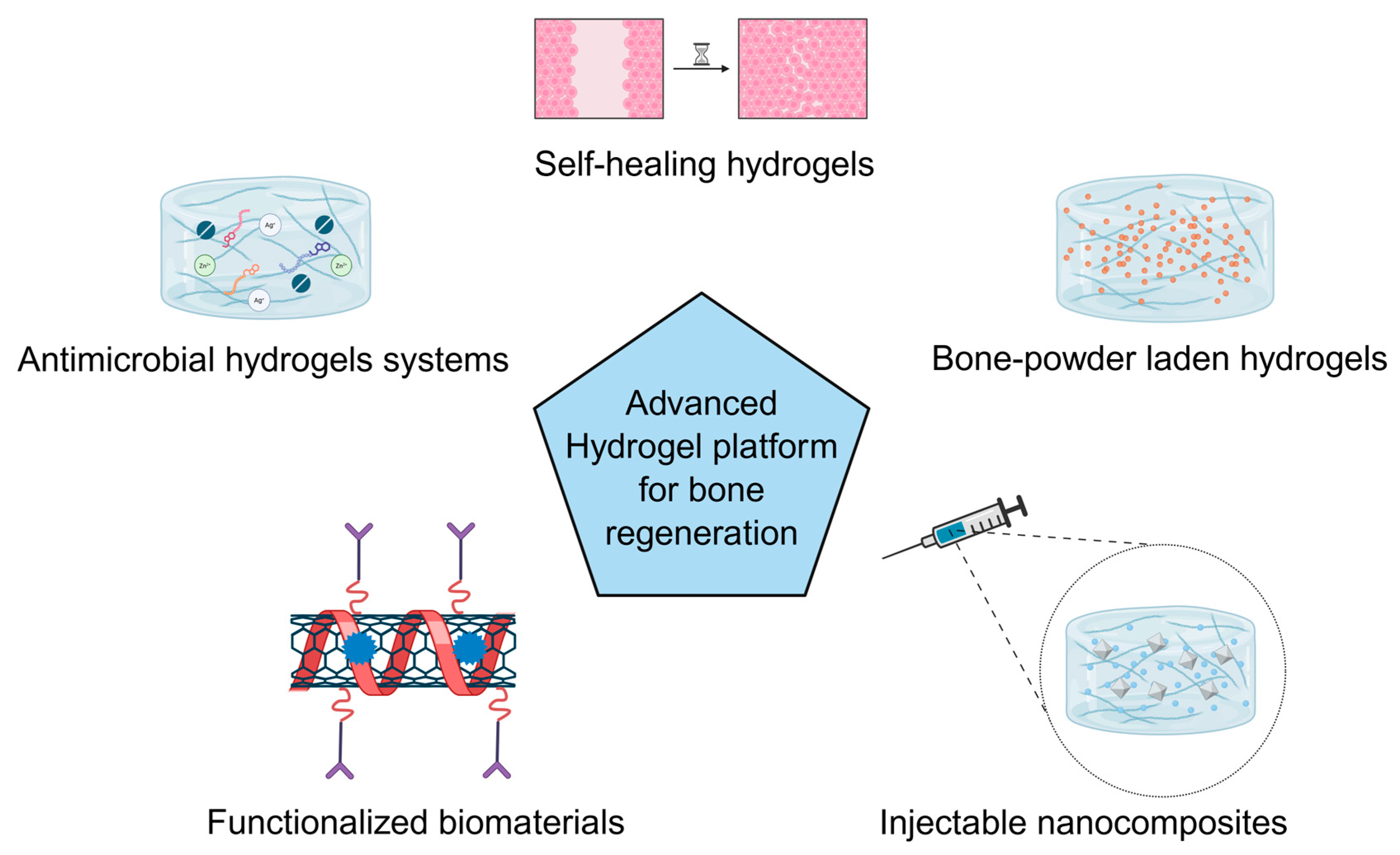

Disclaimer/Publisher’s Note: The statements, opinions and data contained in all publications are solely those of the individual author(s) and contributor(s) and not of MDPI and/or the editor(s). MDPI and/or the editor(s) disclaim responsibility for any injury to people or property resulting from any ideas, methods, instructions or products referred to in the content. |
© 2026 by the authors. Licensee MDPI, Basel, Switzerland. This article is an open access article distributed under the terms and conditions of the Creative Commons Attribution (CC BY) license.