
Entry

The University Student Engagement Inventory (USEI)

by
João Marôco
1,2
1
Intrepid Lab, ECEO, Universidade Lusófona, Campo Grande, 376, 1749-024 Lisboa, Portugal
2
CETRA-UTAD (UID/04011/2025), Quinta de Prados, 5000-801 Vila Real, Portugal
Encyclopedia 2026, 6(8), 166; https://doi.org/10.3390/encyclopedia6080166
Submission received: 19 June 2026 / Revised: 23 July 2026 / Accepted: 31 July 2026 / Published: 4 August 2026
(This article belongs to the Section Social Sciences)

Definition

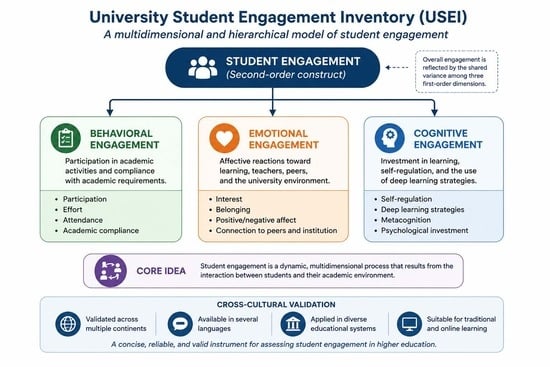
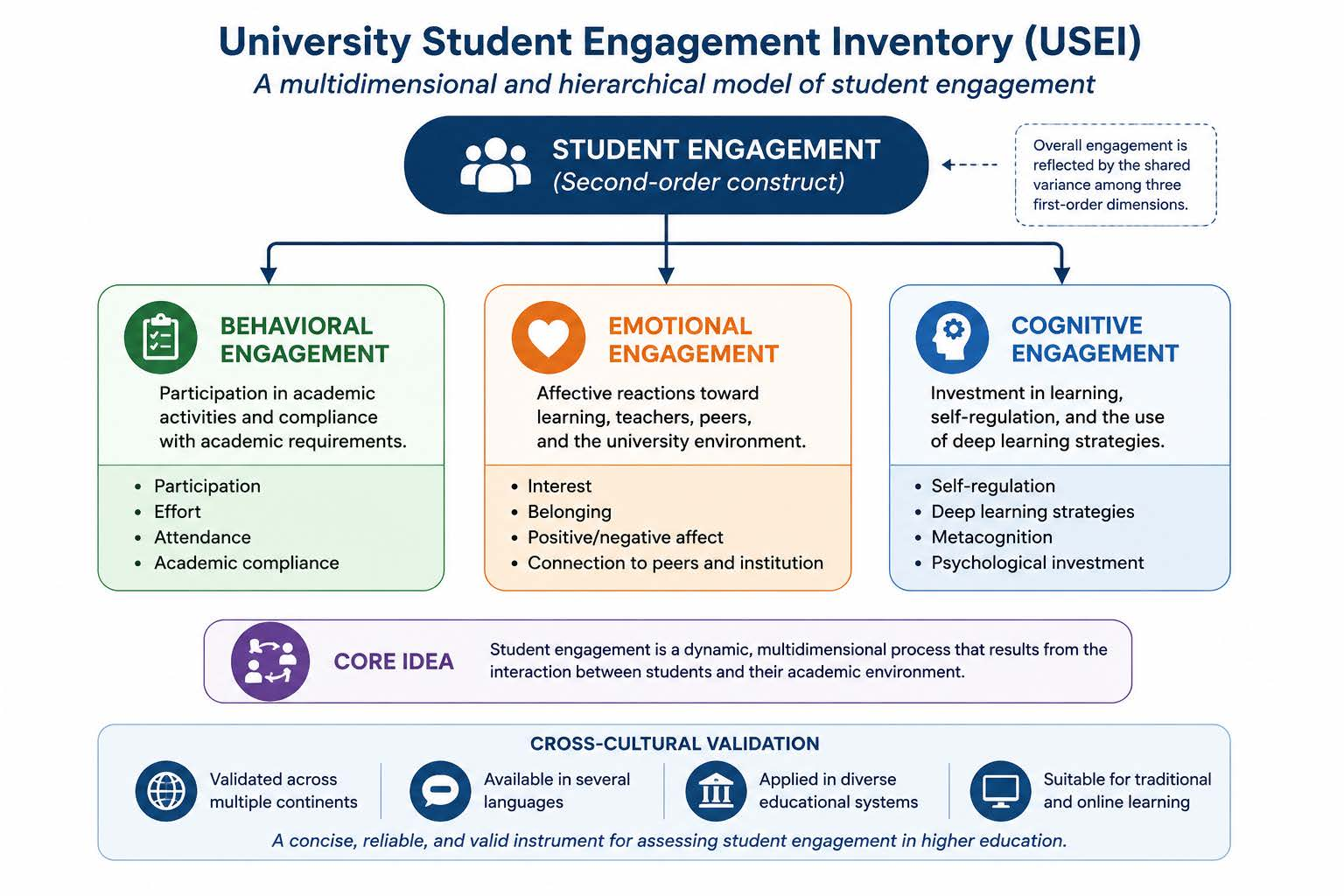
The University Student Engagement Inventory (USEI) is a multidimensional self-report instrument designed to assess student engagement in higher education through three interrelated dimensions: behavioral, emotional, and cognitive engagement. Developed within a hierarchical framework, the USEI provides both dimension-specific scores and an overall indicator of student engagement, supporting research, institutional assessment, and educational quality evaluation across diverse cultural and educational contexts. Student engagement is widely recognized as a key determinant of academic success, persistence, and educational quality in higher education. The University Student Engagement Inventory (USEI) was developed to provide a theoretically grounded and psychometrically sound measure of engagement that captures students’ behavioral, emotional, and cognitive involvement in learning activities. This encyclopedia entry reviews the conceptual foundations, development process, factorial structure, psychometric properties, and applications of the USEI. Evidence from multiple studies indicates that the instrument exhibits satisfactory reliability, construct validity, predictive validity, and measurement invariance across different countries, languages, and educational settings. The USEI has been translated and adapted for use in diverse cultural contexts and has been employed extensively in research examining academic performance, well-being, persistence, and learning environments, including online and blended education. Its brevity, multidimensional structure, and cross-cultural validation have supported its use in educational research and institutional assessment. Overall, the USEI represents a robust and versatile instrument for evaluating student engagement and supporting evidence-based improvements in higher education.

Graphical Abstract

1. Introduction

Student engagement is widely recognized as a key construct in higher education research and a major indicator of educational quality, learning effectiveness, and student success [1,2,3,4]. Over the past three decades, it has evolved from a concept primarily associated with student persistence to one used to explain differences in academic achievement, retention, satisfaction, well-being, and institutional commitment among university students.
The theoretical foundations of engagement can be traced to Astin’s theory of student involvement [5], which emphasizes the investment of physical and psychological energy in educational activities, and Tinto’s model of student persistence [3], which highlights academic and social integration as determinants of retention and success. Together, these perspectives shifted attention from students’ personal characteristics to their interactions with educational environments.
Contemporary theories conceptualize engagement as a multidimensional construct comprising behavioral, emotional, and cognitive dimensions [6,7]. Behavioral engagement refers to active participation in learning activities, emotional engagement reflects affective reactions toward learning and the educational environment, and cognitive engagement represents psychological investment in learning, self-regulation, and the use of deep learning strategies. These dimensions are distinct yet interrelated components of a broader engagement process [8].
Despite the extensive literature on student engagement [9], the construct remains characterized by considerable conceptual and methodological heterogeneity. Kahu [2,10] argued that engagement has been defined from multiple disciplinary perspectives, resulting in overlapping conceptualizations that variously treat engagement as a psychological state, a set of observable behaviors, an institutional process, or an educational outcome. This lack of conceptual clarity has hindered theoretical integration and made comparisons across studies difficult. Similarly, Fredricks, Filsecker, and Lawson [7,11] highlighted persistent inconsistencies in the definition, operationalization, and measurement of engagement, noting that many existing instruments assess only selected facets of engagement or combine engagement with related constructs such as motivation, participation, or school climate. These limitations underscore the need for theoretically coherent and psychometrically robust multidimensional instruments capable of providing comparable assessments across educational contexts. Against this background, the University Student Engagement Inventory (USEI) was developed to provide a theoretically grounded, multidimensional, and psychometrically validated measure that separates behavioral, emotional, and cognitive engagement while allowing estimation of an overall engagement construct.
The importance of engagement was reinforced by large-scale initiatives such as the National Survey of Student Engagement (NSSE), which demonstrated consistent associations between engagement and educational outcomes, including learning gains, persistence, academic achievement, and student satisfaction [12]. Consequently, engagement has become a central concept in educational policy, institutional evaluation, and quality assurance.
Current perspectives view engagement as a dynamic, context-dependent process shaped by interactions among students, learning environments, and institutional influences [2,6,10]. Because engagement can vary according to instructional practices, social relationships, and institutional support [1,11,13], it is increasingly regarded as a modifiable outcome that can be enhanced through educational interventions and policy initiatives [2,10,12].
Given its importance, valid and reliable measures of engagement are essential for monitoring student experiences, identifying students at risk of disengagement, evaluating educational innovations, and advancing research. However, many existing instruments were developed for specific educational systems or populations, limiting their broader applicability.
To address this need, Marôco and colleagues developed the University Student Engagement Inventory (USEI) [8], a concise and theoretically grounded instrument designed to assess behavioral, emotional, and cognitive engagement among university students while supporting the estimation of a global engagement factor. Since its introduction, the USEI has been adapted and validated across multiple countries and languages, providing substantial evidence of reliability, construct validity, predictive validity, and measurement invariance across multiple countries, gender and study areas [1,8,13,14,15,16,17,18,19,20,21,22,23,24,25].
The USEI has been increasingly used in engagement research across multiple countries and educational contexts. Validation studies conducted across Europe, Asia, Africa, North America, and South America have demonstrated its applicability in diverse cultural contexts and its usefulness for investigating relationships with academic efficacy, burnout, student satisfaction, dropout intentions, well-being, and academic performance [1,8,13,14,15,16,17,18,19,20,21,22,23,24,25]. As higher education increasingly emphasizes student well-being, online learning, and evidence-based decision-making, the USEI offers researchers and practitioners a practical and psychometrically robust tool for assessing and promoting student engagement.
Several instruments have been developed to assess student engagement, each reflecting different theoretical perspectives and assessment purposes. Institutional surveys such as the National Survey of Student Engagement (NSSE) primarily evaluate students’ participation in educationally effective practices and the institutional conditions that support learning rather than individual psychological engagement [26]. The Student Engagement Instrument (SEI) focuses mainly on cognitive and affective engagement in school settings and was originally developed for secondary education [27]. In contrast, the Utrecht Work Engagement Scale–Student version (UWES-S) conceptualizes engagement as a positive motivational state characterized by vigor, dedication, and absorption, drawing on the work engagement literature [28]. The USEI differs from these approaches by integrating behavioral, emotional, and cognitive dimensions within a concise hierarchical psychometric framework specifically designed for higher education, enabling the assessment of both domain-specific engagement dimensions and an overall engagement construct while supporting cross-cultural comparisons.

2. Development and Conceptual Framework

The University Student Engagement Inventory (USEI) was developed to provide a concise, theoretically grounded, and psychometrically robust measure of student engagement in higher education [8]. Although engagement had become a central construct in educational research, its assessment was characterized by conceptual ambiguity and diverse measurement approaches [7,26]. The USEI was developed to address these challenges by offering a coherent instrument aligned with contemporary multidimensional models of engagement while remaining suitable for research and institutional assessment [8].
The instrument is grounded in the multidimensional framework proposed by Fredricks and colleagues [7], which conceptualizes engagement as a set of interrelated behavioral, emotional, and cognitive processes through which students interact with learning activities and educational environments. This perspective integrates earlier contributions from Astin’s theory of student involvement [5], Tinto’s model of student persistence [3], and subsequent work emphasizing motivational, affective, and self-regulatory processes in learning [2,6,10].
Unlike approaches that focus primarily on participation or attendance, this framework recognizes that meaningful engagement involves observable behaviors, emotional experiences, and cognitive investment in learning [1,8,13,19]. Engagement is therefore viewed as a dynamic and context-dependent state that can be influenced by instructional practices, social relationships, institutional support, and learning environments [6,26]. This perspective highlights the potential for educational interventions and institutional policies to enhance engagement.
The USEI comprises fifteen items distributed across three related dimensions—Behavioral Engagement, Emotional Engagement, and Cognitive Engagement—which together provide a comprehensive assessment of students’ involvement in academic learning [8,19].

2.1. Dimensions of Student Engagement

2.1.1. Behavioral Engagement

Behavioral engagement refers to students’ participation in academic activities and educational experiences, including attendance, classroom participation, effort, and compliance with academic expectations [7,8]. It represents the most visible dimension of engagement but, by itself, does not fully capture students’ emotional connection to learning or their cognitive investment in academic tasks. As shown in Table 1, the USEI assesses behavioral engagement through items reflecting participation, effort, and involvement in learning activities [8].

2.1.2. Emotional Engagement

Emotional engagement reflects students’ affective reactions toward learning, instructors, peers, and the educational institution [7,8,11]. Positive emotional engagement, such as interest, enthusiasm, and belongingness, has been associated with greater motivation, persistence, satisfaction, and well-being [1,13,21], whereas emotional disengagement has been linked to withdrawal and academic difficulties [1,21,22]. The USEI measures this dimension through items assessing students’ feelings toward their educational experiences and their interest in academic activities (Table 1).

2.1.3. Cognitive Engagement

Cognitive engagement refers to students’ psychological investment in learning and their willingness to expend effort in understanding, integrating, and applying knowledge [7,8]. It is closely related to self-regulated learning, metacognition, and deep learning strategies. Students with higher cognitive engagement tend to adopt more meaningful approaches to learning and demonstrate stronger academic outcomes [7,11,13,29]. As depicted in Table 1, the USEI assesses cognitive engagement through items reflecting information seeking, knowledge integration, self-questioning, and application of learning.

2.2. Hierarchical Structure of the USEI

A distinctive feature of the USEI is its hierarchical structure. Although behavioral, emotional, and cognitive engagement are assessed separately, they are conceptualized as complementary manifestations of a broader engagement construct [8,19,24]. Accordingly, the instrument specifies a second-order factor representing Overall Student Engagement (See Figure 1). This hierarchical model enables the assessment of both overall engagement and specific engagement dimensions. It also reflects the theoretical view that behavioral participation, emotional attachment, and cognitive investment are mutually reinforcing processes that collectively contribute to students’ educational experiences [1,13,21]. Consequently, the USEI can be used to examine both general engagement levels and the specific pathways through which different engagement dimensions relate to academic outcomes. Table 1 presents the English version of the USEI (see [1,2,4,5,6,7,8,9,10,11], for translations into other languages). Each USEI dimensions’ scores can be estimated by first- and second-order latent factor scores or by items in each dimension and overall when a manifest scores are required.

2.3. Theoretical Significance of the USEI Framework

The USEI framework reflects contemporary conceptualizations of student engagement as a multidimensional and dynamic process encompassing behavioral, emotional, and cognitive dimensions [7,8,19]. By supporting both dimension-specific and overall engagement scores, the instrument enables researchers to examine how different aspects of engagement contribute to educational outcomes such as academic performance, persistence, well-being, and satisfaction [1,12,13,21,22,23,24,29]. The USEI has been validated in multiple countries and educational contexts and has consequently been used in research and institutional assessment. The USEI differs from broader institutional surveys such as the NSSE or Work-related such as the UWES, by focusing on the individual student’s behavioral, emotional, and cognitive engagement through a brief psychometric instrument suitable for both research and institutional assessment [7,24].

3. Psychometric Evidence

A major strength of the University Student Engagement Inventory (USEI) is the extensive psychometric evidence accumulated across multiple countries, languages, and educational contexts [13,14,15,16,17,18,19,20,24,25]. Collectively, these studies support the factorial validity, reliability, construct validity, predictive validity, and measurement invariance of the instrument, establishing the USEI as one of the most extensively validated measures of student engagement in higher education.

3.1. Factorial Validity

The original validation study supported a three-factor structure comprising Behavioral, Emotional, and Cognitive Engagement, together with a second-order factor representing Overall Student Engagement [8,19]. Subsequent studies conducted across Europe, Asia, Africa, North America, and South America have consistently replicated this structure [13,14,15,16,17,19].
Although some studies reported major item-level differences, particularly for item SE6, the only negatively worded item, the overall factorial structure has remained stable across cultural contexts [14,15,16,17,19,20,25]. Across validation studies, standardized factor loadings generally ranged from approximately 0.22 to 0.94, while global fit indices consistently supported the three-factor hierarchical structure, with CFI and TLI values typically exceeding 0.90 and RMSEA and SRMR below 0.08 (see Table 2). These findings support the structural validity of the USEI across diverse educational and cultural contexts. Alternative models have occasionally been examined, but the original hierarchical model generally demonstrated the best theoretical and empirical support. Overall, existing evidence confirms the robustness and generalizability of the multidimensional USEI framework. See Table 2 for a summary of available evidence of factorial validity.

3.2. Reliability Evidence

Across validation studies, the USEI has demonstrated satisfactory reliability for both its individual dimensions and the overall engagement construct [8,14,15,16,17,18,19,23,24]. Internal consistency estimates, including Cronbach’s alpha, composite reliability, and omega coefficients, have consistently met recommended psychometric standards, e.g., Cronbach alpha and McDonalds Omega greater than 0.7 (see Table 2). Factor loadings and average variance extracted values further support the reliability and internal coherence of the instrument [8,14,15,16,17,18,19,23,24].

3.3. Convergent, Discriminant, and Predictive Validity

Studies consistently show that USEI scores are positively associated with academic motivation, self-efficacy, learning satisfaction, institutional commitment, belongingness, and well-being [1,13,14,21,22]. At the same time, the instrument demonstrates adequate discriminant validity, indicating that engagement remains empirically distinct from related constructs such as motivation and satisfaction [13,21,22,29].
Predictive validity evidence indicates that higher engagement is associated with better academic performance, stronger academic efficacy beliefs, lower burnout, greater satisfaction, and reduced dropout intentions [1,13,21,22]. Research has also shown that engagement may buffer the negative effects of academic stress and burnout and contribute positively to students’ adaptation to online learning environments [13,23].

3.4. Measurement Invariance and Cross-Cultural Validity

Since its development in Portugal, the USEI has been translated and validated in at least nine additional languages: English, Chinese, Italian, Serbian, Spanish, Turkish, Persian, Arabic, and Norwegian [13,14,15,16,17,18,19,20,23,25]. Validation studies have consistently supported the applicability of the instrument across diverse cultural and educational contexts.
Particularly important is the evidence supporting configural, metric, scalar, and, in some cases, strict measurement invariance across gender, areas of study, countries and educational systems [13,19]. These findings indicate that USEI scores can be meaningfully compared across populations and support its use in international and comparative research.
The stability of the instrument has also been demonstrated in online and hybrid learning environments [13,18,23], further supporting its applicability across contemporary educational settings. Taken together, the available evidence establishes the USEI as a psychometrically robust and internationally applicable measure of student engagement.
Overall psychometric properties of the USEI across different countries/regions are displayed in Table 2.

4. Applications of the USEI

Since its introduction, the University Student Engagement Inventory (USEI) has been widely used in educational research and institutional practice. Its brevity, strong psychometric properties, and multidimensional structure have made it a valuable tool for investigating the antecedents and consequences of student engagement across diverse higher education contexts [8,13,14,15,16,17,19,20,23,25].

4.1. Educational and Psychological Research

The USEI has been extensively employed to examine the determinants and outcomes of student engagement. Research consistently shows that higher engagement is associated with stronger academic motivation, self-efficacy, satisfaction, well-being, and academic performance [1,13,21,30]. Conversely, lower engagement is linked to burnout, psychological distress, and dropout intentions [1,21,22].
The instrument’s multidimensional structure allows researchers to investigate the distinct contributions of behavioral, emotional, and cognitive engagement to educational outcomes. Furthermore, its demonstrated validity across multiple countries has facilitated comparative and cross-cultural research examining engagement patterns in different educational systems [13,19].

4.2. Institutional Assessment and Student Support

Beyond research, the USEI provides higher education institutions with a practical tool for monitoring educational quality and student experiences. The instrument can be used to evaluate academic programs, assess the impact of curricular reforms, and support quality assurance initiatives by providing information about students’ behavioral, emotional, and cognitive involvement in learning [26].
The USEI can also contribute to the identification of students at risk of disengagement or withdrawal. Lower engagement scores have been associated with higher burnout and stronger intentions to leave university [1,21,22]. Because the inventory assesses multiple dimensions of engagement, it can help institutions identify specific areas requiring intervention, such as participation, belongingness, motivation, or learning strategies. When combined with academic and retention indicators, engagement assessments may support more targeted student support initiatives.

4.3. Online and Hybrid Learning

The expansion of online and hybrid education has increased interest in understanding engagement in digital learning environments [31,32]. Studies conducted in virtual and technology-enhanced settings indicate that the USEI retains its psychometric robustness and remains useful for assessing engagement in online learning contexts [13,23].
Research has shown that engagement measured by the USEI is associated with online learning satisfaction, academic efficacy, and successful adaptation to digital learning environments [13,23]. Consequently, the instrument has become a valuable resource for evaluating online teaching practices and technology-enhanced learning initiatives.

4.4. Implications for Educational Practice

The USEI can provide educators, researchers, and administrators with a theoretically grounded framework for assessing student engagement and evaluating educational interventions. By identifying patterns of behavioral, emotional, and cognitive engagement, the instrument can inform efforts to improve teaching practices, student support services, learning environments, and institutional policies aimed at promoting student success [1,13,21,33,34].

5. Strengths, Limitations, and Future Directions

Several characteristics of the USEI support its application in higher education research and practice. First, it is grounded in a well-established multidimensional framework that conceptualizes engagement as comprising behavioral, emotional, and cognitive dimensions [7,8,11]. Second, its hierarchical structure allows researchers to examine both specific engagement dimensions and overall engagement [8,19,24]. Third, the instrument is brief and easy to administer, making it suitable for large-scale surveys and institutional assessments. Finally, extensive validation studies conducted across multiple countries and languages provide strong evidence of its reliability, validity, and cross-cultural applicability [13,19].
Despite these strengths, some limitations should be considered. Like most engagement measures, the USEI relies on self-reported data and may therefore be affected by social desirability, recall bias, and response styles. Moreover, response styles and the interpretation of questionnaire items may vary across cultural contexts, potentially influencing observed engagement scores despite the substantial evidence supporting the instrument’s cross-cultural validity and measurement invariance. In addition, engagement is a dynamic and context-dependent construct that may vary across courses, learning environments, stages of students’ academic trajectories, and broader institutional and cultural contexts [1,13,19]. Consequently, USEI scores should be interpreted as indicators of students’ perceived engagement at a particular point in time rather than as fixed characteristics. Furthermore, although engagement is associated with important educational outcomes, it represents only one component of the broader processes underlying academic success and persistence.
Future research should continue examining engagement longitudinally and across diverse educational contexts. The integration of USEI scores with objective indicators, such as learning analytics and academic performance data, may provide a more comprehensive understanding of engagement processes. Additional validation studies involving underrepresented populations and emerging learning environments will further strengthen the instrument’s international applicability. These developments will contribute to a deeper understanding of student engagement and its role in promoting successful educational experiences in higher education.

6. Conclusions

The University Student Engagement Inventory (USEI) is a multidimensional instrument designed to assess behavioral, emotional, and cognitive engagement among university students. Since its development, the inventory has accumulated substantial evidence supporting its factorial validity, reliability, convergent and predictive validity, and measurement invariance across diverse cultural and educational contexts [8,13,14,15,16,17,18,19,20,23,25].
The USEI’s brevity, theoretical grounding, and robust psychometric properties have contributed to its widespread adoption in higher education research and practice. The instrument has been successfully applied in studies examining academic achievement, self-efficacy, burnout, dropout intentions, student well-being, and learning experiences in both traditional and online educational environments [1,13,21,22].
Although engagement is a complex and context-dependent construct that cannot be fully captured through self-report measures alone, the USEI provides a practical and scientifically sound framework for assessing students’ involvement in learning. Its demonstrated cross-cultural applicability further supports its use in international and comparative research.
Overall, the USEI provides a multidimensional framework for assessing student engagement and for informing educational policies and practices aimed at promoting student success in higher education.

Funding

This research received no external funding.

Institutional Review Board Statement

Not applicable.

Informed Consent Statement

Not applicable.

Data Availability Statement

No new data were created or analyzed in this study. Data sharing is not applicable.

Conflicts of Interest

The author declares no conflicts of interest.

References

  1. Marôco, J.; Assunção, H.; Harju-Luukkainen, H.; Lin, S.W.; Sit, P.S.; Cheung, K.C.; Maloa, B.; Ilic, I.S.; Smith, T.J.; Campos, J.A.D.B. Predictors of Academic Efficacy and Dropout Intention in University Students: Can Engagement Suppress Burnout? PLoS ONE 2020, 15, e0239816. [Google Scholar] [CrossRef] [PubMed]
  2. Kahu, E.R. Framing Student Engagement in Higher Education. Stud. High. Educ. 2013, 38, 758–773. [Google Scholar] [CrossRef]
  3. Tinto, V. Leaving College: Rethinking the Causes and Cures of Student Attrition; University of Chicago Press: Chicago, IL, USA, 1993. [Google Scholar]
  4. Zepke, N. Student Engagement Research in Higher Education: Questioning an Academic Orthodoxy. Teach. High. Educ. 2014, 19, 697–708. [Google Scholar] [CrossRef]
  5. Astin, A.W. Student Involvement: A Developmental Theory for Higher Education. J. Coll. Stud. Pers. 1984, 25, 297–308. [Google Scholar]
  6. Sinatra, G.M.; Heddy, B.C.; Lombardi, D. The Challenges of Defining and Measuring Student Engagement in Science. Educ. Psychol. 2015, 50, 1–13. [Google Scholar] [CrossRef]
  7. Fredricks, J.A.; Filsecker, M.; Lawson, M.A. Student Engagement, Context, and Adjustment: Addressing Definitional, Measurement, and Methodological Issues. Learn. Instr. 2016, 43, 1–4. [Google Scholar] [CrossRef]
  8. Marôco, J.; Marôco, A.L.; Campos, J.A.D.B.; Fredricks, J.A. University Student Engagement: Development of the University Student Engagement Inventory (USEI). Psicol. Reflex. Crítica 2016, 29, 21. [Google Scholar] [CrossRef]
  9. Bond, M.; Buntins, K.; Bedenlier, S.; Zawacki-Richter, O.; Kerres, M. Mapping Research in Student Engagement and Educational Technology in Higher Education: A Systematic Evidence Map. Int. J. Educ. Technol. High. Educ. 2020, 17, 2. [Google Scholar] [CrossRef]
  10. Kahu, E.R.; Nelson, K. Student Engagement in the Educational Interface: Understanding the Mechanisms of Student Success. High. Educ. Res. Dev. 2018, 37, 58–71. [Google Scholar] [CrossRef]
  11. Fredricks, J.A.; Blumenfeld, P.C.; Paris, A.H. School Engagement: Potential of the Concept, State of the Evidence. Rev. Educ. Res. 2004, 74, 59–109. [Google Scholar] [CrossRef]
  12. Finn, J.D. School Engagement and Students at Risk; National Center for Education Statistics (NCES), U.S. Department of Education: Washington, DC, USA, 1993.
  13. Sharif Nia, H.; Marôco, J.; She, L.; Khoshnavay Fomani, F.; Rahmatpour, P.; Ilic, I.S.; Allen, K.-A.; Pahlevan Sharif, S. Student Satisfaction and Academic Efficacy during Online Learning with the Mediating Effect of Student Engagement: A Multi-Country Study. PLoS ONE 2023, 18, e0285315. [Google Scholar] [CrossRef] [PubMed]
  14. Løken, T.K.; Hanssen, N.B.; Olsen, K.; Marôco, J. Norwegian Validation of the University Student Engagement Inventory. Front. Psychol. 2026, 17, 1734409. [Google Scholar] [CrossRef] [PubMed]
  15. Esposito, G.; Marôco, J.; Passeggia, M.; Pepicelli, R.; Freda, M.F. The Italian Validation of the University Student Engagement Inventory. Eur. J. High. Educ. 2022, 12, 35–55. [Google Scholar] [CrossRef]
  16. Freiberg-Hoffmann, A.; Romero-Medina, A.; Curione, K.; Marôco, J. Adaptación y Validación Transcultural al Español Del University Student Engagement Inventory. Rev. Latinoam. Psicol. 2022, 54, 187–195. [Google Scholar] [CrossRef]
  17. She, L.; Khoshnavay Fomani, F.; Marôco, J.; Allen, K.-A.; Sharif Nia, H.; Rahmatpour, P. Psychometric Properties of the University Student Engagement Inventory among Chinese Students. Asian Assoc. Open Univ. J. 2023, 18, 46–60. [Google Scholar] [CrossRef]
  18. Sharif Nia, H.; Azad Moghaddam, H.; Marôco, J.; She, L.; Khoshnavay Fomani, F.; Rahmatpour, P.; Pahlevan Sharif, S.; Allen, K.-A. A Psychometric Lens for E-Learning: Examining the Validity and Reliability of the Persian Version of the University Students’ Engagement Inventory (P-USEI). Asia-Pac. Educ. Res. 2023, 32, 573–582. [Google Scholar] [CrossRef]
  19. Assunção, H.; Lin, S.-W.; Sit, P.-S.; Cheung, S.-C.; Harju-Luukkainen, H.; Smith, T.; Maloa, B.; Campos, J.A.D.B.; Ilic, I.S.; Esposito, G.; et al. University Student Engagement Inventory (USEI): Transcultural Validity Evidence across Four Continents. Front. Psychol. 2020, 10, 2796. [Google Scholar] [CrossRef] [PubMed]
  20. Gün, F.; Turabik, T.; Arastaman, G.; Akbaşlı, S. Adaptation of University Student Engagement Inventory to Turkish Culture: Validity and Reliability Study. İnönü Üniversitesi Eğitim Fakültesi Derg. 2019, 20, 507–520. [Google Scholar] [CrossRef]
  21. Abreu Alves, S.; Sinval, J.; Lucas Neto, L.; Marôco, J.; Gonçalves Ferreira, A.; Oliveira, P. Burnout and Dropout Intention in Medical Students: The Protective Role of Academic Engagement. BMC Med. Educ. 2022, 22, 83. [Google Scholar] [CrossRef] [PubMed]
  22. Sinval, J.; Oliveira, P.; Novais, F.; Almeida, C.M.; Telles-Correia, D. Exploring the Impact of Depression, Anxiety, Stress, Academic Engagement, and Dropout Intention on Medical Students’ Academic Performance: A Prospective Study. J. Affect. Disord. 2025, 368, 665–673. [Google Scholar] [CrossRef] [PubMed]
  23. Sharif-Nia, H.; Marôco, J.; She, L.; Narula, S.; Ma, L.; Kaveh, O.; Rahmatpour, P.; Ghahrani, N. University Student Engagement Inventory: Validation in the Indian Online Learning Context. Meas. Eval. Couns. Dev. 2024, 57, 351–363. [Google Scholar] [CrossRef]
  24. Sinval, J.; Casanova, J.R.; Marôco, J.; Almeida, L.S. University Student Engagement Inventory (USEI): Psychometric Properties. Curr. Psychol. 2021, 40, 1608–1620. [Google Scholar] [CrossRef]
  25. Tannoubi, A.; Quansah, F.; Hagan, J.E., Jr.; Srem-Sai, M.; Bonsaksen, T.; Chalghaf, N.; Boussayala, G.; Azaiez, C.; Snani, H.; Azaiez, F. Adaptation and Validation of the Arabic Version of the University Student Engagement Inventory (A-USEI) among Sport and Physical Education Students. Psych 2023, 5, 320–335. [Google Scholar] [CrossRef]
  26. Kuh, G.D. The National Survey of Student Engagement: Conceptual and Empirical Foundations. New Dir. Institutional Res. 2009, 141, 5–20. [Google Scholar] [CrossRef]
  27. Appleton, J.J.; Christenson, S.L.; Kim, D.; Reschly, A.L. Measuring Cognitive and Psychological Engagement: Validation of the Student Engagement Instrument. J. Sch. Psychol. 2006, 44, 427–445. [Google Scholar] [CrossRef]
  28. Schaufeli, W.B.; Martinez, I.; Pinto, A.M.; Salanova, M.; Bakker, A.B. Burnout and Engagement in University Students: A Cross National Study. J. Cross Cult. Psychol. 2002, 33, 464–481. [Google Scholar]
  29. Skinner, E.A.; Kindermann, T.A.; Furrer, C.J. A Motivational Perspective on Engagement and Disaffection: Conceptualization and Assessment of Children’s Behavioral and Emotional Participation in Academic Activities in the Classroom. Educ. Psychol. Meas. 2009, 69, 493–525. [Google Scholar] [CrossRef]
  30. Carini, R.M.; Kuh, G.D.; Klein, S.P. Student Engagement and Student Learning: Testing the Linkages*. Res. High. Educ. 2006, 47, 1–32. [Google Scholar] [CrossRef]
  31. Coates, H. A Model of Online and General Campus-based Student Engagement. Assess. Eval. High. Educ. 2007, 32, 121–141. [Google Scholar] [CrossRef]
  32. Dixson, M.D. Measuring Student Engagement in the Online Course: The Online Student Engagement Scale (OSE). Online Learn. 2015, 19, n4. [Google Scholar] [CrossRef]
  33. Krause, K.L.; Coates, H. Students’ Engagement in First-year University. Assess. Eval. High. Educ. 2008, 33, 493–505. [Google Scholar] [CrossRef]
  34. Kuh, G.D. What Student Affairs Professionals Need to Know About Student Engagement. J. Coll. Stud. Dev. 2009, 50, 683–706. [Google Scholar] [CrossRef]
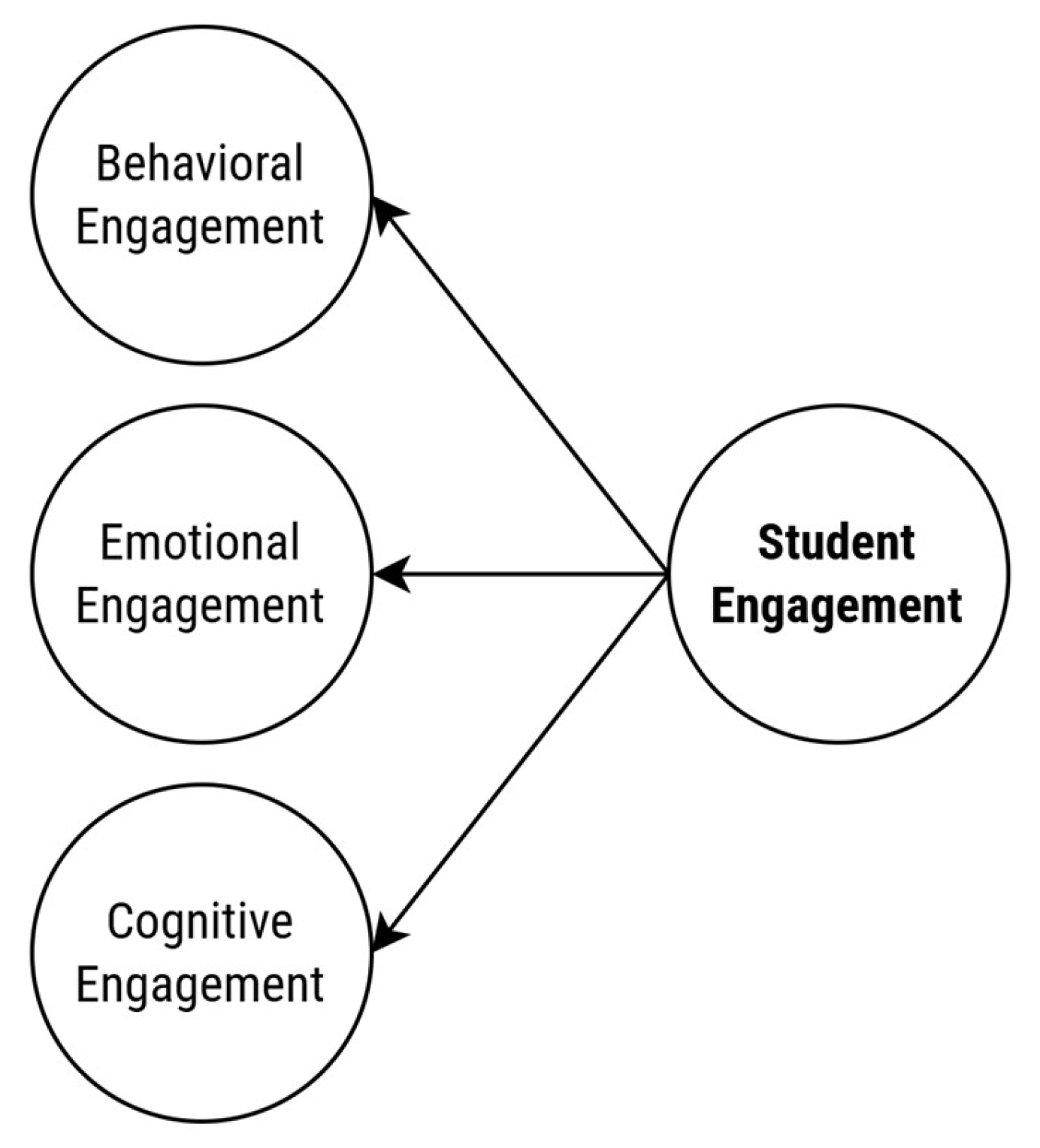
Figure 1. Conceptual framework of the University Student Engagement Inventory (USEI) [8,19]. See Table 1 for description of the items for each of the three first-order dimensions of engagement.
Encyclopedia 06 00166 g001
Table 1. Items and first-order dimensions of the USEI.
DimensionItem
Behavioral
Engagement
SE1—I pay attention in class.
SE2—I follow the school’s rules.
SE3—I usually do my homework on time.
SE4—When I have doubts I ask questions and participate in debates in the classroom.
SE5—I usually participate actively in group assignments.
Emotional
Engagement
SE6—I don’t feel very accomplished at this school.
SE7—I feel excited about the schoolwork.
SE8—I like being at school.
SE9—I am interested in the schoolwork.
SE10—My classroom is an interesting place to be.
Cognitive
Engagement
SE11—When I read a book, I question myself to make sure I understand the subject I’m reading about.
SE12—I talk to people outside the school on matters that I learned in class.
SE13—If I do not understand the meaning of a word, I try to solve the problem, for example by consulting a dictionary or asking someone else.
SE14—I try to integrate the acquired knowledge in solving new problems.
SE15—I try to integrate subjects from different disciplines into my general knowledge.
Note: Adapted from [1]. All items use a five-point response format ranging from 0 (Never) to 4 (Always). Scores may be averaged within each dimension or across all items, with higher values indicating higher levels of engagement. Other non-English translations of the USEI can be found at [1,2,3,4,5,6,7,8,9,10,11] and other references in the References Section.
Table 2. Psychometric Evidence for the University Student Engagement Inventory (USEI) Across Countries and Populations.
Country/RegionRange of Std. Factor LoadingsGoodness-of-Fit IndicesReliability EstimatesMeasurement InvarianceKey Findings
Portugal (Original Development) [1]0.50–0.94 for first-order itemsCFI = 0.970–0.978; TLI = 0.970–0.974; RMSEA = 0.054–0.060Ordinal α = 0.74–0.88; CR = 0.62–0.89Strong measurement invariance across two independent samplesEstablished the original three-factor USEI structure and provided initial evidence of validity, reliability, and invariance.
Portugal (First-Year University Students) [3]First-order: 0.46–0.86; Second-order: 0.64–0.93CFI = 0.987; TLI = 0.985; NFI = 0.982; RMSEA = 0.051Ordinal α = 0.69–0.87; Ordinal ω = 0.63–0.85; ωh = 0.85; CR = 0.70–0.85Full invariance across gender and academic majorsConfirmed the hierarchical structure of engagement and supported comparisons across demographic and academic groups.
Transcultural Study (Portugal, Brazil, Mozambique, United Kingdom, United States, Finland, Serbia, Macau/Taiwan, and Italy) [9]First-order: 0.39–0.85; Second-order: 0.64–0.85CFI = 0.936; TLI = 0.923; RMSEA = 0.052; SRMR = 0.040α = 0.71–0.85 (Total = 0.87); ω = 0.66–0.83 (Total = 0.88); ωh = 0.88Metric invariance across all countries; scalar invariance between Portugal/Brazil and UK/USA; strong invariance across gender and fields of studyProvided the strongest evidence for the cross-cultural applicability of the USEI across multiple continents.
Spain, Argentina, and Uruguay (Spanish Adaptation) [5]0.35–0.84Total: CFI = 0.93; TLI = 0.92; RMSEA = 0.06; Country-specific CFIs = 0.965–0.978Ordinal α = 0.84–0.92 (total sample)Metric and scalar invariance across countriesConfirmed that the Spanish version functions equivalently across three Spanish-speaking countries.
Turkey (Turkish Adaptation) [10]0.22–0.90CFI = 0.93; NFI = 0.89; GFI = 0.90; RMSEA = 0.076; SRMR = 0.061α = 0.66–0.78; Total α = 0.82Not evaluatedSupported the reliability and validity of the Turkish adaptation, although invariance testing was not conducted.
Italy (Italian Validation) [4]First-order: 0.36–0.90; Second-order: 0.70–0.97CFI = 0.95; TLI = 0.94; NFI = 0.93; RMSEA = 0.06; SRMR = 0.05ω = 0.29–0.75; Test–retest r = 0.82Weak metric invariance across gender and field of study; scalar invariance for genderDemonstrated temporal stability and acceptable construct validity in Italian university students.
Norway (Norwegian Validation) [2]First-order: 0.372–0.848; Second-order: 0.714–0.905CFI = 0.951; TLI = 0.941; RMSEA = 0.069; SRMR = 0.053Ordinal α = 0.662–0.803; ω = 0.612–0.767; Total ωh = 0.871Strong scalar invariance across gender and academic fieldsExtended USEI validity evidence to Scandinavian higher education contexts.
Tunisia (Arabic Adaptation) [11]EFA: 0.475–0.848; CFA second-order: 0.84–0.90CFI = 0.981; TLI = 0.977; GFI = 0.960; RMSEA = 0.040; SRMR = 0.041α = 0.842–0.863; Total α = 0.931Not evaluatedProvided strong evidence for the reliability and validity of the Arabic version among sport and physical education students.
Iran (Persian Validation) [8]First-order: 0.40–0.90; Second-order: 0.72–0.87CFI = 0.971; TLI = 0.964; NFI = 0.964; RMSEA = 0.083; SRMR = 0.046Ordinal α = 0.874–0.906; ω = 0.826–0.868; CR = 0.836–0.877Metric, scalar, and strict invariance across genderDemonstrated excellent reliability and invariance.
Indian (English Validation) [7]First-order: 0.46–0.90; Sec-ond-order: 0.83–0.94TLI = 0.960, CFI = 0.967, NFI = 0.960, SRMR = 0.043Ordinal α = 0.81–0.91; ω = 0.81–0.91Metric, scalar, and strict invariance across genderDemonstrated valid and reliable use of the USEI among Indian university students
Note. CFI = Comparative Fit Index; TLI = Tucker–Lewis Index; NFI = Normed Fit Index; GFI = Goodness-of-Fit Index; RMSEA = Root Mean Square Error of Approximation; SRMR = Standardized Root Mean Square Residual; CR = Composite Reliability; α = Cronbach’s alpha; ω = McDonald’s omega; ωh = hierarchical omega; EFA = Exploratory Factor Analysis; CFA = Confirmatory Factor Analysis.
Disclaimer/Publisher’s Note: The statements, opinions and data contained in all publications are solely those of the individual author(s) and contributor(s) and not of MDPI and/or the editor(s). MDPI and/or the editor(s) disclaim responsibility for any injury to people or property resulting from any ideas, methods, instructions or products referred to in the content.