1. Introduction
Major policy changes observed in science education over the past two decades arose from worldwide reform initiatives to conceptualize the purposes and practices of science teaching and learning. In 2012, the National Research Council introduced its Framework for K-12 Science Education in the United States, and the Next Generation Science Standards (NGSS) across countries, representing a paradigm shift in both the definition and assessment of science education [
1,
2]. The reforms facilitated three-dimensional learning, the articulation of disciplinary core ideas, science and engineering practices, and crosscutting concepts. This shift represents the reframing of science education from an approach that moves beyond content transmission toward an integrated view and engages students in authentic science sensemaking. Despite these reforms, there remain a number of challenges when attempting to materialize the vision for reform to be delivered to students and educators. Keeley and Tugel (2019) [
3] argue that curriculum is one vital link between educational policy and how the actual policy plays out in the classroom. Research repeatedly demonstrated gaps between intended curricula and what students actually experience. Curriculum shaping is important to incorporate science learning into education as the salient factor. Moreover, questions about scientific literacy remain debated. Curriculum links the policy of education to classroom practice [
3]. It is a method we can use to draw on these goals and put them into concrete experiences for students to make them real. For this reason, knowledge of curriculum design, delivery, and change is vital to enhancing science education outcomes. Curriculum materials help shape what children learn, directly supporting the students’ perception of science as a discipline but also giving them a sense of identity as science learners. In contrast to traditional views in which the focus is only on mastery of content, contemporary scholars have proposed a broader conceptualization of learning, expanding their view of science to include its role of fostering the transformation of society.
This review lay the ground in Roberts’ (2007) [
4] basic distinction between Vision I and Vision II of scientific literacy, as well as more recent elaborations of Vision III by Sjöström and Eilks (2018) [
5] and Sjöström (2025) [
6]. This framework provides a lens for examining how curriculum research conceptualizes the purposes of science education and the nature of scientific literacy. Vision I (science without society) is best manifested in research on curriculum materials and standards that focus primarily on content knowledge and scientific processes. This vision remains instrumental in creating the basis, yet it has departed from content-focused approaches as the core of understanding. There is a significant presence of Vision II (science in relation to society) across specific cohorts with literature on context-based education and learning, socioscientific issues, and technology integration. It emphasizes the use of science in a practical way in various scenarios. Such a phenomenon brings in Vision II work from the field, with its interest in how science education applies to the students’ lives and in terms of societal challenges. Vision III (science within society) represents the most significant study focusing on equity and social justice, critical reflection of curriculum, and transformative approaches to science education. While it accounts for only a small fraction of the literature, Vision III research deals with some of the key questions about the purposes of science education in a democratic society and what role scientific literacy plays in promoting social change. Instead of proposing these visions as disconnected and independent ends, the literature suggests that science education has to be deliberately intertwined into a structure of how conceptual foundations (Vision I), contextual applications (Vision II), and critical engagement (Vision III) feed one another. This synthesis explains how these three visions could be combined in future efforts to highlight their advantages and tensions among them. In today’s rapidly evolving globalized world, these contemporary pedagogical needs are shaped by international crises, technological change, environmental threats, complex socioscientific issues, and future needs and goals. Consequently, scientific literacy is no longer simply a competence in knowledge of science but needs to be versatile and capable of critically and responsibly contributing to building democratic and sustainable futures.
Many fields of science curricula reviews have been discussed, but no systematic evaluation has been conducted to examine the contemporary scholarship using the Vision III framework [
6]. This matters because Vision III provides a unified theory of how the curriculum not only fosters scientific understanding but also encourages critical engagement, sociopolitical agency, and transformative action. This literature review is based on 140 articles published in leading science education journals:
International Journal of Science Education (57),
Science Education (31),
Science & Education (18), and
Journal of Research in Science Teaching (34). The present review is informed by the following research questions:
RQ1: What are the major categories in the modern science curriculum to foster scientific literacy?
RQ2: In what ways do the findings of these journals resonate with conceptualizations of scientific literacy, specifically on Vision II and Vision III frames?
2. Materials and Methods
We conducted a systematic scoping review of science curriculum research to map the thematic landscape, identify conceptual patterns, and examine how contemporary scholarship aligns with scientific literacy frameworks. Scoping review methodology was chosen because our objective was the breadth of coverage and representativeness of the field rather than the synthesis of causal evidence or the ranking of study quality [
7,
8,
9]. This approach is appropriate for examining heterogeneous bodies of literature—including randomized controlled trials, quasi-experiments, case studies, curriculum analyses, phenomenological investigations, and policy analyses—where no single quality appraisal tool can adequately address the breadth of methodological approaches [
10]. We report this review in accordance with the Preferred Reporting Items for Systematic Reviews and Meta-Analyses extension for Scoping Reviews (PRISMA-ScR) [
10]. Because scoping reviews do not aim to produce evidence hierarchies or inform causal claims, formal risk-of-bias assessment is neither required nor methodologically appropriate. Readers should therefore interpret our findings as a thematic and conceptual map of the field rather than an assessment of what works.
Consistent with scoping review methodology, we did not conduct formal quality appraisal of included studies. Our synthesis draws on qualitative and descriptive findings about the nature, characteristics, and implementation of science curricula rather than making causal claims about curriculum effectiveness. In such descriptive syntheses, formal risk-of-bias assessment is less critical because the synthesis does not rely on the internal validity of individual studies for causal inference [
9]. We acknowledge this as a limitation: our review identifies what has been studied and how it has been framed, but it does not evaluate the methodological rigor of the underlying studies. Future systematic reviews that narrow the scope to specific intervention types may appropriately incorporate quality appraisal and evidence grading.
The search was executed in the Web of Science Core Collection (only including Science Citation Index Expanded and the Social Sciences Citation Index). We applied the following database filters: publication years 2009–2025; document type = article; language = English. The exact search queries, including Boolean operators and field restrictions, are provided in
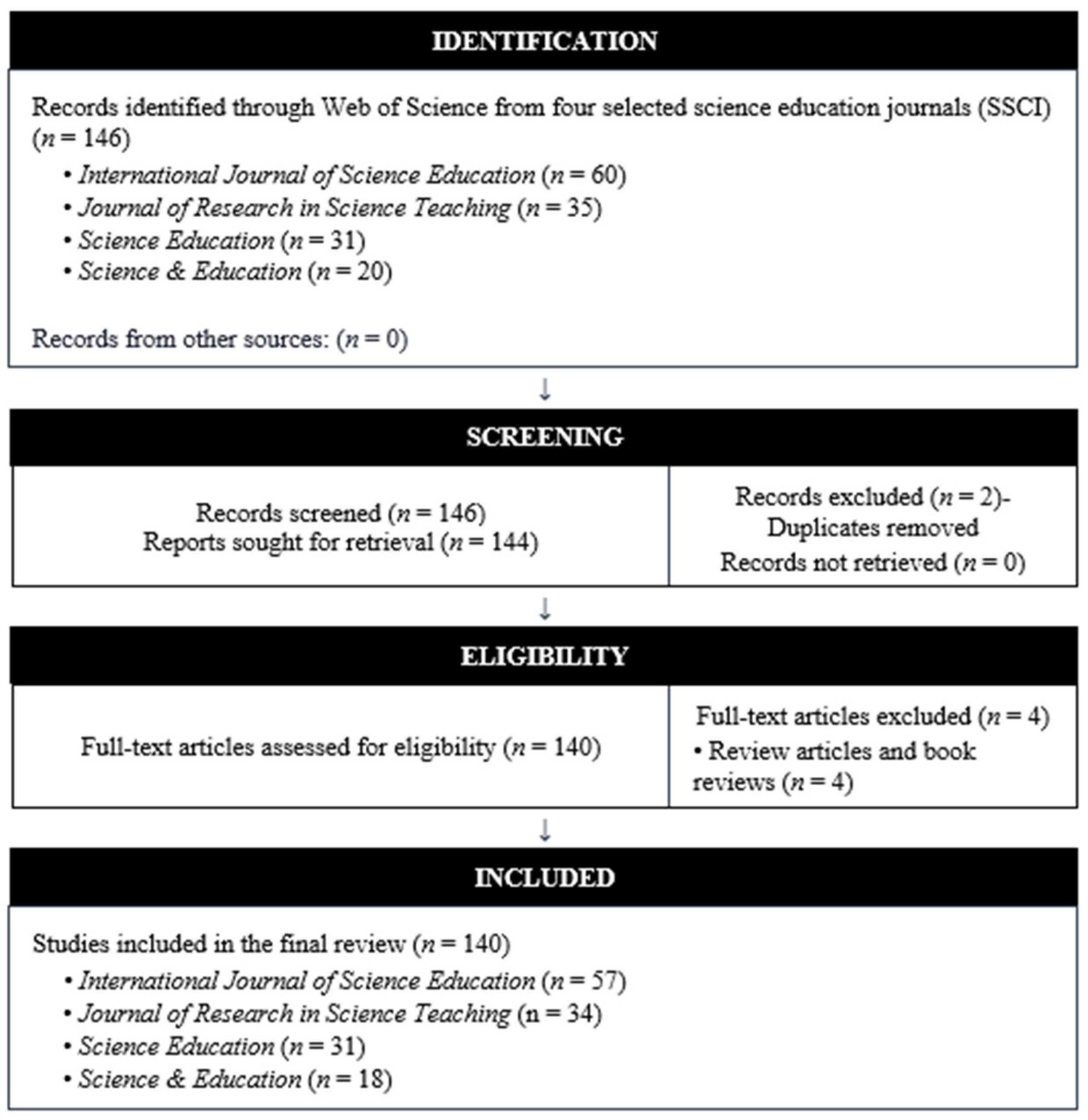
Supplementary Materials (Table S1). The complete PRISMA-ScR flow diagram is presented in
Figure 1. Title, abstract, and keyword fields were searched, and the final search was conducted in January 2026. Reference lists of included articles were manually searched to identify additional relevant studies. Articles were not included in the publication if they were not curriculum-specific; were book reviews, editorials, or commentaries; focused on assessment or policy (with no impact on curriculum); or they were not in English. Eligibility was related to full-text review of the articles.
Table 1 presents the inclusion and exclusion criteria. The items for PRISMA-ScR checklist were provided in
Supplementary Materials (Figure S1). There were four stages we followed when selecting the studies to include: identification, screening, eligibility, and inclusion. Articles from the targeted journals were identified in the first search. After screening by title and abstract, articles that failed to meet the inclusion criteria were excluded. The search strategy combined curriculum-related keywords with science education terms. The searches were restricted to peer-reviewed articles published between 2009 and 2025. The initial search yielded 146 records: 51 from SE and S&E combined (31 and 20, respectively), 35 from JRST, and 60 from IJSE. Two duplicate records of the same article from IJSE results [
11,
12] were identified and removed, leaving 144 unique records. Four articles were excluded at full-text assessment because they were review articles rather than empirical studies of curriculum. The remaining 140 articles were included in the final review in the
Supplementary Materials (Table S2).
A reflexive thematic analysis approach was used, following Braun and Clarke’s (2006) [
13] six-phase framework, as adapted for systematic review contexts by Thomas and Harden (2008) [
14]. This approach was selected because it provides a systematic yet flexible method for identifying, analyzing, and reporting patterns across qualitative and quantitative studies. A reflexive thematic approach allowed us to synthesize across methodologies while remaining grounded in the primary data reported in each study. During the familiarization, two reviewers independently read the full texts of all 140 included articles, extracting key information onto a standardized coding form. The form captured study objectives; methodological design; participant characteristics; curriculum domain, intervention, or focus; and primary findings. During this phase, reviewers maintained analytical memos to note emergent patterns, surprising findings, and preliminary observations about the structure of the field.
During initial coding, articles were independently coded by two reviewers. Coding was conducted at the article level: each article was assigned descriptive codes capturing its primary curriculum focus. Initial coding was predominantly inductive, driven by the content of the articles, though the reviewers were aware of broad curriculum constructs from the science education literature. The two reviewers then met to compare codes, discuss discrepancies, and develop a preliminary coding framework. The remaining articles were coded by one reviewer using the agreed framework, with ambiguities discussed at regular team meetings. Initial coding generated 26 distinct codes across the journal datasets, including content-focused codes (e.g., “inquiry-based curriculum”, “NOS policy”, “climate change education”) and process-focused codes (e.g., “teacher implementation”, “curriculum adaptation”). These 26 codes were reviewed and consolidated into seven final themes through an iterative process of comparison, merger, and refinement. These codes captured the substantive focus of each article in the language of the original authors.
Initial codes were grouped into candidate categories based on conceptual similarity. For example, the codes “inquiry-based laboratory curriculum”, “inquiry-oriented science unit”, and “inquiry-based teaching materials” were grouped into the candidate category “inquiry-based learning”. Similarly, codes related to “engineering design integration”, “STEM curriculum”, and “STEAM curriculum” were grouped into the candidate category “scientific practices”. The seven categories of this review emerged from the iterative coding of 140 articles: (1) nature of science and policy; (2) scientific practices; (3) inquiry-based learning; (4) context-based and socioscientific issues (SSI) education; (5) curriculum standards, materials, and assessments; (6) teacher professional development and teaching practice; and (7) equity and social justice. These categories reflected the major trends in contemporary science curriculum scholarship, from epistemological debates about the nature of science to pressing concerns about equitable access and outcomes.
This review also referred to selected articles based on the vision perspectives, providing a mixed picture for curriculum inquiry and emerging trends for research and applications. Therefore, our indicators were developed by (a) identifying the key differentiating features of each vision across the literature [
4,
5,
15,
16,
17,
18]; (b) grouping these features into content, pedagogical, and outcome domains; (c) phrasing each feature as an answerable coding question with the response options yes/no/partial; and (d) pilot testing on a subset of 10 articles to refine wording and ensure coder interpretability. The complete indicator framework, decision tree, and hybrid classification rules are given in
Supplementary Materials (Table S3a–c). Prior to conducting the study, no review protocol was prospectively registered. The review procedures, including the search strategy, inclusion criteria, and data extraction process, were developed by the authors following the published literature.
The complete coding framework, including all initial codes, candidate categories, refinement decisions, and final theme definitions, was also documented in a codebook (
Supplementary Material Table S3b). To enhance intercoder consistency, the authors independently coded all papers and subsequently met to discuss discrepancies, reaching a consensus to refine coding decisions [
19]. Two researchers independently coded all 140 articles using the seven-category framework. Intercoder reliability was assessed using Cohen’s Kappa for the initial independent coding, yielding moderate agreement (percent agreement = 56.43%,
n = 79/140; κ = 0.492, 95% CI [0.401, 0.585]) [
20]. Discrepancies (
n = 62, 44.3%) were resolved through consensus discussion. Coder stability—measured as the alignment between initial independent codes and final consensus codes—was high (96.43%, κ = 0.957), indicating a robust coding framework. Microsoft Excel was used in the analysis process for article-level coding.
Multiple strategies were employed to enhance the trustworthiness of the analysis. First, independent double-coding established intercoder agreement and refined the coding framework before full-sample coding. Second, regular team meetings provided opportunities for peer debriefing and discussion of coding challenges. Third, the maintenance of analytical memos created an audit trail of analytical decisions. Fourth, negative cases were explicitly noted and discussed rather than being forced into existing categories.
3. Results
The data presented in
Table 2 and
Table 3 were obtained as a result of the two-stage analysis of the articles.
Table 2 shows how the 140 articles were distributed across seven themes. Moreover,
Table 3 provides a comprehensive synthesis of the thematic categories, illustrating their distribution across the journals as well as their alignment with different visions of scientific literacy. An examination of
Table 2 reveals that the journals most frequently addressed the themes of
nature of science and policy and
curriculum materials and standards. These were followed by the themes of
scientific practices and
context-based and SSI education, which together represent the focus of majority of the remaining journals. One of the notable findings of the study is that the theme of
equity and social justice appeared least frequently in the journals.
Taken together,
Table 2 and
Table 3 indicate that both Vision I and Vision II are the focus in a considerable number of articles. Notably, very few articles focused solely on Vision III or on both Vision II and Vision III, representing a striking finding of the study. This result section also provides an in-depth examination of the data from
Table 2 and
Table 3, which are presented under subheadings for each thematic category and discussed in light of the existing literature.
3.1. Inquiry-Based Learning
Research on inquiry-based curriculum (11 articles) reveals a fundamental and persistent tension across national contexts: inquiry reform is enacted as a curricular ideal, but it is implemented within institutional realities that systematically undermine it. In Singapore’s high-stakes assessment environments [
21], Tanzania’s resource-constrained schools [
22], and US preservice teacher education programs [
23], an emphasis on inquiry intentions is discussed through teachers’ already existing beliefs, local assessment pressures, and pedagogical practices. This pattern indicates that scholarly research on inquiry curriculum moved from wondering whether inquiry works toward on what grounds it may survive within the implementation ecosystem. Three interconnected factors are recognized in the literature as being significant: quality of curriculum materials [
24], teacher adaptability [
23], and the structure of the accountability environment [
21]. When these converge, inquiry produces measurable benefits in content knowledge, argumentation, and scientific identity [
25,
26]. If they diverge, inquiry becomes pseudo-inquiry—a procedural form lacking epistemic substance.
When teachers assess curriculum materials before modifying them, fuller inquiry enactments are generated; however, when teachers consider adaptation merely as superficial alteration, even well-designed materials can undermine inquiry integrity [
19,
20]. This reveals a dilemma of teacher agency since some teachers overlook the critical aspects of inquiry curriculum. McNeill et al.’s (2017) [
27] distinction between “fidelity to procedure” and “fidelity to goal” offers a mutually productive resolution combined with the principled adaptation that, while retaining a level of epistemic authenticity, also allows for contextual responsiveness. Additionally, studies in Singapore [
21] and the US [
23] noted that the use of standardized tests is one of the most common barriers to the enactment of inquiry. If tests are used only to recall content, it is not always possible for a teacher to facilitate open-ended, time-consuming inquiry. Furthermore, Patchen and Smithenry’s [
26] understanding that “inquiry outcomes do not always fit conventional assessment measures” is not merely a measurement challenge; it reflects a broader systemic disparity in our approach to the relation between the epistemologies of inquiry and accountability. Furthermore, Siry and Max (2013) [
28] and Kirk and Ferguson (2025) [
29] demonstrated that inquiry curriculum is most transformative, yet least predictable, when student questions, rather than teacher plans, drive the learning trajectory. This emergent curriculum challenges the very notion of curriculum as pre-specified content, suggesting that inquiry, in its most authentic format, defines the boundary between Vision I (planned content) and Vision II (responsive engagement). The vision classification of inquiry studies as bridging Vision I and II thus captures not merely a content feature but an ontological tension in the nature of curriculum itself.
3.2. Scientific Practices
Integrating scientific practices into the curriculum is a shift in science education. The 21 studies examining scientific practices curricula share a common commitment: science learning is most meaningful when students engage in the epistemic practices through which scientific knowledge is actually constructed by argumentation, modeling, explanation, and spatial reasoning. Across these studies, a deeper tension emerges between two competing rationales for practice-based curriculum. One rationale, grounded in disciplinary authenticity (Vision I), positions practices as the proper content of science education; students should learn science by doing science to generate knowledge. The other rationale, grounded in participatory engagement (Vision II), positions practices as tools for developing capacities for evidence-based reasoning in societal contexts. McNeill et al. (2017, 2018) [
27,
30] bridge these rationales by demonstrating that argumentation curricula can simultaneously develop disciplinary competence and democratic deliberation capacity. However, no study explicitly positions scientific practices as tools for social transformation or emancipation. The lack of Vision III framing in this literature is a significant missed opportunity for the field.
The enactment gap is a universal challenge. Whether studying argumentation [
27], modeling [
31], or energy tracking [
32], all studies identify a gap between the designed curriculum and classroom enactment. Teachers struggle to move beyond pseudo-argumentation and pseudo-inquiry because the epistemic demands of authentic practice exceed the pedagogical scripts available in most professional preparation. This gap is not merely a teacher-knowledge problem but rather a systemic design problem in which curriculum materials must include educative features to render the epistemic rationale for practices visible to teachers [
33]. Moreover, scientific practices function as boundary objects that enable communication between Vision I and Vision II communities. To a disciplinary scientist, modeling is a core epistemic practice (Vision I). To a science educator, modeling is a way to engage students in meaningful reasoning about real phenomena (Vision II). The literature demonstrates that curriculum can serve both communities simultaneously but only when the curriculum design makes both rationales explicit. When the rationale underlying Vision II remains implicit, teachers tend to implement practices in ways that align with Vision I. Conversely, when the rationale associated with Vision I is overlooked, scientific practices risk becoming disconnected from the disciplinary foundations that render them meaningful. Studies such as Dawson et al. (2022) [
34] on climate change and Lindahl et al. (2019) [
35] on socioscientific issues move toward a broader conception of science education by engaging students in controversial societal issues through scientific practices. Studies do not examine power relations to question whose knowledge is valued or to address systemic inequities. This omission is noteworthy because it indicates that, although the practices movement has broadened the epistemic aims of school science, its political dimensions remain largely unexplored. Engaging students in argumentation about climate change is important: enabling them to use scientific knowledge and practices to critically examine and respond to the political and economic forces that drive climate change represents a more transformative educational goal.
From this perspective, the integration of scientific practices into the curriculum can be understood as an effort to bridge different visions of science education. The approaches used to cultivate science through argumentation, modeling, spatial reasoning, and engineering design serve as disciplinary activities rooted in the epistemic traditions of science (Vision I) and participatory activities that engage students in meaningful, purposeful action (Vision II). The quality of enactment is as important as material quality; yet, the enactment gap between intended and experienced curriculum remains a central challenge. The lack of Vision III in this literature was noteworthy. While curricula on socioscientific issues represents a critical engagement with controversial topics, none of the studies mentioned in their review explicitly frame scientific practices as tools for social transformation, emancipation, or ecological justice. This suggests an opportunity for future research: how might argumentation, modeling, and other scientific practices be leveraged toward Vision III’s critical agenda?
3.3. Nature of Science and Policy
These 32 articles on nature of science (NOS) in curriculum illustrate a field being transformed: from an inquiry into what information about NOS should be included (Vision I) to a question of how NOS is realized (Vision II) and whose views on NOS are articulated (Vision III). There are studies across different countries including Turkey [
36], China [
37], Norway [
38], and Italy [
39]. These studies found that cognitive–epistemic dimensions of NOS (hypothesis testing, theory–evidence relationship) are well-represented in curriculum documents; however, the social–institutional dimensions (science as a human activity, cultural embeddedness, epistemic justice) remain marginalized. This asymmetry is not accidental, as it reflects a deeper curricular politics in which NOS is domesticated to serve disciplinary boundary maintenance rather than critical reflection on science as a social practice. The most analytically significant development in this theme is the emergence of Vision III critiques that challenge whose epistemological traditions are recognized as science, particularly Cooper et al.’s (2025) [
40] analysis of First Nations science capital and Tolbert et al.’s (2025) [
41] examination of Mātauranga Māori in the curriculum of New Zealand.
Curriculum documents across nations represent NOS in ways that make it intellectually respectable but socially harmless. Humanizing NOS [
38] and acknowledging creativity and subjectivity are progressive steps, but they lack the socially transformative NOS envisioned by Vision III that addresses how science has been complicit in colonialism, eugenics, and environmental destruction. The humanization of NOS without its politicization represents a ceiling effect in curriculum reform: NOS can be made friendlier without making it more critical. Additionally, across diverse settings including Scotland [
42], Sub-Saharan Africa [
43] and Sweden [
44], teachers consistently report uncertainty about how to enact NOS in classrooms. This uncertainty presents an epistemological discomfort. Many teachers hold objectivist views of science that directly contradict constructivist epistemologies supporting more contemporary NOS frameworks. Dissemination of an array of NOS content which is disconnected from teachers’ contextual epistemological commitments through professional development is an ineffective means of reshaping practice. Furthermore, Cooper et al. (2025) [
40] and Tolbert et al. (2025) [
41] are truly representative of a paradigm shift in NOS curriculum research. By putting indigenous knowledge systems at the center as equally valid epistemologies, they address not only what qualifies as science but also who has the authority to define it. Tolbert et al.‘s finding that planned curriculum change is necessary but not sufficient for Vision III materialization is crucial. It identifies a gap between policy intention (Vision I) and transformative experience (Vision III), which teacher education has yet to address.
Curriculum documents set the formal parameters of what is taught, assessed, and valued in science education. Research found evidence of substantial variation in the representation of the NOS across national contexts, disciplines, and time periods. This variation was indicative of differences in policy-level commitments, cultural values, and epistemological premises regarding science education. The evidence from these studies suggested that the three visions were not mutually exclusive but rather complementary. Curriculum review focuses on the planned curriculum (Vision I) in terms of its NOS content and coherence; the enacted curriculum (Vision II) in terms of how teachers are interpreting and implementing the intentions of the NOS; and the experienced curriculum (Vision III) in terms of whose knowledge is legitimized and whose identities are supported.
3.4. Curriculum Materials and Standards
The 32 studies examining curriculum materials, standards, and assessments constitute the theme that is most aligned with Vision I in our review. This kind of concentration shows the limitations of a strictly disciplinary perspective on curriculum design. Across studies regarding NGSS alignment [
45], learning progressions [
46], textbook coherence [
47], and educative materials [
48], one recurring finding emerges: curriculum designed solely for disciplinary coherence fails to achieve its own learning goals because it neglects the implementation ecosystem. Materials that explicitly communicate the pedagogical reasoning behind instructional decisions, such as educative curriculum materials, have been shown to be more effective than materials that presume teachers already possess the necessary expertise. This finding shifts the attention from the question of what students should learn (Vision I) to how teachers can be supported in implementing ambitious curricula (Vision II)—a perspective that also carries important implications for Vision III.
Sikorski and Hammer (2017) [
47] argued that even carefully sequenced curricula fail to achieve their intended goals when students approach them primarily as information to memorize. Jin et al. (2019) [
46] additionally emphasized an ideal learning process, isolated from the difficult and situational context of classroom practice. All these findings come together as a paradox in which curriculum coherence is demanded but also inadequate. Coherence is not something that needs to be imposed upon learners but rather something that must be there for learners to feel worth having. This paradox is the link between Vision I (disciplinary logic) and Vision II (learner experience). In the area of educative materials as professional development, Bismack et al. (2015) [
48], Arias et al. (2016) [
33], and Roblin et al. (2018) [
49] converge on the finding that the best curriculum materials promote embedded professional development because they instruct teachers while teaching students. This educative role is particularly critical for curricula oriented around socioscientific and equity issues, in which teachers require help with controversial matters and students’ diverse viewpoints. One direct implication for Vision III is that transformative curriculum should not be delivered through traditional materials but instead requires materials that develop both teachers’ critical consciousness and pedagogical skill. In light of assessment, Lowell et al.’s (2021) [
45] conclusion that NGSS-aligned curriculum oversimplifies relevant key standards and Matthews et al.’s (2016) [
50] finding that, despite curricular attention, students graduate low in quantitative skills suggest a structural problem: assessment systems exert a gravitational pull on curriculum, thus often negating the stated intentions. When assessments measure only recall and procedural fluency, they silently veto the critical thinking, contextual application, and epistemic agency that Vision II and III curricula aim to develop.
This part showed that Vision I remained the predominant orientation toward standards, materials and assessments in curriculum research. Most research focusing on conceptual content selection, curriculum coherence, learning progressions and educative materials typically had a disciplinary orientation that emphasized what students must know about science as a knowledge base. The most dynamic field of curriculum research centered around Vision I and Vision II. Research in employability, quantitative skills, context-based chemistry, environmental education, and implementation of NGSS strived to maintain disciplinary rigor while facilitating a more contemporary approach to teaching science. This bridging work was inspired by a pragmatic need to prepare students for undergraduate study and community service and acknowledges that science must have a variety of uses when it comes to teaching science. Vision III was also largely aspirational in terms of curriculum standards, materials and standards of performance and assessment. Despite the potential for critical engagement with socioscientific problems and environmental education, the transformative agenda for socio-ecological justice still has not been established as a cornerstone of mainstream curriculum research. These findings highlighted key priorities for curriculum developers and researchers: (1) a continued effort toward strengthening the disciplinary foundation of science curricula and establishing bridges to appropriate contexts; (2) the development of teacher supports for responsive and contextually relevant teaching; and (3) the creation of curricula and assessments that truly engage students toward critical and active interaction with socioscientific phenomena.
3.5. Context-Based and Socioscientific Issues Education
The 19 studies in this theme span the broadest vision distribution in our review: from purely Vision I disciplinary studies [
51] through Vision II contextual applications [
52,
53] to the Vision III study such as Fazio and Campbell’s (2025) [
54] reconceptualization of science curriculum for the Anthropocene. This breadth makes visible a crucial question for the field: does context-based education genuinely expand the purposes of science education, or does it merely repackage disciplinary content in more appealing wrappers? The evidence is mixed. Studies such as Mun’s (2025) [
55] aesthetic STEAM design or Song and Cutumisu’s (2025) [
56] integrated curriculum analysis imply that context and integration can add to engagement without necessarily fostering critical consciousness. By contrast, Donovan’s (2014, 2016) [
57,
58] genetics studies and Fazio and Campbell’s (2025) [
54] Anthropocene framing show that context can become genuinely transformative when it is linked to explicit attention to power, justice, and agency.
Context-based studies in this sample distribute along from “making science relevant” (Vision II) to “using science to transform society” (Vision III). Most studies cluster at the relevance end: STEAM integration, computational thinking, game-based learning, and environmental education all make science more engaging without necessarily making it more critical. Only Donovan’s [
57] genetics studies and Fazio and Campbell’s [
54] Anthropocene curriculum explicitly traverse the full spectrum to Vision III’s transformative agenda. This distribution suggests that context is a necessary but not sufficient condition for critical science education. Moreover, Anwar et al. (2022) [
52] and Kite and Park (2024) [
59] approach STEM integration as a technical challenge about how to combine disciplines effectively. Suriel and Atwater (2012) [
60] and Fazio and Campbell (2025) [
54] approach integration as a transformative opportunity to draw on cross-disciplinary engagement to challenge students’ assumptions about knowledge, power, and responsibility. Both approaches are valuable, but they serve different educational purposes. The dominance of technical over transformative integration in the literature may reflect the relative safety of the former: it is easier to add engineering to science than to ask whether engineering has historically served oppressive purposes. As regards technology, Bodzin’s (2011) [
53] geospatial curriculum and Jen et al.’s (2020) [
61] virtual engineering internships demonstrate the potential of technology to link students with authentic scientific practices (Vision I–II bridge). Yet, technology itself carries Vision III questions:
Who has access? Whose data is collected? Whose algorithms determine what counts as knowledge? Meehan et al.’s (2018) [
62] finding that climate change curricula inadequately address the ethical and political dimensions of technological response exemplifies this gap. Context-based education that introduces technology into the classroom without considering how it will impact society at large only reinforces, rather than challenges, the technocratic assumptions that underlie many contemporary crises.
Distributed alignment of vision in this dimension showed remarkable trends. The three Vision II–III studies had a common concern with justice—including environmental, racial, and multicultural injustice—that went beyond seeing relevance in science to asking how science education can contest unjust systems. Through this lens, Vision I-II studies articulated a common concern about the integration of disciplines, technologies, and pedagogical approaches aimed at preserving disciplinary rigor whilst expanding science learning contexts and modes. The only Vision I study (Blom & Abrie, 2021) [
51] was a cautionary reminder that curricular integration was not necessarily associated with deeper disciplinary understanding.
3.6. Equity and Social Justice
Ten articles addressed Vision III on scientific literacy. It found its value in focusing on sensemaking and identity as a path to equity in science education through a socially transformative curriculum. Equity and social justice in science education worked across multiple dimensions: curriculum content (what knowledge is valued), pedagogical approach (how knowledge is taught), teacher agency (who makes educational decisions), and structural context (what systemic forces enable or constrain equitable practice). Within this review, the area of equity and social justice had the most critically engaged and transformative character in the academic literature for science curriculum studies. This distribution indicated that curriculum research was inevitably bound to wrestle with the social ends and transformative potentials of science learning to typify Vision II and Vision III.
Every study in this theme bridges at least Vision II and III; one study [
63] is classified as pertaining purely to Vision III. Together, these studies argue that equity must be its organizing principle. Donovan (2014, 2016) [
57,
58] demonstrates that even curriculum silence on race itself is a curricular decision with concrete damaging consequences. Mutegi (2011) [
64] argues that inclusion without transformation is accommodation to injustice, not equity. Claussen and Osborne (2013) [
65] deploy Bourdieu’s theory of cultural capital to demonstrate the science curriculum as symbolic violence for students whose backgrounds fail to conform to its hidden presumptions. These studies do not just describe inequality; instead, they map its mechanisms, quantify its consequences, and offer alternative curriculum architectures.
Claussen and Osborne (2013) [
65] and Mutegi (2011) [
64] frame the equity question in terms of either reproducing current social hierarchies or changing them through curriculum. There is no neutral position. Donovan’s (2014) [
57] claim that colorblind genetics curriculum sustains racial essentialism is a paradigmatic example of how a lack of explicit anti-racist framing does not produce neutrality, it produces harm. This insight carries important implications across all curriculum themes. Research grounded in a Vision I perspective that focuses on content while overlooking whose knowledge is represented, and whose is marginalized, may inadvertently contribute to the continuation of existing inequities, regardless of its intentions. Both Sircar et al.’s (2025) [
12] study of collaborative equity-centered curriculum design and Upegui et al.’s (2022) [
63] examination of social justice biology instruction show that equity-focused curriculum must not emerge from the top. It has to be manufactured in teachers’ authentic engagement with equity principles. In fact, the finding ties into our teacher professional development theme: we are not content to simply create new materials; we must create new professional identities for equity. They must become equity advocates, not merely curriculum implementers. In terms of the empirical power of Vision III, Donovan’s (2016) [
58] experimental study demonstrated that genetics curriculum framing significantly affected students’ racial attitudes, thereby providing empirical proof of a core Vision III claim. Curriculum decisions are never merely educational; they are always political. This study transforms Vision III from an aspirational framework into an evidence-based imperative. It suggests that the field’s limited engagement with Vision III is not due to a lack of empirical methodology but due to a lack of willingness to ask politically charged research questions.
These equity and social justice studies were illuminating a different body of curriculum research. The equity category was distinct in focusing on Vision II and III. This category contained no Vision I research, whereas all the other categories encompassed substantial Vision I elements. This was not incidental: when curriculum research was framed by issues of equity and justice, disciplinary content became an instrument rather than an end. The issue was not what science students should be taught but what science education should do for whom, to what end, and in whose interests.
3.7. Teacher Professional Development
The 15 publications covering teacher professional development demonstrate that teacher learning is far more complex than a traditional workshop-based model. Eleven articles cover all three visions, revealing teachers as active sensemakers, designers, and transformers whose agency shapes what curriculum looks like in practice. This theme is unique in our review: it is the only category in which all three visions consistently appear together, not because teacher professional development (PD) is more “advanced” than other themes but because teachers’ work inherently involves content knowledge (Vision I), contextual responsiveness (Vision II), and critical consciousness (Vision III). The research reveals that professional development is the consistent leverage point for integrating the three visions of scientific literacy—but only when it moves beyond transmission models toward collaborative, inquiry-oriented, and equity-centered approaches.
Eleven articles covered all three visions. De Putter-Smits et al. (2012) [
66] compared teacher experiences on context-based curriculum design among 25 teachers with this experience and 8 teachers lacking it. They concluded that design experience significantly increased context-based teaching competence, with biology teachers demonstrating greater competence than teachers from other science subjects. The context-based approach connected content of the discipline (Vision I) to meaningful contexts (Vision II) and the emerging sense that design work was a transformative practice for which teachers’ engagement aligns with Vision III’s focus on agency and praxis. In addition, studies focused on the issue of teacher development and transformation through the curriculum. For instance, Zangori et al. (2013) [
67] found that teachers’ pedagogical content knowledge and their ability to design curriculum also significantly impacted the level of teacher support. The contribution was how curriculum materials could scaffold teacher learning and sense-making. This research added to the literature on educative curriculum materials by demonstrating their potential to support teachers in facilitating student scientific discourse. Ko and Krist (2019) [
68] offered a strategic approach to the adaptation of the curriculum for deciding when and how to allow room for student epistemic agency. The study located methods of investigation, anchoring phenomena, and explanatory models as means to allocate agency. The framework provided some practical advice for PD programs dedicated to supporting teachers toward more responsive instruction. This study described a framework which explicitly linked disciplinary knowledge (Vision I) with participatory epistemology (Vision II) and the redistribution of power in the classroom (Vision III). Epistemic agency, the capacity to participate in the construction and evaluation of knowledge, addressed all three visions, integrating what students know with how they engage and whose voices count.
Longitudinal studies found that belief changes occurred when teachers were engaged in innovative curricula as active participants rather than passive recipients of curriculum. Using the organizational sensemaking framework, Lowell et al. (2024) [
69] performed a contrasting case study of two middle schools that adopted new science curriculum materials. By focusing on ways how tensions are discovered, resources accessed, and practices enacted in the context of existing knowledge, they uncovered the lived logics of instructional transformation. One school emphasized fidelity of implementation and relied on practices from previous years, contributing to a more traditional teaching approach, whereas the other had a much more curriculum-literate focus, highlighting an understanding of the instructional model to tailor the student experience for alignment. The three major themes of the study were the agency dilemma of balancing teacher autonomy with reform fidelity, collaboration as an enabler or barrier for learning, and discipline-specific leadership. Additionally, Dolfing et al. (2021) [
70] investigated support for teachers’ incorporation of contextually specific curriculum innovations and described sensemaking as assimilation, accommodation, toleration, and distancing among teachers. One major finding from these data was that the new content for teachers contrasted with the new pedagogy in sensemaking. This study addressed disciplinary content knowledge (Vision I), pedagogical reform or role of teacher (Vision II), and the political economy of curriculum change (Vision III). This framework of assimilation, accommodation, and toleration provided teachers with a richer vocabulary to reflect on how they experienced the reality of curriculum reform.
The category of teacher PD held a unique linking position among all other categories: the visions were most fully integrated, and the research simultaneously addressed what teachers should know, how they should practice, and how they should transform their professional worlds. Teacher professional development might not be a mere category among others but the connective tissue that binds the visions together. If the goal of science education reform was to achieve curricula and practices that are simultaneously disciplined, contextual, and transformative, then teacher professional development was where that integration must ultimately take place.
4. Discussion
In our review of 140 papers from four influential science education journals, we highlight broad themes evident across the literature. First, a global tendency toward inquiry-based, context-rich curricula was recognized, with several national contexts experiencing comparable implementation challenges. These parallels reveal the convergence of a widespread understanding of the inadequacies of older, content-dominated models. Second, the nature of science has come into play more frequently—the understanding of how science operates is as important as knowledge of scientific content. Third, the integration of context-based education and SSI-based education is a new frontier. However, the equity and social justice theme still accounts for the smallest share despite being the most critically engaged, suggesting that transformative approaches remain at the margins of the field.
This review contributes to understanding how contemporary curriculum research aligns with Roberts’ (2007) [
4] visions of scientific literacy. Vision I is most clearly represented in research on curriculum materials and standards. Vision II has a significant presence across the literature on context-based education, socioscientific issues, and technology integration. Vision III represents the most significant but smallest body of work, focusing on equity and social justice, critical reflection of curriculum, and transformative approaches. The literature suggests that science education must be deliberately intertwined into a structure where conceptual foundations (Vision I), contextual applications (Vision II), and critical engagement (Vision III) feed one another.
Of the number of published curriculum studies in journals, only one (Upegui et al., 2022) [
63] is considered as being about only Vision III and only ten (7.1%) include equity and social justice as a thematic category, where the subject that informs the research is most closely aligned with Vision III’s transformative agenda. This underrepresentation requires explanation: A list of structural conditions that limit the types of curriculum inquiry that are visible, fundable, and publishable should be presented. Science education is epistemically valid as an extension of disciplinary traditions like psychology, cognitive science and the natural sciences that have a vested interest in certain methodologies (experimental, quasi-experimental) and certain research questions (what works, how do students learn). Vision III address questions of power, justice, and transformation and works through epistemological traditions, such as critical theory, feminist theory, and postcolonial studies, which have historically been marginalized within science education. So, the absence of such efforts seems to show that the peer review and editorial processes in this field could be leading to the systematic exclusion of research that does not fit the framework. Moreover, curriculum research is driven by agencies for whom these learning outcomes are concrete, especially in STEM training for the workforce. These funding logics do not align with Vision III research, which tends to measure students’ success in terms of their critical consciousness or political engagement. This structural constraint means that researchers interested in transformative approaches must either conform their questions to fundable frameworks or pursue unfunded work.
Contemporary science education operates internationally within a policy environment such as No Child Left Behind, PISA, and TIMSS, which treats curriculum as an instrument for producing measurable human capital. Curriculum research that challenges the purposes of science education itself is politically risky. Mutegi’s (2011) [
64] critique of “Science for All” as assimilationist and Donovan’s (2014, 2016) [
57,
58] exposure of how genetics curriculum reinforces racial bias are not merely scholarly contributions; they are political interventions. Transformative curriculum is uniquely difficult to study empirically. Vision I outcomes (content knowledge) can be measured with existing instruments. Vision II (engagement, relevance) outcomes are observed using open-ended questionnaires. Vision III outcomes (critical consciousness, political agency, social transformation) require longitudinal designs and conceptual underpinnings that most science education researchers are not familiar with or trained to adopt. This creates a self-reinforcing cycle: a few researchers study Vision III, so few methodologies are developed, leaving Vision III empirically underdeveloped. However, these constraints are not immutable. The rising salience of climate change, environmental justice, and racial equity in public discourse carves out new spaces for Vision III research. Realizing this potential will require deliberate changes: funding agencies must expand outcome definitions; journals must actively solicit critical scholarship; teacher education must prepare educators for politically engaged science teaching; and the field must develop methodologies adequate to studying transformation.
These visions are complementary but not sequential or hierarchical. A common interpretation treats the three visions as a hierarchy: Vision I as foundational, Vision II as intermediate, and Vision III as advanced. This is empirically unsupported and theoretically problematic. Our review reveals that all three visions operate simultaneously, and the most productive work emerges from the interfaces between visions. We propose that each vision addresses a distinct dimension of curriculum. Vision I addresses the epistemic dimension:
What knowledge is worth learning? How is it organized? Without Vision I, curriculum lacks disciplinary integrity. Vision II addresses the contextual dimension:
How does knowledge link to students’ lives and societal challenges? Without Vision II, curriculum lacks relevance. Vision III addresses the political dimension:
Whose knowledge counts? What social purposes does science education serve? Without Vision III, curriculum lacks critical consciousness and may reproduce inequality. This model implies that curriculum reform fails not when any single vision is weak but when the dimensions are disconnected. Lowell et al.’s (2021) [
45] finding that NGSS-aligned curriculum oversimplifies standards represents a disconnect between epistemic and contextual dimensions. Donovan’s (2014) [
57] finding that genetics curriculum erases race underlines the gap between epistemic and political dimensions. Moreover, our data suggest that the most dynamic curriculum research takes place at vision interfaces. For example, Vision I–II (epistemic + contextual) comprises 62 articles (44.3%). Scientific practices and inquiry curricula seek to maintain disciplinary rigor while rendering learning meaningful. The challenge is the enactment gap; well-designed materials often fail because the contextual demands exceed available support. Vision II–III (contextual + political) encompasses 13 articles (9.3%), demonstrating the field’s emerging engagement with critical contextual education. The challenge is political vulnerability: transformative curriculum is subject to the ideological perceptions of stakeholders. As the least explored but potentially most transformative intersection, Vision I–III (epistemic + political) covers only five articles (3.6%). Cooper et al. (2025) [
40] and Tolbert et al. (2025) [
41] challenge what counts as legitimate scientific knowledge. The challenge is epistemic plurality: opening space for multiple knowledge systems threatens deeply held assumptions. All three visions address the 15 teacher professional development studies. Ko and Krist’s (2019) [
68] framework for redistributing epistemic agency and Dolfing et al.‘s (2021) [
70] analysis of teacher sensemaking represent the most sophisticated attempts to integrate all three dimensions simultaneously.
A final contribution of our model is the recognition that tensions between visions are not problems to be solved but productive forces that drive curriculum evolution. Vision I’s coherence can be combined with Vision II’s responsiveness to have more effective curriculum designs. Vision II’s goal of inclusion and Vision III’s goal of transformation promote equity for structural change. These tensions are the engine of curriculum reform; suppressing them in the name of consensus would impede progress. Therefore, our complementarity model has direct implications for ongoing reform efforts. Such efforts that prioritize a single vision are likely to fail because they address only one dimension. Successful reform requires integration across all three dimensions, with deliberate attention to the interfaces where innovation occurs and the tensions that drive evolution.
Curriculum products need to shift from standard material delivery in Vision I to materials that function in the service of concept development, real-world application, and critical consciousness. Roblin et al. (2018) [
49] argue that educative curriculum should incorporate specific plans, understanding of student preconceptions, and scope direction. Sikorski and Hammer (2017) [
47] suggest that curriculum must provide explicit support for coherence-seeking processes. We recommend having Vision I goals of conceptual knowledge built through Vision II and III approaches to enable students to make meaningful connections. Williams (2018) [
71] suggested that problem-finding modules in physics allow learners to create their own problems, translating Vision I content into Vision II authentic practice while fostering the agency required for Vision III.
Technology-enhanced curriculum has both positive and negative implications across the three visions. Jen et al. (2020) [
61] propose virtual engineering internships extended to AI-based mentoring systems. However, integration of technology may lead to developing Vision I (content knowledge) while neglecting Vision II (authentic application) and Vision III (critical evaluation of technology itself). Donovan’s call for genetics curricula to confront racial essentialism exemplifies how technology-based materials should overtly address Vision III imperatives.
Professional development for teachers is the consistent leverage point of integrating the three visions of scientific literacy. Bayram-Jacobs et al. (2019) [
72] push for scaling socioscientific-curriculum-based professional development internationally, arguing that teachers must enact materials collaboratively while building pedagogical content knowledge. Bismack et al. (2015) [
48] encourage the use of student work analysis protocols in professional learning communities when teachers examine artefacts as evidence of curriculum uptake. It urges educators to discern how students are applying conceptual knowledge to practice and critical thinking. Explicit framing negotiations should be carried out in co-design cycles as researchers and teachers explain epistemological presuppositions before their collaborative design for the formation of a Vision III perspective on professional learning embedded within specific curriculum decisions. Hwang’s (2011) [
11] portrayal of narrative identity in teacher education is an ambitious Vision III intervention in which teachers are asked to create curriculum autobiographies to bridge their own histories with professional repertoire-making. From a similar background, Vision III claims that promoting students’ critical engagement with science requires teachers’ critical awareness of their own educational experience, which shapes their teaching practices. It is argued that, by connecting these perspectives, professional development should support teachers in redistributing epistemic agency to students as a shift that requires comfort with all three visions of scientific literacy.
The major message from the literature is that equity is the heart of the curriculum, especially with Vision III orientation emerging as the new way to engage Visions I and II. Sadler et al. (2013) [
73] suggest the use of game-based curricula with clear pathways to different academic levels, including stretch challenges and access supports without tracking. Using this approach, we can understand that Vision I goals can only be achieved if Vision II contexts are inclusive for a variety of learners, and that these require direct structural supports to fulfill Vision III commitments to justice. The literature, however, suggests that Vision III must be read with caution and not be confused with workforce preparation. Mutegi’s (2011) [
64] transformative model and Smith (2011)’s [
74] dissection of policy resistance contend that real Vision III implementation must consider the extent to which neoliberal accountability pressures are obstructing equity in science education. The work of Sircar et al. (2025) [
12] on equity-centered curriculum design, Claussen and Osborne (2013) [
65] on cultural capital, and Bodzin (2011) [
53] on place-based approaches all argue that Vision I content must be presented in a way that affirms and expands on cultural knowledge that non-dominant students bring into science classrooms. This requires transitioning from “contribution” to “action” techniques [
60], alongside mandatory equity impact assessments that quantify effects on diverse populations [
58].
One persistent barrier to the linking of the three visions has been alignment between curriculum goals and evaluation methods. Hickey et al. (2012) propose that the integration of discourse-rich assessments into learning modes breaks down typical Vision I-style testing plans [
75]. These results indicate that lower cognitive proficiency may be over-emphasized in textbooks and that the reality of many assessments today does not seem to harmonize with the emphasis placed by Vision II (application) or that expected by Vision III (critique and a sense of agency). Newer implementations should construct assessment systems in such a way that the harder practices are given such consideration (scientific reasoning, epistemic cognition, transfer) without burdening students with an excessively high amount of testing. This requires longitudinal studies to look at the effects of curriculum interventions on equity outcomes over time and how race, class, gender, and disability intersect to influence experiences in the science curriculum. The fidelity to goal versus procedure framework proposes that the assessment should have a better chance of meeting the ultimate aims of scientific literacy across all three visions than superficial procedural compliance.
International comparative studies illustrate how alternative education systems incorporate the integration of the scientific literacy visions they seek to cultivate. Kácovský et al. (2024) [
76] work to foster durable systems for international monitoring of curriculum focused on intended, implemented, and attained curricula of transitioning educational systems. This Vision III strategy, like Haglund and Hultén’s (2017) [
44] study on Swedish curriculum reform, aims to examine the influence of broader political and social forces on curriculum policy. As proposed by Žák and Kolář (2023) [
77], multi-stakeholder curriculum design councils, consisting of scientists, teachers, students, and employers, will be formed to have continuous conversations. Democratizing curriculum also posits goals for participatory, critical engagement to reach that. Yet, the previous literature likewise calls on us to decolonize our analyses of curricula by acknowledging that contemporary views of nature of science [
78] are rooted in Western epistemological assumptions that marginalize a good deal of other epistemic traditions. Other scholarship should also call for analytic tools that are decolonized and aware of the plurality of knowledge systems, yet which do not flatten them into cultural stances on science.
Synthesis: Toward Coherent, Equity-Centered Curriculum Ecosystems
This review contributes to a coherent view of scientific literacy in terms of Roberts’ visions by aligning with Sjöström and Eilks’ (2018) characterization of Vision III as critical-eco-reflexive Bildung-oriented scientific literacy [
4,
5]. According to this integrative perspective, scientific literacy is described as follows: (a) fundamental and digital literacy, such as the ability to read, write, and communicate science with digital and multimodal literacies required to operate effectively in the current scientific information environment [
79]; (b) epistemic understanding, as knowledge of how scientific knowledge is constructed, verified, and disseminated with a combination of cognitive–epistemic and social–institutional components of the NOS [
38]; (c) contextual application, such as the ability to apply science knowledge to problems and socioscientific issues in the world with a view to showing the connections between science, technology, society, and environment [
34,
73]; (d) critical thinking and agency, that is, the ability to analyze scientific claims critically and make decisions based on evidence on complex issues [
27,
68]; and (e) sociopolitical engagement, as well as willingness and ability to become a part of the democratic space where science and technology play a role and to advocate for social and environmental justice [
58,
64].
Expanding successful curriculum innovations to a larger scale remains a difficult task, compounded by the persistent difficulty of fidelity versus dynamic tailoring. There are widespread concerns about teachers’ training and continued support. Some notable research gaps are the absence of longitudinal studies examining curriculum impacts over many years, the very limited evidence on curriculum efficacy for English language learners, students with disabilities, and low-income communities, and the lack of research on the economics and sustainability of curriculum implementation. Yet, the most significant gap is the underrepresentation of Vision III-oriented research that is both empirical and structural, requiring deliberate action across funding, publishing, and professional development systems.
5. Conclusions
A systematic review of 140 articles from four major science education journals was provided. This review highlights the dynamic and flourishing discipline of curriculum research, characterized by the design and implementation of science curriculum, which also describes the forces behind these changes. Science and engineering practices are integrated with disciplinary content and support teacher practice, while educative curriculum materials support both student learning and teacher professional development. Additionally, socioscientific curricula closely related to students’ lives enhance both participation and literacy; however, robust assessment is required. Curriculum should be developed for equity and social justice reasons, especially in terms of how curricular resources can be used to address persistent achievement gaps.
Implementation takes place across three facets: immediate design improvements, medium-term system alignment, and long-term shift of orientation. Key immediate priorities include resources that embody all three visions [
41,
70,
72] and supports for teacher enactment [
80]. This is achieved through efforts to build coherent assessment structures [
45,
71] in the medium term and reconceptualizing curriculum coherence and teacher identity on a long-term basis [
81]. While there have been significant advancements, there are still challenges associated with curriculum research and implementation. Scaling effective curriculum innovations is difficult, as research shows that impacts found in more rigorous settings diminish when implemented on a large scale. Balancing fidelity with flexible tailoring remains a challenge in curriculum implementation. There is evidence that professional development programs have positive effects, but concerns remain regarding the intensity, duration, and focus of support required for sustainable change. There were a number of gaps identified in the research literature in curriculum studies outlined in this review. First, longitudinal studies assessing curriculum impacts over multiple years and tracking how students learn and progress through grades across the years are limited. Second, more study is required about the efficacy of curriculum for the broader array of learners, including English language learners, students with disabilities, and students from low-income communities. Third, more research into economics and sustainability of curriculum implementation could benefit the field.
Integrated approaches should be developed to promote equity, intellectual engagement, and strong epistemic foundations. Longitudinal research is warranted to elucidate enduring learning trajectories and scaling, and sustainability exploration is warranted to examine how effective interventions are transferred from one population to a broader matrix of contexts. Effects on engagement, identity, and agency, particularly among diverse participants, require further investigation, and the use of Vision III frameworks to foster critical engagement, socio-political action, and transformative education are crucial areas for discussion. Some effects, such as engagement, identity building and agency, also remain open to further study among diverse groups of participants from varying populations served by the curriculum. These issues need to be further addressed in research by investigating how to use Vision III frameworks as instruments to develop more critical engagement, sociopolitical action, and a transformative education agenda throughout the curriculum.
This review also emphasizes the role of teacher learning in the curriculum–practice implementation. Curriculum materials, as well as the way the curriculum is designed, are insufficient to truly change what a student is meant to learn. It requires professional development and ongoing support that considers school and district contexts. Curriculum developers need to begin thinking of equity and implement readily accessible and applicable materials for diverse student populations. Further research will be valuable in designing science curricula that offer students stimulating learning experiences, cultivate scientific literacy across all three visions, and prepare students to participate in and learn about their futures in the fast-evolving world of science and technology.
Several limitations should be noted. First, consistent with our scoping review approach, a formal quality appraisal of included studies was not conducted. Readers should therefore not interpret the findings as an evidence hierarchy; this review maps the landscape of curriculum research rather than establishing what works. Second, the review was limited to four English-language journals; studies in other languages or published in other outlets may present different patterns. Third, our thematic categories were developed inductively and represent our interpretive synthesis; different reviewers might organize the literature somewhat differently.